
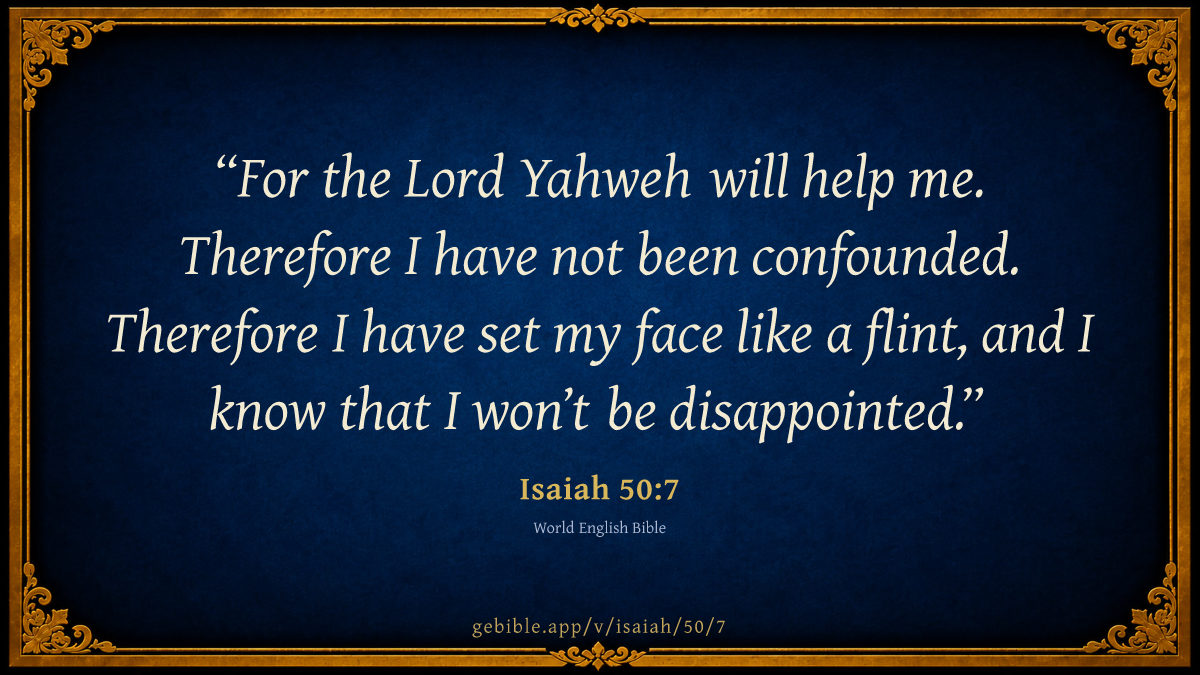
For the Lord Yahweh will help me. Therefore I have not been confounded. Therefore I have set my face like a flint, and I know that I won’t be disappointed.
Parallel Translations
-
For the Lord Yahweh will help me. Therefore I have not been confounded. Therefore I have set my face like a flint, and I know that I won’t be disappointed.
-
For the Lord GOD will help me; therefore shall I not be confounded: therefore have I set my face like a flint, and I know that I shall not be ashamed.
-
For the Lord GOD will help me; therefore have I not been confounded; therefore have I set my face like a flint, and I know that I shall not be ashamed.
Cross-references (15)
Passages linked to Isaiah 50:7 in the Treasury of Scripture Knowledge, ordered by reader-vote popularity; verse text shown in World English Bible.
- Hebrews 13:6 So that with good courage we say, “The Lord is my helper. I will not fear. What can man do to me?”
- Ezekiel 3:8-9 Behold, I have made your face hard against their faces, and your forehead hard against their foreheads. I have made your forehead as a diamond, harder than flint. Don’t be afraid of them, neither be dismayed at their looks, though they are a rebellious house.”
- John 16:33 I have told you these things, that in me you may have peace. In the world you have trouble; but cheer up! I have overcome the world.”
- Isaiah 42:1 “Behold, my servant, whom I uphold, my chosen, in whom my soul delights: I have put my Spirit on him. He will bring justice to the nations.
- Romans 1:16 For I am not ashamed of the Good News of Christ, because it is the power of God for salvation for everyone who believes, for the Jew first, and also for the Greek.
- Psalms 89:21-27 with whom my hand shall be established. My arm will also strengthen him. No enemy will tax him. No wicked man will oppress him. I will beat down his adversaries before him, and strike those who hate him. But my faithfulness and my loving kindness will be with him. In my name, his horn will be exalted. I will set his hand also on the sea, and his right hand on the rivers. He will call to me, ‘You are my Father, my God, and the rock of my salvation!’ I will also appoint him my firstborn, the highest of the kings of the earth.
- Luke 9:51 It came to pass, when the days were near that he should be taken up, he intently set his face to go to Jerusalem
- 1 Peter 4:16 But if one of you suffers for being a Christian, let him not be ashamed; but let him glorify God in this matter.
- Isaiah 49:8 Yahweh says, “I have answered you in an acceptable time. I have helped you in a day of salvation. I will preserve you and give you for a covenant of the people, to raise up the land, to make them inherit the desolate heritage,
- 1 Peter 4:1 Therefore, since Christ suffered for us in the flesh, arm yourselves also with the same mind; for he who has suffered in the flesh has ceased from sin,
- Isaiah 50:9 Behold, the Lord Yahweh will help me! Who is he who will condemn me? Behold, they will all grow old like a garment. The moths will eat them up.
- Jeremiah 1:18 For, behold, I have made you today a fortified city, an iron pillar, and bronze walls against the whole land, against the kings of Judah, against its princes, against its priests, and against the people of the land.
- Psalms 110:1 Yahweh says to my Lord, “Sit at my right hand, until I make your enemies your footstool for your feet.”
- Matthew 23:13-36 “Woe to you, scribes and Pharisees, hypocrites! For you devour widows’ houses, and as a pretense you make long prayers. Therefore you will receive greater condemnation. “But woe to you, scribes and Pharisees, hypocrites! Because you shut up the Kingdom of Heaven against men; for you don’t enter in yourselves, neither do you allow those who are entering in to enter. Woe to you, scribes and Pharisees, hypocrites! For you travel around by sea and land to make one proselyte; and when he becomes one, you make him twice as much a son of Gehenna as yourselves. “Woe to you, you blind guides, who say, ‘Whoever swears by the temple, it is nothing; but whoever swears by the gold of the temple, he is obligated.’ You blind fools! For which is greater, the gold, or the temple that sanctifies the gold? ‘Whoever swears by the altar, it is nothing; but whoever swears by the gift that is on it, he is obligated?’ You blind fools! For which is greater, the gift, or the altar that sanctifies the gift? He therefore who swears by the altar, swears by it, and by everything on it. He who swears by the temple, swears by it, and by him who has been living in it. He who swears by heaven, swears by the throne of God, and by him who sits on it. “Woe to you, scribes and Pharisees, hypocrites! For you tithe mint, dill, and cumin, and have left undone the weightier matters of the law: justice, mercy, and faith. But you ought to have done these, and not to have left the other undone. You blind guides, who strain out a gnat, and swallow a camel! “Woe to you, scribes and Pharisees, hypocrites! For you clean the outside of the cup and of the platter, but within they are full of extortion and unrighteousness. You blind Pharisee, first clean the inside of the cup and of the platter, that its outside may become clean also. “Woe to you, scribes and Pharisees, hypocrites! For you are like whitened tombs, which outwardly appear beautiful, but inwardly are full of dead men’s bones, and of all uncleanness. Even so you also outwardly appear righteous to men, but inwardly you are full of hypocrisy and iniquity. “Woe to you, scribes and Pharisees, hypocrites! For you build the tombs of the prophets, and decorate the tombs of the righteous, and say, ‘If we had lived in the days of our fathers, we wouldn’t have been partakers with them in the blood of the prophets.’ Therefore you testify to yourselves that you are children of those who killed the prophets. Fill up, then, the measure of your fathers. You serpents, you offspring of vipers, how will you escape the judgment of Gehenna? Therefore behold, I send to you prophets, wise men, and scribes. Some of them you will kill and crucify; and some of them you will scourge in your synagogues, and persecute from city to city; that on you may come all the righteous blood shed on the earth, from the blood of righteous Abel to the blood of Zachariah son of Barachiah, whom you killed between the sanctuary and the altar. Most certainly I tell you, all these things will come upon this generation.
- Luke 11:39-54 The Lord said to him, “Now you Pharisees cleanse the outside of the cup and of the platter, but your inward part is full of extortion and wickedness. You foolish ones, didn’t he who made the outside make the inside also? But give for gifts to the needy those things which are within, and behold, all things will be clean to you. But woe to you Pharisees! For you tithe mint and rue and every herb, but you bypass justice and God’s love. You ought to have done these, and not to have left the other undone. Woe to you Pharisees! For you love the best seats in the synagogues, and the greetings in the marketplaces. Woe to you, scribes and Pharisees, hypocrites! For you are like hidden graves, and the men who walk over them don’t know it.” One of the lawyers answered him, “Teacher, in saying this you insult us also.” He said, “Woe to you lawyers also! For you load men with burdens that are difficult to carry, and you yourselves won’t even lift one finger to help carry those burdens. Woe to you! For you build the tombs of the prophets, and your fathers killed them. So you testify and consent to the works of your fathers. For they killed them, and you build their tombs. Therefore also the wisdom of God said, ‘I will send to them prophets and apostles; and some of them they will kill and persecute, that the blood of all the prophets, which was shed from the foundation of the world, may be required of this generation; from the blood of Abel to the blood of Zachariah, who perished between the altar and the sanctuary.’ Yes, I tell you, it will be required of this generation. Woe to you lawyers! For you took away the key of knowledge. You didn’t enter in yourselves, and those who were entering in, you hindered.” As he said these things to them, the scribes and the Pharisees began to be terribly angry, and to draw many things out of him; lying in wait for him, and seeking to catch him in something he might say, that they might accuse him.
Cross-references from openbible.info (CC BY 4.0)
Explain this verse (16 sources)
Historical commentary, presented as a primary source — not an endorsement.
Private notes
Saved on this device only — never synced or sent anywhere.
John Trapp 1656 · Public Domain Isa 50:7 For the Lord GOD will help me;…
Isa 50:7 For the Lord GOD will help me; therefore shall I not be confounded: therefore have I set my face like a flint, and I know that I shall not be ashamed.
Ver. 7. For the Lord God will help me.] And again, Isa 50:9, "Behold, the Lord God will help me." This lively hope held head above water "Hope" we also "perfectly - or, to the end - for the grace that is to be brought unto us at the revelation of Jesus Christ." {1Pe 1:13}
Read full note →
Therefore shall I not be confounded.] Heb., Ashamed, notwithstanding the shame they seek to cast upon me. {Isa 50:6} I am as marble, to which no dirt will stick.
Therefore I have set my face as a flint.] Or, As steel (which is medulla slve nucleus ferri, saith Pliny). I have steeled my countenance. {as Luk 9:51} See Eze 3:8-9. So did Luther when he resolved to appear at Worms before the emperor, though he were sure to encounter as many devils there as were tiles upon the houses. {a} See Act 21:13.
{a} Acts and Mon., 776.
John Trapp, A Commentary or Exposition upon All the Books of the Old and New Testament (1647–1656) — public domain. Text from a community e-Sword module.
Matthew Poole 1685 · Public Domain For; or rather, But, as this particle is oft…
For; or rather, But, as this particle is oft rendered. For God’s favour is here opposed to the injuries of men.
The Lord God will help me; though as a man I am weak and inconsiderable, yet God will strengthen me to go through my great and hard work.
Read full note →
Therefore shall I not be confounded; therefore I assure myself of success in my employment, and of victory over all mine enemies.
Therefore have I set my face like a flint; I have hardened myself with resolution and courage against all opposition. So this or the like phrase is used Eze 3:8,9, which elsewhere signifies obstinacy and impudence, as Jer 5:3; Zec 7:12; so that it notes any settled and unmovable purpose, whether good or evil.
Matthew Poole's English Annotations on the Holy Bible (1683–1685) — public domain. Text from a community e-Sword/MySword module.
John Gill 1763 · Public Domain For the Lord God will help me,.... As he…
For the Lord God will help me,.... As he promised he would, and did, Psa 89:21, which is no contradiction to the deity of Christ, nor any suggestion of weakness in him; for he is the true God, and has all divine perfections in him; is equal to his Father in power, as well as in glory, and therefore equal to the work of redemption, as his other works show him to be; but this is to be understood of him as man, and expresses his strong faith and confidence in God, and in his promises as such; and in his human nature he was weak, and was crucified through weakness, and in it he was made strong by the Lord, and was held and upheld by him: and this shows the greatness of the work of man's redemption, that it was such that no mere creature could effect; even Christ as man needed help and assistance in it; and also the concern that all the divine Persons had in it:
therefore shall I not be confounded; or "made ashamed" (z); though shamefully used, yet not confounded; so as to have nothing to say for himself, or so as to be ashamed of his work; which is perfect in itself, and well pleasing to God:
Read full note →
therefore have I set my face like a flint: or like "steel" (a); or as an adamant stone, as some (b) render it; hardened against all opposition; resolute and undaunted; constant and unmoved by the words and blows of men; not to be browbeaten, or put out of countenance, by anything they can say or do. He was not dismayed at his enemies who came to apprehend him, though they came to him as a thief, with swords and staves; nor in the high priest's palace, nor in Pilate's hall, in both which places he was roughly used; nor at Satan, and his principalities and powers; nor at death itself, with all its terrors.
And I know that I shall not be ashamed, neither of his ministry, which was with power and authority; nor of his miracles, which were proofs of his deity and Messiahship; nor of his obedience, which was pure, and perfect, and pleasing to God; nor of his sufferings, which were for the sake of his people; nor of the work of redemption and salvation, in which he was not frustrated nor disappointed of his end.
(z) "non erubui", Pagniuus, Montanus; "non afficior ignominia", Junius & Tremellius, Piscator; "non pudefactus", Syr. (a) "at chalybem". Forerius. (b) "Tanquam saxum adamantinum", Junius & Tremellius, Piscator.
John Gill's Exposition of the Whole Bible (1746–1763) — public domain (CC PDM 1.0). Text via the HelloAO Bible API.
Adam Clarke 1810 · Public Domain Verse 7. Therefore have I set my face like…
Verse 7. Therefore have I set my face like a flint] The Prophet Ezekiel, Eze 2:8-9, has expressed this with great force in his bold and vehement manner:
"Behold, I have made thy face strong against their faces,
Read full note →
And thy forehead strong against their foreheads:
As an adamant, harder than a rock, have I made thy forehead;
Fear them not, neither be dismayed at their looks,
Though they be a rebellious house."
Adam Clarke's Commentary on the Bible (1810–1826) — public domain. Text from a community e-Sword/MySword module.
Joseph Benson 1811 · Public Domain Isa 50:7-9. For, or rather, but, the Lord God…
Isa 50:7-9. For, or rather, but, the Lord God will help me — Though as man I am weak, yet God will strengthen me to go through my great and hard work. Therefore shall I not be confounded — Therefore I assure myself of success in my undertaking, and of victory over all my enemies. I have set my face like a flint — I have hardened myself with resolution and courage against all opposition. See the like phrase, Eze 3:8-9. which Bishop Lowth translates as follows: “Behold I have made thy face strong against their faces, and thy forehead strong against their foreheads: as an adamant, harder than a rock, have I made thy forehead.” The expression, however, sometimes signifies obstinacy and impudence, as Jer 5:3; Zec 7:12; but here a settled and immoveable purpose to persevere in well-doing. He is near that justifieth me —
Though God seems to be at a distance, and to hide his face from me; yet he is, in truth, at my right hand, ready to help me, and will publicly acquit me from all the calumnies of mine adversaries; will clear up my righteousness, and show, by many and mighty signs and wonders, that I lived and died his faithful servant. Who is mine adversary? Let him come near to me — I challenge all my accusers to stand and appear before the Judge, and to produce all their charges against me: for I am conscious of mine own innocence, and I know that God will give sentence for me. Who is he that shall condemn me? — That dare attempt, or can justly do it? Lo, they all — Mine accusers and enemies; shall wax old as a garment — Shall pine away in their iniquity: the moth shall eat them up — They shall be cut off and consumed, by a secret curse and judgment of God, compared to a moth, Hos 5:12.
Joseph Benson's Commentary on the Old and New Testaments (1811–1818) — public domain. Text from a community e-Sword module.
Albert Barnes 1834 · Public Domain For the Lord God will help me - That…
For the Lord God will help me - That is, he will sustain me amidst all these expressions of contempt and scorn.
Shall I not be confounded - Hebrew, ‘I shall not be ashamed;’ that is, I will bear all this with the assurance of his favor and protection, and I will not blush to be thus treated in a cause so glorious, and which must finally triumph and prevail.
Read full note →
Therefore have I set my face like a flint - To harden the face, the brow, the forehead, might be used either in a bad or a good sense - in the former as denoting shamelessness or haughtiness (see the note at Isa 48:4); in the latter denoting courage, firmness, resolution. It is used in this sense here; and it means that the Messiah would be firm and resolute amidst all the contempt and scorn which he would meet, and would not shrink from any kind or degree of suffering which should be necessary to accomplish the great work in which he was engaged. A similar expression occurs in Eze 3:8-9 : ‘Behold, I have made thy face strong against their faces, and thy forehead strong against their foreheads. As an adamant, harder than a flint, have I made thy forehead; fear them not, neither be dismayed at their looks.’
Albert Barnes' Notes on the Bible (1834–1885) — public domain. Text from a community e-Sword/MySword module.
Haydock's Catholic Bible Commentary 1859 · Public Domain Rock. Christ heard the accusations of his enemies unmoved,…
Rock. Christ heard the accusations of his enemies unmoved, as the had not been afraid to blame the conduct of the Pharisees.
George Leo Haydock (1774–1849), Haydock's Catholic Family Bible and Commentary, 1859 edition — public domain. Excludes Psalms (Douay-Rheims chapter numbering differs from Protestant) and Deuterocanonical books (Catholic canon only).
Robert Jamieson, A. R. Fausset & David Brown 1871 · Public Domain Sample of His not being "discouraged" (Isa 42:4; Isa…
Sample of His not being "discouraged" (Isa 42:4; Isa 49:5).
set . . . face like . . . flint--set Myself resolutely, not to be daunted from My work of love by shame or suffering (Eze 3:8-9).
Jamieson, Fausset & Brown — Commentary Critical and Explanatory on the Whole Bible (1871) — public domain (CC PDM 1.0). Text via the HelloAO Bible API.
Daniel D. Whedon 1874 · Public Domain 7-9. But he trusts in Jehovah, and looks to…
7-9. But he trusts in Jehovah, and looks to the end with a sweetly-willing patience. No shame makes him faint-hearted.
The Lord God will help me — Assurance of hope is assurance of faith for the long future. Except in the Divine Man, no such endurance, with its long waiting, is possible to be exemplified.
Read full note →
Like a flint — He made his face as unfeeling as a flint-stone — the hardest stone known. Power of will to endure like this raises supreme admiration and supreme pity.
He is near — That is, he who justifieth; who causes to be, and at length who appears before the universe a just one. This is in antithesis with the next causative verb — to condemn, to make one a condemned man.
Let us stand together — Adjudication is invited; the contender, or adversary, is called on to do his worst. Messiah does not fear. His mission is serenely to endure. But Jehovah is near, and on his side. His cause is sure. Righteousness will at length be pronounced on him. But the adversary will fail and vanish to naught, as does the rich oriental’s wealth consisting of abundant changes of raiment which the moth preys upon and devours.
Daniel D. Whedon (gen. ed.), Commentary on the Old and New Testaments (1874–1909) — public domain. Text from a community e-Sword module.
The Cambridge Bible for Schools and Colleges 1878 · Public Domain 7. The verse is better rendered thus: But the…
7. The verse is better rendered thus: But the Lord Jehovah helps me, therefore I was not ashamed (i.e. felt no shame); therefore I made my face like flint (figure for determination, cf. Eze_3:9), and knew that I should not be put to shame. For the thought cf. ch. Isa_42:4.
The Cambridge Bible for Schools and Colleges (gen. ed. J. J. S. Perowne; Cambridge University Press, 1878–1918) — public domain. Text from a community e-Sword module.
Ellicott's Commentary for English Readers 1878 · Public Domain (7) The Lord God will help me.—That one stay…
(7) The Lord God will help me.—That one stay gives to the suffering Servant an indomitable strength. (Comp for the phrase Jer_1:18; Eze_3:9.)
A Bible Commentary for English Readers, edited by Charles John Ellicott (1878–1897) — public domain. Text from a community e-Sword module.
The Pulpit Commentary 1880 · Public Domain For the Lord God will help me; rather, but…
For the Lord God will help me; rather, but the Lord God will help me. I shall not be left always in the hands of my enemies. In this confidence the Servant rests, and is not confounded, even when the worst happens to him. He sets his face like a flint; i.e. makes it hard, impassive, expressionless, and at the same time determined, fixed not to give way. (Eze_3:8, Eze_3:9)
God"s help in time of need.
Read full note →
"For the Lord God will help me." This one assurance suffices, and gives the Servant of Jehovah an indomitable strength. "Against the crowd of mockers he places Adonai Jehovah." "Those whom God employs he will assist, and will take care they want not any help that they or their work call for. God, having laid help upon his Son for us, gave help to him, and his hand was all along with the Man of his right hand" (Matthew Henry). "Greater is he who is with us than all that can be against us." "God is my strong Salvation: What foe have I to fear?
John Ashworth, in his "Strange Tales," dwells on the satisfying fulness of the short and simple prayer, "Lord, help me!" It will fit in everywhere and to everything. It stuns up all our need. It appropriately meets us whatever may be our circumstances. In the text, the special need of Divine help is felt in the doing of God"s work. If we are resolutely set, as Christ was, upon doing and finishing just that which God has given us to do, then
I WE MAY MEET WITH INDIFFERENCE. And this is often harder to bear than opposition. Men pass us by. We are not interesting. We are a "voice crying in the wilderness." Sometimes we are behind our age, and God has bidden us remind men of things they ought not to have lost; and then they pass us by as old-fashioned. Sometimes we are called to be critics of the age in which we live; and then men pass us by because we annoy them by showing up their faults. And sometimes we are before our age, and prepare for the changes that are to come; and then men pass us by, with a smile at our unpractical talk, and call us "foolish dreamers." But we must witness on, whether men will or will not hear; and God will be sure to keep us cheerful.
II WE MAY MEET WITH OPPOSITION. Messengers for God usually do. It is a bad sign when all men speak well of them. God"s messages are always likely to offend self-seeking men, and, as a consequence, God"s messengers have to stiffer. But God"s help will tide us over all times of trial. We only have to learn the holy lesson "how great things we must suffer for his sake." God"s help is our unfailing support a "rock that cannot move." The help of God stands always waiting for us as promise. It never actually comes to us until the need has arrived for it. Then we find it is always ready. The grace is there, for the day, for every day. "We can do all things through Christ which strengtheneth us. R.T.
The Pulpit Commentary (1880–1919), ed. H.D.M. Spence-Jones & Joseph S. Exell — public domain. Text from a community e-Sword module.
The Biblical Illustrator 1887 · Public Domain For the Lord God will help Me
Isa_50:7-9
For the Lord God will help Me
Read full note →
Messiah neither ashamed nor put to shame
The verse is better rendered thus: But the Lord Jehovah helps Me, therefore I was not ashamed (i e.
, felt no shame)
; therefore I made My face like flint (figure for determination, Eze_3:9), and knew that I should not be put to shame (Isa_42:4). (Prof. J. Skinner, D.D.)
Messiah the courageous Champion
The Redeemer is as famous for His boldness as for His humility and patience; and, though He yield, yet He is more than a conqueror. Observe--
I. THE DEPENDENCE He hath upon God (Isa_50:7; Isa_50:9). Whom God employs He will assist, and will take care they want not any help that they or their work call for. Nor will He only assist Him in His work, but accept of Him (Isa_50:8). By His resurrection Christ was proved to be not the man that He was represented; not a blasphemer, etc.
II. THE CONFIDENCE He thereupon hath of success in His undertaking (Isa_50:7).
III. THE DEFIANCE which, in this confidence, He bids to all opposers and opposition. God will help Me, and therefore have I set My face like a flint. (M. Henry.)
Temptation to shame in religion
One and the same Divine Person speaks in all this section of the prophet Isaiah. One and the same Being is He, throughout this section, who speaks as I; I came, I called: One who asks, Is My hand shortened that it cannot save? and then, without break, without transition, speaks of His meritorious obedience, His sufferings, and His shame. Our Lord Himself, when prophesying of Himself the specific humiliations which are here spoken of by the prophet, speaks of them as foretold (Luk_18:31-32). But how then as to the words which follow? Our Lord came into the world to suffer; His human spirit was straitened until those sufferings were accomplished; His daily sufferings in doing the will of His Father were His daily bread. How then to Him belong those words which seem to speak of human struggle, as well as of victory: I have set My face like a flint, and I know that I shall, not, be ashamed? It is perhaps best explained by that great rule of St.
Augustine: The Lord Jesus Christ is the Head of the Body. For He willed to speak too in us, who vouchsafed to die for us. He made us His members. Sometimes therefore He speaks in the person of His members; sometimes in His own Person, as our Head; and the whole He speaketh, as though it were one Person. The words of prophecy seem to be tempered, so as to include us His members, nay rather to speak of our victories in Christ, and of our strength supplied by Him, the Christians unashamed boldness in the cause of Christ. Those holily unashamed of God now, God will keep from shame: on those ashamed of Him, He will bring the shame they shrink from. It is startling to see how, in the account of the last severing off of those who are cast out for ever from the sight of God, the first place is occupied by cowards (Rev_21:7-8). There must, then, be something far more malignant, far more offensive to God, and more destructive to salvation, than men think of, in this false shame before men. And yet no one scarcely gives it more than a passing thought; few question earnestly their own consciences about it; few repent of it towards God, or ask His forgiveness of it. It is of moment to know the intensity of the first temptation. First, men cowardly disavow what they know to be right; then they profess what they know to be wrong; then, having disavowed God, they are open to temptation, from whatever quarter of occasion, or surprise, or passion, the impulse may come. They have kindled their fire: they have despised the grace which would quench it: it remains, that it should consume them. And yet, while its influence is so subtle, that it escapes mens observation, unless they are declaring war against it, it is the earliest, the latest, the most infectious, the most universal, the most overspreading, the deadliest disease of the soul. It antedates passion, and it outlives it; it occasions countless sins, but itself is hid under the sins which it occasions; it destroys the goodness of all which seems good, hut is unfelt like paralysis; it nips all wakening good, but is unseen like the frost-wind; it pleads a hatred of hypocrisy and of profession, and is itself the worse hypocrisy of the two, a hypocrisy of evil; to the young, it puts on the appearance of good-nature; to the elder, of courtesy; to the saint, of charity: nothing is too low, nothing too high for its attacks. The senselessness of the sin aggravates its enormity. What is it, of which man is ashamed? It is (and this is a yet deeper aggravation), it is uniformly some gift or grace of Almighty God. In childhood, it was some early habit of piety, which God had vouchsafed to teach, which others had not been taught or had violated. The phases of the sin change with changing years; its essence is unchanged. It is the law of God, or the truth of God, or the friendship of God, and God Himself in all, of whom man stands ashamed before man. And what is this world, before which a man stands ashamed of the Infinite God? Away with such cowardly thoughts of worshipping God, as a sort of Penates, a household god who is to be owned in private and set up within doors, to receive his lip-homage there, and be forgotten or ignored in the face of men. Accustom thyself to the thought of the ever-present Presence of thy God; look to that Eye which recalled Peter to Himself, and which rests on thee; be ashamed to be ungrateful to thy Redeemer, a recreant to thy God; and another fear will displace human fear, another shame will dispel human shame, a shame which maketh not ashamed, a shame which is the earnest of everlasting glory, the shame to be ashamed of thy God. (E. B. Puscy, D. D.)
Therefore have I set My face like a flint
I set My face like a flint
I set My face like a flint the holy hardness of perseverance (Stier)
;--words, too, which doubtless have a special reference to the historic fulfilment. When the time was come that He should be received up, He Steadfastly set His face (as a flint) to go to Jerusalem (Luk_9:51). (Michaelis.)
The strong will
The happiest of gifts for a man to be born with is strength of will; not that a man can by it avoid suffering and sin; but for this--that suffering especially raises and heightens the strong will; that when itforsakes sin it forsakes it without a sigh. Happiness within, attractiveness towards others, ease of repentance and amendment, firmness against opposition, are the splendid dower which the strong will brings to the soul. It is our wisdom then to ask, How shall we keep or make our wills strong?
1. We cannot do this merely by persisting in having our own way, as we call it. Our own way may be wrong; and no one ever uses the strength in connection with crime or fault--never calls a sinful, a wilful, a violent man a strong man. The reason is evident, namely, that wilful sinning is only using a will in the direction in which it is easiest to use it. And this cannot make the will stronger, any more than a mind would grow strong, which employed itself only on intellectual work which presented no difficulty to it. The will must make progress by avoiding things to which it is prone, and by aiming at things which it simply knows in any way to be good, although for the time being it may be that they are not fully desired.
2. There are times when there rises before us a noble ideal of what we ought to be, and we feel an impulse to believe we might be. What is that ideal? It is the will of God concerning us. It is what we may each become by the power of the Spirit of God. Into this ideal we cannot at once pass. But we can be ever approaching it. It is not in human nature to make that sudden change, but it is perfectly possible to make a beginning. And for this purpose we must call in the aid of that very will itself to act upon our will; for there is no power in us higher, more primary, than the will. If the will is to be affected, the will itself must do the work. Suppose one resolve be made; then here at once our will begins to be of constant use to us, and to grow stronger in itself. Our will is not really acting at all when it is working out, however strongly, a natural inclination. The will is only strengthened when it is set to active work, something which we have clearly seen to be our duty, although when we come to do it we find the pursuit of it tax our strength exceedingly. (Archbishop Benson, D.D.)
The Redeemers face set like a flint
I. HOW HIS STERN RESOLVE WAS TESTED.
1. By the offers of the world. The populace wanted to take Him by force and make Him a king.
2. By the persuasions of His friends. Christs kinsmen said that He was beside Himself, and they would have laid hold of Him, and confined Him if they could. They thought His zeal had carried Him beyond the bounds of reason; and when He told His disciples about His approaching death upon the cross, Peter took Him, and began to rebuke Him, saying, Be it far from Thee, Lord: this shall not be unto Thee; and all the disciples would fain have persuaded Him to choose an easier path than that which led to Calvary, and the grave.
3. By the unworthiness of His clients. He came unto His own, etc.
4. By the bitterness which He tasted at His entrance upon His great work as our substitutionary sacrifice. The first drops of that awful tempest which fell upon Him in Gethsemane were hot and terrible.
5. By the ease with which He could have relinquished the enterprise if He had wished to do so.
6. By the taunts of those who scoffed at Him.
7. By the full stress of the death-agony.
II. HOW HIS STEADFAST RESOLVE WAS SUSTAINED. According to our text and its connection--
1. Our Lords steadfastness resulted from His Divine schooling (Isa_50:4).
2. It was sustained by His conscious innocence (Isa_50:8).
3. It was maintained by His unshaken confidence in the help of God (Isa_50:7).
4. It was sustained by the joy that was set before Him (Heb_12:2).
III. CHRISTS STEADFAST RESOLVE IMITATED.
1. If there is anything right in this world, be on the side of it.
2. If you have a right purpose that glorifies God, carry it out. (C. H.Spurgeon.)
Courage in danger
Leonidas being told that the Persian archers with whom he had to fight were so numerous that their arrows would darken the sun, said, So much the better; we shall then fight in the shade. (R. Macculloch.)
Fixed determination: Joan of Arc
It was in vain that her father, when he heard her purpose, swore to drown her ere she should go to the field with men-at-arms: it was in vain that the priest, the wise people of the village, the captain of Vancoulers doubted and refused to aid her. I must go to the king, persisted the peasant girl, even if I wear my limbs to the very knees. I had far rather rest and spin by my mothers side, she pleaded, with a touching pathos, for this is no work of my choosing; but I must go and do it, for my Lord wills it. And who, they asked, is your Lord? He is God. Words such as these touched the rough captain at last; he took Jeanne by the hand, and swore to lead her to the king. (J. R. Green.)
The Biblical Illustrator, edited by Joseph S. Exell (c. 1880s–1900s) — public domain. Text from a community e-Sword module.
Alexander MacLaren 1905 · Public Domain
Isaiah
THE SERVANT’S INFLEXIBLE RESOLVE
Read full note →
Isa 50:7.
What a striking contrast between the tone of these words and of the preceding! There all is gentleness, docility, still communion, submission, patient endurance. Here all is energy and determination, resistance and martial vigour. It is like the contrast between a priest and a warrior. And that gentleness is the parent of this boldness. The same Will which is all submission to God is all resistance in the face of hostile men. The utmost lowliness and the most resolved resistance to opposing forces are found in that prophetic image of the Servant of the Lord-even as they are found in the highest degree and most perfectly in Jesus Christ.
The sequence in this context is worth noting. We had first Christ’s communion with God and communications from the Father; then the perfect submission of His Will; then that submission expressed in His voluntary sufferings; and now we have His immovable steadfastness of resistance to the temptation, which lay in these sufferings, to depart from His attitude of submission, and to abandon His work.
The former verse led us up to the verge of the great mystery of His sacrificial death. This gives us a glimpse into the depths of His human life, and shows Him to us as our example in all holy heroism.
I. The need which Christ felt to exercise firm resistance.
The words of the text are found almost reproduced in Jer 1:1 - Jer 1:19 and Eze 3:1 - Eze 3:27 All prophets and servants of God have had thus to resist, and it would be superfluous to show how resistance to opposing influences is the condition of all noble life and of all true service.
But was it so with Him? The more accurate translation of the second clause of our text is to be noticed: ‘Therefore I will not suffer Myself to be overcome by the shame.’
Then the shame had in it some tendency to divert Him from His course. Christ’s humanity felt natural human shrinking from pain and suffering. It shrank from the contempt and mockery of those around Him, and did so with especial sensitiveness because of His pure and sinless nature, His yearning sympathy, the atmosphere of love in which He dwelt, His clear sight of the sin, and His prevision of the consequent sorrow. If so, His sufferings did appeal to His human nature and constituted a temptation.
At the beginning the Tempter addressed himself to natural desires to procure physical gratification {bread}, and to the equally natural desire to avoid suffering and pain, and to secure His kingdom by an easier method {‘All these will I give Thee, if-’}.
And the latter temptation attended Him all through His life, and was most insistent at its close. The shadow of the cross stretched along His path from its beginning. But it is to be remembered that he had not the same need of self-control which we have, in that His Will was not reluctant, and that no rebellious desires had escaped from its control and needed to be reduced to submission. ‘I was not rebellious.’ ‘The spirit is willing but the flesh is weak’ was true in the fullest extent only of Him. So the context gives us His perfect submission of will, and yet the need to harden His face toward externals from which, instinctively and without breach of filial obedience, His sensitive nature recoiled. The reality of the temptation, the limits of its reach, His consciousness of it, and His immovable obedience and resistance, are all expressed in the deep and wonderful words, ‘If it be possible, let this cup pass from Me, nevertheless not as I will, but as Thou wilt.’
II. The perfect inflexible resolve.
‘Face like a flint’ seems to be quoted in Luk 9:51; ‘Steadily set His face.’ The whole story of the Gospels gives the one impression of a life steadfast in its great resolve. There are no traces of His ever faltering in His purpose, none of His ever suffering Himself to be diverted from it, no parentheses and no digressions. There are no blunders either. But what a contrast in this respect to all other lives! Mark’s Gospel, which is eminently the gospel of the Servant, is full of energy and of this inflexible resolve, which speak in such sayings as ‘I must be about My Father’s business’; ‘I must work the works of My Father while it is day.’ That last journey, during which He ‘steadfastly set His face to go to Jerusalem,’ is but a type of the whole. Christ’s life was a continuous or rather a continually repeated effort.
This inflexible resolve is associated in Him with characteristics not usually allied with it. The gentleness of Christ is so obvious in His character that little needs to be said to point it out. To the influence of His character more than to any other cause may be traced the change in the perspective, so to speak, of Virtue, which characterises modern notions of perfection as contrasted with antique ones. Contrast the Greek and Roman type with the mediaeval ascetic, or with the philanthropic type of modern times. Carlyle’s ideal is retrograde and an anachronism. Women and patient sufferers find example in Him. But we have in Jesus Christ, too, the highest example of all the stronger and robuster virtues, the more distinctly heroic, masculine; and that not merely passive firmness of endurance such as an American Indian will show in torments, but active firmness which presses on to its goal, and, immovably resolute, will not be diverted by anything. In Him we see a resolved Will and a gentle loving Heart in perfect accord. That is a wonderful combination. We often find that such firmness is developed at the expense of indifference to other people. It is like a war chariot, or artillery train, that goes crashing across the field, though it be over shrieking men and broken bones, and the wheels splash in blood. Resolved firmness is often accompanied with self-absorption which makes it gloomy, and with narrow limitations. Such men gather all their powers together to secure a certain end, and do it by shutting the eyes of their mind to everything but the one object, like the painter, who blocks up his studio window to get a top light, or as a mad bull lowers his head and blindly rushes on.
There is none of all this in Christ’s firmness. He was able at every moment to give His whole sympathy to all who needed it, to take in all that lay around Him, and His resolute concentration of Himself on His work made Him none the less perfect in all which goes to make up complete manhood. Not only was Christ’s firmness that of a fixed Will and a most loving Heart, like one of these ‘rocking stones,’ whose solid mass can be set vibrating by a poising bird, but the fixed Will came from the loving Heart. The very compassion and pity of His nature led to that resolved continuance in His path of redeeming love, though suffering and mockery waited for Him at each turn.
And so He is the Joshua, the Warrior-King, as well as the Priest. That Face, ever ready to kindle into pity, to melt into tenderness, to express every shade of tender feeling, was ‘set as a flint.’ That Eye, ever brimming with tears, was ever fixed on one goal. That Character is the type of all strength and of all gentleness.
III. The basis of Christ’s fixed resolve in filial confidence.
‘The Lord God will help Me.’ So Christ lived by faith.
That faith led to this heroic resistance and immovable resolution.
That confidence of divine help was based upon consciousness of obedience.
It is most blessed for us to have Him as our example of faith and of brave opposition to all the antagonistic forces around us. But we need more than an example. He will but rebuke our wavering purposes of obedience, if He is no more than our pattern. Thank God, He is more, even our Fountain of Power, from Whom we can draw life akin to, because derived from, His own. In Him we can feel strength stealing into flaccid limbs, and gain ‘the wrestling thews that throw the world.’ If we are ‘in Christ’ and on the path of duty, we too may be able to set our faces as a flint, and to say truthfully: ‘None of these things move me, neither count I my life dear to myself, that I may finish my course with joy.’ And yet we may withal be gentle, and keep hearts ‘open as day to melting charity,’ and have leisure and sympathy to spare for every sorrow of others, and a hand to help and ‘sustain him that is weary.’
Alexander MacLaren, Expositions of Holy Scripture (1904–1910) — public domain. Text from a community e-Sword module.
unfoldingWord translationNotes 2017 · CC BY-SA 4.0 General Information:
General Information:
Yahweh's servant continues speaking.
Read full note →
therefore I am not disgraced
Even though the servant has been mistreated, he will not be ashamed because he has obeyed Yahweh. This can be stated in active form. AT: "therefore I will not be ashamed" (See: Active or Passive)
so I have made my face like flint
Here "my face" refers to the servant. The servant being steadfastly determined to obey Yahweh is spoken of as if his face were as hard as flint. AT: "so I am absolutely determined" (See: Synecdoche and Metaphor)
for I know that I will not be put to shame
The servant looks to the future with confidence, secure in Yahweh's calling. This can be stated in active form. AT: "for I know that my enemies will not be able to make me feel shame" (See: Active or Passive)
translationWords
Lord Yahweh
face
shame
unfoldingWord translationNotes — © Distant Shores Media and the Door43 World Missions Community, licensed CC BY-SA 4.0. Source: git.door43.org/Door43/en_tn.
Tyndale Open Study Notes 2022 · CC BY-SA 4.0 50:7 Externally, the servant would be disgraced and put…
50:7 Externally, the servant would be disgraced and put to shame, but within himself he would calmly await God’s vindication (see 29:22; 54:4; 61:7). • set my face like a stone: The servant would be determined to do God’s will (see Luke 9:51).
Tyndale Open Study Notes — © Tyndale Open Resources, licensed CC BY-SA 4.0. Text via the HelloAO Bible API.