
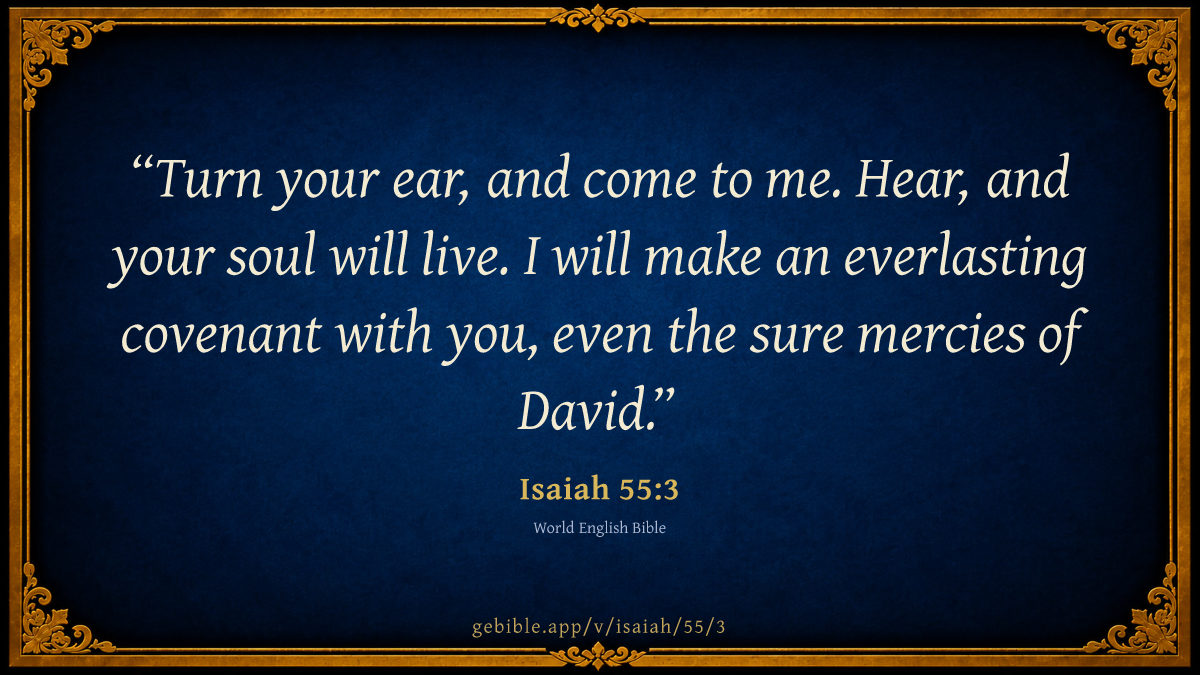
Turn your ear, and come to me. Hear, and your soul will live. I will make an everlasting covenant with you, even the sure mercies of David.
Parallel Translations
-
Turn your ear, and come to me. Hear, and your soul will live. I will make an everlasting covenant with you, even the sure mercies of David.
-
Incline your ear, and come unto me: hear, and your soul shall live; and I will make an everlasting covenant with you, even the sure mercies of David.
-
Incline your ear, and come unto Me; hear, and your soul shall live; and I will make an everlasting covenant with you, even the sure mercies of David.
Cross-references (29)
Passages linked to Isaiah 55:3 in the Treasury of Scripture Knowledge, ordered by reader-vote popularity; verse text shown in World English Bible.
- Jeremiah 32:40 I will make an everlasting covenant with them, that I will not turn away from following them, to do them good. I will put my fear in their hearts, that they may not depart from me.
- Proverbs 4:20 My son, attend to my words. Turn your ear to my sayings.
- Matthew 11:28 “Come to me, all you who labor and are heavily burdened, and I will give you rest.
- John 10:27 My sheep hear my voice, and I know them, and they follow me.
- Acts 13:34 “Concerning that he raised him up from the dead, now no more to return to corruption, he has spoken thus: ‘I will give you the holy and sure blessings of David.’
- Genesis 17:7 I will establish my covenant between me and you and your offspring after you throughout their generations for an everlasting covenant, to be a God to you and to your offspring after you.
- Isaiah 61:8 “For I, Yahweh, love justice. I hate robbery and iniquity. I will give them their reward in truth and I will make an everlasting covenant with them.
- Psalms 78:1 Hear my teaching, my people. Turn your ears to the words of my mouth.
- John 5:24-25 “Most certainly I tell you, he who hears my word and believes him who sent me has eternal life, and doesn’t come into judgment, but has passed out of death into life. Most certainly I tell you, the hour comes, and now is, when the dead will hear the Son of God’s voice; and those who hear will live.
- John 6:37 All those whom the Father gives me will come to me. He who comes to me I will in no way throw out.
- Leviticus 18:5 You shall therefore keep my statutes and my ordinances, which if a man does, he shall live in them. I am Yahweh.
- Psalms 89:28 I will keep my loving kindness for him forever more. My covenant will stand firm with him.
- Psalms 89:35-37 Once I have sworn by my holiness, I will not lie to David. His offspring will endure forever, his throne like the sun before me. It will be established forever like the moon, the faithful witness in the sky.”
- Isaiah 54:8 In overflowing wrath I hid my face from you for a moment, but with everlasting loving kindness I will have mercy on you,” says Yahweh your Redeemer.
- 2 Samuel 7:8-17 Now therefore tell my servant David this, ‘Yahweh of Armies says, “I took you from the sheep pen, from following the sheep, to be prince over my people, over Israel. I have been with you wherever you went, and have cut off all your enemies from before you. I will make you a great name, like the name of the great ones who are in the earth. I will appoint a place for my people Israel, and will plant them, that they may dwell in their own place, and be moved no more. The children of wickedness will not afflict them any more, as at the first, and as from the day that I commanded judges to be over my people Israel. I will cause you to rest from all your enemies. Moreover Yahweh tells you that Yahweh will make you a house. When your days are fulfilled, and you sleep with your fathers, I will set up your offspring after you, who will proceed out of your body, and I will establish his kingdom. He will build a house for my name, and I will establish the throne of his kingdom forever. I will be his father, and he will be my son. If he commits iniquity, I will chasten him with the rod of men, and with the stripes of the children of men; but my loving kindness will not depart from him, as I took it from Saul, whom I put away before you. Your house and your kingdom will be made sure forever before you. Your throne will be established forever.” ’ ” Nathan spoke to David all these words, and according to all this vision.
- 2 Samuel 23:5 Isn’t my house so with God? Yet he has made with me an everlasting covenant, ordered in all things, and sure, for it is all my salvation, and all my desire, although he doesn’t make it grow.
- Psalms 119:112 I have set my heart to perform your statutes forever, even to the end.
- Jeremiah 30:9 but they will serve Yahweh their God, and David their king, whom I will raise up to them.
- Jeremiah 33:20-21 “Yahweh says: ‘If you can break my covenant of the day and my covenant of the night, so that there will not be day and night in their time; then may my covenant also be broken with David my servant, that he won’t have a son to reign on his throne; and with the Levites the priests, my ministers.
- Jeremiah 33:26 then I will also cast away the offspring of Jacob, and of David my servant, so that I will not take of his offspring to be rulers over the offspring of Abraham, Isaac, and Jacob: for I will cause their captivity to be reversed and will have mercy on them.”
- Jeremiah 50:5 They will inquire concerning Zion with their faces turned toward it, saying, ‘Come, and join yourselves to Yahweh in an everlasting covenant that will not be forgotten.’
- Ezekiel 37:24-25 “ ‘ “My servant David will be king over them. They all will have one shepherd. They will also walk in my ordinances, and observe my statutes, and do them. They will dwell in the land that I have given to Jacob my servant, in which your fathers lived. They will dwell therein, they, and their children, and their children’s children, forever. David my servant will be their prince forever.
- Matthew 17:5 While he was still speaking, behold, a bright cloud overshadowed them. Behold, a voice came out of the cloud, saying, “This is my beloved Son, in whom I am well pleased. Listen to him.”
- John 8:47 He who is of God hears the words of God. For this cause you don’t hear, because you are not of God.”
- Hebrews 13:20 Now may the God of peace, who brought again from the dead the great shepherd of the sheep with the blood of an eternal covenant, our Lord Jesus,
- Matthew 13:16 “But blessed are your eyes, for they see; and your ears, for they hear.
- John 6:44-45 No one can come to me unless the Father who sent me draws him, and I will raise him up in the last day. It is written in the prophets, ‘They will all be taught by God.’ Therefore everyone who hears from the Father and has learned, comes to me.
- John 7:37 Now on the last and greatest day of the feast, Jesus stood and cried out, “If anyone is thirsty, let him come to me and drink!
- Romans 10:5 For Moses writes about the righteousness of the law, “The one who does them will live by them.”
Cross-references from openbible.info (CC BY 4.0)
Explain this verse (17 sources)
Historical commentary, presented as a primary source — not an endorsement.
Private notes
Saved on this device only — never synced or sent anywhere.
Geneva Bible translators 1599 · Public Domain The same covenant which through my mercy I ratified…
The same covenant which through my mercy I ratified and confirmed to David, that it should be eternal, 2 Sam. 7:13; Acts 13:34.
Geneva Bible (1599) marginal notes — public domain.
John Trapp 1656 · Public Domain Isa 55:3 Incline your ear, and come unto me:…
Isa 55:3 Incline your ear, and come unto me: hear, and your soul shall live; and I will make an everlasting covenant with you, [even] the sure mercies of David.
Ver. 3. Incline your ear.] Hear with all your might. Alphonsus, King of Arragon, is renowned for his attentive hearing; so is our King Edward VI, who usually stood and took notes on all the sermon. Origen chideth his hearers for nothing so much as for their seldom coming to hear God’s Word, and for their careless and heedless hearing it when they did come; whence their slow growth in godliness.
Read full note →
Hear, and your souls shall live.] God hath ordained - as it were to cross the devil - that as death entered into the world through the ear, by our first parents listening to that old man-slayer, so should life enter into the soul by the same door, as it were. "The dead shall hear the voice of the Son of God, and they that hear shall live." {Joh 5:25} The Romanists hold not hearing so absolutely needful - the mass only they make a work of duty, but the going to sermons but a matter of convenience, and such as is left free to men’s leisures and opportunities without imputation of sin. {a}
And I will make an everlasting covenant with you.] Heb., I will cut out unto them a covenant of perpetuity. A covenant is a cluster of promises solemnly made over.
Even the sure mercies of David.] Or, Firm, faithful. The Greek {Act 13:34} hath it, "The holy things," or the "venerable things of David," that is, of Christ, for the ratifying and assuring whereof it was necessary that Christ should rise from death and enter into glory; for which purpose Paul allegeth this text. See Act 13:34.
{a} Spec. Europ.
John Trapp, A Commentary or Exposition upon All the Books of the Old and New Testament (1647–1656) — public domain. Text from a community e-Sword module.
Matthew Poole 1685 · Public Domain Hear; hearken attentively and obediently to my counsel; hearing…
Hear; hearken attentively and obediently to my counsel; hearing being oft put for obeying, as Deu 18:15; 1Sa 15:22,23; Psa 95:7, &c.
Your soul shall live, to wit, comfortably and happily; which only is worthy of the name of life. I will make an everlasting covenant with you; that everlasting covenant of grace and peace which I made with Abraham, and his seed the Israelites, I am ready to make it with every one of you thirsting Gentiles.
Read full note →
Even the sure mercies of David; even that covenant which was made first with Abraham, and then with David, concerning the exhibition of those glorious and sure mercies or blessings which God hath promised to his people, one and the chief of which mercies was the giving of Christ to die for their sins, and to rise again for their justification. This exposition may receive light and strength by comparing this place with Act 13:33,34. He mentions David rather than Abraham, either,
1. Because these promises, and especially that great promise, which is the foundation of the rest, concerning Christ and his eternal kingdom, were far more frequently, and expressly, and fully made and revealed to David than they were to Abraham. Or,
2. Because David was a more evident and illustrious type of Christ than Abraham was, as being raised from a mean condition to the highest honour, being made a great and most victorious and righteous king, and the first king of that throne upon which the Messiah was to sit. Or,
3. Because the name of David is not here put personally for the king of that name, but patronymically for the Messiah, who was to be David’s Son and successor, and who is therefore called David in the prophetical scriptures, as Jer 30:9; Eze 34:23,24; 37:24,25; Ho 3:5; as Rehoboam upon the same account is called David, 1Ki 12:16. And this is the more probable, because the next verse, which hath a manifest relation to this verse, is confessedly understood of Christ.
Matthew Poole's English Annotations on the Holy Bible (1683–1685) — public domain. Text from a community e-Sword/MySword module.
John Gill 1763 · Public Domain Incline your ear, and come unto me,.... The exhortations…
Incline your ear, and come unto me,.... The exhortations are repeated, to show the importance of them, how welcome these persons were to the Lord, and to his house, and his earnest and tender care and concern for them:
hear, and your soul shall live; or, "that your soul may live (f)"; spiritually and eternally. There must be life before hearing; men must be made alive before they can come to Christ spiritually, or hear his word so as to have a spiritual understanding of it, or savingly believe it; but the meaning is, that by coming and hearing the word of the Lord, they should have something to live upon, good, solid, substantial food; and that they should live comfortably and plentifully, and that for ever. It was reckoned a great absurdity in Sunlungus, a Chinese philosopher, who asserted (g) that a man had three ears, one different from the two that are seen; it is true in a spiritual sense.
Read full note →
And I will make an everlasting covenant with you; which is to be understood not of the covenant of works, nor of the covenant of circumcision, nor of the Sinai covenant; but of the covenant of grace, which is an "everlasting one"; it is from everlasting, being founded in the everlasting love of God, is according to his eternal purposes; Christ is the Mediator of it, who as such was set up from everlasting, and the promises and blessings of it were so early put into his hands; and it will continue to everlasting, sure, firm, unalterable, and immovable. This, properly speaking, was made with Christ from all eternity, and his people in him; it is made manifest to them at conversion, when they are shown it, and their interest in it; when God makes himself known to them as their covenant God, and Christ as the Mediator of it is revealed to them; when the Lord puts his Spirit into them, and makes them partakers of the grace of it; shows them their interest in the blessings of it, and opens and applies the promises of it unto them; and these are made manifest in the ministration of the Gospel, and in the administration of ordinances: even "the sure mercies of David"; that is, the Messiah, the son of David, and his antitype, whence he is often called by his name, Eze 34:23, and so Aben Ezra, Kimchi, and others (h), interpret it. The blessings of the covenant are called "mercies", because they spring from the mercy of God, as redemption, pardon of sin, regeneration, salvation, and eternal life; and they are the mercies of David, or of Christ, for the promises of them were made to him, and the things themselves put into his hands, and are ratified and confirmed by his blood, and through him come to his people: and these are "sure", firm, and steadfast, through the faithfulness and holiness of God, who has given them to Christ; through being in a covenant ordered in all things and sure; and also being in the hands of Christ, in whom the promises are yea and amen, and the blessings sure to all the seed; see Act 13:34, Act 13:34.
(f) "ut vivat", Junius & Tremellius, Vitringa. (g) Martin. Hist. Sinic. l. 4. p. 170. (h) Abarbinel, Mashmiah Jeshuah, fol. 26, 1.
John Gill's Exposition of the Whole Bible (1746–1763) — public domain (CC PDM 1.0). Text via the HelloAO Bible API.
John Wesley 1765 · Public Domain An everlasting covenant - That everlasting covenant of grace…
An everlasting covenant - That everlasting covenant of grace and peace which I made with Abraham, and his seed. Of David - Even that covenant which was made first with Abraham, and then with David, concerning those glorious and sure blessings which God hath promised to his people, one and the chief of which was giving Christ to die for their sins. David here seems to be put for the son of David.
John Wesley, Explanatory Notes Upon the Whole Bible (1754–1765) — public domain. Text via the GEBible commentary corpus.
Adam Clarke 1810 · Public Domain Verse 3. I will make an everlasting covenant] Heb.…
Verse 3. I will make an everlasting covenant] Heb. אכרתה לכם ברית עולם echrethah lachem berith olam, "I will cut the old or everlasting covenant sacrifice with you." That covenant sacrifice which was pointed out of old from the very beginning; and which is to last to the consummation of ages; viz., the Lamb of God that was slain from the foundation of the world.
The sure mercies of David] That is, says Kimchi, "The MESSIAH," called here David; as it is written, "David my servant shall be a prince over you."
Adam Clarke's Commentary on the Bible (1810–1826) — public domain. Text from a community e-Sword/MySword module.
Albert Barnes 1834 · Public Domain Hear, and your soul shall live - That is,…
Hear, and your soul shall live - That is, if you attend to my command and embrace my promises, you shall live. Religion in the Scriptures is often represented as life Joh 5:40; Joh 6:33; Joh 8:13; Joh 20:31; Rom 5:17-18; Rom 6:4; Rom 8:6; 1Jo 5:12; Rev 2:7-10. It stands opposed to the death of sin - to spiritual and eternal death.
And I will make an everlasting covenant with you - On the word ‘covenant,’ see the notes at Isa 28:18; Isa 42:6; Isa 49:8. Here it means that God would bind himself to be their God, their protector, and their friend. This covenant would be made with all who would come to him. It would not be with the nation of the Jews, as such, or with any community, as such, but it would be with all who should embrace the offers of life and salvation.
Read full note →
Even the sure mercies of David - I will confirm to you, and fulfill in you, the solemn promises made to David. The transaction here referred to is that which is celebrated in Psa 89:2-4 :
For I have said, mercy shall be built up forever;
Thy faithfulness hast thou established in the very heavens.
I have made a covenant with my chosen,
I have sworn unto David my servant,
Thy seed will I establish forever,
And build up thy throne to all generations.
A kingdom had thus been promised to David, and he had been assured that the true religion should flourish among those who were to succeed him in Israel. The prophet here says that this solemn promise. would be fulfilled in those who should embrace the Messiah, and that God would ratify with them this covenant. The word rendered here ‘mercies’ (חסד chesed), properly means kindness, goodwill, pity, compassion; then goodness, mercy, grace. The word rendered ‘sure,’ denotes that which is established, or confirmed; that in which confidence may be placed. The whole expression denotes that the covenant made with David was one which promised great favors, and was one which was not to be abrogated, but which was to be perpetual. With all who embraced the Messiah, God would enter into such an unchanging and unwavering covenant - a covenant which was not to be revoked.
Albert Barnes' Notes on the Bible (1834–1885) — public domain. Text from a community e-Sword/MySword module.
Haydock's Catholic Bible Commentary 1859 · Public Domain David. I will be equally faithful to you, Psalm…
David. I will be equally faithful to you, Psalm lxxxviii. 29. Septuagint, "the holy things of David faithful," Acts xiii. 34. The resurrection of Christ fully accomplished the promise made to David.
George Leo Haydock (1774–1849), Haydock's Catholic Family Bible and Commentary, 1859 edition — public domain. Excludes Psalms (Douay-Rheims chapter numbering differs from Protestant) and Deuterocanonical books (Catholic canon only).
Robert Jamieson, A. R. Fausset & David Brown 1871 · Public Domain me . . . live--by coming to me ye…
me . . . live--by coming to me ye shall live: for "I am the life" (Joh 14:6).
everlasting covenant-- (Jer 32:40; Sa2 23:5).
Read full note →
with you . . . David--God's covenant is with the antitypical David, Messiah (Eze 34:23), and so with us by our identification with Him.
sure--answering to "everlasting," irrevocable, unfailing, to be relied on (Psa 89:2-4, Psa 89:28-29, Psa 89:34-36; Jer 33:20-21; Sa2 7:15-16; Co2 1:18-20).
mercies of David--the mercies of grace (Isa 63:7; Joh 1:16) which I covenanted to give to David, and especially to Messiah, his antitype. Quoted in Act 13:34.
Jamieson, Fausset & Brown — Commentary Critical and Explanatory on the Whole Bible (1871) — public domain (CC PDM 1.0). Text via the HelloAO Bible API.
Daniel D. Whedon 1874 · Public Domain 3. This invitation is followed by a yearning call…
3. This invitation is followed by a yearning call upon every one to be a partaker in the whole mass of gospel blessings embraced in the covenant made with David; a covenant made first with Abraham, and renewed with David; a covenant promise of Christ in all his humiliations, and ending with a crowned Christ, a kingly Messiah, exulting in royal victories, and a redeemed, completely redeemed, Church.
Daniel D. Whedon (gen. ed.), Commentary on the Old and New Testaments (1874–1909) — public domain. Text from a community e-Sword module.
The Cambridge Bible for Schools and Colleges 1878 · Public Domain 3–5. The offer of Isa_55:1-2 is summed up in…
3–5. The offer of Isa_55:1-2 is summed up in the promise of an everlasting covenant. see ch. Isa_42:6, Isa_49:8; and cf. Isa_61:8; Jer_32:40; Jer_31:31-33.
Incline your ear &c.] The condition imposed is simply the consent and submission of the heart to the divine will.
Read full note →
an everlasting covenant … the sure mercies of David] i.e. the mercies (lovingkindnesses) irrevocably promised to David and his house. Comp. the “Last Words of David,” 2Sa_23:5 (“an everlasting covenant ordered in all things and secured”), Psa_18:50 (“shewing lovingkindness … to David and to his seed for ever”), Psa_89:28 (“for ever will I keep my lovingkindness to him, and my covenant is sure to him”), and Psa_89:49; and the great promise to which all these passages point, 2Sa_7:8-16. The comparison of the everlasting covenant to these Davidic “mercies” cannot mean simply that the one is as sure as the other. It is identity rather than comparison that is implied, the idea being that the contents of the covenant are the same as the mercies promised to David, and that it will be the fulfilment of the hopes that clustered round the Davidic dynasty. But an intricate question arises with respect to the sense in which this fulfilment is to be understood in the next two verses.
The Cambridge Bible for Schools and Colleges (gen. ed. J. J. S. Perowne; Cambridge University Press, 1878–1918) — public domain. Text from a community e-Sword module.
Ellicott's Commentary for English Readers 1878 · Public Domain (3) Your soul shall live . . .—Better, revive.…
(3) Your soul shall live . . .—Better, revive. The idea is that of waking to a new life.
I will make an everlasting covenant . . .—The words find their explanation in the “new covenant” of Jer_31:31, Luk_22:20, but those which follow show that it is thought of as the expansion and completion of that which had been made with David (2Sa_7:12-17; Psa_89:34-35), as the representative of the true King, whom Isaiah now contemplates as identical with the “servant of the Lord.” For “sure mercies” read the unfailing loving-kindnesses, which were “of David,” as given to him and to his seed by Jehovah.
A Bible Commentary for English Readers, edited by Charles John Ellicott (1878–1897) — public domain. Text from a community e-Sword module.
The Pulpit Commentary 1880 · Public Domain Come unto me (comp. ver. 1, "Come ye to…
Come unto me (comp. ver. 1, "Come ye to the waters"). God dispenses the waters. (see Isa_44:3) I will make an everlasting covenant with you. That the "everlasting covenant" once made between God and man had been broken by man, and by Israel especially, is a part of the teaching contained in the earlier portion of Isaiah. (Isa_24:5) We find the same asserted in the prophecies of his contemporary, Hosea. (Hos_6:7) It would naturally follow from this that, unless God gave up man altogether, he would enter into a new covenant with him. Accordingly, this new covenant is announced, both in Hosea (Hos_2:18-20) and in the later chapters of Isaiah, repeatedly. (Isa_42:6 Isa_49:8 Isa_54:10 Isa_4:3 Isa_56:4, 6 54:2 61:8) Having been thus set before the nation, it is further enlarged upon by Jeremiah (Jer_31:31-33 Jer_32:40 Jer_11:5) and Ezekiel. (Eze_16:60-62 Eze_34:25 Eze_37:26-28) Almost all commentators allow that the Christian covenant is intended that "new covenant" (Heb_9:15) under which man obtains pardon and salvation through the Mediatorship of Christ. Even the sure mercies of David. The "sure mercies of David" are the loving and merciful promises which God made to him. These included the promise that the Messiah should come of his seed, and sit on his throne, and establish an everlasting kingdom, (Psa_89:2-5, Psa_89:19-37) and triumph over death and hell, (Psa_16:9, Psa_16:10) and give peace and happiness to Israel. (Psa_132:15-18) The promises made to David, rightly understood, involve all the essential points of the Christian covenant.
The Pulpit Commentary (1880–1919), ed. H.D.M. Spence-Jones & Joseph S. Exell — public domain. Text from a community e-Sword module.
The Biblical Illustrator 1887 · Public Domain Incline your ear
Isa_55:3
Incline your ear
Read full note →
Gods voice
To incline your ear and hearken diligently unto God is to follow the Divine teachings as to the aims and methods of life.
And God has a thousand voices for those who will hearken.
1. The voice of experience is His, and experience is loud and emphatic in assuring us that if we live after the flesh we shall die; but if we, through the Spirit, do mortify the deeds of the body we shall live.
2. The voice in the heart and conscience is His, and if you will listen in the silence of the mind you will hear the sweet parental accents speaking to your deepest filial affection, and saying, My son, give Me thine heart.
3. And the voice of inspiration is His, speaking through those who have seen most deeply into the Divine meaning of life, and the conclusion of the whole matter with them has been, Fear God and keep His commandments, for this is the whole duty of man.
4. And the voice of Christ is the voice of God, and. Jesus stood and cried,, saying, If any man thirst, let him come unto Me and drink. (C. Short, M. A.)
Incline your ear"
Hold it near the mouth of the gracious Speaker. Be willing to hear what God has to say. Take out that wool of prefudice that has prevented you from hearkening to Gods voice.(C. H. Spurgeon.)
The Divine call and promise
The institution of public worship derives a peculiar value from its tendency to dispose men to the voice of God
I. THE GRACIOUS PROPOSAL ON THE PART OF GOD. I will make an everlasting covenant with you, etc. The covenant here proposed is a covenant of promise, that is, a covenant in which God promises to bestow freely upon His creatures a variety of the greatest and most necessary blessings. Two things here call for our attention--
1. The extent here specified of the engagements of the covenant. The sure mercies of David. This covenant was first discovered to Adam, more fully to Abraham, still more so to David, who was an eminent type of Christ.
Now Christ, the spiritual David, is come; what these sure mercies are, we know more fully. But they are sure mercied, which lead to:
2. The ground of dependence. The covenant is founded upon the goodness of God. Think of the fidelity of His promises; of His ability; of the pledge He has given us. He that spared not His own Son, etc. Think of the great cloud of witnesses who all testify to the Divine character, and speak the mercies to them without exception. Sure in the effects they produce. Sure in all changes. These never fail. Sure in another state of existence, for it is an everlasting covenant administered by an Eternal Being.
II. THE MEANS OF OUR SECURING THESE SURE MERCIES OF DAVID. Incline your car, and come unto Me.
1. The Person speaking ought to induce attention. It is the Lord, our Maker, Preserver, Redeemer.
2. The interest we have in the subject ought to induce attention.
3. Our attention must lead us to God. Incline your ear, and come unto Me.
4. The amazing issues which depend on our obedience should lead us at once to obey. Hear, and your soul shall live. (J. Bolton, B. A.)
Gods own Gospel call
This very memorable chapter may be called Gods own Gospel sermon.
I. TWO SAVING PRECEPTS, which are pressed upon you. These are of simple character.
1. Incline your ear. This is placed in another form, Hearken diligently unto Me; hear, and your soul shall live. You have ears to hear w t therefore-hear. Consider and think upon eternal things. Think about Divine matters as God sets them before you. This attention, this hearkening, must be hearty, honest, continual, earnest and believing.
2. The second precept grows out of the first: Come unto Me. How can I come to God? saith one.
1. Come, at least, by thinking much of Him.
2. Come, by your desires.
3. Come, by confession of sin.
4. Come, in humble, believing prayer. These are the two precepts--Hear and Come. They are neither exacting norunreasonable.
II. To encourage you, and come to my second head, which deals with SAVING PROMISES. Here are two promises corresponding to the two precepts--
1. Your soul shall live.
2. I will make an everlasting covenant with you.
(1) Observe, how He promises condescending intercourse. It is in the Hebrew, I will cut a covenant. Covenants were made by cutting a victim in two, and they who made a covenant passed between the two halves of the sacrifice to make the covenant sure. The Lord, in effect, says, Poor, wretched sinner, you that have not a penny to buy water with, if you will come to Me, I will enter into a sacred agreement and covenant with you.
(2) God is ready to enter into a binding contract with you.
(3) God will thus enter into an unending alliance with you.
(4) We liken what He gives to the sinner to what He did to David (2Sa_23:5). The covenant is all in Christ.
III. Urge the Lords own SAVING PLEAS.
1. God Himself speaks to you.
2. Your day of mercy is not ended (Isa_55:6).
3. He is ready and willing to forgive the whole of your past offences (Isa_55:7).
4. Then comes in the great persuasive of the magnanimity of God (Isa_55:8-9).
5. Hear how the Lord pleads the power of His Gospel (Isa_55:10-11). Hearken to Gods voice, and let it enter your heart; then it will quicken and save you as surely as the sun and the rain water the earth.
6. The Lord persuades men to come to Him by telling them of the joy they will obtain in coming (Isa_55:12).
7. He calls you to Him by the effectual nature of His work (Isa_55:13). (C. H.Spurgeon.)
Gods call to the needy and sinful
I. AN INVITATION, addressed to us by Jehovah Himself, to hearken diligently unto Him, to incline our ear, and to come to Him. There is something peculiarly touching in the invitations of the Word of God, which, if men would but pause and reflect, could not fail to make an impression upon their hearts. Hearken diligently unto Me, God says; incline your ear. He would take you, as it were, each one separately by himself, and reason and counsel with you. The matters of which He would treat with you are too important to be handled in a crowd, too sacred to be discussed amid the noise and bustle of worldly avocations. The Lord will have sinners come to Him; He will have all distance annihilated between your souls and Him; He will have you brought into the closest relationship and communion with Himself; He will have you not only within hearing of His voice, but in His very embrace.
II. THE REASONS FOR OUR CLOSING WITH THIS INVITATION are two, and each of them is very weighty.
1. You will be vast gainers if you follow the leadings of the Divine Spirit, and go into conference with God, and embrace His terms. Your soul shall delight itself in fatness. Your soul shall live.
2. To refuse the offer is to lose the soul. (A. B. Davidson, D. D.)
Salvation through the ear
God hath ordained--as it were to cross the devil--that as death entered into the world through the car, by our first parents listening to that old man-slayer, so should life enter into the soul by the same door. (J. Trapp.)
Hear, and your soul shall live
The highest life
Life is more than mere existence; it is the natural, healthful, and joyous activity of every part of the being. It is eternal life. (Christian Age.)
The way to life
I. THE MESSAGE IMPLIED. When we are commanded to hear, it is supposed that something is spoken: there is a voice which, in one way or other, addresses us. This is none else than the voice of Jehovah, the God of truth, the God of love, the God of all patience and consolation. He speaks to us in His good Word.
II. THE REGARD WHICH THIS MESSAGE DEMANDS. Hear. There can be no impropriety in understanding this literally; and, in this view, it condemns such as do not hear the Gospel when it is brought to them, and they have the opportunity of hearing it. It also reproves such as only occasionally hear the Gospel But more is meant by hearing, in the text, than your presence in the place where the Gospel is preached.
1. Hear with attention. Thus the expression is varied, both in this and the preceding verse: Hearken diligently unto Me; incline your ear, as persons peculiarly and closely attentive. Some marks of inattention, under the sound of the Gospel, are obvious enough. But we cannot always judge of attention by outward appearances. Then, will you hear with attention, when you arc deeply convinced of the truth of what you hear; when you feel its vast importance; when you are thoroughly satisfied that the word of the Gospel is indeed the Word of God.
2. Hear with affection. It is a great thing to love the Gospel. When the Gospel is heard affectionately, there is an earnest concern to enjoy its invaluable blessings: prejudice falls before it; there is a growing conformity to it.
3. Hear with believing application.
4. Hear with obedient compliance. This, indeed, is nearly allied to what has last been mentioned, yet it includes something farther. Thus it is said, Incline your ear, and come unto Me not only believe that these blessings of salvation are adapted to your state, and ready for your reception, but apply to Him who has them to bestow. He is the Author of eternal salvation; to whom? to all them that obey Him.
5. Hear with humble prayer.
III. THE ADVANTAGE PROMISED. Your soul shall live. Several things are here observable.
1. It is a personal advantage. Many advantages are relative and distant. Persons may attend to various means with a view to the good of others. But this advantage is personally your own.
2. It is a spiritual advantage. Your soul. To benefit the body is something; to preserve its life, to maintain and to improve its health, are objects of real moment; but they sink into nothing compared with what relates to the soul.
3. It is a great advantage. Your soul shall live. We all have some idea what life is, and we know how highly it is valued. This advantage must be of peculiar magnitude, as the soul is unspeakably more excellent than the body, and as eternity is of infinitely higher moment than the fleeting shadow of time. The life of the soul! What does it denote? What does it include? The commencement of the life of the soul is in regeneration.
4. It is a sure advantage. Application:
1. The message of the Gospel is brought to you.
2. What is the regard which you are giving to this message?
3. What is your experience of this advantage? (T. Kidd.)
Life in Christ
I. WHAT LIFE THAT IS WHICH A SOUL SHALL HAVE BY COMING TO CHRIST.
II. HOW IT MAY BE DEMONSTRATED THAT THE SOUL SHALL LIVE THAT HEARS AND COMES TO CHRIST. (O. Sedgwick, B. D.)
And I will make an everlasting covenant with you
The covenant with Israel
Nothing is required on the part of Israel but hearing and coming and taking; through these, it becomes pervaded by new life, and Jehovah presents it with an everlasting covenant, namely, the unchangeable mercies of David. (E. Delitzsch, D. D.)
Twelve covenant mercies
I. SAVING KNOWLEDGE (Jer_31:31-34).
II. GODS LAW WRITTEN IN THE HEART (Jer_31:33).
III. FREE PARDON (end of Jer_31:34).
IV. RECONCILIATION (Jer_32:38).
V. TRUE GODLINESS (Jer_31:39).
VI. CONTINUANCE IN GRACE (Jer_31:40).
VII. CLEANSING (Eze_36:25).
VIII. RENEWAL OF NATURE (Jer_31:26).
IX. HOLY CONVERSATION (Jer_31:27).
X. HAPPY SELF-LOATHING (Jer_31:31).
XI. COMMUNION WITH GOD (Eze_37:26-28).
XII. NEEDFUL CHASTISEMENT (Psa_89:30). (C. H. Spurgeon.)
Gods covenant
We should hear much less of the doubts and fears of Christians about their own acceptance, if they would think more of God and His act, His call, His promise and His covenant, than of their own unworthiness, which, indeed, is frankly assumed throughout. (G. A.Chadwick, D. D.)
The sure mercies of David
The sure mercies of David:
The sure mercies of David: i.e the mercies (loving-kindnesses) irrevocably promised to David and his house (comp. 2Sa_23:5; Psa_18:50; Psa_89:28; Psa_89:4), and the great promise to which all these passages point (2Sa_7:8-16). The comparison of the everlasting covenant to these Davidic mercies cannot mean simply that the one is as sure as the other. It is identity rather than comparison that is implied, the idea being that the contents of the covenant are the same as the mercies promised to David, and that it will be the fulfilment of the hopes that clustered round the Davidic dynasty. (Prof. J. Skinner, D. D.)
The sure mercies of David
What is this everlasting covenant? What are these sure mercies of David? Two sorts of authors deserve to be heard on this article, though on different accounts, the first for their ignorance and prejudice, the last for their knowledge and impartiality. The first are the Jews, who, in spite of their obstinate blindness, cannot help owning that these words promise the advent of the Messiah. Rabbi David Kimchi gives this exposition of the words: The sure mercies of David, that is, the Messiah, whom Ezekiel calls David, They shall dwell in the land that I have given them, they, and their children, and their childrens children for ever; and My servant David shall be their prince for ever. The other authors, whom we ought to hear for their impartial knowledge, are the inspired writers, and particularly St. Paul, whose comment on this passage, which he gave at Antioch in Pisidia, determines its meaning. There, the apostle, having attested the truth of the resurrection of Jesus Christ, affirms that the prophets had foretold that event; and, among other passages, which he alleged in proof of what he had advanced, quotes this, I will give you the sure mercies of David (Act_13:34). (J. Saurin.)
The sure mercies of David
The Gospel is the exhibition and the bestowment of all these blessings which were promised to David, as the type of Christ, and His forefathers according to the flesh. Those blessings are indeed unspeakably valuable; in them is the charter of our hope, and the record of our salvation. And this consideration above all adds value to them--they are c, sure.
1. Sure, as respects the fountain from which they are derived, the love and compassion of the holy and eternal one.
2. Sure, as respects the intention of Him who proposes them to us.
3. Sure, because of the price at which they are offered. (H. J. Hastings, M. A.)
The Biblical Illustrator, edited by Joseph S. Exell (c. 1880s–1900s) — public domain. Text from a community e-Sword module.
The Preacher's Complete Homiletical Commentary 1892 · Public Domain Isa_55:3. Hear, and your soul shall live.
THE WAY TO LIFE
Isa_55:3. Hear, and your soul shall live.
Read full note →
The great secret of all true happiness is obedience to the will of God. And the fruitful cause of misery and discomfort, is the spirit of indifference to the Divine authority and contempt for the commands of Heaven. It is therefore of infinite importance that we should be acquainted with the rule and principle of obedience, and that its delightful effect in promoting our happiness should be so exhibited to our view, and impressed upon our hearts, as to induce and secure the performance of that which God commands. This is one great end of the Scripture revelation, &c. Obedience is enforced by a regard to our own happiness.… Nowhere, perhaps, is this more conspicuous than in this chapter.… And in the text, the principle is again displayed, that obedience to the Divine will is needful in order to receive any good.
I. A GRACIOUS PROCLAMATION FOR AUDIENCE.
1. The Almighty Sovereign by whom the proclamation is made. Marvellous that He should stoop to speak to man, &c. Yet a latent scepticism prevails, leading men to overlook the fact that it is God who addresses them. God is speaking in His Word.
2. The solemn business to which the proclamation relates. The life of our soul—the life of God in the soul, &c.
3. The serious attention to this proclamation demanded. Several terms are brought together. Implies attention, humble submission, obedience (1Sa_15:22; Pro_1:24-26).
II. A MERCIFUL DECLARATION OF DIVINE FAVOUR.
1. The nature of the engagement proposed.
2. The peculiar properties of the covenant. Divine in its origin, eternal in its duration.
3. The invaluable blessings that flow from submission. These mercies are great, numerous, valid. Have you submitted to God? (Rom_10:1-4).—George Smith, D.D.
I. THE MESSAGE IMPLIED.
When we are commanded to “hear,” it is supposed that there is a voice which addresses us. This is none else than the voice of Jehovah, who addresses us in this chapter with peculiar energy and feeling. In the first verse we have an epitome of the whole Gospel. This is the message implied in the text.
II. THE REGARD THIS MESSAGE DEMANDS.
“Hear.” This command condemns such as do not hear the gospel when they have the opportunity of doing so. It also reproves such as do so only occasionally, and permit the most trivial engagements and excuses to keep them away from the sanctuary. But more is meant by hearing than your presence in the place where the Gospel is preached. Hear,
1. With attention (H. E. I. 2573–2576);
2. With affection;
3. With believing application (H. E. I. 2654–2658);
4. With obedient compliance;
5. With humble prayer.
III. THE ADVANTAGE PROMISED.
It is a personal, spiritual, great, and sure advantage.—Thornhill Kidd: Fifty-three Sermons, pp. 1–7.
How much of the language of Scripture is language of invitation! He who has the most and best to give is most free in disposing of it; and in this the Divine Benefactor proves that His thoughts and ways are above those of men.
I. THE BLESSING PROFERRED: the life of the soul.
1. The soul was originally made for life.
2. The soul’s life is endangered by sin, the wages of which are death.
3. The soul is redeemed by the death of Him who was and is “the Life,” even Jesus Christ.
4. The soul is capable of renewal and revival by the quickening influence of the Holy Spirit, “the Lord and Giver of life.”
5. It is God’s pleasure that the soul should live. The true life of the soul is an immortal life. “Life and immortality” are Gospel gifts.
II. THE CONDITION IMPOSED: attention to the Divine voice.
1. A voluntary act. The first indispensable step in order to life is the giving heed to Heaven’s quickening voice.
2. Submission and self-surrender. This is involved in “Hear!” for this requires that self-sufficiency be given up, and that God’s voice be heeded as of supreme authority.
3. The approach and obedience of faith. “Come!”
4. The condition is one compatible both with God’s grace and with men’s freedom. Desert is out of the question; by hearing men cannot merit or earn life. At the same time the condition imposes a true probation to all who are addressed. The terms of life are not hard; they are suitable to man, the receiver; they are honourable to God, the Giver!—Homiletical Library, vol. ii. p. 117.
I. Reasons for a diligent attention to the voice of Christ in His Word.
1. The majesty and grace of Him who addresses you (Isa_55:4, and others).
2. The great end proposed by Christ, for which He seeks a conference with you. That your souls may live—live a life of faith, holiness, happiness, &c.
3. The rich consolations which follow a devout reception of the Word. All the blessings of grace and glory.
4. The awful denunciations following a neglected Gospel.
II. Requisites for a profitable attendance.
1. Before you come—meditation and prayer.
2. When you come—with prayer, reverence, faith—Christ is present with all His capacity to bless.
3. Afterwards, aim to retain the impression. Where hearing ends practising begins.—Samuel Thodey.
The Preacher's Complete Homiletical Commentary (gen. ed. Joseph S. Exell; Funk & Wagnalls, c. 1892) — public domain (pre-1929). A full-Bible homiletical/sermon-outline anthology covering 65 of 66 books (2 John is absent from the source module). Text from a community e-Sword module.
unfoldingWord translationNotes 2017 · CC BY-SA 4.0 Turn your ears
Turn your ears
Listening to or paying attention to someone is spoken of as if it were turning one's ears to someone. AT: "Pay attention" (See: Metaphor)
Read full note →
I have placed him
Possible meanings are 1) this refers to what Yahweh did for King David in the past or 2) it refers to what God will do through one of David's descendants.
translationWords
eternity
covenant faithfulness
David
testimony
nation
commander
people group
unfoldingWord translationNotes — © Distant Shores Media and the Door43 World Missions Community, licensed CC BY-SA 4.0. Source: git.door43.org/Door43/en_tn.
Tyndale Open Study Notes 2022 · CC BY-SA 4.0 55:3 Come to me. . . . Listen .…
55:3 Come to me. . . . Listen . . . find life: Those who respond obediently to God’s word find eternal life (see also 55:11). • an everlasting covenant . . . I promised to David: King David received a special covenant from God, a promise to preserve his kingly line (see 2 Sam 7:15-16). David’s dynasty was eternally confirmed in the kingship of the Messiah, Jesus Christ (see Isa 9:6-7; 11:1-16; Acts 2:22-36; 13:34).
Tyndale Open Study Notes — © Tyndale Open Resources, licensed CC BY-SA 4.0. Text via the HelloAO Bible API.