1 “Arise, shine; for your light has come, and Yahweh’s glory has risen on you.
2 For, behold, darkness will cover the earth, and thick darkness the peoples; but Yahweh will arise on you, and his glory shall be seen on you.
3 Nations will come to your light, and kings to the brightness of your rising.
KJVKing James Version
1 Arise, shine; for thy light is come, and the glory of the LORD is risen upon thee.
2 For, behold, the darkness shall cover the earth, and gross darkness the people: but the LORD shall arise upon thee, and his glory shall be seen upon thee.
3 And the Gentiles shall come to thy light, and kings to the brightness of thy rising.
Show all 3 translations
JPSJPS Tanakh (1917)
1 Arise, shine, for thy light is come, and the glory of the LORD is risen upon thee.
2 For, behold, darkness shall cover the earth, and gross darkness the peoples; but upon thee the LORD will arise, and His glory shall be seen upon thee.
3 And nations shall walk at thy light, and kings at the brightness of thy rising.
Ephesians 5:14(v1)Therefore he says, “Awake, you who sleep, and arise from the dead, and Christ will shine on you.”
Ephesians 5:8(v1)For you were once darkness, but are now light in the Lord. Walk as children of light,
John 8:12(v1)Again, therefore, Jesus spoke to them, saying, “I am the light of the world. He who follows me will not walk in the darkness, but will have…
Isaiah 52:1-2(v1)Awake, awake! Put on your strength, Zion. Put on your beautiful garments, Jerusalem, the holy city: for from now on the uncircumcised and…
Isaiah 60:19-20(v1)The sun will be no more your light by day; nor will the brightness of the moon give light to you, but Yahweh will be your everlasting…
Show all 82 cross-references
Isaiah 58:8(v1)Then your light will break out as the morning, and your healing will appear quickly; then your righteousness shall go before you, and…
John 12:46(v1)I have come as a light into the world, that whoever believes in me may not remain in the darkness.
Matthew 5:16(v1)Even so, let your light shine before men; that they may see your good works, and glorify your Father who is in heaven.
Malachi 4:2(vv1–2)But to you who fear my name shall the sun of righteousness arise with healing in its wings. You will go out, and leap like calves of the…
Luke 1:78-79(v1)because of the tender mercy of our God, by which the dawn from on high will visit us, to shine on those who sit in darkness and the shadow…
John 1:9(v1)The true light that enlightens everyone was coming into the world.
1 Peter 4:14(v1)If you are insulted for the name of Christ, you are blessed; because the Spirit of glory and of God rests on you. On their part he is…
Revelation 22:5(v1)There will be no night, and they need no lamp light or sun light; for the Lord God will illuminate them. They will reign forever and ever.
Isaiah 9:2(v1)The people who walked in darkness have seen a great light. The light has shined on those who lived in the land of the shadow of death.
Matthew 4:16(v1)the people who sat in darkness saw a great light, to those who sat in the region and shadow of death, to them light has dawned.”
Luke 2:32(v1)a light for revelation to the nations, and the glory of your people Israel.”
Philippians 2:15(v1)that you may become blameless and harmless, children of God without defect in the middle of a crooked and perverse generation, among whom…
Revelation 21:23(v1)The city has no need for the sun or moon to shine, for the very glory of God illuminated it, and its lamp is the Lamb.
John 3:19(v1)This is the judgment, that the light has come into the world, and men loved the darkness rather than the light; for their works were evil.
Colossians 1:13(v2)who delivered us out of the power of darkness, and translated us into the Kingdom of the Son of his love,
Acts 13:47(v3)For so has the Lord commanded us, saying, ‘I have set you as a light for the Gentiles, that you should bring salvation to the uttermost…
Isaiah 49:23(v3)Kings shall be your foster fathers, and their queens your nursing mothers. They will bow down to you with their faces to the earth, and…
1 Peter 2:9(v2)But you are a chosen race, a royal priesthood, a holy nation, a people for God’s own possession, that you may proclaim the excellence of…
Acts 17:30-31(v2)The times of ignorance therefore God overlooked. But now he commands that all people everywhere should repent, because he has appointed a…
Revelation 21:24(v3)The nations will walk in its light. The kings of the earth bring the glory and honor of the nations into it.
Isaiah 2:2-5(v3)It shall happen in the latter days, that the mountain of Yahweh’s house shall be established on the top of the mountains, and shall be…
Micah 4:1-2(v3)But in the latter days, it will happen that the mountain of Yahweh’s temple will be established on the top of the mountains, and it will be…
Psalms 117:1-2(v3)Praise Yahweh, all you nations! Extol him, all you peoples! For his loving kindness is great toward us. Yahweh’s faithfulness endures…
Zechariah 8:20-23(v3)Yahweh of Armies says: “Many peoples, and the inhabitants of many cities will yet come; and the inhabitants of one shall go to another,…
John 12:32(v3)And I, if I am lifted up from the earth, will draw all people to myself.”
Psalms 68:29(v3)Because of your temple at Jerusalem, kings shall bring presents to you.
Isaiah 45:14(v3)Yahweh says: “The labor of Egypt, and the merchandise of Ethiopia, and the Sabeans, men of stature, will come over to you, and they will be…
Haggai 2:7-9(v2)and I will shake all nations. The precious things of all nations will come, and I will fill this house with glory, says Yahweh of Armies.…
2 Corinthians 4:4-6(v2)in whom the god of this world has blinded the minds of the unbelieving, that the light of the Good News of the glory of Christ, who is the…
Ephesians 4:17-20(v2)This I say therefore, and testify in the Lord, that you no longer walk as the rest of the Gentiles also walk, in the futility of their…
Psalms 138:4(v3)All the kings of the earth will give you thanks, Yahweh, for they have heard the words of your mouth.
Isaiah 66:19-20(v3)“I will set a sign among them, and I will send those who escape of them to the nations, to Tarshish, Pul, and Lud, who draw the bow, to…
Acts 26:18(v2)to open their eyes, that they may turn from darkness to light and from the power of Satan to God, that they may receive remission of sins…
Romans 1:21-32(v2)Because knowing God, they didn’t glorify him as God, and didn’t give thanks, but became vain in their reasoning, and their senseless heart…
Genesis 49:10(v3)The scepter will not depart from Judah, nor the ruler’s staff from between his feet, until he comes to whom it belongs. To him will the…
Leviticus 9:23(v2)Moses and Aaron went into the Tent of Meeting, and came out, and blessed the people; and Yahweh’s glory appeared to all the people.
Numbers 16:19(v2)Korah assembled all the congregation opposite them to the door of the Tent of Meeting. Yahweh’s glory appeared to all the congregation.
Psalms 22:27(v3)All the ends of the earth shall remember and turn to Yahweh. All the relatives of the nations shall worship before you.
Psalms 67:1-4(v3)May God be merciful to us, bless us, and cause his face to shine on us. That your way may be known on earth, and your salvation among all…
Psalms 72:11(v3)Yes, all kings shall fall down before him. All nations shall serve him.
Psalms 72:17-19(v3)His name endures forever. His name continues as long as the sun. Men shall be blessed by him. All nations will call him blessed. Praise be…
Psalms 98:2-3(v3)Yahweh has made known his salvation. He has openly shown his righteousness in the sight of the nations. He has remembered his loving…
Isaiah 11:10(v3)It will happen in that day that the nations will seek the root of Jesse, who stands as a banner of the peoples; and his resting place will…
Isaiah 49:12(v3)Behold, these shall come from afar, and behold, these from the north and from the west; and these from the land of Sinim.”
Isaiah 54:1-3(v3)“Sing, barren, you who didn’t give birth; break out into singing, and cry aloud, you who didn’t travail with child: for more are the…
Ezekiel 10:4(v2)Yahweh’s glory mounted up from the cherub, and stood over the threshold of the house; and the house was filled with the cloud, and the…
Zechariah 2:11(v3)Many nations shall join themselves to Yahweh in that day, and shall be my people; and I will dwell among you, and you shall know that…
Acts 15:17(v3)that the rest of men may seek after the Lord; all the Gentiles who are called by my name, says the Lord, who does all these things.’
Acts 17:23(v2)For as I passed along and observed the objects of your worship, I also found an altar with this inscription: ‘TO AN UNKNOWN GOD.’ What…
Romans 11:11-15(v3)I ask then, did they stumble that they might fall? May it never be! But by their fall salvation has come to the Gentiles, to provoke them…
Romans 15:9-12(v3)and that the Gentiles might glorify God for his mercy. As it is written, “Therefore I will give praise to you among the Gentiles and sing…
2 Corinthians 3:18(v2)But we all, with unveiled face seeing the glory of the Lord as in a mirror, are transformed into the same image from glory to glory, even…
Psalms 2:10(v3)Now therefore be wise, you kings. Be instructed, you judges of the earth.
Isaiah 19:23-25(v3)In that day there will be a highway out of Egypt to Assyria, and the Assyrian shall come into Egypt, and the Egyptian into Assyria; and the…
Isaiah 49:6-7(v3)Indeed, he says, “It is too light a thing that you should be my servant to raise up the tribes of Jacob, and to restore the preserved of…
Isaiah 60:10(v3)“Foreigners will build up your walls, and their kings will serve you: for in my wrath I struck you, but in my favor I have had mercy on you.
Isaiah 60:16(v3)You will also drink the milk of the nations, and will nurse from royal breasts. Then you will know that I, Yahweh, am your Savior, your…
Isaiah 66:12(v3)For Yahweh says, “Behold, I will extend peace to her like a river, and the glory of the nations like an overflowing stream; and you will…
Amos 9:12(v3)that they may possess the remnant of Edom, and all the nations who are called by my name,” says Yahweh who does this.
Habakkuk 3:3-4(v2)God came from Teman, the Holy One from Mount Paran. His glory covered the heavens, and his praise filled the earth. His splendor is like…
Matthew 2:1-11(v3)Now when Jesus was born in Bethlehem of Judea in the days of King Herod, behold, wise men from the east came to Jerusalem, saying, “Where…
Matthew 28:19(v3)Go and make disciples of all nations, baptizing them in the name of the Father and of the Son and of the Holy Spirit,
John 1:14(v2)The Word became flesh, and lived among us. We saw his glory, such glory as of the one and only Son of the Father, full of grace and truth.
John 1:18(v2)No one has seen God at any time. The one and only Son, who is in the bosom of the Father, has declared him.
John 8:55(v2)You have not known him, but I know him. If I said, ‘I don’t know him,’ I would be like you, a liar. But I know him and keep his word.
John 12:20-21(v3)Now there were certain Greeks among those that went up to worship at the feast. These, therefore, came to Philip, who was from Bethsaida of…
Acts 14:16(v2)who in the generations gone by allowed all the nations to walk in their own ways.
Revelation 11:15(v3)The seventh angel sounded, and great voices in heaven followed, saying, “The kingdom of the world has become the Kingdom of our Lord, and…
1 Kings 8:11(v2)so that the priests could not stand to minister by reason of the cloud; for Yahweh’s glory filled Yahweh’s house.
Jeremiah 13:16(v2)Give glory to Yahweh your God, before he causes darkness, and before your feet stumble on the dark mountains, and while you look for light,…
Matthew 15:14(v2)Leave them alone. They are blind guides of the blind. If the blind guide the blind, both will fall into a pit.”
Matthew 23:19(v2)You blind fools! For which is greater, the gift, or the altar that sanctifies the gift?
Luke 24:47(v3)and that repentance and remission of sins should be preached in his name to all the nations, beginning at Jerusalem.
John 1:1(v2)In the beginning was the Word, and the Word was with God, and the Word was God.
Hebrews 1:2-3(v2)has at the end of these days spoken to us by his Son, whom he appointed heir of all things, through whom also he made the worlds. His Son…
Psalms 80:1(v2)Hear us, Shepherd of Israel, you who lead Joseph like a flock, you who sit above the cherubim, shine out.
Matthew 23:24(v2)You blind guides, who strain out a gnat, and swallow a camel!
82 distinct cross-references across this passage (83 total citations).
Cross-references from openbible.info (CC BY 4.0)
Explain this passage (27 sources)
Historical commentary, presented as a primary source — not an endorsement.
Geneva Bible translators1599 · Public DomainOn vv1–3The time of thy prosperity and felicity: whereas speaking…
The time of thy prosperity and felicity: whereas speaking of Babylon, he commanded her to go down, Isa. 47:1.
Geneva Bible (1599) marginal notes — public domain.
John Trapp1656 · Public DomainOn vv1–3Isa 60:1 Arise, shine; for thy light is come,…
Isa 60:1 Arise, shine; for thy light is come, and the glory of the LORD is risen upon thee.
Ver. 1. Arise.] Thou, O my Church, that now liest in pulvere vastitatis, as a forlorn captive, rouse up thyself, change both thy countenance and condition; Tanquam libera ac laeta ad novum nuncium; up, and look up, I have joyful tidings for thee.
Read full note →
For thy light is come.] Christ, who is αυτοφως - light essential. {Joh 12:46}
And, the glory of the Lord is risen upon thee.] The glorious gospel of grace. {2Co 3:7; 2Co 4:4}
John Trapp, A Commentary or Exposition upon All the Books of the Old and New Testament (1647–1656) — public domain. Text from a community e-Sword module.
Matthew Poole1685 · Public DomainOn vv1–3Arise; a word of encouragement accommodated to the Jewish…
Arise; a word of encouragement accommodated to the Jewish or Hebrew style, wherein, as by lying down is described a servile and calamitous condition, Isa 47:1; so by rising, and standing up, a recovery out of it into a free and prosperous one, as may be seen frequently. Rouse up; intimating her deliverance to be at hand. And here under a type, or hieroglyphical description of Jerusalem’s restoration, is displayed the flourishing state of the Gentile church under the Messiah, and that in the greatness, for quality, and also the number of her proselytes; in the description whereof the evangelical prophet, whatever he doth in other parts of his prophecy, doth here most briskly sparkle forth in Divine eloquence. Shine; discover thyself as one breaking forth from a dark night; or, look out, as men do at sea, who use to look out sharp, to see what they can discover after a dark and stormy season; or, be enlightened with more knowledge; or, be thou filled with joy; a metaphorical metonymy of the efficient; as thou art about to change thy condition, change thy countenance; be cheerful in that light or salvation that is approaching. Thy light; either,
1. Thy flourishing and prosperous estate; an allusion to people’s rising, when after a dark night the light breaks forth. they begin to rise. Or,
Read full note →
2. The causer of thy light, the effect for the efficient, viz. thy God, or Christ, because the fountain of all happiness, as the sun and moon are called lights, because they give light, Gen 1:16. Thus Christ is called the true Light, Joh 1:9; and compare Joh 8:12, with Eph 5:14, and you will find these words quoted to that purpose. The glory of the Lord, i.e. the greatest glory, as the cedars of God, the mountains of God, &c.: compare Rev 21:11; or, the glorious Lord, or the Lord of glory, or Christ, who is the glory of the Father, is come unto thee; he is at hand to make himself glorious in some wonderful work for thy salvation, either in his doctrine, or miracles, or work of redemption, that his glory may rest upon thee, suitable to the psalmist’s prayer, Psa 85:6,7,9. Is risen; like as when the sun spreads itself into every place, leaving none dark: thus it refers to the glorious gospel, called such a glorious light, 2Co 4:4.
Matthew Poole's English Annotations on the Holy Bible (1683–1685) — public domain. Text from a community e-Sword/MySword module.
Matthew Henry1710 · Public DomainOn v1It is here promised that the gospel temple shall…
It is here promised that the gospel temple shall be very lightsome and very large.
I. It shall be very lightsome: Thy light has come. When the Jews returned out of captivity they had light and gladness, and joy and honour; they then were made to know the Lord and to rejoice in his great goodness; and upon both accounts their light came. When the Redeemer came to Zion he brought light with him, he himself came to be a light. Now observe, 1. What this light is, and whence it springs: The Lord shall arise upon thee (Isa 60:2), the glory of the Lord (Isa 60:1) shall be seen upon thee. God is the father and fountain of lights, and it is in his light that we shall see light. As far as we have the knowledge of God in us, and the favour of God towards us, our light has come. When God appears to us, and we have the comfort of his favour, then the glory of the Lord rises upon us as the morning light; when he appears for us, and we have the credit of his favour, when he shows us some token for good and proclaims his favour to us, then his glory is seen upon us, as it was upon Israel in the pillar of cloud and fire. When Christ arose as the sun of righteousness, and in him the day-spring from on high visited us, then the glory of the Lord was seen upon us, the glory as of the first-begotten of the Father. 2. What a foil there shall be to this light: Darkness shall cover the earth; but, though it be gross darkness, darkness that might be felt, like that of Egypt, that shall overspread the people, yet the church, like Goshen, shall have light at the same time. When the case of the nations that have not the gospel shall be very melancholy, those dark corners of the earth being full of the habitations of cruelty to poor souls, the state of the church shall be very pleasant. 3. What is the duty which the rising of this light calls for: "Arise, shine; not only receive this light, and" (as the margin reads it) "be enlightened by it, but reflect this light; arise and shine with rays borrowed from it." The children of light ought to shine as lights in the world. If God's glory be seen upon us to our honour, we ought not only with our lips, but in our lives, to return the praise of it to his honour, Mat 5:16; Phi 2:15.
Read full note →
II. It shall be very large. When the Jews were settled again in their own land, after their captivity, many of the people of the land joined themselves to them; but it does not appear that there ever was any such numerous accession to them as would answer the fulness of this prophecy; and therefore we must conclude that this looks further, to the bringing of the Gentiles into the gospel church, not their flocking to one particular place, though under that type it is here described. There is no place now that is the centre of the church's unity; but the promise respects their flocking to Christ, and coming by faith, and hope, and holy love, into that society which is incorporated by the charter of his gospel, and of the unity of which he only is the centre - that family which is named from him, Eph 3:15. The gospel church is expressly called Zion and Jerusalem, and under that notion all believers are said to come to it (Heb 12:22. You have come unto Mount Zion, to the city of the living God, the heavenly Jerusalem), which serves for a key to this prophecy, Eph 2:19. Observe,
1. What shall invite such multitudes to the church: "They shall come to thy light and to the brightness of thy rising, Isa 60:3. They shall be allured to join themselves to thee," (1.) "By the light that shines upon thee," the light of the glorious gospel, which the churches hold forth, in consequence of which they are called golden candlesticks. This light which discovers so much of God and his good will to man, by which life and immortality are brought to light, this shall invite all the serious well-affected part of mankind to come and join themselves to the church, that they may have the benefit of this light to inform them concerning truth and duty. (2.) "By the light with which thou shinest." The purity and love of the primitive Christians, their heavenly-mindedness, contempt of the world, and patient sufferings, were the brightness of the church's rising, which drew many into it. The beauty of holiness was the powerful attractive by which Christ had a willing people brought to him in the day of his power, Psa 110:3.
2. What multitudes shall come to the church. Great numbers shall come, Gentiles (or nations) of those that are saved, as it is expressed with allusion to this, Rev 21:24. Nations shall be discipled (Mat 28:19), and even kings, men of figure, power, and influence, shall be added to the church. They come from all parts (Isa 60:4): Lift up thy eyes round about, and see them coming, devout men out of every nation under heaven, Act 2:5. See how white the fields are already to the harvest, Joh 4:35. See them coming in a body, as one man, and with one consent: They gather themselves together, that they may strengthen one another's hands, and encourage one another. Come, and let us go, Isa 2:3. "They come from the remotest parts: They come to thee from far, having heard the report of thee, as the queen of Sheba, or seen thy star in the east, as the wise men, and they will not be discouraged by the length of the journey from coming to thee. There shall come some of both sexes. Sons and daughters shall come in the most dutiful manner, as thy sons and thy daughters, resolved to be of thy family, to submit to the laws of thy family and put themselves under the tuition of it. They shall come to be nursed at thy side, to have their education with thee from their cradle." The church's children must be nursed at her side, not sent out to be nursed among strangers; there, where alone the unadulterated milk of the word is to be had, must the church's new-born babes be nursed, that they may grow thereby, Pe1 2:1, Pe1 2:2. Those that would enjoy the dignities and privileges of Christ's family must submit to the discipline of it.
3. What they shall bring with them and what advantage shall accrue to the church by their accession to it. Those that are brought into the church by the grace of God will be sure to bring all they are worth in with them, which with themselves they will devote to the honour and service of God and do good with in their places. (1.) The merchants shall write holiness to the Lord upon their merchandise and their hire, as Isa 23:18. "The abundance of the sea, either the wealth that is fetched out of the sea (the fish, the pearls) or that which is imported by sea, shall all be converted to thee and to thy use." The wealth of the rich merchants shall be laid out in works of piety and charity. (2.) The mighty men of the nations shall employ their might in the service of the church: "The forces, or troops, of the Gentiles shall come unto thee, to guard thy coasts, strengthen thy interests, and, if occasion be, to fight thy battles." The forces of the Gentiles had often been against the church, but now they shall be for it; for as God, when he pleases, can, and, when we please him, will, make even our enemies to be at peace with us (Pro 16:7), so, when Christ overcomes the strong man armed, he divides his spoils, and makes that to serve his interests which had been used against them, Luk 11:22. (3.) The wealth imported by land-carriage, as well as that by sea, shall be made use of in the service of God and the church (Isa 60:6): The camels and dromedaries that bring gold and incense (gold to make the golden altar of and incense and sweet perfumes to burn upon it), those of Midian and Sheba, shall bring the richest commodities of their country, not to trade with, but to honour God with, and not in small quantities, but camel-loads of them. This was in part fulfilled when the wise men of the east (perhaps some of the countries here mentioned), drawn by the brightness of the star, came to Christ, and presented to him treasures of gold, frankincense, and myrrh, Mat 2:11. (4.) Great numbers of sacrifices shall be brought to God's altar, acceptable sacrifices, and, though brought by Gentiles, they shall find acceptance, Isa 60:7. Kedar was famous for flocks, and probably the fattest rams were those of Nebaioth; these shall come up with acceptance on God's altar. God must be served and honoured with what we have, according as he has blessed us, and with the best we have. This was fulfilled when by the decree of Darius the governors beyond the rivers (perhaps of some of these countries) were ordered to furnish the temple at Jerusalem with bullocks, rams, and lambs, for the burnt-offering of the God of heaven, Ezr 6:9. It had a further accomplishment, and we trust will have, in the bringing in of the fulness of the Gentiles to the church, which is called the sacrificing or offering up of the Gentiles unto God, Rom 15:16. The flocks and rams are precious souls; for they are said to minister to the church, and to come up as living sacrifices, presenting themselves to God by a reasonable service on his altar, Rom 12:1.
4. How God shall be honoured by the increase of the church and the accession of such numbers to it. (1.) They shall intend the honour of God's name in it. When they bring their gold and incense it shall not be to show the riches of their country, nor to gain applause to themselves for piety and devotion, but to show forth the praises of the Lord, Isa 60:6. Our greatest services and gifts to the church are not acceptable further than we have an eye to the glory of God in them. And this must be our business in our attendance on public ordinances, to give unto the Lord the glory due to his name; for therefore, as these here, we are called out of darkness into light, that we should show forth the praises of him that called us, Pe1 2:9. (2.) God will advance the honour of his own name by it; so he has said (Isa 60:7): I will glorify the house of my glory. The church is the house of God's glory, where he manifests his glory to his people and receives that homage by which they do honour to him. And it is for the glory of this house, and of him that keeps house there, both that the Gentiles shall bring their offerings to it and that they shall be accepted therein.
5. How the church shall herself be affected with this increase of her numbers, Isa 60:5. (1.) She shall be in a transport of joy upon this account: "Thou shalt see and flow together" (or flow to and fro), "as in a pleasing agitation about it, surprised at it, but extremely glad of it." (2.) There shall be a mixture of fear with this joy: "Thy heart shall fear, doubting whether it be lawful to go in to the uncircumcised and eat with them." Peter was so impressed with this fear that he needed a vision and voice from heaven to help him over it, Act 10:28. But, (3.) "When this fear is conquered thy heart shall be enlarged in holy love, so enlarged that thou shalt have room in it for all the Gentile converts; thou shalt not have such a narrow soul as thou hast had nor affections so confined within the Jewish pale." When God intends the beauty and prosperity of his church he gives this largeness of heart and an extensive charity. (4.) These converts flocking to the church shall be greatly admired (Isa 60:8): Who are these that fly as a cloud? Observe, [1.] How the conversion of souls is here described. It is flying to Christ and to his church, for thither we are directed; it is flying like a cloud, though in great multitudes, so as to overspread the heavens, yet with great unanimity, all as one cloud. They shall come with speed, as a cloud flying on the wings of the wind, and come openly, and in the view of all, their very enemies beholding them (Rev 11:12), and yet not able to hinder them. They shall fly as doves to their windows, in great flights, many together; they fly on the wings of the harmless dove, which flies low, denoting their innocency and humility. They fly to Christ, to the church, to the word and ordinances, as doves, by instinct, to their own windows, to their own home; thither they fly for refuge and shelter when they are pursued by the birds of prey, and thither they fly for rest when they have been wandering and are weary, as Noah's dove to the ark. [2.] How the conversion of souls is here admired. It is spoken of with wonder and pleasure: Who are these? We have reason to wonder that so many flock to Christ: when we see them all together we shall wonder whence they all came. And we have reason to admire with pleasure and affection those that do flock to him: Who are these? How excellent, how amiable are they! What a pleasant sight is it to see poor souls hastening to Christ, with a full resolution to abide with him!
Matthew Henry's Commentary on the Whole Bible (1708–1710) — public domain (CC PDM 1.0). Text via the HelloAO Bible API.
John Gill1763 · Public DomainOn vv1–3Arise, shine,.... The Targum adds, "O Jerusalem"; and so…
Arise, shine,.... The Targum adds, "O Jerusalem"; and so the Septuagint, Vulgate Latin, and Arabic versions; and no doubt but the church of God is here addressed: and by what follows it seems to be the Jewish church, as distinct from the Gentiles, since they are said to come to it, the Jews, now converted, and brought into a church state; and who are called upon to arise out of their low dejected state and condition, in which they have long lain, and "shine": or to "awake", as some (p) render it, out of that sleep and lethargy they have been so long in, and to shine forth in the exercise of grace and discharge of duty: or to be "enlightened" (q); with the light of Christ and of the Gospel, now come unto them; and to diffuse this light to others, to hold it forth in profession and conversation; see Mat 5:16.
for thy light is come: the Targum,
Read full note →
"for the time of thy redemption is come;''
meaning from the Babylonish captivity, which that paraphrase refers to: but this is not intended here, but the spiritual prosperity and happiness of the Jews in the latter day, at the time of their conversion; and the sense is, either that Christ, the Light of the world, was come unto them in a spiritual way; or that the glorious light of the Gospel of Christ was come unto them, and shone upon them; or the time was come that the blindness that had been so long upon them should be taken oft, and the veil be taken away they had been so long covered with, and they be turned to the Lord, the fulness of the Gentiles now being about to be brought in; see Rom 11:25,
and the glory of the Lord is risen upon thee; or the glorious Lord; he, whose glory is to be seen, as the glory of the only begotten, who is the brightness of his Father's glory, the sun of righteousness; who shall now, rise upon these, and, leave a glory upon them that shall be visible.
John Gill's Exposition of the Whole Bible (1746–1763) — public domain (CC PDM 1.0). Text via the HelloAO Bible API.
John Wesley1765 · Public DomainOn vv1–3The glory and blessing of the new church after…
The glory and blessing of the new church after a short affliction, ver. 1-22.
Arise - A word of encouragement accommodated to the Jewish, or Hebrew style, wherein, as by lying down, is described a servile and calamitous condition, chap. xlvii, 1, so by rising, and standing up, a recovery out of it, into a free, and prosperous one, as may be seen frequently; Rouze up, intimating her deliverance to be at hand. Here under a type, of Jerusalem's restoration, is displayed the flourishing state of the Gentile - church, under the Messiah. Thy light - Thy flourishing and prosperous state.
John Wesley, Explanatory Notes Upon the Whole Bible (1754–1765) — public domain. Text via the GEBible commentary corpus.
Adam Clarke1810 · Public DomainOn vv1–3The glorious prospect displayed in this chapter seems to…
CHAPTER LX
The glorious prospect displayed in this chapter seems to have
Read full note →
elevated the prophet even above his usual majesty. The subject
is the very flourishing condition of the Church of Jesus Christ
at that period of the Gospel dispensation when both Jews and
Gentiles shall become one fold under one Shepherd. The imagery
employed is of the most consolatory and magnificent
description. This blessed state of the world shall follow a
time of gross darkness, 1, 2.
The universal diffusion of vital godliness beautifully set
forth by a great variety of images, 3-14.
The everlasting duration and spotless purity of this kingdom of
Christ, 15-21.
A time appointed in the counsels of Jehovah for the
commencement of this happy period; and when this time arrives,
the particulars of the prophecy shall have a speedy
accomplishment, 22.
The subject of this chapter is the great increase and flourishing state of the Church of God by the conversion and accession of the heathen nations to it, which is set forth in such ample and exalted terms, as plainly show that the full completion of this prophecy is reserved for future times. This subject is displayed in the most splendid colours under a great variety of images highly poetical, designed to give a general idea of the glories of that perfect state of the Church of God which we are taught to expect in the latter times; when the fulness of the Gentiles shall come in, and the Jews shall be converted and gathered from their dispersions, and the kingdoms of this world shall become the kingdoms of our Lord and of his Christ.
Of the use in prophecy of general or common poetical images, in setting forth the greatness and importance of a future event universally, without descending to particulars, or too minutely explaining circumstances, I have already pretty largely treated in the twentieth prelection on the Hebrew poetry; and have more than once observed in these notes that such images are not always to he applied particularly to persons and things, and were never intended to be minutely explained. I shall add here the opinion of a very learned and judicious person upon this subject: "It is, I think, a mark of right understanding in the language of prophecy, and in the design of prophecy too, to keep to what appears the design and meaning of the prophecy in general, and what the whole of it laid together points out to us, and not to suffer a warm imagination to mislead us from the real intention of the spirit of prophecy, by following uncertain applications of the parts of it." Lowman on the Revelation, note on Re 19:21. - L. To this testimony I must add my own. This is one of the most glorious chapters in the whole of the Old Testament. The splendour, glory, and excellence of the Church of Christ are here pointed out in language which the Spirit of God alone is capable of using. But when shall this state of blessedness take place? Lord, thou only knowest.
NOTES ON CHAP. LX
Verse 1. Arise] Call upon God through Christ, for his salvation; and,
Shine] אורי ori, be illuminated: for till thou arise and call upon God, thou wilt never receive true light.
For thy light is come] כי בא אורך ki ba orech, for thy light cometh. The Messiah is at the door; who, while he is a light to lighten the Gentiles, will be the glory - the effulgence, of his people Israel.
Adam Clarke's Commentary on the Bible (1810–1826) — public domain. Text from a community e-Sword/MySword module.
Joseph Benson1811 · Public DomainOn vv1–3Isa 60:1. Arise, &c. — The prophet here addresses…
Isa 60:1. Arise, &c. — The prophet here addresses the church of God, which he supposes to be sitting sorrowful, and exhorts her to awake and arise from a state of darkness and mourning, and enter into a state of light and happiness, “now that her salvation, so long desired and hoped for, is at hand, and the divine glory is about to rise upon her, and illuminate the nations and people who had hitherto sat in thick darkness.” See Vitringa. The reader will observe the exhortation is accommodated to the Jewish or Hebrew style, wherein, as by lying down is signified a servile and calamitous condition, (Isa 47:1,) so, by rising, and standing up, a recovery out of it into a free and prosperous state, as may be seen frequently. Shine — Discover thyself, as a luminary breaking forth from a dark night. Show thy native beauty: suffer thyself to be so strongly irradiated by the glory of the Lord, that thou mayest not only be enlightened, but mayest be able to enlighten others. For thy light is come — Thy flourishing and prosperous condition, an allusion to people’s rising, when after a dark night the light breaks forth upon them. And the glory of the Lord — Glorious light, grace, and salvation from the Lord; or a bright display of the glory, that is, of the glorious attributes of the Lord; or, the Lord of glory, Christ, is about to make himself glorious, in some wonderful work, for thy salvation. Is risen upon thee — Like as when the sun, arising, spreads his light everywhere, leaving no place dark. Thus shall the church of God be fully illuminated in the latter days, and thus shall she shine for the perfect illumination of all flesh: see Isa 11:9; and Zec 14:7. In his description of this perfect state of the Christian Church, this evangelical prophet is here peculiarly eloquent, displaying it “in the most splendid colours, and under a great variety of images, highly poetical, designed to give a general idea of its glories, when the fulness of the Gentiles shall come in, and the Jews shall be converted and gathered from their dispersions, and the kingdoms of this world shall become the kingdoms of our God, and of his Christ.” — Bishop Lowth.
Joseph Benson's Commentary on the Old and New Testaments (1811–1818) — public domain. Text from a community e-Sword module.
Albert Barnes1834 · Public DomainOn vv1–3Arise - This is evidently addressed to the church,…
Arise - This is evidently addressed to the church, or to Zion regarded as the seat of the church. It is represented as having been in a state of affliction and calamity (compare the notes at Isa 3:26; Isa 52:1-2). She is now called on to arise from the dust, and to impart to others the rich privileges which were conferred on her.
Shine - (אורי 'ôrı̂y). Lowth renders this, ‘Be thou enlightened.’ Margin, ‘Be enlightened, for thy light cometh.’ Noyes, ‘Enjoy light.’ Septuagint Φωτίζου φωτίζου Phōtizou phōtizou - ‘Be enlightened; be enlightened, O Jerusalem.’ Herder renders it, ‘Be light.’ Vitringa regards the expression as equivalent to this, ‘pass into a state of light. That is, enjoy light thyself, and impart it freely to others, Gesenius renders it, ‘Shine, be bright; that is, be surrounded and resplendent with light.’ The idea probably is this, ‘rise now from a state of obscurity and darkness. Enter into light; enter into times of prosperity.’ It is not so much a command to impart light to others as it is to be encompassed with light and glory. It is the language of prophecy rather than of command; a call rather to participate in the light that was shining than to impart it to others. The Septuagint and the Chaldee here add the name ‘Jerusalem,’ and regard it as addressed directly to her.
Read full note →
Thy light is come - On the word ‘light,’ see the notes at Isa 58:8, Isa 58:10. The light here referred to is evidently that of the gospel; and when the prophet says that that light ‘is come,’ he throws himself into future times, and sees in vision the Messiah as having already come, and as pouring the light of salvation on a darkened church and world (compare the notes at Isa 9:2).
And the glory of the Lord - There is refer once here, doubtless, to the Shechinah or visible splendor which usuallv accompanied the manifestations of God to his people (see the notes at Isa 4:5). As Yahweh manifested himself in visible glory to the Israelites during their journey to the promised land, so he would manifest himself in the times of the Messiah as the glorious protector and guide of his people. The divine character and perfections would be manifested like the sun rising over a darkened world.
Is risen upon thee - As the sun rises. The word used here (זרח zârach) is commonly applied to the rising of the sun Gen 32:31; Exo 22:2; 2Sa 23:4; Psa 104:22. The comparison of the gospel to the sun rising upon a dark world is exceedingly beautiful, and often occurs in the Bible (compare Mal 4:2; Luk 1:78, margin.)
Upon thee - Upon thee, in contradistinction from other nations and people. The gospel shed its first beams of glory on Jerusalem.
Albert Barnes' Notes on the Bible (1834–1885) — public domain. Text from a community e-Sword/MySword module.
Haydock's Catholic Bible Commentary1859 · Public DomainOn vv1–3O Jerusalem, is not in Hebrew or St. Jerome,…
O Jerusalem, is not in Hebrew or St. Jerome, but in the Septuagint. Some few things may refer to the terrestrial Jerusalem, though the prophet speaks chiefly of the celestial and of the Church. --- Lord, very great. Christ came to save us. (Calmet) --- God prevents by his grace, but man must co-operate to be justified. (Worthington)
George Leo Haydock (1774–1849), Haydock's Catholic Family Bible and Commentary, 1859 edition — public domain. Excludes Psalms (Douay-Rheims chapter numbering differs from Protestant) and Deuterocanonical books (Catholic canon only).
Lange's Commentary on the Holy Scriptures1864 · Public DomainOn v1The Rising of the heavenly Sun of life upon…
II.—THE SECOND DISCOURSE
The Rising of the heavenly Sun of life upon Jerusalem, and the new personal and natural life conditioned thereby
Read full note →
Isaiah 60
The Prophet has returned from speaking of the present to treat of the last things. He sees a new Sun, the principle of new life, rise upon Jerusalem. Although this future, too, is depicted in colors belonging to the present time, yet we perceive from the matters which he specifies, that his discourse relates to the distant future. And, although the Prophet does not distinguish the times, we see that the fulfilment will take place gradually. We observe in respect to the influence of the Sun, which, according to Isa_60:1-2, is to rise upon Jerusalem, and advance from a glory which is more of a natural character to one which is more supernatural and heavenly. The chapter, however, does not divide itself into two, but into three sections, of which the first (Isa_60:1-9) has for its subject the gathering of all nations to the sun that rises upon Jerusalem; the second (Isa_60:10-17 a), the restoration of Jerusalem to outward glory; the third (Isa_60:17 b–22), this new life in its relation to God, and in its moral and spiritual manifestation. [We do not like such a division of this grand prophetic picture. Its parts cannot well be thus separated.—D. M.].
____________________
1. THE GATHERING OF THE NATIONS TO THE SUN THAT RISES UPON JERUSALEM. . Isa 60:1–9
1Arise, 1shine; for thy light is come;
And the glory of the Lord is risen upon thee.
2 For, behold, the darkness shall cover the earth,
And gross darkness the people:
And the Lord shall arise upon thee,
And his glory shall be seen upon thee.
3 And the Gentiles shall come to thy light,
And kings to the brightness of thy rising.
4 Lift up thine eyes round about, and see:
All they gather themselves together, they come to thee:
Thy sons shall come from far,
And thy daughters shall be 2nursed at thy side.
5 5 Then thou shalt see, and 3flow together,
And thine heart shall fear, and be enlarged;
Because the 4abundance of the sea shall be converted unto thee;
The 5forces of the Gentiles shall come unto thee.
6 The multitude of camels shall cover thee,
The 6dromedaries of Midian and Ephah;
All they from Sheba shall come:
They shall bring gold and incense;
And they shall shew forth the praises of the Lord.
7 All the flocks of Kedar shall be gathered together unto thee,
The rams of Nebaioth shall minister unto thee:
They shall come up with acceptance on mine altar,
And I will glorify the house of my glory.
8 Who are these that fly as a cloud,
And as the doves to their7 windows?
9 Surely the isles shall wait for me,
And the ships of Tarshish first,
To bring thy sons from far,
Their silver and their gold with them,
Unto the name of the Lord thy God,
And to the Holy One of Israel, because he hath glorified thee.
TEXTUAL AND GRAMMATICAL
Isa_60:1, Delitzsch justly bids us mark that קומי אורי are Trochees, and כי־בא אורך are lambuses. Observe the change of vowels. All the Hebrew vowels are found in these five words in correspondence with the fulness of thoughts which these few words contain. How admirably is the language adapted to the subject! Does not this betoken that master of speech, Isaiah? [“What power of creative might lies in these two Trochees, Kumi, ori, which are, as it were, prolonged till what they say is done; and what a power of consolation lies in the two Lambuses ki-ba orech, which, as it were, stamp upon the action of Zion the seal of the divine action, and fit to the ἅρσις (raising up) its θἐσις (foundation)! Delitzsch.—D. M.].
Isa_60:3. זֶרַח, ortus, is ἅπ. λεγ. as an appellative. As a proper name it is of frequent occurrence.
Isa_60:4. תֵּאָמַֽנָה. Observe that the nun has no dagesh forte. (Comp. Naegelsbach’s Gr. §§ 5, 6).
Isa_60:7. [“The verbal form יְשָֽׁרְתוּנֶךְ which is repeated in Isa_60:10, has an abbreviated suffix without the tone, as Isa 47:10.” Delitzsch].
Isa_60:9. פֵאֲרָךְ, with a rarer suffix form for פֵאֲרֵךְ. See a like form in Isa 54:6.
EXEGETICAL AND CRITICAL
1. The Prophet sees in the distant future the restoration of Jerusalem, and its exaltation to unparalleled, supermundane and everlasting glory. But he sees bonded together every thing that is in the future to produce this glory, from the first weak beginnings till the consummation in the heavenly Jerusalem. He sees at first night prevailing over the whole earth. But where Jerusalem is, he beholds a growing brightness as at the rising of the sun. He calls to Jerusalem to receive the glory which Jehovah is about to impart to her, and to let that glory unfold itself (Isa_60:1-2). Then he sees how this light emanating from Jerusalem attracts the Gentiles and their kings (Isa_60:3). He sees further how together with the heathen (and we may say, even in the heathen), Jerusalem’s own children try to reach the mother city, and are aided in this effort by the heathen (Isa_60:4). With joy Jerusalem beholds these multitudes stream to her, and rejoices the more, that they come not with empty hands, but bring with them the choicest products of land and sea (Isa_60:5). Troops of camels will carry the gold and incense of the East (Isa_60:6); the flocks of the eastern nomadic lands will be acceptable as offerings on the altar of Jehovah (Isa_60:7). On the other hand, ships come from the distant West, laden with the precious things of lands beyond the seas, and are with their sails like to bright clouds, or doves on the wing (Isa_60:9). It is obvious that here again the Prophet draws the picture of the future with the colors of the present.
2. Arise, shine—come unto’ thee.
Isa_60:1-5. The image before the mind of the Prophet is a sunrise scene. Far and wide night still reigns, but grandly above all other heights of the earth towers mount Zion, which here, in accordance with Isa 2:2; Mic_4:1, appears as “established in the top of the mountains, and exalted above the hills.” And the Prophet beholds this highest mountain of the earth irradiated by the rising sun. Its summit glitters as if covered with celestial light. From this the Prophet knows that the dawn of the day of salvation for Jerusalem has arrived. He calls therefore to her encouragingly, קוּמי [“In Eph_5:14 this first verse is combined in a paraphrastic form with Isa 51:17; Isa 52:1, 2,” Kay]. Jerusalem has now to lift up her head, because her redemption is nigh (comp. Luk_21:28); she is to raise herself from the depression and prostration in which her situation has hitherto kept her. Jerusalem shall become light, shall shine (אוֹרִי, the verb אוֹר in Isaiah only here, Isa_60:19; Isa_27:11). But she is not to shine in her own light, but to let herself be enlightened by the higher light which rises on her. But this light is called “thy light,” because Jerusalem and this light are adapted the one to the other. What sort of a light it is which shall rise upon Jerusalem, is told us in Isa_60:1 b. It is the glory of Jehovah. This light shall rise as an everlasting sun upon Jerusalem (comp. Isa_60:20; זָרַח is vox solennis of the rising of the sun, and occurs in Isaiah besides here only Isa_60:2 and 58:20). In Isa_60:2 the explanation is given why the sunrise referred to in Isa_60:1 b is a matter of such great importance, and why Jerusalem is so pressingly summoned to yield herself to the influence of this rising sun [Rather to shed forth the light which she has received from it. D. M.]. Jerusalem has herein the highest honor conferred on her that the Sun first rises upon her, that she is that point in the East from which the light is to spread over the countries shrouded in darkness. [“The Sun of suns is Jahve (Psa_84:12), the God who comes, Isa 59:20.... When this Sun rises on Zion she becomes altogether light, but not for herself alone, but for all mankind.” Delitzsch. D. M.]. עֲרָפֶל is found only here in Isaiah. We see from Isa_60:3 that the nations still in darkness are not inaccessible to the light. They have a longing for the light, [This is not said], and a susceptibility of receiving it. Nations and princes come to the heavenly light. The brightness of thy rising is the brightness of that which rises upon Jerusalem, according to Isa_60:2, the brightness of Jehovah. [But Zion made light in the Lord is represented as herself shining as a light in the world. Her rising can be described as the brightness of the sun when he goeth forth in his might, Jdg_5:31; 2Sa_23:4. To regard “the brightness of thy rising,” as meaning “the brightness of that which rises upon thee,” is surely forced and unnatural, albeit the best interpreters acquiesce in this explanation. But the church, as irradiated by the divine glory, and reflecting it, has a light and brightness which is called her own, and which she sheds upon the world.—D. M.]. Not only the nations and princes of the heathen world hasten to Jerusalem. Along with them are other visitants, who are no foreigners in Jerusalem, but are children of the house. The scattered members of the Israelitish kingdom, conducted and attended with all honors by the Gentiles, will return to the holy home (comp. Isa 11:11 sqq.; Isa 25:6 sqq.; Isa 26:2 sq.; Isa 27:13; Jer_3:18, see commentary on this place). [“Those who confine these prophecies to the Babylonish exile understand this as describing the agency of heathen states and sovereigns in the restoration. But in this, as in the parallel passages [Isa 43:5–7; Isa 49:18–23], there is, by a strange coincidence, no word or phrase implying restoration or return, but the image evidently is that of enlargement and accession; the children thus brought to Zion being not those whom she had lost, but such as she had never before known, as is evident from Isa_49:21. The event predicted is therefore neither the former restoration of the Jews, nor their future restoration.” Alexander. D. M.]. The words ver, 4a, are repeated from Isa 49:18. The gathering together (נקבצו) refers not only to separate individuals but according to places such as Isa 11:12; Hos_2:2, [E. V. Hos_1:11] it refers especially to the reunion of Judah with Israel. Of the sons we are simply told that they come from a great distance, but the daughters are carefully carried. על־צד is not=on the side, i. e., on the one arm or on the one shoulder (Isa 49:22), but upon the hip; for it is still the custom in the Orient to carry the children astride on the hip. Such care as is bestowed on children, will be shown to the female members of the people (comp. Isa 66:12). אָמַן is here as Isa 49:23 after the place in Num_11:12, used to denote the nursing and tending of a child. But Jerusalem shall not only see her children come, she shall have the joy of seeing them come with full hands, furnished with all the magnificence and glory of the world. In Isa_60:5 the words וְנָהרְתְּ to לְבָבֵךְ are to be taken as a sentence denoting a circumstance, put as a parenthesis, which expresses the emotion with which Jerusalem will see what has been depicted. The sentence setting forth the object בי יהפך וגו׳ is, accordingly, dependent on תִּרְאִי, which, therefore, cannot possibly come from יָרֵא [But it is better, with the E.V., to take בי as causal.—D. M.]. The verb נָהַר is not here that נָהַר which means “to stream” (Isa 2:2; Jer_31:12; Jer_51:44), and which comes from נָהָר, a river. But it is a different word, related to נוּר, נֵר occurring as a verb besides only Psa_34:6, but forming the stem of the substantives נְהָרָה (Job_3:4) and מִנְהָרָה (Jdg_6:2). The signification is to “shine,” “to brighten up” (for joy). Joy makes the face shine, but the heart tremble (פָחַד in this sense besides only Jer_33:9). [Henderson renders this clause well: Thy heart shall throb and dilate. The idea of enlargement or expansion of the heart through joy is Semitic; but, as Delitzsch points out, we have the opposite idea in angor, angustia.—D. M.]. The joy is called forth by Jerusalem seeing how the treasures of the sea (הָמוֹן as Psa_37:16; Jer_3:23 in the sense of swarm and abundance of the most manifold products, comp. also Isa_60:14), and the wealth of the nations come to her. [The abundance of the sea denotes all precious things which the islands and maritime countries possess.” Delitzsch. D. M.]. עַל stands after יהפך in the sense of אֶל (comp. on Isa 10:3).
3. The multitude of camels—glorified thee.
Isa_60:6-9. [A multitude of camels, without the definite article]. In these verses the Prophet describes how the treasures of the East (Isa_60:6-7) and of the West (Isa_60:8-9) are brought to Jerusalem. The eastern trading nations are indicated by a multitude of camels (שִׁפְעָה, comp. שֶׁפַעDeu_33:19, in Isaiah only here) and young animals [בּכרי not dromedaries, which are not for carrying burdens, but for riding.—D. M.], from Midian and Ephah, which bring from Sheba gold and incense, (comp. on Isa 43:23), the most valuable wares. Midian was a son of Abraham by Keturah, and the father of Ephah, Gen_25:2; Gen_25:4, comp. Gen_37:28; Gen_37:36; Judges 7 :שְׁבָא is Arabia felix (comp. 1Ki_10:2; Jer_6:20; Job_6:19; only here in Isaiah). These merchants at other times sought gain; now they have a nobler aim. They wish to honor Jehovah; they bring Him presents. This they declare in songs of praise (both בִּשַׂר and תְּהִלָּה are used by Isaiah only in chapters 40–66). The eastern pastoral tribes join the eastern trading tribes. Respecting Kedar comp. on Isa 21:16 sqq.; Isa 42:11. Kedar was the second, Nebaioth the eldest son of Ishmael, Gen_25:13. It is disputed whether Nebaioth is the progenitor of the Nabataei, i. e., of the northern or north western Arabs (for Nabataea is the whole country between the Euphrates and the Red Sea). Comp. Delitzsch on this place, and Herzog, R.-Encycl., 1, p. 598, 2d Ed. שֵׁרֵת is a word which is often used of the ministry rendered by the priests to Jehovah (Num_18:2; Deu_17:12; 1Sa_2:11; 1Sa_3:1 et saepe). The flocks of Kedar and the rams of Nebaioth will therefore as עוֹלוֹת ascend the altar of Jehovah. [עַל־רָצוֹן is translated in E. V., and by Dr. Naegelsbach, with acceptance. But it signifies rather with pleasure, delight or good will, and is to be distinguished from the expression elsewhere used לְרָצוֹן which means to (the divine) acceptance, or with acceptance. So Vitringa, Hitzig, Henderson, Delitzsch. On this representation of the victims offering themselves willingly Lowth remarks: “This gives a very elegant and poetical turn to the image. It was a general notion, that prevailed with sacrificers among the heathen, that the victim’s being brought without reluctance to the altar was a good omen; and the contrary a bad one.”—D. M.]. The great number and excellence of these offerings will conduce to the honor of the temple of the Lord. In Isa_60:8-9 the West appears upon the scene. They that like a cloud, or as doves to their enclosure skim over the sea, are ships with expanded sails. The sails spread out resemble a cloud, the velocity is compared with the swift flight of the dove (comp. Hos_11:11. Bochart, Hieroz. 2. p. 540 sqq.). The feminine ending in תעופינה is caused by the feminine אְָנִיּוֹת. אֲרֻבָּה is opus reticulatum, net, interwoven work. The answer to the question, who are these, etc., is left to the reader. Every one perceives that it is ships that come from the west. But why those ships hasten with such speed to the holy land is explained in Isa_60:9. They are directed by inhabitants of the אִיִּים, which here as often (see the List), represent the islands and maritime countries of the west. These people hope in Jehovah. Among those ships the foremost (בָּרִאשֹׁנָה comp. Num_10:14; 1Ki_20:17; 1Ch_11:6) are the ships of Tarshish (comp. Isa 2:16; Isa 23:1, 14). These, which are the largest, and come from the greatest distance, shall also be the first to bring Jerusalem’s sons with their silver and gold to the place where the Lord makes known His name, i. e., reveals His nature, and is therefore honored as the Holy One of Israel (see the List). Jerusalem’s glorification is also thereby intended. [The picture drawn in this section perplexes those who understand it of the literal restoration of the Jews, and of the future glory of the earthly Jerusalem. Hess, Baumgarten and others argue from Isa_60:7 for the restoration of animal sacrifices. But Delitzsch justly rejects this notion as utterly contrary to the Christian system. Animal sacrifice has been abolished by the Servant of Jehovah offering Himself once for all. The blood of the Crucified One has swept away the partition wall of particularism and of ceremonial shadows. But if the victims and the altar here spoken of are not to be taken literally, why should we look for a material temple or construe literally the other traits in the picture? The whole description represents not the material Jerusalem, but the Church of God under images, which, to be consistently interpreted, cannot be taken in a gross, literal sense. “We, Christians, are come unto mount Zion, and unto the city of the living God,” etc., Heb_12:22.—D. M.].
Footnotes:
[1]Or, be enlightened; for thy light cometh.
[2]a carried on the hip.
[3]brighten up.
[4]Or, noise of the sea shall be turned toward thee.
[5]Or, wealth.
[6]young camels.
[7]lattices.
2. The Restoration of Jerusalem to Outward Glory
Isa 60:10–17 a
10 And the 8sons of strangers shall build up thy walls,
And their kings shall minister unto thee:
For in my wrath I smote thee,
But in my favor have I had mercy on thee.
11 Therefore thy gates shall be open continually;
They shall not be shut day nor night;
That men may bring unto thee the 9forces of the Gentiles,
And10 that their kings may be brought.
12 For the nation and kingdom that will not serve thee shall perish;
Yea, those nations shall be utterly wasted.
13 The glory of Lebanon shall come unto thee,
The 11fir tree, the 12pine tree, and the 13box together,
To beautify the place of my sanctuary;
And I will make the place of my feet glorious.
14 The sons also of them that afflicted thee shall come bending unto thee;
And all they that despised thee shall bow themselves down at the soles of thy feet;
And they shall call thee, The city of the Lord, the Zion of the Holy One of Israel.
15 Whereas thou hast been forsaken and hated,
So that no man went through thee,
I will make thee an eternal excellency,
A joy of many generations.
16 Thou shalt also suck the milk of the Gentiles,
And shalt suck the breast of kings:
And thou shalt know that I the Lord am thy Saviour,
And thy Redeemer, the mighty One of Jacob.
17a For brass I will bring gold,
And for iron I will bring silver,
And for wood brass,
And for stones iron.
EXEGETICAL AND CRITICAL
1. In what follows the Prophet depicts the rebuilding of Jerusalem, and the commencement of a new glorious life in it. The foreign nations that destroyed the walls of the old Jerusalem, shall build the walls of the new (Isa_60:10). And its gates shall stand open day and night, for they are needed no more to keep off the enemy, but only to let in foes, if any there should be, as prisoners with their spoils (Isa_60:11). Should there be any nations who are not attracted by the light (Isa_60:3), but repelled by it, they will go to destruction (Isa_60:12). Jerusalem will then inwardly also be magnificently adorned, as it becomes the sanctuary of Jehovah (Isa_60:13). Then they whose fathers formerly oppressed Jerusalem, or who themselves had despised it, must humbly do it homage, and regard it as the city of God (Isa_60:14). Then will Jerusalem be no more forsaken, hated, and shunned; but it will shine in everlasting glory as the joy of all coming generations (Isa_60:15). All nations must bring their best and most precious things as tribute, as a sign that the God of Israel alone is the Almighty God who can help (Isa_60:16). And as a measure to estimate the future glory of Jerusalem, the Prophet further tells us that gold and silver will come in the place of brass and iron, and brass and iron in the place of wood and stone (Isa_60:17 a).
2. And the sons of strangers . . . and for stones iron (Isa_60:10-17 a). [The expression rendered in the E. V. Sons of strangers, is literally translated, Sons of strangeness or of a foreign country, i. e., foreigners, aliens.—D. M.]. In this section, too, the Prophet still paints with the colors of the present. Foreigners shall build Jerusalem’s walls. Perhaps there is here a reminiscence of the time when Israel in Egypt had to erect buildings for Pharaoh (Exo_1:11). In the second part of Isa_60:10 the Prophet thinks of the terrible days when Jerusalem’s walls were destroyed by foreigners. This was done not only by Nebuchadnezzar, but at least partially by others also (comp. 2Ki_14:13 sq.; 1Ki_14:26). Great as was the wrath which destroyed Jerusalem’s walls by the hands of foreigners, so great will be the favor which causes foreigners to rebuild them stronger and more beautiful than ever. A further contrast to the former evil times will be this, that it will be no longer necessary to shut the gates of Jerusalem, for there is no longer an enemy to fear; and there is no more night, which favors the works of darkness (Isa_60:19-20, and Rev_21:25). On the contrary, the only concern now will be to admit the spoil taken from enemies, and their princes that are led captive. That נהוגים is here to be taken in this sense is evident from a comparison of such places as 1Sa_30:2; 1Sa_30:20; Isa_20:4. [Delitzsch explains נהוגים as applied to these kings, that they are “led as captives by the church, irresistibly bound by her, i. e., inwardly subdued (comp. Isa 44:14, with Psa_149:8), and suffer themselves, as prisoners of the church and of her God, to be led into the holy city in solemn procession of honor.”—D. M.] Isa_60:12, חָרַנ, properly to dry up, stands regularly of cities and countries, but is also transferred to nations (Isa 37:18; Jer_50:21; Jer_50:27). [They who consider the literal Jerusalem to be the subject of this prophecy, and not the church of God, may ask themselves if utter destruction will really be the punishment of every nation and kingdom that will not serve the Jews. But it is not they that are born after the flesh that are heirs of these promises, but they who are Christ’s, and so the true seed of Abraham, the Israel of God. (Gal_3:28-29; Gal_4:26-31) The Gentile Christians are not doomed to bondage. In Christ’s church there is one flock and one Shepherd.—D. M.] Is the building of the temple spoken of in Isa_60:13? The answer to this question will decide the point whether the trees mentioned in Isa_60:13 are to serve for the building of the sanctuary, or for ornament to the holy city. But in Isa_60:13 there is no mention of the temple, but only of the place of the sanctuary. [But this expression implies a sanctuary.—D. M.] Further, we learn from Isa 66:1–3 that the new Jerusalem will have neither temple, nor the service that was performed in the temple (comp. Rev_21:23). [But vide contra, Isa_60:7; Isa_2:3.—D. M.] Thirdly, it must appear strange that there is no mention of the cedars of Lebanon, which formed the chief material in the building of the old temple. [But the sherbin tree is a species of cedar growing on Lebanon.—D. M.] The trees here named are cited from Isa 41:19, and, as there, are here mentioned only as representatives of magnificent vegetation. Hitzig’s remark, too, is of weight, that according to Isa_60:17, wood will be excluded as building material. I therefore hold with Hitzig, Ewald, Knobel, Delitzsch, that Isa_60:13 is to be understood of the glorious ornamental living trees that will grace Jerusalem. The glory of Lebanon, which expression occurs besides only Isa 35:2, is probably of the same import as “the choice and best of Lebanon” (Eze_31:16). Luxuriant vegetation, glorious trees will beautify the place where the Lord, though He has no temple of stone there, has still the place of His gracious presence, and where His feet rest (elsewhere called הֲדֹם רַגְלָיו, as which the earth, 66, or the sanctuary with the ark of the covenant, 1Ch_28:7; Psa_90:5, et saepe, is designated). [So, not withstanding the Lord’s declaration to the contrary, Jerusalem, artificially embellished, will still be the place where men ought to worship, though it shall have no material temple (Joh_4:20-24). In the dogmatical and ethical remarks on Isa 66:19 sqq., our author truly says that Isaiah teaches that “instead of the local place of worship of the old covenant, the whole earth will be the temple of the Lord.” We might quote Isaiah as teaching that there will be a temple and sacrifices, too, in the glorious Jerusalem of the future. See the mention of the going up of all nations to the house of the Lord in Isa 2:2, 3; see, too, in verse 7 of this chapter the mention of countless sacrifices ascending the altar of God. If, notwithstanding these statements, we are justified in holding, as Dr. Naegelsbach does, that there will in the Holy City of God be no external temple and no animal sacrifices, we may go further, and seek a spiritual sense for the description of the future outward glory of Jerusalem contained in this chapter. How natural it is to put Zion and Jerusalem for the church of God, whose centre Jerusalem was of old, is seen from the use of Rome for the Church of Rome, whose centre is in that city! We are never to forget that the Prophet paints the future with the colors of the present, and we should avoid playing fast and loose with symbolical language.—D. M.] אֲכַבֵּד at the end of Isa_60:13, designedly corresponds to its initial word כְבוֹד. As the picture mainly sets forth the contrasts between what once was and what shall be, we are told in verse 14 that the descendants of former oppressors and mockers will come submissively to do homage to Jerusalem. (שְׁחוֹחַ is infin. nominascens, and is to be taken as accus. modalis, or adverbialis (comp. Ewald, § 279, Isa 1:2, 6). [“The עַל before כַּפוֹת is not simply equivalent to at, but expresses downward motion, and may be translated down to. The act described is the oriental prostration as a sign of the deepest reverence.—Alexander. Comp. Rev_3:9.—D. M.] When these worshippers at the same time call Jerusalem the City of Jehovah, Zion of the Holy One of Israel, they make thereby a confession of faith. They declare thereby that they hold the religious faith of Israel as the true one, They acknowledge, first, that the God of Israel justly bears the name יהוה; that He is, therefore, the true God; and, secondly, that Jerusalem justly calls herself the City of Jehovah, i. e., the place where God reveals Himself and is worshipped. In “צִיּוֹן ק׳ י׳ the appellative signification of ציון (צִיּוּן, cippus, monumentum) comes to view. [? ] Jerusalem stands as the great, glorious monument which proclaims to the world the Godhead of Jehovah. A further contrast (Isa_60:15) refers to the relation of Jehovah as husband of Jerusalem. [But Jerusalem is not depicted in Isa_60:15 as a wife forsaken and hated and avoided by God.—D. M.]. The Prophet in spirit sees Jerusalem so forsaken and desolate that she, as a deserted city, is trodden by no one, but avoided by all. אֵין עֹבֵר. Comp. Isa 33:8; Isa 34:10; Jer_9:9; Jer_9:11; Eze_33:28 et saepe. [Whereas thou hast been, etc., is literally “Instead of thy being,” etc.,—D. M.]. As the opposite of this, Jerusalem shall be an eternal glory (גָּאוֹן, in the objective sense, as Isa 2:10, 19, 21; Isa 4:2; Isa 13:19; Isa 23:9 et saepe), and joy of all coming generations (comp. Isa 24:11; Psa_48:3). The relation of child and servant is before the mind of the Prophet in Isa_60:16. Israel has in the present been obliged to be the illtreated, plundered servant. Foreign conquerors and tyrants have impoverished it, have sucked it out to the very blood. In opposition to this, the promise is now made that foreign kings must regard Jerusalem as a new born, carefully nursed, beloved child. This child will now suck their breasts. This is the explanation of the apparent incongruity of Jerusalem sucking the breasts of men, and not of women. [The language used forces us to interpret the whole prophecy allegorically.—D. M.] There lies at the same time this in the image, that the kings themselves will not be illtreated slaves, but affectionate caretakers (Isa 49:23), He who causes this wonderful change is Jehovah, whom Israel will thereby know as Saviour and Redeemer by reason of His love, and as the mighty One of Jacob by reason of His power. The second part of verse 16 is almost a literal repetition from Isa 49:26. In Isa_60:17 a the Prophet has evidently before him what(1Ki_10:18-29) is related of Solomon. Mark especially verses 21 and 27 of the passage referred to, where it is said that silver was then nothing accounted of, that Solomon made it as stones. For brass, etc., i. e., instead of brass, etc. [“The city will be massive, built entirely of metal, so that neither the elements nor enemies can destroy it. That the Prophet does not mean to be understood literally is apparent from the allegorical progress of the Prophecy.”—Delitzsch.—D. M.]
Footnotes:
[8]Strangers.
[9]Or, wealth
[10]and their kings as captices.
[11]cypress
[12]plane-tree
[13]sherbin-tree
3. THE NEW LIFE OF JERUSALEM OF WHICH BOTH THE PEOPLE AND NATURE PARTAKE
Isa_60:17-22
17b I will also make 14thy officers peace,
And thine exactors righteousness.
18 Violence shall no more be heard in thy land,
Wasting nor destruction within thy borders;
But thou shalt call thy walls Salvation,
And thy gates Praise.
19 The sun shall be no more thy light by day;
Neither for brightness shall the moon give light unto thee:
But the Lord shall be unto thee an everlasting light,
And thy God thy glory.
20 Thy sun shall no more go down;
Neither shall thy moon withdraw itself:
For the Lord shall be thine everlasting light,
And the days of thy mourning shall be ended.
21 Thy people also shall be all righteous:
They shall inherit the land for ever,
The 15branch of my planting, the work of my hands,
That I may be glorified.
22 16A little one shall become a thousand,
And 17a small one a strong nation:
I the Lord will hasten it in his time.
TEXTUAL AND GRAMMATICAL
Isa_60:19. Although the Masoretes separate לנגה by means of zakeph gadol from what follows, and thereby intimate that they wish לנגה to be taken in the sense: “as regards brightness,” this construction seems to me needlessly difficult.
Isa_60:21. The reading of the Keri מַטָּעַי is to be preferred to that of the Kethib מַטָּעוֹ or מַטָּעָו, which is probably a mistake of the copyist.
Isa_60:22. The feminine suffix is here to be taken in the neuter sense (comp. Isa 59:8; Isa 22:11; Isa 27:4).
EXEGETICAL AND CRITICAL
1. In this section the Prophet takes a loftier flight. The higher life which he promises is above all without sin, i. e., holy. Righteousness, peace and salvation will, therefore, characterize the life of the community (Isa_60:17 b, 18). But even the life of nature will receive a new, higher centre of life. For it will be no more the sun that sheds upon the earth light and heat, and thereby life, but God will Himself be the Sun that shines perpetually and unchangeably (Isa_60:19-20). And because the people, being born again of a divine seed, will sin no more, they will also never lose their country, but possess it to eternity (Isa_60:21). They will also partake of the theocratic blessing of a numerous posterity in the highest degree (Isa_60:22). In the two last verses [and all throughout the chapter, D. M.] we see again how the Prophet represents spiritual, heavenly things with earthly colors.
2. I will also make—gates Praise.
Isa_60:17 b, 18. The Prophet, who had hitherto depicted chiefly the external glory of the future Jerusalem, now describes more its inward state. The might of sin will be broken. Its reign comes to an end. Peace and righteousness have dominion. We have to inquire whether we have to take שׁלום and צדקה as the object or as the predicate. But more is contained in the declaration that peace and righteousness will bear rule than in the statement that the rulers will be peaceable and just people. For the latter might be substantially true, and yet much dissension and injustice be in the land. But when peace and righteousness are not only in the rulers but are themselves the rulers (Gesenius, Umbreit, Stier, Delitzsch, etc.), then everything that could disturb peace and impede justice, is excluded. We shall have to take the term peace in its most extensive and highest sense, as comprehending the harmony of man with God, with himself, and with his fellow creatures. Under righteousness we shall have to understand that complete righteousness which consists in the conformity of human willing and doing with the divine will. Righteousness and peace are related as cause and effect. For only when our willing is conformable to the divine, can the right harmony with God prevail in us and around us. We can recall here Psa_85:11, where for restored Israel the hope is expressed that צדק ושׁלום will kiss each other in their land. Peace and righteousness are here poetically personified, which is a form of expression not rare in Isaiah (comp. Isa 22:18; Isa 32:16 sq.; Isa 45:8; Isa 59:14). [“פְּקֻדָּה properly means office, magistracy, government, here put for those who exercise it, like nobility, ministry and other terms in English. נגשׁים, which has commonly a bad sense, is here used for magistrates or rulers in general, for the purpose of suggesting that instead of tyrants or exactors they should now be under equitable government.” Alexander. D. M.]. Where righteousness and peace rule, nothing more will be heard of violence and wild devastation (שׁד ושׁבר as Isa 59:7; Isa 51:19). On the latter part of Isa_60:18 comp. the remarks on Isa 26:1, which place is related to the one before us. [“The walls of the city of God will be impregnable—Salvation itself. Her gates (unlike those, which ‘lamented and mourned’ Isa 3:26) shall be filled with jubilant anthems; shall be mere Praise.” Kay in the Bible Commentary. D. M.].
3. The sun shall be—in his time.
Isa_60:19-22. Now we see clearly the meaning of that call, “Arise, shine, for thy light is come, and the glory of the Lord is risen upon thee.” The Lord shall he not only the Sun of the life of the spirit; He shall also be the Sun of the life of nature. The light of His divine δόξα will immediately shine through it. As moon and stars grow pale before the rising sun, so will the earthly sun grow pale (comp. Isa 24:23 with Commentary and the places of like purport Isa 4:5; Isa 30:26) before the original Fountain of all light, with whom is no variableness (Jam_1:17), when He rises as the sun. We need now the lights of heaven (Gen_1:14 sqq.), because the eternal Light is still hidden from us. We live here in faith, not in sight. The Apostle John employs this trait in the picture which he draws of the New Jerusalem, Rev_21:23; Rev_21:25; Rev_22:5. נֹגַהּ, Isa_60:19, corresponds to the preceding אור יומם. In Isa 13:10; Joel 2:10; 4:15נגה is also used Of the brightness by night. Although there will be still a distinction in the times of the day, there will be no more darkness. As sun and moon will be no more the lights, but the Lord, the Prophet can also say to Jerusalem, Thy sun will set no more, thy moon will not wane (אָסַף of the drawing in, the withdrawal of the rays of light, whereby the waning and temporary disappearance of the moon are caused, comp, Isa 16:10; Joel 2:10; 4:15). When this alternation of light and darkness in the life of nature is past, history will consist no more of days of joy and days of mourning, The days of mourning are entirely past (שָׁלֵמ as 1Ki_7:51; ימי אבל comp. Gen_27:41; Deu_34:8). The mourning days of Israel consisted in this, that the people as a punishment for their sins were given into the hands of their enemies, and had their land taken from them. But when the people, through the unrestricted influence on their life of the new sun that has risen upon them, have become entirely holy and righteous, such judgments will never more be spoken of. They will possess their land for ever, like a garden of God, which contains no weeds to be rooted up, but only holy plants. [Some interpreters take ארץ in the sense of earth. Isa 49:8 favors this wider sense of ארץ. Here as in Isa 11:1נֵצֶר denotes a shoot rather than a branch. Observe, too, that מַטַּעַי is in the plural (Keri)—my plantings=“my creative acts of grace” (Delitzsch). D. M.]. The work of my hands is an expression occurring Isa 19:25, where it is applied to the people of Assyria, when they shall be hereafter converted. Israel will therefore, as Assyria, be a people whose life is wrought by God, and will therefore conduce to the praise of God (Isa 61:3). [“The dependence of God’s people on Himself for the origin and sustentation of their spiritual life is forcibly expressed by the figure of a plant which He has planted, and by that of a work which He has wrought. Eph_2:10.” Alexander. D. M.]. Then too will that benedictio vere theocratica of a numerous progeny guaranteeing everlasting continuance be realized in the richest measure. The least one (the adjective with the article in the sense of the superlative), i. e., the one that is physically most insignificant, the weakest shall become a thousand, and the smallest one (the same in sense as קטןa strong people (comp. Mic_4:7). We see in Isa_60:21-22, how the Prophet again paints the future with the colors of the present. In this Old Testament shell we can discern the New Testament kernel of the κληρονομία αἰώνιος (Heb_9:15), and of the ζωὴαἰώνιος (Joh_3:15; Joh_3:36 et saepe). The Prophet has foretold in this chapter great, wonderful, incredible things. [The Lord, therefore, at the close, solemnly guarantees their fulfilment. The last words form the seal of the prophecy. “His time” is=“its time,” not the time of the Lord. “Its time” is the time which the Lord has appointed, and which is known only to Him. When that time has arrived, He will hastily accomplish what has been foretold (Isa 46:11; Isa 43:13; Isa 9:6).–D. M.].
Footnotes:
[14]peace thy magistracy, and righteousness thy rulers
[15]The least
[16]The least
[17]The smallest
DOCTRINAL AND ETHICAL
1. [Barnes in his Notes quotes Pope’s Messiah in which “some of the ideas in this chapter, descriptive of the glorious times of the Gospel, have been beautifully versified.” Cowper in the last book of The Task delightfully expatiates on the same “fair theme.” Justly does he exclaim regarding this prophetic picture:
“O scenes surpassing fable, and yet true,
Scenes of accomplished bliss! which who can see,
Though but in distant prospect, and not feel
His soul refresh’d with foretaste of the joy?”—D. M.]
2. On Isa 60:1. “Surge! Illuminare! sunt imperativi evangelici, quibus includitur atque promittitur auxilium divinum praesens ad obsequendum.” Seb. Schmid. “He whose dicere is facere speaks these words, He who with the word ταλιθὰ κοῦμι and Νεανίσκε, σοὶλέγω, ἐγέρθητι (Mar_5:41; Luk_7:14), raised up the dead girl, the deceased young man.” Leigh.
3. “The gracious light of Jehovah, which radiates gloriously in the manifestation of the Redeemer, fills, too, with the light of God the people among whom it shines. What once happened only to Moses upon the mount, when his face shone with heavenly splendor from his converse with the Lord, will now he imparted to the entire sanctified race.” Axenfeld.
4. On Isa 60:1 sqq. The fulfilment of this prophecy takes place by successive stages. In the first place, it is manifest that the city of God here spoken of cannot be the earthly Jerusalem, which was doomed to destruction. But the prophecy has for its, object the ἅνω ‘Ιερουσαλὴμ, the Free, which is the mother of us all (Gal_4:26), which is elsewhere called the heavenly Jerusalem (Heb_12:22), or the New Jerusalem (Rev_21:2). The Lord and living centre of this heavenly Jerusalem appeared, indeed, in the earthly city, and made it the point whence the light emanated to enlighten the Gentiles. For in Jerusalem the Lord had to die (Luk_13:33) and to rise again; and from Jerusalem the preaching of repentance and forgiveness of pins in His name must begin (Luk_24:47). But after the destruction of the earthly Jerusalem, and during the time of the Gentiles, when the holy place is trodden down (Rev_11:2), there is no other Jerusalem on earth than the church of the Lord, a poor and only provisional form of His kingdom, which, for the period between the first and second act of the judgment of the world (Mat_24:29), i. e. between the destruction of Jerusalem, and the second coming of the Lord to effect the first resurrection (Rev_20:4 sqq.), has for its task in conflict with opposing forces, the calling, gathering and enlightening of the elect from all nations. But when the Lord shall have come again in visible glory, and shall have accomplished the first resurrection and the second act of the judgment of the world, then will those who are called hereto reign with Him a thousand years. During this time there will, according to Rev_20:9, be a holy city on earth which is called “the beloved city.” .... But when the third act of the judgment of the world, the second resurrection, and the general judgment shall be completed (Rev_20:11-15), then will the earth, with the heavenly bodies comprised in the system of which it forms a part, have become new (Rev_21:1), Then will the holy city, the new Jerusalem (ibid Isa_60:2), the prototype, descend upon the earth, and then will our prophecy obtain its complete fulfilment (Rev_21:10 sqq.).—[If the church of the Lord is now, as our author holds, the only Jerusalem on earth; if it can now truly be said to stand for the Jerusalem of prophecy, it may pari ratione, as a “glorious church, not having spot or wrinkle, or any such thing,” represent Jerusalem in the future more glorious condition in which it is to appear according to prophecy. The church of the Lord as the heavenly Jerusalem will never be superseded by a material city. We Christians are come unto Mount Zion and unto the city of the living God, the heavenly Jerusalem (Heb_12:22). There is just as much reason to hold that there must now, in order to the fulfilment of prophecy, be a literal Jerusalem, the centre of attraction to God’s chosen people, as that there must be such a city in any future period. Our author in the foregoing remarks disparages unduly the present dispensation. The church of the Lord is now more than a poor and provisional form of His kingdom. See 2 Corinthians 3; Luk_7:28; Luk_10:23-24.—D. M.]
5. On Isa 60:10–16. Poor and unpretending as is the appearance of the church, like that of her Master when He was in the form of a Servant, yet is she constantly herein displaying her majesty that kings and nations must, when it is needful, serve her, whether willingly or reluctantly. The Roman emperors, after having for three centuries endeavored by every means to extirpate the church, must at last submit to her. But when people would not let the church advance, when they would injure her, or deprive her of her necessary freedom and independence, and make her serviceable to worldly aims, then they have inflicted the greatest harm on themselves. This is seen in the example of the Oriental church [and not in her alone] which, after she was made a dead state church, could no longer resist the onset of Islam. This is seen in modern times in many a State, in which unnatural fetters are laid upon the church, whereby her credit, reputation and efficiency are undermined to the great detriment of the people and of the State.
6. On Isa 60:12. “The Roman pontiffs abuse this oracle of the Prophet to establish their tyranny over monarchs. In particular, it is recorded of Pius 4, that at the time of his election he caused a coin to be struck, on one side of which was his own image adorned with a triple crown, and on the other, these words of the Prophet were inscribed.” Foerster. [“The idea of Isa_60:12 is, that no nation can flourish and long continue that does not obey the law of God, or where the true religion does not prevail, and the worship of the true God is not maintained. History is full of affecting illustrations of this. The ancient republics and kingdoms fell because they had not the true religion. The kingdoms of Babylon, Assyria, Macedonia and Egypt; the Roman empire, and all the ancient monarchies and republics, soon fell to ruin because they had not the salutary restraints of the true religion, and because they lacked the protection of the true God. France cast off the government of God in the first Revolution, and was drenched in blood. It is a maxim of universal truth that the nation, which does not admit the influence of the laws and the government of God, must be destroyed. No empire is strong enough to wage successful war with the great Jehovah; and sooner or later, notwithstanding all that human policy can do, corruption, sensuality, luxury, pride and far spreading vice will expose a nation to the displeasure of God, and bring down the heavy arm of His vengeance.” Barnes. D. M.].
7. On the whole chapter. “We have, as the church of believers, the first fruits of this prophecy. But only in the holy people that has its centre in the new Jerusalem of the end [rather that forms the church of the future], shall we behold God’s work, His manifestation and its effect: on the nations in all its fulness. Let us rejoice over the first fruits, and regard them as a pledge of the complete fulfilment of the word of the Prophet.’ Weber.
8. On the whole chapter. [“Surely the strain of this evangelic prophecy rises higher than any temporal deliverance. Therefore we must rise to some more spiritual sense of it, not excluding the former. And that which some call divers senses of the same Scripture, is, indeed, but divers parts of one full sense. This Prophecy is, out of question, a most rich description of the kingdom of Christ under the Gospel. And in this sense, this invitation to arise and shine is mainly addressed to the mystical Jerusalem (comp. Eph_5:14), yet not without some privilege to the literal Jerusalem beyond other people. They are first invited to arise and shine, because the sun arose first in their horizon. Christ came of the Jews, and came first to them. The Redeemer shall come to Zion, says our Prophet in the former chapter. But miserable Jerusalem knew not the day of her visitation, nor the things that concerned her peace, and therefore are they now hid from her eyes. She delighted to deceive herself with fancies of I know not what imaginary grandeur and outward glory, to which the promised Messiah should exalt her, and did, in that kind particularly, abuse this very prophecy; so doting upon a sense grossly literal, she forfeited the enjoyment of those spiritual blessings that are described.” Archbp. Leighton, who has two sermons (4 and 5) on Isa_40:1. D. M.].
HOMILETICAL HINTS
1. On Isa 60:1–6. “In Christ’s appearing in our world there is a twofold call directed to us: 1) Arise; shine! 2) Lift up thine eyes to the Gentiles.” Fr. E. Bauer. “What a blessing the spread of the revealed word will bring to the heathen in respect to individuals, to families, to nations.” Taube. “Zion, the great mother of nations in the midst of her children. 1) With her abundant maternal joys; 2) with her weighty maternal cares; 3) with her holy maternal duties.” Gerok. “What should move us willingly and joyfully to obey the call addressed to the Christian church, ‘Arise; shine?’ 1) There are millions still in darkness; 2) that so blessed a light has arisen on us; 3) that God has promised that our efforts for those benighted millions shall not be in vain.” Walther of St. Louis. [It is through the church that God operates on a dark and sinful world. The church, in order to fulfil her calling to be a light to the Gentiles, must herself shine in the glory of the Lord. “We will go with you; for we have heard that God is with you” (Zec_8:23),—this will hereafter be the language of them that are without to the people of God. The efficiency of the church depends on her holiness and spiritual prosperity. God blesses us to make us a blessing (Gen_12:2). See this thought set forth in the 67 Psalm.
“Heaven does with us as we with torches do;
Not light them for themselves.”
–D.M.].
2. On Isa 60:1. [“What is the shining of the true church? Doth not a church then shine when church service is raised from a decent and primitive simplicity, and decorated with pompous ceremonies, with rich furniture and gaudy vestments? Is not the church then beautiful? Yes, indeed; but all the question is, whether this be the proper, genuine beauty or not; whether this be not strange fire, as the fire that Aaron’s sons used, which became vain, and was taken as strange fire. Methinks it cannot be better decided than to refer it to St. John, in his book of the Revelation. We find there the description of two several women, the one riding in state, arrayed in purple, decked with gold, and precious stones, and pearl, chap. 17; the other, chap, 12, in rich attire too, but of another kind, clothed with the sun, and a crown of twelve stars on her head. The other’s decorament was all earthly; this woman’s is all celestial. What need has she to borrow light and beauty from precious stones, who is clothed with the sun, and crowned with stars? She wears no sublunary ornaments, but which is more noble, she treads upon them; the moon is under her feet. Now, if you know (as you do all, without doubt) which of these two is the spouse of Christ, you can easily resolve the question. The truth is, those things seem to deck religion, but they undo it. Observe where they are most used, and we shall find little or no substance of devotion under them; as we see in that apostate church of Rome. This painting is dishonorable for Christ’s spouse, and, besides, it spoils her natural complexion. The superstitious use of torches and lights in the church by day is a kind of shining, but surely not that which is commanded here. No; it is an affront done both to the sun in the heaven and to the Sun of righteousness in the church.” Abp. Leighton.—D. M.]
3. On Isa 60:10–12. Since the kingdom of David was established on Mount Zion, and the Lord solemnly confirmed this choice (Psa_2:6), there is always, yea, there will be to eternity a holy Zion, or Jerusalem, as centre of the kingdom of God. But the Lord leads His Zion by strange ways. It passes through sin and death to sanctification and life. Let us consider the term Zion according to its earthly history. We distinguish a double form. We see the Old Testament Zion fall on account of its sins. The Lord smites it in His wrath. But it rises not in a material, but in a spiritual form, as the Christian church which serves God in spirit and in truth (Joh_4:20 sqq.), and comprehends all nations. This Zion builds itself from the Gentiles. Strangers build its walls (Isa_60:10). The gates of these walls are not shut for all who are not circumcised in the flesh. But these gates are open day and night for all who are willing to receive the grace of God in Christ and to serve Him (Isa_60:11). The nations, who serve God in Christ, will be greatly blessed even in respect to earthly greatness and prosperity. For the spirit of Christianity will permeate with its quickening influence all natural factors. But where Christianity is not received, or where it is suffered to die out, there moral corruption and decay are the necessary result (Isa_60:12).
4. On Isa 60:10. “God’s love is not extinguished because His wrath burns. Has the fire of His anger produced its effect, then the Sun of His grace rises again; for, says the Lord, ‘I kill, and I make alive; I wound and I heal (Deu_32:39); in my wrath I smote thee, but in my favor have I had mercy on thee.’ ”—Thol.
5. On Isa_60:17-18; Isa_60:21. “Above the voice, which tells us what we ought to be and are not, there sounds another in every human heart which gives a ray of hope that our iniquities shall not separate us from our God, and that we shall one day be what we ought to be. This foreboding voice of longing expectation, which, although weak and confused, sounds through the generations of men, has found in the Old Covenant its fulfilment. There clear, unmistakable voices speak of the time when a fountain shall be opened to the house of David and to the inhabitants of Jerusalem for sin and for uncleanness’ (Zec_13:1); of a time when it shall be said of the city of God on earth: ‘Thy people shall be all righteous, and shall inherit the earth forever, the branch of my planting, the work of my hands that I may be glorified.’ ”—Tholuck.
6. On Isa 60:18–22. It is a great comfort in the present time when darkness covers the earth and thick darkness the people, to know that it will not always remain so. We are now only in an intermediate state. A time of light will come when God alone will be Sun, and that 1) for the intellectual and spiritual life of men (Isa_60:18; Isa_60:21); 2) for the life of nature.
Lange's Commentary on the Holy Scriptures (Critical, Doctrinal, and Homiletical), ed. John Peter Lange, English translation edited by Philip Schaff (1864–1880) — public domain. Text from a community e-Sword module.
Robert Jamieson, A. R. Fausset & David Brown1871 · Public DomainOn vv2–3darkness . . . earth--the rest of the earth:…
darkness . . . earth--the rest of the earth: in contrast with "light . . . upon thee" (Isa 60:1). The earth will be afterwards enlightened through Israel (Isa 9:2).
be seen--conspicuously: so the Hebrew.
Jamieson, Fausset & Brown — Commentary Critical and Explanatory on the Whole Bible (1871) — public domain (CC PDM 1.0). Text via the HelloAO Bible API.
Daniel D. Whedon1874 · Public DomainOn vv1–21. Arise — The chapter opens with an animating…
1. Arise — The chapter opens with an animating address to the delivered children of God.
Shine — The image is a sunrise scene. The night, long and dismal, has brooded, but now gradually ends.
Read full note →
Thy light is come — The tops of the mountains (Isa_2:1-5; Mic_4:1) are gilded, and are seen by the prophet, though far back in time.
Glory of the Lord… risen upon thee — That is, upon Zion-Jerusalem. The light falls upon her, not for her sake alone, but for all man-kind. This vision is welcome recompense for the darkness hitherto. (See Isaiah 58, 59.) Zion is to have the first view of the new day.
Daniel D. Whedon (gen. ed.), Commentary on the Old and New Testaments (1874–1909) — public domain. Text from a community e-Sword module.
The Cambridge Bible for Schools and Colleges1878 · Public DomainOn vv1–31. for thy light is come] Cf. ch. Isa_58:8;…
1. for thy light is come] Cf. ch. Isa_58:8; Isa_58:10, Isa_59:9. It is the light of the promised salvation, so long looked for in vain. The perfect tenses are used from the ideal standpoint of the future.
1–3. The image in these strikingly beautiful verses is that of a city glittering in the first rays of the morning sun. Zion is no doubt addressed in the feminine gender, but the personification is much less complete than in ch. Isa_49:18 ff., Isa_51:17 ff., Isa_52:1 ff., Isa_54:1 ff. The name “Jerusalem” is inserted by the LXX., Targ. and Vulg., but the addition is unnecessary (cf. Isa_54:1).
The Cambridge Bible for Schools and Colleges (gen. ed. J. J. S. Perowne; Cambridge University Press, 1878–1918) — public domain. Text from a community e-Sword module.
Ellicott's Commentary for English Readers1878 · Public DomainOn vv1–2(1) Arise, shine . . .—The description of the…
LX.
(1) Arise, shine . . .—The description of the redeemed Zion—i.e., the new Jerusalem—seen in the prophet’s vision as under the forms of the old. She has been prostrate, as in the darkness of Sheol (as in Isa_51:23; Isa_57:9). The word comes that bids her rise to a new life, radiant with the glory of the Lord. In Eph_5:14 we have, perhaps, an echo, though not a quotation, of the prophet’s words.
A Bible Commentary for English Readers, edited by Charles John Ellicott (1878–1897) — public domain. Text from a community e-Sword module.
The Pulpit Commentary1880 · Public DomainOn vv1–3Vers. 1-22. A SONG OF TRIUMPH UPON GLORIFIED ZION.…
Vers. 1-22. A SONG OF TRIUMPH UPON GLORIFIED ZION. This is rather a detached poem than an integral portion of a book. It is complete in itself, and but slightly connected, either with what precedes or with what follows. Delitzsch and Mr. Cheyne regard it as a "counterpart" to the magnificent ode in ch. 47, which describes the fall and ruin of Babylon. It is composed of five stanzas, of nearly equal length:
(1) vers. 1-4;
Read full note →
(2) vers. 5-9;
(3) vers. 10-14;
(4) vers. 15-18; and
(5) vers. 19-22.
Vers. 1-4. The first stanza. Zion"s brightness and numbers.
Arise, shine. The subject of the address does not distinctly appear until ver. 14, where it is found to be "the city of the Lord, the Zion of the Holy One of Israel." Zion has long been prostrate in the dust from the prophet"s standpoint, and covered with thick darkness. Now she is bidden to "arise" and "shine forth as the day." For thy light is come. Zion cannot shine with her own light, for she has no light of her own, having preferred to "walk in darkness". (Isa_59:9) But she may reflect the radiance which streams from the Person of Jehovah, whose glory is risen upon her. "In thy light shall we see light". (Psa_36:9)
Vers. 1-22. The characteristics of the final Church of the Redeemer.
Isaiah"s teaching on this subject divides itself under three heads.
I THE CHURCH SHALL BE RADIANT WITH A LIGHT DERIVED FROM HER LORD. The radiance spoken of (vers. 1-3) is a radiance of moral and spiritual goodness. The absolute moral perfection of the Son of man can, of course, be but faintly and feebly imitated by his followers. Still, they are bound to imitate him; for he "left them an example, that they should follow his steps". (1Pe_2:21) And they are helped in their imitation by their Lord himself, who infuses into them of his own righteousness, and gives them "grace for grace". (Joh_1:16) And the result is that ultimately they, even in this life, more or less bear his image and are made like to him. "We all," says St. Paul, "with open face beholding as in a glass the glory of the Lord, are changed into the same image from glory to glory, even as by the Spirit of the Lord". (2Co_3:18) And the resemblance will be greater hereafter. For in their final state they will be cleansed from all stain of sin.
II THE CHURCH SHALL BE A GREAT NATION, A VAST COMMUNITY, WHICH SHALL FILL THE NEW EARTH AND NEW HEAVENS. The "little one" was to "become a thousand," and the "small one a strong nation" (ver. 22). The Gentiles from every quarter were to flock in (vers. 3, 4, 14), and haste to the brightness of Zion"s rising. Distinctions of race were to be abolished, and Zion"s gates were to stand open always, to receive all comers (ver. 11). The result was to be a vast influx; and in the ultimate kingdom of the Redeemer would be contained people from every nation under heaven. Besides the mystical hundred and forty-four thousand, representative of the twelve tribes of Israel, St. John saw in the apocalyptic vision "a great multitude, which no man could number, of all nations, and kindreds, and peoples, and tongues, which stood before the throne, and before the Lamb" in the heavenly kingdom, "clothed with white robes, and palms in their hands". (Rev_7:9)
III THE CHURCH SHALL CEASE TO HAVE ENEMIES OR SUFFER VIOLENCE, AND SHALL ENJOY EVERLASTING PEACE. When the pit has closed on the ungodly, and Satan has been bound and shut up, and her sins have not only been forgiven, but purged away, (Isa_1:25) then the Church will find herself kept in perfect peace, with no trouble either from within or from without, with no enemy to vex her, with no faults to mourn (ver. 20), with no temptations against which to struggle. Rest and peace are main objects of human desire; only the peace, to be satisfactory, must be a prolonged quiet energy, instinct with consciousness and life. Such an energy is the reverential and loving adoration which the blessed souls render continually to their present God, as they cast their crowns before his throne, and cry, "Salvation to our God which sitteth upon the throne, and unto the Lamb". (Rev_7:10) The Divine presence will be a perpetually present joy, contenting those who live in it, and causing them to feel an eternal peaceful delight.
HOMILIES BY E. JOHNSON Vers. 1-14. The rebuilding of the temple.
I THE DAWN OF THE NEW DAY. Zion, lying like a prostrate woman on the ground, is bidden to arise, because the glory of her God has dawned upon her. And this in contrast to the thick darkness enwrapping the earth in general. This darkness means alienation from God. As the Israelites had light in their dwellings when thick darkness was on the land of Egypt, so again now. Israel is the "central and mediatorial people." Here a community of God; yonder a world exiled from God. The contrast continues, and ever must continue. "We are of God; the whole world lieth in the evil one." The glory of the pure Church is nothing but a reflection from the Eternal. He is a Sun to enlighten the understanding, open the eyes of the mind, thrill the heart with love. When through the faithlessness of the Church that splendour fades from her, there are no conversions, there is little interest in religion. When it reappears, nations set forth to that light, kings to the brilliance of that dawn.
II THE RETURN FROM EXILE AND INFLUX OF WEALTH. Here the prophet exults in the contemplation of Arabian wealth flowing into the holy city. Their gifts are viewed as religions, as sacrificial, consecrated to God. "The wealth of the heathen world shall be consecrated to the service of the Church. In part this has been the case. No small part of the great wealth of the Roman empire flowed into the Christian Church. The time will come when the wealth of India and China, and of Africa, and of the entire world, shall be devoted to the service of God.
III THE NEW JERUSALEM. The walls shall be raised by the willing hands of strangers, probably the converted heathen, whose kings shall become servants of Zion; an endless stream of caravans shall flow through the open gates. And "eager to minister to Israel, the far-off nations force their reluctant chiefs to join them." For the very existence of these nations must depend on their organic connection with Israel. The Prophet Zechariah significantly declares that the nations who refuse to come up to Jerusalem to worship shall not enjoy the blessing of rain, (Zec_14:17, Zec_14:18) which means they must perish, and their land become desolate. Whatever is said of the territory is said of the nation. To Zion, thus effulgent in her revived glory, shall be attracted also the beauty of natural products the splendour of the trees of Lebanon, that the courts of the temple and the whole city may be decorated in honour of Jehovah. The oppressors, once so hated and feared, will come in the attitude of crouching suppliants, and they will call the city, "City of Jehovah, Zion of the Holy One of Israel." This magnificent picture may be construed:
1. As a picture of the ideal Church in relation to mankind. True, in this imperfect state, the prophecy can be but imperfectly realized. The glorious Church, without spot or blemish, remains the dream of lofty prophets and apostles. But without such dreams religious life must become despondent and dreary, fiat and sad. While we listen to such oracles, translate them into song and set them to music, we purify and uplift our hearts. Sursum corda! We rise a little nearer to heaven, or bring heaven a little nearer to earth.
2. As a picture of heaven. There stands the heavenly temple; thither a vast multitude has congregated; and there a vast fund of spiritual riches has accumulated. Prophecy and religious poetry in general are but illusory enchantments unless they point to a reality in that state unseen. J.
HOMILIES BY W.M. STATHAM Ver. 1. The blessed dawn.
Arise, shine; for thy light is come, and the glory of the Lord is risen upon thee." The original reads, "Be enlightened; for thy light cometh." For it does not follow that all are enlightened to whom the light comes. There must be a receptive and a reflecting power in us.
I OPPORTUNITIES ARE NOT ENOUGH. These come to nations and to men; but we must arise, and shake ourselves from slumber and indifference. Israel is to live as a witness for God. We are not to be as the vortex swallowing up all heavenly privileges; but a fountain, to send them abroad. A lighthouse is not for our own vessels, but for the merchandise of the world. The light shines there in Israel that the Gentiles may come to the brightness of its rising. Light is come. What an advent! How valueless is all else in creation without light!
1. The light of a new morning of national life.
2. The fight of an evangelical prophet, like Isaiah, who sees not only Israel"s ruin, but Israel"s remedy too.
II HUMAN ENDEAVOURS ARE NOT ENOUGH. Isaiah does not say, "I have come." He does not point to the medium, but to the light itself. "The glory of the Lord." This is seen to be such:
1. By its unique character. There is no light like the light of inspiration.
2. By its glorious influence. It brings safe guidance, sure prosperity, and spiritual peace. W.M.S.
HOMILIES BY W. CLARKSON Vers. 1-22. The Church triumphant.
With other eyes than ours the Jews must have read these glowing words. They saw in them a fascinating picture of a triumphant people; they saw the Jerusalem of their knowledge and of their love made strong and glorious in some coming time. Their patriotic hopes were kindled and must have been raised to a white heat of intensity as they dwelt on the gladdening, transporting promise. In the midst of surrounding darkness covering the whole earth (ver. 2), Zion shines forth with a light which proceeds from nothing less than the Divine Presence itself (vers. 1, 2). Attracted by its radiant beams, her exiled sons and daughters return from the strange lands whither they have gone into captivity, while from every quarter the wealth of Gentile nations flows to her feet. She trembles for very joy, her heart expands with the fulness of its emotion, as she welcomes her children to her heart, as she receives these treasures into her gates (vers. 4-6). The produce of other lands is laid on the altar of Jehovah, and brightens the lustre of that glorious house (ver. 7). Precious tribute is brought from distant coasts (ver. 9), and they who once contemptuously humiliated her, now build up the walls of her strength and find their safety in her service (vers. 10-12, 14). In place of saddest desolation and signs of Divine departure shall be proofs of national supremacy and the recovered favour of the Lord (vers. 15, 16). The excellences of earlier days will be eclipsed by the future splendour; the rude arm of force shall give place to the gentle hand of righteousness; the salvation of Jehovah shall surround the city; and songs of praise shall be on the lips of the citizens (vers. 17, 18). The light of noon in all its radiance is but a picture of the glory which will rest upon her in the abiding presence of Jehovah; and joy, rectitude, and enlargement will be her blessed portion (vers. 20-22). There may be intervening days before this is realized; but when the hour is reached for it to come, the Lord will hasten its arrival. But "God fulfils himself in many ways;" he redeems his promises to us otherwise than we hope and even confidently expect. Jerusalem has never attained, and is not likely to realize, the prosperity and power here depicted; in some other way than that of national glory must we look for the fulfilment of this brilliant vision. We shall find it in the triumph of the Church of Christ, of the "Israel of God," which the Divine Redeemer has lived and died to establish. The features of this "golden age," as thus realized, are indicated in the text; they are
I THE EXALTATION OF THE DIVINE. Its glory will be manifestly the "glory of the Lord" (vers. 1, 2). And everything is to work for the exaltation of Christ (vers. 20, 21). Whatever does not aim at this or make for this is alien, intrusive, harmful.
II THE POSSESSION OF VITAL PRINCIPLES. (Ver. 12.) All that opposes itself to those truths and principles of which the Church of Christ is the exponent and depository will fail and perish.
III PERFECT ACCESSIBILITY. (Ver. 11.) Its gates are never to be shut. The Church which is exclusive, the Christian society which is repelling, the minister or messenger of Christ who is forbidding, the message which does not welcome the wandering, bears on the face of it a decisive condemnation.
IV TRIUMPH OVER ITS BITTEREST ENEMIES. (Vers. 10, 14, 15.) Those who smote and scorned shall acknowledge its heavenly origin, and their lips shall utter the redeeming truth; their own hands shall build the walls of Zion.
V THE INCOMING OF THE REMOTEST. (Vers. 6, 8, 9.)
1. Those most distant in space. They shall seek entrance who come from furthest latitudes, whose language, laws, customs, are most strange.
2. Those most distant in spirit they who have been farthest from God, dwelling in the thickest and grossest darkness with which the land has been covered (ver. 2).
VI LAYING ALL THINGS UNDER TRIBUTE. Not only the glory of nature (ver. 18), but also the greatness of mankind (ver. 16); fairest and finest fruits of the field, and the proudest products of society, shall minister to its strength and promote its cause.
VII SPECIAL CONTRIBUTIONS TO THE KINGDOM AND GLORY OF CHRIST. (Ver. 7.) As the flocks and herds of Kedar and Nabathea would add something, by their novelty and peculiarity, to the glories of the temple; so will the especial characteristics of Christian converts, of the Englishman, of the Italian, of the Indian, of the Chinaman, etc., contribute to the glories of the Church: so will "the imagination of the East, the passion of the South, the vigour of the North, and the enterprise of the West," bring their own tribute to the glory of Christ.
VIII THE PREVALENCE OF PEACE. (Vers. 17, 18.)
IX THE REIGN OF RIGHTEOUSNESS. (Vers. 17, 21.)
X EVER-ENLARGING PROSPERITY. (Vers. 17, 22.)
The special lessons to be learnt from this description of the Church triumphant are:
1. That in all matters pertaining to the kingdom of God, it is his glory that should be sedulously kept in view.
2. That the Church of Christ must expect to prove an attractive power in the midst of encompassing evil.
3. That it must address itself to the restoration and acquisition of those that seem least likely to be gained.
4. That each community should consider what is the particular contribution it can bring to adorn the doctrine and strengthen the cause of its Master.
5. That the Church should be incessantly active in its holy mission.
6. That it should take care that moral Had spiritual excellency marks it course as well as numerical growth and the brilliancy of its conquests.
7. That it must maintain the attitude of devout expectancy and holy gratitude, remembering that all its strength and hope are in "the Lord, its Saviour and its Redeemer. C.
HOMILIES BY R. TUCK Ver. 1. The call to shine if we have light: or, the duty of doing as well as knowing.
Our first response to God is the reception of his light; but the second is the giving forth of that light. We read this truth and duty in its Christian phases, and urge it by the use of Christian persuasions. Our Lord made very much of the connection between knowing and doing, profession and practice. His disciples must be salt, that savours something or somebody; light, that shines forth on somebody. See the parables of the ten talents, the husbandmen, the sower and the seed, and the barren fig-tree. God always looks for fitting signs and expressions wherever there is life. See the direct teachings of Christ. "He that heareth these sayings of mine, and doeth them;" "He that doeth the will... the same is my brother;" "Yea, blessed are they that hear the Word, and do it." This union of doing with professing is necessary:
1. To satisfy us of the reality of our own piety. Illustrate from the seed if there is life in it, that life will show itself to the light. Men expect to see religion influencing conduct. We expect this in others. Others expect it in us. They look for our shining if we profess to have received God"s light. No excellence of creed can excuse unsubdued tempers, unrestrained habits, indifference to the welfare of others, and silence concerning what we have tasted and handled and felt of the Word of life. We must test ourselves if we would be assured of our own vitality. No breath, no life. No shining, no light.
2. To prove the truth of Christianity. It makes great pretensions. How shall it support and prove them? Only by living examples. Experiment tests everything, and constantly fresh experiments are needed. After all argument and evidence are exhausted, we ought to be able to say, "See what Christianity has done: the demon-possessed, the blind, the lame, the drunken, the strong-tempered, the selfish, are changed, and now they shine. Then, if we would offer to the men around us the best plea for Christianity, we must just shine. "Arise, shine; for thy light is come.
3. To extend the work of the Light-bringer, the Redeemer. Christian living is the supreme persuasion. Men may resist eloquence, reasoning, force, they cannot resist the power of godliness; it is like the influence of leaven; it is like the testimony of the dawning day, which men must heed. Jerusalem of old Jerusalem spiritualized as the modern Church may well be bidden to "put on the beautiful garments" of godly living, and "arise and shine. R.T.
The Pulpit Commentary (1880–1919), ed. H.D.M. Spence-Jones & Joseph S. Exell — public domain. Text from a community e-Sword module.
The Biblical Illustrator1887 · Public DomainOn vv1–3Arise, shine; for thy light is come
Isa_60:1-12
Arise, shine; for thy light is come
Read full note →
The glory of spiritual Israel
Having repeatedly and fully shown that the national pro-eminence of Israel was not to be perpetual, that the loss of it was the natural consequence and righteous retribution of iniquity, and that their loss did not involve the destruction of the true Church or spiritual Israel, the prophet now proceeds to show that, to the latter, the approaching change would be a glorious and blessed one.
(J. A. Alexander.)
Isa_60:1-22 is the spiritual counterpart of a typical Eastern day
Isa_60:1-22 is the spiritual counterpart of a typical Eastern day with the dust laid and the darts taken out of the sunbeams,--a typical Eastern day in the sudden splendour of its dawn, the completeness and apparent permanence of its noon, the spaciousness it reveals on sea and land, and the barbaric profusion of life, which its strong light is sufficient to flood with glory. (Prof. G. A. Smith, D. D.)
Sunrise in the East
In the East the sun does not rise; the word is weak for an arrival almost too sudden for twilight. In the East the sun leaps above the horizon. You do not feel that he is coming, but that he is come. This first verse is suggested by the swiftness with which he bursts upon an Eastern city, and the shrouded form does not, as in our twilight, slowly unwrap itself, but shines at once, all plates and points of glory. Then the figure yields: for Jerusalem is not merely one radiant point in a world equally lighted by the sun, but is herself Jehovahs unique luminary. (Ibid.)
Thy light is come
The perfect tenses are used from the ideal standpoint of the future. (Prof. J. Skinner, D,D.)
Light breaking on the mountains
Any one who has spent much time among mountains will appreciate the imagery. Around is absolute blackness; the valleys are in gloom; trees, rivers, towns have been obscured; nothing is visible but that dim shaft of granite rising into the silence of the sky. Suddenly we may imagine a spirits voice crying, The light has come. Instantly there is a glow on the mountain--trees, rivers, towns begin to take shape; the whole world has changed. The point to be observed here is that the light was from God. The city was exhorted to be in a condition in which the glory of God might be reflected from it. The chapter describes the degradation of the rest of the world, the effect of the light on other peoples, how they would be attracted toward it; and contains near the end this outburst of victorious joy: The Lord shall be unto thee an ever lasting light, and thy God thy glory. This prophecy, was never literally fulfilled, and yet hundreds of years later a light did pour itself upon Mount Zion; it shone on the thickest darkness of the nations, and unto it ever since the people have been attracted. That prophecy was fulfilled in Christ. He is the Light. (A. H. Bradford, D. D.)
The Gospel era
I. THE GOSPEL ERA IS DISTINGUISHED BY A SPECIAL REVELATION OF DIVINE GLORY. The light that has come to the world is the glory of the Lord. What is the glory of the Lord We take the answer which the Eternal gave to the request of Moses, I beseech Thee, show me Thy glory. The reply was not, I will show thee the infinitude of My possessions, the boundlessness of My, dominions, the almightiness of My power, the immeasurable depths of My wisdom, but, I will cause all My goodness to pass before thee. The Gospel is a wonderful revelation of Gods goodness, in the form of amazing mercy towards a guilty world.
1. The glory of His goodness is seen in the gift of His Son. He spared not His own Son, etc.
2. The glory of His goodness is seen in the entire history of His Son. All the compassion, the tender love and mercy, which Christ displayed when on earth, were the reflected rays of Infinite goodness.
II. THE GOSPEL ERA IMPOSES A SPECIAL OBLIGATION UPON THE WORLD. Arise, shine.
1. Arise. Do not sleep while the rays of Divine goodness are streaming on you. Arise to thought, to penitence, to gratitude, to worship. Arise, discharge the duties and enjoy the advantages of a day flooded with the sun of mercy.
2. Shine. Reflect the rays of this goodness. Let this love of God be so shed abroad in thy heart, that it stream forth its radiance in thy every action, and bless the circle in which thou livest. Do not be as an opaque body, obstructing the rays and throwing a shadow over thy sphere; but be a mirror, to reflect every falling beam. (Homilist.)
Christ the light of the world
The words of the text comprise an exhortation to arise and shine; and a reason to enforce it,--thy light is come, the glory of the Lord is risen upon thee.
I. THE REASON. There is such a connection between ignorance and darkness, that the one is constantly put for the other in Scripture. If ignorance is justly termed darkness, so knowledge is properly compared to light. At the dawn of day, the traveller takes fresh courage; he perceives the path in which he should go, and proceeds on it rejoicing. In the same manner religious knowledge enlightens a man as to his true business in this life, and sets him to work out His salvation. And Christ is the Sun which sends forth this religious knowledge.
1. The sun, when it rises in the morning, dispels all clouds and mists and clews, and shows every object in its true colours. So, without that light which Christ has furnished by His Gospel, we cannot perceive those truths which it is most needful we should perceive.
2. The sun, when it shines above us, does more than enlighten every object. It nourishes, it invigorates. Without it, the sickly plant droops and decays, and brings no fruit to perfection. And the effect of the sun upon outward nature is a striking emblem of the influence of Christ upon the heart. In Him is life, vigorous, spiritual life; and the life is the light of men.
II. THE EXHORTATION. Arise, shine.
1. When the sun rises, and scatters the mists of night, he gives a summons to mankind to rise also, and set themselves to the discharge of their various duties. In the same manner, the appearance of Christ in the world is a summons to all who hear of His revelation, to arise. To awake out of the sleep of ignorance, the sleep of thoughtlessness, the sleep of sin, which are, in truth, the sleep of death; and to apply themselves, before the night cometh in which no man can work, to the business which God has appointed them to perform both for themselves and for Him.
2. The text requires that you not only arise, but that you shine. That Christ has risen in the world is nothing, unless He illuminates your hearts also. When the sun is up, and shines brightly upon any object, that which before was dark shines too; receives a brilliancy not its own, not natural to it. So is it likewise, when Christ illuminates the heart. It takes a new colouring, a light which by nature it had not. Enlightened by the Gospel, the simple becomes wise, and acquires the knowledge which is most truly valuable--the knowledge of duty towards God and man. Enlightened by the Gospel, he who was selfish and covetous is made liberal, and abounds in the feelings of brotherly kindness, and in the works of charity. Enlightened by the Gospel, he who was sensual becomes temperate and pure, and lets his moderation be known unto all men. The lover of this world becomes a lover of God, and sets his affections on things above. In this way the light which has shone upon them is reflected in their conduct, and is visible in their whole character. The sun shines; but some objects still continue dark and gloomy. Between them and the suns light other objects interpose, and prevent his beams from shining upon them. And so it is in the world of grace. (J. B. Sumner, M. A.)
The dawning of Gods light and its awakening call
I. THE DAWNING OF THE LIGHT. Thy light is come. If the light is always near, but the darkness is in mans heart and the blindness in his soul, we have to ask how the darkness passes away, and to point out the manner in which the glory of God dawns upon it, in order that we may see why its dawning is a summons to arise and shine. There are three requisites for its dawning--three stages in the history of the souls enlightenment.
1. Spiritual penitence.
2. Spiritual penitence must pass into spiritual love.
3. Spiritual love necessitates spiritual prayer.
II. THE AWAKENING CALL. Arise, shine. That summons is the inevitable result of the dawning of the light. When God is felt to be near a man thus--in penitence, love, and prayer, that man is imperatively bound to reflectthe glory which has risen in his heart; to bear witness of the light which has pierced and transformed his soul. Let us again observe that this is also based on a great principle, viz the deepest emotion in a mans nature must reveal itself in his life. I proceed to show the way in which the glory of the Lord thus manifests itself in life.
1. In the majesty of holiness.
2. In the beauty of unselfishness.
3. In the earnestness of your efforts for men, (E. L. Hull, B. A.)
The everlasting light
I. THE VOICE SPEAKS TO INDIVIDUALS. How few even realize their possibilities. We have had religious training, we have been taught to consider all questions as they appear in relation to God, we have grown up in a religious atmosphere, and yet the consciousness that no man is a true man until he reflects Jesus Christ in words, business, pleasures and thoughts is dim, and not even desired. The light has come; what does it find? It finds men absorbed and heedless, thinking only of what they can keep for a little while at best; not caring for their fellow-men; selfish and as impervious to higher motives as a granite rock to sunshine. The true glory of a man is to reflect Christ.
II. THE VOICE OF THE PROPHET REACHES THE CHURCH, both local and universal. The Church realizes its true mission only as it reflects the Divine light, which means, simply, realizes the life which was in Jesus Christ.
1. The Church should reflect Jesus in its worship. With Him worship was something essential and vital. Before every great act of His career He went apart from men to pray. The sources of His life were in God. Worship and prayer are the conduits along which flow streams of spiritual vitality. Is the Church a praying Church? Then it is continuing Christs work.
2. The Church lives to repeat the teaching of Jesus.
3. In like manner the Church should reflect Jesus in the service of humanity. It lives to continue His ministry. The most hospitable place in every community ought to be the Church of Christ. Has any one a grief? Let him go to the Church. Are any lonely? Let them go to the Church. Have any disgraced themselves and their friends? Let them seek the Church and its help. But will all these various classes find there a welcome? Not only within its walls, but outside also the Church should serve humanity in the spirit of Christ.
III. THIS CRY OF THE PROPHET COMES TO NATIONS. Nations, as well as individuals and Churches, exist to continue the Incarnation. That nation has not begun to realize its possibilities which has not learned that its superlative privilege is the manifestation of Jesus Christ. What do I mean? That the function of government is not only the protection of the people, but the service of humanity. John Milton truly said that the State is only a huge man. In the vision of the prophet when the light broke upon the sides of Mount Zion the nations saw the glory and were attracted by it (verses 3, 14). The most beautiful thing in this world is the character of Jesus Christ; nothing else so wins men. (A. H. Bradford, D. D.)
Arise, shine!
I. TO WHOM THE CHARGE IS ADDRESSED. To the Church of Christ. This is evident from the context. Further, it appears from the nature of the charge that it can apply only to the Church. There is none else on earth capable of at once fulfilling the charge. The world cannot, for it is essentially dark--darkness covers the earth. The Church is compared to reflected and artificial lights. Christ enlightens the world through His Church.
II. THE CHARGE ITSELF. This is a twofold charge implying two distinct acts.
1. Arise. This implies that the Church is in the meantime in a prostrate condition; her place is in the dust. This may be partly in penitence. It may indicate a state of affliction and mourning; the Church may be sitting in sackcloth. But chiefly it implies a state of sloth, worldliness, carnality. Whatever be the cause of this prostration the Church is directed to rise from the dust now.
2. Shine. Christ shall give thee light for this very purpose; not merely to enlighten yourself, to impart life and joy to you, but that you may shine, give light to the world. And this applies both to the Church as a whole and to the members of the Church individually. There are two ways in which those who have been enlightened by Christ may give light. On the one hand, by simply shining, each one in his sphere, as a separate light, perhaps in the midst of darkness. On the other hand, by kindling other lights.
III. THE ARGUMENT BY WHICH IT IS ENFORCED. Thy light is come, etc. The Church has no independent light of her own, cannot shine of herself; and so, such an encouragement as this is needed. Thy light--this must mean Christ Himself, for He is the light of the Church. Is come - Christ did not come till seven or eight hundred years after this prophecy was delivered. But the prophet refers to Gospel times. Accordingly the Church did arise and shine at that time more brightly and auspiciously than she had ever done before. (C. G. Scott.)
An arousing call
There are some Christian men who have wasted a large part of their lives for want of somebody or something to wake them up. There is more evil wrought in the world by want of thought than by downright malice, and there is more good left undone through want of thought than through any aversion to the doing of good. Some Christians appear to have been born in the land of slumber, and they continually live in their native country of dreams. They rub their eyes occasionally, and suppose themselves to be wide awake; but they are in the Enchanted Ground, and, though they know it not, they are little better than sleep-walkers the most of their days. (C. H. Spurgeon.)
Shining Christians
I. To Gods own people this is my first message, REMEMBER YOUR PRIVILEGE. Your light has come.
1. Recollect out of what darkness that light has delivered you.
2. This light, which God has given you, is His own glory. And the glory of the Lord is risen upon thee. Byron speaks of God S face being mirrored in the sea; but there is not space enough for the face of Deity to be fully reflected in the broad Atlantic, or in all the oceans put together. The image of God is to be fully seen in Jesus Christ, and nowhere else; for there you behold attributes which Creation cannot display.
3. There is also this blessed thing to be said about this light; you will never lose it (Isa_60:20).
II. I WANT TO ROUSE YOU TO SERVICE. Arise, shine; for, etc. Since your light has come, shine--
1. By holy cheerfulness.
2. By a gracious godliness.
3. By zealous earnestness.
4. By a secret bravery.
III. I WANT TO RALLY YOU TO THIS SHINING BY ONE OR TWO ARGUMENTS.
1. By the worlds great need (Isa_60:2).
2. Because of the great results that will surely come of it (Isa_60:3).
3. Because of the great blessing it will bring to the Church (Isa_60:13, etc.).
4. That I may be glorified (Isa_60:21). (C. H. Spurgeon.)
The Epiphany: Christ manifested
I. THE STATE OF THE WORLD BEFORE THE LIGHT OF THE GOSPEL AROSE.
II. THE OBJECT OF THE PRESENT DISPENSATION.
III. THE FUTURE CONSUMMATION. (G. Huntington, M. A.)
The God-lit Church
The old story is repeated; Zion sits in the light while Egypt cowers in gloom. The light which shines upon her is the glory of the Lord, the ancient brightness that dwelt between the cherubim within the veil in the secret place of the Most High, and is now come out in the open world to envelop the desolate captive. Thus touched by the light she becomes light, and in her turn is bidden to shine. There is a very remarkable correspondence reiterated in my text between the illuminating God and the illuminated Zion. The word for shine is connected with the word for light, and might fairly be rendered lighten or be light. Twice the phrase thy light is employed; once to mean the light which is thine because it shines on thee; once to mean the light which is thine because it shines from thee. The other word, three times repeated, for rising is the technical word which expresses the sunrise, and it is applied both to the flashing glory that falls upon Zion, and to the light that gleams from her. Touched by the sun she becomes a sun, and blazes in her heaven in a splendour that draws mens hearts.
I. AS TO THE FACT. Beneath the poetry of my text there lie very definite conceptions of a very solemn and grave character and these conceptions are the foundation of the ringing summons that follows and which reposes upon a double basis--viz. for thy light is come, and for darkness covers the earth. There is a double element in the representation. We have a darkened earth and a sunlit and a sun-like Church, and unless we hold these two convictions in firm grasp, and that not merely as convictions that influence our understanding, but as ever-present forces acting on our emotions, our consciences, our wills, we shall not do the work God has set us to do in the world. If we take the sulphurous and smoky pall that wraps the earth and analyze its contents, they are these: the darkness of ignorance, the darkness of sorrow, the darkness of sin. On the other side, remember the contrasted picture here of the sunlit and sunny Church. The incarnation of Jesus Christ is the fulfilment Of my text, We beheld His glory, the glory as of the only begotten of the Father, full of grace and truth. If you and I are Christians, we are bound to believe in Him as the exclusive source of certainty. We hear from Him no Peradventue, but His word is Verily verily, I say unto thee, and on that we rest all our knowledge of God, of duty, of man, and of the future. If we have the light we shall be light. That is but putting in a picturesque form the very central truth of Christianity. The last word of the Gospel is transformation. We become like Him if we live near to Him, and the end for which the Master became like unto us in His incarnation and passion, was that we might become like to Him by the reception of His very own life unto our souls. These two convictions of these two facts, the dark earth, the sunlit, sun-like Church, lie at the basis of an our missionary work.
II. WE HAVE BASED UPON THESE TWO FACTS THE SUMMONS TO THE CHURCH. Shine, for thy light is come. If we have light, we are light: if we are light, we shall shine; but the shining is not altogether spontaneous and effortless. Stars do not need to be bidden to shine, nor candles either; but we need the exhortation because there are many things that thwart the brilliance and the clearance of our minds. The command suggests effort, and the effort may be in the direction of the specific vocal proclamation of His name. If we are light, we shall be able to shine; if we are light, we are bound to shine; if we are light, we shall want to shine.
III. THE CONFIDENT PROMISE. The Gentiles shall come to thy light, and kings to the brightness of thy rising. If we have the light we shall be light; if we are light we shall shine, and if we shine we shall attract. A painter will fling upon his canvas a scene that you and I, with our purblind eyes, have looked at hundreds of times and seen no beauty in it, but when we gaze on the picture then we see how fair it is. There is an attractive power in the light of Christ shining from the face era man. (A. Maclaren, D. D.)
An imperial ministry
This is a great statesmans vision unveiling the moral and spiritual possibilities of a people. The prophet is primarily addressing his speech to an awakening nation. To direct a nations views is to shape its policies, and to determine the trend and colour of its life. What, then, shall be the elements of an efficient and fruitful ideal? The Lord shall arise upon thee, etc. (Isa_60:2-3). What are the constituent elements in the vision? Light and glory. A certain light, the element of illumination, charity, and simplicity of thought; a certain heat, the element of fervour, warm and expansive sympathies; a certain gravity, the element of impressiveness, weight and strength of moral principle. But the glory of the ideal is still further enriched and intensified. We cannot take Isaiahs ideal and employ it with Isaiahs limitation; we must carry over his vocabulary into the fuller day and let it receive enlargement in the life and mind of Christ. Light, interpreted by the character of the Master, means the absence of shady compromise, sunlit definiteness of purpose, the clear discernment of essentials. Heat, interpreted by the character of the Master, means, an ardent inclusiveness of sympathy, cosmopolitan in its pervasion. Gravity, glory, interpreted by the character of the Master, is significant of moral weight, incorruptible spiritual ambition, unconquerable virtue, whether illustrated in the light of a marriage-feast, or in the sombre experience of Pilates judgment-bar. Arise! , Stand erect and set thy face towards the burning vision, and thou shalt shine with reflected glory. By contemplating the Divine thou shalt incarnate the heart of thy contemplation. The Lord shall arise upon thee, and His glory shall be seen upon thee, and thy imperial treasure shall be found in thy shining notabilities, in the radiant motives and ambitions of thy common life. We have seen this transfiguring ministry at work in the life of the individual. But we may be more than a little doubtful as to whether the vision will also serve and ennoble the community. Well, where is the line of transition? Surely, even in the nation we have again and again witnessed the transforming influence of the grand ideal. It was even so with the later experiences of the eighteenth century. The breaking up of formality, the melting of callousness, the opening out of rivers of philanthropy, the enlarged and sweetened life of our people, the enlightened measure of emancipation, can be directly traced to a strange warming of the nations heart, resulting from a restored contemplation of the light and glory of God. The prophets vision reveals an imperial deal, and unveils the only permanent imperial treasure.
1. The imperial character is to be creative of imperial unity (verse 4). There is to be an enrichment of the home, a consolidation of the family, a knitting together of the finer fellowships of the nation. And mark how this statesman describes the large characteristics of the communion. Then shalt thou see and flow together. It is to be an open-eyed communion, an illumined, society, a fellowship of transparent aims and aspirations. Thine heart shall fear; the fellowship is not to be flippant, light-hearted, and vain; it is to be possessed by the pervasive influence of reverence, that saving element which preserves the sense of true perspective, and gives everything the setting of a just proportion. And be enlarged; the fellowship is not to be fixed and exclusive; its sympathies are to be elastic and expansive, reaching out in ever enlarging circles of interest and regard.
2. The imperial unity is to be the minister of a world-wide illumination. And nations shall come to thy light, etc. (verse 3). If this be the true portrayal of imperial welfare, may we not infer the consequent obligations which rest upon the leaders of the people? The first essential of efficient public ministry is a large and exalted aim. The true aim of every true leader is to build up the moral energy of the people. To give ourselves to the production of superior men--this is the aim which should possess the minds and hearts of all who exercise leadership among their fellow-men. An aim like this, definitely and personally expressed, and pursued with undeviating consistency, will preserve a man from those perils of benumbment which seem to attach themselves to every public ministry. (J. H.Jowett, M. A.)
The privilege and prerogative of the Christian Church
The Church is promised an extraordinary measure of light and glory; an immense increase in the number of her adherents, universal exaltation in the eyes of her enemies, and permanent safety and happiness.
I. THE DIVINE ILLUMINATION WHICH THE CHURCH RECEIVED. Thy light is come, etc. The text suggests--
1. The nature of this illumination. It embraces--
(1) The light of Divine revelation.
(2) The light of the Gospel dispensation.
(3) The light of the Holy Spirits teaching.
2. The necessity of this illumination. The Church existed in a dark age; intellectual, moral, and spiritual darkness prevailed everywhere. This was preeminently the case when Christ came. This was--
(1) The darkness of moral guilt.
(2) The darkness of religious error.
(3) The darkness of spiritual ignorance. This darkness was deep, profound, awful.
3. The beauty of this illumination. The glory of the Lord, etc. Allusion is probably made to the Shechinah. God manifested Himself to His people, and shone upon them in the glory of His grace and mercy.
4. The source of this illumination. Thy light is come, etc. It emanated from a Divine source. It was derived, not inherent. The Church is not the fountain of light, but the medium of it. It is called thy light because it was the exclusive or peculiar prerogative of the Church. It does not come from the Church, but is given to it, for its benefit and use.
II. THE PERMANENT OBLIGATION WHICH THE CHURCH INCURS IN RELATION TO IT. The Church is a Divine institution, raised up for a specific purpose. Its work is to teach men the truth of God and to testify of the grace of God. But she sometimes fails fully to realize her obligations, privileges, prerogatives, and responsibilities. Here she is enjoined--
1. To arise. She must arise from spiritual apathy, lethargy, and obscurity, take her legitimate position before the world, and faithfully discharge her obligations. Here is a loud call--
(1) To behold the light, and hail it with joy.
(2) To receive the light.
(3) To utilize the light.
2. To shine. Privilege confers responsibility. Every fresh accession of spiritual illumination or power increases her influence and responsibility. The Church is a luminous body, and must shine with heavenly lustre.
(1) For its own sake and benefit. It must gladly participate in the light that shines upon it from above, and be encompassed with light and glory. It should at all times be radiant with the beauty of holiness.
(2) For the sake and benefit of others. Not only is it to participate in the light, but to become the grand medium and means of imparting it. Like the reflector to the lamp, it is to collect, receive, and reflect its rays for the benefit of those needing its light. How is the Church to shine? By the beauty of her teaching. By the perfection of her example. By the purity of her doctrine. By the exemplification of her principles. By the grandeur of her life. By the vitality of her organizations. By the vigour of her activity. Like the light in the lighthouse, the light of the Church, in every age, is to shine conspicuously, constantly, cheerfully, and without fail.
III. THE GRAND PREDICTION WHICH THE CHURCH IS ULTIMATELY TO REALIZE. And the Gentiles, etc. This was partially accomplished soon after the rise of the Church, when thousands of the Gentiles walked in this light. When a few years elapsed, the Roman Emperor and many other kings ostensibly opened their eyes to the beams of light shed on the world by the Church. Large accessions are being made, and her power and influence are growing and will extend till the Gospel shall universally triumph over error, ignorance, and ungodliness. (J. S. Spilsbury.)
The Church: her functions and her blessedness
I. THE CHURCH HAS THE LARGEST SCOPE. Nations come to her light, kings to the brightness of her rising. She is world-wide and universal.
II. THE CHURCH BEARS THE CLEAREST WITNESS. She arises. She shines. When she pulses and palpitates with the life of God, how impressive is her trumpet-call! It penetrates far. It arouses multitudes.
III. THE CHURCH DOES THE MOST GLORIOUS WORK. Who are these that fly to her as a cloud, and as the doves to their windows? Her Lord in her saves and edifies His sons and daughters, convinces and converts and comforts.
IV. THE CHURCH ENJOYS THE MOST LASTING BLESSEDNESS. In His favour her King has mercy on her. He never fails nor forsakes her. He leads her members just now in green pastures and by the waters of quietness. He will bring them by-and-by to the Lovely city in a lovely land. (A. Smellie, M. A.)
The true light of man
I. THE TRUE LIGHT OF MAN IS THE MEDIATORIAL REVELATION OF GOD (Isa_60:1).
II. THIS TRUE LIGHT OF MAN WILL ONE DAY BE UNIVERSALLY DIFFUSED (Isa_60:3).
III. THE UNIVERSAL DIFFUSION OF THIS LIGHT WILL EFFECT A WONDERFUL REVOLUTION IN THE WORLD (Isa_60:5-11).
IV. THE PEOPLE WHO, UNDER THIS LIGHT, WILL NOT SERVE THE TRUE GOD, MUST INEVITABLY BE RUINED (Isa_60:12). (Homilist.)
Christ our Light
Light makes many a surface on which it falls flash, but it is the rays which are not absorbed that are reflected in the optics of earth; but in this loftier region the deviation is not superficial but inward, and it is the light which is swallowed up within us that then comes forth from us. Christ will dwell in our hearts, and we shall be like some poor little diamond-shaped bit of glass in a cottage window which, when the sun smites it, is visible over miles of the plain. And if that sun falls upon us, its image will be mirrored in our hearts, and flashing in our lives. The clouds that lie over the sunset, though in themselves they be but poor, grey and moist vapour, when smitten by its beneficent radiance become not unworthy ministers and attendants upon its glory. So it may be with us, for Christ comes to be our light. (A. Maclaren, D. D.)
The shining of the common place
One summer day, when walking in Surrey, on the slope of a hill--the sun setting behind me--right away across the valley I espied a most remarkable light. It was more brilliant than electric light, and seemed to rise from the ground. At first I supposed that some one had lit a fire with resinous wood that sparkled and flashed, but there was evidently no smoke. It seemed as though some angel had dropped a brilliant star down there upon the ploughed field, and that it was burning itself out. Finally, on my reaching the spot, I discovered that an old piece of broken glass had caught the light of the setting sun, and was bathed in a supernatural glow. An old piece of bottle-glass--yet so brilliant--the bottle-glass not being visible, because of the light that shone on it! (Life of Faith.)
The Biblical Illustrator, edited by Joseph S. Exell (c. 1880s–1900s) — public domain. Text from a community e-Sword module.
The Expositor's Bible1887 · Public DomainOn v1Isaiah 60
CHAPTER XXIV
SALVATION IN SIGHT
Read full note →
Isaiah 60
THE deliverance from Babylon has long been certain, since chapter 48; all doubts in the way of Return have been removed, Isaiah 49 through Isaiah 52:12; the means for the spiritual Restoration of the people have been sufficiently found, chapter 53 and preceding chapters on the Servant: Zion has been hailed from afar, chapter 54; last calls to leave Babylon have been uttered, chapter 55; last councils and comforts, Isa_56:1-8; and the civic conscience has been rekindled; Isaiah 56:9 through Isaiah 59. There remains now onlyto take possession of the City herself; to rehearse the vocation of the restored people; and to realise all the hopes, fears, hindrances, and practical problems of the future. These duties occupy the rest of our prophecy, chapters 60-66
Chapter 60 is a prophecy as complete in itself as chapter 54. The City, which in 54 was hailed and comforted from afar, is in chapter 60 bidden rise and enjoy the glory that has at last reached her. Her splendours, hinted at in chapter 54, are seen in full and evident display. In chapters 61-62 her prophet, her genius and representative, rehearses to her his duties, and sets forth her place among the peoples. And in Isa_63:1-7 we have another of those theophanies or appearances of the Sole Divine Author of His peoples salvation, which, -abrupt and separate as if to heighten the sense of the solitariness of their subject-occur at intervals throughout our prophecy, -for instance, in Isa_42:10-17, and in Isa_59:16-19. These three sections, chapter 60, chapters 61-62, and Isa_63:1-7, we will take together in this chapter of our volume.
I. ARISE, SHINE
(Chapter 60)
The sixtieth chapter of Isaiah is the spiritual counterpart of a typical Eastern day, with the dust laid and the darts taken out of the sunbeams, -a typical Eastern day in the sudden splendour of its dawn, the completeness and apparent permanence of its noon, the spaciousness it reveals on sea and land, and the barbaric profusion of life, which its strong light is sufficient to flood with glory.
Under such a day we see Jerusalem. In the first five verses of the chapter, she is addressed, as in chapter 54, as a crushed and desolate woman. But her lonely night is over, and from some prophet at the head of her returning children the cry peals, "Arise, shine, for come hath thy light, and the glory of Jehovah hath risen upon thee." In the East the sun does not rise; the word is weak for an arrival almost too sudden for twilight. In the East the sun leaps above the horizon. You do not feel that he is coming, but that he is come. This first verse is suggested by the swiftness with which he bursts upon an Eastern city, and the shrouded form does not, as in our twilight, slowly unwrap itself, but "shines" at once, all plates and points of glory. Then the figure yields: for Jerusalem is not merely one radiant point in a world equally lighted by the sun, but is herself Jehovahs unique luminary. "For behold the darkness shall cover the earth, and gross darkness the peoples, but upon thee shall Jehovah arise, and His glory upon thee shall be seen. And nations shall come to thy light, and kings to the brightness of thy rising." In the next two verses it is again a woman who is addressed. "Lift up" thine eyes "round about and see, all of them have gathered, have come to thee: thy sons from afar are coming, and thy daughters are carried in the arms." Then follows the fairest verse in the chapter. "Then thou shalt see and be radiant, and thy heart shall throb and grow large; for there shall be turned upon thee the seas flood-tide, and the wealth of the nations shall come to thee." The word which the Authorised English version translated "shall flow together," and our Revised Version "lightened," means both of these. It is liquid light, -light that ripples and sparkles and runs across the face; as it best appears in that beautiful passage of the thirty-fourth Psalm, "they looked to Him and their faces were lightened." Here it suggests the light which a face catches from sparkling water. The prophets figure has changed. The stately mother of her people stands not among the ruins of her city, but upon some great beach, with the sea in front, -the sea that casts up all heavens light upon her face and drifts all earths wealth to her feet, and her eyes are upon the horizon with the hope of her who watches for the return of children.
The next verses are simply the expansion of these two clauses, -about the seas flood and the wealth of the Nations. Isa_60:6-9 look first landward and then seaward, as from Jerusalems own wonderful position on the high ridge between Asia and the sea: between the gates of the East and the gates of the West. On the one side, the citys horizon is the range of Moab and Edom, that barrier, in Jewish imagination, of the hidden and golden East across which pour the caravans here pictured. "Profusion of camels shall cover thee, young camels of Midian and Ephah; all of them from Sheba shall come: gold and frankincense shall they bring, and the praises of Jehovah shall they publish. All the flocks of Kedar shall be gathered to thee, the rams of Nebaioth shall minister to thee: they shall come up with acceptance on Mine altar, and the house of My glory will I glorify." These were just what surged over Jordan from the far countries beyond, of which the Jews knew little more than the names here given, -tawny droves of camels upon the greenness of Palestine like a spate of the desert from which they poured; rivers of sheep brimming up the narrow drove-roads to Jerusalem:-conceive it all under that blazing Eastern sun. But then turning to Judahs other horizon, marked by the yellow fringe of sand and the blue haze of the sea beyond, the prophet cries for Jehovah: "Who are these like a cloud that fly, and like doves to their windows? Surely towards Me the Isles are stretching, and ships of Tarshish in the van, to bring thy sons from afar, their silver and their gold with them, to the Name of Jehovah of Hosts and to the Holy of Israel, for He hath glorified thee." The poetry of the Old Testament has been said to be deficient in its treatment of the sea; and certainly it dwells more frequently, as was natural for the imagination of an inland and a highland people to do, upon the hills. But in what literature will you find passages of equal length more suggestive of the sea than those short pieces in which the Hebrew prophet sought to render the futile rage of the world, as it dashed on the steadfast will of God, by the roar and crash of the ocean on the beach; (Isaiah 14; "Isaiah 1-39") or painted a nations prosperity as the waves of a summer sea; Isa_48:18. or described the long coastlands as stretching out to God, and the white-sailed ships coming up the horizon like doves to their windows!
The rest of the chapter, from Isa_60:10 onwards, is occupied with the rebuilding and adornment of Jerusalem, and with the establishment of the people in righteousness and peace. There is a very obvious mingling of the material and the moral. The Gentiles are to become subject to the Jew, but it is to be a voluntary submission before the evidence of Jerusalems spiritual superiority. Nothing is said of a Messiah or a King. Jerusalem is to be a commonwealth; and, while her "magistracy shall be Peace and her overseers Righteousness," God Himself, in evident presence, is to be her light and glory. Thus the chapter ends with God and the People, and nothing else. God for an everlasting light around, and the people in their land, righteous, secure, and growing very large. "The least shall become a thousand, and the smallest a strong nation: I Jehovah will hasten it in its time."
This chapter has been put through many interpretations to many practical uses:-to describe the ingathering of the Gentiles to the Church (in the Christian year it is the Lesson for Epiphany), to prove the doctrine that the Church should live by the endowment of the kingdoms of this world, and to enforce the duty of costliness and magnificence in the public worship of God. "The glory of the Lebanon shall come unto thee, fir-tree, plane-tree and sherbin together, to beautify the place of My sanctuary, and I will make the place of My feet glorious."
The last of these duties we may extend and qualify. If the coming in of the Gentiles is here represented as bringing wealth to the Church, we cannot help remembering that the going out to the Gentiles, in order to bring them in, means for us the spending of our wealth on things other than the adornment of temples; and that, besides the heathen, there are poor and suffering ones for whom God asks mens gold, as He asked it in olden days for the temple, that He may be glorified. Take that last phrase:-"And" - with all that material wealth which has flown in from Lebanon, from Midian, from Sheba-"I will make the place of My feet glorious." When this singular name was first uttered it was limited to the dwelling-place of the Ark and Presence of God, visible only on Mount Zion. But when God became man, and did indeed tread with human feet this world of ours, what were then the "places of His feet?" Sometimes, it is true, the Temple, but only sometimes; far more often where the sick lay, and the bereaved were weeping, -the pool of Bethesda, the death-room of Jairus daughter, the way to the centurions sick servant, the city gateways where the beggars stood, the lanes where the village folk had gathered, against His coming, their deaf and dumb, their palsied and lunatic. These were "the places of His feet, who Himself bare our sicknesses and carried our infirmities"; and these are what He would seek our wealth to make glorious. They say that the reverence of men builds now no cathedrals as of old; nay, but the love of man, that Christ taught, builds far more of those refuges and houses of healing, scatters far more widely those medicines for the body, those instruments of teaching, those means of grace, in which God is as much glorified as in Jewish Temple or Christian Cathedral.
Nevertheless He, who set "the place of His feet," which He would have us to glorify, among the poor and the sick, was He, who also did not for Himself refuse that alabaster box and that precious ointment, which might have been sold for much and given to the poor. The worship of God, if we read Scripture aright, ought to be more than merely grave and comely. There should be heartiness and lavishness about it, -profusion and brilliance. Not of material gifts alone or chiefly, gold, incense, or rare wood, but of human faculties, graces, and feeling; of joy and music and the sense of beauty. Take this chapter. It is wonderful, not so much for the material wealth which it devotes to the service of Gods house, and which is all that many eyes ever see in it, as for the glorious imagination and heart for the beautiful, the joy in light and space and splendour, the poetry and the music, which use those material things simply as the light uses the wick, or as music uses the lyre, to express and reveal itself. What a call this chapter is to let out the natural wonder and poetry of the heart, its feeling and music and exultation, -"all that is within us," as the Psalmist says, -in the Service of God. Why do we not do so? The answer is very simple. Because, unlike this prophet, we do not realise how present and full our salvation is; because unlike him, we do not realise that "our light has come," and so we will not "arise and shine."
II. THE GOSPEL
(Chapters 61-62)
The speaker in chapter 61 is not introduced by name. Therefore he may be the Prophet himself, or he may be the Servant. The present expositor, while feeling that the evidence is not conclusive against either of these, and that the uncertainty is as great as in Isa_48:16, inclines to think that there is, on the whole, less objection to its being the prophet who speaks than to its being the Servant. But it is not a very important question which is intended, for the Servant was representative of prophecy; and if it be the prophet who speaks here, he also speaks with the conscience of the whole function and aim of the prophetic order. That Jesus Christ fulfilled this programme does not decide the question one way or the other; for a prophet so representative was as much the antetype and foreshadowing of Christ as the Servant himself was. On the whole, then, we must be content to feel about this passage, what we must have already felt about many others in our prophecy, that the writer is more anxious to place before us the whole range and ideal of the prophetic gift than to make clear in whom this ideal is realised; and for the rest Jesus of Nazareth so plainly fulfilled it, that it becomes, indeed, a very minor question to ask whom the writer may have intended as its first application.
If chapter 60 showed us the external glory of Gods people, chapter 61 opens with the programme of their inner mission. There we had the building and adornment of the Temple, that "Jehovah might glorify His people": here we have the binding of broken hearts and the beautifying of soiled lives, that "Jehovah may be glorified." But this inner mission also issues in external splendour, in a righteousness which is like the adornment of a bride and like the beauty of spring.
The commission of the prophet is mainly to duties we have already studied in preceding passages, both on himself and on the Servant. It will be enough to point out its special characteristics. "The Spirit of my Lord Jehovah is upon me, for that Jehovah hath anointed me to bring good tidings to the afflicted; He hath sent me to bind up the broken-hearted, to proclaim to the captive liberty, and to the prisoners open ways; to proclaim an acceptable year for Jehovah, and a day of vengeance for our God; to comfort all that mourn; to offer to the mourners of Zion, to give unto them a crest for ashes, the oil of joy for mourning, the mantle of praise for the spirit of dimness; so that men may call them Oaks-of-Righteousness, the planting of Jehovah, that He may break into glory."
There are heard here all the keynotes of our prophet, and clear, too, is that usual and favourite direction of his thoughts from the inner and spiritual influences to the outward splendour and evidence, the passage from the comfort and healing of the heart to the rich garment, the renown, and his own dearest vision of great forest trees, -in short, Jehovah Himself breaking into glory. But one point needs special attention.
The prophet begins his commission by these words, "to bring good tidings to the afflicted," and again says, "to proclaim to the captive." "The afflicted," or "the poor," as it is mostly rendered, is the classical name for Gods people in Exile. We have sufficiently moved among this people to know for what reason the "bringing of good tidings" should here be reckoned as the first and most indispensable service that prophecy could render them. Why, in the life of every nation, there are hours, when the factors of destiny, that loom largest at other times, are dwarfed and dwindled before the momentousness of a piece of news, -hours, when the nations attitude in a great moral issue, or her whole freedom and destiny, are determined by telegrams from the seat of war. The simultaneous news of Grants capture of Vicksburg and Meades defeat of Lee, news that finally turned English opinion, so long shamefully debating and wavering, to the side of God and the slave; the telegrams from the army, for which silent crowds waited in the Berlin squares through the autumn nights of 1870, conscious that the unity and birthright of Germany hung upon the tidings, -are instances of the vital and paramount influence in a nations history of a piece of news. The force of a great debate in Parliament, the expression of public opinion through all its organs, the voice of a people in a general election, things in their time as ominous as the Fates, all yield at certain supreme moments to the meaning of a simple message from Providence. Now it was for news from God that Israel waited in Exile; for good tidings and the proclamation of fact. They had with them a Divine Law, but no mere exposition of it could satisfy men who were captives and waited for the command of their freedom. They had with them Psalms, but no beauty of music could console them: "How should we sing the Lords song in a strange land?" They had Prophecy, with its assurance of the love and the power of their God; and much as there was in it to help them to patience and to hope, general statements were not enough for them. They needed the testimony of a fact. Freedom and Restoration had been promised them: they waited for the proclamation that it was coming, for the good news that it had arrived. Now our prophecy is mainly this proclamation and good news of fact. The prophet uses before all other words two, -to call or proclaim, kara, and to tell good tidings, bisser. We found them in his opening chapter: we find them again here when he sums up his mission. A third goes along with them, "to comfort," Naham, but it is the accompaniment, and they are the burden, of his prophecy.
But "good tidings" and the "proclamation" meant so much more than the mere political deliverance of Israel-meant the fact of their pardon, the tale of their Gods love, of His provision for them, and of His wonderful passion and triumph of salvation on their behalf-that it is no wonder that these two words came to be ever afterwards the classical terms for all speech and prophecy from God to man. We actually owe the Greek words of the New Testament for "gospel" and "preaching" to this time of Israels history. The Greek term, from which we have "evangel," "evangelist," and "evangelise," originally meant good news, but was first employed in a religious sense in the Greek translation of our prophecy. And our word "preach" is the heir, though not the lineal descendant, through the Latin prcedicare and the Greek khrussein, of the word, which is translated in chapter 60 of our prophet to proclaim, but in chapter 40 to call or cry. It is to the Exile that we trace the establishment among Gods people of regular preaching side by side with sacramental and liturgical worship; for it was in the Exile that the Synagogue arose, whose pulpit was to become as much the centre of Israels life as was the altar of the Temple. And it was from the pulpit of a synagogue centuries after, when the preaching had become dry exposition or hard lawgiving, that Jesus re-read our prophecy and affirmed again the "good news" of God.
What is true of nations is true of individuals. We indeed support our life by principles; we develop it by argument; -we cannot lay too heavy stress upon philosophy and law. But there is something of far greater concern than either argument or the abstract principles from which it is developed; something that our reason cannot find of itself, that our conscience but increases our longing for. It is, whether certain things are facts or not; whether, for instance, the Supreme Power of the Universe is on the side of the individual combatant for righteousness; whether God is love; whether Sin has been forgiven; whether Sin and Death have ever been conquered; whether the summer has come in which humanity may put forth their shoots conscious that all the influence of heaven is on their side, or whether, there being no heavenly favours, man must train his virtue and coax his happiness to ripen behind shelters and in conservatories of his own construction. Now Christ comes to us with the good news of God that it is so. The supreme force in the Universe is on mans side, and for man has won victory and achieved freedom. God has proclaimed pardon. A Saviour has overcome sin and death. We are free to break from evil. The struggle after holiness is not the struggle of a weakly plant in an alien soil and beneath a wintry sky, counting only upon the precarious aids of human cultivation; but summer has come, the acceptable year of the Lord has begun, and all the favour of the Almighty is on His peoples side. These are the "good tidings" and "proclamation" of God, and to every man who believes them they must make an incalculable difference in life.
As we have said, the prophet passes in the rest of this prophecy from the spiritual influences of his mission to its outward effects. The peoples righteousness is described in the external fashion, which we have already studied in chapter 14; Zions espousals to Jehovah are celebrated, but into that we have also gone thoroughly; the restoration of prophecy in Jerusalem is described, {Isa_62:6-9} as in Isa_52:8; and another call is given to depart from Babylon and every foreign city and come to Zion. This call coming now, so long after the last, and when we might think that the prophet had wholly left Babylon behind, need not surprise us. For even though some Jews had actually arrived at Zion, which is not certain, others were hanging back in Babylon; and, indeed, such a call as this might fitly be renewed for the next century or two: so many of Gods people continued to forget that their citizenship was in Zion.
III. THE DIVINE SAVIOUR
{Isa_63:1-7}
Once again the prophet turns to hail, in his periodic transport, the Solitary Divine Hero and Saviour of His people.
That the writer of this piece is the main author of "Second Isaiah" is probable, both because it is the custom of the latter to describe at intervals the passion and effort of Israels Mighty One, and because several of his well-known phrases meet us in this piece. The "speaker in righteousness mighty to save" recalls Isa_45:19-24; and "the day of vengeance and year of my redeemed" recalls Isa_61:2; and "I looked, and there was no helper, and I gazed, and there was none to uphold," recalls Isa_59:16. The prophet is looking out from Jerusalem towards Edom, -a direction in which the watchmen upon Zion had often in her history looked for the return of her armies from the punishment of Israels congenital and perpetual foe. The prophet, however, sees the prospect filled up, not by the flashing van of a great army, but by a solitary figure, without ally, without chariot, Without weapons, "swaying on in the wealth of his strength." The keynote of the piece is the loneliness of this Hero. A figure is used, which, where battle would only have suggested complexity, enthrals us with the spectacle of solitary effort, -the figure of trampling through some vast winevat alone. The Avenging Saviour of Israel has a fierce joy in being alone: it is his new nerve to effort and victory, -"therefore mine own right arm, it brought salvation to me." We see One great form in the strength of one great emotion. "My fury, it upheld me."
The interpretation of this chapter by Christians has been very varied, and often very perverse. To use the words of Calvin, "Violenter torserunt hoc caput Christiani." But, as he sees very rightly, it is not the Messiah nor the Servant of Jehovah, who is here pictured, but Jehovah Himself. This Solitary is the Divine Saviour of Israel, as in Isa_42:7 f. and in Isa_59:16. In chapter 8 of Book II we spoke so fully of the Passion of God that we may now refer to that chapter for the essential truth which underlies our prophets anthropomorphism, and claims our worship where a short sight might only turn the heart away in scorn at the savage and blood-stained surface. One or two other points, however, demand our attention before we give the translation.
Why does the prophet look in the direction of Edom for the return of his God? Partly, it is to be presumed, because Edom was as good a representative as he could choose of the enemies of Israel other than Babylon. (See Isaiah 1-39) But also partly, perhaps, because of the names which match the red colours of his piece, -the wine and the blood. Edom means red, and Bossrah is assonant to Bosser, a vinedresser. Fitter background and scenery the prophet, therefore, could not have for his drama of Divine Vengeance. But we must take care, as Dillmann properly remarks, not to imagine that any definite, historical invasion of Edom by Israel, or other chastening instrument of Jehovah, is here intended. It is a vision which the prophet sees of Jehovah Himself: it illustrates the passion, the agony, the unshared and unaided effort which the Divine Saviour passes through for His people.
Further, it is only necessary to point out, that the term in Isa_63:1 given as "splendid" by the Authorised Version, which I have rendered "sweeping," is literally "swelling," and is, perhaps, best rendered by "sailing on" or "swinging on." The other verb which the Revised Version renders "marching" means "swaying," or moving the head or body from one side to another, in the pride and fulness of strength. In Isa_63:2 "like a wine-treader" is literally "like him that treadeth in the pressing-house"-Geth (the first syllable of Gethsemane, the oil-press): But Isa_63:3 is the "pressing trough."
Who is this coming from Edom,
Raw-red his garments from Bossrah!
This sweeping on in his raiment,
Swaying in the wealth of his strength?
I that do speak in righteousness,
Mighty to save!
Wherefore is red on thy raiment,
And thy garments like to a wine-treaders?
A trough I have trodden alone,
Of the peoples no man was with me.
So I trod them down in my wrath,
And trampled them down in my fury;
Their life-blood sprinkled my garments
And all my raiment I stained.
For the day of revenge in my heart,
And the year of my redeemed has come.
And I looked, and no helper;
I gazed, and none to uphold!
So my righteousness won me salvation;
And my fury, it hath upheld me.
So I stamp on the peoples in my wrath,
And make them drunk with my fury,
And bring down to earth their life-blood.
William Robertson Nicoll, ed., The Expositor's Bible (London: Hodder & Stoughton, 1887–1910) — public domain. 65 of 66 books (1 Corinthians is not separately keyed, as that volume carries no machine-parseable verse references); section-level commentary keyed to the opening verse. Introductory and overview sections not keyed to a specific passage are excluded.
The Preacher's Complete Homiletical Commentary1892 · Public DomainOn v1Isa_60:1-6. Arise, shine, for thy light is come, &c.
THE DAWNING OF GOD’S LIGHT, AND ITS AWAKENING CALL
Isa_60:1-6. Arise, shine, for thy light is come, &c.
Read full note →
We ourselves are a part fulfilment of this prophecy. It is Israel’s God we worship, &c. The Church of today is what it is through the fulfilment of this prophecy in part; the Church of the future will be what it shall become through its fulfilment in completeness. Dropping the special reference to Israel, and viewing the text in its universal bearings, we have—
I. THE CHURCH ENLIGHTENED BY CHRIST’S COMING. Christ rose upon His Church like a great sun, imparting life, reviving courage, diffusing gladness, making bright with glory (Mal_4:2). Christ gives light—
1. By imparting saving knowledge (see p. 569). He taught men of the Father. He showed the way of life. He put into the precepts of the law a depth of spiritual meaning never seen in them before. He could say of Himself (Joh_8:12). He came with full knowledge of the Divine purpose. He spake with absolute authority.
2. By restoring the Church to power and influence. The godly in Israel were but a handful. They were down-trodden and despised. But Christ would reinstate it in power and influence among the nations; He would give it prosperity. This was bringing it light. Accordingly, a new spring-time came with the advent of the Saviour. He made His Church a power. Its power speedily became felt, and continues to this day. It is a permanent and influential factor in history—a thing of might.
3. By conferring on the Church the beauty of holiness. This may answer to the “glory” which the prophet declares “shall be seen upon it.” Christ confers a glory on the Church by the spiritual gifts which He bestows, and by the graces which become visible in the character of His people through the operation of His Word and Spirit.
II. THE LIGHT OF THE CHURCH IN CONTRAST WITH THE SURROUNDING DARKNESS. The Church—believers, Christian nations, enlightened by Christ, stand in marked contrast with the darkness of the world around. The effect of the light is to make the darkness more visible. Contrast—
1. The enlightenment of faith with the boasted enlightenment of reason (1Co_1:21). The world’s cleverness did not lead it to the truth. It leads it often to reject the truth now that it has come. The boasted enlightenment of antiquity left it profoundly immoral. The theories, schemes, reasonings of our philosophers to-day leave the mind in just as great uncertainty on the chief questions of existence, and are powerless to effect moral regeneration.
2. The enlightenment of nations which have received the truth with the darkness of surrounding heathenism.
3. The enlightenment of individuals who have obeyed the truth with the darkness of those who are still in sin. The believer recognises in his own experience that, whereas he was once darkness, he is now light in the Lord. The change in his character manifests this to be true. The unbeliever, on the contrary, knows his state to be one of darkness, of moral evil, of unhappiness; through lack of true knowledge of God, of hopelessness as regards the future.
III. THE DUTY OF THE CHURCH TO TAKE ADVANTAGE OF AND TO DIFFUSE HER LIGHT (Isa_60:1; Isa_60:3). Missionary effort is of the essence of the Church’s calling (Mar_16:16).—The Homiletical Library, vol. ii. pp. 25–27.
Isa_60:1. This stirring appeal springs from a soul full of exultant joy. To understand the depth of that exultation, observe that the prophet spoke in a time of the deepest gloom. Chapter 59:depicts the state of cold formalism into which the nation had sunk. In the very heart of that gloom, Isaiah saw a distant light gathering round the vision of the future Saviour (chap. Isa_59:20). He gazed on the dawning glory, and thence arose the cry, rousing as a trumpet call, “Arise, shine,” &c. Taking these words into the full illumination of Christianity, they express, very beautifully, the awakening of a man to his true work in the world. Paul has himself given them that interpretation (Eph_5:14). Giving to the prophet’s words that Christian meaning, they present to us a truth of immense value respecting the Christian’s mission in the world. It is because the “glory of the Lord has risen on” him, that he is to reflect the light which has entered his soul.
I. THE DAWNING OF THE LIGHT. Man is not in a world of darkness, but blind in a world of light In the awakening hour we call conversion, God does seem to come nearer to the soul. The veil is lifted from the spirit’s eye, and His nearness, for the first time, is discovered. The glory of God in Christ is in close contact with every human heart. Our little life is enveloped by the spiritual world. Just as in the opening of the eyes of the man who was blind from his birth, there appeared to him to be created a world of trees and flowers, whose beauty no idea had ever pictured—so in the solemn awakening hour of spiritual life, all the world of God’s glory breaks in like a new creation. There are three requisites for the dawning of the light.
1. Spiritual penitence. Spiritual, because there is a repentance which is by no means a rising of God’s light in the soul, but merely a transient motion. Mere regret and mere terror may be the beginning of the true, but it is not in itself true repentance. True repentance is the turning of the whole heart to God on the discovery of its own darkness and estrangement. Its chief cause is not so much the remembrance of guilty acts, as the feeling of a guilty heart.
2. Spiritual love. Spiritual, in contrast with that semi-pious emotion which is always convulsively striving to learn whether the soul loves God or not. Spiritual love is not so much the feeling of our love to God, as of His love to us. It is the love which has swept into the soul, subduing its whole being, and becoming its ruling emotion. This is requisite, because love is the insight of the soul. The man who has not this love is blind to the light of God.
3. Spiritual prayer. Spiritual, because living fellowship with the Father is meant. This is the full dawning of the light of God. He who lives in prayer, lives before the unveiled eternity. By penitence, therefore, the soul turns God-wards; by love its eye is opened; and by prayer it moves in the sunrise of the eternal light. This brings us to consider—
II. THE AWAKENING CALL,—“Arise, shine.” When God is felt to be near a man thus—in penitence, love, and prayer, that man is imperatively bound to reflect the glory which has risen in his heart; to bear witness of the light which has pierced and transformed his soul. This is based on a great principle, viz., The deepest emotion in a man’s nature must reveal itself in his life. There is no such thing as a life-long hypocrisy; sooner or later the master passion within will glow to a red heat, and the man will stand transparent before the eye of the world. In what way does the glory of the Lord thus manifest itself in life?
1. In the majesty of holiness. Holiness means, literally, separateness—separateness from sin, by dedication to God. Remember, you are to shine with that light;—you are to go bearing the glory of the Lord, and of the spiritual world, in your life.
2. In the beauty of unselfishness. The life of God is the life of the Cross in the heart. This is a manifestation of God’s light in the soul. Let that light dawn, and men will see the Cross-life there. This is the light which the world so much needs to-day.
3. In the earnestness of your efforts for men. If the light has risen, you know its power. If the glory has dawned, you feel the realities of life. In that illumination, who can be slothfully calm? There is a spirit of so-called refinement abroad now, which makes men afraid to speak of those things which lie deepest in the heart. Was it so with the great ones of old? Was Paul afraid to speak in the name of Christ before Agrippa? Did he shrink before the fiery scorn of Festus? Go, then, bear witness of the light. Live out your prayers in daily actions.—E. L. Hull, B. A.: Sermons, First Series, pp. 61–70.
I. THERE IS A DECLARATION OF FACT: “Thy light is come.” This prophecy was fulfilled when Christ was born. But we must pass beyond that fact, and recognise that there is a revelation to ourselves to-day as much as there was of yore. Thy light is come. What does it mean?
1. The revelation of God in Jesus Christ was a light to mankind, because it brought home distinctly as far as the mind could contemplate it the thought of God [1749]
2. The prophecy is fulfilled in revealing to mankind the dignity and the destiny of man. Before the keen logicians, the wonderful thinkers, of Greece and Rome, there is always hanging a great gulf of blank despair. With us, the poorest character that we meet in rags, we in some measure respect. Man is now seen in the light of the faith of Jesus, &c.
[1749] Even in the Old Testament that thought was most inaccurate. Even in the ancient nations that loved righteousness there was no entire conception of the nature and character of God. One cannot read the “Republic” of Plato, e.g., without being struck with the accuracy of the thoughts and the beauty of the pictures he brings out, with the power of the argument and the keenness of the criticism; and yet through it and above it all with the darkness, and sadness, and despair. God not known; no real grasp of the eternal goodness; no real thought of the eternal life. Christ came and taught men not only by His stately words, but by His loving life, that God is love. Surely when we feel that no rest can be found in a passing life unless we rest upon God, then we acknowledge the truth of the prophet’s saying, “Thy light is come.”
II. AN EXHORTATION TO DUTY: Arise and shine. Be in active operation with Divine force, and permit the light of God to shine through the soul and life. That applies to the Church. 1. The Church is a witness of Divine truth. The Church shines when she witnesses the truth. A modern idea is that the Church is not to be so bigoted as positively to assert the truth. Christ said, “Go ye and teach all nations.” When once the Church forgets her function of teaching the truth there will be heard “the beating of the unseen feet,” Christ coming in the clouds to judge and to condemn. May He give us grace to recollect and to contend for the faith once delivered to the saints.
2. The Church shines when she bears witness to the worship of Almighty God. The Church is the house of prayer, the home of Christian union, the school of souls in their constant intercourse with the Eternal God.
CONCLUSION.—The same truth applies to souls. Shine with the light that has come, is a command for souls more than for the Church. How shall we do it?
1. By keeping steadily before us the severe lines of duty that God lays down for us, and trying to do our duty; seeking grace to do it, &c. We shine when we try to hold the true estimate of character. Unless we are true to ourselves, and true to God, we may make grave mistakes. We must know ourselves by self-examination, by severe and careful watchfulness. It is in penitence, and in the progress that comes from penitence, that the soul shines in the light of Christ. Let us each begin with ourselves and not be content with broad views of Christianity.—Canon Knox-Little: Clerical World, vol. i., pp. 310–312.
I. The deep darkness which envelops the world without the Gospel (Isa_60:2). “Gross darkness,” a striking emblem of ignorance, error, sin, guilt, misery, danger.
1. The heathen world is in this darkness (Rom_1:18-32).
2. In the midst of Christendom there is this darkness. Home heathenism. The condition, of the unregenerate.
II. The uprising of a glorious light for the transformation of the darkness. There is no redeeming principle in man’s apostate nature. But for the prospect opened by the Gospel, there must be the darkness of final and absolute despair. Modern Materialism, &c., are as powerless as the ancient systems to reach the conscience and renew the heart (Isa_38:17; Isa_45:8, and others). But glorious is the view here presented, &c.
1. The Gospel is “light,” and this marks its divinity.
2. The Gospel is universally adapted—
(1.) To every stage of human society.
(2.) To the common wants of man—instruction, comfort, &c.
(3.) To every order of mind.
(4.) To every possible condition. The Gospel offers pardon for the guilty, &c.
3. The Gospel is diffusive, penetrating. Its progress in Apostolic times, &c. (Isa_60:3). Not a dead letter, but “the power of God,” &c. In how many dark places has “light sprung up” (Mat_4:16). It will be diffused till the whole world is flooded with its glorious light.
Conclusion.—Has the light risen upon your soul? Are you reflecting its radiance in your life, &c.? Are you doing what you can to communicate it to others! Every Christian is called upon not only to “arise,” but to “shine” (Eph_5:4). In the radiance of this Divine light the Church is to stand up and show herself, and then the greatest and most blessed results will follow. If your soul is in darkness you need not despair, for LIGHT I. ALL AROUND YOU. A. Tucker.
Words full of inspiration and high hope. Day has dawned upon the world; light and life have come, the day of salvation for all people. Let us consider this new day of salvation in three aspects.
I. How has light arisen upon the world in Jesus Christ?
II. How does light arise upon the individual soul that comes to Christ?
III. How may the blessed light which has arisen within us, and which has made us children of the light, so be manifested by us in our life that it may run its widening way upon the earth?
The claims of foreign missions.—The Homiletical Library, vol. ii. pp. 27–35.
I. The auspicious fact. II. The reasonable command.—J. Rawlinton.
Isa_60:3. The Light. I. Revealed to the Jews. II. Extended to the Gentiles. III. Supreme above all authority and power.
Isa_60:4-5. I. The gathering of the Gentiles to Zion. From every quarter—from far—from beyond the sea. With all their forces. II. Zion’s emotions. She sees and overflows with joy.
Isa_60:6-7. The gathering of Zion’s children. I. They come from all quarters. II. Come full-handed. III. Come with thanksgiving and praise. IV. Come to offer themselves in the service of the Lord. V. Come to find acceptance. VI. Come to share in the manifestation of the Divine glory.—J. Lyth, D.D.
The Preacher's Complete Homiletical Commentary (gen. ed. Joseph S. Exell; Funk & Wagnalls, c. 1892) — public domain (pre-1929). A full-Bible homiletical/sermon-outline anthology covering 65 of 66 books (2 John is absent from the source module). Text from a community e-Sword module.
The Sermon Bible1900 · Public DomainOn v1Taking these words into the full illumination of Christianity,…
Isa 60:1
Taking these words into the full illumination of Christianity, they express, very beautifully, the awakening of a man to his true work in the world. It is because the "glory of the Lord has risen upon him," that the Christian is able to reflect the light which has entered his soul.
Read full note →
Notice:—
I. The dawning of the light: "Thy light has come." Man is not in a world of darkness, but blind in a world of light. All he needs is the opening of the spiritual eye, that the light may be seen. Our little life is enveloped by the spiritual world. Behind the appearance of earth, beyond the waste and decay of these frail bodies, it stands for ever in unclouded splendour. When the soul is born again, it seems as if the curtains of night were suddenly withdrawn, and the whole spiritual universe flashed in a moment into day; because until the dark veil of the carnal was dissolved the soul had been blinded to the invisible. There are three requisites for the dawning of the light—three stages in the history of the soul’s enlightenment: (1) spiritual penitence; (2) spiritual love; (3) spiritual prayer.
II. The awakening call. "Arise, shine." That summons is the inevitable result of the dawning of the light. When God is felt to be near a man thus—in penitence, love, and prayer—that man is imperatively bound to reflect the glory which has risen in his heart; to bear witness of the light which has pierced and transformed his soul. This is based on a great principle, viz., the deepest emotion in a man’s nature must reveal itself in his life. There is no such thing as a life-long hypocrisy: sooner or later the master-passion within a man will glow to a red-heat, and he will stand transparent before the eye of the world. When God enters the soul, it shines unconsciously, and men feel its secret charm. The glory of the Lord manifests itself in life. (1) In the majesty of holiness. Christian separateness is not external nonconformity. It is being in the world and yet above it, having saintly separateness of soul amidst all the duties 6f life, making men feel that your inner life is apart from the business of the world, that your heart is in eternity. (2) In the beauty of unselfishness. The life of God is the life of the cross in the heart. (3) In the earnestness of your efforts for men.
E. L. Hull, Sermons, 1st series, p. 70.
The glory of the Christian Church.
I. That this and other similar prophecies had their measure of fulfilment when Christ came we all know; when His Church, built upon the apostles and prophets, wonderfully branched out from Jerusalem as a centre into the heathen world round about, and gathering into it men of all ranks, languages, and characters, moulded them upon one pattern, the pattern of their Saviour, in truth and righteousness. Thus the prophecies concerning the Church were fulfilled at that time in two respects—its sanctity and its catholicity. It is often asked, Have these prophecies had then and since then perfect accomplishment? Or are we to expect a more complete Christianising of the world than has hitherto been vouchsafed it? Consider the state and prospects of the Christian Church in this respect.
II. Whereas God is one and His will one, and His purpose one and His work one—whereas all He is and does is absolutely perfect and complete, independent of time and place and sovereign over creation—yet in His actual dealings with this world, that is, in all in which we see His providence, He seems to work by a process, by means and ends, by steps, by victories hardly gained and failures repaired and sacrifices ventured. Thus it is only when we view His dispensations at a distance, as the angels do, that we see their harmony and their unity; whereas Scripture, anticipating the end from the beginning, places at their very head and first point of origination all that belongs to them respectively in their fulness.
III. The Christian Church had in the day of its nativity all that fulness of holiness and peace named upon it, and sealed up to it, which beseemed it viewed as God’s design—viewed in its essence, as it is realised at all times and under all circumstances—viewed as God’s work without man’s co-operation—viewed as God’s work in its tendency and in its ultimate blessedness; so that the titles given it on earth are a picture of what it will be absolutely in heaven. The same interpretation will apply to the Scripture account of the elect people of God, which is but the Church of Christ under another name. In their election are sealed up, to be enrolled and enjoyed in due season, the successive privileges of the heirs of light. In God’s purpose—according to His grace, in the tendency and ultimate effects of His dispensation—to be called and chosen is to be saved. For God’s providence moves by great and comprehensive laws; and His word is the mirror of His designs, not of man’s partial success in thwarting His gracious will.
IV. It is our duty to walk by faith; therefore we will take the promises in faith; we will believe they are fulfilled, and enjoy the fruit of them before we see it. We will unlearn the expectation of any public display of God’s glory in the edification of His Church, seeing she is all glorious within, in that inward shrine, made up of faithful hearts, and inhabited by the Spirit of grace.
J. H. Newman, Parochial and Plain Sermons, vol. ii., p. 79.
I. Notice the tidings announced in the text: "Thy light is come." That language is very significant when we remember that Jesus said of Himself at the beginning of His public ministry, "I am the Light of the world."
II. While Jesus Christ, the true Light, "shines in the darkness," and the darkness does not receive it, it is His body, the Church, and not the unbelieving world, which is lighted up at His glorious appearing. Accordingly, the prophet, in the text, says of Zion and of her only, "Thy light is come."
III. The glad announcement made to Zion was designed to exert a practical effect on the daily conduct of her children. "Arise, shine." Christians are reminded that, if faithful to their holy calling, they will "shine as lights in the world."
J. N. Norton, Old Paths, p. 73.
References: Isa 60:1.—D. Moore, Penny Pulpit, No. 3521; Clergyman’s Magazine, vol. xvi., p. 13; Short Sermons for Family Reading, p. 49; A. Watson, Sermons for Sundays, Festivals, and Fasts, 2nd series, vol. i., p. 156; F. W. Farrar, The Fall of Man, p. 382; E. L. Hull, Sermons, 1st series, p. 61; C. J. Vaughan, Good Words, 1869, p. 101; J. Keble, Sermons for Christmas and Epiphany, p. 69; S. Baring-Gould, Preacher’s Pocket, p. 43. Isa 60:1-3.—Clergyman’s Magazine, vol. xiv., p. 10; G. Huntington, Sermons for the Holy Seasons of the Church, p. 27; A. Maclaren, Christian World Pulpit, vol. xxxii., p. 232; Preacher’s Monthly, vol. i., p. 32.
Isa 60:2-3
The manifestation of Christ to the Gentiles.
I. The first token that was shown to the Gentile world that the great Light had arisen which was to cast its beams over them as well as over the small nation which alone hitherto had known God was the star, the wonderful star, which was seen in the sky. This star appeared but twice to the Magi—once to tell them to set out, and once to tell them they had arrived. All the rest was faith. Faith that made them watch; faith that made them gather their gifts; faith that made them set forth on their long journey and maintain it to the end.
II. It was the manifestation of the Redeemer, the Light of the world, to the Gentiles. But much had yet to be done before the Gentiles were received into the full equality of privilege and grace with the Jews. It was above thirty years yet before the rending of the veil of the Temple showed that the partition wall was broken down by the death of Christ, which divided Jew from Gentile; still longer before the commission was given to go and teach all nations, baptizing them into the name of the Holy Trinity; still longer before the vision at Joppa and the gift of the Holy Spirit at Caesarea bade St. Peter baptize Cornelius, the first Gentile Christian, into the Church.
III. Let us claim our share in that exceeding great joy with which the wise men saw the first brightness of that star when they saw it in the East. If we do truth—that is to say, if we really try to please God, by living according to His will, by constant prayers, by confessing our sins, and ever asking His pardoning grace to enable us to obey better—then we come to the light, and our deeds will be made manifest that they are wrought in God.
G. Moberly, Parochial Sermons, p. 36.
Reference: Isa 60:3.—Bishop Walsham How, Plain Words, 2nd series, p. 34.
Isa 60:5
Enlargement of heart is the true description of that higher progress to which it is ever the aim of God to lead us; the text pictures the progress, and unfolds to us both the pain and the joy. The language of the prophet is intended to present to our mind’s eye that nameless dread, that inward shrinking and shuddering, with which the forecast shadows of great crises affect us as we approach them, and through which lies our passage to a larger freedom, a larger power and a larger joy.
I. It is very wonderful how all the great things which have largely influenced the world have grown from small, narrow, hard, but intensely vital beginnings, and have grown by enlargement of heart. Look, from this point of view, at the greatest of all institutions—the Church. There is a clear orderly progress in the development of a Divine idea and in the effect of a Divine influence on man from the day when Abraham "crossed the river" until now. The Church is the depositary of this sacred counsel, this redeeming purpose, which underlies all man’s history; and again and again the heart of the Church has been enlarged in seasons of sore strain and dread to take in those wider views of its vocation, its mission from God, and for God, for which, in the order of Providence, "the fulness of time" was come.
II. A kindred, or rather a parallel, course of enlargement has gone on in similar society. While God has been enlarging His Church, to comprehend better the meaning and the scope of His Gospel on the one hand, He has been enlarging, on the other, man’s heart to receive and to rejoice in it. And, looking at it only from the secular side, it is most notable that the periods of man’s greatest enlargement, when intellect and spirit have broken out of the old bounds and have occupied a new world, have been ages of convulsion and revolution, of ceaseless conflict and awful dread. The vision of a fairer order has never been wanting to mankind; when the path has been darkest, this vision has always been brightest; it is in the seasons of strain and dread that the fairest pictures of this higher order of things have been portrayed. There is travail everywhere through all the spheres of creation; and man’s life, standing as it does on the summit level of mere creature development, travails in birth with a kingdom of heaven,—a kingdom with a new commandment: Love one another.
J. Baldwin Brown, The Higher Life, p. 92.
References: Isa 60:5.—E. Hale, Christian World Pulpit, vol. xxix., p. 58. Isa 60:6.—Preacher’s Lantern, vol. i., p. 427. Isa 60:7.—G. Brooks, Outlines of Sermons, p. 409. Isa 60:8.—Spurgeon, Sermons, vol. ii., No. 63; Ibid., My Sermon Notes: Ecclesiastes to Malachi, p. 262; G. Brooks, Outlines of Sermons, p. 276; J. R. Macduff Communion Memories, p. 62.
Isa 60:13
I. Every attentive reader of Scripture must be aware what stress is there laid upon the duty of costliness and magnificence in the public service of God. Even in the first rudiments of the Church, Jacob, an outcast and wanderer, after the vision of the ladder of angels, thought it not enough to bow down before the unseen presence, but parted with—or, as the world would say, wasted—a portion of the provisions he had with him for the way in an act of worship. The Book of Exodus shows what cost was lavished upon the tabernacle even in the wilderness; the Books of Kings and Chronicles set before us the devotion of heart, the sedulous zeal, the carelessness of expense or toil, with which the first temple was reared upon Mount Zion. The glories of the Christian sanctuary were not to be less outward and visible, though they were to be more spiritual also.
II. It may be objected that such outward splendour in the worship of God is spoken of in terms of censure or jealousy by our Lord and Saviour. Thus, He says, while enumerating the offences of the Pharisees: "Woe unto you, scribes and Pharisees, hypocrites! for ye make clean the outside of the cup and of the platter, but within they are full of extortion and excess." And when His disciples pointed out to our Lord the great size of the stones of which the temple was built—a temple, let it be noted, thus ornamented by the impious Herod—He answered abruptly: "There shall not be left here one stone upon another, that shall not be thrown down." The answer surely is easy. Our Saviour condemned the show of great attention to outward things, while inward things which were more important were neglected. Thus He says Himself in His denunciation of the Pharisees: "These ought ye to have done, and not to leave the other "—the inward—"undone." What Scripture reproves is the inconsistency, or what is more solemnly called the "hypocrisy of being fair without and foul within," of being religious in appearance and not in truth. If it is an inconsistency to pretend to religion outwardly while we neglect it inwardly, it is also an inconsistency, surely, to neglect it outwardly while we pretend to it inwardly. St. Paul says expressly: "If thou shalt confess with thy mouth the Lord Jesus, and shall believe in thine heart that God raised Him from the dead, thou shalt be saved." Now, to adorn the worship of God our Saviour, to make the beauty of holiness visible, to bring offerings to the sanctuary, to be curious in architecture and reverent in ceremonies,—all this external religion is a sort of profession and confession; it is nothing but what is natural, nothing but what is consistent, in those who are cultivating the life of religion within. It is most unbecoming; most offensive, in those who are not religious; but most becoming, most necessary, in those who are so.
J. H. Newman, Parochial and Plain Sermons, vol. vi., p. 295.
References: Isa 60:13.—W. Walters, Christian World Pulpit, vol. vii., p. 253. Isa 60:17.—J. Keble, Sermons for Christmas and Epiphany, p. 327.
Isa 60:18
Consider how salvation is a wall and how gates are praise.
I. There are three safeties which a sinner wants. First, he wants to be saved from the condemnation of his sins; then he wants to be saved from the power of his sins; and then he wants to be saved from the conflict and presence of his sins. Therefore a man’s salvation comes to him with three unfoldings. This threefold salvation is, to every man that receives it, as a wall. On the one side, towards the adversary, it is a wall of fire; on the other side, as it shows itself to him that is within it, it is shelter. It is beauteous, as with all bright and precious stones, inlaid with all the loveliness and the attributes of God. And whatever comes through that wall to touch a man has first touched and pierced his Saviour; for all the faithfulness of God, and all the power of God, and all the glory of God, and all the work of the great Mediator, go to make the eternity and the sufficiency of that great bulwark.
II. "Thou shalt call thy gates Praise." What is praise? The joy of a happy spirit, pouring itself back into the bosom of God as its only fountain. Through the walls of salvation, the Christian enters into a perfect peace—that with a happy heart he may go out praisingly. In every object in nature, he likes to see some reflection of an unseen world; in every providence, he traces a Father’s hand. He has thoughts high above, that make him walk this world an independent man. Heaven is gilding all the distance to him. He comes at last to Zion "with songs and everlasting joy upon his head."
J. Vaughan, Fifty Sermons, 1874, p. 165.
Isa 60:18
Praise is loftier than prayer. In prayer, I bow in my own family; in praise, I join the general assembly and Church of the firstborn written in heaven. Prayer isolates me; by my wants and misery it sets me apart. Praise unites me; by my glory and my gratitude it makes me one with the universe of adoring creatures. Prayer is the wail of an imprisoned spirit; praise is the song of the emancipated spirit floating over and through and out of time and space. Prayer speaks of its want; praise, of God’s fulness. Prayer centres in self; praise anchors on God. "Thou shalt call her gates Praise;" these gates revolve on four hinges, or rather, to drop the mere allegory, praise is composed of four emotions. These are adoration, humility, affection, and gratitude,—all praise strikes these four notes, and includes these as its spiritual elements.
I. Praise is the gate by which we pass out of ourselves. What is religion without thankfulness? There are some persons to whom it seems impossible to take the wings of the morning; their religion seems at best to be a divine kind of grumbling, which would not be if they could but pass through the gates of praise.
II. It is by this path that the believer passes from his old state; it is through these gates that he passes under and into new relations. He enters the Church through the gates of praise. Gratitude is the very bond of our fellowship and union; it is when we speak of our gratitude that we know each other. The Church is a city built of hymns and hallelujahs; its walks are salvation.
III. The gateway by which we pass to higher knowledge and to higher life is praise. A grateful heart is a learned heart, and it is the companion of a thankful mind. The whole universe is a cathedral of praise; its gates revolve on their hinges of melody; they heave and lift themselves with Æolian airs. This idea filled the mind of the Psalmist when he said, "All Thy works praise Thee." In all the wonderful adaptations of the mind to things, and things to the mind, God is praised.
E. Paxton Hood, Sermons, p. 153.
References: Isa 60:18.—S. Cox, Expositions, 1st series, p. 79; Bishop M. Simpson, Sermons, p. 279.
Isa 60:19
I. There is no better test of men’s progress than the advancing power to do without the things which used to be essential to their lives. The lives of men who have been always growing are strewed along their whole course with things they have learned to do without. From the time when the child casts his leading strings aside, because his legs are strong enough to carry him alone, the growing man goes on for ever leaving each help for a higher, until at last, in that great change to which Isaiah’s words seem to apply, he can do without sun and moon as he enters into the immediate presence and essential life of God. And if every progress in life is a change from some new boyhood to some yet riper manhood, if every man is a child to his own possible maturer self, may it not be truly stated that all the spiritual advances of life are advances from some symbol to its reality, and that the abandoned interests and occupations which strew the path which we have travelled are the symbols which we have cast away easily, because we had grasped the realities for which they stood?
II. You may ask (1) How can I tell the symbol from the reality, and so know what things it is good to hold less and less, what things it is good to hold more and more indispensable? The answer no doubt lies in a certain feeling of spirituality and infiniteness and eternity, which belongs to those things which it is good for a man not to be able to do without. (2) When I know what things I must not allow to become indispensable to me, what shall I do then? Shall I throw all those things away? No, certainly not. Not to give up the symbol, but to hold it as a symbol, with that looser grasp which lets its inner reality escape into us, and at the same time makes us always ready to let it go when the reality shall have wholly opened from it, that is the true duty of the Christian as concerns the innocent things of the world. (3) How shall I come to count nothing indispensable but what I really ought to, what I really cannot do without? The answer to that question is in Christ, who holds the answers of all our questions for us. Jesus lifted His disciples past one conception of necessity after another, until at last they knew nothing that was absolutely necessary except God. They began as fishermen, who could not do without their nets, and boats, and houses, and fishing friends, and sports, and gains, and gossipings. He carried them up till they were crying, "Lord, show us the Father, and it sufficeth us."
Phillips Brooks, Sermons, p. 282.
References: Isa 60:19.—A. B. Bruce, Expository 1st series, vol. x., p. 433; Preacher’s Monthly, vol. vii, p. 25. Isa 60:20.—Spurgeon, Sermons, vol. xx., No. 1176. Isa 60:22.—G. Cousins, Christian World Pulpit, vol. xxviii., p. 9; J. Keble, Sermons for Christmas and Epiphany, p. 299.
The Sermon Bible, ed. William Robertson Nicoll (1888–1900) — public domain. Text from a community e-Sword module.
Alexander MacLaren1905 · Public DomainOn v1Isa 60:1 - Isa 60:3.
Isaiah
THE SUNLIT CHURCH
Read full note →
Isa 60:1 - Isa 60:3.
The personation of Israel as a woman runs through the whole of this second portion of Isaiah’s prophecy. We see her thrown on the earth a mourning mother, a shackled captive. We hear her summoned once and again to awake, to arise, to shake herself from the dust, to loose the bands of her neck. These summonses are prophecies of the impending Messianic deliverance. The same circle of truths, in a somewhat different aspect, is presented in the verses before us. The prophet sees the earth wrapped in a funeral pall of darkness, and a beam of more than natural light falling on one prostrate form. The old story is repeated, Zion stands in the light, while Egypt cowers in gloom. The light which shines upon her is ‘the Glory of the Lord,’ the ancient brightness that dwelt between the cherubim within the veil in the secret place of the Most High, and is now come out into the open world to envelop the desolate captive. Thus touched by the light she becomes light, and in her turn is bidden to shine. There is a very remarkable correspondence reiterated in my text between the illuminating God and the illuminated Zion. The word for shine is connected with the word for light, and might fairly be rendered ‘lighten,’ or ‘be light.’ Twice the phrase ‘thy light’ is employed; once to mean the light which is thine because it shines on thee; once to mean the light which is thine because it shines from thee. The other word, three times repeated, for rising, is the technical word which expresses the sunrise, and it is applied both to the flashing glory that falls upon Zion and to the light that gleams from her. Touched by the sun, she becomes a sun, and blazes in her heaven in a splendour that draws men’s hearts. So, then, if that be the fair analysis of the words before us, they present to us some thoughts bearing on the Missionary work of the Church, and I gather them all up in three-the fact, the ringing summons, and the confident promise.
I. Now, as to the fact.
Beneath the poetry of my text there lie very definite conceptions of a very solemn and grave character, and these conceptions are the foundation of the ringing summons that follows, and which reposes upon a double basis-viz. ‘for thy light is come,’ and ‘for darkness covers the earth.’ There is a double element in the representation. We have a darkened earth, and a sunlit and a sunlike church; and unless we hold these two convictions-both of them-in firm grasp, and that not merely as convictions that influence our understanding, but as ever present forces acting on our emotions, our consciences, our wills, we shall not do the work which God has set us to do in the world. I need not dwell long on the former of these, or speak of that funeral pall that wraps the whole earth. Only remember that it is no darkness that came from His hand who forms the light and creates darkness, but is like the smoke that lies over our great cities-the work of many an earth-born fire, whose half-consumed foulness hides the sun from us. If we take the sulphureous and smoky pall that wraps the earth, and analyse its contents, they are these: the darkness of ignorance, the darkness of sorrow, the darkness of sin. Of ignorance; for throughout the wide regions that lie beneath that covering spread over all nations is there any certitude about God, about man, about morals, about responsibilities, about eternity? Peradventures, guesses, dreams, precious fragments of truth, twisted in with the worst of lies, noble aspirations side by side with bestial representations-these are the things on which our brethren repose, or try to repose. We do not forget that light which lighteneth every man that cometh into the world.
We do not forget, of course, that everywhere there are feelings after Him, and everywhere there are gleams and glimpses of a vanishing light, else life were impossible; but oh, dear brethren, let us not forget either that the people sit in darkness of ignorance, which is the saddest darkness that can afflict men.
And it is a darkness of sorrow, for all the ills that flesh is heir to press, unalleviated and unsustained by any known helper in the heavens, upon millions of our fellows. They stand, as the great German poet describes himself as standing, in one of the most pathetic of his lyrics, before the marble image of the fair goddess, who has pity on her face and beauty raying from her limbs, but she has no arms. So tears fall undried. The light-hearted savage is a fiction. What a heavy gloom lies upon his past and his present, which darkens into an impenetrable mist that wraps and hides the future!
And the darkness is a darkness of sin as well as of sorrow and of ignorance. On that point I need not dwell. We all believe that all have ‘sinned and come short of the glory of God,’ and we all believe that idolatry, as we see it, and as it is wrought out, is an ally of impurity and of sin. The process is this: men make gods in their own image, and the gods make devils of the men. ‘They that make them are like unto them, so is every one that trusteth in them.’ We need no other principle than that to account for the degradation of heathenism and for the obscenities and foul transgression within the very courts of the temple.
Now, dear friends, that I may not dwell too long upon the A B C of our belief, let me urge you in one sentence to be on your guard against present-day tendencies which weaken the force of this solemn, tragical conviction as to the realities of heathendom. The new science of comparative religion has done much for us. I am not saying one word against this pursuit, or the conclusions which are drawn from it. But I pray you to remember that the underlying truths buried beneath the system that any men hold as their religion are one thing, and the practical working of that system, as we see it in daily life, is altogether another. The actual character of heathenism is not to be learned from the sacred books of all nations and the precious gleams of wisdom and feeling after the Divine which we recognise in man. As a simple matter of fact, all over the world the religion of heathen nations is a mass of obscenity, intertwined so closely with nobler thoughts that the two seem to be inseparable. Unalleviated sorrows, hideous foulnesses, a gross ignorance covering all the most important realities for men-these are the facts with which we have to grapple. Do not let us forget them.
And on the other side, remember the contrasted picture here of the sunlit and sunny church. The incarnation of Jesus Christ is the fulfilment of my text. ‘We behold His glory, the glory as of the only begotten of the Father, full of grace and truth.’ If you and I are Christians, we are bound to believe in Him as the exclusive source of certainty. We hear from Him no peradventure, but His word is, ‘Verily, verily, I say unto you,’ and on that word we rest all our knowledge of God, of duty, of man, and of the future. Instead of fears, doubt, perhapses, we have a living Christ and His rock-word. And in Him is all joy, and in Him is the cleansing from all sin. And this threefold radiance, into which the one pure light may be analysed, falls upon us. It falls all over the world as well; but they into whose hearts it has come, they whose faces are turned to it, they receive it in a sense in which the unreceptive and unresponsive darkness of the world does not. The light shineth in the darkness, and the darkness will have none of it, and so it is darkness yet. The light shineth upon us, and if by His mercy we have opened our hearts to it, then, according to the profound teaching of this context, we are not only a sun-lighted but a sunlike Church, and to us the commandment comes, ‘Arise, shine, for thy light is come,’ and has turned thy poor darkness into a sun too.
If we have the light we shall be light. That is but putting in a picturesque form the very central truth of Christianity. The last word of the gospel is transformation. We become like Him if we live near Him, and the end for which the Master became like unto us in His incarnation and passion was that we might become like to Him by the reception of His very own life unto our souls. Light makes many a surface on which it falls flash, but in the optics of earth it is the rays which are not absorbed that are reflected; but in this loftier region the illumination is not superficial but inward, and it is the light which is swallowed up within us that then comes forth from us. Christ will dwell in our hearts, and we shall be like some poor little diamond-shaped pane of glass in a cottage window which, when the sun smites it, is visible over miles of the plain. If that sun falls upon us, its image will be mirrored in our hearts and flashing in our lives. The clouds that lie over the sunset, though in themselves they be but poor, grey, and moist vapour, when smitten by its beneficent radiance, become not unworthy ministers and attendants upon its glory. So, my brethren, it may be with us, for Christ comes to be our light, Because He is in us and with us we are changed into His likeness, and the names that are most appropriate to Him He shares with us. Is He the ‘Son’?-we are sons. Is He ‘the Light of the world’? His own lips tell us, ‘Ye are the light of the world.’ Is He the Christ? The Psalm says: ‘Touch not my Christs, and do My prophets no harm.’ Critics have quarrelled over these last chapters of the Book of Isaiah, as to whom the servant of the Lord is; whether he is the personal or collective Israel, whether he is Christ or His Church. Let us take the lesson that He and we are so united that His office that made the union possible, wherein He was sacrificed on the Cross for us all-belongs by derivation to His servants, and that He, the Sun of Righteousness, moves in the heavens circled by many another sun.
So, dear friends, these two convictions of these two facts, the dark earth, the sunlit, sunlike church, lie at the basis of all our missionary work. If once we begin to doubt about them, if once we begin to think that men have got a good deal of light already, and can do very well without much more, or if we at all are hesitant about our possession of the light, and the certitudes and the joys that are in it, then good-bye to our missionary zeal. We shall soon begin to ask the question, ‘To what purpose is this waste?’-though the lips that first asked it, by the bye, did not much recommend it-and shall consider that money and resources and precious lives are too precious to be thrown away thus. But if we rightly appreciate the force of these twin principles, then we shall be ready to listen to the ringing summons.
II. We have here, in the second place, based upon these two facts, the summons to the Church. ‘Shine, for thy light is come.’ If we have light, we are light. If we are light, we shall shine; but the shining is not altogether spontaneous and effortless. Stars do not need to be bidden to shine nor candles either; but we need the exhortation, because there are many things that dim the brilliance of our light and interfere with its streaming forth. True, the property of light is to shine, but we can rob the inward light of its beams. The silent witness of a Christian life transformed into the likeness of Jesus Christ is, perhaps, the best contribution that any of us can make to the spread of His kingdom. It is with us as it is with the great lights in the heavens. ‘There is no speech nor language; their voice is not heart,’ yet, ‘their line has gone through all the earth, and their words to the end of the world.’ So we may quietly ray out the light in us and witness the transforming power of our Master by the transparent purity of our lives. But the command suggests likewise effort, and that effort must be in the direction of the specific vocal proclamation of His name.
I take both these methods of fulfilling the command into my view, in the further remarks that I make, and I put that which I have to say upon this into three sentences: if we are light, we shall be able to shine; if we are light, we are bound to shine; if we are light, we shall wish to shine. We shall be able to shine. And man can manifest what he is unless he is a coward. Any man can talk about the things that are interesting to him if only they are interesting to him. Any man that has Jesus Christ can say so; and perhaps the utterance of the simple personal conviction is the best method of proclaiming His name. All other things are surplusage. They are good when they come, they may be done without. Learning, eloquence, and the like of these, are the adornments of the lamp, but it does not matter whether the lamp be a gorgeous affair of gilt and crystal, or whether it be a poor piece of block tin; the main question is: are there wick and oil in it? The pitcher may be gold and silver, or costly china, or it may be a poor potsherd. Never mind. If there is water in it, it will be precious to a thirsty lip. And so, dear brethren, I press this upon you: every Christian man has the power, if he is a Christian, to proclaim his Master, and if he has the Light he will be able to show it. I pause for a moment to say that this suggests for us the condition of all faithful and effectual witness for Jesus Christ. Cultivate understanding and all other faculties as much as you like: but oh! you Christian ministers, as well as others in less official and public positions, remember this: the fitness to impart is to possess, and that being taken for granted, the main thing is secured. As long as the electric light is in contact with the battery, so long does it burn. Electricians have been trying during the past few years to make accumulators, things in which they can store the influence and put it away in a corner and use it so that the light need not be in connection with the battery; and they have not succeeded-at least it is only a very partial success. You and I cannot start accumulators. Let us remember that personal contact with Jesus is power, and only that personal contact is so. Arise, shine! but if thou hast gone out of the light, thou wilt shine no more.
But again, if we are light we are bound to shine. That is an obvious principle. The capacity to shine is the obligation to shine, for we are all knit together by such mystical cords in this strange brotherhood of humanity that every one of us holds his possession as trust property for the use and behoof of others, and in the present case that which we have received, and the price at which we have received it, give an edge to the keenness of the obligation, and add a new grip to the stringency of the command. It is because Christ has given Himself thus to us that the possession of Him binds us to the imitation of His example, and the impartation of Him to all our brethren. The obligation lies at our doors, and cannot be delegated or devolved.
If we have light, we shall wish to shine. What shall we say about the Christian people who never really had such a wish? God forbid that I should say they have no light; but this I will say, it burns very dimly. Dear brethren, there is no better test of the depth and the purity of our personal attachment to, and possession of, our Master than the impulse that will spring from them to communicate Him to others. ‘Necessity is laid upon me, yea, woe is me if I preach not.’ That should be the word of every one of us, and it will be so in the measure in which we ourselves have thoroughly laid hold of Jesus Christ. ‘This is a day of good tidings, and we cannot hold our peace,’ said the handful of lepers in the camp. ‘If we are silent some mischief will come to us.’ ‘Thy word, when I shut it up in my bones and said, I will speak no more in Thy name, was like a fire, and was weary of forbearing and could not stay.’ Brother, do you know anything of the divine necessity to share your blessing with the men around you? Did you ever feel what it was to carry a burden of the Lord that drove you to speech, and left you no rest until you had done what it impelled you to do? If not, I beseech you to ask yourselves whether you cannot get nearer to the sun than away out there on the very edge of its system, receiving so few of its beams, and these so impotent that they can scarcely do more than melt the surface of the thick-ribbed ice that warps your spirit. If we are light we shall be enabled, we shall be bound, we shall wish, to shine. Christian men and women, is this true of you?
III. Lastly, notice here the confident promise.
‘The Gentiles shall come to thy light, and kings to the brightness of thy rising.’ If we have the light we shall be light; if we are light we shall shine, and if we shine we shall attract. Certainly men and women with the light of Christ in them will draw others to them, just as many an eye that cannot look undazzled upon the sun can look upon it mirrored upon some polished surface. A painter will fling upon his canvas a scene that you and I, with our purblind eyes, have looked at hundreds of times, and seen no beauty; but when we gaze on the picture, then we know how fair it is. There is an attractive power in the light of Christ shining from the face of a man. Of course, we have to moderate our expectations. We have to remember that whilst it is true that some men will come to the light, it is also true that some men ‘love the darkness, and will not come to the light because their deeds are evil’; and we have to remember that we have no right to anticipate rapid results. ‘An inheritance may be begotten hastily at the beginning, but the end thereof shall not be blessed,’ said the wise man; and the history of the Christian Church in many of its missionary operations is a sad commentary upon the saying. We must remember that we cannot estimate how long the preparation for a change, which will be developed swiftly, may be. The sun on autumn mornings shines upon the fog; and the people below, because there is a fog, do not know that it is shining; but it is doing its work on the upper layer all the while, and at length eats its way through the fleecy obstruction, which then swiftly disappears. That must be a very, very long day of which the morning twilight has been nineteen hundred years. Therefore, although the vision tarries, we may fall back with unswerving confidence on these words of my text-’The Gentiles shall come to the brightness of thy rising.’
But after all this has been said, are you satisfied with the rate of progress, are you satisfied with the swiftness of the fulfilment of such hopes? Whose fault is it that the rate of progress is what it is? Yours and mine and our predecessors’. There is such a thing as ‘hasting the day of the Lord,’ and there is such a thing as protracting the time of waiting. Dear brethren, the secret of our slow growth at home and abroad lies in my text. Fulfil the conditions and you will get the result; but if you are not shining by a light which is Christ’s light, who promised that it would have attraction or draw men to it? A great deal of the work of the Christian Church-but do not let us hide ourselves in the generality of that word-a great deal of our work is artificial light, brewed out of retorts, and smelling sulphureous; and a great deal more of it is the phosphorescence that glimmers above decay. If the Christian Church has ceased in any measure, or in any of its members, to be able to attract by the exhibition of its light, let the Christian Church sit down and bethink itself of the sort of light it gives, and perhaps it will find a reason for its failure. It is Christ, the holy Christ, the loving Christ, the Christ in us making us wise and gentle, it is the Christ manifested by word and by work, who will draw the nations to Him.
So, men and brethren, do you keep near your Master and live close by His side till you are drenched and saturated with His glory, and all your cold vapours turned into visible divinity and manifested Jesus. Keep near to Him. As long as a bit of scrap-iron touches a magnet, it is a magnet: as soon as the contact is broken it ceases to attract. If you live in the full sunshine of Christ and have Him, not merely playing upon the surface of your mind, but sinking deep down into it and transforming your whole being, then some men will, as they look at you, be filled with strange longings, and will say: ‘Come, let us walk in the light of the Lord.’ So may you and I live, like the morning star, which, from its serene altitudes, touched into radiance by the sun unseen from the darkened plains, prophesies its rising to a sleeping world, and is content to be lost in the lustre of that unsetting Light!
Alexander MacLaren, Expositions of Holy Scripture (1904–1910) — public domain. Text from a community e-Sword module.
J. R. Dummelow1909 · Public DomainOn v11. The light of deliverance so long waited for…
1. The light of deliverance so long waited for (Isa_59:9) is about to shine. This prophecy received its highest fulfilment at the coming of Christ, the true Light of the world, which was followed by a great ingathering of the nations to the Church of God (Isa_60:3, etc.).
2. People] RV 'peoples.'
Read full note →
4. Cp. Isa_49:18. All they gather themselves] i.e. the exiles who had been dispersed. Nursed.. side] i.e. carried on the hip, in the Eastern fashion.
5. Flow together] RV 'be enlightened.' Fear] RV 'tremble,' with strong emotion. Abundance of the sea] the rich seafaring people. Forces, etc.] RV 'wealth of the nations.'
6f. The nations are pictured as coming in a long train, to bring their riches for the service of the sanctuary. Ephah] a Midianite tribe (Gen_25:4). Sheba] Psa_72:10.
7. Kedar] cp. Isa_21:17. Nebaioth] a tribe allied to Kedar, descended from Ishmael (Gen_25:13).
8. The ships with sails spread speed over the waters, like doves to their neat.
9. Isles] the maritime lands of the west (Isa_49:1). Ships of Tarshish] cp. Isa_2:16; 1Ki_10:22; 1Ki_22:48; Deep-sea ships suitable for long voyages, such as that to Tarshish across the Mediterranean.
10. In my wrath] cp. Isa_54:7-8.
11. The gates are open continually, that the trains of caravans bearing gifts may enter.
And that their kings, etc.] RV 'and their kings led with them,' i.e. as captives. The rebuilding of the Temple is pictured in language recalling its erection in the days of Solomon.
13. Cp. Isa_35:2. Place of my feet] i.e. the Temple (Psa_99:5; Psa_132:7).
15. The figure is that of a forsaken wife (Isa_54:6), but is quickly changed to that of a desolate land.
16. The thought is the same as in Isa_49:23.
17. The language suggests a return to the prosperity which marked Solomon's reign, with the great difference that the officers shall not be agents of oppression (1Ki_12:4). Exactors] RM 'taskmasters.'
18. Thy walls, etc.] cp. Isa_26:1.
19. Cp. Rev_21:23; Rev_22:5.
21. The people shall all fulfil the law, so that there will be no need of the discipline of exile: cp. Isa_59:13, Isa_59:14.
22. A little one] RV 'the little one,' i.e. the smallest; he who has no children, or few. In his time] RV 'in its time.'
J. R. Dummelow, A Commentary on the Holy Bible (Macmillan, 1909) — public domain. Text from a community e-Sword module.
C. I. Scofield1917 · Public DomainOn v3(See Scofield "Isa 42:6")
light
(See Scofield "Isa 42:6")
The Scofield Reference Bible (1917 edition), notes by C. I. Scofield — public domain. Text from a community e-Sword module.
Arno C. Gaebelein1922 · Public DomainOn v1The Glory Chapter: The Morning of a New Age…
CHAPTER 60
The Glory Chapter: The Morning of a New Age and Its Blessing
Read full note →
1. The light and glory has come (Isa 60:1) 2. The darkness before the morning (Isa 60:2) 3. The conversion of the Gentiles (Isa 60:3) 4. The dispersed brought home (Isa 60:4) 5. The conversion of the world (Isa 60:5-9) 6. Jerusalem restored and glorified (Isa 60:10-16) 7. The theocratic kingdom established: Its material and spiritual glories (Isa 60:17-22) A small volume might be written on this glory chapter. The reader will note how all stands connected with chapters 58-59. First the call to repentance, then the uncovering of Jacob’s transgression, their confession, the answer of Jehovah by His personal manifestation. He deals with His adversaries and appears as Redeemer in Zion. Then the glory light breaks forth. It is the dawn of the morning. That morning was preceded by gross darkness--universal apostasy and corruption. After the glory has broken forth the kingdom age begins. The conversion of the Gentiles will take place and Jerusalem will be indeed the city of a great King. Then at last all the people will be righteous. How strange that Christendom should ignore these majestic predictions and their divine order.
Arno C. Gaebelein, The Annotated Bible (1913–1922) — public domain. Text from a community e-Sword module.
Paul E. Kretzmann1924 · Public DomainOn v1The Glory of the Messiah upon the Gentiles
The Glory of the Messiah upon the Gentiles
v. 1. Arise, shine; for thy light is come, and the glory of the Lord is risen upon thee.
Read full note →
v. 2. For, behold, the darkness shall cover the earth and gross darkness the people, the expression referring to the murky darkness of a cloudy day; but the Lord shall arise upon thee, and His glory shall be seen upon thee. Here the evangelist of the Old Testament addresses himself to the congregation of believers, first of all among His own people, the faithful in Israel. It is a cry which goes forth, in undiminished power, to the Church of all times. As one who has been sluggish and asleep the Church is bidden, "Arise!" As one who has hidden her light from men she is commanded, "Shine," he a light, show the power of a real light! The reason for this summons is the opening of the Messianic period: "For come is thy Light," the Day-star from on high, the Messiah. In Him the glory of Jehovah has arisen upon the Church, like the sun arising in all his splendor and majesty. While the earth as a whole is covered by the darkness signifying the lack of the proper knowledge of God and a total abandonment to sin and iniquity, while a dark and cloudy thickness surrounds the people and lies like a pall upon them, the light which arose upon the Church, upon those who waited for the coming of the Messiah, stands out, by way of contrast, in all the greater beauty and glory, shining upon those who have waited for His coming during all the long centuries since the first Gospel-message was proclaimed.
v. 3. And the Gentiles shall come to thy light and kings to the brightness of thy rising, where the rays of the Sun of Righteousness were illuminating the world.
v. 4. Lift up thine eyes round about and see: All they gather themselves together, they come to thee; thy sons shall come from far, and thy daughters shall be nursed at thy side.
v. 5. Then thou shalt see and flow together, be bright with joy, shine with exultation, and thine heart shall fear and be enlarged, swell with delight, because the abundance of the sea shall be converted unto thee, the forces of the Gentiles shall come unto thee, with all their wealth and power.
v. 6. The multitude of camels shall cover thee, the dromedaries, the young camels, of Midian and Ephah. All they from Sheba shall come; they shall bring gold and incense; and they shall show forth the praises of the Lord, blessing the name of Jehovah, setting forth His glory. Here the universal power and extent of Messiah’s reign is pictured. Although in His own person He was sent only to the lost sheep of the house of Israel, He was still the Salvation of all men to the ends of the earth. And His power was to be exerted through His Church as His agent and instrument, as the bearer and proclaimer of the Gospel-message. The Church, bearing the light of the Gospel, should know that Gentiles, a great multitude from the midst of the heathen world, would walk in this light, even kings, some of the mighty of the earth, in the brightness of her coming up, as she would shine forth like the sun in glory. Knowing this, the Church should use her eyes, should see the Gentiles gathering themselves from every part of the world. From afar off her new sons, born through the power of the Gospel, would come, and at her side, in her midst, her newly gained daughters would be nourished and brought up by the study of the Word. This fact should then again react upon the Church. It should arouse her to more fervent efforts, to shine with ever greater brightness, with awe and an enlarged heart. For the multitudes of the heathen along the shores of the Great Sea would be converted and join her forces, the flower and might of the Gentiles would enroll under Messiah’s banner. From Midian, in the far Southeast, from Ephah and Sheba in the Arabian wilderness, from the ends of the earth they would come, overcome by the might of the Messiah in His Word and gladly sacrificing of their earthly goods to Him, as they bless and extol the name of Jehovah. Cf Matthew 2.
v. 7. All the flocks of Kedar, in the south of Arabia Deserta, the chief possession of its inhabitants, shall be gathered together unto thee, as a gift of worship, the rams of Nebaioth, the most excellent of the flocks of the sons of Ishmael in Arabia Petraea, shall minister unto thee, be used as sacrificial animals; they shall come up with acceptance on Mine altar, as acceptable gifts, well-pleasing to the Lord, and I will glorify the house of My glory, the Temple where He lived in the fullness of His glory, as revealed to men. We have here a picture of the manner in which men from every part of the world are gained for the truth of the Gospel and thereupon honor the Lord with the gifts of their hands.
v. 8. Who are these that fly as a cloud? so the prophet asks in directing the eyes of the Church to the West, and as the doves to their windows? the mass of people seeking the Lord’s Sanctuary being represented as an almost numberless multitude. The answer is given in a beautiful verse:
v. 9. Surely the isles, the inhabitants of the coasts and islands of the Mediterranean Sea, shall wait for Me and the ships of Tarshish, here representing their owners, first, as the first among the Gentiles to acknowledge Jehovah, to bring thy Sons from far, in great haste, their silver and their gold with them, unto the name of the Lord, thy God, in order to give Him honor and praise for the blessings of salvation vouchsafed them, and to the Holy One of Israel, whose zeal against all enemies has resulted in the highest benefit to them, because He hath glorified thee, making them partakers of His divine glory.
v. 10. And the sons of strangers, the Gentiles of whom the entire chapter is speaking, shall build up thy walls, so that Jerusalem may rise out of her ruins, a picture of the restoration of the Church, and their kings shall minister unto thee, many of the mighty ones of the earth bowing under the scepter of the Messiah and becoming affiliated with. His Church; for in My wrath I smote thee, in permitting the Chaldeans to lead Judah into captivity, but in My favor have I had mercy on thee. Isa 54:7-8.
v. 11. Therefore thy gates shall be open continually, they shall not be shut day nor night, since the gifts of God’s mercy are dispensed in the Church without ceasing, until the end of time, that men may bring unto thee the forces of the Gentiles, large armies of heathen from every part of the world, and that their kings may be brought, as willing converts to Zion’s King. Cf Luk 14:23.
v. 12. For the nation and kingdom that will not serve thee shall perish, be utterly destroyed; yea, those nations shall be utterly wasted, by the Lord’s judgment of punishment for their enmity against Him. In accordance with this prophecy the Lord visited His Church with the glory of His mercy and brought about the conversion of many Gentiles, all of whom place themselves with all their gifts in the service of the Church.
Paul E. Kretzmann, Popular Commentary of the Bible (1921–1924) — public domain. Text from a community e-Sword module.
unfoldingWord translationNotes2017 · CC BY-SA 4.0On vv1–2General Information:
General Information:
Isaiah continues speaking to the people of Israel.
Read full note →
Arise, shine; for your light has come, and the glory of Yahweh has risen on you
This refers to the glorious things Yahweh has done for the inhabitants of Jerusalem. They are now to show that glory through what they do and say and have hope in the future. (See: Metaphor)

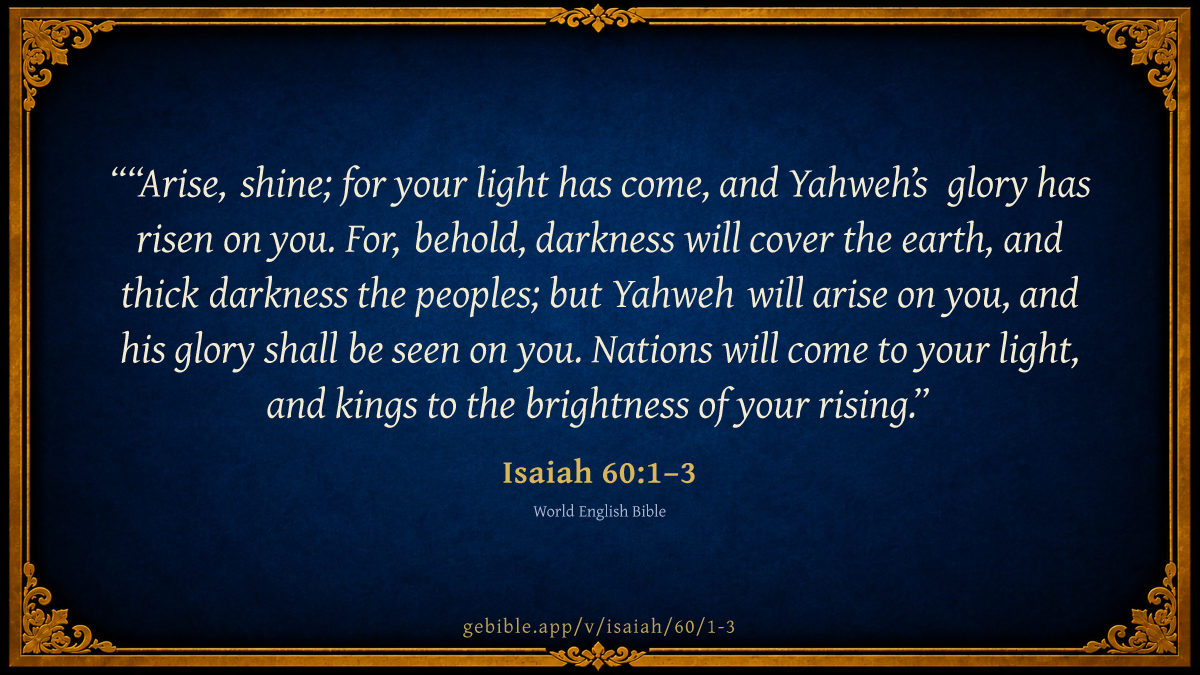
Geneva Bible translators 1599 · Public Domain On vv1–3 The time of thy prosperity and felicity: whereas speaking…
The time of thy prosperity and felicity: whereas speaking of Babylon, he commanded her to go down, Isa. 47:1.
Geneva Bible (1599) marginal notes — public domain.
John Trapp 1656 · Public Domain On vv1–3 Isa 60:1 Arise, shine; for thy light is come,…
Isa 60:1 Arise, shine; for thy light is come, and the glory of the LORD is risen upon thee.
Ver. 1. Arise.] Thou, O my Church, that now liest in pulvere vastitatis, as a forlorn captive, rouse up thyself, change both thy countenance and condition; Tanquam libera ac laeta ad novum nuncium; up, and look up, I have joyful tidings for thee.
Read full note →
For thy light is come.] Christ, who is αυτοφως - light essential. {Joh 12:46}
And, the glory of the Lord is risen upon thee.] The glorious gospel of grace. {2Co 3:7; 2Co 4:4}
John Trapp, A Commentary or Exposition upon All the Books of the Old and New Testament (1647–1656) — public domain. Text from a community e-Sword module.
Matthew Poole 1685 · Public Domain On vv1–3 Arise; a word of encouragement accommodated to the Jewish…
Arise; a word of encouragement accommodated to the Jewish or Hebrew style, wherein, as by lying down is described a servile and calamitous condition, Isa 47:1; so by rising, and standing up, a recovery out of it into a free and prosperous one, as may be seen frequently. Rouse up; intimating her deliverance to be at hand. And here under a type, or hieroglyphical description of Jerusalem’s restoration, is displayed the flourishing state of the Gentile church under the Messiah, and that in the greatness, for quality, and also the number of her proselytes; in the description whereof the evangelical prophet, whatever he doth in other parts of his prophecy, doth here most briskly sparkle forth in Divine eloquence. Shine; discover thyself as one breaking forth from a dark night; or, look out, as men do at sea, who use to look out sharp, to see what they can discover after a dark and stormy season; or, be enlightened with more knowledge; or, be thou filled with joy; a metaphorical metonymy of the efficient; as thou art about to change thy condition, change thy countenance; be cheerful in that light or salvation that is approaching. Thy light; either,
1. Thy flourishing and prosperous estate; an allusion to people’s rising, when after a dark night the light breaks forth. they begin to rise. Or,
Read full note →
2. The causer of thy light, the effect for the efficient, viz. thy God, or Christ, because the fountain of all happiness, as the sun and moon are called lights, because they give light, Gen 1:16. Thus Christ is called the true Light, Joh 1:9; and compare Joh 8:12, with Eph 5:14, and you will find these words quoted to that purpose. The glory of the Lord, i.e. the greatest glory, as the cedars of God, the mountains of God, &c.: compare Rev 21:11; or, the glorious Lord, or the Lord of glory, or Christ, who is the glory of the Father, is come unto thee; he is at hand to make himself glorious in some wonderful work for thy salvation, either in his doctrine, or miracles, or work of redemption, that his glory may rest upon thee, suitable to the psalmist’s prayer, Psa 85:6,7,9. Is risen; like as when the sun spreads itself into every place, leaving none dark: thus it refers to the glorious gospel, called such a glorious light, 2Co 4:4.
Matthew Poole's English Annotations on the Holy Bible (1683–1685) — public domain. Text from a community e-Sword/MySword module.
Matthew Henry 1710 · Public Domain On v1 It is here promised that the gospel temple shall…
It is here promised that the gospel temple shall be very lightsome and very large.
I. It shall be very lightsome: Thy light has come. When the Jews returned out of captivity they had light and gladness, and joy and honour; they then were made to know the Lord and to rejoice in his great goodness; and upon both accounts their light came. When the Redeemer came to Zion he brought light with him, he himself came to be a light. Now observe, 1. What this light is, and whence it springs: The Lord shall arise upon thee (Isa 60:2), the glory of the Lord (Isa 60:1) shall be seen upon thee. God is the father and fountain of lights, and it is in his light that we shall see light. As far as we have the knowledge of God in us, and the favour of God towards us, our light has come. When God appears to us, and we have the comfort of his favour, then the glory of the Lord rises upon us as the morning light; when he appears for us, and we have the credit of his favour, when he shows us some token for good and proclaims his favour to us, then his glory is seen upon us, as it was upon Israel in the pillar of cloud and fire. When Christ arose as the sun of righteousness, and in him the day-spring from on high visited us, then the glory of the Lord was seen upon us, the glory as of the first-begotten of the Father. 2. What a foil there shall be to this light: Darkness shall cover the earth; but, though it be gross darkness, darkness that might be felt, like that of Egypt, that shall overspread the people, yet the church, like Goshen, shall have light at the same time. When the case of the nations that have not the gospel shall be very melancholy, those dark corners of the earth being full of the habitations of cruelty to poor souls, the state of the church shall be very pleasant. 3. What is the duty which the rising of this light calls for: "Arise, shine; not only receive this light, and" (as the margin reads it) "be enlightened by it, but reflect this light; arise and shine with rays borrowed from it." The children of light ought to shine as lights in the world. If God's glory be seen upon us to our honour, we ought not only with our lips, but in our lives, to return the praise of it to his honour, Mat 5:16; Phi 2:15.
Read full note →
II. It shall be very large. When the Jews were settled again in their own land, after their captivity, many of the people of the land joined themselves to them; but it does not appear that there ever was any such numerous accession to them as would answer the fulness of this prophecy; and therefore we must conclude that this looks further, to the bringing of the Gentiles into the gospel church, not their flocking to one particular place, though under that type it is here described. There is no place now that is the centre of the church's unity; but the promise respects their flocking to Christ, and coming by faith, and hope, and holy love, into that society which is incorporated by the charter of his gospel, and of the unity of which he only is the centre - that family which is named from him, Eph 3:15. The gospel church is expressly called Zion and Jerusalem, and under that notion all believers are said to come to it (Heb 12:22. You have come unto Mount Zion, to the city of the living God, the heavenly Jerusalem), which serves for a key to this prophecy, Eph 2:19. Observe,
1. What shall invite such multitudes to the church: "They shall come to thy light and to the brightness of thy rising, Isa 60:3. They shall be allured to join themselves to thee," (1.) "By the light that shines upon thee," the light of the glorious gospel, which the churches hold forth, in consequence of which they are called golden candlesticks. This light which discovers so much of God and his good will to man, by which life and immortality are brought to light, this shall invite all the serious well-affected part of mankind to come and join themselves to the church, that they may have the benefit of this light to inform them concerning truth and duty. (2.) "By the light with which thou shinest." The purity and love of the primitive Christians, their heavenly-mindedness, contempt of the world, and patient sufferings, were the brightness of the church's rising, which drew many into it. The beauty of holiness was the powerful attractive by which Christ had a willing people brought to him in the day of his power, Psa 110:3.
2. What multitudes shall come to the church. Great numbers shall come, Gentiles (or nations) of those that are saved, as it is expressed with allusion to this, Rev 21:24. Nations shall be discipled (Mat 28:19), and even kings, men of figure, power, and influence, shall be added to the church. They come from all parts (Isa 60:4): Lift up thy eyes round about, and see them coming, devout men out of every nation under heaven, Act 2:5. See how white the fields are already to the harvest, Joh 4:35. See them coming in a body, as one man, and with one consent: They gather themselves together, that they may strengthen one another's hands, and encourage one another. Come, and let us go, Isa 2:3. "They come from the remotest parts: They come to thee from far, having heard the report of thee, as the queen of Sheba, or seen thy star in the east, as the wise men, and they will not be discouraged by the length of the journey from coming to thee. There shall come some of both sexes. Sons and daughters shall come in the most dutiful manner, as thy sons and thy daughters, resolved to be of thy family, to submit to the laws of thy family and put themselves under the tuition of it. They shall come to be nursed at thy side, to have their education with thee from their cradle." The church's children must be nursed at her side, not sent out to be nursed among strangers; there, where alone the unadulterated milk of the word is to be had, must the church's new-born babes be nursed, that they may grow thereby, Pe1 2:1, Pe1 2:2. Those that would enjoy the dignities and privileges of Christ's family must submit to the discipline of it.
3. What they shall bring with them and what advantage shall accrue to the church by their accession to it. Those that are brought into the church by the grace of God will be sure to bring all they are worth in with them, which with themselves they will devote to the honour and service of God and do good with in their places. (1.) The merchants shall write holiness to the Lord upon their merchandise and their hire, as Isa 23:18. "The abundance of the sea, either the wealth that is fetched out of the sea (the fish, the pearls) or that which is imported by sea, shall all be converted to thee and to thy use." The wealth of the rich merchants shall be laid out in works of piety and charity. (2.) The mighty men of the nations shall employ their might in the service of the church: "The forces, or troops, of the Gentiles shall come unto thee, to guard thy coasts, strengthen thy interests, and, if occasion be, to fight thy battles." The forces of the Gentiles had often been against the church, but now they shall be for it; for as God, when he pleases, can, and, when we please him, will, make even our enemies to be at peace with us (Pro 16:7), so, when Christ overcomes the strong man armed, he divides his spoils, and makes that to serve his interests which had been used against them, Luk 11:22. (3.) The wealth imported by land-carriage, as well as that by sea, shall be made use of in the service of God and the church (Isa 60:6): The camels and dromedaries that bring gold and incense (gold to make the golden altar of and incense and sweet perfumes to burn upon it), those of Midian and Sheba, shall bring the richest commodities of their country, not to trade with, but to honour God with, and not in small quantities, but camel-loads of them. This was in part fulfilled when the wise men of the east (perhaps some of the countries here mentioned), drawn by the brightness of the star, came to Christ, and presented to him treasures of gold, frankincense, and myrrh, Mat 2:11. (4.) Great numbers of sacrifices shall be brought to God's altar, acceptable sacrifices, and, though brought by Gentiles, they shall find acceptance, Isa 60:7. Kedar was famous for flocks, and probably the fattest rams were those of Nebaioth; these shall come up with acceptance on God's altar. God must be served and honoured with what we have, according as he has blessed us, and with the best we have. This was fulfilled when by the decree of Darius the governors beyond the rivers (perhaps of some of these countries) were ordered to furnish the temple at Jerusalem with bullocks, rams, and lambs, for the burnt-offering of the God of heaven, Ezr 6:9. It had a further accomplishment, and we trust will have, in the bringing in of the fulness of the Gentiles to the church, which is called the sacrificing or offering up of the Gentiles unto God, Rom 15:16. The flocks and rams are precious souls; for they are said to minister to the church, and to come up as living sacrifices, presenting themselves to God by a reasonable service on his altar, Rom 12:1.
4. How God shall be honoured by the increase of the church and the accession of such numbers to it. (1.) They shall intend the honour of God's name in it. When they bring their gold and incense it shall not be to show the riches of their country, nor to gain applause to themselves for piety and devotion, but to show forth the praises of the Lord, Isa 60:6. Our greatest services and gifts to the church are not acceptable further than we have an eye to the glory of God in them. And this must be our business in our attendance on public ordinances, to give unto the Lord the glory due to his name; for therefore, as these here, we are called out of darkness into light, that we should show forth the praises of him that called us, Pe1 2:9. (2.) God will advance the honour of his own name by it; so he has said (Isa 60:7): I will glorify the house of my glory. The church is the house of God's glory, where he manifests his glory to his people and receives that homage by which they do honour to him. And it is for the glory of this house, and of him that keeps house there, both that the Gentiles shall bring their offerings to it and that they shall be accepted therein.
5. How the church shall herself be affected with this increase of her numbers, Isa 60:5. (1.) She shall be in a transport of joy upon this account: "Thou shalt see and flow together" (or flow to and fro), "as in a pleasing agitation about it, surprised at it, but extremely glad of it." (2.) There shall be a mixture of fear with this joy: "Thy heart shall fear, doubting whether it be lawful to go in to the uncircumcised and eat with them." Peter was so impressed with this fear that he needed a vision and voice from heaven to help him over it, Act 10:28. But, (3.) "When this fear is conquered thy heart shall be enlarged in holy love, so enlarged that thou shalt have room in it for all the Gentile converts; thou shalt not have such a narrow soul as thou hast had nor affections so confined within the Jewish pale." When God intends the beauty and prosperity of his church he gives this largeness of heart and an extensive charity. (4.) These converts flocking to the church shall be greatly admired (Isa 60:8): Who are these that fly as a cloud? Observe, [1.] How the conversion of souls is here described. It is flying to Christ and to his church, for thither we are directed; it is flying like a cloud, though in great multitudes, so as to overspread the heavens, yet with great unanimity, all as one cloud. They shall come with speed, as a cloud flying on the wings of the wind, and come openly, and in the view of all, their very enemies beholding them (Rev 11:12), and yet not able to hinder them. They shall fly as doves to their windows, in great flights, many together; they fly on the wings of the harmless dove, which flies low, denoting their innocency and humility. They fly to Christ, to the church, to the word and ordinances, as doves, by instinct, to their own windows, to their own home; thither they fly for refuge and shelter when they are pursued by the birds of prey, and thither they fly for rest when they have been wandering and are weary, as Noah's dove to the ark. [2.] How the conversion of souls is here admired. It is spoken of with wonder and pleasure: Who are these? We have reason to wonder that so many flock to Christ: when we see them all together we shall wonder whence they all came. And we have reason to admire with pleasure and affection those that do flock to him: Who are these? How excellent, how amiable are they! What a pleasant sight is it to see poor souls hastening to Christ, with a full resolution to abide with him!
Matthew Henry's Commentary on the Whole Bible (1708–1710) — public domain (CC PDM 1.0). Text via the HelloAO Bible API.
John Gill 1763 · Public Domain On vv1–3 Arise, shine,.... The Targum adds, "O Jerusalem"; and so…
Arise, shine,.... The Targum adds, "O Jerusalem"; and so the Septuagint, Vulgate Latin, and Arabic versions; and no doubt but the church of God is here addressed: and by what follows it seems to be the Jewish church, as distinct from the Gentiles, since they are said to come to it, the Jews, now converted, and brought into a church state; and who are called upon to arise out of their low dejected state and condition, in which they have long lain, and "shine": or to "awake", as some (p) render it, out of that sleep and lethargy they have been so long in, and to shine forth in the exercise of grace and discharge of duty: or to be "enlightened" (q); with the light of Christ and of the Gospel, now come unto them; and to diffuse this light to others, to hold it forth in profession and conversation; see Mat 5:16.
for thy light is come: the Targum,
Read full note →
"for the time of thy redemption is come;''
meaning from the Babylonish captivity, which that paraphrase refers to: but this is not intended here, but the spiritual prosperity and happiness of the Jews in the latter day, at the time of their conversion; and the sense is, either that Christ, the Light of the world, was come unto them in a spiritual way; or that the glorious light of the Gospel of Christ was come unto them, and shone upon them; or the time was come that the blindness that had been so long upon them should be taken oft, and the veil be taken away they had been so long covered with, and they be turned to the Lord, the fulness of the Gentiles now being about to be brought in; see Rom 11:25,
and the glory of the Lord is risen upon thee; or the glorious Lord; he, whose glory is to be seen, as the glory of the only begotten, who is the brightness of his Father's glory, the sun of righteousness; who shall now, rise upon these, and, leave a glory upon them that shall be visible.
(p) "expergiscere", Grotius. (q) "illuminare", Pagninus, Montanus Piscator.
John Gill's Exposition of the Whole Bible (1746–1763) — public domain (CC PDM 1.0). Text via the HelloAO Bible API.
John Wesley 1765 · Public Domain On vv1–3 The glory and blessing of the new church after…
The glory and blessing of the new church after a short affliction, ver. 1-22.
Arise - A word of encouragement accommodated to the Jewish, or Hebrew style, wherein, as by lying down, is described a servile and calamitous condition, chap. xlvii, 1, so by rising, and standing up, a recovery out of it, into a free, and prosperous one, as may be seen frequently; Rouze up, intimating her deliverance to be at hand. Here under a type, of Jerusalem's restoration, is displayed the flourishing state of the Gentile - church, under the Messiah. Thy light - Thy flourishing and prosperous state.
John Wesley, Explanatory Notes Upon the Whole Bible (1754–1765) — public domain. Text via the GEBible commentary corpus.
Adam Clarke 1810 · Public Domain On vv1–3 The glorious prospect displayed in this chapter seems to…
CHAPTER LX
The glorious prospect displayed in this chapter seems to have
Read full note →
elevated the prophet even above his usual majesty. The subject
is the very flourishing condition of the Church of Jesus Christ
at that period of the Gospel dispensation when both Jews and
Gentiles shall become one fold under one Shepherd. The imagery
employed is of the most consolatory and magnificent
description. This blessed state of the world shall follow a
time of gross darkness, 1, 2.
The universal diffusion of vital godliness beautifully set
forth by a great variety of images, 3-14.
The everlasting duration and spotless purity of this kingdom of
Christ, 15-21.
A time appointed in the counsels of Jehovah for the
commencement of this happy period; and when this time arrives,
the particulars of the prophecy shall have a speedy
accomplishment, 22.
The subject of this chapter is the great increase and flourishing state of the Church of God by the conversion and accession of the heathen nations to it, which is set forth in such ample and exalted terms, as plainly show that the full completion of this prophecy is reserved for future times. This subject is displayed in the most splendid colours under a great variety of images highly poetical, designed to give a general idea of the glories of that perfect state of the Church of God which we are taught to expect in the latter times; when the fulness of the Gentiles shall come in, and the Jews shall be converted and gathered from their dispersions, and the kingdoms of this world shall become the kingdoms of our Lord and of his Christ.
Of the use in prophecy of general or common poetical images, in setting forth the greatness and importance of a future event universally, without descending to particulars, or too minutely explaining circumstances, I have already pretty largely treated in the twentieth prelection on the Hebrew poetry; and have more than once observed in these notes that such images are not always to he applied particularly to persons and things, and were never intended to be minutely explained. I shall add here the opinion of a very learned and judicious person upon this subject: "It is, I think, a mark of right understanding in the language of prophecy, and in the design of prophecy too, to keep to what appears the design and meaning of the prophecy in general, and what the whole of it laid together points out to us, and not to suffer a warm imagination to mislead us from the real intention of the spirit of prophecy, by following uncertain applications of the parts of it." Lowman on the Revelation, note on Re 19:21. - L. To this testimony I must add my own. This is one of the most glorious chapters in the whole of the Old Testament. The splendour, glory, and excellence of the Church of Christ are here pointed out in language which the Spirit of God alone is capable of using. But when shall this state of blessedness take place? Lord, thou only knowest.
NOTES ON CHAP. LX
Verse 1. Arise] Call upon God through Christ, for his salvation; and,
Shine] אורי ori, be illuminated: for till thou arise and call upon God, thou wilt never receive true light.
For thy light is come] כי בא אורך ki ba orech, for thy light cometh. The Messiah is at the door; who, while he is a light to lighten the Gentiles, will be the glory - the effulgence, of his people Israel.
Adam Clarke's Commentary on the Bible (1810–1826) — public domain. Text from a community e-Sword/MySword module.
Joseph Benson 1811 · Public Domain On vv1–3 Isa 60:1. Arise, &c. — The prophet here addresses…
Isa 60:1. Arise, &c. — The prophet here addresses the church of God, which he supposes to be sitting sorrowful, and exhorts her to awake and arise from a state of darkness and mourning, and enter into a state of light and happiness, “now that her salvation, so long desired and hoped for, is at hand, and the divine glory is about to rise upon her, and illuminate the nations and people who had hitherto sat in thick darkness.” See Vitringa. The reader will observe the exhortation is accommodated to the Jewish or Hebrew style, wherein, as by lying down is signified a servile and calamitous condition, (Isa 47:1,) so, by rising, and standing up, a recovery out of it into a free and prosperous state, as may be seen frequently. Shine — Discover thyself, as a luminary breaking forth from a dark night. Show thy native beauty: suffer thyself to be so strongly irradiated by the glory of the Lord, that thou mayest not only be enlightened, but mayest be able to enlighten others. For thy light is come — Thy flourishing and prosperous condition, an allusion to people’s rising, when after a dark night the light breaks forth upon them. And the glory of the Lord — Glorious light, grace, and salvation from the Lord; or a bright display of the glory, that is, of the glorious attributes of the Lord; or, the Lord of glory, Christ, is about to make himself glorious, in some wonderful work, for thy salvation. Is risen upon thee — Like as when the sun, arising, spreads his light everywhere, leaving no place dark. Thus shall the church of God be fully illuminated in the latter days, and thus shall she shine for the perfect illumination of all flesh: see Isa 11:9; and Zec 14:7. In his description of this perfect state of the Christian Church, this evangelical prophet is here peculiarly eloquent, displaying it “in the most splendid colours, and under a great variety of images, highly poetical, designed to give a general idea of its glories, when the fulness of the Gentiles shall come in, and the Jews shall be converted and gathered from their dispersions, and the kingdoms of this world shall become the kingdoms of our God, and of his Christ.” — Bishop Lowth.
Joseph Benson's Commentary on the Old and New Testaments (1811–1818) — public domain. Text from a community e-Sword module.
Albert Barnes 1834 · Public Domain On vv1–3 Arise - This is evidently addressed to the church,…
Arise - This is evidently addressed to the church, or to Zion regarded as the seat of the church. It is represented as having been in a state of affliction and calamity (compare the notes at Isa 3:26; Isa 52:1-2). She is now called on to arise from the dust, and to impart to others the rich privileges which were conferred on her.
Shine - (אורי 'ôrı̂y). Lowth renders this, ‘Be thou enlightened.’ Margin, ‘Be enlightened, for thy light cometh.’ Noyes, ‘Enjoy light.’ Septuagint Φωτίζου φωτίζου Phōtizou phōtizou - ‘Be enlightened; be enlightened, O Jerusalem.’ Herder renders it, ‘Be light.’ Vitringa regards the expression as equivalent to this, ‘pass into a state of light. That is, enjoy light thyself, and impart it freely to others, Gesenius renders it, ‘Shine, be bright; that is, be surrounded and resplendent with light.’ The idea probably is this, ‘rise now from a state of obscurity and darkness. Enter into light; enter into times of prosperity.’ It is not so much a command to impart light to others as it is to be encompassed with light and glory. It is the language of prophecy rather than of command; a call rather to participate in the light that was shining than to impart it to others. The Septuagint and the Chaldee here add the name ‘Jerusalem,’ and regard it as addressed directly to her.
Read full note →
Thy light is come - On the word ‘light,’ see the notes at Isa 58:8, Isa 58:10. The light here referred to is evidently that of the gospel; and when the prophet says that that light ‘is come,’ he throws himself into future times, and sees in vision the Messiah as having already come, and as pouring the light of salvation on a darkened church and world (compare the notes at Isa 9:2).
And the glory of the Lord - There is refer once here, doubtless, to the Shechinah or visible splendor which usuallv accompanied the manifestations of God to his people (see the notes at Isa 4:5). As Yahweh manifested himself in visible glory to the Israelites during their journey to the promised land, so he would manifest himself in the times of the Messiah as the glorious protector and guide of his people. The divine character and perfections would be manifested like the sun rising over a darkened world.
Is risen upon thee - As the sun rises. The word used here (זרח zârach) is commonly applied to the rising of the sun Gen 32:31; Exo 22:2; 2Sa 23:4; Psa 104:22. The comparison of the gospel to the sun rising upon a dark world is exceedingly beautiful, and often occurs in the Bible (compare Mal 4:2; Luk 1:78, margin.)
Upon thee - Upon thee, in contradistinction from other nations and people. The gospel shed its first beams of glory on Jerusalem.
Albert Barnes' Notes on the Bible (1834–1885) — public domain. Text from a community e-Sword/MySword module.
Haydock's Catholic Bible Commentary 1859 · Public Domain On vv1–3 O Jerusalem, is not in Hebrew or St. Jerome,…
O Jerusalem, is not in Hebrew or St. Jerome, but in the Septuagint. Some few things may refer to the terrestrial Jerusalem, though the prophet speaks chiefly of the celestial and of the Church. --- Lord, very great. Christ came to save us. (Calmet) --- God prevents by his grace, but man must co-operate to be justified. (Worthington)
George Leo Haydock (1774–1849), Haydock's Catholic Family Bible and Commentary, 1859 edition — public domain. Excludes Psalms (Douay-Rheims chapter numbering differs from Protestant) and Deuterocanonical books (Catholic canon only).
Lange's Commentary on the Holy Scriptures 1864 · Public Domain On v1 The Rising of the heavenly Sun of life upon…
II.—THE SECOND DISCOURSE
The Rising of the heavenly Sun of life upon Jerusalem, and the new personal and natural life conditioned thereby
Read full note →
Isaiah 60
The Prophet has returned from speaking of the present to treat of the last things. He sees a new Sun, the principle of new life, rise upon Jerusalem. Although this future, too, is depicted in colors belonging to the present time, yet we perceive from the matters which he specifies, that his discourse relates to the distant future. And, although the Prophet does not distinguish the times, we see that the fulfilment will take place gradually. We observe in respect to the influence of the Sun, which, according to Isa_60:1-2, is to rise upon Jerusalem, and advance from a glory which is more of a natural character to one which is more supernatural and heavenly. The chapter, however, does not divide itself into two, but into three sections, of which the first (Isa_60:1-9) has for its subject the gathering of all nations to the sun that rises upon Jerusalem; the second (Isa_60:10-17 a), the restoration of Jerusalem to outward glory; the third (Isa_60:17 b–22), this new life in its relation to God, and in its moral and spiritual manifestation. [We do not like such a division of this grand prophetic picture. Its parts cannot well be thus separated.—D. M.].
____________________
1. THE GATHERING OF THE NATIONS TO THE SUN THAT RISES UPON JERUSALEM. . Isa 60:1–9
1Arise, 1shine; for thy light is come;
And the glory of the Lord is risen upon thee.
2 For, behold, the darkness shall cover the earth,
And gross darkness the people:
And the Lord shall arise upon thee,
And his glory shall be seen upon thee.
3 And the Gentiles shall come to thy light,
And kings to the brightness of thy rising.
4 Lift up thine eyes round about, and see:
All they gather themselves together, they come to thee:
Thy sons shall come from far,
And thy daughters shall be 2nursed at thy side.
5 5 Then thou shalt see, and 3flow together,
And thine heart shall fear, and be enlarged;
Because the 4abundance of the sea shall be converted unto thee;
The 5forces of the Gentiles shall come unto thee.
6 The multitude of camels shall cover thee,
The 6dromedaries of Midian and Ephah;
All they from Sheba shall come:
They shall bring gold and incense;
And they shall shew forth the praises of the Lord.
7 All the flocks of Kedar shall be gathered together unto thee,
The rams of Nebaioth shall minister unto thee:
They shall come up with acceptance on mine altar,
And I will glorify the house of my glory.
8 Who are these that fly as a cloud,
And as the doves to their7 windows?
9 Surely the isles shall wait for me,
And the ships of Tarshish first,
To bring thy sons from far,
Their silver and their gold with them,
Unto the name of the Lord thy God,
And to the Holy One of Israel, because he hath glorified thee.
TEXTUAL AND GRAMMATICAL
Isa_60:1, Delitzsch justly bids us mark that קומי אורי are Trochees, and כי־בא אורך are lambuses. Observe the change of vowels. All the Hebrew vowels are found in these five words in correspondence with the fulness of thoughts which these few words contain. How admirably is the language adapted to the subject! Does not this betoken that master of speech, Isaiah? [“What power of creative might lies in these two Trochees, Kumi, ori, which are, as it were, prolonged till what they say is done; and what a power of consolation lies in the two Lambuses ki-ba orech, which, as it were, stamp upon the action of Zion the seal of the divine action, and fit to the ἅρσις (raising up) its θἐσις (foundation)! Delitzsch.—D. M.].
Isa_60:3. זֶרַח, ortus, is ἅπ. λεγ. as an appellative. As a proper name it is of frequent occurrence.
Isa_60:4. תֵּאָמַֽנָה. Observe that the nun has no dagesh forte. (Comp. Naegelsbach’s Gr. §§ 5, 6).
Isa_60:7. [“The verbal form יְשָֽׁרְתוּנֶךְ which is repeated in Isa_60:10, has an abbreviated suffix without the tone, as Isa 47:10.” Delitzsch].
Isa_60:9. פֵאֲרָךְ, with a rarer suffix form for פֵאֲרֵךְ. See a like form in Isa 54:6.
EXEGETICAL AND CRITICAL
1. The Prophet sees in the distant future the restoration of Jerusalem, and its exaltation to unparalleled, supermundane and everlasting glory. But he sees bonded together every thing that is in the future to produce this glory, from the first weak beginnings till the consummation in the heavenly Jerusalem. He sees at first night prevailing over the whole earth. But where Jerusalem is, he beholds a growing brightness as at the rising of the sun. He calls to Jerusalem to receive the glory which Jehovah is about to impart to her, and to let that glory unfold itself (Isa_60:1-2). Then he sees how this light emanating from Jerusalem attracts the Gentiles and their kings (Isa_60:3). He sees further how together with the heathen (and we may say, even in the heathen), Jerusalem’s own children try to reach the mother city, and are aided in this effort by the heathen (Isa_60:4). With joy Jerusalem beholds these multitudes stream to her, and rejoices the more, that they come not with empty hands, but bring with them the choicest products of land and sea (Isa_60:5). Troops of camels will carry the gold and incense of the East (Isa_60:6); the flocks of the eastern nomadic lands will be acceptable as offerings on the altar of Jehovah (Isa_60:7). On the other hand, ships come from the distant West, laden with the precious things of lands beyond the seas, and are with their sails like to bright clouds, or doves on the wing (Isa_60:9). It is obvious that here again the Prophet draws the picture of the future with the colors of the present.
2. Arise, shine—come unto’ thee.
Isa_60:1-5. The image before the mind of the Prophet is a sunrise scene. Far and wide night still reigns, but grandly above all other heights of the earth towers mount Zion, which here, in accordance with Isa 2:2; Mic_4:1, appears as “established in the top of the mountains, and exalted above the hills.” And the Prophet beholds this highest mountain of the earth irradiated by the rising sun. Its summit glitters as if covered with celestial light. From this the Prophet knows that the dawn of the day of salvation for Jerusalem has arrived. He calls therefore to her encouragingly, קוּמי [“In Eph_5:14 this first verse is combined in a paraphrastic form with Isa 51:17; Isa 52:1, 2,” Kay]. Jerusalem has now to lift up her head, because her redemption is nigh (comp. Luk_21:28); she is to raise herself from the depression and prostration in which her situation has hitherto kept her. Jerusalem shall become light, shall shine (אוֹרִי, the verb אוֹר in Isaiah only here, Isa_60:19; Isa_27:11). But she is not to shine in her own light, but to let herself be enlightened by the higher light which rises on her. But this light is called “thy light,” because Jerusalem and this light are adapted the one to the other. What sort of a light it is which shall rise upon Jerusalem, is told us in Isa_60:1 b. It is the glory of Jehovah. This light shall rise as an everlasting sun upon Jerusalem (comp. Isa_60:20; זָרַח is vox solennis of the rising of the sun, and occurs in Isaiah besides here only Isa_60:2 and 58:20). In Isa_60:2 the explanation is given why the sunrise referred to in Isa_60:1 b is a matter of such great importance, and why Jerusalem is so pressingly summoned to yield herself to the influence of this rising sun [Rather to shed forth the light which she has received from it. D. M.]. Jerusalem has herein the highest honor conferred on her that the Sun first rises upon her, that she is that point in the East from which the light is to spread over the countries shrouded in darkness. [“The Sun of suns is Jahve (Psa_84:12), the God who comes, Isa 59:20.... When this Sun rises on Zion she becomes altogether light, but not for herself alone, but for all mankind.” Delitzsch. D. M.]. עֲרָפֶל is found only here in Isaiah. We see from Isa_60:3 that the nations still in darkness are not inaccessible to the light. They have a longing for the light, [This is not said], and a susceptibility of receiving it. Nations and princes come to the heavenly light. The brightness of thy rising is the brightness of that which rises upon Jerusalem, according to Isa_60:2, the brightness of Jehovah. [But Zion made light in the Lord is represented as herself shining as a light in the world. Her rising can be described as the brightness of the sun when he goeth forth in his might, Jdg_5:31; 2Sa_23:4. To regard “the brightness of thy rising,” as meaning “the brightness of that which rises upon thee,” is surely forced and unnatural, albeit the best interpreters acquiesce in this explanation. But the church, as irradiated by the divine glory, and reflecting it, has a light and brightness which is called her own, and which she sheds upon the world.—D. M.]. Not only the nations and princes of the heathen world hasten to Jerusalem. Along with them are other visitants, who are no foreigners in Jerusalem, but are children of the house. The scattered members of the Israelitish kingdom, conducted and attended with all honors by the Gentiles, will return to the holy home (comp. Isa 11:11 sqq.; Isa 25:6 sqq.; Isa 26:2 sq.; Isa 27:13; Jer_3:18, see commentary on this place). [“Those who confine these prophecies to the Babylonish exile understand this as describing the agency of heathen states and sovereigns in the restoration. But in this, as in the parallel passages [Isa 43:5–7; Isa 49:18–23], there is, by a strange coincidence, no word or phrase implying restoration or return, but the image evidently is that of enlargement and accession; the children thus brought to Zion being not those whom she had lost, but such as she had never before known, as is evident from Isa_49:21. The event predicted is therefore neither the former restoration of the Jews, nor their future restoration.” Alexander. D. M.]. The words ver, 4a, are repeated from Isa 49:18. The gathering together (נקבצו) refers not only to separate individuals but according to places such as Isa 11:12; Hos_2:2, [E. V. Hos_1:11] it refers especially to the reunion of Judah with Israel. Of the sons we are simply told that they come from a great distance, but the daughters are carefully carried. על־צד is not=on the side, i. e., on the one arm or on the one shoulder (Isa 49:22), but upon the hip; for it is still the custom in the Orient to carry the children astride on the hip. Such care as is bestowed on children, will be shown to the female members of the people (comp. Isa 66:12). אָמַן is here as Isa 49:23 after the place in Num_11:12, used to denote the nursing and tending of a child. But Jerusalem shall not only see her children come, she shall have the joy of seeing them come with full hands, furnished with all the magnificence and glory of the world. In Isa_60:5 the words וְנָהרְתְּ to לְבָבֵךְ are to be taken as a sentence denoting a circumstance, put as a parenthesis, which expresses the emotion with which Jerusalem will see what has been depicted. The sentence setting forth the object בי יהפך וגו׳ is, accordingly, dependent on תִּרְאִי, which, therefore, cannot possibly come from יָרֵא [But it is better, with the E.V., to take בי as causal.—D. M.]. The verb נָהַר is not here that נָהַר which means “to stream” (Isa 2:2; Jer_31:12; Jer_51:44), and which comes from נָהָר, a river. But it is a different word, related to נוּר, נֵר occurring as a verb besides only Psa_34:6, but forming the stem of the substantives נְהָרָה (Job_3:4) and מִנְהָרָה (Jdg_6:2). The signification is to “shine,” “to brighten up” (for joy). Joy makes the face shine, but the heart tremble (פָחַד in this sense besides only Jer_33:9). [Henderson renders this clause well: Thy heart shall throb and dilate. The idea of enlargement or expansion of the heart through joy is Semitic; but, as Delitzsch points out, we have the opposite idea in angor, angustia.—D. M.]. The joy is called forth by Jerusalem seeing how the treasures of the sea (הָמוֹן as Psa_37:16; Jer_3:23 in the sense of swarm and abundance of the most manifold products, comp. also Isa_60:14), and the wealth of the nations come to her. [The abundance of the sea denotes all precious things which the islands and maritime countries possess.” Delitzsch. D. M.]. עַל stands after יהפך in the sense of אֶל (comp. on Isa 10:3).
3. The multitude of camels—glorified thee.
Isa_60:6-9. [A multitude of camels, without the definite article]. In these verses the Prophet describes how the treasures of the East (Isa_60:6-7) and of the West (Isa_60:8-9) are brought to Jerusalem. The eastern trading nations are indicated by a multitude of camels (שִׁפְעָה, comp. שֶׁפַעDeu_33:19, in Isaiah only here) and young animals [בּכרי not dromedaries, which are not for carrying burdens, but for riding.—D. M.], from Midian and Ephah, which bring from Sheba gold and incense, (comp. on Isa 43:23), the most valuable wares. Midian was a son of Abraham by Keturah, and the father of Ephah, Gen_25:2; Gen_25:4, comp. Gen_37:28; Gen_37:36; Judges 7 :שְׁבָא is Arabia felix (comp. 1Ki_10:2; Jer_6:20; Job_6:19; only here in Isaiah). These merchants at other times sought gain; now they have a nobler aim. They wish to honor Jehovah; they bring Him presents. This they declare in songs of praise (both בִּשַׂר and תְּהִלָּה are used by Isaiah only in chapters 40–66). The eastern pastoral tribes join the eastern trading tribes. Respecting Kedar comp. on Isa 21:16 sqq.; Isa 42:11. Kedar was the second, Nebaioth the eldest son of Ishmael, Gen_25:13. It is disputed whether Nebaioth is the progenitor of the Nabataei, i. e., of the northern or north western Arabs (for Nabataea is the whole country between the Euphrates and the Red Sea). Comp. Delitzsch on this place, and Herzog, R.-Encycl., 1, p. 598, 2d Ed. שֵׁרֵת is a word which is often used of the ministry rendered by the priests to Jehovah (Num_18:2; Deu_17:12; 1Sa_2:11; 1Sa_3:1 et saepe). The flocks of Kedar and the rams of Nebaioth will therefore as עוֹלוֹת ascend the altar of Jehovah. [עַל־רָצוֹן is translated in E. V., and by Dr. Naegelsbach, with acceptance. But it signifies rather with pleasure, delight or good will, and is to be distinguished from the expression elsewhere used לְרָצוֹן which means to (the divine) acceptance, or with acceptance. So Vitringa, Hitzig, Henderson, Delitzsch. On this representation of the victims offering themselves willingly Lowth remarks: “This gives a very elegant and poetical turn to the image. It was a general notion, that prevailed with sacrificers among the heathen, that the victim’s being brought without reluctance to the altar was a good omen; and the contrary a bad one.”—D. M.]. The great number and excellence of these offerings will conduce to the honor of the temple of the Lord. In Isa_60:8-9 the West appears upon the scene. They that like a cloud, or as doves to their enclosure skim over the sea, are ships with expanded sails. The sails spread out resemble a cloud, the velocity is compared with the swift flight of the dove (comp. Hos_11:11. Bochart, Hieroz. 2. p. 540 sqq.). The feminine ending in תעופינה is caused by the feminine אְָנִיּוֹת. אֲרֻבָּה is opus reticulatum, net, interwoven work. The answer to the question, who are these, etc., is left to the reader. Every one perceives that it is ships that come from the west. But why those ships hasten with such speed to the holy land is explained in Isa_60:9. They are directed by inhabitants of the אִיִּים, which here as often (see the List), represent the islands and maritime countries of the west. These people hope in Jehovah. Among those ships the foremost (בָּרִאשֹׁנָה comp. Num_10:14; 1Ki_20:17; 1Ch_11:6) are the ships of Tarshish (comp. Isa 2:16; Isa 23:1, 14). These, which are the largest, and come from the greatest distance, shall also be the first to bring Jerusalem’s sons with their silver and gold to the place where the Lord makes known His name, i. e., reveals His nature, and is therefore honored as the Holy One of Israel (see the List). Jerusalem’s glorification is also thereby intended. [The picture drawn in this section perplexes those who understand it of the literal restoration of the Jews, and of the future glory of the earthly Jerusalem. Hess, Baumgarten and others argue from Isa_60:7 for the restoration of animal sacrifices. But Delitzsch justly rejects this notion as utterly contrary to the Christian system. Animal sacrifice has been abolished by the Servant of Jehovah offering Himself once for all. The blood of the Crucified One has swept away the partition wall of particularism and of ceremonial shadows. But if the victims and the altar here spoken of are not to be taken literally, why should we look for a material temple or construe literally the other traits in the picture? The whole description represents not the material Jerusalem, but the Church of God under images, which, to be consistently interpreted, cannot be taken in a gross, literal sense. “We, Christians, are come unto mount Zion, and unto the city of the living God,” etc., Heb_12:22.—D. M.].
Footnotes:
[1]Or, be enlightened; for thy light cometh.
[2]a carried on the hip.
[3]brighten up.
[4]Or, noise of the sea shall be turned toward thee.
[5]Or, wealth.
[6]young camels.
[7]lattices.
2. The Restoration of Jerusalem to Outward Glory
Isa 60:10–17 a
10 And the 8sons of strangers shall build up thy walls,
And their kings shall minister unto thee:
For in my wrath I smote thee,
But in my favor have I had mercy on thee.
11 Therefore thy gates shall be open continually;
They shall not be shut day nor night;
That men may bring unto thee the 9forces of the Gentiles,
And10 that their kings may be brought.
12 For the nation and kingdom that will not serve thee shall perish;
Yea, those nations shall be utterly wasted.
13 The glory of Lebanon shall come unto thee,
The 11fir tree, the 12pine tree, and the 13box together,
To beautify the place of my sanctuary;
And I will make the place of my feet glorious.
14 The sons also of them that afflicted thee shall come bending unto thee;
And all they that despised thee shall bow themselves down at the soles of thy feet;
And they shall call thee, The city of the Lord, the Zion of the Holy One of Israel.
15 Whereas thou hast been forsaken and hated,
So that no man went through thee,
I will make thee an eternal excellency,
A joy of many generations.
16 Thou shalt also suck the milk of the Gentiles,
And shalt suck the breast of kings:
And thou shalt know that I the Lord am thy Saviour,
And thy Redeemer, the mighty One of Jacob.
17a For brass I will bring gold,
And for iron I will bring silver,
And for wood brass,
And for stones iron.
EXEGETICAL AND CRITICAL
1. In what follows the Prophet depicts the rebuilding of Jerusalem, and the commencement of a new glorious life in it. The foreign nations that destroyed the walls of the old Jerusalem, shall build the walls of the new (Isa_60:10). And its gates shall stand open day and night, for they are needed no more to keep off the enemy, but only to let in foes, if any there should be, as prisoners with their spoils (Isa_60:11). Should there be any nations who are not attracted by the light (Isa_60:3), but repelled by it, they will go to destruction (Isa_60:12). Jerusalem will then inwardly also be magnificently adorned, as it becomes the sanctuary of Jehovah (Isa_60:13). Then they whose fathers formerly oppressed Jerusalem, or who themselves had despised it, must humbly do it homage, and regard it as the city of God (Isa_60:14). Then will Jerusalem be no more forsaken, hated, and shunned; but it will shine in everlasting glory as the joy of all coming generations (Isa_60:15). All nations must bring their best and most precious things as tribute, as a sign that the God of Israel alone is the Almighty God who can help (Isa_60:16). And as a measure to estimate the future glory of Jerusalem, the Prophet further tells us that gold and silver will come in the place of brass and iron, and brass and iron in the place of wood and stone (Isa_60:17 a).
2. And the sons of strangers . . . and for stones iron (Isa_60:10-17 a). [The expression rendered in the E. V. Sons of strangers, is literally translated, Sons of strangeness or of a foreign country, i. e., foreigners, aliens.—D. M.]. In this section, too, the Prophet still paints with the colors of the present. Foreigners shall build Jerusalem’s walls. Perhaps there is here a reminiscence of the time when Israel in Egypt had to erect buildings for Pharaoh (Exo_1:11). In the second part of Isa_60:10 the Prophet thinks of the terrible days when Jerusalem’s walls were destroyed by foreigners. This was done not only by Nebuchadnezzar, but at least partially by others also (comp. 2Ki_14:13 sq.; 1Ki_14:26). Great as was the wrath which destroyed Jerusalem’s walls by the hands of foreigners, so great will be the favor which causes foreigners to rebuild them stronger and more beautiful than ever. A further contrast to the former evil times will be this, that it will be no longer necessary to shut the gates of Jerusalem, for there is no longer an enemy to fear; and there is no more night, which favors the works of darkness (Isa_60:19-20, and Rev_21:25). On the contrary, the only concern now will be to admit the spoil taken from enemies, and their princes that are led captive. That נהוגים is here to be taken in this sense is evident from a comparison of such places as 1Sa_30:2; 1Sa_30:20; Isa_20:4. [Delitzsch explains נהוגים as applied to these kings, that they are “led as captives by the church, irresistibly bound by her, i. e., inwardly subdued (comp. Isa 44:14, with Psa_149:8), and suffer themselves, as prisoners of the church and of her God, to be led into the holy city in solemn procession of honor.”—D. M.] Isa_60:12, חָרַנ, properly to dry up, stands regularly of cities and countries, but is also transferred to nations (Isa 37:18; Jer_50:21; Jer_50:27). [They who consider the literal Jerusalem to be the subject of this prophecy, and not the church of God, may ask themselves if utter destruction will really be the punishment of every nation and kingdom that will not serve the Jews. But it is not they that are born after the flesh that are heirs of these promises, but they who are Christ’s, and so the true seed of Abraham, the Israel of God. (Gal_3:28-29; Gal_4:26-31) The Gentile Christians are not doomed to bondage. In Christ’s church there is one flock and one Shepherd.—D. M.] Is the building of the temple spoken of in Isa_60:13? The answer to this question will decide the point whether the trees mentioned in Isa_60:13 are to serve for the building of the sanctuary, or for ornament to the holy city. But in Isa_60:13 there is no mention of the temple, but only of the place of the sanctuary. [But this expression implies a sanctuary.—D. M.] Further, we learn from Isa 66:1–3 that the new Jerusalem will have neither temple, nor the service that was performed in the temple (comp. Rev_21:23). [But vide contra, Isa_60:7; Isa_2:3.—D. M.] Thirdly, it must appear strange that there is no mention of the cedars of Lebanon, which formed the chief material in the building of the old temple. [But the sherbin tree is a species of cedar growing on Lebanon.—D. M.] The trees here named are cited from Isa 41:19, and, as there, are here mentioned only as representatives of magnificent vegetation. Hitzig’s remark, too, is of weight, that according to Isa_60:17, wood will be excluded as building material. I therefore hold with Hitzig, Ewald, Knobel, Delitzsch, that Isa_60:13 is to be understood of the glorious ornamental living trees that will grace Jerusalem. The glory of Lebanon, which expression occurs besides only Isa 35:2, is probably of the same import as “the choice and best of Lebanon” (Eze_31:16). Luxuriant vegetation, glorious trees will beautify the place where the Lord, though He has no temple of stone there, has still the place of His gracious presence, and where His feet rest (elsewhere called הֲדֹם רַגְלָיו, as which the earth, 66, or the sanctuary with the ark of the covenant, 1Ch_28:7; Psa_90:5, et saepe, is designated). [So, not withstanding the Lord’s declaration to the contrary, Jerusalem, artificially embellished, will still be the place where men ought to worship, though it shall have no material temple (Joh_4:20-24). In the dogmatical and ethical remarks on Isa 66:19 sqq., our author truly says that Isaiah teaches that “instead of the local place of worship of the old covenant, the whole earth will be the temple of the Lord.” We might quote Isaiah as teaching that there will be a temple and sacrifices, too, in the glorious Jerusalem of the future. See the mention of the going up of all nations to the house of the Lord in Isa 2:2, 3; see, too, in verse 7 of this chapter the mention of countless sacrifices ascending the altar of God. If, notwithstanding these statements, we are justified in holding, as Dr. Naegelsbach does, that there will in the Holy City of God be no external temple and no animal sacrifices, we may go further, and seek a spiritual sense for the description of the future outward glory of Jerusalem contained in this chapter. How natural it is to put Zion and Jerusalem for the church of God, whose centre Jerusalem was of old, is seen from the use of Rome for the Church of Rome, whose centre is in that city! We are never to forget that the Prophet paints the future with the colors of the present, and we should avoid playing fast and loose with symbolical language.—D. M.] אֲכַבֵּד at the end of Isa_60:13, designedly corresponds to its initial word כְבוֹד. As the picture mainly sets forth the contrasts between what once was and what shall be, we are told in verse 14 that the descendants of former oppressors and mockers will come submissively to do homage to Jerusalem. (שְׁחוֹחַ is infin. nominascens, and is to be taken as accus. modalis, or adverbialis (comp. Ewald, § 279, Isa 1:2, 6). [“The עַל before כַּפוֹת is not simply equivalent to at, but expresses downward motion, and may be translated down to. The act described is the oriental prostration as a sign of the deepest reverence.—Alexander. Comp. Rev_3:9.—D. M.] When these worshippers at the same time call Jerusalem the City of Jehovah, Zion of the Holy One of Israel, they make thereby a confession of faith. They declare thereby that they hold the religious faith of Israel as the true one, They acknowledge, first, that the God of Israel justly bears the name יהוה; that He is, therefore, the true God; and, secondly, that Jerusalem justly calls herself the City of Jehovah, i. e., the place where God reveals Himself and is worshipped. In “צִיּוֹן ק׳ י׳ the appellative signification of ציון (צִיּוּן, cippus, monumentum) comes to view. [? ] Jerusalem stands as the great, glorious monument which proclaims to the world the Godhead of Jehovah. A further contrast (Isa_60:15) refers to the relation of Jehovah as husband of Jerusalem. [But Jerusalem is not depicted in Isa_60:15 as a wife forsaken and hated and avoided by God.—D. M.]. The Prophet in spirit sees Jerusalem so forsaken and desolate that she, as a deserted city, is trodden by no one, but avoided by all. אֵין עֹבֵר. Comp. Isa 33:8; Isa 34:10; Jer_9:9; Jer_9:11; Eze_33:28 et saepe. [Whereas thou hast been, etc., is literally “Instead of thy being,” etc.,—D. M.]. As the opposite of this, Jerusalem shall be an eternal glory (גָּאוֹן, in the objective sense, as Isa 2:10, 19, 21; Isa 4:2; Isa 13:19; Isa 23:9 et saepe), and joy of all coming generations (comp. Isa 24:11; Psa_48:3). The relation of child and servant is before the mind of the Prophet in Isa_60:16. Israel has in the present been obliged to be the illtreated, plundered servant. Foreign conquerors and tyrants have impoverished it, have sucked it out to the very blood. In opposition to this, the promise is now made that foreign kings must regard Jerusalem as a new born, carefully nursed, beloved child. This child will now suck their breasts. This is the explanation of the apparent incongruity of Jerusalem sucking the breasts of men, and not of women. [The language used forces us to interpret the whole prophecy allegorically.—D. M.] There lies at the same time this in the image, that the kings themselves will not be illtreated slaves, but affectionate caretakers (Isa 49:23), He who causes this wonderful change is Jehovah, whom Israel will thereby know as Saviour and Redeemer by reason of His love, and as the mighty One of Jacob by reason of His power. The second part of verse 16 is almost a literal repetition from Isa 49:26. In Isa_60:17 a the Prophet has evidently before him what(1Ki_10:18-29) is related of Solomon. Mark especially verses 21 and 27 of the passage referred to, where it is said that silver was then nothing accounted of, that Solomon made it as stones. For brass, etc., i. e., instead of brass, etc. [“The city will be massive, built entirely of metal, so that neither the elements nor enemies can destroy it. That the Prophet does not mean to be understood literally is apparent from the allegorical progress of the Prophecy.”—Delitzsch.—D. M.]
Footnotes:
[8]Strangers.
[9]Or, wealth
[10]and their kings as captices.
[11]cypress
[12]plane-tree
[13]sherbin-tree
3. THE NEW LIFE OF JERUSALEM OF WHICH BOTH THE PEOPLE AND NATURE PARTAKE
Isa_60:17-22
17b I will also make 14thy officers peace,
And thine exactors righteousness.
18 Violence shall no more be heard in thy land,
Wasting nor destruction within thy borders;
But thou shalt call thy walls Salvation,
And thy gates Praise.
19 The sun shall be no more thy light by day;
Neither for brightness shall the moon give light unto thee:
But the Lord shall be unto thee an everlasting light,
And thy God thy glory.
20 Thy sun shall no more go down;
Neither shall thy moon withdraw itself:
For the Lord shall be thine everlasting light,
And the days of thy mourning shall be ended.
21 Thy people also shall be all righteous:
They shall inherit the land for ever,
The 15branch of my planting, the work of my hands,
That I may be glorified.
22 16A little one shall become a thousand,
And 17a small one a strong nation:
I the Lord will hasten it in his time.
TEXTUAL AND GRAMMATICAL
Isa_60:19. Although the Masoretes separate לנגה by means of zakeph gadol from what follows, and thereby intimate that they wish לנגה to be taken in the sense: “as regards brightness,” this construction seems to me needlessly difficult.
Isa_60:21. The reading of the Keri מַטָּעַי is to be preferred to that of the Kethib מַטָּעוֹ or מַטָּעָו, which is probably a mistake of the copyist.
Isa_60:22. The feminine suffix is here to be taken in the neuter sense (comp. Isa 59:8; Isa 22:11; Isa 27:4).
EXEGETICAL AND CRITICAL
1. In this section the Prophet takes a loftier flight. The higher life which he promises is above all without sin, i. e., holy. Righteousness, peace and salvation will, therefore, characterize the life of the community (Isa_60:17 b, 18). But even the life of nature will receive a new, higher centre of life. For it will be no more the sun that sheds upon the earth light and heat, and thereby life, but God will Himself be the Sun that shines perpetually and unchangeably (Isa_60:19-20). And because the people, being born again of a divine seed, will sin no more, they will also never lose their country, but possess it to eternity (Isa_60:21). They will also partake of the theocratic blessing of a numerous posterity in the highest degree (Isa_60:22). In the two last verses [and all throughout the chapter, D. M.] we see again how the Prophet represents spiritual, heavenly things with earthly colors.
2. I will also make—gates Praise.
Isa_60:17 b, 18. The Prophet, who had hitherto depicted chiefly the external glory of the future Jerusalem, now describes more its inward state. The might of sin will be broken. Its reign comes to an end. Peace and righteousness have dominion. We have to inquire whether we have to take שׁלום and צדקה as the object or as the predicate. But more is contained in the declaration that peace and righteousness will bear rule than in the statement that the rulers will be peaceable and just people. For the latter might be substantially true, and yet much dissension and injustice be in the land. But when peace and righteousness are not only in the rulers but are themselves the rulers (Gesenius, Umbreit, Stier, Delitzsch, etc.), then everything that could disturb peace and impede justice, is excluded. We shall have to take the term peace in its most extensive and highest sense, as comprehending the harmony of man with God, with himself, and with his fellow creatures. Under righteousness we shall have to understand that complete righteousness which consists in the conformity of human willing and doing with the divine will. Righteousness and peace are related as cause and effect. For only when our willing is conformable to the divine, can the right harmony with God prevail in us and around us. We can recall here Psa_85:11, where for restored Israel the hope is expressed that צדק ושׁלום will kiss each other in their land. Peace and righteousness are here poetically personified, which is a form of expression not rare in Isaiah (comp. Isa 22:18; Isa 32:16 sq.; Isa 45:8; Isa 59:14). [“פְּקֻדָּה properly means office, magistracy, government, here put for those who exercise it, like nobility, ministry and other terms in English. נגשׁים, which has commonly a bad sense, is here used for magistrates or rulers in general, for the purpose of suggesting that instead of tyrants or exactors they should now be under equitable government.” Alexander. D. M.]. Where righteousness and peace rule, nothing more will be heard of violence and wild devastation (שׁד ושׁבר as Isa 59:7; Isa 51:19). On the latter part of Isa_60:18 comp. the remarks on Isa 26:1, which place is related to the one before us. [“The walls of the city of God will be impregnable—Salvation itself. Her gates (unlike those, which ‘lamented and mourned’ Isa 3:26) shall be filled with jubilant anthems; shall be mere Praise.” Kay in the Bible Commentary. D. M.].
3. The sun shall be—in his time.
Isa_60:19-22. Now we see clearly the meaning of that call, “Arise, shine, for thy light is come, and the glory of the Lord is risen upon thee.” The Lord shall he not only the Sun of the life of the spirit; He shall also be the Sun of the life of nature. The light of His divine δόξα will immediately shine through it. As moon and stars grow pale before the rising sun, so will the earthly sun grow pale (comp. Isa 24:23 with Commentary and the places of like purport Isa 4:5; Isa 30:26) before the original Fountain of all light, with whom is no variableness (Jam_1:17), when He rises as the sun. We need now the lights of heaven (Gen_1:14 sqq.), because the eternal Light is still hidden from us. We live here in faith, not in sight. The Apostle John employs this trait in the picture which he draws of the New Jerusalem, Rev_21:23; Rev_21:25; Rev_22:5. נֹגַהּ, Isa_60:19, corresponds to the preceding אור יומם. In Isa 13:10; Joel 2:10; 4:15נגה is also used Of the brightness by night. Although there will be still a distinction in the times of the day, there will be no more darkness. As sun and moon will be no more the lights, but the Lord, the Prophet can also say to Jerusalem, Thy sun will set no more, thy moon will not wane (אָסַף of the drawing in, the withdrawal of the rays of light, whereby the waning and temporary disappearance of the moon are caused, comp, Isa 16:10; Joel 2:10; 4:15). When this alternation of light and darkness in the life of nature is past, history will consist no more of days of joy and days of mourning, The days of mourning are entirely past (שָׁלֵמ as 1Ki_7:51; ימי אבל comp. Gen_27:41; Deu_34:8). The mourning days of Israel consisted in this, that the people as a punishment for their sins were given into the hands of their enemies, and had their land taken from them. But when the people, through the unrestricted influence on their life of the new sun that has risen upon them, have become entirely holy and righteous, such judgments will never more be spoken of. They will possess their land for ever, like a garden of God, which contains no weeds to be rooted up, but only holy plants. [Some interpreters take ארץ in the sense of earth. Isa 49:8 favors this wider sense of ארץ. Here as in Isa 11:1נֵצֶר denotes a shoot rather than a branch. Observe, too, that מַטַּעַי is in the plural (Keri)—my plantings=“my creative acts of grace” (Delitzsch). D. M.]. The work of my hands is an expression occurring Isa 19:25, where it is applied to the people of Assyria, when they shall be hereafter converted. Israel will therefore, as Assyria, be a people whose life is wrought by God, and will therefore conduce to the praise of God (Isa 61:3). [“The dependence of God’s people on Himself for the origin and sustentation of their spiritual life is forcibly expressed by the figure of a plant which He has planted, and by that of a work which He has wrought. Eph_2:10.” Alexander. D. M.]. Then too will that benedictio vere theocratica of a numerous progeny guaranteeing everlasting continuance be realized in the richest measure. The least one (the adjective with the article in the sense of the superlative), i. e., the one that is physically most insignificant, the weakest shall become a thousand, and the smallest one (the same in sense as קטןa strong people (comp. Mic_4:7). We see in Isa_60:21-22, how the Prophet again paints the future with the colors of the present. In this Old Testament shell we can discern the New Testament kernel of the κληρονομία αἰώνιος (Heb_9:15), and of the ζωὴαἰώνιος (Joh_3:15; Joh_3:36 et saepe). The Prophet has foretold in this chapter great, wonderful, incredible things. [The Lord, therefore, at the close, solemnly guarantees their fulfilment. The last words form the seal of the prophecy. “His time” is=“its time,” not the time of the Lord. “Its time” is the time which the Lord has appointed, and which is known only to Him. When that time has arrived, He will hastily accomplish what has been foretold (Isa 46:11; Isa 43:13; Isa 9:6).–D. M.].
Footnotes:
[14]peace thy magistracy, and righteousness thy rulers
[15]The least
[16]The least
[17]The smallest
DOCTRINAL AND ETHICAL
1. [Barnes in his Notes quotes Pope’s Messiah in which “some of the ideas in this chapter, descriptive of the glorious times of the Gospel, have been beautifully versified.” Cowper in the last book of The Task delightfully expatiates on the same “fair theme.” Justly does he exclaim regarding this prophetic picture:
“O scenes surpassing fable, and yet true,
Scenes of accomplished bliss! which who can see,
Though but in distant prospect, and not feel
His soul refresh’d with foretaste of the joy?”—D. M.]
2. On Isa 60:1. “Surge! Illuminare! sunt imperativi evangelici, quibus includitur atque promittitur auxilium divinum praesens ad obsequendum.” Seb. Schmid. “He whose dicere is facere speaks these words, He who with the word ταλιθὰ κοῦμι and Νεανίσκε, σοὶλέγω, ἐγέρθητι (Mar_5:41; Luk_7:14), raised up the dead girl, the deceased young man.” Leigh.
3. “The gracious light of Jehovah, which radiates gloriously in the manifestation of the Redeemer, fills, too, with the light of God the people among whom it shines. What once happened only to Moses upon the mount, when his face shone with heavenly splendor from his converse with the Lord, will now he imparted to the entire sanctified race.” Axenfeld.
4. On Isa 60:1 sqq. The fulfilment of this prophecy takes place by successive stages. In the first place, it is manifest that the city of God here spoken of cannot be the earthly Jerusalem, which was doomed to destruction. But the prophecy has for its, object the ἅνω ‘Ιερουσαλὴμ, the Free, which is the mother of us all (Gal_4:26), which is elsewhere called the heavenly Jerusalem (Heb_12:22), or the New Jerusalem (Rev_21:2). The Lord and living centre of this heavenly Jerusalem appeared, indeed, in the earthly city, and made it the point whence the light emanated to enlighten the Gentiles. For in Jerusalem the Lord had to die (Luk_13:33) and to rise again; and from Jerusalem the preaching of repentance and forgiveness of pins in His name must begin (Luk_24:47). But after the destruction of the earthly Jerusalem, and during the time of the Gentiles, when the holy place is trodden down (Rev_11:2), there is no other Jerusalem on earth than the church of the Lord, a poor and only provisional form of His kingdom, which, for the period between the first and second act of the judgment of the world (Mat_24:29), i. e. between the destruction of Jerusalem, and the second coming of the Lord to effect the first resurrection (Rev_20:4 sqq.), has for its task in conflict with opposing forces, the calling, gathering and enlightening of the elect from all nations. But when the Lord shall have come again in visible glory, and shall have accomplished the first resurrection and the second act of the judgment of the world, then will those who are called hereto reign with Him a thousand years. During this time there will, according to Rev_20:9, be a holy city on earth which is called “the beloved city.” .... But when the third act of the judgment of the world, the second resurrection, and the general judgment shall be completed (Rev_20:11-15), then will the earth, with the heavenly bodies comprised in the system of which it forms a part, have become new (Rev_21:1), Then will the holy city, the new Jerusalem (ibid Isa_60:2), the prototype, descend upon the earth, and then will our prophecy obtain its complete fulfilment (Rev_21:10 sqq.).—[If the church of the Lord is now, as our author holds, the only Jerusalem on earth; if it can now truly be said to stand for the Jerusalem of prophecy, it may pari ratione, as a “glorious church, not having spot or wrinkle, or any such thing,” represent Jerusalem in the future more glorious condition in which it is to appear according to prophecy. The church of the Lord as the heavenly Jerusalem will never be superseded by a material city. We Christians are come unto Mount Zion and unto the city of the living God, the heavenly Jerusalem (Heb_12:22). There is just as much reason to hold that there must now, in order to the fulfilment of prophecy, be a literal Jerusalem, the centre of attraction to God’s chosen people, as that there must be such a city in any future period. Our author in the foregoing remarks disparages unduly the present dispensation. The church of the Lord is now more than a poor and provisional form of His kingdom. See 2 Corinthians 3; Luk_7:28; Luk_10:23-24.—D. M.]
5. On Isa 60:10–16. Poor and unpretending as is the appearance of the church, like that of her Master when He was in the form of a Servant, yet is she constantly herein displaying her majesty that kings and nations must, when it is needful, serve her, whether willingly or reluctantly. The Roman emperors, after having for three centuries endeavored by every means to extirpate the church, must at last submit to her. But when people would not let the church advance, when they would injure her, or deprive her of her necessary freedom and independence, and make her serviceable to worldly aims, then they have inflicted the greatest harm on themselves. This is seen in the example of the Oriental church [and not in her alone] which, after she was made a dead state church, could no longer resist the onset of Islam. This is seen in modern times in many a State, in which unnatural fetters are laid upon the church, whereby her credit, reputation and efficiency are undermined to the great detriment of the people and of the State.
6. On Isa 60:12. “The Roman pontiffs abuse this oracle of the Prophet to establish their tyranny over monarchs. In particular, it is recorded of Pius 4, that at the time of his election he caused a coin to be struck, on one side of which was his own image adorned with a triple crown, and on the other, these words of the Prophet were inscribed.” Foerster. [“The idea of Isa_60:12 is, that no nation can flourish and long continue that does not obey the law of God, or where the true religion does not prevail, and the worship of the true God is not maintained. History is full of affecting illustrations of this. The ancient republics and kingdoms fell because they had not the true religion. The kingdoms of Babylon, Assyria, Macedonia and Egypt; the Roman empire, and all the ancient monarchies and republics, soon fell to ruin because they had not the salutary restraints of the true religion, and because they lacked the protection of the true God. France cast off the government of God in the first Revolution, and was drenched in blood. It is a maxim of universal truth that the nation, which does not admit the influence of the laws and the government of God, must be destroyed. No empire is strong enough to wage successful war with the great Jehovah; and sooner or later, notwithstanding all that human policy can do, corruption, sensuality, luxury, pride and far spreading vice will expose a nation to the displeasure of God, and bring down the heavy arm of His vengeance.” Barnes. D. M.].
7. On the whole chapter. “We have, as the church of believers, the first fruits of this prophecy. But only in the holy people that has its centre in the new Jerusalem of the end [rather that forms the church of the future], shall we behold God’s work, His manifestation and its effect: on the nations in all its fulness. Let us rejoice over the first fruits, and regard them as a pledge of the complete fulfilment of the word of the Prophet.’ Weber.
8. On the whole chapter. [“Surely the strain of this evangelic prophecy rises higher than any temporal deliverance. Therefore we must rise to some more spiritual sense of it, not excluding the former. And that which some call divers senses of the same Scripture, is, indeed, but divers parts of one full sense. This Prophecy is, out of question, a most rich description of the kingdom of Christ under the Gospel. And in this sense, this invitation to arise and shine is mainly addressed to the mystical Jerusalem (comp. Eph_5:14), yet not without some privilege to the literal Jerusalem beyond other people. They are first invited to arise and shine, because the sun arose first in their horizon. Christ came of the Jews, and came first to them. The Redeemer shall come to Zion, says our Prophet in the former chapter. But miserable Jerusalem knew not the day of her visitation, nor the things that concerned her peace, and therefore are they now hid from her eyes. She delighted to deceive herself with fancies of I know not what imaginary grandeur and outward glory, to which the promised Messiah should exalt her, and did, in that kind particularly, abuse this very prophecy; so doting upon a sense grossly literal, she forfeited the enjoyment of those spiritual blessings that are described.” Archbp. Leighton, who has two sermons (4 and 5) on Isa_40:1. D. M.].
HOMILETICAL HINTS
1. On Isa 60:1–6. “In Christ’s appearing in our world there is a twofold call directed to us: 1) Arise; shine! 2) Lift up thine eyes to the Gentiles.” Fr. E. Bauer. “What a blessing the spread of the revealed word will bring to the heathen in respect to individuals, to families, to nations.” Taube. “Zion, the great mother of nations in the midst of her children. 1) With her abundant maternal joys; 2) with her weighty maternal cares; 3) with her holy maternal duties.” Gerok. “What should move us willingly and joyfully to obey the call addressed to the Christian church, ‘Arise; shine?’ 1) There are millions still in darkness; 2) that so blessed a light has arisen on us; 3) that God has promised that our efforts for those benighted millions shall not be in vain.” Walther of St. Louis. [It is through the church that God operates on a dark and sinful world. The church, in order to fulfil her calling to be a light to the Gentiles, must herself shine in the glory of the Lord. “We will go with you; for we have heard that God is with you” (Zec_8:23),—this will hereafter be the language of them that are without to the people of God. The efficiency of the church depends on her holiness and spiritual prosperity. God blesses us to make us a blessing (Gen_12:2). See this thought set forth in the 67 Psalm.
“Heaven does with us as we with torches do;
Not light them for themselves.”
–D.M.].
2. On Isa 60:1. [“What is the shining of the true church? Doth not a church then shine when church service is raised from a decent and primitive simplicity, and decorated with pompous ceremonies, with rich furniture and gaudy vestments? Is not the church then beautiful? Yes, indeed; but all the question is, whether this be the proper, genuine beauty or not; whether this be not strange fire, as the fire that Aaron’s sons used, which became vain, and was taken as strange fire. Methinks it cannot be better decided than to refer it to St. John, in his book of the Revelation. We find there the description of two several women, the one riding in state, arrayed in purple, decked with gold, and precious stones, and pearl, chap. 17; the other, chap, 12, in rich attire too, but of another kind, clothed with the sun, and a crown of twelve stars on her head. The other’s decorament was all earthly; this woman’s is all celestial. What need has she to borrow light and beauty from precious stones, who is clothed with the sun, and crowned with stars? She wears no sublunary ornaments, but which is more noble, she treads upon them; the moon is under her feet. Now, if you know (as you do all, without doubt) which of these two is the spouse of Christ, you can easily resolve the question. The truth is, those things seem to deck religion, but they undo it. Observe where they are most used, and we shall find little or no substance of devotion under them; as we see in that apostate church of Rome. This painting is dishonorable for Christ’s spouse, and, besides, it spoils her natural complexion. The superstitious use of torches and lights in the church by day is a kind of shining, but surely not that which is commanded here. No; it is an affront done both to the sun in the heaven and to the Sun of righteousness in the church.” Abp. Leighton.—D. M.]
3. On Isa 60:10–12. Since the kingdom of David was established on Mount Zion, and the Lord solemnly confirmed this choice (Psa_2:6), there is always, yea, there will be to eternity a holy Zion, or Jerusalem, as centre of the kingdom of God. But the Lord leads His Zion by strange ways. It passes through sin and death to sanctification and life. Let us consider the term Zion according to its earthly history. We distinguish a double form. We see the Old Testament Zion fall on account of its sins. The Lord smites it in His wrath. But it rises not in a material, but in a spiritual form, as the Christian church which serves God in spirit and in truth (Joh_4:20 sqq.), and comprehends all nations. This Zion builds itself from the Gentiles. Strangers build its walls (Isa_60:10). The gates of these walls are not shut for all who are not circumcised in the flesh. But these gates are open day and night for all who are willing to receive the grace of God in Christ and to serve Him (Isa_60:11). The nations, who serve God in Christ, will be greatly blessed even in respect to earthly greatness and prosperity. For the spirit of Christianity will permeate with its quickening influence all natural factors. But where Christianity is not received, or where it is suffered to die out, there moral corruption and decay are the necessary result (Isa_60:12).
4. On Isa 60:10. “God’s love is not extinguished because His wrath burns. Has the fire of His anger produced its effect, then the Sun of His grace rises again; for, says the Lord, ‘I kill, and I make alive; I wound and I heal (Deu_32:39); in my wrath I smote thee, but in my favor have I had mercy on thee.’ ”—Thol.
5. On Isa_60:17-18; Isa_60:21. “Above the voice, which tells us what we ought to be and are not, there sounds another in every human heart which gives a ray of hope that our iniquities shall not separate us from our God, and that we shall one day be what we ought to be. This foreboding voice of longing expectation, which, although weak and confused, sounds through the generations of men, has found in the Old Covenant its fulfilment. There clear, unmistakable voices speak of the time when a fountain shall be opened to the house of David and to the inhabitants of Jerusalem for sin and for uncleanness’ (Zec_13:1); of a time when it shall be said of the city of God on earth: ‘Thy people shall be all righteous, and shall inherit the earth forever, the branch of my planting, the work of my hands that I may be glorified.’ ”—Tholuck.
6. On Isa 60:18–22. It is a great comfort in the present time when darkness covers the earth and thick darkness the people, to know that it will not always remain so. We are now only in an intermediate state. A time of light will come when God alone will be Sun, and that 1) for the intellectual and spiritual life of men (Isa_60:18; Isa_60:21); 2) for the life of nature.
Lange's Commentary on the Holy Scriptures (Critical, Doctrinal, and Homiletical), ed. John Peter Lange, English translation edited by Philip Schaff (1864–1880) — public domain. Text from a community e-Sword module.
Robert Jamieson, A. R. Fausset & David Brown 1871 · Public Domain On vv2–3 darkness . . . earth--the rest of the earth:…
darkness . . . earth--the rest of the earth: in contrast with "light . . . upon thee" (Isa 60:1). The earth will be afterwards enlightened through Israel (Isa 9:2).
be seen--conspicuously: so the Hebrew.
Jamieson, Fausset & Brown — Commentary Critical and Explanatory on the Whole Bible (1871) — public domain (CC PDM 1.0). Text via the HelloAO Bible API.
Daniel D. Whedon 1874 · Public Domain On vv1–2 1. Arise — The chapter opens with an animating…
1. Arise — The chapter opens with an animating address to the delivered children of God.
Shine — The image is a sunrise scene. The night, long and dismal, has brooded, but now gradually ends.
Read full note →
Thy light is come — The tops of the mountains (Isa_2:1-5; Mic_4:1) are gilded, and are seen by the prophet, though far back in time.
Glory of the Lord… risen upon thee — That is, upon Zion-Jerusalem. The light falls upon her, not for her sake alone, but for all man-kind. This vision is welcome recompense for the darkness hitherto. (See Isaiah 58, 59.) Zion is to have the first view of the new day.
Daniel D. Whedon (gen. ed.), Commentary on the Old and New Testaments (1874–1909) — public domain. Text from a community e-Sword module.
The Cambridge Bible for Schools and Colleges 1878 · Public Domain On vv1–3 1. for thy light is come] Cf. ch. Isa_58:8;…
1. for thy light is come] Cf. ch. Isa_58:8; Isa_58:10, Isa_59:9. It is the light of the promised salvation, so long looked for in vain. The perfect tenses are used from the ideal standpoint of the future.
1–3. The image in these strikingly beautiful verses is that of a city glittering in the first rays of the morning sun. Zion is no doubt addressed in the feminine gender, but the personification is much less complete than in ch. Isa_49:18 ff., Isa_51:17 ff., Isa_52:1 ff., Isa_54:1 ff. The name “Jerusalem” is inserted by the LXX., Targ. and Vulg., but the addition is unnecessary (cf. Isa_54:1).
The Cambridge Bible for Schools and Colleges (gen. ed. J. J. S. Perowne; Cambridge University Press, 1878–1918) — public domain. Text from a community e-Sword module.
Ellicott's Commentary for English Readers 1878 · Public Domain On vv1–2 (1) Arise, shine . . .—The description of the…
LX.
(1) Arise, shine . . .—The description of the redeemed Zion—i.e., the new Jerusalem—seen in the prophet’s vision as under the forms of the old. She has been prostrate, as in the darkness of Sheol (as in Isa_51:23; Isa_57:9). The word comes that bids her rise to a new life, radiant with the glory of the Lord. In Eph_5:14 we have, perhaps, an echo, though not a quotation, of the prophet’s words.
A Bible Commentary for English Readers, edited by Charles John Ellicott (1878–1897) — public domain. Text from a community e-Sword module.
The Pulpit Commentary 1880 · Public Domain On vv1–3 Vers. 1-22. A SONG OF TRIUMPH UPON GLORIFIED ZION.…
Vers. 1-22. A SONG OF TRIUMPH UPON GLORIFIED ZION. This is rather a detached poem than an integral portion of a book. It is complete in itself, and but slightly connected, either with what precedes or with what follows. Delitzsch and Mr. Cheyne regard it as a "counterpart" to the magnificent ode in ch. 47, which describes the fall and ruin of Babylon. It is composed of five stanzas, of nearly equal length:
(1) vers. 1-4;
Read full note →
(2) vers. 5-9;
(3) vers. 10-14;
(4) vers. 15-18; and
(5) vers. 19-22.
Vers. 1-4. The first stanza. Zion"s brightness and numbers.
Arise, shine. The subject of the address does not distinctly appear until ver. 14, where it is found to be "the city of the Lord, the Zion of the Holy One of Israel." Zion has long been prostrate in the dust from the prophet"s standpoint, and covered with thick darkness. Now she is bidden to "arise" and "shine forth as the day." For thy light is come. Zion cannot shine with her own light, for she has no light of her own, having preferred to "walk in darkness". (Isa_59:9) But she may reflect the radiance which streams from the Person of Jehovah, whose glory is risen upon her. "In thy light shall we see light". (Psa_36:9)
Vers. 1-22. The characteristics of the final Church of the Redeemer.
Isaiah"s teaching on this subject divides itself under three heads.
I THE CHURCH SHALL BE RADIANT WITH A LIGHT DERIVED FROM HER LORD. The radiance spoken of (vers. 1-3) is a radiance of moral and spiritual goodness. The absolute moral perfection of the Son of man can, of course, be but faintly and feebly imitated by his followers. Still, they are bound to imitate him; for he "left them an example, that they should follow his steps". (1Pe_2:21) And they are helped in their imitation by their Lord himself, who infuses into them of his own righteousness, and gives them "grace for grace". (Joh_1:16) And the result is that ultimately they, even in this life, more or less bear his image and are made like to him. "We all," says St. Paul, "with open face beholding as in a glass the glory of the Lord, are changed into the same image from glory to glory, even as by the Spirit of the Lord". (2Co_3:18) And the resemblance will be greater hereafter. For in their final state they will be cleansed from all stain of sin.
II THE CHURCH SHALL BE A GREAT NATION, A VAST COMMUNITY, WHICH SHALL FILL THE NEW EARTH AND NEW HEAVENS. The "little one" was to "become a thousand," and the "small one a strong nation" (ver. 22). The Gentiles from every quarter were to flock in (vers. 3, 4, 14), and haste to the brightness of Zion"s rising. Distinctions of race were to be abolished, and Zion"s gates were to stand open always, to receive all comers (ver. 11). The result was to be a vast influx; and in the ultimate kingdom of the Redeemer would be contained people from every nation under heaven. Besides the mystical hundred and forty-four thousand, representative of the twelve tribes of Israel, St. John saw in the apocalyptic vision "a great multitude, which no man could number, of all nations, and kindreds, and peoples, and tongues, which stood before the throne, and before the Lamb" in the heavenly kingdom, "clothed with white robes, and palms in their hands". (Rev_7:9)
III THE CHURCH SHALL CEASE TO HAVE ENEMIES OR SUFFER VIOLENCE, AND SHALL ENJOY EVERLASTING PEACE. When the pit has closed on the ungodly, and Satan has been bound and shut up, and her sins have not only been forgiven, but purged away, (Isa_1:25) then the Church will find herself kept in perfect peace, with no trouble either from within or from without, with no enemy to vex her, with no faults to mourn (ver. 20), with no temptations against which to struggle. Rest and peace are main objects of human desire; only the peace, to be satisfactory, must be a prolonged quiet energy, instinct with consciousness and life. Such an energy is the reverential and loving adoration which the blessed souls render continually to their present God, as they cast their crowns before his throne, and cry, "Salvation to our God which sitteth upon the throne, and unto the Lamb". (Rev_7:10) The Divine presence will be a perpetually present joy, contenting those who live in it, and causing them to feel an eternal peaceful delight.
HOMILIES BY E. JOHNSON Vers. 1-14. The rebuilding of the temple.
I THE DAWN OF THE NEW DAY. Zion, lying like a prostrate woman on the ground, is bidden to arise, because the glory of her God has dawned upon her. And this in contrast to the thick darkness enwrapping the earth in general. This darkness means alienation from God. As the Israelites had light in their dwellings when thick darkness was on the land of Egypt, so again now. Israel is the "central and mediatorial people." Here a community of God; yonder a world exiled from God. The contrast continues, and ever must continue. "We are of God; the whole world lieth in the evil one." The glory of the pure Church is nothing but a reflection from the Eternal. He is a Sun to enlighten the understanding, open the eyes of the mind, thrill the heart with love. When through the faithlessness of the Church that splendour fades from her, there are no conversions, there is little interest in religion. When it reappears, nations set forth to that light, kings to the brilliance of that dawn.
II THE RETURN FROM EXILE AND INFLUX OF WEALTH. Here the prophet exults in the contemplation of Arabian wealth flowing into the holy city. Their gifts are viewed as religions, as sacrificial, consecrated to God. "The wealth of the heathen world shall be consecrated to the service of the Church. In part this has been the case. No small part of the great wealth of the Roman empire flowed into the Christian Church. The time will come when the wealth of India and China, and of Africa, and of the entire world, shall be devoted to the service of God.
III THE NEW JERUSALEM. The walls shall be raised by the willing hands of strangers, probably the converted heathen, whose kings shall become servants of Zion; an endless stream of caravans shall flow through the open gates. And "eager to minister to Israel, the far-off nations force their reluctant chiefs to join them." For the very existence of these nations must depend on their organic connection with Israel. The Prophet Zechariah significantly declares that the nations who refuse to come up to Jerusalem to worship shall not enjoy the blessing of rain, (Zec_14:17, Zec_14:18) which means they must perish, and their land become desolate. Whatever is said of the territory is said of the nation. To Zion, thus effulgent in her revived glory, shall be attracted also the beauty of natural products the splendour of the trees of Lebanon, that the courts of the temple and the whole city may be decorated in honour of Jehovah. The oppressors, once so hated and feared, will come in the attitude of crouching suppliants, and they will call the city, "City of Jehovah, Zion of the Holy One of Israel." This magnificent picture may be construed:
1. As a picture of the ideal Church in relation to mankind. True, in this imperfect state, the prophecy can be but imperfectly realized. The glorious Church, without spot or blemish, remains the dream of lofty prophets and apostles. But without such dreams religious life must become despondent and dreary, fiat and sad. While we listen to such oracles, translate them into song and set them to music, we purify and uplift our hearts. Sursum corda! We rise a little nearer to heaven, or bring heaven a little nearer to earth.
2. As a picture of heaven. There stands the heavenly temple; thither a vast multitude has congregated; and there a vast fund of spiritual riches has accumulated. Prophecy and religious poetry in general are but illusory enchantments unless they point to a reality in that state unseen. J.
HOMILIES BY W.M. STATHAM Ver. 1. The blessed dawn.
Arise, shine; for thy light is come, and the glory of the Lord is risen upon thee." The original reads, "Be enlightened; for thy light cometh." For it does not follow that all are enlightened to whom the light comes. There must be a receptive and a reflecting power in us.
I OPPORTUNITIES ARE NOT ENOUGH. These come to nations and to men; but we must arise, and shake ourselves from slumber and indifference. Israel is to live as a witness for God. We are not to be as the vortex swallowing up all heavenly privileges; but a fountain, to send them abroad. A lighthouse is not for our own vessels, but for the merchandise of the world. The light shines there in Israel that the Gentiles may come to the brightness of its rising. Light is come. What an advent! How valueless is all else in creation without light!
1. The light of a new morning of national life.
2. The fight of an evangelical prophet, like Isaiah, who sees not only Israel"s ruin, but Israel"s remedy too.
II HUMAN ENDEAVOURS ARE NOT ENOUGH. Isaiah does not say, "I have come." He does not point to the medium, but to the light itself. "The glory of the Lord." This is seen to be such:
1. By its unique character. There is no light like the light of inspiration.
2. By its glorious influence. It brings safe guidance, sure prosperity, and spiritual peace. W.M.S.
HOMILIES BY W. CLARKSON Vers. 1-22. The Church triumphant.
With other eyes than ours the Jews must have read these glowing words. They saw in them a fascinating picture of a triumphant people; they saw the Jerusalem of their knowledge and of their love made strong and glorious in some coming time. Their patriotic hopes were kindled and must have been raised to a white heat of intensity as they dwelt on the gladdening, transporting promise. In the midst of surrounding darkness covering the whole earth (ver. 2), Zion shines forth with a light which proceeds from nothing less than the Divine Presence itself (vers. 1, 2). Attracted by its radiant beams, her exiled sons and daughters return from the strange lands whither they have gone into captivity, while from every quarter the wealth of Gentile nations flows to her feet. She trembles for very joy, her heart expands with the fulness of its emotion, as she welcomes her children to her heart, as she receives these treasures into her gates (vers. 4-6). The produce of other lands is laid on the altar of Jehovah, and brightens the lustre of that glorious house (ver. 7). Precious tribute is brought from distant coasts (ver. 9), and they who once contemptuously humiliated her, now build up the walls of her strength and find their safety in her service (vers. 10-12, 14). In place of saddest desolation and signs of Divine departure shall be proofs of national supremacy and the recovered favour of the Lord (vers. 15, 16). The excellences of earlier days will be eclipsed by the future splendour; the rude arm of force shall give place to the gentle hand of righteousness; the salvation of Jehovah shall surround the city; and songs of praise shall be on the lips of the citizens (vers. 17, 18). The light of noon in all its radiance is but a picture of the glory which will rest upon her in the abiding presence of Jehovah; and joy, rectitude, and enlargement will be her blessed portion (vers. 20-22). There may be intervening days before this is realized; but when the hour is reached for it to come, the Lord will hasten its arrival. But "God fulfils himself in many ways;" he redeems his promises to us otherwise than we hope and even confidently expect. Jerusalem has never attained, and is not likely to realize, the prosperity and power here depicted; in some other way than that of national glory must we look for the fulfilment of this brilliant vision. We shall find it in the triumph of the Church of Christ, of the "Israel of God," which the Divine Redeemer has lived and died to establish. The features of this "golden age," as thus realized, are indicated in the text; they are
I THE EXALTATION OF THE DIVINE. Its glory will be manifestly the "glory of the Lord" (vers. 1, 2). And everything is to work for the exaltation of Christ (vers. 20, 21). Whatever does not aim at this or make for this is alien, intrusive, harmful.
II THE POSSESSION OF VITAL PRINCIPLES. (Ver. 12.) All that opposes itself to those truths and principles of which the Church of Christ is the exponent and depository will fail and perish.
III PERFECT ACCESSIBILITY. (Ver. 11.) Its gates are never to be shut. The Church which is exclusive, the Christian society which is repelling, the minister or messenger of Christ who is forbidding, the message which does not welcome the wandering, bears on the face of it a decisive condemnation.
IV TRIUMPH OVER ITS BITTEREST ENEMIES. (Vers. 10, 14, 15.) Those who smote and scorned shall acknowledge its heavenly origin, and their lips shall utter the redeeming truth; their own hands shall build the walls of Zion.
V THE INCOMING OF THE REMOTEST. (Vers. 6, 8, 9.)
1. Those most distant in space. They shall seek entrance who come from furthest latitudes, whose language, laws, customs, are most strange.
2. Those most distant in spirit they who have been farthest from God, dwelling in the thickest and grossest darkness with which the land has been covered (ver. 2).
VI LAYING ALL THINGS UNDER TRIBUTE. Not only the glory of nature (ver. 18), but also the greatness of mankind (ver. 16); fairest and finest fruits of the field, and the proudest products of society, shall minister to its strength and promote its cause.
VII SPECIAL CONTRIBUTIONS TO THE KINGDOM AND GLORY OF CHRIST. (Ver. 7.) As the flocks and herds of Kedar and Nabathea would add something, by their novelty and peculiarity, to the glories of the temple; so will the especial characteristics of Christian converts, of the Englishman, of the Italian, of the Indian, of the Chinaman, etc., contribute to the glories of the Church: so will "the imagination of the East, the passion of the South, the vigour of the North, and the enterprise of the West," bring their own tribute to the glory of Christ.
VIII THE PREVALENCE OF PEACE. (Vers. 17, 18.)
IX THE REIGN OF RIGHTEOUSNESS. (Vers. 17, 21.)
X EVER-ENLARGING PROSPERITY. (Vers. 17, 22.)
The special lessons to be learnt from this description of the Church triumphant are:
1. That in all matters pertaining to the kingdom of God, it is his glory that should be sedulously kept in view.
2. That the Church of Christ must expect to prove an attractive power in the midst of encompassing evil.
3. That it must address itself to the restoration and acquisition of those that seem least likely to be gained.
4. That each community should consider what is the particular contribution it can bring to adorn the doctrine and strengthen the cause of its Master.
5. That the Church should be incessantly active in its holy mission.
6. That it should take care that moral Had spiritual excellency marks it course as well as numerical growth and the brilliancy of its conquests.
7. That it must maintain the attitude of devout expectancy and holy gratitude, remembering that all its strength and hope are in "the Lord, its Saviour and its Redeemer. C.
HOMILIES BY R. TUCK Ver. 1. The call to shine if we have light: or, the duty of doing as well as knowing.
Our first response to God is the reception of his light; but the second is the giving forth of that light. We read this truth and duty in its Christian phases, and urge it by the use of Christian persuasions. Our Lord made very much of the connection between knowing and doing, profession and practice. His disciples must be salt, that savours something or somebody; light, that shines forth on somebody. See the parables of the ten talents, the husbandmen, the sower and the seed, and the barren fig-tree. God always looks for fitting signs and expressions wherever there is life. See the direct teachings of Christ. "He that heareth these sayings of mine, and doeth them;" "He that doeth the will... the same is my brother;" "Yea, blessed are they that hear the Word, and do it." This union of doing with professing is necessary:
1. To satisfy us of the reality of our own piety. Illustrate from the seed if there is life in it, that life will show itself to the light. Men expect to see religion influencing conduct. We expect this in others. Others expect it in us. They look for our shining if we profess to have received God"s light. No excellence of creed can excuse unsubdued tempers, unrestrained habits, indifference to the welfare of others, and silence concerning what we have tasted and handled and felt of the Word of life. We must test ourselves if we would be assured of our own vitality. No breath, no life. No shining, no light.
2. To prove the truth of Christianity. It makes great pretensions. How shall it support and prove them? Only by living examples. Experiment tests everything, and constantly fresh experiments are needed. After all argument and evidence are exhausted, we ought to be able to say, "See what Christianity has done: the demon-possessed, the blind, the lame, the drunken, the strong-tempered, the selfish, are changed, and now they shine. Then, if we would offer to the men around us the best plea for Christianity, we must just shine. "Arise, shine; for thy light is come.
3. To extend the work of the Light-bringer, the Redeemer. Christian living is the supreme persuasion. Men may resist eloquence, reasoning, force, they cannot resist the power of godliness; it is like the influence of leaven; it is like the testimony of the dawning day, which men must heed. Jerusalem of old Jerusalem spiritualized as the modern Church may well be bidden to "put on the beautiful garments" of godly living, and "arise and shine. R.T.
The Pulpit Commentary (1880–1919), ed. H.D.M. Spence-Jones & Joseph S. Exell — public domain. Text from a community e-Sword module.
The Biblical Illustrator 1887 · Public Domain On vv1–3 Arise, shine; for thy light is come
Isa_60:1-12
Arise, shine; for thy light is come
Read full note →
The glory of spiritual Israel
Having repeatedly and fully shown that the national pro-eminence of Israel was not to be perpetual, that the loss of it was the natural consequence and righteous retribution of iniquity, and that their loss did not involve the destruction of the true Church or spiritual Israel, the prophet now proceeds to show that, to the latter, the approaching change would be a glorious and blessed one.
(J. A. Alexander.)
Isa_60:1-22 is the spiritual counterpart of a typical Eastern day
Isa_60:1-22 is the spiritual counterpart of a typical Eastern day with the dust laid and the darts taken out of the sunbeams,--a typical Eastern day in the sudden splendour of its dawn, the completeness and apparent permanence of its noon, the spaciousness it reveals on sea and land, and the barbaric profusion of life, which its strong light is sufficient to flood with glory. (Prof. G. A. Smith, D. D.)
Sunrise in the East
In the East the sun does not rise; the word is weak for an arrival almost too sudden for twilight. In the East the sun leaps above the horizon. You do not feel that he is coming, but that he is come. This first verse is suggested by the swiftness with which he bursts upon an Eastern city, and the shrouded form does not, as in our twilight, slowly unwrap itself, but shines at once, all plates and points of glory. Then the figure yields: for Jerusalem is not merely one radiant point in a world equally lighted by the sun, but is herself Jehovahs unique luminary. (Ibid.)
Thy light is come
The perfect tenses are used from the ideal standpoint of the future. (Prof. J. Skinner, D,D.)
Light breaking on the mountains
Any one who has spent much time among mountains will appreciate the imagery. Around is absolute blackness; the valleys are in gloom; trees, rivers, towns have been obscured; nothing is visible but that dim shaft of granite rising into the silence of the sky. Suddenly we may imagine a spirits voice crying, The light has come. Instantly there is a glow on the mountain--trees, rivers, towns begin to take shape; the whole world has changed. The point to be observed here is that the light was from God. The city was exhorted to be in a condition in which the glory of God might be reflected from it. The chapter describes the degradation of the rest of the world, the effect of the light on other peoples, how they would be attracted toward it; and contains near the end this outburst of victorious joy: The Lord shall be unto thee an ever lasting light, and thy God thy glory. This prophecy, was never literally fulfilled, and yet hundreds of years later a light did pour itself upon Mount Zion; it shone on the thickest darkness of the nations, and unto it ever since the people have been attracted. That prophecy was fulfilled in Christ. He is the Light. (A. H. Bradford, D. D.)
The Gospel era
I. THE GOSPEL ERA IS DISTINGUISHED BY A SPECIAL REVELATION OF DIVINE GLORY. The light that has come to the world is the glory of the Lord. What is the glory of the Lord We take the answer which the Eternal gave to the request of Moses, I beseech Thee, show me Thy glory. The reply was not, I will show thee the infinitude of My possessions, the boundlessness of My, dominions, the almightiness of My power, the immeasurable depths of My wisdom, but, I will cause all My goodness to pass before thee. The Gospel is a wonderful revelation of Gods goodness, in the form of amazing mercy towards a guilty world.
1. The glory of His goodness is seen in the gift of His Son. He spared not His own Son, etc.
2. The glory of His goodness is seen in the entire history of His Son. All the compassion, the tender love and mercy, which Christ displayed when on earth, were the reflected rays of Infinite goodness.
II. THE GOSPEL ERA IMPOSES A SPECIAL OBLIGATION UPON THE WORLD. Arise, shine.
1. Arise. Do not sleep while the rays of Divine goodness are streaming on you. Arise to thought, to penitence, to gratitude, to worship. Arise, discharge the duties and enjoy the advantages of a day flooded with the sun of mercy.
2. Shine. Reflect the rays of this goodness. Let this love of God be so shed abroad in thy heart, that it stream forth its radiance in thy every action, and bless the circle in which thou livest. Do not be as an opaque body, obstructing the rays and throwing a shadow over thy sphere; but be a mirror, to reflect every falling beam. (Homilist.)
Christ the light of the world
The words of the text comprise an exhortation to arise and shine; and a reason to enforce it,--thy light is come, the glory of the Lord is risen upon thee.
I. THE REASON. There is such a connection between ignorance and darkness, that the one is constantly put for the other in Scripture. If ignorance is justly termed darkness, so knowledge is properly compared to light. At the dawn of day, the traveller takes fresh courage; he perceives the path in which he should go, and proceeds on it rejoicing. In the same manner religious knowledge enlightens a man as to his true business in this life, and sets him to work out His salvation. And Christ is the Sun which sends forth this religious knowledge.
1. The sun, when it rises in the morning, dispels all clouds and mists and clews, and shows every object in its true colours. So, without that light which Christ has furnished by His Gospel, we cannot perceive those truths which it is most needful we should perceive.
2. The sun, when it shines above us, does more than enlighten every object. It nourishes, it invigorates. Without it, the sickly plant droops and decays, and brings no fruit to perfection. And the effect of the sun upon outward nature is a striking emblem of the influence of Christ upon the heart. In Him is life, vigorous, spiritual life; and the life is the light of men.
II. THE EXHORTATION. Arise, shine.
1. When the sun rises, and scatters the mists of night, he gives a summons to mankind to rise also, and set themselves to the discharge of their various duties. In the same manner, the appearance of Christ in the world is a summons to all who hear of His revelation, to arise. To awake out of the sleep of ignorance, the sleep of thoughtlessness, the sleep of sin, which are, in truth, the sleep of death; and to apply themselves, before the night cometh in which no man can work, to the business which God has appointed them to perform both for themselves and for Him.
2. The text requires that you not only arise, but that you shine. That Christ has risen in the world is nothing, unless He illuminates your hearts also. When the sun is up, and shines brightly upon any object, that which before was dark shines too; receives a brilliancy not its own, not natural to it. So is it likewise, when Christ illuminates the heart. It takes a new colouring, a light which by nature it had not. Enlightened by the Gospel, the simple becomes wise, and acquires the knowledge which is most truly valuable--the knowledge of duty towards God and man. Enlightened by the Gospel, he who was selfish and covetous is made liberal, and abounds in the feelings of brotherly kindness, and in the works of charity. Enlightened by the Gospel, he who was sensual becomes temperate and pure, and lets his moderation be known unto all men. The lover of this world becomes a lover of God, and sets his affections on things above. In this way the light which has shone upon them is reflected in their conduct, and is visible in their whole character. The sun shines; but some objects still continue dark and gloomy. Between them and the suns light other objects interpose, and prevent his beams from shining upon them. And so it is in the world of grace. (J. B. Sumner, M. A.)
The dawning of Gods light and its awakening call
I. THE DAWNING OF THE LIGHT. Thy light is come. If the light is always near, but the darkness is in mans heart and the blindness in his soul, we have to ask how the darkness passes away, and to point out the manner in which the glory of God dawns upon it, in order that we may see why its dawning is a summons to arise and shine. There are three requisites for its dawning--three stages in the history of the souls enlightenment.
1. Spiritual penitence.
2. Spiritual penitence must pass into spiritual love.
3. Spiritual love necessitates spiritual prayer.
II. THE AWAKENING CALL. Arise, shine. That summons is the inevitable result of the dawning of the light. When God is felt to be near a man thus--in penitence, love, and prayer, that man is imperatively bound to reflectthe glory which has risen in his heart; to bear witness of the light which has pierced and transformed his soul. Let us again observe that this is also based on a great principle, viz the deepest emotion in a mans nature must reveal itself in his life. I proceed to show the way in which the glory of the Lord thus manifests itself in life.
1. In the majesty of holiness.
2. In the beauty of unselfishness.
3. In the earnestness of your efforts for men, (E. L. Hull, B. A.)
The everlasting light
I. THE VOICE SPEAKS TO INDIVIDUALS. How few even realize their possibilities. We have had religious training, we have been taught to consider all questions as they appear in relation to God, we have grown up in a religious atmosphere, and yet the consciousness that no man is a true man until he reflects Jesus Christ in words, business, pleasures and thoughts is dim, and not even desired. The light has come; what does it find? It finds men absorbed and heedless, thinking only of what they can keep for a little while at best; not caring for their fellow-men; selfish and as impervious to higher motives as a granite rock to sunshine. The true glory of a man is to reflect Christ.
II. THE VOICE OF THE PROPHET REACHES THE CHURCH, both local and universal. The Church realizes its true mission only as it reflects the Divine light, which means, simply, realizes the life which was in Jesus Christ.
1. The Church should reflect Jesus in its worship. With Him worship was something essential and vital. Before every great act of His career He went apart from men to pray. The sources of His life were in God. Worship and prayer are the conduits along which flow streams of spiritual vitality. Is the Church a praying Church? Then it is continuing Christs work.
2. The Church lives to repeat the teaching of Jesus.
3. In like manner the Church should reflect Jesus in the service of humanity. It lives to continue His ministry. The most hospitable place in every community ought to be the Church of Christ. Has any one a grief? Let him go to the Church. Are any lonely? Let them go to the Church. Have any disgraced themselves and their friends? Let them seek the Church and its help. But will all these various classes find there a welcome? Not only within its walls, but outside also the Church should serve humanity in the spirit of Christ.
III. THIS CRY OF THE PROPHET COMES TO NATIONS. Nations, as well as individuals and Churches, exist to continue the Incarnation. That nation has not begun to realize its possibilities which has not learned that its superlative privilege is the manifestation of Jesus Christ. What do I mean? That the function of government is not only the protection of the people, but the service of humanity. John Milton truly said that the State is only a huge man. In the vision of the prophet when the light broke upon the sides of Mount Zion the nations saw the glory and were attracted by it (verses 3, 14). The most beautiful thing in this world is the character of Jesus Christ; nothing else so wins men. (A. H. Bradford, D. D.)
Arise, shine!
I. TO WHOM THE CHARGE IS ADDRESSED. To the Church of Christ. This is evident from the context. Further, it appears from the nature of the charge that it can apply only to the Church. There is none else on earth capable of at once fulfilling the charge. The world cannot, for it is essentially dark--darkness covers the earth. The Church is compared to reflected and artificial lights. Christ enlightens the world through His Church.
II. THE CHARGE ITSELF. This is a twofold charge implying two distinct acts.
1. Arise. This implies that the Church is in the meantime in a prostrate condition; her place is in the dust. This may be partly in penitence. It may indicate a state of affliction and mourning; the Church may be sitting in sackcloth. But chiefly it implies a state of sloth, worldliness, carnality. Whatever be the cause of this prostration the Church is directed to rise from the dust now.
2. Shine. Christ shall give thee light for this very purpose; not merely to enlighten yourself, to impart life and joy to you, but that you may shine, give light to the world. And this applies both to the Church as a whole and to the members of the Church individually. There are two ways in which those who have been enlightened by Christ may give light. On the one hand, by simply shining, each one in his sphere, as a separate light, perhaps in the midst of darkness. On the other hand, by kindling other lights.
III. THE ARGUMENT BY WHICH IT IS ENFORCED. Thy light is come, etc. The Church has no independent light of her own, cannot shine of herself; and so, such an encouragement as this is needed. Thy light--this must mean Christ Himself, for He is the light of the Church. Is come - Christ did not come till seven or eight hundred years after this prophecy was delivered. But the prophet refers to Gospel times. Accordingly the Church did arise and shine at that time more brightly and auspiciously than she had ever done before. (C. G. Scott.)
An arousing call
There are some Christian men who have wasted a large part of their lives for want of somebody or something to wake them up. There is more evil wrought in the world by want of thought than by downright malice, and there is more good left undone through want of thought than through any aversion to the doing of good. Some Christians appear to have been born in the land of slumber, and they continually live in their native country of dreams. They rub their eyes occasionally, and suppose themselves to be wide awake; but they are in the Enchanted Ground, and, though they know it not, they are little better than sleep-walkers the most of their days. (C. H. Spurgeon.)
Shining Christians
I. To Gods own people this is my first message, REMEMBER YOUR PRIVILEGE. Your light has come.
1. Recollect out of what darkness that light has delivered you.
2. This light, which God has given you, is His own glory. And the glory of the Lord is risen upon thee. Byron speaks of God S face being mirrored in the sea; but there is not space enough for the face of Deity to be fully reflected in the broad Atlantic, or in all the oceans put together. The image of God is to be fully seen in Jesus Christ, and nowhere else; for there you behold attributes which Creation cannot display.
3. There is also this blessed thing to be said about this light; you will never lose it (Isa_60:20).
II. I WANT TO ROUSE YOU TO SERVICE. Arise, shine; for, etc. Since your light has come, shine--
1. By holy cheerfulness.
2. By a gracious godliness.
3. By zealous earnestness.
4. By a secret bravery.
III. I WANT TO RALLY YOU TO THIS SHINING BY ONE OR TWO ARGUMENTS.
1. By the worlds great need (Isa_60:2).
2. Because of the great results that will surely come of it (Isa_60:3).
3. Because of the great blessing it will bring to the Church (Isa_60:13, etc.).
4. That I may be glorified (Isa_60:21). (C. H. Spurgeon.)
The Epiphany: Christ manifested
I. THE STATE OF THE WORLD BEFORE THE LIGHT OF THE GOSPEL AROSE.
II. THE OBJECT OF THE PRESENT DISPENSATION.
III. THE FUTURE CONSUMMATION. (G. Huntington, M. A.)
The God-lit Church
The old story is repeated; Zion sits in the light while Egypt cowers in gloom. The light which shines upon her is the glory of the Lord, the ancient brightness that dwelt between the cherubim within the veil in the secret place of the Most High, and is now come out in the open world to envelop the desolate captive. Thus touched by the light she becomes light, and in her turn is bidden to shine. There is a very remarkable correspondence reiterated in my text between the illuminating God and the illuminated Zion. The word for shine is connected with the word for light, and might fairly be rendered lighten or be light. Twice the phrase thy light is employed; once to mean the light which is thine because it shines on thee; once to mean the light which is thine because it shines from thee. The other word, three times repeated, for rising is the technical word which expresses the sunrise, and it is applied both to the flashing glory that falls upon Zion, and to the light that gleams from her. Touched by the sun she becomes a sun, and blazes in her heaven in a splendour that draws mens hearts.
I. AS TO THE FACT. Beneath the poetry of my text there lie very definite conceptions of a very solemn and grave character and these conceptions are the foundation of the ringing summons that follows and which reposes upon a double basis--viz. for thy light is come, and for darkness covers the earth. There is a double element in the representation. We have a darkened earth and a sunlit and a sun-like Church, and unless we hold these two convictions in firm grasp, and that not merely as convictions that influence our understanding, but as ever-present forces acting on our emotions, our consciences, our wills, we shall not do the work God has set us to do in the world. If we take the sulphurous and smoky pall that wraps the earth and analyze its contents, they are these: the darkness of ignorance, the darkness of sorrow, the darkness of sin. On the other side, remember the contrasted picture here of the sunlit and sunny Church. The incarnation of Jesus Christ is the fulfilment Of my text, We beheld His glory, the glory as of the only begotten of the Father, full of grace and truth. If you and I are Christians, we are bound to believe in Him as the exclusive source of certainty. We hear from Him no Peradventue, but His word is Verily verily, I say unto thee, and on that we rest all our knowledge of God, of duty, of man, and of the future. If we have the light we shall be light. That is but putting in a picturesque form the very central truth of Christianity. The last word of the Gospel is transformation. We become like Him if we live near to Him, and the end for which the Master became like unto us in His incarnation and passion, was that we might become like to Him by the reception of His very own life unto our souls. These two convictions of these two facts, the dark earth, the sunlit, sun-like Church, lie at the basis of an our missionary work.
II. WE HAVE BASED UPON THESE TWO FACTS THE SUMMONS TO THE CHURCH. Shine, for thy light is come. If we have light, we are light: if we are light, we shall shine; but the shining is not altogether spontaneous and effortless. Stars do not need to be bidden to shine, nor candles either; but we need the exhortation because there are many things that thwart the brilliance and the clearance of our minds. The command suggests effort, and the effort may be in the direction of the specific vocal proclamation of His name. If we are light, we shall be able to shine; if we are light, we are bound to shine; if we are light, we shall want to shine.
III. THE CONFIDENT PROMISE. The Gentiles shall come to thy light, and kings to the brightness of thy rising. If we have the light we shall be light; if we are light we shall shine, and if we shine we shall attract. A painter will fling upon his canvas a scene that you and I, with our purblind eyes, have looked at hundreds of times and seen no beauty in it, but when we gaze on the picture then we see how fair it is. There is an attractive power in the light of Christ shining from the face era man. (A. Maclaren, D. D.)
An imperial ministry
This is a great statesmans vision unveiling the moral and spiritual possibilities of a people. The prophet is primarily addressing his speech to an awakening nation. To direct a nations views is to shape its policies, and to determine the trend and colour of its life. What, then, shall be the elements of an efficient and fruitful ideal? The Lord shall arise upon thee, etc. (Isa_60:2-3). What are the constituent elements in the vision? Light and glory. A certain light, the element of illumination, charity, and simplicity of thought; a certain heat, the element of fervour, warm and expansive sympathies; a certain gravity, the element of impressiveness, weight and strength of moral principle. But the glory of the ideal is still further enriched and intensified. We cannot take Isaiahs ideal and employ it with Isaiahs limitation; we must carry over his vocabulary into the fuller day and let it receive enlargement in the life and mind of Christ. Light, interpreted by the character of the Master, means the absence of shady compromise, sunlit definiteness of purpose, the clear discernment of essentials. Heat, interpreted by the character of the Master, means, an ardent inclusiveness of sympathy, cosmopolitan in its pervasion. Gravity, glory, interpreted by the character of the Master, is significant of moral weight, incorruptible spiritual ambition, unconquerable virtue, whether illustrated in the light of a marriage-feast, or in the sombre experience of Pilates judgment-bar. Arise! , Stand erect and set thy face towards the burning vision, and thou shalt shine with reflected glory. By contemplating the Divine thou shalt incarnate the heart of thy contemplation. The Lord shall arise upon thee, and His glory shall be seen upon thee, and thy imperial treasure shall be found in thy shining notabilities, in the radiant motives and ambitions of thy common life. We have seen this transfiguring ministry at work in the life of the individual. But we may be more than a little doubtful as to whether the vision will also serve and ennoble the community. Well, where is the line of transition? Surely, even in the nation we have again and again witnessed the transforming influence of the grand ideal. It was even so with the later experiences of the eighteenth century. The breaking up of formality, the melting of callousness, the opening out of rivers of philanthropy, the enlarged and sweetened life of our people, the enlightened measure of emancipation, can be directly traced to a strange warming of the nations heart, resulting from a restored contemplation of the light and glory of God. The prophets vision reveals an imperial deal, and unveils the only permanent imperial treasure.
1. The imperial character is to be creative of imperial unity (verse 4). There is to be an enrichment of the home, a consolidation of the family, a knitting together of the finer fellowships of the nation. And mark how this statesman describes the large characteristics of the communion. Then shalt thou see and flow together. It is to be an open-eyed communion, an illumined, society, a fellowship of transparent aims and aspirations. Thine heart shall fear; the fellowship is not to be flippant, light-hearted, and vain; it is to be possessed by the pervasive influence of reverence, that saving element which preserves the sense of true perspective, and gives everything the setting of a just proportion. And be enlarged; the fellowship is not to be fixed and exclusive; its sympathies are to be elastic and expansive, reaching out in ever enlarging circles of interest and regard.
2. The imperial unity is to be the minister of a world-wide illumination. And nations shall come to thy light, etc. (verse 3). If this be the true portrayal of imperial welfare, may we not infer the consequent obligations which rest upon the leaders of the people? The first essential of efficient public ministry is a large and exalted aim. The true aim of every true leader is to build up the moral energy of the people. To give ourselves to the production of superior men--this is the aim which should possess the minds and hearts of all who exercise leadership among their fellow-men. An aim like this, definitely and personally expressed, and pursued with undeviating consistency, will preserve a man from those perils of benumbment which seem to attach themselves to every public ministry. (J. H.Jowett, M. A.)
The privilege and prerogative of the Christian Church
The Church is promised an extraordinary measure of light and glory; an immense increase in the number of her adherents, universal exaltation in the eyes of her enemies, and permanent safety and happiness.
I. THE DIVINE ILLUMINATION WHICH THE CHURCH RECEIVED. Thy light is come, etc. The text suggests--
1. The nature of this illumination. It embraces--
(1) The light of Divine revelation.
(2) The light of the Gospel dispensation.
(3) The light of the Holy Spirits teaching.
2. The necessity of this illumination. The Church existed in a dark age; intellectual, moral, and spiritual darkness prevailed everywhere. This was preeminently the case when Christ came. This was--
(1) The darkness of moral guilt.
(2) The darkness of religious error.
(3) The darkness of spiritual ignorance. This darkness was deep, profound, awful.
3. The beauty of this illumination. The glory of the Lord, etc. Allusion is probably made to the Shechinah. God manifested Himself to His people, and shone upon them in the glory of His grace and mercy.
4. The source of this illumination. Thy light is come, etc. It emanated from a Divine source. It was derived, not inherent. The Church is not the fountain of light, but the medium of it. It is called thy light because it was the exclusive or peculiar prerogative of the Church. It does not come from the Church, but is given to it, for its benefit and use.
II. THE PERMANENT OBLIGATION WHICH THE CHURCH INCURS IN RELATION TO IT. The Church is a Divine institution, raised up for a specific purpose. Its work is to teach men the truth of God and to testify of the grace of God. But she sometimes fails fully to realize her obligations, privileges, prerogatives, and responsibilities. Here she is enjoined--
1. To arise. She must arise from spiritual apathy, lethargy, and obscurity, take her legitimate position before the world, and faithfully discharge her obligations. Here is a loud call--
(1) To behold the light, and hail it with joy.
(2) To receive the light.
(3) To utilize the light.
2. To shine. Privilege confers responsibility. Every fresh accession of spiritual illumination or power increases her influence and responsibility. The Church is a luminous body, and must shine with heavenly lustre.
(1) For its own sake and benefit. It must gladly participate in the light that shines upon it from above, and be encompassed with light and glory. It should at all times be radiant with the beauty of holiness.
(2) For the sake and benefit of others. Not only is it to participate in the light, but to become the grand medium and means of imparting it. Like the reflector to the lamp, it is to collect, receive, and reflect its rays for the benefit of those needing its light. How is the Church to shine? By the beauty of her teaching. By the perfection of her example. By the purity of her doctrine. By the exemplification of her principles. By the grandeur of her life. By the vitality of her organizations. By the vigour of her activity. Like the light in the lighthouse, the light of the Church, in every age, is to shine conspicuously, constantly, cheerfully, and without fail.
III. THE GRAND PREDICTION WHICH THE CHURCH IS ULTIMATELY TO REALIZE. And the Gentiles, etc. This was partially accomplished soon after the rise of the Church, when thousands of the Gentiles walked in this light. When a few years elapsed, the Roman Emperor and many other kings ostensibly opened their eyes to the beams of light shed on the world by the Church. Large accessions are being made, and her power and influence are growing and will extend till the Gospel shall universally triumph over error, ignorance, and ungodliness. (J. S. Spilsbury.)
The Church: her functions and her blessedness
I. THE CHURCH HAS THE LARGEST SCOPE. Nations come to her light, kings to the brightness of her rising. She is world-wide and universal.
II. THE CHURCH BEARS THE CLEAREST WITNESS. She arises. She shines. When she pulses and palpitates with the life of God, how impressive is her trumpet-call! It penetrates far. It arouses multitudes.
III. THE CHURCH DOES THE MOST GLORIOUS WORK. Who are these that fly to her as a cloud, and as the doves to their windows? Her Lord in her saves and edifies His sons and daughters, convinces and converts and comforts.
IV. THE CHURCH ENJOYS THE MOST LASTING BLESSEDNESS. In His favour her King has mercy on her. He never fails nor forsakes her. He leads her members just now in green pastures and by the waters of quietness. He will bring them by-and-by to the Lovely city in a lovely land. (A. Smellie, M. A.)
The true light of man
I. THE TRUE LIGHT OF MAN IS THE MEDIATORIAL REVELATION OF GOD (Isa_60:1).
II. THIS TRUE LIGHT OF MAN WILL ONE DAY BE UNIVERSALLY DIFFUSED (Isa_60:3).
III. THE UNIVERSAL DIFFUSION OF THIS LIGHT WILL EFFECT A WONDERFUL REVOLUTION IN THE WORLD (Isa_60:5-11).
IV. THE PEOPLE WHO, UNDER THIS LIGHT, WILL NOT SERVE THE TRUE GOD, MUST INEVITABLY BE RUINED (Isa_60:12). (Homilist.)
Christ our Light
Light makes many a surface on which it falls flash, but it is the rays which are not absorbed that are reflected in the optics of earth; but in this loftier region the deviation is not superficial but inward, and it is the light which is swallowed up within us that then comes forth from us. Christ will dwell in our hearts, and we shall be like some poor little diamond-shaped bit of glass in a cottage window which, when the sun smites it, is visible over miles of the plain. And if that sun falls upon us, its image will be mirrored in our hearts, and flashing in our lives. The clouds that lie over the sunset, though in themselves they be but poor, grey and moist vapour, when smitten by its beneficent radiance become not unworthy ministers and attendants upon its glory. So it may be with us, for Christ comes to be our light. (A. Maclaren, D. D.)
The shining of the common place
One summer day, when walking in Surrey, on the slope of a hill--the sun setting behind me--right away across the valley I espied a most remarkable light. It was more brilliant than electric light, and seemed to rise from the ground. At first I supposed that some one had lit a fire with resinous wood that sparkled and flashed, but there was evidently no smoke. It seemed as though some angel had dropped a brilliant star down there upon the ploughed field, and that it was burning itself out. Finally, on my reaching the spot, I discovered that an old piece of broken glass had caught the light of the setting sun, and was bathed in a supernatural glow. An old piece of bottle-glass--yet so brilliant--the bottle-glass not being visible, because of the light that shone on it! (Life of Faith.)
The Biblical Illustrator, edited by Joseph S. Exell (c. 1880s–1900s) — public domain. Text from a community e-Sword module.
The Expositor's Bible 1887 · Public Domain On v1 Isaiah 60
CHAPTER XXIV
SALVATION IN SIGHT
Read full note →
Isaiah 60
THE deliverance from Babylon has long been certain, since chapter 48; all doubts in the way of Return have been removed, Isaiah 49 through Isaiah 52:12; the means for the spiritual Restoration of the people have been sufficiently found, chapter 53 and preceding chapters on the Servant: Zion has been hailed from afar, chapter 54; last calls to leave Babylon have been uttered, chapter 55; last councils and comforts, Isa_56:1-8; and the civic conscience has been rekindled; Isaiah 56:9 through Isaiah 59. There remains now onlyto take possession of the City herself; to rehearse the vocation of the restored people; and to realise all the hopes, fears, hindrances, and practical problems of the future. These duties occupy the rest of our prophecy, chapters 60-66
Chapter 60 is a prophecy as complete in itself as chapter 54. The City, which in 54 was hailed and comforted from afar, is in chapter 60 bidden rise and enjoy the glory that has at last reached her. Her splendours, hinted at in chapter 54, are seen in full and evident display. In chapters 61-62 her prophet, her genius and representative, rehearses to her his duties, and sets forth her place among the peoples. And in Isa_63:1-7 we have another of those theophanies or appearances of the Sole Divine Author of His peoples salvation, which, -abrupt and separate as if to heighten the sense of the solitariness of their subject-occur at intervals throughout our prophecy, -for instance, in Isa_42:10-17, and in Isa_59:16-19. These three sections, chapter 60, chapters 61-62, and Isa_63:1-7, we will take together in this chapter of our volume.
I. ARISE, SHINE
(Chapter 60)
The sixtieth chapter of Isaiah is the spiritual counterpart of a typical Eastern day, with the dust laid and the darts taken out of the sunbeams, -a typical Eastern day in the sudden splendour of its dawn, the completeness and apparent permanence of its noon, the spaciousness it reveals on sea and land, and the barbaric profusion of life, which its strong light is sufficient to flood with glory.
Under such a day we see Jerusalem. In the first five verses of the chapter, she is addressed, as in chapter 54, as a crushed and desolate woman. But her lonely night is over, and from some prophet at the head of her returning children the cry peals, "Arise, shine, for come hath thy light, and the glory of Jehovah hath risen upon thee." In the East the sun does not rise; the word is weak for an arrival almost too sudden for twilight. In the East the sun leaps above the horizon. You do not feel that he is coming, but that he is come. This first verse is suggested by the swiftness with which he bursts upon an Eastern city, and the shrouded form does not, as in our twilight, slowly unwrap itself, but "shines" at once, all plates and points of glory. Then the figure yields: for Jerusalem is not merely one radiant point in a world equally lighted by the sun, but is herself Jehovahs unique luminary. "For behold the darkness shall cover the earth, and gross darkness the peoples, but upon thee shall Jehovah arise, and His glory upon thee shall be seen. And nations shall come to thy light, and kings to the brightness of thy rising." In the next two verses it is again a woman who is addressed. "Lift up" thine eyes "round about and see, all of them have gathered, have come to thee: thy sons from afar are coming, and thy daughters are carried in the arms." Then follows the fairest verse in the chapter. "Then thou shalt see and be radiant, and thy heart shall throb and grow large; for there shall be turned upon thee the seas flood-tide, and the wealth of the nations shall come to thee." The word which the Authorised English version translated "shall flow together," and our Revised Version "lightened," means both of these. It is liquid light, -light that ripples and sparkles and runs across the face; as it best appears in that beautiful passage of the thirty-fourth Psalm, "they looked to Him and their faces were lightened." Here it suggests the light which a face catches from sparkling water. The prophets figure has changed. The stately mother of her people stands not among the ruins of her city, but upon some great beach, with the sea in front, -the sea that casts up all heavens light upon her face and drifts all earths wealth to her feet, and her eyes are upon the horizon with the hope of her who watches for the return of children.
The next verses are simply the expansion of these two clauses, -about the seas flood and the wealth of the Nations. Isa_60:6-9 look first landward and then seaward, as from Jerusalems own wonderful position on the high ridge between Asia and the sea: between the gates of the East and the gates of the West. On the one side, the citys horizon is the range of Moab and Edom, that barrier, in Jewish imagination, of the hidden and golden East across which pour the caravans here pictured. "Profusion of camels shall cover thee, young camels of Midian and Ephah; all of them from Sheba shall come: gold and frankincense shall they bring, and the praises of Jehovah shall they publish. All the flocks of Kedar shall be gathered to thee, the rams of Nebaioth shall minister to thee: they shall come up with acceptance on Mine altar, and the house of My glory will I glorify." These were just what surged over Jordan from the far countries beyond, of which the Jews knew little more than the names here given, -tawny droves of camels upon the greenness of Palestine like a spate of the desert from which they poured; rivers of sheep brimming up the narrow drove-roads to Jerusalem:-conceive it all under that blazing Eastern sun. But then turning to Judahs other horizon, marked by the yellow fringe of sand and the blue haze of the sea beyond, the prophet cries for Jehovah: "Who are these like a cloud that fly, and like doves to their windows? Surely towards Me the Isles are stretching, and ships of Tarshish in the van, to bring thy sons from afar, their silver and their gold with them, to the Name of Jehovah of Hosts and to the Holy of Israel, for He hath glorified thee." The poetry of the Old Testament has been said to be deficient in its treatment of the sea; and certainly it dwells more frequently, as was natural for the imagination of an inland and a highland people to do, upon the hills. But in what literature will you find passages of equal length more suggestive of the sea than those short pieces in which the Hebrew prophet sought to render the futile rage of the world, as it dashed on the steadfast will of God, by the roar and crash of the ocean on the beach; (Isaiah 14; "Isaiah 1-39") or painted a nations prosperity as the waves of a summer sea; Isa_48:18. or described the long coastlands as stretching out to God, and the white-sailed ships coming up the horizon like doves to their windows!
The rest of the chapter, from Isa_60:10 onwards, is occupied with the rebuilding and adornment of Jerusalem, and with the establishment of the people in righteousness and peace. There is a very obvious mingling of the material and the moral. The Gentiles are to become subject to the Jew, but it is to be a voluntary submission before the evidence of Jerusalems spiritual superiority. Nothing is said of a Messiah or a King. Jerusalem is to be a commonwealth; and, while her "magistracy shall be Peace and her overseers Righteousness," God Himself, in evident presence, is to be her light and glory. Thus the chapter ends with God and the People, and nothing else. God for an everlasting light around, and the people in their land, righteous, secure, and growing very large. "The least shall become a thousand, and the smallest a strong nation: I Jehovah will hasten it in its time."
This chapter has been put through many interpretations to many practical uses:-to describe the ingathering of the Gentiles to the Church (in the Christian year it is the Lesson for Epiphany), to prove the doctrine that the Church should live by the endowment of the kingdoms of this world, and to enforce the duty of costliness and magnificence in the public worship of God. "The glory of the Lebanon shall come unto thee, fir-tree, plane-tree and sherbin together, to beautify the place of My sanctuary, and I will make the place of My feet glorious."
The last of these duties we may extend and qualify. If the coming in of the Gentiles is here represented as bringing wealth to the Church, we cannot help remembering that the going out to the Gentiles, in order to bring them in, means for us the spending of our wealth on things other than the adornment of temples; and that, besides the heathen, there are poor and suffering ones for whom God asks mens gold, as He asked it in olden days for the temple, that He may be glorified. Take that last phrase:-"And" - with all that material wealth which has flown in from Lebanon, from Midian, from Sheba-"I will make the place of My feet glorious." When this singular name was first uttered it was limited to the dwelling-place of the Ark and Presence of God, visible only on Mount Zion. But when God became man, and did indeed tread with human feet this world of ours, what were then the "places of His feet?" Sometimes, it is true, the Temple, but only sometimes; far more often where the sick lay, and the bereaved were weeping, -the pool of Bethesda, the death-room of Jairus daughter, the way to the centurions sick servant, the city gateways where the beggars stood, the lanes where the village folk had gathered, against His coming, their deaf and dumb, their palsied and lunatic. These were "the places of His feet, who Himself bare our sicknesses and carried our infirmities"; and these are what He would seek our wealth to make glorious. They say that the reverence of men builds now no cathedrals as of old; nay, but the love of man, that Christ taught, builds far more of those refuges and houses of healing, scatters far more widely those medicines for the body, those instruments of teaching, those means of grace, in which God is as much glorified as in Jewish Temple or Christian Cathedral.
Nevertheless He, who set "the place of His feet," which He would have us to glorify, among the poor and the sick, was He, who also did not for Himself refuse that alabaster box and that precious ointment, which might have been sold for much and given to the poor. The worship of God, if we read Scripture aright, ought to be more than merely grave and comely. There should be heartiness and lavishness about it, -profusion and brilliance. Not of material gifts alone or chiefly, gold, incense, or rare wood, but of human faculties, graces, and feeling; of joy and music and the sense of beauty. Take this chapter. It is wonderful, not so much for the material wealth which it devotes to the service of Gods house, and which is all that many eyes ever see in it, as for the glorious imagination and heart for the beautiful, the joy in light and space and splendour, the poetry and the music, which use those material things simply as the light uses the wick, or as music uses the lyre, to express and reveal itself. What a call this chapter is to let out the natural wonder and poetry of the heart, its feeling and music and exultation, -"all that is within us," as the Psalmist says, -in the Service of God. Why do we not do so? The answer is very simple. Because, unlike this prophet, we do not realise how present and full our salvation is; because unlike him, we do not realise that "our light has come," and so we will not "arise and shine."
II. THE GOSPEL
(Chapters 61-62)
The speaker in chapter 61 is not introduced by name. Therefore he may be the Prophet himself, or he may be the Servant. The present expositor, while feeling that the evidence is not conclusive against either of these, and that the uncertainty is as great as in Isa_48:16, inclines to think that there is, on the whole, less objection to its being the prophet who speaks than to its being the Servant. But it is not a very important question which is intended, for the Servant was representative of prophecy; and if it be the prophet who speaks here, he also speaks with the conscience of the whole function and aim of the prophetic order. That Jesus Christ fulfilled this programme does not decide the question one way or the other; for a prophet so representative was as much the antetype and foreshadowing of Christ as the Servant himself was. On the whole, then, we must be content to feel about this passage, what we must have already felt about many others in our prophecy, that the writer is more anxious to place before us the whole range and ideal of the prophetic gift than to make clear in whom this ideal is realised; and for the rest Jesus of Nazareth so plainly fulfilled it, that it becomes, indeed, a very minor question to ask whom the writer may have intended as its first application.
If chapter 60 showed us the external glory of Gods people, chapter 61 opens with the programme of their inner mission. There we had the building and adornment of the Temple, that "Jehovah might glorify His people": here we have the binding of broken hearts and the beautifying of soiled lives, that "Jehovah may be glorified." But this inner mission also issues in external splendour, in a righteousness which is like the adornment of a bride and like the beauty of spring.
The commission of the prophet is mainly to duties we have already studied in preceding passages, both on himself and on the Servant. It will be enough to point out its special characteristics. "The Spirit of my Lord Jehovah is upon me, for that Jehovah hath anointed me to bring good tidings to the afflicted; He hath sent me to bind up the broken-hearted, to proclaim to the captive liberty, and to the prisoners open ways; to proclaim an acceptable year for Jehovah, and a day of vengeance for our God; to comfort all that mourn; to offer to the mourners of Zion, to give unto them a crest for ashes, the oil of joy for mourning, the mantle of praise for the spirit of dimness; so that men may call them Oaks-of-Righteousness, the planting of Jehovah, that He may break into glory."
There are heard here all the keynotes of our prophet, and clear, too, is that usual and favourite direction of his thoughts from the inner and spiritual influences to the outward splendour and evidence, the passage from the comfort and healing of the heart to the rich garment, the renown, and his own dearest vision of great forest trees, -in short, Jehovah Himself breaking into glory. But one point needs special attention.
The prophet begins his commission by these words, "to bring good tidings to the afflicted," and again says, "to proclaim to the captive." "The afflicted," or "the poor," as it is mostly rendered, is the classical name for Gods people in Exile. We have sufficiently moved among this people to know for what reason the "bringing of good tidings" should here be reckoned as the first and most indispensable service that prophecy could render them. Why, in the life of every nation, there are hours, when the factors of destiny, that loom largest at other times, are dwarfed and dwindled before the momentousness of a piece of news, -hours, when the nations attitude in a great moral issue, or her whole freedom and destiny, are determined by telegrams from the seat of war. The simultaneous news of Grants capture of Vicksburg and Meades defeat of Lee, news that finally turned English opinion, so long shamefully debating and wavering, to the side of God and the slave; the telegrams from the army, for which silent crowds waited in the Berlin squares through the autumn nights of 1870, conscious that the unity and birthright of Germany hung upon the tidings, -are instances of the vital and paramount influence in a nations history of a piece of news. The force of a great debate in Parliament, the expression of public opinion through all its organs, the voice of a people in a general election, things in their time as ominous as the Fates, all yield at certain supreme moments to the meaning of a simple message from Providence. Now it was for news from God that Israel waited in Exile; for good tidings and the proclamation of fact. They had with them a Divine Law, but no mere exposition of it could satisfy men who were captives and waited for the command of their freedom. They had with them Psalms, but no beauty of music could console them: "How should we sing the Lords song in a strange land?" They had Prophecy, with its assurance of the love and the power of their God; and much as there was in it to help them to patience and to hope, general statements were not enough for them. They needed the testimony of a fact. Freedom and Restoration had been promised them: they waited for the proclamation that it was coming, for the good news that it had arrived. Now our prophecy is mainly this proclamation and good news of fact. The prophet uses before all other words two, -to call or proclaim, kara, and to tell good tidings, bisser. We found them in his opening chapter: we find them again here when he sums up his mission. A third goes along with them, "to comfort," Naham, but it is the accompaniment, and they are the burden, of his prophecy.
But "good tidings" and the "proclamation" meant so much more than the mere political deliverance of Israel-meant the fact of their pardon, the tale of their Gods love, of His provision for them, and of His wonderful passion and triumph of salvation on their behalf-that it is no wonder that these two words came to be ever afterwards the classical terms for all speech and prophecy from God to man. We actually owe the Greek words of the New Testament for "gospel" and "preaching" to this time of Israels history. The Greek term, from which we have "evangel," "evangelist," and "evangelise," originally meant good news, but was first employed in a religious sense in the Greek translation of our prophecy. And our word "preach" is the heir, though not the lineal descendant, through the Latin prcedicare and the Greek khrussein, of the word, which is translated in chapter 60 of our prophet to proclaim, but in chapter 40 to call or cry. It is to the Exile that we trace the establishment among Gods people of regular preaching side by side with sacramental and liturgical worship; for it was in the Exile that the Synagogue arose, whose pulpit was to become as much the centre of Israels life as was the altar of the Temple. And it was from the pulpit of a synagogue centuries after, when the preaching had become dry exposition or hard lawgiving, that Jesus re-read our prophecy and affirmed again the "good news" of God.
What is true of nations is true of individuals. We indeed support our life by principles; we develop it by argument; -we cannot lay too heavy stress upon philosophy and law. But there is something of far greater concern than either argument or the abstract principles from which it is developed; something that our reason cannot find of itself, that our conscience but increases our longing for. It is, whether certain things are facts or not; whether, for instance, the Supreme Power of the Universe is on the side of the individual combatant for righteousness; whether God is love; whether Sin has been forgiven; whether Sin and Death have ever been conquered; whether the summer has come in which humanity may put forth their shoots conscious that all the influence of heaven is on their side, or whether, there being no heavenly favours, man must train his virtue and coax his happiness to ripen behind shelters and in conservatories of his own construction. Now Christ comes to us with the good news of God that it is so. The supreme force in the Universe is on mans side, and for man has won victory and achieved freedom. God has proclaimed pardon. A Saviour has overcome sin and death. We are free to break from evil. The struggle after holiness is not the struggle of a weakly plant in an alien soil and beneath a wintry sky, counting only upon the precarious aids of human cultivation; but summer has come, the acceptable year of the Lord has begun, and all the favour of the Almighty is on His peoples side. These are the "good tidings" and "proclamation" of God, and to every man who believes them they must make an incalculable difference in life.
As we have said, the prophet passes in the rest of this prophecy from the spiritual influences of his mission to its outward effects. The peoples righteousness is described in the external fashion, which we have already studied in chapter 14; Zions espousals to Jehovah are celebrated, but into that we have also gone thoroughly; the restoration of prophecy in Jerusalem is described, {Isa_62:6-9} as in Isa_52:8; and another call is given to depart from Babylon and every foreign city and come to Zion. This call coming now, so long after the last, and when we might think that the prophet had wholly left Babylon behind, need not surprise us. For even though some Jews had actually arrived at Zion, which is not certain, others were hanging back in Babylon; and, indeed, such a call as this might fitly be renewed for the next century or two: so many of Gods people continued to forget that their citizenship was in Zion.
III. THE DIVINE SAVIOUR
{Isa_63:1-7}
Once again the prophet turns to hail, in his periodic transport, the Solitary Divine Hero and Saviour of His people.
That the writer of this piece is the main author of "Second Isaiah" is probable, both because it is the custom of the latter to describe at intervals the passion and effort of Israels Mighty One, and because several of his well-known phrases meet us in this piece. The "speaker in righteousness mighty to save" recalls Isa_45:19-24; and "the day of vengeance and year of my redeemed" recalls Isa_61:2; and "I looked, and there was no helper, and I gazed, and there was none to uphold," recalls Isa_59:16. The prophet is looking out from Jerusalem towards Edom, -a direction in which the watchmen upon Zion had often in her history looked for the return of her armies from the punishment of Israels congenital and perpetual foe. The prophet, however, sees the prospect filled up, not by the flashing van of a great army, but by a solitary figure, without ally, without chariot, Without weapons, "swaying on in the wealth of his strength." The keynote of the piece is the loneliness of this Hero. A figure is used, which, where battle would only have suggested complexity, enthrals us with the spectacle of solitary effort, -the figure of trampling through some vast winevat alone. The Avenging Saviour of Israel has a fierce joy in being alone: it is his new nerve to effort and victory, -"therefore mine own right arm, it brought salvation to me." We see One great form in the strength of one great emotion. "My fury, it upheld me."
The interpretation of this chapter by Christians has been very varied, and often very perverse. To use the words of Calvin, "Violenter torserunt hoc caput Christiani." But, as he sees very rightly, it is not the Messiah nor the Servant of Jehovah, who is here pictured, but Jehovah Himself. This Solitary is the Divine Saviour of Israel, as in Isa_42:7 f. and in Isa_59:16. In chapter 8 of Book II we spoke so fully of the Passion of God that we may now refer to that chapter for the essential truth which underlies our prophets anthropomorphism, and claims our worship where a short sight might only turn the heart away in scorn at the savage and blood-stained surface. One or two other points, however, demand our attention before we give the translation.
Why does the prophet look in the direction of Edom for the return of his God? Partly, it is to be presumed, because Edom was as good a representative as he could choose of the enemies of Israel other than Babylon. (See Isaiah 1-39) But also partly, perhaps, because of the names which match the red colours of his piece, -the wine and the blood. Edom means red, and Bossrah is assonant to Bosser, a vinedresser. Fitter background and scenery the prophet, therefore, could not have for his drama of Divine Vengeance. But we must take care, as Dillmann properly remarks, not to imagine that any definite, historical invasion of Edom by Israel, or other chastening instrument of Jehovah, is here intended. It is a vision which the prophet sees of Jehovah Himself: it illustrates the passion, the agony, the unshared and unaided effort which the Divine Saviour passes through for His people.
Further, it is only necessary to point out, that the term in Isa_63:1 given as "splendid" by the Authorised Version, which I have rendered "sweeping," is literally "swelling," and is, perhaps, best rendered by "sailing on" or "swinging on." The other verb which the Revised Version renders "marching" means "swaying," or moving the head or body from one side to another, in the pride and fulness of strength. In Isa_63:2 "like a wine-treader" is literally "like him that treadeth in the pressing-house"-Geth (the first syllable of Gethsemane, the oil-press): But Isa_63:3 is the "pressing trough."
Who is this coming from Edom,
Raw-red his garments from Bossrah!
This sweeping on in his raiment,
Swaying in the wealth of his strength?
I that do speak in righteousness,
Mighty to save!
Wherefore is red on thy raiment,
And thy garments like to a wine-treaders?
A trough I have trodden alone,
Of the peoples no man was with me.
So I trod them down in my wrath,
And trampled them down in my fury;
Their life-blood sprinkled my garments
And all my raiment I stained.
For the day of revenge in my heart,
And the year of my redeemed has come.
And I looked, and no helper;
I gazed, and none to uphold!
So my righteousness won me salvation;
And my fury, it hath upheld me.
So I stamp on the peoples in my wrath,
And make them drunk with my fury,
And bring down to earth their life-blood.
William Robertson Nicoll, ed., The Expositor's Bible (London: Hodder & Stoughton, 1887–1910) — public domain. 65 of 66 books (1 Corinthians is not separately keyed, as that volume carries no machine-parseable verse references); section-level commentary keyed to the opening verse. Introductory and overview sections not keyed to a specific passage are excluded.
The Preacher's Complete Homiletical Commentary 1892 · Public Domain On v1 Isa_60:1-6. Arise, shine, for thy light is come, &c.
THE DAWNING OF GOD’S LIGHT, AND ITS AWAKENING CALL
Isa_60:1-6. Arise, shine, for thy light is come, &c.
Read full note →
We ourselves are a part fulfilment of this prophecy. It is Israel’s God we worship, &c. The Church of today is what it is through the fulfilment of this prophecy in part; the Church of the future will be what it shall become through its fulfilment in completeness. Dropping the special reference to Israel, and viewing the text in its universal bearings, we have—
I. THE CHURCH ENLIGHTENED BY CHRIST’S COMING. Christ rose upon His Church like a great sun, imparting life, reviving courage, diffusing gladness, making bright with glory (Mal_4:2). Christ gives light—
1. By imparting saving knowledge (see p. 569). He taught men of the Father. He showed the way of life. He put into the precepts of the law a depth of spiritual meaning never seen in them before. He could say of Himself (Joh_8:12). He came with full knowledge of the Divine purpose. He spake with absolute authority.
2. By restoring the Church to power and influence. The godly in Israel were but a handful. They were down-trodden and despised. But Christ would reinstate it in power and influence among the nations; He would give it prosperity. This was bringing it light. Accordingly, a new spring-time came with the advent of the Saviour. He made His Church a power. Its power speedily became felt, and continues to this day. It is a permanent and influential factor in history—a thing of might.
3. By conferring on the Church the beauty of holiness. This may answer to the “glory” which the prophet declares “shall be seen upon it.” Christ confers a glory on the Church by the spiritual gifts which He bestows, and by the graces which become visible in the character of His people through the operation of His Word and Spirit.
II. THE LIGHT OF THE CHURCH IN CONTRAST WITH THE SURROUNDING DARKNESS. The Church—believers, Christian nations, enlightened by Christ, stand in marked contrast with the darkness of the world around. The effect of the light is to make the darkness more visible. Contrast—
1. The enlightenment of faith with the boasted enlightenment of reason (1Co_1:21). The world’s cleverness did not lead it to the truth. It leads it often to reject the truth now that it has come. The boasted enlightenment of antiquity left it profoundly immoral. The theories, schemes, reasonings of our philosophers to-day leave the mind in just as great uncertainty on the chief questions of existence, and are powerless to effect moral regeneration.
2. The enlightenment of nations which have received the truth with the darkness of surrounding heathenism.
3. The enlightenment of individuals who have obeyed the truth with the darkness of those who are still in sin. The believer recognises in his own experience that, whereas he was once darkness, he is now light in the Lord. The change in his character manifests this to be true. The unbeliever, on the contrary, knows his state to be one of darkness, of moral evil, of unhappiness; through lack of true knowledge of God, of hopelessness as regards the future.
III. THE DUTY OF THE CHURCH TO TAKE ADVANTAGE OF AND TO DIFFUSE HER LIGHT (Isa_60:1; Isa_60:3). Missionary effort is of the essence of the Church’s calling (Mar_16:16).—The Homiletical Library, vol. ii. pp. 25–27.
Isa_60:1. This stirring appeal springs from a soul full of exultant joy. To understand the depth of that exultation, observe that the prophet spoke in a time of the deepest gloom. Chapter 59:depicts the state of cold formalism into which the nation had sunk. In the very heart of that gloom, Isaiah saw a distant light gathering round the vision of the future Saviour (chap. Isa_59:20). He gazed on the dawning glory, and thence arose the cry, rousing as a trumpet call, “Arise, shine,” &c. Taking these words into the full illumination of Christianity, they express, very beautifully, the awakening of a man to his true work in the world. Paul has himself given them that interpretation (Eph_5:14). Giving to the prophet’s words that Christian meaning, they present to us a truth of immense value respecting the Christian’s mission in the world. It is because the “glory of the Lord has risen on” him, that he is to reflect the light which has entered his soul.
I. THE DAWNING OF THE LIGHT. Man is not in a world of darkness, but blind in a world of light In the awakening hour we call conversion, God does seem to come nearer to the soul. The veil is lifted from the spirit’s eye, and His nearness, for the first time, is discovered. The glory of God in Christ is in close contact with every human heart. Our little life is enveloped by the spiritual world. Just as in the opening of the eyes of the man who was blind from his birth, there appeared to him to be created a world of trees and flowers, whose beauty no idea had ever pictured—so in the solemn awakening hour of spiritual life, all the world of God’s glory breaks in like a new creation. There are three requisites for the dawning of the light.
1. Spiritual penitence. Spiritual, because there is a repentance which is by no means a rising of God’s light in the soul, but merely a transient motion. Mere regret and mere terror may be the beginning of the true, but it is not in itself true repentance. True repentance is the turning of the whole heart to God on the discovery of its own darkness and estrangement. Its chief cause is not so much the remembrance of guilty acts, as the feeling of a guilty heart.
2. Spiritual love. Spiritual, in contrast with that semi-pious emotion which is always convulsively striving to learn whether the soul loves God or not. Spiritual love is not so much the feeling of our love to God, as of His love to us. It is the love which has swept into the soul, subduing its whole being, and becoming its ruling emotion. This is requisite, because love is the insight of the soul. The man who has not this love is blind to the light of God.
3. Spiritual prayer. Spiritual, because living fellowship with the Father is meant. This is the full dawning of the light of God. He who lives in prayer, lives before the unveiled eternity. By penitence, therefore, the soul turns God-wards; by love its eye is opened; and by prayer it moves in the sunrise of the eternal light. This brings us to consider—
II. THE AWAKENING CALL,—“Arise, shine.” When God is felt to be near a man thus—in penitence, love, and prayer, that man is imperatively bound to reflect the glory which has risen in his heart; to bear witness of the light which has pierced and transformed his soul. This is based on a great principle, viz., The deepest emotion in a man’s nature must reveal itself in his life. There is no such thing as a life-long hypocrisy; sooner or later the master passion within will glow to a red heat, and the man will stand transparent before the eye of the world. In what way does the glory of the Lord thus manifest itself in life?
1. In the majesty of holiness. Holiness means, literally, separateness—separateness from sin, by dedication to God. Remember, you are to shine with that light;—you are to go bearing the glory of the Lord, and of the spiritual world, in your life.
2. In the beauty of unselfishness. The life of God is the life of the Cross in the heart. This is a manifestation of God’s light in the soul. Let that light dawn, and men will see the Cross-life there. This is the light which the world so much needs to-day.
3. In the earnestness of your efforts for men. If the light has risen, you know its power. If the glory has dawned, you feel the realities of life. In that illumination, who can be slothfully calm? There is a spirit of so-called refinement abroad now, which makes men afraid to speak of those things which lie deepest in the heart. Was it so with the great ones of old? Was Paul afraid to speak in the name of Christ before Agrippa? Did he shrink before the fiery scorn of Festus? Go, then, bear witness of the light. Live out your prayers in daily actions.—E. L. Hull, B. A.: Sermons, First Series, pp. 61–70.
I. THERE IS A DECLARATION OF FACT: “Thy light is come.” This prophecy was fulfilled when Christ was born. But we must pass beyond that fact, and recognise that there is a revelation to ourselves to-day as much as there was of yore. Thy light is come. What does it mean?
1. The revelation of God in Jesus Christ was a light to mankind, because it brought home distinctly as far as the mind could contemplate it the thought of God [1749]
2. The prophecy is fulfilled in revealing to mankind the dignity and the destiny of man. Before the keen logicians, the wonderful thinkers, of Greece and Rome, there is always hanging a great gulf of blank despair. With us, the poorest character that we meet in rags, we in some measure respect. Man is now seen in the light of the faith of Jesus, &c.
[1749] Even in the Old Testament that thought was most inaccurate. Even in the ancient nations that loved righteousness there was no entire conception of the nature and character of God. One cannot read the “Republic” of Plato, e.g., without being struck with the accuracy of the thoughts and the beauty of the pictures he brings out, with the power of the argument and the keenness of the criticism; and yet through it and above it all with the darkness, and sadness, and despair. God not known; no real grasp of the eternal goodness; no real thought of the eternal life. Christ came and taught men not only by His stately words, but by His loving life, that God is love. Surely when we feel that no rest can be found in a passing life unless we rest upon God, then we acknowledge the truth of the prophet’s saying, “Thy light is come.”
II. AN EXHORTATION TO DUTY: Arise and shine. Be in active operation with Divine force, and permit the light of God to shine through the soul and life. That applies to the Church. 1. The Church is a witness of Divine truth. The Church shines when she witnesses the truth. A modern idea is that the Church is not to be so bigoted as positively to assert the truth. Christ said, “Go ye and teach all nations.” When once the Church forgets her function of teaching the truth there will be heard “the beating of the unseen feet,” Christ coming in the clouds to judge and to condemn. May He give us grace to recollect and to contend for the faith once delivered to the saints.
2. The Church shines when she bears witness to the worship of Almighty God. The Church is the house of prayer, the home of Christian union, the school of souls in their constant intercourse with the Eternal God.
CONCLUSION.—The same truth applies to souls. Shine with the light that has come, is a command for souls more than for the Church. How shall we do it?
1. By keeping steadily before us the severe lines of duty that God lays down for us, and trying to do our duty; seeking grace to do it, &c. We shine when we try to hold the true estimate of character. Unless we are true to ourselves, and true to God, we may make grave mistakes. We must know ourselves by self-examination, by severe and careful watchfulness. It is in penitence, and in the progress that comes from penitence, that the soul shines in the light of Christ. Let us each begin with ourselves and not be content with broad views of Christianity.—Canon Knox-Little: Clerical World, vol. i., pp. 310–312.
I. The deep darkness which envelops the world without the Gospel (Isa_60:2). “Gross darkness,” a striking emblem of ignorance, error, sin, guilt, misery, danger.
1. The heathen world is in this darkness (Rom_1:18-32).
2. In the midst of Christendom there is this darkness. Home heathenism. The condition, of the unregenerate.
II. The uprising of a glorious light for the transformation of the darkness. There is no redeeming principle in man’s apostate nature. But for the prospect opened by the Gospel, there must be the darkness of final and absolute despair. Modern Materialism, &c., are as powerless as the ancient systems to reach the conscience and renew the heart (Isa_38:17; Isa_45:8, and others). But glorious is the view here presented, &c.
1. The Gospel is “light,” and this marks its divinity.
2. The Gospel is universally adapted—
(1.) To every stage of human society.
(2.) To the common wants of man—instruction, comfort, &c.
(3.) To every order of mind.
(4.) To every possible condition. The Gospel offers pardon for the guilty, &c.
3. The Gospel is diffusive, penetrating. Its progress in Apostolic times, &c. (Isa_60:3). Not a dead letter, but “the power of God,” &c. In how many dark places has “light sprung up” (Mat_4:16). It will be diffused till the whole world is flooded with its glorious light.
Conclusion.—Has the light risen upon your soul? Are you reflecting its radiance in your life, &c.? Are you doing what you can to communicate it to others! Every Christian is called upon not only to “arise,” but to “shine” (Eph_5:4). In the radiance of this Divine light the Church is to stand up and show herself, and then the greatest and most blessed results will follow. If your soul is in darkness you need not despair, for LIGHT I. ALL AROUND YOU. A. Tucker.
Words full of inspiration and high hope. Day has dawned upon the world; light and life have come, the day of salvation for all people. Let us consider this new day of salvation in three aspects.
I. How has light arisen upon the world in Jesus Christ?
II. How does light arise upon the individual soul that comes to Christ?
III. How may the blessed light which has arisen within us, and which has made us children of the light, so be manifested by us in our life that it may run its widening way upon the earth?
The claims of foreign missions.—The Homiletical Library, vol. ii. pp. 27–35.
I. The auspicious fact. II. The reasonable command.—J. Rawlinton.
Isa_60:3. The Light. I. Revealed to the Jews. II. Extended to the Gentiles. III. Supreme above all authority and power.
Isa_60:4-5. I. The gathering of the Gentiles to Zion. From every quarter—from far—from beyond the sea. With all their forces. II. Zion’s emotions. She sees and overflows with joy.
Isa_60:6-7. The gathering of Zion’s children. I. They come from all quarters. II. Come full-handed. III. Come with thanksgiving and praise. IV. Come to offer themselves in the service of the Lord. V. Come to find acceptance. VI. Come to share in the manifestation of the Divine glory.—J. Lyth, D.D.
The Preacher's Complete Homiletical Commentary (gen. ed. Joseph S. Exell; Funk & Wagnalls, c. 1892) — public domain (pre-1929). A full-Bible homiletical/sermon-outline anthology covering 65 of 66 books (2 John is absent from the source module). Text from a community e-Sword module.
The Sermon Bible 1900 · Public Domain On v1 Taking these words into the full illumination of Christianity,…
Isa 60:1
Taking these words into the full illumination of Christianity, they express, very beautifully, the awakening of a man to his true work in the world. It is because the "glory of the Lord has risen upon him," that the Christian is able to reflect the light which has entered his soul.
Read full note →
Notice:—
I. The dawning of the light: "Thy light has come." Man is not in a world of darkness, but blind in a world of light. All he needs is the opening of the spiritual eye, that the light may be seen. Our little life is enveloped by the spiritual world. Behind the appearance of earth, beyond the waste and decay of these frail bodies, it stands for ever in unclouded splendour. When the soul is born again, it seems as if the curtains of night were suddenly withdrawn, and the whole spiritual universe flashed in a moment into day; because until the dark veil of the carnal was dissolved the soul had been blinded to the invisible. There are three requisites for the dawning of the light—three stages in the history of the soul’s enlightenment: (1) spiritual penitence; (2) spiritual love; (3) spiritual prayer.
II. The awakening call. "Arise, shine." That summons is the inevitable result of the dawning of the light. When God is felt to be near a man thus—in penitence, love, and prayer—that man is imperatively bound to reflect the glory which has risen in his heart; to bear witness of the light which has pierced and transformed his soul. This is based on a great principle, viz., the deepest emotion in a man’s nature must reveal itself in his life. There is no such thing as a life-long hypocrisy: sooner or later the master-passion within a man will glow to a red-heat, and he will stand transparent before the eye of the world. When God enters the soul, it shines unconsciously, and men feel its secret charm. The glory of the Lord manifests itself in life. (1) In the majesty of holiness. Christian separateness is not external nonconformity. It is being in the world and yet above it, having saintly separateness of soul amidst all the duties 6f life, making men feel that your inner life is apart from the business of the world, that your heart is in eternity. (2) In the beauty of unselfishness. The life of God is the life of the cross in the heart. (3) In the earnestness of your efforts for men.
E. L. Hull, Sermons, 1st series, p. 70.
The glory of the Christian Church.
I. That this and other similar prophecies had their measure of fulfilment when Christ came we all know; when His Church, built upon the apostles and prophets, wonderfully branched out from Jerusalem as a centre into the heathen world round about, and gathering into it men of all ranks, languages, and characters, moulded them upon one pattern, the pattern of their Saviour, in truth and righteousness. Thus the prophecies concerning the Church were fulfilled at that time in two respects—its sanctity and its catholicity. It is often asked, Have these prophecies had then and since then perfect accomplishment? Or are we to expect a more complete Christianising of the world than has hitherto been vouchsafed it? Consider the state and prospects of the Christian Church in this respect.
II. Whereas God is one and His will one, and His purpose one and His work one—whereas all He is and does is absolutely perfect and complete, independent of time and place and sovereign over creation—yet in His actual dealings with this world, that is, in all in which we see His providence, He seems to work by a process, by means and ends, by steps, by victories hardly gained and failures repaired and sacrifices ventured. Thus it is only when we view His dispensations at a distance, as the angels do, that we see their harmony and their unity; whereas Scripture, anticipating the end from the beginning, places at their very head and first point of origination all that belongs to them respectively in their fulness.
III. The Christian Church had in the day of its nativity all that fulness of holiness and peace named upon it, and sealed up to it, which beseemed it viewed as God’s design—viewed in its essence, as it is realised at all times and under all circumstances—viewed as God’s work without man’s co-operation—viewed as God’s work in its tendency and in its ultimate blessedness; so that the titles given it on earth are a picture of what it will be absolutely in heaven. The same interpretation will apply to the Scripture account of the elect people of God, which is but the Church of Christ under another name. In their election are sealed up, to be enrolled and enjoyed in due season, the successive privileges of the heirs of light. In God’s purpose—according to His grace, in the tendency and ultimate effects of His dispensation—to be called and chosen is to be saved. For God’s providence moves by great and comprehensive laws; and His word is the mirror of His designs, not of man’s partial success in thwarting His gracious will.
IV. It is our duty to walk by faith; therefore we will take the promises in faith; we will believe they are fulfilled, and enjoy the fruit of them before we see it. We will unlearn the expectation of any public display of God’s glory in the edification of His Church, seeing she is all glorious within, in that inward shrine, made up of faithful hearts, and inhabited by the Spirit of grace.
J. H. Newman, Parochial and Plain Sermons, vol. ii., p. 79.
I. Notice the tidings announced in the text: "Thy light is come." That language is very significant when we remember that Jesus said of Himself at the beginning of His public ministry, "I am the Light of the world."
II. While Jesus Christ, the true Light, "shines in the darkness," and the darkness does not receive it, it is His body, the Church, and not the unbelieving world, which is lighted up at His glorious appearing. Accordingly, the prophet, in the text, says of Zion and of her only, "Thy light is come."
III. The glad announcement made to Zion was designed to exert a practical effect on the daily conduct of her children. "Arise, shine." Christians are reminded that, if faithful to their holy calling, they will "shine as lights in the world."
J. N. Norton, Old Paths, p. 73.
References: Isa 60:1.—D. Moore, Penny Pulpit, No. 3521; Clergyman’s Magazine, vol. xvi., p. 13; Short Sermons for Family Reading, p. 49; A. Watson, Sermons for Sundays, Festivals, and Fasts, 2nd series, vol. i., p. 156; F. W. Farrar, The Fall of Man, p. 382; E. L. Hull, Sermons, 1st series, p. 61; C. J. Vaughan, Good Words, 1869, p. 101; J. Keble, Sermons for Christmas and Epiphany, p. 69; S. Baring-Gould, Preacher’s Pocket, p. 43. Isa 60:1-3.—Clergyman’s Magazine, vol. xiv., p. 10; G. Huntington, Sermons for the Holy Seasons of the Church, p. 27; A. Maclaren, Christian World Pulpit, vol. xxxii., p. 232; Preacher’s Monthly, vol. i., p. 32.
Isa 60:2-3
The manifestation of Christ to the Gentiles.
I. The first token that was shown to the Gentile world that the great Light had arisen which was to cast its beams over them as well as over the small nation which alone hitherto had known God was the star, the wonderful star, which was seen in the sky. This star appeared but twice to the Magi—once to tell them to set out, and once to tell them they had arrived. All the rest was faith. Faith that made them watch; faith that made them gather their gifts; faith that made them set forth on their long journey and maintain it to the end.
II. It was the manifestation of the Redeemer, the Light of the world, to the Gentiles. But much had yet to be done before the Gentiles were received into the full equality of privilege and grace with the Jews. It was above thirty years yet before the rending of the veil of the Temple showed that the partition wall was broken down by the death of Christ, which divided Jew from Gentile; still longer before the commission was given to go and teach all nations, baptizing them into the name of the Holy Trinity; still longer before the vision at Joppa and the gift of the Holy Spirit at Caesarea bade St. Peter baptize Cornelius, the first Gentile Christian, into the Church.
III. Let us claim our share in that exceeding great joy with which the wise men saw the first brightness of that star when they saw it in the East. If we do truth—that is to say, if we really try to please God, by living according to His will, by constant prayers, by confessing our sins, and ever asking His pardoning grace to enable us to obey better—then we come to the light, and our deeds will be made manifest that they are wrought in God.
G. Moberly, Parochial Sermons, p. 36.
Reference: Isa 60:3.—Bishop Walsham How, Plain Words, 2nd series, p. 34.
Isa 60:5
Enlargement of heart is the true description of that higher progress to which it is ever the aim of God to lead us; the text pictures the progress, and unfolds to us both the pain and the joy. The language of the prophet is intended to present to our mind’s eye that nameless dread, that inward shrinking and shuddering, with which the forecast shadows of great crises affect us as we approach them, and through which lies our passage to a larger freedom, a larger power and a larger joy.
I. It is very wonderful how all the great things which have largely influenced the world have grown from small, narrow, hard, but intensely vital beginnings, and have grown by enlargement of heart. Look, from this point of view, at the greatest of all institutions—the Church. There is a clear orderly progress in the development of a Divine idea and in the effect of a Divine influence on man from the day when Abraham "crossed the river" until now. The Church is the depositary of this sacred counsel, this redeeming purpose, which underlies all man’s history; and again and again the heart of the Church has been enlarged in seasons of sore strain and dread to take in those wider views of its vocation, its mission from God, and for God, for which, in the order of Providence, "the fulness of time" was come.
II. A kindred, or rather a parallel, course of enlargement has gone on in similar society. While God has been enlarging His Church, to comprehend better the meaning and the scope of His Gospel on the one hand, He has been enlarging, on the other, man’s heart to receive and to rejoice in it. And, looking at it only from the secular side, it is most notable that the periods of man’s greatest enlargement, when intellect and spirit have broken out of the old bounds and have occupied a new world, have been ages of convulsion and revolution, of ceaseless conflict and awful dread. The vision of a fairer order has never been wanting to mankind; when the path has been darkest, this vision has always been brightest; it is in the seasons of strain and dread that the fairest pictures of this higher order of things have been portrayed. There is travail everywhere through all the spheres of creation; and man’s life, standing as it does on the summit level of mere creature development, travails in birth with a kingdom of heaven,—a kingdom with a new commandment: Love one another.
J. Baldwin Brown, The Higher Life, p. 92.
References: Isa 60:5.—E. Hale, Christian World Pulpit, vol. xxix., p. 58. Isa 60:6.—Preacher’s Lantern, vol. i., p. 427. Isa 60:7.—G. Brooks, Outlines of Sermons, p. 409. Isa 60:8.—Spurgeon, Sermons, vol. ii., No. 63; Ibid., My Sermon Notes: Ecclesiastes to Malachi, p. 262; G. Brooks, Outlines of Sermons, p. 276; J. R. Macduff Communion Memories, p. 62.
Isa 60:13
I. Every attentive reader of Scripture must be aware what stress is there laid upon the duty of costliness and magnificence in the public service of God. Even in the first rudiments of the Church, Jacob, an outcast and wanderer, after the vision of the ladder of angels, thought it not enough to bow down before the unseen presence, but parted with—or, as the world would say, wasted—a portion of the provisions he had with him for the way in an act of worship. The Book of Exodus shows what cost was lavished upon the tabernacle even in the wilderness; the Books of Kings and Chronicles set before us the devotion of heart, the sedulous zeal, the carelessness of expense or toil, with which the first temple was reared upon Mount Zion. The glories of the Christian sanctuary were not to be less outward and visible, though they were to be more spiritual also.
II. It may be objected that such outward splendour in the worship of God is spoken of in terms of censure or jealousy by our Lord and Saviour. Thus, He says, while enumerating the offences of the Pharisees: "Woe unto you, scribes and Pharisees, hypocrites! for ye make clean the outside of the cup and of the platter, but within they are full of extortion and excess." And when His disciples pointed out to our Lord the great size of the stones of which the temple was built—a temple, let it be noted, thus ornamented by the impious Herod—He answered abruptly: "There shall not be left here one stone upon another, that shall not be thrown down." The answer surely is easy. Our Saviour condemned the show of great attention to outward things, while inward things which were more important were neglected. Thus He says Himself in His denunciation of the Pharisees: "These ought ye to have done, and not to leave the other "—the inward—"undone." What Scripture reproves is the inconsistency, or what is more solemnly called the "hypocrisy of being fair without and foul within," of being religious in appearance and not in truth. If it is an inconsistency to pretend to religion outwardly while we neglect it inwardly, it is also an inconsistency, surely, to neglect it outwardly while we pretend to it inwardly. St. Paul says expressly: "If thou shalt confess with thy mouth the Lord Jesus, and shall believe in thine heart that God raised Him from the dead, thou shalt be saved." Now, to adorn the worship of God our Saviour, to make the beauty of holiness visible, to bring offerings to the sanctuary, to be curious in architecture and reverent in ceremonies,—all this external religion is a sort of profession and confession; it is nothing but what is natural, nothing but what is consistent, in those who are cultivating the life of religion within. It is most unbecoming; most offensive, in those who are not religious; but most becoming, most necessary, in those who are so.
J. H. Newman, Parochial and Plain Sermons, vol. vi., p. 295.
References: Isa 60:13.—W. Walters, Christian World Pulpit, vol. vii., p. 253. Isa 60:17.—J. Keble, Sermons for Christmas and Epiphany, p. 327.
Isa 60:18
Consider how salvation is a wall and how gates are praise.
I. There are three safeties which a sinner wants. First, he wants to be saved from the condemnation of his sins; then he wants to be saved from the power of his sins; and then he wants to be saved from the conflict and presence of his sins. Therefore a man’s salvation comes to him with three unfoldings. This threefold salvation is, to every man that receives it, as a wall. On the one side, towards the adversary, it is a wall of fire; on the other side, as it shows itself to him that is within it, it is shelter. It is beauteous, as with all bright and precious stones, inlaid with all the loveliness and the attributes of God. And whatever comes through that wall to touch a man has first touched and pierced his Saviour; for all the faithfulness of God, and all the power of God, and all the glory of God, and all the work of the great Mediator, go to make the eternity and the sufficiency of that great bulwark.
II. "Thou shalt call thy gates Praise." What is praise? The joy of a happy spirit, pouring itself back into the bosom of God as its only fountain. Through the walls of salvation, the Christian enters into a perfect peace—that with a happy heart he may go out praisingly. In every object in nature, he likes to see some reflection of an unseen world; in every providence, he traces a Father’s hand. He has thoughts high above, that make him walk this world an independent man. Heaven is gilding all the distance to him. He comes at last to Zion "with songs and everlasting joy upon his head."
J. Vaughan, Fifty Sermons, 1874, p. 165.
Isa 60:18
Praise is loftier than prayer. In prayer, I bow in my own family; in praise, I join the general assembly and Church of the firstborn written in heaven. Prayer isolates me; by my wants and misery it sets me apart. Praise unites me; by my glory and my gratitude it makes me one with the universe of adoring creatures. Prayer is the wail of an imprisoned spirit; praise is the song of the emancipated spirit floating over and through and out of time and space. Prayer speaks of its want; praise, of God’s fulness. Prayer centres in self; praise anchors on God. "Thou shalt call her gates Praise;" these gates revolve on four hinges, or rather, to drop the mere allegory, praise is composed of four emotions. These are adoration, humility, affection, and gratitude,—all praise strikes these four notes, and includes these as its spiritual elements.
I. Praise is the gate by which we pass out of ourselves. What is religion without thankfulness? There are some persons to whom it seems impossible to take the wings of the morning; their religion seems at best to be a divine kind of grumbling, which would not be if they could but pass through the gates of praise.
II. It is by this path that the believer passes from his old state; it is through these gates that he passes under and into new relations. He enters the Church through the gates of praise. Gratitude is the very bond of our fellowship and union; it is when we speak of our gratitude that we know each other. The Church is a city built of hymns and hallelujahs; its walks are salvation.
III. The gateway by which we pass to higher knowledge and to higher life is praise. A grateful heart is a learned heart, and it is the companion of a thankful mind. The whole universe is a cathedral of praise; its gates revolve on their hinges of melody; they heave and lift themselves with Æolian airs. This idea filled the mind of the Psalmist when he said, "All Thy works praise Thee." In all the wonderful adaptations of the mind to things, and things to the mind, God is praised.
E. Paxton Hood, Sermons, p. 153.
References: Isa 60:18.—S. Cox, Expositions, 1st series, p. 79; Bishop M. Simpson, Sermons, p. 279.
Isa 60:19
I. There is no better test of men’s progress than the advancing power to do without the things which used to be essential to their lives. The lives of men who have been always growing are strewed along their whole course with things they have learned to do without. From the time when the child casts his leading strings aside, because his legs are strong enough to carry him alone, the growing man goes on for ever leaving each help for a higher, until at last, in that great change to which Isaiah’s words seem to apply, he can do without sun and moon as he enters into the immediate presence and essential life of God. And if every progress in life is a change from some new boyhood to some yet riper manhood, if every man is a child to his own possible maturer self, may it not be truly stated that all the spiritual advances of life are advances from some symbol to its reality, and that the abandoned interests and occupations which strew the path which we have travelled are the symbols which we have cast away easily, because we had grasped the realities for which they stood?
II. You may ask (1) How can I tell the symbol from the reality, and so know what things it is good to hold less and less, what things it is good to hold more and more indispensable? The answer no doubt lies in a certain feeling of spirituality and infiniteness and eternity, which belongs to those things which it is good for a man not to be able to do without. (2) When I know what things I must not allow to become indispensable to me, what shall I do then? Shall I throw all those things away? No, certainly not. Not to give up the symbol, but to hold it as a symbol, with that looser grasp which lets its inner reality escape into us, and at the same time makes us always ready to let it go when the reality shall have wholly opened from it, that is the true duty of the Christian as concerns the innocent things of the world. (3) How shall I come to count nothing indispensable but what I really ought to, what I really cannot do without? The answer to that question is in Christ, who holds the answers of all our questions for us. Jesus lifted His disciples past one conception of necessity after another, until at last they knew nothing that was absolutely necessary except God. They began as fishermen, who could not do without their nets, and boats, and houses, and fishing friends, and sports, and gains, and gossipings. He carried them up till they were crying, "Lord, show us the Father, and it sufficeth us."
Phillips Brooks, Sermons, p. 282.
References: Isa 60:19.—A. B. Bruce, Expository 1st series, vol. x., p. 433; Preacher’s Monthly, vol. vii, p. 25. Isa 60:20.—Spurgeon, Sermons, vol. xx., No. 1176. Isa 60:22.—G. Cousins, Christian World Pulpit, vol. xxviii., p. 9; J. Keble, Sermons for Christmas and Epiphany, p. 299.
The Sermon Bible, ed. William Robertson Nicoll (1888–1900) — public domain. Text from a community e-Sword module.
Alexander MacLaren 1905 · Public Domain On v1 Isa 60:1 - Isa 60:3.
Isaiah
THE SUNLIT CHURCH
Read full note →
Isa 60:1 - Isa 60:3.
The personation of Israel as a woman runs through the whole of this second portion of Isaiah’s prophecy. We see her thrown on the earth a mourning mother, a shackled captive. We hear her summoned once and again to awake, to arise, to shake herself from the dust, to loose the bands of her neck. These summonses are prophecies of the impending Messianic deliverance. The same circle of truths, in a somewhat different aspect, is presented in the verses before us. The prophet sees the earth wrapped in a funeral pall of darkness, and a beam of more than natural light falling on one prostrate form. The old story is repeated, Zion stands in the light, while Egypt cowers in gloom. The light which shines upon her is ‘the Glory of the Lord,’ the ancient brightness that dwelt between the cherubim within the veil in the secret place of the Most High, and is now come out into the open world to envelop the desolate captive. Thus touched by the light she becomes light, and in her turn is bidden to shine. There is a very remarkable correspondence reiterated in my text between the illuminating God and the illuminated Zion. The word for shine is connected with the word for light, and might fairly be rendered ‘lighten,’ or ‘be light.’ Twice the phrase ‘thy light’ is employed; once to mean the light which is thine because it shines on thee; once to mean the light which is thine because it shines from thee. The other word, three times repeated, for rising, is the technical word which expresses the sunrise, and it is applied both to the flashing glory that falls upon Zion and to the light that gleams from her. Touched by the sun, she becomes a sun, and blazes in her heaven in a splendour that draws men’s hearts. So, then, if that be the fair analysis of the words before us, they present to us some thoughts bearing on the Missionary work of the Church, and I gather them all up in three-the fact, the ringing summons, and the confident promise.
I. Now, as to the fact.
Beneath the poetry of my text there lie very definite conceptions of a very solemn and grave character, and these conceptions are the foundation of the ringing summons that follows, and which reposes upon a double basis-viz. ‘for thy light is come,’ and ‘for darkness covers the earth.’ There is a double element in the representation. We have a darkened earth, and a sunlit and a sunlike church; and unless we hold these two convictions-both of them-in firm grasp, and that not merely as convictions that influence our understanding, but as ever present forces acting on our emotions, our consciences, our wills, we shall not do the work which God has set us to do in the world. I need not dwell long on the former of these, or speak of that funeral pall that wraps the whole earth. Only remember that it is no darkness that came from His hand who forms the light and creates darkness, but is like the smoke that lies over our great cities-the work of many an earth-born fire, whose half-consumed foulness hides the sun from us. If we take the sulphureous and smoky pall that wraps the earth, and analyse its contents, they are these: the darkness of ignorance, the darkness of sorrow, the darkness of sin. Of ignorance; for throughout the wide regions that lie beneath that covering spread over all nations is there any certitude about God, about man, about morals, about responsibilities, about eternity? Peradventures, guesses, dreams, precious fragments of truth, twisted in with the worst of lies, noble aspirations side by side with bestial representations-these are the things on which our brethren repose, or try to repose. We do not forget that light which lighteneth every man that cometh into the world.
We do not forget, of course, that everywhere there are feelings after Him, and everywhere there are gleams and glimpses of a vanishing light, else life were impossible; but oh, dear brethren, let us not forget either that the people sit in darkness of ignorance, which is the saddest darkness that can afflict men.
And it is a darkness of sorrow, for all the ills that flesh is heir to press, unalleviated and unsustained by any known helper in the heavens, upon millions of our fellows. They stand, as the great German poet describes himself as standing, in one of the most pathetic of his lyrics, before the marble image of the fair goddess, who has pity on her face and beauty raying from her limbs, but she has no arms. So tears fall undried. The light-hearted savage is a fiction. What a heavy gloom lies upon his past and his present, which darkens into an impenetrable mist that wraps and hides the future!
And the darkness is a darkness of sin as well as of sorrow and of ignorance. On that point I need not dwell. We all believe that all have ‘sinned and come short of the glory of God,’ and we all believe that idolatry, as we see it, and as it is wrought out, is an ally of impurity and of sin. The process is this: men make gods in their own image, and the gods make devils of the men. ‘They that make them are like unto them, so is every one that trusteth in them.’ We need no other principle than that to account for the degradation of heathenism and for the obscenities and foul transgression within the very courts of the temple.
Now, dear friends, that I may not dwell too long upon the A B C of our belief, let me urge you in one sentence to be on your guard against present-day tendencies which weaken the force of this solemn, tragical conviction as to the realities of heathendom. The new science of comparative religion has done much for us. I am not saying one word against this pursuit, or the conclusions which are drawn from it. But I pray you to remember that the underlying truths buried beneath the system that any men hold as their religion are one thing, and the practical working of that system, as we see it in daily life, is altogether another. The actual character of heathenism is not to be learned from the sacred books of all nations and the precious gleams of wisdom and feeling after the Divine which we recognise in man. As a simple matter of fact, all over the world the religion of heathen nations is a mass of obscenity, intertwined so closely with nobler thoughts that the two seem to be inseparable. Unalleviated sorrows, hideous foulnesses, a gross ignorance covering all the most important realities for men-these are the facts with which we have to grapple. Do not let us forget them.
And on the other side, remember the contrasted picture here of the sunlit and sunny church. The incarnation of Jesus Christ is the fulfilment of my text. ‘We behold His glory, the glory as of the only begotten of the Father, full of grace and truth.’ If you and I are Christians, we are bound to believe in Him as the exclusive source of certainty. We hear from Him no peradventure, but His word is, ‘Verily, verily, I say unto you,’ and on that word we rest all our knowledge of God, of duty, of man, and of the future. Instead of fears, doubt, perhapses, we have a living Christ and His rock-word. And in Him is all joy, and in Him is the cleansing from all sin. And this threefold radiance, into which the one pure light may be analysed, falls upon us. It falls all over the world as well; but they into whose hearts it has come, they whose faces are turned to it, they receive it in a sense in which the unreceptive and unresponsive darkness of the world does not. The light shineth in the darkness, and the darkness will have none of it, and so it is darkness yet. The light shineth upon us, and if by His mercy we have opened our hearts to it, then, according to the profound teaching of this context, we are not only a sun-lighted but a sunlike Church, and to us the commandment comes, ‘Arise, shine, for thy light is come,’ and has turned thy poor darkness into a sun too.
If we have the light we shall be light. That is but putting in a picturesque form the very central truth of Christianity. The last word of the gospel is transformation. We become like Him if we live near Him, and the end for which the Master became like unto us in His incarnation and passion was that we might become like to Him by the reception of His very own life unto our souls. Light makes many a surface on which it falls flash, but in the optics of earth it is the rays which are not absorbed that are reflected; but in this loftier region the illumination is not superficial but inward, and it is the light which is swallowed up within us that then comes forth from us. Christ will dwell in our hearts, and we shall be like some poor little diamond-shaped pane of glass in a cottage window which, when the sun smites it, is visible over miles of the plain. If that sun falls upon us, its image will be mirrored in our hearts and flashing in our lives. The clouds that lie over the sunset, though in themselves they be but poor, grey, and moist vapour, when smitten by its beneficent radiance, become not unworthy ministers and attendants upon its glory. So, my brethren, it may be with us, for Christ comes to be our light, Because He is in us and with us we are changed into His likeness, and the names that are most appropriate to Him He shares with us. Is He the ‘Son’?-we are sons. Is He ‘the Light of the world’? His own lips tell us, ‘Ye are the light of the world.’ Is He the Christ? The Psalm says: ‘Touch not my Christs, and do My prophets no harm.’ Critics have quarrelled over these last chapters of the Book of Isaiah, as to whom the servant of the Lord is; whether he is the personal or collective Israel, whether he is Christ or His Church. Let us take the lesson that He and we are so united that His office that made the union possible, wherein He was sacrificed on the Cross for us all-belongs by derivation to His servants, and that He, the Sun of Righteousness, moves in the heavens circled by many another sun.
So, dear friends, these two convictions of these two facts, the dark earth, the sunlit, sunlike church, lie at the basis of all our missionary work. If once we begin to doubt about them, if once we begin to think that men have got a good deal of light already, and can do very well without much more, or if we at all are hesitant about our possession of the light, and the certitudes and the joys that are in it, then good-bye to our missionary zeal. We shall soon begin to ask the question, ‘To what purpose is this waste?’-though the lips that first asked it, by the bye, did not much recommend it-and shall consider that money and resources and precious lives are too precious to be thrown away thus. But if we rightly appreciate the force of these twin principles, then we shall be ready to listen to the ringing summons.
II. We have here, in the second place, based upon these two facts, the summons to the Church. ‘Shine, for thy light is come.’ If we have light, we are light. If we are light, we shall shine; but the shining is not altogether spontaneous and effortless. Stars do not need to be bidden to shine nor candles either; but we need the exhortation, because there are many things that dim the brilliance of our light and interfere with its streaming forth. True, the property of light is to shine, but we can rob the inward light of its beams. The silent witness of a Christian life transformed into the likeness of Jesus Christ is, perhaps, the best contribution that any of us can make to the spread of His kingdom. It is with us as it is with the great lights in the heavens. ‘There is no speech nor language; their voice is not heart,’ yet, ‘their line has gone through all the earth, and their words to the end of the world.’ So we may quietly ray out the light in us and witness the transforming power of our Master by the transparent purity of our lives. But the command suggests likewise effort, and that effort must be in the direction of the specific vocal proclamation of His name.
I take both these methods of fulfilling the command into my view, in the further remarks that I make, and I put that which I have to say upon this into three sentences: if we are light, we shall be able to shine; if we are light, we are bound to shine; if we are light, we shall wish to shine. We shall be able to shine. And man can manifest what he is unless he is a coward. Any man can talk about the things that are interesting to him if only they are interesting to him. Any man that has Jesus Christ can say so; and perhaps the utterance of the simple personal conviction is the best method of proclaiming His name. All other things are surplusage. They are good when they come, they may be done without. Learning, eloquence, and the like of these, are the adornments of the lamp, but it does not matter whether the lamp be a gorgeous affair of gilt and crystal, or whether it be a poor piece of block tin; the main question is: are there wick and oil in it? The pitcher may be gold and silver, or costly china, or it may be a poor potsherd. Never mind. If there is water in it, it will be precious to a thirsty lip. And so, dear brethren, I press this upon you: every Christian man has the power, if he is a Christian, to proclaim his Master, and if he has the Light he will be able to show it. I pause for a moment to say that this suggests for us the condition of all faithful and effectual witness for Jesus Christ. Cultivate understanding and all other faculties as much as you like: but oh! you Christian ministers, as well as others in less official and public positions, remember this: the fitness to impart is to possess, and that being taken for granted, the main thing is secured. As long as the electric light is in contact with the battery, so long does it burn. Electricians have been trying during the past few years to make accumulators, things in which they can store the influence and put it away in a corner and use it so that the light need not be in connection with the battery; and they have not succeeded-at least it is only a very partial success. You and I cannot start accumulators. Let us remember that personal contact with Jesus is power, and only that personal contact is so. Arise, shine! but if thou hast gone out of the light, thou wilt shine no more.
But again, if we are light we are bound to shine. That is an obvious principle. The capacity to shine is the obligation to shine, for we are all knit together by such mystical cords in this strange brotherhood of humanity that every one of us holds his possession as trust property for the use and behoof of others, and in the present case that which we have received, and the price at which we have received it, give an edge to the keenness of the obligation, and add a new grip to the stringency of the command. It is because Christ has given Himself thus to us that the possession of Him binds us to the imitation of His example, and the impartation of Him to all our brethren. The obligation lies at our doors, and cannot be delegated or devolved.
If we have light, we shall wish to shine. What shall we say about the Christian people who never really had such a wish? God forbid that I should say they have no light; but this I will say, it burns very dimly. Dear brethren, there is no better test of the depth and the purity of our personal attachment to, and possession of, our Master than the impulse that will spring from them to communicate Him to others. ‘Necessity is laid upon me, yea, woe is me if I preach not.’ That should be the word of every one of us, and it will be so in the measure in which we ourselves have thoroughly laid hold of Jesus Christ. ‘This is a day of good tidings, and we cannot hold our peace,’ said the handful of lepers in the camp. ‘If we are silent some mischief will come to us.’ ‘Thy word, when I shut it up in my bones and said, I will speak no more in Thy name, was like a fire, and was weary of forbearing and could not stay.’ Brother, do you know anything of the divine necessity to share your blessing with the men around you? Did you ever feel what it was to carry a burden of the Lord that drove you to speech, and left you no rest until you had done what it impelled you to do? If not, I beseech you to ask yourselves whether you cannot get nearer to the sun than away out there on the very edge of its system, receiving so few of its beams, and these so impotent that they can scarcely do more than melt the surface of the thick-ribbed ice that warps your spirit. If we are light we shall be enabled, we shall be bound, we shall wish, to shine. Christian men and women, is this true of you?
III. Lastly, notice here the confident promise.
‘The Gentiles shall come to thy light, and kings to the brightness of thy rising.’ If we have the light we shall be light; if we are light we shall shine, and if we shine we shall attract. Certainly men and women with the light of Christ in them will draw others to them, just as many an eye that cannot look undazzled upon the sun can look upon it mirrored upon some polished surface. A painter will fling upon his canvas a scene that you and I, with our purblind eyes, have looked at hundreds of times, and seen no beauty; but when we gaze on the picture, then we know how fair it is. There is an attractive power in the light of Christ shining from the face of a man. Of course, we have to moderate our expectations. We have to remember that whilst it is true that some men will come to the light, it is also true that some men ‘love the darkness, and will not come to the light because their deeds are evil’; and we have to remember that we have no right to anticipate rapid results. ‘An inheritance may be begotten hastily at the beginning, but the end thereof shall not be blessed,’ said the wise man; and the history of the Christian Church in many of its missionary operations is a sad commentary upon the saying. We must remember that we cannot estimate how long the preparation for a change, which will be developed swiftly, may be. The sun on autumn mornings shines upon the fog; and the people below, because there is a fog, do not know that it is shining; but it is doing its work on the upper layer all the while, and at length eats its way through the fleecy obstruction, which then swiftly disappears. That must be a very, very long day of which the morning twilight has been nineteen hundred years. Therefore, although the vision tarries, we may fall back with unswerving confidence on these words of my text-’The Gentiles shall come to the brightness of thy rising.’
But after all this has been said, are you satisfied with the rate of progress, are you satisfied with the swiftness of the fulfilment of such hopes? Whose fault is it that the rate of progress is what it is? Yours and mine and our predecessors’. There is such a thing as ‘hasting the day of the Lord,’ and there is such a thing as protracting the time of waiting. Dear brethren, the secret of our slow growth at home and abroad lies in my text. Fulfil the conditions and you will get the result; but if you are not shining by a light which is Christ’s light, who promised that it would have attraction or draw men to it? A great deal of the work of the Christian Church-but do not let us hide ourselves in the generality of that word-a great deal of our work is artificial light, brewed out of retorts, and smelling sulphureous; and a great deal more of it is the phosphorescence that glimmers above decay. If the Christian Church has ceased in any measure, or in any of its members, to be able to attract by the exhibition of its light, let the Christian Church sit down and bethink itself of the sort of light it gives, and perhaps it will find a reason for its failure. It is Christ, the holy Christ, the loving Christ, the Christ in us making us wise and gentle, it is the Christ manifested by word and by work, who will draw the nations to Him.
So, men and brethren, do you keep near your Master and live close by His side till you are drenched and saturated with His glory, and all your cold vapours turned into visible divinity and manifested Jesus. Keep near to Him. As long as a bit of scrap-iron touches a magnet, it is a magnet: as soon as the contact is broken it ceases to attract. If you live in the full sunshine of Christ and have Him, not merely playing upon the surface of your mind, but sinking deep down into it and transforming your whole being, then some men will, as they look at you, be filled with strange longings, and will say: ‘Come, let us walk in the light of the Lord.’ So may you and I live, like the morning star, which, from its serene altitudes, touched into radiance by the sun unseen from the darkened plains, prophesies its rising to a sleeping world, and is content to be lost in the lustre of that unsetting Light!
Alexander MacLaren, Expositions of Holy Scripture (1904–1910) — public domain. Text from a community e-Sword module.
J. R. Dummelow 1909 · Public Domain On v1 1. The light of deliverance so long waited for…
1. The light of deliverance so long waited for (Isa_59:9) is about to shine. This prophecy received its highest fulfilment at the coming of Christ, the true Light of the world, which was followed by a great ingathering of the nations to the Church of God (Isa_60:3, etc.).
2. People] RV 'peoples.'
Read full note →
4. Cp. Isa_49:18. All they gather themselves] i.e. the exiles who had been dispersed. Nursed.. side] i.e. carried on the hip, in the Eastern fashion.
5. Flow together] RV 'be enlightened.' Fear] RV 'tremble,' with strong emotion. Abundance of the sea] the rich seafaring people. Forces, etc.] RV 'wealth of the nations.'
6f. The nations are pictured as coming in a long train, to bring their riches for the service of the sanctuary. Ephah] a Midianite tribe (Gen_25:4). Sheba] Psa_72:10.
7. Kedar] cp. Isa_21:17. Nebaioth] a tribe allied to Kedar, descended from Ishmael (Gen_25:13).
8. The ships with sails spread speed over the waters, like doves to their neat.
9. Isles] the maritime lands of the west (Isa_49:1). Ships of Tarshish] cp. Isa_2:16; 1Ki_10:22; 1Ki_22:48; Deep-sea ships suitable for long voyages, such as that to Tarshish across the Mediterranean.
10. In my wrath] cp. Isa_54:7-8.
11. The gates are open continually, that the trains of caravans bearing gifts may enter.
And that their kings, etc.] RV 'and their kings led with them,' i.e. as captives. The rebuilding of the Temple is pictured in language recalling its erection in the days of Solomon.
13. Cp. Isa_35:2. Place of my feet] i.e. the Temple (Psa_99:5; Psa_132:7).
15. The figure is that of a forsaken wife (Isa_54:6), but is quickly changed to that of a desolate land.
16. The thought is the same as in Isa_49:23.
17. The language suggests a return to the prosperity which marked Solomon's reign, with the great difference that the officers shall not be agents of oppression (1Ki_12:4). Exactors] RM 'taskmasters.'
18. Thy walls, etc.] cp. Isa_26:1.
19. Cp. Rev_21:23; Rev_22:5.
21. The people shall all fulfil the law, so that there will be no need of the discipline of exile: cp. Isa_59:13, Isa_59:14.
22. A little one] RV 'the little one,' i.e. the smallest; he who has no children, or few. In his time] RV 'in its time.'
J. R. Dummelow, A Commentary on the Holy Bible (Macmillan, 1909) — public domain. Text from a community e-Sword module.
C. I. Scofield 1917 · Public Domain On v3 (See Scofield "Isa 42:6")
light
(See Scofield "Isa 42:6")
The Scofield Reference Bible (1917 edition), notes by C. I. Scofield — public domain. Text from a community e-Sword module.
Arno C. Gaebelein 1922 · Public Domain On v1 The Glory Chapter: The Morning of a New Age…
CHAPTER 60
The Glory Chapter: The Morning of a New Age and Its Blessing
Read full note →
1. The light and glory has come (Isa 60:1) 2. The darkness before the morning (Isa 60:2) 3. The conversion of the Gentiles (Isa 60:3) 4. The dispersed brought home (Isa 60:4) 5. The conversion of the world (Isa 60:5-9) 6. Jerusalem restored and glorified (Isa 60:10-16) 7. The theocratic kingdom established: Its material and spiritual glories (Isa 60:17-22) A small volume might be written on this glory chapter. The reader will note how all stands connected with chapters 58-59. First the call to repentance, then the uncovering of Jacob’s transgression, their confession, the answer of Jehovah by His personal manifestation. He deals with His adversaries and appears as Redeemer in Zion. Then the glory light breaks forth. It is the dawn of the morning. That morning was preceded by gross darkness--universal apostasy and corruption. After the glory has broken forth the kingdom age begins. The conversion of the Gentiles will take place and Jerusalem will be indeed the city of a great King. Then at last all the people will be righteous. How strange that Christendom should ignore these majestic predictions and their divine order.
Arno C. Gaebelein, The Annotated Bible (1913–1922) — public domain. Text from a community e-Sword module.
Paul E. Kretzmann 1924 · Public Domain On v1 The Glory of the Messiah upon the Gentiles
The Glory of the Messiah upon the Gentiles
v. 1. Arise, shine; for thy light is come, and the glory of the Lord is risen upon thee.
Read full note →
v. 2. For, behold, the darkness shall cover the earth and gross darkness the people, the expression referring to the murky darkness of a cloudy day; but the Lord shall arise upon thee, and His glory shall be seen upon thee. Here the evangelist of the Old Testament addresses himself to the congregation of believers, first of all among His own people, the faithful in Israel. It is a cry which goes forth, in undiminished power, to the Church of all times. As one who has been sluggish and asleep the Church is bidden, "Arise!" As one who has hidden her light from men she is commanded, "Shine," he a light, show the power of a real light! The reason for this summons is the opening of the Messianic period: "For come is thy Light," the Day-star from on high, the Messiah. In Him the glory of Jehovah has arisen upon the Church, like the sun arising in all his splendor and majesty. While the earth as a whole is covered by the darkness signifying the lack of the proper knowledge of God and a total abandonment to sin and iniquity, while a dark and cloudy thickness surrounds the people and lies like a pall upon them, the light which arose upon the Church, upon those who waited for the coming of the Messiah, stands out, by way of contrast, in all the greater beauty and glory, shining upon those who have waited for His coming during all the long centuries since the first Gospel-message was proclaimed.
v. 3. And the Gentiles shall come to thy light and kings to the brightness of thy rising, where the rays of the Sun of Righteousness were illuminating the world.
v. 4. Lift up thine eyes round about and see: All they gather themselves together, they come to thee; thy sons shall come from far, and thy daughters shall be nursed at thy side.
v. 5. Then thou shalt see and flow together, be bright with joy, shine with exultation, and thine heart shall fear and be enlarged, swell with delight, because the abundance of the sea shall be converted unto thee, the forces of the Gentiles shall come unto thee, with all their wealth and power.
v. 6. The multitude of camels shall cover thee, the dromedaries, the young camels, of Midian and Ephah. All they from Sheba shall come; they shall bring gold and incense; and they shall show forth the praises of the Lord, blessing the name of Jehovah, setting forth His glory. Here the universal power and extent of Messiah’s reign is pictured. Although in His own person He was sent only to the lost sheep of the house of Israel, He was still the Salvation of all men to the ends of the earth. And His power was to be exerted through His Church as His agent and instrument, as the bearer and proclaimer of the Gospel-message. The Church, bearing the light of the Gospel, should know that Gentiles, a great multitude from the midst of the heathen world, would walk in this light, even kings, some of the mighty of the earth, in the brightness of her coming up, as she would shine forth like the sun in glory. Knowing this, the Church should use her eyes, should see the Gentiles gathering themselves from every part of the world. From afar off her new sons, born through the power of the Gospel, would come, and at her side, in her midst, her newly gained daughters would be nourished and brought up by the study of the Word. This fact should then again react upon the Church. It should arouse her to more fervent efforts, to shine with ever greater brightness, with awe and an enlarged heart. For the multitudes of the heathen along the shores of the Great Sea would be converted and join her forces, the flower and might of the Gentiles would enroll under Messiah’s banner. From Midian, in the far Southeast, from Ephah and Sheba in the Arabian wilderness, from the ends of the earth they would come, overcome by the might of the Messiah in His Word and gladly sacrificing of their earthly goods to Him, as they bless and extol the name of Jehovah. Cf Matthew 2.
v. 7. All the flocks of Kedar, in the south of Arabia Deserta, the chief possession of its inhabitants, shall be gathered together unto thee, as a gift of worship, the rams of Nebaioth, the most excellent of the flocks of the sons of Ishmael in Arabia Petraea, shall minister unto thee, be used as sacrificial animals; they shall come up with acceptance on Mine altar, as acceptable gifts, well-pleasing to the Lord, and I will glorify the house of My glory, the Temple where He lived in the fullness of His glory, as revealed to men. We have here a picture of the manner in which men from every part of the world are gained for the truth of the Gospel and thereupon honor the Lord with the gifts of their hands.
v. 8. Who are these that fly as a cloud? so the prophet asks in directing the eyes of the Church to the West, and as the doves to their windows? the mass of people seeking the Lord’s Sanctuary being represented as an almost numberless multitude. The answer is given in a beautiful verse:
v. 9. Surely the isles, the inhabitants of the coasts and islands of the Mediterranean Sea, shall wait for Me and the ships of Tarshish, here representing their owners, first, as the first among the Gentiles to acknowledge Jehovah, to bring thy Sons from far, in great haste, their silver and their gold with them, unto the name of the Lord, thy God, in order to give Him honor and praise for the blessings of salvation vouchsafed them, and to the Holy One of Israel, whose zeal against all enemies has resulted in the highest benefit to them, because He hath glorified thee, making them partakers of His divine glory.
v. 10. And the sons of strangers, the Gentiles of whom the entire chapter is speaking, shall build up thy walls, so that Jerusalem may rise out of her ruins, a picture of the restoration of the Church, and their kings shall minister unto thee, many of the mighty ones of the earth bowing under the scepter of the Messiah and becoming affiliated with. His Church; for in My wrath I smote thee, in permitting the Chaldeans to lead Judah into captivity, but in My favor have I had mercy on thee. Isa 54:7-8.
v. 11. Therefore thy gates shall be open continually, they shall not be shut day nor night, since the gifts of God’s mercy are dispensed in the Church without ceasing, until the end of time, that men may bring unto thee the forces of the Gentiles, large armies of heathen from every part of the world, and that their kings may be brought, as willing converts to Zion’s King. Cf Luk 14:23.
v. 12. For the nation and kingdom that will not serve thee shall perish, be utterly destroyed; yea, those nations shall be utterly wasted, by the Lord’s judgment of punishment for their enmity against Him. In accordance with this prophecy the Lord visited His Church with the glory of His mercy and brought about the conversion of many Gentiles, all of whom place themselves with all their gifts in the service of the Church.
Paul E. Kretzmann, Popular Commentary of the Bible (1921–1924) — public domain. Text from a community e-Sword module.
unfoldingWord translationNotes 2017 · CC BY-SA 4.0 On vv1–2 General Information:
General Information:
Isaiah continues speaking to the people of Israel.
Read full note →
Arise, shine; for your light has come, and the glory of Yahweh has risen on you
This refers to the glorious things Yahweh has done for the inhabitants of Jerusalem. They are now to show that glory through what they do and say and have hope in the future. (See: Metaphor)
translationWords
light
glory
Yahweh
unfoldingWord translationNotes — © Distant Shores Media and the Door43 World Missions Community, licensed CC BY-SA 4.0. Source: git.door43.org/Door43/en_tn.
Tyndale Open Study Notes 2022 · CC BY-SA 4.0 On vv1, 3 60:1-3 God will come to be with his people…
60:1-3 God will come to be with his people and will transform Zion’s destiny from the darkness as black as night caused by sin and judgment.
Tyndale Open Study Notes — © Tyndale Open Resources, licensed CC BY-SA 4.0. Text via the HelloAO Bible API.