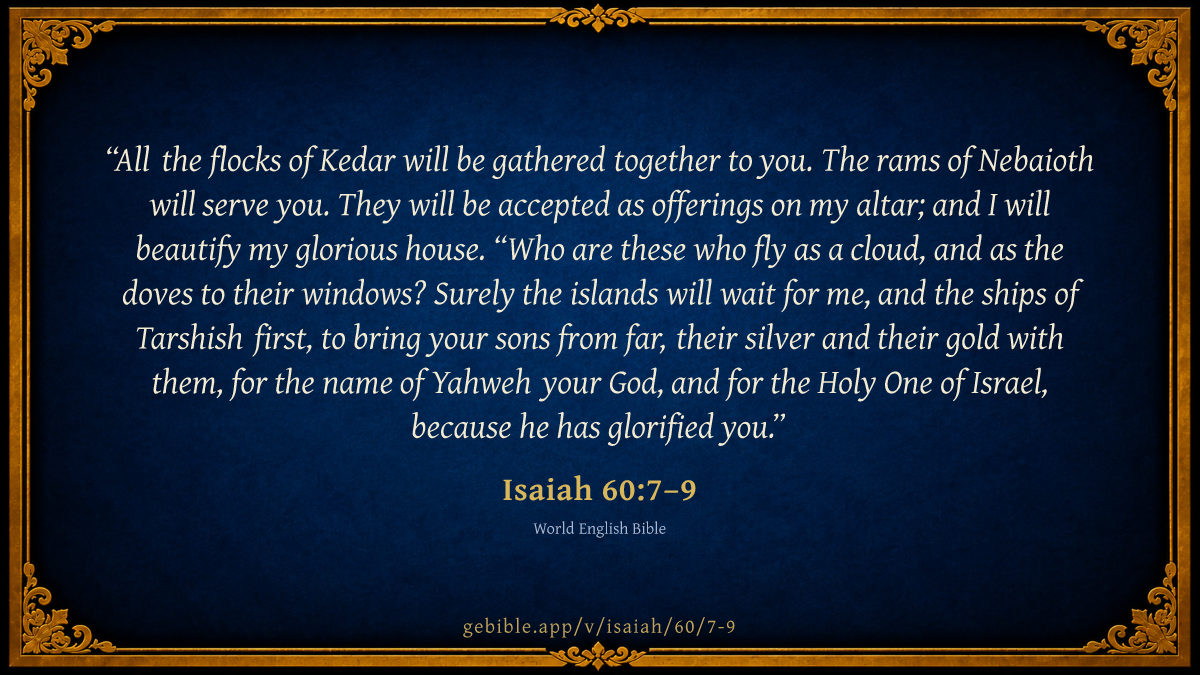
7All the flocks of Kedar will be gathered together to you. The rams of Nebaioth will serve you. They will be accepted as offerings on my altar; and I will beautify my glorious house.
8“Who are these who fly as a cloud, and as the doves to their windows?
9Surely the islands will wait for me, and the ships of Tarshish first, to bring your sons from far, their silver and their gold with them, for the name of Yahweh your God, and for the Holy One of Israel, because he has glorified you.
7 All the flocks of Kedar will be gathered together to you. The rams of Nebaioth will serve you. They will be accepted as offerings on my altar; and I will beautify my glorious house.
8 “Who are these who fly as a cloud, and as the doves to their windows?
9 Surely the islands will wait for me, and the ships of Tarshish first, to bring your sons from far, their silver and their gold with them, for the name of Yahweh your God, and for the Holy One of Israel, because he has glorified you.
KJVKing James Version
7 All the flocks of Kedar shall be gathered together unto thee, the rams of Nebaioth shall minister unto thee: they shall come up with acceptance on mine altar, and I will glorify the house of my glory.
8 Who are these that fly as a cloud, and as the doves to their windows?
9 Surely the isles shall wait for me, and the ships of Tarshish first, to bring thy sons from far, their silver and their gold with them, unto the name of the LORD thy God, and to the Holy One of Israel, because he hath glorified thee.
Show all 3 translations
JPSJPS Tanakh (1917)
7 All the flocks of Kedar shall be gathered together unto thee, the rams of Nebaioth shall minister unto thee; they shall come up with acceptance on Mine altar, and I will glorify My glorious house.
8 Who are these that fly as a cloud, and as the doves to their cotes?
9 Surely the isles shall wait for Me, and the ships of Tarshish first, to bring thy sons from far, their silver and their gold with them, for the name of the LORD thy God, and for the Holy One of Israel, because He hath glorified thee.
Isaiah 56:7(v7)I will bring these to my holy mountain, and make them joyful in my house of prayer. Their burnt offerings and their sacrifices will be…
Genesis 25:13(v7)These are the names of the sons of Ishmael, by their names, according to the order of their birth: the firstborn of Ishmael, Nebaioth, then…
Isaiah 55:5(v9)Behold, you shall call a nation that you don’t know; and a nation that didn’t know you shall run to you, because of Yahweh your God, and…
Isaiah 2:16(v9)for all the ships of Tarshish, and for all pleasant imagery.
Hebrews 13:15-16(v7)Through him, then, let’s offer up a sacrifice of praise to God continually, that is, the fruit of lips which proclaim allegiance to his…
Show all 52 cross-references
Revelation 7:9(v8)After these things I looked, and behold, a great multitude, which no man could count, out of every nation and of all tribes, peoples, and…
Job 42:8(v7)Now therefore, take to yourselves seven bulls and seven rams, and go to my servant Job, and offer up for yourselves a burnt offering; and…
Isaiah 11:11(v9)It will happen in that day that the Lord will set his hand again the second time to recover the remnant that is left of his people from…
Isaiah 51:5(v9)My righteousness is near. My salvation has gone out, and my arms will judge the peoples. The islands will wait for me, and they will trust…
Haggai 2:7-9(v7)and I will shake all nations. The precious things of all nations will come, and I will fill this house with glory, says Yahweh of Armies.…
Luke 13:29(v8)They will come from the east, west, north, and south, and will sit down in God’s Kingdom.
Romans 12:1(v7)Therefore I urge you, brothers, by the mercies of God, to present your bodies a living sacrifice, holy, acceptable to God, which is your…
Romans 15:16(v7)that I should be a servant of Christ Jesus to the Gentiles, serving as a priest of the Good News of God, that the offering up of the…
Isaiah 60:4(vv8–9)“Lift up your eyes all around, and see: they all gather themselves together. They come to you. Your sons will come from far away, and your…
Isaiah 42:4(v9)He will not fail nor be discouraged, until he has set justice in the earth, and the islands wait for his law.”
Isaiah 42:10(v9)Sing to Yahweh a new song, and his praise from the end of the earth, you who go down to the sea, and all that is therein, the islands and…
Isaiah 42:11(v7)Let the wilderness and its cities raise their voices, with the villages that Kedar inhabits. Let the inhabitants of Sela sing. Let them…
Isaiah 49:1(v9)Listen, islands, to me. Listen, you peoples, from afar: Yahweh has called me from the womb; from the inside of my mother, he has mentioned…
Isaiah 49:21(v8)Then you will say in your heart, ‘Who has conceived these for me, since I have been bereaved of my children and am alone, an exile, and…
Isaiah 60:13(v7)“The glory of Lebanon shall come to you, the cypress tree, the pine, and the box tree together, to beautify the place of my sanctuary; and…
Isaiah 66:19-20(v9)“I will set a sign among them, and I will send those who escape of them to the nations, to Tarshish, Pul, and Lud, who draw the bow, to…
Galatians 4:26(v9)But the Jerusalem that is above is free, which is the mother of us all.
Hebrews 12:1(v8)Therefore let’s also, seeing we are surrounded by so great a cloud of witnesses, lay aside every weight and the sin which so easily…
Genesis 8:8-11(v8)He himself sent out a dove to see if the waters were abated from the surface of the ground, but the dove found no place to rest her foot,…
Genesis 9:27(v9)May God enlarge Japheth. Let him dwell in the tents of Shem. Let Canaan be his servant.”
Genesis 10:2-5(v9)The sons of Japheth were: Gomer, Magog, Madai, Javan, Tubal, Meshech, and Tiras. The sons of Gomer were: Ashkenaz, Riphath, and Togarmah.…
Exodus 33:19(v9)He said, “I will make all my goodness pass before you, and will proclaim Yahweh’s name before you. I will be gracious to whom I will be…
Exodus 34:5-7(v9)Yahweh descended in the cloud, and stood with him there, and proclaimed Yahweh’s name. Yahweh passed by before him, and proclaimed,…
Joshua 9:9(v9)They said to him, “Your servants have come from a very far country because of the name of Yahweh your God; for we have heard of his fame,…
1 Kings 8:41(v9)“Moreover concerning the foreigner, who is not of your people Israel, when he comes out of a far country for your name’s sake
1 Kings 10:1(v9)When the queen of Sheba heard of the fame of Solomon concerning Yahweh’s name, she came to test him with hard questions.
1 Kings 10:22(v9)For the king had a fleet of Tarshish at sea with Hiram’s fleet. Once every three years the fleet of Tarshish came, bringing gold, silver,…
1 Kings 22:48(v9)Jehoshaphat made ships of Tarshish to go to Ophir for gold, but they didn’t go; for the ships wrecked at Ezion Geber.
Psalms 68:30-31(v9)Rebuke the wild animal of the reeds, the multitude of the bulls, with the calves of the peoples. Being humbled, may it bring bars of…
Psalms 72:10(v9)The kings of Tarshish and of the islands will bring tribute. The kings of Sheba and Seba shall offer gifts.
Proverbs 18:20(v9)A man’s stomach is filled with the fruit of his mouth. With the harvest of his lips he is satisfied.
Isaiah 14:1-2(v9)For Yahweh will have compassion on Jacob, and will yet choose Israel, and set them in their own land. The foreigner will join himself with…
Isaiah 43:4(v9)Since you have been precious and honored in my sight, and I have loved you, therefore I will give people in your place, and nations instead…
Isaiah 43:6(v9)I will tell the north, ‘Give them up!’ and tell the south, ‘Don’t hold them back! Bring my sons from far away, and my daughters from the…
Isaiah 45:22(v8)“Look to me, and be saved, all the ends of the earth; for I am God, and there is no other.
Isaiah 52:1-6(v9)Awake, awake! Put on your strength, Zion. Put on your beautiful garments, Jerusalem, the holy city: for from now on the uncircumcised and…
Isaiah 57:17(v9)I was angry because of the iniquity of his covetousness and struck him. I hid myself and was angry; and he went on backsliding in the way…
Jeremiah 3:17(v9)At that time they will call Jerusalem ‘Yahweh’s Throne;’ and all the nations will be gathered to it, to Yahweh’s name, to Jerusalem. They…
Jeremiah 30:19(v9)Thanksgiving will proceed out of them with the voice of those who make merry. I will multiply them, and they will not be few; I will also…
Zephaniah 2:11(v9)Yahweh will be awesome to them, for he will famish all the gods of the land. Men will worship him, everyone from his place, even all the…
Zechariah 14:14(v9)Judah also will fight at Jerusalem; and the wealth of all the surrounding nations will be gathered together: gold, and silver, and…
Luke 2:32(v9)a light for revelation to the nations, and the glory of your people Israel.”
John 17:26(v9)I made known to them your name, and will make it known; that the love with which you loved me may be in them, and I in them.”
Acts 9:15(v9)But the Lord said to him, “Go your way, for he is my chosen vessel to bear my name before the nations and kings, and the children of Israel.
2 Corinthians 8:4-5(v9)begging us with much entreaty to receive this grace and the fellowship in the service to the saints. This was not as we had expected, but…
Galatians 3:26(v9)For you are all children of God, through faith in Christ Jesus.
Hebrews 13:10(v7)We have an altar from which those who serve the holy tabernacle have no right to eat.
52 distinct cross-references across this passage (53 total citations).
Cross-references from openbible.info (CC BY 4.0)
Explain this passage (19 sources)
Historical commentary, presented as a primary source — not an endorsement.
Geneva Bible translators1599 · Public DomainOn vv7–9Because the Altar was a figure of Christ, Heb.…
Because the Altar was a figure of Christ, Heb. 13:10, he showeth that nothing can be acceptable to him, which is not offered to him by this Altar, who was both the offering and the altar itself.
That is, the Arabians, that have great abundance of cattle.
Geneva Bible (1599) marginal notes — public domain.
John Trapp1656 · Public DomainOn vv7–9Isa 60:7 All the flocks of Kedar shall be…
Isa 60:7 All the flocks of Kedar shall be gathered together unto thee, the rams of Nebaioth shall minister unto thee: they shall come up with acceptance on mine altar, and I will glorify the house of my glory.
Ver. 7. All the flocks of Kedar,] i.e., The Kedarenes and Nebateans with their flocks, whereof they had abundance; and they now had hearts to "honour the Lord with their substance, and with the best of their increase." See Isa 23:17-18.
John Trapp, A Commentary or Exposition upon All the Books of the Old and New Testament (1647–1656) — public domain. Text from a community e-Sword module.
Matthew Poole1685 · Public DomainOn vv7–9All the flocks of Kedar; the people whereof descended…
All the flocks of Kedar; the people whereof descended from Ishmael, and lived in Arabia Petrea, who were principally shepherds. The rams; q.d. nay, the chief of the flock, viz. for sacrifice; this Nebaioth being put for the people thereof, and sprang from Ishmael also, Gen 25:13; rich as the other were in flocks, and inhabiting the same country. As the Sabeans offered the proper commodities of their country, as gold and spice; so these of theirs, viz. cattle, showing that each country, and so each person, should bring that wherewith they did most excel.
Of Nebaioth: this shows that Abraham’s children according to the flesh should also be brought in to the gospel: compare Mal 1:11.
Read full note →
They shall come up with acceptance; being offered, they shall not now, as heretofore, be rejected; and hereby they shall be distinguished from the profane oblations of the Gentiles, i.e. in the name of Christ, who is the true and only gospel Altar. The house of my glory, i.e. the temple, or my house; glory being put here by a metonymy of the adjunct for God himself, who is glorious. God shall become glorious by the multitude of sacrifices that shall be offered and accepted here, Psa 29:9. And it is a type how glorious his New Testament spiritual worship shall be; this altar pointing at Christ, out of whom nothing is accepted, and that his church should be glorious, being built of living stones, 1Pe 2:5.
Matthew Poole's English Annotations on the Holy Bible (1683–1685) — public domain. Text from a community e-Sword/MySword module.
Matthew Henry1710 · Public DomainOn v9The promises made to the church in the foregoing…
The promises made to the church in the foregoing verses are here repeated, ratified, and enlarged upon, designed still for the comfort and encouragement of the Jews after their return out of captivity, but certainly looking further, to the enlargement and advancement of the gospel church and the abundance of spiritual blessings with which it shall be enriched.
I. God will be very gracious and propitious to them. We must begin with that promise, because thence all the rest take rise. The sanctuary that was desolate begins to be repaired when God causes his face to shine upon it, Dan 9:17. All the favour that the people of God find with men is owing to the light of God's countenance and his favour to them (Isa 60:10): "All shall now make court to thee, for in my wrath I smote thee, while thou wast in captivity" (and the sufferings of the church, especially by its corruptions, decays, and divisions, against which these promises will be its relief, are sad tokens of God's displeasure), "But now in my favour have I had mercy on thee, and therefore have all this mercy in store for thee."
Read full note →
II. Many shall be brought into the church, even from far countries (Isa 60:9): Surely the isles shall wait for me, shall welcome the gospel, and shall attend God with their praises for it and their ready subjection to it. The ships of Tarshish, transport-ships, shall lie ready to carry members from far distant regions to the church, or (which is equivalent) to carry the ministers of the church to remote parts, to preach the gospel and to bring in souls to join themselves to the Lord. Observe, 1. Who are brought - thy sons, that is, such as are designed to be so, those children of God that are scattered abroad, Joh 11:52. 2. What they shall bring with them. They live at such a distance that they cannot bring their flocks and their rams; but, like those who lived remote from Jerusalem (who, when they came up to worship at the feast, because they could not bring their tithes in kind, turned them into money), they shall bring their silver and gold with them. Note, When we give up ourselves to God we must with ourselves give up all we have to him. If we honour him with our spirits, we shall honour him with our substance. 3. To whom they shall devote and dedicate themselves and all they are worth - to the name of the Lord thy God, to God as the Lord of all and the church's God and King, even to the Holy One of Israel (whom Israel worships as a Holy One, in the beauty of holiness), because he has glorified thee. Note, The honour God puts upon his church and people should not only engage us to honour them, but invite us to join ourselves to them. We will go with you, for God is with you, Zac 8:23.
III. Those that come into the church shall be welcome; for so spacious is the holy city that though, Lord, it is done as thou hast commanded, yet still there is room. "Therefore thy gates shall be open continually (Isa 60:11), not only because thou hast no reason to fear thy enemies, but because thou hast reason to expect thy friends." It is usual with us to leave our doors open, or leave some one ready to open them, all night, if we look for a child or a guest to come in late. Note, Christ is always ready to entertain those that come to him, is never out of the way, nor can they ever come unseasonably; the gate of mercy is always open, night and day, or shall soon be opened to those that knock. Ministers, the door-keepers, must be always ready to admit those that offer themselves to the Lord. God not only keeps a good house in his church, but he keeps open house, that at any time, by the preaching of the word, in season and out of season, the forces of the Gentiles, and the kings or commanders of those forces, may be brought into the church. Lift up your heads, O you gates! and let such welcome guests as these come in.
IV. All that are about the church shall be made in some way or other serviceable to it. Though dominion is far from being founded in men's grace, it is founded in God's; and he that made the inferior creatures useful to man will make the nations of men useful to the church. The earth helped the woman. All things are for your sakes. So here (Isa 60:10), "Even the sons of strangers, that have neither knowledge of thee nor kindness for thee, that have always been aliens to the commonwealth of Israel, even they shall build up thy wall, and their kings shall in that and other things ministers unto thee and not think it any disparagement to them to do so." This was fulfilled when the king of Persia, and the governors of the provinces by his order, were aiding and assisting Nehemiah in building the wall about Jerusalem. Rather than Jerusalem's walls shall lie still in ruins, the sons of the stranger shall be raised up to build them. Even those that do not belong to the church may be a protection to it. And the greatest of men should not think it below them to minister to the church, but rejoice that they are in a capacity, and have a heart, to do it any service. Nay, it is the duty of all to do what they can in their places to advance the interests of God's kingdom among men; it is at their peril if they do not; for (Isa 60:12), The nation and kingdom that will not serve thee shall perish; not that they must perish by the sword or by human anathemas, or as if this gave any countenance to the using of external force for the propagating of the gospel, or as if men might be compelled by penalties and punishments to come into the church; by no means. But those who will not by faith submit to Jesus Christ, the King of the church, and serve him, shall perish eternally, Psa 2:12. Those that will not be subject to Christ's golden sceptre, to the government of his word and Spirit, that will not be brought under, or kept in, by the discipline of his family, shall be broken in pieces by his iron rod. Bring them forth and slay them before me, Luk 19:27. Nations of such shall be utterly and eternally wasted, when Christ shall come to take vengeance on those that obey not his gospel, Th2 1:8.
V. There shall be abundance of beauty added to the ordinances of divine worship (Isa 60:13): The glory of Lebanon, the strong and stately cedars that grow there, shall come unto thee, as of old to Solomon, when he built the temple (Ch2 2:16), and with them shall be brought other timber, proper for the carved work thereof, which the enemy had broken down, Psa 74:5, Psa 74:6. The temple, the place of God's sanctuary, shall be not only rebuilt, but beautified. It is the place of his feet, where he rests and resides, Eze 43:7. The ark is called his footstool, because it was under the mercy-seat, Psa 132:7. This he will make glorious in the eyes of his people and of all their neighbours. The glory of the latter house, to which this refers, though in many instances inferior, was yet really greater than the glory of the former, because Christ came to that temple, Mal 3:1. It was likewise adorned with goodly stones and gifts (Luk 21:5), to which this promise may have some reference; yet so slightly did Christ speak of them there that we must suppose it to have its full accomplishment in the beauties of holiness, and the graces and comforts of the Spirit, with which gospel ordinances are adorned and enriched.
VI. The church shall appear truly great and honourable, Isa 60:14. The people of the Jews, after their return out of captivity, by degrees became more considerable, and made a better figure than one would have expected, after they had been so much reduced, and than any of the other nations recovered that had been in like manner humbled by the Chaldeans. It is probable that many of those who had oppressed them in Babylon, when they were themselves driven out by the Persians, made their court to the Jews for shelter and supply and were willing to scrape acquaintance with them. This prophecy is further fulfilled when those that have been enemies to the church are wrought upon by the grace of God to see their error, and come, and join themselves to it: "The sons of those that afflicted thee, if not they themselves, yet their children, shall crouch to thee, shall beg pardon for their folly and beg an interest in thy favour and admission into thy family," Sa1 2:36. A promise like this is made to the church of Philadelphia, Rev 3:9. And it is intended to be, 1. A mortification to the proud oppressors of the church, that have afflicted her, and despised her, and taken a pleasure in doing so; they shall be brought down; their spirits shall be broken, and their condition shall be so mean and miserable that they shall be glad to be obliged to those whom they have most studied to disoblige. Note, Sooner or later God will pour contempt upon those that put contempt upon his people. 2. An exaltation to the poor oppressed ones of the church; and this is the honour that shall be done to them, they shall have an opportunity of doing good to those who have done evil to them and saving those alive who have afflicted and despised them. It is a pleasure to a good man, and he accounts it an honour, to show mercy to those with whom he has found no mercy. Yet this is not all. "They shall not only become suppliants to thee for their own interest, but they shall give honour to thee: They shall call thee, The city of the Lord; they shall at length be convinced that thou art a favourite of heaven, and the particular care of the divine providence." That city is truly great and honourable, it is strong, it is rich, it is safe, it is beautiful, it is the most desirable place that can be to live in, which is the city of the Lord, which he owns, in which he dwells, in which religion is uppermost. Such a one is Zion; it is the place which God has chosen to put his name there; it is the Zion of the Holy One of Israel; therefore, we may be sure, it is a holy city, else the Holy One of Israel would never be called the patron of it.
Matthew Henry's Commentary on the Whole Bible (1708–1710) — public domain (CC PDM 1.0). Text via the HelloAO Bible API.
John Gill1763 · Public DomainOn vv7–9All the flocks of Kedar shall be gathered unto…
All the flocks of Kedar shall be gathered unto thee, the rams of Nebaioth shall minister unto thee,.... Nebaioth and Kedar were the sons of Ishmael, Gen 25:13, Ishmael's twelve sons, of which Nebaioth was the eldest, inhabited all the country from Euphrates to the Red sea, calling it the Nabatene country, as Josephus (b) says; these design the Turks and Saracens, who shall now be converted. The Targum is,
"all the sheep of the Arabians shall be gathered unto thee;''
Read full note →
that is, these shall come with their sheep and rams, not to be offered up in sacrifice, for such sacrifices will not be used; but these, being the produce of the countries of these people, are mentioned to show, that being affected with the grace of God towards them, and influenced by it, will bring the best and chief of their substance to serve the interest of Christ, and glorify him with it:
they shall come up with acceptance on my altar; both they and their sacrifices and offerings will become acceptable to God through Christ, who is that altar that sanctifies every gift:
and I will glorify the house of my glory: with this large number of converts, and with the gifts and offerings they bring with them; the church is meant, which is the house of God, where he dwells and manifests his glory, the glory of himself, of his grace, and of his Gospel; see Jer 30:19.
(b) Antiqu. I. 1. c. 12. sect 4.
John Gill's Exposition of the Whole Bible (1746–1763) — public domain (CC PDM 1.0). Text via the HelloAO Bible API.
John Wesley1765 · Public DomainOn vv7–9Kedar - Arabia Petrea. Acceptance - They shall not…
Kedar - Arabia Petrea. Acceptance - They shall not now, as heretofore, be rejected. The house - The temple, or my house: God shall become glorious by the multitude of sacrifices, that shall be offered, and accepted here. This is a type of how glorious his New Testament worship shall be.
John Wesley, Explanatory Notes Upon the Whole Bible (1754–1765) — public domain. Text via the GEBible commentary corpus.
Adam Clarke1810 · Public DomainOn vv7–9Verse 7. The rams of Nebaioth shall minister unto…
Verse 7. The rams of Nebaioth shall minister unto thee] Vitringa on the place understands their ministering, and ascending or going up on the altar, as offering themselves voluntarily: ipsi se, non expectato sacerdote alto, gloriae et sanctificationi divini nominis ultro ac libenter oblaturi. "They, waiting for no priest, go and freely offer themselves to the glory and sanctification of the sacred name." This gives a very elegant and poetical turn to the image. It was a general notion that prevailed with sacrificers among the heathen, that the victim's being brought without reluctance to the altar was a good omen; and the contrary a bad one. Sabinos petit aliquanto tristior; quod sacrificanti hostia aufugerat. Sueton. Titus, cap. x. Accessit dirum omen, profugus altaribus tauris. "It was an omen of dreadful portent when the victim fled away from the altar." Tacit. Hist. iii. 56. - L.
Adam Clarke's Commentary on the Bible (1810–1826) — public domain. Text from a community e-Sword/MySword module.
Joseph Benson1811 · Public DomainOn vv8–9Isa 60:8. Who are these that fly as a…
Isa 60:8. Who are these that fly as a cloud — These metaphors import the number, as well as speed, of those that should be begotten by the apostles’ doctrine. “By this new crowd of believers hastening to the church,” Vitringa understands “the Greeks and Asiatics, and those of the west groaning under the Ottoman empire, who, having long sat in a state of ignorance and superstition, at this period shall be freed from their yoke, and hasten to the enlightened church in multitudes, like a cloud, and with zeal and impetuosity, (like doves to their cotes or holes,) when once made acquainted with the wonderful change of things, and the mighty works wrought by God for the deliverance of his people. The flight of doves, especially when they return to their cotes, is remarkably swift and precipitate.”
Joseph Benson's Commentary on the Old and New Testaments (1811–1818) — public domain. Text from a community e-Sword module.
Albert Barnes1834 · Public DomainOn vv7–9All the flocks of Kedar - On the word…
All the flocks of Kedar - On the word ‘Kedar,’ see the notes at Isa 21:16. The Kedarenians were a wandering tribe that frequently changed their residence, though it is probable they usually dwelt in the south part of Arabia Deserta, or the north of Arabia Petraea. They are mentioned as dwelling in beautiful tents Son 1:5 : ‘I am black, but comely as the tents of Kedar,’ see Psa 120:5; compare Isa 21:16-17; Isa 42:11. The language here also means that that which constituted their principal wealth would come and enrich Jerusalem, or the church of God.
The rams of Nebaioth - Nebaioth was also a son of Ishmael Gen 25:13; 1Ch 1:29, and was the father of the Nabatheans. They were a people of Arabia Petraea, and lived principally by plunder, trade, and the keeping of flocks. The country of Nabathea extended, it is supposed, from the Euphrates to the Red Sea, and embraced Petra, the capital of Arabia Deserts, and also Medaba. It is not possible, however, to fix the exact boundaries of the various tribes of Arabians. The general idea is, that their most valuable possessions would be devoted to God.
Read full note →
Shall minister unto thee - That is, by coming up as an acceptable sacrifice on the altar.
They shall come up with acceptance on mine altar - It is by no means necessary to understand this literally. The Jews were accustomed to express their ideas of worship by sacrifices, and the prophet naturally employed that language. The sense is, that the conversion of the wandering tribes of Arabia would be as certain and as signal as if the numerous flocks of Kedar and Nebaioth should be devoted to Yahweh in sacrifice. All that was valuable there would be employed in his service; the people would come with their most precious offerings and consecrate them to God. It is evident that this remains to be fulfilled. Paul, indeed, preached in Arabia Gal 1:17; and, doubtless, there were some conversions to Christianity there. But, as a people, they never have been converted to the true God; and in all ages they have been the victims of either idolatry or superstition. The time will come, however, when Arabia, so interesting as settled by the descendants of Abraham; so interesting in the bold, active, and energetic character of its tribes; so interesting as using a language that is one of the most refined and far-spoken of the earth; and so interesting as being, in some parts at least, among the most fertile and beautiful of the earth, shall be converted to God. Probably the most balmy, pure, and pleasant climate of the world is the southern part of Arabia Felix - the country of Yemen; and when the Arabs shall bring their energy of character to the service of the true God, and the gospel shall be preached in their language to all their tribes, no one can predict the effect which this shall have on the entire conversion of the world.
And I will glorify - I will honor my glorious house, that is, the temple. Lowth, ‘And my beauteous house I will yet beautify.’ The idea is, that he would adorn the temple by bringing the distant nations, with their most valuable possessions, to worship there. That is, the true religion would yet appear glorious when the nation should acknowledge it and submit to its requirements.
Albert Barnes' Notes on the Bible (1834–1885) — public domain. Text from a community e-Sword/MySword module.
Haydock's Catholic Bible Commentary1859 · Public DomainOn vv7–9Cedar and Nabaioth sprung from Ismael, and dwelt in…
Cedar and Nabaioth sprung from Ismael, and dwelt in desert Arabia, under tents, feeding flocks. (St. Jerome) (Ezechiel xxvii. 21.) --- They also were converted to Christ.
George Leo Haydock (1774–1849), Haydock's Catholic Family Bible and Commentary, 1859 edition — public domain. Excludes Psalms (Douay-Rheims chapter numbering differs from Protestant) and Deuterocanonical books (Catholic canon only).
Robert Jamieson, A. R. Fausset & David Brown1871 · Public DomainOn vv7–9Kedar-- (Isa 21:16; Sol 1:5), in the south of…
Kedar-- (Isa 21:16; Sol 1:5), in the south of Arabia-Deserta, or north of Arabia-Petræa; they traded in flocks (Eze 27:21).
Nebaioth--son of Ishmael, as was Kedar. Father of the Nabatheans in Arabia-Petræa.
Read full note →
minister--by coming up as an acceptable sacrifice.
come up with acceptance--that is, acceptably. The rams offering themselves voluntarily (Psa 68:30; Rom 12:1; Pe1 2:5), without waiting for any other priest, answer to believers strong in faith and lamb-like meekness; and in the white fleece-like robe of sanctity [VITRINGA].
house of my glory--the temple (Eze. 41:1-26; Hag 2:7, Hag 2:9; Mal 3:1).
Jamieson, Fausset & Brown — Commentary Critical and Explanatory on the Whole Bible (1871) — public domain (CC PDM 1.0). Text via the HelloAO Bible API.
Daniel D. Whedon1874 · Public DomainOn vv8–98. Who are these… fly as a cloud —…
8. Who are these… fly as a cloud — Emigrants from over the seas — from the west — the sails of whose ships are likened to flying clouds. A striking figure.
As… doves — Skimming the waters as “doves” do the air. Refined poetic element here.
Daniel D. Whedon (gen. ed.), Commentary on the Old and New Testaments (1874–1909) — public domain. Text from a community e-Sword module.
The Cambridge Bible for Schools and Colleges1878 · Public DomainOn vv7–97. Kedar (see on ch. Isa_21:16) … Nebajoth] Cf.…
7. Kedar (see on ch. Isa_21:16) … Nebajoth] Cf. Gen_25:13 &c. The identification of the latter tribe with the Nabatæans of the classical writers is disputed by some eminent authorities, but it is at least a significant circumstance that “Nabataei et Cedrei” are bracketed together by Pliny, as Nabaitai and Kidrai are associated in Assyrian inscriptions (Schrader, Cuneiform Inscriptions, on Gen_25:13 f.). The Nabatæans were as powerful in the last three centuries b.c. as the Midianites appear to have been in the days of Moses and the Judges (see on ch. 34 Introd. Note).
shall minister unto thee] serve thee for sacrificial victims. The verb has a liturgical sense (see ch. Isa_56:6) and the somewhat peculiar expression is explained by the following clause.
Read full note →
I will glorify &c.] my beautiful house I will beautify (Isa_60:13). It is difficult to say whether these words imply that the Temple was already in existence.
The Cambridge Bible for Schools and Colleges (gen. ed. J. J. S. Perowne; Cambridge University Press, 1878–1918) — public domain. Text from a community e-Sword module.
Ellicott's Commentary for English Readers1878 · Public DomainOn vv7–9(7) Kedar.—The nomad tribes (Isa_21:17) come as well as…
(7) Kedar.—The nomad tribes (Isa_21:17) come as well as the trading ones. Nebaioth, mentioned with Kedar, in Gen_25:13, among the descendants of Ishmael, expanded iii the centuries preceding the Christian era, into the kingdom of the Nabathœan Arabs, spreading from the Ælanitic Gulf to the Haurân. The two names together include what were known to the Roman geographers as Arabia Felix and Arabia Petræa. The primary thought is that the Temple of the new Jerusalem will be supplied with its sacrifices from the inexhaustible flocks of these regions.
A Bible Commentary for English Readers, edited by Charles John Ellicott (1878–1897) — public domain. Text from a community e-Sword module.
The Pulpit Commentary1880 · Public DomainOn vv7–9Kedar... Nebaioth. Arab tribes, like the Midianites and Sabaeans.…
Kedar... Nebaioth. Arab tribes, like the Midianites and Sabaeans. (With respect to Kedar, see the comment on Isa_21:15) "Nebaioth" stands for the tribe called by the Greeks and Romans the "Nabataeans," and by the Assyrians the "Nabaiti," who were one of the most powerful in the peninsula. About me. Nathan, their king, warred with Asshur-bani-pal (Smith"s" Hist. of Asshur-bani-pal," pp. 256-298). During the Maccabee period we find the Nabataeans in alliance with the Jews, and giving them some valuable assistance. (RAPC 1Ma 5:25 9:35) The locality of the Nabataeans was northern Arabia, or the tract lying between the Elanitic Gulf and the Lower Euphrates. The wealth of the Nabataeans and the Kedarenes was in their flocks and herds; and this wealth, it is prophesied, they will place, at the disposal of Israel. Mine altar... the house of my glory. The renovated Zion contains a glorious temple, and the temple has in it an altar, to which the sheep and rams are brought not, however, to be offered in sacrifice, but to be presented to God and become a part of the wealth of the Church.
God"s presence the glory of God"s house.
Read full note →
"I will glorify the house of my glory". (comp. Hag_2:7-8 Mal_3:1) Rendered literally, the sentence would read, "My house of beauty will I beautify." Foreshadowings of this spiritual truth are found in God"s presence making the charm of the Eden-home; God"s presence abiding as a glory between the cherubim in the holy of holies; and God"s presence coming in the symbol of the descending cloud on Solomon"s temple. It was the great glory of Herod"s restored temple, that the God-Man walked and worshipped and taught within its courts. It is the exceeding great glory of the Church, the spiritual temple, that God the Spirit comes to it, dwells in it, is the inspiration of it, and glorifies it. There is no glory in a shrine without the Deity. The sunshine, streaming through the windows of the old cathedral, fills the whole place with wondrous and solemnizing lights and shades; and the sunshine of the Divine presence fills the heart and the sanctuary with the only true glory and beauty and joy. "The Church is the house of God"s glory, where he manifests his glory to his people, and receives that homage by which they do honour to him.
I WE OUGHT TO GLORIFY GOD"S HOUSE. One idea of the text is that the restored temple at Jerusalem would be honoured by abundant supplies of sacrifices. That old way of worshipping has given place to spiritual forms, such as prayer and praise and instruction; then we should give the best possible attention to these, that in so doing we may honour God"s house. The best song, the best gifts, the best architecture, all should be devoted to the glorifying of God"s house. And the best, most regular, most reverent, attendance at public worship may be our way of honouring God. "What shall I render unto the Lord for all his benefits toward me? I will take the cup of salvation, and call upon the Name of the Lord." That is the way to glorify God for his goodness.
II GOD ALONE CAN TRULY GLORIFY GOD"S HOUSE. If he is not present, accepting the worship, inspiring the worship, and sanctifying the worship, then it is all vain show, empty form, deluding ceremony. Write up "Ichabod," for the "glory is departed." God"s presence is known in the enduement of his ministers with righteousness, and in the making of his chosen people joyful. R.T.
The Pulpit Commentary (1880–1919), ed. H.D.M. Spence-Jones & Joseph S. Exell — public domain. Text from a community e-Sword module.
The Biblical Illustrator1887 · Public DomainOn vv7–9All the flocks of Kedar shall be gathered together…
Isa_60:7
All the flocks of Kedar shall be gathered together unto thee
Read full note →
Sacrificial service
None of the prophets of the Old Testament is able to think of the worship of God by the Israel of the latter days without the offering of sacrifices; but it would be a return to the limited conceptions of the Old Testament if one were to conclude that animal sacrifice will ever be restored.
The dividing-wall of national particularism and ceremonial observances forming shadows of things to come will never be re-established; and with the cessation of sacrificial worship since the fiery judgment fell upon the second temple, there has for ever passed away the restriction of worship to any one central spot on earth (Joh_4:21), butthe stream of salvation which proceeded from Jerusalem will, nevertheless, ultimately empty its waters there, and make the city once more a fountain of blessing. As the prophet has said (Isa_56:7), the house of God in Jerusalem will become a house of prayer for all nations: Jehovah here calls it My house of glory, as that which was built for His honour and filled with His gracious presence. He will make its internal glory like the external, by adorning it with the gifts brought in homage by the world of converted Gentiles. (F. Delitzsch,D. D.)
I will glorify the house of My glory
A prosperous church
I. WHAT IS NOW THE HOUSE OF GOD? A house is a place of residence; the house of God, in the proper sense of the phrase, is the place of His residence. In this sense, the universe is His house, for He inhabits all space, and neither is, nor can be, confined to any one spot. Solomon felt this when he built the magnificent temple at Jerusalem. Behold, said he, addressing himself to God, the heaven and heaven of heavens cannot contain Thee; how much less this house that I have builded? Stephen felt it when, in allusion to the same house, he said, Howbeit the Most High dwelleth not in temples made with hands; as saith the prophet, heaven is My throne and earth is My footstool: what house will ye build Me? saith the Lord: or what is the place of My rest? Whilst, however., the universe is thus the only proper house of God, there are places which, in condescension to our weakness, are specially denominated HIS house, to denote that He specially manifests His presence there, is specially worshipped there, and bestows there special spiritual blessings, rich spiritual banquets. The dispensation of the law was intended to foreshadow good things to come, and accordingly under that dispensation there was a typical sanctuary, a house intended to typify the spiritual house of this dispensation--the Church. In that typical sanctuary there was a visible emblem of the Divine presence, a cloud overshadowing the mercy-seat, the same cloud which had gone before the children of Israel when journeying through the wilderness, as a pillar of a cloud by day, and as a pillar of fire by night. This visible emblem was a type of the spiritual presence of God in His Church. In the same typical sanctuary where this visible emblem was vouchsafed, typical sacrifices were offered and typical blessings bestowed. The new dispensation being the antitype is spiritual. Hence we have not now a typical temple, but every believer individually, and especially every Christian Church, is a spiritual temple. The house of God, then, under this dispensation, is not the building where the saints meet, but the assembly of the saints be it where it may; it is a spiritual house built of living stones, a house where spiritual sacrifices are offered, the sacrifices of praise and thanksgiving, which arc acceptable to God through Jesus Christ. At the same time, whilst the building is not the house of God, there is a subordinate sense in which it may be so denominated.
II. UNDER WHAT CIRCUMSTANCES MAY THE HOUSE CALLED THE HOUSE OF GOD BE DESCRIBED AS THE HOUSE OF HIS GLORY? It is the house of His glory, when His glory is the grand object in view. This house of His glory must not only be built, but also used for His glory: We have applied the phrase house of God in its subordinate sense to the building; let us proceed to apply it in a higher sense to the assembly of the saints, to the Church meeting in the building; and we ask, When is such a Church properly denominated the house of Gods glory?
1. It is so, when the object of its original formation, and that of its assembling from time to time, is the glory of God. Let professing Christians meet together as a mere matter of form, meet without any definite end in view, or meet with any other end than the glory of their Lord, the Church is no longer the house of His glory; nay, if even they meet for praise, for their own spiritual improvement and for the conversion of sinners, yet if the glory of God be not the ultimate end of all this, their assembly cannot be looked upon as the house of His glory.
2. The Church is the House of Gods glory when His glory is kept in view in all Church acts; for example, in receiving members, exercising discipline, choosing officers.
3. The Church is the house of Gods glory, when a spirit in accordance with HIS glory is cherished and manifested by every individual member. It is for the glory of God that love should prevail in His house. It is for the glory of God that there should be peace in His Church. And that the members of Churches should be characterized by humility.
III. THE PROMISE THAT GOD WILL GLORIFY THE HOUSE OF HIS GLORY. There is no promise that He will glorify the house which may be called by HIS name, if it be not the house of His glory. The glory is--
1. When He makes the house the place of numerous conversions.
2. When He makes it the place of edification to His people. (R. Arnot, LL. D.)
I will glorify the house of My glory
I. THE PLACE. For what reasons, or with what propriety, may the Christian Church be called the house of the glory of God? Chiefly on these accounts--
1. Because it is planned and built by the purpose and power of the Most High.
2. Because it contains the special manifestations of the Divine presence and glory.
(1) Christ Himself is the exact image of God. He is the true
Shechinah, the glory of the Lord.
(2) In the gifts and influences of the Holy Ghost.
(3) By the development of the Divine glory in the preaching of the Word.
II. THE PROMISE. I will glorify, etc. God did so in the first temple, by making it an object of beauty and glory to all His people, and by causing it to excite the admiration of surrounding nations also; and still further, by sending Christ finally to minister in that temple. God will glorify the house of His glory--
1. By accepting the services and offerings which, in connection with it, are performed.
2. By making it the place of special communion and fellowship with Himself.
3. By protecting it permanently against all the efforts of hostile powers.
4. By extending its influence, and increasing its celebrity in the earth.
5. By consummating it, finally, in the splendour and happiness of heaven. (J. Parsons.)
God glorifying the house of His glory
The vision is inspiring, and can only be fulfilled in the moral grandeur of the Church.
I. It begins to be accomplished WHEN SHE IS MADE A LIGHT TO DISPEL SPIRITUAL DARKNESS. At times she has not laid sufficient emphasis on her mission as a teaching Church. Unquestionably philanthropy is a function of the Church. But she ought not to permit the teaching side of her work to be thrust into the background. Her special business is to fight darkness with light.
II. God also glorifies her WHEN HE MAKES HER THE ARENA OF HEAVENLY VICTORIES.
III. God glorifies the Church IN MAKING HER THE SCHOOL OF SAINTLY VIRTUES. All educational institutions are to be admired, but the Church is foremost among them. To know the world, to know self, to know God, cover the entire domain of knowledge and mark its distinctive steps and progress. In the Church we are trained in the knowledge of self and God.
IV. But beyond all this the Almighty glorifies her WHEN HE MAKES IT A GARDEN FOR THE GROWTH OF HUMAN FELLOWSHIPS. We must not forget that what society knows of brotherhood has come from the Church. In the Roman Empire there were provident societies, especially burial guilds, before Christianity, but the real idea of fellowship began with the household of faith. The people were taught by Christ to love one another. And when the Church realizes her calling in this respect, and rich and poor meet together in her communion on equal footing, then is she resplendent with heavenly glory. (G. C. Lorimer, D. D.)
The Biblical Illustrator, edited by Joseph S. Exell (c. 1880s–1900s) — public domain. Text from a community e-Sword module.
The Preacher's Complete Homiletical Commentary1892 · Public DomainOn vv7–8Isa_60:7. I will glorify the house of My glory.
THE HONOUR ASCRIBED TO THE CHURCH
Isa_60:7. I will glorify the house of My glory.
Read full note →
Revelation has been gradual. Isaiah’s prophecies refer, first, to Judea and its inhabitants; but as he goes on they become much more general in their application: they reveal to us the glory of the Redeemer—the depth of His humiliation and sufferings, the greatness of His exaltation, the extension of His kingdom to the uttermost parts of the earth. Notice two things—
I. THE PLACE. The prophet refers immediately to the temple at Jerusalem. This was known by the name of the house of the glory of God. God intended that when the Jews settled, a place should be erected for His worship. The design of building a house to contain the emblems of the Divine glory was conceived by David, and announced by him to Nathan the prophet (2Sa_7:2-3). The prophet, however, afterwards received command to the contrary (2Sa_7:5-6; 2Sa_7:12-13). In due time Solomon announced his design to Hiram (1Ki_5:3-5). It was in consequence of this determination that a building was erected in a style of unparalleled splendour. A proclamation was issued to assemble the tribes at its celebration. The holy things were brought, and placed in the holy place (1Ki_8:10). In this way, and by the prayers and praises which were continually offered in it, this house became the place of the glory of God. There the Shechinah dwelt for ages; there sacrifices were offered; there were given the tokens of direction, of protection, and of the glory of God. These things stood in a symbolical and representative character. So that the “house” here spoken of refers to the Gospel Church. We do not stretch the comparison too far, if we call the Church of God, “the house of His glory.” Such an application is not below the design of Isaiah. Such, too, is the representation of Ezekiel (Eze_47:1-12). So in Zechariah (Zec_6:12). Malachi also (Mal_3:1). Reference may also be made to the writings of the apostles on this point (Eph_2:19-22; 1Ti_3:15; 1Pe_2:4-5). All who are called by Divine grace are to be regarded as the Church or House of God. And to these collectively the prophet refers, when he records the determination of Jehovah, “I will glorify the house of My glory.”
But for what reasons, or with what propriety may the Christian Church be called the house of the glory of God? Chiefly on these accounts—
1. Because, it is planned and built by the purpose and power of the Most High. The Christian Church, no less than the ancient temple, was built according to the mind and will of God.
2. Because it contains the special manifestations of the Divine presence and glory. In the temple there were special emblems of God’s presence. We trace the glory of God in all around us (Psa_19:1-3). But to display His glory in the Church, He uses means which make all these comparatively obscure.
(1.) Christ Himself is the exact image of God (Joh_1:14; 2Co_4:4; 2Co_4:6; Col_1:15; Heb_1:3). The perfect representation of God is made in the person, and cross, and work of Jesus Christ.
This glory is seen also
(2) in the gifts and influences of the Holy Spirit. The ministration of the Spirit is called the ministration of glory. As in the temple, the Shechinah dwelt in the holiest of all, so the Spirit dwells in the hearts of true believers, as the Spirit of glory and of God (1Co_3:16-17; 2Co_6:16).
(3.) By the development of the Divine glory in the preaching of the Word. Is it not a fact, that during the last eighteen hundred years, more has been done by the Gospel of Christ than had been done for four thousand years previous to its introduction. And He will be seen more and more till that time shall come when “the whole earth,” &c.
II. THE PROMISE. God glorified the house of His glory in the first temple, by making it an object of beauty and glory to all His people, and by causing it to excite the admiration of surrounding nations; and still further, by sending Christ finally to minister in that temple. God will glorify the house of His glory—
1. By accepting the services and offerings which, in connection with it, are rendered. Formerly He accepted sacrifices in the temple and so glorified it (Eze_20:40-41). No place whatever was honoured by the Divine presence, which was not so dedicated to Him. This is the connection in which the text stands (Isa_60:6-7). Sacrifices are abolished in the Gospel Church, because the Great Sacrifice has been offered (Joh_1:29; 1Co_5:7; Heb_10:14; Heb_9:12). Christ was the great victim slain at the dedication of the Gospel Temple on Calvary. In virtue of this sacrifice, all Christians are accepted, and their offerings (1Pe_2:5; Heb_13:15; Psa_51:17; Rom_12:1; Rom_15:16; Php_4:18).
2. By making it the place of special communion and fellowship with Himself. It was when the priest entered the holiest of all, that God spake with him, and testified His acceptance of the offerings of the people, and issued His various commands (Exo_25:21-22). All are now priests before God, and to each one God condescends to talk (Heb_10:19-22; Eph_2:18).
3. By protecting it permanently against all the efforts of hostile powers. The temple at Jerusalem stood only as long as the people were obedient. But the promise in the text is permanent in reference to the Church at large (Isa_60:16-18). The foundation of God standeth sure. And what are the grounds on which our belief in its security rests?
(1.) Upon the purpose of God.
(2.) Upon the promise of God. The purpose is an abstract of His will; and the promise is an intimation and illustration of that will (Mat_16:18).
(3.) Upon the special superintendence of God (Zec_2:5; Zec_2:8).
4. By extending it influence, and increasing its celebrity in the earth (vers, 4–6, 8, 9). Its glory has been increasing since its foundation was laid. And thus Jerusalem shall become “the praise of the whole earth.”
5. By consummating it finally, in the splendour and happiness of heaven. This world is to suffer a last, decisive change (2Pe_3:10). But still the Gospel Temple shall not be destroyed (Rev_21:22-27).
APPLICATION.—This is a subject concerning glory—the glory of the Gospel of God, the glory of the Church built on the foundation of the apostles and prophets, of which Christ Himself is the chief corner stone. Is this glory lighted up in your hearts? Have you passed from death unto life? If you have not now the light of grace, you will go from gloom to gloom. The Spirit’s influence is a necessity of your nature, “Ye must be born again.”—James Parsons: Pulpit, vol. iv. pp. 145–151.
The Preacher's Complete Homiletical Commentary (gen. ed. Joseph S. Exell; Funk & Wagnalls, c. 1892) — public domain (pre-1929). A full-Bible homiletical/sermon-outline anthology covering 65 of 66 books (2 John is absent from the source module). Text from a community e-Sword module.
unfoldingWord translationNotes2017 · CC BY-SA 4.0On v8General Information:
General Information:
Yahweh continues speaking to the people of Israel.
Read full note →
Who are these who fly along like a cloud, and like the doves to their shelters?
Yahweh uses questions and poetic images to draw attention here. He compares the sails of the ships to clouds and doves. This is also a picture of the Israelites returning to the country where they belong. AT: "Look, I see something like clouds moving quickly and like doves returning to their shelters." (See: Rhetorical Question and Simile)
The coastlands
This refers to the people who live on the coastlands and describes the area of coastlands as if it was people looking out. AT: "The people from the coastlands" (See: Metonymy and Personification)
the ships of Tarshish
This expression usually means large merchant ships suitable for long voyages.
Tyndale Open Study Notes2022 · CC BY-SA 4.0On vv7, 960:7 Kedar was a tribe in Arabia (21:16-17). •…
60:7 Kedar was a tribe in Arabia (21:16-17). • Nebaioth was an Ishmaelite tribe. • I will make my Temple glorious: The glory of God will be even more evident than it was in Solomon’s Temple (see 6:1-5; Hag 2:9; Rev 21:11, 22).

Geneva Bible translators 1599 · Public Domain On vv7–9 Because the Altar was a figure of Christ, Heb.…
Because the Altar was a figure of Christ, Heb. 13:10, he showeth that nothing can be acceptable to him, which is not offered to him by this Altar, who was both the offering and the altar itself.
That is, the Arabians, that have great abundance of cattle.
Geneva Bible (1599) marginal notes — public domain.
John Trapp 1656 · Public Domain On vv7–9 Isa 60:7 All the flocks of Kedar shall be…
Isa 60:7 All the flocks of Kedar shall be gathered together unto thee, the rams of Nebaioth shall minister unto thee: they shall come up with acceptance on mine altar, and I will glorify the house of my glory.
Ver. 7. All the flocks of Kedar,] i.e., The Kedarenes and Nebateans with their flocks, whereof they had abundance; and they now had hearts to "honour the Lord with their substance, and with the best of their increase." See Isa 23:17-18.
John Trapp, A Commentary or Exposition upon All the Books of the Old and New Testament (1647–1656) — public domain. Text from a community e-Sword module.
Matthew Poole 1685 · Public Domain On vv7–9 All the flocks of Kedar; the people whereof descended…
All the flocks of Kedar; the people whereof descended from Ishmael, and lived in Arabia Petrea, who were principally shepherds. The rams; q.d. nay, the chief of the flock, viz. for sacrifice; this Nebaioth being put for the people thereof, and sprang from Ishmael also, Gen 25:13; rich as the other were in flocks, and inhabiting the same country. As the Sabeans offered the proper commodities of their country, as gold and spice; so these of theirs, viz. cattle, showing that each country, and so each person, should bring that wherewith they did most excel.
Of Nebaioth: this shows that Abraham’s children according to the flesh should also be brought in to the gospel: compare Mal 1:11.
Read full note →
They shall come up with acceptance; being offered, they shall not now, as heretofore, be rejected; and hereby they shall be distinguished from the profane oblations of the Gentiles, i.e. in the name of Christ, who is the true and only gospel Altar. The house of my glory, i.e. the temple, or my house; glory being put here by a metonymy of the adjunct for God himself, who is glorious. God shall become glorious by the multitude of sacrifices that shall be offered and accepted here, Psa 29:9. And it is a type how glorious his New Testament spiritual worship shall be; this altar pointing at Christ, out of whom nothing is accepted, and that his church should be glorious, being built of living stones, 1Pe 2:5.
Matthew Poole's English Annotations on the Holy Bible (1683–1685) — public domain. Text from a community e-Sword/MySword module.
Matthew Henry 1710 · Public Domain On v9 The promises made to the church in the foregoing…
The promises made to the church in the foregoing verses are here repeated, ratified, and enlarged upon, designed still for the comfort and encouragement of the Jews after their return out of captivity, but certainly looking further, to the enlargement and advancement of the gospel church and the abundance of spiritual blessings with which it shall be enriched.
I. God will be very gracious and propitious to them. We must begin with that promise, because thence all the rest take rise. The sanctuary that was desolate begins to be repaired when God causes his face to shine upon it, Dan 9:17. All the favour that the people of God find with men is owing to the light of God's countenance and his favour to them (Isa 60:10): "All shall now make court to thee, for in my wrath I smote thee, while thou wast in captivity" (and the sufferings of the church, especially by its corruptions, decays, and divisions, against which these promises will be its relief, are sad tokens of God's displeasure), "But now in my favour have I had mercy on thee, and therefore have all this mercy in store for thee."
Read full note →
II. Many shall be brought into the church, even from far countries (Isa 60:9): Surely the isles shall wait for me, shall welcome the gospel, and shall attend God with their praises for it and their ready subjection to it. The ships of Tarshish, transport-ships, shall lie ready to carry members from far distant regions to the church, or (which is equivalent) to carry the ministers of the church to remote parts, to preach the gospel and to bring in souls to join themselves to the Lord. Observe, 1. Who are brought - thy sons, that is, such as are designed to be so, those children of God that are scattered abroad, Joh 11:52. 2. What they shall bring with them. They live at such a distance that they cannot bring their flocks and their rams; but, like those who lived remote from Jerusalem (who, when they came up to worship at the feast, because they could not bring their tithes in kind, turned them into money), they shall bring their silver and gold with them. Note, When we give up ourselves to God we must with ourselves give up all we have to him. If we honour him with our spirits, we shall honour him with our substance. 3. To whom they shall devote and dedicate themselves and all they are worth - to the name of the Lord thy God, to God as the Lord of all and the church's God and King, even to the Holy One of Israel (whom Israel worships as a Holy One, in the beauty of holiness), because he has glorified thee. Note, The honour God puts upon his church and people should not only engage us to honour them, but invite us to join ourselves to them. We will go with you, for God is with you, Zac 8:23.
III. Those that come into the church shall be welcome; for so spacious is the holy city that though, Lord, it is done as thou hast commanded, yet still there is room. "Therefore thy gates shall be open continually (Isa 60:11), not only because thou hast no reason to fear thy enemies, but because thou hast reason to expect thy friends." It is usual with us to leave our doors open, or leave some one ready to open them, all night, if we look for a child or a guest to come in late. Note, Christ is always ready to entertain those that come to him, is never out of the way, nor can they ever come unseasonably; the gate of mercy is always open, night and day, or shall soon be opened to those that knock. Ministers, the door-keepers, must be always ready to admit those that offer themselves to the Lord. God not only keeps a good house in his church, but he keeps open house, that at any time, by the preaching of the word, in season and out of season, the forces of the Gentiles, and the kings or commanders of those forces, may be brought into the church. Lift up your heads, O you gates! and let such welcome guests as these come in.
IV. All that are about the church shall be made in some way or other serviceable to it. Though dominion is far from being founded in men's grace, it is founded in God's; and he that made the inferior creatures useful to man will make the nations of men useful to the church. The earth helped the woman. All things are for your sakes. So here (Isa 60:10), "Even the sons of strangers, that have neither knowledge of thee nor kindness for thee, that have always been aliens to the commonwealth of Israel, even they shall build up thy wall, and their kings shall in that and other things ministers unto thee and not think it any disparagement to them to do so." This was fulfilled when the king of Persia, and the governors of the provinces by his order, were aiding and assisting Nehemiah in building the wall about Jerusalem. Rather than Jerusalem's walls shall lie still in ruins, the sons of the stranger shall be raised up to build them. Even those that do not belong to the church may be a protection to it. And the greatest of men should not think it below them to minister to the church, but rejoice that they are in a capacity, and have a heart, to do it any service. Nay, it is the duty of all to do what they can in their places to advance the interests of God's kingdom among men; it is at their peril if they do not; for (Isa 60:12), The nation and kingdom that will not serve thee shall perish; not that they must perish by the sword or by human anathemas, or as if this gave any countenance to the using of external force for the propagating of the gospel, or as if men might be compelled by penalties and punishments to come into the church; by no means. But those who will not by faith submit to Jesus Christ, the King of the church, and serve him, shall perish eternally, Psa 2:12. Those that will not be subject to Christ's golden sceptre, to the government of his word and Spirit, that will not be brought under, or kept in, by the discipline of his family, shall be broken in pieces by his iron rod. Bring them forth and slay them before me, Luk 19:27. Nations of such shall be utterly and eternally wasted, when Christ shall come to take vengeance on those that obey not his gospel, Th2 1:8.
V. There shall be abundance of beauty added to the ordinances of divine worship (Isa 60:13): The glory of Lebanon, the strong and stately cedars that grow there, shall come unto thee, as of old to Solomon, when he built the temple (Ch2 2:16), and with them shall be brought other timber, proper for the carved work thereof, which the enemy had broken down, Psa 74:5, Psa 74:6. The temple, the place of God's sanctuary, shall be not only rebuilt, but beautified. It is the place of his feet, where he rests and resides, Eze 43:7. The ark is called his footstool, because it was under the mercy-seat, Psa 132:7. This he will make glorious in the eyes of his people and of all their neighbours. The glory of the latter house, to which this refers, though in many instances inferior, was yet really greater than the glory of the former, because Christ came to that temple, Mal 3:1. It was likewise adorned with goodly stones and gifts (Luk 21:5), to which this promise may have some reference; yet so slightly did Christ speak of them there that we must suppose it to have its full accomplishment in the beauties of holiness, and the graces and comforts of the Spirit, with which gospel ordinances are adorned and enriched.
VI. The church shall appear truly great and honourable, Isa 60:14. The people of the Jews, after their return out of captivity, by degrees became more considerable, and made a better figure than one would have expected, after they had been so much reduced, and than any of the other nations recovered that had been in like manner humbled by the Chaldeans. It is probable that many of those who had oppressed them in Babylon, when they were themselves driven out by the Persians, made their court to the Jews for shelter and supply and were willing to scrape acquaintance with them. This prophecy is further fulfilled when those that have been enemies to the church are wrought upon by the grace of God to see their error, and come, and join themselves to it: "The sons of those that afflicted thee, if not they themselves, yet their children, shall crouch to thee, shall beg pardon for their folly and beg an interest in thy favour and admission into thy family," Sa1 2:36. A promise like this is made to the church of Philadelphia, Rev 3:9. And it is intended to be, 1. A mortification to the proud oppressors of the church, that have afflicted her, and despised her, and taken a pleasure in doing so; they shall be brought down; their spirits shall be broken, and their condition shall be so mean and miserable that they shall be glad to be obliged to those whom they have most studied to disoblige. Note, Sooner or later God will pour contempt upon those that put contempt upon his people. 2. An exaltation to the poor oppressed ones of the church; and this is the honour that shall be done to them, they shall have an opportunity of doing good to those who have done evil to them and saving those alive who have afflicted and despised them. It is a pleasure to a good man, and he accounts it an honour, to show mercy to those with whom he has found no mercy. Yet this is not all. "They shall not only become suppliants to thee for their own interest, but they shall give honour to thee: They shall call thee, The city of the Lord; they shall at length be convinced that thou art a favourite of heaven, and the particular care of the divine providence." That city is truly great and honourable, it is strong, it is rich, it is safe, it is beautiful, it is the most desirable place that can be to live in, which is the city of the Lord, which he owns, in which he dwells, in which religion is uppermost. Such a one is Zion; it is the place which God has chosen to put his name there; it is the Zion of the Holy One of Israel; therefore, we may be sure, it is a holy city, else the Holy One of Israel would never be called the patron of it.
Matthew Henry's Commentary on the Whole Bible (1708–1710) — public domain (CC PDM 1.0). Text via the HelloAO Bible API.
John Gill 1763 · Public Domain On vv7–9 All the flocks of Kedar shall be gathered unto…
All the flocks of Kedar shall be gathered unto thee, the rams of Nebaioth shall minister unto thee,.... Nebaioth and Kedar were the sons of Ishmael, Gen 25:13, Ishmael's twelve sons, of which Nebaioth was the eldest, inhabited all the country from Euphrates to the Red sea, calling it the Nabatene country, as Josephus (b) says; these design the Turks and Saracens, who shall now be converted. The Targum is,
"all the sheep of the Arabians shall be gathered unto thee;''
Read full note →
that is, these shall come with their sheep and rams, not to be offered up in sacrifice, for such sacrifices will not be used; but these, being the produce of the countries of these people, are mentioned to show, that being affected with the grace of God towards them, and influenced by it, will bring the best and chief of their substance to serve the interest of Christ, and glorify him with it:
they shall come up with acceptance on my altar; both they and their sacrifices and offerings will become acceptable to God through Christ, who is that altar that sanctifies every gift:
and I will glorify the house of my glory: with this large number of converts, and with the gifts and offerings they bring with them; the church is meant, which is the house of God, where he dwells and manifests his glory, the glory of himself, of his grace, and of his Gospel; see Jer 30:19.
(b) Antiqu. I. 1. c. 12. sect 4.
John Gill's Exposition of the Whole Bible (1746–1763) — public domain (CC PDM 1.0). Text via the HelloAO Bible API.
John Wesley 1765 · Public Domain On vv7–9 Kedar - Arabia Petrea. Acceptance - They shall not…
Kedar - Arabia Petrea. Acceptance - They shall not now, as heretofore, be rejected. The house - The temple, or my house: God shall become glorious by the multitude of sacrifices, that shall be offered, and accepted here. This is a type of how glorious his New Testament worship shall be.
John Wesley, Explanatory Notes Upon the Whole Bible (1754–1765) — public domain. Text via the GEBible commentary corpus.
Adam Clarke 1810 · Public Domain On vv7–9 Verse 7. The rams of Nebaioth shall minister unto…
Verse 7. The rams of Nebaioth shall minister unto thee] Vitringa on the place understands their ministering, and ascending or going up on the altar, as offering themselves voluntarily: ipsi se, non expectato sacerdote alto, gloriae et sanctificationi divini nominis ultro ac libenter oblaturi. "They, waiting for no priest, go and freely offer themselves to the glory and sanctification of the sacred name." This gives a very elegant and poetical turn to the image. It was a general notion that prevailed with sacrificers among the heathen, that the victim's being brought without reluctance to the altar was a good omen; and the contrary a bad one. Sabinos petit aliquanto tristior; quod sacrificanti hostia aufugerat. Sueton. Titus, cap. x. Accessit dirum omen, profugus altaribus tauris. "It was an omen of dreadful portent when the victim fled away from the altar." Tacit. Hist. iii. 56. - L.
Adam Clarke's Commentary on the Bible (1810–1826) — public domain. Text from a community e-Sword/MySword module.
Joseph Benson 1811 · Public Domain On vv8–9 Isa 60:8. Who are these that fly as a…
Isa 60:8. Who are these that fly as a cloud — These metaphors import the number, as well as speed, of those that should be begotten by the apostles’ doctrine. “By this new crowd of believers hastening to the church,” Vitringa understands “the Greeks and Asiatics, and those of the west groaning under the Ottoman empire, who, having long sat in a state of ignorance and superstition, at this period shall be freed from their yoke, and hasten to the enlightened church in multitudes, like a cloud, and with zeal and impetuosity, (like doves to their cotes or holes,) when once made acquainted with the wonderful change of things, and the mighty works wrought by God for the deliverance of his people. The flight of doves, especially when they return to their cotes, is remarkably swift and precipitate.”
Joseph Benson's Commentary on the Old and New Testaments (1811–1818) — public domain. Text from a community e-Sword module.
Albert Barnes 1834 · Public Domain On vv7–9 All the flocks of Kedar - On the word…
All the flocks of Kedar - On the word ‘Kedar,’ see the notes at Isa 21:16. The Kedarenians were a wandering tribe that frequently changed their residence, though it is probable they usually dwelt in the south part of Arabia Deserta, or the north of Arabia Petraea. They are mentioned as dwelling in beautiful tents Son 1:5 : ‘I am black, but comely as the tents of Kedar,’ see Psa 120:5; compare Isa 21:16-17; Isa 42:11. The language here also means that that which constituted their principal wealth would come and enrich Jerusalem, or the church of God.
The rams of Nebaioth - Nebaioth was also a son of Ishmael Gen 25:13; 1Ch 1:29, and was the father of the Nabatheans. They were a people of Arabia Petraea, and lived principally by plunder, trade, and the keeping of flocks. The country of Nabathea extended, it is supposed, from the Euphrates to the Red Sea, and embraced Petra, the capital of Arabia Deserts, and also Medaba. It is not possible, however, to fix the exact boundaries of the various tribes of Arabians. The general idea is, that their most valuable possessions would be devoted to God.
Read full note →
Shall minister unto thee - That is, by coming up as an acceptable sacrifice on the altar.
They shall come up with acceptance on mine altar - It is by no means necessary to understand this literally. The Jews were accustomed to express their ideas of worship by sacrifices, and the prophet naturally employed that language. The sense is, that the conversion of the wandering tribes of Arabia would be as certain and as signal as if the numerous flocks of Kedar and Nebaioth should be devoted to Yahweh in sacrifice. All that was valuable there would be employed in his service; the people would come with their most precious offerings and consecrate them to God. It is evident that this remains to be fulfilled. Paul, indeed, preached in Arabia Gal 1:17; and, doubtless, there were some conversions to Christianity there. But, as a people, they never have been converted to the true God; and in all ages they have been the victims of either idolatry or superstition. The time will come, however, when Arabia, so interesting as settled by the descendants of Abraham; so interesting in the bold, active, and energetic character of its tribes; so interesting as using a language that is one of the most refined and far-spoken of the earth; and so interesting as being, in some parts at least, among the most fertile and beautiful of the earth, shall be converted to God. Probably the most balmy, pure, and pleasant climate of the world is the southern part of Arabia Felix - the country of Yemen; and when the Arabs shall bring their energy of character to the service of the true God, and the gospel shall be preached in their language to all their tribes, no one can predict the effect which this shall have on the entire conversion of the world.
And I will glorify - I will honor my glorious house, that is, the temple. Lowth, ‘And my beauteous house I will yet beautify.’ The idea is, that he would adorn the temple by bringing the distant nations, with their most valuable possessions, to worship there. That is, the true religion would yet appear glorious when the nation should acknowledge it and submit to its requirements.
Albert Barnes' Notes on the Bible (1834–1885) — public domain. Text from a community e-Sword/MySword module.
Haydock's Catholic Bible Commentary 1859 · Public Domain On vv7–9 Cedar and Nabaioth sprung from Ismael, and dwelt in…
Cedar and Nabaioth sprung from Ismael, and dwelt in desert Arabia, under tents, feeding flocks. (St. Jerome) (Ezechiel xxvii. 21.) --- They also were converted to Christ.
George Leo Haydock (1774–1849), Haydock's Catholic Family Bible and Commentary, 1859 edition — public domain. Excludes Psalms (Douay-Rheims chapter numbering differs from Protestant) and Deuterocanonical books (Catholic canon only).
Robert Jamieson, A. R. Fausset & David Brown 1871 · Public Domain On vv7–9 Kedar-- (Isa 21:16; Sol 1:5), in the south of…
Kedar-- (Isa 21:16; Sol 1:5), in the south of Arabia-Deserta, or north of Arabia-Petræa; they traded in flocks (Eze 27:21).
Nebaioth--son of Ishmael, as was Kedar. Father of the Nabatheans in Arabia-Petræa.
Read full note →
minister--by coming up as an acceptable sacrifice.
come up with acceptance--that is, acceptably. The rams offering themselves voluntarily (Psa 68:30; Rom 12:1; Pe1 2:5), without waiting for any other priest, answer to believers strong in faith and lamb-like meekness; and in the white fleece-like robe of sanctity [VITRINGA].
house of my glory--the temple (Eze. 41:1-26; Hag 2:7, Hag 2:9; Mal 3:1).
Jamieson, Fausset & Brown — Commentary Critical and Explanatory on the Whole Bible (1871) — public domain (CC PDM 1.0). Text via the HelloAO Bible API.
Daniel D. Whedon 1874 · Public Domain On vv8–9 8. Who are these… fly as a cloud —…
8. Who are these… fly as a cloud — Emigrants from over the seas — from the west — the sails of whose ships are likened to flying clouds. A striking figure.
As… doves — Skimming the waters as “doves” do the air. Refined poetic element here.
Daniel D. Whedon (gen. ed.), Commentary on the Old and New Testaments (1874–1909) — public domain. Text from a community e-Sword module.
The Cambridge Bible for Schools and Colleges 1878 · Public Domain On vv7–9 7. Kedar (see on ch. Isa_21:16) … Nebajoth] Cf.…
7. Kedar (see on ch. Isa_21:16) … Nebajoth] Cf. Gen_25:13 &c. The identification of the latter tribe with the Nabatæans of the classical writers is disputed by some eminent authorities, but it is at least a significant circumstance that “Nabataei et Cedrei” are bracketed together by Pliny, as Nabaitai and Kidrai are associated in Assyrian inscriptions (Schrader, Cuneiform Inscriptions, on Gen_25:13 f.). The Nabatæans were as powerful in the last three centuries b.c. as the Midianites appear to have been in the days of Moses and the Judges (see on ch. 34 Introd. Note).
shall minister unto thee] serve thee for sacrificial victims. The verb has a liturgical sense (see ch. Isa_56:6) and the somewhat peculiar expression is explained by the following clause.
Read full note →
I will glorify &c.] my beautiful house I will beautify (Isa_60:13). It is difficult to say whether these words imply that the Temple was already in existence.
The Cambridge Bible for Schools and Colleges (gen. ed. J. J. S. Perowne; Cambridge University Press, 1878–1918) — public domain. Text from a community e-Sword module.
Ellicott's Commentary for English Readers 1878 · Public Domain On vv7–9 (7) Kedar.—The nomad tribes (Isa_21:17) come as well as…
(7) Kedar.—The nomad tribes (Isa_21:17) come as well as the trading ones. Nebaioth, mentioned with Kedar, in Gen_25:13, among the descendants of Ishmael, expanded iii the centuries preceding the Christian era, into the kingdom of the Nabathœan Arabs, spreading from the Ælanitic Gulf to the Haurân. The two names together include what were known to the Roman geographers as Arabia Felix and Arabia Petræa. The primary thought is that the Temple of the new Jerusalem will be supplied with its sacrifices from the inexhaustible flocks of these regions.
A Bible Commentary for English Readers, edited by Charles John Ellicott (1878–1897) — public domain. Text from a community e-Sword module.
The Pulpit Commentary 1880 · Public Domain On vv7–9 Kedar... Nebaioth. Arab tribes, like the Midianites and Sabaeans.…
Kedar... Nebaioth. Arab tribes, like the Midianites and Sabaeans. (With respect to Kedar, see the comment on Isa_21:15) "Nebaioth" stands for the tribe called by the Greeks and Romans the "Nabataeans," and by the Assyrians the "Nabaiti," who were one of the most powerful in the peninsula. About me. Nathan, their king, warred with Asshur-bani-pal (Smith"s" Hist. of Asshur-bani-pal," pp. 256-298). During the Maccabee period we find the Nabataeans in alliance with the Jews, and giving them some valuable assistance. (RAPC 1Ma 5:25 9:35) The locality of the Nabataeans was northern Arabia, or the tract lying between the Elanitic Gulf and the Lower Euphrates. The wealth of the Nabataeans and the Kedarenes was in their flocks and herds; and this wealth, it is prophesied, they will place, at the disposal of Israel. Mine altar... the house of my glory. The renovated Zion contains a glorious temple, and the temple has in it an altar, to which the sheep and rams are brought not, however, to be offered in sacrifice, but to be presented to God and become a part of the wealth of the Church.
God"s presence the glory of God"s house.
Read full note →
"I will glorify the house of my glory". (comp. Hag_2:7-8 Mal_3:1) Rendered literally, the sentence would read, "My house of beauty will I beautify." Foreshadowings of this spiritual truth are found in God"s presence making the charm of the Eden-home; God"s presence abiding as a glory between the cherubim in the holy of holies; and God"s presence coming in the symbol of the descending cloud on Solomon"s temple. It was the great glory of Herod"s restored temple, that the God-Man walked and worshipped and taught within its courts. It is the exceeding great glory of the Church, the spiritual temple, that God the Spirit comes to it, dwells in it, is the inspiration of it, and glorifies it. There is no glory in a shrine without the Deity. The sunshine, streaming through the windows of the old cathedral, fills the whole place with wondrous and solemnizing lights and shades; and the sunshine of the Divine presence fills the heart and the sanctuary with the only true glory and beauty and joy. "The Church is the house of God"s glory, where he manifests his glory to his people, and receives that homage by which they do honour to him.
I WE OUGHT TO GLORIFY GOD"S HOUSE. One idea of the text is that the restored temple at Jerusalem would be honoured by abundant supplies of sacrifices. That old way of worshipping has given place to spiritual forms, such as prayer and praise and instruction; then we should give the best possible attention to these, that in so doing we may honour God"s house. The best song, the best gifts, the best architecture, all should be devoted to the glorifying of God"s house. And the best, most regular, most reverent, attendance at public worship may be our way of honouring God. "What shall I render unto the Lord for all his benefits toward me? I will take the cup of salvation, and call upon the Name of the Lord." That is the way to glorify God for his goodness.
II GOD ALONE CAN TRULY GLORIFY GOD"S HOUSE. If he is not present, accepting the worship, inspiring the worship, and sanctifying the worship, then it is all vain show, empty form, deluding ceremony. Write up "Ichabod," for the "glory is departed." God"s presence is known in the enduement of his ministers with righteousness, and in the making of his chosen people joyful. R.T.
The Pulpit Commentary (1880–1919), ed. H.D.M. Spence-Jones & Joseph S. Exell — public domain. Text from a community e-Sword module.
The Biblical Illustrator 1887 · Public Domain On vv7–9 All the flocks of Kedar shall be gathered together…
Isa_60:7
All the flocks of Kedar shall be gathered together unto thee
Read full note →
Sacrificial service
None of the prophets of the Old Testament is able to think of the worship of God by the Israel of the latter days without the offering of sacrifices; but it would be a return to the limited conceptions of the Old Testament if one were to conclude that animal sacrifice will ever be restored.
The dividing-wall of national particularism and ceremonial observances forming shadows of things to come will never be re-established; and with the cessation of sacrificial worship since the fiery judgment fell upon the second temple, there has for ever passed away the restriction of worship to any one central spot on earth (Joh_4:21), butthe stream of salvation which proceeded from Jerusalem will, nevertheless, ultimately empty its waters there, and make the city once more a fountain of blessing. As the prophet has said (Isa_56:7), the house of God in Jerusalem will become a house of prayer for all nations: Jehovah here calls it My house of glory, as that which was built for His honour and filled with His gracious presence. He will make its internal glory like the external, by adorning it with the gifts brought in homage by the world of converted Gentiles. (F. Delitzsch,D. D.)
I will glorify the house of My glory
A prosperous church
I. WHAT IS NOW THE HOUSE OF GOD? A house is a place of residence; the house of God, in the proper sense of the phrase, is the place of His residence. In this sense, the universe is His house, for He inhabits all space, and neither is, nor can be, confined to any one spot. Solomon felt this when he built the magnificent temple at Jerusalem. Behold, said he, addressing himself to God, the heaven and heaven of heavens cannot contain Thee; how much less this house that I have builded? Stephen felt it when, in allusion to the same house, he said, Howbeit the Most High dwelleth not in temples made with hands; as saith the prophet, heaven is My throne and earth is My footstool: what house will ye build Me? saith the Lord: or what is the place of My rest? Whilst, however., the universe is thus the only proper house of God, there are places which, in condescension to our weakness, are specially denominated HIS house, to denote that He specially manifests His presence there, is specially worshipped there, and bestows there special spiritual blessings, rich spiritual banquets. The dispensation of the law was intended to foreshadow good things to come, and accordingly under that dispensation there was a typical sanctuary, a house intended to typify the spiritual house of this dispensation--the Church. In that typical sanctuary there was a visible emblem of the Divine presence, a cloud overshadowing the mercy-seat, the same cloud which had gone before the children of Israel when journeying through the wilderness, as a pillar of a cloud by day, and as a pillar of fire by night. This visible emblem was a type of the spiritual presence of God in His Church. In the same typical sanctuary where this visible emblem was vouchsafed, typical sacrifices were offered and typical blessings bestowed. The new dispensation being the antitype is spiritual. Hence we have not now a typical temple, but every believer individually, and especially every Christian Church, is a spiritual temple. The house of God, then, under this dispensation, is not the building where the saints meet, but the assembly of the saints be it where it may; it is a spiritual house built of living stones, a house where spiritual sacrifices are offered, the sacrifices of praise and thanksgiving, which arc acceptable to God through Jesus Christ. At the same time, whilst the building is not the house of God, there is a subordinate sense in which it may be so denominated.
II. UNDER WHAT CIRCUMSTANCES MAY THE HOUSE CALLED THE HOUSE OF GOD BE DESCRIBED AS THE HOUSE OF HIS GLORY? It is the house of His glory, when His glory is the grand object in view. This house of His glory must not only be built, but also used for His glory: We have applied the phrase house of God in its subordinate sense to the building; let us proceed to apply it in a higher sense to the assembly of the saints, to the Church meeting in the building; and we ask, When is such a Church properly denominated the house of Gods glory?
1. It is so, when the object of its original formation, and that of its assembling from time to time, is the glory of God. Let professing Christians meet together as a mere matter of form, meet without any definite end in view, or meet with any other end than the glory of their Lord, the Church is no longer the house of His glory; nay, if even they meet for praise, for their own spiritual improvement and for the conversion of sinners, yet if the glory of God be not the ultimate end of all this, their assembly cannot be looked upon as the house of His glory.
2. The Church is the House of Gods glory when His glory is kept in view in all Church acts; for example, in receiving members, exercising discipline, choosing officers.
3. The Church is the house of Gods glory, when a spirit in accordance with HIS glory is cherished and manifested by every individual member. It is for the glory of God that love should prevail in His house. It is for the glory of God that there should be peace in His Church. And that the members of Churches should be characterized by humility.
III. THE PROMISE THAT GOD WILL GLORIFY THE HOUSE OF HIS GLORY. There is no promise that He will glorify the house which may be called by HIS name, if it be not the house of His glory. The glory is--
1. When He makes the house the place of numerous conversions.
2. When He makes it the place of edification to His people. (R. Arnot, LL. D.)
I will glorify the house of My glory
I. THE PLACE. For what reasons, or with what propriety, may the Christian Church be called the house of the glory of God? Chiefly on these accounts--
1. Because it is planned and built by the purpose and power of the Most High.
2. Because it contains the special manifestations of the Divine presence and glory.
(1) Christ Himself is the exact image of God. He is the true
Shechinah, the glory of the Lord.
(2) In the gifts and influences of the Holy Ghost.
(3) By the development of the Divine glory in the preaching of the Word.
II. THE PROMISE. I will glorify, etc. God did so in the first temple, by making it an object of beauty and glory to all His people, and by causing it to excite the admiration of surrounding nations also; and still further, by sending Christ finally to minister in that temple. God will glorify the house of His glory--
1. By accepting the services and offerings which, in connection with it, are performed.
2. By making it the place of special communion and fellowship with Himself.
3. By protecting it permanently against all the efforts of hostile powers.
4. By extending its influence, and increasing its celebrity in the earth.
5. By consummating it, finally, in the splendour and happiness of heaven. (J. Parsons.)
God glorifying the house of His glory
The vision is inspiring, and can only be fulfilled in the moral grandeur of the Church.
I. It begins to be accomplished WHEN SHE IS MADE A LIGHT TO DISPEL SPIRITUAL DARKNESS. At times she has not laid sufficient emphasis on her mission as a teaching Church. Unquestionably philanthropy is a function of the Church. But she ought not to permit the teaching side of her work to be thrust into the background. Her special business is to fight darkness with light.
II. God also glorifies her WHEN HE MAKES HER THE ARENA OF HEAVENLY VICTORIES.
III. God glorifies the Church IN MAKING HER THE SCHOOL OF SAINTLY VIRTUES. All educational institutions are to be admired, but the Church is foremost among them. To know the world, to know self, to know God, cover the entire domain of knowledge and mark its distinctive steps and progress. In the Church we are trained in the knowledge of self and God.
IV. But beyond all this the Almighty glorifies her WHEN HE MAKES IT A GARDEN FOR THE GROWTH OF HUMAN FELLOWSHIPS. We must not forget that what society knows of brotherhood has come from the Church. In the Roman Empire there were provident societies, especially burial guilds, before Christianity, but the real idea of fellowship began with the household of faith. The people were taught by Christ to love one another. And when the Church realizes her calling in this respect, and rich and poor meet together in her communion on equal footing, then is she resplendent with heavenly glory. (G. C. Lorimer, D. D.)
The Biblical Illustrator, edited by Joseph S. Exell (c. 1880s–1900s) — public domain. Text from a community e-Sword module.
The Preacher's Complete Homiletical Commentary 1892 · Public Domain On vv7–8 Isa_60:7. I will glorify the house of My glory.
THE HONOUR ASCRIBED TO THE CHURCH
Isa_60:7. I will glorify the house of My glory.
Read full note →
Revelation has been gradual. Isaiah’s prophecies refer, first, to Judea and its inhabitants; but as he goes on they become much more general in their application: they reveal to us the glory of the Redeemer—the depth of His humiliation and sufferings, the greatness of His exaltation, the extension of His kingdom to the uttermost parts of the earth. Notice two things—
I. THE PLACE. The prophet refers immediately to the temple at Jerusalem. This was known by the name of the house of the glory of God. God intended that when the Jews settled, a place should be erected for His worship. The design of building a house to contain the emblems of the Divine glory was conceived by David, and announced by him to Nathan the prophet (2Sa_7:2-3). The prophet, however, afterwards received command to the contrary (2Sa_7:5-6; 2Sa_7:12-13). In due time Solomon announced his design to Hiram (1Ki_5:3-5). It was in consequence of this determination that a building was erected in a style of unparalleled splendour. A proclamation was issued to assemble the tribes at its celebration. The holy things were brought, and placed in the holy place (1Ki_8:10). In this way, and by the prayers and praises which were continually offered in it, this house became the place of the glory of God. There the Shechinah dwelt for ages; there sacrifices were offered; there were given the tokens of direction, of protection, and of the glory of God. These things stood in a symbolical and representative character. So that the “house” here spoken of refers to the Gospel Church. We do not stretch the comparison too far, if we call the Church of God, “the house of His glory.” Such an application is not below the design of Isaiah. Such, too, is the representation of Ezekiel (Eze_47:1-12). So in Zechariah (Zec_6:12). Malachi also (Mal_3:1). Reference may also be made to the writings of the apostles on this point (Eph_2:19-22; 1Ti_3:15; 1Pe_2:4-5). All who are called by Divine grace are to be regarded as the Church or House of God. And to these collectively the prophet refers, when he records the determination of Jehovah, “I will glorify the house of My glory.”
But for what reasons, or with what propriety may the Christian Church be called the house of the glory of God? Chiefly on these accounts—
1. Because, it is planned and built by the purpose and power of the Most High. The Christian Church, no less than the ancient temple, was built according to the mind and will of God.
2. Because it contains the special manifestations of the Divine presence and glory. In the temple there were special emblems of God’s presence. We trace the glory of God in all around us (Psa_19:1-3). But to display His glory in the Church, He uses means which make all these comparatively obscure.
(1.) Christ Himself is the exact image of God (Joh_1:14; 2Co_4:4; 2Co_4:6; Col_1:15; Heb_1:3). The perfect representation of God is made in the person, and cross, and work of Jesus Christ.
This glory is seen also
(2) in the gifts and influences of the Holy Spirit. The ministration of the Spirit is called the ministration of glory. As in the temple, the Shechinah dwelt in the holiest of all, so the Spirit dwells in the hearts of true believers, as the Spirit of glory and of God (1Co_3:16-17; 2Co_6:16).
(3.) By the development of the Divine glory in the preaching of the Word. Is it not a fact, that during the last eighteen hundred years, more has been done by the Gospel of Christ than had been done for four thousand years previous to its introduction. And He will be seen more and more till that time shall come when “the whole earth,” &c.
II. THE PROMISE. God glorified the house of His glory in the first temple, by making it an object of beauty and glory to all His people, and by causing it to excite the admiration of surrounding nations; and still further, by sending Christ finally to minister in that temple. God will glorify the house of His glory—
1. By accepting the services and offerings which, in connection with it, are rendered. Formerly He accepted sacrifices in the temple and so glorified it (Eze_20:40-41). No place whatever was honoured by the Divine presence, which was not so dedicated to Him. This is the connection in which the text stands (Isa_60:6-7). Sacrifices are abolished in the Gospel Church, because the Great Sacrifice has been offered (Joh_1:29; 1Co_5:7; Heb_10:14; Heb_9:12). Christ was the great victim slain at the dedication of the Gospel Temple on Calvary. In virtue of this sacrifice, all Christians are accepted, and their offerings (1Pe_2:5; Heb_13:15; Psa_51:17; Rom_12:1; Rom_15:16; Php_4:18).
2. By making it the place of special communion and fellowship with Himself. It was when the priest entered the holiest of all, that God spake with him, and testified His acceptance of the offerings of the people, and issued His various commands (Exo_25:21-22). All are now priests before God, and to each one God condescends to talk (Heb_10:19-22; Eph_2:18).
3. By protecting it permanently against all the efforts of hostile powers. The temple at Jerusalem stood only as long as the people were obedient. But the promise in the text is permanent in reference to the Church at large (Isa_60:16-18). The foundation of God standeth sure. And what are the grounds on which our belief in its security rests?
(1.) Upon the purpose of God.
(2.) Upon the promise of God. The purpose is an abstract of His will; and the promise is an intimation and illustration of that will (Mat_16:18).
(3.) Upon the special superintendence of God (Zec_2:5; Zec_2:8).
4. By extending it influence, and increasing its celebrity in the earth (vers, 4–6, 8, 9). Its glory has been increasing since its foundation was laid. And thus Jerusalem shall become “the praise of the whole earth.”
5. By consummating it finally, in the splendour and happiness of heaven. This world is to suffer a last, decisive change (2Pe_3:10). But still the Gospel Temple shall not be destroyed (Rev_21:22-27).
APPLICATION.—This is a subject concerning glory—the glory of the Gospel of God, the glory of the Church built on the foundation of the apostles and prophets, of which Christ Himself is the chief corner stone. Is this glory lighted up in your hearts? Have you passed from death unto life? If you have not now the light of grace, you will go from gloom to gloom. The Spirit’s influence is a necessity of your nature, “Ye must be born again.”—James Parsons: Pulpit, vol. iv. pp. 145–151.
The Preacher's Complete Homiletical Commentary (gen. ed. Joseph S. Exell; Funk & Wagnalls, c. 1892) — public domain (pre-1929). A full-Bible homiletical/sermon-outline anthology covering 65 of 66 books (2 John is absent from the source module). Text from a community e-Sword module.
unfoldingWord translationNotes 2017 · CC BY-SA 4.0 On v8 General Information:
General Information:
Yahweh continues speaking to the people of Israel.
Read full note →
Who are these who fly along like a cloud, and like the doves to their shelters?
Yahweh uses questions and poetic images to draw attention here. He compares the sails of the ships to clouds and doves. This is also a picture of the Israelites returning to the country where they belong. AT: "Look, I see something like clouds moving quickly and like doves returning to their shelters." (See: Rhetorical Question and Simile)
The coastlands
This refers to the people who live on the coastlands and describes the area of coastlands as if it was people looking out. AT: "The people from the coastlands" (See: Metonymy and Personification)
the ships of Tarshish
This expression usually means large merchant ships suitable for long voyages.
Holy One of Israel
See how you translated this in Isaiah 1:4.
he has honored you
"Yahweh has honored you, the people of Israel"
translationWords
dove
Tarshish
silver
gold
name
God
Holy One
Israel
honor
unfoldingWord translationNotes — © Distant Shores Media and the Door43 World Missions Community, licensed CC BY-SA 4.0. Source: git.door43.org/Door43/en_tn.
Tyndale Open Study Notes 2022 · CC BY-SA 4.0 On vv7, 9 60:7 Kedar was a tribe in Arabia (21:16-17). •…
60:7 Kedar was a tribe in Arabia (21:16-17). • Nebaioth was an Ishmaelite tribe. • I will make my Temple glorious: The glory of God will be even more evident than it was in Solomon’s Temple (see 6:1-5; Hag 2:9; Rev 21:11, 22).
Tyndale Open Study Notes — © Tyndale Open Resources, licensed CC BY-SA 4.0. Text via the HelloAO Bible API.