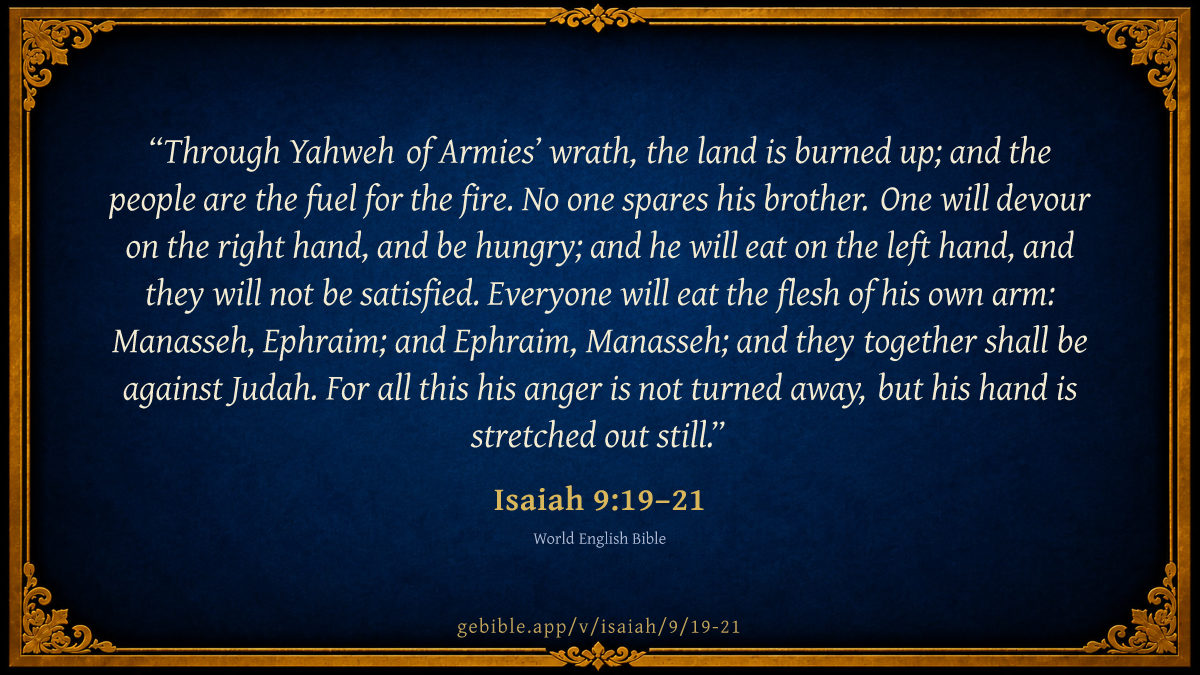
19Through Yahweh of Armies’ wrath, the land is burned up; and the people are the fuel for the fire. No one spares his brother.
20One will devour on the right hand, and be hungry; and he will eat on the left hand, and they will not be satisfied. Everyone will eat the flesh of his own arm:
21Manasseh, Ephraim; and Ephraim, Manasseh; and they together shall be against Judah. For all this his anger is not turned away, but his hand is stretched out still.
19 Through Yahweh of Armies’ wrath, the land is burned up; and the people are the fuel for the fire. No one spares his brother.
20 One will devour on the right hand, and be hungry; and he will eat on the left hand, and they will not be satisfied. Everyone will eat the flesh of his own arm:
21 Manasseh, Ephraim; and Ephraim, Manasseh; and they together shall be against Judah. For all this his anger is not turned away, but his hand is stretched out still.
KJVKing James Version
19 Through the wrath of the LORD of hosts is the land darkened, and the people shall be as the fuel of the fire: no man shall spare his brother.
20 And he shall snatch on the right hand, and be hungry; and he shall eat on the left hand, and they shall not be satisfied: they shall eat every man the flesh of his own arm:
21 Manasseh, Ephraim; and Ephraim, Manasseh: and they together shall be against Judah. For all this his anger is not turned away, but his hand is stretched out still.
Show all 3 translations
JPSJPS Tanakh (1917)
19 (9-18) Through the wrath of the LORD of hosts is the land burnt up; the people also are as the fuel of fire; no man spareth his brother.
20 (9-19) And one snatcheth on the right hand, and is hungry; and he eateth on the left hand, and is not satisfied; they eat every man the flesh of his own arm:
21 (9-20) Manasseh, Ephraim; and Ephraim, Manasseh; and they together are against Judah. For all this His anger is not turned away, but His hand is stretched out still.
Isaiah 49:26(v20)I will feed those who oppress you with their own flesh; and they will be drunk on their own blood, as with sweet wine. Then all flesh shall…
Micah 7:2(v19)The godly man has perished out of the earth, and there is no one upright among men. They all lie in wait for blood; every man hunts his…
Isaiah 5:25(v21)Therefore Yahweh’s anger burns against his people, and he has stretched out his hand against them and has struck them. The mountains…
2 Chronicles 28:6-8(v21)For Pekah the son of Remaliah killed in Judah one hundred twenty thousand in one day, all of them valiant men, because they had forsaken…
Isaiah 9:12(v21)The Syrians in front, and the Philistines behind; and they will devour Israel with open mouth. For all this, his anger is not turned away,…
Show all 35 cross-references
Jeremiah 19:9(v20)I will cause them to eat the flesh of their sons and the flesh of their daughters. They will each eat the flesh of his friend in the siege…
Micah 7:6(v19)For the son dishonors the father, the daughter rises up against her mother, the daughter-in-law against her mother-in-law; a man’s enemies…
Galatians 5:15(v21)But if you bite and devour one another, be careful that you don’t consume one another.
Leviticus 26:26-29(v20)When I break your staff of bread, ten women shall bake your bread in one oven, and they shall deliver your bread again by weight. You shall…
Judges 7:2(v21)Yahweh said to Gideon, “The people who are with you are too many for me to give the Midianites into their hand, lest Israel brag against…
1 Samuel 14:20(v21)Saul and all the people who were with him were gathered together, and came to the battle; and behold, they were all striking each other…
2 Kings 15:30(v21)Hoshea the son of Elah made a conspiracy against Pekah the son of Remaliah, attacked him, killed him, and reigned in his place, in the…
Isaiah 1:31(v19)The strong will be like tinder, and his work like a spark. They will both burn together, and no one will quench them.”
Isaiah 5:30(v19)They will roar against them in that day like the roaring of the sea. If one looks to the land, behold, darkness and distress. The light is…
Isaiah 8:21(v20)They will pass through it, very distressed and hungry. It will happen that when they are hungry, they will worry, and curse by their king…
Isaiah 8:22(v19)and look to the earth, and see distress, darkness, and the gloom of anguish. They will be driven into thick darkness.
Isaiah 9:17(v21)Therefore the Lord will not rejoice over their young men, neither will he have compassion on their fatherless and widows; for everyone is…
Isaiah 10:4(v21)They will only bow down under the prisoners, and will fall under the slain. For all this his anger is not turned away, but his hand is…
Isaiah 11:13(v21)The envy also of Ephraim will depart, and those who persecute Judah will be cut off. Ephraim won’t envy Judah, and Judah won’t persecute…
Isaiah 13:9(v19)Behold, the day of Yahweh comes, cruel, with wrath and fierce anger; to make the land a desolation, and to destroy its sinners out of it.
Isaiah 13:13(v19)Therefore I will make the heavens tremble, and the earth will be shaken out of its place in Yahweh of Armies’ wrath, and in the day of his…
Isaiah 13:18(v19)Their bows will dash the young men in pieces; and they shall have no pity on the fruit of the womb. Their eyes will not spare children.
Isaiah 24:6(v19)Therefore the curse has devoured the earth, and those who dwell therein are found guilty. Therefore the inhabitants of the earth are…
Isaiah 24:11-12(v19)There is a crying in the streets because of the wine. All joy is darkened. The mirth of the land is gone. The city is left in desolation,…
Isaiah 60:2(v19)For, behold, darkness will cover the earth, and thick darkness the peoples; but Yahweh will arise on you, and his glory shall be seen on…
Jeremiah 4:8(v21)For this, clothe yourself with sackcloth, lament and wail; for the fierce anger of Yahweh hasn’t turned back from us.
Jeremiah 13:16(v19)Give glory to Yahweh your God, before he causes darkness, and before your feet stumble on the dark mountains, and while you look for light,…
Lamentations 4:10(v20)The hands of the pitiful women have boiled their own children. They were their food in the destruction of the daughter of my people.
Ezekiel 9:5(v19)To the others he said in my hearing, “Go through the city after him, and strike. Don’t let your eye spare, neither have pity.
Joel 2:2(v19)A day of darkness and gloominess, a day of clouds and thick darkness. As the dawn spreading on the mountains, a great and strong people;…
Amos 5:18(v19)“Woe to you who desire the day of Yahweh! Why do you long for the day of Yahweh? It is darkness, and not light.
Matthew 24:10(v21)Then many will stumble, and will deliver up one another, and will hate one another.
Matthew 27:45(v19)Now from the sixth hour there was darkness over all the land until the ninth hour.
Acts 2:20(v19)The sun will be turned into darkness, and the moon into blood, before the great and glorious day of the Lord comes.
2 Peter 2:4(v19)For if God didn’t spare angels when they sinned, but cast them down to Tartarus, and committed them to pits of darkness to be reserved for…
Cross-references from openbible.info (CC BY 4.0)
Explain this passage (16 sources)
Historical commentary, presented as a primary source — not an endorsement.
Geneva Bible translators1599 · Public DomainOn vv19–20Though there were no foreign enemy, yet they shall…
Though there were no foreign enemy, yet they shall destroy one another.
Geneva Bible (1599) marginal notes — public domain.
John Trapp1656 · Public DomainOn vv19–21Isa 9:19 Through the wrath of the LORD of…
Isa 9:19 Through the wrath of the LORD of hosts is the land darkened, and the people shall be as the fuel of the fire: no man shall spare his brother.
Ver. 19. Through the wrath of the Lord of hosts is the land darkened,] viz., By that pride of smoke, or vast pillar of smoke, mentioned Isa 9:18. Tristem et miseram rerum faciem designat.
Read full note →
No man shall spare his brother.] Wickedness is cruel, and a man had as good deal with a cannibal as with a truly covetous wretch.
John Trapp, A Commentary or Exposition upon All the Books of the Old and New Testament (1647–1656) — public domain. Text from a community e-Sword module.
Matthew Poole1685 · Public DomainOn vv19–21Darkened, either with the smoke last mentioned, or with…
Darkened, either with the smoke last mentioned, or with misery. Or, burnt up, as the LXX., Chaldee, and Arabic interpreters render it.
No man shall spare his brother; they shall destroy one another, as they did in their civil wars, which were frequent among them. The name brother is oft largely used among the Hebrews, even of the remoter kindred, yea, of the fellow members of one city, or tribe, or nation.
Matthew Poole's English Annotations on the Holy Bible (1683–1685) — public domain. Text from a community e-Sword/MySword module.
John Gill1763 · Public DomainOn vv19–21Through the wrath of the Lord of hosts is…
Through the wrath of the Lord of hosts is the land darkened,.... Brought into great distress and affliction; sore judgments and calamities being upon it; for not darkness in a natural, but in a figurative sense, is intended, see Isa 8:22 the allusion is to the ascending of the smoke before mentioned, through fire being kindled in the thickets of the forest, which filled the air with darkness; as smoke arising in great quantity does. This sense of the word, which is only to be met with in this place, is given by Aben Ezra, Kimchi, and Ben Melech, from the use of it in the Arabic language, in which it signifies (f) darkness; but the Septuagint and Arabic versions render it, "the whole land is burned"; and which is confirmed by the Targum, which so interprets it; and this sense well agrees with the context:
and the people shall be as the fuel of the fire; this explains who are meant by the briers and thorns, and thickets of the forest, the inhabitants of the land of Israel; who, as they are the fuel of fire, were the objects of divine wrath and fury:
Read full note →
no man shall spare his brother; which may be ascribed either to the darkness and confusion in which they should be, and so not be able to discern a friend from a foe, as persons surrounded with smoke; or to their malignant spirit, cruelty and inhumanity, not only doing ill to their enemies, but to their own friends and relations, to their own flesh and blood.
(f) "obscura evasit", ---- "tertia pars noctis, a fine crepusculi, tempus quo posterior peragitur precatio vespertina", Golius, col. 1521, 1522. Castel col. 2944. So Schindler, col. 1410. "ateme, caligo, tenebra, crepusculum".
John Gill's Exposition of the Whole Bible (1746–1763) — public domain (CC PDM 1.0). Text via the HelloAO Bible API.
John Wesley1765 · Public DomainOn v21Manasseh - Though more near and dear to one…
Manasseh - Though more near and dear to one another than any other tribe, being both sons of Joseph.
John Wesley, Explanatory Notes Upon the Whole Bible (1754–1765) — public domain. Text via the GEBible commentary corpus.
Adam Clarke1810 · Public DomainOn v20Verse 20. The flesh of his own arm -…
Verse 20. The flesh of his own arm - "The flesh of his neighbour"] "Του βραχιονος του αδελφου αυτου, the Septuagint Alexand. Duplex versio, quarum altera legit רעו reo, quae vox extat, Jer 6:21. Nam רע rea, αδελφος, Ge 43:33. Recte ni fallor." - SECKER. I add to this excellent remark, that the Chaldee manifestly reads רעו reo, his neighbour, not זרעו zeroo, his arm; for he renders it by קריביה karibeyh, his neighbour. And Jeremiah has the very same expression: ואיש בשר רעהו יאכלו veish besar reehu yochelu, "and every one shall eat the flesh of his neighbour," Jer 19:9. This observation, I think, gives the true reading and sense of this place: and the context strongly confirms it by explaining the general idea by particular instances, in the following verse: "Every man shall devour the flesh of his neighbour;" that is, they shall harass and destroy one another. "Manasseh shall destroy Ephraim, and Ephraim, Manasseh;" which two tribes were most closely connected both in blood and situation as brothers and neighbours; "and both of them in the midst of their own dissensions shall agree in preying upon Judah." The common reading, "shall devour the flesh of his own arm," in connexion with what follows, seems to make either an inconsistency, or an anticlimax; whereas by this correction the following verse becomes an elegant illustration of the foregoing. - L.
Adam Clarke's Commentary on the Bible (1810–1826) — public domain. Text from a community e-Sword/MySword module.
Joseph Benson1811 · Public DomainOn v20Isa 9:20-21. He shall snatch on the right hand…
Isa 9:20-21. He shall snatch on the right hand — They shall plunder and devour one another, without ever being satisfied, or ceasing. They shall eat every man the flesh, &c. — They shall destroy one another by their intestine wars: see Isa 49:26. But it was literally fulfilled when they were reduced to that extremity that they ate the flesh of their own children, 2Ki 6:28; Jer 19:8-9; a judgment denounced for their sins by Moses, Deu 28:53, where see the note. They together shall fall on Judah — When those tribes have preyed upon and nearly destroyed one another, they shall turn their rage on Judah. The prophet in the above verses describes the infatuation of the Israelites and Jews, who, instead of uniting in a confederacy against their common enemies, the Syrians and Assyrians, with whom they were not singly able to contend, fell out among themselves, and so far destroyed each other, that they became, one after the other, an easy prey to those heathen nations, whom, humanly speaking, they would have been able to have repelled, had they united in a league, and aided each other. But God suffered them to be infatuated, as a punishment of their sins.
Joseph Benson's Commentary on the Old and New Testaments (1811–1818) — public domain. Text from a community e-Sword module.
Albert Barnes1834 · Public DomainOn vv19–21Through the wrath - By the anger, or indignation.…
Through the wrath - By the anger, or indignation. This spreading desolation is the proof of his anger.
Is the land darkened - The word used here - עתם ‛âtham - occurs nowhere else. According to Gesenius, it is the same as תמם tâmam to be or make complete; and hence means, “in this place, to be consumed, or laid waste.” Kimchi and Aben Ezra render it, ‘The land is darkened.’ Septuagint, Συγκέκαυται Sungkekautai. Chaldee, צרוכת chărôkat - ‘Is scorched.’ Jerome renders it, Conturbata est terra - ‘The land is disturbed.’ The effect is doubtless such as ascending and spreading columns of fire and smoke would produce, and perhaps the general word desolate had better be used in translating the word.
Read full note →
And the people shall be as fuel of the fire - This is an image of widespread ruin. The idea is, that they shall destroy one another as pieces of wood, when on fire, help to consume each other. The way in which it shall be done is stated more fully in the next verse.
No man shall spare his brother - There shall be such a state of wickedness, that it shall lead to anarchy, and strife, and mutual destruction. The common ties of life shall be dissolved, and a man shall have no compassion on his own brother.
Albert Barnes' Notes on the Bible (1834–1885) — public domain. Text from a community e-Sword/MySword module.
Haydock's Catholic Bible Commentary1859 · Public DomainOn vv19, 21Brother. Civil wars shall rage, 4 Kings xv. Josephus…
Brother. Civil wars shall rage, 4 Kings xv. Josephus (Jewish Wars vii.) perhaps alluded to this passage, when he said, that an ancient prophecy announced ruin to the Jews, when they should turn their arms against each other. (Calmet)
George Leo Haydock (1774–1849), Haydock's Catholic Family Bible and Commentary, 1859 edition — public domain. Excludes Psalms (Douay-Rheims chapter numbering differs from Protestant) and Deuterocanonical books (Catholic canon only).
Robert Jamieson, A. R. Fausset & David Brown1871 · Public DomainOn vv19–21darkened--namely, with smoke (Isa 9:18). The Septuagint and Chaldee…
darkened--namely, with smoke (Isa 9:18). The Septuagint and Chaldee render it, "is burnt up," so MAURER, from an Arabic root meaning "suffocating heat."
no man . . . spare . . . brother--intestine discord snapping asunder the dearest ties of nature.
Jamieson, Fausset & Brown — Commentary Critical and Explanatory on the Whole Bible (1871) — public domain (CC PDM 1.0). Text via the HelloAO Bible API.
Daniel D. Whedon1874 · Public DomainOn vv19–2119. Through the wrath — Prophecy breathes an intense…
19. Through the wrath — Prophecy breathes an intense ethical spirit, expressing how God feels toward wrong in itself.
Land darkened — Or, blackened by fire of judgment — the besotted people being the fuel thereof.
Read full note →
No man… spare — When humanity loses all pity for itself the extreme of judgment has come.
Daniel D. Whedon (gen. ed.), Commentary on the Old and New Testaments (1874–1909) — public domain. Text from a community e-Sword module.
The Cambridge Bible for Schools and Colleges1878 · Public DomainOn vv19–2119. darkened] Another translation is “made to glow”; the…
19. darkened] Another translation is “made to glow”; the word is not found elsewhere.
no man sparing his brother. The clause shews that the fire is an emblem of ungovernable party strife. The sense would be still clearer if we could adopt Duhm’s hazardous emendation in the preceding clause so as to make it read “and the people became like man-eaters (cannibals).”
The Cambridge Bible for Schools and Colleges (gen. ed. J. J. S. Perowne; Cambridge University Press, 1878–1918) — public domain. Text from a community e-Sword module.
Ellicott's Commentary for English Readers1878 · Public DomainOn v19(19, 20) Through the wrath of the Lord of…
(19, 20) Through the wrath of the Lord of hosts is the land darkened . . .—The vision of darkness and famine which had come before the prophet’s eyes in Isa_8:21 appears once again, and here, as there, it is a question whether the words are to be understood literally or figuratively. The definiteness of the language of Isa_9:20 suggests the thoughts of the horrors of a famine like that of Samaria (2Ki_6:28-29), or of Deu_28:53-57; Zec_11:9. But even that scene of horror might be only typical of a state of chaos and confusion pervading the whole order of society, fierce passions, jealousies, rivalries working out the destruction of the nation’s life; such as Thucydides (iii. 82-84) has painted as the result of the Peloponnesian war. The mention of Ephraim and Manasseh as conspicuous in the self-destructive work confirms the figurative interpretation. They were devouring “the flesh of their own arm” when they allowed their old tribal jealousies (Jdg_8:1; Jdg_12:1-4; 2Sa_19:43) to break up the unity of the nation.
And they together shall be against Judah.—This formed the climax of the whole. The only power of union that showed itself in the northern kingdom was to perpetuate the great schism in which it had its origin. The idea that Israel as such was a nation was forgotten. Ephraim and Manasseh could join in a common expedition against Judah when they could join in nothing else. Of this the alliance of Pekah with Rezin was the most striking instance (2Ch_28:6-15). Traces of internal division are found in the conspiracy of the Gileadites of the trans-Jordanic district of Manasseh, against Pekah’s predecessor in Samaria (2Ki_15:25).
A Bible Commentary for English Readers, edited by Charles John Ellicott (1878–1897) — public domain. Text from a community e-Sword module.
The Pulpit Commentary1880 · Public DomainOn vv19–21Is the land darkened; rather, burst up (sugkekautai ,…
Is the land darkened; rather, burst up (sugkekautai , LXX). The root used occurs in Arabic in this sense. It is not used elsewhere in Scripture. The people shall be as the fuel of the fire. Though the general ravage, devastation, and desolation of the laud, with its buildings, its trees, and its other vegetable products, is included in the image of the fire devouring the thorny brakes and tangled thickets of a dense forest, yet the threat is intended still more against the Israelite people, who were the true "fuel of the fire," since the ravage would go on until the land should be depopulated. No man shall spare his brother. We have here a new feature. Not only shall foreign enemies Syrians and Philistines dew, up Israel, but the plague of civil war will also be let loose upon them (comp. ver. 21, and see 2Ki_15:30, where we find that Pekah fell a victim to a conspiracy headed by Hoshea).
The Pulpit Commentary (1880–1919), ed. H.D.M. Spence-Jones & Joseph S. Exell — public domain. Text from a community e-Sword module.
unfoldingWord translationNotes2017 · CC BY-SA 4.0On v20They will grab food on the right hand ...…
They will grab food on the right hand ... on the left hand
This expression means that the people will grab food wherever they can find it. (See: Metonymy)
Read full note →
Each will even eat the flesh of his own arm
Possible meanings are 1) people will be so hungry that they will want to eat or will actually eat their own arms or 2) the word "arm" is a metaphor for the person's neighbor. (See: Metaphor)
In all these things, his anger does not subside; instead, his hand
"Even though all these things have happened, he is still angry, and his hand." See how you translated this in Isaiah 5:25.
his hand is still stretched out
Isaiah speaks as if Yahweh were a person about to hit another person with his fist. This is a metaphor for Yahweh punishing Israel. See how you translated this in Isaiah 5:25. AT: "he will still be ready to punish them" (See: Metaphor)
Tyndale Open Study Notes2022 · CC BY-SA 4.0On v219:21 Manasseh and Ephraim represent the northern kingdom as…
9:21 Manasseh and Ephraim represent the northern kingdom as its largest tribes. The two largest tribes of Israel and Judah fought amongst themselves. This is probably a reference to the war between Judah and the alliance of Syria and Israel, which is commonly called the Syro-Ephraimite War (7:1-12). In that conflict, brothers savagely fought against brothers (2 Chr 28).

Geneva Bible translators 1599 · Public Domain On vv19–20 Though there were no foreign enemy, yet they shall…
Though there were no foreign enemy, yet they shall destroy one another.
Geneva Bible (1599) marginal notes — public domain.
John Trapp 1656 · Public Domain On vv19–21 Isa 9:19 Through the wrath of the LORD of…
Isa 9:19 Through the wrath of the LORD of hosts is the land darkened, and the people shall be as the fuel of the fire: no man shall spare his brother.
Ver. 19. Through the wrath of the Lord of hosts is the land darkened,] viz., By that pride of smoke, or vast pillar of smoke, mentioned Isa 9:18. Tristem et miseram rerum faciem designat.
Read full note →
No man shall spare his brother.] Wickedness is cruel, and a man had as good deal with a cannibal as with a truly covetous wretch.
John Trapp, A Commentary or Exposition upon All the Books of the Old and New Testament (1647–1656) — public domain. Text from a community e-Sword module.
Matthew Poole 1685 · Public Domain On vv19–21 Darkened, either with the smoke last mentioned, or with…
Darkened, either with the smoke last mentioned, or with misery. Or, burnt up, as the LXX., Chaldee, and Arabic interpreters render it.
No man shall spare his brother; they shall destroy one another, as they did in their civil wars, which were frequent among them. The name brother is oft largely used among the Hebrews, even of the remoter kindred, yea, of the fellow members of one city, or tribe, or nation.
Matthew Poole's English Annotations on the Holy Bible (1683–1685) — public domain. Text from a community e-Sword/MySword module.
John Gill 1763 · Public Domain On vv19–21 Through the wrath of the Lord of hosts is…
Through the wrath of the Lord of hosts is the land darkened,.... Brought into great distress and affliction; sore judgments and calamities being upon it; for not darkness in a natural, but in a figurative sense, is intended, see Isa 8:22 the allusion is to the ascending of the smoke before mentioned, through fire being kindled in the thickets of the forest, which filled the air with darkness; as smoke arising in great quantity does. This sense of the word, which is only to be met with in this place, is given by Aben Ezra, Kimchi, and Ben Melech, from the use of it in the Arabic language, in which it signifies (f) darkness; but the Septuagint and Arabic versions render it, "the whole land is burned"; and which is confirmed by the Targum, which so interprets it; and this sense well agrees with the context:
and the people shall be as the fuel of the fire; this explains who are meant by the briers and thorns, and thickets of the forest, the inhabitants of the land of Israel; who, as they are the fuel of fire, were the objects of divine wrath and fury:
Read full note →
no man shall spare his brother; which may be ascribed either to the darkness and confusion in which they should be, and so not be able to discern a friend from a foe, as persons surrounded with smoke; or to their malignant spirit, cruelty and inhumanity, not only doing ill to their enemies, but to their own friends and relations, to their own flesh and blood.
(f) "obscura evasit", ---- "tertia pars noctis, a fine crepusculi, tempus quo posterior peragitur precatio vespertina", Golius, col. 1521, 1522. Castel col. 2944. So Schindler, col. 1410. "ateme, caligo, tenebra, crepusculum".
John Gill's Exposition of the Whole Bible (1746–1763) — public domain (CC PDM 1.0). Text via the HelloAO Bible API.
John Wesley 1765 · Public Domain On v21 Manasseh - Though more near and dear to one…
Manasseh - Though more near and dear to one another than any other tribe, being both sons of Joseph.
John Wesley, Explanatory Notes Upon the Whole Bible (1754–1765) — public domain. Text via the GEBible commentary corpus.
Adam Clarke 1810 · Public Domain On v20 Verse 20. The flesh of his own arm -…
Verse 20. The flesh of his own arm - "The flesh of his neighbour"] "Του βραχιονος του αδελφου αυτου, the Septuagint Alexand. Duplex versio, quarum altera legit רעו reo, quae vox extat, Jer 6:21. Nam רע rea, αδελφος, Ge 43:33. Recte ni fallor." - SECKER. I add to this excellent remark, that the Chaldee manifestly reads רעו reo, his neighbour, not זרעו zeroo, his arm; for he renders it by קריביה karibeyh, his neighbour. And Jeremiah has the very same expression: ואיש בשר רעהו יאכלו veish besar reehu yochelu, "and every one shall eat the flesh of his neighbour," Jer 19:9. This observation, I think, gives the true reading and sense of this place: and the context strongly confirms it by explaining the general idea by particular instances, in the following verse: "Every man shall devour the flesh of his neighbour;" that is, they shall harass and destroy one another. "Manasseh shall destroy Ephraim, and Ephraim, Manasseh;" which two tribes were most closely connected both in blood and situation as brothers and neighbours; "and both of them in the midst of their own dissensions shall agree in preying upon Judah." The common reading, "shall devour the flesh of his own arm," in connexion with what follows, seems to make either an inconsistency, or an anticlimax; whereas by this correction the following verse becomes an elegant illustration of the foregoing. - L.
Adam Clarke's Commentary on the Bible (1810–1826) — public domain. Text from a community e-Sword/MySword module.
Joseph Benson 1811 · Public Domain On v20 Isa 9:20-21. He shall snatch on the right hand…
Isa 9:20-21. He shall snatch on the right hand — They shall plunder and devour one another, without ever being satisfied, or ceasing. They shall eat every man the flesh, &c. — They shall destroy one another by their intestine wars: see Isa 49:26. But it was literally fulfilled when they were reduced to that extremity that they ate the flesh of their own children, 2Ki 6:28; Jer 19:8-9; a judgment denounced for their sins by Moses, Deu 28:53, where see the note. They together shall fall on Judah — When those tribes have preyed upon and nearly destroyed one another, they shall turn their rage on Judah. The prophet in the above verses describes the infatuation of the Israelites and Jews, who, instead of uniting in a confederacy against their common enemies, the Syrians and Assyrians, with whom they were not singly able to contend, fell out among themselves, and so far destroyed each other, that they became, one after the other, an easy prey to those heathen nations, whom, humanly speaking, they would have been able to have repelled, had they united in a league, and aided each other. But God suffered them to be infatuated, as a punishment of their sins.
Joseph Benson's Commentary on the Old and New Testaments (1811–1818) — public domain. Text from a community e-Sword module.
Albert Barnes 1834 · Public Domain On vv19–21 Through the wrath - By the anger, or indignation.…
Through the wrath - By the anger, or indignation. This spreading desolation is the proof of his anger.
Is the land darkened - The word used here - עתם ‛âtham - occurs nowhere else. According to Gesenius, it is the same as תמם tâmam to be or make complete; and hence means, “in this place, to be consumed, or laid waste.” Kimchi and Aben Ezra render it, ‘The land is darkened.’ Septuagint, Συγκέκαυται Sungkekautai. Chaldee, צרוכת chărôkat - ‘Is scorched.’ Jerome renders it, Conturbata est terra - ‘The land is disturbed.’ The effect is doubtless such as ascending and spreading columns of fire and smoke would produce, and perhaps the general word desolate had better be used in translating the word.
Read full note →
And the people shall be as fuel of the fire - This is an image of widespread ruin. The idea is, that they shall destroy one another as pieces of wood, when on fire, help to consume each other. The way in which it shall be done is stated more fully in the next verse.
No man shall spare his brother - There shall be such a state of wickedness, that it shall lead to anarchy, and strife, and mutual destruction. The common ties of life shall be dissolved, and a man shall have no compassion on his own brother.
Albert Barnes' Notes on the Bible (1834–1885) — public domain. Text from a community e-Sword/MySword module.
Haydock's Catholic Bible Commentary 1859 · Public Domain On vv19, 21 Brother. Civil wars shall rage, 4 Kings xv. Josephus…
Brother. Civil wars shall rage, 4 Kings xv. Josephus (Jewish Wars vii.) perhaps alluded to this passage, when he said, that an ancient prophecy announced ruin to the Jews, when they should turn their arms against each other. (Calmet)
George Leo Haydock (1774–1849), Haydock's Catholic Family Bible and Commentary, 1859 edition — public domain. Excludes Psalms (Douay-Rheims chapter numbering differs from Protestant) and Deuterocanonical books (Catholic canon only).
Robert Jamieson, A. R. Fausset & David Brown 1871 · Public Domain On vv19–21 darkened--namely, with smoke (Isa 9:18). The Septuagint and Chaldee…
darkened--namely, with smoke (Isa 9:18). The Septuagint and Chaldee render it, "is burnt up," so MAURER, from an Arabic root meaning "suffocating heat."
no man . . . spare . . . brother--intestine discord snapping asunder the dearest ties of nature.
Jamieson, Fausset & Brown — Commentary Critical and Explanatory on the Whole Bible (1871) — public domain (CC PDM 1.0). Text via the HelloAO Bible API.
Daniel D. Whedon 1874 · Public Domain On vv19–21 19. Through the wrath — Prophecy breathes an intense…
19. Through the wrath — Prophecy breathes an intense ethical spirit, expressing how God feels toward wrong in itself.
Land darkened — Or, blackened by fire of judgment — the besotted people being the fuel thereof.
Read full note →
No man… spare — When humanity loses all pity for itself the extreme of judgment has come.
Daniel D. Whedon (gen. ed.), Commentary on the Old and New Testaments (1874–1909) — public domain. Text from a community e-Sword module.
The Cambridge Bible for Schools and Colleges 1878 · Public Domain On vv19–21 19. darkened] Another translation is “made to glow”; the…
19. darkened] Another translation is “made to glow”; the word is not found elsewhere.
no man sparing his brother. The clause shews that the fire is an emblem of ungovernable party strife. The sense would be still clearer if we could adopt Duhm’s hazardous emendation in the preceding clause so as to make it read “and the people became like man-eaters (cannibals).”
The Cambridge Bible for Schools and Colleges (gen. ed. J. J. S. Perowne; Cambridge University Press, 1878–1918) — public domain. Text from a community e-Sword module.
Ellicott's Commentary for English Readers 1878 · Public Domain On v19 (19, 20) Through the wrath of the Lord of…
(19, 20) Through the wrath of the Lord of hosts is the land darkened . . .—The vision of darkness and famine which had come before the prophet’s eyes in Isa_8:21 appears once again, and here, as there, it is a question whether the words are to be understood literally or figuratively. The definiteness of the language of Isa_9:20 suggests the thoughts of the horrors of a famine like that of Samaria (2Ki_6:28-29), or of Deu_28:53-57; Zec_11:9. But even that scene of horror might be only typical of a state of chaos and confusion pervading the whole order of society, fierce passions, jealousies, rivalries working out the destruction of the nation’s life; such as Thucydides (iii. 82-84) has painted as the result of the Peloponnesian war. The mention of Ephraim and Manasseh as conspicuous in the self-destructive work confirms the figurative interpretation. They were devouring “the flesh of their own arm” when they allowed their old tribal jealousies (Jdg_8:1; Jdg_12:1-4; 2Sa_19:43) to break up the unity of the nation.
And they together shall be against Judah.—This formed the climax of the whole. The only power of union that showed itself in the northern kingdom was to perpetuate the great schism in which it had its origin. The idea that Israel as such was a nation was forgotten. Ephraim and Manasseh could join in a common expedition against Judah when they could join in nothing else. Of this the alliance of Pekah with Rezin was the most striking instance (2Ch_28:6-15). Traces of internal division are found in the conspiracy of the Gileadites of the trans-Jordanic district of Manasseh, against Pekah’s predecessor in Samaria (2Ki_15:25).
A Bible Commentary for English Readers, edited by Charles John Ellicott (1878–1897) — public domain. Text from a community e-Sword module.
The Pulpit Commentary 1880 · Public Domain On vv19–21 Is the land darkened; rather, burst up (sugkekautai ,…
Is the land darkened; rather, burst up (sugkekautai , LXX). The root used occurs in Arabic in this sense. It is not used elsewhere in Scripture. The people shall be as the fuel of the fire. Though the general ravage, devastation, and desolation of the laud, with its buildings, its trees, and its other vegetable products, is included in the image of the fire devouring the thorny brakes and tangled thickets of a dense forest, yet the threat is intended still more against the Israelite people, who were the true "fuel of the fire," since the ravage would go on until the land should be depopulated. No man shall spare his brother. We have here a new feature. Not only shall foreign enemies Syrians and Philistines dew, up Israel, but the plague of civil war will also be let loose upon them (comp. ver. 21, and see 2Ki_15:30, where we find that Pekah fell a victim to a conspiracy headed by Hoshea).
The Pulpit Commentary (1880–1919), ed. H.D.M. Spence-Jones & Joseph S. Exell — public domain. Text from a community e-Sword module.
unfoldingWord translationNotes 2017 · CC BY-SA 4.0 On v20 They will grab food on the right hand ...…
They will grab food on the right hand ... on the left hand
This expression means that the people will grab food wherever they can find it. (See: Metonymy)
Read full note →
Each will even eat the flesh of his own arm
Possible meanings are 1) people will be so hungry that they will want to eat or will actually eat their own arms or 2) the word "arm" is a metaphor for the person's neighbor. (See: Metaphor)
In all these things, his anger does not subside; instead, his hand
"Even though all these things have happened, he is still angry, and his hand." See how you translated this in Isaiah 5:25.
his hand is still stretched out
Isaiah speaks as if Yahweh were a person about to hit another person with his fist. This is a metaphor for Yahweh punishing Israel. See how you translated this in Isaiah 5:25. AT: "he will still be ready to punish them" (See: Metaphor)
translationWords
flesh
Manasseh
devour
Ephraim
Judah
Yahweh
anger
hand
unfoldingWord translationNotes — © Distant Shores Media and the Door43 World Missions Community, licensed CC BY-SA 4.0. Source: git.door43.org/Door43/en_tn.
Tyndale Open Study Notes 2022 · CC BY-SA 4.0 On v21 9:21 Manasseh and Ephraim represent the northern kingdom as…
9:21 Manasseh and Ephraim represent the northern kingdom as its largest tribes. The two largest tribes of Israel and Judah fought amongst themselves. This is probably a reference to the war between Judah and the alliance of Syria and Israel, which is commonly called the Syro-Ephraimite War (7:1-12). In that conflict, brothers savagely fought against brothers (2 Chr 28).
Tyndale Open Study Notes — © Tyndale Open Resources, licensed CC BY-SA 4.0. Text via the HelloAO Bible API.