
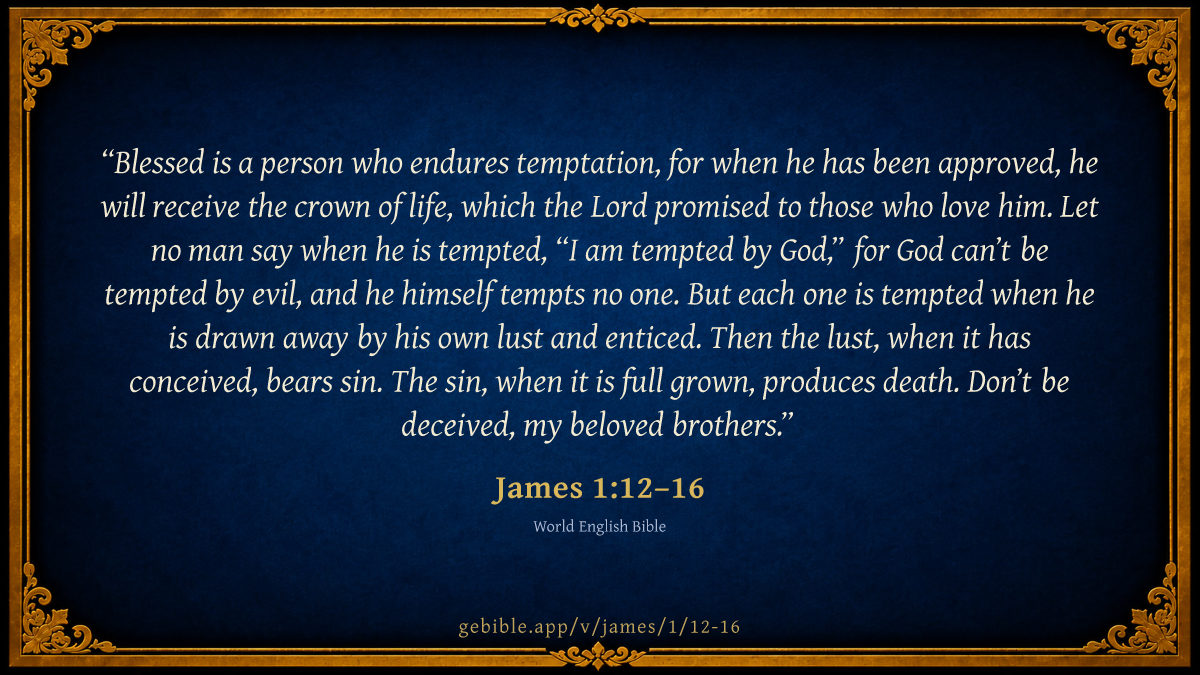
Blessed is a person who endures temptation, for when he has been approved, he will receive the crown of life, which the Lord promised to those who love him.
Let no man say when he is tempted, “I am tempted by God,” for God can’t be tempted by evil, and he himself tempts no one. But each one is tempted when he is drawn away by his own lust and enticed. Then the lust, when it has conceived, bears sin. The sin, when it is full grown, produces death. Don’t be deceived, my beloved brothers.
John Calvin 1540 · Public Domain On vv12–16 12 Blessed is the man. After having applied consolation,…
12 Blessed is the man. After having applied consolation, he moderated the sorrow of those who were severely handled in this world, and again humbled the arrogance of the great. He now draws this conclusion, that they are happy who magnanimously endure troubles and other trials, so as to rise above them. The word temptation may indeed be otherwise understood, even for the stings of lusts which annoy the soul within; but which is here commended, as I think, is fortitude of mind in enduring adversities. It is, however, a paradox, that they are not happy to whom all things come according to their wishes, but such as are not overcome with evils.
For when he is tried. He gives a reason for the preceding sentence; for the crown follows the contest. If, then, it be our chief happiness to be crowned in the kingdom of God, it follows, that the contests with which the Lord tries us, are aids and helps to our happiness. Thus the argument is from the end or the effect: hence we conclude, that the faithful are harassed by so many evils for this purpose, that their piety and obedience may be made manifest, and that they may be thus at length prepared to receive the crown of life.
Read full note →
But they reason absurdly who hence infer that we by fighting merit the crown; for since God has gratuitously appointed it for us, our fighting only renders us fit to receive it.
He adds, that it is promised to those who love God. By speaking thus, he means not that the love of man is the cause of obtaining the crown, (for God anticipates us by his gratuitous love;) but he only intimates that the elect who love him are alone approved by God. He then reminds us that the conquerors of all temptations are those who love God, and that we fail not in courage when we are tried, for no other cause than because the love of the world prevails in us.
John Calvin's Commentaries (1540-1563) — public domain. Text from the Calvin Translation Society English edition (1840s-50s) via the Christian Classics Ethereal Library (ccel.org). Calvin's coverage is partial (roughly two-thirds of the Bible); uncommented books and verses are honest gaps, never fabricated. The 19th-century editor's footnotes and remarks are omitted so the notes are faithfully Calvin's own voice.
Geneva Bible translators 1599 · Public Domain On vv12, 13, 15, 16 The conclusion: Therefore we must patiently bear the cross:…
Job 5:17
The conclusion: Therefore we must patiently bear the cross: and he addeth a fourth argument, which comprehendeth the sum of all the former, to wit, because we come by this way to the crown of life, but yet of grace according to the promise.
Read full note →
Affliction whereby the Lord trieth him.
Geneva Bible (1599) marginal notes — public domain.
John Trapp 1656 · Public Domain On vv12–16 12 Blessed is the man that endureth temptation: for…
12 Blessed is the man that endureth temptation: for when he is tried, he shall receive the crown of life, which the Lord hath promised to them that love him.
Ver. 12. Blessed is the man] Provided that God teach him, as well as chastise him, Psa 94:12, instruct him as well as correct him. See my Love Tokens, par. 2.
Read full note →
He shall receive the crown] A man can be content to have his head broken with a bag of gold, so he may have it, when it is done. Eternal life is called "a crown:" 1. For the perpetuity of it; for a crown hath neither beginning nor ending. 2. For the plenty; because as the crown compasseth on every side, so there is nothing wanting in this life. 3. The dignity; eternal life is a coronation day. (Bishop Lake.) Tertullian wrote his book De corona militis Concerning the crown of a soldier, upon occasion of a certain Christian soldier’s refusing to be crowned, and saying, Non decet Christianum in hac vita coronari; A Christian is to be crowned when he cometh to heaven.
John Trapp, A Commentary or Exposition upon All the Books of the Old and New Testament (1647–1656) — public domain. Text from a community e-Sword module.
Matthew Poole 1685 · Public Domain On vv12–16 Blessed is the man theft endureth; holds out against…
Blessed is the man theft endureth; holds out against the assaults and impressions of temptations with patience and constancy, Jam 5:11; Heb 12:5,7.
Temptations; afflictions, as Jam 1:2.
Read full note →
For when he is tried; approved, and found upon the trial to be sound in the faith: a metaphor taken from metals tried by fire, and found pure.
He shall receive the crown of life; so the heavenly glory is called, Rev 2:10, either because it is not to be had but in eternal life, or because of its duration and not fading away, 1Pe 5:4.
Which the Lord hath promised: this shows on what gronnd it is to be expected, viz. on the account of the promise, and how sure we may be of it.
To them that love him; i.e. all true believers, whose faith, and thereby title to the crown, is evidenced by love, which is the fulfilling of the law.
Objection. Why not, promised to them that suffer for Christ, of whom he here speaks?
Answer. That is implied, for none have him more, or evidence their love to him more, than they, that suffer for him.
Matthew Poole's English Annotations on the Holy Bible (1683–1685) — public domain. Text from a community e-Sword/MySword module.
William Burkitt 1703 · Public Domain On vv12, 13, 16 In these words the apostle lays down a forcible…
In these words the apostle lays down a forcible argument, to persuade Christians to bear sufferings and persecutions with invincible patience, drawn from the blessedness which attends such a condition: Blessed is the man that endureth temptations, &c.
Note here, 1. The character of the person whom God pronounceth blessed; namely, not the man that escapeth temptations and trials in this life, but he that bears them with courage and constancy, with patience and submission.
Read full note →
Note, 2. A description of that ample reward which shall be conferred upon such sufferers; They shall receive the crown of life.
Where observe, the felicity of a future state is set forth by a crown to denote the transcendency and perfection of it; and by a crown of life, to denote the perpetuity and duration of it.
Note, 3. Here is an intimation of the time when this transcendent reward shall be dispensed, namely, when the suffering Christian has finished his course with patience and perseverance: When he is tried he shall receive the crown of life.
Learn from the whole, that a patient and constant enduring of trials and afflicitons in this life, shall certainly be rewarded with a crown of blessedness and immortality in the life to come; Blessed is the man that endureth temptation, &c.
William Burkitt's Expository Notes on the New Testament (1700–1703) — public domain. Text from a community e-Sword module.
Matthew Henry 1710 · Public Domain On v13 I. We are here taught that God is not…
I. We are here taught that God is not the author of any man's sin. Whoever they are who raise persecutions against men, and whatever injustice and sin they may be guilty of in proceeding against them, God is not to be charged with it. And, whatever sins good men may themselves be provoked to by their exercises and afflictions, God is not the cause of them. It seems to be here supposed that some professors might fall in the hour of temptation, that the rod resting upon them might carry some into ill courses, and make them put forth their hands unto iniquity. But though this should be the case, and though such delinquents should attempt to lay their fault on God, yet the blame of their misconduct must lie entirely upon themselves. For, 1. There is nothing in the nature of God that they can lay the blame upon: Let no man say, when he is tempted to take any evil course, or do any evil thing, I am tempted of God; for God cannot be tempted with evil. All moral evil is owing to some disorder in the being that is chargeable with it, to a want of wisdom, or of power, or of decorum and purity in the will. But who can impeach the holy God with the want of these, which are his very essence? No exigence of affairs can ever tempt him to dishonour or deny himself, and therefore he cannot be tempted with evil. 2. There is nothing in the providential dispensations of God that the blame of any man's sin can be laid upon (Jam 1:13): Neither tempteth he any man. As God cannot be tempted with evil himself, so neither can he be a tempter of others. He cannot be a promoter of what is repugnant to his nature. The carnal mind is willing to charge its own sins on God. There is something hereditary in this. Our first father Adam tells God, The woman thou gavest me tempted me, thereby, in effect, throwing the blame upon God, for giving him the tempter. Let no man speak thus. It is very bad to sin; but is much worse, when we have done amiss, to charge it upon God, and say it was owing to him. Those who lay the blame of their sins either upon their constitution or upon their condition in the world, or who pretend they are under a fatal necessity of sinning, wrong God, as if he were the author of sin. Afflictions, as sent by God, are designed to draw out our graces, but not our corruptions.
II. We are taught where the true cause of evil lies, and where the blame ought to be laid (Jam 1:14): Every man is tempted (in an ill sense) when he is drawn away of his own lust, and enticed. In other scriptures the devil is called the tempter, and other things may sometimes concur to tempt us; but neither the devil nor any other person or thing is to be blamed so as to excuse ourselves; for the true original of evil and temptation is in our own hearts. The combustible matter is in us, though the flame may be blown up by some outward causes. And therefore, if thou scornest, thou alone shalt bear it, Pro 9:12. Observe here, 1. The method of sin in its proceeding. First it draws away, then entices. As holiness consists of two parts - forsaking that which is evil and cleaving to that which is good, so these two things, reversed, are the two parts of sin. The heart is carried from that which is good, and enticed to cleave to that which is evil. It is first by corrupt inclinations, or by lusting after and coveting some sensual or worldly thing, estranged from the life of God, and then by degrees fixed in a course of sin. 2. We may observe hence the power and policy of sin. The word here rendered drawn away signifies a being forcibly haled or compelled. The word translated enticed signifies being wheedled and beguiled by allurements and deceitful representations of things, exelkominos kai deleazomenos. There is a great deal of violence done to conscience and to the mind by the power of corruption: and there is a great deal of cunning and deceit and flattery in sin to gain us to its interests. The force and power of sin could never prevail, were it not for its cunning and guile. Sinners who perish are wheedled and flattered to their own destruction. And this will justify God for ever in their damnation, that they destroyed themselves. Their sin lies at their own door, and therefore their blood will lie upon their own heads. 3. The success of corruption in the heart (Jam 1:15): Then, when lust hath conceived, it bringeth forth sin; that is, sin being allowed to excite desires in us, it will son ripen those desires into consent, and then it is said to have conceived. The sin truly exists, though it be but in embryo. And, when it has grown it its full size in the mind, it is then brought forth in actual execution. Stop the beginnings of sin therefore, or else all the evils it produces must be wholly charged upon us. 4. The final issue of sin, and how it ends: Sin, when it is finished, bringeth forth death. After sin is brought forth in actual commissions, the finishing of it (as Dr. Manton observes) is its being strengthened by frequent acts and settled into a habit. And, when the iniquities of men are thus filled up, death is brought forth. There is a death upon the soul, and death comes upon the body. And, besides death spiritual and temporal, the wages of sin is eternal death too. Let sin therefore be repented of and forsaken, before it be finished. Why will you die, O house of Israel! Eze 33:11. God has no pleasure in your death, as he has no hand in your sin; but both sin and misery are owing to yourselves. Your own hearts' lusts and corruptions are your tempters; and when by degrees they have carried you off from God, and finished the power and dominion of sin in you, then they will prove your destroyers.
Read full note →
III. We are taught yet further that, while we are the authors and procurers of all sin and misery to ourselves, God is the Father and fountain of all good, Jam 1:16, Jam 1:17. We should take particular care not to err in our conceptions of God: "Do not err, my beloved brethren, mē lanasthe - do not wander, that is, from the word of God, and the accounts of him you have there. Do not stray into erroneous opinions, and go off from the standard of truth, the things which you have received from the Lord Jesus and by the direction of his Spirit." The loose opinions of Sinon, and the Nicolaitans (from whom the Gnostics, a most sensual corrupt set of people, arose afterwards), may perhaps, by the apostle here, be more especially cautioned against. Those who are disposed to look into these may consult the first book of Irenaeus against heresies. Let corrupt men run into what notions they will, the truth, as it is in Jesus, stands thus: That God is not, cannot be, the author and patronizer of any thing that is evil; but must be acknowledged as the cause and spring of every thing that is good: Every good and every perfect gift is from above, and cometh down from the Father of lights, Jam 1:17. Here observe, 1. God is the Father of lights. The visible light of the sun and the heavenly bodies is from him. He said, Let there be light, and there was light. Thus God is at once represented as the Creator of the sun and in some respects compared to it. "As the sun is the same in its nature and influences, though the earth and clouds, oft interposing, make it seem to us as varying, by its rising and setting, and by its different appearances, or entire withdrawment, when the change is not in it; so God is unchangeable, and our changes and shadows are not from any mutability or shadowy alterations in him, but from ourselves." - Baxter. The Father of lights, with whom there is no variableness, neither shadow of turning. What the sun is in nature, God is in grace, providence, and glory; aye, and infinitely more. For, 2. Every good gift is from him. As the Father of lights, he gives the light of reason. The inspiration of the Almighty giveth understanding, Job 32:8. He gives also the light of learning: Solomon's wisdom in the knowledge of nature, in the arts of government, and in all his improvements, is ascribed to God. The light of divine revelation is more immediately from above. The light of faith, purity, and all manner of consolation is from him. So that we have nothing good but what we receive from God, as there is no evil or sin in us, or done by us, but what is owing to ourselves. We must own God as the author of all the powers and perfections that are in the creature, and the giver of all the benefits which we have in and by those powers and perfections: but none of their darknesses, their imperfections, or their ill actions are to be charged on the Father of lights; from him proceeds every good and perfect gift, both pertaining to this life and that which is to come. 3. As every good gift is from God, so particularly the renovation of our natures, our regeneration, and all the holy happy consequences of it, must be ascribed to him (Jam 1:18): Of his own will begat he us with the word of truth. Here let us take notice, (1.) A true Christian is a creature begotten anew. He becomes as different a person from what he was before the renewing influences of divine grace as if he were formed over again, and born afresh. (2.) The original of this good work is here declared: it is of God's own will; not by our skill or power; not from any good foreseen in us, or done by us, but purely from the good-will and grace of God. (3.) The means whereby this is affected are pointed out: the word of truth, that is, the gospel, as Paul expresses it more plainly, Co1 4:15, I have begotten you in Jesus Christ through the gospel. This gospel in indeed a word of truth, or else it could never produce such real, such lasting, such great and noble effects. We may rely upon it, and venture our immortal souls upon it. And we shall find it a means of our sanctification as it is a word of truth, Joh 17:17. (4.) The end and design of God's giving renewing grace is here laid down: That we should be a kind of first-fruits of his creatures - that we should be God's portion and treasure, and a more peculiar property to him, as the first-fruits were; and that we should become holy to the Lord, as the first-fruits were consecrated to him. Christ is the first-fruits of Christians, Christians are the first-fruits of creatures.
Matthew Henry's Commentary on the Whole Bible (1708–1710) — public domain (CC PDM 1.0). Text via the HelloAO Bible API.
John Gill 1763 · Public Domain On vv12–16 Blessed is the man that endureth temptation,.... Or affliction,…
Blessed is the man that endureth temptation,.... Or affliction, which is designed by temptation, as in Jam 1:2 and the man that endures it is he that so bears it, and bears up under it, as not to be offended at it, and stumble in the ways of Christ, and fall away from the truth, and a profession of it, as temporary believers in a time of temptation do; but manfully and bravely stands up under it, and does not sink under the weight of it, or faint on account of it; and endures afflictions in such manner as not to murmur and repine at them, but is quiet and still, and bears them patiently and constantly, and so endures to the end. Such expect afflictions, and when they come, they are not moved by them, but, notwithstanding them, continue in the ways and work of the Lord; and such are happy persons; they are happy now, and shall be hereafter. Saints are happy under afflictions, and even on account of them, for they are tokens of God's love to them, and evidences of their sonship; and especially they are happy under them, when they enjoy the presence of God in them, when they are instructive to them, and are saner, lifted, when they learn from them the useful lessons of faith, patience, humility, and resignation to the will of God, and are made more partakers of his holiness; and they will be happy hereafter, as follows. The Jews have a saying (h) much like this,
""blessed" is the man, , "who stands in his temptation", for there is no creature whom the holy blessed God does not tempt.''
Read full note →
For when he is tried; by the fire of afflictions, as gold is tried in the fire; when God hereby has tried what is in his heart, and the truth of grace in him, as faith, love, patience, &c. and has purged away his dross and tin, and has refined and purified him, as gold and silver are refined and purified in the furnace, or refining pot: and when being thus tried and proved, and found genuine, and comes forth as gold, after this state of temptation and affliction is over,
he shall receive the crown of life, eternal happiness, called a "crown", because of the glory of it, which will be both upon the bodies and souls of believers to all eternity; and as suitable to their character, they being kings, and having a kingdom and thrones prepared for them; and in allusion to the crown that was given to the conquerors in the Olympic games: and it is called a "crown of life", because it is for life, which an earthly crown is not always; and because it lies in eternal life, and is an everlasting crown; it is a crown of glory that fadeth not away, an incorruptible one; and differs from the corruptible crown given to the victors in the above mentioned games, which were made of fading herbs, and leaves of trees: and now the man that bears up under afflictions, and holds out unto the end, shall have this crown put upon him, and he shall "receive it"; not as merited by him, by his works or sufferings, for neither of them are worthy to be compared or mentioned with this crown of life and glory; but as the free gift of God, as it will be given him by the righteous Judge, as a reward of grace, and not of debt:
which the Lord hath promised to them that love him; either the Lord Jesus Christ, as in Mat 5:10 or else God the Father; the Vulgate Latin, Syriac, and Ethiopic versions, read, "God"; and the Alexandrian copy leaves out the word "Lord", which may be supplied by the word God; see Jam 2:5 and this promise he made before the world was, who cannot lie, nor deceive, and who is able to perform, and is faithful, and will never suffer his faithfulness to fail; so that this happiness is certain, and may be depended upon: besides, the promise of this crown of life is in Christ, where all the promises are yea and amen; yea, the crown itself is in his hands, where it lies safe and secure for "them that love him"; either the Lord Jesus Christ, his person, his people, his truths, and ordinances, and his glorious appearing, Ti2 4:8 or God the Father; not that their love is the cause of this crown of life, or eternal life, for then it would not be the free gift of God, as it is said to be; nor of the promise of it, for that was made before the world was, and when they had no love unto him; but this phrase is descriptive of the persons to whom God manifests his love now, admits to near communion and fellowship with himself, makes all things, even their afflictions, to work for their good, and whom he will cause to inherit substance, and will fill their treasures.
(h) Shemot. Rabba, sect. 34. fol. 133. 3.
John Gill's Exposition of the Whole Bible (1746–1763) — public domain (CC PDM 1.0). Text via the HelloAO Bible API.
John Wesley 1765 · Public Domain On vv12–16 Happy is the man that endureth temptation - Trials…
Happy is the man that endureth temptation - Trials of various kinds. He shall receive the crown - That fadeth not away. Which the Lord hath promised to them that love him - And his enduring proves his love. For it is love only that "endureth all things."
John Wesley, Explanatory Notes Upon the Whole Bible (1754–1765) — public domain. Text via the GEBible commentary corpus.
Adam Clarke 1810 · Public Domain On vv12–16 Verse 12. Blessed is the man that endureth temptation]…
Verse 12. Blessed is the man that endureth temptation] This is a mere Jewish sentiment, and on it the Jews speak some excellent things. In Shemoth Rabba, sec. 31, fol. 129, and in Rab. Tanchum, fol. 29, 4, we have these words: "Blessed is the man שהיה עומד בנסיונו shehayah omed benisyono who stands in his temptation; for there is no man whom God does not try. He tries the rich, to see if they will open their hands to the poor. He tries the poor, to see if they will receive affliction and not murmur. If, therefore, the rich stand in his temptation, and give alms to the poor, he shall enjoy his riches in this world, and his horn shall be exalted in the world to come, and the holy blessed God shall deliver him from the punishment of hell. If the poor stand in his temptation, and do not repine, (kick back,) he shall have double in the world to come." This is exactly the sentiment of James. Every man is in this life in a state of temptation or trial, and in this state he is a candidate for another and a better world; he that stands in his trial shall receive the crown of life, which the Lord hath promised to them that love him. It is only love to God that can enable a man to endure the trials of life. Love feels no loads; all practicable things are possible to him who loveth.
There may be an allusion here to the contests in the Grecian games. He is crowned who conquers; and none else.
Adam Clarke's Commentary on the Bible (1810–1826) — public domain. Text from a community e-Sword/MySword module.
Joseph Benson 1811 · Public Domain On vv12, 13, 14, 16 Jas 1:12. Blessed — Μακαριος, happy, is the man…
Jas 1:12. Blessed — Μακαριος, happy, is the man that endureth temptation — Trials of various kinds, patiently and perseveringly; for when he is tried — Δοκιμος γενομενος, being approved on trial, he shall receive the crown of eternal life, which the Lord Christ hath promised to them that love him — And express their love by such fidelity and zeal.
Joseph Benson's Commentary on the Old and New Testaments (1811–1818) — public domain. Text from a community e-Sword module.
Albert Barnes 1834 · Public Domain On vv12–16 Blessed is the man that endureth temptation - The…
Blessed is the man that endureth temptation - The apostle seems here to use the word “temptation” in the most general sense, as denoting anything that will try the reality of religion, whether affliction, or persecution, or a direct inducement to sin placed before the mind. The word temptation appears in this chapter to be used in two senses; and the question may arise, why the apostle so employs it. Compare Jam 1:2, Jam 1:13. But, in fact, the word “temptation” is in itself of so general a character as to cover the whole usage, and to justify the manner in which it is employed. It denotes anything that will try or test the reality of our religion; and it may be applied, therefore, either to afflictions or to direct solicitations to sin - the latter being the sense in which it is now commonly employed. In another respect, also, essentially the same idea enters into both the ways in which the word is employed.
Affliction, persecution, sickness, etc., may be regarded as, in a certain sense, temptations to sin; that is, the question comes before us whether we will adhere to the religion on account of which we are persecuted, or apostatize from it, and escape these sufferings; whether in sickness and losses we will be patient and submissive to that God who lays his hand upon us, or revolt and murmur. In each and every case, whether by affliction, or by direct allurements to do wrong, the question comes before the mind whether we have religion enough to keep us, or whether we will yield to murmuring, to rebellion, and to sin. In these respects, in a general sense, all forms of trial may be regarded as temptation. Yet in the following verse Jam 1:13 the apostle would guard this from abuse. So far as the form of trial involved an allurement or inducement to sin, he says that no man should regard it as from God. That cannot be his design. The trial is what he aims at, not the sin. In the verse before us he says, that whatever may be the form of the trial, a Christian should rejoice in it, for it will furnish an evidence that he is a child of God.
Read full note →
For when he is tried - In any way - if he bears the trial.
He shall receive the crown of life - See the notes at 2Ti 4:8. It is possible that James had that passage in his eye Compare the Introduction, 5.
Which the Lord hath promised - The sacred writers often speak of such a crown as promised, or as in reserve for the children of God. 2Ti 4:8; 1Pe 5:4; Rev 2:10; Rev 3:11; Rev 4:4.
Them that love him - A common expression to denote those who are truly pious, or who are his friends. It is sufficiently distinctive to characterize them, for the great mass of men do not love God. Compare Rom 1:30.
Albert Barnes' Notes on the Bible (1834–1885) — public domain. Text from a community e-Sword/MySword module.
Haydock's Catholic Bible Commentary 1859 · Public Domain On vv13, 15, 16 God is not a tempter [5] of evils, and…
God is not a tempter [5] of evils, and he tempteth no man. Here to tempt, is to draw and entice another to the evil of sin, which God cannot do. The Greek may also signify, he neither can be tempted, nor tempt any one. But every one is thus tempted by the evil desires of his corrupt nature, which is called concupiscence, and which is not properly called a sin of itself, but only when we yield to it. (Witham)
===============================
Read full note →
[BIBLIOGRAPHY]
Deus enim intentator, i.e. non tentator; by the Greek, Greek: apeirastos; which may signify intentabilis, qui non potest tentari.
George Leo Haydock (1774–1849), Haydock's Catholic Family Bible and Commentary, 1859 edition — public domain. Excludes Psalms (Douay-Rheims chapter numbering differs from Protestant) and Deuterocanonical books (Catholic canon only).
Lange's Commentary on the Holy Scriptures 1864 · Public Domain On vv12–13
II. THE THEME
THE BEATITUDE OF ENDURANCE IN TEMPTATION AS A WARNING AGAINST YIELDING TO IT
Read full note →
Jam_1:12
12 Blessed is the man32 that endureth temptation: for when he is tried, he shall receive the crown of life, which the Lord33 hath promised to them that love him.34
EXEGETICAL AND CRITICAL
That this verse contains the proper theme of the whole Epistle and indicates tie dominant fundamental idea of the same follows from the twofold consideration that 1. the same thought comes up already in the Introduction Jam_1:2; Jam_1:2. that it is repeated in a corresponding final theme at Jam_5:7. It is a beatitude after the manner of the sermon on the mount and moreover the last of these beatitudes of our Lord, in which all the preceding ones blend (Matth. Jam_1:10-11), appropriately adapted to the situation of the readers in the time of James.
Blessed (is) the man.—ἀνήρ instead of ἄνθρωπος not only with reference to Psa_1:1, for it occurs repeatedly (see Jam_1:5, here, Jam_1:20 and Jam_3:2) and we have already intimated that it may be accounted for by the temptations of the time, which James had in view, making the round especially among Jewish men. Thomas appears to have noticed, but not to have understood this characteristic, as would seem from his comment: “beatus vir, non mollis vel effœminatus, sed vir.”
Who endureth temptation.—[Bengel reads with K. L. ὑπομενεῖ, Future; but ὑπομένει is the ordinary reading and, the blessing being absolute, the tense is immaterial.—M.]. Although the proposition is valid and will be valid as a general dogma, the πειρασμός here does not primarily denote the concrete unity of all the πειρασμοί mentioned in Jam_1:2, for the reference to these very πειρασμοί runs through the whole Epistle. Therefore not: ὅταν περιπέσῃ (Wiesinger). Hence ὑπομένει like ὑπομονή in Jam_1:3 and μακροθυμήσατε Jam_5:7, etc.
Because when he has become approved. One who has become approved, not only proved: one who has become approved by the fact of proof. [He has stood the test of the δοκίμιον Jam_5:2 and thereby has become δόκιμος—M.]. The idea is identical with that expressed in Jam_2:23 : Abraham has become the friend of God by δικαιοῦσθαι. And here we see how James and Paul agree in their dogmatical views, for Paul also mentions the δοκιμή as the consequent of ὑπομονή Rom_5:3. But the subjective and inner side of this proof is σφραγίζεσθαι according to Eph_1:13. Krebs, Augusti and al., have found here an allusion to the trial preceding the contest of the athletes, but such an allusion is out of place, so is that of Gebser, Theile and al., to the refining of metals by fire, for that figure presupposes the idea of refining, which although involved in the trial or proof, is not identical with it. The same situation presupposes the certainty of success in refining, questions it in the trial and endangers it in temptation. De Wette and Wiesinger reject a figurative reference; but the crown of life, which is here promised, at least reminds us of the idea of the race-course also in Paul, 1Co_9:24; 2Ti_2:5.
He shall receive the crown of life; στέφανος, garland, chaplet of victory or honour in its fullest significance denotes a crown and in this sense we are warranted to take it here, according to Mat_5:9 and Rev_5:10.—Τῆς ζωῆς is explained by Huther as the Genitive of apposition: “The ζωή i.e. eternal, blissful life is the crown of honour wherewith he that endures is adorned.” But Joh_3:36 says: “he that believeth hath everlasting life”; does “the crown of righteousness” 2Ti_4:8 signify “righteousness is given me as a crown?” If the crown denotes the crown of honour of the finished proof, matured in the life of faith but also objectively awarded and glorified by God, it is the crown of life, i.e. the crown granted to a life which has developed itself into coronation, as life, the Summum of life as life’s prize of honour; our Genitive is consequently the Genitive of possession or dependence. Cf. 1Pe_5:4, Rev_2:10. If the legal men [i.e. sticklers for the Jewish Law. M.] of that time were perhaps wont to say with reference to Psalms 1.: Blessed is the man that ever keeps to the law, he is the tree by the rivers of water, his leaves do not fade i.e. his life shall retain perpetual freshness, the beatitude of James expressing his continuance and promise of life would receive a peculiar significance. Although we cannot assert with Zwingli, Michaelis, Wiesinger and al., that the foundation of this figure is as in 1 Corinthians 9. the idea of the Grecian games, it may be shown that the Jews also regarded the crown or diadem not only as “a symbol of peculiar honour” (Huther referring to Psa_21:4; Wis_5:16-17), but also of an honour accorded by God to a well-endured warfare of life. Both the Jews and the Greeks started with the presumption that persevering wrestling in a higher course of life constituted the condition of the diadem and that presumption repeats itself more or less among all mankind in the most diversified forms. This law of life was recognized in the Old Testament especially in the case of the typical Judah, of David, of the ideal man (Psalms 8), and of the Messiah (Psalms 110). The crown of believers is contrasted with the perishable garland of honour in 1Co_9:25 and it is also alluded to in 1Pe_1:4; 1Pe_5:4. Why is the antithesis here wanting? The Jews and the Jewish Christians of that time might readily remember it; all their visionists wanted to see the day of the kingdom of Zion, of the coronation of their chiliastic Messiah, the crowning of the Jewish rulers of the world. On this account Peter also points the suffering Christian pastors to the crown of glory (1 Peter 5) and the promise of the Epistle to the Hebrews also is the kingdom which cannot be moved (Heb_12:28).—
Which He (the Lord) has promised.—See Critical Note. “If ὁ κύριος is the right reading, it signifies not Christ (Baumgarten, Schneckenburger), but God (Gebser, Theile, Wiesinger [and Alford—M.].” Huther.—But that means nevertheless: God revealed in Christ. But might not James by this very omission have designed a supplying which he had prepared in Jam_5:1?—
To them that love Him.—Jam_2:5; Psa_97:10; Psa 155:20; Rom_8:28; 2Ti_4:8. The love of the Lord, with James and Paul is consequently the real and eternal nature of faith, its root, its sap and its crown; and it is love which proves itself in endurance and by it attains to completion. Cf. John 15. [Amor parit patientiam. Bengel.—M.].
[In Shemoth Rabba, sect. 31, p. 129 and in Rab. Tanchum p. 29, 4, we read: “Blessed is the man, who stands in his temptation; for there is no man whom God does not try. He tries the rich, to see if they will open their hands to the poor: He tries the poor, to see if they will receive affliction and not murmur. If, therefore, the rich stand in his temptation, and give alms to the poor, he shall enjoy his riches in this world, and his horn shall be exalted in the world to come; and the holy blessed God shall deliver him from the punishment of hell. If the poor stand in his temptation, and do not repine, he shall have double in the world to come.”—M.].
For “doctrinal and ethical” and “homiletical and practical” see the preceding section.
Footnotes:
[32]Jam_1:12. The reading ἄνθρωπος in Cod. A. and several minuscule Mss., being a false correction, calls attention to the significant ἀνήρ.
[33]Jam_1:12. ὁ κύριος is wanting in A. B. Cod. Sin., and rejected by Lachmann, Tischendorf, (Alford—M.) and al. Theile retains it with G. K. (C. without the Article) and al. the Syriac, [Armenian—M.] and other versions. Several minuscule Mss. and versions [Vulg. Syr. Copt. Aeth. and al.—M.], read ὁ θεός. As the insertion is more readily accounted for than the omission, we may presume that the Apostle in λ ήμψεται reverts to λήμψεταί τι παρὰ τοῦ κυρίου [Jam_1:7—M.]. But summary sentences have generally a summary mode of expression. We follow therefore Bouman. p. 63.
[34]Jam_1:12. Lange: Blessed (is) the man … for when he has become approved.…
Lange's Commentary on the Holy Scriptures (Critical, Doctrinal, and Homiletical), ed. John Peter Lange, English translation edited by Philip Schaff (1864–1880) — public domain. Text from a community e-Sword module.
Robert Jamieson, A. R. Fausset & David Brown 1871 · Public Domain On vv12–16 Blessed--Compare the beatitudes in the Sermon on the Mount…
Blessed--Compare the beatitudes in the Sermon on the Mount (Mat 5:4, Mat 5:10-11).
endureth temptation--not the "falling into divers temptations" (Jam 1:2) is the matter for "joy," but the enduring of temptation "unto the end." Compare Job 5:17.
Read full note →
when he is tried--literally, "when he has become tested" or "approved," when he has passed through the "trying" (Jam 1:3), his "faith" having finally gained the victory.
the crown--not in allusion to the crown or garland given to winners in the games; for this, though a natural allusion for Paul in writing to the heathen, among whom such games existed, would be less appropriate for James in addressing the Jewish Christians, who regarded Gentile usages with aversion.
of life--"life" constitutes the crown, literally, the life, the only true life, the highest and eternal life. The crown implies a kingdom (Psa 21:3).
the Lord--not found in the best manuscripts and versions. The believer's heart fills up the omission, without the name needing to be mentioned. The "faithful One who promised" (Heb 10:23).
to them that love him--In Ti2 4:8, "the crown of righteousness to them that love His appearing." Love produces patient endurance: none attest their love more than they who suffer for Him.
Jamieson, Fausset & Brown — Commentary Critical and Explanatory on the Whole Bible (1871) — public domain (CC PDM 1.0). Text via the HelloAO Bible API.
Daniel D. Whedon 1874 · Public Domain On vv12–16 3. Blessedness of enduring temptation; which (temptation) comes not…
3. Blessedness of enduring temptation; which (temptation) comes not from God; from whom is the good alone, Jas_1:12-18.
12. Blessed is the man—Whether of low degree or rich.
Read full note →
Endureth— Who not only suffers, undergoes, but endureth; that is, bears up against, and conquers temptation.
For—It is the most glorious of triumphs. He it is who may (Jas_1:2) count it all joy.
Tried—Proved true by the tempting test.
Crown of life—He becomes more than a millionaire; he receives the crown of a heavenly prince—a crown of life—from which he will never pass by death, and which will never wither from him. The phrase crown of life does not signify a crown possessed of or imbued with life; but a crown consisting of life. The life, or glorious immortality, is itself the crown.
Daniel D. Whedon (gen. ed.), Commentary on the Old and New Testaments (1874–1909) — public domain. Text from a community e-Sword module.
The Cambridge Bible for Schools and Colleges 1878 · Public Domain On vv12–16 12–15. Temptation, and its history
12–15. Temptation, and its history
12. Blessed is the man that endureth temptation] The mode of teaching by Beatitudes reminds us at once of the Sermon on the Mount, with which, it will be seen afterwards, the Epistle has so many points of contact. Stress is laid on “enduring” as distinct from simply “suffering,” and the “temptation” is prominently, as in Jas_1:2, that of suffering coming from without.
Read full note →
for when he is tried] Better, when he has stood the trial, the Greek adjective being applied, as in Rom_14:18; Rom_16:10, to one who has been tested and approved.
the crown of life] The image of the “crown” or wreath of the conqueror for the reward of the righteous is common both to St Peter who speaks of “the crown of glory” (1Pe_5:4) and to St Paul who speaks of “the crown of righteousness” (2Ti_4:8). The “crown of life,”—i. e. of eternal life, which is the crown, is, however, peculiar to St James. The figurative use of the word is characteristic of the Son of Sirach (Sir_1:11; Sir_1:16; Sir_1:18; Sir_25:6), and of the LXX. of Proverbs (Jas_1:9, Jas_4:9). In Wis_5:16, we have, in the Greek, the kindred word “diadem.”
which the Lord hath promised to them that love him] Here again it is a question whether “the Lord” is to be taken in its special New Testament sense, or generally of God. As before (see Note on Jas_1:7) the balance turns in favour of the former, and the tense of the verb (“which the Lord promised”), as if referring to some special utterance, may lead us to think of such words as those of Joh_14:21; Joh_14:23. A more general promise of the same kind to those that love the Lord is found in Sir_34:16.
The Cambridge Bible for Schools and Colleges (gen. ed. J. J. S. Perowne; Cambridge University Press, 1878–1918) — public domain. Text from a community e-Sword module.
Ellicott's Commentary for English Readers 1878 · Public Domain On vv12–16 (12) Blessed is the man that endureth temptation.—Surely the…
(12) Blessed is the man that endureth temptation.—Surely the Apostle links such blessedness with the nine Beatitudes, heard in the happy days gone by upon the Mount with Christ (Mat_5:3-11). The words he uses in the original are the same as those which are expressed above, in our second, third, and fourth verses, by “patience” and “trials,” and mean a firm endurance, steadfastness, tenacity of purpose, and quenchless enthusiasm, such as men of Teutonic blood can appreciate perhaps even better than could either Greek or Jew.
For when he is tried (literally, proved, or tested, and found worthy) he shall receive the crown of life, (i.e., the life) which the Lord hath promised to them that love him.—“Lord” is not found in the best MSS., but of course is required by the sense of the passage. Probably in this case, as in so many others, a little note—or “gloss,” as it is called—was made on the margin of an early manuscript, and included unwittingly in the text by some later copyist.
Read full note →
The “pride” and “beauty” of the worldling are as “a fading flower” (Isa_28:1) under the scorching sun; but the unfading, ever-living crown is for the spiritual, the true lovers of their Lord: blessed in truth are they who thus endure the trial. “Therefore,” says the Book of Wisdom (Jas_5:16), “shall they receive a glorious kingdom, and a beautiful crown from the Lord’s hand.” “The righteous live for evermore” (Wis_5:15).
(12-18) The Apostle returns to the consideration of the afflicted Christian. Such a one has a blessedness, greater infinitely than any earthly happiness, already in possession, and the promise of a future beyond all comparison.
It may be well to point out in this place that the idea of blessedness with regard to man is conveyed to us in the New Testament by a different word from that which expresses the like concerning God. The force of this may be seen in Mar_14:61, where the high priest asks our Lord, “Art Thou the Christ, the Son of the Blessed?” i.e., the Blessed God, to show which the adjective is rightly printed with a capital letter. The word applied to God—as in Luk_1:68; Rom_1:25; Rom_9:5; 2Co_1:3; 2Co_11:31; Eph_1:3; 1Pe_1:3—may be almost called a Christian one; at least, it is not found in much earlier writings, whereas the other term descriptive of man’s blessedness (or rather, happiness) is ancient and classical. Only in one passage (1Ti_1:11) is there an exception to this remarkable distinction; and such may well be considered, as it is by the German critic De Wette, un-pauline, though on no such a single instance, or even several such, could the superstructure be built that has been raised up by those who deny the genuineness of the Pastoral Epistles.
A Bible Commentary for English Readers, edited by Charles John Ellicott (1878–1897) — public domain. Text from a community e-Sword module.
The Pulpit Commentary 1880 · Public Domain On vv12–16 Vers. 12-18. Return to the subject of temptation. Ver.…
Vers. 12-18. Return to the subject of temptation. Ver. 2 taught that temptation regarded as an opportunity should be a cause for joy. Ver. 12 teaches that the endurance of temptation brings a blessing from God, even the crown of life. Comp. Rev_2:10, the only other place in the New Testament where the "crown of life" is mentioned; and there also it stands in close connection with the endurance of temptation. Elsewhere we read of the "crown of righteousness", (2Ti_4:8) and the "crown of glory". (1Pe_5:4) The genitive (tofanon thv zwhv) is probably the gen. epex.," the crown, which is life." JO Kuriov of the Received Text has but slight authority. It is wanting in A, B, a, ff, and is deleted by the Revisers, following all recent editors. Render, which he promised, etc. The subject is easily understood, and therefore, as frequently in Jewish writings (e.g. 1 Maccabees), omitted from motives of reverence.
Vers. 12-15.
Read full note →
The natural history of evil.
In the previous part of the chapter James has spoken of "temptation" in the general sense of "trial," and as coming mainly in connection with outward circumstances. In this passage he proceeds to speak of it in the sense in which the word is now ordinarily used, as meaning only internal trial by solicitation to sin. Ver. 12 marks the transition from the one sense to the other, and predicates "blessedness" of "the man that endureth temptation" in either form.
I THE GENESIS OF TEMPTATION. (Vers. 13, 14.) The sacred writers very rarely deal in such abstract psychological analysis as we have in this passage. These verses remind us that there is natural history in the moral world as well as in the physical law of sin and of death" as well as "the law of the Spirit of life in Christ Jesus." There are two conflicting theories always prevalent regarding the origin and development of temptation.
1. The false theory. (Ver. 13.) Men are prone to ascribe the authorship of temptation to God. This heresy is as old as the garden of Eden and the Fall. Our first parents blamed God for the first sin. And the world has adopted the same excuse, in various forms, ever since. Systems of philosophy have done so. Pantheism, for example, says that man is only a mode of the Divine existence, and that good is God"s right hand, while evil is his left, Fatalism teaches that all events good and evil come to pass under the operation of a blind necessity. Materialism in our day regards the vilest passions of bad men and the holiest aspirations of believers as alike only products of our physical organism. And the same dreadful error prevails equally in common life. Superstitious persons, from the time of James until ours, have had the impression that their misdeeds are necessitated by the Divine decrees. Some blame their nature for their sins, and ascribe to their Maker the origination of their corrupt propensities, as the poet Burns did once and again in lines of daring blasphemy. Others trace their sins to their circumstances, blaming God"s providence for surrounding them with evil influences, which, they submit, lay them under an inevitable necessity of
2. sinning. But the apostle advances reason and argument against this impious theory. Think, he says, of the purity and perfection of the Divine nature. Moral evil has no place in God. There is nothing in him that temptation can take hold of. And if he is not himself open to the seductions of sin, it is impossible that he can be a tempter of others. God is the infinite Light, and sin is darkness. God is the eternal Righteousness, and sin is crookedness. God is the unchangeable Beauty, and sin is deformity. So, he will not and cannot solicit men towards what is opposed to his own nature. He tries and tests men; but he does not tempt them. He does not cause sin; he simply permits it. When we pray, as Christ has taught us to do, "Bring us not into temptation," we beg that God may not in his providence place us in circumstances from which our hearts may take occasion to sin.
3. The true theory. (Ver. 14.) Temptation originates within the heart of the sinner himself. It is in vain for him to blame his Maker. Sin is no part of our original constitution, and it is not to be excused on the plea of an unfavorable environment. A man sins only when he is "enticed" by the bait, and "drawn away" by the hook of "his own lust." That is, the impelling power which seduces towards evil is the corrupt nature within us. The world and the devil only tempt effectually when they stir up the filthy pool of depraved personal desire. "Lust" includes, besides the appetites of the body, the evil dispositions of the mind, such as pride, malice, envy, vanity, love of ease, etc. Any appeal made from without to these vile principles and affections can be successful only with the consent of the will. Every man is personally responsible for his sin; fur each man"s sin takes its rise in his own lust." Conscience brushes away the cobwebs of the false theory, and assures us all that we are "merely our own traitors." Only one Man has ever lived within whose soul there was no hook or bait of corrupt desire on which any evil suggestion could fasten; and no one but he could say, "The prince of the world cometh, and he hath nothing in me.
II THE GENEALOGY OF SIN. (Ver. 15.) "Lust" is throughout this passage personified in allegorical fashion as a harlot, ever striving, like the harlot Folly of Pro_9:13-18, to allure and captivate the will. First, she draws the man "who goes right on his way" out of the path of sound principle and wholesome pleasure; and then she entices him into her embrace with the siren strain, "Stolen waters are sweet." Lust may be said to "conceive," when it obtains the consent of the will, or disarms its opposition. The man who dallies with temptation, instead of meeting it with instant and prayerful resistance, will be sure eventually to succumb to it. From the guilty union of lust with the will, a living sin is born. The embryo corruption becomes developed into a deed of positive transgression. And this is not all. Sin, the progeny of lust, itself grows up from the infancy of mere choice to the adult life of settled habit; and "when it is full-grown," it in turn becomes, as the result of union with the will, the mother of death. It was so with the sin of our first parents in Paradise. It was so with the sin of Achan; (Jos_7:21) he saw, coveted, took, and died. It is so with the sin of licentiousness, which has suggested the figure of this passage; the physical corruption which the practice of sensuality entails is just a sacrament of spiritual death. Death is the fruit of all sin. Sin kills peace; it kills hope; it kills usefulness; it kills the conscience; it kills the soul. The harlot-house of lust and sin becomes the vestibule of perdition. As Milton has it, in a well-known passage of bk. 2. of "Paradise Lost a passage suggested by this very verse Sin is
The snaky sorceress that sat Fast by hell-gate, and kept the fatal key;
while Death, her son, is "the grizzly Terror" on the other side, which stood
Fierce as ten furies, terrible as hell.
III THE GLORY AWAITING HIM WHO ENDURES. (Ver. 12.) This comfortable word reminds us of the Beatitudes. The blessedness of which it speaks belongs not only to all Christians who letting patience have its perfect work endure "temptations" in the sense in which the word is used in ver. 2, but to all also who escape victorious from the solicitations of evil desire, referred to in the verses which we have been considering. Notice here:
1. The character of the blessed man. He "loves the Lord," and in the spirit of this love he endures temptation." Love is the substance of the Christian character, and love "endureth all things." Love alone will enable a man to stamp out lust.
2. His glorious reward. "He shall receive the crown of life." Not a chaplet of parsley, not even a diadem of gold; but a crown composed of life. Eternal life itself will be the believer"s reward. Temptation unresisted, as we have seen, is always pregnant with sin and death; but holy endurance entails upon one the gracious reward of spiritual life, which shall be confirmed in spotless purity forever and ever. This glorious blessing is guaranteed; the believer has for it a definite warranty from his Redeemer.
3. The time and condition of its bestowal. It is "when he hath been approved;" i.e. tested as gold or silver in the white heat of the refiner"s fire. The one way to the kingdom is the way of persevering endurance. "Be thou faithful unto death, and I will give thee the crown of life.
LESSONS.
1. Flee from spiritual death.
2. Crucify sin.
3. Mortify lust.
4. Cultivate the grace of endurance.
5. Watch and pray against outward occasions of evil.
6. Sprinkle the conscience with the blood of atonement, and wash the soul in the laver of regeneration. C.J.
Vers. 12-18.
Temptation and its history.
We are carried back by the first word to our Lord"s pronouncement of the Beatitudes in the sermon on the mount. And here, as there, we are confronted with paradox. The words of the earlier Beatitudes had doubtless come with a shock of astonishment to many, who listened for statements that should accord with their carnal life. "Blessed are the proud, the strong, the conquering? Nay; but "the poor in spirit, the mourners, the meek, the merciful ones." So now. Not," How blessed are they that escape the multiplied ills of life! "but," Blessed is the man that endureth." Here, of course, is a return to the strange "greeting" with which the Epistle opened.
I THE ENDURANCE OF TEMPTATION. The word must be taken in the broad, generic sense of " testing." Of this there are two forms enticement to sin, and afflictions of righteousness. It enters into the very essence of a moral universe that there should be testing, and certainly into the moral recovery of a fallen world that the processes of the testing should be intensified. For in a world of innocence, if innocence is to develop into an established holiness, there must be such possibilities of a fall into sin as the very fact of freedom implies; and the resistance of" temptation" (as we specifically call it) involves such self denial as makes well-doing difficult; or, in other words, positive "trials" (as we call them) are necessarily bound up with the righteousness which pursues its way in spite of "temptations" to unrighteousness, and both together constitute the test (peirasmov) of character. And if all this be true of a world of innocence, how much more of a world into which sin has already come! Both the temptations to sin and the trials of righteousness are intensified now, the heart itself being so prone to evil, and the world an evil world. Hence the immense difficulties of salvation from sin. We have an index to this in the intensity of temptation to even a Sinless One in a world of sin, as shown in the conflicts of the Son of man. View the wrestling in the desert, and the agony in the garden! And how much more to us, whose nature is so responsive to the influence of the world! But his conquest is the pledge of ours, if we do but put our trust in him (Joh_16:33; 1Jn_5:4) And the beatitude? We cannot write "blessed" over the fierce wrestling in the desert, nor over the agony of blood. But we can over the victorious result.
And so with ourselves; not," Blessed is the man that is tossed and troubled;" but, "Blessed is the man that endureth. " For what is the result of the enduring? Dokimov genomenov: we can hardly give the force of these words, save by periphrasis, in our tongue. "Having acquired the quality of triedness;" i.e. having been put to the test, having borne the test, and being now certified as true. Like gold in the fire. And the prize? "The crown of life." Figurative expression as regards the word "crown;" so 1Pe_5:4 and 2Ti_4:8. Familiar thought of contention for a reward. But, dropping the figure, let us ask what is the "life" itself that is set forth as the crown of our rejoicing? And, for the answer, compare some words of Christ: "Blessed are the pure in heart: for they shall see God;" "This is life eternal, to know thee the only true God, and Jesus Christ, whom thou hast sent;" He that loveth me shall be loved of my Father, and I will love him, and will manifest myself unto him;" "And my Father will love him, and we will come unto him, and. make our abode with him" (Mat_5:8; Joh 17:3Jn_1:14:21, Joh_14:23) Such the life; the full fruition of God, which is possible only to a pure soul.
II TEMPTATION NOT OF GOD. Now as to the source of the temptation, the endurance of which results in blessed life. A right and a left, a good and an evil, are possible alternatives always, and to free creatures that which is possible may become actual. God cannot constrain them to well-doing, or they would cease to be free. In the case, then, of allowing for temptation in the very constitution of a moral world, God may be said to be its source, its author. But how readily men push the responsibility of their actual sin away from themselves to God! They are placed in such and. such circumstances by God, therefore God is the author of the sin to which those circumstances lead. So they argue with their own hearts. But illustrate: a position of trust, with its involved temptations. Does the employer tempt the trusted servant to wrong-doing? Nay, verily. So man is placed in a post of trust by God, and the trust necessarily involves the possibility of a betrayal of trust; but may we therefore say that God tempts us to do wrong? The very thought is blasphemy! Only an evil being can tempt to evil; on the other hand, an essentially holy Being must seek to work out holiness. This is the true genesis of sin: man"s will yielding to his desire, not resisting it. The result is the presence of an actual power of sin; for sin is no longer a mere possibility to us, but a positive entity. And again, when the will weds itself to this positive power of sin, as before to the mere desire, the result is death. Just as the fruition of God is the life of a pure soul, so a godless desolation is the death of the soul that has permanently espoused itself to sin. Such the dark pedigree set forth by James.
III EVERY GOOD GIFT FROM GOD. The negative has been stated in regard to the goodness of God; now we have the positive. The very sufferance of temptation itself is in love, that the highest good of a created universe may be wrought out. And this love is God"s essential nature. He cannot, then, work harm in any way. God the author of sin? a good God work this unutterable evil? Nay; "God is Light," and a shadow can only be cast by the resisting will. And in this he is unchangeably the same; there is no parallax in these heavens. And therefore the great pledge and proof of his eternal good will of holy love towards us consists in the fact that he has already begotten us to the new life. He would not lift us from sin to holiness that then he might cast us down to sin again. No; we are "sealed with that Holy Spirit of promise, which is the earnest of our inheritance". (Eph_1:13, Eph_1:14) And so our new creation is, as it were, the firstfruits of the new creation of all things.
Our danger still is this, that we are tempted to think God is making it hard for us to be good. Our safety is in holding fast to the eternal truth that "God is love;" and that, as the Good One, and Father of all good, he can so control our troublous circumstances and troubled nature, that, if we are only willing to do his will, all things shall work together for our good (see whole of Ro 8). T.F.L.
The Pulpit Commentary (1880–1919), ed. H.D.M. Spence-Jones & Joseph S. Exell — public domain. Text from a community e-Sword module.
The Biblical Illustrator 1887 · Public Domain On vv12, 13, 16 Blessed is the man that endureth temptation
Jam_1:12
Blessed is the man that endureth temptation
Read full note →
The rewards for enduring temptation
I.
IN THE PRESENT LIFE MEN ARE EXPOSED TO TEMPTATIONS,
1. Men are tempted when assailed by Satan.
2. Men are tempted by their fellow-creatures.
3. Men are tempted by the afflictions and privations of life.
II. MEN ARE REQUIRED TO ENDURE TEMPTATION.
1. When it is borne in a spirit of unflinching piety.
2. When it induces the cultivation of a spirit of dependence on God.
3. When it is not allowed to hinder progress in piety.
III. THE REWARD OF SUCH AS ENDURE TEMPTATION.
1. Great dignity.
2. The enduring character of their reward.
IV. THE SECURITY OF THIS REWARD. (Evangelical Preacher.)
Enduring temptation
This is a blessing which the true disciple of Christ should never weary of holding in remembrance. At the very outset of his letter the apostle strikes this keynote: My brethren, count it all joy when you fall into divers trials, knowing this, that the trying of your faith worketh endurance. What the Christian needs is the power of patient endurance, and the apostle goes on to say how this may be secured. We want wisdom to learn the lessons of experience; and wisdom is given to those who ask for it in faith. It is the want of faith which causes instability. Our subject, then, is--The various trials which we meet in daily life, and which put to the proof our faith and power of endurance. Our true life in this world is a life of struggle, and our true wisdom is to learn by experience what is the real good of life. Some of the trials which we have to endure come upon us by Gods appointment from the circumstances in which we are placed, and over which we have no control. Just as the worth of a sailor is tested by the length and the roughness of the voyage, as the courage of a soldier is put to proof by the marches and the battles he must go through, so is every one of us put to the test by the ordinary circumstances of life; and according to the stuff that we show ourselves to be made of, according to our worth, so will be our judgment. There is no escaping this process of trial: from our earliest days till we draw our last breath it is the inevitable lot of each one of us. God has appointed to every time of life its own discipline, and true progress is possible only if we make a right use of the advantages which lie to our hand, only if we learn the wisdom of experience from each passing season as it comes and goes. But it is when we go forth from the home and school, and begin to do lifes work in earnest, that we find out what it is to live, and how hard it often is to live as we would wish. The conditions of modern society are not altogether favourable to virtue and godliness. On the one hand we have wealth and culture, and refined ease and pleasure-seeking; we have thoughtful inquiry into the nature of things, bold invention, and fertility of resource; science, art, religion, all dressed in their best clothes, and looking very fair and comfortable indeed. On the other hand there is hunger and poverty and degradation, seething discontent and daring impiety and reckless crime prowling like wild beasts outside the circles of respectability, threatening to accomplish their unholy ends by works of violence, hating the light and loving the darkness because their deeds are evil. Every circumstance of daily life becomes a trial of our virtue. The wealth we have, the talents we possess, the station in life we occupy, our knowledge, our leisure, our business capacity are all tests of character whereby we prove to God and man what we are living for--whether we are living all for self and the world, or whether we are living for anything nobler, purer, better. And not only as individuals are we thus tested, but as communities and nations. Our laws and our governments, our inventions, our means of communication, our ships, our railways, our telegraphs--everything by which labour is lessened and wealth increased, every scheme projected for subduing nature and bettering the material condition of mankind--these and the use that we make of them are the things by which we are every day tried and judged, and shall be tried and judged at the last day. In the next place, we must reckon in the category of trials the misfortunes and hard things of life, the disappointments, the losses, the diseases, the sufferings, the thousand ills that natural flesh is heir to--all the things which cause us to have hard thoughts of life, of God, of our brethren. These hard things do not come from chance, nor are they necessarily temptations of the devil. They come to us in the ordinary course of life, as inevitable accidents if you will; but, better still, they are to be regarded as discipline, appointed by the love of a heavenly Father. Now, the effect which sufferings and hardships have upon us depends entirely upon the way in which we receive them. If we yield to them and grumble, they leave us unsoftened and worse than we were before. But if, on the other hand, we bear them patiently, seeing in them the loving hand of an all-wise Benefactor, then they leave us chastened indeed, but purged of earthy dross, with the true gold of our hearts purified and fit for use in the great temple of the Lord. There is still one other class of trials which we must not forget to mention, and these are temptations proper, as we usually understand the word--the actual inducements to sin which surround us and lie in wait for us, and fall upon us to hurt us in the course of our lives. These temptations may be of two kinds. They may be enticements to that which in itself is sinful, as, for instance, when we are tempted in business to dishonesty, or when in intercourse with others we are tempted to falsehood, malice, unrighteous conduct of any kind. On the other hand, the temptations may arise from what is in itself innocent, but which becomes sinful from an improper use of it. Such are the temptations to excess in the use of stimulants; excess in seeking after pleasure which may be mere frivolity or uncleanness; excess in carefulness of worldly things, the covetousness which is idolatry. A very large number of sins which men commit are of this kind. Most men do not seek after what they know to be evil, but they cannot draw the line at moderation. These, too, are trials or tests which show whether or not we can be true and brave for the right and the pure. If we conquer them they are powerless to hurt us, and become instruments for bracing us up and making us stronger than before; if we yield to them they become our tyrants to oppress us with a slavery worse than the bondage of the Israelites in Egypt. What we all need, then, is the Holy Spirit of God ruling within our hearts in love and power, teaching us to refuse the evil and choose the good, making us steadfast to adhere to the right, and causing us to use our time, our talents, our means, our circumstances, both for the strengthening of our own souls and for the furthering of the cause of righteousness among men. Blessed are we if we can do this, and come out of our trials proved and perfected, holding fast at every cost the true and the right. Blessed are we if we have wisdom to consider our wealth and talents as so many gifts to be used for the glory of God and the good of our fellow-men. Blessed are we if we have the courage in all our business dealings to be absolutely honest and just. Blessed are we if we are not only just but pitiful, loving, forgiving, and merciful. (A. C. Watson, B. D.)
The secret and the reward of constancy
What the function of evil is, and why it is permitted to exist, is a question which has perplexed the minds of men ever since they used discourse of reason. It is, confessedly, the most difficult of questions, and many, perhaps most, of the wise have given it up as, for the present at least, an insoluble problem. But the question, so difficult to us, seems to have presented no difficulty to the practical and an-inquisitive intellect of St. James. According to him, the function of evil is to try men, to test them, to put them to the proof, to show them what they are and what they ought to be. Because trials bring us wisdom, and faith, and patience, we are not to shrink from them, but to glory in them, however trying they may be, and even though they seem to put that which is good in us to jeopardy. In verse 12 the apostle sums up all that he has previously said. As he has mused over his theme his heart has taken fire, and he breaks out into the exclamation, Happy is the man that endureth temptation! He has bidden us rejoice when we fall into divers trials; now he pronounces us happy, because we have let patience have her perfect work, because we have sought wisdom of God, because we have risen to an unwavering faith. And, indeed, we may easily see that it is not enough for our welfare that we should simply be exposed to trials, or that we should suffer them. If we are to get the good of them, if they are to refine and complete our character, we must endure them, i.e., as the word implies, we must meet them with a cheerful constancy. I know how hard all this sounds, and is, to the ordinary man. And even if, as yet, we feel that we ourselves cannot endure heavy trials with cheerful fortitude, do we not count those happy who can? do we not wish we were as strong as they? We must admit, then, that St. James is simply uttering an obvious truth when he exclaims, Happy is the man that endureth trial! But why is he happy? The apostle hints at one reward in the words, when he is approved, and distinctly states another reward of constancy in the words, he shall receive the crown of life. For the phrase, when he is approved, points to a figure often employed both in the Old and New Testament Scriptures. Both the prophets and the apostles represent God as a refiner, who sits by the furnace, assaying and purifying gold and silver, and who, when He has purged them of their cross, stamps them as true metal of sterling worth. He has proved them, and He approves them. That a man should like trial for its own sake is no more to be expected than we could expect gold, were it rational and sensitive, to like the fire. But even gold, if it were rational as well as sensitive, might well be content to endure the furnace by which its purity and value are enhanced, by which its alloys and defects are searched out and purged away. Nor does St. James demand that we should like trial for its own sake, but for the sake of the happy effects it will produce on us if it be borne with constancy. How happy, then, is the man who endures trial with a cheerful constancy--happy in that his character is at once refined and approved! This twofold reward we might deem sufficient. But God giveth liberally, with a full hand. To the cheerful endurer He is a cheerful Giver. And hence St. James goes on to promise the crown of life to as many as endure. But what is this crown of life? It is simply a life victorious and crowned; or, in other words, it is a royal and perfected character. Now I suppose there is no one thing that a thoughtful man, who takes his life earnestly, so much desires, as the reward St. James here promises to those who endure. In every one of us there are two men, two worlds, at strife, each of which gains the upper hand at times, neither of which ceases to struggle for its lost supremacy. It is because of this doubleness of nature, and the incessant strife between them, that we are so restless. What is there that we so heartily crave as the power to rule ourselves, to subdue, pacify, and harmonise the conflicting energies, whose ceaseless strife carries havoc through the soul? St. James tells us how we may attain it. Trials, he says, come for this very end, to make us perfect and complete men. If we endure them with steadfast patience, they will work in us a noble character, a royal dignity; they will put a crown on our heads, the crown of life. And, mark, he is not dealing with mere figures of speech; or, rather, he is dealing with figures of speech, but with figures that accurately express facts which we may all verify for ourselves. The phrase, when he is approved, points to the figure of the refiners furnace. But drop the figure, and is it not true that trials, wisely borne, refine and elevate character? Do not those who have patiently endured many sorrows acquire a gentleness, a tenderness, a quick sympathy which, to mere polish of manner, is as tinsel to gold? That other phrase, the crown of life, is also a figure, which indicates the royalty of character that makes a man lord of himself and equal to any fate. And if, at first, the promise sounds a little extravagant, is it not nevertheless a literal statement of fact? Look around you and mark who are the men of whom you are most sure, whom everybody trusts, to whom all are glad to run for counsel or succour. Are they not those who have been tested by divers kinds of trial, and have borne them with manly resolution and cheerfulness? Are they not those who are known to have long ruled themselves in the fear of God, who have governed their passions and cravings with a firm hand; men who, when need was, have planted themselves against the world, and have overcome it? Ah! happy and blessed men! They have endured temptation, and they are approved by God and man. They have risen to that royal sway over themselves which is the true crown of a true life. The life eternal is theirs, even as they pass through the fleeting and changeful hours of time. Every part of St. Jamess promise, then, accords with the plain facts of human life. Trials borne with constancy do refine men, do manifestly win for them the approval of God, do give them a royal self-mastery and control. But we must not expect to receive this promise until we have fulfilled its condition. The reward of constancy is only for the constant. What is the secret of that constancy of which the reward is so great? The apostle reveals this secret. The crown of life, he says, is promised to them that love Him, i.e., to them that love God; or, as we cannot love the Father whom we have not seen without loving the brother whom we have seen, this crown is promised to those who love God and man. Those who endure are those who love. (S. Cox, D. D.)
Enduring temptations
Nothing can exceed the diversity which characterises the lot of men in this life. Looking abroad on the surface of human society we behold constant and most wonderful mutations. You do not see around you now such a state of things as you ever expected. Some whom you hoped to see in honour are covered with infamy--others are covered in the dust! There is something unpleasant to such beings as we are, in this fluctuating state. We meet with much to try us. We have disappointments, afflictions, fears, reverses. And there is no course or character that can secure us against disappointment, and the grave of the graceless is dug just beside the grave of the man of God. Let us look beyond these changes. Let us anticipate that state when change shall be no more.
I. TRIALS AND TEMPTATIONS ARE IN THIS LIFE TO BE EXPECTED. From some ardour of temperament, from some vanity of self-esteem, from some inadequate idea of the station in which religion places us in this world, or some inadequate idea of the duties it requires, we are prone to flatter ourselves that we are going to find it not a very difficult thing, and not very severe to the flesh, to preserve the integrity of a Christians virtue. But this is a dangerous delusion. Rut we do say, that in this life believers should expect temptations, and be on their guard. They will not find it easy to be always faithful to their Master.
1. There is nothing said in the Scriptures which gives us any reason to suppose that it is an easy thing to be faithful Christians. Provision is made for us to vanquish assaults; but the security and peace of heaven do not belong to us here.
2. The express declarations of the Holy Scriptures assure us that believers will, in this life, have very much to tempt and try their fidelity.
3. The character of the believer is such, that it is impossible he should be free from temptation. He is sanctified only in part. Now every feeling and every principle of the believer which are not wholly sanctified, are so many weak points at which he is exposed to injury. More than this, there are so many living, active enemies exerting their energies to drive him into sin. We shall find it difficult to endure. When we little think it, some propensity to evil will solicit gratification. There is almost an infinite variety in those ways in which corruption operates. The heart is the fountain of a thousand streams. One of them turned from its channel will often seek out another, and flow onward with accelerated speed. Another, checked in its course, will often accumulate its energies for a more terrible rush. We ought not to feel secure.
4. Whatever we may hope, there is no situation in this world which places us beyond danger. There are temptations of adversity. There are temptations of prosperity. There are temptations of youth. There are temptations of middle life. There are temptations of old age. How difficult for the man of years to give up the world! There are temptations of health. There are temptations of sickness.
5. If we look at the course in which God has led His own people, we shall find that they have been tried so as by fire. Can we find among the biographies of the saints any one that entered into his rest by a smooth path?
II. NOW THE OBJECT OF ALL THESE IS OUR TRIAL. When he is tried, is the language of our text. There may be some obscurity lingering around this idea. Certainly our God does not try us for the same purposes that men make trials. He knows perfectly what we are and what we shall do in every situation, and needs not the evidence of a trial to enlighten His knowledge.
1. The trial may be designed for our improvement. Surely, those who have had the most mature fitness for entering into the assembly of the first-born had been indebted for it, under God, to those circumstances of difficulty which tried mens souls. Grace is a gift, but it is the nature of grace to improve by action. No man can be of strong body whose muscles have not been used to hard work. No mind can attain much vigour without much severe exercise. And the temptation which tries grace may be necessary for that perfection of grace which fits for heaven.
2. The trial may be designed as a proof to the creatures of God.
III. Whatever may be our trials or the design of them, both DUTY AND INTEREST DEMAND OUR UNSHAKEN FIDELITY. God is a righteous rewarder. There is no difficulty or temptation which will excuse us for unfaithfulness. There is no want of gracious resource in God.
IV. What shall we do? WHAT SHALL BE OUR RESOURCE AMID THE TEMPTATIONS THAT BESET US--these outward fightings and inward fears? The text holds up a crown of life upon our view; it points to the promise and speaks of the love of God. Listen to three ideas on this point.
1. You will find but little to fortify your souls by hope against temptation, if you do not look beyond time. Here few joys will you have. Your peace will be often interrupted--your pleasures vanish--and many a poisoned arrow enter into your heart! But there is another and a better world. Look forward to it.
2. And remember the gift is certain. The text mentions a promise. It is the promise of Him who cannot lie. Resort, then, to the promises of God when temptation assails you.
3. But hope and faith need assistance. Things unseen and eternal are not, always, as living realities to such creatures as we. You may muster resolution, array arguments, multiply resolves, and do whatever else you will for your security; but the love of God is worth more than all. Christians often resort to vain contrivances. (I. S. Spencer, D. D.)
Enduring temptation
I. THE MAN WHO IS BLESSED. We read in Job, Behold, happy is the man whom God correcteth. So James says here, Blessed is the man that endureth temptation. Here we are to understand troubles, afflictions of whatever kind, all that calls for submission, endurance--all that causes pain, anxiety, apprehension. It may be outward in its nature. It may be personal or domestic affliction. It may be disease. It may be poverty with its toils and cares. It may be persecution, with its reproaches, injuries, and penalties. It may be family difficulty, for what crosses arise from heat of temper, perverseness of disposition, incongruity of character, &c.? Or the temptation may be more internal, spiritual in its nature. It may lie in the buffetings of Satan, in seasons of darkness and depression, in peculiar and painful experiences, in terrible fears and fightings within. Every Christian has to pass through the furnace, while in the case of some it is heated seven times, Now mark, the blessed man is he that endureth temptation. The emphasis lies on the endureth. That is equally removed from two extremes Heb_12:5). We are not to manifest a proud, defiant spirit under trial, to summon up resolution and refuse to bend under the blow, to treat it with a stoical indifference. That is not Christianity. We are to give scope to the sensibilities of our nature, within due limits. And it is only thus it can serve the purpose of trial, can prove and improve our graces. We are to see the hand of our heavenly Father in all that befalls us, to recognise ever His power, wisdom, faithfulness, and love, to guard against everything like charging Him foolishly, like questioning either the equity or the goodness of any of His dealings. We are to apply to Him for needful guidance and strength, to repress the risings of impatience, unbelief, self-will, and to fall back ever on the sure promises of His Word and provisions of His covenant. Thus to wait, thus to suffer, and so to have an unquestionable title to the blessing pronounced by the apostle.
II. THE RESPECT IN WHICH HE IS BLESSED. When he is tried--that is after he has been thus tested. He shall receive the crown of life--shall receive it then, at the last, after the completion of this process of sifting. The reference is to the future inheritance of the saints. It is the prospect of that which makes the believer blessed for ever. It is indicative of spiritual triumph--of the battle fought and the victory won. It is conferred only on him that overcometh. It is also, and in its own nature, a symbol of honour and power. It is the accompaniment and expression of royal dignity and authority. And so it tells us that, whatever the humiliation of the believer here below, whatever the contempt heaped on him, he is to be highly exalted; all reproach is to be wiped away, and as in the case of the Lord Himself, the cross is to be exchanged for the crown. And mark the crown, which elsewhere is described as one of righteousness and of glory, is here spoken of as one of life--that is, it consists in life; it is, as it were, composed of this material. It is here literally and exactly the life--that is to say, the well-known life which is promised to those who fight the good fight of faith, and triumph in the conflict. Here is life worth the having--life most blessed, never-ending, all-perfect--life in comparison with which every other is little better than death. But is the man that endureth perfectly sure of this imperishable crown? Here is his warrant, his guarantee, which the Lord hath promised to them that love Him. The apostle thus condenses what is spread out at large in many of the exceeding great and precious promises. The believer does not earn the crown by his trials; he does not procure it by means of personal merit. No; the crown is the fruit of the Cross; not any cross borne by us, but that which was endured by the Lord Jesus. All spiritual life is the result and the reward of His atoning death. He alone is worthy; and it is as united to Him by faith that His people are in any sense entitled to the eternal recompense. As it is thus gracious, so the blessedness is not present but future, in respect of its full possession and enjoyment. It is a thing as yet not given, but only promised, so long as the believer is here below. He is here the heir rather than the proprietor, the man of large prospects rather than of large possessions. But the issue is absolutely certain, secured, as it is, by the promise of that God. Not only so, he is favoured with present pledges and earnests of the future glory. In the hope of it he has an element of strength and comfort, by which he is invigorated and gladdened amidst all his struggles and sorrows. On whom is this crown to be bestowed? The question is an important one; and we are not left without a perfectly distinct answer. The Divine Word brings clearly out who may, and who may not, warrantably appropriate the provisions of the covenant, the sure mercies of David. So here the crown is said to be promised to them that love Him, that is, to those who thus prove themselves the Lords people. Their love does not constitute their title to it, but it establishes and manifests that title (see Joh_14:21; Mat_10:37; 1Co_16:22; Rom_8:28; Jam_2:5). And this statement serves to bring out the only true spring and the only scriptural kind of endurance. The source of it is love to God and His Son Jesus Christ. It is this which sweetens the most bitter cup, and eases the heaviest burden. It keeps down dark suspicions and rebellious murmurs. It enables us to take a right view of the gracious design of the Divine dealings, and to kiss the rod which is seen to be held in a Fathers hand, and used not for His pleasure, but solely for our profit. It changes the whole aspect of Providence, and imparts a peace and a strength which sustain under the severest temptations or trials. And any constancy, perseverance, which has not this element in it, yea, which is not rooted in it, is not Christian and cannot be crowned with the life everlasting. (John Adam.)
The probation of man
I. WHAT IS MEANT BY THE TERMS TRIAL AND PROBATION.
1. The power and opportunity--the danger of proving unfaithful, and of incurring the final displeasure of our Maker and Judge.
2. The power and opportunity of doing right; the blessed possibility of answering the purpose of our being; of proving obedient and faithful, and of our so doing this, as to secure at last, the approbation of our Almighty Judge.
II. OUR PRESENT EXISTENCE IS PROBATIONARY.
III. IT IS GOD HIMSELF WHO PROPORTIONS AND REGULATES THE TRIAL THROUGH WHICH WE HAVE TO PASS. He is too just, too wise, to appoint a trial low and inadequate; and too good to appoint one more severe than the strength He has imparted can sustain.
IV. EVERY AGE, EVERY SITUATION IN LIFE, IS A STATE OF TRIAL; it therefore behoves us to be on our guard against that particular danger to which our particular situation exposes us.
V. IT WILL BE OUR WISDOM NOT TO MURMUR AT THAT PARTICULAR KIND OF TRIAL TO WHICH WE ARE SUBJECTED, but to endure its severity and avoid its danger.
VI. THE PERIOD OF OUR PROBATION WILL CONTINUE NO LONGER THAN IS STRICTLY NECESSARY.
VII. A GREAT AND GLORIOUS REWARD is promised to the man who is faithful to his trial. Such a crown as is worn by those who are kings and priests to God; a crown that shall shine with undiminished splendours, when the light of the sun is extinguished, and the stars shall glitter no morel (James Bromley.)
Temptation: its origin and end
I. Let us inquire into THE ORIGIN OF TEMPTATION. HOW does temptation arise? Temptation, one of the darkest facts of human life, arises, strange to say, from two sources which are mans peculiar heritage and glory--his moral nature and his moral perfectibility. We can be tempted because we know right from wrong; because right carries with it a feeling in ourselves of obligation to do it; and because with this feeling come into frequent conflict inducements to do the wrong. We can be tempted because the vision of the ideal opens itself out to our inward eye; because we are conscious of the possibility of better things; and because the sluggishness of the natural man prompts us to remain content with present attainments, and represents to us the arduous effort that is necessary if we would reach the things that lie beyond. Let us look at these two points with a somewhat closer attention. We of all creatures on the earth are the sole possessors of what deserves to be called a moral nature. We are sensible that we ought to do this and ought not to do that, that we owe the doing and the not doing to our own life and well-being and to the life and well-being of mankind. The highest moral natures among men are such as feel most strongly that, to use the weighty words of Ruskin, a duty missed is the worst of loss. But here, as I say, in this moral nature of ours, and in the feeling of duty that has its seat in it, is found one of the two sources whence temptation arises. God, speaking to us through the universe in which we live, through the age-long experience of the human generations of the past, has set before us the acts that lead to life and blessing, and the acts that lead to death and the curse. But again and again we choose death instead of life. Again and again, under the thoughtless impulse of the moment, we prefer the present to the future, immediate gratification to lasting good; the pretty flower that we know will wither in our hand to the seed which, if only we wait for it, will live again. In a word, we know our duty, and yield to the temptation to refuse to do it. In these temptations to neglect of duty lies the virtue that there is in doing it; and from the feeling of duty implied in our moral nature these temptations come. Furthermore, the second source of temptation is, as I have said, the perfectibility, the capacity for increasing progress, of the mortal nature of man. For you must bear in mind that the present is the child of the past, and accordingly has upon it the marks of its parentage. Everybody knows how much in common man has with the animals beneath him. His physical frame is fashioned after a pattern in many respects similar to theirs. In the same way, the spiritual elements in him have not yet shaken themselves free from the elements pertaining to his animal life. Greed, passion, appetite, the instinct that prompts him to pursue his own happiness without any regard to the good of others; self considered, not as related to society, but as independent of, even if not opposed to it--these characteristics of the lower nature from which the higher has developed, still remain. In the best men they are faint and weak; in the worst men they are pronounced and strong; in all men, except Him who is the Ideal Man--Jesus Christ--something of them still appears. Hence temptation arises--the temptation to sink back again into the brute instead of going on and ever on to the likeness of the Son of God. To proceed. We have sought, in the first place, to answer the question, How does temptation arise?
II. We will now, in the second place, endeavour to answer the question, WHAT IS ITS END? For let us be well assured that no fact of the universe is there as a thing of chance. It has its function in the vast cosmic machinery that is working out the final purposes of God. Sable though its livery may be, still it is a servant in the Divine household. Question it with meekness and reverence, and you will find it not without an answer. It seems, then, that the end of temptation is threefold.
1. First of all, it is an education in self-knowledge. We find out our weak points, we learn where we are strongest, we get to know what we possess of moral resource, we discover where we stand in the upward path. Our Father in heaven sets us in the world of temptation that we may come to know what we are. The knowledge is beyond price, for through self-knowledge, wisely used, comes self-conquest.
2. Then, in the second place, it is through temptation that there arises the strengthening of the moral nature, Mere innocence is not the highest moral state; and innocence does not grow into virtue until it has been exposed to temptation, and the right has been voluntarily chosen, and the wrong voluntarily eschewed. Go to the shed where a potter is working. See around him the products of his art. They are beautiful in form, in design. But take one into your hand. Ah! you have marred it; its shape is spoiled. The clay was soft. It has as readily taken the impress of your unskilled touch as it took the impress of the potters skilful hand. Why? Because it has not yet been put in the fire to have its beauty made permanent. Similar is it with the soul. We should not have been even what we are, if we had not been tempted, and largely by the same means shall we come to be what we hope--souls perfected in goodness, possessors of a will whose currents, deep and strong, flow ever toward the right.
3. We come to the end of temptation--the creation of sympathy between man and man. Self-knowledge is good; moral strength is better; sympathy is best of all. And it is through similarity of experience that sympathy between man and man is produced. It counts for next to nothing that my neighbour sins in different ways from me. We both sin--that is the central fact. What I may feel with regard to his sin and its consequences is a different matter. They deserve denunciation, but he sympathy. Am I without a stain to cast stones at him? All, no! the Holiest this earth has seen was the friend of publicans and sinners. Like Him, I should sympathise with my sinful brethren; like Him, myself having suffered being tempted and suffering it every day I live, I should seek, by the power of sympathy, so sweetly strong, to succour them that are tempted. (H. Farley, B. A.)
True blessedness here and hereafter
The text is a Beatitude. It begins with blessed. We should all like to be blessed. What a more than golden word that blessed is! It begins the Psalms of David: there is sweetest poetry in it. It begins the sermon of the Son of David; it is the end of all holy teaching. Happiness is the earthly word; blessedness is the heavenly one. There are such persons as blessed men, or the eminently practical James would not have written concerning them. It is true the curse has fallen on the world, and man is born to endure toil and suffering in tilling a thorn-bearing earth, and earning his bread with the sweat of his face; but for all that, there are blessed men--men so blessed that the wilderness and the solitary place are glad for them, and by their presence the desert is made to rejoice and blossom as the rose. Great mistakes are made as to the persons who are happy and blessed. Some suppose that the wealthy must be blessed; but if their lives were written, it could be proved to a demonstration that some of those who have had the largest possessions have had the very least of blessedness, especially when those possessions have brought with them the curses of the oppressed and the wailings of the down-trodden. No, look not in gold mines for blessedness, for it gleams not among the nuggets. It cannot be gotten for all the treasures of the miser, or the wealth of nations. But, surely, it is to be found in positions of eminence and power. These are greatly coveted, and men will sell their souls to win them; but I suppose from what I have read of history that if I were to select the most unhappy set of men beneath the vault of heaven one would only have to select statesmen emperors, and kings. Not the high but the holy are blessed; not those who sit with the great, but those who serve with the good are marked out of the Lord as blessed. Nobler natures feel no greed for gold, and pine for no distinction of rank; but they count those blessed who know, and are stored with wisdom. But is it so? Doth he that increaseth knowledge increase joy? Doth he not the rather add to his sorrow? If knowledge were bliss the devil would be in heaven. But some think that surely blessedness may be had by a combination of dignity and wisdom and riches. Put these together, and a man might surely be blessed. And yet it does not seem to be so. I should think that no mortal that ever lived had finer opportunities than Solomon. He cast everything into the crucible, and he brought out of it, not gold, but ashes. Vanity of vanities, saith the preacher; all is vanity. No, you cannot find blessedness on a throne nor in making many books, nor in seeking out many inventions, nor in enjoying all luxuries. These things all cry, It is not in me. If you want blessedness, hear him speak who knows. That is, hear the Holy Ghost speak by the mouth of His servant James: Blessed is the man that endureth temptation.
I. Let us behold my. BLESSED IN THIS LIFE. Blessed is the man that endureth temptation. It does seem very startling at first sight that the blessed man should be described in this way. Notice, it does not say, Blessed is the man that is tempted, nor Blessed is the man that is beset by temptation. No. Blessed is the man that endureth temptation. That is to say, the man who bears up under it, survives it, is not led aside by it, but endures it as gold endures the fire. You need to have a religion which is tested every day in the week, and which stands you in good stead because it can endure the test. You are blessed if you have a religion which God gives, which God tries, which God sustains, which God accepts. As an uncultivated garden is no garden, so untried godliness is no godliness. A faith that will not bear strain and test is no faith. A love that cannot endure temptation is no love to God at all. The men who bear affliction in a gracious manner, these are the blessed people, for they have a patience that has been tested, a faith that has passed the ordeal, a love that has been more than a conqueror in trial. These according to our text are the blessed people.
1. And they are blessed among other things for this reason: because they have endured temptation through their love to God. To cease from evil ways because the Lord Jesus Christ has loved you and given Himself for you, and you have been led to put your sole trust in the merit of His precious blood--this is a genuine work of grace.
2. Then there arises out of the endurance of temptation a sense of Gods acceptance. The text saith, Blessed is the man that endureth temptation, for when he is approved: that is the new version, and a very correct one, too. Not so much when he is tried, but when he has been tried--when he has been put into the fitting pot, and has come out warranted to be real unalloyed gold; when he is proved, and therefore approved, then he shall receive the crown of life. After the tried man has stood against temptation, God says of him, Now I know that thou fearest Me, as He said concerning Abraham after He had tried him. Now I know that thou fearest God, This approval of God breeds a holy delight in the soul.
3. There comes over the back Of this a number of things to help to make such a man blessed: for he has great thankfulness in his soul. You remember Bunyans description of the feelings of Christian when he had passed through the Valley of the Shadow of Death, and was able to look back by the intoning light. He was struck with awe to think that he had ever passed through such a war as that, with an abyss on one side and a quagmire on the ether. The road was haunted with sprites and hobgoblins, and beset with traps and gins and snares beyond all count; and yet he had actually come through that way in safety. When he saw what he had escaped, what could he do but down on his knees and bless God with all his heart that he had been protected through so great a peril? It helps to make a man blessed when his mind is filled with holy gratitude to God who has preserved him.
4. Besides, another feeling comes over him--that of deep humility. Oh, says he, what a wonder of grace I am! However is it that I have escaped such peril? With such a base nature as mine, how have I been kept from destruction? I shall to-morrow perish and fall unless the Lord Himself be still my helper. Putting his trust in God, that sense of his own nothingness, accompanied with a sense of his perfect security in God, makes him feel exceedingly happy.
5. And, once more, he enjoys a fearlessness of heart. The forked tongue of slander has no power with him: he has an antidote against the venom of malice. The noise and strife of this world can little distress him, for innocence walls him up against the onslaught of the enemy. He stands like a rock in the midst of the raging billows, for God has given him steadfastness of soul; and is not that blessedness?
II. WHAT THE BLESSED MAN IS TO BE BY AND BY.
1. He shall receive a crown. That crown which is promised us is not for talk, nor thought, nor vow, but it records something done. It was something appreciated-appreciated by Him that gave the crown. It will be no small heaven for God Himself to appreciate our poor lives 1 It is our blessedness both now and for ever to be accepted in Christ Jesus. A crown meant reward. Now, in the gospel system there is room for a reward, though it is not of debt, but of grace. The child of God, like Moses, has respect unto the recompense of the reward. He does not run to win a crown by his own merit, but he runs knowing that there will be a crown given to him according to the love and goodness of the God of grace.
2. Now go an inch farther in the text: A crown of life. What must that be! What is life? To live means to be in health, to be in force, in joy, in fit condition, to have ones whole self in order, and to enjoy all that surrounds you with all that is within you. God will give to all His people by and by such a crown of life. There shall be no sickness, no weakness, no dulness, no emptiness, no sense of depletion, nor of want; we shall be for ever filled with all the fulness of God. There shall be no pain, no misery, but a plenitude of enjoyment at His right hand where there are pleasures for evermore. We shall possess and enjoy all that manhood can desire. Life shall crown all. All your life shall be crowned; and all the crown shall be life! A crown of life. Does it not mean, however, as well a living crown? The crown they gave in the Olympic games soon faded. That bit of parsley, or olive, or laurel, was soon turned into faded leaves. But you shall have a living crown; that is to say, it shall never be taken from you, nor you from it. When yon sun grows pale with weariness; when his bright eye grows dim with age; when yonder moon shall redden into blood as her brightness is oershaded, then shall your crown be as resplendent as ever. Did you ever try to indulge a speculation as to what the crown of life shall be? I mean this: You have a bulb in your hand of an unknown plant. I have had several lately from Central Africa. The missionary said, Put it in your stove-house; and I did. It did not look to me worth a half a farthing; it was an uncomely root. But it bus developed large green leaves; it is growing rapidly; and it doth not yet appear what it shall be. I am speculating upon the colour of the flowers, and the form of the fruit. I guess by the delicate velvetness of its leaves that it is going to turn out something very remarkable; but I cannot prophesy what it will be. Man by nature is that uncomely bulb. When he dies, you know what a poor dried-up bulb he seems to those who lay him in his coffin. Yet even here, when God gives spiritual life, what a beautiful thing the Christian is! There is an amazing comeliness about the heavenly life even here below; yet we do not know what it is going to be. We know what spiritual life is, but we cannot guess what the flower of that life will be. Whatever it is to be, God will give that glory to those who by His grace endure temptation because they love Him. You gentlemen who believe in evolution, as I do not, tell us what a man will come to when God has sanctified him fully by His grace, and He has passed through ages of blessedness. What will he be when his life develops into the crown of life? We make poor guess-work of it. But I will tell you what I mean to do. I pray you follow me therein. I mean to go and see what this crown of life is like. We do not know what we shall be, but we have heard a soft whisper say, When He shall appear, we shall be like Him, for we shall see Him as He is. (C. H. Spurgeon.)
The discipline of temptation
We pray that we may not be led into temptation; and in using that prayer we acknowledge that it is an imperative duty not to go into temptation. And our Lord speaks more strongly of avoiding temptation than of almost any other duty, bidding us even cut off the right hand or pluck out the right eye, if the right hand or the right eye have proved a temptation. And our own experience agrees with this; and in too many instances where we have fallen, we are compelled to confess that we might have avoided the fall by avoiding the temptation. But still temptations are not scattered all about us without a purpose. As far as we can see, it is by temptations that we are educated. I do not mean that God could not educate us in any other way if He thought fit to do so; nor even that He does not educate some men altogether, and all men, in some degree, without temptations. But the exceptions are not to the point. If two men hold precisely the same principles, and mean to act in precisely the same way, and if one has been tempted to forsake those principles, and has withstood the temptation, and the other has never been tempted at all, then the principles and character of the two are in reality quite different. I do not mean merely that you do not yet know whether the untempted man is thoroughly sincere or not. I mean more than that. I mean that the passage through temptation actually makes a change in the man. The very same principles which he held before he was tempted he may, to all appearance, hold still; but though they are the same in form, and if you were to put them into words, you would have to put them into the same words, they are not the same in reality. The passage through the fire of temptation has ennobled--has sanctified them. Of course it will be inevitable, if we are to be disciplined by temptation, that we shall sometimes fall. How often, must depend on the energy with which we fight. But what is the use of seeking palliations? Seek as we may, the fact remains that here was the means provided by the Providence of God for disciplining our souls; and, instead of using it as we ought, we have made it an occasion for doing ourselves harm. What is the use of thinking what we might have done if we had not been tempted? It is silly for a man to talk to his own heart in a tone which implies that he could have contrived a better arrangement of the circumstances of his own life; and that if he were left to arrange his own trials and his own temptations he could give himself a proper discipline without the same dangers. We must take the circumstances of our lives as we find them, and make the best use of them. And if we have failed to make the best use of them, we must still learn not to lay the fault on them; for whatever they were, we might as well have done the best that could be done. Even after you have fallen you may still make a better use of the temptation than trying to lay the fault upon it. You may seek out how far you can avoid it, and take care to do so. Why, it there were no danger where would be the soldiers honour or reward? where would be his means of proving his devotion to his duty? why should he even exist? And so too, without temptation, where would be the Christians crown? or why should we be Christians at all? A general does not send a soldier whom he cannot trust into a service of difficulty. Neither does Christ employ servants whom He does not love on difficult acts of obedience. On the other hand, it is very important to notice that it is not every apparent victory over temptation that is a real victory. There are two ways of resisting and overcoming temptation. You may turn away from the tempter with a cheerful, resolute will, heartily throwing yourself into your duty, endeavouring to find there, not your duty only, but your happiness also, turning out of your head cheerfully but resolutely even the thought which hankers after what is wrong. Or you may resist the temptation, and even overcome it, with anger at your heart, and an eager longing for the forbidden pleasure still ruling your soul; with eyes looking back to what you are quitting, with discontent at the hard duty which has divided you from your wish, with secret complaining and bitterness at the hardness of your trials. Now this last way of overcoming temptation is not that which St. James declares to be blessed. The type of the character is Balaam, the wicked prophet. He obeyed; exactly obeyed what he was plainly commanded. But it is clear as day that his obedience was merely outward. He did not surrender himself heart and soul to the command. Was he much benefited by having overcome the temptation of Balaks offers? Or was he not rather hardened in a subtler but wickeder sinfulness? Yet this kind of victory is by no means uncommon. You are, for instance, plainly called to do some act of unselfishness. Your conscience points out to you that here is an occasion for self-sacrifice; perhaps not only points out that here is an occasion, but that hero is a distinct call which you cannot rightly turn away from. You are too conscientious not to listen to the call. You sacrifice your own wish to the wish, the pleasure, the feelings of others. But in what spirit? How very natural is it to indemnify ones self, as it were, by cherishing an angry discontent at having been called on to make such a sacrifice; perhaps to despise the one who has benefited by it, even though he is not in the least degree conscious of the benefit; perhaps to long for some happy, turn of accident that shall make the sacrifice unnecessary, and give one the double satisfaction both of enjoying ones wishes and of having sacrificed them; perhaps to brood over it often afterwards, and complain of ones lot, or even of life altogether, so full as it is of hardships like these. How can we expect that unselfishness like this will strengthen the character, will bring us nearer to God. But the same issue is also possible in fighting with other temptations--temptations to vanity, frivolity, idleness; to indulgence of bodily appetite; to pride; to love of power; to wrong ambition, may be resisted, and may be overcome; and yet he that, overcometh may not be blessed, because he has not overcome the inward enemy but only the outward. The evil spirit may have been driven out, and vet may have left behind him a spirit of discontent to keep his place; and that spirit, if left unmolested, shall do as much harm as the spirit that has been expelled. To overcome temptation, not in outer act merely, but with heart and soul, that is what wins the crown of life; the crown emphatically of life, for he who has passed through temptations victorious, he it is who emphatically lives. He has in him the richness of his own experience. He is not using words without meaning, or words with a vague, hazy, indistinct idea, when he speaks of the battle of the Christian,. or of the help of his Redeemer. His principles are not mere sentiments, but living powers, whose strength has been tried and proved. His doctrines are not mere forms of speech; they correspond with needs of his soul, which he has probed to the bottom in the hour of difficulty. The Bible is not to him a beautiful and awful book, full of wonderful promises which sound like words in a foreign tongue, full of awful threatenings which seem too fearful to be literally true; but a record of realities into which he has himself entered, a world of spirits where he can find his own place, see his own work, obtain his own helps. This is the crown which buds here and blossoms hereafter, and fills all the soul on which it falls with the power of its beauty; and this crown is given to him who, when temptations come, gives himself mind and soul, and will and heart, to fulfil the law of Christ. (Bp. Temple.)
Trials endured
1. Afflictions do not make the people of God miserable. There is a great deal of difference between a Christian and a man of the world: his best estate is vanity (Psa_39:5); and a Christians worst is happiness.
(1) Afflictions cannot diminish his happiness. In the greatest want of earthly things there is happiness, and comfort enough in a covenant-interest.
(2) Sometimes afflictions increase their happiness, as they occasion more comfort and further experience of grace: God seldom afflicted in vain. They that count God their chiefest good know no other evil but the darkening of His countenance; in all other cases, Blessed is he that endureth: they lose nothing by affliction but their sins.
2. Of all afflictions those are sweetest which we endure for Christs sake.
(1) That it be for Christ.
(2) That your heart be right for Christ. The form of religion may many times draw a persecution upon itself, as well as the power; the world hateth both, though the form less. Oh! how sad is it that a man cometh to suffer, and he hath nothing to bear him out but an empty form.
3. Before crowning there must he a trial. The trial doth not merit heaven, but always goeth before it. Before we are brought to glory, God will first wean us from sin and the world, which the apostle calleth a being made meet for the inheritance of the saints in light (Col_1:12). He that passeth his life without trial knoweth not himself, nor hath opportunity to discover his uprightness.
4. It is good to oppose the glory of our hopes against the abasure of our sufferings. Here are trials, but we look for a crown of glory.
5. No enduring is acceptable to God but such as doth arise from love. The victory is less over outward inconveniences than inward lusts; for these, being more rooted in our nature, are more hardly overcome. (T. Manton.)
The blessedness of enduring temptation
I. BLESSED IS THE MAN THAT ENDURETH TEMPTATION! The same word means both trial and temptation. And it is not at all surprising that there should be but one expression for these two things, because though the things seem to be different, yet the difference is more in appearance than in reality. At all events, they generally accompany each other: trials, very commonly, prove temptations to sin; and temptations, when rightly viewed, are the very heaviest of all trials. The temptations, however, of which St. James is speaking were what we more usually denominate trials. They were the outward troubles and persecutions attending a Christian life in his days. Persecution became a temptation to the man to go back, to give up his Christian profession, and return to the world. I might specify many other things which are felt to be trials, and which actually are temptations. But these are sufficient to show how extensively the language of St. James may be applied. Let us, then, apply it to ourselves. Blessed is the man that endureth temptation! But let us come more particularly to religious trials. Every man among you knows, in his conscience, that he ought to seek, above all things, the salvation of his soul. You feel convinced, whenever you think upon these subjects, that it is your duty to repent, to believe in Christ Jesus, to lead a holy life, and to separate yourself, so far as may be practicable, from worldly and irreligious companions. But there are many difficulties attending such a course of life. Still, however, you know that these difficulties do not alter the real state of the case. They may tempt you to disregard religion.
II. THE CROWN OF LIFE WHICH IS HERE HELD FORTH TO THE MAN THAT ENDURETH TEMPTATION HAD BEEN PREVIOUSLY PROMISED, IT SHOULD SEEM, TO THEIR THAT LOVE THE LORD. This is, in fact, but another expression describing the same characters. It will supply us, however, with further materials for examining whether we ourselves are of the happy number. Do we, then, love the Lord? Surely, if such be really our character, there will be some clear manifest tokens of this Divine affection visible in our conduct. Love is a feeling which cannot dwell in the heart without producing a perceptible influence upon a mans whole behaviour towards the person whom he loves. On this part of my subject let me give you one necessary caution. God must be loved according to His real character, and not according to any imaginary character which, in our ignorance, we may think fit to ascribe to Him. He must be loved as a God that hateth all sin, and as a God who has given His only Son to put away sin by the sacrifice of Himself. Some think Him a God all mercy--too kind to punish a single sin. (J. Jowett, M. A.)
Strength through trial
The hardy fir-tree that stands the bitter blast on some mountain side is a nobler object than the delicate hot-house exotic. (J. W.Hardman, LL. D.)
Christ tried
It is recorded of the great soldier, the gallant Moutrose, that, finding his followers ill provided with armour, he stripped off breastplate and steel cap, with his stout leathern coat, and rode into battle in his bared shirt sleeves, at the head of his men, to show them that he scorned to use defences which they could not avail of. Even so our Great Captain laid aside the panoply of heaven, and as a man entered into the conflict. (J. W.Hardman, LL. D.)
Trial increases usefulness
There is said to be at Birmingham a department where every rifle is tested before it is sent out. At Greenwich Observatory there is a room where the multitude of ships chronometers are daily corrected and observed, until, being fully tested, they are sent forth as of value and satisfactory usefulness. (J. W. Hardman, LL. D.)
Tried Christians useful
When Napoleon felt that the crisis had come at Waterloo, when the fate of the battle might be decided by one great effort, he ordered the Old Guard to advance, the tried veterans who had followed his eagles from the Nile to the walls of Moscow, and on whose courage and steadiness he could rely to the utmost. (J. W. Hardman, LL. D.)
The flag nailed to the mast
At Trafalgar, Nelson ordered the flag of England to be nailed to the mast of his ship, so that it was not possible for it to be hauled down. Such should be the firm resolve of the Christian, as he reflects on the threefold array--the ranks of the world, the flesh, and the devil--drawn up against him. (J. W. Hardman, LL. D.)
Blessing in trial
There are four possible experiences in regard to the trials of life.
1. They may fail of that which may be their best result. We may have the troubles of life--indeed, we must have them--and yet we may fail of the discipline.
2. They may be made seductions to evil, and yielded to.
3. They may be suffered just as brutes suffer pain.
4. They may be endured. Blessed is the man who has this last experience, who accepts the troubles of life as trims, who endures them, going on his way of duty as speedily in the storm as in the sunshine, obeying the injunction, Let those who weep be as though they wept not. These are the blessed ones. There is no blessing for the untried man, as there is no currency for the unstamped bullion--for the metal, however precious, which is not marked so as to show that is has been tested and is now approved. There is no blessing for the man who yields to temptation or fails under trial. There is no blessing to him who has brutal insensibility to the pains of trial, or unconsciousness of the process, as the anvil is unconscious of the blows of the hammer. But there is a blessing for the man who knows what is going forward; who understands the intent, and appreciates the object, and desires the result of the process. For when he has become approved, after the testing and by reason of the testing, he shall receive the crown of life. (C. F. Deems, D. D.)
Advantage of temptation
I find it most true that the greatest temptation out of hell is to live without temptations; if any waters could stand they would rot; Faith is the better for the free air and the sharp winter storm in its face; grace withereth without adversity. The devil is but Gods master-fencer, to teach us to handle our weapons. (S. Rutherford.)
The good life exposed to temptation
Let no man think himself to be holy because he is not tempted, for the holiest and highest in life have the most temptations. How much the higher a hill is, so much is the wind there greater; so, how much higher the life is, so much stronger is the temptation of the enemy. (Wycliffe.)
The need of testing
No chain is stronger than its weakest link; no boiler is stronger than its weakest plate; no character is stronger than its weakest point. (F. M. Miller.)
Divine testing
At certain seasons the authorities at the mint go through a certain ceremony, which is to ascertain if the coin issued is true and genuine. So does God try us, to prove whether we be sterling metal, bearing His image and superscription, or base metal of the devils coining. We have all read how they try the great guns before they use them in the Queens service. So God tries us, to prove whether we are fit for the service of Christs militant here on earth. As the brightest jewels have to be cut and ground, and some tried in a fierce fire, so the brightest gems, on the day when God makes up His jewels, will be those people who have suffered, and passed through the fire of affliction, of whom it can be said, blessed is the man that endureth temptation. (H. J.Wilmot Buxton, M. A.)
Temptation does not create evil
The wandering Hindoos pipe, that draws the serpents out of their holes, did not put them there, neither do the temptations which draw out the evil of the heart put the evil there, but only show it. Christs scrip, with His own and His disciples little store, did not make Judas the thief he was. It was his lust, his love of money, that made him gladly undertake the trust which, if he had known his own leanings, he would have declined. It was his covetousness, his love of money, which is the root of all evil, that led him to pilfer from his Masters store. It was his lust that made him indignant that that large sum should be lavished on Christs person, which he said would have been better spent upon the poor, but which he meant would have been better than either in his own hands. (W. W.Champneys, M. A.)
Benefit of adversity
A smooth sea never made a skilful mariner; neither do uninterrupted prosperity and success qualify for usefulness and happiness. The storms of adversity, like those of the ocean, rouse the faculties, and excite the inventions, prudence, skill, and fortitude of the voyager. The martyrs of ancient times, in bracing their minds to outward calamities, acquired a loftiness of purpose and moral heroism worth a lifetime of softness and security.
The benefits of affliction
Afflictions are Gods most effectual means to keep us from losing our way to our heavenly rest. Without this hedge of thorns on the right and left we should hardly keep the way to heaven. If there be but one gap open, how ready are we to find it and turn out at it! When we grow wanton, or worldly, or proud, how doth sickness or other affliction reduce us? Every Christian as well as Luther, may call affliction one of his best schoolmasters, and with David may say, Before I was afflicted I went astray, but now have I kept Thy word. Many thousand recovered sinners may cry, O healthful sickness! O comfortable sorrows! O gainful hope! O enriching poverty! O blessed day that ever I was afflicted! Not only the green pastures and still waters, but the rod and staff, they comfort us. Though the Word and Spirit do the main work, yet suffering so unbolts the door of the heart that the Word hath easier entrance. (R. Baxter.)
Trial a source of fruitfulness
After a forest fire has raged furiously, it has been found that many pine-cones have had their seeds released by the heat, which ordinarily would have remained unsown. The future forest sprang from the ashes of the former. Some Christian graces, such as humility, patience, sympathy, have been evolved from the sufferings of the saints. The furnace has been used to fructify.
He shall receive the crown of life
The crowning of patient endurance
I. Temptation, a testing, As INEVITABLE EXPERIENCE, a necessity of our condition. Needful to prove us, and develop strength and symmetry of character. Teaches us to feel for others.
II. Temptation to be STEADFASTLY ENDURED TILL CONQUERED. Yielding is weakening. Love endures, Gods grace sustains.
III. CROWNING OF THE CONQUERER. Not of merit, but grace. (J. M. Sherwood, D. D.)
The tempted soul crowned
I. First of all, we shall take a view of THE TRIED BELIEVER, because he belongs to a very large class of Gods family. The buffetings of Satan. What a mercy it is that all he can do is to buffet us. He has buffeted me about my belief. Ah, they are high doctrines, and crude notions. Then he will buffet the Church of God about their birthright. Ah, it is all presumption, he will tell you. How do you know that you are born of God? Go on to the blessings. Satan will buffet us about them. The promises, the spirit of adoption, the joys of Gods salvation. Very precious all these; but has the devil never said to you, These are only the movings of the natural passions? Now I pass on from these things, though I might write a volume upon them, and look, under the term tempted, at lifes calamities, and exercises, and cares. But just go on to mark the exercise of experimental conflicts. I presume my hearers are fully aware that every corruption belonging to the old Adam nature is at war with, and will be at war with, every grace of the Holy Spirit. Now for the sustaining power by which we endure. Why have not you and I made shipwreck of faith? We would have done so long ago but for that sustaining power of which the Lord spake by the prophet, Fear not, for when thou passeth through the fire, I wilt be with thee, and the flames shall not kindle upon thee; and through the floods, they shall not overflow thee, I will uphold thee, I will sustain thee with the right hand of My righteousness. Blessed is the man that endureth,--patiently, with resignation, I may add with satisfaction. To endure with patience. It is the Lord, let Him do what seemeth Him good. To endure with resignation. Good is the word of the Lord concerning me. To endure with anticipation. When He has tried me, I shall come forth like gold. This is what I call enduring; not merely bearing because I must bear, and cannot help myself, but approving the will of God; and the point I want to reach is that which I last named--satisfaction. My faith has got it, but my feelings have not,. Well, then, I want to endure so as to suck some honey out, as Samson did.
II. Now about THE HIGH ATTAINMENT. Blessed is the man that endureth temptation; for when he is tried, he shall receive the crown of life, which the Lord hath promised to them that love Him. With regard to the word tried, I take a different view of it altogether to that which we have just indulged in with regard to temptation. I understood it in the very same way that I understand that portion of Scripture in which it is said, It came to pass that the Lord tempted Abraham when he was tried; and if you read the sequel, you can come to no other conclusion than that it means that He put his graces to the test; and I believe that all our temptations, all our trials, are intended for this very purpose, that the Spirits graces may be put to the test as to whether they are genuine. You must be aware that there is much among professing multitudes in our day that is spurious. Well, now, how shall we know whether they are genuine or spurious? When he is tried. There is a blessedness in this. The devil may take his bellows, and blow the fire, and bring his fuel, and ply his temptations--there is faith in lively exercise. He is my Lord and my God. There is hope entering into that within the veil--there is love glowing, so that the very mention of the name of Jesus, so dear to me, brought a flood of tears of delight. So of all the other graces. I tell you, it is in this way that the believer is blessed as well as tried. His graces are tried, to see whether they are genuine; and if they are proved to be so, they will endure, they will shine brighter, after all they have been called to experience. Then mark the establishment, the establishment of the soul in every feature of vital godliness. That is true blessedness. I suppose you have read that sweet Scripture of the apostle, It is a good thing that the heart be established with grace, and not with meats. Now I meet with but few established Christians. Blessed is the man that endureth temptation. If temptations kill his religion, the sooner it is killed the better, but if his religion endure the temptation he shall get the blessedness, and stand fast in the Lord, in the power of His might. O how precious is Christ to such a soul! A. word more here. The Divine glory is and must be thus promoted. Referring again to be good old patriarch, it is written, that he was strong in faith, giving glory to God.
III. Now ABOUT THE END. When he is tried he shall receive the crown of life. The crown of life. There are many crowns spoken of in the Scripture. The Church in the Apocalypse is exhorted to hold fast that which she had, that no man take her crown--her crown of distinction, and dignity, and attainment. Our Lord Himself was seen wearing many crowns--but these are not to our point. Then again He was crowned with thorns. What a mercy that you and I can never be crowned with them. He may mean that life which is manifested in this world first of all--and there is a crown--for if spiritual life be uppermost, and Divine life the life of God in the soul, it contains the idea of reigning--a crown--The crown of life. A man may have mental life, but it is not worth calling a crown. He may be crowned in some attainments with honours, literary honours, and the like, but to have a crown of life is to have a life that is supernatural, the life of God in the soul--life that cannot live on earth without visiting heaven every day--a life that shall last for ever--a life that lives upon spiritual and eternal realities--a life of a dignified description. But I apprehend the precise meaning to be the crown of eternity which the apostle elsewhere calls a crown of glory. It cannot be withheld. What is that poor tired soul, tempted, harassed, ready to die in this wilderness journey to be crowned? Ah! but he must strive first, and he must strive lawfully. Just mark further here, that this crown is appointed and said in my text to be given. And who is it to be given by? The Lord. The Lord hath promised it. He never promises without giving--His promises and performances are always inseparable, But do just mark the naming of the recipients--Them that love Him. It is not to them that hate Him--it is to them that love Him. It is not to them that care nothing about Him--not to them that are strangers to Him--it is to them that love Him. Ask then the question, Do I really love the Lord--love Him so as to take Him at His word--love Him so as to delight in no company like His--love Him so as to cleave to Him with purpose of heart--love Him so as to lay out my life to honour, and exalt, and glorify Him. (J. Irons.)
The crown of life
We always associate with the term crown the idea of living in power, affluence, honour, and glory. But such a life, the reward of the tried sufferer, does it lie on this or the other side of death? My friends, from fuels which fall under our own observation, we learn, that as it seldom goes well with the ungodly to the end of his days, but punishment seizes him even here below, so the afflictions of the righteous often reach their termination on earth, and he receives a partial recompense for the sufferings he his undergone in earthly prosperity. But will such instances authorise us to say that he who has been proved in tribulation, who has kept the faith, and exercised patience under the chastening hand of God, will be certainly recompensed by a day of sunshine and prosperity, and at last succeed in his wishes and undertakings, and that this will form the crown of life of which our text speaks? God has not promised the reward of earthly prosperity to those who love Him, nor do the Scriptures term it a crown of life. Must we then say that it is delayed till after the death of the Christian sufferer or conqueror? It is true that St. Paul says, (2Ti_4:7-8). But he had referred just before, in explicit terms, to his approaching death. The time of my departure is at hand; and thus the crown of righteousness was his consolation, when he had nothing more to expect in and from this earthly life. Yet do not the beatitudes at the beginning of our Lords Sermon on the Mount relate to the present life? and does not St. Paul declare godliness is profitable unto all things, having promise of the life that now is, and of that which is to come? He that believeth on the Son of God hath everlasting life. Yes, such is the fact. Have we learned in our humiliation to glory in our exaltation, and in our exaltation to glory in our humiliation? Do we endure the manifold temptations to which we are exposed, and preserve our faith unimpaired? How glorious is the crown of life, even already on our heads, invisible to men of the world, who are sensible only of external pomp and splendour, but visible to the children of God, to whom Divine wisdom is justified in all her ways. Only let this crown adorn us, and we will consent to.lie in the dust, the scorn and by-word of the people. Our apostle was stoned to death; but among the martyrs his countenance would appear like that of the first martyr, Stephen, as the face of an angel. That was his crown here below. That adorable head, which on earth had not a place where to lay itself, wore no visible crown but a crown of thorns; but those who looked upon it with the eye of faith, beheld it still replendent with the glory of the only-begotten of the Father, full of grace and truth, even when He hung upon the Cross; and that was His crown even on earth. But at the right hand of God His crown shines still more gloriously; and there also the crown of the Christian will shine with its full lustre. (B. Jacobi.)
The Biblical Illustrator, edited by Joseph S. Exell (c. 1880s–1900s) — public domain. Text from a community e-Sword module.
The Expositor's Bible 1887 · Public Domain On v12 Chapter 8
Chapter 8
THE SOURCE OF TEMPTATIONS AND THE REALITY OF SIN THE DIFFICULTIES OF THE DETERMINIST.
Read full note →
Jam_1:12-18
AFTER the slight digression respecting the short-lived glory of the rich man, St. James returns once more to the subject with which the letter opens-the blessing of trials and temptations as opportunities of patience, and the blessedness of the man who endures them, and thus earns "the crown of life, which the Lord has promised to them that love him." These last words are very interesting as being a record of some utterance of Christs not preserved in the Gospels, of which we have perhaps other traces elsewhere in the New Testament. {1Pe_5:4; Rev_2:10; 2Ti_4:8} They imply a principle which qualifies what goes before, and leads on to what follows. The mere endurance of temptations and afflictions will not win the promised crown, unless temptations are withstood, and afflictions endured in the right spirit. The proud self-reliance and self-repression of the Stoic have nothing meritorious about them. These trials must be met in a spirit of loving trust in the God who sends or allows them, It is only those who love and trust God who have the right to expect anything from His bounty. This St. James continually insists on. Let not the double-minded man, with his affections and loyalty divided between God and Mammon, "think that he shall receive anything of the" Jam_1:7. God has chosen the poor who are "rich in faith" to be "heirs of the kingdom which He promised to them that love Him." {Jam_2:5} And this love of God is quite incompatible with love of the world. "Whosoever therefore would be a friend of the world maketh himself an enemy of God". {Jam_4:4}
It is the loving withstanding of temptation, then, that wins the crown of life: the mere being tempted tends rather to death. "Lust, when it hath conceived, beareth sin: and the sin, when it is full-grown, bringeth forth death." With these facts before him, the loving Christian will never say, when temptations come, that they come from God. It cannot be Gods will to seduce him from the path of life to the path of death. The existence of temptations is no just ground of complaint against God. Such complaints are an attempt to shift the blame from himself to his Creator. The temptations proceed, not from God, but from the mans own evil nature; a nature which God created stainless, but which man of his own free will has debased. To tempt is to try to lead astray; and one has only to understand the word in its true sense to see how impossible it is that God should become a tempter. By a simple but telling opposition of words St. James indicates where the blame lies. God "Himself tempteth no man (πειραζει δε αυτονα); but each man is tempted, when by his own lusts he is drawn away and enticed" (υποας επιθυμιας εξελκομενος καιμενος). It is his own evil desire which plays the part of the temptress, drawing him out from his place of safety by the enticement of sinful pleasure. So that the fault is in a sense doubly his. The desire which tempts proceeds from his own evil nature, and the will which consents to the temptress is his own. Throughout the passage St. James represents the evil desire as playing the part of Potiphars wife. The man who withstands such temptation is winning the promised crown of life; the man who yields has for the offspring of his error death. The one result is in accordance with Gods will, as is proved by His promising and bestowing the crown; the other is not, but is the natural and known consequence of the mans own act.
At the present time there is a vehement effort being made in some quarters to shift the blame of mans wrong-doing, if not on to God (and He is commonly left out of the account, as unknown or non-existing), at any rate on to those natural laws which determine phenomena. We are asked to believe that such ideas as moral freedom and responsibility are mere chimeras, and that the first thing which a reasonable person has to do, in raising himself to a higher level, is to get rid of them. He is to convince himself that character and conduct are the necessarily evolved result of inherited endowments, developed in certain circumstances, over neither of which the man has any control. He did not select the qualities of body and mind which he received from his parents, and he did not make the circumstances in which he has had to live since his birth. He could no more help acting as he did on any given occasion than he could help the size of his heart or the color of his brain. He is no more responsible for the acts which he produces than a tree is responsible for its leaves. And of all senseless delusions and senseless wastes of power, those which are involved in the feeling of remorse are the worst. In remorse we wring our hands over deeds which we could not possibly have avoided doing, and reproach ourselves for omitting what we could not by any possibility have done. Ethiopians might as reasonably blame themselves for their black skins, or be conscience-stricken for not having golden hair, as any human being feel remorse for what he has done or left undone in the past.
Whatever folly a man may have committed, he eclipses it all by the folly of self-reproach.
Positivism will indeed have worked marvels when it has driven remorse out of the world; and until it has succeeded in doing so, it will remain confronted by an unanswerable proof-as universal as the humanity which it professes to worship-that its moral system is based upon a falsehood. Whether or no we admit the belief in a God, the fact of self-reproach in every human heart remains to be accounted for. And. it is a fact of the most enormous proportions. Think of the years of mental agony and moral torture which countless numbers of the human race have endured since man became a living soul, because men have invariably reproached themselves with the folly and wickedness which they have committed. Think of the exquisite suffering which remorse has inflicted on every human being who has reached years of reflection. Think of the untold misery which the misdeeds of men have inflicted upon those who love and would fain respect them. It may be doubted whether all other forms of human suffering, whether mental or bodily, are more than as a drop in the ocean, compared with the agonies which have been endured through the gnawing pangs of remorse for personal misconduct, and of shame and grief for the misconduct of friends and relations. And if the Determinist is right, all this mental torture, with its myriad stabs and stings through centuries of centuries, is based on a monstrous delusion. These bitter reproachers of themselves and of those dearest to them might have been spared it all, if only they had known that not one of the acts thus blamed and lamented in tears of blood could have been avoided.
Certainly the Positivist, who shuts God out from his consideration, has a difficult problem to solve, when he is asked how he accounts for a delusion so vast, so universal, and so horrible in its consequences; and we do not wonder that he should exhaust all the powers of rhetoric and invective in the attempt to exorcise it. But his difficulty is as nothing compared with the difficulties of a thinker who endeavors to combine Determinism with Theism, and even with Christianity. What sort of a God can He be who has allowed, who has even ordained, that every human heart should be wrung with this needless, senseless agony? Has any savage, any inquisitor, ever devised torture so diabolical? And what kind of a Savior and Redeemer can He be who has come from heaven, and returned thither again, without saying one word to free men from their blind, self-inflicted agonies; who, on the contrary, has said many things to confirm them in their delusions? Whence came moral evil and the pangs of remorse, if there is no such thing as free will? They must have been fore-ordained and created by God. The Theist has no escape from that. If God made man free, and man by misusing his freedom brought sin into the world, and remorse as a punishment for sin, then we have some explanation of the mystery of evil. God neither willed it nor created it; it was the offspring of a free and rebellious will. But if man was never free, and there is no such thing as sin, then the madman gnawing his own limbs in his frenzy is a reasonable being and a joyous sight, compared with the man who gnaws his own heart in remorse for the deeds which the inexorable laws of his own nature compelled him, and still compel him, to commit.
Is there, or is there not, such a thing as sin? That is the question which lies at the bottom of the error against which St. James warns his readers, and of the doctrines which are advocated at the present time by Positivists and all who deny the reality of human freedom and responsibility. To say that when we are tempted we are tempted by God, or that the Power which brought us into existence has given us no freedom to refuse the evil and to choose the good, is to say that sin is a figment of the human mind, and that a conscious revolt of the human mind against the power of holiness is impossible. On such a question the appeal to human language, of which Aristotle is so fond, seems to be eminently suitable; and the verdict which it gives is overwhelming. There is probably no language, there is certainly no civilized language, which has no word to express the idea of sin. If sin is an illusion, how came the whole human race to believe in it, and to frame a word to express it? Can we point to any other word in universal, or even very general use, which nevertheless represents a mere chimera, believed in as real, but actually non-existent? And let us remember that this is no case in which self-interest, which so fatally warps our judgment, can have led the whole human race astray. Self-interest would lead us entirely in the opposite direction. There is no human being who would not enthusiastically welcome the belief that what seem to him to be grievous sins are no more a matter of reproach to him than the beatings of his heart or the winkings of his eyes. Sometimes the conscience-stricken offender, in his efforts to excuse his acts before the judgment-seat of his higher self, tries to believe this. Sometimes the Determinist philosopher endeavors to prove to him that he ought to believe it. But the stern facts of his own nature and the bitter outcome of all human experience are too strong for such attempts. In spite of all specious excuses, and all plausible statements of philosophic difficulties, his conscience and his consciousness compel him to confess, "It was my own lust that enticed me, and my own will that consented."
How serious St. James considers the error of attempting to make God responsible for our temptations is shown both by the earnest and affectionate insertion of "Be not deceived, my beloved brethren," and also by the pains which he takes to disprove the error. After having shown the true source of temptation, and explained the way in which sin and death are generated, he points out how incredible it is on other grounds that God should become a tempter. How can the Source of every good gift and every perfect boon be also a source of temptations to sin? How can the Father of lights be one who would lead away His creatures into darkness? If what we know of human nature ought to tell us whence temptations to sin are likely to come, what we know of Gods nature and of His dealings with mankind ought to tell us whence such things are not likely to come.
And He is far above those heavenly luminaries of which He is the Author. They are not always bright, and are therefore very imperfect symbols of His holiness. In their revolutions they are sometimes overshadowed. The moon is not always at the full, the sun is sometimes eclipsed, and the stars suffer changes in like manner. In Him there is no change, no loss of light, no encroachment of shadow. There is never a time at which one could say that through momentary diminution in holiness it had become possible for Him to become a tempter.
Nor are the brightness and beneficence which pervade the material universe the chief proofs of Gods goodness and of the impossibility of temptations to sin proceeding from Him. It was "of His own will" that He rescued mankind from the state of death into which their rebellious wills had brought them, and by a new revelation of Himself in "the Word of truth," i.e., the Gospel, brought them forth again, born anew as Christians, to be, like the firstborn under the Law, "a kind of first-fruits of His creatures."
When, therefore, we sum up all the known facts of the case, there is only one conclusion at which we can justly arrive. There is the nature of God, so far as it is known to us, utterly opposed to evil. There is the nature of man, as it has been debased by himself, constantly bringing forth evil. There is Gods goodness, as manifested in the creation of the universe and in the regeneration of man. It is a hopeless case to try to banish remorse by making God responsible for mans temptations and sin.
There is only one way of getting rid of remorse, and that is to confess sin-to confess its reality, to confess it to God, and if need be to man. Noman ever yet succeeded in justifying himself by laying the blame of his sins on God. But he may do so by laying the sins themselves upon "the Lamb of God, who taketh away the sins of the world," and by washing his stained robes, "and making them white in the blood of the Lamb." That done, remorse will have no power over him; and instead of fruitlessly accusing God, and seeking vain substitutes for the service of God, he will humbly "give Him glory," and "serve Him day and night in His temple." {Rev_7:15}
William Robertson Nicoll, ed., The Expositor's Bible (London: Hodder & Stoughton, 1887–1910) — public domain. 65 of 66 books (1 Corinthians is not separately keyed, as that volume carries no machine-parseable verse references); section-level commentary keyed to the opening verse. Introductory and overview sections not keyed to a specific passage are excluded.
B. W. Johnson 1891 · Public Domain On vv12–16 12–15. Blessed is the man that endureth temptation. He…
12–15. Blessed is the man that endureth temptation. He that endures and continues faithful shall have the crown.
B. W. Johnson's The People's New Testament with Notes (1889–1891) — public domain. Electronic text from the Christian Classics Ethereal Library (CCEL) ThML edition.
The Preacher's Complete Homiletical Commentary 1892 · Public Domain On vv12, 16 Jas_1:12. Is tried.—Better, “hath been approved.” δόκιμος is properly…
CRITICAL AND EXEGETICAL NOTES
Jas_1:12. Is tried.—Better, “hath been approved.” δόκιμος is properly spoken of money as having been tried and refined. Crown of life.—See figure in Isa_28:5; and compare 2Ti_4:8; 1Pe_5:4. “Crown of life” is peculiar to St. James.
Read full note →
Jas_1:13. Tempted.—Here meaning, “enticed to evil.” Distinguish between trials used as moral discipline, and temptations used to degrade and destroy souls. With the latter the thought of God must never be associated as originator. Confusion arises from the dual meaning of the term “evil.” It is sometimes “sin” and sometimes “calamity.” Cannot be tempted.—Better, “is not a tempter in the way of evil.” Tyndale, “God tempteth not unto evyll.”
Jas_1:14. Drawn away.—This is a better form, “is tempted by his own lust, being drawn away by it.” Lust, or unregulated desire, includes passion for safety, riches, ease, as well as sensual pleasure. Plumptre says, “Adversity and persecution expose men to the solicitations of their lower nature, to love of ease and safety, no less than luxury and prosperity. In both ‘desire’ tempts the will to depart from what it knows to be the will of God.”
Jas_1:15. Bringeth forth.—The second Greek word so translated differs from the first, and is a stronger term. It suggests the production of a monstrosity. It may be rendered “engendereth.”
MAIN HOMILETICS OF THE PARAGRAPH.—Jas_1:12-15
The Mission of Temptation as Excitement to Evil.—From temptation as moral testing St. James proceeds to deal with temptation as a force alluring to the sin of apostasy. Temptation as enticement would seem at first sight to be altogether and only evil. Yet in view of the sinful condition of man, and the redemptive work to be done in him, even temptation in this sense may prove to be an important remedial force, and the man may be blessed who comes into the power of it, but endures, stands fast, effectually resists. The man gains a distinct moral uplift who has come safely through such temptations. It is the moral dignity of Christ that He was tempted, and did endure. Temptation to evil applied to moral beings is an essential condition of moral culture, and we cannot conceive of moral culture being accomplished in any other way. The untempted have no virtue. But this brings up the question, Whence comes temptation to evil?
I. St. James does not here declare the source to be a great evil spirit.—He wants those to whom he writes to feel that the responsibility in the matter rests on themselves, and therefore he avoids the bare possibility of their shifting the responsibility on any Satan. But the question of the existence and work of a personal devil need not be introduced here, as St. James puts it away from consideration. Whatever idea of the power and authority of Satan we may have, it is distinctly understood that he is no co-ordinate power with God, as, perhaps, Ahriman is with Ormuzd; but a strictly subordinate power, working within the Divine restraints, and working in reality towards the Divine beneficent ends.
II. St. James deals with those who say that temptation to evil comes from God.—He affirms that God is never the direct source of temptation. He says that He cannot be, because He Himself cannot be tempted with evil. “At first it might seem as if this assertion did not meet the thought to which it appears to be an answer; but the latent premiss of the reasoning seems to be, that no one tempts to evil who has not been first himself tempted by it.” Satan the tempted one is the tempter.
III. St. James affirms that the source of temptation is found in the nature of man, and the occasion of temptation in the circumstances of man.—“He is drawn away of his own lust, and enticed.” Man is made for pleasure, and is entrusted with desires. It is his nature to want what will please and gratify him. In this of itself there would have been no difficulty; but in the simple gratification of desires there would have been no character, and no possible creation of character. There came a revelation of God’s will to man, which required that he should put his desires into restraint. If he would not, he sinned. In asserting his self-will against God he changed desires into lusts; put himself into the power of his lusts, which tempted him, enticed him, drew him aside to evil. The external world of things, being set in relation to his bodily nature, became the occasion of temptation, when, having lost his self-restraint, desires had become lusts.
IV. St. James assures that the consequences of sin as yielding to temptation to evil are inevitable.—They come in the ordinary and necessary outworking of moral laws, and are as certain as any results of the outworking of natural laws. Let unrestrained desire do its work, and it will bring forth sin. Let sin do its work, and it will bring forth death. The only possible arrest of the process is in man’s own hands—with the Divine help. It lies in gaining that self-mastery which God is ever helping us to gain by bringing us through the sterner discipline of life.
Jas_1:12 (R.V.). The Mission of Temptation as Trial.—“Blessed is the man that endureth temptation: for when he hath been approved, he shall receive the crown of life, which the Lord promised to them that love Him.” It is plain that St. James has two very distinct, yet very closely related, senses in which he uses the word “temptation.” Sometimes he means attraction or enticement to sin; sometimes he means trial, trouble, affliction. How these two differing things came to be so closely associated in his mind we can easily understand. Like the other writers of general epistles, he was anxious about the influence of prevailing persecutions on the faith of the Jewish Christians. Persecutions were trials to be borne. But those Jewish Christians were proving them to be much more than trials; to them they were temptations, enticing them away from their new-found faith, back to their old and formal Judaism. How trials become temptations may be illustrated from the effect produced by the family calamities on Job’s wife. She was altogether upset when the crowning distress came, and her husband was smitten with a foul and humiliating form of disease. She was tempted by trial, and drawn away from her submission and trust. “Then said his wife unto him, Dost thou still retain thine integrity? Curse God, and die.” “The element of testing is recognised as in every trial that comes to the good man. But testing involves temptation. The test is this—Will you resist what you are tempted to think or feel or do under these circumstances of trial? Job was tested by the fiery trials through which he had to pass; but the testing involved temptation to “curse God and die.” We are, however, proposing now to treat St. James’s word “temptation” as meaning “trial.” But as soon as we begin to think of the trials that come into our human lot, an important distinction comes into view. So many of our human troubles we bring upon ourselves; they are the direct, natural, and necessary outcome of our dispositions, cherished habits, negligences, indulgences, or wilfulnesses. Limit thought to any small period of life, say a single year, and it will both surprise and humble us to observe how many of the troubles of that period were manifestly unnecessary and avoidable, if we had been other than we were. It is indeed the exceeding bitterness of human life, to the seriously thoughtful man, that he has brought most of his sufferings upon himself. It is often set before us how true this is in relation to bodily pain and frailty. So much of it is the natural result of our self-indulgent habits, in eating and drinking, in clothing, in exposures, in over-exertions. It may also be shown in relation to those more serious troubles that come through misunderstandings with our fellow-men, and which for many persons make up at least three-fourths of the bitterness of life. Every one of them might have been avoided, if we had cultured a better disposition, exercised a wiser self-restraint, set a worthier watch upon the door of our lips, or shown a readier willingness to seek explanations and reconciliations. We really have only ourselves to blame for such misunderstandings; they are entirely human-made calamities; they are not in any sense heaven-sent trials; and all the bitter hours we may have had, and all the unworthy things we may have been led to say and do, which make wretched hours of woe for others, are all the necessary and natural outworking of our own conduct and our own spirit; they are the woes which we have made for ourselves. But some of our troubles we may fully recognise as sent by God. They come in circumstances which we are wholly unable to control. They are not—save in some very indirect way—related to our own weaknesses or wrong-doings. It may sometimes be very difficult to distinguish between the troubles which we bring upon ourselves and the troubles which God sends; and yet the distinction can be made, and is indeed actually made. Under many of our trials we have a great fretting of conscience—those are our man-made trials. Under other trials conscience is quiet and silent—those are our God-sent trials. The distinction is clearly seen in the life of Abraham. He made trouble for himself in Egypt and at Gerar, when he deceived with the idea of saving his life. He came into troubles which God sent, when he went to Moriah to sacrifice his only son. What we need to see is that all the troubles which we bring upon ourselves bear the character of judgments. They are always the whip that scourges the wilful. They are always designed to arouse to a sense of sin. They are disciplinary and corrective, but in the way of punishment, of judgment. The troubles which God sends have no judgment-element in them—to teach this one truth is the great message of the book of Job. We need to look this truth full in the face. God-sent troubles are not judgments, are not punishments. Job was not punished, Job was not judged, by his trials. God-sent troubles are Divine testings, and are culture rather than discipline. They are for the nourishing of virtue, rather than for the correction of fault. And therefore it is fitting that for those who endure God-sent trials there should be provided gracious and even abundant rewards, summarised in the figure of the “crown of life.” There are periods in the histories of individuals and of Churches, when the God-sent character of their troubles is brought very closely home to them; as there are other periods—which are far harder to bear—when the review of the immediate past shows troubles, cares, burdens, which are manifestly related to our wrong-doing. We see quite plainly that we “sowed the wind,” and we had to “reap the whirlwind”; we followed the devices and desires of our own hearts; and the days went on until we found ourselves deep in the bog and quagmire of the proper fruitage of our own doings. Now we are purposing to read the “temptation” of our text as “our God-sent trials.” So read, “Blessed is the man that endureth trial.”
I. Blessed is the man who has some trial to endure.—“Blessed” is the rightly chosen word. There is an important difference between the words “happy” and “blessed.” Men are happy, in a lightsome way, with what may “hap” or “happen.” Men are blessed, in a serious way, with what they can see God ordains, arranges, or bestows. Happiness is too light a thing to be the issue of any enduring of trial. It represents but a seeming, passing good. Blessedness expresses the very highest condition man can reach. It is man’s most delightful mood; it is man’s truest riches. Blessed puts the print of heaven on a man. And blessedness cannot fail to be the issue of enduring God-sent trial. Would not our life upon the earth be altogether brighter, better, worthier, without these God-sent trials? Why should we have such things to endure? Our hearts often cherish feelings which, if they took shape as words, would speak like this. But in just this way you have heard the child wonder over the meaning of his school-life—the strain of learning, and the correction of faults. Why cannot we live through our human life without these school-tasks and this school-discipline? The answer to the school-boy is the answer to us. You can be something. If you are ever to be what you can be, you must be subjected to school-discipline. To the Christian we must say—You can be something. It is to the honour of God and to your own eternal joy that you should be what you can be. And the God-sent trials are God’s ways of making you what you can become. Is it better to go through life as a being scarcely superior to an animal, which the man is who has never known school-training? And could it possibly be better for the Christian to remain all through his life just the saved thing of his conversion-time? And such he must remain for ever if he does not come under the school-training of God, taking shape as heaven-sent trials. We fret under our own particular trials, think them strangely unsuitable for us, and far more severe than anybody else has to endure; and exactly so, and quite as unreasonably, does the child at school. Have you ever sat quietly down to think over the God-sent trials of your lives, and to ask yourselves which of them you could have done very well without? If you have, you have surely found that you had given yourself no easy task. You looked them carefully over,—diseases that spoiled life’s plans and left permanent marks on the body, in helpless limbs, or recurring pain, or local frailties; disasters which swept away income, and compelled you to begin life again; bereavements that plucked away your life-support, and left you fallen, bruised, helpless, almost hopeless: yes, you passed them all in review, and looked out this one and that, quite sure that they were unnecessary. But you examined them again; and, as you looked, a flood of Divine light fell on them, and in that light was revealed their mission. You saw the good which they had wrought in you and for you, and you had to put them back into the list, close it up, and say, “I would have had nothing of the God-sent trial other than it has been, for He has made all things work together for good.” Blessed is the man that has some God-sent trials to endure. Life with them is hopeful. Life without God-sent trials—who could wish for that?
II. Blessed is the man who endures the trials God does send him.—That word “endure” reminds us that God-sent trials are seldom, if ever, single events or incidents—they are processes; we have to keep up for some time our right relations to them. Single acts of submission under strokes may be comparatively easy; but the keeping on, the enduring, is always so hard. Enduring is so much more, and so much more noble, than bearing. It is not very much to lie down and let the trials of life trample over you, and bear without uttering a groan. Yet that is many people’s best idea of the right attitude towards Divinely sent afflictions; but that is not, Christian endurance. Eastern devotees can do that sort of bearing work far better than we can. In the ceremony of the Doseh a long line of men will cast themselves down on their faces, and let the whole procession of men and horses trample over their backs without a murmur. No, no, enduring is nothing like that; it is intelligent; it is the resolve of the will, based on the good judgment of the mind, and the right feeling of the heart. Enduring is lifting up oneself to take a right position in relation to our trials, and keeping oneself uplifted so long as the trial stays. Enduring is cheerful. Enduring never separates a man from his duties, his relations, and his services. The man who endures goes about his earthly life as bravely and brightly as ever he did, with his great woe bound fast like a burden on his shoulder, but determined that, if he feels it himself, nobody shall see it, nobody shall suspect it. That is the holy enduring of God’s saints. They may try to make their brave burden-bearing invisible, but they cannot quite do it. Lines in their faces, pathos in the tones of their voices, tell us all about it. But then we keep silence too, only saying in our souls, “Blessed are they who endure temptation.”
III. Blessed is the man who gains the crown of life promised to them that endure under trial.—It is not certain where St. James got his idea of the “crown of life” from, or exactly what he meant by it. St. Paul had associations with the great Grecian games, and took his figures from the parsley or the myrtle crowns which decked and honoured the victors in the race or in the fight; but we cannot be sure that St. James had any such associations. We must do what we can toward fixing a meaning for ourselves. Let us try two.
1. Life may be the crown. And this will fit into St. James’s teaching. He is speaking of the discipline under which men are placed. They are training for life, just as we say that the lads at school are training for life. And when they have endured right through, and the training and disciplining work is done, they are crowned with life; the life for which they have been preparing so long comes to them, and it is a dignity, a glory, a joy, as is a crown.
2. Or it may mean that the life of enduring they have lived through will be crowned, as the victor in the old games had his victory shown, and gloried in, by placing on his head the myrtle crown—the deathless myrtle crown. It may be that we shall prefer this meaning, since the crown of life is plainly the gracious recognition and reward that our Lord will give. Oh the thrill of the old victor as he steps forward, with ten thousand eager eyes fixed upon him, and ten thousand voices shouting glad acclaim, towards the royal seat of the mightiest King of all the kings there, and then feels the King’s own royal hand placing the myrtle crown upon his head—the crown which declares he has fought, he has borne, he has endured, he has won! Can it be that the hand of the King of kings will place the crown of life upon our brow? Yes, if we endure—nobly endure, sweetly endure, persistently endure—our God-sent trials. Our God-sent trials! The past has a rich record of them. The future will surely bring some more of them round to us. And “blessed is the man that endureth temptation,” if the temptation take shape as God-sent trial.
SUGGESTIVE NOTES AND SERMON SKETCHES
Jas_1:12. Christian Enduring.—This is the charm of our Lord’s life on the earth. Enduring is the only word that covers and compasses His story. It is fittingly associated with its close, when “He endured such contradiction of sinners against Himself.” It is possible to find “submission” in the cross of the Lord Jesus. It is possible to find something grander far than submission. It is possible to find “endurance,” the active doing, not the merely passive bearing. For this is the thrice noble spirit, this is sublime endurance—a man or a woman keeping on doing cheerfully the life’s work with their great earth-burden bound tightly on their shoulders. Heroes in the strife are they.
Power to endure a Sign of Manliness.—If we would quit ourselves like men, let us be patient men. It is not a manly thing to be grumbling continually, as some people do, about this, about that, about almost everything—the weather, the state of trade, their health, their neighbours, and so forth. Now whatever troubles us can or cannot be avoided. If it can be avoided, let it be avoided; if it cannot, let it be patiently borne; but let there be no peevishness. I think there is something worthy of respect, and even of admiration, in the idea of manliness entertained by many uncivilised peoples, that a man, worth calling a man, should be able to bear almost any amount of physical torture without a groan. Civilisation has perhaps rendered that too hard a test for us; but we surely need not be so impatient of suffering as to mourn and complain about trifling annoyances.—H. Stowell Brown.
The Crown of Life.—The issue and outcome of believing service and faithful stewardship here on earth is the possession of the true life, which stands in union with God; in measure so great, and in quality so wondrous, that it lies on the pure locks of the victors like a flashing diadem, all ablaze with light in a hundred jewels. There is such a congruity between righteousness and the crown of life, that it can be laid on none other head but that of a righteous man; and if it could, all its amaranthine flowers would shrivel and fall when they touched an impure brow.—A. Maclaren, D.D.
The Purpose of Temptation.—There is a purpose in temptation. It is not an accident of our history or nature. It serves great moral and spiritual ends which, so far as we know, could not be otherwise attained. It is essential to virtue. In the New Testament the word has a double meaning. It means the inducement to sin. It means the endurance of suffering. At root they are the same. Suffering tests the character, tries the faith, and so tempts us as much and as surely as does the direct and immediate solicitation to sin. Suffering may tempt men to evil just as certainly as it may train them to good. St. James means by the word “life,” not of course mere vitality, for that the man must have had to be tempted at all; nor only immortality, for that might conceivably be his whether he “endured” temptation or not; but “life” in the sense of character—of virtuous and noble character—which is the really vital thing in man, and in which alone a man’s true life consists. He receives the “crown of life” as the natural issue and consummation of his endurance. Without the cross of temptation no man can have the crown of life. How is temptation disciplinary? In what way does it influence our spiritual life?
1. By teaching us the bitterness of sin. With the first taste of the forbidden fruit we taste the bitterness of sin. It is this knowledge of sin, this awakened consciousness of guilt, which lies at the foundation of our Christian character, and gives to us our place and part in the redemptive work of Christ.
2. By revealing us unto ourselves. Self-knowledge is the root of all virtue. It is one of the secrets of moral safety and of spiritual growth. In our self-ignorance is our peril.
3. By the general development of the character. Before their temptation Adam and Eve were as children. They were children in their innocence. After their temptation the innocence was lost, and lost for ever; but in place of it was a bitter knowledge and a stern experience, which were as distinct a development on what they were before as is manhood to infancy. Temptation brought them into a wider range of being. By their fall life was altogether changed for them. Their feelings ran in new and deeper channels; their knowledge moved in larger spheres; and the peaceful safety and simplicity of Eden were possible for them no more. What is true of Adam and Eve is true equally of us. We are born innocent. Childhood is our Eden. Though innocent, we are temptable and frail—the more temptable and frail because we are their children. We likewise are tempted to our fall, and through the fall we learn exactly what Eve and Adam learnt, the knowledge of good and evil—the blessedness of obedience to the will of God, the poisonous bitterness of wrong. And the wider knowledge admits us into wider life, and instead of continuing children we spring up into the stature of women and of men. The gates of a lost innocence close behind us, and we find ourselves in the great world struggling amid the thorns. Through temptation men fall and sink into unfathomed depths of misery and degradation. It is true. But through temptation also they rise into the image of Christ, “who is the image of God.” Through the test and trial of temptation men grow to manhood—manhood grows to sainthood—and sainthood is at last borne into the Divine haven of the eternal peace—the peace of a perfectly harmonious and completed character, every disturbing and discordant element of which has been vanquished, and for ever left behind. So that no temptation would mean no manhood—no sainthood. It would even mean no Christ. For it was out of temptation that Christ came to save us, and it was through temptation that He saved and saves.—Johnson Barker, LL.B.
Jas_1:13. Nature is God’s Work only.—Some cannot see in nature (as J. S. Mill) “the work of a being at once good and omnipotent,” and prefer to doubt the latter quality sooner than the former. But this nineteenth-century conclusion is no advance beyond the dual system of the Persians, or rather of Mani, who corrupted with his Indian fancies the faith of Zoroaster. The Manichees settled the difficulty better than our deists, by declaring the existence of a good God and a bad one, and appealed to the daily strife between virtue and vice, nay life and death, in witness of their simple creed.
God no Tempter.—Man does not directly say, “I am tempted of God”; but he is ready sometimes to accuse Him indirectly by saying—God has placed me in such and such circumstances; and therefore God is really the author of the sin into which those circumstances have led me. And it is true that God is the author of temptation in the sense that He provides men spheres of moral discipline. God cannot be thought of as enticing any one to sin. He did put Adam, Abraham, etc., into scenes that were disciplinary. He deals with His people now in the same way. God “tempteth not any man.” That is true. But this is also true, “God did tempt Abraham.”
Is God the Author of Sin?—The wider notion of temptation includes the allurements of desire, as well as the trials of adversity. In both cases men found refuge from the reproof of conscience in a kind of fatalism. God had placed them in such and such circumstances; therefore He was the author of the sin to which those circumstances had led. The following sentence is from the son of Sirach: “Say not thou, It is through the Lord that I fell away” (Sir_15:11).—Farrar.
God not the Author of Evil.—God is made the author of evil, either directly or indirectly.
1. Directly. If we say, Nothing can possibly root it out of my mind that I shall be right in doing what God does; and the more I feel my relation to Him, and the fact that I am formed in His image, the more right this will seem to me.
2. Indirectly. If I feel that a certain thing is necessary for the attainment of a great, good end, and secures it, I cannot help feeling that, as a means to such an end, it is right, and I should be justified in doing it.
3. If a certain state of things in the Divine providence is the best attainable, I cannot possibly feel it to be wrong. These three representations are essentially the same. A necessary means to a good end, or the best attainable condition in a world governed by God, must be in harmony with His will—cannot be felt to be wrong. Free-thinkers and others constantly represent evil as necessary, as a means to a good end, as in harmony with the Divine will. This cannot be evil. Then there is no such thing as evil. Sin is a mistake, a fancy of ours, nothing to God. But when you have made the thing itself not wrong, when you have quite hidden its moral deformities under the Divine sanction, and have painted the most hideous results with the plausible sophistry of a good appearance in results—which is done when God is made the author of evil—you have left no room for conscience. There is no wrong to be condemned by conscience; there are no evil results, for all is working to a good end. There is no imaginable reason why a man should not do just what he likes best, at least so long as he can escape any threatening law. And that law has surely no right to be resisting what after all is good. Thus the moral foundations are swept into complete ruin. Can that be true of which the legitimate result is such? The value of religion consists in its purity, and its power to awaken pure sympathies in the souls of men. It is not the province of religion strictly speaking—nor is there any occasion for it—to give us the principles of morality, rules for right conduct. To those who acknowledge no supreme Being, and therefore no religion in our sense, all these principles remain precisely the same as to us. They have their foundations, eternal and imperishable, in the very nature of man and the constitution of human society. Religion is that which can elicit our devotion to these principles by kindling our love and reverence for their highest and most perfect embodiment—as, for example, in Christ. Religion is identical with morality in its principles and aims, yet above it, as moving in a higher sphere of influence and inspiring power. It is this view that renders so indisputable our clear conception of God as good and only good, involved in no evil. If God were a sovereign lawgiver, whose commands could neither be impugned nor judged, we could have no ground for denying that what we call evil might originate with Him. Here the bitter conflict of life arises very much from the confused mixture of good and evil, right and wrong. But in all this the reliance of the mind is on the profound conviction that there is One in whom no such confusion exists. One of the distinguishing characteristics of the religion of the New Testament is, that it marks out with such exact precision, and yet in such grand and lofty outlines, the right and the wrong, and the principles that place them beyond the possibility of being confounded.—Samuel Edger, B.A.
Jas_1:13-14. The Secret of the Tempter’s Power.—Every man is tempted, but every man is differently tempted. Temptations take specific and individual forms, and each age and class, position and pursuit, has temptations of its own. Every generation has its own temptations, since each age brings with it its own social circumstances, its own religious and political conditions, and so—its own temptations. Every man is tempted according to the class to which he belongs, the generation in which he is born, and according to that individuality of character and history which can be his alone. But there is one thing in which they are all alike. The secret of their power over us is ourselves. We are ready enough when we fall to blame some one else. St. James insists that the real responsibility when we are tempted is not in any tempter: it is in ourselves. The real source of temptation is in us. To be tempted is to be “drawn away,” “enticed”—caught like an animal in a noose—lured like a bird into a trap. And we are “drawn away” not so much by any skill or subtlety of the tempter as by the sensuousness of our nature, the keenness of our appetites, the strength of our desires, the ambition of our intellect, the infirmity of our temper, the weakness of our will, the depth of our selfishness, the greatness of our pride, the greediness of our vanity, the feebleness of our faith. The power of temptation lies in some moral frailty which the cunning of the tempter only brings into the light. By “lust” St. James means desire, longing, appetite, animal or otherwise. Desire unregulated—inordinate—ill controlled. Lust in its lower form we call sensualism, meaning by that desires which spring directly from the senses, and have the animal instincts for their immediate origin and root. The senses are the primary creators of temptation. What are Eve and Adam in their fall but a symbol of the senses at their first and keenest? What was the history of our first-remembered sin? Was it not this?—The strength of our sensuous or sensual desires quickened by some external seduction into longing after that which we knew to be forbidden, and which, though forbidden, we longed for nevertheless. There are other forms of lust—lust of power, and lust of gold. When the spirit of ambition becomes the ruling spirit of a man, the tempter has him in his grip. He becomes selfishness incarnate. The question, “Who shall be greatest?” is a question which has been the bane of the world, and the bane of the Church. It is the bane of every society into which it enters. It is destructive of all peace, of all charity, of all brotherhood. It may be destructive of every virtue and of all morality. There is also the lust of gold, the love of money. It is the spirit of covetousness. It is one of the forms which the love of power may take. There is no more fertile source of temptation and of sin. There are two ways in which temptation culminates and is made complete:
1. The sinful impulse is so strong that the man courts or creates the circumstances which shall gratify it, and it is thus developed into outward acts of guilt. The man tempts the tempter.
2. Against or irrespective of his will the man is brought face to face with circumstances which tempt what is temptable in him, and he lacks the presence of mind or the strength of will necessary for resistance. Unsought the tempter meets him. He puts a crafty finger on an unsuspected weakness, and in an instant the simple soul is trapped. In each case the strength of the temptation was in the frailty of the man—natural and pardonable frailty, if you will—but frailty, and sinful frailty, none the less.—Johnson Barker, LL.B.
Jas_1:14. The Limitations of Satan.—Satan can merely act on his general knowledge of human nature, aided by particular guesses at the individual before him, whom he would fain destroy. He has learned too well the deep corruption of the heart, and knows what gaudy bait will most attract the longing and licentious eyes.
The Devil as an Objective Person.—There is no more reason to suppose that God has created any such being, or that any such really exists, than there is to suppose that there is a real being called the prince of this world, or another called antichrist, or two others called Gog and Magog. The devil is that objective person, whose reality is the sum of all subjective seductions, or temptations to evil, viz. those of bad spirits, and those of the corrupted soul itself. These bad spirits, sometimes called Legion, together with our own bad thoughts, are all gathered up into a great king of art and mischief, and called the devil. Whether it is done by some instinct of language, or some special guidance of inspiration, in the use of language, or both, we do not know: the latter is more probable. But however it came to pass, we can see that it serves a most important use in the economy of revelation. In the process of recovery to God men must be convinced of their sins, and made thoroughly conscious of their guiltiness, and this requires a turning of their minds upon themselves in reflection, and a state of piercingly subjective attention to their own ill-desert. And yet they must be taken away, somehow, from a too close or totally subjective attention even to their sins. For if they are to be taken away from their ill-desert and guiltiness, they must be drawn out into a movement of soul in exactly the opposite direction, viz. in the direction of faith which is outward. And this exactly is what the grand objective conception of the devil prepares and facilitates. First, their sin is all gathered up, with its roots and causes, into the bad king conceived to be reigning without; and then it is permitted the penitent, or the disciple struggling with his enemy, to conceive that Christ, in whom he is called to believe, is out in force, to subdue and crush the monster.—Horace Bushnell, D.D.[2]
[2] Dr. Bushnell’s note is given as suggestive of thought, not as approved.—Ed.
Jas_1:15. The Conflict in the Believer.—Even in the heart of the believer two principles of action are at work—the renewal “in the spirit of his mind” after the image of God, and the sinful desire which renders the soul accessible to temptation.—Webster and Wilkinson.
Milton’s Allegory of Sin and Death.—In Milton’s marvellous allegory of sin and death (Paradise Lost, bk. ii. 745–814) Satan represents intellect and will opposed to God, sin its offspring, self-generated, and death the fruit of the union of mind and will with sin. In the incestuous union of sin and death that follows, and in its horrid progeny, Milton seems to have sought to shadow forth the shame and foulness and misery in which even the fairest forms of sin finally issue.
The Allegory of Sin and Death.—In looking at the allegory as a whole we note—
1. Its agreement as to the relation of sin and death with the teaching of St. Paul (Rom_5:12).
2. Its resemblance to like allegories in the literature of other nations, as in the well-known choice of Hercules that bears the name of Prodicus, in which pleasure appears with the garb and allurements of a harlot.—Farrar.
A Suggestive Image.—The image well depicts the repellent subject. The small beginning, from some vain delight or worldly lust and pleasure; next, from the vile embrace, as of a harlot—sin, growing in all its rank luxuriance, until it bear and engender, horribly, of itself, its deadly child. The word of parturition is frightful in the sense it would convey, as of some monstrous deformity, a hideous progeny tenfold more cursed than its begetter.—E. G. Punchard, M.A.
ILLUSTRATIONS TO CHAPTER 1
Jas_1:12. Enduring Temptation.—There were two children who were placed in different homes, at a distance from the father whom they loved. One child was with a family, every member of which esteemed his father; his name was never mentioned but with love and veneration; his character was upheld as a very model of excellence, and the child’s admiration for his father grew with his years and strengthened with his ripening understanding. Far different was the case with his brother. The family he was placed with seemed bent on weaning his affection from his father, and undermining the confidence he reposed in him. They seldom indeed ventured upon open accusation, but were ever insinuating doubts as to his father’s uprightness, discretion, or love. The child was deeply hurt at these suspicions; he stifled them continually; but they awoke thoughts of which he could not always lose at once the painful impression. Often did he say to himself, “Let them talk as they will, I know that my father is good and wise and tender; I know that he loves me: how often have I proved it! I am foolish to be so distressed; ere long I shall see him face to face, and hear from his own lips an explanation of many things which I cannot now unravel: till then, suspect and suggest as they may, I will believe in his excellence and love!” In due time the father sent for both his children to his own home; but think you he welcomed that child with less affection and approval who would love on and trust him through base insinuation and suspicion? See here a picture of two believers. Few doubts ever assail the happy faith of one. The other passes through deep spiritual conflict, a malignant devil, an unbelieving world, and a corrupt heart, are ever whispering hateful suspicions of his God. “Though perplexed, he will not despair”; though silenced and confused, he continues to follow; though beaten by the waves, he clings to the rock. Though his Master is slandered and traduced, he keeps in His service. He continues with Him in his temptations; and in the day of God he too shall hear, “Well done, good and faithful servant!”—Bickersteth.
Temptation as Trial.—Temptation generally signifies no more than trial—any opposition or difficulty that may exercise our graces, and so make them known. In this sense God Himself tempts men—that is, tries and proves them; and thus He tempted Abraham. Sometimes temptation means dangerous trials and enticements to sin, which we are more likely to sink under than to overcome. In this sense God tempteth not any man, nor will He, if we resist such enticements, “suffer us to be tempted above what we are able” (1Co_10:13).—Clio.
Jas_1:15. The Wages of Sin.—A religious writer gives us this parable: A hermit was conducted by an angel into a wood, where he saw an old man cutting down boughs to make up a burden. When it was large he tied it up and attempted to lift it on his shoulders and carry it away, but finding it very heavy he laid it down again, cut more wood, and heaped it on, and then tried again to carry it off. This he repeated several times, always adding something to the load, after trying in vain to raise it from the ground. In the meantime the hermit, astonished at the old man’s folly, desired the angel to explain what this meant. “You behold,” said he, “in this foolish old man an exact representation of those who, being made sensible of the burden of their sin, resolve to repent, but soon grow weary, and instead of lessening their burden, increase it every day. At each trial they find the task heavier than it was before, and so put it off a little longer, in the vain hope that they will by-and-by be more able to accomplish it. Thus they go on adding to their burden until it grows too heavy to be borne, and then, in despair of God’s mercy, and with their sins unrepented of, they lay down and die. Turn again, my son, and behold the end of the old man whom thou sawest heaping up a load of boughs.” The hermit looked, and saw him in vain attempting to remove the pile, which was now accumulated far beyond his strength to raise. His feeble limbs totter over their burden; the poor remains of his strength were fast ebbing away; the darkness of death was gathering around him, and after a convulsive and impotent attempt to lift the pile, he fell down and expired.
Death in Sin.—The tale of the goblet which the genius of a heathen fashioned was true, and taught a moral of which many a deathbed furnishes the melancholy illustration. Having made the model of a serpent, he fixed it in the bottom of a cup. Coiled for the spring, a pair of gleaming eyes in its head, and in its open mouth fangs raised to strike, it lay beneath the ruby wine. Nor did he who raised the golden cup to quench his thirst, and quaff the delicious draught, suspect what lay below, till, as he reached the dregs, that dreadful head rose up, and glistened before his eyes. So, when life’s cup is nearly empted, and sin’s last pleasure quaffed, and unwilling lips are draining the bitter dregs, shall rise the ghastly terrors of remorse and death and judgment upon the despairing soul. Be assured a serpent lurks at the bottom of guilt’s sweetest pleasure.—Dr. Guthrie.
The Preacher's Complete Homiletical Commentary (gen. ed. Joseph S. Exell; Funk & Wagnalls, c. 1892) — public domain (pre-1929). A full-Bible homiletical/sermon-outline anthology covering 65 of 66 books (2 John is absent from the source module). Text from a community e-Sword module.
William B. Godbey 1900 · Public Domain On vv12, 16 12. While James assures us that all external temptation…
ARGUMENT 2
TEMPTATION
Read full note →
12. While James assures us that all external temptation is a great source of blessing, Opening to us the devil’s battlefield, in which we receive the grandest spiritual gymnasium, as we come in contact with the powerful intellect of Satan, he warns us against all internal temptation as out of harmony with the gracious economy, exceedingly detrimental to our spiritual welfare and perilous to our heavenly hopes.
13. Where it says, “God tempted Abraham,” it should read “tested” him, as James assures us that “God tempts no man with evil, neither can He be tempted of evil.”
14. “But each one is tempted, being drawn out and allured by his own lust.” This internal temptation is a powerful argument against inbred sin. The sanctified heart is a citadel impregnable against all possible assaults by the adversary. Troy stood a siege of ten years against the combined armies of Greece, led on by the bravest heroes in the world’s history. When the crafty Ulysses succeeded in the introduction of wooden horses filled with armed men into the city, that world-renowned capital, in one awful night, fell to rise no more. So long as your heart is clean, the combined powers of earth and hell can never hurt you; on the contrary, the battleground of Satan will develop your gifts, mature your graces, cultivate your heroism, inspire your martyrdom, and add stars to your crown, which will accumulate new luster with the flight of eternal ages. Entire sanctification is an eternal fortification against all internal temptation; meanwhile, all possible outward temptation will only augment your efficiency in this life and brighten your felicity in the world to come.
“God worketh together for good all things to them that love Him” (Rom 8:28),
hence you see that God must assuredly, in His transcendent providence and grace, make Satan himself a great source of blessing to His true people. Internal foes are cutting down the Lord’s people by myriads on all sides. Meanwhile an omnipotent Savior is ever ready, waiting and anxious to turn them all out, where, instead of ruining our souls, they would actually become an auxiliary force to develop our heroism and brighten the victor’s wreath in a blissful eternity.
15. “Then lust conceiving hatcheth out sin, and sin being perfected bringeth forth death.” The lust here mentioned is the very nature of Satan, the virus of hell, transmitted to every human being, through Adam the first. We all ought to be converted before we are old enough to commit sin, and then sanctified before we backslide. In that case the devil nature would never develop into a wicked life. A boy finding some eggs out in the forest, bringing them home with him, put them under a hen; within a dozen days a great commotion is heard in the poultry yard; they go out and find a lot of black-snakes running round among the chickens, which they kill outright. When I was a little boy going around hunting up the eggs, my mother would say, “Willie, be sure you leave a nest egg, or the hen will leave the nest.” Good Lord, help us all to take every nest egg out of our hearts, so the devil will quit the nest. So long as you leave a nest egg the devil will lay more and hatch them out, and you will have an everlasting brood of snakes in your heart. O, the importance of sanctification as the only possible way to break up the devil’s nest in the heart. You do not have to do anything to make the lust hatch out sin. It will hatch spontaneously. Sin, when perfected, i.e., when you yield to the lust and commit known and willing sin, bringeth forth death, i.e., condemnation, which, if not removed by pardon, will send you to hell. Be sure you get under the blood and have the devil’s nest egg washed out of your heart, and the fining fire utterly consume all of the pollution of inbred sin.
William B. Godbey, Commentary on the New Testament (1896–1900) — public domain. Text from a community e-Sword module.
Alexander MacLaren 1905 · Public Domain On v12
James
THE CROWN
Read full note →
Jas 1:12.
MY purpose is to bring out the elements of the blessed life here, by grouping together those New Testament passages which represent the future reward under the metaphor of the ‘crown,’ and so to gain, if not a complete, at all events a comprehensive view of the elements of the blessedness of the perfected life hereafter.
These passages are numerous. Paul speaks of ‘the incorruptible crown,’ the reward of the victorious athlete, and of ‘the crown of righteousness,’ the anticipation of which soothed and elevated his last solitary hours. Peter speaks of the ‘crown of glory,’ the reward of the faithful elders. James speaks in my text of the ‘crown of life’ which the man wins who is proved by trial and stands the proof. The martyr Church at Smyrna is encouraged to faithfulness ‘unto death’ by the promise of the ‘crown of life’ from the hands of the Lord of life. The angel of the Church at Philadelphia is stimulated to ‘hold fast what thou hast, that no man take thy crown.’ The elders ‘cast their crowns before the throne.’ If we throw all these passages together, and study their combined effect, we shall, I think, get some helpful and stimulating thoughts.
I. I ask you, then, first to look with me at the general idea conveyed by the symbol.
Now the word which is employed in the passages to which we have referred is not that which usually denotes a kingly crown, but that which indicates the garland or wreath or chaplet of festivity and victory. A twist of myrtle or parsley or pine was twined round the brows of the athlete flushed with effort and victory. The laurel is the ‘meed of mighty conquerors.’ Roses, with violets or ivy, sat upon the brows of revellers. And it is thoughts of these rather than of the kingly tiara which is in the mind of the New Testament writers; though the latter, as we shall see, has also to be included.
So we get three general ideals on which I touch very lightly, as conveyed by the emblem.
The first is that of victory recognised and publicly honoured. So Paul uses the symbol in this sense in both the instances of its occurrence to which we have already referred, the reward of the racer or athlete in the paloestrum, and the ‘crown of righteousness’ which was to follow his having ‘fought the good fight, and finished his course.’ That implies that the present is the wrestling ground, and that the issues of the present lie beyond the present.
We do not look for flowers on the hard-beaten soil of the arena; and the time of conflict is no time for seeking for delights. If the crown be yonder, then here must be the struggle; and it must be our task ‘to scorn delights and live laborious days’ if we are ever to find that blessed result and reward of life here. We have, then, the general idea of victory recognised and publicly honoured by the tumult of acclaim of the surrounding spectators. ‘I will confess His name before the angels of God.’
Then there is the other general idea of festal gladness. That, I suppose, is what was present particularly to Peter’s mind when he talked about ‘the wreath that fadeth not away.’ I think that there is in his words a probable reference to a striking Old Testament passage, in which the prophet takes the drooping flowers on the foreheads of the drunkards of Samaria at their feast as an emblem of the swift fading of their delights, and of the impending destruction of their polity. But, says Peter, this wreath fades never. The flowers of heaven do not droop. It is an emblem of the calm and permanent delights which come to those behind whom is change with its sadness, and before whom stretches progress with its blessedness. Festal gladness, society, and the satisfaction of all desires are included in the meaning of the wreathed amaranthine flowers that twine round immortal brows.
But the usage in the Book of the Apocalypse stands upon a somewhat different footing. There are no Gentile images there. We hear nothing about Grecian games and heathen wrestlings in that book; but all moves within the circle of Jewish thought. That the word which is employed for ‘the crown,’ though it usually meant the victors ‘and the feasters’ chaplet, sometimes also meant the king’s crown of sovereignty, is obvious from one or two of its uses in Scripture. For the ‘crown of thorns’ was a mockery of royalty, and the ‘golden crowns’ which the elders wear in the vision are associated with the thrones upon which they sit, as emblems, not of festal gladness or of triumphant emergence from the struggles and toils of life, but as symbols of royalty and dominion. The characteristic note of the promises of the Revelation is that of Christ’s servants’ participation in the royalty of their Lord. So to the other two general ideas which I have deduced from the symbol we must add for completeness this third one, that it shadows, in some of the instances of its use at all events, though by no means in all, the royalty so mysterious, by which every one of Christ’s ‘brethren is like the children of a king,’ and all are so closely united to Him that they participate in His dominion over all creatures and things. Dominion over self, dominion over the universe, a rule mysterious and ineffable which is also service, cheerful and continuous, are contained in the emblem.
So these three general ideas, victory, festal gladness and abundance, royalty and sovereignty, are taught us by this symbol of the crown.
II. Now, secondly, note more particularly the constituent parts of that chaplet of blessedness.
There are two phrases as to these, amongst the passages with which we are now concerned. St. James and the Book of Revelation speak of the ‘crown of life,’ and Peter speaks of the ‘crown of glory.’ That is to say, the material of which the garland is composed is no perishable pine or myrtle, but it is woven, as it were, of ‘ life’ on the one hand, of glory on the other. Or, if we do not venture upon such a violent metaphor as that, we can at least say that the crown’s life and glory.
Now, as to the first of these - what dim and great thoughts are taught us in it! ‘Life,’ in the New Testament, does not mean bare existence, but in its highest sense pure and blessed existence in union with God. And such life - full, perfect, continual - is regarded as being in itself the crown and reward of faithful Christian living here below. In our experience life is often a burden, a weariness, a care. If it be a crown, it is a crown of thorns. But yonder, to live will be blessedness; being will be well-being. The reward of heaven will simply be the fact of living in God. Here life comes painfully trickling, as it were, in single drops through a narrow rift in the rock; yonder it will spread a broad bosom, flashing beneath the sunshine. Here the plant grows strugglingly in some dusty cleft, amidst uncongenial surroundings, and with only occasional gleams of sunlight; its leaves are small, its stem feeble, its blossoms pallid; yonder it will be rooted in rich soil and shone upon by an unclouded sun, and will burst into flowers and forms of beauty that we know nothing of here. Life is the crown.
Then it is a crown of glory. What is glory? The splendour of God’s character manifested to His creatures and become the object of their admiration. That is the full meaning of glory in the Old and in the New Testament. And all that is transferred to those who cleave to Him here and are perfected yonder. There will be complete perfection of nature. ‘We shall be like Him, for we shall see Him as He is.’ The inmost and deepest beauty of redeemed and perfected souls will then be capable of being manifested fully. Here it struggles for expression, and what we seem to be, though it is often better, is just as often much worse than we really are. But there we shall be able to show ourselves as what in our deepest hearts we are. For the servants who, girt with priestly vestments, do Him sacerdotal service in the highest temple, have His name blazing upon their foreheads, and shine forth as the sun in the kingdom of their Father. The redeemed souls, transmuted into the likeness of the Lord, and made visible in the flashing splendour of their gentle radiance, shall be beheld with the wonder with which all other creatures gaze on Him who is the Lord and Source of their purity, and ‘ if so be that we suffer with Him, we shall be also glorified together.’
But why speak of what we know as little about as the unborn child does of the world, or the caterpillar of its future life when winged and painted and basking in the sunshine? Let us bow before the ignorance which is the prophecy and pledge of the transcendent greatness that lies behind the veil, and say, ‘It is enough for the servant that he be as his Lord.’
III. Now, thirdly, note the conditions of the crown.
These are variously put with a rich variety. Paul speaks, as you remember, of ‘the crown of righteousness,’ by which he means to imply that on impure brows it can never sit, and that, if it could, it would be there a crown of poisoned thorns. None but the righteous can wear it. That is the first and prime indispensable condition. But then there are others stated in the other passages to which we have referred. The wrestler must ‘strive lawfully,’ according to the rules of the arena, if he is to be crowned. The man that is tried must ‘endure his temptation,’ and come out of it ‘proved’ thereby, as gold is tried by the fire. The martyr must be willing to die, if need be, for fidelity to his Master. We must’ hold fast that which we have’ if we are ever to win that which, as yet, we have not, even the crown that ought to be ours, and so is by anticipation called ours.
But two of the passages to which I have referred add yet another kind of condition and requirement. Paul says, ‘Not to me only, but to all them also that love His appearing’; and James here says that the man who is tried will receive the crown ‘which the Lord hath promised to them that love Him.’ So it is not difficult to make out the sequence of these several conditions. Fundamental to all is love to Jesus Christ. That is the beginning of everything. Then, built upon that, for His dear sake, the manful wrestling with temptations and with difficulties, long-breathed running, and continual aspiration after the things that are before, fidelity, if need be, unto death, and a grim tenacity of grasp of the truth and the blessings already bestowed. These things are needed. And then as the result of the love that grasps Christ with hooks of flesh, which are stronger than hooks of steel, and will not let Him go, and as the result of the efforts and struggles and discipline which flow from that love to Him, there must be a righteousness which conforms to His image and is the gift of His indwelling Spirit. These are the conditions on which the crown may be ours.
Such righteousness may be imperfect here upon earth, and when we look upon ourselves we may feel as if there were nothing in us that deserves, or that even can bear, the crown to be laid upon our brows. But if the process have been begun here by love and struggling, and reception of His grace, death will perfect it, But death will not begin it if it have not been commenced in life. We may hope that if we have our faces set towards the Lord, and our poor imperfect steps have been stumbling towards Him through all the confusions and mists of flesh and sense, our course will be wonderfully straightened and accelerated when we ‘shuffle off this mortal coil.’ But there is no sanctifying in death for a man who is not a Christian whilst he lives, and the crown will only come to those whose righteousness began with repentance, and was made complete by passing through the dark valley of death.
IV. Lastly, note the giver of the crown.
‘Which the Lord hath promised,’ ‘which the Lord, the righteous Judge, will give me in that day.’ ‘I will give him a crown of life.’ So Jesus Christ, as Judge, as Brother, as Distributer of the eternal conditions of men, as indwelling in us and making us sharers of all that is His, bestows upon His servants the crown. Yet, let us remember that He does not give it in such a fashion as that the gift may be taken once for all and worn thereafter, independent of Him. It must be a continual communication, all through eternal ages, and right on into the abysses of celestial glories - a continual communication from His ever-opened hand. The energy of a present Christ bestowing at the moment {if there be moments in that dim future} is the condition of the crown’s continued gleaming on brows that have worn it for ages, to which geological periods are but as the beat of a pendulum. Like the rainbow that continues permanently above the cater-act, and yet at each moment is fed by new spray from the stream, so the crown upon our heads will be the consequence of the continual influx into redeemed souls of the very life of Christ Himself.
So, dear brethren, all ends as all begins, with cleaving to Him, and drawing from His fulness grace whilst we need grace, and glory when we are fit for glory. Strength for the conflict and the reward of the victory come from the same hand, and are ours on the same conditions. He who covers our heads in the day of battle is He who wreathes the garland on the conqueror’s brow and keeps its flowers unfading through eternal ages. ‘On His head are many crowns,’ which He bestows upon His followers, and all the heaven of His servants is their share in His heaven. If, then, we love Him, if for His dear sake we manfully strive in the conflict, patiently accept the ministry of trial, discipline ourselves as athletes are willing to do for a poor parsley wreath, hold fast that which we have, and by faith, effort, and prayer, receive of His righteousness here, then the grave will be but as the dressing-room where we shall put off our soiled raiment and on our white robe; and thus apparelled, even we, unworthy, shall hear from Him, ‘I will make thee ruler over many things; enter thou into the joy of thy Lord.’
Alexander MacLaren, Expositions of Holy Scripture (1904–1910) — public domain. Text from a community e-Sword module.
C. I. Scofield 1917 · Public Domain On vv14–15 "Temptation" is used in two senses:
tempted
"Temptation" is used in two senses:
Read full note →
(1) Solicitation to evil (e.g. Gen 3:1-6; Mat 4:1; 1Co 10:13; 2Co 11:3; 2Co 11:4; Jas 1:14).
(2) Testing under trial (eg) Gen 22:1; Luk 22:28 Cf Luk 4:2, Cf Mat 6:13 (solicitation to evil) and 1Pe 1:6 (testing under trial).
The Scofield Reference Bible (1917 edition), notes by C. I. Scofield — public domain. Text from a community e-Sword module.
Paul E. Kretzmann 1924 · Public Domain On vv12, 16 Temptations from within:
Temptations from within:
v. 12. Blessed is the man that endureth temptation; for when he is tried, he shall receive the crown of life, which the Lord hath promised to them that love Him.
Read full note →
v. 13. Let no man say when he is tempted, I am tempted of God; for God cannot be tempted with evil, neither tempteth he any man;
v. 14. but every man is tempted when he is drawn away of his own lust and enticed.
v. 15. Then when lust hath conceived, it bringeth forth sin; and sin, when it is finished, bringeth forth death.
Having spoken of temptations in the very beginning, v. 2, the apostle now explains the term as he wants it understood: Blessed is the man that endures temptation; for, having stood the test, he will receive the crown of life, which the Lord has promised to those that love Him. In v. 2 the apostle had said that the Christians should look upon their engaging temptations that might beset them with joy, since it gave them the opportunity to try their mettle. Here he emphasizes the blessedness of every believer that is tried out in that manner, by withstanding temptations and enduring afflictions. For every an that stands the test in faith, that remains true to the Lord to the end, will receive the reward of mercy, the crown of life, Rev 2:10. This wonderful gift of His grace the Lord has promised to all those that show their faith by their constant love toward Him. Thus not only the test of the temptation in itself, but also the merciful reward which is held out before us, should serve to encourage us in persevering in faith in spite of all temptations.
But we must not make a mistake as to the apostle’s meaning when he refers to temptations: Let no man, being tempted, say, I am tempted of God; for God is untemptable of evil, and He tempts no one. The apostle is speaking of such temptations as assail the Christians by reason of their own flesh and on the part of the enemies in the world and Satan. No man may offer the excuse that he, in giving way to wrong, is doing so at the instigation of God. This evasion is used to this day by people that refer to their temper, or to their propensity for the one or the other sin as something which they cannot help, for which they cannot be held responsible. Such persons should remember a double truth: in the first place, that God is incapable of being tempted by evil, and, secondly, that He will under no circumstances tempt men to evil. He is in no sense the author of sin and can in no way be held responsible for its existence, for He is the essence of holiness and purity.
The matter, in truth, must always be represented thus: But every one is tempted, being allured and deceived by his own lust. Then lust, having conceived, bears sin, but sin, being brought to maturity, brings forth death. This agrees with the words of the Savior: Out of the heart proceed evil thoughts, Mat 15:19. The carnal part of man, his evil nature, the tendency and desire for all that is wrong which he has inherited from his parents, is continually beguiling, alluring, enticing, deceiving him, trying to lead also the Christians into various sins against all the commandments of the Lord. If this lustful condition of the heart succeeds in making an impression on the mind, in overcoming any objections which the new man or conscience may have to offer, then it will break forth in actual sins. And if this sin is not hindered in time, if it is not overcome and suppressed, if it takes possession of the body with all its members, and works its own will in the person concerned, and thus reaches its full maturity, then the end will be death, eternal death, unless such a sinner returns to the Lord in true repentance. Note that the picture of alluring to sensual sin, of attracting as with the wiles of a harlot, is maintained throughout, in order to show the insidious nastiness of sin.
Paul E. Kretzmann, Popular Commentary of the Bible (1921–1924) — public domain. Text from a community e-Sword module.
unfoldingWord translationNotes 2017 · CC BY-SA 4.0 On vv12, 14 Connecting Statement:
Connecting Statement:
James reminds the believers who have fled that God does not cause temptation; he tells them how to avoid temptation.
Read full note →
Blessed is the man who endures testing
"The man who endures testing is fortunate" or "The man who endures testing is well off"
endures testing
remains faithful to God during hardships
passed the test
he has been approved by God
receive the crown of life
Eternal life is spoken of as if it were a wreath of leaves placed on the head of a victorious athlete. AT: "receive eternal life as his reward" (See: Metaphor)
has been promised to those who love God
This can be stated in active form. AT: "God has promised to those who love him" (See: Active or Passive)
when he is tempted
"when he desires to do something evil"
I am tempted by God
This can be stated in active form. AT: "God is trying to make me do something evil" (See: Active or Passive)
God is not tempted by evil
This can be stated in active form. AT: "No one can make God desire to do evil" (See: Active or Passive)
nor does he himself tempt anyone
"and God himself does not try to persuade anyone do evil"
translationWords
bless
endure
test
promise
love
God
tempt
evil
unfoldingWord translationNotes — © Distant Shores Media and the Door43 World Missions Community, licensed CC BY-SA 4.0. Source: git.door43.org/Door43/en_tn.
Tyndale Open Study Notes 2022 · CC BY-SA 4.0 On vv12–15 1:12-27 James addresses the same three topics as in…
1:12-27 James addresses the same three topics as in 1:2-11, adding a new dimension to each topic. External testing (1:2-4) becomes internal temptation (1:11-18); the need for wisdom (1:5-8) is related to controlling angry speech (1:19-21); and poverty/wealth relate to the need to act upon God’s word (1:22-25). The section then summarizes these themes (1:26-27).
1:12 Those who love him are faithful and obedient (cp. 1:22-25; 2:5; Deut 7:9; 1 Jn 5:2).
Tyndale Open Study Notes — © Tyndale Open Resources, licensed CC BY-SA 4.0. Text via the HelloAO Bible API.