
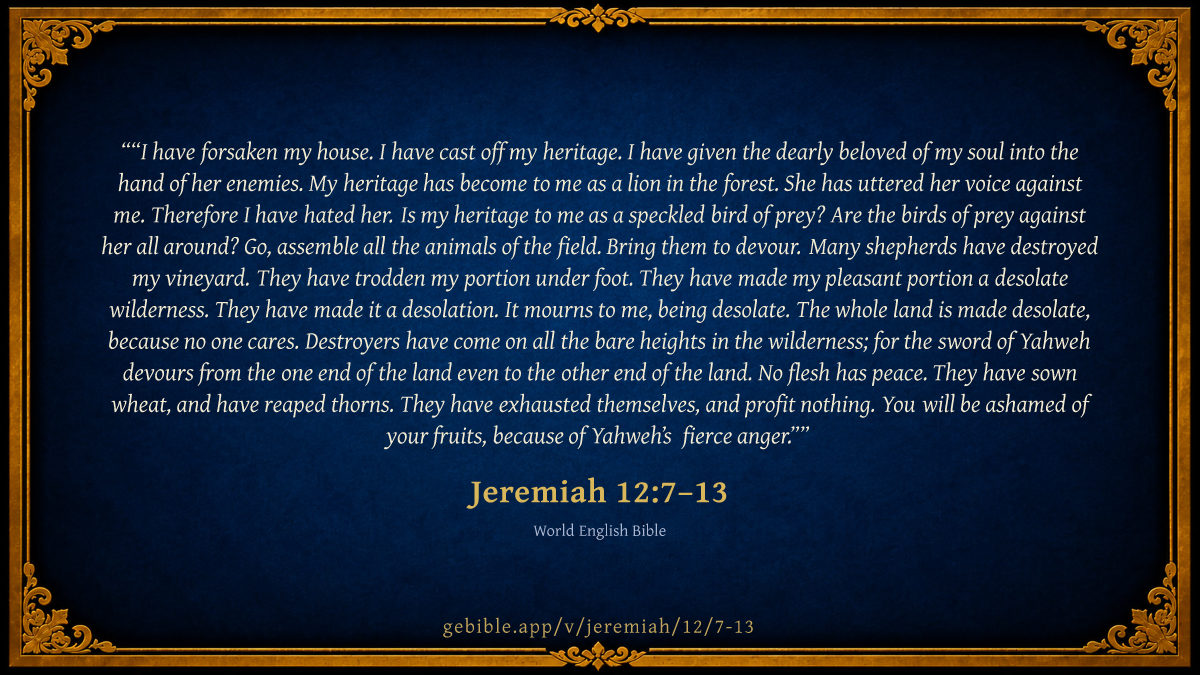
“I have forsaken my house. I have cast off my heritage. I have given the dearly beloved of my soul into the hand of her enemies.
My heritage has become to me as a lion in the forest. She has uttered her voice against me. Therefore I have hated her.
Is my heritage to me as a speckled bird of prey? Are the birds of prey against her all around? Go, assemble all the animals of the field. Bring them to devour.
Many shepherds have destroyed my vineyard. They have trodden my portion under foot. They have made my pleasant portion a desolate wilderness.
They have made it a desolation. It mourns to me, being desolate. The whole land is made desolate, because no one cares.
Destroyers have come on all the bare heights in the wilderness; for the sword of Yahweh devours from the one end of the land even to the other end of the land. No flesh has peace.
They have sown wheat, and have reaped thorns. They have exhausted themselves, and profit nothing. You will be ashamed of your fruits, because of Yahweh’s fierce anger.”
John Calvin 1540 · Public Domain On vv7–13 He confirms what I have already stated; he testifies…
He confirms what I have already stated; he testifies that the people were either openly furious or acting perfidiously and deceitfully; nor has it been the object hitherto merely to say that wrong had been done to the Prophet, but regard has been had to what he taught.
He now adds, Forsaken have I my house and left my heritage God here declares that it was all over with the people. They were inebriated with vain confidence, relying on the covenant which God had made. with their fathers, and thought that God was bound to them. Thus they wished to treat God with contempt according to their own humor, and at the same time to allow themselves every kind of licentiousness. The Prophet makes here many concessions, as though he had said, “Ye are the house of God; ye are his heritage, ye are his beloved, ye are his portion and his richest portion; but all this will not prevent him to become your Judge, and at length to treat you with rigorous justice, and to vindicate himself.” We now perceive the meaning of the Prophet. But as I have before said, the words have more weight having been spoken by God, than if Jeremiah himself had said them. God then, as though sitting for judgment, declares thus to the Jews, Forsaken have I my house The Temple was indeed commended in high terms; but the whole country also was on account of the Temple regarded as the habitation of God; for Judah was overshadowed by the Temple, and was secure and safe under its shadow. This word then is to be extended to the whole land and people, when God says, “Forsaken have I nay house;” that is, “Though I have hitherto chosen for myself an habitation among the Jews, yet I now leave them.” He then adds, Left have I my heritage (The verbs עזב oseb, and נטש nuthesh, have nearly the same meaning; the one is to forsake, and the other is to leave) This distinction was a great honor to the Jews; and hence, how much soever they kindled God’s wrath against themselves, they yet, thought that they were safe as it were by privilege, inasmuch as they were the heritage of God. The Prophet. concedes to them this distinction, but shews how vain it was, for God had departed from them.
Read full note →
He then says, Given have I the desire or the love of my soul, etc. The word ידידות, ididut, may be rendered love; but in Latin we may render it darling, (delitias:) the darling then of my soul have I put in the land of her enemies; for the pronoun is in the feminine gender. We hence see what is the subject here; for God intended to deprive the Jews of their vain confidence, and thus to humble and subdue them, so that they might know that no empty and vain titles would be of any help to them. These titles or distinctions he indeed concedes to them, but not without some degree of irony; for he at the same time shews that all this in which they gloried would avail them nothing when God executed on them his vengeance. But further, this passage contains an implied reproof to the Jews for their ingratitude, inasmuch as they were not retained in their obedience to God by benefits so remarkable; for how great was the honor of being called the heritage and the house of God, and even the beloved of his soul? They had deserved no such honor. As then God had manifested towards them such incomparable love, as he had rendered himself more than a father to them, was it not a wickedness in every way inexcusable, not to respond to so great a love, and that gratuitous, and also to so great a liberality? for what more could God have done than to call thenl the darling of his soul?
We hence see that the sin of the people is greatly amplified by these distinctions, on account of which they yet fostered their pride; as though he had said, “These words indeed are ready on your tongues, — that ye are God’s heritage, and sanctuary, and his love; but ye are for this very reason the more abominable, because ye respond not to God’s love and bountiful dealings: He has favored you with incredible love, he has raised you to very great honor, and yet ye despise him and perversely resist his teaching, nor can ye bear him to govern you.” We now then see what instruction may be gathered from these words. It follows —
John Calvin's Commentaries (1540-1563) — public domain. Text from the Calvin Translation Society English edition (1840s-50s) via the Christian Classics Ethereal Library (ccel.org). Calvin's coverage is partial (roughly two-thirds of the Bible); uncommented books and verses are honest gaps, never fabricated. The 19th-century editor's footnotes and remarks are omitted so the notes are faithfully Calvin's own voice.
Geneva Bible translators 1599 · Public Domain On vv7, 8, 9, 10, 11, 13 God willeth the Prophet to denounce his judgments against…
God willeth the Prophet to denounce his judgments against Jerusalem, notwithstanding that they shall both by threatenings and flatteries, labor to put him to silence.
Geneva Bible (1599) marginal notes — public domain.
John Trapp 1656 · Public Domain On vv7–13 Jer 12:7 I have forsaken mine house, I have…
Jer 12:7 I have forsaken mine house, I have left mine heritage; I have given the dearly beloved of my soul into the hand of her enemies.
Ver. 7. I have forsaken my house.] A man’s house is dear to him, dearer his heritage, dearest his well beloved wife. Jerusalem had been all this to God, but now for sin abandoned by him.
Read full note →
I have given the dearly beloved of my soul.] Or, My dearly beloved, my soul - i.e., Myself, my second self. Heb., The love of my soul. Gr. and Vulgate, My beloved soul. "God is jealous, and the Lord revengeth." {Nah 1:2}
John Trapp, A Commentary or Exposition upon All the Books of the Old and New Testament (1647–1656) — public domain. Text from a community e-Sword module.
Matthew Poole 1685 · Public Domain On vv7–13 God by his
God by his
house here understandeth the temple, which God is said here to have forsaken with respect to his gracious manifestations in it to the people that came thither to worship him. By his
Read full note →
heritage he means the whole body of the Israelites, called God’s heritage not in this chapter only, but Jer 2:7; Joe 2:17; Mic 7:14; whom God threateneth to leave with respect to his special providence, by which he had taken care of them; upon which account Canaan is called the land which God cared for, Deu 11:12; that is, so cared for, as in comparison with them he might seem to neglect all other countries.
I have given the dearly beloved of my soul into the hands of her enemies; that is, he had given that nation which was once his dearly beloved into the hands or power of their enemies.
Matthew Poole's English Annotations on the Holy Bible (1683–1685) — public domain. Text from a community e-Sword/MySword module.
Matthew Henry 1710 · Public Domain On v7 The people of the Jews are here marked for…
The people of the Jews are here marked for ruin.
I. God is here brought in falling out with them and leaving them desolate; and they could never have been undone if they had not provoked God to desert them. It is a terrible word that God here says (Jer 12:7): I have forsaken my house - the temple, which had been his palace; they had polluted it, and so forced him out of it: I have left my heritage, and will look after it no more. His people that he has taken such delight in, and care of, are now thrown out of his protection. They had been the dearly beloved of his soul, precious in his sight and honorable above any people, which is mentioned to aggravate their sin in returning him hatred for his love and their misery in throwing themselves out of the favour of one that had such a kindness for them, and to justify God in his dealings with them. He sought not occasion against them, but, if they would have conducted themselves with any tolerable propriety, he would have made the best of them, for they were the beloved of his soul; but they had conducted themselves so that they had provoked him to give them into the hand of their enemies, to leave them unguarded, an easy prey to those that bore them ill-will. But what was the quarrel God had with a people that had been so long dear to him? Why, truly, they had degenerated. 1. They had become like beasts of prey, which nobody loves, but every body avoids and gets as far off from as he can (Jer 12:8): My heritage is unto me as a lion in the forest. Their sins cry to heaven for vengeance as loud as a lion roars. Nay, they cry out against God in the threatenings and slaughter which they breathe against his prophets that speak to them in his name; and what is said and done against them God takes as said and done against himself. They blaspheme his name, oppose his authority, and bid defiance to his justice, and so cry out against him as a lion in the forest. Those that were the sheep of God's pasture had become barbarous and ravenous, and as ungovernable as lions in the forest; therefore he hated them; for what delight could the God of love take in a people that had now become as roaring lions and raging beasts, fit to be taken and shot at, as a vexation and torment to all about them? 2. They had become like birds of prey, and therefore also unworthy a place in God's house, where neither beasts nor birds of prey were admitted to be offered in sacrifice (Jer 12:9): My heritage is unto me as a bird with talons (so some read it, and so the margin); they are continually pulling and pecking at one another; they have by their unnatural contentions made their country a cock-pit. Or as a speckled bird, dyed, or sprinkled, or bedewed with the blood of her prey. The shedding of innocent blood was Jerusalem's measure-filling sin, and hastened their ruin, not only as it provoked their neighbours likewise; for those that have their hand against every man shall have every man's hand against them (Gen 16:12), and so it follows here: The birds round about are against her. Some make her a speckled, pied, or motley bird, upon the account of their mixing the superstitious customs and usages of the heathen with divine institutions in the worship of God; they were fond of a party-coloured religion, and thought it made them fine, when really it made them odious. God's turtle-dove is no speckled bird.
Read full note →
II. The enemies are here brought in falling upon them and laying them desolate. And some think it is upon this account that they are compared to a speckled bird, because fowls usually make a noise about a bird of an odd unusual colour. God's people are, among the children of this world, as men wondered at, as a speckled bird; but this people had by their own folly made themselves so; and the beasts and birds are called and commissioned to prey upon them. Let all the birds round be against her, for God has forsaken her, and with them let all the beasts of the field come to devour. Those that have made a prey of others shall themselves be preyed upon. It did not lessen the sin of the nations, but very much increased the misery of Judah and Jerusalem, that the desolation brought upon them was by order from heaven. The birds and beasts are perhaps called to feast upon the bodies of the slain, as in St. John's vision, Rev 19:17, Rev 19:18. The utter desolation of the land by the Chaldean army is here spoken of as a thing done, so sure, so near, was it. God speaks of it as a thing which he had appointed to be done, and yet which he had no pleasure in, any more than in the death of other sinners.
1. See with what a tender affection he speaks of this land, notwithstanding the sinfulness of it, in remembrance of his covenant, and the tribute of honour and glory he had formerly had from it: It is my vineyard, my portion, my pleasant portion, Jer 12:10. Note, God has a kindness and concern for his church, though there be much amiss in it; and his correcting it will every way consist with his complacency in it.
2. See with what a tender compassion he speaks of the desolations of this land: Many pastors (the Chaldean generals that made themselves masters of the country and ate it up with their armies as easily as the Arabian shepherds with their flocks eat up the fruits of a piece of ground that lies common) have destroyed my vineyard, without any consideration had either of the value of it or of my interest in it; they have with the greatest insolence and indignation trodden it under foot, and that which was a pleasant land they have made a desolate wilderness. The destruction was universal: The whole land is made desolate, Jer 12:11. It is made so by the sword of war: The spoilers, the Chaldean soldiers, have come through the plain upon all high places; they have made themselves masters of all the natural fastnesses and artificial fortresses, Jer 12:12. The sword devours from one end of the land to the other; all places lie exposed, and the numerous army of the invaders disperse themselves into every corner of that fruitful country, so that no flesh shall have peace, none shall be exempt from the calamity nor be able to enjoy any tranquillity. When all flesh have corrupted their way, no flesh shall have peace; those only have peace that walk after the Spirit.
3. See whence all this misery comes. (1.) It comes from the displeasure of God. It is the sword of the Lord that devours, Jer 12:12. While God's people keep close to him the sword of their protectors and deliverers is the sword of the Lord, witness that of Gideon; but when they have forsaken him, so that he has become their enemy and fights against them, then the sword of their invaders and destroyers becomes the sword of the Lord; witness this of the Chaldeans. It is because of the fierce anger of the Lord (Jer 12:13); it was this that kindled this fire among them and made their enemies so furious. And who may stand before him when he is angry? (2.) It is their sin that has made God their enemy, particularly their incorrigibleness under former rebukes (Jer 12:11): The land mourns unto me; the country that lies desolate does, as it were, pour out its complaint before God and humble itself under his hand; but the inhabitants are so senseless and stupid that none of them lays it to heart; they do not mourn to God, but are unaffected with his displeasure, while the very ground they go upon shames them. Note, When God's hand is lifted up, and men will not see, it shall be laid on, and they shall be made to feel, Isa 26:11.
4. See how unable they should be to guard against it (Jer 12:13): "They have sown wheat, that is, they have taken a great deal of pains for their own security and promised themselves great matters from their endeavors, but it is all in vain; they shall reap thorns, that is, that which shall prove very grievous and vexatious to them. Instead of helping themselves, they shall but make themselves more uneasy. They have put themselves to pain, both with their labour and with their expectations, but it shall not profit; they shall not prevail to extricate themselves out of the difficulties into which they have plunged themselves. They shall be ashamed of your revenues, ashamed that they have depended so much upon their preparations for war and particularly upon their ability to bear the charges of it." Money constitutes the sinews of war; they thought they had enough of that, but shall be ashamed of it; for their silver and gold shall not profit them in the day of the Lord's anger.
Matthew Henry's Commentary on the Whole Bible (1708–1710) — public domain (CC PDM 1.0). Text via the HelloAO Bible API.
John Gill 1763 · Public Domain On vv7–13 I have forsaken my house,.... The temple, where the…
I have forsaken my house,.... The temple, where the Lord took up his residence, and vouchsafed his presence to his people; this was fulfilled in the first temple, when it was destroyed by the Chaldeans; and more fully in the second, when Christ took his leave of it, Mat 23:38 and when that voice was heard in it, a little before the destruction of Jerusalem, as Josephus (a) relates,
"let us go hence.''
Read full note →
So the Targum,
"I have forsaken the house of my sanctuary.''
I have left mine heritage: the people whom he had chosen for his inheritance, whom he prized and valued, took care of, and protected as such; see Deu 32:9.
I have given the dearly beloved of my soul; whom he heartily loved and delighted in, and who were as dear to him as the apple of his eye:
into the hands of her enemies; the Chaldeans. This prophecy represents the thing as if it was already done, because of the certainty of it, and to awaken the Jews out of their lethargy and stupidity; and by the characters which the Lord gives of them it appears what ingratitude they had been guilty of, and that their ruin was owing to themselves and their sins.
(a) De Bello Jud. l. 6. c. 5. sect. 3.
John Gill's Exposition of the Whole Bible (1746–1763) — public domain (CC PDM 1.0). Text via the HelloAO Bible API.
John Wesley 1765 · Public Domain On vv7–13 My house - God by his house here understands…
My house - God by his house here understands the temple. Heritage - The whole body of the Israelites, whom God threatens to leave with respect to his special providence.
John Wesley, Explanatory Notes Upon the Whole Bible (1754–1765) — public domain. Text via the GEBible commentary corpus.
Adam Clarke 1810 · Public Domain On vv7–13 Verse 7. I have forsaken mine house] I have…
Verse 7. I have forsaken mine house] I have abandoned my temple.
I have given the dearly beloved of my soul] The people once in covenant with me, and inexpressibly dear to me while faithful.
Read full note →
Into the hand of her enemies.] This was a condition in the covenant I made with them; If they forsook me, they were to be abandoned to their enemies, and cast out of the good land I gave to their fathers.
Adam Clarke's Commentary on the Bible (1810–1826) — public domain. Text from a community e-Sword/MySword module.
Joseph Benson 1811 · Public Domain On vv7, 8, 10, 12 Jer 12:7. I have forsaken my house — My…
Jer 12:7. I have forsaken my house — My temple, where I had placed my name. I have already withdrawn my favourable regard and presence from it, and shall withhold those manifestations of my power and goodness, which I have been wont to make to the people who come thither to worship me, and I will shortly give it up to utter desolation. I have left my heritage — The whole body of my people, with respect to my special providence over them and care of them, which have been such that, in comparison with them, I might seem to neglect all other countries. I have given the dearly beloved of my soul, &c. — That is, that nation, which was once my dearly beloved, precious in my sight, and honourable above any people; into the hands of her enemies — I have determined to deliver her into their power, and they shall tyrannise over, oppress, and enslave her at their pleasure. God terms the Jewish nation his dearly beloved here, to aggravate their sin in returning him hatred for his love, and their folly and misery in throwing themselves out of the favour of one who had such a kindness for them, and was mighty to protect and save them.
Joseph Benson's Commentary on the Old and New Testaments (1811–1818) — public domain. Text from a community e-Sword module.
Albert Barnes 1834 · Public Domain On vv7, 10, 11, 12, 13 Yahweh shows that the downfall of the nation was…
Yahweh shows that the downfall of the nation was occasioned by no want of love on His part, but by the nation’s conduct.
Left - More correctly, cast away.
Read full note →
Jer 12:8
Judah has not merely refused obedience, but become intractable and fierce, like an untamed lion. It has roared against God with open blasphemy. As His favor is life, so is His hatred death, i. e., Jerusalem’s punishment shall be as if inflicted by one that hated her.
Jer 12:9
Rather, “Is My heritage unto Me as a speckled bird? Are the birds upon her round about? Come, assemble all the wild beasts: bring them to devour her.” By “a speckled” or parti-colored “bird” is probably meant some kind of vulture.
Albert Barnes' Notes on the Bible (1834–1885) — public domain. Text from a community e-Sword/MySword module.
Haydock's Catholic Bible Commentary 1859 · Public Domain On vv7, 9, 10, 11, 13 Soul; people, (Haydock) whose punishment was decreed. Say not,…
Soul; people, (Haydock) whose punishment was decreed. Say not, therefore, that the wicked always prosper.
George Leo Haydock (1774–1849), Haydock's Catholic Family Bible and Commentary, 1859 edition — public domain. Excludes Psalms (Douay-Rheims chapter numbering differs from Protestant) and Deuterocanonical books (Catholic canon only).
Robert Jamieson, A. R. Fausset & David Brown 1871 · Public Domain On vv7–13 I have forsaken--Jehovah will forsake His temple and the…
I have forsaken--Jehovah will forsake His temple and the people peculiarly His. The mention of God's close tie to them, as heretofore His, aggravates their ingratitude, and shows that their past spiritual privileges will not prevent God from punishing them.
beloved of my soul--image from a wife (Jer 11:15; Isa 54:5).
Jamieson, Fausset & Brown — Commentary Critical and Explanatory on the Whole Bible (1871) — public domain (CC PDM 1.0). Text via the HelloAO Bible API.
Daniel D. Whedon 1874 · Public Domain On vv7–13 ISRAEL’S CONSPIRACY PUNISHED, Jer_12:7-13.
ISRAEL’S CONSPIRACY PUNISHED, Jer_12:7-13.
7. The whole passage (Jer_12:7-17) is characterized by an obvious unity, and is throughout the language of Jehovah. Its connexion with what precedes is general rather than particular. The personal trials of Jeremiah had been foreshadowed, and here is set forth the general state of things out of which these trials would come.
Read full note →
I have forsaken — These and the following perfects are used prophetically. It is done only in the divine purpose — not actually executed.
House… heritage… dearly beloved — All refer to the same subject, Judah. Language is too weak to carry the burden of God’s yearning tenderness for his people.
Into the hand — Literally, the palm. The hand is the symbol of power; the palm of passive receptiveness.
Daniel D. Whedon (gen. ed.), Commentary on the Old and New Testaments (1874–1909) — public domain. Text from a community e-Sword module.
The Cambridge Bible for Schools and Colleges 1878 · Public Domain On vv7–13 7. mine house] shewn by the parallelism of the…
7. mine house] shewn by the parallelism of the clauses to mean, not the Temple, but the nation itself; so in Hos_8:1; Hos_9:15.
Ch. Jer_12:7-17. Devastation of Judah to be wrought by hostile neighbours, who shall be punished by exile unless they submit to the God of Israel
Read full note →
Jehovah in pathetic language deplores the necessity of permitting the devastation of His land.
This section has no connexion with the preceding or subsequent context. It may safely be dated late in Jehoiakim’s reign, as relating to the attack upon Judah on the part of Chaldaeans, Syrians, Moabites, and Ammonites (see 2Ki_24:1 f.), under the figure of birds of prey attacking one whose plumage attracts their attention as unusual. Du. places Jer_12:14-17 in the 2nd cent. b.c. He considers “the evil neighbours” of Jer_12:14 to mean the persons of various nationalities who were living in the land in the time of John Hyrcanus and his son. He compares Zec_14:16 ff.; Isa_19:16 ff. as having a similar reference. But, as Pe. says, we do not in those passages, as here, read of exile followed by restoration, nor would a writer of the 2nd cent. b.c. have put into the mouth of Jeremiah a prediction which in fact was not realised.
The section may be subdivided thus.
(i) Jer_12:7-13. Jehovah’s heritage has turned as a savage beast against Him. Therefore He has given her over to be the prey of neighbouring nations. She is like a speckled bird attacked by her own kind. The country is laid waste, because its inhabitants took no serious thought. The culture of the land brings no produce, because of the wrath of Jehovah.
(ii) Jer_12:14-17. Judah’s foes shall themselves be driven into exile—permanent, if they refuse to hear Jehovah; but, if they turn to Him, they shall be restored to their lands.
The Cambridge Bible for Schools and Colleges (gen. ed. J. J. S. Perowne; Cambridge University Press, 1878–1918) — public domain. Text from a community e-Sword module.
Ellicott's Commentary for English Readers 1878 · Public Domain On vv7–13 (7) I have forsaken mine house.—The speaker is clearly…
(7) I have forsaken mine house.—The speaker is clearly Jehovah, but the connection with what precedes is not clear. Possibly we have, in this chapter, what in the writings of a poet would be called fragmentary pieces, written at intervals, and representing different phases of thought, and afterwards arranged without the devices of headings and titles and spaces with which modern bookmaking has made us familiar. So far as a sequence of thought is traceable, it is this, “Thou complainest of thine own sufferings, but there are worse things yet in store for thee; and what after all are thine, as compared with those that I, Jehovah, have brought upon mine heritage, dear as it is to me?”
I have left.—Better, I have cast away.
Read full note →
Into the hand.—Literally, the palm, as given over utterly, unable to resist, and not needing the “grasp” of the whole hand.
A Bible Commentary for English Readers, edited by Charles John Ellicott (1878–1897) — public domain. Text from a community e-Sword module.
The Pulpit Commentary 1880 · Public Domain On vv7–13 Vers. 7-17. A separate prophecy. The key to it…
Vers. 7-17. A separate prophecy. The key to it is in 2Ki_24:1, 2Ki_24:2, where it is related that, after Jehoiakim"s rebellion against Nebuchadnezzar, "Jehovah sent against him bands of the Chaldees, and bands of the Syrians, and bands of the Moabites, and bands of the children of Ammon, and sent them against Judah to destroy it." The prophecy falls into two strophes or sections, Vers. 7-13 and Vers. 14-17. In the first we have a complaint of the desolation produced by the guerilla warfare; in the second, a prediction of the captivity of the hostile peoples, not, however, without a prospect of their return home and conversion to Jehovah. It is evident enough that this passage stands in no connection with what precedes. The whole tone is that of a description of present scenes and not of the future. Sometimes, no doubt, a prophet, in the confidence of faith, represents the future as though it were already past; but there is always something in the context to determine the reference and prevent ambiguity. Here, however, there is nothing to indicate that the description relates to the future; and it is followed by a prediction which presupposes that the preceding passage refers to the literal past.
I have forsaken mine house. The "house" is here not the temple, but the people of Israel, as the parallel clause shows. (see Hos_8:1, and Heb_3:6 1Ti_3:15) Jehovah, not the prophet, is evidently the speaker. I have left; rather, I have east away. Into the hand of her enemies. The Hebrew is more expressive: "Into the palm of the hand." Bonomi ("Nineveh and her Palaces," p. 191) has an engraving from the monuments of guests at a banquet, holding their drinking-vessels in the deeply hollowed palm of their hand. So here the people of Israel, in her weak, fainting state, needs only to be held in the quiet pressure of the palm of the hand. The remark and the illustration are due to Dr. Payne Smith.
Read full note →
The forsaken heritage.
I GOD REGARDS HIS PEOPLE AS HIS LINEAGE. The temple was God"s house, the Jews were God"s heritage. The Church is now the habitation of the Spirit of God, and her members are God"s possession. This fact implies:
1. That God dwells with his people.
2. That he takes delight in them.
3. That he may be expected to protect them from harm.
4. That he has rights over them and claims their submission to himself.
5. That his honor is concerned with his people"s conduct, so that their wickedness is not a matter of indifference to him, but is an insult to his Name.
II GOD MAY FORSAKE HIS HERITAGE. God"s people have no such "vested interests" that nothing can destroy their claims upon him. The present enjoyment of God"s favor is no guarantee that this will be perpetual.
1. History shows that God has forsaken his heritage in the past; e.g. the Jews, ancient Christian Churches of Asia and Africa, individual Christians who have fallen from the faith.
2. It is reasonable to expect that he will do this when honor and righteousness require it. Let us, there fore, not presume on the favor of God.
III GOD ONLY FORSAKES HIS HERITAGE WHEN THAT HAS BECOME CORRUPT. God never leaves his people till they leave him. He is not changeable, capricious, arbitrary in his favors. His love never wanes, his grace never fails, his help and blessings are never limited. The change begins on man"s side. It is found in rebellion against God.
1. In self-will. The heritage becomes like a lion of the forest. i.e. no longer tame, but swayed by its own wild passions.
2. In evil-doing. The lion is fierce and destructive a beast of prey.
3. In direct opposition to God. The lion "cries out against" God.
IV GOD"S HERITAGE IS IN A TERRIBLE CONDITION WHEN IT IS FORSAKEN BY HIM. Birds and beasts of prey come up to devour the heritage.
1. It needs no positive act of God"s to bring desolation on his sinful people. If he but withdraw his protection, the natural evils of the world and the special evils which they have provoked will be enough to bring ruin on their heads.
2. God"s people will suffer in an especial way by the withdrawal of the Divine presence. The heritage is "like a speckled bird." It is strange, and so it draws upon itself opposition. The Jews were a mark for the enmity of the heathen through the singularity of their national customs. Christians are often singled out for opposition from the world for similar reasons. If they have lost their peculiar protection, their peculiar position and nature will invoke a peculiar ruin.
Vers. 7, 8. Leaving all for God.
(Naegelsbach is of opinion that the words of Vers. 7-13 "are to be understood as having a double reference," i.e. both to the prophet"s own feelings and to Jehovah"s judgment. Zwingli and Bugenhagen consider that Jehovah begins to speak at "Go" or "Come," in Ver. 9. There is evidently an intimate blending of the prophetic with the Divine consciousness throughout the whole passage.) A hard duty, but one often devolving upon faithful servants of Jehovah. Indeed, spiritually, it is the first condition of discipleship imposed by Christ. Only thus can the soul preserve its equipoise and integrity in what may be required of it. The Master will brook no rival.
I THE REASONS FOR SUCH A SACRIFICE. It is possible that for one with the keen, affectionate nature of Jeremiah, much intercourse with his family and friends would have interfered with the performance of his duty. He was appointed to discharge an anomalous function, for which the greatest concentration of energy and spirit was required. Even though he had to weep as he spoke the words that God had commanded him, he must speak. His duty to the nation overshadowed or pushed into the background the claims of friends. So the follower of Christ may be subjected to discipline in providence, or to voluntary self-deprivation of a like kind by the demands of spiritual work. And it behooves all who labor in the cause of truth to hold themselves spiritually detached from those things and relations which might impede true usefulness.
II KEEN PERSONAL SORROW IS FREQUENTLY OCCASIONED BY IT. That it was a real trial to Jeremiah there can be no doubt; and probably the special discovery made to him (Jer_11:18 seq.) was intended to facilitate the transfer of attachment to Jehovah. The endearing terms house," "mine heritage," "the dearly beloved of my soul," and the manner in which he repeats the history of his estrangement, prove how deeply the trial had affected him.
III THEREBY IS TESTED THE LOYALTY OF THE SAINT TO GOD. In a question between one"s friends and Jehovah, the settlement ought not to be doubtful to the mind of the saint. The reasons for withdrawal from entangling relations may not immediately appear, but the believer can with confidence leave them in the hands of God, by whom they will in due time be revealed. There is a danger in the midst of ordinary human relations that Jehovah shall be considered simply as an addition to our obligations, instead of being the supreme and all-modifying influence of our life. In proportion to the severity of the experience will be the consolations to be received. M.
Vers. 7-13. The hiding of God"s face.
Here is a most terrible condition of things set forth. It may be taken as telling of the calamities which ensue when God hides his face from his people. It is terrible every way. Because
I OF HIM BY WHOM HIS FACE IS HIDDEN. It is God. We feel such conduct from our fellow-men according to our estimate of the person who manifests it. Now, all these facts which make the hiding of his face grievous to us meet in God righteousness, goodness, wisdom, power. Were he devoid of these, could we question the existence of any of them in him, we could bear with more equanimity his hiding his face from us.
II OF THOSE FROM WHOM HIS FACE IS HIDDEN. Had they been enemies all along, it would have been taken as a matter of course; that he should have regarded them with favor would never have been expected. Or had they been strangers and aliens to him, then, too, his favor would not have been looked for. Or had that favor never been known or enjoyed, then its absence would not have been felt, nothing that they had been accustomed to would have been missed. But the reverse of all this is the truth. They had been counted by him as friends, as dear children, as precious in his sight; and he had been wont to cause his face to shine upon them. See the endearing epithets by which he describes them. He had counted them as "the dearly beloved of his soul" (Ver. 7), "his portion," "his pleasant portion," etc. (Vers. 8-10). How dark, therefore, must be the frown of God to such! how intolerable to them his displeasure.
III OF THAT WHICH ACCOMPANIED THE HIDING OF HIS FACE. There is withdrawal:
1. From the sanctuary. "I have forsaken mine house." The customary services went on, but the glow, the unction, the power of them had departed. The place where his honor dwelt, the dearly beloved of his soul, was forsaken by him.
2. From the people. His heritage was no longer pleasant to him; he delighted not to dwell amongst them. All that joy, strength, prosperity, which belonged to them when God was amongst them had departed.
3. From the land. "The whole land is made desolate." In the outward circumstances and surroundings of the people the effect of God"s hiding his face from them became terribly manifest. And there has come a terrible revulsion of feeling on the part of God towards them (see Vers. 8, 9). And not only his mind, but his hand, his providence, is awfully changed towards them. He calls on their enemies to come (Ver. 9). And they come (Ver. 12). And the ruin is complete: "The sword of the Lord shall devour from the one end of the land even to the other" (Ver. 12). All their own plans their sowing of wheat (Ver. 13) for their own good are miserably defeated, they "reap thorns." Thus the inward displeasure of God manifests itself oftentimes in the outward circumstances of a man or nation.
IV OF THAT ON ACCOUNT OF WHICH GOD"S FACE IS HIDDEN. It was "because no man layeth it to heart" (Ver. 11). The lesser judgments of God, his repeated warnings, had been disregarded hearing they heard not, seeing they saw not; and hence all this. Had the cause of their woe been their misfortune, the result of mistake, or ignorance, or lack of timely counsel, then there would have been some element of consolation amid all they had to suffer. But to add to their distress was the ever-present reflection, "It was all our own fault; we brought it all on ourselves." With what intense hatred, therefore, should we look upon all that grieves the Spirit of God! and with what earnest haste should we endeavor to return unto God, if we have wandered from him! These miseries which beset those from whom God hides his face are his loving scourgings whereby we may be led to say, "I will arise and go to my Father, and will say unto him, Father,! have sinned," etc. C.
Vers. 7-11. The inheritance that has lost its charms.
I WE HAVE HERE REGRETFUL THOUGHTS OF THE PAST. We can see what the prophet once hoped and desired. Not only what he had hoped and desired in those dreams of youth before God had touched his heart and claimed the service of his lips, but also what he had hoped and desired since becoming a prophet. Dear as Anathoth with its inhabitants may have been before, it would become dearer still when he thought of impending calamities to the whole land. There are cherished objects indicated by the words "house," "inheritance," and "desire of the soul." What is precisely indicated by these words it is of course impossible for us to say; but any of us, thinking for a little of the objects that lie nearest to our hearts, will comprehend that the prophet is here speaking of separations he had found it very hard to achieve. He did not pretend that alienation from house and heritage and kindred was an easy thing. Then we must bear in mind that the references here have a deeper meaning than to Jeremiah"s purely human relations. It is pretty well agreed that the full truth of these words is only reached when we think of Jeremiah as representative of Jehovah. God"s separation from his people was the thing of most serious moment. God had a house; God had an inheritance; God had a beloved object, an object of desire. (Deu_32:9) God had been with these people now for many centuries, and there was much to make them precious in his sight. They were the seed of Abraham, the descendants of those whom he had delivered from Egypt and guided through the wilderness into the land where they now dwelt. Things might have been so different, if only the people had been of a different spirit. There was no necessity in the nature of things that. Israel should have become so idolatrous, so hostile to Jehovah, any more than there was necessity that Anathoth should become a place of mortal snares and perils to the prophet. What a fall there was from the triumphal march across Jordan, under Joshua, to the march at the heels of a conqueror all the way from Jerusalem to Babylon! Again we say things might have been so different. That which God had cherished might have become a rich earthly manifestation of His glory. The vineyard on a fruitful hill might have become what it was intended to be a fruitful vineyard.
II PRUDENT AND DECISIVE ACTION IN PRESENT NECESSITIES. Natural affection must yield to spiritual duty. Jeremiah might doubtless have kept the good will of his kinsfolk, such as it was worth, if only he had been able and disposed to remain silent as a prophet. Happily there is no hesitation, there is no sign of its even being possible. Let us seize on every record that illustrates how strong, how immovable, those become who put their trust in God. The path that Jeremiah had to tread was trodden afterwards by Jesus himself. His kinsfolk would have interfered with main force to stop what they reckoned the vagaries of one who was beside himself; and so as far as Jesus could be said to have had any abiding-places, they were in Capernaum and Bethany, not in Nazareth. So with Jeremiah. He had to give up all that on earth he had any natural claim to, and throw himself on God, and those who perchance might help him for the sake of God. Nor was he disappointed. There is certainly no indication here of the compensations that came to the prophet for his fidelity and self-denial. It is hardly the place to mention them. But we do see this clearly, that when once the lower is relinquished, decisively relinquished, and a higher station taken up, the lower is seen to be lower. Temporal and natural relations, that count for so much when one is in the midst of them, are seen then in their comparative unimportance. Let it not be supposed that, after cutting off the right hand, one must of necessity wait for the fullness of life eternal to get anything like compensation. The compensation begins in the very act of self-sacrifice. Does not the prophet here say that what had once been so loved had come to put on such a threatening, maleficent aspect that he also had come to hate it? What has had to be relinquished for Christ only leaves so much the more of opportunity to grasp and to use the spiritual wealth which is in him. Y.
The Pulpit Commentary (1880–1919), ed. H.D.M. Spence-Jones & Joseph S. Exell — public domain. Text from a community e-Sword module.
The Biblical Illustrator 1887 · Public Domain On v9 Mine heritage is unto Me as a speckled bird.
Jer_12:9
Mine heritage is unto Me as a speckled bird.
Read full note →
A speckled bird
Mine (Gods) heritage is unto Me as a speckled bird. As an owl, say some, that loveth not the light; as a peacock, say others, as oft changed as moved. God, that could not endure miscellany seed, nor linsey-woolsey, in Israel, can less endure that His people should be as a speckled bird, here of one colour, and there of another; or as a cake not turned (Hos_5:4). (John Trapp.)
Gods people as speckled birds
Mine heritage (the godly mans) is unto me as a speckled bird. When living at Cambridge Mr. Spurgeon was appointed to preach at a village lust outside the city, and during the day, after much reading and meditation, he was unable to light upon a suitable text, and was, as Bunyan would say, much tumbled up and down in his thoughts. Rising from prayer and the reading of the Scriptures he walked to the window, and, looking out, espied on the other side of the narrow street a solitary canary upon the roof ridge, surrounded by a crowd of sparrows that were all pecking at it. At that moment the verse quoted flashed into his mind, and he started off upon his country walk, restful in heart and mind, and composed his sermon as he journeyed, the main points of his discourse being the peculiarity of Gods people and the persecutions they suffer in consequence. He thus speaks of the episode himself: I preached with freedom and ease to myself, and, I believe, with comfort to my rustic audience. The text was sent to me, and if the ravens did not bring it, certainly the sparrows did. (Chas. Spurgeon.)
.
The Biblical Illustrator, edited by Joseph S. Exell (c. 1880s–1900s) — public domain. Text from a community e-Sword module.
Paul E. Kretzmann 1924 · Public Domain On v7 Israel Spoiled by the Enemies
Israel Spoiled by the Enemies
v. 7. I have forsaken Mine house, so the Lord tells His prophet, I have left Mine heritage, repudiating His chosen people, in the midst of whom He had established, and hoped to maintain, His Church; I have given the dearly beloved of My soul into the hand of her enemies, this being said of the exile with which He intended to punish His disobedient people.
Read full note →
v. 8. Mine heritage is unto Me as a lion in the forest, presuming to rise up against Him like a beast of prey; it crieth out against Me, roaring with hatred and rage, therefore have I hated it, His former love having departed from it on account of its obstinate opposition to His will.
v. 9. Mine heritage is unto Me as a speckled bird, a bird of prey with its plumage striped brown and gray, or an albino; the birds round about are against her, pouncing upon such a bird in either case with the greatest rage. Come ye, assemble all the beasts of the field; come to devour! The whole sentence may also be rendered in the form of a question stating the situation as it actually was found when the heathen nations began their attacks upon Judah.
v. 10. Many pastors, the very ones who were expected to give the Church the proper spiritual care, have destroyed My vineyard; they, together with the heathen kings and their hordes, have trodden My portion, His particular property, under foot; they have made My pleasant portion, the land and the people of His desire, a desolate wilderness. Cf. Jer 3:19.
v. 11. They have made it desolate, practically an uninhabited desert, and being desolate, it moumeth unto Me, making a lament of sadness over the punishment which had come upon it. The whole land is made desolate because no man layeth it to heart, there had been none to turn to the Lord in true repentance.
v. 12. The spoilers are come upon all high places through the wilderness, appearing on the heights of the steppes throughout the land; for the sword of the Lord, the war which the Lord would send upon Judah as a just punishment, shall devour from the one end of the land even to the other end of the land; no flesh, in this case the entire sinful population of Judah, shall have peace, no section of the country would be excepted in the general affliction.
v. 13. They, the people of Judah, have sown wheat, they have undertaken many things in the pride of their hearts, but shall reap thorns, the very opposite of what they expected; they have put themselves to pain, exhausting their strength and almost tormenting themselves in the endeavor to gain their proud ends, but shall not profit, not getting the results which they had anticipated; and they shall be ashamed of your revenues, in the small amounts which they actually produced, because of the fierce anger of the Lord, who would not permit their proud plans to mature. God resists the proud, but gives grace to the humble.
Paul E. Kretzmann, Popular Commentary of the Bible (1921–1924) — public domain. Text from a community e-Sword module.
unfoldingWord translationNotes 2017 · CC BY-SA 4.0 On vv7, 10, 12 I have abandoned my house; I have forsaken my…
I have abandoned my house; I have forsaken my inheritance. I have given my beloved into the hands of her enemies.
These three sentences have similar meanings. The first and second one strengthens the thought in the third. (See: Parallelism)
Read full note →
I have abandoned my house; I have forsaken my inheritance
The two phrases are metaphors in which Yahweh speaks of his people as if they were his "house" and his "inheritance." AT: "I have abandoned my Israelite people, the people whom I chose to belong to me" (See: Metaphor)
into the hands of her enemies
Here the word "hands" represents control. AT: "to be conquered by her enemies" or "over to the control of her enemies" (See: Metonymy)
of her ... she sets herself ... with her ... hate her
Here Yahweh refers to his people as a female by using feminine pronouns. AT: "of their ... they set themselves ... with their ... hate them" (See: Personification)
she sets herself against me with her own voice
This continues to speaks of Yahweh's people as a lion. This speaks of the people showing they are against him as if they were roaring at him. AT: "it is like she roars at me to defy me"
Has not my prized possession become a speckled bird, that other birds of prey go against her all around?
Yahweh uses this rhetorical question to emphasize that his people are surrounded by their enemies. This question can be written as a statement. AT: "My prized possession has become a speckled bird and other birds of prey go against her all around." (See: Rhetorical Question)
Has not my prized possession
Here Yahweh speaks of his people as his "prized possession." AT: "Have not my people, who are my prized possession" (See: Assumed Knowledge and Implicit Information)
become a speckled bird, that other birds of prey go against her all around
Here Yahweh speaks of his people being in danger and surrounded by their enemies as if they were a speckled bird surrounded by birds of prey. AT: "become like a speckled bird, and her enemies are like birds of prey attacking her on all sides" (See: Metaphor)
a speckled bird
"a strange looking bird." This refers to a bird that was often picked on and eaten by other birds.
birds of prey
birds that attack and eat animals
Go and gather all the wild beasts and bring them to devour her
Yahweh speaks here in the form of a command to strengthen what he says. This command is not directed to a specific person and may be written as a statement. AT: "Let all the wild beasts in the fields come and eat her" (See: Apostrophe)
translationWords
house
forsake
inherit
beloved
people of God
hand
lions
voice
possess
prey
creature
unfoldingWord translationNotes — © Distant Shores Media and the Door43 World Missions Community, licensed CC BY-SA 4.0. Source: git.door43.org/Door43/en_tn.
Tyndale Open Study Notes 2022 · CC BY-SA 4.0 On vv7, 9, 10, 11, 12, 13 12:7-13 God called the people of Judah his special…
12:7-13 God called the people of Judah his special possession, his dearest ones, his chosen people, and his vineyard. However, they had become hostile to him, so they had to be surrendered to their enemies. Perhaps the most severe justice they could face was for the Lord to step back and let the people suffer the consequences of their evil ways.
Tyndale Open Study Notes — © Tyndale Open Resources, licensed CC BY-SA 4.0. Text via the HelloAO Bible API.