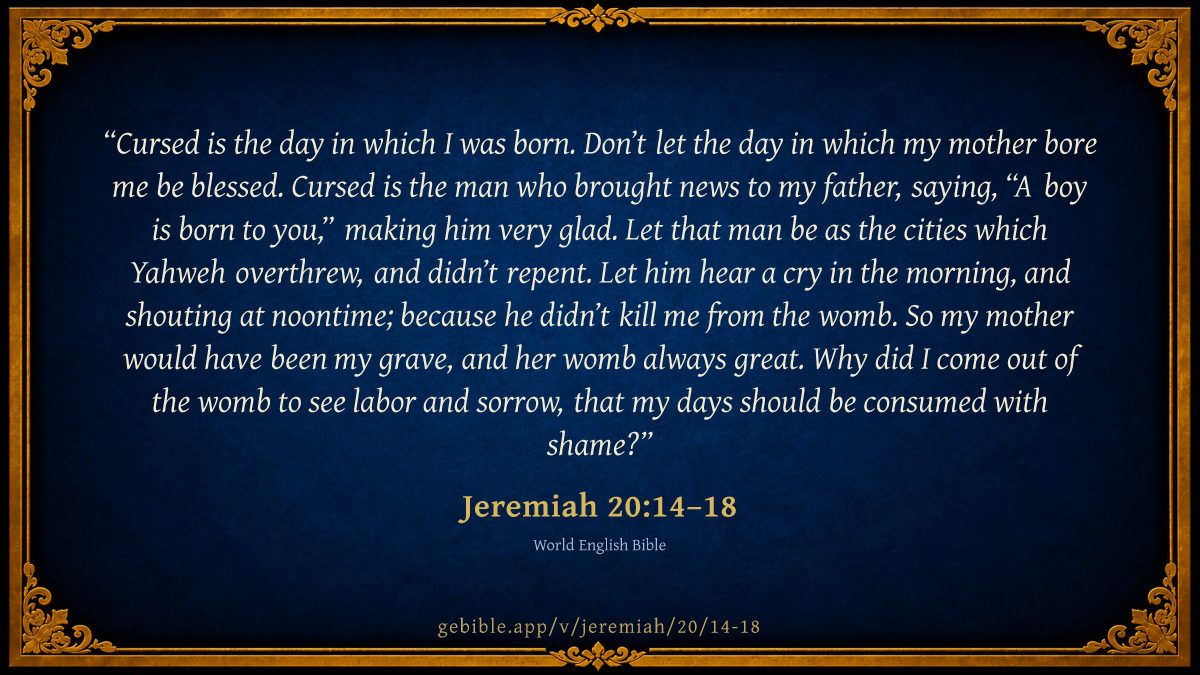
14 Cursed is the day in which I was born. Don’t let the day in which my mother bore me be blessed.
15 Cursed is the man who brought news to my father, saying, “A boy is born to you,” making him very glad.
16 Let that man be as the cities which Yahweh overthrew, and didn’t repent. Let him hear a cry in the morning, and shouting at noontime;
17 because he didn’t kill me from the womb. So my mother would have been my grave, and her womb always great.
18 Why did I come out of the womb to see labor and sorrow, that my days should be consumed with shame?
KJVKing James Version
14 Cursed be the day wherein I was born: let not the day wherein my mother bare me be blessed.
15 Cursed be the man who brought tidings to my father, saying, A man child is born unto thee; making him very glad.
16 And let that man be as the cities which the LORD overthrew, and repented not: and let him hear the cry in the morning, and the shouting at noontide;
17 Because he slew me not from the womb; or that my mother might have been my grave, and her womb to be always great with me.
18 Wherefore came I forth out of the womb to see labour and sorrow, that my days should be consumed with shame?
Show all 3 translations
JPSJPS Tanakh (1917)
14 Cursed be the day wherein I was born; the day wherein my mother bore me, let it not be blessed.
15 Cursed be the man who brought tidings to my father, saying: 'A man-child is born unto thee'; making him very glad.
16 And let that man be as the cities which the LORD overthrew, and repented not; and let him hear a cry in the morning, and an alarm at noontide;
17 Because He slew me not from the womb; and so my mother would have been my grave, and her womb always great.
18 Wherefore came I forth out of the womb to see labour and sorrow, that my days should be consumed in shame?
Jeremiah 15:10(v14)Woe is me, my mother, that you have borne me, a man of strife, and a man of contention to the whole earth! I have not lent, neither have…
Job 3:10-11(v17)because it didn’t shut up the doors of my mother’s womb, nor did it hide trouble from my eyes. “Why didn’t I die from the womb? Why didn’t…
Job 3:20(v18)“Why is light given to him who is in misery, life to the bitter in soul,
Job 10:18-19(v17)“ ‘Why, then, have you brought me out of the womb? I wish I had given up the spirit, and no eye had seen me. I should have been as though I…
Job 3:3-16(v14)“Let the day perish in which I was born, the night which said, ‘There is a boy conceived.’ Let that day be darkness. Don’t let God from…
Show all 50 cross-references
Job 14:1(v18)“Man, who is born of a woman, is of few days, and full of trouble.
Jeremiah 18:22(v16)Let a cry be heard from their houses when you bring a troop suddenly on them; for they have dug a pit to take me and hidden snares for my…
Lamentations 3:1(v18)I am the man who has seen affliction by the rod of his wrath.
1 Peter 4:14-16(v18)If you are insulted for the name of Christ, you are blessed; because the Spirit of glory and of God rests on you. On their part he is…
Deuteronomy 29:23(v16)that all of its land is sulfur, salt, and burning, that it is not sown, doesn’t produce, nor does any grass grow in it, like the overthrow…
Job 3:16(v17)or as a hidden untimely birth I had not been, as infants who never saw light.
Psalms 69:19(v18)You know my reproach, my shame, and my dishonor. My adversaries are all before you.
Psalms 90:9-10(v18)For all our days have passed away in your wrath. We bring our years to an end as a sigh. The days of our years are seventy, or even by…
Ecclesiastes 6:3(v17)If a man fathers a hundred children, and lives many years, so that the days of his years are many, but his soul is not filled with good,…
Jeremiah 48:3-4(v16)The sound of a cry from Horonaim, desolation and great destruction! Moab is destroyed. Her little ones have caused a cry to be heard.
1 Corinthians 4:9-13(v18)For, I think that God has displayed us, the apostles, last of all, like men sentenced to death. For we are made a spectacle to the world,…
Genesis 3:16-19(v18)To the woman he said, “I will greatly multiply your pain in childbirth. You will bear children in pain. Your desire will be for your…
Genesis 19:24-25(v16)Then Yahweh rained on Sodom and on Gomorrah sulfur and fire from Yahweh out of the sky. He overthrew those cities, all the plain, all the…
Genesis 21:5-6(v15)Abraham was one hundred years old when his son, Isaac, was born to him. Sarah said, “God has made me laugh. Everyone who hears will laugh…
Job 14:13(v18)“Oh that you would hide me in Sheol, that you would keep me secret until your wrath is past, that you would appoint me a set time and…
Isaiah 1:6(v18)From the sole of the foot even to the head there is no soundness in it: wounds, welts, and open sores. They haven’t been closed, bandaged,…
Isaiah 51:7(v18)“Listen to me, you who know righteousness, the people in whose heart is my law. Don’t fear the reproach of men, and don’t be dismayed at…
Jeremiah 1:5(v15)“Before I formed you in the womb, I knew you. Before you were born, I sanctified you. I have appointed you a prophet to the nations.”
Jeremiah 4:19(v16)My anguish, my anguish! I am pained at my very heart! My heart trembles within me. I can’t hold my peace, because you have heard, O my…
Jeremiah 8:18(v18)Oh that I could comfort myself against sorrow! My heart is faint within me.
Jeremiah 18:8(v16)if that nation, concerning which I have spoken, turns from their evil, I will repent of the evil that I thought to do to them.
Jeremiah 26:13(v16)Now therefore amend your ways and your doings, and obey Yahweh your God’s voice; then Yahweh will relent from the evil that he has…
Lamentations 1:12(v18)“Is it nothing to you, all you who pass by? Look, and see if there is any sorrow like my sorrow, which is brought on me, with which Yahweh…
Ezekiel 21:22(v16)In his right hand was the lot for Jerusalem, to set battering rams, to open the mouth in the slaughter, to lift up the voice with shouting,…
Hosea 10:14(v16)Therefore a battle roar will arise among your people, and all your fortresses will be destroyed, as Shalman destroyed Beth Arbel in the day…
Hosea 11:8(v16)“How can I give you up, Ephraim? How can I hand you over, Israel? How can I make you like Admah? How can I make you like Zeboiim? My heart…
Amos 1:14(v16)But I will kindle a fire in the wall of Rabbah, and it will devour its palaces, with shouting in the day of battle, with a storm in the day…
Amos 2:2(v16)but I will send a fire on Moab, and it will devour the palaces of Kerioth; and Moab will die with tumult, with shouting, and with the sound…
Amos 4:11(v16)“I have overthrown some of you, as when God overthrew Sodom and Gomorrah, and you were like a burning stick plucked out of the fire; yet…
Jonah 3:4(v16)Jonah began to enter into the city a day’s journey, and he cried out, and said, “In forty days, Nineveh will be overthrown!”
Jonah 3:9-10(v16)Who knows whether God will not turn and relent, and turn away from his fierce anger, so that we might not perish?” God saw their works,…
Jonah 4:2(v16)He prayed to Yahweh, and said, “Please, Yahweh, wasn’t this what I said when I was still in my own country? Therefore I hurried to flee to…
Zephaniah 1:16(v16)a day of the trumpet and alarm, against the fortified cities, and against the high battlements.
Zephaniah 2:9(v16)Therefore as I live, says Yahweh of Armies, the God of Israel, surely Moab will be as Sodom, and the children of Ammon as Gomorrah, a…
Luke 1:14(v15)You will have joy and gladness, and many will rejoice at his birth.
Luke 17:29(v16)but in the day that Lot went out from Sodom, it rained fire and sulfur from the sky and destroyed them all.
John 16:20(v18)Most certainly I tell you that you will weep and lament, but the world will rejoice. You will be sorrowful, but your sorrow will be turned…
Acts 5:41(v18)They therefore departed from the presence of the council, rejoicing that they were counted worthy to suffer dishonor for Jesus’ name.
2 Timothy 1:12(v18)For this cause I also suffer these things. Yet I am not ashamed, for I know him whom I have believed, and I am persuaded that he is able to…
Hebrews 10:36(v18)For you need endurance so that, having done the will of God, you may receive the promise.
Hebrews 11:36(v18)Others were tried by mocking and scourging, yes, moreover by bonds and imprisonment.
Hebrews 12:2(v18)looking to Jesus, the author and perfecter of faith, who for the joy that was set before him endured the cross, despising its shame, and…
Hebrews 13:13(v18)Let’s therefore go out to him outside of the camp, bearing his reproach.
2 Peter 2:6(v16)and turning the cities of Sodom and Gomorrah into ashes, condemned them to destruction, having made them an example to those who would live…
Jude 1:7(v16)Even as Sodom and Gomorrah and the cities around them, having in the same way as these given themselves over to sexual immorality and gone…
Cross-references from openbible.info (CC BY 4.0)
Explain this passage (18 sources)
Historical commentary, presented as a primary source — not an endorsement.
John Calvin1540 · Public DomainOn vv14–18It seems, as I have said, that the Prophet…
It seems, as I have said, that the Prophet was inconsistent with himself; from joy and thanksgiving he immediately passed into curses and execrations; what could have been less appropriate? If we say that he was tried by a new temptation, yet this seems by no means satisfactory, though it is in this way that interpreters commonly untie the knot. But it seems to me a levity unworthy of the holy man to pass suddenly from thanksgiving to God into imprecations, as though he had forgotten himself. I, therefore, doubt not but that the Prophet here relates how grievously he had been harassed by his own thoughts. The whole of this passage, then, is connected with thanksgiving, for he amplifies the deliverance which he has just mentioned, that is, that he had been brought back, as it were, from the lower regions. Thus he recites, in the latter passage, what had before happened to him, as though he had said, “When I now declare that I have been rescued by God from the hand of the wicked, I cannot sufficiently express the greatness of that favor, until I make it more clearly known to all the godly how great and how dreadful agonies I suffered, so that I cursed my birth-day, and abhorred everything that ought to have stimulated me to give praise to God.”
In short, the Prophet teaches us here that he was not only opposed by enemies, but also distressed inwardly in his mind, so that he was carried away contrary to reason and judgment, by turbulent emotions which even led him to give utterance to vile blasphemies. For what is here said cannot be extenuated; but the Prophet most grievously sinned when he became thus calumnious towards God; for a man must be in a state of despair when he curses the day in which he was born. Men are, indeed, wont to celebrate their birth-day; and it was a custom which formerly prevailed, to acknowledge yearly that they owed it to God’s invaluable goodness that they were brought forth into vital light. As then it is a reason for thanksgiving, it is evident that when we turn to a curse what ought to rouse us to praise God, we are no longer in a right mind, nor possessed of reason, but that we are seized as it were with a sacrilegious madness; and yet into this state had the Prophet fallen.
Read full note →
We may then here learn with what care ought every one of us to watch himself, lest we be carried away by a violent feeling, so as to become intemperate and unruly.
At the same time I allow, and it is what we ought carefully to notice, that the origin of his zeal was right. For though the Prophet indirectly blamed God, we ought yet to consider the source of his complaint; he did not curse his birth-day because he was afflicted with diseases, or because he could not endure poverty and want, or because he suffered some private evils; no, nothing of this kind was the case with the Prophet; but the reason was, because he saw that all his labor was lost, which he spent for the purpose of securing the wellbeing of the people; and further, because he found the truth of God loaded with calumnies and reproaches. When, therefore, he saw the ungodly thus insolently resisting him, and that all religion was treated with ridicule, he felt deeply moved. Hence it was that the holy man was touched with so much anguish. And we hence clearly see, that. the source of his zeal was right.
But we are here reminded how much vigilance we ought to exercise over ourselves; for in most instances, when we become weary of life, and desire death, and hate the world, with the light and all the blessings of God, how is it that we are thus influenced, except that disdain reigns within us, or that we cannot with resignation bear reproaches, or that poverty is too grievous to us, or that some troubles press on us too heavily? It is not that we are influenced by a zeal for God. Since, then, the Prophet, who had no regard to himself nor had any private reason either of gain or of loss, became yet. thus exasperated and so very vehement, nay, seized with so violent a feeling, we ought surely to exercise the more care to restrain our feelings; and though many things may daily happen to us, which may produce weariness, or overwhelm us with so much disdain as to render all things hateful to us, we ought yet to contend against such feelings; and if we cannot, at the first effort, repress and subdue them, we ought, at least, according to the example of the Prophet, to learn to correct them by degrees, until God cheers and comforts us, so that we may rejoice and sing a song of thanksgiving.
John Calvin's Commentaries (1540-1563) — public domain. Text from the Calvin Translation Society English edition (1840s-50s) via the Christian Classics Ethereal Library (ccel.org). Calvin's coverage is partial (roughly two-thirds of the Bible); uncommented books and verses are honest gaps, never fabricated. The 19th-century editor's footnotes and remarks are omitted so the notes are faithfully Calvin's own voice.
Geneva Bible translators1599 · Public DomainOn vv14, 16, 17How the children of God are overcome in this…
How the children of God are overcome in this battle of the flesh and the Spirit, and into what inconveniences they fall till God raise them up again: read Job 3:1 and Jer. 15:10.
Geneva Bible (1599) marginal notes — public domain.
John Trapp1656 · Public DomainOn vv14–18Jer 20:14 Cursed [be] the day wherein I was…
Jer 20:14 Cursed [be] the day wherein I was born: let not the day wherein my mother bare me be blessed.
Ver. 14. Cursed be the day wherein I was born.] What a sudden change of his note is here! Out of the same mouth proceedeth blessing and cursing. My brethren, saith James, these things ought not so to be. {Jas 3:10} But here human weakness prevailed; and this part of the chapter hath much of man in it. The best have their outbursts; and as there be white teeth in the blackest blackamore, and, again, a black bill in the whitest swan, so the worst have something in them to be commended, and the best to be condemned. See on Jer 20:7. Some of the Fathers seek to excuse Jeremiah altogether; but that can hardly be, neither needeth it. Origen saith that the day of his birth was past, and therefore nothing now; so that cursing it, he cursed nothing. This is like those among us who say they may now without sin swear by the mass, because it is gone out of the country, &c. Isidor., that Jeremiah’s cursing is but conditional, if any, let that day be cursed, &c.
John Trapp, A Commentary or Exposition upon All the Books of the Old and New Testament (1647–1656) — public domain. Text from a community e-Sword module.
Matthew Poole1685 · Public DomainOn vv14–18This sudden change of the prophet’s style maketh both…
This sudden change of the prophet’s style maketh both Mr. Calvin, and some other good interpreters, think that these words proceeded from Jeremiah rather as a repetition of a former passion, into which the abuses of his enemies had put him, than as the immediate product of his spirit at this time. Whenever they were spoken, they speak a very extravagant passion, to show us, that though Jeremiah was a great man, yet he was but a man, encompassed with infirmities, and subject to like passions with other men. We find Job in the like passion, Job 3:3. These great failures of God’s people stand in Scripture, as rocks in the sea appear, to mind mariners to keep off them, not to run upon them.
Matthew Poole's English Annotations on the Holy Bible (1683–1685) — public domain. Text from a community e-Sword/MySword module.
Matthew Henry1710 · Public DomainOn v14What is the meaning of this? Does there proceed…
What is the meaning of this? Does there proceed out of the same mouth blessing and cursing? Could he that said so cheerfully (Jer 20:13), Sing unto the Lord, praise you the Lord, say so passionately (Jer 20:14), Cursed be the day wherein I was born? How shall we reconcile these? What we have in these verses the prophet records, I suppose, to his own shame, as he had recorded that in the foregoing verses to God's glory. It seems to be a relation of the ferment he had been in while he was in the stocks, out of which by faith and hope he had recovered himself, rather than a new temptation which he afterwards fell into, and it should come in like that of David (Psa 31:22), I said in my haste, I am cut off; this is also implied, Psa 77:7. When grace has got the victory it is good to remember the struggles of corruption, that we may be ashamed of ourselves and our own folly, may admire the goodness of God in not taking us at our word, and may be warned by it to double our guard upon our spirits another time. See here how strong the temptation was which the prophet, by divine assistance, got the victory over, and how far he yielded to it, that we may not despair if we through the weakness of the flesh be at any time thus tempted. Let us see here,
I. What the prophet's language was in this temptation. 1. He fastened a brand of infamy upon his birthday, as Job did in a heat (Job 3:1): "Cursed be the day wherein I was born. It was an ill day to me (Jer 20:14), because it was the beginning of sorrows, and an inlet to all this misery." It is a wish that he had never been born. Judas in hell has reason to wish so (Mat 26:24), but no man on earth has reason to wish so, because he knows not but he may yet become a vessel of mercy, much less has any good man reason to wish so. Whereas some keep their birthday, at the return of the year with gladness, he will look upon his birthday as a melancholy day, and will solemnize it with sorrow, and will have it looked upon as an ominous day. 2. He wished ill to the messenger that brought his father the news of his birth, Jer 20:15. It made his father very glad to hear that he had a child born (perhaps it was his first-born), especially that it was a man-child, for then, being of the family of the priests, he might live to have the honour of serving God's altar; and yet he is ready to curse the man that brought him the tidings, when perhaps the father to whom they were brought gave him a gratuity for it. Here Mr. Gataker well observes, "That parents are often much rejoiced at the birth of their children when, if they did but foresee what misery they are born to, they would rather lament over them than rejoice in them." He is very free and very fierce in the curses he pronounces upon the messenger of his birth (Jer 20:16): "Let him be at the cities of Sodom and Gomorrah, which the Lord utterly overthrew, and repented not, did not in the least mitigate of alleviate their misery. Let him hear the cry of the invading besieging enemy in the morning, as soon as he is stirring; then let him take the alarm, and by noon let him hear their shouting for victory. And thus let him live in constant terror." 3. He is angry that the fate of the Hebrews' children in Egypt was not his, that he was not slain from the womb, that his first breath was not his last, and that he was not strangled as soon as he came into the world, Jer 20:17. He wishes the messenger of his birth had been better employed and had been his murderer; nay, that his mother of whom he was born had been, to her great misery, always with child of him, and so the womb in which he was conceived would have served, without more ado, as a grave for him to be buried in. Job intimates a near alliance and resemblance between the womb and the grave, Job 1:21. Naked came I out of my mother's womb, and naked shall I return thither. 4. He thinks his present calamities sufficient to justify these passionate wishes (Jer 20:18): "Wherefore came I forth out of the womb, where I lay hid, was not seen, was not hated, where I lay safely and knew no evil, to see all this labour and sorrow, nay to have my days consumed with shame, to be continually vexed and abused, to have my life not only spent in trouble, but wasted and worn away by trouble?"
Read full note →
II. What use we may make of this. It is not recorded for our imitation, and yet we may learn good lessons from it. 1. See the vanity of human life and the vexation of spirit that attends it. If there were not another life after this, we should be tempted many a time to wish that we have never known this; for our few days here are full of trouble. 2. See the folly and absurdity of sinful passion, how unreasonably it talks when it is suffered to ramble. What nonsense is it to curse a day - to curse a messenger for the sake of his message! What a brutish barbarous thing for a child to wish his own mother had never been delivered of him! See Isa 45:10. We can easily see the folly of it in others, and should take warning thence to suppress all such intemperate heats and passions in ourselves, to stifle them at first and not to suffer these evil spirits to speak. When the heart is hot, let the tongue be bridled, Psa 39:1, Psa 39:2. 3. See the weakness even of good men, who are but men at the best. See how much those who think they stand are concerned to take heed lest they fall, and to pray daily, Father in heaven, lead us not into temptation!
Matthew Henry's Commentary on the Whole Bible (1708–1710) — public domain (CC PDM 1.0). Text via the HelloAO Bible API.
John Gill1763 · Public DomainOn vv14–18Cursed be the day wherein I was born,.... If…
Cursed be the day wherein I was born,.... If this was said immediately upon the foregoing, it was a most strange and sudden change of frame indeed that the prophet came into, from praising God, to cursing the day of his birth; wherefore some have thought it was delivered at another time, when in great anguish of spirit; very likely when so ill used by Pashur, as before related; but here repeated, to show in what distress he had been, and what reason there was for praise and thanksgiving; for the words may be connected with the preceding, thus, "for he hath delivered from the hand of evil doers the soul of the poor, who said" (l), in the time of his distress, "cursed be the day", &c. but, whenever it was spoke, it showed the impatience of the prophet, the weakness of his faith, and the greatness of his folly, to curse a day, and his birth day too, as Job did, when under affliction, Job 3:1;
let not the day wherein my mother bare me be blessed; to myself or others; let it be reckoned among the unhappy and unfortunate days; let it not be blessed with the light of the sun, or with the light of joy and prosperity; see Job 3:4; let it not be said on this occasion, as commonly is, we wish you joy on your birth day, and may you see many happy days of this kind. Abendana observes, that some of their Rabbins say, that Jeremiah cursed the day of his birth, because it was the ninth of Ab, the day on which the temple was burnt.
Read full note →
(l) So it is supplied by Grotius and Schmidt.
John Gill's Exposition of the Whole Bible (1746–1763) — public domain (CC PDM 1.0). Text via the HelloAO Bible API.
John Wesley1765 · Public DomainOn vv14, 16Cursed - This sudden change makes some think that…
Cursed - This sudden change makes some think that these words proceeded from Jeremiah rather as a repetition of a former passion into which the abuses of his enemies had put him, than as the immediate product of his spirit at this time.
John Wesley, Explanatory Notes Upon the Whole Bible (1754–1765) — public domain. Text via the GEBible commentary corpus.
Adam Clarke1810 · Public DomainOn vv14, 15, 16, 18Verse 14. Cursed be the day wherein I was…
Verse 14. Cursed be the day wherein I was born] If we take these words literally, and suppose them to be in their proper place, they are utterly inconsistent with that state of confidence in which he exulted a few minutes before. If they are the language of Jeremiah, they must have been spoken on a prior occasion, when probably he had given way to a passionate hastiness. They might well comport with the state he was in Jer 20:9. I really believe these verses have got out of their proper place, which I conjecture to be between the eighth and ninth verses. There they will come in very properly; and might have been a part of his complaint in those moments when he had purposed to flee from God as did Jonah, and prophesy no more in his name. Transpositions in this prophet are frequent; therefore place these five verses after the eighth, and let the chapter end with the thirteenth, and the whole will form a piece of exquisite poetry, where the state of despair, and the hasty resolutions he had formed while under its influence, and the state of confidence to which he was raised by the succouring influence of God, will appear to be both illustrative of each other, and are touched with a delicacy and fervour which even a cold heart must admire. See Job 3:3, and the notes there. The two passages are very similar.
Adam Clarke's Commentary on the Bible (1810–1826) — public domain. Text from a community e-Sword/MySword module.
Joseph Benson1811 · Public DomainOn vv14–15Jer 20:14. Cursed be the day, &c. — If…
Jer 20:14. Cursed be the day, &c. — If the reader be surprised at this sudden change of the prophet’s discourse, from joyful thanks for deliverance to bitter complaints, he must observe that the order of time is not strictly observed in the prophetic writings, nor does the discourse always go on in a regular series. Therefore, though these complaints are placed immediately following a thanksgiving, it does not follow that they were pronounced immediately after it. In the following chapters of Jeremiah, it is very evident the order of time is not kept; and it is not unlikely that these words of complaint were uttered before the foregoing, which are expressive of confidence in God and gratitude for deliverance; namely, at a time when his sense of present evils, or his prospect of those just at hand, produced in his mind the most pungent grief and the greatest perturbation. They represent, it seems, the melancholy thoughts which oppressed him while he was struggling with the malice of his enemies, and, as Lowth justly observes, are to be considered, not as expressions of indignation and malice, but rather of mourning and sorrow; or, as a lamentation written in a poetical strain, like a Lessus, Nænia, or mournful ditty, such as the mourning women used to sing, (see note on chap. Jer 9:17,) wherein strong poetical figures were wont to be used, and all the circumstances brought in, which were calculated to raise the passions, but which it would be extremely wrong to interpret in a strict and literal sense. The expressions here used are so similar to those in Job 3., that they seem to have been borrowed from thence; and the reader is referred to the notes on that chapter for our views of them. Bishop Lowth has cited other similar instances of grief, discharging itself in invectives and bitter wishes against objects equally blameless and undeserving with those which our prophet has singled out. Among the rest is the following exclamation in David’s celebrated lamentation over Saul and Jonathan, 2Sa 1:21, “Ye mountains of Gilboa, let there be no dew, neither rain upon you, nor fields of offering.” Upon which the bishop thus descants: “All which if you were to bring to the standard of cool and dispassionate reason, what could appear more absurd? But, if you have an eye to nature, and the ordinary flow of the passions, what more genuine, more exact? The falling upon a wrong cause, instead of the right, though a fault in logic, is sometimes an excellence in poetry; because the leading principle in the former is right reason, in the latter it is passion.” — De Sacr. Poes. Hebrews Prælect. 23. Let not the day, wherein my mother bare me be blessed — Let it not be celebrated with those good wishes and expressions of joy which are wont to be used on birthdays.
Joseph Benson's Commentary on the Old and New Testaments (1811–1818) — public domain. Text from a community e-Sword module.
Haydock's Catholic Bible Commentary1859 · Public DomainOn vv14, 16, 17Cursed, &c. In these and the following words of…
CHAPTER XX.
Cursed, &c. In these and the following words of the prophet, there is a certain figure of speech to express with more energy the greatness of the evils to which his birth had exposed him. (Challoner) --- The wicked would deem the day of his birth cursed, or unlucky. (Menochius) --- Jeremias was now in prison, (Grotius) and people in pain express themselves forcibly, particularly in the East, ver. 7., and Job iii. 2. (Calmet) --- Perhaps no man had announced the tidings of his birth, or he might be no longer living to feel the effects of a curse: as the day was certainly irrevocably past. (Haydock)
George Leo Haydock (1774–1849), Haydock's Catholic Family Bible and Commentary, 1859 edition — public domain. Excludes Psalms (Douay-Rheims chapter numbering differs from Protestant) and Deuterocanonical books (Catholic canon only).
Robert Jamieson, A. R. Fausset & David Brown1871 · Public DomainOn vv14–17The contrast between the spirit of this passage and…
The contrast between the spirit of this passage and the preceding thanksgiving is to be explained thus: to show how great was the deliverance (Jer 20:13), he subjoins a picture of what his wounded spirit had been previous to his deliverance; I had said in the time of my imprisonment, "Cursed be the day"; my feeling was that of Job (Job 3:3, Job 3:10-11, whose words Jeremiah therefore copies). Though Jeremiah's zeal had been stirred up, not so much for self as for God's honor trampled on by the rejection of the prophet's words, yet it was intemperate when he made his birth a subject for cursing, which was really a ground for thanksgiving.
Jamieson, Fausset & Brown — Commentary Critical and Explanatory on the Whole Bible (1871) — public domain (CC PDM 1.0). Text via the HelloAO Bible API.
Daniel D. Whedon1874 · Public DomainOn v1414-18. Cursed be the day, etc. — Violent and…
14-18. Cursed be the day, etc. — Violent and unexpected is the contrast of this passage with the preceding. Instantly and without warning we are precipitated from the height of perfect and triumphant confidence into the deepest depth of sorrow. The faith which had just shone out full-orbed seems suddenly to pass into a fearful eclipse.
But though there is here a startling contrast, there is no essential inconsistency. The faith of the preceding section, and the intense and bitter sorrow of this, are alike genuine facts of the prophet’s experience; and are not necessarily incongruous. Indeed the sorrow which Jeremiah experienced, and which is expressed in these passionate utterances, is not in itself a difficulty; but only its degree as measured by these fearful utterances, and its close relation to the victorious faith of the preceding passage.
Read full note →
But let not the spirit of these passionate words be misunderstood. Too little allowance has been made for the fact that we have here only a summary of the prophet’s oral teachings, so that what we now read in a few sentences represents the experiences of this earnest man, it may be for months and even years. Passages which here stand alongside of each other may reflect states of mind which, in the prophet’s actual experience, were separated by a considerable time. Hence the real difficulty, if any there be, must consist in the essential incongruity of these words with a state of loyalty to God.
As we carefully examine this passage, so far from finding it essentially inconsistent with a personal theistic faith, we see that it could come only from one in whom the idea of God “Like one great furnace flamed” in his fervid soul. It is his jealous regard for God’s honour that gives the keenest bitterness to his grief. The darkest feature of the coming calamity is the fact that it would over-spread God’s own particular heritage, and sweep away the defences of Jehovah’s cause.
In outward form these words are very similar to those fearful utterances of Job recorded in the third chapter of that book. But a careful study of them discloses important differences. Jeremiah’s words are not, like Job’s, turned directly against God, neither are they so violent and passionate and selfish. They are called forth, not by personal losses of property, health, or friends, but by that which he was inevitably to see, though he had struggled against it so long — the ruin of the commonwealth and the discomfiture of God’s people before their heathen enemies. We do not, indeed, deny that there is in this fierce outcry an element of human passion. Jeremiah may have felt that he had been sacrificed to no good end — that he had been too much left to himself in executing Jehovah’s commission. Like Moses, Elijah, and even John, he may have mingled his selfish hopes and disappointments with the deeper experiences of faith and loyalty to God. But this only proves what is so abundantly illustrated everywhere — that this man of God was also “subject to like passions as we are.”
Daniel D. Whedon (gen. ed.), Commentary on the Old and New Testaments (1874–1909) — public domain. Text from a community e-Sword module.
The Cambridge Bible for Schools and Colleges1878 · Public DomainOn vv14–1714. “The days of the year are not for…
14. “The days of the year are not for the Hebrew mind mere marks of time, they are objective entities, each of which in its turn visits the world (cp. the twelve months in the fairy tale).” Pe.
14–18. See summary at commencement of section. Cp. Job_3:3-12. The latter passage is even more vehement than this and also bears traces of artificiality as compared with this natural and spontaneous outburst of a deeply moved human soul. We can hardly therefore doubt that the Job passage is based upon this one and not vice versâ. The words express in the intense language of Eastern emotions the bitterness of the pangs which ever and again seized upon the prophet’s mind and heart, as he contemplated his position and that of his country. Cp. 2Sa_1:21.
The Cambridge Bible for Schools and Colleges (gen. ed. J. J. S. Perowne; Cambridge University Press, 1878–1918) — public domain. Text from a community e-Sword module.
Ellicott's Commentary for English Readers1878 · Public DomainOn vv14–18(14) Cursed be the day wherein I was born…
(14) Cursed be the day wherein I was born . . .—The apparent strangeness of this relapse from the confidence of the two previous verses into a despair yet deeper than before is best explained by the supposition that it is in no sense part of the same poem or meditation, but a distinct fragment belonging to the same period, and placed in its present position by Jeremiah himself, or by the first editor of his prophecies. By some, indeed, it has been thought that we have here an accidental dislocation, and that Jer_20:14-18 should stand before Jer_20:7. The prophet utters a cry of anguish yet keener than that which now precedes it, and borrows the language of that cry from the book of Job (Jer_3:3). The prophet turned in the depth of his suffering to the words in which the great representative of sufferers had “cursed his day.” The question whether we are to blame or to palliate such utterances, how far they harmonise with Christian feeling, is one on which we need not dwell long. It is enough to note (1) that, while we cannot make for them the half-evasive apology which sees in Jeremiah’s prayers against his enemies, and in the imprecatory psalms, prophecies rather than prayers, they indicate the same temper as those psalms and prayers indicate when taken in their natural sense, and so help us to understand them; and (2) that in such cases, while we give thanks that we have the blessing of a higher law and the example of a higher life, we are not called upon to apportion praise or blame. It is enough to reverence, to sympathise, to be silent.
A Bible Commentary for English Readers, edited by Charles John Ellicott (1878–1897) — public domain. Text from a community e-Sword module.
The Pulpit Commentary1880 · Public DomainOn vv14, 16Vers. 14-18. Jeremiah curses the day of his birth.…
Vers. 14-18. Jeremiah curses the day of his birth. The passage is a further development of the complaint in Jer_15:10, and stands in no connection with the consolatory close of the preceding passage. There is a very striking parallel in Job_3:3-12, and the question cannot be evaded, Which is the original? It is difficult to believe that Jeremiah copied from an earlier poem. Deep emotion expresses itself in language suggested by the moment; and, even after retouching his discourses, Jeremiah would leave much of the original expression. But impressions of this sort cannot be unreservedly trusted. The argument from parallel passages is only a subsidiary one in the determination of the date of books.
Vers. 14-18. Jeremiah cursing the day of his birth.
Read full note →
I TROUBLE MAY LEAD A GOOD MAN TO THE VERGE OF DESPAIR. Jeremiah was a prophet, a good man, a man of faith, a man of prayer. Yet he cursed the day of his birth. Jeremiah was not without precedents for his conduct. Not to mention Jonah, whose character is by no means exemplary (though, poor man, he may have been good at heart), the patient Job and the courageous Elijah had both regarded existence as a curse, and cried passionately for death. Jeremiah had great provocations to despair. His mission seemed to be a failure; his old friends had become spies in league with his inveterate foes; he stood alone, watched, maligned, hated, cruelly misjudged. We cannot be surprised that his patience broke down. Though impatience and a yielding to despair are proofs of weakness, they are far less culpable than unfaithfulness. Many would have quietly declined the tasks which Jeremiah manfully performed, though they led him to the verge of despair. It must be noted that, though the prophet cursed the day of his birth, he did not flee from the mission of his life; though he longed for death, he did not commit suicide. From his experience,
(1) the sorrowful may learn that deeper depths of sorrow have been traversed than any they are in, and yet the light has been reached on the further side;
(2) the desponding may see how good men have been near despair before them, and so be encouraged by knowing that their despondency is not a sin of fatal unbelief.
II IT IS FOOLISH AND WRONG FOR A MAN TO CURSE THE DAY OF HIS BIRTH. He may be a good man who falls into despair, still his despair is a failing. This condition of Jeremiah must be distinguished from that of Simeon. Simeon was ready to depart when his life"s work was finished and at God"s time. His prayer was one of placid submission to the will of God. (Luk_2:29) But Jeremiah had not finished his life"s work; life itself was regarded by him as an evil; his despair was contrary to a spirit of resignation to the Divine will Jeremiah"s language should also be distinguished from that of St. Paul when he expressed his longing to "depart and be with Christ". (Php_1:23) The apostle was inspired with a hope of heaven, the prophet moved only by a loathing of life; the apostle was willing patiently to remain and do his work, the prophet felt impatient of life.
1. Such conduct is foolish, for the whole value of life is thus judged by one hasty thought in a mood of gloom and distress. Life is too large and multifarious to be estimated in this way. There are recuperative energies in all of us beyond what we can imagine in our moments of weakness. Besides, if the present is dark, who knows what the future will produce?
2. Such conduct is wrong. We are not the judges of our own lives. To despair is to complain of the justice of God. The mistake of Jeremiah"s hasty impatience is apparent when we consider the value of his life. Jeremiah"s life worthless! Why, it was the most valuable life of the age. There may be persons of whom it can be said that it were better for those men if they had never been born. But these are not the men who are usually most ready to despair of their lives. The despondent may take courage from the mistake of Jeremiah, and know that when they think their lives most worthless they may really be of most service.
III THE CHRISTIAN HAS STRONG INDUCEMENTS NOT TO CURSE THE DAY OF HIS BIRTH. Jeremiah lived before the light and grace of Christianity had been bestowed. We should be without excuse if, while enjoying higher advantages, we imitated his despair.
1. Christianity sheds light on the purpose of sorrow. This was a profound mystery to the Jew, Christ has shown us the blessedness of sorrow, the glory of the cross, the utility of sacrifice.
2. Christianity brings new grace to help in the endurance of sorrow. Christians have the example of the suffering Christ, the sympathy and healing of the great Physician and the new baptism of the Spirit, to help them to endure the baptism of sorrow.
3. Christianity reveals fresh gourd for confidence in God in the darkness of trouble. God is seen as our Father. His will must be wise and good. All life must be wisely ordered by him. Thus we are taught to bend submissively to the higher wilt that we cannot understand.
4. Christianity inspires hope in the final triumph over trouble. It lifts the veil from eternal things and makes known the "far more exceeding and eternal weight of glory." It assures us that no true life can ultimately fail, that no true man lives in vain, that, though evil may vaunt itself in the present, ultimately truth and right shall triumph.
Vers. 14-18. "Is life worth living?
Here is one who evidently thought it was not. How bitterly he grieves over the fact that he was ever brought into existence! It is an illustration, as has been pointed out, of the maddening force of suffering.. It drives a man to the use of wild language. For great sufferings generate great passions in the soul. They rouse the whole man into action. And these great passions thus roused often become irrepressible. Many men of no ordinary meekness and self-control are overborne at such times Jeremiah, Job, Moses, Elijah; and then they express themselves in unmeasured terms. It is as a flood broken loose. Its rushing, foaming waters pour along, and over all that lies in their path. Hence it is that the prophet here, not content with cursing the day of his birth, utters wild execrations on the messenger that announced it to his father. Thus passionately does he protest against the misery and misfortune of his life. Nor has he been alone in such dark thoughts concerning life. Cf. Job 3, where the patriarch, in almost identical language, deplores the fact of his birth. And Moses prayed that God would kill him out of hand; (Num_11:15) and Elijah. (1Ki_19:4) And there have been a whole host of men who have in the most emphatic way affirmed their belief that life is not worth living by refusing to live it any longer Saul, Ahithophel, Judas, and the suicides of all ages declare this. And many more who have not given this dread proof of their sincerity have yet maintained the same. Sophocles said, "Not to be born is best in every way. Once born, by far the better lot is then at once to go back whence we came." Goethe, as he drew near his end, notwithstanding that all men regarded his career as one which had been highly favored and very enviable, is reported to have said, "They have called me a child of fortune, nor have I any wish to complain of the course of my life. Yet it has been nothing but sorrow and labor; and I may truly say that in seventy-five years I have not had four weeks of true comfort. It was the constant rolling of a stone that was always to be lifted anew. When I look back upon my earlier and middle life and consider how few are those left who were young with me, I am reminded of a summer visit to a watering-place. On arriving one makes the acquaintance of those who have already been some time there and leave the week following. This loss is painful. Now one becomes attached to the second generation, with which one lives for a time and becomes intimately connected. But this also passes away and leaves us solitary with the third, which arrives shortly before our own departure, and with which we have no desire to have much intercourse." And the gloomy musings of Hamlet, "To be or not to be, that is the question," is another example, which has been followed by the whole tribe of those who are called pessimists, of representing life as a curse rather than a blessing. And we cannot deny that there are many now whose lot in life is so sad, that, if we looked only at the present, we could not vindicate the justice and still less the goodness of God in regard to them. And the terrible lottery that life is, a lottery in which the blanks far outnumber the prizes, goes far to account for the apathetic indifference with which the deaths of such myriads of children are regarded. If all parents knew for certain that the lot of their children would be bright or mainly so, how much mole jealously would their lives be guarded and avenged! And there are many men who, whilst they stammer out some kind of thanksgiving for their "preservation and all the blessings of this life," fail utterly to feel thankful for their "creation." They would much rather not have been. So that there can be no doubt that there is a larger and it is to be feared an increasing number of people who are desperately or despairingly asking the question which stands at the head of this homily, and which this passionate protest of the prophet against his birth has suggested. But how is all this? Let us therefore inquire
I WHAT ARE THE CAUSES OF SUCH CHEERLESS THINKING AND SPEAKING? We reply:
1. Temperament has a great deal to do with it. Some are born with a sunny, bright, cheerful disposition; let them go down on their knees and give God thanks for it, for it is a better gift to them, more surely secures their happiness, than thousands of gold and silver. But others are born with a temperament the very reverse-pessimists from their mothers" womb, always seeing the dark side of things, melancholy, foreboding, complaining. It Is a positive disease, and calls for mingled pity and careful discipline.
2. But more often still it is, the continued and sore pressure of sorrow. So was it with Job and here with Jeremiah. And it is still the bitter disappointments, the miserable failures, "the slings and arrows of outrageous fortune," trouble upon trouble, these are prolific sources of the sad views of life of which we speak.
3. But most of all, sin moral evil is the real cause. The "philosophy of melancholy" finds its true parentage there. It is this which causes that unrest and torment of soul, that hiding of the face of God and uplifting of the scourge of conscience, which throws all life into shadow and blots out the sun from the heavens. It is this which leads it to be said of and felt by a man, that it had been better for him that he had never been born.
II WHAT IS THE TRUTH ON THE MATTER? Such conclusion as that of the pessimist never can be right, for our deepest moral instincts teach us that, if life were more of a curse than a blessing, he who is the God of mercy and righteousness would never have given it; and that if it were better for a man that he had not been born, he would not have been born. Life must be a blessing or it would not be given.
1. Universal instinct says so. See how men cling to life. The law of self-preservation is the first law of nature.
2. The summing up of the hours in which we have enjoyed peace and satisfaction, and of those which have been darkened by pain and distress, would probably in all lives show a vast balance on the side of the former. Let any one honestly make the calculation for themselves.
3. The laws of life all tend to produce happiness; "In keeping of God"s commandments there is great reward.
4. Good men who may have held dark views of life have done so "in haste," as Psa_31:22 and Psa_116:11; or through looking at one point of their lives only (cf. the joyous praise of ver. 13; what a contrast and contradiction to the verses that follow!); or in ignorance of the truths and consolations which the gospel has introduced. Thus was it with Job and the Old Testament saints generally, and, of course, with all pagan nations.
5. Evil men are not to be credited. They have themselves poisoned life"s springs, and whilst they speak truly enough concerning their own life, they are not competent witnesses as to what all life is.
6. Then "it is the Lord that hath made us, and not we ourselves," and because of this all lands are bidden "be joyful in the Lord". (Psa_35:9) Now, how could this be if life were not worth living?
7. The future which Christ has prepared. Let that be taken into view and quoestio coedit. Life is but the porch way to that which is life indeed the eternal life. Our afflictions, therefore, which here we suffer are light, and "but for a moment," and so, "not worthy to be compared with the glory that shall be revealed.
(1) Then, "Sursum corda," "Lift up your hearts;" "Be joyful in the Lord," because he hath made us.
(2) Be reticent of such thoughts and words as these of Jeremiah. How far short he falls of the apostles of our Lord! They rejoiced in tribulations. Jeremiah had better not have so spoken; better have copied him who said, "If I speak thus I shall offend against the generation of thy children.
(3) Pray to be kept from temptation so to speak or even think, for such temptation is hard to overcome. C.
Vers. 14-18. The prophet cursing the day of his birth.
It is very perplexing to find these words following so closely upon the confidences expressed in vers. 11-13. And yet the perplexity is to some extent removed when we recollect how largely man is the creature of his moods. That he is bright and confident today may not hinder him from being in the depths of despair tomorrow. It is well for us to see how low a real and faithful prophet of God can sink. One is reminded at once of the similar words put into the mouth of Job. We have advantages, however, in considering this expression of Jeremiah which we lack in considering the similar expression of Job. Of Job we know nothing except as the subject of one of the sublimest poems in the world. What substance of fact may have suggested the poem it is beyond our powers to determine. But Jeremiah stands before us unquestionably a real man, a prominent character in the highway of history.
I THE FEELING THAT UNDERLIES THIS TERRIBLE IMPRECATION. The form of the imprecation is not to be too much regarded. The same feeling will be very differently expressed in different languages and among different races. What Jeremiah means is made clear in ver. 18. Just at this particular time it seems to him that life has been nothing but one huge failure. He has no heart to accept suggestions such as might mitigate his gloom. He will not even allow that life has had any other possibilities than those of failure and shame, and therefore the congratulations attending his birth were misplaced. The more we look into his language here, the more we see that it was very wild and foolish. The important matter is that, in approaching the consideration of these words, we should have a distinct impression of how recklessly even a good man may talk. A recollection of Jeremiah"s utterance here will keep us from wondering that there should be so much of foolish and impious talk in the world.
II THE FACT WAS AS FAR AS POSSIBLE FROM CORRESPONDING TO THE FEELING. We look at Jeremiah"s career as a whole, and at the permanent value of his prophesies, and then we see how little moods and feelings count for just by themselves. We gain nothing by saying of any man that it might have been better for him if he had never been born. It is true that Jesus spoke thus of Judas, but we are not at liberty to say what he says; and besides, he was speaking in the language of necessary hyperbole, in order to emphasize the dreadful wickedness of the traitor. The safe ground for us to take is that entrance upon human life in this world is a good thing. Even with all the trials of life, the position of a human being in this world is a noble one, and his possibilities for the future are beyond imagination. While it is right that we should have the deepest compassion for the deformed, the defective, the infirm, we must also recollect that it is better to be the most deformed of human beings than the shapeliest and healthiest of brutes. In face of all the present afflictions of human nature, one thought should be sufficient to brighten them all, namely, the thought of how perfectly comprehensive is the renewing power of God. Within its grasp it comprehends the most imperfect and distorted of human organizations. Jeremiah was making the huge blunder of looking at things entirely from the point of view of his own feelings, and his present feelings. His actions were better than his words. Speaking out of his own feelings, he talked great folly and falsehood; speaking as the prophet of God, his utterances were those of wisdom and truth. The fact was that of no one belonging to his generation could it be more truly said than of him that his birth was a good thing; good for the nation, good for himself, good for the glory and service of Jehovah. We must not bemoan existence because there is suffering in it. Suffering may be very protracted and intense, and yet life be full of blessing. Jesus had to suffer more than any man. He shrank from the approach of death with a sensitiveness which we cannot conceive, who have in us the mortal taint by reason of indwelling sin. Nothing reconciled him to the thought of all he had thus to endure save that it was the clear will of God. What was Jeremiah"s mental suffering compared with that of Jesus? Anal yet, though the life of Jesus was to be one of peculiar and unparalleled sufferings, his birth had angels to announce and celebrate it. Y.
The Pulpit Commentary (1880–1919), ed. H.D.M. Spence-Jones & Joseph S. Exell — public domain. Text from a community e-Sword module.
C. I. Scofield1917 · Public DomainOn v16(See Scofield "Zec 8:14").
repented
(See Scofield "Zec 8:14").
The Scofield Reference Bible (1917 edition), notes by C. I. Scofield — public domain. Text from a community e-Sword module.
unfoldingWord translationNotes2017 · CC BY-SA 4.0On vv14, 16General Information:
General Information:
Jeremiah continues speaking to Yahweh.
Read full note →
Let the day when I was born be cursed
This can be stated in active form. AT: "Curse the day I was born" or "Let people curse the day when I was born" (See: Active or Passive)
Do not let the day that my mother bore me be blessed
This can be stated in active form. AT: "Do not bless the day that my mother bore me" or "Do not let people bless the day that my mother bore me" (See: Active or Passive)
Let the man who informed my father be cursed
This can be stated in active form. AT: "Curse the man who informed my father" or "Let people curse the man who informed my father" (See: Active or Passive)
Tyndale Open Study Notes2022 · CC BY-SA 4.0On vv14, 16, 1720:14-18 Jeremiah’s hope of deliverance did not negate the…
20:14-18 Jeremiah’s hope of deliverance did not negate the reality of his circumstances. Shocked by his persecution, Jeremiah wished that he were already dead or that he had never been born (cp. 16:3-4; Job 3).

John Calvin 1540 · Public Domain On vv14–18 It seems, as I have said, that the Prophet…
It seems, as I have said, that the Prophet was inconsistent with himself; from joy and thanksgiving he immediately passed into curses and execrations; what could have been less appropriate? If we say that he was tried by a new temptation, yet this seems by no means satisfactory, though it is in this way that interpreters commonly untie the knot. But it seems to me a levity unworthy of the holy man to pass suddenly from thanksgiving to God into imprecations, as though he had forgotten himself. I, therefore, doubt not but that the Prophet here relates how grievously he had been harassed by his own thoughts. The whole of this passage, then, is connected with thanksgiving, for he amplifies the deliverance which he has just mentioned, that is, that he had been brought back, as it were, from the lower regions. Thus he recites, in the latter passage, what had before happened to him, as though he had said, “When I now declare that I have been rescued by God from the hand of the wicked, I cannot sufficiently express the greatness of that favor, until I make it more clearly known to all the godly how great and how dreadful agonies I suffered, so that I cursed my birth-day, and abhorred everything that ought to have stimulated me to give praise to God.”
In short, the Prophet teaches us here that he was not only opposed by enemies, but also distressed inwardly in his mind, so that he was carried away contrary to reason and judgment, by turbulent emotions which even led him to give utterance to vile blasphemies. For what is here said cannot be extenuated; but the Prophet most grievously sinned when he became thus calumnious towards God; for a man must be in a state of despair when he curses the day in which he was born. Men are, indeed, wont to celebrate their birth-day; and it was a custom which formerly prevailed, to acknowledge yearly that they owed it to God’s invaluable goodness that they were brought forth into vital light. As then it is a reason for thanksgiving, it is evident that when we turn to a curse what ought to rouse us to praise God, we are no longer in a right mind, nor possessed of reason, but that we are seized as it were with a sacrilegious madness; and yet into this state had the Prophet fallen.
Read full note →
We may then here learn with what care ought every one of us to watch himself, lest we be carried away by a violent feeling, so as to become intemperate and unruly.
At the same time I allow, and it is what we ought carefully to notice, that the origin of his zeal was right. For though the Prophet indirectly blamed God, we ought yet to consider the source of his complaint; he did not curse his birth-day because he was afflicted with diseases, or because he could not endure poverty and want, or because he suffered some private evils; no, nothing of this kind was the case with the Prophet; but the reason was, because he saw that all his labor was lost, which he spent for the purpose of securing the wellbeing of the people; and further, because he found the truth of God loaded with calumnies and reproaches. When, therefore, he saw the ungodly thus insolently resisting him, and that all religion was treated with ridicule, he felt deeply moved. Hence it was that the holy man was touched with so much anguish. And we hence clearly see, that. the source of his zeal was right.
But we are here reminded how much vigilance we ought to exercise over ourselves; for in most instances, when we become weary of life, and desire death, and hate the world, with the light and all the blessings of God, how is it that we are thus influenced, except that disdain reigns within us, or that we cannot with resignation bear reproaches, or that poverty is too grievous to us, or that some troubles press on us too heavily? It is not that we are influenced by a zeal for God. Since, then, the Prophet, who had no regard to himself nor had any private reason either of gain or of loss, became yet. thus exasperated and so very vehement, nay, seized with so violent a feeling, we ought surely to exercise the more care to restrain our feelings; and though many things may daily happen to us, which may produce weariness, or overwhelm us with so much disdain as to render all things hateful to us, we ought yet to contend against such feelings; and if we cannot, at the first effort, repress and subdue them, we ought, at least, according to the example of the Prophet, to learn to correct them by degrees, until God cheers and comforts us, so that we may rejoice and sing a song of thanksgiving.
John Calvin's Commentaries (1540-1563) — public domain. Text from the Calvin Translation Society English edition (1840s-50s) via the Christian Classics Ethereal Library (ccel.org). Calvin's coverage is partial (roughly two-thirds of the Bible); uncommented books and verses are honest gaps, never fabricated. The 19th-century editor's footnotes and remarks are omitted so the notes are faithfully Calvin's own voice.
Geneva Bible translators 1599 · Public Domain On vv14, 16, 17 How the children of God are overcome in this…
How the children of God are overcome in this battle of the flesh and the Spirit, and into what inconveniences they fall till God raise them up again: read Job 3:1 and Jer. 15:10.
Geneva Bible (1599) marginal notes — public domain.
John Trapp 1656 · Public Domain On vv14–18 Jer 20:14 Cursed [be] the day wherein I was…
Jer 20:14 Cursed [be] the day wherein I was born: let not the day wherein my mother bare me be blessed.
Ver. 14. Cursed be the day wherein I was born.] What a sudden change of his note is here! Out of the same mouth proceedeth blessing and cursing. My brethren, saith James, these things ought not so to be. {Jas 3:10} But here human weakness prevailed; and this part of the chapter hath much of man in it. The best have their outbursts; and as there be white teeth in the blackest blackamore, and, again, a black bill in the whitest swan, so the worst have something in them to be commended, and the best to be condemned. See on Jer 20:7. Some of the Fathers seek to excuse Jeremiah altogether; but that can hardly be, neither needeth it. Origen saith that the day of his birth was past, and therefore nothing now; so that cursing it, he cursed nothing. This is like those among us who say they may now without sin swear by the mass, because it is gone out of the country, &c. Isidor., that Jeremiah’s cursing is but conditional, if any, let that day be cursed, &c.
John Trapp, A Commentary or Exposition upon All the Books of the Old and New Testament (1647–1656) — public domain. Text from a community e-Sword module.
Matthew Poole 1685 · Public Domain On vv14–18 This sudden change of the prophet’s style maketh both…
This sudden change of the prophet’s style maketh both Mr. Calvin, and some other good interpreters, think that these words proceeded from Jeremiah rather as a repetition of a former passion, into which the abuses of his enemies had put him, than as the immediate product of his spirit at this time. Whenever they were spoken, they speak a very extravagant passion, to show us, that though Jeremiah was a great man, yet he was but a man, encompassed with infirmities, and subject to like passions with other men. We find Job in the like passion, Job 3:3. These great failures of God’s people stand in Scripture, as rocks in the sea appear, to mind mariners to keep off them, not to run upon them.
Matthew Poole's English Annotations on the Holy Bible (1683–1685) — public domain. Text from a community e-Sword/MySword module.
Matthew Henry 1710 · Public Domain On v14 What is the meaning of this? Does there proceed…
What is the meaning of this? Does there proceed out of the same mouth blessing and cursing? Could he that said so cheerfully (Jer 20:13), Sing unto the Lord, praise you the Lord, say so passionately (Jer 20:14), Cursed be the day wherein I was born? How shall we reconcile these? What we have in these verses the prophet records, I suppose, to his own shame, as he had recorded that in the foregoing verses to God's glory. It seems to be a relation of the ferment he had been in while he was in the stocks, out of which by faith and hope he had recovered himself, rather than a new temptation which he afterwards fell into, and it should come in like that of David (Psa 31:22), I said in my haste, I am cut off; this is also implied, Psa 77:7. When grace has got the victory it is good to remember the struggles of corruption, that we may be ashamed of ourselves and our own folly, may admire the goodness of God in not taking us at our word, and may be warned by it to double our guard upon our spirits another time. See here how strong the temptation was which the prophet, by divine assistance, got the victory over, and how far he yielded to it, that we may not despair if we through the weakness of the flesh be at any time thus tempted. Let us see here,
I. What the prophet's language was in this temptation. 1. He fastened a brand of infamy upon his birthday, as Job did in a heat (Job 3:1): "Cursed be the day wherein I was born. It was an ill day to me (Jer 20:14), because it was the beginning of sorrows, and an inlet to all this misery." It is a wish that he had never been born. Judas in hell has reason to wish so (Mat 26:24), but no man on earth has reason to wish so, because he knows not but he may yet become a vessel of mercy, much less has any good man reason to wish so. Whereas some keep their birthday, at the return of the year with gladness, he will look upon his birthday as a melancholy day, and will solemnize it with sorrow, and will have it looked upon as an ominous day. 2. He wished ill to the messenger that brought his father the news of his birth, Jer 20:15. It made his father very glad to hear that he had a child born (perhaps it was his first-born), especially that it was a man-child, for then, being of the family of the priests, he might live to have the honour of serving God's altar; and yet he is ready to curse the man that brought him the tidings, when perhaps the father to whom they were brought gave him a gratuity for it. Here Mr. Gataker well observes, "That parents are often much rejoiced at the birth of their children when, if they did but foresee what misery they are born to, they would rather lament over them than rejoice in them." He is very free and very fierce in the curses he pronounces upon the messenger of his birth (Jer 20:16): "Let him be at the cities of Sodom and Gomorrah, which the Lord utterly overthrew, and repented not, did not in the least mitigate of alleviate their misery. Let him hear the cry of the invading besieging enemy in the morning, as soon as he is stirring; then let him take the alarm, and by noon let him hear their shouting for victory. And thus let him live in constant terror." 3. He is angry that the fate of the Hebrews' children in Egypt was not his, that he was not slain from the womb, that his first breath was not his last, and that he was not strangled as soon as he came into the world, Jer 20:17. He wishes the messenger of his birth had been better employed and had been his murderer; nay, that his mother of whom he was born had been, to her great misery, always with child of him, and so the womb in which he was conceived would have served, without more ado, as a grave for him to be buried in. Job intimates a near alliance and resemblance between the womb and the grave, Job 1:21. Naked came I out of my mother's womb, and naked shall I return thither. 4. He thinks his present calamities sufficient to justify these passionate wishes (Jer 20:18): "Wherefore came I forth out of the womb, where I lay hid, was not seen, was not hated, where I lay safely and knew no evil, to see all this labour and sorrow, nay to have my days consumed with shame, to be continually vexed and abused, to have my life not only spent in trouble, but wasted and worn away by trouble?"
Read full note →
II. What use we may make of this. It is not recorded for our imitation, and yet we may learn good lessons from it. 1. See the vanity of human life and the vexation of spirit that attends it. If there were not another life after this, we should be tempted many a time to wish that we have never known this; for our few days here are full of trouble. 2. See the folly and absurdity of sinful passion, how unreasonably it talks when it is suffered to ramble. What nonsense is it to curse a day - to curse a messenger for the sake of his message! What a brutish barbarous thing for a child to wish his own mother had never been delivered of him! See Isa 45:10. We can easily see the folly of it in others, and should take warning thence to suppress all such intemperate heats and passions in ourselves, to stifle them at first and not to suffer these evil spirits to speak. When the heart is hot, let the tongue be bridled, Psa 39:1, Psa 39:2. 3. See the weakness even of good men, who are but men at the best. See how much those who think they stand are concerned to take heed lest they fall, and to pray daily, Father in heaven, lead us not into temptation!
Matthew Henry's Commentary on the Whole Bible (1708–1710) — public domain (CC PDM 1.0). Text via the HelloAO Bible API.
John Gill 1763 · Public Domain On vv14–18 Cursed be the day wherein I was born,.... If…
Cursed be the day wherein I was born,.... If this was said immediately upon the foregoing, it was a most strange and sudden change of frame indeed that the prophet came into, from praising God, to cursing the day of his birth; wherefore some have thought it was delivered at another time, when in great anguish of spirit; very likely when so ill used by Pashur, as before related; but here repeated, to show in what distress he had been, and what reason there was for praise and thanksgiving; for the words may be connected with the preceding, thus, "for he hath delivered from the hand of evil doers the soul of the poor, who said" (l), in the time of his distress, "cursed be the day", &c. but, whenever it was spoke, it showed the impatience of the prophet, the weakness of his faith, and the greatness of his folly, to curse a day, and his birth day too, as Job did, when under affliction, Job 3:1;
let not the day wherein my mother bare me be blessed; to myself or others; let it be reckoned among the unhappy and unfortunate days; let it not be blessed with the light of the sun, or with the light of joy and prosperity; see Job 3:4; let it not be said on this occasion, as commonly is, we wish you joy on your birth day, and may you see many happy days of this kind. Abendana observes, that some of their Rabbins say, that Jeremiah cursed the day of his birth, because it was the ninth of Ab, the day on which the temple was burnt.
Read full note →
(l) So it is supplied by Grotius and Schmidt.
John Gill's Exposition of the Whole Bible (1746–1763) — public domain (CC PDM 1.0). Text via the HelloAO Bible API.
John Wesley 1765 · Public Domain On vv14, 16 Cursed - This sudden change makes some think that…
Cursed - This sudden change makes some think that these words proceeded from Jeremiah rather as a repetition of a former passion into which the abuses of his enemies had put him, than as the immediate product of his spirit at this time.
John Wesley, Explanatory Notes Upon the Whole Bible (1754–1765) — public domain. Text via the GEBible commentary corpus.
Adam Clarke 1810 · Public Domain On vv14, 15, 16, 18 Verse 14. Cursed be the day wherein I was…
Verse 14. Cursed be the day wherein I was born] If we take these words literally, and suppose them to be in their proper place, they are utterly inconsistent with that state of confidence in which he exulted a few minutes before. If they are the language of Jeremiah, they must have been spoken on a prior occasion, when probably he had given way to a passionate hastiness. They might well comport with the state he was in Jer 20:9. I really believe these verses have got out of their proper place, which I conjecture to be between the eighth and ninth verses. There they will come in very properly; and might have been a part of his complaint in those moments when he had purposed to flee from God as did Jonah, and prophesy no more in his name. Transpositions in this prophet are frequent; therefore place these five verses after the eighth, and let the chapter end with the thirteenth, and the whole will form a piece of exquisite poetry, where the state of despair, and the hasty resolutions he had formed while under its influence, and the state of confidence to which he was raised by the succouring influence of God, will appear to be both illustrative of each other, and are touched with a delicacy and fervour which even a cold heart must admire. See Job 3:3, and the notes there. The two passages are very similar.
Adam Clarke's Commentary on the Bible (1810–1826) — public domain. Text from a community e-Sword/MySword module.
Joseph Benson 1811 · Public Domain On vv14–15 Jer 20:14. Cursed be the day, &c. — If…
Jer 20:14. Cursed be the day, &c. — If the reader be surprised at this sudden change of the prophet’s discourse, from joyful thanks for deliverance to bitter complaints, he must observe that the order of time is not strictly observed in the prophetic writings, nor does the discourse always go on in a regular series. Therefore, though these complaints are placed immediately following a thanksgiving, it does not follow that they were pronounced immediately after it. In the following chapters of Jeremiah, it is very evident the order of time is not kept; and it is not unlikely that these words of complaint were uttered before the foregoing, which are expressive of confidence in God and gratitude for deliverance; namely, at a time when his sense of present evils, or his prospect of those just at hand, produced in his mind the most pungent grief and the greatest perturbation. They represent, it seems, the melancholy thoughts which oppressed him while he was struggling with the malice of his enemies, and, as Lowth justly observes, are to be considered, not as expressions of indignation and malice, but rather of mourning and sorrow; or, as a lamentation written in a poetical strain, like a Lessus, Nænia, or mournful ditty, such as the mourning women used to sing, (see note on chap. Jer 9:17,) wherein strong poetical figures were wont to be used, and all the circumstances brought in, which were calculated to raise the passions, but which it would be extremely wrong to interpret in a strict and literal sense. The expressions here used are so similar to those in Job 3., that they seem to have been borrowed from thence; and the reader is referred to the notes on that chapter for our views of them. Bishop Lowth has cited other similar instances of grief, discharging itself in invectives and bitter wishes against objects equally blameless and undeserving with those which our prophet has singled out. Among the rest is the following exclamation in David’s celebrated lamentation over Saul and Jonathan, 2Sa 1:21, “Ye mountains of Gilboa, let there be no dew, neither rain upon you, nor fields of offering.” Upon which the bishop thus descants: “All which if you were to bring to the standard of cool and dispassionate reason, what could appear more absurd? But, if you have an eye to nature, and the ordinary flow of the passions, what more genuine, more exact? The falling upon a wrong cause, instead of the right, though a fault in logic, is sometimes an excellence in poetry; because the leading principle in the former is right reason, in the latter it is passion.” — De Sacr. Poes. Hebrews Prælect. 23. Let not the day, wherein my mother bare me be blessed — Let it not be celebrated with those good wishes and expressions of joy which are wont to be used on birthdays.
Joseph Benson's Commentary on the Old and New Testaments (1811–1818) — public domain. Text from a community e-Sword module.
Haydock's Catholic Bible Commentary 1859 · Public Domain On vv14, 16, 17 Cursed, &c. In these and the following words of…
CHAPTER XX.
Cursed, &c. In these and the following words of the prophet, there is a certain figure of speech to express with more energy the greatness of the evils to which his birth had exposed him. (Challoner) --- The wicked would deem the day of his birth cursed, or unlucky. (Menochius) --- Jeremias was now in prison, (Grotius) and people in pain express themselves forcibly, particularly in the East, ver. 7., and Job iii. 2. (Calmet) --- Perhaps no man had announced the tidings of his birth, or he might be no longer living to feel the effects of a curse: as the day was certainly irrevocably past. (Haydock)
George Leo Haydock (1774–1849), Haydock's Catholic Family Bible and Commentary, 1859 edition — public domain. Excludes Psalms (Douay-Rheims chapter numbering differs from Protestant) and Deuterocanonical books (Catholic canon only).
Robert Jamieson, A. R. Fausset & David Brown 1871 · Public Domain On vv14–17 The contrast between the spirit of this passage and…
The contrast between the spirit of this passage and the preceding thanksgiving is to be explained thus: to show how great was the deliverance (Jer 20:13), he subjoins a picture of what his wounded spirit had been previous to his deliverance; I had said in the time of my imprisonment, "Cursed be the day"; my feeling was that of Job (Job 3:3, Job 3:10-11, whose words Jeremiah therefore copies). Though Jeremiah's zeal had been stirred up, not so much for self as for God's honor trampled on by the rejection of the prophet's words, yet it was intemperate when he made his birth a subject for cursing, which was really a ground for thanksgiving.
Jamieson, Fausset & Brown — Commentary Critical and Explanatory on the Whole Bible (1871) — public domain (CC PDM 1.0). Text via the HelloAO Bible API.
Daniel D. Whedon 1874 · Public Domain On v14 14-18. Cursed be the day, etc. — Violent and…
14-18. Cursed be the day, etc. — Violent and unexpected is the contrast of this passage with the preceding. Instantly and without warning we are precipitated from the height of perfect and triumphant confidence into the deepest depth of sorrow. The faith which had just shone out full-orbed seems suddenly to pass into a fearful eclipse.
But though there is here a startling contrast, there is no essential inconsistency. The faith of the preceding section, and the intense and bitter sorrow of this, are alike genuine facts of the prophet’s experience; and are not necessarily incongruous. Indeed the sorrow which Jeremiah experienced, and which is expressed in these passionate utterances, is not in itself a difficulty; but only its degree as measured by these fearful utterances, and its close relation to the victorious faith of the preceding passage.
Read full note →
But let not the spirit of these passionate words be misunderstood. Too little allowance has been made for the fact that we have here only a summary of the prophet’s oral teachings, so that what we now read in a few sentences represents the experiences of this earnest man, it may be for months and even years. Passages which here stand alongside of each other may reflect states of mind which, in the prophet’s actual experience, were separated by a considerable time. Hence the real difficulty, if any there be, must consist in the essential incongruity of these words with a state of loyalty to God.
As we carefully examine this passage, so far from finding it essentially inconsistent with a personal theistic faith, we see that it could come only from one in whom the idea of God “Like one great furnace flamed” in his fervid soul. It is his jealous regard for God’s honour that gives the keenest bitterness to his grief. The darkest feature of the coming calamity is the fact that it would over-spread God’s own particular heritage, and sweep away the defences of Jehovah’s cause.
In outward form these words are very similar to those fearful utterances of Job recorded in the third chapter of that book. But a careful study of them discloses important differences. Jeremiah’s words are not, like Job’s, turned directly against God, neither are they so violent and passionate and selfish. They are called forth, not by personal losses of property, health, or friends, but by that which he was inevitably to see, though he had struggled against it so long — the ruin of the commonwealth and the discomfiture of God’s people before their heathen enemies. We do not, indeed, deny that there is in this fierce outcry an element of human passion. Jeremiah may have felt that he had been sacrificed to no good end — that he had been too much left to himself in executing Jehovah’s commission. Like Moses, Elijah, and even John, he may have mingled his selfish hopes and disappointments with the deeper experiences of faith and loyalty to God. But this only proves what is so abundantly illustrated everywhere — that this man of God was also “subject to like passions as we are.”
Daniel D. Whedon (gen. ed.), Commentary on the Old and New Testaments (1874–1909) — public domain. Text from a community e-Sword module.
The Cambridge Bible for Schools and Colleges 1878 · Public Domain On vv14–17 14. “The days of the year are not for…
14. “The days of the year are not for the Hebrew mind mere marks of time, they are objective entities, each of which in its turn visits the world (cp. the twelve months in the fairy tale).” Pe.
14–18. See summary at commencement of section. Cp. Job_3:3-12. The latter passage is even more vehement than this and also bears traces of artificiality as compared with this natural and spontaneous outburst of a deeply moved human soul. We can hardly therefore doubt that the Job passage is based upon this one and not vice versâ. The words express in the intense language of Eastern emotions the bitterness of the pangs which ever and again seized upon the prophet’s mind and heart, as he contemplated his position and that of his country. Cp. 2Sa_1:21.
The Cambridge Bible for Schools and Colleges (gen. ed. J. J. S. Perowne; Cambridge University Press, 1878–1918) — public domain. Text from a community e-Sword module.
Ellicott's Commentary for English Readers 1878 · Public Domain On vv14–18 (14) Cursed be the day wherein I was born…
(14) Cursed be the day wherein I was born . . .—The apparent strangeness of this relapse from the confidence of the two previous verses into a despair yet deeper than before is best explained by the supposition that it is in no sense part of the same poem or meditation, but a distinct fragment belonging to the same period, and placed in its present position by Jeremiah himself, or by the first editor of his prophecies. By some, indeed, it has been thought that we have here an accidental dislocation, and that Jer_20:14-18 should stand before Jer_20:7. The prophet utters a cry of anguish yet keener than that which now precedes it, and borrows the language of that cry from the book of Job (Jer_3:3). The prophet turned in the depth of his suffering to the words in which the great representative of sufferers had “cursed his day.” The question whether we are to blame or to palliate such utterances, how far they harmonise with Christian feeling, is one on which we need not dwell long. It is enough to note (1) that, while we cannot make for them the half-evasive apology which sees in Jeremiah’s prayers against his enemies, and in the imprecatory psalms, prophecies rather than prayers, they indicate the same temper as those psalms and prayers indicate when taken in their natural sense, and so help us to understand them; and (2) that in such cases, while we give thanks that we have the blessing of a higher law and the example of a higher life, we are not called upon to apportion praise or blame. It is enough to reverence, to sympathise, to be silent.
A Bible Commentary for English Readers, edited by Charles John Ellicott (1878–1897) — public domain. Text from a community e-Sword module.
The Pulpit Commentary 1880 · Public Domain On vv14, 16 Vers. 14-18. Jeremiah curses the day of his birth.…
Vers. 14-18. Jeremiah curses the day of his birth. The passage is a further development of the complaint in Jer_15:10, and stands in no connection with the consolatory close of the preceding passage. There is a very striking parallel in Job_3:3-12, and the question cannot be evaded, Which is the original? It is difficult to believe that Jeremiah copied from an earlier poem. Deep emotion expresses itself in language suggested by the moment; and, even after retouching his discourses, Jeremiah would leave much of the original expression. But impressions of this sort cannot be unreservedly trusted. The argument from parallel passages is only a subsidiary one in the determination of the date of books.
Vers. 14-18. Jeremiah cursing the day of his birth.
Read full note →
I TROUBLE MAY LEAD A GOOD MAN TO THE VERGE OF DESPAIR. Jeremiah was a prophet, a good man, a man of faith, a man of prayer. Yet he cursed the day of his birth. Jeremiah was not without precedents for his conduct. Not to mention Jonah, whose character is by no means exemplary (though, poor man, he may have been good at heart), the patient Job and the courageous Elijah had both regarded existence as a curse, and cried passionately for death. Jeremiah had great provocations to despair. His mission seemed to be a failure; his old friends had become spies in league with his inveterate foes; he stood alone, watched, maligned, hated, cruelly misjudged. We cannot be surprised that his patience broke down. Though impatience and a yielding to despair are proofs of weakness, they are far less culpable than unfaithfulness. Many would have quietly declined the tasks which Jeremiah manfully performed, though they led him to the verge of despair. It must be noted that, though the prophet cursed the day of his birth, he did not flee from the mission of his life; though he longed for death, he did not commit suicide. From his experience,
(1) the sorrowful may learn that deeper depths of sorrow have been traversed than any they are in, and yet the light has been reached on the further side;
(2) the desponding may see how good men have been near despair before them, and so be encouraged by knowing that their despondency is not a sin of fatal unbelief.
II IT IS FOOLISH AND WRONG FOR A MAN TO CURSE THE DAY OF HIS BIRTH. He may be a good man who falls into despair, still his despair is a failing. This condition of Jeremiah must be distinguished from that of Simeon. Simeon was ready to depart when his life"s work was finished and at God"s time. His prayer was one of placid submission to the will of God. (Luk_2:29) But Jeremiah had not finished his life"s work; life itself was regarded by him as an evil; his despair was contrary to a spirit of resignation to the Divine will Jeremiah"s language should also be distinguished from that of St. Paul when he expressed his longing to "depart and be with Christ". (Php_1:23) The apostle was inspired with a hope of heaven, the prophet moved only by a loathing of life; the apostle was willing patiently to remain and do his work, the prophet felt impatient of life.
1. Such conduct is foolish, for the whole value of life is thus judged by one hasty thought in a mood of gloom and distress. Life is too large and multifarious to be estimated in this way. There are recuperative energies in all of us beyond what we can imagine in our moments of weakness. Besides, if the present is dark, who knows what the future will produce?
2. Such conduct is wrong. We are not the judges of our own lives. To despair is to complain of the justice of God. The mistake of Jeremiah"s hasty impatience is apparent when we consider the value of his life. Jeremiah"s life worthless! Why, it was the most valuable life of the age. There may be persons of whom it can be said that it were better for those men if they had never been born. But these are not the men who are usually most ready to despair of their lives. The despondent may take courage from the mistake of Jeremiah, and know that when they think their lives most worthless they may really be of most service.
III THE CHRISTIAN HAS STRONG INDUCEMENTS NOT TO CURSE THE DAY OF HIS BIRTH. Jeremiah lived before the light and grace of Christianity had been bestowed. We should be without excuse if, while enjoying higher advantages, we imitated his despair.
1. Christianity sheds light on the purpose of sorrow. This was a profound mystery to the Jew, Christ has shown us the blessedness of sorrow, the glory of the cross, the utility of sacrifice.
2. Christianity brings new grace to help in the endurance of sorrow. Christians have the example of the suffering Christ, the sympathy and healing of the great Physician and the new baptism of the Spirit, to help them to endure the baptism of sorrow.
3. Christianity reveals fresh gourd for confidence in God in the darkness of trouble. God is seen as our Father. His will must be wise and good. All life must be wisely ordered by him. Thus we are taught to bend submissively to the higher wilt that we cannot understand.
4. Christianity inspires hope in the final triumph over trouble. It lifts the veil from eternal things and makes known the "far more exceeding and eternal weight of glory." It assures us that no true life can ultimately fail, that no true man lives in vain, that, though evil may vaunt itself in the present, ultimately truth and right shall triumph.
Vers. 14-18. "Is life worth living?
Here is one who evidently thought it was not. How bitterly he grieves over the fact that he was ever brought into existence! It is an illustration, as has been pointed out, of the maddening force of suffering.. It drives a man to the use of wild language. For great sufferings generate great passions in the soul. They rouse the whole man into action. And these great passions thus roused often become irrepressible. Many men of no ordinary meekness and self-control are overborne at such times Jeremiah, Job, Moses, Elijah; and then they express themselves in unmeasured terms. It is as a flood broken loose. Its rushing, foaming waters pour along, and over all that lies in their path. Hence it is that the prophet here, not content with cursing the day of his birth, utters wild execrations on the messenger that announced it to his father. Thus passionately does he protest against the misery and misfortune of his life. Nor has he been alone in such dark thoughts concerning life. Cf. Job 3, where the patriarch, in almost identical language, deplores the fact of his birth. And Moses prayed that God would kill him out of hand; (Num_11:15) and Elijah. (1Ki_19:4) And there have been a whole host of men who have in the most emphatic way affirmed their belief that life is not worth living by refusing to live it any longer Saul, Ahithophel, Judas, and the suicides of all ages declare this. And many more who have not given this dread proof of their sincerity have yet maintained the same. Sophocles said, "Not to be born is best in every way. Once born, by far the better lot is then at once to go back whence we came." Goethe, as he drew near his end, notwithstanding that all men regarded his career as one which had been highly favored and very enviable, is reported to have said, "They have called me a child of fortune, nor have I any wish to complain of the course of my life. Yet it has been nothing but sorrow and labor; and I may truly say that in seventy-five years I have not had four weeks of true comfort. It was the constant rolling of a stone that was always to be lifted anew. When I look back upon my earlier and middle life and consider how few are those left who were young with me, I am reminded of a summer visit to a watering-place. On arriving one makes the acquaintance of those who have already been some time there and leave the week following. This loss is painful. Now one becomes attached to the second generation, with which one lives for a time and becomes intimately connected. But this also passes away and leaves us solitary with the third, which arrives shortly before our own departure, and with which we have no desire to have much intercourse." And the gloomy musings of Hamlet, "To be or not to be, that is the question," is another example, which has been followed by the whole tribe of those who are called pessimists, of representing life as a curse rather than a blessing. And we cannot deny that there are many now whose lot in life is so sad, that, if we looked only at the present, we could not vindicate the justice and still less the goodness of God in regard to them. And the terrible lottery that life is, a lottery in which the blanks far outnumber the prizes, goes far to account for the apathetic indifference with which the deaths of such myriads of children are regarded. If all parents knew for certain that the lot of their children would be bright or mainly so, how much mole jealously would their lives be guarded and avenged! And there are many men who, whilst they stammer out some kind of thanksgiving for their "preservation and all the blessings of this life," fail utterly to feel thankful for their "creation." They would much rather not have been. So that there can be no doubt that there is a larger and it is to be feared an increasing number of people who are desperately or despairingly asking the question which stands at the head of this homily, and which this passionate protest of the prophet against his birth has suggested. But how is all this? Let us therefore inquire
I WHAT ARE THE CAUSES OF SUCH CHEERLESS THINKING AND SPEAKING? We reply:
1. Temperament has a great deal to do with it. Some are born with a sunny, bright, cheerful disposition; let them go down on their knees and give God thanks for it, for it is a better gift to them, more surely secures their happiness, than thousands of gold and silver. But others are born with a temperament the very reverse-pessimists from their mothers" womb, always seeing the dark side of things, melancholy, foreboding, complaining. It Is a positive disease, and calls for mingled pity and careful discipline.
2. But more often still it is, the continued and sore pressure of sorrow. So was it with Job and here with Jeremiah. And it is still the bitter disappointments, the miserable failures, "the slings and arrows of outrageous fortune," trouble upon trouble, these are prolific sources of the sad views of life of which we speak.
3. But most of all, sin moral evil is the real cause. The "philosophy of melancholy" finds its true parentage there. It is this which causes that unrest and torment of soul, that hiding of the face of God and uplifting of the scourge of conscience, which throws all life into shadow and blots out the sun from the heavens. It is this which leads it to be said of and felt by a man, that it had been better for him that he had never been born.
II WHAT IS THE TRUTH ON THE MATTER? Such conclusion as that of the pessimist never can be right, for our deepest moral instincts teach us that, if life were more of a curse than a blessing, he who is the God of mercy and righteousness would never have given it; and that if it were better for a man that he had not been born, he would not have been born. Life must be a blessing or it would not be given.
1. Universal instinct says so. See how men cling to life. The law of self-preservation is the first law of nature.
2. The summing up of the hours in which we have enjoyed peace and satisfaction, and of those which have been darkened by pain and distress, would probably in all lives show a vast balance on the side of the former. Let any one honestly make the calculation for themselves.
3. The laws of life all tend to produce happiness; "In keeping of God"s commandments there is great reward.
4. Good men who may have held dark views of life have done so "in haste," as Psa_31:22 and Psa_116:11; or through looking at one point of their lives only (cf. the joyous praise of ver. 13; what a contrast and contradiction to the verses that follow!); or in ignorance of the truths and consolations which the gospel has introduced. Thus was it with Job and the Old Testament saints generally, and, of course, with all pagan nations.
5. Evil men are not to be credited. They have themselves poisoned life"s springs, and whilst they speak truly enough concerning their own life, they are not competent witnesses as to what all life is.
6. Then "it is the Lord that hath made us, and not we ourselves," and because of this all lands are bidden "be joyful in the Lord". (Psa_35:9) Now, how could this be if life were not worth living?
7. The future which Christ has prepared. Let that be taken into view and quoestio coedit. Life is but the porch way to that which is life indeed the eternal life. Our afflictions, therefore, which here we suffer are light, and "but for a moment," and so, "not worthy to be compared with the glory that shall be revealed.
(1) Then, "Sursum corda," "Lift up your hearts;" "Be joyful in the Lord," because he hath made us.
(2) Be reticent of such thoughts and words as these of Jeremiah. How far short he falls of the apostles of our Lord! They rejoiced in tribulations. Jeremiah had better not have so spoken; better have copied him who said, "If I speak thus I shall offend against the generation of thy children.
(3) Pray to be kept from temptation so to speak or even think, for such temptation is hard to overcome. C.
Vers. 14-18. The prophet cursing the day of his birth.
It is very perplexing to find these words following so closely upon the confidences expressed in vers. 11-13. And yet the perplexity is to some extent removed when we recollect how largely man is the creature of his moods. That he is bright and confident today may not hinder him from being in the depths of despair tomorrow. It is well for us to see how low a real and faithful prophet of God can sink. One is reminded at once of the similar words put into the mouth of Job. We have advantages, however, in considering this expression of Jeremiah which we lack in considering the similar expression of Job. Of Job we know nothing except as the subject of one of the sublimest poems in the world. What substance of fact may have suggested the poem it is beyond our powers to determine. But Jeremiah stands before us unquestionably a real man, a prominent character in the highway of history.
I THE FEELING THAT UNDERLIES THIS TERRIBLE IMPRECATION. The form of the imprecation is not to be too much regarded. The same feeling will be very differently expressed in different languages and among different races. What Jeremiah means is made clear in ver. 18. Just at this particular time it seems to him that life has been nothing but one huge failure. He has no heart to accept suggestions such as might mitigate his gloom. He will not even allow that life has had any other possibilities than those of failure and shame, and therefore the congratulations attending his birth were misplaced. The more we look into his language here, the more we see that it was very wild and foolish. The important matter is that, in approaching the consideration of these words, we should have a distinct impression of how recklessly even a good man may talk. A recollection of Jeremiah"s utterance here will keep us from wondering that there should be so much of foolish and impious talk in the world.
II THE FACT WAS AS FAR AS POSSIBLE FROM CORRESPONDING TO THE FEELING. We look at Jeremiah"s career as a whole, and at the permanent value of his prophesies, and then we see how little moods and feelings count for just by themselves. We gain nothing by saying of any man that it might have been better for him if he had never been born. It is true that Jesus spoke thus of Judas, but we are not at liberty to say what he says; and besides, he was speaking in the language of necessary hyperbole, in order to emphasize the dreadful wickedness of the traitor. The safe ground for us to take is that entrance upon human life in this world is a good thing. Even with all the trials of life, the position of a human being in this world is a noble one, and his possibilities for the future are beyond imagination. While it is right that we should have the deepest compassion for the deformed, the defective, the infirm, we must also recollect that it is better to be the most deformed of human beings than the shapeliest and healthiest of brutes. In face of all the present afflictions of human nature, one thought should be sufficient to brighten them all, namely, the thought of how perfectly comprehensive is the renewing power of God. Within its grasp it comprehends the most imperfect and distorted of human organizations. Jeremiah was making the huge blunder of looking at things entirely from the point of view of his own feelings, and his present feelings. His actions were better than his words. Speaking out of his own feelings, he talked great folly and falsehood; speaking as the prophet of God, his utterances were those of wisdom and truth. The fact was that of no one belonging to his generation could it be more truly said than of him that his birth was a good thing; good for the nation, good for himself, good for the glory and service of Jehovah. We must not bemoan existence because there is suffering in it. Suffering may be very protracted and intense, and yet life be full of blessing. Jesus had to suffer more than any man. He shrank from the approach of death with a sensitiveness which we cannot conceive, who have in us the mortal taint by reason of indwelling sin. Nothing reconciled him to the thought of all he had thus to endure save that it was the clear will of God. What was Jeremiah"s mental suffering compared with that of Jesus? Anal yet, though the life of Jesus was to be one of peculiar and unparalleled sufferings, his birth had angels to announce and celebrate it. Y.
The Pulpit Commentary (1880–1919), ed. H.D.M. Spence-Jones & Joseph S. Exell — public domain. Text from a community e-Sword module.
C. I. Scofield 1917 · Public Domain On v16 (See Scofield "Zec 8:14").
repented
(See Scofield "Zec 8:14").
The Scofield Reference Bible (1917 edition), notes by C. I. Scofield — public domain. Text from a community e-Sword module.
unfoldingWord translationNotes 2017 · CC BY-SA 4.0 On vv14, 16 General Information:
General Information:
Jeremiah continues speaking to Yahweh.
Read full note →
Let the day when I was born be cursed
This can be stated in active form. AT: "Curse the day I was born" or "Let people curse the day when I was born" (See: Active or Passive)
Do not let the day that my mother bore me be blessed
This can be stated in active form. AT: "Do not bless the day that my mother bore me" or "Do not let people bless the day that my mother bore me" (See: Active or Passive)
Let the man who informed my father be cursed
This can be stated in active form. AT: "Curse the man who informed my father" or "Let people curse the man who informed my father" (See: Active or Passive)
translationWords
curse
bless
joy
unfoldingWord translationNotes — © Distant Shores Media and the Door43 World Missions Community, licensed CC BY-SA 4.0. Source: git.door43.org/Door43/en_tn.
Tyndale Open Study Notes 2022 · CC BY-SA 4.0 On vv14, 16, 17 20:14-18 Jeremiah’s hope of deliverance did not negate the…
20:14-18 Jeremiah’s hope of deliverance did not negate the reality of his circumstances. Shocked by his persecution, Jeremiah wished that he were already dead or that he had never been born (cp. 16:3-4; Job 3).
Tyndale Open Study Notes — © Tyndale Open Resources, licensed CC BY-SA 4.0. Text via the HelloAO Bible API.