
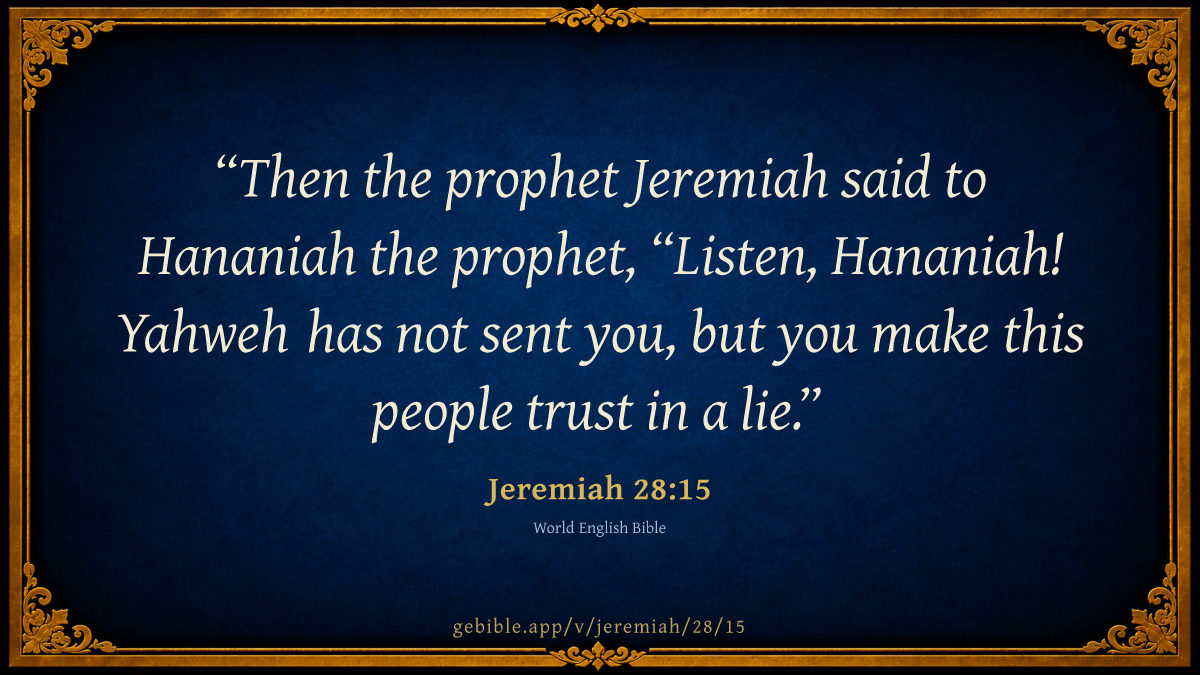
Then the prophet Jeremiah said to Hananiah the prophet, “Listen, Hananiah! Yahweh has not sent you, but you make this people trust in a lie.
Parallel Translations
-
Then the prophet Jeremiah said to Hananiah the prophet, “Listen, Hananiah! Yahweh has not sent you, but you make this people trust in a lie.
-
Then said the prophet Jeremiah unto Hananiah the prophet, Hear now, Hananiah; The LORD hath not sent thee; but thou makest this people to trust in a lie.
-
Then said the prophet Jeremiah unto Hananiah the prophet: 'Hear now, Hananiah; the LORD hath not sent thee; but thou makest this people to trust in a lie.
Cross-references (13)
Passages linked to Jeremiah 28:15 in the Treasury of Scripture Knowledge, ordered by reader-vote popularity; verse text shown in World English Bible.
- Jeremiah 14:14-15 Then Yahweh said to me, “The prophets prophesy lies in my name. I didn’t send them. I didn’t command them. I didn’t speak to them. They prophesy to you a lying vision, divination, and a thing of nothing, and the deceit of their own heart. Therefore Yahweh says concerning the prophets who prophesy in my name, but I didn’t send them, yet they say, ‘Sword and famine will not be in this land.’ Those prophets will be consumed by sword and famine.
- Jeremiah 27:15 For I have not sent them,” says Yahweh, “but they prophesy falsely in my name; that I may drive you out, and that you may perish, you, and the prophets who prophesy to you.”
- Jeremiah 23:21 I didn’t send these prophets, yet they ran. I didn’t speak to them, yet they prophesied.
- Ezekiel 13:2-3 “Son of man, prophesy against the prophets of Israel who prophesy, and say to those who prophesy out of their own heart, ‘Hear Yahweh’s word: The Lord Yahweh says, “Woe to the foolish prophets, who follow their own spirit, and have seen nothing!
- Ezekiel 22:28 Her prophets have plastered for them with whitewash, seeing false visions, and divining lies to them, saying, ‘The Lord Yahweh says,’ when Yahweh has not spoken.
- Lamentations 2:14 Your prophets have seen false and foolish visions for you. They have not uncovered your iniquity, to reverse your captivity, but have seen for you false revelations and causes of banishment.
- Jeremiah 29:23 because they have done foolish things in Israel, and have committed adultery with their neighbors’ wives, and have spoken words in my name falsely, which I didn’t command them. I am he who knows, and am witness,” says Yahweh.
- 1 Kings 22:23 Now therefore, behold, Yahweh has put a lying spirit in the mouth of all these your prophets; and Yahweh has spoken evil concerning you.”
- Ezekiel 13:22 Because with lies you have grieved the heart of the righteous, whom I have not made sad; and strengthened the hands of the wicked, that he should not return from his wicked way, and be saved alive.
- Jeremiah 20:6 You, Pashhur, and all who dwell in your house will go into captivity. You will come to Babylon, and there you will die, and there you will be buried, you, and all your friends, to whom you have prophesied falsely.’ ”
- Jeremiah 28:11 Hananiah spoke in the presence of all the people, saying, “Yahweh says: ‘Even so I will break the yoke of Nebuchadnezzar king of Babylon from off the neck of all the nations within two full years.’ ” Then the prophet Jeremiah went his way.
- Jeremiah 29:31-32 “Send to all of the captives, saying, ‘Yahweh says concerning Shemaiah the Nehelamite: “Because Shemaiah has prophesied to you, and I didn’t send him, and he has caused you to trust in a lie;” therefore Yahweh says, “Behold, I will punish Shemaiah the Nehelamite and his offspring. He will not have a man to dwell among this people. He won’t see the good that I will do to my people,” says Yahweh, “because he has spoken rebellion against Yahweh.” ’ ”
- Zechariah 13:3 It will happen that, when anyone still prophesies, then his father and his mother who bore him will tell him, ‘You must die, because you speak lies in Yahweh’s name;’ and his father and his mother who bore him will stab him when he prophesies.
Cross-references from openbible.info (CC BY 4.0)
Explain this verse (12 sources)
Historical commentary, presented as a primary source — not an endorsement.
Private notes
Saved on this device only — never synced or sent anywhere.
John Calvin 1540 · Public Domain There would not have been weight enough in the…
There would not have been weight enough in the plain teaching of Jeremiah had he not confronted his adversary, as the case is at this day with us; when insolent and unprincipled men rise up and dare to vomit forth their blasphemies, by which they darken and degrade the doctrines of true religion, we are under the necessity to contend with them, otherwise what we teach would be ineffectual; for the minds of many, I mean the simple, are in suspense and fluctuate when they see a great conflict between two contrary parties. It was therefore necessary for the holy man to expose the lies of Hananiah, for he ever vaunted himself and boasted of his own predictions.
But what did Jeremiah say? Jehovah hath not sent thee This refutation ought to be noticed whenever we contend with Satan’s ministers and false teachers; for whatever they may pretend, and with whatever masks they may cover their lies, this one thing ought to be more than sufficient to put an end to their boastings, — that they have not been sent by the Lord. Jeremiah might have contended in a long speech with Hananiah, for he might have been made sufficiently eloquent through the Holy Spirit suggesting and dictating whatever was needful on the subject; but this concise brevity produced much greater effect than if he had made great display and used many words. Let this, then, be borne in mind, that wherever there is a controversy about religion, we ought ever to ask whether he who speaks has been sent by God; for whatever he may babble, though the most acute, and though he may talk things which may fill with wonder the minds of the simple, yet all this is nothing but smoke when his doctrine is not from God. So also we ought at this day to deal in a brief manner with those mercenary dogs of the Pope who bark against the pure truth of the Gospel; we ought to be satisfied with this compendious answer, — that God is not their master and teacher. But as our state now is different from that of the ancient people, we must observe that sent by the Lord is he only whose doctrine is according to the rule of the Law, and of the Prophets, and of the Gospel. If, then, we desire to know whom the Lord has sent, and whom he approves as his servants, let us come to the Scripture, and let there be a thorough examination; he who speaks according to the Law, the Prophets, and the Gospel, has a sure and an indubitable evidence of his divine call; but he who cannot prove that he draws what he advances from these fountains, whatever his pretences may be, ought to be repudiated as a false prophet. We hence see what an important instruction this passage contains.
Read full note →
He then adds, Thou hast made this people to rely on falsehood They pervert the meaning of the Prophet who thus render the words, “Thou hast falsely rendered this people secure,” at least they lessen by one half what the Prophet intended to express; for not only is Hananiah condemned because he vainly and falsely pretended God’s name, but the word שקר, shicor, is introduced, the very thing employed; as though he had said, “Thou feedest this people with a vain hope which thou hast formed in thine own brains; therefore thy fictions make this people to go astray.” Hence Jeremiah not only accused this impostor that he by his fictions deceived the people, but also that he brought forward his prophecies in God’s name; and these removed their fear and gave them some hope, so that the people became torpid in their security.
Let us learn from this passage that we ought especially to take heed when the ground of trust is the subject, lest we rely on any empty or perishable thing, like wretched hypocrites who devour shadows only, and afterwards find nothing solid in their own fictions. But when we refer to trust, let there be something solid on which we can safely rely; and we know that we cannot possibly be disappointed, if we look to God for all things, if we recumb on his mercy alone; for there is no rest nor peace for us anywhere else but in Christ. Let us then retain this object of trust, and let it be our only support. It follows, —
John Calvin's Commentaries (1540-1563) — public domain. Text from the Calvin Translation Society English edition (1840s-50s) via the Christian Classics Ethereal Library (ccel.org). Calvin's coverage is partial (roughly two-thirds of the Bible); uncommented books and verses are honest gaps, never fabricated. The 19th-century editor's footnotes and remarks are omitted so the notes are faithfully Calvin's own voice.
John Trapp 1656 · Public Domain Jer 28:15 Then said the prophet Jeremiah unto Hananiah…
Jer 28:15 Then said the prophet Jeremiah unto Hananiah the prophet, Hear now, Hananiah; The LORD hath not sent thee; but thou makest this people to trust in a lie.
Ver. 15. Thou makest this people to trust in a lie.] Who loved to have it so, {Jer 5:31} and were therefore justly left to obduration and horrible destruction.
John Trapp, A Commentary or Exposition upon All the Books of the Old and New Testament (1647–1656) — public domain. Text from a community e-Sword module.
Matthew Poole 1685 · Public Domain Jeremiah being a second time confirmed in the truth…
Jeremiah being a second time confirmed in the truth of his revelation, and having likewise a special revelation relating to this false prophet, comes now and tells him his doom, viz. that he should die within a year, because he had taught people to believe, and to hope for, and trust to what was false, and they were never like to see.
Matthew Poole's English Annotations on the Holy Bible (1683–1685) — public domain. Text from a community e-Sword/MySword module.
John Gill 1763 · Public Domain Then said Jeremiah the prophet unto Hananiah the prophet,....…
Then said Jeremiah the prophet unto Hananiah the prophet,.... The false prophet, as he is again called by the Targum, and in the Syriac version; where he went to him, and met with him, whether in the temple or elsewhere, is not mentioned; very probably in some public place, that there might be witnesses of what was said; for it was for the conviction of others, as well as for his own confusion, the following things are observed:
hear now, Hananiah, the Lord hath not sent thee; though he spoke in his name, and pretended a mission from him, when he had none, which was abominable wickedness:
Read full note →
but thou makest this people to trust in a lie: that the Lord would break off the yoke of the king of Babylon, and free the nations from servitude to him, particularly Judea; and that the king, and his princes, and people, and the vessels of the temple, carried away with him, would be returned within two years; this the people depended on as coming from the Lord, when he was not sent by him.
John Gill's Exposition of the Whole Bible (1746–1763) — public domain (CC PDM 1.0). Text via the HelloAO Bible API.
Adam Clarke 1810 · Public Domain Verse 15. Hear now, Hananiah; the Lord hath not…
Verse 15. Hear now, Hananiah; the Lord hath not sent thee] This was a bold speech in the presence of those priests and people who were prejudiced in favour of this false prophet, who prophesied to them smooth things. In such cases men wish to be deceived.
Adam Clarke's Commentary on the Bible (1810–1826) — public domain. Text from a community e-Sword/MySword module.
Joseph Benson 1811 · Public Domain Jer 28:15-17. Then said Jeremiah, Hear now, Hananiah —…
Jer 28:15-17. Then said Jeremiah, Hear now, Hananiah — Jeremiah, being a second time confirmed in the truth of what he had foretold, and having likewise a special revelation relating to this false prophet, comes and calls him by his name, and tells him his doom, that he should die within a year, because he had taught rebellion against the Lord — Had taught people to believe and trust to what was false, contradicting God’s will revealed by Jeremiah, and encouraging and exciting the people to hold out against Nebuchadnezzar, and not quietly to yield to this dispensation of God. “Thus, as Hananiah had limited the accomplishment of his prophecy to the space of two years, to gain credit with the people by such a punctual prediction, so Jeremiah confines the trial of his veracity to a much shorter time, and the event, exactly answering to the prediction, evidently showed the falsehood of Hananiah’s pretences.” — Lowth. So Hananiah died the same year in the seventh month — Two months after he had uttered this false prophecy, as appeareth from Jer 28:1. So dangerous a thing it is for those who speak in the name of God to teach people contrary to his revealed will!
Joseph Benson's Commentary on the Old and New Testaments (1811–1818) — public domain. Text from a community e-Sword module.
Robert Jamieson, A. R. Fausset & David Brown 1871 · Public Domain makest . . . trust in a lie-- (Jer…
makest . . . trust in a lie-- (Jer 29:31; Eze 13:22).
Jamieson, Fausset & Brown — Commentary Critical and Explanatory on the Whole Bible (1871) — public domain (CC PDM 1.0). Text via the HelloAO Bible API.
Ellicott's Commentary for English Readers 1878 · Public Domain (15) Hear now, Hananiah . . .—The narrative leaves…
(15) Hear now, Hananiah . . .—The narrative leaves the time and place of the interview uncertain, but suggests an interval of some days between it and the scene in the Temple court just narrated. In the strength of the “word of the Lord” which had come to him, the prophet can now tell his rival that he is a pretender, claiming the gift of prophecy for his own purposes and that of his party. There is a strange significance in the fact that the same official title is applied to both the true and the false prophets.
A Bible Commentary for English Readers, edited by Charles John Ellicott (1878–1897) — public domain. Text from a community e-Sword module.
The Pulpit Commentary 1880 · Public Domain The prophet Jeremiah unto Hananiah the prophet. In one…
The prophet Jeremiah unto Hananiah the prophet. In one sense Hananiah was a prophet as much as Jeremiah. He claimed to have received the prophetic call, and God alone, who searcheth the heart, could pronounce upon the justice of his claim. Whatever training was regarded as necessary for the office he had probably gone through, and now for a number of years he had been universally recognized as a member of the prophetic class. Probably he had those natural gifts, including a real, though dim and not unerring, "second sight," which seems to have formed the substratum of Old Testament prophecy; but he certainly had not the moral backbone so conspicuous in Jeremiah, and he lacked that intimate communion with God (this became dear on the present occasion) which alone warranted the assurance that "Jehovah, the God of Israel, hath sent me."
The Pulpit Commentary (1880–1919), ed. H.D.M. Spence-Jones & Joseph S. Exell — public domain. Text from a community e-Sword module.
C. I. Scofield 1917 · Public Domain (See Scofield "Psa 2:12").
trust
(See Scofield "Psa 2:12").
The Scofield Reference Bible (1917 edition), notes by C. I. Scofield — public domain. Text from a community e-Sword module.
unfoldingWord translationNotes 2017 · CC BY-SA 4.0 you proclaimed rebellion against Yahweh
you proclaimed rebellion against Yahweh
It is not clear why Yahweh speaks of himself by name. AT: "you urged people to rebel against me" (See: First, Second, or Third Person)
Read full note →
In the seventh month
This is the seventh month of the Hebrew calendar. It is during the last part of September and the first part of October on Western calendars. (See: Hebrew Months and Ordinal Numbers)
translationWords
Jeremiah
prophet
Hananiah
Yahweh
people group
believe
earth
die
year
rebel
unfoldingWord translationNotes — © Distant Shores Media and the Door43 World Missions Community, licensed CC BY-SA 4.0. Source: git.door43.org/Door43/en_tn.
Tyndale Open Study Notes 2022 · CC BY-SA 4.0 28:15-17 You must die: The Lord’s decree for Hananiah…
28:15-17 You must die: The Lord’s decree for Hananiah was the lawful penalty for false prophets (Deut 13:1-5). The Lord carried out the decree that very year; Jeremiah’s prophecy was validated when it was fulfilled two months later. In contrast, Hananiah’s prediction that the Temple treasures would be returned in two years was not fulfilled. The Lord demonstrated that he was still in control.
Tyndale Open Study Notes — © Tyndale Open Resources, licensed CC BY-SA 4.0. Text via the HelloAO Bible API.