
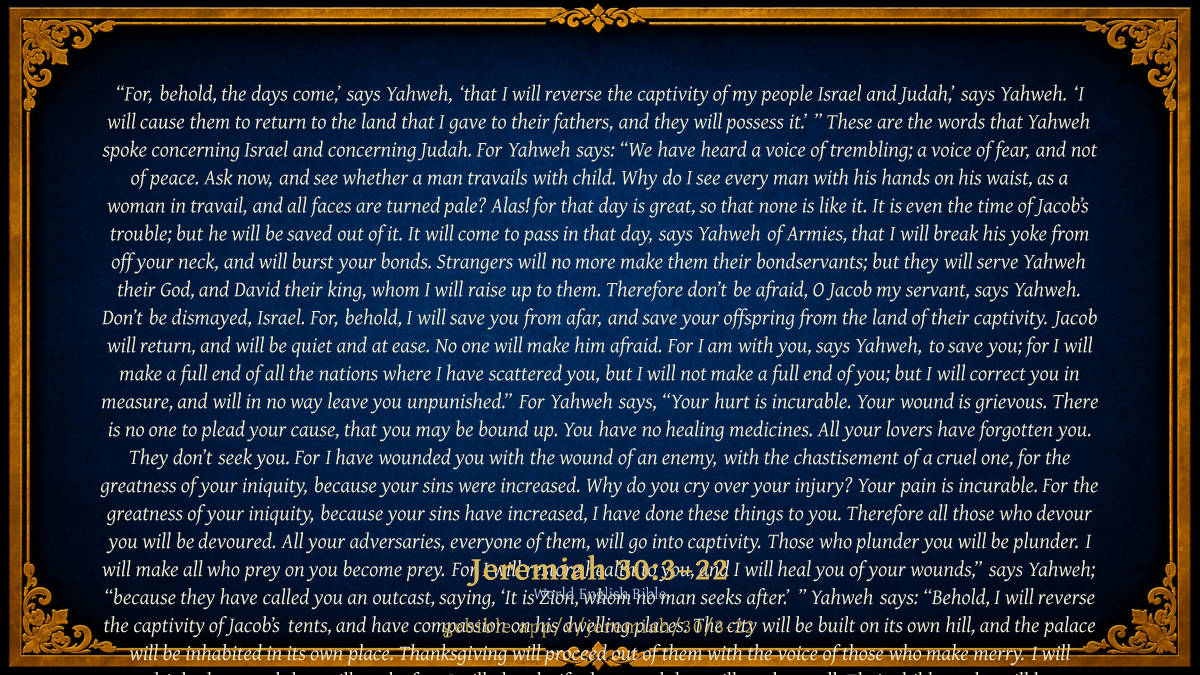
For, behold, the days come,’ says Yahweh, ‘that I will reverse the captivity of my people Israel and Judah,’ says Yahweh. ‘I will cause them to return to the land that I gave to their fathers, and they will possess it.’ ”
These are the words that Yahweh spoke concerning Israel and concerning Judah.
For Yahweh says: “We have heard a voice of trembling; a voice of fear, and not of peace.
Ask now, and see whether a man travails with child. Why do I see every man with his hands on his waist, as a woman in travail, and all faces are turned pale?
Alas! for that day is great, so that none is like it. It is even the time of Jacob’s trouble; but he will be saved out of it.
It will come to pass in that day, says Yahweh of Armies, that I will break his yoke from off your neck, and will burst your bonds. Strangers will no more make them their bondservants;
but they will serve Yahweh their God, and David their king, whom I will raise up to them.
Therefore don’t be afraid, O Jacob my servant, says Yahweh. Don’t be dismayed, Israel. For, behold, I will save you from afar, and save your offspring from the land of their captivity. Jacob will return, and will be quiet and at ease. No one will make him afraid.
For I am with you, says Yahweh, to save you; for I will make a full end of all the nations where I have scattered you, but I will not make a full end of you; but I will correct you in measure, and will in no way leave you unpunished.”
For Yahweh says, “Your hurt is incurable. Your wound is grievous.
There is no one to plead your cause, that you may be bound up. You have no healing medicines.
All your lovers have forgotten you. They don’t seek you. For I have wounded you with the wound of an enemy, with the chastisement of a cruel one, for the greatness of your iniquity, because your sins were increased.
Why do you cry over your injury? Your pain is incurable. For the greatness of your iniquity, because your sins have increased, I have done these things to you.
Therefore all those who devour you will be devoured. All your adversaries, everyone of them, will go into captivity. Those who plunder you will be plunder. I will make all who prey on you become prey.
For I will restore health to you, and I will heal you of your wounds,” says Yahweh; “because they have called you an outcast, saying, ‘It is Zion, whom no man seeks after.’ ”
Yahweh says: “Behold, I will reverse the captivity of Jacob’s tents, and have compassion on his dwelling places. The city will be built on its own hill, and the palace will be inhabited in its own place.
Thanksgiving will proceed out of them with the voice of those who make merry. I will multiply them, and they will not be few; I will also glorify them, and they will not be small.
Their children also will be as before, and their congregation will be established before me. I will punish all who oppress them.
Their prince will be one of them, and their ruler will proceed from among them. I will cause him to draw near, and he will approach me; for who is he who has had boldness to approach me?” says Yahweh.
“You shall be my people, and I will be your God.
John Calvin 1540 · Public Domain On vv3–22 We now, then, see why he says, come shall…
We now, then, see why he says, come shall the days; for every hope after two years would have been extinguished, had not God interposed. Come, then, shall the days in which I wll restore the captivity of Israel and Judah The ten tribes, we know, had been already led into exile; the tribe of Judah and the half tribe of Benjamin only remained. Hence the ten tribes, the whole kingdom of Israel, are mentioned first. The exile of Israel was much longer than that of Judah. It afterwards follows, —
John Calvin's Commentaries (1540-1563) — public domain. Text from the Calvin Translation Society English edition (1840s-50s) via the Christian Classics Ethereal Library (ccel.org). Calvin's coverage is partial (roughly two-thirds of the Bible); uncommented books and verses are honest gaps, never fabricated. The 19th-century editor's footnotes and remarks are omitted so the notes are faithfully Calvin's own voice.
Geneva Bible translators 1599 · Public Domain On vv5, 7, 8, 9, 16, 18, 19, 21 He showeth that before that this deliverance shall come,…
He showeth that before that this deliverance shall come, the Chaldeans should be extremely afflicted by their enemies, and that they should be in such perplexity and sorrow as a woman in her travail, as Isa. 13:8.
Geneva Bible (1599) marginal notes — public domain.
John Trapp 1656 · Public Domain On vv3–22 Jer 30:3 For, lo, the days come, saith the…
Jer 30:3 For, lo, the days come, saith the LORD, that I will bring again the captivity of my people Israel and Judah, saith the LORD: and I will cause them to return to the land that I gave to their fathers, and they shall possess it.
Ver. 3. I will bring again the captivity {a} of Israel and Judah.] This promise, Oecolampadius thinketh, was written in the book in greater letters than the rest; it was fulfilled according to the letter in carnal Israel sent back by Cyrus (upon Daniel’s prayer, who understood by that book here mentioned that the time of deliverance, yea, the set time was come, Dan 9:2), but more fully in those "Jews inwardly," {Rom 2:29} those "Israelites indeed" who are set at liberty by Christ, {Joh 8:36} and shall be much more at the last day.
Read full note →
{a} Convertam conversionem. - Vulg.
John Trapp, A Commentary or Exposition upon All the Books of the Old and New Testament (1647–1656) — public domain. Text from a community e-Sword module.
Matthew Poole 1685 · Public Domain On vv3, 5, 6, 7, 8, 9, 10, 11, 12, 13, 14, 15, 16, 17, 18, 19, 20, 21, 22 The reason why God would have the prophecy written,…
The reason why God would have the prophecy written, was for a memorial of God’s truth in his promises. Israel never returned as to the body of the people, but those of the ten tribes which were God’s people did return; we read, Luk 2:36, of one Anna who was of the tribe of Asher, and many more doubtless did return according to the promises, Jer 3:12,14; 23:6; 31:1,6; Eze 37:21,22. It is uncertain whether this promise of returning to their own land was fulfilled in those few of the ten tribes who joined themselves with those of Judah after they were returned from Babylon, or remaineth yet in part to be fulfilled. The former is most probable, and that there shall be no such time when the Jews shall return again to Jerusalem, and possess their own land, for it is hard now to give an account where the posterity of the ten tribes be by whose return the promise should be justified. Besides that the phrase in the beginning of this verse, For, lo, the days come, seem to import a more speedy fulfilling of the promise than after some thousands of years, though it is certain the Jews feed themselves with some such expectations.
Matthew Poole's English Annotations on the Holy Bible (1683–1685) — public domain. Text from a community e-Sword/MySword module.
Matthew Henry 1710 · Public Domain On vv10, 18 In these verses, as in those foregoing, the deplorable…
In these verses, as in those foregoing, the deplorable case of the Jews in captivity is set forth, but many precious promises are given them that in due time they should be relieved and a glorious salvation wrought for them.
I. God himself appeared against them: he scattered them (Jer 30:11); he did all these things unto them, Jer 30:15. All their calamities came from his hands; whoever were the instruments, he was the principal agent. And this made their case very sad that God, even their own God, spoke concerning them, to pull down and to destroy. Now, 1. This was intended by him as a fatherly chastisement, and no other (Jer 30:11): "I will correct thee in measure, or according to judgment, with discretion, no more than thou deservest, nay, no more than thou canst well bear." What God does against his people is in a way of correction, and that correction is always moderated and always proceeds from love: "I will not leave thee altogether unpunished, as thou art ready to think I should, because of thy relation to me." Note, A profession of religion, though ever so plausible, will be far from securing to us impunity in sin. God is no respecter of persons, but will show his hatred of sin wherever he finds it, and that he hates it most in those that are nearest to him. God here corrects his people for the multitude of their iniquity, and because their sins were increased, Jer 30:14, Jer 30:15. Are our sorrows multiplied at any time and do they increase? We must acknowledge that it is because our sins have been multiplied and they have increased. Iniquities grow in us, and therefore troubles grow upon us. But, 2. What God intended as a fatherly chastisement they and others interpreted as an act of hostility; they looked upon him as having wounded them with the wound of an enemy and with the chastisement of a cruel one (Jer 30:14), as if he had designed their ruin, and neither mitigated the correction nor had any mercy in reserve for them. It did indeed seem as if God had dealt thus severely with them, as if he had turned to be their enemy and had fought against them, Isa 63:10. Job complains that God had become cruel to him and multiplied his wounds. When troubles are great and long we have need carefully to watch over our own hearts, that we entertain not such hard thoughts as these of God and his providence. His are the chastisements of a merciful one, not of a cruel one, whatever they may appear.
Read full note →
II. Their friends forsook them, and were shy of them. None of those who had courted them in their prosperity would take notice of them now in their distress, Jer 30:13. It is commonly thus when families go to decay; those hang off from them that had been their hangers-on. In two cases we are glad of the assistance of our friends and need their service: - 1. If we be impeached, accused, or reproached, we expect that our friends should appear in vindication of us, should speak a good word for us when we cannot put on a face to speak for ourselves; but here there is none to plead thy cause, none to stand up in thy defence, none to intercede for thee with thy oppressors; therefore God will plead their cause, for he might well wonder there was none to uphold a people that had been so much the favourites of Heaven, Isa 63:5. 2. If we be sick, or sore, or wounded, we expect our friends should attend us, advise us, sympathize with us, and, if occasion be, lend a hand for the applying of healing medicines; but here there is none to do that, none to bind up thy wounds, and by counsels and comforts to make proper applications to thy case; nay (Jer 30:14), All thy lovers have forgotten thee; out of sight out of mind; instead of seeking thee, they forsake thee. Such as this has often been the case of religion and serious godliness in the world; those that from their education, profession, and hopeful beginnings, one might have expected to be its friends and lovers, its patrons and protectors, desert it, forget it, and have nothing to say in its defence, nor will do any thing towards the healing of its wounds. Observe, Thy lovers have forgotten thee, for I have wounded thee. When God is against a people who will be for them? Who can be for them so as to do them any kindness? See Job 30:11. Now, upon this account, their case seemed desperate and past relief (Jer 30:12): Thy bruise is incurable, thy wound grievous, and (Jer 30:15) thy sorrow is incurable. The condition of the Jews in captivity was such as no human power could redress the grievances of; there they were like a valley full of dead and dry bones, which nothing less than Omnipotence can put life into. Who could imagine that a people so diminished, so impoverished, should ever be restored to their own land and re-established there? So many were the aggravations of their calamity that their sorrow would not admit of any alleviation, but they seemed to be hardened in it, and their souls refused to be comforted, till divine consolations proved strong ones, too strong to be borne down even by the floods of grief that overwhelmed them. Thy sorrow is incurable because thy sins, instead of being repented of and forsaken, were increased. Note, Incurable griefs are owing to incurable lusts. Now in this deplorable condition they are looked upon with disdain (Jer 30:17): They called thee an outcast, abandoned by all, abandoned to ruin; they said, This is Zion, whom no man seeks after. When they looked on the place where the city and temple had been built they called that an outcast; now all was in ruins, there was no resort to it, no residence in it, none asked the way to Zion, as formerly; no man seeks after it. When they looked on the people that formerly dwelt in Zion, but were now in captivity (and we read of Zion dwelling with the daughter of Babylon, Zac 2:7), they called them outcasts; these are those who belong to Zion, and are wont to talk much of it and weep at the remembrance of it, but no man seeks after them, or enquires concerning them. Note, It is often the lot of Zion to be deserted and despised by those about her.
III. For all this God will work deliverance and salvation for them in due time. Though no other hand, nay, because no other hand, can cure their wound, his will, and shall. 1. Though he seemed to stand at a distance from them, yet he assures them of his presence with them, his powerful and gracious presence: I will save thee, Jer 30:10. I am with thee, to save thee, Jer 30:11. When they are in their troubles he is with them, to save them from sinking under them; when the time has come for their deliverance he is with them, to be ready upon the first opportunity, to save them out of their trouble. 2. Though they were at a distance, remote from their own land, afar off in the land of their captivity, yet there shall salvation find them out, thence shall it fetch them, them and their seed, for they also shall be known among the Gentiles, and distinguished from them, that they may return, Jer 30:10. 3. Though they were now full of fears, and continually alarmed, yet the time shall come when they shall be in rest and quiet, safe and easy, and none shall make them afraid, Jer 30:10. 4. Though the nations into which they were dispersed should be brought to ruin, yet they should be preserved from that ruin (Jer 30:11): Though I make a full end of the nations whither I have scattered thee, and there might be danger of thy being lost among them, yet I will not make a full end of thee. It was promised that in the peace of these nations they should have peace (Jer 29:7), and yet in the destruction of these nations they should escape destruction. God's church may sometimes be brought very low, but he will not make a full end of it, Jer 5:10, Jer 5:18. 5. Though God correct them, and justly, for their sins, their manifold transgressions and mighty sins, yet he will return in mercy to them, and even their sin shall not prevent their deliverance when God's time shall come. 6. Though their adversaries were mighty, God will bring them down, and break their power (Jer 30:16): All that devour thee shall be devoured, and thus Zion's cause will be pleaded and will be made to appear to all the world a righteous cause. Thus Zion's deliverance will be brought about by the destruction of her oppressors; and thus her enemies will be recompensed for all the injury they have done her; for there is a God that judges in the earth, a God to whom vengeance belongs. "They shall every one of them, without exception, go into captivity, and the day will come when those that now spoil thee shall be a spoil." Those that lead into captivity shall go into captivity, Rev 13:10. This might serve to oblige the present conquerors to use their captives well, because the wheel would turn round, and the day would come when they also should be captives, and let them do now as they would then be done by. 7. Though the wound seem incurable, God will make a cure of it (Jer 30:17): I will restore health unto thee. Be the disease ever so dangerous, the patient is safe if God undertakes the cure.
IV. Upon the whole matter, they are cautioned against inordinate fear and grief, for in these precious promises there is enough to silence both. 1. They must not tremble as those that have no hope in the apprehension of future further trouble that might threaten them (Jer 30:10): Fear thou not, O my servant Jacob! neither be dismayed. Note, Those that are God's servants must not give way to disquieting fears, whatever difficulties and dangers may be before them. 2. They must not sorrow as those that have no hope for the troubles which at present they lie under, Jer 30:15. "Why criest thou for thy affliction? It is true thy carnal confidences fail thee, creatures are physicians of no value, but I will heal thy wound, and therefore, Why criest thou? Why dost thou fret and complain thus? It is for thy sin (Jer 30:14, Jer 30:15), and therefore, instead of repining, thou shouldest be repenting. Wherefore should a man complain for the punishment of his sins? The issue will be good at last, and therefore rejoice in hope."
Matthew Henry's Commentary on the Whole Bible (1708–1710) — public domain (CC PDM 1.0). Text via the HelloAO Bible API.
John Gill 1763 · Public Domain On vv3–22 For, lo, the days come, saith the Lord,.... And…
For, lo, the days come, saith the Lord,.... And they are yet to come; the prophecy is not yet fulfilled. Kimchi says this belongs to the days of the Messiah; but not to his first coming, or to his coming in the flesh, which the Jews vainly expect; but to his spiritual coming in the latter day:
that I will bring again the captivity of my people Israel and Judah,
Read full note →
saith the Lord; which cannot be understood of their return from the Babylonish captivity; for, as Kimchi rightly observes, only Judah and Benjamin returned from thence; and though there were some few of the other tribes that came with them, especially of the tribe of Levi, yet not sufficient to answer to so great a prophecy as this, which refers to the same time as that in Hos 3:5; as appears by comparing that with Jer 30:9; and when, as the Apostle Paul says, "all Israel shall be saved", Rom 11:25;
and I will cause them to return to the land that I gave to their fathers, and they shall possess it; the land of Canaan, given to Abraham, Isaac, and Jacob; and which shall be again by the Jews their posterity; for, without that the Jews upon their call and conversion shall return to their own land, in a literal sense, I see not how we can understand this, and many other prophecies.
John Gill's Exposition of the Whole Bible (1746–1763) — public domain (CC PDM 1.0). Text via the HelloAO Bible API.
John Wesley 1765 · Public Domain On vv8, 9, 11, 12, 13, 14 In that day - In the day when God…
In that day - In the day when God should deliver the seed of Jacob out of trouble. His yoke - The yoke of the king of Babylon, that power of his, which for seventy years he exercised over the Jews. Of him - Of the Jews.
John Wesley, Explanatory Notes Upon the Whole Bible (1754–1765) — public domain. Text via the GEBible commentary corpus.
Adam Clarke 1810 · Public Domain On vv3, 5, 7, 8, 9, 11, 12, 13, 15, 16, 18, 19, 20, 21, 22 Verse 3. The days come] First, After the conclusion…
Verse 3. The days come] First, After the conclusion of the seventy years. Secondly, Under the Messiah.
That I will bring again the captivity of Israel] The ten tribes, led captive by the king of Assyria, and dispersed among the nations.
Read full note →
And Judah] The people carried into Babylon at two different times; first, under Jeconiah, and, secondly, under Zedekiah, by Nebuchadnezzar.
Adam Clarke's Commentary on the Bible (1810–1826) — public domain. Text from a community e-Sword/MySword module.
Joseph Benson 1811 · Public Domain On vv4, 8, 10, 12, 16, 18 Jer 30:4-7. And these are the words that the…
Jer 30:4-7. And these are the words that the Lord spake — And which God ordered to be written: and those promises, which were written by his order, are as truly his word as the ten commandments, which were written with his finger. We have heard a voice of trembling — Such a one as discovers great fears and apprehensions of impending evils. Ask ye now and see, &c. — Make diligent inquiry, and ask every one, whether they ever knew or heard of any such thing as a man’s travailing with child? Wherefore then do I see every man with his hands on his loins — As if he were going to bring forth, and felt all the pains of a woman in travail? Alas! for that day is great — The word day in Scripture often comprehends a succession of time, in which a whole series of events is transacted: so it here contains the whole time of the siege and taking of Jerusalem, the destruction of the city and temple, and the carrying away of the people captive. This is described as a time of great tribulation, in which it was an earnest of the day of judgment, the great and terrible day of the Lord.
Joseph Benson's Commentary on the Old and New Testaments (1811–1818) — public domain. Text from a community e-Sword module.
Albert Barnes 1834 · Public Domain On vv5, 7, 8, 9, 10, 12, 13, 14, 15, 16, 17, 18 Better, as in the margin. The prophet places his…
Better, as in the margin. The prophet places his hearers in the center of Babylon, and describes it as convulsed with terror as the armies of Cyrus draw near. The voice of trembling is the war-cry of the advancing host: while fear and no peace implies that even among the exiles there is only alarm at the prospect of the city, where they had so long dwelt, being destroyed.
Albert Barnes' Notes on the Bible (1834–1885) — public domain. Text from a community e-Sword/MySword module.
Haydock's Catholic Bible Commentary 1859 · Public Domain On vv3, 4, 5, 6, 7, 8, 9, 11, 13, 14, 16, 17, 18, 19, 21 Come. Some in St. Jerome explain this and the…
Come. Some in St. Jerome explain this and the following chapter of the end of the world, when all shall confess Christ. Others refer them to the preaching of the gospel alone. (Estius) (Tirinus) --- But the return from captivity is specified, as prefiguring that event. (St. Thomas Aquinas, &c.) (Calmet) --- It is probable that many of the ten tribes returned to Samaria, chap. xxxi., and Ezechiel xxxiii. (Worthington)
George Leo Haydock (1774–1849), Haydock's Catholic Family Bible and Commentary, 1859 edition — public domain. Excludes Psalms (Douay-Rheims chapter numbering differs from Protestant) and Deuterocanonical books (Catholic canon only).
Lange's Commentary on the Holy Scriptures 1864 · Public Domain On vv4, 12, 18 II. The Deliverance of Entire Israel (Jer_30:4-22)
II. The Deliverance of Entire Israel (Jer_30:4-22)
1. The great day of judgment of the world and deliverance of Israel
Read full note →
Jer_30:4-11
4 And these are the words which Jehovah hath spoken concerning1Israel and concerning Judah;
5 For thus saith Jehovah:
We have heard a cry of terror,2
Fear and no deliverance.
6 Ask ye now and see if a male is parturient?
Why do I then see every man with his hands on his hips like a parturient,
And all faces turned into paleness?3
7 Alas! for great is that day, with none like it,4
And it will be a time of trouble to Jacob,
But—he shall be delivered from it.
8 And it shall come to pass on that day, saith Jehovah Zebaoth,
I will break his yoke off from thy neck,
And I will tear asunder thy bonds,
And strangers shall no longer enslave him:5
9 But they shall serve Jehovah their God,
And David their king, whom I will raise up6 for them.
10 But fear thou not, my servant Jacob, saith Jehovah,
And be not dismayed, O Israel.
For behold, I will deliver thee from afar,
And thy seed from the land of their captivity;
And Jacob shall return and rest,
And be tranquil and undisturbed.
11 For I am with thee to deliver thee, saith Jehovah.
Though I make a full end7of all the nations,
Whither I have scattered them,
I will not make an end of thee;
But I will chastise thee according to justice,
And not leave thee unpunished.
EXEGETICAL AND CRITICAL
What was summarily comprised in Jer_30:2 is now set forth in detail (Jer_30:4). Cry of terror, fear without a possibility of deliverance (Jer_30:5); all the men have their hands on their thighs like women in travail, all faces have become pale (Jer_30:6), for the great day of the Lord, a day with none like it, is breaking, a day which will be a time of dread even for Jacob, but yet at the same time the day of redemption (Jer_30:6), for on this day an end is to be put to Israel’s servitude (Jer_30:8). Israel is from thenceforward to serve only his God and his king David (Jer_30:9), Judah and Israel are then to be brought back from the lands of their captivity to a peaceful habitation of their home (Jer_30:10), for while the Lord will execute on all the Gentiles a judgment of destruction, He will indeed chastise Israel so as not to leave him unpunished, but will not destroy him.
Jer_30:4-7. And these … delivered from it. Apart from some brief intimations (Jer_9:25; Jer_11:10-17; Jer_13:11; Jer_23:6; Jer_50:4) the prophet makes Israel and Judah, the two great halves of the Israelitish nation, the subject of his longer discourses, only here (Jer_30:3; Jer_31:27), and in the second discourse (chs. 3–6), which belongs to the time of Josiah.
Jer_30:5. This for, which is logically indeed superfluous but not incorrect (Jer_30:4 announces the entirety of the following discourse as God’s word and כי, Jer_30:5, introduces the particulars), has rhetorically the character of a certain solemn breadth. With dramatic vividness the prophet transports us into the midst of the future, which he describes, causing those who are concerned to be the speakers together with himself. It is clear that the day of terror which he describes cannot be the day of Jerusalem (Psa_137:7). For (1) the day of the destruction of Jerusalem by the Chaldeans cannot be represented as at the same time a day of salvation for all Israel; (2) “ the great day of the Lord like which there is no other” always designates the divine judgment in its highest and most comprehensive sense. For even when Joel, who is the first to speak of the great and fearful days (Jer_2:11), understands by it primarily the day of the devastation by locusts, he yet beholds in this special act only the first act of the great drama of judgments (Jer_3:4), with which he first connects the idea of the redemption and restoration of Israel (Jer_4:1; Jer_4:7). After him Hosea speaks of the great day of Jezreel (Jer_2:2), on which Judah and Israel will return again united under their common head. Afterwards the judicial activity of God is mirrored before the eyes of Isaiah in the judgment on Babylon (Jer_13:6), the return of the whole people being again connected with it (Jer_14:1 sqq.). Next before Jeremiah finally, the idea of the “day of the Lord” forms the central point of Zephaniah’s prophecy, and if he also understands primarily by the “ great day “ (Jer_1:14) the day of the judgment of Jerusalem, yet he also regards all the judicial acts of God as elements or stages of the whole, and to him also the consummation of the judgment is the turning-point of the deliverance and restoration of all Israel (Jer_3:10 sqq,; 20). After Jeremiah there is Malachi only who speaks in express words of “ the great and dreadful day of the Lord “ (Jer_4:5 ).—No deliverance. Comp. Jer_6:14; Jer_8:11; Eze_7:25; Eze_13:10„ 16.—Ask now, etc. Comp. Jer_18:13. The prophet portrays with drastic vividness the effects of the terror by saying that he saw men behaving like women in the pangs of childbirth—pressing their hands on their loins. Comp. Isa_21:3; Jer_6:24; Jer_22:23; Jer_49:24; Jer_50:43.—That day. From that (ההוא) we see (1) that the prophet means a day not immediately impending, but (2) the same as was spoken of in Jer_30:5-6—And it will be a time of trouble, etc. Israel also is not unaffected by the sufferings of that time (comp. Mat_24:21-22); but for them it is only a crisis, which leads to salvation.
Jer_30:8-9. And it shall come to pass … raise up for them. The deliverance announced in the concluding words of Jer_30:7 is described more particularly. It has its negative and its positive side. The nation will no longer serve strangers (Jer_30:8) but their God alone, and the King granted them by God, the Messiah (Jer_30:9).—Thy bonds. Comp. Jer_2:20; Jer_5:5.—Enslave. Comp. Jer_27:7; Jer_25:14.—Serve Jehovah. For Israel to serve his God is at the same time his first duty and the fundamental condition of salvation. This salvation is to be communicated by the anointed of the Lord, the (second David. The Messiah is called David, not merely as a descendant of David still called by his name, but as a real David in the highest degree. As David was the founder of the earthly throne of David, so the Messiah as the fulfiller is the founder and occupant of the eternal throne of David. Jeremiah supports himself here chiefly on Hos_3:5, coll. Isa_55:3, while after him Ezekiel Eze_34:23-24; Eze_37:24-25) leans on his predecessors, especially Jeremiah. The conception of the second David is analogous to that of the second Adam (1Co_15:45 sqq.) It is therefore altogether different from the Rabbinical doctrine of a double Messiah, Ben Joseph and Ben David, (comp. Oehler in Herzog, Real.-Enc., IX. S. 440; BuxtorfLex., p. 1273) with which Haevernick seems (Coram, on Ezek., S. 557) to confound the Christian conception. It is accordingly clear that we must protest against the lower view, that Jeremiah it here speaking of a Davidic dynasty (Sanctius), or of Zerubbabel (Grotius; is David vocatur et hic et Ezech. Eze_34:23; Eze_37:24, nimirum sicut a Ptolemsæo orti Ptolemæi, a Cæsare Cæsares), or indeed of a personally resuscitated David (V. Ammon, Fortd. d. Chr. I., S. 178; Strauss, Glaubensl. II., S. 80). This latter conception is imputed by Hitzig to Ezekiel (ad loc. S. 245) as having thus interpreted the אָקִם of Jeremiah. As to the rest comp. Comm. on Jer_30:21; Jer_23:5; Hengstenberg, Christol. [Eng. Tr. II., p. 413 sqq.]
Jer_30:10-11. But fear thou not . . unpunished. Graf has called attention to the circumstance that these words are addressed to the people living in exile “in opposition to those delivered in Jer_30:9.” More strictly we should say, that Jer_30:8-9 announce the salvation objectively (whence also Israel is spoken of predominantly in the 3d person), but in Jer_30:10 the subjective application follows in the exhortation to be comforted and not to fear, but yet with a repetition of the objective basis. It is not however to be denied that the adversative rendering “thou however” is not appropriate. Meier translates “so fear thou nothing,” evidently not accurately, but in the correct feeling that the connection requires an inferential rather than an adversative sentence. Comp. Isa_44:1-2, which passage certainly occurred to the prophet, the words “fear not my servant Jacob” being taken from it verbatim, and we are thus led to think that instead of וְאַתָּה here we should read וְעַתָּה with which the passage in Isa. commences. The latter certainly would correspond better with the connection. Hitzig and Movers find in these two verses the idiom of Isaiah 2, and would therefore regard it as an interpolation by him. Graf however has satisfactorily shown that with the exception of the expression עבדי יעקב (I say, with the exception of אל־תיראע׳ י׳) all the rest betrays the older, and specifically Jeremiah’s, idiom. Why should not that evident quotation from Isa_44:2 be just as good an instance for the priority of the alleged Isaiah 2, in relation to the genuine Jeremiah? The union of Judah and Israel, which is here spoken of from Jer_30:3 onwards, may have reminded the prophet of that passage in Isaiah, which declares this union. Other declarations of Isaiah, as Isa_51:7, may also have been in the mind of our prophet. Perhaps also passages like Isa_49:12; Isa_60:4; Isa_60:9.—Rest and be tranquil. Comp. Jer_48:11.—Undisturbed. Comp. rems. on Jer_7:33.—For I am with thee. Comp. Jer_15:20; Jer_42:11.—Chastise thee. The expression is found in Jer_10:24 in the same sense. Whether in Isa_28:26 also is disputable. On לִ comp. Naegelsb. Gr., § 112, 5, b.—And not leave thee, etc. From Exo_34:7; the expression is found in Num_14:18, in Nah_1:3, and here.—Comp. further Jer_46:27-28, where these two verses are reproduced.
DOCTRINAL AND ETHICAL
1. Joh. Conr. Schaller, pastor at Cautendorf, says in his Gospel Sermons, (Hof. 1742, S. 628), “These chapters are like a sky in which sparkle many brilliant stars of strong and consolatory declarations, a paradise and pleasure-garden in which a believing soul is refreshed with delightsome flowers of instruction, and solaced with sweetly flavored apples of gracious promise.”
2. On Jer_30:1-3. The people of Israel were not then capable of bearing such a prophecy, brimming over with happiness and glory. They would have misused it, hearing to the end what was promised them, and then only the more certainly postponing what was the only thing then necessary—sincere repentance. Hence they are not yet to hear this gloriously consolatory address. It is to be written, that it may in due time be perceived that the Lord, even at the time when He was obliged to threaten most severely, had thoughts of peace concerning the people, and that thus the period of prosperity has not come by chance, nor in consequence of a change of mind, but in consequence of a plan conceived from the beginning and executed accordingly.
3. On Jer_30:7. The great and terrible day of the Lord (Joe_3:4) has not the dimensions of a human day. It has long sent out its heralds in advance. Yea, it has itself already dawned. For since by the total destruction of the external theocracy judgment is begun at the house of God (1Pe_4:17), we stand in the midst of the day of God in the midst of the judgment of the world. Then the time of trouble for Jacob has begun (Jer_30:7), from which he is to be delivered, when the fulness of the Gentiles is come in (Romans 11.)
4. On Jer_30:9. Christ is David in his highest potency, and He is also still more. For if we represent all the typical points in David’s life as a circle, and draw a line from each of these points, the great circle thus formed would comprise only a part of the πλήρωμα given in Christ. Nevertheless Christ is the true David, who was not chosen like Saul for his bodily stature, but only for his inward relation to God (comp. Psa_2:7), whose kingdom also does not cease after a short period of glory, but endures forever; who will not like Saul succumb to his enemies, but will conquer them all, and will give to his kingdom the widest extent promised; all this however not without, like David, having gone through the bitterest trials.
5. On Jer_30:11. “Modus paternæ castigationis accommodatus et quasi appensus ad stateram judicii Dei adeoque non immensus sed dimensus.” “Christus ecclesiam crucis suæ hæredem constituit. Gregor. M.” Förster.
6. On Jer_30:14. “Cum virlutem patientiæ nostræ flagella transeunt, valde metuendum est, ne peccatis nostris exigentibus non jam quasi filii a patre, sed quasi hostes a Domino feriamur. Gregor. M. Moral. XIV. 20, on Job_19:11.” Ghisler.
7. On Jer_30:17. “Providentia Dei mortalibus salutifera, antequam percutiat, pharmaca medendi gratiâ componit, et gladium iræ suæ φιλανθρωπίᾳ acuit. Evagr. Hist. Ecc_4:6.”—“Quando incidis in tentationem, crede, quod nisi cognovisset te posse illam evadere, non permisisset te in illam incidere. Theophyl. in cap. 18 Joh.” Förster.—“Feriam prius et sanabo melius. Theophyl. in Hosea 11.” Ghisler.
8. On Jer_30:21. “This church of God will own a, Prince from its midst—Jesus, of our flesh and blood through the virgin Mary, and He approaches God, as no other can, for He is God’s image, God’s Son, and at the same time the perfect, holy in all His sufferings, only obedient son of man. This king is mediator and reconciler with God; He is also high-priest and fulfilled all righteousness, as was necessary for our propitiation. What glory to have such a king, who brings us nigh unto God, and this is our glory!” Diedrich.
9. On Jer_31:1. “There is no greater promise than this: I will be thy God. For if He is our God we are His creatures, His redeemed, His sanctified, according to all the three articles of the Christian faith.” Cramer.
10. On Jer_31:2. “The rough heap had to be sifted by the sword, but those who survived, though afflicted in the desert of this life, found favor with God, and these, the true Israel, God leads into His rest.” Diedrich.
11. On Jer_31:3. “The love of God towards us comes from love and has no other cause above or beside itself, but, is in God and remains in God, so that Christ who is in God is its centre. For herein is love, not that we loved God, but that He loved us (1Jn_4:10).” Cramer. “Totum gratiæ imputatur, non nostris meritis. Augustine in Psalms 31.” Förster. “Before I had done anything good Thou hadst already moved towards me. Let these words be written on your hearts with the pen of the living God, that they may light you like flames of fire on the day of the marriage. It is your certificate of birth, your testimonial. Let me never lose sight of how much it has cost Thee to redeem me.” Zinzendorf. “God says: My chastisement even was pure love, though then you did not understand it; you shall learn it afterwards.” Diedrich. [“I incline to the construction given in the English version, both because the suffix to the verb is more naturally, ‘I have drawn thee,’ than ‘I have drawn out toward thee,’ and because there seems to be a tacit allusion to Hos_11:4, ‘With loving kindness have I drawn thee.’—-A great moral truth lies in this passage so construed, viz., that the main power which humbles man’s pride, softens his hard heart and makes him recoil in shame and sorrow from sinning, comes through his apprehension of God’s love as manifested in Christ and His cross. It is love that, draws the fearful or stubborn soul to the feet of divine mercy.” Cowles.—S. R. A.]
12. On Jer_31:6. “It is well: the watchmen on Mount Ephraim had to go to Zion. They received however another visit from the Jewish priests, which they could not have expected at the great reformation, introduced by John, and which had its seat among other places on Mount Ephraim. The Samaritans were not far distant, and Mount Ephraim had even this honor that when the Lord came to His temple He took His Seat as a teacher there.” Zinzendorf. [“God’s grace loves to triumph over the most inveterate prejudices… No words could represent a greater and more benign change in national feeling than these: Samaria saying through her spiritual watchmen, ‘Let us go up to Zion to worship, for our God is there.’ ” Cowles. “ ‘Ascendamus in Sion, hoc est in Ecclesiam’ says S. Jerome. According to this view, the watchmen here mentioned are the Preachers of the Gospel.” Wordsworth.—S. R. A.]
13. On Jer_31:9. “I will lead them. It is an old sighing couplet, but full of wisdom and solid truth:—
‘Lord Jesus, while I live on earth, O guide me,
Let me not, self-led, wander from beside Thee.’ ”
—Zinzendorf.
14. On Jer_31:10. “He who has scattered Israel will also collect it. Why? lie is the Shepherd. It is no wolf-scattering. He interposes His hand, then they go asunder, and directly come together again more orderly.” Zinzendorf.
15. On Jer_31:12-14. “Gaudebunt electi, quando videbunt supra se, intra se, juxta se, infra se. Augustine.”—“Præmia cœlestia erunt tam magna, ut non possint mensurari, tam multa, ut non possint numerari, tam copiosa, ut non possint terminari, tam pretiosa, ut non possint æstimari. Bernhard.” Förster.
16. On Jer_31:15. “Because at all times there is a similar state of things in the church of God, the lament of Rachel is a common one. For as this lament is over the carrying away captive and oppressions of Babylon, so is it also a lament over the tyranny of Herod in slaughtering the innocent children (Mat_2:1-7.)”Cramer. “Premuntur justi in ecclesia ut clament, clamantes exaudiuntur, exauditi glorificent Deum. Augustin.” Förster.—With respect to this, that Rachel’s lament may be regarded as a type of maternal lamentation over lost children, Förster quotes this sentence of Cyprian: non amisimus, sed præmisimus (2Sa_12:23). [On the application of this verse to the murder of the innocents consult W. L. Alexander, Connexion of the Old and New. Testament, p. 54, and W. H. Mill in Wordsworth’s Note in loc.—S. R. A.]
17. On Jer_31:18. The conversion of man must always be a product of two factors. A conversion which man alone should bring about, without God, would be an empty pretence of conversion; a conversion, which God should produce, without man, would be a compulsory, manufactured affair, without any moral value. The merit and the praise is, however, always on God’s side. He gives the will and the execution. Did He not discipline us, we should never learn discipline. Did He not lead back our thoughts to our Father’s house which we have left (Luke 15) we should never think of returning.
18. On Jer_31:19. “The children of God are ashamed their life long, they cannot raise their heads for humiliation. For their sins always seem great to them, and the grace of God always remains something incomprehensible to them.”Zinzendorf. The farther the Christian advances in his consciousness of sonship and in sanctification, the more brilliantly rises the light of grace, the more distinctly does he perceive in this light, how black is the night of his sins from which God has delivered him. [“It is the ripest and fullest ears of grain which hang their heads the lowest.”—S. R. A.]
19. On Jer_31:19. “The use of the dear cross is to make us blush (Dan_9:8) and not regard ourselves as innocent (Jer_30:11). And as it pleases a father when a child soon blushes, so also is this tincture a flower of virtue well-pleasing to God.” Cramer. “Deus oleum miserationis suæ non nisi in vas contritum et contribulatum infundit. Bernhard.”Förster.
20. On Jer_31:19. The reproach of my youth. “The sins of youth are not easily to be forgotten (Psa_25:7; Job_31:18). Therefore we ought to be careful so to act in our youth as not to have to chew the cud of bitter reflection in our old age. It is a comfort that past sins of youth will not injure the truly penitent. Non nocent peccata præterita, cum non placent præsentia. Augustine. To transgress no more is the best sign of repentance.” Cramer.
21. On Jer_31:20. “Comforting and weighty words, which each one should lay to heart. God loves and caresses us as a mother her good child. He remembers His promise. His heart yearns and breaks, and it is His pleasure to do us good.” Cramer. “lpsius proprium est, misereri semper et parcere.” Augustine.—“Major est Dei misericordia quam omnium hominum miseria.” Idem.
22. On Jer_31:23. The Lord bless thee, thou dwelling-place of righteousness, thou holy mountain. “Certainly no greater honor was ever done to the Jewish mountains than that the woman’s seed prayed and wept on them, was transfigured, killed and ascended above all heaven.” Zinzendorf. “ It cannot be denied that a church sanctifies a whole place …. Members of Jesus are real guardian angels, who do not exist in the imagination, but are founded on God’s promise (Mat_25:40).” Idem.
23. On Jer_31:29-30. “The so-called family curse has no influence on the servants of God; one may sleep calmly nevertheless. This does not mean that we should continue in the track of our predecessors, ex. gr., when our ancestors have gained much wealth by sinful trade, that we should continue this trade with this wealth with the hope of the divine blessing…. If this or that property, house, right, condition be afflicted with a curse, the children of God may soon by prudent separation deliver themselves from these unsafe circumstances. For nothing attaches to their persons, when they have been baptized with the blood of Jesus and are blessed by Him.” Zinzendorf.
24. On Jer_31:29-30. “In testamento novo per sarguinem mediatoris deleto paterno chirographo incipit homo paternis debitis non esse obnoxius renascendo, quibus nascendo fuerat obligatus, ipso Mediatore di cente: Ne vobis patrem dicüis in terra (Mat_23:9). Secundum hoc utique, quod alios natales, quibus non patri succederemus, sed cum patre semper viveremus, invenimus.” Augustine, contra Julian, VI. 12, in Ghisler.
25. On Jer_31:31. “In veteribus libris aut nusquam aut difficile præter hunc propheticum locum legitur facta commemoratio testamenti novi, ut omnino ipso nomine appellaretur. Nam multis locis hoc significalur et prænuntiatur futurum, sed non ita ut etiam nomen lega’ ur expressum.” Augustine, de Spir. et Lit. ad Marcellin, Cap. 19 (where to Cap. 29 there is a detailed discussion of this passage) in Ghisler.—“In the whole of the Old Testament there is no passage, in which the view is so clearly and distinctly expressed as here that the law is only παιδαγαγός. And though some commentators have supposed that the passage contains only a censure of the Israelites and not of the Old Covenant, they only show thus that they have not understood the simple meaning of the words.” Ebrard. Comm. zum Hebräerbr. S. 275.
26. On Jer_31:31, sqq. “Propter veteris hominis noxam, quæ per literam jubentem et minantem minime sanabatur, dicitur illud testamentum vetus; hoc antem novum propter novitatem spiritus, quæ hominem novum sanat a vitio vetustatis.” Augustine, c. Lit. Cap. 19.
27. On Jer_31:33. “Quid sunt ergo leges Dei ab ipso Deo scriptæ in cordibus, nisi ipsa præsentia Spiritus sancti, qui est digitus Dei, quo præsente diffunditur charitas in cordibus nostrio, quæ plenitudo legis est et præcepti finis?” Augustine, l. c. Cap. 20.
28. On Jer_31:34. “Quomodo tempus est novi testamenti, de quo propheta dixit: et non docebit unusquisque civem suum, etc. nisi quia rjusdem testamenti novi æternam mercedem, id est ipsius Dei beatissimam contemplationem promittendo conjunxit?” Augustine, l. c. Cap. 24.
29. On Jer_31:33-34. “This is the blessed difference between law and Gospel, between form and substance. Therefore are the great and small alike, and the youths like the elders, the pupils more learned than their teachers, and the young wiser than the ancients (1Jn_2:20 sqq.). Here is the cause:—For I will forgive their iniquities. This is the occasion of the above; no one can effect this without it. Forgiveness of sins makes the scales fall from people’s eyes, and gives them a cheerful temper, clear conceptions, a clear head.”Zinzendorf.
30. On Jer_31:35-37. “Etsi particulares ecclesiæ intotum deficere possunt, ecclesia tamen catholica nunquam defecit aut deficiet. Obstant enim Dei amplissimæ promissiones, inter quas non ultimum locum sibi vindicut quæ hic habetur Jer_31:37.” Förster.
31. On Jer_31:38-40. “Jerusalem will one day be much greater than it has ever been. This is not to be understood literally but spiritually. Jerusalem will be wherever there are believing souls, its circle will be without end and comprise all that has been hitherto impure and lost. This it is of which the prophet is teaching, and which he presents in figures, which were intelligible to the people in his time. The hill Gareb, probably the residence of the lepers, the emblem of the sinner unmasked and smitten by God, and the cursed valley of Ben-Hinnom will be taken up into the holy city. God’s grace will one day effect all this, and Israel will thus be manifested as much more glorious than ever before.” Diedrich.
HOMILETICAL AND PRACTICAL
1. On Jer_30:5-9. Sermon on one of the last Sundays after Trinity or the second in Advent. The day of the judgment of the world a great day. For it is, (1) a day of anxiety and terror for all the world; (2) a day of deliverance from all distress for the church of the Lord; (3) a day of realization of all the happiness set in prospect before it.
2. On Jer_30:10-12. Consolation of the church in great trial. 1. It has well deserved the trial (Jer_30:12); 2. it is therefore chastised, but with moderation; 3. it will not perish but again enjoy peace.
3. On Jer_30:17. [“The Restorer of mankind. 1. Faith in the Christian Sacrament and its attendant revelation of divine character alone answer the demand of the heart and reason of man for a higher state of moral perfection. 2. Christianity offers to maintain a communication between this world and that eternal world of holiness and truth. 3. It commends itself to our wants in the confirmation and direction of that principle of hope, which even in our daily and worldly life, we are perpetually forced to substitute for happiness, and 4. By the adorable object, which it presents to our affections.” Archer Butler—S. R. A.]
4. On Jer_31:1-2. Gesetz and Zeugniss (Law and Testimony) 1864, Heft. 1. Funeral sermon of Ahlfeld.
5. On Jer_31:2-4. lb. 1865. Heft 1. Funeral sermon of Besser, S. 32 ff.
6. On Jer_31:3. C. Fr. Hartmann (Wedding, School, Catechism and Birth-day sermons, ed. C. Chr. Eberh. Ehemann. Tüb. 1865). Wedding sermon. 1. A grateful revival in the love of God already received. 2. Earnest endeavor after a daily enjoyment of this love. 3. Daily nourishment of hope.
7. On Jer_31:3. Florey. Comfort and warning at graves. I. Bändchen, S. 253. On the attractions of God’s love towards His own children. They are, 1. innumerable and yet so frequently overlooked; 2. powerful and yet so frequently resisted; 3. rich in blessing and yet so frequently; unemployed. [For practical remarks on this text see also Tholuck, Stunden der Andacht, No. 11.—S. R. A.]
8. On Jer_31:9. Confessional sermon by Dekan V. Biarowsky in Erlangen (in Palmer’s Evang. Casual-Reden, 2 te Folge, 1 Band. Stuttgart, 1850.) Every partaking of the Lord’s supper is a return to the Lord in the promised land, and every one who is a guest at the supper rises and comes. 1. How are we to come? (weeping and praying). 2. What shall we find? (Salvation and blessing, power and life, grace and help).
9. On Jer_31:18-20. Comparison of conversion with the course of the earth and the sun. 1. The man who has fallen away is like the planet in its distance from the sun; he flees from God as far as he Song of Solomon 2. Love however does not release him: a. he is chastened (winter, cold, long nights, short days); b. he accepts the chastening and returns to proximity to the sun (summer, warmth, light, life). Comp. Brandt, Altes und Neues in i extemporirbaren Entwürfen. Nüremberg, 1829, II. 5. [The stubborn sinner submitting himself to God. I. A description of the feelings and conduct of an obstinate, impenitent sinner, while smarting under the rod of affliction: He is rebellious—till subdued. II. The new views and feelings produced by affliction through divine grace: (a) convinced of guilt and sinfulness; (b) praying; (c) reflecting on the effects of divine grace in his conversion. III. A correcting but compassionate God, watching the result, etc., (a) as a tender father mindful of his penitent child; (b) listening to his complaints, confessions and petitions; (c) declaring His determination to pardon. Payson.—S. R. A.]
10. On Jer_31:31-34. Sermon on 1 Sunday in Advent by Pastor Diechert in Gröningen, S. Stern aus Jakob. I. Stuttg. 1867.
11. On Jer_31:33-34. Do we belong to the people of God? 1. Have we holiness? 2. Have we knowledge? 3. Have we the peace promised to this people? (Caspari in Predigtbuch von Dittmar, Erlangen, 1845).
12. On Jer_31:33-34. By the new covenant in the bath of holy baptism all becomes new. 1. What was dead becomes alive 2. What was obscure becomes clear. 3. What was cold becomes warm. 4. What was bound becomes free (Florey, 1862).
Footnotes:
[1]Jer_30:4.—אֵל=in reference to, of, concerning, as in Jer_29:16; Jer_29:21; Jer_22:11.
[2]Jer_30:5.—קּול חרדה. חרדה is found here only in Jeremiah. The terror is not occasioned by the sound of war, but the apprehension of judgment. Comp. Luk_21:25-26.
[3]Jer_30:6.—לירקון. Abstr. for concrete. Comp. Naegelsb. Gr., § 59, 1. The expression is found here only.
[4]Jer_30:7.—מאין. Comp. rems. on Jer_10:6-7; Naegelsb. Gr., § 106, 5.
[5]Jer_30:8.—The words from וְהָיָה to צַוָּארֶךָ are a quotation almost verbatim from Isa_10:27 coll. Isa_14:25. This explains the suffix in עֻלוֹ, which, as the passage in Isaiah, is to be referred to the inimical tyrants. If, with Graf, we refer it to יעקב, Jer_30:7, צוארדֽ immediately afterwards is intolerably harsh. It is true the person changes in יעבדו בו, yet this is at least a new sentence, in which case the change has nothing surprising in it. Comp. Naegelsb. Gr., § 101, 2, Anm.
[6]Jer_30:9,—אָקִים is used here in the same sense as in Jer_6:17; Jer_23:4, etc.
[7]Jer_30:11.—אֶֽעֱשֶׂה כָלֽה. This expression is found in Jeremiah (besides in Jer_46:28, as a quotation from this passage) only in Jer_4:27; Jer_5:10; Jer_5:18. The construction with the accus. is the prevailing and original construction: Nah_1:8-9; Zep_1:18; Eze_11:13; Eze_20:17; Neh_9:31. With בְּ it is found here only. It appears to signify in this connection: to cause destruction among, etc.
Lange's Commentary on the Holy Scriptures (Critical, Doctrinal, and Homiletical), ed. John Peter Lange, English translation edited by Philip Schaff (1864–1880) — public domain. Text from a community e-Sword module.
Robert Jamieson, A. R. Fausset & David Brown 1871 · Public Domain On vv3, 5, 6, 7, 8, 9, 10, 11, 12, 13, 14, 15, 16, 17, 18, 19, 20, 21, 22 bring again . . . captivity of . .…
bring again . . . captivity of . . . Israel and Judah--the restoration not merely of the Jews (treated of in this thirtieth chapter), but also of the ten tribes ("Israel"; treated in the thirty-first chapter), together forming the whole nation (Jer 30:18; Jer 32:44; Eze 39:25; Amo 9:14-15). "Israel" is mentioned first because its exile was longer than that of Judah. Some captives of the Israelite ten tribes returned with those of Judah (Luk 2:36; "Aser" is mentioned). But these are only a pledge of the full restoration hereafter (Rom 11:26, "All Israel"). Compare Jer 16:15. This third verse is a brief statement of the subject before the prophecy itself is given.
Jamieson, Fausset & Brown — Commentary Critical and Explanatory on the Whole Bible (1871) — public domain (CC PDM 1.0). Text via the HelloAO Bible API.
Daniel D. Whedon 1874 · Public Domain On vv3, 5, 6, 7, 8, 9, 10, 11, 12, 14, 15, 16, 17, 18, 20, 21 3. Israel and Judah — The prophet does not…
3. Israel and Judah — The prophet does not restrict himself to the kingdom of Judah, whose fate then hung in the balance, but includes Israel as being a component part of the theocracy. Though the kingdom of Israel had been extinct for generations, yet his faith staggers not at God’s covenant promise. From such allusions as that in Luk_2:36, we are led to infer that some of the tribal remnants of Israel returned with Judah to Palestine.
Daniel D. Whedon (gen. ed.), Commentary on the Old and New Testaments (1874–1909) — public domain. Text from a community e-Sword module.
The Cambridge Bible for Schools and Colleges 1878 · Public Domain On vv3, 5, 6, 7, 8, 9, 10, 11, 12, 13, 14, 16, 17, 18, 19, 20, 21 3. turn again the captivity] See on Jer_29:14.
3. turn again the captivity] See on Jer_29:14.
The Cambridge Bible for Schools and Colleges (gen. ed. J. J. S. Perowne; Cambridge University Press, 1878–1918) — public domain. Text from a community e-Sword module.
Ellicott's Commentary for English Readers 1878 · Public Domain On vv3, 5, 8, 9, 10, 11, 12, 13, 14, 15, 17, 18, 21 (3) I will bring again the captivity of my…
(3) I will bring again the captivity of my people Israel and Judah . . .—The oracle of Jer_29:10-14 becomes, as it were, the text of a new utterance, and that with a wider range more distinctly including the ten tribes of Israel as well as the two of Judah and Benjamin. There is no narrow provincialism in the prophet’s heart. He yearns for the exiles who are far off on the Euphrates; he yearns also for those who are yet farther in Assyria and the cities of the Medes (2Ki_17:6).
A Bible Commentary for English Readers, edited by Charles John Ellicott (1878–1897) — public domain. Text from a community e-Sword module.
The Pulpit Commentary 1880 · Public Domain On vv5, 6, 7, 8, 9, 10, 11, 12, 14, 16, 17, 18, 19, 20, 21, 22 Vers. 5-11. The great judgment of Israel"s deliverance. It…
Vers. 5-11. The great judgment of Israel"s deliverance. It is nothing less than the "day of Jehovah" which the prophet sees in spirit a day which is "great" (ver. 7; comp. Joe_2:11 Zep_1:14) and terrible (vers. 5, 6; comp. Amo_5:18, 20 Isa_13:6 Joe_2:1, Joe_2:11) for Israel, a day of "trouble" (ver. 7), but for his enemies of destruction.
A voice of trembling; rather, a sound of trembling, a sound causing men to tremble; doubtless it is "the sound of the trumpet, the alarm of war". (Jer_4:19) Of fear, and not of peace; rather, there is fear, and no peace. "Peace," as usual, means the harmony of a well ordered, secure, and peaceful community. Literally, it is wholeness; its opposite is "breaking," i.e. outward ruin and inward anguish.
The Pulpit Commentary (1880–1919), ed. H.D.M. Spence-Jones & Joseph S. Exell — public domain. Text from a community e-Sword module.
The Biblical Illustrator 1887 · Public Domain On vv7, 11, 17, 18, 21 It is even the time of Jacobs trouble; but…
Jer_30:7
It is even the time of Jacobs trouble; but he shall be saved out of it.
Read full note →
Jacobs trouble
There is not a malady in human life, but we find its antidote in the Bible; not a wound, but we find its balm; not a spiritual sickness, but we find its remedy there. If there is no time of trouble to Jacob, what deliverance could Jacob want? Of what use is a promise of rest to the weary and heavy laden, unless a man finds himself burdened and oppressed? A promise of salvation is only of value for those who feel their need of it; and an assurance of deliverance is only precious to such as are made sensible of their danger. The language of our text relates primarily and literally to the languishing state of the Church--to the captivity of Israels tribes--to Jacobs trouble on account of the desolation of their city, and the destruction of their temple; and it is not only promised to them that their trouble should be blessed to them, but also that they should be saved out of it. We notice, first, the time of Jacobs trouble; secondly, the timely deliverance promised, He shall be saved out of it; and thirdly, the evidence and display of the truth and faithfulness of God towards Israel and Jacob.
1. Some may inquire why the truth and faithfulness of God should be brought forward. I do not intend to present you with a catalogue of Jacobs troubles; they are too numerous. I will, however, mention a few.
(1) The trouble here spoken of is of a public nature. In its literal sense, it was the distress, calamity, degeneracy, of the Lords people--the scattering and desolation of His inheritance by captivity. I have but a sorry opinion of that mans spirituality who is not troubled for Jacobs, not grieved for Josephs, not afflicted for Zions low, degenerate, sunken, miry condition. It is to my mind, amid all the enjoyments of my soul in Christ, a source of daily trouble. But this degeneracy is not the worst feature in Jacobs trouble. There is such an awful determination evinced to unite the Church and the world, to amalgamate two whom God has separated in His Word, purposes, and dispensations, with the highest and broadest wall of separation.
(2) But Jacobs trouble is not only of a public character; it is also of a personal nature. There is spiritual trouble when a man is first awakened--when the Lord Jesus convinces him of sin, and discovers the spirituality and extent of the Divine law. This is, indeed, a time of trouble; but here is the mercy--he shall be delivered out of it. He that melted your heart will form Christ there, the hope of glory. He that gave you the knowledge of your sins will also give you the knowledge of His Son. Again, it is a time of trouble when the soul is in legal bondage. What a time of trouble, of fear, sorrow, anxiety, dread, gloom, and dismal forebodings do souls in legal bondage pass through, till the Son of God comes Himself and makes them flee. Again, it is a time of personal trouble when the soul is led into the field of battle, and foiled by the enemy. Again, it is a time of personal trouble when we are called to walk in darkness.
(3) Again, there is a time of providential trouble. It was a time of providential trouble to Joseph when sold by his brethren, falsely accused by his mistress, thrown into a dungeon by his master. It was a time of providential trouble to David, when he was hunted by Saul, betrayed by Doeg, threatened to be stoned by his own people, when Ziklag was burned, when driven into the wilderness as a fugitive, and expelled from his throne, family, and palace by his wicked son--but he shall be saved out of it. There were times and troubles to Isaiah, Jeremiah, and Paul, and all the apostles.
2. The timely deliverance. He shall be saved out of it. There is a threefold method in which God saves Jacob out of his trouble. Sometimes by causing his troubles to terminate with a word. He speaks the word, Peace, be still, and not s wave rolls, nor s wind breathes. Sometimes He causes their troubles to terminate by taking the sons of Jacob out of them to glory, and raising them above the reach of them for ever. Sometimes by teaching them how to trust and triumph in Himself; as David says, Though I walk in the midst of trouble Thou wilt revive me. What a marvellous deliverance God effected for His people in the days of bloody Mary. Then there were multitudes of godly men in prison, under sentence to the fire, and expecting the faggots every moment to be kindled, when God suddenly summoned that cruel queen into His presence. Elizabeth succeeded, and His people were rescued Remember, whether trial is domestic, personal, spiritual, temporal, or circumstantial, a Fathers wisdom directs it, a Fathers love superintends it, and a Fathers word will scatter it. And remember, whatever method God may adopt to save you out of your trouble, you, as a son of Jacob, will be enabled to say, It is good for me that I have been afflicted. Sometimes He delivers them by teaching them how to trust Him, and triumph in Him in the midst of troubles. Look at Gideon and his conquest over the Midianites, without a spear, a bow, dart, javelin, sword, arrow, lance, or any weapon of war--with nothing but lamps and pitchers he overcomes them. How different are the troubles of Jacob and Esau, of Isaac and Ishmael, of the Christian and the worldling, of a child and an enemy. The troubles of the worldling are not few. He is liable to all the calamities of life. He has no God to flee to, no sympathising High Priest. Place a Christless man in my circumstances, despair and anguish will be his portion; but s man that shall be saved if he has my God. Is there any relation to, any likeness to, Jacobs sons to be found in you? Is there any distinction between you and Esau? Is there any personal, spiritual difference between you and the world? Can you give an affirmative answer to these questions? If so, the promise and oath of God are on your side; and, however deep or long your troubles may be, you shall be saved out of them. (J. Iron.)
The Biblical Illustrator, edited by Joseph S. Exell (c. 1880s–1900s) — public domain. Text from a community e-Sword module.
C. I. Scofield 1917 · Public Domain On v6 (See Scofield "Mic 5:1").
travail
(See Scofield "Mic 5:1").
The Scofield Reference Bible (1917 edition), notes by C. I. Scofield — public domain. Text from a community e-Sword module.
Paul E. Kretzmann 1924 · Public Domain On v12 The Turn of Affairs and the Consummation of Salvation
The Turn of Affairs and the Consummation of Salvation
v. 12. For thus saith the Lord, Thy bruise is incurable, and thy wound is grievous, the stroke delivered to the Jews as a nation is mortal, the hopes which they entertained of having their exile end soon were vain.
Read full note →
v. 13. There is none to plead thy cause, intercession could no longer be expected by them, that thou mayest be bound up, the wounds of their body politic being bandaged; thou hast no healing medicines, no remedies of bandages and plasters. Cf. Jer 8:22.
v. 14. All thy lovers, the former allied nations that had professed friendship for Judah, have forgotten thee, they seek thee not, not being at all concerned about Judah’s welfare; for I have wounded thee with the wound of an enemy, with a sharp smiting, with the chastisement of a cruel one, for the multitude of thine iniquity, or with cruel chastisement for the greatness of thy guilt," Cf. Jer 5:6; Jer 13:22, because thy sins were increased. Although the Lord in Himself is incapable of enmity and cruelty, yet the grievous sins of the Jews challenged His avenging justice, so that He was obliged to act as though He were indeed cruel.
v. 15. Why criest thou for thine affliction? Thy sorrow is incurable, or, "that thy pain is malignant?" For the multitude of thine iniquity, because thy sins were increased, I have done these things unto thee. Whatever evil was descending upon Judah, its people had no one but themselves to blame; their punishment was strictly according to justice. But just when Israel was submerged in the evils descending upon it, the mercy of the Lord turned to His people, to vindicate His honor over against all the enemies.
v. 16. Therefore all they that devour thee shall be devoured, and all thine adversaries, every one of them, shall go into captivity, the fate of the oppressed Jews striking them in full measure; and they that spoil thee shall be a spoil, and all that prey upon thee will I give for a prey, so that they would be plundered in turn. The enemies were, indeed, the instruments for carrying out the punishment of God upon His people, but at the same time they were guilty before Him and were bound to suffer accordingly.
v. 17. For I will restore health unto thee, by means of healing plasters, and I will heal thee of thy wounds, saith the Lord; because they called thee an outcast, a wife put away by her husband, saying, This is Zion, whom no man seeketh after, because the Lord had, for the purposes of His mercy, forsaken His people for the time being.
v. 18. Thus saith the Lord, Behold, I will bring again the captivity of Jacob’s tents, so that the time of oppression and exile would be a thing of the past, and have mercy on his dwelling-places, on the places where His holy congregation was wont to assemble; and the city shall be builded upon her own heap, to arise anew from its heap of’ ruins, to be established on the hill of the Lord, and the palace shall remain after the manner thereof, to be inhabited as of old.
v. 19. And out of them, the palaces, the congregations of the Lord, shall proceed thanksgiving and the voice of them that make merry, their voices raised in psalms of rejoicing; and I will multiply them, and they shall not be few, the number of God’s children being increased under His blessing; I will also glorify them, and they shall not be small, they will be honored and not despised in His sight.
v. 20. Their children also shall be as aforetime, at the time when the Lord’s Church was in its most nourishing condition, and their congregation shall be established before Me, founded upon the Rock of Ages, and I will punish all that oppress them.
v. 21. And their nobles shall be of themselves, their most Glorious One being a member of their own nation, and their Governor shall proceed from the midst of them, namely, in the person of the Messiah, under whom the kingdom of David was restored in the best sense of the term; and I will cause Him to draw near, and He shall approach unto Me, consecrated to the Lord’s service, as the great High Priest, entering in once into the most holy place of heaven, Heb 9:12; for who is this that engaged His heart to approach unto Me? saith the Lord. No mere man could take his life into his hands in approaching the holy God in the capacity of Redeemer and Mediator, because all ordinary men, being sinful creatures, would be destroyed by His holiness. Only in and through the Messiah is this approach possible.
v. 22. And ye shall be My people, in and through the Messiah, and I will be your God. Cf 2Co 6:18.
v. 23. Behold, the whirlwind of the Lord, a tempest of Jehovah, goeth forth with fury, or, "fury goes forth," a continuing whirlwind, a rolling and swishing tornado; it shall fall with pain upon the head of the wicked, bowling them over like leaves driven before a strong wind.
v. 24. The fierce anger of the Lord shall not return, not be abated or withdrawn, until He have done it, and until He have performed the intents of His heart, so that all His plans are executed, down to the smallest detail; in the latter days ye shall consider it, for then they would realize the object of the lesson which the Lord wanted them to learn, at the time when the Messianic period would reach its culmination, the supreme test coming with the Last Judgment.
Paul E. Kretzmann, Popular Commentary of the Bible (1921–1924) — public domain. Text from a community e-Sword module.
unfoldingWord translationNotes 2017 · CC BY-SA 4.0 On vv4, 6, 8, 10, 12, 14, 16, 18, 20 General Information:
General Information:
Jeremiah often wrote prophecy in the form of poetry. Hebrew poetry uses different kinds of parallelism. (See: Poetry and Parallelism)
Read full note →
We have heard
Possible meanings are 1) that these are the words of Yahweh referring to himself as "we." AT: "I have heard" or 2) that these are the words of the people of Jerusalem. AT: "You people of Jerusalem say, 'We have heard"
a trembling voice of dread and not of peace
Possible meanings are 1) "people cry out in dread because there is no peace" or 2) "you cry out in dread because there is no peace."
translationWords
voice
peace
unfoldingWord translationNotes — © Distant Shores Media and the Door43 World Missions Community, licensed CC BY-SA 4.0. Source: git.door43.org/Door43/en_tn.
Tyndale Open Study Notes 2022 · CC BY-SA 4.0 On vv3, 7, 8, 9, 10, 11, 12, 15, 16, 17, 18, 19, 22 30:3 The new messages expand on the theme of…
30:3 The new messages expand on the theme of 29:10-14 (see 3:18; 16:15; 24:6). The fall of Jerusalem and the Exile did not mark the end of the Lord’s relationship with Israel. The Lord had a wonderful future for the remnant of his people. Descendants of people from the northern kingdom of Israel who were taken into exile by the Assyrians in 722 BC would be restored. Likewise, descendants of the people of Judah who were taken into Babylonian exile in 597 and 586 BC would return to the Promised Land. • I will bring them home: The first major return from exile occurred in 538 BC (Ezra 1:1–6:22), the second in 458 BC (Ezra 7:1–10:44), and the third in 445 BC (Neh 1–13).
Tyndale Open Study Notes — © Tyndale Open Resources, licensed CC BY-SA 4.0. Text via the HelloAO Bible API.