Questions where the Bible appears to say two different things, with the passages on each side set together.
Are we punished for the sins of others?Romans 5:12 has Paul teach that death passed upon all humanity because of Adam's single sin — the archetypal transgenerational punishment.
Lamentations 5:7(v29)Our fathers sinned, and are no more. We have borne their iniquities.
Ezekiel 18:2-3(v29)“What do you mean, that you use this proverb concerning the land of Israel, saying, ‘The fathers have eaten sour grapes, and the children’s…
Ezekiel 18:20(v30)The soul who sins, he shall die. The son shall not bear the iniquity of the father, neither shall the father bear the iniquity of the son.…
Isaiah 3:11(v30)Woe to the wicked! Disaster is upon them; for the deeds of his hands will be paid back to him.
Deuteronomy 24:16(v30)The fathers shall not be put to death for the children, neither shall the children be put to death for the fathers. Every man shall be put…
Show all 14 cross-references
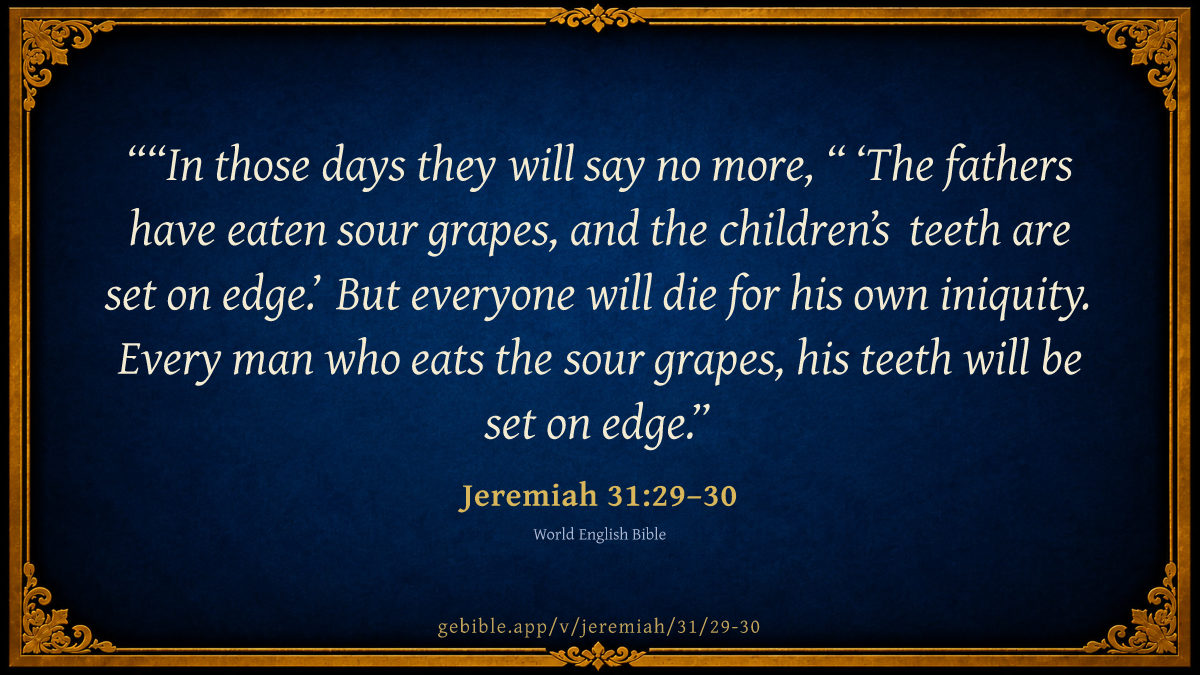
Jeremiah 31:30(v29)But everyone will die for his own iniquity. Every man who eats the sour grapes, his teeth will be set on edge.
Galatians 6:5(v30)For each man will bear his own burden.
Ezekiel 18:4(v30)Behold, all souls are mine; as the soul of the father, so also the soul of the son is mine. The soul who sins, he shall die.
Ezekiel 3:18-19(v30)When I tell the wicked, ‘You will surely die;’ and you give him no warning, nor speak to warn the wicked from his wicked way, to save his…
Ezekiel 33:18(v30)When the righteous turns from his righteousness, and commits iniquity, he will even die therein.
Ezekiel 33:8(v30)When I tell the wicked, ‘O wicked man, you will surely die,’ and you don’t speak to warn the wicked from his way; that wicked man will die…
Ezekiel 33:13(v30)When I tell the righteous that he will surely live; if he trusts in his righteousness, and commits iniquity, none of his righteous deeds…
Galatians 6:7-8(v30)Don’t be deceived. God is not mocked, for whatever a man sows, that he will also reap. For he who sows to his own flesh will from the flesh…
James 1:15(v30)Then the lust, when it has conceived, bears sin. The sin, when it is full grown, produces death.
Cross-references from openbible.info (CC BY 4.0)
Explain this passage (16 sources)
Historical commentary, presented as a primary source — not an endorsement.
John Calvin1540 · Public DomainOn v29Ezekiel shews that it was a complaint commonly prevailing…
Ezekiel shews that it was a complaint commonly prevailing among the people, that they suffered for the sins of their fathers, as Horace also says, a heathen and a despiser of God, “O Roman, thou dost undeservedly suffer for the faults of thy fathers.” Such, then, was the arrogance of the Jews, as to strive with God, as though he punished them, while they were innocent; and they expressed this by using a proverb, “If our fathers have eaten sour grapes, what is the reason that our teeth are set on edge?” We know that teeth are set on edge when unripe fruits are eaten; but the word properly means sour grapes, which the Greeks call omphakes. Then the Prophet says, that this proverb would be no longer used, for after having been tamed by evils, they would at length know that God had not dealt so severely with them without a just cause.
We now perceive the meaning of the Prophet. And he says, In those days, that is, after God had punished the people, and also embraced them through his mercy; for both these things were necessary, that is, that their perverseness and pride should be subdued, and that they should cease to expostulate with God, and also that the gratuitous favor of God should be manifested to them. At that time then, he says, they shall not use this impious proverb, The fathers have eaten a sour grape, and the children’s teeth have been blunted: but on the contrary, he adds, every one shall die in his own iniquity; and whosoever eateth a sour grape, his teeth shall be blunted; that is, at that time the just judgment of God shall be exalted, so that there will be no place for these insolent and blasphemous clamors; the mercy of God will also be made manifest, for men, worthy of death, will be delivered, but not otherwise than through the gratuitous goodness of God.
John Calvin's Commentaries (1540-1563) — public domain. Text from the Calvin Translation Society English edition (1840s-50s) via the Christian Classics Ethereal Library (ccel.org). Calvin's coverage is partial (roughly two-thirds of the Bible); uncommented books and verses are honest gaps, never fabricated. The 19th-century editor's footnotes and remarks are omitted so the notes are faithfully Calvin's own voice.
Geneva Bible translators1599 · Public DomainOn v29The wicked used this proverb, when they did murmur…
The wicked used this proverb, when they did murmur against God’s judgments pronounced by the Prophets, saying, That their fathers had committed the fault and that the children were punished, Ezek. 18:3.
Geneva Bible (1599) marginal notes — public domain.
John Trapp1656 · Public DomainOn vv29–30Jer 31:29 In those days they shall say no…
Jer 31:29 In those days they shall say no more, The fathers have eaten a sour grape, and the children’s teeth are set on edge.
Ver. 29. In those days they shall say no more.] There shall be rectius de operibus Dei iudicium, a more correct judgment passed upon God’s proceedings. See about this byword, Eze 18:2.
John Trapp, A Commentary or Exposition upon All the Books of the Old and New Testament (1647–1656) — public domain. Text from a community e-Sword module.
Matthew Poole1685 · Public DomainOn vv29–30That is, We are punished for our fathers’ sins;…
That is, We are punished for our fathers’ sins; which yet God may justly do; and none questioneth the justice of man in the case, depriving children of their patrimonial estates for their parents’ treasons; nor more than God threateneth in the second commandment, God indeed, Eze 18:2, seemeth displeased at their use of this proverb; but the reason is, because they so used it as to acquit themselves, intimating they were guiltless, and suffered only for the sins of their parents, whereas that was false; otherwise the punishment of children for the sins of their parents was no more than God had threatened, Exo 20:5; 34:7; Jer 15:4. But, saith God, your captivity shall, as to you, expiate your parents’ guilt past, and you shall no more say so.
Matthew Poole's English Annotations on the Holy Bible (1683–1685) — public domain. Text from a community e-Sword/MySword module.
John Gill1763 · Public DomainOn vv29–30In those days they shall say no more,.... The…
In those days they shall say no more,.... The following proverb or byword; they should have no occasion to use it, nor should they choose to use it; since they would understand themselves, and the dispensations of Providence towards them, better than to use it:
the fathers have eaten a sour grape, and the children's teeth are set on edge; that is, the fathers have sinned, and the children are punished for their sins. So the Targum,
Read full note →
"the fathers have sinned, and the children are smitten.''
This was in some sense true; they were punished for their fathers' sins in the captivity, particularly for Manasseh's; nor was it unusual with God to visit the iniquities of the fathers upon the children; nor at all unjust, since they were a part of their parents, and especially since they were guilty of the same sins; nor is it thought unjust among men to punish children for the treason of their parents, as every sin is treason against God. But this was not all that was meant by this proverb; the sense of those that used it was, that they themselves were quite clear and innocent, and that they only suffered for their fathers' faults; which was false, of which they should be convinced, and use the proverb no more, as charging God with injustice.
John Gill's Exposition of the Whole Bible (1746–1763) — public domain (CC PDM 1.0). Text via the HelloAO Bible API.
Adam Clarke1810 · Public DomainOn v29Verse 29. The fathers have eaten a sour grape]…
Verse 29. The fathers have eaten a sour grape] A proverbial expression for, "The children suffer for the offences of their parents." This is explained in the next verse: "Every one shall die for his own iniquity." No child shall suffer Divine punition for the sin of his father; only so far as he acts in the same way can he be said to bear the sins of his parents.
Adam Clarke's Commentary on the Bible (1810–1826) — public domain. Text from a community e-Sword/MySword module.
Joseph Benson1811 · Public DomainOn v29Jer 31:29-30. They shall say no more, The fathers…
Jer 31:29-30. They shall say no more, The fathers have eaten a sour grape, &c. — “God had often declared that he would visit the sins of the fathers upon the children, and had particularly threatened to execute judgment upon the present generation for the idolatries and other sins of their forefathers. See note on Exo 20:5, and chap. Jer 15:4. This gave occasion to the proverb mentioned in this verse, which they that were in captivity applied to their own case, as if the miseries they endured were chiefly owing to their fathers’ sins: see Lam 5:7; Eze 18:2; but when this judgment should be removed, then there would be no further occasion to use this proverb, as Ezekiel there speaks.” But every one shall die for his own iniquity, &c. — These national judgments ceasing, every one shall suffer only for his own faults. “This promise,” says Lowth, “will be remarkably verified when God shall cease to visit upon the Jewish nation that imprecation which they laid upon themselves by the crucifixion of Christ, his blood be upon us, and upon our children.” It was the opinion of Bishop Warburton, that the punishment of children for the iniquity of their parents, was to supply the want of the sanction of a future state, which he supposed was very obscurely, if at all, revealed under the Mosaic dispensation. “For,” says he, “while a future state was kept hid from the Jews there was an absolute need of such a law to restrain the more daring spirits by working upon their instincts. But when a doctrine was brought to light which held them up, and continued them after death, the objects of divine justice, it had then no further use, and was therefore reasonably to be abolished, with the rest of the Jewish laws peculiar to the Mosaic dispensation.” But it may be inquired here, Do not children still suffer for the sins of their parents in the only sense in which they ever did, namely, in all national calamities, and in that poverty and reproach, and those bodily afflictions, which the vices of their parents entail upon them?
Joseph Benson's Commentary on the Old and New Testaments (1811–1818) — public domain. Text from a community e-Sword module.
Haydock's Catholic Bible Commentary1859 · Public DomainOn v29Edge. Such observations had been too often made, Ezechiel…
Edge. Such observations had been too often made, Ezechiel xviii. 12. (Haydock) --- Henceforward you shall not suffer for the faults of Achab, Manasses, &c. Each one shall bear his own burden. The captivity has been like a deluge, cleaning all away. (Calmet)
George Leo Haydock (1774–1849), Haydock's Catholic Family Bible and Commentary, 1859 edition — public domain. Excludes Psalms (Douay-Rheims chapter numbering differs from Protestant) and Deuterocanonical books (Catholic canon only).
Robert Jamieson, A. R. Fausset & David Brown1871 · Public DomainOn vv29–30In those days--after their punishment has. been completed, and…
In those days--after their punishment has. been completed, and mercy again visits them.
fathers . . . eaten . . . sour grape . . . children's teeth . . . on edge--the proverb among the exiles' children born in Babylon, to express that they suffered the evil consequences of their fathers' sins rather than of their own (Lam 5:7; Eze 18:2-3).
Jamieson, Fausset & Brown — Commentary Critical and Explanatory on the Whole Bible (1871) — public domain (CC PDM 1.0). Text via the HelloAO Bible API.
Daniel D. Whedon1874 · Public DomainOn v2929. They shall say no more, etc. — There…
29. They shall say no more, etc. — There is here no incongruity with those passages which describe God as”visiting the iniquities of the fathers upon the children.” Both are exactly true. The fearfully destructive nature of sin is illustrated in that it casts a blight upon everything it touches. A curse rests on the physical universe and on the processes of nature on account of it. Children suffer the consequences of their parents’ sins, but no being is ever punished for the sins of another. There cannot be punishment for sin without a conscience of sin. If a man dies it will be for his own iniquity.
Daniel D. Whedon (gen. ed.), Commentary on the Old and New Testaments (1874–1909) — public domain. Text from a community e-Sword module.
The Cambridge Bible for Schools and Colleges1878 · Public DomainOn v2929, 30. The words “The fathers have eaten, etc.”…
29, 30. The words “The fathers have eaten, etc.” occur also in Eze_18:2, where they are spoken of as a proverb. The people complain that they are being punished for the sins of an earlier generation (perhaps under Manasseh) and murmuring against God’s justice. In the future individual responsibility will be recognised. The earlier view that responsibility for the crime of an individual was as a matter of course shared by all his belongings animate and inanimate alike (see examples in Jos_7:24 f.; 1Sa_22:16-19; 2Sa_21:1-9), gradually yielded (see 2Ki_14:5 f.) as the more enlightened conscience revolted against it. Deu_24:16 marks the change. But Israel in its protest ignores its own sin. As a matter of fact Jeremiah’s generation were as much involved in guilt, and that of no trifling kind, as their predecessors. See further on the general subject, Peake, Problem, etc. pp. 21 f.
The Cambridge Bible for Schools and Colleges (gen. ed. J. J. S. Perowne; Cambridge University Press, 1878–1918) — public domain. Text from a community e-Sword module.
Ellicott's Commentary for English Readers1878 · Public DomainOn v29(29, 30) The fathers have eaten a sour grape…
(29, 30) The fathers have eaten a sour grape . . .—The proverb was one which, as we find from Eze_18:2-3, had at this time come into common use. Men found in it an explanation of their sufferings which relieved their consciences. They were suffering, they said, for the sins of their fathers, not for their own. They distorted the words which, as asserting the continuity of national life, were attached to the second Commandment (Exo_20:5), and instead of finding in them a warning restraining them from evil by the fear of transmitting evil to another generation, they found in them a plea for their own recklessness. Both Ezekiel and Jeremiah felt that the time was come when, even at the risk of a seeming contradiction to words clothed with a Divine authority, the other aspect of God’s government had to be asserted in all its fulness: and therefore they lay stress on the truth that each man is responsible for his own acts, and for those alone, and that the law of the inheritance of evil (what we have learnt to call the law of hérédité) leaves untouched the freedom of man’s will. The “eater of the sour grape, his teeth shall be set on edge,” is, as it were, an emendation of the proverbial saying. The words of the Latin poet, “Delicta majorum immeritus lues,” “Thou, for no guilt of thine, shalt pay the forfeit of thy fathers’ sins” (Hor. Od. iii. 6, 1), show how ready men have been at all times to make a like excuse. How the two truths are to be reconciled, the law of hereditary tendencies, and punishments that fall not on the original offenders, but on their children, and the law of individual responsibility, is a question to which we can give no formal answer. We must be content to accept both laws, and rest in the belief that the Judge of all the earth will assuredly do right.
A Bible Commentary for English Readers, edited by Charles John Ellicott (1878–1897) — public domain. Text from a community e-Sword module.
The Pulpit Commentary1880 · Public DomainOn v29Have eaten a sour grape; rather, sour grapes. The…
Have eaten a sour grape; rather, sour grapes. The prophet (like Ezekiel, Eze 18) condemns the use of this proverb, and declares that the sinner is the artificer of his own ruin. At first sight, it may seem as if Jeremiah opposes the second commandment, which describes how God "visits the iniquity of the fathers upon the children". (Exo_20:5) This, however, cannot really be, for he endorses this declaration later on. (Jer_32:18) The fact is that he is not so much condemning the proverb, as the blasphemous application of it made by the Jews of his time. It is an eternal truth that sin perpetuates itself (except by the miracles of grace) in the children of transgressors, and intensified sin leads to intensified punishment. But the children of transgressors do not cease to be responsible for their own share in the sin; this was the truth which Jeremiah"s contemporaries ignored. He does not deny the solidarity of the family or the race, but he super-adds the neglected truth of the special responsibility of the individual. This is one among many evidences of the deepening sense of individual life in the later period of the Jewish monarchy. (A somewhat different view is offered by Delitzsch, "Messianic Prophecies," According to him, Jeremiah looks forward to a time when the individual shall be liberated from the consequences of his solidarity with his race, and when personality shall be "invested with its rights." But can the individual be thus liberated?)
Heredity and individual responsibility.
Read full note →
The passage before us is interesting as indicating a great advance in freedom and justice of thought from the old orthodoxy that was satisfied with the punishment of children together with their parents to a new and wiser doctrine of individual responsibility. But it is important to observe that it is more than a sign of advancing thought. It is a prophecy concerning facts, a prediction of a higher justice of the future. The old notion here condemned is not condemned because it is false; nay, it is treated as true for the present. The new idea is not substituted as a better interpretation of the facts of experience; it is a description of a higher order of facts not yet realized. The old doctrine applies with a considerable measure of truth to Judaism; the new is part of the larger justice of Christianity. For the Jewish religion was essentially a family religion; its advantages came to the individual through the nation, the tribe, the family; the first condition for receiving them was descent from Abraham, Isaac, and Jacob. But Christianity is fundamentally individualistic. It elevates the family, it creates the Church one grand family of Christian brethren; but it begins with individual faith and ends with individual responsibility. Nevertheless, we have not yet perfect justice. Jeremiah"s prophecy is still a prophecy to us. Let us examine the two conditions of life that are brought before us by the contrast of prediction with the present order of affairs.
I THE PRESENT CONDITION OF HEREDITY. It is true now that if "the fathers have eaten some grapes the children"s teeth are set on edge." Hereditary punishment and hereditary moral corruption are among the darkest mysteries of "all this unintelligible world." But they are facts that follow necessary social and physiological laws.
1. Children suffer the punishment of their parents" sins. Poverty, dishonour, disease, pass from parent to child. The child of a spendthrift becomes a beggar, the son of a thief is ostracized, the drunkard"s child diseased, perhaps insane.
2. Children inherit moral corruption from their parents. Where this is the case it may be thought to lighten the mystery of hereditary punishment. However that may be, it is itself a deeper mystery, a more horrible injustice. It is remarked that if God visits "the iniquity of the fathers upon the children unto the third and fourth generation," it is to generations of "them that hate" him. But if the wickedness that seems to justify the long lived punishment is also hereditary, is not the case the more hard? Now, Jeremiah teaches us that we are not to be satisfied with this as a final and equitable arrangement. It belongs to these present times that are out of joint, and it will be superseded by a better order.
II THE FUTURE CONDITION OF INDIVIDUAL RESPONSIBILITY. (Ver. 30) This was to come with the Messianic era. We have seen it beginning in the revelation of Christianity. It can only be perfected when Christ"s work is perfected by his second advent for judgment. A right social order may do something in this direction. Jeremiah anticipated a wiser, more discriminating exercise of justice in the restored nation after the Captivity. But the full realization must be left for a future dispensation of Divine justice. At the last every man will be called upon alone to answer for his own sins, and judgment will be swift and appropriate. Present inequalities will then be rectified. Meanwhile the injustice of hereditary punishment can be compensated, not only by future alleviations but by turning the punishment into a wholesome discipline, while the injustice of moral corruption will be corrected ultimately by judging a man according to the free choice of his will how he behaved when he was free to act, how far he took new steps downwards, with all due allowance for natural weakness and hereditary tendencies.
Vers. 29, 30. Jehovah visiting the individual for his sins.
I THE SIN OF SOME AND THE SUFFERING OF OTHERS. This is put before us in a very striking figure. Literally, the taste of a sour grape would be an instantaneous sensation; but here we are asked to imagine the possibility of a man getting whatever other advantage there might be in the grape, whatever nourishment, whatever refreshment, and then handing on the one bad element of sourness. And truly it often seems as if there were this kind of division. The wrong doer goes on succeeding, enjoying himself, getting his full of life, and then his children come in to find that the father"s wrong doing is like a millstone round their necks, destroying every chance they might otherwise have. The figure here presents from the human side that fact of experience which from the Divine side is presented as a law. "I the Lord thy God am a jealous God, visiting the iniquity of the fathers upon the children". (Exo_20:5)
II THE SIN OF SOME AND THEIR OWN SUFFERING. We need to look somewhat carefully at the point brought out in ver. 30. At first it seems as if daily experience were contradicted, for we leap to an inference that the children"s tooth will not be set on edge by the sour grapes their fathers have eaten; whereas it is abundantly plain that children still suffer for the sins of their fathers. But observe that this is not at all denied. The great point insisted on is that the fathers will suffer themselves; and this is a point that needs to be insisted on, for the fallacy is continually arising that a man may, by some magic, some precaution, escape the consequences of his evil, and so he may escape from some consequences. But observe, again, the all-comprehending word here used, "he shall die, and this word has a retrospective force. There never has been any other law but that a man shall die for his own iniquity. Possibly we should take this passage as having some sort of reference to the old custom of making revenge a hereditary thing. If the doer of a wrong escaped vengeance and died peacefully in his bed, then his son stood in the father"s place, and became an object of attack till the punishment due to the father was visited on him. It seems so plain to us that a man should die for his own iniquity, punishment falling on the head of him who does the wrong, that we find it hard to imagine a day when the ethical code was otherwise. Whereas it is tolerably clear that in Old Testament times and countries the feeling was that somebody must be punished; and if the real criminal escaped, why, then take his nearest blood relation. That the Christian looks on things so differently is the clearest proof that this prophecy has been fulfilled.
III THE NEED THERE IS THAT EVERY ONE SHOULD CLASSIFY THE SUFFERINGS OF HIS LIFE. It is not enough that we seek deliverance from suffering. It is right for us to do so, and suffering, we may be sure, is not by the will of God. But as there is suffering which comes from causes within our control, so there is suffering coming from causes outside our control; and it is with the former only that we can deal. Besides, it is the worst suffering, seeing that it comes from trouble and unrest of conscience. God has so made us that the worst wounds from others are but as surface scratches compared with the wounds that in our folly we inflict on ourselves. Then we have to look, not only on the sufferings, but enjoyments. We may so live as to rise above the worst that men can do to us, and at the same time, we may be the better for whatever good man is disposed to do. If sometimes it is true that the fathers eat sour grapes and the children"s teeth get set on edge, is it not also true that the fathers eat sweet grapes, yet little of the sweetness they seem to taste it is a sweetness standing over for the children? Y.
The Pulpit Commentary (1880–1919), ed. H.D.M. Spence-Jones & Joseph S. Exell — public domain. Text from a community e-Sword module.
The Biblical Illustrator1887 · Public DomainOn v29In those days they shall say no more, The…
Jer_31:29
In those days they shall say no more, The fathers have eaten a sour grape, and the childrens teeth are set on edge.
Read full note →
The bequethment of the ungodly
There is this great difference between moral and physical evil--that men will use all their carefulness to avoid the one, while every imaginable prohibition is ineffectual to deter them from the other. It is quite evident that there is not in our nature a principle of what we may call a moral self-preservation. Hence it is that, whilst the Governor of the universe has not thought it necessary to interpose the precepts of the statute-book that we may be warned against physical evil, He has heaped together edicts and motives which all bear on the avoidance of moral evil. We know, indeed, that such is the desperate proneness of man to misdoing, that all this mighty instrumentality is practically of no effect; but it is singular to observe how every motive by which our nature can be plied is brought into play, so that the Divine Legislator has left nothing untried in order to save us from iniquity. If a man be wrapt up in selfishness, why, he is told that health, and peace, and reputation will be best consulted by his seeking first the kingdom of God and His righteousness. Then, if he care only for himself--if he would not hate his own flesh, and mar his own happiness, let him cultivate that godliness which hath the promise of the present life, as well as that which is to come. And if a man be inaccessible to this kind of attack--if he can be contented, for the gratification of his senses and the indulgence of his passions, to brave the penalties of the law of the Almighty, the Bible will open upon him another battery, and seek to move him by his affection for others. Those yet unborn may be sufferers by your sin; for the days spoken of in our text are assuredly not yet come--the days in which they shall say no more, The fathers have eaten a sour grape, and the childrens teeth are set on edge. Yes, you may say, it is not to be denied that God doth visit on the children the iniquity of the fathers; but is this just? The innocent seem made to suffer for the guilty. Can this be right? No, it cannot be just that the innocent should suffer for the guilty. If you can show the children to be innocent, and therefore deserve nothing of what they receive, you will make good your point--that the visitation is unjust; but to maintain the thorough innocence of the children would be to maintain the purity of human nature. If in themselves they deserve not to be visited with calamity, they must be exceptions to the rule that men are born in sin and shapen in iniquity. It is certain that every one born into the world is born in a state of wrath and condemnation: the child, whether of believing or unbelieving parents, has not a particle of right to one solitary blessing; and if, therefore, whatever be His reasons for making a distinction, God withholds many blessings from this or that child, He withholds nothing to which the child has a claim; and if He permits many calamities to fall on the child, He permits nothing which is wholly undeserved. Wherein, then, can lie the violation of justice if nothing be kept back to which there was right, nothing inflicted but in the way of retribution? But still if you allow the strict justice of the measure, yon may profess to think it hard that the child should have to endure what, but for the parents offences, it would have escaped. Let us not, however, be carried away by appearances. The child, for example, is of a diseased constitution, of a dishonoured name, of broken fortunes; these constitute that setting the teeth on edge, which you think it so hard that the fathers eating the sour grape should have caused. But who can prove to me that the child is injured by the visitation? Nay, who can prove to me that the child is not really advantaged? Are penury and affliction never overruled for good? Is it necessarily an evil to have been born poor in place of rich--to be of weak health instead of strong--to struggle with adversity, in place of being lapped in prosperity! No man who feels himself immortal, who is conscious that this confined theatre of existence is but the school in which he is disciplined for s higher and nobler, will contend for the necessary injuriousness of want and calamity. We are poor judges of injuries. What seems to be injurious, is so capable of being overruled for good, that it may turn out beneficial. There may be many a tongue which would never have been tuned to the high praise of God, had not the teeth been set on edge by the sin of the father. Now there would seem no more important and practical application of this subject, than the pressing home on parents the duties which they owe to their children. Fathers of the present day will rise early and late take rest, they will ply without ceasing at laborious occupations, and the strength of intellect, and the powers of muscle shall be devoted with a like prodigality; and the animating thing throughout the unwearied enlistment of every talent and every moment in one engrossing pursuit shall be the upholding of a family in sufficiency and obtaining the means of future independence. And it may never occur to these fathers that if they so indulge the passion of accumulation as to become the slaves of covetousness, or if they so engross themselves with the wharf and the exchange as to leave comparatively no time for the Church and the closet--or if the resolve to be rich induce them to depart from high-toned rectitude, and to carry on trade with those shuffling and underhand tricks by which it is often deformed--it may never, we fear, occur to them that in their zeal for their childrens welfare they may be storing up for them calamity, and that with every pound they lay by, they may lay by a worm which, if it sleep till their own death, shall then struggle into life and gnaw at the core of their familys happiness. Yet, if then be truth in the text, the father s sin goes down to his posterity: and where shall be the profit of a large bequeathment of land or consols if there be fastened to it the entailment of the Almightys displeasure? God has ordained that wickedness shall defeat its own end; He may allow you to heap up wealth, but He puts the stamp of His anger on the silver and the gold; and the nothing which s pious beggar has to leave were a better inheritance than the coffers of ingots on which were impressed the stamp of the Lords indignation. The days are not yet come, in which it shall no longer be mid, The fathers have eaten a sour grape, and the childrens teeth were set on edge. But the days shall come when the prophecy shall be accomplished, even as will be that which asserts the universal extinction of war; though nation is as yet ready to rise against nation, and no signs appear of the sword being beaten into the ploughshare. Prophecies like these are commands as well as prophecies; and their being fulfilled as predictions may greatly depend on their being obeyed as precepts. Here is a clear practical lesson for parents. Would you save your children from the having the teeth set on edge? Take heed, then, that you eat not the sour grape yourselves! You may be sure that you then consult best for the interests of your families when you consult most your own souls. (H. Melvill, B. D.)
The hereditary principle in Gods government of humanity
I. Man has been subject to this hereditary principle of government through all past ages.
1. Its necessary working is secured by the connection existing between the members of our race.
(1) How close is the tie of physical relationship subsisting between men and generations! We are all made of the one blood, all descendants from the same stock. Our parents transmit to us not merely their natures, but their idiosyncrasies, their diseases, their characteristic propensities.
(2) How close, too, is the tie of social interdependence. Every man is dependent upon his brother. One has something to impart which the other requires.
2. It is registered in the everyday experience of humanity.
(1) You see it written in a man s history as the lineal descendant from a particular family. Some inherit a princely fortune, and some a crushing penury, from their ancestors. Their social status, too, is often ruled by the position and conduct of those of whom they were born.
(2) You see it written in his history as the offspring of past generations. The human plant does not grow up in its wild luxuriance and unassisted strength, but is trained against the walls and espaliers of law and government, and pruned by the hand of public customs and manners.
II. This hereditary principle of the Divine government is to man no just ground of complaint.
1. No man is made to suffer more than he actually deserves on account of his own personal sins. The method is for the Judge of all the earth to determine and no one else. In sooth, since suffering must come to the sinner, I would sooner have it through parents than in any other way; for that medium seems to afford some alleviating considerations. Love modifies suffering, cools its fires on the nerves, and lessens its pressure on the heart.
2. The evil which thus descends to us from our ancestors is not to be compared with that which we produce ourselves. With evils that are transmitted to you there can be no remorse. You bear them as calamities; and you have the grace of heaven, the sympathy of the good, and the smiles of an approving conscience to enable you to bear them with calm magnanimity, and even with triumphant exultation.
3. Whilst this hereditary principle of the Divine government entails evil, it also entails good. Whence came our political constitution, which, notwithstanding its defects, affords a better guarantee of personal liberty, social order, and human progress, than any other government under heaven? Did we elaborate it ourselves? No. It is the production of days. It has grown out of the enlightening instructions, the importunate prayers, the patriotic sacrifices and struggles of the best men of the generations that are gone.
4. This hereditary principle tends to restrain vice and stimulate virtue. What sacrifices will not parents of the ordinary natural affection make to serve the interest of their children! Now the hereditary principle of government brings this mighty impulse in the worlds heart to act in the restraint of evil and in the development of good.
III. The time will come when men will cease entirely complaining of this principle. In those days of universal knowledge, virtue, and blessedness, not a solitary man will be found to complain of this hereditary principle in the Divine government. Every man shall have such an insight into the nature of Gods administration that he shall see the wisdom and feel the beneficence of this principle. In those days the successive generations of holy and happy men will clearly see that the good, that will then have come out of this principle to humanity, will far out-measure all the evil that has ever grown out of its operation, through all the past history of man. In those days, parents, through many a circling age, down to the solemn day of doom, will transmit nothing to their offspring, but halesness of constitution, elasticity of intellect, purity of felling, nobleness of soul, and honour of name, knowledge, and blessed example, on which it shall leave its successor to lay another, and thus on for centuries; until humanity shall find itself on that rich and lofty soil, where the choicest productions of paradise will bloom for ever.
1. This subject serves to show the right which every reformer has to protest against the sins of individuals.
2. It serves to show the solemn responsibility of the parental character.
3. It serves to show that the best way to elevate the race is to train the young.
4. It serves to throw some light upon what is called original sin. A deterioration of our nature, and a disturbance of our moral relations, is a fact palpable to every eye, incontrovertible to every intellect, conscious to every soul
5. It serves to indicate the philosophy of Christs incarnation. (Homilist.)
The Biblical Illustrator, edited by Joseph S. Exell (c. 1880s–1900s) — public domain. Text from a community e-Sword module.
unfoldingWord translationNotes2017 · CC BY-SA 4.0On v29Fathers have eaten sour grapes, but the children's teeth…
Fathers have eaten sour grapes, but the children's teeth are dulled
These words are a proverb that Jeremiah heard people say when they were complaining that Yahweh was punishing children for the sins of their fathers. (See: Proverbs)
Read full note →
sour grapes
Possible meanings are 1) grapes with too much acid in them or 2) grapes that are not ripe. If grapes are not part of your culture, you may want to use a general word for fruit.
teeth are dulled
Use the common words in your language for how people's mouths feel when they eat sour or unripe fruit.
For each man will die in his own iniquity
"For each man will die because of his own sins"
everyone who eats sour grapes, his teeth will be dulled
Jeremiah restates the proverb so that it now means people will suffer as a consequence of their own behaviors. (See: Proverbs)
Tyndale Open Study Notes2022 · CC BY-SA 4.0On v2931:29-30 Some seemed to think that this proverb (apparently…
31:29-30 Some seemed to think that this proverb (apparently a misinterpretation of Exod 20:5; 34:7; Num 14:18) meant that innocent children were dying because of their parents’ sins. The Lord made it clear that each individual is punished for his or her own sins (see Lam 5:7; Ezek 18:2-32; 33:10-20).
 GEBible — Godless Engineer's Bible App
John Calvin 1540 · Public Domain On v29 Ezekiel shews that it was a complaint commonly prevailing…
Ezekiel shews that it was a complaint commonly prevailing among the people, that they suffered for the sins of their fathers, as Horace also says, a heathen and a despiser of God, “O Roman, thou dost undeservedly suffer for the faults of thy fathers.” Such, then, was the arrogance of the Jews, as to strive with God, as though he punished them, while they were innocent; and they expressed this by using a proverb, “If our fathers have eaten sour grapes, what is the reason that our teeth are set on edge?” We know that teeth are set on edge when unripe fruits are eaten; but the word properly means sour grapes, which the Greeks call omphakes. Then the Prophet says, that this proverb would be no longer used, for after having been tamed by evils, they would at length know that God had not dealt so severely with them without a just cause.
We now perceive the meaning of the Prophet. And he says, In those days, that is, after God had punished the people, and also embraced them through his mercy; for both these things were necessary, that is, that their perverseness and pride should be subdued, and that they should cease to expostulate with God, and also that the gratuitous favor of God should be manifested to them. At that time then, he says, they shall not use this impious proverb, The fathers have eaten a sour grape, and the children’s teeth have been blunted: but on the contrary, he adds, every one shall die in his own iniquity; and whosoever eateth a sour grape, his teeth shall be blunted; that is, at that time the just judgment of God shall be exalted, so that there will be no place for these insolent and blasphemous clamors; the mercy of God will also be made manifest, for men, worthy of death, will be delivered, but not otherwise than through the gratuitous goodness of God.
John Calvin's Commentaries (1540-1563) — public domain. Text from the Calvin Translation Society English edition (1840s-50s) via the Christian Classics Ethereal Library (ccel.org). Calvin's coverage is partial (roughly two-thirds of the Bible); uncommented books and verses are honest gaps, never fabricated. The 19th-century editor's footnotes and remarks are omitted so the notes are faithfully Calvin's own voice.
Geneva Bible translators 1599 · Public Domain On v29 The wicked used this proverb, when they did murmur…
The wicked used this proverb, when they did murmur against God’s judgments pronounced by the Prophets, saying, That their fathers had committed the fault and that the children were punished, Ezek. 18:3.
Geneva Bible (1599) marginal notes — public domain.
John Trapp 1656 · Public Domain On vv29–30 Jer 31:29 In those days they shall say no…
Jer 31:29 In those days they shall say no more, The fathers have eaten a sour grape, and the children’s teeth are set on edge.
Ver. 29. In those days they shall say no more.] There shall be rectius de operibus Dei iudicium, a more correct judgment passed upon God’s proceedings. See about this byword, Eze 18:2.
John Trapp, A Commentary or Exposition upon All the Books of the Old and New Testament (1647–1656) — public domain. Text from a community e-Sword module.
Matthew Poole 1685 · Public Domain On vv29–30 That is, We are punished for our fathers’ sins;…
That is, We are punished for our fathers’ sins; which yet God may justly do; and none questioneth the justice of man in the case, depriving children of their patrimonial estates for their parents’ treasons; nor more than God threateneth in the second commandment, God indeed, Eze 18:2, seemeth displeased at their use of this proverb; but the reason is, because they so used it as to acquit themselves, intimating they were guiltless, and suffered only for the sins of their parents, whereas that was false; otherwise the punishment of children for the sins of their parents was no more than God had threatened, Exo 20:5; 34:7; Jer 15:4. But, saith God, your captivity shall, as to you, expiate your parents’ guilt past, and you shall no more say so.
Matthew Poole's English Annotations on the Holy Bible (1683–1685) — public domain. Text from a community e-Sword/MySword module.
John Gill 1763 · Public Domain On vv29–30 In those days they shall say no more,.... The…
In those days they shall say no more,.... The following proverb or byword; they should have no occasion to use it, nor should they choose to use it; since they would understand themselves, and the dispensations of Providence towards them, better than to use it:
the fathers have eaten a sour grape, and the children's teeth are set on edge; that is, the fathers have sinned, and the children are punished for their sins. So the Targum,
Read full note →
"the fathers have sinned, and the children are smitten.''
This was in some sense true; they were punished for their fathers' sins in the captivity, particularly for Manasseh's; nor was it unusual with God to visit the iniquities of the fathers upon the children; nor at all unjust, since they were a part of their parents, and especially since they were guilty of the same sins; nor is it thought unjust among men to punish children for the treason of their parents, as every sin is treason against God. But this was not all that was meant by this proverb; the sense of those that used it was, that they themselves were quite clear and innocent, and that they only suffered for their fathers' faults; which was false, of which they should be convinced, and use the proverb no more, as charging God with injustice.
John Gill's Exposition of the Whole Bible (1746–1763) — public domain (CC PDM 1.0). Text via the HelloAO Bible API.
Adam Clarke 1810 · Public Domain On v29 Verse 29. The fathers have eaten a sour grape]…
Verse 29. The fathers have eaten a sour grape] A proverbial expression for, "The children suffer for the offences of their parents." This is explained in the next verse: "Every one shall die for his own iniquity." No child shall suffer Divine punition for the sin of his father; only so far as he acts in the same way can he be said to bear the sins of his parents.
Adam Clarke's Commentary on the Bible (1810–1826) — public domain. Text from a community e-Sword/MySword module.
Joseph Benson 1811 · Public Domain On v29 Jer 31:29-30. They shall say no more, The fathers…
Jer 31:29-30. They shall say no more, The fathers have eaten a sour grape, &c. — “God had often declared that he would visit the sins of the fathers upon the children, and had particularly threatened to execute judgment upon the present generation for the idolatries and other sins of their forefathers. See note on Exo 20:5, and chap. Jer 15:4. This gave occasion to the proverb mentioned in this verse, which they that were in captivity applied to their own case, as if the miseries they endured were chiefly owing to their fathers’ sins: see Lam 5:7; Eze 18:2; but when this judgment should be removed, then there would be no further occasion to use this proverb, as Ezekiel there speaks.” But every one shall die for his own iniquity, &c. — These national judgments ceasing, every one shall suffer only for his own faults. “This promise,” says Lowth, “will be remarkably verified when God shall cease to visit upon the Jewish nation that imprecation which they laid upon themselves by the crucifixion of Christ, his blood be upon us, and upon our children.” It was the opinion of Bishop Warburton, that the punishment of children for the iniquity of their parents, was to supply the want of the sanction of a future state, which he supposed was very obscurely, if at all, revealed under the Mosaic dispensation. “For,” says he, “while a future state was kept hid from the Jews there was an absolute need of such a law to restrain the more daring spirits by working upon their instincts. But when a doctrine was brought to light which held them up, and continued them after death, the objects of divine justice, it had then no further use, and was therefore reasonably to be abolished, with the rest of the Jewish laws peculiar to the Mosaic dispensation.” But it may be inquired here, Do not children still suffer for the sins of their parents in the only sense in which they ever did, namely, in all national calamities, and in that poverty and reproach, and those bodily afflictions, which the vices of their parents entail upon them?
Joseph Benson's Commentary on the Old and New Testaments (1811–1818) — public domain. Text from a community e-Sword module.
Haydock's Catholic Bible Commentary 1859 · Public Domain On v29 Edge. Such observations had been too often made, Ezechiel…
Edge. Such observations had been too often made, Ezechiel xviii. 12. (Haydock) --- Henceforward you shall not suffer for the faults of Achab, Manasses, &c. Each one shall bear his own burden. The captivity has been like a deluge, cleaning all away. (Calmet)
George Leo Haydock (1774–1849), Haydock's Catholic Family Bible and Commentary, 1859 edition — public domain. Excludes Psalms (Douay-Rheims chapter numbering differs from Protestant) and Deuterocanonical books (Catholic canon only).
Robert Jamieson, A. R. Fausset & David Brown 1871 · Public Domain On vv29–30 In those days--after their punishment has. been completed, and…
In those days--after their punishment has. been completed, and mercy again visits them.
fathers . . . eaten . . . sour grape . . . children's teeth . . . on edge--the proverb among the exiles' children born in Babylon, to express that they suffered the evil consequences of their fathers' sins rather than of their own (Lam 5:7; Eze 18:2-3).
Jamieson, Fausset & Brown — Commentary Critical and Explanatory on the Whole Bible (1871) — public domain (CC PDM 1.0). Text via the HelloAO Bible API.
Daniel D. Whedon 1874 · Public Domain On v29 29. They shall say no more, etc. — There…
29. They shall say no more, etc. — There is here no incongruity with those passages which describe God as”visiting the iniquities of the fathers upon the children.” Both are exactly true. The fearfully destructive nature of sin is illustrated in that it casts a blight upon everything it touches. A curse rests on the physical universe and on the processes of nature on account of it. Children suffer the consequences of their parents’ sins, but no being is ever punished for the sins of another. There cannot be punishment for sin without a conscience of sin. If a man dies it will be for his own iniquity.
Daniel D. Whedon (gen. ed.), Commentary on the Old and New Testaments (1874–1909) — public domain. Text from a community e-Sword module.
The Cambridge Bible for Schools and Colleges 1878 · Public Domain On v29 29, 30. The words “The fathers have eaten, etc.”…
29, 30. The words “The fathers have eaten, etc.” occur also in Eze_18:2, where they are spoken of as a proverb. The people complain that they are being punished for the sins of an earlier generation (perhaps under Manasseh) and murmuring against God’s justice. In the future individual responsibility will be recognised. The earlier view that responsibility for the crime of an individual was as a matter of course shared by all his belongings animate and inanimate alike (see examples in Jos_7:24 f.; 1Sa_22:16-19; 2Sa_21:1-9), gradually yielded (see 2Ki_14:5 f.) as the more enlightened conscience revolted against it. Deu_24:16 marks the change. But Israel in its protest ignores its own sin. As a matter of fact Jeremiah’s generation were as much involved in guilt, and that of no trifling kind, as their predecessors. See further on the general subject, Peake, Problem, etc. pp. 21 f.
The Cambridge Bible for Schools and Colleges (gen. ed. J. J. S. Perowne; Cambridge University Press, 1878–1918) — public domain. Text from a community e-Sword module.
Ellicott's Commentary for English Readers 1878 · Public Domain On v29 (29, 30) The fathers have eaten a sour grape…
(29, 30) The fathers have eaten a sour grape . . .—The proverb was one which, as we find from Eze_18:2-3, had at this time come into common use. Men found in it an explanation of their sufferings which relieved their consciences. They were suffering, they said, for the sins of their fathers, not for their own. They distorted the words which, as asserting the continuity of national life, were attached to the second Commandment (Exo_20:5), and instead of finding in them a warning restraining them from evil by the fear of transmitting evil to another generation, they found in them a plea for their own recklessness. Both Ezekiel and Jeremiah felt that the time was come when, even at the risk of a seeming contradiction to words clothed with a Divine authority, the other aspect of God’s government had to be asserted in all its fulness: and therefore they lay stress on the truth that each man is responsible for his own acts, and for those alone, and that the law of the inheritance of evil (what we have learnt to call the law of hérédité) leaves untouched the freedom of man’s will. The “eater of the sour grape, his teeth shall be set on edge,” is, as it were, an emendation of the proverbial saying. The words of the Latin poet, “Delicta majorum immeritus lues,” “Thou, for no guilt of thine, shalt pay the forfeit of thy fathers’ sins” (Hor. Od. iii. 6, 1), show how ready men have been at all times to make a like excuse. How the two truths are to be reconciled, the law of hereditary tendencies, and punishments that fall not on the original offenders, but on their children, and the law of individual responsibility, is a question to which we can give no formal answer. We must be content to accept both laws, and rest in the belief that the Judge of all the earth will assuredly do right.
A Bible Commentary for English Readers, edited by Charles John Ellicott (1878–1897) — public domain. Text from a community e-Sword module.
The Pulpit Commentary 1880 · Public Domain On v29 Have eaten a sour grape; rather, sour grapes. The…
Have eaten a sour grape; rather, sour grapes. The prophet (like Ezekiel, Eze 18) condemns the use of this proverb, and declares that the sinner is the artificer of his own ruin. At first sight, it may seem as if Jeremiah opposes the second commandment, which describes how God "visits the iniquity of the fathers upon the children". (Exo_20:5) This, however, cannot really be, for he endorses this declaration later on. (Jer_32:18) The fact is that he is not so much condemning the proverb, as the blasphemous application of it made by the Jews of his time. It is an eternal truth that sin perpetuates itself (except by the miracles of grace) in the children of transgressors, and intensified sin leads to intensified punishment. But the children of transgressors do not cease to be responsible for their own share in the sin; this was the truth which Jeremiah"s contemporaries ignored. He does not deny the solidarity of the family or the race, but he super-adds the neglected truth of the special responsibility of the individual. This is one among many evidences of the deepening sense of individual life in the later period of the Jewish monarchy. (A somewhat different view is offered by Delitzsch, "Messianic Prophecies," According to him, Jeremiah looks forward to a time when the individual shall be liberated from the consequences of his solidarity with his race, and when personality shall be "invested with its rights." But can the individual be thus liberated?)
Heredity and individual responsibility.
Read full note →
The passage before us is interesting as indicating a great advance in freedom and justice of thought from the old orthodoxy that was satisfied with the punishment of children together with their parents to a new and wiser doctrine of individual responsibility. But it is important to observe that it is more than a sign of advancing thought. It is a prophecy concerning facts, a prediction of a higher justice of the future. The old notion here condemned is not condemned because it is false; nay, it is treated as true for the present. The new idea is not substituted as a better interpretation of the facts of experience; it is a description of a higher order of facts not yet realized. The old doctrine applies with a considerable measure of truth to Judaism; the new is part of the larger justice of Christianity. For the Jewish religion was essentially a family religion; its advantages came to the individual through the nation, the tribe, the family; the first condition for receiving them was descent from Abraham, Isaac, and Jacob. But Christianity is fundamentally individualistic. It elevates the family, it creates the Church one grand family of Christian brethren; but it begins with individual faith and ends with individual responsibility. Nevertheless, we have not yet perfect justice. Jeremiah"s prophecy is still a prophecy to us. Let us examine the two conditions of life that are brought before us by the contrast of prediction with the present order of affairs.
I THE PRESENT CONDITION OF HEREDITY. It is true now that if "the fathers have eaten some grapes the children"s teeth are set on edge." Hereditary punishment and hereditary moral corruption are among the darkest mysteries of "all this unintelligible world." But they are facts that follow necessary social and physiological laws.
1. Children suffer the punishment of their parents" sins. Poverty, dishonour, disease, pass from parent to child. The child of a spendthrift becomes a beggar, the son of a thief is ostracized, the drunkard"s child diseased, perhaps insane.
2. Children inherit moral corruption from their parents. Where this is the case it may be thought to lighten the mystery of hereditary punishment. However that may be, it is itself a deeper mystery, a more horrible injustice. It is remarked that if God visits "the iniquity of the fathers upon the children unto the third and fourth generation," it is to generations of "them that hate" him. But if the wickedness that seems to justify the long lived punishment is also hereditary, is not the case the more hard? Now, Jeremiah teaches us that we are not to be satisfied with this as a final and equitable arrangement. It belongs to these present times that are out of joint, and it will be superseded by a better order.
II THE FUTURE CONDITION OF INDIVIDUAL RESPONSIBILITY. (Ver. 30) This was to come with the Messianic era. We have seen it beginning in the revelation of Christianity. It can only be perfected when Christ"s work is perfected by his second advent for judgment. A right social order may do something in this direction. Jeremiah anticipated a wiser, more discriminating exercise of justice in the restored nation after the Captivity. But the full realization must be left for a future dispensation of Divine justice. At the last every man will be called upon alone to answer for his own sins, and judgment will be swift and appropriate. Present inequalities will then be rectified. Meanwhile the injustice of hereditary punishment can be compensated, not only by future alleviations but by turning the punishment into a wholesome discipline, while the injustice of moral corruption will be corrected ultimately by judging a man according to the free choice of his will how he behaved when he was free to act, how far he took new steps downwards, with all due allowance for natural weakness and hereditary tendencies.
Vers. 29, 30. Jehovah visiting the individual for his sins.
I THE SIN OF SOME AND THE SUFFERING OF OTHERS. This is put before us in a very striking figure. Literally, the taste of a sour grape would be an instantaneous sensation; but here we are asked to imagine the possibility of a man getting whatever other advantage there might be in the grape, whatever nourishment, whatever refreshment, and then handing on the one bad element of sourness. And truly it often seems as if there were this kind of division. The wrong doer goes on succeeding, enjoying himself, getting his full of life, and then his children come in to find that the father"s wrong doing is like a millstone round their necks, destroying every chance they might otherwise have. The figure here presents from the human side that fact of experience which from the Divine side is presented as a law. "I the Lord thy God am a jealous God, visiting the iniquity of the fathers upon the children". (Exo_20:5)
II THE SIN OF SOME AND THEIR OWN SUFFERING. We need to look somewhat carefully at the point brought out in ver. 30. At first it seems as if daily experience were contradicted, for we leap to an inference that the children"s tooth will not be set on edge by the sour grapes their fathers have eaten; whereas it is abundantly plain that children still suffer for the sins of their fathers. But observe that this is not at all denied. The great point insisted on is that the fathers will suffer themselves; and this is a point that needs to be insisted on, for the fallacy is continually arising that a man may, by some magic, some precaution, escape the consequences of his evil, and so he may escape from some consequences. But observe, again, the all-comprehending word here used, "he shall die, and this word has a retrospective force. There never has been any other law but that a man shall die for his own iniquity. Possibly we should take this passage as having some sort of reference to the old custom of making revenge a hereditary thing. If the doer of a wrong escaped vengeance and died peacefully in his bed, then his son stood in the father"s place, and became an object of attack till the punishment due to the father was visited on him. It seems so plain to us that a man should die for his own iniquity, punishment falling on the head of him who does the wrong, that we find it hard to imagine a day when the ethical code was otherwise. Whereas it is tolerably clear that in Old Testament times and countries the feeling was that somebody must be punished; and if the real criminal escaped, why, then take his nearest blood relation. That the Christian looks on things so differently is the clearest proof that this prophecy has been fulfilled.
III THE NEED THERE IS THAT EVERY ONE SHOULD CLASSIFY THE SUFFERINGS OF HIS LIFE. It is not enough that we seek deliverance from suffering. It is right for us to do so, and suffering, we may be sure, is not by the will of God. But as there is suffering which comes from causes within our control, so there is suffering coming from causes outside our control; and it is with the former only that we can deal. Besides, it is the worst suffering, seeing that it comes from trouble and unrest of conscience. God has so made us that the worst wounds from others are but as surface scratches compared with the wounds that in our folly we inflict on ourselves. Then we have to look, not only on the sufferings, but enjoyments. We may so live as to rise above the worst that men can do to us, and at the same time, we may be the better for whatever good man is disposed to do. If sometimes it is true that the fathers eat sour grapes and the children"s teeth get set on edge, is it not also true that the fathers eat sweet grapes, yet little of the sweetness they seem to taste it is a sweetness standing over for the children? Y.
The Pulpit Commentary (1880–1919), ed. H.D.M. Spence-Jones & Joseph S. Exell — public domain. Text from a community e-Sword module.
The Biblical Illustrator 1887 · Public Domain On v29 In those days they shall say no more, The…
Jer_31:29
In those days they shall say no more, The fathers have eaten a sour grape, and the childrens teeth are set on edge.
Read full note →
The bequethment of the ungodly
There is this great difference between moral and physical evil--that men will use all their carefulness to avoid the one, while every imaginable prohibition is ineffectual to deter them from the other. It is quite evident that there is not in our nature a principle of what we may call a moral self-preservation. Hence it is that, whilst the Governor of the universe has not thought it necessary to interpose the precepts of the statute-book that we may be warned against physical evil, He has heaped together edicts and motives which all bear on the avoidance of moral evil. We know, indeed, that such is the desperate proneness of man to misdoing, that all this mighty instrumentality is practically of no effect; but it is singular to observe how every motive by which our nature can be plied is brought into play, so that the Divine Legislator has left nothing untried in order to save us from iniquity. If a man be wrapt up in selfishness, why, he is told that health, and peace, and reputation will be best consulted by his seeking first the kingdom of God and His righteousness. Then, if he care only for himself--if he would not hate his own flesh, and mar his own happiness, let him cultivate that godliness which hath the promise of the present life, as well as that which is to come. And if a man be inaccessible to this kind of attack--if he can be contented, for the gratification of his senses and the indulgence of his passions, to brave the penalties of the law of the Almighty, the Bible will open upon him another battery, and seek to move him by his affection for others. Those yet unborn may be sufferers by your sin; for the days spoken of in our text are assuredly not yet come--the days in which they shall say no more, The fathers have eaten a sour grape, and the childrens teeth are set on edge. Yes, you may say, it is not to be denied that God doth visit on the children the iniquity of the fathers; but is this just? The innocent seem made to suffer for the guilty. Can this be right? No, it cannot be just that the innocent should suffer for the guilty. If you can show the children to be innocent, and therefore deserve nothing of what they receive, you will make good your point--that the visitation is unjust; but to maintain the thorough innocence of the children would be to maintain the purity of human nature. If in themselves they deserve not to be visited with calamity, they must be exceptions to the rule that men are born in sin and shapen in iniquity. It is certain that every one born into the world is born in a state of wrath and condemnation: the child, whether of believing or unbelieving parents, has not a particle of right to one solitary blessing; and if, therefore, whatever be His reasons for making a distinction, God withholds many blessings from this or that child, He withholds nothing to which the child has a claim; and if He permits many calamities to fall on the child, He permits nothing which is wholly undeserved. Wherein, then, can lie the violation of justice if nothing be kept back to which there was right, nothing inflicted but in the way of retribution? But still if you allow the strict justice of the measure, yon may profess to think it hard that the child should have to endure what, but for the parents offences, it would have escaped. Let us not, however, be carried away by appearances. The child, for example, is of a diseased constitution, of a dishonoured name, of broken fortunes; these constitute that setting the teeth on edge, which you think it so hard that the fathers eating the sour grape should have caused. But who can prove to me that the child is injured by the visitation? Nay, who can prove to me that the child is not really advantaged? Are penury and affliction never overruled for good? Is it necessarily an evil to have been born poor in place of rich--to be of weak health instead of strong--to struggle with adversity, in place of being lapped in prosperity! No man who feels himself immortal, who is conscious that this confined theatre of existence is but the school in which he is disciplined for s higher and nobler, will contend for the necessary injuriousness of want and calamity. We are poor judges of injuries. What seems to be injurious, is so capable of being overruled for good, that it may turn out beneficial. There may be many a tongue which would never have been tuned to the high praise of God, had not the teeth been set on edge by the sin of the father. Now there would seem no more important and practical application of this subject, than the pressing home on parents the duties which they owe to their children. Fathers of the present day will rise early and late take rest, they will ply without ceasing at laborious occupations, and the strength of intellect, and the powers of muscle shall be devoted with a like prodigality; and the animating thing throughout the unwearied enlistment of every talent and every moment in one engrossing pursuit shall be the upholding of a family in sufficiency and obtaining the means of future independence. And it may never occur to these fathers that if they so indulge the passion of accumulation as to become the slaves of covetousness, or if they so engross themselves with the wharf and the exchange as to leave comparatively no time for the Church and the closet--or if the resolve to be rich induce them to depart from high-toned rectitude, and to carry on trade with those shuffling and underhand tricks by which it is often deformed--it may never, we fear, occur to them that in their zeal for their childrens welfare they may be storing up for them calamity, and that with every pound they lay by, they may lay by a worm which, if it sleep till their own death, shall then struggle into life and gnaw at the core of their familys happiness. Yet, if then be truth in the text, the father s sin goes down to his posterity: and where shall be the profit of a large bequeathment of land or consols if there be fastened to it the entailment of the Almightys displeasure? God has ordained that wickedness shall defeat its own end; He may allow you to heap up wealth, but He puts the stamp of His anger on the silver and the gold; and the nothing which s pious beggar has to leave were a better inheritance than the coffers of ingots on which were impressed the stamp of the Lords indignation. The days are not yet come, in which it shall no longer be mid, The fathers have eaten a sour grape, and the childrens teeth were set on edge. But the days shall come when the prophecy shall be accomplished, even as will be that which asserts the universal extinction of war; though nation is as yet ready to rise against nation, and no signs appear of the sword being beaten into the ploughshare. Prophecies like these are commands as well as prophecies; and their being fulfilled as predictions may greatly depend on their being obeyed as precepts. Here is a clear practical lesson for parents. Would you save your children from the having the teeth set on edge? Take heed, then, that you eat not the sour grape yourselves! You may be sure that you then consult best for the interests of your families when you consult most your own souls. (H. Melvill, B. D.)
The hereditary principle in Gods government of humanity
I. Man has been subject to this hereditary principle of government through all past ages.
1. Its necessary working is secured by the connection existing between the members of our race.
(1) How close is the tie of physical relationship subsisting between men and generations! We are all made of the one blood, all descendants from the same stock. Our parents transmit to us not merely their natures, but their idiosyncrasies, their diseases, their characteristic propensities.
(2) How close, too, is the tie of social interdependence. Every man is dependent upon his brother. One has something to impart which the other requires.
2. It is registered in the everyday experience of humanity.
(1) You see it written in a man s history as the lineal descendant from a particular family. Some inherit a princely fortune, and some a crushing penury, from their ancestors. Their social status, too, is often ruled by the position and conduct of those of whom they were born.
(2) You see it written in his history as the offspring of past generations. The human plant does not grow up in its wild luxuriance and unassisted strength, but is trained against the walls and espaliers of law and government, and pruned by the hand of public customs and manners.
II. This hereditary principle of the Divine government is to man no just ground of complaint.
1. No man is made to suffer more than he actually deserves on account of his own personal sins. The method is for the Judge of all the earth to determine and no one else. In sooth, since suffering must come to the sinner, I would sooner have it through parents than in any other way; for that medium seems to afford some alleviating considerations. Love modifies suffering, cools its fires on the nerves, and lessens its pressure on the heart.
2. The evil which thus descends to us from our ancestors is not to be compared with that which we produce ourselves. With evils that are transmitted to you there can be no remorse. You bear them as calamities; and you have the grace of heaven, the sympathy of the good, and the smiles of an approving conscience to enable you to bear them with calm magnanimity, and even with triumphant exultation.
3. Whilst this hereditary principle of the Divine government entails evil, it also entails good. Whence came our political constitution, which, notwithstanding its defects, affords a better guarantee of personal liberty, social order, and human progress, than any other government under heaven? Did we elaborate it ourselves? No. It is the production of days. It has grown out of the enlightening instructions, the importunate prayers, the patriotic sacrifices and struggles of the best men of the generations that are gone.
4. This hereditary principle tends to restrain vice and stimulate virtue. What sacrifices will not parents of the ordinary natural affection make to serve the interest of their children! Now the hereditary principle of government brings this mighty impulse in the worlds heart to act in the restraint of evil and in the development of good.
III. The time will come when men will cease entirely complaining of this principle. In those days of universal knowledge, virtue, and blessedness, not a solitary man will be found to complain of this hereditary principle in the Divine government. Every man shall have such an insight into the nature of Gods administration that he shall see the wisdom and feel the beneficence of this principle. In those days the successive generations of holy and happy men will clearly see that the good, that will then have come out of this principle to humanity, will far out-measure all the evil that has ever grown out of its operation, through all the past history of man. In those days, parents, through many a circling age, down to the solemn day of doom, will transmit nothing to their offspring, but halesness of constitution, elasticity of intellect, purity of felling, nobleness of soul, and honour of name, knowledge, and blessed example, on which it shall leave its successor to lay another, and thus on for centuries; until humanity shall find itself on that rich and lofty soil, where the choicest productions of paradise will bloom for ever.
1. This subject serves to show the right which every reformer has to protest against the sins of individuals.
2. It serves to show the solemn responsibility of the parental character.
3. It serves to show that the best way to elevate the race is to train the young.
4. It serves to throw some light upon what is called original sin. A deterioration of our nature, and a disturbance of our moral relations, is a fact palpable to every eye, incontrovertible to every intellect, conscious to every soul
5. It serves to indicate the philosophy of Christs incarnation. (Homilist.)
The Biblical Illustrator, edited by Joseph S. Exell (c. 1880s–1900s) — public domain. Text from a community e-Sword module.
unfoldingWord translationNotes 2017 · CC BY-SA 4.0 On v29 Fathers have eaten sour grapes, but the children's teeth…
Fathers have eaten sour grapes, but the children's teeth are dulled
These words are a proverb that Jeremiah heard people say when they were complaining that Yahweh was punishing children for the sins of their fathers. (See: Proverbs)
Read full note →
sour grapes
Possible meanings are 1) grapes with too much acid in them or 2) grapes that are not ripe. If grapes are not part of your culture, you may want to use a general word for fruit.
teeth are dulled
Use the common words in your language for how people's mouths feel when they eat sour or unripe fruit.
For each man will die in his own iniquity
"For each man will die because of his own sins"
everyone who eats sour grapes, his teeth will be dulled
Jeremiah restates the proverb so that it now means people will suffer as a consequence of their own behaviors. (See: Proverbs)
translationWords
ancestor
grape
die
iniquity
unfoldingWord translationNotes — © Distant Shores Media and the Door43 World Missions Community, licensed CC BY-SA 4.0. Source: git.door43.org/Door43/en_tn.
Tyndale Open Study Notes 2022 · CC BY-SA 4.0 On v29 31:29-30 Some seemed to think that this proverb (apparently…
31:29-30 Some seemed to think that this proverb (apparently a misinterpretation of Exod 20:5; 34:7; Num 14:18) meant that innocent children were dying because of their parents’ sins. The Lord made it clear that each individual is punished for his or her own sins (see Lam 5:7; Ezek 18:2-32; 33:10-20).
Tyndale Open Study Notes — © Tyndale Open Resources, licensed CC BY-SA 4.0. Text via the HelloAO Bible API.