
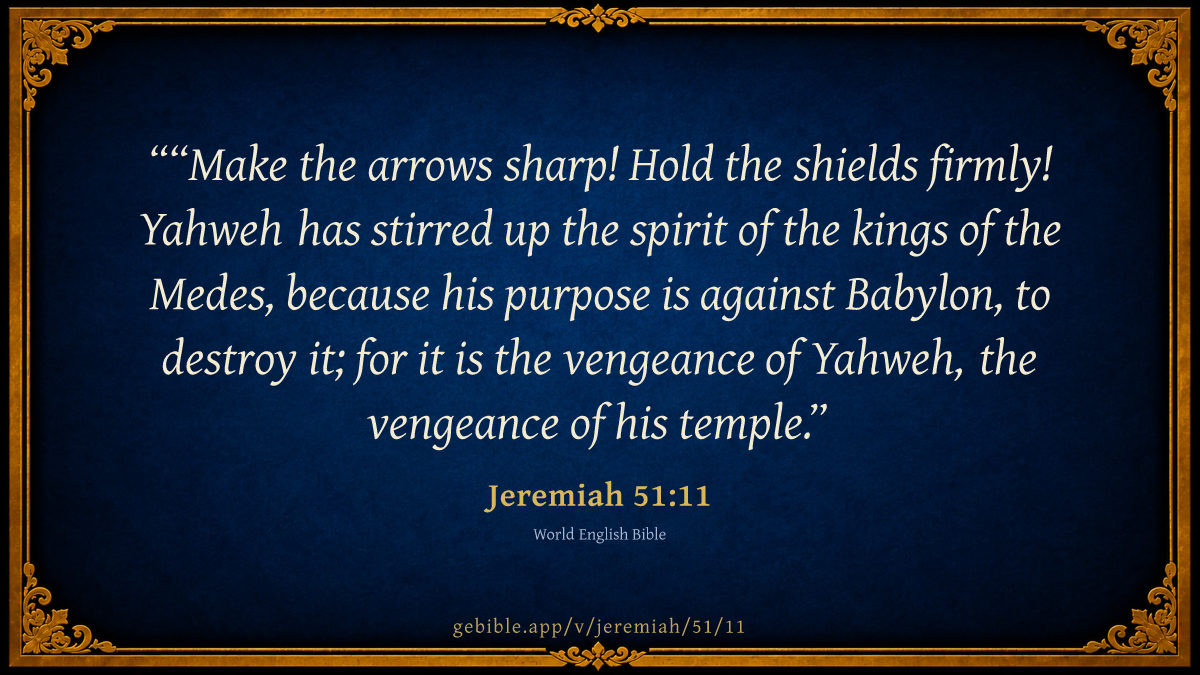
“Make the arrows sharp! Hold the shields firmly! Yahweh has stirred up the spirit of the kings of the Medes, because his purpose is against Babylon, to destroy it; for it is the vengeance of Yahweh, the vengeance of his temple.
Parallel Translations
-
“Make the arrows sharp! Hold the shields firmly! Yahweh has stirred up the spirit of the kings of the Medes, because his purpose is against Babylon, to destroy it; for it is the vengeance of Yahweh, the vengeance of his temple.
-
Make bright the arrows; gather the shields: the LORD hath raised up the spirit of the kings of the Medes: for his device is against Babylon, to destroy it; because it is the vengeance of the LORD, the vengeance of his temple.
-
Make bright the arrows, fill the quivers, the LORD hath roused the spirit of the kings of the Medes; because His device is against Babylon, to destroy it; for it is the vengeance of the LORD, the vengeance of His temple.
Cross-references (31)
Passages linked to Jeremiah 51:11 in the Treasury of Scripture Knowledge, ordered by reader-vote popularity; verse text shown in World English Bible.
- Jeremiah 46:4 Harness the horses, and get up, you horsemen, and stand up with your helmets. Polish the spears, put on the coats of mail.
- Jeremiah 50:45 Therefore hear the counsel of Yahweh, that he has taken against Babylon; and his purposes, that he has purposed against the land of the Chaldeans: Surely they will drag them away, even the little ones of the flock. Surely he will make their habitation desolate over them.
- Jeremiah 46:9 Go up, you horses! Rage, you chariots! Let the mighty men go out: Cush and Put, who handle the shield; and the Ludim, who handle and bend the bow.
- Jeremiah 50:9 For, behold, I will stir up and cause to come up against Babylon a company of great nations from the north country; and they will set themselves in array against her. She will be taken from there. Their arrows will be as of an expert mighty man. None of them will return in vain.
- 1 Kings 11:14 Yahweh raised up an adversary to Solomon: Hadad the Edomite. He was one of the king’s offspring in Edom.
- 1 Kings 11:23 God raised up an adversary to him, Rezon the son of Eliada, who had fled from his lord Hadadezer king of Zobah.
- 1 Chronicles 5:26 So the God of Israel stirred up the spirit of Pul king of Assyria, and the spirit of Tilgath Pilneser king of Assyria, and he carried them away, even the Reubenites, and the Gadites, and the half-tribe of Manasseh, and brought them to Halah, Habor, Hara, and to the river of Gozan, to this day.
- 2 Chronicles 36:22 Now in the first year of Cyrus king of Persia, that Yahweh’s word by the mouth of Jeremiah might be accomplished, Yahweh stirred up the spirit of Cyrus king of Persia, so that he made a proclamation throughout all his kingdom, and put it also in writing, saying,
- Ezra 1:1 Now in the first year of Cyrus king of Persia, that Yahweh’s word by Jeremiah’s mouth might be accomplished, Yahweh stirred up the spirit of Cyrus king of Persia, so that he made a proclamation throughout all his kingdom, and put it also in writing, saying,
- Psalms 74:3-11 Lift up your feet to the perpetual ruins, all the evil that the enemy has done in the sanctuary. Your adversaries have roared in the middle of your assembly. They have set up their standards as signs. They behaved like men wielding axes, cutting through a thicket of trees. Now they break all its carved work down with hatchet and hammers. They have burned your sanctuary to the ground. They have profaned the dwelling place of your Name. They said in their heart, “We will crush them completely.” They have burned up all the places in the land where God was worshiped. We see no miraculous signs. There is no longer any prophet, neither is there among us anyone who knows how long. How long, God, shall the adversary reproach? Shall the enemy blaspheme your name forever? Why do you draw back your hand, even your right hand? Take it from your chest and consume them!
- Psalms 83:3-9 They conspire with cunning against your people. They plot against your cherished ones. “Come,” they say, “let’s destroy them as a nation, that the name of Israel may be remembered no more.” For they have conspired together with one mind. They form an alliance against you. The tents of Edom and the Ishmaelites; Moab, and the Hagrites; Gebal, Ammon, and Amalek; Philistia with the inhabitants of Tyre; Assyria also is joined with them. They have helped the children of Lot. Do to them as you did to Midian, as to Sisera, as to Jabin, at the river Kishon;
- Isaiah 10:26 Yahweh of Armies will stir up a scourge against him, as in the slaughter of Midian at the rock of Oreb. His rod will be over the sea, and he will lift it up like he did against Egypt.
- Isaiah 13:17-18 Behold, I will stir up the Medes against them, who will not value silver, and as for gold, they will not delight in it. Their bows will dash the young men in pieces; and they shall have no pity on the fruit of the womb. Their eyes will not spare children.
- Isaiah 21:2 A grievous vision is declared to me. The treacherous man deals treacherously, and the destroyer destroys. Go up, Elam; attack! I have stopped all of Media’s sighing.
- Isaiah 21:5 They prepare the table. They set the watch. They eat. They drink. Rise up, you princes, oil the shield!
- Isaiah 41:25 “I have raised up one from the north, and he has come, from the rising of the sun, one who calls on my name, and he shall come on rulers as on mortar, and as the potter treads clay.
- Isaiah 45:1 Yahweh says to his anointed, to Cyrus, whose right hand I have held, to subdue nations before him, and strip kings of their armor; to open the doors before him, and the gates shall not be shut:
- Isaiah 45:5 I am Yahweh, and there is no one else. Besides me, there is no God. I will strengthen you, though you have not known me,
- Isaiah 46:11 I call a ravenous bird from the east, the man of my counsel from a far country. Yes, I have spoken. I will also bring it to pass. I have planned. I will also do it.
- Jeremiah 50:14-15 Set yourselves in array against Babylon all around, all you who bend the bow; shoot at her. Spare no arrows; for she has sinned against Yahweh. Shout against her all around. She has submitted herself. Her bulwarks have fallen. Her walls have been thrown down, for it is the vengeance of Yahweh. Take vengeance on her. As she has done, do to her.
- Jeremiah 50:25 Yahweh has opened his armory, and has brought out the weapons of his indignation; for the Lord, Yahweh of Armies, has a work to do in the land of the Chaldeans.
- Jeremiah 50:28-29 Listen to those who flee and escape out of the land of Babylon, to declare in Zion the vengeance of Yahweh our God, the vengeance of his temple. “Call together the archers against Babylon, all those who bend the bow. Encamp against her all around. Let none of it escape. Pay her back according to her work. According to all that she has done, do to her; for she has been proud against Yahweh, against the Holy One of Israel.
- Jeremiah 51:12 Set up a standard against the walls of Babylon! Make the watch strong! Set the watchmen, and prepare the ambushes; for Yahweh has both purposed and done that which he spoke concerning the inhabitants of Babylon.
- Jeremiah 51:24 “I will render to Babylon and to all the inhabitants of Chaldea all their evil that they have done in Zion in your sight,” says Yahweh.
- Jeremiah 51:27-29 “Set up a standard in the land! Blow the trumpet among the nations! Prepare the nations against her! Call together against her the kingdoms of Ararat, Minni, and Ashkenaz! Appoint a marshal against her! Cause the horses to come up as the rough canker worm! Prepare against her the nations, the kings of the Medes, its governors, and all its deputies, and all the land of their dominion! The land trembles and is in pain; for the purposes of Yahweh against Babylon stand, to make the land of Babylon a desolation, without inhabitant.
- Jeremiah 51:35 May the violence done to me and to my flesh be on Babylon!” the inhabitant of Zion will say; and, “May my blood be on the inhabitants of Chaldea!” will Jerusalem say.
- Habakkuk 2:17-20 For the violence done to Lebanon will overwhelm you, and the destruction of the animals, which made them afraid; because of men’s blood, and for the violence done to the land, to every city and to those who dwell in them. “What value does the engraved image have, that its maker has engraved it; the molten image, even the teacher of lies, that he who fashions its form trusts in it, to make mute idols? Woe to him who says to the wood, ‘Awake!’ or to the mute stone, ‘Arise!’ Shall this teach? Behold, it is overlaid with gold and silver, and there is no breath at all within it. But Yahweh is in his holy temple. Let all the earth be silent before him!”
- Zechariah 12:2-3 “Behold, I will make Jerusalem a cup of reeling to all the surrounding peoples, and it will also be on Judah in the siege against Jerusalem. It will happen in that day, that I will make Jerusalem a burdensome stone for all the peoples. All who burden themselves with it will be severely wounded, and all the nations of the earth will be gathered together against it.
- Zechariah 14:2 For I will gather all nations against Jerusalem to battle; and the city will be taken, the houses rifled, and the women ravished. Half of the city will go out into captivity, and the rest of the people will not be cut off from the city.
- Zechariah 14:12 This will be the plague with which Yahweh will strike all the peoples who have fought against Jerusalem: their flesh will consume away while they stand on their feet, and their eyes will consume away in their sockets, and their tongue will consume away in their mouth.
- Revelation 17:16-17 The ten horns which you saw, and the beast, these will hate the prostitute, will make her desolate, will strip her naked, will eat her flesh, and will burn her utterly with fire. For God has put in their hearts to do what he has in mind, to be of one mind, and to give their kingdom to the beast, until the words of God should be accomplished.
Cross-references from openbible.info (CC BY 4.0)
Explain this verse (17 sources)
Historical commentary, presented as a primary source — not an endorsement.
Private notes
Saved on this device only — never synced or sent anywhere.
John Calvin 1540 · Public Domain These words might have been addressed to the Medes…
These words might have been addressed to the Medes as well as to the Babylonians. If the latter meaning be approved, that is, that the Prophet addresses the Babylonians, the words are a taunt, as though he had said, that they were to no purpose spending their labors in preparing their armies, because God would be stronger than they, and that the Medes would carry on war under his banner and authority. Nor would what I have also stated, be unsuitable, that is, that the Prophet bids the Medes to prepare themselves and to put on their arms, that they might fight courageously against the Babylonians.
He now adds the main thing, — that the kings of the Medes would come against Babylon, because they had been called from above; and he mentions the word spirit, that he might more fully express that men’s minds are ruled and turned by the secret power of God, and also that whatever power or boldness is found in them, proceeds altogether from God; as though he had said, that God would so prepare the Medes and the Persians, that he would not only strengthen their arms, hands, and feet, for the war, but would also lead them, and overrule their passions — that he would, in short, turn their spirit here and there, according to his will. He does not now speak of the wind, as before; nor does he point out the enemies generally, but expressly names the Medes. For though Cyaxares, or Darius, as he is called by Daniel, was not a very prudent man, nor skillful in war, yet, as he was higher in dignity, the Prophet here mentions the Medes rather than the Persians. Cyrus excelled in celerity, and was also a man of singular wariness, activity, and boldness: but as he was by no means wealthy, and ruled over a rustic nation, and the limits of his kingdom were confined, the Prophet rightly speaks here of the Medes only, whose power far exceeded that of the Persians.
Read full note →
But we hence learn, that Jeremiah did not speak as a man, but was the instrument of the Spirit; for it was an indubitable seal to his prophecy, that he predicted an event a long time before the war took place. Cyrus was not yet born, who was the leader in this war: nor was Darius as yet born; for seventy years elapsed from the time the Prophet spoke to the taking of Babylon. We then see that this passage is a sure proof of his faithfulness and authority.
He afterwards adds, that God’s thought respecting Babylon was to destroy her He still speaks after the manner of men, and at the same time obviates an objection which might have disturbed weak minds, because Babylon not only remained safe and secure for a long time, but also received an increase of power and dignity. The minds then of the godly might have desponded, when there seemed to be no accomplishment of this prophecy. Hence the Prophet calls attention to the thought of God, as though he had said, that though God did not immediately put forth his hand, if, was yet enough for the faithful to know what he had decreed. in short, the Prophet reminded, them, that they ought to acquiesce in God’s decree, though his work was yet hid.
And he again confirms the Jews, by adding, that it would be his vengeance, even that of God, because he disregarded not his Temple. By these words he intimates that the worship, according to the law, was pleasing to God, because the Jews became a distinct people from heathen nations, when the rule as to religion was prescribed to them. Then the Prophet intimates, that though any sort of religion pleased men, there is yet but one which is approved by God, even that which he himself has commanded. The case being so, we may conclude, that God cannot long endure his worship to be scoffed at. For we know how scornfully and proudly the Chaldeans spoke of the Temple, so that they not only uttered blasphemies, but also heaped every reproach they could think of on the Temple. Since that religion was founded on God’s word, it follows that it could not be but that he must have at length risen and vindicated the wrongs done to him by the Chaldeans. We now perceive the meaning of the Prophet, when he says, that it would be the vengeance of God; and he adds, because God will avenge his temple. He confirms the Jews, when he declares that God would be the vindicator of his own worship; and he, at the same time, shows, that the worship according to the law, which had been taught by Moses, was the only worship in the world which God approved. It afterwards follows, —
John Calvin's Commentaries (1540-1563) — public domain. Text from the Calvin Translation Society English edition (1840s-50s) via the Christian Classics Ethereal Library (ccel.org). Calvin's coverage is partial (roughly two-thirds of the Bible); uncommented books and verses are honest gaps, never fabricated. The 19th-century editor's footnotes and remarks are omitted so the notes are faithfully Calvin's own voice.
Geneva Bible translators 1599 · Public Domain Or, fill, or multiply.
Or, fill, or multiply.
For the wrong done to his people and to his Temple, Jer. 50:28.
Geneva Bible (1599) marginal notes — public domain.
John Trapp 1656 · Public Domain Jer 51:11 Make bright the arrows; gather the shields:…
Jer 51:11 Make bright the arrows; gather the shields: the LORD hath raised up the spirit of the kings of the Medes: for his device [is] against Babylon, to destroy it; because it [is] the vengeance of the LORD, the vengeance of his temple.
Ver. 11. Make bright the arrows,] q.d., Do so, O Chaldeans, if ye think it will boot you anything at all for the shoring up of your tottering state, whereas the Lord is resolved to bring it down.
John Trapp, A Commentary or Exposition upon All the Books of the Old and New Testament (1647–1656) — public domain. Text from a community e-Sword module.
Matthew Poole 1685 · Public Domain Make bright the arrows; prepare the arrows for fighting,…
Make bright the arrows; prepare the arrows for fighting, whether by feathering, sharpening, or polishing and cleansing of them, is not much material.
Gather the shields; you that are Chaldeans, gather all the shields you have together, you will have need of them all: or, you that are the enemies of the Chaldeans, gather you together your shields. For God hath put a spirit into Cyrus and Darius, &c., and his design is against Babylon to destroy it. It is a day in which God is resolved to take vengeance on Babylon, to take vengeance for the indignities they have offered to, and the horrible profanation of, his temple.
Matthew Poole's English Annotations on the Holy Bible (1683–1685) — public domain. Text from a community e-Sword/MySword module.
John Gill 1763 · Public Domain Make bright the arrows,.... Which were covered with rust;…
Make bright the arrows,.... Which were covered with rust; scour them of it; anoint them with oil, as armour were wont to be; make them neat, clean, and bright, that they may pierce the deeper; hence we read of a "polished shaft", or arrow, one made bright and pure, Isa 49:2; agreeably to this some render the word "sharpen the arrows" (k); so the Targum. The word has the signification of "choosing"; but, as Gussetius observes (l), whether the direction be to choose the best arrows, or to scour clean and polish them, the end is the same; namely, to have such as are most fit for use. Joseph Kimchi derives the word from another, which signifies a feather; and so renders it, "feather the arrows" (m); that they may fly the swifter. These and what follow are either the words of God, or of the prophet; or, as some think, of the Jews about to return to Judea, whose words are continued, exhorting the Medes and Persians to go on with the war against the Chaldeans; but they rather seem to be addressed to the Chaldeans themselves, putting them upon doing these things; and suggesting, that when they had done all they could, it would be to no purpose:
gather the shields; which lay scattered about and neglected in time of peace: or, "fill" them; fill the hands with them; or bring in a full or sufficient number; since there would be now occasion for them, to defend them against the enemy. The Targum, and several versions, render it, "fill the quivers" (n); that is, with arrows; and so Jarchi: or, "fill the shields" (o); that is, with oil; anoint them, as in Isa 21:5;
Read full note →
the Lord hath raised up the spirit of the kings of the Medes; of Cyaxares, or Darius the Mede, and of Cyrus, who succeeded his uncle as king of Media; and indeed the army that came against Babylon was an army of Medes joined by the Persians, Cyrus being employed as general of it by his uncle. The Septuagint, Syriac, and Arabic versions, read it, "the spirit of the king of the Medes"; with which the following clause seems to agree:
for his device is against Babylon, to destroy it; the device of the king of the Medes, Darius; or rather the device of the Lord, who stirred up the spirit of the kings of the Medes; put it into their hearts to fulfil his will; and gave them wisdom and skill, courage and resolution, to do it; and as he will to the kings of the earth against mystical Babylon, Rev 17:16;
because it is the vengeance of the Lord, the vengeance of his temple; his vengeance on Babylon, for the destruction of his temple, and the profanation of it; see Jer 50:28.
(k) "acuite sagittas", V. L. Castalio; "exacuite", Montanus. (l) Ebr. Comment. p. 148. (m) "Ponite pennas in sagittis", so some in Vatablus. (n) , Sept. "implete pharetras", V. L. Castalio, So Syr. this version is prefered by Gussetius, Ebr. Comment. p. 860, 945. (o) "Implete scuta, scil. oleo", Stockius, p. 1098.
John Gill's Exposition of the Whole Bible (1746–1763) — public domain (CC PDM 1.0). Text via the HelloAO Bible API.
Adam Clarke 1810 · Public Domain Verse 11. Make bright the arrows] This is the…
Verse 11. Make bright the arrows] This is the prophet's address to Babylon.
The Lord hath raised up the spirit of the kings of the Medes] Of Cyaxares king of Media, called Darius the Mede in Scripture; and of Cyrus king of Persia, presumptive heir of the throne of Cyaxares, his uncle. Cambyses, his father, sent him, Cyrus, with 30,000 men to assist his uncle Cyaxares, against Neriglissar king of Babylon, and by these was Babylon overthrown.
Adam Clarke's Commentary on the Bible (1810–1826) — public domain. Text from a community e-Sword/MySword module.
Joseph Benson 1811 · Public Domain Jer 51:11-12. Make bright the arrows, gather the shields…
Jer 51:11-12. Make bright the arrows, gather the shields — Hebrew, מלאו השׁלשׂים, the quivers. Thus the LXX., πληρουτε τας φαρετρας, with whom agree the Vulgate, Castalio, and others. The meaning is, Prepare all the instruments of war to defend yourselves, ye Babylonians, for you will have need of them all. The Lord hath raised up the spirit of the kings of the Medes — Neriglissar, king of Babylon, having formed an alliance against the Medes, Cambyses sent his son Cyrus with an army of thirty thousand Persians to join the Medes, commanded by Cyaxares, king of Media, Cyrus’s uncle; called in Scripture, Darius the Mede. It was properly his army that made the expedition against the Babylonians, Cyrus being employed as his general. Persia was then a small part of the empire of Media, and of little account till Cyrus advanced its reputation; and even then it was called the kingdom of the Medes and Persians, the Medes having still the preference: see Xenophon’s Cyropæd., lib. 1. and Lowth. Set up the standard upon, or rather, before the walls of Babylon; and proceed to take all the necessary steps to distress her, and make yourselves masters of her: for the Lord hath both devised, &c. — For God will both favour your undertaking, and will enable you to accomplish it.
Joseph Benson's Commentary on the Old and New Testaments (1811–1818) — public domain. Text from a community e-Sword module.
Albert Barnes 1834 · Public Domain Make bright - Rather, Sharpen.
Make bright - Rather, Sharpen.
The Medes Gen 10:2 were a branch of the great Aryan family, who as conquerors had seized upon the vast regions extending from the Caspian Sea to the eastern borders of Mesopotamia, but without being able to dispossess the Turanian tribes who had previously dwelt there. They were divided into numerous clans, each with its own local chief, the leaders of the larger sections being those who are here called kings.
Albert Barnes' Notes on the Bible (1834–1885) — public domain. Text from a community e-Sword/MySword module.
Haydock's Catholic Bible Commentary 1859 · Public Domain Sharpen. He addresses ironically the citizens of Babylon. ---…
Sharpen. He addresses ironically the citizens of Babylon. --- Medes. Thus the subjects of the Persian monarchs are commonly styled. (Calmet)
George Leo Haydock (1774–1849), Haydock's Catholic Family Bible and Commentary, 1859 edition — public domain. Excludes Psalms (Douay-Rheims chapter numbering differs from Protestant) and Deuterocanonical books (Catholic canon only).
Lange's Commentary on the Holy Scriptures 1864 · Public Domain 11 Sharpen9 the arrows, fill the shields !10
13. THE TRIPLE THREATENING
Jer_51:11-14
Read full note →
11 Sharpen9 the arrows, fill the shields !10
Jehovah hath awakened the spirit of the kings of Media,
For his mind is against Babylon to destroy it;
For the vengeance of Jehovah it is,
The vengeance of his sanctuary.
12 Against the walls of Babylon raise standards,
Strengthen the watch, appoint watchmen,
Lay the ambush!
For as Jehovah hath thought so also hath he done—
All that he hath spoken against the inhabitants of Babylon.
13 O thou that dwellest on great waters, on greatness of treasures!
Thine end is come, the ell of thy section.11
14 Sworn hath Jehovah Zebaoth by himself:12
“Have I filled, thee with men as with grasshoppers,
So shall they sing over thee the song of the vintage.”
EXEGETICAL AND CRITICAL
A triple call of threatening against Babylon forming a climax; first (Jer_51:11 a) a general summons to war, with mention of the warlike power thus called upon, then (Jer_51:12 a) an immediate attack on the walls of the city is commanded, and in the third place (Jer_51:13), its approaching end is announced. Each of the calls is, however, followed by a statement of reasons, in which also a climax may be perceived. For Jer_51:11 b announces the decree of Jehovah and its cause; Jer_51:12 b contains the assurance that with the Lord purposing and acting are the same thing. Jer_51:14 strengthens the threatening of Jer_51:13 by reference to a solemn oath of Jehovah.
Jer_51:11. Sharpen … sanctuary.—Hath awakened, etc. Comp. rems, on Jer_51:1. This passage is taken from Isa_13:17, from which we see that the definition of the enemies, threatening from the north (Jer_50:9; Jer_50:41), as the Medes is older than Jeremiah. Comp. Jer_51:28. In this sentence the prophet informs us to whom the summons of the preceding clause is addressed. The second half of the verse contains a double statement of cause, first the proximate and immediate, then the remote and mediate, but at the same time deepest ground of the summons. Comp. Jer_50:15; Jer_50:28.
Jer_51:12. Against the walls … of Babylon. The military signals are to precede the attack on the walls of Babylon. On account of against the walls, נֵם, standards, seems here to be not the mere general signal of convocation or message, but a military sign indicating a particular point of attack. The word also denotes the flags of ships (Isa_33:23; Eze_27:7). Comp. Winer, R.-W.-B., s. v. “Fahnen” and “Schiffe.” The watch and watchmen appear to be related to each other as defensive and offensive (comp. 2Sa_11:16, and Hitzig).—Ambush. Comp. Jos_8:14-16; Jdg_20:33-35.—For, etc. To wish and to do sire to be shown to be identical with Jehovah. Comp. Jer_4:28; Lam_2:17; Zec_1:6; Zec_8:14-15.
Jer_51:13-14. O thou that dwellest … vintage. The greatest supports of the power of Babylon were the waters surrounding it (comp. vers, 32 and 36; Jer_50:38; Isa_21:1; Psa_137:1), and the great riches which Nebuchadnezzar accumulated (comp. Βαβυλὼν ἡ πολύχρυσος, Æsch. Pers. 52, and Oppert, Exped. en Mésop. I. p. 175), and which rendered it possible for him to erect his immense buildings. Duncker says in reference to this: “Nebuchadnezzar had no need to fear that he would exhaust the subjects of his native land by the cost of his buildings. The immense booty of Nineveh, the greater part of which accrued to the Babylonians, the plunder of Jerusalem, the tributes of Syria and the Phœnician cities furnished the greatest means. The fruitfulness of the Babylonian territory, the produce of the fields depended on the overflowing of the Euphrates. By an extensive system of dams, canals and conduits, Nebuchadnezzar succeeded both in conducting the water of the Euphrates to every point of the Babylonian plain, and in draining the marshes and averting the violent inundations, which were not infrequent” (Gesch. d. Alterth., I., S. 846). Add to this that these water-courses were of the greatest importance for the defence of the country. “Their object was primarily irrigation and navigation; but they afforded at the same time strong lines of defence against the enemy,” says Niebuhr (Ass. u. Bab., S. 229).—On a cylinder in the possession of Mr. Thomas Phillips, which has been deciphered by Grotefend, Nebuchadnezzar says (according to Oppert, p. 231): “Tout autour je fis couler de l’eau dans cette digue immense de terre. A travers ces grandes eaux comparables aux abimes de la mer, je fis faire un conduit.” Comp. Ib., p. 234.—Their end is come. Comp. Gen_6:13.—Ell of thy section. There are two renderings of this, “measure, end of thy fury, avarice, gain.” So Grotius, Capelle, Chr. B. Michaelis, Rosenmueller, Ewald, Hitzig, But אַמָּה is the ell or yard measure, and does not involve the idea of full measure, or end. Hence the other rendering is to be preferred, which, after the example of Jerome (pedalis præcisionis tuæ), is adopted by Venema, J. D. Michaelis, Eichhorn, De Wette, Gesenius, Böttcher (Proben altestam. Schrifterkl., S. 289, Anm. m), Maurer, Graf. The idea lying at the foundation of the expression “the ell of the cutting thee off,” is that the thread of life is measured, and when a definite number of yards is reached, will be cut off. Comp, Isa_38:12; Job_6:9.—Have I, כִּי אִם, are not here particles of asseveration, as in 2Sa_15:21; 2Ki_5:20, but conditional, if I have filled thee with men as with grasshoppers (comp. Jer_46:23), this was only in order to be able to tread the more abundant vintage (הֵידָד. Comp. rems. on Jer_25:30). Hence even the song of the treaders is a sign of their work yielding abundant returns.
DOCTRINAL AND ETHICAL
1. “Daniel’s Babylonian empire resumes, as it were, the thread which was broken off with the tower-erection and kingdom of Nimrod. In the Babylonian tower-building the whole of the then existing humanity was united against God; with the Babylonian kingdom began the period of the universal monarchies, which again aspired after an atheistical union of entire humanity. Babylon has since and even to the Revelation (Jeremiah 18) remained the standing type of this world.” Auberlen, Der proph. Daniel, S. 230.
2. For what reason does Babylon appear as a type of the world? Why not Nineveh, or Persepolis, or Tyre, or Memphis, or Rome? Certainly not because Babylon was greater, more glorious, more powerful or prouder and more ungodly than those cities and kingdoms. Nineveh especially was still greater than Babylon (comp. Duncker, Gesch. d. Alterth. I. S. 474, 5), and Assyria was not less hostile to the theocracy, having carried away into captivity the northern and larger half of the people of Israel. Babylon is qualified for this representation in two ways: 1. because it is the home of worldly princedom and titanic arrogance (Gen_10:8; Gen_11:1-4); 2. because Babylon destroyed the centre of the theocracy, Jerusalem, the temple and the theocratic kingdom, and first assumed to be the single supreme power of the globe.
3. “When God has used a superstitious, wicked and tyrannical nation long enough as His rod, He breaks it in pieces and finally throws it into the fire. For even those whom He formerly used as His chosen anointed instruments He then regards as but the dust in the streets or as chaff before the wind.” Cramer.
4. “No monarch is too rich, too wicked, too strong for God the Lord. And He can soon enlist and engage soldiers whom He can use against His declared enemies.” Cramer.
5. “Israel was founded on everlasting foundations, even God’s word and promise. The sins of the people brought about that it was laid low in the dust, but not without hope of a better resurrection. Babylon, on the other hand, must perish forever, for in it is the empire of evil come to its highest bloom. Jeremiah owns the nothingness of all worldly kingdoms, since they are all under this national order to serve only for a time. We are to be subject to them and seek their welfare for the sake of the souls of men, whom God is educating therein; a Christian however cannot be enthusiastic for them after the manner of the ancient heathen nor of ancient Israel, for here we have no abiding city, our citizenship is in heaven. The kingdoms of this world are no sanctuaries for us and we supplicate their continuance only with the daily bread of the fourth petition. Jeremiah applies many words and figures to Babylon which he has already used in the judgments on other nations, thus to intimate that in Babylon all the heathenism of the world culminates, and that here also must be the greatest anguish. What, however, is here declared of Babylon must be fulfilled again on all earthly powers in so far as, treading in its footprints, they take flesh for their arm and regard the material of this world as power, whether they be called states or churches.” Diedrich.
6. On Jer_50:2. In putting into the mouth of Israel, returning from Babylon, the call to an everlasting covenant with Jehovah, the prophet causes them 1. to confess that they have forgotten the first covenant; 2. he shows us that the time of the new covenant begins with the redemption from the Babylonish captivity. He was far, however, from supposing that this redemption would be only a weak beginning, that the appearance of the Saviour would be deferred for centuries, that Israel would sink still deeper as an external πολιτεία, and that finally the Israel of the new covenant would itself appear as a μυστήριον, εἰς ὃ ἐπιθυμοῦσιν ἄγγελοι παρακύψαι (1Pe_1:9-12).
7. From what Jeremiah has already said in Jer_31:31-34 of the new covenant we see that its nature and its difference from the old is not unknown to him. Yet he knows the new covenant only in general. He knows that it will be deeply spiritual and eternal, but how and why it will be so is still to him part of the μυστήριον.
8. On Jer_50:6. Jeremiah here points back to Jeremiah 23. Priests, kings and prophets, who should discharge the office of shepherds, prove to be wolves. Yea, they are the worst of wolves, who go about in official clothing. There is therefore no more dangerous doctrine than that of an infallible office. Jer_14:14; Mat_7:15; Mat_23:2-12.
9. On Jer_50:7. It is the worst condition into which a church of God can come, when the enemies who desolate it can maintain that they are in the right in doing so. It is, however, a just nemesis when those who will not hear the regular messengers of God must be told by the extraordinary messengers of God what they should have done. Comp. Jer_40:2-3.
10. On Jer_50:8. “Babylon is opened, and it must be abandoned not clung to, for the captivity is a temporary chastisement, not the divine arrangement for the children of God. God’s people must in the general redemption go like rams before the herd of the nations, that these may also attach themselves to Israel, as this was fulfilled at the time of Christ in the first churches and the apostles, who now draw the whole heathen world after them to eternal life. Here the prophet recognizes the new humanity, which proceeds from the ruins of the old, in which also ancient Israel leads the way; thus all, who follow it, become Israel.” Diedrich.—“The heathen felt somewhat of the divine punishment when they overcame so easily the usually so strongly protected nation. But Jeremiah shows them still how they deceived themselves in thinking that God had wholly rejected His people, for of the eternal covenant of grace they certainly understood nothing.” Heim and Hoffmann on the Major Prophets.
11. On Jer_50:18. “The great powers of the world form indeed the history of the world, but they have no future. Israel, however, always returns home to the dear and glorious land. The Jews might as a token of this return under Cyrus; the case is however this, that the true Holy One in Israel, Christ, guides us back to Paradise, when we flee to His hand from the Babylon of this world and let it be crucified for us.” Diedrich.
12. On Jer_50:23. “Although the Chaldeans were called of God for the purpose of making war on the Jewish nation on account of their multitudinous sins, yet they are punished because they did it not as God with a pure intention, namely, to punish the wrong in them and keep them for reformation; for they were themselves greater sinners than the Jews and continued with impenitence in their sins. Therefore they could not go scot-free and remain unpunished. Moreover, they acted too roughly and dealt with the Jews more harshly than God had commanded, for which He therefore fairly punished them. As God the Lord Himself says (Isa_47:6): When I was angry with My people I gave them into thine hands; but thou shewedst them no mercy. Therefore it is not enough that God’s will be accomplished, but there must be the good intention in it, which God had, otherwise such a work may be a sin and call down the divine punishment upon it.” Würtemb. Summ.
13. On Jer_50:31-34. “God calls Babylon Thou Pride, for pride was their inward force and impulse in all their actions. But worldly pride makes a Babylon and brings on a Babylon’s fate .… Pride must fall, for it is in itself a lie against God, and all its might must perish in the fire; thus will the humble and meek remain in possession of the earth: this has a wide application through all times, even to eternity.” Diedrich.
14. On Jer_51:33. “Israel is indeed weak and must suffer in a time of tyranny; it cannot help itself, nor needs it to do so, for its Redeemer is strong, His name The Lord Zebaoth—and He is, now, having assumed our flesh, among us and conducts our cause so that the world trembles.” Diedrich.
15. On Jer_50:45. “An emblem of the destruction of anti-christian Babylon, which was also the true hammer of the whole world. This has God also broken and must and will do it still more. And this will the shepherd-boys do, as is said here in Jer_51:45 (according to Luther’s translation), that is, all true teachers and preachers.” Cramer.
16. On Jeremiah 51. “The doctrines accord in all points with the previous chapter. And the prophet Jeremiah both in this and the previous chapter does nothing else but make out for the Babylonians their final discharge and passport, because they behaved so valiantly and well against the people of Judah, that they might know they would not go unrecompensed. For payment is according to service. And had they done better it would have gone better with them. It is well that when tyrants succeed in their evil undertakings they should not suppose they are God’s dearest children and lean on His bosom, since they will yet receive the recompense on their crown, whatever they have earned.” Cramer.
17. [“Though in the hand of Babylon is a golden cup; she chooses such a cup, in order that men’s eyes may be dazzled with the glitter of the gold, and may not inquire what it contains. But mark well, in the golden cup of Babylon is the poison of idolatry, the poison of false doctrines, which destroy the souls of men. I have often seen such a golden cup, in fair speeches of seductive eloquence: and when I have examined the venomous ingredients of the golden chalice, I have recognized the cup of Babylon.” Origen in Wordsworth.—S. R. A.]
“The seat and throne of Anti-christ is expressly named Babylon, namely, the city of Rome, built on the seven hills (Rev_17:9). Just as Babylon brought so many lands and kingdoms under its sway and ruled them with great pomp and pride (the golden cup, which made all the world drunk, was Babylon in the hand of the Lord (Jer_51:7), and all the heathen drank of the wine and became mad)—so has the spiritual Babylon a cup in its hand, full of the abomination and uncleanness of its whoredom, of which the kings of the earth and all who dwell on the earth have been made drunk. As it is said of Babylon that she dwells by great waters and has great treasures, so writes John of the Romish Babylon, that it is clothed in silk and purple and scarlet and adorned with gold, precious stones and pearls (Rev_18:12). Of Babylon it is said that the slain in Israel were smitten by her; so also the spiritual Babylon is become drunk with the blood of the saints (Rev_17:6). Just, however, as the Chaldean Babylon is a type of the spiritual in its pride and despotism, so also is it a type of the destruction which will come upon it. Many wished to heal Babylon but she would not be healed; so many endeavor to support the ruinous anti-christian Babylon, but all in vain. For as Babylon was at last so destroyed as to be a heap of stones and abode of dragons, so will it be with anti-christian Babylon. Of this it is written in Rev_14:8 : She is fallen, fallen, that great city, for she has made all nations drink of the wine of her fornication. And again, Babylon the great is fallen, and is become the habitation of devils and a hold of all foul and hateful birds (Rev_18:2). As the inhabitants of Babylon were admonished to flee from her, that every man might deliver his soul (Jer_51:6)—and again, My people, go ye out from the midst of her and deliver every man his soul, etc. (Jer_51:45)—so the Holy Spirit admonishes Christians almost in the same words to go out from the spiritual Babylon, that they be not polluted by her sins and at the same time share in her punishment. For thus it is written in Rev_18:4, I heard, says John, a voice from heaven saying, Go ye out of her, My people, that ye be not partakers of her sins and that ye receive not of her plagues, for her sins reach unto heaven and God remembers her iniquities.” Wurtemb. Summarien.
18. On Jer_51:5. “A monarch can sooner make an end of half a continent than draw a nail from a hut which the Lord protects.—And if it is true that Kaiser Rudolph, when he revoked the toleration of the Picards and the same day lost one of his principal forts, said, ‘I thought it would be so, for I grasped at God’s sceptre’ (Weismanni, Hist. Eccl. Tom. II. p. 320)—this was a sage remark, a supplement to the words of the wise.” Zinzendorf.
19. On Jer_51:9. We heal Babylon, but she will not be healed. Babylon is an outwardly beautiful but inwardly worm-eaten apple. Hence sooner or later the foulness must become noticeable. So is it with all whose heart and centre is not God. All is inwardly hollow and vain. When this internal vacuity begins to render itself externally palpable, when here and there a rent or foul spot becomes visible, then certainly come the friends and admirers of the unholy form and would improve, cover up, sew up, heal. But it does not avail. When once there is death in the body no physician can effect a cure.
20. On Jer_51:17; Jer_51:19-20. “The children of God have three causes why they may venture on Him. 1. All men are fools, their treasure is it not; 2. The Lord is their hammer; He breaks through everything, and 3, they are an instrument in His hand, a heritage; in this there is happiness.” Zinzendorf.
21. On Jer_51:41-44. “How was Sheshach thus won, the city renowned in all the world thus taken? No one would have thought it possible, but God does it. He rules with wonders and with wonders He makes His church free. Babylon is a wonder no longer for its power, but for its weakness. We are to know the world’s weakness even where it still appears strong. A sea of hostile nations has covered Babylon. Her land is now a desolation. God takes Bel, the principal idol of Babylon, symbolizing its whole civil powers in hand, and snatches his prey from his teeth. Our God is stronger than all worldly forces, and never leaves us to them.” Diedrich.
22. On Jer_51:58. “Yea, so it is with all walls and towers, in which God’s word is not the vital force, even though they be entitled churches and cathedrals … God’s church alone possesses permanence through His pure word.” Diedrich.
23. On Jer_51:60-64. When we wish to preserve an archive safely, we deposit it in a record-office where it is kept in a dry place that no moisture may get to it. Seraiah throws his book-roll into the waters of the Euphrates, which must wash it away, dissolve and destroy it. But this was of no account. The main point was that he, Seraiah, as representative of the holy nation had taken solemn stock of the word of God against Babylon, and as it were taken God at His word, and reminded Him of it. In this manner the matter was laid up in the most enduring and safest archive that could be imagined; it was made a case of honor with the omniscient and omnipotent God. Such matters can, however, neither be forgotten, nor remain in dead silence, nor be neglected. They must be brought to such an end as the honor of God requires.
HOMILETICAL AND PRACTICAL
1. On Jer_50:2. This text may be used on the feast of the Reformation, or any other occasion with reference to a rem bene gestam. The Triumph of the Good Cause, 1. over what enemies it is gained; 2. to what it should impel us; (a) to the avoidance of that over which we new triumph; (b) to the grateful proclamation of what the Lord has done for us, by word and by deed.
2. On Jer_50:4-8. The deliverance of Israel from the Babylonian captivity a type of the deliverance of the Church. 1. The Church must humbly acknowledge the captivity suffered as a judgment of God. 2. She must turn like Israel inwardly with an upright heart unto the Lord; 3. She must become like Israel to all men a pattern and leader to freedom.
3. On Jer_50:5. A confirmation sermon. “What is the hour of confirmation? 1. An hour which calls to separation; 2. an hour which leads to new connections; 3. an hour which fixes forever the old covenant with the soul’s friend.” Florey, 1853.
4. On Jer_50:18-20. Assyria and Babylon the types of all the spiritual enemies of the church as of individual Christians. Every one has his Assyria and his Babylon. Sin is the destruction of men. Forgiveness of sins is the condition of life, for only where forgiveness of sins is, is there life and blessedness. In Christ we find the forgiveness of sins. He destroys the handwriting. He washes us clean. He is also the good shepherd who leads our souls into green pastures, to the spiritual Carmel.
5. On Jer_50:31-32. Warning against pride. Babylon was very strong and powerful, rich and splendid. It seemed invincible by nature and by art. Had it not then a certain justification in being proud, at least towards men? No; for no one has to contend only with men. Every one who contends has the Lord either for his friend or his enemy. It is the Lord from whom cometh victory (Pro_21:31). He it is who teacheth our hands to fight (Psa_18:35; Psa_144:1). His strength is made perfect in weakness (2Co_12:9). He can make the lame (Isa_33:23; Mic_4:7) and mortally wounded (Jer_37:10) so strong that they overmaster the sound (comp. Jer_51:45). He can make one man put to flight a thousand (Deu_32:30; Isa_30:17). With him can one dash in pieces a troop and leap over a wall (Psa_18:29). No one accordingly should be proud. The word of the Lord, “I am against thee, thou proud one!” is a terrible word which no one should conjure up against himself.
6. On Jer_50:33-34. The consolation of the Church in persecution. 1. It suffers violence and injustice. 2. Its redeemer is strong.
7. On Jer_51:5. God the Lord manifests such favor to Israel as to declare Himself her husband (Jer_2:2; Jer_3:1). But now that Israel and Judah are in exile, it seems as if they were rejected or widowed women. This, however, is only appearance. Israel’s husband does not die. He may well bring a period of chastisement, of purification and trial on His people, but when this period is over, the Lord turns the handle, and smites those through whom He chastised Israel, when they had forgotten that they were not to satisfy their own desire, but only to accomplish the Lord’s will on Israel.
8. On Jer_51:6. A time may come when it is well to separate one’s self. For although it is said in Pro_18:1; he who separateth himself, seeketh that which pleaseth him and opposeth all that is good—and therefore separation, as the antipodes of churchliness, i.e., of churchly communion and humble subjection to the law of the co-operation of members (1Co_12:25 sqq.) is to be repudiated, yet there may come moments in the life of the church, when it will be a duty to leave the community and separate one’s self. Such a moment is come when the community has become a Babylon. It should, however, be noted that one should not be too ready with such a decision. For even the life of the church is subject to many vacillations. There are periods of decay, obscurations, as it were, comparable to eclipses of the stars, but to these, so long as the foundations only subsist, must always follow a restoration and return to the original brightness. No one is to consider the church a Babylon on account of such a passing state of disease. It is this only when it has withheld the objective divine foundations, the means of grace, the word and sacrament, altogether and permanently in their saving efficacy. Then, when the soul can no longer find in the church the pure and divine bread of life; it is well “to deliver the soul that it perish not in the iniquity of the church.” From this separation from the church is, however, to be carefully distinguished the separation within the church, from all that which is opposed to the healthy life of the church, and is therefore to be regarded as a diseased part of the ecclesiastical body. Such separation is the daily duty of the Christian. He has to perform it with respect to his private life in all the manifold relations, indicated to us in Mat_18:17; Rom_16:17; 1Co_5:9 sqq.; 2Th_3:6; Tit_3:10; 2Jn_1:10-11.—Comp. the article on Sects, by Palmer in Herzog, R.-Enc., XXI., S. 21, 22.
9. On Jer_51:10. The righteousness which avails before God. 1. Its origin (not our work or merit, but God’s grace in Christ); 2. Its fruit, praise of that which the Lord has wrought in us (a) by words, (b) by works.
10. On Jer_51:50. This text may be used at the sending out of missionaries or the departure of emigrants. Occasion may be taken to speak 1, of the gracious help and deliverance, which the Lord has hitherto shown to the departing; 2, they may be admonished to remain united in their distant land with their brethren at home by (a) remembering the Lord, i.e., ever remaining sincerely devoted to the Lord as the common shield of salvation; (b) faithfuly serving Jerusalem, i.e., the common mother of us all (Gal_4:26), the church, with all our powers in the proper place and measure, and ever keeping her in our hearts.
DOCTRINAL AND ETHICAL
1. “Daniel’s Babylonian empire resumes, as it were, the thread which was broken off with the tower-erection and kingdom of Nimrod. In the Babylonian tower-building the whole of the then existing humanity was united against God; with the Babylonian kingdom began the period of the universal monarchies, which again aspired after an atheistical union of entire humanity. Babylon has since and even to the Revelation (Jeremiah 18) remained the standing type of this world.” Auberlen, Der proph. Daniel, S. 230.
2. For what reason does Babylon appear as a type of the world? Why not Nineveh, or Persepolis, or Tyre, or Memphis, or Rome? Certainly not because Babylon was greater, more glorious, more powerful or prouder and more ungodly than those cities and kingdoms. Nineveh especially was still greater than Babylon (comp. Duncker, Gesch. d. Alterth. I. S. 474, 5), and Assyria was not less hostile to the theocracy, having carried away into captivity the northern and larger half of the people of Israel. Babylon is qualified for this representation in two ways: 1. because it is the home of worldly princedom and titanic arrogance (Gen_10:8; Gen_11:1-4); 2. because Babylon destroyed the centre of the theocracy, Jerusalem, the temple and the theocratic kingdom, and first assumed to be the single supreme power of the globe.
3. “When God has used a superstitious, wicked and tyrannical nation long enough as His rod, He breaks it in pieces and finally throws it into the fire. For even those whom He formerly used as His chosen anointed instruments He then regards as but the dust in the streets or as chaff before the wind.” Cramer.
4. “No monarch is too rich, too wicked, too strong for God the Lord. And He can soon enlist and engage soldiers whom He can use against His declared enemies.” Cramer.
5. “Israel was founded on everlasting foundations, even God’s word and promise. The sins of the people brought about that it was laid low in the dust, but not without hope of a better resurrection. Babylon, on the other hand, must perish forever, for in it is the empire of evil come to its highest bloom. Jeremiah owns the nothingness of all worldly kingdoms, since they are all under this national order to serve only for a time. We are to be subject to them and seek their welfare for the sake of the souls of men, whom God is educating therein; a Christian however cannot be enthusiastic for them after the manner of the ancient heathen nor of ancient Israel, for here we have no abiding city, our citizenship is in heaven. The kingdoms of this world are no sanctuaries for us and we supplicate their continuance only with the daily bread of the fourth petition. Jeremiah applies many words and figures to Babylon which he has already used in the judgments on other nations, thus to intimate that in Babylon all the heathenism of the world culminates, and that here also must be the greatest anguish. What, however, is here declared of Babylon must be fulfilled again on all earthly powers in so far as, treading in its footprints, they take flesh for their arm and regard the material of this world as power, whether they be called states or churches.” Diedrich.
6. On Jer_50:2. In putting into the mouth of Israel, returning from Babylon, the call to an everlasting covenant with Jehovah, the prophet causes them 1. to confess that they have forgotten the first covenant; 2. he shows us that the time of the new covenant begins with the redemption from the Babylonish captivity. He was far, however, from supposing that this redemption would be only a weak beginning, that the appearance of the Saviour would be deferred for centuries, that Israel would sink still deeper as an external πολιτεία, and that finally the Israel of the new covenant would itself appear as a μυστήριον, εἰς ὃ ἐπιθυμοῦσιν ἄγγελοι παρακύψαι (1Pe_1:9-12).
7. From what Jeremiah has already said in Jer_31:31-34 of the new covenant we see that its nature and its difference from the old is not unknown to him. Yet he knows the new covenant only in general. He knows that it will be deeply spiritual and eternal, but how and why it will be so is still to him part of the μυστήριον.
8. On Jer_50:6. Jeremiah here points back to Jeremiah 23. Priests, kings and prophets, who should discharge the office of shepherds, prove to be wolves. Yea, they are the worst of wolves, who go about in official clothing. There is therefore no more dangerous doctrine than that of an infallible office. Jer_14:14; Mat_7:15; Mat_23:2-12.
9. On Jer_50:7. It is the worst condition into which a church of God can come, when the enemies who desolate it can maintain that they are in the right in doing so. It is, however, a just nemesis when those who will not hear the regular messengers of God must be told by the extraordinary messengers of God what they should have done. Comp. Jer_40:2-3.
10. On Jer_50:8. “Babylon is opened, and it must be abandoned not clung to, for the captivity is a temporary chastisement, not the divine arrangement for the children of God. God’s people must in the general redemption go like rams before the herd of the nations, that these may also attach themselves to Israel, as this was fulfilled at the time of Christ in the first churches and the apostles, who now draw the whole heathen world after them to eternal life. Here the prophet recognizes the new humanity, which proceeds from the ruins of the old, in which also ancient Israel leads the way; thus all, who follow it, become Israel.” Diedrich.—“The heathen felt somewhat of the divine punishment when they overcame so easily the usually so strongly protected nation. But Jeremiah shows them still how they deceived themselves in thinking that God had wholly rejected His people, for of the eternal covenant of grace they certainly understood nothing.” Heim and Hoffmann on the Major Prophets.
11. On Jer_50:18. “The great powers of the world form indeed the history of the world, but they have no future. Israel, however, always returns home to the dear and glorious land. The Jews might as a token of this return under Cyrus; the case is however this, that the true Holy One in Israel, Christ, guides us back to Paradise, when we flee to His hand from the Babylon of this world and let it be crucified for us.” Diedrich.
12. On Jer_50:23. “Although the Chaldeans were called of God for the purpose of making war on the Jewish nation on account of their multitudinous sins, yet they are punished because they did it not as God with a pure intention, namely, to punish the wrong in them and keep them for reformation; for they were themselves greater sinners than the Jews and continued with impenitence in their sins. Therefore they could not go scot-free and remain unpunished. Moreover, they acted too roughly and dealt with the Jews more harshly than God had commanded, for which He therefore fairly punished them. As God the Lord Himself says (Isa_47:6): When I was angry with My people I gave them into thine hands; but thou shewedst them no mercy. Therefore it is not enough that God’s will be accomplished, but there must be the good intention in it, which God had, otherwise such a work may be a sin and call down the divine punishment upon it.” Würtemb. Summ.
13. On Jer_50:31-34. “God calls Babylon Thou Pride, for pride was their inward force and impulse in all their actions. But worldly pride makes a Babylon and brings on a Babylon’s fate .… Pride must fall, for it is in itself a lie against God, and all its might must perish in the fire; thus will the humble and meek remain in possession of the earth: this has a wide application through all times, even to eternity.” Diedrich.
14. On Jer_51:33. “Israel is indeed weak and must suffer in a time of tyranny; it cannot help itself, nor needs it to do so, for its Redeemer is strong, His name The Lord Zebaoth—and He is, now, having assumed our flesh, among us and conducts our cause so that the world trembles.” Diedrich.
15. On Jer_50:45. “An emblem of the destruction of anti-christian Babylon, which was also the true hammer of the whole world. This has God also broken and must and will do it still more. And this will the shepherd-boys do, as is said here in Jer_51:45 (according to Luther’s translation), that is, all true teachers and preachers.” Cramer.
16. On Jeremiah 51. “The doctrines accord in all points with the previous chapter. And the prophet Jeremiah both in this and the previous chapter does nothing else but make out for the Babylonians their final discharge and passport, because they behaved so valiantly and well against the people of Judah, that they might know they would not go unrecompensed. For payment is according to service. And had they done better it would have gone better with them. It is well that when tyrants succeed in their evil undertakings they should not suppose they are God’s dearest children and lean on His bosom, since they will yet receive the recompense on their crown, whatever they have earned.” Cramer.
17. [“Though in the hand of Babylon is a golden cup; she chooses such a cup, in order that men’s eyes may be dazzled with the glitter of the gold, and may not inquire what it contains. But mark well, in the golden cup of Babylon is the poison of idolatry, the poison of false doctrines, which destroy the souls of men. I have often seen such a golden cup, in fair speeches of seductive eloquence: and when I have examined the venomous ingredients of the golden chalice, I have recognized the cup of Babylon.” Origen in Wordsworth.—S. R. A.]
“The seat and throne of Anti-christ is expressly named Babylon, namely, the city of Rome, built on the seven hills (Rev_17:9). Just as Babylon brought so many lands and kingdoms under its sway and ruled them with great pomp and pride (the golden cup, which made all the world drunk, was Babylon in the hand of the Lord (Jer_51:7), and all the heathen drank of the wine and became mad)—so has the spiritual Babylon a cup in its hand, full of the abomination and uncleanness of its whoredom, of which the kings of the earth and all who dwell on the earth have been made drunk. As it is said of Babylon that she dwells by great waters and has great treasures, so writes John of the Romish Babylon, that it is clothed in silk and purple and scarlet and adorned with gold, precious stones and pearls (Rev_18:12). Of Babylon it is said that the slain in Israel were smitten by her; so also the spiritual Babylon is become drunk with the blood of the saints (Rev_17:6). Just, however, as the Chaldean Babylon is a type of the spiritual in its pride and despotism, so also is it a type of the destruction which will come upon it. Many wished to heal Babylon but she would not be healed; so many endeavor to support the ruinous anti-christian Babylon, but all in vain. For as Babylon was at last so destroyed as to be a heap of stones and abode of dragons, so will it be with anti-christian Babylon. Of this it is written in Rev_14:8 : She is fallen, fallen, that great city, for she has made all nations drink of the wine of her fornication. And again, Babylon the great is fallen, and is become the habitation of devils and a hold of all foul and hateful birds (Rev_18:2). As the inhabitants of Babylon were admonished to flee from her, that every man might deliver his soul (Jer_51:6)—and again, My people, go ye out from the midst of her and deliver every man his soul, etc. (Jer_51:45)—so the Holy Spirit admonishes Christians almost in the same words to go out from the spiritual Babylon, that they be not polluted by her sins and at the same time share in her punishment. For thus it is written in Rev_18:4, I heard, says John, a voice from heaven saying, Go ye out of her, My people, that ye be not partakers of her sins and that ye receive not of her plagues, for her sins reach unto heaven and God remembers her iniquities.” Wurtemb. Summarien.
18. On Jer_51:5. “A monarch can sooner make an end of half a continent than draw a nail from a hut which the Lord protects.—And if it is true that Kaiser Rudolph, when he revoked the toleration of the Picards and the same day lost one of his principal forts, said, ‘I thought it would be so, for I grasped at God’s sceptre’ (Weismanni, Hist. Eccl. Tom. II. p. 320)—this was a sage remark, a supplement to the words of the wise.” Zinzendorf.
19. On Jer_51:9. We heal Babylon, but she will not be healed. Babylon is an outwardly beautiful but inwardly worm-eaten apple. Hence sooner or later the foulness must become noticeable. So is it with all whose heart and centre is not God. All is inwardly hollow and vain. When this internal vacuity begins to render itself externally palpable, when here and there a rent or foul spot becomes visible, then certainly come the friends and admirers of the unholy form and would improve, cover up, sew up, heal. But it does not avail. When once there is death in the body no physician can effect a cure.
20. On Jer_51:17; Jer_51:19-20. “The children of God have three causes why they may venture on Him. 1. All men are fools, their treasure is it not; 2. The Lord is their hammer; He breaks through everything, and 3, they are an instrument in His hand, a heritage; in this there is happiness.” Zinzendorf.
21. On Jer_51:41-44. “How was Sheshach thus won, the city renowned in all the world thus taken? No one would have thought it possible, but God does it. He rules with wonders and with wonders He makes His church free. Babylon is a wonder no longer for its power, but for its weakness. We are to know the world’s weakness even where it still appears strong. A sea of hostile nations has covered Babylon. Her land is now a desolation. God takes Bel, the principal idol of Babylon, symbolizing its whole civil powers in hand, and snatches his prey from his teeth. Our God is stronger than all worldly forces, and never leaves us to them.” Diedrich.
22. On Jer_51:58. “Yea, so it is with all walls and towers, in which God’s word is not the vital force, even though they be entitled churches and cathedrals … God’s church alone possesses permanence through His pure word.” Diedrich.
23. On Jer_51:60-64. When we wish to preserve an archive safely, we deposit it in a record-office where it is kept in a dry place that no moisture may get to it. Seraiah throws his book-roll into the waters of the Euphrates, which must wash it away, dissolve and destroy it. But this was of no account. The main point was that he, Seraiah, as representative of the holy nation had taken solemn stock of the word of God against Babylon, and as it were taken God at His word, and reminded Him of it. In this manner the matter was laid up in the most enduring and safest archive that could be imagined; it was made a case of honor with the omniscient and omnipotent God. Such matters can, however, neither be forgotten, nor remain in dead silence, nor be neglected. They must be brought to such an end as the honor of God requires.
HOMILETICAL AND PRACTICAL
1. On Jer_50:2. This text may be used on the feast of the Reformation, or any other occasion with reference to a rem bene gestam. The Triumph of the Good Cause, 1. over what enemies it is gained; 2. to what it should impel us; (a) to the avoidance of that over which we new triumph; (b) to the grateful proclamation of what the Lord has done for us, by word and by deed.
2. On Jer_50:4-8. The deliverance of Israel from the Babylonian captivity a type of the deliverance of the Church. 1. The Church must humbly acknowledge the captivity suffered as a judgment of God. 2. She must turn like Israel inwardly with an upright heart unto the Lord; 3. She must become like Israel to all men a pattern and leader to freedom.
3. On Jer_50:5. A confirmation sermon. “What is the hour of confirmation? 1. An hour which calls to separation; 2. an hour which leads to new connections; 3. an hour which fixes forever the old covenant with the soul’s friend.” Florey, 1853.
4. On Jer_50:18-20. Assyria and Babylon the types of all the spiritual enemies of the church as of individual Christians. Every one has his Assyria and his Babylon. Sin is the destruction of men. Forgiveness of sins is the condition of life, for only where forgiveness of sins is, is there life and blessedness. In Christ we find the forgiveness of sins. He destroys the handwriting. He washes us clean. He is also the good shepherd who leads our souls into green pastures, to the spiritual Carmel.
5. On Jer_50:31-32. Warning against pride. Babylon was very strong and powerful, rich and splendid. It seemed invincible by nature and by art. Had it not then a certain justification in being proud, at least towards men? No; for no one has to contend only with men. Every one who contends has the Lord either for his friend or his enemy. It is the Lord from whom cometh victory (Pro_21:31). He it is who teacheth our hands to fight (Psa_18:35; Psa_144:1). His strength is made perfect in weakness (2Co_12:9). He can make the lame (Isa_33:23; Mic_4:7) and mortally wounded (Jer_37:10) so strong that they overmaster the sound (comp. Jer_51:45). He can make one man put to flight a thousand (Deu_32:30; Isa_30:17). With him can one dash in pieces a troop and leap over a wall (Psa_18:29). No one accordingly should be proud. The word of the Lord, “I am against thee, thou proud one!” is a terrible word which no one should conjure up against himself.
6. On Jer_50:33-34. The consolation of the Church in persecution. 1. It suffers violence and injustice. 2. Its redeemer is strong.
7. On Jer_51:5. God the Lord manifests such favor to Israel as to declare Himself her husband (Jer_2:2; Jer_3:1). But now that Israel and Judah are in exile, it seems as if they were rejected or widowed women. This, however, is only appearance. Israel’s husband does not die. He may well bring a period of chastisement, of purification and trial on His people, but when this period is over, the Lord turns the handle, and smites those through whom He chastised Israel, when they had forgotten that they were not to satisfy their own desire, but only to accomplish the Lord’s will on Israel.
8. On Jer_51:6. A time may come when it is well to separate one’s self. For although it is said in Pro_18:1; he who separateth himself, seeketh that which pleaseth him and opposeth all that is good—and therefore separation, as the antipodes of churchliness, i.e., of churchly communion and humble subjection to the law of the co-operation of members (1Co_12:25 sqq.) is to be repudiated, yet there may come moments in the life of the church, when it will be a duty to leave the community and separate one’s self. Such a moment is come when the community has become a Babylon. It should, however, be noted that one should not be too ready with such a decision. For even the life of the church is subject to many vacillations. There are periods of decay, obscurations, as it were, comparable to eclipses of the stars, but to these, so long as the foundations only subsist, must always follow a restoration and return to the original brightness. No one is to consider the church a Babylon on account of such a passing state of disease. It is this only when it has withheld the objective divine foundations, the means of grace, the word and sacrament, altogether and permanently in their saving efficacy. Then, when the soul can no longer find in the church the pure and divine bread of life; it is well “to deliver the soul that it perish not in the iniquity of the church.” From this separation from the church is, however, to be carefully distinguished the separation within the church, from all that which is opposed to the healthy life of the church, and is therefore to be regarded as a diseased part of the ecclesiastical body. Such separation is the daily duty of the Christian. He has to perform it with respect to his private life in all the manifold relations, indicated to us in Mat_18:17; Rom_16:17; 1Co_5:9 sqq.; 2Th_3:6; Tit_3:10; 2Jn_1:10-11.—Comp. the article on Sects, by Palmer in Herzog, R.-Enc., XXI., S. 21, 22.
9. On Jer_51:10. The righteousness which avails before God. 1. Its origin (not our work or merit, but God’s grace in Christ); 2. Its fruit, praise of that which the Lord has wrought in us (a) by words, (b) by works.
10. On Jer_51:50. This text may be used at the sending out of missionaries or the departure of emigrants. Occasion may be taken to speak 1, of the gracious help and deliverance, which the Lord has hitherto shown to the departing; 2, they may be admonished to remain united in their distant land with their brethren at home by (a) remembering the Lord, i.e., ever remaining sincerely devoted to the Lord as the common shield of salvation; (b) faithfuly serving Jerusalem, i.e., the common mother of us all (Gal_4:26), the church, with all our powers in the proper place and measure, and ever keeping her in our hearts.
DOCTRINAL AND ETHICAL
1. “Daniel’s Babylonian empire resumes, as it were, the thread which was broken off with the tower-erection and kingdom of Nimrod. In the Babylonian tower-building the whole of the then existing humanity was united against God; with the Babylonian kingdom began the period of the universal monarchies, which again aspired after an atheistical union of entire humanity. Babylon has since and even to the Revelation (Jeremiah 18) remained the standing type of this world.” Auberlen, Der proph. Daniel, S. 230.
2. For what reason does Babylon appear as a type of the world? Why not Nineveh, or Persepolis, or Tyre, or Memphis, or Rome? Certainly not because Babylon was greater, more glorious, more powerful or prouder and more ungodly than those cities and kingdoms. Nineveh especially was still greater than Babylon (comp. Duncker, Gesch. d. Alterth. I. S. 474, 5), and Assyria was not less hostile to the theocracy, having carried away into captivity the northern and larger half of the people of Israel. Babylon is qualified for this representation in two ways: 1. because it is the home of worldly princedom and titanic arrogance (Gen_10:8; Gen_11:1-4); 2. because Babylon destroyed the centre of the theocracy, Jerusalem, the temple and the theocratic kingdom, and first assumed to be the single supreme power of the globe.
3. “When God has used a superstitious, wicked and tyrannical nation long enough as His rod, He breaks it in pieces and finally throws it into the fire. For even those whom He formerly used as His chosen anointed instruments He then regards as but the dust in the streets or as chaff before the wind.” Cramer.
4. “No monarch is too rich, too wicked, too strong for God the Lord. And He can soon enlist and engage soldiers whom He can use against His declared enemies.” Cramer.
5. “Israel was founded on everlasting foundations, even God’s word and promise. The sins of the people brought about that it was laid low in the dust, but not without hope of a better resurrection. Babylon, on the other hand, must perish forever, for in it is the empire of evil come to its highest bloom. Jeremiah owns the nothingness of all worldly kingdoms, since they are all under this national order to serve only for a time. We are to be subject to them and seek their welfare for the sake of the souls of men, whom God is educating therein; a Christian however cannot be enthusiastic for them after the manner of the ancient heathen nor of ancient Israel, for here we have no abiding city, our citizenship is in heaven. The kingdoms of this world are no sanctuaries for us and we supplicate their continuance only with the daily bread of the fourth petition. Jeremiah applies many words and figures to Babylon which he has already used in the judgments on other nations, thus to intimate that in Babylon all the heathenism of the world culminates, and that here also must be the greatest anguish. What, however, is here declared of Babylon must be fulfilled again on all earthly powers in so far as, treading in its footprints, they take flesh for their arm and regard the material of this world as power, whether they be called states or churches.” Diedrich.
6. On Jer_50:2. In putting into the mouth of Israel, returning from Babylon, the call to an everlasting covenant with Jehovah, the prophet causes them 1. to confess that they have forgotten the first covenant; 2. he shows us that the time of the new covenant begins with the redemption from the Babylonish captivity. He was far, however, from supposing that this redemption would be only a weak beginning, that the appearance of the Saviour would be deferred for centuries, that Israel would sink still deeper as an external πολιτεία, and that finally the Israel of the new covenant would itself appear as a μυστήριον, εἰς ὃ ἐπιθυμοῦσιν ἄγγελοι παρακύψαι (1Pe_1:9-12).
7. From what Jeremiah has already said in Jer_31:31-34 of the new covenant we see that its nature and its difference from the old is not unknown to him. Yet he knows the new covenant only in general. He knows that it will be deeply spiritual and eternal, but how and why it will be so is still to him part of the μυστήριον.
8. On Jer_50:6. Jeremiah here points back to Jeremiah 23. Priests, kings and prophets, who should discharge the office of shepherds, prove to be wolves. Yea, they are the worst of wolves, who go about in official clothing. There is therefore no more dangerous doctrine than that of an infallible office. Jer_14:14; Mat_7:15; Mat_23:2-12.
9. On Jer_50:7. It is the worst condition into which a church of God can come, when the enemies who desolate it can maintain that they are in the right in doing so. It is, however, a just nemesis when those who will not hear the regular messengers of God must be told by the extraordinary messengers of God what they should have done. Comp. Jer_40:2-3.
10. On Jer_50:8. “Babylon is opened, and it must be abandoned not clung to, for the captivity is a temporary chastisement, not the divine arrangement for the children of God. God’s people must in the general redemption go like rams before the herd of the nations, that these may also attach themselves to Israel, as this was fulfilled at the time of Christ in the first churches and the apostles, who now draw the whole heathen world after them to eternal life. Here the prophet recognizes the new humanity, which proceeds from the ruins of the old, in which also ancient Israel leads the way; thus all, who follow it, become Israel.” Diedrich.—“The heathen felt somewhat of the divine punishment when they overcame so easily the usually so strongly protected nation. But Jeremiah shows them still how they deceived themselves in thinking that God had wholly rejected His people, for of the eternal covenant of grace they certainly understood nothing.” Heim and Hoffmann on the Major Prophets.
11. On Jer_50:18. “The great powers of the world form indeed the history of the world, but they have no future. Israel, however, always returns home to the dear and glorious land. The Jews might as a token of this return under Cyrus; the case is however this, that the true Holy One in Israel, Christ, guides us back to Paradise, when we flee to His hand from the Babylon of this world and let it be crucified for us.” Diedrich.
12. On Jer_50:23. “Although the Chaldeans were called of God for the purpose of making war on the Jewish nation on account of their multitudinous sins, yet they are punished because they did it not as God with a pure intention, namely, to punish the wrong in them and keep them for reformation; for they were themselves greater sinners than the Jews and continued with impenitence in their sins. Therefore they could not go scot-free and remain unpunished. Moreover, they acted too roughly and dealt with the Jews more harshly than God had commanded, for which He therefore fairly punished them. As God the Lord Himself says (Isa_47:6): When I was angry with My people I gave them into thine hands; but thou shewedst them no mercy. Therefore it is not enough that God’s will be accomplished, but there must be the good intention in it, which God had, otherwise such a work may be a sin and call down the divine punishment upon it.” Würtemb. Summ.
13. On Jer_50:31-34. “God calls Babylon Thou Pride, for pride was their inward force and impulse in all their actions. But worldly pride makes a Babylon and brings on a Babylon’s fate .… Pride must fall, for it is in itself a lie against God, and all its might must perish in the fire; thus will the humble and meek remain in possession of the earth: this has a wide application through all times, even to eternity.” Diedrich.
14. On Jer_51:33. “Israel is indeed weak and must suffer in a time of tyranny; it cannot help itself, nor needs it to do so, for its Redeemer is strong, His name The Lord Zebaoth—and He is, now, having assumed our flesh, among us and conducts our cause so that the world trembles.” Diedrich.
15. On Jer_50:45. “An emblem of the destruction of anti-christian Babylon, which was also the true hammer of the whole world. This has God also broken and must and will do it still more. And this will the shepherd-boys do, as is said here in Jer_51:45 (according to Luther’s translation), that is, all true teachers and preachers.” Cramer.
16. On Jeremiah 51. “The doctrines accord in all points with the previous chapter. And the prophet Jeremiah both in this and the previous chapter does nothing else but make out for the Babylonians their final discharge and passport, because they behaved so valiantly and well against the people of Judah, that they might know they would not go unrecompensed. For payment is according to service. And had they done better it would have gone better with them. It is well that when tyrants succeed in their evil undertakings they should not suppose they are God’s dearest children and lean on His bosom, since they will yet receive the recompense on their crown, whatever they have earned.” Cramer.
17. [“Though in the hand of Babylon is a golden cup; she chooses such a cup, in order that men’s eyes may be dazzled with the glitter of the gold, and may not inquire what it contains. But mark well, in the golden cup of Babylon is the poison of idolatry, the poison of false doctrines, which destroy the souls of men. I have often seen such a golden cup, in fair speeches of seductive eloquence: and when I have examined the venomous ingredients of the golden chalice, I have recognized the cup of Babylon.” Origen in Wordsworth.—S. R. A.]
“The seat and throne of Anti-christ is expressly named Babylon, namely, the city of Rome, built on the seven hills (Rev_17:9). Just as Babylon brought so many lands and kingdoms under its sway and ruled them with great pomp and pride (the golden cup, which made all the world drunk, was Babylon in the hand of the Lord (Jer_51:7), and all the heathen drank of the wine and became mad)—so has the spiritual Babylon a cup in its hand, full of the abomination and uncleanness of its whoredom, of which the kings of the earth and all who dwell on the earth have been made drunk. As it is said of Babylon that she dwells by great waters and has great treasures, so writes John of the Romish Babylon, that it is clothed in silk and purple and scarlet and adorned with gold, precious stones and pearls (Rev_18:12). Of Babylon it is said that the slain in Israel were smitten by her; so also the spiritual Babylon is become drunk with the blood of the saints (Rev_17:6). Just, however, as the Chaldean Babylon is a type of the spiritual in its pride and despotism, so also is it a type of the destruction which will come upon it. Many wished to heal Babylon but she would not be healed; so many endeavor to support the ruinous anti-christian Babylon, but all in vain. For as Babylon was at last so destroyed as to be a heap of stones and abode of dragons, so will it be with anti-christian Babylon. Of this it is written in Rev_14:8 : She is fallen, fallen, that great city, for she has made all nations drink of the wine of her fornication. And again, Babylon the great is fallen, and is become the habitation of devils and a hold of all foul and hateful birds (Rev_18:2). As the inhabitants of Babylon were admonished to flee from her, that every man might deliver his soul (Jer_51:6)—and again, My people, go ye out from the midst of her and deliver every man his soul, etc. (Jer_51:45)—so the Holy Spirit admonishes Christians almost in the same words to go out from the spiritual Babylon, that they be not polluted by her sins and at the same time share in her punishment. For thus it is written in Rev_18:4, I heard, says John, a voice from heaven saying, Go ye out of her, My people, that ye be not partakers of her sins and that ye receive not of her plagues, for her sins reach unto heaven and God remembers her iniquities.” Wurtemb. Summarien.
18. On Jer_51:5. “A monarch can sooner make an end of half a continent than draw a nail from a hut which the Lord protects.—And if it is true that Kaiser Rudolph, when he revoked the toleration of the Picards and the same day lost one of his principal forts, said, ‘I thought it would be so, for I grasped at God’s sceptre’ (Weismanni, Hist. Eccl. Tom. II. p. 320)—this was a sage remark, a supplement to the words of the wise.” Zinzendorf.
19. On Jer_51:9. We heal Babylon, but she will not be healed. Babylon is an outwardly beautiful but inwardly worm-eaten apple. Hence sooner or later the foulness must become noticeable. So is it with all whose heart and centre is not God. All is inwardly hollow and vain. When this internal vacuity begins to render itself externally palpable, when here and there a rent or foul spot becomes visible, then certainly come the friends and admirers of the unholy form and would improve, cover up, sew up, heal. But it does not avail. When once there is death in the body no physician can effect a cure.
20. On Jer_51:17; Jer_51:19-20. “The children of God have three causes why they may venture on Him. 1. All men are fools, their treasure is it not; 2. The Lord is their hammer; He breaks through everything, and 3, they are an instrument in His hand, a heritage; in this there is happiness.” Zinzendorf.
21. On Jer_51:41-44. “How was Sheshach thus won, the city renowned in all the world thus taken? No one would have thought it possible, but God does it. He rules with wonders and with wonders He makes His church free. Babylon is a wonder no longer for its power, but for its weakness. We are to know the world’s weakness even where it still appears strong. A sea of hostile nations has covered Babylon. Her land is now a desolation. God takes Bel, the principal idol of Babylon, symbolizing its whole civil powers in hand, and snatches his prey from his teeth. Our God is stronger than all worldly forces, and never leaves us to them.” Diedrich.
22. On Jer_51:58. “Yea, so it is with all walls and towers, in which God’s word is not the vital force, even though they be entitled churches and cathedrals … God’s church alone possesses permanence through His pure word.” Diedrich.
23. On Jer_51:60-64. When we wish to preserve an archive safely, we deposit it in a record-office where it is kept in a dry place that no moisture may get to it. Seraiah throws his book-roll into the waters of the Euphrates, which must wash it away, dissolve and destroy it. But this was of no account. The main point was that he, Seraiah, as representative of the holy nation had taken solemn stock of the word of God against Babylon, and as it were taken God at His word, and reminded Him of it. In this manner the matter was laid up in the most enduring and safest archive that could be imagined; it was made a case of honor with the omniscient and omnipotent God. Such matters can, however, neither be forgotten, nor remain in dead silence, nor be neglected. They must be brought to such an end as the honor of God requires.
HOMILETICAL AND PRACTICAL
1. On Jer_50:2. This text may be used on the feast of the Reformation, or any other occasion with reference to a rem bene gestam. The Triumph of the Good Cause, 1. over what enemies it is gained; 2. to what it should impel us; (a) to the avoidance of that over which we new triumph; (b) to the grateful proclamation of what the Lord has done for us, by word and by deed.
2. On Jer_50:4-8. The deliverance of Israel from the Babylonian captivity a type of the deliverance of the Church. 1. The Church must humbly acknowledge the captivity suffered as a judgment of God. 2. She must turn like Israel inwardly with an upright heart unto the Lord; 3. She must become like Israel to all men a pattern and leader to freedom.
3. On Jer_50:5. A confirmation sermon. “What is the hour of confirmation? 1. An hour which calls to separation; 2. an hour which leads to new connections; 3. an hour which fixes forever the old covenant with the soul’s friend.” Florey, 1853.
4. On Jer_50:18-20. Assyria and Babylon the types of all the spiritual enemies of the church as of individual Christians. Every one has his Assyria and his Babylon. Sin is the destruction of men. Forgiveness of sins is the condition of life, for only where forgiveness of sins is, is there life and blessedness. In Christ we find the forgiveness of sins. He destroys the handwriting. He washes us clean. He is also the good shepherd who leads our souls into green pastures, to the spiritual Carmel.
5. On Jer_50:31-32. Warning against pride. Babylon was very strong and powerful, rich and splendid. It seemed invincible by nature and by art. Had it not then a certain justification in being proud, at least towards men? No; for no one has to contend only with men. Every one who contends has the Lord either for his friend or his enemy. It is the Lord from whom cometh victory (Pro_21:31). He it is who teacheth our hands to fight (Psa_18:35; Psa_144:1). His strength is made perfect in weakness (2Co_12:9). He can make the lame (Isa_33:23; Mic_4:7) and mortally wounded (Jer_37:10) so strong that they overmaster the sound (comp. Jer_51:45). He can make one man put to flight a thousand (Deu_32:30; Isa_30:17). With him can one dash in pieces a troop and leap over a wall (Psa_18:29). No one accordingly should be proud. The word of the Lord, “I am against thee, thou proud one!” is a terrible word which no one should conjure up against himself.
6. On Jer_50:33-34. The consolation of the Church in persecution. 1. It suffers violence and injustice. 2. Its redeemer is strong.
7. On Jer_51:5. God the Lord manifests such favor to Israel as to declare Himself her husband (Jer_2:2; Jer_3:1). But now that Israel and Judah are in exile, it seems as if they were rejected or widowed women. This, however, is only appearance. Israel’s husband does not die. He may well bring a period of chastisement, of purification and trial on His people, but when this period is over, the Lord turns the handle, and smites those through whom He chastised Israel, when they had forgotten that they were not to satisfy their own desire, but only to accomplish the Lord’s will on Israel.
8. On Jer_51:6. A time may come when it is well to separate one’s self. For although it is said in Pro_18:1; he who separateth himself, seeketh that which pleaseth him and opposeth all that is good—and therefore separation, as the antipodes of churchliness, i.e., of churchly communion and humble subjection to the law of the co-operation of members (1Co_12:25 sqq.) is to be repudiated, yet there may come moments in the life of the church, when it will be a duty to leave the community and separate one’s self. Such a moment is come when the community has become a Babylon. It should, however, be noted that one should not be too ready with such a decision. For even the life of the church is subject to many vacillations. There are periods of decay, obscurations, as it were, comparable to eclipses of the stars, but to these, so long as the foundations only subsist, must always follow a restoration and return to the original brightness. No one is to consider the church a Babylon on account of such a passing state of disease. It is this only when it has withheld the objective divine foundations, the means of grace, the word and sacrament, altogether and permanently in their saving efficacy. Then, when the soul can no longer find in the church the pure and divine bread of life; it is well “to deliver the soul that it perish not in the iniquity of the church.” From this separation from the church is, however, to be carefully distinguished the separation within the church, from all that which is opposed to the healthy life of the church, and is therefore to be regarded as a diseased part of the ecclesiastical body. Such separation is the daily duty of the Christian. He has to perform it with respect to his private life in all the manifold relations, indicated to us in Mat_18:17; Rom_16:17; 1Co_5:9 sqq.; 2Th_3:6; Tit_3:10; 2Jn_1:10-11.—Comp. the article on Sects, by Palmer in Herzog, R.-Enc., XXI., S. 21, 22.
9. On Jer_51:10. The righteousness which avails before God. 1. Its origin (not our work or merit, but God’s grace in Christ); 2. Its fruit, praise of that which the Lord has wrought in us (a) by words, (b) by works.
10. On Jer_51:50. This text may be used at the sending out of missionaries or the departure of emigrants. Occasion may be taken to speak 1, of the gracious help and deliverance, which the Lord has hitherto shown to the departing; 2, they may be admonished to remain united in their distant land with their brethren at home by (a) remembering the Lord, i.e., ever remaining sincerely devoted to the Lord as the common shield of salvation; (b) faithfuly serving Jerusalem, i.e., the common mother of us all (Gal_4:26), the church, with all our powers in the proper place and measure, and ever keeping her in our hearts.
DOCTRINAL AND ETHICAL
1. “Daniel’s Babylonian empire resumes, as it were, the thread which was broken off with the tower-erection and kingdom of Nimrod. In the Babylonian tower-building the whole of the then existing humanity was united against God; with the Babylonian kingdom began the period of the universal monarchies, which again aspired after an atheistical union of entire humanity. Babylon has since and even to the Revelation (Jeremiah 18) remained the standing type of this world.” Auberlen, Der proph. Daniel, S. 230.
2. For what reason does Babylon appear as a type of the world? Why not Nineveh, or Persepolis, or Tyre, or Memphis, or Rome? Certainly not because Babylon was greater, more glorious, more powerful or prouder and more ungodly than those cities and kingdoms. Nineveh especially was still greater than Babylon (comp. Duncker, Gesch. d. Alterth. I. S. 474, 5), and Assyria was not less hostile to the theocracy, having carried away into captivity the northern and larger half of the people of Israel. Babylon is qualified for this representation in two ways: 1. because it is the home of worldly princedom and titanic arrogance (Gen_10:8; Gen_11:1-4); 2. because Babylon destroyed the centre of the theocracy, Jerusalem, the temple and the theocratic kingdom, and first assumed to be the single supreme power of the globe.
3. “When God has used a superstitious, wicked and tyrannical nation long enough as His rod, He breaks it in pieces and finally throws it into the fire. For even those whom He formerly used as His chosen anointed instruments He then regards as but the dust in the streets or as chaff before the wind.” Cramer.
4. “No monarch is too rich, too wicked, too strong for God the Lord. And He can soon enlist and engage soldiers whom He can use against His declared enemies.” Cramer.
5. “Israel was founded on everlasting foundations, even God’s word and promise. The sins of the people brought about that it was laid low in the dust, but not without hope of a better resurrection. Babylon, on the other hand, must perish forever, for in it is the empire of evil come to its highest bloom. Jeremiah owns the nothingness of all worldly kingdoms, since they are all under this national order to serve only for a time. We are to be subject to them and seek their welfare for the sake of the souls of men, whom God is educating therein; a Christian however cannot be enthusiastic for them after the manner of the ancient heathen nor of ancient Israel, for here we have no abiding city, our citizenship is in heaven. The kingdoms of this world are no sanctuaries for us and we supplicate their continuance only with the daily bread of the fourth petition. Jeremiah applies many words and figures to Babylon which he has already used in the judgments on other nations, thus to intimate that in Babylon all the heathenism of the world culminates, and that here also must be the greatest anguish. What, however, is here declared of Babylon must be fulfilled again on all earthly powers in so far as, treading in its footprints, they take flesh for their arm and regard the material of this world as power, whether they be called states or churches.” Diedrich.
6. On Jer_50:2. In putting into the mouth of Israel, returning from Babylon, the call to an everlasting covenant with Jehovah, the prophet causes them 1. to confess that they have forgotten the first covenant; 2. he shows us that the time of the new covenant begins with the redemption from the Babylonish captivity. He was far, however, from supposing that this redemption would be only a weak beginning, that the appearance of the Saviour would be deferred for centuries, that Israel would sink still deeper as an external πολιτεία, and that finally the Israel of the new covenant would itself appear as a μυστήριον, εἰς ὃ ἐπιθυμοῦσιν ἄγγελοι παρακύψαι (1Pe_1:9-12).
7. From what Jeremiah has already said in Jer_31:31-34 of the new covenant we see that its nature and its difference from the old is not unknown to him. Yet he knows the new covenant only in general. He knows that it will be deeply spiritual and eternal, but how and why it will be so is still to him part of the μυστήριον.
8. On Jer_50:6. Jeremiah here points back to Jeremiah 23. Priests, kings and prophets, who should discharge the office of shepherds, prove to be wolves. Yea, they are the worst of wolves, who go about in official clothing. There is therefore no more dangerous doctrine than that of an infallible office. Jer_14:14; Mat_7:15; Mat_23:2-12.
9. On Jer_50:7. It is the worst condition into which a church of God can come, when the enemies who desolate it can maintain that they are in the right in doing so. It is, however, a just nemesis when those who will not hear the regular messengers of God must be told by the extraordinary messengers of God what they should have done. Comp. Jer_40:2-3.
10. On Jer_50:8. “Babylon is opened, and it must be abandoned not clung to, for the captivity is a temporary chastisement, not the divine arrangement for the children of God. God’s people must in the general redemption go like rams before the herd of the nations, that these may also attach themselves to Israel, as this was fulfilled at the time of Christ in the first churches and the apostles, who now draw the whole heathen world after them to eternal life. Here the prophet recognizes the new humanity, which proceeds from the ruins of the old, in which also ancient Israel leads the way; thus all, who follow it, become Israel.” Diedrich.—“The heathen felt somewhat of the divine punishment when they overcame so easily the usually so strongly protected nation. But Jeremiah shows them still how they deceived themselves in thinking that God had wholly rejected His people, for of the eternal covenant of grace they certainly understood nothing.” Heim and Hoffmann on the Major Prophets.
11. On Jer_50:18. “The great powers of the world form indeed the history of the world, but they have no future. Israel, however, always returns home to the dear and glorious land. The Jews might as a token of this return under Cyrus; the case is however this, that the true Holy One in Israel, Christ, guides us back to Paradise, when we flee to His hand from the Babylon of this world and let it be crucified for us.” Diedrich.
12. On Jer_50:23. “Although the Chaldeans were called of God for the purpose of making war on the Jewish nation on account of their multitudinous sins, yet they are punished because they did it not as God with a pure intention, namely, to punish the wrong in them and keep them for reformation; for they were themselves greater sinners than the Jews and continued with impenitence in their sins. Therefore they could not go scot-free and remain unpunished. Moreover, they acted too roughly and dealt with the Jews more harshly than God had commanded, for which He therefore fairly punished them. As God the Lord Himself says (Isa_47:6): When I was angry with My people I gave them into thine hands; but thou shewedst them no mercy. Therefore it is not enough that God’s will be accomplished, but there must be the good intention in it, which God had, otherwise such a work may be a sin and call down the divine punishment upon it.” Würtemb. Summ.
13. On Jer_50:31-34. “God calls Babylon Thou Pride, for pride was their inward force and impulse in all their actions. But worldly pride makes a Babylon and brings on a Babylon’s fate .… Pride must fall, for it is in itself a lie against God, and all its might must perish in the fire; thus will the humble and meek remain in possession of the earth: this has a wide application through all times, even to eternity.” Diedrich.
14. On Jer_51:33. “Israel is indeed weak and must suffer in a time of tyranny; it cannot help itself, nor needs it to do so, for its Redeemer is strong, His name The Lord Zebaoth—and He is, now, having assumed our flesh, among us and conducts our cause so that the world trembles.” Diedrich.
15. On Jer_50:45. “An emblem of the destruction of anti-christian Babylon, which was also the true hammer of the whole world. This has God also broken and must and will do it still more. And this will the shepherd-boys do, as is said here in Jer_51:45 (according to Luther’s translation), that is, all true teachers and preachers.” Cramer.
16. On Jeremiah 51. “The doctrines accord in all points with the previous chapter. And the prophet Jeremiah both in this and the previous chapter does nothing else but make out for the Babylonians their final discharge and passport, because they behaved so valiantly and well against the people of Judah, that they might know they would not go unrecompensed. For payment is according to service. And had they done better it would have gone better with them. It is well that when tyrants succeed in their evil undertakings they should not suppose they are God’s dearest children and lean on His bosom, since they will yet receive the recompense on their crown, whatever they have earned.” Cramer.
17. [“Though in the hand of Babylon is a golden cup; she chooses such a cup, in order that men’s eyes may be dazzled with the glitter of the gold, and may not inquire what it contains. But mark well, in the golden cup of Babylon is the poison of idolatry, the poison of false doctrines, which destroy the souls of men. I have often seen such a golden cup, in fair speeches of seductive eloquence: and when I have examined the venomous ingredients of the golden chalice, I have recognized the cup of Babylon.” Origen in Wordsworth.—S. R. A.]
“The seat and throne of Anti-christ is expressly named Babylon, namely, the city of Rome, built on the seven hills (Rev_17:9). Just as Babylon brought so many lands and kingdoms under its sway and ruled them with great pomp and pride (the golden cup, which made all the world drunk, was Babylon in the hand of the Lord (Jer_51:7), and all the heathen drank of the wine and became mad)—so has the spiritual Babylon a cup in its hand, full of the abomination and uncleanness of its whoredom, of which the kings of the earth and all who dwell on the earth have been made drunk. As it is said of Babylon that she dwells by great waters and has great treasures, so writes John of the Romish Babylon, that it is clothed in silk and purple and scarlet and adorned with gold, precious stones and pearls (Rev_18:12). Of Babylon it is said that the slain in Israel were smitten by her; so also the spiritual Babylon is become drunk with the blood of the saints (Rev_17:6). Just, however, as the Chaldean Babylon is a type of the spiritual in its pride and despotism, so also is it a type of the destruction which will come upon it. Many wished to heal Babylon but she would not be healed; so many endeavor to support the ruinous anti-christian Babylon, but all in vain. For as Babylon was at last so destroyed as to be a heap of stones and abode of dragons, so will it be with anti-christian Babylon. Of this it is written in Rev_14:8 : She is fallen, fallen, that great city, for she has made all nations drink of the wine of her fornication. And again, Babylon the great is fallen, and is become the habitation of devils and a hold of all foul and hateful birds (Rev_18:2). As the inhabitants of Babylon were admonished to flee from her, that every man might deliver his soul (Jer_51:6)—and again, My people, go ye out from the midst of her and deliver every man his soul, etc. (Jer_51:45)—so the Holy Spirit admonishes Christians almost in the same words to go out from the spiritual Babylon, that they be not polluted by her sins and at the same time share in her punishment. For thus it is written in Rev_18:4, I heard, says John, a voice from heaven saying, Go ye out of her, My people, that ye be not partakers of her sins and that ye receive not of her plagues, for her sins reach unto heaven and God remembers her iniquities.” Wurtemb. Summarien.
18. On Jer_51:5. “A monarch can sooner make an end of half a continent than draw a nail from a hut which the Lord protects.—And if it is true that Kaiser Rudolph, when he revoked the toleration of the Picards and the same day lost one of his principal forts, said, ‘I thought it would be so, for I grasped at God’s sceptre’ (Weismanni, Hist. Eccl. Tom. II. p. 320)—this was a sage remark, a supplement to the words of the wise.” Zinzendorf.
19. On Jer_51:9. We heal Babylon, but she will not be healed. Babylon is an outwardly beautiful but inwardly worm-eaten apple. Hence sooner or later the foulness must become noticeable. So is it with all whose heart and centre is not God. All is inwardly hollow and vain. When this internal vacuity begins to render itself externally palpable, when here and there a rent or foul spot becomes visible, then certainly come the friends and admirers of the unholy form and would improve, cover up, sew up, heal. But it does not avail. When once there is death in the body no physician can effect a cure.
20. On Jer_51:17; Jer_51:19-20. “The children of God have three causes why they may venture on Him. 1. All men are fools, their treasure is it not; 2. The Lord is their hammer; He breaks through everything, and 3, they are an instrument in His hand, a heritage; in this there is happiness.” Zinzendorf.
21. On Jer_51:41-44. “How was Sheshach thus won, the city renowned in all the world thus taken? No one would have thought it possible, but God does it. He rules with wonders and with wonders He makes His church free. Babylon is a wonder no longer for its power, but for its weakness. We are to know the world’s weakness even where it still appears strong. A sea of hostile nations has covered Babylon. Her land is now a desolation. God takes Bel, the principal idol of Babylon, symbolizing its whole civil powers in hand, and snatches his prey from his teeth. Our God is stronger than all worldly forces, and never leaves us to them.” Diedrich.
22. On Jer_51:58. “Yea, so it is with all walls and towers, in which God’s word is not the vital force, even though they be entitled churches and cathedrals … God’s church alone possesses permanence through His pure word.” Diedrich.
23. On Jer_51:60-64. When we wish to preserve an archive safely, we deposit it in a record-office where it is kept in a dry place that no moisture may get to it. Seraiah throws his book-roll into the waters of the Euphrates, which must wash it away, dissolve and destroy it. But this was of no account. The main point was that he, Seraiah, as representative of the holy nation had taken solemn stock of the word of God against Babylon, and as it were taken God at His word, and reminded Him of it. In this manner the matter was laid up in the most enduring and safest archive that could be imagined; it was made a case of honor with the omniscient and omnipotent God. Such matters can, however, neither be forgotten, nor remain in dead silence, nor be neglected. They must be brought to such an end as the honor of God requires.
HOMILETICAL AND PRACTICAL
1. On Jer_50:2. This text may be used on the feast of the Reformation, or any other occasion with reference to a rem bene gestam. The Triumph of the Good Cause, 1. over what enemies it is gained; 2. to what it should impel us; (a) to the avoidance of that over which we new triumph; (b) to the grateful proclamation of what the Lord has done for us, by word and by deed.
2. On Jer_50:4-8. The deliverance of Israel from the Babylonian captivity a type of the deliverance of the Church. 1. The Church must humbly acknowledge the captivity suffered as a judgment of God. 2. She must turn like Israel inwardly with an upright heart unto the Lord; 3. She must become like Israel to all men a pattern and leader to freedom.
3. On Jer_50:5. A confirmation sermon. “What is the hour of confirmation? 1. An hour which calls to separation; 2. an hour which leads to new connections; 3. an hour which fixes forever the old covenant with the soul’s friend.” Florey, 1853.
4. On Jer_50:18-20. Assyria and Babylon the types of all the spiritual enemies of the church as of individual Christians. Every one has his Assyria and his Babylon. Sin is the destruction of men. Forgiveness of sins is the condition of life, for only where forgiveness of sins is, is there life and blessedness. In Christ we find the forgiveness of sins. He destroys the handwriting. He washes us clean. He is also the good shepherd who leads our souls into green pastures, to the spiritual Carmel.
5. On Jer_50:31-32. Warning against pride. Babylon was very strong and powerful, rich and splendid. It seemed invincible by nature and by art. Had it not then a certain justification in being proud, at least towards men? No; for no one has to contend only with men. Every one who contends has the Lord either for his friend or his enemy. It is the Lord from whom cometh victory (Pro_21:31). He it is who teacheth our hands to fight (Psa_18:35; Psa_144:1). His strength is made perfect in weakness (2Co_12:9). He can make the lame (Isa_33:23; Mic_4:7) and mortally wounded (Jer_37:10) so strong that they overmaster the sound (comp. Jer_51:45). He can make one man put to flight a thousand (Deu_32:30; Isa_30:17). With him can one dash in pieces a troop and leap over a wall (Psa_18:29). No one accordingly should be proud. The word of the Lord, “I am against thee, thou proud one!” is a terrible word which no one should conjure up against himself.
6. On Jer_50:33-34. The consolation of the Church in persecution. 1. It suffers violence and injustice. 2. Its redeemer is strong.
7. On Jer_51:5. God the Lord manifests such favor to Israel as to declare Himself her husband (Jer_2:2; Jer_3:1). But now that Israel and Judah are in exile, it seems as if they were rejected or widowed women. This, however, is only appearance. Israel’s husband does not die. He may well bring a period of chastisement, of purification and trial on His people, but when this period is over, the Lord turns the handle, and smites those through whom He chastised Israel, when they had forgotten that they were not to satisfy their own desire, but only to accomplish the Lord’s will on Israel.
8. On Jer_51:6. A time may come when it is well to separate one’s self. For although it is said in Pro_18:1; he who separateth himself, seeketh that which pleaseth him and opposeth all that is good—and therefore separation, as the antipodes of churchliness, i.e., of churchly communion and humble subjection to the law of the co-operation of members (1Co_12:25 sqq.) is to be repudiated, yet there may come moments in the life of the church, when it will be a duty to leave the community and separate one’s self. Such a moment is come when the community has become a Babylon. It should, however, be noted that one should not be too ready with such a decision. For even the life of the church is subject to many vacillations. There are periods of decay, obscurations, as it were, comparable to eclipses of the stars, but to these, so long as the foundations only subsist, must always follow a restoration and return to the original brightness. No one is to consider the church a Babylon on account of such a passing state of disease. It is this only when it has withheld the objective divine foundations, the means of grace, the word and sacrament, altogether and permanently in their saving efficacy. Then, when the soul can no longer find in the church the pure and divine bread of life; it is well “to deliver the soul that it perish not in the iniquity of the church.” From this separation from the church is, however, to be carefully distinguished the separation within the church, from all that which is opposed to the healthy life of the church, and is therefore to be regarded as a diseased part of the ecclesiastical body. Such separation is the daily duty of the Christian. He has to perform it with respect to his private life in all the manifold relations, indicated to us in Mat_18:17; Rom_16:17; 1Co_5:9 sqq.; 2Th_3:6; Tit_3:10; 2Jn_1:10-11.—Comp. the article on Sects, by Palmer in Herzog, R.-Enc., XXI., S. 21, 22.
9. On Jer_51:10. The righteousness which avails before God. 1. Its origin (not our work or merit, but God’s grace in Christ); 2. Its fruit, praise of that which the Lord has wrought in us (a) by words, (b) by works.
10. On Jer_51:50. This text may be used at the sending out of missionaries or the departure of emigrants. Occasion may be taken to speak 1, of the gracious help and deliverance, which the Lord has hitherto shown to the departing; 2, they may be admonished to remain united in their distant land with their brethren at home by (a) remembering the Lord, i.e., ever remaining sincerely devoted to the Lord as the common shield of salvation; (b) faithfuly serving Jerusalem, i.e., the common mother of us all (Gal_4:26), the church, with all our powers in the proper place and measure, and ever keeping her in our hearts.
DOCTRINAL AND ETHICAL
1. “Daniel’s Babylonian empire resumes, as it were, the thread which was broken off with the tower-erection and kingdom of Nimrod. In the Babylonian tower-building the whole of the then existing humanity was united against God; with the Babylonian kingdom began the period of the universal monarchies, which again aspired after an atheistical union of entire humanity. Babylon has since and even to the Revelation (Jeremiah 18) remained the standing type of this world.” Auberlen, Der proph. Daniel, S. 230.
2. For what reason does Babylon appear as a type of the world? Why not Nineveh, or Persepolis, or Tyre, or Memphis, or Rome? Certainly not because Babylon was greater, more glorious, more powerful or prouder and more ungodly than those cities and kingdoms. Nineveh especially was still greater than Babylon (comp. Duncker, Gesch. d. Alterth. I. S. 474, 5), and Assyria was not less hostile to the theocracy, having carried away into captivity the northern and larger half of the people of Israel. Babylon is qualified for this representation in two ways: 1. because it is the home of worldly princedom and titanic arrogance (Gen_10:8; Gen_11:1-4); 2. because Babylon destroyed the centre of the theocracy, Jerusalem, the temple and the theocratic kingdom, and first assumed to be the single supreme power of the globe.
3. “When God has used a superstitious, wicked and tyrannical nation long enough as His rod, He breaks it in pieces and finally throws it into the fire. For even those whom He formerly used as His chosen anointed instruments He then regards as but the dust in the streets or as chaff before the wind.” Cramer.
4. “No monarch is too rich, too wicked, too strong for God the Lord. And He can soon enlist and engage soldiers whom He can use against His declared enemies.” Cramer.
5. “Israel was founded on everlasting foundations, even God’s word and promise. The sins of the people brought about that it was laid low in the dust, but not without hope of a better resurrection. Babylon, on the other hand, must perish forever, for in it is the empire of evil come to its highest bloom. Jeremiah owns the nothingness of all worldly kingdoms, since they are all under this national order to serve only for a time. We are to be subject to them and seek their welfare for the sake of the souls of men, whom God is educating therein; a Christian however cannot be enthusiastic for them after the manner of the ancient heathen nor of ancient Israel, for here we have no abiding city, our citizenship is in heaven. The kingdoms of this world are no sanctuaries for us and we supplicate their continuance only with the daily bread of the fourth petition. Jeremiah applies many words and figures to Babylon which he has already used in the judgments on other nations, thus to intimate that in Babylon all the heathenism of the world culminates, and that here also must be the greatest anguish. What, however, is here declared of Babylon must be fulfilled again on all earthly powers in so far as, treading in its footprints, they take flesh for their arm and regard the material of this world as power, whether they be called states or churches.” Diedrich.
6. On Jer_50:2. In putting into the mouth of Israel, returning from Babylon, the call to an everlasting covenant with Jehovah, the prophet causes them 1. to confess that they have forgotten the first covenant; 2. he shows us that the time of the new covenant begins with the redemption from the Babylonish captivity. He was far, however, from supposing that this redemption would be only a weak beginning, that the appearance of the Saviour would be deferred for centuries, that Israel would sink still deeper as an external πολιτεία, and that finally the Israel of the new covenant would itself appear as a μυστήριον, εἰς ὃ ἐπιθυμοῦσιν ἄγγελοι παρακύψαι (1Pe_1:9-12).
7. From what Jeremiah has already said in Jer_31:31-34 of the new covenant we see that its nature and its difference from the old is not unknown to him. Yet he knows the new covenant only in general. He knows that it will be deeply spiritual and eternal, but how and why it will be so is still to him part of the μυστήριον.
8. On Jer_50:6. Jeremiah here points back to Jeremiah 23. Priests, kings and prophets, who should discharge the office of shepherds, prove to be wolves. Yea, they are the worst of wolves, who go about in official clothing. There is therefore no more dangerous doctrine than that of an infallible office. Jer_14:14; Mat_7:15; Mat_23:2-12.
9. On Jer_50:7. It is the worst condition into which a church of God can come, when the enemies who desolate it can maintain that they are in the right in doing so. It is, however, a just nemesis when those who will not hear the regular messengers of God must be told by the extraordinary messengers of God what they should have done. Comp. Jer_40:2-3.
10. On Jer_50:8. “Babylon is opened, and it must be abandoned not clung to, for the captivity is a temporary chastisement, not the divine arrangement for the children of God. God’s people must in the general redemption go like rams before the herd of the nations, that these may also attach themselves to Israel, as this was fulfilled at the time of Christ in the first churches and the apostles, who now draw the whole heathen world after them to eternal life. Here the prophet recognizes the new humanity, which proceeds from the ruins of the old, in which also ancient Israel leads the way; thus all, who follow it, become Israel.” Diedrich.—“The heathen felt somewhat of the divine punishment when they overcame so easily the usually so strongly protected nation. But Jeremiah shows them still how they deceived themselves in thinking that God had wholly rejected His people, for of the eternal covenant of grace they certainly understood nothing.” Heim and Hoffmann on the Major Prophets.
11. On Jer_50:18. “The great powers of the world form indeed the history of the world, but they have no future. Israel, however, always returns home to the dear and glorious land. The Jews might as a token of this return under Cyrus; the case is however this, that the true Holy One in Israel, Christ, guides us back to Paradise, when we flee to His hand from the Babylon of this world and let it be crucified for us.” Diedrich.
12. On Jer_50:23. “Although the Chaldeans were called of God for the purpose of making war on the Jewish nation on account of their multitudinous sins, yet they are punished because they did it not as God with a pure intention, namely, to punish the wrong in them and keep them for reformation; for they were themselves greater sinners than the Jews and continued with impenitence in their sins. Therefore they could not go scot-free and remain unpunished. Moreover, they acted too roughly and dealt with the Jews more harshly than God had commanded, for which He therefore fairly punished them. As God the Lord Himself says (Isa_47:6): When I was angry with My people I gave them into thine hands; but thou shewedst them no mercy. Therefore it is not enough that God’s will be accomplished, but there must be the good intention in it, which God had, otherwise such a work may be a sin and call down the divine punishment upon it.” Würtemb. Summ.
13. On Jer_50:31-34. “God calls Babylon Thou Pride, for pride was their inward force and impulse in all their actions. But worldly pride makes a Babylon and brings on a Babylon’s fate .… Pride must fall, for it is in itself a lie against God, and all its might must perish in the fire; thus will the humble and meek remain in possession of the earth: this has a wide application through all times, even to eternity.” Diedrich.
14. On Jer_51:33. “Israel is indeed weak and must suffer in a time of tyranny; it cannot help itself, nor needs it to do so, for its Redeemer is strong, His name The Lord Zebaoth—and He is, now, having assumed our flesh, among us and conducts our cause so that the world trembles.” Diedrich.
15. On Jer_50:45. “An emblem of the destruction of anti-christian Babylon, which was also the true hammer of the whole world. This has God also broken and must and will do it still more. And this will the shepherd-boys do, as is said here in Jer_51:45 (according to Luther’s translation), that is, all true teachers and preachers.” Cramer.
16. On Jeremiah 51. “The doctrines accord in all points with the previous chapter. And the prophet Jeremiah both in this and the previous chapter does nothing else but make out for the Babylonians their final discharge and passport, because they behaved so valiantly and well against the people of Judah, that they might know they would not go unrecompensed. For payment is according to service. And had they done better it would have gone better with them. It is well that when tyrants succeed in their evil undertakings they should not suppose they are God’s dearest children and lean on His bosom, since they will yet receive the recompense on their crown, whatever they have earned.” Cramer.
17. [“Though in the hand of Babylon is a golden cup; she chooses such a cup, in order that men’s eyes may be dazzled with the glitter of the gold, and may not inquire what it contains. But mark well, in the golden cup of Babylon is the poison of idolatry, the poison of false doctrines, which destroy the souls of men. I have often seen such a golden cup, in fair speeches of seductive eloquence: and when I have examined the venomous ingredients of the golden chalice, I have recognized the cup of Babylon.” Origen in Wordsworth.—S. R. A.]
“The seat and throne of Anti-christ is expressly named Babylon, namely, the city of Rome, built on the seven hills (Rev_17:9). Just as Babylon brought so many lands and kingdoms under its sway and ruled them with great pomp and pride (the golden cup, which made all the world drunk, was Babylon in the hand of the Lord (Jer_51:7), and all the heathen drank of the wine and became mad)—so has the spiritual Babylon a cup in its hand, full of the abomination and uncleanness of its whoredom, of which the kings of the earth and all who dwell on the earth have been made drunk. As it is said of Babylon that she dwells by great waters and has great treasures, so writes John of the Romish Babylon, that it is clothed in silk and purple and scarlet and adorned with gold, precious stones and pearls (Rev_18:12). Of Babylon it is said that the slain in Israel were smitten by her; so also the spiritual Babylon is become drunk with the blood of the saints (Rev_17:6). Just, however, as the Chaldean Babylon is a type of the spiritual in its pride and despotism, so also is it a type of the destruction which will come upon it. Many wished to heal Babylon but she would not be healed; so many endeavor to support the ruinous anti-christian Babylon, but all in vain. For as Babylon was at last so destroyed as to be a heap of stones and abode of dragons, so will it be with anti-christian Babylon. Of this it is written in Rev_14:8 : She is fallen, fallen, that great city, for she has made all nations drink of the wine of her fornication. And again, Babylon the great is fallen, and is become the habitation of devils and a hold of all foul and hateful birds (Rev_18:2). As the inhabitants of Babylon were admonished to flee from her, that every man might deliver his soul (Jer_51:6)—and again, My people, go ye out from the midst of her and deliver every man his soul, etc. (Jer_51:45)—so the Holy Spirit admonishes Christians almost in the same words to go out from the spiritual Babylon, that they be not polluted by her sins and at the same time share in her punishment. For thus it is written in Rev_18:4, I heard, says John, a voice from heaven saying, Go ye out of her, My people, that ye be not partakers of her sins and that ye receive not of her plagues, for her sins reach unto heaven and God remembers her iniquities.” Wurtemb. Summarien.
18. On Jer_51:5. “A monarch can sooner make an end of half a continent than draw a nail from a hut which the Lord protects.—And if it is true that Kaiser Rudolph, when he revoked the toleration of the Picards and the same day lost one of his principal forts, said, ‘I thought it would be so, for I grasped at God’s sceptre’ (Weismanni, Hist. Eccl. Tom. II. p. 320)—this was a sage remark, a supplement to the words of the wise.” Zinzendorf.
19. On Jer_51:9. We heal Babylon, but she will not be healed. Babylon is an outwardly beautiful but inwardly worm-eaten apple. Hence sooner or later the foulness must become noticeable. So is it with all whose heart and centre is not God. All is inwardly hollow and vain. When this internal vacuity begins to render itself externally palpable, when here and there a rent or foul spot becomes visible, then certainly come the friends and admirers of the unholy form and would improve, cover up, sew up, heal. But it does not avail. When once there is death in the body no physician can effect a cure.
20. On Jer_51:17; Jer_51:19-20. “The children of God have three causes why they may venture on Him. 1. All men are fools, their treasure is it not; 2. The Lord is their hammer; He breaks through everything, and 3, they are an instrument in His hand, a heritage; in this there is happiness.” Zinzendorf.
21. On Jer_51:41-44. “How was Sheshach thus won, the city renowned in all the world thus taken? No one would have thought it possible, but God does it. He rules with wonders and with wonders He makes His church free. Babylon is a wonder no longer for its power, but for its weakness. We are to know the world’s weakness even where it still appears strong. A sea of hostile nations has covered Babylon. Her land is now a desolation. God takes Bel, the principal idol of Babylon, symbolizing its whole civil powers in hand, and snatches his prey from his teeth. Our God is stronger than all worldly forces, and never leaves us to them.” Diedrich.
22. On Jer_51:58. “Yea, so it is with all walls and towers, in which God’s word is not the vital force, even though they be entitled churches and cathedrals … God’s church alone possesses permanence through His pure word.” Diedrich.
23. On Jer_51:60-64. When we wish to preserve an archive safely, we deposit it in a record-office where it is kept in a dry place that no moisture may get to it. Seraiah throws his book-roll into the waters of the Euphrates, which must wash it away, dissolve and destroy it. But this was of no account. The main point was that he, Seraiah, as representative of the holy nation had taken solemn stock of the word of God against Babylon, and as it were taken God at His word, and reminded Him of it. In this manner the matter was laid up in the most enduring and safest archive that could be imagined; it was made a case of honor with the omniscient and omnipotent God. Such matters can, however, neither be forgotten, nor remain in dead silence, nor be neglected. They must be brought to such an end as the honor of God requires.
HOMILETICAL AND PRACTICAL
1. On Jer_50:2. This text may be used on the feast of the Reformation, or any other occasion with reference to a rem bene gestam. The Triumph of the Good Cause, 1. over what enemies it is gained; 2. to what it should impel us; (a) to the avoidance of that over which we new triumph; (b) to the grateful proclamation of what the Lord has done for us, by word and by deed.
2. On Jer_50:4-8. The deliverance of Israel from the Babylonian captivity a type of the deliverance of the Church. 1. The Church must humbly acknowledge the captivity suffered as a judgment of God. 2. She must turn like Israel inwardly with an upright heart unto the Lord; 3. She must become like Israel to all men a pattern and leader to freedom.
3. On Jer_50:5. A confirmation sermon. “What is the hour of confirmation? 1. An hour which calls to separation; 2. an hour which leads to new connections; 3. an hour which fixes forever the old covenant with the soul’s friend.” Florey, 1853.
4. On Jer_50:18-20. Assyria and Babylon the types of all the spiritual enemies of the church as of individual Christians. Every one has his Assyria and his Babylon. Sin is the destruction of men. Forgiveness of sins is the condition of life, for only where forgiveness of sins is, is there life and blessedness. In Christ we find the forgiveness of sins. He destroys the handwriting. He washes us clean. He is also the good shepherd who leads our souls into green pastures, to the spiritual Carmel.
5. On Jer_50:31-32. Warning against pride. Babylon was very strong and powerful, rich and splendid. It seemed invincible by nature and by art. Had it not then a certain justification in being proud, at least towards men? No; for no one has to contend only with men. Every one who contends has the Lord either for his friend or his enemy. It is the Lord from whom cometh victory (Pro_21:31). He it is who teacheth our hands to fight (Psa_18:35; Psa_144:1). His strength is made perfect in weakness (2Co_12:9). He can make the lame (Isa_33:23; Mic_4:7) and mortally wounded (Jer_37:10) so strong that they overmaster the sound (comp. Jer_51:45). He can make one man put to flight a thousand (Deu_32:30; Isa_30:17). With him can one dash in pieces a troop and leap over a wall (Psa_18:29). No one accordingly should be proud. The word of the Lord, “I am against thee, thou proud one!” is a terrible word which no one should conjure up against himself.
6. On Jer_50:33-34. The consolation of the Church in persecution. 1. It suffers violence and injustice. 2. Its redeemer is strong.
7. On Jer_51:5. God the Lord manifests such favor to Israel as to declare Himself her husband (Jer_2:2; Jer_3:1). But now that Israel and Judah are in exile, it seems as if they were rejected or widowed women. This, however, is only appearance. Israel’s husband does not die. He may well bring a period of chastisement, of purification and trial on His people, but when this period is over, the Lord turns the handle, and smites those through whom He chastised Israel, when they had forgotten that they were not to satisfy their own desire, but only to accomplish the Lord’s will on Israel.
8. On Jer_51:6. A time may come when it is well to separate one’s self. For although it is said in Pro_18:1; he who separateth himself, seeketh that which pleaseth him and opposeth all that is good—and therefore separation, as the antipodes of churchliness, i.e., of churchly communion and humble subjection to the law of the co-operation of members (1Co_12:25 sqq.) is to be repudiated, yet there may come moments in the life of the church, when it will be a duty to leave the community and separate one’s self. Such a moment is come when the community has become a Babylon. It should, however, be noted that one should not be too ready with such a decision. For even the life of the church is subject to many vacillations. There are periods of decay, obscurations, as it were, comparable to eclipses of the stars, but to these, so long as the foundations only subsist, must always follow a restoration and return to the original brightness. No one is to consider the church a Babylon on account of such a passing state of disease. It is this only when it has withheld the objective divine foundations, the means of grace, the word and sacrament, altogether and permanently in their saving efficacy. Then, when the soul can no longer find in the church the pure and divine bread of life; it is well “to deliver the soul that it perish not in the iniquity of the church.” From this separation from the church is, however, to be carefully distinguished the separation within the church, from all that which is opposed to the healthy life of the church, and is therefore to be regarded as a diseased part of the ecclesiastical body. Such separation is the daily duty of the Christian. He has to perform it with respect to his private life in all the manifold relations, indicated to us in Mat_18:17; Rom_16:17; 1Co_5:9 sqq.; 2Th_3:6; Tit_3:10; 2Jn_1:10-11.—Comp. the article on Sects, by Palmer in Herzog, R.-Enc., XXI., S. 21, 22.
9. On Jer_51:10. The righteousness which avails before God. 1. Its origin (not our work or merit, but God’s grace in Christ); 2. Its fruit, praise of that which the Lord has wrought in us (a) by words, (b) by works.
10. On Jer_51:50. This text may be used at the sending out of missionaries or the departure of emigrants. Occasion may be taken to speak 1, of the gracious help and deliverance, which the Lord has hitherto shown to the departing; 2, they may be admonished to remain united in their distant land with their brethren at home by (a) remembering the Lord, i.e., ever remaining sincerely devoted to the Lord as the common shield of salvation; (b) faithfuly serving Jerusalem, i.e., the common mother of us all (Gal_4:26), the church, with all our powers in the proper place and measure, and ever keeping her in our hearts.
DOCTRINAL AND ETHICAL
1. “Daniel’s Babylonian empire resumes, as it were, the thread which was broken off with the tower-erection and kingdom of Nimrod. In the Babylonian tower-building the whole of the then existing humanity was united against God; with the Babylonian kingdom began the period of the universal monarchies, which again aspired after an atheistical union of entire humanity. Babylon has since and even to the Revelation (Jeremiah 18) remained the standing type of this world.” Auberlen, Der proph. Daniel, S. 230.
2. For what reason does Babylon appear as a type of the world? Why not Nineveh, or Persepolis, or Tyre, or Memphis, or Rome? Certainly not because Babylon was greater, more glorious, more powerful or prouder and more ungodly than those cities and kingdoms. Nineveh especially was still greater than Babylon (comp. Duncker, Gesch. d. Alterth. I. S. 474, 5), and Assyria was not less hostile to the theocracy, having carried away into captivity the northern and larger half of the people of Israel. Babylon is qualified for this representation in two ways: 1. because it is the home of worldly princedom and titanic arrogance (Gen_10:8; Gen_11:1-4); 2. because Babylon destroyed the centre of the theocracy, Jerusalem, the temple and the theocratic kingdom, and first assumed to be the single supreme power of the globe.
3. “When God has used a superstitious, wicked and tyrannical nation long enough as His rod, He breaks it in pieces and finally throws it into the fire. For even those whom He formerly used as His chosen anointed instruments He then regards as but the dust in the streets or as chaff before the wind.” Cramer.
4. “No monarch is too rich, too wicked, too strong for God the Lord. And He can soon enlist and engage soldiers whom He can use against His declared enemies.” Cramer.
5. “Israel was founded on everlasting foundations, even God’s word and promise. The sins of the people brought about that it was laid low in the dust, but not without hope of a better resurrection. Babylon, on the other hand, must perish forever, for in it is the empire of evil come to its highest bloom. Jeremiah owns the nothingness of all worldly kingdoms, since they are all under this national order to serve only for a time. We are to be subject to them and seek their welfare for the sake of the souls of men, whom God is educating therein; a Christian however cannot be enthusiastic for them after the manner of the ancient heathen nor of ancient Israel, for here we have no abiding city, our citizenship is in heaven. The kingdoms of this world are no sanctuaries for us and we supplicate their continuance only with the daily bread of the fourth petition. Jeremiah applies many words and figures to Babylon which he has already used in the judgments on other nations, thus to intimate that in Babylon all the heathenism of the world culminates, and that here also must be the greatest anguish. What, however, is here declared of Babylon must be fulfilled again on all earthly powers in so far as, treading in its footprints, they take flesh for their arm and regard the material of this world as power, whether they be called states or churches.” Diedrich.
6. On Jer_50:2. In putting into the mouth of Israel, returning from Babylon, the call to an everlasting covenant with Jehovah, the prophet causes them 1. to confess that they have forgotten the first covenant; 2. he shows us that the time of the new covenant begins with the redemption from the Babylonish captivity. He was far, however, from supposing that this redemption would be only a weak beginning, that the appearance of the Saviour would be deferred for centuries, that Israel would sink still deeper as an external πολιτεία, and that finally the Israel of the new covenant would itself appear as a μυστήριον, εἰς ὃ ἐπιθυμοῦσιν ἄγγελοι παρακύψαι (1Pe_1:9-12).
7. From what Jeremiah has already said in Jer_31:31-34 of the new covenant we see that its nature and its difference from the old is not unknown to him. Yet he knows the new covenant only in general. He knows that it will be deeply spiritual and eternal, but how and why it will be so is still to him part of the μυστήριον.
8. On Jer_50:6. Jeremiah here points back to Jeremiah 23. Priests, kings and prophets, who should discharge the office of shepherds, prove to be wolves. Yea, they are the worst of wolves, who go about in official clothing. There is therefore no more dangerous doctrine than that of an infallible office. Jer_14:14; Mat_7:15; Mat_23:2-12.
9. On Jer_50:7. It is the worst condition into which a church of God can come, when the enemies who desolate it can maintain that they are in the right in doing so. It is, however, a just nemesis when those who will not hear the regular messengers of God must be told by the extraordinary messengers of God what they should have done. Comp. Jer_40:2-3.
10. On Jer_50:8. “Babylon is opened, and it must be abandoned not clung to, for the captivity is a temporary chastisement, not the divine arrangement for the children of God. God’s people must in the general redemption go like rams before the herd of the nations, that these may also attach themselves to Israel, as this was fulfilled at the time of Christ in the first churches and the apostles, who now draw the whole heathen world after them to eternal life. Here the prophet recognizes the new humanity, which proceeds from the ruins of the old, in which also ancient Israel leads the way; thus all, who follow it, become Israel.” Diedrich.—“The heathen felt somewhat of the divine punishment when they overcame so easily the usually so strongly protected nation. But Jeremiah shows them still how they deceived themselves in thinking that God had wholly rejected His people, for of the eternal covenant of grace they certainly understood nothing.” Heim and Hoffmann on the Major Prophets.
11. On Jer_50:18. “The great powers of the world form indeed the history of the world, but they have no future. Israel, however, always returns home to the dear and glorious land. The Jews might as a token of this return under Cyrus; the case is however this, that the true Holy One in Israel, Christ, guides us back to Paradise, when we flee to His hand from the Babylon of this world and let it be crucified for us.” Diedrich.
12. On Jer_50:23. “Although the Chaldeans were called of God for the purpose of making war on the Jewish nation on account of their multitudinous sins, yet they are punished because they did it not as God with a pure intention, namely, to punish the wrong in them and keep them for reformation; for they were themselves greater sinners than the Jews and continued with impenitence in their sins. Therefore they could not go scot-free and remain unpunished. Moreover, they acted too roughly and dealt with the Jews more harshly than God had commanded, for which He therefore fairly punished them. As God the Lord Himself says (Isa_47:6): When I was angry with My people I gave them into thine hands; but thou shewedst them no mercy. Therefore it is not enough that God’s will be accomplished, but there must be the good intention in it, which God had, otherwise such a work may be a sin and call down the divine punishment upon it.” Würtemb. Summ.
13. On Jer_50:31-34. “God calls Babylon Thou Pride, for pride was their inward force and impulse in all their actions. But worldly pride makes a Babylon and brings on a Babylon’s fate .… Pride must fall, for it is in itself a lie against God, and all its might must perish in the fire; thus will the humble and meek remain in possession of the earth: this has a wide application through all times, even to eternity.” Diedrich.
14. On Jer_51:33. “Israel is indeed weak and must suffer in a time of tyranny; it cannot help itself, nor needs it to do so, for its Redeemer is strong, His name The Lord Zebaoth—and He is, now, having assumed our flesh, among us and conducts our cause so that the world trembles.” Diedrich.
15. On Jer_50:45. “An emblem of the destruction of anti-christian Babylon, which was also the true hammer of the whole world. This has God also broken and must and will do it still more. And this will the shepherd-boys do, as is said here in Jer_51:45 (according to Luther’s translation), that is, all true teachers and preachers.” Cramer.
16. On Jeremiah 51. “The doctrines accord in all points with the previous chapter. And the prophet Jeremiah both in this and the previous chapter does nothing else but make out for the Babylonians their final discharge and passport, because they behaved so valiantly and well against the people of Judah, that they might know they would not go unrecompensed. For payment is according to service. And had they done better it would have gone better with them. It is well that when tyrants succeed in their evil undertakings they should not suppose they are God’s dearest children and lean on His bosom, since they will yet receive the recompense on their crown, whatever they have earned.” Cramer.
17. [“Though in the hand of Babylon is a golden cup; she chooses such a cup, in order that men’s eyes may be dazzled with the glitter of the gold, and may not inquire what it contains. But mark well, in the golden cup of Babylon is the poison of idolatry, the poison of false doctrines, which destroy the souls of men. I have often seen such a golden cup, in fair speeches of seductive eloquence: and when I have examined the venomous ingredients of the golden chalice, I have recognized the cup of Babylon.” Origen in Wordsworth.—S. R. A.]
“The seat and throne of Anti-christ is expressly named Babylon, namely, the city of Rome, built on the seven hills (Rev_17:9). Just as Babylon brought so many lands and kingdoms under its sway and ruled them with great pomp and pride (the golden cup, which made all the world drunk, was Babylon in the hand of the Lord (Jer_51:7), and all the heathen drank of the wine and became mad)—so has the spiritual Babylon a cup in its hand, full of the abomination and uncleanness of its whoredom, of which the kings of the earth and all who dwell on the earth have been made drunk. As it is said of Babylon that she dwells by great waters and has great treasures, so writes John of the Romish Babylon, that it is clothed in silk and purple and scarlet and adorned with gold, precious stones and pearls (Rev_18:12). Of Babylon it is said that the slain in Israel were smitten by her; so also the spiritual Babylon is become drunk with the blood of the saints (Rev_17:6). Just, however, as the Chaldean Babylon is a type of the spiritual in its pride and despotism, so also is it a type of the destruction which will come upon it. Many wished to heal Babylon but she would not be healed; so many endeavor to support the ruinous anti-christian Babylon, but all in vain. For as Babylon was at last so destroyed as to be a heap of stones and abode of dragons, so will it be with anti-christian Babylon. Of this it is written in Rev_14:8 : She is fallen, fallen, that great city, for she has made all nations drink of the wine of her fornication. And again, Babylon the great is fallen, and is become the habitation of devils and a hold of all foul and hateful birds (Rev_18:2). As the inhabitants of Babylon were admonished to flee from her, that every man might deliver his soul (Jer_51:6)—and again, My people, go ye out from the midst of her and deliver every man his soul, etc. (Jer_51:45)—so the Holy Spirit admonishes Christians almost in the same words to go out from the spiritual Babylon, that they be not polluted by her sins and at the same time share in her punishment. For thus it is written in Rev_18:4, I heard, says John, a voice from heaven saying, Go ye out of her, My people, that ye be not partakers of her sins and that ye receive not of her plagues, for her sins reach unto heaven and God remembers her iniquities.” Wurtemb. Summarien.
18. On Jer_51:5. “A monarch can sooner make an end of half a continent than draw a nail from a hut which the Lord protects.—And if it is true that Kaiser Rudolph, when he revoked the toleration of the Picards and the same day lost one of his principal forts, said, ‘I thought it would be so, for I grasped at God’s sceptre’ (Weismanni, Hist. Eccl. Tom. II. p. 320)—this was a sage remark, a supplement to the words of the wise.” Zinzendorf.
19. On Jer_51:9. We heal Babylon, but she will not be healed. Babylon is an outwardly beautiful but inwardly worm-eaten apple. Hence sooner or later the foulness must become noticeable. So is it with all whose heart and centre is not God. All is inwardly hollow and vain. When this internal vacuity begins to render itself externally palpable, when here and there a rent or foul spot becomes visible, then certainly come the friends and admirers of the unholy form and would improve, cover up, sew up, heal. But it does not avail. When once there is death in the body no physician can effect a cure.
20. On Jer_51:17; Jer_51:19-20. “The children of God have three causes why they may venture on Him. 1. All men are fools, their treasure is it not; 2. The Lord is their hammer; He breaks through everything, and 3, they are an instrument in His hand, a heritage; in this there is happiness.” Zinzendorf.
21. On Jer_51:41-44. “How was Sheshach thus won, the city renowned in all the world thus taken? No one would have thought it possible, but God does it. He rules with wonders and with wonders He makes His church free. Babylon is a wonder no longer for its power, but for its weakness. We are to know the world’s weakness even where it still appears strong. A sea of hostile nations has covered Babylon. Her land is now a desolation. God takes Bel, the principal idol of Babylon, symbolizing its whole civil powers in hand, and snatches his prey from his teeth. Our God is stronger than all worldly forces, and never leaves us to them.” Diedrich.
22. On Jer_51:58. “Yea, so it is with all walls and towers, in which God’s word is not the vital force, even though they be entitled churches and cathedrals … God’s church alone possesses permanence through His pure word.” Diedrich.
23. On Jer_51:60-64. When we wish to preserve an archive safely, we deposit it in a record-office where it is kept in a dry place that no moisture may get to it. Seraiah throws his book-roll into the waters of the Euphrates, which must wash it away, dissolve and destroy it. But this was of no account. The main point was that he, Seraiah, as representative of the holy nation had taken solemn stock of the word of God against Babylon, and as it were taken God at His word, and reminded Him of it. In this manner the matter was laid up in the most enduring and safest archive that could be imagined; it was made a case of honor with the omniscient and omnipotent God. Such matters can, however, neither be forgotten, nor remain in dead silence, nor be neglected. They must be brought to such an end as the honor of God requires.
HOMILETICAL AND PRACTICAL
1. On Jer_50:2. This text may be used on the feast of the Reformation, or any other occasion with reference to a rem bene gestam. The Triumph of the Good Cause, 1. over what enemies it is gained; 2. to what it should impel us; (a) to the avoidance of that over which we new triumph; (b) to the grateful proclamation of what the Lord has done for us, by word and by deed.
2. On Jer_50:4-8. The deliverance of Israel from the Babylonian captivity a type of the deliverance of the Church. 1. The Church must humbly acknowledge the captivity suffered as a judgment of God. 2. She must turn like Israel inwardly with an upright heart unto the Lord; 3. She must become like Israel to all men a pattern and leader to freedom.
3. On Jer_50:5. A confirmation sermon. “What is the hour of confirmation? 1. An hour which calls to separation; 2. an hour which leads to new connections; 3. an hour which fixes forever the old covenant with the soul’s friend.” Florey, 1853.
4. On Jer_50:18-20. Assyria and Babylon the types of all the spiritual enemies of the church as of individual Christians. Every one has his Assyria and his Babylon. Sin is the destruction of men. Forgiveness of sins is the condition of life, for only where forgiveness of sins is, is there life and blessedness. In Christ we find the forgiveness of sins. He destroys the handwriting. He washes us clean. He is also the good shepherd who leads our souls into green pastures, to the spiritual Carmel.
5. On Jer_50:31-32. Warning against pride. Babylon was very strong and powerful, rich and splendid. It seemed invincible by nature and by art. Had it not then a certain justification in being proud, at least towards men? No; for no one has to contend only with men. Every one who contends has the Lord either for his friend or his enemy. It is the Lord from whom cometh victory (Pro_21:31). He it is who teacheth our hands to fight (Psa_18:35; Psa_144:1). His strength is made perfect in weakness (2Co_12:9). He can make the lame (Isa_33:23; Mic_4:7) and mortally wounded (Jer_37:10) so strong that they overmaster the sound (comp. Jer_51:45). He can make one man put to flight a thousand (Deu_32:30; Isa_30:17). With him can one dash in pieces a troop and leap over a wall (Psa_18:29). No one accordingly should be proud. The word of the Lord, “I am against thee, thou proud one!” is a terrible word which no one should conjure up against himself.
6. On Jer_50:33-34. The consolation of the Church in persecution. 1. It suffers violence and injustice. 2. Its redeemer is strong.
7. On Jer_51:5. God the Lord manifests such favor to Israel as to declare Himself her husband (Jer_2:2; Jer_3:1). But now that Israel and Judah are in exile, it seems as if they were rejected or widowed women. This, however, is only appearance. Israel’s husband does not die. He may well bring a period of chastisement, of purification and trial on His people, but when this period is over, the Lord turns the handle, and smites those through whom He chastised Israel, when they had forgotten that they were not to satisfy their own desire, but only to accomplish the Lord’s will on Israel.
8. On Jer_51:6. A time may come when it is well to separate one’s self. For although it is said in Pro_18:1; he who separateth himself, seeketh that which pleaseth him and opposeth all that is good—and therefore separation, as the antipodes of churchliness, i.e., of churchly communion and humble subjection to the law of the co-operation of members (1Co_12:25 sqq.) is to be repudiated, yet there may come moments in the life of the church, when it will be a duty to leave the community and separate one’s self. Such a moment is come when the community has become a Babylon. It should, however, be noted that one should not be too ready with such a decision. For even the life of the church is subject to many vacillations. There are periods of decay, obscurations, as it were, comparable to eclipses of the stars, but to these, so long as the foundations only subsist, must always follow a restoration and return to the original brightness. No one is to consider the church a Babylon on account of such a passing state of disease. It is this only when it has withheld the objective divine foundations, the means of grace, the word and sacrament, altogether and permanently in their saving efficacy. Then, when the soul can no longer find in the church the pure and divine bread of life; it is well “to deliver the soul that it perish not in the iniquity of the church.” From this separation from the church is, however, to be carefully distinguished the separation within the church, from all that which is opposed to the healthy life of the church, and is therefore to be regarded as a diseased part of the ecclesiastical body. Such separation is the daily duty of the Christian. He has to perform it with respect to his private life in all the manifold relations, indicated to us in Mat_18:17; Rom_16:17; 1Co_5:9 sqq.; 2Th_3:6; Tit_3:10; 2Jn_1:10-11.—Comp. the article on Sects, by Palmer in Herzog, R.-Enc., XXI., S. 21, 22.
9. On Jer_51:10. The righteousness which avails before God. 1. Its origin (not our work or merit, but God’s grace in Christ); 2. Its fruit, praise of that which the Lord has wrought in us (a) by words, (b) by works.
10. On Jer_51:50. This text may be used at the sending out of missionaries or the departure of emigrants. Occasion may be taken to speak 1, of the gracious help and deliverance, which the Lord has hitherto shown to the departing; 2, they may be admonished to remain united in their distant land with their brethren at home by (a) remembering the Lord, i.e., ever remaining sincerely devoted to the Lord as the common shield of salvation; (b) faithfuly serving Jerusalem, i.e., the common mother of us all (Gal_4:26), the church, with all our powers in the proper place and measure, and ever keeping her in our hearts.
DOCTRINAL AND ETHICAL
1. “Daniel’s Babylonian empire resumes, as it were, the thread which was broken off with the tower-erection and kingdom of Nimrod. In the Babylonian tower-building the whole of the then existing humanity was united against God; with the Babylonian kingdom began the period of the universal monarchies, which again aspired after an atheistical union of entire humanity. Babylon has since and even to the Revelation (Jeremiah 18) remained the standing type of this world.” Auberlen, Der proph. Daniel, S. 230.
2. For what reason does Babylon appear as a type of the world? Why not Nineveh, or Persepolis, or Tyre, or Memphis, or Rome? Certainly not because Babylon was greater, more glorious, more powerful or prouder and more ungodly than those cities and kingdoms. Nineveh especially was still greater than Babylon (comp. Duncker, Gesch. d. Alterth. I. S. 474, 5), and Assyria was not less hostile to the theocracy, having carried away into captivity the northern and larger half of the people of Israel. Babylon is qualified for this representation in two ways: 1. because it is the home of worldly princedom and titanic arrogance (Gen_10:8; Gen_11:1-4); 2. because Babylon destroyed the centre of the theocracy, Jerusalem, the temple and the theocratic kingdom, and first assumed to be the single supreme power of the globe.
3. “When God has used a superstitious, wicked and tyrannical nation long enough as His rod, He breaks it in pieces and finally throws it into the fire. For even those whom He formerly used as His chosen anointed instruments He then regards as but the dust in the streets or as chaff before the wind.” Cramer.
4. “No monarch is too rich, too wicked, too strong for God the Lord. And He can soon enlist and engage soldiers whom He can use against His declared enemies.” Cramer.
5. “Israel was founded on everlasting foundations, even God’s word and promise. The sins of the people brought about that it was laid low in the dust, but not without hope of a better resurrection. Babylon, on the other hand, must perish forever, for in it is the empire of evil come to its highest bloom. Jeremiah owns the nothingness of all worldly kingdoms, since they are all under this national order to serve only for a time. We are to be subject to them and seek their welfare for the sake of the souls of men, whom God is educating therein; a Christian however cannot be enthusiastic for them after the manner of the ancient heathen nor of ancient Israel, for here we have no abiding city, our citizenship is in heaven. The kingdoms of this world are no sanctuaries for us and we supplicate their continuance only with the daily bread of the fourth petition. Jeremiah applies many words and figures to Babylon which he has already used in the judgments on other nations, thus to intimate that in Babylon all the heathenism of the world culminates, and that here also must be the greatest anguish. What, however, is here declared of Babylon must be fulfilled again on all earthly powers in so far as, treading in its footprints, they take flesh for their arm and regard the material of this world as power, whether they be called states or churches.” Diedrich.
6. On Jer_50:2. In putting into the mouth of Israel, returning from Babylon, the call to an everlasting covenant with Jehovah, the prophet causes them 1. to confess that they have forgotten the first covenant; 2. he shows us that the time of the new covenant begins with the redemption from the Babylonish captivity. He was far, however, from supposing that this redemption would be only a weak beginning, that the appearance of the Saviour would be deferred for centuries, that Israel would sink still deeper as an external πολιτεία, and that finally the Israel of the new covenant would itself appear as a μυστήριον, εἰς ὃ ἐπιθυμοῦσιν ἄγγελοι παρακύψαι (1Pe_1:9-12).
7. From what Jeremiah has already said in Jer_31:31-34 of the new covenant we see that its nature and its difference from the old is not unknown to him. Yet he knows the new covenant only in general. He knows that it will be deeply spiritual and eternal, but how and why it will be so is still to him part of the μυστήριον.
8. On Jer_50:6. Jeremiah here points back to Jeremiah 23. Priests, kings and prophets, who should discharge the office of shepherds, prove to be wolves. Yea, they are the worst of wolves, who go about in official clothing. There is therefore no more dangerous doctrine than that of an infallible office. Jer_14:14; Mat_7:15; Mat_23:2-12.
9. On Jer_50:7. It is the worst condition into which a church of God can come, when the enemies who desolate it can maintain that they are in the right in doing so. It is, however, a just nemesis when those who will not hear the regular messengers of God must be told by the extraordinary messengers of God what they should have done. Comp. Jer_40:2-3.
10. On Jer_50:8. “Babylon is opened, and it must be abandoned not clung to, for the captivity is a temporary chastisement, not the divine arrangement for the children of God. God’s people must in the general redemption go like rams before the herd of the nations, that these may also attach themselves to Israel, as this was fulfilled at the time of Christ in the first churches and the apostles, who now draw the whole heathen world after them to eternal life. Here the prophet recognizes the new humanity, which proceeds from the ruins of the old, in which also ancient Israel leads the way; thus all, who follow it, become Israel.” Diedrich.—“The heathen felt somewhat of the divine punishment when they overcame so easily the usually so strongly protected nation. But Jeremiah shows them still how they deceived themselves in thinking that God had wholly rejected His people, for of the eternal covenant of grace they certainly understood nothing.” Heim and Hoffmann on the Major Prophets.
11. On Jer_50:18. “The great powers of the world form indeed the history of the world, but they have no future. Israel, however, always returns home to the dear and glorious land. The Jews might as a token of this return under Cyrus; the case is however this, that the true Holy One in Israel, Christ, guides us back to Paradise, when we flee to His hand from the Babylon of this world and let it be crucified for us.” Diedrich.
12. On Jer_50:23. “Although the Chaldeans were called of God for the purpose of making war on the Jewish nation on account of their multitudinous sins, yet they are punished because they did it not as God with a pure intention, namely, to punish the wrong in them and keep them for reformation; for they were themselves greater sinners than the Jews and continued with impenitence in their sins. Therefore they could not go scot-free and remain unpunished. Moreover, they acted too roughly and dealt with the Jews more harshly than God had commanded, for which He therefore fairly punished them. As God the Lord Himself says (Isa_47:6): When I was angry with My people I gave them into thine hands; but thou shewedst them no mercy. Therefore it is not enough that God’s will be accomplished, but there must be the good intention in it, which God had, otherwise such a work may be a sin and call down the divine punishment upon it.” Würtemb. Summ.
13. On Jer_50:31-34. “God calls Babylon Thou Pride, for pride was their inward force and impulse in all their actions. But worldly pride makes a Babylon and brings on a Babylon’s fate .… Pride must fall, for it is in itself a lie against God, and all its might must perish in the fire; thus will the humble and meek remain in possession of the earth: this has a wide application through all times, even to eternity.” Diedrich.
14. On Jer_51:33. “Israel is indeed weak and must suffer in a time of tyranny; it cannot help itself, nor needs it to do so, for its Redeemer is strong, His name The Lord Zebaoth—and He is, now, having assumed our flesh, among us and conducts our cause so that the world trembles.” Diedrich.
15. On Jer_50:45. “An emblem of the destruction of anti-christian Babylon, which was also the true hammer of the whole world. This has God also broken and must and will do it still more. And this will the shepherd-boys do, as is said here in Jer_51:45 (according to Luther’s translation), that is, all true teachers and preachers.” Cramer.
16. On Jeremiah 51. “The doctrines accord in all points with the previous chapter. And the prophet Jeremiah both in this and the previous chapter does nothing else but make out for the Babylonians their final discharge and passport, because they behaved so valiantly and well against the people of Judah, that they might know they would not go unrecompensed. For payment is according to service. And had they done better it would have gone better with them. It is well that when tyrants succeed in their evil undertakings they should not suppose they are God’s dearest children and lean on His bosom, since they will yet receive the recompense on their crown, whatever they have earned.” Cramer.
17. [“Though in the hand of Babylon is a golden cup; she chooses such a cup, in order that men’s eyes may be dazzled with the glitter of the gold, and may not inquire what it contains. But mark well, in the golden cup of Babylon is the poison of idolatry, the poison of false doctrines, which destroy the souls of men. I have often seen such a golden cup, in fair speeches of seductive eloquence: and when I have examined the venomous ingredients of the golden chalice, I have recognized the cup of Babylon.” Origen in Wordsworth.—S. R. A.]
“The seat and throne of Anti-christ is expressly named Babylon, namely, the city of Rome, built on the seven hills (Rev_17:9). Just as Babylon brought so many lands and kingdoms under its sway and ruled them with great pomp and pride (the golden cup, which made all the world drunk, was Babylon in the hand of the Lord (Jer_51:7), and all the heathen drank of the wine and became mad)—so has the spiritual Babylon a cup in its hand, full of the abomination and uncleanness of its whoredom, of which the kings of the earth and all who dwell on the earth have been made drunk. As it is said of Babylon that she dwells by great waters and has great treasures, so writes John of the Romish Babylon, that it is clothed in silk and purple and scarlet and adorned with gold, precious stones and pearls (Rev_18:12). Of Babylon it is said that the slain in Israel were smitten by her; so also the spiritual Babylon is become drunk with the blood of the saints (Rev_17:6). Just, however, as the Chaldean Babylon is a type of the spiritual in its pride and despotism, so also is it a type of the destruction which will come upon it. Many wished to heal Babylon but she would not be healed; so many endeavor to support the ruinous anti-christian Babylon, but all in vain. For as Babylon was at last so destroyed as to be a heap of stones and abode of dragons, so will it be with anti-christian Babylon. Of this it is written in Rev_14:8 : She is fallen, fallen, that great city, for she has made all nations drink of the wine of her fornication. And again, Babylon the great is fallen, and is become the habitation of devils and a hold of all foul and hateful birds (Rev_18:2). As the inhabitants of Babylon were admonished to flee from her, that every man might deliver his soul (Jer_51:6)—and again, My people, go ye out from the midst of her and deliver every man his soul, etc. (Jer_51:45)—so the Holy Spirit admonishes Christians almost in the same words to go out from the spiritual Babylon, that they be not polluted by her sins and at the same time share in her punishment. For thus it is written in Rev_18:4, I heard, says John, a voice from heaven saying, Go ye out of her, My people, that ye be not partakers of her sins and that ye receive not of her plagues, for her sins reach unto heaven and God remembers her iniquities.” Wurtemb. Summarien.
18. On Jer_51:5. “A monarch can sooner make an end of half a continent than draw a nail from a hut which the Lord protects.—And if it is true that Kaiser Rudolph, when he revoked the toleration of the Picards and the same day lost one of his principal forts, said, ‘I thought it would be so, for I grasped at God’s sceptre’ (Weismanni, Hist. Eccl. Tom. II. p. 320)—this was a sage remark, a supplement to the words of the wise.” Zinzendorf.
19. On Jer_51:9. We heal Babylon, but she will not be healed. Babylon is an outwardly beautiful but inwardly worm-eaten apple. Hence sooner or later the foulness must become noticeable. So is it with all whose heart and centre is not God. All is inwardly hollow and vain. When this internal vacuity begins to render itself externally palpable, when here and there a rent or foul spot becomes visible, then certainly come the friends and admirers of the unholy form and would improve, cover up, sew up, heal. But it does not avail. When once there is death in the body no physician can effect a cure.
20. On Jer_51:17; Jer_51:19-20. “The children of God have three causes why they may venture on Him. 1. All men are fools, their treasure is it not; 2. The Lord is their hammer; He breaks through everything, and 3, they are an instrument in His hand, a heritage; in this there is happiness.” Zinzendorf.
21. On Jer_51:41-44. “How was Sheshach thus won, the city renowned in all the world thus taken? No one would have thought it possible, but God does it. He rules with wonders and with wonders He makes His church free. Babylon is a wonder no longer for its power, but for its weakness. We are to know the world’s weakness even where it still appears strong. A sea of hostile nations has covered Babylon. Her land is now a desolation. God takes Bel, the principal idol of Babylon, symbolizing its whole civil powers in hand, and snatches his prey from his teeth. Our God is stronger than all worldly forces, and never leaves us to them.” Diedrich.
22. On Jer_51:58. “Yea, so it is with all walls and towers, in which God’s word is not the vital force, even though they be entitled churches and cathedrals … God’s church alone possesses permanence through His pure word.” Diedrich.
23. On Jer_51:60-64. When we wish to preserve an archive safely, we deposit it in a record-office where it is kept in a dry place that no moisture may get to it. Seraiah throws his book-roll into the waters of the Euphrates, which must wash it away, dissolve and destroy it. But this was of no account. The main point was that he, Seraiah, as representative of the holy nation had taken solemn stock of the word of God against Babylon, and as it were taken God at His word, and reminded Him of it. In this manner the matter was laid up in the most enduring and safest archive that could be imagined; it was made a case of honor with the omniscient and omnipotent God. Such matters can, however, neither be forgotten, nor remain in dead silence, nor be neglected. They must be brought to such an end as the honor of God requires.
HOMILETICAL AND PRACTICAL
1. On Jer_50:2. This text may be used on the feast of the Reformation, or any other occasion with reference to a rem bene gestam. The Triumph of the Good Cause, 1. over what enemies it is gained; 2. to what it should impel us; (a) to the avoidance of that over which we new triumph; (b) to the grateful proclamation of what the Lord has done for us, by word and by deed.
2. On Jer_50:4-8. The deliverance of Israel from the Babylonian captivity a type of the deliverance of the Church. 1. The Church must humbly acknowledge the captivity suffered as a judgment of God. 2. She must turn like Israel inwardly with an upright heart unto the Lord; 3. She must become like Israel to all men a pattern and leader to freedom.
3. On Jer_50:5. A confirmation sermon. “What is the hour of confirmation? 1. An hour which calls to separation; 2. an hour which leads to new connections; 3. an hour which fixes forever the old covenant with the soul’s friend.” Florey, 1853.
4. On Jer_50:18-20. Assyria and Babylon the types of all the spiritual enemies of the church as of individual Christians. Every one has his Assyria and his Babylon. Sin is the destruction of men. Forgiveness of sins is the condition of life, for only where forgiveness of sins is, is there life and blessedness. In Christ we find the forgiveness of sins. He destroys the handwriting. He washes us clean. He is also the good shepherd who leads our souls into green pastures, to the spiritual Carmel.
5. On Jer_50:31-32. Warning against pride. Babylon was very strong and powerful, rich and splendid. It seemed invincible by nature and by art. Had it not then a certain justification in being proud, at least towards men? No; for no one has to contend only with men. Every one who contends has the Lord either for his friend or his enemy. It is the Lord from whom cometh victory (Pro_21:31). He it is who teacheth our hands to fight (Psa_18:35; Psa_144:1). His strength is made perfect in weakness (2Co_12:9). He can make the lame (Isa_33:23; Mic_4:7) and mortally wounded (Jer_37:10) so strong that they overmaster the sound (comp. Jer_51:45). He can make one man put to flight a thousand (Deu_32:30; Isa_30:17). With him can one dash in pieces a troop and leap over a wall (Psa_18:29). No one accordingly should be proud. The word of the Lord, “I am against thee, thou proud one!” is a terrible word which no one should conjure up against himself.
6. On Jer_50:33-34. The consolation of the Church in persecution. 1. It suffers violence and injustice. 2. Its redeemer is strong.
7. On Jer_51:5. God the Lord manifests such favor to Israel as to declare Himself her husband (Jer_2:2; Jer_3:1). But now that Israel and Judah are in exile, it seems as if they were rejected or widowed women. This, however, is only appearance. Israel’s husband does not die. He may well bring a period of chastisement, of purification and trial on His people, but when this period is over, the Lord turns the handle, and smites those through whom He chastised Israel, when they had forgotten that they were not to satisfy their own desire, but only to accomplish the Lord’s will on Israel.
8. On Jer_51:6. A time may come when it is well to separate one’s self. For although it is said in Pro_18:1; he who separateth himself, seeketh that which pleaseth him and opposeth all that is good—and therefore separation, as the antipodes of churchliness, i.e., of churchly communion and humble subjection to the law of the co-operation of members (1Co_12:25 sqq.) is to be repudiated, yet there may come moments in the life of the church, when it will be a duty to leave the community and separate one’s self. Such a moment is come when the community has become a Babylon. It should, however, be noted that one should not be too ready with such a decision. For even the life of the church is subject to many vacillations. There are periods of decay, obscurations, as it were, comparable to eclipses of the stars, but to these, so long as the foundations only subsist, must always follow a restoration and return to the original brightness. No one is to consider the church a Babylon on account of such a passing state of disease. It is this only when it has withheld the objective divine foundations, the means of grace, the word and sacrament, altogether and permanently in their saving efficacy. Then, when the soul can no longer find in the church the pure and divine bread of life; it is well “to deliver the soul that it perish not in the iniquity of the church.” From this separation from the church is, however, to be carefully distinguished the separation within the church, from all that which is opposed to the healthy life of the church, and is therefore to be regarded as a diseased part of the ecclesiastical body. Such separation is the daily duty of the Christian. He has to perform it with respect to his private life in all the manifold relations, indicated to us in Mat_18:17; Rom_16:17; 1Co_5:9 sqq.; 2Th_3:6; Tit_3:10; 2Jn_1:10-11.—Comp. the article on Sects, by Palmer in Herzog, R.-Enc., XXI., S. 21, 22.
9. On Jer_51:10. The righteousness which avails before God. 1. Its origin (not our work or merit, but God’s grace in Christ); 2. Its fruit, praise of that which the Lord has wrought in us (a) by words, (b) by works.
10. On Jer_51:50. This text may be used at the sending out of missionaries or the departure of emigrants. Occasion may be taken to speak 1, of the gracious help and deliverance, which the Lord has hitherto shown to the departing; 2, they may be admonished to remain united in their distant land with their brethren at home by (a) remembering the Lord, i.e., ever remaining sincerely devoted to the Lord as the common shield of salvation; (b) faithfuly serving Jerusalem, i.e., the common mother of us all (Gal_4:26), the church, with all our powers in the proper place and measure, and ever keeping her in our hearts.
DOCTRINAL AND ETHICAL
1. “Daniel’s Babylonian empire resumes, as it were, the thread which was broken off with the tower-erection and kingdom of Nimrod. In the Babylonian tower-building the whole of the then existing humanity was united against God; with the Babylonian kingdom began the period of the universal monarchies, which again aspired after an atheistical union of entire humanity. Babylon has since and even to the Revelation (Jeremiah 18) remained the standing type of this world.” Auberlen, Der proph. Daniel, S. 230.
2. For what reason does Babylon appear as a type of the world? Why not Nineveh, or Persepolis, or Tyre, or Memphis, or Rome? Certainly not because Babylon was greater, more glorious, more powerful or prouder and more ungodly than those cities and kingdoms. Nineveh especially was still greater than Babylon (comp. Duncker, Gesch. d. Alterth. I. S. 474, 5), and Assyria was not less hostile to the theocracy, having carried away into captivity the northern and larger half of the people of Israel. Babylon is qualified for this representation in two ways: 1. because it is the home of worldly princedom and titanic arrogance (Gen_10:8; Gen_11:1-4); 2. because Babylon destroyed the centre of the theocracy, Jerusalem, the temple and the theocratic kingdom, and first assumed to be the single supreme power of the globe.
3. “When God has used a superstitious, wicked and tyrannical nation long enough as His rod, He breaks it in pieces and finally throws it into the fire. For even those whom He formerly used as His chosen anointed instruments He then regards as but the dust in the streets or as chaff before the wind.” Cramer.
4. “No monarch is too rich, too wicked, too strong for God the Lord. And He can soon enlist and engage soldiers whom He can use against His declared enemies.” Cramer.
5. “Israel was founded on everlasting foundations, even God’s word and promise. The sins of the people brought about that it was laid low in the dust, but not without hope of a better resurrection. Babylon, on the other hand, must perish forever, for in it is the empire of evil come to its highest bloom. Jeremiah owns the nothingness of all worldly kingdoms, since they are all under this national order to serve only for a time. We are to be subject to them and seek their welfare for the sake of the souls of men, whom God is educating therein; a Christian however cannot be enthusiastic for them after the manner of the ancient heathen nor of ancient Israel, for here we have no abiding city, our citizenship is in heaven. The kingdoms of this world are no sanctuaries for us and we supplicate their continuance only with the daily bread of the fourth petition. Jeremiah applies many words and figures to Babylon which he has already used in the judgments on other nations, thus to intimate that in Babylon all the heathenism of the world culminates, and that here also must be the greatest anguish. What, however, is here declared of Babylon must be fulfilled again on all earthly powers in so far as, treading in its footprints, they take flesh for their arm and regard the material of this world as power, whether they be called states or churches.” Diedrich.
6. On Jer_50:2. In putting into the mouth of Israel, returning from Babylon, the call to an everlasting covenant with Jehovah, the prophet causes them 1. to confess that they have forgotten the first covenant; 2. he shows us that the time of the new covenant begins with the redemption from the Babylonish captivity. He was far, however, from supposing that this redemption would be only a weak beginning, that the appearance of the Saviour would be deferred for centuries, that Israel would sink still deeper as an external πολιτεία, and that finally the Israel of the new covenant would itself appear as a μυστήριον, εἰς ὃ ἐπιθυμοῦσιν ἄγγελοι παρακύψαι (1Pe_1:9-12).
7. From what Jeremiah has already said in Jer_31:31-34 of the new covenant we see that its nature and its difference from the old is not unknown to him. Yet he knows the new covenant only in general. He knows that it will be deeply spiritual and eternal, but how and why it will be so is still to him part of the μυστήριον.
8. On Jer_50:6. Jeremiah here points back to Jeremiah 23. Priests, kings and prophets, who should discharge the office of shepherds, prove to be wolves. Yea, they are the worst of wolves, who go about in official clothing. There is therefore no more dangerous doctrine than that of an infallible office. Jer_14:14; Mat_7:15; Mat_23:2-12.
9. On Jer_50:7. It is the worst condition into which a church of God can come, when the enemies who desolate it can maintain that they are in the right in doing so. It is, however, a just nemesis when those who will not hear the regular messengers of God must be told by the extraordinary messengers of God what they should have done. Comp. Jer_40:2-3.
10. On Jer_50:8. “Babylon is opened, and it must be abandoned not clung to, for the captivity is a temporary chastisement, not the divine arrangement for the children of God. God’s people must in the general redemption go like rams before the herd of the nations, that these may also attach themselves to Israel, as this was fulfilled at the time of Christ in the first churches and the apostles, who now draw the whole heathen world after them to eternal life. Here the prophet recognizes the new humanity, which proceeds from the ruins of the old, in which also ancient Israel leads the way; thus all, who follow it, become Israel.” Diedrich.—“The heathen felt somewhat of the divine punishment when they overcame so easily the usually so strongly protected nation. But Jeremiah shows them still how they deceived themselves in thinking that God had wholly rejected His people, for of the eternal covenant of grace they certainly understood nothing.” Heim and Hoffmann on the Major Prophets.
11. On Jer_50:18. “The great powers of the world form indeed the history of the world, but they have no future. Israel, however, always returns home to the dear and glorious land. The Jews might as a token of this return under Cyrus; the case is however this, that the true Holy One in Israel, Christ, guides us back to Paradise, when we flee to His hand from the Babylon of this world and let it be crucified for us.” Diedrich.
12. On Jer_50:23. “Although the Chaldeans were called of God for the purpose of making war on the Jewish nation on account of their multitudinous sins, yet they are punished because they did it not as God with a pure intention, namely, to punish the wrong in them and keep them for reformation; for they were themselves greater sinners than the Jews and continued with impenitence in their sins. Therefore they could not go scot-free and remain unpunished. Moreover, they acted too roughly and dealt with the Jews more harshly than God had commanded, for which He therefore fairly punished them. As God the Lord Himself says (Isa_47:6): When I was angry with My people I gave them into thine hands; but thou shewedst them no mercy. Therefore it is not enough that God’s will be accomplished, but there must be the good intention in it, which God had, otherwise such a work may be a sin and call down the divine punishment upon it.” Würtemb. Summ.
13. On Jer_50:31-34. “God calls Babylon Thou Pride, for pride was their inward force and impulse in all their actions. But worldly pride makes a Babylon and brings on a Babylon’s fate .… Pride must fall, for it is in itself a lie against God, and all its might must perish in the fire; thus will the humble and meek remain in possession of the earth: this has a wide application through all times, even to eternity.” Diedrich.
14. On Jer_51:33. “Israel is indeed weak and must suffer in a time of tyranny; it cannot help itself, nor needs it to do so, for its Redeemer is strong, His name The Lord Zebaoth—and He is, now, having assumed our flesh, among us and conducts our cause so that the world trembles.” Diedrich.
15. On Jer_50:45. “An emblem of the destruction of anti-christian Babylon, which was also the true hammer of the whole world. This has God also broken and must and will do it still more. And this will the shepherd-boys do, as is said here in Jer_51:45 (according to Luther’s translation), that is, all true teachers and preachers.” Cramer.
16. On Jeremiah 51. “The doctrines accord in all points with the previous chapter. And the prophet Jeremiah both in this and the previous chapter does nothing else but make out for the Babylonians their final discharge and passport, because they behaved so valiantly and well against the people of Judah, that they might know they would not go unrecompensed. For payment is according to service. And had they done better it would have gone better with them. It is well that when tyrants succeed in their evil undertakings they should not suppose they are God’s dearest children and lean on His bosom, since they will yet receive the recompense on their crown, whatever they have earned.” Cramer.
17. [“Though in the hand of Babylon is a golden cup; she chooses such a cup, in order that men’s eyes may be dazzled with the glitter of the gold, and may not inquire what it contains. But mark well, in the golden cup of Babylon is the poison of idolatry, the poison of false doctrines, which destroy the souls of men. I have often seen such a golden cup, in fair speeches of seductive eloquence: and when I have examined the venomous ingredients of the golden chalice, I have recognized the cup of Babylon.” Origen in Wordsworth.—S. R. A.]
“The seat and throne of Anti-christ is expressly named Babylon, namely, the city of Rome, built on the seven hills (Rev_17:9). Just as Babylon brought so many lands and kingdoms under its sway and ruled them with great pomp and pride (the golden cup, which made all the world drunk, was Babylon in the hand of the Lord (Jer_51:7), and all the heathen drank of the wine and became mad)—so has the spiritual Babylon a cup in its hand, full of the abomination and uncleanness of its whoredom, of which the kings of the earth and all who dwell on the earth have been made drunk. As it is said of Babylon that she dwells by great waters and has great treasures, so writes John of the Romish Babylon, that it is clothed in silk and purple and scarlet and adorned with gold, precious stones and pearls (Rev_18:12). Of Babylon it is said that the slain in Israel were smitten by her; so also the spiritual Babylon is become drunk with the blood of the saints (Rev_17:6). Just, however, as the Chaldean Babylon is a type of the spiritual in its pride and despotism, so also is it a type of the destruction which will come upon it. Many wished to heal Babylon but she would not be healed; so many endeavor to support the ruinous anti-christian Babylon, but all in vain. For as Babylon was at last so destroyed as to be a heap of stones and abode of dragons, so will it be with anti-christian Babylon. Of this it is written in Rev_14:8 : She is fallen, fallen, that great city, for she has made all nations drink of the wine of her fornication. And again, Babylon the great is fallen, and is become the habitation of devils and a hold of all foul and hateful birds (Rev_18:2). As the inhabitants of Babylon were admonished to flee from her, that every man might deliver his soul (Jer_51:6)—and again, My people, go ye out from the midst of her and deliver every man his soul, etc. (Jer_51:45)—so the Holy Spirit admonishes Christians almost in the same words to go out from the spiritual Babylon, that they be not polluted by her sins and at the same time share in her punishment. For thus it is written in Rev_18:4, I heard, says John, a voice from heaven saying, Go ye out of her, My people, that ye be not partakers of her sins and that ye receive not of her plagues, for her sins reach unto heaven and God remembers her iniquities.” Wurtemb. Summarien.
18. On Jer_51:5. “A monarch can sooner make an end of half a continent than draw a nail from a hut which the Lord protects.—And if it is true that Kaiser Rudolph, when he revoked the toleration of the Picards and the same day lost one of his principal forts, said, ‘I thought it would be so, for I grasped at God’s sceptre’ (Weismanni, Hist. Eccl. Tom. II. p. 320)—this was a sage remark, a supplement to the words of the wise.” Zinzendorf.
19. On Jer_51:9. We heal Babylon, but she will not be healed. Babylon is an outwardly beautiful but inwardly worm-eaten apple. Hence sooner or later the foulness must become noticeable. So is it with all whose heart and centre is not God. All is inwardly hollow and vain. When this internal vacuity begins to render itself externally palpable, when here and there a rent or foul spot becomes visible, then certainly come the friends and admirers of the unholy form and would improve, cover up, sew up, heal. But it does not avail. When once there is death in the body no physician can effect a cure.
20. On Jer_51:17; Jer_51:19-20. “The children of God have three causes why they may venture on Him. 1. All men are fools, their treasure is it not; 2. The Lord is their hammer; He breaks through everything, and 3, they are an instrument in His hand, a heritage; in this there is happiness.” Zinzendorf.
21. On Jer_51:41-44. “How was Sheshach thus won, the city renowned in all the world thus taken? No one would have thought it possible, but God does it. He rules with wonders and with wonders He makes His church free. Babylon is a wonder no longer for its power, but for its weakness. We are to know the world’s weakness even where it still appears strong. A sea of hostile nations has covered Babylon. Her land is now a desolation. God takes Bel, the principal idol of Babylon, symbolizing its whole civil powers in hand, and snatches his prey from his teeth. Our God is stronger than all worldly forces, and never leaves us to them.” Diedrich.
22. On Jer_51:58. “Yea, so it is with all walls and towers, in which God’s word is not the vital force, even though they be entitled churches and cathedrals … God’s church alone possesses permanence through His pure word.” Diedrich.
23. On Jer_51:60-64. When we wish to preserve an archive safely, we deposit it in a record-office where it is kept in a dry place that no moisture may get to it. Seraiah throws his book-roll into the waters of the Euphrates, which must wash it away, dissolve and destroy it. But this was of no account. The main point was that he, Seraiah, as representative of the holy nation had taken solemn stock of the word of God against Babylon, and as it were taken God at His word, and reminded Him of it. In this manner the matter was laid up in the most enduring and safest archive that could be imagined; it was made a case of honor with the omniscient and omnipotent God. Such matters can, however, neither be forgotten, nor remain in dead silence, nor be neglected. They must be brought to such an end as the honor of God requires.
HOMILETICAL AND PRACTICAL
1. On Jer_50:2. This text may be used on the feast of the Reformation, or any other occasion with reference to a rem bene gestam. The Triumph of the Good Cause, 1. over what enemies it is gained; 2. to what it should impel us; (a) to the avoidance of that over which we new triumph; (b) to the grateful proclamation of what the Lord has done for us, by word and by deed.
2. On Jer_50:4-8. The deliverance of Israel from the Babylonian captivity a type of the deliverance of the Church. 1. The Church must humbly acknowledge the captivity suffered as a judgment of God. 2. She must turn like Israel inwardly with an upright heart unto the Lord; 3. She must become like Israel to all men a pattern and leader to freedom.
3. On Jer_50:5. A confirmation sermon. “What is the hour of confirmation? 1. An hour which calls to separation; 2. an hour which leads to new connections; 3. an hour which fixes forever the old covenant with the soul’s friend.” Florey, 1853.
4. On Jer_50:18-20. Assyria and Babylon the types of all the spiritual enemies of the church as of individual Christians. Every one has his Assyria and his Babylon. Sin is the destruction of men. Forgiveness of sins is the condition of life, for only where forgiveness of sins is, is there life and blessedness. In Christ we find the forgiveness of sins. He destroys the handwriting. He washes us clean. He is also the good shepherd who leads our souls into green pastures, to the spiritual Carmel.
5. On Jer_50:31-32. Warning against pride. Babylon was very strong and powerful, rich and splendid. It seemed invincible by nature and by art. Had it not then a certain justification in being proud, at least towards men? No; for no one has to contend only with men. Every one who contends has the Lord either for his friend or his enemy. It is the Lord from whom cometh victory (Pro_21:31). He it is who teacheth our hands to fight (Psa_18:35; Psa_144:1). His strength is made perfect in weakness (2Co_12:9). He can make the lame (Isa_33:23; Mic_4:7) and mortally wounded (Jer_37:10) so strong that they overmaster the sound (comp. Jer_51:45). He can make one man put to flight a thousand (Deu_32:30; Isa_30:17). With him can one dash in pieces a troop and leap over a wall (Psa_18:29). No one accordingly should be proud. The word of the Lord, “I am against thee, thou proud one!” is a terrible word which no one should conjure up against himself.
6. On Jer_50:33-34. The consolation of the Church in persecution. 1. It suffers violence and injustice. 2. Its redeemer is strong.
7. On Jer_51:5. God the Lord manifests such favor to Israel as to declare Himself her husband (Jer_2:2; Jer_3:1). But now that Israel and Judah are in exile, it seems as if they were rejected or widowed women. This, however, is only appearance. Israel’s husband does not die. He may well bring a period of chastisement, of purification and trial on His people, but when this period is over, the Lord turns the handle, and smites those through whom He chastised Israel, when they had forgotten that they were not to satisfy their own desire, but only to accomplish the Lord’s will on Israel.
8. On Jer_51:6. A time may come when it is well to separate one’s self. For although it is said in Pro_18:1; he who separateth himself, seeketh that which pleaseth him and opposeth all that is good—and therefore separation, as the antipodes of churchliness, i.e., of churchly communion and humble subjection to the law of the co-operation of members (1Co_12:25 sqq.) is to be repudiated, yet there may come moments in the life of the church, when it will be a duty to leave the community and separate one’s self. Such a moment is come when the community has become a Babylon. It should, however, be noted that one should not be too ready with such a decision. For even the life of the church is subject to many vacillations. There are periods of decay, obscurations, as it were, comparable to eclipses of the stars, but to these, so long as the foundations only subsist, must always follow a restoration and return to the original brightness. No one is to consider the church a Babylon on account of such a passing state of disease. It is this only when it has withheld the objective divine foundations, the means of grace, the word and sacrament, altogether and permanently in their saving efficacy. Then, when the soul can no longer find in the church the pure and divine bread of life; it is well “to deliver the soul that it perish not in the iniquity of the church.” From this separation from the church is, however, to be carefully distinguished the separation within the church, from all that which is opposed to the healthy life of the church, and is therefore to be regarded as a diseased part of the ecclesiastical body. Such separation is the daily duty of the Christian. He has to perform it with respect to his private life in all the manifold relations, indicated to us in Mat_18:17; Rom_16:17; 1Co_5:9 sqq.; 2Th_3:6; Tit_3:10; 2Jn_1:10-11.—Comp. the article on Sects, by Palmer in Herzog, R.-Enc., XXI., S. 21, 22.
9. On Jer_51:10. The righteousness which avails before God. 1. Its origin (not our work or merit, but God’s grace in Christ); 2. Its fruit, praise of that which the Lord has wrought in us (a) by words, (b) by works.
10. On Jer_51:50. This text may be used at the sending out of missionaries or the departure of emigrants. Occasion may be taken to speak 1, of the gracious help and deliverance, which the Lord has hitherto shown to the departing; 2, they may be admonished to remain united in their distant land with their brethren at home by (a) remembering the Lord, i.e., ever remaining sincerely devoted to the Lord as the common shield of salvation; (b) faithfuly serving Jerusalem, i.e., the common mother of us all (Gal_4:26), the church, with all our powers in the proper place and measure, and ever keeping her in our hearts.
DOCTRINAL AND ETHICAL
1. “Daniel’s Babylonian empire resumes, as it were, the thread which was broken off with the tower-erection and kingdom of Nimrod. In the Babylonian tower-building the whole of the then existing humanity was united against God; with the Babylonian kingdom began the period of the universal monarchies, which again aspired after an atheistical union of entire humanity. Babylon has since and even to the Revelation (Jeremiah 18) remained the standing type of this world.” Auberlen, Der proph. Daniel, S. 230.
2. For what reason does Babylon appear as a type of the world? Why not Nineveh, or Persepolis, or Tyre, or Memphis, or Rome? Certainly not because Babylon was greater, more glorious, more powerful or prouder and more ungodly than those cities and kingdoms. Nineveh especially was still greater than Babylon (comp. Duncker, Gesch. d. Alterth. I. S. 474, 5), and Assyria was not less hostile to the theocracy, having carried away into captivity the northern and larger half of the people of Israel. Babylon is qualified for this representation in two ways: 1. because it is the home of worldly princedom and titanic arrogance (Gen_10:8; Gen_11:1-4); 2. because Babylon destroyed the centre of the theocracy, Jerusalem, the temple and the theocratic kingdom, and first assumed to be the single supreme power of the globe.
3. “When God has used a superstitious, wicked and tyrannical nation long enough as His rod, He breaks it in pieces and finally throws it into the fire. For even those whom He formerly used as His chosen anointed instruments He then regards as but the dust in the streets or as chaff before the wind.” Cramer.
4. “No monarch is too rich, too wicked, too strong for God the Lord. And He can soon enlist and engage soldiers whom He can use against His declared enemies.” Cramer.
5. “Israel was founded on everlasting foundations, even God’s word and promise. The sins of the people brought about that it was laid low in the dust, but not without hope of a better resurrection. Babylon, on the other hand, must perish forever, for in it is the empire of evil come to its highest bloom. Jeremiah owns the nothingness of all worldly kingdoms, since they are all under this national order to serve only for a time. We are to be subject to them and seek their welfare for the sake of the souls of men, whom God is educating therein; a Christian however cannot be enthusiastic for them after the manner of the ancient heathen nor of ancient Israel, for here we have no abiding city, our citizenship is in heaven. The kingdoms of this world are no sanctuaries for us and we supplicate their continuance only with the daily bread of the fourth petition. Jeremiah applies many words and figures to Babylon which he has already used in the judgments on other nations, thus to intimate that in Babylon all the heathenism of the world culminates, and that here also must be the greatest anguish. What, however, is here declared of Babylon must be fulfilled again on all earthly powers in so far as, treading in its footprints, they take flesh for their arm and regard the material of this world as power, whether they be called states or churches.” Diedrich.
6. On Jer_50:2. In putting into the mouth of Israel, returning from Babylon, the call to an everlasting covenant with Jehovah, the prophet causes them 1. to confess that they have forgotten the first covenant; 2. he shows us that the time of the new covenant begins with the redemption from the Babylonish captivity. He was far, however, from supposing that this redemption would be only a weak beginning, that the appearance of the Saviour would be deferred for centuries, that Israel would sink still deeper as an external πολιτεία, and that finally the Israel of the new covenant would itself appear as a μυστήριον, εἰς ὃ ἐπιθυμοῦσιν ἄγγελοι παρακύψαι (1Pe_1:9-12).
7. From what Jeremiah has already said in Jer_31:31-34 of the new covenant we see that its nature and its difference from the old is not unknown to him. Yet he knows the new covenant only in general. He knows that it will be deeply spiritual and eternal, but how and why it will be so is still to him part of the μυστήριον.
8. On Jer_50:6. Jeremiah here points back to Jeremiah 23. Priests, kings and prophets, who should discharge the office of shepherds, prove to be wolves. Yea, they are the worst of wolves, who go about in official clothing. There is therefore no more dangerous doctrine than that of an infallible office. Jer_14:14; Mat_7:15; Mat_23:2-12.
9. On Jer_50:7. It is the worst condition into which a church of God can come, when the enemies who desolate it can maintain that they are in the right in doing so. It is, however, a just nemesis when those who will not hear the regular messengers of God must be told by the extraordinary messengers of God what they should have done. Comp. Jer_40:2-3.
10. On Jer_50:8. “Babylon is opened, and it must be abandoned not clung to, for the captivity is a temporary chastisement, not the divine arrangement for the children of God. God’s people must in the general redemption go like rams before the herd of the nations, that these may also attach themselves to Israel, as this was fulfilled at the time of Christ in the first churches and the apostles, who now draw the whole heathen world after them to eternal life. Here the prophet recognizes the new humanity, which proceeds from the ruins of the old, in which also ancient Israel leads the way; thus all, who follow it, become Israel.” Diedrich.—“The heathen felt somewhat of the divine punishment when they overcame so easily the usually so strongly protected nation. But Jeremiah shows them still how they deceived themselves in thinking that God had wholly rejected His people, for of the eternal covenant of grace they certainly understood nothing.” Heim and Hoffmann on the Major Prophets.
11. On Jer_50:18. “The great powers of the world form indeed the history of the world, but they have no future. Israel, however, always returns home to the dear and glorious land. The Jews might as a token of this return under Cyrus; the case is however this, that the true Holy One in Israel, Christ, guides us back to Paradise, when we flee to His hand from the Babylon of this world and let it be crucified for us.” Diedrich.
12. On Jer_50:23. “Although the Chaldeans were called of God for the purpose of making war on the Jewish nation on account of their multitudinous sins, yet they are punished because they did it not as God with a pure intention, namely, to punish the wrong in them and keep them for reformation; for they were themselves greater sinners than the Jews and continued with impenitence in their sins. Therefore they could not go scot-free and remain unpunished. Moreover, they acted too roughly and dealt with the Jews more harshly than God had commanded, for which He therefore fairly punished them. As God the Lord Himself says (Isa_47:6): When I was angry with My people I gave them into thine hands; but thou shewedst them no mercy. Therefore it is not enough that God’s will be accomplished, but there must be the good intention in it, which God had, otherwise such a work may be a sin and call down the divine punishment upon it.” Würtemb. Summ.
13. On Jer_50:31-34. “God calls Babylon Thou Pride, for pride was their inward force and impulse in all their actions. But worldly pride makes a Babylon and brings on a Babylon’s fate .… Pride must fall, for it is in itself a lie against God, and all its might must perish in the fire; thus will the humble and meek remain in possession of the earth: this has a wide application through all times, even to eternity.” Diedrich.
14. On Jer_51:33. “Israel is indeed weak and must suffer in a time of tyranny; it cannot help itself, nor needs it to do so, for its Redeemer is strong, His name The Lord Zebaoth—and He is, now, having assumed our flesh, among us and conducts our cause so that the world trembles.” Diedrich.
15. On Jer_50:45. “An emblem of the destruction of anti-christian Babylon, which was also the true hammer of the whole world. This has God also broken and must and will do it still more. And this will the shepherd-boys do, as is said here in Jer_51:45 (according to Luther’s translation), that is, all true teachers and preachers.” Cramer.
16. On Jeremiah 51. “The doctrines accord in all points with the previous chapter. And the prophet Jeremiah both in this and the previous chapter does nothing else but make out for the Babylonians their final discharge and passport, because they behaved so valiantly and well against the people of Judah, that they might know they would not go unrecompensed. For payment is according to service. And had they done better it would have gone better with them. It is well that when tyrants succeed in their evil undertakings they should not suppose they are God’s dearest children and lean on His bosom, since they will yet receive the recompense on their crown, whatever they have earned.” Cramer.
17. [“Though in the hand of Babylon is a golden cup; she chooses such a cup, in order that men’s eyes may be dazzled with the glitter of the gold, and may not inquire what it contains. But mark well, in the golden cup of Babylon is the poison of idolatry, the poison of false doctrines, which destroy the souls of men. I have often seen such a golden cup, in fair speeches of seductive eloquence: and when I have examined the venomous ingredients of the golden chalice, I have recognized the cup of Babylon.” Origen in Wordsworth.—S. R. A.]
“The seat and throne of Anti-christ is expressly named Babylon, namely, the city of Rome, built on the seven hills (Rev_17:9). Just as Babylon brought so many lands and kingdoms under its sway and ruled them with great pomp and pride (the golden cup, which made all the world drunk, was Babylon in the hand of the Lord (Jer_51:7), and all the heathen drank of the wine and became mad)—so has the spiritual Babylon a cup in its hand, full of the abomination and uncleanness of its whoredom, of which the kings of the earth and all who dwell on the earth have been made drunk. As it is said of Babylon that she dwells by great waters and has great treasures, so writes John of the Romish Babylon, that it is clothed in silk and purple and scarlet and adorned with gold, precious stones and pearls (Rev_18:12). Of Babylon it is said that the slain in Israel were smitten by her; so also the spiritual Babylon is become drunk with the blood of the saints (Rev_17:6). Just, however, as the Chaldean Babylon is a type of the spiritual in its pride and despotism, so also is it a type of the destruction which will come upon it. Many wished to heal Babylon but she would not be healed; so many endeavor to support the ruinous anti-christian Babylon, but all in vain. For as Babylon was at last so destroyed as to be a heap of stones and abode of dragons, so will it be with anti-christian Babylon. Of this it is written in Rev_14:8 : She is fallen, fallen, that great city, for she has made all nations drink of the wine of her fornication. And again, Babylon the great is fallen, and is become the habitation of devils and a hold of all foul and hateful birds (Rev_18:2). As the inhabitants of Babylon were admonished to flee from her, that every man might deliver his soul (Jer_51:6)—and again, My people, go ye out from the midst of her and deliver every man his soul, etc. (Jer_51:45)—so the Holy Spirit admonishes Christians almost in the same words to go out from the spiritual Babylon, that they be not polluted by her sins and at the same time share in her punishment. For thus it is written in Rev_18:4, I heard, says John, a voice from heaven saying, Go ye out of her, My people, that ye be not partakers of her sins and that ye receive not of her plagues, for her sins reach unto heaven and God remembers her iniquities.” Wurtemb. Summarien.
18. On Jer_51:5. “A monarch can sooner make an end of half a continent than draw a nail from a hut which the Lord protects.—And if it is true that Kaiser Rudolph, when he revoked the toleration of the Picards and the same day lost one of his principal forts, said, ‘I thought it would be so, for I grasped at God’s sceptre’ (Weismanni, Hist. Eccl. Tom. II. p. 320)—this was a sage remark, a supplement to the words of the wise.” Zinzendorf.
19. On Jer_51:9. We heal Babylon, but she will not be healed. Babylon is an outwardly beautiful but inwardly worm-eaten apple. Hence sooner or later the foulness must become noticeable. So is it with all whose heart and centre is not God. All is inwardly hollow and vain. When this internal vacuity begins to render itself externally palpable, when here and there a rent or foul spot becomes visible, then certainly come the friends and admirers of the unholy form and would improve, cover up, sew up, heal. But it does not avail. When once there is death in the body no physician can effect a cure.
20. On Jer_51:17; Jer_51:19-20. “The children of God have three causes why they may venture on Him. 1. All men are fools, their treasure is it not; 2. The Lord is their hammer; He breaks through everything, and 3, they are an instrument in His hand, a heritage; in this there is happiness.” Zinzendorf.
21. On Jer_51:41-44. “How was Sheshach thus won, the city renowned in all the world thus taken? No one would have thought it possible, but God does it. He rules with wonders and with wonders He makes His church free. Babylon is a wonder no longer for its power, but for its weakness. We are to know the world’s weakness even where it still appears strong. A sea of hostile nations has covered Babylon. Her land is now a desolation. God takes Bel, the principal idol of Babylon, symbolizing its whole civil powers in hand, and snatches his prey from his teeth. Our God is stronger than all worldly forces, and never leaves us to them.” Diedrich.
22. On Jer_51:58. “Yea, so it is with all walls and towers, in which God’s word is not the vital force, even though they be entitled churches and cathedrals … God’s church alone possesses permanence through His pure word.” Diedrich.
23. On Jer_51:60-64. When we wish to preserve an archive safely, we deposit it in a record-office where it is kept in a dry place that no moisture may get to it. Seraiah throws his book-roll into the waters of the Euphrates, which must wash it away, dissolve and destroy it. But this was of no account. The main point was that he, Seraiah, as representative of the holy nation had taken solemn stock of the word of God against Babylon, and as it were taken God at His word, and reminded Him of it. In this manner the matter was laid up in the most enduring and safest archive that could be imagined; it was made a case of honor with the omniscient and omnipotent God. Such matters can, however, neither be forgotten, nor remain in dead silence, nor be neglected. They must be brought to such an end as the honor of God requires.
HOMILETICAL AND PRACTICAL
1. On Jer_50:2. This text may be used on the feast of the Reformation, or any other occasion with reference to a rem bene gestam. The Triumph of the Good Cause, 1. over what enemies it is gained; 2. to what it should impel us; (a) to the avoidance of that over which we new triumph; (b) to the grateful proclamation of what the Lord has done for us, by word and by deed.
2. On Jer_50:4-8. The deliverance of Israel from the Babylonian captivity a type of the deliverance of the Church. 1. The Church must humbly acknowledge the captivity suffered as a judgment of God. 2. She must turn like Israel inwardly with an upright heart unto the Lord; 3. She must become like Israel to all men a pattern and leader to freedom.
3. On Jer_50:5. A confirmation sermon. “What is the hour of confirmation? 1. An hour which calls to separation; 2. an hour which leads to new connections; 3. an hour which fixes forever the old covenant with the soul’s friend.” Florey, 1853.
4. On Jer_50:18-20. Assyria and Babylon the types of all the spiritual enemies of the church as of individual Christians. Every one has his Assyria and his Babylon. Sin is the destruction of men. Forgiveness of sins is the condition of life, for only where forgiveness of sins is, is there life and blessedness. In Christ we find the forgiveness of sins. He destroys the handwriting. He washes us clean. He is also the good shepherd who leads our souls into green pastures, to the spiritual Carmel.
5. On Jer_50:31-32. Warning against pride. Babylon was very strong and powerful, rich and splendid. It seemed invincible by nature and by art. Had it not then a certain justification in being proud, at least towards men? No; for no one has to contend only with men. Every one who contends has the Lord either for his friend or his enemy. It is the Lord from whom cometh victory (Pro_21:31). He it is who teacheth our hands to fight (Psa_18:35; Psa_144:1). His strength is made perfect in weakness (2Co_12:9). He can make the lame (Isa_33:23; Mic_4:7) and mortally wounded (Jer_37:10) so strong that they overmaster the sound (comp. Jer_51:45). He can make one man put to flight a thousand (Deu_32:30; Isa_30:17). With him can one dash in pieces a troop and leap over a wall (Psa_18:29). No one accordingly should be proud. The word of the Lord, “I am against thee, thou proud one!” is a terrible word which no one should conjure up against himself.
6. On Jer_50:33-34. The consolation of the Church in persecution. 1. It suffers violence and injustice. 2. Its redeemer is strong.
7. On Jer_51:5. God the Lord manifests such favor to Israel as to declare Himself her husband (Jer_2:2; Jer_3:1). But now that Israel and Judah are in exile, it seems as if they were rejected or widowed women. This, however, is only appearance. Israel’s husband does not die. He may well bring a period of chastisement, of purification and trial on His people, but when this period is over, the Lord turns the handle, and smites those through whom He chastised Israel, when they had forgotten that they were not to satisfy their own desire, but only to accomplish the Lord’s will on Israel.
8. On Jer_51:6. A time may come when it is well to separate one’s self. For although it is said in Pro_18:1; he who separateth himself, seeketh that which pleaseth him and opposeth all that is good—and therefore separation, as the antipodes of churchliness, i.e., of churchly communion and humble subjection to the law of the co-operation of members (1Co_12:25 sqq.) is to be repudiated, yet there may come moments in the life of the church, when it will be a duty to leave the community and separate one’s self. Such a moment is come when the community has become a Babylon. It should, however, be noted that one should not be too ready with such a decision. For even the life of the church is subject to many vacillations. There are periods of decay, obscurations, as it were, comparable to eclipses of the stars, but to these, so long as the foundations only subsist, must always follow a restoration and return to the original brightness. No one is to consider the church a Babylon on account of such a passing state of disease. It is this only when it has withheld the objective divine foundations, the means of grace, the word and sacrament, altogether and permanently in their saving efficacy. Then, when the soul can no longer find in the church the pure and divine bread of life; it is well “to deliver the soul that it perish not in the iniquity of the church.” From this separation from the church is, however, to be carefully distinguished the separation within the church, from all that which is opposed to the healthy life of the church, and is therefore to be regarded as a diseased part of the ecclesiastical body. Such separation is the daily duty of the Christian. He has to perform it with respect to his private life in all the manifold relations, indicated to us in Mat_18:17; Rom_16:17; 1Co_5:9 sqq.; 2Th_3:6; Tit_3:10; 2Jn_1:10-11.—Comp. the article on Sects, by Palmer in Herzog, R.-Enc., XXI., S. 21, 22.
9. On Jer_51:10. The righteousness which avails before God. 1. Its origin (not our work or merit, but God’s grace in Christ); 2. Its fruit, praise of that which the Lord has wrought in us (a) by words, (b) by works.
10. On Jer_51:50. This text may be used at the sending out of missionaries or the departure of emigrants. Occasion may be taken to speak 1, of the gracious help and deliverance, which the Lord has hitherto shown to the departing; 2, they may be admonished to remain united in their distant land with their brethren at home by (a) remembering the Lord, i.e., ever remaining sincerely devoted to the Lord as the common shield of salvation; (b) faithfuly serving Jerusalem, i.e., the common mother of us all (Gal_4:26), the church, with all our powers in the proper place and measure, and ever keeping her in our hearts.
DOCTRINAL AND ETHICAL
1. “Daniel’s Babylonian empire resumes, as it were, the thread which was broken off with the tower-erection and kingdom of Nimrod. In the Babylonian tower-building the whole of the then existing humanity was united against God; with the Babylonian kingdom began the period of the universal monarchies, which again aspired after an atheistical union of entire humanity. Babylon has since and even to the Revelation (Jeremiah 18) remained the standing type of this world.” Auberlen, Der proph. Daniel, S. 230.
2. For what reason does Babylon appear as a type of the world? Why not Nineveh, or Persepolis, or Tyre, or Memphis, or Rome? Certainly not because Babylon was greater, more glorious, more powerful or prouder and more ungodly than those cities and kingdoms. Nineveh especially was still greater than Babylon (comp. Duncker, Gesch. d. Alterth. I. S. 474, 5), and Assyria was not less hostile to the theocracy, having carried away into captivity the northern and larger half of the people of Israel. Babylon is qualified for this representation in two ways: 1. because it is the home of worldly princedom and titanic arrogance (Gen_10:8; Gen_11:1-4); 2. because Babylon destroyed the centre of the theocracy, Jerusalem, the temple and the theocratic kingdom, and first assumed to be the single supreme power of the globe.
3. “When God has used a superstitious, wicked and tyrannical nation long enough as His rod, He breaks it in pieces and finally throws it into the fire. For even those whom He formerly used as His chosen anointed instruments He then regards as but the dust in the streets or as chaff before the wind.” Cramer.
4. “No monarch is too rich, too wicked, too strong for God the Lord. And He can soon enlist and engage soldiers whom He can use against His declared enemies.” Cramer.
5. “Israel was founded on everlasting foundations, even God’s word and promise. The sins of the people brought about that it was laid low in the dust, but not without hope of a better resurrection. Babylon, on the other hand, must perish forever, for in it is the empire of evil come to its highest bloom. Jeremiah owns the nothingness of all worldly kingdoms, since they are all under this national order to serve only for a time. We are to be subject to them and seek their welfare for the sake of the souls of men, whom God is educating therein; a Christian however cannot be enthusiastic for them after the manner of the ancient heathen nor of ancient Israel, for here we have no abiding city, our citizenship is in heaven. The kingdoms of this world are no sanctuaries for us and we supplicate their continuance only with the daily bread of the fourth petition. Jeremiah applies many words and figures to Babylon which he has already used in the judgments on other nations, thus to intimate that in Babylon all the heathenism of the world culminates, and that here also must be the greatest anguish. What, however, is here declared of Babylon must be fulfilled again on all earthly powers in so far as, treading in its footprints, they take flesh for their arm and regard the material of this world as power, whether they be called states or churches.” Diedrich.
6. On Jer_50:2. In putting into the mouth of Israel, returning from Babylon, the call to an everlasting covenant with Jehovah, the prophet causes them 1. to confess that they have forgotten the first covenant; 2. he shows us that the time of the new covenant begins with the redemption from the Babylonish captivity. He was far, however, from supposing that this redemption would be only a weak beginning, that the appearance of the Saviour would be deferred for centuries, that Israel would sink still deeper as an external πολιτεία, and that finally the Israel of the new covenant would itself appear as a μυστήριον, εἰς ὃ ἐπιθυμοῦσιν ἄγγελοι παρακύψαι (1Pe_1:9-12).
7. From what Jeremiah has already said in Jer_31:31-34 of the new covenant we see that its nature and its difference from the old is not unknown to him. Yet he knows the new covenant only in general. He knows that it will be deeply spiritual and eternal, but how and why it will be so is still to him part of the μυστήριον.
8. On Jer_50:6. Jeremiah here points back to Jeremiah 23. Priests, kings and prophets, who should discharge the office of shepherds, prove to be wolves. Yea, they are the worst of wolves, who go about in official clothing. There is therefore no more dangerous doctrine than that of an infallible office. Jer_14:14; Mat_7:15; Mat_23:2-12.
9. On Jer_50:7. It is the worst condition into which a church of God can come, when the enemies who desolate it can maintain that they are in the right in doing so. It is, however, a just nemesis when those who will not hear the regular messengers of God must be told by the extraordinary messengers of God what they should have done. Comp. Jer_40:2-3.
10. On Jer_50:8. “Babylon is opened, and it must be abandoned not clung to, for the captivity is a temporary chastisement, not the divine arrangement for the children of God. God’s people must in the general redemption go like rams before the herd of the nations, that these may also attach themselves to Israel, as this was fulfilled at the time of Christ in the first churches and the apostles, who now draw the whole heathen world after them to eternal life. Here the prophet recognizes the new humanity, which proceeds from the ruins of the old, in which also ancient Israel leads the way; thus all, who follow it, become Israel.” Diedrich.—“The heathen felt somewhat of the divine punishment when they overcame so easily the usually so strongly protected nation. But Jeremiah shows them still how they deceived themselves in thinking that God had wholly rejected His people, for of the eternal covenant of grace they certainly understood nothing.” Heim and Hoffmann on the Major Prophets.
11. On Jer_50:18. “The great powers of the world form indeed the history of the world, but they have no future. Israel, however, always returns home to the dear and glorious land. The Jews might as a token of this return under Cyrus; the case is however this, that the true Holy One in Israel, Christ, guides us back to Paradise, when we flee to His hand from the Babylon of this world and let it be crucified for us.” Diedrich.
12. On Jer_50:23. “Although the Chaldeans were called of God for the purpose of making war on the Jewish nation on account of their multitudinous sins, yet they are punished because they did it not as God with a pure intention, namely, to punish the wrong in them and keep them for reformation; for they were themselves greater sinners than the Jews and continued with impenitence in their sins. Therefore they could not go scot-free and remain unpunished. Moreover, they acted too roughly and dealt with the Jews more harshly than God had commanded, for which He therefore fairly punished them. As God the Lord Himself says (Isa_47:6): When I was angry with My people I gave them into thine hands; but thou shewedst them no mercy. Therefore it is not enough that God’s will be accomplished, but there must be the good intention in it, which God had, otherwise such a work may be a sin and call down the divine punishment upon it.” Würtemb. Summ.
13. On Jer_50:31-34. “God calls Babylon Thou Pride, for pride was their inward force and impulse in all their actions. But worldly pride makes a Babylon and brings on a Babylon’s fate .… Pride must fall, for it is in itself a lie against God, and all its might must perish in the fire; thus will the humble and meek remain in possession of the earth: this has a wide application through all times, even to eternity.” Diedrich.
14. On Jer_51:33. “Israel is indeed weak and must suffer in a time of tyranny; it cannot help itself, nor needs it to do so, for its Redeemer is strong, His name The Lord Zebaoth—and He is, now, having assumed our flesh, among us and conducts our cause so that the world trembles.” Diedrich.
15. On Jer_50:45. “An emblem of the destruction of anti-christian Babylon, which was also the true hammer of the whole world. This has God also broken and must and will do it still more. And this will the shepherd-boys do, as is said here in Jer_51:45 (according to Luther’s translation), that is, all true teachers and preachers.” Cramer.
16. On Jeremiah 51. “The doctrines accord in all points with the previous chapter. And the prophet Jeremiah both in this and the previous chapter does nothing else but make out for the Babylonians their final discharge and passport, because they behaved so valiantly and well against the people of Judah, that they might know they would not go unrecompensed. For payment is according to service. And had they done better it would have gone better with them. It is well that when tyrants succeed in their evil undertakings they should not suppose they are God’s dearest children and lean on His bosom, since they will yet receive the recompense on their crown, whatever they have earned.” Cramer.
17. [“Though in the hand of Babylon is a golden cup; she chooses such a cup, in order that men’s eyes may be dazzled with the glitter of the gold, and may not inquire what it contains. But mark well, in the golden cup of Babylon is the poison of idolatry, the poison of false doctrines, which destroy the souls of men. I have often seen such a golden cup, in fair speeches of seductive eloquence: and when I have examined the venomous ingredients of the golden chalice, I have recognized the cup of Babylon.” Origen in Wordsworth.—S. R. A.]
“The seat and throne of Anti-christ is expressly named Babylon, namely, the city of Rome, built on the seven hills (Rev_17:9). Just as Babylon brought so many lands and kingdoms under its sway and ruled them with great pomp and pride (the golden cup, which made all the world drunk, was Babylon in the hand of the Lord (Jer_51:7), and all the heathen drank of the wine and became mad)—so has the spiritual Babylon a cup in its hand, full of the abomination and uncleanness of its whoredom, of which the kings of the earth and all who dwell on the earth have been made drunk. As it is said of Babylon that she dwells by great waters and has great treasures, so writes John of the Romish Babylon, that it is clothed in silk and purple and scarlet and adorned with gold, precious stones and pearls (Rev_18:12). Of Babylon it is said that the slain in Israel were smitten by her; so also the spiritual Babylon is become drunk with the blood of the saints (Rev_17:6). Just, however, as the Chaldean Babylon is a type of the spiritual in its pride and despotism, so also is it a type of the destruction which will come upon it. Many wished to heal Babylon but she would not be healed; so many endeavor to support the ruinous anti-christian Babylon, but all in vain. For as Babylon was at last so destroyed as to be a heap of stones and abode of dragons, so will it be with anti-christian Babylon. Of this it is written in Rev_14:8 : She is fallen, fallen, that great city, for she has made all nations drink of the wine of her fornication. And again, Babylon the great is fallen, and is become the habitation of devils and a hold of all foul and hateful birds (Rev_18:2). As the inhabitants of Babylon were admonished to flee from her, that every man might deliver his soul (Jer_51:6)—and again, My people, go ye out from the midst of her and deliver every man his soul, etc. (Jer_51:45)—so the Holy Spirit admonishes Christians almost in the same words to go out from the spiritual Babylon, that they be not polluted by her sins and at the same time share in her punishment. For thus it is written in Rev_18:4, I heard, says John, a voice from heaven saying, Go ye out of her, My people, that ye be not partakers of her sins and that ye receive not of her plagues, for her sins reach unto heaven and God remembers her iniquities.” Wurtemb. Summarien.
18. On Jer_51:5. “A monarch can sooner make an end of half a continent than draw a nail from a hut which the Lord protects.—And if it is true that Kaiser Rudolph, when he revoked the toleration of the Picards and the same day lost one of his principal forts, said, ‘I thought it would be so, for I grasped at God’s sceptre’ (Weismanni, Hist. Eccl. Tom. II. p. 320)—this was a sage remark, a supplement to the words of the wise.” Zinzendorf.
19. On Jer_51:9. We heal Babylon, but she will not be healed. Babylon is an outwardly beautiful but inwardly worm-eaten apple. Hence sooner or later the foulness must become noticeable. So is it with all whose heart and centre is not God. All is inwardly hollow and vain. When this internal vacuity begins to render itself externally palpable, when here and there a rent or foul spot becomes visible, then certainly come the friends and admirers of the unholy form and would improve, cover up, sew up, heal. But it does not avail. When once there is death in the body no physician can effect a cure.
20. On Jer_51:17; Jer_51:19-20. “The children of God have three causes why they may venture on Him. 1. All men are fools, their treasure is it not; 2. The Lord is their hammer; He breaks through everything, and 3, they are an instrument in His hand, a heritage; in this there is happiness.” Zinzendorf.
21. On Jer_51:41-44. “How was Sheshach thus won, the city renowned in all the world thus taken? No one would have thought it possible, but God does it. He rules with wonders and with wonders He makes His church free. Babylon is a wonder no longer for its power, but for its weakness. We are to know the world’s weakness even where it still appears strong. A sea of hostile nations has covered Babylon. Her land is now a desolation. God takes Bel, the principal idol of Babylon, symbolizing its whole civil powers in hand, and snatches his prey from his teeth. Our God is stronger than all worldly forces, and never leaves us to them.” Diedrich.
22. On Jer_51:58. “Yea, so it is with all walls and towers, in which God’s word is not the vital force, even though they be entitled churches and cathedrals … God’s church alone possesses permanence through His pure word.” Diedrich.
23. On Jer_51:60-64. When we wish to preserve an archive safely, we deposit it in a record-office where it is kept in a dry place that no moisture may get to it. Seraiah throws his book-roll into the waters of the Euphrates, which must wash it away, dissolve and destroy it. But this was of no account. The main point was that he, Seraiah, as representative of the holy nation had taken solemn stock of the word of God against Babylon, and as it were taken God at His word, and reminded Him of it. In this manner the matter was laid up in the most enduring and safest archive that could be imagined; it was made a case of honor with the omniscient and omnipotent God. Such matters can, however, neither be forgotten, nor remain in dead silence, nor be neglected. They must be brought to such an end as the honor of God requires.
HOMILETICAL AND PRACTICAL
1. On Jer_50:2. This text may be used on the feast of the Reformation, or any other occasion with reference to a rem bene gestam. The Triumph of the Good Cause, 1. over what enemies it is gained; 2. to what it should impel us; (a) to the avoidance of that over which we new triumph; (b) to the grateful proclamation of what the Lord has done for us, by word and by deed.
2. On Jer_50:4-8. The deliverance of Israel from the Babylonian captivity a type of the deliverance of the Church. 1. The Church must humbly acknowledge the captivity suffered as a judgment of God. 2. She must turn like Israel inwardly with an upright heart unto the Lord; 3. She must become like Israel to all men a pattern and leader to freedom.
3. On Jer_50:5. A confirmation sermon. “What is the hour of confirmation? 1. An hour which calls to separation; 2. an hour which leads to new connections; 3. an hour which fixes forever the old covenant with the soul’s friend.” Florey, 1853.
4. On Jer_50:18-20. Assyria and Babylon the types of all the spiritual enemies of the church as of individual Christians. Every one has his Assyria and his Babylon. Sin is the destruction of men. Forgiveness of sins is the condition of life, for only where forgiveness of sins is, is there life and blessedness. In Christ we find the forgiveness of sins. He destroys the handwriting. He washes us clean. He is also the good shepherd who leads our souls into green pastures, to the spiritual Carmel.
5. On Jer_50:31-32. Warning against pride. Babylon was very strong and powerful, rich and splendid. It seemed invincible by nature and by art. Had it not then a certain justification in being proud, at least towards men? No; for no one has to contend only with men. Every one who contends has the Lord either for his friend or his enemy. It is the Lord from whom cometh victory (Pro_21:31). He it is who teacheth our hands to fight (Psa_18:35; Psa_144:1). His strength is made perfect in weakness (2Co_12:9). He can make the lame (Isa_33:23; Mic_4:7) and mortally wounded (Jer_37:10) so strong that they overmaster the sound (comp. Jer_51:45). He can make one man put to flight a thousand (Deu_32:30; Isa_30:17). With him can one dash in pieces a troop and leap over a wall (Psa_18:29). No one accordingly should be proud. The word of the Lord, “I am against thee, thou proud one!” is a terrible word which no one should conjure up against himself.
6. On Jer_50:33-34. The consolation of the Church in persecution. 1. It suffers violence and injustice. 2. Its redeemer is strong.
7. On Jer_51:5. God the Lord manifests such favor to Israel as to declare Himself her husband (Jer_2:2; Jer_3:1). But now that Israel and Judah are in exile, it seems as if they were rejected or widowed women. This, however, is only appearance. Israel’s husband does not die. He may well bring a period of chastisement, of purification and trial on His people, but when this period is over, the Lord turns the handle, and smites those through whom He chastised Israel, when they had forgotten that they were not to satisfy their own desire, but only to accomplish the Lord’s will on Israel.
8. On Jer_51:6. A time may come when it is well to separate one’s self. For although it is said in Pro_18:1; he who separateth himself, seeketh that which pleaseth him and opposeth all that is good—and therefore separation, as the antipodes of churchliness, i.e., of churchly communion and humble subjection to the law of the co-operation of members (1Co_12:25 sqq.) is to be repudiated, yet there may come moments in the life of the church, when it will be a duty to leave the community and separate one’s self. Such a moment is come when the community has become a Babylon. It should, however, be noted that one should not be too ready with such a decision. For even the life of the church is subject to many vacillations. There are periods of decay, obscurations, as it were, comparable to eclipses of the stars, but to these, so long as the foundations only subsist, must always follow a restoration and return to the original brightness. No one is to consider the church a Babylon on account of such a passing state of disease. It is this only when it has withheld the objective divine foundations, the means of grace, the word and sacrament, altogether and permanently in their saving efficacy. Then, when the soul can no longer find in the church the pure and divine bread of life; it is well “to deliver the soul that it perish not in the iniquity of the church.” From this separation from the church is, however, to be carefully distinguished the separation within the church, from all that which is opposed to the healthy life of the church, and is therefore to be regarded as a diseased part of the ecclesiastical body. Such separation is the daily duty of the Christian. He has to perform it with respect to his private life in all the manifold relations, indicated to us in Mat_18:17; Rom_16:17; 1Co_5:9 sqq.; 2Th_3:6; Tit_3:10; 2Jn_1:10-11.—Comp. the article on Sects, by Palmer in Herzog, R.-Enc., XXI., S. 21, 22.
9. On Jer_51:10. The righteousness which avails before God. 1. Its origin (not our work or merit, but God’s grace in Christ); 2. Its fruit, praise of that which the Lord has wrought in us (a) by words, (b) by works.
10. On Jer_51:50. This text may be used at the sending out of missionaries or the departure of emigrants. Occasion may be taken to speak 1, of the gracious help and deliverance, which the Lord has hitherto shown to the departing; 2, they may be admonished to remain united in their distant land with their brethren at home by (a) remembering the Lord, i.e., ever remaining sincerely devoted to the Lord as the common shield of salvation; (b) faithfuly serving Jerusalem, i.e., the common mother of us all (Gal_4:26), the church, with all our powers in the proper place and measure, and ever keeping her in our hearts.
Footnotes:
[9]Jer_51:11.—הֵבֵר is properly to polish, but arrows are polished by being sharpened. The word is thus rendered by the Chaldee and Vulgate.
[10]Jer_51:11.—שׁלטים. The meaning is doubtful. It may be quiver, arrow, or shield. Roediger, in Ges. Thes., p. 1418, decides for the last, and I also think that both the parallel passages (comp. Son_4:4 with 2Ch_23:9; Eze_27:11; 1Ch_18:7) and the use of the word in Aramaic favor the meaning “shield.” To fill the shields is a phrase like brachio implere. Comp. מִלֵּא קֶשֶׁת, Zec_9:13, and Koehler thereon. [Wordsworth prefers the translation quivers as given by the Vulg., Syriac, and Targum. Cowles: “The Hebrew word means primarily to fill. Gesenius supposes it means here, Fill the shields with the soldiers’ own body, i.e., put them on; while Maurer suggests the sense, ‘Fill them with oil,’ anoint them as a preparation for service, urging that this is in harmony with the preceding clause, ‘Polish the arrows,’ and corresponds with Isa_21:5, ‘Anoint the shields.’ ”—S. R. A.]
[11]Jer_51:13.—According to this rendering [A. V.: measure of thy covetousness], בִצְעֵןְ is inf. Kal from בָצַע (comp. פִתְחֵךְ Jer_48:7; Olsh., § 245, b) meaning to strife off, cut off, etc.
[12]Jer_51:14.בנכּשׁו. Comp. Amo_6:8.
Lange's Commentary on the Holy Scriptures (Critical, Doctrinal, and Homiletical), ed. John Peter Lange, English translation edited by Philip Schaff (1864–1880) — public domain. Text from a community e-Sword module.
Robert Jamieson, A. R. Fausset & David Brown 1871 · Public Domain Make bright--literally, "pure." Polish and sharpen.
Make bright--literally, "pure." Polish and sharpen.
gather--literally, "fill"; that is, gather in full number, so that none be wanting. So, "gave in full tale" (Sa1 18:27). GESENIUS, not so well, translates, "Fill with your bodies the shields" (compare Sol 4:4). He means to tell the Babylonians, Make what preparations you will, all will be in vain (compare Jer 46:3-6).
Read full note →
kings of . . . Medes--He names the Medes rather than the Persians, because Darius, or Cyaxares, was above Cyrus in power and the greatness of his kingdom.
temple-- (Jer 50:28).
Jamieson, Fausset & Brown — Commentary Critical and Explanatory on the Whole Bible (1871) — public domain (CC PDM 1.0). Text via the HelloAO Bible API.
Daniel D. Whedon 1874 · Public Domain 11. Make bright — Rather, sharpen.
11. Make bright — Rather, sharpen.
Gather — Better, fill; that is, put them on in their places.
Read full note →
Kings of the Medes — Suggesting the various clans, or kingships, into which they were divided.
Daniel D. Whedon (gen. ed.), Commentary on the Old and New Testaments (1874–1909) — public domain. Text from a community e-Sword module.
The Cambridge Bible for Schools and Colleges 1878 · Public Domain 11. sharp] For mg. cp. Isa_49:2 (“polished shaft”).
11. sharp] For mg. cp. Isa_49:2 (“polished shaft”).
hold firm] mg. fill. If we retain “shields” (see next note), the latter verb seems inappropriate. Cp., however, its use in 2Sa_23:7 R.V. mg. Gi. suggests “polish” or “furbish,” but this involves a somewhat drastic change in the Heb.
Read full note →
shields] The LXX vary much in their rendering of the word. Here they have “quivers.” For mg. see W. E. Barnes in Expos. Times, vol. X. (Oct. ’98–Sept. ’99), pp. 43 ff.
kings] read king, with LXX. Cp. Jer_51:28.
The Cambridge Bible for Schools and Colleges (gen. ed. J. J. S. Perowne; Cambridge University Press, 1878–1918) — public domain. Text from a community e-Sword module.
Ellicott's Commentary for English Readers 1878 · Public Domain (11) Make bright the arrows.—Better, Sharpen, the “polishing” or…
(11) Make bright the arrows.—Better, Sharpen, the “polishing” or “making bright” being as the means to that end.
Gather the shields.—Literally, fill the shields, i.e., arm yourselves with them, The large shields of the Persian soldiers covered the whole body, and the man literally filled them. The LXX. and Vulgate agree in rendering the noun “quivers” instead of “shields,” but this would seem to have been a conjecture rising out of a wish to connect the two clauses. The rendering of the Authorised version agrees with the use of the word in Song Son_4:4; Eze_27:11; 2Ki_11:10. Some critics interpret the words as meaning “fill the shields with oil,” as parallel to “sharpen the arrows,” and agreeing with “anoint the shield” in Isa_21:5.
Read full note →
Of the kings of the Medes.—As with the Greeks in their use of the terms Medise and Medism, so with the Hebrews the Medes are more prominent than the Persians in the work of destruction (comp. Isa_13:17). The “kings” are the chieftains of tribes more or less independent, but owning the suzerainty of the Persian king. It is noticeable that the ruler of Babylon, after its capture by Cyrus, in Dan_5:31, is “Darius the Median,” and that he is called a “king.”
A Bible Commentary for English Readers, edited by Charles John Ellicott (1878–1897) — public domain. Text from a community e-Sword module.
The Pulpit Commentary 1880 · Public Domain Make bright; rather, polish, so that the arrows may…
Make bright; rather, polish, so that the arrows may penetrate easily. (comp. Isa_49:2, "a polished shaft Gather the shields; rather, fill the shields (viz. with your arms); i.e. take hold of them. Comp. the phrase, "to fill the hand with the bow". (2Ki_9:24) The rendering" quivers" is wanting in philological authority, and seems to have been inferred from this passage, where, however, it is unnecessary. The kings of the Medes. The prophet speaks of the Medes and not the Persians. (comp. Isa_13:17) "The reason, probably, is twofold:
(1) that the name Madai became known to the Jews at an earlier period than Paras, "Persia;" and
Read full note →
(2) that the generals of Cyrus were apparently Medes (e.g. Mazares and Harpagus, Herod., 1:157, 162)" (Cheyne"s "Prophecies of Isaiah," 2:275, 276). The new Cyrus inscription throws light on the latter circumstance.
The Pulpit Commentary (1880–1919), ed. H.D.M. Spence-Jones & Joseph S. Exell — public domain. Text from a community e-Sword module.
unfoldingWord translationNotes 2017 · CC BY-SA 4.0 General Information:
General Information:
Jeremiah is speaking to the people of Jerusalem as if he were speaking to the people of Babylon and their enemies, who cannot hear him, telling them that Yahweh will destroy Babylon before the Babylonians can prepare to defend themselves. (See: Apostrophe)
Read full note →
Lift up a banner over Babylon's walls
"Give a signal to attack Babylon's walls"
make the watch strong
"make sure the guards are strong and have good weapons"
set up watchmen
"make sure there are enough men watching the city"
prepare the ambushes
This was done in order to catch anyone running from the city.
translationWords
bow and arrow
shield
spirit
king
Medes
temple
unfoldingWord translationNotes — © Distant Shores Media and the Door43 World Missions Community, licensed CC BY-SA 4.0. Source: git.door43.org/Door43/en_tn.
Tyndale Open Study Notes 2022 · CC BY-SA 4.0 51:11-12 The kings of the Medes included Cyrus, who…
51:11-12 The kings of the Medes included Cyrus, who marched against Babylon and overthrew it in 539 BC.
Tyndale Open Study Notes — © Tyndale Open Resources, licensed CC BY-SA 4.0. Text via the HelloAO Bible API.