Jeremiah 7:13-16 sits inside this longer paragraph.
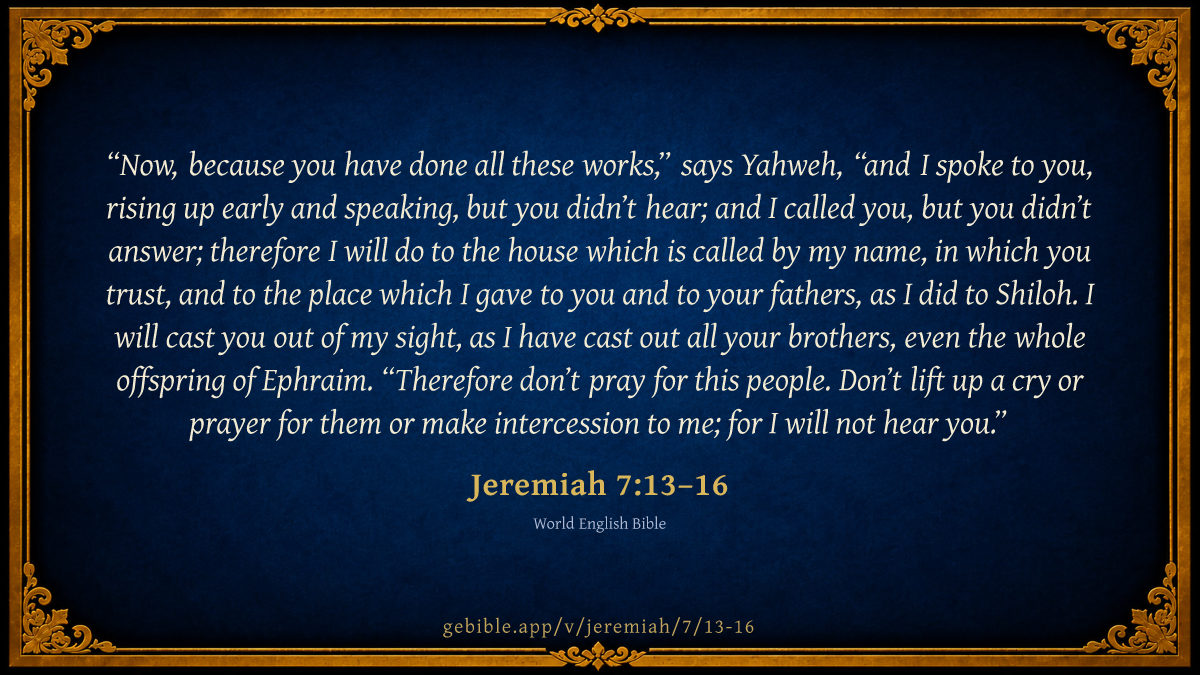
12“But go now to my place which was in Shiloh, where I caused my name to dwell at the first, and see what I did to it for the wickedness of my people Israel. 13Now, because you have done all these works,” says Yahweh, “and I spoke to you, rising up early and speaking, but you didn’t hear; and I called you, but you didn’t answer; 14therefore I will do to the house which is called by my name, in which you trust, and to the place which I gave to you and to your fathers, as I did to Shiloh. 15I will cast you out of my sight, as I have cast out all your brothers, even the whole offspring of Ephraim.
16“Therefore don’t pray for this people. Don’t lift up a cry or prayer for them or make intercession to me; for I will not hear you. 17Don’t you see what they do in the cities of Judah and in the streets of Jerusalem? 18The children gather wood, and the fathers kindle the fire, and the women knead the dough, to make cakes to the queen of the sky, and to pour out drink offerings to other gods, that they may provoke me to anger. 19Do they provoke me to anger?” says Yahweh. “Don’t they provoke themselves, to the confusion of their own faces?”

John Calvin 1540 · Public Domain On vv13–16 The Prophet confirms by an example what he said…
The Prophet confirms by an example what he said yesterday, — that the Jews deceived themselves in thinking that they were covered by the shadow of the Temple, while yet they disclosed themselves, and when the whole world were witness of their impious rebellion. He therefore mentions what had before happened. The Ark of the Covenant, as it is well known, had long rested in Shiloh. Now the Temple did not excel in dignity on its own account, but on account of the Ark of the Covenant and the altar. It was indeed splendidly adorned; but the holiness of the Temple was derived from the Ark of the Covenant, the altar, and the sacrifices. This Ark had been in Shiloh. Hence Jeremiah shews how foolish were the Jews in being proud, because they had among them the Ark of the Covenant and the altar, for the first place, where sacrifices had been offered to God, was not preserved in safety. This is the import of the whole.
But he did not in vain say, Even go to Shiloh The כי, ki, here, though commonly a causal particle, seems to be taken as explanatory. If yet it be viewed only as an affirmative, I do not object, “Well, go to Shiloh.” But the language in this case is ironical, “Ye glory in the Temple; forsooth! go to Shiloh.” And God calls it his place — my place, in order that the Jews might understand that it had nothing superior in itself. The Ark of the Covenant had indeed been removed into Mount Sion, and there God had chosen a perpetual habitation for himself; but the other place was superior as to antiquity. This is the reason why he calls it “my place, “and adds, Where I made my name to dwell, that is, where I designed the Ark to be: for the Ark of the Covenant and the altar, with all their furniture, were properly the name of God; nor was it by chance that all the tribes had placed the Ark in Shiloh; but it was God’s will to be there worshipped for a time. Hence he says, that the place was sacred before Jerusalem; and therefore he says at the first, בראשונה, berashune; that is, the Shilomites are not only equal with you, but antiquity brings them a greater honor: if then a comparison is made, they excel you as to what is ancient.
Read full note →
See, he says, what I did to that place for the iniquity of my people Israel. He calls here Israel his people, not for honor’s sake, but that he might again remind the Jews that they were only equal to the Israelites; and yet that it profited all the tribes nothing, that they were wont to assemble there to worship God. For when we reason from example, we must always see that there be no material difference. Jeremiah then shews that the Israelites were equal to the Jews, and that if the Jews claimed a superiority, the claim was neither just nor right, for Israel were also the people of God, inasmuch as it was God’s will to fix there the Ark of the Covenant, that sacrifices might be there offered to him; and then antiquity was in its favor, for it was a holy place before it was known that God had chosen Mount Sion as a situation for his Temple.
Hence he draws this conclusion, Now, then, as ye have done all these works, that is, as ye have become like the Israelites, therefore, etc. But he first amplifies their crime, — that they had not only imitated the wickedness of the twelve tribes, but had also perversely despised all warnings, I spake to you, he says, and rose up early By this metaphor he intimates, that he was as solicitous for preserving the kingdom of Judah, as parents are wont to be for the safety of their children: for as a father rises early to see what is necessary for his family, so also God says, that he rose early, inasmuch as he had been assiduous in exhorting them. He appropriates to his own person what properly belonged to his prophets: but as he had roused them by his Spirit and employed them in their work, he justly claims to himself whatever he had done by them as his instruments: and it was an exaggeration of their guilt, that they were slothful, nay, stupid, when God sedulously labored for their safety.
He adds, I spoke, and ye heard not; I cried to you, and ye did not answer, he inveighs more at large against their hardness; for had he only once warned them, some pretense might have been made; but as God, by rising early every day, labored to restore them to himself, and as he had not only employed instruction, but also crying, (for by crying he doubtless means exhortations and threatenings, which ought to have produced greater effect upon them,) there appeared in this contumacy the highest degree of mad audacity. The meaning is, — that God had tried all means to restore the Jews to a sound mind, but that they were wholly irreclaimable; for he had called them not only once, but often; and he had also endued his prophets with power to labor strenuously in the discharge of their office: he had not only shewed by them what was useful and necessary, but he had cried, that is, had employed greater vehemence, in order to correct their tardiness. Since then God, in using all these means, could effect nothing, what remained for them was miserably to perish, as they willfully sought their own destruction.
John Calvin's Commentaries (1540-1563) — public domain. Text from the Calvin Translation Society English edition (1840s-50s) via the Christian Classics Ethereal Library (ccel.org). Calvin's coverage is partial (roughly two-thirds of the Bible); uncommented books and verses are honest gaps, never fabricated. The 19th-century editor's footnotes and remarks are omitted so the notes are faithfully Calvin's own voice.
Geneva Bible translators 1599 · Public Domain On vv13, 15, 16 That is, I never ceased to warn you, as…
That is, I never ceased to warn you, as Isa. 65:2; Prov. 1:23.
He showeth what is the only remedy to redress our faults: to suffer God to lead us into the way, and to obey his calling, Isa. 66:4.
Geneva Bible (1599) marginal notes — public domain.
John Trapp 1656 · Public Domain On vv13–16 Jer 7:13 And now, because ye have done all…
Jer 7:13 And now, because ye have done all these works, saith the LORD, and I spake unto you, rising up early and speaking, but ye heard not; and I called you, but ye answered not;
Ver. 13. And now, because ye have done.] Worthily are they made examples to others, that will not take example by others; that will not aliena frui insania, make benefit of other men’s miseries.
Read full note →
Rising early.] As good husbands use to do; and as Plutarch reporteth of the Persian kings, that they had an officer to call them up betimes, and to mind them of their business.
John Trapp, A Commentary or Exposition upon All the Books of the Old and New Testament (1647–1656) — public domain. Text from a community e-Sword module.
Matthew Poole 1685 · Public Domain On vv13–16 These works; either the same, or as bad, or…
These works; either the same, or as bad, or worse than they did at Shiloh; or particularly those mentioned Jer 7:9.
Rising up early; a metaphor taken from persons that are diligent in their business, they use to rise up early: q.d. I did not only speak by my prophets, but they in my name used all diligence to reclaim you, Jer 11:7,8; 25:3,4, calling earnestly unto you; by which he means his exhortations and menaces, which ought to have had some efficacy upon them; but you slighted, and disregarded, and would not come at my call, Pro 1:24. See Poole "2Ch 36:15", See Poole "2Ch 36:16", and See Poole "Isa 1:2".
Matthew Poole's English Annotations on the Holy Bible (1683–1685) — public domain. Text from a community e-Sword/MySword module.
Matthew Henry 1710 · Public Domain On v16 God had shown them, in the foregoing verses, that…
God had shown them, in the foregoing verses, that the temple and the service of it, of which they boasted and in which they trusted, should not avail to prevent the judgment threatened. But there was another thing which might stand them in some stead, and which yet they had no value for, and that was the prophet's intercession for them; his prayers would do them more good than their own pleas: now here that support is taken from them; and their case is said indeed who have lost their interest in the prayers of God's ministers and people.
I. God here forbids the prophet to pray for them (Jer 7:16): "The decree has gone forth, their ruin is resolved on, therefore pray not thou for this people, that is, pray not for the preventing of this judgment threatened; they have sinned unto death, and therefore pray not for their life, but for the life of their souls," Jo1 5:16. See here, 1. That God's prophets are praying men; Jeremiah foretold the destruction of Judah and Jerusalem, and yet prayed for their preservation, not knowing that the decree was absolute; and it is the will of God that we pray for the peace of Jerusalem. Even when we threaten sinners with damnation we must pray for their salvation, that they may turn and live. Jeremiah was hated, and persecuted, and reproached, by the children of his people, and yet he prayed for them; for it becomes us to render good for evil. 2. That God's praying prophets have a great interest in heaven, how little soever they have on earth. When God has determined to destroy this people, he bespeaks the prophet not to pray for them, because he would not have his prayers to lie (as prophets' prayers seldom did) unanswered. God said to Moses, Let me alone, Exo 22:10. 3. It is an ill omen to a people when God restrains the spirits of his ministers and people from praying for them, and gives them to see their case so desperate that they have no heart to speak a good word for them. 4. Those that will not regard good ministers' preaching cannot expect any benefit by their praying. If you will not hear us when we speak from God to you, God will not hear us when we speak to him for you.
Read full note →
II. He gives him a reason for this prohibition. Praying breath is too precious a thing to be lost and thrown away upon a people hardened in sin and marked for ruin.
1. They are resolved to persist in their rebellion against God, and will not be turned back by the prophet's preaching. For this he appeals to the prophet himself, and his own inspection and observation (Jer 7:17): Seest thou not what they do openly and publicly, without either shame or fear, in the cities of Judah and in the streets of Jerusalem? This intimates both that the sin was evident and could not be denied and that the sinners were impudent and would not be reclaimed; they committed their wickedness even in the prophet's presence and under his eye; he saw what they did, and yet they did it, which was an affront to his office, and to him whose officer he was, and bade defiance to both. Now observe,
(1.) What the sin is with which they are here charged - it is idolatry, Jer 7:18. Their idolatrous respects are paid to the queen of heaven, the moon, either in an image or in the original, or both. They worshipped it probably under the name of Ashtaroth, or some other of their goddesses, being in love with the brightness in which they saw the moon walk, and thinking themselves indebted to her for her benign influences or fearing her malignant ones, Job 31:26. The worshipping of the moon was much in use among the heathen nations, Jer 44:17, Jer 44:19. Some read it the frame or workmanship of heaven. The whole celestial globe with all its ornaments and powers was the object of their adoration. They worshipped the host of heaven, Act 7:42. The homage they should have paid to their Prince they paid to the statues that beautified the frontispiece of his palace; they worshipped the creatures instead of him that made them, the servants instead of him that commands them, and the gifts instead of him that gave them. With the queen of heaven they worshipped other gods, images of things not only in heaven above, but in earth beneath, and in the waters under the earth; for those that forsake the true God wander endlessly after false ones. To these deities of their own making they offer cakes for meat-offerings, and pour out drink-offerings, as if they had their meat and drink from them and were obliged to make to them their acknowledgments: and see how busy they are, and how every hand is employed in the service of these idols, according as they used to be employed in their domestic services. The children were sent to gather wood; the fathers kindled the fire to heat the oven, being of the poorer sort that could not afford to keep servants to do it, yet they would rather do it themselves than it should be undone; the women kneaded the dough with their own hands, for perhaps, though they had servants to do it, they took a pride in showing their zeal for their idols by doing it themselves. Let us be instructed, even by this bad example, in the service of our God. [1.] Let us honour him with our substance, as those that have our subsistence from him, and eat and drink to the glory of him from whom we have our meat and drink. [2.] Let us not decline the hardest services, nor disdain to stoop to the meanest, by which God may be honoured; for none shall kindle a fire on God's altar for nought. Let us think it an honour to be employed in any work for God. [3.] Let us bring up our children in the acts of devotion; let them, as they are capable, be employed in doing something towards the keeping up of religious exercises.
(2.) What is the direct tendency of this sin: "It is that they may provoke me to anger; they cannot design any thing else in it. But (Jer 7:19) do they provoke me to anger? Is it because I am hard to be pleased, or easily provoked? Or am I to bear the blame of the resentment? No; it is their own doing; they may thank themselves, and they alone shall bear it." Is it against God that they provoke him to wrath? Is he the worse for it? Does it do him any real damage? No; is it not against themselves, to the confusion of their own faces? It is malice against God, but it is impotent malice; it cannot hurt him: nay, it is foolish malice; it will hurt themselves. They show their spite against God, but they do the spite to themselves. Canst thou think any other than that a people, thus desperately set upon their own ruin, should be abandoned?
2. God is resolved to proceed in his judgments against them, and will not be turned back by the prophet's prayers (Jer 7:20): Thus saith the Lord God, and what he saith he will not unsay, nor can all the world gainsay it; hear it therefore, and tremble. "Behold, my anger and my fury shall be poured out upon this place, as the flood of waters was upon the old world or the shower of fire and brimstone upon Sodom; since they will anger me, let them see what will come of it." They shall soon find, (1.) That there is no escaping this deluge of fire, either by flying from it or fencing against it; it shall be poured out on this place, though it be a holy place, the Lord's house. It shall reach both man and beast, like the plagues of Egypt, and, like some of them, shall destroy the trees of the field and the fruit of the ground, which they had designed and prepared for Baal, and of which they had made cakes to the queen of heaven. (2.) There is no extinguishing it: It shall burn and shall not be quenched; prayers and tears shall then avail nothing. When his wrath is kindled but a little, much more when it is kindled to such a degree, there shall be no quenching it. God's wrath is that fire unquenchable which eternity itself will not see the period of. Depart, you cursed, into everlasting fire.
Matthew Henry's Commentary on the Whole Bible (1708–1710) — public domain (CC PDM 1.0). Text via the HelloAO Bible API.
John Gill 1763 · Public Domain On vv13–16 And now, because ye have done all these works,…
And now, because ye have done all these works, saith the Lord,.... Meaning evil works, such as theft, murder, adultery, perjury, and idolatry, mentioned Jer 7:8 or the same which were done by the people of Israel, on account of which the tabernacle at Shiloh was left:
and I spake unto you, rising up early; that is, by his servants the prophets, whom he sent unto them, and by whom he spoke, as the Targum paraphrases it, and as it is in Jer 7:25, which shows the Lord's great concern for this people, his early care of them, in sending his servants betimes to warn, rebuke, and reclaim them:
Read full note →
and speaking, but ye heard not; would not listen to the words of the prophets, and of the Lord by them; but turned a deaf ear to them, which aggravates their stubbornness, obstinacy, and wickedness, that so much respect should be shown them, so much pains should be taken with them, and that so early, and yet to no purpose:
and I called you, but ye answered not; this call was by the external ministry of the prophets, and was with great vehemence in them, but not with divine energy; however, it was sufficient to leave the Jews without excuse; and their inattention to it exposes their hardness and wilful obstinacy; see Pro 1:24.
John Gill's Exposition of the Whole Bible (1746–1763) — public domain (CC PDM 1.0). Text via the HelloAO Bible API.
John Wesley 1765 · Public Domain On vv15–16 Even - The ten tribes.
Even - The ten tribes.
John Wesley, Explanatory Notes Upon the Whole Bible (1754–1765) — public domain. Text via the GEBible commentary corpus.
Adam Clarke 1810 · Public Domain On vv15–16 Verse 15. The whole seed of Ephraim.] Taken here…
Verse 15. The whole seed of Ephraim.] Taken here for all the ten tribes, that of Ephraim being the principal.
Adam Clarke's Commentary on the Bible (1810–1826) — public domain. Text from a community e-Sword/MySword module.
Joseph Benson 1811 · Public Domain On vv13, 16 Jer 7:13-15. And now, because ye have done all…
Jer 7:13-15. And now, because ye have done all these works — Either the same, or as bad, or worse than Israel did when the tabernacle was at Shiloh; and particularly those mentioned Jer 7:9. And I spake unto you, rising up early, &c. — A metaphor taken from persons who, being diligent in their business, are wont to rise up early; as if he had said, I not only spoke to you by my prophets, but they, in my name, made all possible haste, and used all possible diligence to reclaim you, continually and carefully preventing you with remonstrances; employing with all possible attention severity and softness, promises and threats; but all to no purpose. Therefore, &c. — Because you have added this, your obstinate rejecting of all admonitions and warnings, to the rest of your provocations, will I do unto this house, which is called by my name — This sumptuous temple, of which you boast, and in which you trust for protection and preservation; the place which I gave to you and to your fathers — Upon condition of your obedience, Psa 105:44-45, and therefore may justly, upon the breach of the condition, take from you again; as I have done to Shiloh — See Jer 7:12. And I will cast you out of my sight — You shall have my presence with you and watchful eye over you no more; but I will send you into captivity to Babylon, as I did your brethren into Assyria. See on 2Ki 17:6-18. He terms the Israelites their brethren here, to remind them that they both proceeded from the same stock, and therefore had no reason to expect but they should both fare alike, seeing their sins were alike: even the whole seed of Ephraim — The ten tribes, called often by this name, because the tribe of Ephraim was the most numerous and potent of them all, and Jeroboam, their first king, was of that tribe.
Joseph Benson's Commentary on the Old and New Testaments (1811–1818) — public domain. Text from a community e-Sword module.
Albert Barnes 1834 · Public Domain On vv13, 15, 16 Rising up early and speaking - A proverbial expression…
Rising up early and speaking - A proverbial expression for “speaking zealously and earnestly.” It is used only by Jeremiah.
Albert Barnes' Notes on the Bible (1834–1885) — public domain. Text from a community e-Sword/MySword module.
Haydock's Catholic Bible Commentary 1859 · Public Domain On vv13, 15, 16 Early. Sparing no opportunity of reclaiming you. (Calmet)
Early. Sparing no opportunity of reclaiming you. (Calmet)
George Leo Haydock (1774–1849), Haydock's Catholic Family Bible and Commentary, 1859 edition — public domain. Excludes Psalms (Douay-Rheims chapter numbering differs from Protestant) and Deuterocanonical books (Catholic canon only).
Robert Jamieson, A. R. Fausset & David Brown 1871 · Public Domain On vv13–16 rising . . . early--implying unwearied earnestness in soliciting…
rising . . . early--implying unwearied earnestness in soliciting them (Jer 7:25; Jer 11:17; Ch2 36:15).
Jamieson, Fausset & Brown — Commentary Critical and Explanatory on the Whole Bible (1871) — public domain (CC PDM 1.0). Text via the HelloAO Bible API.
Daniel D. Whedon 1874 · Public Domain On vv13–14 13. Rising up early — Showing deep and tender…
13. Rising up early — Showing deep and tender interest, in that he speaks from early morning onward.
Daniel D. Whedon (gen. ed.), Commentary on the Old and New Testaments (1874–1909) — public domain. Text from a community e-Sword module.
The Cambridge Bible for Schools and Colleges 1878 · Public Domain On vv15–16 15. I will cast you out of my sight]…
15. I will cast you out of my sight] Observe that exile as the punishment is already foreshadowed, while in the latter words we may trace an allusion to the popular feeling (cp. Jdg_11:24; 1Sa_26:19) that Jehovah’s protection did not extend beyond Palestine.
Ephraim] as representing all the northern tribes.
The Cambridge Bible for Schools and Colleges (gen. ed. J. J. S. Perowne; Cambridge University Press, 1878–1918) — public domain. Text from a community e-Sword module.
Ellicott's Commentary for English Readers 1878 · Public Domain On vv13, 15, 16 (13) Rising up early and speaking.—A characteristic phrase of…
(13) Rising up early and speaking.—A characteristic phrase of Jeremiah’s, and used by him only (Jer_13:25, Jer_25:4; Jer_26:5; Jer_29:19). In its bold anthropomorphism it takes the highest form of human activity, waking from sleep and beginning at the dawn of day, to represent the like activity in God.
I called you, but ye answered not.—An echo of earlier complaints from prophets and wise men (Pro_1:24; Isa_65:12; Isa_66:4), destined itself to be used again by One greater than the prophets (Mat_23:37).
A Bible Commentary for English Readers, edited by Charles John Ellicott (1878–1897) — public domain. Text from a community e-Sword module.
The Pulpit Commentary 1880 · Public Domain On vv13–16 Rising up early and speaking; i.e. speaking zealously and…
Rising up early and speaking; i.e. speaking zealously and continually. (so ver. 25; Jer_25:4 Jer_26:5 Jer_29:19) It is an expression peculiar to Jeremiah.
The voice unheeded.
Read full note →
I GOD IS EVER SPEAKING TO HIS CHILDREN. There is a Divine voice speaking, not to favored prophets in rare moments of spiritual elevation, but to all men, that all who will may hear. This voice comes to us in many forms.
1. The voice of nature the proclamation of the power and wisdom of God in the awful, silent speech of the stars, (Psa_19:3) and the gentler language which tells of his tenderness and beneficence in the cheery songs of spring and the glad shout of the harvest.
2. The voice of history. God is in history, and speaks to us through the events of the past, warning by judgments (ver. 12), inviting by acts of deliverance and gifts of mercy (see Psalm 105).
3. The voice of providence in daily life. Has not God been speaking to us through our own experience using various prophetic agencies the advent of a new joy, the cloud of a great sorrow, a visitation of the angel of death to the home? Has he not repeatedly roused, invited, pleaded, and consoled us with voices from out eternity?
4. The voice of prophecy. God had often so spoken to the Jews before the days of Jeremiah, and reference is plainly made to this fact in the text. That voice still lives, because truth is eternal. Thus God speaks to us through the inspired thoughts of the Bible.
5. The voice of Christ. He is the "Word" of God made articulate in the dialect of men. (Joh_1:1-14) He who sees Christ hears the voice of God.
6. The voice of conscience. This is God speaking within the soul. Every time we feel compunction at doing wrong, or an inward urging to do the right, God is pleading in our heart by direct communion, spirit with spirit.
II THE VOICE OF GOD IS URGENT. God speaks with urgency up early and speaking.
1. The urgency of God"s voice is a proof of his great love to his children. He speaks with frequency, repeating the same unheeded lesson, and even when none attend to his voice. God speaks to his children before they pray to him. The first impulse, to spiritual communion comes from God, not
2. from us. (Psa_27:8) Christ stands at the door and knocks. (Rev_3:20) We may see in this an evidence of the long-suffering mercy of God a mercy which "endureth forever," and we may see an encouragement to listen and turn to him. Still he "waiteth to be gracious.
3. The urgency of God"s voice is a proof of the great importance of what he says. God is urgent. What tremendous destinies must turn on a question which even he must rouse and bestir himself about! We might expect that any voice from the awful majesty of God would be full of deep and vast meaning. What must be the significance of his words when even he speaks with earnest insistence, with pressing urgency? How can such an utterance be passed unheeded?
III GOD"S VOICE IS OFTEN NOT HEEDED. He speaks with the authority of the majesty of heaven, with the yearning love of a Father, with the urgency which betokens matters of profound interest, and with a direct reference to the most fearful woe and the most glorious blessedness of his children. Yet men turn aside with indifference. What are the causes of this appalling wonder?
1. Spiritual deafness. There are men who have no ears for the voice of God. Yet God can open our ears if we are willing to hear.
2. Hatred to the highest truth. Men stop their ears against the sound of honest words which are hateful to sinful hearts.
3. Consciousness of guilt. Fearing words of doom, men refuse to hear any words from God; but
a. the doom will not be the less because the warning is unheeded, and
b. God warns to save.
4. Unbelief. Doubt as to whether a voice is Divine is often natural, and if the doubt grows into widespread skepticism the cause may be intellectual rather than moral. Bat when once a voice is recognized as Divine, unbelief is distrust in God; is "making him a liar.
IV THE REFUSAL TO GIVE HEED TO GOD"S VOICE IS A FATAL EVIL.
1. It aggravates guilt by adding to it
a. fresh rebellion against our great King,
b. ingratitude to the pleading love of our merciful Father,
c. willful sin against light.
2. It leaves the purpose of God"s voice unaffected. He urges and pleads with his children, but he does not force them to return to him. If they will not heed his voice that voice is lost upon them, and the ruin from which it would call them unaverted.
Vers. 13, 25. "Rising up early.
A striking expression concerning Jehovah. In ver. 25 it is strengthened: "Daily rising up early." It speaks to us
I OF THE ANXIETY OF JEHOVAH FOR HIS PEOPLE. He who has important business on hand, or dear ones in trying circumstances, or great results dependent upon immediate and strenuous exertion, will show diligence in some such way. He will be unable to rest. So it is with God and his Church. Not that he can be said to fear or be uncertain as to the issues. But the interest he has in the fortunes and spiritual state of his people is of this description. It is no impassive God who is presented to us in Scripture. A profound concern for the interests of our race ever fills the mind of God. His deepest affections are engaged. He mourns the sin and rejoices in the salvation of men.
II OF HIS DILIGENCE IN PROVIDING FOR THE WANTS OF HIS PEOPLE. It is no aimless, helpless anxiety that fills his breast. The most practical measures of help and direction are devised and carried into execution. Prophets, the plenipotentiaries of Divine grace, are sent in immediate response to the needs and demands of men. No age of the world or the Church but has its thick succession. Heaven is in continual activity on behalf of sinners. The choicest spiritual gifts are ceaselessly rained upon the earth. The most devoted servants of God are raised up and sent. Truth in quick evolution anticipates the spiritual necessities of those who would seek God. There is no flagging, no cessation, from Adam"s fall to the uplifting of the second Adam. And onward from that Divine spectacle, in which was displayed the "fullness of the Godhead bodily," events hurry to the culminating glories of Pentecost and the marriage supper of the Lamb.
III IF THIS BE THE CASE, HOW OUGHT WE TO STUDY AND LAY HOLD OF THE MESSAGE OF SALVATION? Is there not a contrast between the affectionate concern and sacrifice of God and the languid indifference or stubborn refusals of men? How shall we escape if we neglect this infinite mercy? How shall we excuse the manner in which we listen to the Word of God? M.
Vers. 13-16. The Divine long-suffering worn out.
The above section brings before us, as do many other Scriptures, this very certain and very serious truth of God"s patience being not only exhaustible, but exhausted. We observe
I THE DIVINE LONG-SUFFERING IS A VERY PRECIOUS FACT. Nations, Churches, individuals have not we ourselves? have been examples of it. What have not all of us owed to the fact that the Lord is long-suffering, and" willeth not the death of a sinner, but rather that he should turn," etc.? But
II THIS TRUTH HAS VERY OFTEN BEEN MUCH ABUSED.
1. In men"s thoughts; for they hope, and to think that in have allowed themselves to pervert the truth of the "eternal " no way can the finite will of man exhaust the infinitude of mercy which there is in God.
2. And in their words also they have so set forth the long-suffering of God as to leave on men"s minds the impression that it was practically infinite, We love to sing such verses as those which tell how "None can measure out thy patience By the span of human thought, None can bound the tender mercies Which thy holy Son hath wrought.
And there is a sense in which these words are most blessedly true, but it is undeniable that such words are often pressed to a meaning which practically encourages the sinner to go on in sin.
3. And yet more is this truth abused in deed. Those to whom the prophet was writing had abused the long-suffering of God (cf. the closing verses of the Second Book of Chronicles). And how fearfully frequent is this abuse in the present day! How many reckon securely on making their peace with God, and having all the great affairs of their souls fully settled for eternity, although they go on, day by day and year by year, living in total disregard both of God and of his will. Therefore it is necessary to insist with all urgency
III THAT THE LONG-SUFFERING OF GOD CAN BE WORN OUT. The above section of this prophecy plainly declares this fact. And the fate of Jerusalem stands not alone in evidence of this (cf. the story of the Deluge, and how long then the long-suffering of God waited). Those who perished in the wilderness how often were they warned! And, indeed, it may be said that God never brings ruin upon nation, Church, or individual soul without warning, repeated, plain, and urgent. But the fact that he does send such ruin proves that men may tempt God too far.
IV AND THAT WHICH WILL EXHAUST THE LONG-SUFFERING OF GOD IS CLEARLY SHOWN US. It is not the fact of sin, great sin, repeated sin, but it is when, as in the case before us, sin has been persisted in, in spite of every kind and degree of plainest warning. "He that being often reproved hardeneth his neck," etc. (Pro_29:1) Now, such was the conduct of those told of here. God had not merely let them know of the peril of their conduct, but his loving solicitude for them had shown itself in the most marked ways. Note expressions in Ver. 13: God not only spoke to them, but like as "those who watch for the morning" rise up early, so God himself awoke early, i.e. he chose the most favorable hours, the most probable means for gaining attention to the truths which he, by his prophets, spoke to them. But it was all of no avail. "Ye heard not; ... ye answered not". (cf. Jer_6:16, Jer_6:17) Now, it is sin persisted in, in spite of all such Divine solicitude so repeatedly manifested" that God will not pardon (Vers. 14, 15). It is an unpardonable sin, and like such sin its forgiveness is not even to be prayed for. (Ver. 16, and cf. 1Jn_4:16)
V CONSIDER THE REASON OF THIS REFUSAL TO FORGIVE, It is not because there is not love sufficient in God to pardon, but because his love is so great, because he is love. For God"s love is not as that of too many earthly parents a partial and unjust thing, loving one child at the expense of the others but his love is for the children. His whole family are the subjects of his incessant and tenderest solicitude. Now, if a rebellious child come away from its rebellion, and have done with it, coming and confessing, "Father, I have sinned," with what joy the Father welcomes such returning one back! And so do the angels of God. No harm, but only good, results. But if there be no repentance, and the spirit of rebellion burns on in the heart of the child, how, consistently with true regard for the welfare of the other and obedient children, can the Father deal with that one as he does with these? It would turn heaven into hell, and make the Father"s house, now the home of blessedness and the blessed, a scene of eternal discord. It could not be. Now, it is because such despising of the long-suffering of God destroys the hope of repentance, renders impossible the sighing of the contrite heart, and renders certain the going on in rebellion, that therefore this sin wears out the long-suffering of God and hath never forgiveness. The very love of God necessitates that he who is separate and alien in heart from the children of his love should be separate and alien from them in every other respect as well. And therefore, because it would be praying against the well-being of God"s children, the prophet is forbidden to pray for the forgiveness of this sin. It is the unpardonable sin, the sin unto death, the sin against the Holy Ghost.
CONCLUSION. We learn what alone bars the mercy of God. Not this or that sin, however great. Still less the circumstance of death. But this "despising the forbearance of God." What need, then, for us all to pray, "Keep back thy servant also from presumptuous sins; let them not have dominion over me... I shall be innocent from the great transgression! C.
The Pulpit Commentary (1880–1919), ed. H.D.M. Spence-Jones & Joseph S. Exell — public domain. Text from a community e-Sword module.
The Biblical Illustrator 1887 · Public Domain On vv13, 16 I spake unto you, rising up early.
Jer_7:13
I spake unto you, rising up early.
Read full note →
Gods call to sinners
I. A gracious call. We are utterly undeserving of it. Though we are transgressors, guilty, corrupt, depraved,--yet God calls upon us--to escape--to live--to be saved--to turn unto Him, and be forever blest and happy.
II. An affectionate call. The call of a merciful Creator who hath no pleasure in the death and destruction of His fallen creatures: and would rather they should repent and live; the call of a tender Father, who looks with compassion upon the prodigal wanderer, invites and urges him to abandon his wretchedness and want, and come back to his home of plenty, and his Fathers bosom again, and assures him of a joyous welcome if he will; the call of a Friend--that Friend that sticketh closer than a brother--even of Jesus our best friend, our elder brother.
III. A varied call. From every part of the outspread volume of creation, there issues a voice calling upon us, to know, fear, adore, worship, the great Creator. And as well as by His works, we are called upon by His ways--by His dealings with the children of men. The misfortunes and calamities that occur to others; and the bereavements, afflictions, and trials that happen to ourselves--the constant experience we have of the uncertainty of our present existence, and of the instability of all earthly good, by these and many similar things we are addressed and admonished to seek a more enduring substance, a more incorruptible and unfading inheritance. From every page, also, of the book of God there proceedeth a call, exhorting us to depart from iniquity, and follow after holiness,--to supplicate for pardoning mercy and for assisting grace.
IV. An oft-repeated--a reiterated call. We are not appealed to once or twice, and then abandoned to our folly. Forbearance is exercised towards us from year to year; line is given upon line, and precept upon precept,--here a little and there a little; so that we may have the last possible opportunity of being saved, and may not be left in despair until the last moment of the day of grace hath expired, and our souls be beyond the region of impression and awakening.
V. An earnest call. Men may be light and trifling. God is always serious--always in earnest. He is in earnest in what He does, and in what He speaks. All the appeals and persuasions by which the Almighty follows you, as children hastening madly on to destruction, are embodied in the very terms, and wear the very air of the utmost earnestness; yea, so serious and earnest are they, that, when it is considered from whom they come, and to what they relate, the wonder is, that men are not at once startled by them, and arrested in their downward course, and constrained to hasten to the only safe Refuge from the gathering and impending storm.
VI. An urgent call. Its reference is to the present: it demands immediate attention and instant compliance. (C. Cook.)
The Biblical Illustrator, edited by Joseph S. Exell (c. 1880s–1900s) — public domain. Text from a community e-Sword module.
Paul E. Kretzmann 1924 · Public Domain On v16 The Idolatry and Disobedience of the Jews
The Idolatry and Disobedience of the Jews
v. 16. Therefore pray not thou for this people, the Lord expressly forbidding the prophet to make intercession for the reprobate nation, neither lift up cry nor prayer for them, neither make intercession to Me; for I will not hear thee. As strong as the prayers of the righteous are in holding back the wrath of God, the time will come when they are unavailing, due to the hardness of men’s hearts, which provokes the punishment of the Lord.
Read full note →
v. 17. Seest thou not what they do in the cities of Judah and in the streets of Jerusalem? The wickedness which Jeremiah was obliged to witness wherever he looked was bound to convince him that the course of the Lord was right, that He was fully justified in rejecting all prayers made in behalf of the apostate Jews. The extent of their idolatry is now described.
v. 18. The children gather wood, and the fathers kindle the fire, and the women knead their dough to make cakes to the queen of heaven, the female goddess Ashtoreth, or Astarte, the counterpart of the male idol Baal, in whose honor the cakes, made of honey, fine flour, and other ingredients, bore a round, flat surface to resemble the disk of the moon, and to pour out drink-offerings, the libations made as sacrifices, unto other gods that they may provoke Me to anger, the expression implying design on their part, the deliberate intention to arouse His wrath.
v. 19. Do they provoke Me to anger? saith the Lord. Do they truly believe that they can aggrieve Him by such acts? Will they reduce the bliss which He enjoys? Do they not provoke themselves, bringing grief and sorrow upon their own heads, to the confusion of their own, faces? That is ever the consequence of sin: the perfect blessedness of God is not reduced by man’s transgression, but his own peace of mind is disturbed, and he loads grief and sorrow upon himself.
v. 20. Therefore, thus saith the Lord God, Jehovah, the All-powerful: Behold, Mine anger and My fury shall be poured out upon this place, upon Jerusalem, as the center of His nation and from there over the entire land, upon man, and upon beast, on the cattle owned by them, and upon the trees of the field, and upon the fruit of the ground, that resulting from its tilling by the hand of man; and it, the fury of the Lord, shall burn and shall not be quenched, the very irrational and inanimate creation being included in the Lord’s punishment, in order to strike terror to the heart of men.
v. 21. Thus saith the Lord of hosts, the God of Israel, still the Lord of those who are truly His Israel, His people, but who here addresses the apostate nation: Put your burnt offerings unto your sacrifices, the former, which were required to be wholly burned, being mingled with the latter, of which only parts were placed on the altar of burnt offerings, and eat flesh. It is a cry of disgust: So far as I am concerned, you may treat the one the same as the other; they are both equally loathsome to Me, since I despise your entire worship.
v. 22. For I spake not unto your fathers nor commanded them in the day that I brought them out of the land of Egypt concerning burnt offerings or sacrifices, it was not His object to establish a mere external worship without true piety of the heart,
v. 23. but this thing commanded I them, saying, Obey My voice, and I will be your God, and ye shall be My people, that being the fundamental principle upon which the entire relation between God and Israel was built up, and walk ye in all the ways that I have commanded you that it may be well unto you. All the Jewish rites and ceremonies presupposed faith and obedience on the part of the people. God required no sacrifice, unless it was the outgrowth of obedience grounded in faith. The actual claims of the Moral Law always preceded the ordinances pertaining to the outward form of worship. Cf 1Sa 15:22.
v. 24. But they hearkened not, they ignored the Lord and His precepts entirely, nor inclined their ear, they did not even attempt to listen, but walked in the counsels and in the imagination, the stubbornness, of their evil heart and went backward and not forward, literally, "they were to the back and not to the face," that is, they turned their backs to the Lord.
v. 25. Since the day that your fathers came forth out of the land of Egypt unto this day, beginning with Moses, the servant of Jehovah, I have even sent unto you all My servants, the prophets, daily rising up early and sending them, with unremitting diligence and eager kindliness;
v. 26. yet they hearkened not unto Me nor inclined their ear, but hardened their neck, like a stubborn ox under the yoke, Deu 31:27; they did worse than their fathers, the later generations, particularly that now addressed, being much farther removed from the true service of Jehovah than the generation of the Exodus.
v. 27. Therefore thou shall speak all these words unto them, but they will not hearken to thee, Jeremiah would have as little success as the other prophets had had; thou shall also call unto them, but they will not answer thee, being utterly indifferent to the Word of the Lord.
v. 28. But thou shalt say unto them, This is a nation that obeyeth not the voice of the Lord, their God, being therefore classed with the Gentile nations, nor receiveth correction, hardened to the point that all rebukes make no impression upon them; truth is perished, all reliability, all fidelity is lost, and is cut off from their mouth. There is a fine bit of sarcasm in this phrase, for the Jews confessed the Lord with their mouths only, and not with their hearts. The use of God’s name for the purpose of mouth-worship only is a flagrant offense against the Second Commandment and is bound to bring down the wrath of God upon the offenders.
Paul E. Kretzmann, Popular Commentary of the Bible (1921–1924) — public domain. Text from a community e-Sword module.
unfoldingWord translationNotes 2017 · CC BY-SA 4.0 On v16 General Information:
General Information:
Yahweh speaks to Jeremiah about the people of Judah. In these verses, "this people" refers to the people of Judah.
Read full note →
do not pray for this people, and do not lift up a lamenting wail or say a prayer on their behalf, and do not petition me
These four clauses each mean about the same thing and are repeated for emphasis. (See: Parallelism)
lift up a lamenting wail
"cry out with sadness"
on their behalf
"for their benefit" or "for them"
petition me
"plead with me"
Do you not see what they are doing in the cities of Judah and in the streets of Jerusalem?
This question expects a positive answer and is asked to bring these things to Jeremiah's attention. They can be expressed as a statement. AT: "Look at what they are doing in the cities of Judah and in the streets of Jerusalem!" (See: Rhetorical Question)
kindling the fire
"starting the fire"
kneading dough
mixing dough by hand
dough
a thick mixture of flour and liquid used for baking
the queen of the heavens
This was the name of a false god. AT: "the false god known as 'the queen of the heavens'" (See: Assumed Knowledge and Implicit Information)
will provoke me
"will anger me"
translationWords
Jeremiah
pray
people group
lament
Judah
Jerusalem
ancestor
fire
heaven
drink offering
unfoldingWord translationNotes — © Distant Shores Media and the Door43 World Missions Community, licensed CC BY-SA 4.0. Source: git.door43.org/Door43/en_tn.
Tyndale Open Study Notes 2022 · CC BY-SA 4.0 On vv13, 16 7:13-15 The people of the northern kingdom had previously…
7:13-15 The people of the northern kingdom had previously done what Judah was now doing. God had sent many prophets who spoke and called out to them (2 Kgs 17:22-23; 2 Chr 36:15-16), but they would not listen and refused to answer. The Lord had spared Jerusalem and the Temple when the northern tribes were taken into exile by the Assyrians in 722 BC; this time, the Temple would be destroyed.
Tyndale Open Study Notes — © Tyndale Open Resources, licensed CC BY-SA 4.0. Text via the HelloAO Bible API.