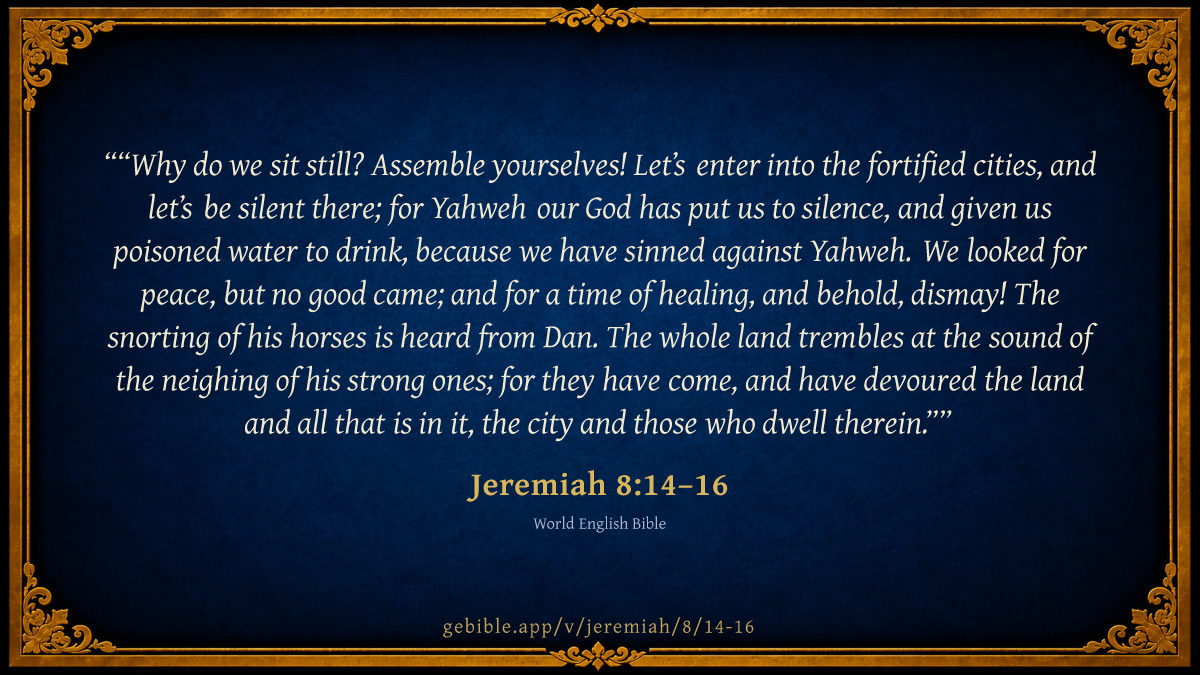
14“Why do we sit still? Assemble yourselves! Let’s enter into the fortified cities, and let’s be silent there; for Yahweh our God has put us to silence, and given us poisoned water to drink, because we have sinned against Yahweh.
15We looked for peace, but no good came; and for a time of healing, and behold, dismay!
16The snorting of his horses is heard from Dan. The whole land trembles at the sound of the neighing of his strong ones; for they have come, and have devoured the land and all that is in it, the city and those who dwell therein.”
14 “Why do we sit still? Assemble yourselves! Let’s enter into the fortified cities, and let’s be silent there; for Yahweh our God has put us to silence, and given us poisoned water to drink, because we have sinned against Yahweh.
15 We looked for peace, but no good came; and for a time of healing, and behold, dismay!
16 The snorting of his horses is heard from Dan. The whole land trembles at the sound of the neighing of his strong ones; for they have come, and have devoured the land and all that is in it, the city and those who dwell therein.”
KJVKing James Version
14 Why do we sit still? assemble yourselves, and let us enter into the defenced cities, and let us be silent there: for the LORD our God hath put us to silence, and given us water of gall to drink, because we have sinned against the LORD.
15 We looked for peace, but no good came; and for a time of health, and behold trouble!
16 The snorting of his horses was heard from Dan: the whole land trembled at the sound of the neighing of his strong ones; for they are come, and have devoured the land, and all that is in it; the city, and those that dwell therein.
Show all 3 translations
JPSJPS Tanakh (1917)
14 'Why do we sit still? Assemble yourselves, and let us enter into the fortified cities, and let us be cut off there; for the LORD our God hath cut us off, and given us water of gall to drink, because we have sinned against the LORD.
15 We looked for peace, but no good came; and for a time of healing, and behold terror!'
16 The snorting of his horses is heard from Dan; at the sound of the neighing of his strong ones the whole land trembleth; for they are come, and have devoured the land and all that is in it, the city and those that dwell therein.
Jeremiah 14:19(v15)Have you utterly rejected Judah? Has your soul loathed Zion? Why have you struck us, and there is no healing for us? We looked for peace,…
Jeremiah 23:15(v14)Therefore Yahweh of Armies says concerning the prophets: “Behold, I will feed them with wormwood, and make them drink poisoned water; for…
Jeremiah 9:15(v14)Therefore Yahweh of Armies, the God of Israel, says, “Behold, I will feed them, even this people, with wormwood and give them poisoned…
Judges 5:22(v16)Then the horse hoofs stamped because of the prancing, the prancing of their strong ones.
Judges 18:29(v16)They called the name of the city Dan, after the name of Dan their father, who was born to Israel; however the name of the city used to be…
Show all 38 cross-references
Psalms 69:21(v14)They also gave me poison for my food. In my thirst, they gave me vinegar to drink.
Jeremiah 35:11(v14)But when Nebuchadnezzar king of Babylon came up into the land, we said, ‘Come! Let’s go to Jerusalem for fear of the army of the Chaldeans,…
Lamentations 3:19(v14)Remember my affliction and my misery, the wormwood and the bitterness.
1 Corinthians 10:28(v16)But if anyone says to you, “This was offered to idols,” don’t eat it for the sake of the one who told you, and for the sake of conscience.…
Deuteronomy 29:18(v14)lest there should be among you man, woman, family, or tribe whose heart turns away today from Yahweh our God, to go to serve the gods of…
Deuteronomy 32:32(v14)For their vine is of the vine of Sodom, of the fields of Gomorrah. Their grapes are poison grapes. Their clusters are bitter.
2 Samuel 20:6(v14)David said to Abishai, “Now Sheba the son of Bichri will do us more harm than Absalom did. Take your lord’s servants, and pursue after him,…
Jeremiah 4:15-16(v16)For a voice declares from Dan, and publishes evil from the hills of Ephraim: “Tell the nations, behold, publish against Jerusalem,…
Micah 1:12(v15)For the inhabitant of Maroth waits anxiously for good, because evil has come down from Yahweh to the gate of Jerusalem.
Matthew 27:34(v14)they gave him sour wine to drink mixed with gall. When he had tasted it, he would not drink.
1 Thessalonians 5:3(v15)For when they are saying, “Peace and safety,” then sudden destruction will come on them, like birth pains on a pregnant woman. Then they…
Leviticus 10:3(v14)Then Moses said to Aaron, “This is what Yahweh spoke of, saying, ‘I will show myself holy to those who come near me, and before all the…
Numbers 5:18-24(v14)The priest shall set the woman before Yahweh, and let the hair of the woman’s head go loose, and put the meal offering of memorial in her…
Judges 20:1(v16)Then all the children of Israel went out, and the congregation was assembled as one man, from Dan even to Beersheba, with the land of…
2 Kings 7:3-4(v14)Now there were four leprous men at the entrance of the gate. They said to one another, “Why do we sit here until we die? If we say, ‘We…
Psalms 24:1(v16)The earth is Yahweh’s, with its fullness; the world, and those who dwell in it.
Psalms 39:2(v14)I was mute with silence. I held my peace, even from good. My sorrow was stirred.
Jeremiah 4:5-6(v14)Declare in Judah, and publish in Jerusalem; and say, ‘Blow the trumpet in the land!’ Cry aloud and say, ‘Assemble yourselves! Let’s go into…
Jeremiah 4:10(v15)Then I said, “Ah, Lord Yahweh! Surely you have greatly deceived this people and Jerusalem, saying, ‘You will have peace;’ whereas the sword…
Jeremiah 4:24(v16)I saw the mountains, and behold, they trembled, and all the hills moved back and forth.
Jeremiah 6:23(v16)They take hold of bow and spear. They are cruel, and have no mercy. Their voice roars like the sea, and they ride on horses, everyone set…
Jeremiah 8:11(v15)They have healed the hurt of the daughter of my people slightly, saying, “Peace, peace,” when there is no peace.
Jeremiah 10:25(v16)Pour out your wrath on the nations that don’t know you, and on the families that don’t call on your name; for they have devoured Jacob.…
Jeremiah 14:20(v14)We acknowledge, Yahweh, our wickedness, and the iniquity of our fathers; for we have sinned against you.
Jeremiah 47:3(v16)At the noise of the stamping of the hoofs of his strong ones, at the rushing of his chariots, at the rumbling of his wheels, the fathers…
Lamentations 3:27-28(v14)It is good for a man that he bear the yoke in his youth. Let him sit alone and keep silence, because he has laid it on him.
Amos 6:10(v14)“When a man’s relative carries him, even he who burns him, to bring bodies out of the house, and asks him who is in the innermost parts of…
Nahum 1:4-5(v16)He rebukes the sea, and makes it dry, and dries up all the rivers. Bashan languishes, and Carmel; and the flower of Lebanon languishes. The…
Nahum 3:2(v16)The noise of the whip, the noise of the rattling of wheels, prancing horses, and bounding chariots,
Habakkuk 2:20(v14)But Yahweh is in his holy temple. Let all the earth be silent before him!”
Habakkuk 3:10(v16)The mountains saw you, and were afraid. The storm of waters passed by. The deep roared and lifted up its hands on high.
Zechariah 2:13(v14)Be silent, all flesh, before Yahweh; for he has roused himself from his holy habitation!”
Historical commentary, presented as a primary source — not an endorsement.
John Calvin1540 · Public DomainOn vv14–16This verse, and those which follow, are explained in…
This verse, and those which follow, are explained in different ways; but I will briefly shew the meaning of the Prophet. I have no doubt but that he speaks here in the name of the whole people. The Prophet, then, in these words, represents what occupied their minds, and the counsels which the Jews adopted: and further, there is no doubt but that he shews in these words that they, as hypocrites are wont to do, had recourse to expedients, by which they thought they could protect themselves from God’s wrath. For they who think that the Prophet spoke his own sentiments are greatly mistaken: on the contrary, he relates here the purposes which the Jews formed; and at the same time he reproves their hardness in turning here and there, and in thinking that they could turn aside the judgment of God; for hypocrites, unless constrained, never ascend to the first cause; that is, they never acknowledge nor regard the hand of him who strikes them, as it is said in another place. (Isaiah 9:13.) They indeed feel their evils, and seek to apply remedies; but they stop at the nearest reliefs, without seeking to pacify God and to return into favor with him; and when the smallest hope is given them, they think themselves to be safe, if they betake themselves to this or that hiding-place.
This feeling is what the Prophet describes: Why do we sit? or, “Why do we rest?” But the word here means to sit still: Why do we then sit still? as though they had accused themselves of sloth or idleness: “What means this our slothfulness? we sit still in the villages, which are exposed to the violence of enemies: gather then yourselves, and let us enter into fortified cities; we shall rest there.” They thought that they should be safe, if they entered into fortified cities. Then, on the other hand, Jeremiah shews how foolishly they trusted to such refuges. Surely, he says, our God hath made us silent He had said before ונדמה-שם, vanudame-shem, “and we shall there rest.” The verb, means to rest, and to be silent. He repeats the same word, “Surely, our God hath made us to be silent;” but in a different sense. There is then a striking allusion in the verb דמה, dame, or the sameness of sound. “Jehovah hath made us to be silent, “or to rest; or, he hath cut us off, for in Hiphil, it has this meaning.
Read full note →
We hence see, that on the one hand is declared what might have given some comfort to the Jews, for there were fortified cities which might have protected them from the assaults of enemies; but, on the other hand, the Prophet shews that they were greatly mistaken, for God would make them to rest in a different manner, as he would reduce them to nothing; for the dead are said to rest, or to be silent. In short, he means a quiet state when speaking in the name of the people; but he refers to destruction when speaking by God’s command.
He afterwards confirms the same thing in a metaphorical language, God will give them the waters of gall, or, poisoned waters: and he adds, Because they have acted impiously against Jehovah We may learn from this last part, that the Prophet is now performing the duty of his office. The people indeed never willingly allowed that they were suffering punishment justly due to their sins; but the Prophet here reproves them for hoping to be safe by fleeing to fortified cities, as though God could not follow them there. He then says that God’s vengeance would closely pursue them, and that wherever they fled, they would still be exposed to evils, for they carried with them their impieties, which would draw upon them the wrath of God. It follows —
John Calvin's Commentaries (1540-1563) — public domain. Text from the Calvin Translation Society English edition (1840s-50s) via the Christian Classics Ethereal Library (ccel.org). Calvin's coverage is partial (roughly two-thirds of the Bible); uncommented books and verses are honest gaps, never fabricated. The 19th-century editor's footnotes and remarks are omitted so the notes are faithfully Calvin's own voice.
Geneva Bible translators1599 · Public DomainOn vv14, 16That is, hath brought us into extreme affliction, and…
That is, hath brought us into extreme affliction, and thus they shall not attribute this plague to fortune, but to God’s just judgment, Jer. 9:15 and 23:15.
He speaketh in the person of the people, who when the enemy cometh, will turn about to hide themselves, and acknowledge that it is God’s hand.
Geneva Bible (1599) marginal notes — public domain.
John Trapp1656 · Public DomainOn vv14–16Jer 8:14 Why do we sit still? assemble yourselves,…
Jer 8:14 Why do we sit still? assemble yourselves, and let us enter into the defenced cities, and let us be silent there: for the LORD our God hath put us to silence, and given us water of gall to drink, because we have sinned against the LORD.
Ver. 14. Why do we sit still?] Here the people speak (see on Jer 8:13), being grievously frightened upon the coming of the Chaldees, and thereupon consulting what course to take; but all would not do. {Jer 8:16}
Read full note →
Let us be silent.] Sic silent pavidi mures coram fele. So they were as a panic struck mouse in the eyes of a cat.
For the Lord our God hath put us to silence.] Hath expelled our courage and stopped our mouths.
And hath given us water of gall to drink.] Succum cicutae, juice of hemlock, our bane, our death’s draught; so that now we know, by woeful experience, what an evil and bitter thing sin is; for a drop of honey we have now a sea of gall.
John Trapp, A Commentary or Exposition upon All the Books of the Old and New Testament (1647–1656) — public domain. Text from a community e-Sword module.
Matthew Poole1685 · Public DomainOn vv14–16Why do we sit still? the people at length…
Why do we sit still? the people at length seem to bethink themselves, and thus to bespeak each other. Let us enter into the defenced cities; in the scattered villages there is no safety for us, let us retire into places of greater security, Mat 24:16-18; possibly they thought they might be secured there, as they had been before in the time of Sennacherib.
Let us be silent there; keep close within our walls, say or do nothing to provoke the enemy; but sit down and bewail the desperateness of our condition, Lam 3:28,29, or tremblingly expect the issue of this sad war, for there is no possibility of making head against such an enemy, that bears down all before them.
Read full note →
The Lord our God hath put us to silence: they now begin to perceive that the hand of God is in all this, and that therefore they have not a word to say, as if they were wronged; God hath put them to shame: much less courage to oppose the Babylonians; their heart fails them, they are as men in a great terror and consternation; God hath put us to silence, let us be silent.
Water of gall; or, poison; probably the name of some poisonous herb, with the juice or infusion whereof they were wont to kill persons, as hemlock, nightshade &c. See Hos 10:4. It notes those bitter destructive judgments that God was bringing upon them, Jer 9:15, which did spring from that bitter root of their sinning against him, as in the next words.
Matthew Poole's English Annotations on the Holy Bible (1683–1685) — public domain. Text from a community e-Sword/MySword module.
John Gill1763 · Public DomainOn vv14–16We looked for peace,.... Outward prosperity, affluence of temporal…
We looked for peace,.... Outward prosperity, affluence of temporal blessings, peace with enemies, and safety from them, which the false prophets had given them reason to expect; or which last they concluded and hoped for, from their being in the defenced cities:
but no good came; they were disappointed in their expectation; the good that was promised them, and they looked for, never came, but all the reverse:
Read full note →
and for a time of health; or, of healing (l); the political wounds of the commonwealth of Israel:
and behold trouble! or "terror" (m); at the approach of the enemy, described in the following verses. The Targum is,
"a time of pardon of offences, and, lo, a punishment of sins.''
Healing, in Scripture, signifies pardon of sin; see Psa 41:4.
John Gill's Exposition of the Whole Bible (1746–1763) — public domain (CC PDM 1.0). Text via the HelloAO Bible API.
John Wesley1765 · Public DomainOn vv14, 16Why - The people at length seem to bethink…
Why - The people at length seem to bethink themselves, and thus to bespeak each other. Silent - Keep close within our walls.
John Wesley, Explanatory Notes Upon the Whole Bible (1754–1765) — public domain. Text via the GEBible commentary corpus.
Adam Clarke1810 · Public DomainOn v16Verse 16. The snorting of his horses was heard…
Verse 16. The snorting of his horses was heard from Dan:] Dan lay in the way from Babylon to Jerusalem; and it was by this city, after the battle of Carchemish, that Nebuchadnezzar, in pursuing the Egyptians, entered Palestine.
The whole land trembled at the sound of the neighing of his strong ones] Of his war horses. This is a fine image; so terrible was the united neighing of the cavalry of the Babylonians that the reverberation of the air caused the ground to tremble. This is better, and more majestic, than the celebrated line of Virgil:-
Read full note →
Quadrupe-dante pu-trem soni-tu quatit ungula campum. It would be much easier to shake the ground with the prancings of many horses, than to cause an earthquake by the sound of the neighing of the troops of cavalry.
Adam Clarke's Commentary on the Bible (1810–1826) — public domain. Text from a community e-Sword/MySword module.
Joseph Benson1811 · Public DomainOn vv14, 16Jer 8:14-15. Let us enter into the defenced cities…
Jer 8:14-15. Let us enter into the defenced cities — In these verses the prophet seems to turn to and address his countrymen by way of apostrophe; and, as one of the people that dwelt in the open towns, advises those that were in the like situation to retire with him into some of the fortified cities, and there wait the event with patience; since there was nothing but terror abroad, and the noise of the enemy who had already begun to ravage the country. By this the prophet signifies, that when the Chaldeans should come, there would be no hope of safety left but in fleeing to fortified places, and that none would dare to stay in the open country. He speaks of the thing as already present, because it was soon to happen, and it was represented to him, in his vision, as already present. Let us be silent there, for the Lord hath put us to silence — This may mean, that God had suffered the forces of the king of Judah to be so diminished that they were not able to defend the country and open towns, but must of necessity keep themselves cooped up in their fortified cities, and leave the country to be ravaged everywhere by the Chaldeans. And given us water of gall to drink — Hath brought us into grievous calamities for the punishment of our sins. We looked for peace — We were willing to believe the false prophets, who foretold prosperous times. For a time of health — Or, for a time in which we should be cured; that is, for a time of peace, in which we might recover our strength.
Joseph Benson's Commentary on the Old and New Testaments (1811–1818) — public domain. Text from a community e-Sword module.
Albert Barnes1834 · Public DomainOn vv14–16The people rouse one another to exertion. “Why,” they…
The people rouse one another to exertion. “Why,” they ask, “do we remain here to be overwhelmed?” They are ready now to follow the command given (see the marginal reference), but with the conviction that all hope is over.
Let us be silent there - Rather, let us perish there, literally “be put to silence.”
Read full note →
Water of gall - i. e., poison. The word rendered “gall” was probably the belladonna, or night-shade, to the “berries” of which the grapes of Israel were compared.
Albert Barnes' Notes on the Bible (1834–1885) — public domain. Text from a community e-Sword/MySword module.
Haydock's Catholic Bible Commentary1859 · Public DomainOn vv14, 16Silent, in utter destruction, 1 Kings ii. 9. We…
Silent, in utter destruction, 1 Kings ii. 9. We cannot be in a worse condition.
George Leo Haydock (1774–1849), Haydock's Catholic Family Bible and Commentary, 1859 edition — public domain. Excludes Psalms (Douay-Rheims chapter numbering differs from Protestant) and Deuterocanonical books (Catholic canon only).
Robert Jamieson, A. R. Fausset & David Brown1871 · Public DomainOn vv14–16assemble--for defense.
assemble--for defense.
let us be silent--not assault the enemy, but merely defend ourselves in quiet, until the storm blow over.
Read full note →
put us to silence--brought us to that state that we can no longer resist the foe; implying silent despair.
water of gall--literally, "water of the poisonous plant," perhaps the poppy (Jer 9:15; Jer 23:15).
Jamieson, Fausset & Brown — Commentary Critical and Explanatory on the Whole Bible (1871) — public domain (CC PDM 1.0). Text via the HelloAO Bible API.
Daniel D. Whedon1874 · Public DomainOn vv14, 1614. Let us be silent, etc. — Better, let…
14. Let us be silent, etc. — Better, let us perish, for Jehovah our God hath caused us to perish.
Gall — The name of a poisonous plant which cannot be unmistakably identified. From the fact that it is mentioned in Deu_32:32, as having berries, some have not improbably conjectured that the nightshade is intended.
Daniel D. Whedon (gen. ed.), Commentary on the Old and New Testaments (1874–1909) — public domain. Text from a community e-Sword module.
The Cambridge Bible for Schools and Colleges1878 · Public DomainOn vv14–1614. be silent … put us to silence] better,…
14. be silent … put us to silence] better, as mg. perish … caused us to perish. Cp. 1Sa_2:9.
water of gall] a plant yielding some bitter flavour reminding of gall. It is mentioned also Jer_9:15, Jer_23:15; Deu_29:18 (Matthew 17), Jer_32:32; Psa_69:21; Lam_3:5; Lam_3:19; Hos_10:4 (“hemlock”). It cannot be identified with any certainty.
Read full note →
14, 15. The people in their straits address one another. Cp. Jer_4:5.
The Cambridge Bible for Schools and Colleges (gen. ed. J. J. S. Perowne; Cambridge University Press, 1878–1918) — public domain. Text from a community e-Sword module.
Ellicott's Commentary for English Readers1878 · Public DomainOn vv14–16(14) Why do we sit still? . . .—The…
(14) Why do we sit still? . . .—The cry of the people in answer to the threatening of Jehovah is brought in by the prophet with a startling dramatic vividness. They are ready to flee into the defenced cities, as the prophet had told them in Jer_4:5, but it is without hope. They are going into the silence as of death, for to that silence Jehovah himself has brought them.
Water of gall.—The idea implied is that of poison as well as bitterness. It is uncertain what the “gall-plant” was; possibly, from its connection with “grapes” or “clusters,” as in Deu_32:32, belladonna or colocynth is meant. Others have suggested the poppy, and this is in part confirmed by the narcotic properties implied in Mat_27:34. In Deu_29:18 it is joined with “wormwood.”
A Bible Commentary for English Readers, edited by Charles John Ellicott (1878–1897) — public domain. Text from a community e-Sword module.
The Pulpit Commentary1880 · Public DomainOn vv14–16Why do we sit still? The prophet transports us…
Why do we sit still? The prophet transports us by a stroke of his pea into the midst of the fulfillment of his prophecy. The people of the country districts are represented as urging each other to flight. True, it is the resource of despair. No defensed cities can defend them against the judgment of Jehovah. Let us be silent; rather, let us perish; literally, let us be put to silence. Hath put us to silence; rather, hath caused us to perish; i.e. hath decreed our destruction. Water of gall; a phrase characteristic of our prophet. (see Jer_9:14 Jer_23:15) It is a little difficult to find a rendering which shall suit all the passages in which rosh (gall) is mentioned. In Deu_32:33 (and so Job_20:16) it is clearly used for "venom" in general; and yet in Ver. 32 of the same chapter it obviously means a plant. Another general application of the term seems to have been to bitterness in general, the ideas of bitterness and poisonousness being taken as interchangeable. The Authorized Version may therefore stand.
Vers. 14, 15. Despair.
Read full note →
I DESPAIR WILL ARISE ON THE PERCEPTION THAT THERE IS NO WAY OF ESCAPE FROM RUIN. The miserable Jews are pictured as first sitting still helplessly, and then rousing themselves to enter the fenced cities, only to find that death awaits them there as surely as in the open plain. People are too ready to believe that "something will turn up," and so hold on, in confidence and indifference, till their eyes are suddenly opened, and they see room for nothing but despair.
II DESPAIR WILL ARISE ON THE RECOGNITION OF THE WRATH OF GOD. The Jews are to see that their God has put them to silence. Philistines, Egyptians, Assyrians, Chaldeans, might all be resisted; but who shall resist God? Men can only fight against God with confidence until they perceive him fighting against them. Then hope is madness.
III DESPAIR WILL BE HEIGHTENED BY THE SENSE OF GUILT. The Jews are to see that their calamity is the punishment of sin. It is deserved. It is justly given. Men hope on while they refuse to admit their sin; but conviction of sin is fatal to hope.
IV DESPAIR MAY FOLLOW A CONFIDENT HOPE. The Jews had looked for peace and for a time of health. Yet none came. Hope may be very bright and yet very delusive. The splendor of the sunrise contains little promise that the day will close without storms. Subjective confidence is no guarantee of objective truth. Things are not the more true because we believe them very firmly. We may feel safe and be in danger. A peaceful death is no security for a joyful resurrection. It is little that a man has overcome the fear of death; the important question is whether he has removed the ground for that fear. The faith that saves is not confidence in our own security, but submissive and obedient trust in Christ.
V THE POSSIBILITY OF DESPAIR IS REVEALED, NOT TO PRODUCE IT, BUT TO WARN Us FROM IT. If it were inevitable, or, being experienced, invincible, it would be cruel to prepare any for it. Why not let the poor doomed wretch enjoy his brief hour of sunshine before he is sent "to dwell in solemn shades of endless night?" But the revelations of a possibly dark future are given in mercy to warn us from sowing the seeds of despair and to point to the way of escape. No soul need despair since there is One who "is able to save them to the uttermost that come unto God by him". (Heb_7:25)
The Pulpit Commentary (1880–1919), ed. H.D.M. Spence-Jones & Joseph S. Exell — public domain. Text from a community e-Sword module.
unfoldingWord translationNotes2017 · CC BY-SA 4.0On vv14, 16Connecting Statement:
Connecting Statement:
Yahweh continues his message by telling us what the people of Judah will say at the time of their punishment.
Read full note →
General Information:
The words "we," "us" and "our" refer to the people of Judah.
Why are we sitting here?
This question is asked to motivate action. It can be translated as a statement. AT: "We should not stay here." (See: Rhetorical Question)
Come together; let us go to the fortified cities
The "fortified cities" were cities with high walls and strong defenses. See how you translated the similar phrases in Jeremiah 4:5.
we will become silent there in death
Here "become silent" means to die. AT: "let us die there" or "let us wait for our enemies to kill us there" (See: Metaphor)
For Yahweh our God will silence us
Here "silence" is a metaphor for condemning to death. AT: "because Yahweh our God has condemned us to die" (See: Metaphor)
He will make us drink poison
This is an idiom for Yahweh's judgment on his people. (See: Idiom)
Tyndale Open Study Notes2022 · CC BY-SA 4.0On vv14, 168:14-15 These people had heard Jeremiah publicly deliver the…
8:14-15 These people had heard Jeremiah publicly deliver the decree of the Lord; they now realized that they deserved their punishment because they had sinned against the Lord. Though their doom was sealed, they still did not seek forgiveness for their sins.

John Calvin 1540 · Public Domain On vv14–16 This verse, and those which follow, are explained in…
This verse, and those which follow, are explained in different ways; but I will briefly shew the meaning of the Prophet. I have no doubt but that he speaks here in the name of the whole people. The Prophet, then, in these words, represents what occupied their minds, and the counsels which the Jews adopted: and further, there is no doubt but that he shews in these words that they, as hypocrites are wont to do, had recourse to expedients, by which they thought they could protect themselves from God’s wrath. For they who think that the Prophet spoke his own sentiments are greatly mistaken: on the contrary, he relates here the purposes which the Jews formed; and at the same time he reproves their hardness in turning here and there, and in thinking that they could turn aside the judgment of God; for hypocrites, unless constrained, never ascend to the first cause; that is, they never acknowledge nor regard the hand of him who strikes them, as it is said in another place. (Isaiah 9:13.) They indeed feel their evils, and seek to apply remedies; but they stop at the nearest reliefs, without seeking to pacify God and to return into favor with him; and when the smallest hope is given them, they think themselves to be safe, if they betake themselves to this or that hiding-place.
This feeling is what the Prophet describes: Why do we sit? or, “Why do we rest?” But the word here means to sit still: Why do we then sit still? as though they had accused themselves of sloth or idleness: “What means this our slothfulness? we sit still in the villages, which are exposed to the violence of enemies: gather then yourselves, and let us enter into fortified cities; we shall rest there.” They thought that they should be safe, if they entered into fortified cities. Then, on the other hand, Jeremiah shews how foolishly they trusted to such refuges. Surely, he says, our God hath made us silent He had said before ונדמה-שם, vanudame-shem, “and we shall there rest.” The verb, means to rest, and to be silent. He repeats the same word, “Surely, our God hath made us to be silent;” but in a different sense. There is then a striking allusion in the verb דמה, dame, or the sameness of sound. “Jehovah hath made us to be silent, “or to rest; or, he hath cut us off, for in Hiphil, it has this meaning.
Read full note →
We hence see, that on the one hand is declared what might have given some comfort to the Jews, for there were fortified cities which might have protected them from the assaults of enemies; but, on the other hand, the Prophet shews that they were greatly mistaken, for God would make them to rest in a different manner, as he would reduce them to nothing; for the dead are said to rest, or to be silent. In short, he means a quiet state when speaking in the name of the people; but he refers to destruction when speaking by God’s command.
He afterwards confirms the same thing in a metaphorical language, God will give them the waters of gall, or, poisoned waters: and he adds, Because they have acted impiously against Jehovah We may learn from this last part, that the Prophet is now performing the duty of his office. The people indeed never willingly allowed that they were suffering punishment justly due to their sins; but the Prophet here reproves them for hoping to be safe by fleeing to fortified cities, as though God could not follow them there. He then says that God’s vengeance would closely pursue them, and that wherever they fled, they would still be exposed to evils, for they carried with them their impieties, which would draw upon them the wrath of God. It follows —
John Calvin's Commentaries (1540-1563) — public domain. Text from the Calvin Translation Society English edition (1840s-50s) via the Christian Classics Ethereal Library (ccel.org). Calvin's coverage is partial (roughly two-thirds of the Bible); uncommented books and verses are honest gaps, never fabricated. The 19th-century editor's footnotes and remarks are omitted so the notes are faithfully Calvin's own voice.
Geneva Bible translators 1599 · Public Domain On vv14, 16 That is, hath brought us into extreme affliction, and…
That is, hath brought us into extreme affliction, and thus they shall not attribute this plague to fortune, but to God’s just judgment, Jer. 9:15 and 23:15.
He speaketh in the person of the people, who when the enemy cometh, will turn about to hide themselves, and acknowledge that it is God’s hand.
Geneva Bible (1599) marginal notes — public domain.
John Trapp 1656 · Public Domain On vv14–16 Jer 8:14 Why do we sit still? assemble yourselves,…
Jer 8:14 Why do we sit still? assemble yourselves, and let us enter into the defenced cities, and let us be silent there: for the LORD our God hath put us to silence, and given us water of gall to drink, because we have sinned against the LORD.
Ver. 14. Why do we sit still?] Here the people speak (see on Jer 8:13), being grievously frightened upon the coming of the Chaldees, and thereupon consulting what course to take; but all would not do. {Jer 8:16}
Read full note →
Let us be silent.] Sic silent pavidi mures coram fele. So they were as a panic struck mouse in the eyes of a cat.
For the Lord our God hath put us to silence.] Hath expelled our courage and stopped our mouths.
And hath given us water of gall to drink.] Succum cicutae, juice of hemlock, our bane, our death’s draught; so that now we know, by woeful experience, what an evil and bitter thing sin is; for a drop of honey we have now a sea of gall.
John Trapp, A Commentary or Exposition upon All the Books of the Old and New Testament (1647–1656) — public domain. Text from a community e-Sword module.
Matthew Poole 1685 · Public Domain On vv14–16 Why do we sit still? the people at length…
Why do we sit still? the people at length seem to bethink themselves, and thus to bespeak each other. Let us enter into the defenced cities; in the scattered villages there is no safety for us, let us retire into places of greater security, Mat 24:16-18; possibly they thought they might be secured there, as they had been before in the time of Sennacherib.
Let us be silent there; keep close within our walls, say or do nothing to provoke the enemy; but sit down and bewail the desperateness of our condition, Lam 3:28,29, or tremblingly expect the issue of this sad war, for there is no possibility of making head against such an enemy, that bears down all before them.
Read full note →
The Lord our God hath put us to silence: they now begin to perceive that the hand of God is in all this, and that therefore they have not a word to say, as if they were wronged; God hath put them to shame: much less courage to oppose the Babylonians; their heart fails them, they are as men in a great terror and consternation; God hath put us to silence, let us be silent.
Water of gall; or, poison; probably the name of some poisonous herb, with the juice or infusion whereof they were wont to kill persons, as hemlock, nightshade &c. See Hos 10:4. It notes those bitter destructive judgments that God was bringing upon them, Jer 9:15, which did spring from that bitter root of their sinning against him, as in the next words.
Matthew Poole's English Annotations on the Holy Bible (1683–1685) — public domain. Text from a community e-Sword/MySword module.
John Gill 1763 · Public Domain On vv14–16 We looked for peace,.... Outward prosperity, affluence of temporal…
We looked for peace,.... Outward prosperity, affluence of temporal blessings, peace with enemies, and safety from them, which the false prophets had given them reason to expect; or which last they concluded and hoped for, from their being in the defenced cities:
but no good came; they were disappointed in their expectation; the good that was promised them, and they looked for, never came, but all the reverse:
Read full note →
and for a time of health; or, of healing (l); the political wounds of the commonwealth of Israel:
and behold trouble! or "terror" (m); at the approach of the enemy, described in the following verses. The Targum is,
"a time of pardon of offences, and, lo, a punishment of sins.''
Healing, in Scripture, signifies pardon of sin; see Psa 41:4.
(l) "medelae, vel sanationis", Pagninus, Montanus, Vatablus, Schmidt. (m) "terror", Pagninus, Montanus, Junius & Tremellius, Schmdit.
John Gill's Exposition of the Whole Bible (1746–1763) — public domain (CC PDM 1.0). Text via the HelloAO Bible API.
John Wesley 1765 · Public Domain On vv14, 16 Why - The people at length seem to bethink…
Why - The people at length seem to bethink themselves, and thus to bespeak each other. Silent - Keep close within our walls.
John Wesley, Explanatory Notes Upon the Whole Bible (1754–1765) — public domain. Text via the GEBible commentary corpus.
Adam Clarke 1810 · Public Domain On v16 Verse 16. The snorting of his horses was heard…
Verse 16. The snorting of his horses was heard from Dan:] Dan lay in the way from Babylon to Jerusalem; and it was by this city, after the battle of Carchemish, that Nebuchadnezzar, in pursuing the Egyptians, entered Palestine.
The whole land trembled at the sound of the neighing of his strong ones] Of his war horses. This is a fine image; so terrible was the united neighing of the cavalry of the Babylonians that the reverberation of the air caused the ground to tremble. This is better, and more majestic, than the celebrated line of Virgil:-
Read full note →
Quadrupe-dante pu-trem soni-tu quatit ungula campum. It would be much easier to shake the ground with the prancings of many horses, than to cause an earthquake by the sound of the neighing of the troops of cavalry.
Adam Clarke's Commentary on the Bible (1810–1826) — public domain. Text from a community e-Sword/MySword module.
Joseph Benson 1811 · Public Domain On vv14, 16 Jer 8:14-15. Let us enter into the defenced cities…
Jer 8:14-15. Let us enter into the defenced cities — In these verses the prophet seems to turn to and address his countrymen by way of apostrophe; and, as one of the people that dwelt in the open towns, advises those that were in the like situation to retire with him into some of the fortified cities, and there wait the event with patience; since there was nothing but terror abroad, and the noise of the enemy who had already begun to ravage the country. By this the prophet signifies, that when the Chaldeans should come, there would be no hope of safety left but in fleeing to fortified places, and that none would dare to stay in the open country. He speaks of the thing as already present, because it was soon to happen, and it was represented to him, in his vision, as already present. Let us be silent there, for the Lord hath put us to silence — This may mean, that God had suffered the forces of the king of Judah to be so diminished that they were not able to defend the country and open towns, but must of necessity keep themselves cooped up in their fortified cities, and leave the country to be ravaged everywhere by the Chaldeans. And given us water of gall to drink — Hath brought us into grievous calamities for the punishment of our sins. We looked for peace — We were willing to believe the false prophets, who foretold prosperous times. For a time of health — Or, for a time in which we should be cured; that is, for a time of peace, in which we might recover our strength.
Joseph Benson's Commentary on the Old and New Testaments (1811–1818) — public domain. Text from a community e-Sword module.
Albert Barnes 1834 · Public Domain On vv14–16 The people rouse one another to exertion. “Why,” they…
The people rouse one another to exertion. “Why,” they ask, “do we remain here to be overwhelmed?” They are ready now to follow the command given (see the marginal reference), but with the conviction that all hope is over.
Let us be silent there - Rather, let us perish there, literally “be put to silence.”
Read full note →
Water of gall - i. e., poison. The word rendered “gall” was probably the belladonna, or night-shade, to the “berries” of which the grapes of Israel were compared.
Albert Barnes' Notes on the Bible (1834–1885) — public domain. Text from a community e-Sword/MySword module.
Haydock's Catholic Bible Commentary 1859 · Public Domain On vv14, 16 Silent, in utter destruction, 1 Kings ii. 9. We…
Silent, in utter destruction, 1 Kings ii. 9. We cannot be in a worse condition.
George Leo Haydock (1774–1849), Haydock's Catholic Family Bible and Commentary, 1859 edition — public domain. Excludes Psalms (Douay-Rheims chapter numbering differs from Protestant) and Deuterocanonical books (Catholic canon only).
Robert Jamieson, A. R. Fausset & David Brown 1871 · Public Domain On vv14–16 assemble--for defense.
assemble--for defense.
let us be silent--not assault the enemy, but merely defend ourselves in quiet, until the storm blow over.
Read full note →
put us to silence--brought us to that state that we can no longer resist the foe; implying silent despair.
water of gall--literally, "water of the poisonous plant," perhaps the poppy (Jer 9:15; Jer 23:15).
Jamieson, Fausset & Brown — Commentary Critical and Explanatory on the Whole Bible (1871) — public domain (CC PDM 1.0). Text via the HelloAO Bible API.
Daniel D. Whedon 1874 · Public Domain On vv14, 16 14. Let us be silent, etc. — Better, let…
14. Let us be silent, etc. — Better, let us perish, for Jehovah our God hath caused us to perish.
Gall — The name of a poisonous plant which cannot be unmistakably identified. From the fact that it is mentioned in Deu_32:32, as having berries, some have not improbably conjectured that the nightshade is intended.
Daniel D. Whedon (gen. ed.), Commentary on the Old and New Testaments (1874–1909) — public domain. Text from a community e-Sword module.
The Cambridge Bible for Schools and Colleges 1878 · Public Domain On vv14–16 14. be silent … put us to silence] better,…
14. be silent … put us to silence] better, as mg. perish … caused us to perish. Cp. 1Sa_2:9.
water of gall] a plant yielding some bitter flavour reminding of gall. It is mentioned also Jer_9:15, Jer_23:15; Deu_29:18 (Matthew 17), Jer_32:32; Psa_69:21; Lam_3:5; Lam_3:19; Hos_10:4 (“hemlock”). It cannot be identified with any certainty.
Read full note →
14, 15. The people in their straits address one another. Cp. Jer_4:5.
The Cambridge Bible for Schools and Colleges (gen. ed. J. J. S. Perowne; Cambridge University Press, 1878–1918) — public domain. Text from a community e-Sword module.
Ellicott's Commentary for English Readers 1878 · Public Domain On vv14–16 (14) Why do we sit still? . . .—The…
(14) Why do we sit still? . . .—The cry of the people in answer to the threatening of Jehovah is brought in by the prophet with a startling dramatic vividness. They are ready to flee into the defenced cities, as the prophet had told them in Jer_4:5, but it is without hope. They are going into the silence as of death, for to that silence Jehovah himself has brought them.
Water of gall.—The idea implied is that of poison as well as bitterness. It is uncertain what the “gall-plant” was; possibly, from its connection with “grapes” or “clusters,” as in Deu_32:32, belladonna or colocynth is meant. Others have suggested the poppy, and this is in part confirmed by the narcotic properties implied in Mat_27:34. In Deu_29:18 it is joined with “wormwood.”
A Bible Commentary for English Readers, edited by Charles John Ellicott (1878–1897) — public domain. Text from a community e-Sword module.
The Pulpit Commentary 1880 · Public Domain On vv14–16 Why do we sit still? The prophet transports us…
Why do we sit still? The prophet transports us by a stroke of his pea into the midst of the fulfillment of his prophecy. The people of the country districts are represented as urging each other to flight. True, it is the resource of despair. No defensed cities can defend them against the judgment of Jehovah. Let us be silent; rather, let us perish; literally, let us be put to silence. Hath put us to silence; rather, hath caused us to perish; i.e. hath decreed our destruction. Water of gall; a phrase characteristic of our prophet. (see Jer_9:14 Jer_23:15) It is a little difficult to find a rendering which shall suit all the passages in which rosh (gall) is mentioned. In Deu_32:33 (and so Job_20:16) it is clearly used for "venom" in general; and yet in Ver. 32 of the same chapter it obviously means a plant. Another general application of the term seems to have been to bitterness in general, the ideas of bitterness and poisonousness being taken as interchangeable. The Authorized Version may therefore stand.
Vers. 14, 15. Despair.
Read full note →
I DESPAIR WILL ARISE ON THE PERCEPTION THAT THERE IS NO WAY OF ESCAPE FROM RUIN. The miserable Jews are pictured as first sitting still helplessly, and then rousing themselves to enter the fenced cities, only to find that death awaits them there as surely as in the open plain. People are too ready to believe that "something will turn up," and so hold on, in confidence and indifference, till their eyes are suddenly opened, and they see room for nothing but despair.
II DESPAIR WILL ARISE ON THE RECOGNITION OF THE WRATH OF GOD. The Jews are to see that their God has put them to silence. Philistines, Egyptians, Assyrians, Chaldeans, might all be resisted; but who shall resist God? Men can only fight against God with confidence until they perceive him fighting against them. Then hope is madness.
III DESPAIR WILL BE HEIGHTENED BY THE SENSE OF GUILT. The Jews are to see that their calamity is the punishment of sin. It is deserved. It is justly given. Men hope on while they refuse to admit their sin; but conviction of sin is fatal to hope.
IV DESPAIR MAY FOLLOW A CONFIDENT HOPE. The Jews had looked for peace and for a time of health. Yet none came. Hope may be very bright and yet very delusive. The splendor of the sunrise contains little promise that the day will close without storms. Subjective confidence is no guarantee of objective truth. Things are not the more true because we believe them very firmly. We may feel safe and be in danger. A peaceful death is no security for a joyful resurrection. It is little that a man has overcome the fear of death; the important question is whether he has removed the ground for that fear. The faith that saves is not confidence in our own security, but submissive and obedient trust in Christ.
V THE POSSIBILITY OF DESPAIR IS REVEALED, NOT TO PRODUCE IT, BUT TO WARN Us FROM IT. If it were inevitable, or, being experienced, invincible, it would be cruel to prepare any for it. Why not let the poor doomed wretch enjoy his brief hour of sunshine before he is sent "to dwell in solemn shades of endless night?" But the revelations of a possibly dark future are given in mercy to warn us from sowing the seeds of despair and to point to the way of escape. No soul need despair since there is One who "is able to save them to the uttermost that come unto God by him". (Heb_7:25)
The Pulpit Commentary (1880–1919), ed. H.D.M. Spence-Jones & Joseph S. Exell — public domain. Text from a community e-Sword module.
unfoldingWord translationNotes 2017 · CC BY-SA 4.0 On vv14, 16 Connecting Statement:
Connecting Statement:
Yahweh continues his message by telling us what the people of Judah will say at the time of their punishment.
Read full note →
General Information:
The words "we," "us" and "our" refer to the people of Judah.
Why are we sitting here?
This question is asked to motivate action. It can be translated as a statement. AT: "We should not stay here." (See: Rhetorical Question)
Come together; let us go to the fortified cities
The "fortified cities" were cities with high walls and strong defenses. See how you translated the similar phrases in Jeremiah 4:5.
we will become silent there in death
Here "become silent" means to die. AT: "let us die there" or "let us wait for our enemies to kill us there" (See: Metaphor)
For Yahweh our God will silence us
Here "silence" is a metaphor for condemning to death. AT: "because Yahweh our God has condemned us to die" (See: Metaphor)
He will make us drink poison
This is an idiom for Yahweh's judgment on his people. (See: Idiom)
but there will be nothing good
"but nothing good will happen"
but see
"but understand"
translationWords
die
sin
peace
cure
terror
unfoldingWord translationNotes — © Distant Shores Media and the Door43 World Missions Community, licensed CC BY-SA 4.0. Source: git.door43.org/Door43/en_tn.
Tyndale Open Study Notes 2022 · CC BY-SA 4.0 On vv14, 16 8:14-15 These people had heard Jeremiah publicly deliver the…
8:14-15 These people had heard Jeremiah publicly deliver the decree of the Lord; they now realized that they deserved their punishment because they had sinned against the Lord. Though their doom was sealed, they still did not seek forgiveness for their sins.
Tyndale Open Study Notes — © Tyndale Open Resources, licensed CC BY-SA 4.0. Text via the HelloAO Bible API.