
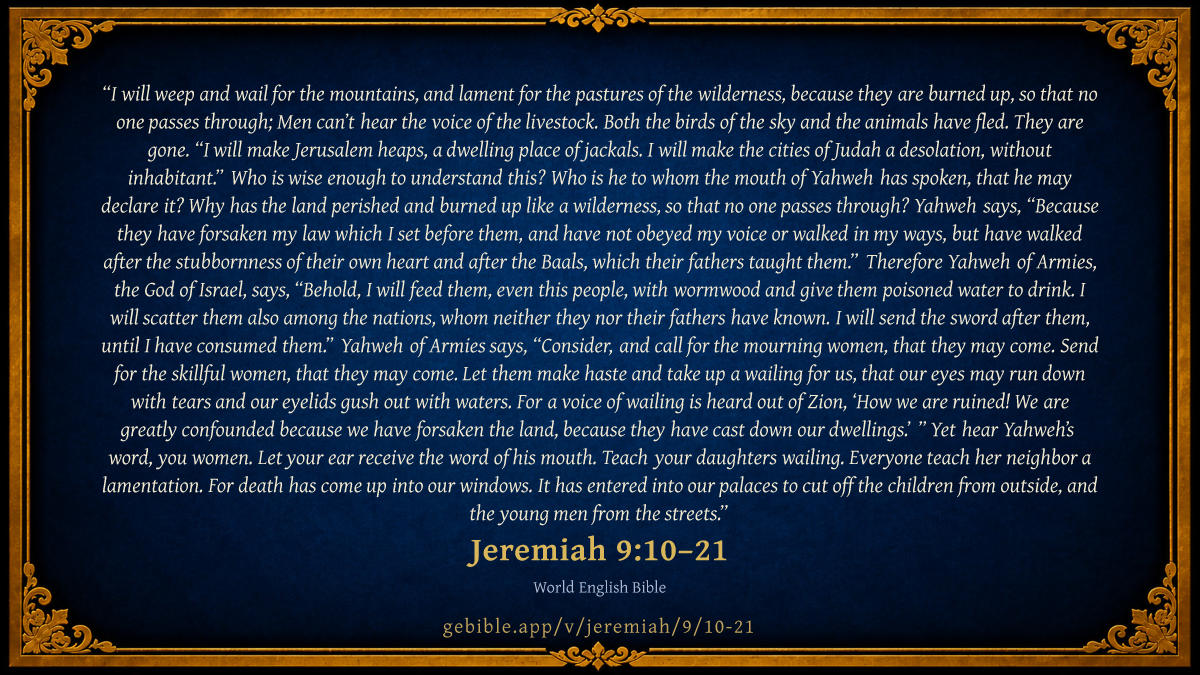
I will weep and wail for the mountains, and lament for the pastures of the wilderness, because they are burned up, so that no one passes through; Men can’t hear the voice of the livestock. Both the birds of the sky and the animals have fled. They are gone.
“I will make Jerusalem heaps, a dwelling place of jackals. I will make the cities of Judah a desolation, without inhabitant.”
Who is wise enough to understand this? Who is he to whom the mouth of Yahweh has spoken, that he may declare it? Why has the land perished and burned up like a wilderness, so that no one passes through?
Yahweh says, “Because they have forsaken my law which I set before them, and have not obeyed my voice or walked in my ways, but have walked after the stubbornness of their own heart and after the Baals, which their fathers taught them.” Therefore Yahweh of Armies, the God of Israel, says, “Behold, I will feed them, even this people, with wormwood and give them poisoned water to drink. I will scatter them also among the nations, whom neither they nor their fathers have known. I will send the sword after them, until I have consumed them.”
Yahweh of Armies says, “Consider, and call for the mourning women, that they may come. Send for the skillful women, that they may come.
Let them make haste and take up a wailing for us, that our eyes may run down with tears and our eyelids gush out with waters.
For a voice of wailing is heard out of Zion, ‘How we are ruined! We are greatly confounded because we have forsaken the land, because they have cast down our dwellings.’ ”
Yet hear Yahweh’s word, you women. Let your ear receive the word of his mouth. Teach your daughters wailing. Everyone teach her neighbor a lamentation.
For death has come up into our windows. It has entered into our palaces to cut off the children from outside, and the young men from the streets.
John Calvin 1540 · Public Domain On vv10–21 The Prophet had exhorted others to lament and to…
The Prophet had exhorted others to lament and to bewail. He now comes forth as though none had ears to attend to his admonition. As then he himself undertakes to mourn and to lament, he no doubt indirectly condemns the insensibility of the whole people. He saw by the spirit of prophecy, that all the rest thought what he said incredible and therefore fabulous. For though the kingdom of Judah was at that time much wasted, and the kingdom of Israel wholly fallen, they yet continued secure and heedless when they ought to have expected God’s vengeance every day, and even every hour. Since then there was such insensibility in the people, the Prophet here prepares himself for lamentation and mourning.
I will take up, he says, mourning and lamentation for the mountains The words may be explained, “I will take up mourning, which shall ascend as far as the mountains;” but the cause of mourning seems rather to be intended; for it immediately follows, and weeping for the pastures of the desert Had not this clause been added, the former meaning might be taken, that is, that mourning would be so loud as to penetrate into the mountains or ascend into the highest parts. But as Jeremiah connects the two clauses, for the mountains, and for the pastures of the desert, the other meaning is much more appropriate, — that the confidence of the people was very absurd, as they thougilt themselves beyond danger, dwelling as they did on the plains; for the enemies, he says, shall leave nothing untouched; they shall come to the mountains and to the pastures of the desert. It hence follows, that they were foolish who promised themselves quietness on the plains, where the enemy could easily come.
Read full note →
We now then understand the Prophet’s meaning: he sets here his own fear and solicitude in contrast with the stupor of the whole people. I will raise, he says, weeping and lamentation for the mountains: but others remained secure and thoughtless in their pleasures. He then shews, that while they were blind, his eyes were open, and he saw the coming ruin which was now at hand. And he sets the mountains and pastures of the desert in opposition to the level country. For when a country is laid waste, we know that still a retreat is sought on mountains; for enemies dread ambushes there, and access is not easy where the roads are narrow. Then the Prophet says, that even the mountains would not be beyond the reach of danger, for the enemies would march there: he says the same of the pastures of the desert. We hence learn how absurd was their confidence who thought themselves safe because they inhabited the plain country, which was the most accessible.
As to the word נאותnaut, it comes from נוהhue, which means to dwell. He then takes נאות haut, as signifying pleasant places, or pastures. Some render it sheds or cottages. David uses the same word in Psalm 23:2, in speaking of God’s favor to him, who was pleased to become his shepherd:
“He makes me to lie down,” he says, “in pleasant places.”
But the Prophet no doubt means pastures here. And he calls them the pastures of the desert. The word מדבר midbar, we know, is taken to designate not only waste and sterile places, but also a mountainous country. Though then the richest pastures were on mountains, yet the Jews were wont to call them deserts: there is therefore nothing absurd in saying, the pleasant places or pastures of the desert. But we must bear in mind the contrast, of which I have reminded you: for he intended to condemn the foolish confidence of the people, who thought that they were dwelling in safety, when yet they were exposed to enemies, and had no means to repel or retard their progress.
Because they are laid waste, He says. This word may be taken in another sense, “burnt up;” but it is not suitable here. He says then that these places are laid waste, so that no one passed through. He means that mountains would not only be without inhabitants, but would be so deserted and solitary that there would be none passing over them. There would then be none to frequent them. It hence follows, that there would be no inhabitants, He then adds, that no voice of cattle was heard; as though he had said, that their enemies would take away as their spoil whatever should be found there: for the wealth of mountains consists in cattle; for there is neither sowing nor reaping there; but inhabitants of mountains get their living and whatever is necessary to support life, from flesh and skin and milk and cheese. When therefore the Prophet declares that there would be no voice of cattle, it is the same as though he had said, that the mountains would become altogether uninhabited, for their enemies would take away all the cattle found there.
He then adds, From the bird of the heavens to the earthly beast they shall migrate and depart Here he seems again indirectly to reprove the insensibility of the people, as though he had said, that the birds would feel it to be the judgment of God, while yet men were wholly insensible; and that there would be a similar feeling in brute animals; as though he had said, that there would be more understanding in birds and animals than in the Jews, who had not only been created in the image of God, but had also been enlightened as to the truth of salvation; for shine among them did the truth of God in the law. Hence the Prophet shews that this stupidity was most shameful; for they were as stupid as if they had no thought and no understanding, while yet birds acknowledged the vengeance of God, and brute animals were terrified by it. We now perceive the meaning of the Prophet. It follows —
John Calvin's Commentaries (1540-1563) — public domain. Text from the Calvin Translation Society English edition (1840s-50s) via the Christian Classics Ethereal Library (ccel.org). Calvin's coverage is partial (roughly two-thirds of the Bible); uncommented books and verses are honest gaps, never fabricated. The 19th-century editor's footnotes and remarks are omitted so the notes are faithfully Calvin's own voice.
Geneva Bible translators 1599 · Public Domain On vv10, 12, 14, 15, 17, 19, 20, 21 Signifying, that all the places about Jerusalem should be…
Signifying, that all the places about Jerusalem should be destroyed.
Geneva Bible (1599) marginal notes — public domain.
John Trapp 1656 · Public Domain On vv10–21 Jer 9:10 For the mountains will I take up…
Jer 9:10 For the mountains will I take up a weeping and wailing, and for the habitations of the wilderness a lamentation, because they are burned up, so that none can pass through [them]; neither can [men] hear the voice of the cattle; both the fowl of the heavens and the beast are fled; they are gone.
Ver. 10. For the mountains will I take up a weeping.] Accingit se Tropheta ad luctum. Jeremiah was better at weeping than Heraclitus, and from a better principle. Lachrymas angustiae exprimit Crux: lachrymas poenitentiae peccatum: lachrymas sympathiae, affectus humanitatis, vel Christianitatis: lachrymas nequitiae, vel hypocrisis vel vindictae cupiditas. Jeremiah’s tears were of the best sort.
Read full note →
Because they are burnt up.] The Rabbis tell us, that after the people were carried captive to Babylon, the land of Jewry was burnt up with sulphur and salt. But this may well pass for a Jewish fable.
Both the fowl of the heaven.] See Jer 4:25.
John Trapp, A Commentary or Exposition upon All the Books of the Old and New Testament (1647–1656) — public domain. Text from a community e-Sword module.
Matthew Poole 1685 · Public Domain On vv10–21 The prophet having, Jer 9:1, taken up a lamentation…
The prophet having, Jer 9:1, taken up a lamentation for the slaughter of the people, he now reassumes it for the desolation of the whole land, every part of it being to be laid waste: see Jer 4:23,26. And it either sets forth the greatness of his grief, that shall reach to he very mountains, as the words may be read; or rather, the cause of his mourning, because he presently adds, for
the habitations of the wilderness. Of the wilderness; plain, or valley, as it often signifies; so the word is used Isa 63:13,14; or, pleasant plains. The country of Judea being mountainous, these plains and valleys were their chief places for pasturage, vhich dealt greatly aggravate the devastation; these shall be burnt up, the herbage so burnt that it shall be left utterly barren, like a parched heath, Jer 9:12. The mountains shall not be able to secure them, nor the valleys to feed them. None can pass through them; either there being no path; the LXX. render it, on the paths of the wilderness; or none to pass to and fro, and so leave it desolate; or so parched and waste that none can pass through it, so far are they from being inhabited, Jer 2:6. Neither can men hear the voice of the cattle; there, where once all sorts of cattle and fowls in great plenty where wont to feed and graze, there is not so much as the chirping of a bird, the bleating of a sheep or lowing of an ox to be heard: see Jer 23:10-12; 50:3. They are said to be fled and gone; either the enemy hath swept away all, or they have forsaken the land, because there was no food, Jer 12:4. A figurative expression of a universal desolation.
Matthew Poole's English Annotations on the Holy Bible (1683–1685) — public domain. Text from a community e-Sword/MySword module.
Matthew Henry 1710 · Public Domain On v12 Two things the prophet designs, in these verses, with…
Two things the prophet designs, in these verses, with reference to the approaching destruction of Judah and Jerusalem: - 1. To convince people of the justice of God in it, that they had by sin brought it upon themselves and that therefore they had no reason to quarrel with God, who did them no wrong at all, but a great deal of reason to fall out with their sins, which did them all this mischief. 2. To affect people with the greatness of the desolation that was coming, and the miserable effects of it, that by a terrible prospect of it they might be awakened to repentance and reformation, which was the only way to prevent it, or, at least, mitigate their own share in it. This being designed,
I. He calls for the thinking men, by them to show people the equity of God's proceedings, though they seemed harsh and severe (Jer 9:12): "Who, where, is the wise man, or the prophet, to whom the mouth of the Lord hath spoken? You boast of your wisdom, and of the prophets you have among you; produce me any one that has but the free use of human reason or any acquaintance with divine revelation, and he will soon understand this himself, and it will be so clear to him that he will be ready to declare it to others, that there is a just ground of God's controversy with this people." Do these wise men enquire, For what does the land perish? What is the matter, that such a change is made with this land? It used to be a land that God cared for, and he had his eyes upon it for good (Deu 11:12), but it is now a land that he has forsaken and that his face is against. It used to flourish as the garden of the Lord and to be replenished with inhabitants; but now it is burnt up like a wilderness, that none passeth through it, much less cares to settle in it. It was supposed, long ago, that it would be asked, when it came to this, Wherefore has the Lord done thus unto this land? What means the heat of this great anger? (Deu 29:24), to which question God here gives a full answer, before which all flesh must be silent. He produces out of the record,
Read full note →
1. The indictment preferred and proved against them, upon which they had been found guilty, Jer 9:13, Jer 9:14. It is charged upon them, and it cannot be denied, (1.) That they have revolted from their allegiance to their rightful Sovereign. Therefore. God has forsaken their land, and justly, because they have forsaken his law, which he had so plainly, so fully, so frequently set before them, and had not observed his orders, not obeyed his voice, nor walked in the ways that he had appointed. Here their wickedness began, in the omission of their duty to their God and a contempt of his authority. But it did not end here. It is further charged upon them, (2.) That they have entered themselves into the service of pretenders and usurpers, have not only withdrawn themselves from their obedience to their prince, but have taken up arms against him. For, [1.] They have acted according to the dictates of their own lusts, have set up their own will, the wills of the flesh, and the carnal mind, in competition with, and contradiction to the will of God: They have walked after the imagination of their own hearts; they would do as they pleased, whatever God and conscience said to the contrary. [2.] They have worshipped the creatures of their own fancy, the work of their own hands, according to the tradition received from their fathers: They have walked after Baalim: the word is plural; they had many Baals, Baal-peor and Baal-berith, the Baal of this place and the Baal of the other place; for they had lords many, which their fathers taught them to worship, but which the God of their fathers had again and again forbidden. This was it for which the land perished. The King of kings never makes war thus upon his own subjects but when they treacherously depart from him and rebel against him, and it has become necessary by this means to chastise their rebellion and reduce them to their allegiance; and they themselves shall at length acknowledge that he is just in all that is brought upon them.
2. The judgment given upon this indictment, the sentence upon the convicted rebels, which must now be executed, for it was righteous and nothing could be moved in arrest of it: The Lord of hosts, the God of Israel, hath said it (Jer 9:15, Jer 9:16), and who can reverse it? (1.) That all their comforts at home shall be poisoned and embittered to them: I will feed this people with wormwood (or rather with wolf's-bane, for it signifies a herb that is not wholesome, as wormwood is though it be bitter, but some herb that is both nauseous and noxious), and I will give them water of gall (or juice of hemlock or some other herb that is poisonous) to drink. Every thing about them, till it comes to their very meat and drink, shall be a terror and torment to them. God will curse their blessings, Mal 2:2. (2.) That their dispersion abroad shall be their destruction (Jer 9:16): I will scatter them among the heathen. They were corrupted and debauched by their intimacy with the heathen, with whom they mingled and learned their works; and now they shall lose themselves, where they lost their virtue, among the heathen. They set up gods which neither they nor their fathers had known, strange gods, new gods (Deu 32:17); and now God will put them among neighbours whom neither they nor their fathers have known, whom they can claim no acquaintance with, and therefore can expect no favour from. And yet, though they are scattered so as that they will not know where to find one another. God will know where to find them all out (Psa 21:8) with that evil which still pursues impenitent sinners: I will send a sword after them, some killing judgment or other, till I have consumed them; for when God judges he will overcome, when he pursues he will overtake. And now we see for what the land perishes; all this desolation is the desert of their deeds and the performance of God's words.
II. He calls for the mourning women, and engages them, with the arts they practise to affect people and move their passions, to lament these sad calamities that had come or were coming upon them, that the nation might be alarmed to prepare for them: The Lord of hosts himself says, Call for the mourning women, that they may come, Jer 9:17. the scope of this is to show how very woeful and lamentable the condition of this people was likely to be. 1. Here is work for the counterfeit mourners: Send for cunning women, that know how to compose mournful ditties, or at least to sing them in mournful tunes and accents, and therefore are made use of at funerals to supply the want of true mourners. Let these take up a wailing for us, Jer 9:18. The deaths and funerals were so many that people wept for them till they had no power to weep, as those, Sa1 30:4. Let those therefore do it now whose trade it is. Or, rather, it intimates the extreme sottishness and stupidity of the people, that laid not to heart the judgments they were under, nor, even when there was so much blood shed, could find in their hearts to shed a tear. They cry not when God binds them, Job 36:13. God sent his mourning prophets to them, to call them to weeping and mourning, but his word in their mouths did not work upon their faith; rather therefore than they shall go laughing to their ruin, let the mourning women come, and try to work upon their fancy, that their eyes may at length run down with tears, and their eyelids gush out with waters. First or last, sinners must be weepers. 2. Here is work for the real mourners. (1.) There is that which is a lamentation. The present scene is very tragical (Jer 9:19): A voice of wailing is heard out of Zion. Some make this to be the song of the mourning women: it is rather an echo to it, returned by those whose affections were moved by their wailings. In Zion the voice of joy and praise used to be heard, while the people kept closely to God. But sin has altered the note; it is now the voice of lamentation. It should seem to be the voice of those who fled from all parts of the country to the castle of Zion for protection. Instead of rejoicing that they had got safely thither, they lamented that they were forced to seek for shelter there: "How are we spoiled! How are we stripped of all our possessions! We are greatly confounded, ashamed of ourselves and our poverty;" for that is it that they complain of, that is it that they blush at the thoughts of, rather than of their sin: We are confounded because we have forsaken the land (forced so to do by the enemy), not because we have forsaken the Lord, being drawn aside of our own lust and enticed - because our dwellings have cast us out, not because our God has cast us off. Thus unhumbled hearts lament their calamity, but not their iniquity, the procuring cause of it. (2.) There is more still to come which shall be for a lamentation. Things are bad, but they are likely to be worse. Those whose land has spued them out (as it did their predecessors the Canaanites, and justly, because they trod in their steps, Lev 18:28) complain that they are driven into the city, but, after a while, those of the city, and they with them, shall be forced thence too: Yet hear the word of the Lord; he has something more to say to you (Jer 9:20); let the women hear it, whose tender spirits are apt to receive the impressions of grief and fear, for the men will not heed it, will not give it a patient hearing. The prophets will be glad to preach to a congregation of women that tremble at God's word. Let your ear receive the word of God's mouth, and bid it welcome, though it be a word of terror. Let the women teach their daughters wailing; this intimates that the trouble shall last long, grief shall be entailed upon the generation to come. Young people are apt to love mirth, and expect mirth, and are disposed to be gay and airy; but let the elder women teach the younger to be serious, tell them what a vale of tears they must expect to find this world, and train them up among the mourners in Zion, Tit 2:4, Tit 2:5. Let every one teach her neighbour lamentation; this intimates that the trouble shall spread far, shall go from house to house. People shall not need to sympathize with their friends; they shall all have cause enough to mourn for themselves. Note, Those that are themselves affected with the terrors of the Lord should endeavour to affect others with them. The judgment here threatened is made to look terrible. [1.] Multitudes shall be slain, Jer 9:21. Death shall ride in triumph, and there shall be no escaping his arrests when he comes with commission, neither within doors nor without. Not within doors, for let the doors be shut ever so fast, let them be ever so firmly locked and bolted, death comes up into our windows, like a thief in the night; it steals upon us ere we are aware. Nor does it thus boldly attack the cottages only, but it has entered into our palaces, the palaces of our princes and great men, though ever so stately, ever so strongly built and guarded. Note, No palaces can keep out death. Nor are those more safe that are abroad; death cuts off even the children from without and the young men from the streets. The children who might have been spared by the enemy in pity, because they had never been hurtful to them, and the young men who might have been spared in policy, because capable of being serviceable to them, shall fall together by the sword. It is usual now, even in the severest military executions, to put none to the sword. It is usual now, even in the severest military executions, to put none to the sword but those that are found in arms; but then even the boys and girls playing in the streets were sacrificed to the fury of the conqueror. [2.] Those that are slain shall be left unburied (Jer 9:22): Speak, Thus saith the Lord (for the confirmation and aggravation of what was before said), Even the carcases of men shall fall as dung, neglected, and left to be offensive to the smell, as dung is. Common humanity obliges the survivors to bury the dead, even for their own sake; but here such numbers shall be slain, and those so dispersed all the country over, that it shall be an endless thing to bury them all, nor shall there be hands enough to do it, nor shall the conquerors permit it, and those that should do it shall be overwhelmed with grief, so that they shall have no heart to do it. The dead bodies even of the fairest and strongest, when they have lain awhile, become dung, such vile bodies have we. And here such multitudes shall fall that their bodies shall lie as thick as heaps of dung in the furrows of the field, and no more notice shall be taken of them than of the handfuls which the harvestman drops for the gleaners, for none shall gather them, but they shall remain in sight, monuments of divine vengeance, that the eye of the impenitent survivors may affect their heart. Slay them not, bury them not, lest my people forget, Psa 59:11.
Matthew Henry's Commentary on the Whole Bible (1708–1710) — public domain (CC PDM 1.0). Text via the HelloAO Bible API.
John Gill 1763 · Public Domain On vv10–21 For the mountains will I take up a weeping…
For the mountains will I take up a weeping and wailing,.... Because of the desolation of them; because no pasture upon them, nor flocks feeding there; or "concerning" them, as the Arabic version; or "upon" them (y), in order to cause the lamentation to be heard the further; but the former sense seems best, as appears by what follows. The Septuagint, Syriac, and Arabic versions, read it as an exhortation to others, "take up a weeping": but they are the words of the prophet, declaring what he would do.
And for the habitations of the wilderness a lamentation; for the cottages of the shepherds, erected for their convenience, to look after their flocks, feeding on the mountains, and in the valleys; for the wilderness does not denote barren places, but pastures:
Read full note →
because they are burnt up; by the fire of the Chaldeans, who burnt the cottages, and drove off the cattle:
so that none can pass through them; or there is none that passes through; as no inhabitant there, so no passenger that way; which shows how very desolate these places were:
neither can men hear the voice of the cattle; the lowing of the oxen, or the bleating of the sheep, there being none to be heard, being all carried off; and indeed no men to hear them, had there been any:
both the fowl of the heavens and the beasts are fled, they are gone; or, "from the fowl of the heavens to the beasts", &c. (z), the places lying waste and uncultivated; there were no seed for the fowls to pick up, which generally frequent places where there is sowing, and where fruit is brought to perfection; and no pasture for the beasts to feed upon. Kimchi says these words are an hyperbole. The word "beast", being by geometry, or numerically, fifty two, the Jews (a) gather from hence, that for the space of fifty two years no man passed through the land of Judah; which they reckon from the time that Zedekiah was carried captive, to the commandment of Cyrus.
(y) "super montibus", Cocceius; "super montes", V. L. Pagninus, Montanus. (z) "ab ave coelorum usque ad bestiam", Schmidt. (a) T. Bab. Sabbat, fol. 145. 2. & Gloss. in ib. Vid. T. Bab. Megilla, fol. 11. 1, 2.
John Gill's Exposition of the Whole Bible (1746–1763) — public domain (CC PDM 1.0). Text via the HelloAO Bible API.
John Wesley 1765 · Public Domain On vv10, 12, 16, 17, 20, 21 Wailing - The prophet having taken up a lamentation…
Wailing - The prophet having taken up a lamentation for the slaughter of the people, now re-assumes it for the desolation of the whole land. The mountains shall not be able to secure them, nor the valleys to feed them.
John Wesley, Explanatory Notes Upon the Whole Bible (1754–1765) — public domain. Text via the GEBible commentary corpus.
Adam Clarke 1810 · Public Domain On vv10, 11, 12, 15, 17, 20, 21 Verse 10. Both the fowl of the heavens and…
Verse 10. Both the fowl of the heavens and the beast are fled] The land shall be so utterly devastated, that neither beast nor bird shall be able to live in it.
Adam Clarke's Commentary on the Bible (1810–1826) — public domain. Text from a community e-Sword/MySword module.
Joseph Benson 1811 · Public Domain On vv10, 12, 15, 17 Jer 9:10-11. For the mountains will I take up…
Jer 9:10-11. For the mountains will I take up a weeping — “These words,” says Houbigant, “as they now lie, must belong either to Jeremiah or the daughter of Zion; and yet it follows in the next verse, And I will make, which are the words of God: therefore this verse should be rendered, by a slight alteration of the text, ‘Take ye up a weeping and wailing on the mountains, a lamentation in the dwellings of the wilderness; for they are desolate, because there is no traveller; nor is the voice of cattle heard in them; both the fowl of the heavens and the beast are fled.’“ The prophet laments that general desolation which he sees coming upon the whole land, and which would involve all the parts of it, both high and low, in one common destruction. I will make Jerusalem heaps — Of rubbish, and lay it in such ruins that it shall be fit for nothing but to be a den of dragons —
Or serpents, as the word תניםfrequently signifies, or such creatures as are usually found in ruins or desolate places.
Joseph Benson's Commentary on the Old and New Testaments (1811–1818) — public domain. Text from a community e-Sword module.
Albert Barnes 1834 · Public Domain On v10 The punishment described in general terms in the preceding…
The punishment described in general terms in the preceding three verses is now detailed at great length.
Jer 9:10
Read full note →
The habitations i. e - the temporary encampments of the shepherds (see Jer 6:3).
So that none can ... - Or, “They are parched up, with no man to pass through them; neither do they hear the voice of cattle; from the birds of the heaven even to the beasts they “are fled, they are gone.”
Jer 9:11
Dragons - Rather, jackals.
Jer 9:12
For what the land perisheth ... - This is the question proposed for consideration. The prophet calls upon the wise man to explain his question; that question being, Wherefore did the land perish? He follows it by the assertion of a fact: “It is parched like the wilderness with no man to pass through.”
Jer 9:13
The cause of the chastisement about to fall upon Jerusalem, was their desertion of the divine Law.
Jer 9:14
Imagination - Or, as in the margin.
Which their fathers taught them - It was not the sin of one generation that brought upon them chastisement: it was a sin, which had been handed down from father to son.
Jer 9:15
I will feed them ... - Rather, I am feeding them. The present participle used here, followed by three verbs in the future, shows that the judgment has beam, of which the successive stages are given in the next clause.
Wormwood - See Deu 29:18, note, and for “water of gall,” Jer 8:14, note.
Jer 9:16
This verse is taken from Lev 26:33. The fulfillment of what had been so long before appointed as the penalty for the violation of Yahweh’s covenant is one of the most remarkable proofs that prophecy was something more than human foresight.
Till I have consumed them - See Jer 4:27 note. How is this “consuming” consistent with the promise to the contrary there given? Because it is limited by the terms of Jer 9:7. Previously to Nebuchadnezzars destruction of Jerusalem God removed into safety those in whom the nation should revive.
Jer 9:17
The mourning women - Hired to attend at funerals, and by their skilled wailings aid the real mourners in giving vent to their grief. Hence, they are called “cunning,” literally “wise” women, wisdom being constantly used in Scripture for anything in which people are trained.
Jer 9:18
Take up a wailing for us - i. e., for the nation once God’s chosen people, but long spiritually dead.
Jer 9:19
Forsaken - Or, left: forced to abandon the land.
Because our dwellings ... - Rather, “because they have east down our dwellings.” The whole verse is a description of their sufferings. See 2Ki 25:1-12.
Jer 9:20
The command is addressed to the women because it was more especially their part to express the general feelings of the nation. See 1Sa 18:6; 2Sa 1:24. The women utter now the death-wail over the perishing nation. They are to teach their daughters and neighbors the “lamentation, i. e., dirge,” because the harvest of death would be so large that the number of trained women would not suffice.
Jer 9:21
Death is come up ... - i. e., death steals silently like a thief upon his victims, and makes such havoc that there are no children left to go “without,” nor young men to frequent the open spaces in the city.
Jer 9:22
The “handful” means the little bundle of grain which the reaper gathers on his arm with three or four strokes of his sickle, and then lays down. Behind the reaper came one whose business it was to gather several of these bundles, and bind them into a sheaf. Thus, death strews the ground with corpses as thickly as these handfuls lie upon the reaped land, but the corpses lie there unheeded.
Albert Barnes' Notes on the Bible (1834–1885) — public domain. Text from a community e-Sword/MySword module.
Haydock's Catholic Bible Commentary 1859 · Public Domain On vv10, 11, 15, 16, 17, 21 Owner. Hebrew mikne, "cattle," or (Haydock) "substance." (St. Jerome)…
Owner. Hebrew mikne, "cattle," or (Haydock) "substance." (St. Jerome) --- Departed. Beasts and birds will not continue long after men cease to cultivate the country. (Theodoret) (Chap. iv. 25., and xii. 4., and Sophonias i. 3.)
George Leo Haydock (1774–1849), Haydock's Catholic Family Bible and Commentary, 1859 edition — public domain. Excludes Psalms (Douay-Rheims chapter numbering differs from Protestant) and Deuterocanonical books (Catholic canon only).
Robert Jamieson, A. R. Fausset & David Brown 1871 · Public Domain On vv10–21 Jeremiah breaks in upon Jehovah's threats of wrath with…
Jeremiah breaks in upon Jehovah's threats of wrath with lamentation for his desolated country.
mountains--once cultivated and fruitful: the hillsides were cultivated in terraces between the rocks.
Read full note →
habitations of . . . wilderness--rather, "the pleasant herbage (literally, 'the choice parts' of any thing) of the pasture plain." The Hebrew for "wilderness" expresses not a barren desert, but an untilled plain, fit for pasture.
burned up--because no one waters them, the inhabitants being all gone.
none can pass through them--much less inhabit them.
fowl-- (Jer 4:25).
Jamieson, Fausset & Brown — Commentary Critical and Explanatory on the Whole Bible (1871) — public domain (CC PDM 1.0). Text via the HelloAO Bible API.
Daniel D. Whedon 1874 · Public Domain On vv10, 11, 12, 16, 17, 21 THE DESOLATION OF THE LAND AND THE DISPERSION OF…
THE DESOLATION OF THE LAND AND THE DISPERSION OF THE PEOPLE, Jer_9:9-15.
10. The whole passage to the twenty-second verse is devoted to setting forth in detail the punishment which is about to come upon the land and the people.
Read full note →
For the mountains — Once cultivated and fruitful, and covered with happy flocks, but now desolate.
For the habitations — Namely, of the shepherds, who pitch their tents or construct their booths wherever is pasturage for their flocks. But these pastures are to be burned up, so that there will be no life left.
Daniel D. Whedon (gen. ed.), Commentary on the Old and New Testaments (1874–1909) — public domain. Text from a community e-Sword module.
The Cambridge Bible for Schools and Colleges 1878 · Public Domain On vv10, 11, 12, 13, 14, 15, 17, 19, 20, 21 10. Cp. Jer_4:23-26.
10. Cp. Jer_4:23-26.
a lamentation] lit. a ḳinah, i.e. a composition carefully constructed in a definite rhythmical form. See Intr. p. xlix, also notes in C. B. on Amo_5:2; Amo_5:16, with pp. 232 ff. there.
Read full note →
burned up] better, laid waste.
10–16. See introd. summary to the section.
The Cambridge Bible for Schools and Colleges (gen. ed. J. J. S. Perowne; Cambridge University Press, 1878–1918) — public domain. Text from a community e-Sword module.
Ellicott's Commentary for English Readers 1878 · Public Domain On vv10, 11, 12, 14, 15, 17, 18, 19, 20, 21 (10) For the mountains . . .—The Hebrew preposition…
(10) For the mountains . . .—The Hebrew preposition means both “upon” and “on account of,” and probably both meanings were implied. The prophet sees himself upon the mountains, taking up the lamentation for them because they are “burned up.”
The habitations.—Better, as in the margin, pastures. The wilderness is simply the wild open country.
Read full note →
So that none can pass . . . neither can men hear.—Better, with none to pass through them . . . neither do men hear.
Both the fowl . . .—The Hebrew is more emphatic; from the fowl of the heavens to the beast . . . they are fled.
A Bible Commentary for English Readers, edited by Charles John Ellicott (1878–1897) — public domain. Text from a community e-Sword module.
The Pulpit Commentary 1880 · Public Domain On vv10–21 This and the next six verses contain a description…
This and the next six verses contain a description of the sad fate of the sinful land and people. At first the prophet speaks as if he saw it all spread out before him. Then, in the character of a surprised spectator, he inquires how this came to pass, and receives the Divine answer, that it is the doom of self-willed rebellion. The habitations should rather be pastures. The country, once covered with grazing flocks and herds, is now so utterly waste that even the birds cannot find subsistence.
Vers. 10-22. The terrible threatenings of love.
Read full note →
There are few more awful passages of Scripture than this. The doom denounced on the guilty people is indeed dreadful. Nevertheless that doom had not yet descended. There was a merciful pause, during which space was given for repentance. Meanwhile the prophet was bidden to utter these threatenings. Notice
I How TERRIBLE THEY ARE.
1. In themselves. The fertile hills and pastures of their country shall be laid waste, so that no living creature can find food (Ver. 10). Jerusalem is to be utterly destroyed and desolate (Ver. 11). The deep anguish of the people-their very meat to be as "wormwood," and their drink as" water of gall "( Ver. 15). They shall be carried captive and scattered among the heathen, and even then shall not escape the sword (Ver. 16). They shall be overwhelmed with sorrow, their eyes shall gush out with tears (Vers. 17-19). Death shall reign everywhere (Ver. 21); and shall be accompanied with deepest degradation (Ver. 22). It is not possible to conceive of more hopeless misery than is portrayed in these vivid descriptions of the wrath that was to come.
2. Because of their righteousness. Unrighteous suffering can be borne, and those who bear it are bidden by the Lord to count themselves as "blessed" because of it. (Mat_5:11, Mat_5:12) And sorrows that come to us in the course of God"s providence, and the reason of which we do not know, these we can bear sustained by the faith of the Father"s love. But when sore suffering is sent to us as the direct punishment of sin, and the righteous because so deserved anger of Cod is evident, then those consolations which are open to us under other sufferings are closed to us under these. The bitter reflection, "It was all our own fault; it might, it ought to have been avoided," makes the pain we endure, and the calamities that overtake us, more terrible than otherwise they could possibly be. We take refuge from man"s anger and from ordinary sorrows in God"s love, but sin that has brought down God"s righteous judgment has also closed against us that most blessed shelter and every shelter, and we are left without defense. And another element in their terribleness is:
3. The certainty of their fulfillment, "God is not mocked: whatsoever a man soweth, that shall he also reap." The threatenings of God are not, as are many of the threatenings of men, mere empty vaporings, great swelling words, never designed to be fulfilled. Let the records of all human history, of all human lives, Whether told of within or without the pages of the Bible, attest the absolute certainty of fulfillment which evermore characterizes the threatenings of God. When and where has be ever threatened and failed to fulfill his threat? Let the Fall, the Flood, the destruction of Sodom, the plagues on Egypt, the deaths of the generation of unbelievers in the wilderness, and ten thousand instances more, all prove the steadfastness of God to his word. And it is this fact of the absolute certainty of his threatenings being fulfilled that adds to them a yet further terribleness. There is no chance of escape, no hope of God"s relenting; as certain as the fixed laws of nature are these awful denunciations of God to him who persists in brining them upon himself.
II BUT THEY ARE THE THREATENINGS OF LOVE.
1. He who utters them is the God who in his very nature and essence is love. How manifold are the proofs of this in creation, in providence, in grace! He, therefore, has no pleasure in the death of the wicked; judgment is his "strange work.
2. Those against whom they are uttered are the objects of his love. His love for them is deeper than his anger against them. Hence it is that the contrite sinner never fails to gain the pardon he seeks. "Fathers of our flesh" may "chasten after their own pleasure, but he for our profit" (cf. Ver. 7).
3. His purpose in these threatenings is a loving purpose. He would compel by the scourge of fear his rebellious children to abandon their evil ways.
4. And if at length he is compelled to execute his threatenings, it is out of love that he does so. For the love of God is towards his children, not to any one particular child, and the welfare of the family is the chief consideration. Salus populi suprema lex. If consistently with that the transgressor can be restored, he will be, but not else. Hence, as an earthly father would not permit one of his children, ill with terrible and contagious disease, to mingle with the other children; or, as in the far more sad case of utter moral wickedness, intercourse with the rest would be forbidden; so, for the sake of the rest of his children, God will separate them from the wicked and the wicked from them. But it is love which constrains to this, and hence it is that the seeming contradiction is true, that he who is the God of love is also "a consuming fire." The very fatherhood of God is the most fearful fact of all others against the persistently rebellious and ungodly soul. Hence
III Such THREATENINGS ARE EVER THE MOST TERRIBLE OF ALL, Cf. the threatenings of our Savior. The most awful utterances to be found in the whole Bible proceeded from his lips-the lips whose words were wont to be so "gracious" that the people "wondered" at them. It is his sayings which have lit up the lurid glare of the fires unquenchable of hell, and it is he who has made our souls shudder at the sight of" the worm that dieth not," and of the "outer darkness" where there is "weeping and wailing and gnashing of teeth." See, too, the Revelation of St. John. That apostle, whose great theme is the love of God, whose soul was more attuned to the music of love than that of any other, wrote that awful book, which is full throughout of "mourning, lamentation, and woe;" and which almost reeks with the Mood and fire and smoke of torments of which it tells. These facts can only be accounted for and there are more like them on the ground that the threatenings of love are ever the most terrible of all. And they are so, for such reasons as these:
1. Love so hates what tends to the harm of those it loves. Hence it brands with its deepest curse that sin which harms God"s children most of all. One chief argument with many minds for the retention of capital punishments is that only so can a government or nation mark its sense of the supreme wickedness of the crime it so punishes. Punish it as other crimes are punished, and it will come to be regarded as no worse than they. And in like manner God would inspire us with a holy abhorrence of sin by the awful condemnation that he has pronounced against it.
2. Love so yearns to rescue those it loves. The rope may cut and wound the hands of the drowning sailor to whom we have thrown it, but we do not mind that if thereby he be drawn safe to shore. The knife of the surgeon may cut deep and cause fearful pain, but if it saves the imperiled life we are thankful notwithstanding. So God sends forth these stern, rough, and terrible threatenings, that souls under the spell of sin may be awakened, alarmed, made to tremble, and to "seek the Lord while he may be found." No gentler means will avail; therefore these, so love resolves, shall not be left untried. It will shrink from nothing to accomplish its compassionate purpose of rescuing from the murderous sin the soul it loves.
3. And there is no wickedness so deep as that of outraging love. Men will never see sin in all its hatefulness until they see it as outrage done to love. Whilst they are taught only that it is disobedience to sovereign rule rather than despite and shameful wrong done to a Father"s heart, they will not look upon it as they should, nor repent of it as they must. Even in human esteem, outrage done to a loving heart adds intensity to the condemnation with which we view and sentence disobedience done to law. We all recognize that such wickedness is the worst of all. We cannot wonder, then, that the threatenings against wrong persistently done to the love of God are terrible as they are, and the most terrible of all.
CONCLUSION.
1. Beware of bringing upon yourselves such threatenings as these. Those which are fulminated forth by hatred, or by pride, or by sovereignty, or by law, these, though they may be terrible, are not to be compared with those that we have been considering. "The wrath of the Lamb" is the most awful of all.
2. Beware of despising them. So far from believing what has now been shown, men argue in directly opposite way, and, because the threatenings are those of love, they conclude that they may safely be disregarded, they will never be carried out. But what has now been shown proves that this is the very last thing we can venture to do.
3. Beware of concealing them. It is to be feared that, in these soft, easy days on which we have fallen, the Lord"s watchmen do very often fail to "blow the trumpet and give warning." From blood-guiltiness such as that let us pray to be delivered. For are there not many now whom nothing but the startling peal of the trumpet of God"s threatened judgments will ever arouse or alarm? Assuredly there are. Therefore, in view of the doom of the ungodly, as well as by the love of Christ, let us "beseech men to be reconciled to God. C.
The Pulpit Commentary (1880–1919), ed. H.D.M. Spence-Jones & Joseph S. Exell — public domain. Text from a community e-Sword module.
The Biblical Illustrator 1887 · Public Domain On vv13, 21 Because they have forsaken My law . . .…
Jer_9:13-16
Because they have forsaken My law . . . give them water of gall to drink.
Read full note →
The wages of sin
A quaint preacher, addressing miners, drew a picture of two mines. He represented payday at one of the mines, and described the long line of men coming to the cashiers desk to receive their wages. Presently some men came up whom the cashier did not know. Where have you been working? he asked. We were working in the other pit, they answered. Then that is the place to go for your money. No, they said, we like your pay best; we are tired, and we want rest, and we want peace and plenty. At the pit where we have been working they are treating us cruelly, and we get no pay, but blows and hard words. Wont you pay us? But the cashier says, No; you chose to work in the other pit, and you must take the wages they pay; you cannot work for one employer and get your wages from another. That was fair, was it not? the preacher asked. His hearers answered that it was. Then, said he, dont you serve the devil unless you want his wages.
The Biblical Illustrator, edited by Joseph S. Exell (c. 1880s–1900s) — public domain. Text from a community e-Sword module.
Paul E. Kretzmann 1924 · Public Domain On v10 The Desolation of the Land
The Desolation of the Land
v. 10. For the mountains will I take up a weeping and wailing, the prophet once more taking up his lament, and for the habitations of the wilderness, for the pastures of the steppes, a lamentation because they are burned up, singed by the sun’s excessive heat, no one remaining to tend and to irrigate them, so that none can pass through them, much less inhabit them; neither can men hear the voice of the cattle, their contented lowing in luscious pastures; both the fowl of the heavens and the beast are fled; they are gone, the land being deserted by every form of life. Upon this complaint Jehovah answers.
Read full note →
v. 11. (And) I will make Jerusalem heaps, a shapeless ruin, and a den of dragons, or jackals; and I will make the cities of Judah desolate, without an inhabitant, the standing expression for the very height of desolation. The application of the prophet now follows.
v. 12. Who is the wise man that may understand this? Who will heed and apply this lesson, this warning, in a proper manner? And who is he to whom the mouth of the Lord hath spoken that he may declare it, explain it to his countrymen, for what the land perisheth and is burned up like a wilderness that none passeth through? Evidently there is not one who possesses this divine wisdom.
v. 13. And the Lord said, in answering the question which has just been proposed. Because they have forsaken My Law which I set before them and have not obeyed My voice, the message brought by the true prophets, neither walked therein, not making the Word of the Lord their one rule of life,
v. 14. but have walked after the imagination of their own heart, following their own sinful desires in all the acts of their lives, and after Baalim, the idols of the heathen, which their fathers taught them, whose idolatry they made their own, thus becoming guilty of the same transgressions:
v. 15. therefore thus saith the Lord of hosts, the God of Israel, the almighty and only God, Behold, I will feed them, even this people, with wormwood, a bitter and poisonous food, and give them water of gall to drink, poison-water, Cf. Jer 8:14.
v. 16. I will scatter them also among the heathen, in shameful captivity and exile, whom neither they nor their fathers have known, as an adequate punishment for their transgression; and I will send a sword after them till I have consumed them, a large number of them thus being destroyed, especially among those who sought the shelter of Egypt, against the warning of God. Cf. Jer 44:27.
v. 17. Thus saith the Lord of hosts, Consider ye and call for the mourning women, those hired to give expression to their grief by plaintive cries and a general mournful behavior, found also in the New Testament, Mat 9:23, that they may come, and send for cunning women that they may come, for those most skilful in lamentation were required in this instance;
v. 18. and let them make haste and take up a wailing for us, for the whole nation of Judah, that our eyes may run down with tears and our eyelids gush out with waters, in the strongest expression of excessive sorrow.
v. 19. For a voice of wailing is heard out of Zion, in a lamentation over the city’s pitiful fate, but without a true repentance of the heart. How are we spoiled, laid waste by the enemy! We are greatly confounded, heaped with shame and disgrace, because we have forsaken the land, having been compelled to leave it, because our dwellings have cast us out, or, "because the enemy has driven us out. "
v. 20. Yet hear the word of the Lord, O ye women, and let your ear receive the word of His mouth, in ready obedience to the suggestion which He here makes, and teach your daughters wailing and every one her neighbor lamentation, so that the older generation of mourning women might quickly be replaced, and that there might always be a sufficient number of professional mourners in view of the coming slaughter.
v. 21. For death is come up into our windows, unexpectedly, stealthily, like a thief in the night, and is entered into our palaces, for the soldiers of the invading army, finding the doors barred, would gain admission through openings which are not so firmly barred, to cut off the children from without, those playing out in the streets and in the open places, and the young men from the streets. Thus death would take its harvest both in the houses and outside, in the streets and market-places.
v. 22. Speak, this being addressed to the prophet, in continuing the command of verse 20, Thus saith the Lord, Even the carcasses of men shall fall as dung upon the open field, there to rot away, and as the handful after the harvest-man, the grain ready to be gathered into sheaves, and none shall gather them, there would be neither a gathering of the bundles nor the labor of gleaners to take care of this grain. The words imply utter destruction, an utter casting aside on the part of Jehovah.
Paul E. Kretzmann, Popular Commentary of the Bible (1921–1924) — public domain. Text from a community e-Sword module.
unfoldingWord translationNotes 2017 · CC BY-SA 4.0 On vv10, 13, 15, 17, 19, 21 General Information:
General Information:
Yahweh continues speaking about the people of Judah. In verse 12, Jeremiah makes a comment.
Read full note →
I will sing a song of mourning ... a funeral song will be sung for the meadows
Yahweh is mourning for the land of Israel as if it were a person who died. (See: Parallelism and Personification)
a funeral song will be sung
This can be stated in active form. AT: "I will sing a funeral song" (See: Active or Passive)
the meadows
"the fields of grass that the livestock eats"
For they are burned
This can be stated in active form. AT: "Because someone has burned the meadows and pastures" (See: Active or Passive)
They will not hear the sound of any cattle
"Nobody will hear the sound of cattle there"
a hideout for jackals
"a place for jackals to hide." Jackals are fierce wild dogs.
places without inhabitants
"places where no people live"
What man is wise enough to understand this?
Yahweh uses this rhetorical question to emphasize that only a very wise person will understand the things he has said. This question can be written as a statement. AT: "Only people who are very wise can understand these things." (See: Rhetorical Question)
To whom has the mouth of Yahweh spoken, and he will declare it?
Yahweh uses this rhetorical question to emphasize that only the people he has spoken to can declare these things. This question can be written as a statement. AT: "Only those who have been taught by Yahweh can explain these things to others." (See: Rhetorical Question)
the mouth of Yahweh
Here Yahweh's speech is represented by his "mouth." AT: "Yahweh" (See: Synecdoche)
Why has the land perished and been destroyed ... pass through?
Yahweh uses this rhetorical question to emphasize that only a wise person could explain why the land has been destroyed. This question can be written as a statement. AT: "Only a wise person could explain why the land has perished and been destroyed ... pass through." (See: Rhetorical Question)
has the land perished and been destroyed
This can be stated in active form. Both "perished" and "been ruined" describe the land being ruined. AT: "is the land ruined" (See: Active or Passive and Doublet)
translationWords
mourn
cow
Jerusalem
ruin
kingdom of Judah
wise
understand
perish
desert
unfoldingWord translationNotes — © Distant Shores Media and the Door43 World Missions Community, licensed CC BY-SA 4.0. Source: git.door43.org/Door43/en_tn.
Tyndale Open Study Notes 2022 · CC BY-SA 4.0 On vv10, 11, 12, 13, 15, 17, 18, 20 9:10 It is unclear whether these words were uttered…
9:10 It is unclear whether these words were uttered by the Lord or by Jeremiah. If the words belong to the Lord, they indicate that he pronounced judgment from a broken heart. If they come from Jeremiah, they show the depths of pain in his heart as he delivered the Lord’s decree. The prophet faced the difficult task of separating his patriotism and empathy for the people from his identity as the Lord’s messenger.
Tyndale Open Study Notes — © Tyndale Open Resources, licensed CC BY-SA 4.0. Text via the HelloAO Bible API.