
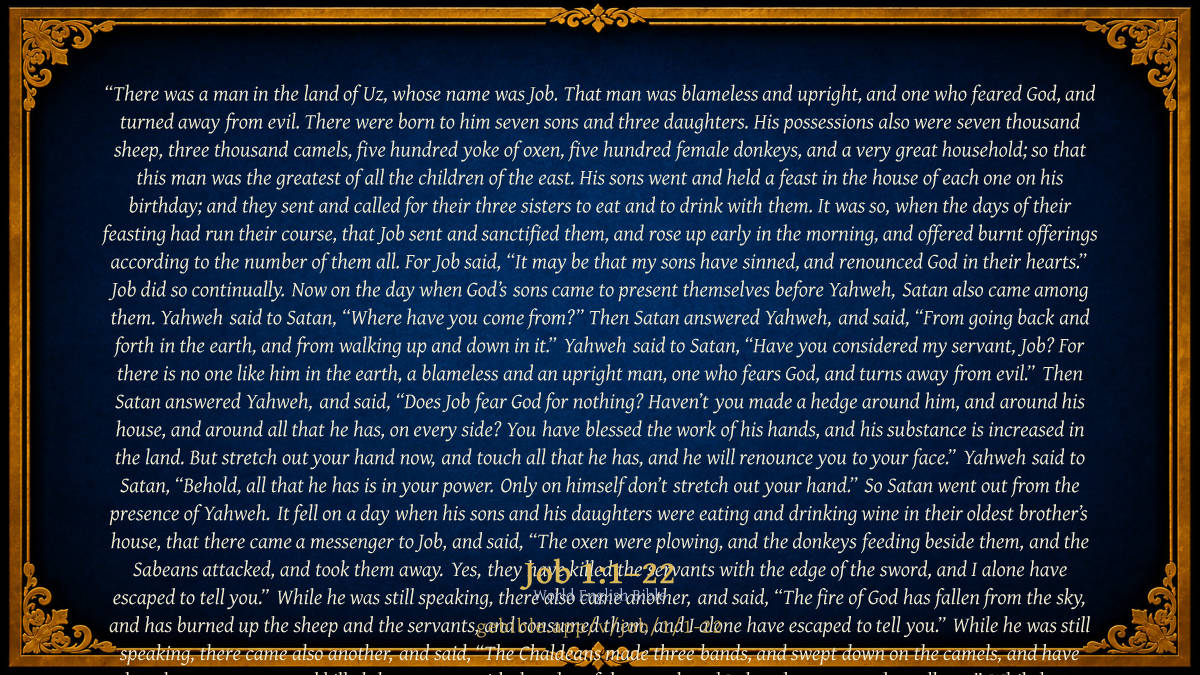
There was a man in the land of Uz, whose name was Job. That man was blameless and upright, and one who feared God, and turned away from evil. There were born to him seven sons and three daughters. His possessions also were seven thousand sheep, three thousand camels, five hundred yoke of oxen, five hundred female donkeys, and a very great household; so that this man was the greatest of all the children of the east. His sons went and held a feast in the house of each one on his birthday; and they sent and called for their three sisters to eat and to drink with them. It was so, when the days of their feasting had run their course, that Job sent and sanctified them, and rose up early in the morning, and offered burnt offerings according to the number of them all. For Job said, “It may be that my sons have sinned, and renounced God in their hearts.” Job did so continually.
Now on the day when God’s sons came to present themselves before Yahweh, Satan also came among them. Yahweh said to Satan, “Where have you come from?” Then Satan answered Yahweh, and said, “From going back and forth in the earth, and from walking up and down in it.”
Yahweh said to Satan, “Have you considered my servant, Job? For there is no one like him in the earth, a blameless and an upright man, one who fears God, and turns away from evil.”
Then Satan answered Yahweh, and said, “Does Job fear God for nothing? Haven’t you made a hedge around him, and around his house, and around all that he has, on every side? You have blessed the work of his hands, and his substance is increased in the land. But stretch out your hand now, and touch all that he has, and he will renounce you to your face.”
Yahweh said to Satan, “Behold, all that he has is in your power. Only on himself don’t stretch out your hand.” So Satan went out from the presence of Yahweh.
It fell on a day when his sons and his daughters were eating and drinking wine in their oldest brother’s house, that there came a messenger to Job, and said, “The oxen were plowing, and the donkeys feeding beside them, and the Sabeans attacked, and took them away. Yes, they have killed the servants with the edge of the sword, and I alone have escaped to tell you.”
While he was still speaking, there also came another, and said, “The fire of God has fallen from the sky, and has burned up the sheep and the servants, and consumed them, and I alone have escaped to tell you.”
While he was still speaking, there came also another, and said, “The Chaldeans made three bands, and swept down on the camels, and have taken them away, yes, and killed the servants with the edge of the sword; and I alone have escaped to tell you.”
While he was still speaking, there came also another, and said, “Your sons and your daughters were eating and drinking wine in their oldest brother’s house, and behold, there came a great wind from the wilderness, and struck the four corners of the house, and it fell on the young men, and they are dead. I alone have escaped to tell you.”
Then Job arose, and tore his robe, and shaved his head, and fell down on the ground, and worshiped. He said, “Naked I came out of my mother’s womb, and naked will I return there. Yahweh gave, and Yahweh has taken away. Blessed be Yahweh’s name.” In all this, Job didn’t sin, nor charge God with wrongdoing.
Geneva Bible translators 1599 · Public Domain On vv1, 3, 5, 6, 7, 9, 10, 11, 12, 15, 16, 18, 20, 21, 22 That is, of the country of Idumea, as Lam.…
That is, of the country of Idumea, as Lam. 4:21, or bordering thereupon: for the land was called by the name of Uz, the son of Dishan the son of Seir, Gen. 36:28.
Forasmuch as he was a Gentile, and not a Jew, and yet is pronounced upright, and without hypocrisy, it declareth that among the heathen God hath his.
Read full note →
Hereby is declared, what is meant by an upright and just man.
Geneva Bible (1599) marginal notes — public domain.
John Trapp 1656 · Public Domain On vv1–22 Job 1:1 There was a man in the land…
Job 1:1 There was a man in the land of Uz, whose name [was] Job; and that man was perfect and upright, and one that feared God, and eschewed evil.
Ver. 1. There was a man] A notable man, a man by an excellency, and with an accent (as it were), a man of high degree ( Animo virili praeditus), as the word Ish signifieth, Psa 49:2; Psa 62:9 (where it is opposed to Adam, utpote quem ex meliore luto finxit Titan), a manly man, every way excellent and eximious: Magnus et admirabilis vir, &c. A great and marvellous man, if it be fit to call him by the name of a man, as Chrysostom speaketh of Babylas the martyr. Basil, in his sermon of the forty martyrs, calleth them the stars of the world, and the flowers of the Churches, αστερας της οικουμενης, ανθη των εκκλησιων. Chrysostom, speaking of those that were praying for Peter, Act 12:12, saith that Puriores caelo afflictione facti sunt, by their afflictions they were become clearer than the azured sky; and elsewhere, falling into speech of some religious men of his time, he doubteth not, for their holy and heavenly conversation, to style them Aγγελους, angels. That Job deserved this high title, as well as the best of them, we have here, and otherwise, God’s own testimony of him, and this whole Book, whereof he is the principal object, doth abundantly prove him a hero, Daemonium hominis et miraculum naturae, ut de Scaligero non nemo dixit, a supernatural man and of miraculous nature so that anyone said concerning Scaliger. τρισμακαρες τε κασιγνητοι τε, κασιγνηται τε (Hem. Odys.).
Read full note →
In the land of Uz] Which, what it was, and where situated, though our maps show us not, yet, by the consent of all, it was a country bordering upon Idumea in part, and part upon Arabia. See Lam 4:21 Jer 25:20. Chrysostom testifieth that Job’s sepulchre hath been showed in Arabia; which might well have been called happy, if but for having such an inhabitant. Ptolemy placeth the Hussites in Arabia.
Whose name was Job] It is, then, a true and real history that we here have of him, and not a fiction or a moral parable, as some have believed. See a double testimony for this, the one prophetical, Eze 14:14, the other apostolical, Jas 5:11, and such a well twined cord is not easily broken. What if Josephus make no mention in his history of such a man? it was beside his purpose to write anything but what concerned the Jews. Aristeus in his History of the Jews maketh Job to be descended of Esau, and to dwell in Idumea. The Jewish doctors and some of the fathers of the Church make him to be that Jobab mentioned Gen 36:33. True it is that the words differ much in the Hebrew writing; but for that, while he prospered, he might be called Jobab; when in distress (which lasted twelve months, say the Hebrews, seven years, saith Suidas) contracted into Job. See the like Rth 1:20 Gen 17:5. Some make him to be much more ancient, viz. the same with that Jobab who was the son of Joktan, the nephew of Eber, 1Ch 1:25-26, and that himself was penman of this Book. He doth indeed wish that his words were written in a book; and haply he and his friends, laying their heads together, might write this history; and that in hexameters for most part, as Jerome thinketh. But that it was by inspiration of God is testified not only by the divine grandeur and majesty of the style, together with the intrinsical excellency and efficacy of the matter, but also by the concurrent testimony of not a few other Scriptures, sufficiently asserting the authenticity and authority of this Book. The common opinion is that it was written by Moses, while he abode as a stranger among the Midianites, for the comfort of his poor countrymen, groaning under the Egyptian servitude; or else, that this history, written at first by Job and his friends in prose, was afterwards by Moses put into verse, and embellished with the most rich ornaments, and the most glittering figures of poetry. Sure it is, saith Senault (Preface to his Paraphrase), that there is no book in the world where the manner of speaking is more noble, the conceits more generous, the descriptions more rich, and the comparisons more natural. Sometimes the author reasoneth like an excellent philosopher, oftentimes like a profound divine; but always like an orator, and his eloquence never leaveth him.
And that man was perfect] That is, upright (as it followeth next) and sincere, without guile or gall, a pattern of patience, a standing rule to all ages; and therefore (in God’s acceptation and account) "perfect and entire, wanting nothing," Jas 1:4, because in him patience had her perfect work, as much as mortality would afford, Tamim de victimis perfectis et immaculatis dicitur. The upright, it is said concerning perfect and spotless victim. It was but an unsavoury speech of him, who when he was persuaded to be patient as Job was, replied, What tell you me of Job? Job never had any suits in Chancery. No, but he had far sharper trials; and if he had been judge in that court (as he was in his own country, Job 29:12; Job 29:17) he would have made as good despatch there as ever Sir Thomas More did, who calling once for the next cause, was answered, that there Was none.
And upright] More resembling Jacob, that plain hearted man, than Esau, his great grandfather. Of the word here used (Jesher) Israel was called Jeshurun, Deu 32:15; Deu 33:5; Deu 33:26 Isa 44:2, because God requireth uprightness (which he calleth perfection, Deu 18:13, and there is a great Tau in the word Tamim, {Hebrew Text Note} to show that an upright man keepeth the whole law from the first to the last letter thereof), and where he findeth it, reckoneth Jether, an Ishmaelite, 1Ch 7:38, to be a very good Israelite, 2Sa 17:25, and Job, the Idumean, a very good Christian; such a one as Apelles was, Rom 16:10, approved in Christ (Buxtorf).
And one that feared God] With an amicable, not servile, fear, such as was that of those mongrels who feared him for his lions, and are therefore said not to have feared him, 2Ki 17:32-34. Job so lived with men as if God saw him, and so spake with God as if men overheard him Sic vive cum hominibus, tanquam Deus videat. Sic loquere cum Deo, &c. So live with men just as to see God. so to speak with God … ( Sen.). Thence it was that seldom or never did any man see him doing or hear him speaking but what was good and godly, as Xenophon saith of Socrates; thence it was that be never did well that he might appear to do so, sed quia aliter facere non potuit (as Velleius saith of Cato), but because, acting by this principle of God’s fear, he could not do otherwise: for the fear of the Lord is pure, Psa 19:9, and men do perfect holiness in the fear of God, 2Co 7:1.
And eschewed evil] He must needs do so that feareth God, the greatest good, since sin is the greatest evil, and stands in full opposition to him. Job, therefore, stands in awe, and sins not, he studiously declines evil, as he would do a serpent in his way, or poison in his food. And this he did, not in a land of uprightness, where the fear of God was in fashion; but among profane Esauites, in the midst of a crooked and corrupt generation, as Noah in the old world, Lot in Sodom, Joseph in Egypt, Elijah amidst the Baalites, or as an orient star shining with fulness of heavenly light, and fixed in the region of happiness, though seen sometimes in a well, in a puddle, in a stinking ditch.
John Trapp, A Commentary or Exposition upon All the Books of the Old and New Testament (1647–1656) — public domain. Text from a community e-Sword module.
Matthew Poole 1685 · Public Domain On vv1, 3, 4, 5, 6, 7, 8, 9, 10, 11, 12, 14, 15, 16, 17, 18, 19, 20, 21, 22 The land of Uz was either in Edom, called…
The land of Uz was either in Edom, called the land of Uz, Lam 4:21, or in some part of Arabia, not far from the Chaldeans and Sabeans, as this chapter witnesseth; so called probably from Uz, one of Esau's posterity, Gen 36:28; Jer 25:20.
That man was perfect; not legally or exactly, as he confesseth, Job 9:20; but comparatively to such as were partial in their obedience to God's commands, and as to his sincere intentions, hearty affections, and constant and diligent endeavours to perform all his duties to God and men.
Read full note →
Upright, Heb. right; exact and regular in all his dealings with men; one of an unblamable conversation, doing to others as he would have others to deal with him.
One that feared God; one truly pious, and devoted to God's worship and service.
Eschewed evil, i.e. carefully avoiding all sin against God or men.
Matthew Poole's English Annotations on the Holy Bible (1683–1685) — public domain. Text from a community e-Sword/MySword module.
Matthew Henry 1710 · Public Domain On vv1, 4, 6, 13, 20 Concerning Job we are here told,
Concerning Job we are here told,
I. That he was a man; therefore subject to like passions as we are. He was Ish, a worthy man, a man of note and eminency, a magistrate, a man in authority. The country he lived in was the land of Uz, in the eastern part of Arabia, which lay towards Chaldea, near Euphrates, probably not far from Ur of the Chaldees, whence Abraham was called. When God called one good man out of that country, yet he left not himself without witness, but raised up another in it to be a preacher of righteousness. God has his remnant in all places, sealed ones out of every nation, as well as out of every tribe of Israel, Rev 7:9. It was the privilege of the land of Uz to have so good a man as Job in it; now it was Arabia the Happy indeed: and it was the praise of Job that he was eminently good in so bad a place; the worse others were round about him the better he was. His name Job, or Jjob, some say, signifies one hated and counted as an enemy. Others make it to signify one that grieves or groans; thus the sorrow he carried in his name might be a check to his joy in his prosperity. Dr. Cave derives it from Jaab - to love, or desire, intimating how welcome his birth was to his parents, and how much he was the desire of their eyes; and yet there was a time when he cursed the day of his birth. Who can tell what the day may prove which yet begins with a bright morning?
Read full note →
II. That he was a very good man, eminently pious, and better than his neighbours: He was perfect and upright. This is intended to show us, not only what reputation he had among men (that he was generally taken for an honest man), but what was really his character; for it is the judgment of God concerning him, and we are sure that is according to truth. 1. Job was a religious man, one that feared God, that is, worshipped him according to his will, and governed himself by the rules of the divine law in every thing. 2. He was sincere in his religion: He was perfect; not sinless, as he himself owns (Job 9:20): If I say I am perfect, I shall be proved perverse. But, having a respect to all God's commandments, aiming at perfection, he was really as good as he seemed to be, and did not dissemble in his profession of piety; his heart was sound and his eye single. Sincerity is gospel perfection. I know no religion without it. 3. He was upright in his dealings both with God and man, was faithful to his promises, steady in his counsels, true to every trust reposed in him, and made conscience of all he said and did. See Isa 33:15. Though he was not of Israel, he was indeed an Israelite without guile. 4. The fear of God reigning in his heart was the principle that governed his whole conversation. This made him perfect and upright, inward and entire for God, universal and uniform in religion; this kept him close and constant to his duty. He feared God, had a reverence for his majesty, a regard to his authority, and a dread of his wrath. 5. He dreaded the thought of doing what was wrong; with the utmost abhorrence and detestation, and with a constant care and watchfulness, he eschewed evil, avoided all appearances of sin and approaches to it, and this because of the fear of God, Neh 5:15. The fear of the Lord is to hate evil (Pro 8:13) and then by the fear of the Lord men depart from evil, Pro 16:6.
III. That he was a man who prospered greatly in this world, and made a considerable figure in his country. He was prosperous and yet pious. Though it is hard and rare, it is not impossible, for a rich man to enter into the kingdom of heaven. With God even this is possible, and by his grace the temptations of worldly wealth are not insuperable. He was pious, and his piety was a friend to his prosperity; for godliness has the promise of the life that now is. He was prosperous, and his prosperity put a lustre upon his piety, and gave him who was so good so much greater opportunity of doing good. The acts of his piety were grateful returns to God for the instances of his prosperity; and, in the abundance of the good things God gave him, he served God the more cheerfully. 1. He had a numerous family. He was eminent for religion, and yet not a hermit, not a recluse, but the father and master of a family. It was an instance of his prosperity that his house was filled with children, which are a heritage of the Lord, and his reward, Psa 127:3. he had seven sons and three daughters, Job 1:2. Some of each sex, and more of the more noble sex, in which the family is built up. Children must be looked upon as blessings, for so they are, especially to good people, that will give them good instructions, and set them good examples, and put up good prayers for them. Job had many children, and yet he was neither oppressive nor uncharitable, but very liberal to the poor, Job 31:17, etc. Those that have great families to provide for ought to consider that what is prudently given in alms is set out to the best interest and put into the best fund for their children's benefit. 2. He had a good estate for the support of his family; his substance was considerable, Job 1:3. Riches are called substance, in conformity to the common form of speaking; otherwise, to the soul and another world, they are but shadows, things that are not, Pro 23:5. It is only in heavenly wisdom that we inherit substance, Pro 8:21. In those days, when the earth was not fully peopled, it was as now in some of the plantations, men might have land enough upon easy terms if they had but wherewithal to stock it; and therefore Job's substance is described, not by the acres of land he was lord of, but, (1.) By his cattle - sheep and camels, oxen and asses. The numbers of each are here set down, probably not the exact number, but thereabout, a very few under or over. The sheep are put first, because of most use in the family, as Solomon observes (Pro 27:23, Pro 27:26, Pro 27:27): Lambs for thy clothing, and milk for the food of thy household. Job, it is likely, had silver and gold as well as Abraham (Gen 13:2); but then men valued their own and their neighbours' estates by that which was for service and present use more than by that which was for show and state, and fit only to be hoarded. As soon as God had made man, and provided for his maintenance by the herbs and fruits, he made him rich and great by giving him dominion over the creatures, Gen 1:28. That therefore being still continued to man, notwithstanding his defection (Gen 9:2), is still to be reckoned one of the most considerable instances of men's wealth, honour, and power, Psa 8:6. (2.) By his servants. He had a very good household or husbandry, many that were employed for him and maintained by him; and thus he both had honour and did good; yet thus he was involved in a great deal of care and put to a great deal of charge. See the vanity of this world; as goods are increased those must be increased that tend them and occupy them, and those will be increased that eat them; and what good has the owner thereof save the beholding of them with his eyes? Ecc 5:11. In a word, Job was the greatest of all the men of the east; and they were the richest in the world: those were rich indeed who were replenished more than the east, Isa 2:6. Margin. Job's wealth, with his wisdom, entitled him to the honour and power he had in his country, which he describes (ch. 29), and made him sit chief. Job was upright and honest, and yet grew rich, nay, therefore grew rich; for honesty is the best policy, and piety and charity are ordinarily the surest ways of thriving. He had a great household and much business, and yet kept up the fear and worship of God; and he and his house served the Lord. The account of Job's piety and prosperity comes before the history of his great afflictions, to show that neither will secure us from the common, no, nor from the uncommon calamities of human life. Piety will not secure us, as Job's mistaken friends thought, for all things come alike to all; prosperity will not, as a careless world thinks, Isa 47:8. I sit as a queen and therefore shall see no sorrow.
Matthew Henry's Commentary on the Whole Bible (1708–1710) — public domain (CC PDM 1.0). Text via the HelloAO Bible API.
John Gill 1763 · Public Domain On vv1–22 There was a man in the land of Uz,…
There was a man in the land of Uz, whose name was Job,.... Of the signification of his name, see the introduction to the book. The place where he dwelt had its name not from Uz, a descendant of Shem, Gen 10:23 but from Uz, a son of Nahor, brother to Abraham, Gen 22:21 unless it can be thought to be so called from Uz, of the children of Seir, in the land of Edom; since we read of the land of Uz along with Edom, or rather of Edom as in the land of Uz, or on the borders of it, Lam 4:21, the Targum calls it the land of Armenia, but rather it is Arabia; and very probably it was one of the Arabias Job lived in, either Petraea or Deserta, probably the latter; of which Uz or Ausitis, as the Septuagint and Vulgate Latin version read it, was a part; the same with the Aesitae of Ptolemy (u); and it is said to be near the land of Canaan (w), for in Arabia Felix the Sabeans lived; and certain it is that this country was near to the Sabeans and Chaldeans, and to the land of Edom, from whence Eliphaz the Temanite came: and as this very probably was a wicked and an idolatrous place, it was an instance of the distinguishing grace of God, to call Job by his grace in the land of Uz, as it was to call Abraham in Ur of the Chaldeans; and though it might be distressing and afflicting to the good man to live in such a country, as it was to Lot to live in Sodom, yet it was an honour to him, or rather it was to the glory of the grace of God that he was religious here, and continued to be so, see Rev 2:13 and gives an early proof of what the Apostle Peter observed, "that God is no respecter of persons, but, in every nation, he that feareth God, and worketh righteousness, is accepted with him"; that is, through Christ, Act 10:34. Job, as he is described by his name and country, so by his sex, "a man"; and this is not so much to distinguish his sex, nor to express the reality of his existence as a man, but to denote his greatness; he was a very considerable, and indeed an extraordinary man; he was a man not only of wealth and riches, but of great power and authority, so the mean and great man are distinguished in Isa 2:9 see the account he gives of himself in Job 29:7, by which it appears he was in great honour and esteem with men of all ranks and degrees, as well as he was a man of great grace, as follows:
and the man was perfect; in the same sense as Noah, Abraham, and Jacob were; not with respect to sanctification, unless as considered in Christ, who is made sanctification to his people; or with regard to the truth, sincerity, and genuineness of it; or in a comparative sense, in comparison of what he once was, and others are; but not so as to be free from sin, neither from the being of it, which no man is clear of in this life, nor from the actings of it in thought, word, and deed, see Job 9:20 or so as to be perfect in grace; for though all grace is seminally implanted at once in regeneration, it opens and increases gradually; there is a perfection of parts, but not of degrees; there is the whole new man, but that is not arrived to the measure of the stature of the fulness of Christ; there are all and every grace, but not one perfect, not knowledge, nor faith, nor hope, nor love, nor patience, nor any other: but then, as to justification, every good man is perfect; Christ has completely redeemed his people from all their sins; he has perfectly fulfilled the law in their room and stead; he has fully expiated all their transgressions, he has procured the full remission of them, and brought in a righteousness which justifies them from them all; so that they are free from the guilt of sin, and condemnation by it, and are in the sight of God unblamable, unreproveable, without fault, all fair and perfectly comely; and this was Job's case:
Read full note →
and upright; to whom was shown the uprightness of Christ, or to whom the righteousness of Christ was revealed from faith to faith, and which was put upon him, and he walked in by faith, see Job 33:23, moreover, Job was upright in heart, a right spirit was renewed in him; and though he was not of the nation of Israel, yet he was, in a spiritual sense, an Israelite indeed, in whom there was no guile, the truth of grace and the root of the matter being in him, Job 19:28, and he was upright in his walk and conversation before God, and also before men; upright in all his dealings and concerns with them, in every relation he stood, in every office and character he bore:
and one that feared God; not as the devils, who believe and tremble; nor as carnal men, when the judgments of God are in the earth, hide themselves in fear of him; nor as hypocrites, whose fear or devotion is only outward, and is taught by the precept of men; but as children affectionately reverence their parents: Job feared God with a filial and godly fear, which sprung from the grace of God, and was encouraged and increased by his goodness to him, and through a sense of it; it was attended with faith and confidence of interest in him, with an holy boldness and spiritual joy, and true humility; and comprehended the whole of religious worship, both public and private, internal and external:
and eschewed evil, or "departed from it" (x); and that with hatred and loathing of it, and indignation at it, which the fear of God engages unto, Pro 8:13, he hated it as every good man does, as being contrary to the nature and will of God, abominable in itself, and bad in its effects and consequences; and he departed from it, not only from the grosser acts of it, but abstained from all appearance of it, and studiously shunned and avoided everything that led unto it; so far was he from indulging to a sinful course of life and conversation, which is inconsistent with the grace and fear of God,
(u) Geograph. l. 5. c. 19. (w) Shalshalet Hakabala, fol. 75. 2. (x) Sept. "recedens a malo", V. L. Montanus, Junius & Tremellius, &c.
John Gill's Exposition of the Whole Bible (1746–1763) — public domain (CC PDM 1.0). Text via the HelloAO Bible API.
John Wesley 1765 · Public Domain On vv1, 3, 4, 5, 6, 9, 12, 14, 15, 16, 17, 19, 20, 21, 22 Job's piety, children, substance, ver. 1-5. Satan obtains leave…
Job's piety, children, substance, ver. 1-5. Satan obtains leave to try him, ver. 6-12. His oxen, sheep, camels and servants destroyed, ver. 13-17. His sons and daughters killed, ver. 18, 19. His patience and piety, ver. 20-22.
Uz - Part of Arabia. Perfect - Not legally or exactly, but as to his sincere intentions, hearty affections, and diligent endeavours to perform all his duties to God and men. Upright - Hebrew. right, exact and regular in all his dealings, with men; one of an unblameable conversation. Feared - One truly pious, and devoted to God. Eschewed - Carefully avoiding all sin against God or men.
John Wesley, Explanatory Notes Upon the Whole Bible (1754–1765) — public domain. Text via the GEBible commentary corpus.
Adam Clarke 1810 · Public Domain On vv1, 3, 4, 5, 6, 7, 8, 9, 10, 11, 12, 13, 14, 15, 16, 17, 19, 20, 21, 22 As the time in which Job lived is so…
THE BOOK OF JOB
As the time in which Job lived is so very uncertain, (see the preface, and the observations at the end of the notes on the first chapter,) Job 1:22 the date found in our common English Bibles, which is upon the supposition that Moses wrote the book while among the Midianites, about one thousand five hundred and twenty years before the commencement of the Christian era, is inserted in the margin, not because it is the most probable, but because it is the most generally received.
Read full note →
CHAPTER I
Character of Job, 1.
His family, 2.
His substance, 3.
Care of has family, 4, 5.
Satan accuses him to God as a selfish person, who served God
only for the hope of secular rewards, 6-11.
Satan is permitted to strip him of all his children and
property, 12-19.
Job's remarkable resignation and patience, 20-22.
NOTES ON CHAP. I
Verse 1. In the land of Uz] This country was situated in Idumea, or the land of Edom, in Arabia Petraea, of which it comprised a very large district. See the preface.
Whose name was Job] The original is איוב Aiyob; and this orthography is followed by the Chaldee, Syriac, and Arabic. From the Vulgate we borrow Job, not very dissimilar from the ιωβ Iob of the Septuagint. The name signifies sorrowful, or he that weeps. He is supposed to have been called Jobab. See more in the preface.
Perfect and upright] תם וישר tam veyashar; COMPLETE as to his mind and heart, and STRAIGHT or CORRECT as to his moral deportment.
Feared God] Had him in continual reverence as the fountain of justice, truth, and goodness.
Eschewed evil.] סר מרע sar mera, departing from, or avoiding evil. We have the word eschew from the old French eschever, which signifies to avoid. All within was holy, all without was righteous; and his whole life was employed in departing from evil, and drawing nigh to God. Coverdale translates an innocent and vertuous man, soch one as feared God, an eschued evell. From this translation we retain the word eschew.
Adam Clarke's Commentary on the Bible (1810–1826) — public domain. Text from a community e-Sword/MySword module.
Joseph Benson 1811 · Public Domain On vv1, 3, 4, 5, 6, 7, 8, 9, 10, 11, 12, 14, 16, 17, 18, 19, 20, 21, 22 Job 1:1. There was a man in the land…
Job 1:1. There was a man in the land of Uz, whose name was Job — We have observed in the argument, that the firstborn son of Nahor, Abraham’s brother, was called Uz. It appears also from Gen 10:23, that a grandson of Shem bore the same name, but it does not appear whether any country was named from either of these. But we find in Lam 4:21, that Edom was called Uz, probably from a grandson of Seir, the Horite, of that name. See Gen 36:20; Gen 36:28; 1Ch 1:38; 1Ch 1:42. This person, as the reader will recollect, inhabited the mountainous country, called Seir from him, before the time of Abraham; but his posterity being driven out, the Edomites seized that country, Gen 14:6; Deu 2:12, whence it afterward bore the name of Edom. It is part of Arabia Petræa, bordering upon the tribe of Judah to the south. Hence the land of Uz is properly placed between Egypt and the Philistines in Jer 25:20. See Bishop Lowth and Dodd. This, therefore, was probably the country of Job, “whose name,” Dr. Dodd says, “in the Chaldee, Syriac, and Arabic, may, with the greatest probability, be derived from a root which signifies to love or desire; and might be rendered, the beloved or desirable one.” We have observed, that it is likely he was of the posterity of Uz, the son of Nahor, the brother of Abraham; but how far removed from him can only be conjectured from the age of his friends; the eldest of whom, Eliphaz the Temanite, could not be nearer than great-grand-son to Esau; for Esau begat Eliphaz, and the son of Eliphaz was Teman: so that supposing this Eliphaz to be the son of Teman, (and higher it will be impossible to place him,) he will then be five generations from Abraham; but as Eliphaz was very much older than Job, nay, older than his father, as appears from chap. Job 15:10; and, considering that Abraham was very old before he had a son by Sarah, and that Rebecca, grand-daughter to Nahor, by Bethuel, perhaps his youngest son, was of an age proper to be wife to Isaac; we shall, probably, not be wide of the mark, if we allow Job to be at least six, if not seven generations removed from Nahor. The age therefore in which he lived must have coincided with the latter years of the life of Jacob, with those of Joseph, and the descent into, and sojourning in Egypt: his afflictions must have happened during the sojourning, about ten years before the death of Joseph, and his life must have been prolonged to within fourteen years before the departure of the Israelites from Egypt, that is, the year of the world 2499. The number of the years of the life of Job, according to this calculation, will be about two hundred; which, for that age of the world, and especially considering that Job was blessed with a remarkably long life, as a reward for his sufferings and integrity, will not appear very extraordinary; for Jacob lived one hundred and forty-seven years; Levi, his son, one hundred and thirty-seven; Koath, his grand-son, one hundred and thirty-three; and Amram, his great-grand-son, and father of Moses, one hundred and thirty-seven; Moses also lived one hundred and twenty years. All these, it seems, were his cotemporaries, some older, some younger than Job: so that this appears to agree extremely well with that circumstance of his history. See Heath and Dodd.
That man was perfect — Not exactly, or according to the law of innocence, but as to his sincere intentions, hearty affections, and diligent endeavours to perform his whole duty to God and men. And upright — Hebrew, וישׁו, vejashar, right, exact, and regular in all his dealings with men; one of an unblameable conversation. And one that feared God — One truly pious and devoted to God. And eschewed evil — Carefully avoiding all sin against God or men.
Joseph Benson's Commentary on the Old and New Testaments (1811–1818) — public domain. Text from a community e-Sword module.
Albert Barnes 1834 · Public Domain On vv1–22 There was a man - This has all the…
There was a man - This has all the appearance of being a true history. Many have regarded the whole book as a fiction, and have supposed that no such person as Job ever lived. But the book opens with the appearance of reality; and the express declaration that there was such a man, the mention of his name and of the place where he lived, show that the writer meant to affirm that there was in fact such a man. On this question see the Introduction, Section 1.
In the land of Uz - On the question where Job lived, see also the Introduction, Section 2.
Read full note →
Whose name was Job - The name Job (Hebrew איוב 'ı̂yôb, Gr. Ἰώβ Iōb means properly, according to Gesenius, “one persecuted,” from a root (איב 'âyab) meaning to be an enemy to anyone, to persecute, to hate. The primary idea, according to Gesenius, is to be sought in breathing, blowing, or puffing at, or upon anyone, as expressive of anger or hatred, Germ. “Anschnauben.” Eichhorn (Einleit. section 638. 1,) supposes that the name denotes a man who turns himself penitently to God, from a sense of the verb still found in Arabic “to repent.” On this supposition, the name was given to him, because, at the close of the book, he is represented as exercising repentance for the improper expressions in which he had indulged during his sufferings. The verb occurs only once in the Hebrew Scriptures, Exo 23:22 : But if thou shalt indeed obey his voice, and do all that I speak, then “I will be an enemy” אויב 'ôyêb “unto thine enemies” אויב את 'êth 'ôyêb.
The participle איב 'oyēb is the common word to denote an enemy in the Old Testament, Exo 15:6, Exo 15:9; Lev 26:25; Num 35:23; Deu 32:27, Deu 32:42; Psa 7:5; Psa 8:2; Psa 31:8; Lam 2:4-5; Job 13:24; Job 27:7; Job 33:10, “et soepe al.” If this be the proper meaning of the word “Job,” then the name would seem to have been given him by anticipation, or by common consent, as a much persecuted man. Significant names were very common among the Hebrews - given either by anticipation (see the notes at Isa 8:18), or subsequently, to denote some leading or important event in the life; compare Gen 4:1-2, Gen 4:25; Gen 5:29; 1Sa 1:20. Such, too, was the case among the Romans, where the “agnomen” thus bestowed became the appellation by which the individual was best known. Cicero thus received his name from a wart which he had on his face, resembling a “vetch,” and which was called by the Latins, “cicer.” Thus also Marcus had the name “Ancus,” from the Greek word ανκὼν ankōn, because he had a crooked arm; and thus the names Africanus, Germanicus, etc., were given to generals who had distinguished themselves in particular countries; see Univer. Hist. Anc. Part ix. 619, ed. 8vo, Lond. 1779. In like manner it is possible that the name “Job” was given to the Emir of Uz by common consent, as the man much persecuted or tried, and that this became afterward the appellation by which he was best known. The name occurs once as applied to a son of Issachar, Gen 46:13, and in only two other places in the Bible except in this book; Eze 14:14; Jam 5:11.
And that man was perfect - (תמם tâmam). The Septuagint have greatly expanded this statement, by giving a paraphrase instead of a translation. “He was a man who was true (ἀληθινός alēthinos), blameless (ἄμεμπτος amemptos), just (δίκαιος dikaios), pious (θεοσεβής theosebēs), abstaining from every evil deed.” Jerome renders it, “simplex - simple,” or “sincere.” The Chaldee, שׁלם shālam, “complete, finished, perfect.” The idea seems to be that his piety, or moral character, was “proportionate” and was “complete in all its parts.” He was a man of integrity in all the relations of life - as an Emir, a father, a husband, a worshipper of God. Such is properly the meaning of the word תם tâm as derived from תמם tâmam, “to complete, to make full, perfect” or “entire,” or “to finish.” It denotes that in which there is no part lacking to complete the whole - as in a watch in which no wheel is missing. Thus, he was not merely upright as an Emir, but he was pious toward God; he was not merely kind to his family, but he was just to his neighbors and benevolent to the poor. The word is used to denote integrity as applied to the heart, Gen 20:5 : לבבי בתם betām lebābı̂y, “In the honesty, simplicity, or sincerity of my heart (see the margin) have I done this.” So 1Ki 22:34, “One drew a bow לתמוּ letumô in the simplicity (or perfection) of his heart;” that is, without any evil intention; compare 2Sa 15:11; Pro 10:9. The proper notion, therefore, is that of simplicity. sincerity, absence from guile or evil intention, and completeness of parts in his religion. That he was a man absolutely sinless, or without any propensity to evil, is disproved alike by the spirit of complaining which he often evinces, and by his own confession, Job 9:20 :
If I justify myself, mine own mouth shall condemn me;
If I say I am perfect, it shall prove me perverse.
So also Job 42:5-6 :
I have heard of thee by the hearing of the ear,
But now mine eye seeth thee;
Wherefore I abhor myself,
And repent in dust and ashes.
Compare Ecc 7:20.
And upright - The word ישׁר yâshâr, from ישׁר yâshar, to be straight, is applied often to a road which is straight, or to a path which is level or even. As used here it means upright or righteous; compare Psa 11:7; Psa 37:14,; Deu 32:4; Psa 33:4.
And one that feared God - Religion in the Scriptures is often represented as the fear of God; Pro 1:7, Pro 1:29; Pro 2:5; Pro 8:13; Pro 14:26-27; Isa 11:2; Act 9:31, “et soepe al.”
And eschewed evil - “And departed from (סוּר sûr) evil.” Septuagint, “Abstaining from every evil thing.” These then are the four characteristics of Job’s piety - he was sincere; upright; a worshipper of God; and one who abstained from all wrong. These are the essential elements of true religion everywhere; and the whole statement in the book of Job shows Job was, though not absolutely free from the sins which cleave to our nature, eminent in each of these things.
Albert Barnes' Notes on the Bible (1834–1885) — public domain. Text from a community e-Sword/MySword module.
Haydock's Catholic Bible Commentary 1859 · Public Domain On vv1, 3, 4, 5, 6, 9, 11, 12, 15, 16, 17, 20, 21, 22 Hus. The land of Hus was a part of…
Hus. The land of Hus was a part of Edom; as appears from Lamentations iv. 21. --- Simple. That is, innocent, sincere, and without guile, (Challoner) in opposition to hypocrites and double dealers. (Calmet) --- Hebrew Tam, "perfect."
George Leo Haydock (1774–1849), Haydock's Catholic Family Bible and Commentary, 1859 edition — public domain. Excludes Psalms (Douay-Rheims chapter numbering differs from Protestant) and Deuterocanonical books (Catholic canon only).
Lange's Commentary on the Holy Scriptures 1864 · Public Domain On v1 Job_1:1-22, Job_2:1-13
HISTORICAL INTRODUCTION
PROLOGUE
Read full note →
Job_1:1-22, Job_2:1-13
1. Job’s Character and Course of Life. (Job_1:1-15.)
1There was a man in the land of Uz, whose name was Job; and that man was perfect and upright, and one that feared God, and eschewed evil. 2And there were born to him seven sons and three daughters. 3His substance also was seven thousand sheep, and three thousand camels, and five hundred yoke of oxen, and five hundred she asses, and a very great household; so that this man was the greatest of all the men [sons] of the East.—4And his sons went and feasted in their houses, every one his day [Now his sons were wont to hold a feast at the house of each one on his (birth)-day], and [they] sent and called for their three sisters to eat and to drink with them. 5And it was so, when the days of their feasting were gone about, that Job sent and sanctified them [that he might make atonement for them, Z.], and rose up early in the morning, and offered burnt offerings according to the number of them all: for Job said, It may be that my sons have sinned, and cursed, [renounced, bid farewell to] God in their hearts!—Thus did Job continually.
2. The Divine Determination to try Job through Suffering
a. The milder form of trial by taking away his possessions
(Job_1:6-22.)
6Now there was a day [it came to pass on a day, or, on the day] when the sons of God came to present themselves before the Lord [Jehovah], and Satan came also among them. 7And the Lord said unto Satan, Whence comest thou? Then Satan answered the Lord, and said, From going to and fro in the earth, and from walking up and down in it. 8And the Lord said unto Satan, Hast thou considered my servant Job, that [for] there is none like him in the earth, a perfect and an upright man, one that feareth God and escheweth evil?—9Then Satan answered the Lord, 10and said, Doth Job fear God for nought? Hast thou not made an hedge about him, and about his house, and about all that he hath on every side? Thou hast blessed the work of his hands, and his substance is increased [spread abroad] in the land. 11But put forth Thine hand now, and touch all that he hath, and [verily] he will curse Thee to Thy face. 12And the Lord said unto Satan, Behold, all that he hath is in thy power [hand], only upon himself put not forth thine hand. So Satan went forth from the presence of the Lord.
13And there was a day [it came to pass on the day], when his sons and his daughters were eating and drinking wine in their eldest brother’s house: 14and there came a messenger unto Job, and said, The oxen were ploughing, and the [she] asses feeding beside them: 15and the Sabeans fell upon them, and took them away; yea, they have slain [smitten] the servants with the edge of the sword; and I only am escaped alone to tell thee. 16While he was yet speaking, there came also another, and said, The fire of God is fallen from heaven, and hath burned up the sheep and the servants, and consumed them; and I only am escaped alone to tell thee. 17While he was yet speaking there came also another, and said, The Chaldeans made out three bands, and fell upon the camels, and have carried them away, yea, and slain the servants with the edge of the sword: and I only am escaped alone to tell thee. 18While he was yet speaking there came also another, and said, Thy sons and thy 19daughters were eating and drinking wine in their eldest brother’s house: and behold, there came a great wind from [beyond] the wilderness, and smote the four corners of the house, and it fell upon the young men [people], and they are dead; and I only am escaped alone to tell thee.
20Then Job arose, and rent his mantle, and shaved his head, and fell down upon 21the ground, and worshipped, and said: Naked came I out of my mother’s womb, and naked shall I return thither: The Lord [Jehovah] gave, and the Lord [Jehovah] hath taken away; blessed be the name of the Lord [Jehovah]. 22In all this Job sinned not, nor charged God foolishly [nor uttered folly against God].
b. The severer trial, the loss of health.
(Job_2:1-10).
1Again there was a day [and it came to pass on a day (Z.), or: Now it was the day] when the sons of God came to present themselves before the Lord and Satan also came among them to present himself before the Lord. 2And the Lord said unto Satan, From whence comest thou? And Satan answered the Lord, and said, From going to and fro in the earth, and from walking up and down in it. 3And the Lord said unto Satan, Hast thou considered my servant Job, that [for] there is none like him in the earth, a perfect and an upright man, one that feareth God and escheweth evil? and still he holdeth fast his integrity, although thou movedst Me against him to destroy him without cause. 4And Satan answered the Lord and said, Skin for skin, yea [and] all that a man hath will he give for his life. 5But put forth Thine hand now, and touch his bone and his flesh, and he will curse Thee to Thy face. 6And the Lord said unto Satan, Behold he is in thine hand; but 7[only] spare his life. So Satan went forth from the presence of the Lord, and smote Job with sore boils from the sole of his foot unto his crown. 8And he took him a potsherd to scrape himself withal; and he sat down among the ashes. 9Then said his wife unto him, Dost thou still retain thine integrity. Curse [renounce] God, and die! 10But he said unto her, Thou speakest as one of the foolish women speaketh. What! shall we receive good at the hand of God, and shall we not receive evil? In all this did not Job sin with his lips.
3. The Visit of the Friends and their Mute Sympathy as an Immediate Preparation for the Action of the Poem
Job_2:11-13.
11Now when [or, Then] Job’s three friends heard of all this evil that was come upon him, [and] they came every one from his own place; Eliphaz the Temanite, and Bildad the Shuhite, and Zophar the Naamathite; for [and] they had made an appointment together to come [or: they met together by appointment] to mourn with him, and to comfort him. 12And when they lifted up their eyes afar off, and knew him not, they lifted up their voice and wept; and they rent every one his mantle, and sprinkled dust upon their heads toward heaven. 13So they sat down with him upon the ground seven days and seven nights, and none spake a word unto him: for they saw that his grief [affliction] was very great.
EXEGETICAL AND CRITICAL
1. Job’s character and course of life. Job_1:1-15.
Job_1:1. There was a man in the land of Uz, whose name was Job. Literally, A man was in the land of Uz, etc.: the order of the words as in 2Sa_12:1; Est_2:5. On the name אִיּוֹב see Introduction, § 1, and Note.—בְּאֶרֶץ עוּץ, Vulg.: in terra Hus; LXX.: ἐν χώρᾳ τῇ ’Αυσίτιδι. Comp. the more precise definition: ἐν τῇ Ἀυσίτιδι ἐπὶ τοῖς ὁρίοις τῆς Ἰδουμαίας καὶ Ἀραβίας (in the addition at the end of the book) which gives with general accuracy the position of the country. For we are certainly constrained to place it in the region lying North-East of Edomitis towards the Arabian desert. We cannot identify it with any locality within the land of the Edomites, nor with that land itself, as some writers, ancient and modern, have undertaken to do. For 1. In Job_1:3 Job is represented in general terms as belonging to the בְּנֵי קֶדֶם, the “sons of the East,” i.e., as a North Arabian, an inhabitant of the Syro-Arabian desert which extends eastward from Transjordanic Palestine to the Euphrates (comp. 1Ki_5:10 [A. V.: Job 4:30] Isa_11:14; Jer_49:28; Eze_25:4).—2. The Sabeans and Chaldeans are, according to Job_1:15; Job_1:17, neighbors, dwelling in adjacent territory.—3. The Αἰσῖται (Αἰσεῖται) mentioned by Ptolemy V., Job_19:2, as neighbors of Babylonia on the West, under the Caucabenes, are assuredly none other than the inhabitants of the country we are considering.—4. Jer_25:20 sq., clearly and definitely distinguishes between Uz and Edom. The expression in Lam_4:21, “O daughter of Edom, that dwellest in the land of Uz,” does not affirm the identity of the two countries, but rather refers to an expansion of the boundaries of Edom which at some time took place, so as to include the land of Uz (comp. Nägelsbach on both the passages cited).—5. In Gen_10:23, Uz, the patriarchal founder of the country, after whom it was named, appears as the immediate descendant of Aram; in Gen_22:21, as the son of Nahor, the brother of Abraham; and in Gen_36:28 as the grand-son of Seïr, the ancestor of the Horite aborigines of Idumea. None of these passages in Genesis brings Uz into genealogical relation to Edom, though they clearly make him appear as geographically his neighbor.—6. Again Job_2:11 of our book (Eliphaz the Temanite), also Job_32:2 (Elihu the descendant of Buz; comp. Gen_22:21, where the same Buz appears as the son of Nahor and the brother of Uz) argue for a relation of co-ordination between the countries of Uz and Edom.—7. Josephus (Ant. I., 6, 4) names Οὖσος, the son of Aram (Gen_10:23) as the founder of Trachonitis and Damascus. This reference, resting as it does on a primitive tradition, contains an indirect contradiction of the supposition that Uz was an Idumean province; rather is the inference probable that at one time it extended further North, as far as South-eastern Syria.—8. The Syro-Arabian tradition of the Middle Ages and of modern times fixes the place where Job lived at a considerable distance North, or North-East from Seïr-Edom, to wit, in the fruitful East-Hauranitic province el-Bethenije (Nukra), which Abulfeda calls “a part of the territory of Damascus,” and within which at this day are pointed out a “Place of Job” (Makam-Ejûb) and a Monastery of Job (Dair-Ejûb), both situated south of Nawa on the road leading north to Damascus (comp. Fries in the Stud. und Krit., 1854, II.; and especially J. C. Wetstein: “The Monastery of Job in Hauran, and the Tradition of Job,” in the Appendix to Delitzsch’s Commentary, II. 395 sq., Clark, Edinb.). We are indeed scarcely to look for the home of our hero so far North as these sacred localities of the Christian-Mohamedan tradition concerning Job, or as the location favored by the hypothesis of Bochart, Ilgen, J. H. Michaelis, etc., which regards the valley al-Gutha situated not far from Damascus, as the Uz of Scripture. At the same time the considerations here presented make it far more probable that it belonged to the territory of East-Hauran (not necessarily of Hauran in Palestine, or the eastern portion of Manasseh), than that it was identical with any locality in Edom South, or South-West from Palestine. [“The so-called universalism of the writer is apparent here. His hero is a stranger to Judaism and the privileges of the peculiar people, living in a foreign country. The author saw that God was not confined to the Jew, but was and must be everywhere the father of His children, however imperfectly they attained to the knowledge of Him; he saw that the human heart was the same, too, everywhere, that it everywhere proposed to itself the same problems, and rocked and tossed amidst the same uncertainties; that its intercourse with heaven was alike, and alike awful in all places; and away down far in that great desert stretching into infinite expanse, where men’s hearts drew in from the imposing silence, deep, still thoughts of God, he lays the scene of his great poem. He knows, Jew though he be, that there is something deeper far than Judaism, or the mere outward forms of any dispensation, that God and man are the great facts, and the great problem their connection.” Davidson]. And that man was perfect and upright, and one that feared God and eschewed evil. These four attributes, of which תָּם (literally integer, whole, complete) here denotes moral integrity, and hence blamelessness, while יָשָׁר denotes uprightness, righteousness,—are not simply co-ordinate, but “the first furnishes the foundation of the second, and the last two conjointly of the first two,” (Hahn). For the fear of God and eschewing evil are obviously mentioned as the ground or source of blamelessness and uprightness (comp. Pro_1:7); the religious characteristics serve to explain the moral. The ו before יְרֵא is thus explanatory, and might, as in Job_1:8 and Job_2:3, be dispensed with. [Lee remarks well on תָּם that it “seems to be synonymous with the Greek τέλειος, 1Co_2:6; 1Co_14:20, etc., and to signify complete in every requisite of true religion, ‘thoroughly furnished unto all good works,’ rather than perfect in the abstract; and hence תֻּמָּה Job_2:3 is rather the exercise of true religion, than perfection or integrity in the abstract.” Delitzsch defines thus: “תָּם, with the whole heart disposed towards God and what is good, and also well-disposed toward mankind; יָשָׁר in thought and action without deviation conformed to that which is right, יְרֵא אֱלֹהים, fearing God. and consequently being actuated by the fear of God which is the beginning (i.e., principle) of wisdom; סָר מֵרָע, keeping aloof from evil, which is opposed to God.” Ewald and Davidson cor-relate תָּם and יְרֵא אֱלֹהִים, as descriptive of the inner qualities of a righteous man, יָשָׁר and סָר מֵרָע as descriptive of his outer life].
Job_1:2. And there were born to him seven sons and three daughters. The description of his piety is immediately followed by that of his prosperity, showing first of all how he prospered in his family, how rich he was in children. The high significance which attached to this species of wealth and happiness, according to the Old Testament view, may be seen from Job_21:8; Job_21:11; Job_29:5, of our book, and also Psalms 127, 128. The number of sons, it will be observed, far exceeds that of daughters; this being in accordance with the tendency, prevalent alike in ancient and in modern times, to magnify the importance of those by whom the family life and name are perpetuated, and to regard that man as specially fortunate, who is blessed with a preponderance of male descendants (comp. Pro_17:6). The number of sons, moreover, and the number of daughters, are sacred numbers of special symbolical significance, their sum likewise forming a sacred number; and again, in the summary which follows of the patriarch’s possessions, we find the same numbers recurring, as multiples of one thousand. It has already been shown in the Introduction, § 8, near the beginning, how in these unmistakably ideal numerals we recognize, notwithstanding the prose form, the essentially poetic character of the Prologue; and the same is true of the Epilogue (see Job_42:12-13).
Job_1:3. His substance also was seven thousand sheep and three thousand camels, etc. [“It is a large, princely household.” Del.] “Although Job is not to be regarded as a wandering Bedouin, but as a settled prince, or Emir (Job_1:4; Job_1:18; Job_29:7; Job_31:32), who also engaged in agriculture (Job_1:14; Job_5:23; Job_31:8; Job_31:38 sq.), his wealth is nevertheless, after the manner of those countries, estimated according to the extent of his flocks and herds (מִקְנֶה), together with the servants thereto appertaining.” Dillm.—Five hundred yoke of oxen, and five hundred she asses. צמד, a yoke, i.e., pair, oxen being worked in pairs in tilling the land (Job_1:14). Only the she asses are mentioned (comp. on the other hand Gen_12:16; Gen_32:15), as forming the most valuable part of this species of cattle property. In Syria even yet they are far more numerously owned than the males, and sold at three times the value of the latter; and this not so much for the milk as for breeding (comp. Wetzstein in Delitzsch; also Rosenmüller’s Altes und Neues Morgenland, III., 319).—And a very great household (very many servants). עֲבֻדָּה רַבָּה, precisely as in Gen_26:14, brought into connection with wealth in cattle, which, as the more important, is mentioned first. The Targ. takes עֲבֻדָּה to be the same with עֲבֹדָה, 1Ch_27:26, meaning husbandry. This interpretation, which the Septuagint seeks after its fashion to combine with the common one (καὶ ὑπηρεσία πολλὴ σφόδρα, καὶ ἔργα μεγάλα ἧν αὐτῷ ἐπὶ τῆς γῆς), is condemned by the analogy of the parallel passage in Gen_26:14, as well as by the singular unanimity with which exegetical tradition favors the signification we have given.—So that this man was the greatest of all the sons of the East. [“Vav consec. imperf. summing up the issue of the foregone: all which made Job the greatest of the Orientals.” Davidson.] On בני־קדם see above on Job_1:1, also Introd., § 5. For גָּדוֹל in the sense of rich and distinguished, see Gen_24:35; Gen_26:13; Ecc_2:9. [“The sons of the East are the inhabitants of the regions East of Palestine. Although elsewhere the term designates the Arabians, who constitute the principal element of the population between Canaan and the Euphrates, here it cannot be referred specially to them, for Job was not an Arabian, and Uz belonged rather to the Aramaic race.” Hengst. Schlottmann calls attention to the fact that the name “Saracen” is Arabic for “men of the East.” E.]
Job_1:4-5 describe and illustrate Job’s remarkable piety, presenting a single characteristic of the same, which at the same time prepares the way for a better understanding of the narrative which follows. [These verses serve a threefold use in the narrative: primarily, they furnish the historical occasion for the terrible calamities which follow; incidentally, they contain a striking illustration of Job’s tender and conscientious piety; and, finally, they present a pleasing picture of patriarchal family life in its affectionate harmony and joyousness.—E.]
Job_1:4. Now his sons were wont to hold a feast in the house of each one on his birth-day.—Lit.: “And his sons went and made a feast,” etc. The verb “went” here, as the perf. consec. וְהָֽלְכוּ shows, refers not to an action which took place once, but to one which was wont to recur at definite times. [“It does not exhibit the whole religious expression of Job’s life, but only one remarkable custom in it; hence being independent, vav has not the imperf. consecutive, but the simple perf., expressing here a single past action which the connection shows to have been customary.” Dav.] Since מִשְׁתֶּה denotes not the ordinary daily meal, but, as the derivation from שתה proves, a feast of entertainment, a banquet attended with wine-drinking (Job_1:13), a συμπόσιον, convivium, it is impossible to take יוֹמוֹ (Accus. tempor.) in the sense of a daily recurrence of these meals, thus assuming that every week the dinner passed round in rotation to each of the seven brothers (Hirzel, Oehler, Kamph., Del. [Hengstenberg, Words.]). This would be a living in riot and revelry, all the more unbecoming since by such an arrangement the parents would be excluded altogether from the family-circle, whereas the sisters would be, contrary to Eastern custom, the habitual companions of their brothers at the table. Evidently יוֹם denotes a day marked by special observance and feasting (comp. Hos_1:11; Hos_2:15; Hos_7:5); whence it would seem to have been either some annual festival, of general observance, such as the harvest festival, so widely observed in antiquity, or the spring festival (so Ewald, Vaih., Heil., Hahn, Dillm. [Dav.]); or else the birth-day festival of either one of the seven brothers (Rosml., Umbr., Welte, Schlott. [Wem., Carey, Rod., Bar., Elz.]). The latter seems to be most favored by Job_3:1, where יוֹם (as also in Hos_7:5) evidently stands in the sense of birth-day (Gen_40:20); with this moreover stands in special harmony what we find in Job_1:13; Job_1:18, to wit, that special prominence is twice given to the circumstance that Job’s calamities came to pass on the day when his firstborn son was lost; this very coincidence of those fearful visitations with the birth-day festival of his first-born (the רֵאשִׁית אונוֹ, the firstling of his strength, comp. Gen_49:3). constituting for the unfortunate father a tragic climax of sorrow, such as could not have befallen him had any other festivity been the occasion which brought the children together to undergo their common doom. The opening words of the verse following are indeed cited against this view; the fact, it is alleged, that we find mentioned there a cycle of days as “the days of their feasting,” and that it was not until they were ended that Job performed his purification, requires, on the assumption that these days were the birth-days of the seven sons, that the cycle should be distributed over the entire year, which would lead us to the untenable conclusion that but one expiation was offered in the year, namely, at the end of the last birth-day festival (comp. Dillm.). But why this conclusion should be pronounced untenable certainly does not appear. Moreover there is nothing at all to prevent our supposing that the birth-days of the seven sons, or indeed of all the ten children, were not very far apart, that, e.g., they all fell within one half-year. And then, over and above all, it would seem that excessively fine-spun speculation as to the question how the author conceived the circulation or the expiration (הִקִּיף) of the festal days must result in some violence to the character of the narrative, which is not rigidly historical, but poetic and ideal. For this reason we must reject Schlottmann’s endeavor to represent each of the birth-day festivals mentioned in the account as lasting several days, thus assuming that Job’s expiatory sacrifice was made at the close of each such festival. This supposition would make it necessary for us to read quite too much between the lines, to say in Job_1:4 that יוֹמוֹ means the first in each series of feast-days, while in Job_1:5, by יְמֵי הַמִּשְׁתֶּה are meant the several days of each festival of days (with which, however, the verb הִקִּיף, to go round, devolvi, does not agree).
[Zöckler’s argument in favor of the birth-day theory is ingenious and suggestive, but not altogether satisfactory. The account in the text is so brief and general as to make absolute certainty impossible. The impression, however, which the narrative most naturally makes on the reader is: (1) That the days of the feast followed each other in immediate succession; in other words, that the seven feasts were given on seven successive days in the houses of the seven brothers in regular order from the oldest to the youngest; and (2) that at the end of the week, probably on the morning of the eighth day, Job’s sacrifice was offered. This is the simple and natural deduction from the narrative as it stands, and it is not easy to harmonize with it the theory that the feasts were held on a series of birth-days, separate from each other by an interval, longer or shorter. The suggestion that each birth-day feast lasted several days, and that Job’s sacrifice was offered at the end of those days, is clearly shown by Z to be unwarranted, and at variance with the statement conveyed by the הִקִּיף. We are thus reduced either to (a) the daily theory, advocated by Hirzel, etc.; or to (b) the theory of an annual festival (spring or harvest, or both). But such an interminable carousal as (a) would imply, is, as Z. shows, highly improbable, and not to be assumed without the gravest necessity. In favor of (b), on the contrary, may be urged: (1) The prevalence in antiquity of those simple season-festivals. (2) The especial probability that such feasts would be observed in a patriarchal community, like Job’s family, belonging, as it evidently does, to the period of transition from a pastoral nomadism to a settled agricultural life. (3) The correspondence between the number of Job’s sons and the seven days of the festival week. (4) The absence of Job, which would be unnatural if these were birth-day festivals, may be at least more readily accounted for on such an occasion of simple secular merry-making as, e.g., a harvest festival. (Schlottmann well remarks that if the festival had been religious in its character, Job, as patriarchal priest, would have stood more in the foreground).
Z.’s remark that the double mention of the fact that the fatal feast was held in the house of the first-born, becomes doubly significant, if the day were his birth-day, is certainly striking, but of less weight than the other considerations presented above. The specification of the place of entertainment imparts greater reality to the narrative; the further specification of the house of the first-born still further deepens the tragic impression of the story, by suggesting that the calamity struck the banqueters on the very first day of their festivities.—E.]—And sent and called for their three sisters to eat and to drink with them.—This invitation which was always extended to the sisters (who, we are to suppose, were living with their mother), is made specially prominent as showing “the inner mutual relation which the father had established among his children” (Hirzel). [“And they used to send and invite—an independent fact; the author lifts it out of dependence to emphasize it, for the purpose of showing the beautiful harmony and affection of Job’s family one to another, and the generous and free-hearted magnificence of the sons, and also the possibility of the coming catastrophe which swept away sons and daughters at once. The father had no relish for this kind of enjoyment; but no peevish dislike of it, or of those who had, being a wise and liberal man, wishing the happiness of all about him, and pleased to see them enjoy themselves in their own, not his way, so only they do it innocently and religiously. The sons of Job seem to have had establishments of their own, and the daughters lived apart with the mother. On the irregularity of fem. שְׁלשֶׁת with fem, noun, comp. Gen_7:13; Jer_36:23(where the gend. are both right and wrong); Zec_3:9.” Dav.]
Job_1:5. And it was so, when the days of their feasting were gone about, i.e., when the period through which their mutual invitations ran, that which embraced their frequent birth-day festivals, had run its course (הִקִּיף, comp. that which has been said above against Schlott). [Good: “And it came to pass, as the days of such banquets returned,” etc., which is not only opposed to the plain meaning of the verb, but at variance with the obvious design of Job’s sacrifice, which was retrospective, not anticipatory, offered for the sins which he feared they had committed, not for those which he feared they might commit. A similar rotatory system of banquets is said to prevail in China. “They have their fraternities which they call the brotherhood of the months; this consists of months according to the number of the days therein, and in a circle they go abroad to eat at one another’s houses by turns.” Semedo’s History of China, quoted by Burder, Oriental Customs.—E.] יְמֵי הַמִּשְׁתֶּה is to be understood collectively, “the days of the banquets, of entertaining” not as a strict singular, of one feast distributed over several days.—That Job sent that he might atone for them.—He sent for them for this end; for the efficacy of sacrifices of purification depended on the presence of those in whose behalf they were made. וַיְקַדְּשֵׁם, literally: “and sanctified, consecrated them,” defining the object of וישלח. How the sanctification took place, we are told in what follows. The term expresses not merely the preparation for the expiation, the lustration or washing preceding the sacrifice, as Rosmlr., Arnh., Hirz., Vaih., Heil., Dillm. affirm, on the strength of passages like Exo_19:10; Jos_7:13; 1Sa_16:5. [Zöckler seems to regard the “sanctification” here as a part of the general rite of expiation which Job performed, and thus as taking place at the same time. The other theory, maintained by the majority of commentators (including, in addition to those named above, Hengst., Dav., Con.), is supported by the following considerations: “(1) The general usage of the verb קדש, the essential signification of which in its transitive forms is to dedicate, purify for holy service. See Ges. and Fürst’s Lex. (2) The analogy of the Mosaic and other rituals, in which preparatory rites of purification are the rule. It is true that the author of the book is careful to put himself and his characters outside of the Mosaic system,1 and avoids even here, as we shall see below, any identification of Job’s sacrifices with the Mosaic. Preparatory riles, lustrations, and the like, are however common to all religions, and there is no reason to suppose that the author would shrink from introducing a feature of such general observance because it belongs to the Mosaic ritual. It is in harmony with this that we find (3) in Exo_19:10 the direct recognition of a preparatory rite of purification (the same word being used there as here), before the Sinaitic code had been given, whereby the prevalence of such a rite in the pre-Mosaic period is clearly implied (comp. Gen_35:21). (4) The order of terms in the passage under consideration—“sent,” “purified,” “rose early,” “offered”—certainly agrees best with the supposition that on the evening of the seventh day he sent and secured the purification of his children, their preparation for the solemn holocaust of the morrow, and then rose early on the morning of the eighth day, and in presence of his assembled children consummated the sacrifice. Had only one sacrificial rite been designated, the natural order would have been “rose,” “sent,” “purified,” “offered.” (5) The absolute use of וישלח makes it exceedingly doubtful whether we can with Z. render it: “and he sent for them.” At the same time, as Z. admits, the impressiveness and efficacy of the sacrifice required that those for whom it was made should be present. This leaves us no alternative but to regard the sanctification and the offering as two distinct rites, the former secured by Job’s mandate in his absence, the latter performed by him in person, and in the presence of his children. When to this we add the separation of the two verbs “sanctified” and “offered” by the verb “rose early,” the conclusion here reached seems irresistible.—E.]—And rose up early in the morning, and offered burnt-offerings, according to the number of them all.—The comprehensive magnificence of the sacrifice made it necessary that he should rise early. [His rising early may also be taken as an indication of his zeal, and of his earnest desire to make the expiation as promptly as possible. “Job made his offering in the morning because in the morning the feelings are most freely and most strongly inclined toward religious contemplation. The saying: Morgenstunde hat Gold im Munde (the morning hour has gold in its mouth), is true not only of work, but also of prayer.” Hengst.—E.] וישכם perf. consec. as in Job_1:4. [“הֶֽעֱלָה refers not so much to bringing it up to the raised altar, as to causing it to rise in flame and smoke, causing to ascend to God who is above.” Del]. מספּר כלם, and according to the number of them all (accus. of nearer definition, Ewald, § 300, c. [Green, § 274, 2]). Job, it will be observed, offered burnt-offerings, not sin-offerings (so again in Job_42:8). This is quite in accordance with the pre-Mosaic patriarchal period, which, as all the historical references to sacrifices in the book of Genesis also show, was not yet acquainted with the sin-offering instituted later by Moses. [An indication of the care and skill with which our author preserves the antique coloring of his narrative.—E.] Another genuinely patriarchal trait is furnished in the fact that Job, in his character as father, appears also in the character of priest of the household, offering its sacrifices. Comp. Introduction, § 2.—For Job said: in the first instance, naturally, to himself, or in prayer to God; but surely also in speech to others, as a formal statement of his principle, and explanation of his course. It is a needless weakening of the אמר to explain with Ewald, Hahn, etc.: “for Job thought.”—It may be that my sons have sinned, and renounced God in their hearts; to wit, in the intoxication of their abandonment to pleasure, in the wanton or presumptuous spirit produced by their merrymaking (comp. Pro_20:1; Isa_5:11; Isa_28:7, etc.). Thus it is that Job gives utterance here to that extraordinary earnestness and zeal in fulfilling the Divine will, which leads him to ascribe the highest importance to the avoidance, or, when necessary, the expiation of all sins, even of the heart and the thought. Comp. Job_31:24, sq. בֵּרֵךְ, “to bless, to salute,” is also used (e.g., Gen_47:10; 1Ki_8:66) of bidding farewell to” [taking leave of], here, however, still more definitely in a bad sense, taking leave of one in a hostile spirit; dismissing, renouncing. So also in Job_1:11 and Job_2:5; Job_2:9. The word also admits of the signification “to curse” (comp. Psa_10:3 [?]; 1Ki_21:10); but most surely this is not the meaning here, where sins of thought simply are referred to. [The bifurcation of definitions, so that the same word is used in a good and a bad sense, is a well-known characteristic of the Hebrew in common with other Semitic languages. Thus חֶסֶד, grace, is used Pro_14:34 in the sense of disgrace. Or, the word in its radical signification is a vox media, acquiring its ethical character from the specific application made of it, of which we have a happy illustration in בֵּרֵךְ, primarily to kneel, and so to invoke; hence to bless, or to curse, according to the nature of the invocation. And still further: from the meaning to invoke, comes to salute, which again may be to salute with good-will, or with ill-will; in the latter case (if at parting) to dismiss, warn off, renounce. Compare the analogous uses of χαίρειν and valere. Of the harsher definition, to curse, it may be observed that: (1) We are not restricted to it. The context does not absolutely require it. We are justified both by usage and analogy in adopting the milder definition, to forsake, dismiss. (2) It is more natural to suppose that the children of Job, nurtured, as they must have been, by so tender and conscientious a father, should have been betrayed, during their festivities, into a wanton thoughtlessness, a pleasure-loving alienation from God, than into positive blasphemy. (3) It is more natural to assume that the pious patriarch would be accustomed to fear the former, than the latter more heinous evil, in the case of his children. Mark the statement: “thus did Job continually.” (4) The qualifying predicate, “in their hearts,” agrees better with the idea of forgetting, or forsaking God in feeling, than with that of blasphemy. The latter would seek some overt expression. (5) Job’s loving and faithful solicitude for the spiritual welfare of his children is much more strikingly exhibited, if we regard it as prompted by anxiety lest they should have been guilty of even the most secret infidelity in thought or disposition, than if we assume the graver offence to be intended. Lee, following Parkhurst, thinks that Job suspected his children of a tendency to idolatry, and translates: “It may be my sons have sinned and blessed the gods in their hearts.” It is sufficient answer to this to say that it violates the usus loquendi of אֱלֹהִים, and especially of בֵּרֵךְ אֱלֹהִים in our book, that we are not constrained to render the verb: “to bless,” and that it is opposed to the internal probabilities of the case. “The only false religion we know, from the internal evidence of the poem itself, to have existed at this period, was that of Sabiism, or the worship of the heavenly bodies; but there is nothing to render it even probable that the sons of Job were attached to this.” Good. The author just quoted (Good) seeks to avoid what he considers the difficulty in the case by giving to the particle ו here a negative sense, under “a philological canon,” which he lays down as follows: “that the imperfect negative may be employed alone in every sentence compounded of two opposite propositions, where it becomes the means of connecting the one with the other, such propositions being in a state of reciprocal negation;” and he would translate: “peradventure my sons may have sinned, nor blessed God in their hearts.” His own illustrations, however, fail to establish his choice, as in every instance the connective particle has of itself a negative force, such as does not belong to the ו. It is certainly inapplicable to the simple structure of the Hebrew. Merx in his recent version violently and arbitrarily assails the integrity of the text here and elsewhere, where the like expression occurs. In his own text he substitutes קלל for ברךְ. It is enough to say of this change that, as appears from what has been said above, the necessity for it is altogether imaginary, and that the sole authority for it is the subjective non possumus of the critic.—E. “Job is afraid lest his children may have become somewhat unmindful of God during their mirthful gatherings. In Job’s family, therefore, there was an earnest desire for sanctification, which was far from being satisfied with mere outward propriety of conduct.” Del. “It is curious that the sin which the father’s heart dreaded in his children, was the sin to which he himself was tempted, and into which he almost fell. The case of his sons shows one kind of temptation—seduction; and his own case the other—compulsion and hardship.”—Dav.]—Thus did Job continually.—יַעֲשֶׂה, was wont to do. Comp. Ewald § 136, c. [Green § 263, 4]. כל הימים, literally, “all the days,” i.e., continually, always, so long as the particular occasion continued, or so often as it occurred anew. Comp. Deu_4:10; Deu_6:24; Deu_11:1; 1Sa_2:32.
[“Where now such piety was to be found, and such conscientious solicitude to keep his whole house free from sin, there we might expect, judging after the manner of men, that prosperity would abide permanently. This at least we might expect from the stand-point of theory, which regards the outward lot as an index of the moral worth, which assumes piety and prosperity to be inseparable and convertible conceptions But in Heaven it was otherwise decreed.” Dillmann].
2. The Divine determination to try Job through suffering. a. The milder trial, the taking away of his possessions, a. The preparatory scene in heaven, Job_1:6-12.
[“Against human expectation and beyond human conception the direst suffering overtakes the pure, pious Job. Whence it came no believer could doubt; but why it came was for the sufferer and his contemporaries a great and difficult problem, with the solution of which they grappled in vehement conflict. The reader of the book would also have remained in entire ignorance of the Divine decree, and would have followed the labyrinthine sinuosities of the contending parties, not with superior discriminating judgment, but with an uncomfortable uncertainty, if the poet had here simply related the calamity into which the pious Job had been plunged by God. It was therefore a correct feeling which influenced the poet to indicate at the outset to the reader the Divine grounds of the decree, and thus to provide for him a polestar which would guide him through all the entanglement of the succeeding conflicts. This he does by disclosing to us those events, occurring in heaven, which led to the Divine decree concerning Job, the execution of which thereupon follows. No less fine a conception of the poet is the circumstance that the calamity which Job must bear does not overwhelm him all at once, but comes upon him in two visitations, lying somewhat apart in time; the first visitation deprives him of the greatest part of his riches and his children, the second plunges him into the most fearful, and, at the same time, the most hopeless [disease. Both visitations wound his feelings in different ways, until on all sides they are tried most thoroughly. Between the two is an interval of rest, in which the stricken one can collect his feelings, and set himself right before God. And as in the second visitation his suffering reaches its climax, so also does his virtue.” Dillmann].
Job_1:6. Now it came to pass on a day.—Gesenius, Ewald, Dillmann, etc., would translate הַיּוֹם, “the day,” or “that day,” giving to the article a retrospective construction. But this favorite mode of expression is found at the beginning of a narrative even when it cannot be considered to have any reference to what has preceded, and where accordingly the translation “at the time specified” is out of the question; e.g., 2Ki_4:18. The article here, therefore, is used “because the narrator in thought connects the day with the following occurrence, and this frees it from absolute indefiniteness.” Del. [“We are justified by no analogy in explaining the article as designating the definite day to which that which follows belongs. Ewald rightly explains ‘the day’ as an indefinite chronological link connecting what follows with what precedes. So also 1Sa_1:4; 1Sa_14:1; 2Ki_4:18. Compare ἐν ἐκείνῃ τῆ ἡμέρα. Mat_13:1.” Schlott. Others (Dav., Bar., Con.) explain it of the day appointed for the Divine Court (Chald.: day of judgment at the new year), which is not essentially different from the view of Del. adopted by Zöck. In any case it is to be observed that הַיּוֹם is not nominative, but accusative of time.—E.]—When the sons of God came to present themselves before the Lord.—These words describe the convening of a heavenly assembly, of a celestial סוֹד (Job_15:8; comp. Jer_23:18; Psa_89:8). Compare the similar description in 1Ki_22:19 sq., also Isa_6:1 sq. בְּנֵי הָאֱלֹהִים, the sons of God, i.e., the angels, heavenly spirits; a name to be found also in Job_38:7; Gen_6:2 [?]; and with slight modification in Psa_29:1; Psa_89:7; Dan_3:25. Elsewhere in our book we find them called “servants,” “messengers” (Job_4:18), or “saints” (holy ones, Job_5:1; Job_15:15). The name “sons of God” points to the peculiar manner of their creation, which took place before the lower spheres of nature or mankind were made (Job_38:4-7), as well as to the peculiarly high degree in which they partake of the Divine likeness, and enjoy inward communion with God. [“The word son naturally expresses descent; and hence various related notions such as inheritor, the idea of similarity, relation, etc. So a son of God will be one inheriting the nature or character of God, one descended from Him, or like Him. This similarity may be of two kinds: first, in essential nature, that is, spirit—hence the angels as distinguished from man and agreeing with God completely in this respect are called sons of God; second, in ethical character, that is, holiness, in which sense pious men are called sons of God (Gen_6:2). In the former and in the latter sense the holy angels have a right to the title; and in the former sense, though not in the latter, Satan is still named a son of God as inheriting a spiritual nature, and appears in the celestial court.” Dav].
לְהִתְיַצֵּב עַל יְהוָֹה, literally, to set themselves over, i.e., before Jehovah. עַל (instead of which we have elsewhere, e.g., Pro_22:29לִפְּנֵי) “is a usage of language derived from the optical illusion of the one who is in the foreground seeming to range above the one in the background.” Del. Comp. Job_2:1; Zec_6:5; also the similar expression עמד על in 1Ki_22:19. [עַל, “as if the King sat, and the courtiers stood over him (Isa_6:2, מִמַּעַל in a higher degree of the seraphim floating around him off the ground. Drechsler); but this is dubious, for עַל is used where such sense is inadmissible (Jdg_3:19; with Jdg_6:31; Gen_24:30” Dav.] To set themselves before Jehovah is to assume the customary attitude of servants awaiting the command of their master.—And Satan also came among them.—[Literally, the Satan. “In 1Ch_21:1 the name is used without the art.; i.e., has ceased to be appellative and become proper—Satan. In our book and Zechariah the art. is used, and we should perhaps render: the Satan, the adversary. In 1Ki_22:19, where a scene greatly resembling the present is discovered, the tempter bears no name; but his individuality is distinct, for he is characterized as the spirit. The use of the art. cannot be of any great weight as an argument as to the era of our book.” Dav.] Concerning the signification of the name הָשָּׂטָז (instead of which we are not, with Eichhorn, Herder, Ilgen, Stuhlmann, etc., to read חַשָּׁטָן, ὁ περιοδεύτης, the world-spy, from שׁוּט, Job_1:7), as also concerning the relation of the representation of Satan in our book, to that of the other Old Testament books generally, see Doctrinal and Ethical remarks.
Job_1:7. And the Lord said unto Satan, Whence comest thou?—מֵאַיִך תָּבֹא, the sense being: whence art thou just now coming? the imperf. expressing the immediate present [Satan being conceived as in the act of making his appearance.—E.] (Ewald, § 136, b). The question is certainly not simply “for the purpose of introducing the transaction” (Dillm.); there lies more in it, to wit, the intimation that Satan’s ways are not God’s ways; that it is his wont to roam about, a being without stability, malicious, intent upon evil; that there is in his case a reason, which does not exist in the case of God’s true children, the angels, why God should inquire after his crooked and crafty ways, and compel him thereby to give an account of his restless, arbitrary movements. As Cocceius has truly said: “Satan is represented as transacting his own affairs as it were without the knowledge, i.e., without the approbation of God.” (Comp. Seb. Schmidt, p. 25, and Lud w. Schulze, in the Allg. literar. Anzeiger, 1870, Oct., p. 270). From going to and fro in the earth, and from walking up and down in it.—Umbreit is right in calling attention to the curt brevity of this reply of Satan’s. It is also to be noted, however, that the answer is of necessity somewhat general, giving rise to the expectation that Jehovah will follow with a more particular question (comp. Delitzsch). שׁוּט בְּ describes the more rapid passage through a place, scouring it from one end to another (comp. Num_11:8) [of the people scattering themselves to collect manna]; 2Sa_24:2 [of the census taken when David numbered the people]; likewise the Synon. שׁוֹטֵט (Amo_8:12; Jer_5:1; Zec_4:10; 2Ch_16:9): הִתְהַלֵּךְ describes the more deliberate movement of one who is traveling for observation (Zec_1:10-11; Zec_6:7; comp. Gen_3:8; also the περιπατεῖν of the adversary, who goes about espying whom he may devour, 1Pe_5:8). [Acc. to Ges., שׁוּט is a verb denominative from שׁוּט, whip, scourge; and is used in Kal. of rowing (Eze_27:8), i.e. lashing the sea with oars, and of running to and fro in haste, pr. so as to lash the air with one’s arms as with oars, “happily enough describing Satan’s functions, ‘going about,’ inspecting, tempting, trepanning, taking up evil reports of all men” (Dav.). The signification “to compass” (Sept. περιελθων) is not exact.—E.]. Here belongs the Arabic designation of the devil as El-Harith, the busy-body, ever-active, zealous one. [“In the life of Zoroaster (see Zend Avesta, by J. G. Kleuker, vol. 3., p. 11), the prince of the evil demons, the angel of death, whose name is Engremeniosch, is said to traverse the whole earth far and wide, with intent to oppose and injure in every possible way all good men.” Rosenm.]
Job_1:8. Hast thou considered my servant Job?—Literally, hast thou set thine heart on, etc.שִׂים לֵב = animadvertere [“animum advertere, for לֵב is animus, נֶפֶשׁ, anima,” Del.], construed here with עַל [“of the object on which the attention falls,” Del.], as in Hag_1:5; Hag_1:7; below, Job_2:3, with אֶל [“of the object towards which it is directed,” Del.]. For there is none like him in the earth, a perfect and an upright man, etc.כִּי, “for,” giving the reason not for the title, “my servant” (Hirz.), but for the circumstance that Jehovah makes special inquiry after this man. The four qualities predicated concerning Job are repeated here from Job_1:1 (with the omission, however, of the Vav connective between the two pairs). In this, the impress of the epic-narrative character of this section of the book is visible, and it appears again in the refrain-like repetitions of Job_1:16-18. The same may be observed in the Mosaic account of the creation, Genesis 1. [“The Deity reiterates the description of Job given by the historian; it is, therefore, a first principle and action of the drama that Job was sinless, keeping all the commandments with a perfect heart, and in spite of this—which Job himself knew, and which the author knew—nay, because of this, he was grievously tormented. And herein just lay the problem for Job and the overwhelming strength of the temptation, leading him in the madness of despair, both physical and speculative, to renounce God to his face, and assert the government of the world to be hopelessly chaotic and unjust. Spirits like that of Job could not be reached in meaner ways; passion has long been mastered; there is nothing but his very strength and calmness and faith to work upon; his first principles, the laborious deductions of a religious life, and the deepest experience of a loving heart—confusion must be introduced there, between the man’s notions of God and providence, and his necessary ideas of right on the one side, and on the other the actual appearance of the universe fearfully contravening them, thus leading him into atheism.… His trial was not for his sin, but for his sinlessness, to prove and establish it.… Job’s sufferings had no doubt relation to his sin, they gave him deeper views of it, and of God’s holiness; but that is not the great truth the book teaches.” Dav. It is significant, as Hengstenberg observes, that in these preliminary transactions, which at length issued in Job’s trial, Jehovah takes the initiative. He directs Satan’s attention to the piety of Job; it is his use of the argument which Job’s character furnishes in favor of the reality of godliness in a human life that evokes the Adversary’s malignity in the challenge which fires the train of Job’s calamities. To such an extent is the agency of Satan secondary and subordinate throughout, that not only must he receive God’s permission before he can proceed one step against Job, but the very occasion through which he obtains that permission is gratuitously provided for him by God. So absolute is the Divine Sovereignty. Thus completely are even the occasions of evil within the limitations of the Divine will. And thus is our confidence strengthened at the outset in the ultimate inevitable triumph of the Divine purpose.—E.].
Job_1:9. Doth Job fear God for naught? [A little more literally: For naught hath Job feared God? חִנָּם, emphatic by position; יָרֵא, which above in Job_1:1; Job_1:8 is a participle, here a Pret. (Perf.) of that which has been hitherto, and still is.—E.]. חִנָּם, gratis, from חֵן, gratia, here equivalent to gratuitously, groundlessly, without good reason [LXX. δωρεάν comp. the δωρεάν of Joh_15:25) without reward, or profit. [“Genuine love loves God, חִנָּם; it loves Him for His own sake; it is a relation of person to person, without any actual stipulations and claim.” Del. Satan denies this of Job. Compare the three-fold use of חִנָּם in this book; by Satan of Job here; by God of Satan, Job_2:3; by Job of God, Job_9:17.—E.] The question, which is asked in order to throw suspicion on the pure and disinterested character of Job’s piety, is thoroughly characteristic of Satan in his character of Accuser of men (κατήγωρ, Rev_12:10; διάβολος, Mat_4:1, etc.). [“This question: Does Job serve God for naught? is the problem of the book.” Dav.].
Job_1:10. Hast thou not made a hedge about him, and about his house, and about all that he hath on every side?—The figure used here, borrowed from the enclosure of a garden or a field for protection against wild beasts (Mat_21:33), is somewhat analogous to the modern figurative expression: “to make one’s bed warm and soft for him. [אַתָּ (without the final ה) emphatic: Hast not Thou made a hedge about him? Thou—the Almighty One, whose protection is all-sufficient. Ought he not to serve Thee, his Defender and Benefactor? Would not self-interest prompt him to this?—E.]. שׂוּךְ, sepire, to hedge about, as in Hos_2:8. [Here in a good sense, for protection; below, Job_3:23, in a bad sense, to straiten. Good remarks that “to give the original verb the full force of its meaning, it should be derived from the science of engineering, and rendered: ‘Hast thou not raised a palisade about him?’ But this last term is not sufficiently colloquial.” Wemyss unnecessarily assumes the hedge here to be a guard of angels. The Arabic has: “Hast thou not protected him with thy hand?” The Chald. Paraphrase: “Hast thou not covered him with thy word?” The Coptic: “Hast thou not been a fence to his possessions?”—E.] The preposition בְּעַד it is much better to derive from a verb בָּעַד, synonymous with the root בגד, to cover, to veil [with which root it is also cognate: see Ewald, § 217, m], than from the prepositions בְּ and עַד, of which most regard the word as compounded (as is held even yet by Delitzsch, and Dietrich in his Ed. of Gesen. Lex.). There lies in the three-fold repetition of this word a special emphasis, which is still further strengthened by the addition, at the close of the question, of מִסָּבִיב, round about, on every side, “without leaving a gap through which harm might enter.” Dillm.—LXX.: “Hast thou not hedged round the parts without him, and the inner parts of his house, and that which is without all his possessions round about?”] Thou hast blessed the work of his hands. מַעֲשֵׂת יָדָיו (as in Psa_90:17; Deu_2:7; Deu_14:29, etc.), a general designation of all a man’s enterprises and activities. Compare as to sense the parallel passage, Gen_39:3 (where it is said of Joseph: the Lord made all that he did to prosper in his hand”).—And his herds spread in the land: literally, his stock of cattle, פָרַץ, breaks through in the land, like a flood breaking through an embankment (מַיִם בְּפֶרֶץ, 2Sa_5:20), or like a herd breaking out of a fold. Comp. Gen_28:14; Gen_30:30; Gen_30:43; 2 Chron. 2:23; Isa_45:2—[So the versions of Junius and Tremellius and Piscator: And his cattle for multitude have burst forth through the land. Conant: “his substance is spread abroad in the earth,” which, he thinks, “is better than in the land, as it is the Adversary’s object to express, in the strongest terms, the extent of Job’s possessions.” On “Thou hast blessed,” etc., Wordsworth remarks: “Even Satan confesses that God’s benediction is the source of all good to man.”—E.]
Job_1:11. But put forth thy hand now, and touch all that he hath.—וְאוּלָם, nevertheless, verum enim vero, introducing with strong emphasis the direct opposite of Jehovah’s eulogy on Job (comp. Job_11:5; Job_12:7; Job_17:10; Job_33:1). [שְֽׁלַה־נָֽא, Methegh accompanying Sheva. Green, § 45, 4],—נגע with בְּ (as in Job_19:21), sometimes with אֶל (as in Job_2:5), to touch, to lay the hand on anything, with intent to injure or destroy. [“Touch, or as it may be translated, smite, as below in Job_1:19. But the former sense is more appropriate here, as indicating how easily all this worldly prosperity would vanish at the touch of the Almighty.” Conant. “נָגַע frequently of the evil touch which blasts; of the scattering wind (Eze_17:10); of the consuming touch of God (Job_19:21; Isa_53:4; Psa_73:14); the fiery effect of the divine touch (and look) marvellously told Psa_104:32.” Dav. “Satan wishes to make God the author of evil; but God does not inflict evil on Job; but allows Satan to put forth his hand (Job_1:12), and afflict him.” Didymus, quoted by Wordsworth].
Verily he will curse Thee to Thy face.—אִס־לֹא וגוﬡ, not, “will he not curse, etc.” (and thus = an non, as in Job_17:2; Job_22:20), but the formula of an oath, with the apodosis omitted,=“truly, verily” (LXX.: εἰ μήν). It is more suitable to Satan’s insolent, reckless character to represent him as swearing that God is mistaken, than as questioning and calling upon God to watch and see, whether he is not mistaken [as e.g. Renan’s version: et on verra s’il ne te renie pas en face.] בֵּרֵךְ, here again=valedicere, take leave of, as in Job_1:5, but strengthened here, so as to emphasize the shameless arrogance of the deed by the addition of עַל־פָּנֶיךָ, “to thy face,” literally “upon thy face,” as in Job_6:28; Job_21:31; Isa_65:3; comp. אֶל־פָּנִים, Job_2:5; Job_13:15; בְּפָנִים, Job_16:8. [The refusal of Good and Lee to entertain any other meaning for בֵּרֵךְ than “to bless” leads them here, as also in Job_2:5, to forced and untenable constructions. Good’s rendering: “Will he then, indeed, bless thee to thy face?” is entirely against the usage of the particles, אִס־לֹא, which elsewhere are strongly affirmative, not negative, and, moreover, leaves the qualifying clause, “to thy face,” meaningless. Lee’s rendering is even more objectionable: “But put forth thine hand now, and touch all that he hath: if not (i.e. if thou continue thy favors), then in thy presence will he bless thee.” A forced construction, and a feeble conclusion, entirely unworthy of the Satan of our book.—E.].
Job_1:12. Behold, all that he hath is in thy power: literally, is in thy hand; is delivered to thee. The divine permission appears here at the same time as a divine command; for such a permissive activity, on the part of God, as would admit of his remaining purely passive, is altogether unknown to the Old Testament (comp. Isa_45:7). Rather do we find that whenever men are tempted, it is because they are left by God to be tried, because He forsakes them, or withdraws His hand from them (2Ch_32:31; Psa_27:9, and often)—simple representations, parallel to that in the passage before us, and substantially equivalent to it (comp. Vilmar, Theol. Mor., 1871, I., p. 163). God, indeed, in decreeing that Job shall be tempted, has altogether other ends in view than those which are sought by the Adversary, who is commissioned to carry on the work of the temptation. While the latter desires, through his art as tempter, to compass the fall of Job, it is God’s will rather that he should endure the test, that thereby he may be not only lifted up by purification to the highest degree of virtue and piety, but also proved to be in truth a man of piety, who feared God, Satan and all other doubters to the contrary notwithstanding. That which is here put in operation is thus, on the part of God, a trial of Job, putting him to the proof; on the part of Satan, a veritable temptation to lead him astray. The motive from which the divine decree ordaining the trial proceeds is naught else than love, delivering and preserving the soul; that from which proceeds the action of the agent for the fulfilment of that decree is hate, the spirit which would murder body and soul, a diabolical satisfaction in causing a poor man’s body and soul to be destroyed in hell (Mat_10:28; Luk_12:4 [where, however, God is meant, not the devil.—E.]). Therefore does God annex to the permission which He here grants Satan the warning prohibition: “only upon himself put not forth thy hand.” For He well knows the lust of murder and the thirst for destruction which possesses him who is a murderer and a liar from the beginning. So Satan went forth from the presence of the Lord.—וַיֵּצֵא, literally, “and Satan went out,” i.e. out of the hall where the celestial assembly was convened. Immediately upon receiving the Divine license, he left the place, to begin the work of temptation in which he longed to engage. [“He went forth at once, the ardor with which he entered on his work being thus set forth.” Dillm. “As Cain did (Gen_4:16), and as Judas did from the presence of Christ (Joh_13:30).” Words.]
3. (b) Job’s actual trial in the execution of the decree on his possessions and family, Job_1:13-19.
[“In the opening verses the author gave us a glimpse of the calm sunshine of Job’s domestic life, its happy unity and religious simplicity. In the next few verses he took us elsewhere, and showed the first far-gatherings of the storm; and now it breaks in unheard-of fury, scattering ruin and scathing all that was beautiful in earth and man. The heavenly and the earthly combine, and there results a tumultuous mixture absolutely appalling in its workings. Heaven and earth unite to sow destruction around Job; all the destructive forces in nature, men’s evil passions and heaven’s lurking fire, are drawn out to overwhelm him. Man and heaven alternate in their eager fury for his ruin—first the Sabean horde, then the lightnings, then the “hasty and bitter” Chaldeans, and finally the tempest. Only one escapes each stroke, and yet one, for the man must know the outside of his ruin, and he must know it at once; each wave must come higher than the foregoing—the cattle, least numerous; the flocks, a deeper loss; the camels, more precious still; and, cruelest of all, a loss unlike all else—the children—and each wave comes up before the preceding has time to recede. All antiquity and human thought cannot produce three such scenes as these; the first so lovely in its peace and righteousness; the second so awful in its far sublimity, unveiling to our eyes the hidden powers that play with and for us; and now the third, so wild in its fury and frantic in its malignant outbursts—and all to be followed by one so dreadful in its calmness and iron composure, when a human spirit stands alone in its own conscious greatness, independent of earth, and defiant of hell.” Dav.] All that the poet in Job_1:2-4 has described as the property of his hero, he now represents as in one day taken away from him. This is done in four stages, or by four strokes, following each other in immediate succession [and immediately announced to him, whence the German proverbial expression Hiobsposten, “Job’s posts,” applied to tidings of calamity. Compare in English the proverbial expression: “Job’s comforters.”—E.] These four strokes are: (1) The loss of the oxen and the asses. (2) The loss of the sheep, representing the smaller cattle. (3) The loss of the camels. Each of these calamities was accompanied by the slaying of the servants in charge of the animals specified. (4) The loss of the children. In so far as the fourth of these losses was by far the most severe and painful, a gradation of woe appears in the series. [Ewald, followed by Dillmann and others, has remarked upon the peculiarity that the first and third of the calamities are ascribed to human, the second and fourth to celestial agencies.—E. “It is not accidental (says Hengstenberg) that there are just four catastrophes, divided into two pairs, and corresponding to the fourfold particularization of the righteousness of Job. In them may be seen a sort of irony of destiny touching his and all human righteousness.”]
Job_1:13. And there was a day [literally: Now it was the day, or: It came to pass on the day, viz.: when Satan, in pursuance of his fell purpose, visited on Job the first installment of woe, his children having assembled in the house of their eldest brother to begin their festivities. On that same day, the first and brightest of the festal round, the fatal stroke fell.—E.] when his sons and his daughters were eating and drinking wine in their eldest brother’s house [in the house of their brother, the first-born], i.e., according to Job_1:4, were celebrating the birth-day of this first-born, on a day, therefore, which was one of especial joy to Job’s entire household. See above on Job_1:4-5.
Job_1:14-15. The first loss: that of the oxen and the she-asses, together with the servants in charge.
Job_1:14. Then came a messenger to Job, etc. Literally: And a messenger came, etc.—The וְ introduces the conclusion of the conditional sentence וּבָנָיו ונו֬ in Job_1:13 [i.e., when his sons, etc., then it was that a messenger came]. Comp. Job_1:19, and Ewald, § 341 d.—The oxen were ploughing, and the she-asses feeding beside them.—The participial construction describes the condition which was disturbed by the calamity that befell them (Del., comp. Ewald, § 168 c). [This remark includes the construction of the partic. with היה, which is not (with Fürst, and others) to be regarded as a simple periphrasis for the narrative tense, as is usual in Aramean; היה on the contrary has its own force, defining the time of the continuous condition expressed by the participle.—E.] The partic. stands in the fem. plur., חֹרְשׁוֹת, because בָּקָר is a collective noun, and, more particularly, because the females of the class, cows, are intended. Subsequently, however, and referring back to this חֹרְשׁוֹת, we find the masc. suffix יְדֵיהֶם in use as the more general or primary gender (Ewald, § 184 c. [Green, § 220, 1, b], and comp. Job_39:3-4; Job_42:15). עַל־יְדֵיהֶם, literally: “on, or at, their hands.” The meaning is not “in their places,” as some Rabbis and Böttcher explain it, referring to Num_2:17; Deu_23:13 [nor “according to their custom,” more solito, Schult; nor “at some distance,” Wem.]; but, as the connection shows, “on both sides of them” (comp. Jdg_11:26), or simply “beside them” (=אֶצְלָם, comp. Num_34:3).
Job_1:15. And the Sabeans fell upon them; literally: And Sabea fell, etc.—שְׁבָא, as the name of a people, is used in the feminine (Ewald, § 174, b); it is followed, however, by the masc. plur. הִכּוּ [see Green, § 197, d]. By שְׁבָא here is meant not the rich, commercial Sabeans of Southern Arabia, referred to in Job_6:19, but the related branch of the same people in northeastern Arabia, who lived the nomadic life of predatory Bedouins, ranging from the Persian Gulf to Idumea, neighbors and kindred of the tribe of Dedan, who also lived in North Arabia; Gen_10:7; Gen_25:3. Genesis still further makes mention of three races of the name, the Cushite, (Job_10:9), the Joktanite (10:28), and the Abrahamic, or Keturic (Job_25:3), which shows in general the mixed character of this people. [Schlottmann, while agreeing with Zöck. as to the branch of the family here referred to, shows on the authority of Pliny and Strabo, that the Sabeans of Southern Arabia were robbers as well as traders.—E.]—And they have slain the servants with the edge of the sword.—The servants here were the young herdsmen in charge of the cattle [lit.: “the young men;” LXX., τοῦς πᾶιδας; Jerome, pueros; Luther, “the boys;” so in slave communities servants are called boys.—E.] With the edge; literally: according to the [mouth, i.e.,] sharpness of the sword (לְפִּי הֶרֶב), i.e., unsparingly. [According to Ges. and Furst לְ here denotes the instrument. “The objection to Gesenius’ view is obviated by the near relation between the ideas of agency and instrumentality; and any other explanation of his examples is unnatural and forced.” Con.—And only I alone escaped to tell thee.—[“Chrysostom (Hom. 2 et 3 de patient. Jobi) fancies that the מַלְאָךְ was Satan himself, who indulged himself in the gratification of bringing the ill tidings to Job.” Dillm.] The ה paragogic in וָאִמָּלְטָה does not mark here the cohortative use of the verb, but simply makes more vivid the verbal notion, in order to show the haste with which he escaped. [“I have saved myself with great difficulty.” Del.] Comp. Gesenius, § 49, 2; Ewald, § 232, g. The clause לְהַגִּיד לָךְ is objective: in order that, in accordance with the Divine decree, I might tell thee.
Job_1:16. The second loss: that of the smaller cattle, with the servants in charge.—While this one was yet speaking, there came another, etc.—The same connection between the circumstantial participial clause and the principal clause, as in verse 13. (Ewald, § 341, d) זֶה־זֶה, “the one–the other,” and so again in Job_21:23; Job_21:25.—The fire of God fell from heaven and burned up the sheep, etc.—By “the fire of God” the author means the lightning rapidly repeating itself [see Exo_9:23], which might be particularly destructive to the flocks of smaller cattle (Psalms 78.), and the agency of which in suddenly burning and devouring is certainly described in 1Ki_18:38; 2Ki_1:12) (comp. Luk_9:54). [The expression: “fire of God,” indicates the poetic character of the description here given; and the entire sentence: “the fire of God fell from heaven,” is manifestly designed to show that Satan moved heaven and earth to combine in inflicting disaster on Job, so as to leave him without hope in either quarter.—E.] It is less natural to assume a rain of fire and brimstone, like that of Sodom (Del.); neither does the language used suit the burning sulphurous south wind called the Samûm (Schlott.), as a comparison with Psa_11:6 shows. [The latter theory moreover would result in making too little distinction between this calamity and the fourth.—E.]
Job_1:17. The third loss: that of the camels, with their keepers. The Chaldeansformed three bands; lit.: “Made three heads” (Luther: drei spitzen), i.e., three army-bands or divisions. For דָאשִׁים in this sense, see Jdg_7:16; Jdg_9:34; 1Sa_11:11. As substantially parallel, comp. also Gen_14:15, where the same primitive tactics and strategy are described as practiced by Chedorlaomer and his vassal-kings. “Without any authority, Ewald sees in this mention of the Chaldeans an indication of the composition of the book in the seventh century B. C., when the Chaldeans under Nabopolassar began to inherit the Assyrian power. Following Ewald, Renan observes that the Chaldeans first appear as such marauders about the time of Uzziah. But in Genesis we find mention of early Semitic Chaldeans among the mountain ranges lying to the north of Assyria and Mesopotamia (in Arphaxad, Gen_10:22, or Ur of the Chaldees, Gen_11:28; Gen_11:31; comp. the Charduchian range of Xenophon; and later, of Nahorite Chaldeans in Mesopotamia, whose existence is traced back to patriarchal times (Gen_22:22), and who were powerful enough at any time to make a raid into Idumea.” Del. (Comp. also Dillmann, who, although an advocate of the later period to which the composition of the book is assigned, is careful not to try to make capital for his theory out of this passage).—And set upon the camels.—פָּשַׁט, literally: to strip, to pillage. [According to Gesenius the primary meaning is to spread out; hence of an invading army, in Nah_3:16, of locusts. This sense best agrees with the prepositions with which it is construed: here עַל, and so Jdg_9:33; elsewhere אֶל, 1Sa_27:8; בְּ, 2Ch_25:13.—E.] The technical expression for such marauding invasions, or raids. Comp. Jdg_9:33; Jdg_9:44; 1Sa_23:27; 1Sa_30:14; Hos_7:1.
Job_1:18-19. The fourth loss: that of the sons and daughters.
Job_1:18. While this one was yet speaking, etc. Instead of עוֹד (Job_1:16-17), we have here עַד, which appears in connection with the participle, in the sense of “while,” also in Neh_7:3.—The supposition of Schlott. [also of Hengst.], that “this slight change of expression is made to distinguish the two following verses from the preceding, because they relate the greatest loss,” is disproved by the circumstance that the change is too insignificant, being scarcely noticeable. The conjecture of Dillmann and some of the earlier commentators is more plausible, that instead of עַר, we should read עֹר, defectively written, which in fact is the reading of some MSS.
Job_1:19. Behold there came a great wind from beyond the wilderness;i.e. hither across over the desert. [“From the further side, gathering strength and violence as it approached from far. Isa_21:1; Jer_4:11; Hos_13:15.” Dav.] As the land of Uz in our narrative stands west of the great North-Arabian desert [see on Job_1:1], the wind spoken of here is to be taken as a storm from the east, or possibly from the north-east rather. It is, moreover, evidently a whirlwind that is intended, for the house is smitten on its four corners, and is thus made to fall, like the house described in Mat_7:27. [“The violence of the winds of the Arabian desert is well known. When Pietro della Valle travelled through this desert in the year 1625, the wind tore to pieces the tents of his caravan.” Hirzel.]—And smote the four corners,etc. [וַיִּגַּע, in the masc., although the subject, רוּחַ, is first construed as fem. (בָּאָה). The use of the masc. belongs probably to the poetic vividness of the description. The change would be the more readily made in this case, as רוּחַ is sometimes, though rarely, masc.; comp. Job_41:8 (A. V. 16).—E.]—And it fell upon the young people;i.e. the ten children of Job, along with whom no special mention is made here of the servants in attendance, who probably perished with them, for the reason that their loss, in comparison with the far more grievous loss of his children, would not be taken into account by Job.—הַנְּעָרִים, here, and Job_29:5 (so also Rth_2:21), plur. of the epicene noun נַעַר, which in the Pentateuch also is used both for a young man and a young woman. [Conant thinks, “it is the less necessary to assume suck a usage here, as the attention of the messenger would naturally be directed to the fate of the sons in which all were involved.” The view of Jarchi, as explained by Bernard: “ ‘There was no occasion to mention the daughters,’ meaning thereby that the daughters were of little consequence,” would meet with little favor at the present day. Ewald, speaking of the effect of this calamity on Job, remarks, it would add to the stunning force of the blow, that all this happened during the first day of a joyous festival, and consequently before the children could have incurred much guilt, according to the father’s apprehension as expressed in Job_1:4-5, so that the poet can furnish no sufficient occasion for their destruction in the greatness of their sin. This may be regarded as an additional and sufficient reason for assigning these calamities to the day when the entertainment took place in the house of the first-born, without having recourse to the theory that it was a birth-day feast. Wordsworth’s remark on the sweeping, all-embracing aspect of the destruction wrought is striking: “Satan had said, that God had ‘hedged in Job on all sides;’ but now Job is attacked on all sides; from the south by Sabeans; from the east by Chaldeans; from heaven by fire and whirlwind, or tornado, which assailed all the corners of the house of Job’s eldest son, in which his children were gathered together, and which fell upon them, and buried them in their hour of feasting.”—E.]
(y) Job’s Constancy and Patience. Vers.20–22.
Job_1:20. Then Job arose, and rent his mantle, and shaved his head: both well-known oriental gestures, expressive of violent grief, rending the mantle, the outer garment, מְעִיל [“an exterior tunic, fuller and longer than the common one, but without sleeves; worn by men of birth and rank, by kings and princes, by priests, etc.” Ges.—Comp. Job_2:12; Job_29:14], and shaving the head, including the beard [“a sign of mourning among other nations, but not allowed to the Hebrews (Lev_21:5; Deu_14:1; comp. Eze_44:20), except to certain persons, e.g. the Nazarites. See Num_6:9. This, as Professor S. Lee observes, is another evidence of Job’s independence of the Levitical law: see Job_1:5. The Hebrews in time of mourning sometimes plucked off the hair, as well as rent the mantle: see Ezr_9:3.” Words.] Job’s rising is mentioned simply as a preparatory motion, and as a sign of strong mental agitation, not as an independent gesture of grief. So also the clause which follows: “and fell down upon the ground,” is to be regarded not as an attitude of sorrow, but rather as preparatory to the worship of God in the immediate connection. This act of adoration (προσκύνησις) accordingly is presented in a twofold manner: first by the circumstantial preparatory clause, וַיִּפֹּל אַרְצָה, then by the exact terminus technicus for adoration, וַיִּשְׁתָּֽחוּ. (Comp. Hoelemann, Ueber die biblische Gestalt der Anbetung, in his Bibelstudien, Part I., 1859.) [“Job’s recognition of the quarter whence his sorrows came, and his feeling of God’s right to send them, and their ultimate (after some rockings) spiritual effect upon him, are finely exhibited in this verb. Human nature and grief has its rights first—the heart must utter itself in words or actions; but the paroxysm over, a deeper calm succeeds—a closer feeling of heaven, as after the thunder and tempestuous obscuration, the heavens are deeper and more transparent.” Dav.]
Job_1:21. The devout expression of the sufferer’s lament and resignation is put in poetic form, in parallel members, clearly proving that the author of the prologue is the same with the author of the poem. Comp. Introd. § 8.—Naked came I out of my mother’s womb.—יָצָתִי, defectively written, as in Job_32:18; Num_11:11.—And naked shall I return thither.—The difficult word, שָׁמָּה, “thither” meaning “into the womb” (not as Böttcher explains, “into the earth,” as though Job, in speaking, pointed with his finger to the ground), may be explained in two ways: either with Hahn and Hupfeld, “thither, whence I came, in coming out of my mother’s womb, to wit, out of the state of nonentity” [So Dav.: “Mother’s womb is considered synonymous with non-existence, and death is a return thither again into such a state”]; comp. Job_30:23; Psa_9:18 (17 E. V.); or, more probably, by assuming a slight poetic ambiguity, by virtue of which “womb” in the second instance represents its counterpart, the bosom of mother earth: comp. Psa_139:13; Psa_139:15; Sir_40:1 [“A heavy yoke is upon the sons of Adam from the day that they go out of their mother’s womb till the day that they return to the mother of all things.” Cyprian, quoting our passage, has it thus: “Naked came I out of my mother’s womb, and naked shall I go under the earth.” “Dans le second membre,” says Renan, “l’auteur passe à l’idée du sein de la terre, mére de tous les hommes.”—E.] The thought expressed here and elsewhere, as in Ecc_5:14 (15 E. V. see Comment. on the passage), that man departs hence as naked and helpless as he came here, is moreover only a deduction from that fundamental truth of antiquity announced in Gen_3:19 (Ecc_12:7). But to go further, and, taking בֶּטֶך אִמִי in the sense of earth’s bosom, the interior of the earth, to find here the doctrine of the pre-existence of souls (J. D. Michaelis, Knapp, etc.), this is to do gross violence to the plain phraseology of the passage, and is, at the same time, to foist surreptitiously on our book a dogma of later times, nowhere to be met with in the Old Testament.—Blessed be the name of Jehovahמְבֹרָך, “blessed, praised,” in a sense exactly opposite to that of Job_1:11, but chosen by the poet with express reference to the use there made by Satan of the word. Instead of the curse he wished for, the Tempter is compelled to hear from the sorely tried man God praised in benedictions. Job here gives evidence of being a believer in Jehovah, a confessor of the only true and eternal God, as his threefold use of the name יְהוָֹה proves. In his later discourses, this name retires before the name of God in general use in the patriarchal age, and occurs again only once (Job_12:9). Comp. Introd. § 5. [“Faith, expressing itself in the most vivid language, seizes on the most elevated, joyous, expressive name. As in regard to the matter, so also in regard to the name, Job is here raised above himself.” Hengst.]
Job_1:22. In all this Job sinned not.—בְּכָל־זֹאת־, not “in all that which Job said and did” (Muntinghe, Rosenm., etc.), which would be a very flat statement; but in all that befell him, in all these dispensations. The LXX. correctly: ἐν τούτοις πᾶσι το͂ις συμβεβηκόσιν αὐτῷ. The expression reaches back beyond Job_1:20-21, although without excluding that which is here related as said and done by Job. And showed no folly toward God: lit. and gave forth no folly toward God;i.e. uttered against Him nothing foolish, nothing senseless (תִּפְלָה, the same as the adj. הָּפֵל, meaning stale, insipid, Job_6:6; comp. Job_24:12; Jer_25:18). Comp. Jerome: neque stultum quid contra Deum locutus est: and among the moderns more especially Rosenm., Rödiger (in Ges. Thesaurus, p. 15, 16), Oehl., Vaih. [Noy. Bar. app’y, Con.]; Dillm. also, who explains: “offered to God nothing unsavory, i.e., nothing to displease him.” [“It is curious to observe that in many languages, modern as well as ancient, wisdom is represented under the character of sapidity, or a palatable stimulus, and folly under that of insipidity, or anything devoid of stimulus.… So while the Hebrew term here employed (תפל) means equally froth, insipidity, folly, or obtuseness of intellect, its opposite, which is טעם, means, in like manner, taste, poignancy, discernment, superiority of intellect; terms which the Arabs yet retain, and in both senses.” Good. For further illustration, G. refers to the proverbial “Attic salt” of the Greeks, for the flavor of wit and wisdom.—To this should be added, that in Scripture these terms have an ethical, as well as an intellectual significance, so that as “wisdom” is one of the most important equivalents of piety, “folly” stands in the same relation to impiety. And so here. Job, in his trial, uttered nothing which betrayed a heart unsalted by wisdom and grace, no spiritual absurdity which betokened a spirit at variance with the Supreme Wisdom.—E.] Altogether too inexact and free are the renderings, on the one hand, of Umbreit: “and permitted himself nothing foolish against God;” on the other hand of Ewald and Hahn: “and gave God no offence.” Contrary to usage is Olshausen’s rendering of תפלה as equivalent to “abuse, reviling” (“he gave God no abuse,” i.e., reviled him not: so the Pesh.) [Renan: “he uttered no blasphemy against God”]. The connection, however, forbids the explanation of Hirz., Stick., Schlott., Del. [Merx, Dav., Röd., Elz.]: “he did not charge God with folly, attributed to him no foolishness.” [So substantially E. V.: “he did not charge God foolishly.”] For at first Job shows himself far removed from that extreme violence of feeling which later in the history leads him once and again to the very verge of blasphemy, to represent God, for instance, as his cruel tormentor and persecutor. It would be very strange and quite premature for the poet to introduce here an allusion to those later aberrations.
5. (b) The severer trial: the loss of health, (a). The preparatory scene in heaven, Job_2:1-6. Job_2:1. Now it came to pass on a day.—Not, of course, on the same day as that mentioned Job_1:13, but after a certain interval, which is not more particularly defined. The art. here, הַיּוֹם, as in Job_1:6 q.v. It will be observed that here there is a variation from the statement in Job_1:6 in the use of לְהִתְיַצֵב with Satan, as well as with “the sons of God;” indicating, as Del. and Dillm. have shown, that he, as well as they, appeared at this time in the heavenly assembly with a definite object. What that object was is made to appear immediately in the succeeding dialogue between Jehovah and Satan.—E.]
Job_2:2. From whence comest thou?—Here אֵי מִזֶּה, instead of the earlier מֵאַיִ ן, Job_1:7; the only variation, and a slight one, of the language in that verse, which is otherwise repeated here word for word. The same is true of the following verse, at least of the first and longer part of it, which is an exact repetition of Job_1:8 with one slight variation, the substitution of אֶל for עַל before עַבְדִּי.
Job_2:3. And still he holdeth fast to his piety, i.e., notwithstanding the heavy calamities which have visited him, he still maintains a blameless life. תֻּמָּה, the quality of the תָּם, Job_1:1. Comp. Job_27:5; Job_31:6; Pro_11:3 [the only passage where the word occurs outside of our book.—E.]—Although thou didst move me against him to destroy him without cause.—Lit: “And so thou didst move me against him,” etc.; the imperf. consec. here not in the inferential sense, “so that thou,” etc. (Hirz., Stick., Hahn, Dillm. [Hengst.]), but adversative rather: “and yet thou didst move me,” etc. (Rosm., Ew., Umbr., Vaih., Heilig. [Noy., Rod., Wem., Bev., Con., Elz.]). With this construction the חִנָּם, “without cause, un-deservedly,” is by no means at variance; for this expression only enhances the reproachfulness of Jehovah’s address.—With הֵסִית בְּ, to excite, stir up against any one, comp. 1Sa_26:19; 2Sa_24:1 (but differently in Jos_15:18; 1Ch_21:1). [It “does not signify, as Umbreit thinks, to lead astray, in which case it were almost a blasphemous anthropomorphism; it signifies instigare, and indeed generally to evil, as e.g., 1Ch_21:1; but not always, e.g., Jos_15:18; here it is certainly in a strongly anthropopathical sense of the impulse given by Satan to Jehovah to prove Job in so hurtful a manner.” Del.]—בִּלֵּעַ, to destroy, to ruin [literally, to swallow up]; see Job_8:18; Job_10:8; Job_37:20); applied here to the crushing destruction of Job’s outward prosperity. Not without reason does Jehovah make choice of these strong expressions, בלע here, הסית just before; for “Satan’s aim went beyond the limited power which was given him over Job.” Del. Comp. our remarks above on Job_1:12. [The lofty Divine irony of Jehovah’s language should not be overlooked, contrasting as it does so strongly with Satan’s baffled malignity and arrogant, scoffing unbelief. Schultens justly remarks: Ut in verbis Satanæ jactantia, ita in Dei responso irrisio se exerit.—E.]
Job_2:4. Skin for skin.—A proverbial expression, the independent meaning of which is obscure, and can be ascertained only from the connection. Now the following sentence, “all that a man hath will he give for his life,” is evidently parallel in sense, as appears from the repetition of בְּעַד, “about,” here “for, instead of” (as in Isa_32:14; comp. the same use of תַּחַת in Exo_21:23-25, and so frequently). It is therefore simply the application of the proverb to Job’s case. The meaning of the phrase therefore, it would seem, must be this: A man will give like for like; of two things having about equal value he will willingly let the one go, that he may save the other; and this in fact, Satan suggests, Job had done; he had willingly given up all that was his, in order to save his own life and his bodily health. Job’s property therefore is here represented as a skin, with which his person was covered, an integument enveloping him for protection and comfort (comp. Job_18:13; Job_19:26, where עוֹר designates the entire body, the whole person corporeally considered). His physical life is represented as another such a skin. Of these two skins or integuments, the one of which lies nearer to him than the other, and is therefore dearer to him and more indispensable, he has surrendered the one, to wit, the outer, remoter, least necessary, in order to save and to retain the other. [“As is said in the proverb: Like for like; so it is with man: all for life.” Hirz. “A proverbial saying, to the effect: A man freely parts with an external good, if he may thereby keep possession of another. So Job can well bear the loss of children and property, since the dearest earthly good, life and health, are left him.” Vaih. So Ges., Dillm., Hengst., Con., Dav., etc.] This interpretation is beyond question the one best suited to the context, and is to be preferred to the others which have been proposed, viz.: a. That of the Targ., of several Rabbis, Schlott., and Del.—“A man will give a part of the skin, or a member, in order to preserve another part of the skin, or member; much more will a man give up all that he has to keep his life.” This explanation is at fault in taking עוֹר, which always means the whole skin or hide, for a member or a part of the skin.—b. That of Ephraem, Rosenm., Hupf., in which עוֹר is used in respect of the lost children and animals to designate their life, their existence. [According to this view the full expression would be: skin (of another) for skin (of oneself), as “life for life” in Exo_21:23; skin being used metaphorically for the body, or the life. The thought accordingly is: The bodies or the lives of others one will part with for his own.—The objection to this view is that the two equivalents, or the two things compared here, are not so much what is another’s, and what is one’s own, but rather one’s own property and one’s own life, or person.—Good’s explanation: “ ‘Skin for skin’ is, in plain English, ‘property for person,’ or the ‘skin forming property for the skin forming person,’ ” is correct as to the application, but as an explanation of the proverb it is faulty in that it injects too much of the special application into the body of the proverb.—E.] c. The interpretation of Olshausen, who refers to ver 5, and explains “skin for skin” to mean “as thou treatest him, so he will treat thee; so long as thou leavest his (skin, i.e.,) person untouched, so long will he not assail (thy skin, i.e.,) thee in person.” This, however, is at variance alike with the connection and with decorum. [“Though it is the devil who speaks, this were nevertheless too unbecomingly expressed.” Del. In addition to the above explanations, the following deserve mention: d. That of Parkhurst Schult., Wem., who render the clause: Skin after skin, or skin upon skin; i.e., to save his life a man would willingly be flayed over and over. This is unnatural in itself, a doubtful rendering of the preposition, and at variance with the analogous use of the same preposition in the following clause. Any explanation which requires a different use of the preposition in both clauses is certainly to be rejected. e. The view of Umbreit, who while agreeing with the explanation given above of the clause: skin for skin, explains differently its relation to the following clause. The proverb he regards as a mercantile one, meaning, one thing for another, everything is exchangeable in the market, any external good may be bartered for another; but life is an internal good of such value that nothing will buy it, and a man will sacrifice everything for it. His translation accordingly is: “Skin for skin; but all that a man hath he gives for his life.” This, however, is much less simple and natural than to regard the וְ as connective, and the second clause as the application of the first. Especially decisive against it is the adversative אוּלָם at the beginning of Job_2:5, which on Umbreit’s theory would be deprived of all force. f. Merx in his version substitutes for the oriental proverb the German: Das Hemd sitzt näher als der Rock (The shirt is nearer than the coat), and explains: “One skin envelopes another skin; the first (goods and children) has been taken away from Job, he must yet be stripped of the second (health).” He maintains that בְּעַד never signifies “for, instead;” but he is condemned out of his own mouth, for in the very next clause he translates בְּעַד נַפְשׁוֹ “for his life!” While it may be granted that בְּעַד is not exactly synonymous with תַּחַת, either may be appropriately rendered by “for,” the former corresponding rather to the Greek περί, or ὑπὲρ, the latter to ἀντι. “Although it does not stand for the ב of price, it nevertheless can, like תהת in Exo_21:23-25, be used with the verb נתן in the sense of “instead,” especially when the accessory notion ‘for the protection of’ is retained in connection with it.” Dillm.
The use of skin as the representative of value in the proverb is explained by the extent to which it was used as an article of utility and traffic. It was useful in itself and as a medium of exchange. Hence “skin for skin” would naturally mean “value for value.”—E.]
Job_2:5. But put forth now Thy hand, and touch his bone and his flesh.—אוּלָם, verum enim vero, but verily, as in Job_1:11. [The connection of the two verses is as follows: Value for value; a man’s life is worth everything, and all that he has he will give up to save his life. But—touch that, put his life in peril, so that nothing that he has, or can do will save it, and assuredly he will curse thee. A simple statement of the connection is all that is necessary to refute some of the erroneous interpretations of the passage.—E.] נָגַע, to touch (in Job_1:11 construed with בְּ) is here followed by אֵל. It is going too far, however, to assume, with Delitzsch, that this “expresses increased malignity: stretch forth Thy hand but once to his very bones,” etc. [Hengst. agrees with Hupfeld that here “the bone” is specially mentioned as in Psa_6:3 (2); Psa_38:4 (3): Psa_51:10 (8) as the basis of the body and of its condition, as the inmost seat and source of vital power and sensibility.” Note the peculiar metaphorical use of עֶצֶם, in Hebrew for self, self-same.—Add also that the collocation of bone and flesh in Hebrew is in almost every instance expressive of a man’s very self, his essential personality. Comp. Gen_2:23; Jdg_9:2; Job_10:11; Pro_14:30. Satan’s words here accordingly mean more than: touch his body; they mean: touch him; strike him in the vital parts of his being.
Verily, he will curse Thee to Thy face.—As in Job_1:11. Satan, it will be noted, is more truly Satanic in this scene than in the former. As Dav. finely observes: “In his former aspersion of Job he had only hinted that Job’s religion was not very genuine; it was profitable, and therefore carefully attended to. Here he goes a great way deeper, and maligns human nature in its very humanity. Man is not only irreligious (except for profit), but he is inhuman; what is usually regarded as possessions of the most irreligious men, love of kind and kindred, the deeper affections of family on which so much fine sentiment has been expended—they are matters of profit too. Man cares little for friend or family, only he be safe himself: put forth Thy hand and touch his own bone and flesh, and his viperish nature will rise like the trodden serpent, and disown Thee to Thy face.” The essence of sin in its ordinary human manifestation is to be unable to live from any higher motive than self; its essence in the life of Satan is to be unable to conceive of any higher motive than self. The spirit of evil in man often makes virtue tributary to self; the spirit of evil in Satan takes the very constancy of virtue as proof only of more intense selfishness. The devil’s logic in the case of Job: the more steadfast Job seems to be, the more inhuman must he be.—E.]
Job_2:6. Behold he is in thy hand, only spare his life.—Comp. Job_1:12. נֶפֶשׁ is to be distinguished from חַיִּים; it denotes not the life-function, as such, which belongs to man as a spiritual and corporeal being, but its seat and medium, the soul (ψυχή, anima). But as above in Job_2:4, so here, it must be rendered “life” [the term “soul” with us not being the exact equivalent of the above Hebrew, Greek, and Latin terms.—E.] Comp. the like use of ψυχή in Act_20:10, and elsewhere often in the New Testament.—שְׁמֹר, lit.: “beware of, abstain from;” i.e., take care that in imperiling his life by the infliction of painful disease, thou dost not deprive him of it.
6. (β) The fulfillment of the decree in Job’s terrible disease: Job_2:7-8.
Job_2:7. Then Satan went out … (comp. Job_1:12) … and smote Job with sore boils from the sole of his foot unto his crown;i.e., over his whole body.—Comp. the description of the same frightful disease given in almost the very same words in Deu_28:35.—שְׁחִין [singular collective], used in Lev_13:18 sq., of the boils of a leper, and elsewhere of the carbuncles of the plague, refers here, as its use with the strengthening attributive רַע shows, to the worst form of leprosy, the Lepra Arabica,[2] or Elephantiasis, called also lepra nodosa, or tuberculosa, on account of the frightful swollen pustules, or boils, which make the limbs of the sufferer, and especially the lower extremities, look like the lumpy, apparently jointless limbs of the elephant [also perhaps “from its rendering the skin, like that of the elephant’s, scabrous and dark-colored, and furrowed all over with tubercles.” Good]. By the Arabians it is named gudhâm, the mutilating disease, because in its extreme stages entire members gradually fall away, such as fingers, teeth, hands, etc. Once in the Old Testament it is described as שְׁחִין מִצְרַיִם, “the Egyptian ulcer” (Deu_28:27). It is not limited, however, to Arabia and Egypt, but prevails also in the East Indies, inclusive of the Sunda Islands, and likewise in the West Indies, and even in the countries of Northern Europe, as in Norway, where it rages at times with fearful violence, often seizing on entire villages. It is not only contagious (according to the testimony of the ancients, e.g., of Aretäus, the Cappadocian, it might be communicated by the mere breathing of the person diseased), but in many cases it also transmits itself from parents to children. [Dillman remarks that according to the most recent observations it does not seem to be contagious. So also the article on Medicine in Smith’s Bible Dict. says: “It is hereditary and may be inoculated, but does not propagate itself by the closest contact.”—E.] Finally, it is, as a rule, incurable; or at all events one of the most tedious diseases, protracting itself through twenty years or more. The identity of this disease with Job’s affliction was maintained long ago by Origen (c. Cels. Job_6:5), and is held by all modern expositors. This view is supported by the symptoms of the disease as they are further given in our book: the insufferable itching of the skin (Job_2:8); the skin cracking, and covered with boils now hard and crustated, and now festering (Job_7:5); the stinking breath (Job_19:17); the blackened and chapped appearance of the body caused by inward heat in the bones (Job_30:30); the danger of the limbs falling away (Job_30:17; Job_30:30); the extreme emaciation of the body (Job_19:20; Job_30:18); the anguished frame, made restless by nightly dreams, gaspings and tortures (Job_7:4; Job_7:13-15; Job_30:17), etc. [“It first appears in general, but not always, about the face, as an indurated nodule (hence it is improperly called tubercular), which gradually enlarges, inflames, and ulcerates. Sometimes it commences in the neck or arms. The ulcers will heal spontaneously, but only after a long period, and after destroying a great deal of the neighboring parts. If a joint be attacked, the ulceration will go on till its destruction is complete, the joints of finger, toe, etc., dropping off one by one. Frightful dreams and fetid breath are symptoms mentioned by some pathologists. More nodules will develop themselves; and if the face be the chief seat of the disease, it assumes a leonine aspect (hence called also Leontiasis), loathsome and hideous; the skin becomes thick, rugose, and livid; the eyes are fierce and staring, and the hair gene rally falls off from all the parts affected. When the throat is attacked the voice shares the affection, and sinks to a hoarse, husky whisper.”—Art. Medicine in Smith’s Bib. Dict. See also art. Leper]. Comp. below on Job_7:14; also the more particular description of the disease by Aretäus the Cappadocian (translated by Mann, 1858, p. 221; comp. also Del., Vol. I., p. 70, n. Clark’s For. The. Lib.); J. D. Michaelis, Einleitung ins A. T., I. 57 sq.; Winer, Real- Wörterbuch, I. 115 sq. (3d Ed.); Friedrich, Z. Bibel, 1848, I. 193 sq.; Hecker, Elephantiasis, oder Lepra Arabica, Lahr, 1838; Heer, De elephantiasi Græcorum et Arabum; Danielson and Boeck, Traité de la Spédalskhed, ou Elephantiasis des Grecs, a work published at the expense of the Government of Norway, Paris, 1848; Virchow, Die krankhaften Geschwülste, Vol. II. 1, Berlin, 1863 (which treats with especial minuteness of the distinction frequently overlooked between the Eleph. Græcorum and the Eleph. Arabum); also the narratives of travelers, e.g., Bruce, and recently of Bickmore (an American traveler in the East Indies), who, after giving a harrowing description of a village in northern Sumatra filled with sufferers from elephantiasis, declares with a shudder that one who has never seen such cases of leprosy can form no conception of the distortions which the human body can assume, and still live.
Job_2:8. And he took him a potsherd to scrape himself withal.—The modern Orientals, when suffering from the same disease, make use of instruments prepared for scraping, made out of ivory or other material (comp. Cleric on the passage). [“Scraping with a potsherd will not only relieve the intolerable itching of the skin, but also remove the matter.” Del.] And he sat down among the ashes: lit.: “and he was sitting (at the time) in the midst of the ashes;” or “while he sat in the midst of the ashes.” [So most of the recent commentators. The participial construction וְהוּא ישֵׁב describing the condition of the subject at the time of the affirmation in the principal verb. Comp. Gen_19:1; Jdg_13:9; and see Ewald, Gr. § 168, 2 and § 341, a. Schlott. finds in this clause evidence, that but a short time intervened between the former trial and the present. While he was yet sitting in ashes, mourning the loss of his children, he was smitten in his own person.—E.] Sitting in the ashes is certainly the attitude of a mourner (comp. Job_42:6; Jer_6:26; Jon_3:6); but in this case, the attitude is occasioned not only by the loss of his children, but more especially by the new calamity which has befallen the sufferer. The LXX. enlarges upon the description in accordance with the Levitical law touching leprosy, as well as such passages as Psa_113:7 : Καὶ εκάθητο ἐπὶ τῆς κοπρίας εξω τῆς πόλεως. There is nothing in the Heb. text here to indicate the segregation of Job in his leprosy. Still it cannot be doubted, especially in view of Job_2:12 (see notes), that even as a non-Israelite, as an inhabitant of Haurân e.g., he was required to submit to such separation Comp. the information given by Wetstein in Del. (2:152), concerning the dung-heaps, the mezbele before the villages of Haurân, and the occupation of the same by lepers. [“The dung is brought in a dry state in baskets to the place before the village, and is generally burnt once every month.… The ashes remain.… If a village has been inhabited for a century, the mezbele reaches a height which far surpasses it. The winter rains make the ash-heaps into a compact mass, and gradually change the mezbele into a firm mound of earth.… The mezbele serves the inhabitants of the district as a watch-tower, and on close, oppressive evenings as a place of assembly, because there is a current of air on the height. There the children play about the whole day long; there the forsaken one lies, who, having been seized by some horrible malady, is not, allowed to enter the dwellings of men, by day asking alms of the passers-by, and at night hiding himself among the ashes, which the sun has warmed. There the dogs of the village lie, perhaps gnawing at a decaying car-case that is frequently thrown there. Wetzst.
7. (γ) Job’s Steadfastness in Piety. Vers.9, 10.
Job_2:9. Then said his wife unto him.—[The Chald. here gives the name of Job’s wife as Dinah, a trace of the old tradition that Job was contemporary with Jacob. The Sept. and Copt, contain a considerable addition to the text in the form of a lengthened and impassioned discourse by Job’s wife, detailing his sorrows and her own.—E.] In place of Satan, who, from Job_2:6 on, disappears from the book’s history, Job’s own wife now appears against him to tempt him, to be, as it were, an adjutrix diaboli (Augustine). Dost thou still hold fast to thine integrity?—עדְֹךָ וגו׳, a question implying astonishment, although without a particle of interrogation (Ew. § 324, a). Compare the question which Anna, the wife of Tobias, that apocryphal copy of Job’s wife, addresses to her blinded husband: ποῦ εἰσὶν αἱ ἐλεημοσύναι σου καὶ αἱ δικαιοσύναι σου, ἰδοὺ γνωστὰ πάντα μετὰ σοῦ [“i.e. as Sengelmann and Fritzsche correctly explain, one sees from thy misfortunes that thy virtue is not of much avail to thee.” Del.]—Renounce God and die!—ברך אלתים evidently in the bad sense of Job_1:11; Job_2:5; and thus equivalent, to: “let God go, renounce thy allegiance to Him, give up at last praising and trusting Him, since verily nothing more remains for thee but to die!” Hahn takes ברך here sensu bono: “Praise God all the time, thou shall presently see what thy reward is, even death!” [So Ges. Lex.: “Bless and praise God as thou wilt, yet thou must now die; thy piety towards God is in vain.” Carey, Con.: “The import of this taunting reproach I take to be: Bless God (if you will), and die! for that is all it will profit you.”] But to this stands opposed the sharp rejoinder which Job makes in Job_2:10 to his wife, from which it may be clearly inferred, that on the present occasion she was to him, if not altogether a “Proserpina et Furia infernalis” (Calv.), still, in some measure, a μάστιξ τοῦ διαβόλου (Chrysost.), to scourge him severely, an “instrument of the Tempter” (Ebr.). [Another argument against taking ברך in the sense of “blessing” is brought forward by Hengst., to wit, that the words bear an unmistakable relation to the saying of Satan, twice repeated: Verily he will renounce Thee to Thy face. The wife is Satan’s instrument in the endeavor to secure the fulfilment of that prediction. It may be still farther suggested, that the spirit which manifestly prompted the first words of the wife seems more in harmony with the rendering “renounce.” She begins by expressing her astonishment, an astonishment evidently accompanied by deep indignation, that after such heavy blows Job should still hold fast to his integrity. Nothing could be more natural than to find her in the same breath vehemently urging Job to relinquish his integrity by “bidding farewell” to God.—E.]
Job_2:10. Thou speakest as one of the foolish women speaketh.—Folly here in the well-known Old Testament sense of godlessness, impiousness (Psa_14:1), or in the sense of that saying of Luther’s: “All those who are without the Holy Ghost, however wise they may be esteemed by the world in temporal affairs, power or business, before God they are fools or blind men.” [“The translation ‘as one of the foolish women’ does not correspond to the Hebrew; נָבָל is one who thinks madly and acts impiously.” Del. “נבלה means not simply a woman without understanding, but one who is a fool, who refuses to know more of God, who is an atheist, or a heathen.” Dillm.] The reproof is thus a severe one; at the same time, the אַחַת “one, any one,” has that in it which somewhat softens its severity: comp. 2Sa_13:13, [“Job does not say to his wife: Thou art a foolish woman; but: Thou speakest as if thou didst belong to that class; thou art become unlike thyself.” Hengst.] Shall we receive the good from God, and shall we not also receive the evil?—The question consists of two members: the גַם, standing at the beginning (instead of which we might have expected the more exact הֲגַם), “belongs logically to the second part, towards which the voice should hurry in reading the first part, which contains the premise of the other: this is frequently the case after interrogative particles, e.g., Num_16:22; Isa. 5:46.” Del. For this anticipation of the גַם, which has its logical connection with a later clause, comp. below Job_15:10 Hos_6:11; Zec_9:11; also the analogous syntactical construction of רַק ,אַךְ ,אַף. [Hence the rendering of גַם by “What?” (E. V ) is inaccurate. “The first division of the verse is translated by Ges., Ew. (Hupf., Dillm., Ren ), and some others affirmatively, and the second division interrogatively. Thes. I, p 294, bonum accepimus a Deo, nonne etiam malum suscipiamus? … But the Heb. has the same form in both divisions; and the interrogative tone in both is a far more spirited expression of the thought.” Con.] The word קִבֵּל, “to receive” is found elsewhere in prose only in the post-exilic literature, and in Aramaic. Its appearance here, however, should not greatly surprise us, as we meet with it in proverbial poetry. Pro_19:20. [It is worthy of note as a fine exhibition of the sympathetic genius of the author, that whereas as in Job_1:21 he uses the name Jehovah, here he uses the name Elohim. There the religious consciousness of Job, deeply stirred by his losses, but realizing nevertheless the full blessedness of uninterrupted communion with God, and pouring itself forth in that sublime soliloquy which is for all ages the doxology of the chastised believer, seizes on that name which to the Old Testament saint most fully expressed in his eternal perfections and glory on the one side, and in his personal relations to man on the other. Here, the same consciousness, deep, genuine, unfaltering as ever, but striving on the one hand to maintain itself against the depressing influence of physical ill, on the other hand to repel the daring suggestion of atheistical folly, consecrated as the suggestion was through Satanic skill by all the associations which love had sealed upon the lips that spoke it, seizes on that name of the Supreme Being which most fully expresses his power over the forces of nature, and which most effectually silences the sneer of the godless heart. There Job speaks rather as the chastised child, in the attitude of benediction, blessing the name of Jehovah; here he speaks rather as the chastised creature, in the attitude of resignation, vindicating the ways of Elohim.—E.]—In all this did not Job sin with his lips.—Compare the similar judgment rendered by the poet at the conclusion of the first trial, Job_1:22. That Job has thus far escaped all sin of the lips (comp. Job_27:4; Psa_34:14 (13); Psa_59:8 (7); Psa_140:4 (3); Pro_24:2, etc.), is here emphasized indeed only by way of contrast with the violent expressions which soon follow, which he was provoked to utter by the three friends, and in which he assuredly did sin. The intimation that he had already sinned in his thoughts (Targ., Diedrich), is scarcely conveyed by the בִּשְׂפָתָיו, however true in itself the remark of Delitzsch: “The temptation to murmur was now already at work within him, but he was its master, so that no murmur escaped him.”
8. The visit of the friends, and their mute sympathy, as an immediate preparation for the action of the poem, Job_2:11-13.
Job_2:11. Then Job’s three friends heard of all this evil that was come upon him.—[The question whether the article should be used with “friends” cannot be determined with absolute certainty, the form of expression in the Hebrew being ambiguous, and the circumstances not being fully known. By some (Dav., Con., Ren., Elz.) it is omitted, although by most it is recognized; and this on the whole seems best. Although there is nothing to justify the Sept. in describing these friends as kings, there is good reason for regarding them as persons of universal consideration by virtue of their station, their age, and their wisdom. Comp. Job_12:3; Job_13:2; Job_15:17 sq.; Job_18:3; and Elihu’s remarks in Job 32 See also below on Eliphaz. And the concerted demonstration which they here make of their sympathy with Job would show that they were his friends in a peculiar sense. For these reasons the rendering “the three friends of Job” is to be preferred.—E.] הַבָּאָה, as accentuated, is not the partic, fem., but the perf. with the art which stands in place of the rel. pron., as in Gen_18:21; Gen_46:27. [Ewald, however, justly criticizes the Masora in these and other passages on the ground that the partic. can just as well be assumed in them, and is besides the more obvious construction. See Gr., p. 802, n. 1.—E.] That which is here related is to be understood as taking place not at the very beginning of Job’s sickness, but some months later (comp. Job_7:3), when the disease had made considerable progress, producing loathsome disfigurement of his person (comp. Job_2:12; Job_7:4 seq.; Job 19 Job 30.)—And they came each from his own place.—These places where they lived, which are mentioned in the sequel only in the most general way as countries, or regions of country, are not to be regarded as situated in each other’s immediate vicinity. The place where they came to, the object of וַיָּבֹאוּ, is to be thought of as some other place than that where Job lived. From this, their appointed rendezvous, they then proceeded to Job’s abode, to testify to him their sympathy (this being the meaning of לָנוּד, comp. Job_42:11, also נִיד, sympathy, Job_16:5), and to comfort him.—Eliphaz the Temanite, etc.—Since Eliphaz (אֱלִיפַז) appears also in Gen_36:4; Gen_36:10; Gen_36:12, as an old Idumean name of a person, there can be no doubt that his country, Teman (תֵּימָן), a name which also occurs in Gen_36:11; Gen_36:15, in close connection with that of Eliphaz, is to be identified with the Idumean region of that name, whose inhabitants, not only according to our poem, but also according to the testimony of other Scripture writers, such as Jeremiah (Jer_49:7) and Baruch (Job_3:22 seq.), were particularly celebrated for their wisdom comp. also Obad. 8:9; also the בְּנֵי בְיָן, i.e., sons of knowledge, of wisdom, in (Macc. Job_5:4). We are scarcely to understand by it the Têmâ of East Hauran (which indeed may possibly be a colony of the Edomite Theman). As for the countries of the two other friends, Shuah (שׁוּחַ), the home of Bildad, is to be sought for somewhere in the eastern part of North Arabia, among the settlements of the Keturäites, one of whom is called Shuah, Gen_25:2. The application of the name to Schakka, beyond Hauran, the Σακκαία of Ptolem., Job_5:15, is doubtful on account of the difference in sound of the names. [According to Carey it is identical with the Saiace of Pliny (6:32), now called Sekiale, or El Saiak about midway between the Elamitic Gulf and the mouth of the Euphrates]. Naamah, finally, must be one of the many Syrian regions of that name; it can hardly be the city of that name in the Shefelah, mentioned Jos_15:41 When out of a נַעֲמָתִי the LXX. makes out Zophar a Μιναῖος (or Μανναῖος, so Aristæus, in Euseb. Præp. Ev. Job_9:25), it probably follows a tradition which pointed to Maon (now Mâân), lying East of Petra, as his home.—Again, as regards the etymology of the names of the three friends, it may be conjectured that אֱלִיפַז means the man to whom “God is his joy;” בִּלְדַּד, “the son of strife” (לרד, in Arab. to strive, to wrangle); צוֹפַד, perhaps “the twitterer” (i.e., צִפּוֹר, from צפר, to pipe, to twitter). So Gesenius—Dietrich in their smaller dictionary; while Delitzsch, e.g., adopts entirely different definitions: thus אֱלִיפַז = cui Deus aurum est, comp. Job_22:25, also the name Phasael, formed by transposition; so also Michaelis, Suppl. p. 37. Fürst: “El is dispenser of riches;” Ges. in Lex.: “God his strength”]: בְּלִי דַד=בלדד, sine mammis, one brought up without his mother’s milk; צוֹפר = el—asfar, “the yellow,” flavedo. Comp. Abulfeda’s Hist. ante-islamica, Ed. Fleischer, p. 168 [Fürst: “The shaggy, or rough”]. The two latter names, being just those in respect to which the suspicion that they are a poetic invention could be in some measure justified, do not appear elsewhere in the Old Testament. [And they had made an appointment together to come, etc.; or more correctly: They met together by appointment; the proper meaning of the Niph. נוֹעַד being, as Del. and Dillm. point out, not to appoint a place for meeting (which would be נוֹעַץ rather), but to meet in an appointed place at an appointed time.—E.]
Job_2:12. And they raised their eyes afar off, and knew him not.—Two things may be inferred from these words: (1) That Job was now staying not in his own house, but out of doors, in a place which furnished miserable shelter, serving as a retreat for lepers; comp. on Job_2:8 above [and especially the extract from Wetst. concerning the mezbele]; and (2) that the disease had already disfigured him so that he could not be recognized (comp. notes on Job_2:7).—And sprinkled dust upon their heads toward heaven.—In addition to the weeping and the rending of their mantles, these words describe a third and a particularly violent symbol and expression of their sympathizing grief. Gathering up the dust they fling it into the air, i.e., “toward heaven,” until it falls back upon their heads; thus indicating that by a heavenly, a Divine dispensation, they felt themselves to be bowed down to the dust in sorrow (comp. Eze_27:30; Lam_2:10, etc.)
Job_2:13. And they sat down with him upon the earth seven days and seven nights;i.e. as the sequel shows, in silence, and also without doubt fasting. This impressive demonstration of sympathizing sorrow reminds us, not of the seven days’ lamentation for Saul (1Sa_31:13), but rather of Ezekiel’s mourning, when he sat down for seven days astonished among the captives by the river Chebar (Eze_3:15). To lay stress on the number seven as rigidly historical is inadmissible in view of the poetic ideal character of the description. At the same time, the statement contains nothing impossible or improbable, nothing at variance with customs and modes of thought which are known to prevail in the east, especially among oriental sages, with whom moreover, ascetic practices are always to be associated. Their “sitting down upon the ground” still further characterizes them as mourners in all they did; comp. 2Sa_12:16; Eze_26:16; Lam_2:10.—And none spake a word unto him: lit. “without one (וְאֵין וגו׳) speaking to him a word.” This silence is to be understood as absolute—not as interrupted by occasional speech among themselves. [“This seven days’ silence has been thought improbable, and it has been sought in various ways to modify the statement. A great mistake. For it is to be borne in mind that what is observable in the well-known phenomena of mystical absorption in the East is, in a less exaggerated form, a universal characteristic of orientals. Rest as well as motion has with them more positive power than with us—a trait which Hamann, in the beginning of one of his most genial writings (the Æsthetica in nuce), mentions as characteristic of the primeval world of humanity: “The rest of our ancestors was a profounder sleep; and their motion a reeling dance. Seven days they would sit in the stillness of meditation; and then they would open their mouth for winged sayings.’ ” Schlott.] The reason for the friends’ silence is given by the poet in the explanatory clause which follows: For they saw that the affliction was very great;i.e. they observed that Job’s painful condition, including the disease and the misery which caused it (כְּאֵב here accordingly not in a one-sided subjective sense, but also the objective sense of affliction, malady), was far too great to admit of their endeavoring to comfort him simply by words. It is therefore the overpowering sight of the nameless misery which has seized upon their friend that closes their mouth; although to this must be added the influence of the erroneous assumption, which controlled all of them, that Job’s terrible suffering had been occasioned by certain secret sins, the existence of which they had not before suspected, and which they had never deemed him capable of committing. And the fact that this erroneous assumption, which led them to look on their friend not only as one who was sorely afflicted, but as one who had fallen, lay at the bottom of their persistent mournful silence, and was even to be read on their countenances, must have made their presence to the sorely tried sufferer the more painful the longer it continued. And so their visit, which was undertaken according to Job_2:11 with the most loving intent, became, without their purposing it, a severe trial of his feelings (comp. Job_6:14 sq., especially Job 2:24)—a trial which at length affected him more powerfully, and became more insupportable to him than all former ones, driving him at last into that passionate and intemperate outbreak, which even the lamenting and doubting challenge of his wife had failed to call forth. Comp. Vilmar (Past. Theol. Blätt. xi. 69): “The temptation of Job becomes efficient by means of his friends. First of all, by their presence they cause his attention to be drawn exclusively to his own misery, and then by their reproaches they draw out from him, one after the other, the maintenance of his own innocence, his complaint because of the cruel misunderstanding of his friends, his dispute with them, and finally his dispute with God.” [“Thus a new trial awaits Job, one in which he cannot stand aloof from men, and go through in the secresy of his own soul—fighting his dark adversaries alone, and conquering and becoming strong in his solitude: his conflict this time is with men, with the best and most religious of men, and with the loftiest creed his time has heard of. It is a tremendous conflict; when a man stands alone, with all parties and forms of faith and thought, and even the world, or outward God, against him, and only himself and strong conscience, and his necessary thoughts of the unseen God and instinctive personal faith in Him as his helpers. It does not appear what place, if any, Satan holds in this new conflict; his name disappears from the book. We cannot say, whether he silently acknowledged himself baffled and retired, having done his worst on Job, and so this new trial, not of his contriving, but of God’s, who will by its means bring Job to fuller knowledge of Himself that he may be at peace; and if so, how infinitely deeper is God’s knowledge of us than Satan’s, and with what unspeakably profounder skill he can touch the deepest springs of our nature, and so get behind, do what Satan will, all his possible contrivances, for greater is He that is in us than he that is in the world—or whether we are to understand this new fire to be also of the devil’s kindling. We prefer to have done with him, and view the remaining portion of Job’s exercise as between him and God alone, who, though the devil failed, and retired in confusion, will yet display to the universe more wondrous strength and more marvellously the talismanic touch of the divine hand upon the human heart. It seems so; much of the poem is monologue, the objections and interpellations of the friends are but used by God as spurs to stimulate the soul to exercise itself on him. No one can doubt the divine wisdom in using the friends to bring Job into fuller knowledge of itself; the violence of human dialectic and the many-sidedness of several minds presented before Job in much greater completeness all the phases of his relation to heaven than could have been accomplished by the mere workings of his own mind.” Dav.
DOCTRINAL AND ETHICAL
The feature of the preceding Section of our book of greatest interest to the reader who would thoroughly investigate the Scriptures both from the speculative, doctrinal and ethical point of view, as well as from the apologetic, centre predominantly, indeed we may say exclusively, is the enigmatic figure of Satan.—The “Satan of the Prologue” is the standing theme of certain introductory chapters, or of elaborate dissertations in most of the modern Commentaries on Job, both critical and apologetic. The following are the fundamental questions treated in this connection: Can we and should we assume a personal intermediate cause out of the circle of the highest created existences, that is, a mighty fallen angel, to account for that which is sinful in the actions and motives of mankind in general? Again: Should we attribute to this evil spirit, even within the sphere of the external life of nature and humanity, operations which produce ruin and destruction, thus exhibiting him as a cause, not only of moral evil, but, in a qualified sense, also of physical evil on earth? Again: May we assume that like the good angels, he has access to God’s throne, and so has, as it were, a place and a voice, or, at any rate, certain ministerial functions in the councils of heaven? Finally—and this is, after those more general questions, that which specially relates to the peculiarities of the Satanology of the Book of Job—Can we assign the name, the functions, the whole appearance of Satan as the personal principle of evil, or, in a word, as the Adversary, to that more remote antiquity of the theocratic development, to which so many indications point as the most probable time to which to refer the composition of this book? Or are we constrained to regard the whole conception of Satan as the product only of a later development, say of a biblico-theological development moulded by influences proceeding from the Assyrian Babylon, or the Persians, and accordingly to bring down the composition, if not of the entire book, at least of the Prologue (together with the Epilogue, comp. Introd. § 8), into a later age, subsequent not only to the time of Moses, but even to that of Solomon? With reference to the skeptical element which resides in each one of those questions, and at the same time with a view to obtaining a more concise and simple treatment of the same, the question may be put thus: whether the Satan of the Book of Job is to be rejected—(1) on religious and moral grounds, as the product of a dualistic mythology, antagonistic to a pure monotheism, or (2) on physicotheological grounds as a superstition; or (3) on æsthetic grounds as a pure poetic fiction; or (4) on grounds derived from the history of revelation, as a scriptural and theological anachronism.
1. The theory that there is a Satan cannot be rejected on religious and moral grounds, for the entire Holy Scriptures of the Old and New Testaments demonstrate the existence of such a being; never, however, in the dualistic sense of the religion of the Zend [Avesta], as an evil principle, absolutely and from eternity opposing the good God, but always as a relative or created evil principle, as an angel or spirit which had been created good by God, but which had afterwards fallen through its own criminal wickedness. As a matter of fact, this created evil principle—to the actual existence of which no one testifies more frequently, strongly, and emphatically than our Lord Himself in His discourses as recorded in the Gospels (the synoptical alike with that of John)—meets us already in the oldest book of the Bible, in Genesis, where the account given of the origin of sin (Job 3) so unmistakably presents the evil spirit, disguised as a serpent, as the author of sin in the development of humanity, that every attempt to explain the serpent as pure “allegory,” or a “mere hieroglyph,” runs off into absurdity. Not less do we find this same evil principle, if not by name, at least in fact, in the Azazel of Leviticus (Job_16:3 seq., 27), that “personification of abstract impurity as opposed to the absolute purity of Jehovah,” as Roskoff (Gesch. des Teufels, Bd. I., Leipzig, 1869) has perhaps not unsuitably defined him, as well as in the description, resembling our Prologue, given by the prophet Micah the elder in 1Ki_22:21 seq, where הָרוּחַ, “the spirit” simply, is used to designate the evil spirit only because hitherto humanity had to trace everywhere mainly the operation of this spirit, the liar and murderer from the beginning, whereas of the Spirit in the highest and truest sense of the word, the Holy Spirit of God (Joe_3:1 [E. V., Job 2:28], Joh_3:34, etc.), it had learned as yet little or nothing. But also by name the Old Testament more than once already testifies to the existence of Satan, certain as it is that not only this Prologue, but also 1Ch_21:1 and Zec_3:1, apply this designation to the same being; in the passage in 1 Chron. as a peculiar proper name without the article, in Zechariah, as in our passage, as an appellative, and consequently with the article. The signification attaching to the word in each case, whether with or without the article, is simply “the Adversary” (שָׂטָן from שָׂטַם=שָׂטַן, to he hostile to, adversari; Job_16:9; Job_30:21), or also “the Accuser” (Psa_109:6). Comp. the New Testament equivalents ὁ διάβολος and ὁ κατήγως, Rev_12:10; likewise the cases where שָׂטָן denotes a human adversary or enemy, such as 1Sa_29:4; 2Sa_19:23 [22]; 1Ki_5:18 [4]; Job_11:14-20; also Num_22:22; Num_22:32, where a good angel of Jehovah, in so far as he obstructs Balaam on his way, is spoken of as his “Satan.” This same signification, however, has in it nothing which in the slightest degree indicates an absolutely dualistic antagonism of Satan to God, and hence a character above that of a creature, or, in any sense, divine and eternal. And especially in this Prologue, which in any case, even if written after the time of Solomon, contains the earliest Biblical testimony to Satan’s invisible agency in tempting men, does he appear as distinctly as possible as belonging to the class of created spirits, an angel like the angels or “sons of God” (בִּנֵי הָאֱלֹהִים, Job_1:6 seq.; Job_38:4 seq.; Gen_6:2; comp. Psa_29:1; Psa_89:7 [6], although indeed an angel possessed of an evil disposition, and guilty of evil actions, who in any case belongs to the same side with the angels who bring calamity and death (Job_33:22; Psa_78:49), and who, as an accuser of men, is engaged in doing just the opposite of that which is attributed to those who are spoken of in our book as “interceding” or “mediating” angels (Job_5:1; Job_33:23 seq.). Nothing therefore can be more perverse or unhistorical than the attempt to represent the Satan of the Old Testament in general, and of our book in particular, as a Hebrew imitation, either of the Angramainyas—Ahriman of the Persians (so many of the earlier exegetes, also Umbreit, Renan, Hilgenfeld, Roskoff in the work cited above, Alex. Kohnt: Ueber die jüdische Angeologie und Dämonologie in ihrer Abhängigkeit vom Parsismus, Leipzig, 1866), or of the Set-Typhon of the Egyptians (so Diestel in his Treatise concerning Set Typhon, Azazel, and Satan, Stud. u. Krit., 1860, II.), and so to maintain the original uncreatedness of the evil spirit, his dualistic coexistence with God from eternity.3 It is certainly impossible to see how the theory of a tempter of men, a created being, coming forth out of the realm of evil spirits, the theory, i.e., of a fallen angel as a personal principle of evil, and author of sin in humanity, does any violence to the purity of the religious consciousness, or the moral earnestness of men; or why it should be necessary to deny that Satan is “of purely Israelitish origin and a natural product of primitive Hebraism,” and with Diestel (in the article referred to above), to maintain that “it would be no particular honor even for Israel to be able to claim him as its own, that he never had a proper footing in the Hebrew consciousness.” Comp. Delitzsch, I. Job 57: “But how should it be no honor for Israel, the people to whom the revelation of redemption was made, and in whose history the plan of redemption was developed, to have traced the poisonous stream of evil up to the fountain of its first free beginning in the spiritual world, and to have more than superficially understood the history of the fall of mankind by sin, which points to a disguised superhuman power, opposed to the Divine will? This perception undoubtedly only begins gradually to dawn in the Old Testament; but in the New Testament the abyss of evil is fully disclosed, and Satan has so far a hold on the consciousness of Jesus, that He regards His life’s vocation as a conflict with Satan. And the Protevangelium is deciphered in facts, when the promised seed of the woman crushed the serpent’s head, but at the same time suffered the bruising of its own heel.”
2. Again, the physico-theological ground, that such natural phenomena of a destructive character, as the ravages of lightning, storms, dire diseases, etc., are to be referred directly to the agency of God as Ruler of the universe, and that we ascribe to the evil spirit far too wide a sphere for the exertion of his power, when we attribute such results to him—this position does not sustain the test of more searching inquiry in the light of God’s Word. Not only does our book in that striking description which it gives of Job’s calamities in Job_1:13-18, and Job_2:7, introduce a whole series of such destructive natural agencies (two of which indeed are works of destruction accomplished by wild, godless men), referring the same to Satan as the intermediate instrument of a Divine decree, but the entire Scripture of the Old and New Testaments views all possible events of nature which are connected with the destinies of mankind, and all historical catastrophes, as brought about by the invisible agency of angelic powers, now of such as are good, and now of such as are evil. Whether man is preserved or injured, it represents either result in so far as man with his body belongs to the corporeal world, as accomplished by the agency of spirits (comp. v. Hofmann, Schriftbew., I. 285 seq.). And in particular does it introduce angels as causing desolating wars and defeats (comp. Dan_10:1 seq.; Rev_9:14 seq.; Job_20:8), also as letting loose the elements of destruction, such as fire, water, tempest, etc., in general, therefore as active powers engaged in furthering the manifestations of Divine wrath, now expressly representing them as belonging to the kingdom of Satan, now leaving their moral character undetermined. This it does quite often; our passage is by no means the only one; comp. 1Ch_21:1 sq.; Rev_14:15; Rev_16:5, and often. So that Luther accordingly expresses no absurdly superstitious notion, but what is essentially only the purely theistic representation of the Holy Scriptures as apprehended by faith, when in the exposition of the fourth petition of the Lord’s Prayer in his Greater Catechism, he writes: “The devil causes brawls, murders, sedition and war, also thunderstorms, hail, to destroy grain and cattle, to poison the air, etc.” The extent of the sphere which Luther here, and in many other passages, especially in his “Table-talk about the devil” (Werke, Bd., 60), assigns to the agency of Satan in injuring and destroying life, may be altogether too wide; even as in like manner the Satanological and demonological representations of the earlier ages of the Church may need in many ways to be limited and corrected in accordance with the assured results of the modern natural sciences and philosophical investigation. But on the whole it still remains indisputable that he who denies to Satan any agency whatever in the sphere of nature, and allows him exclusively a moral influence upon the will, has removed himself far from the foundation of revealed truth, and for the Satan of the Bible, the “Prince of this world,” who “has the power of death” (Heb_2:14), substitutes what is only a semi-personal Phantom-Satan, an abstraction of modern thought, the existence of which is problematical. Comp. Delitzsch (I. 63): “As among men, so in nature, since the fall two different powers of Divine anger and Divine love are in operation; the mingling of these is the essence of the present Kosmos. Everything destructive to nature, and everything arising therefrom which is dangerous and fatal to the life of man, is the outward manifestation of the power of anger. In this power Satan has fortified himself; and this, which underlies the whole course of nature, he is able to make use of, so far as God may permit it, as being subservient to His chief design (comp. Rev_13:13 with 2Th_2:9). He has no creative power. Fire and storm, by means of which he works, are of God; but he is allowed to excite these forces to hostility against man, just as he himself is become an instrument of evil. It is similar with human demonocracy, whose very being consists in placing itself en rapport with the hidden powers of nature. Satan is the great magician, and has already manifested himself as such even in paradise, and in the temptation of Jesus Christ. There is in nature, as among men, an entanglement of contrary forces, which he knows how to unloose, because it is the sphere of his special dominion; for the whole course of nature in the change of its phenomena, is subject not only to abstract laws, but also to concrete supernatural powers, both bad and good.”
3. Neither is the Satan of our book to be assailed on æsthetic grounds; for his appearance before God in the midst of the other angels has nothing at variance with the position which all the rest of the Scriptures assigns to the Evil Spirit in the administration of the world, or the economy of the Divine kingdom, nothing which favors the suspicion that we have to do here with the arbitrary product of an inventive fancy, without objective reality. Herder, Eichhorn, Ilgen, and others in a former age [and so Wemyss] denied that the Satan of these two chapters has a nature decidedly evil, and regarded him as being, in respect to his moral character, an impartial, judicial agent of God, a divinely authorized censor morum, who exhibits scarcely any the slightest traces, or traits of a personal evil principle. This theory, however, must be rejected, not only on account of the unmistakably evil disposition and conduct which our poet attributes to him, but also on account of the analogy of Zec_3:1 seq., a passage which not less decidedly than this in Job brings into connection these two facts: on the one hand that Satan’s character is thoroughly bad and opposed to God, on the other that he has the right to appear before God among the angels. The same may be said of Umbreit’s view: that the Satan of our poem is a creation of the poet’s imagination, suggested by Psa_109:6 (Die Sünde im Alten Testament, 1853), as well as of those modern views generally, which find in the appearance of Satan among the holy “sons of God” in heaven anything singular, anything which contradicts what the Scripture teaches elsewhere concerning Satan (so e.g., Ewald, and Lutz in his Bibl. Dogmatik, 1847). It is enough to oppose to these mythologizing attempts of a biased criticism such New Testament passages as Luk_10:18; Joh_12:31 seq.; Rev_12:9, which represent Satan’s right to appear before God in the ranks of celestial beings as continuing until the time of Christ and His redemptive work, and thus show the identity of the character of Satan in our book with that of the New Testament revelation, and in general the essential unity and consistency of the entire Satanology of the Holy Scriptures. Comp. what Schlottmann observes (p. 9 of his Commen., more particularly against Ewald) in favor of this identity of the Satan of the Prologue to our book with the same as presented in the remaining books of the Bible: “Even the later Hebrew representation of the world of evil spirits is much further removed from all dualism than Ewald’s description of it would imply. In all the Hebrew conceptions of the subject the evil spirits never appear otherwise than as originally pure, but fallen through their own sin. They never have the power to accomplish more than the universal plan of the Almighty God permits to them. But this same thought the Prologue expresses in bold, poetic fashion when it relates that Satan, in order to tempt Job, must first obtain permission thereto from God Himself. In this the poet certainly does not intend in the least to lessen the gulf fixed between good and evil; rather is that striking contrast which is presented in the appearance of the unholy one as an inferior in the assembly of the holy altogether intentional, precisely as in the masterly conception of Giotto’s celebrated picture. Moreover, that Satan here appears not at the head of his hosts, but alone, is a peculiarity that is required by the simplicity of plan in the poem; any other representation would be a superfluous detail of ornamentation. And how would the symbolic significance of that scene, great in its simplicity as it stands, be completely distorted and obscured, if Satan should, according to Ewald’s supposition, enter the assembly of the holy ones with all his adherents,” etc. Even Goethe, who, according to his own published confession, used the Satan of our book as the original of one of his most powerful spirit-creations, of Mephistopheles in Faust (see his remarks on the subject in Burkhardt’s Conversations of Goethe with the Chancellor v. Müller, Stuttgart, 1871, p. Job 96: “A great work is produced only by the appropriation of foreign treasures. Have I not in Mephistopheles appropriated Job and a song of Shakespeare?”)—even Goethe was evidently far removed from the disposition to pervert or to obscure the truly and decidedly diabolical character of this “spirit which always denies,” great as is the difference between the modern creation of his muse, and the tempter of this venerable poem in the volume of revelation.
4. Finally, as regards the arguments derived from the history of religion or revelation, by which it is sought to prove that the Satan of our book is a Scriptural and theological anachronism, they resolve themselves as to their substance into arbitrary assumptions. The Satanology of Job exhibits precisely that conception of the character which we are justified in expecting in view of the probability that it was composed between the patriarchal age and that of the exile. The fact that the name Satan, i.e., the “Adversary,” the “Accuser,” already attaches to the Evil One as a proper name (or at all events as an appellative used absolutely, comp. above, No. 1), exhibits, it is true, a certain progress, as compared with the documents of the Mosaic age, seeing that in them his dark personality is either symbolically veiled, as by the serpent in Genesis 3, or mysteriously kept out of sight, as by the mystical name Azazel, Leviticus 16. But this progress is by no means of such a sort as to require for its explanation the assumption of transforming influences of a religious-historical character from without, proceeding from the East, from Babylonia, or Persia; the name שָׂטָן being most assuredly all the time a genuine Hebrew name, mocking at every attempt to derive it from non-Israelitish heathen names of divinities! For, as has been already remarked above, nothing that is essential to the complete Satanic nature is wanting in that evil spirit-nature which lies concealed in the serpent of Paradise; as a crawling, crafty, smooth-tongued tempter of men, he is already preparing the way to become their accuser. And if it be said that the documents which stand nearest to the patriarchal and Mosaic ages make comparatively little mention of him, if on any given occasion they introduce him neither as tempter nor as accuser, if e.g. in the fearful temptation which assailed Abraham when he was commanded to offer his son Isaac (Genesis 22), they leave his agency entirely out of the account, the simple explanation of all this is that the recognition of the mysterious co-operation of this evil spiritual agency with God’s activity as ruler of the world was effected only very gradually among the people of God. It was a part of the redemptive plan of God so to lead and to educate them that at first everything, even temptations and severe moral trials, was to be referred to His own action and disposition, and only afterwards were they accustomed to discriminate between the agency of angels and demons in such cases and that of God. Comp. Delitzsch and Schlottmann in l. c.; also L. Schulze in the Allg. liter. Anz., 1870, Oct., p. 270, who reduces to its exact value Dillmann’s assertion that the conception of Satan in our book is one that is only in process of development, and assigns to it the proper limitations.
On the question, why no further mention is made of Satan in the remainder of the poem, and especially in the Epilogue, Schlottmann expresses himself in the following striking language in l. c.: “How the power granted to the Evil One is everywhere made subservient to the Divine plan that is set forth in the clearest light by the issue of the poem; not only does Satan fail of his own end, but the temptations which he brings on the pious hero are made instrumental in raising him to a higher stage of knowledge and union with God. But that no mention at all is made in the Epilogue of the confusion brought on Satan is occasioned by the high simplicity of the poem, which everywhere confines itself to that which is most essential, and would fain leave the reader to divine everything which can be divined. Any scene at the end of the book, in which Satan should again make his appearance, no matter how the same might be described, would be insipid, unworthy, and fatal to the quiet grandeur of the conclusion.”
HOMILETICAL AND PRACTICAL
The element of Satanology in the above section, which doctrinally considered is the most attractive, cannot of course have too much prominence given to it by the practical expositor. For him the principal figure in the Introduction of the poem is Job himself, the pious man who was at first abundantly endowed with earthly comforts, but who was afterwards plunged at once by a mysterious Divine decree ordaining his trial into a real abyss of temporal misery; who, however, bore this trial with unshaken patience and constancy, without allowing himself, for a time at least, to indulge in the slightest outbreak of complaining despondency, or passionate murmuring. This accordingly must be the theme of the practical and homiletic annotator on these introductory chapters of the book: Job, the Old Testament saint, an example of that perfect patience in suffering, which is and remains also for the child of God under the New Dispensation one of the highest and most needful virtues (comp. Jam_5:11); or in other words: Job, the Old Testament Ideal of a suffering righteous man, as a type of Christ, the Righteous Man in the highest and purest sense of the word, who by His innocent suffering is become the founder of the New Covenant. In so far as any intimation is conveyed of a want of similarity between the conduct in suffering of the Old Testament type on the one side, and that of Christ and of true Christians (comp. 1Pe_4:12 seq.) on the other, the closing verses of the Prologue (Job_2:11-13) may be included in the text, where the impending outbreak of the unregenerate and imperfect element in the nature of the Old Testament saints, is suggested and anticipated. We may thus point out how the sufferer, after victoriously overcoming so many preceding temptations, nevertheless succumbed to that last trial which visited him in the mute yet eloquent conduct of his friends, now become the accusers and suspecters of his innocence, when they sat down beside him. Or, in other words, it may be shown how the suffering saint, before the coming of Christ, could resist indeed all other temptations, but was stranded at last on the rock of self-righteousness and of the diseased pride of virtue—in contrast with which the conduct beseeming the Christian sufferer (the true πάσχειν ὡς Χριστιανός, 1Pe_4:16) is at once suggested. If however we decide to dwell more thoroughly and exclusively on the conduct of the type, we shall then omit from our text these closing verses, which are besides in close connection with Job 3, and which form as it were the immediate basis of the gloomy picture there presented, and we shall treat simply of Job’s steadfast endurance in the fire of sore tribulations which came upon him. In the latter case again we can either combine into one whole the two stages of the trial, the first—the lighter, consisting of the loss of his property and family, and the other—the more severe, consisting of the infliction on him of the most frightful of all bodily plagues; or we can consider the subject under two divisions, the point of separation being Job_1:22. The attempt of Delitzsch to establish seven temptations as befalling Job in succession (the first four in Job_1:13-18; the fifth in Job_2:7-8; the sixth in Job_2:9-10; and the seventh in Job_2:11-13), could be applied of course only in case we include those closing verses, narrating the mute visit of the friends. Much, however, may be urged against this division; as, e.g., that no regular gradation can be observed in the seven trials thus distinguished; that the first four (Job_1:13-18) constitute one connected trial, rather than four distinct trials, etc. On this account we must perhaps waive any homiletic use of this division, especially seeing that it might easily suggest a sensible contradiction to Job_5:1-9 : “in the seventh [trouble] no evil shall befall thee.”
Particular Passages.—Job_1:1-5. Cocceius (Job_1:5): Scripture selects this example of pious solicitude, in order to show that this holy man exercised the greatest solicitude at a time when we are wont to exercise it the least. For during our festivities what is it about which we mostly occupy our mind and conversation, but vanities? It is showing too much sourness, we think, to speak at our cups about the Kingdom of God, or His fear, or the hope of eternal life.… Finally, the constancy of this custom of Job’s is to be noted. He was never free from care. However well instructed and obedient his children might be, he by no means laid aside his solicitude in their behalf. It is easy, when we think that we stand, to stumble and fall. There always remains in men a proneness to sin, however much they cultivate piety.—Starke: Job gives to all parents an example: (1) That they should keep a watchful eye on their children’s conduct and life. (2) That they should pray God to give their children salvation and blessing, without allowing themselves, however, to be prompted by their errors and transgressions to curse them, or to wish them evil. (3) That they must also pray in behalf of their children that God would be gracious to them and forgive their sins.
Job_1:6-12. Brentius: Every temptation proceeds both from the Lord and from Satan. The latter seeks to destroy and to betray, the former to try man, and to teach His will. Hence faith, as it receives the good from the Lord’s hand, so also it receives suffering. For he who receives the cross out of Satan’s hand, receives it for his destruction (comp. 2Co_7:10); but he who receives it from the Lord’s hand, receives it for his trial (comp. Hebrews 12.)—Starke: God, in accordance with His hidden counsel, permissively decrees at times much misery even to the most pious. This truth has always been a great stumbling-block to the reason.… It is to be observed, however: (a) That these sore trials were not occasioned in the first instance by Satan’s calumnies against Job, but that even before the foundation of the world God had decreed and purposed to put all His saints to the test, each one in his measure. (b) That God inwardly sustained and strengthened Job so much with His consolation that his afflictions were as easily supported by him as the slight suffering of another. (c) That it was God’s will that Job’s patience should be made known to others for their blessed edification and imitation. (d) That God caused the friends’ lack of knowledge to be instrumental in putting them to shame, and in leading them to be better instructed in the mystery of the cross. (e) That to Job himself also the exercise and trial of his faith was in the highest degree advantageous and necessary. (f) That the final issue decreed for these sufferings was not only one that could be borne, but also one to be desired, and in the highest degree delightful and honorable for Job.—Seb. Schmidt (on Job_1:12); From this verse we learn clearly that the power of the Devil is indeed great, so that, when the Divine protection is withdrawn, men are in his hand; that it is nevertheless finite, and in ways without number weaker than the Divine; and hence that he can do nothing whatsoever unless the Lord should permit it to him, just as here he could not destroy even a single sheep of Job’s before he had received permission.—Vict. Andrea: This much is certain, that this scene in heaven may teach us that the destinies of men on earth have their ulterior roots and determining causes in the heavenly world; and that Satan, who is here represented as taking an active part in human affairs, notwithstanding all his hostility, can touch us only just so far as the Almighty God in His wisdom and love permits him.
Job_1:13-18. Zeyss (in Starke): Afflictions seldom come singly, but each joins hand with the other, and before one has passed away, another is already at the door, Psa_62:8. Thus the Christian state is altogether a state of affliction, for which the best of all provisions is an iron front and a strong paternoster, i.e., an intrepid faith and earnest prayer.
Job_1:19-22. Brentius: Thou wilt endure without great sorrow the loss of all thy possessions, if only the Lord, the treasury of all good things, remains. Set aside the Lord, there being only the cross placed before thee, and thou shalt see what blasphemies will arise in a man’s heart.—Osiander: In adversity we should look not at the means and instruments by which God sends calamity upon us, but to God only, from whom comes both good and evil, prosperity and adversity (Rth_1:13; Sir_2:14).
Job_2:1-8. Zeyss: God sometimes permits Satan to have power over the pious, to torment them, either in the body, by this or that painful casualty, or in the soul, by tempting them, in order that their faith, their patience, humility, devotion, prayerfulness, etc., may be tested, and the good which God has imparted to them, may be made manifest (Tob_12:13).—Joach. Lange: If any man is a brother of Job, although it be only in the sense that he endures a severe and long-continued sickness, produced, not by any special agency of Satan, but by natural causes—let him nevertheless be comforted, seeing that he may be assured that such a decree of God is by no means a token of Divine displeasure—provided only that the sufferer maintains his integrity, that after the example of Job his mind is upright with God, and he adheres loyally to Him.—J. H. Jacobi: Job, vindicating his virtue, justifying his Maker’s eulogy of him, sits down on his heap of ashes as the glory and boast of God. God and His whole heavenly host look to see how he will bear his calamity. “He triumphs, and his triumph reaches higher than the stars.”
Job_2:9-13. Brentius (on Job_2:9-10): You see here how great an evil is a wicked wife! For a wife is given by the Lord to share in bearing life’s labors, and, as Scripture says, for a help-meet. But lo! Job’s wife becomes a stumbling-block, and a blaspheming instrument of Satan; and thus she is a preacher of the irreligious flesh, teaching him in his afflictions to esteem God as dead, or as negligent of human affairs, and distrusting Divine succor, to rely on his own powers, and industry, and endeavors.—Wohlfarth: A true friend in need (Sir_40:23; Rom_12:15), what a priceless treasure! As when all turned away from Job, and even his wife forsook him, three noble friends drew nigh to comfort him; thus it is that true friendship at all times asserts itself.—Starke: Even in ministering comfort we must use discretion, in order that the wound which has been inflicted may not be torn open again … Job, who was so poorly comforted by his friends, is a type of Christ, who in His sufferings was also deprived of all consolation.
Footnotes:
[1]Delitzsch perhaps states it too strongly when he says: “he avoids even the slightest reference to anything Israelitish.”
[2]According to the author of the art. Medicine in Smith’s Bible Dict. there is still another disease called Elephantiasis Arabum, quite distinct from the disease which afflicted Job, which is known as the Elephantiasis Græcorum.
[3]Comp. that which has been advanced against this theory even by such liberally disposed investigators as Dillmann p. 8) and Davidson (Introd. II, p. 199, 230 seq.); in like manner Max Müller’s objections to the prevalent assumption of the identity of most of the religious traditions in the book of Genesis with those of the Zend Avesta (in his Essays, vol. I., p. 129 seq.).
Lange's Commentary on the Holy Scriptures (Critical, Doctrinal, and Homiletical), ed. John Peter Lange, English translation edited by Philip Schaff (1864–1880) — public domain. Text from a community e-Sword module.
Robert Jamieson, A. R. Fausset & David Brown 1871 · Public Domain On vv3, 4, 5, 6, 7, 8, 9, 10, 11, 12, 13, 14, 15, 16, 17, 19, 20, 21, 22 she-asses--prized on account of their milk, and for riding…
she-asses--prized on account of their milk, and for riding (Jdg 5:10). Houses and lands are not mentioned among the emir's wealth, as nomadic tribes dwell in movable tents and live chiefly by pasture, the right to the soil not being appropriated by individuals. The "five hundred yoke of oxen" imply, however, that Job tilled the soil. He seems also to have had a dwelling in a town, in which respect he differed from the patriarchs. Camels are well called "ships of the desert," especially valuable for caravans, as being able to lay in a store of water that suffices them for days, and to sustain life on a very few thistles or thorns.
household-- (Gen 26:14). The other rendering which the Hebrew admits, "husbandry," is not so probable.
Read full note →
men of the east--denoting in Scripture those living east of Palestine; as the people of North Arabia-Deserta (Jdg 6:3; Eze 25:4).
Jamieson, Fausset & Brown — Commentary Critical and Explanatory on the Whole Bible (1871) — public domain (CC PDM 1.0). Text via the HelloAO Bible API.
Daniel D. Whedon 1874 · Public Domain On vv1–22 PROLOGUE — Chaps. 1, 2.
HISTORICAL INTRODUCTION.
PROLOGUE — Chaps. 1, 2.
Read full note →
THE PIETY AND PROSPERITY OF JOB, Job_1:1-5.
1. There was a man — These first words point to an historical basis for the ensuing work. Job bears the noble title of אישׁ, man, in contradistinction to אדם, “mean man.” Isa_2:9; Isa_5:15, etc. A similar distinction occurs in Latin between vir and homo; in Greek between ανηρ and ανθρωπος. In our own language man — from the Sanscrit manu, originally a thinker, (man, “to think,”) — is, like אישׁ of the text, an honourable designation. “Human beings,” says Herodotus, “are many, but men are few.” Ezekiel (Eze_14:14; Eze_14:20) ranks Job, with Noah and Daniel, as highest types of our race.
The land of Uz — So called, probably, from Uz, a son of Dishan, (Gen_36:28,) and grandson of Seir. The translation of the word Uz by the Septuagint into Αυσιτις, Ausitis, has led some, on account of a supposed resemblance to the word Αισιται, AEsitae, the name of a tribe mentioned by Ptolemy, (Geogr.,Job_5:19,) and living in the Arabian desert west from Babylon, to fix upon the neighbourhood of Babylonia as the home of the patriarch. But little reliance, however, can be placed upon this fanciful philology, and as little upon Moslem traditions, which induce others to look for the country of Job in the Hauran, (Delitzsch,) or East Hauran, (Zockler,) a province east of the Jordan, and stretching southward from Damascus, being a part of the ancient kingdom of Bashan. The recent commentator Hitzig, after a long and laboured but unsatisfactory argument, based upon ancient idolatrous worship, locates Uz in the hill district of Tulul, which upon the west is bounded by the mountain range of Hauran.
We rather accord with the ancient opinion, according to which Uz lay in the northern part of Arabia, and, comprehending Edom, (as intimated in Lam_4:21,) extended toward the Euphrates, for the most part corresponding to the Arabia Petraea of classical geography. In support of this we may note, — 1. That Job was the greatest of all the men of the East; that is, of the bene Kedem, one of the nations of Arabia. “The sons of the East,” says Gesenius, (Thesaurus, page 1193,) “are the inhabitants of Arabia Deserta, which extends from the east of Palestine to the Euphrates.” (See note on Job_1:3.) The Scriptures help us in determining their residence, for we learn from Gen_25:4; Gen_25:6, that Abraham sent among others the sons of Midian “eastward unto the east country;” and from Jdg_6:3, that subsequently the Midianites and the Amalekites were in confederacy with “the children of the East;” and from Isa_11:14, that God linked “them of the East” with Edom, and Moab, and the children of Ammon, in one common though dissimilar doom. From the remarkable association of these nations with “the children of the East” in these and similar passages, we are justified in concluding that Job must have lived somewhere between Egypt and the Euphrates, and to the south or south-east of Palestine. 2. The sole scriptures, other than that of our text, that speak of Uz as a country, associate it with Edom, (Lam_4:21, and Jer_25:20,) though in the latter case other nations are also mentioned. The latter of these passages does not conflict with the conclusion from the former, that Uz was the more extensive country and included Edom. Then, too, the grandson of Seir the Horite, whose descendants dwelt in Edom, was called Uz. (Gen_36:20-21; Gen_36:28; Gen_36:30-31.) As the neighbouring mountains received and transmitted the name of the grandparent, Seir, it stands in reason that the country of Edom should take the name of the grandson, Uz, though subsequently displaced by the name of Edom, (Idumea.) This view is strengthened by Deu_2:12, “The HORIM also dwelt in Seir beforetime; but the children of Esau succeeded them [margin, inherited them] when they had destroyed them,” etc. The relatives of this Uz evidently dwelt in Seir and the adjacent country, until driven out by the children of Esau. 3. This position agrees better with that of the countries where Job’s friends lived than any other hypothesis; nor is the objection of its distance from Chaldaea a serious difficulty. (See note on Job_1:17.) It would also account for the great knowledge of Egypt displayed by Job, since it also lay not far from one of the most ancient caravan routes, whose starting point was Egypt. It harmonizes, also, with the mention of Jordan in Job_40:23, and of Canaanitish merchants in Job_41:6. 4. If tradition be appealed to, the statement in the supplement to the Septuagint, on the authority of the Syriac Book, that Job “dwelt in the land of Ausis, (Uz,) on the borders of Idumea and Arabia,” is worthy of quite as much consideration as the sites of monasteries, (J.G. Wetzstein,) or the fact that the sepulchre of Job is also pointed out in the Hauran, since four other places also lay claim to his tomb.
Whose name was Job — איוב, iyyob. The origin of this name is exceedingly uncertain. The more general view is that of our older lexicographers, who rendered it persecuted, on the supposition that the word is a passive form of the verb איב, ayab, to hate, or attack. A serious objection against such a derivation is, that the kittol form, in which the word is, has an active or a neuter signification, and exceedingly rarely a passive meaning, (such as, for instance, yillodh, born,) so that the probabilities would be quite as great that the word “iyob” would be rendered “persecutor” as “persecuted.” The more plausible view is that which finds in the word the idea of penitence, although Zockler (in Lange) thinks that both views are equally admissible. On the hypothesis that the book is of great antiquity, we should be justified in seeking the origin of the word in the Arabic, as in those ancient times this language was closely allied to the Hebrew, furnishing the latter language with many of its roots and archaic forms. The Arabic aba, to turn, return, is near akin to the Hebrew oub, (cognate with shoub,) signifying also to turn; thence as a noun, one who turns back (to God) or repents. This view is held by Eichhorn, Rosenmuller, Ewald, Delitzsch, and Dillmann, among others. A somewhat similar name, יוב, Job, was borne by the third son of Issachar, Gen_46:13; and an Edomite king, Jobab, is spoken of in Gen_36:33. This name corresponds with the Greek name of Job, as cited in the supplement to the Septuagint.
Perfect and upright — תם וישׁר. These words express, as nearly as possible, the sense of the original. The Jewish idea, (for instance that of Rabbi Solomon, reappearing in Ewald and Henry,) that the perfection of Job consisted simply in “sincerity” or “innocency of heart,” is incomplete, presenting but one side of a many-sided prism. The word “perfect,” like the crystal of the prism, is generic, and contemplates the moral being as a whole, rather than in specific traits. Wherever this work of faith manifests itself, whether amid the mountains of Idumea or the distractions of camp-life, as with the two Roman centurions, or under Christ’s direct disclosure of himself, as to a Saul of Tarsus, it is the work of God, deep, radical, and superinduced upon the nature of man by the Spirit of God. This perfection was not inconsistent with infirmities, errors of judgment, and perhaps derelictions of the heart, as is exemplified in Job’s own case; for which, through accepted faith, the unknown mediation of Christ may as truly avail in behalf of a Job, as the known, avails for us. Thus saints may ripen for heaven in other folds than that of Israel or of Christendom, and the words of Peter be verified: “In every nation he that feareth Him, and worketh righteousness, is accepted with him.” Act_10:35. Job’s perfection could not, more than ours, stand complete in the presence of the Absolute Perfection, and so needed, like ours, the mediation.
Daniel D. Whedon (gen. ed.), Commentary on the Old and New Testaments (1874–1909) — public domain. Text from a community e-Sword module.
The Cambridge Bible for Schools and Colleges 1878 · Public Domain On vv1, 2, 4, 5, 6, 7, 8, 9, 11, 12, 13, 14, 16, 17, 18, 20, 21, 22 Ch. Job_1:1-3. Job’s name and abode; his piety, and…
Ch. Job_1:1-3. Job’s name and abode; his piety, and consequent family felicity and worldly prosperity
1. the land of Uz] This word occurs several times in the Old Testament: (1) as the name of a son of Aram, Gen_10:23; (2) as the name of the eldest son of Nahor, the brother of Abraham, Gen_22:21; and (3) as that of a descendant of Seir, Gen_36:28. These references would point either to Syria on the north-east of Palestine or to the region of Edom, further south. From the Book itself we learn that Job’s flocks were exposed on the east to inroads on the part of the Chaldeans, the tribes between Syria and the Euphrates, Job_1:17; and in another direction to attacks from the Sabeans, Job_1:15. The most prominent man among his friends was from Teman, which belonged to Edom, Job_2:11 (comp. Gen_36:15; Jer_49:7; Jer_49:20), and he himself is named the greatest of all the children of the East, Job_1:3. In Lam_4:21 it is said: Rejoice O daughter of Edom that dwellest in the land of Uz. These words do not imply that Uz is identical with Edom, but they imply that Edomites had possession of Uz, which could not have been the case unless the lands bordered on one another. The land of Uz, therefore, probably lay east of Palestine and north of Edom. This general position is already assigned to it in the Sept. which, in some verses added to the end of the Book, and embodying the tradition of the time, says that the land of Uz lay “on the borders of Edom and Arabia.”
Read full note →
There is nothing in Scripture that defines the position of Job’s home more precisely. An interesting tradition, as old at least as the early centuries of the Christian era, has been investigated by Wetzstein. This tradition places the home of Job in the Nukra, the fertile depression of Bashan at the south-east foot of Hermon. Near the town of Nawa, about 40 miles almost due south of Damascus, a little to the west of the pilgrim route from this city to Mecca, and about the latitude of the north end of the sea of Tiberias, there still exist a Makâm, that is, place, or tomb, and monastery of Job. Wetzstein assigns the building to the end of the third century. See his Excursus at the end of Delitzsch’s Comm. on Job.
whose name was Job] The Heb. form of the name is Iyyôb, which does not occur again in the Bible. There is no play on the name or allusion to its significance in the Book. It does not seem, therefore, to have been coined by the Author of the Poem, but probably came down to him with other fragments of the tradition on which he worked. The way in which Ezekiel alludes to Job, in company with other renowned names such as Noah and Daniel, seems to imply that this prophet drew his information regarding Job from a more general source than the present Book: “Though these three men, Noah, Daniel and Job were in it (the sinful land), they should deliver but their own souls by their righteousness,” Job_14:14. The tradition regarding Job and his sufferings was probably well known in the East, and the name of the suffering hero was part of the tradition. It is of little consequence, therefore, to enquire what the name means of itself. If the word be Hebrew it might mean the “assailed” or “persecuted,” that is, by Satan (or God). In Arabic the form of the word is Ayyûb, and if derived from this dialect the name might mean the “returning,” that is, penitent, or more generally, the “pious.” Job is several times spoken of in the Kor’an. In Sur. 38:44 he is called awwâb, which means “ever returning to God,” i. e. pious rather than penitent, but there seems no allusion in the term to the etymology of his name, for in the same chapter both David and Solomon receive the same epithet.
that man was perfect] The term “perfect” means properly “complete,” without defect. It does not imply that the man was sinless, for Job never puts forward any such pretension, but that he was a righteous man and free from specific sins such as were held to bring down the chastisement of heaven. That he was so is the very foundation of his trial and the first principle of the Book. Job’s “perfection” is affirmed in heaven: “Hast thou considered my servant Job … a perfect and an upright man?” Job_1:8, Job_2:3; it is understood by his wife: Dost thou still hold fast thy perfection? Job_2:9; and it is persistently claimed for himself by Job, not only in moments of excitement when stung by the insinuations of his friends: I am perfect, Job_9:21 (see notes), but also when the heat of the conflict is over and under the most solemn oaths: As God liveth who hath taken away my right, … I will not remove my perfection from me; my righteousness I hold fast, Job_27:2; Job_27:5-6. The word occurs again, Job_31:6, and in another form, Job_12:4 : The just, perfect man is laughed to scorn. Even the three friends admit Job’s perfectness in general, although they are under the impression that he must have been guilty of some serious offences to account for his calamities, and they urge it upon Job as a ground of confidence in his ultimate recovery: Is not thy hope the perfectness of thy ways? Job_4:6; and again: “God will not cast away a perfect man,” Job_8:20. One of the objects the writer of the Book had in view was to teach that sufferings may fall on men for reasons unconnected with any sin on their own part; and using the history of Job for this purpose, it was necessary that he should lay emphasis in all parts of the Book upon Job’s perfection. The term “perfect” is used of Noah in the same sense: Noah, a just man, was perfect in his generation; that is, he was righteous and exempt from the sins of his contemporaries, Gen_6:9.
feared God] Job was not only just and upright, with a high morality, he was also godfearing. These two things are never separated in the Old Testament. For as God was the author of all the movements in the world and human history, so right thoughts of Him and right relations to Him lay at the foundation of all right human conduct. The fear of the Lord is the beginning of wisdom; and wisdom includes both just thinking and right conduct.
The Cambridge Bible for Schools and Colleges (gen. ed. J. J. S. Perowne; Cambridge University Press, 1878–1918) — public domain. Text from a community e-Sword module.
Ellicott's Commentary for English Readers 1878 · Public Domain On vv1, 2, 3, 4, 5, 6, 7, 9, 12, 15, 16, 17, 18, 20, 21, 22 (1) There was a man in the land of…
(1) There was a man in the land of Uz.—The first mention of this name is in Gen_10:23, where Uz is said to have been one of the sons of Aram, who was one of the sons of Shem. (Comp. 1Ch_1:17.) Another Uz (in the Authorised Version spelt Huz) is mentioned in Gen_22:21 as the firstborn of Nahor, the brother of Abraham. A third form of this name is mentioned in Gen_36:28 among “the sons of Seir the Horite. who inhabited the land” of Edom. (Comp. 1Ch_1:42.) It is probable that each of these is to be associated with a different district: the first perhaps with that of the Lebanon—a district near Damascus is still called El-Ghutha; the second with that of Mesopotamia or Chaldea; and the third with the Edomite district south of Palestine. From the mention of “the land of Uz” (Lam_4:21) and “the kings of the land of Uz” (Jer_25:20), where in each case the association seems to be with Edom, it is probable that the land of Job is to be identified rather with the district south and southeast of Palestine.
Whose name was Job.—The name is really Iyyov, and is carefully to be distinguished from the Job (Yov) who was the son of Issachar (Gen_46:13), and from the Jobab (Yovav) who was one of the kings of Edom (Gen_36:33), with both of which it has been confounded. The form of the name may suggest the signification of “the assaulted one,” as the root from which it appears to be derived means “was an enemy.”
Read full note →
Perfect and upright . . .—Noah in like manner is said to have been “perfect” (Gen_6:9). Abram was required to be so (Gen_17:1), and Israel generally (Deu_18:13), though the adjective in these places is not quite the same as that used here; and our Lord required the same high standard of His disciples (Mat_5:48), while He also, through the gift of the Spirit, made it possible. The character here given to Job is that in which wisdom is declared to consist. (Comp. Job_28:28.) It has the twofold aspect of refusing the evil and choosing the good, of aiming at a lofty ideal of excellence and of shunning that which is fatal or opposed to it.
A Bible Commentary for English Readers, edited by Charles John Ellicott (1878–1897) — public domain. Text from a community e-Sword module.
The Pulpit Commentary 1880 · Public Domain On vv1–22 There was a man. This opening presents to us…
There was a man. This opening presents to us the Book of Job as a detached work, separate from and independent of all others. The historical books are generally united each to each by the you connective. In the land of Us. Uz, or Huz (Hebrew, W), seems to have been originally, like Judah, Moab, Ammon, Edom, etc., the name of a man. It was borne by a son of Nahor, the brother of Abraham, (Gen_22:21) and again by a son of Dishan, the son of Seir the Horite. (Gen_36:28) Some regard it as also a personal name in Gen_10:23. But from this use it passed to the descendants of one or more of these patriarchs, and from them to the country or countries which they inhabited. The "land of Uz" is spoken of, not only in this passage, but also in Jer_25:20 and Lam_4:21. These last-cited places seem to show that Jeremiah"s "land of Uz" was in or near Edom, and therefore south of Palestine; but as Uzzites, like so many nations of these ports, were migratory, we need not be surprised if the name Uz was, at different times, attached to various localities. Arabian tradition regards the region of the Hauran, north-east of Palestine, as Job"s country. The other geographical names in the Book of Job point to a more eastern location, one not far remote from the southern Euphrates, and the adjacent parts of Arabia Sheba, Dedan, Teman, Buz, Shuah, and Chesed (Casdim) all point to this locality. On the other hand, there is a passage in the inscriptions of Asshurbanipal (circ. B.C. 650-625) which, associating together the names of Huz and Buz (Khazu and Bazu), appears to place them both in Central Arabia, not far from the Jebel Shnmmar ("Ancient Monarchies," vol. 2. p. 470). My own conclusion would be that, while the name "land of Uz" designated at various periods various localities, Job"s "land of Uz" lay a little west of the Lower Euphrates, on the borders of Chaldea and Arabia. Whose name was Job. In the Hebrew the name is "Iyyob," whence the "Eyoub" of the Arabs and the "Hiob" of the Germans. It is quite a distinct name from that of the third son of Issachar, (Gen_46:18) which is properly expressed by "Job," being bwOy. Iyyob is supposed to be derived from aib (byia), "to be hostile," and to mean "cruelly or hostilely treated," in which ease we must suppose it to have been first given to the patriarch in his later life, and to have superseded some other, as "Peter" superseded "Simon," and "Paul" superseded "Saul." According to a Jewish tradition, adopted by some of the Christian Fathers, Job"s original name was "Jobab," and under this name he reigned as King of Edom. (Gen_36:33) But this kingship is scarcely compatible with the view given of him in the Book of Job. The supposed connection of the name of Juba with that of Job is very doubtful. And that man was perfect. Tam ( the word translated "perfect," seems to mean "complete, entire, not wanting in any respect," It corresponds to the Greek teleiov , and the Latin integer (comp. Horace, "Od.," 1:22. 1, "Integer vitro, scelerisque purus"). It does not mean absolutely sinless," which Job was not. (comp. Job_9:20 Job_40:4) And upright. This is the exact meaning of yashar (rvy). "The Book of Jasher" was "the Book of the Upright". (biblion tou euyouv , 2Sa_1:18) One that feared God, and eschewed evil; literally, fearing God and departing from evil. The same testimony is given of Job by God himself in ver. 8, and again in Job_2:3. (comp. also Eze_14:14, Eze_14:20) We must suppose Job to have reached as near perfection as was possible tot man at the time.
Vers. 1-5. The hero of the poem.
Read full note →
I THE PATRIARCH"S NAME. Job.
1. Historical. Not fictitious, but real. (Eze_14:14 Jam_5:11) Even if the Book of Job proceeded from the brilliant Solomonic period, the person of Job must be looked for in remote patriarchal times.
2. Significant. Meaning "Persecuted," or "Repenting," if not better connected with a root denoting "joyous exultation." Scripture names are frequently suggestive of traits in character (e.g. Jacob, Peter, Barnabas) or points in history (e.g. Abraham, Israel, Benjamin, Samuel).
3. Illustrious. Allied to that of princes, (Gen_46:13 Gen_36:33) like whom probably he was descended from the father of the faithful. (Gen_25:6) The piety, no less than the intellectual endowments, of ancestors sometimes reappears in their posterity.
4. Honoured. Commended by God, (Eze_14:14) extolled by St. James, (Jam_5:11) immortalized by the Hebrew bard.
II THE PATRIARCH"S COUNTRY. Uz.
1. Heathen. Though considerably civilized, as surviving monuments attest, the sons of the East were not embraced within the Abrahamic covenant, in which respect they fell behind the sons of Israel. (Rom_9:4) For countries, as for individuals, the institutions of religion are a higher honour and a greater privilege than the blessings of civilization. Yet:
2. Not God-forsaken. If Job"s countrymen, like Abraham"s, were addicted to idolatry. (Job_31:26-28) it is apparent that a remnant still adhered to the primeval faith of mankind. Probably no age or people has ever been wholly bereft of light from heaven or of the gracious influences of God"s Spirit. In the darkest times and most idolatrous lands God has been able to find a seed to serve him. (1Ki_19:18 Rom_11:4, Rom_11:5)
III THE PATRIARCH"S PIETY.
1. Perfect. Used of Noah (Gen_6:9) and of Abraham; (Gen_17:1) describes the patriarch"s religious character with reference to itself as
(1) complete, full-orbed, well-proportioned, thoroughly symmetrical, possessing all the attributes and qualities indispensable to spiritual manhood an ideal after which Old Testament saints strove (Psa_119:6) and New Testament believers aspired, (Act_24:16) and which by Christ, (Mat_5:48) Paul, (1Th_5:23) and by St. James (Jam_1:4) is propounded as the goal of Christian attainment; and as
(2) sincere, clear and transparent in motive, single and undivided in aim, pure and unmixed in affection, without guile, without hypocrisy, without duplicity a quality again exemplified by David, (Psa_26:1) Zacharias and Elisabeth, (Luk_1:6) Nathanael, (Joh_1:47) St. Paul, (2Co_4:2) and enjoined by Christ as a perpetual obligation. (Col_3:22 1Ti_1:5)
2. Upright. Defining Job"s piety in its relation to the law of right, as that which was "straight," or without deviation, (i.e. conscious; Ecc_7:20) in either thought or act flora the prescribed path of duty, and also distinguishing it from the "crooked ways" of the ungodly, (Psa_125:4 Pro_2:15) against which saints are warned, (Jos_1:7 Pro_4:25, Pro_4:27) and which they strive to shun. (Psa_101:3 Heb_13:18)
3. God-fearing. Setting forth the aspect which Job"s piety maintained towards God an outlook not of dark, slavish terror, but of bright filial reverence and holy awe. such solemn and profound veneration as a contemplation of the Divine character is fitted to inspire, (Psa_89:7 Psa_99:3) as Abraham cherished, (Gen_22:12) as is inculcated upon Christians, (Heb_12:28) and as lies at the foundation of all true greatness. (Psa_111:10 Job_28:28 Pro_1:7)
4. Sin-hating. Completing the portrait of the patriarch"s religious character by depicting the attitude in which it stood to moral evil, whether in himself or in the world around, which was not a position of indifference or neutrality, but of active and determined hostility a necessary feature in the character of the good man as portrayed in Scripture. (Psa_34:14 Pro_14:6 Eph_5:11 1Jn_3:3, 1Jn_3:6)
IV THE PATRIARCH"S ESTATE.
1. Extensive. It comprised seven thousand sheep, bespeaking him an opulent flockmaster; three thousand camels, implying that he acted as a princely merchant; five hundred yoke of oxen, pointing to a large farm; and five hundred she-asses, which were highly prized for their milk; while along with these it embraced "a very great household," or a multitude of servants, such as ploughmen, shepherds, camel-drivers, besides guards, overseers, traffickers, and scribes; from which it is certain that the patriarch could not have been an idler thus showing that piety is not incompatible with great business activity, or the ordinary occupations of life necessarily detrimental to the culture of the soul. (Rom_12:11)
2. Valuable. The different items of the above catalogue clearly show that Job was rich, material wealth being in his case allied with spiritual treasure, thus proving that, though good men are not always rich, as unfortunately rich men are not always good, it is yet by no means impossible to be both; witness Abraham, (Gen_13:2) Isaac, (Gen_26:13, Gen_26:14) Jacob, (Gen_32:10) Joseph of Arimathaea. (Mat_27:57)
3. Removable. As the event showed, and as is the case with the estate of every man, great or small, upon the earth. (Jam_1:10, 11 1Jn_2:17)
V THE PATRIARCH"S FAMILY.
1. Numerous. Under the Old Testament economy a large family was promised as a special recompense to the pious, (Psa_113:9 Psa_127:4, 5 128:1-4) and though an abundant offspring is not now a sign of grace or an evidence of religion, yet children are among the most precious of Heaven"s gifts, and happy is the man that hath his quiver full of them.
2. Happy. Whether the entertainments they gave were birthday commemorations, or periodically returning religious festivals, or weekly banquets, they obviously formed a cheery and genial household. Innocent festivity is neither unbecoming nor irreligious, since it is not true that "man was made to mourn" (Burns), while it is true that God"s people are commanded to rejoice evermore. (Ecc_9:7 Psa_100:1 Php_4:4)
3. Loving. If Job"s family were mirthful, they were likewise harmonious and united. Few spectacles on earth are more beautiful than families whose members are endeared to one another by reciprocal affection; (Psa_133:1) and yet good men have often seen their households torn by unseemly strife; e.g. Adam, Abraham, Isaac, Jacob, David.
VI THE PATRIARCH"S SOLICITUDE.
1. Reasonable. Gaiety and merry-making, while innocent in themselves and sanctioned by religion, have a tendency to cause the heart to forget God. Those who frequent social banquets and indulge in the world"s delicacies are apt to become lovers of pleasure more than lovers of God; (2Ti_3:4) e.g. Solomon, Dives, Demas.
2. Becoming. As a pious man, Job could scarcely fail to be concerned about the behaviour of so many young people, especially while attending a feast. As a father, he was doubly constrained to have respect to their spiritual and eternal welfare. Even more is it the duty of a parent to train up his sons and daughters in the nurture and admonition of the Lord than to provide for their education and settlement in life. (Eph_6:4)
3. Earnest. The father who could be at such pains and expense about the religious education of his children as Job appears to have heel was clearly in earnest, and might profitably be taken as a pattern by Christian parents. Contrast the parental negligence of Eli. (1Sa_2:29)
4. Habitual. As Job"s zeal was prompt, so likewise was it constant. The godly practice of Divine worship was maintained with unwearied regularity, week after week, or at least upon the close of every festive occasion. As a parent"s responsibility for his children does not terminate with their childhood, so neither should his endeavours to promote their welfare cease with their arriving at the stage of manhood and womanhood.
Learn:
1. God may have children outside the pale of the Church visible.
2. Prosperity and piety, though not commonly conjoined, are by no means incompatible.
3. God"s people should aim at the possession of a piety which is "perfect and entire, wanting nothing.
4. Good men"s families should themselves be good.
5. Pious parents should train their children in the fear of God and in the observance of his precepts.
Vers. 1-5. Job.
I AN ORIENTAL PRINCE.
II A WEALTHY MAN.
III AN EMINENT SAINT.
IV A GODLY PARENT.
V A SACRIFICING PRIEST.
Vers. 1-5. Job"s life and character.
The scene opens in all brightness, and the hero of this sacred poem stands before us bathed in the sunshine of earthly prosperity, and, better, crowned with the favour of God a truly enviable man. We have in these few lines give, in brief, suggestive touches
I A PICTURE OF COMPLETE HAPPINESS. There are internal and external elements of earthly bliss; and neither must be absent if that bliss is to be full and complete. First in importance is the internal element the kingdom el God within the man. Yet a starved or stinted virtue, struggling with poverty and adversity, is a sight to kindle pity as well as admiration. Our moral sense is only thoroughly satisfied when we see goodness furnished with sufficiency of this world"s means. The moral energies are cramped by extreme misery; they find in competence a stage upon which they can move with ease and grace, and put forth all their powers in harmonious development. The great master, Aristotle, taught that the secret of happiness lay in the rational and virtuous activity of the soul in the whole of its life. But he also insisted that a sufficient provision of external goods was essential to complete happiness, just as the equipping of the Greek chorus was necessary for the representation of a drama. Yet the inferiority of the external elements of happiness to the internal is indicated, not only by their coming second in the description of the sacred poet, but by the swift tragic sequel, the darkening of the scene, the sudden breaking up of house and home and fortune of the prosperous man. And here we are reminded of the saying of another illustrious Greek, Solon: "Call no man happy till the day of his death." The fate of Croesus, whose name was a synonym for worldly luck in the ancient Greek world, pointed the moral of that saying, according to the charming story of Herodotus, as Job"s vicissitudes give point to it here. This world passeth; all that is external to us is liable to loss, change, uncertainty. Only the "sweet and virtuous soul, like seasoned timber, never gives." The ruins of a falling world leave the true man unshaken. Doing the will of God, united to him by conscious obedience and trust, he abides for ever. Thus, in the concise emphatic designation of Job"s character, in the very first verse of the poem, its keynote is struck.
II LINEAMENTS OF CHARACTER. Four words, like a few expressive touches from a master"s pencil, place before us the character of the patriarch.
1. "That man was perfect." That is, he was sound (integer vitae, as the Roman poet says) in heart and life, blameless in the ordinary sense in which we use that word, free from glaring vice or gross inconsistency. We must bear in mind that general epithets like these, denoting attributes of human character, are derived from our experience of external objects. They are, therefore, figurative expressions, not to be used in an exact mathematical sense, which, of course, is inapplicable to such an object as human character. Perfect, as a sound animal is said to be; without blemish, like a snowy, sacrificial lamb; spotless, like a "garnered fruit," without "pitted speck." There are two aspects of perfection the negative and the positive. Negative perfection is more the Old Testament view. It is when the character presents a blank on the side of those gross vices, those sins against honour and truth and every Divine and social bend, which incur the hatred or man and the displeasure of Heaven. The New Testament view brings out the positive side of "perfection." It is not only the life void of offence, but it is the completeness of the Christian man in those heavenly graces, that bright resplendent adornment of the sanctified character, which in the sight of God is of great price. But there are conditions of life in which there is comparatively little scope for the development o! character widely on the positive side. There is but a small circle of duties, employments, amusements, relations, in such circumstances as in the primeval and pastoral simplicity of Job. How different from this highly developed, widely and variously interesting modern life of ours! Where more is given, more will be required. But the example of Job consists in the simplicity and integrity with which he moved about in the sphere of his little sovereignty, and, with every facility for indulging passion, for infringing right, for encroaching on the happiness of others, kept himself white as the lily, nobly free from blame. Not that he was that insipidity of character, a merely correct man. Intense selfishness is often found in your correct men. We see from glimpses presently given us in the course of the poem that he was an actively good man. Here we may read the exquisite descriptions of his past life in ch. 29 and 31, forced from him in his self-defence. We look upon the picture of a man who is the pillar of his community, a light, a comfort, a joy to dependents and equals alike. It is a picture which the thousands of our countrymen who are in the enjoyment of fortune, position, education, and influence in their respective neighbourhoods, may be invited to contemplate and to imitate. The Divine pleasures and the noble reward of a right use of wealth and position, form for multitudes of the great a field but little explored. Amidst the serious warnings of Scripture and of experience against the dangers of prosperity, let the pure example of Job stand out to remind the prosperous that they may make their means a help instead of a hindrance to the kingdom of heaven; may enslave the unrighteous mammon; in gaining much of this world, need not necessarily lose their souls!
2. He was upright. The idea is that of a right line. And the opposite image is conveyed by the word "froward," or "crooked," from the curved, deviating line. As the country-people say of an honest man, He acts straight," and as our fine old English word gives it, "straightforward." There is a certain mathematics of conduct. Never to depart from truth, even in jest; not to extenuate, nor to exaggerate, nor to be partial in our statements; not to add to nor take from facts; to "tell the truth, the whole truth, and nothing but the truth;" to abstain from flattery on the one hand, and slanderous perversion on the other; to regard one"s word as one"s bond; to think and speak with others in that candour, that clearest light in which we ever commune with ourselves; to hate semblances and dissemblances, to get rid of duplicities and confusions; in all relations, to self, to God, to others, to be one and the same man; to avoid turnings and twistings in our route; to go straight to our ends, like an arrow to its mark; this is the spirit, this is the temper, of the "upright" man. His character resembles the fine-drawn lines of a true work of art; while the "froward" man reminds us of the ill-drawn design, whose deformity no amount of overlaying and ornament can disguise.
3. God-fearing. This and the following epithet complete the representation of the two former. No man is "perfect" without being a fearer of God; none upright without departing from evil. Religion takes its rise in man"s feeling of awe towards the vast unseen Power and Cause revealed through things seen. His conscience, by its exhortations, speaks to him of the righteousness of the unseen eternal Cause. All his experience inward and outward impresses upon him the sense of his absolute dependence. Obedience, active and passive, to the Eternal Will is the primary law revealed in the heart of man amidst Sinai-like thunders, over all the world, and in all times. Feelings like these constitute man"s earliest and universal religion; Scripture designates them by this comprehensive expression, "the fear of God, the fear of the Eternal." It is no slavish feeling, if man be true to himself. It is not a blind terror, not a Panic inspiration. It is fear chastened and elevated by intelligence, by spiritual fellowship; it is unbounded respect, immeasurable reverence; it is ever on the way to become perfect love. The result of this genuine religion upon the character is to make us view all things in their relation to the unseen and the eternal. Thus life is dignified, lifted out of meanness, receives a certain significance and purport in its smallest details. Without religion we exist as animals, we do not live as men. The busiest career, the loudest reputation, the most splendid worldly success what sense, what meaning, is there in it without the principle in the heart which consciously binds it to the unseen? "Tis a tale told by an idiot, full of sound and fury, but meaning nothing.
4. Eschewed evil." Or, a man who departed from evil. This was the habit of his life. It completes what is given in the second trait. His rectitude, leading him in a direct line of conduct, delivers him from the bypaths of deceit, of transgression, the ways of darkness and of shame. Here, then, in these four words we have suggested the idea of complete piety, the picture of a constant and a noble life, standing "four-square to all the winds that blow." We see a spotless character, attended by a fair fame in the world; the secret foundation on which the moral structure rests is revealed to us, in a habit of principle, a heart full of the fear of God. We look upon the patriarch, moving in the pure air and the holy sunlight of Heaven"s favour, blessed with the good will of men, and with all those hopes of the future which a past happiness inspires, little dreaming that his skies are so soon to be darkened, and the foundations of his earthly joy to be so violently shaken.
III FEATURES OF EXTERNAL PROSPERITY. These, too, are briefly and suggestively sketched, and need not be dwelt upon at length. All the elements of a high prosperity and great position in that simple state of life are present.
1. His family. He had ten children, the sons more than twice as numerous as the daughters. Men felt in those times that a large family was a great blessing, one of the visible marks of Heaven"s favour. Sons especially were a new source of wealth and importance to the household. Parents in our day are perhaps seldom in the habit of thanking God for large families. They are too ready to groan beneath the care, rather than to cheerfully admit the reality of the blessing. Yet how constantly do we see proofs of the happiness of large families, even in poverty! A rightly ordered household is the Divinest of schools. Character is so variously developed and in so many ways tried and educated in them. In the variety of this little world there is a fine preparation going on for activity and for endurance in the greater world. On the whole, there can be no question that large families are a great source, not only of happiness, but of riches of every kind. And the truth needs to be insisted on from time to time, when we hear the matter spoken of in terms of disparagement or pity. The full quiver is no object of pity in any time when men are obeying the laws of God in their social life. It is the solitary, and those who are doomed to lead a too self-centered existence, who need our pity.
2. His property. It consisted, we are told, in ample herds of cattle sheep, camels, oxen, asses, and in a proportionate number of servants. All man"s wealth is derived from the earth and its products in plants and animals. And it is a good thing to be reminded of this. We whose wealth is represented by mere symbols and figures for the most part have not the sense of our dependence brought home to us so vividly as he who leads the simple pastoral life of Job. There is health and blessing in the calling of the husbandman and the shepherd, living so near to Mother Earth, constantly reminded of their dependence upon her, of their power by diligence to extract comfort from her bosom. We all were once tillers and herdsmen and hunters; these are man"s primeval occupations, and he must return to them again and again if he is to continue to prosper. Let us take the lesson that all sources of profit which are connected with the improvement of the earth are the healthiest that we can draw upon. To develop the earth and the mind of man natural and spiritual cultivation these are noble works and worthy pursuits. Let the emigration of the young and vigorous into the vast untilled tracts of the world be encouraged. There let them wed toil with nature, and build up scenes of comfort and happiness like that in which the patriarch dwelt.
IV PIETY AMIDST THE TEMPTATIONS OF PROSPERITY. It was an ancient saying that a good man struggling with adversity was a sight for the gods. But how much more so a good man struggling with prosperity. For while adversity menaces our physical well-being, not less does prosperity endanger our spiritual health. It does not openly attack, it softens, it relaxes, it undermines. For ten men who can bear poverty is there one who can bear riches? What lovely spiritual blossoms spring out of the scant soil of outward misery, like the prisoner"s flower between the stones of his dungeon! What moral emaciation, what leanness of soul, may attend the full purse, cower in the splendid mansion, lurk beneath the fine raiment of the worldly great! Even with true men, who are not to be easily overcome by outward temptations, it holds good, and they will own, in the beautiful words of Milton, that riches "slacken Virtue and abate her edge." We are not, indeed, to infer, because so much is said in the Gospel on the dangers of riches to the soul, that there are no dangers in poverty. But the truth is that the dangers of riches are more subtle, less obvious, being associated with pleasure, not with pain. Poverty stings, riches lull the soul. Misery may pervert the conscience; but luxury seems to put it to sleep. Our life is a struggle of the outward with the inward. The outward, in one form or other, threatens to get the better of us. On this great contest and agony the real interest of life, all its tragedy and poetry, depend. And if it kindles admiration, enthusiasm, awakens the sense of the sublime to see the victory of the soul over adversity, poverty, contempt, should it not equally delight our best feeling to see the victory of the soul over riches and prosperity? In the case of many, take away their surroundings, and they are nothing. The picture is worthless apart from the frame. Others are great in any circumstances. They do not make the man. It is the man who makes them interesting. They may change, they may be reversed; the man remains the same. It is such a moral hero of the tranquil scenes of peace that we are to contemplate in Job. His piety is well brought out in the contrast between the thoughtlessness of his children and his own seriousness (vers. 4, 5). They, in the heyday of youth and health and spirits, were wont on holidays or birthdays to meet and hold high festival in one another"s houses. They give the type of the thoughtless cultivators of pleasure. Nor is it hinted that there was anything vicious in their pleasures. They loved the joyous pastimes of their season of life, and they took pleasure in one another"s company that was all. No hint is given that in the subsequent calamity they fell victims to the judgment of God upon their sins. They pass, with this brief mention, out of sight, and all the interest centres upon Job. What he felt and knew was that pleasure, however innocent, dulls, like riches, the soul towards God. Young people have been seen to remove the family Bible from its place in making preparations for a dance, as if conscious that there was something in the tree indulgence of the instincts of pleasure inconsistent with the presence of the solemn reminders of religion. But pleasure has already travelled beyond the limits of moderation, and entered the region of lawlessness, licence, and excess, when there can be a disposition to ignore, even for a moment, the holy influences of religion, the presence of God. In contrast, then, to the gay abandonment to mirth, the thoughtless devotion to the pleasures of the hour on the part of his children, we see in Job a mind which no distraction could divert from the constant sense of his relation to his God. A kindly father, he did not interfere to spoil his children"s natural and innocent festivities on these special occasions of joy; but his thought followed them, with upliftings of the heart, and prayers for their preservation from those evils which may arise in the very midst of the scenes of highest social enjoyment, like serpents from a bed of flowers. Still, we need not assume excess or evil on the part of Job"s children; the language merely suggests the anxiety of his mind lest such should be. It may be that the fear of God had entered their hearts too, and, restraining their enjoyment within due bounds, and inspiring thankfulness, allowed their festivals to be crowned with the favour of Heaven. One of our famed English writers, describing the scene at an old French peasant"s house, when, after the labours of the day, before retiring to rest, the young people of the household joined in a cheerful dance, says he noticed some slight gesture, some uplifting of the eyes or hands, at a particular point, a word, I thought I saw religion mingling with the dance!" A beautiful hint, for those who are perplexed with the problem how to unite religion with relaxation, to satisfy the instinct for amusement consistently with piety. There is no solution to be found for the problem except in the cheerful and loyal surrender of the heart to God, and the intelligent worship of him in all our activities, all our pleasures. It is a narrow or a spurious conception of religion which shuts us out from any genuine pleasures. The habitual recognition of our Creator in the use of this sensitive organization of body and mind which is his gift is the means of enhancing and at the same time hallowing every healthy pleasure of the body and the soul. One of the "fruits of the Spirit," one of the graces of the Christian life, one of the results of true piety, is "temperance," "moderation," or "self-control." We see this in Job. And we see the genuineness of his piety amidst prosperity in the anxiety he feels lest his children should have transgressed against this law of conduct (ver. 5). "It may be," he said, "that my sons have sinned, and said farewell to God abandoned or forgotten him in their hearts." The next point ispiety manifested in ritual. Ritual, or cultus, has an important place in the history and development of religion. It is the outward presentation of religion, as symbolic of an inward reality. As cleanliness and neatness of person, propriety and gentleness of manners, have a certain value as an index of the inner man, so with the ritual and symbolic side of religion. It is a kind of language, and has the only value that language can have that of meaning something. When it no longer has a meaning, it must pass away and be replaced by a more vital mode of expression. For both language and ritual are the changing element in religion; the inward and spiritual is the abiding and eternal. Now, we are here carried back to a time when the outward expression of piety was different and more elaborate than with us. Sacrifices of various kinds offered a most significant, powerful, varied medium of communication of the soul"s penitences, devotions, aspirations to God. Here we have the ritual of penitence the trespass offering. It is the devout longing for reconciliation to God, oneness with God, that is expressed, following on the sense of a rupture, or possible rupture, through carelessness or transgression of the soul"s true relations to him. An account of such offerings under the Law of Moses will be found in Le 4 Lev_6:17-23 Lev_7:1-10. And Job, rising early after each of these festivals, was wont to send for his children individually, that they might be present at the solemn sacrifice, and thus symbolically receive purification and absolution from the stain of guilt. Thus there rises before us, in this concluding trait of the character of Job, the picture of one who sought first the kingdom of God, and to be right with him an example of paternal love and piety; of one who identified, like Jos_24:15, his household with himself in the service of the Eternal. By the pleasing art of the sacred poet, our interest, our sympathy, is already powerfully drawn towards the hero of his story. The curtain falls on this bright life-scene as if with the good wishes and prayers of all spectators. May the shadow of Job never grow less! May his path be as the shining light, increasing to the perfect day! May he continue blessing and blessed in the bosom of his family and household, advance to "old age with honour, troops of friends," and come to his end in his season, as a shock of corn, fully ripe! J.
HOMILIES BY R. GREEN Vers. 1-5. The typical conditions of domestic happiness.
This early Eastern poem, designed to throw light on the methods of the Divine discipline of men, opens with a pleasing picture of domestic felicity, presenting a typical example of happy family life. But Job is the central figure. It is the Book of Job. All has its relation to him. He is the one subject of the book. Not more truly is Job perfect than are the circumstances which surround him. All the elements of domestic happiness are present. They are seen in
I THE PERSONAL CHARACTER OF THE HEAD OF THE HOUSE. In his spirit he is "perfect," not marked by moral flaw. As "a just man" he walks in his integrity. In his deportment and his dealing with men he is "upright." No crooked vagaries mar his character or conduct. Honesty, straightforwardness, sincerity, are the conspicuous virtues of this good man. Towards God he is reverent, devout, obedient. The foundation of all wisdom, as of all virtue, is present he "fears God." Evil he "eschews," he avoids it. Such are the characteristics necessary in the head of a godly, happy household.
II A second feature is seen in THE NUMBER OF THE MEMBERS OF THE FAMILY AND THEIR AFFECTIONATE RELATIONSHIPS. Each adds his own element of character, and the variety of those elements secures the completeness of the family life, while affection preserves its unity. Love is the bond of perfectness in the family as in all communities.
III A further element is found in THE ABUNDANT POSSESSIONS, raising the family from want to affluence, and bringing within its reach all that could promote its comfort and enjoyment.
IV Over the whole is cast the guard and the sanctity of HABITUAL RELIGIOUS OBSERVANCE. Declaring
(1) Job"s faith in God;
(2) his reverent fear;
(3) his knowledge of the doctrine of redemption by sacrifice;
(4) his religious domestic discipline. In all these Job is a model for the head of a family.
Most proper was it that such a man should be "the greatest of the sons of the East." Happy the nation whose greatest men are its best! Happy the people amongst whom the most observable are the most worthy of imitation. Such was Job, the subject of one of the most interesting, as of one of the oldest, examples of poetical, dramatic, religious writing. R.G.
HOMILIES BY W.F. ADENEY Ver. 1. Job.
The Book of Job opens with a description of its hero. The portrait is drawn with the few swift, strong strokes of a master-hand. We have first the outer man and then the inner first Job as he was known to any casual observer, and then Job as he was seen by the more thoughtful and penetrating, i.e. as he was in his true self.
I THE OUTER MAN.
1. A man. Job first appears before us as a man.
(1) Only a man. Not a demi-god, not an angel. Frail as a man, feeble, and fallible.
(2) A true man. Diogenes went about with a lantern to search for a man. He need not have gone far if he had been in the land of Uz. Here was one who revealed the heroism of true manhood in the hour of most severe trial
(3) A typical man. Job is not called "the man," but "a man," one of a race. He is not named "the son of man." Only One could bear that title in its foulness of meaning. Job was an exceptional man indeed. But he was not unique. We are not to think of him as standing alone. The drama which is enacted in his experience is a type though on a large scale of the drama of human life generally.
2. A Gentile. Job was of "the land of Uz a Syrian or an Arab. Yet his story occurs in the Jewish Scriptures, and there he appears as one of God"s most choice saints. Even in the Old Testament the Books of Job and Jonah show that all Divine grace is not confined to the narrow line of Israel God has now those whom he owns in heathen lands. To be out of the covenant is not to be renounced by God, if one"s heart and life are turned heavenwards.
3. A marked individual. "Whose name was Job." This man had a name, and his history has made it a great name. Though one of a race, every man has his own personality, character, and career. The significance of a name will depend on the conduct of the man who bears it. Job Judas: what opposite ideas do these two names suggest? What will be the flavour of our names for those who come after us?
II THE INNER MAN.
1. A moral character.
(1) Inwardly true. This seems to he the idea of the biblical word "perfect." No one is perfect in our sense of the word. Certainly Job was not faultless, nor had he attained to the top of the highest pinnacle of grace. But he was no hypocrite. There was no guile, no duplicity, in him. He was true to the core, a man of moral simplicity, who wore no mask. Tests of trouble could not prove such a man false.
(2) Outwardly upright. This characteristic is a necessary consequence of the preceding one. No man can be inwardly true whose way of life is crooked. Truth in the inward parts must be followed by righteousness of couduct. Note what tremendous stress the Bible lays on plain integrity. There is no saintliness without it. Job was an honest man true to his word, fair in his dealing, trustworthy, and honourable. Such is the man in whom God delights.
2. A religious character.
(1) Positively devout. "One that feared God" Thus Job had "the beginning of wisdom" Here was the secret of his moral integrity. The deepest moral characteristics of a good man rest on his religion. The interior life cannot be sound without this; for then, even if the second table of commandments may be kept, the first is neglected.
(2) Negatively opposed to sin. Sin is the opposite of devoutness. The religious man not only shuns it; he hates it. Though sometimes he weakly succumbs to it, yet he detests it. It is not enough not to sin, we must hate and loathe sin. W.F.A.
The Pulpit Commentary (1880–1919), ed. H.D.M. Spence-Jones & Joseph S. Exell — public domain. Text from a community e-Sword module.
The Biblical Illustrator 1887 · Public Domain On vv1, 4, 6, 9, 10, 11, 12, 16, 20, 21, 22 There was a man in the land of Uz,…
Job_1:1-3
There was a man in the land of Uz, whose name was Job.
Read full note →
The character of Job
There are serious and devout persons who regard the Book of Job as a work of imagination, and refer it to the age of Solomon. They point out that the subject discussed is precisely that which agitated the mind of Solomon, and that nothing but a wide contact with the Gentile world could have admitted a subject or a scene so remote from ordinary Jewish thought. Luther says, I look upon the Book of Job as true history, yet I do not believe that all took place just as it is written, but that an ingenious, learned, and pious person brought it into its present form. The poetical character of the work is manifest, and this poetical character must be taken into full account in any attempt to explain the contents. That is admissible in poetry which would not be proper in prose. Poetry may suggest, prose should state. Whether the poem be historically based or not, there is certainly set before us a very distinct and well-marked individuality. It is not possible for us to understand the discussion in the book until we are adequately impressed with the character of the hero, because the whole turns, not as is usually assumed, upon his patience, nor upon his absolute innocence, but upon his religious sincerity and moral uprightness. Job is presented in the characteristics of his conduct, his attractions, and his repulsions. Perfect and upright. Fearing God. Eschewing evil. A man may be delineated very minutely; a photograph in words may be presented of his features, his bodily form, his gait, his tone of voice, and even of his qualities of mind and disposition, and yet no adequate idea of him may be conveyed to the minds of others. Genius is shown in some brief, sententious striking off of the essential peculiarities, the things in which the man stands out from other men. This hand mark of genius is on the description that is given of Job. It is brief, but it differentiates him precisely. We feel that we know the man.
I. It presents the characteristics of his conduct. Our Lord taught--what reason also affirms--that a mans life and doings form the proper basis of any judgment that is made concerning him. By their fruits ye shall know them. That ground of judgment is universally acknowledged to be quite fair. We ought to be willing to lay our life and conduct open before our fellow men, and to say, Judge me according to my integrity. Many, even religious men, prefer to say, Judge me according to my professions. The world is right in persisting in judging us by our conduct. And it may be questioned whether, on the whole, its judgment is harsh and unfair. It does not look for perfection in us, but it does expect to find that ours is a higher standard of honesty and charity than theirs. We would like to be described by our beliefs. Our Lord was described by His doings. He went about, doing good. It says much for Job that he can be set before us in the light of his conduct. He was a sincere, upright, kind, and good man. How are we to explain these words, perfect and upright, as descriptions of human life and conduct? The word perfect has in Scripture this idea in it. The thought of the absolutely perfect is cherished in a mans soul, and he is ever trying to work his thought out into his life and conduct. Taking the two words together, perfect refers to the ideal in the mans mind; and upright describes the moral characteristic of his human relationships. And we may glorify our Father in heaven by cherishing high ideals, and by bringing forth, in our daily life, much fruit of common honesties, common purities, and common charities, and so grow towards the standard of the perfect.
II. It presents the characteristic of his attractions. Tell us what a man loves, and we can tell you exactly what the man is. Everyone is disclosed by his favourite pursuit. Do you love truth and goodness? Then a blessed revelation is made concerning you. The Godward side of your nature is alive, healthy, and active. But is it the same thing to say of Job that he feared God, and to say that he set his love on God? Yes. A man can never worthily love, if he does not fear,--fear in the deeper sense of respect, admire, and reverence. Fear and love grow together, and grow so like each other that we find it difficult to tell which is fear and which is love. Job, on the side of his attractions, was drawn to God. The purity of the waters that lie full in the face of the sun is drawn out, and caught up by invisible forces into the sky, by and by to serve ends of refreshing on the earth. And all the noblest and best that is in a man may be drawn out by the invisible forces of Divine love and fear, if the soul do but lie open to God, the Sun of Righteousness.
III. It presents the characteristic of his repulsions. He eschewed evil. The word employed is vigorous, but not exactly refined. We cannot pronounce it without discerning its precise meaning. Escheweth means, finds it nauseous, and spits it out. The clean is repelled from the unclean, the kindly from the cruel, the gentle from the passionate, the pure from the vicious. A good man is characterised by an acute sensitiveness to everything that is evil. What then was the leading idea of Jobs life? It was a life lived in the power of principle. Some central idea ruled it, gave it unity, steadied it. He believed that, in righteousness, Divine communion may be enjoyed. He saw that God, happiness, truth, peace, the only worthy idea of living, all belong to righteousness. So his conduct was right. Righteousness tendeth unto life; and God blesseth the generation of the righteous. Whatever may happen to this man, we may be sure that God was on his side. God declared him to be a pure, upright, and sincere man. (Robert Tuck, B. A.)
Job, the model of piety
Job must have lived not very long after the Deluge. Somewhere between the time of Noah and of Abraham. Five things in this model which we shall do well to imitate.
I. Job was a model of home piety (1Ti_5:4). Some persons pretend to be very good and pious when among strangers, but they are not careful how they act at home. If we are really trying to be good Christians, and to love and serve God, then home is the place in which we should let our religion be seen. It should make us more respectful and obedient to our parents, and more kind and loving and gentle to our brothers and sisters, and to all about us in the home, than those are who do not profess to be Christians. Jobs sons were in the habit of having social gatherings at each others houses. When their feasting was over, their father was accustomed to gather them all together for special religious services, when he prayed that God would forgive them if any of them had said, or thought, or felt, or done anything that was wrong while the feasting was going on. It was in this way that Job was a model of piety at home.
II. Job was a model of intelligent piety. He lived so long ago that we could not expect him to have had very clear views about the character of God, and the way to serve Him. But he had. It is wonderful how much he knew about these things. He lived before any part of the Bible was written. But he got his knowledge from the God of the Bible. We get our knowledge from the Bible. If we come to the Bible to find out what true piety is, and how we are to serve God, we shall understand this matter as Job did, and our piety, like his, will be intelligent piety.
III. Job was a model of practical piety. His piety did not show itself in what he said only, but also, and mainly, in what he did. He carried his religion with him wherever he went (chap. 29). We have some examples of good Christian men and women who are like Job in this respect. But there ought to be many more of the same kind. If, from the example of Job, we look up to the example of Jesus, we shall find them both very much alike in this respect. When Jesus went about doing good, He was making His piety practical.
IV. We have is joe a model of patient piety. The apostle James says, Ye have heard of the patience of Job. This is the first thought that comes to us when the name of Job is mentioned. Think of his terrible calamities. We should have been tempted to say some very bitter things against the providence of God for permitting so great and crushing an affliction to come upon us. But Job said nothing of the kind. All he did is told thus: Job arose, and rent his mantle, and shaved his head. This was the way in which people in that Eastern country were accustomed to express their feelings when in great sorrow. But what a much more wonderful model of patience was Jesus! The patience of Job was beautiful at the beginning, but it did not last. He got discouraged, and said some very impatient things. He failed in his patience before he got through his trials. And so it is with all the examples of piety and patience that we find among our fellow creatures. They fail, sooner or later. The example of Jesus is the only perfect one.
V. Job was a model, or example, of rewarded piety. When Satan said, Does Job serve God for nought? he meant to say that Job was selfish in his religion, and only served God for the pay or profit he expected from it. But he was mistaken here. Job knew that there was a reward to be found in the service of God. But this was not the only thing he thought of in that service. In keeping Gods commandments there is great reward. All who serve God as faithfully as Job did will find themselves richly rewarded. (R. Newton, D. D.)
The character of Job
1. Beginning with the opening verses, we are led to contemplate Job in his family relations; in his tender solicitude for the spiritual welfare of his children, causing the light of daily worship to shed its rays upon the domestic tabernacle,--his house a church, and himself the ministering priest at its altars. This whole passage brings out in strong relief the depth of Jobs personal piety, and his fervent intercessions for his family. According to the number--that is, according to the needs, and necessities, and particular circumstances of them all, the ungovernable pride and passion, perhaps, which he had observed in one son, the worldly spirit and pleasure seeking which he knew to be the besetting sin of another. One by one, each sons infirmities and temptations shall have its remembrance in a pious fathers prayers. The whole scene brings out an example of that household piety which is the strength of nations, the seed of the Church, the best conservator of Gods truth in the world, and that on which the Almighty has declared shall ever rest His heavenly benediction. For I know him, it is said of Abraham, that he will command his children and his household after him, and they shall keep the way of the Lord to do justice and judgment. Thus, for his exemplary character and conduct in all the relations of home life, we can understand why it is witnessed of Job that he was a perfect and an upright man.
2. Again, in the entire submissiveness of his will to the Divine will, we see a reason why it should be witnessed of Job that he was a perfect and an upright man. His preeminence in this virtue of patient resignation we find recognised in the Epistle of St. James, who, after bidding us take the prophets for an example of suffering affliction and of patience, cites, as worthy of special imitation, the patience of Job. Nor have we need to go further than this first chapter for evidence of the patriarchs absolute and beautiful self-abasement. For we see a man before us who is a very wreck of wrecks--under the pressure of bodily suffering unexampled. And yet, amidst the wild and wasting havoc, no murmur of rebellion escapes his lips, neither does any hard thought of God find any place in his heart. Still, as we know, it was not always thus with Job. This model of suffering patience was at times tempted to expressions of almost blasphemous impatience--imprecating darkness upon the anniversary of his birth, as a day not worthy to be joined unto the days of the year, or to come into the number of the months. It was the yielding to this temper of mind which drew forth against him the stern and just reproof of Elihu, Should it be according to thy mind? Is it for thee to say how God should correct, and when God should correct, and in what measures He should correct? Art thou a competent judge of what the Almighty may have in view in His corrective dispensations; or whether shall tend to promote them, this form of chastening or that? Should it be according to thy mind? No doubt this form of insubmissiveness is often to be found in Gods children when lying under His Fatherly corrections. Chastening, we know, we must have; and chastening we expect. But, as with Job at the time of this reproof being administered to him, there is often a disposition in us to dictate to our heavenly Father in what form the chastening should come. Under any great trial there is a constant tendency in us to say, I could have borne any trial rather than this. Far otherwise was it with Job--at least, when he was in his better moods: He desired to be conformed to the will of God in all things. He had no selective submissions, taking patiently the thorn in the flesh one day, and withstanding proudly the angel in the path of the vineyards the next; now bowing in all lowliness under the imposed yoke of the Saviour, and now refusing to take up his appointed cross. Job knew that submission to the Divine will was not more the discipline of life than it will be the repose and bliss of immortality. In all this Job sinned hot, nor charged God foolishly. In the yielded captivity and surrender of every thought to the will of God, he would vindicate his claim to be considered a perfect and an upright man.
3. Furthermore, among personal characteristics of Job justifying the honourable mention made of him in our text, we naturally include the strength and clearness of his faith. As a grace of character, no virtue stands higher than this in the Divine esteem. It was that royal gift from above which procured for Abraham the distinguishing title of the Friend of God. And there are points of resemblance between his faith and that of this perfect and upright man in the land of Uz. Both were beforehand of their dispensation in their views of the doctrine of an atoning sacrifice; both, with a clearness of vision beyond that of men of their own age, saw the day of Christ; saw it, and were glad. Even in those family burnt offerings recorded in this first chapter, there was, on the part of Job, a distinct act of faith. He saw in that sacrifice and oblation a type of the coming propitiation; saw his own sins and his sons sins laid on that slain victim, and believed that they were blotted out in the cloud that curled up from that sacrificial fire. This, indeed, was the only answer to be returned to his own question--the question which had perplexed him, as well as thousands of minds besides: How should man be just with God? How should God and man come together in judgment? Clearly in no way except by means of that Divine and ineffable mystery so beautifully foreshadowed in his own striking language: Neither is there any daysman betwixt us that might lay his hand upon us both. And then see how this strong and eagle-eyed gaze into the far-off future comes out in the nineteenth chapter, when describing his faith in the God-Redeemer, the Divine and everliving Mediator. Job knew, as well as David knew, that, in the higher sense for which a Redeemer is needed, no man can redeem his brother, or make atonement unto God for him; for that it cost more to redeem their souls: so that he must let that alone forever. See, then, how great is Jobs faith. This Redeemer, who can do for us what no created being could do--living, and all through the ages, ever living--must be Divine. Yet not Divine only; for He is my kinsman, of the same race and blood with me, bound over by Divine appointment to do for me the kinsmans part. Mystery of mysteries! yet shall my faith embrace it. I know that my Redeemer liveth. And this faith, in Jobs case, like all true faith, was an intensely practical thing; a working factor in the shaping of his whole life and character. See how this comes out in the thirteenth chapter. Things are at their worst with Job. The taunts and reproaches of his so-called friends had irritated him beyond endurance, and he spake unadvisedly with his lips. And no wonder. Hold your peace, he says to them. Let me alone, that I may speak, and let come on me what will. It does seem as if God had set me for His mark; the looming wrath cloud does seem as if it would discharge itself upon me every moment. Yet think you that on this account I am going to doubt my God, distrust my God, see shadow of change in the Unchangeable? Nay, verily; though He slay me, yet will I trust in Him. Oh! wonder we to find it written of such an one, That man was perfect and upright, and one that feared God?
4. One other aspect of Jobs character remains to be taken, as supplying a reason for the high commendation of the text; I mean that view of his life which brings him before us as a man of prayer; a man of devout and heart-searching communion with his own spirit; a man able to bear anything rather than the thought of estrangement, and coldness, and a cloud of fear and unlove coming for a moment between his soul and God. Take a few passages only from his book, showing the intense fervour of these spiritual longings: Oh! that I knew where I might find Him; that I might come even unto His seat! Oh! that one might plead for a man with God, as a man pleadeth for his friend! Oh! that I were as in months past; as in the days when God preserved me; as I was in the days of my youth, when the secret of God was upon my tabernacle! That man was perfect and upright, and one that feared God. Still, we must be careful that these searchings of heart are not carried too far; are not, in the hands of Satan, made an occasion of driving us from our hope. We must not forget that the occasional intermission of our spiritual comforts is often a part of a necessary sanctifying discipline. It is possible that God sees us depending too much on these tokens of His favour, this abiding of His secret upon our tabernacle, Insensibly we had come to look upon those happy experiences as our righteousness; we had almost made a Christ of them, to the disparagement of the a insufficiency of His atonement, and to the casting of a shadow on the glory of His Cross. But this must not be. In all our self-examinations we must not shrink from looking back, and must not be afraid to look within. But if we can honestly discern in ourselves the signs of present desires after holiness, and yet are disquieted and cast down, then, instead either of looking back or looking within, we must look out and look up; out of self, up to Christ; out of the light upon the tabernacle, up to the light of heaven; out of all thought, of what we may have done or not done for Christ, up to the grateful contemplation of what Christ has done for us. (Daniel Moore, M. A.)
A good man in great prosperity
I. A good man. He was perfect. Not sinless, but complete in all the parts of his moral and religious character; he did not attend to one class of duties to the exclusion of others, cultivate one attribute of virtue regardless of the rest. He was complete. All the parts of the plant of goodness within him grew simultaneously and symmetrically.
1. In relation to his general conduct he was upright. He pursued the straight road of rectitude, turning neither to the right nor left hand; he did what his conscience believed was right, regardless of issues.
2. In relation to his God he was devout. He feared God, not with a slavish fear,--his fear was a loving reverence. He was far removed from all irreverence of feeling, he was profoundly religious. God filled the horizon of his soul, he looked at all things in their relation to the Divine.
3. In relation to evil he was an apostate. He eschewed evil; he departed from it; he hurried from it as from the presence of a monster. However fashionable, gorgeously attired, institutionally and socially powerful, he loathed it, and fled from it as Lot from Sodom.
4. In relation to his family he was a priest. He offered burnt offerings. He interposed with God on their behalf; he was a mediator between his own children and the great Father of spirits. Like a good father he sought the moral cleansing of his children and their reconciliation to the Eternal.
II. Here is a good man very prosperous.
1. He was prosperous as a father. There were born unto him seven sons and three daughters. In ancient times, to be destitute of children was esteemed a great calamity: the greater the family the greater the parental blessing. Things have changed now: here in our England, a large family is regarded as a terrible infliction. What greater blessing in this world can a man have than a large number of loving hearts to call him father?
2. He was prosperous as a farmer. The stock here described has been estimated to amount in our money to the sum of £30,000. Here, and now, this is a good fortune, but yonder, and then, it stood for at least fifty times the amount.
3. He was prosperous as a citizen. For this man was the greatest of all the men in the east in those days, no doubt, men whose names would strike awe into the soul of the populace, but Job was the greatest of them all. Elsewhere he describes the power which he wielded over men. When I went out to the gate through the city, when I prepared my seat in the street! the young men saw me, and hid themselves, etc. (Job_29:7-8).
In conclusion, two remarks--
1. That a good man in great prosperity is what antecedently we might have expected to find everywhere in the world.
2. That a good man in great prosperity is not a common scene in human life. Generally speaking, the best men are the poorest, and the worst men hold the prizes of the world. (Homilist.)
Jobs life of prosperity
Now let us judge this life from a point of view which the writer may have taken, which at any rate it becomes us to take, with our knowledge of what gives manhood its true dignity and perfectness. Obedience to God, self-control and self-culture, the observance of religious forms, brotherliness and compassion, uprightness and purity of life, these are Jobs excellences. But all circumstances are favourable, his wealth makes beneficence easy, and moves him to gratitude. His natural disposition is towards piety and generosity; it is pure joy to him to honour God and help his fellow men. The life is beautiful. But imagine it as the unclouded experience of years in a world where so many are tried with suffering and bereavement, foiled in their strenuous toil, and disappointed in their dearest hopes, and is it not evident that Jobs would tend to become a kind of dream life, not deep and strong, but on the surface, a broad stream, clear, glittering, with the reflection of moon and stars, or of the blue heaven, but shallow, gathering no force, scarcely moving towards the ocean? No dreaming is there when the soul is met with sore rebuffs, and made aware of the profound abyss that lies beneath, when the limbs fail on the steep hills of difficult duty. But a long succession of prosperous years, immunity from disappointment, loss, and sorrow, lulls the spirit to repose. Earnestness of heart is not called for, and the will, however good, is not braced to endurance. Whether by subtle intention or by an instinctive sense of fitness, the writer has painted Job as one who with all his virtue and perfectness spent his life as in a dream, and needed to be awakened. He is a Pygmalions statue of flawless marble, the face divinely calm, and not without a trace of self-conscious remoteness from the suffering multitudes, needing the hot blast of misfortune to bring it to life. Or, let us say he is a new type of humanity in Paradise, an Adam enjoying a Garden of Eden fenced in from every storm, as yet undiscovered by the enemy. We are to see the problem of the primitive story of Genesis revived and wrought out afresh, not on the old lines, but in a way that makes it real to the race of suffering men. The dream life of Job in his time of prosperity corresponds closely with that ignorance of good and evil which the first pair had in the garden eastward ill Eden while as yet the forbidden tree bore its fruit untouched, undesired, in the midst of the greenery and flowers. (Robert A. Watson, D. D.)
Job
Job may be called the first of the Bible heathens. He was not a Jew, he was one outside the pale of the visible Church. The problems of the book are of interest to man as man, and not as either Jew or Gentile. There is no allusion in the book to Jewish traditions, customs, or modes of thought,. The sacrifices mentioned are primitive, not Mosaic. There is a striking breadth and universalism in its pictures of life, manners, customs, and places. There is a variety about the local colouring that we find in no book that is undoubtedly Jewish in its origin. There is a marked absence of the strong assertion of God as Israels God which we elsewhere find. The picture of Satan is very different from that which we have elsewhere in Scripture. Many considerations point to the very high antiquity of Jobs time,--such as his own great longevity; the primitive and patriarchal simplicity of life and customs; the reference to sacrifices, but to neither priest nor shrine; the fact that the only form of idolatry spoken of is the very primitive one of the worship of the sun and moon; and the total silence of the history to such striking and momentous events as the destruction of Sodom, and the giving of the law. When or by whom the book was written we have not sufficient evidence to warrant even a guess. The presence of the book in the Canon ought to be a standing marvel to those who can see in the Old Testament only a collection of Jewish literature, a store house of national thought, history, poetry, or theology. The book stands by itself, sublime in its solitariness, suggestive in its isolation. Not less remarkable is the book if regard be had to its literary character, its poetic elevation, its dramatic daring, its full-blown magnificence of imagery. Carlyle says, There is nothing written, I think, in the Bible or out of it, of equal literary merit. The form is essentially dramatic. The problem presented is one phase of the world-old and worldwide one of human suffering. It is the most inscrutable side of the mystery that is presented and treated--the suffering of a righteous man; not of one made righteous, purified, by the discipline of pain, but righteous prior to the assault of affliction. There is brought before us a figure of piety and fame, public repute and private virtue. Then follows the charge of selfishness, preferred by the accuser, and the Divine permission that he be put to the test. The working out of this test, its effect upon him and upon his friends, constitute the body of the drama. The theory of the friends is this; in this life pain is proportioned to sin, and joy to righteousness; suffering to transgression, and reward to innocence. It makes no provision for a mystery of suffering; all pain, whilst it may be made to be disciplinary or corrective in its consequence by being rightly used, and by learning what it is fitted to teach, is yet, in its primary character, penal. When, therefore, you see suffering, you may be sure there has been sin. Job indignantly repels this explanation of his sufferings. He touches the very borders of blasphemy in his declarations of innocence, and his demands that the Almighty should show why He causes him thus to suffer. As the argument develops, the parties change places. The friends, at first calm, dispassionate, and even, from their standpoint, considerate and forbearing, deteriorate. They lose temper in presence of what they deem to be Jobs obstinacy and sinful determination not to admit his sins. Their theory is not broad enough to cover all the facts of the case: this they feel, and naturally they become irritated and irritable. The episode of Elihu may be passed by as not essential to the development of the drams,. In a few sentences may be stated the position which is assumed by the Divine voice. He ends the controversy, but not by explaining the difficulties which had perplexed them all. He asks, Is it the Creator God of this universe that man dares to arraign at his bar, and is it of Him that he dares to demand a self-vindication? The true attitude of man ought to be one of confidence in the God whose works proclaim Him to be infinitely great and wise. Man is crushed out of the last semblance of self-complacency. The effect of this self-manifestation by the Almighty, and of the revelation of what His own real image is, strikes Job into nothingness. But whatever had been his faults, those of his friends had been deeper and deadlier. Their presumption had been more than his. So the Almighty vindicates the sufferer, and condemns, though He spares the mere theologians, who set their own orthodoxy as higher than His charity, and a human theory above a Divine sympathy. (G. M. Grant, B. D.)
In the land of Uz.
Gods servants in unfavourable surroundings
I. God hath His servants in all places, in the worst places. There was never any air so bad but that a servant of God might breathe in it. Here God had a choice piece, even in the land of Uz, a place of profaneness; here was Bethel in Bethaven, a house of God in a land of wickedness. Lot dwelt in Sodom, Joseph in Egypt.
II. It is a great honour and a high commendation to be good, and do good amongst those that are evil.
III. Grace will preserve itself in the midst of the greatest opposition. It is such a fire as no water can wholly quench or put out. True grace will keep itself sound and clean among those who are leprous and unclean; it is such a thing as overcomes all the evil that is about it. As all the water in the salt sea cannot make the fish salt, but still the fish retains its freshness; so all the wickedness and filthiness that is in the world cannot destroy, cannot defile true grace; that will bear up its head, and hold up itself forever. (J. Caryl.)
Perfect and upright.--
The perfection of the saints
There is a two-fold perfection ascribed to the saints in this life; a perfection of justification, a perfection of sanctification. The first of these, in a strict sense, is a complete perfection. The saints are complete in Christ, they are perfectly justified; there is not any sin left uncovered nor any guilt left unwashed in the blood of Christ, not the least spot, but is taken away. His garment is large enough to cover all our nakedness and deformities. Then there is a perfection of holiness or of sanctification.
1. The saints even in this life have a perfect beginning of holiness, because they are begun to be sanctified in every part (1Th_5:23). When the work of sanctification is begun in all parts, it is a perfect work beginning.
2. They are likewise perfect in regard of their desires and intendments. Perfect holiness is the aim of the saints on earth; it is the reward of the saints in heaven. The thing which they drive at here, is perfection, therefore they themselves are called perfect.
3. He was perfect comparatively, comparing him with those who were either openly wicked or but openly holy; he was a man without spot, compared with those that were either all over spotted with filthiness, or only painted with godliness.
4. We may say the perfection here spoken of is the perfection of sincerity. Job was sincere, he was sound at the heart. He did not act a part, or personate religion, but was a religious person. He was not gilded, but gold. When Job bought or sold, traded or bargained, promised or covenanted, he stood to all uprightly. As a magistrate he gave to all their due. (J. Caryl.)
Grace the best of blessings
The first thing which God takes notice of is His grace.
I. Gracious habits and spiritual blessings are the choicest of all blessings. If God has given a man grace, he hath the best and the choicest of all that which God can give. God hath given us His Son, and God hath given us His Spirit, and God hath given us the graces of His Spirit; these are the finest of the flower, and the honey out of the rock of mercy. Though you should not come to children, though you should not come to the other part of the inventory, to sheep, and camels, and oxen, and asses; if you are in the first part of the description, that you have a perfect heart, and upright life, and the fear of God in your inward parts, and a holy turning against every evil, your lot is fallen in a fair place, and you have a goodly heritage: they that have this, need not be discontented at their own, nor envious at the condition of any other; they have the principal verb, the one thing necessary.
II. Where one grace is, there is every grace. Grace is laid into the soul in all the parts of it, and there is somewhat of every grace laid into the soul. We have not one man one grace, and another man another grace; but every man hath every grace that hath any grace at all. All grace goes together. Particularly, this man was perfect. That is, he was sincere and plain hearted. Observe from hence--
1. It is sincerity that especially commends us unto God. As Jobs graces are preferred in his description, before his riches, so sincerity is preferred before all his other graces. Sincerity is that which makes us so acceptable and pleasing unto God.
2. Sincere and sound-hearted persons are in Gods esteem perfect persons. Truth of grace is our perfection here; in heaven we shall have perfection as well as truth. Further, in that upon this perfectness and plainness of heart, there is presently added uprightness:
Observe from thence--
1. Where the heart is sincere towards God, the ways are just and honest before men.
2. It is a great honour and an ornament unto our profession of godliness, to be just and upright in our dealings toward men. (J. Caryl.)
One that feared God.--
Holy fear
Here we have fearing God added to perfect and upright. Observe hence--
I. Moral integrity and moral honesty, without the fear of God, can never render us acceptable unto God. God delights in nothing we do, unless we do it in His fear. Not to wrong man because we fear God, is an argument of more than man.
II. Holy fear contains in it every grace we receive from God, and all the worship we tender up to God. Fear containeth faith, and fear containeth love too.
III. Holy fear keeps the heart and life clean. The fear of the Lord is clean (Psa_19:1-14). Clean not only in itself, formally clean, but effective: it makes clean, and keeps clean the heart and life. Fear is an armed man at the gate, which examines all, and stops everyone from entering that is unfit. It stands as a watchman on the tower, and it looks every way, to see what is coming to the soul; if evil come, fear will not admit it. (J. Caryl.)
And eschewed evil.--
Hatred of evil
1. Godly persons do not only forbear sin, but they abhor sin. They have not only their hands bound from it, but they have their hearts set against it.
2. A godly mans opposition of sin is universal; it is against all sin.
3. Godly persons do not only avoid the acts of evil, but all the occasions of evil. (J. Caryl.)
The upright eschew all evil
If sin be evil, and displease God, and deserve damnation, he that most fully and carefully avoideth it, is the honestest and the wisest man. You will not blame your child or servant for being loath to offend and disobey you even in the smallest matter. You like not him that offereth you the least abuse, so well as him that offereth you none. You had rather be well than have the least disease. You will not take a little poison, nor would you feel a little of hell. Why then should we not avoid the least sin so far as we are able? (R. Baxter.)
Revert sons and three daughters.--
Children a blessing
There are some who account their children but bills of charges; but God puts them upon the account of our mercies. (J. Caryl.)
His substance also was seven thousand sheep.--
A great estate
A question may here be raised, Why the Holy Ghost spends so many words, and is thus accurate in the setting forth of Jobs outward estate?
1. He is described to be a man of a very great estate, to the end that the greatness of his affliction might appear afterward. The measure of a loss is taken by the greatness of a mans enjoyment. If a man have but little, his affliction cannot be great. After great enjoyments, want is greatest.
2. The greatness of his estate is set forth, that the greatness of his patience might appear.
3. It was to give all the world a testimony that Job was a thorough godly and holy man; that he was a man of extraordinary strength of grace. Why? Because he held his integrity, and kept up his spirit in the way of holiness, notwithstanding he was lifted up with abundance of outward blessings. To be very great, and very good, shows that a man is good indeed. Great and good, rich and holy, are happy conjunctions, and they are rare conjunctions. Usually riches impoverish the soul, and the world eats out all care of heaven; therefore Job was one of a thousand, being at once thus great in riches, and thus rich in goodness. How often do riches cause forgetfulness of God, yea, kicking against God? How often are they made the bellows of pride, the fuel of uncleanness, the instruments of revenge? How often do rich men contemn, despise, and oppress their weak and poor brethren? From the whole, take these observations.
We see here Job a holy man, very full of riches: thence observe--
1. That riches are the good blessings of God. To hold and possess great riches, is not evil; it is evil to set our hearts upon them.
2. Plain and honest dealing is no hindrance to the gaining or preserving of an estate. Honest dealing is no stop, no bar to getting. The nighest and the safest way to riches, is the way of justice. Woe to those, who by getting riches, get a wound in their own consciences.
3. In that Job, a man fearing God, was thus rich, thus great; see here the truth of the promises. God will make good His promise concerning outward things to His people (1Ti_4:8).
4. Here is another observation from this place: Job was frequent in holy duties; he was a man fearing God, he was much in the way of holy worship; he did not serve God by fits, or at his leisure, but continually; yet he was very rich. Time spent in holy duties is no loss, no hindrance to our ordinary callings, or to our thriving in them. The time we spend in spiritual duties, is time gained for secular. The time we spend in prayer, etc., whets our tools, and oils our wheels, promotes all we go about, and getteth a blessing upon all. (J. Caryl.)
The Biblical Illustrator, edited by Joseph S. Exell (c. 1880s–1900s) — public domain. Text from a community e-Sword module.
The Expositor's Bible 1887 · Public Domain On vv1, 6, 13
II.
THE OPENING SCENE ON EARTH
Read full note →
Job_1:1-5
THE land of Uz appears to have been a general name for the great Syro-Arabian desert. It is described vaguely as lying "east of Palestine and north of Edom," or as "corresponding to the Arabia Deserta of classical geography, at all events so much of it as lies north of the 30th parallel of latitude." In Jer_25:20, among those to whom the wine cup of fury is sent, are mentioned "all the mingled people and all the kings of the land of Uz." But within this wide region, extending from Damascus to Arabia, from Palestine to Chaldaea, it seems possible to find a more definite locality for the dwelling place of Job. Eliphaz, one of his friends, belonged to Teman, a district or city of Idumaea. In Lam_4:21, the writer, who may have had the Book of Job before him, says, "Rejoice and be glad, O daughter of Edom, that dwellest in the land of Uz"; a passage that seems to indicate a habitable region, not remote from the gorges of Idumaea. It is necessary also to fix on a district which lay in the way of the caravans of Sheba and Tema, and was exposed to the attacks of lawless bands of Chaldaeans and Sabeans. At the same time there must have been a considerable population, abundant pasturage for large flocks of camels and sheep, and extensive tracts of arable land. Then, the dwelling of Job lay near a city at the gate of which he sat with other elders to administer justice. The attention paid to details by the author of the book warrants us in expecting that all these conditions may be satisfied.
A tradition which places the home of Job in the Hauran, the land of Bashan of Scripture, some score of miles from the Sea of Galilee, has been accepted by Delitzsch. A monastery, there, appears to have been regarded from early Christian times as authentically connected with the name of Job. But the tradition has little value in itself, and the locality scarcely agrees in a single particular with the various indications found in the course of the book. The Hauran does not belong to the land of Uz. It was included in the territory of Israel. Nor can it by any stretch of imagination be supposed to lie in the way of wandering bands of Sabeans, whose home was in the centre of Arabia.
But the conditions are met-one has no hesitation in saying, fully met-in a region hitherto unidentified with the dwelling place of Job, the valley or oasis of Jauf (Palgrave, Djowf), lying in the North Arabian desert about two hundred miles almost due east from the modern Maan and the ruins of Petra. Various interesting particulars regarding this valley and its inhabitants are given by Mr. C.M. Doughty in his "Travels in Arabia Deserta." But the best description is that by Mr. Palgrave, who, under the guidance of Bedawin, visited the district in 1862. Travelling from Maan by way of the Wadi Sirhan, after a difficult and dangerous journey of thirteen days, their track in the last stage following "endless windings among low hills and stony ledges," brought them to greener slopes and traces of tillage, and at length "entered a long and narrow pass, whose precipitous banks shut in the view on either side." After an hour of tedious marching in terrible heat, turning a huge pile of crags, they looked down into the Jauf.
"A broad, deep valley, descending ledge after ledge till its innermost depths are hidden from sight amid far-reaching shelves of reddish rock, below everywhere studded with tufts of palm groves and clustering fruit trees in dark green patches, down to the farthest end of its windings; a large brown mass of irregular masonry crowning a central hill; beyond, a tall and solitary tower overlooking the opposite bank of the hollow, and farther down, small round turrets and flat house roofs, half buried amid the garden foliage, the whole plunged in a perpendicular flood of light and heat; such was the first aspect of the Djowf as we now approached it from the west."
The principal town bears the name of the district, and is composed of eight villages, once distinct, which have in process of time coalesced into one. The principal quarter includes the castle, and numbers about four hundred houses. "The province is a large oval depression, of sixty or seventy miles long by ten or twelve broad, lying between the northern desert that separates it from Syria and Euphrates, and the southern Nefood, or sandy waste." Its fertility is great and is aided by irrigation, so that the dates and other fruits produced in the Jauf are famed throughout Arabia. The people "occupy a halfway position between Bedouins and the inhabitants of the cultivated districts." Their number is reckoned at about forty thousand, and there can be no question that the valley has been a seat of population from remote antiquity. To the other points of identification may be added this, that in the Wadi Sirhan, not far from the entrance to the Jauf, Mr. Palgrave passed a poor settlement with the name Oweysit, or Owsit, and the Outz, or Uz, of our text. With population, an ancient city, fertile fields, and ample pasturage in the middle of the desert, the nearest habitable region to Edom, in the way of caravans, generally safe from predatory tribes, yet exposed to those from the east and south that might make long expeditions under pressure of great need, the valley of the Jauf appears to correspond in every important particular with the dwelling place of the man of Uz.
The question whether such a man as Job ever lived has been variously answered, one Hebrew rabbi, for example, affirming that he was a mere parable. But Ezekiel names him along with Noah and Daniel, James in his epistle says, "Ye have heard of the patience of Job"; and the opening words of this book, "There was a man in the land of Uz," are distinctly historical. To know, therefore, that a region in the Arabian desert corresponds so closely with the scene of Jobs life is to be reassured that a true history forms the basis of the poem. The tradition with which the author began his work probably supplied the name and dwelling place of Job, his wealth, piety, and afflictions, including the visit of his friends, and his restoration after sore trial from the very gate of despair to faith and prosperity. The rest comes from the genius of the author of the drama. This is a work of imagination based on fact. And we do not proceed far till we find, first ideal touches, then bold flights into a region never opened to the gaze of mortal eye.
Job is described in the third verse as one of the Children of the East or Bene-Kedem, a vague expression denoting the settled inhabitants of the North Arabian desert, in contrast to the wandering Bedawin and the Sabeans of the South. In Genesis and Judges they are mentioned along with the Amalekites, to whom they were akin. But the name as used by the Hebrews probably covered the inhabitants of a large district very little known. Of the Bene-Kedem Job is described as the greatest. His riches meant power, and in the course of the frequent alternations of life in those regions one who had enjoyed unbroken prosperity for many years would be regarded with veneration not only for his wealth, but for what it signified- the constant favour of Heaven. He had his settlement near the city, and was the acknowledged emeer of the valley taking his place at the gate as chief judge. How great a chief one might become who added to his flocks and herds year by year and managed his affairs with prudence we learn from the history of Abraham; and to the present day, where the patriarchal mode of living and customs continue, as among the Kurds of the Persian highland, examples of wealth in sheep and oxen, camels and asses almost approaching that of Job are sometimes to be met with. The numbers-seven thousand sheep, three thousand camels, five hundred yoke of oxen, five hundred she-asses-are probably intended simply to represent his greatness. Yet they are not beyond the range of possibility.
The family of Job-his wife, seven sons, and three daughters-are about him when the story begins, sharing his prosperity. In perfect friendliness and idyllic joy the brothers and sisters spend their lives, the shield of their fathers care and religion defending them. Each of the sons has a day on which he entertains the others, and at the close of the circle of festivities, whether weekly or once a year, there is a family sacrifice. The father is solicitous lest his children, speaking or even thinking irreverently, may have dishonoured God. For this reason he makes the periodic offering, from time to time keeping on behalf of his household a day of atonement. The number of the children is not necessarily ideal, nor is the round of festivals and sacred observances. Yet the whole picture of happy family life and unbroken joy begins to lift the narrative into an imaginative light. So fine a union of youthful enjoyment and fatherly sympathy and puritanism is seldom approached in this world. The poet has kept out of his picture the shadows which must have lurked beneath the sunny surface of life. It is not even suggested that the recurring sacrifices were required. Jobs thoughtfulness is precautionary: "It may be that my sons have sinned, and renounced God in their hearts." The children are dear to him, so dear that he would have nothing come between them and the light of heaven.
For the religion of Job, sincere and deep, disclosing itself in these offerings to the Most High, is, above his fatherly affection and sympathy, the distinction with which the poet shows him invested. He is a fearer of the One Living and True God. the Supremely Holy. In the course of the drama the speeches of Job often go back on his faithfulness to the Most High; and we can see that he served his fellow men justly and generously because he believed in a Just and Generous God. Around him were worshippers of the sun and moon, whose adoration he had been invited to share. But he never joined in it, even by kissing his hand when the splendid lights of heaven moved with seeming Divine majesty across the sky. For him there was but One God, unseen yet ever present, to whom, as the Giver of all, he did not fail to offer thanksgiving and prayer with deepening faith. In his worship of this God the old order of sacrifice had its place, simple, unceremonious. Head of the clan, he was the priest by natural right, and offered sheep or bullock that there might be atonement, or maintenance of fellowship with the Friendly Power who ruled the world. His religion may be called a nature religion of the finest type-reverence, faith, love, freedom. There is no formal doctrine beyond what is implied in the names Eloah, the Lofty One, Shaddai, Almighty, and in those simple customs of prayer, confession, and sacrifice in which all believers agreed. Of the law of Moses, the promises to Abraham, and those prophetical revelations by which the covenant of God was assured to the Hebrew people Job knows nothing. His is a real religion, capable of sustaining the soul of man in righteousness, a religion that can save; but it is a religion learned from the voices of earth and sky and sea, and from human experience through the inspiration of the devout obedient heart. The author makes no attempt to reproduce the beliefs of patriarchal times as described in Genesis, but with a sincere and sympathetic touch he shows what a fearer of God in the Arabian desert might be. Job is such a man as he may have personally known.
In the region of Idumaea the faith of the Most High was held in remarkable purity by learned men, who formed a religious caste or school of wide reputation: and Teman, the home of Eliphaz, appears to have been the centre of the cultus. "Is wisdom no more in Teman?" cries Jeremiah. "Is counsel perished from the prudent? Is their wisdom (hokhma) vanished?" And Obadiah makes a similar reference: "Shall I not in that day, saith the Lord, destroy the wise men out of Edom, and understanding out of the mount of Esau?" In Isaiah the darkened wisdom of some time of trouble and perplexity is reflected in the "burden of Dumah," that is, Idumaea: "One calleth unto me out of Seir," as if with the hope of clearer light on Divine providence, "Watchman, what of the night? Watchman, what of the night?" And the answer is an oracle in irony, almost enigma: "The morning cometh, and also the night. If ye will inquire, inquire; turn, come." Not for those who dwelt in shadowed Dumah was the clear light of Hebrew prophecy. But the wisdom or hokhma of Edom and its understanding were nevertheless of the kind in Proverbs and elsewhere constantly associated with true religion and represented as almost identical with it. And we may feel assured that when the Book of Job was written there was good ground for ascribing to sages of Teman and Uz an elevated faith.
For a Hebrew like the author of Job to lay aside for a time the thought of his countrys traditions, the law and the prophets, the covenant of Sinai, the sanctuary, and the altar of witness, and return in writing his poem to the primitive faith which his forefathers grasped when they renounced the idolatry of Chaldaea was after all no grave abandonment of privilege. The beliefs of Teman, sincerely held, were better than the degenerate religion of Israel against which Amos testified. Had not that prophet even pointed the way when he cried in Jehovahs name-"Seek not Bethel, nor enter into Gilgal, and pass not to Beersheba. Seek Him that maketh the Pleiades and Orion, and turneth the shadow of death into the morning, and maketh the day dark with night; that calleth for the waters of the sea, and poureth them out upon the face of the earth; Jehovah is His name"? Israel after apostasy may have needed to begin afresh, and to seek on the basis of the primal faith a new atonement with the Almighty. At all events there were many around, not less the subjects of God and beloved by Him, who stood in doubt amidst the troubles of life and the ruin of earthly hopes. Teman and Uz were in the dominion of the heavenly King. To correct and confirm their faith would be to help the faith of Israel also and give the true religion of God fresh power against idolatry and superstition.
The book which returned thus to the religion of Teman found an honourable place in the roll of sacred Scriptures. Although the canon was fixed by Hebrews at a time when the narrowness of the post-exilic age drew toward Pharisaism, and the law and the temple were regarded with veneration far greater than in the time of Solomon, room was made for this book of broad human sympathy and free faith. It is a mark at once of the wisdom of the earlier rabbis and their judgment regarding the essentials of religion. To Israel, as St. Paul afterwards said, belonged "the adoption, and the glory, and the covenants, and the giving of the law, and the service of God, and the promises." But he too shows the same disposition as the author of our poem to return on the primitive and fundamental-the justification of Abraham by his faith, the promise made to him, and the covenant that extended to his family: "They which be of faith, the same are sons of Abraham"; "They which be of faith are blessed with the faithful Abraham"; "Not through the law was the promise to Abraham or to his seed"; "That the blessing of Abraham might come on the Gentiles through Jesus Christ." A greater than St. Paul has shown us how to use the Old Testament, and we have perhaps misunderstood the intent with which our Lord carried the minds of men back to Abraham and Moses and the prophets. He gave a religion to the whole world. Was it not then the spiritual dignity, the religious breadth of the Israelite fathers, their sublime certainty of God, their glow and largeness of faith for which Christ went back to them? Did He not for these find them preparers of His own way?
From the religion of Job we pass to consider his character described in the words, "That man was perfect and upright, and one that feared God, and eschewed evil." The use of four strong expressions, cumulatively forming a picture of the highest possible worth and piety, must be held to point to an ideal life. The epithet perfect is applied to Noah, and once and again in the Psalms to the disposition of the good. Generally, however, it refers rather to the scheme or plan by which conduct is ordered than to the fulfilment in actual life; and a suggestive parallel may be found in the "perfection" or "entire sanctification" of modern dogma. The word means complete, built up all round so that no gaps are to be seen in the character. We are asked to think of Job as a man whose uprightness, goodness, and fidelity towards man were unimpeachable, who was also towards God reverent, obedient, grateful, wearing his religion as a white garment of unsullied virtue. Then is it meant that he had no infirmity of will or soul, that in him for once humanity stood absolutely free from defect? Scarcely. The perfect man in this sense, with all moral excellences and without weakness, would as little have served the purpose of the writer as one marred by any gross or deforming fault.. The course of the poem shows that Job was not free from errors of temper and infirmities of will. He who is proverbially known as the most patient failed in patience when the bitter cup of reproach had to be drained. But undoubtedly the writer exalts the virtue of his hero to the highest range, a plane above the actual. In order to set the problem of the book in a clear light such purity of soul and earnest dutifulness had to be assumed as would by every reckoning deserve the rewards of God, the "Well done, good and faithful servant; enter thou into the joy of thy Lord."
The years of Job have passed hitherto in unbroken prosperity. He has long enjoyed the bounty of providence, his children about him, his increasing flocks of sheep and camels, oxen and asses feeding in abundant pastures. The stroke of bereavement has not fallen since his father and mother died in ripe old age. The dreadful simoom has spared his flocks, the wandering Bedawin have passed them by. An honoured chief, he rules in wisdom and righteousness, ever mindful of the Divine hand by which he is blessed, yearning for himself the trust of the poor and the gratitude of the afflicted. Enjoying unbounded respect in his own country, he is known beyond the desert to a circle of friends who admire him as a man and honour him as a servant of God. His steps are washed with butter, and the rock pours him out rivers of oil. The lamp of God shines upon his head, and by His light he walks through darkness. His root is spread out to the waters, and the dew lies all night upon his branch.
Now let us judge this life from a point of view which the writer may have taken, which at any rate it becomes us to take, with our knowledge of what gives manhood its true dignity and perfectness. Obedience to God, self-control and self-culture, the observance of religious forms, brotherliness and compassion, uprightness and purity of life, these are Jobs excellences. But all circumstances are favourable, his wealth makes beneficence easy and moves him to gratitude. His natural disposition is towards piety and generosity; it is pure joy to him to honour God and help his fellow men. The life is beautiful. But imagine it as the unclouded experience of years in a world where so many are tried with suffering and bereavement, foiled in their strenuous toil and disappointed in their dearest hopes, and is it not evident that Jobs would tend to become a kind of dream life, not deep and strong, but on the surface, a broad stream, clear, glittering with the reflection of moon and stars or of the blue heaven, but shallow, gathering no force, scarcely moving towards the ocean? When a Psalmist says, "Thou hast set our iniquities before Thee, our secret sins in the light of Thy countenance. For all our days are passed away in Thy wrath: we bring our years to an end as a tale that is told," he depicts the common experience of men, a sad experience, yet needful to the highest wisdom and the noblest faith. No dreaming is there when the soul is met with sore rebuffs and made aware of the profound abyss that lies beneath, when the limbs fail on the steep hills of difficult duty. But a long succession of prosperous years, immunity from disappointment, loss, and sorrow, lulls the spirit to repose. Earnestness of heart is not called for, and the will, however good, is never braced to endurance. Whether by subtle intention or by an instinctive sense of fitness, the writer has painted Job as one who with all his virtue and perfectness spent his life as in a dream and needed to be awakened. He is a Pygmalions statue of flawless marble, the face divinely calm and not without a trace of self-conscious remoteness from the suffering multitudes, needing the hot blast of misfortune to bring it to life. Or, let us say, he is a new type of humanity in paradise, an Adam enjoying a Garden of Eden fenced in from every storm, as yet undiscovered by the enemy. We are to see the problem of the primitive story of Genesis revived and wrought out afresh, not on the old lines, but in a way that makes it real to the race of suffering men. The dream life of Job in his time of prosperity corresponds closely with that ignorance of good and evil which the first pair had in the garden eastward in Eden while as yet the forbidden tree bore its fruit untouched, undesired, in the midst of the greenery and flowers.
When did the man Job live? Far back in the patriarchal age, or but a short time before the author of the book came upon his story and made it immortal? We may incline to the later date, but it is of no importance. For us the interest of the book is not antiquarian but humane, the relation of pain and affliction to the character of man. the righteous government of God. The life and experiences of Job are idealised so that the question may be clearly understood; and the writer makes not the slightest attempt to give his book the colour of remote antiquity.
But we cannot fail to be struck from the outset with the genius shown in the choice of a life set in the Arabian desert. For breadth of treatment, for picturesque and poetic effect, for the development of a drama that was to exhibit the individual soul in its need of God, in the shadow of deep trouble as well as the sunshine of success, the scenery is strikingly adapted, far better than if it had been laid in some village of Israel. Inspiration guided the writers choice. The desert alone gave scope for those splendid pictures of nature, those noble visions of Divine Almightiness, and those sudden and tremendous changes which make the movement impressive and sublime.
The modern analogue in literature is the philosophic novel. But Job is far more intense, more operatic, as Ewald says, and the elements are even simpler. Isolation is secured. Life is bared to its elements. The personality is entangled in disaster with the least possible machinery or incident. The dramatising altogether is singularly abstract. And thus we are enabled to see, as it were, the very thought of the author, lonely, resolute, appealing, under the widespread Arabian sky and the Divine infinitude.
William Robertson Nicoll, ed., The Expositor's Bible (London: Hodder & Stoughton, 1887–1910) — public domain. 65 of 66 books (1 Corinthians is not separately keyed, as that volume carries no machine-parseable verse references); section-level commentary keyed to the opening verse. Introductory and overview sections not keyed to a specific passage are excluded.
The Preacher's Complete Homiletical Commentary 1892 · Public Domain On vv1, 4, 6, 13, 20 I. Job’s personality (Job_1:1). “There was a man,” &c.
FIRST PART OF PROSE INTRODUCTION TO THE BOOK OR POEM
I. Job’s personality (Job_1:1). “There was a man,” &c.
Read full note →
1. His actual existence. Job a historic, not a fictitious character. Mentioned with Noah and Daniel (Eze_14:14). Lived in the time of the patriarchs. Died about 200-years old; Abraham, 175; his father Terah, 205. No apparent allusion in the Book to the Exodus or the Giving of the Law. Worship, manners, and customs, those of patriarchal times. His existence a proof God never left Himself without a witness.
2. His residence. “In the land of Uz.” Uz, east or south-east of Palestine. Adjacent to the Edomites, who appear at one time to have occupied it (Lam_4:21). Probably in Arabia Deserta, between Palestine and the Euphrates. Uz the name of a son of Aram the son of Shem (Gen_10:23); of the firstborn of Nahor, Abraham’s brother (Gen_22:21); and of the grandson of Seir the Horite (Gen_36:28). The country named from one of these. Job’s country, like Abraham’s, at that time tending to idolatry (ch. Job_31:26-28). Grace found flourishing in the most unfavourable situations. Job, like Abraham and Daniel, found “faithful among the faithless.” To be godly among the ungodly a high excellence and honour. So Obadiah in Ahab’s court and the saints in Cesar’s palace (1Ki_18:12; Php_4:22).
3. His name. “Whose name was Job.” Denotes “the persecuted,” or “the penitent.” Names in the cast often significant,—descriptive of character or history. Sometimes given from events connected with the birth, as Jabez, Ichabod, &c. Sometimes changed for another in afterlife, as Jacob for Israel, Jedidiah for Solomon. Benoni, “son of my affliction,” changed by Jacob to Benjamin,—“son of my right hand” (Gen_35:18). Job thought by some to be the same with Jobab (Gen_10:29). “Job” also the name of one of the sons of Issachar (Gen_46:13). Job’s name a memento of the possible or actual reverse to his prosperity (ch. Job_3:25-26). His afflictions to be remembered as waters that have passed away (ch. Job_11:16). Profitable, as well as pleasant, to remember past troubles (Psa_42:6; Psa_42:8).
II. His character. “That man was perfect,” &c. The question not so much what a man DOES as what he IS. Grace mentioned before greatness. A gracious character and spiritual blessings a man’s choicest possessions.
“Perfect.” Implies:
1. Completeness. Job complete in all the parts of his moral character (Jas_1:4). Like a human body with no member or organ wanting or imperfect. A man’s morality and religion to be characterized by symmetry and thoroughness. Attention not to be given to one class of duties to the neglect of another.—Job conscientious in the discharge of all the duties of life (Psa_119:6). Kept, like Paul, a conscience void of offence both towards God and man (Act_24:16). Believers to be sanctified wholly, throughout body, soul, and spirit (1Th_5:23.) Are actually sanctified in every part, though every part not wholly sanctified. A perfect man, in the New Testament sense, an advanced, mature, and fully instructed Christian (Php_3:15; 1Co_2:6; Eph_4:13; Jas_3:2).
2. Sincerity. Job’s perfection rather that of purpose than performance. Aimed constantly at perfection. Not sinless but sincere. Without guile (Joh_11:57). Without hypocrisy towards God or double-dealing towards man. Sincerity the foundation of a gracious character. Gives religion all its worth and beauty. Godly sincerity is Gospel perfection. Sincere and sound-hearted believers in God’s sight “perfect.”
3 Blamelessness. The character of Zechariah and Elizabeth (Luk_1:6). No fault found in Daniel, even by his enemies (Dan_6:4). Moral integrity is Bible perfection. Paul lived in all good conscience (Act_24:2). Job blameless though not sinless. Reproved by Jehovah (ch. Job_42:5-6). Noah said to be perfect (Gen_6:9).—God’s testimony to Job’s blamelessness (ch. Job_2:3). His own (ch. 31 throughout).
Christian Perfection
A certain perfection belonging to saints both in Old and New Testaments. The holiness of believers on earth, partial and progressive. Christ the only absolutely righteous and perfect One. Believers perfect and complete in Him, now representatively, hereafter personally (Col_2:10). Have here a begun perfection in conformity to Christ’s image (Rom_8:9; Rom_8:29). That conformity to be in time absolute and complete (2Co_3:18). Christ made to those who are in Him both “wisdom” and “sanctification” (1Co_1:30). Believers only made perfect in love (1Jn_4:18). Job’s case (ch. Job_29:11; Job_29:16; Job_31:16; Job_31:20). Love the fulfilling of the law (Rom_13:10). Perfection required by God in all his children (Mat_5:48; Gen_17:1; Jas_1:4). To be constantly pressed after by them (Php_3:12; Php_3:14). Desire and endeavour after it a test of sincerity. Not usually to be attained without afflictions (Heb_5:8; Heb_12:10-11). The Captain of our salvation himself made perfect through suffering (Heb_2:10). Job perfect and upright before his trials, humble and contrite after them (ch. Job_40:4; Job_42:6.
“Upright.” Refers to heart and life. Or, “perfect” internally, “upright” externally.—Job outwardly what he was inwardly, and vice versâ. Uprightness of life and conduct the best proof of inward sincerity. When the heart is sincere towards God, the actions will be just towards men. “Upright” = straight. Job held the straight path of rectitude. Sin’s ways crooked. Joshua not to turn to the right hand or to the left (Jos_1:7). Like Daniel, Job did what was right, regardless of consequences (Dan_6:10). “Perfect” and “upright” connected also in the Psalms (Psa_37:37). The two complete the moral character of a man of God.
“One that feared God.” Another element in his character, and accounting for the preceding. Religion, or the fear of God, the true basis of morality. The first table of the law the foundation of and preparation for the second. A morality without religion is a body without a soul.—Job profoundly religious. The horizon of his soul filled with God (ch. Job_29:3-4; Job_31:23). Looked at all things in their relation to God and His will (ch. Job_31:2; Job_31:14-15; Job_31:28). Reverenced His majesty, regarded His authority, dreaded His wrath. Feared God, not the idols of his countrymen (ch. Job_31:26-27). So Cornelius (Act_10:2.) Feared Him, not with a slavish but a filial fear—a fear coupled with confidence and love. The fear of the saints, rather the fear of offending than the dread of suffering. Believers fear God for His goodness as well as His greatness (Hos_3:5). Saints fear God because He pardons, sinners because He punishes (Psa_130:4). Filial fear the product of God’s free grace revealed in the Gospel (Jer_32:39-40; Rom_8:15). The root of all true religion. Holiness perfected in it (2Co_7:1. Forgiveness through the blood of Jesus imparted with a view to it (Psa_130:4). That fear required by God (Jer_5:22). Due to Him (Psa_89:7). Casts out the fear of man (Heb_11:27; Dan_3:16-18).—The fear of God the secret of true courage and endurance.—Fabius Maximus, a Roman general, sought to impress his soldiers with reverence for the gods as the best means of confirming their valour [Plutarch].
“Eschewed evil.” Heb., “Departed from evil,” from its practice and presence. Hurried away from it as from the presence of a monster. Avoided it as offensive to God, and in itself loathsome and abominable. Sometimes more difficult to avoid evil than to practice good. Evil often fashionable. Followed by the multitude (Exo_23:2; Mat_7:13). To depart from evil the effect and evidence of the fear of God (Psa_4:4; Pro_8:13; Pro_16:6). Exhibits the spirituality and strength of holiness. The spirit active against evil in order to depart from it. Believers while on earth beset with temptations to evil. Job eschewed all evil. Every appearance of it to be abstained from (1Th_5:22). Evil to be departed from in its pleasing as well as its repulsive forms. Not only evil itself to be eschewed, but its occasions, temptations, and incentives (Pro_4:14-15; Mat_5:29-30). Job withdrew his eyes from evil as well as his hands and feet (ch. Job_31:1). To depart from evil necessary in order to persevere in good. Grace received to be carefully guarded and preserved. Job’s perfection not sinlessness, but a constant striving against sin.
III. His prosperity
In three particulars (Job_1:2).
1. His children. “There were born to him.” Children esteemed a great part of a man’s prosperity and happiness, especially in O. T. times. Viewed as a mark of the Divine favour and blessing (Psa_127:3-5; Psa_128:3-4). Mentioned first as the chief part of Job’s outward prosperity. His happiness, however, not merely in having children, but having them godly (Job_1:5). “Born to him.” His children comforts and blessings to him. Job eminent for holiness, yet not a hermit or recluse.
“Seven sons and three daughters.” In number and sex the ideal of a perfect family. Both numbers, as well as their sum, mystic and symbolical. “Seven,” indicative of perfection; “ten,” of multitude. The more children, if gracious, the greater blessing. More sons than daughters, an enhancement of his property. A large family no hindrance to piety, uprightness, and charity (ch. Job_29:11-17; Job_31:13-20; Job_31:32). So Enoch walked with God 300 years, and begat sons and daughters (Gen_5:22).
2. His property. “His substance was seven thousand sheep,” &c. Job described as an Arab prince, emir or sheikh. His possession in cattle, though not a wandering Bedowin (ch. Job_29:7). No land or houses mentioned, though living in or near a city. Appears, like Isaac, to have cultivated land belonging to others (ch. Job_31:39). Wealth, in earliest times, reckoned not by extent of land but number of cattle (Gen_12:6; Gen_24:35; Gen_30:43). Heavenly wisdom the only real “substance” (Pro_8:21; Pro_23:5). Piety and charity ordinarily the best way of thriving even in this world. Prayer whets the tools, oils the wheels, and brings a blessing. Riches an evil only in their abuse. In the hand a blessing, in the heart a curse. Riches not bad, therefore given to the good; not the best, therefore given also to the bad. Taken from the good for trial, from the bad for conviction or punishment. Not money, but the love of it, the root of all evil (1Ti_6:10). Job’s grace seen in his having riches without setting his heart on them (ch. Job_31:24-25; Psa_62:10). One of the few examples in which the camel gets through the needle’s eye (Mat_19:24). In the N.T., the poor of this world often chosen as heirs of the kingdom (Jas_2:5). The Master himself without a place on which to lay his head (Mat_8:20). Enough for the servant that he be as his Lord (Mat_10:25). Job pious, and his piety acting as a friend to his prosperity; prosperous, and his prosperity giving a lustre to his piety [Henry.]
“Household.” Body of servants or slaves required for cattle and agriculture. Job’s slaves or servants treated by him with justice and humanity (ch. Job_31:13). Regarded by him as in God’s sight on the same footing with himself (ch. Job_31:14). Could all bear honourable testimony to his conduct and character (ch. Job_31:31). Like Abraham, doubtless, had them trained for God’s service as well as his own (Gen_14:14).
3. His dignity. “So that” (or, “and”) “he was the greatest,” &c. A new feature in his prosperity. Probably indicates his eminence and rank as a prince or magistrate. Job not only the richest but the most respected in the land (Gen_24:35; Gen_26:13; Ecc_2:9). A man of great authority, not only from his possessions but his character. His greatness not only that of wealth, but of intellectual and moral worth (ch. Job_29:11; Job_29:16; Job_31:16-20). Mentioned to show the greatness of his fall and his grace in bearing it. Job, like David and Daniel, an example of grace coupled with earthly nobility. Grace graces the highest position. Goodness, the fairest jewel in an earthly coronet. Grace found in every station. Not many noble are called, yet always some (1Co_1:26). Poor Lazarus reposes in rich Abraham’s bosom. Goodness appears the more excellent when associated with worldly greatness. Has then most to overcome and can most diffuse its influence.
“Men of the East.” “The East” applied to countries cast of Palestine, as the north of Arabia. Heb., “Sons of the East.” Noted for their riches, yet Job the richest of them all. Easy with God to make his children the greatest, yet in love often places them among the least in this world (1Co_1:27-28).
The Preacher's Complete Homiletical Commentary (gen. ed. Joseph S. Exell; Funk & Wagnalls, c. 1892) — public domain (pre-1929). A full-Bible homiletical/sermon-outline anthology covering 65 of 66 books (2 John is absent from the source module). Text from a community e-Sword module.
The Sermon Bible 1900 · Public Domain On v1 After the days of his sons’ feasting were over,…
Job 1:5
After the days of his sons’ feasting were over, Job offered sacrifices of atonement for them, lest in the midst of their enjoyment they might have sinned and cursed God in their hearts. He was afraid lest their pleasures had done them harm, and he wished, if it were so, to remedy it.
Read full note →
I. "It may be," said Job, "that my sons have cursed God in their hearts." The blasphemy of the heart is the natural child of prosperity where man is corrupt and God is pure. Prosperity makes a man feel strong in himself and confident, but it does not make him feel grateful, because, knowing God to be a holy God, and himself to be alienated from Him, he cannot think that his good things are God’s gift, but rather that they are enjoyed in spite of Him. So then he learns to hate God; and the more he enjoys his earthly good things, the more he hates Him.
II. The first beginnings of this feeling are a sense of weari ness and impatience when any pleasure is interrupted, or for a short time deferred, by a call to offer up our prayers to God.
The two things seem to us unsuitable to one another. Whenever we find our duty dull, then the thought of God becomes dull to us also; we are in the first beginnings of cursing Him in our hearts.
III. If we believe that our pleasures are the gift of God, that God loves us, and that these, as well as all other things which we enjoy, are the fruits of His fatherly affection, then we need no sacrifice of atonement to sanctify our joys to us, and to save us from the punishment of inward blasphemy; all is atoned for, all is peace and safety; for we have received the Spirit of adoption, and cry, "Abba, Father," and the Spirit itself witnesseth with our spirit that we are the sons of God through Jesus Christ.
T. Arnold, Sermons, vol. vi., p. 93.
References: Job 1:5.—C. J. Vaughan, Memorials of Harrow Sundays, p. 385; Spurgeon, Evening by Evening, p. 362; E. Monro, Practical Sermons, vol. i., p. 347. Job 1:6.—Spurgeon, My Sermon Notes: Genesis to Proverbs, p. 115.
Job 1:6-12
I. The introduction of Satan into the scene before us illustrates the problem of the book of Job. This wonderful, and perhaps most human of all books, evidently discusses the problem of suffering, of evil in the world, especially in its relation to man; and Satan, as a malignant person, is seen to be the author of the evil which Job suffers. Satan appears here in the character in which he is constantly represented throughout the Bible; he is the accuser of the brethren; he is the adversary among the sons of God: he is among them, but he is among them to criticise and sneer; this is the name by which he is known, and all other names end in this; he is the adversary, Diabolus, "your adversary the devil."
II. The response of the evil one to his almighty Questioner distinctly expresses: (1) Indifference. This is the end, the passionless end, of his character. Indifference, the absence of all reality, contempt for all enthusiasm, contempt for all sentiment, studious repression of all that might be Divine instinct or delight in the works of the great God—such is Satan. (2) There is another attribute, although certainly the first is very greatly the result of the second; it is unbelief. He had no God-consciousness. Something, some Being even, of infinitely greater dimensions than himself, he was able to apprehend, but of the blessed and benignant character of this Being he was wholly unaware; for we know all things and all beings in some sense by our participation in their nature. (3) Another characteristic brought out as an attribute of Satan in this singular and ancient scene is cruelty. (4) Another characteristic feature brought out in the text is limitation. While evil and Satan exist, they are conditioned by the sovereignty of God; God rules over evil in all its personalities and forms. The personality of Satan stands over against the personality of God, but limited, only permitted, and doomed by His sovereignty.
E. Paxton Hood, Preacher’s Lantern, vol. ii., p. 114.
References: Job 1:8.—Spurgeon, Sermons, vol. xi., No. 623; A. M. Fairbairn, The City of God, p. 143.
Job 1:8-9
Among the mysteries of God’s providence there is perhaps no mystery greater than the law by which suffering is meted out in the world. It is not a mystery that sin should bring forth sorrow; it is not a mystery that pain, disease, and death should be the fruit of man’s fall. The really difficult problem is not the problem of suffering in the abstract; it is the problem of the meting out of suffering on any theory; it is the problem why the innocent are called upon to suffer while the guilty too often escape; it is the problem why the purest, simplest of our race should drain the cup of sorrow whilst the ungodly have more than their hearts desire, and have neither affliction in their life nor pain in their death. This is the problem which comes before us in that grandest of poems, which has ever sounded the deeps of the human heart, the poem of Job. We have in this book the problem worked out, and three answers given.
I. First is the answer of the three friends who come to condole with Job in his affliction. One after another they repeat the same commonplaces of their creed—God is just, and therefore God rewards the righteous and punishes the wicked. If a man suffers, he suffers because he deserves it. The sufferer himself indignantly repudiates this belief. It is of no use to tell him he has been a hypocrite, an evildoer; he denies the accusation; he will be true to God and to the method of His justice so far as he knows it, but he must be true to his conscience; he will not say, "I am guilty," when he knows he is innocent.
II. But there is another theory of suffering, which approaches more nearly to the truth, which is also given in the book of Job. Elihu declares that God’s purpose in chastisement is the purification of His servant. Here certainly is a step in advance. To see a purpose of love in affliction is to turn it into a blessing.
III. But the mystery of suffering is not fully explained even when this purifying power is assigned to it. The author of this sublime poem is made the instrument of revealing to us another purpose of affliction. There is a suffering which is not even for the salvation or purification of the individual soul, but for the glory of God. If we look at the prelude of the book, we learn this lesson. Satan insinuates that the piety of Job is a selfish piety. His challenge strikes at the nature of God Himself. And God accepts the challenge. This is the key to the enigma, though Job knew nothing of it. Surely no more noble part can be assigned to any man than to be the champion of God. Men may mock at the Gospel and its promises; they may charge the followers of the Crucified with selfish aims and sordid motives; but one saint, who knows that the glory of God is in his hands, shall answer the sneer. His submission, self-sacrifice, and love shall compel the world to confess that God is love, and that man loves God for Himself.
J. S. Perowne, Christian World Pulpit, vol. xxv., p. 81.
Job 1:9
I. Selfishness is not the essence of human nature as presented in the Bible. Satan denies that there is unselfishness in Job, who is described as a "righteous man, who feared God and eschewed evil." He would imply that it is not in God’s power to create a disinterested love of Himself even in a regenerate creature; that self-interest is the hidden worm at the root of everything, good or bad. (1) Think, first, of the regenerate man, and see whether God’s plan of forming him proceeds on the principle of appealing to selfishness. It is granted that the Bible all through presses men with threatenings of punishment and holds out to them promises of happiness to lead them to a new life. But this is to be remembered, that it begins its work with men who are sunk in sin, and that the essence of sin is selfishness. The Bible is constantly advancing from the domain of threatening and outward promise to that of free and unselfish love. As a man rises into the knowledge of the Divine plan he seeks and serves God, not from the hope of what he is to receive from Him, but from the delight which he finds in Him. (2) Even in the case of unregenerate men, the Bible does not affirm that the only law at work is one of utter selfishness.
The elements of human nature are still there. They are not annihilated, neither are they demonised. Whatever unrenewed men may be to God, they perform to their fellow-men oftentimes the most unselfish acts. The Bible delights to recognise this, and records the genuine and the kindly in unrenewed men. Let us thank God that He has not left human nature without gleams of His own kindness still reflected from it.
II. We have to show from the context the results of a belief in unmitigated selfishness. We shall take the character of the accusing spirit here for an illustration of these results. (1) The first evident consequence in him who holds it is a want of due regard for his fellow-creatures. All may be treated remorselessly where all are so contemptible. (2) The next consequence to the spirit which has no belief in unselfishness is the want of any centre of rest within itself. Incessant wandering, "going about," "seeking rest and finding none," is the view given of Satan in Scripture. (3) Another effect is the failure of any real hold on a God. It was so with the great spirit of evil. He could not deny God’s existence; this was too plainly forced upon him and felt by him; but he had no just views of a God of truth, and purity, and goodness, else he had never continued so to resist Him.
III. Consider some means that may be adopted as a remedy by those who are in danger of falling into this faith. (1) We should seek as much as possible to bring our own life into close contact with what is genuine in our fellow-men. (2) In judging of humanity, we must beware of taking a part for the whole. (3) We must learn to apprehend the Divine care for human nature.
J. Ker, Sermons, p. 98.
References: Job 1:9.—Spurgeon, Evening by Evening, p. 22; T. T. Shore, Some Difficulties of Belief, p. 211.
Job 1:10, Job 1:21
I. Adversity tests the genuineness, the reality, of a man’s religious life.
II. Adversity improves the quality of the religious life, so that all true believers are able to say, "It was good for me that I was afflicted." It renders our religious life (1) more thoughtful; (2) more robust; (3) more intense and prayerful; (4) more rounded and complete; (5) more tender and sympathetic.
III. Adversity promotes the permanence and growth of the religious life.
IV. Adversity gives effectiveness, capacity of service and usefulness, to the religious life. Neither the good servant nor the good soldier is trained in luxury for his work. They have both to "endure hardness" and to pass through discipline if they are to attain proficiency and be of real use.
J. C. Harrison, Congregationalist, vol. i., p. 653
Job 1:21
I. Job’s temptation came to him late in life.
II. Job is described as being perfect and pure, one that feared God and eschewed evil. The words of the text show that he had trust in God. He had got at two sides of trust in God’s omnipotence—trust in His positive and in His negative omnipotence. The Lord gives and the Lord takes away in His wisdom. It is not His will that we should possess all gifts; we have to realise our dependence upon one another. There are many who are tempted through feelings of despondency because they see how little they can do, how far others are before them, who are tempted not to do what they can do. We have not because God thinks it best for us not to have; we do not because God does not will us to do. The truer wisdom recognises the fact that it is God who gives, and God, equally omnipotent, equally powerful to give, who withholds. What He wants is a humble, intelligent, and diligent use of the gifts He has given. You must use that which God gives, otherwise you may lose that which you have. His will is not simply that we should accept heaven, but it is offered to our winning, to our acquisition. He would see every man using the talents given him, and the reward, we know, was given, not simply to the five, but to the fewer than five, of entering into the joy of the Lord.
Bishop King, Oxford Journal, Oct. 22nd, 1874.
The authorship and date of the book of Job are problems yet unsolved. This only is certain, that it presents a picture of a very early civilisation. It is not Jewish. Its teaching is unlocalised, and is of all time because it seems to be of no special time.
I. Hence it is that portions of this ancient book sound to us so strangely modern; and the verse before us is one in point.
It is a height of spirituality for which we are not prepared in a civilisation so remote. There is a ring of enthusiasm in the words, the spirit of a mind possessed with the reality of a Divine world above and beyond this.
II. The moral of the book of Job is that there are lessons in suffering or loss as true and precious as those which are learnt from regarding it as punishment, and this truth is one which we are still far from having mastered. In the problem presented here to Job was the dawn of that light which burst in all its fulness upon mankind in the Son of God. We have here a true foreshadowing of the Man of sorrows, and acquainted with grief, of Him who was made perfect by sufferings, not because of the Father’s hate, but because of His great love.
III. The instinct of sonship which was so strong in Job we, blessed with the great heritage of Christianity, are often slow to attain to. For, however much the reason is convinced that suffering and sacrifice are necessary ministers of the kingdom of heaven, we, each for himself, have to make it our own by another path.
A. Ainger, Sermons Preached in the Temple Church, p. 52.
References: Job 1-2—S. Cox, Expositor, 1st series, vol. iv., pp. 81, 161; Ibid., Commentary on Job, p. 22. Job 1-3—A. W. Momerie, Defects of Modern Christianity, p. 79. Job 2:3.—F.4 W. Farrar, Christian World Pulpit, vol. xxviii., p. 17. Job 2:4.—Old Testament Outlines, p. 92; J. Robertson, Expositor, 2nd series, vol. vi., p. 255; H. Melvill, Penny Pulpit, No. 1526. Job 2:5.—Parker, Fountain, July 4th, 1878.
The Sermon Bible, ed. William Robertson Nicoll (1888–1900) — public domain. Text from a community e-Sword module.
Alexander MacLaren 1905 · Public Domain On v21
Job
SORROW THAT WORSHIPS
Read full note →
Job 1:21.
This book of Job wrestles with the problem of the meaning of the mystery of sorrow. Whether history or a parable, its worth is the same, as tortured hearts have felt for countless centuries, and will feel to the end. Perhaps no picture that was ever painted is grander and more touching than that of the man of Uz, in the antique wealth and happiness of his brighter days, rich, joyful, with his children round him, living in men’s honour, and walking upright before God. Then come the dramatic completeness and suddenness of his great trials. One day strips him of all, and stripped of all he rises to a loftier dignity, for there is a majesty as well as an isolation in his sorrow.
How many spirits tossed by afflictions have found peace in these words! How many quivering lips have tried to utter their grave, calm accents! To how many of us are they hallowed by memories of times when they stood between us and despair!
They seem to me to say everything that can be said about our trials and losses, to set forth the whole truth of the facts, and to present the whole series of feelings with which good men may and should be exercised.
I. The vindication of sorrow.
He ‘rent his clothes’-the signs and tokens of inward desolation and loss.
It is worth our while to stay for one moment with the thought that we are meant to feel grief. God sends sorrows in order that they may pain. Sorrow has its manifold uses in our lives and on our hearts. It is natural. That is enough. God set the fountain of tears in our souls. We are bidden not to ‘despise the chastening of the Lord.’ It is they who are ‘exercised’ thereby to whom the chastisement is blessed.
It is sanctioned by Christ. He wept. He bade the women of Jerusalem weep for themselves and for their children.
Religion does not destroy the natural emotions-sorrow as little as any other. It guides, controls, curbs, comforts, and brings blessings out of it. So do not aim at an impossible stoicism, but permit nature to have its way, and look at the picture of this manly sorrow of Job’s-calm, silent, unless when stung by the undeserved reproaches of these three ‘orthodox liars for God,’ and going to God and worshipping.
II. The recognition of loss and sorrow as the law of life.
‘Naked came I out of my mother’s womb.’
We need not dwell on the figure ‘mother,’ suggesting the grave as the kindly mother’s bosom that gathers us all in, and the thought that perhaps gleams forth that death, too, is a kind of birth.
But the truth picturesquely set forth is just the old and simple one-that all possessions are transient.
The naked self gets clothed and lapped round with possessions, but they are all outside of it, apart from its individuality. It has been without them. It will be without them. Death at the end will rob us of them all.
The inevitable law of loss is fixed and certain. We are losing something every moment-not only possessions, but all our dearest ties are knit but for a time, and sure to be snapped. They go, and then after a while we go.
The independence of each soul of all its possessions and relations is as certain as the loss of them. They may go and we are made naked, but still we exist all the same. We have to learn the hard lesson which sounds so unfeeling, that we can live on in spite of all losses. Nothing, no one, is necessary to us.
All this is very cold and miserable; it is the standing point of law and necessity. An atheist could say it. It is the beginning of the Christian contemplation of life, but only the beginning.
III. The recognition of God in the law.
‘The Lord gave, and the Lord hath taken away.’ That is a step far beyond the former. To bring in the thought of the Lord makes a world of difference.
The tendency is to look only at the second cause. In Job’s case there were two classes of agencies, men, Chaldeans and Sabeans, and natural causes, fire and wind, but he did not stop with these.
The grand corrective of that tendency lies in the full theistic idea, that God is the sole cause of all. The immanence of Deity in all things and events is our refuge from the soul-crushing tyranny of the reign of law.
That devout recognition of God in law is eminently to be made in regard to death, as Job does in the text: ‘The number of his months is with Thee.’ Death is not any more nor any less under His control than all other human incidents are. It has no special sanctity, nor abnormally close connection with His will, but it no more is exempt from such connection than all the other events of life. The connection is real. He opens the gate of the grave and no man shuts. He shuts, and no man opens.
Job did not forget the Lord’s gifts even while he was writhing under the stroke of His withdrawings. Alas! that it should so often need sorrow to bear into our hearts that we owe all to Him, but even then, if not before, it is well to remember how much good we have received of the Lord, and the remembrance should not be ‘a sorrow’s crown of sorrow,’ but a thankful one.
IV. The thankful resignation to God’s loving administration of the law.
The preceding words might be said with mere submission to an irresistible power, but this last sentence climbs to the highest of the true Christian idea. It recognises in loss and sorrow a reason for praise.
Why?
Because we may be sure that all loss is for our good.
Because we may be sure that all loss is from a loving God. In loss of dear ones, our gain is in drawing nearer to God, in being taught more to long for heaven. In our relation to them, a loftier love, a hallowing of all the past. Their gain is in their entrance to heaven, and all the glory that they have reached.
This blessing of God for loss is not inconsistent with sorrow, but anticipates the future when we shall know all and bless Him for all.
Alexander MacLaren, Expositions of Holy Scripture (1904–1910) — public domain. Text from a community e-Sword module.
J. R. Dummelow 1909 · Public Domain On v1 The Prologue
The Prologue
Job 1, 2, which form the Prologue to the book, describe (a) the prosperity and piety of Job; (b) a scene in heaven in which the Satan questions the motives of his piety; and (c) his subsequent trials, which are permitted by God in order to test and confirm His servant's righteousness, and to show to angels and men that a man may serve God for His own sake and not from self-interest. So far from being dependent on outside conditions the true servant of God will endure the severest trials which can befall human nature, and yet retain his faith and uprightness. It should be observed that whilst the author reveals to his readers the source and purpose of Job's trials these are unknown to Job and his friends. It is the mystery of his suffering which forms the problem of the book.
Read full note →
Job 1, 2 are in prose. The rest of the book, except Job_32:1-5 and Job_42:7-17, is in poetry. See on Job 3.
1-5. The prosperity and piety of Job.
1. The land of Uz] a district to the E. of Palestine, and near Arabia and Edom: cp. Jer_25:20; Lam_4:21. The word Uz occurs (a) as the name of a son of Aram (Gen_10:23); (b) as a descendant of Seir (Gen_36:28); (c) as a son of Nahor (Gen_22:21). The names 'Aram' and 'Seir' seem to point to the lands of Syria and Edom, but the exact position of Uz cannot be exactly defined. From various allusions in the book we must probably think of 'the red sandstones of Edom' (the 'red' land),' and of the remote desert city in the hollow of the hills—Sela, afterwards Petra; of the broad grey plain of the Arabah to the west; of the dark rugged peaks rising high to the east, their summits white with snow in winter, and beyond this the high desert plateau with its great pilgrim and trading road to Arabia' (see on Job_6:15-20;). 'a region with few springs, where the white broom grows' (see on Job_30:4); 'and where the ostrich still runs and the wild ass scours the plain seeking the scanty green patches in spring' (Job_39:5-8, Job_39:13-18). (Conder.)
Job] Meaning uncertain; either 'persecuted' or 'pious.' Perfect] Not sinless; rather, 'single-hearted,' blameless: cp. Noah (Gen_6:9).
2. Seven.. three] sacred numbers indicating perfection. We are dealing with ideal history, as the rest of the numbers and other features here and in the Epilogue show.
3. Job was a prince of the desert. He possessed herds of camels yielding milk and food and hair for making tents; asses for riding, and fetching water; cattle and sheep. He even possessed fields (Job_31:38). The description corresponds in each respect to the life of a free Arab chief E. of Jordan today. The term men of the east is applied to the tribes dwelling on the borders of Palestine, e.g. Syria and Arabia (cp. Gen_29:1; Jdg_6:3).
4. RV 'And his sons went and held a feast in the house of each one upon his day.' They took it in turns to entertain each other at their respective homes.
5. When the days.. were gone about] i.e. when all seven sons had given their feast. It appears that it was Job's pious custom to gather together his children at stated intervals that atonement might be made for any neglect of God at their feasts. He sanctified them, i.e. prepared them by ablutions, etc., for taking part in the sacrifices he afterwards offered (cp. Gen_35:2; Exo_19:10; Lev_9:7; 1Sa_16:5). Here we have an instance of the piety alluded to in Job_1:1. Burnt offerings] Observe that it was not the sin offering of the Mosaic Law which Job offered, but a burnt offering wholly given to God, which was common to many peoples (cp. Numbers 23 Mic_6:5-8). As head of the family Job acted as priest: cp. Jethro (Exo_2:16; Exo_3:1). Cursed] RV 'renounced'; 'blasphemed 'or 'blamed 'may be better.
6-12. The first interview between God and Satan. The scene in heaven is based on the conceptions of the spirit world prevailing in the author's time (cp. 1Ki_22:19-22; Zec_3:1-2), and introduced by him to explain the origin and purpose of Job's trials. See last section of Intro.
6. Now there was a day] better, 'Now it was the day,' as if at a special season. The sons of God] i.e. the angels: cp. Job_38:7. They come before God to give account of their ministry: cp. 1Ki_22:19.
Satan] rather, 'the Satan,' lit. 'the adversary.' The word is in common use today among Orientals. The presence of the definite article shows that it is not used in this book as a proper name. The Satan is again spoken of in 1Ch_21:1 and in Zec_3:1-2 (see note). In the Adversary we have presented to us a spirit whose mission it is to try and test the lives of men and the motives of their acts: cp. Zec_2:3. He sees the bad side of life and therefore opposes man's standing with God. Naturally the constant discovery of evil motives underlying good actions has destroyed his faith in human nature. He is not represented as opposed to God, he is rather His loyal servant, who will not see His kindness abused, and zealously fulfils his duties by leaving no part of the earth unvisited. Malignant motives are, however, already attributed to him; he seems to delight in opposing men, and tortures Job without compunction to justify his own cynicism. But he is not yet regarded as a fallen and evil being, opposed to God. The personality and character of the Devil had not yet been fully revealed.
9-12. In answer to God's challenge the Satan makes the slanderous suggestion that Job's religion is based on selfishness. He serves God for reward. The Satan obtains leave to put Job to the test.
9. The principles of Job's conduct are questioned. Perhaps his integrity is only skin deep. Will he continue his righteous life if he is called on to suffer? 10. An hedge] i.e. God's protecting care.
11. Curse thee to thy face] see on Job_1:5.
12. God permits the Adversary to try Job in order to test his integrity and manifest his piety. Observe that Job's person is exempt from attack in this first trial. In view of the Satan's eagerness to prove his judgment of Job correct, God knows that this limitation of his power is necessary.
'Between Job_1:12 and Job_1:13 there is an interval, an ominous stillness like that which precedes the storm. The poet has drawn aside the curtain to us, and we know what is impending. Job knows nothing' (Davidson).
13-22. The first trial of Job's integrity arising from the loss of his property and children. The way in which the messengers are introduced, and the similarity of their message, shows that we are not reading actual history, but a drama. The poet represents the catastrophe as falling on the day when the feast was at the eldest brother's house, because on the morning of that day the sacrifices had been offered for Job's children after the feast in the youngest brother's house on the day before. The death of the children cannot therefore be explained as due to their sin, for this had just been atoned for. Each catastrophe is worse than the previous one.
15. Sabeans] Arab tribes. Saba is the great S. Arabian kingdom of which inscriptions going back to an early date are preserved. The Bedouin Arabs still make raids on tribes at a distance, and also, when strong enough, on the settled population.
16. The fire of God] i.e. lightning.
17. Chaldeans] Heb. Kasdim, from the neighbourhood of the Euphrates and the Persian Gulf.
20. Rent his mantle] Tearing the robe has always been an Eastern sign of mourning, as was also shaving the head or pulling out the hair (see Jer_7:29; Mic_1:16). Worshipped] lit. 'prostrated himself': cp. Gen_18:2; Mat_8:2. The first act of worship is submission, humility.
21. Thither] i.e. to the womb of mother earth. This v. (but somewhat differently rendered, cp. 1Ti_6:7) is used in the Burial Service. All is from God, and He has the right to do what He will with His own.
The lord] It will be noticed as a rule the Hebrew author only uses in the dialogues such names for the Deity as were common to other peoples besides the Hebrews, e.g. 'God,' 'the Almighty.' The occurrence of the Heb. title 'Jehovah' here and in Job_12:9 is commonly explained on the supposition that it was a slip on his part. It is keenly disputed whether the name may not have been much older than the time of Moses, and known in Babylonia and Assyria. The evidence must at present be regarded as indecisive, though such a wide diffusion is not antecedently unlikely: see on Gen_2:4; Exo_3:13.
22. Charged God foolishly] lit. 'and did not offer (or, attribute) folly to God.' Thus Job successfully withstands the first test of the Adversary and remains loyal to God.
J. R. Dummelow, A Commentary on the Holy Bible (Macmillan, 1909) — public domain. Text from a community e-Sword module.
C. I. Scofield 1917 · Public Domain On vv1, 6, 8, 9 land of Uz
land of Uz
A region at the south of Edom, and west of the Arabian desert, extending to Chaldea.
Read full note →
Uz See Jer 25:20.
fear (See Scofield "Psa 19:9").
The Scofield Reference Bible (1917 edition), notes by C. I. Scofield — public domain. Text from a community e-Sword module.
Arno C. Gaebelein 1922 · Public Domain On vv1, 6 Analysis and Annotations
Analysis and Annotations
I. THE INTRODUCTION
Read full note →
Job 1:1-5. We are at once introduced to the leading person of this book. “There was a man in the land of Uz, whose name was Job and that man was perfect and upright, and one that feared God and eschewed evil.” As already stated in the introduction, the land of Uz was east of Palestine and probably a part of Idumea, or in close proximity to the land of Edom. This seems to be confirmed by Lam 4:21: “Rejoice and be glad, O daughter of Edom, that dwellest in the land of Uz.” Uz is also mentioned in Jer 25:20. It must have been on the borderland of Edom, if it was not a part of it. In Gen 22:20-21, we read of the sons of Abraham’s brother Nahor; among them are two named Uz and Buz. (Elihu was of Buz, Job 32:2.)
The meaning of the name Job is “persecuted” or “afflicted.” His character is described as most excellent. He was perfect, which of course does not mean that he was sinless, without any flaw in his character. He was a whole-hearted man with a well-balanced solid character. In his dealings with others he was righteous, always upright and doing the right thing. He feared God, walking in the fear of God, which proves that he was a child of God, born again; and therefore he shunned evil in every form. This brief description of Job shows that he was an unusual man. The Lord Himself bore witness to this fact, for He said to Satan, “there is none like him in the earth.”
Great blessing rested upon him and upon his house. His family consisted of seven sons and three daughters. Of cattle he had seven thousand sheep, three thousand camels, five hundred yoke of oxen and five hundred she-asses and a very great household. He was in every way, in his character, in his enormous wealth, the greatest man of the children of the east. His was the position of a prince among men with a princely household. Then follows a pleasing scene, a sample of how he conducted himself. His sons and daughters lacked nothing; they feasted and enjoyed life together in the midst of the great prosperity with which God had blessed them. There is nothing to indicate that it was sinful pleasure in which they indulged. But Job had a tender conscience. He wanted to make provision in case his children had sinned and “cursed God in their hearts.” The Hebrew for “curse” is “bless” and the meaning is to renounce God, to forget and turn away from Him. Notice that Job feared some such thought of turning away from God might have entered their young hearts; and that is where all turning away from God starts. And therefore pious Job rose up early in the morning and besides sanctifying them he also offered burnt offerings according to the number of them all. He knew God’s holiness and the true mode of approach, by a sacrifice, the shedding of blood “without which there is no remission of sins.” How far he himself entered into the joys of his family we do not know; nor does he mention himself as needing a sacrifice.
Arno C. Gaebelein, The Annotated Bible (1913–1922) — public domain. Text from a community e-Sword module.
Paul E. Kretzmann 1924 · Public Domain On vv1, 6, 13 Job’s Wealth and Piety
Job’s Wealth and Piety
v. 1. There was a man in the land of Uz, in Northern Arabia, toward the Euphrates, whose name was Job, generally considered a descendant of Aram, Gen 22:21, and therefore related to the patriarchs, although very distantly; and that man was perfect and upright, his moral integrity and blamelessness resulting in the true righteousness of life, and one that feared God and eschewed evil, his heart being disposed in the right manner toward God and everything good, and therefore also filled with loving regard for all men. Job seems to have been an emir, or chief, of the country, both on account of his wealth and on account of his ability as leader.
Read full note →
v. 2. And there were born unto him seven sons and three daughters, a great blessing of God; for children, according to Scriptures, are special gifts of His kindness, Psalms 127, 128.
v. 3. His substance also, that is, his possessions, his wealth, was seven thousand sheep, and three thousand camels, and five hundred yoke of oxen, and five hundred she-asses, and a very great household, very many servants, these being needed to maintain an establishment of such princely magnitude, so that this man was the greatest of all the men of the East, he outranked in wealth and power all the inhabitants of this section of Arabia.
v. 4. And his sons went and feasted in their houses, everyone his day, they observed the custom of celebrating the several birthdays in the family, or some other special holidays, with banquets connected with wine drinking; and sent and called for their three sisters to eat and to drink with them, for the sons had establishments of their own, while the unmarried sisters lived at home with their mother. These invitations were regularly issued and as regularly accepted.
v. 5. And it was so, when the days of their feasting were gone about, when the annual period of these festivals had come to a close, when everyone of the brothers had arranged and celebrated his feast, that Job sent and sanctified them, to atone for probable transgressions by sacrifices of purification, and rose up early in the morning and offered burnt offerings according to the number of them all, Job himself officiating as priest of the congregation of his family and making his offering at a time when the hearts would be most inclined to quiet contemplation; for Job said, It may be that my sons have sinned, forgetting the careful watch over every single word and act which quiet sobriety demands, and cursed God in their hearts, renouncing or forgetting Him and His fear, as they abandoned themselves to their pleasure. Thus did Job continually, he was wont to do that as often as occasion demanded, every year. Job is an example of a pious father, who fears God and brings up his children in the nurture and admonition of the Lord, who also patiently corrects their faults and guides them in the paths of righteousness.
Paul E. Kretzmann, Popular Commentary of the Bible (1921–1924) — public domain. Text from a community e-Sword module.
unfoldingWord translationNotes 2017 · CC BY-SA 4.0 On vv1, 4, 6, 9, 13, 16, 18, 20 land of Uz
land of Uz
Possible locations are 1) a place in ancient Edom east of the Jordan River in modern western Jordan or 2) a place east of the Euphrates River in modern Iran. (See: How to Translate Names)
Read full note →
blameless and upright
The words "blameless" and "upright" share similar meanings and emphasize that Job was a righteous man. AT: "one who did what was right before God" (See: Doublet)
one who feared God
"one who honored God"
turned from evil
Here evil is spoken of as if it were a place that a person could avoid going to, instead of the doing of evil actions. AT: "refused to do evil" (See: Metaphor)
seven sons and three daughters
"7 sons and 3 daughters" (See: Numbers)
He possessed seven thousand sheep
"He had 7,000 sheep" (See: Numbers)
three thousand camels
"3,000 camels" (See: Numbers)
five hundred pairs of oxen
"500 pairs of oxen" (See: Numbers)
the greatest
"the richest"
all the people of the East
The refers to places that were east of Canaan. AT: "all the people who live in lands that were east of Canaan" (See: Assumed Knowledge and Implicit Information)
translationWords
Job
blameless
God
evil
ewe
camel
cow
donkey
servant
unfoldingWord translationNotes — © Distant Shores Media and the Door43 World Missions Community, licensed CC BY-SA 4.0. Source: git.door43.org/Door43/en_tn.
Tyndale Open Study Notes 2022 · CC BY-SA 4.0 On vv1, 2, 5, 6, 8, 9, 10, 11, 13, 15, 16, 19, 20 1:1 The opening phrase, There once was a man,…
1:1 The opening phrase, There once was a man, can introduce either a parable (2 Sam 12:1) or history (1 Sam 25:2). • Job is also mentioned in Ezek 14:14, 20 and Jas 5:11. • Uz is east of the Jordan, either in Edom to the south (Gen 36:28; 1 Chr 1:42; Jer 25:19-20; Lam 4:21) or in Aram to the north (Gen 10:23; 22:21; 1 Chr 1:17, 42). Job was not an Israelite—he lived before the nation was born and outside its later territory. • Job was morally blameless—a man of complete integrity (Job 1:8; 2:3; see Pss 25:21; 37:37; Prov 2:7; 20:11; 29:10). He did not claim to be perfect or sinless (Job 6:24; 7:21; see also Eccl 7:20; Rom 3:23; 1 Jn 1:8), but he was righteous; his suffering did not result from guilt. He feared God (see Ps 111:10; Prov 1:7; 9:10; 2 Cor 7:1) and did not appeal to any of the ancient Near Eastern gods (Job 9:8; 23:13; 31:26-28).
Tyndale Open Study Notes — © Tyndale Open Resources, licensed CC BY-SA 4.0. Text via the HelloAO Bible API.