Questions where the Bible appears to say two different things, with the passages on each side set together.
Is death final?The Hebrew Bible's wisdom literature and older narrative strata treat death as terminal — the dead go to Sheol, lose consciousness, and do not return.
Job 3:5(v21)Let darkness and the shadow of death claim it for their own. Let a cloud dwell on it. Let all that makes black the day terrify it.
Job 14:1(v20)“Man, who is born of a woman, is of few days, and full of trouble.
2 Samuel 12:23(v21)But now he is dead, why should I fast? Can I bring him back again? I will go to him, but he will not return to me.”
Job 16:22(v21)For when a few years have come, I will go the way of no return.
Psalms 39:13(v20)Oh spare me, that I may recover strength, before I go away and exist no more.”
Show all 21 cross-references
Job 7:8-10(v21)The eye of him who sees me will see me no more. Your eyes will be on me, but I will not be. As the cloud is consumed and vanishes away, so…
Psalms 23:4(v21)Even though I walk through the valley of the shadow of death, I will fear no evil, for you are with me. Your rod and your staff, they…
2 Samuel 14:14(v21)For we must die, and are like water spilled on the ground, which can’t be gathered up again; neither does God take away life, but devises…
Job 3:13(v21)For now should I have lain down and been quiet. I should have slept, then I would have been at rest,
Job 14:10-14(v21)But man dies, and is laid low. Yes, man gives up the spirit, and where is he? As the waters fail from the sea, and the river wastes and…
Psalms 88:11-12(v21)Is your loving kindness declared in the grave? Or your faithfulness in Destruction? Are your wonders made known in the dark? Or your…
Job 7:6-7(v20)My days are swifter than a weaver’s shuttle, and are spent without hope. Oh remember that my life is a breath. My eye will no more see good.
Job 7:16-21(v20)I loathe my life. I don’t want to live forever. Leave me alone, for my days are but a breath. What is man, that you should magnify him,…
Job 8:9(v20)(For we are but of yesterday, and know nothing, because our days on earth are a shadow.)
Job 9:25-26(v20)“Now my days are swifter than a runner. They flee away. They see no good. They have passed away as the swift ships, as the eagle that…
Job 13:21(v20)withdraw your hand far from me, and don’t let your terror make me afraid.
Psalms 39:5(v20)Behold, you have made my days hand widths. My lifetime is as nothing before you. Surely every man stands as a breath.”
Psalms 88:6(v21)You have laid me in the lowest pit, in the darkest depths.
Psalms 103:15-16(v20)As for man, his days are like grass. As a flower of the field, so he flourishes. For the wind passes over it, and it is gone. Its place…
Isaiah 38:11(v21)I said, “I won’t see Yah, Yah in the land of the living. I will see man no more with the inhabitants of the world.
Jeremiah 2:6(v21)They didn’t say, ‘Where is Yahweh who brought us up out of the land of Egypt, who led us through the wilderness, through a land of deserts…
Cross-references from openbible.info (CC BY 4.0)
Explain this passage (16 sources)
Historical commentary, presented as a primary source — not an endorsement.
Geneva Bible translators1599 · Public DomainOn vv20–21He wisheth that God would leave off his affliction,…
He wisheth that God would leave off his affliction, considering his great misery and the brevity of his life.
Geneva Bible (1599) marginal notes — public domain.
John Trapp1656 · Public DomainOn vv20–21Job 10:20 [Are] not my days few? cease [then,…
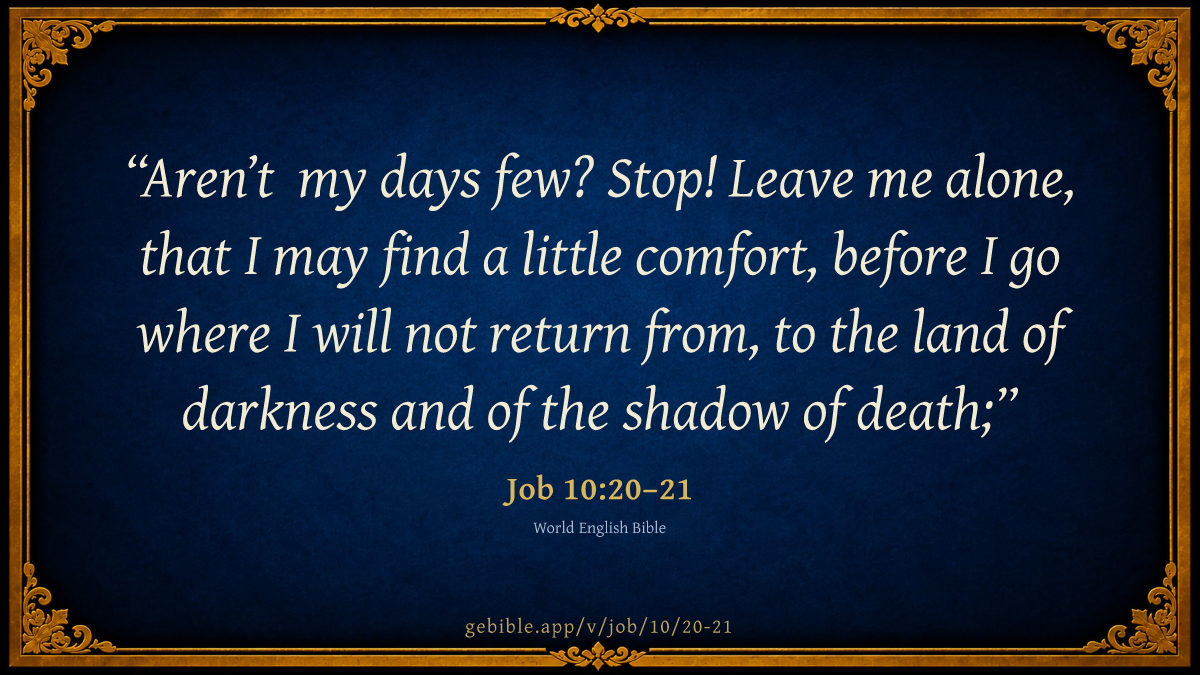
Job 10:20 [Are] not my days few? cease [then, and] let me alone, that I may take comfort a little,
Ver. 20. Are not my days few?] And oh that they might not be also evil! since I shall not much trouble the world, oh that I might not find much trouble in the world! What man is he that would fain see good days? saith David, Psa 34:12. What man is he that would not? saith Austin in answer to him. Job and David join in one and the same suit for a truce from trouble, since their time here was so very short, Psa 39:13; Psa 89:47.
Read full note →
Cease then, and let me alone] After he had vented his passions he falls again to his prayers. Ye have done all this wickedness (saith Samuel to the people who had been over importunate for a king), yet turn not aside from following the Lord, &c., 1Sa 12:20. Whilst prayer stands still, the whole trade of godliness stands still. Saints, though they have sinned, yet must not restrain prayer, but go home to God again with shame in their faces and tears in their eyes, and he will speak peace; only they must be sensible that their Father hath spit in their faces, &c.
That I may take comfort a little] A modest request. The poor man speaks supplications, begs a farthing. They who are lowly make low demands. Oh that I were but a door keeper! Oh that Ishmael might live in thy sight! &c.
John Trapp, A Commentary or Exposition upon All the Books of the Old and New Testament (1647–1656) — public domain. Text from a community e-Sword module.
Matthew Poole1685 · Public DomainOn vv20–21My life is short, and of itself hastens apace…
My life is short, and of itself hastens apace to an end; there is no need that thou shouldst push it forward, or grudge me some ease for so small a moment.
Let me alone; or, lay aside, or remove, thy hand or anger from me.
Matthew Poole's English Annotations on the Holy Bible (1683–1685) — public domain. Text from a community e-Sword/MySword module.
John Gill1763 · Public DomainOn vv20–21Before I go whence I shall not return,.... Before…
Before I go whence I shall not return,.... Before he went out of the world, the way of all flesh, to the grave, his long home, from whence there is no return to this world, and to the business and affairs of it; to a man's house, his family and his friends, to converse with them as before, there will be no return until the resurrection, which Job does not here deny, as some have thought; it was a doctrine he well understood, and strongly asserts in Job 19:26; but this must be understood in the same sense as in Job 7:9,
even to the land of darkness, and the shadow of death; which describes not the state of the damned, as some Popish interpreters, carry it; for Job had no thought nor fear of such a state; but the grave, which is called "a land", or country, it being large and spacious, and full of inhabitants; a land of "darkness", a very dark one, where the body separated from the soul is deprived of all light; where the sun, moon, and stars, are never seen; nor is there the least crevice that light can enter in at, or be seen by those that dwell in those shades, which are "the shadow of death" itself; deadly shades, thick and gross ones, the darkest shades, where death itself is, or dead men are, destitute of light and life; where no pleasure, comfort, and conversation, can be had; and therefore a land in itself most undesirable.
John Gill's Exposition of the Whole Bible (1746–1763) — public domain (CC PDM 1.0). Text via the HelloAO Bible API.
John Wesley1765 · Public DomainOn v20Cease - My life is short, and of itself…
Cease - My life is short, and of itself hastens to an end, there is no need that thou shouldest grudge me some ease for so small a moment.
John Wesley, Explanatory Notes Upon the Whole Bible (1754–1765) — public domain. Text via the GEBible commentary corpus.
Adam Clarke1810 · Public DomainOn vv20–21Verse 20. Are not my days few?] My life…
Verse 20. Are not my days few?] My life cannot be long; let me have a little respite before I die.
Adam Clarke's Commentary on the Bible (1810–1826) — public domain. Text from a community e-Sword/MySword module.
Joseph Benson1811 · Public DomainOn v20Job 10:20-22. Are not my days few? Cease then,…
Job 10:20-22. Are not my days few? Cease then, &c. — My life is short, and of itself hastens to an end; there is no need that thou shouldest grudge me some ease for so small a moment. Let me alone — Or lay aside, or remove thy hand or anger from me. That I may take comfort a little — Hebrews אבליגה, abligah, et recreabo me, I shall refresh, or strengthen myself: shall have some respite, some remission of my grief and pain, some consolation. Those that are not duly thankful for constant ease should think how welcome one hour’s ease would be if they were in constant pain. Before I go to the place whence I shall not return — Shall not come back into this world and life. At death we must bid a final farewell to this world: the body must then be laid where it will lie long; and the soul appointed to that state where it must be for ever. That had need to be well done which is to be done but once, and done for eternity. Even to the land of darkness, and the shadow of death — That is, a dark and dismal shade. Holy souls at death remove to a land of light, where there is no death; but their bodies they leave to a land of darkness, and the shadow of death. Of darkness, as darkness itself, &c. — He heaps up expressions here to show that he has as dreadful apprehensions of death and the grave as other men naturally have, so that it was only the extreme misery he was in that made him wish for it. Without any order — No order is observed in bringing people to the grave, not the eldest are brought first, not the richest, not the poorest, and yet every one in his own order, the order appointed by the God of life. All lie there on the same level, and there is no distinction between the prince and the peasant; but the servant is there free from his master: and in the grave there is perpetual night, and no succession of day. And where the light is as darkness — Where there is no difference between light and darkness; where the day is as dark as the night; where there is nothing but perpetual and uninterrupted darkness. In the grave there is no knowledge, no comfort, no joy, no praising God, no working out our salvation, for the night is come wherein no man can work. Let us consider this, and therefore walk and work while we have the light with us.
Joseph Benson's Commentary on the Old and New Testaments (1811–1818) — public domain. Text from a community e-Sword module.
Albert Barnes1834 · Public DomainOn vv20–21Are not my days few? - My life is…
Are not my days few? - My life is short, and hastens to a close. Let not then my afflictions be continued to the last moment of life, but let thine hand be removed, that I may enjoy some rest before I go hence, to return no more. This is an address to God, and the meaning is, that as life was necessarily so short, he asked to be permitted to enjoy some comfort before he should go to the land of darkness and of death; compare the note at Job 7:21. A somewhat similar expression occurs in Psa 39:13 :
O spare me, that I may recover strength,
Read full note →
Before I go hence, and be no more.
Albert Barnes' Notes on the Bible (1834–1885) — public domain. Text from a community e-Sword/MySword module.
Haydock's Catholic Bible Commentary1859 · Public DomainOn vv20–21Lament. Hebrew, "take comfort," (Haydock) or breath. (Calmet) ---…
Lament. Hebrew, "take comfort," (Haydock) or breath. (Calmet) --- Repentance is always necessary, but more particularly at the hour of death. (Worthington)
George Leo Haydock (1774–1849), Haydock's Catholic Family Bible and Commentary, 1859 edition — public domain. Excludes Psalms (Douay-Rheims chapter numbering differs from Protestant) and Deuterocanonical books (Catholic canon only).
Robert Jamieson, A. R. Fausset & David Brown1871 · Public DomainOn v20But, since I was destined from my birth to…
But, since I was destined from my birth to these ills, at least give me a little breathing time during the few days left me (Job 9:34; Job 13:21; Psa 39:13).
Jamieson, Fausset & Brown — Commentary Critical and Explanatory on the Whole Bible (1871) — public domain (CC PDM 1.0). Text via the HelloAO Bible API.
Daniel D. Whedon1874 · Public DomainOn vv20–2120. Take comfort — Same as Job_9:27. Cease —…
20. Take comfort — Same as Job_9:27. Cease — Let him cease. “Job at the end of his complaint, not venturing to speak to God, but of him, in the third person.” — Schlottmann.
Daniel D. Whedon (gen. ed.), Commentary on the Old and New Testaments (1874–1909) — public domain. Text from a community e-Sword module.
The Cambridge Bible for Schools and Colleges1878 · Public DomainOn v2020–22. He begs for a little easing of his…
20–22. He begs for a little easing of his pain ere he departs to the land of darkness.
are not my days few] The same argument as ch. Job_7:16.
Read full note →
cease then, and let me alone] Another reading is, let him cease then, &c. In the last case the speaker turns away from God and speaks of Him. In the rest of the chapter, however, Job everywhere addresses God.
take comfort] The same word as ch. Job_9:27, brighten up.
The Cambridge Bible for Schools and Colleges (gen. ed. J. J. S. Perowne; Cambridge University Press, 1878–1918) — public domain. Text from a community e-Sword module.
Ellicott's Commentary for English Readers1878 · Public DomainOn v20(20) Cease then, and let me alone.—According to another…
(20) Cease then, and let me alone.—According to another reading, “Let him cease, and let me alone.” In reading this reply of Job’s, one cannot but feel that it moves upon the very verge of blasphemy, and is only redeemed therefrom by its pervading reverence and deep undertone of faith. Job never gives up his faith in God, though, like Jacob, he wrestles with Him in the dark, and the issue shows that God is not displeased with such an unburdening of the soul that keeps close to the straight line of truth, which is, after all, one of the many manifestations of God.
A Bible Commentary for English Readers, edited by Charles John Ellicott (1878–1897) — public domain. Text from a community e-Sword module.
The Pulpit Commentary1880 · Public DomainOn vv20–21Are not my days few? Cease then, and let…
Are not my days few? Cease then, and let me alone, that I may take comfort a little. Job here returns from vague longings and idle aspirations to actual realities the facts of the case and asks, "Is not the time that I now have to live short? Must not my disease make an end of me in a very brief space? If so, then may I not make a request? My petition is that God will "cease" from me, grant me a respite, "let me alone" for a short time, remove his heavy hand, and allow me to "take comfort a little," recover my strength, and obtain a breathing-space, before my actual end, before the time comes for my descent to Sheol," which is then (vers. 21, 22) described. The parallel with Psa_39:13 is striking.
The Pulpit Commentary (1880–1919), ed. H.D.M. Spence-Jones & Joseph S. Exell — public domain. Text from a community e-Sword module.
unfoldingWord translationNotes2017 · CC BY-SA 4.0On v20Are not my days only a few?
Are not my days only a few?
Here "my days" represent the length of Job's life. This question expects a positive answer, to emphasize that Job only expects to live a few more days. It can be translated as a statement. AT: "I only have a few days left to live." or "My life will soon end." (See: Rhetorical Question)
Read full note →
the land
Here the place where the spirits of dead people go is spoken of as if it was a land. AT: "the place" (See: Metaphor)
of darkness and of the shadow of death
The phrase "shadow of death" intensifies the idea of "darkness." Both phrases describe where the spirits of dead people go. (See: Doublet)
the shadow of death
See how you translated this in Job 3:5.
as dark as midnight
The darkness of the place where the spirits of dead people go is compared to the darkness of midnight. (See: Simile)
without any order
This negative phrase can be expressed in positive form. AT: "full of confusion" or "where all is confused" (See: Litotes)
where the light is like midnight
The light of the place where the spirits of dead people go is compared to midnight. AT: "where there is no light" (See: Simile)
Tyndale Open Study Notes2022 · CC BY-SA 4.0On v2010:20-22 Earlier, Job had painted a fairly pleasant picture…
10:20-22 Earlier, Job had painted a fairly pleasant picture of Sheol (3:13-19); now he describes it as a land of darkness and utter gloom (see also 7:9-10; 14:7-22).
 GEBible — Godless Engineer's Bible App
Geneva Bible translators 1599 · Public Domain On vv20–21 He wisheth that God would leave off his affliction,…
He wisheth that God would leave off his affliction, considering his great misery and the brevity of his life.
Geneva Bible (1599) marginal notes — public domain.
John Trapp 1656 · Public Domain On vv20–21 Job 10:20 [Are] not my days few? cease [then,…
Job 10:20 [Are] not my days few? cease [then, and] let me alone, that I may take comfort a little,
Ver. 20. Are not my days few?] And oh that they might not be also evil! since I shall not much trouble the world, oh that I might not find much trouble in the world! What man is he that would fain see good days? saith David, Psa 34:12. What man is he that would not? saith Austin in answer to him. Job and David join in one and the same suit for a truce from trouble, since their time here was so very short, Psa 39:13; Psa 89:47.
Read full note →
Cease then, and let me alone] After he had vented his passions he falls again to his prayers. Ye have done all this wickedness (saith Samuel to the people who had been over importunate for a king), yet turn not aside from following the Lord, &c., 1Sa 12:20. Whilst prayer stands still, the whole trade of godliness stands still. Saints, though they have sinned, yet must not restrain prayer, but go home to God again with shame in their faces and tears in their eyes, and he will speak peace; only they must be sensible that their Father hath spit in their faces, &c.
That I may take comfort a little] A modest request. The poor man speaks supplications, begs a farthing. They who are lowly make low demands. Oh that I were but a door keeper! Oh that Ishmael might live in thy sight! &c.
John Trapp, A Commentary or Exposition upon All the Books of the Old and New Testament (1647–1656) — public domain. Text from a community e-Sword module.
Matthew Poole 1685 · Public Domain On vv20–21 My life is short, and of itself hastens apace…
My life is short, and of itself hastens apace to an end; there is no need that thou shouldst push it forward, or grudge me some ease for so small a moment.
Let me alone; or, lay aside, or remove, thy hand or anger from me.
Matthew Poole's English Annotations on the Holy Bible (1683–1685) — public domain. Text from a community e-Sword/MySword module.
John Gill 1763 · Public Domain On vv20–21 Before I go whence I shall not return,.... Before…
Before I go whence I shall not return,.... Before he went out of the world, the way of all flesh, to the grave, his long home, from whence there is no return to this world, and to the business and affairs of it; to a man's house, his family and his friends, to converse with them as before, there will be no return until the resurrection, which Job does not here deny, as some have thought; it was a doctrine he well understood, and strongly asserts in Job 19:26; but this must be understood in the same sense as in Job 7:9,
even to the land of darkness, and the shadow of death; which describes not the state of the damned, as some Popish interpreters, carry it; for Job had no thought nor fear of such a state; but the grave, which is called "a land", or country, it being large and spacious, and full of inhabitants; a land of "darkness", a very dark one, where the body separated from the soul is deprived of all light; where the sun, moon, and stars, are never seen; nor is there the least crevice that light can enter in at, or be seen by those that dwell in those shades, which are "the shadow of death" itself; deadly shades, thick and gross ones, the darkest shades, where death itself is, or dead men are, destitute of light and life; where no pleasure, comfort, and conversation, can be had; and therefore a land in itself most undesirable.
John Gill's Exposition of the Whole Bible (1746–1763) — public domain (CC PDM 1.0). Text via the HelloAO Bible API.
John Wesley 1765 · Public Domain On v20 Cease - My life is short, and of itself…
Cease - My life is short, and of itself hastens to an end, there is no need that thou shouldest grudge me some ease for so small a moment.
John Wesley, Explanatory Notes Upon the Whole Bible (1754–1765) — public domain. Text via the GEBible commentary corpus.
Adam Clarke 1810 · Public Domain On vv20–21 Verse 20. Are not my days few?] My life…
Verse 20. Are not my days few?] My life cannot be long; let me have a little respite before I die.
Adam Clarke's Commentary on the Bible (1810–1826) — public domain. Text from a community e-Sword/MySword module.
Joseph Benson 1811 · Public Domain On v20 Job 10:20-22. Are not my days few? Cease then,…
Job 10:20-22. Are not my days few? Cease then, &c. — My life is short, and of itself hastens to an end; there is no need that thou shouldest grudge me some ease for so small a moment. Let me alone — Or lay aside, or remove thy hand or anger from me. That I may take comfort a little — Hebrews אבליגה, abligah, et recreabo me, I shall refresh, or strengthen myself: shall have some respite, some remission of my grief and pain, some consolation. Those that are not duly thankful for constant ease should think how welcome one hour’s ease would be if they were in constant pain. Before I go to the place whence I shall not return — Shall not come back into this world and life. At death we must bid a final farewell to this world: the body must then be laid where it will lie long; and the soul appointed to that state where it must be for ever. That had need to be well done which is to be done but once, and done for eternity. Even to the land of darkness, and the shadow of death — That is, a dark and dismal shade. Holy souls at death remove to a land of light, where there is no death; but their bodies they leave to a land of darkness, and the shadow of death. Of darkness, as darkness itself, &c. — He heaps up expressions here to show that he has as dreadful apprehensions of death and the grave as other men naturally have, so that it was only the extreme misery he was in that made him wish for it. Without any order — No order is observed in bringing people to the grave, not the eldest are brought first, not the richest, not the poorest, and yet every one in his own order, the order appointed by the God of life. All lie there on the same level, and there is no distinction between the prince and the peasant; but the servant is there free from his master: and in the grave there is perpetual night, and no succession of day. And where the light is as darkness — Where there is no difference between light and darkness; where the day is as dark as the night; where there is nothing but perpetual and uninterrupted darkness. In the grave there is no knowledge, no comfort, no joy, no praising God, no working out our salvation, for the night is come wherein no man can work. Let us consider this, and therefore walk and work while we have the light with us.
Joseph Benson's Commentary on the Old and New Testaments (1811–1818) — public domain. Text from a community e-Sword module.
Albert Barnes 1834 · Public Domain On vv20–21 Are not my days few? - My life is…
Are not my days few? - My life is short, and hastens to a close. Let not then my afflictions be continued to the last moment of life, but let thine hand be removed, that I may enjoy some rest before I go hence, to return no more. This is an address to God, and the meaning is, that as life was necessarily so short, he asked to be permitted to enjoy some comfort before he should go to the land of darkness and of death; compare the note at Job 7:21. A somewhat similar expression occurs in Psa 39:13 :
O spare me, that I may recover strength,
Read full note →
Before I go hence, and be no more.
Albert Barnes' Notes on the Bible (1834–1885) — public domain. Text from a community e-Sword/MySword module.
Haydock's Catholic Bible Commentary 1859 · Public Domain On vv20–21 Lament. Hebrew, "take comfort," (Haydock) or breath. (Calmet) ---…
Lament. Hebrew, "take comfort," (Haydock) or breath. (Calmet) --- Repentance is always necessary, but more particularly at the hour of death. (Worthington)
George Leo Haydock (1774–1849), Haydock's Catholic Family Bible and Commentary, 1859 edition — public domain. Excludes Psalms (Douay-Rheims chapter numbering differs from Protestant) and Deuterocanonical books (Catholic canon only).
Robert Jamieson, A. R. Fausset & David Brown 1871 · Public Domain On v20 But, since I was destined from my birth to…
But, since I was destined from my birth to these ills, at least give me a little breathing time during the few days left me (Job 9:34; Job 13:21; Psa 39:13).
Jamieson, Fausset & Brown — Commentary Critical and Explanatory on the Whole Bible (1871) — public domain (CC PDM 1.0). Text via the HelloAO Bible API.
Daniel D. Whedon 1874 · Public Domain On vv20–21 20. Take comfort — Same as Job_9:27. Cease —…
20. Take comfort — Same as Job_9:27. Cease — Let him cease. “Job at the end of his complaint, not venturing to speak to God, but of him, in the third person.” — Schlottmann.
Daniel D. Whedon (gen. ed.), Commentary on the Old and New Testaments (1874–1909) — public domain. Text from a community e-Sword module.
The Cambridge Bible for Schools and Colleges 1878 · Public Domain On v20 20–22. He begs for a little easing of his…
20–22. He begs for a little easing of his pain ere he departs to the land of darkness.
are not my days few] The same argument as ch. Job_7:16.
Read full note →
cease then, and let me alone] Another reading is, let him cease then, &c. In the last case the speaker turns away from God and speaks of Him. In the rest of the chapter, however, Job everywhere addresses God.
take comfort] The same word as ch. Job_9:27, brighten up.
The Cambridge Bible for Schools and Colleges (gen. ed. J. J. S. Perowne; Cambridge University Press, 1878–1918) — public domain. Text from a community e-Sword module.
Ellicott's Commentary for English Readers 1878 · Public Domain On v20 (20) Cease then, and let me alone.—According to another…
(20) Cease then, and let me alone.—According to another reading, “Let him cease, and let me alone.” In reading this reply of Job’s, one cannot but feel that it moves upon the very verge of blasphemy, and is only redeemed therefrom by its pervading reverence and deep undertone of faith. Job never gives up his faith in God, though, like Jacob, he wrestles with Him in the dark, and the issue shows that God is not displeased with such an unburdening of the soul that keeps close to the straight line of truth, which is, after all, one of the many manifestations of God.
A Bible Commentary for English Readers, edited by Charles John Ellicott (1878–1897) — public domain. Text from a community e-Sword module.
The Pulpit Commentary 1880 · Public Domain On vv20–21 Are not my days few? Cease then, and let…
Are not my days few? Cease then, and let me alone, that I may take comfort a little. Job here returns from vague longings and idle aspirations to actual realities the facts of the case and asks, "Is not the time that I now have to live short? Must not my disease make an end of me in a very brief space? If so, then may I not make a request? My petition is that God will "cease" from me, grant me a respite, "let me alone" for a short time, remove his heavy hand, and allow me to "take comfort a little," recover my strength, and obtain a breathing-space, before my actual end, before the time comes for my descent to Sheol," which is then (vers. 21, 22) described. The parallel with Psa_39:13 is striking.
The Pulpit Commentary (1880–1919), ed. H.D.M. Spence-Jones & Joseph S. Exell — public domain. Text from a community e-Sword module.
unfoldingWord translationNotes 2017 · CC BY-SA 4.0 On v20 Are not my days only a few?
Are not my days only a few?
Here "my days" represent the length of Job's life. This question expects a positive answer, to emphasize that Job only expects to live a few more days. It can be translated as a statement. AT: "I only have a few days left to live." or "My life will soon end." (See: Rhetorical Question)
Read full note →
the land
Here the place where the spirits of dead people go is spoken of as if it was a land. AT: "the place" (See: Metaphor)
of darkness and of the shadow of death
The phrase "shadow of death" intensifies the idea of "darkness." Both phrases describe where the spirits of dead people go. (See: Doublet)
the shadow of death
See how you translated this in Job 3:5.
as dark as midnight
The darkness of the place where the spirits of dead people go is compared to the darkness of midnight. (See: Simile)
without any order
This negative phrase can be expressed in positive form. AT: "full of confusion" or "where all is confused" (See: Litotes)
where the light is like midnight
The light of the place where the spirits of dead people go is compared to midnight. AT: "where there is no light" (See: Simile)
translationWords
rest
darkness
shadow
die
light
unfoldingWord translationNotes — © Distant Shores Media and the Door43 World Missions Community, licensed CC BY-SA 4.0. Source: git.door43.org/Door43/en_tn.
Tyndale Open Study Notes 2022 · CC BY-SA 4.0 On v20 10:20-22 Earlier, Job had painted a fairly pleasant picture…
10:20-22 Earlier, Job had painted a fairly pleasant picture of Sheol (3:13-19); now he describes it as a land of darkness and utter gloom (see also 7:9-10; 14:7-22).
Tyndale Open Study Notes — © Tyndale Open Resources, licensed CC BY-SA 4.0. Text via the HelloAO Bible API.