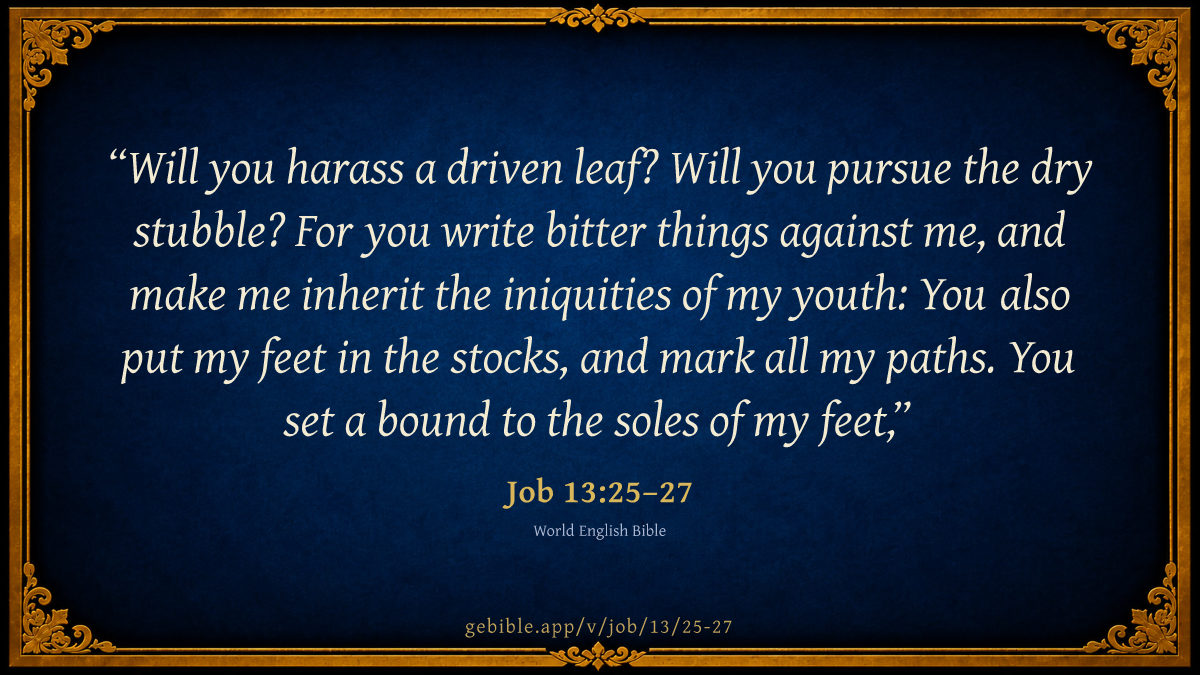
Job 33:11(v27)He puts my feet in the stocks. He marks all my paths.’
Psalms 25:7(v26)Don’t remember the sins of my youth, nor my transgressions. Remember me according to your loving kindness, for your goodness’ sake, Yahweh.
Leviticus 26:36(v25)“ ‘As for those of you who are left, I will send a faintness into their hearts in the lands of their enemies. The sound of a driven leaf…
Job 21:18(v25)How often is it that they are as stubble before the wind, as chaff that the storm carries away?
John 5:14(v26)Afterward Jesus found him in the temple, and said to him, “Behold, you are made well. Sin no more, so that nothing worse happens to you.”
Show all 23 cross-references
Ruth 1:20(v26)She said to them, “Don’t call me Naomi. Call me Mara, for the Almighty has dealt very bitterly with me.
1 Samuel 24:14(v25)Against whom has the king of Israel come out? Whom do you pursue? A dead dog? A flea?
2 Chronicles 16:10-12(v27)Then Asa was angry with the seer, and put him in the prison; for he was in a rage with him because of this thing. Asa oppressed some of the…
Job 2:7(v27)So Satan went out from the presence of Yahweh, and struck Job with painful sores from the sole of his foot to his head.
Job 3:20(v26)“Why is light given to him who is in misery, life to the bitter in soul,
Job 10:6(v27)that you inquire after my iniquity, and search after my sin?
Job 14:3(v25)Do you open your eyes on such a one, and bring me into judgment with you?
Job 14:16(v27)But now you count my steps. Don’t you watch over my sin?
Job 16:9(v27)He has torn me in his wrath and persecuted me. He has gnashed on me with his teeth. My adversary sharpens his eyes on me.
Job 20:11(v26)His bones are full of his youth, but youth will lie down with him in the dust.
Psalms 88:3-18(v26)For my soul is full of troubles. My life draws near to Sheol. I am counted among those who go down into the pit. I am like a man who has no…
Proverbs 5:11-13(v26)You will groan at your latter end, when your flesh and your body are consumed, and say, “How I have hated instruction, and my heart…
Proverbs 7:22(v27)He followed her immediately, as an ox goes to the slaughter, as a fool stepping into a noose.
Isaiah 17:13(v25)The nations will rush like the rushing of many waters: but he will rebuke them, and they will flee far off, and will be chased like the…
Jeremiah 31:19(v26)Surely after that I was turned. I repented. After that I was instructed. I struck my thigh. I was ashamed, yes, even confounded, because I…
Matthew 12:20(v25)He won’t break a bruised reed. He won’t quench a smoking flax, until he leads justice to victory.
John 5:5(v26)A certain man was there who had been sick for thirty-eight years.
Acts 16:24(v27)who, having received such a command, threw them into the inner prison, and secured their feet in the stocks.
Cross-references from openbible.info (CC BY 4.0)
Explain this passage (17 sources)
Historical commentary, presented as a primary source — not an endorsement.
Geneva Bible translators1599 · Public DomainOn vv26–27Thou punishest me now for the faults that I…
Thou punishest me now for the faults that I committed in my youth.
Geneva Bible (1599) marginal notes — public domain.
John Trapp1656 · Public DomainOn vv25–27Job 13:25 Wilt thou break a leaf driven to…
Job 13:25 Wilt thou break a leaf driven to and fro? and wilt thou pursue the dry stubble?
Ver. 25. Wilt thou break a leaf driven to and fro? &c.] q.d. Egregiam vero laudem, Thinkest thou to get any honour by encountering and overturning me, who was at my best but as a leaf, or as stubble, weak and worthless; and am now, by reason of mine afflictions, but as a leaf blown off, and whirled up and down, Indignum est maiestate tua, ut misellum homuncionem, &c. (Jan.); or as stubble fully dried, which is soon scattered by the wind, Psa 1:4, or quickly burnt by the fire, Nah 1:10. David reasoneth in this manner with Saul, 1Sa 24:14, "After whom is the king of Israel come forth? after whom dost thou pursue? After a dead dog, after a flea." A great purchase surely! a great victory!
Read full note →
- An gloria tanta est
Insidias homini supposuisse Deum? (Tibul.)
The truth is, God doth not afflict any man (whom he knows to be a thing of nothing) on purpose to try his strength, or to show his power; but either to exercise his justice upon the wicked, or to prove the faith of his people, and to promote their salvation.
John Trapp, A Commentary or Exposition upon All the Books of the Old and New Testament (1647–1656) — public domain. Text from a community e-Sword module.
Matthew Poole1685 · Public DomainOn vv25–27Doth it become thy infinite and excellent majesty to…
Doth it become thy infinite and excellent majesty to use all thy might to crush such a poor, impotent, frail creature as I am, that can no more resist thy power than a leaf, or a little loose and dry straw can resist the fury of the wind or fire.
Matthew Poole's English Annotations on the Holy Bible (1683–1685) — public domain. Text from a community e-Sword/MySword module.
John Gill1763 · Public DomainOn vv25–27Wilt thou break a leaf driven to and fro?....…
Wilt thou break a leaf driven to and fro?.... A leaf that falls from a tree in autumn, and withers and is rolled up, and driven about by the wind, which it cannot resist, to which Job here compares himself; but it is not to be understood of him with respect to his spiritual estate; for being a good man, and one that trusted in the Lord, and made him his hope, he was, as every good man is, like to a tree planted by rivers of water, whose leaf withers not, but is always green, and does not fall off, as is the case of carnal professors, who are compared to trees in autumn, which cast their leaves and rotten fruit; see Psa 1:3; but in respect to his outward estate, his frailty, weakness, and feebleness, especially as now under the afflicting hand of God; see Isa 64:6; so John the Baptist, on account of his being a frail mortal man, a weak feeble creature, compares himself to a reed shaken with the wind, Mat 11:7; now to break such an one was to add affliction to affliction, and which could not well be borne; and the like is signified by the next clause,
and wilt thou pursue the dry stubble? which cannot stand before the wind, or the force of devouring fire; this also respects not Job in his spiritual estate, with regard to which he was not like to dry stubble or chaff, to which wicked men are compared, Psa 1:4; but to standing corn and wheat in the full ear; and not only to green grass, which is flourishing, but to palm trees, and cedar trees of the Lord, which are full of sap, to which good men are like; but he describes him in his weak and afflicted state, tossed to and fro like dry stubble; and no more able to contend and grapple with an incensed God than dry stubble can withstand devouring flames; this he says, partly to suggest that it was below the Divine Being to set his strength against his weakness; as David said to Saul, "after whom is the king of Israel come out? after a dead dog, after a flea?" Sa1 24:14; which words Bar Tzemach compares with these; and partly to move the divine pity and commiseration towards him, who uses not to "break the bruised reed, nor quench the smoking flax", Isa 42:3.
John Gill's Exposition of the Whole Bible (1746–1763) — public domain (CC PDM 1.0). Text via the HelloAO Bible API.
John Wesley1765 · Public DomainOn vv25–26Leaf - One that can no more resist thy…
Leaf - One that can no more resist thy power, than a leaf, or a little dry straw can resist the wind or fire.
John Wesley, Explanatory Notes Upon the Whole Bible (1754–1765) — public domain. Text via the GEBible commentary corpus.
Adam Clarke1810 · Public DomainOn vv25–27Verse 25. Wilt thou break a leaf] Is it…
Verse 25. Wilt thou break a leaf] Is it becoming thy dignity to concern thyself with a creature so contemptible?
Adam Clarke's Commentary on the Bible (1810–1826) — public domain. Text from a community e-Sword/MySword module.
Joseph Benson1811 · Public DomainOn vv25–27Job 13:25. Wilt thou break a leaf? &c. —…
Job 13:25. Wilt thou break a leaf? &c. — Doth it become thy infinite and excellent majesty to use thy might to crush such a poor, impotent, and frail creature as I am, that can no more resist thy power than a leaf or a little dry straw can resist the fury of the wind or fire? Thus, whatever was irreverent or unbecoming in Job’s expressions, as recorded in Job 13:22, is greatly alleviated, as Dr. Dodd has observed, from Peters, by the humility and self- abasement manifested in these last three verses. Scarcely ever were the feelings of the human heart, burdened with an extraordinary load of grief, expressed in a more natural, or less blameable way. He first wishes that God would discover to him the particular sins, if there were any, for which he thus afflicted him, intimating his readiness to deplore them, and to correct his errors for the future. Secondly, he accounts it the greatest of his calamities, that God should hide his face from him, and deal with him as an enemy; on whose friendship and favour he had always set the highest value; had endeavoured to preserve it by the integrity of his life, and was resolved never to depart from that integrity. Lastly, he confesses his own meanness, or rather nothingness, in comparison of God; and that in a manner so ingenuous and simple, as to show that his complaints, however passionate and moving, did not proceed from pride or stubbornness of spirit.
Joseph Benson's Commentary on the Old and New Testaments (1811–1818) — public domain. Text from a community e-Sword module.
Albert Barnes1834 · Public DomainOn vv25–27Wilt thou break a leaf driven to and fro?…
Wilt thou break a leaf driven to and fro? - Job here means to say that the treatment of God in regard to him was like treading down a leaf that was driven about by the wind - an insigni ficant, unsettled, and worthless thing. “Wouldst thou show thy power against such an object?” - The sense is, that it was not worthy of God thus to pursue one so unimportant, and so incapable of offering any resistance.
And wilt thou pursue the dry stubble? - Is it worthy of God thus to contend with the driven straw and stubble of the field? To such a leaf, and to such stubble, he compares himself; and he asks whether God could be employed in a work such as that would be, of pursuing such a flying leaf or driven stubble with a desire to overtake it, and wreak his vengeance on it.
Albert Barnes' Notes on the Bible (1834–1885) — public domain. Text from a community e-Sword/MySword module.
Haydock's Catholic Bible Commentary1859 · Public DomainOn vv26–27Bitter. The judge wrote down the sentence; which he…
Bitter. The judge wrote down the sentence; which he read, or gave to his officer. (Calmet) --- Youth, for which I thought I had satisfied. (Haydock)
George Leo Haydock (1774–1849), Haydock's Catholic Family Bible and Commentary, 1859 edition — public domain. Excludes Psalms (Douay-Rheims chapter numbering differs from Protestant) and Deuterocanonical books (Catholic canon only).
Robert Jamieson, A. R. Fausset & David Brown1871 · Public DomainOn vv25–27(Lev 26:36; Psa 1:4). Job compares himself to a…
(Lev 26:36; Psa 1:4). Job compares himself to a leaf already fallen, which the storm still chases hither and thither.
break--literally, "shake with (Thy) terrors." Jesus Christ does not "break the bruised reed" (Isa 42:3, Isa 27:8).
Jamieson, Fausset & Brown — Commentary Critical and Explanatory on the Whole Bible (1871) — public domain (CC PDM 1.0). Text via the HelloAO Bible API.
Daniel D. Whedon1874 · Public DomainOn vv25–2725. Break — Terrify, agitate, (chase) — Gesenius. A…
25. Break — Terrify, agitate, (chase) — Gesenius. A fallen leaf chased hither and thither by omnipotence: such was fallen Job. The figure is one of simplicity and yet one of power. “A glimmering wick shall He not quench.”
Isa_42:3. “I have heard divines say, that those virtues that were but sparks upon earth shall become great and glorious flames in heaven.” — Izaak Walton.
Daniel D. Whedon (gen. ed.), Commentary on the Old and New Testaments (1874–1909) — public domain. Text from a community e-Sword module.
The Cambridge Bible for Schools and Colleges1878 · Public DomainOn vv25–2725. Wilt thou break] Or, Wilt thou affright, that…
25. Wilt thou break] Or, Wilt thou affright, that is, chase. The “driven leaf” and the “dry stubble” are figures for that which is so light and unsubstantial that it is the sport of every wind of circumstance. So Job describes himself, in contrast with God, and asks, Is thy determination to assail this kind of foe the explanation of my afflictions?
The Cambridge Bible for Schools and Colleges (gen. ed. J. J. S. Perowne; Cambridge University Press, 1878–1918) — public domain. Text from a community e-Sword module.
Ellicott's Commentary for English Readers1878 · Public DomainOn vv25–27(25) Wilt thou break a leaf.—His confession of sin…
(25) Wilt thou break a leaf.—His confession of sin here approaches even to what the Psalmist describes as the condition of the ungodly (Psa_1:4).
A Bible Commentary for English Readers, edited by Charles John Ellicott (1878–1897) — public domain. Text from a community e-Sword module.
The Pulpit Commentary1880 · Public DomainOn vv25–27Wilt thou break a leaf driven to and fro?…
Wilt thou break a leaf driven to and fro? and wilt thou pursue the dry stubble? Job compares himself to two of the weakest things in nature a withered leaf, and a morsel of dry stubble. He cannot believe that God will employ his almighty strength in crushing and destroying what is so slight and feeble. A deep sense of God"s goodness and compassion underlies the thought.
The Pulpit Commentary (1880–1919), ed. H.D.M. Spence-Jones & Joseph S. Exell — public domain. Text from a community e-Sword module.
The Biblical Illustrator1887 · Public DomainOn vv25–27Wilt Thou break a leaf driven to and fro?
Job_13:25
Wilt Thou break a leaf driven to and fro?
Read full note →
A pitiful plea
Poor Job! Who could have been brought lower? In his deep distress he turns to God, and finding no other plea so near at hand he makes a plea of his own distress. He compares himself to the weakest thing he could think of. He draws an argument out of his weakness. It is a common figure he uses, that of a leaf driven to and fro. To this Job likens himself--a helpless, hopeless, worthless, weak, despised, perishing thing. And he appeals to God. Out of pity upon my utter weakness and nothingness, turn away Thy hand, and break not a leaf that is driven to and fro. The apprehension is so startling, the appeal is so forcible, that the argument may be employed in a great many ways. How often have the sick used it, when they have been brought to so low an ebb with physical pain that life itself seemed worthless. Not less applicable the plea to those who are plunged into the depths of poverty. So too with those who are in trouble through bereavement. Perhaps it is even more harassing in eases of mental distress, for, after all, the sharpest pangs we feel are not those of the body, nor those of the estate, but those of the mind. When the iron enters into the soul, the rust thereof is poison. Many a child of God may have used this plea, or may yet use it.
I. The plea is such as arises from inward consciousness. What plea is more powerful to ourselves than that which we draw from ourselves? In this case Job was quite certain about his own weakness. How could he doubt that? I trust many of us have been brought into such a humble frame of mind as to feel that, in a certain sense, this is true of us. What a great blessing it is to be made to know our weakness! But while it is a confession of weakness, the plea is also an acknowledgment of Gods power to push that weakness to a direful conclusion.
II. This is also a very pitiful plea. Though there is weakness, yet there is also power, for weakness is, for the most part, a prevalent plea with those who are strong and good. The plea gathers force when the weakness is confessed. How a confession of weakness touches your heart when it comes from your child!
III. This plea is rightly addressed. It is addressed to God. It can be used to each person of the Blessed Trinity in Unity. Oh, the depths of Thy loving kindness! Is it possible that Thou canst east away a poor, broken-hearted trembler, a poor, fearing, doubting one, who would fain be saved, but who trembles lest he should be cast away?
IV. The plea is backed up by many cases of success. Give one illustration. The case of Hannah, the mother of Samuel; or the case of King Manasseh. Or our Lords dealing with sinful women.
V. The text is a faint plea which invites full succour. It meant this. Instead of breaking it, Thou wilt spare it; Thou wilt gather it up; Thou wilt give it life again. Oh, you who are brought to the very lowest of weakness! use that weakness in pleading with God, and He will return unto you with such a fulness of blessing that you shall receive pardon and favour.
VI. We may use this plea--many of us who have long known the saviour. Perhaps our faith has got to be very low. O Lord, wilt Thou destroy my little faith? It is weal: and trembling, but it is faith of Thine own giving. Oh, break not the poor leaf that is driven to and fro! It may be your hope is not very bright. You cannot see the golden gates, though they are very near. Well, but your hope shall not be destroyed because it is clouded. Perhaps you are conscious that you have not been so useful lately as you were. Bring your little graces to Christ, as the mothers brought their little children, and ask Him to put His hands upon them and to bless them. Bring your mustard seed to Christ, and ask Him to make it grow into a tree, and He will do it; but never think that He will destroy you, or that He will destroy the work of His hands in you. (C. H. Spurgeon.)
God and human frailty
The thin, frail leaf--would God break that? God, the all-powerful, dealing with the feeble life of Job! God, perhaps, would bruise the leaf, but He would not break it.
I. A leaf is the frailest among frail things. A leaf is, in many ways, a type of man. Physically, mentally, humanly, morally. We have come into this world with constitutions tainted by sin, surrounded by temptations to evil.
II. A leaf is the fittest emblem of mans mortality. Will the eternal God act harshly with the ephemeral man? What is it to break a leaf? To treat it as a thing of insignificance, to leave it to the sport of circumstances, to let it be hurried out of sight as a mean and mortal thing. How delicate is man, physically considered; how surrounded is he by the majestic forces of nature! Yet God has plainly said, I care for this leaf more than for all the works of My hands. Mortal though man is, he enshrines within him an everlasting being.
III. A leaf is subject to a variety of dangers. Blight may settle on it; the tornado might tear it from the parent stem; the rain and the dew may be withheld; the scorching sun may wither; the birds of the heaven may devour it. We look at man, and we say, How subject is he to manifold forms of danger!
1. The hand of trial might break us. The difference between what we can bear and what we cannot may be a very slight degree. God will not lay upon us more than we are able to bear.
2. The hand of temptation may break us. Our reserves are soon used up. There is a kind of omnipresence of temptation. Yet no temptation hath overtaken us, but such as we are able to bear. The resisting power has been given us.
3. The hand of transition might break us. The leaf has to endure the most sudden and severe changes of temperature; but these minister to its strength and life. Think of the changes of human life--from affluence to poverty, from companionship to solitude, from one estate to another. Then comes the great change. But all the changes of our life are ordered by God, and leave us sometimes saddened, but not broken or destroyed.
IV. A leaf is the wonderful work of God. And a most wonderful work it is. And God made man. From the first His care has been for His lost child, His voice has been to the sons of men, and the great atonement has been a sacrifice for the world. We believe in Gods care for every leaf in the great forest of humanity.
V. A leaf is often broken by man. Gods tender mercies are over all His works. He will not break a leaf. Man will. There are those who come near the secrets of human lives, and could write interesting volumes, if they dared, on broken human leaves. Close with reflections--
1. Think of the strength of God.
2. Think of the possibilities of life.
3. Think of the position we occupy.
4. Think of the end that is coming. (W. M. Statham.)
A picture and a problem of life
I. A picture of life. It is a leaf driven to and fro. The words suggest four ideas.
1. Insignificance. A leaf, not a tree.
2. Frailty. A leaf. How fragile. The tree strikes its roots into the earth and often grows on for many years. But the leaf is only for a season. From spring to autumn is the period that measures its longest duration.
3. Restlessness. Driven to and fro. How unsettled is human life! Man is never at rest.
4. Worthlessness. A leaf that has fallen from the stem and tossed by the winds is a worthless thing. On its stem it was a thing of beauty and a thing of service to the tree, but now its value is gone. Job felt that his life was worthless, as worthless as a withered leaf and dry stubble.
II. A problem of life. Wilt Thou break a leaf driven to and fro? This question may be looked upon in two aspects.
1. As expressing error in sentiment. The idea in the mind of Job seems to have been that God was infinitely too great to notice such a creature as he, that it was unworthy of the Infinite to pay any attention whatever to a creature so insignificant and worthless. Two thoughts expose this error.
(1) To God there is nothing great or small.
(2) Man, however worthless, is infinitely influential.
2. As capable of receiving a glorious answer. Wilt Thou break a leaf driven to and fro? Wilt Thou torment me forever? Writ Thou quench my existence? Take this as the question of suffering humanity, and here is the answer, The Son of Man has come to seek and to save the lost. I have come that ye might have life, and that ye might have it more abundantly. (Homilist.)
The Biblical Illustrator, edited by Joseph S. Exell (c. 1880s–1900s) — public domain. Text from a community e-Sword module.
unfoldingWord translationNotes2017 · CC BY-SA 4.0On v26Connecting Statement:
Connecting Statement:
Job finishes presenting his case to God.
Read full note →
For you write down bitter things against me
"Bitter things" represents accusations. AT: "For you write down accusations against me" (See: Metaphor)
you make me inherit the iniquities of my youth
Inheriting the iniquities of his youth is a metaphor. Possible meanings are it represents 1) being guilty for the sins of his youth. AT: "you say that I am still guilty for the sins of my youth" or 2) being punished for the sins of his youth. AT: "you punish me for the sins of my youth" (See: Metaphor)
the iniquities of my youth
The abstract noun "youth" can be translated with the word "young." AT: "the sins I committed when I was young" (See: Abstract Nouns)
You also put my feet in the stocks
Doing this represents punishing Job and keeping him from living freely as if Job had committed a crime and was a prisoner. AT: "It is as though you put my feet in the stocks" (See: Metaphor)
the stocks
Possible meanings are 1) a frame that holds a prisoner's feet in place so that he cannot move at all or 2) chains around a prisoner's feet that make it hard for him to walk. These are used as a form of punishment.
all my paths
"Paths" represent the things Job does. AT: "everything I do" (See: Metaphor)
you examine the ground where the soles of my feet have walked
The soles of his feet represent the person who walks. AT: "you examine the ground where I have walked" (See: Synecdoche)
you examine the ground where the soles of my feet have walked
Examining this ground represents examining all that Job has done. AT: "it is as though you examine the ground where I have walked" or "you examine everything I do like a person examining someone's footprints on the ground" (See: Metaphor)
like a rotten thing that wastes away
Job compares his life to something that is decaying. He is slowly dying. (See: Simile)
like a garment that moths have eaten
Job compares himself to clothes that are full of holes because the moths have eaten parts of it. (See: Simile)
Tyndale Open Study Notes2022 · CC BY-SA 4.0On v2513:25 In the Old Testament, dry straw is a…
13:25 In the Old Testament, dry straw is a common image for what can be blown away (“chaff,” Ps 83:13; Isa 40:24; Jer 13:24) or burned (Exod 15:7; Isa 47:14; Mal 4:1; see also “dry grass,” Isa 5:24; 33:11), or for what is weak (Job 41:20-21) and trifling (Isa 41:2).

Geneva Bible translators 1599 · Public Domain On vv26–27 Thou punishest me now for the faults that I…
Thou punishest me now for the faults that I committed in my youth.
Geneva Bible (1599) marginal notes — public domain.
John Trapp 1656 · Public Domain On vv25–27 Job 13:25 Wilt thou break a leaf driven to…
Job 13:25 Wilt thou break a leaf driven to and fro? and wilt thou pursue the dry stubble?
Ver. 25. Wilt thou break a leaf driven to and fro? &c.] q.d. Egregiam vero laudem, Thinkest thou to get any honour by encountering and overturning me, who was at my best but as a leaf, or as stubble, weak and worthless; and am now, by reason of mine afflictions, but as a leaf blown off, and whirled up and down, Indignum est maiestate tua, ut misellum homuncionem, &c. (Jan.); or as stubble fully dried, which is soon scattered by the wind, Psa 1:4, or quickly burnt by the fire, Nah 1:10. David reasoneth in this manner with Saul, 1Sa 24:14, "After whom is the king of Israel come forth? after whom dost thou pursue? After a dead dog, after a flea." A great purchase surely! a great victory!
Read full note →
- An gloria tanta est
Insidias homini supposuisse Deum? (Tibul.)
The truth is, God doth not afflict any man (whom he knows to be a thing of nothing) on purpose to try his strength, or to show his power; but either to exercise his justice upon the wicked, or to prove the faith of his people, and to promote their salvation.
John Trapp, A Commentary or Exposition upon All the Books of the Old and New Testament (1647–1656) — public domain. Text from a community e-Sword module.
Matthew Poole 1685 · Public Domain On vv25–27 Doth it become thy infinite and excellent majesty to…
Doth it become thy infinite and excellent majesty to use all thy might to crush such a poor, impotent, frail creature as I am, that can no more resist thy power than a leaf, or a little loose and dry straw can resist the fury of the wind or fire.
Matthew Poole's English Annotations on the Holy Bible (1683–1685) — public domain. Text from a community e-Sword/MySword module.
John Gill 1763 · Public Domain On vv25–27 Wilt thou break a leaf driven to and fro?....…
Wilt thou break a leaf driven to and fro?.... A leaf that falls from a tree in autumn, and withers and is rolled up, and driven about by the wind, which it cannot resist, to which Job here compares himself; but it is not to be understood of him with respect to his spiritual estate; for being a good man, and one that trusted in the Lord, and made him his hope, he was, as every good man is, like to a tree planted by rivers of water, whose leaf withers not, but is always green, and does not fall off, as is the case of carnal professors, who are compared to trees in autumn, which cast their leaves and rotten fruit; see Psa 1:3; but in respect to his outward estate, his frailty, weakness, and feebleness, especially as now under the afflicting hand of God; see Isa 64:6; so John the Baptist, on account of his being a frail mortal man, a weak feeble creature, compares himself to a reed shaken with the wind, Mat 11:7; now to break such an one was to add affliction to affliction, and which could not well be borne; and the like is signified by the next clause,
and wilt thou pursue the dry stubble? which cannot stand before the wind, or the force of devouring fire; this also respects not Job in his spiritual estate, with regard to which he was not like to dry stubble or chaff, to which wicked men are compared, Psa 1:4; but to standing corn and wheat in the full ear; and not only to green grass, which is flourishing, but to palm trees, and cedar trees of the Lord, which are full of sap, to which good men are like; but he describes him in his weak and afflicted state, tossed to and fro like dry stubble; and no more able to contend and grapple with an incensed God than dry stubble can withstand devouring flames; this he says, partly to suggest that it was below the Divine Being to set his strength against his weakness; as David said to Saul, "after whom is the king of Israel come out? after a dead dog, after a flea?" Sa1 24:14; which words Bar Tzemach compares with these; and partly to move the divine pity and commiseration towards him, who uses not to "break the bruised reed, nor quench the smoking flax", Isa 42:3.
John Gill's Exposition of the Whole Bible (1746–1763) — public domain (CC PDM 1.0). Text via the HelloAO Bible API.
John Wesley 1765 · Public Domain On vv25–26 Leaf - One that can no more resist thy…
Leaf - One that can no more resist thy power, than a leaf, or a little dry straw can resist the wind or fire.
John Wesley, Explanatory Notes Upon the Whole Bible (1754–1765) — public domain. Text via the GEBible commentary corpus.
Adam Clarke 1810 · Public Domain On vv25–27 Verse 25. Wilt thou break a leaf] Is it…
Verse 25. Wilt thou break a leaf] Is it becoming thy dignity to concern thyself with a creature so contemptible?
Adam Clarke's Commentary on the Bible (1810–1826) — public domain. Text from a community e-Sword/MySword module.
Joseph Benson 1811 · Public Domain On vv25–27 Job 13:25. Wilt thou break a leaf? &c. —…
Job 13:25. Wilt thou break a leaf? &c. — Doth it become thy infinite and excellent majesty to use thy might to crush such a poor, impotent, and frail creature as I am, that can no more resist thy power than a leaf or a little dry straw can resist the fury of the wind or fire? Thus, whatever was irreverent or unbecoming in Job’s expressions, as recorded in Job 13:22, is greatly alleviated, as Dr. Dodd has observed, from Peters, by the humility and self- abasement manifested in these last three verses. Scarcely ever were the feelings of the human heart, burdened with an extraordinary load of grief, expressed in a more natural, or less blameable way. He first wishes that God would discover to him the particular sins, if there were any, for which he thus afflicted him, intimating his readiness to deplore them, and to correct his errors for the future. Secondly, he accounts it the greatest of his calamities, that God should hide his face from him, and deal with him as an enemy; on whose friendship and favour he had always set the highest value; had endeavoured to preserve it by the integrity of his life, and was resolved never to depart from that integrity. Lastly, he confesses his own meanness, or rather nothingness, in comparison of God; and that in a manner so ingenuous and simple, as to show that his complaints, however passionate and moving, did not proceed from pride or stubbornness of spirit.
Joseph Benson's Commentary on the Old and New Testaments (1811–1818) — public domain. Text from a community e-Sword module.
Albert Barnes 1834 · Public Domain On vv25–27 Wilt thou break a leaf driven to and fro?…
Wilt thou break a leaf driven to and fro? - Job here means to say that the treatment of God in regard to him was like treading down a leaf that was driven about by the wind - an insigni ficant, unsettled, and worthless thing. “Wouldst thou show thy power against such an object?” - The sense is, that it was not worthy of God thus to pursue one so unimportant, and so incapable of offering any resistance.
And wilt thou pursue the dry stubble? - Is it worthy of God thus to contend with the driven straw and stubble of the field? To such a leaf, and to such stubble, he compares himself; and he asks whether God could be employed in a work such as that would be, of pursuing such a flying leaf or driven stubble with a desire to overtake it, and wreak his vengeance on it.
Albert Barnes' Notes on the Bible (1834–1885) — public domain. Text from a community e-Sword/MySword module.
Haydock's Catholic Bible Commentary 1859 · Public Domain On vv26–27 Bitter. The judge wrote down the sentence; which he…
Bitter. The judge wrote down the sentence; which he read, or gave to his officer. (Calmet) --- Youth, for which I thought I had satisfied. (Haydock)
George Leo Haydock (1774–1849), Haydock's Catholic Family Bible and Commentary, 1859 edition — public domain. Excludes Psalms (Douay-Rheims chapter numbering differs from Protestant) and Deuterocanonical books (Catholic canon only).
Robert Jamieson, A. R. Fausset & David Brown 1871 · Public Domain On vv25–27 (Lev 26:36; Psa 1:4). Job compares himself to a…
(Lev 26:36; Psa 1:4). Job compares himself to a leaf already fallen, which the storm still chases hither and thither.
break--literally, "shake with (Thy) terrors." Jesus Christ does not "break the bruised reed" (Isa 42:3, Isa 27:8).
Jamieson, Fausset & Brown — Commentary Critical and Explanatory on the Whole Bible (1871) — public domain (CC PDM 1.0). Text via the HelloAO Bible API.
Daniel D. Whedon 1874 · Public Domain On vv25–27 25. Break — Terrify, agitate, (chase) — Gesenius. A…
25. Break — Terrify, agitate, (chase) — Gesenius. A fallen leaf chased hither and thither by omnipotence: such was fallen Job. The figure is one of simplicity and yet one of power. “A glimmering wick shall He not quench.”
Isa_42:3. “I have heard divines say, that those virtues that were but sparks upon earth shall become great and glorious flames in heaven.” — Izaak Walton.
Daniel D. Whedon (gen. ed.), Commentary on the Old and New Testaments (1874–1909) — public domain. Text from a community e-Sword module.
The Cambridge Bible for Schools and Colleges 1878 · Public Domain On vv25–27 25. Wilt thou break] Or, Wilt thou affright, that…
25. Wilt thou break] Or, Wilt thou affright, that is, chase. The “driven leaf” and the “dry stubble” are figures for that which is so light and unsubstantial that it is the sport of every wind of circumstance. So Job describes himself, in contrast with God, and asks, Is thy determination to assail this kind of foe the explanation of my afflictions?
The Cambridge Bible for Schools and Colleges (gen. ed. J. J. S. Perowne; Cambridge University Press, 1878–1918) — public domain. Text from a community e-Sword module.
Ellicott's Commentary for English Readers 1878 · Public Domain On vv25–27 (25) Wilt thou break a leaf.—His confession of sin…
(25) Wilt thou break a leaf.—His confession of sin here approaches even to what the Psalmist describes as the condition of the ungodly (Psa_1:4).
A Bible Commentary for English Readers, edited by Charles John Ellicott (1878–1897) — public domain. Text from a community e-Sword module.
The Pulpit Commentary 1880 · Public Domain On vv25–27 Wilt thou break a leaf driven to and fro?…
Wilt thou break a leaf driven to and fro? and wilt thou pursue the dry stubble? Job compares himself to two of the weakest things in nature a withered leaf, and a morsel of dry stubble. He cannot believe that God will employ his almighty strength in crushing and destroying what is so slight and feeble. A deep sense of God"s goodness and compassion underlies the thought.
The Pulpit Commentary (1880–1919), ed. H.D.M. Spence-Jones & Joseph S. Exell — public domain. Text from a community e-Sword module.
The Biblical Illustrator 1887 · Public Domain On vv25–27 Wilt Thou break a leaf driven to and fro?
Job_13:25
Wilt Thou break a leaf driven to and fro?
Read full note →
A pitiful plea
Poor Job! Who could have been brought lower? In his deep distress he turns to God, and finding no other plea so near at hand he makes a plea of his own distress. He compares himself to the weakest thing he could think of. He draws an argument out of his weakness. It is a common figure he uses, that of a leaf driven to and fro. To this Job likens himself--a helpless, hopeless, worthless, weak, despised, perishing thing. And he appeals to God. Out of pity upon my utter weakness and nothingness, turn away Thy hand, and break not a leaf that is driven to and fro. The apprehension is so startling, the appeal is so forcible, that the argument may be employed in a great many ways. How often have the sick used it, when they have been brought to so low an ebb with physical pain that life itself seemed worthless. Not less applicable the plea to those who are plunged into the depths of poverty. So too with those who are in trouble through bereavement. Perhaps it is even more harassing in eases of mental distress, for, after all, the sharpest pangs we feel are not those of the body, nor those of the estate, but those of the mind. When the iron enters into the soul, the rust thereof is poison. Many a child of God may have used this plea, or may yet use it.
I. The plea is such as arises from inward consciousness. What plea is more powerful to ourselves than that which we draw from ourselves? In this case Job was quite certain about his own weakness. How could he doubt that? I trust many of us have been brought into such a humble frame of mind as to feel that, in a certain sense, this is true of us. What a great blessing it is to be made to know our weakness! But while it is a confession of weakness, the plea is also an acknowledgment of Gods power to push that weakness to a direful conclusion.
II. This is also a very pitiful plea. Though there is weakness, yet there is also power, for weakness is, for the most part, a prevalent plea with those who are strong and good. The plea gathers force when the weakness is confessed. How a confession of weakness touches your heart when it comes from your child!
III. This plea is rightly addressed. It is addressed to God. It can be used to each person of the Blessed Trinity in Unity. Oh, the depths of Thy loving kindness! Is it possible that Thou canst east away a poor, broken-hearted trembler, a poor, fearing, doubting one, who would fain be saved, but who trembles lest he should be cast away?
IV. The plea is backed up by many cases of success. Give one illustration. The case of Hannah, the mother of Samuel; or the case of King Manasseh. Or our Lords dealing with sinful women.
V. The text is a faint plea which invites full succour. It meant this. Instead of breaking it, Thou wilt spare it; Thou wilt gather it up; Thou wilt give it life again. Oh, you who are brought to the very lowest of weakness! use that weakness in pleading with God, and He will return unto you with such a fulness of blessing that you shall receive pardon and favour.
VI. We may use this plea--many of us who have long known the saviour. Perhaps our faith has got to be very low. O Lord, wilt Thou destroy my little faith? It is weal: and trembling, but it is faith of Thine own giving. Oh, break not the poor leaf that is driven to and fro! It may be your hope is not very bright. You cannot see the golden gates, though they are very near. Well, but your hope shall not be destroyed because it is clouded. Perhaps you are conscious that you have not been so useful lately as you were. Bring your little graces to Christ, as the mothers brought their little children, and ask Him to put His hands upon them and to bless them. Bring your mustard seed to Christ, and ask Him to make it grow into a tree, and He will do it; but never think that He will destroy you, or that He will destroy the work of His hands in you. (C. H. Spurgeon.)
God and human frailty
The thin, frail leaf--would God break that? God, the all-powerful, dealing with the feeble life of Job! God, perhaps, would bruise the leaf, but He would not break it.
I. A leaf is the frailest among frail things. A leaf is, in many ways, a type of man. Physically, mentally, humanly, morally. We have come into this world with constitutions tainted by sin, surrounded by temptations to evil.
II. A leaf is the fittest emblem of mans mortality. Will the eternal God act harshly with the ephemeral man? What is it to break a leaf? To treat it as a thing of insignificance, to leave it to the sport of circumstances, to let it be hurried out of sight as a mean and mortal thing. How delicate is man, physically considered; how surrounded is he by the majestic forces of nature! Yet God has plainly said, I care for this leaf more than for all the works of My hands. Mortal though man is, he enshrines within him an everlasting being.
III. A leaf is subject to a variety of dangers. Blight may settle on it; the tornado might tear it from the parent stem; the rain and the dew may be withheld; the scorching sun may wither; the birds of the heaven may devour it. We look at man, and we say, How subject is he to manifold forms of danger!
1. The hand of trial might break us. The difference between what we can bear and what we cannot may be a very slight degree. God will not lay upon us more than we are able to bear.
2. The hand of temptation may break us. Our reserves are soon used up. There is a kind of omnipresence of temptation. Yet no temptation hath overtaken us, but such as we are able to bear. The resisting power has been given us.
3. The hand of transition might break us. The leaf has to endure the most sudden and severe changes of temperature; but these minister to its strength and life. Think of the changes of human life--from affluence to poverty, from companionship to solitude, from one estate to another. Then comes the great change. But all the changes of our life are ordered by God, and leave us sometimes saddened, but not broken or destroyed.
IV. A leaf is the wonderful work of God. And a most wonderful work it is. And God made man. From the first His care has been for His lost child, His voice has been to the sons of men, and the great atonement has been a sacrifice for the world. We believe in Gods care for every leaf in the great forest of humanity.
V. A leaf is often broken by man. Gods tender mercies are over all His works. He will not break a leaf. Man will. There are those who come near the secrets of human lives, and could write interesting volumes, if they dared, on broken human leaves. Close with reflections--
1. Think of the strength of God.
2. Think of the possibilities of life.
3. Think of the position we occupy.
4. Think of the end that is coming. (W. M. Statham.)
A picture and a problem of life
I. A picture of life. It is a leaf driven to and fro. The words suggest four ideas.
1. Insignificance. A leaf, not a tree.
2. Frailty. A leaf. How fragile. The tree strikes its roots into the earth and often grows on for many years. But the leaf is only for a season. From spring to autumn is the period that measures its longest duration.
3. Restlessness. Driven to and fro. How unsettled is human life! Man is never at rest.
4. Worthlessness. A leaf that has fallen from the stem and tossed by the winds is a worthless thing. On its stem it was a thing of beauty and a thing of service to the tree, but now its value is gone. Job felt that his life was worthless, as worthless as a withered leaf and dry stubble.
II. A problem of life. Wilt Thou break a leaf driven to and fro? This question may be looked upon in two aspects.
1. As expressing error in sentiment. The idea in the mind of Job seems to have been that God was infinitely too great to notice such a creature as he, that it was unworthy of the Infinite to pay any attention whatever to a creature so insignificant and worthless. Two thoughts expose this error.
(1) To God there is nothing great or small.
(2) Man, however worthless, is infinitely influential.
2. As capable of receiving a glorious answer. Wilt Thou break a leaf driven to and fro? Wilt Thou torment me forever? Writ Thou quench my existence? Take this as the question of suffering humanity, and here is the answer, The Son of Man has come to seek and to save the lost. I have come that ye might have life, and that ye might have it more abundantly. (Homilist.)
The Biblical Illustrator, edited by Joseph S. Exell (c. 1880s–1900s) — public domain. Text from a community e-Sword module.
unfoldingWord translationNotes 2017 · CC BY-SA 4.0 On v26 Connecting Statement:
Connecting Statement:
Job finishes presenting his case to God.
Read full note →
For you write down bitter things against me
"Bitter things" represents accusations. AT: "For you write down accusations against me" (See: Metaphor)
you make me inherit the iniquities of my youth
Inheriting the iniquities of his youth is a metaphor. Possible meanings are it represents 1) being guilty for the sins of his youth. AT: "you say that I am still guilty for the sins of my youth" or 2) being punished for the sins of his youth. AT: "you punish me for the sins of my youth" (See: Metaphor)
the iniquities of my youth
The abstract noun "youth" can be translated with the word "young." AT: "the sins I committed when I was young" (See: Abstract Nouns)
You also put my feet in the stocks
Doing this represents punishing Job and keeping him from living freely as if Job had committed a crime and was a prisoner. AT: "It is as though you put my feet in the stocks" (See: Metaphor)
the stocks
Possible meanings are 1) a frame that holds a prisoner's feet in place so that he cannot move at all or 2) chains around a prisoner's feet that make it hard for him to walk. These are used as a form of punishment.
all my paths
"Paths" represent the things Job does. AT: "everything I do" (See: Metaphor)
you examine the ground where the soles of my feet have walked
The soles of his feet represent the person who walks. AT: "you examine the ground where I have walked" (See: Synecdoche)
you examine the ground where the soles of my feet have walked
Examining this ground represents examining all that Job has done. AT: "it is as though you examine the ground where I have walked" or "you examine everything I do like a person examining someone's footprints on the ground" (See: Metaphor)
like a rotten thing that wastes away
Job compares his life to something that is decaying. He is slowly dying. (See: Simile)
like a garment that moths have eaten
Job compares himself to clothes that are full of holes because the moths have eaten parts of it. (See: Simile)
translationWords
inherit
unfoldingWord translationNotes — © Distant Shores Media and the Door43 World Missions Community, licensed CC BY-SA 4.0. Source: git.door43.org/Door43/en_tn.
Tyndale Open Study Notes 2022 · CC BY-SA 4.0 On v25 13:25 In the Old Testament, dry straw is a…
13:25 In the Old Testament, dry straw is a common image for what can be blown away (“chaff,” Ps 83:13; Isa 40:24; Jer 13:24) or burned (Exod 15:7; Isa 47:14; Mal 4:1; see also “dry grass,” Isa 5:24; 33:11), or for what is weak (Job 41:20-21) and trifling (Isa 41:2).
Tyndale Open Study Notes — © Tyndale Open Resources, licensed CC BY-SA 4.0. Text via the HelloAO Bible API.