
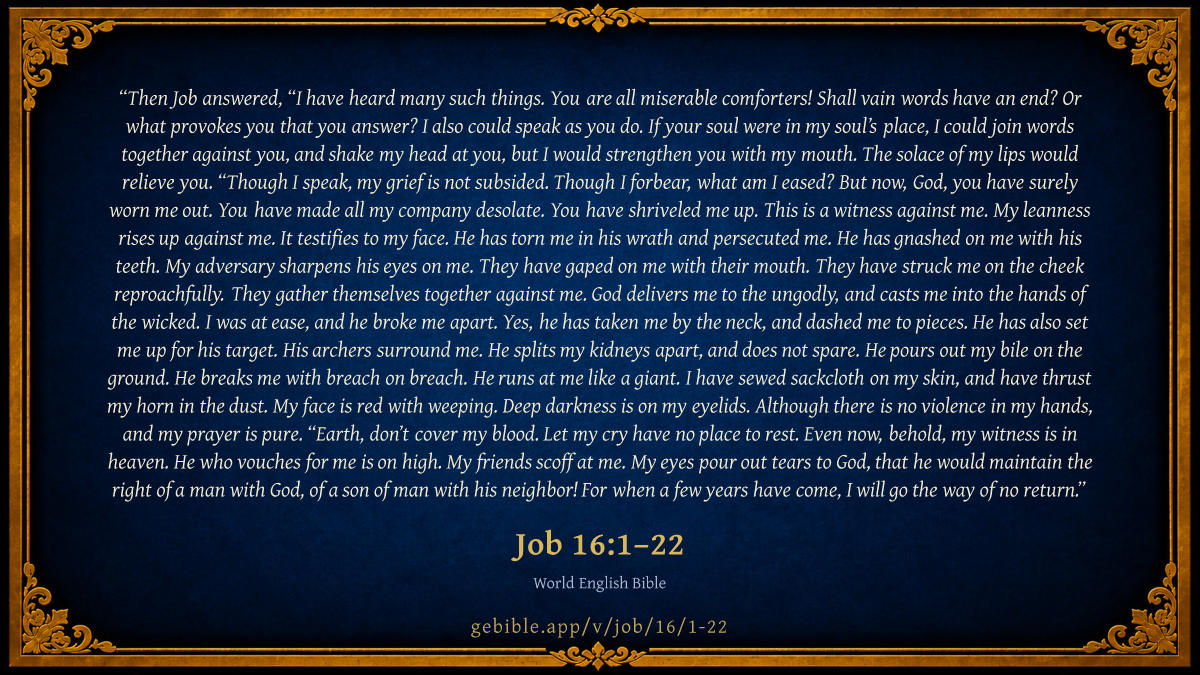
Then Job answered,
“I have heard many such things. You are all miserable comforters!
Shall vain words have an end? Or what provokes you that you answer?
I also could speak as you do. If your soul were in my soul’s place, I could join words together against you, and shake my head at you,
but I would strengthen you with my mouth. The solace of my lips would relieve you.
“Though I speak, my grief is not subsided. Though I forbear, what am I eased?
But now, God, you have surely worn me out. You have made all my company desolate.
You have shriveled me up. This is a witness against me. My leanness rises up against me. It testifies to my face.
He has torn me in his wrath and persecuted me. He has gnashed on me with his teeth. My adversary sharpens his eyes on me.
They have gaped on me with their mouth. They have struck me on the cheek reproachfully. They gather themselves together against me.
God delivers me to the ungodly, and casts me into the hands of the wicked.
I was at ease, and he broke me apart. Yes, he has taken me by the neck, and dashed me to pieces. He has also set me up for his target.
His archers surround me. He splits my kidneys apart, and does not spare. He pours out my bile on the ground.
He breaks me with breach on breach. He runs at me like a giant.
I have sewed sackcloth on my skin, and have thrust my horn in the dust.
My face is red with weeping. Deep darkness is on my eyelids.
Although there is no violence in my hands, and my prayer is pure.
“Earth, don’t cover my blood. Let my cry have no place to rest.
Even now, behold, my witness is in heaven. He who vouches for me is on high.
My friends scoff at me. My eyes pour out tears to God,
that he would maintain the right of a man with God, of a son of man with his neighbor!
For when a few years have come, I will go the way of no return.
Geneva Bible translators 1599 · Public Domain On vv3, 4, 5, 6, 7, 8, 9, 10, 11, 13, 15, 17, 18, 19, 20, 21 Which serve for vain ostentation and for no true…
Which serve for vain ostentation and for no true comfort.
For Eliphaz did reply against Job’s answer.
Geneva Bible (1599) marginal notes — public domain.
John Trapp 1656 · Public Domain On vv1–22 Job 16:1 Then Job answered and said,
Job 16:1 Then Job answered and said,
Ver. 1. Then Job answered and said] Although he had little or nothing to answer unto but what he had answered before, yet that he might not say nothing, he replieth to Eliphaz’s painted speech, and giveth him to know, that prudentibus viris non placent phalerata sed fortia (as Bishop Jewel was wont to say), that is, that wise men look for matter, and not for words only, from those that accost them.
John Trapp, A Commentary or Exposition upon All the Books of the Old and New Testament (1647–1656) — public domain. Text from a community e-Sword module.
Matthew Poole 1685 · Public Domain On vv2–22 I have heard many such things; both from you,…
I have heard many such things; both from you, who do so odiously repeat the same things, and from divers others; for these things, though you pride and please yourselves in them, as if you had made some great and strange discoveries, are but vulgar and trivial.
Miserable comforters; instead of giving me those comforts which you pretend to do, Job 15:11, and which my condition loudly calls for, you feed me with terrors, and censures, and scoffs.
Matthew Poole's English Annotations on the Holy Bible (1683–1685) — public domain. Text from a community e-Sword/MySword module.
Matthew Henry 1710 · Public Domain On vv1, 6, 17 Both Job and his friends took the same way…
Both Job and his friends took the same way that disputants commonly take, which is to undervalue one another's sense, and wisdom, and management. The longer the saw of contention is drawn the hotter it grows; and the beginning of this sort of strife is as the letting forth of water; therefore leave it off before it be meddled with. Eliphaz had represented Job's discourses as idle, and unprofitable, and nothing to the purpose; and Job here gives his the same character. Those who are free in passing such censures must expect to have them retorted; it is easy, it is endless: but cui bono? - what good does it do? It will stir up men's passions, but will never convince their judgments, nor set truth in a clear light. Job here reproves Eliphaz, 1. For needless repetitions (v. 2): "I have heard many such things. You tell me nothing but what I knew before, nothing but what you yourselves have before said; you offer nothing new; it is the same thing over and over again." This Job thinks as great a trial of his patience as almost any of his troubles. The inculcating of the same things thus by an adversary is indeed provoking and nauseous, but by a teacher it is often necessary, and must not be grievous to the learner, to whom precept must be upon precept, and line upon line. Many things we have heard which it is good for us to hear again, that we may understand and remember them better, and be more affected with them and influenced by them. 2. For unskilful applications. They came with a design to comfort him, but they went about it very awkwardly, and, when they touched Job's case, quite mistook it: "Miserable comforters are you all, who, instead of offering any thing to alleviate the affliction, add affliction to it, and make it yet more grievous." The patient's case is sad indeed when his medicines are poisons and his physicians his worst disease. What Job says here of his friends is true of all creatures, in comparison with God, and, one time or other, we shall be made to see it and own it, that miserable comforters are they all. When we are under convictions of sin, terrors of conscience, and the arrests of death, it is only the blessed Spirit that can comfort effectually; all others, without him, do it miserably, and sing songs to a heavy heart, to no purpose. 3. For endless impertinence. Job wishes that vain words might have an end, Job 16:3. If vain, it were well that they were never begun, and the sooner they are ended the better. Those who are so wise as to speak to the purpose will be so wise as to know when they have said enough of a thing and when it is time to break off. 4. For causeless obstinacy. What emboldeneth thee, that thou answerest? It is a great piece of confidence, and unaccountable, to charge men with those crimes which we cannot prove upon them, to pass a judgment on men's spiritual state upon the view of their outward condition, and to re-advance those objections which have been again and again answered, as Eliphaz did. 5. For the violation of the sacred laws of friendship, doing by his brother as he would not have been done by and as his brother would not have done by him. This is a cutting reproof, and very affecting, Job 16:4, Job 16:5. (1.) He desires his friends, in imagination, for a little while, to change conditions with him, to put their souls in his soul's stead, to suppose themselves in misery like him and him at ease like them. This was no absurd or foreign supposition, but what might quickly become true in fact. So strange, so sudden, frequently, are the vicissitudes of human affairs, and such the turns of the wheel, that the spokes soon change places. Whatever our brethren's sorrows are, we ought by sympathy to make them our own, because we know not how soon they may be so. (2.) He represents the unkindness of their conduct towards him, by showing what he could do to them if they were in his condition: I could speak as you do. It is an easy thing to trample upon those that are down, and to find fault with what those say that are in extremity of pain and affliction: "I could heap up words against you, as you do against me; and how would you like it? how would you bear it?" (3.) He shows them what they should do, by telling them what in that case he would do (Job 16:5): "I would strengthen you, and say all I could to assuage your grief, but nothing to aggravate it." It is natural to sufferers to think what they would do if the tables were turned. But perhaps our hearts may deceive us; we know not what we should do. We find it easier to discern the reasonableness and importance of a command when we have occasion to claim the benefit of it than when we have occasion to do the duty of it. See what is the duty we owe to our brethren in their affliction. [1.] We should say and do all we can to strengthen them, suggesting to them such considerations as are proper to encourage their confidence in God and to support their sinking spirits. Faith and patience are the strength of the afflicted; whatever helps these graces confirms the feeble knees. [2.] To assuage their grief - the causes of their grief, if possible, or at least their resentment of those causes. Good words cost nothing; but they may be of good service to those that are in sorrow, not only as it is some comfort to them to see their friends concerned for them, but as they may be so reminded of that which, through the prevalency of grief, was forgotten. Though hard words (we say) break no bones, yet kind words may help to make broken bones rejoice; and those have the tongue of the learned that know how to speak a word in season to the weary.
Matthew Henry's Commentary on the Whole Bible (1708–1710) — public domain (CC PDM 1.0). Text via the HelloAO Bible API.
John Gill 1763 · Public Domain On vv1–21 Then Job answered and said. As soon as Eliphaz…
Then Job answered and said. As soon as Eliphaz had done speaking, Job stood up, and made the following reply.
Then Job answered and said. As soon as Eliphaz had done speaking, Job stood up, and made the following reply.
Read full note →
Job 16:2
job 16:2
job 16:2
job 16:2I have heard many such things,.... As those Eliphaz has been discoursing of, concerning the punishment of wicked men; many instances of this kind had been reported to him from his preceptors, and from his parents, and which they had had from theirs, as well as Eliphaz had from his; and he had heard these things, or such like, told "many times" from one to another, as Ben Gersom interprets it; or "frequently", as the Vulgate Latin version, yea, he had heard them his friends say many things of this kind; so that there was nothing new delivered, nothing but what was "crambe millies cocta", the same thing over and over again; insomuch that it was not only needless and useless, but nauseous and disagreeable, and was far from carrying any conviction with it, or tracing weight and influence upon him; that he only gave it the hearing, and that was all, and scarce with any patience, it being altogether inapplicable to him: that wicked men were punished for their sins, he did not deny; and that good men were also afflicted, was a very plain case; and that neither good nor hatred, or an interest in the favour of God or not, were not known by these things; nor could any such conclusion be fairly drawn, that because Job was afflicted, that therefore he was a bad man:
miserable comforters are ye all; his friends came to comfort him, and no doubt were sincere in their intentions; they took methods, as they thought, proper to answer such an end; and were so sanguine as to think their consolations were the consolations of God, according to his will; and bore hard upon Job for seeming to slight them, Job 15:11; to which Job here may have respect; but they were so far from administering divine consolation, that they were none at all, and worse than none; instead of yielding comfort, what they said added to his trouble and affliction; they were, as it may be rendered, "comforters of trouble", or "troublesome comforters" (k), which is what rhetoricians call an oxymoron; what they said, instead of relieving him, laid weights and heavy pressures upon him he could not bear; by suggesting his afflictions were for some enormous crime and secret sin that he lived in the commission of; and that he was no other than an hypocrite: and unless he repented and reformed, he could not expect it would be better with him; and this was the sentiment of them one and all: so to persons under a sense of sin, and distressed about the salvation of their souls, legal preachers are miserable comforters, who send them to a convicting, condemning, and cursing law, for relief; to their duties of obedience to it for peace, pardon, and acceptance with God; who decry the grace of God in man's salvation, and cry up the works of men; who lay aside the person, blood, and righteousness of Christ, the consolation of Israel, and leave out the Spirit of God the Comforter in their discourses; and indeed all that can be said, or directed to, besides the consolation that springs from God by Christ, through the application of the Spirit, signifies nothing; for if any comfort could be had from any other, he would not be, as he is called, the God of all comfort; all the creatures and creature enjoyments, even the best are broken cisterns, and like the deceitful brooks Job compares his friends to, Job 6:15, that disappoint when any expectations of comfort are raised upon them.
(k) "consolatores molestiae", Vatablus, Drusius, Mercerus, Cocceius, Schmidt, Michaelis; "molesti", Beza, Junius & Tremellius, Piscator, Codurcus, Tigurine version; "molestissimi", Schultens.
John Gill's Exposition of the Whole Bible (1746–1763) — public domain (CC PDM 1.0). Text via the HelloAO Bible API.
John Wesley 1765 · Public Domain On vv1, 2, 3, 7, 9, 10, 11, 12, 13, 15, 17, 18, 19, 22 Job upbraids his friends with unkindness, ver. 1-5. Bemoans…
Job upbraids his friends with unkindness, ver. 1-5. Bemoans himself, ver. 6-16. Appeals from their censure to the righteous judgment of God, ver. 17-22.
John Wesley, Explanatory Notes Upon the Whole Bible (1754–1765) — public domain. Text via the GEBible commentary corpus.
Adam Clarke 1810 · Public Domain On vv1, 2, 3, 4, 5, 6, 7, 8, 9, 13, 15, 16, 17, 18, 19, 20, 21, 22 Job replies to Eliphaz, and through him to all…
CHAPTER XVI
Job replies to Eliphaz, and through him to all his friends,
Read full note →
who, instead of comforting him, had added to his misfortunes;
and shows that, had they been in his circumstances, he would
have treated them in a different manner, 1-5.
Enters into an affecting detail of his suffering, 6-16.
Consoles himself with the consciousness of his own innocence,
of which he takes God to witness, and patiently expects a
termination of all his sufferings by death. 17-22.
NOTES ON CHAP. XVI
Adam Clarke's Commentary on the Bible (1810–1826) — public domain. Text from a community e-Sword/MySword module.
Joseph Benson 1811 · Public Domain On vv1, 2, 3, 4, 5, 6, 7, 8, 9, 10, 11, 12, 13, 15, 17, 19, 21, 22 Job 16:1. Then Job answered and said — “Job,…
Job 16:1. Then Job answered and said — “Job, above measure grieved that his friends should treat him in this cruel manner, expostulates very tenderly with them on the subject. He tells them he should, in the like circumstances, have behaved to them in a very different way, Job 16:2. That he, as well as every one about him, was in the utmost astonishment, to find a man, whom he imagined his friend, accuse him falsely, and give him worse treatment than even his greatest enemies would have done. But that he plainly saw God was pleased to add this to the rest of his calamities; that he should not only be deprived of the comfort and assistance he might have expected from his friends, but that he should be used by them in a most relentless way, Job 16:7-14. That he had voluntarily taken on him all the marks of humility used by the guilty, though he was really innocent; that God above knew his innocence, though his friends so slanderously traduced him, Job 16:15-22. That he was sensible he was nigh his dissolution, otherwise he could return their own with interest, Job 17:1-3. That he made no doubt, whenever the cause came to a decision, the event would prove favourable to him. In the mean time, they would do well to consider what effect this their treatment of him must have on all mankind, and how great a discouragement it must be to the lovers of virtue, to see a man, whose character was yet unstained, on bare suspicion, dealt with so cruelly by persons pretending to virtue and goodness, Job 16:4-9. Would they but give themselves time to reflect, they must see that he could have no motive to hypocrisy; since all his schemes and hopes, with regard to life, were at an end, and, as he expected nothing but death, with what view could he play the hypocrite?” Job 16:10, to the end. — Heath.
Joseph Benson's Commentary on the Old and New Testaments (1811–1818) — public domain. Text from a community e-Sword module.
Albert Barnes 1834 · Public Domain On vv2–22 Many such things - That is, either things fitted…
Many such things - That is, either things fitted to provoke and irritate, or sentiments that are common-place. There was nothing new in what they said, and nothing to the purpose.
Miserable comforters - Compare Job 13:4. They had come professedly to condole with him. Now all that they said was adapted only to irritate, and to deepen his distress. He was disappointed; and he was deeply wounded and grieved.
Albert Barnes' Notes on the Bible (1834–1885) — public domain. Text from a community e-Sword/MySword module.
Haydock's Catholic Bible Commentary 1859 · Public Domain On vv2, 3, 4, 5, 7, 8, 9, 11, 14, 16, 17, 18, 19, 21, 22 Comforters. "Job’s friends or comforters," are become proverbial, to…
Comforters. "Job’s friends or comforters," are become proverbial, to denote people who do the contrary to what they seem to promise. (Haydock) --- Never did men sustain worse the character of comforters. They all magnify their knowledge and piety, and make the most absurd application of their principles to Job’s condition. (Calmet) --- He was not ignorant that tyrants and wicked men were often, may generally till the age in which he lived, visited with visible judgments. (Haydock)
George Leo Haydock (1774–1849), Haydock's Catholic Family Bible and Commentary, 1859 edition — public domain. Excludes Psalms (Douay-Rheims chapter numbering differs from Protestant) and Deuterocanonical books (Catholic canon only).
Lange's Commentary on the Holy Scriptures 1864 · Public Domain On v1 B.—Job: Although oppressed by his disconsolate condition, he nevertheless…
B.—Job: Although oppressed by his disconsolate condition, he nevertheless wishes and hopes that God will demonstrate his innocence, against the unreasonable accusations of his friends
Job 16-17
Read full note →
(A brief preliminary repudiation of the discourses of the friends as aimless and unprofitable):
Job_16:1-5
1 Then Job answered and said:
2 I have heard many such things:
miserable comforters are ye all.
3 Shall vain words have an end?
or what emboldeneth thee that thou answerest?
4 I also could speak as ye do;
if your soul were in my soul’s stead,
I could heap up words against you,
and shake mine head at you.
5 But I would strengthen you with my mouth,
and the moving of my lips should assuage your grief.
1. Lamentation on account of the disconsolateness of his condition, as forsaken and hated by God and men:
Job_16:6-17
6 Though I speak, my grief is not assuaged;
and though I forbear, what am I eased?
7 But now He hath made me weary:
Thou hast made desolate all my company.
8 And Thou hast filled me with wrinkles, which is a witness against me;
and my leanness rising up in me
beareth witness to my face.
9 He teareth me in His wrath, who hateth me;
He gnasheth upon me with His teeth;
mine enemy sharpeneth his eyes upon me.
10 They have gaped upon me with their mouth;
they have smitten me upon the cheek reproachfully;
they have gathered themselves together against me.
11 God hath delivered me to the ungodly,
and turned me over into the hands of the wicked.
12 I was at ease, but He hath broken me asunder;
He hath also taken me by my neck, and shaken me to pieces,
and set me up for His mark.
13 His archers compass me round about,
He cleaveth my reins asunder, and doth not spare;
He poureth out my gall upon the ground.
14 He breaketh me with breach upon breach;
He runneth upon me like a giant.
15 I have sowed sackcloth upon my skin,
and defiled my horn in the dust.
16 My face is foul with weeping,
and on my eyelids is the shadow of death;
17 not for any injustice in mine hands;
also my prayer is pure.
2. Vivid expression of the hope of a future recognition of his innocence:
Job_16:18 to Job_17:9
18 O earth, cover not thou my blood!
and let my cry have no place!
19 Also now, behold, my witness is in heaven,
and my record is on high.
20 My friends scorn me:
but mine eye poureth out tears unto God.
21 O that one might plead for a man with God,
as a man pleadeth for his neighbor!
22 When a few years are come,
then I shall go the way whence I shall not return.
Job_17:1 My breath is corrupt,
my days are extinct,
the graves are ready for me.
2 Are there not mockers with me?
and doth not mine eye continue in their provocation?
3 Lay down now, put me in a surety with Thee;
who is he that will strike hands with me?
4 For Thou hast hid their heart from understanding?
therefore shalt Thou not exalt them.
5 He that speaketh flattery to his friends,
even the eyes of his children shall fail.
6 He hath made me also a byword of the people;
and aforetime I was as a tabret.
7 Mine eye also is dim by reason of sorrow,
and all my members are as a shadow.
8 Upright men shall be astonished at this,
and the innocent shall stir up himself against the hypocrite.
9 The righteous also shall hold on his way,
and he that hath clean hands shall be stronger and stronger.
3. Sharp censure of the admonitory speeches of the friends as unreasonable, and destitute of all power to comfort:
Job_17:10-16
10 But as for you all, do ye return, and come now;
for I cannot find one wise man among you.
11 My days are passed,
my purposes are broken off,
even the thoughts of my heart.
12 They change the night into day:
the light is short because of darkness.
13 If I wait, the grave is mine house;
I have made my bed in the darkness.
14 I have said to corruption, Thou art my father;
to the worm, Thou art my mother and my sister.
15 And where is now my hope?
as for my hope, who shall see it?
16 They shall go down to the bars of the pit,
when our rest together is in the dust.
EXEGETICAL AND CRITICAL
1. Heartlessly repulsed by his friends, and left without comfort, Job turns, more trustfully than in his previous apologies, to the God who evidenced Himself in his good conscience, of whom he cannot believe that He will leave him forever without testifying to his innocence, however cheerless a night of despair may in the meanwhile surround him. It is in the expression of his confidence, and of his inward yearning and waiting for this Divine testimony to his innocence (Job_16:18 to Job_17:9) that the significance of this discourse culminates, so far as it gives pleasing evidence of progress beyond Job’s former frame of mind. Along with this indeed it gives evidence that the spirit of hopeless and bitter complaint is, if not intensified, at least substantially unchanged and undiminished. The first principal division of the discourse (Job_16:6-17) which precedes that expression of yearning confidence in God’s help contains in particular an expression of cheerless lamentation over his condition, as one forsaken by God and men; while a shorter introduction prefaced to this division (Job_16:2-5), as well as the concluding section, or third division (Job_17:10-16) are particularly occupied with a bitter complaint on account of the misunderstanding and heartless conduct of the friends.—The whole discourse comprises six long strophes, the first of which constitutes the introduction, extending through four verses, or ten stichs (Job_16:2-5), while the first and second divisions contain each two strophes (of 6, 7 verses, or 14 stichs), the third division, however, only one strophe (of 7 verses, or 14 stichs).
2. Exordium of the discourse, or introductory strophe: A short preliminary repudiation of the discourses of the friends as aimless, and destitute of all power to comfort: ch Job_16:2-5.
Job_16:2. I have heard (already) many such things (רַבּוֹת, multa, as in ch, Job_23:14), and miserable comforters are ye all. מְנַחֲמֵי עָמָל, lit. “comforters of distress” [Gen of attribute, Green, § 254, 6] are burdensome comforters (consolatores onerosi, Jer.), who, instead of comfort, minister only trouble and distress; comp. Job_15:11.
Job_16:3. Are windy words (now) at an end? Comp. Job_15:2, where Eliphaz reproaches Job with windy speech—a reproach which Job now pays back in the same coin.—Or what vexes thee [addressed more particularly to Eliphaz] that thou answerest?המריץ, Hiph. of מרץ, “to be sick, weak” (see on Job_6:25), signifies “to make sick, to afflict” (Ewald, Schlott., Dillm.), or again “to goad, incite, vex” (Del.) [see the examples in notes on Job_6:25 favoring this definition]: not, “to make sweet, to sweeten,” as the Targ. interprets, as though מרץ were without further qualification = כִּי—ּמלץ moreover is not = quum (Hirz.), but as in Job_6:11 quod: “what vexes thee that thou answerest,” or “to answer.”
Job_16:4. I also indeed would speak like you, i.e., would be minded to serve you with such like discourses as your own [Dillmann, Conant, Renan, Rodwell, etc., with good reason prefer to render the subjunctive אֲדַבֵּרָה “I could,” or “might,” rather than “would”].—If your soul were instead of mine;i.e. in case you had my place, your persons were instead of mine. [Conant, however: “Your soul is not to be taken as a periphrasis of the personal pronoun. Soul, the seat of intelligence, mental activity and emotion, stands as the representative of these faculties in man, and is specially appropriate here, where there is immediate reference to what is thought, felt and suffered. The force of the expression is lost therefore by substituting ye and me.”]—Would [or could] weave words against you.—הֶחֱבִיר בְּמִלִּיםis not “to make a league with words” (Gesen. [Rodwell], etc.), nor again: “to affect wisdom with words” (Ewald), but to “combine words, string them together like pearls.” Instead of the simple accus of the object מִלִּים, the more choice construction with בְּ instrum. is used; comp. the following member, also Job_16:10; Jer_18:16; Lam_1:17 (Gesen. § 138 [§ 135] 1, Rem. 3). [“When he says: I would range together, etc., he gives them to understand that their speeches are more artificial than natural, more declamations than the outgushings of the heart.” Del.]—And shake my head at you;viz., as a gesture of scorn and malicious pleasure; comp. Psa_22:8 [7]; Isa_37:22; Jer_18:16; Sir_12:18; Mat_27:39. It should be borne in mind that what is hateful in such conduct is not to be charged upon Job (who indeed only states what he could do if he had before him the friends, weak and miserable as he is now, and should then follow the promptings of the natural man), but on the friends, before whom Job here holds up as in a mirror the hatefulness of their own conduct. [In regard to the rendering of על by “against,” and the explanation of הֵנִיַע as a gesture of scorn, see below on Job_16:5]
Job_16:5. Would [could] strengthen you with my mouth:i.e. with mere words, instead of with deeds of a love that wins the heart. [On the form אֲאַמִּֽצְכֶם with Tsere shortened to Hhirik, see Green, § 104, h.]—And the sympathy of my lips (נִיד, commisseration, sympathy, only here; comp. the phrase, similar in sound, נִיבִ שְׂפָתַיִם, “fruit of the lips,” Isa_57:19) should assuage, soil, your grief. חָשַׂךְ, “to soothe, restrain, check,” here without an obj. as in Isa_58:1. The following verse easily enables us to supply כְּאֵב, as the object. [The E. V., Wem., Bar., Elz., etc., render this as a contrast with Job_16:4, as though Job, after there describing what he might do if they were in his place, describes here what, on the other hand, he really would do. But there is nothing to indicate such a contrast. Job_16:5 is most simply and naturally the continuation of Job_16:4.—The irony of the passage is most keen and cutting. If you were in my place, says Job, if your soul were tried as mine is, I could speak windy words in abundance as you have done, I could string them out one after another, and nod my head to comfort: oh, yes! all such comfort—sympathy of the head, of the mouth, of the lips, I could lavish upon you—that is cheap enough, as your conduct shows—but as for the heart, that is quite another matter! It will be seen from this paraphrase of Job’s language that a somewhat different view is taken of one or two expressions, particularly in Job_16:4, from that given above by Zöckler, It seems unnecessary and unnatural to suppose that Job would in Job_16:4 describe himself as framing words against them, and indulging in gestures of malicious mockery, and then in Job_16:5 as strengthening and soothing them with words—but nothing more. Moreover the expressions of Job_16:4 would thus lose their point, there being no reason to suppose that the friends had shown any such malignity as would be thus suggested. What Job says is, that he could multiply words of cold formal sympathy, that he could string out such words upon them, or towards them; and again that he could make with his head the customary oriental gesture of condolence (נוּעַ here like נוּד, see above, Job_2:11 and comp. Gesen. sub. 5.), this being by implication all the sympathy he had received from them.—E.]
3. First Division. A lamentation concerning the cheerlessness of his condition, as one forsaken and persecuted by God and men. Job_16:6-17.
First Strophe: Job_16:6-11. From the friends, the “miserable comforters,” who leave him in his helplessness, he turns to himself, who is so greatly in need of sympathy, because God has delivered him over to the scorn and the cruelty of the unrighteous.
Job_16:6. [“He bethinks himself whether he will continue, the colloquy further. Already in the lamentation of Job 3. Job had given vent to his grief, and solicited comfort. The colloquy thus far had shown that from them he had no comfort to expect. Should he then speak further, in order to procure at least some alleviation of his grief? but he cannot anticipate even this as the result of his speaking. He must accordingly be silent; yet even then he is no better off.” Dillm.]—If I speak (voluntative after אִם, see Ew. § 355, b) my grief is not assuaged; if I forbear (voluntative without אִם, as in Job_11:17; Psa_73:16, etc.), what departs from me, viz. of my pain? how much of my pain goes away from me, do I lose? The unexpressed answer would naturally be; Nought! On יהלךְ, comp. Job_14:20.
Job_16:7. Nevertheless—now He hath exhausted me, viz. God, not the pain (כְּאֵבִי, Job_16:6), which the Vulg., Aben-Ezra, etc., regard as the subj. The particle אְַךְ, which belongs to the whole sentence, signifies neither: “of a truth, yea verily!” (Ew.) nor “only” [=entirely], as though it belonged only to הלאני (Hirz., Hahn, etc.), but it has here an adversative meaning, and states, in opposition to the two previously mentioned possibilities of speaking and being silent, what is actually the case with Job; hence it should be rendered “still, nevertheless,” verum tamen: [Renan: Mais quoi! “He is absolutely incapable of offering any resistance to his pain, and care has also been taken that no solacing word shall come to him from any quarter,” Del. See the next clause].—Thou hast desolated all my circle. עֵדָה here not “rabble,” as in Job_15:34, but sensu bono—circle of friends and family dependents (Carey: all my clan). [“This mention of the family is altogether in place, seeing that the loss of the same must be doubly felt by him now that his friends are hostile to him.” Schlott,]. The Pesh. reads “all my testimony” (עֵדָתִי), i.e., all that witness in my behalf, all my prosperity (so also Hahn among the moderns), to which however הֵשֵׂם is not particularly suitable. Note moreover the transition, bearing witness as it does to the vivid excitement of the speaker’s feelings, from the declarations concerning God in the third person (which we find in the first member, and which appear again Job_16:9 seq.), and the mournful plaintive address to Him here and in Job_16:8, in which the description before us is directly continued.
Job_16:8. And hast seized me (not “Thou makest me wrinkled,” Vulg., Luther [E. V., Lee, Rodwell] or “shrivelest me together, Del.—for קמט signifies “to press together, to fasten firmly together;” comp. Job_22:16. [Wordsworth attempts somewhat peculiarly to combine the two definitions: “Thou hast bound me fast with wrinkles, as with a chain”].—It is become a witness, viz., the fact that thou hast seized me; the circumstance that God makes him suffer so severely is—so at least it seems—a witness of his guilt. [This clause, taken in connection especially with the following parallelism, seems certainly to favor the rendering of the Vulg., E. V., etc. “thou hast filled me with wrinkles.” The witness against Job is naturally something which like his “leanness” is visible. The corrugation of the skin was a feature of elephantiasis more marked even than the emaciation of the body, and would hardly be omitted in so vivid a description of his condition as Job here gives. The primary signification of “seizing,” or “compressing” should not however be lost sight of; indeed it adds much to the terrible, force of the representation to retain it, and, with Wordsworth, to combine the two definitions, only in a somewhat different way from his; the true conception being that God—who in Job_16:12 is represented as seizing Job and dashing him in pieces,—is here represented as seizing, compressing him, until his body is shriveled, crumpled up into wrinkles.—E.]. In opposition to Ewald, who changes הָיָה into הַיָה (= הַוָּה, see Job_6:2; Job_30:13), and translates accordingly: “and calamity seized me as a witness ”—comp. Del. and Dillm. on the passage: [who object that it would leave לְעֵד without much of its force and emphasis, and that the construction would be too condensed and artificial].—And my leanness has appeared against me, accusing me to the face (speaking out against me, comp. Job_15:6 b). On כַּחַשׁ = consumption, emaciation, comp. Psa_109:24. The signification rests on a metaphor similar to that by virtue of which a dried-up brook is called a “liar” (Job_6:15 seq.).
Job_16:9. His anger has torn and made war upon me; He has gnashed against me with His teeth; as mine enemy He has whetted His eyes against me. God, who is now again spoken of in the third person, is imagined as a ferocious beast of prey, who is enraged against Job. So above in Job_10:16.—As to the “tearing,” comp. Hos_6:1; the “making war,” Job_30:21; the “whetting” or “sharpening” of the eyes, Psa_7:13 [12]: also the acies oculorum of the Romans, and the modern expression, “to shoot a murderous look at any one”
Job_16:10. Men also, like God, fall upon Job, as his enemies, resembling beasts of prey.—They have opened wide their mouth against me (a gesture of insolent mockery, as in Psa_22:8 [Psa_22:7]; Jer. 57:4); with abuse (i.e., with abusive speech) they strike me on the cheeks (comp. Mic. 4:14 [Mic_5:1]; Lam_3:30; Joh_18:22; Joh_19:3); together they strengthen themselves against me, or again: they complete; fill themselves up [= fill up their ranks] against me, for הְתְמַלֵּא means “to gather themselves together to a מְלֹא (Isa_31:4), a heap;” not “to equip themselves with a full suit of armor,” as Hirzel would explain, supplying בַּרְזֶל.—The whole of this lamentation, which reminds us of Psalms 22., is general in its form; it contemplates nevertheless the hostile attacks made by the friends on Job, as in particular the word “together” in the third member shows—in hearing which the friends could not help feeling that they were personally aimed at in the strong expressions of the speaker, even as he on his part must have had his sensibilities hurt by such expressions as those of Eliphaz in Job_15:16 (see on the passage).
Job_16:11. God delivers me (comp. Deu_23:16 [15]) to the unrighteous, and casts me headlong into the hand of the wicked. יִרְֽטֵנִי, Imperf. Kal. of ירט (contracted from יִירְטֵני, Ges., § 70 [§ 68], Rem. 3). [“The preformative Jod has Metheg in correct texts, so that we need not suppose, with Ralbag, a רטה similar in meaning to ירט.” Del.], præcipitem me dat; comp. LXX. ἔῤῥιψε and Symmachus ἐνέβαλε.—עֲויִל in the first member, “the perverted one, the reprobate, the unrighteous,” or again—“the boy” [der Bube, “or the boyish, childish, knavish one”] as Del. explains it, (referring to Job_19:18; Job_22:11), is used collectively for the plur., as the parallel term רְשָׁעִים in b shows.
Second Strophe: Job_16:12-17. Continuation of the description of the cruel and hostile treatment he had received from God, notwithstanding his innocence.
Job_16:12. I was at ease, and He then shattered me. שָׁלֵו, secure, unharmed, suspecting no evil; comp. Job_21:23; Job_3:26.—פַּרְֽפּרַ, Pilp. of פרר with strong intensive signification—“to shatter, to crush in pieces;” so also the following פִּצְפֵּץ, from פצץ, “to beat in pieces, to dash to pieces.” [“He compares himself to a man who is seized by the hair of his head, and thrown down a precipice, where his limbs are broken. He probably alludes to some ancient mode of punishing criminals.” Wemyss]. Observe the onomatopoetic element of these intensive forms, which furthermore are to be understood not literally or physically, but in a figurative sense of the sudden shattering of prosperity, and peace of soul.—And set me for a mark. מַטָּרָה (from נָטַר, τηρεῖν, like σκοπός from σκέπτεσθαι), target, mark, as in 1Sa_20:20; Lam_3:12; comp. מִפְגַע above in Job_7:20.
Job_16:13 expands the figure in Job 12. c.—His arrows whirred about me. רַבָּיו, not “his troops, his archers” (Rabb. [E. V., Noy., Con., Car., Rod., Elz., etc.]), but according to the unanimous witness of the ancient versions: “his arrows, darts” (from רמה ,רבה – רבב, jacere, Gen_49:23; comp. Gen_21:10).—(He cleaves my reins without sparing, pours out on the earth my gall (comp. Lam_2:11). Job here describes more specifically the terrible effect of God’s arrows, i.e., of the ailments inflicted on him by a hostile God (comp. Job_6:4, also the well-known mythological representations of classical antiquity), representing in accordance with the Hebrew conception the noblest and most sensitive of the inner organs of the body as affected, namely the reins, and also the gall-bladder. In view of the highly poetic character of the description, it is not necessary to inquire whether he conceives of the “outpouring” of the gall as taking place inwardly, without being at all perceptible externally, or whether, with a disregard of physiological possibility or probability, he represents it as something that is externally visible. It is moreover worthy of note that according to Arabic notions the “rupture of the gall-bladder” may really be produced by violent painful emotions. Comp. Delitzsch on the passage; also his Biblical Psychology [p. 317, Clark]; also my Theol. Naturalis, p. 618.
Job_16:14. He breaks through me breach upon breach. פֶּרֶץ, comp. Job_30:14, here as accus. of the object, united to its cognate verb; comp. Gesen., § 138 [§ 135] Rem. 1.—He runs upon me like a mighty warrior. In this new turn of the comparison Job, and in particular his body, appears as a wall, or a fortress, which is by degrees breached by missiles and battering-rams, and which God himself assaults by storm.
Job_16:15. I have sewed sackcloth upon my skin, i.e. I have girded around myself, and stitched together (about the loins) a closely fitting mourning garment of close hair (comp. שַׂק in Isa_3:24; Isa_20:2; Isa_32:11; 1Ki_21:27; 2Ki_6:30, etc.). The “sewing upon the skin” is doubtless to be understood only figuratively of the laying on of a closely fitting garment, which it is not intended to lay off immediately. Possibly, indeed, there may be an allusion to the cracked swollen skin of one diseased with elephantiasis, in which the hair of the sackcloth (cilicium) must of necessity stick (see my Kritische Gesch. der Ascese, p. 82 seq.). [See also Art. “Sackcloth” in Smith’sBib. Dict. “Job does not say of it that he put it on, or slung it around him, but that he sewed it upon his naked body; and this is to be attributed to the hideous distortion of the body by elephantiasis, which will not admit of the use of the ordinary form of clothes.” Delitzsch]. In any case in referring to this stiff, almost dead skin, as a part of his fearfully distorted body, he chooses the term גֶּלֶד, which appears in Hebrew only here (though more common in Aram. and Arab.), and in contrast with עוֹר, the “sound, healthy skin,” may be translated “hide;” comp. the βύρσα of the LXX.—And have lowered (lit. “stuck,” see below) my horn—the symbol of power and of free manly dignity, comp. 1Sa_2:1; 1Sa_2:10; Psa_89:18 [Psa_89:17], Psa_89:25 [Psa_89:24]; Psa_92:11 [sa 92:10]; etc., Luk_1:69—into the dust:—this being a sign of his humiliation, of his consciousness of the defeat, and of the deep sorrow which he has been called to endure. For this lowering of the horn into the dust of the earth is the direct opposite of “lifting up the horn” (Psa_83:3 [2] as a symbol of the increase of power and dignity. עוֹלֵל is with Saad., Rosenm., Ew., Hirz., Dillm., etc., to be derived from עלל, introire, of frequent use in the Aram, and Arab., and thus signifies “to stick into, to dig into.” If it were the Pil. of עלל, “to act,” meaning accordingly “to abuse,” or “to defile” (Targ., Pesch., Delitzsch [E. V., Schlott.] etc.), the לְ before the object would not be wanting; comp. Lam_1:22; Lam_2:20; Lam_3:51. To be preferred to this is the translation—” I roll my horn in the dust” (Umbr., Vaihing., Hahn), a rendering which is etymologically admissible.
Job_16:16. My face is burning red with weeping. חֳמַרְמְרָה (instead of which we ought perhaps with the K’ri to read the plural חֳמַרְמְרוּ, unless we explain the fem., like תִּשְׁטֹף in Job_14:19, in accordance with Gesen., § 146, [§ 143], 3), Pualal of חמר, an intensive passive form, expressing the idea of being exceedingly reddened, glowing red (comp. Lam_1:20; Lam_2:11). [From the same root comes the name Alhambra, applied to the building from its color. See Delitzsch].—And on mine eyelashes is a death-shade, i.e., by reason of continuous weeping, and the weakening thereby of the power of sight, my eyes are encompassed by a gloom of night: [an explanation which Schlottmann characterizes as flat and prosaic. The idea is rather that in Job’s despondent mood he conceived of “the shadow of death” as gathering around. He had well-nigh wept himself out of life].
Job_16:17. Although no violence is in my hands (or clings to them) and my prayer is pure.—Job emphasizes his innocence here in contrast not only with Job_16:16, but with the whole description thus far given of the persecution which he had endured, Job_16:12-16.—עַל is used here, as in Isa_53:9, as a conjunction. in the sense of “notwithstanding that, although,” (Ewald, § 222, b), not as a preposition, as Hirzel explains it (“in spite of non-violence”).
4. Second Division. A vivid expression of the hope of a future recognition of his innocence: Job_16:18—Job_17:9.
First Strophe: Job_16:18—ch. Job_17:2. [His confidence in God as his witness and vindicator—his only hope in view of the speedy approach of death].
Job_16:18. Earth, cover not thou my blood. i.e., drink it not up, let it lie open to view, and cry to heaven as a witness to my innocence, Comp. Gen_4:10; Eze_24:7 seq.; Isa_26:21. [“As according to the tradition it is said to have been impossible to remove the stain of the blood of Zachariah, who was murdered in the court of the temple, until it was removed by the destruction of the temple itself.” Delitzsch. “According to the old belief no rain or dew: would moisten the spot marked by the blood of a person murdered when innocent, or change its blighted appearance into living green.” Ewald]. The second member also expresses essentially the same meaning: and let my cry have no resting-place, i.e., let not the cry for vengeance arising from my shed blood (or the cry of my soul poured out in my blood, Gen_9:4, etc.), be stilled, let it not reach a place of rest, before it appears as my גוֹאֵל (Job_19:25) to deliver and avenge me. [“Therefore in the very God who appears to him to be a bloodthirsty enemy in pursuit of him, Job nevertheless hopes to find a witness of his innocence: He will acknowledge his blood, like that of Abel, to be the blood of an innocent man. It is an inward irresistible demand made by his faith which here brings together two opposite principles—principles which the understanding cannot unite—with bewildering boldness. Job believes that God will even finally avenge the blood which His wrath has shed, as blood that has been innocently shed.” Delitzsch].
Job_16:19. Even now behold in heaven my witness, and my attestor (שָׂהֵד, LXX. συνίστωρ, an Aram, synonym of עֵד, witness, comp. Gen_31:47) in the heights.—In regard to מְרומִים as a synonym, of שָׁמַיִם, comp. Job_25:2; Job_31:2. גַם עַתָּה, “even now,” (not “now however,” Ewald) sets the present condition of Job, apparently quite forsaken, but in reality still supported and upheld by God as a heavenly witness of his innocence, in contrast with a future period, when he will be again publicly acknowledged and brought to honor. This more prosperous and happy future he does not yet indeed realize so vividly as later in Job_19:25 seq. That of which he speaks here is only the contrast between his apparent forsakenness, and the fact that, as he firmly believes, God in heaven is still on his side. [“If his blood is to be one day avenged, and his innocence recognized, he must have a witness of the same. And reflecting upon it he remembers that even now, when appearances are all against him, he has such a witness in God in heaven.” Dillm.].
Job_16:20. [“The conduct of the friends in denying, nay in mocking his innocence, compels him to cling to this God in heaven.” Dillm.].—They who mock me (lit., “my mockers,” with strong accent on “mockers”) are my friends. [“It is worthy of remark that the word here used, melits, signifies also an interpreter, an intercessor, and is employed in that sense; below, Job_33:23; comp. Gen_42:23; 2Ch_32:31; Isa_43:27; and some, as Professors Lee and Carey, have assigned that sense to the word here, ‘My true interpreters are my friends;’ and they suppose in this word, here and in Job_33:23, a prophetic reference to the Mediator. But the Auth. Ver. appears to be correct; and the similarity of the words serves to bring out the contrast between the unkindness of man, and the mercy of God.” Words.].—To Eloah mine eye poureth tears:i.e. although my friends mock me, instead of taking me under their protection, and attesting my innocence, I still direct to God a look of tearful entreaty that He would do justice, etc.—[“An equally strong emphasis lies here on subj. and predicate: ‘My friends’ stands in contrast with God; ‘my mockers’ in contrast with ‘my witness,’ Job_16:19; and finally also ‘my mockers’ in contrast with ‘my friends.’ ” Schlottm.]. Ew., Dillm., etc., take the first member, less suitably, as assigning the reason for the second: “because my friends are become such as mock me, mine eye pours out tears to Eloah,” etc.
Job_16:21 states the object of the weeping (i.e., the yearning) look which he lifts up to God. This object is twofold: (1) That He would do justice to a man before God: lit. “that He would decide (וְיוֹכַח, voluntative expressing the final end, as in Job_9:33) for the man against Eloah, or with Eloah (עִם as in Psa_55:19 [18]; Job 94:16 [15] of an opponent); i.e., that before His own bar He would pronounce me not guilty, that He would cease to misunderstand and to persecute me as an enemy, but would rather assist me to my right, and so appear on my side. (2) (That He would do justice) to the son of man against his friend, that He would justify me against my human friend (רֵעֵהוּ distributively for רֵעָיו), and set me forth as innocent—which would result immediately upon his justification before God’s bar. For the interchange of “man” and “son of man” in poetic parallelism, comp. Psa_8:5. It is not necessary to adopt Ewald’s suggestion (Jahrb. der bibl. Wissenschaft, IX. 38) to read בֵּין אָדָם, instead of בֶּן־א׳, in order to acquire a more suitable construction for חוכיח. The construction according to the common reading presents nothing that is objectionable, scarcely anything that is particularly harsh. The influence of the לְ of the first member extends forward to בֶּן־אָדָם (as in. Job_15:3), and the לְ before רֵעֵהוּ = “in respect to, against,” supplies the place of the עִם of the first member. It would be much harsher were we, with Schlottmann, Ewald (in Comm.), and Olsh. to translate the second member: “and judges man against his friend,” a rendering which is condemned by the usage of the language, for הוֹכִיחַ with accus. of person never signifies “to judge,” but always “to punish, reprove.” [“Job appeals from God to God: he hopes that truth and love will finally decide against wrath. … Schlottmann aptly recalls the saying of the philosophers, which applies here in a different sense from that in which it is meant: Nemo contra Deum, nisi Deus ipse.” Del. “The prayer of Job is fulfilled in Job_42:7; and that too in a sense quite otherwise than that which Job had ventured to hope for, even in this life. This is again one of the passages where the poet permits his hero, in an exalted moment, to enjoy a presage of the issue.” Dillm.] Concerning the theological significance of the wish here expressed by Job, that he might, be justified by God before God as well as before men; comp. the Doctrinal and Ethical Remarks.
Job_16:22. Giving the reason why Job longs to be vindicated, arising from the fact that his end is near, and that for him who has once died there is no prospect of a return to this life, [This, however, is not to be understood as a reason given why God should interpose speedily to vindicate him before his death. Rather the argument, is drawn from the hopelessness of his physical condition. Death was sure and near; that recovery which the friends promised on condition of repentance was out of the question: hence if he is to be vindicated, it must be by God, who can do it when he is gone.]—For years that may be numbered are coming on, and by a path without return shall I go hence.—The thought is substantially the same as in Job_7:7-10; and Job_10:20 seq.—שְׁנוֹת מִסְפַּר, lit. “years of number” (Gen_34:30; Psa_105:12), are years that may be numbered, i.e. a few years (LXX: ἔτη ἀριθ μητά), by which we are naturally to understand those which still remain before his death, the remaining years of his life (not all the years of his life, as Hahn and Del. explain). For יֶאֱתָיוּ (in regard to the form, comp. on Job_12:6) can only mean: “they are coming on, they stand before me,” not: “they are passing away” (transeunt, Vulg., etc.), nor: “their end is coming on” (Hahn, Del.). That Job here announces the sad issue in which the rapid and inevitably fatal course of the elephantiasis generally resulted, is shown by the conclusion of the discourse, Job_17:11-16.
Job_17:1 [the chapter-division here being manifestly errroneous] continues the statement of the reason given in Job_16:22. It consists of abrupt sob-like ejaculations of which it may be truly said with Oetinger that they form “the requiem, which Job chants for himself even while yet living.”—My spirit is disturbed, so correctly most moderns, taking רוּחִי in the sense of “the spirit or power.” The translation: “my breath is corrupt,” or “destroyed” (De Wette, Del. [B.V., Rod., Elz., Con., Ber.], etc.), is less suitable here to the connection, which requires, as the subject of Job’s expression, not that single symptom of a short and fetid breath [which would be a much less conclusive indication that his days were numbered than others which he might have mentioned], referred to also in Job_7:15; Job_19:17; but requires rather some sign of the incipient dissolution of the whole psychical bodily organism, a failure of the vital principle.—My days are extinct (דעך = זעך, Job_6:17, which some MSS. exhibit here also); graves await me [Rodney: for me the tombs!]. Comp. the Arabic proverb: “to be a grave-companion (Ssâchib el-kubûr);” also the familiar saying of Luther: “to walk on the grave;” and the modern expression: “to stand with one foot in the grave.”
Job_17:2. Verily mockery surrounds me: and on their quarreling mine eye must dwell.—So substantially Welte, Arnh., Del., Dillm. [Schlott,, Con., Words.], whose rendering of this difficult verse is the most satisfactory; for (1) It is best to take אִם־לֹא, as in Job_1:11; Job_22:20; Job_31:36, etc., as a formula of asseveration=“verily, truly.” (2) הֲתֻלִים (or according to another reading הֲתֻלִּים is an abstract term, formed from הֵתֵל = mockery, scoffing (not “deception,” as Hirzel renders it); to render it as a concrete term in the sense of “mockers” [E. V., Noyes, etc.], or “beguiled,” is at variance with the laws governing the formation of Hebrew words (see Ew. § 153, a; 179, a, b).—(3) הַמְרוֹתָם is Inf. Hiph. with suffix, from מרה, which means in Hiph. “to make refractory,” to incite to strife, to contend with one. The word is written with Dagh. dirimens in מ, comp. Job_9:18; Joe_1:17, etc.—(4) תָּלַן, Jussive or Voluntative form of לין, to lodge, to tarry (comp. Job_19:4; Job_29:19; Job_31:32), is a pausal form for תָּלֵן, which occurs also in Jdg_19:20, the use of which in a non-pausal position seems to be purely arbitrary, or rests possibly on euphonic grounds (the liquids l and n in juxtaposition being treated as though they were gutturals: comp. Ewald, § 141, b, Rem. 2). (5) The sense of the entire verse, according to the construction here given, is decidedly more suitable to the context: Of a truth it is mocking me (ה׳ עִמָּדִי, lit. “mockery is with me, befalls me”) to force me, who am standing on the verge of the grave to confess a guilt from which I know myself to be free; and such hateful quarrelsome conduct it is that I must have continually before my eyes!—Other renderings are e.g.—a. That of the Pesh., Vulg., and recently of Hirzel, which takes הֲתֻלִים in sense of “deception, illusion.” Thus Hirzel’s rendering is: “If deception is not with me, then let them continually henceforth quarrel.” b. That of Rosenmüller: annon illusiones mecum, et in adversando eorum pernoctat oculus meus.—c. That of Ewald (in part also of Eichhorn, Umbr.): “If only I were not mocked and mine eye were not obliged to dwell,” etc.—d. The rendering in part similar to the latter, of Vaih. and Heiligst.—“Oh, that mockery did not surround me! then could mine eye abide in peace with their contention!”—e. That of Stickel and Hahn: “Or are there not around me those who are deluded? must not mine eye dwell on their contention?”—[f. That of Renan: “May it please God that traitors might be far from me, and that mine eye be never more afflicted with their quarrels!”]
Second Strophe: Job_17:3-9. Repetition of the yearning and trustful supplication to God as the only remaining attestor or witness of his innocence now remaining to him in view of the heartless coldness, nay the hostility of his human friends.—Oh, lay down [now], be Thou bondsman for me with Thyself! who else will furnish surety to me? The thought is not substantially different from that in Job_16:21, only that the representation which there predominates of an adjudication in favor of Job’s innocence is here replaced by that of pledging or binding one’s self as security for it. For all the expressions of the verse are borrowed from the system of pledging. With the Imper. שִׂימָה is to be supplied, as the following lowing עָרִבֵנִי shows, an accus. of the object, “a pledge, security.” It is not necessary with Reiske and Olsh. to change עָרְבֵנִי to עַרְבֹנִי, arrhabonem meam. The following עִמָּךְ, indicating the person with whom the pledge is deposited, again represents God, precisely as in Job_16:21, as being, so to speak, divided, or separated into two persons. The word of entreaty ערב (which appears also in Isa_38:14. and Psa_119:122, and which is here used with the accus. of the person following in the sense of “representing any one mediatorially as ἔγγυος or μεσίτης) is replaced in the second member by the circumstantial phrase נִתְקַע לְיָד, to give surety by striking hands. For this is the meaning of the phrase, which elsewhere reads תָּקַע יָד, or כַּף (Pro_6:1; Pro_17:18; Pro_22:26), or simply תָּקַע (Pro_11:15). Here, however, where, instead of the person, the hand of the person is mentioned (לְיָדִי, instead of the simple לִי, which, according to Pro_6:1, we might be led to expect), the reflexive Niphal is used; hence literally: “who will strike himself [scil. his hand] into my hand;” i. e. who will (by a solemn striking of hands, as in a pledge) bind himself to me to vindicate publicly my innocence? What man will do this if Thou, God, doest it not?
Job_17:4 assigns a reason for this prayer for God’s intervention as his security in the shortsightedness and narrow-mindedness of the friends: for Thou hast closed [lit. hid] their heart to [lit. from] understanding (to [from] a correct knowledge in respect to my innocence), therefore Thou wilt not let them prevail: lit. wilt not exalt them, i. e. above me, who am unjustly injured by them, but wilt rather at last confound them by demonstrating my innocence (as actually came to pass, Job_42:7). תְּרוֹמֵם, Imperf. Pil. of רוּם with plur. suffix, is a contraction of תְּרוֹמְמֵם, with omission of Dagh. forte in מ on account of the preceding long ô. The correction תְּרֻמֵּם (suggested by Dillm. with a reference to Job_31:15; Job_41:2 K’ri) is unnecessary, as also the explanation of תְּרוֹמֵם as a Hithpael noun, signifying “striving upward, improvement, victory” (Ew.).
Job_17:5 continues the consideration of the unfriendly conduct of the friends. Friends are delivered for a spoil, while the eyes of their (lit. “of his”) children languish.—חֵלֶק, “a share of booty, spoil” (according to Num_31:36) denotes here in particular, as the word הִגִּיד makes probable, mortgaged property, an article in pledge, distrained from a debtor by a judicial execution; הִגִּיד לְחֵלֶק (for ה׳ לִהְיוֹת חֵלֶק, comp. 1Ki_14:2; Jer_13:21) signifies to advertise and offer for sale such a pledged article in court; or, more simply and briefly, to distrain, to seize upon by means of a judicial execution. The subject of יַגִּיד is indefinite [“one exposes friends,” i. e., “friends are exposed”] (comp. Job_6:20). In the object רֵעִים Job certainly points immediately to himself, for certainly he only was the victim of the heartless conduct of the three. He purposely, however, expresses himself by a general proposition; for his whole description is as yet only ideal, imaginative. In the second member, as the sing, suffix in בָּנָיו shows, he again speaks only of himself as the one who was ill-treated, continuing the description (by means of an enallage of number, similar to that in Job_18:5; Job_24:5; Job_24:16; Job_27:23), as though he had in a written רֵעַ or רֵעֵהוּ. Hence literally: “and the eyes of his children languish,” or “although the eyes of his children languish” (Ewald, Stickel, Heiligst., Hahn, Dillmann, etc.). Many of the ancients, and also De Wette, Delitzsch [Noyes, Con., Renan, Barnes, Wem., Car., Wordsw., Rod.], etc., translate: “Whoso spoileth friends, the eyes of his children must fail” (or, optatively, “may the eyes of his children fail!” So Rosenmüller, Vaihinger). [The E. V. adopts the same view of the general construction, but less appropriately takes חֵלֶק in the sense of “flattery:” “He that speaketh flattery to his friends, even the eyes of his children shall fail.”] In this way, doubtless, the harshness of that change of number is avoided; but so to predict (or even to wish for) the punishment of the evil-doer seems here too little suited to the context, and especially does not agree with the contents of the following verse. [But it certainly agrees very well with the last member of the preceding verse, the thought of which it both confirms and expands. God would not, could not, favor the friends, for they had betrayed friendship, and thus had incurred judgment in which their posterity would share. Job_17:5 may be, as conjectured by some, a proverbial saying quoted by Job to emphasize Job_17:4 b. The “pining of the eyes” is a frequent figure for suffering. This last construction has in its favor, therefore: (1) That it is suitable to the connection. (2) That it avoids the harshness of the other construction, with its sudden change of number, and its strained introduction of the reference to the betrayed one’s children, which is particularly pointless when applied to the childless Job. (3) It takes away from Job_17:4 the isolation which belongs to it, according to the other construction, and provides a much simpler transition from Job_17:4 to Job_17:5.—E.]
Job_17:6 seq. Continued description of the unfriendly conduct of the friends, only Unit the same is now directly charged on God. And He (viz., God, who is manifestly to be understood here as the subject of the verb) has set me for a proverb to the world.—מְשֹׁל, a substant. infinitive (comp. Job_12:4), means a proverb, simile, sensu objective, hence an object of ridicule [or, as in E. V., “by-word”]. ַעמִּים, lit. “nations,” denotes here not the races living around Job (e. g., those “gipsy-like troglodytes” who are more fully described in Job 24:30, and who, Delitzsch thinks, may possibly be intended here), but the common people generally (vulgus, plebs), hence equivalent to the great multitude, the world; comp. Pro_24:24. And I must be one to be spit upon in the face.—תֹּפֶת (only here in the O. T.) denotes spittle, an object spit upon; לְפָנִים is in the closest union with it (comp. Num_12:14; Deu_25:9). A תֹּפֶת לְפָ׳ is accordingly one into whose face any body spits, the object of the most unqualified public detestation. Comp. Job_30:9 seq., from which passage it also appears that Job speaks here not only of that which his friends did to him, but that he uses עַמּים in a more comprehensive sense.
Job_17:7. Then mine eye became dim with grief (כעשׂ, as in Job_6:2; and comp. Job_16:16; Psa_6:8 [7]; Job_31:10 [9]), and all my members (lit. “my frames, bodily frames, or structures”) are as shadows [better on account of the generic הַ, “as a shadow”], i. e., so meagre and emaciated, like intangible shadows, or phantoms; comp. Job_19:20.
Job_17:8. The upright are astonished at this—because they cannot understand how things can come to such a pass with one of their sort. And the innocent is roused against the ungodly—lit. “stirred up” by anger—in an opposite sense to that of Job_31:29, describing “the innocent man’s sense of justice as being aroused on account of the prosperity of the חָנֵף, comp. Psa_37:1; Psalms 73.” Hirzel.
Job_17:8. Nevertheless the righteous holds fast on his way (the way of piety and rectitude in which he has hitherto walked), and he that is of clean hands (lit. “and the clean-of-hands,” וּטְהָר־, as in Pro_22:11) increaseth in strength (יוֹסִיף, of inward increase, or growth of strength, as in Ecc_1:18).—The whole verse is of great significance as an expression of the cheerful confidence in his innocence and deliverance which Job reaches after the bitter reflections of Job_17:5 seq. So far from realizing the reproach of Eliphaz in Job_15:4, that he would “destroy piety and diminish devotion before God,” he holds fast on his godly way, yea, travels it still more joyously and vigorously than before (comp. Doctrinal and Ethical Remarks). [“These words of Job (if we may be allowed the figure) are like a rocket, which shoots above the tragic darkness of the book, lighting it up suddenly, although only for a short time.” Del.]
5. Third Division: Sixth Strophe. Severe censure of the admonitions of the friends, as devoid of understanding, and without any power to comfort, Job_17:10-16.
Job_17:10. But as for ye all (כֻּלָּם for כֻּלְּכֶם as in 1Ki_22:28, and Mic_1:2 [corresponding more to the form of a vocative clause—Del.]; the preceding וְאוּלָם is here written וְֹאֻלָּם, with sharpened tone, for the sake of assonance)—come on again, I pray.—תָּשׁוּבוּ, instead of the Imper. שׁוּבוּ, which we might have expected, but which cannot stand so well at the beginning of the clause (comp. Ew., § 229) [besides that, as Delitzsch remarks, the first verb is used adverbially, iterum, denuo, according to Gesen., § 142 (§ 139), 3 a—and not either of a physical return, as though, irritated by his words, they had made a movement to depart (Renan), or of a mental return from their hostility (see Job_6:29).—E.]. In this sense it is followed by the supplementary verb בּוֹא in the Imperf., connected with it by ו. I shall nevertheless not find a wise man among you—i. e., your heart remains closed against a right understanding of my condition (see Job_17:4), however often and persistently you may attempt, to justify your attacks upon me. [“He means that they deceive themselves concerning the actual state of the case before them; for in reality he is meeting death without being deceived, or allowing himself to be deceived, about the matter.” Del.]
Job_17:11 seq. prove this charge of a defective understanding on the part of the friends by setting forth the nearness of Job’s end, and the almost complete exhaustion of his strength: this fact is fatal to their preconceived opinion as to the possibility of a joyful restoration of his prosperity, such as they had frequently set forth as depending on his sincere repentance. My days are gone (being quite near their end—comp. Job_16:22), my plans are broken off (זִמּוֹת, lit. “connections, combinations,” from זמם, “to bind together,” the same as מְזִמּות elsewhere, Job_21:27; Job_42:2;—but not sensu malo, but in the good sense of the plans of his life which had been destroyed), the nurslings [Pfleglinge] of my heart.—מוֹרָשֵׁי are things which are coveted and earnestly Bought after, favorite projects, plans affectionately cherished; comp. אָרַשׁ, to long after, Psa_21:3 [from which root Dillmann suggests the present noun may be derived (מוֹרָשׁ for מֹארָשׁ, like מוֹסֵר for מֹאסֵר from אסר), which would give at once the meaning, “desires, coveted treasures.” So apparently Zöckler. If, according to the prevailing view, it be taken from ירשׁ, the meaning will be peculia, cherished possessions.—E.] Not so suitable is the definition “possessions” (from ירשׁ, possidere, after Obad. 17:17 and Isa_14:23), while the rendering ἄρθρα (LXX.), cords or bands [or, as Del. suggests, “joints, instead of valves of the heart”] (Gekat., Ewald) is entirely unsupported, and decidedly opposed to the laws of the language.
Job_17:12. They change night into day (comp. Isa_5:20), inasmuch, to wit, as they picture before me joyous anticipations of life (thus Eliphaz in Job_5:17 seq.; Bildad in Job_8:20 seq.; Zophar in Job_11:13 seq.), while not-withstanding I have before me only the dark night of death. Light is to be near (lit. “is near,” i. e., according to their assertions) in the presence of darkness, i. e., there where the darkness is still present, or in conspectu;מִפְּנֵי, here therefore = coram, comp. Job_23:17 (so Umbreit, Vaih., Del.). Others (Ew., Hirz., Stick., Dillm.) take מִפְּנֵי in the comparative sense: light is nearer than the face of darkness, i. e., than the visible darkness, which, however, is less suitable in the parallelism. The same is true of the explanation of Welte—“and they bring the light near to the darkness;” of Rosenmüller—“light is near the darkness,” and similarly the LXX.; of Schlottmann—“light, to which the darkness already draws near;” of Renan—“Ah! but your light resembles the darkness!” etc.—Note still further that here in Job_17:11-12, where the tone of lamentation is resumed, those short, sob-like ejaculations appear again, which we have already met with above in Job_17:1-2. [The explanation here given does not seem to harmonize perfectly with the context. With Job_17:10 Job seems to dismiss the friends from his present discourse. He flings that verse at them as a parting contemptuous challenge, and so takes his leave of them. With Job_17:11 he enters on the pathetic elegiac strain with which he closes each one of his discourses thus far (see Job 7:22; 10:20 seq.; Job_14:18 seq.). Job_17:11-12 are characterized, as Zöckler justly remarks, by “brief, sob-like ejaculations” (as in Job_17:1-2), which are more befitting the elegy of a crushed heart than the sarcasm of a bitter spirit. Job makes himself the theme of the whole passage from Job_17:11 to Job_17:16. He is pre-occupied exclusively with his own lamentable condition and prospects, not with the course of his friends, any reference to which after Job_17:10 would interrupt the self-absorption of his sorrow. Supposing Job then to be occupied with himself solely, it follows that יָשִׂימוּ is to be taken impersonally, and the verse may be explained either—a. With Noyes: “Night, hath become day to me (i. e. I have sleepless nights; I am as much awake by night as by day), the light bordereth on darkness (i. e. the day seems very short; the daylight seems to go as soon as it is come).” Or b. We may translate: “Night will (soon) take the place of day, light (in which I am tarrying for a brief season, awaiting my abode in Sheol, Job_17:13) is not far from darkness (קָרוֹב מִפְּנֵי, prope abest ab; LXX. φῶς ἐγγὺ ἀπὸ προσώπου σκότους = οὐμακρὰν σκ̓., according to Olympiodorus.—The use of פְּנֵי with מִן, which Delitzsch objects to this rendering, is finely poetic. The darkness faces him, stares upon him, close at hand, just on the other side of this narrow term of light which is left to him). In favor of b may be urged: (1) The use of the fut. יָשִׂימוּ, following the preterites in Job_17:11.—(2) The analogy of Isa_5:20, where שִׂים לְ means to put for, exchange, substitute. (3) It preserves the continuity of Job’s reflections on his own condition, and his immediate prospects. (4) The thought is in admirable harmony with the description which immediately follows, in which he represents himself as lingering on the verge of Sheol, awaiting his speedy departure thither, preparing his couch in that darkness which is so near, etc.—E.]
Job_17:13 seq. show how far Job was right in seeing before his eyes nothing but night and darkness, and in giving up the hope of a state of greater prosperity which was held up before him by the friends, Job_17:13-14 form the conditional protasis, introduced by אִם on which all the verbs in both verses depend, Job_17:15 being the apodosis, introduced by וְ consec. [Of which view of the construction, however, Delitzsch remarks) “There is no objection to this explanation so far as the syntax is concerned; but there will then be weighty thoughts which are also expressed in the form of fresh thoughts, for which independent clauses seem more appropriate, under the government of אִם as if they were pre-suppositions.” And see below.]
Job_17:13. If I hope for the underworld as my house [or abode], have spread in the darkness my couch.—[Delitzsch agrees with the E. V. in the construction: “If I wait, it is for Sheol as my house.” Gesenius, Fürst and Conant take הֵן = אִם, “Lo!” as in Hos_12:12; Jer_31:20.]
Job_17:14. If I have cried out to the grave: Thou art my father!—שַׁחַת, grave (comp. Job_9:31) in Heb. is strictly speaking feminine, here, however, it is construed ad sensum as a masculine (as is the case elsewhere with such feminines as דַּעַת ,נְחשֶׁת ,קֶשֶׁת, etc., comp. Ges., Thes., p. 1878). It is unnecessary with the LXX., Vulg., Pesh., to take שׁחת here in the sense of “death,” or with Nachman, Rosenm,, Schlottm., Del. [E. V., Con., Car.], etc., to assign to it the meaning: “corruption, rottenness” as though it were derived from שָׁחַת, not from שׁוּחַ, fodere: moreover the existence of such a second substant. שׁחת = corruption is susceptible of certain proof from no other passage. In regard to the bold poetic expression here given to the inward familiarity of Job with the state of death which lay before him, comp. Ps. 88:19 [Psa_88:18]; Pro_7:4; also below Job_30:29.
Job_17:15. Apodosis: Where then (as to אֵפוֹ, which, notwithstanding the accents, is to be drawn into union with the preceding אַיֵּה, where? comp. on Job_9:24) is (now) my hope? Yea, my hope, who sees it?i. e., I who exhibits it to me as really well founded? who discloses it to me? In both clauses one and the same hope is intended, that viz. of the restoration of his prosperity in this life, even before death [this hope, Dillmann remarks, being the hope which, according to the friends, he should have, not the hope which, according to Job_17:13, he really has].
Job_17:16. To the bars of the grave it sinks down, when at the same time there is rest in the dust.—The subject here also is תִּקְוָתִי, Job_17:15, this hope being regarded as single, although the expression there was doubled. הֵּרַדְנָה is a poetic alternate form for תֵּרַד (Ew., § 191, Gesen., § 47, Rem. 3), not third pers. plur., as the old translators [and E. V.] rendered the form, and as among moderns [Green, § 88, Schlottm.], Böttcher and Dillmann take it, the latter supposing that the hope which Job really had, mentioned in Job_17:13, and the hope attributed to him by the friends in Job_17:15, are the two subjects of the verb.—בַּדֵּי שְׁאֹל are “bars of the underworld, of the realm of the dead,” not its “clefts” (Böttcher), nor its “bounds” (Hahn); for again in Exo_25:13 seq.; Job_27:6 seq.; Hos_11:6, בַּדִּים signifies “carrying poles,” or “cross-beams” (vectes). And whereas, according to many other passages, Sheol is represented as provided with doors or gates (Job_38:17; Isa_38:10; Psa_9:14 [ Psa_9:13]; Psa_107:18), its “cross-beams” or “bars” signify essentially the same with its gates (comp. Lam_2:9). In יַחַד, “at the same time” (not “together” [E. V.], as Hahn renders it, understanding it to be affirmed of the descending hope, and of Job at his death). Job expresses a thought similar to that in Job_14:22, the thought, namely, that the rest of his body in the dust coincides in time with the descent of the soul to Hades. נָֽחַת, pausal form for נחת, “rest,” signifies here the rest of the lifeless body in the grave: comp. Isa_26:19; Psa_22:30 [29].
DOCTRINAL AND ETHICAL
1. The central point of this new reply of Job’s—and it is that which principally shows progress on the part of the sorely afflicted sufferer out of his spiritual darkness to a clearer perception and a brighter frame of mind—lies in the expression of a yearning hops in his future justification by God, which is found in the last section but one of the discourse, and which constitutes the real kernel of the argument. Inasmuch as the friends, instead of ministering to him loving sympathy and true comfort were become his “mockers” (Job_16:20), he finds himself all the more urgently driven to God alone as his helper, and the guardian of his innocence. Hence it is that he now suddenly turns to the same God, whom he had just before described in the strongest language as his ferocious, deadly enemy and persecutor, as well as the author of the suffering inflicted on him even by his human enemies, and, full of confidence, calls Him his “witness in heaven,” and his “attestor on high” (Job_16:19), who is already near to him, and who will not permit the earth to drink up his blood, which cries out to heaven, and thus to silence his self-vindication (Job_16:18). Nay, more: he lifts up his tearful eye with courageous supplication to God, praying Him that He would “do justice” to him before Himself, that He would represent him before His own judicial tribunal, interceding in his behalf, acquitting him, and thus vindicating his innocence against his human accusers (Job_16:21). “We see distinctly here how Job’s idea of God becomes brighter in that it becomes dualized (in that he prays to God Himself, the author of his sufferings, as his deliverer and helper). The God who delivers Job to death as guilty, and the God who cannot leave him unvindicated—even though it should be only after death—come forth distinct and separate as darkness from light out of the chaos of temptation.…Thus Job becomes here the prophet of the issue of his own course of suffering; and over his relation to Eloah and to the friends, of whom the former abandons him to the sinner’s death, and the latter declare him to be guilty, hovers the form of the God of the future, which now breaks through the darkness, from whom Job believingly awaits and implores what the God of the present withholds from him” (Del. i. 310–311).—The same duality between the God of the present as a God of terror, and the Redeemer-God of the future, becomes apparent in the earnest entreaty which is further on addressed to God, that He “would become a bondsman with Himself” for Job, seeing that He is the only possible guarantor of his innocence (Job_17:3). Not less does this duality between a God of truth, who knows and attests his righteous conduct, and a God of absolute power and fury, lie also at the foundation of the confident declaration which concludes this whole section, according to which the righteous man, untroubled by the suspicions and attacks of his enemies, “holds fast on his way,” and in respect of his innocence and purity only “increases in strength” (Job_17:9). That to which Job here gives expression, primarily indeed in the form of entreaty, of yearning desire, or as an inference from religious and ethical postulates, acquires, when considered in its historical connection with his deliverance, the significance of an indirect prophecy, referring not only to the actual historical issue of his own suffering (which in fact ends with just such a vindication as he here wishes for himself), but also in general to the completed reconciliation of God with sinful humanity in Christ.—For this work of reconciliation was accomplished, according to 2Co_5:19, precisely as Job here wishes for it. God was in Christ, and reconciled the world to Himself. He officiated as Judge, acquitting, and as Advocate, vindicating, in one person. He became in Christ His own Mediator with humanity (Gal_3:20), and caused that “suretyship with Himself” to come to pass, which Job here wishes and longs for, in that He sent His own Son to be the “Mediator” (μεσίτης, 1Ti_2:5; Heb_12:24), or a “surety” (ἔγγυος, Heb_7:22) of the New Covenant, and so established for fallen humanity, subject to sin and to death, its penalty, an eternal redemption, which is ever renewed in each individual. The older expositors have for the most part failed to recognize this profounder typical and prophetic sense of the passage, obscured as it is by the erroneous translations of the verses in question given by the LXX. and the Vulgate. Comp. however the remarks of Cocceius below on Job_16:19 seq.
2. Although however Job seems by the profound truth and the striking power of these bold prophetic anticipations of his future vindication to be making most significant advances in the direction of more correct knowledge, and to be at any rate far above the limited and elementary conceptions of his friends, there is nevertheless in the midst of all this soaring of his purer and better consciousness to God one thing perceptibly wanting. It is the penitent confession of his sins. He not only calls himself a “righteous” man, and “pure of hands,” (Job_17:9), but with all earnestness he regards himself as such (comp. Job_16:17). He will by no means admit that his suffering is in any sense, or in any degree whatever, the punishment of his sins. In this particular he falls short of that which he himself has before this expressly conceded (Job_14:4). As the friends, in consequence of their superficial judgment, greatly exaggerated his guilt, so he, by no means free as yet from Pelagian self-righteousness, exaggerates his innocence. The justification which he wishes and hopes for, is not the New Testament δικαίωσις, that Divine act of grace declaring the repentant sinner righteous. It is only the Divine attestation of an innocence and freedom from sin, which he deems himself to possess in perfection. It thus stands very nearly related to that lawyer’s “willing to justify himself” which is mentioned in Luk_10:29; and is altogether different from that disposition which at last the actual justification and restoration of Job to favor produced (Job_42:6). Again—what he says in Job_16:15 seq. of thrusting his horn into the dust, of continuous weeping, of wearing sackcloth, has no reference to signs of actual repentance (a view often met with in the ancient commentators); these things are simply indications of physical pain, referring to a humiliation which proceeded less out of a complete and profound acquaintance with sin, than out of the sense of severe painful suffering (comp. above on this passage). With this defective knowledge of self, and partial self-righteousness, in which Job shows himself to be as yet entangled, is closely connected the gross harshness of the judgment concerning the friends, with which he requites their inconsiderate words against himself; characterizing them as windy phrase-mongers (Job_16:3), as unwise (Job_17:4; Job_17:10), as impudent mockers (Job_16:20; Job_17:2), as hard-hearted extortioners and distrainers (Job_17:5), yea, as belonging to the category of “children of the world” (Job_17:6), of the unrighteous and wicked (Job_16:10-11), of the profligate (Job_17:8). Closely connected with it in like manner is the harsh and extreme judgment in which he indulges of that which God does against him; the description which he gives of Him as a mighty warrior rushing upon him with inexorable, nay with bloodthirsty cruelty (Job_16:12-14), attributing to Him as the higher cause all the ignominy and injustice which he had suffered through the friends (Job_16:11 seq.; Job_17:6 seq.). And finally here belongs the gloomy hopelessness in respect to the issue of his life into which his spirit sinks down again, (Job_17:11-16) from the courage and confidence to which it had been raised in the last section but one. This despair is in palpable contradiction with the better confidence which like a flash of light had illuminated the darkness of his anguished soul, although it is in unison with the state of the sufferer’s heart in this stage of his education in the school of suffering, lacking as it does as yet the complete exactness and purity of moral self-knowledge, and as a consequence the real stability and joyfulness of faith in God’s power to save. So it is that the hope, which again emerges in his next discourse, that his innocence will be acknowledged in a better hereafter, is by no means held by him with a firm and decided grasp, but rather appears only as a transient flash across the prevailing darkness of his soul.
3. Job suffers as a righteous man, comparatively, and for that reason the complaints of his anguished heart in this discourse resemble even in manifold peculiarities of expression that which other righteous sufferers of the Old Testament say in the outgushings of their hearts, e. g., the Psalmist in Psalms 22. (comp. above on Job_16:10), Ps. 44. and 69. (comp. especially the words: “I am made a byword to the world,” Job_17:6, with Psa_44:15 [Psa_44:14], and Psa_69:12 [Psa_69:11]); also the servant of Jehovah in the second division of Isaiah; comp. Job_17:8, “the righteous are astonished thereat,” with Isa_52:14; also Job_16:16-17—“My face is burning red with weeping, etc., … although no wrong cleaves to my hands,” etc., with Isa_53:9—“although he hath done no violence, neither is any deceit found in his mouth:”—likewise Job_16:19—“Even now behold in heaven my witness,” with Isa_50:8 seq. (“He is near that justifieth me, who will condemn me?” etc.). Notwithstanding these and the like correspondences with the lamentations and prayers of other righteous sufferers, Seinecke (Der Grundgedanke des B. Hiob, 1863, p. 34 seq.) goes too far when, on the ground of such correspondences in this and in other discourses of Job, he regards Job as being in general an allegorical figure of essentially the same significance with the servant of God in Isaiah, and hence as a poetic personification of the suffering people of Israel. Scarcely can it be definitely said that the poet “by the relation to the passion-psalms stamped on the picture of the affliction of Job, has marked Job, whether consciously or unconsciously, as a typical person; that by taking up, and not unintentionally either, many national traits, he has made it natural to interpret Job as a Mashal of Israel” (Delitzsch I. 313). There is too evident a lack of distinct intimations of such a purpose on the part of the poet to justify us in assuming anything more than the fact that the illustrious sufferer of Uz has a typical significance for many pious sufferers of later (post-patriarchal, and post-solomonic) times, and that consequently later poets, the authors of the Lamentation-Psalms, or prophets (such as Isaiah, possibly also Ezekiel and Zechariah) borrowed many particular traits from the picture of his suffering. Moreover, in view of the uncertainty touching such a relation of the matter, we can only warn against any homiletic application of this Messianic-allegorical conception of Job as being essentially identical with the “servant of God.” The exposition for practical edification of the section Job_16:18 to Job_17:9, with its rich yield of thought in biblical theology and the history of redemption, would gain little more by any attempts in this direction than the obscuration of the simple fact by useless and barren subtleties.
HOMILETICAL AND PRACTICAL
Job_16:7 seq. Oecolampadius: He makes use of three motives most suitable for conciliating pity, to wit: the manifest severity of his sufferings (Job_16:7-14), repentance (??—Job_16:15-16), and innocence (Job_16:17-21).
Job_16:10 seq. Brentius: There is this in God’s judgment that is most grievous—that He seems to favor our adversaries, and to stand on their side, by prospering their counsels and efforts against us. Nor is there any one who can endure this trial, unless thoroughly fortified by the word of God. Thus Christ Himself laments, saying: “Dogs have compassed me; the assembly of the wicked enclosed me (Psalms 22.).—Cramer: O soul, remember here thy Saviour, to whom also such things happened; for He suffered pain in body and soul, was persecuted by His enemies, and forsaken, afflicted, and tortured by God Himself.
Job_16:19 seq.: He intimates that God’s tribunal is above all tribunals; and when his mind and conscience, his faith and love toward God, cannot be recognised, appreciated or judged by any judge or witness, other than the Supreme, how can he do otherwise than appeal to Him? So the Apostle (1Co_4:3-4) repudiates every judgment but that of God … (On Job_17:3.) Here he calls God, in whose power he is, his Surety; which is simply to ask that He would approve his appeal, and judge in accordance with it, so that if his adversary should carry the day, He would satisfy his claims. So we find elsewhere the pious, when wronged by an unrighteous judgment, appealing to the judgment of God, requesting Him to be their surety, as though they wished God to say to the adversary: This man is mine; enter thy suit, if any thing is due to thee, I will render satisfaction (Isa_38:14 : Psa_119:122).
Job_16:22. Brentius: Death is here called a path, by which we do not return. For take away the Word, or Christ, and death seems to be eternal annihilation; add the Word and Christ, and death will be the beginning of the resurrection.…(On Job_17:11 seq.). This despair of Job is described for our instruction, that we may learn: first, that no one can endure the judgment of death without God the Father; next that we may know by clear testimony that God alone is good, but every man a liar.
Job_17:11 seq. Starke: We see here how unlike are God’s ways and thoughts, and those of men. Job had no other thought but that now it was all over with him, he would neither continue in life, nor again attain his former prosperity. And God had notwithstanding joined both these things together so wondrously and so gloriously, as the wished-for issue of Job’s sufferings sufficiently proves. Delitzsch: Job feels himself to be inevitably given up as a prey to death, and as from the depth of Hades into which he is sinking, he stretches out his hands to God, not that He would sustain him in life, but that He would acknowledge him before the world as His. If he is to die even, he desires only that he may not die the death of a criminal. … When then the issue of the history is that God acknowledges Job as His servant, and after he is proved and refined by the temptation, preserves to him a doubly rich and prosperous life, Job receives beyond his prayer and comprehension; and after he has learned from his own experience that God brings to Hades and out again (1Sa_2:6; comp. on the other hand above, Job_7:9), he has forever conquered all fear of death, and the germs of the hope of a future life, which in the midst of his affliction, have broken through his consciousness, can joyously expand.
Lange's Commentary on the Holy Scriptures (Critical, Doctrinal, and Homiletical), ed. John Peter Lange, English translation edited by Philip Schaff (1864–1880) — public domain. Text from a community e-Sword module.
Robert Jamieson, A. R. Fausset & David Brown 1871 · Public Domain On vv3, 4, 5, 6, 7, 8, 9, 10, 11, 12, 13, 14, 15, 16, 18, 19, 20, 21, 22 "Words of wind," Hebrew. He retorts upon Eliphaz his…
"Words of wind," Hebrew. He retorts upon Eliphaz his reproach (Job 15:2).
emboldeneth--literally, "What wearies you so that ye contradict?" that is, What have I said to provoke you? &c. [SCHUTTENS]. Or, as better accords with the first clause, "Wherefore do ye weary yourselves contradicting?" [UMBREIT].
Jamieson, Fausset & Brown — Commentary Critical and Explanatory on the Whole Bible (1871) — public domain (CC PDM 1.0). Text via the HelloAO Bible API.
Daniel D. Whedon 1874 · Public Domain On vv1, 2, 3, 4, 6, 7, 8, 9, 10, 11, 12, 13, 14, 15, 16, 17, 18, 19, 20, 21, 22 JOB’S FOURTH REPLY. Chaps. 16, 17.
JOB’S FOURTH REPLY. Chaps. 16, 17.
1. Job answered and said — He replies to their heartless speeches, that there is a vast difference between the condition of a sufferer and that of his upbraiders. Their windy words have left his grief unassuaged. The conflict rages sore around him. His friends are not his sole antagonists: his startled soul sees on all sides a glaring throng of fiendish foes, into whose power God has cast him headlong. In every form of assault known to warfare the Divine Being has attacked him, until, (so he imagines,) crushed and wounded, he lies weltering in his own blood. The darkest hour, however, is one of hope. The blood of the innocent has power with God. Job’s faith, like that of Abel, is glorified in the juncture of extreme distress. It rises to the certainty that the God who is in the heights sees and feels his woes, and, conscious of this divine sympathy, he ventures to supplicate God himself, to plead with God in his behalf (ch. 17). With the grave beneath his feet, he prays for a mediator. He makes the amazing appeal to God to be his sponsor or bondsman with God. He has faith to believe that his sufferings shall not injure the cause of virtue. “A bitter feeling at the behaviour of his friends extends itself like a red thread throughout the entire discourse.” — Hitzig. See Job_16:10; Job_16:20; Job_17:2; Job_17:4; Job_17:10; Job_17:12.
Daniel D. Whedon (gen. ed.), Commentary on the Old and New Testaments (1874–1909) — public domain. Text from a community e-Sword module.
The Cambridge Bible for Schools and Colleges 1878 · Public Domain On vv1–22 Ch. Job_16:1-5. Job expresses his weariness of the monotony…
Ch. Job_16:1-5. Job expresses his weariness of the monotony of his friends’speeches, and rejects their consolation, which is only that of the lip
The Cambridge Bible for Schools and Colleges (gen. ed. J. J. S. Perowne; Cambridge University Press, 1878–1918) — public domain. Text from a community e-Sword module.
Ellicott's Commentary for English Readers 1878 · Public Domain On vv1, 2, 3, 4, 6, 7, 8, 9, 11, 12, 15, 16, 17, 18, 19, 20, 22 (1) Then Job answered.—Job, in replying, ceases to continue…
XVI.
(1) Then Job answered.—Job, in replying, ceases to continue the argument, which he finds useless; but, after complaining of the way his friends have conducted it, and contrasting the way in which they have treated him with that in which he would treat them were they in his case, he proceeds again to enlarge upon his condition, and makes a touching appeal to Heaven, which prepares us for the more complete confession in Job 19. He ends by declaring that his case is desperate.
A Bible Commentary for English Readers, edited by Charles John Ellicott (1878–1897) — public domain. Text from a community e-Sword module.
The Pulpit Commentary 1880 · Public Domain On vv1–22 Job answers the second speech of Eliphaz in a…
Job answers the second speech of Eliphaz in a discourse which occupies two (short) chapters, and is thus not much more lengthy than the speech of his antagonist. His tone is very despairing. He finds no help at all in the speeches of the "comforters" (vers. 2-6), and turns from them to consider once more the dealings of God with him (vers. 7-14). Next, he describes his own proceedings under his afflictions, and appeals to earth and. heaven, and God in heaven, to take up his cause and help him (vers. 15-22). In Job 17 he continues much in the same-strain, but with an intermixture of the topics, which is somewhat confusing. In vers. 1, 2 he bewails himself; in ver. 3 he makes an appeal to God; in vers. 4, 5 he reflects upon his "comforters;" in vers. 6-9 he returns to himself and his prospects; while in the remainder of the chapter (vers. 10-16) he alternates between reproaches addressed to his friends (vers. 10, 12) and lamentations over his own condition (vers. 11, 13-16).
Vers. 1, 2. Then Job answered and said, I have heard many such things. There was nothing new in the second speech of Eliphaz, if we except its increased bitterness. Job had heard all the commonplaces about the universal sinfulness of man, and the invariable connection between sin and suffering, a thousand times before. It was the traditional belief in which he and all those about him had been brought up. But it brought him no relief. The reiteration of it only made him feel that there was neither comfort nor instruction to be got from his so-called "comforters." Hence his outburst. Miserable comforters are ye all!
Read full note →
Vers. 1-6. Job to Eliphaz: 1. Unacceptable comfort and unassuaged grief.
I UNACCEPTABLE COMFORT. Job characterizes the offered consolation of Eliphaz and his companions as:
1. In its nature common" place. "I have heard many such things." Not that Job imagined self-evident and obvious maxims could not be true, or objected to a good lesson because it was common, or was himself "one of those nicelings who are always longing for I wet not what novelties, and cannot abide that a man should tell them one tale twice" (Calvin), like the Athenians, (Act_17:21) and some Christians of whom St. Paul writes; (2Ti_4:3) but that either he desired to rebuke the assumption of the friends, who had pretentiously styled their stale platitudes "the consolations of God", (Job_15:11) by discovering them to be exceedingly trite observations, or he wished to draw attention to the greatness of his misery which refused to be comforted by common means.
2. In its pertinence powerless. "Shall vain words literally, "words of wind have an end?" If Job meant, by designating Eliphaz"s oration "words of wind," to repay him for the compliment contained in Job_15:2, most unquestionably Job was wrong, since good men should be, (Gal_5:23 1Co_13:7 Eph_4:2) and meek men should rather hear reproach than resent it, (1Pe_2:20) being called thereunto by Christ"s precept, (Mat_11:29) promise, (Mat_5:5) and example; (1Pe_2:21) but if Job simply designed to direct attention to the fact that a truth might be precious in itself as well as eloquently set forth, and vet possess no relevancy to the subject under consideration whistling past it, in fact, like the idle wind he gave utterance to a valuable remark. The public ear groans at the quantity of windy talk, irrelevant observation, impertinent argument, and pointless discussion to which it is obliged to listen. It is, however, a mistake to suppose that good people and religious literature enjoy a monopoly of this sort of wisdom. As much weak (Scottice "feckless") palaver may be heard in parliaments and scientific congress as in pulpits and sermons.
1. In its spirit irascible. "What emboldeneth literally, "goadeth thee that thou answerest?" Eliphaz had thrown off the somewhat calm and philosophic manner that had distinguished him in his first address, had given way to temper, and allowed the heat of his spirit to communicate a degree of sharpness to his tongue. Between the two, the tongue and the temper, there is an intimate connection. It is hard to pour forth floods of glowing eloquence when the soul is like an icicle; but equally it is a task for the wisest, when the whole inner man is on fire, to keep the conflagration from shooting out lambent flames, and emitting fiery sounds from the mouth. "It is good to be zealously affected in a good thing;" but "the discretion of a man deferreth his anger," "lest there be debates, envyings, wraths, strifes, backbitings, whisperings, swellings, tumults," and because "the wrath of man worketh not the righteousness of God," while "an angry man stirreth up strife, and a furious man aboundeth in transgression.
2. In its utterance facile. "I also could speak as you do: if your soul were in my soul"s stead, I could heap up words against you, and shake mine head at you." The allusion seems to be to the glibness with which Eliphaz and his copartners tossed their trite maxims from their tongues; which, says Job, is not a great thing after all, but, on the contrary, is rather a poor accomplishment, in which I myself could rival you. Fluent speech is a great ornament, as well as a powerful handmaid, to fine wisdom; but, as a substitute for wisdom, it is wholly contemptible. Nimble-tongued talkers should also remember that sometimes those hear them who could eclipse them at their own trade, but are restrained from doing so, if not by regard for their fellows, by respect for themselves.
3. In its character insincere. "I would strengthen you with my mouth, and the solace of my lips would soothe you." The same sort of consolation they offered him, he could with perfect ease present to them mere lip-salve, comfort proceeding from the teeth outward. But of course he would not, as they very well knew who had been acquainted with his previous manner of life, (Job_29:11-17) and had even been constrained at the outset to acknowledge. (Job_4:3, Job_4:4) Sincerity, that becomes and is binding upon all in every situation of life, is specially required of sympathizers. That which comes not from the heart never finds its way to the heart. Comfort without honesty wants the first element of success, (1Co_13:1) and is as hateful to God as it is distasteful to man. (Pro_27:14)
4. In its result irksome. "Miserable comforters literally, "comforters of trouble are ye all." Instead of soothing, it annoyed; instead of healing, it wounded; instead of helping, it weakened. And no wonder, if its character was as above depicted.
II UNASSUAGED GRIEF. Job declares that, much as his misery demanded right and effectual consolation, he was not able to find it in God, his friends, or himself.
1. No comfort from God. Not because God failed to appreciate his need of comfort, (Gen_21:17 Exo_3:7 Isa_40:7) or that his case exceeded the Divine resources, (2Co_1:3) or that the will on God"s part was wanting to alleviate his sorrow; (Psa_103:13 Isa_27:8 Isa_42:3 Isa_66:13 2Co_7:6) but that God sometimes, for wise and good purposes of trial and discipline, hides his face from afflicted saints. (Isa_54:7, Isa_54:8)
2. No help from man. Eliphaz, Bildad, and Zophar had only proved "comforters of trouble," broken reeds that pierce the hand of those who lean upon them. Job had not gone to them for consolation; it was they who had proffered comfort to him. But, in either case, the result would have been the same. Man"s resources in the shape of sympathy are soon exhausted.
3. No ease from himself. If he spoke, his grief was not assuaged; if he remained silent, he experienced no alleviation (ver. 6). Common woes are usually relieved by tears or talking; and great sorrows, at least by great souls, full-orbed, self-contained, self-sufficient men, can be restrained, if not abated, by silent endurance; but Job"s misery refused to yield to any medicine. This should have moderated Job"s indignation against his friends, since if he, who best knew his own trouble, was unable to find a crumb of comfort in it, it was worse than foolish to expect that men, who in a manner only spoke at a venture, would be successful in ministering to a malady which they did not understand.
Learn:
1. That truths which seem original to ordinary minds are often recognized by wiser and better-informed persons as exceedingly trite and commonplace.
2. That well-meaning people sometimes bandy words with one another, and call each other bad names, like vulgar scolds and common sinners.
3. That it is no uncommon thing for men in trouble, whether saints or sinners, to meet with miserable comforters and physicians of no value.
4. That the three requisites for comfort are sincerity. sympathy, and sagacity.
5. That God can place the most capable of men in positions which shall reveal their insufficiency.
HOMILIES BY E. JOHNSON Vers. 1-22. Deep dejection and irrepressible hope.
In this reply Job refuses to make a direct rejoinder to the attack upon him; he is too utterly bowed down in his weakness. But
I The first part of his speech consists of A BITTER SARCASM UPON THE IDLE TALK OF HIS FRIENDS. (Vers. 1-5) Their speeches are useless. They mean to comfort; (Job_15:11) but their reasonings produce an opposite effect on his mind. They should cease; there must he something ailing those who are thus afflicted with the disease of words. Words will not heal the broken bones nor soothe the wounded heart. Were it so, then Job could act the part of comforter as well as they, in the case of their affliction. Thus with scorn he repels their futile attempts to "charm ache with air, and agony with words," to "patch grief with proverbs." "Brother, men Can counsel, and speak comfort to that grief Which they themselves not feel; but, tasting if, Their counsel turns to passion, which before Would give preceptial medicine to rage, Fetter strong madness in a silken thread, Charm ache with air, and agony with words; No, no; "tis all men"s office to speak patience To those that wring under the load of sorrow; But no man"s virtue, nor sufficiency, To be so moral when he shall endure The like himself: therefore give me no counsel: My griefs cry louder than advertisement.
II Next, he relapses into a MELANCHOLY CONTEMPLATION OF HIS EXTREME MISERY. (Vers. 6-17)
1. The alternative of silence or of speech is equally unbearable. (Ver. 6) A healthy man can give vent to his feelings in talk; but no words suffice to check the flow of this immense grief. Would he do well to be silent? But, then, what grief would depart from him? None! There is no riddance either way. Speak or not, his suffering remains the same.
2. The instinct to pour forth his woe proves irrepressible and he proceeds with the description of his terrible sufferings. (Vers. 7-14) His strength is exhausted. His house is desolate. His wrinkled and emaciated body is a spectacle to move his own pity. But still keener are the sufferings of his mind. The thought that God has inflicted this suffering, that he is, as he supposes, an object of the Divine wrath, fills his mind with intolerable gloom. And not only is God against him, but evil men seem to be employed as instruments of his wrath. They, envious of his former prosperity, and of his goodness, now gather around to heap every insult upon his head. Tracing again all to God, Job conceives of him under the image of a furious warrior, who has advanced against him in utmost violence, caused a shower of arrows to fall upon him, pierced him as with a sword, battered him into ruins as a strong wall is battered into breaches by the violence of the battering-ram.
3. His present condition. (Vers. 15-17) Humbling himself beneath the rod, he has adopted all the symbolic language of penitence and grief. He has put on the sackcloth; bowed his head to the dust; given himself to weeping until his eyes are heavy and his face is red. And all this "though there is no wrong in his hand, and his prayer is pure.
III THE HEAVEN-PIERCING CRY OF INNOCENCE. (Vers. 18-22) So soon as in the course of these sad reflections Job once more recurs to the consciousness of his innocence, new courage is born to his heart; in his very exhaustion he can still cry to Heaven in the might of a confidence that will yet wring an answer from God. He calls upon the earth not to hide his blood, and may his cry have no resting-place. The allusion is to the ancient sacred custom of blood-revenge. (Gen_4:10, Gen_4:11; comp. 2Sa_1:21) But the circumstances under which the desire net to die unavenged here appears are quite unusual As one persecuted, not merely by man, but far more by God, near to death, he maintains his innocence before man and God. Here is a seeming contradiction between the dark thoughts just expressed of God, and this profound faith in the invisible and just Judge. Grief is full of inconsistencies and contradictions, arising from the imperfection of the understanding. They cannot be solved by thought, only as here by faith. Thus we come to another moment of calm amidst this terrible tempest of grief another break in the sky amidst these storms. The chapter leaves the deposit of a noble consolation at our feet.
1. The existence of the Witness in heaven. An all-intelligent Witness, a feeling Witness, an all-remembering Witness of innocent suffering, is our heavenly Father. There may be ever an appeal to him from the unfeeling conduct and the mocking observation of men.
2. The certainty of a just decision in the end. "If we hope for that we see not, then do we with patience wait for it." In all the sense of life"s mystery, and the temptation to doubt whether God be perfectly good and kind, let Patience, supported by faith, have her perfect work. Let us "remember Job," and "consider the end of the Lord J.
The Pulpit Commentary (1880–1919), ed. H.D.M. Spence-Jones & Joseph S. Exell — public domain. Text from a community e-Sword module.
The Biblical Illustrator 1887 · Public Domain On vv1, 7, 11, 17, 22 Miserable comforters are ye all.
Job_16:1-3
Miserable comforters are ye all.
Read full note →
Miserable comforters
They are but sorry comforters who, being confounded with the sight of the afflicteds trouble, do grate upon their (real or supposed) guilt, weaken the testimony of their good conscience that they may stir them up to repent, and let them see no door of hope, but upon ill terms. Learn--
1. Gods people may mutually charge and load one another with heavy imputations; whereof, though one party be guilty, yet who they are will not be fully cleared (save in mens own consciences) till God appear.
2. Man may sadly charge that upon others whereof themselves are most guilty. For the friends charged Job to have spoken vain words, or words of wind, and yet he asserts themselves were guilty of it, having no solid reason in their discourses, but only prejudice, mistakes, and passion.
3. Men may teach doctrine, true and useful in its own kind, which yet is but vain when ill applied. Thus Satan may abuse and pervert Scripture.
4. Vain and useless discourses are a great burden to a spiritual, and especially to a weary spiritual mind, that needs better.
5. When men are filled with passion, prejudice, or self-love, they will outweary all others with their discourses before they weary themselves. Yea, they may think they are doing well, when they are a burden to those who hear them.
6. Men are not easily driven from their false principles and opinions when once they are drunk in.
7. As men may be bold who have truth and reason on their side, so ofttimes passion will hold men on to keep up debates when yet they have no solid reason to justify their way.
8. Mans consciences will be put to it, to see upon what grounds they go in debates. It is a sad thing to start or continue them without solid and necessary causes, but only out of prejudice, interest, or because they are engaged.
9. Men ought seriously to consider what spirit they are of, and what sets them to work in every thing they say and do. (George Hutcheson.)
Spiritual depression and its remedies
I. Spiritual distress is either physical, caused by the action of bodily weakness and infirmity upon the mind. Or satanic, directly due to suggestions of the great enemy of souls. Or judicial, arising from the sensible withdrawal of the light of Gods countenance. The general cause of this depression is sin. God occasionally permits it to come upon us, that we may know ourselves, and feel our own weakness.
II. How spiritual depression manifests itself. The most common form is, that the sufferer fancies himself lost. The Psalmist expresses the effect thus, Make the bones which Thou hast broken to rejoice. The sufferer finds no comfort in prayer; or in the ordinances of religion. What can be done for such?
1. Sympathise with the sufferer.
2. Immediately have recourse to prayer.
3. Endeavour to discover the cause of the withdrawal of Gods favour.
4. Dwell much on the promises of God.
5. Meditate upon the love and sovereignty of God.
6. Look to the Lord Jesus Christ Himself.
Do not continue to write bitter things against yourselves. This is not the day of condemnation. (M. Villiers, M. A.)
Jobs comforters
The office of the comforter is a very high and blessed one. One who has the tongue of the learned, and can speak a word in season to him that is weary, may often prevent distress becoming despair; may often strengthen faith and hope, and cheer the mourner with the light of eternal peace. He who has force of conviction, clearness of sight, knowledge of Gods love, may render one of the richest services that man can render to his fellow men. In Jobs case there was a sorrow that indeed cried aloud for comfort. The pity of the angels must have rested on him, plunged from such a height of mercy into such a gulf of misery. Is there no comforter? When wealth abounded, he had many to felicitate him; are there none now to weep for him, and to uphold his heart? Let us look. There are never wanting hearts that pity the afflictions of men. But it is one thing to pity with silent, on-looking grief; it is another thing to tackle grief itself, and show how right and merciful it is: and for this brave and tender work few are fitted. And so accordingly Job has to complain (Job_6:15-17) that his friends on whom he had relied were like the winter torrents, brawling strongly, flowing bravely when less needed; but drying up in the summer heats and leaving caravans, which hoped to drink of their waters, to perish with thirst. But amidst the bewilderment which marks all his friends, and the general shrinking of those who should have tried to comfort, there are three of his old friends--apparently from what they say themselves, and what Elihu says of them, all men at least as old as Job himself--who strive to console him. Not at the very outset of his calamity, but at a time when Job can say (Job_7:3), I am made to possess months of vanity; these three men make an appointment with each other and go together to comfort him. Job himself flouts them, saying, Miserable comforters are ye all; doing thereby not quite justice to men whose task was not so easy to accomplish as some of their critics think. I think that great and obvious as their faults were, perhaps they were better comforters to Job than any others would have been. They did not find a solace for him, but they did something better, they helped him to find the true solace for himself. Let us see what there is in the character and utterances Of these men worthy of our remark.
1. They had evidently some of the grandest qualities of a comforter about them. They had a profound sense of Jobs calamity. Their whole bearing at the outset is beautiful; when they see him they lift up their voice and weep. They seat themselves beside him on his dunghill, and for a whole week, in grave, respectful silence, they share his sorrow. Everywhere, but especially in sorrow, speech is only silvern, but silence is golden. In great sorrow the room to admit comfort is small, though the comfort needed be very large indeed. Consolation is hardly for early stages of great sorrow, it must be inserted gradually, as the soul gives room to hold it. And when the time comes for direct consolation, it should be line upon line, here a little, there a little. The comfort of the Gospel of providence first; the comfort of the Gospel of salvation second. If they had been but wise enough to hold their peace, they had been almost perfect comforters. They did so for seven days, and showed by doing so they had one great quality of the comforter; they took some proper measure of the trouble they came to soothe.
2. If they had a sense of his calamity they had also another quality of great value in a comforter--they had courage. Amongst Jobs numberless friends hardly any but themselves had the courage to face his grief. They had it. Courage is wanted sometimes to forbid the abandonment of despair, to deny the accusations which impatience makes against God. Sometimes, like the great Comforter, you have to begin by convincing of sin, and to lead the afflicted through penitence to consolation.
3. They had also some of the great elements of the creed of consolation. They believed, first of all, that God sent the affliction; and the root of all consolation is there. The sorrows crown of sorrow is the thought that chance reigns. And wherever we feel God rules, and what has happened came by Divine prescription or permission, we have a seed of consolation most sufficient. In fact, as we shall see hereafter, all Jobs grand comfort springs from this. They have a second great article of faith and consolation--their hearts are strongly moored in a sense of the justice of God. In heathen creeds a large place was often assigned to Divine envy and jealousy. And they have also some knowledge of His love, They urge Job to prayer as to something He habitually answers. They urge him to penitence, assuring him that even though his guilt had been so great, yet God would pardon him. They have some of the great convictions requisite to console.
Yet they fail in their effort to console; and when you ask why, you see that while they possessed some of the first qualities of comforters, they had others which marred their work.
1. First of all, their creed, good as far as it goes, does not go far enough. There was in it a certain intellectual and moral narrowness. They think of God almost exclusively as a judge--rewarding right, punishing wrong, pardoning the fault He punishes when it is duly repented. But they seem to give God no margin for any other activities. According to them, all He does is reward or punishment. They have not in their view any grand future extending to the other world--in preparation for which, discipline of various kinds may be useful, even where there is no special transgression. They had a short, clear creed--say to the righteous it shall be well with him, say to the wicked it shall be ill with him--and any refinement, such as whom God loveth He chasteneth, seems to them something that spoils the clearness and cogency of saving truth. These men could believe in a reward to the righteous, in affliction to the wrongdoer, but the doctrine, Many are the afflictions of the righteous, enfeebled the hopes of the good and destroyed the alarm of the wicked. Accordingly not one of them ever is able to get out of the feeling that Job had been secretly a sinner above all men. We should beware of narrowness, and, although our light is fuller, remember that we make a mistake whenever we imagine that we have mapped out the whole of God and of the plans and working of God. Leave a margin modestly, and assume that God will do many things, the reasons for which are sufficient, but not knowable by ourselves. Assume that we cannot understand much of His ways, and be on your guard against creeds that simplify too much. Man is rather a complicated thing, and the truth of man cannot be reduced to a set of very easy and very broad statements. These comforters failed to remember that mans understanding was not quite equal to account for all Gods acts, and they left out of view all the prospective probable results of Gods dealings in the idea that the calamity could have no reason excepting some precedent wrong. And they had another fault.
2. They were short of faith in man. It is easy to understand how men should be suspicious. When we feel how much of volcanic energy there is in the evil of our own hearts, we are apt to believe too readily in the evil of others. Faults are common, falls are common, but deliberate hypocrisy is too rare to justify an easy assumption of its existence on slight grounds. If a wavering thought that their friend must have been guilty of great sins, and all his religion hypocrisy, was pardonable, should they have settled down so fixedly and promptly in this belief, and without any evidence, have first surmised and then asserted guilt beyond that of any other? This unbelief in Job is a sin which God subsequently rebukes them for. It is a serious thing to admit to ones heart any unbelief in the essential integrity of another. Keep faith in man if you would comfort man. These men were short of faith in their fellow men, and became, as Job called them, false witnesses for God, in consequence of being so. Perhaps the week of silence is due to suspense as well as sympathy, to some misgiving about their theory as much as to compassion. But as soon as Job has cursed his day, and given vent to the murmur which, however natural, was not sinless, then the momentary misgiving vanishes, and they begin their work. Eliphaz, more gently than the rest, with little more than a hint of the direction in which he thinks Job would do wisely to proceed. Bildad follows with utterance full of ungracious candour: If thy children have sinned against Him, and He have cast them away in their transgression He would restore your prosperity if you prayed. Zophar, who is coarser than either of the rest, roundly tells him that God exacteth of him less than his iniquity deserves. When Job has declared his innocence, and uttered his longing to stand face to face with God, and reminded them that the prosperity of the wicked was as universally observed as their calamities, they abate no measure of their censure. In every form of innuendo and accusation they impeach him for some great crime. Till at last Eliphaz himself gathers boldness to make specific charges of inhumanity. Poor Job! to be thus battered by accusations; when soothing tenderness was his need and due. Yet I am not sure he is altogether to be pitied. They could not give him comfort, but they drove him to find it for himself. And in finding it for himself he got it more firmly and more richly than he could possibly have found it ready made on their lips. Several things should be remembered.
1. It is well to act the comforter.
2. Love is the great prerequisite for doing so. Sympathy soothes more than any philosophy of sorrow.
3. A narrow interpretation of Gods ways of love is a common fault of those who would console.
4. There must be time for consolation to grow, and it may come in a form very different from that in which we expect it.
5. At last God brings all the true-hearted to a comfort exceedingly rich and great. (Richard Glover.)
Jobs comforters
These words express Jobs opinion of his friends. Nor is it a harsh judgment. These friends missed, and misused, their opportunity. They wanted to be at the philosophy of the matter. Many men now, when asked to assist a neighbour, are more ready to trace the history of the ease, than to render assistance. Jobs comforters deserved the epithet miserable, because--
I. They forgot that affliction is not necessarily punitive. And, conversely, all exaltation is not blessedness. Jobs comforters saw only the surface, and reasoned from what they saw. They did not discriminate between Jobs circumstances and the man Job. They did not discriminate between the body of Job and Job. Allowing that the affliction of Job fell heavily on his soul, it was not necessarily punitive on that account. God subjects His people to tests and disciplines as well as to punishments. Christian men are in the school of Christ, and must accept its discipline.
II. They did not discriminate between means and ends. Not to do so is grievously to err in matters religious; not doing so is practical superstition. A man regards church going, Bible reading, attendance upon ordinances, as ends instead of means. What then? He lessens the felt necessity for the broken and contrite heart. Nay, more, he will never rise into the region of the spiritual, so will never worship God acceptably.
III. We shall never benefit a fellow man by casting the past in his teeth. Even if a child has been naughty in the past, we shall only harden it by dwelling upon the fact. Our Lord never twitted men about their past. Jobs comforters gratuitously assumed that Jobs past had not been well spent, and so they merited the epithet miserable. We all need comfort; we can get it only in Christ. If we are seeking it in fame, money, friends, learning--anything appertaining exclusively to this world--the time will come when we shall exclaim of these things, Miserable comforters are ye all, May that sentence not be uttered in eternity. (J. S. Swan.)
Miserable comforters
Cold comfort some ministers render to afflicted consciences; their advice will be equally valuable with that of the Highlander who is reported to have seen an Englishman sinking in a bog on Ben Nevis. I am sinking, cried the traveller. Can you tell me how to get out? The Highlander calmly replied, I think it is likely you never will, and walked away. (C. H. Spurgeon.)
No comfort in cant
Those persons are incompetent for the work of comfort bearing who have nothing but cant to offer. There are those who have the idea that you must groan over the distressed and afflicted. There are times in grief when one cheerful face dawning upon a mans soul is worth a thousand dollars to him. Do not whine over the afflicted. Take the promises of the Gospel and utter them in a manly tone. Do not be afraid to smile if you feel like it. Do not drive any more hearses through that poor soul. Do not tell him the trouble was foreordained; it will not be any comfort to know it was a million years coming. If you want to find splints for a broken bone, do not take cast iron. Do not tell them it is Gods justice that weighs out grief. They want to hear of Gods tender mercy. (T. De Witt Talmage.)
The worldly philosopher no comforter
He comes and says, Why, this is what you ought to have expected. The laws of nature must have their way; and then they get eloquent over something they have seen in post-mortem examinations. Now, away with all human philosophy at such times! What difference does it make to that father and mother what disease their son died of? He is dead, and it makes no difference whether the trouble was in the epigastric or hypogastric region. If the philosopher be of the stoical school, he will come and say, You ought to control your feelings. You must not cry so. You must cultivate a cooler temperament. You must have self-reliance, self-government, self-control--an iceberg reproving a hyacinth for having a drop of dew in its eye. (T. De Witt Talmage.)
The voluble are miserable comforters
Voluble people are incompetent for the work of giving comfort. Bildad and Eliphaz had the gift of language, and with their words almost bothered Jobs life out. Alas for those voluble people that go among the houses of the afflicted, and talk, and talk, and talk, and talk! They rehearse their own sorrows, and then tell the poor sufferers that they feel badly now, but they will feel worse after awhile. Silence! Do you expect with a thin court plaster of words to heal a wound deep as the soul? Step very gently round about a broken heart. Talk very softly round those whom God has bereft. Then go your way. Deep sympathy has not much to say. (T. De Witt Talmage.)
The comforter must have experienced sorrow
People who have not had trials themselves cannot give comfort to others. They may talk very beautifully, and they may give you a good deal of poetic sentiment; but while poetry is perfume that smells sweet, it makes a very poor salve. If you have a grave in a pathway, and somebody comes and covers it all over with flowers, it is a grave yet. Those who have not had grief themselves know not the mystery of a broken heart. They know not the meaning of childlessness, and the having no one to put to bed at night, or the standing in a room where every book, and picture, and door is full of memories--the doormat where she sat--the cup out of which she drank--the place where she stood at the door and clapped her hands--the odd figures she scribbled--the blocks she built into a house. Ah, no! you must have trouble yourself before you can comfort trouble in others. (T. De Witt Talmage.)
The Biblical Illustrator, edited by Joseph S. Exell (c. 1880s–1900s) — public domain. Text from a community e-Sword module.
The Expositor's Bible 1887 · Public Domain On v1 Job 16, 17
XIV.
"MY WITNESS IN HEAVEN"
Read full note →
Job 16, 17
JOB SPEAKS
IF it were comforting to be told of misery and misfortune, to hear the doom of insolent evildoers described again and again in varying terms, then Job should have been comforted. But his friends had lost sight of their errand, and he had to recall them to it.
"I have heard many such things:
Afflictive comforters are ye all.
Shall vain words have an end?"
He would have them consider that perpetual harping on one string is but a sober accomplishment! Returning one after another to the wicked man, the godless sinner, crafty, froward, sensual, overbearing, and his certain fate of disaster and extinction, they are at once obstinately ungracious and to Jobs mind pitifully inept. He is indisposed to argue afresh with them, but he cannot refrain from expressing his sorrow and indeed his indignation that they have offered him a stone for bread. Excusing themselves, they had blamed him for his indifference to the "consolations of God." All he had been aware of was their "joining words together" against him with much shaking of the head. Was that Divine consolation? Anything, it seemed, was good enough for him, a man under the stroke of God. Perhaps he is a little unfair to his comforters. They cannot drop their creed in order to assuage his grief. In a sense it would have been easy to murmur soothing inanities.
"One writes that Other friends remain,
That Loss is common to the race-
And common is the commonplace,
And vacant chaff well meant for grain."
"That loss is common would not make
My own less bitter, rather more:
Too common! Never morning wore
To evening, but some heart did break."
Even so: the courteous superficial talk of men who said, Friend, you are only accidentally afflicted; there is no stroke of God in this: wait a little till the shadows pass, and meanwhile let us cheer you by stories of old times: - such talk would have served Job even less than the serious attempt ofthe friends to settle the problem. It is therefore with somewhat inconsiderate irony he blames them for not giving what, if they had offered it, he would have rejected with scorn.
"I also could speak like you;
If your soul were in my souls stead,
I could join words together against you,
And shake my head at you;
I could strengthen you with my mouth,
And the solace of my lips should assuage your grief."
The passage is throughout ironical. No change of tone occurs in Job_16:5, as the opening word but in the English version is intended to imply. Job means, of course, that such consolation as they were offering he never would have offered them. It would be easy, but abhorrent.
So far in sad sarcasm; and then, the sense of desolation falling too heavily on his mind for banter or remonstrance, he returns to his complaint. What is he among men? What is he in himself? What is he before God? Alone, stricken, the object of fierce assault and galling reproach. After a pause of sorrowful thought he resumes the attempt to express his woes, a final protest before his lips are silent in death. He cannot hope that speaking will relieve his sorrow or mitigate his pain. He would prefer to bear on
"In all the silent manliness of grief."
But as yet the appeal he has made to God remains unanswered, for aught he knows unheard. It appears therefore his duty to his own reputation and his faith that he endeavour yet again to break the obstinate doubts of his integrity which still estrange from him those who were his friends. He uses indeed language that will not commend his case but tend to confirm every suspicion. Were he wise in the worlds way he would refrain from repeating his complaint against God. Rather would he speak of his misery as a simple fact of experience and strive to argue himself into submission. This line he has not taken and never takes. It is present to his own mind that the hand of God is against him. Whether men will join him by and by in an appeal from God to God he cannot tell. But once more all that he sees or seems to see he will declare. Every step may bring him into more painful isolation, yet he will proclaim his wrong.
"Certainly, now, He hath wearied me out.
Thou hast made desolate my company;
Thou hast taken hold of me,
And it is a witness against me;
And my leanness riseth up against me
Bearing witness to my face."
He is exhausted; he has come to the last stage. The circle of his family and friends in which he once stood enjoying the love and esteem of all-where is it now? That hold of life is gone. Then, as if in sheer malice, God has plucked health from him, and doing so, left a charge of unworthiness. By the sore disease the Divine hand grasps him, keeps him down. The emaciation of his body bears witness against him as an object of wrath. Yes; God is his enemy, and how terrible an enemy! He is like a savage lion that tears with his teeth and glares as if in act to devour. With God, men also, in their degree, persecute and assail him. People from the city have come out to gaze upon him. Word has gone round that he is being crushed by the Almighty for proud defiance and blasphemy. Men who once trembled before him have smitten him upon the cheek reproachfully. They gather in groups to jeer at him. He is delivered into their hands.
But it is God, not men, of whose strange work he has most bitterly to speak. Words almost fail him to express what his Almighty Foe has done.
I was at ease, and He brake me asunder;
Yea he hath taken me by the neck
And dashed me to pieces:
He hath also set me as His butt,
His arrows compass me round about,
He cleaveth my reins asunder and spareth not,
He poureth my gall on the ground;
He breaketh me with breach upon breach,
He runneth upon me like a giant.
Figure after figure expresses the sense of persecution by one full of resource who cannot be resisted. Job declares himself to be physically bruised and broken. The stings and sores of his disease are like arrows shot from every side that rankle in his flesh. He is like a fortress beleaguered and stormed by some irresistible enemy. His strength humbled to the dust, his eyes foul with weeping, the eyelids swollen so that he cannot see, he lies abased and helpless, stricken to the very heart. But not in the chastened mood of one who has done evil and is now brought to contrite submission. That is as far from him as ever. The whole account is of persecution, undeserved. He suffers, but protests still that there is no violence in his hands, also his prayer is pure. Let neither God nor man think he is concealing sin and making appeal craftily. Sincere he is in every word.
At this point, where Jobs impassioned language might be expected to lead to a fresh outburst against heaven and earth, one of the most dramatic turns in the thought of the sufferer brings it suddenly to a minor harmony with the creation and the Creator. His excitement is intense. Spiritual eagerness approaches the highest point. He invokes the earth to help him and the mountain echoes. He protests that his claim of integrity has its witness and must be acknowledged.
For this new and most pathetic effort to reach a benignant fidelity in God which all his cries have not yet stirred, the former speeches have made preparation. Rising from the thought that it was all one to God whether he lived or died since the perfect and the wicked are alike destroyed, bewailing the want of a daysman between him and the Most High, Job in the tenth chapter touched the thought that his Maker could not despise the work of His own hands. Again, in chapter 14, the possibility of redemption from Sheol gladdened him for a little. Now, under the shadow of imminent death, he abandons the hope of deliverance from the underworld. Immediately, if at all, his vindication must come. And it exists, written on the breast of earth, open to the heavens, somewhere in clear words before the Highest. Not vainly did the speaker in his days of past felicity serve God with all his heart. The God he then worshipped heard his prayers, accepted his offerings, made him glad with a friendship that was. no empty dream. Somewhere his Divine Friend lives still, observes still his tears and agonies and cries. Those enemies about him taunting him with sins he never committed, this horrible malady bearing him down into death; -God knows of these, knows them to be cruel and undeserved. He cries to that God, Eloah of the Elohim, Higher than the highest.
O Earth, cover not my blood,
And let my cry have no resting place!
Even now, lo! my witness is in heaven,
And He that voucheth for me is on high.
My friends scorn me:
Mine eye sheds tears unto God-
That he would right a man against God,
And a son of man against his friend.
Now, in the present stage of being, before those years expire that lead him to the grave, Job entreats the vindication which exists in the records of heaven. As a son of man he pleads, not as one who has any peculiar claim, but simply as a creature of the Almighty; and he pleads for the first time with tears. The fact that earth, too, is besought to help him must not be overlooked. There is a touch of wide and wistful emotion, a sense that Eloah must regard the witness of His world. The thought has its colour from a very old feeling; it takes us back to primeval faith, and the dumb longing before faith.
Is there in any sense a deeper depth in the faithfulness of God, a higher heaven, more difficult to penetrate, of Divine benignity? Job is making a bold effort to break that barrier we have already found to exist in Hebrew thought between God as revealed by nature and providence and God as vindicator of the individual life. The man has that in his own heart which vouches for his life, though calamity and disease impeach him. And in the heart of God also there must be a witness to His faithful servant, although, meanwhile, something interferes with the testimony God could bear. Jobs appeal is to the sun beyond the rolling clouds to shine. It is there; God is faithful and true. It will shine. But let it shine now! Human life is brief and delay will be disastrous. Pathetic cry-a struggle against what in ordinary life is the inexorable. How many have gone the way whence they shall not return, unheard apparently, unvindicated, hidden in calumny and shame! And yet Job was right. The Maker has regard to the work of His hands.
The philosophy of Jobs appeal is this, that beneath all seeming discord there is one clear note. The universe is one and belongs to One, from the highest heaven to the deepest pit. Nature, providence, -what are they but the veil behind which the One Supreme is hidden, the veil Gods own hands have wrought? We see the Divine in the folds, of the veil, the marvellous pictures of the arras. Yet behind is He who weaves the changing forms, iridescent with colours of heaven, dark with unutterable mystery. Man is now in the shadow of the veil, now in the light of it, self-pitying, exultant, in despair, in ecstasy. He would pass the barrier. It will not yield at his will. It is no veil now, but a wall of adamant. Yet faith on this side answers to truth beyond; of this the soul is assured. The cry is for God to unravel the enigmas of His own providence, to unfold the principle of His discipline, to make clear what is perplexing to the mind and conscience of His thinking, suffering creature. None but He who weaves the web can withdraw it, and let the light of eternity shine on the tangles of time. From God the Concealer to God the Revealer, from God who hides Himself to God who is Light, in whom is no darkness at all, we appeal. To pray on-that is mans high privilege, mans spiritual life.
So the passage we have read is a splendid utterance of the wayworn travelling soul conscious of sublime possibilities, -shall we not say, certainties? Job is God-inspired in his cry, not profane, not mad, but prophetic. For God is a bold dealer with men, and He likes bold sons. The impeachment we almost shuddered to hear is not abominable to Him because it is the truth of a soul. The claim that God is mans witness is the true courage of faith: it is sincere, and it is justified.
The demand for immediate vindication still urged is inseparable from the circumstances.
For when a few years are come
I shall go the way whence I shall not return.
My spirit is consumed, my days extinct;
The grave is ready for me.
Surely there are mockeries with me
And mine eye lodgeth in their provocation.
Provide a pledge now; be surety for me with Thyself.
Who is there that will strike hands with me?
Moving towards the underworld, the fire of his spirit burning low because of his disease, his body preparing its own grave, the bystanders flouting him with mockeries under a sense of which his eyes remain closed in weary endurance, he has need for one to undertake for him, to give him a pledge of redemption. But who is there excepting God to whom he can appeal? What other friend is left? Who else would be surety for one so forlorn? Against disease and fate, against the seeming wreck of hope and life, will not God Himself stand up for His servant? As for the men his friends, his enemies, the Divine suretyship for Job will recoil upon them and their cruel taunts. Their hearts are "hid from understanding," unable to grasp the truth of the case; "Therefore Thou shalt not exalt them"-that is, Thou shalt bring them low. Yes, when God redeems His pledge, declares openly that He has undertaken for His servant, the proverb shall be fulfilled-"He that giveth his fellows for a prey, even the eyes of his children shall fail." It is a proverb of the old way of thinking and carries a kind of imprecation. Job forgets himself in using it. Yet how, otherwise, is the justice of God to be invoked against those who pervert judgment and will not receive the sincere defence of a dying man?
"I am even made a byeword of the populace;
I am become one in whose face they spit:
Mine eye also fails by reason of sorrow."
This is apparently parenthetical-and then Job returns to the result of the intervention of his Divine Friend. One reason why God should become his surety is the pitiable state he is in. But another reason is the new impetus that will be given to religion, the awakening of good men out of their despondency, the reassurance of those who are pure in heart, the growth of spiritual strength in the faithful and true. A fresh light thrown on providence shall indeed startle and revive the world.
"Upright men shall be amazed at this,
And the innocent shall rouse himself against the godless.
And the righteous shall keep his way,
And he that hath clean hands wax stronger and stronger."
With this hope, that his life is to be rescued from darkness and the faith of the good re-established by the fulfilment of Gods suretyship, Job comforts himself for a little-but only for a little, a moment of strength, during which he has courage to dismiss his friends:-
"But as for you all, turn ye, and go;
For I shall not find a wise man among you."
They have forfeited all claim to his attention. Their continued discussion of the ways of God will only aggravate his pain. Let them take their departure then and leave him in peace.
The final passage of the speech referring to a hope present to Jobs mind has been variously interpreted. It is generally supposed that the reference is to the promise held out by the friends that repentance will bring him relief from trouble and new prosperity. But this is long ago dismissed. It seems clear that my hope, an expression twice used, cannot refer to one pressed upon Job but never accepted. It must denote either the hope that God would after Jobs death lay aside His anger and forgive, or the hope that God would strike hands with him and undertake his case against all adverse forces and circumstances. If this be the meaning, the course of thought in the last strophe, from Job_17:11 onward, is the following, -Life is running to a low ebb with me, all I had once in my heart to do is arrested, brought to an end; so gloomy are my thoughts that they set night for day, the light is near unto darkness. If I wait till death come and Sheol be my habitation and my body is given to corruption, where then shall my hope of vindication be? As for the fulfilment of my trust in God, who shall see it?
The effort once made to maintain hope even in the face of death is not forgotten. But he questions now whether it has the least ground in fact. The sense of bodily decay masters his brave prevision of a deliverance from Sheol. His mind needs yet another strain put upon it before it shall rise to the magnificent assertion-Without my flesh I shall see God. The tides of trust ebb and flow. There is here a low ebb. The next advance will mark the springtide of resolute belief.
If I wait till Sheol is my house;
Till I have spread my couch in darkness:
If I shall have said to corruption, My father art thou,
To the worm, My mother and my sister-
Where then were my hope?
As for my hope, who shall see it?
It shall go down to the bars of Sheol,
When once there is rest in the dust.
How strenuous is the thought that has to fight with the grave and corruption! The body in its emaciation and decay, doomed to be the prey of worms, appears to drag with it into the nether darkness the eager life of the spirit. Those who have the Christian outlook to another life may measure by the oppression Job has to endure the value of that revelation of immortality which is the gift of Christ.
Not in error, not in unbelief, did a man like Job fight with grim death, strive to keep it at bay till his character was cleared. There was no acknowledged doctrine of the future to found upon. Of sheer necessity each burdened soul had to seek its own Apocalypse. He who had suffered with bleeding heart a lifelong sacrifice, he who had striven to free his fellow slaves and sank at last overborne by tyrannous power, the brave defeated, the good betrayed, those who sought through heathen beliefs and those who found in revealed religion the promises of God-all alike stood in sorrowful ignorance before inexorable death, beheld the shadows of the underworld and singly battled for hope amidst the deepening gloom. The sense of the overwhelming disaster of death to one whose life and religion are scornfully condemned is not ascribed to Job as a peculiar trial, rarely mingling with human experience. The writer of the book has himself felt it and has seen the shadow of it on many a face. "Where," as one asks, "were the tears of God as He thrust back into eternal stillness the hands stretched out to Him in dying faith?"
There was a religion which gave large and elaborate answer to the questions of mortality. The wide intelligence of the author of Job can hardly have missed the creed and ceremonial of Egypt; he cannot have failed to remember its "Book of the Dead." His own work, throughout, is at once a parallel and a contrast to that old vision of future life and Divine judgment. It has been affirmed that some of the forms of expression, especially in the nineteenth chapter, have their source in the Egyptian scripture, and that the "Book of the Dead" is full of spiritual aspirations which give it a striking resemblance to the Book of Job. Now, undoubtedly, the correspondence is remarkable and will bear examination. The soul comes before Osiris, who holds the shepherds crook and the penal scourge. Thoth (or Logos) breathes new spirit into the embalmed body, and the dead pleads for himself before the assessors-"Hail to thee, great Lord of Justice. I arrive near thee. I am one of those consecrated to thee on the earth. I reach the land of eternity. I rejoin the eternal country. Living is he who dwelleth in darkness; all his grandeurs live." The dead is in fact not dead, he is recreated; the mouth of no worm shall devour him. At the close of the "Book of the Dead" it is written, the departed "shall be among the gods; his flesh and bones shall be healthy as one who is not dead. He shall shine as a star forever and ever. He seeth God with his flesh." The defence of the soul in claiming beatitude is this: "I have committed no revenge in act or in heart, no excesses in love. I have injured no one with lies. I have driven away no beggars, committed no treacheries, caused no tears. I have not taken anothers property, nor ruined another, nor destroyed the laws of righteousness. I have not aroused contests, nor neglected the Creator of my soul. I have not disturbed the joy of others. I have not passed by the oppressed, sinning against my Creator, or the Lord, or the heavenly powers I am pure, pure."
There are many evident resemblances which have been already studied and would repay further attention; but the questions occur, how far the author of the Book of Job refused Egyptian influences, and why, in the face of a solution of his problem apparently thrust upon him with the authority of ages, he yet exerted himself to find a solution of his own, meanwhile throwing his hero into the hopelessnesss of one to whom death as a physical fact is final, compelled to forego the expectation of a daysman who should affirm his righteousness before the Lord of all. The "Book of the Dead" was, for one thing, identified with polytheism, with idolatry and a priestly system; and a thinker whose belief was entirely monotheistic, whose mind turned decisively from ritual, whose interests were widely humane, was not likely to accept as a revelation the promises of Egyptian priests to their aristocratic patrons, or to seek light from the mysteries of Isis and Osiris. Throughout his book our author is advancing to a conclusion altogether apart from the ideas of Egyptian faith regarding the trust of the soul. But chiefly his mind seems to have been repelled by the excessive care given to the dead body, with the consequent materialising of religion. Life to him meant so much that he needed a far more spiritual basis for its continuance than could be found in the preservation of the worn out frame; With rare and unsurpassed endeavour he was straining beyond time and sense after a vision of life in the union of mans spirit with its Maker, and that Divine constancy in which alone faith could have acceptance and repose. No thought of maintaining himself in existence by having his body embalmed is ever expressed by Job. The author seems to scorn that childish dream of continuance. Death means decay, corruption. This doom passed on the body the stricken life must endure, and the soul must stay itself upon the righteousness and grace of God.
William Robertson Nicoll, ed., The Expositor's Bible (London: Hodder & Stoughton, 1887–1910) — public domain. 65 of 66 books (1 Corinthians is not separately keyed, as that volume carries no machine-parseable verse references); section-level commentary keyed to the opening verse. Introductory and overview sections not keyed to a specific passage are excluded.
The Preacher's Complete Homiletical Commentary 1892 · Public Domain On v1 I. Complains of the want of sympathy on the…
JOB’S SECOND REPLY TO ELIPHAZ
I. Complains of the want of sympathy on the part of his friends (Job_16:2-5).
Read full note →
1. They gave him only verses from the ancients about the punishment of the wicked and the prosperity of the righteous, such as he was already familiar with. (Job_16:2).—“I have heard many such things.” In this, and the manner in which they did it, they showed themselves “miserable” (margin, “troublesome”) comforters; (Heb. “comforters of trouble or mischief”). Professing to come as comforters, they had turned out tormentors. Professed comfort may be only an exasperation of sorrow. No small sin to “talk to the grief of those whom God has wounded.” In speaking to tried ones, we need a tender heart and a gentle tongue. Easy to irritate the wound instead of healing it. Words may either—
“Scorch like drops of burning gall,
Or soothe like honey-dew.”
Deep distress and despondency not to be cured by moral and religious aphorisms. “To preach of patience is often the very means of stirring up all impatience” [Maurice]. The tongue of the wise nowhere more needed than in the house of sorrow. The two requisites for a “comforter” found in Solomon’s virtuous woman: “She openeth her mouth with wisdom, and in her tongue is the law of kindness” (Pro_31:26).
Men are “miserable comforters”—
(1) When they comfort others with error and falsehood—as with erroneous views of God, of His dealings, or of themselves; “daubing with untempered mortar;” healing the hurt of the mourner “slightly, saying peace, peace, when there is no peace;”
(2) When they direct to improper means for relief—as drowning the remembrance of the trouble in the pleasures and pursuits of the world;
(3) When they seek merely to divert the mourner’s mind from the trouble, or persuade him to put away and forget his sorrow;
(4) When they fail to point him to the true source of comfort—Christ as a Saviour and sympathizing Friend—the truths of the Gospel and of the Word of God. “The waters of Lethe will not change the nature of sorrow, but the blood of Christ will.”
To be a true “comforter” we require—
(1) To be able to sympathize with the troubled;
(2) To understand, generally, the meaning and use of trouble. Trouble a part of our education for heaven, as well as for the right performance of our duties on earth,—to be accepted as a message from above—an angel of mercy sent by the God who is love;
(3) To be acquainted ourselves with the truth with which we are to comfort others, and to have experienced in some degree the power of it on our own hearts;
(4) To possess the spirit and imitate the conduct of Him whose mission on earth was to “comfort them that mourn;”
(5) To speak truthfully and suitably to the case, while we present such views of God and His dealings as are fitted to impart light and comfort to the sad and sorrowing.
2. Job’s friends spoke as not realizing his sorrow. They treated him either with unfeeling reproofs, or sometimes with fine speeches (Job_16:3). “Shall vain words (Heb. ‘words of wind,’—airy, empty speeches) have an end?” The friends had all followed in the same unprofitable strain. Job returns the reproach of Eliphaz (ch. Job_15:2). Too much of the spirit of angry retort in these discussions. The time and country of the speakers, however, to be remembered. The Gospel of Jesus teaches us to give the “soft answer that turneth away wrath.”—“Or what emboldeneth (or exciteth) thee that thou answerest?” No ground or need for continuing such speeches. Eliphaz had spoken as a man under excitement. The style and spirit of his second speech considerably different from that of his first. Especially important for a comforter and instructor of others to exercise patience, and not to lose his temper. No small part of wisdom to know how we “ought to answer every man.” “Every man shall kiss his lips that giveth a right answer” (Pro_24:26). Job’s friends found it easy to repeat commonplaces, and shake their head.—(Job_16:4). “I also could speak as you do: if (or ‘would that’) your soul were in my soul’s stead, I could heap up words (—string sentences and verses together) against you, and shake mine head at you” (—either in condolence or solemn admonition). Easy for the whole to advise the sick. The great want in Job’s friends a genuine sympathy. After the first oriental outburst of grief at their friend’s calamity, all was cold, heartless, and even cruel. Selfishness the common sin of our fallen nature—
“The proud, the cold, untroubled heart of stone,
That never mused on sorrow but its own.”
In Job’s friends this coldness aggravated, if not generated, by false religious views and misinterpretations of Divine Providence. True religion softens the heart, and inclines it to kindness and compassion. A false religion generally the parent of cruelty.
Job expresses what his own conduct would be were they in his situation (Job_16:5). “I would strengthen you with my mouth, and the moving (or condolence) of my lips should assuage your grief” (—or perhaps, ironically, ‘I could strengthen you with my mouth,’ and give you lip-consolation as you give me, instead of the “hearty counsel” of a friend, Pro_27:9). Job’s actual practice described. Acknowledged by Eliphaz himself to have been a comforter of many (ch. Job_4:3-4). His own testimony as to his manner of life in the time of his prosperity (ch. Job_29:25; Job_31:18). His friends had dealt in words which had no weight or force (ch. Job_6:25), and which only tended to exasperate his sorrow. His words, had their places been changed, would have strengthened and relieved them. Three objects to be aimed at in comforting those in trouble—
(1) To strengthen them to bear their trouble;
(2) To lighten their grief;
(3) To lead them to the right improvement of their trial. The last, the object more especially aimed at by Elihu (ch. Job_30:15-30).
II. Renews his sorrowful complaint regarding his condition (Job_16:6-16).
His sorrow neither mitigated by speech nor silence (Job_16:6). “Though I speak my grief is not assuaged; and though I forbear, what am I eased?” Natural for grief to find relief in words. The troubled spirit also often calmed by silent meditation. Job experienced neither. No relief found in the assertion of his innocence or utterance of his sorrow. He had spoken to God, to his friends, to himself, yet his grief remained. Had sat at first in silence many days, and had spent many silent hours since then. Still no ease to his trouble. A bad case that yields to no kind of treatment.
He ascribes his troubles to God (Job_16:7). “But now he hath made me weary” (—quite exhausted me, or laden me with trouble). Job’s troubles accumulated and now of some continuance, with as yet no relief. The visit of his friends, instead of a balm, had proved a bitterness. All ascribed by Job to God. Good to eye God’s hand in our troubles, whoever and whatever may be the instrument of it. No trial but of His sending. When Satan was labouring to “destroy” Job, it was only by God’s permission and authority (ch. Job_2:3). The part of a sanctified nature, to see God in every event of our lot, whether prosperous or adverse. So David—“Thou didst it” (Psa_39:9). “Let him curse, for the Lord hath bidden him” (2Sa_16:11).
He turns from man and addresses his complaint to God Himself. “Thou hast.” One word spoken to God in our trouble better than a hundred to man. The invitation (Psa_7:15). The resolution (Psa_42:8-9). Tragic and touching description of Job’s sorrows. Embraces—
1. The loss of his family and alienation of his friends (Job_16:7). “Thou hast made desolate all my company” (—overwhelmed in calamity all my family, and struck with astonishment all my friends). Difficult to forbear recurring to grievous visitations and present troubles. All Job’s children removed by one fell swoop. His property gone. Himself a mass of loathsome ulcers. His wife and friends paralysed and alienated by his calamities. His very servants standing aloof from him (ch. Job_19:13-19). A grievous aggravation of affliction when friends are alienated and stand a distance from us (Psa_31:11; Psa_38:1; Psa_88:18). The experience of the Man of Sorrows foreshadowed in Job’s (Mat_26:31; Mat_26:34; Mat_26:56).
2. His wasted appearance construed by his friends into a token of guilt (Job_16:8). “Thou hast filled me with wrinkles (or ‘laid fast hold of me,’ as a person arrested by the hand of justice), which [in the opinion of my friends] is a witness against me [that I am a guilty man]; and my leanness (—or ‘liars,’ or, ‘my lie’) rising up in me beareth witness to my face.” A marred and meagre visage may testify to our grief, but not to our guilt. Christ’s visage marred more than any man’s, and his form more than the sons of men (Isa_52:14). Our guilt, not His own, and our sorrows carried by Him as our Surety, marred His visage and robbed His form of comeliness and beauty (Isa_53:2; Isa_53:4).
3. The apprehension of Divine anger in His troubles (Job_16:20). “He teareth me in his wrath who hateth me (Heb., ‘his wrath hath torn and violently opposed me’); he gnasheth upon me with his teeth: mine enemy sharpeneth his eyes upon me” (or, ‘as my enemy he glares upon me with his eyes,’—looks on me with fierce, sparkling eyes, like an enraged lion, ready to pounce upon his prey.) The perverted view of God which Satan presents, and the flesh is ready to take under severe and protracted trouble. Sad that our best Friend should be viewed as a relentless foe,—that the God who is love, should be converted into a furious wild beast or a wrathful demon. Such a view on the part of Job Satan’s especial object at present. His aim to bring him to curse God to His face. Satan but showed himself to Job, and sought to pass himself off for God. The bitterest ingredient in a believer’s trials, when not love but anger is apprehended in them. To see love in a cross takes out all bitterness; to see wrath, adds poison to the dart. David’s prayer—“Rebuke me, [but] not in thine anger, chasten me, [but] not in thy hot displeasure” (Psa_6:1).
4. The bitter hostility of his friends (Job_16:10). “They have gaped upon me with their mouth; they have smitten me upon the cheek reproachfully; they have gathered themselves together against me” (as conspirators, to effect my ruin; or, “they have attacked me with combined forces”). Terribly bitter cup when both God and man—especially our friends and professedly good men—seem to be turned against us. The cup given to Jesus as our Surety. The words of the first clause of the verse those of the Psalm which describes His experience on the cross (Psa_22:13). His cheek literally smitten, according to the prophecy (Mic_5:1; Mat_26:67; Mat_27:30; Joh_19:3). Jews and Gentiles, rulers and people, were gathered together against Him (Act_4:27; (Psa_2:12). Man’s combined opposition, joined to a frowning providence, no proof either of guilt or Divine displeasure. David’s prayer: “Let them curse, but bless thou” (Psa_109:28).
5. His apparent abandonment by God into the hands of wicked men (Job_16:11). “God hath delivered me to the ungodly (Heb., ‘to an evil one’), and turned me over (or, ‘thrown me down headlong’) into the hands of the wicked.” His case, in his own view, like that of a criminal delivered over to the executioners of justice; or one cast into a gulf or dungeon, as the punishment of his crime. His friends appeared to him in the character, and as acting towards him the part, of wicked men. Job delivered by God into the hands of an “evil one” in a way that he was not then aware of. Possibly, however, some glimmering of the truth as to the immediate agent in his affliction. The doctrine of evil spirits, and of one prominent among them as their leader, not likely to have been unknown in Job’s time. The tradition of man’s temptation and fall widely spread and preserved in the line of Shem. No uncommon thing for a child of God to be for wise purposes left for a time in the hands of bad men and bad angels. Divine abandonment the bitterest ingredient in the Saviour’s cup. The only thing that extorted a wail of sorrow from His lips (Mat_27:46). To be left in the hands of the wicked was itself a grievous affliction. “The tender mercies of the wicked are cruel.” To appear to be abandoned by God at the same time a fearful aggravation. The Surety actually delivered into the hands of Satan to be tempted, and of wicked men to be put to death (Mat_4:1; Act_2:23).
6. The sad and sudden reverse in his experience (Job_16:12). “I was at ease (—in tranquillity and prosperity), but he hath broken me asunder (or, in pieces, thoroughly crushed and smashed me as an earthen vessel); he hath also taken me by my neck [as a wild beast does his prey] and shaken me to pieces (—or, dashed me as on the ground, or against a rock), and set me up for his mark” (—to shoot his arrows at, as Saracenic conquerors sometimes did with their captives, and as his own soldiers did with Sebastian, the martyr of Gaul). Great and sudden reverses among the sorest earthly trials. The remembrance of previous comfort and prosperity an embittering of present calamity and suffering. Once none more happy and prosperous than Job; now none more afflicted and wretched. No greater contrast between past and present experience since Adam and Eve were driven out of Paradise. Labours for words to express the grievousness of the latter. Employs words of double form and intensified meaning. “Broken me asunder,” “shaken me to pieces.” No mere hurt, but utter destruction, like that of a glass or an earthen vessel dashed to the ground, and smashed into a thousand pieces, no more to be united. Children gone; property lost; wife alienated; body covered from head to foot with the most grievous and loathsome disease that ever afflicted fallen humanity; mind harassed, depressed, distracted; sleep taken away; what sleep obtained made more wretched than the absence of it by horrifying dreams; his sincerity and piety more than suspected by his friends, in consequence of his sufferings; and his bruised spirit worried and irritated by their flippant and worldly arguments, to convince him that he must not be the man he had been taken to be, and that to be delivered from his troubles he must repent and seek God. And of all these overwhelming reverses, God Himself, whom he had diligently and faithfully served, the Author! High and important object that for which God could do such violence to His nature in thus dealing with a faithful servant! Transcendently glorious end in view, when He still more terribly bruised His faithful and well-beloved Son!
7. A tragically sublime enlargement on his treatment at the Divine hand (Job_16:13). “His archers (or ‘his mighty ones,’ perhaps ‘his darts’—the many calamities with which God had visited and was still visiting him) compass me round about: he cleaveth my reins asunder (—attacks me in the most vital parts, and inflicts on me deadly wounds), and doth not spare: he poureth out my gall upon the ground” (—His strokes of the most fatal kind, leaving no hope of life). No pity shewn in dealing with His servant, but all kinds of severity inflicted. Sometimes God appears to lay aside His attribute of mercy, even in dealing with His own. So in visiting Jerusalem for her sins: “Thou hast not pitied” (Lam_3:43). Thus God “spared not his own Son.”—(Job_16:14). “He breaketh me with breach upon breach;”—is continually dealing new blows, like a storming party attacking the walls of a fortress—is always inflicting new griefs. So David’s complaint: “Deep calleth unto deep; all thy waves and thy billows have gone over me,”—one after another in rapid succession” (Psa_62:7). One severe trial often found almost sufficient to crush us. Ordinarily, “in the day of the rough wind,” He “stayeth the east wind.” Rarely, as with Job, are heavy strokes repeated, successive, and accumulated. Such, however, the experience of Jesus in the last hours of His earthly life. From the traitor’s kiss to His dying cry upon the cross, “bruised and put to grief” by God, devils, and men; smitten in soul and body with one wound after another, till at last reproach broke His heart, and He was brought to the dust of death. And all this, while standing in your place, reader, and mine.—“He runneth upon me like a giant,” or, “as a warrior,” sword in hand, with strength and fury. Appalling climax! Terrible experience for a child of God. Awful situation of an impenitent and Christless soul. “A fearful thing to fall into the hands of the living God.” If these things be done in the green tree, what shall be done in the dry?
8. The effect of this severity on the part of God (Job_16:15). “I have sewed sackcloth upon my skin.” Sackcloth, a garment of coarse cloth worn by mourners and penitents. Probably assumed by Job after the death of his children, and continued ever since. Worn next to the person, and now adhering to his skin through the purulent matter issuing from his ulcers. God’s providence able very soon to change our silk into sackcloth.—“And defiled (or thrust) my horn in the dust,”—like a noble animal spent with fatigue or overpowered in conflict. Job now literally in the dust. His place still among the ashes. His condition one of the deepest misery. His experience that of sorrow and humiliation. The horn an emblem of strength and dignity. Job, as a prince or emir, naturally speaks of his “horn.” Easy with God to bring the loftiest horn to the dust. Witness Haman, Nebuchadnezzar, Wolsey, Masauiello, the fisherman-saviour of Naples. Soon “high ambition lowly laid.” (Job_16:16).—“My face is foul (or red) with weeping.” Job no stoic. His eye poured out tears to God (Job_16:20). Manly to weep from a sufficient cause. Jesus wept. It is only sin which makes men callous and insensible. True religion neither makes men stones nor stoics. “Scorn the proud man that is ashamed to weep.”—“And on mine eyelids is the shadow of death.” A speedy dissolution anticipated as the result of his calamities and disease. The dimness of death already appearing to him to settle on his eyes. Now viewed himself as a dying man (ch. Job_17:1.) Figuratively also, deep and continued sorrow clouded his eyes as with the dimness of death. The effect of grief and tears on the sight frequently complained of in the Psalms (Psa_6:7; Psa_31:9; Psa_38:10. See, also, 2Sa_5:17). Faustus, son of Vortigern, said to have wept himself blind for the abominations of his parents.
III. Re-asserts his innocence and integrity (Job_16:17).
“Not for any injustice (or, ‘although,’—or, connecting with what follows,—‘because there is not any violence’) in mine hands; also my prayer is pure.” Maintains that his sufferings were neither on account of wrong done to his neighbour or hypocrisy towards God. The two charges alleged or insinuated against him by his friends. The gist of their speeches to shew that he must have made himself rich by oppression, or had abused his riches to the injury of his neighbour, and that the justice of God now overtook him for his crimes. This conduct towards man necessarily implied that his profession of religion towards God had been false and hollow. Job maintains, like Paul, that he had exercised himself in having a conscience void of offence both towards God and towards man. “Prayer” here put for religion or religious duties in general—his duty towards God. A great part of religion consists in prayer or in communion with the Father of our spirits. Divine worship an approach of the soul to the mercy-seat. Job a man of prayer, contrary to the allegation of his friends (ch. Job_15:4). A prayerless man is a man without religion and without God. Job speaks of
Prayer
as a matter of course, as a thing natural for a man. As natural for a man to pray as for an infant to utter cries to its mother. The natural instinct of a babe towards its earthly parent a picture of that in a human soul towards its heavenly one. Because natural, prayer is universal. Prayer to Deity in some form or other the language of man wherever found. The most degraded still sometimes prays, and pays respect to prayer when offered by another. Prayer a thing of the spirit, unconfined to time, or place, or form. In prayer, however, as in other things, the spirit seeks outward expression—in the lips, and the posture of the body, as bended knees, uplifted hands, &c. Prayer either public, solemn, formal, or private,—in the family, the closet, everywhere. “I will that men pray everywhere.” Nehemiah prayed in the glittering banquet-hall while presenting, according to his office, the wine-cup to his royal master. Especial prominence given in the Bible to united prayer (Mat_18:19; Act_12:5; Act_12:12). Prayer to be made for others as well as for ourselves. Job an intercessor (ch. Job_1:5; Job_42:10). Patterns for prayer given everywhere throughout the Scriptures. Especially found in “the Lord’s Prayer.” The first part of this Divine form of devotion consists in three petitions for God himself—for God’s glory, His kingdom, and His pleasure; the second part, in the remaining four, for ourselves and our neighbour. Of these four, the first is for temporal benefits; the second and third for spiritual ones; and the fourth and last, for both combined.
Job declares that his prayer was “pure.” Prayer “pure” when offered with a sincere heart and pure conscience. More particularly—
1. When not in hypocrisy or “out of feigned lips”; when with the heart and not merely the lip or outward posture (Isa_29:13; Mat_15:8).
2. When not accompanied with the practice of sin. The sacrifice of the wicked an abomination to the Lord (Pro_15:8; Pro_31:27; Pro_28:9) “If I regard iniquity in my heart the Lord will not hear me” (Psa_66:17). Men to lift up “holy hands.”
3. When for right objects and from right motives. “Ye ask and receive not, because ye ask amiss, that ye may consume it upon your lusts” (Jas_4:3).
4. When addressed to the only true God (Psa_65:2).
5. When presented in a way according to His own will, not through images or pictures, or with superstitious and humanly devised practices (Colossians 2, Col_3:22).
6. When offered with right disposition and feelings, with benevolence and forgiveness of injuries. “Lifting up holy hands, without wrath” (1Ti_2:8). “When ye stand praying, forgive” (Mar_11:25).
7. When made with humility through the one Mediator, and with faith in His atoning sacrifice. “To this man will I look who is poor and of a contrite spirit” (Isa_66:2). “There is one God and one Mediator between God and men, the man Christ Jesus.” “No man cometh to the Father but by me” (1Ti_2:5; Joh_14:6). Boldness given to enter into the holiest of all by the blood of Jesus (Heb_10:19).
IV. Apostrophizes the earth in an impassioned prayer that his innocence may be made manifest (Job_16:18)
“O earth, cover not thou my blood, and let my cry have no place” (of concealment, or hindrance in its access to God’). Perhaps connected with the preceding: “Because I am innocent, let this be the case.’ ” Job, as an undeserving sufferer, regards himself as one whose blood is innocently shed. Probable reference to Abel’s murder (Gen_4:10-11). The narrative or document containing it well known to Job. The shedder of Job’s blood either the immediate agent in his sufferings, or his friends who so cruelly persecuted him. Murder easily and often committed without actual shedding of blood. Parents often murdered by the unkindness of their children, and wives by the harsh treatment of their husbands. Words and looks kill as well as blows. Blood shed inwardly as well as outwardly,—shed where no eye sees it but God’s.
Job’s prayer heard. His innocence and his friends’ unkindness at length revealed. No innocent blood always covered. “Murder will out” and be revenged. The blood of the slaughtered Huguenots visited on Charles IX., who died in a bloody sweat, crying: “What blood! what blood!”—and still visited in the wars and revolutions of France. A day coming when the earth shall “disclose her blood,”—the blood innocently shed on it and kept by it against a future day, and shall “no more cover her slain” (Isa_26:21). Earth covers innocent blood till God uncovers and revenges it. Arabs say the dew never rests on a spot that has been wet with it. The innocent blood of the crucified One still speaks in heaven. Led to the sacking and burning of Jerusalem, with the slaughter and dispersion of its people. Is still visited on the outcast impenitent shedders of it. Speaks pardon and peace to all who, as guilty, take refuge in it as their only atonement and hope.
The “cry” of the helpless and oppressed never unheard. No place on earth able to hide it from God. Enters from the most humble and wretched hovel into the ears of the Lord of Sabaoth (Jas_5:4).
V. Job’s consolation (Job_16:19-20).
1. In God’s consciousness of his innocence (Job_16:19). “Also now (—besides the testimony of my own consciousness; or, ‘even now,’ in the midst of these calamities and sufferings), behold (—strange as you may deem my assertion) my witness (—he who can and will bear testimony to my innocence) is in heaven, and my record (—the eye-witness of my upright life) is on high.” Job’s integrity already testified to by God in a way he was not aware of. The comfort of the righteous under oppression, that God is witness not only of their suffering, but of their integrity. God’s great all-seeing eye the terror of the sinner, the comfort of the saint. The Eye-Witness in heaven will one day speak out on earth (Mat_25:31-45). A grievous trial for a good man to lie under suspicion of hypocrisy, especially with good men. His comfort in the record on high,—the Eye-Witness unseen, but seeing all.
2. In his constant tearful waiting upon God (Job_16:20). “My friends scorn me (Heb., ‘my mockers are my friends’), but mine eye poureth out tears unto God.” One of Job’s great trials, that those who should have befriended and comforted him only mocked him, by dealing in wordy harangues and persuasions to repent in order to deliverance from his overwhelming troubles. His comfort in being able to turn from them to God. While his ear was stunned with their unfeeling reflections, his eye was pouring out tears to Him in whom “the fatherless findeth mercy.” A relief in trouble to be able to weep, much more in being able to weep to God. Tears wept to God do not scald, but cool. The misery of the world, that they either do not weep in trouble, or do not weep to Him who is able both to pity and help them. Every tear wept to God put into His bottle. God’s lachrymatory constantly filling with the tears of the sorrowful wept into His bosom. A day coming when each tear treasured up in it will sparkle as a gem in the mourner’s crown. Prayers and tears the weapons of the saints. While the eye pours out tears to God, God pours in comfort and strength unto the soul. With God the eye pleads as effectually as the lips. The tearful eye an eloquent pleader when the tongue is unable to utter a word. Tears wept to God have a voice that He who sees them well understands. Those blessed troubles that open the sluices for tears to be poured out to God. Believers weep with their face to God, the world with their back to Him. Precious grace that enables a man to take his griefs and weep out his tears to God. The trouble that drives unbelievers farther from God is only driving a believer nearer to Him; as the wind that drives one mariner farther from home is wafting another nearer to it. The magnet, amid all the commotions of the earth, and sea, and sky, still keeps pointing to the north.
VI. His longing desire to have his case tried before God (Job_16:21).
“O that one might plead for a man with God, as a man pleadeth for his neighbour” (or, ‘O that a man might plead,’ or simply as expressing the subject of his prayer,—‘that a man,—viz., himself,—might plead with God as a son of man with his neighbour’). Job’s constant desire, from a consciousness of his integrity, to plead his cause with God (ch. Job_9:19; Job_9:32-35). His aim not to establish his sinlessness, but his sincerity. His desire not to plead with God in reference to his personal acceptance with Him, but in reference to the particular matter and cause of his present sufferings. It is our happiness that we have not to plead our case with God as righteous persons, but as sinners. Even Job unable to answer God for one of a thousand charges he could bring against him (ch. Job_9:3). It is the comfort of the Gospel—
(1) That a sinner does not need to plead with God in order to establish his righteousness; God justifies the ungodly who believe in His Son;
(2) That receiving Christ as a Saviour we have one who constantly pleads for us. In Christ we have an Advocate who is God Himself while our Brother,—the Man who is Jehovah’s Fellow (Zec_13:7.) Our God-man Advocate pleads not our innocence, but His obedience unto death, as the ground of our justification. Exhibits before the Divine tribunal not our tears, but His own blood. Mentions in the plea not our works, but our faith in Himself.
The reason for Job’s earnest desire (Job_16:22).—“When a few years are come (or ‘for the years numbered to me,’ or, ‘my few years have come,’ i.e., to an end), then shall I go whence I shall not return.” The apprehension of approaching death now always present with Job. His great desire that his cause might be tried and his innocence declared before he left this world. Elsewhere he comforts himself with the assurance that even if death should intervene, God would vindicate his character and manifest his innocence (ch. Job_19:25-27). Natural to desire to see it done while living. Sad for a good man to die with a cloud of suspicion resting on his character.—Things which each ought to be earnest and diligent to have done before we go “whence we shall not return.”
(1) Our own acceptance with God made sure.
(2) The salvation of our children secured.
(3) Our family and affairs rightly ordered.
(4) Peace and reconciliation sought with all men.
(5) Duties towards our family, friends, and neighbours discharged. “Whatsoever thy hand findeth to do, do it with thy might” (Ecc_9:10).
Solemn enquiry: “When a few years are come,” where shall I be, and what shall be my place and experience? Like Job, I shall be done with a present world. Its joys and sorrows, its cares and anxieties, will have ceased with me for ever. Shall I be enjoying a better state? Have I a house not made with hands, eternal in the heavens? Have I an interest in Christ, so as to be able to say: “To me to live is Christ, and to die is gain?” Do I know that God is the strength of my heart now, and that He shall be my portion for ever? That He will guide me with His counsel while here, and afterwards receive me to glory? While my body is mouldering in the grave, shall my spirit be mingling in the songs of saints and seraphim before the throne? Am I already washed in the blood of the Lamb?
The Preacher's Complete Homiletical Commentary (gen. ed. Joseph S. Exell; Funk & Wagnalls, c. 1892) — public domain (pre-1929). A full-Bible homiletical/sermon-outline anthology covering 65 of 66 books (2 John is absent from the source module). Text from a community e-Sword module.
J. R. Dummelow 1909 · Public Domain On v1 Job's Fourth Speech (Job 16, 17)
Job's Fourth Speech (Job 16, 17)
See introductory remarks on Job 15-21.
Read full note →
1-5. Job retorts scornfully that he too could offer such empty 'comfort' if he were in the friends' place.
2. The friends can do nothing but repeat their exasperating commonplaces.
3. Shall vain words, etc.] i.e. 'will you never stop?'
5. Job would have acted very differently (Job_4:3-4; Job 29), giving no mere lip-comfort.
6-17. Job enlarges on the wrath of God and the enmity of man. Neither speech nor silence brings him relief.
7-9. These vv. seem to refer to the hostility of God, Job_16:10 to that of man. In Job_16:7-9 Job varies between complaint of God in the third person and direct address to Him.
7b. Perhaps a reference to the loss of his family (Job_1:18-19).
13. Archers] RM 'arrows.'
Reins] i.e. kidneys.
14. With breach upon breach] with one blow after another, as a battering-ram makes breaches in a wall.
15. Sackcloth] the sign of mourning.
Horn] the emblem of pride and strength.
17. Not for any injustice] RV 'although there is no violence.' Cp. the suffering Servant of Jehovah in Isa_53:9.
18. Conscious of his innocence and yet of his impending death, which seems a token that he is condemned as guilty, Job invokes the earth not to conceal his blood, but to let it cry aloud for justice. The idea that the earth would not absorb innocent blood occurs also in Gen_4:10; Eze_24:7, Eze_24:8.
8. No place] RV 'no resting place.' Let it be heard everywhere!
19-21. Rejected by men who count him guilty, Job is for a moment cheered with a bright vision of a 'witness in heaven,' one who will vouch for and testify to his innocence (Job_16:19). From Job_16:20-21 RV it is supposed that Job has an intuition that the God who now seems to be his enemy is after all the God of love, in communion with whom his past life has been spent, and to Him he turns:
'But thou giv'st leave, dear Lord, that we Take shelter from Thyself in Thee; And with the wings of Thine own Dove Fly to the sceptre of soft love.' (Crashaw, quoted by cheyne.)
We see here a development of the idea of a 'daysman' or mediator first mentioned in Job_9:33. There it appears as a longing impossible to be realised. In this chapter it turns into a definite hope, and in Job_19:25-27 it rises to a certainty. It is evident from Job_16:22; Job_17:1-3, Job_17:13-16 that Job does not expect this vindication before his death, which seems at hand.
19. Also now] RV 'Even now.' My record] RV 'he that voucheth for me.'
21. 'RV '0 that he (God) would maintain the right of man with God, and of a son of man with his neighbour.' Some render the second half of the sentence, 'as a mortal man does for his neighbour.'
22. Connected in subject with Job_17:1, Job_17:2. Some by a slight correction read in the first line, 'For the mourning-women shall come.'
J. R. Dummelow, A Commentary on the Holy Bible (Macmillan, 1909) — public domain. Text from a community e-Sword module.
Arno C. Gaebelein 1922 · Public Domain On v1 CHAPTERS 16-17 Job’s Reply to Eliphaz
CHAPTERS 16-17 Job’s Reply to Eliphaz
1. Miserable comforters are ye all (Job 16:1-5)
Read full note →
2. Oh God! Thou hast done it! (Job 16:6-14)
3. Yet I look to Thee (Job 16:15-22)
4. Trouble upon trouble; self-pity (Job 17:1-12)
5. Where is now my hope? (Job 17:13-16)
Job 16:1-5. How masterfully he meets their wrong accusations and how he brings forth his suffering afresh, yet always with that horrible nightmare, God is not for me, but against me! Such things Eliphaz spoke he had heard before. What are you anyway? Nothing but miserable comforters. If they were in the condition in which he is, he would also speak. “But I would strengthen you with my mouth, and the solace of my lips should assuage your grief.” I would never treat you as you treat me.
Job 16:6-14. And now he charges God with being responsible for all. What does he say? “Thou hast made me desolate.... Thou hast laid fast hold on me.... He hath torn me in His wrath and persecuted me.... He has gnashed upon me with His teeth.... He hath delivered me to the ungodly.” Remarkable is verse 10. “They have gaped upon me with their mouth; they have smitten me upon the cheek reproachfully; they gather themselves against me.” This was done to another Sufferer, the Lord Jesus Christ. But He murmured not; He did not dishonour God as Job did, but glorified Him. It is interesting to make a contrast between these two sufferers. It brings out the perfection and loveliness of our Saviour.
Job 16:15-22. But in all these ravings, faith, which slumbers in his breast, asserts itself, and tries to awake. He says “my witness is in heaven, and He that voucheth for me is on high.” Thus he clings to God. How beautiful this word suits us, who know Him who has gone on high and who voucheth for us there, needs hardly to be pointed out. But Job knew Him not as we know Him. Once more he desires that daysman. “O that one might plead for man with God, as a man pleadeth for His neighbour!”
Job 17:1-12. What a pathetic description of his troubles! And he cannot deliver himself from the obsession that God is the author of it all.
Job 17:13-16. And what is his hope now? How dark and evil his thoughts! The grave is to be his house, the darkness his bed. Corruption, his father, the worm his mother and his sister. He and his hope will go down to the bars of the pit, and rest together in the dust. But we shall soon hear another confession from his lips.
Arno C. Gaebelein, The Annotated Bible (1913–1922) — public domain. Text from a community e-Sword module.
Paul E. Kretzmann 1924 · Public Domain On vv1, 7 Job Complains of the Unmerciful Attitude of his Friends
Job Complains of the Unmerciful Attitude of his Friends
v. 1. Then Job answered and said, in repudiating also this speech and its insinuations,
Read full note →
v. 2. I have heard many such things, he had now heard arguments of this kind in a greater amount than he cared for. Miserable comforters, literally, "consolers of distress," are ye all, men whose words, instead of comforting and lifting up, only intensified the burden of Job’s distress.
v. 3. Shall vain, windy, empty, words have an end? It was about time that they brought something more substantial if they intended to comfort him. Or what emboldeneth thee that thou answerest? What particular thing had vexed, goaded, incited Eliphaz so as to feel called upon to bring this new insult?
v. 4. I also could speak as ye do, he might serve them in the same manner, pay them in like coin; if your soul were in my soul’s stead, if they were in his place, I could heap up words against you, weaving a web of them, stringing them together, in the same form of unnatural statements which came from them, and shake mine head at you, in a gesture of questioning scorn, of malicious doubt, just as they had been doing in making him smart under their suspicions.
v. 5. But I would strengthen you with my mouth, mere words taking the place of real deeds of love, and the moving of my lips should assuage your grief, a bitter reference to the hollow consolations which Eliphaz had spoken of, 1-5:11. Such sympathy, Job insists, is easily given, since it is so cheap.
v. 6. Though I speak, my grief is not assuaged, if he gives vent to his misery, it does him no good, namely, with such poor comforters at hand; and though I forbear, what am I eased? If he desists from speaking, his pain does not leave, and his friends have no more true sympathy for him than before. Their unmerciful attitude is that of many others of their kind, whose very sympathy for those in misery has a cutting quality, which hurts more than it comforts.
Paul E. Kretzmann, Popular Commentary of the Bible (1921–1924) — public domain. Text from a community e-Sword module.
unfoldingWord translationNotes 2017 · CC BY-SA 4.0 On vv1, 4, 6, 9, 11, 13, 15, 18, 20 you are all miserable comforters
you are all miserable comforters
"instead of comforting me, you all make me more miserable"
Read full note →
Will useless words ever have an end?
Job uses this rhetorical question to express that he wishes that they would stop speaking useless words. This question can be written as a statement. AT: "How I wish your useless words would end!" (See: Rhetorical Question)
What is wrong with you that you answer like this?
Job uses this rhetorical question to rebuke Eliphaz. Here the word "you" is singular and refers to Eliphaz, who just finished speaking to Job. This question can be written as a statement. AT: "Eliphaz, you should stop answering me like this!" (See: Rhetorical Question)
translationWords
Job
comfort
word
unfoldingWord translationNotes — © Distant Shores Media and the Door43 World Missions Community, licensed CC BY-SA 4.0. Source: git.door43.org/Door43/en_tn.
Tyndale Open Study Notes 2022 · CC BY-SA 4.0 On vv4, 7, 9, 12, 13, 14, 15, 17, 18, 19 16:4 Job might have wanted to shake his head…
16:4 Job might have wanted to shake his head in mockery or in horror (2 Kgs 19:21; Pss 22:7; 109:25; Isa 37:22; Jer 18:16; Lam 2:15; Matt 27:39).
Tyndale Open Study Notes — © Tyndale Open Resources, licensed CC BY-SA 4.0. Text via the HelloAO Bible API.