
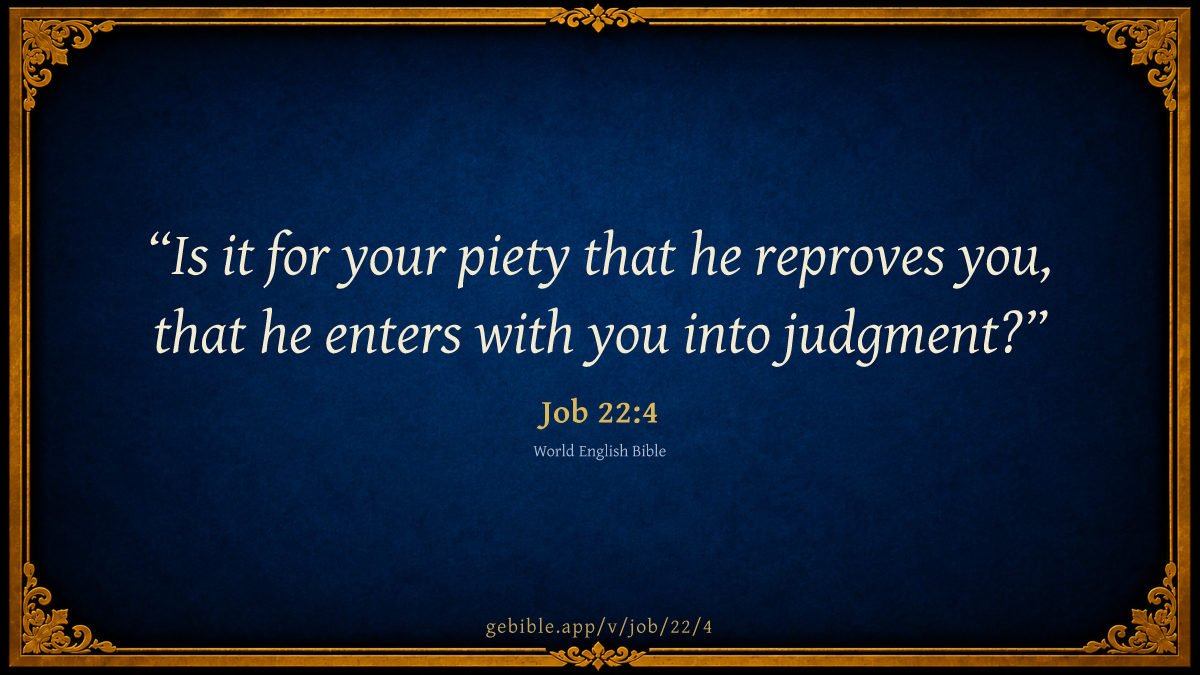
Is it for your piety that he reproves you, that he enters with you into judgment?
Parallel Translations
-
Is it for your piety that he reproves you, that he enters with you into judgment?
-
Will he reprove thee for fear of thee? will he enter with thee into judgment?
-
Is it for thy fear of Him that He reproveth thee, that He entereth with thee into judgment?
Cross-references (16)
Passages linked to Job 22:4 in the Treasury of Scripture Knowledge, ordered by reader-vote popularity; verse text shown in World English Bible.
- Job 14:3 Do you open your eyes on such a one, and bring me into judgment with you?
- Psalms 143:2 Don’t enter into judgment with your servant, for in your sight no man living is righteous.
- Isaiah 3:14-15 Yahweh will enter into judgment with the elders of his people and their leaders: “It is you who have eaten up the vineyard. The plunder of the poor is in your houses. What do you mean that you crush my people, and grind the face of the poor?” says the Lord, Yahweh of Armies.
- Revelation 3:19 As many as I love, I reprove and chasten. Be zealous therefore, and repent.
- Job 7:12 Am I a sea, or a sea monster, that you put a guard over me?
- Job 9:19 If it is a matter of strength, behold, he is mighty! If of justice, ‘Who,’ says he, ‘will summon me?’
- Job 9:32 For he is not a man, as I am, that I should answer him, that we should come together in judgment.
- Job 16:21 that he would maintain the right of a man with God, of a son of man with his neighbor!
- Job 19:29 be afraid of the sword, for wrath brings the punishments of the sword, that you may know there is a judgment.”
- Job 23:6-7 Would he contend with me in the greatness of his power? No, but he would listen to me. There the upright might reason with him, so I should be delivered forever from my judge.
- Job 34:23 For he doesn’t need to consider a man further, that he should go before God in judgment.
- Psalms 39:11 When you rebuke and correct man for iniquity, you consume his wealth like a moth. Surely every man is but a breath.”
- Psalms 76:6 At your rebuke, God of Jacob, both chariot and horse are cast into a dead sleep.
- Psalms 80:16 It’s burned with fire. It’s cut down. They perish at your rebuke.
- Psalms 130:3-4 If you, Yah, kept a record of sins, Lord, who could stand? But there is forgiveness with you, therefore you are feared.
- Ecclesiastes 12:14 For God will bring every work into judgment, with every hidden thing, whether it is good, or whether it is evil.
Cross-references from openbible.info (CC BY 4.0)
Explain this verse (15 sources)
Historical commentary, presented as a primary source — not an endorsement.
Private notes
Saved on this device only — never synced or sent anywhere.
Geneva Bible translators 1599 · Public Domain Lest thou shouldest reprove or hurt him?
Lest thou shouldest reprove or hurt him?
Geneva Bible (1599) marginal notes — public domain.
John Trapp 1656 · Public Domain Job 22:4 Will he reprove thee for fear of…
Job 22:4 Will he reprove thee for fear of thee? will he enter with thee into judgment?
Ver. 4. Will he reprove thee for fear of thee?] Doth he plague and punish thee thus, for fear that in time thou mayest grow so overly good, that he cannot reward thee, or so overly great, that he cannot command thee? No such matter. Others read it thus: Would he reprove thee for thy religion? Vox timoris sire religionis active sumitur, &c. (Merlin), Would he come into judgment with thee? q.d. Surely God would not deal thus harshly with thee if thou didst truly fear him; but thou art a wicked wretch, as Job 22:5. Either God punisheth thee for thy piety or thy sinfulness. Not for the former, doubtless (for piety is profitable to all things, &c.), therefore for the latter. This is Eliphaz’s argument here. But Austin makes answer (besides what Job doth in the two following chapters), Tract. in Joan. 124, God chastiseth his best children sometimes for his own glory, as Joh 9:3, sometimes for their good; as, namely, for prevention, probation, purgation, preparation, either to the performance of some special service or to the receipt of some special blessing, &c., Vel ad demonstrationem debitae miseriae, vel ad emendationem labilis vitae, vel ad exercitationem necessariae patientiae.
Read full note →
Will he enter with thee into judgment?] This seemeth to be the same in sense with the former hemistich; {The half or section of a line of verse, as divided by the cæsura or the like; also, a line of less than the usual length. spec. Such a half-line or line in Old English verse.} and then it shows Eliphaz’s confidence, though he were in an error.
John Trapp, A Commentary or Exposition upon All the Books of the Old and New Testament (1647–1656) — public domain. Text from a community e-Sword module.
Matthew Poole 1685 · Public Domain Will, or doth, or
Will, or doth, or
would he reprove thee, i.e. punish thee? For this word is frequently used of real rebukes or chastisements, as hath been oft noted.
Read full note →
For fear of thee; because he is afraid, lest if he should let thee alone, thou wouldst grow too great and powerful for him, as princes ofttimes crush those subjects of whom they are afraid. Surely no. As thy righteousness cannot profit him, so thy wickedness can do him no hurt. Or, for thy piety or religion, which is commonly called by the name of fear. Doth he punish thee because thou fearest and servest him, as thou dost insinuate? No surely, but for thy sins, as it follows.
Will he enter with thee into judgment, and condemn thee? to wit, for the reason last mentioned, as appears from the Hebrew text, where the words lie thus, Will he for fear of thee
reprove thee, or
enter with thee into judgment?
Matthew Poole's English Annotations on the Holy Bible (1683–1685) — public domain. Text from a community e-Sword/MySword module.
John Gill 1763 · Public Domain Is not thy wickedness great?.... It must be owned…
Is not thy wickedness great?.... It must be owned it is, it cannot be denied. Indeed, the wickedness of every man's heart is great, it being desperately wicked, full of sin, abounding with it; out of it comes forth everything that is bad, and the wickedness of actions is very great: some sins are indeed greater than others, as those against God, and the first table of the law, are greater than those against men, or the second table; some are like crimson and scarlet, are beams in the eye, while others are comparatively as motes; yet all are great, as committed against God, and as they are breaches of his law; and especially they appear so to sensible sinners, to whom sin is made exceeding sinful; and they see and own themselves to be the chief of sinners, and as such entreat for pardon on that account, see Psa 25:11;
and thine iniquities infinite? strictly speaking, nothing is infinite but God; sins may be said in some sense to be infinite, because committed against an infinite God, and cannot be satisfied for by a finite creature, or by finite sufferings, only through the infinite value of the blood of Christ; here it signifies, that his iniquities were "innumerable" (n), as some versions, they were not to be reckoned up, they were so many; or, more literally, there is "no end of thine iniquities" (o), there is no summing of them up; and it may denote his continuance in them; Eliphaz suggests as if Job lived in sin, and allowed himself in it, and was going on in a course of iniquity without end, which was very uncharitable; here he charges him in a general way, and next he descends to particulars.
Read full note →
(n) Sept. (o) "non est finis iniquitatibus tuis", Pagninus, Montanus, &c.
John Gill's Exposition of the Whole Bible (1746–1763) — public domain (CC PDM 1.0). Text via the HelloAO Bible API.
John Wesley 1765 · Public Domain Reprove - Punish thee. Because he is afraid, lest…
Reprove - Punish thee. Because he is afraid, lest if he should let thee alone, thou wouldst grow too great and powerful for him: surely no. As thy righteousness cannot profit him, so thy wickedness can do him no hurt.
John Wesley, Explanatory Notes Upon the Whole Bible (1754–1765) — public domain. Text via the GEBible commentary corpus.
Adam Clarke 1810 · Public Domain Verse 4. For fear of thee?] Is it because…
Verse 4. For fear of thee?] Is it because he is afraid that thou wilt do him some injury, that he has stripped thee of thy power and wealth?
Adam Clarke's Commentary on the Bible (1810–1826) — public domain. Text from a community e-Sword/MySword module.
Joseph Benson 1811 · Public Domain Job 22:4. Will he reprove thee — That is,…
Job 22:4. Will he reprove thee — That is, rebuke, chastise, or punish thee; for fear of thee? — Because he is afraid lest, if he should let thee alone, thou wouldst grow too great and powerful for him: surely no. As thy righteousness cannot profit him, so thy wickedness can do him no hurt.
Joseph Benson's Commentary on the Old and New Testaments (1811–1818) — public domain. Text from a community e-Sword module.
Albert Barnes 1834 · Public Domain Will he reprove thee for fear of thee? -…
Will he reprove thee for fear of thee? - Or, rather, will he come into trial, and argue his cause before a tribunal, because he is afraid that his character will suffer, or because he feels himself bound to appear, and answer to the charges which may be brought? The language is all taken from courts of justice, and the object is, to reprove Job as if he felt that it was necessary that God should appear and answer to what he alleged against him.
Will he enter with thee into judgment? - Will he condescend to enter on a trial with one like thee? Will he submit his cause to a trial with man, as if he were an equal, or as if man had any right to such an investigation? It is to be remembered, that Job had repeatedly expressed a desire to carry his cause before God, and that God would meet him as an equal, and not take advantage of his majesty and power to overwhelm him; see Job 13:3, note; Job 13:20-21, notes. Eliphaz here asks, whether God could be expected to meet “a man,” one of his own creatures, in this manner, and to go into a trial of the cause. He says that God was supreme; that no one could bring him into court; and that he could not be restrained from doing his pleasure by any dread of man. These sentiments are all noble and correct, and worthy of a sage. Soon, however, he changes the style, and utters the language of severe reproach, because Job had presumed to make such a suggestion. Perhaps, also, in this verse, a special emphasis should be placed on “thee.” “Will God enter into trial with thee ... a man whose wickedness is so great, and whose sin is infinite?” Job 22:4-5.
Albert Barnes' Notes on the Bible (1834–1885) — public domain. Text from a community e-Sword/MySword module.
Haydock's Catholic Bible Commentary 1859 · Public Domain Fear. Thus malefactors are condemned, that they may no…
Fear. Thus malefactors are condemned, that they may no longer disturb society. But may not God afflict the just, though he have nothing to fear? (Calmet)
George Leo Haydock (1774–1849), Haydock's Catholic Family Bible and Commentary, 1859 edition — public domain. Excludes Psalms (Douay-Rheims chapter numbering differs from Protestant) and Deuterocanonical books (Catholic canon only).
Robert Jamieson, A. R. Fausset & David Brown 1871 · Public Domain Is the punishment inflicted on thee from fear of…
Is the punishment inflicted on thee from fear of thee, in order to disarm thee? as Job had implied (see on Job 7:12; Job 7:20; and Job 10:17).
will he enter . . . into judgment?-- Job had desired this (Job 13:3, Job 13:21). He ought rather to have spoken as in Psa 143:2.
Jamieson, Fausset & Brown — Commentary Critical and Explanatory on the Whole Bible (1871) — public domain (CC PDM 1.0). Text via the HelloAO Bible API.
Daniel D. Whedon 1874 · Public Domain 4. For fear of thee — For (the sake…
4. For fear of thee — For (the sake of) thy fear, (Job_4:6; Job_15:4.) “A genuine Eliphazian word,” not artificially “assigned him by the poet,” as Ewald holds. Will he reprove thee, (punish thee, Ewald,) that he may get gain by thy worship and piety? What advantage would it be to him to answer thy summons to trial? A judicial phrase. Job_9:32; Job_13:3; Job_13:22. No, if he reprove it must be on account of sin, which thought paves the way to the conclusion.
Daniel D. Whedon (gen. ed.), Commentary on the Old and New Testaments (1874–1909) — public domain. Text from a community e-Sword module.
The Cambridge Bible for Schools and Colleges 1878 · Public Domain 4. God’s treatment of men being for their sakes…
4. God’s treatment of men being for their sakes and according to what they are, it is inconceivable that He should chastise them for their piety.
for fear of thee] Rather, for thy (godly) fear, thy piety; comp. ch. Job_4:6, Job_15:4 for this use of the word fear by Eliphaz. The words scarcely contain the idea that if God derived advantage from men’s piety He might be supposed to afflict them in order to increase their godliness (Ew.). The simple thought is that man’s conduct does not affect God. If God deals with man it is on account of man himself. Can it be supposed then that God would afflict a man because he is pious? (Job_22:4). This is too extravagant a suggestion, therefore if Job is afflicted it is for his sins (Job_22:5). Job_22:4 forms a mere foreground to Job_22:5 seq., in order to suggest by contrast the real cause of Job’s calamities.
The Cambridge Bible for Schools and Colleges (gen. ed. J. J. S. Perowne; Cambridge University Press, 1878–1918) — public domain. Text from a community e-Sword module.
Ellicott's Commentary for English Readers 1878 · Public Domain (4) Will he reprove thee.—That is, Because He standeth…
(4) Will he reprove thee.—That is, Because He standeth in awe of thee. Will He justify his dealings with thee?
A Bible Commentary for English Readers, edited by Charles John Ellicott (1878–1897) — public domain. Text from a community e-Sword module.
The Pulpit Commentary 1880 · Public Domain Will he reprove thee for fear of thee? rather,…
Will he reprove thee for fear of thee? rather, Is it for thy fear of him that he reproveth thee? Surely not. If he reproves thee, it must be because thou fearest him not. The fact of thy reproof is sure evidence of the fact of thy guilt. Will he enter with thee into judgment? rather, that he entereth with thee into judgment (see the Revised Version).
The Pulpit Commentary (1880–1919), ed. H.D.M. Spence-Jones & Joseph S. Exell — public domain. Text from a community e-Sword module.
unfoldingWord translationNotes 2017 · CC BY-SA 4.0 Connecting Statement:
Connecting Statement:
Eliphaz continues speaking to Job.
Read full note →
Is it because of your reverence for him that he rebukes you and takes you to judgment? Is not your wickedness great? Is there no end to your iniquities?
Eliphaz uses questions to scold Job and accuse him of committing terrible sins. AT: "It is certainly not because you have been devoted to him that God rebukes you and takes you to judgment! No, as you know, he judges you because your wickedness is great and you keep on sinning!" (See: Rhetorical Question)
translationWords
revere
rebuke
judge
evil
iniquity
unfoldingWord translationNotes — © Distant Shores Media and the Door43 World Missions Community, licensed CC BY-SA 4.0. Source: git.door43.org/Door43/en_tn.