Psalms 69:1-2(v11)Save me, God, for the waters have come up to my neck! I sink in deep mire, where there is no foothold. I have come into deep waters, where…
Lamentations 3:54(v11)Waters flowed over my head. I said, “I am cut off.”
Job 24:3(v9)They drive away the donkey of the fatherless, and they take the widow’s ox for a pledge.
Job 24:21(v9)He devours the barren who don’t bear. He shows no kindness to the widow.
Ezekiel 22:7(v9)In you have they treated father and mother with contempt. Among you they have oppressed the foreigner. In you they have wronged the…
Show all 40 cross-references
Jonah 2:3(v11)For you threw me into the depths, in the heart of the seas. The flood was all around me. All your waves and your billows passed over me.
Job 6:4(v10)For the arrows of the Almighty are within me. My spirit drinks up their poison. The terrors of God set themselves in array against me.
Job 13:21(v10)withdraw your hand far from me, and don’t let your terror make me afraid.
Job 18:8-10(v10)For he is cast into a net by his own feet, and he wanders into its mesh. A snare will take him by the heel. A trap will catch him. A noose…
Job 19:8(v11)He has walled up my way so that I can’t pass, and has set darkness in my paths.
Job 31:21(v9)if I have lifted up my hand against the fatherless, because I saw my help in the gate,
Psalms 124:4-5(v11)then the waters would have overwhelmed us, the stream would have gone over our soul; then the proud waters would have gone over our soul.
Isaiah 10:2(v9)to deprive the needy from justice, and to rob the poor among my people of their rights, that widows may be their plunder, and that they may…
Exodus 22:21-24(v9)“You shall not wrong an alien or oppress him, for you were aliens in the land of Egypt. “You shall not take advantage of any widow or…
Deuteronomy 27:19(v9)‘Cursed is he who withholds justice from the foreigner, fatherless, and widow.’ All the people shall say, ‘Amen.’
Job 5:14(v11)They meet with darkness in the day time, and grope at noonday as in the night.
Job 18:6(v11)The light will be dark in his tent. His lamp above him will be put out.
Job 18:18(v11)He will be driven from light into darkness, and chased out of the world.
Job 19:6(v10)know now that God has subverted me, and has surrounded me with his net.
Job 29:12-13(v9)Because I delivered the poor who cried, and the fatherless also, who had no one to help him, the blessing of him who was ready to perish…
Job 31:16-18(v9)“If I have withheld the poor from their desire, or have caused the eyes of the widow to fail, or have eaten my morsel alone, and the…
Job 38:34(v11)“Can you lift up your voice to the clouds, That abundance of waters may cover you?
Psalms 10:15(v9)Break the arm of the wicked. As for the evil man, seek out his wickedness until you find none.
Psalms 11:6(v10)On the wicked he will rain blazing coals; fire, sulfur, and scorching wind shall be the portion of their cup.
Psalms 37:17(v9)For the arms of the wicked shall be broken, but Yahweh upholds the righteous.
Psalms 42:7(v11)Deep calls to deep at the noise of your waterfalls. All your waves and your billows have swept over me.
Psalms 94:6(v9)They kill the widow and the alien, and murder the fatherless.
Proverbs 1:27(v10)when calamity overtakes you like a storm, when your disaster comes on like a whirlwind, when distress and anguish come on you.
Proverbs 4:19(v11)The way of the wicked is like darkness. They don’t know what they stumble over.
Isaiah 1:17(v9)Learn to do well. Seek justice. Relieve the oppressed. Defend the fatherless. Plead for the widow.”
Isaiah 1:23(v9)Your princes are rebellious and companions of thieves. Everyone loves bribes and follows after rewards. They don’t defend the fatherless,…
Isaiah 8:22(v11)and look to the earth, and see distress, darkness, and the gloom of anguish. They will be driven into thick darkness.
Lamentations 3:2(v11)He has led me and caused me to walk in darkness, and not in light.
Ezekiel 30:22(v9)Therefore the Lord Yahweh says: ‘Behold, I am against Pharaoh king of Egypt, and will break his arms, the strong arm, and that which was…
Joel 2:2-3(v11)A day of darkness and gloominess, a day of clouds and thick darkness. As the dawn spreading on the mountains, a great and strong people;…
Malachi 3:5(v9)I will come near to you to judgment; and I will be a swift witness against the sorcerers, and against the adulterers, and against the…
Matthew 8:12(v11)but the children of the Kingdom will be thrown out into the outer darkness. There will be weeping and gnashing of teeth.”
Luke 18:3-5(v9)A widow was in that city, and she often came to him, saying, ‘Defend me from my adversary!’ He wouldn’t for a while, but afterward he said…
1 Thessalonians 5:3(v10)For when they are saying, “Peace and safety,” then sudden destruction will come on them, like birth pains on a pregnant woman. Then they…
Proverbs 3:25-26(v10)Don’t be afraid of sudden fear, neither of the desolation of the wicked, when it comes; for Yahweh will be your confidence, and will keep…
Cross-references from openbible.info (CC BY 4.0)
Explain this passage (16 sources)
Historical commentary, presented as a primary source — not an endorsement.
Geneva Bible translators1599 · Public DomainOn vv9, 11Thou hast not only not showed pity, but oppressed…
Thou hast not only not showed pity, but oppressed them.
Geneva Bible (1599) marginal notes — public domain.
John Trapp1656 · Public DomainOn vv9–11Job 22:9 Thou hast sent widows away empty, and…
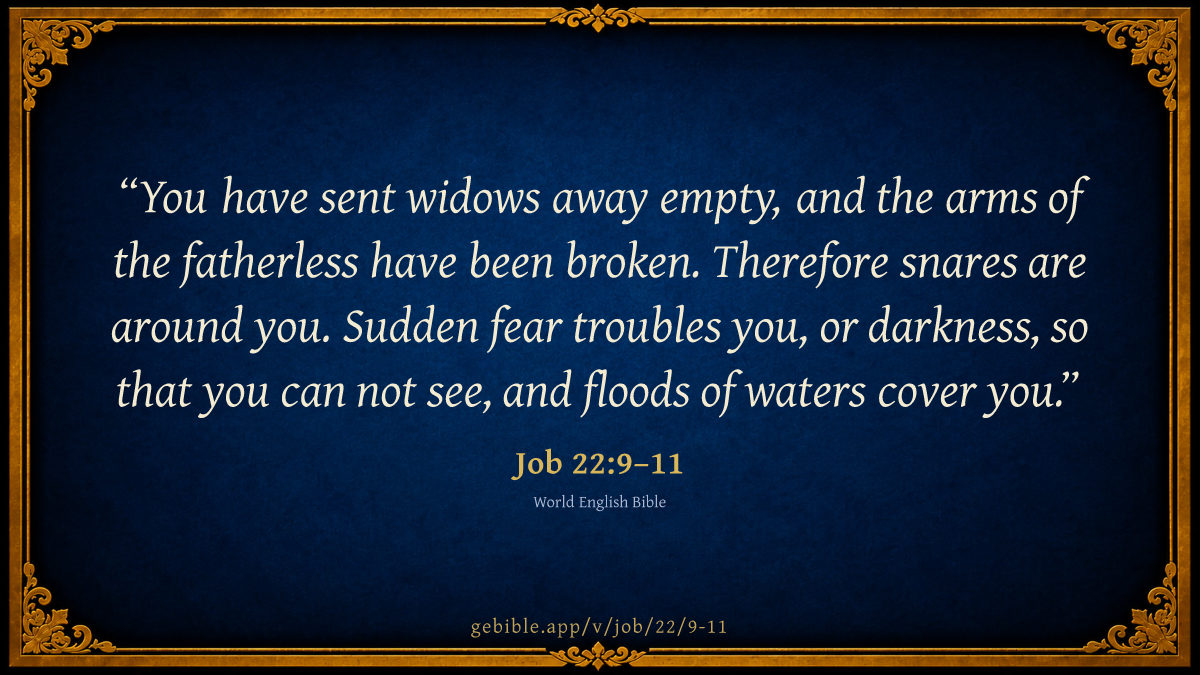
Job 22:9 Thou hast sent widows away empty, and the arms of the fatherless have been broken.
Ver. 9. Thou hast sent widows away empty] A widow is a calamitous name: 2Sa 14:5, "I am indeed a widow woman, and my husband is dead." As a tree whose root is uncovered thriveth not, so it fareth with a widow. R. Jona observeth, That in Hebrew she hath her name from dumbness, quod marito mortuo respondere non possit adversariis, et se adversus eos tueri, because now that her husband is dead, she cannot answer her adversaries, or defend herself against them. Vidua desolata et derelieta nihil est humiliatius: et proinde peculiariter viduarum iudex et vindex est Deus (Bain. in Pro 15:25). God, therefore, hath taken them and their orphans into his tuition, owning them as his clients, and commanding all men to be good to them. These, if Job had indeed sent away empty, not only not relieving their necessities, but ravishing their estates, adding the misery of poverty to that of their condition, he had surely subjected himself to the fierce wrath of God, their patron, by a specialty.
Read full note →
And the arms of the fatherless have been broken] Immanis iniuria, si ita res haberet, sed calumnia erat, saith Mercer. This had been a crying crime if it could have been proven against Job; but he was not the man. Some from these words conclude him a judge; others a king. Doubtless he was a potent person, and by his greatness could have borne out his foulest outrages, breaking through the lattice of the laws, as the larger flies do through a spider’s web. Sed alia de se infra profitebitur, saith Mercer here; but Job shall clear himself in the following chapters; where we shall find him described and characterised to have been the oracle of wisdom, the guardian of justice, the refuge of innocence, the comet of the guilty, the patron of peace, and pattern of piety, to magistrates especially, in the wise managing of all public affairs, both of judgment and mercy.
John Trapp, A Commentary or Exposition upon All the Books of the Old and New Testament (1647–1656) — public domain. Text from a community e-Sword module.
Matthew Poole1685 · Public DomainOn vv9–11Widows, whose helpless estate called for thy pity, Exo…
Widows, whose helpless estate called for thy pity, Exo 22:22; Deu 24:17,19.
Away empty; either by denying them that relief which their poverty required, or that right which their cause deserved; or by spoiling them of their goods, because thou knewest them to be unable to oppose thee, or to right themselves.
Read full note →
The arms, i.e. all their supports, and comforts, and rights. A heinous sin, but falsely charged upon Job.
Matthew Poole's English Annotations on the Holy Bible (1683–1685) — public domain. Text from a community e-Sword/MySword module.
John Gill1763 · Public DomainOn vv9–11Therefore snares are round about thee,.... Not what occasion…
Therefore snares are round about thee,.... Not what occasion sin, draw into it, and issue in it, as inward corruptions, the temptations of Satan, and the things of this world, but punishments; because of the above sins charged upon Job, therefore evils, calamities, and distresses of various kinds, came upon, him, beset him, and encompassed him all around, so that there was no way left for him to escape; it may refer to the Sabeans and Chaldeans seizing on his cattle, and carrying them away; to the fire that fell from heaven upon his sheep, and consumed them; to the great wind that blew down the house in which his children were, and destroyed them; and to the boils and ulcers that were all over his body:
and sudden fear troubleth thee; those things, at least some of them, were what he feared, and they came suddenly upon him, and gave him great trouble and distress, Job 3:25; and present fear frequently, on a sudden, darted into his mind, and gave him fresh trouble; he was afraid of his present sorrows, and of further and future ones, Job 9:28; and perhaps Eliphaz might think he was afraid of hell and damnation, and of sudden destruction from the Almighty coming upon him, Job 31:23; see Isa 24:17.
John Gill's Exposition of the Whole Bible (1746–1763) — public domain (CC PDM 1.0). Text via the HelloAO Bible API.
John Wesley1765 · Public DomainOn vv9, 11Arms - Their supports, and rights.
Arms - Their supports, and rights.
John Wesley, Explanatory Notes Upon the Whole Bible (1754–1765) — public domain. Text via the GEBible commentary corpus.
Adam Clarke1810 · Public DomainOn vv9–11Verse 9. The arms of the fatherless] Whatever strength…
Verse 9. The arms of the fatherless] Whatever strength or power or property they had, of that thou hast deprived them. Thou hast been hard-hearted and cruel, and hast enriched thyself with the spoils of the poor and the defenceless.
Adam Clarke's Commentary on the Bible (1810–1826) — public domain. Text from a community e-Sword/MySword module.
Joseph Benson1811 · Public DomainOn vv9–10Job 22:9. Thou hast sent widows — Whose helpless…
Job 22:9. Thou hast sent widows — Whose helpless state called for thy pity; away empty — Either by denying them that relief that their poverty required, or that right which their cause deserved; or, by spoiling them of their goods, because thou knewest them to be unable to oppose thee, or to defend themselves. And the arms of the fatherless have been broken —
That is, all their supports and rights, a heinous sin, but falsely charged upon Job.
Joseph Benson's Commentary on the Old and New Testaments (1811–1818) — public domain. Text from a community e-Sword module.
Albert Barnes1834 · Public DomainOn vv9–11Thou hast sent widows away empty - That is,…
Thou hast sent widows away empty - That is, without regarding their needs, and without doing anything to mitigate their sorrows. The oppression of the widow and the fatherless is, in the Scriptures, every where regarded as a crime of special magnitude; see the notes at Isa 1:17.
The arms of the fatherless have been broken - Thou hast taken away all that they relied on. Thou hast oppressed them and taken advantage of their weak and defenseless condition to enrich yourself. This charge was evidently gratuitous and unjust. It was the result of an “inference” from the fact that he was thus afflicted, and about as just as inferences, in such cases, usually are. To all this, Job replies in beautiful language in Job 29:11-16, when describing his former condition, and in justice to him, we may allow him to speak “here,” and to show what was, in fact, the course of his life.
Read full note →
When the ear heard me, then it blessed me;
And when the eye saw me, it gave witness to me:
Because I delivered the poor that cried,
And the fatherless, and him that had none to help him.
The blessing of him that was ready to perish came upon me:
And I caused the widow’s heart to leap for joy.
I put on righteousness, and it clothed me;
My judgment was as a robe and a diadem.
I was eyes to the blind,
And feet was I to the lame;
I was a father to the poor,
And the cause which I knew not, I searched out
Albert Barnes' Notes on the Bible (1834–1885) — public domain. Text from a community e-Sword/MySword module.
George Leo Haydock (1774–1849), Haydock's Catholic Family Bible and Commentary, 1859 edition — public domain. Excludes Psalms (Douay-Rheims chapter numbering differs from Protestant) and Deuterocanonical books (Catholic canon only).
Robert Jamieson, A. R. Fausset & David Brown1871 · Public DomainOn vv9–11empty--without their wants being relieved (Gen 31:42). The Mosaic…
empty--without their wants being relieved (Gen 31:42). The Mosaic law especially protected the widow and fatherless (Exo 22:22); the violation of it in their case by the great is a complaint of the prophets (Isa 1:17).
arms--supports, helps, on which one leans (Hos 7:15). Thou hast robbed them of their only stay. Job replies in Job 29:11-16.
Jamieson, Fausset & Brown — Commentary Critical and Explanatory on the Whole Bible (1871) — public domain (CC PDM 1.0). Text via the HelloAO Bible API.
Daniel D. Whedon1874 · Public DomainOn v1111. Darkness, etc. — Dillmann and Schlottmann make this…
11. Darkness, etc. — Dillmann and Schlottmann make this a question, but the text is better — (thus Hitzig.) The darkness is moral, blurring the vision. Eliphaz represents Job’s sins as encompassing him like thick, dark clouds, and overwhelming him as a flood.
Daniel D. Whedon (gen. ed.), Commentary on the Old and New Testaments (1874–1909) — public domain. Text from a community e-Sword module.
The Cambridge Bible for Schools and Colleges1878 · Public DomainOn vv9–109. His treatment of widows—he ejected them empty; or…
9. His treatment of widows—he ejected them empty; or when they came seeking redress, or pleading their rights, he let them go unheard. Comp. Job’s own language as to himself, ch. Job_29:13, Job_31:16.
The “arms” of the fatherless are their helps or rights, on which they relied, and by which they were supported.
The Cambridge Bible for Schools and Colleges (gen. ed. J. J. S. Perowne; Cambridge University Press, 1878–1918) — public domain. Text from a community e-Sword module.
Ellicott's Commentary for English Readers1878 · Public DomainOn v10(10, 11) Snares . . . about thee.—That is,…
(10, 11) Snares . . . about thee.—That is, Fear troubleth thee, or darkness, &c. “If darkness and abundance of waters cover thee so that thou canst not see, is not God in the high heavens, though thou canst not see Him. God is too great to take note of the affairs of men, their sin or their good deeds. He is so far off that He cannot see what goes on in the earth, for His dwelling-place is in heaven.” Eliphaz attributes to Job the kind of sentiments that he had himself attributed to the wicked man in the last chapter, Job_22:14, &c.
A Bible Commentary for English Readers, edited by Charles John Ellicott (1878–1897) — public domain. Text from a community e-Sword module.
The Pulpit Commentary1880 · Public DomainOn vv9–11Thou hast sent widows away empty. Job, on the…
Thou hast sent widows away empty. Job, on the contrary, declares that he "caused the widow s heart to sing for joy". (Job_29:13) The sin of oppressing widows was one of which Job deeply felt the heinousness. He is certainly a priori not likely to have committed it, (Job_1:1 Job_4:3, Job_4:4) and the prejudiced testimony of Eliphaz will scarcely convince any dispassionate person to the contrary. And the arms of the fatherless have been broken; i.e. the strength of the fatherless has been (by thy fault) taken flora them. Job has allowed them to be oppressed and ruined. The reply of Job is, "When the ear heard, then it blessed me; and when the eye saw, it gave witness to me: because I delivered the poor that cried, and the fatherless, and him that had none to help him". (Job_29:11, Job_29:12; see also Job_31:21, Job_31:22)
The Pulpit Commentary (1880–1919), ed. H.D.M. Spence-Jones & Joseph S. Exell — public domain. Text from a community e-Sword module.
unfoldingWord translationNotes2017 · CC BY-SA 4.0On v9Connecting Statement:
Connecting Statement:
Eliphaz continues speaking to Job.
Read full note →
You have sent widows away empty
"You made widows go away with nothing"
widows
women whose husbands have died
the arms of the fatherless have been broken
Here "arms" refer to power. This can be stated in active form. AT: "you even oppressed orphans" (See: Metonymy and Active or Passive)
snares are all around you ... There is darkness ... an abundance of waters covers you
Each of these metaphors means troubles and dangers are all around Job because of his sin. (See: Metaphor)
Tyndale Open Study Notes2022 · CC BY-SA 4.0On v922:9 The Old Testament gives Israel the responsibility of…
22:9 The Old Testament gives Israel the responsibility of caring for widows and orphans (Deut 10:18; 14:29) and repeatedly condemns their neglect as the worst of social evils (Exod 22:22-24; Deut 27:19). Job agreed that it was wicked (Job 24:3, 21) but claimed that he was innocent (29:12-13; 31:16-18, 21).
 GEBible — Godless Engineer's Bible App
Geneva Bible translators 1599 · Public Domain On vv9, 11 Thou hast not only not showed pity, but oppressed…
Thou hast not only not showed pity, but oppressed them.
Geneva Bible (1599) marginal notes — public domain.
John Trapp 1656 · Public Domain On vv9–11 Job 22:9 Thou hast sent widows away empty, and…
Job 22:9 Thou hast sent widows away empty, and the arms of the fatherless have been broken.
Ver. 9. Thou hast sent widows away empty] A widow is a calamitous name: 2Sa 14:5, "I am indeed a widow woman, and my husband is dead." As a tree whose root is uncovered thriveth not, so it fareth with a widow. R. Jona observeth, That in Hebrew she hath her name from dumbness, quod marito mortuo respondere non possit adversariis, et se adversus eos tueri, because now that her husband is dead, she cannot answer her adversaries, or defend herself against them. Vidua desolata et derelieta nihil est humiliatius: et proinde peculiariter viduarum iudex et vindex est Deus (Bain. in Pro 15:25). God, therefore, hath taken them and their orphans into his tuition, owning them as his clients, and commanding all men to be good to them. These, if Job had indeed sent away empty, not only not relieving their necessities, but ravishing their estates, adding the misery of poverty to that of their condition, he had surely subjected himself to the fierce wrath of God, their patron, by a specialty.
Read full note →
And the arms of the fatherless have been broken] Immanis iniuria, si ita res haberet, sed calumnia erat, saith Mercer. This had been a crying crime if it could have been proven against Job; but he was not the man. Some from these words conclude him a judge; others a king. Doubtless he was a potent person, and by his greatness could have borne out his foulest outrages, breaking through the lattice of the laws, as the larger flies do through a spider’s web. Sed alia de se infra profitebitur, saith Mercer here; but Job shall clear himself in the following chapters; where we shall find him described and characterised to have been the oracle of wisdom, the guardian of justice, the refuge of innocence, the comet of the guilty, the patron of peace, and pattern of piety, to magistrates especially, in the wise managing of all public affairs, both of judgment and mercy.
John Trapp, A Commentary or Exposition upon All the Books of the Old and New Testament (1647–1656) — public domain. Text from a community e-Sword module.
Matthew Poole 1685 · Public Domain On vv9–11 Widows, whose helpless estate called for thy pity, Exo…
Widows, whose helpless estate called for thy pity, Exo 22:22; Deu 24:17,19.
Away empty; either by denying them that relief which their poverty required, or that right which their cause deserved; or by spoiling them of their goods, because thou knewest them to be unable to oppose thee, or to right themselves.
Read full note →
The arms, i.e. all their supports, and comforts, and rights. A heinous sin, but falsely charged upon Job.
Matthew Poole's English Annotations on the Holy Bible (1683–1685) — public domain. Text from a community e-Sword/MySword module.
John Gill 1763 · Public Domain On vv9–11 Therefore snares are round about thee,.... Not what occasion…
Therefore snares are round about thee,.... Not what occasion sin, draw into it, and issue in it, as inward corruptions, the temptations of Satan, and the things of this world, but punishments; because of the above sins charged upon Job, therefore evils, calamities, and distresses of various kinds, came upon, him, beset him, and encompassed him all around, so that there was no way left for him to escape; it may refer to the Sabeans and Chaldeans seizing on his cattle, and carrying them away; to the fire that fell from heaven upon his sheep, and consumed them; to the great wind that blew down the house in which his children were, and destroyed them; and to the boils and ulcers that were all over his body:
and sudden fear troubleth thee; those things, at least some of them, were what he feared, and they came suddenly upon him, and gave him great trouble and distress, Job 3:25; and present fear frequently, on a sudden, darted into his mind, and gave him fresh trouble; he was afraid of his present sorrows, and of further and future ones, Job 9:28; and perhaps Eliphaz might think he was afraid of hell and damnation, and of sudden destruction from the Almighty coming upon him, Job 31:23; see Isa 24:17.
John Gill's Exposition of the Whole Bible (1746–1763) — public domain (CC PDM 1.0). Text via the HelloAO Bible API.
John Wesley 1765 · Public Domain On vv9, 11 Arms - Their supports, and rights.
Arms - Their supports, and rights.
John Wesley, Explanatory Notes Upon the Whole Bible (1754–1765) — public domain. Text via the GEBible commentary corpus.
Adam Clarke 1810 · Public Domain On vv9–11 Verse 9. The arms of the fatherless] Whatever strength…
Verse 9. The arms of the fatherless] Whatever strength or power or property they had, of that thou hast deprived them. Thou hast been hard-hearted and cruel, and hast enriched thyself with the spoils of the poor and the defenceless.
Adam Clarke's Commentary on the Bible (1810–1826) — public domain. Text from a community e-Sword/MySword module.
Joseph Benson 1811 · Public Domain On vv9–10 Job 22:9. Thou hast sent widows — Whose helpless…
Job 22:9. Thou hast sent widows — Whose helpless state called for thy pity; away empty — Either by denying them that relief that their poverty required, or that right which their cause deserved; or, by spoiling them of their goods, because thou knewest them to be unable to oppose thee, or to defend themselves. And the arms of the fatherless have been broken —
That is, all their supports and rights, a heinous sin, but falsely charged upon Job.
Joseph Benson's Commentary on the Old and New Testaments (1811–1818) — public domain. Text from a community e-Sword module.
Albert Barnes 1834 · Public Domain On vv9–11 Thou hast sent widows away empty - That is,…
Thou hast sent widows away empty - That is, without regarding their needs, and without doing anything to mitigate their sorrows. The oppression of the widow and the fatherless is, in the Scriptures, every where regarded as a crime of special magnitude; see the notes at Isa 1:17.
The arms of the fatherless have been broken - Thou hast taken away all that they relied on. Thou hast oppressed them and taken advantage of their weak and defenseless condition to enrich yourself. This charge was evidently gratuitous and unjust. It was the result of an “inference” from the fact that he was thus afflicted, and about as just as inferences, in such cases, usually are. To all this, Job replies in beautiful language in Job 29:11-16, when describing his former condition, and in justice to him, we may allow him to speak “here,” and to show what was, in fact, the course of his life.
Read full note →
When the ear heard me, then it blessed me;
And when the eye saw me, it gave witness to me:
Because I delivered the poor that cried,
And the fatherless, and him that had none to help him.
The blessing of him that was ready to perish came upon me:
And I caused the widow’s heart to leap for joy.
I put on righteousness, and it clothed me;
My judgment was as a robe and a diadem.
I was eyes to the blind,
And feet was I to the lame;
I was a father to the poor,
And the cause which I knew not, I searched out
Albert Barnes' Notes on the Bible (1834–1885) — public domain. Text from a community e-Sword/MySword module.
Haydock's Catholic Bible Commentary 1859 · Public Domain On vv9, 11 Arms; possessions, condemning orphans unjustly.
Arms; possessions, condemning orphans unjustly.
George Leo Haydock (1774–1849), Haydock's Catholic Family Bible and Commentary, 1859 edition — public domain. Excludes Psalms (Douay-Rheims chapter numbering differs from Protestant) and Deuterocanonical books (Catholic canon only).
Robert Jamieson, A. R. Fausset & David Brown 1871 · Public Domain On vv9–11 empty--without their wants being relieved (Gen 31:42). The Mosaic…
empty--without their wants being relieved (Gen 31:42). The Mosaic law especially protected the widow and fatherless (Exo 22:22); the violation of it in their case by the great is a complaint of the prophets (Isa 1:17).
arms--supports, helps, on which one leans (Hos 7:15). Thou hast robbed them of their only stay. Job replies in Job 29:11-16.
Jamieson, Fausset & Brown — Commentary Critical and Explanatory on the Whole Bible (1871) — public domain (CC PDM 1.0). Text via the HelloAO Bible API.
Daniel D. Whedon 1874 · Public Domain On v11 11. Darkness, etc. — Dillmann and Schlottmann make this…
11. Darkness, etc. — Dillmann and Schlottmann make this a question, but the text is better — (thus Hitzig.) The darkness is moral, blurring the vision. Eliphaz represents Job’s sins as encompassing him like thick, dark clouds, and overwhelming him as a flood.
Daniel D. Whedon (gen. ed.), Commentary on the Old and New Testaments (1874–1909) — public domain. Text from a community e-Sword module.
The Cambridge Bible for Schools and Colleges 1878 · Public Domain On vv9–10 9. His treatment of widows—he ejected them empty; or…
9. His treatment of widows—he ejected them empty; or when they came seeking redress, or pleading their rights, he let them go unheard. Comp. Job’s own language as to himself, ch. Job_29:13, Job_31:16.
The “arms” of the fatherless are their helps or rights, on which they relied, and by which they were supported.
The Cambridge Bible for Schools and Colleges (gen. ed. J. J. S. Perowne; Cambridge University Press, 1878–1918) — public domain. Text from a community e-Sword module.
Ellicott's Commentary for English Readers 1878 · Public Domain On v10 (10, 11) Snares . . . about thee.—That is,…
(10, 11) Snares . . . about thee.—That is, Fear troubleth thee, or darkness, &c. “If darkness and abundance of waters cover thee so that thou canst not see, is not God in the high heavens, though thou canst not see Him. God is too great to take note of the affairs of men, their sin or their good deeds. He is so far off that He cannot see what goes on in the earth, for His dwelling-place is in heaven.” Eliphaz attributes to Job the kind of sentiments that he had himself attributed to the wicked man in the last chapter, Job_22:14, &c.
A Bible Commentary for English Readers, edited by Charles John Ellicott (1878–1897) — public domain. Text from a community e-Sword module.
The Pulpit Commentary 1880 · Public Domain On vv9–11 Thou hast sent widows away empty. Job, on the…
Thou hast sent widows away empty. Job, on the contrary, declares that he "caused the widow s heart to sing for joy". (Job_29:13) The sin of oppressing widows was one of which Job deeply felt the heinousness. He is certainly a priori not likely to have committed it, (Job_1:1 Job_4:3, Job_4:4) and the prejudiced testimony of Eliphaz will scarcely convince any dispassionate person to the contrary. And the arms of the fatherless have been broken; i.e. the strength of the fatherless has been (by thy fault) taken flora them. Job has allowed them to be oppressed and ruined. The reply of Job is, "When the ear heard, then it blessed me; and when the eye saw, it gave witness to me: because I delivered the poor that cried, and the fatherless, and him that had none to help him". (Job_29:11, Job_29:12; see also Job_31:21, Job_31:22)
The Pulpit Commentary (1880–1919), ed. H.D.M. Spence-Jones & Joseph S. Exell — public domain. Text from a community e-Sword module.
unfoldingWord translationNotes 2017 · CC BY-SA 4.0 On v9 Connecting Statement:
Connecting Statement:
Eliphaz continues speaking to Job.
Read full note →
You have sent widows away empty
"You made widows go away with nothing"
widows
women whose husbands have died
the arms of the fatherless have been broken
Here "arms" refer to power. This can be stated in active form. AT: "you even oppressed orphans" (See: Metonymy and Active or Passive)
snares are all around you ... There is darkness ... an abundance of waters covers you
Each of these metaphors means troubles and dangers are all around Job because of his sin. (See: Metaphor)
an abundance of waters
"a flood"
translationWords
snare
fear
darkness
water
unfoldingWord translationNotes — © Distant Shores Media and the Door43 World Missions Community, licensed CC BY-SA 4.0. Source: git.door43.org/Door43/en_tn.
Tyndale Open Study Notes 2022 · CC BY-SA 4.0 On v9 22:9 The Old Testament gives Israel the responsibility of…
22:9 The Old Testament gives Israel the responsibility of caring for widows and orphans (Deut 10:18; 14:29) and repeatedly condemns their neglect as the worst of social evils (Exod 22:22-24; Deut 27:19). Job agreed that it was wicked (Job 24:3, 21) but claimed that he was innocent (29:12-13; 31:16-18, 21).
Tyndale Open Study Notes — © Tyndale Open Resources, licensed CC BY-SA 4.0. Text via the HelloAO Bible API.