
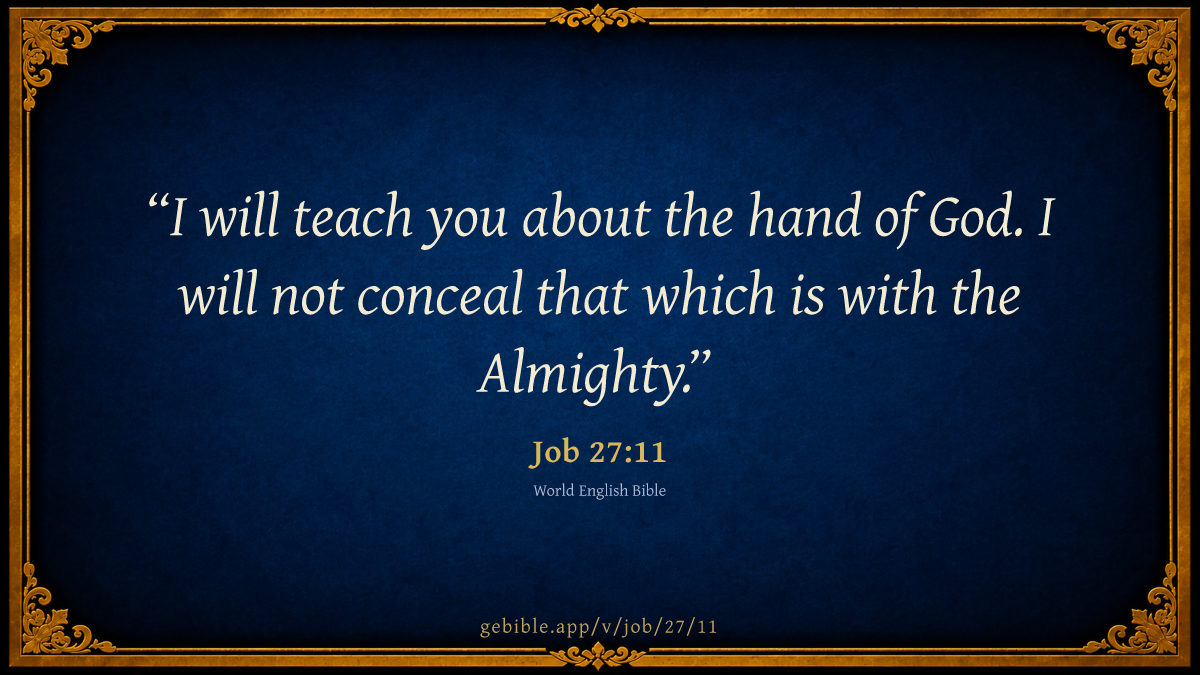
I will teach you about the hand of God. I will not conceal that which is with the Almighty.
Parallel Translations
-
I will teach you about the hand of God. I will not conceal that which is with the Almighty.
-
I will teach you by the hand of God: that which is with the Almighty will I not conceal.
-
I will teach you concerning the hand of God; that which is with the Almighty will I not conceal.
Cross-references (7)
Passages linked to Job 27:11 in the Treasury of Scripture Knowledge, ordered by reader-vote popularity; verse text shown in World English Bible.
- Psalms 71:17 God, you have taught me from my youth. Until now, I have declared your wondrous works.
- Job 4:3-4 Behold, you have instructed many, you have strengthened the weak hands. Your words have supported him who was falling, You have made firm the feeble knees.
- Isaiah 8:11 For Yahweh spoke this to me with a strong hand, and instructed me not to walk in the way of this people, saying,
- Deuteronomy 4:5 Behold, I have taught you statutes and ordinances, even as Yahweh my God commanded me, that you should do so in the middle of the land where you go in to possess it.
- Job 6:10 Let still be my consolation, yes, let me exult in pain that doesn’t spare, that I have not denied the words of the Holy One.
- Job 32:8-10 But there is a spirit in man, and the Spirit of the Almighty gives them understanding. It is not the great who are wise, nor the aged who understand justice. Therefore I said, ‘Listen to me; I also will show my opinion.’
- Acts 20:20 how I didn’t shrink from declaring to you anything that was profitable, teaching you publicly and from house to house,
Cross-references from openbible.info (CC BY 4.0)
Explain this verse (17 sources)
Historical commentary, presented as a primary source — not an endorsement.
Private notes
Saved on this device only — never synced or sent anywhere.
Geneva Bible translators 1599 · Public Domain That is, what God reserveth to himself, and whereof…
That is, what God reserveth to himself, and whereof he giveth not the knowledge to all.
Geneva Bible (1599) marginal notes — public domain.
John Trapp 1656 · Public Domain Job 27:11 I will teach you by the hand…
Job 27:11 I will teach you by the hand of God: [that] which [is] with the Almighty will I not conceal.
Ver. 11. I will teach you by the hand of God] That is, by the help of God, συν Yεω, or concerning the hand of God, what is in the hand of the Lord (so the Septuagint), what things he is wont to do by his power, and what are his usual proceedings, his actual and efficacious providence, Act 4:28. Deo iuvante et subministrante facultates (Vat.).
Read full note →
That which is with the Almighty I will not conceal] Neque celabo, ut res divinae comparatae sint, so the Tigurines translate. Envious masters use to hide from their scholars the best and chiefest part of their skill. It is reported of that spotted beast, the lynx, that knowing that his urine will congeal into a precious stone, and so stand man in stead, of pure envy, when he pisseth he maketh a hole in the ground to cover it. Cardan, speaking of one that had a receipt that would suddenly and certainly dissolve a stone in the bladder, and died, not imparting his skill to any one, I doubt not, saith he, but that man went to hell, quod moriens, artem suam mortalibus inviserit, because he envied his skill to those that survived him. Job was none such: but what he knew of God’s mind and manner of dealing (which hath no certain law, nor invariable rule, but dependeth upon his mere pleasure) he was ready to impart to his friends, who measured God’s actions by a wrong rule.
John Trapp, A Commentary or Exposition upon All the Books of the Old and New Testament (1647–1656) — public domain. Text from a community e-Sword module.
Matthew Poole 1685 · Public Domain By the hand of God, i.e. by God’s help…
By the hand of God, i.e. by God’s help and inspiration; as God is said to speak to the prophet with or by a strong hand, Isa 8:11. I will not teach you my own vain conceits, but what God himself hath taught me. Or, concerning (as the prefix beth is oft used, as Exo 12:43,44; Psa 63:6; 87:3; Pro 4:11)
the hand of God, i.e. his counsel and providence in governing the world, or the manner of his dealing with men, and especially with wicked men, of whose portion he discourseth Job 27:13,14, &c., showing how far the hand of God is either for them, or upon them, and against them.
Read full note →
That which is with the Almighty, i.e. what is in his breast or counsel, and how he executes his secret purposes concerning them; or the truth of God, the doctrine which he hath taught his church about these matters.
Matthew Poole's English Annotations on the Holy Bible (1683–1685) — public domain. Text from a community e-Sword/MySword module.
Matthew Henry 1710 · Public Domain Job's friends had seen a great deal of the…
Job's friends had seen a great deal of the misery and destruction that attend wicked people, especially oppressors; and Job, while the heat of disputation lasted, had said as much, and with as much assurance, of their prosperity; but now that the heat of the battle was nearly over he was willing to own how far he agreed with them, and where the difference between his opinion and theirs lay. 1. He agreed with them that wicked people are miserable people, that God will surely reckon with cruel oppressors, and one time or other, one way or other, his justice will make reprisals upon them for all the affronts they have put upon God and all the wrongs they have done to their neighbours. This truth is abundantly confirmed by the entire concurrence even of these angry disputants in it. But, 2. In this they differed - they held that these deserved judgments are presently and visibly brought upon wicked oppressors, that they travail with pain all their days, that in prosperity the destroyer comes upon them, that they shall not be rich, nor their branch green, and that their destruction shall be accomplished before their time (so Eliphaz, Job 15:20, Job 15:21, Job 15:29, Job 15:32), that the steps of their strength shall be straitened, that terrors shall make them afraid on every side (so Bildad, Job 18:7, Job 18:11), that he himself shall vomit up his riches, and that in the fulness of his sufficiency he shall be in straits, so Zophar, Job 20:15, Job 20:22. Now Job held that, in many cases, judgments do not fall upon them quickly, but are deferred for some time. That vengeance strikes slowly he had already shown (ch. 21 and 24); now he comes to show that it strikes surely and severely, and that reprieves are no pardons.
I. Job here undertakes to set this matter in a true light (Job 27:11, Job 27:12): I will teach you. We must not disdain to learn even from those who are sick and poor, yea, and peevish too, if they deliver what is true and good. Observe, 1. What he would teach them: "That which is with the Almighty," that is, "the counsels and purposes of God concerning wicked people, which are hidden with him, and which you cannot hastily judge of; and the usual methods of his providence concerning them." This, says Job, will I not conceal. What God has not concealed from us we must not conceal from those we are concerned to teach. Things revealed belong to us and our children. 2. How he would teach them: By the hand of God, that is, by his strength and assistance. Those who undertake to teach others must look to the hand of God to direct them, to open their ear (Isa 50:4), and to open their lips. Those whom God teaches with a strong hand are best able to teach others, Isa 8:11. 3. What reason they had to learn those things which he was about to teach them (Job 27:12), that it was confirmed by their own observation - You yourselves have seen it (but what we have heard, and seen and known, we have need to be taught, that we may be perfect in our lesson), and that it would set them to rights in their judgment concerning him - "Why then are you thus altogether vain, to condemn me for a wicked man because I am afflicted?" Truth, rightly understood and applied, would cure us of that vanity of mind which arises from our mistakes. That particularly which he offers now to lay before them is the portion of a wicked man with God, particularly of oppressors, Job 27:13. Compare Job 20:29. Their portion in the world may be wealth and preferment, but their portion with God is ruin and misery. They are above the control of any earthly power, it may be, but the Almighty can deal with them.
Read full note →
II. He does it, by showing that wicked people may, in some instances, prosper, but that ruin follows them in those very instances; and that is their portion, that is their heritage, that is it which they must abide by.
1. They may prosper in their children, but ruin attends them. His children perhaps are multiplied (Job 27:14) or magnified (so some); they are very numerous and are raised to honour and great estates. Worldly people are said to be full of children (Psa 17:14), and, as it is in the margin there, their children are full. In them the parents hope to live and in their preferment to be honoured. But the more children they leave, and the greater prosperity they leave them in, the more and the fairer marks do they leave for the arrows of God's judgments to be levelled at, his three sore judgments, sword, famine, and pestilence, Sa2 24:13. (1.) Some of them shall die by the sword, the sword of war perhaps (they brought them up to live by their sword, as Esau, Gen 27:40, and those that do so commonly die by the sword, first or last), or by the sword of justice for their crimes, or the sword of the murderer for their estates. (2.) Others of them shall die by famine (Job 27:14): His offspring shall not be satisfied with bread. He thought he had secured to them large estates, but it may happen that they may be reduced to poverty, so as not to have the necessary supports of life, at least not to live comfortably. They shall be so needy that they shall not have a competency of necessary food, and so greedy, or so discontented, that what they have they shall not be satisfied with, because not so much, or not so dainty, as what they have been used to. You eat, but you have not enough, Hag 1:6. (3.) Those that remain shall be buried in death, that is, shall die of the plague, which is called death (Rev 6:8), and be buried privately and in haste, as soon as they are dead, without any solemnity, buried with the burial of an ass; and even their widows shall not weep; they shall not have wherewithal to put them in mourning. Or it denotes that these wicked men, as they live undesired, so they die unlamented, and even their widows will think themselves happy that they have got rid of them.
2. They may prosper in their estates, but ruin attends them too, Job 27:16-18. (1.) We will suppose them to be rich in money and plate, in clothing and furniture. They heap up silver in abundance as the dust, and prepare raiment as the clay; they have heaps of clothes about them, as plentiful as heaps of clay. Or it intimates that they have such abundance of clothes that they are even a burden to them. They lade themselves with thick clay, Hab 2:6. See what is the care and business of worldly people - to heap up worldly wealth. Much would have more, until the silver is cankered and the garments are moth-eaten, Jam 5:2, Jam 5:3. But what comes of it? He shall never be the better for it himself; death will strip him, death will rob him, if he be not robbed and stripped sooner, Luk 12:20. Nay, God will so order it that the just shall wear his raiment and the innocent shall divide his silver. [1.] They shall have it, and divide it among themselves. In some way or other Providence shall so order it that good men shall come honestly by that wealth which the wicked man came dishonestly by. The wealth of the sinner is laid up for the just, Pro 13:22. God disposes of men's estates as he pleases, and often makes their wills against their wills. The just, whom he hated and persecuted, shall have rule over all his labour, and, in due time, recover with interest what was violently taken from him. The Egyptians' jewels were the Israelites' pay. Solomon observes (Ecc 2:26) that God makes the sinners drudges to the righteous; for the sinner he gives travail to gather and heap up, that he may give to him that is good before God. [2.] They shall do good with it. The innocent shall not hoard the silver, as he did that gathered it, but shall divide it to the poor, shall give a portion to seven and also to eight, which is laying up the best securities. Money is like manure, good for nothing if it be not spread. When God enriches good men they must remember they are but stewards and must give an account. What bad men bring a curse upon their families with the ill-getting of good men bring a blessing upon their families with the well-using of. He that by unjust gain increaseth his substance shall gather it for him that will pity the poor, Pro 28:8. (2.) We will suppose them to have built themselves strong and stately houses; but they are like the house which the moth makes for herself in an old garment, out of which she will soon be shaken, Job 27:18. He is very secure in it, as a moth, and has no apprehension of danger; but it will prove of as short continuance as a booth which the keeper makes, which will quickly be taken down and gone, and his place shall know him no more.
3. Destruction attends their persons, though they lived long in health and at ease (Job 27:19): The rich man shall lie down to sleep, to repose himself in the abundance of his wealth (Soul, take thy ease), shall lie down in it as his strong city, and seem to others to be very happy and very easy; but he shall not be gathered, that is, he shall not have his mind composed, and settled, and gathered in, to enjoy his wealth. He does not sleep so contentedly as people think he does. He lies down, but his abundance will not suffer him to sleep, at least not so sweetly as the labouring man, Ecc 5:12. He lies down, but he is full of tossings to and fro till the dawning of the day, and then he opens his eyes and he is not; he sees himself, and all he has, hastening away, as it were, in the twinkling of an eye. His cares increase his fears, and both together make him uneasy, so that, when we attend him to his bed, we do not find him happy there. But, in the close, we are called to attend his exit, and see how miserable he is in death and after death.
(1.) He is miserable in death. It is to him the king of terrors, Job 27:20, Job 27:21. When some mortal disease seizes him what a fright is he in! Terrors take hold of him as waters, as if he were surrounded by the flowing tides. He trembles to think of leaving this world, and much more of removing to another. This mingles sorrow and wrath with his sickness, as Solomon observes, Ecc 5:17. These terrors put him either [1.] Into a silent and sullen despair; and then the tempest of God's wrath, the tempest of death, may be said to steal him away in the night, when no one is aware or takes any notice of it. Or, [2.] Into an open and clamorous despair; and then he is said to be carried away, and hurled out of his place as with a storm, and with an east wind, violent, and noisy, and very dreadful. Death, to a godly man, is like a fair gale of wind to convey him to the heavenly country, but, to a wicked man, it is like an east wind, a storm, a tempest, that hurries him away in confusion and amazement, to destruction.
(2.) He is miserable after death. [1.] His soul falls under the just indignation of God, and it is the terror of that indignation which puts him into such amazement at the approach of death (Job 27:22): For God shall cast upon him and not spare. While he lived he had the benefit of sparing mercy; but now the day of God's patience is over, and he will not spare, but pour out upon him the full vials of his wrath. What God casts down upon a man there is no flying from nor bearing up under. We read of his casting down great stones from heaven upon the Canaanites (Jos 10:11), which made terrible execution among them; but what was that to his casting down his anger in its full weight upon the sinner's conscience, like the talent of lead? Zac 5:7, Zac 5:8. The damned sinner, seeing the wrath of God break in upon him, would fain flee out of his hand; but he cannot: the gates of hell are locked and barred, and the great gulf fixed, and it will be in vain to call for the shelter of rocks and mountains. Those who will not be persuaded now to fly to the arms of divine grace, which are stretched out to receive them, will not be able to flee from the arms of divine wrath, which will shortly be stretched out to destroy them. [2.] His memory falls under the just indignation of all mankind (Job 27:23): Men shall clap their hands at him, that is, they shall rejoice in the judgments of God, by which he is cut off, and be well pleased in his fall. When the wicked perish there is shouting, Pro 11:10. When God buries him men shall hiss him out of his place, and leave on his name perpetual marks of infamy. In the same place where he has been caressed and cried up he shall be laughed at (Psa 52:7) and his ashes shall be trampled on.
Matthew Henry's Commentary on the Whole Bible (1708–1710) — public domain (CC PDM 1.0). Text via the HelloAO Bible API.
John Gill 1763 · Public Domain Behold, all ye yourselves have seen it,.... As they…
Behold, all ye yourselves have seen it,.... As they were men of observation, at least made great pretensions to it, as well as of age and experience, they must have seen and observed somewhat at least of the above things; they must have seen the wicked, as David afterwards did, spreading himself like a green bay tree, and the hypocrites in easy and flourishing circumstances, and good men labouring under great afflictions and pressures, and Job himself was now an instance of that before their eyes:
why then are ye thus altogether vain? or "become vain in vanity" (k); so exceeding vain, so excessively trifling, as to speak and act against the dictates of their own conscience, against their own sense, and what they saw with their own eyes, and advance notions so contrary thereunto; as to affirm that evil men are always punished of God in this life, and good men are succeeded and prospered by him; and so from Job's afflictions drew so vain and empty a conclusion, that he must be a wicked man and an hypocrite.
Read full note →
(k) "vanitate vanescitis", Pagninus, Junius & Tremellius, Michaelis, Schultens; "vel evanescitis", Montanus, Bolducius, Beza, Mercerus, Drusius, Piscator, Cocceius.
John Gill's Exposition of the Whole Bible (1746–1763) — public domain (CC PDM 1.0). Text via the HelloAO Bible API.
Adam Clarke 1810 · Public Domain Verse 11. I will teach you by the hand…
Verse 11. I will teach you by the hand of God] Relying on Divine assistance, and not speaking out of my own head, or quoting what others have said I will teach you what the mind of the Almighty is, and I will conceal nothing. Job felt that the good hand of his God was upon him, and that therefore he should make no mistake in his doctrines. In this way the Chaldee understood the words, ביד אל beyad El, by the hand of God, which it translates בנבואת אלהא binbuath Elaha, by the prophecy of God. Those who reject the literal meaning, which conveys a very good sense, may adopt the translation of Mr. Good, which has much to recommend it: "I will teach you concerning the dealings of God."
Adam Clarke's Commentary on the Bible (1810–1826) — public domain. Text from a community e-Sword/MySword module.
Joseph Benson 1811 · Public Domain Job 27:11. I will teach you by the hand…
Job 27:11. I will teach you by the hand of God — That is, by God’s help and inspiration; or, by such arguments as are irresistible. The words, however, may be rendered, concerning the hand of God; that is, concerning his counsel and providence in governing the world, or the manner of his dealing with men, and especially with wicked men, of whom he discourses, Job 27:13, &c., showing how far the hand of God is either for them, upon, or against them. That which is with the Almighty — That is, in his counsel, and how he executes his secret purposes concerning them; I will not conceal — I will declare the truth of God, and the doctrine that he hath taught his church about these matters.
Joseph Benson's Commentary on the Old and New Testaments (1811–1818) — public domain. Text from a community e-Sword module.
Albert Barnes 1834 · Public Domain I will teach you by the hand of God…
I will teach you by the hand of God - Margin, “or, being in.” Coverdale, “In the name of God.” So Tindal, Noyes, “Concerning the hand of God.” Good, “Concerning the dealings of God.” The Chaldee renders it אלהא בנביאת - “By the prophecy of God.” Luther, “I will teach you by the hand of God.” The idea evidently is, that Job would instruct them by what God had done. He would appeal to his works, and to the dispensations of his providence; and by the indications of wisdom and skill which were to be found there, he would derive important lessons for their instruction on the great principles of his administration. Accordingly, in the remainder of this chapter, he makes his appeal to what actually occurs in the dispensations of Providence, and in the next, he refers to various scientific subjects, evincing the wisdom which God had shown in the mineral kingdom. The hand is the instrument by which we accomplish anything, and hence, it is used here to denote what God does.
That which is with the Almighty will I not conceal - That is, I will appeal to his works, and show what traces of wisdom there are in them.
Albert Barnes' Notes on the Bible (1834–1885) — public domain. Text from a community e-Sword/MySword module.
Haydock's Catholic Bible Commentary 1859 · Public Domain Hand, or grace of God. --- Hath, how he…
Hand, or grace of God. --- Hath, how he acts, and with what design. (Calmet) --- Quid disponat Deus. (St. Augustine)
George Leo Haydock (1774–1849), Haydock's Catholic Family Bible and Commentary, 1859 edition — public domain. Excludes Psalms (Douay-Rheims chapter numbering differs from Protestant) and Deuterocanonical books (Catholic canon only).
Robert Jamieson, A. R. Fausset & David Brown 1871 · Public Domain These words are contrary to Job's previous sentiments (see…
These words are contrary to Job's previous sentiments (see on Job 21:22-33; Job 24:22-25). Job 21:22-33; Job 24:22-25). They therefore seem to be Job's statement, not so much of his own sentiments, as of what Zophar would have said had he spoken when his turn came (end of the twenty-sixth chapter). So Job stated the friends' opinion (Job 21:17-21; Job 24:18-21). The objection is, why, if so, does not Job answer Zophar's opinion, as stated by himself? The fact is, it is probable that Job tacitly, by giving, in the twenty-eighth chapter, only a general answer, implies, that in spite of the wicked often dying, as he said, in prosperity, he does not mean to deny that the wicked are in the main dealt with according to right, and that God herein vindicates His moral government even here. Job therefore states Zophar's argument more strongly than Zophar would have done. But by comparing Job 27:13 with Job 20:29 ("portion," "heritage"), it will be seen, it is Zophar's argument, rather than his own, that Job states. Granting it to be true, implies Job, you ought not to use it as an argument to criminate me. For (Job 28:1-28) the ways of divine wisdom in afflicting the godly are inscrutable: all that is sure to man is, the fear of the Lord is wisdom (Job 28:28).
by the hand--rather, concerning the hand of God, namely, what God does in governing men.
Read full note →
with the Almighty--the counsel or principle which regulates God's dealings.
Jamieson, Fausset & Brown — Commentary Critical and Explanatory on the Whole Bible (1871) — public domain (CC PDM 1.0). Text via the HelloAO Bible API.
Daniel D. Whedon 1874 · Public Domain Section second — A CALM AND FORMAL STATEMENT OF…
Section second — A CALM AND FORMAL STATEMENT OF JOB’S VIEWS CONCERNING THE LOT OF THE WICKED IN THIS, AND THEIR DOOM IN THE NEXT, LIFE, Job_27:11-23.
Introductory strophe a — Experience has given man wisdom which should guard him against error in the interpretation of the mind and ways of God. With a noble feeling of conciliation he takes for his text the statement of the friends concerning the wicked, Job_27:11-13.
Read full note →
11. By the — Concerning. Literally, in.
Hand of God — The mystery of the divine government, which he proceeds to unfold in this and the subsequent chapters.
That which is with the Almighty — His dealings. Compare Job_12:16; Job_15:9; and see note on Job_22:14.
Daniel D. Whedon (gen. ed.), Commentary on the Old and New Testaments (1874–1909) — public domain. Text from a community e-Sword module.
The Cambridge Bible for Schools and Colleges 1878 · Public Domain 11. by the hand of God] Rather, concerning the…
11. by the hand of God] Rather, concerning the hand of God. In a brief preface Job intimates that he will instruct his friends regarding the hand of God, that is, His operation, His method of dealing with the wicked.
with the Almighty] There is no just ground for restricting the phrase with the Almighty to the meaning, the plans or purposes of the Almighty, the general principles of His government, which continue to be His principles though they may not for a time appear in actual operation. Such a limitation is interpolated into the text, and is contrary to the parallelism of the first clause. In Job_27:13 the same phrase occurs, “the portion of the wicked man with God,” which is interpreted in the next clause as “the heritage which they receive from the Almighty.” The words refer to no ideal of moral government, such as always exists and may always manifest itself; they describe God’s actual treatment of the wicked man, apart from all limitation. This is the doctrine of the three friends; that of Job in ch. 21, and even ch. 24 was very different.
Read full note →
11–23. The disastrous fate of the wicked man at the hand of God.
Job_27:7-10 drew a contrast between the internal state of the mind of the speaker and that of the sinner; in these verses the contrast is pursued in a terrible picture of the external history and fate of the sinner at the hand of God. From Job’s hand such a picture can have no meaning, unless either he now anticipates for himself a happy issue out of his afflictions, and restoration to prosperity, while the calamities that befall the wicked are final; or regards his own afflictions, even though they should bring him unto death, as altogether different in their character and marks from those that bring the wicked man to destruction. Either side of the alternative sets Job in complete contradiction to his position in the chapters that precede and follow this one. On the former side see on Job_27:10. The latter side supposes Job now to take a view of his afflictions entirely opposed to that which he has hitherto taken and continues to take, namely that they are due to the enmity and hostility of God (ch. Job_13:24, Job_16:9, Job_19:11; Job_19:22, but also ch. Job_30:21, and even the present chap. Job_27:2-6)—a view which Elihu severely animadverts upon, ch. Job_33:10 seq. And the idea that to become the prey of pestilence and sword (Job_27:14-15) is a sure mark of a wicked man, while to be the victim of a fatal and loathsome malady is no such proof of wickedness (Delitzsch), is one which it is difficult to treat with seriousness.
The Cambridge Bible for Schools and Colleges (gen. ed. J. J. S. Perowne; Cambridge University Press, 1878–1918) — public domain. Text from a community e-Sword module.
Ellicott's Commentary for English Readers 1878 · Public Domain (11) I will teach you.—Better, I will teach you…
(11) I will teach you.—Better, I will teach you of the hand of God; or, what is in the power of God.
A Bible Commentary for English Readers, edited by Charles John Ellicott (1878–1897) — public domain. Text from a community e-Sword module.
The Pulpit Commentary 1880 · Public Domain Vers. 11-23. It is impossible to deny that this…
Vers. 11-23. It is impossible to deny that this passage directly contradicts Job"s former utterances, especially Job_24:2-24. But the hypotheses which would make Job irresponsible for the present utterance and fix on him, as his steadfast conviction, the opposite theory, are unsatisfactory and have no solid basis. To suppose that Zophar is the real speaker is to imagine the absolute loss and suppression of two entire verses one between vers. 10 and 11, assigning the speech to him, and another at the beginning of Jer 28, reintroducing Job and making him once more the interlocutor. That this should have happened by accident is inconceivable. Ta kata tuchn ou panu sunduazetai To ascribe it to intentional corruption by a Hebrew redactor, bent on maintaining the old orthodox view, and on falsely and wickedly giving the authority of Job to it (Froude "Short Studies on Great Subjects," vol. 1. p. 316), is to take away all authority from the existing text of the Hebrew Scriptures, and to open a door to any amount of wild suggestion and conjectural emendation. The other hypothesis that of Eichhorn that Job is here simply anticipating what his adversaries will say, though a less dangerous view, is untenable, since Job never does this without following up his statement of the adversaries" ease with a reply, and here is no reply whatever, but a simple turning away, after ver. 23, to another subject. The explanation of the contradiction by supposing that Job"s former statement was tentative and controversial, or else hasty and ill-considered, and that now, to prevent misconception, he determines to set himself right, is, on the other hand, thoroughly defensible, and receives a strong support from the remarkable introduction in ver. 11, which "prepares us, if not for a recantation, yet (at any rate) for a modification of statements wrung from the speaker when his words flowed over from a spirit drunk with the poison of God"s arrows" (see the remarks of Canon Cook, in the "Speaker"s Commentary," vol. 4. p. 90, which are in substantial agreement with those of Ewald said Dillmann).
I will teach you by (or, concerning) the hand of God. Job is now at last about to deliver his real sentiments respecting God"s dealings with men in the world, and prefaces his. remarks with this solemn introduction, to draw special attention to them. He is aware that his previous statements on the subject, especially in Job_24:2-24, have been overstrained and exaggerated, and wishes, now that he is uttering his last words, (Job_31:40) to correct his previous hasty utterances, and put on record his true views. That which is with the Almighty will I not conceal. By "that which is with the Almighty" Job means the Divine principles of action.
Read full note →
Vers. 11-23. Job"s first parable: 2. The portion of a wicked man with God.
I JOB"S LANGUAGE EXPLAINED. The lot, or earthly inheritance, of the ungodly Job exhibits in three particulars.
1. The wicked man"s family. However numerous the children that gather round a sinner"s hearth, they will all be overwhelmed in eventual destruction.
(1) Designed. If his sons and daughters multiply, it is not because of any special favour with which they are regarded by Heaven, but only to meet their appointed portion. If the wicked send forth their little ones like a flock, (Job_21:11) it is purely that, like oxen, they may be fattened for the slaughter.
(2) Violent. Instead of dying peacefully in the course of nature after long, prosperous, and happy lives, they shall perish by the sword, by famine, or by pestilence the three most usual forms of calamity in the East, and the three customary modes of inflicting Divine punishment. (2Sa_24:13 Jer_14:12) Job"s children were not removed in either of these ways.
(3) Humiliating. Such indignity will fall upon his offspring, when they in turn follow him to the grave, that they shall be "buried in death," meaning either left unburied, or, as is more probable, totally forgotten the instant they are dead. Contrast the picture of the wicked man"s funeral in a previous oration. (Job_21:9, Job_21:32)
(4) Appalling. Either so complete will the ruin of this ungodly person"s family be that no widows shall remain to mourn for himself and children; or so sudden will be the shock of bereavement, that, paralyzed with grief, they will be unable to weep; or so attended with indications of Divine displeasure that they will fear to indulge in outward tokens of sorrow.
2. The wicked man"s wealth. This also shall be dissipated.
(1) His money. Should it be plentiful as the dust, (Zec_9:3 1Ki_10:27) he must leave it behind him, but not to his children, for "his silver the innocent shall divide" (ver. 17). The dying millionaire cannot calculate, or secure, that his accumulated treasures will be enjoyed by his family. (Psa_39:6 Luk_12:20) God can scatter a man"s wealth as easily as destroy a man"s life or extinguish a man"s house.
(2) His raiment. This is another form of Oriental wealth (vide Exposition), which, though abundant as the mire, must share the same fate, and become the property of the righteous.
(3) His palace. Strongly built and gorgeously decorated, it yet is frail and brittle, as easily destroyed and as quickly removed as a moth-web (Job_8:15) or a watchman"s hut. (Isa_1:8)
3. The wicked man"s person. Equally with his family and possessions, the wicked man himself is engulfed in an awful doom.
(1) Surprised by sudden death. At night retiring to bed rich, he knows not that before morning he shall be removed from life and fiches at a stroke; or, if permitted to see the dawn, he is quite unconscious that he does so for the last time, and that, ere the night falls, he shall be no more (ver. 19). Death, which comes to all men suddenly, (Mat_24:44) is no surprise to them who habitually look for its approach, (2Ti_4:6) but a fearful awakening to them who live in careless unconcern about their latter end. (1Th_5:3)
(2) Terrified by impending judgment. While the violent surprise with which death seizes on the sinner is represented by three more metaphors of a flood from which it is impossible to run, (Psa_18:4) a tempest or whirlwind which stealeth one away by night, (Job_21:18 Pro_10:25) and an east wind accompanied by destructive storms, (Isa_41:16) sometimes "so severe as to smite down whole villages and uproot the largest trees" (Cox) the effect produced upon the sinner"s mind is depicted as one of paralyzing, overwhelming, devouring consternation. (Psa_73:19) This fear is probably the apprehension of something after death (cf. "Macbeth," act 1: So 7).
(3) Overtaken by merited punishment. Upon the head of this unhappy wretch God shall rain down calamities so fast and furious that every attempt to escape his doom will be in vain. Such also David thought would be the portion of the wicked; (Psa_11:6) and such St. Paul asserts will be the ultimate reward of the unbelieving and impenitent. (Rom_2:9)
(4) Pursued by universal execration. Even if we read (Carey) it, i.e. the wind, shall clap its hands at him, and whistle at him in derision, the image must be interpreted to mean that the storm-chased sinner will be beheld with malignant joy and withering scorn; that, in fact, men will clap their hands with infinite delight over his tragic fate, and hunt his guilty spirit from the world with expressions of bitter hatred and contempt.
II JOB"S MEANING CLEARED.
1. The difficulty. The above exposition of the wicked man"s portion bears so close a resemblance to the pictures already sketched by the friends, that much perplexity has been occasioned by Job"s seeming inconsistency., in at this stage admitting the very dogma he had so powerfully assailed in his previous contendings. If this were true, it would only prove that great men sometimes change their rain, Is and modify their opinions. But the contradiction is more apparent than real.
2. The solution. For a detailed statement of the different schemes proposed with a view to either bridge over or remove this difficulty, the Exposition may be consulted. Here it may suffice to say that either we may understand Job as recapitulating the theory of the friends, which he has just characterized as "foolish notions" (ver. 12); or, holding that the sentiments he delivers are his own, we may affirm that in previously painting the prosperous fortunes of the ungodly (e.g. Job_12:6 Job_21:7) he was merely placing exceptional cases against the exclusive theory of the friends, that ungodly men have always evil fortunes, which was all that strict logic required as its refutation, but that here he desires to intimate his acquiescence in the main element of their dogma, viz. that as a rule "the retributive justice of God is manifest in the case of the evil-doer" (Delitzsch).
Learn:
1. That every man"s portion from God is twofold, relating to the life that is to come as well as to that which now is.
2. That the higher a wicked man rises in worldly prosperity, the more ignominious will be his final overthrow.
3. That God can effect sudden and surprising transfers of property on earth.
4. That sudden death may overtake the person who appears best secured against it.
5. That sudden death is not the same thing to a wicked man that it is to a good one.
6. That the wicked man cannot face the future without a fear.
7. That if a wicked man"s death is a cause of joy to the world, the departure of a saint should be a source of lamentation.
Teachings concerning God.
I THE HIGHEST TEACHINGS. Our thoughts am too much chained to the earths and too much centred in self. Even in religion we tend to subjective feelings rather than to worship the contemplation and the service of God. Now, the chief end of revelation is to make God known to us, and the highest occupation for our minds is to rise to the thought of God. The character of God should make this clear to us.
1. His greatness. Knowledge should seek a worthy object. We should desire to know what is greatest, rather than petty details.
2. His holiness. Teachings about God are teachings about goodness. Here we come to the source of true ethics. We cannot study "the good" till we know God.
3. His love. That is supreme in God, and it is supreme in the universe. To know the love of God is to know what is highest and best of all things.
II PRACTICAL TEACHINGS. It may be urged that we cannot afford to spend our time in contemplation, that we want to know how to live our present life, and that therefore earthly and human knowledge is the most important knowledge. But this is a mistake. For God is not separated from this world and the affairs of daily life. The knowledge of God is not abstract theology. God is our Father, our Master, our Guide. To know God is to know how to live; it is to know what character and conduct are in harmony with the mind of our supreme King. We cannot live aright without knowing him. Moreover, it is a matter of profound interest to know how God is disposed towards us. Is he gracious and forgiving? how may we best please him? These are practical questions. But apart from the ends of knowledge, the knowledge of God is itself a source of blessedness. To know God is eternal life. (Joh_17:3)
III DIFFICULT TEACHINGS. Experience shows how grievously men have erred in their teachings about God. Not only has heathenism gone astray in its manifold and monstrous perversions of Divinity, but Christians have set forth the most erroneous conceptions of God. With some he has been regarded as a stern despot, an arbitrary autocrat; with others he has been represented as a mere personification of amiable and compliant good will, without regard to moral considerations. It is not wonderful that the teachings are difficult, considering:
1. The greatness of God. One can know but a very little of so awful a Being. We see but "parts of his ways;" "but the thunder of his power who can understand?
2. The blindness of men. Sin blinds us; prejudice perverts our notions of God instead of allowing us to see the truth about him.
IV POSSIBLE TEACHINGS.
1. From revelation. God has not hidden himself in the thick darkness. He has made himself known in his works, by the inspiration of prophecy, and above all in the Person of Christ. Agnosticism is only defensible if all revelation is discarded, and agnosticism cannot account for Christ.
2. By spiritual grace. The knowledge of God is an inward revelation. We can only read nature, the Bible, and Christ aright when the Spirit of God is in our hearts. By the gift of his Spirit God opens our eyes to the knowledge of himself. W.F.A.
The Pulpit Commentary (1880–1919), ed. H.D.M. Spence-Jones & Joseph S. Exell — public domain. Text from a community e-Sword module.
The Biblical Illustrator 1887 · Public Domain I will teach you by the hand of God.
Job_27:11-23
I will teach you by the hand of God.
Read full note →
Gods treatment of wicked men
Looking at Jobs lecture or address, we have to notice two things.
I. Its introduction. The eleventh and twelfth verses may be regarded as an exordium; and in this exordium he indicates two things.
1. That his arguments are drawn from the operations of God in human history. I will teach you by the hand of God.
2. That the facts of human history are open to the observation of all. Behold, all ye yourselves have seen it.
II. Its doctrine. The doctrine is this, that punishment will ultimately overtake wicked men, however much, for a time, they may prosper in the world. He gives back, says a modern writer, to his three friends the doctrine which they had fully imparted to him.
1. That great wickedness often prospers for a time in this life.
2. That though it may, it must be followed by terrible punishment. Conclusion--
(1)
This address of Jobs is worthy of the imitation of religious teachers.
(2) It shows that worldly prosperity is neither a test of character, nor a safeguard against punishment. (Homilist.)
Zophars missing speech
There has been much diversity of view in regard to the remainder of this chapter. The difficulty is that Job seems here to state the same things which had been maintained by his friends, and against which he had all along contended. This difficulty has been felt to be very great, and is very great. It cannot be denied that there is a great resemblance between the sentiments here expressed, and those which had been maintained by his friends, and that this speech, if offered by them, would have accorded entirely with their main position. Job seems to abandon all which he had defended, and to concede all which he had so warmly condemned. Dr. Kennicott supposes that the text is imperfect, and that these verses constituted the third speech of Zophar. His arguments for this opinion are--
1. That Eliphaz and Bildad had each spoken three times, and that we are naturally led to expect a third speech from Zophar; but, according to the present arrangement, there is none.
2. That the sentiments accord exactly with what Zophar might be expected to advance, and are exactly in his style; that they are expressed in his fierce manner of accusation, and are in the very place where Zophars speech is naturally expected. But the objections to this view are insuperable. They are--
(1)
The entire want of any authority in the manuscripts, or ancient versions, for such an arrangement or supposition. All the ancient versions and manuscripts make this a part of the speech of Job.
(2) If this had been a speech of Zophar, we should have expected a reply to it, or an allusion to it, in the speech of Job which follows. But no such reply or allusion occurs.
(3) If the form which is usual on the opening of a speech--And Zophar answered and said--had ever existed here, it is incredible that it should have been removed. But it occurs in no manuscript or version; and it is not allowable to make such an alteration in the Scripture by conjecture. Wemyss, in his translation of Job, accords with the view of Kennicott, and makes the verses 13-23 to be the third speech of Zophar.
For this, however, he alleges no authority, and no reasons except such as had been suggested by Kennicott. Coverdale has inserted the word saying at the close of verse 12, and regards what follows to the end of the chapter as an enumeration or recapitulation of the false sentiments which they had maintained, and which Job regards as the vain things (verse 12) which they had maintained. In support of this view, it may be alleged--
(1) That it avoids all the difficulty of transposition, and the necessity of inserting an introduction, as we must do, if we suppose it to be a speech of Zophar.
(2) It avoids the difficulty of supposing that Job had here contradicted the sentiments which he had before advanced, or of conceding all that his friends had maintained.
(3) It is in accordance with the practice of the speakers in this book, and the usual practice of debaters, who enumerate at considerable length the sentiments which they regard as erroneous, and which they design to oppose.
(4) It is the most simple and natural supposition, and, therefore, most likely to be the true one. (Albert Barnes.)
The Biblical Illustrator, edited by Joseph S. Exell (c. 1880s–1900s) — public domain. Text from a community e-Sword module.
Paul E. Kretzmann 1924 · Public Domain Belief in the Final Destruction of the Ungodly.
Belief in the Final Destruction of the Ungodly.
v. 11. I will teach you by the hand of God, concerning the way, the manner, in which His hand works; that which is with the Almighty will I not conceal, he would declare to his friends the very counsels and thoughts of God which govern His dealings with men.
Read full note →
v. 12. Behold, all ye yourselves have seen it, he concedes that the final lot of the wicked is often one of extreme affliction, he agrees to accept this observation; why, then, are ye thus altogether vain, guided so completely by empty and foolish delusions?
v. 13. This is the portion of the wicked man with God, the lot which is bound to strike him, and the heritage of oppressors which they shall receive of the Almighty, the judgment of God being carried out chiefly in three forms of punishment, as Job now shows.
v. 14. If his children be multiplied, their great number being considered a proof of the divine blessing, it is for the sword, that being the first great scourge in the hand of God; and his offspring shall not be satisfied with bread, famine being a second scourge of nations.
v. 15. Those that remain of him shall be buried in death, those who escaped the first punishments would become victims of the pestilence; and his widows shall not weep, being hindered even from observing the usual ceremonies of mourning by the severity of the plague.
v. 16. Though he heap up silver as the dust, in immeasurable quantities, and prepare raiment, fine garments, as the clay, that they are as numerous, as common, as the mud of the streets;
v. 17. he may prepare it, but the just shall put it on, for he will enter into the heritage of the godless, and the innocent shall divide the silver, Cf Psa 37:29-34; Ecc 2:16.
v. 18. He buildeth his house as a moth, a frail and temporary dwelling, and as a booth that the keeper maketh, a shed which a watchman puts up for a few days.
v. 19. The rich man shall lie down, but he shall not be gathered, he lies down once and not again, that is, he never arises; he openeth his eyes, and he is not, at the time of awakening he is gone, snatched away suddenly by the hand of death.
v. 20. Terrors take hold on him as waters, the fear of death comes upon him like the torrents of an overflowing stream; a tempest stealeth him away in the night, a sudden gust of the violent east wind carries him off.
v. 21. The east wind carrieth him away, and he departeth, going off without returning; and as a storm hurleth him out of his place, he being helpless in its power.
v. 22. For God shall cast upon him and not spare, hurling the arrows of His wrath and vengeance upon him; he would fain flee out of his hand, all his attempts to escape the doom at the hand of God are futile.
v. 23. Men shall clap their hands at him, in mockery and derision, and shall hiss him out of his place, forcing him to leave his dwelling under their scornful jeering. Job thus pictured the final misfortune of the wicked in terms which even went beyond those employed by his friends.
Paul E. Kretzmann, Popular Commentary of the Bible (1921–1924) — public domain. Text from a community e-Sword module.
unfoldingWord translationNotes 2017 · CC BY-SA 4.0 I will teach you
I will teach you
Each occurrence of "you" in these verses is plural and refers to Job's three friends. (See: Forms of You)
Read full note →
the hand of God
God's "hand" represents his power. AT: "the power of God" (See: Metonymy)
I will not conceal the thoughts of the Almighty
The abstract noun "thoughts" can be expressed with the verb "think." AT: I will not hide from you what the Almighty thinks" (See: Abstract Nouns)
why then have you spoken all this nonsense?
Job uses this question to rebuke his friends for saying such foolish things. This question can be translated as a simple statement. AT: "you should not have spoken so foolishly!" (See: Rhetorical Question)
translationWords
hand
Almighty
unfoldingWord translationNotes — © Distant Shores Media and the Door43 World Missions Community, licensed CC BY-SA 4.0. Source: git.door43.org/Door43/en_tn.