Proverbs 13:22(v17)A good man leaves an inheritance to his children’s children, but the wealth of the sinner is stored for the righteous.
Proverbs 28:8(v17)He who increases his wealth by excessive interest gathers it for one who has pity on the poor.
Ecclesiastes 2:26(v17)For to the man who pleases him, God gives wisdom, knowledge, and joy; but to the sinner he gives travail, to gather and to heap up, that he…
Deuteronomy 28:41(v14)You will father sons and daughters, but they will not be yours, for they will go into captivity.
Job 8:14-15(v18)Whose confidence will break apart, Whose trust is a spider’s web. He will lean on his house, but it will not stand. He will cling to it,…
Show all 43 cross-references
Psalms 78:64(v15)Their priests fell by the sword, and their widows couldn’t weep.
Isaiah 1:8(v18)The daughter of Zion is left like a shelter in a vineyard, like a hut in a field of melons, like a besieged city.
Job 20:19-29(v13)For he has oppressed and forsaken the poor. He has violently taken away a house, and he will not build it up. “Because he knew no quietness…
Zechariah 9:3(v16)Tyre built herself a stronghold, and heaped up silver like the dust, and fine gold like the mire of the streets.
Job 15:20-35(v13)the wicked man writhes in pain all his days, even the number of years that are laid up for the oppressor. A sound of terrors is in his…
Job 20:10(v14)His children will seek the favor of the poor. His hands will give back his wealth.
Isaiah 3:11(v13)Woe to the wicked! Disaster is upon them; for the deeds of his hands will be paid back to him.
Isaiah 51:8(v18)For the moth will eat them up like a garment, and the worm will eat them like wool; but my righteousness will be forever, and my salvation…
Matthew 6:19(v16)“Don’t lay up treasures for yourselves on the earth, where moth and rust consume, and where thieves break through and steal;
Luke 23:29(v14)For behold, the days are coming in which they will say, ‘Blessed are the barren, the wombs that never bore, and the breasts that never…
2 Peter 2:9(v13)the Lord knows how to deliver the godly out of temptation and to keep the unrighteous under punishment for the day of judgment,
Deuteronomy 28:32(v14)Your sons and your daughters will be given to another people. Your eyes will look, and fail with longing for them all day long. There will…
1 Samuel 2:5(v14)Those who were full have hired themselves out for bread. Those who were hungry are satisfied. Yes, the barren has borne seven. She who has…
1 Kings 10:27(v16)The king made silver as common as stones in Jerusalem, and cedars as common as the sycamore trees that are in the lowland.
1 Kings 14:10-11(v15)therefore, behold, I will bring evil on the house of Jeroboam, and will cut off from Jeroboam everyone who urinates on a wall, he who is…
1 Kings 16:3-4(v15)behold, I will utterly sweep away Baasha and his house; and I will make your house like the house of Jeroboam the son of Nebat. The dogs…
1 Kings 21:21-24(v15)Behold, I will bring evil on you, and will utterly sweep you away and will cut off from Ahab everyone who urinates against a wall, and him…
2 Kings 9:7-8(v14)You must strike your master Ahab’s house, that I may avenge the blood of my servants the prophets, and the blood of all the servants of…
2 Kings 10:6-10(v14)Then he wrote a letter the second time to them, saying, “If you are on my side, and if you will listen to my voice, take the heads of the…
Esther 5:11(v14)Haman recounted to them the glory of his riches, the multitude of his children, all the things in which the king had promoted him, and how…
Esther 9:5-10(v14)The Jews struck all their enemies with the stroke of the sword, and with slaughter and destruction, and did what they wanted to those who…
Job 15:22(v14)He doesn’t believe that he will return out of darkness. He is waited for by the sword.
Job 21:11-12(v14)They send out their little ones like a flock. Their children dance. They sing to the tambourine and harp, and rejoice at the sound of the…
Job 22:24(v16)Lay your treasure in the dust, the gold of Ophir among the stones of the brooks.
Job 31:3(v13)Is it not calamity to the unrighteous, and disaster to the workers of iniquity?
Psalms 11:6(v13)On the wicked he will rain blazing coals; fire, sulfur, and scorching wind shall be the portion of their cup.
Psalms 12:5(v13)“Because of the oppression of the weak and because of the groaning of the needy, I will now arise,” says Yahweh; “I will set him in safety…
Psalms 109:13(v14)Let his posterity be cut off. In the generation following let their name be blotted out.
Proverbs 22:22-23(v13)Don’t exploit the poor, because he is poor; and don’t crush the needy in court; for Yahweh will plead their case, and plunder the life of…
Ecclesiastes 8:13(v13)But it shall not be well with the wicked, neither shall he lengthen days like a shadow, because he doesn’t fear God.
Jeremiah 22:18(v15)Therefore Yahweh says concerning Jehoiakim the son of Josiah, king of Judah: “They won’t lament for him, saying, ‘Ah my brother!’ or, ‘Ah…
Hosea 9:13-14(v14)I have seen Ephraim, like Tyre, planted in a pleasant place; but Ephraim will bring out his children to the murderer. Give them—Yahweh what…
Habakkuk 2:6(v16)Won’t all these take up a parable against him, and a taunting proverb against him, and say, ‘Woe to him who increases that which is not…
Malachi 3:5(v13)I will come near to you to judgment; and I will be a swift witness against the sorcerers, and against the adulterers, and against the…
James 5:2(v16)Your riches are corrupted and your garments are moth-eaten.
James 5:4-6(v13)Behold, the wages of the laborers who mowed your fields, which you have kept back by fraud, cry out, and the cries of those who reaped have…
Isaiah 38:12(v18)My dwelling is removed, and is carried away from me like a shepherd’s tent. I have rolled up my life like a weaver. He will cut me off from…
Lamentations 2:6(v18)He has violently taken away his tabernacle, as if it were of a garden. He has destroyed his place of assembly. Yahweh has caused solemn…
Cross-references from openbible.info (CC BY 4.0)
Explain this passage (16 sources)
Historical commentary, presented as a primary source — not an endorsement.
Geneva Bible translators1599 · Public DomainOn vv13, 15, 18Thus will God order the wicked, and punish him…
Thus will God order the wicked, and punish him even unto his posterity.
Geneva Bible (1599) marginal notes — public domain.
John Trapp1656 · Public DomainOn vv13–18Job 27:13 This [is] the portion of a wicked…
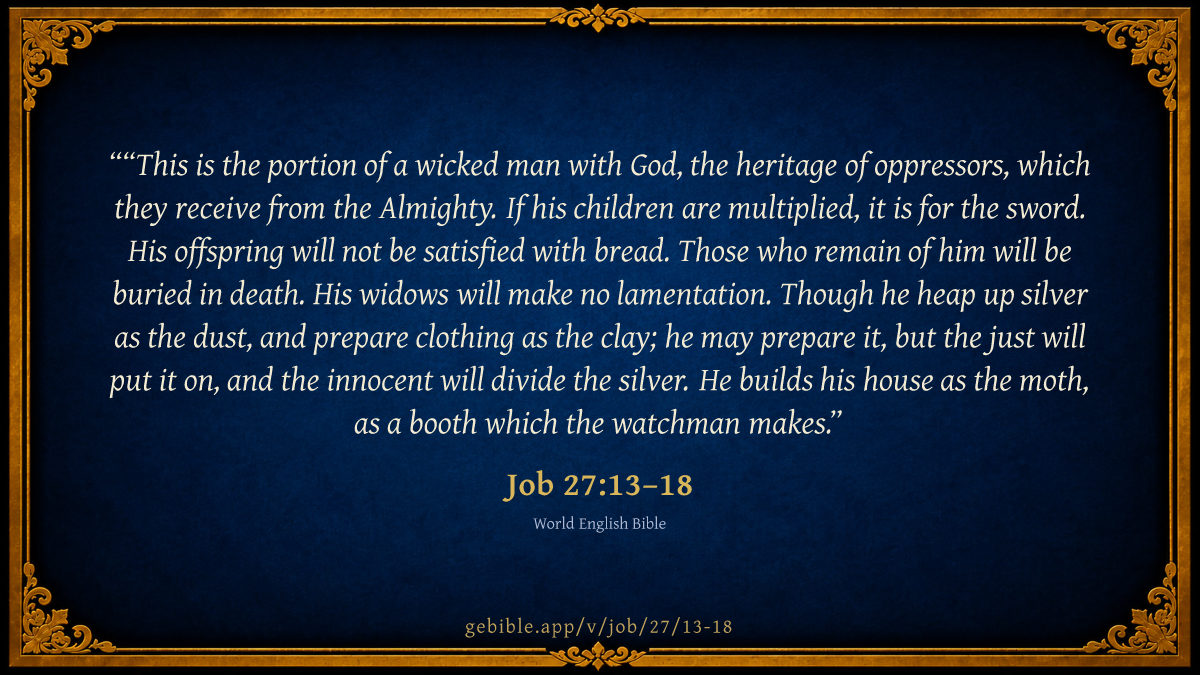
Job 27:13 This [is] the portion of a wicked man with God, and the heritage of oppressors, [which] they shall receive of the Almighty.
Ver. 13. This is the portion of a wicked man with God] q.d. So ye say, and so I say too; for herein I will not deny to comply and to chime in with you. Zophar had said the same in effect, and used the selfsame expressions that Job here doth, Job 20:29. See the notes there. But must Job therefore be a hypocrite, though he continue to hope, and pray, and delight in God amidst all his miseries? Job 27:8-10. Negatur. He had spoken much before of the wicked man’s prosperity; now, to prevent mistakes, he discourseth largely of his punishment, and how ill he beareth it.
Read full note →
And the heritage of oppressors, &c.] Of fierce and formidable tyrants, that are a terror to others. These are the rewards they shall receive from the God of recompences, the Almighty, who can well enough deal with them, and delights to get him a name in their just destruction.
John Trapp, A Commentary or Exposition upon All the Books of the Old and New Testament (1647–1656) — public domain. Text from a community e-Sword module.
Matthew Poole1685 · Public DomainOn vv13–18This is the portion of a wicked man; that…
This is the portion of a wicked man; that which is mentioned in the following verses; in which Job delivers either,
1. The opinion of his friends, in whose person he utters them, and afterwards declares his dissent from them. Or rather,
Read full note →
2. His own opinion, and how far he agreeth with them; for his sense differs but little from what Zophar said, Job 20:29.
With God; either laid up with God, or in his counsel and appointment; or which he shall have from God, as the next words explain it.
Of oppressors; who are mighty, and fierce, and terrible, and mischievous to mankind, as this word implies, whom therefore men cannot destroy, but God will.
Matthew Poole's English Annotations on the Holy Bible (1683–1685) — public domain. Text from a community e-Sword/MySword module.
John Gill1763 · Public DomainOn vv13–18If his children be multiplied,.... As it is possible…
If his children be multiplied,.... As it is possible they may; this is one external blessing common to good men and bad men. Haman, that proud oppressor, left ten sons behind him, and wicked Ahab had seventy, Est 9:12,
it is for the sword; for them that kill with the sword, as the Targum; to be killed with it, as in the two instances above; Haman's ten sons were slain by the sword of the Jews, Est 9:13, and Ahab's seventy sons by the sword of Jehu, or those he ordered to slay them, Kg2 10:7. The children of such wicked persons are oftentimes put to death, either by the sword of the enemy, fall in battle in an hostile way, which is one of God's four sore judgments, Eze 14:21; or, leading a most wicked life, commit such capital crimes as bring them into the hand of the civil magistrate, who bears not the sword in vain, but is the minister of God, a revengeful executioner of wrath on wicked men; or else they die by the sword of the murderer, being brought into the world for such, and through their riches become their prey, Hos 9:13; or if neither of these is the case, yet they at last, let them prosper as they will, fall a sacrifice to the glittering sword of divine justice, whetted and drawn in wrath against them; the sword of the enemy seems chiefly intended:
Read full note →
and his offspring shall not be satisfied with bread; such of them as die not by the sword shall perish by famine, which is another of God's sore judgments; though this may respect the grandchildren of wicked men, whom God visits to the third and fourth generation; the Targum paraphrases it, his children's children, and so Sephorno; to which agrees the Vulgate Latin version: the sense is, that the posterity of such wicked men, when they are dead and gone, shall be so reduced as to beg their bread, and shall not have a sufficiency of that for the support of nature, but shall die for want of food.
John Gill's Exposition of the Whole Bible (1746–1763) — public domain (CC PDM 1.0). Text via the HelloAO Bible API.
John Wesley1765 · Public DomainOn vv15, 16, 18Remain - Who survive that sword and famine. Widows…
Remain - Who survive that sword and famine. Widows - For they had many wives. Weep - Because they also, as well as other persons, groaned under their tyranny, and rejoice in their deliverance from it.
John Wesley, Explanatory Notes Upon the Whole Bible (1754–1765) — public domain. Text via the GEBible commentary corpus.
Adam Clarke1810 · Public DomainOn vv13–18Verse 13. This is the portion of a wicked…
Verse 13. This is the portion of a wicked man] Job now commences his promised teaching; and what follows is a description of the lot or portion of the wicked man and of tyrants. And this remuneration shall they have with God in general, though the hand of man be not laid upon them. Though he does not at all times show his displeasure against the wicked, by reducing them to a state of poverty and affliction, yet he often does it so that men may see it; and at other times he seems to pass them by, reserving their judgment for another world, that men may not forget that there is a day of judgment and perdition for ungodly men, and a future recompense for the righteous.
Adam Clarke's Commentary on the Bible (1810–1826) — public domain. Text from a community e-Sword/MySword module.
Joseph Benson1811 · Public DomainOn vv13, 14, 16Job 27:13. This is the portion of a wicked…
Job 27:13. This is the portion of a wicked man — Namely, that which is mentioned in the following verses; with God — Either laid up with God, namely, in his counsel and appointment; or, which he shall have from God, as the next words explain it; and the heritage of oppressors — Who are mighty, fierce, terrible, and mischievous, as the word עריצים, gnaritzim, implies; whom, therefore, men cannot destroy, but God will.
Joseph Benson's Commentary on the Old and New Testaments (1811–1818) — public domain. Text from a community e-Sword module.
Albert Barnes1834 · Public DomainOn vv13–18This is the portion of a wicked man with…
This is the portion of a wicked man with God - There has been much diversity of view in regard to the remainder of this chapter. The difficulty is, that Job seems here to state the same things which had been maintained by his friends, and against which he had all along contended. This difficulty has been felt to be very great, and is very great. It cannot be denied, that there is a great resemblance between the sentiments here expressed and those which had been maintained by his friends, and that this speech, if offered by them, would have accorded entirely with their main position. Job seems to abandon all which he had defended, and to concede all which he had so warmly condemned. One mode of explaining the difficulty has been suggested in the “Analysis” of the chapter. It was proposed by Noyes, and is plausible, but, perhaps, will not be regarded as satisfactory to all. Dr. Kennicott supposes that the text is imperfect, and that these verses constituted the third speech of Zophar. His arguments for this opinion are:
(1) That Eliphaz and Bildad had each spoken three times, and that we are naturally led to expect a third speech from Zophar; but, according to the present arrangement, there is none.
Read full note →
(2) That the sentiments accord exactly with what Zophar might be expected to advance, and are exactly in his style; that they are expressed in “his fierce manner of accusation,” and are “in the very place where Zophar’s speech is naturally expected.”
But the objections to this view are insuperable. They are:
(1) The entire lack of any authority in the manuscripts, or ancient versions, for such an arrangement or supposition. All the ancient versions and manuscripts make this a part of the speech of Job.
(2) If this had been a speech of Zophar, we should have expected a reply to it, or an allusion to it, in the speech of Job which follows. But no such reply or allusion occurs.
(3) If the form which is usual on the opening of a speech, “And Zophar answered and said,” had ever existed here, it is incredible that it should have been removed. But it occurs in no manuscript or version; and it is not allowable to make such an alteration in the Scripture by conjecture.
Wemyss, in his translation of Job, accords with the view of Kennicott, and makes these verses Job 27:13-23 to be the third speech of Zophar. For this, however, he alleges no authority, and no reasons except such as had been suggested by Kennicott. Coverdale, in his translation of the Bible (1553 a.d.), has inserted the word “saying” at the close of Job 27:12, and regards what follows to the end of the chapter as an enumeration or recapitulation of the false sentiments which they had maintained, and which Job regards as the “vain” things Job 27:12 which they had maintained. In support of this view the following reasons may be alleged:
(1) It avoids all the difficulty of transposition, and the necessity of inserting an introduction, as we must do, if we suppose it to be a speech of Zophar.
(2) It avoids the difficulty of supposing that Job had here contradicted the sentiments which he had before advanced, or of conceding all that his friends had maintained.
(3) It is in accordance with the practice of the speakers in this book, and the usual practice of debaters, who enumerate at considerable length the sentiments which they regard as erroneous and which they design to oppose.
(4) It is the most simple and natural supposition, and, therefore, most likely to be the true one. Still, it must be admitted, that the passage is attended with difficulty; but the above solution is, it seems to me, the most plausible.
This is the portion - This is what he receives; to wit, what he states in the following verses, that his children would be cut off.
And the heritage of oppressors - What tyrants and cruel people must expect to receive at the hand of God.
Albert Barnes' Notes on the Bible (1834–1885) — public domain. Text from a community e-Sword/MySword module.
Haydock's Catholic Bible Commentary1859 · Public DomainOn vv13, 14, 15, 18Portion. This you have repeatedly asserted; and (Haydock) I…
Portion. This you have repeatedly asserted; and (Haydock) I acknowledge it is generally, but not always, the case. (Calmet)
George Leo Haydock (1774–1849), Haydock's Catholic Family Bible and Commentary, 1859 edition — public domain. Excludes Psalms (Douay-Rheims chapter numbering differs from Protestant) and Deuterocanonical books (Catholic canon only).
Robert Jamieson, A. R. Fausset & David Brown1871 · Public DomainOn vv13–18(See on Job 27:11).
(See on Job 27:11).
Jamieson, Fausset & Brown — Commentary Critical and Explanatory on the Whole Bible (1871) — public domain (CC PDM 1.0). Text via the HelloAO Bible API.
Daniel D. Whedon1874 · Public DomainOn vv13, 14, 15, 16, 1813. In chapters 21 and 24 Job had, in…
13. In chapters 21 and 24 Job had, in glowing terms, portrayed the prosperity of the wicked; he now (Job_27:13-23) guards his statement by conceding that wickedness is punished, though not uniformly. His argument before seemed to deny punishment in this present life. Now that he has silenced his adversaries he desires to leave the argument in a condition more satisfactory, lest the wicked be emboldened to sin without restraint. He employs against the friends the very terms they had used, gathering them up like so many weapons, which in their disastrous defeat they had left on the field, Job_20:29. Delitzsch suggests “that Job holds up the end of the evildoer before the friends that they may infer from it that he is not an evildoer, whereas the friends held it up before Job that he might infer from it that he is an evildoer.” A.B. Davidson and others regard “the passage in question as a kind of summary by Job of the views of the friends on providence, which views he characterizes as הבל, (Job_27:12,) “utter vanity,” and quite insufficient to explain the facts. Having run over these views (Job_27:13-23) he proceeds to controvert them.” Such an estimate is, however, erroneous, since Job distinctly declares (Job_27:11-12) his determination to set forth his own views. The speech stands forth in its rugged grandeur, self-declaratory of its Jobesque origin, and is in itself a refutation of those who would sacrilegiously ascribe it to the feeblest of the three, the passionate, parrot-like Zophar.
Portion… heritage — The passage is taken almost verbatim from Zophar; Job_20:29.
Daniel D. Whedon (gen. ed.), Commentary on the Old and New Testaments (1874–1909) — public domain. Text from a community e-Sword module.
The Cambridge Bible for Schools and Colleges1878 · Public DomainOn vv13–1813–23. The utter destruction of the wicked man is…
13–23. The utter destruction of the wicked man is exhibited in three turns: his children and descendants are destined for the sword, and become the prey of famine and pestilence (Job_27:13-15); his wealth and possessions pass into the hands of the righteous, and his home perishes (Job_27:16-18); and he himself is cut off suddenly by awful calamities at the hand of God, and amidst the execrations of men (Job_27:19-23).
The Cambridge Bible for Schools and Colleges (gen. ed. J. J. S. Perowne; Cambridge University Press, 1878–1918) — public domain. Text from a community e-Sword module.
Ellicott's Commentary for English Readers1878 · Public DomainOn vv13, 15(13) This is the portion of a wicked man.—Some…
(13) This is the portion of a wicked man.—Some have thought that the remainder of this chapter, if not Job 28 also, constitutes the missing third speech of Zophar, and that the usual words, “Then answered Zophar the Naamathite, and said,” have dropped out; but whatever may so be gained in symmetry seems to be lost in dramatic effect. We have seen that Bildad had but little to say, and that was only a few truisms; it is not surprising, therefore, that when it came to the turn of Zophar he had nothing more to say, and Job was left virtually master of the field. It is, however, a little remarkable that, supposing these words to be rightly ascribed to Job, he should precisely adopt those with which Zophar had concluded (Job_20:29). Perhaps Job is willing to show how completely he is prepared to accept the facts of his friends, although he will not admit their inferences. He, like them, is quite ready to allow that the prosperity of the wicked must be seeming rather than real, and that it must eventually come to nought.
A Bible Commentary for English Readers, edited by Charles John Ellicott (1878–1897) — public domain. Text from a community e-Sword module.
The Pulpit Commentary1880 · Public DomainOn vv13–18This is the portion of a wicked men with…
This is the portion of a wicked men with God. In "this" Job includes all that follows from ver. 14 to ver. 23 which I am going to lay down." He pointedly takes up the words of Zophar in Job_20:29, admitting their general truth. And the heritage of oppressors, which they shall receive of the Almighty. Retribution is "their portion "their heritage i.e. the natural result and consequence of their precedent sin.
Vers. 13-23. The reward of iniquity.
Read full note →
Job"s eye had been open to behold the ways of God with men. He had seen the effects of righteous living and of wickedness. His own suffering, coupled with his consciousness of integrity, would quicken his inquiries and his observations on the relative results of these two methods of living. He now pronounces his judgment on the fruits of ungodly living: "This is the portion of a wicked man." Whatever may be the temporary prosperity of the wicked (and of such prosperity Job had already spoken), yet it lacks permanence, and it is associated with much sorrow. He traces the sorrow in the following particulars.
I AFFLICTION UPON HIS FAMILY. A curse is upon his home. The sword, the famine, the pestilence, carry off his children, even if they be multiplied.
II INSECURITY OF HIS WEALTH. Yea, "though he heap up silver as the dust." The Divine retributions are everywhere acknowledged to extend to ill-gotten gain. Job is speaking of "the wicked man" and of "oppressors." They have an earthly "heritage," but there is a God that judgeth in the earth, and there is a "heritage" also which they shall receive of the Almighty.
III THE INSTABILITY OF HIS HOUSE. That in which man takes so great a pride. To establish a name in the earth, to be distinguished as a family, a house, is a marked aim on the part of most men. The effort and hope of the wicked are cut off. The very "name of the wicked shall rot.
IV HE IS THE VICTIM OF SORROW, UNHAPPINESS, AND FEAR. That which sustains the righteous in his afflictions, viz. his conscious integrity, is wanting in the wicked, and he becomes filled with fear.
V HE IS FINALLY UPROOTED AND CAST AWAY. He leaves no permanent memorial. His name, his works, his memory, are not cherished by any. "The east wind carrieth him away," and he is hurled "out of his place." He is judged of God; he is despised of man (vers. 22, 23). This, in Job"s view, is the lot of the ungodly; and though he himself has Suffered many things at the hands of the Lord, he is conscious of his righteousness, and has confident hope of final vindication. R.G.
Vers. 13-23. The portion of a wicked man.
Job seems to be echoing the teaching of his friends which he has previously repudiated. Now he urges that the wicked man does meet with trouble as the wages of his misdeeds. But Job looks further than his friends. He does not associate particular and immediate troubles with guilt as they do; he takes a large view of life; he embraces the whole career; and from that he draws his conclusions. The striking thing about this picture is that success is converted into disappointment. The wicked man prospers. He is not poor and miserable, as the old, conventional, orthodox creed assumed. But his very wealth and success are turned to failure and wretchedness.
I FAMILY DISAPPOINTMENTS. (Vers. 13-15) The wicked man is not childless. He has children who are to be regarded as "a heritage from the Lord." His family grows up about him. But wait for the end. Clouds gather and break over the home. Brave sons are slain by the sword. Famine visits the land, or business failure impoverishes the store, and then many children only mean many mouths to feed. If the calamity does not always come in this visible way, in some way or other the bad man must miss the true blessings of family life, for he has not the pure and generous spirit out of which they are produced.
II USELESS WEALTH. (Vers. 16, 17) He may heap up silver as the dust, but he will not be able to enjoy it. Mere money is not happiness. Money may be married to misery, while peace may dwell with poverty. The wealth may not be forfeited; yet the life of its owner is but brief. After he has gone another will enjoy the product of his labours, Thus, while he has it, it will not satisfy his deepest wants, and at best his tenure of it is temporary and hazardous.
III DANGER IN THE MIDST OF SECURITY. (Vers. 18, 19) He has built him a house. But in the day of trial this will prove flimsy as a silken cocoon spun by a moth, frail as a booth of green boughs. Thus he deceives himself. If he had not been prosperous he would have been more ready to confess his helplessness. But his very success has blinded him, and lulled him to sleep in a false sense of ease and safety. Yet his ruin is preparing for him, and it will burst over him when he least expects it. Such a sudden and startling surprise must be overwhelming. The miserable man will be crushed by it.
IV TERRORS AND IRRESISTIBLE DESTRUCTION. (Vers. 20, 21) When the day of reckoning comes there will be no possibility of mistaking it. All signs of prosperity now disappear. There is only an awakening to terror and tempest. The fierce east wind sweeps the wicked man away. No one can resist the judgment of God. It is sudden, swift, complete, like the desolating hurricane.
V REPROBATION INSTEAD OF POPULARITY. (Vers. 22, 23) In his prosperity the wicked man was fawned upon by flatterers. Then he had society and admirers. Now he has lost all, and is desolate. God is against him. Men mock at him. A miserable, hunted creature, he has no hope and no refuge. Around and before him are only foes and dangers. He can but despair. This awful fate is set forth as a warning. It is possible for the wicked man to repeat and find deliverance in the grace of Christ. W.F.A.
The Pulpit Commentary (1880–1919), ed. H.D.M. Spence-Jones & Joseph S. Exell — public domain. Text from a community e-Sword module.
The Biblical Illustrator1887 · Public DomainOn v16Though he heap up silver as the dust.
Job_27:16-17
Though he heap up silver as the dust.
Read full note →
Hoarding
I. The wicked hoarding their wealth. They heap up silver as the dust. As a rule, this is the grand work of wicked men on the earth. On it they concentrate all their energies; to it they devote all their time.
II. The hoarded wealth of the wicked coming into the hands of the good. The just shall put it on, and the innocent shall divide the silver.
1. This is partially taking place now every day. Wicked worldlings die, and the righteous get possession of their wealth.
2. This will be the case universally, one day. All the wealth amassed by wicked men shall fall into the hands of the Christly. If the wicked man is blessed with children, punishment may come from that quarter. The sword and famine may deprive him of them; and so desolate will he become that all his sorrowing friends shall be buried. If wicked men are blessed with great riches, their wealth shall fall into the hands of the good. He may prepare it, but the just shall put it on. That if the wicked man is blessed with houses they will not stand. (Homilist.)
The Biblical Illustrator, edited by Joseph S. Exell (c. 1880s–1900s) — public domain. Text from a community e-Sword module.
unfoldingWord translationNotes2017 · CC BY-SA 4.0On vv13, 15, 18This is the portion of a wicked man with…
This is the portion of a wicked man with God
"This is what God has planned for the wicked man"
Read full note →
the heritage of the oppressor that he receives from the Almighty
Here "the heritage of the oppressor" is a metaphor representing what will happen to the oppressor. What God will do to him is spoken of as if it were an inheritance that God will give him. AT: "what the Almighty will do to the oppressor" (See: Metaphor)
it is for the sword
Here "the sword" represents dying in battle. AT: "they will die in battle" (See: Metonymy)

Geneva Bible translators 1599 · Public Domain On vv13, 15, 18 Thus will God order the wicked, and punish him…
Thus will God order the wicked, and punish him even unto his posterity.
Geneva Bible (1599) marginal notes — public domain.
John Trapp 1656 · Public Domain On vv13–18 Job 27:13 This [is] the portion of a wicked…
Job 27:13 This [is] the portion of a wicked man with God, and the heritage of oppressors, [which] they shall receive of the Almighty.
Ver. 13. This is the portion of a wicked man with God] q.d. So ye say, and so I say too; for herein I will not deny to comply and to chime in with you. Zophar had said the same in effect, and used the selfsame expressions that Job here doth, Job 20:29. See the notes there. But must Job therefore be a hypocrite, though he continue to hope, and pray, and delight in God amidst all his miseries? Job 27:8-10. Negatur. He had spoken much before of the wicked man’s prosperity; now, to prevent mistakes, he discourseth largely of his punishment, and how ill he beareth it.
Read full note →
And the heritage of oppressors, &c.] Of fierce and formidable tyrants, that are a terror to others. These are the rewards they shall receive from the God of recompences, the Almighty, who can well enough deal with them, and delights to get him a name in their just destruction.
John Trapp, A Commentary or Exposition upon All the Books of the Old and New Testament (1647–1656) — public domain. Text from a community e-Sword module.
Matthew Poole 1685 · Public Domain On vv13–18 This is the portion of a wicked man; that…
This is the portion of a wicked man; that which is mentioned in the following verses; in which Job delivers either,
1. The opinion of his friends, in whose person he utters them, and afterwards declares his dissent from them. Or rather,
Read full note →
2. His own opinion, and how far he agreeth with them; for his sense differs but little from what Zophar said, Job 20:29.
With God; either laid up with God, or in his counsel and appointment; or which he shall have from God, as the next words explain it.
Of oppressors; who are mighty, and fierce, and terrible, and mischievous to mankind, as this word implies, whom therefore men cannot destroy, but God will.
Matthew Poole's English Annotations on the Holy Bible (1683–1685) — public domain. Text from a community e-Sword/MySword module.
John Gill 1763 · Public Domain On vv13–18 If his children be multiplied,.... As it is possible…
If his children be multiplied,.... As it is possible they may; this is one external blessing common to good men and bad men. Haman, that proud oppressor, left ten sons behind him, and wicked Ahab had seventy, Est 9:12,
it is for the sword; for them that kill with the sword, as the Targum; to be killed with it, as in the two instances above; Haman's ten sons were slain by the sword of the Jews, Est 9:13, and Ahab's seventy sons by the sword of Jehu, or those he ordered to slay them, Kg2 10:7. The children of such wicked persons are oftentimes put to death, either by the sword of the enemy, fall in battle in an hostile way, which is one of God's four sore judgments, Eze 14:21; or, leading a most wicked life, commit such capital crimes as bring them into the hand of the civil magistrate, who bears not the sword in vain, but is the minister of God, a revengeful executioner of wrath on wicked men; or else they die by the sword of the murderer, being brought into the world for such, and through their riches become their prey, Hos 9:13; or if neither of these is the case, yet they at last, let them prosper as they will, fall a sacrifice to the glittering sword of divine justice, whetted and drawn in wrath against them; the sword of the enemy seems chiefly intended:
Read full note →
and his offspring shall not be satisfied with bread; such of them as die not by the sword shall perish by famine, which is another of God's sore judgments; though this may respect the grandchildren of wicked men, whom God visits to the third and fourth generation; the Targum paraphrases it, his children's children, and so Sephorno; to which agrees the Vulgate Latin version: the sense is, that the posterity of such wicked men, when they are dead and gone, shall be so reduced as to beg their bread, and shall not have a sufficiency of that for the support of nature, but shall die for want of food.
John Gill's Exposition of the Whole Bible (1746–1763) — public domain (CC PDM 1.0). Text via the HelloAO Bible API.
John Wesley 1765 · Public Domain On vv15, 16, 18 Remain - Who survive that sword and famine. Widows…
Remain - Who survive that sword and famine. Widows - For they had many wives. Weep - Because they also, as well as other persons, groaned under their tyranny, and rejoice in their deliverance from it.
John Wesley, Explanatory Notes Upon the Whole Bible (1754–1765) — public domain. Text via the GEBible commentary corpus.
Adam Clarke 1810 · Public Domain On vv13–18 Verse 13. This is the portion of a wicked…
Verse 13. This is the portion of a wicked man] Job now commences his promised teaching; and what follows is a description of the lot or portion of the wicked man and of tyrants. And this remuneration shall they have with God in general, though the hand of man be not laid upon them. Though he does not at all times show his displeasure against the wicked, by reducing them to a state of poverty and affliction, yet he often does it so that men may see it; and at other times he seems to pass them by, reserving their judgment for another world, that men may not forget that there is a day of judgment and perdition for ungodly men, and a future recompense for the righteous.
Adam Clarke's Commentary on the Bible (1810–1826) — public domain. Text from a community e-Sword/MySword module.
Joseph Benson 1811 · Public Domain On vv13, 14, 16 Job 27:13. This is the portion of a wicked…
Job 27:13. This is the portion of a wicked man — Namely, that which is mentioned in the following verses; with God — Either laid up with God, namely, in his counsel and appointment; or, which he shall have from God, as the next words explain it; and the heritage of oppressors — Who are mighty, fierce, terrible, and mischievous, as the word עריצים, gnaritzim, implies; whom, therefore, men cannot destroy, but God will.
Joseph Benson's Commentary on the Old and New Testaments (1811–1818) — public domain. Text from a community e-Sword module.
Albert Barnes 1834 · Public Domain On vv13–18 This is the portion of a wicked man with…
This is the portion of a wicked man with God - There has been much diversity of view in regard to the remainder of this chapter. The difficulty is, that Job seems here to state the same things which had been maintained by his friends, and against which he had all along contended. This difficulty has been felt to be very great, and is very great. It cannot be denied, that there is a great resemblance between the sentiments here expressed and those which had been maintained by his friends, and that this speech, if offered by them, would have accorded entirely with their main position. Job seems to abandon all which he had defended, and to concede all which he had so warmly condemned. One mode of explaining the difficulty has been suggested in the “Analysis” of the chapter. It was proposed by Noyes, and is plausible, but, perhaps, will not be regarded as satisfactory to all. Dr. Kennicott supposes that the text is imperfect, and that these verses constituted the third speech of Zophar. His arguments for this opinion are:
(1) That Eliphaz and Bildad had each spoken three times, and that we are naturally led to expect a third speech from Zophar; but, according to the present arrangement, there is none.
Read full note →
(2) That the sentiments accord exactly with what Zophar might be expected to advance, and are exactly in his style; that they are expressed in “his fierce manner of accusation,” and are “in the very place where Zophar’s speech is naturally expected.”
But the objections to this view are insuperable. They are:
(1) The entire lack of any authority in the manuscripts, or ancient versions, for such an arrangement or supposition. All the ancient versions and manuscripts make this a part of the speech of Job.
(2) If this had been a speech of Zophar, we should have expected a reply to it, or an allusion to it, in the speech of Job which follows. But no such reply or allusion occurs.
(3) If the form which is usual on the opening of a speech, “And Zophar answered and said,” had ever existed here, it is incredible that it should have been removed. But it occurs in no manuscript or version; and it is not allowable to make such an alteration in the Scripture by conjecture.
Wemyss, in his translation of Job, accords with the view of Kennicott, and makes these verses Job 27:13-23 to be the third speech of Zophar. For this, however, he alleges no authority, and no reasons except such as had been suggested by Kennicott. Coverdale, in his translation of the Bible (1553 a.d.), has inserted the word “saying” at the close of Job 27:12, and regards what follows to the end of the chapter as an enumeration or recapitulation of the false sentiments which they had maintained, and which Job regards as the “vain” things Job 27:12 which they had maintained. In support of this view the following reasons may be alleged:
(1) It avoids all the difficulty of transposition, and the necessity of inserting an introduction, as we must do, if we suppose it to be a speech of Zophar.
(2) It avoids the difficulty of supposing that Job had here contradicted the sentiments which he had before advanced, or of conceding all that his friends had maintained.
(3) It is in accordance with the practice of the speakers in this book, and the usual practice of debaters, who enumerate at considerable length the sentiments which they regard as erroneous and which they design to oppose.
(4) It is the most simple and natural supposition, and, therefore, most likely to be the true one. Still, it must be admitted, that the passage is attended with difficulty; but the above solution is, it seems to me, the most plausible.
This is the portion - This is what he receives; to wit, what he states in the following verses, that his children would be cut off.
And the heritage of oppressors - What tyrants and cruel people must expect to receive at the hand of God.
Albert Barnes' Notes on the Bible (1834–1885) — public domain. Text from a community e-Sword/MySword module.
Haydock's Catholic Bible Commentary 1859 · Public Domain On vv13, 14, 15, 18 Portion. This you have repeatedly asserted; and (Haydock) I…
Portion. This you have repeatedly asserted; and (Haydock) I acknowledge it is generally, but not always, the case. (Calmet)
George Leo Haydock (1774–1849), Haydock's Catholic Family Bible and Commentary, 1859 edition — public domain. Excludes Psalms (Douay-Rheims chapter numbering differs from Protestant) and Deuterocanonical books (Catholic canon only).
Robert Jamieson, A. R. Fausset & David Brown 1871 · Public Domain On vv13–18 (See on Job 27:11).
(See on Job 27:11).
Jamieson, Fausset & Brown — Commentary Critical and Explanatory on the Whole Bible (1871) — public domain (CC PDM 1.0). Text via the HelloAO Bible API.
Daniel D. Whedon 1874 · Public Domain On vv13, 14, 15, 16, 18 13. In chapters 21 and 24 Job had, in…
13. In chapters 21 and 24 Job had, in glowing terms, portrayed the prosperity of the wicked; he now (Job_27:13-23) guards his statement by conceding that wickedness is punished, though not uniformly. His argument before seemed to deny punishment in this present life. Now that he has silenced his adversaries he desires to leave the argument in a condition more satisfactory, lest the wicked be emboldened to sin without restraint. He employs against the friends the very terms they had used, gathering them up like so many weapons, which in their disastrous defeat they had left on the field, Job_20:29. Delitzsch suggests “that Job holds up the end of the evildoer before the friends that they may infer from it that he is not an evildoer, whereas the friends held it up before Job that he might infer from it that he is an evildoer.” A.B. Davidson and others regard “the passage in question as a kind of summary by Job of the views of the friends on providence, which views he characterizes as הבל, (Job_27:12,) “utter vanity,” and quite insufficient to explain the facts. Having run over these views (Job_27:13-23) he proceeds to controvert them.” Such an estimate is, however, erroneous, since Job distinctly declares (Job_27:11-12) his determination to set forth his own views. The speech stands forth in its rugged grandeur, self-declaratory of its Jobesque origin, and is in itself a refutation of those who would sacrilegiously ascribe it to the feeblest of the three, the passionate, parrot-like Zophar.
Portion… heritage — The passage is taken almost verbatim from Zophar; Job_20:29.
Daniel D. Whedon (gen. ed.), Commentary on the Old and New Testaments (1874–1909) — public domain. Text from a community e-Sword module.
The Cambridge Bible for Schools and Colleges 1878 · Public Domain On vv13–18 13–23. The utter destruction of the wicked man is…
13–23. The utter destruction of the wicked man is exhibited in three turns: his children and descendants are destined for the sword, and become the prey of famine and pestilence (Job_27:13-15); his wealth and possessions pass into the hands of the righteous, and his home perishes (Job_27:16-18); and he himself is cut off suddenly by awful calamities at the hand of God, and amidst the execrations of men (Job_27:19-23).
The Cambridge Bible for Schools and Colleges (gen. ed. J. J. S. Perowne; Cambridge University Press, 1878–1918) — public domain. Text from a community e-Sword module.
Ellicott's Commentary for English Readers 1878 · Public Domain On vv13, 15 (13) This is the portion of a wicked man.—Some…
(13) This is the portion of a wicked man.—Some have thought that the remainder of this chapter, if not Job 28 also, constitutes the missing third speech of Zophar, and that the usual words, “Then answered Zophar the Naamathite, and said,” have dropped out; but whatever may so be gained in symmetry seems to be lost in dramatic effect. We have seen that Bildad had but little to say, and that was only a few truisms; it is not surprising, therefore, that when it came to the turn of Zophar he had nothing more to say, and Job was left virtually master of the field. It is, however, a little remarkable that, supposing these words to be rightly ascribed to Job, he should precisely adopt those with which Zophar had concluded (Job_20:29). Perhaps Job is willing to show how completely he is prepared to accept the facts of his friends, although he will not admit their inferences. He, like them, is quite ready to allow that the prosperity of the wicked must be seeming rather than real, and that it must eventually come to nought.
A Bible Commentary for English Readers, edited by Charles John Ellicott (1878–1897) — public domain. Text from a community e-Sword module.
The Pulpit Commentary 1880 · Public Domain On vv13–18 This is the portion of a wicked men with…
This is the portion of a wicked men with God. In "this" Job includes all that follows from ver. 14 to ver. 23 which I am going to lay down." He pointedly takes up the words of Zophar in Job_20:29, admitting their general truth. And the heritage of oppressors, which they shall receive of the Almighty. Retribution is "their portion "their heritage i.e. the natural result and consequence of their precedent sin.
Vers. 13-23. The reward of iniquity.
Read full note →
Job"s eye had been open to behold the ways of God with men. He had seen the effects of righteous living and of wickedness. His own suffering, coupled with his consciousness of integrity, would quicken his inquiries and his observations on the relative results of these two methods of living. He now pronounces his judgment on the fruits of ungodly living: "This is the portion of a wicked man." Whatever may be the temporary prosperity of the wicked (and of such prosperity Job had already spoken), yet it lacks permanence, and it is associated with much sorrow. He traces the sorrow in the following particulars.
I AFFLICTION UPON HIS FAMILY. A curse is upon his home. The sword, the famine, the pestilence, carry off his children, even if they be multiplied.
II INSECURITY OF HIS WEALTH. Yea, "though he heap up silver as the dust." The Divine retributions are everywhere acknowledged to extend to ill-gotten gain. Job is speaking of "the wicked man" and of "oppressors." They have an earthly "heritage," but there is a God that judgeth in the earth, and there is a "heritage" also which they shall receive of the Almighty.
III THE INSTABILITY OF HIS HOUSE. That in which man takes so great a pride. To establish a name in the earth, to be distinguished as a family, a house, is a marked aim on the part of most men. The effort and hope of the wicked are cut off. The very "name of the wicked shall rot.
IV HE IS THE VICTIM OF SORROW, UNHAPPINESS, AND FEAR. That which sustains the righteous in his afflictions, viz. his conscious integrity, is wanting in the wicked, and he becomes filled with fear.
V HE IS FINALLY UPROOTED AND CAST AWAY. He leaves no permanent memorial. His name, his works, his memory, are not cherished by any. "The east wind carrieth him away," and he is hurled "out of his place." He is judged of God; he is despised of man (vers. 22, 23). This, in Job"s view, is the lot of the ungodly; and though he himself has Suffered many things at the hands of the Lord, he is conscious of his righteousness, and has confident hope of final vindication. R.G.
Vers. 13-23. The portion of a wicked man.
Job seems to be echoing the teaching of his friends which he has previously repudiated. Now he urges that the wicked man does meet with trouble as the wages of his misdeeds. But Job looks further than his friends. He does not associate particular and immediate troubles with guilt as they do; he takes a large view of life; he embraces the whole career; and from that he draws his conclusions. The striking thing about this picture is that success is converted into disappointment. The wicked man prospers. He is not poor and miserable, as the old, conventional, orthodox creed assumed. But his very wealth and success are turned to failure and wretchedness.
I FAMILY DISAPPOINTMENTS. (Vers. 13-15) The wicked man is not childless. He has children who are to be regarded as "a heritage from the Lord." His family grows up about him. But wait for the end. Clouds gather and break over the home. Brave sons are slain by the sword. Famine visits the land, or business failure impoverishes the store, and then many children only mean many mouths to feed. If the calamity does not always come in this visible way, in some way or other the bad man must miss the true blessings of family life, for he has not the pure and generous spirit out of which they are produced.
II USELESS WEALTH. (Vers. 16, 17) He may heap up silver as the dust, but he will not be able to enjoy it. Mere money is not happiness. Money may be married to misery, while peace may dwell with poverty. The wealth may not be forfeited; yet the life of its owner is but brief. After he has gone another will enjoy the product of his labours, Thus, while he has it, it will not satisfy his deepest wants, and at best his tenure of it is temporary and hazardous.
III DANGER IN THE MIDST OF SECURITY. (Vers. 18, 19) He has built him a house. But in the day of trial this will prove flimsy as a silken cocoon spun by a moth, frail as a booth of green boughs. Thus he deceives himself. If he had not been prosperous he would have been more ready to confess his helplessness. But his very success has blinded him, and lulled him to sleep in a false sense of ease and safety. Yet his ruin is preparing for him, and it will burst over him when he least expects it. Such a sudden and startling surprise must be overwhelming. The miserable man will be crushed by it.
IV TERRORS AND IRRESISTIBLE DESTRUCTION. (Vers. 20, 21) When the day of reckoning comes there will be no possibility of mistaking it. All signs of prosperity now disappear. There is only an awakening to terror and tempest. The fierce east wind sweeps the wicked man away. No one can resist the judgment of God. It is sudden, swift, complete, like the desolating hurricane.
V REPROBATION INSTEAD OF POPULARITY. (Vers. 22, 23) In his prosperity the wicked man was fawned upon by flatterers. Then he had society and admirers. Now he has lost all, and is desolate. God is against him. Men mock at him. A miserable, hunted creature, he has no hope and no refuge. Around and before him are only foes and dangers. He can but despair. This awful fate is set forth as a warning. It is possible for the wicked man to repeat and find deliverance in the grace of Christ. W.F.A.
The Pulpit Commentary (1880–1919), ed. H.D.M. Spence-Jones & Joseph S. Exell — public domain. Text from a community e-Sword module.
The Biblical Illustrator 1887 · Public Domain On v16 Though he heap up silver as the dust.
Job_27:16-17
Though he heap up silver as the dust.
Read full note →
Hoarding
I. The wicked hoarding their wealth. They heap up silver as the dust. As a rule, this is the grand work of wicked men on the earth. On it they concentrate all their energies; to it they devote all their time.
II. The hoarded wealth of the wicked coming into the hands of the good. The just shall put it on, and the innocent shall divide the silver.
1. This is partially taking place now every day. Wicked worldlings die, and the righteous get possession of their wealth.
2. This will be the case universally, one day. All the wealth amassed by wicked men shall fall into the hands of the Christly. If the wicked man is blessed with children, punishment may come from that quarter. The sword and famine may deprive him of them; and so desolate will he become that all his sorrowing friends shall be buried. If wicked men are blessed with great riches, their wealth shall fall into the hands of the good. He may prepare it, but the just shall put it on. That if the wicked man is blessed with houses they will not stand. (Homilist.)
The Biblical Illustrator, edited by Joseph S. Exell (c. 1880s–1900s) — public domain. Text from a community e-Sword module.
unfoldingWord translationNotes 2017 · CC BY-SA 4.0 On vv13, 15, 18 This is the portion of a wicked man with…
This is the portion of a wicked man with God
"This is what God has planned for the wicked man"
Read full note →
the heritage of the oppressor that he receives from the Almighty
Here "the heritage of the oppressor" is a metaphor representing what will happen to the oppressor. What God will do to him is spoken of as if it were an inheritance that God will give him. AT: "what the Almighty will do to the oppressor" (See: Metaphor)
it is for the sword
Here "the sword" represents dying in battle. AT: "they will die in battle" (See: Metonymy)
translationWords
destine
evil
inherit
oppress
receive
children
sword
offspring
unfoldingWord translationNotes — © Distant Shores Media and the Door43 World Missions Community, licensed CC BY-SA 4.0. Source: git.door43.org/Door43/en_tn.