Job 15:21(v20)A sound of terrors is in his ears. In prosperity the destroyer will come on him.
Psalms 11:6(v21)On the wicked he will rain blazing coals; fire, sulfur, and scorching wind shall be the portion of their cup.
Job 18:11(v20)Terrors will make him afraid on every side, and will chase him at his heels.
Job 24:24(v19)They are exalted; yet a little while, and they are gone. Yes, they are brought low, they are taken out of the way as all others, and are…
Psalms 83:15(v21)so pursue them with your tempest, and terrify them with your storm.
Show all 37 cross-references
Job 21:18(vv20–21)How often is it that they are as stubble before the wind, as chaff that the storm carries away?
Psalms 58:9(vv19, 21)Before your pots can feel the heat of the thorns, he will sweep away the green and the burning alike.
Exodus 12:29(v20)At midnight, Yahweh struck all the firstborn in the land of Egypt, from the firstborn of Pharaoh who sat on his throne to the firstborn of…
2 Kings 19:35(v20)That night, Yahweh’s angel went out, and struck one hundred eighty-five thousand in the camp of the Assyrians. When men arose early in the…
Job 7:10(v21)He will return no more to his house, neither will his place know him any more.
Job 20:23(v20)When he is about to fill his belly, God will cast the fierceness of his wrath on him. It will rain on him while he is eating.
Exodus 9:23-25(v21)Moses stretched out his rod toward the heavens, and Yahweh sent thunder and hail; and lightning flashed down to the earth. Yahweh rained…
Job 20:8(v20)He will fly away as a dream, and will not be found. Yes, he will be chased away like a vision of the night.
Job 22:16(v20)who were snatched away before their time, whose foundation was poured out as a stream,
Job 34:20(v20)In a moment they die, even at midnight. The people are shaken and pass away. The mighty are taken away without a hand.
Psalms 18:4(v20)The cords of death surrounded me. The floods of ungodliness made me afraid.
Psalms 42:7(v20)Deep calls to deep at the noise of your waterfalls. All your waves and your billows have swept over me.
Psalms 69:14-15(v20)Deliver me out of the mire, and don’t let me sink. Let me be delivered from those who hate me, and out of the deep waters. Don’t let the…
Psalms 73:19-20(v19)How they are suddenly destroyed! They are completely swept away with terrors. As a dream when one wakes up, so, Lord, when you awake, you…
Jeremiah 8:2(v19)They will spread them before the sun, the moon, and all the army of the sky, which they have loved, which they have served, after which…
Jeremiah 18:17(v21)I will scatter them as with an east wind before the enemy. I will show them the back, and not the face, in the day of their calamity.
Daniel 5:30(v20)In that night Belshazzar the Chaldean King was slain.
Hosea 13:15(v21)Though he is fruitful among his brothers, an east wind will come, the breath of Yahweh coming up from the wilderness; and his spring will…
Jonah 2:3(v20)For you threw me into the depths, in the heart of the seas. The flood was all around me. All your waves and your billows passed over me.
Nahum 1:3-8(v21)Yahweh is slow to anger, and great in power, and will by no means leave the guilty unpunished. Yahweh has his way in the whirlwind and in…
Matthew 7:27(v21)The rain came down, the floods came, and the winds blew, and beat on that house; and it fell—and great was its fall.”
Genesis 49:10(v19)The scepter will not depart from Judah, nor the ruler’s staff from between his feet, until he comes to whom it belongs. To him will the…
Job 7:8(v19)The eye of him who sees me will see me no more. Your eyes will be on me, but I will not be.
Job 8:22(v19)Those who hate you will be clothed with shame. The tent of the wicked will be no more.”
Job 14:10(v19)But man dies, and is laid low. Yes, man gives up the spirit, and where is he?
Job 14:12-15(v19)so man lies down and doesn’t rise. Until the heavens are no more, they will not awake, nor be roused out of their sleep. “Oh that you would…
Job 20:7-9(v19)yet he will perish forever like his own dung. Those who have seen him will say, ‘Where is he?’ He will fly away as a dream, and will not be…
Job 21:23-26(v19)One dies in his full strength, being wholly at ease and quiet. His pails are full of milk. The marrow of his bones is moistened. Another…
Job 21:30(v19)that the evil man is reserved to the day of calamity, That they are led out to the day of wrath?
Job 30:23(v19)For I know that you will bring me to death, To the house appointed for all living.
Matthew 3:12(v19)His winnowing fork is in his hand, and he will thoroughly cleanse his threshing floor. He will gather his wheat into the barn, but the…
Matthew 23:37(v19)“Jerusalem, Jerusalem, who kills the prophets, and stones those who are sent to her! How often I would have gathered your children…
37 distinct cross-references across this passage (39 total citations).
Cross-references from openbible.info (CC BY 4.0)
Explain this passage (15 sources)
Historical commentary, presented as a primary source — not an endorsement.
Geneva Bible translators1599 · Public DomainOn v19He meaneth, that the wicked tyrants shall not have…
He meaneth, that the wicked tyrants shall not have a quiet death, nor be buried honorably.
Geneva Bible (1599) marginal notes — public domain.
John Trapp1656 · Public DomainOn vv19–21Job 27:19 The rich man shall lie down, but…
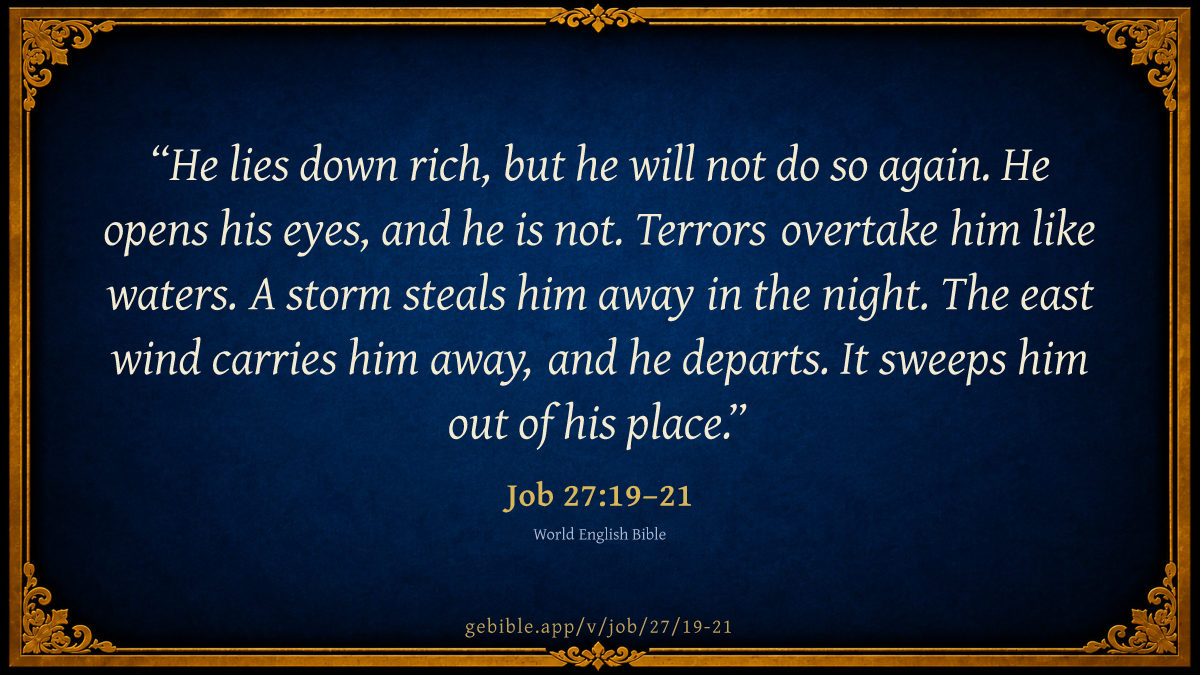
Job 27:19 The rich man shall lie down, but he shall not be gathered: he openeth his eyes, and he [is] not.
Ver. 19. The rich man shall lie down] That is, the wicked rich man, as Jas 5:1. Magna cognatio ut rei sic nominis, divitiis, et vitiis. He shall lie down, viz. in the streets, as being left homeless.
Read full note →
But he shall not be gathered] i.e. Taken into house or harbour by any man; but abhorred by all for his former cruelty.
He openeth his eyes, and he is not] He looketh about him on every side, but findeth no succour. There are that understand it of death: The rich man shall lie down, sc. in the dust of death; but shall not be gathered, that is, nec honorifice funerabitur; he shall not have the honour of a comely burial (Tigur.). Besides, he openeth his eyes, and he is not; upon his death bed he looks about for comfort (the mole, they say, never openeth her eyes till the pangs of death are upon her); but instead thereof shall see that threefold terrible spectacle, death, judgment, hell, and all to be passed through by his poor soul; hence, and no wonder.
John Trapp, A Commentary or Exposition upon All the Books of the Old and New Testament (1647–1656) — public domain. Text from a community e-Sword module.
Matthew Poole1685 · Public DomainOn vv19–21Shall lie down; either,
Shall lie down; either,
1. To sleep; as this word is used, Gen 19:35; Deu 6:7, &c. Or,
Read full note →
2. In death, of which it is used, 2Sa 7:12.
He shall not be gathered, to wit, in burial, of which this word is used, 2Ki 22:20; Jer 8:2; 25:33. Instead of that honourable interment and burial with his fathers which he expected, he shall be buried with the burial of an ass; his carcass shall lie like dung upon the earth.
He openeth his eyes so the sense is either,
1. He awaketh in the morning, promising to himself a happy day. Or,
2. He looks about him for help and relief in his extremity. But the words are and may be rendered thus, one openeth his eyes, i.e. whilst a man can open his eyes, in a moment, or in the twinkling of an eye.
He is not; he is as if he had never been, dead and gone, and his family and name extinct with him.
Matthew Poole's English Annotations on the Holy Bible (1683–1685) — public domain. Text from a community e-Sword/MySword module.
John Gill1763 · Public DomainOn vv19–21Terrors take hold on him as waters,.... The terrors…
Terrors take hold on him as waters,.... The terrors of death, and of an awful judgment that is to come after it; finding himself dying, death is the king of terrors to him, dreading not only the awful stroke of death itself, but of what is to follow upon it; or rather these terrors are those that seize the wicked man after death; perceiving what a horrible condition he is in, the terrors of a guilty conscience lay hold on him, remembering his former sins with all the aggravating circumstances of them; the terrors of the law's curses lighting upon him, and of the wrath and fury of the Almighty pouring out on him and surrounding him, and devils and damned spirits all about him. These will seize him "as waters", like a flood of waters, denoting the abundance of them, "terror on every side", a "Magormissabib", Jer 20:3, will he be, and coming with great rapidity, with an irresistible force, and without ceasing, rolling one after another in a sudden and surprising manner:
a tempest stealeth him away in the night; the tempest of divine wrath, from which there is no shelter but the person, blood, and righteousness of Christ; this comes like a thief, suddenly and unexpectedly, and steals the wicked man out of this world; or rather from the judgment seat, and carries him into the regions of darkness, of horror and black despair, where he is surrounded with the aforesaid terrors; this is said to be in the night, to make it the more shocking and terrible, see Luk 12:19; and may have respect to that blackness that attends a tempest, and to that blackness of darkness reserved for wicked men, Jde 1:13.
John Gill's Exposition of the Whole Bible (1746–1763) — public domain (CC PDM 1.0). Text via the HelloAO Bible API.
John Wesley1765 · Public DomainOn vv19–21Lie down - In death. Not gathered - Instead…
Lie down - In death. Not gathered - Instead of that honourable interment with his fathers, his carcase shall lie like dung upon the earth. One openeth his eyes - That is, while a man can open his eyes, in the twinkling of an eye. He is as if he had never been, dead and gone, and his family and name extinct with him.
John Wesley, Explanatory Notes Upon the Whole Bible (1754–1765) — public domain. Text via the GEBible commentary corpus.
Adam Clarke1810 · Public DomainOn vv19–21Verse 19. The rich man shall lie down] In…
Verse 19. The rich man shall lie down] In the grave.
But he shall not be gathered] Neither have a respectable burial among men, nor be gathered with the righteous in the kingdom of God. It may be that Job alludes here to an opinion relative to the state of certain persons after death, prevalent in all nations in ancient times, viz., that those whose funeral rites had not been duly performed, wander about as ghosts, and find no rest.
Read full note →
He openeth his eyes] In the morning of the resurrection.
And he is not.] He is utterly lost and undone for ever. This seems to be the plain sense of the passage; and so all the versions appear to have understood it; but Reiske and some others, by making יאסף yeaseph an Arabic word, signifying, not the idea of gathering, but care, anxiety, c., have quite altered this sense of the passage and Mr. Good, who copies them, translates thus: Let the rich man lie down, and care not. I see no manner of occasion to resort to this interpretation, which, in my judgment, gives a sense inferior to that given above, or to the following: The rich man shall lie down-go to his rest, fully persuaded that his property is in perfect safety; but he shall not be gathered, or he shall not gather-make any farther addition to his stores: he openeth his eyes in the morning, when he is not-marauders in the night have stripped him of all his property, as in the case of Job himself; a case quite probable, and not unfrequent in Arabia, when a hostile tribe makes a sudden incursion, and carries off an immense booty. But I prefer the first meaning, as it is obtained without crucifying the text. Coverdale translates: When the rich man dyeth, he carieth nothinge with him: he is gone in the twincklinge of an eye.
Adam Clarke's Commentary on the Bible (1810–1826) — public domain. Text from a community e-Sword/MySword module.
Joseph Benson1811 · Public DomainOn vv19–21Job 27:19. The rich man shall lie down —…
Job 27:19. The rich man shall lie down — In death; but he shall not be gathered — Namely, in burial, as this word יאסŠ, jeaseph, is often used. Instead of that honourable interment with his fathers, which he expected, his carcass shall lie like dung upon the earth. He openeth, or, one openeth his eyes, and he is not — That is, while a man can open his eyes, in a moment, or in the twinkling of an eye, he is as if he had never been; he is dead and gone, and his family and name are extinct with him.
Joseph Benson's Commentary on the Old and New Testaments (1811–1818) — public domain. Text from a community e-Sword module.
Albert Barnes1834 · Public DomainOn vv19–21The rich man - That is, the rich man…
The rich man - That is, the rich man who is wicked.
Shall lie down - Shalt die - for so the connection demands.
Read full note →
But he shall not be gathered - In an honorable burial. The slain in battle are gathered together for burial; but he shall be unburied. The expressions “to be gathered,” “to be gathered to one’s fathers,” frequently occur in the Scriptures, and seem to be used to denote a peaceful and happy death and an honorable burial. There was the idea of a happy union with departed friends; of being honorably placed by their side in the grave, and admitted to companionship with them again in the unseen world; compare Gen 25:8; Gen 35:29; Gen 49:29, Gen 49:33; Num 27:13; Deu 32:50; Jdg 2:10; 2Ki 22:20. Among the ancients, the opinion prevailed that the souls of those who were not buried in the customary manner, were not permitted to enter Hades, or the abodes of the dead, but were doomed to wander for an hundred years upon the banks of the river Styx. Thus, Homer (Iliad, 23:71, following) represents the spirit of Patroclus as appearing to Achilles, and praying him that he would commit his body with proper honors to the earth. So Palinurus is represented by Virgil (Aeneid, vi. 365) as saying, “Cast earth upon me, that I may have a calm repose in death.” The Hindoos, says Dr. Ward, believe that the souls of those who are unburied wander about and find no rest. It is possible that such views may have prevailed in the time of Job. The sentiment here is, that such an honored death would be denied the rich man of oppression and wickedness.
He openeth his eyes, and he is not - That is, in the twinkling of an eye he is no more. From the midst of his affluence he is suddenly cut off, and hurried away in a moment.
Albert Barnes' Notes on the Bible (1834–1885) — public domain. Text from a community e-Sword/MySword module.
Haydock's Catholic Bible Commentary1859 · Public DomainOn vv19–20Nothing. His riches are all left behind! The men…
Nothing. His riches are all left behind! The men of riches have slept their sleep, and have found nothing in their hands. They awake as from a dream, (chap. xx. 8.; Haydock) and then they form a true estimate of things. (Menochius) --- God chiefly punishes the wicked in death, Psalm lxxv. (Worthington)
George Leo Haydock (1774–1849), Haydock's Catholic Family Bible and Commentary, 1859 edition — public domain. Excludes Psalms (Douay-Rheims chapter numbering differs from Protestant) and Deuterocanonical books (Catholic canon only).
Robert Jamieson, A. R. Fausset & David Brown1871 · Public DomainOn vv19–21gathered--buried honorably (Gen 25:8; Kg2 22:20). But UMBREIT, agreeably…
gathered--buried honorably (Gen 25:8; Kg2 22:20). But UMBREIT, agreeably to Job 27:18, which describes the short continuance of the sinner's prosperity, "He layeth himself rich in his bed, and nothing is robbed from him, he openeth his eyes, and nothing more is there." If English Version be retained, the first clause probably means, rich though he be in dying, he shall not be honored with a funeral; the second, When he opens his eyes in the unseen world, it is only to see his destruction: the Septuagint reads for "not gathered," He does not proceed, that is, goes to his bed no more. So MAURER.
Jamieson, Fausset & Brown — Commentary Critical and Explanatory on the Whole Bible (1871) — public domain (CC PDM 1.0). Text via the HelloAO Bible API.
Daniel D. Whedon1874 · Public DomainOn vv19–21Strophe c — Suddenly and with violence he dies,…
Strophe c — Suddenly and with violence he dies, the scorn of nature and of man, rejected and shot at by God himself, Job_27:19-23.
19. The rich… lie down — He lieth down rich. Though the wicked man be rich at his death, he shall not be gathered; an obscure phrase, the meaning of which our translators have given correctly when they have made it of signification similar to Gen_25:8 — “Abraham was gathered to his people.” Since Abraham was buried in a land of strangers, and with Sarah only, the expression cannot signify mere burial with the dead, but rather pre-supposes continued conscious existence, and implies probably the communion of the dead. Compare Gen_15:15; Gen_25:8; Gen_25:17; Gen_35:29; Gen_49:29-33; Num_20:24, etc. The rendering of Ewald, Hirtzel, etc., follows the Septuagint, “he doeth it no more,” that is, “he lies down for the last time,” but is hardly justified by the form of the verb, which is passive. The trivial reading of Umbreit, based upon a different pointing, “and nothing is robbed from him,” Hitzig strangely enough accepts.
Read full note →
He openeth his eyes — So sudden and unexpected is his death: it is but a glance, an opening of the eye, and he is no more. Or it may express the surprise of the guilty soul when it awakens to consciousness in the unseen world. Luk_16:23.
Daniel D. Whedon (gen. ed.), Commentary on the Old and New Testaments (1874–1909) — public domain. Text from a community e-Sword module.
The Cambridge Bible for Schools and Colleges1878 · Public DomainOn vv19–2119. the rich man shall lie down] “Rich” is…
19. the rich man shall lie down] “Rich” is equivalent to “wicked,” Isa_53:9. The words might be rendered, he lieth down rich.
shall not be gathered] The parallel in the next clause, he is not, suggests the general sense, he shall rise no more. Perhaps the most probable sense is that he shall not “be gathered and buried,” according to the passages, Jer_8:2; Jer_25:33, Eze_29:5; he shall have no funeral solemnities but shall be carried away by a sudden destruction. Others assume (after the Sept.) a different vocalization, he shall do it (lie down) no more. This is rather flat.
Read full note →
he openeth his eyes, and he is not] The words describe the suddenness of his destruction. The phrase is no more remarkable than that in 2Ki_19:35, “When they arose early in the morning behold they were all dead corpses.” It is hardly necessary to circumscribe the words, “Hardly shall the sinner open his eyes, to view his destruction, when he is swept away.”
The Cambridge Bible for Schools and Colleges (gen. ed. J. J. S. Perowne; Cambridge University Press, 1878–1918) — public domain. Text from a community e-Sword module.
Ellicott's Commentary for English Readers1878 · Public DomainOn v19(19) But he shall not be gathered.—Some ancient versions…
(19) But he shall not be gathered.—Some ancient versions read, “but he shall do so no more;” but the “gathering” may refer to his wealth. “He openeth his eyes, and it (i.e., his wealth) is not;” or it may mean that as soon as he opens his eyes, hoping to enjoy his riches, he shall be no more, but be suddenly cut off. This sense appears to accord with the following verses.
A Bible Commentary for English Readers, edited by Charles John Ellicott (1878–1897) — public domain. Text from a community e-Sword module.
The Pulpit Commentary1880 · Public DomainOn vv19–21The rich man lieth down; rather, he lieth down…
The rich man lieth down; rather, he lieth down rich (see the Revised Version). But he shall not be gathered. If we accept the present text, we may translate, But it (i.e. his wealth) shall not be gathered"and suppose his wealth to have consisted in agricultural produce. Or we may alter psay into pyswOy, and translate, He lieth down rich, but he shall do so no more a correction to which the ou prosyhsei of the Septuagint points. He openeth his eyes, and he is not. Some translate, "It is not;" i.e. the harvest, in which his wealth consisted, is not it has been all destroyed by blight or robbers Those who render, "He is not," generally suppose that he opens his eyes only to find himself in the hands of murderers.
The Pulpit Commentary (1880–1919), ed. H.D.M. Spence-Jones & Joseph S. Exell — public domain. Text from a community e-Sword module.
unfoldingWord translationNotes2017 · CC BY-SA 4.0On v20Terrors overtake him
Terrors overtake him
Here "overtake him" represents suddenly happening to him. Possible meanings are that "terrors" is a metonym for 1) things that cause people to be afraid. AT: "Terrifying things suddenly happen to him" or 2) fear. AT: "He suddenly becomes terrified"
Read full note →
like waters
The word "waters" refers to a flood. Floods can happen very suddenly when people do not expect them, and they are dangerous and frightening. AT: "like a flood" or "like waters that rise up suddenly" (See: Simile)
a storm takes him away
"a violent wind blows him away"
it sweeps him out of his place
Job speaks of the wind blowing the wicked man out of his house as if the wind were a person sweeping dust out of a house with a broom. AT: "the wind sweeps him out of his place like a woman who sweeps dirt out of a house" or "the wind easily blows him out of his place" (See: Personification)
 GEBible — Godless Engineer's Bible App
Geneva Bible translators 1599 · Public Domain On v19 He meaneth, that the wicked tyrants shall not have…
He meaneth, that the wicked tyrants shall not have a quiet death, nor be buried honorably.
Geneva Bible (1599) marginal notes — public domain.
John Trapp 1656 · Public Domain On vv19–21 Job 27:19 The rich man shall lie down, but…
Job 27:19 The rich man shall lie down, but he shall not be gathered: he openeth his eyes, and he [is] not.
Ver. 19. The rich man shall lie down] That is, the wicked rich man, as Jas 5:1. Magna cognatio ut rei sic nominis, divitiis, et vitiis. He shall lie down, viz. in the streets, as being left homeless.
Read full note →
But he shall not be gathered] i.e. Taken into house or harbour by any man; but abhorred by all for his former cruelty.
He openeth his eyes, and he is not] He looketh about him on every side, but findeth no succour. There are that understand it of death: The rich man shall lie down, sc. in the dust of death; but shall not be gathered, that is, nec honorifice funerabitur; he shall not have the honour of a comely burial (Tigur.). Besides, he openeth his eyes, and he is not; upon his death bed he looks about for comfort (the mole, they say, never openeth her eyes till the pangs of death are upon her); but instead thereof shall see that threefold terrible spectacle, death, judgment, hell, and all to be passed through by his poor soul; hence, and no wonder.
John Trapp, A Commentary or Exposition upon All the Books of the Old and New Testament (1647–1656) — public domain. Text from a community e-Sword module.
Matthew Poole 1685 · Public Domain On vv19–21 Shall lie down; either,
Shall lie down; either,
1. To sleep; as this word is used, Gen 19:35; Deu 6:7, &c. Or,
Read full note →
2. In death, of which it is used, 2Sa 7:12.
He shall not be gathered, to wit, in burial, of which this word is used, 2Ki 22:20; Jer 8:2; 25:33. Instead of that honourable interment and burial with his fathers which he expected, he shall be buried with the burial of an ass; his carcass shall lie like dung upon the earth.
He openeth his eyes so the sense is either,
1. He awaketh in the morning, promising to himself a happy day. Or,
2. He looks about him for help and relief in his extremity. But the words are and may be rendered thus, one openeth his eyes, i.e. whilst a man can open his eyes, in a moment, or in the twinkling of an eye.
He is not; he is as if he had never been, dead and gone, and his family and name extinct with him.
Matthew Poole's English Annotations on the Holy Bible (1683–1685) — public domain. Text from a community e-Sword/MySword module.
John Gill 1763 · Public Domain On vv19–21 Terrors take hold on him as waters,.... The terrors…
Terrors take hold on him as waters,.... The terrors of death, and of an awful judgment that is to come after it; finding himself dying, death is the king of terrors to him, dreading not only the awful stroke of death itself, but of what is to follow upon it; or rather these terrors are those that seize the wicked man after death; perceiving what a horrible condition he is in, the terrors of a guilty conscience lay hold on him, remembering his former sins with all the aggravating circumstances of them; the terrors of the law's curses lighting upon him, and of the wrath and fury of the Almighty pouring out on him and surrounding him, and devils and damned spirits all about him. These will seize him "as waters", like a flood of waters, denoting the abundance of them, "terror on every side", a "Magormissabib", Jer 20:3, will he be, and coming with great rapidity, with an irresistible force, and without ceasing, rolling one after another in a sudden and surprising manner:
a tempest stealeth him away in the night; the tempest of divine wrath, from which there is no shelter but the person, blood, and righteousness of Christ; this comes like a thief, suddenly and unexpectedly, and steals the wicked man out of this world; or rather from the judgment seat, and carries him into the regions of darkness, of horror and black despair, where he is surrounded with the aforesaid terrors; this is said to be in the night, to make it the more shocking and terrible, see Luk 12:19; and may have respect to that blackness that attends a tempest, and to that blackness of darkness reserved for wicked men, Jde 1:13.
John Gill's Exposition of the Whole Bible (1746–1763) — public domain (CC PDM 1.0). Text via the HelloAO Bible API.
John Wesley 1765 · Public Domain On vv19–21 Lie down - In death. Not gathered - Instead…
Lie down - In death. Not gathered - Instead of that honourable interment with his fathers, his carcase shall lie like dung upon the earth. One openeth his eyes - That is, while a man can open his eyes, in the twinkling of an eye. He is as if he had never been, dead and gone, and his family and name extinct with him.
John Wesley, Explanatory Notes Upon the Whole Bible (1754–1765) — public domain. Text via the GEBible commentary corpus.
Adam Clarke 1810 · Public Domain On vv19–21 Verse 19. The rich man shall lie down] In…
Verse 19. The rich man shall lie down] In the grave.
But he shall not be gathered] Neither have a respectable burial among men, nor be gathered with the righteous in the kingdom of God. It may be that Job alludes here to an opinion relative to the state of certain persons after death, prevalent in all nations in ancient times, viz., that those whose funeral rites had not been duly performed, wander about as ghosts, and find no rest.
Read full note →
He openeth his eyes] In the morning of the resurrection.
And he is not.] He is utterly lost and undone for ever. This seems to be the plain sense of the passage; and so all the versions appear to have understood it; but Reiske and some others, by making יאסף yeaseph an Arabic word, signifying, not the idea of gathering, but care, anxiety, c., have quite altered this sense of the passage and Mr. Good, who copies them, translates thus: Let the rich man lie down, and care not. I see no manner of occasion to resort to this interpretation, which, in my judgment, gives a sense inferior to that given above, or to the following: The rich man shall lie down-go to his rest, fully persuaded that his property is in perfect safety; but he shall not be gathered, or he shall not gather-make any farther addition to his stores: he openeth his eyes in the morning, when he is not-marauders in the night have stripped him of all his property, as in the case of Job himself; a case quite probable, and not unfrequent in Arabia, when a hostile tribe makes a sudden incursion, and carries off an immense booty. But I prefer the first meaning, as it is obtained without crucifying the text. Coverdale translates: When the rich man dyeth, he carieth nothinge with him: he is gone in the twincklinge of an eye.
Adam Clarke's Commentary on the Bible (1810–1826) — public domain. Text from a community e-Sword/MySword module.
Joseph Benson 1811 · Public Domain On vv19–21 Job 27:19. The rich man shall lie down —…
Job 27:19. The rich man shall lie down — In death; but he shall not be gathered — Namely, in burial, as this word יאסŠ, jeaseph, is often used. Instead of that honourable interment with his fathers, which he expected, his carcass shall lie like dung upon the earth. He openeth, or, one openeth his eyes, and he is not — That is, while a man can open his eyes, in a moment, or in the twinkling of an eye, he is as if he had never been; he is dead and gone, and his family and name are extinct with him.
Joseph Benson's Commentary on the Old and New Testaments (1811–1818) — public domain. Text from a community e-Sword module.
Albert Barnes 1834 · Public Domain On vv19–21 The rich man - That is, the rich man…
The rich man - That is, the rich man who is wicked.
Shall lie down - Shalt die - for so the connection demands.
Read full note →
But he shall not be gathered - In an honorable burial. The slain in battle are gathered together for burial; but he shall be unburied. The expressions “to be gathered,” “to be gathered to one’s fathers,” frequently occur in the Scriptures, and seem to be used to denote a peaceful and happy death and an honorable burial. There was the idea of a happy union with departed friends; of being honorably placed by their side in the grave, and admitted to companionship with them again in the unseen world; compare Gen 25:8; Gen 35:29; Gen 49:29, Gen 49:33; Num 27:13; Deu 32:50; Jdg 2:10; 2Ki 22:20. Among the ancients, the opinion prevailed that the souls of those who were not buried in the customary manner, were not permitted to enter Hades, or the abodes of the dead, but were doomed to wander for an hundred years upon the banks of the river Styx. Thus, Homer (Iliad, 23:71, following) represents the spirit of Patroclus as appearing to Achilles, and praying him that he would commit his body with proper honors to the earth. So Palinurus is represented by Virgil (Aeneid, vi. 365) as saying, “Cast earth upon me, that I may have a calm repose in death.” The Hindoos, says Dr. Ward, believe that the souls of those who are unburied wander about and find no rest. It is possible that such views may have prevailed in the time of Job. The sentiment here is, that such an honored death would be denied the rich man of oppression and wickedness.
He openeth his eyes, and he is not - That is, in the twinkling of an eye he is no more. From the midst of his affluence he is suddenly cut off, and hurried away in a moment.
Albert Barnes' Notes on the Bible (1834–1885) — public domain. Text from a community e-Sword/MySword module.
Haydock's Catholic Bible Commentary 1859 · Public Domain On vv19–20 Nothing. His riches are all left behind! The men…
Nothing. His riches are all left behind! The men of riches have slept their sleep, and have found nothing in their hands. They awake as from a dream, (chap. xx. 8.; Haydock) and then they form a true estimate of things. (Menochius) --- God chiefly punishes the wicked in death, Psalm lxxv. (Worthington)
George Leo Haydock (1774–1849), Haydock's Catholic Family Bible and Commentary, 1859 edition — public domain. Excludes Psalms (Douay-Rheims chapter numbering differs from Protestant) and Deuterocanonical books (Catholic canon only).
Robert Jamieson, A. R. Fausset & David Brown 1871 · Public Domain On vv19–21 gathered--buried honorably (Gen 25:8; Kg2 22:20). But UMBREIT, agreeably…
gathered--buried honorably (Gen 25:8; Kg2 22:20). But UMBREIT, agreeably to Job 27:18, which describes the short continuance of the sinner's prosperity, "He layeth himself rich in his bed, and nothing is robbed from him, he openeth his eyes, and nothing more is there." If English Version be retained, the first clause probably means, rich though he be in dying, he shall not be honored with a funeral; the second, When he opens his eyes in the unseen world, it is only to see his destruction: the Septuagint reads for "not gathered," He does not proceed, that is, goes to his bed no more. So MAURER.
Jamieson, Fausset & Brown — Commentary Critical and Explanatory on the Whole Bible (1871) — public domain (CC PDM 1.0). Text via the HelloAO Bible API.
Daniel D. Whedon 1874 · Public Domain On vv19–21 Strophe c — Suddenly and with violence he dies,…
Strophe c — Suddenly and with violence he dies, the scorn of nature and of man, rejected and shot at by God himself, Job_27:19-23.
19. The rich… lie down — He lieth down rich. Though the wicked man be rich at his death, he shall not be gathered; an obscure phrase, the meaning of which our translators have given correctly when they have made it of signification similar to Gen_25:8 — “Abraham was gathered to his people.” Since Abraham was buried in a land of strangers, and with Sarah only, the expression cannot signify mere burial with the dead, but rather pre-supposes continued conscious existence, and implies probably the communion of the dead. Compare Gen_15:15; Gen_25:8; Gen_25:17; Gen_35:29; Gen_49:29-33; Num_20:24, etc. The rendering of Ewald, Hirtzel, etc., follows the Septuagint, “he doeth it no more,” that is, “he lies down for the last time,” but is hardly justified by the form of the verb, which is passive. The trivial reading of Umbreit, based upon a different pointing, “and nothing is robbed from him,” Hitzig strangely enough accepts.
Read full note →
He openeth his eyes — So sudden and unexpected is his death: it is but a glance, an opening of the eye, and he is no more. Or it may express the surprise of the guilty soul when it awakens to consciousness in the unseen world. Luk_16:23.
Daniel D. Whedon (gen. ed.), Commentary on the Old and New Testaments (1874–1909) — public domain. Text from a community e-Sword module.
The Cambridge Bible for Schools and Colleges 1878 · Public Domain On vv19–21 19. the rich man shall lie down] “Rich” is…
19. the rich man shall lie down] “Rich” is equivalent to “wicked,” Isa_53:9. The words might be rendered, he lieth down rich.
shall not be gathered] The parallel in the next clause, he is not, suggests the general sense, he shall rise no more. Perhaps the most probable sense is that he shall not “be gathered and buried,” according to the passages, Jer_8:2; Jer_25:33, Eze_29:5; he shall have no funeral solemnities but shall be carried away by a sudden destruction. Others assume (after the Sept.) a different vocalization, he shall do it (lie down) no more. This is rather flat.
Read full note →
he openeth his eyes, and he is not] The words describe the suddenness of his destruction. The phrase is no more remarkable than that in 2Ki_19:35, “When they arose early in the morning behold they were all dead corpses.” It is hardly necessary to circumscribe the words, “Hardly shall the sinner open his eyes, to view his destruction, when he is swept away.”
The Cambridge Bible for Schools and Colleges (gen. ed. J. J. S. Perowne; Cambridge University Press, 1878–1918) — public domain. Text from a community e-Sword module.
Ellicott's Commentary for English Readers 1878 · Public Domain On v19 (19) But he shall not be gathered.—Some ancient versions…
(19) But he shall not be gathered.—Some ancient versions read, “but he shall do so no more;” but the “gathering” may refer to his wealth. “He openeth his eyes, and it (i.e., his wealth) is not;” or it may mean that as soon as he opens his eyes, hoping to enjoy his riches, he shall be no more, but be suddenly cut off. This sense appears to accord with the following verses.
A Bible Commentary for English Readers, edited by Charles John Ellicott (1878–1897) — public domain. Text from a community e-Sword module.
The Pulpit Commentary 1880 · Public Domain On vv19–21 The rich man lieth down; rather, he lieth down…
The rich man lieth down; rather, he lieth down rich (see the Revised Version). But he shall not be gathered. If we accept the present text, we may translate, But it (i.e. his wealth) shall not be gathered"and suppose his wealth to have consisted in agricultural produce. Or we may alter psay into pyswOy, and translate, He lieth down rich, but he shall do so no more a correction to which the ou prosyhsei of the Septuagint points. He openeth his eyes, and he is not. Some translate, "It is not;" i.e. the harvest, in which his wealth consisted, is not it has been all destroyed by blight or robbers Those who render, "He is not," generally suppose that he opens his eyes only to find himself in the hands of murderers.
The Pulpit Commentary (1880–1919), ed. H.D.M. Spence-Jones & Joseph S. Exell — public domain. Text from a community e-Sword module.
unfoldingWord translationNotes 2017 · CC BY-SA 4.0 On v20 Terrors overtake him
Terrors overtake him
Here "overtake him" represents suddenly happening to him. Possible meanings are that "terrors" is a metonym for 1) things that cause people to be afraid. AT: "Terrifying things suddenly happen to him" or 2) fear. AT: "He suddenly becomes terrified"
Read full note →
like waters
The word "waters" refers to a flood. Floods can happen very suddenly when people do not expect them, and they are dangerous and frightening. AT: "like a flood" or "like waters that rise up suddenly" (See: Simile)
a storm takes him away
"a violent wind blows him away"
it sweeps him out of his place
Job speaks of the wind blowing the wicked man out of his house as if the wind were a person sweeping dust out of a house with a broom. AT: "the wind sweeps him out of his place like a woman who sweeps dirt out of a house" or "the wind easily blows him out of his place" (See: Personification)
his place
"his home"
translationWords
terror
water
unfoldingWord translationNotes — © Distant Shores Media and the Door43 World Missions Community, licensed CC BY-SA 4.0. Source: git.door43.org/Door43/en_tn.