Matthew 16:26(v8)For what will it profit a man, if he gains the whole world, and forfeits his life? Or what will a man give in exchange for his life?
Jeremiah 14:12(v9)When they fast, I will not hear their cry; and when they offer burnt offering and meal offering, I will not accept them; but I will consume…
Proverbs 1:28(v9)Then they will call on me, but I will not answer. They will seek me diligently, but they will not find me;
Isaiah 1:15(v9)When you spread out your hands, I will hide my eyes from you. Yes, when you make many prayers, I will not hear. Your hands are full of…
Job 22:26-27(v10)For then you will delight yourself in the Almighty, and will lift up your face to God. You will make your prayer to him, and he will hear…
Show all 40 cross-references
Job 35:12-13(v9)There they cry, but no one answers, because of the pride of evil men. Surely God will not hear an empty cry, neither will the Almighty…
Psalms 18:41(v9)They cried, but there was no one to save; even to Yahweh, but he didn’t answer them.
Psalms 37:4(v10)Also delight yourself in Yahweh, and he will give you the desires of your heart.
Micah 3:4(v9)Then they will cry to Yahweh, but he will not answer them. Yes, he will hide his face from them at that time, because they made their deeds…
Job 8:13(v8)So are the paths of all who forget God. The hope of the godless man will perish,
Psalms 66:18(v9)If I cherished sin in my heart, the Lord wouldn’t have listened.
Proverbs 28:9(v9)He who turns away his ear from hearing the law, even his prayer is an abomination.
Jeremiah 11:11(v9)Therefore Yahweh says, ‘Behold, I will bring evil on them, which they will not be able to escape; and they will cry to me, but I will not…
Ezekiel 8:18(v9)Therefore I will also deal in wrath. My eye won’t spare, neither will I have pity. Though they cry in my ears with a loud voice, yet I will…
Hosea 7:14(v9)They haven’t cried to me with their heart, but they howl on their beds. They assemble themselves for grain and new wine. They turn away…
Zechariah 7:13(v9)It has come to pass that, as he called, and they refused to listen, so they will call, and I will not listen,” said Yahweh of Armies;
James 4:3(v9)You ask, and don’t receive, because you ask with wrong motives, so that you may spend it on your pleasures.
Job 11:20(v8)But the eyes of the wicked will fail. They will have no way to flee. Their hope will be the giving up of the spirit.”
Psalms 109:7(v9)When he is judged, let him come out guilty. Let his prayer be turned into sin.
Habakkuk 3:18(v10)yet I will rejoice in Yahweh. I will be joyful in the God of my salvation!
Luke 12:20-21(v8)“But God said to him, ‘You foolish one, tonight your soul is required of you. The things which you have prepared—whose will they be?’ So is…
Luke 13:25(v9)When once the master of the house has risen up, and has shut the door, and you begin to stand outside and to knock at the door, saying,…
John 9:31(v9)We know that God doesn’t listen to sinners, but if anyone is a worshiper of God, and does his will, he listens to him.
Job 13:16(v8)This also will be my salvation, that a godless man will not come before him.
Job 15:34(v8)For the company of the godless will be barren, and fire will consume the tents of bribery.
Job 20:5(v8)that the triumphing of the wicked is short, the joy of the godless but for a moment?
Job 31:3(v8)Is it not calamity to the unrighteous, and disaster to the workers of iniquity?
Psalms 43:4(v10)Then I will go to the altar of God, to God, my exceeding joy. I will praise you on the harp, God, my God.
Psalms 78:34-36(v10)When he killed them, then they inquired after him. They returned and sought God earnestly. They remembered that God was their rock, the…
Isaiah 33:14-15(v8)The sinners in Zion are afraid. Trembling has seized the godless ones. Who among us can live with the devouring fire? Who among us can live…
Matthew 13:21(v10)yet he has no root in himself, but endures for a while. When oppression or persecution arises because of the word, immediately he stumbles.
Matthew 23:13(v8)“Woe to you, scribes and Pharisees, hypocrites! For you devour widows’ houses, and as a pretense you make long prayers. Therefore you will…
Mark 8:36-37(v8)For what does it profit a man, to gain the whole world, and forfeit his life? For what will a man give in exchange for his life?
Luke 9:25(v8)For what does it profit a man if he gains the whole world, and loses or forfeits his own self?
Luke 18:1(v10)He also spoke a parable to them that they must always pray, and not give up,
Acts 10:2(v10)a devout man, and one who feared God with all his house, who gave gifts for the needy generously to the people, and always prayed to God.
Ephesians 6:18(v10)with all prayer and requests, praying at all times in the Spirit, and being watchful to this end in all perseverance and requests for all…
1 Timothy 6:9-10(v8)But those who are determined to be rich fall into a temptation, a snare, and many foolish and harmful lusts, such as drown men in ruin and…
James 5:1-3(v8)Come now, you rich, weep and howl for your miseries that are coming on you. Your riches are corrupted and your garments are moth-eaten.…
Cross-references from openbible.info (CC BY 4.0)
Explain this passage (17 sources)
Historical commentary, presented as a primary source — not an endorsement.
Geneva Bible translators1599 · Public DomainOn v8What advantage hath the dissembler to gain never so…
What advantage hath the dissembler to gain never so much, seeing he shall lose his own soul?
Geneva Bible (1599) marginal notes — public domain.
John Trapp1656 · Public DomainOn vv8–10Job 27:8 For what [is] the hope of the…
Job 27:8 For what [is] the hope of the hypocrite, though he hath gained, when God taketh away his soul?
Ver. 8. For what is the hope of the hypocrite, &c.] Here Job proveth himself to be no hypocrite, by his and their different character and carriage, especially under affliction. Though God kill Job, yet he will trust in him; but "what is the hope of the hypocrite?" &c. He that maketh a bridge of his own shadow must needs fall into the brook. The common hope thinks it takes hold of God; but it is but as a child that catcheth at the shadow on the wall, which he thinks he holdeth fast in his hand, but soon finds it otherwise; so shall the hypocrite at death, his hope shall be then as the giving up of the ghost, and that is but cold comfort. While he was in health, and had all well about him, he nourished strong hopes of God’s favour, and the rather because he gained and gathered wealth apace. So bladder like is the soul that is filled with earthly vanities, though but wind, it grows great, and swells in high conceitedness; but if pricked with the least pin of piercing grief (how much more when struck with death’s dart!) it shriveleth to nothing, and is ready to say, as one rich wretch did on his death bed, Spes et fortuna valete, Life and hope, adieu to you both at once.
Read full note →
Though he hath gained] Or, When he hath been covetous; raking together Rem, rem, quocunque modo rem. See this notably exemplified in that rich fool, Luk 12:20, whose life and hopes ended together.
When God taketh away his soul?] Extrahet, Shall pull it out by violence, as a sword out of his sheath; when God shall make a breach upon their citadel, come upon them by forcible entry, turn them out of their cottages of clay, by a firmae eiectione, cut them in twain, as he did that evil servant, Mat 24:50-51, tear their bodies and souls asunder, as a man teareth the bark from the tree, or the shell from the fish, leaving it naked. Where, then, shall be the high hopes of the hypocrite? And oh what a dreadful shriek giveth his guilty soul then, to see itself launching into an infinite ocean of scalding lead, and to consider that it must swim naked in it for ever!
John Trapp, A Commentary or Exposition upon All the Books of the Old and New Testament (1647–1656) — public domain. Text from a community e-Sword module.
Matthew Poole1685 · Public DomainOn vv8–10There is no reason why I should envy or…
There is no reason why I should envy or desire the portion of wicked men; for though they ofttimes prosper in the world, as I have said, and seem to be great gainers, yet death, which hasteneth to all men, and to me especially, will show that they are far greater losers, and die in a most wretched and desperate condition; having no hope either of continuing in this life, which they chiefly desire, or of enjoying a better life, which they never regarded. But I have a firm and well-grounded hope, not of that temporal restitution which you promised me, but of a blessed immortality after death, and therefore am none of these hopeless hypocrites, as you account me. Taketh away; or, expelleth, or plucketh up; which notes violence, and that he died unwillingly; compare Luk 12:20; when good men are said freely and cheerfully to give themselves or their souls unto God.
Matthew Poole's English Annotations on the Holy Bible (1683–1685) — public domain. Text from a community e-Sword/MySword module.
John Gill1763 · Public DomainOn vv8–10For what is the hope of the hypocrite,.... In…
For what is the hope of the hypocrite,.... In religion, who seems to be what he is not, a holy and righteous man; professes to have what he has not, the grace of God; pretends to do what he does not, worship God sincerely and fervently, and does all he does to be seen of men; though such a man may have an hope, as he has, of an interest in the divine layout, and of eternal glory and happiness, what will it signify? what avail will it be unto him? what will it issue in? Job was of the same mind in this with Bildad and Zophar, that such a man's hope is as the spider's web, and as the giving up of the ghost, Job 8:14; however he may please himself with it in this life, it will be of no service to him at death; for it is not like that of the true believer's, that is sure and steadfast, and founded upon the perfect righteousness and sacrifice of Christ; but upon his outward substance, fancying, that because God prospers him in this world, he is highly in his favour, and shall enjoy the happiness of the world to come; and upon his external profession of religion, and found of duties performed by him, but he will find himself mistaken: though he hath gained; great wealth and riches under a guise of religion, and by that means making gain of godliness, and taking the one for the other; so the Targum,
"because he hath gathered the mammon of falsehood;''
Read full note →
and also has great gifts, and a great deal of head knowledge, being able to talk of and dispute about most points of religion, and so has gained a great name among men both for knowledge and holiness, and yet all will not stand him in any stead, or be of any advantage to him:
when God taketh away his soul? out of his body by death, as a sword is drawn out of its scabbard, and which is as easily done by him; or as a shoe is plucked off from the foot, as Aben Ezra, and what he has a right to do, and will do it: and this taking it away seems to be in a violent manner, though not by what is called a violent death, yet against the will of the person; a good man is willing to die, is desirous of it, and gives up the ghost cheerfully; but an hypocrite is not willing to die, being afraid of death, and therefore his life or soul is taken from him without his consent and will, and not in love but in wrath, as the latter part of this chapter shows. Now Job had an hope which bore him up under all his troubles, and which he retained in the most killing and distressed circumstances, and which continued with him, and supported him in the views of death and eternity, so that he could look upon death, and into another world, with pleasure, and therefore could be no hypocrite, see Job 13:15.
John Gill's Exposition of the Whole Bible (1746–1763) — public domain (CC PDM 1.0). Text via the HelloAO Bible API.
John Wesley1765 · Public DomainOn vv8, 10Though - Though they prosper in the world. God,…
Though - Though they prosper in the world. God, as the judge takes it away, to be tried, and determined to its everlasting state. And what will his hope be then? It will be vanity and a lie; it will stand him in no stead.
John Wesley, Explanatory Notes Upon the Whole Bible (1754–1765) — public domain. Text via the GEBible commentary corpus.
Adam Clarke1810 · Public DomainOn v8Verse 8. What is the hope of the hypocrite]…
Verse 8. What is the hope of the hypocrite] The word חנף chaneph, which we translate, most improperly, hypocrite, means a wicked fellow, a defiled, polluted wretch, a rascal, a knave, a man who sticks at nothing in order to gain his ends. In this verse it means a dishonest man, a rogue, who by overreaching, cheating, c., has amassed a fortune.
When God taketh away his soul?] Could he have had any well grounded hope of eternal blessedness when he was acquiring earthly property by guilt and deceit? And of what avail will this property be when his soul is summoned before the judgment-seat? A righteous man yields up his soul to God the wicked does not, because he is afraid of God, of death, and of eternity. God therefore takes the soul away - forces it out of the body. Mr. Blair gives us an affecting picture of the death of a wicked man. Though well known, I shall insert it as a striking comment on this passage: -
Read full note →
"How shocking must thy summons be, O death!
To him that is at ease in his possessions;
Who, counting on long years of pleasures here;
Is quite unfurnished for that world to come!
In that dread moment how the frantic soul
Raves round the walls of her clay tenement;
Runs to each avenue, and shrieks for help,
But shrieks in vain! How wishfully she looks
On all she's leaving, now no longer hers!
A little longer, yet a little longer,
O, might she stay, to wash away her stains,
And fit her for her passage! Mournful sight!
Her very eyes weep blood; and every groan
She heaves is big with horror. But the foe,
Like a stanch murderer, steady to his purpose,
Pursues her close, through every lane of life,
Nor misses once the track, but presses on;
Till, forced at last to the tremendous verge,
At once she sinks to everlasting ruin."
THE GRAVE.
The Chaldee has, What can the detractor expect who has gathered together (ממון דשקר mamon dishkar, the mammon of unrighteousness) when God plucks out his soul? The Septuagint: Τις γαρ εστιν ετι ελπις ασεβει, ὁτι επεχει; Μη πεποιθως επι Κυριον ει αρα σωθησεται; "For what is the hope of the ungodly that he should wait for? shall he, by hoping in the Lord, be therefore saved?" Mr. Good translates differently from all the versions: -
"Yet what is the hope of the wicked that he should prosper,
That God should keep his soul in quiet?"
I believe our version gives as true a sense as any; and the words appear to have been in the eye of our Lord, when he said, "For what is a man profited if he shall gain the whole world and lose his own soul? or what shall a man give in exchange for his soul?" Mt 16:26.
Adam Clarke's Commentary on the Bible (1810–1826) — public domain. Text from a community e-Sword/MySword module.
Joseph Benson1811 · Public DomainOn vv8–10Job 27:8. What is the hope of the hypocrite,…
Job 27:8. What is the hope of the hypocrite, though he hath gained? — There is no reason why I should envy or desire the portion of wicked men: although they ofttimes prosper in the world, and seem to be great gainers; yet death, which hasteneth to all men, and to me especially, will show that they are far greater losers, and die in a most wretched and desperate condition, having no hope either of continuing in this life, which they chiefly desire, or of enjoying a better life, which they never regarded. But I have a firm and well-grounded hope, not of that temporal restitution which you promise, but of a blessed immortality after death; and therefore I am not a hopeless hypocrite, as you think me to be. When God taketh away his soul — When, much against his will, and by an act of violence, (as the word ישׁל, jeshel, here used, signifies,) God, as the Judge, takes his soul out of his body, that it may be tried and determined to its everlasting state. What will his hope be then? It will be vanity and a lie; it will stand him in no stead. The wealth of this world, which he hoped in, he must leave behind him, and the happiness of the other world, which he hoped for, he will certainly fall short of; his hopes, therefore, will disappoint and make him ashamed.
Joseph Benson's Commentary on the Old and New Testaments (1811–1818) — public domain. Text from a community e-Sword module.
Albert Barnes1834 · Public DomainOn vv8–10For what is the hope of the hypocrite? -…
For what is the hope of the hypocrite? - The same sentiment which Job here advances had before been expressed by Bildad; see it explained in the notes at Job 8:13 following It had also been expressed in a similar manner by Zophar (see the notes on Job 20:5, and had been much insisted on in their arguments. Job now says that he fully accords with that belief. He was not disposed to defend hypocrisy; he had no sympathy for it. He knew, as they did, that all the joy of a hypocrite would be temporary, and that when death came it must vanish. He wishes that his remarks should not be construed so as to make him the advocate of hypocrisy or sin, and affirms that he relied on a more solid foundation of peace and joy than the hypocrite could possess. It was by explanations and admissions such as these that the controversy was gradually closed, and when they came fully to understand Job, they felt that they had nothing which they could reply to him.
Though he hath gained - - יבצע yı̂bâtsa‛. The Vulgate renders this, si avare rapiat - “if he avariciously seizes upon.” The Septuagint, ὅτι hoti ἐπἐχει epechei that he persisteth. Dr. Good, “That he should prosper;” and so Wemyss. The Hebrew word (בצע bâtsa‛) means properly, to cut or dash in pieces; then to tear in pieces, or to plunder or spoil; then to cut off, to bring to an end, etc. It is applied to the action of a weaver, who, when his web is finished, cuts off the thrum that binds it to the beam. The web is then finished; it is all woven, and is then taken from the loom. Hence, it is elegantly used to denote the close of life, when life is woven or finished - by the rapid passing of days like the weavers shuttle Job 7:6, and when it is then, as it were, taken out of the loom; see this figure explained in the notes at Isa 38:12. This is the idea here, that life would be cut off like the weaver’s web, and that when that was done the hope of the hypocrite would be of no value.
Read full note →
When God taketh away his soul - When he dies. There has been much perplexity felt in regard to the Hebrew word here rendered “taketh away” - ישׁל yēshel. A full explanation may be seen in Schultens and Rosenmuller. Some suppose it is the future from נשל for ישל - meaning to draw out, and that the idea is, that God draws out this life as a sword is drawn out of a sheath. Others, that it is from שלה - to be secure, or tranquil, or at rest: and that it refers to the time when God shall give rest in the grave, or that the meaning of the word שלה here is the same as שלל or נשל - to draw out; see Gesenius on the word שלה. Schnurrer conjectures that it is derived from שאל - to ask, to demand, and that the form here is contracted from the future ישאל. But the common supposition is, that it means to draw out - in allusion to drawing out a sword from a scabbard - thus drawing life or the soul from the body.
Albert Barnes' Notes on the Bible (1834–1885) — public domain. Text from a community e-Sword/MySword module.
Haydock's Catholic Bible Commentary1859 · Public DomainOn vv8–9Soul, in death: What will it profit? &c., Matthew…
Soul, in death: What will it profit? &c., Matthew xvi. 26. All this proves demonstratively another world. (Calmet)
George Leo Haydock (1774–1849), Haydock's Catholic Family Bible and Commentary, 1859 edition — public domain. Excludes Psalms (Douay-Rheims chapter numbering differs from Protestant) and Deuterocanonical books (Catholic canon only).
Robert Jamieson, A. R. Fausset & David Brown1871 · Public DomainOn vv8–10"What hope hath the hypocrite, notwithstanding all his gains,…
"What hope hath the hypocrite, notwithstanding all his gains, when?" &c. "Gained" is antithetic to "taketh away." UMBREIT'S translation is an unmeaning tautology. "When God cuts off, when He taketh away his life."
taketh away--literally, "draws out" the soul from the body, which is, as it were, its scabbard (Job 4:21; Psa 104:29; Dan 7:15). Job says that he admits what Bildad said (Job 8:13) and Zophar (Job 20:5). But he says the very fact of his still calling upon God (Job 27:10) amid all his trials, which a hypocrite would not dare to do, shows he is no "hypocrite."
Jamieson, Fausset & Brown — Commentary Critical and Explanatory on the Whole Bible (1871) — public domain (CC PDM 1.0). Text via the HelloAO Bible API.
Daniel D. Whedon1874 · Public DomainOn vv8, 108. For — Job appeals to the want of…
8. For — Job appeals to the want of religious experience on the part of the ungodly to show that he cannot be accounted such.
Gained (unjustly) — Thus the Syriac, Chaldee, Vulgate, Arnheim, Gesenius, Furst, etc. The exhaustive comment of Tayler Lewis abundantly shows that Zockler, (in Lange,) Dillmann, etc., are wrong in reading כי יבצע, “When he cutteth off.” The transition from the prime meaning of batsa’h, “break off,” “plunder” (for gain,) to its secondary meaning “gain,” is easy and natural. The construction of Zockler, etc., mixes the metaphor, and demands, contrary to Hebrew usage, the same subject for two successive verbs, each preceded by כי; also it destroys the parallelism. The resemblance between the text and the profound question of Christ (Mar_8:36) is worthy of note.
Read full note →
Taketh away — Literally, Draweth out, as a sword from its sheath, as in Dan_7:15, (see margin,) where the body is called a sheath. The Talmud, the Hindu, and the Roman, (Pliny,) use the same metaphor. The Hindu Vedanta says, “The soul is in the body as in a sheath.” — COLEBROOK, Misc. Essays, 1:372. Gesenius (Thes., 855) cites a philosopher who, being despised by Alexander on account of his ugliness, responded: “The body is nothing but the sheath of a sword in which the soul is concealed.” While the figure of the text painfully expresses the resistance of the soul against its severance from the body, (compare Gen_35:18,) it assumes a separate existence for the soul. To speak of hope for a man after his death, unless the soul be conscious, would be a palpable absurdity. The passage is among the many of this book that take for granted the conscious existence of the wicked after death, and by implication the immortality of all.
Daniel D. Whedon (gen. ed.), Commentary on the Old and New Testaments (1874–1909) — public domain. Text from a community e-Sword module.
The Cambridge Bible for Schools and Colleges1878 · Public DomainOn vv8, 108. The verse most probably means,
8. The verse most probably means,
For what is the hope of the godless man when God cutteth off,
Read full note →
When he taketh away his soul?
lit. when He cutteth off, when God draweth out his soul. The comfortless state of the ungodly man (A. V. hypocrite, see on ch. Job_8:13), who has no trust in God, is described in three conditions of his history, first, when he is at the moment of death, when God “cutteth (him) off” and “draweth out his soul” (Job_27:8); second, when calamity overtakes him (Job_27:9); and in general, in his whole life (Job_27:10).
The Cambridge Bible for Schools and Colleges (gen. ed. J. J. S. Perowne; Cambridge University Press, 1878–1918) — public domain. Text from a community e-Sword module.
Ellicott's Commentary for English Readers1878 · Public DomainOn vv8, 10(8) What is the hope?—Better, What is the hope…
(8) What is the hope?—Better, What is the hope of the godless, though he get him gain, when God taketh away his soul?
A Bible Commentary for English Readers, edited by Charles John Ellicott (1878–1897) — public domain. Text from a community e-Sword module.
The Pulpit Commentary1880 · Public DomainOn vv8–10For what is the hope of the hypocrite, though…
For what is the hope of the hypocrite, though he hath gained. The hypocrite and liar may get advantage in this life by his lies and his hypocrisy. He may deceive men; he may raise himself in their opinion; he may derive worldly advantage from having secured their approval But what will he have to look forward rein the end, when God taketh away (i.e. removeth from earth) his soul? Job evidently regards the soul that is "taken away" or removed from earth as still existing, still conscious, still capable of hope or of despair, and asks what hope of a happy future could the man who had lived a hypocrite entertain, when God required his soul, and he felt under God"s judgment. The question reminds us of those words of our blessed Lord shall it profit a man, if he gain the whole world, and lose his own soul? or what shall a man give in exchange for his soul?". (Mar_8:36, 37)
Vers. 8-12. The hope of the hypocrite.
Read full note →
Job, the man of integrity, who was determined to hold fast his integrity until death, saw plainly that the hypocrite had no ground of confidence, and he boldly makes the demand," What is the hope of the hypocrite?" It is an appeal that can receive no satisfying answer. There is no hope for him, indeed; whatever he may imagine it to be, it is as a bubble that floats on the water for a short time, then bursts, and no trace is left of it. His confidence is placed on an unsafe foundation; he may build his expectations upon it, but the inevitable flood of time will wash it away. It is a vain, groundless, lost, disappointed hope. Job directs his inquiry into one channel What is the hypocrite"s hope as towards God? The earthly hopes of the hypocrite are not safe, though for a time he may prosper. But his hopes towards God are vain indeed. The hypocrite is estranged from God.
I HE HAS NO HOPE IN GOD IN DEATH. When the righteous man filleth his bosom with sheaves, the hope of the wicked is found to be cut off. Beyond the grave all is darkness.
II HE CANNOT TURN TO GOD IN TIME OF TROUBLE. When affliction falls upon the humble and righteous one, he whom he has sought to know and obey proves to be a reality to him. But the hypocrite has made God to be a sham. He has not known or obeyed him, or acted towards him as though he were a reality. To him, indeed, there is no God. How can he call on him in trouble whom he has denied in health?
III HE CANNOT FIND IN GOD A SPRING OF JOY. He cannot delight himself in him whom he has represented to himself as an unreality. God has not been really God in the estimate of the hypocrite. The man who is himself conscious of being false makes all false around him. He does not live in a real but a deceitful world. He has deceived himself in respect of it.
IV HE CANNOT CALL UPON GOD IN PRAYER. Thus the hope of the hypocrite perishes. It is vain. In the exigencies of life, when he most needs help, the false foundation which he has laid for himself fails him. The man who acts falsely towards God really acts falsely towards himself, and turns the most substantial grounds of hope into airy nothingness. R.G.
Vers. 8-10. An empty hope.
The wicked man may have gained much of earthly goods. But all he has is temporal and external. Therefore it is useless to him at death, and in regard to all his spiritual needs. We can see the dark features of his miserable prospect in the picture that Job has drawn.
I HE HAS EARTHLY POSSESSIONS. The foolish man has made gain; but it is useless to him. He is like the rich man in the parable, who was about to build new barns lot his goods when his life was taken and all his wealth lost at a stroke. If a person trusts to his earthly prosperity he is not prepared to confess his true needs. He thinks he is rich when he is miserable and blind and naked. (Rev_3:17) If he has acquired his wealth for himself, if it is his gain, he is in the greater danger of overestimating it. Self-made men are tempted to think too much of what they have won by their own hard toil.
II HE HAS NO CLAIM ON THE HEAVENLY INHERITANCE. There is nothing for the future. Yet life is brief and uncertain. It must end soon; it may end at any moment. Riches may have been got by a man"s own energy; but life is dependent on the will of God. Thus a man gains earthly things; but God disposes of his life. The greater concerns are altogether outside his powers, as they are beyond the region of his calculations.
III HE HAS NO ACCESS TO GOD IN PRAYER. The wicked man has no right to expect God to hear him in trouble.
1. He will have trouble. All his prosperity cannot exclude the possibility, nay, the certainty, of adversity.
2. He will need God. In trouble he may shriek to Heaven for help, though he never dreams of acknowledging God in times of prosperity. Prayer is so natural to man that it is forced out of the most unaccustomed lips by the pressure of great distress.
3. He will not be heard. Job is right. There are men whose prayers God will not hear. The reason is simply that they do not fulfil the necessary conditions of successful prayer. No man can fall so low, but that if he humble himself and turn and repent, God will hear him. But God will not hear the prayer of the impenitent. When the wicked man fails into trouble, very naturally he will desire to be saved from it. But possibly he may not repent of his sin nor desire to be saved from that; then all his prayer comes from a low, selfish desire to escape what hurts him. Such a prayer cannot be heard.
IV HE HAS NO DELIGHT IN GOD.
1. He misses the one source of perfect good. Though he gains much, his possessions are external; they do not help or Iced his soul. They are but temporal; when he dies he will leave them all behind. But God, as the Portion of his people, is a satisfying and permanent possession. He, and he alone, both fills all their real need now and endures for ever. To miss God in pursuit of any other aim is to light on an empty hope.
2. He will not continue to seek God. In the agony of the moment a miserable, selfish cry to Heaven is wrung from his heart. But when the trouble is past he forgets his prayer. He will not "always call upon God." So-called death-bed repentances are justly viewed with suspicion. Too often the dying man is only afraid of the dread unknown, naturally desirous of being delivered from its terrors. Too often, if he recovers, his penitence is forgotten with his fears of death, and he lives his old evil life again. W.F.A.
The Pulpit Commentary (1880–1919), ed. H.D.M. Spence-Jones & Joseph S. Exell — public domain. Text from a community e-Sword module.
The Biblical Illustrator1887 · Public DomainOn vv8–9For what is the hope of the hypocrite?
Job_27:8
For what is the hope of the hypocrite?
Read full note →
The character and hope of the hypocrite
I. The character of the hypocrite. By a hypocrite we understand not a self-deceiver, but a deceiver of others. To himself his real character is known, as it is also to God, the Judge of all; but it is hid from his fellow men, who are deceived by his plausible profession and fair speeches. The word implies that, like an ancient stage player, he acts under a mask, and personates a character which does not properly belong to him. The mask he wears is a form of godliness, and the part he acts is that of a religious man. His religion is only a counterfeit.
1. The hypocrite is a person whose outward conduct, upon the whole, is irreproachable in the sight of men.
2. His true character is far from coming up to the requirements of the Gospel. He is one whose heart is not right with God. His heart is unchanged, unrenewed, unsanctified, destitute of faith and humility, and without the love and fear of God.
3. The hypocrite does all his works to be seen of men. It is not God that he seeks to please. Self is the idol which he worships, and to which his incense is burned.
4. The hypocrite is partial and formal in his obedience. His obedience has respect only to some of the Commandments. The principle by which he is actuated is earthly and grovelling, leading him to seek only to have glory of men. Such a man has no portion in the life to come; he has no treasure in heaven.
II. The nature of his hope. Job takes for granted that the hypocrite may gain by his profession. He may, in many respects, succeed in obtaining the object of his wishes or the reward he covets. But what is his hope when God taketh away his soul? Consider--
1. The foundation on which his hope rests.
2. The author of his hope. Not God, but Satan.
3. The effects it produces.
Then let us examine ourselves by this test. There are some who do not go so far even as the hypocrite. Even he pays some deference to religion. What character do we bear? Let us beware of the leaven of the Pharisees, which is hypocrisy. Avoid hypocrisy and cultivate sincerity. Be Christians, not merely in name, but in reality. Build your hope on Christ alone, counting Him to be your greatest gain. (D. Rees.)
A warning to hypocrites
I. The fearful nature of religious hypocrisy. With all His mildness, gentleness, and compassion, we yet find Christ thundering against the hypocrite. There is a class of men who make a profession of religion which they know to be false. These are the persons whom the Redeemer denounces. A religious profession is undoubtedly an excellence, but this is the honest avowal of the religion that is already in the heart; taking care, that as the hypocrite hides his sins under a cloak, we should not hide our religion under a cloak, but should honestly avow that Saviour whom we profess to believe on in secret. Now that which is uttered and avowed before nil the world, because we have it in secret, is surely a different affair from a mere profession that is allied to an attempt to impose upon men, and setting the omniscience of God at defiance.
II. Vain are all warnings given to hypocrites, because hypocrisy hardens the heart. See the case of Judas. We ought to be made of glass, that every man may see what is our real character. We are more transparent than crystal before the eyes of the eternal God. The sin of false profession infatuates the mind, hardens the heart, and keeps a man always forming such false reasonings and conclusions that they lead at last to the most manifest overwhelming of him with his own crimes and with Gods judgment.
III. How vain are all the things on which the hypocrite places his hope when God arises to judgment. A man may accustom himself to falsehood until he makes lies his refuge, and can scarcely distinguish between the most gross imposition upon himself and sincere safe dealing. When men accustom themselves to a system of deceit, they get perfectly bewildered and know not that which a child would have known and expected.
IV. A life of hypocrisy is likely to end in a death of impenitence. The sacrifice of the wicked is an abomination; the prayer only of the upright is Gods delight. We dare not think that a man, after living a life of hypocrisy, need only utter a few prayers and all is safe and well. True prayer is alone the prayer of true penitence. (James Bennett, D. D.)
The hypocrites hope
The teaching of the text may be summed up in this plain proposition--the hypocrites hope. How happy soever he may seem from it for a while, will leave him miserable when God shall take away his soul.
I. To whom the character of a hypocrite belongs. The word suggests, one who acts in a play, representing another person rather than his own. Transferred to religion, it is used to denote such as have put on a form of godliness, and would pass for saints, but are not in reality what they seem. The Hebrew word comes from one that signifies a cloud, as their wickedness is covered; or as they are painted over with another colour, hiding their natural one, that it may not be known. Thus an hypocrite is a real enemy to God, outwardly acting as one of His children. Open his character.
1. An hypocrite is one that pretends to have entirely devoted himself to God, when he has not, but divided his heart between God and the world; and so God has no interest in him at all. It is the whole heart God calls for, and He will have nothing less.
2. He is one that professes a regard to the will of God, as the reason, and to the glory of God as the end, of what he does in religion; when, in the meantime, he acts from other springs, and for lower and selfish ends.
3. He is one that takes more pains to appear outwardly religious than to be really so, between God and his own soul. A true Christian is as solicitous about his heart as about his life. But this is not the hypocrites concern. If he has a fair outside, he is little careful how matters stand within.
4. He is one that, in religious duties, puts God off with bodily service, whilst the heart is unengaged and left out.
5. He is partial and uneven in his obedience to God, and in his walk with Him.
II. Such may have a hope which they maintain as long as they live. It is strange that in souls so unsafe this hope should be so tong kept up. It is owing to such things as these--
1. To wretched ignorance of themselves, through neglecting to look into their own hearts.
2. To their not attending to the extent and spirituality of the law, as to what it requires of them, and how far they come short of obedience to it.
3. To the favourable apprehensions others may have of them.
4. To comparing themselves with open sinners, or more loose professors.
5. To the length they may go as to the attainment of what looks like grace.
III. What hypocrites may be said for a while to gain. It is supposed that some advantage they aim at, and may also reach.
1. By the part they act, they may gain more of the world.
2. They may gain the esteem and applause of men, and have the reputation of being eminently holy and religious.
3. They may gain a sort of peace in their own minds.
4. They may hereupon gain a smooth passage through the world, and an easy going out of it.
5. They may have a pompous funeral, and be well spoken of when they are dead.
IV. The vanity and emptiness of the hypocrites hope and gain, and the certainty and dreadfulness of his misery when God taketh away his soul.
1. What is the hope of the hypocrite? A hope without ground, without fruit; and a hope that will not hold before the Judge.
2. What is the gain of the hypocrite? It is unsuitable to his soul, his better part. It is bounded within this present life, and can accompany him no further. Then take up with no hope but such as will stand you in stead when God shall take away your soul.
(1) Not the hope that is built upon a mere profession, how specious soever.
(2) Not a hope that is built upon excellent gifts and attainments.
(3) Not a hope that is built upon external reformation.
(4) Not a hope that is built upon the good opinion of others.
(5) Not a hope that is built upon what we enjoy or suffer as to the present world.
(6) Not a hope that is built upon Church privileges; but a hope that has the mercy of God in Christ for its ground, and the promise of God for its warrant. (D. Wilcox.)
The hypocrites hope
I. To whom the character in the text applies. To all those who, in the concerns of religion, act a different part to what they really are. Particularly it applies--
1. To those who pretend entire devotedness to God, while their hearts are divided (Psa_12:2)
.
2. Who profess a regard to the will of God as the reason, and His glory as the end, of what they do in religion; while, at the same time, they act from other springs, and for lower and selfish ends (Mat_6:1).
3. Who are more careful to appear outwardly religious, than to be really so between God and their own souls (Mat_23:27-28).
4. Who put God off with bodily service, while the heart is not engaged in it (Isa_29:13; Joh_4:24).
5. Who are partial in their obedience to God, while the real Christian says Psa_119:128.
II. The hope and the gain of such a character.
1. Their hope relates to a future state of blessedness.
2. It is groundless, without a solid foundation (Col_1:27).
3. It is fruitless. See the Christians hope, 1Jn_3:3.
4. It will be cut off (Mat_7:23).
And this false hope is generally owing--
1. To ignorance of themselves; their own hearts.
2. To want of attention to the extent and spirituality of the law of God (Rom_7:9).
3. The favourable opinion others have of them.
4. Comparing themselves with open sinners, or lukewarm professors (Luk_18:11).
5. The length they go, as to the exercise of what appears to be grace; abstaining from many sins; practising many religious duties, etc.
As to their acquisitions; they may gain--
1. More of this world.
2. The esteem and applause of men.
3. A false peace (Rev_3:17).
4. A smooth passage through life.
5. A pompous funeral. But, behold--
III. The dreadful end of such; expressed in these words, When God taketh away his soul.
1. His soul, his immortal part, which he has deceived and ruined.
2. God will take it away; whose power there is no resisting; from whose presence there is no escape.
3. He will take it away; perhaps with violence (Pro_14:32), always in displeasure.
4. Take it away from present gains and hopes, to real misery, and to the greatest share of it. To all this he is continually liable, and at no time safe from it. While he is crying, Peace, peace, sudden destruction is coming upon him.
Improvement--
1. Seriously examine as to your own character. Judge yourselves, that ye be not judged.
2. Dread nothing more than the hypocrites hope, and frequently look to the foundation of your own.
3. Bless God if you can give a reason for the hope that is in you; but do it with fear and trembling; the final judgment is not yet over.
4. Do nothing to sink your hope, or fill you with overwhelming fear. Think often what you hope for, whom you hope in, and of the ground you hope upon; and thus prepare for the fruition of your hope in eternal glory. (T. Hannam.)
The Biblical Illustrator, edited by Joseph S. Exell (c. 1880s–1900s) — public domain. Text from a community e-Sword module.
unfoldingWord translationNotes2017 · CC BY-SA 4.0On v8For what is the hope of a godless man…
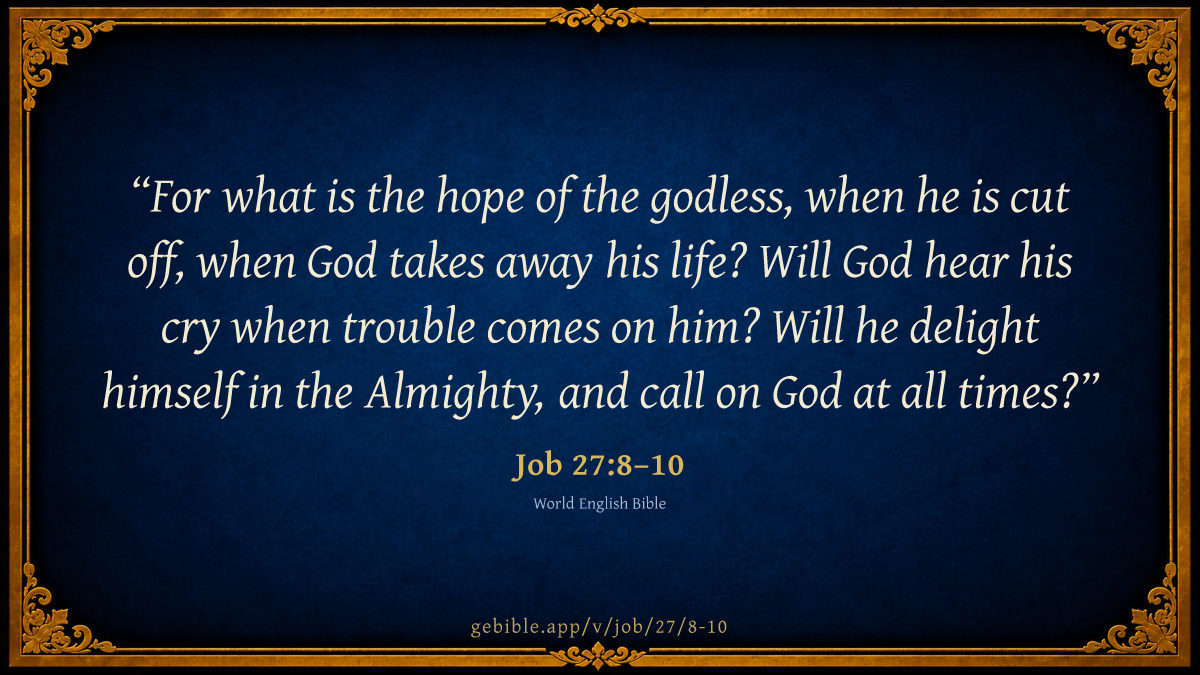
For what is the hope of a godless man when ... when God takes away his life?
Job uses this question to say that such a man has no hope. This question can be translated as a simple statement. AT: "There is no hope for the godless when God ... takes away his soul." (See: Rhetorical Question)
Read full note →
when God cuts him off, when God takes away his life
These two phrases have the same meaning. AT: "when God cuts him off and takes away his life" or "when God causes him to die" (See: Parallelism)
cuts him off
This is a metaphor meaning "kills him" or "causes him to die" (See: Metaphor)
takes away his life
This is a metaphor meaning "kills him" or "makes him stop living" (See: Metaphor)
Will God hear his cry when trouble comes upon him?
Job uses this question to say that God will not help that person. This question can be translated as a simple statement. AT: "God will not hear his cry when trouble comes upon him." or "When trouble comes upon him and he cries out for help, God will not hear him." (See: Rhetorical Question)
Will God hear his cry
Here "hear his cry" represents responding to the godless man's cry and helping him. AT: "Will God respond to his cry" (See: Metonymy)
Will he delight himself in the Almighty and call upon God at all times?
Job uses this question to say that the godless man will not do these things. This question can be translated as a simple statement. AT: "He will not delight himself in the Almighty and call upon God at all times." or "He will not be happy about what the Almighty does and he will not pray to God often." (See: Rhetorical Question)
 GEBible — Godless Engineer's Bible App
Geneva Bible translators 1599 · Public Domain On v8 What advantage hath the dissembler to gain never so…
What advantage hath the dissembler to gain never so much, seeing he shall lose his own soul?
Geneva Bible (1599) marginal notes — public domain.
John Trapp 1656 · Public Domain On vv8–10 Job 27:8 For what [is] the hope of the…
Job 27:8 For what [is] the hope of the hypocrite, though he hath gained, when God taketh away his soul?
Ver. 8. For what is the hope of the hypocrite, &c.] Here Job proveth himself to be no hypocrite, by his and their different character and carriage, especially under affliction. Though God kill Job, yet he will trust in him; but "what is the hope of the hypocrite?" &c. He that maketh a bridge of his own shadow must needs fall into the brook. The common hope thinks it takes hold of God; but it is but as a child that catcheth at the shadow on the wall, which he thinks he holdeth fast in his hand, but soon finds it otherwise; so shall the hypocrite at death, his hope shall be then as the giving up of the ghost, and that is but cold comfort. While he was in health, and had all well about him, he nourished strong hopes of God’s favour, and the rather because he gained and gathered wealth apace. So bladder like is the soul that is filled with earthly vanities, though but wind, it grows great, and swells in high conceitedness; but if pricked with the least pin of piercing grief (how much more when struck with death’s dart!) it shriveleth to nothing, and is ready to say, as one rich wretch did on his death bed, Spes et fortuna valete, Life and hope, adieu to you both at once.
Read full note →
Though he hath gained] Or, When he hath been covetous; raking together Rem, rem, quocunque modo rem. See this notably exemplified in that rich fool, Luk 12:20, whose life and hopes ended together.
When God taketh away his soul?] Extrahet, Shall pull it out by violence, as a sword out of his sheath; when God shall make a breach upon their citadel, come upon them by forcible entry, turn them out of their cottages of clay, by a firmae eiectione, cut them in twain, as he did that evil servant, Mat 24:50-51, tear their bodies and souls asunder, as a man teareth the bark from the tree, or the shell from the fish, leaving it naked. Where, then, shall be the high hopes of the hypocrite? And oh what a dreadful shriek giveth his guilty soul then, to see itself launching into an infinite ocean of scalding lead, and to consider that it must swim naked in it for ever!
John Trapp, A Commentary or Exposition upon All the Books of the Old and New Testament (1647–1656) — public domain. Text from a community e-Sword module.
Matthew Poole 1685 · Public Domain On vv8–10 There is no reason why I should envy or…
There is no reason why I should envy or desire the portion of wicked men; for though they ofttimes prosper in the world, as I have said, and seem to be great gainers, yet death, which hasteneth to all men, and to me especially, will show that they are far greater losers, and die in a most wretched and desperate condition; having no hope either of continuing in this life, which they chiefly desire, or of enjoying a better life, which they never regarded. But I have a firm and well-grounded hope, not of that temporal restitution which you promised me, but of a blessed immortality after death, and therefore am none of these hopeless hypocrites, as you account me. Taketh away; or, expelleth, or plucketh up; which notes violence, and that he died unwillingly; compare Luk 12:20; when good men are said freely and cheerfully to give themselves or their souls unto God.
Matthew Poole's English Annotations on the Holy Bible (1683–1685) — public domain. Text from a community e-Sword/MySword module.
John Gill 1763 · Public Domain On vv8–10 For what is the hope of the hypocrite,.... In…
For what is the hope of the hypocrite,.... In religion, who seems to be what he is not, a holy and righteous man; professes to have what he has not, the grace of God; pretends to do what he does not, worship God sincerely and fervently, and does all he does to be seen of men; though such a man may have an hope, as he has, of an interest in the divine layout, and of eternal glory and happiness, what will it signify? what avail will it be unto him? what will it issue in? Job was of the same mind in this with Bildad and Zophar, that such a man's hope is as the spider's web, and as the giving up of the ghost, Job 8:14; however he may please himself with it in this life, it will be of no service to him at death; for it is not like that of the true believer's, that is sure and steadfast, and founded upon the perfect righteousness and sacrifice of Christ; but upon his outward substance, fancying, that because God prospers him in this world, he is highly in his favour, and shall enjoy the happiness of the world to come; and upon his external profession of religion, and found of duties performed by him, but he will find himself mistaken: though he hath gained; great wealth and riches under a guise of religion, and by that means making gain of godliness, and taking the one for the other; so the Targum,
"because he hath gathered the mammon of falsehood;''
Read full note →
and also has great gifts, and a great deal of head knowledge, being able to talk of and dispute about most points of religion, and so has gained a great name among men both for knowledge and holiness, and yet all will not stand him in any stead, or be of any advantage to him:
when God taketh away his soul? out of his body by death, as a sword is drawn out of its scabbard, and which is as easily done by him; or as a shoe is plucked off from the foot, as Aben Ezra, and what he has a right to do, and will do it: and this taking it away seems to be in a violent manner, though not by what is called a violent death, yet against the will of the person; a good man is willing to die, is desirous of it, and gives up the ghost cheerfully; but an hypocrite is not willing to die, being afraid of death, and therefore his life or soul is taken from him without his consent and will, and not in love but in wrath, as the latter part of this chapter shows. Now Job had an hope which bore him up under all his troubles, and which he retained in the most killing and distressed circumstances, and which continued with him, and supported him in the views of death and eternity, so that he could look upon death, and into another world, with pleasure, and therefore could be no hypocrite, see Job 13:15.
John Gill's Exposition of the Whole Bible (1746–1763) — public domain (CC PDM 1.0). Text via the HelloAO Bible API.
John Wesley 1765 · Public Domain On vv8, 10 Though - Though they prosper in the world. God,…
Though - Though they prosper in the world. God, as the judge takes it away, to be tried, and determined to its everlasting state. And what will his hope be then? It will be vanity and a lie; it will stand him in no stead.
John Wesley, Explanatory Notes Upon the Whole Bible (1754–1765) — public domain. Text via the GEBible commentary corpus.
Adam Clarke 1810 · Public Domain On v8 Verse 8. What is the hope of the hypocrite]…
Verse 8. What is the hope of the hypocrite] The word חנף chaneph, which we translate, most improperly, hypocrite, means a wicked fellow, a defiled, polluted wretch, a rascal, a knave, a man who sticks at nothing in order to gain his ends. In this verse it means a dishonest man, a rogue, who by overreaching, cheating, c., has amassed a fortune.
When God taketh away his soul?] Could he have had any well grounded hope of eternal blessedness when he was acquiring earthly property by guilt and deceit? And of what avail will this property be when his soul is summoned before the judgment-seat? A righteous man yields up his soul to God the wicked does not, because he is afraid of God, of death, and of eternity. God therefore takes the soul away - forces it out of the body. Mr. Blair gives us an affecting picture of the death of a wicked man. Though well known, I shall insert it as a striking comment on this passage: -
Read full note →
"How shocking must thy summons be, O death!
To him that is at ease in his possessions;
Who, counting on long years of pleasures here;
Is quite unfurnished for that world to come!
In that dread moment how the frantic soul
Raves round the walls of her clay tenement;
Runs to each avenue, and shrieks for help,
But shrieks in vain! How wishfully she looks
On all she's leaving, now no longer hers!
A little longer, yet a little longer,
O, might she stay, to wash away her stains,
And fit her for her passage! Mournful sight!
Her very eyes weep blood; and every groan
She heaves is big with horror. But the foe,
Like a stanch murderer, steady to his purpose,
Pursues her close, through every lane of life,
Nor misses once the track, but presses on;
Till, forced at last to the tremendous verge,
At once she sinks to everlasting ruin."
THE GRAVE.
The Chaldee has, What can the detractor expect who has gathered together (ממון דשקר mamon dishkar, the mammon of unrighteousness) when God plucks out his soul? The Septuagint: Τις γαρ εστιν ετι ελπις ασεβει, ὁτι επεχει; Μη πεποιθως επι Κυριον ει αρα σωθησεται; "For what is the hope of the ungodly that he should wait for? shall he, by hoping in the Lord, be therefore saved?" Mr. Good translates differently from all the versions: -
"Yet what is the hope of the wicked that he should prosper,
That God should keep his soul in quiet?"
I believe our version gives as true a sense as any; and the words appear to have been in the eye of our Lord, when he said, "For what is a man profited if he shall gain the whole world and lose his own soul? or what shall a man give in exchange for his soul?" Mt 16:26.
Adam Clarke's Commentary on the Bible (1810–1826) — public domain. Text from a community e-Sword/MySword module.
Joseph Benson 1811 · Public Domain On vv8–10 Job 27:8. What is the hope of the hypocrite,…
Job 27:8. What is the hope of the hypocrite, though he hath gained? — There is no reason why I should envy or desire the portion of wicked men: although they ofttimes prosper in the world, and seem to be great gainers; yet death, which hasteneth to all men, and to me especially, will show that they are far greater losers, and die in a most wretched and desperate condition, having no hope either of continuing in this life, which they chiefly desire, or of enjoying a better life, which they never regarded. But I have a firm and well-grounded hope, not of that temporal restitution which you promise, but of a blessed immortality after death; and therefore I am not a hopeless hypocrite, as you think me to be. When God taketh away his soul — When, much against his will, and by an act of violence, (as the word ישׁל, jeshel, here used, signifies,) God, as the Judge, takes his soul out of his body, that it may be tried and determined to its everlasting state. What will his hope be then? It will be vanity and a lie; it will stand him in no stead. The wealth of this world, which he hoped in, he must leave behind him, and the happiness of the other world, which he hoped for, he will certainly fall short of; his hopes, therefore, will disappoint and make him ashamed.
Joseph Benson's Commentary on the Old and New Testaments (1811–1818) — public domain. Text from a community e-Sword module.
Albert Barnes 1834 · Public Domain On vv8–10 For what is the hope of the hypocrite? -…
For what is the hope of the hypocrite? - The same sentiment which Job here advances had before been expressed by Bildad; see it explained in the notes at Job 8:13 following It had also been expressed in a similar manner by Zophar (see the notes on Job 20:5, and had been much insisted on in their arguments. Job now says that he fully accords with that belief. He was not disposed to defend hypocrisy; he had no sympathy for it. He knew, as they did, that all the joy of a hypocrite would be temporary, and that when death came it must vanish. He wishes that his remarks should not be construed so as to make him the advocate of hypocrisy or sin, and affirms that he relied on a more solid foundation of peace and joy than the hypocrite could possess. It was by explanations and admissions such as these that the controversy was gradually closed, and when they came fully to understand Job, they felt that they had nothing which they could reply to him.
Though he hath gained - - יבצע yı̂bâtsa‛. The Vulgate renders this, si avare rapiat - “if he avariciously seizes upon.” The Septuagint, ὅτι hoti ἐπἐχει epechei that he persisteth. Dr. Good, “That he should prosper;” and so Wemyss. The Hebrew word (בצע bâtsa‛) means properly, to cut or dash in pieces; then to tear in pieces, or to plunder or spoil; then to cut off, to bring to an end, etc. It is applied to the action of a weaver, who, when his web is finished, cuts off the thrum that binds it to the beam. The web is then finished; it is all woven, and is then taken from the loom. Hence, it is elegantly used to denote the close of life, when life is woven or finished - by the rapid passing of days like the weavers shuttle Job 7:6, and when it is then, as it were, taken out of the loom; see this figure explained in the notes at Isa 38:12. This is the idea here, that life would be cut off like the weaver’s web, and that when that was done the hope of the hypocrite would be of no value.
Read full note →
When God taketh away his soul - When he dies. There has been much perplexity felt in regard to the Hebrew word here rendered “taketh away” - ישׁל yēshel. A full explanation may be seen in Schultens and Rosenmuller. Some suppose it is the future from נשל for ישל - meaning to draw out, and that the idea is, that God draws out this life as a sword is drawn out of a sheath. Others, that it is from שלה - to be secure, or tranquil, or at rest: and that it refers to the time when God shall give rest in the grave, or that the meaning of the word שלה here is the same as שלל or נשל - to draw out; see Gesenius on the word שלה. Schnurrer conjectures that it is derived from שאל - to ask, to demand, and that the form here is contracted from the future ישאל. But the common supposition is, that it means to draw out - in allusion to drawing out a sword from a scabbard - thus drawing life or the soul from the body.
Albert Barnes' Notes on the Bible (1834–1885) — public domain. Text from a community e-Sword/MySword module.
Haydock's Catholic Bible Commentary 1859 · Public Domain On vv8–9 Soul, in death: What will it profit? &c., Matthew…
Soul, in death: What will it profit? &c., Matthew xvi. 26. All this proves demonstratively another world. (Calmet)
George Leo Haydock (1774–1849), Haydock's Catholic Family Bible and Commentary, 1859 edition — public domain. Excludes Psalms (Douay-Rheims chapter numbering differs from Protestant) and Deuterocanonical books (Catholic canon only).
Robert Jamieson, A. R. Fausset & David Brown 1871 · Public Domain On vv8–10 "What hope hath the hypocrite, notwithstanding all his gains,…
"What hope hath the hypocrite, notwithstanding all his gains, when?" &c. "Gained" is antithetic to "taketh away." UMBREIT'S translation is an unmeaning tautology. "When God cuts off, when He taketh away his life."
taketh away--literally, "draws out" the soul from the body, which is, as it were, its scabbard (Job 4:21; Psa 104:29; Dan 7:15). Job says that he admits what Bildad said (Job 8:13) and Zophar (Job 20:5). But he says the very fact of his still calling upon God (Job 27:10) amid all his trials, which a hypocrite would not dare to do, shows he is no "hypocrite."
Jamieson, Fausset & Brown — Commentary Critical and Explanatory on the Whole Bible (1871) — public domain (CC PDM 1.0). Text via the HelloAO Bible API.
Daniel D. Whedon 1874 · Public Domain On vv8, 10 8. For — Job appeals to the want of…
8. For — Job appeals to the want of religious experience on the part of the ungodly to show that he cannot be accounted such.
Gained (unjustly) — Thus the Syriac, Chaldee, Vulgate, Arnheim, Gesenius, Furst, etc. The exhaustive comment of Tayler Lewis abundantly shows that Zockler, (in Lange,) Dillmann, etc., are wrong in reading כי יבצע, “When he cutteth off.” The transition from the prime meaning of batsa’h, “break off,” “plunder” (for gain,) to its secondary meaning “gain,” is easy and natural. The construction of Zockler, etc., mixes the metaphor, and demands, contrary to Hebrew usage, the same subject for two successive verbs, each preceded by כי; also it destroys the parallelism. The resemblance between the text and the profound question of Christ (Mar_8:36) is worthy of note.
Read full note →
Taketh away — Literally, Draweth out, as a sword from its sheath, as in Dan_7:15, (see margin,) where the body is called a sheath. The Talmud, the Hindu, and the Roman, (Pliny,) use the same metaphor. The Hindu Vedanta says, “The soul is in the body as in a sheath.” — COLEBROOK, Misc. Essays, 1:372. Gesenius (Thes., 855) cites a philosopher who, being despised by Alexander on account of his ugliness, responded: “The body is nothing but the sheath of a sword in which the soul is concealed.” While the figure of the text painfully expresses the resistance of the soul against its severance from the body, (compare Gen_35:18,) it assumes a separate existence for the soul. To speak of hope for a man after his death, unless the soul be conscious, would be a palpable absurdity. The passage is among the many of this book that take for granted the conscious existence of the wicked after death, and by implication the immortality of all.
Daniel D. Whedon (gen. ed.), Commentary on the Old and New Testaments (1874–1909) — public domain. Text from a community e-Sword module.
The Cambridge Bible for Schools and Colleges 1878 · Public Domain On vv8, 10 8. The verse most probably means,
8. The verse most probably means,
For what is the hope of the godless man when God cutteth off,
Read full note →
When he taketh away his soul?
lit. when He cutteth off, when God draweth out his soul. The comfortless state of the ungodly man (A. V. hypocrite, see on ch. Job_8:13), who has no trust in God, is described in three conditions of his history, first, when he is at the moment of death, when God “cutteth (him) off” and “draweth out his soul” (Job_27:8); second, when calamity overtakes him (Job_27:9); and in general, in his whole life (Job_27:10).
The Cambridge Bible for Schools and Colleges (gen. ed. J. J. S. Perowne; Cambridge University Press, 1878–1918) — public domain. Text from a community e-Sword module.
Ellicott's Commentary for English Readers 1878 · Public Domain On vv8, 10 (8) What is the hope?—Better, What is the hope…
(8) What is the hope?—Better, What is the hope of the godless, though he get him gain, when God taketh away his soul?
A Bible Commentary for English Readers, edited by Charles John Ellicott (1878–1897) — public domain. Text from a community e-Sword module.
The Pulpit Commentary 1880 · Public Domain On vv8–10 For what is the hope of the hypocrite, though…
For what is the hope of the hypocrite, though he hath gained. The hypocrite and liar may get advantage in this life by his lies and his hypocrisy. He may deceive men; he may raise himself in their opinion; he may derive worldly advantage from having secured their approval But what will he have to look forward rein the end, when God taketh away (i.e. removeth from earth) his soul? Job evidently regards the soul that is "taken away" or removed from earth as still existing, still conscious, still capable of hope or of despair, and asks what hope of a happy future could the man who had lived a hypocrite entertain, when God required his soul, and he felt under God"s judgment. The question reminds us of those words of our blessed Lord shall it profit a man, if he gain the whole world, and lose his own soul? or what shall a man give in exchange for his soul?". (Mar_8:36, 37)
Vers. 8-12. The hope of the hypocrite.
Read full note →
Job, the man of integrity, who was determined to hold fast his integrity until death, saw plainly that the hypocrite had no ground of confidence, and he boldly makes the demand," What is the hope of the hypocrite?" It is an appeal that can receive no satisfying answer. There is no hope for him, indeed; whatever he may imagine it to be, it is as a bubble that floats on the water for a short time, then bursts, and no trace is left of it. His confidence is placed on an unsafe foundation; he may build his expectations upon it, but the inevitable flood of time will wash it away. It is a vain, groundless, lost, disappointed hope. Job directs his inquiry into one channel What is the hypocrite"s hope as towards God? The earthly hopes of the hypocrite are not safe, though for a time he may prosper. But his hopes towards God are vain indeed. The hypocrite is estranged from God.
I HE HAS NO HOPE IN GOD IN DEATH. When the righteous man filleth his bosom with sheaves, the hope of the wicked is found to be cut off. Beyond the grave all is darkness.
II HE CANNOT TURN TO GOD IN TIME OF TROUBLE. When affliction falls upon the humble and righteous one, he whom he has sought to know and obey proves to be a reality to him. But the hypocrite has made God to be a sham. He has not known or obeyed him, or acted towards him as though he were a reality. To him, indeed, there is no God. How can he call on him in trouble whom he has denied in health?
III HE CANNOT FIND IN GOD A SPRING OF JOY. He cannot delight himself in him whom he has represented to himself as an unreality. God has not been really God in the estimate of the hypocrite. The man who is himself conscious of being false makes all false around him. He does not live in a real but a deceitful world. He has deceived himself in respect of it.
IV HE CANNOT CALL UPON GOD IN PRAYER. Thus the hope of the hypocrite perishes. It is vain. In the exigencies of life, when he most needs help, the false foundation which he has laid for himself fails him. The man who acts falsely towards God really acts falsely towards himself, and turns the most substantial grounds of hope into airy nothingness. R.G.
Vers. 8-10. An empty hope.
The wicked man may have gained much of earthly goods. But all he has is temporal and external. Therefore it is useless to him at death, and in regard to all his spiritual needs. We can see the dark features of his miserable prospect in the picture that Job has drawn.
I HE HAS EARTHLY POSSESSIONS. The foolish man has made gain; but it is useless to him. He is like the rich man in the parable, who was about to build new barns lot his goods when his life was taken and all his wealth lost at a stroke. If a person trusts to his earthly prosperity he is not prepared to confess his true needs. He thinks he is rich when he is miserable and blind and naked. (Rev_3:17) If he has acquired his wealth for himself, if it is his gain, he is in the greater danger of overestimating it. Self-made men are tempted to think too much of what they have won by their own hard toil.
II HE HAS NO CLAIM ON THE HEAVENLY INHERITANCE. There is nothing for the future. Yet life is brief and uncertain. It must end soon; it may end at any moment. Riches may have been got by a man"s own energy; but life is dependent on the will of God. Thus a man gains earthly things; but God disposes of his life. The greater concerns are altogether outside his powers, as they are beyond the region of his calculations.
III HE HAS NO ACCESS TO GOD IN PRAYER. The wicked man has no right to expect God to hear him in trouble.
1. He will have trouble. All his prosperity cannot exclude the possibility, nay, the certainty, of adversity.
2. He will need God. In trouble he may shriek to Heaven for help, though he never dreams of acknowledging God in times of prosperity. Prayer is so natural to man that it is forced out of the most unaccustomed lips by the pressure of great distress.
3. He will not be heard. Job is right. There are men whose prayers God will not hear. The reason is simply that they do not fulfil the necessary conditions of successful prayer. No man can fall so low, but that if he humble himself and turn and repent, God will hear him. But God will not hear the prayer of the impenitent. When the wicked man fails into trouble, very naturally he will desire to be saved from it. But possibly he may not repent of his sin nor desire to be saved from that; then all his prayer comes from a low, selfish desire to escape what hurts him. Such a prayer cannot be heard.
IV HE HAS NO DELIGHT IN GOD.
1. He misses the one source of perfect good. Though he gains much, his possessions are external; they do not help or Iced his soul. They are but temporal; when he dies he will leave them all behind. But God, as the Portion of his people, is a satisfying and permanent possession. He, and he alone, both fills all their real need now and endures for ever. To miss God in pursuit of any other aim is to light on an empty hope.
2. He will not continue to seek God. In the agony of the moment a miserable, selfish cry to Heaven is wrung from his heart. But when the trouble is past he forgets his prayer. He will not "always call upon God." So-called death-bed repentances are justly viewed with suspicion. Too often the dying man is only afraid of the dread unknown, naturally desirous of being delivered from its terrors. Too often, if he recovers, his penitence is forgotten with his fears of death, and he lives his old evil life again. W.F.A.
The Pulpit Commentary (1880–1919), ed. H.D.M. Spence-Jones & Joseph S. Exell — public domain. Text from a community e-Sword module.
The Biblical Illustrator 1887 · Public Domain On vv8–9 For what is the hope of the hypocrite?
Job_27:8
For what is the hope of the hypocrite?
Read full note →
The character and hope of the hypocrite
I. The character of the hypocrite. By a hypocrite we understand not a self-deceiver, but a deceiver of others. To himself his real character is known, as it is also to God, the Judge of all; but it is hid from his fellow men, who are deceived by his plausible profession and fair speeches. The word implies that, like an ancient stage player, he acts under a mask, and personates a character which does not properly belong to him. The mask he wears is a form of godliness, and the part he acts is that of a religious man. His religion is only a counterfeit.
1. The hypocrite is a person whose outward conduct, upon the whole, is irreproachable in the sight of men.
2. His true character is far from coming up to the requirements of the Gospel. He is one whose heart is not right with God. His heart is unchanged, unrenewed, unsanctified, destitute of faith and humility, and without the love and fear of God.
3. The hypocrite does all his works to be seen of men. It is not God that he seeks to please. Self is the idol which he worships, and to which his incense is burned.
4. The hypocrite is partial and formal in his obedience. His obedience has respect only to some of the Commandments. The principle by which he is actuated is earthly and grovelling, leading him to seek only to have glory of men. Such a man has no portion in the life to come; he has no treasure in heaven.
II. The nature of his hope. Job takes for granted that the hypocrite may gain by his profession. He may, in many respects, succeed in obtaining the object of his wishes or the reward he covets. But what is his hope when God taketh away his soul? Consider--
1. The foundation on which his hope rests.
2. The author of his hope. Not God, but Satan.
3. The effects it produces.
Then let us examine ourselves by this test. There are some who do not go so far even as the hypocrite. Even he pays some deference to religion. What character do we bear? Let us beware of the leaven of the Pharisees, which is hypocrisy. Avoid hypocrisy and cultivate sincerity. Be Christians, not merely in name, but in reality. Build your hope on Christ alone, counting Him to be your greatest gain. (D. Rees.)
A warning to hypocrites
I. The fearful nature of religious hypocrisy. With all His mildness, gentleness, and compassion, we yet find Christ thundering against the hypocrite. There is a class of men who make a profession of religion which they know to be false. These are the persons whom the Redeemer denounces. A religious profession is undoubtedly an excellence, but this is the honest avowal of the religion that is already in the heart; taking care, that as the hypocrite hides his sins under a cloak, we should not hide our religion under a cloak, but should honestly avow that Saviour whom we profess to believe on in secret. Now that which is uttered and avowed before nil the world, because we have it in secret, is surely a different affair from a mere profession that is allied to an attempt to impose upon men, and setting the omniscience of God at defiance.
II. Vain are all warnings given to hypocrites, because hypocrisy hardens the heart. See the case of Judas. We ought to be made of glass, that every man may see what is our real character. We are more transparent than crystal before the eyes of the eternal God. The sin of false profession infatuates the mind, hardens the heart, and keeps a man always forming such false reasonings and conclusions that they lead at last to the most manifest overwhelming of him with his own crimes and with Gods judgment.
III. How vain are all the things on which the hypocrite places his hope when God arises to judgment. A man may accustom himself to falsehood until he makes lies his refuge, and can scarcely distinguish between the most gross imposition upon himself and sincere safe dealing. When men accustom themselves to a system of deceit, they get perfectly bewildered and know not that which a child would have known and expected.
IV. A life of hypocrisy is likely to end in a death of impenitence. The sacrifice of the wicked is an abomination; the prayer only of the upright is Gods delight. We dare not think that a man, after living a life of hypocrisy, need only utter a few prayers and all is safe and well. True prayer is alone the prayer of true penitence. (James Bennett, D. D.)
The hypocrites hope
The teaching of the text may be summed up in this plain proposition--the hypocrites hope. How happy soever he may seem from it for a while, will leave him miserable when God shall take away his soul.
I. To whom the character of a hypocrite belongs. The word suggests, one who acts in a play, representing another person rather than his own. Transferred to religion, it is used to denote such as have put on a form of godliness, and would pass for saints, but are not in reality what they seem. The Hebrew word comes from one that signifies a cloud, as their wickedness is covered; or as they are painted over with another colour, hiding their natural one, that it may not be known. Thus an hypocrite is a real enemy to God, outwardly acting as one of His children. Open his character.
1. An hypocrite is one that pretends to have entirely devoted himself to God, when he has not, but divided his heart between God and the world; and so God has no interest in him at all. It is the whole heart God calls for, and He will have nothing less.
2. He is one that professes a regard to the will of God, as the reason, and to the glory of God as the end, of what he does in religion; when, in the meantime, he acts from other springs, and for lower and selfish ends.
3. He is one that takes more pains to appear outwardly religious than to be really so, between God and his own soul. A true Christian is as solicitous about his heart as about his life. But this is not the hypocrites concern. If he has a fair outside, he is little careful how matters stand within.
4. He is one that, in religious duties, puts God off with bodily service, whilst the heart is unengaged and left out.
5. He is partial and uneven in his obedience to God, and in his walk with Him.
II. Such may have a hope which they maintain as long as they live. It is strange that in souls so unsafe this hope should be so tong kept up. It is owing to such things as these--
1. To wretched ignorance of themselves, through neglecting to look into their own hearts.
2. To their not attending to the extent and spirituality of the law, as to what it requires of them, and how far they come short of obedience to it.
3. To the favourable apprehensions others may have of them.
4. To comparing themselves with open sinners, or more loose professors.
5. To the length they may go as to the attainment of what looks like grace.
III. What hypocrites may be said for a while to gain. It is supposed that some advantage they aim at, and may also reach.
1. By the part they act, they may gain more of the world.
2. They may gain the esteem and applause of men, and have the reputation of being eminently holy and religious.
3. They may gain a sort of peace in their own minds.
4. They may hereupon gain a smooth passage through the world, and an easy going out of it.
5. They may have a pompous funeral, and be well spoken of when they are dead.
IV. The vanity and emptiness of the hypocrites hope and gain, and the certainty and dreadfulness of his misery when God taketh away his soul.
1. What is the hope of the hypocrite? A hope without ground, without fruit; and a hope that will not hold before the Judge.
2. What is the gain of the hypocrite? It is unsuitable to his soul, his better part. It is bounded within this present life, and can accompany him no further. Then take up with no hope but such as will stand you in stead when God shall take away your soul.
(1) Not the hope that is built upon a mere profession, how specious soever.
(2) Not a hope that is built upon excellent gifts and attainments.
(3) Not a hope that is built upon external reformation.
(4) Not a hope that is built upon the good opinion of others.
(5) Not a hope that is built upon what we enjoy or suffer as to the present world.
(6) Not a hope that is built upon Church privileges; but a hope that has the mercy of God in Christ for its ground, and the promise of God for its warrant. (D. Wilcox.)
The hypocrites hope
I. To whom the character in the text applies. To all those who, in the concerns of religion, act a different part to what they really are. Particularly it applies--
1. To those who pretend entire devotedness to God, while their hearts are divided (Psa_12:2)
.
2. Who profess a regard to the will of God as the reason, and His glory as the end, of what they do in religion; while, at the same time, they act from other springs, and for lower and selfish ends (Mat_6:1).
3. Who are more careful to appear outwardly religious, than to be really so between God and their own souls (Mat_23:27-28).
4. Who put God off with bodily service, while the heart is not engaged in it (Isa_29:13; Joh_4:24).
5. Who are partial in their obedience to God, while the real Christian says Psa_119:128.
II. The hope and the gain of such a character.
1. Their hope relates to a future state of blessedness.
2. It is groundless, without a solid foundation (Col_1:27).
3. It is fruitless. See the Christians hope, 1Jn_3:3.
4. It will be cut off (Mat_7:23).
And this false hope is generally owing--
1. To ignorance of themselves; their own hearts.
2. To want of attention to the extent and spirituality of the law of God (Rom_7:9).
3. The favourable opinion others have of them.
4. Comparing themselves with open sinners, or lukewarm professors (Luk_18:11).
5. The length they go, as to the exercise of what appears to be grace; abstaining from many sins; practising many religious duties, etc.
As to their acquisitions; they may gain--
1. More of this world.
2. The esteem and applause of men.
3. A false peace (Rev_3:17).
4. A smooth passage through life.
5. A pompous funeral. But, behold--
III. The dreadful end of such; expressed in these words, When God taketh away his soul.
1. His soul, his immortal part, which he has deceived and ruined.
2. God will take it away; whose power there is no resisting; from whose presence there is no escape.
3. He will take it away; perhaps with violence (Pro_14:32), always in displeasure.
4. Take it away from present gains and hopes, to real misery, and to the greatest share of it. To all this he is continually liable, and at no time safe from it. While he is crying, Peace, peace, sudden destruction is coming upon him.
Improvement--
1. Seriously examine as to your own character. Judge yourselves, that ye be not judged.
2. Dread nothing more than the hypocrites hope, and frequently look to the foundation of your own.
3. Bless God if you can give a reason for the hope that is in you; but do it with fear and trembling; the final judgment is not yet over.
4. Do nothing to sink your hope, or fill you with overwhelming fear. Think often what you hope for, whom you hope in, and of the ground you hope upon; and thus prepare for the fruition of your hope in eternal glory. (T. Hannam.)
The Biblical Illustrator, edited by Joseph S. Exell (c. 1880s–1900s) — public domain. Text from a community e-Sword module.
unfoldingWord translationNotes 2017 · CC BY-SA 4.0 On v8 For what is the hope of a godless man…
For what is the hope of a godless man when ... when God takes away his life?
Job uses this question to say that such a man has no hope. This question can be translated as a simple statement. AT: "There is no hope for the godless when God ... takes away his soul." (See: Rhetorical Question)
Read full note →
when God cuts him off, when God takes away his life
These two phrases have the same meaning. AT: "when God cuts him off and takes away his life" or "when God causes him to die" (See: Parallelism)
cuts him off
This is a metaphor meaning "kills him" or "causes him to die" (See: Metaphor)
takes away his life
This is a metaphor meaning "kills him" or "makes him stop living" (See: Metaphor)
Will God hear his cry when trouble comes upon him?
Job uses this question to say that God will not help that person. This question can be translated as a simple statement. AT: "God will not hear his cry when trouble comes upon him." or "When trouble comes upon him and he cries out for help, God will not hear him." (See: Rhetorical Question)
Will God hear his cry
Here "hear his cry" represents responding to the godless man's cry and helping him. AT: "Will God respond to his cry" (See: Metonymy)
Will he delight himself in the Almighty and call upon God at all times?
Job uses this question to say that the godless man will not do these things. This question can be translated as a simple statement. AT: "He will not delight himself in the Almighty and call upon God at all times." or "He will not be happy about what the Almighty does and he will not pray to God often." (See: Rhetorical Question)
translationWords
hope
godly
cut off
cry
trouble
delight
Almighty
call
unfoldingWord translationNotes — © Distant Shores Media and the Door43 World Missions Community, licensed CC BY-SA 4.0. Source: git.door43.org/Door43/en_tn.
Tyndale Open Study Notes 2022 · CC BY-SA 4.0 On v9 27:9-23 Some interpreters see a new speech here and…
27:9-23 Some interpreters see a new speech here and ascribe it to Zophar because otherwise Zophar has no speech in this cycle.
Tyndale Open Study Notes — © Tyndale Open Resources, licensed CC BY-SA 4.0. Text via the HelloAO Bible API.