Proverbs 16:16(vv15, 17)How much better it is to get wisdom than gold! Yes, to get understanding is to be chosen rather than silver.
Proverbs 3:15(v18)She is more precious than rubies. None of the things you can desire are to be compared to her.
Proverbs 31:10(v18)Who can find a worthy woman? For her price is far above rubies.
Proverbs 8:19(vv15, 19)My fruit is better than gold, yes, than fine gold, my yield than choice silver.
Ezekiel 28:13(vv16, 19)You were in Eden, the garden of God. Every precious stone adorned you: ruby, topaz, emerald, chrysolite, onyx, jasper, sapphire, turquoise,…
Show all 29 cross-references
Exodus 28:17(v19)You shall set in it settings of stones, four rows of stones: a row of ruby, topaz, and beryl shall be the first row;
Exodus 39:10(v19)They set in it four rows of stones. A row of ruby, topaz, and beryl was the first row;
Psalms 45:9(v16)Kings’ daughters are among your honorable women. At your right hand the queen stands in gold of Ophir.
Proverbs 3:13-15(v15)Happy is the man who finds wisdom, the man who gets understanding. For her good profit is better than getting silver, and her return is…
Proverbs 8:10-11(v15)Receive my instruction rather than silver, knowledge rather than choice gold. For wisdom is better than rubies. All the things that may be…
Isaiah 13:12(v16)I will make people more rare than fine gold, even a person than the pure gold of Ophir.
Lamentations 4:7(v18)Her nobles were purer than snow. They were whiter than milk. They were more ruddy in body than rubies. Their polishing was like sapphire.
Ezekiel 27:16(v18)“ ‘ “Syria was your merchant by reason of the multitude of your handiworks. They traded for your wares with emeralds, purple, embroidered…
Revelation 22:1(v17)He showed me a river of water of life, clear as crystal, proceeding out of the throne of God and of the Lamb,
Exodus 28:20(v16)and the fourth row a chrysolite, an onyx, and a jasper. They shall be enclosed in gold in their settings.
1 Chronicles 29:4(v16)even three thousand talents of gold, of the gold of Ophir, and seven thousand talents of refined silver, with which to overlay the walls of…
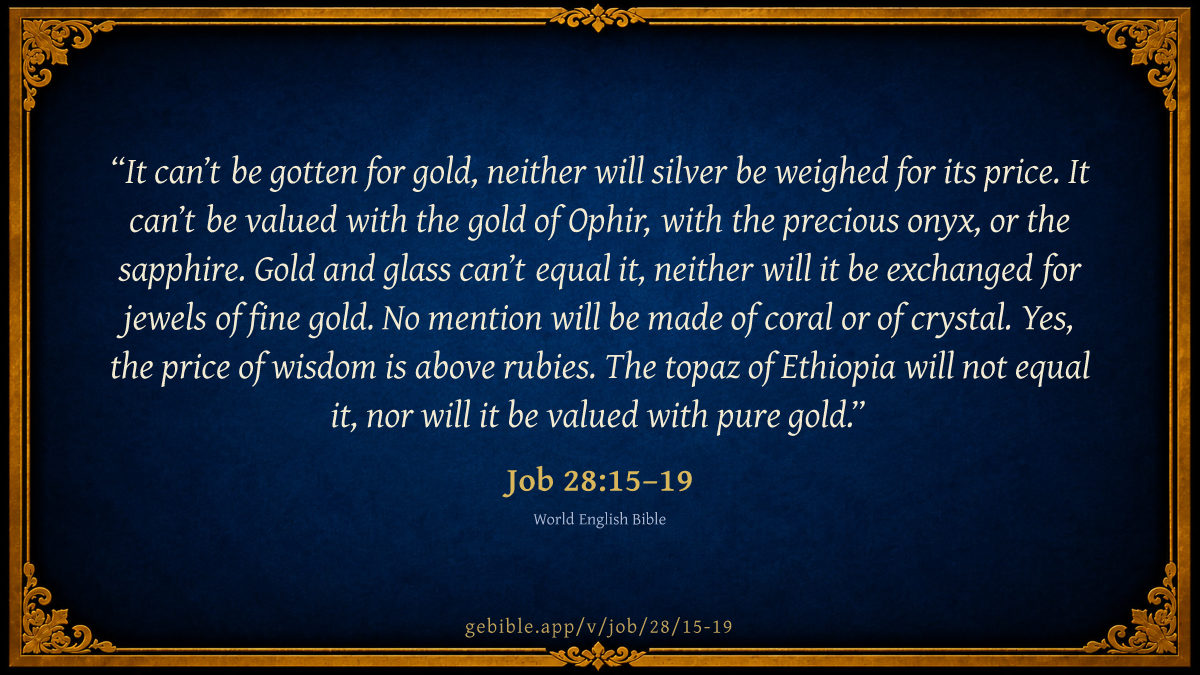
Job 28:18(v15)No mention will be made of coral or of crystal. Yes, the price of wisdom is above rubies.
Proverbs 8:11(v18)For wisdom is better than rubies. All the things that may be desired can’t be compared to it.
Proverbs 8:17(v15)I love those who love me. Those who seek me diligently will find me.
Ezekiel 1:22(v17)Over the head of the living creature there was the likeness of an expanse, like an awesome crystal to look at, stretched out over their…
Matthew 7:6(v18)“Don’t give that which is holy to the dogs, neither throw your pearls before the pigs, lest perhaps they trample them under their feet, and…
Matthew 13:45-46(v18)“Again, the Kingdom of Heaven is like a man who is a merchant seeking fine pearls, who having found one pearl of great price, he went and…
1 Timothy 2:9(v18)In the same way, that women also adorn themselves in decent clothing, with modesty and propriety, not just with braided hair, gold, pearls,…
Revelation 4:6(v17)Before the throne was something like a sea of glass, similar to crystal. In the middle of the throne, and around the throne were four…
Revelation 17:4(v18)The woman was dressed in purple and scarlet, and decked with gold and precious stones and pearls, having in her hand a golden cup full of…
Revelation 18:12(v18)merchandise of gold, silver, precious stones, pearls, fine linen, purple, silk, scarlet, all expensive wood, every vessel of ivory, every…
Revelation 21:11(v17)having the glory of God. Her light was like a most precious stone, as if it were a jasper stone, clear as crystal;
Revelation 21:20(v19)the fifth, sardonyx; the sixth, sardius; the seventh, chrysolite; the eighth, beryl; the ninth, topaz; the tenth, chrysoprase; the…
Revelation 21:21(v18)The twelve gates were twelve pearls. Each one of the gates was made of one pearl. The street of the city was pure gold, like transparent…
29 distinct cross-references across this passage (32 total citations).
Cross-references from openbible.info (CC BY 4.0)
Explain this passage (16 sources)
Historical commentary, presented as a primary source — not an endorsement.
Geneva Bible translators1599 · Public DomainOn vv15, 18It can neither be bought for gold nor precious…
It can neither be bought for gold nor precious stones, but is only the gift of God.
Geneva Bible (1599) marginal notes — public domain.
John Trapp1656 · Public DomainOn vv15–19Job 28:15 It cannot be gotten for gold, neither…
Job 28:15 It cannot be gotten for gold, neither shall silver be weighed [for] the price thereof.
Ver. 15. It cannot be gotten for gold] Non emitur, nec aestimatur, it is not purchased or procured with money, as other learning may ( en precium et praestantiam sapientiae). "With a great sum obtained I this freedom," said that colonel, Act 22:28. So may many say of their learning, they have sufficiently paid for it. Cleanthes parted with all he had for learning; Plato gave thirty thousand florins for three books; Reuchlin gave the Jew that taught him Hebrew a crown for every hour’s pains; Jerome got his skill in that language with the hazard of his life, and held it a good bargain. But here is no such trading. See Act 8:18-20. Fie (quoth that rich and wretched cardinal, when he saw he must die), will money do nothing? will not death be hired? may not heaven be purchased? No, no, God is no money merchant; his kingdom is not partum, wealthy, but paratum, the prepared, Mat 25:34, his grace is gratuitous; Mat 13:11, To you it is given (and what more free than gift?) to know the mysteries of the kingdom of God. And to you it is given, freely given, on behalf of Christ, not only to believe on him, &c., Php 1:29. That proud merit monger that said, Gratis non accipiam, I will not have grace or glory of free cost, could not but go without both (Vega).
John Trapp, A Commentary or Exposition upon All the Books of the Old and New Testament (1647–1656) — public domain. Text from a community e-Sword module.
Matthew Poole1685 · Public DomainOn vv15–19For gold; the choicest gold laid up in treasures,…
For gold; the choicest gold laid up in treasures, as the word signifies. Weighed, to wit, in the balance; for in those times money was paid by weight, not by tale. See Gen 23:16; Jer 23:9,10.
Matthew Poole's English Annotations on the Holy Bible (1683–1685) — public domain. Text from a community e-Sword/MySword module.
John Gill1763 · Public DomainOn vv15–19It cannot be gotten for gold,.... Having in general…
It cannot be gotten for gold,.... Having in general said that there is nothing in the whole compass of the terraqueous globe, nothing that is upon the surface of the earth, or in the bowels of it, or in the vast ocean, that is an equivalent price for wisdom, Job descends to particulars, and instances first in gold, that being the most valuable of metals; the word here used for it signifies "shut up" (w), because it is first shut up in the earth, out of which it is dug, and when taken from thence, and refined, and made into coins or vessels, it is shut up among the treasures of men; the words may be more literally rendered, "gold shall not be given instead of it" (x); as a sufficient price, or valuable consideration for it:
neither shall silver be weighed for the price thereof; in former times this metal used to be delivered, in buying and selling, not by the number and value of pieces, but by weight, in rude masses and lumps, and even when coined into shekels; see Gen 23:16.
Read full note →
(w) Sept. "conclusum", Tigurine version; "clausum", Bolducius. (x) "non dabitur pro ea", V. L. Montanus, Schultens.
John Gill's Exposition of the Whole Bible (1746–1763) — public domain (CC PDM 1.0). Text via the HelloAO Bible API.
Adam Clarke1810 · Public DomainOn vv15–19Verse 15. It cannot be gotten for gold] Genuine…
Verse 15. It cannot be gotten for gold] Genuine religion and true happiness are not to be acquired by earthly property. Solomon made gold and silver as plentiful as the stones in Jerusalem, and had all the delights of the sons of men, and yet he was not happy; yea, he had wisdom, was the wisest of men, but he had not the wisdom of which Job speaks here, and therefore, to him, all was vanity and vexation of spirit. If Solomon, as some suppose, was the author of this book, the sentiments expressed here are such as we might expect from this deeply experienced and wise man.
Adam Clarke's Commentary on the Bible (1810–1826) — public domain. Text from a community e-Sword/MySword module.
Joseph Benson1811 · Public DomainOn vv15, 18Job 28:15-17. It cannot be gotten for gold —…
Job 28:15-17. It cannot be gotten for gold — The choicest gold laid up in treasures, as the word סגר, segor, signifies: neither shall silver be weighed for the price thereof — Namely, in the balance; for in those times money was paid by weight. It cannot be valued with gold of Ophir — Though the gold that comes from thence be the purest of all, neither that, nor the most precious stones, can purchase this wisdom. The gold and the crystal — Hebrew, זכוכית, zecucith, gemma nitidissima, a very bright gem, says Buxtorf: lapis pretiosus, nitidus, a bright precious stone, Ab. Ezra. The word is not elsewhere used, but being derived from זכךְ, zachach, purus, vel mundus esse, it has in it the signification of purity, clearness, and brightness. The exchange of it shall not be for jewels — Or, vessels, as כלי, chelei, rather means; of fine gold, פז, paz, of solid gold, in which vessels the curiosity of art is added to the excellence of the matter of which they are formed.
Joseph Benson's Commentary on the Old and New Testaments (1811–1818) — public domain. Text from a community e-Sword module.
Albert Barnes1834 · Public DomainOn vv15–19It cannot be gotten for gold - Margin, “fine…
It cannot be gotten for gold - Margin, “fine gold shall not be given for it.” The word which is here rendered “gold.” and in the margin “fine gold” (סגור segôr), is not the common word used to denote this metal. It is derived from סגר sâgar, to “shut,” to “close,” and means properly that which is “shut up” or “enclosed;” and hence, Gesenius supposes it means pure gold, or the most precious gold, as that which is shut up or enclosed with care. Dr. Good renders it “solid gold,” supposing it means that which is condensed, or beaten. The phrase occurs in nearly the same form סגור זהב zâhâb sâgûr, “gold shut up,” Margin,) in 1Ki 6:20-21; 1Ki 7:49-50; 1Ki 10:21; 2Ch 4:21-22; 2Ch 9:20, and undoubtedly denotes there the most precious kind of gold. Its relation to the sense of the verb “to shut up” is not certain. Prof. Lee supposes that the idea is derived from the use of the word, and of similar words in Arabic, where the idea of heating, fusing, giving another color, changing the shape, and thence of fixing, retaining, etc., is found; and that the idea here is that of fused or purified gold. Michaelis supposes that it refers to “native” gold that is pure and unadulterated, or the form of gold called “dendroides,” from its shooting out in the form of a tree - “baumartig gewachsenes Gold” (from the Arabic, “a tree”). It is not known, however, that the Hebrew word סגר was always used to denote a tree. There can be no doubt that the word denotes “gold” of a pure kind, and it may have been given to it because gold of that kind was carefully “shut up” in places of safe keeping; but it would seem more probable to me that it was given to it for some reason now unknown. Of many of the names now given by us to objects which are significant, and which are easily understood by us, it would be impossible to trace the reason or propriety, after the lapse of four thousand years.
Neither shall silver be weighed - That is, it would be impossible to weigh out so much silver as to equal its value. Before the art of coining was known, it was common to weigh the precious metals that were used as a medium of trade; compare Gen 23:16.
Albert Barnes' Notes on the Bible (1834–1885) — public domain. Text from a community e-Sword/MySword module.
Haydock's Catholic Bible Commentary1859 · Public DomainOn vv15–19Finest, obrizum, which has the colour of fire. (Pliny,…
Finest, obrizum, which has the colour of fire. (Pliny, [Natural History?] xxiii. 3.) The old Vulgate and Septuagint read "locked-up gold," aurum conclusum, (Calmet) and the Hebrew Segor, (Haydock) "that which is shut up," like things of value: gold is sometimes specified, 3 Kings vi. 20.
George Leo Haydock (1774–1849), Haydock's Catholic Family Bible and Commentary, 1859 edition — public domain. Excludes Psalms (Douay-Rheims chapter numbering differs from Protestant) and Deuterocanonical books (Catholic canon only).
Robert Jamieson, A. R. Fausset & David Brown1871 · Public DomainOn vv15–19Not the usual word for "gold"; from a Hebrew…
Not the usual word for "gold"; from a Hebrew root, "to shut up" with care; that is, purest gold (Kg1 6:20, Margin).
weighed--The precious metals were weighed out before coining was known (Gen 23:16).
Jamieson, Fausset & Brown — Commentary Critical and Explanatory on the Whole Bible (1871) — public domain (CC PDM 1.0). Text via the HelloAO Bible API.
Daniel D. Whedon1874 · Public DomainOn vv15–1915. Gold — Hebrew, segor. Four different words are…
15. Gold — Hebrew, segor. Four different words are used for gold in this chapter. Gold, “most honoured prize of wealth,” (Pindar,) first and last (Job_28:15; Job_28:19) in this brilliant array of nature’s treasures, filled then, as now, its world-wide place of supremacy. See note, however, on Job_28:1.
Daniel D. Whedon (gen. ed.), Commentary on the Old and New Testaments (1874–1909) — public domain. Text from a community e-Sword module.
The Cambridge Bible for Schools and Colleges1878 · Public DomainOn vv15–1915. for gold] Probably, as margin, fine gold, i.…
15. for gold] Probably, as margin, fine gold, i. e. purified gold; comp. 1Ki_6:20, where a word somewhat similar occurs.
be weighed] In ancient times money was weighed, not counted, Gen_23:16.
Read full note →
15–19. As the preceding verses (1–14) expressed the idea that there was no “place” of Wisdom where men could find it and from which they could bring it forth, these verses express the idea that it can be acquired by no price which men can offer for it. It is altogether unattainable. The passage may contain the additional idea of the preciousness or desirableness of Wisdom (see Job_28:18), but the purpose of these verses is not to set forth wisdom as a good or as the chief good, for which one might willingly give all that he holds most precious; the thought of the passage is that though one should offer gold and precious stones for Wisdom it cannot be procured, being nowhere to be found. That the Writer’s purpose is to express this conception mainly is evident from the refrain which closes the passage, as a similar one closed the preceding passage: But Wisdom whence cometh it? and where is the place of understanding? (Job_28:20).
The Cambridge Bible for Schools and Colleges (gen. ed. J. J. S. Perowne; Cambridge University Press, 1878–1918) — public domain. Text from a community e-Sword module.
Ellicott's Commentary for English Readers1878 · Public DomainOn v17(17) The exchange of it.—Or, according to some, the…
(17) The exchange of it.—Or, according to some, the attraction of it. The remainder of this chapter calls for little remark: its unrivalled sublimity is patent, and comment is superfluous. There is a general resemblance between this chapter and Proverbs 8, and both seem to imply a knowledge of the Mosaic narrative of creation.
A Bible Commentary for English Readers, edited by Charles John Ellicott (1878–1897) — public domain. Text from a community e-Sword module.
The Pulpit Commentary1880 · Public DomainOn vv15–19It cannot be gotten for gold. No amount of…
It cannot be gotten for gold. No amount of gold can purchase it; no, not of the purest and most refined quality, (1Ki_6:20, 1Ki_6:21) for it is not a thing that can be bought or sold God must grant it, and find a way of imparting it; which he certainly will not do for a sum of money. Neither shall silver be weighed for the price thereof; If gold cannot purchase it, much less can silver the less valuable medium of exchange. (On the weighing of silver, in sales, see Gen_23:16 Jer_32:9 Ezr_8:26)
The Pulpit Commentary (1880–1919), ed. H.D.M. Spence-Jones & Joseph S. Exell — public domain. Text from a community e-Sword module.
The Biblical Illustrator1887 · Public DomainOn v17And the crystal cannot equal it.
Job_28:17
And the crystal cannot equal it.
Read full note →
The crystal exact
In the first place I remark that religion is superior to the crystal in exactness. That shapeless mass of crystal against which you accidentally dashed your foot is laid out with more exactness than any earthly city. There are six styles of crystallisation, and all of them divinely ordained. Every crystal has mathematical precision. Gods geometry reaches through it, and it is a square, or it is a rectangle, or it is a rhomboid or, in some way, it hath a mathematical figure. Now religion beats that in the simple fact that spiritual accuracy is more beautiful than material accuracy. Gods attributes are exact. Gods law exact. Gods decrees exact. Gods management of the world exact. Never counting wrong, though He counts the grass blades and the stars, and the sands and the cycles. His providences never dealing with us perpendicularly when those providences ought to be oblique, nor lateral when they ought to be vertical. Everything in our life arranged without any possibility of mistake. Each life a six-sided prism. Born at the right time; dying at the right time. There are no happen-sos in our theology. If I thought this was a slipshod universe I would go crazy. God is not an anarchist. Law, order, symmetry, precision. A perfect square. A perfect rectangle. A perfect rhomboid. A perfect circle. The edge of Gods robe of government never frays out. There are no loose screws in the worlds machinery. It did not just happen that Napoleon was attacked with indigestion at Borodino, so that he became incompetent for the day. It did not just happen that John Thomas, the missionary, on a heathen island, waiting for an outfit and orders for another missionary tour, received that outfit and those orders in a box that floated ashore, while the ship and the crew that carried the box were never heard of. The barking of F.W. Robertsons dog, he tells us, led to a line of events which brought him from the army into the Christian ministry, where he served God with world-renowned usefulness. It did not merely happen so. I believe in a particular Providence. I believe Gods geometry may be seen in all our life more beautifully than in crystallography. Job was right. The crystal cannot equal it. (T. De Witt Talmage.)
The Biblical Illustrator, edited by Joseph S. Exell (c. 1880s–1900s) — public domain. Text from a community e-Sword module.
unfoldingWord translationNotes2017 · CC BY-SA 4.0On vv15, 18It cannot be gotten for gold
It cannot be gotten for gold
This can be stated in active form. This implies that wisdom is worth much more than gold. AT: "People cannot pay for wisdom with gold" (See: Assumed Knowledge and Implicit Information)
Read full note →
neither can silver be weighed as its price
This implies that wisdom is worth much more than silver. It can be stated in active form. AT: "and people cannot weigh out enough silver to pay for wisdom" (See: Assumed Knowledge and Implicit Information)
It cannot be valued with ... sapphire
This implies that wisdom is much more valuable than the gold of Ophir, precious onyx and sapphire. (See: Assumed Knowledge and Implicit Information)
Ophir
This is the name of a land where there was fine gold. (See: How to Translate Names)
onyx
a valuable black gemstone
sapphire
a valuable blue gemstone
Gold and crystal cannot equal it in worth
This implies that wisdom is much more valuable than gold and crystal.
crystal
a valuable gemstone that is clear or lightly colored
neither can it be exchanged for jewels of fine gold
"and it cannot be exchanged for jewels of fine gold." This implies that wisdom is much more valuable than jewels of fine gold.
Tyndale Open Study Notes2022 · CC BY-SA 4.0On v1628:16-19 The metals, gemstones, and glass listed here were…
28:16-19 The metals, gemstones, and glass listed here were precious in the ancient world, but the speaker says that wisdom is much more precious than wealth.

Geneva Bible translators 1599 · Public Domain On vv15, 18 It can neither be bought for gold nor precious…
It can neither be bought for gold nor precious stones, but is only the gift of God.
Geneva Bible (1599) marginal notes — public domain.
John Trapp 1656 · Public Domain On vv15–19 Job 28:15 It cannot be gotten for gold, neither…
Job 28:15 It cannot be gotten for gold, neither shall silver be weighed [for] the price thereof.
Ver. 15. It cannot be gotten for gold] Non emitur, nec aestimatur, it is not purchased or procured with money, as other learning may ( en precium et praestantiam sapientiae). "With a great sum obtained I this freedom," said that colonel, Act 22:28. So may many say of their learning, they have sufficiently paid for it. Cleanthes parted with all he had for learning; Plato gave thirty thousand florins for three books; Reuchlin gave the Jew that taught him Hebrew a crown for every hour’s pains; Jerome got his skill in that language with the hazard of his life, and held it a good bargain. But here is no such trading. See Act 8:18-20. Fie (quoth that rich and wretched cardinal, when he saw he must die), will money do nothing? will not death be hired? may not heaven be purchased? No, no, God is no money merchant; his kingdom is not partum, wealthy, but paratum, the prepared, Mat 25:34, his grace is gratuitous; Mat 13:11, To you it is given (and what more free than gift?) to know the mysteries of the kingdom of God. And to you it is given, freely given, on behalf of Christ, not only to believe on him, &c., Php 1:29. That proud merit monger that said, Gratis non accipiam, I will not have grace or glory of free cost, could not but go without both (Vega).
John Trapp, A Commentary or Exposition upon All the Books of the Old and New Testament (1647–1656) — public domain. Text from a community e-Sword module.
Matthew Poole 1685 · Public Domain On vv15–19 For gold; the choicest gold laid up in treasures,…
For gold; the choicest gold laid up in treasures, as the word signifies. Weighed, to wit, in the balance; for in those times money was paid by weight, not by tale. See Gen 23:16; Jer 23:9,10.
Matthew Poole's English Annotations on the Holy Bible (1683–1685) — public domain. Text from a community e-Sword/MySword module.
John Gill 1763 · Public Domain On vv15–19 It cannot be gotten for gold,.... Having in general…
It cannot be gotten for gold,.... Having in general said that there is nothing in the whole compass of the terraqueous globe, nothing that is upon the surface of the earth, or in the bowels of it, or in the vast ocean, that is an equivalent price for wisdom, Job descends to particulars, and instances first in gold, that being the most valuable of metals; the word here used for it signifies "shut up" (w), because it is first shut up in the earth, out of which it is dug, and when taken from thence, and refined, and made into coins or vessels, it is shut up among the treasures of men; the words may be more literally rendered, "gold shall not be given instead of it" (x); as a sufficient price, or valuable consideration for it:
neither shall silver be weighed for the price thereof; in former times this metal used to be delivered, in buying and selling, not by the number and value of pieces, but by weight, in rude masses and lumps, and even when coined into shekels; see Gen 23:16.
Read full note →
(w) Sept. "conclusum", Tigurine version; "clausum", Bolducius. (x) "non dabitur pro ea", V. L. Montanus, Schultens.
John Gill's Exposition of the Whole Bible (1746–1763) — public domain (CC PDM 1.0). Text via the HelloAO Bible API.
Adam Clarke 1810 · Public Domain On vv15–19 Verse 15. It cannot be gotten for gold] Genuine…
Verse 15. It cannot be gotten for gold] Genuine religion and true happiness are not to be acquired by earthly property. Solomon made gold and silver as plentiful as the stones in Jerusalem, and had all the delights of the sons of men, and yet he was not happy; yea, he had wisdom, was the wisest of men, but he had not the wisdom of which Job speaks here, and therefore, to him, all was vanity and vexation of spirit. If Solomon, as some suppose, was the author of this book, the sentiments expressed here are such as we might expect from this deeply experienced and wise man.
Adam Clarke's Commentary on the Bible (1810–1826) — public domain. Text from a community e-Sword/MySword module.
Joseph Benson 1811 · Public Domain On vv15, 18 Job 28:15-17. It cannot be gotten for gold —…
Job 28:15-17. It cannot be gotten for gold — The choicest gold laid up in treasures, as the word סגר, segor, signifies: neither shall silver be weighed for the price thereof — Namely, in the balance; for in those times money was paid by weight. It cannot be valued with gold of Ophir — Though the gold that comes from thence be the purest of all, neither that, nor the most precious stones, can purchase this wisdom. The gold and the crystal — Hebrew, זכוכית, zecucith, gemma nitidissima, a very bright gem, says Buxtorf: lapis pretiosus, nitidus, a bright precious stone, Ab. Ezra. The word is not elsewhere used, but being derived from זכךְ, zachach, purus, vel mundus esse, it has in it the signification of purity, clearness, and brightness. The exchange of it shall not be for jewels — Or, vessels, as כלי, chelei, rather means; of fine gold, פז, paz, of solid gold, in which vessels the curiosity of art is added to the excellence of the matter of which they are formed.
Joseph Benson's Commentary on the Old and New Testaments (1811–1818) — public domain. Text from a community e-Sword module.
Albert Barnes 1834 · Public Domain On vv15–19 It cannot be gotten for gold - Margin, “fine…
It cannot be gotten for gold - Margin, “fine gold shall not be given for it.” The word which is here rendered “gold.” and in the margin “fine gold” (סגור segôr), is not the common word used to denote this metal. It is derived from סגר sâgar, to “shut,” to “close,” and means properly that which is “shut up” or “enclosed;” and hence, Gesenius supposes it means pure gold, or the most precious gold, as that which is shut up or enclosed with care. Dr. Good renders it “solid gold,” supposing it means that which is condensed, or beaten. The phrase occurs in nearly the same form סגור זהב zâhâb sâgûr, “gold shut up,” Margin,) in 1Ki 6:20-21; 1Ki 7:49-50; 1Ki 10:21; 2Ch 4:21-22; 2Ch 9:20, and undoubtedly denotes there the most precious kind of gold. Its relation to the sense of the verb “to shut up” is not certain. Prof. Lee supposes that the idea is derived from the use of the word, and of similar words in Arabic, where the idea of heating, fusing, giving another color, changing the shape, and thence of fixing, retaining, etc., is found; and that the idea here is that of fused or purified gold. Michaelis supposes that it refers to “native” gold that is pure and unadulterated, or the form of gold called “dendroides,” from its shooting out in the form of a tree - “baumartig gewachsenes Gold” (from the Arabic, “a tree”). It is not known, however, that the Hebrew word סגר was always used to denote a tree. There can be no doubt that the word denotes “gold” of a pure kind, and it may have been given to it because gold of that kind was carefully “shut up” in places of safe keeping; but it would seem more probable to me that it was given to it for some reason now unknown. Of many of the names now given by us to objects which are significant, and which are easily understood by us, it would be impossible to trace the reason or propriety, after the lapse of four thousand years.
Neither shall silver be weighed - That is, it would be impossible to weigh out so much silver as to equal its value. Before the art of coining was known, it was common to weigh the precious metals that were used as a medium of trade; compare Gen 23:16.
Albert Barnes' Notes on the Bible (1834–1885) — public domain. Text from a community e-Sword/MySword module.
Haydock's Catholic Bible Commentary 1859 · Public Domain On vv15–19 Finest, obrizum, which has the colour of fire. (Pliny,…
Finest, obrizum, which has the colour of fire. (Pliny, [Natural History?] xxiii. 3.) The old Vulgate and Septuagint read "locked-up gold," aurum conclusum, (Calmet) and the Hebrew Segor, (Haydock) "that which is shut up," like things of value: gold is sometimes specified, 3 Kings vi. 20.
George Leo Haydock (1774–1849), Haydock's Catholic Family Bible and Commentary, 1859 edition — public domain. Excludes Psalms (Douay-Rheims chapter numbering differs from Protestant) and Deuterocanonical books (Catholic canon only).
Robert Jamieson, A. R. Fausset & David Brown 1871 · Public Domain On vv15–19 Not the usual word for "gold"; from a Hebrew…
Not the usual word for "gold"; from a Hebrew root, "to shut up" with care; that is, purest gold (Kg1 6:20, Margin).
weighed--The precious metals were weighed out before coining was known (Gen 23:16).
Jamieson, Fausset & Brown — Commentary Critical and Explanatory on the Whole Bible (1871) — public domain (CC PDM 1.0). Text via the HelloAO Bible API.
Daniel D. Whedon 1874 · Public Domain On vv15–19 15. Gold — Hebrew, segor. Four different words are…
15. Gold — Hebrew, segor. Four different words are used for gold in this chapter. Gold, “most honoured prize of wealth,” (Pindar,) first and last (Job_28:15; Job_28:19) in this brilliant array of nature’s treasures, filled then, as now, its world-wide place of supremacy. See note, however, on Job_28:1.
Daniel D. Whedon (gen. ed.), Commentary on the Old and New Testaments (1874–1909) — public domain. Text from a community e-Sword module.
The Cambridge Bible for Schools and Colleges 1878 · Public Domain On vv15–19 15. for gold] Probably, as margin, fine gold, i.…
15. for gold] Probably, as margin, fine gold, i. e. purified gold; comp. 1Ki_6:20, where a word somewhat similar occurs.
be weighed] In ancient times money was weighed, not counted, Gen_23:16.
Read full note →
15–19. As the preceding verses (1–14) expressed the idea that there was no “place” of Wisdom where men could find it and from which they could bring it forth, these verses express the idea that it can be acquired by no price which men can offer for it. It is altogether unattainable. The passage may contain the additional idea of the preciousness or desirableness of Wisdom (see Job_28:18), but the purpose of these verses is not to set forth wisdom as a good or as the chief good, for which one might willingly give all that he holds most precious; the thought of the passage is that though one should offer gold and precious stones for Wisdom it cannot be procured, being nowhere to be found. That the Writer’s purpose is to express this conception mainly is evident from the refrain which closes the passage, as a similar one closed the preceding passage: But Wisdom whence cometh it? and where is the place of understanding? (Job_28:20).
The Cambridge Bible for Schools and Colleges (gen. ed. J. J. S. Perowne; Cambridge University Press, 1878–1918) — public domain. Text from a community e-Sword module.
Ellicott's Commentary for English Readers 1878 · Public Domain On v17 (17) The exchange of it.—Or, according to some, the…
(17) The exchange of it.—Or, according to some, the attraction of it. The remainder of this chapter calls for little remark: its unrivalled sublimity is patent, and comment is superfluous. There is a general resemblance between this chapter and Proverbs 8, and both seem to imply a knowledge of the Mosaic narrative of creation.
A Bible Commentary for English Readers, edited by Charles John Ellicott (1878–1897) — public domain. Text from a community e-Sword module.
The Pulpit Commentary 1880 · Public Domain On vv15–19 It cannot be gotten for gold. No amount of…
It cannot be gotten for gold. No amount of gold can purchase it; no, not of the purest and most refined quality, (1Ki_6:20, 1Ki_6:21) for it is not a thing that can be bought or sold God must grant it, and find a way of imparting it; which he certainly will not do for a sum of money. Neither shall silver be weighed for the price thereof; If gold cannot purchase it, much less can silver the less valuable medium of exchange. (On the weighing of silver, in sales, see Gen_23:16 Jer_32:9 Ezr_8:26)
The Pulpit Commentary (1880–1919), ed. H.D.M. Spence-Jones & Joseph S. Exell — public domain. Text from a community e-Sword module.
The Biblical Illustrator 1887 · Public Domain On v17 And the crystal cannot equal it.
Job_28:17
And the crystal cannot equal it.
Read full note →
The crystal exact
In the first place I remark that religion is superior to the crystal in exactness. That shapeless mass of crystal against which you accidentally dashed your foot is laid out with more exactness than any earthly city. There are six styles of crystallisation, and all of them divinely ordained. Every crystal has mathematical precision. Gods geometry reaches through it, and it is a square, or it is a rectangle, or it is a rhomboid or, in some way, it hath a mathematical figure. Now religion beats that in the simple fact that spiritual accuracy is more beautiful than material accuracy. Gods attributes are exact. Gods law exact. Gods decrees exact. Gods management of the world exact. Never counting wrong, though He counts the grass blades and the stars, and the sands and the cycles. His providences never dealing with us perpendicularly when those providences ought to be oblique, nor lateral when they ought to be vertical. Everything in our life arranged without any possibility of mistake. Each life a six-sided prism. Born at the right time; dying at the right time. There are no happen-sos in our theology. If I thought this was a slipshod universe I would go crazy. God is not an anarchist. Law, order, symmetry, precision. A perfect square. A perfect rectangle. A perfect rhomboid. A perfect circle. The edge of Gods robe of government never frays out. There are no loose screws in the worlds machinery. It did not just happen that Napoleon was attacked with indigestion at Borodino, so that he became incompetent for the day. It did not just happen that John Thomas, the missionary, on a heathen island, waiting for an outfit and orders for another missionary tour, received that outfit and those orders in a box that floated ashore, while the ship and the crew that carried the box were never heard of. The barking of F.W. Robertsons dog, he tells us, led to a line of events which brought him from the army into the Christian ministry, where he served God with world-renowned usefulness. It did not merely happen so. I believe in a particular Providence. I believe Gods geometry may be seen in all our life more beautifully than in crystallography. Job was right. The crystal cannot equal it. (T. De Witt Talmage.)
The Biblical Illustrator, edited by Joseph S. Exell (c. 1880s–1900s) — public domain. Text from a community e-Sword module.
unfoldingWord translationNotes 2017 · CC BY-SA 4.0 On vv15, 18 It cannot be gotten for gold
It cannot be gotten for gold
This can be stated in active form. This implies that wisdom is worth much more than gold. AT: "People cannot pay for wisdom with gold" (See: Assumed Knowledge and Implicit Information)
Read full note →
neither can silver be weighed as its price
This implies that wisdom is worth much more than silver. It can be stated in active form. AT: "and people cannot weigh out enough silver to pay for wisdom" (See: Assumed Knowledge and Implicit Information)
It cannot be valued with ... sapphire
This implies that wisdom is much more valuable than the gold of Ophir, precious onyx and sapphire. (See: Assumed Knowledge and Implicit Information)
Ophir
This is the name of a land where there was fine gold. (See: How to Translate Names)
onyx
a valuable black gemstone
sapphire
a valuable blue gemstone
Gold and crystal cannot equal it in worth
This implies that wisdom is much more valuable than gold and crystal.
crystal
a valuable gemstone that is clear or lightly colored
neither can it be exchanged for jewels of fine gold
"and it cannot be exchanged for jewels of fine gold." This implies that wisdom is much more valuable than jewels of fine gold.
exchanged
"traded"
translationWords
gold
silver
unfoldingWord translationNotes — © Distant Shores Media and the Door43 World Missions Community, licensed CC BY-SA 4.0. Source: git.door43.org/Door43/en_tn.
Tyndale Open Study Notes 2022 · CC BY-SA 4.0 On v16 28:16-19 The metals, gemstones, and glass listed here were…
28:16-19 The metals, gemstones, and glass listed here were precious in the ancient world, but the speaker says that wisdom is much more precious than wealth.
Tyndale Open Study Notes — © Tyndale Open Resources, licensed CC BY-SA 4.0. Text via the HelloAO Bible API.