Jeremiah 31:35-36(v33)Yahweh, who gives the sun for a light by day, and the ordinances of the moon and of the stars for a light by night, who stirs up the sea,…
Amos 5:8(v31)seek him who made the Pleiades and Orion, and turns the shadow of death into the morning, and makes the day dark with night; who calls for…
Job 9:9(vv31–32)He makes the Bear, Orion, and the Pleiades, and the rooms of the south.
Genesis 8:22(v33)While the earth remains, seed time and harvest, and cold and heat, and summer and winter, and day and night will not cease.”
Genesis 1:16(v33)God made the two great lights: the greater light to rule the day, and the lesser light to rule the night. He also made the stars.
Show all 11 cross-references
Job 38:12-13(v33)“Have you commanded the morning in your days, and caused the dawn to know its place, that it might take hold of the ends of the earth, and…
Psalms 148:6(v33)He has also established them forever and ever. He has made a decree which will not pass away.
Jeremiah 33:25(v33)Yahweh says: “If my covenant of day and night fails, if I have not appointed the ordinances of heaven and earth;
Psalms 119:90-91(v33)Your faithfulness is to all generations. You have established the earth, and it remains. Your laws remain to this day, for all things serve…
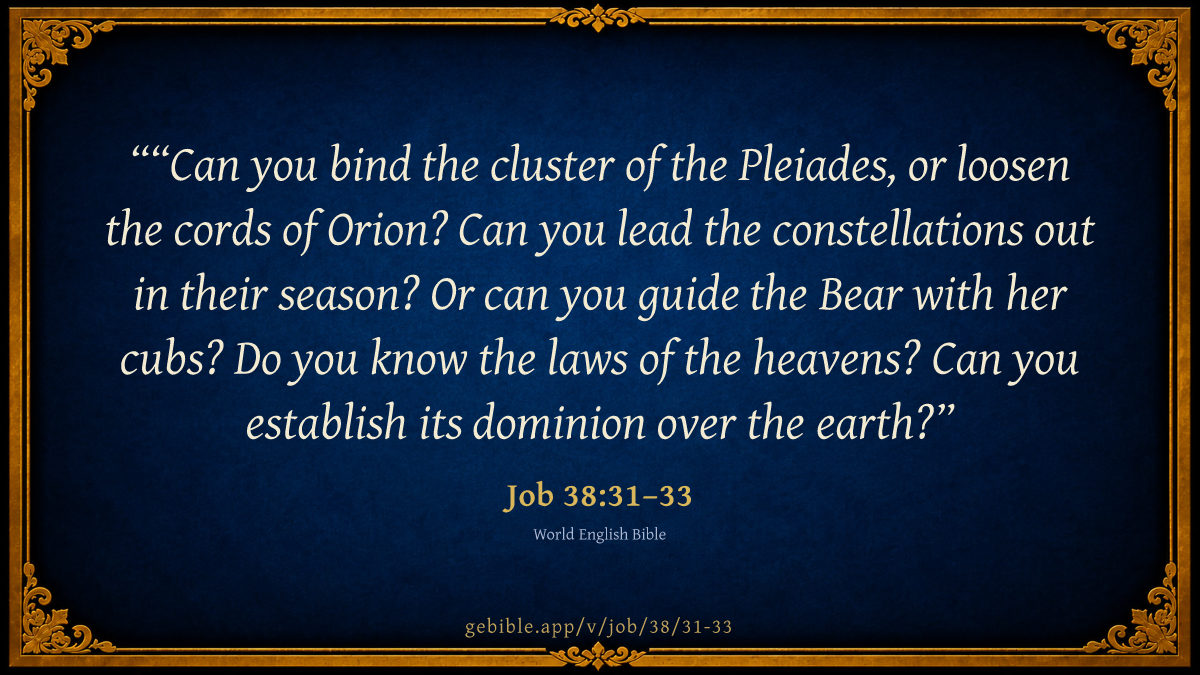
Job 38:31(v32)“Can you bind the cluster of the Pleiades, or loosen the cords of Orion?
2 Kings 23:5(v32)He got rid of the idolatrous priests, whom the kings of Judah had ordained to burn incense in the high places in the cities of Judah, and…
11 distinct cross-references across this passage (12 total citations).
Cross-references from openbible.info (CC BY 4.0)
Explain this passage (16 sources)
Historical commentary, presented as a primary source — not an endorsement.
Geneva Bible translators1599 · Public DomainOn vv31–33Which stars arise when the sun is in Taurus,…
Which stars arise when the sun is in Taurus, which is the springtime, and bring flowers.
Which star bringeth in winter.
Geneva Bible (1599) marginal notes — public domain.
John Trapp1656 · Public DomainOn vv31–33Job 38:31 Canst thou bind the sweet influences of…
Job 38:31 Canst thou bind the sweet influences of Pleiades, or loose the bands of Orion?
Ver. 31. Canst thou bind the sweet influences of the Pleiades] That is, restrain the pleasantness of the spring, or assuage the sharpness of winter, that cold and comfortless quarter? There is none beside God who can either forbid flowers to break forth in the springtime or else cause them to flourish in winter. The Pleiades (otherwise called Virgiliae and the hens, a verni temporis significatione) are the seven stars in the end of Aries. They are in Hebrew called Chimah, or Chamah, to love ardently, because of the fellowship and working together that appeareth in them. They have all one name, because they all help one another in the work, which is to bring the spring; and like seven sisters or lovers, so are they joined together in one constellation, and in one company. We see, saith one, that God will have the sweetest works in nature to be perfected by mutual help. The best time of the year cometh with these Pleiades, and the best time of our life cometh when we enter into true love and fellowship.
Read full note →
Or loose the bands of Orion?] Which is a constellation which arises in the beginning of winter, and draweth foul weather after him as with bands; these can no man loose, for winter never rotteth in the air (as the proverb hath it), nor is it fit it should, for it is of very great use for mellowing of the earth, killing of worms and weeds, &c. Neither can the spring come kindly till Orion have prepared the way, Nimbosus Orion (Virg.), παρα το ορινειν, turbare et concitare. God will have us suffer before we reign. The word Chesil here used signifieth in the Chaldee to perfect; because, saith one, by suffering and offering violence to ourselves we enter into perfection, Luk 13:32. If we would have a pleasant spring of grace in our hearts we must first have a nipping winter. The spirit of mortification must be like the cold constellation of Orion, to nip our quick motions in the head, and to bind all our unclean desires and burning lusts, that they stir not in us; and unless we do thus the delights of Pleiades, or the seven stars of comfort, shall never appear to us.
John Trapp, A Commentary or Exposition upon All the Books of the Old and New Testament (1647–1656) — public domain. Text from a community e-Sword module.
Matthew Poole1685 · Public DomainOn vv31–33Bind, i.e. restrain or hinder them. Canst thou bind…
Bind, i.e. restrain or hinder them. Canst thou bind or shut up the earth when they open it?
The sweet influences; or, the delights; because this constellation by its benign and opening influences brings in the spring, the herbs and flowers, and other delights of the earth.
Read full note →
Pleiades, called also the Seven Stars. Of this and the following constellation, see Job 9:9.
The bands; by which it binds up the air and earth, by bringing storms of rain or hail, or frost and snow; and withal binds or seals the hands of workmen, as is noted, Job 37:7.
Orion: this is another constellation, which riseth in November, and brings in winter. So the sense of the verse is, Thou canst not bind the earth when the one looseth or openeth it, nor loose or open it when the other binds or shutteth it up.
Matthew Poole's English Annotations on the Holy Bible (1683–1685) — public domain. Text from a community e-Sword/MySword module.
John Gill1763 · Public DomainOn vv31–33Knowest thou the ordinances of heaven?.... Settled by the…
Knowest thou the ordinances of heaven?.... Settled by the decree, purpose, and will of God, and are firm and stable; see Psa 148:6; the laws and statutes respecting their situation, motion, operation, influence, and use, which are constantly observed; these are so far from being made by men, and at their direction, that they are not known by them, at least not fully and perfectly;
canst thou set the dominion thereof in the earth? or over it; of the heavens over the earth; not such an one as judicial astrologers ascribe unto them, as to influence the bodies of men, especially the tempers and dispositions of their minds; to affect their wills and moral actions, the events and occurrences of their lives, and the fate of nations and kingdoms; their dominion is not moral and civil, but physical or natural, as to make the revolutions of night and day, and of the several seasons of the year; and to affect and influence the fruits of the earth, &c. see Gen 1:16; but this dominion is solely under God, and at his direction, and is not of men's fixing.
John Gill's Exposition of the Whole Bible (1746–1763) — public domain (CC PDM 1.0). Text via the HelloAO Bible API.
John Wesley1765 · Public DomainOn vv31–33Bind - Restrain or hinder them. Pleiades - The…
Bind - Restrain or hinder them. Pleiades - The seven stars, which bring in the spring. Bands - By which it binds up the air and earth, by bringing storms of rain and hail or frost and snow. Orion - This constellation rises in November, and brings in winter. Both summer and winter will have their course? God indeed can change them when he pleases, can make the spring cold, and so bind the influences of Pleiades, and the winter warm, and so loose the bands of Orion; but we cannot.
John Wesley, Explanatory Notes Upon the Whole Bible (1754–1765) — public domain. Text via the GEBible commentary corpus.
Adam Clarke1810 · Public DomainOn vv31–33Verse 31. Canst thou bind the sweet influences of…
Verse 31. Canst thou bind the sweet influences of Pleiades] The Pleiades are a constellation in the sign Taurus. They consist of six stars visible to the naked eye; to a good eye, in a clear night, seven are discernible; but with a telescope ten times the number may be readily counted. They make their appearance in the spring. Orion may be seen in the morning, towards the end of October, and is visible through November, December, and January; and hence, says Mr. Good, it becomes a correct and elegant synecdoche for the winter at large. The Pleiades are elegantly opposed to Orion, as the vernal renovation of nature is opposed to its wintry destruction; the mild and open benignity of spring, to the severe and icy inactivity of winter.
I have already expressed my mind on these supposed constellations, and must refer to my notes on Job 9:9, c., and to the learned notes of Doctor Hales and Mr. Mason Good on these texts. They appear certain, where I am obliged to doubt and, from their view of the subject, make very useful and important deductions. I find reluctance in departing from the ancient versions. In this case, these learned men follow them; I cannot, because I do not see the evidence of the groundwork; and I dare not draw conclusions from premises which seem to me precarious, or which I do not understand. I wish, therefore, the reader to examine and judge for himself.
Read full note →
Coverdale renders the 31st and 32d verses Job 38:31-32 thus:
Hast thou brought the VII starres together? Or, Art thou able to breake the circle of heaven? Canst thou bringe forth the morynge starre, or the evenynge starre, at convenient tyme, and conveye them home agayne?
Adam Clarke's Commentary on the Bible (1810–1826) — public domain. Text from a community e-Sword/MySword module.
Joseph Benson1811 · Public DomainOn vv31–32Job 38:31. Canst thou bind the sweet influences of…
Job 38:31. Canst thou bind the sweet influences of Pleiades? — Generally understood of the seven stars, which, rising about the time of the vernal equinox, bring in the spring. Canst thou restrain or hinder their influences? Or loose the bands of Orion? — By which it binds up the air and earth, rising in November, and bringing in the winter, attended with storms of rain and hail, or frost and snow. See note on Job 9:9. Whatever be the meaning of the words rendered Pleiades and Orion, the sense of which is disputed among the learned; by the former, כימה, chimah, we are to understand the sign which appears in the heavens at the spring of the year: and by the latter, כסיל, chesil, the sign which presents itself when the season is cold and severe: and the plain interpretation of the passage is, Is it in thy power to hinder either the mild or the rigid seasons of the year from making their regular appearance? Both summer and winter will have their course; God indeed can change them when he pleases, can make the spring cold, and so bind the influences of Pleiades and the winter warm, and so loose the bands of Orion, but we cannot.
Joseph Benson's Commentary on the Old and New Testaments (1811–1818) — public domain. Text from a community e-Sword module.
Albert Barnes1834 · Public DomainOn vv31–33Canst thou bind the sweet influences of Pleiades? -…
Canst thou bind the sweet influences of Pleiades? - The seven stars. On the meaning of the word used here (כימה kı̂ymâh), see the notes at Job 9:9. In regard to the meaning of the word rendered “sweet influences,” there has been considerable variety of interpretation. The Septuagint renders it, “Dost thou understand the band (δεσμόν desmon) of Pleiades?” The Hebrew word (מעדנה ma‛ădannâh) is naturally derived from a word signifying “pleasures,” or “delights” (מעדן ma‛âdan, from עדן ‛âdan, “to be soft, or pliant; to enjoy pleasure or delight”; hence, the word “Eden”), and then it would mean, as in our translation, the delightful influences of the Pleiades; or the influences supposed to be produced by this constellation in imparting happiness, particularly the pleasures enjoyed in the spring time, when that constellation makes its appearance. But Gesenius supposes that the word is derived from ענד ‛ânad, “to bind,” and that it is used by transposition for מענדות mā‛nadôth.
It would then refer to the “bands of Pleiades,” and the question would be whether Job had created the band which united the stars composing that constellation in so close union; whether he had bound them together in a cluster or bundle. This idea is adopted by Rosenmuller, Umbreit, and Noyes. Herder renders it, “the brilliant Pleiades.” The word “bands” applied to the Pleiades is not unfrequently used in Persian poetry. They were spoken of as a band or ornament for the forehead - or compared with a headband made up of diamonds or pearls. Thus, Sadi, in his Gullstan, p. 22, (Amsterdam, 1651), speaking of a garden, says,” The earth is strewed, as it were, with emeralds, and the bands of Pleiades appear upon the boughs of the trees.” So Hafiz, another Persian poet, says, in one of his odes, “Over thy songs heaven has strewed the bands of the Pleiades as a seal of immortality.” The Greenlanders call the Pleiades killukturset, a name given to them because they appear to be bound together.
Read full note →
“Egede’s Account of the Greenland Mission, p. 57;” see Rosenmuller, “Alte u. neue Morgenland, No. 768.” There seems, however, no good reason for departing from the usual meaning of the word, and then the reference will be to the time when the Pleiades or the seven stars make their appearance - the season of spring. Then the winter disappears; the streams are unlocked; the earth is covered with grass and flowers; the air is sweet and balmy; and a happy influence seems to set in upon the world. There may be some allusion here to the influence which the stars were supposed to exert over the seasons and the affairs of this world, but it is not necessary to suppose this. All that is required in the interpretation of the passage is, that the appearance of certain constellations was connected with certain changes in the seasons; as with spring, summer, or winter. It was not unnatural to infer from that fact, that the constellations exerted an influence in causing those changes, and hence, arose the pretended science of astrology. But there is no necessary connection between the two. The Pleiades appear in the spring, and seem to lead on that joyous season. These stars, so closely set together, seem to be bound to one another in a sisterly union (Herder), and thus joyously usher in the spring. God asks Job whether he were the author of that band, and had thus united them for the purpose of ushering in happy influences on the world.
Or loose the bands of Orion - In regard to this constellation, see the notes at Job 9:9. The word bands here has been supposed to refer to the girdle with which it is usually represented. Orion is here described as a man girded for action, and is the pioneer of winter. It made its appearance early in the winter, and was regarded as the precursor of storms and tempests; see the quotations in the notes at Job 9:9. Thus appearing in the autumn, this constellation seems to lead on the winter. It comes with strength. It spreads its influence over the air, the earth, the waters, and binds everything at its pleasure. God here asks Job whether he had power to disarm this giant; to unloose his girdle; to divest him of strength; to control the seasons? Had he power over summer and winter, so as to cause them to go or come at his bidding, and to control all those laws which produced them?
Albert Barnes' Notes on the Bible (1834–1885) — public domain. Text from a community e-Sword/MySword module.
Haydock's Catholic Bible Commentary1859 · Public DomainOn vv31–33Pleiades. The seven stars. --- Arcturus. A bright star…
Pleiades. The seven stars. --- Arcturus. A bright star in the north. (Challoner) --- The same terms occur, and are explained, chap. ix. 9. (Haydock)
George Leo Haydock (1774–1849), Haydock's Catholic Family Bible and Commentary, 1859 edition — public domain. Excludes Psalms (Douay-Rheims chapter numbering differs from Protestant) and Deuterocanonical books (Catholic canon only).
Robert Jamieson, A. R. Fausset & David Brown1871 · Public DomainOn vv31–33sweet influences--the joy diffused by spring, the time when…
sweet influences--the joy diffused by spring, the time when the Pleiades appear. The Eastern poets, Hafiz, Sadi, &c., describe them as "brilliant rosettes." GESENIUS translates: "bands" or "knot," which answers better the parallelism. But English Version agrees better with the Hebrew. The seven stars are closely "bound" together (see on Job 9:9). "Canst thou bind or loose the tie?" "Canst thou loose the bonds by which the constellation Orion (represented in the East as an impious giant chained to the sky) is held fast?" (See on Job 9:9).
Jamieson, Fausset & Brown — Commentary Critical and Explanatory on the Whole Bible (1871) — public domain (CC PDM 1.0). Text via the HelloAO Bible API.
Daniel D. Whedon1874 · Public DomainOn vv31–33β. Perhaps Job can tell who formed the constellations,…
β. Perhaps Job can tell who formed the constellations, “Arcturus, Orion, and Pleiades, and the chambers of the South,” — upon which he descanted so sublimely, (Job_9:9,) — and who set them in their lofty places, and ordained and confirmed their influences upon the earth! Job_38:31-33.
31. Sweet influences — Our Authorized Version is based on the natural derivation of מעדנות from עדן, “to be soft” or “tender,” the root idea of the word Eden. According to this rendering the meaning is, as given by Patrick, “Canst thou forbid the sweet flowers to come forth, when the ‘seven stars’ arise in the spring; or open the earth for the husbandman’s labour, when the winter season, at the rising of Orion, ties up their hands;” — an interpretation fanciful and weak. The word is now generally supposed to be, by metathesis, from ענד, “to bind;” hence bands. Furst, Gesenius, etc., follow the Septuagint and Targum in this rendering. The word kimah, rendered PLEIADES, (the seven stars,) signifies heap or group, and naturally suggests the ties that bind it together into its beautiful order, which leads Persian poets to compare it to a bouquet formed of jewels, (see note, Job_9:9,) and one of the Moallakat to say, “It was the hour when the Pleiades appeared in the firmament, like the folds of a silken sash, variously decked with gems.” With Oriental poets “the bands of the Pleiades” is a frequent figure. It will illustrate the Authorized Version to add that Madlar reached the conclusion that Alcyone, the principal star in the group of the Pleiades, now occupies the centre of gravity, and is at present the sun or great centre about which our universe of stars is revolving. This “focal point,” it is proper to add, was conjectured by Struve to lie between π and μ, in the group Hercules; while Argelander fixed upon Perseus as “the empire constellation of our astral system.” These “seven stars,” which in unspeakable beauty shine conspicuously forth from a vast throng (heap) of apparently minor stars, out of a distance perhaps forty million times as great as that of our own earth from the sun, send forth tender and as yet unestimated powerful influences, some of which our own earth is not too small to gather up and to feel.
Read full note →
The bands of Orion — (See Job_9:9.) מושׁכות, signifies also fetters, or its belt of three stars. (Hitzig.) These are the stars by which the giant form seems to be fastened to the heaven. (Hirtzel.) These mighty stars canst thou move from the places God has assigned them? Job can neither place in order the clustering Pleiades nor displace the stars of Orion. There is, possibly, an allusion to the wonderful nebula within this constellation. “Orion and the Pleiades are visible in the Syrian sky longer in the year than with us, and there they come about 17 higher above the horizon than with us.” — Delitzsch.
Daniel D. Whedon (gen. ed.), Commentary on the Old and New Testaments (1874–1909) — public domain. Text from a community e-Sword module.
The Cambridge Bible for Schools and Colleges1878 · Public DomainOn vv31–3331. canst thou bind] Rather, dost thou bind? The…
31. canst thou bind] Rather, dost thou bind? The questions addressed to Job, throughout the chapter, mean in general, Is it he that effects what is observed to be done? not, Can he undo what is done, or do what is not done? Hence the questions here imply that the Pleiades are bound and that Orion is loosed, and Job is asked whether it be he that binds in the one case and looses in the other.
the sweet influences] The idea suggested by “influences” is that man’s life on the earth is ruled by the stars, as Shakespeare calls the moon
Read full note →
the moist star,
Upon whose influence Neptune’s empire hangs.
There is, however, no trace of this idea in the original word. Those who retain this translation suppose the reference to be to the genial influence of spring, of which this cluster of stars, when appearing before the sun in the east, was a joyful herald. Such a reference is too remote; neither does it allow any just meaning to “bind.” Besides, the exegetical tradition is that the word rendered “sweet influences “has the same sense as “bands” in the second clause (so Sept. δεσμόν), as the parallelism requires. The verse rather means,
Dost thou bind the bands of the Pleiades,
Or loose the cords of Orion?
It is not certain that these are the stars meant, and the allusions are obscure. As “loosing the cords” or bands of Orion cannot mean dissolving the constellation and separating its stars from one another, so, if the parallelism is exact, “binding the bands” of the Pleiades ought not to refer to the fact that the stars of this constellation always appear as a group in the same form, although this is the idea which most writers consider to be expressed. The word in the second clause, being from a root always meaning to draw (ch. Job_41:1, Isa_5:18, Hos_11:4), ought to have some such sense as cords,—that by which anything is drawn, rather than that by which it is bound. The reference is probably to the motion of the constellation in the heavens. An Arabic poet, bewailing the slowness of the hours of a night of sorrow, says that, in their immobility and tardiness to turn towards their setting-place, “its stars seem bound by cords to a rock.” The same poet, however, compares the Pleiades, including perhaps Orion under the name, when it appears upon the horizon, to a girdle studded with jewels; and some have supposed that the sense in the present passage is similar, rendering, Dost thou bind into a band (or fillet) the Pleiades? This is an improbable conceit. So far as the mere language is concerned, the first clause most naturally refers to some star or constellation which appears bound to one place, whether it be that it stands always high in the heavens or is unable to rise much above the horizon; and the second clause to some star or group whose motion in the heavens is free, whether it be that it is able to rise high or that it sets and disappears.
31–38. The direction of the regular movements of the heavens, and their influence upon the earth.
The Cambridge Bible for Schools and Colleges (gen. ed. J. J. S. Perowne; Cambridge University Press, 1878–1918) — public domain. Text from a community e-Sword module.
Ellicott's Commentary for English Readers1878 · Public DomainOn vv31–33(31) The sweet influences.—With reference to their supposed effect…
(31) The sweet influences.—With reference to their supposed effect on weather and the like, or perhaps the word means chain or band, with allusion to their group—“Glitter like a swarm of fire-flies tangled in a silver braid.” The context, however, of “the bands of Orion” seems rather to favour the other view. “Canst thou regulate the influences exerted by these several constellations in either direction of increase or diminution?”
A Bible Commentary for English Readers, edited by Charles John Ellicott (1878–1897) — public domain. Text from a community e-Sword module.
The Pulpit Commentary1880 · Public DomainOn vv31–33Canst thou bind the sweet influences of Pleiades? (On…
Canst thou bind the sweet influences of Pleiades? (On the almost certain identification of the Hebrew Kirnah with the Pleiades, see the comment on Job_9:9) Whether the "sweet influences" of the constellation are here spoken of is very doubtful. Schultens and Professor Lee support the rendering; but most critics prefer to translate the word employed ( by "chains" or "fastenings" (Rashi, Kimchi, Rosenmuller, Dillmann, Canon Cook). If we adopt this view, we must suppose the invisible links which unite the stars into a constellation to be intended. Job is asked whether he can draw the links nearer together, and bind the stars closer to one another. Or loose the bands of Orion? The identity of Kesil with Orion is generally allowed. Job is asked if he can loosen the tie which unites the several members of this constellation together. Of course, he can pretend to no such powers.
Vers. 31-41. Jehovah to Job: the first answer the examination: 5. Concerning four worlds.
Read full note →
I THE WORLD OF STARS. Jehovah invites Job to reflect upon his own impotence, and therefore also inferentially upon his (i.e. Jehovah"s) omnipotence, as regards the phenomena of the heavens, over which the Power of God is exhibited in a fourfold degree.
1. In creating the orbs of heaven. The constellations (Orion, Arcturus, the Pleiades, Mazzaroth) and the planets that adorn the nocturnal sky, the nebulae that fill the depths of space, the wandering comets that flash along their eccentric paths, are all the work of his almighty fingers; cf. Job_9:9, homiletics; and consult Exposition for the import of the names Orion ("Giant" or "Fool"), the Pleiades ("A Heap" or "Group"), Arcturus (the Great Bear). Mazzaroth is commonly understood to signify the twelve signs of the zodiac (Gesenius, Umbreit, Delitzsch, Carey), though its introduction between Orion and Arcturus, conjoined with its obvious connection with the root zahar" "to shine," seems to point to a constellation or star of peculiar brightness (Canon Cook), as e.g. Jupiter or Venus (LXX, Lucifer).
2. In instituting the ordinances of heaven. The laws in accordance with which the celestial luminaries have been formed and established in their respective places in the sky, and in obedience to which they move through the depths of space and shine upon the face of earth, have been patiently investigated, and are now in some degree understood by man; but in the sense of comprehending how they have been ordained, the wisest astronomer, no less than the dullest peasant, is completely ignorant. Kepler ascertained that planets move in elliptical orbits, but why, was beyond his Power to tell Newton discovered the law of gravitation; but what gravitation itself was, the philosopher could no more explain than a schoolboy.
3. In regulating the movements of heaven. Whether the image is that of a chariot to which its snorting steeds are fastened by means of bands (Carey), or of a bouquet of jewels bound or twisted together (Delitzsch), the binding, of the sweet influences of the Pleiades refers to God"s power in bringing that constellation above the horizon at certain seasons of the year" and in calling it forth every night during the season upon the dark vault of heaven. So the loosening of the bands of Orion may point to the disappearance of that constellation from the firmament, the bringing forth of Mazzaroth and the guiding of Arcturus to the directing of their movements in the sky.
4. In determining the influences of heaven. That the stellar world exercised an influence upon the earth, the course of its events and the fortunes of its inhabitants, was a dream of astrological superstition, and cannot be admitted as the subject to which Jehovah here alludes. The explanation must be sought, and with sufficient fulness will be found, by recurring to the words of Moses in connection with the work of the fourth creative day. (Gen_1:14-19)
II THE WORLD OF METEORS. Descending from the upper circle of the stars, Jehovah pauses at the next beneath it, the circle of the aerial firmament, directing Job to two phenomena that lie beyond the range of his ability, but quite within the sphere of God"s, thereby demonstrating on the one hand the feebleness of man, and on the other hand the omnipotence of God.
1. The bringing of rain. "Canst thou lift up thy voice to the clouds, that abundance of waters may cover thee? God speaks to the clouds when his voice thunders through the sky, and immediately the clouds reply by deluging the earth with a flood. But man may shout himself hoarse in the vain endeavour to make the clouds obedient to his will. Yet the Power of faith wielded by a weak man has accomplished what is here denied to man in himself. (1Ki_18:42 Jam_5:17)
2. The sending of lightning. "Canst thou send forth lightnings, that they may go, and say unto thee, Here we are?" No! It is a special mercy that no Job ca, a thus exercise unlimited control over the powers of nature. "Could great men thunder As Jove himself does, Jove would ne"er be quiet, For every pelting, petty officer Would use his heaven for thunder! ("Measure for Measure," act 2: So 2) But the thunderbolts of the sky, the electric currents of the air, the innumerable forces of the globe, are all obedient to the word of command which God gives. (cf. Mat_8:9)
III THE WORLD OF INTELLIGENCE. Descending yet a third step, Jehovah reaches the realm of men. Interrogating Job, he:
1. Makes a frank recognition. Man is possessed of wisdom in the inward parts, and retains understanding in his heart; i.e. he has a certain power of inquiring into the names and causes of terrestrial phenomena. God delights to acknowledge the essential dignity of man, even though sin has largely defaced his beauty and impaired his powers. Man"s intelligence is a noble gift which man should not despise, but cultivate with assiduity.
2. Asks an important question. Whence did man receive his wisdom? Was it from himself? Did it spring up within his heart as a spontaneous growth or development? Or was the doctrine of Elihu (Job_32:8) correct that it is the Spirit of the Almighty which gives man understanding? Many modern scientists would affirm the former, which shows that they still require to ponder Jehovah"s question to the patriarch.
IV THE WORLD OF ANIMALS. Leaving man, the last stage is arrived at in the domain of the lower creatures, in which Job is invited to behold an evidence of the power, wisdom, and goodness of God.
1. Of God"s power. Had the problem been proposed to Job to provide food for the lioness and her whelps, Jehovah asks him if he could have done it: "Wilt thou hunt the prey for the lioness? or fill the appetite of the young lions?" (ver. 39). No; Job could not have so much as approached these ferocious creatures without trembling; but God did it every day, silently, regularly, effectively, by the operation of a divinely implanted instinct which impelled every particular creature to seek and find its own particular food That God was able thus to move even the most untamable of beasts was sufficient demonstration of the completeness of that control which he wielded over the entire animal creation.
2. Of God"s wisdom. There are few more striking illustrations of the wisdom of God than those afforded by the instincts of the lower creatures, and in particular by that which guides them to the special food which each requires, to the place where it is to be found, and the manner in which it is to be appropriated. What this mysterious force is which controls every sentient creature neither science nor philosophy can explain. Resembling intelligence, it yet differs from intelligence by obvious characteristics.
3. Of God"s goodness. Manifested in catering for any of his creatures, it is conspicuously seen in providing food for the unclean raven and her hateful brood. It is even revealed by those predatory instincts which lead the stronger animals to prey upon the weaker, thus serving among other purposes to limit the increase of the inferior orders of existence, and even shadowing forth to man truths of a lofty spiritual significance, had he only the opened eye to understand them.
Learn:
1. That there is no part of God"s universe over which his sway is not sovereign and complete.
2. That man may admire God"s great power and wisdom, but he can neither equal the one nor improve the other.
3. That man is even dependent upon God for the capacity to understand and appreciate the Divine wisdom and power.
4. That nothing exists in God"s world that does not serve some divinely ordained purpose.
5. That God"s goodness extends to the meanest and most repulsive of creatures.
6. That that God who is kind to lionesses and ravens will not likely be forgetful of his own children.
7. That men should imitate their Maker in being kind to the lower animals.
Vers. 31, 32. Astrology and astronomy.
The earliest science was that which concerned itself with the movements of the heavenly bodies; until recent times this science was universally associated with the fortunes of men, and it is still thus associated by the greater part of the world. What is our relation to the heavenly bodies?
I IN COMMON WITH THE STARS, WE ARE PART OF ONE DIVINE UNIVERSE. The study of the heavens is the study of God"s works. He dwells in the most distant systems, and equally in this familiar world. All parts of the universe obey the fixed laws of God; all move in harmony under his directing hand. Thus all the worlds are linked together. We are members of a very large "household of God.
II WE ARE SUBJECT TO INFLUENCES FROM THE HEAVENLY BODIES. We have given up astrology as a delusion. But we are entirely dependent for life itself upon one heavenly body, the sun. This earth is not self-sufficient. It would be frozen to death if the sun were to cease to pour into it his streams of heat. Some have connected sun-spots with social and financial crises! Although this may be but a survival of an ancient superstition, perhaps it is not wise to affirm that it must be nothing more. Now, the physical heavens have always been to us a type of the spiritual heavens. Spiritually our life is not self-contained. Astrology had this in its favour, that it taught a certain largeness of view. It did not permit a person to confine his attention to his own parish. It compelled him to look up and to look to distant things. It is our duty to "do the next thing," and not to waste our time in star-gazing. Nevertheless, we need to be lifted in thought out of the petty round of interests that immediately concern us, even in order that we may best discharge our duty in connection with those interests. Astronomy is an elevating and enlarging science; much more so is a true theology.
III WE CANNOT AFFECT THE HEAVENLY BODIES. They roll on their age-long courses in sublime indifference to our greatest achievements and strongest desires. Job is asked whether he can bind up the cluster or Pleiades, as he would bind up a hunch of jewels. Can he unclasp the belt of great Orion? Here man is nothing. This is a lesson in humility. Yet have we not a grand encouragement in knowing that the Lord of the starry universe is our Father who cares for us, listens to our cry, and helps our need?
IV WE CANNOT RULE THE SEASONS. As summer came on, Job would see the brilliant little group of the Pleiades rising before the sun and the giant Orion sinking out of sight; and this would be a sign that the fruitful season was approaching. But Job could not hasten it. The farmer cannot bring abort the seasons he would choose. It is useless to murmur at their apparent inopportuneness. It is wiser to learn the lesson they teach us of our absolute dependence on God. Before these great phenomena of nature we are as nothing. Yet in the sight of God we are more than all of them; for they are material, we spiritual; they his works, we his children. W.F.A.
The Pulpit Commentary (1880–1919), ed. H.D.M. Spence-Jones & Joseph S. Exell — public domain. Text from a community e-Sword module.
The Biblical Illustrator1887 · Public DomainOn vv31–32Canst thou bind the sweet influences of Pleiades, or…
Job_38:31
Canst thou bind the sweet influences of Pleiades, or loose the bands of Orion?
Read full note →
Light unrestrainable
Who can bind or restrain the light? The subject before us is the self-revealing power of the Gospel. Men may love darkness, but they cannot hide the advent of light, and can never be, in conscience and accountability, as if they had not seen the light. Evil men may wish the Christ out of the world, but they cannot hide His glory. All Christian light, whether its medium be teaching, or character, or life, or conversation, cannot be restrained. We cannot tell where influence reaches. It may leap forth long after we have finished our course. Men being dead, yet speak to us; facts in their history are disentombed, and we receive the light of their fidelity and heroism.
I. The light of Pleiades in a human sense. What the world wants is more light--the light of love. That sweetens all relationships, and is the only cement of all classes in our crowded communities. Love is the light of the universe. Let the rosy beams of affection shine in the character, its potent charm will be as irresistible as is the health-giving, gladdening light.
II. The light of the Pleiades in a Divine sense. Love is never impotent--never doubtful of its triumph. Our Saviour never distrusted the issues of the Cross. While men are questioning about Him, His influences are going forth. Sin, grief, and death are still here. But men cannot take Christ out of the world.
III. The light of the Pleiades in a historic sense. Light does not die. The great influence of the reformers will never be lost. You cart bind mere opinion; you can bind mere ecclesiasticism; you cannot bind the renewed Christlike soul.
IV. The light of the Pleiades in a personal influence sense. Words live long after their authors have uttered them. Deeds are vital long after great empires have passed away. Words and deeds go through the electric chain of schools, and families, and churches. None can bind the sweet influences of the Pleiades at home or abroad. (W. M. Statham.)
Spring
The Pleiades are a constellation, or group of seven stars, seen in the astronomical sign Taurus, making their appearance in the spring, and thence called spring signs, or tokens. The Hebrew term is expressive of beauty. In the text, the word translated bind signifies to compel or constrain. Canst thou compel the sweet influences of the Pleiades, or loosen the bands of Orion? (winter). Canst thou force forward the spring, and abruptly break up the rigidity of winter?
I. How absolute is the rule of the most high in the natural world. Can man alter the Divine dispensations, or so much as either hasten or delay them? Let us mark our absolute dependence, and humble ourselves before the Almighty Ruler.
II. He who rules in the kingdom of nature rules also in that of providence. The events of life are no less under His control than are the stars in their courses. Canst thou compel or retain the sweet influences of prosperity; or canst thou loosen the bands of adversity? All our comfort and satisfaction, whether of a bodily or mental kind, is received from Him; and, when He pleases, is in a moment wrested from us. Joy and sorrow, pleasure and pain, come and go at His command. It is true that men themselves, being free and intelligent creatures, do by their character and conduct modify and influence their fate and fortune; but this they do only in accordance with the laws of providence, How important it is that we should be earnest and faithful in improving the varying dispensations of providence which are successively appointed for our trial.
III. He who rules in nature and providence rules also in the kingdom of grace. If we look within, we shall find new proofs of our ignorance and weakness, and absolute dependence on the Author of our being. Can you loose the bands of guilt, or compel the sweet influences of pardoning mercy? God only can remit our offences; and the means He has employed for this end, in the incarnation, sufferings, and death of His own dear Son, afford the clearest demonstration of the foolishness of human wisdom, and the impotence of human power in this high concern. (H. Grey, D. D.)
Delightful influences of spring tide
The Pleiades are a well-known cluster of stars in the constellation of Taurus. The ancients were in the habit of determining their seasons by the rising and setting of certain constellations. The Pleiades were regarded as the cardinal constellations of spring. These seven stars appear about the middle of April, and hence are associated with the return of spring, the season of sweet influences. The Hebrew word is derived from a word signifying delights. The influences of spring are delightful in many ways--
I. As temporal ministries. These influences come to bring great blessings to man, as a tenant of the earth.
1. Supplies of food. They come to mollify the earth, fertilise the soil, germinate the seed out of which come the material provisions for man and beast.
2. Pleasures to the senses. Spring mantles the world with a thousand robes of beauty, all with endless variety of hue and shape.
3. Exhilarates the spirit. The influences of spring are delightful--
II. As Divine manifestations. Spring tide is a new revelation of God. It reveals--
1. The profusion of His vital energy. Every spot teems with a new existence, and every new life is from Him.
2. The wonderful tastefulness of God. Spring brings a universe of fresh beauties to the eye.
3. The calm ease with which He works. How quietly He pours forth those oceans of new life that are now rolling over the earth.
4. The regularity of His procedure. For 6000 years spring has never failed to come.
III. As instructive emblems.
1. Spring is an emblem of human life. Both have vast capabilities of improvement. Both are remarkably changeable. Both are fraught with fallacious promises.
2. Spring is an emblem of spiritual renovation.
(1) The new spiritual life is like the spring in the season from which it has emerged.
(2) In the tenacity with which the past strives to keep its hold.
(3) It tends to a perfect future. The power of winter will gradually give way; summer will come, and then the golden autumn.
3. Spring is an emblem of the general resurrection, The Bible looks at it in this light (1Co_15:36; 1Co_15:41).
(1) Spring life is a resuscitation; it is not properly a new creation, it grows out of the past.
(2) Spring life is a resuscitation from an apparently extinct life. That which thou sowest is not quickened unless it die.
(3) Spring life is a resuscitation against which many antecedent objections might have been raised. So with the resurrection of the body. (Homilist.)
Influence and power
The Pleiades was looked upon as the constellation of spring; Orion, of winter. The sweet influences of the Pleiades were the life forces which caused the grass to spring, the plant to grow, and the flower to bloom. The bands of Orion were made of ice. They only could bind the sweet influences of spring; spring only, at its return, could loose them. Nothing but silent influence is strong enough to overcome silent influence. The greatest forces in this world are those which work, like the warmth of spring and the cold of winter, in silence. There is, in every mans life, spring and winter; and there is war between them. In this world good influence has all the time to do battle with bad influence. A legend says that after the battle of Chalons the spirits of the slain soldiers continued the conflict for several days. And after we are dead, the silent, invisible influences we have brought into being will continue their battle for good or evil. Theodore Parker spoke a great truth when, dying in Italy, he said, There are two Theodore Parkers; one of them is dying in Italy; the other I have planted in America, and it will continue to live. We have, in spite of ourselves, an immortality upon earth. So far from blotting us out, death often intensifies our personality. But in Christianity there is more than influence. Ye shall receive power after that the Holy Ghost is come upon you. Influence is the sum total of all the forces in our lives--mental, moral, financial, social. Power is God at work. All power is given unto Me in heaven and earth. Go ye therefore and make disciples, and lo, I am with you. God does not delegate power. He goes along with us, and exerts that power Himself. Christian influences are not sufficient for the needs of the Church. The success of the Gospel at first did not depend upon influence. The only time the word is used in the Bible is in this text from Job. The apostles were not men of influence. Few disciples were made from the influential classes, and as soon as made, they lost by their faithfulness most of the influence they had before. Christ did not choose to become a man of influence. God hath chosen power rather than influence. Mere influence never converted a soul. The Spirit can, of course, use influences. Influence without the Spirit never saved anybody. We should seek power even at the expense of influence. There is such a thing as gaining and retaining influence over a person in such a way as to lose all power with God. And there is such a thing as losing influence while we gain power. Paul had a good opportunity for gaining influence with Felix by flattering him in his sins, and could have made a splendid impression for himself by such a course. But as he gained influence with Felix, he would have lost power with God. He chose power before influence, and reasoned of righteousness, temperance, and judgment to come till Felix trembled under the hand of God. Paul and Silas did not have influence enough to keep them out of jail, but there was power enough with them to shake the old jail open. By a compromising course they might have pleased the authorities, and kept out of prison, but they would have lost all power. The disciples at Pentecost had little influence. They were the followers of One who had been crucified as a malefactor. The doctrines He preached were very unpopular. But they had power, and Christians with power can get along without much influence. If they had depended upon influence they would have set about the building of such houses and the establishment of such institutions as would have promoted it. All this would have taken time. Influences, like the forces of spring, work slowly. Power works suddenly. Not evolution, but revolution, was the effect of power at Pentecost. Not a word have I to say, let me repeat, against the use of all influences for good. What I insist upon is, that this world is not going to be converted by influences. (A. G. Dixon, D. D.)
Pleiades
The isolated group of the Seven Stars, from the singularity of its appearance, has been distinguished and designated by an appropriate name from the earliest ages. The learned priests of Belus carefully observed its risings and settings nearly two thousand years before the Christian era. By the Greeks it was called Pleiades, from the word pleein, to sail, because it indicated the time when the sailor might hope to undertake a voyage with safety. It was also called Vergiliae, from ver, the spring, because it ushered in the mild vernal weather, favourable to farming and pastoral employments. The Greek poets associated it with that beautiful mythology which, in its purest form, peopled the air, the woods, and the waters with imaginary beings, and made the sky itself a concave mirror, from which came back exaggerated ideal reflections of humanity. The seven stars were supposed to be the seven daughters of Atlas, by Pleione, one of the Oceanides--placed in the heavens after death. Their names are Alcyone, Merope, Main, Electra, Taygeta, Asterope, and Celaeno. They were all united to the immortal gods, with the exception of Merope, who married Sisyphus, King of Corinth, and whose star, therefore, is dim and obscure among her sisters. The lost Pleiad, the sorrowing Merope, has long been a favourite shadowy creation of the poetic dream. But an interest deeper than any derived from mythical association or classical allusion, is connected with this group of stars by the use made of it in Scripture. I believe that in the apparently simple and passing allusion to it in Job, lies hid the germ of one of the greatest of physical truths--a germ lying dormant and concealed in the pages of Scripture for ages, but now brought into air and sunlight by the discoveries of science, and developing flowers and fruit of rare value and beauty. If our translators have correctly identified the group of stars to which they have given the familiar name of Pleiades--and we have every reason to confide in their fidelity--we have a striking proof here afforded to us of the perfect harmony that exists between the revelations of science and those of the Bible--the one illustrating and confirming the other. So far as Job was concerned, the question, Canst thou bind the sweet influences of Pleiades? might have referred solely to what was then the common belief--namely, that the genial weather of spring was somehow caused by the peculiar position of the Pleiades in the sky at that season; as if God had simply said, Canst thou hinder or retard the spring? It remained for modern science to make a grander and wider application of it, and to show in this, as in other instances, that the Bible is so framed as to expand its horizon with the march of discovery--that the requisite stability of a moral rule is, in it, most admirably combined with the capability of movement and progress. If we examine the text in the original, we find that the Chaldaic word translated in our version Pleiades is Chimah, meaning literally a hinge, pivot, or axle, which turns round and moves other bodies along with it. Now, strange to say, the group of stars thus characterised has recently been ascertained by a series of independent calculations--in utter ignorance of the meaning of the text--to be actually the hinge or axle round which the solar system revolves. It was long known as one of the most elementary truths of astronomy, that the earth and the planets revolve around the sun; but the question recently began to be raised among astronomers, Does the sun stand still, or does it move round some other object in space, carrying its train of planets and their satellites along with it in its orbit? Attention being thus specially directed to this subject, it was soon found that the sun had an appreciable motion, which tended in the direction of a lily-shaped group of small stars, called the constellation of Hercules. Towards this constellation the stars seem to be opening out; while at the opposite point of the sky their mutual distances are apparently diminishing--as if they were drifting away, like the foaming wake of a ship, from the suns course. When this great physical truth was established beyond doubt, the next subject of investigation was the point or centre round which the sun performed this marvellous revolution: and after a series of elaborate observations, and most ingenious calculations, this intricate problem was also satisfactorily solved--one of the greatest triumphs of human genius. M. Madler, of Dorpat, found that Alcyone, the brightest star of the Pleiades, is the centre of gravity of our vast solar system--the luminous hinge in the heavens, round which our sun and his attendant planets are moving through space. The very complexity and isolation of the system of the Pleiades, exhibiting seven distinct orbs closely compressed to the naked eye, but nine or ten times that number when seen through a telescope--forming a grand cluster, whose individuals are united to each other more closely than to the general mass of stars--indicate the amazing attractive energy that must be concentrated in that spot. Vast as is the distance which separates our sun from this central group--a distance thirty-four millions of times greater than the distance between the sun and our earth--yet so tremendous is the force exerted by Alcyone, that it draws our system irresistibly around it at the rate of 422,000 miles a day, in an orbit which it will take many thousands of years to complete. With this new explanation, how remarkably striking and appropriate does the original word for Pleiades appear! What a lofty significance does the question of the Almighty receive from this interpretation! Canst thou bind the sweet influences of Pleiades? Canst thou arrest, or in any degree modify, that attractive influence which it exerts upon our sun and all its planetary worlds, whirling them round its pivot in an orbit of such inconceivable dimensions, and with a velocity so utterly bewildering? Silence the most profound can be the only answer to such a question. Man can but stand afar off, and in awful astonishment and profound humility exclaim with the Psalmist, O Lord my God, Thou art very great! (Hugh Macmillan, D. D.)
Orion
This cluster of stars--the Kesil of the ancient Chaldeans--is by far the most magnificent constellation in the heavens. Its form must be familiar to everyone who has attentively considered the nocturnal sky. It resembles the rude outline of a gigantic human figure. By the Greek mythologists, Orion was supposed to be a celebrated hunter, superior to the rest of mankind in strength and stature, whose mighty deeds entitled him after death to the honours of an apotheosis. The Orientals imagined him to be a huge giant who, Titan-like, had warred against God, and was therefore bound in chains to the firmament of heaven; and some authors have conjectured that this notion is the origin of the history of Nimrod, who, according to Jewish tradition, instigated the descendants of Noah to build the Tower of Babel. The constellation of Orion is composed of four very bright stars, forming a quadrilateral, higher than it is broad, with three equidistant stars in a diagonal line in the middle. The two upper stars, called Betelgeux and Bellatrix, form the shoulders; in the middle, immediately above these, are three small, dim stars, close to each other, forming the cheek or head. These stars are distinctly visible only on a very clear night; and this circumstance may have given rise to the old fable that (Enopion, King of Chios,--whose daughter Orion demanded in marriage,--put out his eyes as he lay asleep on the seashore, and that he recovered his sight by gazing upon the rising sun from the summit of a neighbouring hill. The constellation is therefore represented by the poets, as groping with blinded eyes all round the heavens in search of the sun. The feet are composed of two very bright stars, called Rigel and Saiph; the three stars in the middle are called the belt or girdle, and from them depends a stripe of smaller stars, forming the hunters sword. The whole constellation, containing seventeen stars to the naked eye, but exhibiting seventy-eight in an ordinary telescope, occupies a large and conspicuous position in the southern heavens, below the Pleiades; and is often visible, owing to the brightness and magnitude of its stars, when all other constellations, with the exception of the Plough, are lost in the mistiness of night. In this country it is seen only a short space above the horizon, along whose ragged outline of dark hills its starry feet may be observed for many nights in the winter, walking in solitary grandeur. It attains its greatest elevation in January and February, and disappears altogether during the summer and autumn months. In Mesopotamia it occupies a position nearer the zenith, and therefore is more brilliant and striking in appearance. Night after night it sheds down its rays with mystical splendour over the lonely solitudes through which the Euphrates flows, and where the tents of the patriarch of Uz once stood. Orion is not only the most striking and splendid constellation in the heavens, it is also one of the few clusters that are visible in all parts of the habitable world. The equator passes through the middle of it; the glittering stars of its belt being strung, like diamonds, on its invisible line. In the beginning of January, when it is about the meridian, we obtain the grandest display of stars which the sidereal heavens in this country can exhibit. The ubiquity of this constellation may have been one of the reasons why it was chosen to illustrate Gods argument with Job, in a book intended to be read universally. When the Bible reader of every clime and country can go out in the appropriate season, and find in his own sky the very constellation and direct his gaze to the very peculiarity in it, to which the Creator alluded in His mysterious converse with Job, he has no longer a vague, indefinite idea in his mind, but is powerfully convinced of the reality of the whole circumstance, while his feelings of devotion are deepened and intensified. The three bright stars which constitute the girdle or bands of Orion never change their form; they preserve the same relative position to each other, and to the rest of the constellation, from year to year, and age to age. They afford to us one of the highest types of immutability in the midst of ceaseless changes. (Hugh Macmillan, D. D.)
Interrogations humble pride
The probability is that Job had been tempted to arrogance by his vast attainments. He was a metallurgist, a zoologist, a poet, and shows by his writings he had knowledge of hunting, of music, of husbandry, of medicine, of mining, of astronomy, and perhaps was so far ahead of the scholars and scientists of his time, that he may have been somewhat puffed up. Hence this interrogation of my text. And there is nothing that so soon takes down human pride as an interrogation point rightly thrust. Christ used it mightily. Paul mounted the parapet of his great arguments with such a battery. Men of the world understand it. Demosthenes began his speech on the crown, and Cicero his oration against Catiline, and Lord Chatham his most famous orations with a question. The empire of ignorance is so much vaster than the empire of knowledge that after the most learned and elaborate disquisition upon any subject of sociology or theology the plainest man may ask a question that will make the wisest speechless. After the profoundest assault upon Christianity the humblest disciple may make an inquiry that would silence a Voltaire. Called upon, as we all are at times, to defend our holy religion, instead of argument that can always be answered by argument, let us try the power of interrogation. (T. De Witt Talmage.)
The sweet influences of life
My text called Job and calls us to consider the sweet influences. We put too much emphasis upon the acidities of life, upon the irritations of life, upon the disappointments of life. Ammianus Marcellinus said that Chaldea was, in olden times, overrun with lions, but many of them lost their power because the great swamps produced many gnats, that would get into the eyes of the lions, and the lions, to free themselves of the gnats, would claw their own eyes out, and then starve. And in our time many a lion has been overcome by a gnat. The little, stinging annoyances of life keep us from appreciating the sweet influences. And how many of these last there are t Sweet influences of home, sweet influences of the wife of friendship, of our holy religion. Of all the sweet influences that have ever blessed the earth those that radiate from Christ are the sweetest. (T. De Witt Talmage.)
Influence cannot be restrained
You are in no danger of overestimating your influence upon others. The real danger lies in the other direction. You influence others and mould their characters and destinies for time and for eternity far more extensively than you imagine. The whole truth in this matter might flatter you; it would certainly astonish you if you could once grasp it in its full proportions. It was a remark of Samuel J. Mills that No young man should live in the nineteenth century without making his influence felt around the globe. At first thought that seems a heavy contract for any young man to take. As we come to apprehend more clearly the immutable laws of Gods moral universe, we find that this belting of the globe by His influence is just what every responsible being does--too often, alas, unconsciously. You have seen the telephone, that wonderful instrument which so accurately transmits the sound of the human voice so many miles. How true it is that all these wonderful modern inventions are only faint reflections of some grand and eternal law of the moral universe of God! Gods great telephone--I say it reverently--is everywhere, filling earth and air and sea, and sending round the world with unerring accuracy, and for a blessing or a curse, every thought of your heart, every word that falls thoughtfully or thoughtlessly from your lips, and every act you do. It is time you awoke to the conviction that, whether you would have it so or not, your influence is worldwide for good or for evil. Which? (Peter Pounder.)
Moral gravitation
is as powerful as material gravitation, and if, as my text teaches, and science confirms, the Pleiades, which are 422,000 miles from our earth, influence the earth, we ought to be impressed with how we may be influenced by others far away back, and how we may influence others far down the future. That rill away up amongst the Alleghenies, so thin that you think it will hardly find its way down the rocks, becomes the mighty Ohio rolling into the Mississippi and roiling into the sea. That word you utter, that deed you do, may augment itself as the years go by, until rivers cease to roll, and the ocean itself shall be dried up in the burning of the world. Paul, who was all the time saying important things, said nothing more startlingly suggestive than when he declared, None of us liveth or dieth to himself. Words, thoughts, actions, have an eternity of flight. As Job could not bind the sweet influences of the Seven Stars, as they were called, so we cannot arrest or turn aside the good projected long ago. Those influences were started centuries before our cradle was rocked, and will reign centuries after our graves are dug. Oh, it is a tremendous thing to live. (T. De Witt Talmage.)
The Biblical Illustrator, edited by Joseph S. Exell (c. 1880s–1900s) — public domain. Text from a community e-Sword module.
unfoldingWord translationNotes2017 · CC BY-SA 4.0On v31Connecting Statement:
Connecting Statement:
Yahweh continues to challenge Job.
Read full note →
General Information:
Yahweh uses five questions to emphasize to Job that he rules the heavens and Job does not. (See: Rhetorical Question)
General Information:
Each of the two lines in these three verses mean similar things. (See: Parallelism)
Can you fasten chains ... over the earth?
These can be translated as statements. AT: "Tell me if you can fasten chains on the Pleiades, or undo the cords of Orion. Tell me if you can lead the constellations to appear at their proper times, or guide the Bear with its children. Tell me if you know the regulations of the sky, or whether you could set in place the sky's rule over the earth." (See: Rhetorical Question)
fasten chains on
"bind chains onto" or "tie the bonds of"
the Pleiades ... Orion ... the Bear
These are the names of constellations. See how you translated them in Job 9:9.
undo the cords of Orion
"loosen the cords that hold Orion"
constellations
groups of stars that seem like they form a particular shape in the sky

Geneva Bible translators 1599 · Public Domain On vv31–33 Which stars arise when the sun is in Taurus,…
Which stars arise when the sun is in Taurus, which is the springtime, and bring flowers.
Which star bringeth in winter.
Geneva Bible (1599) marginal notes — public domain.
John Trapp 1656 · Public Domain On vv31–33 Job 38:31 Canst thou bind the sweet influences of…
Job 38:31 Canst thou bind the sweet influences of Pleiades, or loose the bands of Orion?
Ver. 31. Canst thou bind the sweet influences of the Pleiades] That is, restrain the pleasantness of the spring, or assuage the sharpness of winter, that cold and comfortless quarter? There is none beside God who can either forbid flowers to break forth in the springtime or else cause them to flourish in winter. The Pleiades (otherwise called Virgiliae and the hens, a verni temporis significatione) are the seven stars in the end of Aries. They are in Hebrew called Chimah, or Chamah, to love ardently, because of the fellowship and working together that appeareth in them. They have all one name, because they all help one another in the work, which is to bring the spring; and like seven sisters or lovers, so are they joined together in one constellation, and in one company. We see, saith one, that God will have the sweetest works in nature to be perfected by mutual help. The best time of the year cometh with these Pleiades, and the best time of our life cometh when we enter into true love and fellowship.
Read full note →
Or loose the bands of Orion?] Which is a constellation which arises in the beginning of winter, and draweth foul weather after him as with bands; these can no man loose, for winter never rotteth in the air (as the proverb hath it), nor is it fit it should, for it is of very great use for mellowing of the earth, killing of worms and weeds, &c. Neither can the spring come kindly till Orion have prepared the way, Nimbosus Orion (Virg.), παρα το ορινειν, turbare et concitare. God will have us suffer before we reign. The word Chesil here used signifieth in the Chaldee to perfect; because, saith one, by suffering and offering violence to ourselves we enter into perfection, Luk 13:32. If we would have a pleasant spring of grace in our hearts we must first have a nipping winter. The spirit of mortification must be like the cold constellation of Orion, to nip our quick motions in the head, and to bind all our unclean desires and burning lusts, that they stir not in us; and unless we do thus the delights of Pleiades, or the seven stars of comfort, shall never appear to us.
John Trapp, A Commentary or Exposition upon All the Books of the Old and New Testament (1647–1656) — public domain. Text from a community e-Sword module.
Matthew Poole 1685 · Public Domain On vv31–33 Bind, i.e. restrain or hinder them. Canst thou bind…
Bind, i.e. restrain or hinder them. Canst thou bind or shut up the earth when they open it?
The sweet influences; or, the delights; because this constellation by its benign and opening influences brings in the spring, the herbs and flowers, and other delights of the earth.
Read full note →
Pleiades, called also the Seven Stars. Of this and the following constellation, see Job 9:9.
The bands; by which it binds up the air and earth, by bringing storms of rain or hail, or frost and snow; and withal binds or seals the hands of workmen, as is noted, Job 37:7.
Orion: this is another constellation, which riseth in November, and brings in winter. So the sense of the verse is, Thou canst not bind the earth when the one looseth or openeth it, nor loose or open it when the other binds or shutteth it up.
Matthew Poole's English Annotations on the Holy Bible (1683–1685) — public domain. Text from a community e-Sword/MySword module.
John Gill 1763 · Public Domain On vv31–33 Knowest thou the ordinances of heaven?.... Settled by the…
Knowest thou the ordinances of heaven?.... Settled by the decree, purpose, and will of God, and are firm and stable; see Psa 148:6; the laws and statutes respecting their situation, motion, operation, influence, and use, which are constantly observed; these are so far from being made by men, and at their direction, that they are not known by them, at least not fully and perfectly;
canst thou set the dominion thereof in the earth? or over it; of the heavens over the earth; not such an one as judicial astrologers ascribe unto them, as to influence the bodies of men, especially the tempers and dispositions of their minds; to affect their wills and moral actions, the events and occurrences of their lives, and the fate of nations and kingdoms; their dominion is not moral and civil, but physical or natural, as to make the revolutions of night and day, and of the several seasons of the year; and to affect and influence the fruits of the earth, &c. see Gen 1:16; but this dominion is solely under God, and at his direction, and is not of men's fixing.
John Gill's Exposition of the Whole Bible (1746–1763) — public domain (CC PDM 1.0). Text via the HelloAO Bible API.
John Wesley 1765 · Public Domain On vv31–33 Bind - Restrain or hinder them. Pleiades - The…
Bind - Restrain or hinder them. Pleiades - The seven stars, which bring in the spring. Bands - By which it binds up the air and earth, by bringing storms of rain and hail or frost and snow. Orion - This constellation rises in November, and brings in winter. Both summer and winter will have their course? God indeed can change them when he pleases, can make the spring cold, and so bind the influences of Pleiades, and the winter warm, and so loose the bands of Orion; but we cannot.
John Wesley, Explanatory Notes Upon the Whole Bible (1754–1765) — public domain. Text via the GEBible commentary corpus.
Adam Clarke 1810 · Public Domain On vv31–33 Verse 31. Canst thou bind the sweet influences of…
Verse 31. Canst thou bind the sweet influences of Pleiades] The Pleiades are a constellation in the sign Taurus. They consist of six stars visible to the naked eye; to a good eye, in a clear night, seven are discernible; but with a telescope ten times the number may be readily counted. They make their appearance in the spring. Orion may be seen in the morning, towards the end of October, and is visible through November, December, and January; and hence, says Mr. Good, it becomes a correct and elegant synecdoche for the winter at large. The Pleiades are elegantly opposed to Orion, as the vernal renovation of nature is opposed to its wintry destruction; the mild and open benignity of spring, to the severe and icy inactivity of winter.
I have already expressed my mind on these supposed constellations, and must refer to my notes on Job 9:9, c., and to the learned notes of Doctor Hales and Mr. Mason Good on these texts. They appear certain, where I am obliged to doubt and, from their view of the subject, make very useful and important deductions. I find reluctance in departing from the ancient versions. In this case, these learned men follow them; I cannot, because I do not see the evidence of the groundwork; and I dare not draw conclusions from premises which seem to me precarious, or which I do not understand. I wish, therefore, the reader to examine and judge for himself.
Read full note →
Coverdale renders the 31st and 32d verses Job 38:31-32 thus:
Hast thou brought the VII starres together? Or, Art thou able to breake the circle of heaven? Canst thou bringe forth the morynge starre, or the evenynge starre, at convenient tyme, and conveye them home agayne?
Adam Clarke's Commentary on the Bible (1810–1826) — public domain. Text from a community e-Sword/MySword module.
Joseph Benson 1811 · Public Domain On vv31–32 Job 38:31. Canst thou bind the sweet influences of…
Job 38:31. Canst thou bind the sweet influences of Pleiades? — Generally understood of the seven stars, which, rising about the time of the vernal equinox, bring in the spring. Canst thou restrain or hinder their influences? Or loose the bands of Orion? — By which it binds up the air and earth, rising in November, and bringing in the winter, attended with storms of rain and hail, or frost and snow. See note on Job 9:9. Whatever be the meaning of the words rendered Pleiades and Orion, the sense of which is disputed among the learned; by the former, כימה, chimah, we are to understand the sign which appears in the heavens at the spring of the year: and by the latter, כסיל, chesil, the sign which presents itself when the season is cold and severe: and the plain interpretation of the passage is, Is it in thy power to hinder either the mild or the rigid seasons of the year from making their regular appearance? Both summer and winter will have their course; God indeed can change them when he pleases, can make the spring cold, and so bind the influences of Pleiades and the winter warm, and so loose the bands of Orion, but we cannot.
Joseph Benson's Commentary on the Old and New Testaments (1811–1818) — public domain. Text from a community e-Sword module.
Albert Barnes 1834 · Public Domain On vv31–33 Canst thou bind the sweet influences of Pleiades? -…
Canst thou bind the sweet influences of Pleiades? - The seven stars. On the meaning of the word used here (כימה kı̂ymâh), see the notes at Job 9:9. In regard to the meaning of the word rendered “sweet influences,” there has been considerable variety of interpretation. The Septuagint renders it, “Dost thou understand the band (δεσμόν desmon) of Pleiades?” The Hebrew word (מעדנה ma‛ădannâh) is naturally derived from a word signifying “pleasures,” or “delights” (מעדן ma‛âdan, from עדן ‛âdan, “to be soft, or pliant; to enjoy pleasure or delight”; hence, the word “Eden”), and then it would mean, as in our translation, the delightful influences of the Pleiades; or the influences supposed to be produced by this constellation in imparting happiness, particularly the pleasures enjoyed in the spring time, when that constellation makes its appearance. But Gesenius supposes that the word is derived from ענד ‛ânad, “to bind,” and that it is used by transposition for מענדות mā‛nadôth.
It would then refer to the “bands of Pleiades,” and the question would be whether Job had created the band which united the stars composing that constellation in so close union; whether he had bound them together in a cluster or bundle. This idea is adopted by Rosenmuller, Umbreit, and Noyes. Herder renders it, “the brilliant Pleiades.” The word “bands” applied to the Pleiades is not unfrequently used in Persian poetry. They were spoken of as a band or ornament for the forehead - or compared with a headband made up of diamonds or pearls. Thus, Sadi, in his Gullstan, p. 22, (Amsterdam, 1651), speaking of a garden, says,” The earth is strewed, as it were, with emeralds, and the bands of Pleiades appear upon the boughs of the trees.” So Hafiz, another Persian poet, says, in one of his odes, “Over thy songs heaven has strewed the bands of the Pleiades as a seal of immortality.” The Greenlanders call the Pleiades killukturset, a name given to them because they appear to be bound together.
Read full note →
“Egede’s Account of the Greenland Mission, p. 57;” see Rosenmuller, “Alte u. neue Morgenland, No. 768.” There seems, however, no good reason for departing from the usual meaning of the word, and then the reference will be to the time when the Pleiades or the seven stars make their appearance - the season of spring. Then the winter disappears; the streams are unlocked; the earth is covered with grass and flowers; the air is sweet and balmy; and a happy influence seems to set in upon the world. There may be some allusion here to the influence which the stars were supposed to exert over the seasons and the affairs of this world, but it is not necessary to suppose this. All that is required in the interpretation of the passage is, that the appearance of certain constellations was connected with certain changes in the seasons; as with spring, summer, or winter. It was not unnatural to infer from that fact, that the constellations exerted an influence in causing those changes, and hence, arose the pretended science of astrology. But there is no necessary connection between the two. The Pleiades appear in the spring, and seem to lead on that joyous season. These stars, so closely set together, seem to be bound to one another in a sisterly union (Herder), and thus joyously usher in the spring. God asks Job whether he were the author of that band, and had thus united them for the purpose of ushering in happy influences on the world.
Or loose the bands of Orion - In regard to this constellation, see the notes at Job 9:9. The word bands here has been supposed to refer to the girdle with which it is usually represented. Orion is here described as a man girded for action, and is the pioneer of winter. It made its appearance early in the winter, and was regarded as the precursor of storms and tempests; see the quotations in the notes at Job 9:9. Thus appearing in the autumn, this constellation seems to lead on the winter. It comes with strength. It spreads its influence over the air, the earth, the waters, and binds everything at its pleasure. God here asks Job whether he had power to disarm this giant; to unloose his girdle; to divest him of strength; to control the seasons? Had he power over summer and winter, so as to cause them to go or come at his bidding, and to control all those laws which produced them?
Albert Barnes' Notes on the Bible (1834–1885) — public domain. Text from a community e-Sword/MySword module.
Haydock's Catholic Bible Commentary 1859 · Public Domain On vv31–33 Pleiades. The seven stars. --- Arcturus. A bright star…
Pleiades. The seven stars. --- Arcturus. A bright star in the north. (Challoner) --- The same terms occur, and are explained, chap. ix. 9. (Haydock)
George Leo Haydock (1774–1849), Haydock's Catholic Family Bible and Commentary, 1859 edition — public domain. Excludes Psalms (Douay-Rheims chapter numbering differs from Protestant) and Deuterocanonical books (Catholic canon only).
Robert Jamieson, A. R. Fausset & David Brown 1871 · Public Domain On vv31–33 sweet influences--the joy diffused by spring, the time when…
sweet influences--the joy diffused by spring, the time when the Pleiades appear. The Eastern poets, Hafiz, Sadi, &c., describe them as "brilliant rosettes." GESENIUS translates: "bands" or "knot," which answers better the parallelism. But English Version agrees better with the Hebrew. The seven stars are closely "bound" together (see on Job 9:9). "Canst thou bind or loose the tie?" "Canst thou loose the bonds by which the constellation Orion (represented in the East as an impious giant chained to the sky) is held fast?" (See on Job 9:9).
Jamieson, Fausset & Brown — Commentary Critical and Explanatory on the Whole Bible (1871) — public domain (CC PDM 1.0). Text via the HelloAO Bible API.
Daniel D. Whedon 1874 · Public Domain On vv31–33 β. Perhaps Job can tell who formed the constellations,…
β. Perhaps Job can tell who formed the constellations, “Arcturus, Orion, and Pleiades, and the chambers of the South,” — upon which he descanted so sublimely, (Job_9:9,) — and who set them in their lofty places, and ordained and confirmed their influences upon the earth! Job_38:31-33.
31. Sweet influences — Our Authorized Version is based on the natural derivation of מעדנות from עדן, “to be soft” or “tender,” the root idea of the word Eden. According to this rendering the meaning is, as given by Patrick, “Canst thou forbid the sweet flowers to come forth, when the ‘seven stars’ arise in the spring; or open the earth for the husbandman’s labour, when the winter season, at the rising of Orion, ties up their hands;” — an interpretation fanciful and weak. The word is now generally supposed to be, by metathesis, from ענד, “to bind;” hence bands. Furst, Gesenius, etc., follow the Septuagint and Targum in this rendering. The word kimah, rendered PLEIADES, (the seven stars,) signifies heap or group, and naturally suggests the ties that bind it together into its beautiful order, which leads Persian poets to compare it to a bouquet formed of jewels, (see note, Job_9:9,) and one of the Moallakat to say, “It was the hour when the Pleiades appeared in the firmament, like the folds of a silken sash, variously decked with gems.” With Oriental poets “the bands of the Pleiades” is a frequent figure. It will illustrate the Authorized Version to add that Madlar reached the conclusion that Alcyone, the principal star in the group of the Pleiades, now occupies the centre of gravity, and is at present the sun or great centre about which our universe of stars is revolving. This “focal point,” it is proper to add, was conjectured by Struve to lie between π and μ, in the group Hercules; while Argelander fixed upon Perseus as “the empire constellation of our astral system.” These “seven stars,” which in unspeakable beauty shine conspicuously forth from a vast throng (heap) of apparently minor stars, out of a distance perhaps forty million times as great as that of our own earth from the sun, send forth tender and as yet unestimated powerful influences, some of which our own earth is not too small to gather up and to feel.
Read full note →
The bands of Orion — (See Job_9:9.) מושׁכות, signifies also fetters, or its belt of three stars. (Hitzig.) These are the stars by which the giant form seems to be fastened to the heaven. (Hirtzel.) These mighty stars canst thou move from the places God has assigned them? Job can neither place in order the clustering Pleiades nor displace the stars of Orion. There is, possibly, an allusion to the wonderful nebula within this constellation. “Orion and the Pleiades are visible in the Syrian sky longer in the year than with us, and there they come about 17 higher above the horizon than with us.” — Delitzsch.
Daniel D. Whedon (gen. ed.), Commentary on the Old and New Testaments (1874–1909) — public domain. Text from a community e-Sword module.
The Cambridge Bible for Schools and Colleges 1878 · Public Domain On vv31–33 31. canst thou bind] Rather, dost thou bind? The…
31. canst thou bind] Rather, dost thou bind? The questions addressed to Job, throughout the chapter, mean in general, Is it he that effects what is observed to be done? not, Can he undo what is done, or do what is not done? Hence the questions here imply that the Pleiades are bound and that Orion is loosed, and Job is asked whether it be he that binds in the one case and looses in the other.
the sweet influences] The idea suggested by “influences” is that man’s life on the earth is ruled by the stars, as Shakespeare calls the moon
Read full note →
the moist star,
Upon whose influence Neptune’s empire hangs.
There is, however, no trace of this idea in the original word. Those who retain this translation suppose the reference to be to the genial influence of spring, of which this cluster of stars, when appearing before the sun in the east, was a joyful herald. Such a reference is too remote; neither does it allow any just meaning to “bind.” Besides, the exegetical tradition is that the word rendered “sweet influences “has the same sense as “bands” in the second clause (so Sept. δεσμόν), as the parallelism requires. The verse rather means,
Dost thou bind the bands of the Pleiades,
Or loose the cords of Orion?
It is not certain that these are the stars meant, and the allusions are obscure. As “loosing the cords” or bands of Orion cannot mean dissolving the constellation and separating its stars from one another, so, if the parallelism is exact, “binding the bands” of the Pleiades ought not to refer to the fact that the stars of this constellation always appear as a group in the same form, although this is the idea which most writers consider to be expressed. The word in the second clause, being from a root always meaning to draw (ch. Job_41:1, Isa_5:18, Hos_11:4), ought to have some such sense as cords,—that by which anything is drawn, rather than that by which it is bound. The reference is probably to the motion of the constellation in the heavens. An Arabic poet, bewailing the slowness of the hours of a night of sorrow, says that, in their immobility and tardiness to turn towards their setting-place, “its stars seem bound by cords to a rock.” The same poet, however, compares the Pleiades, including perhaps Orion under the name, when it appears upon the horizon, to a girdle studded with jewels; and some have supposed that the sense in the present passage is similar, rendering, Dost thou bind into a band (or fillet) the Pleiades? This is an improbable conceit. So far as the mere language is concerned, the first clause most naturally refers to some star or constellation which appears bound to one place, whether it be that it stands always high in the heavens or is unable to rise much above the horizon; and the second clause to some star or group whose motion in the heavens is free, whether it be that it is able to rise high or that it sets and disappears.
31–38. The direction of the regular movements of the heavens, and their influence upon the earth.
The Cambridge Bible for Schools and Colleges (gen. ed. J. J. S. Perowne; Cambridge University Press, 1878–1918) — public domain. Text from a community e-Sword module.
Ellicott's Commentary for English Readers 1878 · Public Domain On vv31–33 (31) The sweet influences.—With reference to their supposed effect…
(31) The sweet influences.—With reference to their supposed effect on weather and the like, or perhaps the word means chain or band, with allusion to their group—“Glitter like a swarm of fire-flies tangled in a silver braid.” The context, however, of “the bands of Orion” seems rather to favour the other view. “Canst thou regulate the influences exerted by these several constellations in either direction of increase or diminution?”
A Bible Commentary for English Readers, edited by Charles John Ellicott (1878–1897) — public domain. Text from a community e-Sword module.
The Pulpit Commentary 1880 · Public Domain On vv31–33 Canst thou bind the sweet influences of Pleiades? (On…
Canst thou bind the sweet influences of Pleiades? (On the almost certain identification of the Hebrew Kirnah with the Pleiades, see the comment on Job_9:9) Whether the "sweet influences" of the constellation are here spoken of is very doubtful. Schultens and Professor Lee support the rendering; but most critics prefer to translate the word employed ( by "chains" or "fastenings" (Rashi, Kimchi, Rosenmuller, Dillmann, Canon Cook). If we adopt this view, we must suppose the invisible links which unite the stars into a constellation to be intended. Job is asked whether he can draw the links nearer together, and bind the stars closer to one another. Or loose the bands of Orion? The identity of Kesil with Orion is generally allowed. Job is asked if he can loosen the tie which unites the several members of this constellation together. Of course, he can pretend to no such powers.
Vers. 31-41. Jehovah to Job: the first answer the examination: 5. Concerning four worlds.
Read full note →
I THE WORLD OF STARS. Jehovah invites Job to reflect upon his own impotence, and therefore also inferentially upon his (i.e. Jehovah"s) omnipotence, as regards the phenomena of the heavens, over which the Power of God is exhibited in a fourfold degree.
1. In creating the orbs of heaven. The constellations (Orion, Arcturus, the Pleiades, Mazzaroth) and the planets that adorn the nocturnal sky, the nebulae that fill the depths of space, the wandering comets that flash along their eccentric paths, are all the work of his almighty fingers; cf. Job_9:9, homiletics; and consult Exposition for the import of the names Orion ("Giant" or "Fool"), the Pleiades ("A Heap" or "Group"), Arcturus (the Great Bear). Mazzaroth is commonly understood to signify the twelve signs of the zodiac (Gesenius, Umbreit, Delitzsch, Carey), though its introduction between Orion and Arcturus, conjoined with its obvious connection with the root zahar" "to shine," seems to point to a constellation or star of peculiar brightness (Canon Cook), as e.g. Jupiter or Venus (LXX, Lucifer).
2. In instituting the ordinances of heaven. The laws in accordance with which the celestial luminaries have been formed and established in their respective places in the sky, and in obedience to which they move through the depths of space and shine upon the face of earth, have been patiently investigated, and are now in some degree understood by man; but in the sense of comprehending how they have been ordained, the wisest astronomer, no less than the dullest peasant, is completely ignorant. Kepler ascertained that planets move in elliptical orbits, but why, was beyond his Power to tell Newton discovered the law of gravitation; but what gravitation itself was, the philosopher could no more explain than a schoolboy.
3. In regulating the movements of heaven. Whether the image is that of a chariot to which its snorting steeds are fastened by means of bands (Carey), or of a bouquet of jewels bound or twisted together (Delitzsch), the binding, of the sweet influences of the Pleiades refers to God"s power in bringing that constellation above the horizon at certain seasons of the year" and in calling it forth every night during the season upon the dark vault of heaven. So the loosening of the bands of Orion may point to the disappearance of that constellation from the firmament, the bringing forth of Mazzaroth and the guiding of Arcturus to the directing of their movements in the sky.
4. In determining the influences of heaven. That the stellar world exercised an influence upon the earth, the course of its events and the fortunes of its inhabitants, was a dream of astrological superstition, and cannot be admitted as the subject to which Jehovah here alludes. The explanation must be sought, and with sufficient fulness will be found, by recurring to the words of Moses in connection with the work of the fourth creative day. (Gen_1:14-19)
II THE WORLD OF METEORS. Descending from the upper circle of the stars, Jehovah pauses at the next beneath it, the circle of the aerial firmament, directing Job to two phenomena that lie beyond the range of his ability, but quite within the sphere of God"s, thereby demonstrating on the one hand the feebleness of man, and on the other hand the omnipotence of God.
1. The bringing of rain. "Canst thou lift up thy voice to the clouds, that abundance of waters may cover thee? God speaks to the clouds when his voice thunders through the sky, and immediately the clouds reply by deluging the earth with a flood. But man may shout himself hoarse in the vain endeavour to make the clouds obedient to his will. Yet the Power of faith wielded by a weak man has accomplished what is here denied to man in himself. (1Ki_18:42 Jam_5:17)
2. The sending of lightning. "Canst thou send forth lightnings, that they may go, and say unto thee, Here we are?" No! It is a special mercy that no Job ca, a thus exercise unlimited control over the powers of nature. "Could great men thunder As Jove himself does, Jove would ne"er be quiet, For every pelting, petty officer Would use his heaven for thunder! ("Measure for Measure," act 2: So 2) But the thunderbolts of the sky, the electric currents of the air, the innumerable forces of the globe, are all obedient to the word of command which God gives. (cf. Mat_8:9)
III THE WORLD OF INTELLIGENCE. Descending yet a third step, Jehovah reaches the realm of men. Interrogating Job, he:
1. Makes a frank recognition. Man is possessed of wisdom in the inward parts, and retains understanding in his heart; i.e. he has a certain power of inquiring into the names and causes of terrestrial phenomena. God delights to acknowledge the essential dignity of man, even though sin has largely defaced his beauty and impaired his powers. Man"s intelligence is a noble gift which man should not despise, but cultivate with assiduity.
2. Asks an important question. Whence did man receive his wisdom? Was it from himself? Did it spring up within his heart as a spontaneous growth or development? Or was the doctrine of Elihu (Job_32:8) correct that it is the Spirit of the Almighty which gives man understanding? Many modern scientists would affirm the former, which shows that they still require to ponder Jehovah"s question to the patriarch.
IV THE WORLD OF ANIMALS. Leaving man, the last stage is arrived at in the domain of the lower creatures, in which Job is invited to behold an evidence of the power, wisdom, and goodness of God.
1. Of God"s power. Had the problem been proposed to Job to provide food for the lioness and her whelps, Jehovah asks him if he could have done it: "Wilt thou hunt the prey for the lioness? or fill the appetite of the young lions?" (ver. 39). No; Job could not have so much as approached these ferocious creatures without trembling; but God did it every day, silently, regularly, effectively, by the operation of a divinely implanted instinct which impelled every particular creature to seek and find its own particular food That God was able thus to move even the most untamable of beasts was sufficient demonstration of the completeness of that control which he wielded over the entire animal creation.
2. Of God"s wisdom. There are few more striking illustrations of the wisdom of God than those afforded by the instincts of the lower creatures, and in particular by that which guides them to the special food which each requires, to the place where it is to be found, and the manner in which it is to be appropriated. What this mysterious force is which controls every sentient creature neither science nor philosophy can explain. Resembling intelligence, it yet differs from intelligence by obvious characteristics.
3. Of God"s goodness. Manifested in catering for any of his creatures, it is conspicuously seen in providing food for the unclean raven and her hateful brood. It is even revealed by those predatory instincts which lead the stronger animals to prey upon the weaker, thus serving among other purposes to limit the increase of the inferior orders of existence, and even shadowing forth to man truths of a lofty spiritual significance, had he only the opened eye to understand them.
Learn:
1. That there is no part of God"s universe over which his sway is not sovereign and complete.
2. That man may admire God"s great power and wisdom, but he can neither equal the one nor improve the other.
3. That man is even dependent upon God for the capacity to understand and appreciate the Divine wisdom and power.
4. That nothing exists in God"s world that does not serve some divinely ordained purpose.
5. That God"s goodness extends to the meanest and most repulsive of creatures.
6. That that God who is kind to lionesses and ravens will not likely be forgetful of his own children.
7. That men should imitate their Maker in being kind to the lower animals.
Vers. 31, 32. Astrology and astronomy.
The earliest science was that which concerned itself with the movements of the heavenly bodies; until recent times this science was universally associated with the fortunes of men, and it is still thus associated by the greater part of the world. What is our relation to the heavenly bodies?
I IN COMMON WITH THE STARS, WE ARE PART OF ONE DIVINE UNIVERSE. The study of the heavens is the study of God"s works. He dwells in the most distant systems, and equally in this familiar world. All parts of the universe obey the fixed laws of God; all move in harmony under his directing hand. Thus all the worlds are linked together. We are members of a very large "household of God.
II WE ARE SUBJECT TO INFLUENCES FROM THE HEAVENLY BODIES. We have given up astrology as a delusion. But we are entirely dependent for life itself upon one heavenly body, the sun. This earth is not self-sufficient. It would be frozen to death if the sun were to cease to pour into it his streams of heat. Some have connected sun-spots with social and financial crises! Although this may be but a survival of an ancient superstition, perhaps it is not wise to affirm that it must be nothing more. Now, the physical heavens have always been to us a type of the spiritual heavens. Spiritually our life is not self-contained. Astrology had this in its favour, that it taught a certain largeness of view. It did not permit a person to confine his attention to his own parish. It compelled him to look up and to look to distant things. It is our duty to "do the next thing," and not to waste our time in star-gazing. Nevertheless, we need to be lifted in thought out of the petty round of interests that immediately concern us, even in order that we may best discharge our duty in connection with those interests. Astronomy is an elevating and enlarging science; much more so is a true theology.
III WE CANNOT AFFECT THE HEAVENLY BODIES. They roll on their age-long courses in sublime indifference to our greatest achievements and strongest desires. Job is asked whether he can bind up the cluster or Pleiades, as he would bind up a hunch of jewels. Can he unclasp the belt of great Orion? Here man is nothing. This is a lesson in humility. Yet have we not a grand encouragement in knowing that the Lord of the starry universe is our Father who cares for us, listens to our cry, and helps our need?
IV WE CANNOT RULE THE SEASONS. As summer came on, Job would see the brilliant little group of the Pleiades rising before the sun and the giant Orion sinking out of sight; and this would be a sign that the fruitful season was approaching. But Job could not hasten it. The farmer cannot bring abort the seasons he would choose. It is useless to murmur at their apparent inopportuneness. It is wiser to learn the lesson they teach us of our absolute dependence on God. Before these great phenomena of nature we are as nothing. Yet in the sight of God we are more than all of them; for they are material, we spiritual; they his works, we his children. W.F.A.
The Pulpit Commentary (1880–1919), ed. H.D.M. Spence-Jones & Joseph S. Exell — public domain. Text from a community e-Sword module.
The Biblical Illustrator 1887 · Public Domain On vv31–32 Canst thou bind the sweet influences of Pleiades, or…
Job_38:31
Canst thou bind the sweet influences of Pleiades, or loose the bands of Orion?
Read full note →
Light unrestrainable
Who can bind or restrain the light? The subject before us is the self-revealing power of the Gospel. Men may love darkness, but they cannot hide the advent of light, and can never be, in conscience and accountability, as if they had not seen the light. Evil men may wish the Christ out of the world, but they cannot hide His glory. All Christian light, whether its medium be teaching, or character, or life, or conversation, cannot be restrained. We cannot tell where influence reaches. It may leap forth long after we have finished our course. Men being dead, yet speak to us; facts in their history are disentombed, and we receive the light of their fidelity and heroism.
I. The light of Pleiades in a human sense. What the world wants is more light--the light of love. That sweetens all relationships, and is the only cement of all classes in our crowded communities. Love is the light of the universe. Let the rosy beams of affection shine in the character, its potent charm will be as irresistible as is the health-giving, gladdening light.
II. The light of the Pleiades in a Divine sense. Love is never impotent--never doubtful of its triumph. Our Saviour never distrusted the issues of the Cross. While men are questioning about Him, His influences are going forth. Sin, grief, and death are still here. But men cannot take Christ out of the world.
III. The light of the Pleiades in a historic sense. Light does not die. The great influence of the reformers will never be lost. You cart bind mere opinion; you can bind mere ecclesiasticism; you cannot bind the renewed Christlike soul.
IV. The light of the Pleiades in a personal influence sense. Words live long after their authors have uttered them. Deeds are vital long after great empires have passed away. Words and deeds go through the electric chain of schools, and families, and churches. None can bind the sweet influences of the Pleiades at home or abroad. (W. M. Statham.)
Spring
The Pleiades are a constellation, or group of seven stars, seen in the astronomical sign Taurus, making their appearance in the spring, and thence called spring signs, or tokens. The Hebrew term is expressive of beauty. In the text, the word translated bind signifies to compel or constrain. Canst thou compel the sweet influences of the Pleiades, or loosen the bands of Orion? (winter). Canst thou force forward the spring, and abruptly break up the rigidity of winter?
I. How absolute is the rule of the most high in the natural world. Can man alter the Divine dispensations, or so much as either hasten or delay them? Let us mark our absolute dependence, and humble ourselves before the Almighty Ruler.
II. He who rules in the kingdom of nature rules also in that of providence. The events of life are no less under His control than are the stars in their courses. Canst thou compel or retain the sweet influences of prosperity; or canst thou loosen the bands of adversity? All our comfort and satisfaction, whether of a bodily or mental kind, is received from Him; and, when He pleases, is in a moment wrested from us. Joy and sorrow, pleasure and pain, come and go at His command. It is true that men themselves, being free and intelligent creatures, do by their character and conduct modify and influence their fate and fortune; but this they do only in accordance with the laws of providence, How important it is that we should be earnest and faithful in improving the varying dispensations of providence which are successively appointed for our trial.
III. He who rules in nature and providence rules also in the kingdom of grace. If we look within, we shall find new proofs of our ignorance and weakness, and absolute dependence on the Author of our being. Can you loose the bands of guilt, or compel the sweet influences of pardoning mercy? God only can remit our offences; and the means He has employed for this end, in the incarnation, sufferings, and death of His own dear Son, afford the clearest demonstration of the foolishness of human wisdom, and the impotence of human power in this high concern. (H. Grey, D. D.)
Delightful influences of spring tide
The Pleiades are a well-known cluster of stars in the constellation of Taurus. The ancients were in the habit of determining their seasons by the rising and setting of certain constellations. The Pleiades were regarded as the cardinal constellations of spring. These seven stars appear about the middle of April, and hence are associated with the return of spring, the season of sweet influences. The Hebrew word is derived from a word signifying delights. The influences of spring are delightful in many ways--
I. As temporal ministries. These influences come to bring great blessings to man, as a tenant of the earth.
1. Supplies of food. They come to mollify the earth, fertilise the soil, germinate the seed out of which come the material provisions for man and beast.
2. Pleasures to the senses. Spring mantles the world with a thousand robes of beauty, all with endless variety of hue and shape.
3. Exhilarates the spirit. The influences of spring are delightful--
II. As Divine manifestations. Spring tide is a new revelation of God. It reveals--
1. The profusion of His vital energy. Every spot teems with a new existence, and every new life is from Him.
2. The wonderful tastefulness of God. Spring brings a universe of fresh beauties to the eye.
3. The calm ease with which He works. How quietly He pours forth those oceans of new life that are now rolling over the earth.
4. The regularity of His procedure. For 6000 years spring has never failed to come.
III. As instructive emblems.
1. Spring is an emblem of human life. Both have vast capabilities of improvement. Both are remarkably changeable. Both are fraught with fallacious promises.
2. Spring is an emblem of spiritual renovation.
(1) The new spiritual life is like the spring in the season from which it has emerged.
(2) In the tenacity with which the past strives to keep its hold.
(3) It tends to a perfect future. The power of winter will gradually give way; summer will come, and then the golden autumn.
3. Spring is an emblem of the general resurrection, The Bible looks at it in this light (1Co_15:36; 1Co_15:41).
(1) Spring life is a resuscitation; it is not properly a new creation, it grows out of the past.
(2) Spring life is a resuscitation from an apparently extinct life. That which thou sowest is not quickened unless it die.
(3) Spring life is a resuscitation against which many antecedent objections might have been raised. So with the resurrection of the body. (Homilist.)
Influence and power
The Pleiades was looked upon as the constellation of spring; Orion, of winter. The sweet influences of the Pleiades were the life forces which caused the grass to spring, the plant to grow, and the flower to bloom. The bands of Orion were made of ice. They only could bind the sweet influences of spring; spring only, at its return, could loose them. Nothing but silent influence is strong enough to overcome silent influence. The greatest forces in this world are those which work, like the warmth of spring and the cold of winter, in silence. There is, in every mans life, spring and winter; and there is war between them. In this world good influence has all the time to do battle with bad influence. A legend says that after the battle of Chalons the spirits of the slain soldiers continued the conflict for several days. And after we are dead, the silent, invisible influences we have brought into being will continue their battle for good or evil. Theodore Parker spoke a great truth when, dying in Italy, he said, There are two Theodore Parkers; one of them is dying in Italy; the other I have planted in America, and it will continue to live. We have, in spite of ourselves, an immortality upon earth. So far from blotting us out, death often intensifies our personality. But in Christianity there is more than influence. Ye shall receive power after that the Holy Ghost is come upon you. Influence is the sum total of all the forces in our lives--mental, moral, financial, social. Power is God at work. All power is given unto Me in heaven and earth. Go ye therefore and make disciples, and lo, I am with you. God does not delegate power. He goes along with us, and exerts that power Himself. Christian influences are not sufficient for the needs of the Church. The success of the Gospel at first did not depend upon influence. The only time the word is used in the Bible is in this text from Job. The apostles were not men of influence. Few disciples were made from the influential classes, and as soon as made, they lost by their faithfulness most of the influence they had before. Christ did not choose to become a man of influence. God hath chosen power rather than influence. Mere influence never converted a soul. The Spirit can, of course, use influences. Influence without the Spirit never saved anybody. We should seek power even at the expense of influence. There is such a thing as gaining and retaining influence over a person in such a way as to lose all power with God. And there is such a thing as losing influence while we gain power. Paul had a good opportunity for gaining influence with Felix by flattering him in his sins, and could have made a splendid impression for himself by such a course. But as he gained influence with Felix, he would have lost power with God. He chose power before influence, and reasoned of righteousness, temperance, and judgment to come till Felix trembled under the hand of God. Paul and Silas did not have influence enough to keep them out of jail, but there was power enough with them to shake the old jail open. By a compromising course they might have pleased the authorities, and kept out of prison, but they would have lost all power. The disciples at Pentecost had little influence. They were the followers of One who had been crucified as a malefactor. The doctrines He preached were very unpopular. But they had power, and Christians with power can get along without much influence. If they had depended upon influence they would have set about the building of such houses and the establishment of such institutions as would have promoted it. All this would have taken time. Influences, like the forces of spring, work slowly. Power works suddenly. Not evolution, but revolution, was the effect of power at Pentecost. Not a word have I to say, let me repeat, against the use of all influences for good. What I insist upon is, that this world is not going to be converted by influences. (A. G. Dixon, D. D.)
Pleiades
The isolated group of the Seven Stars, from the singularity of its appearance, has been distinguished and designated by an appropriate name from the earliest ages. The learned priests of Belus carefully observed its risings and settings nearly two thousand years before the Christian era. By the Greeks it was called Pleiades, from the word pleein, to sail, because it indicated the time when the sailor might hope to undertake a voyage with safety. It was also called Vergiliae, from ver, the spring, because it ushered in the mild vernal weather, favourable to farming and pastoral employments. The Greek poets associated it with that beautiful mythology which, in its purest form, peopled the air, the woods, and the waters with imaginary beings, and made the sky itself a concave mirror, from which came back exaggerated ideal reflections of humanity. The seven stars were supposed to be the seven daughters of Atlas, by Pleione, one of the Oceanides--placed in the heavens after death. Their names are Alcyone, Merope, Main, Electra, Taygeta, Asterope, and Celaeno. They were all united to the immortal gods, with the exception of Merope, who married Sisyphus, King of Corinth, and whose star, therefore, is dim and obscure among her sisters. The lost Pleiad, the sorrowing Merope, has long been a favourite shadowy creation of the poetic dream. But an interest deeper than any derived from mythical association or classical allusion, is connected with this group of stars by the use made of it in Scripture. I believe that in the apparently simple and passing allusion to it in Job, lies hid the germ of one of the greatest of physical truths--a germ lying dormant and concealed in the pages of Scripture for ages, but now brought into air and sunlight by the discoveries of science, and developing flowers and fruit of rare value and beauty. If our translators have correctly identified the group of stars to which they have given the familiar name of Pleiades--and we have every reason to confide in their fidelity--we have a striking proof here afforded to us of the perfect harmony that exists between the revelations of science and those of the Bible--the one illustrating and confirming the other. So far as Job was concerned, the question, Canst thou bind the sweet influences of Pleiades? might have referred solely to what was then the common belief--namely, that the genial weather of spring was somehow caused by the peculiar position of the Pleiades in the sky at that season; as if God had simply said, Canst thou hinder or retard the spring? It remained for modern science to make a grander and wider application of it, and to show in this, as in other instances, that the Bible is so framed as to expand its horizon with the march of discovery--that the requisite stability of a moral rule is, in it, most admirably combined with the capability of movement and progress. If we examine the text in the original, we find that the Chaldaic word translated in our version Pleiades is Chimah, meaning literally a hinge, pivot, or axle, which turns round and moves other bodies along with it. Now, strange to say, the group of stars thus characterised has recently been ascertained by a series of independent calculations--in utter ignorance of the meaning of the text--to be actually the hinge or axle round which the solar system revolves. It was long known as one of the most elementary truths of astronomy, that the earth and the planets revolve around the sun; but the question recently began to be raised among astronomers, Does the sun stand still, or does it move round some other object in space, carrying its train of planets and their satellites along with it in its orbit? Attention being thus specially directed to this subject, it was soon found that the sun had an appreciable motion, which tended in the direction of a lily-shaped group of small stars, called the constellation of Hercules. Towards this constellation the stars seem to be opening out; while at the opposite point of the sky their mutual distances are apparently diminishing--as if they were drifting away, like the foaming wake of a ship, from the suns course. When this great physical truth was established beyond doubt, the next subject of investigation was the point or centre round which the sun performed this marvellous revolution: and after a series of elaborate observations, and most ingenious calculations, this intricate problem was also satisfactorily solved--one of the greatest triumphs of human genius. M. Madler, of Dorpat, found that Alcyone, the brightest star of the Pleiades, is the centre of gravity of our vast solar system--the luminous hinge in the heavens, round which our sun and his attendant planets are moving through space. The very complexity and isolation of the system of the Pleiades, exhibiting seven distinct orbs closely compressed to the naked eye, but nine or ten times that number when seen through a telescope--forming a grand cluster, whose individuals are united to each other more closely than to the general mass of stars--indicate the amazing attractive energy that must be concentrated in that spot. Vast as is the distance which separates our sun from this central group--a distance thirty-four millions of times greater than the distance between the sun and our earth--yet so tremendous is the force exerted by Alcyone, that it draws our system irresistibly around it at the rate of 422,000 miles a day, in an orbit which it will take many thousands of years to complete. With this new explanation, how remarkably striking and appropriate does the original word for Pleiades appear! What a lofty significance does the question of the Almighty receive from this interpretation! Canst thou bind the sweet influences of Pleiades? Canst thou arrest, or in any degree modify, that attractive influence which it exerts upon our sun and all its planetary worlds, whirling them round its pivot in an orbit of such inconceivable dimensions, and with a velocity so utterly bewildering? Silence the most profound can be the only answer to such a question. Man can but stand afar off, and in awful astonishment and profound humility exclaim with the Psalmist, O Lord my God, Thou art very great! (Hugh Macmillan, D. D.)
Orion
This cluster of stars--the Kesil of the ancient Chaldeans--is by far the most magnificent constellation in the heavens. Its form must be familiar to everyone who has attentively considered the nocturnal sky. It resembles the rude outline of a gigantic human figure. By the Greek mythologists, Orion was supposed to be a celebrated hunter, superior to the rest of mankind in strength and stature, whose mighty deeds entitled him after death to the honours of an apotheosis. The Orientals imagined him to be a huge giant who, Titan-like, had warred against God, and was therefore bound in chains to the firmament of heaven; and some authors have conjectured that this notion is the origin of the history of Nimrod, who, according to Jewish tradition, instigated the descendants of Noah to build the Tower of Babel. The constellation of Orion is composed of four very bright stars, forming a quadrilateral, higher than it is broad, with three equidistant stars in a diagonal line in the middle. The two upper stars, called Betelgeux and Bellatrix, form the shoulders; in the middle, immediately above these, are three small, dim stars, close to each other, forming the cheek or head. These stars are distinctly visible only on a very clear night; and this circumstance may have given rise to the old fable that (Enopion, King of Chios,--whose daughter Orion demanded in marriage,--put out his eyes as he lay asleep on the seashore, and that he recovered his sight by gazing upon the rising sun from the summit of a neighbouring hill. The constellation is therefore represented by the poets, as groping with blinded eyes all round the heavens in search of the sun. The feet are composed of two very bright stars, called Rigel and Saiph; the three stars in the middle are called the belt or girdle, and from them depends a stripe of smaller stars, forming the hunters sword. The whole constellation, containing seventeen stars to the naked eye, but exhibiting seventy-eight in an ordinary telescope, occupies a large and conspicuous position in the southern heavens, below the Pleiades; and is often visible, owing to the brightness and magnitude of its stars, when all other constellations, with the exception of the Plough, are lost in the mistiness of night. In this country it is seen only a short space above the horizon, along whose ragged outline of dark hills its starry feet may be observed for many nights in the winter, walking in solitary grandeur. It attains its greatest elevation in January and February, and disappears altogether during the summer and autumn months. In Mesopotamia it occupies a position nearer the zenith, and therefore is more brilliant and striking in appearance. Night after night it sheds down its rays with mystical splendour over the lonely solitudes through which the Euphrates flows, and where the tents of the patriarch of Uz once stood. Orion is not only the most striking and splendid constellation in the heavens, it is also one of the few clusters that are visible in all parts of the habitable world. The equator passes through the middle of it; the glittering stars of its belt being strung, like diamonds, on its invisible line. In the beginning of January, when it is about the meridian, we obtain the grandest display of stars which the sidereal heavens in this country can exhibit. The ubiquity of this constellation may have been one of the reasons why it was chosen to illustrate Gods argument with Job, in a book intended to be read universally. When the Bible reader of every clime and country can go out in the appropriate season, and find in his own sky the very constellation and direct his gaze to the very peculiarity in it, to which the Creator alluded in His mysterious converse with Job, he has no longer a vague, indefinite idea in his mind, but is powerfully convinced of the reality of the whole circumstance, while his feelings of devotion are deepened and intensified. The three bright stars which constitute the girdle or bands of Orion never change their form; they preserve the same relative position to each other, and to the rest of the constellation, from year to year, and age to age. They afford to us one of the highest types of immutability in the midst of ceaseless changes. (Hugh Macmillan, D. D.)
Interrogations humble pride
The probability is that Job had been tempted to arrogance by his vast attainments. He was a metallurgist, a zoologist, a poet, and shows by his writings he had knowledge of hunting, of music, of husbandry, of medicine, of mining, of astronomy, and perhaps was so far ahead of the scholars and scientists of his time, that he may have been somewhat puffed up. Hence this interrogation of my text. And there is nothing that so soon takes down human pride as an interrogation point rightly thrust. Christ used it mightily. Paul mounted the parapet of his great arguments with such a battery. Men of the world understand it. Demosthenes began his speech on the crown, and Cicero his oration against Catiline, and Lord Chatham his most famous orations with a question. The empire of ignorance is so much vaster than the empire of knowledge that after the most learned and elaborate disquisition upon any subject of sociology or theology the plainest man may ask a question that will make the wisest speechless. After the profoundest assault upon Christianity the humblest disciple may make an inquiry that would silence a Voltaire. Called upon, as we all are at times, to defend our holy religion, instead of argument that can always be answered by argument, let us try the power of interrogation. (T. De Witt Talmage.)
The sweet influences of life
My text called Job and calls us to consider the sweet influences. We put too much emphasis upon the acidities of life, upon the irritations of life, upon the disappointments of life. Ammianus Marcellinus said that Chaldea was, in olden times, overrun with lions, but many of them lost their power because the great swamps produced many gnats, that would get into the eyes of the lions, and the lions, to free themselves of the gnats, would claw their own eyes out, and then starve. And in our time many a lion has been overcome by a gnat. The little, stinging annoyances of life keep us from appreciating the sweet influences. And how many of these last there are t Sweet influences of home, sweet influences of the wife of friendship, of our holy religion. Of all the sweet influences that have ever blessed the earth those that radiate from Christ are the sweetest. (T. De Witt Talmage.)
Influence cannot be restrained
You are in no danger of overestimating your influence upon others. The real danger lies in the other direction. You influence others and mould their characters and destinies for time and for eternity far more extensively than you imagine. The whole truth in this matter might flatter you; it would certainly astonish you if you could once grasp it in its full proportions. It was a remark of Samuel J. Mills that No young man should live in the nineteenth century without making his influence felt around the globe. At first thought that seems a heavy contract for any young man to take. As we come to apprehend more clearly the immutable laws of Gods moral universe, we find that this belting of the globe by His influence is just what every responsible being does--too often, alas, unconsciously. You have seen the telephone, that wonderful instrument which so accurately transmits the sound of the human voice so many miles. How true it is that all these wonderful modern inventions are only faint reflections of some grand and eternal law of the moral universe of God! Gods great telephone--I say it reverently--is everywhere, filling earth and air and sea, and sending round the world with unerring accuracy, and for a blessing or a curse, every thought of your heart, every word that falls thoughtfully or thoughtlessly from your lips, and every act you do. It is time you awoke to the conviction that, whether you would have it so or not, your influence is worldwide for good or for evil. Which? (Peter Pounder.)
Moral gravitation
is as powerful as material gravitation, and if, as my text teaches, and science confirms, the Pleiades, which are 422,000 miles from our earth, influence the earth, we ought to be impressed with how we may be influenced by others far away back, and how we may influence others far down the future. That rill away up amongst the Alleghenies, so thin that you think it will hardly find its way down the rocks, becomes the mighty Ohio rolling into the Mississippi and roiling into the sea. That word you utter, that deed you do, may augment itself as the years go by, until rivers cease to roll, and the ocean itself shall be dried up in the burning of the world. Paul, who was all the time saying important things, said nothing more startlingly suggestive than when he declared, None of us liveth or dieth to himself. Words, thoughts, actions, have an eternity of flight. As Job could not bind the sweet influences of the Seven Stars, as they were called, so we cannot arrest or turn aside the good projected long ago. Those influences were started centuries before our cradle was rocked, and will reign centuries after our graves are dug. Oh, it is a tremendous thing to live. (T. De Witt Talmage.)
The Biblical Illustrator, edited by Joseph S. Exell (c. 1880s–1900s) — public domain. Text from a community e-Sword module.
unfoldingWord translationNotes 2017 · CC BY-SA 4.0 On v31 Connecting Statement:
Connecting Statement:
Yahweh continues to challenge Job.
Read full note →
General Information:
Yahweh uses five questions to emphasize to Job that he rules the heavens and Job does not. (See: Rhetorical Question)
General Information:
Each of the two lines in these three verses mean similar things. (See: Parallelism)
Can you fasten chains ... over the earth?
These can be translated as statements. AT: "Tell me if you can fasten chains on the Pleiades, or undo the cords of Orion. Tell me if you can lead the constellations to appear at their proper times, or guide the Bear with its children. Tell me if you know the regulations of the sky, or whether you could set in place the sky's rule over the earth." (See: Rhetorical Question)
fasten chains on
"bind chains onto" or "tie the bonds of"
the Pleiades ... Orion ... the Bear
These are the names of constellations. See how you translated them in Job 9:9.
undo the cords of Orion
"loosen the cords that hold Orion"
constellations
groups of stars that seem like they form a particular shape in the sky
to appear at their proper times
"so that they appear at the right time"
its children
"its cubs"
translationWords
heaven
earth
unfoldingWord translationNotes — © Distant Shores Media and the Door43 World Missions Community, licensed CC BY-SA 4.0. Source: git.door43.org/Door43/en_tn.