
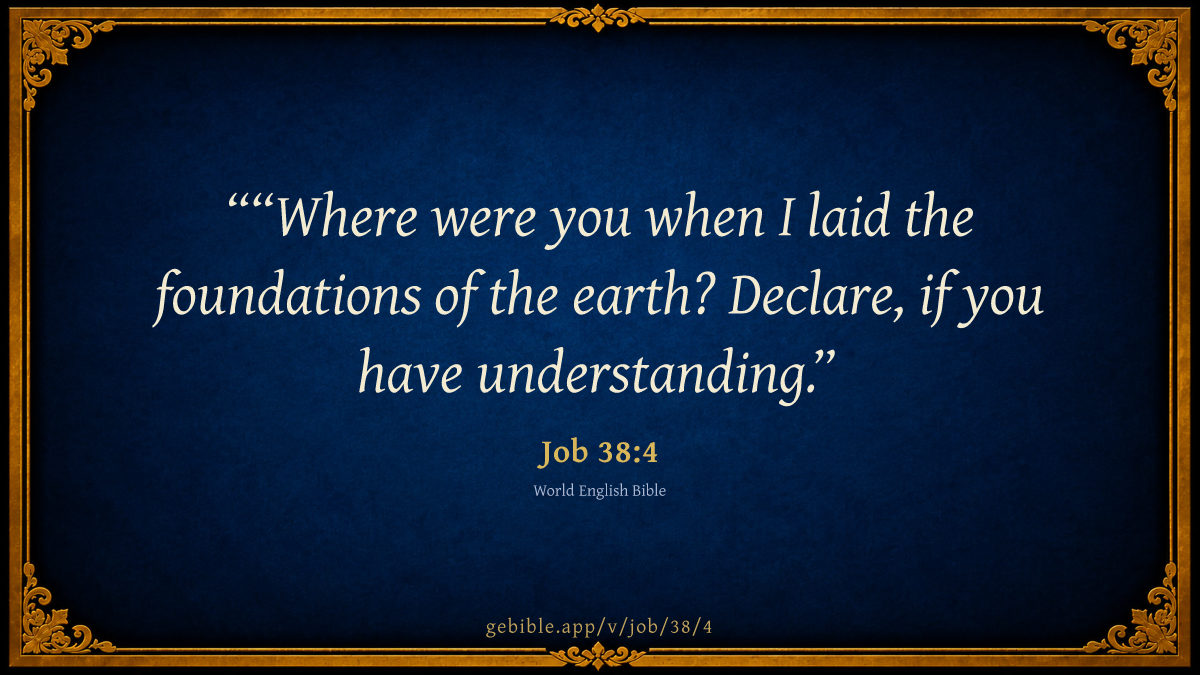
“Where were you when I laid the foundations of the earth? Declare, if you have understanding.
Parallel Translations
-
“Where were you when I laid the foundations of the earth? Declare, if you have understanding.
-
Where wast thou when I laid the foundations of the earth? declare, if thou hast understanding.
-
Where wast thou when I laid the foundations of the earth? Declare, if thou hast the understanding.
Examined in Scripture Analysis
Science (1)
Historical claims about the natural world, weighed against the scientific record.
Contradictions (1)
Questions where the Bible appears to say two different things, with the passages on each side set together.
Cross-references (8)
Passages linked to Job 38:4 in the Treasury of Scripture Knowledge, ordered by reader-vote popularity; verse text shown in World English Bible.
- Psalms 104:5 He laid the foundations of the earth, that it should not be moved forever.
- Hebrews 1:10 And, “You, Lord, in the beginning, laid the foundation of the earth. The heavens are the works of your hands.
- Proverbs 30:4 Who has ascended up into heaven, and descended? Who has gathered the wind in his fists? Who has bound the waters in his garment? Who has established all the ends of the earth? What is his name, and what is his son’s name, if you know?
- Hebrews 1:2 has at the end of these days spoken to us by his Son, whom he appointed heir of all things, through whom also he made the worlds.
- Genesis 1:1 In the beginning, God created the heavens and the earth.
- Psalms 102:25 Of old, you laid the foundation of the earth. The heavens are the work of your hands.
- Proverbs 8:22 “Yahweh possessed me in the beginning of his work, before his deeds of old.
- Proverbs 8:29-30 when he gave to the sea its boundary, that the waters should not violate his commandment, when he marked out the foundations of the earth, then I was the craftsman by his side. I was a delight day by day, always rejoicing before him,
Cross-references from openbible.info (CC BY 4.0)
Explain this verse (17 sources)
Historical commentary, presented as a primary source — not an endorsement.
Private notes
Saved on this device only — never synced or sent anywhere.
Geneva Bible translators 1599 · Public Domain Seeing he could not judge of those things which…
Seeing he could not judge of those things which were done so long before he was born, he was not able to comprehend all God’s works: much less the secret causes of his judgments.
Geneva Bible (1599) marginal notes — public domain.
John Trapp 1656 · Public Domain Job 38:4 Where wast thou when I laid the…
Job 38:4 Where wast thou when I laid the foundations of the earth? declare, if thou hast understanding.
Ver. 4. Where wast thou when I laid the foundations of the earth?] q.d. Thou wast nowhere, a mere nonens; thou wast no companion or counsellor of mine; nay, not so much as an onlooker, for thou art but of yesterday. Thou understandest not the reason of this fair fabric; much less of my dark and deep counsels.
Read full note →
Declare, if thou hast understanding] Heb. if thou kuowest understanding. An irony, but friendly, and free from all bitterness; the better to convince Job of his folly and faultiness; for which end, also, multis eum interrogationibus onerat, God loadeth him with many deep questions, the least whereof he could not answer. (Mercer).
John Trapp, A Commentary or Exposition upon All the Books of the Old and New Testament (1647–1656) — public domain. Text from a community e-Sword module.
Matthew Poole 1685 · Public Domain Then thou wast no where, thou hadst no being;…
Then thou wast no where, thou hadst no being; thou art but of yesterday; and dost thou presume to judge of my eternal counsels? I made the world without thy help, and therefore can govern it without thy counsel, and I do not need thee to be the controller or censurer of my works.
When I laid the foundations of the earth; when I made the earth, which is as the foundation or lower part of the whole world, and settled it as firm and fast upon its own centre as if it had been built upon the surest foundations. But if thou art ignorant of these manifest and visible works, do. not pretend to the exact knowledge of my secret counsels and mysterious providences.
Matthew Poole's English Annotations on the Holy Bible (1683–1685) — public domain. Text from a community e-Sword/MySword module.
Matthew Henry 1710 · Public Domain For the humbling of Job, God here shows him…
For the humbling of Job, God here shows him his ignorance even concerning the earth and the sea. Though so near, though so bulky, yet he could give no account of their origination, much less of heaven above or hell beneath, which are at such a distance, or of the several parts of matter which are so minute, and then, least of all, of the divine counsels.
I. Concerning the founding of the earth. "If he have such a mighty insight, as he pretends to have, into the counsels of God, let him give some account of the earth he goes upon, which is given to the children of men."
Read full note →
1. Let him tell where he was when this lower world was made, and whether he was advising of assisting in that wonderful work (Job 38:4): "Where wast thou when I laid the foundations of the earth? Thy pretensions are high; canst thou pretend to his? Wast thou present when the world was made?" See here, (1.) The greatness and glory of God: I laid the foundations of the earth. This proves him to be the only living and true God, and a God of power (Isa 40:21, Jer 10:11, Jer 10:12), and encourages us to trust in him at all times, Isa 51:13, Isa 51:16. (2.) The meanness and contemptibleness of man: "Where wast thou then? Thou that hast made such a figure among the children of the east, and settest up for an oracle, and a judge of the divine counsels, where was thou when the foundations of the earth were laid?" So far were we from having any hand in the creation of the world, which might entitle us to a dominion in it, or so much as being witnesses of it, by which we might have gained an insight into it, that we were not then in being. The first man was not, much less were we. It is the honour of Christ that he was present when this was done (Pro 8:22, etc., Joh 1:1, Joh 1:2); but we are of yesterday and know nothing. Let us not therefore find fault with the works of God, nor prescribe to him. He did not consult us in making the world, and yet it is well made; why should we expect then that he should take his measures from us in governing it?
2. Let him describe how this world was made, and give a particular account of the manner in which this strong and stately edifice was formed and erected: "Declare, if thou hast so much understanding as thou fanciest thyself to have, what were the advances of that work." Those that pretend to have understanding above others ought to give proof of it. Show my thy faith by thy works, thy knowledge by thy words. Let Job declare it if he can, (1.) How the world came to be so finely framed, with so much exactness, and such an admirable symmetry and proportion of all the parts of it (Job 38:5): "Stand forth, and tell who laid the measures thereof and stretched out the line upon it." Wast thou the architect that formed the model and then drew the dimensions by rule according to it? The vast bulk of the earth is moulded as regularly as if it had been done by line and measure; but who can describe how it was cast into this figure? Who can determine its circumference and diameter, and all the lines that are drawn on the terrestrial globe? It is to this day a dispute whether the earth stands still or turns round; how then can we determine by what measures it was first formed? (2.) How it came to be so firmly fixed. Though it is hung upon nothing, yet it is established, that it cannot be moved; but who can tell upon what the foundations of it are fastened, that it may not sink with its own weight, or who laid the corner-stone thereof, that the parts of it may not fall asunder? Job 38:6. What God does, it shall be for ever (Ecc 3:14); and therefore, as we cannot find fault with God's work, so we need not be in fear concerning it; it will last, and answer the end, the works of his providence as well as the work of creation; the measures of neither can never be broken; and the work of redemption is no less firm, of which Christ himself is both the foundation and the corner-stone. The church stands as fast as the earth.
3. Let him repeat, if he can, the songs of praise which were sung at that solemnity (Job 38:7), when the morning-stars sang together, the blessed angels (the first-born of the Father of light), who, in the morning of time, shone as brightly as the morning star, going immediately before the light which God commanded to shine out of darkness upon the seeds of this lower world, the earth, which was without form and void. They were the sons of God, who shouted for joy when they saw the foundations of the earth laid, because, though it was not made for them, but for the children of men, and though it would increase their work and service, yet they knew that the eternal Wisdom and Word, whom they were to worship (Heb 1:6), would rejoice in the habitable parts of the earth, and that much of his delight would be in the sons of men, Pro 8:31. The angels are called the sons of God because they bear much of his image, are with him in his house above, and serve him as a son does his father. Now observe here, (1.) The glory of God, as the Creator of the world, is to be celebrated with joy and triumph by all his reasonable creatures; for they are qualified and appointed to be the collectors of his praises from the inferior creatures, who can praise him merely as objects that exemplify his workmanship. (2.) The work of angels is to praise God. The more we abound in holy, humble, thankful, joyful praise, the more we do the will of God as they do it; and, whereas we are so barren and defective in praising God, it is a comfort to think that they are doing it in a better manner. (3.) They were unanimous in singing God's praises; they sang together with one accord, and there was no jar in their harmony. The sweetest concerts are in praising God. (4.) They all did it, even those who afterwards fell and left their first estate. Even those who have praised God may, by the deceitful power of sin, be brought to blaspheme him, and yet God will be eternally praised.
II. Concerning the limiting of the sea to the place appointed for it, Job 38:8, etc. This refers to the third day's work, when God said (Gen 1:9), Let the waters under the heaven be gathered together unto one place, and it was so. 1. Out of the great deep or chaos, in which earth and water were intermixed, in obedience to the divine command the waters broke forth like a child out of the teeming womb, Job 38:8. Then the waters that had covered the deep, and stood above the mountains, retired with precipitation. At God's rebuke they fled, Psa 104:6, Psa 104:7. 2. This newborn babe is clothed and swaddled, Job 38:9. The cloud is made the garment thereof, with which it is covered, and thick darkness (that is, shores vastly remote and distant from one another and quite in the dark one to another) is a swaddling-band for it. See with what ease the great God manages the raging sea; notwithstanding the violence of its tides, and the strength of its billows, he manages it as the nurse does the child in swaddling clothes. It is not said, He made rocks and mountains its swaddling bands, but clouds and darkness, something that we are not aware of and should think least likely for such a purpose. 3. There is a cradle too provided for this babe: I broke up for it my decreed place, Job 38:10. Valleys were sunk for it in the earth, capacious enough to receive it, and there it is laid to sleep; and, if it be sometimes tossed with winds, that (as bishop Patrick observes) is but the rocking of the cradle, which makes it sleep the faster. As for the sea, so for every one of us, there is a decreed place; for he that determined the times before appointed determined also the bounds of our habitation. 4. This babe being made unruly and dangerous by the sin of man, which was the original of all unquietness and danger in this lower world, there is also a prison provided for it; bars and doors are set, Job 38:10. And it is said to it, by way of check to its insolence, Hitherto shalt thou come, but no further. The sea is God's for he made it, he restrains it; he says to it, Here shall thy proud waves be stayed, Job 38:11. This may be considered as an act of God's power over the sea. Though it is so vast a body, and though its motion is sometimes extremely violent, yet God has it under check. Its waves rise no higher, its tides roll no further, than God permits; and this is mentioned as a reason why we should stand in awe of God (Jer 5:22), and yet why we should encourage ourselves in him, for he that stops the noise of the sea, even the noise of her waves, can, when he pleases, still the tumult of the people, Psa 65:7. It is also to be looked upon as an act of God's mercy to the world of mankind and an instance of his patience towards that provoking grace. Though he could easily cover the earth again with the waters of the sea (and, methinks, every flowing tide twice a day threatens us, and shows what the sea could do, and would do, if God would give it leave), yet he restrains them, being not willing that any should perish, and having reserved the world that now is unto fire, Pe2 3:7.
Matthew Henry's Commentary on the Whole Bible (1708–1710) — public domain (CC PDM 1.0). Text via the HelloAO Bible API.
John Gill 1763 · Public Domain Where wast thou when I laid the foundations of…
Where wast thou when I laid the foundations of the earth?.... The earth has foundations, and such firm ones that it cannot be moved; but what are they, since it is hung in the air on nothing! No other than the power and will of God, who laid these foundations, and the Son of God, who has created and upholds all things by the word of his power, Heb 1:3. Where was Job then? In a state of nothingness, a mere nonentity: he was not present when this amazing work of nature was done, and saw not how the Lord went about it; and yet takes upon him to dive into the secret works and ways of Providence, for which he is rebuked by this question and the following;
declare, if thou hast understanding: Job had the understanding of a man in things natural and civil, and of a good man in things spiritual and divine; but he had no understanding of this, of what he is questioned about; could not declare in what place he was, and where he stood, when the earth was founded.
John Gill's Exposition of the Whole Bible (1746–1763) — public domain (CC PDM 1.0). Text via the HelloAO Bible API.
John Wesley 1765 · Public Domain Where - Thou art but of yesterday; and dost…
Where - Thou art but of yesterday; and dost thou presume to judge of my eternal counsels! When - When I settled it as firm upon its own center as if it had been built upon the surest foundations.
John Wesley, Explanatory Notes Upon the Whole Bible (1754–1765) — public domain. Text via the GEBible commentary corpus.
Adam Clarke 1810 · Public Domain Verse 4. Where wast thou when I laid the…
Verse 4. Where wast thou when I laid the foundations of the earth?] Thou hast a limited and derived being; thou art only of yesterday; what canst thou know? Didst thou see me create the world?
Adam Clarke's Commentary on the Bible (1810–1826) — public domain. Text from a community e-Sword/MySword module.
Joseph Benson 1811 · Public Domain Job 38:4-5. Where wast thou when I laid the…
Job 38:4-5. Where wast thou when I laid the foundations of the earth? — When I settled it as firm upon its own centre as if it had been built upon the surest foundations? Then thou wast nowhere; thou hadst no being: thou art but of yesterday; and dost thou presume to judge of my eternal counsels? I made the world without thy help, and therefore can govern it without thy advice or direction. Declare who hath laid the measures thereof — Who hath prescribed how long, and broad, and deep it should be? Or who hath stretched the line upon it? — The measuring-line, to regulate all its dimensions, so that it might be as beautiful as useful; if thou knowest —
But if thou art ignorant of these manifest and visible works, do not pretend to the exact knowledge of my mysterious providences.
Joseph Benson's Commentary on the Old and New Testaments (1811–1818) — public domain. Text from a community e-Sword module.
Albert Barnes 1834 · Public Domain Where wast thou when I laid the foundations of…
Where wast thou when I laid the foundations of the earth? - The first appeal is to the creation. The question here, “Where wast thou?” implies that Job was not present. He had not then an existence. He could not, therefore, have aided God, or counselled him, or understood what he was doing. How presumptuous, therefore, it was in one so short-lived to sit in judgment on the doings of him who had formed the world! How little could he expect to be able to know of him! The expression, “laid the foundations of the earth,” is taken from building an edifice. The foundations are first laid, and the super-structure is then reared. It is a poetic image, and is not designed to give any intimation about the actual process by which the earth was made, or the manner in which it is sustained.
If thou hast understanding - Margin, as in Hebrew “if thou knowest.” That is, “Declare how it was done. Explain the manner in which the earth was formed and fixed in its place, and by which the beautiful world grew up under the hand of God.” If Job could not do this, what presumption was it to speak as he had done of the divine adminisitration!
Albert Barnes' Notes on the Bible (1834–1885) — public domain. Text from a community e-Sword/MySword module.
Haydock's Catholic Bible Commentary 1859 · Public Domain Foundations. The Hebrews placed the earth in the centre…
Foundations. The Hebrews placed the earth in the centre of the universe, resting upon nothing, (chap. xxvi. 7., and xxxvi. 30.) or upon itself. See Hesiod, Theog. 325. (Calmet) --- These questions seem intended to shew, that if God has created all things for man, he will not surely neglect to watch over him. (Menochius)
George Leo Haydock (1774–1849), Haydock's Catholic Family Bible and Commentary, 1859 edition — public domain. Excludes Psalms (Douay-Rheims chapter numbering differs from Protestant) and Deuterocanonical books (Catholic canon only).
Robert Jamieson, A. R. Fausset & David Brown 1871 · Public Domain To understand the cause of things, man should have…
To understand the cause of things, man should have been present at their origin. The finite creature cannot fathom the infinite wisdom of the Creator (Job 28:12; Job 15:7-8).
hast--"knowest."
Read full note →
understanding-- (Pro 4:1).
Jamieson, Fausset & Brown — Commentary Critical and Explanatory on the Whole Bible (1871) — public domain (CC PDM 1.0). Text via the HelloAO Bible API.
Daniel D. Whedon 1874 · Public Domain The first division of the discourse — THE COMPREHENSIVE…
The first division of the discourse — THE COMPREHENSIVE KNOWLEDGE OF GOD’S MORAL GOVERNMENT DISPLAYED BY JOB JUSTIFIES THE PROPOUNDING OF SOME QUESTIONS AS TO THE PHYSICAL AND SEEMINGLY INANIMATE WORLD, IN THE MIDST OF WHICH MAN HAS BEEN PLACED, WITH THE HIGH ENDOWMENTS OF WISDOM AND UNDERSTANDING, Job_38:4-38.
First long strophe — THE VASTNESS OF JOB’S KNOWLEDGE MUST EMBRACE THE PROCESS OF THE CREATION OF EARTH, SEA, AND LIGHT, Job_38:4-15.
Read full note →
“All true knowledge is genetic.” — Hitzig. He who claims insight into that which is, must know how it came to be, for nature (natura) is a perpetual birth. This first long strophe treats of the wonder-working of Omnipotence. Each of the minor strophes consists of four verses, the fourth verse of each, according to Schlottmann, forming a climax in the thought.
a. Job is summoned to explain the founding of the earth; the laying out of its architectural proportion; and even so simple and yet glorious a matter as the laying of its corner-stone, Job_38:4-7.
4. Laid the foundations — When I founded the earth (a more exact rendering) better harmonizes with the wonderful scientific disclosure of Job_26:7.
Daniel D. Whedon (gen. ed.), Commentary on the Old and New Testaments (1874–1909) — public domain. Text from a community e-Sword module.
The Cambridge Bible for Schools and Colleges 1878 · Public Domain 4. Was Job present, possibly taking part in the…
4. Was Job present, possibly taking part in the operation, when Jehovah laid the foundations of the earth? Let him then “declare” how all was done. The word declare of course refers to the queries in Job_38:5-7.
4–11. Earth and sea.
Read full note →
4–38. A survey of the inanimate creation, the wonders of earth and sky—the earth, Job_38:4-18; the heavens, Job_38:18-38
The Cambridge Bible for Schools and Colleges (gen. ed. J. J. S. Perowne; Cambridge University Press, 1878–1918) — public domain. Text from a community e-Sword module.
Ellicott's Commentary for English Readers 1878 · Public Domain (4) Where wast thou?—The comparison of the creation of…
(4) Where wast thou?—The comparison of the creation of the world to the building of an edifice is such a concession to the feebleness of man as serves of itself to heighten the effect of the inevitable answer to the question preferred.
A Bible Commentary for English Readers, edited by Charles John Ellicott (1878–1897) — public domain. Text from a community e-Sword module.
The Pulpit Commentary 1880 · Public Domain Where wast thou when I laid the foundations of…
Where wast thou when I laid the foundations of the earth? Wast thou present? Didst thou witness it? If not, what canst thou know concerning it? And if thou knowest nothing of creation, what canst thou know of deeper things? The metaphor, by which the creation of the earth is compared to the foundation of an edifice, is a common one, (Psa_102:25 Psa_104:5 Pro_8:29 Isa_48:13 Isa_51:13, 16 Zec_12:1 Heb_1:10, etc.) and is to be viewed as a concession to human weakness, creation itself, as it actually took place, being inconceivable. Declare, if thou hast understanding. That is, if thou hast any knowledge on the subject (comp. ver. 18).
Vers. 4-15. Jehovah to Job: the first answer the examination: 1. Concerning the creation.
Read full note →
I THE CREATION OF THE EARTH THE HANDIWORK OF GOD.
1. An exclusively Divine work. Jehovah claims not simply to have been the Framer of the mighty fabric of the globe, but to have shared the honour of that stupendous achievement with no co-worker. Hence certainly not with Job. "Where wast thou when I established the earth?" Not taking part or even looking on, since thou wast not then in existence. That this terrestrial world, and indeed the vast universe of which it forms a part almost infinitesimally small, has not existed from eternity, and did not spring into being fortuitously and without adequate cause, hut was summoned from the womb of nothingness by the fiat of Omnipotence, besides according with the plainest declarations of Scripture, (Gen_1:1) harmonizes more exactly than any other theory with the dictates of reason.
2. A perfectly finished work. As in the Mosaic cosmogony Elohim is represented as beginning, carrying forward through successive stages, and completing the preparation of the newly made earth as man"s abode, so here Jehovah advances a like claim in behalf of himself. Under the image of a building he describes the earth, in its construction, as having been planned by him: "Who," i.e. but me, "hath determined its measure?" founded by him: "Where wast thou when I established the earth?" erected by him: "Whereupon are the foundations," i.e. the bases of its pillars, "fastened?" finished by him: "Who hath laid the cornerstone thereof?
3. A firmly secured work. Not, however, in the sense of standing still and without motion (Caryl), but in that of being permanently established. The constitution and course of nature, though not unalterable at the will of him by whom it hath been decreed, is yet so definitely settled that man can reckon on its uniformity. It can be overthrown by neither accident nor design. The properties and laws of matter are so certain in their operation, that some reasoners have falsely concluded them to be immutable.
II THE CREATION OF THE EARTH WAS THE SONG OF THE ANGELS.
1. The singers: the angels. The race of spiritual intelligences who inhabit the heavenly world, (Psa_68:17 Mat_18:10 Joh_1:51) who are here described by:
(1) Their place in creation; being styled (according to one exposition of the passage) "morning stars," as having been first created, the first beings summoned into the broad expanse of dependent existence, (Gen_3:3-4 Isa_8:5) as the morning stars appear to swim out first into the vault of heaven; as being possessed of incomparable excellence of nature, (Psa_103:20) as the morning stars outshine all other stars in brilliance; or as being the harbingers or heralds of succeeding and perhaps higher creatures than themselves, (Joh_1:51) as the morning star serves to usher in through the portals of the dawn the golden chariot of the sun.
(2) Their relation to God; being designated his "sons," not as Christ is, who is the Father"s Only Begotten (Psa_2:7 Joh_1:18 Act_13:33) an honour never conferred upon the angels; (Heb_1:5) or as saints are, by regeneration and adoption (Joh_1:12) an experience which the unfallen angels do not need, and the fallen ones do not get; out probably as Adam was, (Luk_3:38) and as men in general are (Act_17:28) to indicate their dependence upon, and constitutional likeness to, God their Creator.
2. Their song: an anthem of creation. Which also is characterized in a twofold way:
(1) By its outward expression, as vocal," they sang," giving utterance to their emotions in the tongue of immortals; as choral, "they sang together," preserving harmony in their singing, maintaining a delightful concord of sweet sounds; as universal, "all the sons of God shouted" there was not a voice in the innumerable throng that was silent (cf. "Merchant of Venice," act 5. sc. 1); as cordial, "they shouted," expressive of the hearty vehemence and exuberant gladness with which they poured forth their heavenly melodies.
(2) By its inward inspiration, as proceeding from the full tide of joy which rose and swelled within their breasts, which joy was occasioned by admiration of the great Creator"s power, contemplation of the Divine Artificer"s wisdom, appreciation of the Infinite Father"s goodness, anticipation of the supreme God"s purpose, in calling forth from the wide womb of non-existence, by a single fiat of omnipotence, a world so wondrously fair, for an end of which it may have been given to their angelic minds to form some by no means, dim conception, viz. to be the future home of man.
III THE CREATION OF THE EARTH A STUDY FOB MAN, As such it was propounded to Job, who was asked to receive lessons from it as to three points.
1. The brevity of man"s life as compared with the existence of God. "Where wast thou when I founded the earth? Thou wast not then born! Thy days on earth are as a Shadow. A few years ago thou hadst no existence. But I, thy Creator, whom thou dost foolishly arraign, bad a being before the world was!" Nothing is more fitted to impress man with a sense of the utter vanity and insignificance of this terrestrial existence of which he partakes than a contemplation of the eternity of God.
2. The ignorance of man"s mind as compared with the omniscience of God. Jehovah asks the patriarch if he could tell how the pillars of the globe were fastened in their sockets, or how either the foundation or corner stones of the stupendous fabric were laid in their places, and fixed so as to continue permanent and immovable. "Declare, if thou hast understanding." But all these were comprehended by eternal wisdom. How immeasurably foolish, then must it be for man to presume that he either can, or ought to be able to, understand the moral administration of a world of whose original construction he is entirely ignorant! Nothing is better calculated to humble the pride of human wisdom than we reflect both how small is the circle of knowledge surveyed by the wisest in comparison with the vast sphere of ignorance by which he is still encompassed, and in particular how infinitesimal is the largest quantity of science collected by man when weighed against the immeasurable omniscience of God.
3. The impotence of man"s arm as compared with the omnipotence of God. Vast in contrivance and execution as are many of the works of man, the building of the pyramids, the exploration of mines, the construction of locomotives, the tunnelling of mountains, and other mighty achievements of human genius, it is certain that man himself must regard these as puny and insignificant beside the gigantic works of nature, the piling up of Himalayas, the formation of oceans, the establishment of those mysterious influences which men in their ignorance denominate physical forces, the peopling of earth, air, and sea with their myriad forms of life. And yet these are all the handiwork of God, effected by his power with infinite ease and with such consummate skill that man cannot hope to improve them, cannot oven imitate them, yea, can hardly succeed in making a perfect copy of them. Nay, modern astronomy, by enlarging our conceptions of the stellar world, reminds us that stupendous a work as is the formation of this material globe, it is in reality one of the smallest of the productions that have come from his creative hand, being in fact but as a drop in a bucket, or as the small dust of a balance, in comparison with the boundless universe to which it belongs.
Learn:
1. That the first of all beings is God.
2. That the primal cause of all things is the power of God.
3. That only the mind which planned the world can perfectly understand its government.
4. That all God"s works, in the moral world no less than in the material, are characterized by wisdom.
5. That God"s works should never fail to excite the admiration and rejoicing of God"s children.
6. That, though man cannot be saved, he may yet be instructed, by the angels.
7. That if the old or material creation required the power of God, much more does the new or spiritual creation.
HOMILIES BY R. GREEN Vers. 4, 19, 32, 33. Human impotence and ignorance exposed.
Job"s affliction is a mystery a mystery that needs to be revealed. Job has not given the explanation of it. He has not known it. His friends have failed. It has been attributed to his sin; but he is confident in his honest integrity, and cannot be persuaded that he is suffering punishment, for he has not a consciousness of guilt. Elihu has indicated the hidden nature of the Divine works, and has not made the mystery clearer. But he has closed the lips of them who would accuse God of wrong and unjust dealing. Job is being led, perhaps blindfold, to a final exposition of the whole. By imperfect knowledge of the purpose of God, Job may be led to wrong conclusions. But God will not forsake his faithful servant, of whom the Divine testimony at the beginning was that he "sinned not with his tongue;" and at the end that he had "spoken the thing which is right." It is still night with Job; he is in the dark as to the purpose of his affliction, but the morning breaketh. And whilst God has appeared hitherto as the Punisher of Job, he will ere long declare himself his Friend, and when he has well tried his faithful servant will amply reward him. But there are processes in the Divine method. Job has to be humbled to the very dust, and the present stage in that process is to reveal the littleness of man in presence of the Most High. Human impotence and ignorance are displayed in presence of the wonderful creation of God.
I GOD"S WORK INDEPENDENT OF MAN. "Where wast thou when I laid the foundations of the earth?" "Hast thou commanded the morning," and "caused the day-spring to know his place?" "Hast thou entered into the springs of the sea?" etc.
II GOD"S WORK ABOVE MAN. "Canst thou bind the sweet influences of Pleiades?" etc.
III GOD"S WORK UNKNOWN TO MAN. "Knowest thou the ordinances of heaven?" "Who hath put wisdom in the inward parts?" etc. Thus is Job taught amidst the wonders of God"s creation how great is the Creator. If his works are past finding out by puny man, surely his purpose which he hath hidden is beyond the reach of human research. It is another step in the valley of humiliation for him who is finally found biting the dust. R.G.
The Pulpit Commentary (1880–1919), ed. H.D.M. Spence-Jones & Joseph S. Exell — public domain. Text from a community e-Sword module.
The Biblical Illustrator 1887 · Public Domain Where wast thou when I laid the foundations of…
Job_38:4
Where wast thou when I laid the foundations of the earth?
Read full note →
Ignorance of the worlds origin
God would impress on Job his utter ignorance of the world in which he lived, and his incompetency to interpret His moral administration. The moral is this--Be concerned, Job, for a moral trust in My character, rather than for a theoretical knowledge of My ways. In the text there is a Divine challenge in relation to the when and how of the origin of the world.
I. The when. His ignorance as to when He began His creation. Where wast thou when I laid the foundation of the earth?
II. The how. Who hath laid the measures thereof, if thou knowest? or who hath stretched the line upon it? Conclusion--The subject serves--
1. To rebuke all disposition to pronounce an opinion upon the ways of God.
2. To suggest that our grand effort ought to be to cultivate a loving trust in the Divine character, rather than to comprehend the Divine procedure. Comprehend Him we never can.
3. To enable us to appreciate the glorious services of Christianity. The question, Where wast thou when I laid the foundations of the earth? confounds and crushes me. I feel powerless before it, it overwhelms me with a sense of my own insignificance. Christianity comes to my relief. It tells me that although I am insignificant, I am still a child, a beloved child of the Everlasting, and that it is not the will of my Father that any, even of His little ones, should perish; nay, that it is His good pleasure that I should have a kingdom. (Homilist.)
The insignificance of man as a creature
I. What is thine intellect to Mine?
II. What is thine age to Mine?
III. What is thy power to Mine?
IV. What is thy independence to Mine? He is--
1. Independent in being.
2. In action. This subject serves--
(1) To rebuke all disposition to pronounce an opinion upon the ways of God.
(2) To suggest that our grand effort ought to be to cultivate a loving trust in the Divine character, rather than to comprehend the Divine procedure.
3. To enable us to appreciate the glorious service of Christianity. (Homilist.)
The creation of the world
I. Some leading ideas respecting the Divine work of creation. Notice--
1. The hoary and venerable antiquity of the work, and its entire independence of the power and wisdom of man. Many an upstart of yesterday imagines himself capable to investigate and define every subject. The questions of the text lead us to contemplate the creating work as mysterious and unsearchable.
II. The manner in which meditations on this work of creation may be most profitably conducted. Philosophers will afford delightful aid to the more studious observer of the universe. The grand philosophy is in the Bible, where resounds the voice of God Himself, describing His own operations. But there is still needed the specially illuminating influence of the Holy Spirit of God. This influence is to be sought by prayer, while the proper means are diligently used.
III. The important ends and uses to which meditations of this kind ought to be directed and applied. The agency of the Spirit is particularly manifest in sanctifying devout meditations to their proper end. By meditations properly conducted, a habit of spirituality is acquired, and an ability to bring the mind close to the contemplation of Divine things. Here is the porch of the temple of wisdom. There is the foot of the ladder, whereby the soul at length ascends to heaven. Nor is the utility of such meditations confined to the infancy of religious wisdom; it follows us up to the very gates of heaven, yea, into heaven itself. (J. Love, D. D.)
The Biblical Illustrator, edited by Joseph S. Exell (c. 1880s–1900s) — public domain. Text from a community e-Sword module.
unfoldingWord translationNotes 2017 · CC BY-SA 4.0 General Information:
General Information:
Yahweh begins to challenge Job with a series of questions that emphasize he created the earth and Job did not. (See: Rhetorical Question)
Read full note →
Where were you when I laid the earth's foundations? Tell me, if you have so much understanding
This can be translated as a statement. AT: "Tell me where you were when I laid the foundations of the earth, if you have so much understanding" (See: Rhetorical Question)
I laid the earth's foundations
Yahweh describes creating the earth as though he was building a structure. (See: Metaphor)
if you have so much understanding
The abstract noun "understanding" can be translated as the verb "understand." AT: "if you understand so much" (See: Abstract Nouns)
Who determined its dimensions? Tell me, if you know
This can be translated as a statement. AT: "Tell me who determined its dimensions, if you know" (See: Rhetorical Question)
dimensions
"size"
Who stretched the measuring line over it?
This can be translated as a statement. AT: "Tell me who stretched the measuring line over it." (See: Rhetorical Question)
measuring line
a rope or cord that people use to make something the right size and shape
translationWords
earth
found
unfoldingWord translationNotes — © Distant Shores Media and the Door43 World Missions Community, licensed CC BY-SA 4.0. Source: git.door43.org/Door43/en_tn.