2“I know that you can do all things, and that no purpose of yours can be restrained.
3You asked, ‘Who is this who hides counsel without knowledge?’ therefore I have uttered that which I didn’t understand, things too wonderful for me, which I didn’t know.
4You said, ‘Listen, now, and I will speak; I will question you, and you will answer me.’
5I had heard of you by the hearing of the ear, but now my eye sees you.
6Therefore I abhor myself, and repent in dust and ashes.”
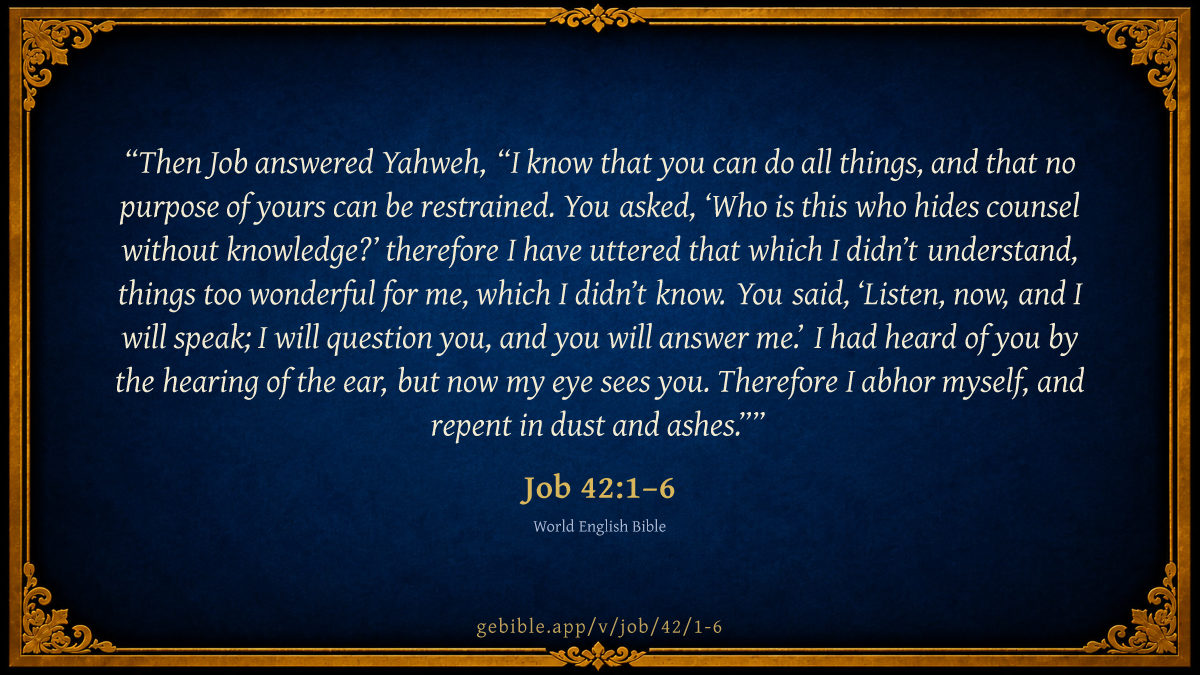
2 “I know that you can do all things, and that no purpose of yours can be restrained.
3 You asked, ‘Who is this who hides counsel without knowledge?’ therefore I have uttered that which I didn’t understand, things too wonderful for me, which I didn’t know.
4 You said, ‘Listen, now, and I will speak; I will question you, and you will answer me.’
5 I had heard of you by the hearing of the ear, but now my eye sees you.
6 Therefore I abhor myself, and repent in dust and ashes.”
KJVKing James Version
1 Then Job answered the LORD, and said,
2 I know that thou canst do every thing, and that no thought can be withholden from thee.
3 Who is he that hideth counsel without knowledge? therefore have I uttered that I understood not; things too wonderful for me, which I knew not.
4 Hear, I beseech thee, and I will speak: I will demand of thee, and declare thou unto me.
5 I have heard of thee by the hearing of the ear: but now mine eye seeth thee.
6 Wherefore I abhor myself, and repent in dust and ashes.
Show all 3 translations
JPSJPS Tanakh (1917)
1 Then Job answered the LORD, and said:
2 I know that Thou canst do every thing, and that no purpose can be withholden from Thee.
3 Who is this that hideth counsel without knowledge? Therefore have I uttered that which I understood not, things too wonderful for me, which I knew not.
4 Hear, I beseech Thee, and I will speak; I will demand of Thee, and declare Thou unto me.
5 I had heard of Thee by the hearing of the ear; but now mine eye seeth Thee;
6 Wherefore I abhor my words, and repent, seeing I am dust and ashes.
Questions where the Bible appears to say two different things, with the passages on each side set together.
Can God be seen?The Hebrew Bible repeatedly narrates theophanies in which God is seen face-to-face — by Abraham, Isaac, Jacob, Moses, seventy elders, Manoah, Micaiah, Job, Isa…
Matthew 19:26(v2)Looking at them, Jesus said, “With men this is impossible, but with God all things are possible.”
Mark 10:27(v2)Jesus, looking at them, said, “With men it is impossible, but not with God, for all things are possible with God.”
Genesis 18:14(v2)Is anything too hard for Yahweh? At the set time I will return to you, when the season comes round, and Sarah will have a son.”
Hebrews 4:12-13(v2)For the word of God is living and active, and sharper than any two-edged sword, piercing even to the dividing of soul and spirit, of both…
Jeremiah 32:17(v2)“Ah Lord Yahweh! Behold, you have made the heavens and the earth by your great power and by your outstretched arm. There is nothing too…
Show all 66 cross-references
Isaiah 46:10(v2)I declare the end from the beginning, and from ancient times things that are not yet done. I say: My counsel will stand, and I will do all…
Ephesians 1:11(v2)We were also assigned an inheritance in him, having been foreordained according to the purpose of him who does all things after the counsel…
Psalms 44:21(v2)won’t God search this out? For he knows the secrets of the heart.
Proverbs 19:21(v2)There are many plans in a man’s heart, but Yahweh’s counsel will prevail.
Job 23:13(v2)But he stands alone, and who can oppose him? What his soul desires, even that he does.
Isaiah 14:27(v2)For Yahweh of Armies has planned, and who can stop it? His hand is stretched out, and who can turn it back?”
Isaiah 43:13(v2)Yes, since the day was, I am he. There is no one who can deliver out of my hand. I will work, and who can hinder it?”
Ephesians 1:17-18(v5)that the God of our Lord Jesus Christ, the Father of glory, may give to you a spirit of wisdom and revelation in the knowledge of him,…
Ecclesiastes 3:14(v2)I know that whatever God does, it shall be forever. Nothing can be added to it, nor anything taken from it; and God has done it, that men…
Daniel 4:35(v2)All the inhabitants of the earth are reputed as nothing; and he does according to his will in the army of heaven, and among the inhabitants…
Romans 10:17(v5)So faith comes by hearing, and hearing by the word of God.
John 2:24-25(v2)But Jesus didn’t entrust himself to them, because he knew everyone, and because he didn’t need for anyone to testify concerning man; for he…
Psalms 139:2(v2)You know my sitting down and my rising up. You perceive my thoughts from afar.
Jeremiah 17:10(v2)“I, Yahweh, search the mind. I try the heart, even to give every man according to his ways, according to the fruit of his doings.”
Ezekiel 38:10(v2)“ ‘The Lord Yahweh says: “It will happen in that day that things will come into your mind, and you will devise an evil plan.
Mark 14:36(v2)He said, “Abba, Father, all things are possible to you. Please remove this cup from me. However, not what I desire, but what you desire.”
Job 38:2(v3)“Who is this who darkens counsel by words without knowledge?
Psalms 131:1(v3)Yahweh, my heart isn’t arrogant, nor my eyes lofty; nor do I concern myself with great matters, or things too wonderful for me.
Psalms 139:6(v3)This knowledge is beyond me. It’s lofty. I can’t attain it.
Luke 18:27(v2)But he said, “The things which are impossible with men are possible with God.”
John 12:45(v5)He who sees me sees him who sent me.
Psalms 40:5(v3)Many, Yahweh, my God, are the wonderful works which you have done, and your thoughts which are toward us. They can’t be declared back to…
Isaiah 6:1(v5)In the year that king Uzziah died, I saw the Lord sitting on a throne, high and lifted up; and his train filled the temple.
Isaiah 6:5(v5)Then I said, “Woe is me! For I am undone, because I am a man of unclean lips, and I dwell among a people of unclean lips: for my eyes have…
John 12:41(v5)Isaiah said these things when he saw his glory, and spoke of him.
John 21:17(v2)He said to him the third time, “Simon, son of Jonah, do you have affection for me?” Peter was grieved because he asked him the third time,…
Ezra 9:6(v6)and I said, “My God, I am ashamed and blush to lift up my face to you, my God; for our iniquities have increased over our head, and our…
Job 26:14(v5)Behold, these are but the outskirts of his ways. How small a whisper do we hear of him! But the thunder of his power who can understand?”
Numbers 12:6-8(v5)He said, “Now hear my words. If there is a prophet among you, I, Yahweh, will make myself known to him in a vision. I will speak with him…
Job 4:12(v5)“Now a thing was secretly brought to me. My ear received a whisper of it.
Job 40:7(v4)“Now brace yourself like a man. I will question you, and you will answer me.
John 1:18(v5)No one has seen God at any time. The one and only Son, who is in the bosom of the Father, has declared him.
1 Timothy 1:13-16(v6)although I used to be a blasphemer, a persecutor, and insolent. However, I obtained mercy, because I did it ignorantly in unbelief. The…
James 4:7-10(v6)Be subject therefore to God. Resist the devil, and he will flee from you. Draw near to God, and he will draw near to you. Cleanse your…
Job 23:8-9(v5)“If I go east, he is not there; if west, I can’t find him; He works to the north, but I can’t see him. He turns south, but I can’t catch a…
Job 33:16(v5)Then he opens the ears of men, and seals their instruction,
Job 38:3(v4)Brace yourself like a man, for I will question you, then you answer me!
Job 40:3-4(v6)Then Job answered Yahweh, “Behold, I am of small account. What will I answer you? I lay my hand on my mouth.
Proverbs 30:2-4(v3)“Surely I am the most ignorant man, and don’t have a man’s understanding. I have not learned wisdom, neither do I have the knowledge of the…
Job 28:22(v5)Destruction and Death say, ‘We have heard a rumor of it with our ears.’
Job 30:19(v6)He has cast me into the mire. I have become like dust and ashes.
Daniel 9:3(v6)I set my face to the Lord God, to seek by prayer and petitions, with fasting and sackcloth and ashes.
Esther 4:1-3(v6)Now when Mordecai found out all that was done, Mordecai tore his clothes, and put on sackcloth with ashes, and went out into the middle of…
Job 2:8(v6)He took for himself a potsherd to scrape himself with, and he sat among the ashes.
Psalms 51:17(v6)The sacrifices of God are a broken spirit. O God, you will not despise a broken and contrite heart.
Jeremiah 31:19(v6)Surely after that I was turned. I repented. After that I was instructed. I struck my thigh. I was ashamed, yes, even confounded, because I…
Ezekiel 16:63(v6)that you may remember, and be confounded, and never open your mouth any more, because of your shame, when I have forgiven you all that you…
Ezekiel 20:43(v6)There you will remember your ways, and all your deeds in which you have polluted yourselves. Then you will loathe yourselves in your own…
Ezekiel 36:31(v6)“ ‘ “Then you will remember your evil ways, and your deeds that were not good; and you will loathe yourselves in your own sight for your…
Jonah 3:6-10(v6)The news reached the king of Nineveh, and he arose from his throne, and took off his royal robe, covered himself with sackcloth, and sat in…
Matthew 11:21(v6)“Woe to you, Chorazin! Woe to you, Bethsaida! For if the mighty works had been done in Tyre and Sidon which were done in you, they would…
Luke 10:13(v6)“Woe to you, Chorazin! Woe to you, Bethsaida! For if the mighty works had been done in Tyre and Sidon which were done in you, they would…
Luke 15:18-19(v6)I will get up and go to my father, and will tell him, “Father, I have sinned against heaven, and in your sight. I am no more worthy to be…
1 Corinthians 15:8-9(v6)and last of all, as to the child born at the wrong time, he appeared to me also. For I am the least of the apostles, who is not worthy to…
Isaiah 5:5(v6)Now I will tell you what I will do to my vineyard. I will take away its hedge, and it will be eaten up. I will break down its wall, and it…
Isaiah 58:5(v6)Is this the fast that I have chosen? A day for a man to humble his soul? Is it to bow down his head like a reed, and to spread sackcloth…
Acts 7:55-56(v5)But he, being full of the Holy Spirit, looked up steadfastly into heaven and saw the glory of God, and Jesus standing on the right hand of…
Genesis 18:30-32(v4)He said, “Oh don’t let the Lord be angry, and I will speak. What if there are thirty found there?” He said, “I will not do it if I find…
1 Kings 21:27(v6)When Ahab heard those words, he tore his clothes, and put sackcloth on his flesh, and fasted, and lay in sackcloth, and went softly.
Job 9:31(v6)yet you will plunge me in the ditch. My own clothes will abhor me.
Genesis 18:27(v4)Abraham answered, “See now, I have taken it on myself to speak to the Lord, although I am dust and ashes.
Cross-references from openbible.info (CC BY 4.0)
Explain this passage (25 sources)
Historical commentary, presented as a primary source — not an endorsement.
Geneva Bible translators1599 · Public DomainOn vv2–5No thought so secret, but thou dost see it,…
No thought so secret, but thou dost see it, nor anything that thou thinkest, but thou canst bring it to pass.
Geneva Bible (1599) marginal notes — public domain.
John Trapp1656 · Public DomainOn vv1–6Job 42:1 Then Job answered the LORD, and said,
Job 42:1 Then Job answered the LORD, and said,
Ver. 1. Then Job answered the Lord, and said] After that he had been so plainly and plentifully convinced by Almighty God, 1. That he was far short of him in eternity, wisdom, power, providence, &c.; 2. That he could not stand before behemoth and leviathan, the works of his hands; Job yieldeth, submitting to God’s justice, and imploring his mercy: so effectual is the word of God’s grace in the hearts of his elect. It had need to be an elaborate speech that shall work upon the conscience, such as was this before going. Vide etiam quid afflictio faciat, saith Mercer. See here also the happy fruit of an affliction sanctified. "By this shall the iniquity of Jacob" (of Job) "be purged; and this is all the fruit, to take away his sin," Isa 27:9. To make his works full, Rev 3:2. Job had repented before, Job 40:4-5, but not so completely. Dico hic narrari poenitentiam Iobi plenam, saith Piscator. Here he doth it thoroughly, by a deep and downright repentance, such as was never to be repented of.
John Trapp, A Commentary or Exposition upon All the Books of the Old and New Testament (1647–1656) — public domain. Text from a community e-Sword module.
Matthew Poole1685 · Public DomainOn vv2–6Thou canst do; not only by power, (for that…
Thou canst do; not only by power, (for that he always thought,) but also by right; about which he had in some sort doubted and disputed. It is a maxim in law, that a man can only do that which he hath a right to do.
Every thing; whatsoever it pleaseth thee to do with thy creatures.
Read full note →
No thought can be withholden from thee; he speaks either,
1. Of Job’s thoughts. Thou knowest me and all my sinful and unworthy thoughts of thy providential dealings with me, though I was not able to see the evil of them. Or,
2. Of God’s thoughts. Whatsoever thou thinkest or proposest to do thou canst or mayst do it; and neither I nor any of thy creatures can either restrain thee from it, or condemn thee for it, as I have boldly and wickedly presumed to do. So this last clause of the verse explains the former.
Matthew Poole's English Annotations on the Holy Bible (1683–1685) — public domain. Text from a community e-Sword/MySword module.
Matthew Henry1710 · Public DomainOn v1The words of Job justifying himself were ended, Job…
The words of Job justifying himself were ended, Job 31:40. After that he said no more to that purport. The words of Job judging and condemning himself began, Job 40:4, Job 40:5. Here he goes on with words to the same purport. Though his patience had not its perfect work, his repentance for his impatience had. He is here thoroughly humbled for his folly and unadvised speaking, and it was forgiven him. Good men will see and own their faults at last, though it may be some difficulty to bring them to do this. Then, when God had said all that to him concerning his own greatness and power appearing in the creatures, then Job answered the Lord (Job 42:1), not by way of contradiction (he had promised not so to answer again, Job 40:5), but by way of submission; and thus we must all answer the calls of God.
I. He subscribes to the truth of God's unlimited power, knowledge, and dominion, to prove which was the scope of God's discourse out of the whirlwind, Job 42:2. Corrupt passions and practices arise either from some corrupt principles or from the neglect and disbelief of the principles of truth; and therefore true repentance begins in the acknowledgement of the truth, Ti2 2:25. Job here owns his judgment convinced of the greatness, glory, and perfection of God, from which would follow the conviction of his conscience concerning his own folly in speaking irreverently to him. 1. He owns that God can do every thing. What can be too hard for him that made behemoth and leviathan, and manages both as he pleases? He knew this before, and had himself discoursed very well upon the subject, but now he knew it with application. God had spoken it once, and then he heard it twice, that power belongs to God; and therefore it is the greatest madness and presumption imaginable to contend with him. "Thou canst do every thing, and therefore canst raise me out of this low condition, which I have so often foolishly despaired of as impossible: I now believe thou art able to do this." 2. That no thought can be withholden from him, that is, (1.) There is no thought of ours that he can be hindered from the knowledge of. Not a fretful, discontented, unbelieving thought is in our minds at any time but God is a witness to it. It is in vain to contest with him; for we cannot hide our counsels and projects from him, and, if he discover them, he can defeat them. (2.) There is no thought of his that he can be hindered from the execution of. Whatever the Lord pleased, that did he. Job had said this passionately, complaining of it (Job 23:13), What his soul desireth even that he doeth; now he says, with pleasure and satisfaction, that God's counsels shall stand. If God's thoughts concerning us be thoughts of good, to give us an unexpected end, he cannot be withheld from accomplishing his gracious purposes, whatever difficulties may seem to lie in the way.
Read full note →
II. He owns himself to be guilty of that which God had charged him with in the beginning of his discourse, Job 42:3. "Lord, the first word thou saidst was, Who is this that darkens counsel by words without knowledge? There needed no more; that word convinced me. I own I am the man that has been so foolish. That word reached my conscience, and set my sin in order before me. It is too plain to be denied, too bad to be excused. I have hidden counsel without knowledge. I have ignorantly overlooked the counsels and designs of God in afflicting me, and therefore have quarrelled with God, and insisted too much upon my own justification: Therefore I uttered that which I understood not," that is, "I have passed a judgment upon the dispensations of Providence, though I was utterly a stranger to the reasons of them." Here, 1. He owns himself ignorant of the divine counsels; and so we are all. God's judgments are a great deep, which we cannot fathom, much less find out the springs of. We see what God does, but we neither know why he does it, what he is aiming at, nor what he will bring it to. These are things too wonderful for us, out of our sight to discover, out of our reach to alter, and out of our jurisdiction to judge of. They are things which we know not; it is quite above our capacity to pass a verdict upon them. The reason why we quarrel with Providence is because we do not understand it; and we must be content to be in the dark about it, until the mystery of God shall be finished. 2. He owns himself imprudent and presumptuous in undertaking to discourse of that which he did not understand and to arraign that which he could not judge of. He that answereth a matter before he heareth it, it is folly and shame to him. We wrong ourselves, as well as the cause which we undertake to determine, while we are no competent judges of it.
III. He will not answer, but he will make supplication to his Judge, as he had said, Job 9:15. "Hear, I beseech thee, and I will speak (Job 42:4), not speak either as plaintiff or defendant (Job 13:22), but as a humble petitioner, not as one that will undertake to teach and prescribe, but as one that desires to learn and is willing to be prescribed to. Lord, put no more hard questions to me, for I am not able to answer thee one of a thousand of those which thou hast put; but give me leave to ask instruction from thee, and do not deny it me, do not upbraid me with my folly and self-sufficiency," Jam 1:5. Now he is brought to the prayer Elihu taught him, That which I see not teach thou me.
IV. He puts himself into the posture of a penitent, and therein goes upon a right principle. In true repentance there must be not only conviction of sin, but contrition and godly sorrow for it, sorrow according to God, Co2 7:9. Such was Job's sorrow for his sins.
1. Job had an eye to God in his repentance, thought highly of him, and went upon that as the principle of it (Job 42:5): "I have heard of thee by the hearing of the ear many a time from my teachers when I was young, from my friends now of late. I have known something of thy greatness, and power, and sovereign dominion; and yet was not brought, by what I heard, to submit myself to thee as I ought. The notions I had of these things served me only to talk of, and had not a due influence upon my mind. But now thou hast by immediate revelation discovered thyself to me in thy glorious majesty; now my eyes see thee; now I feel the power of those truths which before I had only the notion of, and therefore now I repent, and unsay what I have foolishly said." Note, (1.) It is a great mercy to have a good education, and to know the things of God by the instructions of his word and ministers. Faith comes by hearing, and then it is most likely to come when we hear attentively and with the hearing of the ear. (2.) When the understanding is enlightened by the Spirit of grace our knowledge of divine things as far exceeds what we had before as that by ocular demonstration exceeds that by report and common fame. By the teachings of men God reveals his Son to us; but by the teachings of his Spirit he reveals his Son in us (Gal 1:16), and so changes us into the same image, Co2 3:18. (3.) God is pleased sometimes to manifest himself most fully to his people by the rebukes of his word and providence. "Now that I have been afflicted, now that I have been told of my faults, now my eye sees thee." The rod and reproof give wisdom. Blessed is the man whom thou chastenest and teachest.
2. Job had an eye to himself in his repentance, thought hardly of himself, and thereby expressed his sorrow for his sins (Job 42:6): Wherefore I abhor myself, and repent in dust and ashes. Observe, (1.) It concerns us to be deeply humbled for the sins we are convinced of, and not to rest in a slight superficial displeasure against ourselves for them. Even good people, that have no gross enormities to repent of, must be greatly afflicted in soul for the workings and breakings out of pride, passion, peevishness, and discontent, and all their hasty unadvised speeches; for these we must be pricked to the heart and be in bitterness. Till the enemy be effectually humbled, the peace will be insecure. (2.) Outward expressions of godly sorrow well become penitents; Job repented in dust and ashes. These, without an inward change, do but mock God; but, where they come from sincere contrition of soul, the sinner by them gives glory to God, takes shame to himself, and may be instrumental to bring others to repentance. Job's afflictions had brought him to the ashes (Job 2:8, he sat down among the ashes), but now his sins brought him thither. True penitents mourn for their sins as heartily as ever they did for any outward afflictions, and are in bitterness as for an only son of a first-born, for they are brought to see more evils in their sins than in their troubles. (3.) Self-loathing is evermore the companion of true repentance. Eze 6:9, They shall loathe themselves for the evils which they have committed. We must no only angry at ourselves for the wrong and damage we have by sin done to our own souls, but must abhor ourselves, as having by sin made ourselves odious to the pure and holy God, who cannot endure to look upon iniquity. If sin be truly an abomination to us, sin in ourselves will especially be so; the nearer it is to us the more loathsome it will be. (4.) The more we see of the glory and majesty of God, and the more we see of the vileness and odiousness of sin and of ourselves because of sin, the more we shall abase and abhor ourselves for it. "Now my eye sees what a God he is whom I have offended, the brightness of that majesty which by wilful sin I have spit in the face of, the tenderness of that mercy which I have spurned at the bowels of; now I see what a just and holy God he is whose wrath I have incurred; wherefore I abhor myself. Woe is me, for I am undone," Isa 6:5. God had challenged Job to look upon proud men and abase them. "I cannot," says Job, "pretend to do it; I have enough to do to get my own proud heart humbled, to abase that and bring that low." Let us leave it to God to govern the world, and make it our care, in the strength of his grace, to govern ourselves and our own hearts well.
Matthew Henry's Commentary on the Whole Bible (1708–1710) — public domain (CC PDM 1.0). Text via the HelloAO Bible API.
John Gill1763 · Public DomainOn vv1–6Then Job answered the Lord, and said. For though…
Then Job answered the Lord, and said. For though he had said he would answer no more, Job 40:5; yet he might mean not in the manner he had, complaining of God and justifying himself; besides he might change his mind without any imputation of falsehood or a lie; see Jer 20:9; to which may be added, that he had then said all he had to say, and did not know he should have more: he then confessed as much as he was convinced of, but it was not enough; and now through what the Lord had since said to him he was more convinced of his ignorance, mistakes, and sins, and had such a sight of God and of himself, that he could not forbear speaking; moreover an injunction was laid upon him from the Lord to speak again, and therefore he was obliged to give in his answer; see Job 40:7.
.
Read full note →
Job 42:2
job 42:2
job 42:2
job 42:2I know that thou canst do every thing,.... As the works of creation, and the sustentation of them, show; so the Targum,
"thou sustainest all things,''
and can manage, every creature made by him, even such as were not tractable by men, such as behemoth and leviathan, the creatures last instanced in; and was able to abase and bring low the proud, which Job could not do; and could also save him by his right hand, and bring him out of his low estate in which he was, and raise him to great prosperity again, which Job always despaired of till now; and though he had a theoretical knowledge of the omnipotence of God before, see Job 9:4; yet not a practical experimental knowledge of it; at least not to such a degree as he now had, working upon his heart, bowing his will, and bringing him to a resignation to the will of God; he not only knew he could do all things, but that he had a right to do what he pleased; and that whatever he did he did well and wisely, and in a righteous manner, of which before he seemed to have some doubt. And that no thought can be withholden from thee; either no thought of men, good or bad, of God or of themselves, and so is an acknowledgment of the omniscience of God, and may be an appeal to that; that God, who knows the secrets of men's hearts, knew what thoughts Job now had of God; of the wisdom, righteousness, and goodness of God in the dispensations of his providence, different from what he had before; see Joh 21:17; or rather it may be understood of every thought of God's heart, of every secret purpose and wise counsel of his; which, as they are all well known to him, and cannot be withheld from having effect, or the performance of them hindered, Job now saw and was fully assured that all that had befallen him was according to the sovereign and inscrutable purposes of God, and according to the wise counsels of his will; he knew that not only God could do everything, but that he also did whatever he pleased.
John Gill's Exposition of the Whole Bible (1746–1763) — public domain (CC PDM 1.0). Text via the HelloAO Bible API.
John Wesley1765 · Public DomainOn vv1–5Job throughly humbles himself before God, ver. 1-6. God…
Job throughly humbles himself before God, ver. 1-6. God reproves his friends, for whom Job intercedes, and God accepts them, ver. 7-9. God blesses and restores Job to his prosperity, ver. 10-15. His age and death, ver. 16, 17
John Wesley, Explanatory Notes Upon the Whole Bible (1754–1765) — public domain. Text via the GEBible commentary corpus.
Adam Clarke1810 · Public DomainOn vv1, 2, 3, 5, 6Job humbles himself before God, 1-6.
CHAPTER XLII
Job humbles himself before God, 1-6.
Read full note →
God accepts him; censures his three friends; and commands Job
to offer sacrifices for then, that he might pardon and accept
them, as they had not spoken what was right concerning their
Maker, 7-9.
The Lord turns Job's captivity; and his friends visit him, and
bring him presents, 10, 11.
Job's affluence becomes double to what it was before, 12.
His family is also increased, 13-15.
Having lived one hundred and forty years after his calamities,
he dies, 16, 17.
NOTES ON CHAP. XLII
Adam Clarke's Commentary on the Bible (1810–1826) — public domain. Text from a community e-Sword/MySword module.
Joseph Benson1811 · Public DomainOn vv2–6Job 42:2. I know thou canst do every thing…
Job 42:2. I know thou canst do every thing — Job here subscribes to God’s unlimited power, knowledge, and dominion, to prove which was the scope of God’s discourse out of the whirlwind. And his judgment being convinced of these, his conscience also was convinced of his own folly in speaking so irreverently concerning him. No thought can be withholden from thee — No thought of ours can be withholden from thy knowledge. And there is no thought of thine which thou canst be hindered from bringing into execution.
Joseph Benson's Commentary on the Old and New Testaments (1811–1818) — public domain. Text from a community e-Sword module.
Albert Barnes1834 · Public DomainOn vv2–6I know that thou canst do everything - This…
I know that thou canst do everything - This is said by Job in view of what had been declared by the Almighty in the previous chapters. It is an acknowledgment that God was omnipotent, and that man ought to be submissive, under the putting forth of his infinite power. One great object of the address of the Almighty was to convince Job of his majesty, and that object was fully accomplished.
And that no thought - No purpose or plan of thine. God was able to execute all his designs.
Read full note →
Can be withholden from thee - Margin, “or, of thine can be hindered.” Literally, “cut off” - בצר bâtsar. The word, however, means also “to cut off access to,” and then to prevent, hinder, restrain. This is its meaning here; so Gen 11:6, “Nothing will be restrained (יבצר yibâtsar) from them, which they have imagined to do.”
Albert Barnes' Notes on the Bible (1834–1885) — public domain. Text from a community e-Sword/MySword module.
Haydock's Catholic Bible Commentary1859 · Public DomainOn vv2, 3, 5, 6I know. So the Keri orders us to translate,…
I know. So the Keri orders us to translate, with all the ancient versions, as the Hebrew text has, "thou knowest;" which Prof. Chappelow and Schultens deem more "sublime," though one would think it was hardly "sense." (Kennicott) --- Hid. Hebrew, "of thine can be hindered." All thy orders must be obeyed. It is in vain to keep silence: (chap. xxxix. 34.) I will confess openly thy justice and power. (Haydock) -- He acknowledges his error, in not having before spoken enough of a just Providence. (Worthington)
George Leo Haydock (1774–1849), Haydock's Catholic Family Bible and Commentary, 1859 edition — public domain. Excludes Psalms (Douay-Rheims chapter numbering differs from Protestant) and Deuterocanonical books (Catholic canon only).
Robert Jamieson, A. R. Fausset & David Brown1871 · Public DomainOn vv3–6I am the man! Job in God's own words…
I am the man! Job in God's own words (Job 38:2) expresses his deep and humble penitence. God's word concerning our guilt should be engraven on our hearts and form the groundwork of our confession. Most men in confessing sin palliate rather than confess. Job in omitting "by words" (Job 38:2), goes even further than God's accusation. Not merely my words, but my whole thoughts and ways were "without knowledge."
too wonderful--I rashly denied that Thou hast any fixed plan in governing human affairs, merely because Thy plan was "too wonderful" for my comprehension.
Jamieson, Fausset & Brown — Commentary Critical and Explanatory on the Whole Bible (1871) — public domain (CC PDM 1.0). Text via the HelloAO Bible API.
Daniel D. Whedon1874 · Public DomainOn vv1–6JOB’S SECOND AND LAST REPLY, Job_42:2-6.
JOB’S SECOND AND LAST REPLY, Job_42:2-6.
In recognising the almightiness of God — his infinite power in its relations not only to the diversified types of evil, but to evil itself — Job declares God to be just and wise, and in all things governed by the highest principles of right. At the contemplation of the inmost harmony in the divine Being between almightiness, justice, goodness, and wisdom, and by contrast his own rampant folly and wickedness, he abhors himself, and repents in dust and ashes, Job_42:2-6.
Read full note →
The reply links itself for the most part with Job_40:7-14, which contains the challenge of the Almighty respecting the control and government of the world, in connexion with which the amplification in Job_40:15-24 and chap. 41 furnishes living criteria — ugly touchstones for the proudest human reason. “If even that which is apparently most contradictory, rightly perceived, is so glorious, his affliction is also no such monstrous injustice as he thinks. On the contrary, it is a profoundly elaborated thought, (mizimmah,) a well-digested counsel, (‘heisah,) of God.” — Delitzsch.
Daniel D. Whedon (gen. ed.), Commentary on the Old and New Testaments (1874–1909) — public domain. Text from a community e-Sword module.
The Cambridge Bible for Schools and Colleges1878 · Public DomainOn vv1–6Ch. Job_42:1-6. Job’s reply to the Lord’s Second Address…
Ch. Job_42:1-6. Job’s reply to the Lord’s Second Address from the Storm
The Lord’s words make Job feel more deeply than before that greatness which belongs to God alone, and with deep compunction he retracts his past words and repents in dust and ashes.
The Cambridge Bible for Schools and Colleges (gen. ed. J. J. S. Perowne; Cambridge University Press, 1878–1918) — public domain. Text from a community e-Sword module.
Ellicott's Commentary for English Readers1878 · Public DomainOn vv3–4(3) Who is he that hideth counsel?—It is quite…
XLII.
(3) Who is he that hideth counsel?—It is quite obvious that the right way of understanding these verses is, as in Isa_63:1-6, after the manner of a dialogue, in which Job and the Lord alternately reply. “Who is this that hideth counsel without knowledge?” were the words with which God Himself joined the debate in Job_38:2; and therefore, unless we assign them to Him here also, we must regard them as quoted by Job, and applied reflectively to himself; but it is far better to consider them as part of a dialogue.
A Bible Commentary for English Readers, edited by Charles John Ellicott (1878–1897) — public domain. Text from a community e-Sword module.
The Pulpit Commentary1880 · Public DomainOn vv1, 3, 4, 5, 6Vers. 1-17. This concluding chapter divides into two parts.…
Vers. 1-17. This concluding chapter divides into two parts. In the first part (vers. 1-6) Job makes his final submission, humbling himself in the dust before God. In the second (vers. 7-17) the historical framework, in which the general dialogue is set, is resumed and brought to a close. God"s approval of Job is declared, and his anger denounced against the three friends, who are required to expiate their guilt by a sacrifice, and only promised forgiveness if Job will intercede on their behalf (ver. 8). The sacrifice takes place (ver. 9); and then a brief account is appended of Job"s after life his prosperity, his reconciliation with his family and friends, his wealth, his sons and daughters, and his death in a good old age, when he was "full of days" (vers. 10-17). The poetic structure, begun in Job_3:3, is continued to the end of ver. 6, when the style changes into prose of the same character as that employed in ch.. 1. 2., and in Job_32:1-5.
Vers. 1, 2. Then Job answered the Lord, and said, I know that thou caner do every thing; i.e. I know and acknowledge thy omnipotence, which thou hast set forth so magnificently before me in ch. 38-41. It is brought home to me by the grand review of thy works which thou hast made, and the details into which thou hast condescended to enter. I know also and acknowledge that no thought can be with-holden from thee; i.e. I confess also thy omniscience that thou knowest even the thoughts of all created beings. (comp. Psa_44:21 Psa_139:2 Heb_4:13, etc.)
Read full note →
Vers. 1-17. The conclusion of the drama.
I THE SETTLEMENT OF THE THIRD CONTROVERSY BETWEEN JEHOVAH AND JOB. (Vers. 1-6.) This controversy, it will be remembered, arose out of the intensity of Job"s sufferings and the perplexity of Job"s spirit, which caused him on the one hand to form too favourable an opinion of his own, and on the other hand too unfavourable an opinion of God"s, righteousness; to misinterpret the facts of providence almost as egregiously as, though in an opposite direction from, the friends; to misapprehend the fundamental principle of the Divine administration, which, if it was not strictly retributive justice, as the friends alleged, was still less a heartless indifference to human happiness, as Job occasionally seemed to insinuate, but, as Elihu maintained, a principle of grace; to misconstrue the purpose at which God aimed in his affliction, and, as a consequence, to recklessly charge God with partiality, injustice, and enmity. Accordingly this, the last controversy to emerge, was the first which required to be disposed of; and this is done by Job"s unconditional surrender to Jehovah.
1. A clear recognition of the Divine supremacy, "I know that thou canst do everything, and that no thought can be withholden from thee." The conception of Jehovah"s omnipotence and omniscience, of his infinite capability of elaborating plans and carrying them forward into execution, though not wholly unfamiliar to the mind of the patriarch, now stands out before his quickened imagination with a luminosity which was previously wanting. The contemplation of a wisdom that could fashion and a power that could govern such strange and wondrous monsters as behemoth (the hippopotamus, or Nile-horse) and leviathan (the crocodile or alligator), had enabled him to see that in the higher sphere of man also similarly elaborated thoughts, counsels, plans, might be formed by the Supreme, and even projected into actual realization. That Job"s affliction was one such exquisitely fashioned thought of God had at last dawned upon the troubled soul of the patriarch.
2. A humble acknowledgment of sin. "Who is he that hideth counsel without knowledge?" So Jehovah at the opening of the theophany had charged the patriarch with doing; (Job_38:2) and to this at length the patriarch, with sorrow in his heart, assents. It is a sure sign that a man has entered on the path of penitence when he owns himself prepared not alone to admit his fault, but also to accept the rebukes of God. (Lev_26:41) So David did when God reproved him for his great transgression in the matter of Uriah. And here Job with perfect frankness concedes that God"s language concerning him, however severe, was not undeserved; that in speaking as he did about God and his transcendently glorious administration of mundane affairs he had simply been babbling in ignorance, talking about sublimities immeasurably beyond his conception. "Therefore have I uttered that I understood not; things too wonderful for me, which I knew not.
3. An earnest desire for Divine illumination. A second time taking up the words of God, (Job_38:3) Job, as it seems to us, applies them to himself. Formerly he had deemed himself qualified to answer God, so confident did he feel as to the fulness of his knowledge and the clearness of his convictions. On this assumption God had challenged him to stand forth and submit to examination. Now, however, Job has been brought to see what every one must be brought to see before he can be either wise or good, viz. his native ignorance, his mental and moral darkness, his comparative blindness, especially as regards the things of God. Hence, with the true spirit of a penitent, he exclaims, "Hear, I beseech thee, and I will speak: I will demand of thee, and declare thou unto me." So did Asaph confess his ignorance and supplicate instruction. (Psa_73:22) So David, (Psa_25:4) and either he or a later Hebrew poet. (Psa_119:12, Psa_119:18, Psa_119:19, Psa_119:27, Psa_119:33) God instructs not the wise in their own conceits; or, if he does, the first lesson he imparts is to show them their folly. Hence the words of St. Paul. (1Co_3:18)
4. A penitential expression of self-abasement. The insight Job had gained from the Divine teaching had completely revolutionized his soul. From being proud and self-confident, he had become humble and subdued. Prostrate in the dust of contrition, he was full of spiritual self-loathing. "Wherefore I abhor myself, and repent in dust and ashes." Job felt ashamed of his behaviour in condemning God; he was not less ashamed of his own moral weakness and imperfection. Thus practically he confessed that, in the controversy he had waged with God, the right lay with God, the wrong with him.
II THE SETTLEMENT OF THE SECOND CONTROVERSY BETWEEN JOB AND THE THREE FRIENDS. (Vers. 7-9) This controversy, as formerly explained, (Job_2:11, homiletics) turned upon the relation existing between sin and suffering; the friends maintaining that suffering, in the Divine administration, was so invariably connected with sin by the principle of a strictly retributive justice, that it was always possible to estimate the amount of an individual"s guilt by the depth of his calamity; while Job, on the other hand, not only rejected the application of such a principle to himself, but contended that many facts existed which were wholly irreconcilable with such a principle. On this controversy also Jehovah pronounces an authoritative verdict, to the effect that truth lay upon the side of Job rather than upon that of the friends, to whom accordingly he now, in turn, directs his address.
1. The imputation made. Eliphaz and his friends had not spoken concerning him that which was right, as Job had. They had erred in two ways in presenting an erroneous view of the Divine dealings with mankind in general, and in maintaining it at the expense both of God and of Job. In order to make good their theory, they had alleged, in defiance of all evidence to the contrary, that Job was a wicked man, and that God was incensed against him with righteous indignation both of which assertions were incorrect. Neither was God punishing Job, nor was Job a wicked man, but one whom all through the tremendous ordeal God recognized as his servant. And if Eliphaz and his friends had transgressed against God in misrepresenting the Divine character and ways, they had offended scarcely less by misjudging the character and ways of Job. If Job himself was not entirely free from blame in the views he was sometimes driven in anguish to express, it midst still be remembered that he was nearer the truth than they were, and that occasionally he was able to recognize the Divine justice and love in his tribulation.
2. The direction given. "Therefore take unto you now seven rams, and go to my servant Job, and offer up for yourselves a burnt offering." Interesting as showing the antiquity of sacrificial worship beyond the bounds of the Holy Land, this statement is also valuable. as pointing out the close correspondence as to fundamental ideas and prevailing forms between the worship observed in heathen countries and that subsequently practised in Israel. Here, as afterwards in the Mosaic cultus, the burnt offering is the appointed medium of pardon and acceptance, proclaiming to Job and his contemporaries, as later to Abraham"s descendants, that without shedding of blood there is no remission, that reconciliation is impossible except upon the ground of an atoning sacrifice. Here, as afterwards, bullocks and rams are the animals selected for the sacrificial ritual, perhaps also for a like purpose, to typify the holy Lamb of God who should in the end of the ages become the world"s Propitiation, while at the same time they suggested forcibly their own insufficiencyto (Heb_9:11-14 Heb_10:1-5) cleanse the conscience from sin. Here also, as afterwards, the offering is directed to be presented through an officiating priest (in this case Job), to signify that no man can come to God except through the intervention of a Mediator. Thus the rudiments of the gospel may be said to have existed in that early age the work of Christ being clearly symbolized, his great propitiation by the sacrificial victims, his heavenly intercession by the prayer of Job.
3. The encouragement offered. "My servant Job shall pray for you: for him literally, "his face or person will I accept." Having graciously constituted Job a Mediator between himself and the friends, Jehovah guarantees that if they will avail themselves of his services, he will be accepted, and of course they also in him. Here, again, it is impossible not to descry another shadow of the gospel. God, having constituted Christ a High Priest for ever, distinctly engages to accept all who through him supplicate his favour. Hence Christ says, "I am the Way:... no man cometh unto the Father, but by me;" and the writer to the Hebrews declares that "he is able to save unto the uttermost all them that come unto God through him.
4. The warning appended. "Lest I deal with you after your folly." That is to say, unless they fited for refuge to this hope set before them, they could not escape the punishment their folly merited. If they complied with the Divine instruction, they were safe; if they declined, they would suffer. So likewise has the gospel its warbling. If sinful men flee to Christ, the one Mediator between God and man, they will certainly be delivered; if they do not, they shall just as certainly be destroyed.
5. The obedience rendered. "So Eliphaz the Temanite, Bildad the Shuhite, and Zophar the Naamathite went, and did according as the Lord commanded them." And in so doing they expressed their penitence they tacitly acknowledged their offence; their faith they acted precisely as the Lord had commanded; their humility they sought the friendly offices of one whom they had regarded as an outcast; their submission they acquiesced in the Divine verdict, though it had gone against them. In all this they show to sinful men a pattern of how the guilty should draw near to God.
III THE SETTLEMENT OF THE FIRST OR FUNDAMENTAL CONTROVERSY BETWEEN JEHOVAH AND SATAN. (Vers. 9-17) It has been repeatedly explained (Job_1:9, homiletics) that controversy is here also ended by the action of God, who, by delivering his servant from the furnace of affliction and reinstating him in even more than his former prosperity, virtually pronounces judgment against the devil. Job has not been a fair-weather professor of religion, but an earnest and sincere follower of Heaven, clinging to his piety amidst the severest reverses, and not only serving God for nought, but adhering to him even when it seemed that God had cast him off. It was, therefore, useless to continue the experiment a moment longer. Accordingly it is stated, "The Lord also accepted Job." Four things are mentioned as giving unmistakable evidence el Jehovah"s acceptance of his servant.
1. The cessation of his trial. "And the Lord that marks the Author of Job"s deliverance the captivity of Job;" that describes its joy, it was like the coming home from exile; "when he prayed for his friends;" that specifies its time, when Job was interceding with Heaven in behalf of others.
2. The return of his prosperity. "Also the Lord gave Job twice as much as he had before;" "fourteen thousand sheep, and six thousand camels, and a thousand yoke of oxen, and a thousand she-asses;" but only the same number of children as before sons and three daughters," perhaps because the former seven and three were not lost, but only gone before. They who lose all for God on earth will not be losers in the end. Job received twice as much as he had before. Christ"s followers are promised "a hundredfold more in this world, and in the world to come life everlasting.
3. The sympathy of his friends. "Then came there unto him all his brethren, and all his sisters, and all they that had been of his acquaintance before." During the time of his desolation they had deserted him, as he pathetically complained, (Job_19:13-19) thinking him an object of Divine displeasure. Now they return with the first symptoms of returning prosperity. "And they bemoaned him, and comforted him over all the evil that the Lord had brought upon him." A little of this would have cheered him when in the depths; but, alas! then it was awanting. Let it not, however, be asserted that their display of sympathy was purely superficial, that in fact they were a company of hypocrites, since they at least offered a small token of their honesty in every one presenting him with gifts. "Every man also gave him a piece of money, and every one an earring of gold.
4. The happiness of his old age. Surrounded by a family of fair daughters and noble sons, as in the beginning of his days, and possessed of a constantly augmenting estate, the devout patriarch glided peacefully along the stream of life, till at length he reached the grave an old man and full of days, having lived after the cessation of his afflictions a hundred and forty years, and seen his sons, and his sons" sons, even four generations.
Learn:
1. That only that piety is sincere which exalts God and abases self.
2. That no man can truly know himself until he has first known God.
3. That true repentance ever springs from a believing apprehension of God.
4. That God is deeply displeased with those who misrepresent either himself or his ways.
5. That a good man may commit many faults without forfeiting the Divine favour.
6. That the Law of Moses was not the first or the only shadow of the good things to come.
7. That from the first the sinful world possessed a way of salvation.
8. That the essential element in justifying faith is for all men the same, viz. obedience to the revealed will of God.
9. That God"s people are commonly most blessed themselves when trying to promote the good of others.
10. That God will yet turn the captivity of all his suffering people, causing their night of sorrow to be followed by a morning of joy.
11. That God will not forsake his people who adhere to him.
12. That a peaceful old age in the bosom of a pious family is one of the choicest blessings a saint can enjoy on this side of heaven.
13. That notwithstanding God can give a saint on earth unspeakable felicity, it is better that the saint should ultimately die and go to heaven.
HOMILIES BY E. JOHNSON Vers. 1-6. Job"s answer and confession.
It Consists of
I THE HUMBLE ACKNOWLEDGMENT OF GOD"S POWER. (Ver. 2) God can do everything; and no "beginning," no germinating or budding thought, is hidden from him; he sees it alike in its origin, development, and end. Both the fearful forms of force in the animal life of nature, and the striking destinies of individual men, are constant proofs of the presence of him who governs the world in power and in justice.
II AS ACKNOWLEDGMENT OF HIS OWN IGNORANCE AND WEAKNESS. (Ver. 3) Justly did God rebuke him in the question, "Who darkeneth counsel without understanding?" He has been passing judgment on matters he did not understand, drawing conclusions from imperfect premises, dealing with things that are and must remain to us mysterious, as if they could be explained by the rules of a limited experience. t is this haste, this childish impatience of suspense, which drives some into discontent and murmuring, others into unbelief and atheism. A haste to speak before our thought is ripe, a haste to judge before the materials of judgment are at hand, these lead in human intercourse and in Divine relations to false positions, which must be sooner or later abandoned. But we see in Job
III THE EXPRESSION AND THE ACT OF PENITENT. (Vers. 4-6) Quoting (ver. 4) the summons of Jehovah at the beginning of his discourses, (comp. Job_38:3 and Job_40:7) he gives the answer alone befitting and required. He had before heard of God, i.e. had had an indirect and imperfect acquaintance with God. There is a knowledge of God at second hand" which is insufficient to bring us to the sense of our true relations to him. (Psa_48:9) We hear about God from the sources of early instruction, parents, teachers, pulpits, and books, and yet may thus not be brought into personal communication with God. In contrast to this is the personal vision of God. Not with the eyes of the body, but with the deeper view of the mind the intellectual intuition, the contemplation of the Invisible through his creative manifestations. (Rom_1:19, Rom_1:20) This immediate view of God produces at once a new view of sell. To see that God is infinite is to see that we are finite; to behold his perfection is to be sensible of our own imperfection; to acknowledge him to be in the right is to confess that our thoughts are wrong; to be amazed and enraptured with his glory is to loathe our own meanness. Yet these thoughts may exist in the mind, and yet be without result except that of conscious misery. But their tendency and their purpose are to produce repentance, as we see in the example of Job. And here we mark the traits of a true repentance. It is "to recall" the idle word, the impious thought; and it is to reverse the attitude of the mind from that of presumption and pride to that of submission and humility. So in dust and ashes, with pride abased, overcome by the Divine majesty, would Job offer those sacrifices which God does not despise. (Ps 51) In returning to God he returns to his true spirit and attitude of patience. Out of this, by the provocation of his friends, he had allowed himself to be mused. But now hearing the rod, and who hath appointed it, kissing the hand that hath smitten, he waits in silence until the blessing of the Most High anew exalts the sincere penitent. J.
HOMILIES BY R. GREEN Vers. 1-6. Contrition.
Job, chastened with severe afflictions, harassed by the biting words of incompetent teachers, and now by the Divine voice humbled into the very dust, makes his lowly confession unto Almighty God, and casts himself upon the Divine forbearance and mercy. The confession of this truly humble, lowly, contrite, and obedient heart embraces
I A JUST APPREHENSION OF THE DIVINE POWER. The ability of God to work all in all to do whatsoever he pleaseth. "Now I know that thou canst do everything.
II A LOWLY RECOGNITION OF THE DIVINE KNOWLEDGE. "No thought can be withholden from thee." Not only the visible works of the world are before the eye of the Almighty, but the very thoughts and intents of the mind (ver. 2).
III A BECOMING ACKNOWLEDGMENT OF PERSONAL IGNORANCE, ERROR, AND PRESUMPTION. (Ver. 3) Before God Job confesses his faults, though in presence of man he maintained his untarnished integrity. But he who may feel himself able to answer to his fellow may fall silent before the infinitely Holy One. Job"s confession reveals
IV A LOWLY PENITENCE, which finds its expression in fervent prayer (ver. 4). Job is willing to be taught of God. He abandons his own self-confident boasting. He is truly humbled. All this is produced by
V A VIVID PERCEPTION OF THE SUPREME NATURE OF GOD. He is not dependent for this upon the teachings of friends. "Now mine eye seeth thee." The true vision of God humbles the proudest heart. It is finally perfected
VI IN SELF-ABHORRENCE AND SINCERE REPENTANCE. This is the end of all When man has reached his lowest estate he may be lifted up. The whole course of Job"s affliction with the whole teaching of the poem brings the sufferer in penitent, contrite humiliation to the footstool of Divine mercy. "In dust and ashes" Job repents, renounces all his claim to self-righteousness, and casts himself upon that God who has declared himself to be just, to care for his creatures, and to wait as with open ear to listen to the voice of their cry. Job is truly broken before God. All his pride is crushed. He is a lowly suppliant. He justifies God in his own self-condemnation. R.G.
HOMILIES BY W.F. ADENEY Vers. 1, 2. The confession of God"s supremacy.
At last the end has come to the discipline of Job. He is brought to more than resignation to a clear perception of the supremacy of God, and to a humble submission to it.
I THE FACT OF GOD"S SUPREMACY. This is what Job has now come to see. God is supreme both in power and in wisdom.
1. In power. There is no resisting his might. He does as he will with the children of men. Even "the king of the children of pride" is one of his creatures, endowed with the might he has given, and subject to the laws he has imposed. All rebellion against God"s will must be futile. It can be no better than dashing one"s self against a granite cliff. But if God is so powerful when opposed to us, he is equally powerful as our Saviour. He uses his might to further what is good as well as to thwart what is evil. If he can cast the mighty down, he can lift. the helpless up.
2. In knowledge. There is thought in all the work of God. But God"s thought also penetrates to all that we do. No excuses or subterfuges can enable us to elude his searching glance. He knows the hidden sin. But he also knows the hidden sorrow; and the misjudged sufferer is quite understood by God. Friends may calumniate, as they calumniated Job; but God knows all.
II THE KNOWLEDGE OF THIS FACT. Job is now brought to see that God is supreme in power and knowledge. He may have admitted the truth in words all along. But he did not appreciate it until the end of his long trial. In his very natural but very foolish complaints he was virtually ignoring the great truth which he is now confessing. How, then, has he come at length to perceive it as by the flash of a new revelation?
1. Through suffering. Many lessons are being taught by the strange experience of Job; among them some are for his own benefit. Suffering opens our eyes to our own littleness and to the greatness of God.
2. By means of the works of nature. The great theophany, wherein God called to Job out of the whirlwind, led to a display of some of the grandest works of God, first in the physical forces of the universe, and then in the most wonderful creatures of the animal world. A study of nature should lead us to perceive both the power and the wisdom of God.
III THE CONFESSION. It is one thing for God to be supreme, and another thing for man to know that he is. Yet a third stage is reached when the truth is-frankly admitted and openly confessed. It is our duty to confess the supremacy of God.
1. For the glory of God. We rob him of his own when we ignore his great power and wisdom. Worship, which acknowledges the greatness of God, and adores him, not only for might and knowledge, but also for righteousness and love, is a right and fitting exercise for all spiritual beings.
2. For our own guidance and assurance. The confession will help us to obey God. It will also aid us in the attempt to bear the strange distresses of life. When the confession advances beyond what Job saw, surely submission should be more perfect. If we are to be patient when we see that God is almighty and all-wise, we should be confident when we go on to see that he is just and merciful. W.F.A.
The Pulpit Commentary (1880–1919), ed. H.D.M. Spence-Jones & Joseph S. Exell — public domain. Text from a community e-Sword module.
The Biblical Illustrator1887 · Public DomainOn vv1, 5Then Job answered the Lord, and said.
Job_42:1-10
Then Job answered the Lord, and said.
Read full note →
Jobs confession and restoration
I. Jobs acknowledgment of Gods greatness. Throughout his speeches Job had frequently asserted the majesty of God. But now he has a new view of it, which turns awe into reverence and fear into adoration.
II. Jobs confession of his ignorance. He felt that in his past utterances he had been guilty of saying that which he understood not. It is a very common fault to be too confident, and to match our little knowledge with the wonders of the universe. Behold, we know not anything, is mans truest wisdom.
III. Jobs humbleness before God. A great change had passed over his spirit. At the beginning he had sought to vindicate himself, and to charge God--with the strangeness and the mystery of His ways. Now, at the close, he repents in dust and ashes, and even abhors himself for his effrontery and impatience.
IV. Gods condemnation of Jobs friends. The friends of Job had not spoken the thing that was right of God and His ways. They had ascribed a mechanical severity to His administration of human affairs. In addition to that they had shown an acrimonious spirit in their denunciation of Job. So God reproved them, and ordered that they should prepare a burnt offering of seven bullocks and seven rams to offer for their sin.
V. Jobs abundant prosperity. Great End prosperous as Job had been before his afflictions, he was still greater and more prosperous afterwards. God gave him twice as much as he had before. (S. G. Woodrow.)
Jobs confession and restoration
This passage sets before us the result of Jehovahs coming into communion with Job.
I. The result inwardly.
1. Jobs new knowledge.
(1) He has a new knowledge of God--not new in its facts, exactly, but new in his appreciation of them. It was not so much a knowledge that God is, as that He is omnipotent, and wise in His providence. Every revelation of God to our hearts has for its contents, above the fact of Gods existence, the facts of His character. God is never shown to us except with His attributes. This new knowledge came to Job because he suffered. When Job sees God, and learns of his attributes, the cue attribute which he has questioned, and which he would naturally want to know about--justice--remains in the background. When God shows Himself to us we are satisfied, even though He does not show that part of Himself which we have most wanted to see.
(2) A new knowledge of himself. He says frankly that he had been talking about which he was ignorant. All along Job had been discussing God with his friends upon two assumptions--that he was able to know all about Him, and that he did know all about Him. He now finds that he was mistaken in both. How difficult it is to know ourselves, even negatively. A sight of the Infinitely Holy convicts us of sin. We learn what we are by contrast with something else.
2. In connection with Jobs new knowledge there came a new state of heart.
(1) He was willing to have his questions unanswered. All thought of the vexing problem of suffering seems to be forgotten. Faith has silenced doubt. We are not made to know some things. The question is, how to be satisfied while not knowing.
(2) The appearance of God brought to Job the rare virtue of humility. We cannot truthfully say that heretofore Job had shown any excess of this virtue. Now he sees that the attitude of mind out of which his bold words Godward had arisen was unbecoming one who was but a creature. It is no mark of greatness to fancy oneself infallible. To acknowledge mistake is a sign of progress.
(3) Job goes beyond humility to repentance. He says that dust and ashes are the best exponent of his state of mind. Repentance is open to any man who thinks. No one, not even righteous Job, needs to hunt long for reasons for repentance.
II. The result outwardly of Jobs coming into connection with God.
1. His misfortunes were reversed. We cannot infer from this that God will always literally restore earthly prosperity for those who are afflicted by its loss. What we may reasonably infer is that God controls outer things for good ends to us. We are not to infer that the Lords hand is shortened, but He chooses His own way.
2. God transforms Jobs sorrow into joy. Some time or some where He will do the same for us if we are His. It may be largely in this life, as in the case of Job. The area of vision has been enlarged by our blessed Lord, who brought life and immortality to light.
3. Job was able to be of service to his friends. Jehovah was angry against the three friends. Gods coming to Job was a means of his being a blessing to others. It is so with ourselves.
III. General lessons.
1. The conclusion of the Book of Job shows to us the mercy of God. God sometimes seems unmerciful, but it is only seeming.
2. Jobs questions remain unanswered. The mystery of Providence is unsolved.
3. Yet Job was satisfied. It was better for him to have Jehovah reveal Himself and His glory to him, than to know all things he wanted to know. There is something better than knowledge, something for which knowledge would be no substitute, the peace of the soul in fellowship with God.
4. The supreme lesson of this sublime Book is that joy comes through submission to God happiness for the human soul is not in conquest, but in being conquered; not in exaltation, but in humiliation. (D. J. Burrell, D. D.)
Jobs confession and restoration
The primary object of the Book of Job is to prove and illustrate the glory and force of a pure, unselfish religion. Job was reconciled to his sufferings, not by argument, but by a direct revelation of the character of God. We have here what has been well called a religious controversy issuing in utter failure. Neither party was convinced; each retained his own views. The result in this case, as in every religious controversy which has occurred since, was bitterness of spirit and alienation of heart, without adding much to the cause of truth. It was not when the friends addressed him that Job was convinced, but when Jehovah addressed him--when He brought him face to face with the wonders of creation--then the mystery of suffering was solved. The moment a man begins to have a living perception of God, when God becomes a presence and a reality to him, he begins to be sorry for his wrong-doing. Job had been peevish, complaining, and somewhat vindictive under his trials. The nearer a man approaches his perfect ideal, the more he feels his imperfections. As the moral sense of the race increases, the more heinous seem the so-called smaller sins. The term which Job uses when he says I repent is identical with that which is used in the New Testament to indicate the godly sorrow which is not to be repented of. It means a genuine turning away from evil Observe that the reprovers are reproved. The doctors are treated with a dose of their own medicine. Their dogma falls upon their own heads. They had been placing the justice of God above all His other attributes, and now this very justice has pronounced against them. It is very easy to fall into the error of Jobs three friends, to set ourselves up as monopolists of the truth, and make people around us who do not happen to agree with us very uncomfortable. The trouble with Jobs friends was, that in their zeal to vindicate their favourite doctrine they not only ignored other doctrines which were fully as important, but they violated some of the simplest principles of righteousness. How does God treat these unprofitable debaters? He rebukes their assumption by sending them to the victim of their persecution, that he may pray for them. They did as they were told. The lesson was humiliating, but it was salutary, and they showed their real goodness of heart by their prompt obedience. We must not miss noticing in the beautiful climax the double lesson which it contains. There had been wrong on both sides. Job had little occasion to boast of his victory, and the greatness of his soul appeared in the heartiness with which he accepted the Divine decision. Here we have the only true solution of the religions controversy. Among Christians who disagree there can be no victor or vanquished, Dissensions which end in the glorification of one party and the humiliation of the other are only followed by more bitter conflicts, or are the beginning of a long estrangement. It is only when Eliphaz and Job can get down on their knees together that a real peace is established. (C. A. Dickinson.)
The Biblical Illustrator, edited by Joseph S. Exell (c. 1880s–1900s) — public domain. Text from a community e-Sword module.
The Preacher's Complete Homiletical Commentary1892 · Public DomainOn v1Job_42:11. “A piece of money.” According to Gesenius and…
Notes
Job_42:11. “A piece of money.” According to Gesenius and others, קשׂיִטָה (kesitah), from the unused root קָשַׂט = َ׃َ״ٰ (kasata) to “be just or true;” whence ׃ْ״ (Kistoon) “balances;” a certain weight of money, equal to about four shekels (Gen_42:35; Gen_33:19, compared with Job_23:16). According to SCHULTENS, a stater, or lump of gold exactly weighed. SEPTUAGINT: “A lamb.” So ABULWALID and ABEN EZRA. VULGATE: “A sheep.” So SYRIAC, ARABIC, and COVERDALE. LUTHER: “A flne groschen.” MARTIN and DIODATI: “A piece of money.” So the early translators and expositors in general. GROTIUS and MERCER, after the Rabbins: “A coin with the figure of a sheep struck upon it.” SCOTT: “Some species of current coin,” from Gen_33:19, compared with Act_7:16. HUFNAGEL: “Apparently a piece of silver, not a coin. NOTES: “Probably a lump of silver of a certain weight. UMBREIT: “The metal weighed out, not coined. MICHAELIS: “A weight which cannot be defined.” LEE: “Not a stamped coin but a certain weight. CAREY: “A weight in the form of a lamb, used for weighing money; “as seen on Egyptian monuments, one being weighed against three rings. TOWNSEND: “Something weighed; each piece weighing four shekels.” KITTO: “Probably a present of silver, the value of a Iamb.” BARTH: “A piece of money; a weight of gold or silver: a coin probably with the figure of an animal upon it.” FAUSSET: “The term used instead of a shekel: a mark of antiquity. MAGEE and HORN: “Good reason to understand it as signifying a lamb.” WEMYSS: “A girdle.” BOOTHROYD: “Term derived from a Hebrew word denoting ‘to be pure,’ hence ‘pure metal,’ proved money.” GRTNŒUS: “Symbol of Job’s tried fidelity.”
Read full note →
THIRD GREAT DIVISION OF THE POEM.—THE CONCLUSION
The Almighty’s address immediately followed by the catastrophe of the poem,—the repentance of Job, and the consequent change of his condition. What the three friends, and Elihu himself, had failed to do, Jehovah’s voice at once accomplishes. “Where the word of a king is, there is power.” No explanation given by the Almighty of the mystery of Job’s sufferings, and those of other good men, or of the prosperity of the ungodly in this world. By the mere exhibition of the Divine perfections, objection is silenced and discontent removed; while the objector confesses his error, and deeply humbles himself on account of his presumtion and folly.
From verse seven to the end, the narrative is given in prose, in the same style as the introduction in the first two chapters. The chapter stands connected with the preceding parts of the book, as the capital of the magnificent column of which the introduction is the base.
I. Job’s Repentance. Job_42:1-6.—“Then Job answered the Lord,” &c. Repentance the happy fruit of sanctified affliction (Isa_27:9). Job’s repentance expressed in few words. God requires not many words, but much faith. We have—
1. A believing acknowledgment of God’s omnipotence. Job_42:2.—“I know that Thou canst do everything, and that no thought can be withholden from Thee (Marg, ‘no thought of thine can be hindered’; or, ‘no purpose is too high for Thee’ [to accomplish].” One of Job’s errors, apparently, that he had, in his heart at least, doubted God’s omnipotence, as if He were unable either to punish the wicked as they deserved, or to deliver His servants out of trouble, or keep them from falling into it. Much of this secret infidelity lurking in the natural heart. Apparently easy and natural to believe that God is almighty and able to “do all things.” Easy to profess it, but not so easy to act always upon the belief, and to have our heart and life powerfully influenced by it. The belief of God’s almightiness at the bottom of all true religion. The faith that characterized the worthies of the Old Testament (Hebrews 11). Noah believed that God could destroy the world by a flood, and preserve himself and his family by the ark; Abraham, that He could give him a son when Sarah was past child-bearing, and that He could raise that son from the dead; Moses, that He could open a way for Israel through the Red Sea; Joshua, that He-could cause the walls of Jericho to fall to the ground; Shadrach, Me-shach, and Abednego, that He could deliver them from the fiery furnace; Mary, that, without her knowing a man, God could, according to His Word, make her the mother of the promised Saviour. This faith directed, in the New Testament, to Christ. “Lord, if Thou wilt, Thou canst make me clean.” “Believe ye that I am able to do this?” “If Thou canst do anything, have compassion on us and help us. Jesus said unto him: If thou canst believe; all things are possible to him that believeth.” The Roman centurion commended for believing that Jesus had but to speak the work, where He was, and his servant should be healed. When God speaks, faith—
“Laughs at impossibilities,
And cries, It shall be done.”
Mighty works wrought by means of faith in God’s almightiness. The part of such faith to “remove mountains.” “Nothing shall be impossible to you.” The virtue of faith, that it arms itself “with that omnipotence it trusts.” Faith honours God, and God honours it (Rom_4:20-21). Hence, through faith, men “subdued kingdoms, wrought righteousness, obtained promises, stopped the mouths of lions, quenched the violence of fire, escaped the edge of the sword, out of weakness were made strong, waxed valiant in fight, turned to flight the armies of the aliens” (Heb_11:33-34). Peace and restfulness of heart the fruit of such faith. “Thou wilt keep him in perfect peace whose mind is stayed on Thee, because he trusteth in Thee” (Isa_26:3). The character of unbelief and infidelity that it doubts God’s omnipotence. “If the Lord should open windows in heaven might this thing be.” “Why should it be thought an incredible thing, that God should raise the dead?”
God’s “thoughts” only known to us as they are revealed by Him. When known, faith rests assured that they shall be accomplished; however unlikely and impossible they may appear to carnal reason. His “thoughts” or purposes respect—
(1) Himself;
(2) His Son, Jesus Christ;
(3) His Church as a whole;
(4) Each individual member of that Church;
(5) The creation at large (Rom_8:21). His thoughts those of an infinite and eternal Being, who sees the end from the beginning; of one perfect in knowledge, wisdom, justice, goodness, and truth. His thoughts the foundation of His procedure, and the plan according to which He acts in Providence.
The front of Job’s offending in God’s sight, and that of which he has now so deeply to repent,—his unworthy thoughts of God, and especially his unbelief in regard to God’s almightiness. Observe—
(1) Grievous sin often in the heart in reference to God, when none may appear in the life in reference to men.
(2) The cause of bitter repentance to a child of God, to find that he has sinned by indulging unworthy thoughts of his heavenly Father.
(3) Much of God’s Word and works intended to teach His children that He is able to do all things.
God’s right as well as might probably included in Job’s acknowledgment. A maxim in law, that a man can only do what he has a right to do. God not only can, but justly may, do whatever He pleases. Has a sovereign right over all His creatures. May dispose of them and deal with them as He pleases. Job tempted at times to question this right, or, at least, to doubt whether it was righteously exercised. His language at the commencement of his trials not maintained to the close—“The Lord gave, and the Lord hath taken away; blessed be the name of the Lord.” God’s pleasure in regard to His creatures, always and necessarily only what is right.
2. Humble acceptance of Divine reproof. Job_42:3.—“Who is he that hideth (or obscureth) counsel (or wisdom) without knowledge (or which is beyond his knowledge)?” Supply: Thou speakest justly; I am that foolish and presumptuous person. Reference to the Almighty’s question in chap. Job_38:2. Observe—A truly penitent heart humbly accepts of God’s reproof. An impenitent one rejects it and maintains its own innocence. Israel’s sin greatly aggravated in God’s sight by saying, when reproved by Him: “I am innocent” (Jer_2:35). The fifty-first Psalm David’s penitent acceptance of the Divine reproof. Adam’s impenitence seen in charging his sin upon Eve, and Eve’s in charging hers upon the serpent. Saul), instead of accepting Samuel’s reproof, laid his sin upon the people (1Sa_15:1-26. To accept the punishment of our iniquity a proof of a humbled heart (Lev_26:41.)
3. Penitent acknowledgment of ignorant and rash speaking. Job_42:3.—“Therefore (this being true of me, I acknowledge that) I uttered that I understood not; things too wonderful for me, which I knew not.” Observe:—
(1) Much of our discontent and murmuring at God’s procedure, the result of ignorance. Asaph’s acknowledgment: “So foolish was I, and ignorant; I was as a beast before Thee” (Psa_73:21).
(2) Most of what we say of God, except as guided by His Spirit, that which we do not understand. Our words concerning God and His dealings in Providence mostly only the prattling of a child, without its innocence.
(3) God’s purposes and ways in Providence, “too wonderful” for us, in our present state, to comprehend. His thoughts “a great deep.” For that deep, human reason unable to furnish a sounding-line. The part of piety and faith to trust God without seeking to trace Him; and to be assured that He does all things well, however much appearances may appear to speak to the contrary. Even God’s dealings in reference to ourselves often “too wonderful” for us; much more those dealings in reference to the world at large. His operations in respect to outward and common things often such as we know not; much more those in respect to the renewing of our nature and the salvation of our soul. “As thou knowest not the way of the Spirit (or of the wind, Joh_3:8), nor how the bones do grow in the womb of her that is with child; even so thou knowest not the work of God, who maketh all” (Ecc_11:5).
4. His desire to take the place of a humble inquirer and learner. Job_42:4.—“Hear, I beseech Thee, and I will speak: I will demand (or ask) of Thee, and declare (or tell) Thou unto me” [things of which I am so ignorant]. Observe—
(1) The mark of true repentance to desire to know the Lord’s will. “Lord, what wilt Thou have me to do?”
(2) Man’s proper place, in relation to God and His dealings, that of a learner and inquirer.
(3) A humble, docile, and childlike spirit, man’s true nobility. The spirit and posture of a child, that of the great philosopher whose name has become inseparably connected with the achievements of modern science.
(4). Enough in God and His ways to give room for inquiry and learning throughout eternity. Into the mystery of redemption with its glorious results, the angels represented as desiring studiously to look.
(5) Wise to take all our difficulties, whether in regard to Providence or grace, His work or His Word, to God Himself for their solution. God His own interpreter. Those the most proficient in knowledge who go most to God and His Word for instruction. The disciples to be imitated who inquired in private the meaning of the Master’s teaching in public. “What may this parable mean?”
(6) Necessary to be inquirers and learners ourselves in order to be teachers of others.
(7) In Divine things especially, nothing rightly known except as we are taught it of God. Divine teaching the special bestowment on God’s elect, and the first step in a man’s salvation (Joh_6:45). That teaching imparted to the humble (Mat_11:25; Isa_28:9; Psa_25:9). The privilege of a child of God through life (Psa_16:7; Psa_32:8).
5. His confession to a different kind of knowledge of God from what he had before. Job_42:5.—“I have heard of thee (or ‘heard thee’) by the hearing of the ear; but now mine eye seeth thee.” A perception of God’s visible glory probably vouchsafed to Job, as to Isaiah in the temple with similar results (Isa_6:1-5). An inward and spiritual apprehension of the Divine perfections doubtless mainly intended. This the object of the Almighty’s address. Observe—
(1) Knowledge of God and His Son different in different persons, and in the same person at different periods. That difference twofold: (i) In degree. Among believers, some are babes in knowledge, others full-grown men (Heb_5:13-14.) All our knowledge here comparatively that of a child (1Co_13:9-11. Knowledge obtained by “seeing,” much more clear and satisfactory than that by “hearing.” Same contrast in chap. Job_29:11; Psa_48:8. Much of our knowledge here obtained by hearing or report. Hence rather faith than knowledge. Knowledge hereafter rather from seeing than hearing. “They shall see God.” “Now we see through a glass darkly, but then face to face.” “We shall be like Him, for we shall see Him as He is.” (ii.) In kind. This difference probably, as well as the former, indicated in the contrast. The difference between a believer’s knowledge of God and that of an unbeliever, one of kind rather than of degree. The believer sees with the eye of faith what before he had only heard by report. Knowledge of Divine things by mere report rather that of a blind man in relation to colours. A knowledge of Christ after the flesh the utmost that a man in his unrenewed state can attain to. This superseded in a believer by a spiritual divinely given knowledge (2Co_5:16; Gal_1:15; Mat_16:17). The testimony of the men of Sychar: “Now we believe, not because of thy saying; for we have heard Him ourselves, and know that this is indeed the Christ, the Saviour of the world.” Mere traditional and educational knowledge of Divine things to be distinguished from that which is spiritual and saving. The defectiveness of the former as compared with the latter exhibited in Job’s case. The invitation of the Gospel: “Come and see.” “Taste and see that the Lord is good.” The knowledge of the believer an experimental one,—not only a hearing, but a tasting of the salvation of God. “If so be ye have tasted that the Lord is gracious” (1Pe_2:3).
(2) Much of God’s dealing with believers and others, with a view to bring them to an experimental knowledge of Himself and His truth. This the object of His dealings with Job. “Now mine eye seeth thee.” God often pleased to reveal Himself most in the rebukes of His providence. “I will allure her into the wilderness, and will speak comfortably to her” (Marg., ‘to her heart’—in an effectual way of instruction). Spiritual knowledge often one of the most blessed fruits of sanctified affliction. Often more knowledge of Divine things gained in one month or one week on a sick bed than in many years of previous experience. Such teaching one of the ends of affliction. “Blessed is the man whom thou choosest, O Lord, and teachest him out of thy law” (Psa_94:10).
(3) A good man’s knowledge of God and Divine things progressive. The hearing of God to conduct to the seeing of Him. The path of the just like the shining light, shining more and more unto the perfect day. Knowledge under Divine teaching like the river in Ezekiel’s vision—first up to the ankles, then the knees, then the loins, and at last a river to swim in. Saving knowledge like the restored sight of the blind man in the Gospel—first men seen as trees walking, then all things seen clearly. The greatest increase of knowledge awaiting the believer in another world. “Now I know in part (in fragments or piecemeal), but then shall I know even as also I am known” (1Co_13:12).
(4) Danger of stopping short of a spiritual and experimental knowledge of God and Divine things. Job’s “now” to be desired, whatever it may cost us. Paul’s resolution—“Henceforth know we no man after the flesh; yea, though we have known Christ after the flesh, yet henceforth know we him [so] no more” (2Co_5:16). Professing Christians especially counselled by Christ to come to Him for the eye-salve of His Spirit, that they may anoint their eyes and see (Rev_3:7).
6. His self-abhorrence, as the result of his perception of the Divine perfections. Job_42:6.—“Wherefore I abhor myself (or, ‘I loath [my conduct and language]’).” Observe—
(1) The result of the Divine manifestation and address immediate. But little time required for the Spirit’s teaching. Nothing unnatural in sudden conversion. Conviction and conversion the effect of the same teaching as in the case of Job. Other examples of the same suddenness: Isaiah in the temple; Zacchæus; the penitent thief; the three thousand on the day of Pentecost; Saul on the way to Damascus; the Ethiopian eunuch; the jailor at Philippi, &c.
(2) Job’s language the effect of the apprehension of the Divine character and perfections. The natural effect of such apprehension is the perception of the enormity, of all sin, and the discovery of our own depravity in particular—more especially of our sinful thoughts and words in respect to God and His dealings with us. Similar effect in the case of Isaiah in the temple: “Woe is me, for I am undone; because I am a man of unclean lips, and I dwell among a people of unclean lips: for mine eyes have seen the King, the Lord of Hosts” (Isa_6:5). Same effect on Peter at the miraculous draught of fishes: “Depart from me, for I am a sinful man, O Lord.” That in ourselves and others which needs only to be rightly known to be abhorred.
“Vice is a monster of such hideous mien,
That, to be hated, needs but to be seen.”
That is, to be seen as Job saw it, in the light of God’s character and perfections. All sin in itself filthy and abominable. Probably seen to be such even by the lost,—“an abhorring to all flesh.” The right abhorrence of sin and of ourselves, that accompanied with true repentance. Judas abhorred himself, and committed suicide.
(3) Self-abhorrence a part of true repentance. The pardoned and accepted penitent is ashamed and loathes himself for his sins (Eze_16:60-63; Eze_36:25-32). Self-abhorrence a part of the believers sweetest experience, and will always accompany it.
(4) Sin infinitely loathsome to a holy God. Sin seen by God exactly as it is. If loathsome to Job, still infected with it, how much more to his spotless Creator! Hence (i.) The long-suffering patience and forbearance of God, in bearing with a world of sinners. (ii.) The riches of His grace in providing for such loathsome creatures a Saviour and a substitute in the person of His own Son, and in taking them again for His own children. (iii.) The mightiness and preciousness of the Holy Spirit’s operation, that renews and sanctifies the objects of the Divine abhorrence.
(5) Not the least favourable sign when we are most loathsome in our own eyes. Cannot be worst with us when we see ourselves as God sees us. We are often worst when we think ourselves best. The Pharisee in the temple contrasted with the Publican. “God be merciful to me, a sinner,” a better sign than—“God, I thank Thee that I am not as other men are.” Job most commended by God when most loathed by himself. The believer most beautiful in God’s eyes when blackest in his own (Son_1:5).
(6) Self-abhorrence a benefit to ourselves. Has the tendency—(i.) To keep us from pride. (ii.) To render us forbearing and compassionate towards others. (iii.) To prepare us to act as intercessors on behalf of fellow-sinners. Job not directed to pray for his three friends till he was brought to abhor himself.
7. His declaration of repentance and humiliation. Job_42:6.—“I repent in dust and ashes”—that is, sitting in them—a token of humiliation and repentance (Job_3:6; Luk_10:13). The catastrophe of the poem in these last words of Job. Probably one of the secret purposes of God in permitting the temptation and trials. Not intimated at the first; but “known unto God are all his works from the beginning of the world.” One of God’s objects in all the temptations and sufferings of his children, their perfection. That perfection connected with their self-humiliation and repentance (Eze_16:61-63; Eze_36:31). The aim of God in His dealings with His people, to humble them in order to their exaltation—to empty in order to fill them (Isa_57:15; Isa_66:2). Observe, in regard to
Repentance—
1. The Nature of it. A change of mind—of views, feelings, dispositions; with a corresponding change of conduct. This change mainly in relation to God: hence, “repentance toward God.” Job’s repentance inward, but manifesting itself outwardly, both in his words and actions, negatively and positively. No more murmuring and discontent with his lot. No more unworthy thoughts of God. No more bitterness against his three friends. “Fruits meet for repentance.”
2. The Author of it. God himself, through the agency of the Holy Ghost. Repentance directed to God is a repentance proceeding from God. The exercise of it our own; the grace of it, God’s. Every good and perfect gift, and true repentance among them, from the Father of lights. “Then hath God granted unto the Gentiles repentance unto life.” “Peradventure God will give them repentance to the acknowledging of the truth.” The Son of God the author of saving repentance equally with the Father. Christ “exalted by the Father’s right hand to be a Prince and a Saviour, to give repentance unto Israel and the remission of their sins.” The Holy Ghost sent both by the Father and the Son for this purpose. God himself the Author of Job’s repentance, when the three friends and Elihu had laboured for it in vain.
3. The Means of it. The truth, as exhibited by the Holy Ghost. The exhibition of the truth regarding God and ourselves. The prodigal “came to himself”—had his eyes opened to the truth as to his conduct and condition, as well as to the character of his father, and said: “I will arise and go to my father.” Job’s repentance after the Divine exhibition of the truth to him regarding God and his own sin. The aim of the Almighty in his prolonged address and the manifestation of Himself. “After that I was instructed, I smote upon my thigh” (Jer_31:19). Ministers and preachers directed “in meekness to instruct those that oppose themselves, peradventure God will give them repentance to the acknowledging of the truth.” Repentance and remission of sins to be preached in Christ’s name. The preaching of Christ as the Father’s gift of love to sinners, and as the sinner’s Substitute through whom we are invited back to God, one of the most effectual means of producing “repentance unto life.”
4. The Effects of it. The reception of blessing. Job prepared by his repentance for the turning of his captivity, with all the blessings that followed it. “Repentance into life.” Job further prepared for becoming a blessing to others. Only directed to intercede for his friends when he repented himself. Deep personal repentance necessary as a preparation for usefulness to others. Christ’s most useful and honoured servants usually those who have been brought through the deepest exercises of self-humiliation and repentance; witness Paul, Luther, John Bunyan. Isaiah’s self-abasement and repentance in the temple preparatory to his answering: “Here am I; send me.” Peter’s commission as a fisher of men preceded by his exclamation: “Depart from me; for I am a sinful man, O Lord.”
II. The Divine Verdict. Job_42:7.—“And it was so that after the Lord had spoken these words unto Job, the Lord said to Eliphaz, the Temanite, My wrath is kindled against thee and against thy two friends; for ye have not spoken of me (Hebrew, ‘to me;’ Greek Version, ‘before me,’—the controversy viewed as carried on in the presence of the Almighty as umpire, as all controversies should) the thing that is right (solid or true), as my servant Job hath” (Greek version, ‘against my servant Job’). Eliphaz particularly named in the verdict as having been the first and chief speaker, and probably the oldest and most distinguished of the three friends. Perhaps the others influenced by his sentiments and example. Responsibility connected with age, position, and attainments, Job spoken of by the Almighty as “my servant” in presence of the three friends, as before in the presence of Satan and the angels. Observe—
(1) God’s judgment of his servants often very different from that of men, and even of their fellow servants.
(2) God never ashamed to acknowledge his faithful servants. One of the rewards of the faithful servant to be so acknowledged at the last day (Mat_25:21; Rev_3:5).
(3) True godliness a thing that stands the fire. Comes out as it went in, only purer.
(4) God often most pleased with us when we are least pleased with ourselves. Job now loathing himself, and sitting in ashes. From the verdict itself observe—
1. All disputes sooner or later settled by God Himself. A reason for patience and forbearance, meekness and moderation in controversy. “Judge nothing before the time, until the Lord come, who both will bring to light the hidden things of darkness, and will make manifest the counsels of the heart” (1Co_4:5). One great lesson of the book to teach us to wait patiently for that day (Jas_5:7-11). The cause of God’s servants sooner or later righted by God Himself. He who has a good and righteous cause may afford to wait.
2. God’s decision often very different from man’s expectation. The decision apparently expected by all but Job to be in favour of the three friends. God’s judgment entirely the reverse. Job magnified and the friends mortified. “Man looketh on the outward appearance, but the Lord looketh on the heart.” “Not he that commendeth himself is approved, but whom the Lord commendeth” (2Co_10:18). Job’s cause essentially good, though marred by many unbecoming utterances; the friends’ cause essentially bad, though supported by many precious and excellent truths.
3. God’s views in regard to individuals and their conduct not to be readily gathered from appearances. The three friends seemed to be enjoying God’s favour, and only Job to be lying under His displeasure. Exactly the reverse of the reality. So with Jesus, and the priests and rulers who condemned him. “We esteemed him stricken, smitten of God, and afflicted” (Isa_53:4). Men often stand differently in God’s account from what they do in their own and that of their fellow men. “A light thing to be judged of you or of man’s judgment” (1Co_4:4). God often most angry when there is least appearance of it. May be angry with men for what they are most proud of themselves.
4. God sometimes displeased with otherwise good men, and those bearing a high character for piety and morality. Such apparently the character of the three friends. What then the case of men living in constant and open rebellion against Him? “If the righteous scarcely be saved, where shall the ungodly and the sinner appear?” (1Pe_4:18).
5. God angry with men on account of things not rightly and truly spoken. God’s displeasure as truly against sinful words as sinful actions. “By thy words thou shalt be justified, and by thy words thou shalt be condemned” (Mat_12:37). The reason—“Out of the abundance of the heart the mouth speaketh.” Generally, as a man’s words are, so is he.
6. God jealous of his own glory and the character of his servants. The things not rightly and truly spoken by the three friends were—
(1) In regard to God Himself. So English version.
(2) In regard to His servant Job. So Greek version. Their sin in regard to Himself, that they gave an unjust view of God as always visiting the ungodly in this life with tokens of his displeasure, and that the righteous are uniformly free from outward strokes. Their sin against Job the consequence of this—in making Job out to be a great, though perhaps secret, transgressor. The character of God’s servants as dear to Him as His own. “He that toucheth you, toucheth the apple of His eye” (Zec_2:8). God requires that we not only speak zealously for Him, but truthfully of Him.
7. God’s anger against sins of omission as well as sins of commission. “Ye have not spoken,” &c. Not enough that we do not speak stoutly and blasphemously against Him. Do we speak truly and faithfully of him?
III. The Direction. Job_42:8-9.—“Therefore take unto you seven bullocks and seven rams, and go to my servant Job, and offer up for yourselves a burnt offering; and my servant Job shall pray for you: for him will I accept; lest I deal with you after your folly (or ‘impute folly to you, so as to punish it), in that ye have not spoken of me the thing which is right, like my servant Job. So Eliphaz the Temanite, and Bildad the Shuhite, and Zophar the Naamathite, went and did according as the Lord commanded them: the Lord also accepted Job” [in his intercession for his friends, according to Job_42:8]. The direction twofold, having reference to both parties in the controversy; involving humiliation to the one, and giving honour to the other.
1. In reference to the three friends. These directed as penitents to seek pardon and reconciliation with God through Job’s mediation. Observe—
(1) God reproves only in order to reconciliation
(2) Pardon and reconciliation with God possible under a dispensation of mercy. Our happiness that God’s anger against us for sin may be turned away. Unspeakably awful were that anger to be everlasting. Yet this the case of all who continue impenitent, and who reject the Saviour that God has provided (Joh_3:36).
(3) God takes the first step in the matter of a sinner’s reconciliation with Him. Gives direction to Eliphaz about the means of securing it. Our quarrels with God begin on our part; reconciliation on His. “God was in Christ reconciling the world unto himself. Now then we are ambassadors of Christ as though God did beseech you by us” (2Co_5:21).
(4) With God alone, not only to say whether there should be reconciliation with Him on the part of sinners, but how the reconciliation was to be effected. “In vain they do worship me, teaching for doctrines the commandments of men” (Mat_15:9). To be reconciled with God we must comply with God’s prescription.
The friends directed to offer sacrifice. Repentance implied; yet the direction not to repent as Job had done, but to take a burnt-offering. No reconciliation between God and man without sacrifice. No reconciliation without forgiveness of sin, and no forgiveness without satisfaction to justice, and no satisfaction without sacrifice. Hence all covenants made by God with men accompanied with sacrifices. Animal sacrifices appointed before and under the Law of Moses as the means of reconciliation with God. These only types or figures, for the time, of the true sacrifice, the woman’s Seed; the bruising of whose heel by the Serpent in his suffering and death was to take away sin (Gen_3:15). Impossible that the blood of bulls and goats should make satisfaction for human transgression. Its object impressively to teach that without shedding of blood and the substitution of life for life, there is no remission (Heb_9:18-23). The promise of a Divine-human Saviour and Substitute never to be lost sight of. Every slaughtered victim but pointed to that Substitute.—Seven bullocks and seven rams here prescribed; to indicate
(1) The heinous-ness of sin which is to be atoned for;
(2) The sufficiency of the great Sacrifice provided to take it away;
(3) The insufficiency of every other. The same number frequently offered under the law (Lev_23:18). Observe—All sin to be at once confessed and taken to the blood of Christ for its forgiveness. “If we confess our sin,” &c. (1Jn_1:7; 1Jn_1:9). The conscience kept clean and peace maintained by constant confession to God (not to a priest), and faith in the sacrifice offered on Calvary.—The friends to go to Job with their offering. Thus expressing both their penitence and their faith. The act humbling to themselves, but honouring to Job. The first last, and the last first. Job had humbled himself before God; they must humble themselves before him. Having joined in accusing him, they must join in seeking his mediation. Job alone to be regarded in the matter of acceptance; yet the friends to “go” to him. So Christ alone regarded as the ground of a sinner’s acceptance with God, yet sinners to go to Him in penitence and faith. “To him shall men come; in the Lord shall all the seed of Israel be justified, and shall glory” (Isa_45:24-25). Job apparently to officiate as priest in presenting the friends’ sacrifices to God. This usually done, before the law, by the head of the family or the eldest son; under the law, by Aaron and his sons after him, as types for the time being of the great Priest—one not after the order of Aaron, but of Melchizedec, who was at once both priest and king; and made a priest immediately by God himself, without either predecessor or successor in the office. Job here exhibited as another type of the great High Priest, through whom we draw nigh to God.
2. In reference to Job. Job directed to “pray” for the friends, and to mediate with God on their behalf, with a view to their pardon and acceptance. In a sinner’s reconciliation with God, sacrifice not to be without prayers. As a priest, Job must pray as well as offer the sacrifice for the friends. So Christ, the true Priest of our profession, offered in he midst of this sacrifice on the cross, the prayer: “Father forgive them;” and on the night immediately preceding it, the prayer in the Upper Room—a specimen of the intercession which He is ever making for His people within the veil. In the prayer as well as in the sacrifice offered up by Job, the friends doubtless united. So we are exhorted, “having such an High priest who is passed into the heavens,” to “come boldly to the throne of grace, that we may obtain mercy, and find grace to help us in every time of need” (Heb_4:16). God’s promise in regard to Job—“Him will I accept.” Him, not you. Him, and you in him, or for his sake. So men accepted with God not in themselves or on their own account, but in Christ and on Christ’s account. Believers made “accepted in the Beloved.” “The Lord is well pleased for His righteousness sake.” (Eph_1:6; Isa_42:21). Observe—
(1). Believers, being accepted in Christ, not only find acceptance for themselves in their prayers, but for others also. The honour put upon Job, that put upon all Christ’s members, who in Him are made “kings and priests unto God.”
(2) Acceptance with God the thing to be aimed at in all our prayers and services. Duties not only to be discharged and prayers offered, but their acceptance to be sought and looked for.
(3) Acceptance certain, where there is obedience to God’s commands and faith in His Son. “Him will I accept.” Acceptance itself certain—the time and manner of its manifestation with God Himself. Part of the Spirit’s work to testify it. Also made known by its effects, and indicated in Providence. God’s promise sufficient.
(4) The person to be first accepted, then the prayer or service. “Him,” his person, “will I accept.”
(5) God’s method to accept and bless one man for the sake of another. So in temporal matters—God blessed Laban for Jacob’s sake, and Potiphar for Joseph’s sake (Gen_30:27; Gen_39:5). This principle at the foundation of the Gospel and the scheme of redemption. Sinners pardoned, accepted, and blessed on Christ’s account,—the whole plan of salvation. The Gospel thus found in Job as elsewhere in the Old Testament. The Scriptures testify of Christ.
Job honoured by being made a priest in behoof of his friends, after his deep humiliation, his severe suffering, and their proud contemptuous treatment of him. So with Christ—sufferings first, then “the glory which should follow.” So with Christ’s members—“If we suffer with Him, we shall also be glorified together.” Job prepared, by his previous suffering and humiliation, for the honour now put upon him. Much of the painful discipline of God’s children doubtless intended to qualify them for the exercise of their priestly office. Believers thus much more able to sympathize with others. “A deep distress hath humanized my soul.”—Wordsworth. So Christ Himself suffered, that He might be a merciful High Priest. Prosperity, honour, and extensive usefulness, only safe when preceded by humiliation. Christ’s most honoured servants usually those who have been most humbled under the mighty hand of God. “Before honour cometh humility.” Job thus honoured after his rejection by his friends, a type of Christ exalted at God’s right hand, as “a Priest upon His throne,” after His rejection by the priests and rulers. “The stone which the builders rejected is become the head of the corner.”
The honour put upon Job God’s highest testimony in favour of His servant. The Divine testimony—
(1) To his faith;
(2) To the sincerity of his repentance;
(3) To the uprightness and excellence of his general character. To be a priest and an intercessor for others, implies—
(1) Deep consciousness of the evil and demerit of sin which necessitates such an arrangement;
(2) High regard for the honour and interests of God, and the claims of His justice and government;
(3) Tender compassion and love towards those for whom the duty is exercised;
(4) A forgiving spirit towards those who are enemies to ourselves. Believers most Christlike when interceding for others. To pray for ourselves is human; to pray for others Divine. Job’s general character and power as a man of prayer and intercession for others, indicated in the only other passage in the Old Testament where his name occurs. Mentioned as such in connection with Noah and Daniel, in Eze_14:14. The privilege and duty of believers in the New Testament to pray for others, and to mediate their reconciliation with God by publishing Christ and persuading men to be reconciled to God through Him (2Co_5:19-21). Only known in eternity how great the blessing derived by the world and individual men from the intercession of faithful and loving believers. In answer to their prayers, sickness removed and life spared; prison doors opened; nations preserved in tranquillity; preachers of the Gospel aided and blessed in their work; sinners awakened and souls saved (Gen_20:7; Gen_20:17; Jas_5:14-16; Act_12:4-7; 1Ti_2:1-2; Col_4:3-4; 1Jn_5:14-16; Jas_5:16-20).
Job’s praying for his friends an evidence—
(1) Of the heartiness of his forgiveness of them;
(2) Of the sincerity of his repentance. His prayer the most effectual means of opening their eyes and softening their heart. Ministers often more useful by their prayers than by their preaching, Saul probably impressed more by Stephen’s praying than by his disputing.
IV. Job’s Deliverance. Job_42:10.—“And the Lord turned the captivity of Job, when (or while) he prayed for his friends.” Observe—
1. The Author of the deliverance. “The Lord turned,” &c. Job’s trouble began from Satan’s malice; his deliverance, from God’s mercy. No mischief done by the serpent, but can be undone by the woman’s Seed. God able to deliver from Satan’s malice, but Satan not able to hinder God’s mercy. God Himself the deliverer both of His Church collectively and of His people individually. “When the Lord turned again the captivity of Zion,” &c. (Psa_126:1). “I was delivered out of the mouth of the lion: and the Lord shall deliver me from every evil work” (2Ti_4:17-18). See also 2Co_1:10.
2. The Deliverance itself. “Turned the captivity of Job.” His trouble a captivity. His outward condition resembling such. Stripped of all his property; separated from his friends; sitting on an ash-heap, as in the mire of a dungeon; his body covered with sores and filth. Strictly a captivity, as being for the time delivered into Satan’s hands, who treated him with all the rigour he was capable. Bodily affliction and outward trouble perhaps more frequently from Satan than we are aware. “Ought not this woman whom Satan hath bound, lo, these eighteen years,” &c. (Luk_13:16). Job’s captivity an inward, as well as an outward one. Job, in his affliction, held bound by his own spirit, as well as the spirit of evil. To a child of God, the most real and painful captivity to be shut out from God’s sensible favour and fellowship, and to be shut up in spiritual darkness and desertion. Job’s captivity turned, as being now released both from Satan’s hand and his multiplied sufferings, whether external or internal. His disease removed, according to Elihu’s teaching (ch. Job_33:24-25). What His servants say in words, God Himself confirms by deeds. His disease probably removed as quickly as it had been inflicted. Diseases often instantaneously removed by the finger of God. Examples: The leprosy of Miriam, Gehazi, and the lepers in the Gospel. God’s plaister as broad as Satan’s sore. Job now also restored to the light of God’s countenance and the sensible enjoyment of His favour and friendship. Also according to Elihu’s doctrine (ch. Job_33:26). These deliverances and blessings followed by others afterwards narrated: plenty instead of poverty; the affection of friends instead of their alienation; a numerous and happy family instead of a desolate household.
The deliverance of Job a type—
(1) Of the deliverance wrought by the Father for Christ, in terminating His sufferings, raising Him from the dead, and exalting Him to His own right hand in glory.
(2) Of the deliverance of believers at death. Their departure a release; a harvest of joy after a seed-time of tears; a morning of gladness after a night of weeping.
(3) Of the deliverance to be wrought for the Church and for creation at large at the resurrection of the just,—the binding of Satan, the emancipation of the creature from the bondage of corruption, and the creation of the new heavens and the new earth “wherein dwelleth righteousness.”
3. The Time of the deliverance. “When he prayed for his friends.” Observe—
(1) We are often best promoting our own welfare when praying for that of others. According to the principles of the Divine government, that we should be most blessed ourselves when most solicitous about the happiness of our fellow-men. “The liberal soul shall be made fat.” “He that watereth others shall be watered himself.” “There is that scattered and yet increaseth; and there is that withholdeth more than is meet, and it tendeth to poverty.” Selfishness the greatest hindrance to our happiness. The ocean receives the influx of rivers as it exhales its waters into the air. The earth receives rain as it gives its moisture to the plants that grow on it. The clouds are replenished as they distil their treasures on the earth. To seek mercy and deliverance for others often the shortest way of obtaining it ourselves.
(2) Job, in experiencing deliverance when praying for his so-called friends (often to him real enemies), typical of the Lord Jesus Christ. His deliverance and exaltation im mediately subsequent to His prayer, “Father forgive them, for they know not what they do.”
V. Job’s increased possessions. Job_42:10; Job_42:12.—“Also the Lord gave Job twice as much as he had before. So the Lord blessed the latter end of Job more than his beginning: for he had fourteen thousand sheep, and six thousand camels, and a thousand yoke of oxen, and a thousand she-asses.” The “end of the Lord” now seen, “that the Lord is very pitiful” (Jas_5:11). God’s thoughts towards his suffering people, “thoughts of peace and not of evil, to give them an expected end” (Jer_29:11). Job seen to be right in blessing God both while giving and taking away. God takes away from His own only in order to give more. Every apparent loss to a believer a real gain. As easy with God to give riches as to take them away. His to give power to get wealth, by blessing honest endeavours. Made Jacob rich in spite of all Laban’s endeavours to prevent it. Easy with God to restore what either Satan or man may take from us. Observe—
(1) God takes care that none loses by serving Him. What is lost in God’s service is made up with more than compound interest (Mat_19:29). God a liberal rewarder. Gave Job not only as much as he had lost, but its double. Raised faithful. Joseph from a dungeon to a palace; and, from a slave, made him prime-minister of Egypt. Valentinian lost his tribuneship for Christ, and was ultimately made Emperor.
(2) The faithful be-liever’s latter end always better than his beginning. Bildad’s words true of every believer (chap. Job_8:7). A good man’s last days and last comforts generally his best. At eventide light. The best wine reserved by God for his obedient children to the last. As yet unknown what He has prepared hereafter for them that love Him (1Co_2:9).
(3) God able to do more than we either ask or think. Job only asked to be shown why he was so severely afflicted and wherein he had sinned. God removes the affliction itself, and makes him twice as rich as he was be fore. Job only thought to remain practising repentance in dust and ashes. God not only withdrew him from his ash-heap, but restored him to more than his former dignity and prosperity.
(4) Believers often prepared for greater blessing by previous suffering and humiliation. Prosperity more difficult to bear than adversity, and requires preparation for it. Job prepared for his great increase of wealth by his previous troubles, and the self-abasement which preceded it. Believers prepared for being glorified with Christ by being made first to suffer with Him. Comfort in the thought that present troubles may be only the preparation for future triumphs.
(5) The history of the Church and the world, as well as of individual believers, foreshadowed in the experience of Job. The sufferings of the Church and of believers in this present time “not worthy to be compared with the glory that shall be revealed.” The creation itself to be “delivered from the bondage of corruption into the glorious liberty of the children of God.” The new earth “wherein dwelleth righteousness,” to experience a blessing, and yield an abundance unknown since the entrance of sin (Rom_8:18-22; 2Pe_3:13; Psa_67:4-7).
VI. The changed conduct of friends. Job_42:11.—“Then came unto him all his brethren, and all his sisters, and all they that had been of his acquaintance before, and did eat bread with him in his house: and they bemoaned him, and comforted him over all the evil that the Lord bad brought upon him; every man also gave him a piece of money (Greek version, ‘an ewe-lamb;’ Latin version, ‘a sheep;’ same word used only in Gen_23:19, and Jos_24:32), and every one an ear-ring of gold.” This friendly conduct due to the favour of God. Included in the turning of Job’s captivity. “When a man’s ways please the Lord, he maketh even his enemies to be at peace with him,”—much more his friends. Job’s relations and acquaintances probably now more influenced by God’s hand on them, than by the removal of His hand from him. God’s favour shown to Jacob in turning Esau’s heart towards him, and causing Jacob to “see His face as the face of an angel.” God’s hand formerly recognized by Job in the alienation of some of his friends; now doubtless acknowledged by him in the affection of others. The hearts of men, whether friends or enemies, “in the hand of the Lord, who turneth them whithersoever He will.” The former alienation of friends no small ingredient in Job’s cup of sorrow. Their present affection no trifling element in his restored happiness. Friendship the wine of life. “Poor is the friendless master of a world.” Heaven itself sweetened by the presence of loving friends.
They “did eat bread in his house.” No small joy to Job after his long isolation, that, his leprosy being now removed, he could have his friends partaking of a meal with him in his own house. Type of Jesus with His friends around Him at the marriage-supper of the Lamb. So also, after His resurrection, the scattered disciples gathered again to Him, and “ate and drank with Him” during the forty days of His sojourn with them (Act_10:41).
The visit one of congratulation as well as condolence. “They bemoaned him and comforted him,” &c. Talk of past griefs an enhancement of present joy. Observe—
(1) God gives not only compensation but consolation to His suffering children. “As one whom his mother comforteth, so will I comfort you” (Isa_66:13). God at no more loss for instruments to comfort His children than to correct them.
(2) Consolations come best in God’s time. Satan’s malice in keeping back these friends before, now over-ruled for the enhancement of Job’s restored happiness.
(3) Patience to have her perfect work. “The Lord, after ye have suffered awhile, make you perfect, strengthen, stablish, settle you.” The consolation of these friends all the sweeter, now that Job, after the dark night is over, can rejoice in the sunshine of God’s favour. Yet Job still a mourner and needing consolation. His hearth still desolate, with neither son nor daughter at his board. No absolute freedom from trouble till we reach the land where the inhabitants shall no more say, I am sick; and where all tears are wiped away.
They comforted him “over all the Lord had done unto him.” God’s hand in Job’s troubles acknowledged by the friends as well as himself. Observe—
(1) God the Author and Dispenser of our trials, whatever the instruments. Safest and best in our trouble to regard the first cause, rather than secondary and subordinate ones. God to be acknowledged in all events as ordering all things by his His Providence, even to the fall of a sparrow. Evil, as well as good, from the Lord, however He may please to send it. Acknowledged even by Satan—“Put forth thine hand now,” &c.
(2) Praise due to God for His grace in sustaining under past troubles, and His mercy in delivering out of them. These, as well as sending, the troubles, among the things which the Lord had done to Job. Such praise to mingle with our consolations. So Jethro, alter coming out to meet Moses, praised God on hearing of “all that the Lord had done unto Pharaoh and to the Egyptians for Israel’s sake, and all the travail that had come upon them by the way, and Low the Lord delivered them” (Exo_18:8-11). A picture of heaven and the enhancement of its joy.
The friends brought presents to Job, according to the custom of the country. These probably intended—
(1) To testify their affection and esteem;
(2) To contribute to the restoration of his estate. The sincerity of our friendship and affection evinced by what it costs us. The extent of our sympathy with the suffering measured by what, according to our ability, we contribute to their relief.
VII. Job’s Second Family. Job_42:13-15. “He had also seven sons and three daughters. And he called the name of the first, Jemima; and the name of the second, Kezia; and the name of the third, Keren-happuch. And in all the land were no women found so fair as the daughters of Job: and their father gave them inheritance among their brethren.” Children given to Job to take the place of the former one, and to sooth the sorrow for their removal. Given in the same number and proportion of sex. As easy with God to give children as riches. Observe—
(1) God’s compassion and liberality towards His children. Job to have every loss made up to him, even to his deceased children. God keeps account of His servants’ losses, in order to make them up, either here or hereafter.
(2) Pious children not lost but gone before. The reason why Job’s cattle are doubled, but not his children. The former strictly lost, but not the latter. Those dying in the Lord not lost, but hidden from our view. Job’s godly children, buried under the ruins of their dwelling, now only waiting to welcome him to the Father’s house. All to be received again in body and spirit at the resurrection of the just. His children, therefore, really doubled, as well as his riches—ten with himself on earth, and ten with God in the better country. Precious comfort to pious parents in the death of their infant or believing children. These only separated from them for a time by a thin veil. The star goes out of sight with us only to shine in another hemisphere. Those not lost who are sleeping in Abraham’s bosom. Those not to be considered as lost to us who are found to Christ. Those hardly absent who are in their Father’s house. Such removals sanctified to believing parents. Children and friends departing in the Lord, only a part of the “plenishing” of our future home, making heaven more home-like. Help to make up the “sublime attractions of the grave.” A purifying and elevating influence in the thought, that while a part of us is on earth, another part is glorified in heaven. The fact fitted to turn our natural sorrow into a sacred joy.
“Who could sink and settle to that point
Of selfishness—so senseless who could be,
As long and perseveringly to mourn
For any object of his love, removed
From this unstable wild, if he could fix
A satisfying view upon that state
Of pure, imperishable blessedness
Which reason promises, and Holy Writ
Ensures to all believers?”—Wordsworth.
Job, as made the father of a new family after his restoration, a type of Christ after His resurrection and ascension—receiving, as the eternal Father, or Father of eternity, the Gentiles as His children in the place of the Jews, who had previously constituted the covenant family, but who through unbelief were now for a time cut off. “Behold, I was left alone; these, where had they been” (Isa_49:20-23). “Instead of the fathers shall be the children.”
Job’s second daughters distinguished for the beauty of their persons. God not only gave children, but well-favoured ones. An enhancement of the gift. God’s gifts to his tried people often come with a special mark of their origin upon them. A beautiful countenance pleasant to look upon. A reflection of the beauty which is in Him who is the sum and source of all beauty. Beauty vain as compared with grace, but in itself no mean gift and a fit accompaniment to a gracious spirit. A shadow or image of the beauty of holiness. The sweetest countenance, that which is lighted up by the inward grace of the Spirit. The beauty of the outward man made prominent in the Old Testament; that of the inward man in the New. New Testament females not praised for their beauty, but for their love and good works (Romans 16). Christ’s second, or Gentile family, given Him after his ascension, distinguished for their spiritual beauty. The Holy Spirit only then given in his fulness. The promise then fulfilled: “Thy people shall be willing (liberal, princely, or free-will offerings) in the day of thy power, in the beauties of holiness” (Psa_109:3).
The names of Job’s second daughters recorded. A mark of honour. The names of many of Christ’s daughters recorded in the New Testament; those of all of them in the Book of Life (Rom_16:1-15; Php_4:3). The names of Job’s daughters significant, and probably given to indicate at once the beauty of their person, and the sweetness of their disposition; as well as to commemorate the mercy of God in his own deliverance. “Jemima” denotes “a dove,” or dovelike; but may include in it the idea of “day.” “Kezia” is the Cassia, a fragrant spice. “Keren-happuch” is either “the Horn of Paint,” or “the Inverted Horn;” according to the Greek version, the Horn of Plenty. Thus perhaps Job praised the God of his life for changing his night into day, giving him the oil of joy for mourning, and turning again his captivity as the streams in the south. True piety will not forget God’s benefits.
Job’s estate divided among his daughters as well as his sons. Indicative—
(1) Of his riches;
(2) Of the excellent character of his daughters;
(3) Of the harmony and love existing in his family. Job’s second, no less than his first children, distinguished for their unity and mutual affection. Children a blessing when love unites them to one another, and to God as their common Father. Believing women, as well as men, made heirs of God and joint-heirs with Christ the Elder Brother. In Christ, neither male nor female, bond nor free (Gal_3:28; Col_3:11).
Job’s Age and Death. Job_42:16-17.—“After this lived Job an hundred and forty years, and saw his sons and his son’s sons, even four generations. So Job died, being old and full of days.” Observe—
1. His Age. His years thought to have been doubled as well as his estate. In this case, seventy years old at the time of his trouble, and two hundred and ten at the time of his death. Thus attained a greater age than either Abraham or Isaac. Hence earlier than either of them, though probably during part of his life contemporary with one, if not both. Corresponds with the internal evidence of the book. To be remembered in reading his speeches. His troubles all the more keenly felt as occurring before he had reached, for that period of the world, the meridian of life. His death not until he had reached, even for that period, a good old age. Length of days a part of wisdom’s wages (Pro_3:16). Job’s short season of trouble and adversity succeeded by a long life of comfort and prosperity. God a rich rewarder of his faithful servants. Joseph thirteen years a slave; eighty a prime-minister. Our light affliction, which is but for a moment, worketh for us a far more exceeding, even an eternal weight of glory. Weeping endureth for a night, joy cometh in the morning of a nightless day. Short toil, long repose; short conflict, endless triumph. A temporary cross, an eternal crown. Every tear of God’s faithful servants a seed which shall one day produce a rich harvest of ceaseless joy.
2. His Experience. Spared to see not only his children, but his children’s children, “even to the fourth generation.” The promise of the Old Testament (Psa_128:6; Pro_17:6). Mentioned as the happiness of Joseph in Egypt (Gen_50:23). Job still more abundantly compensated for the loss of his former family. The words of Eliphaz made good in his experience (chap. Job_5:25). Died, not only old, but “full of days.” Satisfied with the days given him, both as to their number and character. Now as willing to die as ever he had been wishful to live. Ready now, like Simeon, to depart in peace, his eyes having seen God’s salvation. Had experienced the goodness of the Lord in the gooduess of the living; and now, like Jacob, waited for his salvation in a better world. Had, like David, “served his generation by the will of God;” and now ready, like a tired and happy child, to fall asleep. Comes to his grave, as Eliphaz had said, “like a shock of corn, fully ripe.” The evening of his days a tranquil sun-down. At eventide light. Typical of millennial blessedness in the evening of the world. A numerous family of the “Everlasting Father,” like the drops of dew from the womb of the morning. His children all in holy and happy fellowship. No more falling out of the brethren by the way. No adversary nor evil occurrent. No Canaanite in the house of the Lord. Satan bound, and no more allowed either to deceive the nations or molest the Church.
3. His Death. “So Job died.” Piety no exemption from death. Till Christ Himself conies, the grave receives the members as well as the Head. Death to Job no king of terrors. The messenger from his Father’s house with a—“Well done, good and faithful servant; enter into the joy of thy Lord.” The good fight fought, the weary warrior only called off from the field. Had already experienced great deliverances, but was now to experience the greatest of all. A king and a priest on earth, Job died, like all believers, to exercise his royal and priestly office in a land never stained with tears, and in a temple never defiled with sin.
The Preacher's Complete Homiletical Commentary (gen. ed. Joseph S. Exell; Funk & Wagnalls, c. 1892) — public domain (pre-1929). A full-Bible homiletical/sermon-outline anthology covering 65 of 66 books (2 John is absent from the source module). Text from a community e-Sword module.
The Sermon Bible1900 · Public DomainOn v1Job 42:5-6
Job 42:5-6
These words indicate two stages in acquaintance with God and spiritual things, the one defined by the hearing of the ear, and the other by the seeing of the eye. But it is the latter which is attended by thorough contrition and change of character.
Read full note →
I. Every man may be said to hear of God by the hearing of the ear to whom the Gospel is preached or who has in his hand the book of revelation. And if this hearing of the ear do not involve or ensure a change of heart or conduct, there are great advantages which it does bestow. Revelation is effectual in transforming the face of society even where it does not as a spiritual leaven pervade the inner life of a people. It is something—it is a great deal—to be able to say, "We have heard of Thee by the hearing of the ear."
II. When the patriarch speaks of "abhorring himself," he indicates his sense of his own utter deficiency and worthlessness, his consciousness of being debased and very far gone in original sin. Our text involves an assertion that no clothing which men can weave for themselves without the disclosures and directions of the Bible will be of any use before God.
III. Great emphasis should be laid on these words, "Mine eye seeth Thee." Faith is that act of the soul which corresponds most nicely to the act of sight in the body. The passing from the possession of revelation to the exercise of eyesight is the mighty transition from being a nominal to being a real Christian. We need light from God in order to our seeing light. There is an incalculable difference between listening to a sound and having an eye in the heart.
IV. We may account for much of the slow progress of real Christians in piety on the principle that they are but seldom occupied with contemplations of the invisible world. Without these glimpses of futurity, piety will languish, and hope lose its vigour. There is nothing like a glimpse of heaven to make a man a humble, self-denying Christian.
H. Melvill, Penny Pulpit, No. 2207.
I. These words may indeed be applied to any manifestation of God to His sinful creatures, but with a peculiar force and propriety may we consider them as applicable to "God manifest in the flesh" in Christ crucified. Nothing like this can set before us these two points combined together: God’s hatred of sin and love for mankind. Other things might teach us these separately, but then either of these separately would profit us little without the other. Whatever therefore most humbles us and gives us low opinions of our own condition brings us nearer to Christ’s Cross; whatever exalts and puffs us up with pride puts us farther from it. All the blessings which the Gospel holds out to faithful Christians are connected with the Cross of Christ, and may be best attained by meditating on it.
II. They who are made conformable unto the great doctrine of "Christ crucified" will receive the blessings of the kingdom both now and hereafter; but they who are not, Scripture declares in many ways, will not be admitted into that kingdom. All things preach this doctrine to the eye and ear of faith—the disappointment, the vexation, the vanity, and heavy judgments attending all that is good in this world; but when Jesus Christ is Himself brought before us on the Cross, it teaches us as none of these can do. "I have heard of Thee by the hearing of the ear: but now mine eye seeth Thee. Wherefore I abhor myself, and repent in dust and ashes."
Plain Sermons by Contributors to "Tracts for the Times," vol. iv., p. 169.
References: Job 42:5, Job 42:6.—E. Garbett, Experiences of the Inner Life, p. 13; C. J. Vaughan, Voices of the Prophets, p. 21. Job 42:7.—J. Jackson Wray, Light from the Old Lamp, p. 263. Job 42:7-17.—S. Cox, Expositor, 1st series, vol. xii., p. 245; Ibid., Commentary on Job, p. 542. Job 42:10.—R. Glover, Homiletic Magazine, vol. x., p. 290; Spurgeon, Sermons, vol. vii., No. 404, and vol. xxi., No. 1262; G. Matheson, Moments on the Mount, p. 2.
The Sermon Bible, ed. William Robertson Nicoll (1888–1900) — public domain. Text from a community e-Sword module.
Alexander MacLaren1905 · Public DomainOn v1Job 42:1 - Job 42:10.
Job
‘THE END OF THE LORD’
Read full note →
Job 42:1 - Job 42:10.
The close of the Book of Job must be taken in connection with its prologue, in order to get the full view of its solution of the mystery of pain and suffering. Indeed the prologue is more completely the solution than the ending is; for it shows the purpose of Job’s trials as being, not his punishment, but his testing. The whole theory that individual sorrows were the result of individual sins, in the support of which Job’s friends poured out so many eloquent and heartless commonplaces, is discredited from the beginning. The magnificent prologue shows the source and purpose of sorrow. The epilogue in this last chapter shows the effect of it in a good man’s character, and afterwards in his life.
So we have the grim thing lighted up, as it were, at the two ends. Suffering comes with the mission of trying what stuff a man is made of, and it leads to closer knowledge of God, which is blessed; to lowlier self-estimation, which is also blessed; and to renewed outward blessings, which hide the old scars and gladden the tortured heart.
Job’s final word to God is in beautiful contrast with much of his former unmeasured utterances. It breathes lowliness, submission, and contented acquiescence in a providence partially understood. It does not put into Job’s mouth a solution of the problem, but shows how its pressure is lightened by getting closer to God. Each verse presents a distinct element of thought and feeling.
First comes, remarkably enough, not what might have been expected, namely, a recognition of God’s righteousness, which had been the attribute impugned by Job’s hasty words, but of His omnipotence. God ‘can do everything,’ and none of His ‘thoughts’ or purposes can be ‘restrained’ {Rev. Ver.}. There had been frequent recognitions of that attribute in the earlier speeches, but these had lacked the element of submission, and been complaint rather than adoration. Now, the same conviction has different companions in Job’s mind, and so has different effects, and is really different in itself. The Titan on his rock, with the vulture tearing at his liver, sullenly recognised Jove’s power, but was a rebel still. Such had been Job’s earlier attitude, but now that thought comes to him along with submission, and so is blessed. Its recurrence here, as in a very real sense a new conviction, teaches us how old beliefs may flash out into new significance when seen from a fresh point of view, and how the very same thought of God may be an argument for arraigning and for vindicating His providence.
The prominence given, both in the magnificent chapters in which God answers Job out of the whirlwind and in this final confession, to power instead of goodness, rests upon the unspoken principle that ‘the divine nature is not a segment, but a circle. Any one divine attribute implies all others. Omnipotence cannot exist apart from righteousnes’s {Davidson’s Job, Cambridge Bible for Schools}. A mere naked omnipotence is not God. If we rightly understand His power, we can rest upon it as a Hand sustaining, not crushing, us. ‘He doeth all things well’ is a conviction as closely connected with ‘I know that Thou canst do all things’ as light is with heat.
The second step in Job’s confession is the acknowledgment of the incompleteness of his and all men’s materials and capacities for judging God’s providence. Job 42:3 begins with quoting God’s rebuke {Job 38:2}. It had cut deep, and now Job makes it his own confession. We should thus appropriate as our own God’s merciful indictments, and when He asks, ‘Who is it?’ should answer with lowliness, ‘Lord, it is I.’ Job had been a critic; he is a worshipper. He had tried to fathom the bottomless, and been angry because his short measuring-line had not reached the depths. But now he acknowledges that he had been talking about what passed his comprehension, and also that his words had been foolish in their rashness.
Is then the solution of the whole only that old commonplace of the unsearchableness of the divine judgments? Not altogether; for the prologue gives, if not a complete, yet a real, key to them. But still, after all partial solutions, there remains the inscrutable element in them. The mystery of pain and suffering is still a mystery; and while general principles, taught us even more clearly in the New Testament than in this book, do lighten the ‘weight of all this unintelligible world,’ we have still to take Job’s language as the last word on the matter, and say, ‘How unsearchable are His judgments, and His ways past finding out!’
For individuals, and on the wider field of the world, God’s way is in the sea; but that does not bewilder those who also know that it is also in the sanctuary. Job’s confession as to his rash speeches is the best estimate of many elaborate attempts to ‘vindicate the ways of God to man.’ It is better to trust than to criticise, better to wait than to seek prematurely to understand.
Job 42:4, like Job 42:3, quotes the words of God {Job 38:3; Job 40:7}. They yield a good meaning, if regarded as a repetition of God’s challenge, for the purpose of disclaiming any such presumptuous contest. But they are perhaps better understood as expressing Job’s longing, in his new condition of humility, for fuller light, and his new recognition of the way to pierce to a deeper understanding of the mystery, by illumination from God granted in answer to his prayer. He had tried to solve his problem by much, and sometimes barely reverent, thinking. He had racked brain and heart in the effort, but he has learned a more excellent way, as the Psalmist had, who said, ‘When I thought, in order to know this, it was too painful for me, until I went into the sanctuary of God; then understood I.’ Prayer will do more for clearing mysteries than speculation, however acute, and it will change the aspect of the mysteries which it does not clear from being awful to being solemn-veils covering depths of love, not clouds obscuring the sun.
The centre of all Job’s confession is in Job 42:5, which contrasts his former and present knowledge of God, as being mere hearsay before, and eyesight now. A clearer understanding, but still more, a sense of His nearness, and an acquaintance at first hand, are implied in the bold words, which must not be interpreted of any outward revelation to sense, but of the direct, full, thrilling consciousness of God which makes all men’s words about Him seem poor. That change was the master transformation in Job’s case, as it is for us all. Get closer to God, realise His presence, live beneath His eye and with your eyes fixed on Him, and ancient puzzles will puzzle no longer, and wounds will cease to smart, and instead of angry expostulation or bewildered attempts at construing His dealings, there will come submission, and with submission, peace.
The cure for questionings of His providence is experience of His nearness, and blessedness therein. Things that loomed large dwindle, and dangers melt away. The landscape is the same in shadow and sunshine; but when the sun comes out, even snow and ice sparkle, and tender beauty starts into visibility in grim things. So, if we see God, the black places of life are lighted; and we cease to feel the pressure of many difficulties of speculation and practice, both as regards His general providence and His revelation in law and gospel.
The end of the whole matter is Job’s retractation of his words and his repentance. ‘I abhor’ has no object expressed, and is better taken as referring to the previous speeches than to ‘myself.’ He means thereby to withdraw them all. The next clause, ‘I repent in dust and ashes,’ carries the confession a step farther. He recognises guilt in his rash speeches, and bows before his God confessing his sin. Where are his assertions of innocence gone? One sight of God has scattered them, as it ever does. A man who has learned his own sinfulness will find few difficulties and no occasions for complaint in God’s dealings with him. If we would see aright the meaning of our sorrows, we must look at them on our knees. Get near to God in heart-knowledge of Him, and that will teach our sinfulness, and the two knowledges will combine to explain much of the meaning of sorrow, and to make the unexplained residue not hard to endure.
The epilogue in prose which follows Job’s confession, tells of the divine estimate of the three friends, of Job’s sacrifice for them, and of his renewed outward prosperity. The men who had tried to vindicate God’s righteousness are charged with not having spoken that which is right; the man who has passionately impugned it is declared to have thus spoken. No doubt, Eliphaz and his colleagues had said a great many most excellent, pious things, and Job as many wild and untrue ones. But their foundation principle was not a true representation of God’s providence, since it was the uniform connection of sin with sorrow, and the accurate proportion which these bore to each other.
Job, on the other hand, had spoken truth in his denials of these principles, and in his longings to have the righteousness of God set in clear relation to his own afflictions. We must remember, too, that the friends were talking commonplaces learned by rote, while Job’s words came scalding hot from his heart. Most excellent truth may be so spoken as to be wrong; and it is so, if spoken heartlessly, regardless of sympathy, and flung at sufferers like a stone, rather than laid on their hearts as a balm. God lets a true heart dare much in speech; for He knows that the sputter and foam prove that ‘the heart’s deeps boil in earnest.’
Job is put in the place of intercessor for the three-a profound humiliation for them and an honour for him. They obeyed at once, showing that they have learned their lesson, as well as Job his. An incidental lesson from that final picture of the sufferer become the priest requiting accusations with intercession, is the duty of cherishing kind feelings and doing kind acts to those who say hard things of us. It would be harder for some of us to offer sacrifices for our Eliphazes than to argue with them. And yet another is that sorrow has for one of its purposes to make the heart more tender, both for the sorrows and the faults of others.
Note, too, that it was ‘when Job prayed for his friends’ that the Lord turned his captivity. That is a proverbial expression, bearing witness, probably, to the deep traces left by the Exodus, for reversing calamity. The turning-point was not merely the confession, but the act, of beneficence. So, in ministering to others, one’s own griefs may be soothed.
The restoration of outward good in double measure is not meant as the statement of a universal law of Providence, and still less as a solution of the problem of the book. But it is putting the truth that sorrows, rightly borne, yield peaceable fruit at the last, in the form appropriate to the stage of revelation which the whole book represents; that is, one in which the doctrine of immortality, though it sometimes rises before Job’s mind as an aspiration of faith, is not set in full light.
To us, living in the blaze of light which Jesus Christ has let into the darkness of the future, the ‘end of the Lord’ is that heaven should crown the sorrows of His children on earth. We can speak of light, transitory affliction working out an eternal weight of glory. The book of Job is expressing substantially the same expectation, when it paints the calm after the storm and the restoration in double portion of vanished blessings. Many desolate yet trusting sufferers know how little such an issue is possible for their grief, but if they have more of God in clearer sight of Him, they will find empty places in their hearts and homes filled.
Alexander MacLaren, Expositions of Holy Scripture (1904–1910) — public domain. Text from a community e-Sword module.
J. R. Dummelow1909 · Public DomainOn v1Job's Final Withdrawal
Job's Final Withdrawal
Job at last has learned his lesson. The convincing evidences of wisdom, power, and love which God has offered him, have led him to lay aside his pride of intellect and pride of innocence. He feels that he may safely trust, even though he may never fully understand, and with Abraham he may rest convinced that the Judge of all the earth must do right.
Read full note →
The difficulties of Job were the difficulties of the author and of the thoughtful men of his day. 'He had pondered the ethical and religious problem presented by the moral order of the world. With a flaming hatred of wrong and tender pity for the oppressed, he saw the triumph of the wicked and the misery of the just. He was familiar with the current doctrines, and knew how they ignored the most patent facts. A truly religious man, he had found his heart drawn to God by the irrepressible instinct for fellowship with Him, driven from Him by the apparent immorality of His government. He had known what it was to be baffled in his search for God and to feel himself slipping from the fear of the Almighty. An intellectual solution he had not been able to reach. But in humble submission to God's inscrutable wisdom, and in a profounder sense of fellowship with Him, he had escaped into the region of unclouded trust' (Prof. A. S. Peake's 'Job').
2b. RV 'And that no purpose of thine can be restrained.'
3. Job soliloquises. 'Well might God say to him (Job_38:2): Who is this that hideth counsel without knowledge?' i.e. that misreads in his ignorance the real facts of divine providence. The point is that Job now agrees in God's estimate of himself.
4. Again he repeats God's words in Job_38:3 and Job_40:7.
5, 6. Job declares that he now understands God's relations towards man in a far deeper and truer sense than he had hitherto. At once he retracts and repents of all that he had said amiss. The sight of God, i.e. a clearer apprehension of His majesty and righteousness, humbles Job to the dust.
6. Abhor myself] RM 'loathe my words.'
J. R. Dummelow, A Commentary on the Holy Bible (Macmillan, 1909) — public domain. Text from a community e-Sword module.
C. I. Scofield1917 · Public DomainOn v6Wherefore I abhor myself
Wherefore I abhor myself
The problem, of which the book of Job is the profound discussion, finds here its solution. Brought into the presence of God, Job is revealed to himself. In no sense a hypocrite, but godly and possessing a faith which all his afflictions could not shake, Job was yet self-righteous and lacking in humility. Chapter 29 fully discloses this. But in the presence of God he anticipates, as it were, the experience of Paul. Php 3:4-9 and the problem is solved. The godly are afflicted that they may be brought to self-knowledge and self-judgment. Such afflictions are not penal for their sins, but remedial and purifying. The book of Job affords a sublime illustration of the truth announced in; 1Co 11:31; 1Co 11:32; Heb 12:7-11. Best of all, such self-knowledge and self-judgment is the prelude to greater fruitfulness.; Job 42:7-17; Joh 15:2. Cf.; Jos 5:13; Jos 5:14; Eze 1:28; Eze 2:1-3; Dan 10:5-11; Rev 1:17-19.
Read full note →
repent (See Scofield "Zec 8:14") .
The Scofield Reference Bible (1917 edition), notes by C. I. Scofield — public domain. Text from a community e-Sword module.
Arno C. Gaebelein1922 · Public DomainOn v1Critics claim that Job’s answer is misplaced and that…
VI. THE CONFESSION OF JOB
CHAPTER 42:1-6
Read full note →
Critics claim that Job’s answer is misplaced and that it really ought to be put in connection with chapter 41:3-5. This is another evidence of the lack of spiritual discernment of these “great” scholars. They treat the Word of God as literature only and criticise it as such. We have seen that the additional words of Jehovah were needed to bring Job completely into the dust and bring from his lips the confession which alone could satisfy Jehovah and be the great blessing for himself. This confession we have now before us.
Then Job answered the Lord and said:
I know that Thou canst do all things,
And that no purpose of Thine can be withstood.
Who is this that hideth counsel without knowledge?
Therefore have I uttered that which I understood not.
Hear I beseech Thee and I will speak,
I will demand of Thee, and I will speak and declare Thou unto Me.
I heard of Thee by the hearing of the ear;
But now mine eyes seeth Thee,
Wherefore I abhor myself, and repent in dust and ashes.
Here we have his full answer, his complete prostration before Jehovah. He acknowledgeth first Jehovah’s supreme power. He is omnipotent and can do all things. Then he quotes Jehovah’s own words (Job 38:2; Job 40:2). Thou hast asked me, “Who is this that hideth counsel without knowledge?” It is strange that some expositors can misapply these words as if the Lord again rebuked Elihu. No, as we have shown before, He rebukes Job for his wild and audacious charges he had made against the Lord. And now Job acknowledgeth that Jehovah’s rebuke is right. It is all true, he saith, I uttered things I did not understand, things too wonderful for me, beyond my ken. Hear me now, Jehovah, I will speak. Once more he quotes Jehovah’s word. Thou hast said (40:2), “I ask of thee, answer ME.” Here then is MY answer, he replies--”I heard of Thee by hearing of the ear; but now mine eyes hath seen Thee--this is my answer now--I abhor myself in dust and ashes I repent.”
Face to face with Jehovah, His power and His holiness prostrate Job in the dust. No creature can stand and boast in His presence. His plea of innocence, of righteousness, of philanthropy and all the boastings of his former greatness is gone. He seeth himself stripped of all; he stands in Jehovah’s presence in nakedness and shame. Nor does he say that he abhors now what his mouth hath spoken, but it is himself, his wicked, proud self, which he abhors. He has taken the place of greatness. Now Jehovah can come forth and lift him up and raise him to blessing and glory. This great scene corresponds with the vision of Isaiah when he beheld the Lord and cried out “Woe is me! for I am undone; because I am of unclean lips” (Isa 6:5). And Daniel also! (Dan 10:1-21). Peter on the Lake of Galilee was face to face with Him, who hath spoken to Job, the same and not another, and when he seeth His power and realizeth this is Jehovah, Peter falls at His feet and like Isaiah, Daniel and Job, acknowledges his nothingness. “Depart from me, for I am a sinful man, O Lord.”
The enigma of the book of Job is solved. God permitted the afflictions to come upon His servant Job, not only to manifest His power, but for Job’s good, to draw him into the place of nearness and of blessing. And that place is the dust, “in dust and in ashes.”
This is the place which all God’s saints must own. And blessed are we, beloved reader, if we follow the wooings of grace, if we let His Spirit put us daily into that place, so that the Lord’s hand may be prevented from putting us there by suffering and affliction.
Arno C. Gaebelein, The Annotated Bible (1913–1922) — public domain. Text from a community e-Sword module.
Paul E. Kretzmann1924 · Public DomainOn v1Job’s Humble Confession. —
Job’s Humble Confession. —
v. 1. Then Job, now fully overcome by the Lord’s arguments, answered the Lord and said,
Read full note →
v. 2. I know that Thou canst do every thing, the omnipotence, the creative power of God, had been set before him in the most convincing manner, and that no thought can be withholden from Thee, no undertaking, no venture, is forbidden to Him; no matter what He does, His justice cannot be questioned. No matter how hard it is for men to understand, God’s ways are always right.
v. 3. Who is he that hideth counsel without knowledge? That was the question which the Lord had addressed to Job at the beginning of His discourse, 38:2, and Job now acknowledges the truth of this verdict. Therefore have I uttered that I understood not, making statements concerning things beyond his comprehension; things too wonderful for me, which I knew not, passing judgment on God’s government of human affairs which cannot be fathomed by man’s finite mind as long as he is in this world.
v. 4. Hear, I beseech Thee, and I will speak, for Job was ready now to make the right answer; I will demand of Thee, and declare Thou unto me, he was ready humbly to ask and to receive instruction.
v. 5. I have heard of Thee by the hearing of the ear, he had drawn his conclusions from outward and incomplete observation only, which, as he now realizes, was faulty; but now mine eye seeth Thee, he had had his spiritual vision opened to the real essence of God, to an understanding of His attributes.
v. 6. Wherefore I abhor myself, Job utterly repudiated and rejected all his rash statements, which had cast slurs upon God’s justice, and repent in dust and ashes, in the deepest humiliation and mourning. That is the proper attitude to take if one is convinced of any wrong in his past life; not to slur over the matter, but to make a full confession, to come to the Lord with meekness and repentance, asking His forgiveness.
Paul E. Kretzmann, Popular Commentary of the Bible (1921–1924) — public domain. Text from a community e-Sword module.
unfoldingWord translationNotes2017 · CC BY-SA 4.0On vv1, 4I know that you can do all things, that…
I know that you can do all things, that no purpose of yours can be stopped
You may want to repeat the words "I know." AT: "I know that you can do all things. I know that no purpose of yours can be stopped" (See: Ellipsis)
Read full note →
no purpose of yours can be stopped
This can be translated in active form. AT: "no one can stop any of your plans" (See: Active or Passive)
Who is this
The ULB and most modern versions agree that Job is loosely quoting God's own words from Job 38:2. You may decide, as does the UDB, to make it clear that God asked this question of Job and that Job is now remembering it. AT: "You said to me, 'Who is this" (See: Rhetorical Question)
conceals plans
That is, hides or misrepresents God's plans. (See: Assumed Knowledge and Implicit Information)
Tyndale Open Study Notes2022 · CC BY-SA 4.0On vv1, 542:1-6 Job understood the message of God’s speeches: I…
42:1-6 Job understood the message of God’s speeches: I know that you can do anything. Nothing is too hard for God (Gen 18:14; Jer 32:17; Matt 19:26) and nothing can stop his plan (Job 23:13; Isa 14:27; 46:10). Job realized how unlike God he was.
Geneva Bible translators 1599 · Public Domain On vv2–5 No thought so secret, but thou dost see it,…
No thought so secret, but thou dost see it, nor anything that thou thinkest, but thou canst bring it to pass.
Geneva Bible (1599) marginal notes — public domain.
John Trapp 1656 · Public Domain On vv1–6 Job 42:1 Then Job answered the LORD, and said,
Job 42:1 Then Job answered the LORD, and said,
Ver. 1. Then Job answered the Lord, and said] After that he had been so plainly and plentifully convinced by Almighty God, 1. That he was far short of him in eternity, wisdom, power, providence, &c.; 2. That he could not stand before behemoth and leviathan, the works of his hands; Job yieldeth, submitting to God’s justice, and imploring his mercy: so effectual is the word of God’s grace in the hearts of his elect. It had need to be an elaborate speech that shall work upon the conscience, such as was this before going. Vide etiam quid afflictio faciat, saith Mercer. See here also the happy fruit of an affliction sanctified. "By this shall the iniquity of Jacob" (of Job) "be purged; and this is all the fruit, to take away his sin," Isa 27:9. To make his works full, Rev 3:2. Job had repented before, Job 40:4-5, but not so completely. Dico hic narrari poenitentiam Iobi plenam, saith Piscator. Here he doth it thoroughly, by a deep and downright repentance, such as was never to be repented of.
John Trapp, A Commentary or Exposition upon All the Books of the Old and New Testament (1647–1656) — public domain. Text from a community e-Sword module.
Matthew Poole 1685 · Public Domain On vv2–6 Thou canst do; not only by power, (for that…
Thou canst do; not only by power, (for that he always thought,) but also by right; about which he had in some sort doubted and disputed. It is a maxim in law, that a man can only do that which he hath a right to do.
Every thing; whatsoever it pleaseth thee to do with thy creatures.
Read full note →
No thought can be withholden from thee; he speaks either,
1. Of Job’s thoughts. Thou knowest me and all my sinful and unworthy thoughts of thy providential dealings with me, though I was not able to see the evil of them. Or,
2. Of God’s thoughts. Whatsoever thou thinkest or proposest to do thou canst or mayst do it; and neither I nor any of thy creatures can either restrain thee from it, or condemn thee for it, as I have boldly and wickedly presumed to do. So this last clause of the verse explains the former.
Matthew Poole's English Annotations on the Holy Bible (1683–1685) — public domain. Text from a community e-Sword/MySword module.
Matthew Henry 1710 · Public Domain On v1 The words of Job justifying himself were ended, Job…
The words of Job justifying himself were ended, Job 31:40. After that he said no more to that purport. The words of Job judging and condemning himself began, Job 40:4, Job 40:5. Here he goes on with words to the same purport. Though his patience had not its perfect work, his repentance for his impatience had. He is here thoroughly humbled for his folly and unadvised speaking, and it was forgiven him. Good men will see and own their faults at last, though it may be some difficulty to bring them to do this. Then, when God had said all that to him concerning his own greatness and power appearing in the creatures, then Job answered the Lord (Job 42:1), not by way of contradiction (he had promised not so to answer again, Job 40:5), but by way of submission; and thus we must all answer the calls of God.
I. He subscribes to the truth of God's unlimited power, knowledge, and dominion, to prove which was the scope of God's discourse out of the whirlwind, Job 42:2. Corrupt passions and practices arise either from some corrupt principles or from the neglect and disbelief of the principles of truth; and therefore true repentance begins in the acknowledgement of the truth, Ti2 2:25. Job here owns his judgment convinced of the greatness, glory, and perfection of God, from which would follow the conviction of his conscience concerning his own folly in speaking irreverently to him. 1. He owns that God can do every thing. What can be too hard for him that made behemoth and leviathan, and manages both as he pleases? He knew this before, and had himself discoursed very well upon the subject, but now he knew it with application. God had spoken it once, and then he heard it twice, that power belongs to God; and therefore it is the greatest madness and presumption imaginable to contend with him. "Thou canst do every thing, and therefore canst raise me out of this low condition, which I have so often foolishly despaired of as impossible: I now believe thou art able to do this." 2. That no thought can be withholden from him, that is, (1.) There is no thought of ours that he can be hindered from the knowledge of. Not a fretful, discontented, unbelieving thought is in our minds at any time but God is a witness to it. It is in vain to contest with him; for we cannot hide our counsels and projects from him, and, if he discover them, he can defeat them. (2.) There is no thought of his that he can be hindered from the execution of. Whatever the Lord pleased, that did he. Job had said this passionately, complaining of it (Job 23:13), What his soul desireth even that he doeth; now he says, with pleasure and satisfaction, that God's counsels shall stand. If God's thoughts concerning us be thoughts of good, to give us an unexpected end, he cannot be withheld from accomplishing his gracious purposes, whatever difficulties may seem to lie in the way.
Read full note →
II. He owns himself to be guilty of that which God had charged him with in the beginning of his discourse, Job 42:3. "Lord, the first word thou saidst was, Who is this that darkens counsel by words without knowledge? There needed no more; that word convinced me. I own I am the man that has been so foolish. That word reached my conscience, and set my sin in order before me. It is too plain to be denied, too bad to be excused. I have hidden counsel without knowledge. I have ignorantly overlooked the counsels and designs of God in afflicting me, and therefore have quarrelled with God, and insisted too much upon my own justification: Therefore I uttered that which I understood not," that is, "I have passed a judgment upon the dispensations of Providence, though I was utterly a stranger to the reasons of them." Here, 1. He owns himself ignorant of the divine counsels; and so we are all. God's judgments are a great deep, which we cannot fathom, much less find out the springs of. We see what God does, but we neither know why he does it, what he is aiming at, nor what he will bring it to. These are things too wonderful for us, out of our sight to discover, out of our reach to alter, and out of our jurisdiction to judge of. They are things which we know not; it is quite above our capacity to pass a verdict upon them. The reason why we quarrel with Providence is because we do not understand it; and we must be content to be in the dark about it, until the mystery of God shall be finished. 2. He owns himself imprudent and presumptuous in undertaking to discourse of that which he did not understand and to arraign that which he could not judge of. He that answereth a matter before he heareth it, it is folly and shame to him. We wrong ourselves, as well as the cause which we undertake to determine, while we are no competent judges of it.
III. He will not answer, but he will make supplication to his Judge, as he had said, Job 9:15. "Hear, I beseech thee, and I will speak (Job 42:4), not speak either as plaintiff or defendant (Job 13:22), but as a humble petitioner, not as one that will undertake to teach and prescribe, but as one that desires to learn and is willing to be prescribed to. Lord, put no more hard questions to me, for I am not able to answer thee one of a thousand of those which thou hast put; but give me leave to ask instruction from thee, and do not deny it me, do not upbraid me with my folly and self-sufficiency," Jam 1:5. Now he is brought to the prayer Elihu taught him, That which I see not teach thou me.
IV. He puts himself into the posture of a penitent, and therein goes upon a right principle. In true repentance there must be not only conviction of sin, but contrition and godly sorrow for it, sorrow according to God, Co2 7:9. Such was Job's sorrow for his sins.
1. Job had an eye to God in his repentance, thought highly of him, and went upon that as the principle of it (Job 42:5): "I have heard of thee by the hearing of the ear many a time from my teachers when I was young, from my friends now of late. I have known something of thy greatness, and power, and sovereign dominion; and yet was not brought, by what I heard, to submit myself to thee as I ought. The notions I had of these things served me only to talk of, and had not a due influence upon my mind. But now thou hast by immediate revelation discovered thyself to me in thy glorious majesty; now my eyes see thee; now I feel the power of those truths which before I had only the notion of, and therefore now I repent, and unsay what I have foolishly said." Note, (1.) It is a great mercy to have a good education, and to know the things of God by the instructions of his word and ministers. Faith comes by hearing, and then it is most likely to come when we hear attentively and with the hearing of the ear. (2.) When the understanding is enlightened by the Spirit of grace our knowledge of divine things as far exceeds what we had before as that by ocular demonstration exceeds that by report and common fame. By the teachings of men God reveals his Son to us; but by the teachings of his Spirit he reveals his Son in us (Gal 1:16), and so changes us into the same image, Co2 3:18. (3.) God is pleased sometimes to manifest himself most fully to his people by the rebukes of his word and providence. "Now that I have been afflicted, now that I have been told of my faults, now my eye sees thee." The rod and reproof give wisdom. Blessed is the man whom thou chastenest and teachest.
2. Job had an eye to himself in his repentance, thought hardly of himself, and thereby expressed his sorrow for his sins (Job 42:6): Wherefore I abhor myself, and repent in dust and ashes. Observe, (1.) It concerns us to be deeply humbled for the sins we are convinced of, and not to rest in a slight superficial displeasure against ourselves for them. Even good people, that have no gross enormities to repent of, must be greatly afflicted in soul for the workings and breakings out of pride, passion, peevishness, and discontent, and all their hasty unadvised speeches; for these we must be pricked to the heart and be in bitterness. Till the enemy be effectually humbled, the peace will be insecure. (2.) Outward expressions of godly sorrow well become penitents; Job repented in dust and ashes. These, without an inward change, do but mock God; but, where they come from sincere contrition of soul, the sinner by them gives glory to God, takes shame to himself, and may be instrumental to bring others to repentance. Job's afflictions had brought him to the ashes (Job 2:8, he sat down among the ashes), but now his sins brought him thither. True penitents mourn for their sins as heartily as ever they did for any outward afflictions, and are in bitterness as for an only son of a first-born, for they are brought to see more evils in their sins than in their troubles. (3.) Self-loathing is evermore the companion of true repentance. Eze 6:9, They shall loathe themselves for the evils which they have committed. We must no only angry at ourselves for the wrong and damage we have by sin done to our own souls, but must abhor ourselves, as having by sin made ourselves odious to the pure and holy God, who cannot endure to look upon iniquity. If sin be truly an abomination to us, sin in ourselves will especially be so; the nearer it is to us the more loathsome it will be. (4.) The more we see of the glory and majesty of God, and the more we see of the vileness and odiousness of sin and of ourselves because of sin, the more we shall abase and abhor ourselves for it. "Now my eye sees what a God he is whom I have offended, the brightness of that majesty which by wilful sin I have spit in the face of, the tenderness of that mercy which I have spurned at the bowels of; now I see what a just and holy God he is whose wrath I have incurred; wherefore I abhor myself. Woe is me, for I am undone," Isa 6:5. God had challenged Job to look upon proud men and abase them. "I cannot," says Job, "pretend to do it; I have enough to do to get my own proud heart humbled, to abase that and bring that low." Let us leave it to God to govern the world, and make it our care, in the strength of his grace, to govern ourselves and our own hearts well.
Matthew Henry's Commentary on the Whole Bible (1708–1710) — public domain (CC PDM 1.0). Text via the HelloAO Bible API.
John Gill 1763 · Public Domain On vv1–6 Then Job answered the Lord, and said. For though…
Then Job answered the Lord, and said. For though he had said he would answer no more, Job 40:5; yet he might mean not in the manner he had, complaining of God and justifying himself; besides he might change his mind without any imputation of falsehood or a lie; see Jer 20:9; to which may be added, that he had then said all he had to say, and did not know he should have more: he then confessed as much as he was convinced of, but it was not enough; and now through what the Lord had since said to him he was more convinced of his ignorance, mistakes, and sins, and had such a sight of God and of himself, that he could not forbear speaking; moreover an injunction was laid upon him from the Lord to speak again, and therefore he was obliged to give in his answer; see Job 40:7.
.
Read full note →
Job 42:2
job 42:2
job 42:2
job 42:2I know that thou canst do every thing,.... As the works of creation, and the sustentation of them, show; so the Targum,
"thou sustainest all things,''
and can manage, every creature made by him, even such as were not tractable by men, such as behemoth and leviathan, the creatures last instanced in; and was able to abase and bring low the proud, which Job could not do; and could also save him by his right hand, and bring him out of his low estate in which he was, and raise him to great prosperity again, which Job always despaired of till now; and though he had a theoretical knowledge of the omnipotence of God before, see Job 9:4; yet not a practical experimental knowledge of it; at least not to such a degree as he now had, working upon his heart, bowing his will, and bringing him to a resignation to the will of God; he not only knew he could do all things, but that he had a right to do what he pleased; and that whatever he did he did well and wisely, and in a righteous manner, of which before he seemed to have some doubt. And that no thought can be withholden from thee; either no thought of men, good or bad, of God or of themselves, and so is an acknowledgment of the omniscience of God, and may be an appeal to that; that God, who knows the secrets of men's hearts, knew what thoughts Job now had of God; of the wisdom, righteousness, and goodness of God in the dispensations of his providence, different from what he had before; see Joh 21:17; or rather it may be understood of every thought of God's heart, of every secret purpose and wise counsel of his; which, as they are all well known to him, and cannot be withheld from having effect, or the performance of them hindered, Job now saw and was fully assured that all that had befallen him was according to the sovereign and inscrutable purposes of God, and according to the wise counsels of his will; he knew that not only God could do everything, but that he also did whatever he pleased.
John Gill's Exposition of the Whole Bible (1746–1763) — public domain (CC PDM 1.0). Text via the HelloAO Bible API.
John Wesley 1765 · Public Domain On vv1–5 Job throughly humbles himself before God, ver. 1-6. God…
Job throughly humbles himself before God, ver. 1-6. God reproves his friends, for whom Job intercedes, and God accepts them, ver. 7-9. God blesses and restores Job to his prosperity, ver. 10-15. His age and death, ver. 16, 17
John Wesley, Explanatory Notes Upon the Whole Bible (1754–1765) — public domain. Text via the GEBible commentary corpus.
Adam Clarke 1810 · Public Domain On vv1, 2, 3, 5, 6 Job humbles himself before God, 1-6.
CHAPTER XLII
Job humbles himself before God, 1-6.
Read full note →
God accepts him; censures his three friends; and commands Job
to offer sacrifices for then, that he might pardon and accept
them, as they had not spoken what was right concerning their
Maker, 7-9.
The Lord turns Job's captivity; and his friends visit him, and
bring him presents, 10, 11.
Job's affluence becomes double to what it was before, 12.
His family is also increased, 13-15.
Having lived one hundred and forty years after his calamities,
he dies, 16, 17.
NOTES ON CHAP. XLII
Adam Clarke's Commentary on the Bible (1810–1826) — public domain. Text from a community e-Sword/MySword module.
Joseph Benson 1811 · Public Domain On vv2–6 Job 42:2. I know thou canst do every thing…
Job 42:2. I know thou canst do every thing — Job here subscribes to God’s unlimited power, knowledge, and dominion, to prove which was the scope of God’s discourse out of the whirlwind. And his judgment being convinced of these, his conscience also was convinced of his own folly in speaking so irreverently concerning him. No thought can be withholden from thee — No thought of ours can be withholden from thy knowledge. And there is no thought of thine which thou canst be hindered from bringing into execution.
Joseph Benson's Commentary on the Old and New Testaments (1811–1818) — public domain. Text from a community e-Sword module.
Albert Barnes 1834 · Public Domain On vv2–6 I know that thou canst do everything - This…
I know that thou canst do everything - This is said by Job in view of what had been declared by the Almighty in the previous chapters. It is an acknowledgment that God was omnipotent, and that man ought to be submissive, under the putting forth of his infinite power. One great object of the address of the Almighty was to convince Job of his majesty, and that object was fully accomplished.
And that no thought - No purpose or plan of thine. God was able to execute all his designs.
Read full note →
Can be withholden from thee - Margin, “or, of thine can be hindered.” Literally, “cut off” - בצר bâtsar. The word, however, means also “to cut off access to,” and then to prevent, hinder, restrain. This is its meaning here; so Gen 11:6, “Nothing will be restrained (יבצר yibâtsar) from them, which they have imagined to do.”
Albert Barnes' Notes on the Bible (1834–1885) — public domain. Text from a community e-Sword/MySword module.
Haydock's Catholic Bible Commentary 1859 · Public Domain On vv2, 3, 5, 6 I know. So the Keri orders us to translate,…
I know. So the Keri orders us to translate, with all the ancient versions, as the Hebrew text has, "thou knowest;" which Prof. Chappelow and Schultens deem more "sublime," though one would think it was hardly "sense." (Kennicott) --- Hid. Hebrew, "of thine can be hindered." All thy orders must be obeyed. It is in vain to keep silence: (chap. xxxix. 34.) I will confess openly thy justice and power. (Haydock) -- He acknowledges his error, in not having before spoken enough of a just Providence. (Worthington)
George Leo Haydock (1774–1849), Haydock's Catholic Family Bible and Commentary, 1859 edition — public domain. Excludes Psalms (Douay-Rheims chapter numbering differs from Protestant) and Deuterocanonical books (Catholic canon only).
Robert Jamieson, A. R. Fausset & David Brown 1871 · Public Domain On vv3–6 I am the man! Job in God's own words…
I am the man! Job in God's own words (Job 38:2) expresses his deep and humble penitence. God's word concerning our guilt should be engraven on our hearts and form the groundwork of our confession. Most men in confessing sin palliate rather than confess. Job in omitting "by words" (Job 38:2), goes even further than God's accusation. Not merely my words, but my whole thoughts and ways were "without knowledge."
too wonderful--I rashly denied that Thou hast any fixed plan in governing human affairs, merely because Thy plan was "too wonderful" for my comprehension.
Jamieson, Fausset & Brown — Commentary Critical and Explanatory on the Whole Bible (1871) — public domain (CC PDM 1.0). Text via the HelloAO Bible API.
Daniel D. Whedon 1874 · Public Domain On vv1–6 JOB’S SECOND AND LAST REPLY, Job_42:2-6.
JOB’S SECOND AND LAST REPLY, Job_42:2-6.
In recognising the almightiness of God — his infinite power in its relations not only to the diversified types of evil, but to evil itself — Job declares God to be just and wise, and in all things governed by the highest principles of right. At the contemplation of the inmost harmony in the divine Being between almightiness, justice, goodness, and wisdom, and by contrast his own rampant folly and wickedness, he abhors himself, and repents in dust and ashes, Job_42:2-6.
Read full note →
The reply links itself for the most part with Job_40:7-14, which contains the challenge of the Almighty respecting the control and government of the world, in connexion with which the amplification in Job_40:15-24 and chap. 41 furnishes living criteria — ugly touchstones for the proudest human reason. “If even that which is apparently most contradictory, rightly perceived, is so glorious, his affliction is also no such monstrous injustice as he thinks. On the contrary, it is a profoundly elaborated thought, (mizimmah,) a well-digested counsel, (‘heisah,) of God.” — Delitzsch.
Daniel D. Whedon (gen. ed.), Commentary on the Old and New Testaments (1874–1909) — public domain. Text from a community e-Sword module.
The Cambridge Bible for Schools and Colleges 1878 · Public Domain On vv1–6 Ch. Job_42:1-6. Job’s reply to the Lord’s Second Address…
Ch. Job_42:1-6. Job’s reply to the Lord’s Second Address from the Storm
The Lord’s words make Job feel more deeply than before that greatness which belongs to God alone, and with deep compunction he retracts his past words and repents in dust and ashes.
The Cambridge Bible for Schools and Colleges (gen. ed. J. J. S. Perowne; Cambridge University Press, 1878–1918) — public domain. Text from a community e-Sword module.
Ellicott's Commentary for English Readers 1878 · Public Domain On vv3–4 (3) Who is he that hideth counsel?—It is quite…
XLII.
(3) Who is he that hideth counsel?—It is quite obvious that the right way of understanding these verses is, as in Isa_63:1-6, after the manner of a dialogue, in which Job and the Lord alternately reply. “Who is this that hideth counsel without knowledge?” were the words with which God Himself joined the debate in Job_38:2; and therefore, unless we assign them to Him here also, we must regard them as quoted by Job, and applied reflectively to himself; but it is far better to consider them as part of a dialogue.
A Bible Commentary for English Readers, edited by Charles John Ellicott (1878–1897) — public domain. Text from a community e-Sword module.
The Pulpit Commentary 1880 · Public Domain On vv1, 3, 4, 5, 6 Vers. 1-17. This concluding chapter divides into two parts.…
Vers. 1-17. This concluding chapter divides into two parts. In the first part (vers. 1-6) Job makes his final submission, humbling himself in the dust before God. In the second (vers. 7-17) the historical framework, in which the general dialogue is set, is resumed and brought to a close. God"s approval of Job is declared, and his anger denounced against the three friends, who are required to expiate their guilt by a sacrifice, and only promised forgiveness if Job will intercede on their behalf (ver. 8). The sacrifice takes place (ver. 9); and then a brief account is appended of Job"s after life his prosperity, his reconciliation with his family and friends, his wealth, his sons and daughters, and his death in a good old age, when he was "full of days" (vers. 10-17). The poetic structure, begun in Job_3:3, is continued to the end of ver. 6, when the style changes into prose of the same character as that employed in ch.. 1. 2., and in Job_32:1-5.
Vers. 1, 2. Then Job answered the Lord, and said, I know that thou caner do every thing; i.e. I know and acknowledge thy omnipotence, which thou hast set forth so magnificently before me in ch. 38-41. It is brought home to me by the grand review of thy works which thou hast made, and the details into which thou hast condescended to enter. I know also and acknowledge that no thought can be with-holden from thee; i.e. I confess also thy omniscience that thou knowest even the thoughts of all created beings. (comp. Psa_44:21 Psa_139:2 Heb_4:13, etc.)
Read full note →
Vers. 1-17. The conclusion of the drama.
I THE SETTLEMENT OF THE THIRD CONTROVERSY BETWEEN JEHOVAH AND JOB. (Vers. 1-6.) This controversy, it will be remembered, arose out of the intensity of Job"s sufferings and the perplexity of Job"s spirit, which caused him on the one hand to form too favourable an opinion of his own, and on the other hand too unfavourable an opinion of God"s, righteousness; to misinterpret the facts of providence almost as egregiously as, though in an opposite direction from, the friends; to misapprehend the fundamental principle of the Divine administration, which, if it was not strictly retributive justice, as the friends alleged, was still less a heartless indifference to human happiness, as Job occasionally seemed to insinuate, but, as Elihu maintained, a principle of grace; to misconstrue the purpose at which God aimed in his affliction, and, as a consequence, to recklessly charge God with partiality, injustice, and enmity. Accordingly this, the last controversy to emerge, was the first which required to be disposed of; and this is done by Job"s unconditional surrender to Jehovah.
1. A clear recognition of the Divine supremacy, "I know that thou canst do everything, and that no thought can be withholden from thee." The conception of Jehovah"s omnipotence and omniscience, of his infinite capability of elaborating plans and carrying them forward into execution, though not wholly unfamiliar to the mind of the patriarch, now stands out before his quickened imagination with a luminosity which was previously wanting. The contemplation of a wisdom that could fashion and a power that could govern such strange and wondrous monsters as behemoth (the hippopotamus, or Nile-horse) and leviathan (the crocodile or alligator), had enabled him to see that in the higher sphere of man also similarly elaborated thoughts, counsels, plans, might be formed by the Supreme, and even projected into actual realization. That Job"s affliction was one such exquisitely fashioned thought of God had at last dawned upon the troubled soul of the patriarch.
2. A humble acknowledgment of sin. "Who is he that hideth counsel without knowledge?" So Jehovah at the opening of the theophany had charged the patriarch with doing; (Job_38:2) and to this at length the patriarch, with sorrow in his heart, assents. It is a sure sign that a man has entered on the path of penitence when he owns himself prepared not alone to admit his fault, but also to accept the rebukes of God. (Lev_26:41) So David did when God reproved him for his great transgression in the matter of Uriah. And here Job with perfect frankness concedes that God"s language concerning him, however severe, was not undeserved; that in speaking as he did about God and his transcendently glorious administration of mundane affairs he had simply been babbling in ignorance, talking about sublimities immeasurably beyond his conception. "Therefore have I uttered that I understood not; things too wonderful for me, which I knew not.
3. An earnest desire for Divine illumination. A second time taking up the words of God, (Job_38:3) Job, as it seems to us, applies them to himself. Formerly he had deemed himself qualified to answer God, so confident did he feel as to the fulness of his knowledge and the clearness of his convictions. On this assumption God had challenged him to stand forth and submit to examination. Now, however, Job has been brought to see what every one must be brought to see before he can be either wise or good, viz. his native ignorance, his mental and moral darkness, his comparative blindness, especially as regards the things of God. Hence, with the true spirit of a penitent, he exclaims, "Hear, I beseech thee, and I will speak: I will demand of thee, and declare thou unto me." So did Asaph confess his ignorance and supplicate instruction. (Psa_73:22) So David, (Psa_25:4) and either he or a later Hebrew poet. (Psa_119:12, Psa_119:18, Psa_119:19, Psa_119:27, Psa_119:33) God instructs not the wise in their own conceits; or, if he does, the first lesson he imparts is to show them their folly. Hence the words of St. Paul. (1Co_3:18)
4. A penitential expression of self-abasement. The insight Job had gained from the Divine teaching had completely revolutionized his soul. From being proud and self-confident, he had become humble and subdued. Prostrate in the dust of contrition, he was full of spiritual self-loathing. "Wherefore I abhor myself, and repent in dust and ashes." Job felt ashamed of his behaviour in condemning God; he was not less ashamed of his own moral weakness and imperfection. Thus practically he confessed that, in the controversy he had waged with God, the right lay with God, the wrong with him.
II THE SETTLEMENT OF THE SECOND CONTROVERSY BETWEEN JOB AND THE THREE FRIENDS. (Vers. 7-9) This controversy, as formerly explained, (Job_2:11, homiletics) turned upon the relation existing between sin and suffering; the friends maintaining that suffering, in the Divine administration, was so invariably connected with sin by the principle of a strictly retributive justice, that it was always possible to estimate the amount of an individual"s guilt by the depth of his calamity; while Job, on the other hand, not only rejected the application of such a principle to himself, but contended that many facts existed which were wholly irreconcilable with such a principle. On this controversy also Jehovah pronounces an authoritative verdict, to the effect that truth lay upon the side of Job rather than upon that of the friends, to whom accordingly he now, in turn, directs his address.
1. The imputation made. Eliphaz and his friends had not spoken concerning him that which was right, as Job had. They had erred in two ways in presenting an erroneous view of the Divine dealings with mankind in general, and in maintaining it at the expense both of God and of Job. In order to make good their theory, they had alleged, in defiance of all evidence to the contrary, that Job was a wicked man, and that God was incensed against him with righteous indignation both of which assertions were incorrect. Neither was God punishing Job, nor was Job a wicked man, but one whom all through the tremendous ordeal God recognized as his servant. And if Eliphaz and his friends had transgressed against God in misrepresenting the Divine character and ways, they had offended scarcely less by misjudging the character and ways of Job. If Job himself was not entirely free from blame in the views he was sometimes driven in anguish to express, it midst still be remembered that he was nearer the truth than they were, and that occasionally he was able to recognize the Divine justice and love in his tribulation.
2. The direction given. "Therefore take unto you now seven rams, and go to my servant Job, and offer up for yourselves a burnt offering." Interesting as showing the antiquity of sacrificial worship beyond the bounds of the Holy Land, this statement is also valuable. as pointing out the close correspondence as to fundamental ideas and prevailing forms between the worship observed in heathen countries and that subsequently practised in Israel. Here, as afterwards in the Mosaic cultus, the burnt offering is the appointed medium of pardon and acceptance, proclaiming to Job and his contemporaries, as later to Abraham"s descendants, that without shedding of blood there is no remission, that reconciliation is impossible except upon the ground of an atoning sacrifice. Here, as afterwards, bullocks and rams are the animals selected for the sacrificial ritual, perhaps also for a like purpose, to typify the holy Lamb of God who should in the end of the ages become the world"s Propitiation, while at the same time they suggested forcibly their own insufficiencyto (Heb_9:11-14 Heb_10:1-5) cleanse the conscience from sin. Here also, as afterwards, the offering is directed to be presented through an officiating priest (in this case Job), to signify that no man can come to God except through the intervention of a Mediator. Thus the rudiments of the gospel may be said to have existed in that early age the work of Christ being clearly symbolized, his great propitiation by the sacrificial victims, his heavenly intercession by the prayer of Job.
3. The encouragement offered. "My servant Job shall pray for you: for him literally, "his face or person will I accept." Having graciously constituted Job a Mediator between himself and the friends, Jehovah guarantees that if they will avail themselves of his services, he will be accepted, and of course they also in him. Here, again, it is impossible not to descry another shadow of the gospel. God, having constituted Christ a High Priest for ever, distinctly engages to accept all who through him supplicate his favour. Hence Christ says, "I am the Way:... no man cometh unto the Father, but by me;" and the writer to the Hebrews declares that "he is able to save unto the uttermost all them that come unto God through him.
4. The warning appended. "Lest I deal with you after your folly." That is to say, unless they fited for refuge to this hope set before them, they could not escape the punishment their folly merited. If they complied with the Divine instruction, they were safe; if they declined, they would suffer. So likewise has the gospel its warbling. If sinful men flee to Christ, the one Mediator between God and man, they will certainly be delivered; if they do not, they shall just as certainly be destroyed.
5. The obedience rendered. "So Eliphaz the Temanite, Bildad the Shuhite, and Zophar the Naamathite went, and did according as the Lord commanded them." And in so doing they expressed their penitence they tacitly acknowledged their offence; their faith they acted precisely as the Lord had commanded; their humility they sought the friendly offices of one whom they had regarded as an outcast; their submission they acquiesced in the Divine verdict, though it had gone against them. In all this they show to sinful men a pattern of how the guilty should draw near to God.
III THE SETTLEMENT OF THE FIRST OR FUNDAMENTAL CONTROVERSY BETWEEN JEHOVAH AND SATAN. (Vers. 9-17) It has been repeatedly explained (Job_1:9, homiletics) that controversy is here also ended by the action of God, who, by delivering his servant from the furnace of affliction and reinstating him in even more than his former prosperity, virtually pronounces judgment against the devil. Job has not been a fair-weather professor of religion, but an earnest and sincere follower of Heaven, clinging to his piety amidst the severest reverses, and not only serving God for nought, but adhering to him even when it seemed that God had cast him off. It was, therefore, useless to continue the experiment a moment longer. Accordingly it is stated, "The Lord also accepted Job." Four things are mentioned as giving unmistakable evidence el Jehovah"s acceptance of his servant.
1. The cessation of his trial. "And the Lord that marks the Author of Job"s deliverance the captivity of Job;" that describes its joy, it was like the coming home from exile; "when he prayed for his friends;" that specifies its time, when Job was interceding with Heaven in behalf of others.
2. The return of his prosperity. "Also the Lord gave Job twice as much as he had before;" "fourteen thousand sheep, and six thousand camels, and a thousand yoke of oxen, and a thousand she-asses;" but only the same number of children as before sons and three daughters," perhaps because the former seven and three were not lost, but only gone before. They who lose all for God on earth will not be losers in the end. Job received twice as much as he had before. Christ"s followers are promised "a hundredfold more in this world, and in the world to come life everlasting.
3. The sympathy of his friends. "Then came there unto him all his brethren, and all his sisters, and all they that had been of his acquaintance before." During the time of his desolation they had deserted him, as he pathetically complained, (Job_19:13-19) thinking him an object of Divine displeasure. Now they return with the first symptoms of returning prosperity. "And they bemoaned him, and comforted him over all the evil that the Lord had brought upon him." A little of this would have cheered him when in the depths; but, alas! then it was awanting. Let it not, however, be asserted that their display of sympathy was purely superficial, that in fact they were a company of hypocrites, since they at least offered a small token of their honesty in every one presenting him with gifts. "Every man also gave him a piece of money, and every one an earring of gold.
4. The happiness of his old age. Surrounded by a family of fair daughters and noble sons, as in the beginning of his days, and possessed of a constantly augmenting estate, the devout patriarch glided peacefully along the stream of life, till at length he reached the grave an old man and full of days, having lived after the cessation of his afflictions a hundred and forty years, and seen his sons, and his sons" sons, even four generations.
Learn:
1. That only that piety is sincere which exalts God and abases self.
2. That no man can truly know himself until he has first known God.
3. That true repentance ever springs from a believing apprehension of God.
4. That God is deeply displeased with those who misrepresent either himself or his ways.
5. That a good man may commit many faults without forfeiting the Divine favour.
6. That the Law of Moses was not the first or the only shadow of the good things to come.
7. That from the first the sinful world possessed a way of salvation.
8. That the essential element in justifying faith is for all men the same, viz. obedience to the revealed will of God.
9. That God"s people are commonly most blessed themselves when trying to promote the good of others.
10. That God will yet turn the captivity of all his suffering people, causing their night of sorrow to be followed by a morning of joy.
11. That God will not forsake his people who adhere to him.
12. That a peaceful old age in the bosom of a pious family is one of the choicest blessings a saint can enjoy on this side of heaven.
13. That notwithstanding God can give a saint on earth unspeakable felicity, it is better that the saint should ultimately die and go to heaven.
HOMILIES BY E. JOHNSON Vers. 1-6. Job"s answer and confession.
It Consists of
I THE HUMBLE ACKNOWLEDGMENT OF GOD"S POWER. (Ver. 2) God can do everything; and no "beginning," no germinating or budding thought, is hidden from him; he sees it alike in its origin, development, and end. Both the fearful forms of force in the animal life of nature, and the striking destinies of individual men, are constant proofs of the presence of him who governs the world in power and in justice.
II AS ACKNOWLEDGMENT OF HIS OWN IGNORANCE AND WEAKNESS. (Ver. 3) Justly did God rebuke him in the question, "Who darkeneth counsel without understanding?" He has been passing judgment on matters he did not understand, drawing conclusions from imperfect premises, dealing with things that are and must remain to us mysterious, as if they could be explained by the rules of a limited experience. t is this haste, this childish impatience of suspense, which drives some into discontent and murmuring, others into unbelief and atheism. A haste to speak before our thought is ripe, a haste to judge before the materials of judgment are at hand, these lead in human intercourse and in Divine relations to false positions, which must be sooner or later abandoned. But we see in Job
III THE EXPRESSION AND THE ACT OF PENITENT. (Vers. 4-6) Quoting (ver. 4) the summons of Jehovah at the beginning of his discourses, (comp. Job_38:3 and Job_40:7) he gives the answer alone befitting and required. He had before heard of God, i.e. had had an indirect and imperfect acquaintance with God. There is a knowledge of God at second hand" which is insufficient to bring us to the sense of our true relations to him. (Psa_48:9) We hear about God from the sources of early instruction, parents, teachers, pulpits, and books, and yet may thus not be brought into personal communication with God. In contrast to this is the personal vision of God. Not with the eyes of the body, but with the deeper view of the mind the intellectual intuition, the contemplation of the Invisible through his creative manifestations. (Rom_1:19, Rom_1:20) This immediate view of God produces at once a new view of sell. To see that God is infinite is to see that we are finite; to behold his perfection is to be sensible of our own imperfection; to acknowledge him to be in the right is to confess that our thoughts are wrong; to be amazed and enraptured with his glory is to loathe our own meanness. Yet these thoughts may exist in the mind, and yet be without result except that of conscious misery. But their tendency and their purpose are to produce repentance, as we see in the example of Job. And here we mark the traits of a true repentance. It is "to recall" the idle word, the impious thought; and it is to reverse the attitude of the mind from that of presumption and pride to that of submission and humility. So in dust and ashes, with pride abased, overcome by the Divine majesty, would Job offer those sacrifices which God does not despise. (Ps 51) In returning to God he returns to his true spirit and attitude of patience. Out of this, by the provocation of his friends, he had allowed himself to be mused. But now hearing the rod, and who hath appointed it, kissing the hand that hath smitten, he waits in silence until the blessing of the Most High anew exalts the sincere penitent. J.
HOMILIES BY R. GREEN Vers. 1-6. Contrition.
Job, chastened with severe afflictions, harassed by the biting words of incompetent teachers, and now by the Divine voice humbled into the very dust, makes his lowly confession unto Almighty God, and casts himself upon the Divine forbearance and mercy. The confession of this truly humble, lowly, contrite, and obedient heart embraces
I A JUST APPREHENSION OF THE DIVINE POWER. The ability of God to work all in all to do whatsoever he pleaseth. "Now I know that thou canst do everything.
II A LOWLY RECOGNITION OF THE DIVINE KNOWLEDGE. "No thought can be withholden from thee." Not only the visible works of the world are before the eye of the Almighty, but the very thoughts and intents of the mind (ver. 2).
III A BECOMING ACKNOWLEDGMENT OF PERSONAL IGNORANCE, ERROR, AND PRESUMPTION. (Ver. 3) Before God Job confesses his faults, though in presence of man he maintained his untarnished integrity. But he who may feel himself able to answer to his fellow may fall silent before the infinitely Holy One. Job"s confession reveals
IV A LOWLY PENITENCE, which finds its expression in fervent prayer (ver. 4). Job is willing to be taught of God. He abandons his own self-confident boasting. He is truly humbled. All this is produced by
V A VIVID PERCEPTION OF THE SUPREME NATURE OF GOD. He is not dependent for this upon the teachings of friends. "Now mine eye seeth thee." The true vision of God humbles the proudest heart. It is finally perfected
VI IN SELF-ABHORRENCE AND SINCERE REPENTANCE. This is the end of all When man has reached his lowest estate he may be lifted up. The whole course of Job"s affliction with the whole teaching of the poem brings the sufferer in penitent, contrite humiliation to the footstool of Divine mercy. "In dust and ashes" Job repents, renounces all his claim to self-righteousness, and casts himself upon that God who has declared himself to be just, to care for his creatures, and to wait as with open ear to listen to the voice of their cry. Job is truly broken before God. All his pride is crushed. He is a lowly suppliant. He justifies God in his own self-condemnation. R.G.
HOMILIES BY W.F. ADENEY Vers. 1, 2. The confession of God"s supremacy.
At last the end has come to the discipline of Job. He is brought to more than resignation to a clear perception of the supremacy of God, and to a humble submission to it.
I THE FACT OF GOD"S SUPREMACY. This is what Job has now come to see. God is supreme both in power and in wisdom.
1. In power. There is no resisting his might. He does as he will with the children of men. Even "the king of the children of pride" is one of his creatures, endowed with the might he has given, and subject to the laws he has imposed. All rebellion against God"s will must be futile. It can be no better than dashing one"s self against a granite cliff. But if God is so powerful when opposed to us, he is equally powerful as our Saviour. He uses his might to further what is good as well as to thwart what is evil. If he can cast the mighty down, he can lift. the helpless up.
2. In knowledge. There is thought in all the work of God. But God"s thought also penetrates to all that we do. No excuses or subterfuges can enable us to elude his searching glance. He knows the hidden sin. But he also knows the hidden sorrow; and the misjudged sufferer is quite understood by God. Friends may calumniate, as they calumniated Job; but God knows all.
II THE KNOWLEDGE OF THIS FACT. Job is now brought to see that God is supreme in power and knowledge. He may have admitted the truth in words all along. But he did not appreciate it until the end of his long trial. In his very natural but very foolish complaints he was virtually ignoring the great truth which he is now confessing. How, then, has he come at length to perceive it as by the flash of a new revelation?
1. Through suffering. Many lessons are being taught by the strange experience of Job; among them some are for his own benefit. Suffering opens our eyes to our own littleness and to the greatness of God.
2. By means of the works of nature. The great theophany, wherein God called to Job out of the whirlwind, led to a display of some of the grandest works of God, first in the physical forces of the universe, and then in the most wonderful creatures of the animal world. A study of nature should lead us to perceive both the power and the wisdom of God.
III THE CONFESSION. It is one thing for God to be supreme, and another thing for man to know that he is. Yet a third stage is reached when the truth is-frankly admitted and openly confessed. It is our duty to confess the supremacy of God.
1. For the glory of God. We rob him of his own when we ignore his great power and wisdom. Worship, which acknowledges the greatness of God, and adores him, not only for might and knowledge, but also for righteousness and love, is a right and fitting exercise for all spiritual beings.
2. For our own guidance and assurance. The confession will help us to obey God. It will also aid us in the attempt to bear the strange distresses of life. When the confession advances beyond what Job saw, surely submission should be more perfect. If we are to be patient when we see that God is almighty and all-wise, we should be confident when we go on to see that he is just and merciful. W.F.A.
The Pulpit Commentary (1880–1919), ed. H.D.M. Spence-Jones & Joseph S. Exell — public domain. Text from a community e-Sword module.
The Biblical Illustrator 1887 · Public Domain On vv1, 5 Then Job answered the Lord, and said.
Job_42:1-10
Then Job answered the Lord, and said.
Read full note →
Jobs confession and restoration
I. Jobs acknowledgment of Gods greatness. Throughout his speeches Job had frequently asserted the majesty of God. But now he has a new view of it, which turns awe into reverence and fear into adoration.
II. Jobs confession of his ignorance. He felt that in his past utterances he had been guilty of saying that which he understood not. It is a very common fault to be too confident, and to match our little knowledge with the wonders of the universe. Behold, we know not anything, is mans truest wisdom.
III. Jobs humbleness before God. A great change had passed over his spirit. At the beginning he had sought to vindicate himself, and to charge God--with the strangeness and the mystery of His ways. Now, at the close, he repents in dust and ashes, and even abhors himself for his effrontery and impatience.
IV. Gods condemnation of Jobs friends. The friends of Job had not spoken the thing that was right of God and His ways. They had ascribed a mechanical severity to His administration of human affairs. In addition to that they had shown an acrimonious spirit in their denunciation of Job. So God reproved them, and ordered that they should prepare a burnt offering of seven bullocks and seven rams to offer for their sin.
V. Jobs abundant prosperity. Great End prosperous as Job had been before his afflictions, he was still greater and more prosperous afterwards. God gave him twice as much as he had before. (S. G. Woodrow.)
Jobs confession and restoration
This passage sets before us the result of Jehovahs coming into communion with Job.
I. The result inwardly.
1. Jobs new knowledge.
(1) He has a new knowledge of God--not new in its facts, exactly, but new in his appreciation of them. It was not so much a knowledge that God is, as that He is omnipotent, and wise in His providence. Every revelation of God to our hearts has for its contents, above the fact of Gods existence, the facts of His character. God is never shown to us except with His attributes. This new knowledge came to Job because he suffered. When Job sees God, and learns of his attributes, the cue attribute which he has questioned, and which he would naturally want to know about--justice--remains in the background. When God shows Himself to us we are satisfied, even though He does not show that part of Himself which we have most wanted to see.
(2) A new knowledge of himself. He says frankly that he had been talking about which he was ignorant. All along Job had been discussing God with his friends upon two assumptions--that he was able to know all about Him, and that he did know all about Him. He now finds that he was mistaken in both. How difficult it is to know ourselves, even negatively. A sight of the Infinitely Holy convicts us of sin. We learn what we are by contrast with something else.
2. In connection with Jobs new knowledge there came a new state of heart.
(1) He was willing to have his questions unanswered. All thought of the vexing problem of suffering seems to be forgotten. Faith has silenced doubt. We are not made to know some things. The question is, how to be satisfied while not knowing.
(2) The appearance of God brought to Job the rare virtue of humility. We cannot truthfully say that heretofore Job had shown any excess of this virtue. Now he sees that the attitude of mind out of which his bold words Godward had arisen was unbecoming one who was but a creature. It is no mark of greatness to fancy oneself infallible. To acknowledge mistake is a sign of progress.
(3) Job goes beyond humility to repentance. He says that dust and ashes are the best exponent of his state of mind. Repentance is open to any man who thinks. No one, not even righteous Job, needs to hunt long for reasons for repentance.
II. The result outwardly of Jobs coming into connection with God.
1. His misfortunes were reversed. We cannot infer from this that God will always literally restore earthly prosperity for those who are afflicted by its loss. What we may reasonably infer is that God controls outer things for good ends to us. We are not to infer that the Lords hand is shortened, but He chooses His own way.
2. God transforms Jobs sorrow into joy. Some time or some where He will do the same for us if we are His. It may be largely in this life, as in the case of Job. The area of vision has been enlarged by our blessed Lord, who brought life and immortality to light.
3. Job was able to be of service to his friends. Jehovah was angry against the three friends. Gods coming to Job was a means of his being a blessing to others. It is so with ourselves.
III. General lessons.
1. The conclusion of the Book of Job shows to us the mercy of God. God sometimes seems unmerciful, but it is only seeming.
2. Jobs questions remain unanswered. The mystery of Providence is unsolved.
3. Yet Job was satisfied. It was better for him to have Jehovah reveal Himself and His glory to him, than to know all things he wanted to know. There is something better than knowledge, something for which knowledge would be no substitute, the peace of the soul in fellowship with God.
4. The supreme lesson of this sublime Book is that joy comes through submission to God happiness for the human soul is not in conquest, but in being conquered; not in exaltation, but in humiliation. (D. J. Burrell, D. D.)
Jobs confession and restoration
The primary object of the Book of Job is to prove and illustrate the glory and force of a pure, unselfish religion. Job was reconciled to his sufferings, not by argument, but by a direct revelation of the character of God. We have here what has been well called a religious controversy issuing in utter failure. Neither party was convinced; each retained his own views. The result in this case, as in every religious controversy which has occurred since, was bitterness of spirit and alienation of heart, without adding much to the cause of truth. It was not when the friends addressed him that Job was convinced, but when Jehovah addressed him--when He brought him face to face with the wonders of creation--then the mystery of suffering was solved. The moment a man begins to have a living perception of God, when God becomes a presence and a reality to him, he begins to be sorry for his wrong-doing. Job had been peevish, complaining, and somewhat vindictive under his trials. The nearer a man approaches his perfect ideal, the more he feels his imperfections. As the moral sense of the race increases, the more heinous seem the so-called smaller sins. The term which Job uses when he says I repent is identical with that which is used in the New Testament to indicate the godly sorrow which is not to be repented of. It means a genuine turning away from evil Observe that the reprovers are reproved. The doctors are treated with a dose of their own medicine. Their dogma falls upon their own heads. They had been placing the justice of God above all His other attributes, and now this very justice has pronounced against them. It is very easy to fall into the error of Jobs three friends, to set ourselves up as monopolists of the truth, and make people around us who do not happen to agree with us very uncomfortable. The trouble with Jobs friends was, that in their zeal to vindicate their favourite doctrine they not only ignored other doctrines which were fully as important, but they violated some of the simplest principles of righteousness. How does God treat these unprofitable debaters? He rebukes their assumption by sending them to the victim of their persecution, that he may pray for them. They did as they were told. The lesson was humiliating, but it was salutary, and they showed their real goodness of heart by their prompt obedience. We must not miss noticing in the beautiful climax the double lesson which it contains. There had been wrong on both sides. Job had little occasion to boast of his victory, and the greatness of his soul appeared in the heartiness with which he accepted the Divine decision. Here we have the only true solution of the religions controversy. Among Christians who disagree there can be no victor or vanquished, Dissensions which end in the glorification of one party and the humiliation of the other are only followed by more bitter conflicts, or are the beginning of a long estrangement. It is only when Eliphaz and Job can get down on their knees together that a real peace is established. (C. A. Dickinson.)
The Biblical Illustrator, edited by Joseph S. Exell (c. 1880s–1900s) — public domain. Text from a community e-Sword module.
The Preacher's Complete Homiletical Commentary 1892 · Public Domain On v1 Job_42:11. “A piece of money.” According to Gesenius and…
Notes
Job_42:11. “A piece of money.” According to Gesenius and others, קשׂיִטָה (kesitah), from the unused root קָשַׂט = َ׃َ״ٰ (kasata) to “be just or true;” whence ׃ْ״ (Kistoon) “balances;” a certain weight of money, equal to about four shekels (Gen_42:35; Gen_33:19, compared with Job_23:16). According to SCHULTENS, a stater, or lump of gold exactly weighed. SEPTUAGINT: “A lamb.” So ABULWALID and ABEN EZRA. VULGATE: “A sheep.” So SYRIAC, ARABIC, and COVERDALE. LUTHER: “A flne groschen.” MARTIN and DIODATI: “A piece of money.” So the early translators and expositors in general. GROTIUS and MERCER, after the Rabbins: “A coin with the figure of a sheep struck upon it.” SCOTT: “Some species of current coin,” from Gen_33:19, compared with Act_7:16. HUFNAGEL: “Apparently a piece of silver, not a coin. NOTES: “Probably a lump of silver of a certain weight. UMBREIT: “The metal weighed out, not coined. MICHAELIS: “A weight which cannot be defined.” LEE: “Not a stamped coin but a certain weight. CAREY: “A weight in the form of a lamb, used for weighing money; “as seen on Egyptian monuments, one being weighed against three rings. TOWNSEND: “Something weighed; each piece weighing four shekels.” KITTO: “Probably a present of silver, the value of a Iamb.” BARTH: “A piece of money; a weight of gold or silver: a coin probably with the figure of an animal upon it.” FAUSSET: “The term used instead of a shekel: a mark of antiquity. MAGEE and HORN: “Good reason to understand it as signifying a lamb.” WEMYSS: “A girdle.” BOOTHROYD: “Term derived from a Hebrew word denoting ‘to be pure,’ hence ‘pure metal,’ proved money.” GRTNŒUS: “Symbol of Job’s tried fidelity.”
Read full note →
THIRD GREAT DIVISION OF THE POEM.—THE CONCLUSION
The Almighty’s address immediately followed by the catastrophe of the poem,—the repentance of Job, and the consequent change of his condition. What the three friends, and Elihu himself, had failed to do, Jehovah’s voice at once accomplishes. “Where the word of a king is, there is power.” No explanation given by the Almighty of the mystery of Job’s sufferings, and those of other good men, or of the prosperity of the ungodly in this world. By the mere exhibition of the Divine perfections, objection is silenced and discontent removed; while the objector confesses his error, and deeply humbles himself on account of his presumtion and folly.
From verse seven to the end, the narrative is given in prose, in the same style as the introduction in the first two chapters. The chapter stands connected with the preceding parts of the book, as the capital of the magnificent column of which the introduction is the base.
I. Job’s Repentance. Job_42:1-6.—“Then Job answered the Lord,” &c. Repentance the happy fruit of sanctified affliction (Isa_27:9). Job’s repentance expressed in few words. God requires not many words, but much faith. We have—
1. A believing acknowledgment of God’s omnipotence. Job_42:2.—“I know that Thou canst do everything, and that no thought can be withholden from Thee (Marg, ‘no thought of thine can be hindered’; or, ‘no purpose is too high for Thee’ [to accomplish].” One of Job’s errors, apparently, that he had, in his heart at least, doubted God’s omnipotence, as if He were unable either to punish the wicked as they deserved, or to deliver His servants out of trouble, or keep them from falling into it. Much of this secret infidelity lurking in the natural heart. Apparently easy and natural to believe that God is almighty and able to “do all things.” Easy to profess it, but not so easy to act always upon the belief, and to have our heart and life powerfully influenced by it. The belief of God’s almightiness at the bottom of all true religion. The faith that characterized the worthies of the Old Testament (Hebrews 11). Noah believed that God could destroy the world by a flood, and preserve himself and his family by the ark; Abraham, that He could give him a son when Sarah was past child-bearing, and that He could raise that son from the dead; Moses, that He could open a way for Israel through the Red Sea; Joshua, that He-could cause the walls of Jericho to fall to the ground; Shadrach, Me-shach, and Abednego, that He could deliver them from the fiery furnace; Mary, that, without her knowing a man, God could, according to His Word, make her the mother of the promised Saviour. This faith directed, in the New Testament, to Christ. “Lord, if Thou wilt, Thou canst make me clean.” “Believe ye that I am able to do this?” “If Thou canst do anything, have compassion on us and help us. Jesus said unto him: If thou canst believe; all things are possible to him that believeth.” The Roman centurion commended for believing that Jesus had but to speak the work, where He was, and his servant should be healed. When God speaks, faith—
“Laughs at impossibilities,
And cries, It shall be done.”
Mighty works wrought by means of faith in God’s almightiness. The part of such faith to “remove mountains.” “Nothing shall be impossible to you.” The virtue of faith, that it arms itself “with that omnipotence it trusts.” Faith honours God, and God honours it (Rom_4:20-21). Hence, through faith, men “subdued kingdoms, wrought righteousness, obtained promises, stopped the mouths of lions, quenched the violence of fire, escaped the edge of the sword, out of weakness were made strong, waxed valiant in fight, turned to flight the armies of the aliens” (Heb_11:33-34). Peace and restfulness of heart the fruit of such faith. “Thou wilt keep him in perfect peace whose mind is stayed on Thee, because he trusteth in Thee” (Isa_26:3). The character of unbelief and infidelity that it doubts God’s omnipotence. “If the Lord should open windows in heaven might this thing be.” “Why should it be thought an incredible thing, that God should raise the dead?”
God’s “thoughts” only known to us as they are revealed by Him. When known, faith rests assured that they shall be accomplished; however unlikely and impossible they may appear to carnal reason. His “thoughts” or purposes respect—
(1) Himself;
(2) His Son, Jesus Christ;
(3) His Church as a whole;
(4) Each individual member of that Church;
(5) The creation at large (Rom_8:21). His thoughts those of an infinite and eternal Being, who sees the end from the beginning; of one perfect in knowledge, wisdom, justice, goodness, and truth. His thoughts the foundation of His procedure, and the plan according to which He acts in Providence.
The front of Job’s offending in God’s sight, and that of which he has now so deeply to repent,—his unworthy thoughts of God, and especially his unbelief in regard to God’s almightiness. Observe—
(1) Grievous sin often in the heart in reference to God, when none may appear in the life in reference to men.
(2) The cause of bitter repentance to a child of God, to find that he has sinned by indulging unworthy thoughts of his heavenly Father.
(3) Much of God’s Word and works intended to teach His children that He is able to do all things.
God’s right as well as might probably included in Job’s acknowledgment. A maxim in law, that a man can only do what he has a right to do. God not only can, but justly may, do whatever He pleases. Has a sovereign right over all His creatures. May dispose of them and deal with them as He pleases. Job tempted at times to question this right, or, at least, to doubt whether it was righteously exercised. His language at the commencement of his trials not maintained to the close—“The Lord gave, and the Lord hath taken away; blessed be the name of the Lord.” God’s pleasure in regard to His creatures, always and necessarily only what is right.
2. Humble acceptance of Divine reproof. Job_42:3.—“Who is he that hideth (or obscureth) counsel (or wisdom) without knowledge (or which is beyond his knowledge)?” Supply: Thou speakest justly; I am that foolish and presumptuous person. Reference to the Almighty’s question in chap. Job_38:2. Observe—A truly penitent heart humbly accepts of God’s reproof. An impenitent one rejects it and maintains its own innocence. Israel’s sin greatly aggravated in God’s sight by saying, when reproved by Him: “I am innocent” (Jer_2:35). The fifty-first Psalm David’s penitent acceptance of the Divine reproof. Adam’s impenitence seen in charging his sin upon Eve, and Eve’s in charging hers upon the serpent. Saul), instead of accepting Samuel’s reproof, laid his sin upon the people (1Sa_15:1-26. To accept the punishment of our iniquity a proof of a humbled heart (Lev_26:41.)
3. Penitent acknowledgment of ignorant and rash speaking. Job_42:3.—“Therefore (this being true of me, I acknowledge that) I uttered that I understood not; things too wonderful for me, which I knew not.” Observe:—
(1) Much of our discontent and murmuring at God’s procedure, the result of ignorance. Asaph’s acknowledgment: “So foolish was I, and ignorant; I was as a beast before Thee” (Psa_73:21).
(2) Most of what we say of God, except as guided by His Spirit, that which we do not understand. Our words concerning God and His dealings in Providence mostly only the prattling of a child, without its innocence.
(3) God’s purposes and ways in Providence, “too wonderful” for us, in our present state, to comprehend. His thoughts “a great deep.” For that deep, human reason unable to furnish a sounding-line. The part of piety and faith to trust God without seeking to trace Him; and to be assured that He does all things well, however much appearances may appear to speak to the contrary. Even God’s dealings in reference to ourselves often “too wonderful” for us; much more those dealings in reference to the world at large. His operations in respect to outward and common things often such as we know not; much more those in respect to the renewing of our nature and the salvation of our soul. “As thou knowest not the way of the Spirit (or of the wind, Joh_3:8), nor how the bones do grow in the womb of her that is with child; even so thou knowest not the work of God, who maketh all” (Ecc_11:5).
4. His desire to take the place of a humble inquirer and learner. Job_42:4.—“Hear, I beseech Thee, and I will speak: I will demand (or ask) of Thee, and declare (or tell) Thou unto me” [things of which I am so ignorant]. Observe—
(1) The mark of true repentance to desire to know the Lord’s will. “Lord, what wilt Thou have me to do?”
(2) Man’s proper place, in relation to God and His dealings, that of a learner and inquirer.
(3) A humble, docile, and childlike spirit, man’s true nobility. The spirit and posture of a child, that of the great philosopher whose name has become inseparably connected with the achievements of modern science.
(4). Enough in God and His ways to give room for inquiry and learning throughout eternity. Into the mystery of redemption with its glorious results, the angels represented as desiring studiously to look.
(5) Wise to take all our difficulties, whether in regard to Providence or grace, His work or His Word, to God Himself for their solution. God His own interpreter. Those the most proficient in knowledge who go most to God and His Word for instruction. The disciples to be imitated who inquired in private the meaning of the Master’s teaching in public. “What may this parable mean?”
(6) Necessary to be inquirers and learners ourselves in order to be teachers of others.
(7) In Divine things especially, nothing rightly known except as we are taught it of God. Divine teaching the special bestowment on God’s elect, and the first step in a man’s salvation (Joh_6:45). That teaching imparted to the humble (Mat_11:25; Isa_28:9; Psa_25:9). The privilege of a child of God through life (Psa_16:7; Psa_32:8).
5. His confession to a different kind of knowledge of God from what he had before. Job_42:5.—“I have heard of thee (or ‘heard thee’) by the hearing of the ear; but now mine eye seeth thee.” A perception of God’s visible glory probably vouchsafed to Job, as to Isaiah in the temple with similar results (Isa_6:1-5). An inward and spiritual apprehension of the Divine perfections doubtless mainly intended. This the object of the Almighty’s address. Observe—
(1) Knowledge of God and His Son different in different persons, and in the same person at different periods. That difference twofold: (i) In degree. Among believers, some are babes in knowledge, others full-grown men (Heb_5:13-14.) All our knowledge here comparatively that of a child (1Co_13:9-11. Knowledge obtained by “seeing,” much more clear and satisfactory than that by “hearing.” Same contrast in chap. Job_29:11; Psa_48:8. Much of our knowledge here obtained by hearing or report. Hence rather faith than knowledge. Knowledge hereafter rather from seeing than hearing. “They shall see God.” “Now we see through a glass darkly, but then face to face.” “We shall be like Him, for we shall see Him as He is.” (ii.) In kind. This difference probably, as well as the former, indicated in the contrast. The difference between a believer’s knowledge of God and that of an unbeliever, one of kind rather than of degree. The believer sees with the eye of faith what before he had only heard by report. Knowledge of Divine things by mere report rather that of a blind man in relation to colours. A knowledge of Christ after the flesh the utmost that a man in his unrenewed state can attain to. This superseded in a believer by a spiritual divinely given knowledge (2Co_5:16; Gal_1:15; Mat_16:17). The testimony of the men of Sychar: “Now we believe, not because of thy saying; for we have heard Him ourselves, and know that this is indeed the Christ, the Saviour of the world.” Mere traditional and educational knowledge of Divine things to be distinguished from that which is spiritual and saving. The defectiveness of the former as compared with the latter exhibited in Job’s case. The invitation of the Gospel: “Come and see.” “Taste and see that the Lord is good.” The knowledge of the believer an experimental one,—not only a hearing, but a tasting of the salvation of God. “If so be ye have tasted that the Lord is gracious” (1Pe_2:3).
(2) Much of God’s dealing with believers and others, with a view to bring them to an experimental knowledge of Himself and His truth. This the object of His dealings with Job. “Now mine eye seeth thee.” God often pleased to reveal Himself most in the rebukes of His providence. “I will allure her into the wilderness, and will speak comfortably to her” (Marg., ‘to her heart’—in an effectual way of instruction). Spiritual knowledge often one of the most blessed fruits of sanctified affliction. Often more knowledge of Divine things gained in one month or one week on a sick bed than in many years of previous experience. Such teaching one of the ends of affliction. “Blessed is the man whom thou choosest, O Lord, and teachest him out of thy law” (Psa_94:10).
(3) A good man’s knowledge of God and Divine things progressive. The hearing of God to conduct to the seeing of Him. The path of the just like the shining light, shining more and more unto the perfect day. Knowledge under Divine teaching like the river in Ezekiel’s vision—first up to the ankles, then the knees, then the loins, and at last a river to swim in. Saving knowledge like the restored sight of the blind man in the Gospel—first men seen as trees walking, then all things seen clearly. The greatest increase of knowledge awaiting the believer in another world. “Now I know in part (in fragments or piecemeal), but then shall I know even as also I am known” (1Co_13:12).
(4) Danger of stopping short of a spiritual and experimental knowledge of God and Divine things. Job’s “now” to be desired, whatever it may cost us. Paul’s resolution—“Henceforth know we no man after the flesh; yea, though we have known Christ after the flesh, yet henceforth know we him [so] no more” (2Co_5:16). Professing Christians especially counselled by Christ to come to Him for the eye-salve of His Spirit, that they may anoint their eyes and see (Rev_3:7).
6. His self-abhorrence, as the result of his perception of the Divine perfections. Job_42:6.—“Wherefore I abhor myself (or, ‘I loath [my conduct and language]’).” Observe—
(1) The result of the Divine manifestation and address immediate. But little time required for the Spirit’s teaching. Nothing unnatural in sudden conversion. Conviction and conversion the effect of the same teaching as in the case of Job. Other examples of the same suddenness: Isaiah in the temple; Zacchæus; the penitent thief; the three thousand on the day of Pentecost; Saul on the way to Damascus; the Ethiopian eunuch; the jailor at Philippi, &c.
(2) Job’s language the effect of the apprehension of the Divine character and perfections. The natural effect of such apprehension is the perception of the enormity, of all sin, and the discovery of our own depravity in particular—more especially of our sinful thoughts and words in respect to God and His dealings with us. Similar effect in the case of Isaiah in the temple: “Woe is me, for I am undone; because I am a man of unclean lips, and I dwell among a people of unclean lips: for mine eyes have seen the King, the Lord of Hosts” (Isa_6:5). Same effect on Peter at the miraculous draught of fishes: “Depart from me, for I am a sinful man, O Lord.” That in ourselves and others which needs only to be rightly known to be abhorred.
“Vice is a monster of such hideous mien,
That, to be hated, needs but to be seen.”
That is, to be seen as Job saw it, in the light of God’s character and perfections. All sin in itself filthy and abominable. Probably seen to be such even by the lost,—“an abhorring to all flesh.” The right abhorrence of sin and of ourselves, that accompanied with true repentance. Judas abhorred himself, and committed suicide.
(3) Self-abhorrence a part of true repentance. The pardoned and accepted penitent is ashamed and loathes himself for his sins (Eze_16:60-63; Eze_36:25-32). Self-abhorrence a part of the believers sweetest experience, and will always accompany it.
(4) Sin infinitely loathsome to a holy God. Sin seen by God exactly as it is. If loathsome to Job, still infected with it, how much more to his spotless Creator! Hence (i.) The long-suffering patience and forbearance of God, in bearing with a world of sinners. (ii.) The riches of His grace in providing for such loathsome creatures a Saviour and a substitute in the person of His own Son, and in taking them again for His own children. (iii.) The mightiness and preciousness of the Holy Spirit’s operation, that renews and sanctifies the objects of the Divine abhorrence.
(5) Not the least favourable sign when we are most loathsome in our own eyes. Cannot be worst with us when we see ourselves as God sees us. We are often worst when we think ourselves best. The Pharisee in the temple contrasted with the Publican. “God be merciful to me, a sinner,” a better sign than—“God, I thank Thee that I am not as other men are.” Job most commended by God when most loathed by himself. The believer most beautiful in God’s eyes when blackest in his own (Son_1:5).
(6) Self-abhorrence a benefit to ourselves. Has the tendency—(i.) To keep us from pride. (ii.) To render us forbearing and compassionate towards others. (iii.) To prepare us to act as intercessors on behalf of fellow-sinners. Job not directed to pray for his three friends till he was brought to abhor himself.
7. His declaration of repentance and humiliation. Job_42:6.—“I repent in dust and ashes”—that is, sitting in them—a token of humiliation and repentance (Job_3:6; Luk_10:13). The catastrophe of the poem in these last words of Job. Probably one of the secret purposes of God in permitting the temptation and trials. Not intimated at the first; but “known unto God are all his works from the beginning of the world.” One of God’s objects in all the temptations and sufferings of his children, their perfection. That perfection connected with their self-humiliation and repentance (Eze_16:61-63; Eze_36:31). The aim of God in His dealings with His people, to humble them in order to their exaltation—to empty in order to fill them (Isa_57:15; Isa_66:2). Observe, in regard to
Repentance—
1. The Nature of it. A change of mind—of views, feelings, dispositions; with a corresponding change of conduct. This change mainly in relation to God: hence, “repentance toward God.” Job’s repentance inward, but manifesting itself outwardly, both in his words and actions, negatively and positively. No more murmuring and discontent with his lot. No more unworthy thoughts of God. No more bitterness against his three friends. “Fruits meet for repentance.”
2. The Author of it. God himself, through the agency of the Holy Ghost. Repentance directed to God is a repentance proceeding from God. The exercise of it our own; the grace of it, God’s. Every good and perfect gift, and true repentance among them, from the Father of lights. “Then hath God granted unto the Gentiles repentance unto life.” “Peradventure God will give them repentance to the acknowledging of the truth.” The Son of God the author of saving repentance equally with the Father. Christ “exalted by the Father’s right hand to be a Prince and a Saviour, to give repentance unto Israel and the remission of their sins.” The Holy Ghost sent both by the Father and the Son for this purpose. God himself the Author of Job’s repentance, when the three friends and Elihu had laboured for it in vain.
3. The Means of it. The truth, as exhibited by the Holy Ghost. The exhibition of the truth regarding God and ourselves. The prodigal “came to himself”—had his eyes opened to the truth as to his conduct and condition, as well as to the character of his father, and said: “I will arise and go to my father.” Job’s repentance after the Divine exhibition of the truth to him regarding God and his own sin. The aim of the Almighty in his prolonged address and the manifestation of Himself. “After that I was instructed, I smote upon my thigh” (Jer_31:19). Ministers and preachers directed “in meekness to instruct those that oppose themselves, peradventure God will give them repentance to the acknowledging of the truth.” Repentance and remission of sins to be preached in Christ’s name. The preaching of Christ as the Father’s gift of love to sinners, and as the sinner’s Substitute through whom we are invited back to God, one of the most effectual means of producing “repentance unto life.”
4. The Effects of it. The reception of blessing. Job prepared by his repentance for the turning of his captivity, with all the blessings that followed it. “Repentance into life.” Job further prepared for becoming a blessing to others. Only directed to intercede for his friends when he repented himself. Deep personal repentance necessary as a preparation for usefulness to others. Christ’s most useful and honoured servants usually those who have been brought through the deepest exercises of self-humiliation and repentance; witness Paul, Luther, John Bunyan. Isaiah’s self-abasement and repentance in the temple preparatory to his answering: “Here am I; send me.” Peter’s commission as a fisher of men preceded by his exclamation: “Depart from me; for I am a sinful man, O Lord.”
II. The Divine Verdict. Job_42:7.—“And it was so that after the Lord had spoken these words unto Job, the Lord said to Eliphaz, the Temanite, My wrath is kindled against thee and against thy two friends; for ye have not spoken of me (Hebrew, ‘to me;’ Greek Version, ‘before me,’—the controversy viewed as carried on in the presence of the Almighty as umpire, as all controversies should) the thing that is right (solid or true), as my servant Job hath” (Greek version, ‘against my servant Job’). Eliphaz particularly named in the verdict as having been the first and chief speaker, and probably the oldest and most distinguished of the three friends. Perhaps the others influenced by his sentiments and example. Responsibility connected with age, position, and attainments, Job spoken of by the Almighty as “my servant” in presence of the three friends, as before in the presence of Satan and the angels. Observe—
(1) God’s judgment of his servants often very different from that of men, and even of their fellow servants.
(2) God never ashamed to acknowledge his faithful servants. One of the rewards of the faithful servant to be so acknowledged at the last day (Mat_25:21; Rev_3:5).
(3) True godliness a thing that stands the fire. Comes out as it went in, only purer.
(4) God often most pleased with us when we are least pleased with ourselves. Job now loathing himself, and sitting in ashes. From the verdict itself observe—
1. All disputes sooner or later settled by God Himself. A reason for patience and forbearance, meekness and moderation in controversy. “Judge nothing before the time, until the Lord come, who both will bring to light the hidden things of darkness, and will make manifest the counsels of the heart” (1Co_4:5). One great lesson of the book to teach us to wait patiently for that day (Jas_5:7-11). The cause of God’s servants sooner or later righted by God Himself. He who has a good and righteous cause may afford to wait.
2. God’s decision often very different from man’s expectation. The decision apparently expected by all but Job to be in favour of the three friends. God’s judgment entirely the reverse. Job magnified and the friends mortified. “Man looketh on the outward appearance, but the Lord looketh on the heart.” “Not he that commendeth himself is approved, but whom the Lord commendeth” (2Co_10:18). Job’s cause essentially good, though marred by many unbecoming utterances; the friends’ cause essentially bad, though supported by many precious and excellent truths.
3. God’s views in regard to individuals and their conduct not to be readily gathered from appearances. The three friends seemed to be enjoying God’s favour, and only Job to be lying under His displeasure. Exactly the reverse of the reality. So with Jesus, and the priests and rulers who condemned him. “We esteemed him stricken, smitten of God, and afflicted” (Isa_53:4). Men often stand differently in God’s account from what they do in their own and that of their fellow men. “A light thing to be judged of you or of man’s judgment” (1Co_4:4). God often most angry when there is least appearance of it. May be angry with men for what they are most proud of themselves.
4. God sometimes displeased with otherwise good men, and those bearing a high character for piety and morality. Such apparently the character of the three friends. What then the case of men living in constant and open rebellion against Him? “If the righteous scarcely be saved, where shall the ungodly and the sinner appear?” (1Pe_4:18).
5. God angry with men on account of things not rightly and truly spoken. God’s displeasure as truly against sinful words as sinful actions. “By thy words thou shalt be justified, and by thy words thou shalt be condemned” (Mat_12:37). The reason—“Out of the abundance of the heart the mouth speaketh.” Generally, as a man’s words are, so is he.
6. God jealous of his own glory and the character of his servants. The things not rightly and truly spoken by the three friends were—
(1) In regard to God Himself. So English version.
(2) In regard to His servant Job. So Greek version. Their sin in regard to Himself, that they gave an unjust view of God as always visiting the ungodly in this life with tokens of his displeasure, and that the righteous are uniformly free from outward strokes. Their sin against Job the consequence of this—in making Job out to be a great, though perhaps secret, transgressor. The character of God’s servants as dear to Him as His own. “He that toucheth you, toucheth the apple of His eye” (Zec_2:8). God requires that we not only speak zealously for Him, but truthfully of Him.
7. God’s anger against sins of omission as well as sins of commission. “Ye have not spoken,” &c. Not enough that we do not speak stoutly and blasphemously against Him. Do we speak truly and faithfully of him?
III. The Direction. Job_42:8-9.—“Therefore take unto you seven bullocks and seven rams, and go to my servant Job, and offer up for yourselves a burnt offering; and my servant Job shall pray for you: for him will I accept; lest I deal with you after your folly (or ‘impute folly to you, so as to punish it), in that ye have not spoken of me the thing which is right, like my servant Job. So Eliphaz the Temanite, and Bildad the Shuhite, and Zophar the Naamathite, went and did according as the Lord commanded them: the Lord also accepted Job” [in his intercession for his friends, according to Job_42:8]. The direction twofold, having reference to both parties in the controversy; involving humiliation to the one, and giving honour to the other.
1. In reference to the three friends. These directed as penitents to seek pardon and reconciliation with God through Job’s mediation. Observe—
(1) God reproves only in order to reconciliation
(2) Pardon and reconciliation with God possible under a dispensation of mercy. Our happiness that God’s anger against us for sin may be turned away. Unspeakably awful were that anger to be everlasting. Yet this the case of all who continue impenitent, and who reject the Saviour that God has provided (Joh_3:36).
(3) God takes the first step in the matter of a sinner’s reconciliation with Him. Gives direction to Eliphaz about the means of securing it. Our quarrels with God begin on our part; reconciliation on His. “God was in Christ reconciling the world unto himself. Now then we are ambassadors of Christ as though God did beseech you by us” (2Co_5:21).
(4) With God alone, not only to say whether there should be reconciliation with Him on the part of sinners, but how the reconciliation was to be effected. “In vain they do worship me, teaching for doctrines the commandments of men” (Mat_15:9). To be reconciled with God we must comply with God’s prescription.
The friends directed to offer sacrifice. Repentance implied; yet the direction not to repent as Job had done, but to take a burnt-offering. No reconciliation between God and man without sacrifice. No reconciliation without forgiveness of sin, and no forgiveness without satisfaction to justice, and no satisfaction without sacrifice. Hence all covenants made by God with men accompanied with sacrifices. Animal sacrifices appointed before and under the Law of Moses as the means of reconciliation with God. These only types or figures, for the time, of the true sacrifice, the woman’s Seed; the bruising of whose heel by the Serpent in his suffering and death was to take away sin (Gen_3:15). Impossible that the blood of bulls and goats should make satisfaction for human transgression. Its object impressively to teach that without shedding of blood and the substitution of life for life, there is no remission (Heb_9:18-23). The promise of a Divine-human Saviour and Substitute never to be lost sight of. Every slaughtered victim but pointed to that Substitute.—Seven bullocks and seven rams here prescribed; to indicate
(1) The heinous-ness of sin which is to be atoned for;
(2) The sufficiency of the great Sacrifice provided to take it away;
(3) The insufficiency of every other. The same number frequently offered under the law (Lev_23:18). Observe—All sin to be at once confessed and taken to the blood of Christ for its forgiveness. “If we confess our sin,” &c. (1Jn_1:7; 1Jn_1:9). The conscience kept clean and peace maintained by constant confession to God (not to a priest), and faith in the sacrifice offered on Calvary.—The friends to go to Job with their offering. Thus expressing both their penitence and their faith. The act humbling to themselves, but honouring to Job. The first last, and the last first. Job had humbled himself before God; they must humble themselves before him. Having joined in accusing him, they must join in seeking his mediation. Job alone to be regarded in the matter of acceptance; yet the friends to “go” to him. So Christ alone regarded as the ground of a sinner’s acceptance with God, yet sinners to go to Him in penitence and faith. “To him shall men come; in the Lord shall all the seed of Israel be justified, and shall glory” (Isa_45:24-25). Job apparently to officiate as priest in presenting the friends’ sacrifices to God. This usually done, before the law, by the head of the family or the eldest son; under the law, by Aaron and his sons after him, as types for the time being of the great Priest—one not after the order of Aaron, but of Melchizedec, who was at once both priest and king; and made a priest immediately by God himself, without either predecessor or successor in the office. Job here exhibited as another type of the great High Priest, through whom we draw nigh to God.
2. In reference to Job. Job directed to “pray” for the friends, and to mediate with God on their behalf, with a view to their pardon and acceptance. In a sinner’s reconciliation with God, sacrifice not to be without prayers. As a priest, Job must pray as well as offer the sacrifice for the friends. So Christ, the true Priest of our profession, offered in he midst of this sacrifice on the cross, the prayer: “Father forgive them;” and on the night immediately preceding it, the prayer in the Upper Room—a specimen of the intercession which He is ever making for His people within the veil. In the prayer as well as in the sacrifice offered up by Job, the friends doubtless united. So we are exhorted, “having such an High priest who is passed into the heavens,” to “come boldly to the throne of grace, that we may obtain mercy, and find grace to help us in every time of need” (Heb_4:16). God’s promise in regard to Job—“Him will I accept.” Him, not you. Him, and you in him, or for his sake. So men accepted with God not in themselves or on their own account, but in Christ and on Christ’s account. Believers made “accepted in the Beloved.” “The Lord is well pleased for His righteousness sake.” (Eph_1:6; Isa_42:21). Observe—
(1). Believers, being accepted in Christ, not only find acceptance for themselves in their prayers, but for others also. The honour put upon Job, that put upon all Christ’s members, who in Him are made “kings and priests unto God.”
(2) Acceptance with God the thing to be aimed at in all our prayers and services. Duties not only to be discharged and prayers offered, but their acceptance to be sought and looked for.
(3) Acceptance certain, where there is obedience to God’s commands and faith in His Son. “Him will I accept.” Acceptance itself certain—the time and manner of its manifestation with God Himself. Part of the Spirit’s work to testify it. Also made known by its effects, and indicated in Providence. God’s promise sufficient.
(4) The person to be first accepted, then the prayer or service. “Him,” his person, “will I accept.”
(5) God’s method to accept and bless one man for the sake of another. So in temporal matters—God blessed Laban for Jacob’s sake, and Potiphar for Joseph’s sake (Gen_30:27; Gen_39:5). This principle at the foundation of the Gospel and the scheme of redemption. Sinners pardoned, accepted, and blessed on Christ’s account,—the whole plan of salvation. The Gospel thus found in Job as elsewhere in the Old Testament. The Scriptures testify of Christ.
Job honoured by being made a priest in behoof of his friends, after his deep humiliation, his severe suffering, and their proud contemptuous treatment of him. So with Christ—sufferings first, then “the glory which should follow.” So with Christ’s members—“If we suffer with Him, we shall also be glorified together.” Job prepared, by his previous suffering and humiliation, for the honour now put upon him. Much of the painful discipline of God’s children doubtless intended to qualify them for the exercise of their priestly office. Believers thus much more able to sympathize with others. “A deep distress hath humanized my soul.”—Wordsworth. So Christ Himself suffered, that He might be a merciful High Priest. Prosperity, honour, and extensive usefulness, only safe when preceded by humiliation. Christ’s most honoured servants usually those who have been most humbled under the mighty hand of God. “Before honour cometh humility.” Job thus honoured after his rejection by his friends, a type of Christ exalted at God’s right hand, as “a Priest upon His throne,” after His rejection by the priests and rulers. “The stone which the builders rejected is become the head of the corner.”
The honour put upon Job God’s highest testimony in favour of His servant. The Divine testimony—
(1) To his faith;
(2) To the sincerity of his repentance;
(3) To the uprightness and excellence of his general character. To be a priest and an intercessor for others, implies—
(1) Deep consciousness of the evil and demerit of sin which necessitates such an arrangement;
(2) High regard for the honour and interests of God, and the claims of His justice and government;
(3) Tender compassion and love towards those for whom the duty is exercised;
(4) A forgiving spirit towards those who are enemies to ourselves. Believers most Christlike when interceding for others. To pray for ourselves is human; to pray for others Divine. Job’s general character and power as a man of prayer and intercession for others, indicated in the only other passage in the Old Testament where his name occurs. Mentioned as such in connection with Noah and Daniel, in Eze_14:14. The privilege and duty of believers in the New Testament to pray for others, and to mediate their reconciliation with God by publishing Christ and persuading men to be reconciled to God through Him (2Co_5:19-21). Only known in eternity how great the blessing derived by the world and individual men from the intercession of faithful and loving believers. In answer to their prayers, sickness removed and life spared; prison doors opened; nations preserved in tranquillity; preachers of the Gospel aided and blessed in their work; sinners awakened and souls saved (Gen_20:7; Gen_20:17; Jas_5:14-16; Act_12:4-7; 1Ti_2:1-2; Col_4:3-4; 1Jn_5:14-16; Jas_5:16-20).
Job’s praying for his friends an evidence—
(1) Of the heartiness of his forgiveness of them;
(2) Of the sincerity of his repentance. His prayer the most effectual means of opening their eyes and softening their heart. Ministers often more useful by their prayers than by their preaching, Saul probably impressed more by Stephen’s praying than by his disputing.
IV. Job’s Deliverance. Job_42:10.—“And the Lord turned the captivity of Job, when (or while) he prayed for his friends.” Observe—
1. The Author of the deliverance. “The Lord turned,” &c. Job’s trouble began from Satan’s malice; his deliverance, from God’s mercy. No mischief done by the serpent, but can be undone by the woman’s Seed. God able to deliver from Satan’s malice, but Satan not able to hinder God’s mercy. God Himself the deliverer both of His Church collectively and of His people individually. “When the Lord turned again the captivity of Zion,” &c. (Psa_126:1). “I was delivered out of the mouth of the lion: and the Lord shall deliver me from every evil work” (2Ti_4:17-18). See also 2Co_1:10.
2. The Deliverance itself. “Turned the captivity of Job.” His trouble a captivity. His outward condition resembling such. Stripped of all his property; separated from his friends; sitting on an ash-heap, as in the mire of a dungeon; his body covered with sores and filth. Strictly a captivity, as being for the time delivered into Satan’s hands, who treated him with all the rigour he was capable. Bodily affliction and outward trouble perhaps more frequently from Satan than we are aware. “Ought not this woman whom Satan hath bound, lo, these eighteen years,” &c. (Luk_13:16). Job’s captivity an inward, as well as an outward one. Job, in his affliction, held bound by his own spirit, as well as the spirit of evil. To a child of God, the most real and painful captivity to be shut out from God’s sensible favour and fellowship, and to be shut up in spiritual darkness and desertion. Job’s captivity turned, as being now released both from Satan’s hand and his multiplied sufferings, whether external or internal. His disease removed, according to Elihu’s teaching (ch. Job_33:24-25). What His servants say in words, God Himself confirms by deeds. His disease probably removed as quickly as it had been inflicted. Diseases often instantaneously removed by the finger of God. Examples: The leprosy of Miriam, Gehazi, and the lepers in the Gospel. God’s plaister as broad as Satan’s sore. Job now also restored to the light of God’s countenance and the sensible enjoyment of His favour and friendship. Also according to Elihu’s doctrine (ch. Job_33:26). These deliverances and blessings followed by others afterwards narrated: plenty instead of poverty; the affection of friends instead of their alienation; a numerous and happy family instead of a desolate household.
The deliverance of Job a type—
(1) Of the deliverance wrought by the Father for Christ, in terminating His sufferings, raising Him from the dead, and exalting Him to His own right hand in glory.
(2) Of the deliverance of believers at death. Their departure a release; a harvest of joy after a seed-time of tears; a morning of gladness after a night of weeping.
(3) Of the deliverance to be wrought for the Church and for creation at large at the resurrection of the just,—the binding of Satan, the emancipation of the creature from the bondage of corruption, and the creation of the new heavens and the new earth “wherein dwelleth righteousness.”
3. The Time of the deliverance. “When he prayed for his friends.” Observe—
(1) We are often best promoting our own welfare when praying for that of others. According to the principles of the Divine government, that we should be most blessed ourselves when most solicitous about the happiness of our fellow-men. “The liberal soul shall be made fat.” “He that watereth others shall be watered himself.” “There is that scattered and yet increaseth; and there is that withholdeth more than is meet, and it tendeth to poverty.” Selfishness the greatest hindrance to our happiness. The ocean receives the influx of rivers as it exhales its waters into the air. The earth receives rain as it gives its moisture to the plants that grow on it. The clouds are replenished as they distil their treasures on the earth. To seek mercy and deliverance for others often the shortest way of obtaining it ourselves.
(2) Job, in experiencing deliverance when praying for his so-called friends (often to him real enemies), typical of the Lord Jesus Christ. His deliverance and exaltation im mediately subsequent to His prayer, “Father forgive them, for they know not what they do.”
V. Job’s increased possessions. Job_42:10; Job_42:12.—“Also the Lord gave Job twice as much as he had before. So the Lord blessed the latter end of Job more than his beginning: for he had fourteen thousand sheep, and six thousand camels, and a thousand yoke of oxen, and a thousand she-asses.” The “end of the Lord” now seen, “that the Lord is very pitiful” (Jas_5:11). God’s thoughts towards his suffering people, “thoughts of peace and not of evil, to give them an expected end” (Jer_29:11). Job seen to be right in blessing God both while giving and taking away. God takes away from His own only in order to give more. Every apparent loss to a believer a real gain. As easy with God to give riches as to take them away. His to give power to get wealth, by blessing honest endeavours. Made Jacob rich in spite of all Laban’s endeavours to prevent it. Easy with God to restore what either Satan or man may take from us. Observe—
(1) God takes care that none loses by serving Him. What is lost in God’s service is made up with more than compound interest (Mat_19:29). God a liberal rewarder. Gave Job not only as much as he had lost, but its double. Raised faithful. Joseph from a dungeon to a palace; and, from a slave, made him prime-minister of Egypt. Valentinian lost his tribuneship for Christ, and was ultimately made Emperor.
(2) The faithful be-liever’s latter end always better than his beginning. Bildad’s words true of every believer (chap. Job_8:7). A good man’s last days and last comforts generally his best. At eventide light. The best wine reserved by God for his obedient children to the last. As yet unknown what He has prepared hereafter for them that love Him (1Co_2:9).
(3) God able to do more than we either ask or think. Job only asked to be shown why he was so severely afflicted and wherein he had sinned. God removes the affliction itself, and makes him twice as rich as he was be fore. Job only thought to remain practising repentance in dust and ashes. God not only withdrew him from his ash-heap, but restored him to more than his former dignity and prosperity.
(4) Believers often prepared for greater blessing by previous suffering and humiliation. Prosperity more difficult to bear than adversity, and requires preparation for it. Job prepared for his great increase of wealth by his previous troubles, and the self-abasement which preceded it. Believers prepared for being glorified with Christ by being made first to suffer with Him. Comfort in the thought that present troubles may be only the preparation for future triumphs.
(5) The history of the Church and the world, as well as of individual believers, foreshadowed in the experience of Job. The sufferings of the Church and of believers in this present time “not worthy to be compared with the glory that shall be revealed.” The creation itself to be “delivered from the bondage of corruption into the glorious liberty of the children of God.” The new earth “wherein dwelleth righteousness,” to experience a blessing, and yield an abundance unknown since the entrance of sin (Rom_8:18-22; 2Pe_3:13; Psa_67:4-7).
VI. The changed conduct of friends. Job_42:11.—“Then came unto him all his brethren, and all his sisters, and all they that had been of his acquaintance before, and did eat bread with him in his house: and they bemoaned him, and comforted him over all the evil that the Lord bad brought upon him; every man also gave him a piece of money (Greek version, ‘an ewe-lamb;’ Latin version, ‘a sheep;’ same word used only in Gen_23:19, and Jos_24:32), and every one an ear-ring of gold.” This friendly conduct due to the favour of God. Included in the turning of Job’s captivity. “When a man’s ways please the Lord, he maketh even his enemies to be at peace with him,”—much more his friends. Job’s relations and acquaintances probably now more influenced by God’s hand on them, than by the removal of His hand from him. God’s favour shown to Jacob in turning Esau’s heart towards him, and causing Jacob to “see His face as the face of an angel.” God’s hand formerly recognized by Job in the alienation of some of his friends; now doubtless acknowledged by him in the affection of others. The hearts of men, whether friends or enemies, “in the hand of the Lord, who turneth them whithersoever He will.” The former alienation of friends no small ingredient in Job’s cup of sorrow. Their present affection no trifling element in his restored happiness. Friendship the wine of life. “Poor is the friendless master of a world.” Heaven itself sweetened by the presence of loving friends.
They “did eat bread in his house.” No small joy to Job after his long isolation, that, his leprosy being now removed, he could have his friends partaking of a meal with him in his own house. Type of Jesus with His friends around Him at the marriage-supper of the Lamb. So also, after His resurrection, the scattered disciples gathered again to Him, and “ate and drank with Him” during the forty days of His sojourn with them (Act_10:41).
The visit one of congratulation as well as condolence. “They bemoaned him and comforted him,” &c. Talk of past griefs an enhancement of present joy. Observe—
(1) God gives not only compensation but consolation to His suffering children. “As one whom his mother comforteth, so will I comfort you” (Isa_66:13). God at no more loss for instruments to comfort His children than to correct them.
(2) Consolations come best in God’s time. Satan’s malice in keeping back these friends before, now over-ruled for the enhancement of Job’s restored happiness.
(3) Patience to have her perfect work. “The Lord, after ye have suffered awhile, make you perfect, strengthen, stablish, settle you.” The consolation of these friends all the sweeter, now that Job, after the dark night is over, can rejoice in the sunshine of God’s favour. Yet Job still a mourner and needing consolation. His hearth still desolate, with neither son nor daughter at his board. No absolute freedom from trouble till we reach the land where the inhabitants shall no more say, I am sick; and where all tears are wiped away.
They comforted him “over all the Lord had done unto him.” God’s hand in Job’s troubles acknowledged by the friends as well as himself. Observe—
(1) God the Author and Dispenser of our trials, whatever the instruments. Safest and best in our trouble to regard the first cause, rather than secondary and subordinate ones. God to be acknowledged in all events as ordering all things by his His Providence, even to the fall of a sparrow. Evil, as well as good, from the Lord, however He may please to send it. Acknowledged even by Satan—“Put forth thine hand now,” &c.
(2) Praise due to God for His grace in sustaining under past troubles, and His mercy in delivering out of them. These, as well as sending, the troubles, among the things which the Lord had done to Job. Such praise to mingle with our consolations. So Jethro, alter coming out to meet Moses, praised God on hearing of “all that the Lord had done unto Pharaoh and to the Egyptians for Israel’s sake, and all the travail that had come upon them by the way, and Low the Lord delivered them” (Exo_18:8-11). A picture of heaven and the enhancement of its joy.
The friends brought presents to Job, according to the custom of the country. These probably intended—
(1) To testify their affection and esteem;
(2) To contribute to the restoration of his estate. The sincerity of our friendship and affection evinced by what it costs us. The extent of our sympathy with the suffering measured by what, according to our ability, we contribute to their relief.
VII. Job’s Second Family. Job_42:13-15. “He had also seven sons and three daughters. And he called the name of the first, Jemima; and the name of the second, Kezia; and the name of the third, Keren-happuch. And in all the land were no women found so fair as the daughters of Job: and their father gave them inheritance among their brethren.” Children given to Job to take the place of the former one, and to sooth the sorrow for their removal. Given in the same number and proportion of sex. As easy with God to give children as riches. Observe—
(1) God’s compassion and liberality towards His children. Job to have every loss made up to him, even to his deceased children. God keeps account of His servants’ losses, in order to make them up, either here or hereafter.
(2) Pious children not lost but gone before. The reason why Job’s cattle are doubled, but not his children. The former strictly lost, but not the latter. Those dying in the Lord not lost, but hidden from our view. Job’s godly children, buried under the ruins of their dwelling, now only waiting to welcome him to the Father’s house. All to be received again in body and spirit at the resurrection of the just. His children, therefore, really doubled, as well as his riches—ten with himself on earth, and ten with God in the better country. Precious comfort to pious parents in the death of their infant or believing children. These only separated from them for a time by a thin veil. The star goes out of sight with us only to shine in another hemisphere. Those not lost who are sleeping in Abraham’s bosom. Those not to be considered as lost to us who are found to Christ. Those hardly absent who are in their Father’s house. Such removals sanctified to believing parents. Children and friends departing in the Lord, only a part of the “plenishing” of our future home, making heaven more home-like. Help to make up the “sublime attractions of the grave.” A purifying and elevating influence in the thought, that while a part of us is on earth, another part is glorified in heaven. The fact fitted to turn our natural sorrow into a sacred joy.
“Who could sink and settle to that point
Of selfishness—so senseless who could be,
As long and perseveringly to mourn
For any object of his love, removed
From this unstable wild, if he could fix
A satisfying view upon that state
Of pure, imperishable blessedness
Which reason promises, and Holy Writ
Ensures to all believers?”—Wordsworth.
Job, as made the father of a new family after his restoration, a type of Christ after His resurrection and ascension—receiving, as the eternal Father, or Father of eternity, the Gentiles as His children in the place of the Jews, who had previously constituted the covenant family, but who through unbelief were now for a time cut off. “Behold, I was left alone; these, where had they been” (Isa_49:20-23). “Instead of the fathers shall be the children.”
Job’s second daughters distinguished for the beauty of their persons. God not only gave children, but well-favoured ones. An enhancement of the gift. God’s gifts to his tried people often come with a special mark of their origin upon them. A beautiful countenance pleasant to look upon. A reflection of the beauty which is in Him who is the sum and source of all beauty. Beauty vain as compared with grace, but in itself no mean gift and a fit accompaniment to a gracious spirit. A shadow or image of the beauty of holiness. The sweetest countenance, that which is lighted up by the inward grace of the Spirit. The beauty of the outward man made prominent in the Old Testament; that of the inward man in the New. New Testament females not praised for their beauty, but for their love and good works (Romans 16). Christ’s second, or Gentile family, given Him after his ascension, distinguished for their spiritual beauty. The Holy Spirit only then given in his fulness. The promise then fulfilled: “Thy people shall be willing (liberal, princely, or free-will offerings) in the day of thy power, in the beauties of holiness” (Psa_109:3).
The names of Job’s second daughters recorded. A mark of honour. The names of many of Christ’s daughters recorded in the New Testament; those of all of them in the Book of Life (Rom_16:1-15; Php_4:3). The names of Job’s daughters significant, and probably given to indicate at once the beauty of their person, and the sweetness of their disposition; as well as to commemorate the mercy of God in his own deliverance. “Jemima” denotes “a dove,” or dovelike; but may include in it the idea of “day.” “Kezia” is the Cassia, a fragrant spice. “Keren-happuch” is either “the Horn of Paint,” or “the Inverted Horn;” according to the Greek version, the Horn of Plenty. Thus perhaps Job praised the God of his life for changing his night into day, giving him the oil of joy for mourning, and turning again his captivity as the streams in the south. True piety will not forget God’s benefits.
Job’s estate divided among his daughters as well as his sons. Indicative—
(1) Of his riches;
(2) Of the excellent character of his daughters;
(3) Of the harmony and love existing in his family. Job’s second, no less than his first children, distinguished for their unity and mutual affection. Children a blessing when love unites them to one another, and to God as their common Father. Believing women, as well as men, made heirs of God and joint-heirs with Christ the Elder Brother. In Christ, neither male nor female, bond nor free (Gal_3:28; Col_3:11).
Job’s Age and Death. Job_42:16-17.—“After this lived Job an hundred and forty years, and saw his sons and his son’s sons, even four generations. So Job died, being old and full of days.” Observe—
1. His Age. His years thought to have been doubled as well as his estate. In this case, seventy years old at the time of his trouble, and two hundred and ten at the time of his death. Thus attained a greater age than either Abraham or Isaac. Hence earlier than either of them, though probably during part of his life contemporary with one, if not both. Corresponds with the internal evidence of the book. To be remembered in reading his speeches. His troubles all the more keenly felt as occurring before he had reached, for that period of the world, the meridian of life. His death not until he had reached, even for that period, a good old age. Length of days a part of wisdom’s wages (Pro_3:16). Job’s short season of trouble and adversity succeeded by a long life of comfort and prosperity. God a rich rewarder of his faithful servants. Joseph thirteen years a slave; eighty a prime-minister. Our light affliction, which is but for a moment, worketh for us a far more exceeding, even an eternal weight of glory. Weeping endureth for a night, joy cometh in the morning of a nightless day. Short toil, long repose; short conflict, endless triumph. A temporary cross, an eternal crown. Every tear of God’s faithful servants a seed which shall one day produce a rich harvest of ceaseless joy.
2. His Experience. Spared to see not only his children, but his children’s children, “even to the fourth generation.” The promise of the Old Testament (Psa_128:6; Pro_17:6). Mentioned as the happiness of Joseph in Egypt (Gen_50:23). Job still more abundantly compensated for the loss of his former family. The words of Eliphaz made good in his experience (chap. Job_5:25). Died, not only old, but “full of days.” Satisfied with the days given him, both as to their number and character. Now as willing to die as ever he had been wishful to live. Ready now, like Simeon, to depart in peace, his eyes having seen God’s salvation. Had experienced the goodness of the Lord in the gooduess of the living; and now, like Jacob, waited for his salvation in a better world. Had, like David, “served his generation by the will of God;” and now ready, like a tired and happy child, to fall asleep. Comes to his grave, as Eliphaz had said, “like a shock of corn, fully ripe.” The evening of his days a tranquil sun-down. At eventide light. Typical of millennial blessedness in the evening of the world. A numerous family of the “Everlasting Father,” like the drops of dew from the womb of the morning. His children all in holy and happy fellowship. No more falling out of the brethren by the way. No adversary nor evil occurrent. No Canaanite in the house of the Lord. Satan bound, and no more allowed either to deceive the nations or molest the Church.
3. His Death. “So Job died.” Piety no exemption from death. Till Christ Himself conies, the grave receives the members as well as the Head. Death to Job no king of terrors. The messenger from his Father’s house with a—“Well done, good and faithful servant; enter into the joy of thy Lord.” The good fight fought, the weary warrior only called off from the field. Had already experienced great deliverances, but was now to experience the greatest of all. A king and a priest on earth, Job died, like all believers, to exercise his royal and priestly office in a land never stained with tears, and in a temple never defiled with sin.
The Preacher's Complete Homiletical Commentary (gen. ed. Joseph S. Exell; Funk & Wagnalls, c. 1892) — public domain (pre-1929). A full-Bible homiletical/sermon-outline anthology covering 65 of 66 books (2 John is absent from the source module). Text from a community e-Sword module.
The Sermon Bible 1900 · Public Domain On v1 Job 42:5-6
Job 42:5-6
These words indicate two stages in acquaintance with God and spiritual things, the one defined by the hearing of the ear, and the other by the seeing of the eye. But it is the latter which is attended by thorough contrition and change of character.
Read full note →
I. Every man may be said to hear of God by the hearing of the ear to whom the Gospel is preached or who has in his hand the book of revelation. And if this hearing of the ear do not involve or ensure a change of heart or conduct, there are great advantages which it does bestow. Revelation is effectual in transforming the face of society even where it does not as a spiritual leaven pervade the inner life of a people. It is something—it is a great deal—to be able to say, "We have heard of Thee by the hearing of the ear."
II. When the patriarch speaks of "abhorring himself," he indicates his sense of his own utter deficiency and worthlessness, his consciousness of being debased and very far gone in original sin. Our text involves an assertion that no clothing which men can weave for themselves without the disclosures and directions of the Bible will be of any use before God.
III. Great emphasis should be laid on these words, "Mine eye seeth Thee." Faith is that act of the soul which corresponds most nicely to the act of sight in the body. The passing from the possession of revelation to the exercise of eyesight is the mighty transition from being a nominal to being a real Christian. We need light from God in order to our seeing light. There is an incalculable difference between listening to a sound and having an eye in the heart.
IV. We may account for much of the slow progress of real Christians in piety on the principle that they are but seldom occupied with contemplations of the invisible world. Without these glimpses of futurity, piety will languish, and hope lose its vigour. There is nothing like a glimpse of heaven to make a man a humble, self-denying Christian.
H. Melvill, Penny Pulpit, No. 2207.
I. These words may indeed be applied to any manifestation of God to His sinful creatures, but with a peculiar force and propriety may we consider them as applicable to "God manifest in the flesh" in Christ crucified. Nothing like this can set before us these two points combined together: God’s hatred of sin and love for mankind. Other things might teach us these separately, but then either of these separately would profit us little without the other. Whatever therefore most humbles us and gives us low opinions of our own condition brings us nearer to Christ’s Cross; whatever exalts and puffs us up with pride puts us farther from it. All the blessings which the Gospel holds out to faithful Christians are connected with the Cross of Christ, and may be best attained by meditating on it.
II. They who are made conformable unto the great doctrine of "Christ crucified" will receive the blessings of the kingdom both now and hereafter; but they who are not, Scripture declares in many ways, will not be admitted into that kingdom. All things preach this doctrine to the eye and ear of faith—the disappointment, the vexation, the vanity, and heavy judgments attending all that is good in this world; but when Jesus Christ is Himself brought before us on the Cross, it teaches us as none of these can do. "I have heard of Thee by the hearing of the ear: but now mine eye seeth Thee. Wherefore I abhor myself, and repent in dust and ashes."
Plain Sermons by Contributors to "Tracts for the Times," vol. iv., p. 169.
References: Job 42:5, Job 42:6.—E. Garbett, Experiences of the Inner Life, p. 13; C. J. Vaughan, Voices of the Prophets, p. 21. Job 42:7.—J. Jackson Wray, Light from the Old Lamp, p. 263. Job 42:7-17.—S. Cox, Expositor, 1st series, vol. xii., p. 245; Ibid., Commentary on Job, p. 542. Job 42:10.—R. Glover, Homiletic Magazine, vol. x., p. 290; Spurgeon, Sermons, vol. vii., No. 404, and vol. xxi., No. 1262; G. Matheson, Moments on the Mount, p. 2.
The Sermon Bible, ed. William Robertson Nicoll (1888–1900) — public domain. Text from a community e-Sword module.
Alexander MacLaren 1905 · Public Domain On v1 Job 42:1 - Job 42:10.
Job
‘THE END OF THE LORD’
Read full note →
Job 42:1 - Job 42:10.
The close of the Book of Job must be taken in connection with its prologue, in order to get the full view of its solution of the mystery of pain and suffering. Indeed the prologue is more completely the solution than the ending is; for it shows the purpose of Job’s trials as being, not his punishment, but his testing. The whole theory that individual sorrows were the result of individual sins, in the support of which Job’s friends poured out so many eloquent and heartless commonplaces, is discredited from the beginning. The magnificent prologue shows the source and purpose of sorrow. The epilogue in this last chapter shows the effect of it in a good man’s character, and afterwards in his life.
So we have the grim thing lighted up, as it were, at the two ends. Suffering comes with the mission of trying what stuff a man is made of, and it leads to closer knowledge of God, which is blessed; to lowlier self-estimation, which is also blessed; and to renewed outward blessings, which hide the old scars and gladden the tortured heart.
Job’s final word to God is in beautiful contrast with much of his former unmeasured utterances. It breathes lowliness, submission, and contented acquiescence in a providence partially understood. It does not put into Job’s mouth a solution of the problem, but shows how its pressure is lightened by getting closer to God. Each verse presents a distinct element of thought and feeling.
First comes, remarkably enough, not what might have been expected, namely, a recognition of God’s righteousness, which had been the attribute impugned by Job’s hasty words, but of His omnipotence. God ‘can do everything,’ and none of His ‘thoughts’ or purposes can be ‘restrained’ {Rev. Ver.}. There had been frequent recognitions of that attribute in the earlier speeches, but these had lacked the element of submission, and been complaint rather than adoration. Now, the same conviction has different companions in Job’s mind, and so has different effects, and is really different in itself. The Titan on his rock, with the vulture tearing at his liver, sullenly recognised Jove’s power, but was a rebel still. Such had been Job’s earlier attitude, but now that thought comes to him along with submission, and so is blessed. Its recurrence here, as in a very real sense a new conviction, teaches us how old beliefs may flash out into new significance when seen from a fresh point of view, and how the very same thought of God may be an argument for arraigning and for vindicating His providence.
The prominence given, both in the magnificent chapters in which God answers Job out of the whirlwind and in this final confession, to power instead of goodness, rests upon the unspoken principle that ‘the divine nature is not a segment, but a circle. Any one divine attribute implies all others. Omnipotence cannot exist apart from righteousnes’s {Davidson’s Job, Cambridge Bible for Schools}. A mere naked omnipotence is not God. If we rightly understand His power, we can rest upon it as a Hand sustaining, not crushing, us. ‘He doeth all things well’ is a conviction as closely connected with ‘I know that Thou canst do all things’ as light is with heat.
The second step in Job’s confession is the acknowledgment of the incompleteness of his and all men’s materials and capacities for judging God’s providence. Job 42:3 begins with quoting God’s rebuke {Job 38:2}. It had cut deep, and now Job makes it his own confession. We should thus appropriate as our own God’s merciful indictments, and when He asks, ‘Who is it?’ should answer with lowliness, ‘Lord, it is I.’ Job had been a critic; he is a worshipper. He had tried to fathom the bottomless, and been angry because his short measuring-line had not reached the depths. But now he acknowledges that he had been talking about what passed his comprehension, and also that his words had been foolish in their rashness.
Is then the solution of the whole only that old commonplace of the unsearchableness of the divine judgments? Not altogether; for the prologue gives, if not a complete, yet a real, key to them. But still, after all partial solutions, there remains the inscrutable element in them. The mystery of pain and suffering is still a mystery; and while general principles, taught us even more clearly in the New Testament than in this book, do lighten the ‘weight of all this unintelligible world,’ we have still to take Job’s language as the last word on the matter, and say, ‘How unsearchable are His judgments, and His ways past finding out!’
For individuals, and on the wider field of the world, God’s way is in the sea; but that does not bewilder those who also know that it is also in the sanctuary. Job’s confession as to his rash speeches is the best estimate of many elaborate attempts to ‘vindicate the ways of God to man.’ It is better to trust than to criticise, better to wait than to seek prematurely to understand.
Job 42:4, like Job 42:3, quotes the words of God {Job 38:3; Job 40:7}. They yield a good meaning, if regarded as a repetition of God’s challenge, for the purpose of disclaiming any such presumptuous contest. But they are perhaps better understood as expressing Job’s longing, in his new condition of humility, for fuller light, and his new recognition of the way to pierce to a deeper understanding of the mystery, by illumination from God granted in answer to his prayer. He had tried to solve his problem by much, and sometimes barely reverent, thinking. He had racked brain and heart in the effort, but he has learned a more excellent way, as the Psalmist had, who said, ‘When I thought, in order to know this, it was too painful for me, until I went into the sanctuary of God; then understood I.’ Prayer will do more for clearing mysteries than speculation, however acute, and it will change the aspect of the mysteries which it does not clear from being awful to being solemn-veils covering depths of love, not clouds obscuring the sun.
The centre of all Job’s confession is in Job 42:5, which contrasts his former and present knowledge of God, as being mere hearsay before, and eyesight now. A clearer understanding, but still more, a sense of His nearness, and an acquaintance at first hand, are implied in the bold words, which must not be interpreted of any outward revelation to sense, but of the direct, full, thrilling consciousness of God which makes all men’s words about Him seem poor. That change was the master transformation in Job’s case, as it is for us all. Get closer to God, realise His presence, live beneath His eye and with your eyes fixed on Him, and ancient puzzles will puzzle no longer, and wounds will cease to smart, and instead of angry expostulation or bewildered attempts at construing His dealings, there will come submission, and with submission, peace.
The cure for questionings of His providence is experience of His nearness, and blessedness therein. Things that loomed large dwindle, and dangers melt away. The landscape is the same in shadow and sunshine; but when the sun comes out, even snow and ice sparkle, and tender beauty starts into visibility in grim things. So, if we see God, the black places of life are lighted; and we cease to feel the pressure of many difficulties of speculation and practice, both as regards His general providence and His revelation in law and gospel.
The end of the whole matter is Job’s retractation of his words and his repentance. ‘I abhor’ has no object expressed, and is better taken as referring to the previous speeches than to ‘myself.’ He means thereby to withdraw them all. The next clause, ‘I repent in dust and ashes,’ carries the confession a step farther. He recognises guilt in his rash speeches, and bows before his God confessing his sin. Where are his assertions of innocence gone? One sight of God has scattered them, as it ever does. A man who has learned his own sinfulness will find few difficulties and no occasions for complaint in God’s dealings with him. If we would see aright the meaning of our sorrows, we must look at them on our knees. Get near to God in heart-knowledge of Him, and that will teach our sinfulness, and the two knowledges will combine to explain much of the meaning of sorrow, and to make the unexplained residue not hard to endure.
The epilogue in prose which follows Job’s confession, tells of the divine estimate of the three friends, of Job’s sacrifice for them, and of his renewed outward prosperity. The men who had tried to vindicate God’s righteousness are charged with not having spoken that which is right; the man who has passionately impugned it is declared to have thus spoken. No doubt, Eliphaz and his colleagues had said a great many most excellent, pious things, and Job as many wild and untrue ones. But their foundation principle was not a true representation of God’s providence, since it was the uniform connection of sin with sorrow, and the accurate proportion which these bore to each other.
Job, on the other hand, had spoken truth in his denials of these principles, and in his longings to have the righteousness of God set in clear relation to his own afflictions. We must remember, too, that the friends were talking commonplaces learned by rote, while Job’s words came scalding hot from his heart. Most excellent truth may be so spoken as to be wrong; and it is so, if spoken heartlessly, regardless of sympathy, and flung at sufferers like a stone, rather than laid on their hearts as a balm. God lets a true heart dare much in speech; for He knows that the sputter and foam prove that ‘the heart’s deeps boil in earnest.’
Job is put in the place of intercessor for the three-a profound humiliation for them and an honour for him. They obeyed at once, showing that they have learned their lesson, as well as Job his. An incidental lesson from that final picture of the sufferer become the priest requiting accusations with intercession, is the duty of cherishing kind feelings and doing kind acts to those who say hard things of us. It would be harder for some of us to offer sacrifices for our Eliphazes than to argue with them. And yet another is that sorrow has for one of its purposes to make the heart more tender, both for the sorrows and the faults of others.
Note, too, that it was ‘when Job prayed for his friends’ that the Lord turned his captivity. That is a proverbial expression, bearing witness, probably, to the deep traces left by the Exodus, for reversing calamity. The turning-point was not merely the confession, but the act, of beneficence. So, in ministering to others, one’s own griefs may be soothed.
The restoration of outward good in double measure is not meant as the statement of a universal law of Providence, and still less as a solution of the problem of the book. But it is putting the truth that sorrows, rightly borne, yield peaceable fruit at the last, in the form appropriate to the stage of revelation which the whole book represents; that is, one in which the doctrine of immortality, though it sometimes rises before Job’s mind as an aspiration of faith, is not set in full light.
To us, living in the blaze of light which Jesus Christ has let into the darkness of the future, the ‘end of the Lord’ is that heaven should crown the sorrows of His children on earth. We can speak of light, transitory affliction working out an eternal weight of glory. The book of Job is expressing substantially the same expectation, when it paints the calm after the storm and the restoration in double portion of vanished blessings. Many desolate yet trusting sufferers know how little such an issue is possible for their grief, but if they have more of God in clearer sight of Him, they will find empty places in their hearts and homes filled.
Alexander MacLaren, Expositions of Holy Scripture (1904–1910) — public domain. Text from a community e-Sword module.
J. R. Dummelow 1909 · Public Domain On v1 Job's Final Withdrawal
Job's Final Withdrawal
Job at last has learned his lesson. The convincing evidences of wisdom, power, and love which God has offered him, have led him to lay aside his pride of intellect and pride of innocence. He feels that he may safely trust, even though he may never fully understand, and with Abraham he may rest convinced that the Judge of all the earth must do right.
Read full note →
The difficulties of Job were the difficulties of the author and of the thoughtful men of his day. 'He had pondered the ethical and religious problem presented by the moral order of the world. With a flaming hatred of wrong and tender pity for the oppressed, he saw the triumph of the wicked and the misery of the just. He was familiar with the current doctrines, and knew how they ignored the most patent facts. A truly religious man, he had found his heart drawn to God by the irrepressible instinct for fellowship with Him, driven from Him by the apparent immorality of His government. He had known what it was to be baffled in his search for God and to feel himself slipping from the fear of the Almighty. An intellectual solution he had not been able to reach. But in humble submission to God's inscrutable wisdom, and in a profounder sense of fellowship with Him, he had escaped into the region of unclouded trust' (Prof. A. S. Peake's 'Job').
2b. RV 'And that no purpose of thine can be restrained.'
3. Job soliloquises. 'Well might God say to him (Job_38:2): Who is this that hideth counsel without knowledge?' i.e. that misreads in his ignorance the real facts of divine providence. The point is that Job now agrees in God's estimate of himself.
4. Again he repeats God's words in Job_38:3 and Job_40:7.
5, 6. Job declares that he now understands God's relations towards man in a far deeper and truer sense than he had hitherto. At once he retracts and repents of all that he had said amiss. The sight of God, i.e. a clearer apprehension of His majesty and righteousness, humbles Job to the dust.
6. Abhor myself] RM 'loathe my words.'
J. R. Dummelow, A Commentary on the Holy Bible (Macmillan, 1909) — public domain. Text from a community e-Sword module.
C. I. Scofield 1917 · Public Domain On v6 Wherefore I abhor myself
Wherefore I abhor myself
The problem, of which the book of Job is the profound discussion, finds here its solution. Brought into the presence of God, Job is revealed to himself. In no sense a hypocrite, but godly and possessing a faith which all his afflictions could not shake, Job was yet self-righteous and lacking in humility. Chapter 29 fully discloses this. But in the presence of God he anticipates, as it were, the experience of Paul. Php 3:4-9 and the problem is solved. The godly are afflicted that they may be brought to self-knowledge and self-judgment. Such afflictions are not penal for their sins, but remedial and purifying. The book of Job affords a sublime illustration of the truth announced in; 1Co 11:31; 1Co 11:32; Heb 12:7-11. Best of all, such self-knowledge and self-judgment is the prelude to greater fruitfulness.; Job 42:7-17; Joh 15:2. Cf.; Jos 5:13; Jos 5:14; Eze 1:28; Eze 2:1-3; Dan 10:5-11; Rev 1:17-19.
Read full note →
repent (See Scofield "Zec 8:14") .
The Scofield Reference Bible (1917 edition), notes by C. I. Scofield — public domain. Text from a community e-Sword module.
Arno C. Gaebelein 1922 · Public Domain On v1 Critics claim that Job’s answer is misplaced and that…
VI. THE CONFESSION OF JOB
CHAPTER 42:1-6
Read full note →
Critics claim that Job’s answer is misplaced and that it really ought to be put in connection with chapter 41:3-5. This is another evidence of the lack of spiritual discernment of these “great” scholars. They treat the Word of God as literature only and criticise it as such. We have seen that the additional words of Jehovah were needed to bring Job completely into the dust and bring from his lips the confession which alone could satisfy Jehovah and be the great blessing for himself. This confession we have now before us.
Then Job answered the Lord and said:
I know that Thou canst do all things,
And that no purpose of Thine can be withstood.
Who is this that hideth counsel without knowledge?
Therefore have I uttered that which I understood not.
Hear I beseech Thee and I will speak,
I will demand of Thee, and I will speak and declare Thou unto Me.
I heard of Thee by the hearing of the ear;
But now mine eyes seeth Thee,
Wherefore I abhor myself, and repent in dust and ashes.
Here we have his full answer, his complete prostration before Jehovah. He acknowledgeth first Jehovah’s supreme power. He is omnipotent and can do all things. Then he quotes Jehovah’s own words (Job 38:2; Job 40:2). Thou hast asked me, “Who is this that hideth counsel without knowledge?” It is strange that some expositors can misapply these words as if the Lord again rebuked Elihu. No, as we have shown before, He rebukes Job for his wild and audacious charges he had made against the Lord. And now Job acknowledgeth that Jehovah’s rebuke is right. It is all true, he saith, I uttered things I did not understand, things too wonderful for me, beyond my ken. Hear me now, Jehovah, I will speak. Once more he quotes Jehovah’s word. Thou hast said (40:2), “I ask of thee, answer ME.” Here then is MY answer, he replies--”I heard of Thee by hearing of the ear; but now mine eyes hath seen Thee--this is my answer now--I abhor myself in dust and ashes I repent.”
Face to face with Jehovah, His power and His holiness prostrate Job in the dust. No creature can stand and boast in His presence. His plea of innocence, of righteousness, of philanthropy and all the boastings of his former greatness is gone. He seeth himself stripped of all; he stands in Jehovah’s presence in nakedness and shame. Nor does he say that he abhors now what his mouth hath spoken, but it is himself, his wicked, proud self, which he abhors. He has taken the place of greatness. Now Jehovah can come forth and lift him up and raise him to blessing and glory. This great scene corresponds with the vision of Isaiah when he beheld the Lord and cried out “Woe is me! for I am undone; because I am of unclean lips” (Isa 6:5). And Daniel also! (Dan 10:1-21). Peter on the Lake of Galilee was face to face with Him, who hath spoken to Job, the same and not another, and when he seeth His power and realizeth this is Jehovah, Peter falls at His feet and like Isaiah, Daniel and Job, acknowledges his nothingness. “Depart from me, for I am a sinful man, O Lord.”
The enigma of the book of Job is solved. God permitted the afflictions to come upon His servant Job, not only to manifest His power, but for Job’s good, to draw him into the place of nearness and of blessing. And that place is the dust, “in dust and in ashes.”
This is the place which all God’s saints must own. And blessed are we, beloved reader, if we follow the wooings of grace, if we let His Spirit put us daily into that place, so that the Lord’s hand may be prevented from putting us there by suffering and affliction.
Arno C. Gaebelein, The Annotated Bible (1913–1922) — public domain. Text from a community e-Sword module.
Paul E. Kretzmann 1924 · Public Domain On v1 Job’s Humble Confession. —
Job’s Humble Confession. —
v. 1. Then Job, now fully overcome by the Lord’s arguments, answered the Lord and said,
Read full note →
v. 2. I know that Thou canst do every thing, the omnipotence, the creative power of God, had been set before him in the most convincing manner, and that no thought can be withholden from Thee, no undertaking, no venture, is forbidden to Him; no matter what He does, His justice cannot be questioned. No matter how hard it is for men to understand, God’s ways are always right.
v. 3. Who is he that hideth counsel without knowledge? That was the question which the Lord had addressed to Job at the beginning of His discourse, 38:2, and Job now acknowledges the truth of this verdict. Therefore have I uttered that I understood not, making statements concerning things beyond his comprehension; things too wonderful for me, which I knew not, passing judgment on God’s government of human affairs which cannot be fathomed by man’s finite mind as long as he is in this world.
v. 4. Hear, I beseech Thee, and I will speak, for Job was ready now to make the right answer; I will demand of Thee, and declare Thou unto me, he was ready humbly to ask and to receive instruction.
v. 5. I have heard of Thee by the hearing of the ear, he had drawn his conclusions from outward and incomplete observation only, which, as he now realizes, was faulty; but now mine eye seeth Thee, he had had his spiritual vision opened to the real essence of God, to an understanding of His attributes.
v. 6. Wherefore I abhor myself, Job utterly repudiated and rejected all his rash statements, which had cast slurs upon God’s justice, and repent in dust and ashes, in the deepest humiliation and mourning. That is the proper attitude to take if one is convinced of any wrong in his past life; not to slur over the matter, but to make a full confession, to come to the Lord with meekness and repentance, asking His forgiveness.
Paul E. Kretzmann, Popular Commentary of the Bible (1921–1924) — public domain. Text from a community e-Sword module.
unfoldingWord translationNotes 2017 · CC BY-SA 4.0 On vv1, 4 I know that you can do all things, that…
I know that you can do all things, that no purpose of yours can be stopped
You may want to repeat the words "I know." AT: "I know that you can do all things. I know that no purpose of yours can be stopped" (See: Ellipsis)
Read full note →
no purpose of yours can be stopped
This can be translated in active form. AT: "no one can stop any of your plans" (See: Active or Passive)
Who is this
The ULB and most modern versions agree that Job is loosely quoting God's own words from Job 38:2. You may decide, as does the UDB, to make it clear that God asked this question of Job and that Job is now remembering it. AT: "You said to me, 'Who is this" (See: Rhetorical Question)
conceals plans
That is, hides or misrepresents God's plans. (See: Assumed Knowledge and Implicit Information)
translationWords
Job
Yahweh
know
unfoldingWord translationNotes — © Distant Shores Media and the Door43 World Missions Community, licensed CC BY-SA 4.0. Source: git.door43.org/Door43/en_tn.
Tyndale Open Study Notes 2022 · CC BY-SA 4.0 On vv1, 5 42:1-6 Job understood the message of God’s speeches: I…
42:1-6 Job understood the message of God’s speeches: I know that you can do anything. Nothing is too hard for God (Gen 18:14; Jer 32:17; Matt 19:26) and nothing can stop his plan (Job 23:13; Isa 14:27; 46:10). Job realized how unlike God he was.
Tyndale Open Study Notes — © Tyndale Open Resources, licensed CC BY-SA 4.0. Text via the HelloAO Bible API.