Lamentations 2:16(v5)All your enemies have opened their mouth wide against you. They hiss and gnash their teeth. They say, “We have swallowed her up. Certainly…
Psalms 73:18-20(v3)Surely you set them in slippery places. You throw them down to destruction. How they are suddenly destroyed! They are completely swept away…
Hosea 8:7(v5)For they sow the wind, and they will reap the whirlwind. He has no standing grain. The stalk will yield no head. If it does yield,…
Psalms 92:7(v3)though the wicked spring up as the grass, and all the evildoers flourish, they will be destroyed forever.
Psalms 127:5(v4)Happy is the man who has his quiver full of them. They won’t be disappointed when they speak with their enemies in the gate.
Show all 40 cross-references
Jeremiah 51:44(v5)I will execute judgment on Bel in Babylon, and I will bring out of his mouth that which he has swallowed up. The nations will not flow any…
Deuteronomy 27:15-26(v3)‘Cursed is the man who makes an engraved or molten image, an abomination to Yahweh, the work of the hands of the craftsman, and sets it up…
Job 18:16-19(v4)His roots will be dried up beneath. His branch will be cut off above. His memory will perish from the earth. He will have no name in the…
Job 24:18(v3)“They are foam on the surface of the waters. Their portion is cursed in the earth. They don’t turn into the way of the vineyards.
Job 27:8(v3)For what is the hope of the godless, when he is cut off, when God takes away his life?
Psalms 37:35-36(v3)I have seen the wicked in great power, spreading himself like a green tree in its native soil. But he passed away, and behold, he was not.…
Psalms 69:25(v3)Let their habitation be desolate. Let no one dwell in their tents.
Psalms 73:3-9(v3)For I was envious of the arrogant, when I saw the prosperity of the wicked. For there are no struggles in their death, but their strength…
Psalms 119:155(v4)Salvation is far from the wicked, for they don’t seek your statutes.
Jeremiah 12:1-3(v3)You are righteous, Yahweh, when I contend with you; yet I would like to reason the cause with you. Why does the way of the wicked prosper?…
Jeremiah 51:34(v5)“Nebuchadnezzar the king of Babylon has devoured me. He has crushed me. He has made me an empty vessel. He has, like a monster, swallowed…
Acts 1:20(v3)For it is written in the book of Psalms, ‘Let his habitation be made desolate. Let no one dwell in it;’ and, ‘Let another take his office.’
Exodus 20:5(v4)you shall not bow yourself down to them, nor serve them, for I, Yahweh your God, am a jealous God, visiting the iniquity of the fathers on…
Deuteronomy 28:33(v5)A nation which you don’t know will eat the fruit of your ground and all of your work. You will only be oppressed and crushed always,
Deuteronomy 28:51(v5)They will eat the fruit of your livestock and the fruit of your ground, until you are destroyed. They also won’t leave you grain, new wine,…
Judges 6:3-6(v5)So it was, when Israel had sown, that the Midianites, the Amalekites, and the children of the east came up against them. They encamped…
Judges 6:11(v5)Yahweh’s angel came and sat under the oak which was in Ophrah, that belonged to Joash the Abiezrite. His son Gideon was beating out wheat…
2 Chronicles 33:11(v5)Therefore Yahweh brought on them the captains of the army of the king of Assyria, who took Manasseh in chains, bound him with fetters, and…
Job 1:15(v5)and the Sabeans attacked, and took them away. Yes, they have killed the servants with the edge of the sword, and I alone have escaped to…
Job 1:17(v5)While he was still speaking, there came also another, and said, “The Chaldeans made three bands, and swept down on the camels, and have…
Job 1:19(v4)and behold, there came a great wind from the wilderness, and struck the four corners of the house, and it fell on the young men, and they…
Job 2:3(v5)Yahweh said to Satan, “Have you considered my servant Job? For there is no one like him in the earth, a blameless and an upright man, one…
Job 4:10-11(v4)The roaring of the lion, and the voice of the fierce lion, the teeth of the young lions, are broken. The old lion perishes for lack of…
Job 8:4(v4)If your children have sinned against him, he has delivered them into the hand of their disobedience.
Job 10:7(v4)Although you know that I am not wicked, there is no one who can deliver out of your hand.
Job 12:6(v5)The tents of robbers prosper. Those who provoke God are secure, who carry their god in their hands.
Job 18:8-10(v5)For he is cast into a net by his own feet, and he wanders into its mesh. A snare will take him by the heel. A trap will catch him. A noose…
Job 20:15(v5)He has swallowed down riches, and he will vomit them up again. God will cast them out of his belly.
Job 27:14(v4)If his children are multiplied, it is for the sword. His offspring will not be satisfied with bread.
Psalms 7:2(v4)lest they tear apart my soul like a lion, ripping it in pieces, while there is no one to deliver.
Psalms 109:9-15(v4)Let his children be fatherless, and his wife a widow. Let his children be wandering beggars. Let them be sought from their ruins. Let the…
Isaiah 62:8(v5)Yahweh has sworn by his right hand, and by the arm of his strength, “Surely I will no more give your grain to be food for your enemies, and…
Amos 5:12(v4)For I know how many your offenses, and how great are your sins— you who afflict the just, who take a bribe, and who turn away the needy in…
Luke 13:4-5(v4)Or those eighteen, on whom the tower in Siloam fell and killed them; do you think that they were worse offenders than all the men who dwell…
Lamentations 2:5(v5)The Lord has become as an enemy. He has swallowed up Israel. He has swallowed up all her palaces. He has destroyed his strongholds. He has…
Cross-references from openbible.info (CC BY 4.0)
Explain this passage (17 sources)
Historical commentary, presented as a primary source — not an endorsement.
Geneva Bible translators1599 · Public DomainOn vv3–5That is, the sinner that hath not the fear…
That is, the sinner that hath not the fear of God.
I was not moved with his prosperity, but knew that God had cursed him and his.
Geneva Bible (1599) marginal notes — public domain.
John Trapp1656 · Public DomainOn vv3–5Job 5:3 I have seen the foolish taking root:…
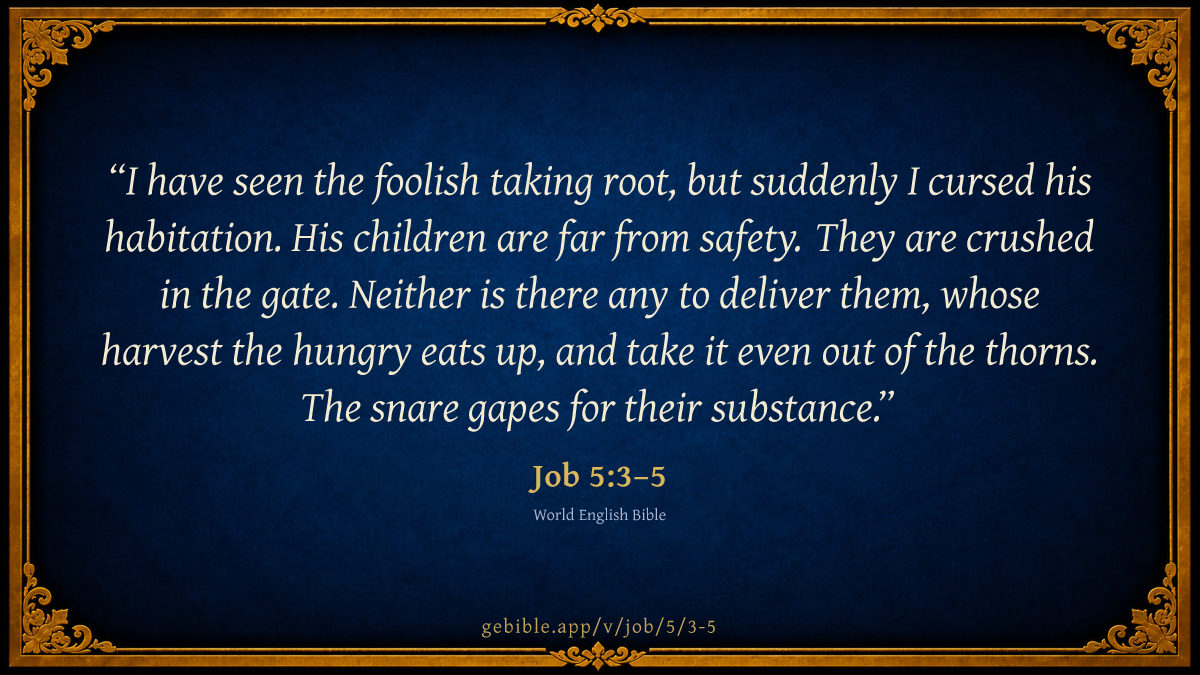
Job 5:3 I have seen the foolish taking root: but suddenly I cursed his habitation.
Ver. 3. I have seen the foolish taking root] q.d. I grant that wicked men are not always presently punished, sed Nemesis in tergo; et subito tollitur, qui diu toleratur. God’s wrath is such as no wicked man can avert or avoid. This had Eliphaz well observed, "I have seen"; he had set a memorandum on God’s just judgments, and marked his spits with his own stars, as one speaketh. Eliphaz was a man of much experience. See Job 4:8. In him that was true which Elihu saith should be, that days spake, and multitude of years taught wisdom, Job 32:7. Only herein he is mistaken, that he misapplieth all to Job, arguing from his outward condition to his inward; as if, therefore, he were wicked, because seemingly wretched. Thus the gloss he set was viperous, eating out the bowels of the text; it was a truth of God that he uttered, and the same in sense with that of David, Psa 37:35; and that of Solomon, Pro 23:18. But why should he thus writhe it and wrest it, to make the tune sound to his own key? St Peter speaketh of some that wrest the Scriptures, 2Pe 3:16, putting them upon the rack, and making them speak that which they never thought. And Tertullian saith of others, that they do murder the Scriptures for their own turns, and to serve their own purposes, Caedem scripturarum faciunt. The make a slaugter of the scriptures. But let us hear Eliphaz: "I have seen," saith he, and what more sure than sight? Num 16:14, "the foolish," the wilful fool, and perhaps he points at some one such rich fool as is mentioned Luk 12:20, not unknown to Job, and, as Eliphaz deemeth, a fit parallel for him, "taking root," dwelling alone in the earth, confirmed and settled in a fair estate, in a prosperous condition, as Nebuchadnezzar, that goodly tree, thought himself, Dan 4:4; Dan 4:22, {see Jer 12:2} and Dionysius, tyrant of Sicily, who conceited that his kingdom was bound fast unto him with chains of adamant; but he was soon after cast out, and thereby convinced of singular folly (Aelian. Var. Hist. lib. 2). A tempest, or, at least, an axe, of Divine vengeance, can easily fell these rooted fast and best fruited trees, and lay them low enough, as he did Nebuchadnezzar, that club of the nations and rod of God’s wrath, Isa 14:4-8 Dan 4:22, &c., and Attila, the conquering Hun, who called himself the wrath of God and scourge of the world, and arrogantly said, that the stars of heaven fell before him, and the earth trembled (Jovius), but was soon after rooted up by impartial death in the midst of his nuptial solemnities, Subita morte extinctus est, sanguine copiose in fauces exundante et ex ore erumpente. He died suddenly, much blood pouring from his throat and his mouth.
Read full note →
And suddenly I cursed his habitation] His house, which he held his castle, together with his family, Job 5:4, and his family provisions, Job 5:5. All these Eliphaz suddenly (even when he was in the ruff of all his jollity, in the height of his flourish) cursed, Heb. pierced, or bored through, not so much by a malediction as a prediction, Male ominatus sum iis, I foresaw and foretold that that happiness would not hold long; I ominously divined it; I both thought it and spake it. Pium non decent dirae; cursing men are cursed men; but a godly person may presage a curse, and foretell it, according to that, Pro 3:33, "The curse of the Lord is in the house of the wicked," yea, the flying roll of curses, that is ten yards long and five yards broad, shall remain in the midst of it, and consume it, Zec 5:4. Brimstone shall be scattered upon his habitation, and the fire of God shall kindle it; so that his roots shall be dried up beneath, and above shall his branch be cut off, &c., Job 18:15-16.
John Trapp, A Commentary or Exposition upon All the Books of the Old and New Testament (1647–1656) — public domain. Text from a community e-Sword module.
Matthew Poole1685 · Public DomainOn vv3–5I have oft observed it in my experience. Having…
I have oft observed it in my experience. Having severely rebuked Job for his transports of passion and intemperate speeches against God, he now returns to his former argument, and proves that such dreadful and destructive judgments of God do not befall the righteous, but the wicked, as he observed, Job 4:7,8. Withal, he answers an objection concerning the present and seeming prosperity of the wicked, which he confesseth that he himself had sometimes observed.
The foolish, i. e. the wicked man, who is quite destitute of true, i.e. of spiritual and heavenly, wisdom.
Read full note →
Taking root; not only prosperous for the present, but, as it seemed, from all secure for the future, being strongly fortified with power, and riches, and children too, so as there was no appearance nor danger of a change.
Suddenly; in a moment, besides and before mine, and his own, and all other men’s expectation.
I cursed; either,
1. I judged that he was a cursed creature, notwithstanding all his prosperity; and I foresaw and foretold it by the rules of Scripture, or the direction of God’s Spirit, that he would certainly sooner or later be stripped of all his blessings, and have God’s curse fall heavily upon him. Or rather,
2. I saw and perceived, by, the event which followed his prosperity, that he was a man accursed of God. For he speaks not in these words of what his estate constantly was, even in the midst of his happiness, though even then he was really accursed; but of what it was by a sudden change.
His habitation; or, as the Hebrew word signifies, his pleasant or commodious habitation; persons or things in it, or belonging to it, being comprehended in that word by a usual metonymy.
Matthew Poole's English Annotations on the Holy Bible (1683–1685) — public domain. Text from a community e-Sword/MySword module.
John Gill1763 · Public DomainOn vv3–5I have seen the foolish taking root,.... Such foolish…
I have seen the foolish taking root,.... Such foolish wicked men as before described; those Eliphaz had observed to prosper in the world, and increase in riches, and even to have attained to a seeming stability and firmness, as if they would ever continue in such happy circumstances, see Jer 12:2; by this he would obviate an objection that here might be raised and made against the assertion he was proving, that wicked men are afflicted and punished of God for their sins; whereas it is notorious that they are not in trouble as other men, but in very prosperous and flourishing circumstances; this he grants is their case for a while, as he had observed, but in a short time they pass away, they and their substance disappear, and are no more seen, as follows:
but suddenly I cursed his habitation; not that he wished ill to him, or imprecated evils upon him; for cursing and bitterness only fit the mouths of wicked men, and not good men, among whom Eliphaz must be allowed to be; but he immediately thought within himself, as soon as he saw the flourishing state of the wicked, that the curse of the Lord was in their houses, as in Pro 3:33; that they and all they had were under a curse, and that God find given them what they had with a curse, and had cursed all their blessings; which makes the difference between a good man and a wicked man; the one has what he has, his cottage and his small substance, with a blessing; the other his pleasant habitation, as the word (r) here used signifies, his stately palace, rich furniture, and large estates, with a curse; or he prognosticated, he foresaw, and could foretell, and that without pretending to an extraordinary spirit of prophecy, that in a short time the curse of God would light upon him, and upon his house, see Zac 5:3.
Read full note →
(r) "pulchritudini ejus", V. L. "commodam ejus", Cocceius; "amoenam", Schultens.
John Gill's Exposition of the Whole Bible (1746–1763) — public domain (CC PDM 1.0). Text via the HelloAO Bible API.
John Wesley1765 · Public DomainOn vv3–5Foolish - The wicked man. Root - Not only…
Foolish - The wicked man. Root - Not only prosperous for the present, but, as it seemed, firm and secure for the future. Suddenly - In a moment, beyond mine, and his own, and all other mens expectation. Cursed - l saw by the event which followed his prosperity, that he was a man accursed of God.
John Wesley, Explanatory Notes Upon the Whole Bible (1754–1765) — public domain. Text via the GEBible commentary corpus.
Adam Clarke1810 · Public DomainOn vv3–5Verse 3. I have seen the foolish taking root]…
Verse 3. I have seen the foolish taking root] I have seen wicked men for a time in prosperity, and becoming established in the earth; but I well knew, from God's manner of dealing with men, that they must soon be blasted. I even ventured to pronounce their doom; for I knew that, in the order of God's providence, that was inevitable. I cursed his habitation.
Adam Clarke's Commentary on the Bible (1810–1826) — public domain. Text from a community e-Sword/MySword module.
Joseph Benson1811 · Public DomainOn vv3–5Job 5:3. I have seen the foolish taking root…
Job 5:3. I have seen the foolish taking root — I have observed the wicked man, whom I term foolish, as being destitute of true, that is, of heavenly, wisdom, not only prosperous for the present, but, as it seemed, firm and secure for the future, being strongly fortified with power and riches, and children too, so that there was no likelihood or apparent danger of a change; but suddenly — In a moment, before any one’s expectation; I cursed his habitation — I saw, by the event which followed his prosperity, that he was a man under a divine curse, and that, notwithstanding the seeming depth and strength in which he vainly promised himself a permanent, unshaken situation for many years, all his hopes were built on a weak and false foundation. Thus Eliphaz answers an objection concerning the present seeming prosperity of the wicked, which he confesses that he himself had sometimes observed, but which, he insists, was of short duration, destructive judgments from God unexpectedly overwhelming them.
Joseph Benson's Commentary on the Old and New Testaments (1811–1818) — public domain. Text from a community e-Sword module.
Albert Barnes1834 · Public DomainOn vv3–5I have seen the foolish - The wicked. To…
I have seen the foolish - The wicked. To confirm the sentiment which he had just advanced, Eliphaz appeals to his own observation, and says that though the wicked for a time seem to be prosperous, yet he had observed that they were soon overtaken with calamity and cut down. He evidently means that prosperity was no evidence of the divine favor; but that when it had continued for a little time, and was then withdrawn, it was proof that the man who had been prospered was at heart a wicked man. It was easy to understated that he meant that this should be applied to Job, who, though he had been favored with temporary prosperity, was now revealed to be at heart a wicked man. The sentiment here advanced by Eliphaz, as the result of his observation, strikingly accords with the observation of David, as expressed in Psa 23:1-6 :
“I have seen the wicked in great power,
Read full note →
And spreading himself like a green bay-tree;
Yet he passed away, and, lo, he was not:
Yea, I sought him, but he could not be found.”
Psa 23:1-6 :35-36.
Taking root - This figure, to denote prosperous and rapid growth, is often used in the Scriptures. Thus, in Psa 1:3 :
“And he shall be like a tree planted by the rivers of water,
That bringeth forth his fruit in his season.”
So Isa 27:6 :
“Those that come out of Jacob shall he cause to take root;
Israel shall blossom and bud,
And shall fill the face of the world with fruit.”
So Psa 80:9-10 :
“Thou preparedst room before it,
And didst cause it to take deep root,
And it filled the land.
The hills were covered with the shadow of it,
And the boughs thereof were like the goodly cedars.”
But suddenly - Meaning either that calamity came upon him suddenly - as it had upon Job, that is, without any apparent preparation, or that; calamity came before a great while, that is, that this prosperity did not continue. Probably there is an implied reference hereto the case of Job, meaning that he had known just such instances before; and as the case of Job accorded with what he had before seen, he hastened to the conclusion that Job must have been a wicked man.
I cursed his habitation - I had occasion to regard it as accursed; that is, I witnessed the downfall of his fortunes, and pronounced his habitation accursed. I saw that God regarded it as such, and that he had suddenly punished him. This accords with the observation of David, referred to above.
Albert Barnes' Notes on the Bible (1834–1885) — public domain. Text from a community e-Sword/MySword module.
Haydock's Catholic Bible Commentary1859 · Public DomainOn vv3–4And I. Septuagint, "But presently their subsistence was eaten…
And I. Septuagint, "But presently their subsistence was eaten up." I envied not their riches: but judged they would soon end. (Haydock)
George Leo Haydock (1774–1849), Haydock's Catholic Family Bible and Commentary, 1859 edition — public domain. Excludes Psalms (Douay-Rheims chapter numbering differs from Protestant) and Deuterocanonical books (Catholic canon only).
Robert Jamieson, A. R. Fausset & David Brown1871 · Public DomainOn vv3–5the foolish--the wicked. I have seen the sinner spread…
the foolish--the wicked. I have seen the sinner spread his "root" wide in prosperity, yet circumstances "suddenly" occurred which gave occasion for his once prosperous dwelling being "cursed" as desolate (Psa 37:35-36; Jer 17:8).
Jamieson, Fausset & Brown — Commentary Critical and Explanatory on the Whole Bible (1871) — public domain (CC PDM 1.0). Text via the HelloAO Bible API.
Daniel D. Whedon1874 · Public DomainOn vv3–53. Suddenly I cursed — He feels himself justified…
3. Suddenly I cursed — He feels himself justified in acting upon what he had observed — that adversity trod upon the heel of wickedness. So that where-ever he beheld the marked prosperity of the foolish, he at once pronounced their doom. The version of the Septuagint, “but suddenly their habitation was devoured,” Merx is not justifiable in following. “The word ‘suddenly’ points, as with the finger, to the catastrophe by which, at one stroke, Job’s prosperity was laid in the dust — to the Chaldeans and Sabeans, to the lightning and the storm.” — Hengstenberg.
Daniel D. Whedon (gen. ed.), Commentary on the Old and New Testaments (1874–1909) — public domain. Text from a community e-Sword module.
The Cambridge Bible for Schools and Colleges1878 · Public DomainOn vv3–53. the foolish] Rather perhaps, a foolish man, the…
3. the foolish] Rather perhaps, a foolish man, the same word as in Job_5:2. Eliphaz cites an instance from his own experience confirming the truth stated in Job_5:2. He saw a man of this character taking root, and for the moment appearing to give promise of prosperity.
but suddenly I cursed] The meaning is not that Eliphaz cursed his habitation before-hand, foreseeing that destruction would certainly overtake him; but that, though this fool appeared prosperous and seemed preparing for enduring happiness, suddenly God’s judgment fell on him, and Eliphaz, seeing his desolation and knowing the true meaning of it, pronounced his habitation accursed; and this he did “suddenly,” so speedily in the midst of his apparent luxuriance did the curse of God wither up the prosperity of the fool.
The Cambridge Bible for Schools and Colleges (gen. ed. J. J. S. Perowne; Cambridge University Press, 1878–1918) — public domain. Text from a community e-Sword module.
Ellicott's Commentary for English Readers1878 · Public DomainOn vv3–5(3) I cursed.—The word means, “I was able to…
(3) I cursed.—The word means, “I was able to declare distinctly, and I did declare without hesitation, that his lot would be as follows.” All these general results of experience have the sting of insinuation in them that they contain the key to Job’s unfortunate condition. There is secret unsoundness there which is the cause of the manifest and open misery. It is impossible that a man so stricken should be otherwise than, for some unknown reason, the guilty victim of the righteous wrath of a just judge.
A Bible Commentary for English Readers, edited by Charles John Ellicott (1878–1897) — public domain. Text from a community e-Sword module.
The Pulpit Commentary1880 · Public DomainOn vv3–5I have seen the foolish taking root. The "I"…
I have seen the foolish taking root. The "I" is emphatic. I myself have seen," etc. What Eliphaz had seen was that folly, i.e. sinful infatuation, was always punished. It might seem to prosper: the foolish man might seem to be taking root; but Eliphaz was not deceived by appearances he saw through them, he knew that there was a curse upon the man"s house, and so pronounced it accursed. And the ruin which he had foreseen, it is implied, followed. But suddenly; rather, immediately, without hesitation. I cursed his habitation; i.e. "pronounced it accursed, declared that the curse of God rested upon it?
"The foolish taking root.
Read full note →
I IT IS POSSIBLE FOR THE FOOLISH TO TAKE ROOT. "The foolish," in biblical phraseology, are worse than people of weak intellect; they are always regarded as morally degenerate. Their folly is the opposite to the wisdom of which the beginning is "the fear of the Lord." Though lacking in moral fibre as well as in mental stamina, such people still often contrive to achieve an astonishing amount of success in life.
1. They mall be favoured by circumstances. In this world men are not wholly dependent upon their own character and conduct. There is a general tide of prosperity that sweeps strong on its flood many who have had no hand in originating it. There is good fortune as well as misfortune, and the one is often as little deserved as the other.
2. They may be helped by Providence. God"s grace is always greater than our deserts. He would win us by his goodness. The foolish man should see that this goodness of God is designed to lead him to repentance. (Rom_2:4) Sometimes, however, the Divine temporal favour is in reality a method of judgment, a sunshine that ripens the effects of folly, so that they may appear in their fulness at the hastening harvest-time.
3. They may assist themselves. There is a kind of prosperity which good and wise men scorn, not being able to stoop to the degradation which leads to it. Then bad and foolish men step in, and, though grovelling in the dust, succeed in grasping some of the so-called good things of life. Much outward prosperity is not directly dependent on moral qualities. A man may be skilful in money-making without being either a saint or a philosopher.
II ALTHOUGH THE FOOLISH MAY TAKE ROOT, THEY WILL NOT BEAR GOOD FRUIT. We may be surprised at their temporal prosperity, but it is only temporal. For a while they live and grow, not simply flourishing a moment like a plucked flower that must soon fade, but actually striking roots into the ground, and thus strengthening their position and drawing nourishment to themselves. Still, at best, it is only the rooting in the soil that is thought of. This is but the first stage. Eliphaz was quite right in his surmise that the last stage would be very different, although he was in error as to the time, circumstances, and character of the great denouement.
1. No good fruit will follow. The foolish stock can only bring forth fruit of folly; and if it grows luxuriantly, it will not bear any better products. Its size will only multiply and coarsen its natural issue. Let bad and foolish men advance unimpeded as far as possible in their earthly prosperity, yet of real soul-prosperity they will have none, for they have not in them the life from which this springs.
2. The flourishing prosperity will come to an end. These noxious plants must be finally rooted up if they are not struck down earlier by the thunderbolts of judgment. Rapid growth is no promise of long endurance. The mistake of the old world was to look for the judgment on earth. It may come here. But if it does not, it is certain to come hereafter; for God is wise and good and almighty. Therefore beware of the delusion of temporal insanity. Look to the end. Look to the quality of the success attained. Let this be what Christ approves; i.e. like his success, which was victory through the cross. Then a fruitful root will sprout out of a "dry ground". W.F.A. (Isa_53:2)
The Pulpit Commentary (1880–1919), ed. H.D.M. Spence-Jones & Joseph S. Exell — public domain. Text from a community e-Sword module.
The Biblical Illustrator1887 · Public DomainOn v3I have seen the foolish taking root.
Job_5:3
I have seen the foolish taking root.
Read full note →
1. Wicked men may flourish in great outward prosperity.
2. Wicked men may not only flourish and grow, but they may flourish and grow a great while. I ground it upon this; the text saith that they take root: I have seen the foolish take root; and the word notes a deep rooting. Some wicked men stand out many storms, like old oaks; like trees deeply rooted, they stand many a blast, yea, many a blow. Spectators are ready to say, such and such storms will certainly overthrow them, and yet still they stand; but though they stand so long that all wonder, yet they shall fall.
3. Outward good things are not good in themselves. The foolish take root. The worst of men may enjoy the best of outward comforts. Outward things are unto us as we are. If the man be good, then they are good. There is a great difference between the flourishing of a wise man and the flourishing of a fool; all his flourishing in the earth is no good to him, because himself is not good. Spiritual good things are so good that, though they find us not good, yet they will make us good; we cannot have them indeed, and be unlike them.
4. The enjoyment of outward good things is no evidence, can be made no argument, that a man is good. And yet how many stick upon this evidence, blessing themselves because they are outwardly blessed! (J. Caryl.)
The Biblical Illustrator, edited by Joseph S. Exell (c. 1880s–1900s) — public domain. Text from a community e-Sword module.
unfoldingWord translationNotes2017 · CC BY-SA 4.0On v4General Information:
General Information:
These verses continue the earlier use of parallelism, here emphasizing in different ways the idea that the children of foolish people are never safe. (See: Parallelism)
Read full note →
His children are far from safety
"His" refers to the foolish person or the foolish people in Job 5:02. AT: "Their children are never safe"
are crushed
Here being crushed represents being oppressed, taken advantage of, at court. This idea may be put into active form. AT: "someone crushes them" (See: Metaphor and Active or Passive)
city gate
The city gate, functioning as a court, was the place where disputes were resolved and where judgments were given.
There is no one to rescue them
"There is no one to help the foolish people's children out of their hardship"
they even take it from among the thorns
This perhaps refers to parts of a field where the worst crops grow, because of thorn plants present.
The thirsty pant for their wealth
Here greedy people are spoken of as if they were thirsty, and the wealth of the foolish person is spoken of as if it were something that they could drink. (See: Metaphor)
Tyndale Open Study Notes2022 · CC BY-SA 4.0On v45:4 The court (literally the gate) was the site…
5:4 The court (literally the gate) was the site of legal and commercial deliberations in which Job had participated (29:7; see Deut 21:19-21; Ruth 4:1-11).

Geneva Bible translators 1599 · Public Domain On vv3–5 That is, the sinner that hath not the fear…
That is, the sinner that hath not the fear of God.
I was not moved with his prosperity, but knew that God had cursed him and his.
Geneva Bible (1599) marginal notes — public domain.
John Trapp 1656 · Public Domain On vv3–5 Job 5:3 I have seen the foolish taking root:…
Job 5:3 I have seen the foolish taking root: but suddenly I cursed his habitation.
Ver. 3. I have seen the foolish taking root] q.d. I grant that wicked men are not always presently punished, sed Nemesis in tergo; et subito tollitur, qui diu toleratur. God’s wrath is such as no wicked man can avert or avoid. This had Eliphaz well observed, "I have seen"; he had set a memorandum on God’s just judgments, and marked his spits with his own stars, as one speaketh. Eliphaz was a man of much experience. See Job 4:8. In him that was true which Elihu saith should be, that days spake, and multitude of years taught wisdom, Job 32:7. Only herein he is mistaken, that he misapplieth all to Job, arguing from his outward condition to his inward; as if, therefore, he were wicked, because seemingly wretched. Thus the gloss he set was viperous, eating out the bowels of the text; it was a truth of God that he uttered, and the same in sense with that of David, Psa 37:35; and that of Solomon, Pro 23:18. But why should he thus writhe it and wrest it, to make the tune sound to his own key? St Peter speaketh of some that wrest the Scriptures, 2Pe 3:16, putting them upon the rack, and making them speak that which they never thought. And Tertullian saith of others, that they do murder the Scriptures for their own turns, and to serve their own purposes, Caedem scripturarum faciunt. The make a slaugter of the scriptures. But let us hear Eliphaz: "I have seen," saith he, and what more sure than sight? Num 16:14, "the foolish," the wilful fool, and perhaps he points at some one such rich fool as is mentioned Luk 12:20, not unknown to Job, and, as Eliphaz deemeth, a fit parallel for him, "taking root," dwelling alone in the earth, confirmed and settled in a fair estate, in a prosperous condition, as Nebuchadnezzar, that goodly tree, thought himself, Dan 4:4; Dan 4:22, {see Jer 12:2} and Dionysius, tyrant of Sicily, who conceited that his kingdom was bound fast unto him with chains of adamant; but he was soon after cast out, and thereby convinced of singular folly (Aelian. Var. Hist. lib. 2). A tempest, or, at least, an axe, of Divine vengeance, can easily fell these rooted fast and best fruited trees, and lay them low enough, as he did Nebuchadnezzar, that club of the nations and rod of God’s wrath, Isa 14:4-8 Dan 4:22, &c., and Attila, the conquering Hun, who called himself the wrath of God and scourge of the world, and arrogantly said, that the stars of heaven fell before him, and the earth trembled (Jovius), but was soon after rooted up by impartial death in the midst of his nuptial solemnities, Subita morte extinctus est, sanguine copiose in fauces exundante et ex ore erumpente. He died suddenly, much blood pouring from his throat and his mouth.
Read full note →
And suddenly I cursed his habitation] His house, which he held his castle, together with his family, Job 5:4, and his family provisions, Job 5:5. All these Eliphaz suddenly (even when he was in the ruff of all his jollity, in the height of his flourish) cursed, Heb. pierced, or bored through, not so much by a malediction as a prediction, Male ominatus sum iis, I foresaw and foretold that that happiness would not hold long; I ominously divined it; I both thought it and spake it. Pium non decent dirae; cursing men are cursed men; but a godly person may presage a curse, and foretell it, according to that, Pro 3:33, "The curse of the Lord is in the house of the wicked," yea, the flying roll of curses, that is ten yards long and five yards broad, shall remain in the midst of it, and consume it, Zec 5:4. Brimstone shall be scattered upon his habitation, and the fire of God shall kindle it; so that his roots shall be dried up beneath, and above shall his branch be cut off, &c., Job 18:15-16.
John Trapp, A Commentary or Exposition upon All the Books of the Old and New Testament (1647–1656) — public domain. Text from a community e-Sword module.
Matthew Poole 1685 · Public Domain On vv3–5 I have oft observed it in my experience. Having…
I have oft observed it in my experience. Having severely rebuked Job for his transports of passion and intemperate speeches against God, he now returns to his former argument, and proves that such dreadful and destructive judgments of God do not befall the righteous, but the wicked, as he observed, Job 4:7,8. Withal, he answers an objection concerning the present and seeming prosperity of the wicked, which he confesseth that he himself had sometimes observed.
The foolish, i. e. the wicked man, who is quite destitute of true, i.e. of spiritual and heavenly, wisdom.
Read full note →
Taking root; not only prosperous for the present, but, as it seemed, from all secure for the future, being strongly fortified with power, and riches, and children too, so as there was no appearance nor danger of a change.
Suddenly; in a moment, besides and before mine, and his own, and all other men’s expectation.
I cursed; either,
1. I judged that he was a cursed creature, notwithstanding all his prosperity; and I foresaw and foretold it by the rules of Scripture, or the direction of God’s Spirit, that he would certainly sooner or later be stripped of all his blessings, and have God’s curse fall heavily upon him. Or rather,
2. I saw and perceived, by, the event which followed his prosperity, that he was a man accursed of God. For he speaks not in these words of what his estate constantly was, even in the midst of his happiness, though even then he was really accursed; but of what it was by a sudden change.
His habitation; or, as the Hebrew word signifies, his pleasant or commodious habitation; persons or things in it, or belonging to it, being comprehended in that word by a usual metonymy.
Matthew Poole's English Annotations on the Holy Bible (1683–1685) — public domain. Text from a community e-Sword/MySword module.
John Gill 1763 · Public Domain On vv3–5 I have seen the foolish taking root,.... Such foolish…
I have seen the foolish taking root,.... Such foolish wicked men as before described; those Eliphaz had observed to prosper in the world, and increase in riches, and even to have attained to a seeming stability and firmness, as if they would ever continue in such happy circumstances, see Jer 12:2; by this he would obviate an objection that here might be raised and made against the assertion he was proving, that wicked men are afflicted and punished of God for their sins; whereas it is notorious that they are not in trouble as other men, but in very prosperous and flourishing circumstances; this he grants is their case for a while, as he had observed, but in a short time they pass away, they and their substance disappear, and are no more seen, as follows:
but suddenly I cursed his habitation; not that he wished ill to him, or imprecated evils upon him; for cursing and bitterness only fit the mouths of wicked men, and not good men, among whom Eliphaz must be allowed to be; but he immediately thought within himself, as soon as he saw the flourishing state of the wicked, that the curse of the Lord was in their houses, as in Pro 3:33; that they and all they had were under a curse, and that God find given them what they had with a curse, and had cursed all their blessings; which makes the difference between a good man and a wicked man; the one has what he has, his cottage and his small substance, with a blessing; the other his pleasant habitation, as the word (r) here used signifies, his stately palace, rich furniture, and large estates, with a curse; or he prognosticated, he foresaw, and could foretell, and that without pretending to an extraordinary spirit of prophecy, that in a short time the curse of God would light upon him, and upon his house, see Zac 5:3.
Read full note →
(r) "pulchritudini ejus", V. L. "commodam ejus", Cocceius; "amoenam", Schultens.
John Gill's Exposition of the Whole Bible (1746–1763) — public domain (CC PDM 1.0). Text via the HelloAO Bible API.
John Wesley 1765 · Public Domain On vv3–5 Foolish - The wicked man. Root - Not only…
Foolish - The wicked man. Root - Not only prosperous for the present, but, as it seemed, firm and secure for the future. Suddenly - In a moment, beyond mine, and his own, and all other mens expectation. Cursed - l saw by the event which followed his prosperity, that he was a man accursed of God.
John Wesley, Explanatory Notes Upon the Whole Bible (1754–1765) — public domain. Text via the GEBible commentary corpus.
Adam Clarke 1810 · Public Domain On vv3–5 Verse 3. I have seen the foolish taking root]…
Verse 3. I have seen the foolish taking root] I have seen wicked men for a time in prosperity, and becoming established in the earth; but I well knew, from God's manner of dealing with men, that they must soon be blasted. I even ventured to pronounce their doom; for I knew that, in the order of God's providence, that was inevitable. I cursed his habitation.
Adam Clarke's Commentary on the Bible (1810–1826) — public domain. Text from a community e-Sword/MySword module.
Joseph Benson 1811 · Public Domain On vv3–5 Job 5:3. I have seen the foolish taking root…
Job 5:3. I have seen the foolish taking root — I have observed the wicked man, whom I term foolish, as being destitute of true, that is, of heavenly, wisdom, not only prosperous for the present, but, as it seemed, firm and secure for the future, being strongly fortified with power and riches, and children too, so that there was no likelihood or apparent danger of a change; but suddenly — In a moment, before any one’s expectation; I cursed his habitation — I saw, by the event which followed his prosperity, that he was a man under a divine curse, and that, notwithstanding the seeming depth and strength in which he vainly promised himself a permanent, unshaken situation for many years, all his hopes were built on a weak and false foundation. Thus Eliphaz answers an objection concerning the present seeming prosperity of the wicked, which he confesses that he himself had sometimes observed, but which, he insists, was of short duration, destructive judgments from God unexpectedly overwhelming them.
Joseph Benson's Commentary on the Old and New Testaments (1811–1818) — public domain. Text from a community e-Sword module.
Albert Barnes 1834 · Public Domain On vv3–5 I have seen the foolish - The wicked. To…
I have seen the foolish - The wicked. To confirm the sentiment which he had just advanced, Eliphaz appeals to his own observation, and says that though the wicked for a time seem to be prosperous, yet he had observed that they were soon overtaken with calamity and cut down. He evidently means that prosperity was no evidence of the divine favor; but that when it had continued for a little time, and was then withdrawn, it was proof that the man who had been prospered was at heart a wicked man. It was easy to understated that he meant that this should be applied to Job, who, though he had been favored with temporary prosperity, was now revealed to be at heart a wicked man. The sentiment here advanced by Eliphaz, as the result of his observation, strikingly accords with the observation of David, as expressed in Psa 23:1-6 :
“I have seen the wicked in great power,
Read full note →
And spreading himself like a green bay-tree;
Yet he passed away, and, lo, he was not:
Yea, I sought him, but he could not be found.”
Psa 23:1-6 :35-36.
Taking root - This figure, to denote prosperous and rapid growth, is often used in the Scriptures. Thus, in Psa 1:3 :
“And he shall be like a tree planted by the rivers of water,
That bringeth forth his fruit in his season.”
So Isa 27:6 :
“Those that come out of Jacob shall he cause to take root;
Israel shall blossom and bud,
And shall fill the face of the world with fruit.”
So Psa 80:9-10 :
“Thou preparedst room before it,
And didst cause it to take deep root,
And it filled the land.
The hills were covered with the shadow of it,
And the boughs thereof were like the goodly cedars.”
But suddenly - Meaning either that calamity came upon him suddenly - as it had upon Job, that is, without any apparent preparation, or that; calamity came before a great while, that is, that this prosperity did not continue. Probably there is an implied reference hereto the case of Job, meaning that he had known just such instances before; and as the case of Job accorded with what he had before seen, he hastened to the conclusion that Job must have been a wicked man.
I cursed his habitation - I had occasion to regard it as accursed; that is, I witnessed the downfall of his fortunes, and pronounced his habitation accursed. I saw that God regarded it as such, and that he had suddenly punished him. This accords with the observation of David, referred to above.
Albert Barnes' Notes on the Bible (1834–1885) — public domain. Text from a community e-Sword/MySword module.
Haydock's Catholic Bible Commentary 1859 · Public Domain On vv3–4 And I. Septuagint, "But presently their subsistence was eaten…
And I. Septuagint, "But presently their subsistence was eaten up." I envied not their riches: but judged they would soon end. (Haydock)
George Leo Haydock (1774–1849), Haydock's Catholic Family Bible and Commentary, 1859 edition — public domain. Excludes Psalms (Douay-Rheims chapter numbering differs from Protestant) and Deuterocanonical books (Catholic canon only).
Robert Jamieson, A. R. Fausset & David Brown 1871 · Public Domain On vv3–5 the foolish--the wicked. I have seen the sinner spread…
the foolish--the wicked. I have seen the sinner spread his "root" wide in prosperity, yet circumstances "suddenly" occurred which gave occasion for his once prosperous dwelling being "cursed" as desolate (Psa 37:35-36; Jer 17:8).
Jamieson, Fausset & Brown — Commentary Critical and Explanatory on the Whole Bible (1871) — public domain (CC PDM 1.0). Text via the HelloAO Bible API.
Daniel D. Whedon 1874 · Public Domain On vv3–5 3. Suddenly I cursed — He feels himself justified…
3. Suddenly I cursed — He feels himself justified in acting upon what he had observed — that adversity trod upon the heel of wickedness. So that where-ever he beheld the marked prosperity of the foolish, he at once pronounced their doom. The version of the Septuagint, “but suddenly their habitation was devoured,” Merx is not justifiable in following. “The word ‘suddenly’ points, as with the finger, to the catastrophe by which, at one stroke, Job’s prosperity was laid in the dust — to the Chaldeans and Sabeans, to the lightning and the storm.” — Hengstenberg.
Daniel D. Whedon (gen. ed.), Commentary on the Old and New Testaments (1874–1909) — public domain. Text from a community e-Sword module.
The Cambridge Bible for Schools and Colleges 1878 · Public Domain On vv3–5 3. the foolish] Rather perhaps, a foolish man, the…
3. the foolish] Rather perhaps, a foolish man, the same word as in Job_5:2. Eliphaz cites an instance from his own experience confirming the truth stated in Job_5:2. He saw a man of this character taking root, and for the moment appearing to give promise of prosperity.
but suddenly I cursed] The meaning is not that Eliphaz cursed his habitation before-hand, foreseeing that destruction would certainly overtake him; but that, though this fool appeared prosperous and seemed preparing for enduring happiness, suddenly God’s judgment fell on him, and Eliphaz, seeing his desolation and knowing the true meaning of it, pronounced his habitation accursed; and this he did “suddenly,” so speedily in the midst of his apparent luxuriance did the curse of God wither up the prosperity of the fool.
The Cambridge Bible for Schools and Colleges (gen. ed. J. J. S. Perowne; Cambridge University Press, 1878–1918) — public domain. Text from a community e-Sword module.
Ellicott's Commentary for English Readers 1878 · Public Domain On vv3–5 (3) I cursed.—The word means, “I was able to…
(3) I cursed.—The word means, “I was able to declare distinctly, and I did declare without hesitation, that his lot would be as follows.” All these general results of experience have the sting of insinuation in them that they contain the key to Job’s unfortunate condition. There is secret unsoundness there which is the cause of the manifest and open misery. It is impossible that a man so stricken should be otherwise than, for some unknown reason, the guilty victim of the righteous wrath of a just judge.
A Bible Commentary for English Readers, edited by Charles John Ellicott (1878–1897) — public domain. Text from a community e-Sword module.
The Pulpit Commentary 1880 · Public Domain On vv3–5 I have seen the foolish taking root. The "I"…
I have seen the foolish taking root. The "I" is emphatic. I myself have seen," etc. What Eliphaz had seen was that folly, i.e. sinful infatuation, was always punished. It might seem to prosper: the foolish man might seem to be taking root; but Eliphaz was not deceived by appearances he saw through them, he knew that there was a curse upon the man"s house, and so pronounced it accursed. And the ruin which he had foreseen, it is implied, followed. But suddenly; rather, immediately, without hesitation. I cursed his habitation; i.e. "pronounced it accursed, declared that the curse of God rested upon it?
"The foolish taking root.
Read full note →
I IT IS POSSIBLE FOR THE FOOLISH TO TAKE ROOT. "The foolish," in biblical phraseology, are worse than people of weak intellect; they are always regarded as morally degenerate. Their folly is the opposite to the wisdom of which the beginning is "the fear of the Lord." Though lacking in moral fibre as well as in mental stamina, such people still often contrive to achieve an astonishing amount of success in life.
1. They mall be favoured by circumstances. In this world men are not wholly dependent upon their own character and conduct. There is a general tide of prosperity that sweeps strong on its flood many who have had no hand in originating it. There is good fortune as well as misfortune, and the one is often as little deserved as the other.
2. They may be helped by Providence. God"s grace is always greater than our deserts. He would win us by his goodness. The foolish man should see that this goodness of God is designed to lead him to repentance. (Rom_2:4) Sometimes, however, the Divine temporal favour is in reality a method of judgment, a sunshine that ripens the effects of folly, so that they may appear in their fulness at the hastening harvest-time.
3. They may assist themselves. There is a kind of prosperity which good and wise men scorn, not being able to stoop to the degradation which leads to it. Then bad and foolish men step in, and, though grovelling in the dust, succeed in grasping some of the so-called good things of life. Much outward prosperity is not directly dependent on moral qualities. A man may be skilful in money-making without being either a saint or a philosopher.
II ALTHOUGH THE FOOLISH MAY TAKE ROOT, THEY WILL NOT BEAR GOOD FRUIT. We may be surprised at their temporal prosperity, but it is only temporal. For a while they live and grow, not simply flourishing a moment like a plucked flower that must soon fade, but actually striking roots into the ground, and thus strengthening their position and drawing nourishment to themselves. Still, at best, it is only the rooting in the soil that is thought of. This is but the first stage. Eliphaz was quite right in his surmise that the last stage would be very different, although he was in error as to the time, circumstances, and character of the great denouement.
1. No good fruit will follow. The foolish stock can only bring forth fruit of folly; and if it grows luxuriantly, it will not bear any better products. Its size will only multiply and coarsen its natural issue. Let bad and foolish men advance unimpeded as far as possible in their earthly prosperity, yet of real soul-prosperity they will have none, for they have not in them the life from which this springs.
2. The flourishing prosperity will come to an end. These noxious plants must be finally rooted up if they are not struck down earlier by the thunderbolts of judgment. Rapid growth is no promise of long endurance. The mistake of the old world was to look for the judgment on earth. It may come here. But if it does not, it is certain to come hereafter; for God is wise and good and almighty. Therefore beware of the delusion of temporal insanity. Look to the end. Look to the quality of the success attained. Let this be what Christ approves; i.e. like his success, which was victory through the cross. Then a fruitful root will sprout out of a "dry ground". W.F.A. (Isa_53:2)
The Pulpit Commentary (1880–1919), ed. H.D.M. Spence-Jones & Joseph S. Exell — public domain. Text from a community e-Sword module.
The Biblical Illustrator 1887 · Public Domain On v3 I have seen the foolish taking root.
Job_5:3
I have seen the foolish taking root.
Read full note →
1. Wicked men may flourish in great outward prosperity.
2. Wicked men may not only flourish and grow, but they may flourish and grow a great while. I ground it upon this; the text saith that they take root: I have seen the foolish take root; and the word notes a deep rooting. Some wicked men stand out many storms, like old oaks; like trees deeply rooted, they stand many a blast, yea, many a blow. Spectators are ready to say, such and such storms will certainly overthrow them, and yet still they stand; but though they stand so long that all wonder, yet they shall fall.
3. Outward good things are not good in themselves. The foolish take root. The worst of men may enjoy the best of outward comforts. Outward things are unto us as we are. If the man be good, then they are good. There is a great difference between the flourishing of a wise man and the flourishing of a fool; all his flourishing in the earth is no good to him, because himself is not good. Spiritual good things are so good that, though they find us not good, yet they will make us good; we cannot have them indeed, and be unlike them.
4. The enjoyment of outward good things is no evidence, can be made no argument, that a man is good. And yet how many stick upon this evidence, blessing themselves because they are outwardly blessed! (J. Caryl.)
The Biblical Illustrator, edited by Joseph S. Exell (c. 1880s–1900s) — public domain. Text from a community e-Sword module.
unfoldingWord translationNotes 2017 · CC BY-SA 4.0 On v4 General Information:
General Information:
These verses continue the earlier use of parallelism, here emphasizing in different ways the idea that the children of foolish people are never safe. (See: Parallelism)
Read full note →
His children are far from safety
"His" refers to the foolish person or the foolish people in Job 5:02. AT: "Their children are never safe"
are crushed
Here being crushed represents being oppressed, taken advantage of, at court. This idea may be put into active form. AT: "someone crushes them" (See: Metaphor and Active or Passive)
city gate
The city gate, functioning as a court, was the place where disputes were resolved and where judgments were given.
There is no one to rescue them
"There is no one to help the foolish people's children out of their hardship"
they even take it from among the thorns
This perhaps refers to parts of a field where the worst crops grow, because of thorn plants present.
The thirsty pant for their wealth
Here greedy people are spoken of as if they were thirsty, and the wealth of the foolish person is spoken of as if it were something that they could drink. (See: Metaphor)
translationWords
children
gate
harvest
consume
unfoldingWord translationNotes — © Distant Shores Media and the Door43 World Missions Community, licensed CC BY-SA 4.0. Source: git.door43.org/Door43/en_tn.
Tyndale Open Study Notes 2022 · CC BY-SA 4.0 On v4 5:4 The court (literally the gate) was the site…
5:4 The court (literally the gate) was the site of legal and commercial deliberations in which Job had participated (29:7; see Deut 21:19-21; Ruth 4:1-11).
Tyndale Open Study Notes — © Tyndale Open Resources, licensed CC BY-SA 4.0. Text via the HelloAO Bible API.