Psalms 9:17(v13)The wicked shall be turned back to Sheol, even all the nations that forget God.
Job 11:20(v13)But the eyes of the wicked will fail. They will have no way to flee. Their hope will be the giving up of the spirit.”
Job 13:16(v13)This also will be my salvation, that a godless man will not come before him.
Proverbs 10:28(vv13, 15)The prospect of the righteous is joy, but the hope of the wicked will perish.
Job 15:34(v13)For the company of the godless will be barren, and fire will consume the tents of bribery.
Show all 28 cross-references
Job 27:18(v15)He builds his house as the moth, as a booth which the watchman makes.
Isaiah 59:5-6(v14)They hatch adders’ eggs, and weave the spider’s web. He who eats of their eggs dies; and that which is crushed breaks out into a viper.…
Deuteronomy 8:11(v13)Beware lest you forget Yahweh your God, in not keeping his commandments, his ordinances, and his statutes, which I command you today;
Deuteronomy 8:19(v13)It shall be, if you shall forget Yahweh your God, and walk after other gods, and serve them and worship them, I testify against you today…
Job 20:5(v13)that the triumphing of the wicked is short, the joy of the godless but for a moment?
Psalms 50:22(v13)“Now consider this, you who forget God, lest I tear you into pieces, and there be no one to deliver.
Proverbs 12:7(v13)The wicked are overthrown, and are no more, but the house of the righteous shall stand.
Luke 12:1-2(v13)Meanwhile, when a multitude of many thousands had gathered together, so much so that they trampled on each other, he began to tell his…
Job 18:14(vv13, 15)He will be rooted out of the security of his tent. He will be brought to the king of terrors.
Deuteronomy 6:12(v13)then beware lest you forget Yahweh, who brought you out of the land of Egypt, out of the house of bondage.
Deuteronomy 8:14(v13)then your heart might be lifted up, and you forget Yahweh your God, who brought you out of the land of Egypt, out of the house of bondage;
Job 27:8-10(v13)For what is the hope of the godless, when he is cut off, when God takes away his life? Will God hear his cry when trouble comes on him?…
Job 36:13(v13)“But those who are godless in heart lay up anger. They don’t cry for help when he binds them.
Psalms 10:4(v13)The wicked, in the pride of his face, has no room in his thoughts for God.
Isaiah 33:14(v13)The sinners in Zion are afraid. Trembling has seized the godless ones. Who among us can live with the devouring fire? Who among us can live…
Isaiah 51:13(v13)Have you forgotten Yahweh your Maker, who stretched out the heavens, and laid the foundations of the earth? Do you live in fear continually…
Lamentations 3:18(v13)I said, “My strength has perished, along with my expectation from Yahweh.”
Matthew 7:24-27(v15)“Everyone therefore who hears these words of mine, and does them, I will liken him to a wise man, who built his house on a rock. The rain…
Luke 6:47-49(v15)Everyone who comes to me, and hears my words, and does them, I will show you who he is like. He is like a man building a house, who dug and…
Psalms 49:11(v15)Their inward thought is that their houses will endure forever, and their dwelling places to all generations. They name their lands after…
Psalms 52:5-7(v15)God will likewise destroy you forever. He will take you up, and pluck you out of your tent, and root you out of the land of the living. The…
Psalms 112:10(v15)The wicked will see it, and be grieved. He shall gnash with his teeth, and melt away. The desire of the wicked will perish.
Matthew 24:51(v13)and will cut him in pieces, and appoint his portion with the hypocrites. That is where the weeping and grinding of teeth will be.
28 distinct cross-references across this passage (30 total citations).
Cross-references from openbible.info (CC BY 4.0)
Explain this passage (18 sources)
Historical commentary, presented as a primary source — not an endorsement.
Geneva Bible translators1599 · Public DomainOn v14Which is today, and tomorrow swept away.
Which is today, and tomorrow swept away.
Geneva Bible (1599) marginal notes — public domain.
John Trapp1656 · Public DomainOn vv13–15Job 8:13 So [are] the paths of all that…
Job 8:13 So [are] the paths of all that forget God; and the hypocrite’s hope shall perish:
Ver. 13. So are the paths of all that forget God] To remember God is as necessary as to draw breath, saith Chrysostom. This the wicked man doth not, Psa 9:17. He will neither have God in his head, Psa 10:4, nor heart, Psa 14:1, nor words, Psa 12:2, nor ways, Tit 1:16. What wonder then though his paths wither, though his life, health, wealth, power, perish, since he is in such a posture of distance from, and defiance with, the fountain of living waters, the Father of all mercy and consolation; by whose favour such flourish for a time, sed exoriuntur, ut exurantur?
Read full note →
And the hypocrite’s hope shall perish] Every wicked man is a hypocrite; and if there were nothing else to evince it, yet his very hope and groundless confidence in the mercies of God without warrant of promise, would undoubtedly prove it. Praesumendo sperat, et sperando petit, saith an ancient; he presumptuously hopeth, and by hoping perisheth; he lays his own shadow for a bridge, and so must needs fall into the brook. Trust thou in the Lord and do good, saith David, Psa 37:3. But this man, though he cannot tell of one tear for sin, nor one hour spent in the practice of mortification; yet he affirmeth deeply of going to heaven, and is ready to rap, yea, bounce at heaven’s gate with Lord, Lord, open unto us: but what saith the psalmist? "As for such as turn aside unto their crooked ways" (though they do it never so slily, as if they would steal a passage to hell, and the world never the wiser), "the Lord shall lead them forth with the workers of iniquity," with gross offenders, Psa 125:5, as malefactors are led forth to execution; and when the filthy sinner (so the word here rendered hypocrite signifieth) goes damned to hell, what shall become of the zealous professor, with all his fair hopes and possibilities? Surely God rejecteth their confidences; they shall not prosper in them, Jer 2:37.
John Trapp, A Commentary or Exposition upon All the Books of the Old and New Testament (1647–1656) — public domain. Text from a community e-Sword module.
Matthew Poole1685 · Public DomainOn vv13–15Of all that forget God, i.e. of wicked men,…
Of all that forget God, i.e. of wicked men, who are branded with this same character, Psa 9:17; 50:22; or hypocrites, as the next words explain it, who are described by their first and fundamental miscarriage, which is, that they forget, i.e. neglect, forsake, and despise, (for so this phrase is commonly understood, as Deu 6:12; 8:11; 32:18; Jer 2:32; 23:27) God, i.e. his presence, and commands, and worship, and providence; and therefore break forth into manifold sins. But by their paths he doth not understand the course of their actions, or manner of their living; but the events which befall them, called their paths objectively, because they are the paths of God, or the methods of his providence, or manner of his dealing with them. Now this may be accommodated to the foregoing similitude in this manner: Such is the prosperity of wicked men, because it wants the solid foundation of their piety, and of God’s promise and blessing consequent thereupon, it quickly vanisheth into nothing.
The hypocrite’s hope shall perish, i.e. he shall lose what he hoped for (hope being oft put for its object,) even uninterrupted and abiding felicity, and with it all hope of restitution.
Matthew Poole's English Annotations on the Holy Bible (1683–1685) — public domain. Text from a community e-Sword/MySword module.
John Gill1763 · Public DomainOn vv13–15Whose hope shall be cut off,.... The same thing…
Whose hope shall be cut off,.... The same thing as before, expressed in different words, and repeated for the certainty of it; signifying that it should be of no manner of use, should be wholly lost, and issue in black despair: the word has the signification of loathing, and is differently rendered, either, "whom his hope shall loathe" (e) or, "who shall loathe his hope" (f); he shall fret and tease, and vex himself that he should be such a fool to entertain such a vain hope, or to place hope and confidence in such vain things, finding himself most sadly disappointed:
and whose trust shall be a spider's web; or "a spider's house" (g); and such its web is to it; having made it, it encloses itself in it, and dwells securely: very fitly is the hope and confidence of an hypocrite compared to a spider's web, which is a very nice and curious piece of workmanship, as are the outward works of righteousness, done by hypocrites they are wrought out and set off to the best advantage, to be seen of men; yet very slight and thin, and will bear no weight; such are the best works of carnal professors; they make a fine appearance, but have no substance, do not flow from principles of grace, nor are done in the strength of Christ, or to the glory of God; are but "splendida peccata", as one calls them, and fall infinitely short of bearing the weight of the salvation of the soul: as the spider's web is spun out of its own bowels, so the works of such persons are wholly of themselves; they are their own, done without the grace of God and spirit of Christ; and such webs are not fit for garments, are too thin to cover naked souls; insufficient to shelter from divine wrath and vengeance; cannot bear the besom of justice, one stroke of which will sweep them all away; and though they may think themselves safe enclosed in them as in a house, they will find themselves in the issue wretchedly mistaken; for there is no shelter, safety, and security, in such cobwebs; there is none but in Christ and his righteousness.
John Gill's Exposition of the Whole Bible (1746–1763) — public domain (CC PDM 1.0). Text via the HelloAO Bible API.
John Wesley1765 · Public DomainOn vv13–15Paths - Of wicked men. By their paths he…
Paths - Of wicked men. By their paths he doth not understand their manner of living, but the events which befall them, God's manner of dealing with them.
John Wesley, Explanatory Notes Upon the Whole Bible (1754–1765) — public domain. Text via the GEBible commentary corpus.
Adam Clarke1810 · Public DomainOn vv13–15Verse 13. So are the paths] The papyrus and…
Verse 13. So are the paths] The papyrus and the rush flourish while they have a plentiful supply of ooze and water; but take these away, and their prosperity is speedily at an end; so it is with the wicked and profane; their prosperity is of short duration, however great it may appear to be in the beginning. Thou also, O thou enemy of God, hast flourished for a time; but the blast of God is come upon thee, and now thou art dried up from the very roots.
The hypocrite's hope shall perish] A hypocrite, or rather profligate, has no inward religion, for his heart is not right with God; he has only hope, and that perishes when he gives up the ghost.
Read full note →
This is the first place in which the word hypocrite occurs, or the noun חנף chaneph, which rather conveys the idea of pollution and defilement than of hypocrisy. A hypocrite is one who only carries the mask of godliness, to serve secular purposes; who wishes to be taken for a religionist, though he is conscious he has no religion. Such a person cannot have hope of any good, because he knows he is insincere: but the person in the text has hope; therefore hypocrite cannot be the meaning of the original word. But all the vile, the polluted, and the profligate have hope; they hope to end their iniquities before they end life; and they hope to get at last to the kingdom of heaven. Hypocrite is a very improper translation of the Hebrew.
Adam Clarke's Commentary on the Bible (1810–1826) — public domain. Text from a community e-Sword/MySword module.
Joseph Benson1811 · Public DomainOn vv13–15Job 8:13. So are the paths of all that…
Job 8:13. So are the paths of all that forget God — Of wicked men, who are often described by this character; see Psa 9:17; Psa 50:22; or, of hypocrites, as the next words explain it, whose first and fundamental error is, that they forget, that is, neglect, forsake, and despise God, his presence, commands, worship, and providence; and, therefore, break out into manifold sins. But, by their paths, he does not intend their manner of living, but the events which befall them, God’s manner of dealing with them. Now this may be accommodated to the foregoing similitude in this manner, namely, Such is the prosperity of wicked men; because it wants the solid foundation of piety, and of God’s promise and blessing consequent thereupon, it quickly vanishes into nothing. The hypocrite’s hope shall perish — That is, the object of his hope, his riches, his friends, his honours, and other such like things, on which he founded his expectations; for, when these are lost, hope may be said to perish, because that from which it arose is no more.
Joseph Benson's Commentary on the Old and New Testaments (1811–1818) — public domain. Text from a community e-Sword module.
Albert Barnes1834 · Public DomainOn vv13–15So are the paths of all that forget God…
So are the paths of all that forget God - This is clearly a part of the quotation from the sayings of the ancients. The word “paths” here means ways, acts, doings. They who forget God are like the paper-reed. They seem to flourish, but they have nothing that is firm and substantial. As the paper-reed soon dies, as the flag withers away before any other herb, so it will be with the wicked, though apparently prosperous.
And the hypocrite’s hope shall perish - This important sentiment, it seems, was known in the earliest periods of the world; and if the supposition above be correct, that this is a fragment of a poem which had come down from far distant times, it was probably known before the flood. The passage requires no particular philological explanation, but it is exceedingly important. We may remark on it,
Read full note →
(1) That there were hypocrites even in that early age of the world. They are confined to no period, or country, or religious denomination, or profession. There are hypocrites in religion - and so there are in politics, and in business, and in friendship, and in morals. There arc pretended friends, and pretended patriots, and pretended lovers of virtue, whose hearts are false and hol ow, just as there are pretended friends of religion. Wherever there is genuine coin, it will be likely to be counterfeited; and the fact of a counterfeit is always a tribute to the intrinsic worth of the coin - for who would be at the pains to counterfeit that which is worthless? The fact that there are hypocrites in the church, is an involuntary tribute to the excellency of religion.
(2) The hypocrite has a hope of eternal life. This hope is founded on various things. It may be on his own morality; it may be on the expectation that he will be able to practice a deception; it may be on some wholly false and unfounded view of the character and plans of God. Or taking the word “hypocrite” in a larger sense to denote anyone who pretends to religion and who has none, this hope may be founded on some change of feeling which he has had, and which he mistook for religion; on some supposed vision which he had of the cross or of the Redeemer, or on the mere subsiding of the alarm which an awakened sinner experiences, and the comparative peace consequent on that. The mere cessation of fear produces a kind of peace - as the ocean is calm and beautiful after a storm - no matter what may be the cause, whether it be true religion or any other cause. Many a sinner, who has lost his convictions for sin in any way, mistakes the temporary calm which succeeds for true religion, and embraces the hope of the hypocrite.
(3) That hope will perish. This may occur in various ways.
(a) It may die away insensibly, and leave the man to be a mere professor of religion - a formalist, without comfort, usefulness, or peace.
(b) It may be taken away in some calamity by which God tries the soul, and where the man will see that he has no religion to sustain him.
(c) It may occur under the preaching of the gospel, when the hypocrite may be convinced that he is destitute of vital piety, and has no true love to God.
(d) It may be on a bed of death - when God comes to take away the soul, and when the judgment-seat appears in view.
(e) Or it will be at the bar of God. Then the hope of the hypocrite will certainly be destroyed. Then it will be seen that he had no true religion, and then he will be consigned to the awful doom of him who in the most solemn circumstances lived to deceive, and who assumed the appearance of that which he had the strongest reason to believe he never possessed. Oh! how important it is for every professor of religion to examine himself, that he may know what is the foundation of his hope of heaven!
Albert Barnes' Notes on the Bible (1834–1885) — public domain. Text from a community e-Sword/MySword module.
Haydock's Catholic Bible Commentary1859 · Public DomainOn vv14–15Him, the hypocrite, or God. (Calmet) --- Both shall…
Him, the hypocrite, or God. (Calmet) --- Both shall one day condemn the ill use of riches. (Haydock)
George Leo Haydock (1774–1849), Haydock's Catholic Family Bible and Commentary, 1859 edition — public domain. Excludes Psalms (Douay-Rheims chapter numbering differs from Protestant) and Deuterocanonical books (Catholic canon only).
Robert Jamieson, A. R. Fausset & David Brown1871 · Public DomainOn vv13–15paths--so "ways" (Pro 1:19).
paths--so "ways" (Pro 1:19).
all that forget God--the distinguishing trait of the godless (Psa 9:17; Psa 50:22).
Jamieson, Fausset & Brown — Commentary Critical and Explanatory on the Whole Bible (1871) — public domain (CC PDM 1.0). Text via the HelloAO Bible API.
Daniel D. Whedon1874 · Public DomainOn vv13–1413. Forget God — Ingratitude is a burning wind…
13. Forget God — Ingratitude is a burning wind that dries up the fountains of piety and the streams of love. (St. Bernard.)
The hypocrite — חנŠ. At the root of this word, occurring so often in this book, unquestionably lies the idea of veiling or concealing. The word also signifies the ungodly, which is the meaning that Gesenius and most interpreters of Job give it. Hitzig, however, renders as in the text. Our English word in its Greek original explains itself. A hypocrite is one who acts a part, like a stageplayer. (See on our text two sermons by Dr. South.)
Daniel D. Whedon (gen. ed.), Commentary on the Old and New Testaments (1874–1909) — public domain. Text from a community e-Sword module.
The Cambridge Bible for Schools and Colleges1878 · Public DomainOn vv13–1513. Application of the simile. When men forget God,…
13. Application of the simile. When men forget God, and His sustaining grace is withdrawn from them, they sink down suddenly and perish like the luxuriant water-reed.
the hypocrite] This word is difficult to translate, it means rather the godless, or, profane, cf. Jer_23:11; hypocrisy in the ordinary sense is not at all the idea of the term. The verb is rendered in the English Version mostly “defile” or “pollute,” but “profane” would suit most of the passages.
The Cambridge Bible for Schools and Colleges (gen. ed. J. J. S. Perowne; Cambridge University Press, 1878–1918) — public domain. Text from a community e-Sword module.
Ellicott's Commentary for English Readers1878 · Public DomainOn v15(15) It shall not endure.—The description of the wicked…
(15) It shall not endure.—The description of the wicked man ends here.
A Bible Commentary for English Readers, edited by Charles John Ellicott (1878–1897) — public domain. Text from a community e-Sword module.
The Pulpit Commentary1880 · Public DomainOn vv13–15So are the paths of all that forget God.…
So are the paths of all that forget God. So, that is, do those proceed on their way by whom God has been forgotten, They spring up in apparent strength and lusty force; they flourish for a brief space; then, untouched by man"s hand, they suddenly fade, fall, and disappear, before the mass of their contemporaries. Job is, of course, glanced at in the expression, "all that forget God," though it is the last thing that he had done. And the hypocrite"s hope shall perish; or, the hope of the ungodly man shall perish. (comp. Job_13:16 Job_15:34 Job_17:8, where the LXXtranslates by asebhv or paranomov)
The hypocrite"s hope.
Read full note →
I A STARTLING DEFINITION. The hypocrite is:
1. An ungodly person. He has an outward pretence of piety, but in reality be is destitute of true religion.
2. A forgetter of God. It is not necessary that his impiety should take the form of flagrant wickedness. That might be easily detected, and would be altogether inconsistent with an appearance of godliness. It is enough that he simply forgets God.
II AN AMAZING REVELATION. The hypocrite finds himself possessed of a hope, i.e. of God"s favour and of eternal life; which hope is:
1. Like the papyrus, the fruit of his prosperity, wholly dependent on external circumstances.
2. Like the spider"s web, a flimsy, unsubstantial edifice, deftly fashioned out of his own imagination.
3. Like the gourd, complacently self-satisfying.
III A FEARFUL PREDICTION. The hypocrite"s hope shall perish:
1. Like the papyrus, it may droop suddenly.
2. Like the spider"s web, it may be destroyed violently.
3. Like the climbing plant, it will be blasted shamefully.
LESSONS.
1. Examine well the grounds on which our hope of heaven rests.
2. Seek to be possessed of that good hope which comes through grace.
The spider"s web.
Bildad compares the hope of the impious to a spider"s web, or rather, recalling sayings of antiquity, he quotes an old proverb to that effect. Let us consider the wisdom of this ancient saying by noting characteristics of the spider"s web.
I IT IS QUICKLY WOVEN. It is one of the most rapidly made fabrics in nature. It puts Jonah"s gourd to the shame. Some men are very hasty in forming foolish hopes. With them the wish is father to the thought. They jump to conclusions that are favourable to themselves. But the sanguine temperament is no guarantee for permanent security. Because we believe readily, we do not believe the more safely.
II IT IS DELICATE AND BEAUTIFUL TO LOOK AT. We cannot but admire the spider"s web on a bright September morning, when it. is spangled with dewdrops. Its very delicacy of structure adds to the beauty of it. There is nothing coarse about it. Some people have a religion that is refined and delicate and beautiful. They despise the vulgar ideas of other people. Their spider"s web is much more suitable to their superfine culture than the coarse hemp ropes of the religion of less cultivated people.
III IT IS USEFUL FOR ITS NATURAL END. We have no right to complain that the spider"s web does not sustain our weight when we lean upon it. It was not spun for such a purpose. But yet it serves its own proper end. It is an excellent ladder for its maker, and a perfect trap for his victims. Some of those grounds of hope to which foolish people trust are not utterly false and useless. For example, aestheticism taken for a religion is as a spider"s web. Yet it is useful as a form of culture. Intellectualism is like another spider"s web. While the superfine thinker is spinning his fanciful threads of thought, he is doing little for the business of life. Yet what he does may be good and true in itself, if only he would keep it in its right place.
IV IT IS EXCESSIVELY FRAGILE. It is just the type of fragility. Therefore all its good points are useless when a man thinks of trusting his weight to it. You but mock the drowning man if you toss him the spider"s web. He must grasp a substantial rope if he is to be saved. Now, Bildad rightly compares the hope of the impious to this web. It is fragile in the extreme.
1. It has no substance The man trusts
(1) to his own wisdom, which is folly in the eyes of God;
(2) to his goodness, which under God"s searching glance is full of sin;
(3) to his prosperity, which cannot endure when the favour of God is withdrawn;
(4) to God"s goodness, which indeed is a rock of refuge, only it is out of the reach of the impious, who only clutch at a shadow of it in their own fancy.
2. It is heavily tried. Here is a question of life and death. A man has to seek a security for his own soul and his eternal interests. The spider"s web may stand slight tests, but not the strain those awful requirements put upon it. Aesthetics, intellectualism, and all other human ideas fail here. We want a strong means of deliverance, the gospel shows us that this is to be had in Christ for those who repent and trust him. W.F.A.
The Pulpit Commentary (1880–1919), ed. H.D.M. Spence-Jones & Joseph S. Exell — public domain. Text from a community e-Sword module.
The Biblical Illustrator1887 · Public DomainOn vv13–14So are the paths of all that forget God.
Job_8:13
So are the paths of all that forget God.
Read full note →
Withering paths
I. Consider the sin of forgetting God.
1. It is a very common sin. Thousands never think of Him except in times of trouble.
2. It is an inexcusable sin. They are dependent upon Him. He is constantly revealing Himself to them.
(1) In nature. Physical sequences have a living agent behind them; link after link of causation, but held and moved by a living hand. Law has no life. Natural agitations are the rustling of Gods garments as He works.
(2) In events. They are the tramp of the Everlasting. History is full of the interpositions of the Supreme.
(3) In Christ. Here, God became as one of us, that we might know Him.
(4) By His Spirit. Mens souls are disturbed by His presence within them.
3. It is a sin of Gods children (Jer_11:31 Jer_23:23-29 ?). We should live to Him every waking hour. Nothing should be too trifling about which to talk to Him.
II. To forget God is ruinous. Our life paths fade away like the rush without mire and the flag without water.
1. The path of inner progress. Men feel that without God they make no moral advancement. True manliness withers; they become moral skeletons. Truth, moral vitality, courage for the right, honour, integrity, all fade away from them, and they are like a withered rush. No one is self-adequate. God is the fountain of life. The highest archangel would cry, as he looked towards the Life-giver of the universe, All my springs are in Thee. The forces of death within us surely conquer, unless they are subdued by the incomings of Gods life.
2. The path of outward actualities. The way of life yields little true joy if God be forgotten. There may be worldly success without it. A man may get rich or high-positioned, but he fails to gain the highest satisfactions.
3. The path of posthumous influence. The way of life is impressionable. We all leave footprints upon it. The footprints of the good are more lasting than the evil. Evil is everywhere to be rooted up. It is a fact that the influence of the good is more permanent than the evil. Compare the influence of Alexander and Socrates, Nero and Paul, Queen Mary and Knox, Voltaire and Wesley, etc. The good parent and the wicked one. The name of the wicked shall rot. Think of the folly of forgetting Him. Why should you do this, and die? The withering of a flower may awaken a sigh; the fading away of an oak a tear; but what sorrow should there be over a man fading away into a demon! (W. Osborne Lilley.)
Forgetfulness of God
1. The hypocrite is a forgetter of God.
2. Forgetfulness of God (howsoever it seems no great matter, yet) is exceeding sinful, a wickedness of the highest stature. Forgetfulness of God is therefore a great wickedness, because God hath done so many things to be remembered by.
3. Forgetfulness of God is a mother sin, or the cause of all other sins. First, a forgetfulness that there is a God. Secondly, a forgetfulness who, or what manner of God He is. Thou thoughtest that I was such an one as thyself (Psa_50:1-23). Thirdly, to forget God, is to forget what God requires; this forgetfulness of these three sorts is productive of any, of every sin.
4. They that forget God shall quickly wither, how great and flourishing soever they are. (J. Caryl.)
The hypocrites hope shall perish.
The sin of hypocrisy
A common objection against religion is the existence of hypocrisy. The infidel uses it, the scoffer employs it, and the indifferent, who admit the obligation of religion, yet object to its restraint, always fall back upon the prevalence of hypocrisy. Nothing can be more absurd than for the people to cry down religion because of hypocrisy; it is like a man denying the existence of a subject because he saw a shadow, or asserting that because he had received or seen a few counterfeit sovereigns, there was not a piece of pure gold in the mint. The way of the hypocrite is such as Bildad describes; a brief season of profession, terminating in the extinction of what seemed spiritual life, when all his self-confidence proves to offer no better security than the flimsy web or house of the spider. The rush and flag are succulent plants, and can only live in miry or marshy spots; withdraw from them the moisture on which they grow, and you destroy them. So the hypocrite has no abiding principle of life in him, nor any aptness to derive benefit from those deep or heaven-sent sources which impart nourishment to the believer; some flood of excitement bears him up, some unwholesomeness in the soil enables him to look flourishing. The hypocrite is like the rush or the flag in his material; cut one of these and you will find but pith, or an arrangement of empty cells, you will not find the substance of the oak. Again he springs up all at once from the ground; the smooth stem of the rush, or the broad, waving leaf of the flag will represent the hypocrites profession. There is a peculiarity in the common rush; you never can find one green at the top, get it fresh and flourishing as you will, it has begun to wither. Find the hypocrite ever so promising, there will be something to tell you, if you look narrowly, that his religious life has death in it already.
I. The origin of hypocrisy, or the assumption of a character which does not belong to us. In the first instance it comes from low notions of God, arising out of our deceived understanding. Hypocrisy argues a sense of obligation on the part of the hypocrite. He knows his responsibility, but having no clear notion of the purity and all-seeing eye of God, he puts on a form of religion while destitute of the power; he thinks that God is like himself, and therefore that he can deceive Him. These persons are without a relish for that state of mind which religion requires, the new heart, the right spirit, the single eye, the death unto sin, the life unto righteousness. Man must have a religion, so a religion he assumes.
II. The general character of hypocrisy. How can we avoid setting down as a hypocrite the man who, devoid of Christ in his heart, attends religious services? One characteristic is self-deception. A man begins by dissembling with God; he proceeds to deceive his fellows; at length he palms the cheat upon himself. Nothing is so irksome even to the sincere Christian as the duty of self-examination. Where self-love is predominant, it is easy to believe that the man will, in the first place, shut his eyes to his faults: a false standard of holiness being set up, he will soon find others worse than himself; this will comfort him; he will substitute single acts for habits, or momentary feelings for abiding and governing principles of conduct.
III. The consequences of hypocrisy. The scoffer laughs at what he considers a satisfactory proof that there is no such thing as true religion. The careless or indolent content themselves with their present neutral (as they suppose it) condition, and think it better not to go any further in their profession. The child of God trembles and feels cast down. Yet there is good brought out of all this by God. The best method of avoiding the sin of hypocrisy is to have this constantly in our minds, that we have to deal with a God who is about our path, and about our bed, and spieth out all our ways, one on whom there can be no deception practised. Let us then seek to have that oneness of spirit by which only we can serve Him. In our religion let the heart agree with the head, the hands, and the feet. (C. O. Pratt, M. A.)
The hypocrite-his character, hope, and end
These words are supposed to be a quotation from one of the fathers. We can see that the quotation may begin at Job_8:11, but it is not easy to see where it ends.
I. The character of the hypocrite. All hypocrites belong to the class of those who forget God. In outward appearance, to the eye of man, they appear to remember God. Their outward services; their regular observance of everything that is external in religion; the words which they use; the subjects on which they converse--all appear to mark them out as those who remember God. But, in all this, as the very word hypocrite indicates, they are but acting a part. There is no reality in their services; no correspondence between their outward lives and the state of their heart; the two are altogether at variance. They are anxious for the praise of men; and so they are careful to adapt their outward lives--that which is seen of men--to a religious standard. They care not for the praise of God; and so they neglect their hearts, and withhold them from Him to whom they are due. All is show; there is no fruit. We meet with solemn examples of this character in the Scriptures. It is the motive; it is the power of godliness; it is Jesus dwelling in the heart; it is walking as in the presence of God,--it is this that constitutes the difference between the true Christian and the hypocrite; between him who serves God in truth, and him who serves in appearance. Then let us seek truthfulness of character and reality.
II. The hope of the hypocrite. The Christians hope is laid up in heaven. It is an anchor of the soul, sure and steadfast. The hypocrites hope fastens itself on some vain thing in the present life, some worldly gain, the praise of man, or some pecuniary benefit. And there is no single character in which there is so little hope of any real and saving change as in that of the hypocrite. But what is the issue and end of the hypocrites hope, and of himself? The hypocrite, being destitute of the grace of God, cannot grow, but must wither away. Without the grace of God we are but as some succulent plant, when the moistened mire and water are withdrawn from its roots. It needs not to be cut down by the hand of man, but withers speedily in consequence of the lack of moisture. We may, however, explain the mire and the water, not of inward grace, but rather of outward prosperity; and then the meaning will be this--It is only in circumstances of outward prosperity that the hypocrite can appear to flourish. Let these be changed let sifting trials come, as they will come, to try the heart, and he is as a rush or flag from which the mire and water are removed; he suddenly disappears, his hope vanishes, and he himself is lost. Another illustration is used. The hypocrites hope is compared to a spiders web. Beautifully formed as such a web is--a masterpiece of ingenuity and arrangement--it is easily swept away. A gust of wind, or the hand of man may carry it away in a moment. The poor spider may cling for safety to his house or web, woven out of its own body, but it cannot shelter him (Job_8:15). What a vivid picture of the hypocrites trust! His confidence of success rises high, when suddenly the hand of God sweeps away the spiders web, and the poor deceiver falls, clinging to its ruins Our subject has led us to speak of the thorough hypocrite, but we ought to remember that there are many degrees of this sin short of downright hypocrisy. Simplicity and transparency of character--one of the most beautiful graces of the Christian character--may be wanting. (George Wagner.)
The hope of the hypocrite
It is thought that this passage is a quotation introduced by Bildad from a fragmentary poem of more ancient date. Desirous of fortifying his own sentiments by the authority of the ancients, he introduces into the heart of his argument a stray passage which had been carried down through successive generations. The moral of this fragment is that the hypocrites hope shall perish. This is presented under three images.
1. That of the bulrush growing in a marshy soil. Rush and flag may represent any plant which demands a marshy soil, and imbibes a large quantity of water. When the hypocrite is compared to a rush which cannot live without mire, and the flag that cannot grow without water, we are instructed as to the weakness and unsubstantial nature, of his confidence; and when it is added that while yet it is in greenness, it withereth before any other herb, we are reminded of the brevity and precariousness of his profession. Take the reed out of the water, and plant it in any other soil, and you will see it hang down its head and perish utterly. You have no need to tear it up by the roots, or to cut it down as by a reaping hook. All that you have tot do is draw off the watery substance on which it depends for nourishment, and which it copiously imbibes. Thus too it is with the profession and confidence of the hypocrite. To prove the worthlessness of his hope, it is enough that you abstract from him the enjoyments of his past existence--the mire and moisture from which he derived his fair show of appearances in the flesh. But for the favourable condition in which he happened to be placed, he would have never appeared religious at all, and that being changed, his declension is rapid and inevitable. The hypocrites hope shall perish. He is himself frail as a reed, and that which he leans upon is unstable as water. Has then the hypocrite hope? Yes, for such is the deceitfulness of the human heart, that it can even cry peace when there is no peace. Thinking the Deity to be altogether such an one as himself, he has accustomed himself to call evil good and good evil. As the man is, so is the god that he creates for himself. And hence it is that even the hypocrite has a hope. But it is a hope which must perish.
2. That of the spiders web, swept away in a moment by the breath of the storm. The web of the spider is carefully and ingeniously constructed; but nothing is more easily brushed aside. The insect trusts to it indeed, but in a moment of time, he and it are carried away together. The hypocrite, too, has reared for himself what he supposes will be a comfortable habitation against the storm and rain. Not more slender is the thread spun by the spider than is his fancied security. Let trial or calamity come, and it will avail him nothing.
3. A plant that has no depth of earth for its roots, but which seeks even among a heap of stones for wherewithal to maintain itself. The metaphor is drawn from an object with which the observers of nature are familiar. When the roots have only a slender hold of a heap of stones, they are easily loosened, and the tree falls prostrate. Such is the attachment of the hypocrite to the place of his self-confidence. Into every crevice of his fancied merits does he push the fibres of hope. On the hard rock of an unconverted heart he flourishes awhile. Learn--
(1) Human nature is very much the same in all ages.
(2) It concerns us all to endeavour after that well-grounded hope which will stand against every storm, and give composure to us in our latter end. Hope is the grand engine that moves the world. How desirous we ought to be that our hope of heaven should be well grounded and sure. For this purpose be much in secret prayer; and study to be more conformed unto Him who is the author of your hope. (J. L. Adamson.)
The hope of the hypocrite delusive
I. What is meant by the hypocrite? All hypocrites may be comprehended under these two sorts.
1. The gross dissembler, who knowingly, and against his conscience, pursues some sinful course, endeavouring only to conceal it from the eyes of men. Such an one as Gehazi, or Judas.
2. The formal, refined hypocrite who deceives his own heart. He makes some advances into the practice of holiness; but not being sound at the heart, not being thoroughly divided from his sin, he takes that for grace which is not sincerity, and therefore much less grace; and being thus deceived, he misses of the power of godliness, and embraces only the form (Mat_7:26-27). Both these hypocrites agree in this, that they are deceivers. One deceives the world, the other deceives himself.
II. What is meant by the hypocrites hope? Those persuasions that a man has of the goodness and safety of his spiritual condition, whereby he strongly persuades himself that he is now in a state of grace, and consequently shall hereafter attain to a state of glory. This hope is not in the same proportion in all hypocrites. Distinguish in it these two degrees.
1. A probable opinion. This is but the lowest degree of assent.
2. A peremptory persuasion. This is its higher pitch and perfection. It seems seldom to be entertained but where hypocrisy is in conjunction with gross ignorance, or judicial searedness. Proposition--
I. A hypocrite may proceed so far as to obtain a hope and expectation of a future blessedness.
1. Hypocrites have and do obtain such hopes. Evinced by two arguments. From the nature and constitution of mans mind, which is vehement and restless in its pursuit after some suitable good. It is natural for man, both in his desires and designs, to build chiefly upon the future. Man naturally looks forward. Every man carries on some particular design, upon the event of which he builds his satisfaction; and the spring that moves these designs is hope. Hopes of the future are the causes of present action. It follows that the hypocrite has his hope, for he has his course and his way, according to which he acts, and without hope there can be no action. The other argument, proving that hypocrites have their hopes, shall be taken from that peace and comfort that even hypocrites enjoy; which are the certain effects, and therefore the infallible signs of some hope abiding in the mind. Assuredly, if it were not for hope, the heart of the merriest and most secure hypocrite in the world would break.
2. By what ways and means the hypocrite comes first to attain this hope. By misapprehending God. By his misunderstanding of sin. By mistakes about the spiritual rigour and strictness of the Gospel. By his mistakes about repentance, faith, and conversion.
3. By what ways and means the hypocrite preserves and continues this false hope. Those methods by which he first gets it, have in them also a natural fitness to continue, cherish, and foment it. Three ways more. Especially--
(1) By keeping up a course of external obedience, and abstaining from gross and scandalous sins.
(2) By comparing himself with others, who are openly vicious, and apparently worse than himself. There is no way more effectual for a man to argue himself into a delusion.
(3) By forbearing to make a strict and impartial trial of his estate. No wonder if the hypocrite discerns not his condition, when he never turns his eyes inwards by a thorough, faithful examination. The foulest soul may think itself fair and beautiful till it comes to view its deformity in the glass of Gods Word. Proposition--
II. The hypocrites fairest and most promising expectation of a future happiness will in the end vanish into miserable disappointment.
1. Prove this proposition. From clear testimony of Scripture. A spiders web may represent a hypocrites hope in the curious subtilty, and the fine artificial composure of it, and in the weakness of it; for it is too fine spun to be strong. From the weakness of the foundation on which the hope is built.
2. Show what are those critical seasons and turns in which more especially the hypocrites hope will be sure to fail him.
(1) The time of some heartbreaking, discouraging judgment from God.
(2) At the time of death.
III. Make some use and improvement of the foregoing discourse. It shall be to display and set before us the transcendent, surpassing misery of the final estate of all hypocrites, whose peculiar lot it is to hope themselves into damnation, and to perish with those circumstances that shall double and treble the weight of their destruction. In this life the heart of man is not capable of such absolute, entire misery, but that some glimmerings of hope will still dart in upon him, and buoy up his spirits from an utter despondency. But when it shall come to this, that a man must go one way, and his hopes another, so parting as never to meet again, human nature admits not of any further addition to its sorrow; for it is pure, perfect, unmixed misery, without any allay or mitigation. Those appetites and desires, the satisfaction of which brings the greatest delight; the defrauding of them, according to the rule of contraries, brings the greatest and the sharpest misery. Nothing so comfortable as hope crowned with fruition; nothing so tormenting as hope snapped off with disappointment and frustration. The despairing reprobate is happier than the hoping reprobate. Both indeed fall equally low, but he that hopes has the greater fall, because he falls from the higher place. (R. South, D. D.)
The Biblical Illustrator, edited by Joseph S. Exell (c. 1880s–1900s) — public domain. Text from a community e-Sword module.
Alexander MacLaren1905 · Public DomainOn v14Job 8:14. - Rom 5:5.
Job
TWO KINDS OF HOPE
Read full note →
Job 8:14. - Rom 5:5.
These two texts take opposite sides. Bildad was not the wisest of Job’s friends, and he gives utterance to solemn commonplaces with partial truth in them. In the rough it is true that the hope of the ungodly perishes, and the limits of the truth are concealed by the splendour of the imagery and the perfection of artistic form in which the well-worn platitude is draped. The spider’s web stretched glittering in the dewy morning on the plants, shaking its threaded tears in the wind, the flag in the dry bed of a nullah withering while yet green, the wall on which leaning a man will fall, are vivid illustrations of hopes that collapse and fail. But my other text has to do with hopes that do not fail. Paul thinks that he knows of hope that maketh not ashamed, that is, which never disappoints. Bildad was right if he was thinking, as he was, of hopes fixed on earth; the Apostle was right, for he was thinking of hopes set on God. It is a commonplace that ‘hope springs immortal in the human breast’; it is equally a commonplace that hopes are disappointed. What is the conclusion from these two universal experiences? Is it the cynical one that it is all illusion, or is it that somewhere there must be an object on which hope may twine its tendrils without fear? God has given the faculty, and we may be sure that it is not given to be for ever balked. We must hope. Our hope may be our worst enemy; it may and should be our purest joy.
Let us then simply consider these two sorts of hope, the earthly and the heavenly, in their working in the three great realms of life, death, and eternity.
I. In life.
The faculty is inseparable from man’s consciousness of immortality and of an indefinitely expansible nature which ever makes him discontented with the present. It has great purposes to perform in strengthening him for work, in helping him over sorrows, in making him buoyant and elastic, in painting for him the walls of the dungeon, and hiding for him the weight of the fetters.
But for what did he receive this great gift? Mainly that he might pass beyond the temporal and hold converse with the skies. Its true sphere is the unseen future which is at God’s right hand.
We may run a series of antitheses, e.g.-
Earthly hope is so uncertain that its larger part is often fear.
Heavenly hope is fixed and sure. It is as certain as history.
Earthly hope realised is always less blessed than we expected. How universal the experience that there is little to choose between a gratified and a frustrated hope! The wonders inside the caravan are never so wonderful as the canvas pictures outside.
Heavenly hopes ever surpass the most rapturous anticipation. ‘The half hath not been told.’
Earthly hopes are necessarily short-winged. They are settled one way or another, and sink hull down below our horizon.
Heavenly hope sets its object far off, and because a lifetime only attains it in part, it blesses a lifetime and outlasts it.
II. Hope in death.
That last hour ends for us all alike our earthly joys and relations. The slow years slip away, and each bears with it hopes that have been outlived, whether fulfilled or disappointed. One by one the lights that we kindle in our hall flicker out, and death quenches the last of them. But there is one light that burns on clear through the article of death, like the lamp in the magician’s tomb. ‘The righteous hath hope in his death.’ We can each settle for ourselves whether we shall carry that radiant angel with her white wings into the great darkness, or shall sadly part with her before we part with life. To the earthly soul that last earthly hour is a black wall beyond which it cannot look. To the God-trusting soul the darkness is peopled with bright-faced hopes.
III. Hope in eternity.
It is not for our tongues to speak of what must, in the natural working out of consequences, be the ultimate condition of a soul which has not set its hopes on the God who alone is the right Object of the blessed but yet awful capacity of hoping, when all the fleeting objects which it sought as solace and mask of its own true poverty are clean gone from its grasp. Dante’s tremendous words are more than enough to move wholesome horror in any thinking soul: ‘Leave hope behind, all ye who enter here.’ They are said to be unfeeling, grim, and mediaeval, incredible in this enlightened age; but is there any way out of them, if we take into account what our nature is moulded to need and cling to, and what ‘godless’ men have done with it?
But let us turn to the brighter of these texts. ‘Hope maketh not ashamed.’ There will be an internal increase of blessedness, power, purity in that future, a fuller possession of God, a reaching out after completer likeness to Him. So if we can think of days in that calm state where time will be no more, ‘to-morrow shall be as this day and much more abundant,’ and the angel Hope, who kept us company through all the weary marches of earth, will attend on us still, only having laid aside the uncertainty that sometime veiled her smiles, but retaining all the buoyant eagerness for the ever unfolding wonders which gave us courage and cheer in the days of our flesh.
Alexander MacLaren, Expositions of Holy Scripture (1904–1910) — public domain. Text from a community e-Sword module.
C. I. Scofield1917 · Public DomainOn v14(See Scofield "Psa 2:12")
trust
(See Scofield "Psa 2:12")
The Scofield Reference Bible (1917 edition), notes by C. I. Scofield — public domain. Text from a community e-Sword module.
unfoldingWord translationNotes2017 · CC BY-SA 4.0On v13General Information:
General Information:
It is unclear if verses 11-14 are the teaching of Bildad, or if Bildad is quoting the sayings of the ancestors of Job 8:8-10.
Read full note →
General Information:
In verses 14-18, the pronouns "he" and "his" refer to the godless person who represents godless people in general. It may be helpful to readers to use the plural pronouns "they" and "their." (See: Generic Noun Phrases)
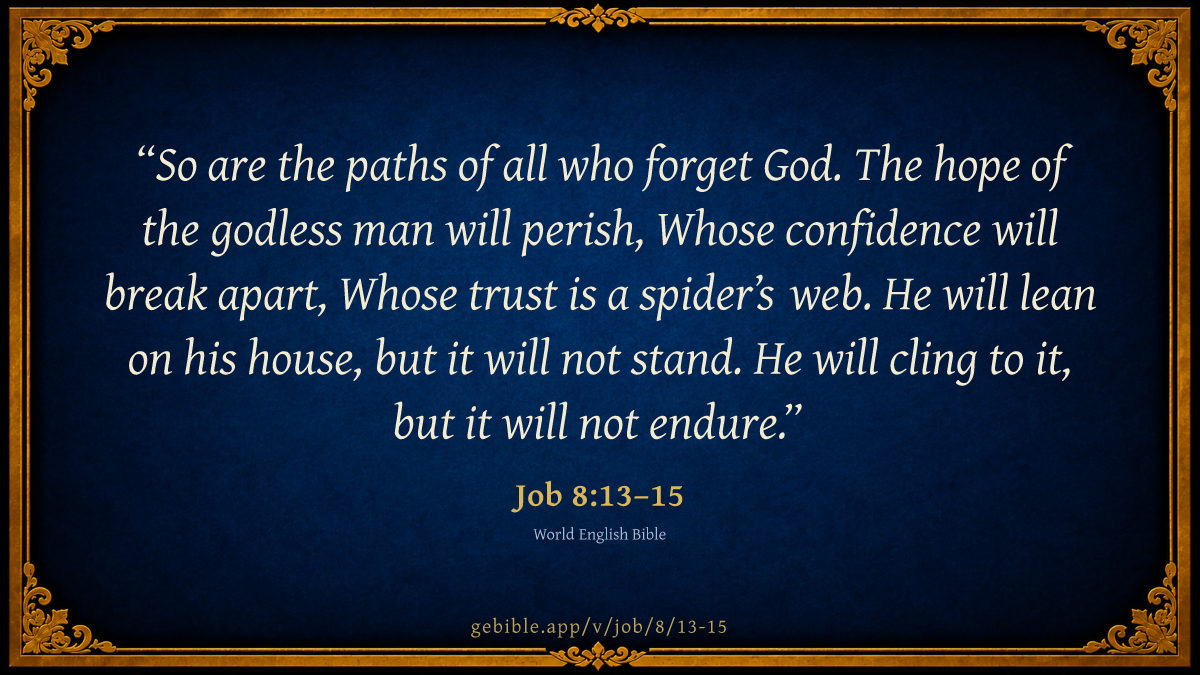
So also are the paths of all who forget God
Here "the paths" represents a person's future and the events that will happen to them. AT: "The same thing will happen to everyone who forgets God" (See: Metonymy)
the hope of the godless will perish
"the things the godless person desires will not happen"
His confidence will break apart ... his trust is as weak as a spider's web
These two phrases mean the same thing and emphasize that the godless person is trusting in something that cannot save him. (See: Parallelism)
his trust is as weak as a spider's web
Here Bildad compares the trust of the godless person to a spider's web; the slightest force will break both. (See: Simile)
He leans on his house, but it will not support him; he takes hold of it, but it does not stand
This statement probably refers to a man relying on his property and wealth for security. If so, then "house" here represents the owner's property and wealth. AT: "He thinks he will be safe because he is wealthy, but he will not be safe" (See: Metaphor)
it will not support him
This negative statement emphasizes the opposite. It can be stated in positive form. AT: "he will fall down" (See: Litotes)
it does not stand
This negative statement emphasizes the opposite. It can be stated in positive form. AT: "it will fall down" (See: Litotes)
 GEBible — Godless Engineer's Bible App
Geneva Bible translators 1599 · Public Domain On v14 Which is today, and tomorrow swept away.
Which is today, and tomorrow swept away.
Geneva Bible (1599) marginal notes — public domain.
John Trapp 1656 · Public Domain On vv13–15 Job 8:13 So [are] the paths of all that…
Job 8:13 So [are] the paths of all that forget God; and the hypocrite’s hope shall perish:
Ver. 13. So are the paths of all that forget God] To remember God is as necessary as to draw breath, saith Chrysostom. This the wicked man doth not, Psa 9:17. He will neither have God in his head, Psa 10:4, nor heart, Psa 14:1, nor words, Psa 12:2, nor ways, Tit 1:16. What wonder then though his paths wither, though his life, health, wealth, power, perish, since he is in such a posture of distance from, and defiance with, the fountain of living waters, the Father of all mercy and consolation; by whose favour such flourish for a time, sed exoriuntur, ut exurantur?
Read full note →
And the hypocrite’s hope shall perish] Every wicked man is a hypocrite; and if there were nothing else to evince it, yet his very hope and groundless confidence in the mercies of God without warrant of promise, would undoubtedly prove it. Praesumendo sperat, et sperando petit, saith an ancient; he presumptuously hopeth, and by hoping perisheth; he lays his own shadow for a bridge, and so must needs fall into the brook. Trust thou in the Lord and do good, saith David, Psa 37:3. But this man, though he cannot tell of one tear for sin, nor one hour spent in the practice of mortification; yet he affirmeth deeply of going to heaven, and is ready to rap, yea, bounce at heaven’s gate with Lord, Lord, open unto us: but what saith the psalmist? "As for such as turn aside unto their crooked ways" (though they do it never so slily, as if they would steal a passage to hell, and the world never the wiser), "the Lord shall lead them forth with the workers of iniquity," with gross offenders, Psa 125:5, as malefactors are led forth to execution; and when the filthy sinner (so the word here rendered hypocrite signifieth) goes damned to hell, what shall become of the zealous professor, with all his fair hopes and possibilities? Surely God rejecteth their confidences; they shall not prosper in them, Jer 2:37.
John Trapp, A Commentary or Exposition upon All the Books of the Old and New Testament (1647–1656) — public domain. Text from a community e-Sword module.
Matthew Poole 1685 · Public Domain On vv13–15 Of all that forget God, i.e. of wicked men,…
Of all that forget God, i.e. of wicked men, who are branded with this same character, Psa 9:17; 50:22; or hypocrites, as the next words explain it, who are described by their first and fundamental miscarriage, which is, that they forget, i.e. neglect, forsake, and despise, (for so this phrase is commonly understood, as Deu 6:12; 8:11; 32:18; Jer 2:32; 23:27) God, i.e. his presence, and commands, and worship, and providence; and therefore break forth into manifold sins. But by their paths he doth not understand the course of their actions, or manner of their living; but the events which befall them, called their paths objectively, because they are the paths of God, or the methods of his providence, or manner of his dealing with them. Now this may be accommodated to the foregoing similitude in this manner: Such is the prosperity of wicked men, because it wants the solid foundation of their piety, and of God’s promise and blessing consequent thereupon, it quickly vanisheth into nothing.
The hypocrite’s hope shall perish, i.e. he shall lose what he hoped for (hope being oft put for its object,) even uninterrupted and abiding felicity, and with it all hope of restitution.
Matthew Poole's English Annotations on the Holy Bible (1683–1685) — public domain. Text from a community e-Sword/MySword module.
John Gill 1763 · Public Domain On vv13–15 Whose hope shall be cut off,.... The same thing…
Whose hope shall be cut off,.... The same thing as before, expressed in different words, and repeated for the certainty of it; signifying that it should be of no manner of use, should be wholly lost, and issue in black despair: the word has the signification of loathing, and is differently rendered, either, "whom his hope shall loathe" (e) or, "who shall loathe his hope" (f); he shall fret and tease, and vex himself that he should be such a fool to entertain such a vain hope, or to place hope and confidence in such vain things, finding himself most sadly disappointed:
and whose trust shall be a spider's web; or "a spider's house" (g); and such its web is to it; having made it, it encloses itself in it, and dwells securely: very fitly is the hope and confidence of an hypocrite compared to a spider's web, which is a very nice and curious piece of workmanship, as are the outward works of righteousness, done by hypocrites they are wrought out and set off to the best advantage, to be seen of men; yet very slight and thin, and will bear no weight; such are the best works of carnal professors; they make a fine appearance, but have no substance, do not flow from principles of grace, nor are done in the strength of Christ, or to the glory of God; are but "splendida peccata", as one calls them, and fall infinitely short of bearing the weight of the salvation of the soul: as the spider's web is spun out of its own bowels, so the works of such persons are wholly of themselves; they are their own, done without the grace of God and spirit of Christ; and such webs are not fit for garments, are too thin to cover naked souls; insufficient to shelter from divine wrath and vengeance; cannot bear the besom of justice, one stroke of which will sweep them all away; and though they may think themselves safe enclosed in them as in a house, they will find themselves in the issue wretchedly mistaken; for there is no shelter, safety, and security, in such cobwebs; there is none but in Christ and his righteousness.
Read full note →
(e) "quem abominabitur spes ejus", Montanus; "fastidit", Junius & Tremellius, Piscator; "cum taedio rejectabit", Schultens. (f) "Quippe abominabitur spem suam", Schmidt. (g) "domus araneae, vel aranei"; Pagninus, Montanus, &c.
John Gill's Exposition of the Whole Bible (1746–1763) — public domain (CC PDM 1.0). Text via the HelloAO Bible API.
John Wesley 1765 · Public Domain On vv13–15 Paths - Of wicked men. By their paths he…
Paths - Of wicked men. By their paths he doth not understand their manner of living, but the events which befall them, God's manner of dealing with them.
John Wesley, Explanatory Notes Upon the Whole Bible (1754–1765) — public domain. Text via the GEBible commentary corpus.
Adam Clarke 1810 · Public Domain On vv13–15 Verse 13. So are the paths] The papyrus and…
Verse 13. So are the paths] The papyrus and the rush flourish while they have a plentiful supply of ooze and water; but take these away, and their prosperity is speedily at an end; so it is with the wicked and profane; their prosperity is of short duration, however great it may appear to be in the beginning. Thou also, O thou enemy of God, hast flourished for a time; but the blast of God is come upon thee, and now thou art dried up from the very roots.
The hypocrite's hope shall perish] A hypocrite, or rather profligate, has no inward religion, for his heart is not right with God; he has only hope, and that perishes when he gives up the ghost.
Read full note →
This is the first place in which the word hypocrite occurs, or the noun חנף chaneph, which rather conveys the idea of pollution and defilement than of hypocrisy. A hypocrite is one who only carries the mask of godliness, to serve secular purposes; who wishes to be taken for a religionist, though he is conscious he has no religion. Such a person cannot have hope of any good, because he knows he is insincere: but the person in the text has hope; therefore hypocrite cannot be the meaning of the original word. But all the vile, the polluted, and the profligate have hope; they hope to end their iniquities before they end life; and they hope to get at last to the kingdom of heaven. Hypocrite is a very improper translation of the Hebrew.
Adam Clarke's Commentary on the Bible (1810–1826) — public domain. Text from a community e-Sword/MySword module.
Joseph Benson 1811 · Public Domain On vv13–15 Job 8:13. So are the paths of all that…
Job 8:13. So are the paths of all that forget God — Of wicked men, who are often described by this character; see Psa 9:17; Psa 50:22; or, of hypocrites, as the next words explain it, whose first and fundamental error is, that they forget, that is, neglect, forsake, and despise God, his presence, commands, worship, and providence; and, therefore, break out into manifold sins. But, by their paths, he does not intend their manner of living, but the events which befall them, God’s manner of dealing with them. Now this may be accommodated to the foregoing similitude in this manner, namely, Such is the prosperity of wicked men; because it wants the solid foundation of piety, and of God’s promise and blessing consequent thereupon, it quickly vanishes into nothing. The hypocrite’s hope shall perish — That is, the object of his hope, his riches, his friends, his honours, and other such like things, on which he founded his expectations; for, when these are lost, hope may be said to perish, because that from which it arose is no more.
Joseph Benson's Commentary on the Old and New Testaments (1811–1818) — public domain. Text from a community e-Sword module.
Albert Barnes 1834 · Public Domain On vv13–15 So are the paths of all that forget God…
So are the paths of all that forget God - This is clearly a part of the quotation from the sayings of the ancients. The word “paths” here means ways, acts, doings. They who forget God are like the paper-reed. They seem to flourish, but they have nothing that is firm and substantial. As the paper-reed soon dies, as the flag withers away before any other herb, so it will be with the wicked, though apparently prosperous.
And the hypocrite’s hope shall perish - This important sentiment, it seems, was known in the earliest periods of the world; and if the supposition above be correct, that this is a fragment of a poem which had come down from far distant times, it was probably known before the flood. The passage requires no particular philological explanation, but it is exceedingly important. We may remark on it,
Read full note →
(1) That there were hypocrites even in that early age of the world. They are confined to no period, or country, or religious denomination, or profession. There are hypocrites in religion - and so there are in politics, and in business, and in friendship, and in morals. There arc pretended friends, and pretended patriots, and pretended lovers of virtue, whose hearts are false and hol ow, just as there are pretended friends of religion. Wherever there is genuine coin, it will be likely to be counterfeited; and the fact of a counterfeit is always a tribute to the intrinsic worth of the coin - for who would be at the pains to counterfeit that which is worthless? The fact that there are hypocrites in the church, is an involuntary tribute to the excellency of religion.
(2) The hypocrite has a hope of eternal life. This hope is founded on various things. It may be on his own morality; it may be on the expectation that he will be able to practice a deception; it may be on some wholly false and unfounded view of the character and plans of God. Or taking the word “hypocrite” in a larger sense to denote anyone who pretends to religion and who has none, this hope may be founded on some change of feeling which he has had, and which he mistook for religion; on some supposed vision which he had of the cross or of the Redeemer, or on the mere subsiding of the alarm which an awakened sinner experiences, and the comparative peace consequent on that. The mere cessation of fear produces a kind of peace - as the ocean is calm and beautiful after a storm - no matter what may be the cause, whether it be true religion or any other cause. Many a sinner, who has lost his convictions for sin in any way, mistakes the temporary calm which succeeds for true religion, and embraces the hope of the hypocrite.
(3) That hope will perish. This may occur in various ways.
(a) It may die away insensibly, and leave the man to be a mere professor of religion - a formalist, without comfort, usefulness, or peace.
(b) It may be taken away in some calamity by which God tries the soul, and where the man will see that he has no religion to sustain him.
(c) It may occur under the preaching of the gospel, when the hypocrite may be convinced that he is destitute of vital piety, and has no true love to God.
(d) It may be on a bed of death - when God comes to take away the soul, and when the judgment-seat appears in view.
(e) Or it will be at the bar of God. Then the hope of the hypocrite will certainly be destroyed. Then it will be seen that he had no true religion, and then he will be consigned to the awful doom of him who in the most solemn circumstances lived to deceive, and who assumed the appearance of that which he had the strongest reason to believe he never possessed. Oh! how important it is for every professor of religion to examine himself, that he may know what is the foundation of his hope of heaven!
Albert Barnes' Notes on the Bible (1834–1885) — public domain. Text from a community e-Sword/MySword module.
Haydock's Catholic Bible Commentary 1859 · Public Domain On vv14–15 Him, the hypocrite, or God. (Calmet) --- Both shall…
Him, the hypocrite, or God. (Calmet) --- Both shall one day condemn the ill use of riches. (Haydock)
George Leo Haydock (1774–1849), Haydock's Catholic Family Bible and Commentary, 1859 edition — public domain. Excludes Psalms (Douay-Rheims chapter numbering differs from Protestant) and Deuterocanonical books (Catholic canon only).
Robert Jamieson, A. R. Fausset & David Brown 1871 · Public Domain On vv13–15 paths--so "ways" (Pro 1:19).
paths--so "ways" (Pro 1:19).
all that forget God--the distinguishing trait of the godless (Psa 9:17; Psa 50:22).
Jamieson, Fausset & Brown — Commentary Critical and Explanatory on the Whole Bible (1871) — public domain (CC PDM 1.0). Text via the HelloAO Bible API.
Daniel D. Whedon 1874 · Public Domain On vv13–14 13. Forget God — Ingratitude is a burning wind…
13. Forget God — Ingratitude is a burning wind that dries up the fountains of piety and the streams of love. (St. Bernard.)
The hypocrite — חנŠ. At the root of this word, occurring so often in this book, unquestionably lies the idea of veiling or concealing. The word also signifies the ungodly, which is the meaning that Gesenius and most interpreters of Job give it. Hitzig, however, renders as in the text. Our English word in its Greek original explains itself. A hypocrite is one who acts a part, like a stageplayer. (See on our text two sermons by Dr. South.)
Daniel D. Whedon (gen. ed.), Commentary on the Old and New Testaments (1874–1909) — public domain. Text from a community e-Sword module.
The Cambridge Bible for Schools and Colleges 1878 · Public Domain On vv13–15 13. Application of the simile. When men forget God,…
13. Application of the simile. When men forget God, and His sustaining grace is withdrawn from them, they sink down suddenly and perish like the luxuriant water-reed.
the hypocrite] This word is difficult to translate, it means rather the godless, or, profane, cf. Jer_23:11; hypocrisy in the ordinary sense is not at all the idea of the term. The verb is rendered in the English Version mostly “defile” or “pollute,” but “profane” would suit most of the passages.
The Cambridge Bible for Schools and Colleges (gen. ed. J. J. S. Perowne; Cambridge University Press, 1878–1918) — public domain. Text from a community e-Sword module.
Ellicott's Commentary for English Readers 1878 · Public Domain On v15 (15) It shall not endure.—The description of the wicked…
(15) It shall not endure.—The description of the wicked man ends here.
A Bible Commentary for English Readers, edited by Charles John Ellicott (1878–1897) — public domain. Text from a community e-Sword module.
The Pulpit Commentary 1880 · Public Domain On vv13–15 So are the paths of all that forget God.…
So are the paths of all that forget God. So, that is, do those proceed on their way by whom God has been forgotten, They spring up in apparent strength and lusty force; they flourish for a brief space; then, untouched by man"s hand, they suddenly fade, fall, and disappear, before the mass of their contemporaries. Job is, of course, glanced at in the expression, "all that forget God," though it is the last thing that he had done. And the hypocrite"s hope shall perish; or, the hope of the ungodly man shall perish. (comp. Job_13:16 Job_15:34 Job_17:8, where the LXXtranslates by asebhv or paranomov)
The hypocrite"s hope.
Read full note →
I A STARTLING DEFINITION. The hypocrite is:
1. An ungodly person. He has an outward pretence of piety, but in reality be is destitute of true religion.
2. A forgetter of God. It is not necessary that his impiety should take the form of flagrant wickedness. That might be easily detected, and would be altogether inconsistent with an appearance of godliness. It is enough that he simply forgets God.
II AN AMAZING REVELATION. The hypocrite finds himself possessed of a hope, i.e. of God"s favour and of eternal life; which hope is:
1. Like the papyrus, the fruit of his prosperity, wholly dependent on external circumstances.
2. Like the spider"s web, a flimsy, unsubstantial edifice, deftly fashioned out of his own imagination.
3. Like the gourd, complacently self-satisfying.
III A FEARFUL PREDICTION. The hypocrite"s hope shall perish:
1. Like the papyrus, it may droop suddenly.
2. Like the spider"s web, it may be destroyed violently.
3. Like the climbing plant, it will be blasted shamefully.
LESSONS.
1. Examine well the grounds on which our hope of heaven rests.
2. Seek to be possessed of that good hope which comes through grace.
The spider"s web.
Bildad compares the hope of the impious to a spider"s web, or rather, recalling sayings of antiquity, he quotes an old proverb to that effect. Let us consider the wisdom of this ancient saying by noting characteristics of the spider"s web.
I IT IS QUICKLY WOVEN. It is one of the most rapidly made fabrics in nature. It puts Jonah"s gourd to the shame. Some men are very hasty in forming foolish hopes. With them the wish is father to the thought. They jump to conclusions that are favourable to themselves. But the sanguine temperament is no guarantee for permanent security. Because we believe readily, we do not believe the more safely.
II IT IS DELICATE AND BEAUTIFUL TO LOOK AT. We cannot but admire the spider"s web on a bright September morning, when it. is spangled with dewdrops. Its very delicacy of structure adds to the beauty of it. There is nothing coarse about it. Some people have a religion that is refined and delicate and beautiful. They despise the vulgar ideas of other people. Their spider"s web is much more suitable to their superfine culture than the coarse hemp ropes of the religion of less cultivated people.
III IT IS USEFUL FOR ITS NATURAL END. We have no right to complain that the spider"s web does not sustain our weight when we lean upon it. It was not spun for such a purpose. But yet it serves its own proper end. It is an excellent ladder for its maker, and a perfect trap for his victims. Some of those grounds of hope to which foolish people trust are not utterly false and useless. For example, aestheticism taken for a religion is as a spider"s web. Yet it is useful as a form of culture. Intellectualism is like another spider"s web. While the superfine thinker is spinning his fanciful threads of thought, he is doing little for the business of life. Yet what he does may be good and true in itself, if only he would keep it in its right place.
IV IT IS EXCESSIVELY FRAGILE. It is just the type of fragility. Therefore all its good points are useless when a man thinks of trusting his weight to it. You but mock the drowning man if you toss him the spider"s web. He must grasp a substantial rope if he is to be saved. Now, Bildad rightly compares the hope of the impious to this web. It is fragile in the extreme.
1. It has no substance The man trusts
(1) to his own wisdom, which is folly in the eyes of God;
(2) to his goodness, which under God"s searching glance is full of sin;
(3) to his prosperity, which cannot endure when the favour of God is withdrawn;
(4) to God"s goodness, which indeed is a rock of refuge, only it is out of the reach of the impious, who only clutch at a shadow of it in their own fancy.
2. It is heavily tried. Here is a question of life and death. A man has to seek a security for his own soul and his eternal interests. The spider"s web may stand slight tests, but not the strain those awful requirements put upon it. Aesthetics, intellectualism, and all other human ideas fail here. We want a strong means of deliverance, the gospel shows us that this is to be had in Christ for those who repent and trust him. W.F.A.
The Pulpit Commentary (1880–1919), ed. H.D.M. Spence-Jones & Joseph S. Exell — public domain. Text from a community e-Sword module.
The Biblical Illustrator 1887 · Public Domain On vv13–14 So are the paths of all that forget God.
Job_8:13
So are the paths of all that forget God.
Read full note →
Withering paths
I. Consider the sin of forgetting God.
1. It is a very common sin. Thousands never think of Him except in times of trouble.
2. It is an inexcusable sin. They are dependent upon Him. He is constantly revealing Himself to them.
(1) In nature. Physical sequences have a living agent behind them; link after link of causation, but held and moved by a living hand. Law has no life. Natural agitations are the rustling of Gods garments as He works.
(2) In events. They are the tramp of the Everlasting. History is full of the interpositions of the Supreme.
(3) In Christ. Here, God became as one of us, that we might know Him.
(4) By His Spirit. Mens souls are disturbed by His presence within them.
3. It is a sin of Gods children (Jer_11:31 Jer_23:23-29 ?). We should live to Him every waking hour. Nothing should be too trifling about which to talk to Him.
II. To forget God is ruinous. Our life paths fade away like the rush without mire and the flag without water.
1. The path of inner progress. Men feel that without God they make no moral advancement. True manliness withers; they become moral skeletons. Truth, moral vitality, courage for the right, honour, integrity, all fade away from them, and they are like a withered rush. No one is self-adequate. God is the fountain of life. The highest archangel would cry, as he looked towards the Life-giver of the universe, All my springs are in Thee. The forces of death within us surely conquer, unless they are subdued by the incomings of Gods life.
2. The path of outward actualities. The way of life yields little true joy if God be forgotten. There may be worldly success without it. A man may get rich or high-positioned, but he fails to gain the highest satisfactions.
3. The path of posthumous influence. The way of life is impressionable. We all leave footprints upon it. The footprints of the good are more lasting than the evil. Evil is everywhere to be rooted up. It is a fact that the influence of the good is more permanent than the evil. Compare the influence of Alexander and Socrates, Nero and Paul, Queen Mary and Knox, Voltaire and Wesley, etc. The good parent and the wicked one. The name of the wicked shall rot. Think of the folly of forgetting Him. Why should you do this, and die? The withering of a flower may awaken a sigh; the fading away of an oak a tear; but what sorrow should there be over a man fading away into a demon! (W. Osborne Lilley.)
Forgetfulness of God
1. The hypocrite is a forgetter of God.
2. Forgetfulness of God (howsoever it seems no great matter, yet) is exceeding sinful, a wickedness of the highest stature. Forgetfulness of God is therefore a great wickedness, because God hath done so many things to be remembered by.
3. Forgetfulness of God is a mother sin, or the cause of all other sins. First, a forgetfulness that there is a God. Secondly, a forgetfulness who, or what manner of God He is. Thou thoughtest that I was such an one as thyself (Psa_50:1-23). Thirdly, to forget God, is to forget what God requires; this forgetfulness of these three sorts is productive of any, of every sin.
4. They that forget God shall quickly wither, how great and flourishing soever they are. (J. Caryl.)
The hypocrites hope shall perish.
The sin of hypocrisy
A common objection against religion is the existence of hypocrisy. The infidel uses it, the scoffer employs it, and the indifferent, who admit the obligation of religion, yet object to its restraint, always fall back upon the prevalence of hypocrisy. Nothing can be more absurd than for the people to cry down religion because of hypocrisy; it is like a man denying the existence of a subject because he saw a shadow, or asserting that because he had received or seen a few counterfeit sovereigns, there was not a piece of pure gold in the mint. The way of the hypocrite is such as Bildad describes; a brief season of profession, terminating in the extinction of what seemed spiritual life, when all his self-confidence proves to offer no better security than the flimsy web or house of the spider. The rush and flag are succulent plants, and can only live in miry or marshy spots; withdraw from them the moisture on which they grow, and you destroy them. So the hypocrite has no abiding principle of life in him, nor any aptness to derive benefit from those deep or heaven-sent sources which impart nourishment to the believer; some flood of excitement bears him up, some unwholesomeness in the soil enables him to look flourishing. The hypocrite is like the rush or the flag in his material; cut one of these and you will find but pith, or an arrangement of empty cells, you will not find the substance of the oak. Again he springs up all at once from the ground; the smooth stem of the rush, or the broad, waving leaf of the flag will represent the hypocrites profession. There is a peculiarity in the common rush; you never can find one green at the top, get it fresh and flourishing as you will, it has begun to wither. Find the hypocrite ever so promising, there will be something to tell you, if you look narrowly, that his religious life has death in it already.
I. The origin of hypocrisy, or the assumption of a character which does not belong to us. In the first instance it comes from low notions of God, arising out of our deceived understanding. Hypocrisy argues a sense of obligation on the part of the hypocrite. He knows his responsibility, but having no clear notion of the purity and all-seeing eye of God, he puts on a form of religion while destitute of the power; he thinks that God is like himself, and therefore that he can deceive Him. These persons are without a relish for that state of mind which religion requires, the new heart, the right spirit, the single eye, the death unto sin, the life unto righteousness. Man must have a religion, so a religion he assumes.
II. The general character of hypocrisy. How can we avoid setting down as a hypocrite the man who, devoid of Christ in his heart, attends religious services? One characteristic is self-deception. A man begins by dissembling with God; he proceeds to deceive his fellows; at length he palms the cheat upon himself. Nothing is so irksome even to the sincere Christian as the duty of self-examination. Where self-love is predominant, it is easy to believe that the man will, in the first place, shut his eyes to his faults: a false standard of holiness being set up, he will soon find others worse than himself; this will comfort him; he will substitute single acts for habits, or momentary feelings for abiding and governing principles of conduct.
III. The consequences of hypocrisy. The scoffer laughs at what he considers a satisfactory proof that there is no such thing as true religion. The careless or indolent content themselves with their present neutral (as they suppose it) condition, and think it better not to go any further in their profession. The child of God trembles and feels cast down. Yet there is good brought out of all this by God. The best method of avoiding the sin of hypocrisy is to have this constantly in our minds, that we have to deal with a God who is about our path, and about our bed, and spieth out all our ways, one on whom there can be no deception practised. Let us then seek to have that oneness of spirit by which only we can serve Him. In our religion let the heart agree with the head, the hands, and the feet. (C. O. Pratt, M. A.)
The hypocrite-his character, hope, and end
These words are supposed to be a quotation from one of the fathers. We can see that the quotation may begin at Job_8:11, but it is not easy to see where it ends.
I. The character of the hypocrite. All hypocrites belong to the class of those who forget God. In outward appearance, to the eye of man, they appear to remember God. Their outward services; their regular observance of everything that is external in religion; the words which they use; the subjects on which they converse--all appear to mark them out as those who remember God. But, in all this, as the very word hypocrite indicates, they are but acting a part. There is no reality in their services; no correspondence between their outward lives and the state of their heart; the two are altogether at variance. They are anxious for the praise of men; and so they are careful to adapt their outward lives--that which is seen of men--to a religious standard. They care not for the praise of God; and so they neglect their hearts, and withhold them from Him to whom they are due. All is show; there is no fruit. We meet with solemn examples of this character in the Scriptures. It is the motive; it is the power of godliness; it is Jesus dwelling in the heart; it is walking as in the presence of God,--it is this that constitutes the difference between the true Christian and the hypocrite; between him who serves God in truth, and him who serves in appearance. Then let us seek truthfulness of character and reality.
II. The hope of the hypocrite. The Christians hope is laid up in heaven. It is an anchor of the soul, sure and steadfast. The hypocrites hope fastens itself on some vain thing in the present life, some worldly gain, the praise of man, or some pecuniary benefit. And there is no single character in which there is so little hope of any real and saving change as in that of the hypocrite. But what is the issue and end of the hypocrites hope, and of himself? The hypocrite, being destitute of the grace of God, cannot grow, but must wither away. Without the grace of God we are but as some succulent plant, when the moistened mire and water are withdrawn from its roots. It needs not to be cut down by the hand of man, but withers speedily in consequence of the lack of moisture. We may, however, explain the mire and the water, not of inward grace, but rather of outward prosperity; and then the meaning will be this--It is only in circumstances of outward prosperity that the hypocrite can appear to flourish. Let these be changed let sifting trials come, as they will come, to try the heart, and he is as a rush or flag from which the mire and water are removed; he suddenly disappears, his hope vanishes, and he himself is lost. Another illustration is used. The hypocrites hope is compared to a spiders web. Beautifully formed as such a web is--a masterpiece of ingenuity and arrangement--it is easily swept away. A gust of wind, or the hand of man may carry it away in a moment. The poor spider may cling for safety to his house or web, woven out of its own body, but it cannot shelter him (Job_8:15). What a vivid picture of the hypocrites trust! His confidence of success rises high, when suddenly the hand of God sweeps away the spiders web, and the poor deceiver falls, clinging to its ruins Our subject has led us to speak of the thorough hypocrite, but we ought to remember that there are many degrees of this sin short of downright hypocrisy. Simplicity and transparency of character--one of the most beautiful graces of the Christian character--may be wanting. (George Wagner.)
The hope of the hypocrite
It is thought that this passage is a quotation introduced by Bildad from a fragmentary poem of more ancient date. Desirous of fortifying his own sentiments by the authority of the ancients, he introduces into the heart of his argument a stray passage which had been carried down through successive generations. The moral of this fragment is that the hypocrites hope shall perish. This is presented under three images.
1. That of the bulrush growing in a marshy soil. Rush and flag may represent any plant which demands a marshy soil, and imbibes a large quantity of water. When the hypocrite is compared to a rush which cannot live without mire, and the flag that cannot grow without water, we are instructed as to the weakness and unsubstantial nature, of his confidence; and when it is added that while yet it is in greenness, it withereth before any other herb, we are reminded of the brevity and precariousness of his profession. Take the reed out of the water, and plant it in any other soil, and you will see it hang down its head and perish utterly. You have no need to tear it up by the roots, or to cut it down as by a reaping hook. All that you have tot do is draw off the watery substance on which it depends for nourishment, and which it copiously imbibes. Thus too it is with the profession and confidence of the hypocrite. To prove the worthlessness of his hope, it is enough that you abstract from him the enjoyments of his past existence--the mire and moisture from which he derived his fair show of appearances in the flesh. But for the favourable condition in which he happened to be placed, he would have never appeared religious at all, and that being changed, his declension is rapid and inevitable. The hypocrites hope shall perish. He is himself frail as a reed, and that which he leans upon is unstable as water. Has then the hypocrite hope? Yes, for such is the deceitfulness of the human heart, that it can even cry peace when there is no peace. Thinking the Deity to be altogether such an one as himself, he has accustomed himself to call evil good and good evil. As the man is, so is the god that he creates for himself. And hence it is that even the hypocrite has a hope. But it is a hope which must perish.
2. That of the spiders web, swept away in a moment by the breath of the storm. The web of the spider is carefully and ingeniously constructed; but nothing is more easily brushed aside. The insect trusts to it indeed, but in a moment of time, he and it are carried away together. The hypocrite, too, has reared for himself what he supposes will be a comfortable habitation against the storm and rain. Not more slender is the thread spun by the spider than is his fancied security. Let trial or calamity come, and it will avail him nothing.
3. A plant that has no depth of earth for its roots, but which seeks even among a heap of stones for wherewithal to maintain itself. The metaphor is drawn from an object with which the observers of nature are familiar. When the roots have only a slender hold of a heap of stones, they are easily loosened, and the tree falls prostrate. Such is the attachment of the hypocrite to the place of his self-confidence. Into every crevice of his fancied merits does he push the fibres of hope. On the hard rock of an unconverted heart he flourishes awhile. Learn--
(1) Human nature is very much the same in all ages.
(2) It concerns us all to endeavour after that well-grounded hope which will stand against every storm, and give composure to us in our latter end. Hope is the grand engine that moves the world. How desirous we ought to be that our hope of heaven should be well grounded and sure. For this purpose be much in secret prayer; and study to be more conformed unto Him who is the author of your hope. (J. L. Adamson.)
The hope of the hypocrite delusive
I. What is meant by the hypocrite? All hypocrites may be comprehended under these two sorts.
1. The gross dissembler, who knowingly, and against his conscience, pursues some sinful course, endeavouring only to conceal it from the eyes of men. Such an one as Gehazi, or Judas.
2. The formal, refined hypocrite who deceives his own heart. He makes some advances into the practice of holiness; but not being sound at the heart, not being thoroughly divided from his sin, he takes that for grace which is not sincerity, and therefore much less grace; and being thus deceived, he misses of the power of godliness, and embraces only the form (Mat_7:26-27). Both these hypocrites agree in this, that they are deceivers. One deceives the world, the other deceives himself.
II. What is meant by the hypocrites hope? Those persuasions that a man has of the goodness and safety of his spiritual condition, whereby he strongly persuades himself that he is now in a state of grace, and consequently shall hereafter attain to a state of glory. This hope is not in the same proportion in all hypocrites. Distinguish in it these two degrees.
1. A probable opinion. This is but the lowest degree of assent.
2. A peremptory persuasion. This is its higher pitch and perfection. It seems seldom to be entertained but where hypocrisy is in conjunction with gross ignorance, or judicial searedness. Proposition--
I. A hypocrite may proceed so far as to obtain a hope and expectation of a future blessedness.
1. Hypocrites have and do obtain such hopes. Evinced by two arguments. From the nature and constitution of mans mind, which is vehement and restless in its pursuit after some suitable good. It is natural for man, both in his desires and designs, to build chiefly upon the future. Man naturally looks forward. Every man carries on some particular design, upon the event of which he builds his satisfaction; and the spring that moves these designs is hope. Hopes of the future are the causes of present action. It follows that the hypocrite has his hope, for he has his course and his way, according to which he acts, and without hope there can be no action. The other argument, proving that hypocrites have their hopes, shall be taken from that peace and comfort that even hypocrites enjoy; which are the certain effects, and therefore the infallible signs of some hope abiding in the mind. Assuredly, if it were not for hope, the heart of the merriest and most secure hypocrite in the world would break.
2. By what ways and means the hypocrite comes first to attain this hope. By misapprehending God. By his misunderstanding of sin. By mistakes about the spiritual rigour and strictness of the Gospel. By his mistakes about repentance, faith, and conversion.
3. By what ways and means the hypocrite preserves and continues this false hope. Those methods by which he first gets it, have in them also a natural fitness to continue, cherish, and foment it. Three ways more. Especially--
(1) By keeping up a course of external obedience, and abstaining from gross and scandalous sins.
(2) By comparing himself with others, who are openly vicious, and apparently worse than himself. There is no way more effectual for a man to argue himself into a delusion.
(3) By forbearing to make a strict and impartial trial of his estate. No wonder if the hypocrite discerns not his condition, when he never turns his eyes inwards by a thorough, faithful examination. The foulest soul may think itself fair and beautiful till it comes to view its deformity in the glass of Gods Word. Proposition--
II. The hypocrites fairest and most promising expectation of a future happiness will in the end vanish into miserable disappointment.
1. Prove this proposition. From clear testimony of Scripture. A spiders web may represent a hypocrites hope in the curious subtilty, and the fine artificial composure of it, and in the weakness of it; for it is too fine spun to be strong. From the weakness of the foundation on which the hope is built.
2. Show what are those critical seasons and turns in which more especially the hypocrites hope will be sure to fail him.
(1) The time of some heartbreaking, discouraging judgment from God.
(2) At the time of death.
III. Make some use and improvement of the foregoing discourse. It shall be to display and set before us the transcendent, surpassing misery of the final estate of all hypocrites, whose peculiar lot it is to hope themselves into damnation, and to perish with those circumstances that shall double and treble the weight of their destruction. In this life the heart of man is not capable of such absolute, entire misery, but that some glimmerings of hope will still dart in upon him, and buoy up his spirits from an utter despondency. But when it shall come to this, that a man must go one way, and his hopes another, so parting as never to meet again, human nature admits not of any further addition to its sorrow; for it is pure, perfect, unmixed misery, without any allay or mitigation. Those appetites and desires, the satisfaction of which brings the greatest delight; the defrauding of them, according to the rule of contraries, brings the greatest and the sharpest misery. Nothing so comfortable as hope crowned with fruition; nothing so tormenting as hope snapped off with disappointment and frustration. The despairing reprobate is happier than the hoping reprobate. Both indeed fall equally low, but he that hopes has the greater fall, because he falls from the higher place. (R. South, D. D.)
The Biblical Illustrator, edited by Joseph S. Exell (c. 1880s–1900s) — public domain. Text from a community e-Sword module.
Alexander MacLaren 1905 · Public Domain On v14 Job 8:14. - Rom 5:5.
Job
TWO KINDS OF HOPE
Read full note →
Job 8:14. - Rom 5:5.
These two texts take opposite sides. Bildad was not the wisest of Job’s friends, and he gives utterance to solemn commonplaces with partial truth in them. In the rough it is true that the hope of the ungodly perishes, and the limits of the truth are concealed by the splendour of the imagery and the perfection of artistic form in which the well-worn platitude is draped. The spider’s web stretched glittering in the dewy morning on the plants, shaking its threaded tears in the wind, the flag in the dry bed of a nullah withering while yet green, the wall on which leaning a man will fall, are vivid illustrations of hopes that collapse and fail. But my other text has to do with hopes that do not fail. Paul thinks that he knows of hope that maketh not ashamed, that is, which never disappoints. Bildad was right if he was thinking, as he was, of hopes fixed on earth; the Apostle was right, for he was thinking of hopes set on God. It is a commonplace that ‘hope springs immortal in the human breast’; it is equally a commonplace that hopes are disappointed. What is the conclusion from these two universal experiences? Is it the cynical one that it is all illusion, or is it that somewhere there must be an object on which hope may twine its tendrils without fear? God has given the faculty, and we may be sure that it is not given to be for ever balked. We must hope. Our hope may be our worst enemy; it may and should be our purest joy.
Let us then simply consider these two sorts of hope, the earthly and the heavenly, in their working in the three great realms of life, death, and eternity.
I. In life.
The faculty is inseparable from man’s consciousness of immortality and of an indefinitely expansible nature which ever makes him discontented with the present. It has great purposes to perform in strengthening him for work, in helping him over sorrows, in making him buoyant and elastic, in painting for him the walls of the dungeon, and hiding for him the weight of the fetters.
But for what did he receive this great gift? Mainly that he might pass beyond the temporal and hold converse with the skies. Its true sphere is the unseen future which is at God’s right hand.
We may run a series of antitheses, e.g.-
Earthly hope is so uncertain that its larger part is often fear.
Heavenly hope is fixed and sure. It is as certain as history.
Earthly hope realised is always less blessed than we expected. How universal the experience that there is little to choose between a gratified and a frustrated hope! The wonders inside the caravan are never so wonderful as the canvas pictures outside.
Heavenly hopes ever surpass the most rapturous anticipation. ‘The half hath not been told.’
Earthly hopes are necessarily short-winged. They are settled one way or another, and sink hull down below our horizon.
Heavenly hope sets its object far off, and because a lifetime only attains it in part, it blesses a lifetime and outlasts it.
II. Hope in death.
That last hour ends for us all alike our earthly joys and relations. The slow years slip away, and each bears with it hopes that have been outlived, whether fulfilled or disappointed. One by one the lights that we kindle in our hall flicker out, and death quenches the last of them. But there is one light that burns on clear through the article of death, like the lamp in the magician’s tomb. ‘The righteous hath hope in his death.’ We can each settle for ourselves whether we shall carry that radiant angel with her white wings into the great darkness, or shall sadly part with her before we part with life. To the earthly soul that last earthly hour is a black wall beyond which it cannot look. To the God-trusting soul the darkness is peopled with bright-faced hopes.
III. Hope in eternity.
It is not for our tongues to speak of what must, in the natural working out of consequences, be the ultimate condition of a soul which has not set its hopes on the God who alone is the right Object of the blessed but yet awful capacity of hoping, when all the fleeting objects which it sought as solace and mask of its own true poverty are clean gone from its grasp. Dante’s tremendous words are more than enough to move wholesome horror in any thinking soul: ‘Leave hope behind, all ye who enter here.’ They are said to be unfeeling, grim, and mediaeval, incredible in this enlightened age; but is there any way out of them, if we take into account what our nature is moulded to need and cling to, and what ‘godless’ men have done with it?
But let us turn to the brighter of these texts. ‘Hope maketh not ashamed.’ There will be an internal increase of blessedness, power, purity in that future, a fuller possession of God, a reaching out after completer likeness to Him. So if we can think of days in that calm state where time will be no more, ‘to-morrow shall be as this day and much more abundant,’ and the angel Hope, who kept us company through all the weary marches of earth, will attend on us still, only having laid aside the uncertainty that sometime veiled her smiles, but retaining all the buoyant eagerness for the ever unfolding wonders which gave us courage and cheer in the days of our flesh.
Alexander MacLaren, Expositions of Holy Scripture (1904–1910) — public domain. Text from a community e-Sword module.
C. I. Scofield 1917 · Public Domain On v14 (See Scofield "Psa 2:12")
trust
(See Scofield "Psa 2:12")
The Scofield Reference Bible (1917 edition), notes by C. I. Scofield — public domain. Text from a community e-Sword module.
unfoldingWord translationNotes 2017 · CC BY-SA 4.0 On v13 General Information:
General Information:
It is unclear if verses 11-14 are the teaching of Bildad, or if Bildad is quoting the sayings of the ancestors of Job 8:8-10.
Read full note →
General Information:
In verses 14-18, the pronouns "he" and "his" refer to the godless person who represents godless people in general. It may be helpful to readers to use the plural pronouns "they" and "their." (See: Generic Noun Phrases)
So also are the paths of all who forget God
Here "the paths" represents a person's future and the events that will happen to them. AT: "The same thing will happen to everyone who forgets God" (See: Metonymy)
the hope of the godless will perish
"the things the godless person desires will not happen"
His confidence will break apart ... his trust is as weak as a spider's web
These two phrases mean the same thing and emphasize that the godless person is trusting in something that cannot save him. (See: Parallelism)
his trust is as weak as a spider's web
Here Bildad compares the trust of the godless person to a spider's web; the slightest force will break both. (See: Simile)
He leans on his house, but it will not support him; he takes hold of it, but it does not stand
This statement probably refers to a man relying on his property and wealth for security. If so, then "house" here represents the owner's property and wealth. AT: "He thinks he will be safe because he is wealthy, but he will not be safe" (See: Metaphor)
it will not support him
This negative statement emphasizes the opposite. It can be stated in positive form. AT: "he will fall down" (See: Litotes)
it does not stand
This negative statement emphasizes the opposite. It can be stated in positive form. AT: "it will fall down" (See: Litotes)
translationWords
God
hope
godly
perish
confidence
trust
unfoldingWord translationNotes — © Distant Shores Media and the Door43 World Missions Community, licensed CC BY-SA 4.0. Source: git.door43.org/Door43/en_tn.