Romans 9:20(v32)But indeed, O man, who are you to reply against God? Will the thing formed ask him who formed it, “Why did you make me like this?”
1 Samuel 2:25(v33)If one man sins against another, God will judge him; but if a man sins against Yahweh, who will intercede for him?” Notwithstanding, they…
Ecclesiastes 6:10(v32)Whatever has been, its name was given long ago; and it is known what man is; neither can he contend with him who is mightier than he.
Job 9:19(v33)If it is a matter of strength, behold, he is mighty! If of justice, ‘Who,’ says he, ‘will summon me?’
1 John 2:1-2(v33)My little children, I write these things to you so that you may not sin. If anyone sins, we have a Counselor with the Father, Jesus Christ,…
Show all 17 cross-references
Psalms 106:23(v33)Therefore he said that he would destroy them, had Moses, his chosen, not stood before him in the breach, to turn away his wrath, so that he…
Numbers 23:19(v32)God is not a man, that he should lie, nor a son of man, that he should repent. Has he said, and will he not do it? Or has he spoken, and…
Psalms 143:2(v32)Don’t enter into judgment with your servant, for in your sight no man living is righteous.
Isaiah 45:9(v32)Woe to him who strives with his Maker— a clay pot among the clay pots of the earth! Shall the clay ask him who fashions it, ‘What are you…
1 Samuel 16:7(v32)But Yahweh said to Samuel, “Don’t look on his face, or on the height of his stature, because I have rejected him; for I don’t see as man…
Job 13:18-23(v32)See now, I have set my cause in order. I know that I am righteous. Who is he who will contend with me? For then would I hold my peace and…
Job 23:3-7(v32)Oh that I knew where I might find him! That I might come even to his seat! I would set my cause in order before him, and fill my mouth with…
Job 33:12(v32)“Behold, I will answer you. In this you are not just, for God is greater than man.
Job 35:5-7(v32)Look to the skies, and see. See the skies, which are higher than you. If you have sinned, what effect do you have against him? If your…
Jeremiah 49:19(v32)“Behold, he will come up like a lion from the pride of the Jordan against the strong habitation: for I will suddenly make them run away…
1 John 3:20(v32)because if our heart condemns us, God is greater than our heart, and knows all things.
1 Kings 3:16-28(v33)Then two women who were prostitutes came to the king, and stood before him. The one woman said, “Oh, my lord, I and this woman dwell in one…
Cross-references from openbible.info (CC BY 4.0)
Explain this passage (17 sources)
Historical commentary, presented as a primary source — not an endorsement.
Geneva Bible translators1599 · Public DomainOn v33Which might make an accord between God and me,…
Which might make an accord between God and me, speaking of impatience, and yet confessing God to be just in punishing him.
Geneva Bible (1599) marginal notes — public domain.
John Trapp1656 · Public DomainOn vv32–33Job 9:32 For [he is] not a man, as…
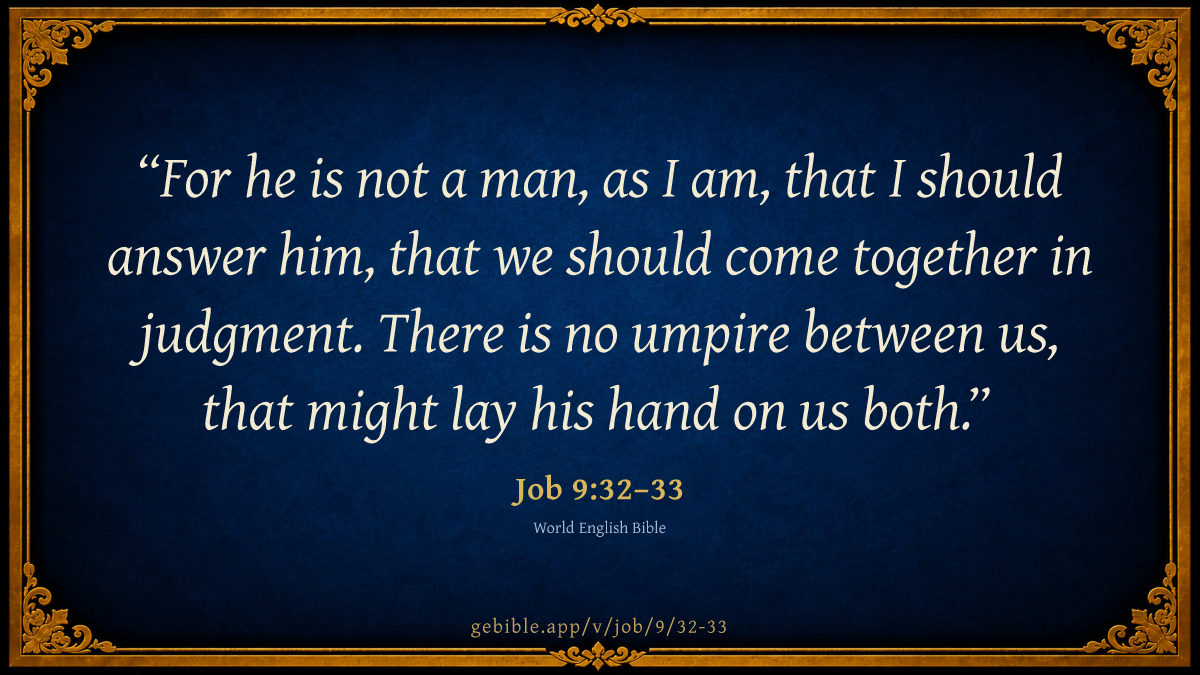
Job 9:32 For [he is] not a man, as I [am, that] I should answer him, [and] we should come together in judgment.
Ver. 32. For he is not a man as I am] He is not such a one, nor can be, as I am, and must be; he hath other eyes and thoughts and ways than creatures have. He who is just before men is unjust before God; therefore he is no fit match for me to contend in addition: have I an arm like God? or can I thunder with a voice like him? Job 40:9. Is it safe to contend with him that is mightier than I? Ecc 6:10. Surely if I should be so mad as to justify myself, yet I should soon be given to know that "that which is highly esteemed amongst men is an abomination in the sight of God," Luk 16:15.
Read full note →
And we should come together in judgment] How can that possibly be, when as God is the supreme judge, neither is there any appealing from or repealing of his sentence?
John Trapp, A Commentary or Exposition upon All the Books of the Old and New Testament (1647–1656) — public domain. Text from a community e-Sword module.
Matthew Poole1685 · Public DomainOn vv32–33He is not a man, as I am; but…
He is not a man, as I am; but one infinitely superior to me in majesty, and power, and wisdom, and justice.
That I should answer him; that I should presume to debate my cause with him, or answer his allegations against me.
Read full note →
That we should come together, face to face, to plead upon equal terms before a superior and indifferent judge.
Matthew Poole's English Annotations on the Holy Bible (1683–1685) — public domain. Text from a community e-Sword/MySword module.
John Gill1763 · Public DomainOn vv32–33Neither is there any daysman betwixt us,.... Or "one…
Neither is there any daysman betwixt us,.... Or "one that reproves" (q); who upon hearing a cause reproves him that is found guilty, or is blameworthy, or has done injury to another; but there is no such person to be found, among angels or men, capable of this, supposing, as if Job should say, I should appear to be the injured person; or there is no "umpire" or "arbitrator" (r), to whom the case between us can be referred; for, as Bar Tzemach observes, he that stands in such a character between two parties must be both more wise and more mighty than they; but there is none among all beings wiser and mightier than God:
that might lay his hand upon us both; and restrain them from using any violence to one another, as contending persons are apt to do; and compromise matters, settle and adjust things in difference between them, so as to do justice to both, and make both parties easy, and make peace between them. Herodotus (s) makes mention of a custom among the Arabians,"when they enter into covenants and agreements with each other, another man stands in the midst of them both, and with a sharp stone cuts the inside of the hands of the covenanters near the larger fingers; and then takes a piece out of each of their garments, and anoints with the blood seven stones that lie between them; and while he is doing this calls upon a deity, and when finished the covenant maker goes with his friends to an host or citizen, if the affair is transacted with a citizen; and the friends reckon it a righteous thing to keep the covenant.''To which, or some such custom, Job may be thought to allude. Now, whereas Christ is the daysman, umpire and mediator between God and men, who has interposed between them, and has undertaken to manage affairs relating to both; in things pertaining to God, the glory of his justice, and the honour of his law, and to made reconciliation for the sins of men, and to make peace for them with God by the blood of his cross; which he has completely done, being every way qualified for it, inasmuch as he partakes of both natures, and is God and man in one person, and so could put his hand on both, and make both one; or bring them who were at variance to an entire agreement with each other, upon such a bottom, as even the strict justice of God cannot object unto. Now, I say, Job must not be understood as if he was ignorant of this, for he had knowledge of Christ as a Redeemer and Saviour, and so as the Mediator and Peacemaker; the Septuagint version renders it as a wish, "O that there was a mediator between us!" and so it may be considered as a prayer for Christ's incarnation, and that he would appear and do the work of a mediator he was appointed to, which Job plainly saw there was great need of; or, as others (t), "there is no daysman yet"; there will be one, but as yet he is not come; in due time he will, which Job had faith in and full assurance of: but there is no need of such versions and glosses: Job is here not speaking of the affair of salvation, about which he had no doubt, he knew his state was safe, and he had an interest in the living Redeemer and blessed Mediator; but of the present dispensation of Providence, and of the clearing of that up to the satisfaction of his friends, so that he might appear to be an innocent person; and since God did not think fit to change the scene, there was none to interpose on his behalf, and it was in vain for him to contend with God.
Read full note →
(q) "arguens", Montanus, Bolducius, Drusius; "redarguens", Vatablus, Mercerus. (r) "Arbiter", Junius & Tremellius, Piscator, Cocceius, Schultens. (s) Thalia, sive, l. 3. c. 8. (t) So some in Caryll.
John Gill's Exposition of the Whole Bible (1746–1763) — public domain (CC PDM 1.0). Text via the HelloAO Bible API.
John Wesley1765 · Public DomainOn vv32–33A man - But one infinitely superior to me…
A man - But one infinitely superior to me in majesty, and power, and wisdom, and justice. That - That I should presume to debate my cause with him. Come - Face to face, to plead upon equal terms.
John Wesley, Explanatory Notes Upon the Whole Bible (1754–1765) — public domain. Text via the GEBible commentary corpus.
Adam Clarke1810 · Public DomainOn vv32–33Verse 32. For he is not a man as…
Verse 32. For he is not a man as I am] I cannot contend with him as with one of my fellows in a court of justice.
Adam Clarke's Commentary on the Bible (1810–1826) — public domain. Text from a community e-Sword/MySword module.
Joseph Benson1811 · Public DomainOn v32Job 9:32-33. For he is not a man as…
Job 9:32-33. For he is not a man as I am — But one infinitely superior to me in majesty and power, wisdom and justice. That I should answer him — That I should presume to debate my cause with him, or answer his allegations against me. That we should come together in judgment — Face to face, to plead upon equal terms. Neither is there any days-man — Or, umpire; that might lay his hand upon us both — Order and govern us in pleading, and oblige us to stand to his decision. The laying the hand on both parties implies a coercive power to enforce the execution of his decrees. This no one could have over the Almighty: it was in vain, therefore, to contend with him. Our Lord Jesus Christ is now the blessed daysman, who has mediated between heaven and earth, has laid his hand upon us both: to him the Father hath committed all judgment. But this was not made so clear then as it is now by the gospel, which leaves no room for such a complaint as this.
Joseph Benson's Commentary on the Old and New Testaments (1811–1818) — public domain. Text from a community e-Sword module.
Albert Barnes1834 · Public DomainOn vv32–33For he is not a man as I am…
For he is not a man as I am - He is infinitely superior to me in majesty and power. The idea is, that the contest would be unequal, and that he might as well surrender without bringing the matter to an issue. It is evident that the disposition of Job to yield, was rather because he saw that God was superior in power than because he saw that he was right, and that he felt that if he had ability to manage the cause as well as God could, the matter would not be so much against him as it was then. That there was no little impropriety of feeling in this, no one can doubt; but have we never had feelings like this when we have been afflicted? Have we never submitted to God because we felt that he was Almighty, and that it was vain to contend with him, rather than because he was seen to be right? True submission is always accompanied with the belief that God is RIGHT - whether we can see him to be right or not.
And we should come together in judgment - For trial, to have the case adjudicated. That is, that we should meet face to face, and have the cause tried before a superior judge. Noyes.
Albert Barnes' Notes on the Bible (1834–1885) — public domain. Text from a community e-Sword/MySword module.
Haydock's Catholic Bible Commentary1859 · Public DomainOn v33There. Septuagint, "O that an umpire, (or mediator) were…
There. Septuagint, "O that an umpire, (or mediator) were between us, and one arguing and giving ear in the midst of both!"
George Leo Haydock (1774–1849), Haydock's Catholic Family Bible and Commentary, 1859 edition — public domain. Excludes Psalms (Douay-Rheims chapter numbering differs from Protestant) and Deuterocanonical books (Catholic canon only).
Robert Jamieson, A. R. Fausset & David Brown1871 · Public DomainOn vv32–33(Ecc 6:10; Isa 45:9).
(Ecc 6:10; Isa 45:9).
Jamieson, Fausset & Brown — Commentary Critical and Explanatory on the Whole Bible (1871) — public domain (CC PDM 1.0). Text via the HelloAO Bible API.
Daniel D. Whedon1874 · Public DomainOn v33Strophe c — The cause of Job’s inability to…
Strophe c — The cause of Job’s inability to make out his innocency is not his guilt, but the character and conditions of his accuser — , to wit, his omnipotence and unamenableness to human dealing and treatment. (Davidson,) Job_9:32-35.
33. Neither is there any daysman — See Excursus IV, page 90; also sermon by Dr. Chalmers, on “Necessity of a Mediator between God and Man.”
Daniel D. Whedon (gen. ed.), Commentary on the Old and New Testaments (1874–1909) — public domain. Text from a community e-Sword module.
The Cambridge Bible for Schools and Colleges1878 · Public DomainOn vv32–3332–34. The preceding verses described how unavailing all Job’s…
32–34. The preceding verses described how unavailing all Job’s efforts were to make out his innocence in the face of the fixed resolution of God to hold him guilty. Now Job comes back to what is the real difficulty,—God is not a man like himself.
The Cambridge Bible for Schools and Colleges (gen. ed. J. J. S. Perowne; Cambridge University Press, 1878–1918) — public domain. Text from a community e-Sword module.
Ellicott's Commentary for English Readers1878 · Public DomainOn v32(32, 33) For he is not a man, as…
(32, 33) For he is not a man, as I am . . .—Is not that confession, if we believe that such a daysman as Job longed for has been given, itself a witness that it came from God, and was given by God? The light that has shined upon us was shining then in the heart of Job, and shines for ever in the pages of his book. Job felt, as he had been taught to feel, that in himself there not only was no hope, but no possibility of justification with God, unless there should be an umpire and impartial mediator, who could make the cause of both his own, and reconcile and unite the two in himself. It is useless to inquire what other particular form the aspiration of Job may have taken, or how far he understood and meant what he said; but here are his words, and this is what they must mean, and it is for us to adore the wisdom by which they were taught accurately to correspond with what we know has been given to us by God. We know that a daysman has laid his hand upon us both; and while we see that this is what Job wanted, we cannot but see more plainly that this is what we want. It is to be observed that this word daysman, or judge, is immediately connected with the Scripture phrase, “the day of the Lord,” and St. Paul’s words, “the day shall declare it” (1Co_3:13).
A Bible Commentary for English Readers, edited by Charles John Ellicott (1878–1897) — public domain. Text from a community e-Sword module.
The Pulpit Commentary1880 · Public DomainOn vv32–33For he is not a man, as I am,…
For he is not a man, as I am, that I should answer him; and we should come together in judgment (comp. vers. 2-14). On one of two conditions only, Job thinks, could the contest be even between himself and God.
(1) If God, divesting himself of all his Divine attributes, became man;
Read full note →
(2) if some thirdsman could be found, some umpire or arbitrator, to preside over the contest, and decide it. Neither condition, however, was (he thought) possible; and therefore no satisfactory judgment could take place.
Recent commentators observe that the Christian scheme, which Job could not anticipate, provides almost a literal fulfilment of both conditions, since the God who is to judge us is "true Man," and is also a Mediator, or "Thirds-man," between us and the offended Father, with authority to make the final decision, "the Father having committed all judgment unto the Son, (Joh_5:22) and" given him authority to execute judgment also for the very reason that he is "the Son of man". (Joh_5:27)
The Pulpit Commentary (1880–1919), ed. H.D.M. Spence-Jones & Joseph S. Exell — public domain. Text from a community e-Sword module.
The Biblical Illustrator1887 · Public DomainOn v33Neither is there any daysman.
Job_9:33
Neither is there any daysman.
Read full note →
The daysman
At this point of the poem we are seeing Job at his worst. He has become desperate under his accumulated miseries. In this chapter Job answers Bildad. He admits that God is just; but from His infinite justice, holiness, and power, he concludes that the best man has no hope of being approved by Him. His protest he clothes in the figure of a legal trial. God comes into court, first as plaintiff, then as defendant; first asserting His rights, snatching away that which He has a mind to claim, then answering the citation of the man who challenges His justice. In either case mans cause is hopeless. If the subject of His power calls Him to account, He appears at the bar, only to crush the appellant, and, with His infinite wisdom, to find flaws in his plea. As we study, certain deep-lying instincts begin to take shape in cravings for something which the theology of the day does not supply. The sufferer begins to feel rather than see that the problem of his affliction needs for its solution the additional factor which was supplied long after in the person and work of Jesus Christ,--a mediator between God and man. As he sees it, plaintiff and defendant have no common ground. God is a being different in nature and condition from himself. If now there were a human side to God. If there were only some daysman, some arbiter or mediator, who could lay his hand upon us both, understand both natures and both sets of circumstances,--then all would be well. This desire of Job is to be studied, not as a mere individual, but as a human experience. Jobs craving for a mediator is the craving of humanity. The soul was made for God. Christ meets an existing need. Manhood was made for Christ. With Christ goes this fact of mediation. There is a place for mediation in mans relations to God. There is a craving for mediation in the human heart to which Job here gives voice. One needs but a moderate acquaintance with the history of religion to see how this instinctive longing for someone or something to stand between man and God has asserted itself in the institutions of worship. This demand for a mediator is backed and urged by two great interlinked facts--sin and suffering. Jobs question here is, How shall man be just with God? He urges that man as he is cannot be just with God as He is. Let him be as good as he may, his goodness is impurity itself beside the infinite perfection of the Almighty. God cannot listen to any plea of man based on his own righteousness Again, this craving for a mediator is awakened by human experience of suffering; a fact which is intertwined with the fact of sin. We need, our poor humanity needs, such a daysman, partaker of both natures, the Divine and the human, to show us suffering on its heavenly as well as on its earthly side, and to flood its earthly side with heavenly light by the revelation. In Christ we have the human experience of sorrow and its Divine interpretation. Jobs longing therefore is literally and fully met. Despise not this Mediator. Seek His intervention. (Marvin R. Vincent, D. D.)
The daysman
This passage is one whose difficulty does not arise from crudities of translation, but rather from the subtle sequences of passion-moved thought. It consists of a lament over the absence of an umpire, or daysman, between God and the sin-stricken soul, and a vehement longing for such a one. In the notion of an umpire, there are three general thoughts apparent at the outset. There is a deep-seated opposition between the two parties concerned: this is only to be removed by vindicating the right; and the result aimed at is reconciliation. How far does such arbitration differ from mediation? It is mediation, with the additional element of an agreement entered into between the opposing parties. A daysman is a mediator who has been appointed or agreed on by both. Let us see how these general thoughts are applicable to this cry of Job.
I. He is labouring under a sense of hopeless sin. This is not less true because it is not persistent through the Book of Job, but intermittent; sometimes lightly felt, at other times crushing. It is on that account only a truer exhibition of human character. Here the feverish sense of it is at its strongest.
1. He is plunged in the ditch, in the mire, in the sewer; so that his clothes abhor him. The mire is his covering: he is all sin!
2. In this state he is self-condemned. He cannot answer God, he cannot come into judgment with Him! That is probably the true meaning of these words, and not the common explanation, that he is afraid to answer God. God is not a man; He is not to be answered. He is Himself the judge; He must be right. That was not always Jobs spirit, it is true; but that is his spirit in the present passage.
3. Then again, he cannot put away his pollution. He cannot make himself pure. If I wash myself in snow water, and make my hands never so clean (cleanse them with lye), yet shalt Thou plunge me in the ditch. Struggling to get free only shows ones utter helplessness.
4. And why does he feel so helpless? What is it that reveals his sin to him? It is the character of God! Gods holiness! Gods law! He had not known sin but for that law. Gods requirement, Gods inspection of the soul after it has done its best, seems to plunge it into the ditch.
II. It is this sense of hopeless sin that has taught Job the need of a Mediator.
1. As yet he can find none. His words do not go the length of asserting that there is not a daysman between God and any man; they are confined to his own need at the present moment--Betwixt us! For him there is none, and that is his overwhelming trouble.
2. But there is a need. He longs (more than one of the Hebrew words bring out the longing) for an umpire who should mediate between him and God.
3. This mediator must be able to lay his hand upon us both. Not surely in the poor and irreverent sense (for it is both), that by a restraining hand of power he might control the action of the Almighty. The meaning is surely the simple one, that the umpire must be one who can reach both parties.
4. On the one hand we must do justice to Gods holiness. In the mediation that must be sacred. It must issue from the trial not less glorious than before.
5. And on the other hand, the mediator must confess and deal with the sin of man. He must neither conceal nor excuse it; but, admitting, and rightly measuring the fact, he must be able to deal with it so as to satisfy God and to save man.
III. The results of such mediation are indicated. Generally there is reconciliation, the removal of that state of enmity existing between the sinner and his God.
1. Specifically, there is pardon. Let God take His rod away from me! Gods punishment, whatever form it may assume, shall pass wholly away. Thy sins be forgiven thee! That would come from such a daysman.
2. Next there is peace Let not His fear terrify me! May I look up to God, the Omnipotent and the holy God, and say, I am not afraid; for I have been reconciled unto Him! The mediator has laid a hand upon both, has reached Gods holiness, and has reached my sin.
3. Then fear passes, and trust comes. Then would I speak, and not fear Him. There can be no communion with God till the daysman has cast out the fear which has torment. Till then I can neither speak to Him nor hear Him.
IV. We have in the New Testament the antithesis of this longing cry of Job. The law (says Paul, Gal_3:19-20) was ordained in the hand of a mediator. Now a mediator is not a mediator of one; but God is one. And who is the other party? It is sinful man. And Jesus is the Mediator of the new covenant (Heb_12:24), laying a hand on both, mediating between two who have been long and sorely at variance; the daysman betwixt us and God, who pleads as a man with God, as a man pleadeth for his neighbour (Job_16:21). The need then of a mediator, as a spiritual necessity of the sinner who has come to look down into his own heart and to compare it with Gods holiness, is one of the strange teachings of the Book of Job. (J. Elder Cumming, D. D.)
The need of a daysman
There are two attributes of God--His might and His righteousness. The one a natural and the other a moral attribute. One manifested in creation, the other dimly discernible in the moral nature, that is, the conscience of man, and yet greatly needing a revelation to bring it home to mans heart with awful reality and power. Jobs thoughts were evidently occupied in this chapter with both these attributes. But if we are asked with which he is most occupied, we must answer, not with the highest, not with the righteousness so much as with the power of God. These verses seem to show a two-fold feeling in Jobs mind, corresponding to the two attributes--the righteousness and the power of God; but the predominating feeling was that of the irresistible power of God. Job longed for something to bridge over the terrible chasm between the Creator and himself, and not for some thing only, but some living person, some daysman, who should lay his hand upon them both. Taken critically and historically, the word daysman seems to signify an umpire. If Job felt the power of God more than His righteousness, and his own weakness more than his guilt, this is precisely what he would want. He could not, he felt, contend with God himself; could not stand on a level with the Creator in this great controversy. He felt, therefore, his need of an umpire. But what is the difference between a daysman so explained and a mediator? The difference is not great, but such as it is, it corresponds to the difference between feeling the power and the righteousness of God. The feeling of wanting a mediator is the higher. A consciousness of guilt and inward corruption is a higher feeling than that of weakness; and the longing for a Mediator a higher longing than that for a daysman. (George Wagner.)
A Mediator between God and man
When no man could redeem his neighbour from the grave--God Himself found a ransom. When not one of the beings whom He had formed could offer an adequate expiation--did the Lord of hosts awaken the sword of vengeance against His fellow. When there was no messenger among the angels who surrounded His throne, that could both proclaim and purchase peace for a guilty world--did God manifest in the flesh, descend in shrouded majesty amongst our earthly tabernacles, and pour out His soul unto the death for us, and purchase the Church by His own blood, and bursting away from the grave which could not held Him, ascend to the throne of His appointed Mediatorship; and now He, the lust and the last, who was dead and is alive, and maketh intercession for transgressors, is able to save to the uttermost all who come unto God through Him; and, standing in the breach between a holy God and the sinners who have offended Him, does He make reconciliation, and lay His hand upon them both. But it is not enough that the Mediator be appointed by God--He must be accepted by man. And to incite our acceptance does He hold forth every kind and constraining argument. He casts abroad over the whole face of the world one wide and universal assurance of welcome. Whosoever cometh unto Me shall not be cast out. Come unto Me, all ye who labour and are heavy laden, and I will give you rest. Where sin hath abounded, grace hath much more abounded. Whatsoever ye ask in My name ye shall receive. The path of access to Christ is open and free of every obstacle, which kept fearful and guilty man at an impracticable distance from the jealous and unpacified Lawgiver. He hath put aside the obstacle, and now stands in its place. Let us only go in the way of the Gospel, and we shall find nothing between us and God but the Author and Finisher of the Gospel--who, on the one hand, beckons to Him the approach of man with every token of truth and of tenderness; and on the other hand advocates our cause with God, and fills His mouth with arguments, and pleads that very atonement which was devised in love by the Father, and with the incense of which He was well pleased, and claims, as the fruit of the travail of His soul, all who put their trust in Him; and thus, laying His hand upon God, turns Him altogether from the fierceness of His indignation. But Jesus Christ is something more than the agent of our justification--He is the Agent of our sanctification also. Standing between us and God, He receives from Him of that Spirit which is called the promise of the Father; and He pours it forth in free and generous dispensation on those who believe in Him. Without this Spirit there may, in a few of the goodlier specimens of our race, be within us the play of what is kindly in constitutional feeling, and upon us the exhibition of what is seemly in a constitutional virtue; and man thus standing over us in judgment, may pass his verdict of approbation; and all that is visible in our doings may be pure as by the operation of snow water. But the utter irreligiousness of our nature will remain as entire and as obstinate as ever. The alienation of our desires from God will persist with unsubdued vigour in our bosoms; and sin, in the very essence of its elementary principle, will still lord it over the inner man with all the power of its original ascendency--till the deep, and the searching, and the prevailing influence of the love of God be shed abroad in our hearts by the Holy Ghost. This is the work of the great Mediator. This is the might and the mystery of that regeneration, without which we shall never see the kingdom of God. This is the office of Him to whom all power is committed, both in heaven and in earth--who, reigning in heaven, and uniting its mercy with its righteousness, causes them to flow upon earth in one stream of celestial influence; and reigning on earth, and working mightily in the hearts of its people, makes them meet for the society of heaven--thereby completing the wonderful work of our redemption, by which on the one hand He brings the eye of a holy God to look approvingly on the sinner, and on the other hand makes the sinner fit for the fellowship, and altogether prepared for the enjoyment of God. Such are the great elements of a sinners religion. But if you turn from the prescribed use of them, the wrath of God abideth on you. If you kiss not the Son while He is in the way, you provoke His anger; and when once it begins to burn, they only are blessed who have put their trust in Him. If, on the fancied sufficiency of a righteousness that is without godliness, you neglect the great salvation, you will not escape the severities of that day when the Being with whom you have to do shall enter with you into judgment; and it is only by fleeing to the Mediator, as you would from a coming storm, that peace is made between you and God, and that, sanctified by the faith which is in Jesus, you are made to abound in such fruits of righteousness as shall he to praise and glory at the last and the solemn reckoning. (T. Chalmers, D. D.)
The daysman
How is this daysman, Jesus Christ, constituted to hold this office? Job knew what were his real wants; he did not know how these wants were to be supplied, and yet he gives us in the context the whole constitution of the office of a daysman. In the depth of his woe, in the valley of his degradation, while he sat in dust and ashes, he sighed forth, If I wash myself with snow water, and make my hands never so clean; yet shalt Thou plunge me in the ditch, and mine own clothes shall abhor me. For He is not a mail, as I am, that I should answer Him, and we should come together in judgment. Neither is there any daysman betwixt us, that might lay his hand upon us both. Mark this context. Here the patriarch gives utterance to a full recognition of his guilt, of his consciousness of the wrath that had descended from heaven upon him, of the impossibility of his making himself just with God. He dwells in the ditch of corruption, and is self-abhorred; and God, whom he has offended, is not a man that he should answer Him, that they should come face to face, that they should reason together. He is not a man as I am. He looked upon God as the heathen looked upon Him,--as a God of Majesty, a God of holiness, a God of sublimity and of glory, inaccessible to man. God is not a man, that I should come near Him, said Job, and I have none to introduce me to Him. That was his misery--God is not a man, that I should speak to Him, and I have none to stand between myself and God to present my prayer to Him. Hopeless, hapless, wretched patriarch! What he wanted was a daysman betwixt the two to lay his hand upon them both. I have come here to tell you that that daysman is Christ--the man Christ Jesus. And what saith He? Behold, I am according to thy wish in Gods stead; I also am formed out of the clay. That is my plea, and that is my glory, that God has become a man as I am, and I now can answer Him. I now can come to Him face to face; I now can fill my mouth with arguments; I now can come, and by His own invitation reason with Him. He is formed out of the clay; thus is He the one between God and man; and He lays His hand upon us both. This is Jesus; therefore is He constituted a Mediator between God and man; and this He has attained by His atoning sacrifice. Atonement!--what is the meaning of that word? We pronounce it as one word; but it is really three words, at-one-ment; and that is its meaning. By reason of our sin, there are two parties opposed the one to the other; there is no clement of union, but every element of antagonism to part and keep us asunder. Christ is the atoning sacrifice, and His atonement is a complete satisfaction. This is because Christ, our daysman, is both God and man, both natures in one person. To be a mediator it is necessary to have power and influence with both parties. Christ, as our daysman, has power with God, for He Himself is God; and to obtain influence with man He became a man, and bare our sorrows and endured our griefs. He became as one of us, sin only excepted. Behold the sympathy of Jesus!--a participator in our sufferings, a sharer in our sorrows, and acquainted with our grief. It is true the majesty of God was unapproachable; no man could approach unto it; the spotless glory of that Presence was too dazzling for mortal sight to behold; His holiness was too pure to come into any contact with sin; the height of that glory was beyond what man had any power to attain unto. Then God in Christ came down to us. Oh, what grace! And whereas the Majesty of the Godhead was too august, He left it there upon His Fathers throne, and He wrapped Himself for a time in the familiar mantle of our humanity; He became a man as we are. Inasmuch as man could not approach unto God, Christ brought the Godhead to the level of our humanity, that He might raise the human race from death and sin to the enjoyment of the life of righteousness. This is the true dignity of man, that Christ has dignified him and elevated him to His Fathers glory. To him that overcometh will I grant to sit with Me upon My throne, even as I also have overcome, and am set down upon My Fathers throne. This is the Daysman who lays His hand upon us both. Does not that span the gulf? You know a bridge, to be of use and service, must rest its springing arch upon one bank and upon the other. To stop midway spoils the bridge. The ladder that is lifted up must touch the place on which you stand and the place where you would be, So is Christ the daysman. He lays His hand upon both parties. With one hand He lays hold upon God, for He Himself is God, and with the other He stoops until He lays hold upon sinful man, for He Himself is man; and thus laying His hand upon both parties, He brings both to one--He effects an at-one-ment, and God is in Christ reconciling the world unto Himself. Oh, blessed meeting! happy reconciliation! where mercy and truth met together, and righteousness and peace kissed each other! Again: a mediator for sin must suffer, and by his sufferings he must satisfy. Here, again, the necessity for this daysman to be both God and man. If He had been God only, He could not suffer, and if He had been man only, with all His sufferings He could not satisfy. He is God and He is man. As a man He suffers, and as a God He satisfies. Brethren, what think ye of this? He is the daysman betwixt us. And now we are able to contemplate God, not as the angry lawgiver only, but, through Christ, as merciful and gracious, slow to anger, and of great kindness. Now we are in our Christian liberty, and in the adoption of sons enabled to look upon God, not as robed in thunder, not as though He were girt in indignation, not as clothed in dazzling light, that no man can approach unto, but I can look upon Him as a man like as I am, touched with the feeling of my infirmities--in all points tempted like as we are, yet without sin. I see in Him not a master, but a brother; not an enemy, but a friend; not an angry judge, but a sympathising advocate, pleading for me. And what is His plea? Our innocence? Nay, nay, He knows we are sinners; He admits our sin, He admits it all; He offers not one single word of apology or extenuation for our fault; but He pleads His own righteousness, He pleads His own sufferings in our stead, and His death in our behalf. He is the substitute, and as such He is the daysman betwixt God and man. He lays His hand upon us both. (Robert Maguire, M. A.)
The sinners daysman
All that a sinner needs he may find in the Saviour.
I. The sinner needs a daysman. Nothing but a sense of sin will ever lead a man in reality to seek a Saviour.
1. Mark the situation in which the sinner stands before his God--a condemned criminal
2. The sinner cannot plead his own cause.
3. There are none around to befriend his cause.
II. A daysman is provided. The Gospel is called the ministry of reconciliation. It bears this name because it points to Jesus as the sinners daysman. He is fitted for the character He sustains, and He effectually discharges the office.
III. The importance of our seeking an interest in this daysman. He is not our daysman unless we have sought Him. We must come to Him, and it must be by faith. The interest in Him surely should be sought at once. (G. Hadley.)
The great arbitration case
The patriarch Job, when reasoning with the Lord concerning his great affliction, felt himself to be at a disadvantage and declined the controversy, saying, He is not a man, as I am, that I should answer Him, and we should come together in judgment. Yet feeling that his friends were cruelly misstating his case, he still desired to spread it before the Lord, but wished for a mediator, a middleman, to act as umpire and decide the case. But what Job desired to have, the Lord has provided for us in the person of His own dear Son, Jesus Christ. There is an old quarrel between the thrice holy God and His sinful subjects, the sons of Adam.
I. First of all, let me describe what are the essentials of an umpire, an arbitrator, or a daysman.
1. The first essential is, that both parties should be agreed to accept him. Let me come to thee, thou sinner, against whom God has laid His suit, and put the matter to thee. God has accepted Christ Jesus to be His umpire in His dispute. He appointed Him to the office, and chose Him for it before He laid the foundations of the world. He is Gods fellow, equal with the Most High, and can put His hand upon the Eternal Father without fear because He is dearly beloved of that Fathers heart. But He is also a man like thyself, sinner. He once suffered, hungered, thirsted, and knew the meaning of poverty and pain. Now, what thinkest thou? God has accepted Him; canst thou agree with God in this matter, and agree to take Christ to be thy daysman too? Art thou willing that He should take this case into His hands and arbitrate between thee and God? for if God accepteth Him, and thou accept Him too, then He has one of the first qualifications for being a daysman.
2. But, in the next place, both parties must be fully agreed to leave the case entirely in the arbitrators hands. If the arbitrator does not possess the power of settling the case, then pleading before him is only making an opportunity for wrangling, without any chance of coming to a peaceful settlement. Now God has committed all power into the hands of His Son. Jesus Christ is the plenipotentiary of God, and has been invested with full ambassadorial powers. If the case be settled by Him, the Father is agreed. Now, sinner, does grace move thy heart to do the same? Wilt thou agree to put thy case into the hands of Jesus Christ, the Son of God and the Son of Man? Wilt thou abide by His decision?
3. Further, let us say, that to make a good arbitrator or umpire, it is essential that he be a fit person. If the case were between a king and a beggar, it would not seem exactly right that another king should be the arbitrator, nor another beggar; but if there could be found a person who combined the two, who was both prince and beggar, then such a man could be selected by both. Our Lord Jesus Christ precisely meets the case. There is a very great disparity between the plaintiff and the defendant, for how great is the gulf which exists between the eternal God and poor fallen man? How is this to be bridged? Why, by none except by one who is God and who at the same time can become man. Now the only being who can do this is Jesus Christ. He can put His hand on thee, stooping down to all thine infirmity and thy sorrow, and He can put His other hand upon the Eternal Majesty, and claim to be co-equal with God and co-eternal with the Father. Dost thou not see, then, His fitness? There cannot surely be a better skilled or more judicious daysman than our blessed Redeemer.
4. Yet there is one more essential of an umpire, and that is, that he should be a person desirous to bring the case to a happy settlement. In the great case which is pending between God and the sinner, the Lord Jesus Christ has a sincere anxiety both for His Fathers glory and for the sinners welfare, and that there should be peace between the two contending parties. It is the life and aim of Jesus Christ to make peace. He delighteth not in the death of sinners, and He knows no joy greater than that of receiving prodigals to His bosom, and of bringing lost sheep back again to the fold. Thou seest then, sinner, how the case is. God has evidently chosen the most fitting arbitrator. That arbitrator is willing to undertake the case, and thou mayest well repose all confidence in Him: but if thou shalt live and die without accepting Him as thine arbitrator, then, the ease going against thee, thou wilt have none to blame but thyself.
II. And now I shall want, by your leave, to take you into the court where the trial is going on and show you the legal proceedings before the great Daysman. The man, Christ Jesus, who is God over all, blessed forever, opens His court by laying down the principles upon which He intends to deliver judgment, and those principles I will now try to explain and expound. They are two fold--first, strict justice; and secondly, fervent love. The arbitrator has determined that let the case go as it may there shall be full justice done, justice to the very extreme, whether it be for or against the defendant. He intends to take the law in its sternest and severest aspect, and to judge according to its strictest letter. He will not be guilty of partiality on either side. But the arbitrator also says that He will judge according to the second rule, that of fervent love. He loves His Father, and therefore He will decide on nothing that may attain His honour or disgrace His crown. He so loves God, the Eternal One, that He will suffer heaven and earth to pass away sooner than there shall be one blot upon the character of the Most High. On the other hand, He so loves the poor defendant, man, that He will be willing to do anything rather than inflict penalty upon him unless justice shall absolutely require it. He loves man with so large a love that nothing will delight Him more than to decide in his favour, and He will be but too glad if He can be the means of happily establishing peace between the two. Let justice and love unite if they can. Having thus laid down the principles of judgment, the arbitrator next calls upon the plaintiff to state His case. Let us listen While the great Creator speaks. Hear, O heavens, and give ear, O earth: for the Lord hath spoken, I have nourished and brought up children. The Eternal God charges us, and let me confess at once most justly and most truly charges us, with having broken all His commandments--some of them in act, some of them in word, all of them in heart, and thought, and imagination. He charges upon us, that against light and knowledge we have chosen the evil and forsaken the good. All this, calmly and dispassionately, according to the great Book of the law, is laid to our charge before the Daysman. No exaggeration of sin is brought against us. The plaintiffs case having thus been stated, the defendant is called upon by the Daysman for his; and I think I hear Him as He begins. First of all, the trembling defendant sinner pleads--I confess to the indictment, but I say I could not help it. I have sinned, it is true, but my nature was such that I could not well do otherwise; I must lay all the blame of it to my own heart; my heart was deceitful and my nature was evil. The Daysman at once rules that this is no excuse whatever, but an aggravation, for inasmuch as it is conceded that the mans heart itself is enmity against God, this is an admission of yet greater malice and blacker rebellion. Then the defendant pleads in the next place that albeit he acknowledges the facts alleged against him, yet he is no worse than other offenders, and that there are many in the world who have sinned more grievously than he has done. The sinner urges further, that though he has offended, and offended very greatly and grievously, yet he has done a great many good things. It is true he did not love God, but he always went to chapel. The defendant has no end of pleas, for the sinner has a thousand excuses; and finding that nothing else will do, he begins to appeal to the mercy of the plaintiff, and says that for the future he will do better. He confesses that he is in debt, but he will run up no more bills at that shop. What is the poor defendant to do now? He is fairly beaten this time. He falls down on his knees, and with many tears and lamentations he cries, I see how the case stands; I have nothing to plead, but I appeal to the mercy of the plaintiff; I confess that I have broken His commandments; I acknowledge that I deserve His wrath; but I have heard that He is merciful, and I plead for free and full forgiveness. And now comes another scene. The plaintiff seeing the sinner on his knees, with his eyes full of tears, makes this reply, I am willing at all times to deal kindly and according to loving kindness with all My creatures; but will the arbitrator for a moment suggest that I should damage and ruin My own perfections of truth and holiness; that I should belie My own word; that I should imperil My own throne; that I should make the purity of immaculate justice to be suspected, and should bring down the glory of My unsullied holiness, because this creature has offended Me, and now craves for mercy? I cannot, I will not spare the guilty; he has offended, and he must die! As I live, I have no pleasure in the death of the wicked, but would rather that he should turn from his wickedness and live. Still, this would rather must not be supreme. I am gracious and would spare the sinner, but I am just, and must not unsay My own words. I swore with an oath, The soul that sinneth shall die. I have laid it down as a matter of firm decree, Cursed is everyone that continueth not in all things which are written in the book of the law to do them. This sinner is righteously cursed, and he must inevitably die; and yet I love him. The arbitrator bows and says, Even so; justice demands that the offender should die, and I would not have Thee unjust. The arbitrator, therefore, after pausing awhile, puts it thus: I am anxious that these two should be brought together; I love them both: I Cannot, on the one hand, recommend that My Father should stain His honour; I cannot, on the other hand, endure that this sinner should be cast eternally into hell; I will decide the case, and it shall be thus: I will pay My Fathers justice all it craves; I pledge Myself that in the fulness of time I will suffer in My own proper person all that the weeping, trembling sinner ought to have suffered. My Father, wilt Thou stand to this? The Eternal God accepts the awful sacrifice! Yes, sinner, and He did more than say it, for when the fulness of time came--you know the story. Here, then, is the arbitration. Christ Himself suffers; and now I have to put the query, Hast thou accepted Christ?
III. Let us now look at the daysmans success.
1. For every soul who has received Christ, Christ has made a full atonement which God the Father has accepted; and His success in this matter is to be rejoiced in, first of all, because the suit, has been settled conclusively. We have known cases go to arbitration, and yet the parties have quarrelled afterwards; they have said that the arbitrator did not rule justly, or something of the kind, and so the whole point has been raised again. But, O beloved, the case between a saved soul and God is settled once and forever. There is no more conscience of sin left in the believer.
2. Again, the case has been settled on the best principles, because, you see, neither party can possibly quarrel with the decision. The sinner cannot, for it is all mercy to him: even eternal justice cannot, for it has had its due.
3. Again, the case has been so settled, that both parties are well content. You never hear a saved soul murmur at the substitution of the Lord Jesus.
4. And through this Daysman both parties have come to be united in the strongest, closest, dearest, and fondest bond of union. This lawsuit has ended in such a way that the plaintiff and the defendant are friends for life, nay, friends through death, and friends in eternity. What a wonderful thing is that union between God and the sinner! We have all been thinking a great deal lately about the Atlantic cable. It is a very interesting attempt to join two worlds together. That poor cable, you know, has had to be sunk into the depths of the sea, in the hope of establishing a union between the two worlds, and now we are disappointed again. But oh! what an infinitely greater wonder has been accomplished. Christ Jesus saw the two worlds divided, and the great Atlantic of human guilt rolled between. He sank down deep into the woes of man till all Gods waves and billows had gone over Him, that He might be, as it were, the great telegraphic communication between God and the apostate race, between the Most Holy One and poor sinners. Let me say to you, sinner, there was no failure in the laying down of that blessed cable. (C. H. Spurgeon.)
.
The Biblical Illustrator, edited by Joseph S. Exell (c. 1880s–1900s) — public domain. Text from a community e-Sword module.
unfoldingWord translationNotes2017 · CC BY-SA 4.0On v32answer him
answer him
Job implies that God has charged him of doing wrong, and he wants to respond to those charges. AT: "answer his charges against me" or "defend myself" or "argue my innocence with him" (See: Assumed Knowledge and Implicit Information)
Read full note →
come together in court
"come together to trial." Here "court" is a place where people can come and a judge will settle disputes. "Coming together in court" is a metonym for going against each other in a court of law. AT: "confront each other before a judge" (See: Metonymy)
There is no judge between us
This means there is no judge who is greater than God who could decide what is right between him and Job.
lay his hand upon us both
Here "lay his hand upon" means having power or authority over. AT: "take hold of both of us" or "have authority over both of us" (See: Idiom)
 GEBible — Godless Engineer's Bible App
Geneva Bible translators 1599 · Public Domain On v33 Which might make an accord between God and me,…
Which might make an accord between God and me, speaking of impatience, and yet confessing God to be just in punishing him.
Geneva Bible (1599) marginal notes — public domain.
John Trapp 1656 · Public Domain On vv32–33 Job 9:32 For [he is] not a man, as…
Job 9:32 For [he is] not a man, as I [am, that] I should answer him, [and] we should come together in judgment.
Ver. 32. For he is not a man as I am] He is not such a one, nor can be, as I am, and must be; he hath other eyes and thoughts and ways than creatures have. He who is just before men is unjust before God; therefore he is no fit match for me to contend in addition: have I an arm like God? or can I thunder with a voice like him? Job 40:9. Is it safe to contend with him that is mightier than I? Ecc 6:10. Surely if I should be so mad as to justify myself, yet I should soon be given to know that "that which is highly esteemed amongst men is an abomination in the sight of God," Luk 16:15.
Read full note →
And we should come together in judgment] How can that possibly be, when as God is the supreme judge, neither is there any appealing from or repealing of his sentence?
John Trapp, A Commentary or Exposition upon All the Books of the Old and New Testament (1647–1656) — public domain. Text from a community e-Sword module.
Matthew Poole 1685 · Public Domain On vv32–33 He is not a man, as I am; but…
He is not a man, as I am; but one infinitely superior to me in majesty, and power, and wisdom, and justice.
That I should answer him; that I should presume to debate my cause with him, or answer his allegations against me.
Read full note →
That we should come together, face to face, to plead upon equal terms before a superior and indifferent judge.
Matthew Poole's English Annotations on the Holy Bible (1683–1685) — public domain. Text from a community e-Sword/MySword module.
John Gill 1763 · Public Domain On vv32–33 Neither is there any daysman betwixt us,.... Or "one…
Neither is there any daysman betwixt us,.... Or "one that reproves" (q); who upon hearing a cause reproves him that is found guilty, or is blameworthy, or has done injury to another; but there is no such person to be found, among angels or men, capable of this, supposing, as if Job should say, I should appear to be the injured person; or there is no "umpire" or "arbitrator" (r), to whom the case between us can be referred; for, as Bar Tzemach observes, he that stands in such a character between two parties must be both more wise and more mighty than they; but there is none among all beings wiser and mightier than God:
that might lay his hand upon us both; and restrain them from using any violence to one another, as contending persons are apt to do; and compromise matters, settle and adjust things in difference between them, so as to do justice to both, and make both parties easy, and make peace between them. Herodotus (s) makes mention of a custom among the Arabians,"when they enter into covenants and agreements with each other, another man stands in the midst of them both, and with a sharp stone cuts the inside of the hands of the covenanters near the larger fingers; and then takes a piece out of each of their garments, and anoints with the blood seven stones that lie between them; and while he is doing this calls upon a deity, and when finished the covenant maker goes with his friends to an host or citizen, if the affair is transacted with a citizen; and the friends reckon it a righteous thing to keep the covenant.''To which, or some such custom, Job may be thought to allude. Now, whereas Christ is the daysman, umpire and mediator between God and men, who has interposed between them, and has undertaken to manage affairs relating to both; in things pertaining to God, the glory of his justice, and the honour of his law, and to made reconciliation for the sins of men, and to make peace for them with God by the blood of his cross; which he has completely done, being every way qualified for it, inasmuch as he partakes of both natures, and is God and man in one person, and so could put his hand on both, and make both one; or bring them who were at variance to an entire agreement with each other, upon such a bottom, as even the strict justice of God cannot object unto. Now, I say, Job must not be understood as if he was ignorant of this, for he had knowledge of Christ as a Redeemer and Saviour, and so as the Mediator and Peacemaker; the Septuagint version renders it as a wish, "O that there was a mediator between us!" and so it may be considered as a prayer for Christ's incarnation, and that he would appear and do the work of a mediator he was appointed to, which Job plainly saw there was great need of; or, as others (t), "there is no daysman yet"; there will be one, but as yet he is not come; in due time he will, which Job had faith in and full assurance of: but there is no need of such versions and glosses: Job is here not speaking of the affair of salvation, about which he had no doubt, he knew his state was safe, and he had an interest in the living Redeemer and blessed Mediator; but of the present dispensation of Providence, and of the clearing of that up to the satisfaction of his friends, so that he might appear to be an innocent person; and since God did not think fit to change the scene, there was none to interpose on his behalf, and it was in vain for him to contend with God.
Read full note →
(q) "arguens", Montanus, Bolducius, Drusius; "redarguens", Vatablus, Mercerus. (r) "Arbiter", Junius & Tremellius, Piscator, Cocceius, Schultens. (s) Thalia, sive, l. 3. c. 8. (t) So some in Caryll.
John Gill's Exposition of the Whole Bible (1746–1763) — public domain (CC PDM 1.0). Text via the HelloAO Bible API.
John Wesley 1765 · Public Domain On vv32–33 A man - But one infinitely superior to me…
A man - But one infinitely superior to me in majesty, and power, and wisdom, and justice. That - That I should presume to debate my cause with him. Come - Face to face, to plead upon equal terms.
John Wesley, Explanatory Notes Upon the Whole Bible (1754–1765) — public domain. Text via the GEBible commentary corpus.
Adam Clarke 1810 · Public Domain On vv32–33 Verse 32. For he is not a man as…
Verse 32. For he is not a man as I am] I cannot contend with him as with one of my fellows in a court of justice.
Adam Clarke's Commentary on the Bible (1810–1826) — public domain. Text from a community e-Sword/MySword module.
Joseph Benson 1811 · Public Domain On v32 Job 9:32-33. For he is not a man as…
Job 9:32-33. For he is not a man as I am — But one infinitely superior to me in majesty and power, wisdom and justice. That I should answer him — That I should presume to debate my cause with him, or answer his allegations against me. That we should come together in judgment — Face to face, to plead upon equal terms. Neither is there any days-man — Or, umpire; that might lay his hand upon us both — Order and govern us in pleading, and oblige us to stand to his decision. The laying the hand on both parties implies a coercive power to enforce the execution of his decrees. This no one could have over the Almighty: it was in vain, therefore, to contend with him. Our Lord Jesus Christ is now the blessed daysman, who has mediated between heaven and earth, has laid his hand upon us both: to him the Father hath committed all judgment. But this was not made so clear then as it is now by the gospel, which leaves no room for such a complaint as this.
Joseph Benson's Commentary on the Old and New Testaments (1811–1818) — public domain. Text from a community e-Sword module.
Albert Barnes 1834 · Public Domain On vv32–33 For he is not a man as I am…
For he is not a man as I am - He is infinitely superior to me in majesty and power. The idea is, that the contest would be unequal, and that he might as well surrender without bringing the matter to an issue. It is evident that the disposition of Job to yield, was rather because he saw that God was superior in power than because he saw that he was right, and that he felt that if he had ability to manage the cause as well as God could, the matter would not be so much against him as it was then. That there was no little impropriety of feeling in this, no one can doubt; but have we never had feelings like this when we have been afflicted? Have we never submitted to God because we felt that he was Almighty, and that it was vain to contend with him, rather than because he was seen to be right? True submission is always accompanied with the belief that God is RIGHT - whether we can see him to be right or not.
And we should come together in judgment - For trial, to have the case adjudicated. That is, that we should meet face to face, and have the cause tried before a superior judge. Noyes.
Albert Barnes' Notes on the Bible (1834–1885) — public domain. Text from a community e-Sword/MySword module.
Haydock's Catholic Bible Commentary 1859 · Public Domain On v33 There. Septuagint, "O that an umpire, (or mediator) were…
There. Septuagint, "O that an umpire, (or mediator) were between us, and one arguing and giving ear in the midst of both!"
George Leo Haydock (1774–1849), Haydock's Catholic Family Bible and Commentary, 1859 edition — public domain. Excludes Psalms (Douay-Rheims chapter numbering differs from Protestant) and Deuterocanonical books (Catholic canon only).
Robert Jamieson, A. R. Fausset & David Brown 1871 · Public Domain On vv32–33 (Ecc 6:10; Isa 45:9).
(Ecc 6:10; Isa 45:9).
Jamieson, Fausset & Brown — Commentary Critical and Explanatory on the Whole Bible (1871) — public domain (CC PDM 1.0). Text via the HelloAO Bible API.
Daniel D. Whedon 1874 · Public Domain On v33 Strophe c — The cause of Job’s inability to…
Strophe c — The cause of Job’s inability to make out his innocency is not his guilt, but the character and conditions of his accuser — , to wit, his omnipotence and unamenableness to human dealing and treatment. (Davidson,) Job_9:32-35.
33. Neither is there any daysman — See Excursus IV, page 90; also sermon by Dr. Chalmers, on “Necessity of a Mediator between God and Man.”
Daniel D. Whedon (gen. ed.), Commentary on the Old and New Testaments (1874–1909) — public domain. Text from a community e-Sword module.
The Cambridge Bible for Schools and Colleges 1878 · Public Domain On vv32–33 32–34. The preceding verses described how unavailing all Job’s…
32–34. The preceding verses described how unavailing all Job’s efforts were to make out his innocence in the face of the fixed resolution of God to hold him guilty. Now Job comes back to what is the real difficulty,—God is not a man like himself.
The Cambridge Bible for Schools and Colleges (gen. ed. J. J. S. Perowne; Cambridge University Press, 1878–1918) — public domain. Text from a community e-Sword module.
Ellicott's Commentary for English Readers 1878 · Public Domain On v32 (32, 33) For he is not a man, as…
(32, 33) For he is not a man, as I am . . .—Is not that confession, if we believe that such a daysman as Job longed for has been given, itself a witness that it came from God, and was given by God? The light that has shined upon us was shining then in the heart of Job, and shines for ever in the pages of his book. Job felt, as he had been taught to feel, that in himself there not only was no hope, but no possibility of justification with God, unless there should be an umpire and impartial mediator, who could make the cause of both his own, and reconcile and unite the two in himself. It is useless to inquire what other particular form the aspiration of Job may have taken, or how far he understood and meant what he said; but here are his words, and this is what they must mean, and it is for us to adore the wisdom by which they were taught accurately to correspond with what we know has been given to us by God. We know that a daysman has laid his hand upon us both; and while we see that this is what Job wanted, we cannot but see more plainly that this is what we want. It is to be observed that this word daysman, or judge, is immediately connected with the Scripture phrase, “the day of the Lord,” and St. Paul’s words, “the day shall declare it” (1Co_3:13).
A Bible Commentary for English Readers, edited by Charles John Ellicott (1878–1897) — public domain. Text from a community e-Sword module.
The Pulpit Commentary 1880 · Public Domain On vv32–33 For he is not a man, as I am,…
For he is not a man, as I am, that I should answer him; and we should come together in judgment (comp. vers. 2-14). On one of two conditions only, Job thinks, could the contest be even between himself and God.
(1) If God, divesting himself of all his Divine attributes, became man;
Read full note →
(2) if some thirdsman could be found, some umpire or arbitrator, to preside over the contest, and decide it. Neither condition, however, was (he thought) possible; and therefore no satisfactory judgment could take place.
Recent commentators observe that the Christian scheme, which Job could not anticipate, provides almost a literal fulfilment of both conditions, since the God who is to judge us is "true Man," and is also a Mediator, or "Thirds-man," between us and the offended Father, with authority to make the final decision, "the Father having committed all judgment unto the Son, (Joh_5:22) and" given him authority to execute judgment also for the very reason that he is "the Son of man". (Joh_5:27)
The Pulpit Commentary (1880–1919), ed. H.D.M. Spence-Jones & Joseph S. Exell — public domain. Text from a community e-Sword module.
The Biblical Illustrator 1887 · Public Domain On v33 Neither is there any daysman.
Job_9:33
Neither is there any daysman.
Read full note →
The daysman
At this point of the poem we are seeing Job at his worst. He has become desperate under his accumulated miseries. In this chapter Job answers Bildad. He admits that God is just; but from His infinite justice, holiness, and power, he concludes that the best man has no hope of being approved by Him. His protest he clothes in the figure of a legal trial. God comes into court, first as plaintiff, then as defendant; first asserting His rights, snatching away that which He has a mind to claim, then answering the citation of the man who challenges His justice. In either case mans cause is hopeless. If the subject of His power calls Him to account, He appears at the bar, only to crush the appellant, and, with His infinite wisdom, to find flaws in his plea. As we study, certain deep-lying instincts begin to take shape in cravings for something which the theology of the day does not supply. The sufferer begins to feel rather than see that the problem of his affliction needs for its solution the additional factor which was supplied long after in the person and work of Jesus Christ,--a mediator between God and man. As he sees it, plaintiff and defendant have no common ground. God is a being different in nature and condition from himself. If now there were a human side to God. If there were only some daysman, some arbiter or mediator, who could lay his hand upon us both, understand both natures and both sets of circumstances,--then all would be well. This desire of Job is to be studied, not as a mere individual, but as a human experience. Jobs craving for a mediator is the craving of humanity. The soul was made for God. Christ meets an existing need. Manhood was made for Christ. With Christ goes this fact of mediation. There is a place for mediation in mans relations to God. There is a craving for mediation in the human heart to which Job here gives voice. One needs but a moderate acquaintance with the history of religion to see how this instinctive longing for someone or something to stand between man and God has asserted itself in the institutions of worship. This demand for a mediator is backed and urged by two great interlinked facts--sin and suffering. Jobs question here is, How shall man be just with God? He urges that man as he is cannot be just with God as He is. Let him be as good as he may, his goodness is impurity itself beside the infinite perfection of the Almighty. God cannot listen to any plea of man based on his own righteousness Again, this craving for a mediator is awakened by human experience of suffering; a fact which is intertwined with the fact of sin. We need, our poor humanity needs, such a daysman, partaker of both natures, the Divine and the human, to show us suffering on its heavenly as well as on its earthly side, and to flood its earthly side with heavenly light by the revelation. In Christ we have the human experience of sorrow and its Divine interpretation. Jobs longing therefore is literally and fully met. Despise not this Mediator. Seek His intervention. (Marvin R. Vincent, D. D.)
The daysman
This passage is one whose difficulty does not arise from crudities of translation, but rather from the subtle sequences of passion-moved thought. It consists of a lament over the absence of an umpire, or daysman, between God and the sin-stricken soul, and a vehement longing for such a one. In the notion of an umpire, there are three general thoughts apparent at the outset. There is a deep-seated opposition between the two parties concerned: this is only to be removed by vindicating the right; and the result aimed at is reconciliation. How far does such arbitration differ from mediation? It is mediation, with the additional element of an agreement entered into between the opposing parties. A daysman is a mediator who has been appointed or agreed on by both. Let us see how these general thoughts are applicable to this cry of Job.
I. He is labouring under a sense of hopeless sin. This is not less true because it is not persistent through the Book of Job, but intermittent; sometimes lightly felt, at other times crushing. It is on that account only a truer exhibition of human character. Here the feverish sense of it is at its strongest.
1. He is plunged in the ditch, in the mire, in the sewer; so that his clothes abhor him. The mire is his covering: he is all sin!
2. In this state he is self-condemned. He cannot answer God, he cannot come into judgment with Him! That is probably the true meaning of these words, and not the common explanation, that he is afraid to answer God. God is not a man; He is not to be answered. He is Himself the judge; He must be right. That was not always Jobs spirit, it is true; but that is his spirit in the present passage.
3. Then again, he cannot put away his pollution. He cannot make himself pure. If I wash myself in snow water, and make my hands never so clean (cleanse them with lye), yet shalt Thou plunge me in the ditch. Struggling to get free only shows ones utter helplessness.
4. And why does he feel so helpless? What is it that reveals his sin to him? It is the character of God! Gods holiness! Gods law! He had not known sin but for that law. Gods requirement, Gods inspection of the soul after it has done its best, seems to plunge it into the ditch.
II. It is this sense of hopeless sin that has taught Job the need of a Mediator.
1. As yet he can find none. His words do not go the length of asserting that there is not a daysman between God and any man; they are confined to his own need at the present moment--Betwixt us! For him there is none, and that is his overwhelming trouble.
2. But there is a need. He longs (more than one of the Hebrew words bring out the longing) for an umpire who should mediate between him and God.
3. This mediator must be able to lay his hand upon us both. Not surely in the poor and irreverent sense (for it is both), that by a restraining hand of power he might control the action of the Almighty. The meaning is surely the simple one, that the umpire must be one who can reach both parties.
4. On the one hand we must do justice to Gods holiness. In the mediation that must be sacred. It must issue from the trial not less glorious than before.
5. And on the other hand, the mediator must confess and deal with the sin of man. He must neither conceal nor excuse it; but, admitting, and rightly measuring the fact, he must be able to deal with it so as to satisfy God and to save man.
III. The results of such mediation are indicated. Generally there is reconciliation, the removal of that state of enmity existing between the sinner and his God.
1. Specifically, there is pardon. Let God take His rod away from me! Gods punishment, whatever form it may assume, shall pass wholly away. Thy sins be forgiven thee! That would come from such a daysman.
2. Next there is peace Let not His fear terrify me! May I look up to God, the Omnipotent and the holy God, and say, I am not afraid; for I have been reconciled unto Him! The mediator has laid a hand upon both, has reached Gods holiness, and has reached my sin.
3. Then fear passes, and trust comes. Then would I speak, and not fear Him. There can be no communion with God till the daysman has cast out the fear which has torment. Till then I can neither speak to Him nor hear Him.
IV. We have in the New Testament the antithesis of this longing cry of Job. The law (says Paul, Gal_3:19-20) was ordained in the hand of a mediator. Now a mediator is not a mediator of one; but God is one. And who is the other party? It is sinful man. And Jesus is the Mediator of the new covenant (Heb_12:24), laying a hand on both, mediating between two who have been long and sorely at variance; the daysman betwixt us and God, who pleads as a man with God, as a man pleadeth for his neighbour (Job_16:21). The need then of a mediator, as a spiritual necessity of the sinner who has come to look down into his own heart and to compare it with Gods holiness, is one of the strange teachings of the Book of Job. (J. Elder Cumming, D. D.)
The need of a daysman
There are two attributes of God--His might and His righteousness. The one a natural and the other a moral attribute. One manifested in creation, the other dimly discernible in the moral nature, that is, the conscience of man, and yet greatly needing a revelation to bring it home to mans heart with awful reality and power. Jobs thoughts were evidently occupied in this chapter with both these attributes. But if we are asked with which he is most occupied, we must answer, not with the highest, not with the righteousness so much as with the power of God. These verses seem to show a two-fold feeling in Jobs mind, corresponding to the two attributes--the righteousness and the power of God; but the predominating feeling was that of the irresistible power of God. Job longed for something to bridge over the terrible chasm between the Creator and himself, and not for some thing only, but some living person, some daysman, who should lay his hand upon them both. Taken critically and historically, the word daysman seems to signify an umpire. If Job felt the power of God more than His righteousness, and his own weakness more than his guilt, this is precisely what he would want. He could not, he felt, contend with God himself; could not stand on a level with the Creator in this great controversy. He felt, therefore, his need of an umpire. But what is the difference between a daysman so explained and a mediator? The difference is not great, but such as it is, it corresponds to the difference between feeling the power and the righteousness of God. The feeling of wanting a mediator is the higher. A consciousness of guilt and inward corruption is a higher feeling than that of weakness; and the longing for a Mediator a higher longing than that for a daysman. (George Wagner.)
A Mediator between God and man
When no man could redeem his neighbour from the grave--God Himself found a ransom. When not one of the beings whom He had formed could offer an adequate expiation--did the Lord of hosts awaken the sword of vengeance against His fellow. When there was no messenger among the angels who surrounded His throne, that could both proclaim and purchase peace for a guilty world--did God manifest in the flesh, descend in shrouded majesty amongst our earthly tabernacles, and pour out His soul unto the death for us, and purchase the Church by His own blood, and bursting away from the grave which could not held Him, ascend to the throne of His appointed Mediatorship; and now He, the lust and the last, who was dead and is alive, and maketh intercession for transgressors, is able to save to the uttermost all who come unto God through Him; and, standing in the breach between a holy God and the sinners who have offended Him, does He make reconciliation, and lay His hand upon them both. But it is not enough that the Mediator be appointed by God--He must be accepted by man. And to incite our acceptance does He hold forth every kind and constraining argument. He casts abroad over the whole face of the world one wide and universal assurance of welcome. Whosoever cometh unto Me shall not be cast out. Come unto Me, all ye who labour and are heavy laden, and I will give you rest. Where sin hath abounded, grace hath much more abounded. Whatsoever ye ask in My name ye shall receive. The path of access to Christ is open and free of every obstacle, which kept fearful and guilty man at an impracticable distance from the jealous and unpacified Lawgiver. He hath put aside the obstacle, and now stands in its place. Let us only go in the way of the Gospel, and we shall find nothing between us and God but the Author and Finisher of the Gospel--who, on the one hand, beckons to Him the approach of man with every token of truth and of tenderness; and on the other hand advocates our cause with God, and fills His mouth with arguments, and pleads that very atonement which was devised in love by the Father, and with the incense of which He was well pleased, and claims, as the fruit of the travail of His soul, all who put their trust in Him; and thus, laying His hand upon God, turns Him altogether from the fierceness of His indignation. But Jesus Christ is something more than the agent of our justification--He is the Agent of our sanctification also. Standing between us and God, He receives from Him of that Spirit which is called the promise of the Father; and He pours it forth in free and generous dispensation on those who believe in Him. Without this Spirit there may, in a few of the goodlier specimens of our race, be within us the play of what is kindly in constitutional feeling, and upon us the exhibition of what is seemly in a constitutional virtue; and man thus standing over us in judgment, may pass his verdict of approbation; and all that is visible in our doings may be pure as by the operation of snow water. But the utter irreligiousness of our nature will remain as entire and as obstinate as ever. The alienation of our desires from God will persist with unsubdued vigour in our bosoms; and sin, in the very essence of its elementary principle, will still lord it over the inner man with all the power of its original ascendency--till the deep, and the searching, and the prevailing influence of the love of God be shed abroad in our hearts by the Holy Ghost. This is the work of the great Mediator. This is the might and the mystery of that regeneration, without which we shall never see the kingdom of God. This is the office of Him to whom all power is committed, both in heaven and in earth--who, reigning in heaven, and uniting its mercy with its righteousness, causes them to flow upon earth in one stream of celestial influence; and reigning on earth, and working mightily in the hearts of its people, makes them meet for the society of heaven--thereby completing the wonderful work of our redemption, by which on the one hand He brings the eye of a holy God to look approvingly on the sinner, and on the other hand makes the sinner fit for the fellowship, and altogether prepared for the enjoyment of God. Such are the great elements of a sinners religion. But if you turn from the prescribed use of them, the wrath of God abideth on you. If you kiss not the Son while He is in the way, you provoke His anger; and when once it begins to burn, they only are blessed who have put their trust in Him. If, on the fancied sufficiency of a righteousness that is without godliness, you neglect the great salvation, you will not escape the severities of that day when the Being with whom you have to do shall enter with you into judgment; and it is only by fleeing to the Mediator, as you would from a coming storm, that peace is made between you and God, and that, sanctified by the faith which is in Jesus, you are made to abound in such fruits of righteousness as shall he to praise and glory at the last and the solemn reckoning. (T. Chalmers, D. D.)
The daysman
How is this daysman, Jesus Christ, constituted to hold this office? Job knew what were his real wants; he did not know how these wants were to be supplied, and yet he gives us in the context the whole constitution of the office of a daysman. In the depth of his woe, in the valley of his degradation, while he sat in dust and ashes, he sighed forth, If I wash myself with snow water, and make my hands never so clean; yet shalt Thou plunge me in the ditch, and mine own clothes shall abhor me. For He is not a mail, as I am, that I should answer Him, and we should come together in judgment. Neither is there any daysman betwixt us, that might lay his hand upon us both. Mark this context. Here the patriarch gives utterance to a full recognition of his guilt, of his consciousness of the wrath that had descended from heaven upon him, of the impossibility of his making himself just with God. He dwells in the ditch of corruption, and is self-abhorred; and God, whom he has offended, is not a man that he should answer Him, that they should come face to face, that they should reason together. He is not a man as I am. He looked upon God as the heathen looked upon Him,--as a God of Majesty, a God of holiness, a God of sublimity and of glory, inaccessible to man. God is not a man, that I should come near Him, said Job, and I have none to introduce me to Him. That was his misery--God is not a man, that I should speak to Him, and I have none to stand between myself and God to present my prayer to Him. Hopeless, hapless, wretched patriarch! What he wanted was a daysman betwixt the two to lay his hand upon them both. I have come here to tell you that that daysman is Christ--the man Christ Jesus. And what saith He? Behold, I am according to thy wish in Gods stead; I also am formed out of the clay. That is my plea, and that is my glory, that God has become a man as I am, and I now can answer Him. I now can come to Him face to face; I now can fill my mouth with arguments; I now can come, and by His own invitation reason with Him. He is formed out of the clay; thus is He the one between God and man; and He lays His hand upon us both. This is Jesus; therefore is He constituted a Mediator between God and man; and this He has attained by His atoning sacrifice. Atonement!--what is the meaning of that word? We pronounce it as one word; but it is really three words, at-one-ment; and that is its meaning. By reason of our sin, there are two parties opposed the one to the other; there is no clement of union, but every element of antagonism to part and keep us asunder. Christ is the atoning sacrifice, and His atonement is a complete satisfaction. This is because Christ, our daysman, is both God and man, both natures in one person. To be a mediator it is necessary to have power and influence with both parties. Christ, as our daysman, has power with God, for He Himself is God; and to obtain influence with man He became a man, and bare our sorrows and endured our griefs. He became as one of us, sin only excepted. Behold the sympathy of Jesus!--a participator in our sufferings, a sharer in our sorrows, and acquainted with our grief. It is true the majesty of God was unapproachable; no man could approach unto it; the spotless glory of that Presence was too dazzling for mortal sight to behold; His holiness was too pure to come into any contact with sin; the height of that glory was beyond what man had any power to attain unto. Then God in Christ came down to us. Oh, what grace! And whereas the Majesty of the Godhead was too august, He left it there upon His Fathers throne, and He wrapped Himself for a time in the familiar mantle of our humanity; He became a man as we are. Inasmuch as man could not approach unto God, Christ brought the Godhead to the level of our humanity, that He might raise the human race from death and sin to the enjoyment of the life of righteousness. This is the true dignity of man, that Christ has dignified him and elevated him to His Fathers glory. To him that overcometh will I grant to sit with Me upon My throne, even as I also have overcome, and am set down upon My Fathers throne. This is the Daysman who lays His hand upon us both. Does not that span the gulf? You know a bridge, to be of use and service, must rest its springing arch upon one bank and upon the other. To stop midway spoils the bridge. The ladder that is lifted up must touch the place on which you stand and the place where you would be, So is Christ the daysman. He lays His hand upon both parties. With one hand He lays hold upon God, for He Himself is God, and with the other He stoops until He lays hold upon sinful man, for He Himself is man; and thus laying His hand upon both parties, He brings both to one--He effects an at-one-ment, and God is in Christ reconciling the world unto Himself. Oh, blessed meeting! happy reconciliation! where mercy and truth met together, and righteousness and peace kissed each other! Again: a mediator for sin must suffer, and by his sufferings he must satisfy. Here, again, the necessity for this daysman to be both God and man. If He had been God only, He could not suffer, and if He had been man only, with all His sufferings He could not satisfy. He is God and He is man. As a man He suffers, and as a God He satisfies. Brethren, what think ye of this? He is the daysman betwixt us. And now we are able to contemplate God, not as the angry lawgiver only, but, through Christ, as merciful and gracious, slow to anger, and of great kindness. Now we are in our Christian liberty, and in the adoption of sons enabled to look upon God, not as robed in thunder, not as though He were girt in indignation, not as clothed in dazzling light, that no man can approach unto, but I can look upon Him as a man like as I am, touched with the feeling of my infirmities--in all points tempted like as we are, yet without sin. I see in Him not a master, but a brother; not an enemy, but a friend; not an angry judge, but a sympathising advocate, pleading for me. And what is His plea? Our innocence? Nay, nay, He knows we are sinners; He admits our sin, He admits it all; He offers not one single word of apology or extenuation for our fault; but He pleads His own righteousness, He pleads His own sufferings in our stead, and His death in our behalf. He is the substitute, and as such He is the daysman betwixt God and man. He lays His hand upon us both. (Robert Maguire, M. A.)
The sinners daysman
All that a sinner needs he may find in the Saviour.
I. The sinner needs a daysman. Nothing but a sense of sin will ever lead a man in reality to seek a Saviour.
1. Mark the situation in which the sinner stands before his God--a condemned criminal
2. The sinner cannot plead his own cause.
3. There are none around to befriend his cause.
II. A daysman is provided. The Gospel is called the ministry of reconciliation. It bears this name because it points to Jesus as the sinners daysman. He is fitted for the character He sustains, and He effectually discharges the office.
III. The importance of our seeking an interest in this daysman. He is not our daysman unless we have sought Him. We must come to Him, and it must be by faith. The interest in Him surely should be sought at once. (G. Hadley.)
The great arbitration case
The patriarch Job, when reasoning with the Lord concerning his great affliction, felt himself to be at a disadvantage and declined the controversy, saying, He is not a man, as I am, that I should answer Him, and we should come together in judgment. Yet feeling that his friends were cruelly misstating his case, he still desired to spread it before the Lord, but wished for a mediator, a middleman, to act as umpire and decide the case. But what Job desired to have, the Lord has provided for us in the person of His own dear Son, Jesus Christ. There is an old quarrel between the thrice holy God and His sinful subjects, the sons of Adam.
I. First of all, let me describe what are the essentials of an umpire, an arbitrator, or a daysman.
1. The first essential is, that both parties should be agreed to accept him. Let me come to thee, thou sinner, against whom God has laid His suit, and put the matter to thee. God has accepted Christ Jesus to be His umpire in His dispute. He appointed Him to the office, and chose Him for it before He laid the foundations of the world. He is Gods fellow, equal with the Most High, and can put His hand upon the Eternal Father without fear because He is dearly beloved of that Fathers heart. But He is also a man like thyself, sinner. He once suffered, hungered, thirsted, and knew the meaning of poverty and pain. Now, what thinkest thou? God has accepted Him; canst thou agree with God in this matter, and agree to take Christ to be thy daysman too? Art thou willing that He should take this case into His hands and arbitrate between thee and God? for if God accepteth Him, and thou accept Him too, then He has one of the first qualifications for being a daysman.
2. But, in the next place, both parties must be fully agreed to leave the case entirely in the arbitrators hands. If the arbitrator does not possess the power of settling the case, then pleading before him is only making an opportunity for wrangling, without any chance of coming to a peaceful settlement. Now God has committed all power into the hands of His Son. Jesus Christ is the plenipotentiary of God, and has been invested with full ambassadorial powers. If the case be settled by Him, the Father is agreed. Now, sinner, does grace move thy heart to do the same? Wilt thou agree to put thy case into the hands of Jesus Christ, the Son of God and the Son of Man? Wilt thou abide by His decision?
3. Further, let us say, that to make a good arbitrator or umpire, it is essential that he be a fit person. If the case were between a king and a beggar, it would not seem exactly right that another king should be the arbitrator, nor another beggar; but if there could be found a person who combined the two, who was both prince and beggar, then such a man could be selected by both. Our Lord Jesus Christ precisely meets the case. There is a very great disparity between the plaintiff and the defendant, for how great is the gulf which exists between the eternal God and poor fallen man? How is this to be bridged? Why, by none except by one who is God and who at the same time can become man. Now the only being who can do this is Jesus Christ. He can put His hand on thee, stooping down to all thine infirmity and thy sorrow, and He can put His other hand upon the Eternal Majesty, and claim to be co-equal with God and co-eternal with the Father. Dost thou not see, then, His fitness? There cannot surely be a better skilled or more judicious daysman than our blessed Redeemer.
4. Yet there is one more essential of an umpire, and that is, that he should be a person desirous to bring the case to a happy settlement. In the great case which is pending between God and the sinner, the Lord Jesus Christ has a sincere anxiety both for His Fathers glory and for the sinners welfare, and that there should be peace between the two contending parties. It is the life and aim of Jesus Christ to make peace. He delighteth not in the death of sinners, and He knows no joy greater than that of receiving prodigals to His bosom, and of bringing lost sheep back again to the fold. Thou seest then, sinner, how the case is. God has evidently chosen the most fitting arbitrator. That arbitrator is willing to undertake the case, and thou mayest well repose all confidence in Him: but if thou shalt live and die without accepting Him as thine arbitrator, then, the ease going against thee, thou wilt have none to blame but thyself.
II. And now I shall want, by your leave, to take you into the court where the trial is going on and show you the legal proceedings before the great Daysman. The man, Christ Jesus, who is God over all, blessed forever, opens His court by laying down the principles upon which He intends to deliver judgment, and those principles I will now try to explain and expound. They are two fold--first, strict justice; and secondly, fervent love. The arbitrator has determined that let the case go as it may there shall be full justice done, justice to the very extreme, whether it be for or against the defendant. He intends to take the law in its sternest and severest aspect, and to judge according to its strictest letter. He will not be guilty of partiality on either side. But the arbitrator also says that He will judge according to the second rule, that of fervent love. He loves His Father, and therefore He will decide on nothing that may attain His honour or disgrace His crown. He so loves God, the Eternal One, that He will suffer heaven and earth to pass away sooner than there shall be one blot upon the character of the Most High. On the other hand, He so loves the poor defendant, man, that He will be willing to do anything rather than inflict penalty upon him unless justice shall absolutely require it. He loves man with so large a love that nothing will delight Him more than to decide in his favour, and He will be but too glad if He can be the means of happily establishing peace between the two. Let justice and love unite if they can. Having thus laid down the principles of judgment, the arbitrator next calls upon the plaintiff to state His case. Let us listen While the great Creator speaks. Hear, O heavens, and give ear, O earth: for the Lord hath spoken, I have nourished and brought up children. The Eternal God charges us, and let me confess at once most justly and most truly charges us, with having broken all His commandments--some of them in act, some of them in word, all of them in heart, and thought, and imagination. He charges upon us, that against light and knowledge we have chosen the evil and forsaken the good. All this, calmly and dispassionately, according to the great Book of the law, is laid to our charge before the Daysman. No exaggeration of sin is brought against us. The plaintiffs case having thus been stated, the defendant is called upon by the Daysman for his; and I think I hear Him as He begins. First of all, the trembling defendant sinner pleads--I confess to the indictment, but I say I could not help it. I have sinned, it is true, but my nature was such that I could not well do otherwise; I must lay all the blame of it to my own heart; my heart was deceitful and my nature was evil. The Daysman at once rules that this is no excuse whatever, but an aggravation, for inasmuch as it is conceded that the mans heart itself is enmity against God, this is an admission of yet greater malice and blacker rebellion. Then the defendant pleads in the next place that albeit he acknowledges the facts alleged against him, yet he is no worse than other offenders, and that there are many in the world who have sinned more grievously than he has done. The sinner urges further, that though he has offended, and offended very greatly and grievously, yet he has done a great many good things. It is true he did not love God, but he always went to chapel. The defendant has no end of pleas, for the sinner has a thousand excuses; and finding that nothing else will do, he begins to appeal to the mercy of the plaintiff, and says that for the future he will do better. He confesses that he is in debt, but he will run up no more bills at that shop. What is the poor defendant to do now? He is fairly beaten this time. He falls down on his knees, and with many tears and lamentations he cries, I see how the case stands; I have nothing to plead, but I appeal to the mercy of the plaintiff; I confess that I have broken His commandments; I acknowledge that I deserve His wrath; but I have heard that He is merciful, and I plead for free and full forgiveness. And now comes another scene. The plaintiff seeing the sinner on his knees, with his eyes full of tears, makes this reply, I am willing at all times to deal kindly and according to loving kindness with all My creatures; but will the arbitrator for a moment suggest that I should damage and ruin My own perfections of truth and holiness; that I should belie My own word; that I should imperil My own throne; that I should make the purity of immaculate justice to be suspected, and should bring down the glory of My unsullied holiness, because this creature has offended Me, and now craves for mercy? I cannot, I will not spare the guilty; he has offended, and he must die! As I live, I have no pleasure in the death of the wicked, but would rather that he should turn from his wickedness and live. Still, this would rather must not be supreme. I am gracious and would spare the sinner, but I am just, and must not unsay My own words. I swore with an oath, The soul that sinneth shall die. I have laid it down as a matter of firm decree, Cursed is everyone that continueth not in all things which are written in the book of the law to do them. This sinner is righteously cursed, and he must inevitably die; and yet I love him. The arbitrator bows and says, Even so; justice demands that the offender should die, and I would not have Thee unjust. The arbitrator, therefore, after pausing awhile, puts it thus: I am anxious that these two should be brought together; I love them both: I Cannot, on the one hand, recommend that My Father should stain His honour; I cannot, on the other hand, endure that this sinner should be cast eternally into hell; I will decide the case, and it shall be thus: I will pay My Fathers justice all it craves; I pledge Myself that in the fulness of time I will suffer in My own proper person all that the weeping, trembling sinner ought to have suffered. My Father, wilt Thou stand to this? The Eternal God accepts the awful sacrifice! Yes, sinner, and He did more than say it, for when the fulness of time came--you know the story. Here, then, is the arbitration. Christ Himself suffers; and now I have to put the query, Hast thou accepted Christ?
III. Let us now look at the daysmans success.
1. For every soul who has received Christ, Christ has made a full atonement which God the Father has accepted; and His success in this matter is to be rejoiced in, first of all, because the suit, has been settled conclusively. We have known cases go to arbitration, and yet the parties have quarrelled afterwards; they have said that the arbitrator did not rule justly, or something of the kind, and so the whole point has been raised again. But, O beloved, the case between a saved soul and God is settled once and forever. There is no more conscience of sin left in the believer.
2. Again, the case has been settled on the best principles, because, you see, neither party can possibly quarrel with the decision. The sinner cannot, for it is all mercy to him: even eternal justice cannot, for it has had its due.
3. Again, the case has been so settled, that both parties are well content. You never hear a saved soul murmur at the substitution of the Lord Jesus.
4. And through this Daysman both parties have come to be united in the strongest, closest, dearest, and fondest bond of union. This lawsuit has ended in such a way that the plaintiff and the defendant are friends for life, nay, friends through death, and friends in eternity. What a wonderful thing is that union between God and the sinner! We have all been thinking a great deal lately about the Atlantic cable. It is a very interesting attempt to join two worlds together. That poor cable, you know, has had to be sunk into the depths of the sea, in the hope of establishing a union between the two worlds, and now we are disappointed again. But oh! what an infinitely greater wonder has been accomplished. Christ Jesus saw the two worlds divided, and the great Atlantic of human guilt rolled between. He sank down deep into the woes of man till all Gods waves and billows had gone over Him, that He might be, as it were, the great telegraphic communication between God and the apostate race, between the Most Holy One and poor sinners. Let me say to you, sinner, there was no failure in the laying down of that blessed cable. (C. H. Spurgeon.)
.
The Biblical Illustrator, edited by Joseph S. Exell (c. 1880s–1900s) — public domain. Text from a community e-Sword module.
unfoldingWord translationNotes 2017 · CC BY-SA 4.0 On v32 answer him
answer him
Job implies that God has charged him of doing wrong, and he wants to respond to those charges. AT: "answer his charges against me" or "defend myself" or "argue my innocence with him" (See: Assumed Knowledge and Implicit Information)
Read full note →
come together in court
"come together to trial." Here "court" is a place where people can come and a judge will settle disputes. "Coming together in court" is a metonym for going against each other in a court of law. AT: "confront each other before a judge" (See: Metonymy)
There is no judge between us
This means there is no judge who is greater than God who could decide what is right between him and Job.
lay his hand upon us both
Here "lay his hand upon" means having power or authority over. AT: "take hold of both of us" or "have authority over both of us" (See: Idiom)
translationWords
God
judge, judges
unfoldingWord translationNotes — © Distant Shores Media and the Door43 World Missions Community, licensed CC BY-SA 4.0. Source: git.door43.org/Door43/en_tn.
Tyndale Open Study Notes 2022 · CC BY-SA 4.0 On v32 9:32-33 A mediator would not judge God and man…
9:32-33 A mediator would not judge God and man but would work to bring them together (see 16:19-21).
Tyndale Open Study Notes — © Tyndale Open Resources, licensed CC BY-SA 4.0. Text via the HelloAO Bible API.