
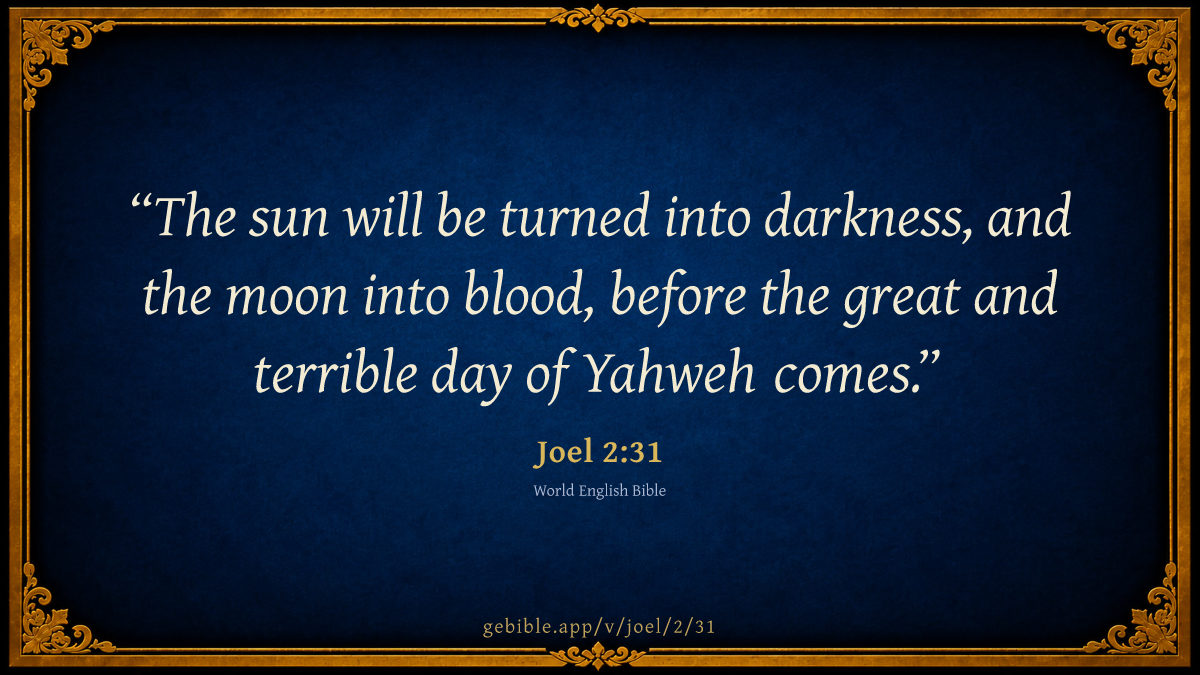
The sun will be turned into darkness, and the moon into blood, before the great and terrible day of Yahweh comes.
Parallel Translations
-
The sun will be turned into darkness, and the moon into blood, before the great and terrible day of Yahweh comes.
-
The sun shall be turned into darkness, and the moon into blood, before the great and the terrible day of the LORD come.
-
(3-4) The sun shall be turned into darkness, and the moon into blood, before the great and terrible day of the LORD come.
Cross-references (13)
Passages linked to Joel 2:31 in the Treasury of Scripture Knowledge, ordered by reader-vote popularity; verse text shown in World English Bible.
- Revelation 6:12-13 I saw when he opened the sixth seal, and there was a great earthquake. The sun became black as sackcloth made of hair, and the whole moon became as blood. The stars of the sky fell to the earth, like a fig tree dropping its unripe figs when it is shaken by a great wind.
- Matthew 24:29 But immediately after the suffering of those days, the sun will be darkened, the moon will not give its light, the stars will fall from the sky, and the powers of the heavens will be shaken;
- Malachi 4:1 “For, behold, the day comes, it burns as a furnace; and all the proud, and all who work wickedness, will be stubble; and the day that comes will burn them up,” says Yahweh of Armies, “that it shall leave them neither root nor branch.
- Malachi 4:5 Behold, I will send you Elijah the prophet before the great and terrible day of Yahweh comes.
- Joel 3:15 The sun and the moon are darkened, and the stars withdraw their shining.
- Joel 2:10 The earth quakes before them. The heavens tremble. The sun and the moon are darkened, and the stars withdraw their shining.
- Zephaniah 1:14-16 The great day of Yahweh is near. It is near, and hurries greatly, the voice of the day of Yahweh. The mighty man cries there bitterly. That day is a day of wrath, a day of distress and anguish, a day of trouble and ruin, a day of darkness and gloom, a day of clouds and blackness, a day of the trumpet and alarm, against the fortified cities, and against the high battlements.
- Mark 13:24-25 But in those days, after that oppression, the sun will be darkened, the moon will not give its light, the stars will be falling from the sky, and the powers that are in the heavens will be shaken.
- Isaiah 13:9-10 Behold, the day of Yahweh comes, cruel, with wrath and fierce anger; to make the land a desolation, and to destroy its sinners out of it. For the stars of the sky and its constellations will not give their light. The sun will be darkened in its going out, and the moon will not cause its light to shine.
- Luke 21:25 There will be signs in the sun, moon, and stars; and on the earth anxiety of nations, in perplexity for the roaring of the sea and the waves;
- Joel 3:1 “For, behold, in those days, and in that time, when I restore the fortunes of Judah and Jerusalem,
- Isaiah 34:4-5 All of the army of the sky will be dissolved. The sky will be rolled up like a scroll, and all its armies will fade away, as a leaf fades from off a vine or a fig tree. For my sword has drunk its fill in the sky. Behold, it will come down on Edom, and on the people of my curse, for judgment.
- Matthew 27:45 Now from the sixth hour there was darkness over all the land until the ninth hour.
Cross-references from openbible.info (CC BY 4.0)
Explain this verse (11 sources)
Historical commentary, presented as a primary source — not an endorsement.
Private notes
Saved on this device only — never synced or sent anywhere.
John Calvin 1540 · Public Domain We now see why the Prophet adds here this…
We now see why the Prophet adds here this sad catalogue, and how well these things harmonize together, — that God would testify his paternal love by the manifestation of Christ, — and that he would exhibit tokens of his wrath, which would fill the whole world with anxiety and fear.
What he says of blood and darkness is, no doubt, to be taken metaphorically for a disordered state of things; for we know that calamities are often compared to obscurity and darkness. It is the same as though he said, “So great will be the succession of evils, that the whole order of nature will seem to be subverted that the very elements will put on a new form; the sun, which illuminates the earth, will be turned into darkness, the moon into blood; the calamities which shall come will take away every token of God’s kindness. Then nothing will remain, but that men, sunk, as it were, in the deepest abyss of all evils, will seek some spark of grace from God and never find it; for heaven will be dark, the earth will be covered with thick darkness.” We then see that the Prophet does not express what would be, word for word, nor is he to be understood as speaking, as they say, literally, but he uses a figurative mode of speaking, by which he sets forth such a dreadful state of things, that the very elements would put on a new appearance; for the sun would not any more perform its office, and the moon would refuse its light to the earth. As God, then, would take away all tokens of his favor, so the Prophet, by blood, by darkness and by dark clouds, sets forth metaphorically that sorrows by which the minds of men would necessarily be possessed.
Read full note →
Now if any one asks, why by the coming of Christ was God’s wrath more stirred up against men? for this may seem to be without reason. To this I answer, that it was, as it were accidental: for if Christ had been received as he ought to have been, if all embraced him with due reverence, he would have certainly been the giver, not only of spiritual grace, but also of earthly happiness. The felicity of all, then, would have in every respect been made complete by the coming of Christ, had not their wickedness and ingratitude kindled up anew the wrath of God; and we see what a flood of evils burst forth immediately after the preaching of the gospel. Now when we consider how severely God afflicted his people formerly, we cannot but say that much heavier have been the calamities inflicted on the world since the manifestation of Christ, — whence this? Even because the world’s ingratitude had arrived to its highest point, as indeed it is at this day: for the light of the gospel has gone forth again, and God has exhibited himself to the world as a Father, and we see how great is the wickedness and perversity of men in rejecting the gifts of God; we see some contemptuously rejecting the Gospel, and others impelled by satanic fury to resist the doctrine of Christ; we see them making a boast of their blasphemies, and we see them kindled with cruel rage and breathing slaughters against the children of God; we see the world full of ungodly men and of the despisers of God; we see an awful contempt of God’s grace prevailing everywhere: we see such an unbridled licentiousness in wickedness, that it ought to make us ashamed of ourselves and weary of our life. Since, then, the world is so ungrateful for such a favor, is it a wonder that God should show more dreadful tokens of his vengeance? For certainly at this day, when we closely examine the condition of the world, we find that all are miserable, and even those who applaud themselves, and whom the world admire as semigods. How can it be otherwise? The common people, doubtless, groan under their miseries, and that because God thus punishes the contempt of his grace, which he has again offered to us, and which is so unworthily rejected. Inasmuch, then, as so base an ingratitude on the part of men has provoked God’s wrath, it is no wonder that the sound of his scourges is everywhere heard: for the servant who knows his lord’s will and does it not, is worthy, as Christ declares, of heavier stripes, (Luke 12.) And what happens through the whole world is, that after God has shone by his gospel, after Christ has everywhere proclaimed reconciliation, they now openly fall away, and show that they prefer having God angry than propitious to them: for when the gospel is rejected, what else is it but to declare war against God, and to scorn and not to receive the reconciliation which God is ready to give, and of which he treats of his own accord with men?
It is then no wonder that the Prophet says here, that the world would be full of darkness after the appearance of Christ, who is the Sun of Righteousness, and who has shone upon us with his salvation: but it was, as it were, accidental, that God exhibited himself with so much severity to the world, when yet it was the acceptable time, when it was the day of salvation and of good-will; for the world suffered not that to be fulfilled which God had promised to us by the Prophet Joel, nor received the Spirit of adoption, when they might have safely fled to God; nay, when God was ready to cherish them in his own bosom. But since they were refractory and untractable, it was necessary for God to visit such perverseness in an unusual manner. It is no wonder then that the Prophet says, that in those days there shall be prodigies in heaven and on earth, for the sun shall be turned into darkness, etc., before it shall come — the day of Jehovah, great and terrible
It may be asked what day the Prophet refers to: for he has hitherto spoken of the first coming of Christ; and there seems to be some inconsistency in this place. I answer, that the Prophet includes the whole kingdom of Christ, from the beginning to the end; and this is well understood, and in other places we have stated that the Prophets common speak in this manner: for when the discourse is concerning Christ’s kingdom, they sometimes refer to its commencement only, and sometimes they speak of its termination; but they often mark out by one delineation the whole course of the kingdom of Christ, from its beginning to its end; and such is the case here. The Prophet, by saying, ‘After those days I will pour out my Spirit,’ no doubt meant that this, as we have explained, would be fulfilled when Christ should commence his kingdom, and make it known through the teaching of the gospel: Christ poured out then his Spirit. But as the kingdom of Christ is not for a few days, or for a short time, but continues its course to the end of the word, the Prophet turns his attention to that day or that time, and says, “There shall, in the meanwhile, be the greatest calamities: and whosoever shall not flee to the grace of God shall be very miserable; they shall never find rest nor comfort, nor the light of life, for the world shall be sunk in darkness; and God shall take away from the sun, the moon, the elements, and all other aids, the tokens of his favor; and he will show himself everywhere to be angry and offended with men.” The Prophet further shows, that these evils of which he speaks would not be for a few days or a few years, but perpetual; ‘Before,’ he says, ‘the day of Jehovah, great and terrible, shall come.’ In short, he means that all the scourges of God, which he had hitherto mentioned, would be, as it were, preparations to subdue the hearts of men, that they might with reverence and submission receive Christ. As, therefore, men carry by nature a high spirit, and cannot bend their neck to recede the yoke of Christ, hence the Prophet says here that they were to be subdued by severe scourges, when God would remove all evidences of his love, and fill heaven and earth with dread. Thus, then, he would in a manner change the hardness and contumacy which is innate in men, that they might know that they had to do with God. And, at the same time, the Prophet reminds them, that unless they were amended by these scourges, something more dreadful remained for them, — the Judge would at last come from heaven, not only to clothe the sun and moon in darkness, but to turn life into death. It would, indeed, be far better for the reprobate to die a hundred times than always to live and thus to sustain eternal death in life itself.
The Prophet then means, that men persisting in their obstinacy shall meet with something more grievous and more ruinous than the evils of this life, for they must all at last stand before the tribunal of the celestial Judge: for the day of Jehovah, great and terrible, will come. He refers, in this sentence, to unbelievers and rebels against God; for when Christ shall come, he will be a Redeemer to the godly; no day in their whole life will shine on them so pleasantly; so far will this day be from bringing terror and fear to them, that they are bidden, while expecting it, to lift up their heads, which is a token of cheerfulness and joy. But as the Prophet Joel’s object was to humble the confident pride of the flesh, and as he addressed the refractory and the rebellious, it is no wonder that he sets before them what is terrific and dreadful.
John Calvin's Commentaries (1540-1563) — public domain. Text from the Calvin Translation Society English edition (1840s-50s) via the Christian Classics Ethereal Library (ccel.org). Calvin's coverage is partial (roughly two-thirds of the Bible); uncommented books and verses are honest gaps, never fabricated. The 19th-century editor's footnotes and remarks are omitted so the notes are faithfully Calvin's own voice.
Geneva Bible translators 1599 · Public Domain The order of nature shall seem to be changed…
The order of nature shall seem to be changed for the horrible afflictions that shall be in the world, Isa. 13:10; Ezek. 32:7; Joel 3:15; Matt. 24:29.
Geneva Bible (1599) marginal notes — public domain.
John Trapp 1656 · Public Domain Joe 2:31 The sun shall be turned into darkness,…
Joe 2:31 The sun shall be turned into darkness, and the moon into blood, before the great and the terrible day of the LORD come.
Ver. 31. The sun shall be turned into darkness, and the moon into blood] By strange and stupendous eclipses: such as was that of the moon for 12 nights together, a little before the last destruction of Jerusalem; and that of the sun this present 29th day of March, 1652, wherein I write these things, but could scarce see to write, or forbear to behold: for though busy enough to bring this work to an end, if God please, yet I cannot say, as the Duke of Alva did to the King of France, who asked him whether he had observed the late great eclipse? "No," said he, "I have so much to do upon earth, that I have no leisure to look toward heaven." Of this day’s eclipse I may well say, as Lucan doth of another,
Read full note →
“ Ipse caput medio Titan cum ferret Olympo,
Condidit ardentes atra caligine currus;
Involvitque orbem tenebris, gentesque coegit
Desperate diem. ”
I heartily pray it do not presage a dreadful eclipse of the sun of Christ’s glorious Gospel among us; that this bright sun should go down at noon over our heads, and our earth be darkened in the clear day, Amo 8:9. And let every good soul pray that that dismal day may never arise unto us, wherein it shall be said that this glory is departed from our English Israel.
‘ - nobiscum, Christe, maneto;
Extingui lucem nec patiare tuam. ”
And the moon into blood] That is, into redness, as it was likewise on the 15th day of this instant March, in the morning. Two such eclipses so near together having seldom been seen, I fear we may have cause, ere the year come about, to sing sadly with the poet (Ovid. Metam. lib. 15)
“ Signa dabant luctus superi haud incerta futuri
Saepe faces visae, solis quoque tristis imago;
Caerulus et vulture ferrugine Lucifer atra
Sparsus erat, sparsi lunares sanguine currus. ”
Before the great and terrible day of the Lord come] i.e. The great day of general judgment, called here the great day, because the great God will on that day do great things and determine great matters; and the terrible day, because it is a day of anger and of wrath, Rev 6:17; yea, the day of the declaration of the just judgment of God, according to the gospel, Rom 2:5; Rom 2:16. It is elsewhere called "that day" by an appellative proper, Mar 13:32 Luk 21:34 Mat 7:22. That day of note, wherein God will break silence, "execute judgment upon all, and convince all that are ungodly among them of all their ungodly deeds which they have ungodly committed, and of all their hard speeches which ungodly sinners have spoken against him," Jdg 1:15. Enoch foretold this great day before Noah did the Deluge. This day is longer before it comes, but shall be more terrible when it is come. Whether it shall come in the year of our Lord, 1657, as some have gathered out of the numeral letters of these two words, Mundi Conflagratio, and because the year of the world 1657 was the year of the flood, let time determine: I have nothing to say to it.
John Trapp, A Commentary or Exposition upon All the Books of the Old and New Testament (1647–1656) — public domain. Text from a community e-Sword module.
Matthew Poole 1685 · Public Domain Having mentioned the prodigies which were to be wrought…
Having mentioned the prodigies which were to be wrought on earth, now the prophet specifieth what shall be done in heaven, where the great luminaries shall be wonderfully affected.
The sun shall be turned into darkness; shall be greatly obscured; shall seem to be turned from a body of light to mere darkness.
Read full note →
The moon into blood; either by eclipse, or by the intervention of vapours drawn up from the places where was great slaughter and effusion of blood; however as to manner, it is most certain as to the event; the moon shall seem to be blood.
Before the great and the terrible day of the Lord come; great to all, terrible to the rejecters and persecutors of Christ. This day was the day of Jerusalem’s’ destruction, and burning of the temple, and slaughter of the Jews, for their violence against and murder of the Messiah, for their sins against the gospel: this was fulfilled partly in the devastation of Jerusalem, but shall fully and finally be fulfilled in the day of judgment, and at the consummation of the world.
Matthew Poole's English Annotations on the Holy Bible (1683–1685) — public domain. Text from a community e-Sword/MySword module.
John Gill 1763 · Public Domain The sun shall be turned into darkness, and the…
The sun shall be turned into darkness, and the moon into blood,.... Not by eclipses, as Aben Ezra; but by the clouds of smoke arising from the burning of towns and cities, which would be so great as to obscure the sun, and through which the moon would look like blood: or all, this may be understood in a figurative sense of the change that should be made in the ecclesiastic and civil state of the Jewish nation, signified by the "heavens" and "earth"; and particularly that their king or kingdom should be in a low, mean, and distressed condition, designed by the sun; and the change of their priesthood is signified by the "moon": so Vitringa on Isa 24:23; interprets the "sun" here of King Agrippa, the last king of the Jews in obscurity; and the "moon" of Ananias junior, the high priest, slain by the zealots:
before the great and the terrible day of the Lord come; not the fall of Gog and Magog, as Kimchi; not the day of the last judgment, but of the destruction of Jerusalem; not by the Chaldeans, but by the Romans; their last destruction, which was very great and terrible indeed, and in which there was a manifest appearance of the hand and power of God; see Mal 4:1. Maimonides (u) interprets it of the destruction of Sennacherib near Jerusalem; but if that sense is not acceptable, he proposes that of the destruction of Gog and Magog, in the times of the Messiah.
Read full note →
(u) Moreh Nevochim, par. 2. c. 19. p. 271.
John Gill's Exposition of the Whole Bible (1746–1763) — public domain (CC PDM 1.0). Text via the HelloAO Bible API.
John Wesley 1765 · Public Domain The sun - Having mentioned the prodigies which were…
The sun - Having mentioned the prodigies which were to be wrought on earth, he now specifies what shall be done in heaven. The terrible day - The unholy day of the destruction of Jerusalem; typifying the day of judgment.
John Wesley, Explanatory Notes Upon the Whole Bible (1754–1765) — public domain. Text via the GEBible commentary corpus.
Adam Clarke 1810 · Public Domain Verse 31. The sun shall be turned into darkness]…
Verse 31. The sun shall be turned into darkness] The Jewish polity, civil and ecclesiastical, shall be entirely destroyed.
Before the great and the terrible day of the Lord come.] In the taking and sacking of Jerusalem, and burning of the temple, by the Romans, under Titus, the son of Vespasian. This was, perhaps, the greatest and most terrible day of God's vengeance ever shown to the world, or that ever will be shown, till the great day of the general judgment. For a full view of this subject, I wish to refer the reader to the notes on Mt 24:1-51.
Adam Clarke's Commentary on the Bible (1810–1826) — public domain. Text from a community e-Sword/MySword module.
Joseph Benson 1811 · Public Domain Joe 2:31. The sun shall be turned into darkness,…
Joe 2:31. The sun shall be turned into darkness, and the moon into blood, &c. — Particular judgments upon kings and nations are often described in such terms as properly belong to the general judgment and conflagration of the heavens and the earth, as has been observed on Joe 2:10 th of this chapter. The expressions here used, in their literal sense, import the failing of light in the sun and moon, whether by eclipses or any other cause, such as perhaps, at the time here referred to, by the prodigious quantity of smoke arising from the burning of cities, towns, and villages on every side, and also of Jerusalem itself, which undoubtedly was sufficient to obscure the heavenly luminaries for some time. Or, the expression in this verse may be interpreted figuratively of the dark and melancholy state of public affairs before and at the destruction of the Jewish nation by the Romans, and of the utter overthrow of their state and government: see note on Isa 13:9-10. The last destruction of Jerusalem, the desolation of Judea, and the prodigious slaughter made of the Jews, might with great propriety be called, as it is here, The great and terrible day of the Lord; since the divine justice was then executed with a severity which had never been used before toward the Jewish people. The calamities of those times were indeed dreadful, almost beyond description, and seem to have exceeded any thing that any other nation had ever suffered; which was agreeable to what Moses, in the very beginning of their state, had foretold should happen to them, if ever, by their disobedience to God’s commands, and their other crimes, they should fill up the measure of their iniquity: see notes on Deuteronomy 28.
Joseph Benson's Commentary on the Old and New Testaments (1811–1818) — public domain. Text from a community e-Sword module.
Albert Barnes 1834 · Public Domain Before the great and terrible Day of the Lord…
Before the great and terrible Day of the Lord come - o: “The days of our life are our days wherein we do what we please; that will be the “Day of the Lord,” when He, our Judge, shall require the account of all our doings. It will be “great,” because it is the horizon of time and eternity; the last day of time, the beginning of eternity. It will put an end to the world, guilt, deserts, good or evil. It will be “great,” because in it great things will be done. Christ with all His Angels will come down and sit on His Throne; all who have ever lived or shall live, shall be placed before Him to be judged; all thoughts, words, and deeds shall be weighed most exactly; on all a sentence will be passed, absolute, irrevocable throughout eternity; the saints shall be assigned to heaven, the ungodly to hell; a great gulf shall be placed between, which shall sever them forever, so that the ungodly shall never see the godly nor heaven nor God; but shall be shut up in a prison forever, and shall burn as long as heaven shall be heaven, or God shall be God.” : “That day shall be great to the faithful, terrible to the unbelieving; great to those who said, ‘Truly this is the Son of God;’ terrible to those who said, ‘His blood be upon us and upon our children.’” : “When then thou art hurried to any sin, think on that terrible and unendurable judgment-seat of Christ, where the Judge sits on His lofty Throne, and all creation shall stand in awe at His glorious Appearing and we shall be brought, one by one, to give account of what we have done in life. Then by him who hath done much evil in life, there will stand terrible angels. “There” will be the deep gulf, the impassable darkness, the lightless fire, retaining in darkness the power to burn, but reft of its rays. There is the empoisoned and ravenous worm insatiably devouring and never satisfied, inflicting by its gnawing pangs unbearable. There that sharpest punishment of all, that shame and everlasting reproach. Fear these things; and, instructed by this fear, hold in thy soul as with a bridle from the lust of evil.”
Albert Barnes' Notes on the Bible (1834–1885) — public domain. Text from a community e-Sword/MySword module.
The Cambridge Bible for Schools and Colleges 1878 · Public Domain 31. Celestial portents. The imagery may be suggested partly…
31. Celestial portents. The imagery may be suggested partly by eclipses (cf. on Amo_8:9), partly by unusual obscurations of sun or moon through atmospheric disturbances,—for instance, sand-storms, cyclones, flights of locusts, &c. “A dreadful whirlwind occurred here [in Allahabad] on June 2, 1838. The whole sky was blood-red, not with clouds, for there was not a cloud to be seen. Overhead moved immense masses of dust; but below there was not a breath of wind. Shortly after, the wind rose, carrying with it sand and dust. It soon became extremely dark, although the sun was still up. The darkness was not only visible but tangible. The wind wrought immense damage” (Asiatic Journal, Nov. 1838, p. 155, referred to by Ewald).
into darkness] comp. Joe_2:10, with the passages there cited.
Read full note →
into blood] comp. Rev_6:12 (the imagery of which is based upon this passage, as that of Joe_2:13-14 is upon Isa_34:4). Ovid (quoted by Credner), among the celestial portents which he describes as preceding the death of Caesar, includes sparsi lunares sanguine currus (Met. xv. 790).
before &c.] exactly the same words as in Mal_4:5.
The Cambridge Bible for Schools and Colleges (gen. ed. J. J. S. Perowne; Cambridge University Press, 1878–1918) — public domain. Text from a community e-Sword module.
The Pulpit Commentary 1880 · Public Domain The sun shall be turned into darkness, and the…
The sun shall be turned into darkness, and the moon into blood, before the great and terrible day of the Lord come. These wonders in the heavens follow the wonders on earth, and these obscurations of the heavenly bodies the darkening of the sun and the dull blood-like appearance of the moon were portents of coming judgment. These miraculous phenomena, if literally employed, may refer to those portentous sights which, as the Jewish historian Josephus and the Roman historian Tacitus testify, were witnessed, both by besiegers and besieged, during the siege and before the destruction of Jerusalem. But taken symbolically, as is preferable, blood symbolizes bloodshed; fire, the firing of a town in time of war; and pillars of smoke, the clouds of smoke rolling up to heaven from the burning or smouldering ruins of a town or city set on fire by the enemy; while the darkening of the sun and the turning of the moon into a dull blood-red would portend approaching judgment, and a change, political and ecclesiastical, in the existing constitution of things. Here particularly, by reading Joel"s prophecy in the light of the New Testament, we shall understand with tolerable clearness the meaning of the symbols of the sun and moon. The symbolic language of Joel"s prediction found its fulfilment, at least in part, within less than half a century from the time when Peter spoke. Scarce forty years from that Pentecostal outpouring and the ruling powers, civil and ecclesiastical, of the Jewish nation came to an end. The Jewish Church and Hebrew commonwealth went out in darkness. The moon of the latter began to wane from the first day the Roman power was set up in Palestine, but at the destruction of the capital the light of that moon was extinguished for ever; the sun of the former was long getting obscured by clouds, but at last it underwent a total and final eclipse. But why, it may be asked, are sun and moon thus symbolic of rulers superior and inferior, or of rulers of greater and less importance, or of rulers in Church and state? By the original constitution of these luminaries, as specified in the record of Creation, they were actually appointed to this, and so naturally enough the physical here, as elsewhere, underlies the symbolic, as we read, "God made two great lights: the greater light to rule the day, and the lesser light to rule the night." Thus what was commenced when Judaea became a Roman province was completed when Jerusalem was destroyed and the temple burnt by the Roman army under Titus. "The day of the Lord" is an expression very common with the prophets, and always expressive of some severe visitation or special judgment. Thus we read in this same Book of the Prophet Joel, "The day of the Lord is at hand, and as a destruction from the Almighty shall it come." Again in Amo_5:18, "The day of the Lord is darkness, and not light." But other days of judicial visitation were not to be compared with this. The day of Babylon"s destruction is called by Isaiah simply "the day of the Lord;" so Jeremiah speaks of the day of the destruction of Pharaoh"s army at the Euphrates as "the day of the Lord;" and Joel himself designates the day of Jerusalem"s destruction of Nebuchadnezzar as "the day of the Lord." But the day mentioned in the text before us is "that great and notable day of the Lord," and so it was the day of the final destruction and desolation of Jerusalem.
The Pulpit Commentary (1880–1919), ed. H.D.M. Spence-Jones & Joseph S. Exell — public domain. Text from a community e-Sword module.