Questions where the Bible appears to say two different things, with the passages on each side set together.
Was John the Baptist Elijah?In Matthew 11:14 Jesus says of John the Baptist: "this is Elijah, which was for to come," and Matthew 17:12-13 makes the identification explicit — the disciple…
Malachi 4:5(v21)Behold, I will send you Elijah the prophet before the great and terrible day of Yahweh comes.
Deuteronomy 18:15-18(v21)Yahweh your God will raise up to you a prophet from among you, of your brothers, like me. You shall listen to him. This is according to all…
Matthew 11:14(v21)If you are willing to receive it, this is Elijah, who is to come.
Matthew 3:11-12(v20)I indeed baptize you in water for repentance, but he who comes after me is mightier than I, whose sandals I am not worthy to carry. He will…
Mark 1:7-8(v20)He preached, saying, “After me comes he who is mightier than I, the thong of whose sandals I am not worthy to stoop down and loosen. I…
Show all 20 cross-references
John 1:25(v21)They asked him, “Why then do you baptize, if you are not the Christ, nor Elijah, nor the prophet?”
Matthew 16:14(v21)They said, “Some say John the Baptizer, some, Elijah, and others, Jeremiah, or one of the prophets.”
Matthew 17:10-12(v21)His disciples asked him, saying, “Then why do the scribes say that Elijah must come first?” Jesus answered them, “Elijah indeed comes…
Luke 1:17(v21)He will go before him in the spirit and power of Elijah, ‘to turn the hearts of the fathers to the children,’ and the disobedient to the…
Luke 3:15-17(v20)As the people were in expectation, and all men reasoned in their hearts concerning John, whether perhaps he was the Christ, John answered…
Luke 3:15-18(v19)As the people were in expectation, and all men reasoned in their hearts concerning John, whether perhaps he was the Christ, John answered…
John 3:28-36(v20)You yourselves testify that I said, ‘I am not the Christ,’ but, ‘I have been sent before him.’ He who has the bride is the bridegroom; but…
John 10:24(v19)The Jews therefore came around him and said to him, “How long will you hold us in suspense? If you are the Christ, tell us plainly.”
Matthew 11:9-11(v21)But why did you go out? To see a prophet? Yes, I tell you, and much more than a prophet. For this is he, of whom it is written, ‘Behold, I…
John 7:40(v21)Many of the multitude therefore, when they heard these words, said, “This is truly the prophet.”
Acts 19:4(v19)Paul said, “John indeed baptized with the baptism of repentance, saying to the people that they should believe in the one who would come…
John 5:33-36(v19)You have sent to John, and he has testified to the truth. But the testimony which I receive is not from man. However, I say these things…
Acts 13:25(v19)As John was fulfilling his course, he said, ‘What do you suppose that I am? I am not he. But behold, one comes after me, the sandals of…
Matthew 21:23-32(v19)When he had come into the temple, the chief priests and the elders of the people came to him as he was teaching, and said, “By what…
John 2:18(v19)The Jews therefore answered him, “What sign do you show us, seeing that you do these things?”
Cross-references from openbible.info (CC BY 4.0)
Explain this passage (26 sources)
Historical commentary, presented as a primary source — not an endorsement.
John Calvin1540 · Public DomainOn vv19–2119. And this is the testimony. Hitherto the Evangelist…
19. And this is the testimony. Hitherto the Evangelist has related the preaching of John about Christ; he now comes down to a more illustrious testimony, which was delivered to the ambassadors of the Priests, that they might convey it to Jerusalem. He says, therefore, that John openly confessed for what purpose he was sent by God. The first inquiry here is, for what purpose the Priests put questions to him. It is generally believed that, out of hatred to Christ, they gave to John an honor which did not belong to him; but this could not be the reason, for Christ was not yet known to them. Others say that they were better pleased with John, because he was of the lineage and order of the priesthood; but neither do I think that this is probable; for since they expected from Christ all prosperity, why did they voluntarily contrive a false Christ? I think, therefore, that there was another reason that induced them. It was now a long time since they had the Prophets; John came suddenly and contrary to expectation; and the minds of all were aroused to expect the Messiah. Besides, all entertained the belief that the coining of the Messiah was at hand.
That they may not appear to be careless about their duty, if they neglect or disguise a matter of so great importance, they ask John, Who art thou? At first, therefore, they did not act from malice, but, on the contrary, actuated by the desire of redemption, they wish to know if John be the Christ, because he begins to change the order which had been customary in the Church. And yet I do not deny that ambition, and a wish to retain their authority, had some influence over them; but nothing certainly was farther from their intention than to transfer the honor of Christ to another. Nor is their conduct in this matter inconsistent with the office which they sustain; for since they held the government of the Church of God, it was their duty to take care that no one rashly obtruded himself, that no founder of a new sect should arise, that the unity of faith should not be broken in the Church, and that none should introduce new and foreign ceremonies. It is evident, therefore, that a report about John was widely spread and aroused the minds of all; and this was arranged by the wonderful Providence of God, that this testimony might be more strikingly complete.
John Calvin's Commentaries (1540-1563) — public domain. Text from the Calvin Translation Society English edition (1840s-50s) via the Christian Classics Ethereal Library (ccel.org). Calvin's coverage is partial (roughly two-thirds of the Bible); uncommented books and verses are honest gaps, never fabricated. The 19th-century editor's footnotes and remarks are omitted so the notes are faithfully Calvin's own voice.
Geneva Bible translators1599 · Public DomainOn vv19–21John is neither the Messiah, nor like to any…
John is neither the Messiah, nor like to any of the other Prophets, but is the herald of Christ, who is now present.
Geneva Bible (1599) marginal notes — public domain.
John Trapp1656 · Public DomainOn vv19–2119 And this is the record of John, when…
19 And this is the record of John, when the Jews sent priests and Levites from Jerusalem to ask him, Who art thou?
Ver. 19. Jews sent priests] Whose proper office it was to inquire into new doctrines, and by preserving, to present knowledge to the people, who were to "seek the law at the priest’s mouth," Mal 2:7. Cicero complains of his Roman priests, that they were good honest men, but not very skilful. Bonos illos quidem viros, sed certe non pereruditos. (Cic. xx. de. Fin.) And Varro upbraids them with their ignorance of much about their own gods and religions. (Aug. Civ. Dei. iv. 1.)
John Trapp, A Commentary or Exposition upon All the Books of the Old and New Testament (1647–1656) — public domain. Text from a community e-Sword module.
Matthew Poole1685 · Public DomainOn vv19–21John’s former testimony was more private to the common…
John’s former testimony was more private to the common people; this testimony was given to a public authority.
The Jews (most probably the rulers of the Jews, who made up their sanhedrim, or great court, answering a parliament with us, for the cognizance of false prophets belonged to them)
Read full note →
sent priests and Levites, which were Pharisees, Joh 1:24, of the strictest sect of the Jews as to rites and ceremonies; these came from Jerusalem, where the sanhedrim constantly sat, and the chief priests were, (if the message were not from the sanhedrim itself), to ask John Baptist who he was; that is, by what authority he preached and baptized? What kind of prophet he was? For they could not but know his name and family, he descending from a priest amongst them: and this appeareth to be their sense from what followeth.
Matthew Poole's English Annotations on the Holy Bible (1683–1685) — public domain. Text from a community e-Sword/MySword module.
William Burkitt1703 · Public DomainOn v19In these verses we have a second testimony which…
In these verses we have a second testimony which John the Baptist gave of our Saviour Jesus Christ. The Jews sent priests and Levites from Jerusalem, saying, Who art thou? That is, the Sanhedrin, or great council at Jerusalem, to whom it belonged to judge who were true prophets, sent messengers to the Baptist to know, Whether he was the Messiah or not? John refuses to take this honour to himself, but tells them plainly, he was his harbinger and forerunner, and that the Messias himself was just at hand.
From hence note, How very cautious, and exceeding careful, this messenger of Christ was, and all the ministers of Christ ought to be, that they do not assume or arrogate to themselves any part of that honour which is due to Christ; but set the crown of praise upon Christ’s own head, acknowledging him to be all in all. 1Co 3:5 Who is Paul? and who is Apollos? but ministers by whom ye believed?
Read full note →
Observe farther, In this testimony of John the Baptist, these two things:
1. A negative declaration, who he was not; I am not, says he, the Messiah whom ye look for, nor Elias, nor that prophet you expect: not Elias, that is, in your sense, not Elias the Tishbite; not Elias for identity of person, but Elias for similtude of gifts, office, and calling. John came, though not in the person, yet in the power and spirit, of Elias. He denies farther, that he was that prophet: that prophet which Moses spake of, Deu 18:15 nor any of the old prophets risen from the dead; nay, strictly speaking, he was not any prophet at all; but more than a prophet: The Old Testament prophets prophesied of Christ to come; but John pointed at, showed, and declared a Christ already come; and in this sense he was no mere prophet, but more than a prophet.
2. We have here the Baptist’s positive affirmation who he was; namely, Christ’s herald in the wilderness, his usher, his forerunner to prepare the people for receiving of the Messias, and to make them ready for the entertaining of the gospel, by preaching the doctrine of repentance to them.
From hence learn, That the preaching of the doctrine of repentance is indispensably necessary, in order to the preparing of the hearts of sinners for the receiving of Jesus Christ.
Observe lastly, The great and exemplary humility of the holy Baptist, the mean and lowly opinion he had of himself. Although John was the greatest among them that were born of a woman, and so much esteemed by the Jews, and had the honour to go before Christ in the exercise of his office and ministry; yet he judges himself unworthy to carry Christ’s shoes after him: He that cometh after me is preferred before me, whose shoes I am not worthy to unloose.
Learn hence, That the more eminent gifts the ministers of the gospel have, and the more ready men are to honour and esteem them, the more they will abase themselves, if they be truly gracious, and account themselves highly honoured in doing the meanest offices of love and service for Jesus Christ. Thus doth the holy Baptist here: His shoes’ latchet I am not worthy to unloose.
William Burkitt's Expository Notes on the New Testament (1700–1703) — public domain. Text from a community e-Sword module.
Matthew Henry1710 · Public DomainOn v19We have here the testimony of John, which he…
We have here the testimony of John, which he delivered to the messengers who were sent from Jerusalem to examine him. Observe here,
I. Who they were that sent to him, and who they were that were sent. 1. They that sent to him were the Jews at Jerusalem, the great sanhedrim or high-commission court, which sat at Jerusalem, and was the representative of the Jewish church, who took cognizance of all matters relating to religion. One would think that they who were the fountains of learning, and the guides of the church, should have, by books, understood the times so well as to know that the Messiah was at hand, and therefore should presently have known him that was his forerunner, and readily embraced him; but, instead of this, they sent messengers to cross questions with him. Secular learning, honour, and power, seldom dispose men's minds to the reception of divine light. 2. They that were sent were, (1.) Priests and Levites, probably members of the council, men of learning, gravity, and authority. John Baptist was himself a priest of the seed of Aaron, and therefore it was not fit that he should be examined by any but priests. It was prophesied concerning John's ministry that it should purify the Sons of Levi (Mal 3:3), and therefore they were jealous of him and his reformation. (2.) They were of the Pharisees, proud, self-justiciaries, that thought they needed no repentance, and therefore could not bear one that made it his business to preach repentance.
Read full note →
II. On what errand they were sent; it was to enquire concerning John and his baptism. They did not send for John to them, probably because they feared the people, lest the people where John was should be provoked to rise, or lest the people where they were should be brought acquainted with him; they thought it was good to keep him at a distance. They enquire concerning him, 1. To satisfy their curiosity; as the Athenians enquired concerning Paul's doctrine, for the novelty of it, Act 17:19, Act 17:20. Such a proud conceit they had of themselves that the doctrine of repentance was to them strange doctrine. 2. It was to show their authority. They thought they looked great when they called him to account whom all men counted as a prophet, and arraigned him at their bar. 3. It was with a design to suppress him and silence him if they could find any colour for it; for they were jealous of his growing interest, and his ministry agreed neither with the Mosaic dispensation which they had been long under, nor with the notions they had formed of the Messiah's kingdom.
III. What was the answer he gave them, and his account, both concerning himself and concerning his baptism, in both which he witnessed to Christ.
1. Concerning himself, and what he professed himself to be. They asked him, Su tis ei - Thou, who art thou? John's appearing in the world was surprising. He was in the wilderness till the day of his showing unto Israel. His spirit, his converse, he doctrine, had something in them which commanded and gained respect; but he did not, as seducers do, give out himself to be some great one. He was more industrious to do good than to appear great; and therefore waived saying any thing of himself till he was legally interrogated. Those speak best for Christ that say least of themselves, whose own works praise them, not their own lips. He answers their interrogatory,
(1.) Negatively. He was not that great one whom some took him to be. God's faithful witnesses stand more upon their guard against undue respect than against unjust contempt. Paul writes as warmly against those that overvalued him, and said, I am of Paul, as against those that undervalued him, and said that his bodily presence was weak; and he rent his clothes when he was called a god. [1.] John disowns himself to be the Christ (Joh 1:20): He said, I am not the Christ, who was now expected and waited for. Note, The ministers of Christ must remember that they are not Christ, and therefore must not usurp his powers and prerogatives, nor assume the praises due to him only. They are not Christ, and therefore must not lord it over God's heritage, nor pretend to a dominion over the faith of Christians. They cannot created grace and peace; they cannot enlighten, convert, quicken, comfort; for they are not Christ. Observe how emphatically this is here expressed concerning John: He confessed, and denied not, but confessed; it denotes his vehemence and constancy in making this protestation. Note, Temptations to pride, and assuming that honour to ourselves which does not belong to us, ought to be resisted with a great deal of vigour and earnestness. When John was taken to be the Messiah, he did not connive at it with a Si populus vult decipi, decipiatur - If the people will be deceived, let them; but openly and solemnly, without any ambiguities, confessed, I am not the Christ; hoti ouk eimi egō ho Christos - I am not the Christ, not I; another is at hand, who is he, but I am not. His disowning himself to be the Christ is called his confessing and not denying Christ. Note, Those that humble and abase themselves thereby confess Christ, and give honour to him; but those that will not deny themselves do in effect deny Christ, [2.] He disowns himself to be Elias, Joh 1:21. The Jews expected the person of Elias to return from heaven, and to live among them, and promised themselves great things from it. Hearing of John's character, doctrine, and baptism, and observing that he appeared as one dropped from heaven, in the same part of the country from which Elijah was carried to heaven, it is no wonder that they were ready to take him for this Elijah; but he disowned this honour too. He was indeed prophesied of under the name of Elijah (Mal 4:5), and he came in the spirit and power of Elias (Luk 1:17), and was the Elias that was to come (Mat 11:14); but he was not the person of Elias, not that Elias that went to heaven in the fiery chariot, as he was that met Christ in his transfiguration. He was the Elias that God had promised, not the Elias that they foolishly dreamed of. Elias did come, and they knew him not (Mat 17:12); nor did he make himself known to them as the Elias, because they had promised themselves such an Elias as God never promised them. [3.] He disowns himself to be that prophet, or the prophet. First, He was not that prophet which Moses said the Lord would raise up to them of their brethren, like unto him. If they meant this, they needed not ask that question, for that prophet was no other than the Messiah, and he had said already, I am not the Christ. Secondly, He was not such a prophet as they expected and wished for, who, like Samuel and Elijah, and some other of the prophets, would interpose in public affairs, and rescue them from under the Roman yoke. Thirdly, He was not one of the old prophets raised from the dead, as they expected one to come before Elias, as Elias before the Messiah. Fourthly, Though John was a prophet, yea, more than a prophet, yet he had his revelation, not by dreams and visions, as the Old Testament prophets had theirs; his commission and work were of another nature, and belonged to another dispensation. If John had said that he was Elias, and was a prophet, he might have made his words good; but ministers must, upon all occasions, express themselves with the utmost caution, both that they may not confirm people in any mistakes, and particularly that they may not give occasion to any to think of them above what is meet.
(2.) Affirmatively. The committee that was sent to examine him pressed for a positive answer (Joh 1:22), urging the authority of those that sent them, which they expected he should pay a deference to: "Tell us, What art thou? not that we may believe thee, and be baptized by three, but that we may give an answer to those that sent us, and that it may not be said we were sent on a fool's errand." John was looked upon as a man of sincerity, and therefore they believed he would not give an evasive ambiguous answer; but would be fair and above-board, and give a plain answer to a plain question: What sayest thou of thyself? And he did so, I am the voice of one crying in the wilderness. Observe,
[1.] He gives his answer in the words of scripture, to show that the scripture was fulfilled in him, and that his office was supported by a divine authority. What the scripture saith of the office of the ministry should be often thought of by those of that high calling, who must look upon themselves as that, and that only, which the word of God makes them.
[2.] He gives in his answer in very humble, modest, self-denying expressions. He chooses to apply that scripture to himself which denotes not his dignity, but his duty and dependence, which bespeaks him little: I am the voice, as if he were vox et praeterea nihil - mere voice.
[3.] He gives such an account of himself as might be profitable to them, and might excite and awaken them to hearken to him; for he was the voice (see Isa 40:3), a voice to alarm, an articulate voice to instruct. Ministers are but the voice, the vehicle, by which God is pleased to communicate his mind. What are Paul and Apollos but messengers? Observe, First, He was a human voice. The people were prepared to receive the law by the voice of thunders, and a trumpet exceedingly loud, such as made them tremble; but they were prepared for the gospel by the voice of a man like ourselves, a still small voice, such as that in which God came to Elijah, Kg1 19:12. Secondly, He was the voice of one crying, which denotes, 1. His earnestness and importunity in calling people to repentance; he cried aloud, and did not spare. Ministers must preach as those that are in earnest, and are themselves affected with those things with which they desire to affect others. Those words are not likely to thaw the hearers' hearts that freeze between the speaker's lips. 2. His open publication of the doctrine he preached; he was the voice of one crying, that all manner of persons might hear and take notice. Doth not wisdom cry? Pro 8:1. Thirdly, It was in the wilderness that this voice was crying; in a place of silence and solitude, out of the noise of the world and the hurry of its business; the more retired we are from the tumult of secular affairs the better prepared we are to hear from God. Fourthly, That which he cried was, Make straight the way of the Lord; that is, 1. He came to rectify the mistakes of people concerning the ways of God; it is certain that they are right ways, but the scribes and Pharisees, with their corrupt glosses upon the law, had made them crooked. Now John Baptist calls people to return to the original rule. 2. He came to prepare and dispose people for the reception and entertainment of Christ and his gospel. It is an allusion to the harbingers of a prince or great man, that cry, Make room. Note, When God is coming towards us, we must prepare to meet him, and let the word of the Lord have free course. See Psa 24:7.
2. Here is his testimony concerning his baptism.
(1.) The enquiry which the committee made about it: Why baptizest thou, if thou be not the Christ, nor Elias, nor that prophet? Joh 1:25. [1.] They readily apprehended baptism to be fitly and properly used as a sacred rite or ceremony, for the Jewish church had used it with circumcision in the admission of proselytes, to signify the cleansing of them from the pollutions of their former state. That sign was made use of in the Christian church, that it might be the more passable. Christ did not affect novelty, nor should his ministers. [2.] They expected it would be used in the days of the Messiah, because it was promised that then there should be a fountain opened (Zac 13:1), and clean water sprinkled, Eze 36:25. It is taken for granted that Christ, and Elias, and that prophet, would baptize, when they came to purify a polluted world. Divine justice drowned the old world in its filth, but divine grace has provided for the cleansing of this new world from its filth. [3.] They would therefore know by what authority John baptized. His denying himself to be Elias, or that prophet, subjected him to this further question, Why baptizest thou? Note, It is no new thing for a man's modesty to be turned against him, and improved to his prejudice; but it is better that men should take advantage of our low thoughts of ourselves, to trample upon us, than the devil take advantage of our high thoughts of ourselves, to tempt us to pride and draw us into his condemnation.
(2.) The account he gave of it, Joh 1:26, Joh 1:27.
[1.] He owned himself to be only the minister of the outward sign: "I baptize with water, and that is all; I am no more, and do no more, than what you see; I have no other title than John the Baptist; I cannot confer the spiritual grace signified by it." Paul was in care that none should think of him above what they saw him to be (Co2 12:6); so was John Baptist. Ministers must not set up for masters.
[2.] He directed them to one who was greater than himself, and would do that for them, if they pleased, which he could not do: "I baptize with water, and that is the utmost of my commission; I have nothing to do but by this to lead you to one that comes after me, and consign you to him." Note, The great business of Christ's ministers is to direct all people to him; we preach not ourselves, but Christ Jesus the Lord. John gave the same account to this committee that he had given to the people (Joh 1:15): This as he of whom I spoke. John was constant and uniform in his testimony, not as a reed shaken with the wind. The sanhedrim were jealous of his interest in the people, but he is not afraid to tell them that there is one at the door that will go beyond him. First, He tells them of Christ's presence among them now at this time: There stands one among you, at this time, whom you know not. Christ stood among the common people, and was as one of them. Note, 1. Much true worth lies hid in this world; obscurity is often the lot of real excellency. Saints are God's hidden ones, therefore the world knows them not. 2. God himself is often nearer to us than we are aware of. The Lord is in this place, and I knew it not. They were gazing, in expectation of the messiah: Lo he is here, or he is there, when the kingdom of God was abroad and already among them, Luk 17:21. Secondly, He tells them of Christ's preference above himself: He comes after me, and yet is preferred before me. This he had said before; he adds here, "Whose shoe-latchet I am not worthy to loose; I am not fit to be named the same day with him; it is an honour too great for me to pretend to be in the meanest office about him," Sa1 25:41. Those to whom Christ is precious reckon his service, even the most despised instances of it, an honour to them. See Psa 84:10. If so great a man as John accounted himself unworthy of the honour of being near Christ, how unworthy then should we account ourselves! Now, one would think, these chief priests and Pharisees, upon this intimation given concerning the approach of the Messiah, should presently have asked who, and where, this excellent person was; and who more likely to tell them than he who had given them this general notice? No, they did not think this any part of their business or concern; they came to molest John, not to receive any instructions from him: so that their ignorance was wilful; they might have known Christ, and would not.
Lastly, Notice is taken of the place where all this was done: In Bethabara beyond Jordan, Joh 1:28. Bethabara signifies the house of passage; some think it was the very place where Israel passed over Jordan into the land of promise under the conduct of Joshua; there was opened the way into the gospel state by Jesus Christ. It was at a great distance from Jerusalem, beyond Jordan; probably because what he did there would be least offensive to the government. Amos must go prophesy in the country, not near the court; but it was sad that Jerusalem should put so far from her the things that belonged to her peace. He made this confession in the same place where he was baptizing, that all those who attended his baptism might be witnesses of it, and none might say that they knew not what to make of him.
Matthew Henry's Commentary on the Whole Bible (1708–1710) — public domain (CC PDM 1.0). Text via the HelloAO Bible API.
John Gill1763 · Public DomainOn vv19–21And this is the record of John,.... The evangelist…
And this is the record of John,.... The evangelist proceeds to give a large, and full account of the testimony John the Baptist bore to Christ, which he had hinted at before, and had signified was his work, and office, and the end of his being sent,
When the Jews sent priests and Levites from Jerusalem, to ask him, who art thou? The Jews that sent were the great sanhedrim that sat at Jerusalem, whose business it was to inquire into, examine, and try prophets, whether true or false (p); and John appearing as a prophet, and being so esteemed by the people, they deputed messengers to him to interrogate him, and know who he was. The persons sent were very likely of their own body, since priests and Levites were in that council. For it is said (q),
Read full note →
"they do not constitute, or appoint in the sanhedrim but priests, Levites, and Israelites, who have their genealogies---and it is commanded, that there should be in the great sanhedrim priests and Levites, as it is said, Deu 17:9 "and thou shalt come unto the priests, the Levites", &c. and if they are not to be found, though they are all Israelites, (not of the tribe of Levi,) it is right.
Such a sanhedrim is a lawful one; but priests and Levites, if such could be found, that had proper qualifications, were to be admitted in the first place. A message from so august an assembly, at so great a distance, (for Jordan was a day's journey distant from Jerusalem (r); according to Josephus (s), it was 210 furlongs, or 26 miles and a quarter,) and by the hands of persons of such character and figure, was doing John a great deal of honour, and serves to make his testimony of Christ the more public and remarkable; and it also shows what a noise John's ministry and baptism made among the Jews, that it even reached Jerusalem, and the great council of the nation; and likewise the question put to him, which by John's answer seems to intimate as if it was thought he was the Messiah, shows the opinion that was entertained of him, and even the sanhedrim might not be without thoughts this way: and the question they put by their messengers might not be, as some have thought, to ensnare John, nor out of disrespect to Jesus, who, as yet, was not made manifest; but might be in good earnest, having, from many circumstances, reason to think there might be something in the people's opinion of him; since, though the government was not wholly departed from Judah, yet they could not but observe it was going away apace, an Idumean having been upon the throne for some years, placed there by the Roman senate; and now the government was divided among his sons by the same order; Daniel's weeks they could not but see were just accomplishing; and besides, from the uncommon appearance John made, the austerity of his life; the doctrine of remission of sins he preached, and the new ordinance of baptism he administered, they might be ready to conclude he was the person,
(p) Misn. Sanhedrin, c. 1. sect. 5. (q) Maimon. Hilch. Sanhedrin, c. 2. sect. 1, 2. (r) Misna Maaser Sheni, c. 5. sect. 2. Juchasin, fol. 65. 2. Jarchi in Isa. xxiv. 16. (s) De Bello Jud. l. 5. c. 4.
John Gill's Exposition of the Whole Bible (1746–1763) — public domain (CC PDM 1.0). Text via the HelloAO Bible API.
John Wesley1765 · Public DomainOn vv19–21The Jews - Probably the great council sent.
The Jews - Probably the great council sent.
John Wesley, Explanatory Notes Upon the Whole Bible (1754–1765) — public domain. Text via the GEBible commentary corpus.
Adam Clarke1810 · Public DomainOn vv19–21Verse 19. And this is the record of John]…
Verse 19. And this is the record of John] He persisted in this assertion, testifying to the Jews that this Jesus was THE CHRIST.
Adam Clarke's Commentary on the Bible (1810–1826) — public domain. Text from a community e-Sword/MySword module.
Joseph Benson1811 · Public DomainOn v19Joh 1:19-23. And this is the record of John…
Joh 1:19-23. And this is the record of John — This is the testimony which he bare publicly to Jesus; when the Jews — Namely, the senate, or great council of the nation; sent priests and Levites from Jerusalem — Persons of the first consideration for learning and office; to ask him, Who art thou — What character dost thou assume to thyself? It is probable, that the reason why the sanhedrim sent these persons, was their having been informed that the Baptist’s extraordinary sanctity, zeal, and powerful preaching, together with the solemnity of his baptizing, had made such an impression on the people, that they were beginning to think he might be the Messiah. These rulers therefore judged it proper to send persons thus to examine him, because it belonged to them to take cognizance of all matters relating to religion, and especially to judge who were true prophets. And as they were evidently jealous of his increasing popularity, they probably hoped to find in his answers to their questions some pretence for taking measures to silence him, especially as they understood his ministry neither agreed with the Mosaic dispensation which they had been long under, nor with the notions they had formed of the Messiah’s kingdom. And he confessed, and denied not, &c. — John, according to the natural plainness of his temper, presently replied to their inquiry; I am not the Christ — As if he had said, I know that the people begin to look on me as their long- expected deliverer, but I tell you plainly, they are mistaken: nor do I in the least pretend to arrogate to myself the honours which are due to none but him. And they asked him, What then? Art thou Elias — Art thou the Prophet Elijah, who, as the Scriptures tell us, is to arise from the dead, and to appear before the coming of the Messiah? And he saith, I am not — There was here an apparent contradiction to the words of our Lord concerning John, (Mat 11:14,) This is Elias which was to come. But Jesus, in these words, evidently refers to the prophecy of Mal 4:5; his purpose being to inform his disciples that John was Elijah in the sense of that prophet, and that his prediction was accomplished in the Baptist, inasmuch as he came in the spirit and power of Elijah. But when the question was here proposed to John, the laws of truth required that he should answer it as he did, namely, according to the sense wherein the words were used by the proposers, who expected that the very Prophet Elijah would come in person before the Messiah should appear: a notion which they entertained very early, as is evident from the Septuagint translation of the passage just referred to in Malachi, ιδου εγω αποστελλω υμιν Ηλιαν τον θεσβιτην, literally, Behold, I send you Elias the Tishbite before the day of the Lord come. Therefore the Baptist, on being asked if he was Elias, could not answer otherwise than in the negative, without rendering himself liable to the charge of equivocating. For though the name of Elias did truly belong to the forerunner of the Messiah, Malachi having called him so, John was not the person whom the people expected, and the priests meant, when they asked him, Art thou Elias? He was not that individual prophet returned from heaven to sojourn again upon the earth. It is justly observed by Grotius here, that the persons who made this inquiry show that they were ignorant of the parentage of John the Baptist, or that they were in doubt concerning it; Art thou that prophet — Whom Moses has assured us God will raise up, and of whom we are daily in expectation? (Joh 6:14 :) or their meaning may have been, Art thou Jeremiah, or any other of the old prophets raised from the dead? for it appears from Mat 16:14, that they thought the Messiah would be preceded by some such extraordinary personage. And he answered, No — He was a prophet, but not one of the old prophets raised from the dead, nor had he his revelations by dreams and visions, as the Old Testament prophets had theirs; his commission and work were of another nature, and belonged to another dispensation. Then said they, Who art thou? that we may give an answer, &c. — We are sent by the supreme council, who have a right to judge persons pretending a commission from God, as thou seemest to do by baptizing and gathering disciples. It becomes thee, therefore, to give an account of thyself to us, that we may lay it before them who have sent us. And he said, I am the voice of one crying in the wilderness — John, instead of giving a description of his own character and office, refers those who questioned him to the words of the Prophet Isaiah, in which they would find it; and what he here says of himself, is to be understood no otherwise than we understand what Matthew says of him, (Mat 3:3,) where see the note. He says, in effect, I am that forerunner of Christ of whom Isaiah speaks, Isa 40:3. Archbishop Fenelon beautifully illustrates the humility of this reply: as if this illustrious prophet had said, “Far from being the Messiah, or Elias, or one of the old prophets, I am nothing but a voice; a sound, that as soon as it has expressed the thought, of which it is the sign, dies into air, and is known no more.” Dr. Campbell renders the clause, I am he whose voice proclaimeth in the wilderness, &c.; observing that, in such declarations, the general purport is alone regarded by the speaker, and that the words, therefore, ought not to be interpreted too grammatically; interpretations to be formed from the manifest scope, and not from the syntactic structure of sentences, being not unfrequent in Scripture. Thus, Rev 1:12, Επεστραψα βλεπειν την φωνην, literally, I turned to see the voice.
Joseph Benson's Commentary on the Old and New Testaments (1811–1818) — public domain. Text from a community e-Sword module.
Albert Barnes1834 · Public DomainOn vv19–21This is the record - The word “record” here…
This is the record - The word “record” here means “testimony,” in whatever way given. The word “record” now commonly refers to “written” evidence. This is not its meaning here. John’s testimony was given without writing.
When the Jews sent - John’s fame was great. See Mat 3:5. It spread from the region of Galilee to Jerusalem, and the nation seemed to suppose, from the character of his preaching, that he was the Messiah, Luk 3:15. The great council of the nation, or the Sanhedrin, had, among other things, the charge of religion. They felt it to be their duty, therefore, to inquire into the character and claims of John, and to learn whether he was the Messiah. It is not improbable that they wished that he might be the long-expected Christ, and were prepared to regard him as such.
Read full note →
When the Jews sent priests and Levites - See the notes at Luk 10:31-32. These were probably members of the Sanhedrin.
Albert Barnes' Notes on the Bible (1834–1885) — public domain. Text from a community e-Sword/MySword module.
Haydock's Catholic Bible Commentary1859 · Public DomainOn v19The Jews sent, &c. These men, who were priests…
The Jews sent, &c. These men, who were priests and Levites, seem to have been sent and deputed by the sanhedrim, or great council at Jerusalem, to ask of John the Baptist, who was then in great esteem and veneration, whether he was not their Messias; who, as they knew by the predictions of the prophets, was to come about that time. John declared to them he was not. To their next question, if he was not Elias? He answered: he was not: because in person he was not; though our Saviour (Matthew xi. 14.) says he was Elias: to wit, in spirit and office only. Their third question was, if he was a prophet? He answered, no. Yet Christ (Matthew xi.) tells us, he was a prophet, and more than a prophet. In the ordinary acceptation only, they were called prophets who foretold things to come: John then, with truth, as well as humility, could say he was not a prophet; not being sent to foretell the coming of the Messias, but to point him out as already come, and present with the Jews. (Witham)
George Leo Haydock (1774–1849), Haydock's Catholic Family Bible and Commentary, 1859 edition — public domain. Excludes Psalms (Douay-Rheims chapter numbering differs from Protestant) and Deuterocanonical books (Catholic canon only).
Lange's Commentary on the Holy Scriptures1864 · Public DomainOn v19Joh_1:19 to Joh_20:31
II
THE GOSPEL OF THE HISTORICAL MANIFESTATION OF CHRIST, ON HIS SELF-REVELATION AND HIS VICTORY IN CONFLICT WITH THE DARKNESS OF THE WORLD
Read full note →
Joh_1:19 to Joh_20:31
FIRST SECTION
The Reception which Christ, the Light of the World, finds in His Life of Love among the men akin to the Light, the Elect
Joh_1:19 to Joh_4:54
I.
John the Baptist, and his public and repeated Testimony concerning Christ. Jesus accredited as the Christ, attested the Son of God, the eternal Lord, and the Lamb of God.
Joh_1:19-34
(Joh_1:19-28 : Pericope for the 4th Sunday in Advent.)
(1) Testimony Of John The Baptist Before The Rulers Of The Jews. Jesus The Messiah Coming After The Baptist, The Eternal Pre-historical And Super-historical Lord Before Him
19And this is the record [testimony] of John, when the Jews sent [to him]122 priests and Levites from Jerusalem, to ask him, Who art thou? 20And he confessed, and denied not; but [and he] confessed, I am not [Not I am]123 the Christ. 21And they asked him, What then? Art thou Elias [Elijah]? And he saith, I am not. Art 22thou that prophet? And he answered, No. Then124 [in official demand] said they unto him, Who art thou? that we may give an answer to them that sent us. What sayest thou of thyself? 23He said, I am the voice of one crying in the wilderness, Make straight the way of the Lord, as said [Isaiah] the prophet Esaias [ch. John 40:3]. 24And they125 which were sent were of the Pharisees [And they had been sent by the Pharisees]. 25And they asked him, and said unto him, Why baptizest thou then, if thou be not that [the] Christ, nor Elias [Elijah], neither126 that [the] prophet? 26John answered them, saying, I baptize with [in] water; but there standeth one among you [in the midst of you there standeth one], whom ye know not: 27he it is127 [This is he] who coming after me, is preferred [taketh place, or, hath come to be] before me, whose shoe's latchet I am not worthy to unloose. 28These things were done in Bethabara [Bethany]128 beyond Jordan, where John was baptizing.
(2) testimony of the baptist before his disciplines, the historical lamb of god; upon him the dove
29The next day John [he]129 seeth Jesus coming unto him, and saith, Behold the Lamb of God, which taketh away [taketh away by bearing, or, beareth away]130 the sin of the world! 30This is he of whom I said, After me cometh a man which [who] is preferred [taketh place, or, hath come to be] before me; for he was before me. 31And I knew him not; but that he should be made manifest to Israel, therefore am I come 32[for this cause came I] baptizing with [in] water.131 And John bare record [witness], saying, I saw the Spirit descending from heaven like132 a dove, and it abode upon him. 33And I knew him not: but he that sent me to baptize with [in] water, the same said unto me, Upon whom thou shalt see the Spirit descending and remaining [abiding] on him, the same is he which [who] baptizeth with [in] the Holy Ghost [Spirit]. 34And I saw [have seen, ἑὠραχα,] and bare record [have borne witness, μεμαρτύρηχα] that this is the Son of God.
EXEGETICAL AND CRITICAL
[Now follows the historical narrative. The testimony of John the Baptist, and the call of the first disciples form the historical introduction or the portico of the public life of Christ. John omits the birth, early history and discourses of the Baptist, as being sufficiently known from the Synoptists, and confines himself to his testimony after the baptism (alluded to as a past fact in Joh_1:33-34) and the temptation of Christ in the wilderness, when He stood already in the midst of the Jews (Joh_1:26). The testimony is threefold, 1) before the deputies of the Sanhedrin from Jerusalem (19–28); 3) a day afterwards, before a larger public and His disciples, as it would seem (29–34); 3) again a day afterwards, before two of His disciples, who now joined Jesus (35–37).—The examination of John the Baptist by the official messengers of the Sanhedrin, who had the supervision of the public teaching of religion among the Jews (Mat_21:23), displays the prevalence and confusion of the Messianic expectations, and the hostility of the leaders of the hierarchy to the approaching new dispensation. The five questions of the priests represent a descending climax (the Messiah; Elijah; an anonymous prophet; why baptizest thou?); the short, laconic answers of the Baptist, in striking contrast, are rising from negation to affirmation, and turn the attention away from himself and towards Christ.—P. S.]
Joh_1:19. And this is.—The gospel history itself begins with the testimony of John the Baptist. Comp. Matthew 3; Mark 1; Luke 3. The question is whether the same testimony is meant here, as in Joh_1:15. Origen supposed this to be another testimony; Meyer thinks it the same. Evidently in Joh_1:15 a general testimony, with μαρτυρεῖ, is distinguished from a special, καὶ κέκραγε. This most public testimony concerning Jesus before the rulers is undoubtedly meant here. It is a definite pointing of the rulers of the Jews to the person of the Messiah, not related so distinctly by the Synoptists, but of the highest importance for the history of the temptation. This: αὕτη, the following [it is the predicate, ἡ μαρτυρία the subject. A verbal testimony is meant. Record now refers to written evidence.—P. S.]. "Οτε points also to a particular event, which took place at a particular time. That this event must have followed the baptism of Jesus is clear;133 because, according to Joh_1:31-33, it was that which gave the Baptist himself his first certainty respecting the person of Jesus; and this certainty he expresses here, Joh_1:26-27. Likewise Joh_1:29. Olshausen, Baumgarten-Crusius, and others, place the baptism between the two testimonies, Joh_1:19 and Joh_1:29; Ewald, between Joh_1:31 and Joh_1:32; all against the testimony of the section before us. That John knew of the existence of the Messiah earlier, and with human reverence presumed that he found Him in the person of Jesus, Mat_3:14, is not inconsistent with his still needing a divine attestation. As regards the history of the temptation, its termination coincides with the present testimony; for Jesus, the next day, comes again behind the Baptist, and soon afterwards (not forty days after) returns to Galilee.
When the Jews from Jerusalem.—[The Synoptists, who wrote before the destruction of Jerusalem, seldom use the term Jews as distinct from Christians (Matthew five times, Mark seven times, Luke five times); John, who wrote after the destruction of Jerusalem and after the final separation of the Synagogue from the Christian church, uses it very often (over seventy times in the Gospel and twice in the Apoc.).—P. S.] Ἰουδαῖοι, probably as yet primarily in the neutral sense, though already conceived as about to become a hostile body, on the way to apostasy from true Judaism in opposition to the Messiah. The conception is the historical one of the Jews as the theocratic people, as in Joh_2:13; Joh_3:1; Joh_5:1, then branching into a friendly one (Joh_4:22; Joh_18:33) and a hostile (Joh_5:10; Joh_7:1; Joh_8:31; Joh_10:24, etc.), which in the sequel prevails. In the latter sense the term therefore denotes the Jews as Judaists. Meyer therefore is not perfectly accurate when he says: “John, in his writing, lets the Jews, as the old communion, from which the Christian has already entirely withdrawn, appear steadily in a hostile position to the Lord and His work, the ancient theocratic people as an opposition party to the church of God and its Head.” The Jews do certainly appear in this character predominantly in John, and with good reason Meyer observes that this can furnish no argument, against the genuineness of His Gospel (against Fischer and Hilgenfeld). The expression, The Jews, as he also remarks, varies according to the context; here it is the Jews from Jerusalem, the Sanhedrin.
Priests and Levites.—[The two classes of persons employed about the temple service, Jos_3:3. In the wider sense, Levites designates the descendants of Levi; in a narrower sense, as here, the subordinate officers of the Jewish hierarchy, as distinct from the priests of the family of Aaron.—P. S.] The Levites as an attendant body were designed, under certain circumstances, to arrest the Baptist, and at any rate to add state as a convoy of police, or to enhance the official dignity of the priests. It is a touch of historical accuracy.
Who art thou?—i.e., in thy official, theocratic character. That they supposed He might lay claim to the Messiahship, is evident from the answer of John. They had official right, according to Deu_18:21, to inquire into his character and his credentials as a prophet. They had occasion to do so in his baptism (Joh_1:25), not only because the baptism connected itself with the kingdom of Messiah (Eze_36:25; Eze_37:23; Zec_13:1), but also because the baptism was a declaration concerning the whole congregation of the people, that it was unclean (Hag_2:14), which could easily offend the pride of the Pharisees. Besides, the people were already inclined to take him for the Messiah, Luk_3:15. According to Joh_1:24, the delegates were of the party of the Pharisees. These had probably moved in the Sanhedrin, that the deputation be sent, because the Messianic question was of much more importance to them than to the Sadducees, and because they, with their sensuous Messianic hopes, took the matter of the credentials of the Messiah more strictly in their more external sense.
Joh_1:20. And he confessed, and denied not.—Should this mean only; He denied not his own real character? he confessed in this matter the truth? The double expression, positive and negative, would be rather strong for this. The question of the Sanhedrin set before him the temptation to declare himself the Christ. But in so doing he would have denied the Christ whom he already knew, and denied his own better, prophetic knowledge. We suppose, therefore, that his confessing and not denying in regard to himself imply at the same time his confessing and not denying in regard to Christ. This is indicated also by the emphatic order of the words: ἐγὼ οὐκ εἰμί, which is supported by the best authorities as against οὐκ εἰμὶ ἑγώ. Meyer: “I for my part,” implying that he knows another, who is the Messiah.—The reserve of the Baptist towards the deputation shows the mighty prophet, who understood them. He leaves each successive development of his deposition to be drawn from him, till the moment for his testimony arrives. This mysterious bearing is no doubt intended also to humble and press the self-conceited spirit.
Joh_1:21. What then? Art thou Elijah?—The question is a half inference. He who comes with such pretensions must be, if not the Messiah Himself, at least the Elijah who precedes Him. They refer to the Messianic prophecy, Mal_4:5. The pure sense of this prophecy, that an ideal Elijah should precede the Messiah, which John actually was (Luk_1:17; Mat_11:14; Mat_17:10), had early become corrupted among the Jews, as is shown by the very translation of the passage in the Septuagint. Ἠλίαν τὸνθεσβίτην(Elijah the Tishbite).134 Thus these messengers understood the word entirely in a superstitious sense, taking it literally for the actual Elijah. Hence John answers categorically: I am not [not the Tishbite, whom you mean.]135 But he adds no explanation; for this would have involved him in an exegetical controversy, and turned him from his main object, which was to testify of Christ.
Art thou the prophet?—The next question in the spirit of their theology; hence occurring immediately. The prophet, with the article; the well-known prophet; a personage in their Messianic theology presumed to be familiar. According to Chrysostom [Bengel], Lücke, Bleek, Meyer, [Alford], the prophet meant would be the one spoken of in Deu_18:15;136 but this we must certainly, with Hengstenberg and Tholuck, deny, for this prophecy was at least in Act_3:22; Act_7:37 referred to the Messiah. It is a question whether the passages, Joh_6:14; Joh_7:40, refer to the passage in Deuteronomy. From Mat_16:14 it is sufficiently evident that an expectation of Jeremiah137 or some one of the prophets as the forerunner of the Messiah was cherished. Probably this expectation was connected with the doctrine of the woes of the Messiah, that is, with what was known of the suffering Messiah, The wailing Jeremiah, or one of the later prophets of affliction, seemed better fitted for the fore-runner of the suffering Messiah, than the stern, judicial Elijah. The gradual shaping of this expectation of Jeremiah as a guardian angel in the theocratic day of suffering, appears in 2Ma_2:7; 2Ma_15:13. This particular prophet, therefore, is meant, who should complete the forerunning office of Elijah, and probably precede him. This expectation also was here literally and superstitiously taken. Hence again: No!—the short answer οὔ Luthardt quite falsely refers to the prophets in the second part of Isaiah (c. 40.). Against this see Meyer [p. 101, note].
Joh_1:22. Then said they unto him, Who art thou?—Now they come out with the categorical official demand of an explanation. Yet we must notice that they do not yet say: Thou art unauthorized. They distinguish the prophetic appearance of the Baptist in general from his baptism. They wished primarily that he should explain himself concerning his prophetic mission. [Alford: “They ever ask about his person: he ever refers them to his office. He is no one—a voice merely: it is the work of God, the testimony to Christ, which is every thing. So the formalist ever in the church asks, Who is he? while the witness for Christ only exalts, only cares for Christ’s work.”—P. S.]
Joh_1:23. I am the voice of one crying.—Isa_40:3. As Christ, when He calls Himself the Son of Man, applied to Himself as Messiah a passage of prophecy which had been unnoticed and obscured by the Jewish Messianic theology, Dan_7:13, so did the Baptist when he called himself the voice of one crying in the wilderness. By this the same subject was meant, as by the Elijah of Malachi, but the passage had not been corrupted by a carnal interpretation, and was perfectly fitted to denote the unassuming spirit of the Baptist, who would be wholly absorbed in his mission to be a herald of the coming Messiah. The quotation is after the Septuagint, except εὐθύνατε instead of ἐτοιμάσατε. It appears from this passage that the Synoptists (Mat_3:3), following John’s own declaration respecting himself, have applied that passage of the prophet in its direct intent to him.
Joh_1:24. Were of the Pharisees.—This conveys primarily the explanation that they did not understand a Scripture for which they had no distinct exegetical tradition; at least they knew not how to apply the passage cited to John. Then, that they were disposed to allow the right to baptize only to one of the three persons named: the Messiah Himself and His two fore-runners. Baptism was the symbol of the purification which should precede the Messianic kingdom. The tract Kiddushin says (see Tholuck): “Elijah comes, and will declare clean and unclean.”
Joh_1:26. I baptize in water.—In this answer Heracleon, and Lücke and De Wette after him, have missed the striking point. According to Meyer, John now explains himself more particularly respecting what he has said. To the question: Why baptizest thou? he answers: I baptize only with water; the baptism of the spirit is reserved to the Messiah. To the reminder: Thou art not the Messiah, etc., he answers: The Messiah is already in the midst of you, therefore is this baptism needful. The matter resolves itself simply into John’s declaration: The Messiah is the proper Baptist of the prophets; and his implied assertion: Your interpretation of Eze_36:25 is false. But because this true Baptist is here, I with my water-baptism prepare for His baptizing with the Spirit. It is at the same time implied that it is rather the Messiah who accredits him, than he the Messiah. In water. See Mat_3:11.
But there standeth one among you.—If the ἔαὐτός ἐστιν and the ὅς ̓́μπροσθέν μου γέγονεν be omitted, as they are in Codd. B. C. L., the clause would proceed: One whom ye know not, cometh after me, etc. We retain these words, which are doubted by Tholuck and Meyer; because John in Joh_1:15 has noted this formula as the most public testimony of the Baptist.—Whom ye know not.—A reproof: Ye ought to have known him already: a hint: Ye must now learn to know him. The words: Standeth, or hath come, among you can hardly refer only to the birth of Jesus in Bethlehem and His obscurity in Nazareth. They look to the baptism of Christ as the beginning of His public appearance. The objections of Baur and Baümlein to this are groundless.
Joh_1:27. He it is, who coming after me [behind me].—See Joh_1:15.—Whose shoe’s string, etc. [In the East, people wore only sandals, or the soles of a shoe, bound fast to the foot by strings]. See Mat_3:11. That is: Whom I am not worthy to serve as a slave. It is a parallel, or a concrete form, of the expression, Joh_1:15 : on ὅτι πρῶτός μον ἦν.
Joh_1:28. In Bethabara beyond Jordan.—Rather Bethany, see the Textual Notes. But not the Bethany on the Mount of Olives, Joh_11:18. The place seems to have been a ford on the further side of the Jordan in Peræa, not otherwise known under this name of Bethany. Origen explored that region, and found a Bethabara (see Jdg_7:24) about opposite Jericho. The conjecture of Possinus and Hug, that the name בֵּית אֲנִיָה, domus navis, expresses the same as בֵּית עֲבָרָה, domus transitus (ford-house), is not invalidated by the suggestion (of Meyer) that this etymology does not suit Bethany on the Mount of Olives; for the name of Bethany might have arisen in different ways. Bolten and Paulus, by a period after ἐγένετο, made out the Bethany on the Mount of Olives; Kuinoel made the “beyond,” this side; Baur invented the fiction that the author would make Jesus begin, as well as finish His ministry in Bethany.—The statement that the deputation received their answer from the Baptist at Bethany, beyond Jordan, leads to the inference that on their return through the wilderness they already came unintentionally into the neighborhood of Jesus at Jericho.
Joh_1:29. The next day John seeth Jesus coming unto him.—The Evangelist finds the days now following so important that he enumerates them in order; the first, Joh_1:29; the second, Joh_1:35; the third, Joh_1:43. Hereupon Luthardt observes, p. John 76: The Evangelist begins and closes with a week; on the third day those disciples come to him, on the fourth Simon, and on the fifth Philip and Nathanael join the others, on the sixth Jesus is journeying with His disciples, on the seventh in Cana. If this exact reckoning of a week were designed (so that Jesus, according to Luthardt, would, as it were, keep a Sabbath in Cana), the fourth day would have to be made distinct, and the third (John 2) marked as the seventh. It is much more natural to let the three days come so that the calling of Peter falls late in the evening of the day of Joh_1:35. The third day (Joh_2:1) is, according to Origen, Baur and Meyer, the third from the day of Joh_1:43. Baur gives as a reason for this (which is a change from a former view of his) a silly fancy, that the six days should correspond to the six water-pots in John 2. Meyer better: If it were the third day from that of Joh_1:35, or the day following that of Joh_1:43, we should have τῇ ἐπαύριον again. Against his longer reckoning (Joh_2:1 : the third day from that of Joh_1:43) we must, however, observe that the proper starting-point of the reckoning thus far is still the day of the accrediting of Jesus as the Messiah on the part of John. It is important to the Evangelist to set forth what a life from day to day was then begun. On the first day, the pointing of the disciples to Jesus; on the next, three or four disciples gained; on the clay after, two more. If now we suppose that the third day is the same with the ἐπαύριον of Joh_1:43, or is reckoned from the accrediting of Jesus, Joh_1:19, this explains the fact that the marriage-feast had already continued nearly three days when Jesus arrived, and that the wine was exhausted. The line between the day in the wilderness and the day of Joh_1:43 still remains somewhat uncertain.—Our first date, Joh_1:29, denotes the day after that declaration of the Baptist to the deputation from Jerusalem, not one of the days following. Jesus returns from the temptation. The reason why He returns to John is not given; yet it is at hand. John must know that Jesus intended to disappoint the chiliastic Messianic hopes of the Jews. He must also bear witness of the course which Jesus intended to take; he must be guarded to the utmost against the vexation of imagining that Jesus would adopt a different course from what he might have expected in the Messiah accredited by him. And then this also was what led to John’s transfer of his disciples to the discipleship of Jesus, though the outward attachment of the Baptist himself to Jesus was not to be expected.
Behold the Lamb of God.—The Baptist knew from three sources the appointment of the Messiah to suffering: (1) The experience of suffering by the pious, especially the prophets, as well as the import of the sacrificial types and the prophecies of the suffering Messiah. (2) The baptism of Christ, which indicated to him that Christ must bow under the servant-form of sinners, or which was an omen of His suffering, see Mat_3:14. (3) A decisive point, which has not been noticed: The Baptist has directed the deputation from Jerusalem to the Messiah, who was in the vicinity. He may therefore suppose that they have come to know him, And now he sees Christ coming back from the wilderness, alone, in earnest, solemn mood, with the expression of separation from the world. He could not have been a man of the Spirit, without having perceived in the Spirit that an adversity, or a sacrificial suffering of premonitory conflict, had taken place. This accounts also for his first exclamation being: Behold the Lamb of God!—and the supposition that the Evangelist has put his own knowledge into the mouth of the Baptist (Strauss, Weisse), loses all support. That the subsequent human wavering of the Baptist, Mat_11:3, is not inconsistent with his present divine enlightenment and inspiration, needs no explanation; the opposition between the divine and human elements is nowhere entirely transcended in the Old Testament prophets. And Mat_11:3 itself proves that John had till then depended with assurance upon Christ, and even then could not give Him up under temptation. The Baptist, says Meyer in explanation, had not a sudden flash of natural light, or a rising conviction, but a revelation. But sudden flashes produced by rising convictions can hardly be separated from revelations, unless we conceive the latter as immediate, magical effects. With a natural light we have nothing to do.
Now comes the question: What is meant by the Lamb of God? By the article it is designated as appointed, by the genitive as belonging to God, appointed for Him for a sacrifice. Isaiah 53.; Rev_5:6; Rev_13:8. The phrase implies also, selected by God. The question arises, however, whether the expression is to be referred to the paschal lamb (with Grotius, Lampe, Hofmann, Luthardt [Bengel, Olshausen, Hengstenberg], and others), to the sin-offering (with Baumgarten-Crusius and Meyer), or to the prophetic passage, Isa_53:7 (with Chrysostom) [Origen, Cyril, Lücke, Thol., De Wette, Brückner, Meyer (5th ed.), Ewald]. For it is clear that we are not, with Herder, to suppose it a mere figure of a religiously devoted servant of God. We are evidently directed primarily to that passage of Isaiah 53; for John had taken the description of his own mission from the second part of Isaiah, and the Messianic import of the passage named cannot be evaded (see Lücke, I. p. 408 sqq.; Tholuck, p. 90; my Leben Jesu, II. p. 466), and the particular features suit. [To the same chapter in Isaiah reference is had Mat_8:17; Act_8:32; 1Pe_2:22-25.—P. S.] The Septuagint reads ἀμνός for the Hebrew רָחֵל, Joh_1:7. It is said in Joh_1:10, He made “His soul an offering for sin,” אָשָׁם. It is said of Him in Joh_1:4 : “He hath borne (נָשָׂא, Sept. φέρει) our griefs.” Specially important is Joh_1:11 : “By his knowledge shall my righteous servant justify many; for he shall bear (יִסְבֹּל) their iniquities.” And the bearing, in connection with the idea of the offering for sin and the vicarious expiation, involves the idea of taking away, carrying off; it is therefore of no account that the Baptist says αἴρειν, and the Septuagint φέρειν (see 1Jn_3:5), for it is the way of the Seventy to express the bearing of sin by φέρειν.138 The interpretations: put away (Kuinoel), support (Gabler), abstractly considered, deviate from the notion of atonement, though they are included in the concrete term αἴρειν: suffer—endure—piacularly bear —take away and blot out. Latterly the term has been emptied of its element of expiation again by Hofmann and Luthardt, and referred to the then beginning suffering of Christ through the sins of men in His human weakness, without reference to His death (sea against this Meyer and Tholuck). Of course, on the other hand, the word of the Baptist is not to be referred, as a mature dogmatic perception, to the future death of Christ. Yet a germ-perception of the atoning virtue of the holy suffering even the ancient prophets had, Isaiah 53. And how powerfully the thought had seized the Baptist, appears from his naming sin (τὴν ἁμαρτίαν) in the singular,139 as the burden which Christ has to bear, and besides as the sin of the world.—But if the prophet, Isaiah 53., evidently himself went back to the notion of the expiatory sacrifice, then the Baptist also did the same. Lambs were by preference taken for the sin-offering, Lev_5:6; see Tholuck. Christ, as the Lamb appointed by God, is a sin-offering, which atones for the guilt of the world. The fact that men have made Him, over and above this, even a curse-bearer, and that under the direction of God, is not included in the idea before us, yet neither is it excluded by it. But as regards the further step backward, to the paschal lamb, which Justin Martyr, Clement of Alexandria, and others combined with the reference to Isaiah 53., it is contested by Tholuck and Meyer. Justly, so far as the paschal lamb in the stricter sense served as a meal of thank-offering; but unjustly, so far as the paschal lamb in the wider sense formed the root of the whole system of sacrifice, and pointed by the blood on the door-posts to the atoning offering, nay, even ran back to the curse-offering, the extermination of the Egyptian first-born.—Mark further the rapt manner in which the Baptist utters the great word: Behold the Lamb of God! The sequel shows that he speaks thus to his disciples.140
Joh_1:30. This is he of whom I said.—Meyer properly observes: These words refer not to the testimony in Joh_1:26-27, but to all that John had previously said of the coming Messiah. John had described the divine mark of the Messiah, before he knew the particular person; now he joyfully shows that he rightly described Him, and said none too much.
Joh_1:31. And I knew him not.—(Not: Even I knew him not.)141—That is, I did not with divine certainty, by revelation, know Him;—though in his human feeling he reverenced Him in unrestrained foreboding (against Lücke, Ewald). Hence no contradiction to Matthew (against Strauss, Baur). But now he shows how he came to this knowledge. As he was to introduce the Messiah in official authentication, he must have a token from above. This was given him.
But that he should be made manifest.—The ultimate and highest object of his baptism did not exclude the tributary purposes of preparing a people for the Lord. According to the Jewish tradition in Justin (Dial, cum Tryph., ch. viii.) the Messiah was to remain unknown [ἄγνωστος] till Elijah should anoint Him, and thereby make Him known to all [φανερόν πᾶσι ποιήσῃ].—Baptizing in water [ἐν (τῷ) ὕδατι].—“An humble description of himself in comparison with Him who baptizes with the Spirit.” Meyer.
Joh_1:32. And John bare witness, saying.—We might expect the mark of the Messiah given to John to come before his testimony, i.e., Joh_1:33 before Joh_1:32. Hence Lücke and others read this verse as a parenthesis. But this exhibition of the testimony of John is in two parts. The Evangelist distinguishes the first exclamation of John respecting Christ as the Lamb of God from the then following testimony of the way in which he came to know Him. Thus we have to make a new paragraph at Joh_1:32. John bears witness of the way in which he came to know Jesus in His baptism as the Messiah.
I saw the Spirit descending.—Here we must (1) assert against Baur, that the Baptist is speaking of the actual event of the baptism; this is clear from the connection of Joh_1:32 with Joh_1:31; (2) dispute [Theodore of Mops.], Tholuck, [Alford] and others in the idea that the Baptist had the manifestation alone, and that it was an inward transaction, excluding externality (though not excluding all objective element). “Even the αωματικῷ εἴδει in Luk_3:22, cannot prove the outwardness of the phenomenon; for it rather expresses only the unusual fact that the dove served as the symbol of the Spirit.” Tholuck. Against this are (1) the fact that the event was given by an inward voice to the Baptist as the token. On the supposition of mere inwardness the inward voice alone would have sufficed; at all events it must have come at the same time with the token. (2) The mention of the appearance of the Spirit, ὡς περιστερά, as a dove. Merely inwardly seen, this would be only an apparition, not a token. (3) θεάομαι is used, as in Joh_1:14, of a seeing which is neither merely outward, nor yet merely inward. (4) The participation of Christ; according to the Synoptists, in the seeing of the phenomenon; to which must be added the voice: “Thou art my beloved Son!”—showing that Christ was the centre of the whole appearance. (5) The analogy of the signs (rushing wind and tongues of fire) at the outpouring of the Holy Ghost on the day of Pentecost. See this Comm. on Mat_3:13-17; p. 77. Tholuck: “The point of comparison between the symbol (symbolical phenomenon, we should say) and the Spirit, Theodore of Mopsuestia takes to be the affectionate tenderness and attachment of the dove to men; Calvin, its gentleness; Neander, its tranquil flying; Baumgarten-Crusius, a motherly, brooding virtue, consecrating the water (Gen_1:1); most, from Mat_10:16, purity and innocence.142 This last is certainly to be taken as the main point,143 yet it is connected with the gentle, noiseless flight of this particular bird. In the Targum on Son_2:12, the dove is regarded as the symbol of the Spirit of God.” We suppose that the phenomenon and the symbol are to be distinguished; the phenomenon we take to have been a soft, hovering brightness, resembling the flashes from a dove floating down in the sunlight (Psa_68:13 : “Yet shall ye be as the wings of a dove covered with silver, and her feathers with yellow gold;” see Act_2:3); and the symbol, no one virtue of the dove, but her virtues, as a of spiritual life, which, as such, never consists in a single virtue (see Mat_10:16); hence purity, loveliness, gentleness, friendliness towards men, and vital warmth. On the reference of the dove to the church see the Comm. on Mat_3:13-17; p. 78. Hence the “abiding upon him” [καὶ ἔμεινεν ἐπ’ αὐτόν, ὲπί, with the accusative signifies the direction to—] is part of the sign; in the continuance of the radiance the Baptist received assurance that the Spirit abode upon Christ.
Misinterpretations of this event: (a) The Ebionitic: An impartation of the Spirit, beginning with the baptism, (b) The Gnostic: The Logos uniting Himself with the Man Jesus;—a view dragged in again by Hilgenfeld. (c) Baur: The λόγος and the πνεῦμα ἅγιον are, according to John’s representation, identical.144 Attempted interpretations: (1) Frommann: The preparation of the Logos for coming forth out of his immanent union with God: (2) Lücke, Neander, etc.: The awakening of the divine-human consciousness. (3) Hofmann, Luthardt: The impartation of official powers. (4) Baumgarten-Crusius, Tholuck: The impartation of the Spirit for transmission to mankind. (5) Meyer: Not an impartation to Jesus, but only an objective sign (σημεῖον) divinely granted to the spiritual intuition of the Baptist.
We find in this occurrence not merely the full development of Christ’s consciousness of Himself personally as the God-Man, but also of the accompanying consciousness of His Messianic mission, as a calling, in particular, to self-humiliation in order to exaltation;—a development produced by a corresponding communication of the Holy Ghost without measure, which should make Him, in the course of His humiliation towards exaltation, the Baptist of the Spirit (Geistestäufer) for the whole world (see Isaiah 11; Joel 3; Matthew 28) This consciousness is (1) that of being the Son of God, and (2) that of the divine good pleasure blessing the path of humiliation upon which in His baptism He entered.
Joh_1:33. And I knew him not.—Looking back to the earlier stage, and strongly emphasizing the ignorance by the repetition. Then the Baptist tells us how the miraculous appearance became to him the sign. In the nature of the case, this mark must have been given him before the occurrence itself. The description of Christ as the true Baptist, the Baptizer with the Holy Ghost, corresponds with John’s humble sense of the impotence of his own baptism of water.
Joh_1:34. And I have seen.—In the perfect. Plainly this cannot be understood of a mere internal process.—And have borne witness.—Not: I consider myself as having now testified (De Wette); nor: I have testified and do now testify (Lücke). The Baptist undoubtedly looks back with joyful mind to the testimony which he bore before the rulers of the Jews. He has borne it, and that a plain, straight-forward testimony: borne witness to this Man, Jesus of Nazareth, and testified that He is not merely Messiah, but also the Son of God. As if he would say: I have lived. My mission is in its substance accomplished (see Joh_3:29). Hence from that moment forth he points his disciples to Jesus.
DOCTRINAL AND ETHICAL
1. Who art thou? Starke: “Whether this question (of the Sanhedrin) was put sincerely, or hypocritically and with evil intent, is uncertain; but the latter is more probable. Others, however, think the former, since there are no indications that the delegation was sent out of mere envy, or with the design of questioning his office. Causes of the embassy: (1) John’s unusual sort of official work, in the wilderness preaching and baptizing, and the great gathering of the people to him. (2) The conviction, from many signs, that the time of the Messiah must be at hand. (3) The vehement longing of the Jewish people everywhere for the advent of the Messiah, especially by reason of their great oppression under the Roman power, etc., because they hoped the Messiah would erect again their fallen commonwealth, and because they did not yet imagine that the kingdom of the Messiah would turn to the prejudice of their prestige. Furthermore they must either not have known the origin and family of John, or must have been entirely foolish to suppose the Messiah could be born of the tribe of Levi.”
2. The two testimonies of the Baptist form the contents of this section: Christ the Lord (the Old Testament manifestation of God, the Angel of the Lord, Jehovah): (1) Christ the Lamb of God (the Servant of God); (2) Christ the Son of God.
3. From the first testimony it is evident that Christ was accredited by John in an entirely official manner; in the second we see how Christ was accredited by John himself most distinctly by God. Likewise, that John points his disciples to Christ, and that every genuine fore-runner does the same, while the spurious fore-runners, the chief priests, keep their disciples to themselves.
4. On the import of the baptism of Jesus see the exegesis under Joh_1:32, and Com. on Matth. Joh_3:13, p. 76.
5. Between the 28th and 29th verses falls the close of the history of the temptation of Jesus, and with it the settlement of His Messianic calling or, as Reinhard puts it, His plan. He comes out of the wilderness with the clear sense of His destiny and His willingness to become the Lamb of God. This then the prophetic Baptist perceives in His appearance through the Spirit.
6. It is noticeable that the temptation of John by the Sanhedrin, and that of the Lord by Satan, coincides in time. The Baptist says: I am not the Christ; Jesus says: I am not the Christ according to the perverted antichristian hopes of the hierarchy, according to the notion of the ungodly world.
7. Gerlach: “In the fact that he alone knew the Messiah, while the entire people and their rulers knew Him not, John would give them the credentials of his own prophetic mission.”
8. The ultimate object of the mission of John the Baptist: To make Christ known by official, attestation according to the Old Testament law before the rulers of the Jews, by a testimony of the New Testament Spirit among His disciples. Malachi pointed to John (Elijah), John points to Christ, and thus the Messianic prophecy converges at last to the distinctness of an index finger.
HOMILETICAL AND PRACTICAL
See the Comm. on Mat_3:13-17; Mar_1:1-8; Luk_3:1-22. The temptation of John and the temptation of Christ. The first and last temptation of John, and the first and last temptation of Christ.—Who art thou? or, the perfect ignorance of a hardened, formal spirituality before living spirits.—No, and again no! or, how the spirit of John refuses to suit the forms of the Pharisees.—The great two-fold testimony of the Baptist concerning Christ: (1) The same both in public and in the confidential circle; (2) varying in form: in its legal office before the Jewish rulers describing Christ as the eternal Lord, and in its spiritual office in the circle of disciples describing Christ as the Lamb of God.—The denials of John and the denials of Christ as against the current notions of Elijah and Christ, a proof that between the spirit of Holy Scripture itself and the exegesis of a traditional hierarchical theology there is an immense difference.—The lessons of the connection between John’s humble knowledge of himself and his knowledge of Christ.—John, as a witness of his own knowledge of Christ, free and open, yet also wisely reserved (1) in reference to what he knew of Christ (speaking to the unsusceptible only of the Lord, to the susceptible, of the Lamb of God); (2) in reference to how be knew it: showing to the one company only that he knows Christ, to the other, how he came to know him.—The self-denial of John the true confession, as an example to us: (1) The true confession of Christ; (2) the true confession of himself.—John and the Pharisees, or the servant of the law of God and the men of human commandments (the man of the law and the men of traditions).—The Baptist, as God’s prophet, consistent with himself, and therefore one thing to the Pharisees, another to his disciples.—The glory of Christ in the light of the human and the divine nature: (1) High as heaven above the Baptist; (2) one with the Father in the Holy Ghost,—The word: I have borne witness, is equivalent to: I have lived: (1) In the mouth of the Baptist; (2) in the mouth of the Lord (the “true witness”); (3) in the mouth of every believer.—The Lamb and the Dove, or, the sensible signs of the kingdom of heaven (1) in the lamb and in all silent, devout passiveness of nature; (2) in the dove and in all pure, beautiful joyousness of nature.—[The lamb, the pure and gentle beast of earth; the dove, the pure and gentle bird of heaven: Psa_85:10-11.]—Christ the Lamb of God, who bears the sins of the world: (1) bears; (2) bears with; (3) bears away.—The testimonies of the Baptist concerning Christ, at first apparently without effect, and afterwards of immeasurable, permanent power.—Christ the centre of all testimonies of God: (1) The inexhaustibly and strongly Attested; (2) the inexhaustible and true Witness.—The Pericope, Joh_1:19-28. The spiritual position of things at the advent of Christ in its permanent import: (1) The spiritual leaders of the people understand not the Baptist and know not Christ; (2) the Baptist preaches and testifies of Christ as a voice in the wilderness; (3) Christ fights out His victory in secret.—John a pure prophetic character, the standard of value between the Pharisees and Christ: (1) As compared with the Pharisees, grandly exalted; (2) as compared with Christ, small, even to the deepest self-humiliation.—The mysteriousness of the testimony of the Baptist: (1) The mysteriousness in the testimony itself; (2) the mysterious features in the attested One; (3) the mysterious intimation of his work.
Starke:—Before persons whose candor and fear of God we should most trust, we are many a time most on our guard.—Wo to the city and to the country whose watchmen are blind.—Canstein: Christians in general, and preachers in particular, should not arrogate to themselves what belongs to Christ, but point their hearers away from themselves and to Christ, to look for all their salvation from Him.—Hedinger: No one may take to himself credit, or receive praise beyond due measure and contrary to humility, 2Co_10:13.—In calling himself a voice, he not only hints that his preaching is from heaven, but also that in him nothing is to be honored save his voice, nay, that all he is, is, as it were, nothing but voice.—Canstein: We have to do not with the person (humanly taken), but with the matter itself.—Cramer: Spare neither friends nor foes to confess the truth.—Jesus is in the midst of us, though we see Him not.—Osiander: To the minister of the church it belongs to preach and to administer the sacraments, but Christ gives the increase, and pours out the Spirit.—Zeisius: A true teacher should, after the example of John, be well instructed, authenticated, and established.
Gerlach:—The decisive self-denial of John in his relation to Christ gave and still gives the greatest weight to his testimony. This self-denial was and still is, to unbelief, incomprehensible; in this, that a man could so clearly know his mission and its limits.—Braune: Whom John had announced as coming with axe, winnowing-fan, and fire, Him he now commended as the Lamb of God which taken away the sin of the world.
Heubner:—On the rights of the magistracy in regard to religion.—What privileges has the spiritual power?—The limits of obedience.—Who art thou? as it were the: Who is there? demanded of every one in the ministry of the kingdom of God.—Tycho Brahe’s symbol: Esse Polius quam haberi.—Christian self-valuation.—Persius: Quem deus esse jussit, disce.—Christian choices of calling.—Assurance of an eternal mission.—In John the testimony of the best and noblest of his time and of the ages before is set forth.—Schleiermacher: The baptism of John stood in a manner between the law and the Gospel.—John’s testimony concerning Christ a type of ours.—Couard: An evangelical preacher will and must bear witness only of Christ.—To what the question: Who art thou? would lead us, if put to ourselves.—Rieger: John the model of an evangelical preacher.145
[Schaff:—Behold the Lamb of God, Joh_1:20 (repeated Joh_1:36). (1) The person who speaks: John the Baptist, in the name of the whole Old Testament, responded to by the experience of the Christian believer. (2) The person spoken of: Christ, (a) compared to a lamb for His innocence and purity (“a lamb without blemish and without spot,” 1Pe_1:19), meekness, gentleness, and quiet submission, (“as a lamb led to the slaughter,” Isaiah 53); (b) called the Lamb foretold by the prophet Isaiah in that remarkable passage on the suffering Messiah, Isa_53:7. Comp. also the paschal lamb, the blood of which, being sprinkled on the door-post, saved the Israelites from the destroying angel (1Co_5:7), and the lambs of the daily sacrifices, Exo_29:38; (c) the Lamb of God, appointed and ordained by God from eternity, dedicated to God, and approved by God. (3) The office of Christ: to bear, and by bearing, i.e., by His propitiatory sacrifice, to take away the sin, the accumulated mass of the sins, of the world, i. e., of the entire human race (1Jn_2:12), consequently also my sins. (4) The exhortation Behold, with the eye of a living faith, which appropriates the atoning sacrifice of Christ.—Augustine: How weighty must be the blood of the Lamb, by whom the world was made, to turn the scale when weighed against the world.—Olshausen: The sacrificial lamb which bears the sin, also takes it away; there is no bearing of sin without removing the same.—Ryle: The Lamb of God has made atonement sufficient for all mankind, though efficient to none but believers.—Matthew Henry: John was more industrious to do good than to appear great. Those speak best for Christ that say least of themselves, whose own works praise them, not their own lips.—The same: Secular learning, honor and power seldom dispose men’s minds to the reception of divine light.—J. C. Ryle, (abridged): The greatest saints have always been men of John Baptist’s spirit.; “clothed with humility” (1Pe_5:5), not seeking their own honor, ever willing to decrease if Christ might only increase. Hence God has honored and exalted them (Luk_14:11).—Humility is the beginning of Christian graces.—The learned Pharisees are examples of the blindness of unconverted men.—Christ is “still standing” among multitudes who neither see, nor hear, nor believe. It will be better on the last day to never have been born, than to have had Christ “standing among us” without knowing Him.—P. S.]
Footnotes:
[122]Joh_1:19.—Codd. B. C *., Lachmann add πρὸς αὐτόν. Not decisive. [א. C.3 L. al., text, rec., Tischend., 8th ed., omit it. Alf., with Lachm., inserts it.—P. S.]
[123]Joh_1:20).—ὅτι ἐ γ ὼ ο ὐ κ ε ἰ μ ὶ ὁ χριστός is the reading of the best MSS., א. A. B.C*., L. X., Orig., Chrys., Cyr., Lachm., Tisch. (VIII. ed.), Alf., instead of οὐκ εἰμί ἐγώ. The former reading emphasizes ἐγώ, I for my part, and implies that John knew another who was the Messiah, while the latter reading emphasizes the negation: It is not I who, etc.—P. S.]
[124]Joh_1:22.—The ου̇͂ν after ει̇͂πον here is significant. Not, as by Lachmann according to B. C., to be omitted. [Cod. Sin. has it.]
[125]Joh_1:24.—Tischendorf, after several codd. (A.* B.* C.* L.), omits the article before ἀπεσταλμένοι. As Origen supposed a second embassy, the omission may have arisen with him. [The Cod. Sinaiticus has a gap here, indicating the original presence of the article.—E. D. Y.]
[126]Joh_1:26.—A. B. C. L. [Cod. Sin.] read οὐδέ both times, instead of οὔτε. The latter is probably exegetically the more accurate particle.
[127]Joh_1:27.—The words αὐτός ἐστιν and ὄς ἔμπροσθέν μου γέγονεν are wanting in B. and C. [Cod. Sin.] and in Origen. Bracketed by Lachmann, omitted by Tischendorf [and Alford]. The Johannean style is in favor of the first words; the connection with ὁ ὀπίσω., etc., is in favor of the others. Cod. A., etc., and the similar expression in Joh_1:15, are in favor of both.
[128]Joh_1:29.—The Recepta reads Βηθαβαρᾷ, after Origen. Authorities decisive against it. [Comp. the note of Alford in loc.—P. S.]
[129]Joh_1:29.—Against the addition ὁ ̓Ιωάννης are A. B. C., etc. Meyer: “Beginning of a church lesson.” [Cod. Sin., a gap.—E. D. Y.]
[130]Joh_1:28.—[The E. V. follows the Vulgate: qui tollit. The Gr. verb αἴρειν has the double meaning to take up (to bear the punishment of sin in order to expiate it, comp. Isaiah 53.: he bore our griefs and carried our sorrows), and to take away (=ἀφαιρεῖν). Both may be combined (as is done by Olshausen) and expressed by the German verb hinwegtragen, to bear away, to take away by taking upon one’s self, or to remove the penalty of sin by expiation: See the Exeg. Notes. The present ὁ αἴρων is used in prophetic vision of the act of atonement as a present and continuous fact.—P. S.]
[131]Joh_1:31.—[Some authorities insert here and in Joh_1:33 the article τῷ before ὕδατι, “in the water (of Jordan) in which you see me baptize.” Alford brackets, Tischend. (ed. VIII.) omits, Meyer (p. 112) defends it.—P. S.]
[132]Joh_1:32.—Most codd. read ὡς, not ὡσεί, which comes from Mat_3:16; Luk_3:22.
[133][So also Lücke, De Wette, Meyer, Wieseler, Ebrard, Luthardt, Godet, Alford, etc. Bengel infers from this passage that the preaching of the Baptist began not long before the baptism of Jesus; otherwise the embassy would have been sent earlier. Alford argues that it was absolutely necessary to suppose that John should have delivered this testimony often, and under varying circumstances, first in the form given by Luke: ἔ ρ χ ε τ α ι ὁ ἰσχυρ. μου κ. τ. λ., and after it in this form, ου̇͂τος η̇͂ν ὂν ει̇͂πον, where his former testimony is distinctly referred to.—P. S.]
[134][Chrysostom, Jerome, Augustine and other fathers distinguished two Elijahs, corresponding to the two advents of Christ, 1) a man of the spirit and power of Elijah, i.e., John the Baptist; 2) Elijah the Tishbite, who shall precede as a herald the second or judicial coming of Christ. ‘This view is adopted by Ryle, who thinks that John could not well have answered in the negative, if there is no literal fulfilment of Malachi’s prophecy in prospect. Trench (Studies in the Gospels, p. 214) leaves the question undecided.—P. S.]
[135][Bengel: Omnia a se amolitur, ut Christum confiteatur et ad Christum redigat quxrentes. “He turns all from himself, that he may confess Christ and bring the inquirers to Christ.” This expresses the true character and mission of the Baptist. Comp. Joh_3:30.—P. S.]
[136][The absence of a name is urged in favor of this interpretation.—P. S.]
[137][Grotius, Kuinoel, Olsh. refer ὁ προφήτης to Jeremiah.—P. S.]
[138][Meyer (p. 108), on the contrary, takes αἴρειν here in the sense to take away, to abolish, but admits that this idea presupposes the idea of bearing (Das Hinwegnehmen der Sünde von Seite des Lammes setzt das Aufsichnehmen derselben voraus). Dr. Lange’s view is more correct. In Isaiah 53., to which also Meyer refers the passage, the idea of expiatory bearing (נָשָׂ א, LXX.: φέρει, ἀνήνεγκε, ἀνοίσει) prevails. By assuming and bearing our sin, Christ has abolished it. His blood cleanseth from all sin, 1Jn_1:7.—P. S.]
[139][This, with the article, forcibly presents the sins of the race as one fact. Christ bore the whole. “Sin and the world,” says Bengel, “are equally wide. In Isa_53:6; Isa_53:8; Isa_53:12 the same singular number is used in the midst of plurals.”—P. S.]
[140][Comp. on this important and difficult passage Lücke, I. 401–416, and Alford, who likewise refers the Lamb of God to the prophetic announcement in Isa_53:7, where it is connected with the bearing and taking away of sin. But this does not set aside the fact that Christ was indeed the true Paschal Lamb slain for us, 1Co_5:7. The passage is strangely misunderstood by the author of Ecce Homo. Ch. 1, who endeavors to explain it from the 23d Psalm, as describing a state of quiet and happy repose under the protection of the Divine Shepherd. The exegesis is the poorest part of this book—P. S.]
[141][Κἀλώ, or as א. reads, καὶ ἐγώ. Alford explains: I also, like the rest of the people, had no certain knowledge of Him. But καί here reassumes ἐγώ, Joh_1:30, and continues the narrative. See Meyer. John knew Jesus far better than the people (Mat_3:14), but in comparison with his divine knowledge of inspiration received at the baptism of Christ, his former human knowledge of conjecture dwindled into ignorance.—P. S.]
[142][Augustine urges simplicity as the tertium comparationis. “The Holy Ghost,” he says (as quoted by Wordsworth who does not refer to the place), “then manifested Himself as a Dove,—and, at the day of Pentecost, in tongues of fire: in order that we may learn to unite fervor with simplicity and to seek for both from the Holy Ghost.”—P. S.]
[143]After the martyrdom of Polycarp a dove arose from the ashes of the martyr.
[144][The last view is sufficiently refuted by σὰρξ ἐγένετο, which could never be said of the Spirit. Comp. Meyer, p. 115.—P. S.]
[145][Several commonplace extracts or mere repetitions and themes of sermons have been omitted in this section.—P. S.]
Lange's Commentary on the Holy Scriptures (Critical, Doctrinal, and Homiletical), ed. John Peter Lange, English translation edited by Philip Schaff (1864–1880) — public domain. Text from a community e-Sword module.
Robert Jamieson, A. R. Fausset & David Brown1871 · Public DomainOn vv19–21THE BAPTIST'S TESTIMONY TO CHRIST. (John 1:19-36)
THE BAPTIST'S TESTIMONY TO CHRIST. (John 1:19-36)
record--testimony.
Read full note →
the Jews--that is, the heads of the nation, the members of the Sanhedrim. In this peculiar sense our Evangelist seems always to use the term.
Jamieson, Fausset & Brown — Commentary Critical and Explanatory on the Whole Bible (1871) — public domain (CC PDM 1.0). Text via the HelloAO Bible API.
Daniel D. Whedon1874 · Public DomainOn vv19–21§ 18. THREEFOLD TESTIMONY OF JOHN THAT JESUS, AND…
§ 18. THREEFOLD TESTIMONY OF JOHN THAT JESUS, AND NOT HIMSELF, WAS THE MESSIAH, AND ITS EFFECTS, Joh_1:19-51.
These three testimonies were made by John: first, to the delegation of priests and Levites, 19-28; second, to the people, 29-34; third, to two of his disciples, 35-37. John was now at Bethabara, (or rather Bethania or Bethany,) in the maturity of his ministry. See Joh_1:28. All Jerusalem and Judea had been aroused, and many of the Pharisees and Sadducees (Mat_3:7) had come to his ministry to encounter his stirring admonitions. With perhaps some hostile purpose, the Sanhedrim sent a delegation to him for an explicit declaration of his mission. Our Evangelist, John, and his brother James, were at that time with the Baptist and his disciples, and our John was then able to hear those replies of the Baptist, which decided him afterwards to join Jesus, and which he now quotes in his Gospel to correct those misled disciples of the Baptist who were still claiming him to be superior to Jesus. At the time of John’s receiving this deputation, Jesus, having passed through his baptism and temptation, was now standing among the people, (Joh_1:26,) silently waiting the hour of his manifestation.
Read full note →
FIRST testimony of the Baptist for Jesus, to a delegation from the Sanhedrim, 19-28.
19. Record—Not a written, but a spoken, memorable testimony.
The Jews—Our evangelist has a way of using the word Jews, as if he were not himself a Jew, and as if they were a foreign race. This arises, doubtless, not only from the fact that the nation has been overthrown, and that he is writing among and for Gentiles, but also from the fact that the Jews had been the deadly enemies of Christ and persecutors of his followers, and so had become, at the time of writing this Gospel, a distinct and hostile sect.
Who art thou?—The scathing denunciation by John of the vices of the age had not spared these dignitaries. If they can get him to profess certain things in regard to his own character and mission, he may be arraigned to make his pretensions good, or undergo the punishment of an impostor. He completely eludes their plots.
Daniel D. Whedon (gen. ed.), Commentary on the Old and New Testaments (1874–1909) — public domain. Text from a community e-Sword module.
The Cambridge Bible for Schools and Colleges1878 · Public DomainOn vv19–2119. the record] Better, the witness; see on Joh_1:7…
19. the record] Better, the witness; see on Joh_1:7 and comp. Joh_3:11, Joh_5:31.
the Jews] This term in S. John’s Gospel commonly means the opponents of Christ, a meaning not found in the Synoptists, who seldom use the term. Mat_28:15; Mar_7:3; Luk_6:3; Luk_23:51, are the only instances excepting the title ‘King of the Jews.’ In them it is the sects and parties (Pharisees, Scribes, Herodians, &c.) that are the typical representatives of hostility to Christ. But S. John, writing later, with a fuller realisation of the national apostasy, and a fuller experience of Jewish malignity in opposing the Gospel, lets the shadow of this knowledge fall back upon his narrative, and ‘the Jews’ are to him not his fellow countrymen, but the persecutors and murderers of the Messiah. ‘The name of a race has become the name of a sect.’ He uses the term about 70 times, almost always with this shade of meaning.
Read full note →
priests] The Baptist himself was of priestly family (Luk_1:5); hence priests were suitable emissaries. The combination ‘priests and Levites’ occurs nowhere else in N.T. Together they represent the hierarchy.
Levites] Levites were commissioned to teach (2Ch_35:3; Neh_8:7-9) as well as serve in the Temple; and it is as teachers, similar to the Scribes, that they are sent to the Baptist. The mention of Levites as part of the deputation is the mark of an eyewitness. Excepting in the parable of the Good Samaritan (Luk_10:32), Levites are not mentioned by the Synoptists, nor elsewhere in N.T., excepting Act_4:36. Had the Evangelist been constructing a story out of borrowed materials, we should probably have had Scribes or Elders instead of Levites. These indications of eyewitness are among the strong proofs of the authenticity of this Gospel.
Who art thou?] with a strong emphasis on the ‘thou.’
19–37. The Testimony of the Baptist
19–28. His Testimony to the Deputation from Jerusalem
This section describes a crisis in the Baptist’s ministry. He had already attracted the attention of the Sanhedrin. It was a time of excitement and expectation respecting the Messiah. John evidently spoke with an authority greater than other teachers, and his success was greater than theirs. The miracle attending his birth, connected with the public ministry of Zacharias in the Temple, was probably well known. He had proclaimed that a new dispensation was at hand (Mat_3:2), and this was believed to refer to the Messiah. But what was John’s own position? Was he the Messiah? This uncertainty led the authorities at Jerusalem to send and question John himself as to his mission. No formal deputation from the Sanhedrin seems to have been sent. The Sadducee members, acquiescing in the Roman dominion, would not feel much interest. But to the Pharisee members, who represented the religious and national hopes of their countrymen, the question was vital; and they seem to have sent an informal though influential deputation of ministers of religion (Joh_1:19) from their own party (Joh_1:24). S. John was probably among the Baptist’s disciples at this time, and heard his master proclaim himself not the Messiah, but His Herald. It was a crisis for him as well as for his master, and as such he records it.
The Cambridge Bible for Schools and Colleges (gen. ed. J. J. S. Perowne; Cambridge University Press, 1878–1918) — public domain. Text from a community e-Sword module.
Ellicott's Commentary for English Readers1878 · Public DomainOn vv19–21(19) The narrative is connected with the prologue by…
(19) The narrative is connected with the prologue by the record of John, which is common to both (Joh_1:15), and opens therefore with “And.”
The Jews.—This term, originally applied to the members of the tribe of Judah, was extended after the Captivity to the whole nation of which that tribe was the chief part. Used by St. John more than seventy times, it is to be understood generally of the representatives of the nation, and of the inhabitants of Judæa, and of these as opposed to the teaching and work of Christ. He was himself a Jew, but the true idea of Judaism had led him to the Messiah, and the old name is to him but as the husk that had been burst in the growth of life. It remains for them to whom the name was all, and who, trying to cramp life within rigid forms, had crushed out its power.
Read full note →
Priests and Levites.—The word “Levite” occurs only twice elsewhere in the New Testament—in the parable of the Good Samaritan (Luk_10:32), and in the description of Joses (Act_4:36). It is clear from such passages as 2Ch_17:7-9; 2Ch_35:3; Neh_8:7, that part of the function of the Levites was to give instruction in the Law, and it is probable that the “scribes” were often identical with them. We have, then, here two divisions of the Sanhedrin, as we have two in the frequent phrase of the other Evangelists, “scribes,” and “elders,” the scribes (Levites) being common to both, and the three divisions being priests, Levites (scribes), and elders (notables). (Comp. Joh_1:24, and Note on Mat_5:20.)
From Jerusalem is to be taken with “sent,” not with “priests and Levites.” Emphasis is laid upon the fact that the work of John had excited so much attention that the Sanhedrin sent from Jerusalem to make an official inquiry. The judgment of the case of a false prophet is specially named in the Mishna as belonging to the Council of the Seventy One. (Comp. Luk_13:33)
A Bible Commentary for English Readers, edited by Charles John Ellicott (1878–1897) — public domain. Text from a community e-Sword module.
The Pulpit Commentary1880 · Public DomainOn vv19–21Vers. 19-34. 2. The testimony of the Baptist.
Vers. 19-34. 2. The testimony of the Baptist.
The historic narrative commences with the nineteenth verse of the chapter. The scene is laid after the ministry of John had reached its climax in the baptism of Jesus an event presupposed and implied, but not described. John"s ministry had produced the most amazing excitement among the people. They had flocked to his side and to his baptism, confessing their sins; they had heard his summons to repentance; they had trembled under his threats of judgment; they had received their appropriate message from the inspired seer. His prophetic indignation against their selfishness and greed, their formalism, and their boast of covenanted immunity from the consequences of moral fault, had roused conscience into preternatural activity. The wail of concern and the excitement of alarmed inquiry had as yet only secured from John the promise of another Teacher, of Another, mightier than he, whose fan was in his hand, who would test, divide, save, and punish. When the Christ came himself to this baptism, came confessing the sins of the whole world, came with awful holiness and yet infinite sympathy for the sorrows and perils of the people, to fulfil all righteousness, a new revelation was made to John. The voice from heaven, the symbol of the Holy Spirit which descended and abode upon him, brought John into a new world. He was as one dazed and bewildered by excess of light. The abundance of the revelations became a new test of his own mission, and a new explanation to him of what his purpose in the world had really been. The contrast between the ministry of John as detailed by the synoptists and the Fourth Gospel is explicable so soon as we observe that the latter takes up the career of John where the former had laid it down. Here, consequently, is a chapter in John"s history concerning which the synoptists are silent. When the baptism of Jesus was accomplished, and the Spirit had led him away into the wilderness, John stood, much as Elisha might have done (in the very same region) when Elijah went heavenwards in a chariot of fire. But he proceeded to testify new and strange things about his kinsman. The effect of his ministry was, for the time, greatly augmented by the suspense and expectation of some rapidly approaching manifestation. In the midst of the excitement thus produced we learn from this verse: And this is the testimony of John, when the Jews sent (to him) from Jerusalem priests and Levites, that, etc. The copula "and" shows how the narrative roots itself in the prologue, and points back to the citation already made from John"s words. In ver. 15 they were introduced apart from their historical connection as the summation of the highest and most fruitful mission of the Baptist. Now the precise antecedents which give to them special weight are set forth. "This" is the predicate of the sentence. The occasion referred to is when "the Jews" sent their deputation. The evangelist is accused of always using the term, "the Jews," in a sense that is hostile to them, and thus an argument has been framed against the authenticity of the Gospel. It is true that John uses this term far more frequently than the synoptists (Matthew five times, Mark seven times, Luke five times), for it is found more than seventy times in his Gospel; but it is not exclusively used in a depreciatory sense. (see Joh_2:13 Joh 3:1 Joh 4:22 Joh 5:1 Joh 18:33) For the most part he uses the term (now denotative of the entire people, though formerly confined to the tribe of Judah) for the theocratic nation which had ceased, when he composed his Gospel, to have any political existence. More than this, in a vast number of texts he rises the term for the authoritative powers of the nation rather than of the people. According to the narrative of each of the Gospels, the theocratic people displayed, by its highest representatives and ruling powers, rancorous hatred and calculated antagonism to the Son of God. (See Introduction for proof that, notwithstanding this separation of the evangelist"s mind from them, he must have been a Palestinian Jew himself.) The Jews, the ecclesiastical party, sent a deputation of priests and Levites from Jerusalem, which consisted, as we learn from the twenty-third verse, "of the Pharisees." They came to make a legitimate inquiry from the new prophet. There is no trace of malignity or antagonism in this act. They would learn from his own lips who he was, what character or functions he was sustaining. A similar deputation approached our Lord at a later period, when all their jealousy and hatred had been aroused. There was, however, no better way in which they could learn the facts of the case. The Sanhedrin, or great council of seventy-one members, the elders, high priests (including ex-high priests), and scribes, is variously described. There is no early trace anterior to the time of Antipater and Herod of this body as thus constituted, but it was doubtless formed upon the basis of the older institution of the seventy eiders,or (Num_11:16 Eze_8:11) of the gerousia of the Books of Maccabees. (RAPC 1Ma 12:6 2Ma 1:10) It is probable (Hengstenberg) that the Levites here mentioned by John represent those who in the other Gospels are described as "scribes," or students of the Law, belonging to the sacred tribe, though not to the family of Aaron. The absence of any reference to the Levites in Matthew and Mark, (Luk_10:32 Act_4:36) and the frequent occurrence of "scribes," make it probable that the profession of the Law was specially followed by the remnant of the tribe of Levi (but see Schurer, "Jewish People in Time of Christ," 25). The deputation came to receive and convey to those that sent them definite replies to certain questions. In Luk_3:15 there is said to have been a widespread impression that John the Baptist was supposed to be the Christ of their popular expectation. Such a portentous claim must be sifted by them without delay. They were sent that they should put the question to him; Who art thou? John"s profession of a baptizer, and his implied teaching that "Pharisees and Sadducees," the covenanted, sacramental people, needed cleansing and admission by some sacred rite into a fellowship more holy than that of the theocratic nation itself, demanded, immediate examination; and they were justified by the letter of the Law in making the inquiry. (Deu_18:21)
Read full note →
Vers. 19-28. The second testimony of John the Baptist.
A deputation, consisting of the priests and Levites from Jerusalem, the ecclesiastical centre of Judaism, visited the Baptist as he was baptizing disciples at Bethany beyond Jordan, for the purpose of ascertaining whether he was the Messiah or the forerunner, of ancient prophecy. The scene is interesting as the place where the first disciples were made and the foundation of the Christian Church laid. The interview occurred after the baptism and the temptation. We now come to the properly historical part of the Gospel.
I THE POSITION ASSERTED FOR HIMSELF BY JOHN. It is one which displays his true humility. He is clear, frank, and unambiguous. "He confessed, and denied not." He asserts his position:
1. Negatively.
(1) "I am not the Christ." Some mistakenly thought he was. "All men mused in their hearts of John, whether he were the Christ, or not". (Luk_3:15) The members of the deputation may have known that John was the son of Zacharias, a priest, and therefore a Levite himself, and remembered the incident in the temple; but, as his mother was of the house of David, from whom the Messiah was to spring, they might be led to suspect that John was himself the Messiah. They gave John more honour than Jesus: they esteemed the one for his priestly lineage; the other was only the carpenter"s Son. The answer of John is perfectly explicit, he claims honour, not for himself, but for Christ.
(2) He is not Elias. "Art thou Elias?" The question was suggested by Malachi"s prophecy concerning "God sending Elijah the prophet before the great and terrible day of the Lord". (Mal_4:5) The deputies thought, "If this is not the Christ, perhaps he is his forerunner, Elijah." How could he say he was not Elias, when Christ himself says elsewhere, "This is Elias"? (Mat_11:14) The answer of John is, "I am not the Elias who was personally taken up to heaven, and whose return to earth is expected by you." But John was Elias in the sense of being clothed "with the spirit and power of Elias". (Luk_1:17) Elias was the antitype of John. The typical resemblance between the two is remarkable.
(3) He is not the prophet neither the prophet spoken of by Moses, (Deu_18:15, Deu_18:18) nor "Jeremiah, or one of the prophets". (Mat_14:14)
2. Positively. He is a voice voice of one crying in the wilderness, Make straight the way of the Lord." He points to Isaiah"s prophecy concerning himself. He was but a voice to be heard, not a great personage to receive the homage of men.
II THE OFFICE OF THE BAPTIST. It was simply to baptize as a preparation for the recognition of Christ. The deputies questioned his authority to baptize. "Why baptizest thou, then, if thou be not that Christ, or Elias, or one of the prophets?
(1) They evidently expected the Messiah or his forerunner to baptize, probably from the language of Eze_36:24, "Then will I sprinkle clean water upon you.
(2) Besides, the baptism of John was an innovation. The Gentiles had hitherto been baptized on their acceptance of Judaism, but it had been unusual to baptize Jews. The action of John, therefore, had the appearance of inaugurating a new religion. Therefore they demanded his authority.
(3) His answer was practically, "My baptism with water is subordinate to a higher baptism. I baptize for another, not for myself; to make disciples for Christ, the Mighty One, who was before me; not for myself.
(4) He points to Christ as a Person standing among them whom they knew not. He himself was not worthy to unloose the latchet of his shoes; but the Pharisees from Jerusalem, so ultra-conservative of ordinances and usages, could neither see, nor acknowledge, nor believe in him. How natural it was that "they should reject the counsel of God, not being baptized of John"! (Luk_7:30) How true it still is that Christ is still standing among thousands who will neither see, nor reverence, nor trust him!
Vers. 19-28. A disclaimer and a claim.
When our Lord Jesus came into this world, he did not come as one isolated from the race he designed to save. He condescended to take his place the most honourable place in a long and illustrious succession. He superseded the last prophet of the old dispensation; he commissioned the first prophets of the new. The herald and forerunner of our Lord perfectly comprehended his own relation to his Master, and felt it a dignity to occupy a position of Divine appointment, although a position of inferiority, in respect to him. The query put to John by the leaders of the Jewish Church at Jerusalem was natural and proper; it was evidence of the interest which John"s mission was exciting in the land; and it gave the Baptist an opportunity of both declaring himself and witnessing to his Lord.
I JOHN"S DISCLAIMER. No doubt there was an expectation, general and eager, of One who, in accordance with Hebrew prophecy, should be the Deliverer and Ruler of God"s people Israel. From varying motives in some cases with spiritual yearning, in other cases with political expectation the Jews turned anxiously towards every personage of distinction and influence who arose among the people. Thus they turned to John, whose character was austere and inflexible as that of a Hebrew seer, and whose popular power was manifest from the multitude of his adherents and admirers. In these circumstances, John"s first duty was to give an unequivocal answer to the inquiry of the Jews. This inquiry was pointed and particular. Was John Elias, again visiting the people who revered him as one of their holiest and mightiest saints? There was something in his appearance, his habits, his speech, that suggested this possibility. Or was he "the prophet," less definitely designated? Or could it be that he was none other than the Messiah? The times were ripe for the advent of the promised Deliverer; John evidently possessed a spiritual authority, a popular power, such as Israel had not seen for many a generation. To every such inquiry John had only one answer: "I am not." In this disclaimer we recognize both the intelligence and the candour of the forerunner. A weak mind might have been overpowered by interest so profound and widespread. A self-seeking and ambitious mind might have taken advantage of such an opportunity to assert a personal authority and to climb to the throne of power. John was superior to such temptations. Though greater than others born of women, he did not aspire to a position for which God had not destined him. In fact, he was too great to wish to be aught but the herald and the servant of him who was to come.
II JOHN"S CLAIM. A just and admirable modesty was not, indeed never is, inconsistent with a due assertion of position and duties assigned by God. He who knows what God has sent him into the world to do, will neither depreciate his own work nor envy another"s. The claim made by John was very remarkable. He affirmed himself to be:
1. A fulfilment of prophecy. The circumstances of his birth and education, taken in conjunction with certain declarations of Old Testament Scripture, must have suggested to John that he held a place in the revealed counsels of eternal wisdom.
2. A voice. Often had God spoken to Israel. In John he spake yet again. To him it was given to utter by human lips the thoughts of the Divine mind. Not that this was mechanical function; John"s whole soul was inflamed with the grandeur and the burning necessity of that message of repentance which he was called upon to deliver to his fellow countrymen. Nothing but the conviction that his voice was the expression of Divine thought, that he was summoning men in God"s Name to a higher life of righteousness and faith, could have animated him to discharge his ministry with such amazing boldness. Nor could any other conviction have overcome the difficulty he must at first have felt in publicly witnessing that Jesus of Nazareth was the Christ.
3. A herald, and one preparing the way of a great Successor. It was his to make straight the Lord"s way. It was his to announce the Messiah"s approach, and to direct the attention of Israel to the coming in lowly guise of Israel"s King. It was his. to subside into comparative insignificance, to withdraw from publicity, in order that he might make room for One whose presence would bring the realization of the brightest hopes and the most fervent prayers. It was his to administer the humbler baptism with water the symbol of a better baptism to be conferred by Christ, even that with the Holy Spirit.
APPLICATION.
1. Learn the completeness and harmony of the Divine plan. The revelation of God proceeds upon an order which may be recognized both by the intellect and by the heart of man. The wisdom of the Eternal arranges that all preparation shall be made for the appearance of the world"s Saviour; the morning star heralds the rising of the Sun of Righteousness. God"s ways in grace are as regular and as orderly as his ways in providence.
2. Learn the dignity and preciousness of Immanuel. One so honourable as the Baptist yet deemed himself unworthy to serve the meek and lowly. Jesus to act as his meanest attendant. Lowly was his attitude, and reverent his words, when the Son of God drew near. Surely he, who was so regarded and so heralded, demands our homage and deserves our love. T.
Vers. 19-23. The Jewish deputation and the Baptist.
Notice
I THE DEPUTATION"S QUESTION. "Who art thou?" This implies:
1. That a spirit of inquiry trod been awakened. Whether from curiosity, officialism, or jealousy, it was there. It is better to be questioned from any motive than not to be questioned at all. It is better for the questioners themselves. That is a very dull age or person that asks no questions. Asking is the condition of receiving. It is better for the one questioned, especially if he be a public man a teacher with a truth, or a herald with a message. It proves that his presence and efforts awake attention. This was the case with the Baptist now. It gladdened his heart that a deputation came and questioned him. It proved that his voice had begun to stir the land and awake the spirit of inquiry.
2. That there was a prevalent expectation at the time for the appearance of a great personage. Some expecting the Messiah, some Elijah, some the prophet, and all expecting some great one to appear. Time somehow had reached its fulness; it had been in travail for some time, and a birth was naturally expected. Ancient prophecy also nursed the expectation, and there was a deeply felt need for the fulfilment and for the appearance of a Deliverer. There is a close connection between want and expectation, and between both and inquiry. So that when the Baptist began to burn in the wilderness, the spirit of the age soon caught the flame, and the country was ablaze with inquiry from different motives.
3. A high compliment is paid to John and his ministry, whether meant or not. Especially by the first form of the inquiry, "Art thou the Christ?" No one would ask a taper, "Art thou the sun?" but one would be tempted to ask the question of the moon or the morning star. John would doubtless be satisfied with the simple question, "Who art thou?" and drop it there and listen to the reply; for how many come and go and act on the stage of time without exciting the simple question, "Who art thou?" But John succeeded soon in eliciting this question, not from the thoughtless crowd, but from the mental and moral princes of the nation, and they ask him, "Art thou the Christ?" John was such a shining light that it was pardonable to mistake him for a moment for the Light of the world. The herald partook so much of the majesty of the coming King that it was natural to suspect that he might be the King himself. All this was befitting and natural.
4. Great persistency and demand in their inquiry. They ask in every shape and form, and ask again and again; and in this they are worthy of imitation by all inquirers for truth. If your first question fails, ask again and again. How many have not been admitted to the temple of truth and the heaven of life because they only timidly knocked at the door once and then ran away! But this deputation were persistent and demanding. And in this they were neither wrong, intrusive, nor unwelcome. The ministry of John was such as to deserve and demand inquiry. The public had a right to demand his testimonials, and he was ready to furnish them. Truth suffers not by inquiry, but gains. This inquiry in its persistency and demand was as pleasing to John as it ought to be profitable to the deputation.
5. The inquiry is made of the proper party. Many ask for information everywhere but where they are likely to get it. They try to gather knowledge of a person of everybody but of the person himself. They try to find a risen Saviour in an empty grave, find the stars in the day, and the sun in the night. But this deputation act wisely and intelligently in their search for knowledge concerning John by coming to John himself, and asking him, "Who art thou?" And who was so likely to know and. reply? If you want water, go to the fountain. If you want to know something about the rose, do not go to the oak or even the lily, but go to the rose itself; look at its delicate beauty, and inhale its sweet perfume, if you want truth, go to him who is the Truth. Do not accept things at second hand when you can get them new and fresh. So far as the formality of this inquiry goes, it is wise and intelligent.
II JOHN"S ANSWER. Negatively. To the form of the inquiry which implied that he might be the Christ, Elijah, or the prophet, he gave a firm denial. This proves his strict honesty as a herald. The temptation would be too strong for an impostor or an ambitious upstart; he would likely reply affirmatively or evasively. These are questions which no one but John had to answer. His position was unique. He had strong individuality and transparent honesty. He would be no other than himself. His only ambition was to occupy his own place, and work out his own mission in life. Affirmatively. He was glad to deny in order to affirm; to say something about himself in order to introduce the great subject of his mission the coming Messiah. He refers to himself as a subject of ancient prophecy, and therefore a divinely appointed herald (Isaiah 40). "Now, I am that voice." We have here:
1. The import of his mission. "Make straight the way of the Lord." This implies:
(1) That the Lord was coming. He was coming in his Son their long expected Messiah. He was close at hand; in fact, in their midst, although they knew him not.
(2) That his way had become crooked. The way of the Lord, as opened by himself through Moses, was straight, leading directly to the Messiah; but they had made it crooked and uneven with their traditions and wicked conduct.
(3) That it should be immediately straightened. This was their solemn duty, and this they were called to do by suitable preparation by repentance, by a radical reformation and inward cleansing. The King was at hand, and the way should be worthy of the distinguished traveller. Let every barrier to the progress of his chariot be removed; and, that his march may be triumphant and men be blessed, his way should be straightened.
2. His characteristics as a messenger. In addition to those indicated, we have:
(1) Mysteriousness. "The voice." He was a mystery to himself as well as to others. Born and bred in the desert, holding closer communion with heaven than with earth, with God than with men, with ancient prophets and seers than with his own family, having dreams from early youth of a Divine mission which suddenly burst out into a voice like a peal of thunder upon the wilderness, people listened, wondered, and were stirred to inquiry; and in this whirlwind of excitement he was half a mystery to himself as well as to others.
(2) Self-obliviousness and devotion to his mission. As if he were to say, "You have suspected me of being the Christ, Elijah, or the prophet: I am neither, only the voice of one crying," etc. The voice is that of some one; but never mind that some one, but attend to the voice and its contents: "your Messiah is in it." With John it was not the messenger, but the mission; not the herald, but the coming King. And it should ever be so. The minister is but the voice the herald of the King, the aural expression of Divine thought, to be heard rather than seen.
(3) There is a striking adaptation. His work was crying, and he was the voice. He was a herald with a Divine message, and he bad a voice to publish it. We should not grumble because we have not some gifts, if we have the necessary gifts for our special calling; if we have not, we have made a mistake. When our land was a moral wilderness, God"s old pioneering heralds had voices like thunder. How the wilderness to a great extent is transformed into a garden, and the voice becomes naturally more suppressed. The Baptist was a special herald with a special message in the world"s wilderness, and he had a voice like a trumpet.
(4) Awful loneliness. "The voice of one crying in the wilderness." Here is a vast wilderness, and only one crying in it. John was literally so, and morally to a greater extent. He had scarcely any one to sympathize with him, no responsive voice but the echo of his, no inspiration but that from within and from above. The Messiah he heralded was personally unknown to him. Great reformations have commenced with a few with one and that one alone bearing a lonely torch through a scene of dense darkness. Let those who labour almost alone in foreign lands remember the lonely crier of the Judaean wilderness, the sources of his inspiration, and the ultimate results.
(5) Terrible earnestness. "The voice of one crying." Not moaning, or muttering, or whispering, but crying. John was terribly earnest. His message burned like fire in his soul, quivered on his lips, and thundered forth in his voice. His whole being was merged into speech his head and feet, his face, his eyes, especially his trumpet voice, and even his strange garment spoke; so that he could not give a better account of himself than by saying, "I am the voice." He almost felt all voice. And it should ever be so. The observer should be all eyes, the listener all ears, but the herald all voice. Let the preacher be all mind in the study, but all voice in the pulpit.
(6) Great power and effect. There is a great power in a voice, even the mere sound of material forces the peals of the thunder, the sweeping blast of the storm, the mighty tones of the ocean, or the terrible roar of the cataract; but what is all this sound to the human voice in its various cadences and modulations, as the expression of thought, the flaming chariot of passion and enthusiasm, and the stately vehicle of intelligence? In the thunder and the storm matter only speaks; but in the human voice mind speaks; and in that of a Divine herald God himself speaks. So that in the voice of John could be heard the want of the world and the will of God. The thunder is not much without the lightning. The Baptist had a message of lightning and a voice of thunder, so that it was very powerful and effective. Its first notes were stern and terrible as he came in contact with the awful hypocrisy, infidelity, and vice of the age. Then his voice burst forth into thunders of invective and whirlwinds of condemnation, "O generation of vipers," etc.! But towards the close of his ministry his voice grew more tender and mellow, so that we cannot imagine even the stern Baptist"s voice to be otherwise than soft and musical as he uttered the words, the climax of his ministry, "Behold the Lamb," etc.! The ministry of John terrified and charmed, stirred society to its very core, answered its purposes, and drove all nearer to or further from God.
(7) Evanescence. "I am the voice," etc. Notice the difference between the description of Christ and that of John. One is the "Word," abiding and permanent; the other is the "voice," transient and evaporating. John and his ministry were the voice like the report of a cannon, soon to die away, but not before the shot is sent home. John"s voice was soon hushed, but hushed in the music of fulfilment, and in the sweeter voice of the already present King.
LESSONS.
1. Many inquire while they ought to know. This deputation and those that sent them were masters in Israel, and ought to know the coming of their Lord and Messiah.
2. Many inquire in proper form, but in a wrong spirit. This deputation were outwardly proper, but inwardly hollow and insincere.
3. Many inquirers at first raise high hopes, but they are soon blighted. Doubtless John at first was elated with such a respectable and apparently genuine deputation; but his hopes were soon blighted by the hoar frost of bigotry and pride. It came to nothing, at least with regard to the majority of them.
4. The faithful herald should publish his message irrespective of consequences, treat all with respect, answer questions. Some may benefit by others failures, and drink the water drawn but left by some one else. B.T.
The Pulpit Commentary (1880–1919), ed. H.D.M. Spence-Jones & Joseph S. Exell — public domain. Text from a community e-Sword module.
The Biblical Illustrator1887 · Public DomainOn vv19–20The record of John
Joh_1:19-28
The record of John
Read full note →
I.
AN INSTRUCTIVE EXAMPLE OF TRUE HUMILITY.
1. John was an eminent saint of God (Mat_11:11; Joh_5:35),yet we see him lowly and self-abased.
(1) He refuses the honour which the Jews were ready to pay him;
(2) He declines all flattering titles;
(3) He asserts that he is only a voice and a baptizer with water;
(4) He exalts Christ alone.
2. The greatest saints in every age have been men of the Baptists spirit.
(1) They have differed widely in gifts;
(2) They have been all alike in humility; seeking not their own honour, thinking little of themselves, giving Christ the preeminence. This is the secret of the honour Christ has put upon them Luk_14:11).
3. Let us cultivate this spirit;
(1) This is the initial saving grace;
(2) We have no religion without it;
(3) All saints may have it;
(4) It will appear most beautiful in death and at the Judgment.
II. A MOURNFUL EXAMPLE OF THE BLINDNESS OF UNCONVERTED MEN.
1. The Jews professed to be waiting for the Messiah, and yet at the moment of the manifestation of Christ they were utterly dark (verse 26). And, worse than this, the vast majority would never know Him.
2. Johns words apply to thousands now. Christ stands among those who know Him not. Money and pleasure they know. They are asleep with salvation within reach. Application:
1. Do we know the extent of our religious privileges?
2. Do we know that Christ rejected will be soon Christ withdrawn. (Bp. Ryle.)
The confession of John
I. AS IT RESPECTED HIMSELF.
1. He confessed I am not the Christ. This is a hard saying for human nature. Though death is working in every part, it will be its own saviour if it can. Man may be willing to take the reform of John wherewith to gild his own pretensions, but he is offended with the idea that he needs salvation at the hands of another. But there is no hope for him until he confesses it.
2. He confessed that he was not Elias nor any of the prophets. He came, indeed, in the spirit and power of Elias (Mat_11:14), and was more than a prophet: but not in their sense. Ah! the deceitfulness of the human heart! To have such popular preachers, to be united to such a mighty Church--this pleases the natural man. But Johns example teaches us to renounce all prophets, save only as they set Christ forth.
3. He confessed he was not worthy to perform the most menial cruces for Christ. The greatest of men sink into nothing before the glory of Christ. And if such was Johns unworthiness, considering who he was, what is ours, considering who we are?
II. AS IT RESPECTS THE CHRIST.
1. He bore witness to Christs preexistence, and therefore to His divinity.
2. To His coming after him, and therefore to His humanity.
3. To His real presence, and any one searching for Him can find Him now in His Word and sacraments; and He is present now as then, as the Messiah, with all His Messianic blessings.
4. To his atonement (Joh_1:29).
III. AS IT RESPECTS OUR RECEPTION OF CHRIST.
1. We are to give heed to the testimony of Christs heralds.
(1) Those who speak to us in the Scriptures;
(2) Those who minister in sacred things;
2. We must set ourselves to work in Christs way;
(1) By repentance (Joh_1:23);
(2) By faith (Joh_1:29). (J. A. Seiss, D. D.)
The Forerunners confession
I. BY WHOM MADE. John: on the testimony of the Evangelist (Joh_1:19) and his own (Joh_1:23).
1. The Evangelists estimate of John was high (Joh_1:6-7). The dignity of his person, the nobility of his character, the elevation of his calling (comp. Pro_32:2).
2. His estimate of himself was low (Joh_1:23); an obscure desert preacher, an echo sounding through moral wastes, an insignificant forerunner, a water baptizer who could not touch the impure heart. This language revealed the essential humility of his nature (Joh_3:20; cf. Php_2:3), the felt loneliness of his position (Joh_3:26; cf. Kings 19:10), his feebleness (Joh_3:27; cf. 2Co_12:9-10), the fruitlessness of his mission (Joh_1:25).
II. WHEN DELIVERED. On the occasion of the Embassy and after the Baptism. It was
1. Timely: given at the moment required (1Pe_3:15).
2. Prompt: without hesitation or reluctance, knowing that he had nothing to conceal or to be ashamed of (2Ti_1:8.)
3. Consistent: the same to the legates and to the populace (Mat_5:37; Corinthians 1:8.)
4. Final (Heb_10:2; Joh_3:6).
III. TO WHOM ADDRESSED. The deputation from Jerusalem (verse 19).
1. Composed of Priests and Levites, who would keep each other in countenance, and perhaps overawe the desert prophet by their combined importance.
2. Prompted by growing excitement in the Temple authorities at Johns popularity. Perhaps hastened by report of Christs baptism. Those who enter on evil courses are easily alarmed (Job_18:7-11.) Rulers governing by force or fraud are afraid of democratic commotions.
3. Instructed to ask who the Baptist was. Public men must expect to be criticized and questioned out of jealousy, fear, and even hate.
IV. OF WHAT COMPOSED. Of his testimony concerning himself.
1. Negatively:
(1) Not the Christ concerning whom he volunteers no information Pro_29:11; Ecc_3:7);
(2) Not Elias, i.e, in the sense they meant; although he was Elias in the sense of Malachi (verse 5), and Christ (Mat_11:14);
(3) Not the prophet: neither Moses nor Jeremiah (Job_10:21;Zec_1:5.)
2. Positively:
(1) A voice in the wilderness;
(2) A herald of Jehovah.
(3) A baptizer;
(4) A servant of Christ.
Learn:
1. The best qualifications for a witness of Christ--humility and courage.
2. The secret of success in life--to know who oneself is not as well as who oneself is.
3. The inferiority of all Christs servants to himself. (T. Whitelaw, D. D.)
The Forerunner and his Lord
I. A GREAT QUESTION.
1. there was something in the man that called it forth. Speaking generally, every man is an enigma. Many men, however, go through life without being challenged. Men of the regulation type, whose individuality never strikes you--such men have an easy time of it and give others no trouble. There are others whose strong and striking individuality is an intolerable nuisance to a slumbering, self-complacent society--heroes, reformers, martyrs. Such was John. No one could mistake him for any one else. Hence he was put on his defence and cross-examined.
2. There was something in the times that called forth this question. The world was throbbing with expectation. Heathen religion and philosophy ended in a query. The lost deity of Athens was a note of interrogation. The Jews had grown weary of the stereotyped platitudes of the Rabbis. Men could not help contrasting these days with those of the prophet. And now John came with words of living fire, and thousands exclaimed, this is the Prophet. The phylactured class looked profound and shook their heads. Others responded, No amount of head shaking will account for this miracle of a man: While you shake your head he is shaking multitudes. It was natural that the spirit of inquiry awakened by him should be first exercised upon him.
II. A GREAT ANSWER. It is not difficult to give our estimate of other men, but very difficult for a man of delicate feeling to estimate himself, and most difficult to a man of Johns popularity. If there be any littleness in him it will show itself now. John had summed up other people; what about his estimate of himself! An exaggerated estimate had been formed of him. Will he have genius and modesty enough to correct it? Yes.
1. He answers negatively, and brushes away all exaggerations.
2. He answers in the affirmative
(1) concerning himself. Isaiah had only noticed the voice and message. John would not do otherwise
(2) concerning Him for whom he had been mistaken. Every true preacher finds his way from every question to Christ.
(a) He is near;
(b) He stands. Not one who hurries through like a passing stranger;
(c) He is unrecognized;
(d) He is the Lamb of God. (David Davies.)
The mission of John the Baptist
It was no affair of his to determine his own latitude and longitude in the chart of the worlds history. That was for his cotemporaries to do, not for him. That was their responsibility, not his. It was for him not to be thinking about himself and what he might possibly be, but to do his work, to fulfil his mission, to bear his testimony.
1. You cannot have forgotten how our Lord Jesus Christ Himself, being tempted in the wilderness, took up, in opposition to the tempter, not any special or exceptional ground such as He might claim as Messiah and Son of God, but common human ground, such as any poor tempted, suffering mortal may stand on and be safe. The language of the evangelist reveals his profound sense of the difficulty of the situation and of the nobleness of the Baptists demeanour in it: He confessed, and denied not: but confessed, I am not the Christ. It was so easy to equivocate, to give an ambiguous answer; so hard to return a decisive, resolute, unhesitating no. The false prophet would have returned a very different answer. The true prophet must take up common human ground, and so be help and strength to his sinful, suffering, tempted fellow-men. Is the way of the Lord straight, or not? Is every obstacle removed out of his path, every offence out of His kingdom? If not, then it is my duty, and yours, to help to make it straight. This is all that I profess or claim to do. Necessity is laid upon me, and do it I must.
2. But again--there is a shadow of loneliness and isolation in the reply, I am the voice of one crying in the wilderness. And so it must always be when the circumstances are at all similar. John the Baptist was far in advance of his cotemporaries; was at a far higher spiritual level than they. There was only One who could thoroughly under stand, appreciate, and sympathize with him--his Master and ours, Jesus Christ. If your work is the fruit of real conviction, if it is inspired by true ideas, the work will live, the ideas will triumph, will spread and propagate themselves and mould other minds--on a small scale it may be, and in a very humble way--until it shall be a surprise even to yourself to witness it. Johns work lives even to this day. His thoughts still mould us.
3. And, once more, there is a feeling of hope and joy in the reply, as well as a shadow of loneliness and isolation. John the Baptist could not forget, any more than we can, that the words which he selected to describe his work are imbedded in a passage of which this is the opening strain: Comfort ye, comfort ye, My people, saith your God. True prophet and earnest worker for God that he was, he could not but find joy in his work, for the works own sake, as well as sorrow. For it is the very nature of such work to bring both joy and sorrow. It is so still. Whatever be the work which is given us to do, whatever be the path of duty for us, if we will but throw ourselves heartily into the one, and tread the other firmly and diligently, hope and interest and joy are sure to spring up around us. In some way or other the work is sure to bring a multitude of wholesome human interests along with it. (D. J. Vaughan, M. A.)
The mission from Jerusalem
The work of John and its results would seem to have come up formally before the Sanhedrim, and this mission was born of their professional dealing with the matter. They had suffered him to go on for some time without taking any public notice of him, Gamaliel-like thinking. If this be of man, it will come to nought; if of God, it will prove itself. And so the resolution probably was: Wait and take the winning side. I suppose they looked upon the Forerunner as one who was going up like a rocket and would come down as a stick. They do not send a deputation till they must. They did not like this interloper, but comforted themselves with the thought that the worst would soon blow over, and that the enthusiasm, too fierce to last, would soon cool down. At length, when they found that it was not to be pooh-poohed, they said, We must see to the bottom of this. But it would not have been dignified to come to examine into matters themselves, so they sent a deputation to obtain an account of who John was and what he was about. (A. B. Grosart, D. D.)
The Sanhedrim,
though of considerable antiquity, was not of Mosaic origin, nor was it called by that name until the days of Antipater and Herod. In the time of Christ it was composed of seventy-one members, chosen from
1. The chief priests and their families, the officiating high priest being president;
2. The elders, including both priests and laymen, and
3. The scribes, professional jurists, or experts in law. The court resembled that of Jehoshaphats time (2Ch_19:8-11), and possessed the power of judging a tribe, a false prophet, and a chief priest. It was not so much a theological court, to whose jurisdiction belonged all offences against the theocratical principles of the State, as the supreme native tribunal of Judea, to which all matters were referred that could not be dealt with in inferior courts, or that were not reserved by the Procurator. In the exercise of its judicial capacity, therefore (Deu_18:12), these emissaries were sent to inquire into Johns credentials as a prophet. (T. Whitelaw, D. D.)
The Baptists temptation
This may be regarded as a temptation of John corresponding to the simultaneous temptation of Christ. John refused the titles in which the hierarchical party expressed their false views, even as Christ refused to satisfy their expectations by the assumption of external power. (Canon Westcott.)
Is it a little thing to have a deputation waiting upon you from the capital, in whose heart there is evidently a very special expectation, and to hear them say, Who art thou? in a tone which seems to imply We shall not be surprised if thou dost reveal thyself as the very light we have been expecting. This temptation often seizes a man, and, extending himself beyond his proper function and calling by flattering persuasions, the result is self-mortification and ignominy; and he who might have done something really good goes out of the world having mis-spent his little day. When a man says, I claim infallibility, and, whether at Rome or in London, he commits the most grievous sins, though he wear the holiest of names. Look at John, see how the great men crowd round him. It never occurred to him that he was some great one. Hence the subtlety of these tempting flatteries. But he baffled them, and kept them at arms length. He would have no compliments, and declined the illustrious titles that were offered him one by one. But this was not enough. John did not stop at the half truth. A man may resist a temptation to lie, and yet conceal the whole of the truth he has been commissioned to tell. If John was not the Christ, but knew who the Christ was, it was not enough for him to decline the Messiahship. He must declare the Christ. This he did with a promptness, clearness, and fulness that puts many a so-called evangelical ministry to the blush. Hence John came out unscathed, and was rewarded by one of the greatest eulogies ever pronounced by Christ on man. (J. Parker, D. D.)
Levites.
It was by no accident that these were mentioned. John was of the national priesthood, and thus descended from the Levites. It is just possible therefore that relatives or family friends being turned for the nonce into deputies, he might be more easily persuaded to fall in harmony with that foregone conclusion to which they would guide him. Thus a disturbing element of personal relationship would enter into the temptation to assert himself, and to surcease his lowly subordination of himself to that other Christ who could by no possibility be accepted by these temporal Messiah-expecting Jews. (A. B. Grosart, D. D.)
Who art thou?--The botanist, in his rambles along the lanes and among the hedgerows, passes by hundreds of flowers without pausing to look at them. A momentary glance is enough. He has seen so many of the same kind before. But now and then he sees a flower which invites his curiosity. He takes his pocket lens, and, with many a keen, scrutinizing, gaze he asks, What art thou? What sayest thou of thyself. This was the principle in which these religious scientists came to John. He did not belong to their schools, and had not been classified in their catalogue of men and professions. In what niche could he be placed? Such a man is an awkward one for classification. He is a class in himself. He cannot be bracketed with others. (David Davies.)
I am not the Christ.--A gentleman heard two distinguished ministers one Sunday. Recording his experience, he said: In the morning I could not see the Master for the man; in the evening I could not see the man for the Master. (David Davies.)
Ministers must send men to Christ
A member of Ebenezer Erskines congregation recorded that having gone once to that godly man to express his admiration and gratitude for a particular sermon, Mr. Erskine accepted gratefully the latter but dismissed the former peremptorily, and asked with kindling eye, Did the sermon lead you to Christ? If never before did you then and there give yourself to Jesus Christ? The preachers fidelity was painful at the moment, and was resented; but after reflection led the visitor to acknowledge that, but for the preachers turning away the conversation from praise of the sermon to Jesus Christ, he would have been little or nothing the better for it. As it was he was sent to Christ. The pointed question set him thinking and praying, and he never rested until he had given himself to the Lord Jesus. (A. B. Grosart, D. D.)
The Biblical Illustrator, edited by Joseph S. Exell (c. 1880s–1900s) — public domain. Text from a community e-Sword module.
B. W. Johnson1891 · Public DomainOn vv19–2019. This is the record of John. The writer…
19. This is the record of John. The writer now plunges at once into his history. He passes by the childhood of the Lord, John's ministry, and comes at once to the time when Jesus, thirty years old, is acknowledged by the Father as the Son of God. When the Jews sent priests and Levites. The Jewish rulers, the Sanhedrim, the court or parliament of seventy-one members who ruled Israel. The delegation sent to John was official. His preaching in the wilderness of Jordan had stirred the whole land, and they were sent to ascertain his character. Matthew, Mark, and Luke use the term Jews very seldom, John often, a proof that he wrote far away from Palestine and for Gentiles.
B. W. Johnson's The People's New Testament with Notes (1889–1891) — public domain. Electronic text from the Christian Classics Ethereal Library (CCEL) ThML edition.
The Preacher's Complete Homiletical Commentary1892 · Public DomainOn v19CHAPTERS Joh_1:19 to Joh_4:54
PART II. (A.)
CHAPTERS Joh_1:19 to Joh_4:54
Read full note →
I. THE MANIFESTATION OF THE WORD AS LIGHT AMONG THOSE PREPARED TO RECEIVE HIM (Joh_1:19-51)
1. The testimony of John the Baptist:
(1) he is not the Christ, etc. (Joh_1:19-21);
(2) he is the voice of the promised herald (Joh_1:23).
2. He proclaims to the messengers of the Sanhedrin the dignity of Christ (Joh_1:24-28).
3. He testifies, to his disciples, of Christ as the antitype of divine ordinance and the fulfilment of prophetic promise (Joh_1:29-31), his faith having been confirmed by the incidents which transpired at the baptism of Jesus (Joh_1:32-34).
4. John’s disciples are pointed to Jesus (Joh_1:35-40).
5. Jesus reveals Himself to individual disciples:
(1) to Simon (Joh_1:41-42);
(2) to Philip (Joh_1:43-44); and
(3) to Nathanael the Israelite without guile (Joh_1:45-51).
6. To these He reveals Himself as
(1) the Messiah (Joh_1:41);
(2) the Son of God, in whom Old Testament predictions find their fulfilment (Joh_1:45-49);
(3) the Son of man, by whom the heavenly stairway which Jacob saw in a vision is realised and completed (Joh_1:50-51).
EXPLANATORY AND CRITICAL NOTES
THE WITNESS OF JOHN THE BAPTIST (Joh_1:19-37)
Joh_1:19. Here the historical narrative of the gospel begins. The point of time may be considered as soon after the baptism of Jesus by John, which was to the latter the testimony of Jesus’ Messiahship (Joh_1:33-34). This is the record, etc.—As we learn from Mat_3:7, many of the Jewish leaders had been attracted by the Baptist’s teaching; and the people as a whole were so moved by it that “all men mused in their hearts of John whether he were the Christ” (Luk_3:15). Indeed so much attention did John’s teaching attract that the Jews “sent priests and Levites … to ask him, Who art thou?” St. John was writing his Gospel as a universal treatise, and it was necessary for him to use the term the Jews, as he constantly does. It frequently refers to the ecclesiastical leaders of the people. The term is used historically. The Levites are seldom mentioned in the New Testament, and the general idea of expositors is that they were identical with the Scribes. At all events it seems reasonable to conclude from such a passage as Neh_8:7-8, that the remnant of this tribe in our Lord’s day still continued to be students and scribes of the law. Who art thou?—Bishop Wordsworth remarks that there is here “an indirect testimony” to the miraculous occurrences of which the birth of John the Baptist was the centre. There is no doubt that these occurrences would be known and remembered in priestly and ecclesiastical circles. Hence the willingness of the Jewish leaders to accept John as the Messiah.
Joh_1:20. John’s answer shows that he as well as his interrogators understood the bearing of this question. “He confessed” indicates in effect the spontaneity and eagerness with which the declaration was made. The same thought follows in a negative form, “he denied not,” to show that he did not for an instant yield to the temptation to deny. Finally the second “he confessed” is added to the first in order to attach it to the profession which follows. ἐγὼ οὐκ εἰμὶ ὁ Χριστιός, i.e. I am not, etc., but there is One who is.
Joh_1:21. Elias.—Mal_4:5-6. John came in the spirit and power of Elijah, it is true (Luk_1:17); but according to the Jewish expectation of a literal return of the old prophet, the Baptist could return only a negative answer. That (the) prophet.—Deu_18:15. The interpretation of this old prophecy given in Act_3:19-24 was evidently that held by John. Thus again he answered no.
Joh_1:22-23.—In his positive answer the Baptist appropriated to himself the grand prophecy of Isa_40:3. Notice the agreement with the Synoptists, who all refer this prophecy to John (Mat_3:3; Mar_1:3; Luk_3:3-6).
Joh_1:24. And they had been sent from the Pharisees.—The best MSS. omit the οἱ, but this does not alter the sense, as the messengers would no doubt be themselves Pharisees. The clause is inserted to explain the sequel.
Joh_1:25.—The Pharisees, versed in the law and tradition, were well acquainted with the meaning of the baptismal rite—as, e.g., applied to proselytes. But why did John enforce it in the case of all, Jews as well as others, if he were not the Messiah, or Elias, whom they expected to enact “a great national lustration to inaugurate the kingdom of Messiah” (Godet)? Eze_36:25-27; Zec_13:1.
Joh_1:26-27. I baptise, etc.—This is the continuation of his call to repentance (Joh_1:23, “Make straight,” etc.), as well as the answer to the question of the Pharisees. In the very fact that he announces to them the presence of the Messiah in the midst of them, their question is resolved. “If the Christ is there He is known by him and him alone,—the Messianic time has come; he is its initiator, and his baptism is thereby justified” (Godet). Latchet, etc.—The coming Messiah should be so glorious that John felt himself unworthy of serving Him in the most menial office. The phrase ὃς ἔμπροσθέν μου γέγονεν is wanting in the best MSS.
Joh_1:28. In Bethabara should be read ἐν Βηθανίᾳ—in Bethania, or Bethany beyond Jordan. The change of name from the Bethany of the oldest MSS. seems to have been effected by Origen. In his day the name had been obliterated from the region of the Jordan; but finding that tradition pointed to a place called Bethabara as that where John baptised, he inserted that name. But, according to Godet, “As to the Bethany near the Jordan, it is more probable that its name is derived from Beth-Onijah (אניה-navis), place of the ferry-boat. This last sense would almost coincide with that of Bethabara, place of the ford” (Jdg_7:24). Caspari identifies it with Tell (i.e. Beth sometimes is so translated in Arabic) Anihje, a village some miles north of the Sea of Galilee on the east side of Jordan. The conclusion of Godet and others (given above) is perhaps the most reasonable in view of all the facts of the case. There were two Bethanys, just as there were two Cæsareas, etc.
Joh_1:31-33. I knew Him not also.—John, though knowing that Jesus had some important work to do, and a lofty destiny far higher than his own, had not yet arrived at the knowledge of Him as the hope of Israel. The divine lineage and lofty mission of Jesus as the Messiah were not fully known to John until after that scene at Jordan, when the Spirit descended on the Saviour “from heaven like a dove and abode upon Him.” Then the Baptist knew by an express divine revelation that this was He who should baptise with the Spirit, that this was indeed The Son of God.
Joh_1:34. And I saw and bare record (have seen, etc.).—The perfects denote a completed fact. The meaning is not that Jesus became (was constituted) at His baptism the Son of God, but simply that this momentous truth was then revealed to John and testified to by him.
Joh_1:35-37. Again (vide Joh_1:29). Two of His disciples, etc.—The minute details are interesting as showing how deep an impression this day’s events had made on the writer of this Gospel, who was one of the two mentioned.
(36) Looking on Jesus as He walked.—Regarding Him with earnest gaze. Christ and the Baptist henceforward were each independently to carry on their individual work; but John was now to be guided by the action of Jesus. Like all men, John also must “behold the Lamb of God.”
(37) “The disciples understand the words as the teacher meant them.… There is no word bidding them follow Jesus; that cannot be needed” (Watkins).
MAIN HOMILETICS OF THE PARAGRAPH.—Joh_1:19-37
The witness of John the Baptist.—John the Baptist was aware that his preparatory ministry was nearing its close, that his prophetic ray would grow dim and fade away as the Sun of righteousness, now risen visibly on the world, shed abroad its heavenly light. The Baptist is a noble figure as he meets us in this Gospel, as he bears unfaltering witness to the Messiah, and directs his loved disciples to Jesus. His uprightness, candour, humility, boldness, and power form traits of a character that wins the esteem and admiration of all noble minds. “Among them that are born of women there hath not risen a greater than John the Baptist” (Mat_11:11). But now his work was nearly done—and well done. Therefore like a modest herald he steps aside at the coming of the Prince whose way he had prepared. The witness of John is given in threefold form:—
I. His testimony as to his own person and work.—“The Word was made flesh” is the theme of the prologue to this Gospel. The witness of John that Jesus is the incarnate Word is the subject of this section.
1. The Evangelist had already referred to the witness of the Baptist (Joh_1:6-8; Joh_1:15), as the herald of the Messiah about to be revealed, when he preached “repentance” to those who flocked to his ministry and declared that “the kingdom of the heavens was at hand” (Joh_1:15 : compare Mat_3:1-3; Mat_3:11). His preaching, which was with power, and his employment of the rite of baptism, which was to be a significant sign of the times of the Messiah (Eze_36:25-27; Isa_52:15; Zec_13:1), made so deep an impression on all classes of the community, that “all men mused in their hearts of John, whether he were the Christ, or not” (Luk_3:15). It was this circumstance which led to his first historical testimony to Christ recorded here. The religious rulers could not allow such events to transpire and such thoughts to spread without making strict inquiry as to John’s person and the meaning of his work. Therefore the Jews (under which designation we are to understand most probably the Sanhedrin, on which devolved the oversight of the religious teaching and worship of the people) “sent priests and Levites from Jerusalem to ask him, Who art thou?” (Joh_1:19). By the Levites probably the scribes are meant (Neh_8:7-8). As men versed in the law, they were sent to discover and define John’s position. All of them were members of the party of the Pharisees, the sect which laid the greatest stress on the outward observances of the law, and the greatest store by the “traditions” of the fathers. Thus we may expect that (as afterward in the case of Christ) they approached John the Baptist, if not as enemies, yet with no very friendly disposition.
2. Their question was a sign of the times. As in the human soul, when seeking after salvation, there may be, and usually is, a period of uncertainty, when the soul can find no rest, and looks hither and thither in order to find it, so at the time when Christ appeared men were anxiously looking for a Redeemer. Not only among the Jews, but even among the heathen, there was an expectation that a deliverer of the race was nigh at hand. But more especially was this the case among the Jews, groaning as they were under the yoke of subjection to Rome.
3. Pious Israelites, and even the formalists, were anxiously hoping that the promised hour was near (Luk_2:25; Luk_2:38). And as they heard of John’s preaching, of the crowds that were drawn to his baptism, and of the revival of religion that was proceeding under his startling calls to repentance, it was little wonder that “the people were in expectation” (Luk_3:15). It was certainly time to ask John publicly, “Who art thou?”
4. There was no delay or hesitation in the Baptist’s answer. That is the meaning of the words, “He confessed, and denied not.” His confession was open and prompt, without dubiety. Without arrière pensée, without any thought of his own honour or self-advantage, he unhesitatingly repudiated any claim to be the Messiah, as he doubtless realised that this definite question lingered behind the general one.
5. Satisfied on this point, the deputation then endeavoured to discover something concerning John himself. “Art thou Elias?” is the next question. And the Baptist’s answer is, “I am not,” i.e. not Elias in person, according to your expectation. “Art thou that prophet?” i.e. that prophet foretold by Moses (Deu_18:15; Deu_18:18). And John answered, “No,” as if by this brevity he would signify that he did not desire them to linger on the subject of own personality. Then in response to their further demand that he would positively declare who he was, he answered, “I am the voice,” etc. Of himself he would not speak further: his office, and not himself, to him was most important. He desired to draw attention away from himself, so as to concentrate it on the Messiah. Therefore he described himself as “the voice crying in the wilderness” spoken of by Isaiah (Isa_40:3), to prepare the way of the Messiah. “A man becomes a voice when he desires nothing for himself, when he does not consider himself, but when his message is everything” (Luther). The wilderness was a fitting image of the moral condition of his people, whose hearts needed to be “prepared for the Lord” (Luk_1:16-18; Luk_1:76) by true repentance.
6. In the next question the true character of the messengers of the Jewish religious leaders shows itself. They were zealous in a way for the law, but they were even more so for their traditions. “Why baptisest thou with water?” etc. They knew that before the days of the Messiah there should be a cleansing of the people (vide above, Eze_36:25, etc.); but if John were not the Messiah, nor one of the prophets who should precede Him, what right had he to presume to use that symbolic rite? This question led to the testimony the Baptist was so desirous to make: “I baptise with water,” etc. (Joh_1:26-27). You ask me for my authority to baptise: it is my right and duty in the office committed to me. I must prepare the way of the Lord; and to this end I preach repentance and baptise, i.e. prepare those who shall receive the Messiah. And this is so much more needful, as the Messiah no longer delays His coming, but even now stands among you, i.e. has already begun His public ministry in Israel. Thus in the lofty position of Him whose forerunner John was, in the necessity of the forsaking of sin as a preparation for His coming, lay John’s authority for his baptism.
II. John’s testimony in the presence of Jesus.—
1. John confessed that he had not recognised the high destiny of Jesus, but only the fact that He should be made manifest to Israel. This does not mean that John was unacquainted with Jesus personally. Probably he had heard something of the marvellous circumstances attending the birth of Jesus, and the expectations raised by these circumstances in pious hearts. But that He who at Nazareth appeared in such humble guise in the form of a servant should be the promised Messiah was far from John’s thought.
2. A fuller revelation dawned on him at the baptism of the Redeemer. He who was formerly known only as the son of Joseph was now revealed as the Son of God. He whom the Baptist saw as One so pure and true as to need no cleansing, nor therefore the symbolic sign of cleansing, was now revealed as He who should baptise with the Holy Ghost. John’s baptism, like the Old Testament offerings, was intimately related to the forgiveness of sin. And as the offerer was purged from sin by looking in faith toward what those offerings symbolised, so those who received John’s baptism in faith as a preparation for the coming of God’s kingdom participated in that forgiveness which membership in that kingdom implies. But, like the Old Testament offerings, this baptism was typical and temporary. It could not confer that spiritual life by which renewed men are enabled “to mortify the deeds of the body” (Rom_8:13). And it was revealed to John at Christ’s baptism that He it was who “should baptise with the Holy Ghost.” And therefore John was now prepared to testify, as he did, that—
3. Christ is the Lamb of God, etc.—the Son of God—the Messiah of Israel. But why was it necessary that the Spirit should descend on the Redeemer at His baptism? Was He not the eternal Son? Did not the fulness of the Godhead bodily dwell in Him? Was He not “conceived of the Holy Ghost”? Yet it is said, “God giveth not the Spirit by measure unto Him.” The meaning seems to be that our Lord’s humanity needed this preparation, this bestowal of the Holy Spirit, for its high office. God “was manifested in the flesh, justified in the spirit” (1Ti_3:16).
III. John’s testimony to Jesus among his disciples.—
1. When John saw Jesus coming as conqueror from the wilderness conflict he had pointed Him out as the “Lamb of God” to all who heard him speak. On the following day he directed his disciples especially to this heavenly Teacher and Redeemer, to bear witness to whom was now his high office and his deepest joy.
2. Apparently John prompted his disciples to follow the Saviour. His words, “Behold the Lamb of God,” would be to them equivalent to a command to go after Him.
Learn, preachers and teachers:
1. To lose sight of self in witnessing for Christ;
2. To be open and bold in confessing Christ;
3. To rejoice in being able to direct others to the Saviour.
Joh_1:22. “Who art thou?” (A Christmas Homily.)—We consider this question—
I. As a question put to ourselves.—The Saviour has been born. God became man. Then comes the question, O God, what am I that Thou shouldst give Thy Son for me? Some give to this question—
1. No reply.—John gave a reply; we seek to back out of it. Who art thou? This is no police inquiry what you are in the world, and how much you are worth. It is a question of conscience to our hearts. Conscience seeks to know how we stand toward God. Your possessions, the duties of your office, the newest form of entertainment, political news, etc., you know; but to your own heart you are a stranger. You do not venture to look into it, it is so unpleasant to do so. So you seek to hear not, or to ignore this question, Who art thou? and are silent. But your silence is also an answer.
2. A vain-glorious answer.—John gave a humble answer; you an answer of self-commendation. You can look the question boldly in the face. You fulfil what is incumbent on you; you envelop yourself in the cloak of your good name as a citizen. You measure yourself complacently with others. You know nothing of a troubled conscience, and you have nothing to seek for at the manger-cradle of the Son of God.
3. An embarrassed and undetermined answer.—John gave a definite and clear answer; you give a doubtful one. You hear the question plainly, Who art thou? Are you already converted? Are you a child of God, a member of Christ? Can you die assured? But you seek to shun the question; you give an embarrassed and undetermined answer.
4. An honest answer.—There are those who answer faithfully. Their answer is a troubled one, and runs, I am a sinner. And it brings the troubled soul to the Saviour. Or their answer is a plaintive one, for they sigh for the comfort of grace, and have it not yet. Therefore they cry out, “It is for Thee I sigh; comfort Thou my heart.” Or their answer is a joyful one, and runs, “I am a sinner, but I have found grace. Christ is born for me.”
II. As a question put concerning the Lord.—Men turn aside from the question, Who art thou? They do not know themselves, and therefore they do not know the Lord. They know not the meaning of Christian joy. But those who seek to answer the question go to the manger-bed and ask, Who is this Child? Of Him our gospel says:—
1. He is so near, and is yet so far above us.—He has come into your midst, Him whom ye knew not. This is true now as then.
2. He is so high, and yet so lowly.—He who comes after me is preferred before me. He is God from eternity, and yet has appeared in time, and lies as an infant of days in His manger-bed.
3. He is so holy, and yet so full of grace.—He it is the latchet of whose shoes I am not worthy to stoop down and unloose. We are not worthy tremblingly to offer Him the lowliest service; and yet He appears as the Lamb of God who beareth away the sins of the world.—Appuhn, in J. L. Sommer.
Joh_1:27. Christ’s disciples follow Him.—I. Christ’s disciples follow Him as their Redeemer. This is the first and chiefest reason why we should go after Him.
1. It is good to be attracted to Him for any reason; but all will be useless unless we recognise and act upon the great need of our nature, and the promise that it will be granted, which is discovered in the very name of the Saviour: “He shall be called Jesus, for He shall save His people from their sins.” And men must come to Him for this eternally important and all-inclusive blessing of redemption. Otherwise they cannot truly follow Him in any fashion. The prisoner manacled and fettered in his cell cannot walk on the highway, however eagerly he may desire to do so. His chains and fetters must be taken off, and he must come forth from his cell a free man first. Now by nature we are bound by sin, enslaved by sin; and ere we can follow Jesus to any good purpose we must be delivered.
2. But how can we attain deliverance and follow Christ if we are bound and fettered? Here is the grace and simplicity of the gospel. When men feel their need, and desire deliverance truly and sincerely, in that very moment the fetters are broken, and they are enabled to go to the Redeemer for pardon, peace, and every heavenly gift. “Whosoever will, let him take of the water of life freely” (Rev_22:17). “He hath lifted up and borne away the sin of the world” (Joh_1:29); “He hath borne our sins in His own body on the tree” (1Pe_2:24); “He was wounded for our transgressions and bruised for our iniquities” (Isa_53:5). He hath taken away the guilt of our sin.
3. But more than that—if we follow Him as our redeemer He enables us “to die unto sin.” We are delivered from the power of that baleful disorder which has laid hold of our humanity, from the grip of that subtle foe that seeks our undoing. How miserable has this foe made earnest men who have tried to free themselves from his power! Again and again they have wrestled and striven, only to fall yet once more before his onslaught. And, on the other hand, how blessed is the experience of those who have felt their own impotence, have looked to Christ for deliverance, and of whom it can be said: “Sin shall have no more dominion over you; for ye are not under the law, but under grace” (Rom_6:14).
4. And thus do Christ’s disciples attain to peace. The old terror of God passes away, as they see sin’s guilt removed at the cross; the old misery and wretchedness in the ineffectual strife with the power of sin is banished when Christ frees them from their bondage. Then peace and joy and unfading hope fill their souls. Old-fashioned and simple teaching? Yes; but ever fresh and welcome to those who receive and act upon it. Consequently it is of supreme importance as a test for ourselves to ask: Have all we obeyed the earnest exhortations of faithful preachers of the cross? Have we, like John’s disciples, followed Jesus, and is the full blessedness of redemption ours?
II. Christ’s disciples follow Him as their pattern.—To do this aright is impossible until we have learned to follow Him as the Redeemer. Hence there are many who profess to follow Him, by taking Him as their example, who in reality go astray at the very first step. They overlook the essential purpose for which God’s Son became incarnate, and for which He calls men to Him: “Look unto Me and be ye saved, all ye ends of the earth.” But when this first step has been made, then we are to follow Christ as our heavenly pattern.
1. Men need such a pattern—one who in human form would reveal and exemplify the life and walk of the “perfect man,” according to the heavenly ideal. Such was never seen in human life—at least after the fall. Men could not know or understand the perfect human life, which is summed up in the phrase “walking with God,” until it was revealed in Christ. Nothing remained but the mystic and brief record of that primæval period of Edenic blessedness, ere sin entered the world. And afterward, although in some hearts still the desire for heavenly communion so prevailed that of an Enoch and a Noah it was said that they “walked with God,” yet this brief record also implies and records the presence of imperfection. There were flaws—“In much the best life faileth.”
2. But all men, as we have seen, conform their lives to one pattern or another. The child imitates the parent; the friend is influenced by the more powerful personality, the genius, the amiability, the intelligence of some dearly loved friend. We are influenced, often insensibly, by one conspicuous in the religious, the social, the political sphere. Hence the need of choosing as our patterns those influenced by principles of righteousness. Hence, also, the need of all those who are professedly Christ’s followers, and who have their influence in greater or less degree as parents, friends, public men, to see that their influence is for good—that in this they are imitators of Christ.
3. But it is well, above all, that we should daily look to that “perfect pattern” in whose steps we are commanded to follow, to that sacred height of holiness toward which we are to climb.
(1) We are to follow Him in His willing obedience to the Father. “He was obedient unto death,” even. No murmur escaped His lips, however bitter the cup, however painful and shameful the cross. A cheerful compliance with all that must needs be done was the conspicuous feature of His life. In His prophetic word, ages before His incarnation, He declared: “Lo, I come; in the volume of the book it is written of Me, I delight to do Thy will, O My God; yea, Thy law is within My heart” (Psa_40:7-8). And when He did assume the lowly guise of a servant on earth, it was to reaffirm that word: “My meat is to do the will of Him that sent Me, and to finish His work” (Joh_4:34). And this is the spirit in which all true sons of God will seek to serve the heavenly Father.
(2) He is our pattern also in His patient endurance in love and activity for men. Who, of all who have lived, has kept perfectly the second great commandment of the law but Christ?
(3) And we are to follow Him also in His victorious conquest of evil. From the hour when the vanquished adversary retired foiled from the mountain top, until on the cross the Saviour cried “It is finished,” the powers of evil sought to conquer Him in vain. In vain! for the resurrection morning proclaimed them vanquished for ever.
(4) In this way must we follow Christ—on the path of obedience, in the way of the service of humanity, in the conquest of evil—and we shall be “more than conquerors through Him who loved us” (Rom_8:37).
III. “Through Him who loved us.” This leads to the further thought that we are to follow Christ as our guide and shepherd. Christ our pattern of attainment! Is it not to us an impossible one? Yes, but for His promise, “Lo, I am with you always.” Therein lies our hope.
1. He is our guide.—Without an experienced guide even skilled mountaineers will not attempt to scale giddy Alpine peaks; and even such skilled guides may err, so that guide and traveller may rush to death. But our heavenly Guide never errs—He is unfailing. His hold is never relinquished—no blinding storm, nor slippery path, nor yawning crevasse can daunt or stay Him. And those who trust Him He will safely guide on the perilous path of life, until they rest on the summit in the serene sunshine of heaven, far above the storms and clouds of earth.
2. But more comforting still is the assurance that He is the shepherd of His people. We need not only a guide for the upward path—we need to be strengthened and refreshed for the way. And His people find all needed nourishment in the green pastures of His word and gospel, whereby their souls are strengthened for the journey; whilst there is continual refreshing for them in the waterbrooks of grace. He strengthens them to resist their spiritual foes: “in temptation’s dangerous hour” He stands near to help them; when the wolf—the enemy of God and man—draws near to steal, kill, destroy, and His flock look to Him for aid, He will not be afar; when they must pass through the darkness of death He shines as their example, comforts with His rod and staff, and at eventide brings them safely folded into “the greener pastures of paradise, and the waterbrooks of everlasting life.”
Joh_1:29. The Lamb of God.—John’s action here shows (Joh_1:19-27) how faithful he was in his office as forerunner of the Messiah. It was not his own influence, honour, glory, he thought upon. Having recognised in Jesus his Lord and the promised Deliverer, he pointed his disciples to Him, contented that his preparatory work should come to an end, that his influence should wane whilst that of Jesus waxed, that as the herald of the dawn he should fade from view at the rising of the Sun of righteousness.
I. What is the meaning of this title, “the Lamb of God”?—What would John’s hearers understand by those words? One common idea is that they refer to the passover lamb. No doubt this in a sense is true. The sprinkling of His blood is a sign of safety to the redeemed. But this is not the only meaning. The reference is in greater measure to the lamb of the trespass offering (Lev_4:32-35; Lev_14:12-14, etc.). The image brought before a Jewish mind by this descriptive title would be the sacrifices offered in a special sense for sin—more particularly, perhaps, the lamb of the daily morning and evening sacrifice. It would call to mind the ascending altar smoke, rising like a prayer for forgiveness, and the typical sacrifices ever pointing forward to One who was to complete and end them all. Especially would they be reminded of that prophetic picture of the Messiah in which He is represented thus: “He is brought as a lamb to the slaughter,” etc. (Isa_53:7). Now it is in this sense chiefly that men are called upon to “behold the Lamb of God.” He is the great atonement for sin, for His atoning work is potent to take away the guilt of sin and free men from its curse. It is sufficient here to point out that this word is in agreement with the leading idea of the New Testament when it speaks of Christ “bearing away” the world’s sin. The full force of the word (αἴρειν) is to “lift up” as a burden and “carry away”—the meaning being that Jesus lifted up the burden and penalty of sin from believers, Himself bearing the penalty for them. This was done by expiation—by rendering satisfaction for the breaking and outraging of God’s law through sin. Nothing less could bring peace; and Christ brings peace by removing the guilt of sin. “Surely He hath borne,” etc. (Isa_53:4-5). Thus the Old Testament seer spoke of the coming Messiah. And when He had completed His work on earth, the New Testament writers speak of that work thus: “It behoved Christ to suffer,” etc. (Luk_24:26); “The blood of Jesus Christ cleanseth from all sin” (1Jn_1:7); “Christ appeared to put away sin by the sacrifice of Himself” (Heb_9:26). Such words testify plainly as to the nature of Christ’s redemptive work. His sacrificial death accomplished what the typical sacrifice of the old covenant pointed to. He shed His blood “for the remission of sin” (Mat_26:28). Make of it what men may, this is a cardinal doctrine of Scripture. “God hath set Him forth,” etc. (Rom_3:25). There is an experimental proof of the truth of this doctrine which to believers is irrefragable. It is the fact that those who truly have faith in Christ know the blessedness that springs from forgiven sin. Does it form a firm foundation for our Christian hope? They who have this proof need no other that Christ is “the Lamb of God.”
II. Whilst the foregoing is the primary sense of the text, and that which would first occur to John’s Jewish hearers, there is another sense in which it appeals to the Christian. Christ is here held up as the example we must follow if we would be free from sin and grow in holiness. His disposition and life are held up for our imitation. The redeeming work and power of Christ are many-sided—a truth often forgotten in disputes as to the meaning of the Atonement.
1. In this descriptive title there is an intimation of the gentleness of Christ’s character. He never did nor will “quench the smoking flax,” etc. He never did nor will spurn true penitents, how great soever their sin and guilt. He wore no forbidding aspect, did not display the fulness of His power in wrath. The mild rays of love and mercy shone in all His life. Tender acts, gentle words, showed what forces moved His matchless life. He was ever willing to sheathe the sword of justice and stretch out a helping hand to erring men if they would cease their rebellion. He felt for weak humanity, sorrowed with men and women in their trials, rejoiced with them in their innocent joys, tenderly loved little children, bore compassionately with the waywardness of children of a larger growth. He was meek and lowly—the Lamb of God. True, there were not wanting elements of divine strength from His character—anger at sin, scorn of evil (Matthew 23, etc.). But He showed this only when gentleness, even divine, would not reclaim, and divine indignation must needs show itself. Still, this was exceptional. And so, too, exalted in the heavens, the same tender compassion characterises Him. He will yet, no doubt, speak in judgment, and terrible will be the wrath of the Lamb. But “His nature and His name is love,” and with tender entreaty He invites men to look to Him and live.
2. The purity and sinlessness of Jesus are suggested by the title of the text. He was as “a lamb without blemish and without spot” (1Pe_1:19), the true sacrificial antitype. His life all through was beautiful, pure, true. There was about it that which made wicked men shrink from it as darkness from light. As the pellucid flood reflects the blue heaven, so the pure human life of Jesus reflected as in a mirror the purity and holiness of heaven. His lynx-eyed enemies could not disprove His innocence; at His trial hired witnesses had to be set up to accuse Him, as no honest man could be found to speak an accusing word. Pilate had to confess, “This man hath done nothing amiss.” So He stands before the world gentle and tender, pure and innocent—the Lamb of God.
3. And by this display of character and life Jesus Christ is in a true and genuine sense taking away the sin of the world. Not only does His sacrifice free men from the guilt of sin—through faith in Him the heart is endowed with a new spiritual power by which the believer overcomes the world. Yet this would not be sufficient were there no example for the Christian to follow, and some goal pointed out toward which he may strive. But there is such an example and such a goal. Christ is our example, and calls us to follow Him, the perfect man, bending down to us from the height of holiness toward which we are to strive to attain. His example and His invitations are like an immense magnet force drawing men, when they submit to its power, nearer to itself. The more men become familiar with Christ’s character, the more will they be dissatisfied with themselves and with sin, the more attracted to holiness and the divine service.
III. Attend therefore to the exhortation of the Baptist.—“Behold,” etc. Men must do so whether they will or no. Toward Him all eyes in the civilised world are directed. Even His enemies cannot help themselves. To ignore Him would be to ignore the luminous centre of a dark world. Behold Him! ye who have not yet trusted in Him. You have tasted of sin’s bitterness, felt its misery, have trembled at the thought of death and eternity. You feel it is a curse in the happiness of “being.” But there is one power can burst asunder the fetters of evil, can purify and bless. It is Christ’s gospel. Behold the Lamb of God! in simple faith accept Him, and the blessedness of pardon will visit your sin-sick nature like a healing balm, and peace like restful eventide will descend upon your souls. In vain will the like result be sought in other ways. Try this way! Behold Him, Christians! and let the view animate your souls and stir you to greater efforts to attain. The conflict between good and evil is fierce and protracted. Take your stand beside the cross. Let not men say your example was such that, if you were representative Christians, they could see no great hope of a higher life or any great profit in passing to the position in which you profess to stand. Follow the Lord’s example: “Let your profiting appear unto all men.” Remember how unweariedly He toiled and endured for you amidst danger and in temptation. Therefore be not weary in well-doing, and let your hands be quick to good. See Him and become Christlike; let His loving character be reproduced in your lives. For if men do not behold Him earnestly and lovingly in the day of life, a time will come when they shall not be able to choose. “Behold, He cometh with clouds, and every eye shall see Him” (Rev_1:7)—comes no more with messages of peace, but awful as the Judge of quick and dead. May it be ours to labour diligently now as His disciples and servants, so that we may joyfully look for His appearing, and join the mighty host of the redeemed whom John in vision heard saying, “Worthy is the Lamb that was slain,” etc. (Rev_5:12). And till then may we raise that prayer which has ascended since the Church was founded in many a stormy time, and which still ascends: “Agnus Dei, qui tollis peccata mundi, miserere nobis: Agnus Dei, qui tollis peccata mundi, dona nobis pacem.” Amen.
Joh_1:29-34. The result of beholding Christ in faith as the Lamb of God.—In view of all that Christ is, of all His greatness and glory, of all His love and condescension, what position should we assume toward Him? When we remember that not only does He bring us salvation, but that He is governing and controlling all things, coming in His judgments among the nations and individuals, until He shall come at last in His glory, it well becomes us to ask: How are we receiving Him? Is He coming to us in love and mercy, and are we rejoicing in Him? There can be joy to those alone to whom the coming of Christ signifies grace and not judgment. Do we believe Him to be what the Scriptures declare He is? Then it will be the part of true wisdom to ask how we stand related to Him. All things, all created beings, “were created by Him and for Him” (Col_1:16). What then is our duty?
I. We should submit ourselves willingly to His rule.—
1. When the King of kings makes His presence felt, we should receive Him with honour and reverence, and prepare ourselves for His service. At His advent as the incarnate Son it was foretold that His forerunner should “go before Him in the spirit and power of Elias … to make ready a people prepared for the Lord” (Luk_1:17). And the forerunner declared that he himself was the voice of one crying, etc. (Joh_1:23).
2. Therefore we should prepare our hearts to receive Christ, by repentance of sin and turning away from it—“Prepare the way of the Lord and make His paths straight” (Mat_3:2-3). So we must humble ourselves before Him, remembering our sins, through His grace turn from sin and submit ourselves to Him, to be freed from spiritual bondage, and made free citizens of His spiritual kingdom—“fellow-citizens of the saints and of the household of God.”
3. And receiving Christ thus, we shall reach true joy and peace in life; for then we shall be occupying our true position as subjects of our King and as creatures of our Creator. Duty and destiny are both then clear and plain. Doubt as to the one and darkness as regards the other vanish away.
4. Let us submit ourselves to our Maker and King then, for in this way alone do we attain our true position in time and our true hope for eternity. But we must also do so in adoring gratitude when we remember His love and mercy—that He the Son and Word of God became man, emptied Himself of His glory, suffered and died that we might live. When we have thus submitted ourselves, then—
II. We should labour for Him.—
1. The true and loyal citizen of a country delights to spend and be spent in the service of country and ruler. The statesman spends laborious days and nights, often for a lifetime, without fee or reward, in the service of his fatherland. The philanthropist, in his enthusiasm for humanity; gives himself up to his benevolent labours, not only without a grudge, but with positive pleasure, finding in well-doing and in blessing others the highest reward.
2. Do not such examples put many of those called Christians to confusion? Are not those who profess that they believe in Christ citizens of a kingdom far more grand and glorious than the most glorious dominion that the world has ever seen? Are they not subjects of the King of kings and Lord of lords, the Creator and Governor of all, who also when His subjects rebelled “was made flesh,” in order that He might bring them back from their alienation?
3. And yet how feebly and haltingly do they serve Him and labour for Him, and the building up and extension of His kingdom! But His true subjects make this their continual aim. Even in what is erroneously called their secular labour, they will be ever seeking to do His will and work. The glory of Christ and His kingdom will be the one aim of life to them. It is the true aim of men, and leads to the best and most blessed end, if men would but see this. When we have attained to being workers together with Christ, then—
III. We should bear witness to Him.—
1. This Christ’s forerunner did (Joh_1:15). This is a distinctive mark of true subjects of Christ. “Ye shall be witnesses unto Me both in Jerusalem,” etc. (Act_1:8).
2. They should bear witness by their righteous, joyful lives, showing in this way, unto all men, whose they are and whom they serve, attracting men to the kingdom by their radiant Christian character (Mat_5:16; 1Th_1:8).
3. They should witness for Him in word, rebuking what is evil in His name (Luk_3:7-9), and pointing to Him as the way of salvation (Luk_3:16-18), testifying from experience what He has done for their souls.
4. Nor must their testimony end with their immediate surroundings. To every true Christian man and woman is given the promise, “Ye shall be My witnesses unto the uttermost part of the earth.” Each cannot do this personally. But when the Church at Philippi is filled with the Spirit of Christ, then it will be eager to uphold and aid the missionary apostle to bear the truth, that has blessed them, to those wandering in error (Php_4:14)—to bring the light of salvation, which has arisen on them, making their hearts glad, to those who are still in spiritual darkness. True citizens of the spiritual kingdom should need no persuasion to invite them to missionary effort.
HOMILETIC NOTES
Joh_1:19-38. Who art thou, journalist with far-heard speaking-trumpet of thy newspaper? thou poet or literary man? thou preacher in the pulpit or speaker on the political platform? Will you allow yourself to be addressed generally in regard to your prophetic calling, as the Baptist was spoken to, as to whether you use your calling on the basis of self-knowledge and self-denial? Do you know what your dangers are, and the weak points in your armour? Are you venal like the prophet Balaam, or incorruptible like Simon Peter in presence of the sorcerer? Are you fearful like Jonah, or undismayed like Nathan? Do you, like Saul, even when he was by chance found among the prophets, hold fast to the old evil Ego, or are you personally consecrated to God as was that other Saul when he became Paul? A consecrated voice of to-day speaks in wrath against all the egoistic and selfish doings of blatant popular orators: “They frequently rave about freedom whilst all the time the slaves of their own lusts; they speak about the eternal rights of man, and mean only their own little ego!” What do you say of yourself? no matter whether you are surrounded by the madding crowd, or by silent loneliness; whether men weave thorns or laurels for your crown; whether the one side seek to pamper, or the other to scoff you? Are you as wholesomely distrustful of yourself as was Paul, who not only thought lightly of man’s judgment, but in view of the possibility of being self-deceived declared: “Yea, I judge not mine own self: it is God who judgeth me” (1Co_4:3). Do you confess and deny not: I am not my own Christ; as the hart panteth after the waterbrooks, so crieth and thirsteth my soul for Him who is full of grace and truth—full of forgiveness and salvation? Do you confess and deny not: I am of unclean lips, and need the expiating call from above? This is indeed the distinction, frequently overlooked, between simple modesty and Christian humility,—that modesty is a gracious adornment, humility a religious virtue; that modesty has learned the limits of individual knowledge and ability, humility, on the contrary, the feeling of sinfulness and misery; that modesty thinks it sufficient not to intrude one’s self and strut vainly before men, whilst humility bends the knee before the all-holy God. Thinking of one’s self too highly—this is the mildew on the sowing of the preacher, the poison on the pen of the author, the rust upon the harp of the poet. Wherefore sings a noble singer: “And were my song, waiting for the world’s favour, to court the reward of vanity, then should I dash my harp to pieces, and shuddering be silent eternally before Thee.” In the kingdom of God the prophet discovers his true relation to Christ, to his fellow-labourers, to his people, as well as a true activity, only when he lets the night of his Ego become ever shorter, and the day of the great spiritual Sun ever longer, in his life: “He must increase, but I must decrease.”—Dr. R. Kögel.
Joh_1:19-37. The world is weary with its cumbrous and futile methods of obtaining deliverance from sin.—Consciousness of moral law, and the ever-growing conviction of the comprehensiveness and inflexibility of the physical and mental consequences of actions, deepen the harrowing sense of moral evil, fasten on the transgressor the Nessus-shirt of fire, from which in this nineteenth century, as well as in the first, he struggles hard to be free. “The sin of the world” is even now revealed with awful distinctness to some minds. It is not necessary to go to the cell of the anchorite, where some child of superstition is combating those phantoms of despair which are conjured up by excited brain and morbid tradition. Nor is it requisite to follow the explorer or the missionary into haunts of vice and homes of cruelty, where bold badness deliberately crushes broken hearts and blasphemes Heaven. It is scarcely needful to lift the thin veil of poor excuse and preposterous flattery with which a flimsy philosophy conceals the evil. The grim, gaunt forms of sin loom through the veil, and the fear of men is not hushed by being told that they should be virtuous and calm, that evil is an accident and responsibility a dream. Nature—the word being used as another name for God—may be very beautiful in her glowing sunrise, and fascinating when the light and the mist conceal very much from view; but Nature, bearing man in her bosom, and evolving him, sin and all, out of her eternal depths, “without any interference” of God or devil, is very ghastly and terrible. Under this awful vision, the hearts of thousands have been hurried, crushed and blaspheming, into the darkness. The sin of the world, in its individual forms and its terrible aggregate, presses upon conscience as a fault and a removable evil. Hence its awful burden. From this springs the whole history of sacrifices and atonements. If sin is to be taken away from the world, the twofold process of redemption and renewal must be involved in the Acts 1. The conscience must be assured that the law has not been trifled with; that it is safe and right to believe in God as able to save, ready to forgive, waiting to bless; that the universal voice of nature has failed to speak all the truth; that a Father’s heart pulsates behind the eternal laws; that He has revealed Himself, in a higher form than nature can ever approach, through a human life which still towers above the loftiest evolution of humanity; that Holy Love is at the heart of the universe; that Grace will reign through righteousness unto eternal life! But,
2. More than this, the sin itself, as well as all its natural consequences, must be expelled from the individual and the aggregate. There must be the new life, as well as the new relationship with God.—Dr. H. R. Reynolds.
ILLUSTRATION
Joh_1:29. Permanent convictions.—John found no greater word to describe the glory of the noon than that through which he had seen the dawn. It was the same light in its zenith as when it first greeted him through the mist. Surely it is worth while to investigate a revelation like this, which was as much to the aged seer as it was to the young fisherman. How beautiful is a life of which the early days, the middle, and the latest hold the same convictions, only growing with the man’s growth, and widening with his experience. How beautiful when the life is based on truths which no experience can overthrow, which experience only renders more precious; and how different from the lives of men who flit restlessly from one faith to another, and find no abiding home. It is beautiful when we see the father and the young man and the child bound together by the faith which goes through all the stages of life, the end circling round the beginning, only with a deeper conviction and a stronger love at last. To understand the meaning of this profound phrase we must go back to the Old Testament, in which the mind of him who first uttered it was steeped. Perhaps the passage which was most clearly before him as he spoke was that in the climax of evangelical prophecy where Jesus is described as a Lamb led to the slaughter, and where it is said that as a sheep before his shearers is dumb, so He opened not His mouth. Forty days before Christ had been baptised, and in the interval John had no doubt been meditating deeply on the prophecies that announced the Messiah; and this would stand more clearly before his mind than any. Besides, through those days and before them, he had been hearing countless stories of grief and sin from those who came to be baptised of him; and would he not think of One into whose ear sorrow would never be sobbed in vain—One who was to deal with sin adequately and finally by taking it away? “He was wounded for our transgressions, He was bruised for our iniquities, the chastisement of our peace was upon Him, and with His stripes we are healed.” But along with this we must include a reference to the Paschal Lamb. Few thoughts in John’s Gospel are more distinct than that of the relation of Jesus Christ to the Paschal sacrifice and feast. The Passover, which was the most conspicuous symbol of the Messianic deliverance, was not far off; flocks of lambs were passing by to Jerusalem to be offered at the coming feast, and the sight may have brought home the thought. Further, there is no difficulty in believing that the forerunner, who had deeply meditated the Messianic prophecies and the meaning of the sacrifices, saw, with prophetic insight, that Christ was to suffer, thus standing for a time on a higher level than any of the disciples.—Dr. W. R. Nicoll.
The Preacher's Complete Homiletical Commentary (gen. ed. Joseph S. Exell; Funk & Wagnalls, c. 1892) — public domain (pre-1929). A full-Bible homiletical/sermon-outline anthology covering 65 of 66 books (2 John is absent from the source module). Text from a community e-Sword module.
F. W. Grant1903 · Public DomainOn v19Subdivision 2. (Joh 1:19-34.)
Subdivision 2. (Joh 1:19-34.)
The witness of faith.
Read full note →
The first eighteen verses are, in fact, the witness of God as to Christ -a revelation. Who could know of the Word in eternity, the Creator; or of the Only-begotten Son in the Father’s bosom, or of the Word incarnate, except by revelation? But now man is given his place, and allowed to tell his story from his own side, -to show how he has come to rejoice in Christ; and we are called now to listen to the Baptist in this character of witness to his Lord.
1. It is a blessed testimony, and shows us, as the other Gospels scarcely do, the bright side of what elsewhere seems a life so shadowed. But in them we see him rather in his witness to the nation -which is, of course, a witness about Christ too; but more in His relation also to the nation and where their present state spoke sadly of what was to be the outcome of his presentation to them. With Pharisees and Sadducees coming out in their hollow fashion to his baptism of repentance, a vipers, brood, as he calls them, his testimony is largely a warning of coming judgment. The axe is already at the root of the trees, and they must not plead their being children of Abraham as exemption from the wrath at hand. He who comes is going to purge His floor and gather (it is true) His wheat into the garner; but the chaff He will burn up with unquenchable fire. Corresponding to all this is the figure of the preacher in the wilderness, his leathern girdle fastened round his garment of hair. Of this aspect of John’s ministry we find here little indeed: for here he is not standing in the presence of the people, but in Another Presence of which he is come to speak. He is standing in the glory of that Light which is in the world, and he is transfigured by it. The austerity has passed out of manner and form, and become the tender abstraction of the worshipper. They come after him, attracted by what they more readily understand, priests and Levites from Jerusalem, seeking the man able thus to stand alone, while with his words he bows the multitudes before him: they find one bowing himself in abasement deeper than that of his stricken hearers. Only not in the shadow, but in the light; not in the alarm of an awakened conscience, but in the joy of a heart that has found its rest in faith.
They came to ask him, "Who art thou?" "And he confessed, and denied not," says the exultant Spirit; "and he confessed, I am not the Christ." Was it not, after all, but a small thing to say that? Yes; but it was the manner of his saying it, unasked, as one who knew in his soul that Christ whom men needed, so as to need nothing else. What did it matter what he himself was, when he and they (but in how different fashion) were standing in the presence of His glory; and they ignorant of it? But they go on: "What then? art thou Elias?" And he saith, "I am not." "Art thou that prophet?" -the Prophet of whom Moses had spoken, and whom they did not know to be Christ also: and he answered, "No;" -shorter and shorter, as one who would be quit of it; but they will not leave it there. "They said to him, therefore, Who art thou? that we may give an answer to them that sent us: what sayest thou of thyself? He said, I am the voice of one crying in the wilderness, Make straight the way of the Lord" -of Jehovah -"as said the prophet Esaias."
Vox et praeterea nihil: a "voice," -scarcely a person; a voice whose whole value lies in the message that it brings; a voice, which of necessity must pass away, but which may do a work that shall not pass; here a voice that shall bring to the souls of men the imperishable Word which shall abide for ever. We cannot but realize the voice in John thus to be in suited relation to the Word, which is Christ, and of whom as such the Gospel speaks. Nor is there a moan in this over his mere brief apparition among men. What are men that a name among them and a following from them should be a thing to covet? Nay; but there is a Seeker of men, and for whom they have value, not as aught but as naught; as helpless, astray, lost, ruined. That the speaker knew; and knowing, spoke of it with a joy that would not permit him to be silent, nor permit him to stand before their eyes to hide or lessen the glory which was before his own.
But those who had been sent were of the Pharisees, and they saw nothing; nor, as conscious of their need, did they heed the testimony. They had misinterpreted the ages past, and here was the voice of those ages, and it was strange and distant, and the light in the eyes of him who spoke, had they not seen it before in many a fanatic? But, keen ritualists as they were, they had rightful question with him now, founded on his own confession: for, if he were neither Christ, nor Elias, nor the Prophet, why did he baptize?
In fact, it was a boldness unheard of to impose such a baptism upon Israelites: he a man without miracle to attest him, with nothing indeed save his own unworldly life, and that fervent appeal to the conscience which awoke it to its office, with the startling announcement of heaven’s Kingdom and its King at hand. Meet him on the ground of Scripture or of fact they could not; but it was easier to question his personal right to such a prerogative as he claimed, of which they too were the prescriptive judges. But John answers them in his own strange fashion by an attack upon all ritualism in its very essence. Baptize? yes, he baptized -with water! Water symbolically might have deepest meaning; otherwise it could but put away the filth of the flesh. Water does water’s work: for which its Maker ordained it. Why make much of this, while in the midst of them stood One, unknown, unnoticed, so great that the Baptist, as he declares, was unworthy to do for Him a menial’s office, and had derived from Him all the significance he had.
Thus John was in his person a witness for his Lord. He not merely had a voice to speak for Him: he was that voice. Delivered from the common cravings of men, and standing apart from their contending interests but not their needs, Christ had delivered, Christ sufficed for him. As another could say afterwards, and with fuller intelligence, John could have said in his measure with equal truth, Christ lived in him; Christ’s interests absorbed and energized him. A beautiful testimony! His voice might utter itself in the wilderness; his heart abode amid the "precious fruits brought forth by the Sun" which shone upon him, a man "filled with the Holy Spirit even from his mother’s womb."
2. But with these men for his hearers John cannot get his heart out; as on their part there is no movement of the heart towards the blessed One of whom he testifies. With other audience upon the morrow his joy breaks out; and we see how fully he is one with all whoever since have found in Jesus the rest and satisfaction of their souls. "He seeth Jesus coming unto him, and saith, Behold the Lamb of God, who taketh away the sin of the world." Thus we see how his faith has taken refuge in a Sin-bearer and Saviour, the only Saviour of the world. We have at the outset here the broadest view of Christ’s sacrifice, as characteristically throughout the Gospel. The Baptist speaks also of "sin," not "sins." That which has been from the time of the fall ever in view in all God’s dealings with the world will through this work be at last completely removed, and eternal righteousness established in its place. Meanwhile the broadest foundation is laid, for every one that will to rest on. Not Israel, not the saints, not even believers as such are given title here, but men as men, sinners with the consciousness of nothing else but sin; for for sinners the sacrifice for sin was offered; and though it be said most truly that only by faith do we receive the fruit of it, yet faith does not eye itself but its object, nor rest in any estimate of one’s own condition (as to which we might be deceived) but upon the sure testimony of the Word both as to our condition and as to that which has met the condition.
Thus John’s confession here is not too broad to allow of the simplest individual appropriation of it. The rock is not too broad to build upon. Every one is welcome: no question raised as to any one who comes; and none need raise a question.
John adds as to this Lamb of sacrifice his confession of Him as a divine Person, repeating his former words. He adds also that he had been (as the world itself) blind as to His glory. Yet that He might be made manifest to Israel was the whole purport of his own mission. It is the consciousness of the condition in which we were, out of which divine love and power alone have brought us that will enable us to rely upon the same grace for others, and upon nothing else but grace.
3. But this is not the whole of John’s testimony. He has seen Christ as a Man marked out by the descent of the Spirit of God upon Him, and had this given to him as the sign by which he should know the One baptizing with the Holy Spirit. He sees and bears witness, therefore, that this is the Son of God.
The oil upon Aaron’s head descends to the skirts of his clothing; and thus is accomplished that unity among brethren of which the Psalmist speaks (Psa 133:1-3.) Now that the oil is the type of the Spirit, with which Christ as the true Aaron is anointed without blood, hardly needs demonstration (Exo 29:7). Every thing combines to show that it was after John’s baptism when the Spirit descended to abide on Christ, as the Baptist beheld it here, that this was fulfilled. (See Mat 3:1-17, notes.) He had bowed in Jordan as the true offering in death for the sins of others, just as the Baptist proclaims Him now the Lamb of God to take away the sin of the world. He is declared, as the Spirit descends upon Him, the Son of God; and that, as the apostle tells us (Heb 5:5), is His call to the priesthood. The baptism of the Spirit is thus His priestly action, the anointing oil flowing down from the Head, which in the psalm produces the unity of brotherhood in Israel, and could not but as fully apply to that of a heavenly people, or to the Church; the Body of Christ is formed by the baptism of the Spirit (1Co 12:13); and though we could not have this as yet developed, for us it is the highest expression of spiritual unity, the fullest manifestation of the power of Christ’s priestly work. It gives completeness to the Baptist’s testimony to our Lord.
F. W. Grant, The Numerical Bible (4th ed., 1903) — public domain. Text from a community e-Sword module.
J. W. McGarvey1914 · Public DomainOn v19J. W. McGarvey's The Fourfold Gospel [XX. John's First…
J. W. McGarvey's The Fourfold Gospel [XX. John's First Testimony].
XX. JOHN'S FIRST TESTIMONY TO JESUS. (Bethany beyond Jordan, February, A. D. 27.) dJOHN I. 19-34.
Read full note →
d19 And this is the witness of John [John had been sent to testify, "and" this is the matter of his testimony], when the Jews [The term "Jews" is used seventy times by John to describe the ruling classes of Judæa] sent unto him [In thus sending an embassy they honored John more than they ever honored Christ. They looked upon John as a priest and Judæan, but upon Jesus as a carpenter and Galilæan. It is probable that the sending of this investigating committee marks the period when the feelings of the rulers toward John changed from friendliness to hostility. At the first, probably led on by the prophecies of Daniel, these Jews found joy in [101] John's coming ( Joh_5:33-35). When they attended his ministry in person he denounced their wickedness and incurred their hatred] from Jerusalem priests and Levites [they were commissioned to teach ( 2Ch_15:3, Neh_8:7-9), and it was probably because of their wisdom as teachers that they were sent to question John about his baptism] to ask him, Who art thou? 20 And he confessed, and denied not; and he confessed [The repetition here suggests John's firmness under repeated temptation. As the questioners ran down the scale from "Christ" to "that prophet," John felt himself diminishing in their estimation, but firmly declined to take honors which did not belong to him], I am not [in this entire section ( Joh_1:20-24) John places emphasis upon the pronoun "I," that he may contrast himself with Christ] the Christ [When the apostle John wrote this Gospel it had become fashionable with many of the Baptist's disciples to assert that the Baptist was the Christ. (Recognitions of Clement 1. 50, 60; Olshausen, Hengstenberg, Godet.) In giving this testimony of the Baptist, John corrects this error; but his more direct purpose is to show forth John's full testimony, and give the basis for the words of Jesus found at Joh_5:33. The fact that the Jews were disposed to look upon John as the Messiah gave all the greater weight to his testimony; for the more exalted the person of the witness, the weightier are his words. John's own experience doubtless caused him to feel the influence of the Baptist's testimony.] 21 And they asked him, What then? Art thou Elijah? [Malachi had declared that Elijah should precede the Messiah ( Mal_4:5). The Jews interpreted this prophecy literally, and looked for the return of the veritable Elijah who was translated ( Mat_17:10). This literal Elijah did return, and was seen upon the Mount of Transfiguration before the crucifixion of our Lord. But the prophecy of Malachi referred to a spiritual Elijah--one who should come "in the spirit and power of Elijah," and in this sense John fulfilled Malachi's prediction-- Luk_1:17, Mat_11:14, Mat_17:12.] And he saith, I am not [He answered their question according to [102] the sense in which they had asked it. He was not the Elijah who had been translated about nine hundred years before this time.] Art thou the prophet? [Moses had foretold a prophet who should come ( Deu_18:15-18), but the Jews appear to have had no fixed opinion concerning him, for some thought he would be a second Moses, others a second Elijah, others the Messiah. The Scriptures show us how uncertain they were about him ( Mat_16:14, Joh_6:14, Joh_7:40, Joh_7:41). As to Jeremiah being that prophet, see II. Macc. ii. 7. Even Christians disagree as to whether Moses refers to Christ or to a line of prophets. Though divided in opinion as to who this prophet would be, the Jews were fairly unanimous as to what he would do. Finding in their Scriptures two pictures of the Christ, one representing him as a great Conqueror, and the other of his priesthood, setting him forth as a great Sufferer, they took the pictures to refer to two personages, one denoting a king--the Messiah--and the other a prophet. The Jews to this day thus divide the Christ of prophecy, and seek to make him two personages.] And he answered, No. [He was not the prophet, either as he or they understood that term. John gives us a beautiful example of humility. Like Paul, he would not be overvalued-- Act_14:13-15, 1Co_1:12, 1Co_1:13.] 22 They said therefore unto him, Who art thou? that we may give an answer to them that sent us What sayest thou of thyself? [Unable to guess his office, they asked him to state it plainly.] 23 He said, I am the voice [It is as though John answered, "You ask who I am. My personality is nothing; my message everything. I shall pass away as a sound passes into silence; but the truth which I have uttered shall abide." In his answer John shows himself to be the spiritual Elijah, for he declares that he came to do the work of Elijah; viz.: to prepare the people for the advent of Messiah. There are many echoes in the world; but few voices] of one crying in the wilderness, Make straight the way of the Lord [prepare the minds and hearts of the people that Christ may freely enter in], as said Isaiah the prophet. [ Isa_40:3.] 24 And they had been sent were from [103] The Pharisees. [Of all the Jewish sects the Pharisees were most attentive to external rites and ceremonies, and hence would notice John's baptism more than would others. It is interesting to notice that the Pharisees, who were Christ's most bitter opponents, were warned of John about the presence of Messiah from the very beginning.] 25 And they asked him, and said unto him, Why then baptizest thou, if thou art not the Christ, neither Elijah, neither the prophet? [If you are no more important personage, who do you presume to introduce any other ordinance than those provided for by the law of Moses? The question shows that to them John's baptism was a new rite. Even if proselyte baptism then existed at this time (of which there is certainly no sufficient evidence), it differed in two marked ways from John's baptism: 1. John baptized his converts, while proselytes baptized themselves. 2. John baptized Jews and not Gentiles.] 26 John answered them, saying, I baptize in water: but in the midst of you standeth one whom ye know not, 27 i even he that cometh after me [that is, follows in that way which I as forerunner am preparing for him], The latchet of whose shoe I am not worthy to unloose. [The words "standeth" and "shoe" showed that the person of whom the Baptist spoke had a visible, bodily form. To loose the latchet was a peculiarly servile office. The Talmud says,"Every office a servant will do for his master, a scholar should perform for his teacher, except loosing his sandal-thong." The greatest prophet felt unworthy to render Christ this humble service, but unconverted sinners often presume to serve Christ according to their own will, and fully expect to have their service honored and rewarded. Taken as a whole, the answer of John appears indirect and insufficient. What was there in all this to authorize him to baptize? This appears to be his meaning: "You demand my authority for baptism. It rests in him for whom I prepare the way. It is a small matter to introduce baptism in water for one so worthy. If you accept him, my baptism will need no explanation; and if you reject him, my rite and its authority are both wholly [104] immaterial."] 28 These things were done in Bethany beyond the Jordan [Owing to variation in the manuscripts, we may read "Bethany" or "Bethabara," or even possibly "Bethabara in Bathania." Tradition fixes upon the Jericho ford, which is about five miles on an air line north of the Dead Sea, as the site of Jesus' baptism. But this spot is eighty miles from Cana of Galilee, and hence Jesus, leaving it on foot, could not well have attended the wedding in Cana on "the third day" ( Joh_2:1). We must therefore look for Bethany or Bethabara farther up the river. John the Baptist was a roving preacher ( Luk_3:3), and during the forty days of Jesus' temptation seems to have moved up the river Jordan. Fifty miles above the Jericho ford, and ten miles south of the Sea of Galilee, Lieutenant Conder found a ford named 'Abarah (meaning "ferry"), which answers to Bethabara (meaning "house of the ferry"). It was in the land of Bashan, which in the time of Christ was called Bathania (meaning "soft soil"). This spot is only twenty-two miles from Cana. Being beyond the Jordan, it is not in Galilee, as Dr. Thomson asserts. Conder says: "We have collected the names of over forty fords, and no other is called 'Abarah; nor does the word occur again in all nine thousand names collected by the survey party."] where John was baptizing. 29 On the morrow he seeth Jesus coming unto him [Jesus had just returned from the temptation in the wilderness. This is his first appearance in John's Gospel. The fact that John leaves out all the early history of Jesus shows that he wrote many years after the other evangelists, when all these facts were so well known as to need no mention by him], and saith, Behold, the Lamb of God [Lambs were commonly used for sin-offerings ( Lev_4:32), and three of them were sacrificed in the cleansing of a leper ( Lev_14:10). A lamb was also the victim of the morning (9 A. M.) and evening (3 P. M.) sacrifice ( Exo_29:38)--the hours when Jesus was nailed to the cross and when he expired. A lamb was also the victim at the paschal supper. The great prophecy of Isaiah, setting forth the vicarious sacrifice of Christ ( Isa_53:1-12) depicts him as a lamb, and in [105] terms which answer closely to the words here used by John. The Jews to whom John spoke readily understood his allusion as being to sacrificial lambs; but they could not understand his meaning, for they had no thought of the sacrifice of a person. Jesus is called the Lamb of God because he is the lamb or sacrifice which God provided and accepted as the true and only sin-offering-- Heb_10:4-14, 1Pe_1:19], that taketh away the sin of the world! [The present tense, "taketh," is used because the expiatory effect of Christ's sacrifice is perpetual, and the fountain of his forgiveness never fails. Expiated sin is this spoken of as being taken away ( Lev_10:17, Exo_34:7, Num_14:18). Some, seeking to avoid the vicarious nature of Christ's sacrifice, claim that the Baptist means that Jesus would gradually lift the world out of sin by his teaching. But lambs do not teach, and sin is not removed by teaching, but by sacrifice ( Heb_9:22, Rev_5:9). Jesus was sacrificed for the world, that is, for the entire human family in all ages. All are bought, but all do not acknowledge the purchase ( 2Pe_2:1). He gives liberty to all, but all do not receive it, and some having received it return again to bondage ( Gal_4:9). The Baptist had baptized for the remission of sins. He now points his converts to him who would make this promise good unto their souls. A Christian looks upon Christ as one who has taken away his past sin ( 1Pe_2:24), and who will forgive his present sin-- 1Jo_1:9.] 30 This is he of whom I said [for this saying see Joh_1:15, Joh_1:27], After me cometh a man which is preferred before me: for he was before me. [As a man John was six months older than Jesus, but Jesus was the eternal Word. The Baptist therefore asserts here the pre-existence of our Lord.] 31 And I knew him not [had no such certain knowledge of him as would fit me to testify concerning him]; but that he should be made manifest to Israel, for this cause came I baptizing in water. [John baptized not only that he himself might know Christ by the spiritual sign, but also that through that knowledge duly published all Israel might know him.] 32 And John bare witness, [106] saying, I have beheld the Spirit descending as a dove out of heaven; and it abode upon him. [The descent of the Spirit served at least two purposes: 1. It enabled John to identify the Messiah. 2. It was, so to speak, an official recognition of Jesus as Messiah similar to the anointing or crowning of a king. It is asserted by some that it was of no benefit to Jesus, since his own divine powers permitted of no addition; but the language of Scripture indicates otherwise-- Isa_11:2, Isa_11:3, Luk_4:17-19, Joh_3:34.] 33 And I knew him not [John's assertions that he did not know Jesus are assertions that he did not know him to be the Messiah. He believed it, as appears from his reluctance to baptize him, but he did not know it. His language to the people shows this ( Joh_1:26). Many of the people must have known Jesus, but none of them knew him to be the Messiah. Moreover, when John denied that he knew Jesus as Messiah we must not take it that he was ignorant of the past history of Jesus. No doubt he knew in a general way who Jesus was; but as the official forerunner and announcer of Jesus, and as the heaven-sent witness ( Joh_1:6, Joh_1:7), it was necessary that the Baptist should receive, by personal revelation from God, as here stated, an indubitable, absolute knowledge of the Messiahship of Jesus. Without this, John would not have been truly qualified as a witness. That Jesus is the Son of God must not rest on hearsay evidence. John kept silent till he could testify of his own knowledge]: but he that sent me [thus humbly does John claim his divine commission as a prophet] to baptize in water, he said unto me, Upon whomsoever thou shalt see the Spirit descending, and abiding upon him [John seems to emphasize the abiding of the Spirit. The Spirit of God was also bestowed upon the prophets and the apostles, but in them his power was intermittent, and not constant; visions came to them intermittently, but with Christ the fellowship of the Spirit was continuous], the same is he that baptizeth in the Holy Spirit. [Christ bestows the Spirit upon his own. If he himself received the Spirit at the time of his baptism, why should [107] it be thought strange that he bestows the Spirit upon his disciples at the time of their baptism?--See Act_2:38, Act_19:1-7, Tit_3:5.] 34 And I have seen [that is, I have seen the promised sign], and have borne witness that this is the Son of God. [This is the climax of John's testimony. It was twofold, embracing the results of the two senses of sight and hearing. 1. John saw the dove-like apparition of the Spirit, which convinced him that Jesus was the one to baptize in the Spirit. 2. He heard the voice of the Father, which convinced him that Jesus was the Son of God. As to each of these two facts he had a separate revelation, appealing to a different sense, and each given by the personage of the Deity more nearly concerned in the matter revealed. John was not only to prepare the people to receive Christ by calling them to repentance, and baptizing them for the remission of their sins; there was another work equally great and important to be performed. Their heads as well as their hearts needed his preparatory services. His testimony ran counter to and corrected popular opinion concerning Christ. We see that John corrected four errors: 1. The Jews looked for a Messiah of no greater spiritual worthiness than John himself, but the Baptist disclaimed even the right to unlace the Lord's shoe, that he might emphasize the difference between himself and the Messiah in point of spiritual excellency. 2. The Jews looked for one who would come after Moses, David, and the prophets, and lost sight of the fact that he would be before them, both in point of time and of honor ( Mat_22:41-46). 3. The Jews looked for a liberator from earthly bondage--a glorious king; John pointed them to a liberator from spiritual bondage, a perfect sacrifice acceptable to God. 4. The Jews looked for a human Messiah, a son of David. John enlarged their idea, by pointing them to a Messiah who was also the Son of God. When the Jews accept John's guidance as a prophet, they will believe in the Messiahship of Jesus.] [108]
[FFG 101-108]
J. W. McGarvey (with Philip Y. Pendleton), Commentaries on the New Testament (The Fourfold Gospel, 1914; Acts; and the epistles) — public domain. Text from a community e-Sword/MySword module.
Paul E. Kretzmann1924 · Public DomainOn v19The Testimony of John the Baptist.
The Testimony of John the Baptist.
The embassy of the Jews:
Read full note →
v. 19. And this is the record of John, when the Jews sent priests and Levites from Jerusalem to ask him, Who art thou?
v. 20. And he confessed, and denied not; but confessed, I am not the Christ.
v. 21. And they asked him, What then? Art thou Elias? And he saith, I am not. Art thou that prophet? And he answered, No.
v. 22. Then said they unto him, Who art thou? that we may give an answer to them that sent us. What sayest thou of thyself?
v. 23. He said, I am the voice of one crying in the wilderness, Make straight the way of the Lord, as said the Prophet Esaias.
The gospel-history begins with the testimony of John the Baptist, since his preaching concerned Him whose herald he was. See Mat 3:1-17; Mar 1:1-45; Luk 3:1-38. The evangelist does not relate in general what transactions took place between the representatives of the Jews and the Baptist, but has reference to a special, definite occasion, and notes the verbal testimony given at that time. The Jews, that is, the leaders of the Jews, the members of the Sanhedrin, composed of priests, presbyters, and scribes, among whom were also some very prominent Pharisees, Bent this embassy. This delegation consisted of priests and Levites, and they had certain questions to lay before him for the Bake of obtaining information. The coming of John, his manner of living, the features of his ministry, all these were of such an extraordinary nature as to provoke sensational comment. Hence the question, Who art thou ? (Emphasis on "thou. ") There was a definite purpose connected with the question, for it was not an idle inquiry as to name and birth, but as to his official character. "What personage do you claim to be? What place in the community do you aspire to?" The implication was that John might be the Messiah. If so, the Jewish leaders wanted to know about it; for they deemed it their duty to keep peace in the Church. But John rejected the implication with the greatest seriousness. He expressly put from him even the suggestion of an honor to which he had no right or claim. Without the slightest equivocation or show of reluctant humility John made his confession that he was not the Christ. It would have been an easy matter for him to assume the honor, for the people would have supported him without question; but he put even the suggestion of the temptation away from him. He also rejected the honor of being called the second Elijah in the sense that his was the actual person of Elijah, returned to the world in his former flesh and blood. It had indeed been prophesied, Mal 4:5, that Elijah the prophet should come as the forerunner of the Messiah, that is, that a prophet in the power and spirit of Elijah would prepare the way for Christ. And Jesus expressly states, Mat 17:10-13, that John the Baptist was the Elijah who was to come. But because of the false understanding that the Jews had of this Elijah, John could not admit that identity without misleading them. He denied, in the third place, that he was that prophet. For the Jews understood the prophecy, Deu 18:15, not of the Messiah Himself, but of some special prophet, a faithful prophet, 1 Maccabees 14:41, who was to terminate the prophetic period and usher in the Messianic reign. See Joh 6:14; Joh 7:40. With some impatience the members of the delegation now demanded a clear answer, a positive statement. They were under obligations to bring back an answer to the Sanhedrin, and could not go back without having accomplished the object of their mission. And John now did make a definite confession concerning himself, referring to the prophecy Isa 40:3. He was the voice of one in the wilderness, calling loudly and urgently that people should make straight and level the way of the Lord. The Messiah was about to enter, to come to His people, and Israel was to prepare the way for Him by sincere repentance. Only those that sincerely acknowledge their sins and repent of them may obtain salvation in Christ. That was the chief, the prominent part of John’s ministry, to call Israel to repentance.
Paul E. Kretzmann, Popular Commentary of the Bible (1921–1924) — public domain. Text from a community e-Sword module.
unfoldingWord translationNotes2017 · CC BY-SA 4.0On v19the Jews sent ... to him from Jerusalem
the Jews sent ... to him from Jerusalem
The word "Jews" here represents the "Jewish leaders." AT: "the Jewish leaders sent ... to him from Jerusalem" (See: Synecdoche)
Read full note →
He confessed—he did not deny, but confessed
The second phrase says in negative terms the same thing that the first phrase says in positive terms to emphasize that John was telling the truth and strongly stating that he was not the Christ. Your language may have a different way of doing this.
What are you then?
"What then is the case, if you are not the Messiah?" or "What then is going on?" or "What then are you doing?"
Tyndale Open Study Notes2022 · CC BY-SA 4.0On vv19–211:19–12:50 Jesus reveals himself to the world through his…
1:19–12:50 Jesus reveals himself to the world through his miraculous signs and sermons. Audiences were divided: Some wanted to believe in him; others opposed him. This division intensifies as the book unfolds. Jesus ended his public ministry with a final appeal for people to believe in him (12:44-50).
1:19-51 John’s Gospel gives limited attention to John the Baptist compared to the synoptic Gospels (Matt 3:1-6; Mark 1:2-6; Luke 1:1-24, 57-80; 3:1-13). Yet the apostle John wants us to see that John the Baptist correctly identified and exalted Jesus. John the Baptist’s disciples leave him and follow Jesus; Jesus took over the ministry John began, increasing as John decreased (John 3:30).

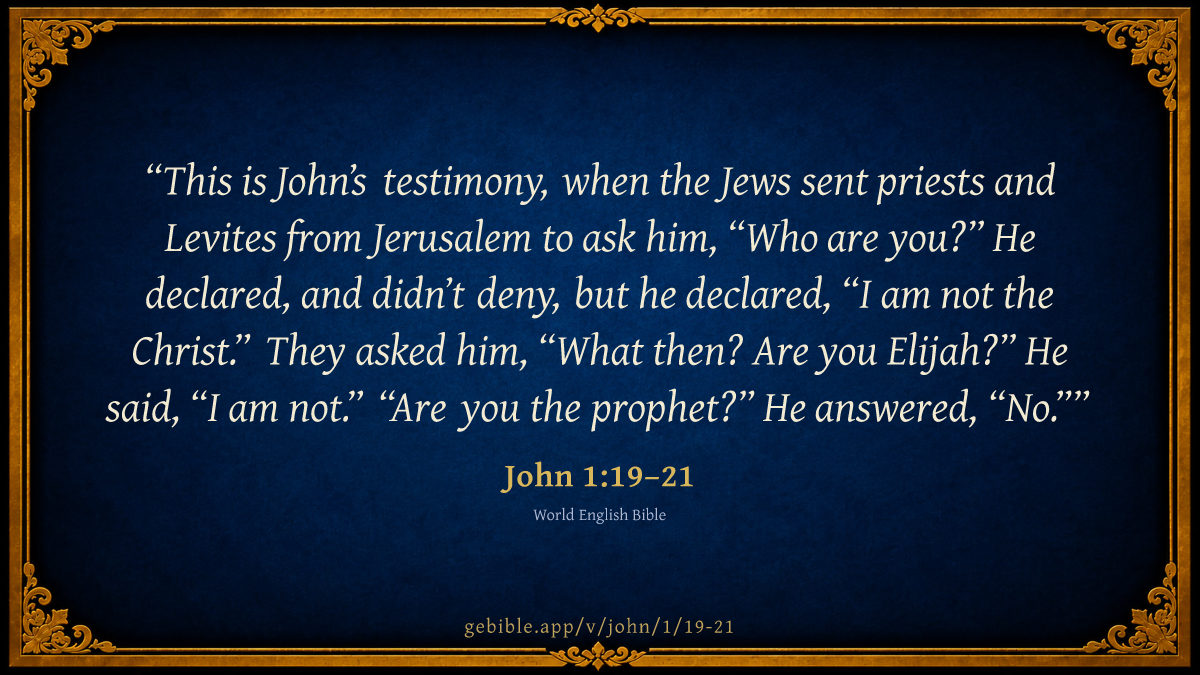
John Calvin 1540 · Public Domain On vv19–21 19. And this is the testimony. Hitherto the Evangelist…
19. And this is the testimony. Hitherto the Evangelist has related the preaching of John about Christ; he now comes down to a more illustrious testimony, which was delivered to the ambassadors of the Priests, that they might convey it to Jerusalem. He says, therefore, that John openly confessed for what purpose he was sent by God. The first inquiry here is, for what purpose the Priests put questions to him. It is generally believed that, out of hatred to Christ, they gave to John an honor which did not belong to him; but this could not be the reason, for Christ was not yet known to them. Others say that they were better pleased with John, because he was of the lineage and order of the priesthood; but neither do I think that this is probable; for since they expected from Christ all prosperity, why did they voluntarily contrive a false Christ? I think, therefore, that there was another reason that induced them. It was now a long time since they had the Prophets; John came suddenly and contrary to expectation; and the minds of all were aroused to expect the Messiah. Besides, all entertained the belief that the coining of the Messiah was at hand.
That they may not appear to be careless about their duty, if they neglect or disguise a matter of so great importance, they ask John, Who art thou? At first, therefore, they did not act from malice, but, on the contrary, actuated by the desire of redemption, they wish to know if John be the Christ, because he begins to change the order which had been customary in the Church. And yet I do not deny that ambition, and a wish to retain their authority, had some influence over them; but nothing certainly was farther from their intention than to transfer the honor of Christ to another. Nor is their conduct in this matter inconsistent with the office which they sustain; for since they held the government of the Church of God, it was their duty to take care that no one rashly obtruded himself, that no founder of a new sect should arise, that the unity of faith should not be broken in the Church, and that none should introduce new and foreign ceremonies. It is evident, therefore, that a report about John was widely spread and aroused the minds of all; and this was arranged by the wonderful Providence of God, that this testimony might be more strikingly complete.
John Calvin's Commentaries (1540-1563) — public domain. Text from the Calvin Translation Society English edition (1840s-50s) via the Christian Classics Ethereal Library (ccel.org). Calvin's coverage is partial (roughly two-thirds of the Bible); uncommented books and verses are honest gaps, never fabricated. The 19th-century editor's footnotes and remarks are omitted so the notes are faithfully Calvin's own voice.
Geneva Bible translators 1599 · Public Domain On vv19–21 John is neither the Messiah, nor like to any…
John is neither the Messiah, nor like to any of the other Prophets, but is the herald of Christ, who is now present.
Geneva Bible (1599) marginal notes — public domain.
John Trapp 1656 · Public Domain On vv19–21 19 And this is the record of John, when…
19 And this is the record of John, when the Jews sent priests and Levites from Jerusalem to ask him, Who art thou?
Ver. 19. Jews sent priests] Whose proper office it was to inquire into new doctrines, and by preserving, to present knowledge to the people, who were to "seek the law at the priest’s mouth," Mal 2:7. Cicero complains of his Roman priests, that they were good honest men, but not very skilful. Bonos illos quidem viros, sed certe non pereruditos. (Cic. xx. de. Fin.) And Varro upbraids them with their ignorance of much about their own gods and religions. (Aug. Civ. Dei. iv. 1.)
John Trapp, A Commentary or Exposition upon All the Books of the Old and New Testament (1647–1656) — public domain. Text from a community e-Sword module.
Matthew Poole 1685 · Public Domain On vv19–21 John’s former testimony was more private to the common…
John’s former testimony was more private to the common people; this testimony was given to a public authority.
The Jews (most probably the rulers of the Jews, who made up their sanhedrim, or great court, answering a parliament with us, for the cognizance of false prophets belonged to them)
Read full note →
sent priests and Levites, which were Pharisees, Joh 1:24, of the strictest sect of the Jews as to rites and ceremonies; these came from Jerusalem, where the sanhedrim constantly sat, and the chief priests were, (if the message were not from the sanhedrim itself), to ask John Baptist who he was; that is, by what authority he preached and baptized? What kind of prophet he was? For they could not but know his name and family, he descending from a priest amongst them: and this appeareth to be their sense from what followeth.
Matthew Poole's English Annotations on the Holy Bible (1683–1685) — public domain. Text from a community e-Sword/MySword module.
William Burkitt 1703 · Public Domain On v19 In these verses we have a second testimony which…
In these verses we have a second testimony which John the Baptist gave of our Saviour Jesus Christ. The Jews sent priests and Levites from Jerusalem, saying, Who art thou? That is, the Sanhedrin, or great council at Jerusalem, to whom it belonged to judge who were true prophets, sent messengers to the Baptist to know, Whether he was the Messiah or not? John refuses to take this honour to himself, but tells them plainly, he was his harbinger and forerunner, and that the Messias himself was just at hand.
From hence note, How very cautious, and exceeding careful, this messenger of Christ was, and all the ministers of Christ ought to be, that they do not assume or arrogate to themselves any part of that honour which is due to Christ; but set the crown of praise upon Christ’s own head, acknowledging him to be all in all. 1Co 3:5 Who is Paul? and who is Apollos? but ministers by whom ye believed?
Read full note →
Observe farther, In this testimony of John the Baptist, these two things:
1. A negative declaration, who he was not; I am not, says he, the Messiah whom ye look for, nor Elias, nor that prophet you expect: not Elias, that is, in your sense, not Elias the Tishbite; not Elias for identity of person, but Elias for similtude of gifts, office, and calling. John came, though not in the person, yet in the power and spirit, of Elias. He denies farther, that he was that prophet: that prophet which Moses spake of, Deu 18:15 nor any of the old prophets risen from the dead; nay, strictly speaking, he was not any prophet at all; but more than a prophet: The Old Testament prophets prophesied of Christ to come; but John pointed at, showed, and declared a Christ already come; and in this sense he was no mere prophet, but more than a prophet.
2. We have here the Baptist’s positive affirmation who he was; namely, Christ’s herald in the wilderness, his usher, his forerunner to prepare the people for receiving of the Messias, and to make them ready for the entertaining of the gospel, by preaching the doctrine of repentance to them.
From hence learn, That the preaching of the doctrine of repentance is indispensably necessary, in order to the preparing of the hearts of sinners for the receiving of Jesus Christ.
Observe lastly, The great and exemplary humility of the holy Baptist, the mean and lowly opinion he had of himself. Although John was the greatest among them that were born of a woman, and so much esteemed by the Jews, and had the honour to go before Christ in the exercise of his office and ministry; yet he judges himself unworthy to carry Christ’s shoes after him: He that cometh after me is preferred before me, whose shoes I am not worthy to unloose.
Learn hence, That the more eminent gifts the ministers of the gospel have, and the more ready men are to honour and esteem them, the more they will abase themselves, if they be truly gracious, and account themselves highly honoured in doing the meanest offices of love and service for Jesus Christ. Thus doth the holy Baptist here: His shoes’ latchet I am not worthy to unloose.
William Burkitt's Expository Notes on the New Testament (1700–1703) — public domain. Text from a community e-Sword module.
Matthew Henry 1710 · Public Domain On v19 We have here the testimony of John, which he…
We have here the testimony of John, which he delivered to the messengers who were sent from Jerusalem to examine him. Observe here,
I. Who they were that sent to him, and who they were that were sent. 1. They that sent to him were the Jews at Jerusalem, the great sanhedrim or high-commission court, which sat at Jerusalem, and was the representative of the Jewish church, who took cognizance of all matters relating to religion. One would think that they who were the fountains of learning, and the guides of the church, should have, by books, understood the times so well as to know that the Messiah was at hand, and therefore should presently have known him that was his forerunner, and readily embraced him; but, instead of this, they sent messengers to cross questions with him. Secular learning, honour, and power, seldom dispose men's minds to the reception of divine light. 2. They that were sent were, (1.) Priests and Levites, probably members of the council, men of learning, gravity, and authority. John Baptist was himself a priest of the seed of Aaron, and therefore it was not fit that he should be examined by any but priests. It was prophesied concerning John's ministry that it should purify the Sons of Levi (Mal 3:3), and therefore they were jealous of him and his reformation. (2.) They were of the Pharisees, proud, self-justiciaries, that thought they needed no repentance, and therefore could not bear one that made it his business to preach repentance.
Read full note →
II. On what errand they were sent; it was to enquire concerning John and his baptism. They did not send for John to them, probably because they feared the people, lest the people where John was should be provoked to rise, or lest the people where they were should be brought acquainted with him; they thought it was good to keep him at a distance. They enquire concerning him, 1. To satisfy their curiosity; as the Athenians enquired concerning Paul's doctrine, for the novelty of it, Act 17:19, Act 17:20. Such a proud conceit they had of themselves that the doctrine of repentance was to them strange doctrine. 2. It was to show their authority. They thought they looked great when they called him to account whom all men counted as a prophet, and arraigned him at their bar. 3. It was with a design to suppress him and silence him if they could find any colour for it; for they were jealous of his growing interest, and his ministry agreed neither with the Mosaic dispensation which they had been long under, nor with the notions they had formed of the Messiah's kingdom.
III. What was the answer he gave them, and his account, both concerning himself and concerning his baptism, in both which he witnessed to Christ.
1. Concerning himself, and what he professed himself to be. They asked him, Su tis ei - Thou, who art thou? John's appearing in the world was surprising. He was in the wilderness till the day of his showing unto Israel. His spirit, his converse, he doctrine, had something in them which commanded and gained respect; but he did not, as seducers do, give out himself to be some great one. He was more industrious to do good than to appear great; and therefore waived saying any thing of himself till he was legally interrogated. Those speak best for Christ that say least of themselves, whose own works praise them, not their own lips. He answers their interrogatory,
(1.) Negatively. He was not that great one whom some took him to be. God's faithful witnesses stand more upon their guard against undue respect than against unjust contempt. Paul writes as warmly against those that overvalued him, and said, I am of Paul, as against those that undervalued him, and said that his bodily presence was weak; and he rent his clothes when he was called a god. [1.] John disowns himself to be the Christ (Joh 1:20): He said, I am not the Christ, who was now expected and waited for. Note, The ministers of Christ must remember that they are not Christ, and therefore must not usurp his powers and prerogatives, nor assume the praises due to him only. They are not Christ, and therefore must not lord it over God's heritage, nor pretend to a dominion over the faith of Christians. They cannot created grace and peace; they cannot enlighten, convert, quicken, comfort; for they are not Christ. Observe how emphatically this is here expressed concerning John: He confessed, and denied not, but confessed; it denotes his vehemence and constancy in making this protestation. Note, Temptations to pride, and assuming that honour to ourselves which does not belong to us, ought to be resisted with a great deal of vigour and earnestness. When John was taken to be the Messiah, he did not connive at it with a Si populus vult decipi, decipiatur - If the people will be deceived, let them; but openly and solemnly, without any ambiguities, confessed, I am not the Christ; hoti ouk eimi egō ho Christos - I am not the Christ, not I; another is at hand, who is he, but I am not. His disowning himself to be the Christ is called his confessing and not denying Christ. Note, Those that humble and abase themselves thereby confess Christ, and give honour to him; but those that will not deny themselves do in effect deny Christ, [2.] He disowns himself to be Elias, Joh 1:21. The Jews expected the person of Elias to return from heaven, and to live among them, and promised themselves great things from it. Hearing of John's character, doctrine, and baptism, and observing that he appeared as one dropped from heaven, in the same part of the country from which Elijah was carried to heaven, it is no wonder that they were ready to take him for this Elijah; but he disowned this honour too. He was indeed prophesied of under the name of Elijah (Mal 4:5), and he came in the spirit and power of Elias (Luk 1:17), and was the Elias that was to come (Mat 11:14); but he was not the person of Elias, not that Elias that went to heaven in the fiery chariot, as he was that met Christ in his transfiguration. He was the Elias that God had promised, not the Elias that they foolishly dreamed of. Elias did come, and they knew him not (Mat 17:12); nor did he make himself known to them as the Elias, because they had promised themselves such an Elias as God never promised them. [3.] He disowns himself to be that prophet, or the prophet. First, He was not that prophet which Moses said the Lord would raise up to them of their brethren, like unto him. If they meant this, they needed not ask that question, for that prophet was no other than the Messiah, and he had said already, I am not the Christ. Secondly, He was not such a prophet as they expected and wished for, who, like Samuel and Elijah, and some other of the prophets, would interpose in public affairs, and rescue them from under the Roman yoke. Thirdly, He was not one of the old prophets raised from the dead, as they expected one to come before Elias, as Elias before the Messiah. Fourthly, Though John was a prophet, yea, more than a prophet, yet he had his revelation, not by dreams and visions, as the Old Testament prophets had theirs; his commission and work were of another nature, and belonged to another dispensation. If John had said that he was Elias, and was a prophet, he might have made his words good; but ministers must, upon all occasions, express themselves with the utmost caution, both that they may not confirm people in any mistakes, and particularly that they may not give occasion to any to think of them above what is meet.
(2.) Affirmatively. The committee that was sent to examine him pressed for a positive answer (Joh 1:22), urging the authority of those that sent them, which they expected he should pay a deference to: "Tell us, What art thou? not that we may believe thee, and be baptized by three, but that we may give an answer to those that sent us, and that it may not be said we were sent on a fool's errand." John was looked upon as a man of sincerity, and therefore they believed he would not give an evasive ambiguous answer; but would be fair and above-board, and give a plain answer to a plain question: What sayest thou of thyself? And he did so, I am the voice of one crying in the wilderness. Observe,
[1.] He gives his answer in the words of scripture, to show that the scripture was fulfilled in him, and that his office was supported by a divine authority. What the scripture saith of the office of the ministry should be often thought of by those of that high calling, who must look upon themselves as that, and that only, which the word of God makes them.
[2.] He gives in his answer in very humble, modest, self-denying expressions. He chooses to apply that scripture to himself which denotes not his dignity, but his duty and dependence, which bespeaks him little: I am the voice, as if he were vox et praeterea nihil - mere voice.
[3.] He gives such an account of himself as might be profitable to them, and might excite and awaken them to hearken to him; for he was the voice (see Isa 40:3), a voice to alarm, an articulate voice to instruct. Ministers are but the voice, the vehicle, by which God is pleased to communicate his mind. What are Paul and Apollos but messengers? Observe, First, He was a human voice. The people were prepared to receive the law by the voice of thunders, and a trumpet exceedingly loud, such as made them tremble; but they were prepared for the gospel by the voice of a man like ourselves, a still small voice, such as that in which God came to Elijah, Kg1 19:12. Secondly, He was the voice of one crying, which denotes, 1. His earnestness and importunity in calling people to repentance; he cried aloud, and did not spare. Ministers must preach as those that are in earnest, and are themselves affected with those things with which they desire to affect others. Those words are not likely to thaw the hearers' hearts that freeze between the speaker's lips. 2. His open publication of the doctrine he preached; he was the voice of one crying, that all manner of persons might hear and take notice. Doth not wisdom cry? Pro 8:1. Thirdly, It was in the wilderness that this voice was crying; in a place of silence and solitude, out of the noise of the world and the hurry of its business; the more retired we are from the tumult of secular affairs the better prepared we are to hear from God. Fourthly, That which he cried was, Make straight the way of the Lord; that is, 1. He came to rectify the mistakes of people concerning the ways of God; it is certain that they are right ways, but the scribes and Pharisees, with their corrupt glosses upon the law, had made them crooked. Now John Baptist calls people to return to the original rule. 2. He came to prepare and dispose people for the reception and entertainment of Christ and his gospel. It is an allusion to the harbingers of a prince or great man, that cry, Make room. Note, When God is coming towards us, we must prepare to meet him, and let the word of the Lord have free course. See Psa 24:7.
2. Here is his testimony concerning his baptism.
(1.) The enquiry which the committee made about it: Why baptizest thou, if thou be not the Christ, nor Elias, nor that prophet? Joh 1:25. [1.] They readily apprehended baptism to be fitly and properly used as a sacred rite or ceremony, for the Jewish church had used it with circumcision in the admission of proselytes, to signify the cleansing of them from the pollutions of their former state. That sign was made use of in the Christian church, that it might be the more passable. Christ did not affect novelty, nor should his ministers. [2.] They expected it would be used in the days of the Messiah, because it was promised that then there should be a fountain opened (Zac 13:1), and clean water sprinkled, Eze 36:25. It is taken for granted that Christ, and Elias, and that prophet, would baptize, when they came to purify a polluted world. Divine justice drowned the old world in its filth, but divine grace has provided for the cleansing of this new world from its filth. [3.] They would therefore know by what authority John baptized. His denying himself to be Elias, or that prophet, subjected him to this further question, Why baptizest thou? Note, It is no new thing for a man's modesty to be turned against him, and improved to his prejudice; but it is better that men should take advantage of our low thoughts of ourselves, to trample upon us, than the devil take advantage of our high thoughts of ourselves, to tempt us to pride and draw us into his condemnation.
(2.) The account he gave of it, Joh 1:26, Joh 1:27.
[1.] He owned himself to be only the minister of the outward sign: "I baptize with water, and that is all; I am no more, and do no more, than what you see; I have no other title than John the Baptist; I cannot confer the spiritual grace signified by it." Paul was in care that none should think of him above what they saw him to be (Co2 12:6); so was John Baptist. Ministers must not set up for masters.
[2.] He directed them to one who was greater than himself, and would do that for them, if they pleased, which he could not do: "I baptize with water, and that is the utmost of my commission; I have nothing to do but by this to lead you to one that comes after me, and consign you to him." Note, The great business of Christ's ministers is to direct all people to him; we preach not ourselves, but Christ Jesus the Lord. John gave the same account to this committee that he had given to the people (Joh 1:15): This as he of whom I spoke. John was constant and uniform in his testimony, not as a reed shaken with the wind. The sanhedrim were jealous of his interest in the people, but he is not afraid to tell them that there is one at the door that will go beyond him. First, He tells them of Christ's presence among them now at this time: There stands one among you, at this time, whom you know not. Christ stood among the common people, and was as one of them. Note, 1. Much true worth lies hid in this world; obscurity is often the lot of real excellency. Saints are God's hidden ones, therefore the world knows them not. 2. God himself is often nearer to us than we are aware of. The Lord is in this place, and I knew it not. They were gazing, in expectation of the messiah: Lo he is here, or he is there, when the kingdom of God was abroad and already among them, Luk 17:21. Secondly, He tells them of Christ's preference above himself: He comes after me, and yet is preferred before me. This he had said before; he adds here, "Whose shoe-latchet I am not worthy to loose; I am not fit to be named the same day with him; it is an honour too great for me to pretend to be in the meanest office about him," Sa1 25:41. Those to whom Christ is precious reckon his service, even the most despised instances of it, an honour to them. See Psa 84:10. If so great a man as John accounted himself unworthy of the honour of being near Christ, how unworthy then should we account ourselves! Now, one would think, these chief priests and Pharisees, upon this intimation given concerning the approach of the Messiah, should presently have asked who, and where, this excellent person was; and who more likely to tell them than he who had given them this general notice? No, they did not think this any part of their business or concern; they came to molest John, not to receive any instructions from him: so that their ignorance was wilful; they might have known Christ, and would not.
Lastly, Notice is taken of the place where all this was done: In Bethabara beyond Jordan, Joh 1:28. Bethabara signifies the house of passage; some think it was the very place where Israel passed over Jordan into the land of promise under the conduct of Joshua; there was opened the way into the gospel state by Jesus Christ. It was at a great distance from Jerusalem, beyond Jordan; probably because what he did there would be least offensive to the government. Amos must go prophesy in the country, not near the court; but it was sad that Jerusalem should put so far from her the things that belonged to her peace. He made this confession in the same place where he was baptizing, that all those who attended his baptism might be witnesses of it, and none might say that they knew not what to make of him.
Matthew Henry's Commentary on the Whole Bible (1708–1710) — public domain (CC PDM 1.0). Text via the HelloAO Bible API.
John Gill 1763 · Public Domain On vv19–21 And this is the record of John,.... The evangelist…
And this is the record of John,.... The evangelist proceeds to give a large, and full account of the testimony John the Baptist bore to Christ, which he had hinted at before, and had signified was his work, and office, and the end of his being sent,
When the Jews sent priests and Levites from Jerusalem, to ask him, who art thou? The Jews that sent were the great sanhedrim that sat at Jerusalem, whose business it was to inquire into, examine, and try prophets, whether true or false (p); and John appearing as a prophet, and being so esteemed by the people, they deputed messengers to him to interrogate him, and know who he was. The persons sent were very likely of their own body, since priests and Levites were in that council. For it is said (q),
Read full note →
"they do not constitute, or appoint in the sanhedrim but priests, Levites, and Israelites, who have their genealogies---and it is commanded, that there should be in the great sanhedrim priests and Levites, as it is said, Deu 17:9 "and thou shalt come unto the priests, the Levites", &c. and if they are not to be found, though they are all Israelites, (not of the tribe of Levi,) it is right.
Such a sanhedrim is a lawful one; but priests and Levites, if such could be found, that had proper qualifications, were to be admitted in the first place. A message from so august an assembly, at so great a distance, (for Jordan was a day's journey distant from Jerusalem (r); according to Josephus (s), it was 210 furlongs, or 26 miles and a quarter,) and by the hands of persons of such character and figure, was doing John a great deal of honour, and serves to make his testimony of Christ the more public and remarkable; and it also shows what a noise John's ministry and baptism made among the Jews, that it even reached Jerusalem, and the great council of the nation; and likewise the question put to him, which by John's answer seems to intimate as if it was thought he was the Messiah, shows the opinion that was entertained of him, and even the sanhedrim might not be without thoughts this way: and the question they put by their messengers might not be, as some have thought, to ensnare John, nor out of disrespect to Jesus, who, as yet, was not made manifest; but might be in good earnest, having, from many circumstances, reason to think there might be something in the people's opinion of him; since, though the government was not wholly departed from Judah, yet they could not but observe it was going away apace, an Idumean having been upon the throne for some years, placed there by the Roman senate; and now the government was divided among his sons by the same order; Daniel's weeks they could not but see were just accomplishing; and besides, from the uncommon appearance John made, the austerity of his life; the doctrine of remission of sins he preached, and the new ordinance of baptism he administered, they might be ready to conclude he was the person,
(p) Misn. Sanhedrin, c. 1. sect. 5. (q) Maimon. Hilch. Sanhedrin, c. 2. sect. 1, 2. (r) Misna Maaser Sheni, c. 5. sect. 2. Juchasin, fol. 65. 2. Jarchi in Isa. xxiv. 16. (s) De Bello Jud. l. 5. c. 4.
John Gill's Exposition of the Whole Bible (1746–1763) — public domain (CC PDM 1.0). Text via the HelloAO Bible API.
John Wesley 1765 · Public Domain On vv19–21 The Jews - Probably the great council sent.
The Jews - Probably the great council sent.
John Wesley, Explanatory Notes Upon the Whole Bible (1754–1765) — public domain. Text via the GEBible commentary corpus.
Adam Clarke 1810 · Public Domain On vv19–21 Verse 19. And this is the record of John]…
Verse 19. And this is the record of John] He persisted in this assertion, testifying to the Jews that this Jesus was THE CHRIST.
Adam Clarke's Commentary on the Bible (1810–1826) — public domain. Text from a community e-Sword/MySword module.
Joseph Benson 1811 · Public Domain On v19 Joh 1:19-23. And this is the record of John…
Joh 1:19-23. And this is the record of John — This is the testimony which he bare publicly to Jesus; when the Jews — Namely, the senate, or great council of the nation; sent priests and Levites from Jerusalem — Persons of the first consideration for learning and office; to ask him, Who art thou — What character dost thou assume to thyself? It is probable, that the reason why the sanhedrim sent these persons, was their having been informed that the Baptist’s extraordinary sanctity, zeal, and powerful preaching, together with the solemnity of his baptizing, had made such an impression on the people, that they were beginning to think he might be the Messiah. These rulers therefore judged it proper to send persons thus to examine him, because it belonged to them to take cognizance of all matters relating to religion, and especially to judge who were true prophets. And as they were evidently jealous of his increasing popularity, they probably hoped to find in his answers to their questions some pretence for taking measures to silence him, especially as they understood his ministry neither agreed with the Mosaic dispensation which they had been long under, nor with the notions they had formed of the Messiah’s kingdom. And he confessed, and denied not, &c. — John, according to the natural plainness of his temper, presently replied to their inquiry; I am not the Christ — As if he had said, I know that the people begin to look on me as their long- expected deliverer, but I tell you plainly, they are mistaken: nor do I in the least pretend to arrogate to myself the honours which are due to none but him. And they asked him, What then? Art thou Elias — Art thou the Prophet Elijah, who, as the Scriptures tell us, is to arise from the dead, and to appear before the coming of the Messiah? And he saith, I am not — There was here an apparent contradiction to the words of our Lord concerning John, (Mat 11:14,) This is Elias which was to come. But Jesus, in these words, evidently refers to the prophecy of Mal 4:5; his purpose being to inform his disciples that John was Elijah in the sense of that prophet, and that his prediction was accomplished in the Baptist, inasmuch as he came in the spirit and power of Elijah. But when the question was here proposed to John, the laws of truth required that he should answer it as he did, namely, according to the sense wherein the words were used by the proposers, who expected that the very Prophet Elijah would come in person before the Messiah should appear: a notion which they entertained very early, as is evident from the Septuagint translation of the passage just referred to in Malachi, ιδου εγω αποστελλω υμιν Ηλιαν τον θεσβιτην, literally, Behold, I send you Elias the Tishbite before the day of the Lord come. Therefore the Baptist, on being asked if he was Elias, could not answer otherwise than in the negative, without rendering himself liable to the charge of equivocating. For though the name of Elias did truly belong to the forerunner of the Messiah, Malachi having called him so, John was not the person whom the people expected, and the priests meant, when they asked him, Art thou Elias? He was not that individual prophet returned from heaven to sojourn again upon the earth. It is justly observed by Grotius here, that the persons who made this inquiry show that they were ignorant of the parentage of John the Baptist, or that they were in doubt concerning it; Art thou that prophet — Whom Moses has assured us God will raise up, and of whom we are daily in expectation? (Joh 6:14 :) or their meaning may have been, Art thou Jeremiah, or any other of the old prophets raised from the dead? for it appears from Mat 16:14, that they thought the Messiah would be preceded by some such extraordinary personage. And he answered, No — He was a prophet, but not one of the old prophets raised from the dead, nor had he his revelations by dreams and visions, as the Old Testament prophets had theirs; his commission and work were of another nature, and belonged to another dispensation. Then said they, Who art thou? that we may give an answer, &c. — We are sent by the supreme council, who have a right to judge persons pretending a commission from God, as thou seemest to do by baptizing and gathering disciples. It becomes thee, therefore, to give an account of thyself to us, that we may lay it before them who have sent us. And he said, I am the voice of one crying in the wilderness — John, instead of giving a description of his own character and office, refers those who questioned him to the words of the Prophet Isaiah, in which they would find it; and what he here says of himself, is to be understood no otherwise than we understand what Matthew says of him, (Mat 3:3,) where see the note. He says, in effect, I am that forerunner of Christ of whom Isaiah speaks, Isa 40:3. Archbishop Fenelon beautifully illustrates the humility of this reply: as if this illustrious prophet had said, “Far from being the Messiah, or Elias, or one of the old prophets, I am nothing but a voice; a sound, that as soon as it has expressed the thought, of which it is the sign, dies into air, and is known no more.” Dr. Campbell renders the clause, I am he whose voice proclaimeth in the wilderness, &c.; observing that, in such declarations, the general purport is alone regarded by the speaker, and that the words, therefore, ought not to be interpreted too grammatically; interpretations to be formed from the manifest scope, and not from the syntactic structure of sentences, being not unfrequent in Scripture. Thus, Rev 1:12, Επεστραψα βλεπειν την φωνην, literally, I turned to see the voice.
Joseph Benson's Commentary on the Old and New Testaments (1811–1818) — public domain. Text from a community e-Sword module.
Albert Barnes 1834 · Public Domain On vv19–21 This is the record - The word “record” here…
This is the record - The word “record” here means “testimony,” in whatever way given. The word “record” now commonly refers to “written” evidence. This is not its meaning here. John’s testimony was given without writing.
When the Jews sent - John’s fame was great. See Mat 3:5. It spread from the region of Galilee to Jerusalem, and the nation seemed to suppose, from the character of his preaching, that he was the Messiah, Luk 3:15. The great council of the nation, or the Sanhedrin, had, among other things, the charge of religion. They felt it to be their duty, therefore, to inquire into the character and claims of John, and to learn whether he was the Messiah. It is not improbable that they wished that he might be the long-expected Christ, and were prepared to regard him as such.
Read full note →
When the Jews sent priests and Levites - See the notes at Luk 10:31-32. These were probably members of the Sanhedrin.
Albert Barnes' Notes on the Bible (1834–1885) — public domain. Text from a community e-Sword/MySword module.
Haydock's Catholic Bible Commentary 1859 · Public Domain On v19 The Jews sent, &c. These men, who were priests…
The Jews sent, &c. These men, who were priests and Levites, seem to have been sent and deputed by the sanhedrim, or great council at Jerusalem, to ask of John the Baptist, who was then in great esteem and veneration, whether he was not their Messias; who, as they knew by the predictions of the prophets, was to come about that time. John declared to them he was not. To their next question, if he was not Elias? He answered: he was not: because in person he was not; though our Saviour (Matthew xi. 14.) says he was Elias: to wit, in spirit and office only. Their third question was, if he was a prophet? He answered, no. Yet Christ (Matthew xi.) tells us, he was a prophet, and more than a prophet. In the ordinary acceptation only, they were called prophets who foretold things to come: John then, with truth, as well as humility, could say he was not a prophet; not being sent to foretell the coming of the Messias, but to point him out as already come, and present with the Jews. (Witham)
George Leo Haydock (1774–1849), Haydock's Catholic Family Bible and Commentary, 1859 edition — public domain. Excludes Psalms (Douay-Rheims chapter numbering differs from Protestant) and Deuterocanonical books (Catholic canon only).
Lange's Commentary on the Holy Scriptures 1864 · Public Domain On v19 Joh_1:19 to Joh_20:31
II
THE GOSPEL OF THE HISTORICAL MANIFESTATION OF CHRIST, ON HIS SELF-REVELATION AND HIS VICTORY IN CONFLICT WITH THE DARKNESS OF THE WORLD
Read full note →
Joh_1:19 to Joh_20:31
FIRST SECTION
The Reception which Christ, the Light of the World, finds in His Life of Love among the men akin to the Light, the Elect
Joh_1:19 to Joh_4:54
I.
John the Baptist, and his public and repeated Testimony concerning Christ. Jesus accredited as the Christ, attested the Son of God, the eternal Lord, and the Lamb of God.
Joh_1:19-34
(Joh_1:19-28 : Pericope for the 4th Sunday in Advent.)
(1) Testimony Of John The Baptist Before The Rulers Of The Jews. Jesus The Messiah Coming After The Baptist, The Eternal Pre-historical And Super-historical Lord Before Him
19And this is the record [testimony] of John, when the Jews sent [to him]122 priests and Levites from Jerusalem, to ask him, Who art thou? 20And he confessed, and denied not; but [and he] confessed, I am not [Not I am]123 the Christ. 21And they asked him, What then? Art thou Elias [Elijah]? And he saith, I am not. Art 22thou that prophet? And he answered, No. Then124 [in official demand] said they unto him, Who art thou? that we may give an answer to them that sent us. What sayest thou of thyself? 23He said, I am the voice of one crying in the wilderness, Make straight the way of the Lord, as said [Isaiah] the prophet Esaias [ch. John 40:3]. 24And they125 which were sent were of the Pharisees [And they had been sent by the Pharisees]. 25And they asked him, and said unto him, Why baptizest thou then, if thou be not that [the] Christ, nor Elias [Elijah], neither126 that [the] prophet? 26John answered them, saying, I baptize with [in] water; but there standeth one among you [in the midst of you there standeth one], whom ye know not: 27he it is127 [This is he] who coming after me, is preferred [taketh place, or, hath come to be] before me, whose shoe's latchet I am not worthy to unloose. 28These things were done in Bethabara [Bethany]128 beyond Jordan, where John was baptizing.
(2) testimony of the baptist before his disciplines, the historical lamb of god; upon him the dove
29The next day John [he]129 seeth Jesus coming unto him, and saith, Behold the Lamb of God, which taketh away [taketh away by bearing, or, beareth away]130 the sin of the world! 30This is he of whom I said, After me cometh a man which [who] is preferred [taketh place, or, hath come to be] before me; for he was before me. 31And I knew him not; but that he should be made manifest to Israel, therefore am I come 32[for this cause came I] baptizing with [in] water.131 And John bare record [witness], saying, I saw the Spirit descending from heaven like132 a dove, and it abode upon him. 33And I knew him not: but he that sent me to baptize with [in] water, the same said unto me, Upon whom thou shalt see the Spirit descending and remaining [abiding] on him, the same is he which [who] baptizeth with [in] the Holy Ghost [Spirit]. 34And I saw [have seen, ἑὠραχα,] and bare record [have borne witness, μεμαρτύρηχα] that this is the Son of God.
EXEGETICAL AND CRITICAL
[Now follows the historical narrative. The testimony of John the Baptist, and the call of the first disciples form the historical introduction or the portico of the public life of Christ. John omits the birth, early history and discourses of the Baptist, as being sufficiently known from the Synoptists, and confines himself to his testimony after the baptism (alluded to as a past fact in Joh_1:33-34) and the temptation of Christ in the wilderness, when He stood already in the midst of the Jews (Joh_1:26). The testimony is threefold, 1) before the deputies of the Sanhedrin from Jerusalem (19–28); 3) a day afterwards, before a larger public and His disciples, as it would seem (29–34); 3) again a day afterwards, before two of His disciples, who now joined Jesus (35–37).—The examination of John the Baptist by the official messengers of the Sanhedrin, who had the supervision of the public teaching of religion among the Jews (Mat_21:23), displays the prevalence and confusion of the Messianic expectations, and the hostility of the leaders of the hierarchy to the approaching new dispensation. The five questions of the priests represent a descending climax (the Messiah; Elijah; an anonymous prophet; why baptizest thou?); the short, laconic answers of the Baptist, in striking contrast, are rising from negation to affirmation, and turn the attention away from himself and towards Christ.—P. S.]
Joh_1:19. And this is.—The gospel history itself begins with the testimony of John the Baptist. Comp. Matthew 3; Mark 1; Luke 3. The question is whether the same testimony is meant here, as in Joh_1:15. Origen supposed this to be another testimony; Meyer thinks it the same. Evidently in Joh_1:15 a general testimony, with μαρτυρεῖ, is distinguished from a special, καὶ κέκραγε. This most public testimony concerning Jesus before the rulers is undoubtedly meant here. It is a definite pointing of the rulers of the Jews to the person of the Messiah, not related so distinctly by the Synoptists, but of the highest importance for the history of the temptation. This: αὕτη, the following [it is the predicate, ἡ μαρτυρία the subject. A verbal testimony is meant. Record now refers to written evidence.—P. S.]. "Οτε points also to a particular event, which took place at a particular time. That this event must have followed the baptism of Jesus is clear;133 because, according to Joh_1:31-33, it was that which gave the Baptist himself his first certainty respecting the person of Jesus; and this certainty he expresses here, Joh_1:26-27. Likewise Joh_1:29. Olshausen, Baumgarten-Crusius, and others, place the baptism between the two testimonies, Joh_1:19 and Joh_1:29; Ewald, between Joh_1:31 and Joh_1:32; all against the testimony of the section before us. That John knew of the existence of the Messiah earlier, and with human reverence presumed that he found Him in the person of Jesus, Mat_3:14, is not inconsistent with his still needing a divine attestation. As regards the history of the temptation, its termination coincides with the present testimony; for Jesus, the next day, comes again behind the Baptist, and soon afterwards (not forty days after) returns to Galilee.
When the Jews from Jerusalem.—[The Synoptists, who wrote before the destruction of Jerusalem, seldom use the term Jews as distinct from Christians (Matthew five times, Mark seven times, Luke five times); John, who wrote after the destruction of Jerusalem and after the final separation of the Synagogue from the Christian church, uses it very often (over seventy times in the Gospel and twice in the Apoc.).—P. S.] Ἰουδαῖοι, probably as yet primarily in the neutral sense, though already conceived as about to become a hostile body, on the way to apostasy from true Judaism in opposition to the Messiah. The conception is the historical one of the Jews as the theocratic people, as in Joh_2:13; Joh_3:1; Joh_5:1, then branching into a friendly one (Joh_4:22; Joh_18:33) and a hostile (Joh_5:10; Joh_7:1; Joh_8:31; Joh_10:24, etc.), which in the sequel prevails. In the latter sense the term therefore denotes the Jews as Judaists. Meyer therefore is not perfectly accurate when he says: “John, in his writing, lets the Jews, as the old communion, from which the Christian has already entirely withdrawn, appear steadily in a hostile position to the Lord and His work, the ancient theocratic people as an opposition party to the church of God and its Head.” The Jews do certainly appear in this character predominantly in John, and with good reason Meyer observes that this can furnish no argument, against the genuineness of His Gospel (against Fischer and Hilgenfeld). The expression, The Jews, as he also remarks, varies according to the context; here it is the Jews from Jerusalem, the Sanhedrin.
Priests and Levites.—[The two classes of persons employed about the temple service, Jos_3:3. In the wider sense, Levites designates the descendants of Levi; in a narrower sense, as here, the subordinate officers of the Jewish hierarchy, as distinct from the priests of the family of Aaron.—P. S.] The Levites as an attendant body were designed, under certain circumstances, to arrest the Baptist, and at any rate to add state as a convoy of police, or to enhance the official dignity of the priests. It is a touch of historical accuracy.
Who art thou?—i.e., in thy official, theocratic character. That they supposed He might lay claim to the Messiahship, is evident from the answer of John. They had official right, according to Deu_18:21, to inquire into his character and his credentials as a prophet. They had occasion to do so in his baptism (Joh_1:25), not only because the baptism connected itself with the kingdom of Messiah (Eze_36:25; Eze_37:23; Zec_13:1), but also because the baptism was a declaration concerning the whole congregation of the people, that it was unclean (Hag_2:14), which could easily offend the pride of the Pharisees. Besides, the people were already inclined to take him for the Messiah, Luk_3:15. According to Joh_1:24, the delegates were of the party of the Pharisees. These had probably moved in the Sanhedrin, that the deputation be sent, because the Messianic question was of much more importance to them than to the Sadducees, and because they, with their sensuous Messianic hopes, took the matter of the credentials of the Messiah more strictly in their more external sense.
Joh_1:20. And he confessed, and denied not.—Should this mean only; He denied not his own real character? he confessed in this matter the truth? The double expression, positive and negative, would be rather strong for this. The question of the Sanhedrin set before him the temptation to declare himself the Christ. But in so doing he would have denied the Christ whom he already knew, and denied his own better, prophetic knowledge. We suppose, therefore, that his confessing and not denying in regard to himself imply at the same time his confessing and not denying in regard to Christ. This is indicated also by the emphatic order of the words: ἐγὼ οὐκ εἰμί, which is supported by the best authorities as against οὐκ εἰμὶ ἑγώ. Meyer: “I for my part,” implying that he knows another, who is the Messiah.—The reserve of the Baptist towards the deputation shows the mighty prophet, who understood them. He leaves each successive development of his deposition to be drawn from him, till the moment for his testimony arrives. This mysterious bearing is no doubt intended also to humble and press the self-conceited spirit.
Joh_1:21. What then? Art thou Elijah?—The question is a half inference. He who comes with such pretensions must be, if not the Messiah Himself, at least the Elijah who precedes Him. They refer to the Messianic prophecy, Mal_4:5. The pure sense of this prophecy, that an ideal Elijah should precede the Messiah, which John actually was (Luk_1:17; Mat_11:14; Mat_17:10), had early become corrupted among the Jews, as is shown by the very translation of the passage in the Septuagint. Ἠλίαν τὸνθεσβίτην(Elijah the Tishbite).134 Thus these messengers understood the word entirely in a superstitious sense, taking it literally for the actual Elijah. Hence John answers categorically: I am not [not the Tishbite, whom you mean.]135 But he adds no explanation; for this would have involved him in an exegetical controversy, and turned him from his main object, which was to testify of Christ.
Art thou the prophet?—The next question in the spirit of their theology; hence occurring immediately. The prophet, with the article; the well-known prophet; a personage in their Messianic theology presumed to be familiar. According to Chrysostom [Bengel], Lücke, Bleek, Meyer, [Alford], the prophet meant would be the one spoken of in Deu_18:15;136 but this we must certainly, with Hengstenberg and Tholuck, deny, for this prophecy was at least in Act_3:22; Act_7:37 referred to the Messiah. It is a question whether the passages, Joh_6:14; Joh_7:40, refer to the passage in Deuteronomy. From Mat_16:14 it is sufficiently evident that an expectation of Jeremiah137 or some one of the prophets as the forerunner of the Messiah was cherished. Probably this expectation was connected with the doctrine of the woes of the Messiah, that is, with what was known of the suffering Messiah, The wailing Jeremiah, or one of the later prophets of affliction, seemed better fitted for the fore-runner of the suffering Messiah, than the stern, judicial Elijah. The gradual shaping of this expectation of Jeremiah as a guardian angel in the theocratic day of suffering, appears in 2Ma_2:7; 2Ma_15:13. This particular prophet, therefore, is meant, who should complete the forerunning office of Elijah, and probably precede him. This expectation also was here literally and superstitiously taken. Hence again: No!—the short answer οὔ Luthardt quite falsely refers to the prophets in the second part of Isaiah (c. 40.). Against this see Meyer [p. 101, note].
Joh_1:22. Then said they unto him, Who art thou?—Now they come out with the categorical official demand of an explanation. Yet we must notice that they do not yet say: Thou art unauthorized. They distinguish the prophetic appearance of the Baptist in general from his baptism. They wished primarily that he should explain himself concerning his prophetic mission. [Alford: “They ever ask about his person: he ever refers them to his office. He is no one—a voice merely: it is the work of God, the testimony to Christ, which is every thing. So the formalist ever in the church asks, Who is he? while the witness for Christ only exalts, only cares for Christ’s work.”—P. S.]
Joh_1:23. I am the voice of one crying.—Isa_40:3. As Christ, when He calls Himself the Son of Man, applied to Himself as Messiah a passage of prophecy which had been unnoticed and obscured by the Jewish Messianic theology, Dan_7:13, so did the Baptist when he called himself the voice of one crying in the wilderness. By this the same subject was meant, as by the Elijah of Malachi, but the passage had not been corrupted by a carnal interpretation, and was perfectly fitted to denote the unassuming spirit of the Baptist, who would be wholly absorbed in his mission to be a herald of the coming Messiah. The quotation is after the Septuagint, except εὐθύνατε instead of ἐτοιμάσατε. It appears from this passage that the Synoptists (Mat_3:3), following John’s own declaration respecting himself, have applied that passage of the prophet in its direct intent to him.
Joh_1:24. Were of the Pharisees.—This conveys primarily the explanation that they did not understand a Scripture for which they had no distinct exegetical tradition; at least they knew not how to apply the passage cited to John. Then, that they were disposed to allow the right to baptize only to one of the three persons named: the Messiah Himself and His two fore-runners. Baptism was the symbol of the purification which should precede the Messianic kingdom. The tract Kiddushin says (see Tholuck): “Elijah comes, and will declare clean and unclean.”
Joh_1:26. I baptize in water.—In this answer Heracleon, and Lücke and De Wette after him, have missed the striking point. According to Meyer, John now explains himself more particularly respecting what he has said. To the question: Why baptizest thou? he answers: I baptize only with water; the baptism of the spirit is reserved to the Messiah. To the reminder: Thou art not the Messiah, etc., he answers: The Messiah is already in the midst of you, therefore is this baptism needful. The matter resolves itself simply into John’s declaration: The Messiah is the proper Baptist of the prophets; and his implied assertion: Your interpretation of Eze_36:25 is false. But because this true Baptist is here, I with my water-baptism prepare for His baptizing with the Spirit. It is at the same time implied that it is rather the Messiah who accredits him, than he the Messiah. In water. See Mat_3:11.
But there standeth one among you.—If the ἔαὐτός ἐστιν and the ὅς ̓́μπροσθέν μου γέγονεν be omitted, as they are in Codd. B. C. L., the clause would proceed: One whom ye know not, cometh after me, etc. We retain these words, which are doubted by Tholuck and Meyer; because John in Joh_1:15 has noted this formula as the most public testimony of the Baptist.—Whom ye know not.—A reproof: Ye ought to have known him already: a hint: Ye must now learn to know him. The words: Standeth, or hath come, among you can hardly refer only to the birth of Jesus in Bethlehem and His obscurity in Nazareth. They look to the baptism of Christ as the beginning of His public appearance. The objections of Baur and Baümlein to this are groundless.
Joh_1:27. He it is, who coming after me [behind me].—See Joh_1:15.—Whose shoe’s string, etc. [In the East, people wore only sandals, or the soles of a shoe, bound fast to the foot by strings]. See Mat_3:11. That is: Whom I am not worthy to serve as a slave. It is a parallel, or a concrete form, of the expression, Joh_1:15 : on ὅτι πρῶτός μον ἦν.
Joh_1:28. In Bethabara beyond Jordan.—Rather Bethany, see the Textual Notes. But not the Bethany on the Mount of Olives, Joh_11:18. The place seems to have been a ford on the further side of the Jordan in Peræa, not otherwise known under this name of Bethany. Origen explored that region, and found a Bethabara (see Jdg_7:24) about opposite Jericho. The conjecture of Possinus and Hug, that the name בֵּית אֲנִיָה, domus navis, expresses the same as בֵּית עֲבָרָה, domus transitus (ford-house), is not invalidated by the suggestion (of Meyer) that this etymology does not suit Bethany on the Mount of Olives; for the name of Bethany might have arisen in different ways. Bolten and Paulus, by a period after ἐγένετο, made out the Bethany on the Mount of Olives; Kuinoel made the “beyond,” this side; Baur invented the fiction that the author would make Jesus begin, as well as finish His ministry in Bethany.—The statement that the deputation received their answer from the Baptist at Bethany, beyond Jordan, leads to the inference that on their return through the wilderness they already came unintentionally into the neighborhood of Jesus at Jericho.
Joh_1:29. The next day John seeth Jesus coming unto him.—The Evangelist finds the days now following so important that he enumerates them in order; the first, Joh_1:29; the second, Joh_1:35; the third, Joh_1:43. Hereupon Luthardt observes, p. John 76: The Evangelist begins and closes with a week; on the third day those disciples come to him, on the fourth Simon, and on the fifth Philip and Nathanael join the others, on the sixth Jesus is journeying with His disciples, on the seventh in Cana. If this exact reckoning of a week were designed (so that Jesus, according to Luthardt, would, as it were, keep a Sabbath in Cana), the fourth day would have to be made distinct, and the third (John 2) marked as the seventh. It is much more natural to let the three days come so that the calling of Peter falls late in the evening of the day of Joh_1:35. The third day (Joh_2:1) is, according to Origen, Baur and Meyer, the third from the day of Joh_1:43. Baur gives as a reason for this (which is a change from a former view of his) a silly fancy, that the six days should correspond to the six water-pots in John 2. Meyer better: If it were the third day from that of Joh_1:35, or the day following that of Joh_1:43, we should have τῇ ἐπαύριον again. Against his longer reckoning (Joh_2:1 : the third day from that of Joh_1:43) we must, however, observe that the proper starting-point of the reckoning thus far is still the day of the accrediting of Jesus as the Messiah on the part of John. It is important to the Evangelist to set forth what a life from day to day was then begun. On the first day, the pointing of the disciples to Jesus; on the next, three or four disciples gained; on the clay after, two more. If now we suppose that the third day is the same with the ἐπαύριον of Joh_1:43, or is reckoned from the accrediting of Jesus, Joh_1:19, this explains the fact that the marriage-feast had already continued nearly three days when Jesus arrived, and that the wine was exhausted. The line between the day in the wilderness and the day of Joh_1:43 still remains somewhat uncertain.—Our first date, Joh_1:29, denotes the day after that declaration of the Baptist to the deputation from Jerusalem, not one of the days following. Jesus returns from the temptation. The reason why He returns to John is not given; yet it is at hand. John must know that Jesus intended to disappoint the chiliastic Messianic hopes of the Jews. He must also bear witness of the course which Jesus intended to take; he must be guarded to the utmost against the vexation of imagining that Jesus would adopt a different course from what he might have expected in the Messiah accredited by him. And then this also was what led to John’s transfer of his disciples to the discipleship of Jesus, though the outward attachment of the Baptist himself to Jesus was not to be expected.
Behold the Lamb of God.—The Baptist knew from three sources the appointment of the Messiah to suffering: (1) The experience of suffering by the pious, especially the prophets, as well as the import of the sacrificial types and the prophecies of the suffering Messiah. (2) The baptism of Christ, which indicated to him that Christ must bow under the servant-form of sinners, or which was an omen of His suffering, see Mat_3:14. (3) A decisive point, which has not been noticed: The Baptist has directed the deputation from Jerusalem to the Messiah, who was in the vicinity. He may therefore suppose that they have come to know him, And now he sees Christ coming back from the wilderness, alone, in earnest, solemn mood, with the expression of separation from the world. He could not have been a man of the Spirit, without having perceived in the Spirit that an adversity, or a sacrificial suffering of premonitory conflict, had taken place. This accounts also for his first exclamation being: Behold the Lamb of God!—and the supposition that the Evangelist has put his own knowledge into the mouth of the Baptist (Strauss, Weisse), loses all support. That the subsequent human wavering of the Baptist, Mat_11:3, is not inconsistent with his present divine enlightenment and inspiration, needs no explanation; the opposition between the divine and human elements is nowhere entirely transcended in the Old Testament prophets. And Mat_11:3 itself proves that John had till then depended with assurance upon Christ, and even then could not give Him up under temptation. The Baptist, says Meyer in explanation, had not a sudden flash of natural light, or a rising conviction, but a revelation. But sudden flashes produced by rising convictions can hardly be separated from revelations, unless we conceive the latter as immediate, magical effects. With a natural light we have nothing to do.
Now comes the question: What is meant by the Lamb of God? By the article it is designated as appointed, by the genitive as belonging to God, appointed for Him for a sacrifice. Isaiah 53.; Rev_5:6; Rev_13:8. The phrase implies also, selected by God. The question arises, however, whether the expression is to be referred to the paschal lamb (with Grotius, Lampe, Hofmann, Luthardt [Bengel, Olshausen, Hengstenberg], and others), to the sin-offering (with Baumgarten-Crusius and Meyer), or to the prophetic passage, Isa_53:7 (with Chrysostom) [Origen, Cyril, Lücke, Thol., De Wette, Brückner, Meyer (5th ed.), Ewald]. For it is clear that we are not, with Herder, to suppose it a mere figure of a religiously devoted servant of God. We are evidently directed primarily to that passage of Isaiah 53; for John had taken the description of his own mission from the second part of Isaiah, and the Messianic import of the passage named cannot be evaded (see Lücke, I. p. 408 sqq.; Tholuck, p. 90; my Leben Jesu, II. p. 466), and the particular features suit. [To the same chapter in Isaiah reference is had Mat_8:17; Act_8:32; 1Pe_2:22-25.—P. S.] The Septuagint reads ἀμνός for the Hebrew רָחֵל, Joh_1:7. It is said in Joh_1:10, He made “His soul an offering for sin,” אָשָׁם. It is said of Him in Joh_1:4 : “He hath borne (נָשָׂא, Sept. φέρει) our griefs.” Specially important is Joh_1:11 : “By his knowledge shall my righteous servant justify many; for he shall bear (יִסְבֹּל) their iniquities.” And the bearing, in connection with the idea of the offering for sin and the vicarious expiation, involves the idea of taking away, carrying off; it is therefore of no account that the Baptist says αἴρειν, and the Septuagint φέρειν (see 1Jn_3:5), for it is the way of the Seventy to express the bearing of sin by φέρειν.138 The interpretations: put away (Kuinoel), support (Gabler), abstractly considered, deviate from the notion of atonement, though they are included in the concrete term αἴρειν: suffer—endure—piacularly bear —take away and blot out. Latterly the term has been emptied of its element of expiation again by Hofmann and Luthardt, and referred to the then beginning suffering of Christ through the sins of men in His human weakness, without reference to His death (sea against this Meyer and Tholuck). Of course, on the other hand, the word of the Baptist is not to be referred, as a mature dogmatic perception, to the future death of Christ. Yet a germ-perception of the atoning virtue of the holy suffering even the ancient prophets had, Isaiah 53. And how powerfully the thought had seized the Baptist, appears from his naming sin (τὴν ἁμαρτίαν) in the singular,139 as the burden which Christ has to bear, and besides as the sin of the world.—But if the prophet, Isaiah 53., evidently himself went back to the notion of the expiatory sacrifice, then the Baptist also did the same. Lambs were by preference taken for the sin-offering, Lev_5:6; see Tholuck. Christ, as the Lamb appointed by God, is a sin-offering, which atones for the guilt of the world. The fact that men have made Him, over and above this, even a curse-bearer, and that under the direction of God, is not included in the idea before us, yet neither is it excluded by it. But as regards the further step backward, to the paschal lamb, which Justin Martyr, Clement of Alexandria, and others combined with the reference to Isaiah 53., it is contested by Tholuck and Meyer. Justly, so far as the paschal lamb in the stricter sense served as a meal of thank-offering; but unjustly, so far as the paschal lamb in the wider sense formed the root of the whole system of sacrifice, and pointed by the blood on the door-posts to the atoning offering, nay, even ran back to the curse-offering, the extermination of the Egyptian first-born.—Mark further the rapt manner in which the Baptist utters the great word: Behold the Lamb of God! The sequel shows that he speaks thus to his disciples.140
Joh_1:30. This is he of whom I said.—Meyer properly observes: These words refer not to the testimony in Joh_1:26-27, but to all that John had previously said of the coming Messiah. John had described the divine mark of the Messiah, before he knew the particular person; now he joyfully shows that he rightly described Him, and said none too much.
Joh_1:31. And I knew him not.—(Not: Even I knew him not.)141—That is, I did not with divine certainty, by revelation, know Him;—though in his human feeling he reverenced Him in unrestrained foreboding (against Lücke, Ewald). Hence no contradiction to Matthew (against Strauss, Baur). But now he shows how he came to this knowledge. As he was to introduce the Messiah in official authentication, he must have a token from above. This was given him.
But that he should be made manifest.—The ultimate and highest object of his baptism did not exclude the tributary purposes of preparing a people for the Lord. According to the Jewish tradition in Justin (Dial, cum Tryph., ch. viii.) the Messiah was to remain unknown [ἄγνωστος] till Elijah should anoint Him, and thereby make Him known to all [φανερόν πᾶσι ποιήσῃ].—Baptizing in water [ἐν (τῷ) ὕδατι].—“An humble description of himself in comparison with Him who baptizes with the Spirit.” Meyer.
Joh_1:32. And John bare witness, saying.—We might expect the mark of the Messiah given to John to come before his testimony, i.e., Joh_1:33 before Joh_1:32. Hence Lücke and others read this verse as a parenthesis. But this exhibition of the testimony of John is in two parts. The Evangelist distinguishes the first exclamation of John respecting Christ as the Lamb of God from the then following testimony of the way in which he came to know Him. Thus we have to make a new paragraph at Joh_1:32. John bears witness of the way in which he came to know Jesus in His baptism as the Messiah.
I saw the Spirit descending.—Here we must (1) assert against Baur, that the Baptist is speaking of the actual event of the baptism; this is clear from the connection of Joh_1:32 with Joh_1:31; (2) dispute [Theodore of Mops.], Tholuck, [Alford] and others in the idea that the Baptist had the manifestation alone, and that it was an inward transaction, excluding externality (though not excluding all objective element). “Even the αωματικῷ εἴδει in Luk_3:22, cannot prove the outwardness of the phenomenon; for it rather expresses only the unusual fact that the dove served as the symbol of the Spirit.” Tholuck. Against this are (1) the fact that the event was given by an inward voice to the Baptist as the token. On the supposition of mere inwardness the inward voice alone would have sufficed; at all events it must have come at the same time with the token. (2) The mention of the appearance of the Spirit, ὡς περιστερά, as a dove. Merely inwardly seen, this would be only an apparition, not a token. (3) θεάομαι is used, as in Joh_1:14, of a seeing which is neither merely outward, nor yet merely inward. (4) The participation of Christ; according to the Synoptists, in the seeing of the phenomenon; to which must be added the voice: “Thou art my beloved Son!”—showing that Christ was the centre of the whole appearance. (5) The analogy of the signs (rushing wind and tongues of fire) at the outpouring of the Holy Ghost on the day of Pentecost. See this Comm. on Mat_3:13-17; p. 77. Tholuck: “The point of comparison between the symbol (symbolical phenomenon, we should say) and the Spirit, Theodore of Mopsuestia takes to be the affectionate tenderness and attachment of the dove to men; Calvin, its gentleness; Neander, its tranquil flying; Baumgarten-Crusius, a motherly, brooding virtue, consecrating the water (Gen_1:1); most, from Mat_10:16, purity and innocence.142 This last is certainly to be taken as the main point,143 yet it is connected with the gentle, noiseless flight of this particular bird. In the Targum on Son_2:12, the dove is regarded as the symbol of the Spirit of God.” We suppose that the phenomenon and the symbol are to be distinguished; the phenomenon we take to have been a soft, hovering brightness, resembling the flashes from a dove floating down in the sunlight (Psa_68:13 : “Yet shall ye be as the wings of a dove covered with silver, and her feathers with yellow gold;” see Act_2:3); and the symbol, no one virtue of the dove, but her virtues, as a of spiritual life, which, as such, never consists in a single virtue (see Mat_10:16); hence purity, loveliness, gentleness, friendliness towards men, and vital warmth. On the reference of the dove to the church see the Comm. on Mat_3:13-17; p. 78. Hence the “abiding upon him” [καὶ ἔμεινεν ἐπ’ αὐτόν, ὲπί, with the accusative signifies the direction to—] is part of the sign; in the continuance of the radiance the Baptist received assurance that the Spirit abode upon Christ.
Misinterpretations of this event: (a) The Ebionitic: An impartation of the Spirit, beginning with the baptism, (b) The Gnostic: The Logos uniting Himself with the Man Jesus;—a view dragged in again by Hilgenfeld. (c) Baur: The λόγος and the πνεῦμα ἅγιον are, according to John’s representation, identical.144 Attempted interpretations: (1) Frommann: The preparation of the Logos for coming forth out of his immanent union with God: (2) Lücke, Neander, etc.: The awakening of the divine-human consciousness. (3) Hofmann, Luthardt: The impartation of official powers. (4) Baumgarten-Crusius, Tholuck: The impartation of the Spirit for transmission to mankind. (5) Meyer: Not an impartation to Jesus, but only an objective sign (σημεῖον) divinely granted to the spiritual intuition of the Baptist.
We find in this occurrence not merely the full development of Christ’s consciousness of Himself personally as the God-Man, but also of the accompanying consciousness of His Messianic mission, as a calling, in particular, to self-humiliation in order to exaltation;—a development produced by a corresponding communication of the Holy Ghost without measure, which should make Him, in the course of His humiliation towards exaltation, the Baptist of the Spirit (Geistestäufer) for the whole world (see Isaiah 11; Joel 3; Matthew 28) This consciousness is (1) that of being the Son of God, and (2) that of the divine good pleasure blessing the path of humiliation upon which in His baptism He entered.
Joh_1:33. And I knew him not.—Looking back to the earlier stage, and strongly emphasizing the ignorance by the repetition. Then the Baptist tells us how the miraculous appearance became to him the sign. In the nature of the case, this mark must have been given him before the occurrence itself. The description of Christ as the true Baptist, the Baptizer with the Holy Ghost, corresponds with John’s humble sense of the impotence of his own baptism of water.
Joh_1:34. And I have seen.—In the perfect. Plainly this cannot be understood of a mere internal process.—And have borne witness.—Not: I consider myself as having now testified (De Wette); nor: I have testified and do now testify (Lücke). The Baptist undoubtedly looks back with joyful mind to the testimony which he bore before the rulers of the Jews. He has borne it, and that a plain, straight-forward testimony: borne witness to this Man, Jesus of Nazareth, and testified that He is not merely Messiah, but also the Son of God. As if he would say: I have lived. My mission is in its substance accomplished (see Joh_3:29). Hence from that moment forth he points his disciples to Jesus.
DOCTRINAL AND ETHICAL
1. Who art thou? Starke: “Whether this question (of the Sanhedrin) was put sincerely, or hypocritically and with evil intent, is uncertain; but the latter is more probable. Others, however, think the former, since there are no indications that the delegation was sent out of mere envy, or with the design of questioning his office. Causes of the embassy: (1) John’s unusual sort of official work, in the wilderness preaching and baptizing, and the great gathering of the people to him. (2) The conviction, from many signs, that the time of the Messiah must be at hand. (3) The vehement longing of the Jewish people everywhere for the advent of the Messiah, especially by reason of their great oppression under the Roman power, etc., because they hoped the Messiah would erect again their fallen commonwealth, and because they did not yet imagine that the kingdom of the Messiah would turn to the prejudice of their prestige. Furthermore they must either not have known the origin and family of John, or must have been entirely foolish to suppose the Messiah could be born of the tribe of Levi.”
2. The two testimonies of the Baptist form the contents of this section: Christ the Lord (the Old Testament manifestation of God, the Angel of the Lord, Jehovah): (1) Christ the Lamb of God (the Servant of God); (2) Christ the Son of God.
3. From the first testimony it is evident that Christ was accredited by John in an entirely official manner; in the second we see how Christ was accredited by John himself most distinctly by God. Likewise, that John points his disciples to Christ, and that every genuine fore-runner does the same, while the spurious fore-runners, the chief priests, keep their disciples to themselves.
4. On the import of the baptism of Jesus see the exegesis under Joh_1:32, and Com. on Matth. Joh_3:13, p. 76.
5. Between the 28th and 29th verses falls the close of the history of the temptation of Jesus, and with it the settlement of His Messianic calling or, as Reinhard puts it, His plan. He comes out of the wilderness with the clear sense of His destiny and His willingness to become the Lamb of God. This then the prophetic Baptist perceives in His appearance through the Spirit.
6. It is noticeable that the temptation of John by the Sanhedrin, and that of the Lord by Satan, coincides in time. The Baptist says: I am not the Christ; Jesus says: I am not the Christ according to the perverted antichristian hopes of the hierarchy, according to the notion of the ungodly world.
7. Gerlach: “In the fact that he alone knew the Messiah, while the entire people and their rulers knew Him not, John would give them the credentials of his own prophetic mission.”
8. The ultimate object of the mission of John the Baptist: To make Christ known by official, attestation according to the Old Testament law before the rulers of the Jews, by a testimony of the New Testament Spirit among His disciples. Malachi pointed to John (Elijah), John points to Christ, and thus the Messianic prophecy converges at last to the distinctness of an index finger.
HOMILETICAL AND PRACTICAL
See the Comm. on Mat_3:13-17; Mar_1:1-8; Luk_3:1-22. The temptation of John and the temptation of Christ. The first and last temptation of John, and the first and last temptation of Christ.—Who art thou? or, the perfect ignorance of a hardened, formal spirituality before living spirits.—No, and again no! or, how the spirit of John refuses to suit the forms of the Pharisees.—The great two-fold testimony of the Baptist concerning Christ: (1) The same both in public and in the confidential circle; (2) varying in form: in its legal office before the Jewish rulers describing Christ as the eternal Lord, and in its spiritual office in the circle of disciples describing Christ as the Lamb of God.—The denials of John and the denials of Christ as against the current notions of Elijah and Christ, a proof that between the spirit of Holy Scripture itself and the exegesis of a traditional hierarchical theology there is an immense difference.—The lessons of the connection between John’s humble knowledge of himself and his knowledge of Christ.—John, as a witness of his own knowledge of Christ, free and open, yet also wisely reserved (1) in reference to what he knew of Christ (speaking to the unsusceptible only of the Lord, to the susceptible, of the Lamb of God); (2) in reference to how be knew it: showing to the one company only that he knows Christ, to the other, how he came to know him.—The self-denial of John the true confession, as an example to us: (1) The true confession of Christ; (2) the true confession of himself.—John and the Pharisees, or the servant of the law of God and the men of human commandments (the man of the law and the men of traditions).—The Baptist, as God’s prophet, consistent with himself, and therefore one thing to the Pharisees, another to his disciples.—The glory of Christ in the light of the human and the divine nature: (1) High as heaven above the Baptist; (2) one with the Father in the Holy Ghost,—The word: I have borne witness, is equivalent to: I have lived: (1) In the mouth of the Baptist; (2) in the mouth of the Lord (the “true witness”); (3) in the mouth of every believer.—The Lamb and the Dove, or, the sensible signs of the kingdom of heaven (1) in the lamb and in all silent, devout passiveness of nature; (2) in the dove and in all pure, beautiful joyousness of nature.—[The lamb, the pure and gentle beast of earth; the dove, the pure and gentle bird of heaven: Psa_85:10-11.]—Christ the Lamb of God, who bears the sins of the world: (1) bears; (2) bears with; (3) bears away.—The testimonies of the Baptist concerning Christ, at first apparently without effect, and afterwards of immeasurable, permanent power.—Christ the centre of all testimonies of God: (1) The inexhaustibly and strongly Attested; (2) the inexhaustible and true Witness.—The Pericope, Joh_1:19-28. The spiritual position of things at the advent of Christ in its permanent import: (1) The spiritual leaders of the people understand not the Baptist and know not Christ; (2) the Baptist preaches and testifies of Christ as a voice in the wilderness; (3) Christ fights out His victory in secret.—John a pure prophetic character, the standard of value between the Pharisees and Christ: (1) As compared with the Pharisees, grandly exalted; (2) as compared with Christ, small, even to the deepest self-humiliation.—The mysteriousness of the testimony of the Baptist: (1) The mysteriousness in the testimony itself; (2) the mysterious features in the attested One; (3) the mysterious intimation of his work.
Starke:—Before persons whose candor and fear of God we should most trust, we are many a time most on our guard.—Wo to the city and to the country whose watchmen are blind.—Canstein: Christians in general, and preachers in particular, should not arrogate to themselves what belongs to Christ, but point their hearers away from themselves and to Christ, to look for all their salvation from Him.—Hedinger: No one may take to himself credit, or receive praise beyond due measure and contrary to humility, 2Co_10:13.—In calling himself a voice, he not only hints that his preaching is from heaven, but also that in him nothing is to be honored save his voice, nay, that all he is, is, as it were, nothing but voice.—Canstein: We have to do not with the person (humanly taken), but with the matter itself.—Cramer: Spare neither friends nor foes to confess the truth.—Jesus is in the midst of us, though we see Him not.—Osiander: To the minister of the church it belongs to preach and to administer the sacraments, but Christ gives the increase, and pours out the Spirit.—Zeisius: A true teacher should, after the example of John, be well instructed, authenticated, and established.
Gerlach:—The decisive self-denial of John in his relation to Christ gave and still gives the greatest weight to his testimony. This self-denial was and still is, to unbelief, incomprehensible; in this, that a man could so clearly know his mission and its limits.—Braune: Whom John had announced as coming with axe, winnowing-fan, and fire, Him he now commended as the Lamb of God which taken away the sin of the world.
Heubner:—On the rights of the magistracy in regard to religion.—What privileges has the spiritual power?—The limits of obedience.—Who art thou? as it were the: Who is there? demanded of every one in the ministry of the kingdom of God.—Tycho Brahe’s symbol: Esse Polius quam haberi.—Christian self-valuation.—Persius: Quem deus esse jussit, disce.—Christian choices of calling.—Assurance of an eternal mission.—In John the testimony of the best and noblest of his time and of the ages before is set forth.—Schleiermacher: The baptism of John stood in a manner between the law and the Gospel.—John’s testimony concerning Christ a type of ours.—Couard: An evangelical preacher will and must bear witness only of Christ.—To what the question: Who art thou? would lead us, if put to ourselves.—Rieger: John the model of an evangelical preacher.145
[Schaff:—Behold the Lamb of God, Joh_1:20 (repeated Joh_1:36). (1) The person who speaks: John the Baptist, in the name of the whole Old Testament, responded to by the experience of the Christian believer. (2) The person spoken of: Christ, (a) compared to a lamb for His innocence and purity (“a lamb without blemish and without spot,” 1Pe_1:19), meekness, gentleness, and quiet submission, (“as a lamb led to the slaughter,” Isaiah 53); (b) called the Lamb foretold by the prophet Isaiah in that remarkable passage on the suffering Messiah, Isa_53:7. Comp. also the paschal lamb, the blood of which, being sprinkled on the door-post, saved the Israelites from the destroying angel (1Co_5:7), and the lambs of the daily sacrifices, Exo_29:38; (c) the Lamb of God, appointed and ordained by God from eternity, dedicated to God, and approved by God. (3) The office of Christ: to bear, and by bearing, i.e., by His propitiatory sacrifice, to take away the sin, the accumulated mass of the sins, of the world, i. e., of the entire human race (1Jn_2:12), consequently also my sins. (4) The exhortation Behold, with the eye of a living faith, which appropriates the atoning sacrifice of Christ.—Augustine: How weighty must be the blood of the Lamb, by whom the world was made, to turn the scale when weighed against the world.—Olshausen: The sacrificial lamb which bears the sin, also takes it away; there is no bearing of sin without removing the same.—Ryle: The Lamb of God has made atonement sufficient for all mankind, though efficient to none but believers.—Matthew Henry: John was more industrious to do good than to appear great. Those speak best for Christ that say least of themselves, whose own works praise them, not their own lips.—The same: Secular learning, honor and power seldom dispose men’s minds to the reception of divine light.—J. C. Ryle, (abridged): The greatest saints have always been men of John Baptist’s spirit.; “clothed with humility” (1Pe_5:5), not seeking their own honor, ever willing to decrease if Christ might only increase. Hence God has honored and exalted them (Luk_14:11).—Humility is the beginning of Christian graces.—The learned Pharisees are examples of the blindness of unconverted men.—Christ is “still standing” among multitudes who neither see, nor hear, nor believe. It will be better on the last day to never have been born, than to have had Christ “standing among us” without knowing Him.—P. S.]
Footnotes:
[122]Joh_1:19.—Codd. B. C *., Lachmann add πρὸς αὐτόν. Not decisive. [א. C.3 L. al., text, rec., Tischend., 8th ed., omit it. Alf., with Lachm., inserts it.—P. S.]
[123]Joh_1:20).—ὅτι ἐ γ ὼ ο ὐ κ ε ἰ μ ὶ ὁ χριστός is the reading of the best MSS., א. A. B.C*., L. X., Orig., Chrys., Cyr., Lachm., Tisch. (VIII. ed.), Alf., instead of οὐκ εἰμί ἐγώ. The former reading emphasizes ἐγώ, I for my part, and implies that John knew another who was the Messiah, while the latter reading emphasizes the negation: It is not I who, etc.—P. S.]
[124]Joh_1:22.—The ου̇͂ν after ει̇͂πον here is significant. Not, as by Lachmann according to B. C., to be omitted. [Cod. Sin. has it.]
[125]Joh_1:24.—Tischendorf, after several codd. (A.* B.* C.* L.), omits the article before ἀπεσταλμένοι. As Origen supposed a second embassy, the omission may have arisen with him. [The Cod. Sinaiticus has a gap here, indicating the original presence of the article.—E. D. Y.]
[126]Joh_1:26.—A. B. C. L. [Cod. Sin.] read οὐδέ both times, instead of οὔτε. The latter is probably exegetically the more accurate particle.
[127]Joh_1:27.—The words αὐτός ἐστιν and ὄς ἔμπροσθέν μου γέγονεν are wanting in B. and C. [Cod. Sin.] and in Origen. Bracketed by Lachmann, omitted by Tischendorf [and Alford]. The Johannean style is in favor of the first words; the connection with ὁ ὀπίσω., etc., is in favor of the others. Cod. A., etc., and the similar expression in Joh_1:15, are in favor of both.
[128]Joh_1:29.—The Recepta reads Βηθαβαρᾷ, after Origen. Authorities decisive against it. [Comp. the note of Alford in loc.—P. S.]
[129]Joh_1:29.—Against the addition ὁ ̓Ιωάννης are A. B. C., etc. Meyer: “Beginning of a church lesson.” [Cod. Sin., a gap.—E. D. Y.]
[130]Joh_1:28.—[The E. V. follows the Vulgate: qui tollit. The Gr. verb αἴρειν has the double meaning to take up (to bear the punishment of sin in order to expiate it, comp. Isaiah 53.: he bore our griefs and carried our sorrows), and to take away (=ἀφαιρεῖν). Both may be combined (as is done by Olshausen) and expressed by the German verb hinwegtragen, to bear away, to take away by taking upon one’s self, or to remove the penalty of sin by expiation: See the Exeg. Notes. The present ὁ αἴρων is used in prophetic vision of the act of atonement as a present and continuous fact.—P. S.]
[131]Joh_1:31.—[Some authorities insert here and in Joh_1:33 the article τῷ before ὕδατι, “in the water (of Jordan) in which you see me baptize.” Alford brackets, Tischend. (ed. VIII.) omits, Meyer (p. 112) defends it.—P. S.]
[132]Joh_1:32.—Most codd. read ὡς, not ὡσεί, which comes from Mat_3:16; Luk_3:22.
[133][So also Lücke, De Wette, Meyer, Wieseler, Ebrard, Luthardt, Godet, Alford, etc. Bengel infers from this passage that the preaching of the Baptist began not long before the baptism of Jesus; otherwise the embassy would have been sent earlier. Alford argues that it was absolutely necessary to suppose that John should have delivered this testimony often, and under varying circumstances, first in the form given by Luke: ἔ ρ χ ε τ α ι ὁ ἰσχυρ. μου κ. τ. λ., and after it in this form, ου̇͂τος η̇͂ν ὂν ει̇͂πον, where his former testimony is distinctly referred to.—P. S.]
[134][Chrysostom, Jerome, Augustine and other fathers distinguished two Elijahs, corresponding to the two advents of Christ, 1) a man of the spirit and power of Elijah, i.e., John the Baptist; 2) Elijah the Tishbite, who shall precede as a herald the second or judicial coming of Christ. ‘This view is adopted by Ryle, who thinks that John could not well have answered in the negative, if there is no literal fulfilment of Malachi’s prophecy in prospect. Trench (Studies in the Gospels, p. 214) leaves the question undecided.—P. S.]
[135][Bengel: Omnia a se amolitur, ut Christum confiteatur et ad Christum redigat quxrentes. “He turns all from himself, that he may confess Christ and bring the inquirers to Christ.” This expresses the true character and mission of the Baptist. Comp. Joh_3:30.—P. S.]
[136][The absence of a name is urged in favor of this interpretation.—P. S.]
[137][Grotius, Kuinoel, Olsh. refer ὁ προφήτης to Jeremiah.—P. S.]
[138][Meyer (p. 108), on the contrary, takes αἴρειν here in the sense to take away, to abolish, but admits that this idea presupposes the idea of bearing (Das Hinwegnehmen der Sünde von Seite des Lammes setzt das Aufsichnehmen derselben voraus). Dr. Lange’s view is more correct. In Isaiah 53., to which also Meyer refers the passage, the idea of expiatory bearing (נָשָׂ א, LXX.: φέρει, ἀνήνεγκε, ἀνοίσει) prevails. By assuming and bearing our sin, Christ has abolished it. His blood cleanseth from all sin, 1Jn_1:7.—P. S.]
[139][This, with the article, forcibly presents the sins of the race as one fact. Christ bore the whole. “Sin and the world,” says Bengel, “are equally wide. In Isa_53:6; Isa_53:8; Isa_53:12 the same singular number is used in the midst of plurals.”—P. S.]
[140][Comp. on this important and difficult passage Lücke, I. 401–416, and Alford, who likewise refers the Lamb of God to the prophetic announcement in Isa_53:7, where it is connected with the bearing and taking away of sin. But this does not set aside the fact that Christ was indeed the true Paschal Lamb slain for us, 1Co_5:7. The passage is strangely misunderstood by the author of Ecce Homo. Ch. 1, who endeavors to explain it from the 23d Psalm, as describing a state of quiet and happy repose under the protection of the Divine Shepherd. The exegesis is the poorest part of this book—P. S.]
[141][Κἀλώ, or as א. reads, καὶ ἐγώ. Alford explains: I also, like the rest of the people, had no certain knowledge of Him. But καί here reassumes ἐγώ, Joh_1:30, and continues the narrative. See Meyer. John knew Jesus far better than the people (Mat_3:14), but in comparison with his divine knowledge of inspiration received at the baptism of Christ, his former human knowledge of conjecture dwindled into ignorance.—P. S.]
[142][Augustine urges simplicity as the tertium comparationis. “The Holy Ghost,” he says (as quoted by Wordsworth who does not refer to the place), “then manifested Himself as a Dove,—and, at the day of Pentecost, in tongues of fire: in order that we may learn to unite fervor with simplicity and to seek for both from the Holy Ghost.”—P. S.]
[143]After the martyrdom of Polycarp a dove arose from the ashes of the martyr.
[144][The last view is sufficiently refuted by σὰρξ ἐγένετο, which could never be said of the Spirit. Comp. Meyer, p. 115.—P. S.]
[145][Several commonplace extracts or mere repetitions and themes of sermons have been omitted in this section.—P. S.]
Lange's Commentary on the Holy Scriptures (Critical, Doctrinal, and Homiletical), ed. John Peter Lange, English translation edited by Philip Schaff (1864–1880) — public domain. Text from a community e-Sword module.
Robert Jamieson, A. R. Fausset & David Brown 1871 · Public Domain On vv19–21 THE BAPTIST'S TESTIMONY TO CHRIST. (John 1:19-36)
THE BAPTIST'S TESTIMONY TO CHRIST. (John 1:19-36)
record--testimony.
Read full note →
the Jews--that is, the heads of the nation, the members of the Sanhedrim. In this peculiar sense our Evangelist seems always to use the term.
Jamieson, Fausset & Brown — Commentary Critical and Explanatory on the Whole Bible (1871) — public domain (CC PDM 1.0). Text via the HelloAO Bible API.
Daniel D. Whedon 1874 · Public Domain On vv19–21 § 18. THREEFOLD TESTIMONY OF JOHN THAT JESUS, AND…
§ 18. THREEFOLD TESTIMONY OF JOHN THAT JESUS, AND NOT HIMSELF, WAS THE MESSIAH, AND ITS EFFECTS, Joh_1:19-51.
These three testimonies were made by John: first, to the delegation of priests and Levites, 19-28; second, to the people, 29-34; third, to two of his disciples, 35-37. John was now at Bethabara, (or rather Bethania or Bethany,) in the maturity of his ministry. See Joh_1:28. All Jerusalem and Judea had been aroused, and many of the Pharisees and Sadducees (Mat_3:7) had come to his ministry to encounter his stirring admonitions. With perhaps some hostile purpose, the Sanhedrim sent a delegation to him for an explicit declaration of his mission. Our Evangelist, John, and his brother James, were at that time with the Baptist and his disciples, and our John was then able to hear those replies of the Baptist, which decided him afterwards to join Jesus, and which he now quotes in his Gospel to correct those misled disciples of the Baptist who were still claiming him to be superior to Jesus. At the time of John’s receiving this deputation, Jesus, having passed through his baptism and temptation, was now standing among the people, (Joh_1:26,) silently waiting the hour of his manifestation.
Read full note →
FIRST testimony of the Baptist for Jesus, to a delegation from the Sanhedrim, 19-28.
19. Record—Not a written, but a spoken, memorable testimony.
The Jews—Our evangelist has a way of using the word Jews, as if he were not himself a Jew, and as if they were a foreign race. This arises, doubtless, not only from the fact that the nation has been overthrown, and that he is writing among and for Gentiles, but also from the fact that the Jews had been the deadly enemies of Christ and persecutors of his followers, and so had become, at the time of writing this Gospel, a distinct and hostile sect.
Who art thou?—The scathing denunciation by John of the vices of the age had not spared these dignitaries. If they can get him to profess certain things in regard to his own character and mission, he may be arraigned to make his pretensions good, or undergo the punishment of an impostor. He completely eludes their plots.
Daniel D. Whedon (gen. ed.), Commentary on the Old and New Testaments (1874–1909) — public domain. Text from a community e-Sword module.
The Cambridge Bible for Schools and Colleges 1878 · Public Domain On vv19–21 19. the record] Better, the witness; see on Joh_1:7…
19. the record] Better, the witness; see on Joh_1:7 and comp. Joh_3:11, Joh_5:31.
the Jews] This term in S. John’s Gospel commonly means the opponents of Christ, a meaning not found in the Synoptists, who seldom use the term. Mat_28:15; Mar_7:3; Luk_6:3; Luk_23:51, are the only instances excepting the title ‘King of the Jews.’ In them it is the sects and parties (Pharisees, Scribes, Herodians, &c.) that are the typical representatives of hostility to Christ. But S. John, writing later, with a fuller realisation of the national apostasy, and a fuller experience of Jewish malignity in opposing the Gospel, lets the shadow of this knowledge fall back upon his narrative, and ‘the Jews’ are to him not his fellow countrymen, but the persecutors and murderers of the Messiah. ‘The name of a race has become the name of a sect.’ He uses the term about 70 times, almost always with this shade of meaning.
Read full note →
priests] The Baptist himself was of priestly family (Luk_1:5); hence priests were suitable emissaries. The combination ‘priests and Levites’ occurs nowhere else in N.T. Together they represent the hierarchy.
Levites] Levites were commissioned to teach (2Ch_35:3; Neh_8:7-9) as well as serve in the Temple; and it is as teachers, similar to the Scribes, that they are sent to the Baptist. The mention of Levites as part of the deputation is the mark of an eyewitness. Excepting in the parable of the Good Samaritan (Luk_10:32), Levites are not mentioned by the Synoptists, nor elsewhere in N.T., excepting Act_4:36. Had the Evangelist been constructing a story out of borrowed materials, we should probably have had Scribes or Elders instead of Levites. These indications of eyewitness are among the strong proofs of the authenticity of this Gospel.
Who art thou?] with a strong emphasis on the ‘thou.’
19–37. The Testimony of the Baptist
19–28. His Testimony to the Deputation from Jerusalem
This section describes a crisis in the Baptist’s ministry. He had already attracted the attention of the Sanhedrin. It was a time of excitement and expectation respecting the Messiah. John evidently spoke with an authority greater than other teachers, and his success was greater than theirs. The miracle attending his birth, connected with the public ministry of Zacharias in the Temple, was probably well known. He had proclaimed that a new dispensation was at hand (Mat_3:2), and this was believed to refer to the Messiah. But what was John’s own position? Was he the Messiah? This uncertainty led the authorities at Jerusalem to send and question John himself as to his mission. No formal deputation from the Sanhedrin seems to have been sent. The Sadducee members, acquiescing in the Roman dominion, would not feel much interest. But to the Pharisee members, who represented the religious and national hopes of their countrymen, the question was vital; and they seem to have sent an informal though influential deputation of ministers of religion (Joh_1:19) from their own party (Joh_1:24). S. John was probably among the Baptist’s disciples at this time, and heard his master proclaim himself not the Messiah, but His Herald. It was a crisis for him as well as for his master, and as such he records it.
The Cambridge Bible for Schools and Colleges (gen. ed. J. J. S. Perowne; Cambridge University Press, 1878–1918) — public domain. Text from a community e-Sword module.
Ellicott's Commentary for English Readers 1878 · Public Domain On vv19–21 (19) The narrative is connected with the prologue by…
(19) The narrative is connected with the prologue by the record of John, which is common to both (Joh_1:15), and opens therefore with “And.”
The Jews.—This term, originally applied to the members of the tribe of Judah, was extended after the Captivity to the whole nation of which that tribe was the chief part. Used by St. John more than seventy times, it is to be understood generally of the representatives of the nation, and of the inhabitants of Judæa, and of these as opposed to the teaching and work of Christ. He was himself a Jew, but the true idea of Judaism had led him to the Messiah, and the old name is to him but as the husk that had been burst in the growth of life. It remains for them to whom the name was all, and who, trying to cramp life within rigid forms, had crushed out its power.
Read full note →
Priests and Levites.—The word “Levite” occurs only twice elsewhere in the New Testament—in the parable of the Good Samaritan (Luk_10:32), and in the description of Joses (Act_4:36). It is clear from such passages as 2Ch_17:7-9; 2Ch_35:3; Neh_8:7, that part of the function of the Levites was to give instruction in the Law, and it is probable that the “scribes” were often identical with them. We have, then, here two divisions of the Sanhedrin, as we have two in the frequent phrase of the other Evangelists, “scribes,” and “elders,” the scribes (Levites) being common to both, and the three divisions being priests, Levites (scribes), and elders (notables). (Comp. Joh_1:24, and Note on Mat_5:20.)
From Jerusalem is to be taken with “sent,” not with “priests and Levites.” Emphasis is laid upon the fact that the work of John had excited so much attention that the Sanhedrin sent from Jerusalem to make an official inquiry. The judgment of the case of a false prophet is specially named in the Mishna as belonging to the Council of the Seventy One. (Comp. Luk_13:33)
A Bible Commentary for English Readers, edited by Charles John Ellicott (1878–1897) — public domain. Text from a community e-Sword module.
The Pulpit Commentary 1880 · Public Domain On vv19–21 Vers. 19-34. 2. The testimony of the Baptist.
Vers. 19-34. 2. The testimony of the Baptist.
The historic narrative commences with the nineteenth verse of the chapter. The scene is laid after the ministry of John had reached its climax in the baptism of Jesus an event presupposed and implied, but not described. John"s ministry had produced the most amazing excitement among the people. They had flocked to his side and to his baptism, confessing their sins; they had heard his summons to repentance; they had trembled under his threats of judgment; they had received their appropriate message from the inspired seer. His prophetic indignation against their selfishness and greed, their formalism, and their boast of covenanted immunity from the consequences of moral fault, had roused conscience into preternatural activity. The wail of concern and the excitement of alarmed inquiry had as yet only secured from John the promise of another Teacher, of Another, mightier than he, whose fan was in his hand, who would test, divide, save, and punish. When the Christ came himself to this baptism, came confessing the sins of the whole world, came with awful holiness and yet infinite sympathy for the sorrows and perils of the people, to fulfil all righteousness, a new revelation was made to John. The voice from heaven, the symbol of the Holy Spirit which descended and abode upon him, brought John into a new world. He was as one dazed and bewildered by excess of light. The abundance of the revelations became a new test of his own mission, and a new explanation to him of what his purpose in the world had really been. The contrast between the ministry of John as detailed by the synoptists and the Fourth Gospel is explicable so soon as we observe that the latter takes up the career of John where the former had laid it down. Here, consequently, is a chapter in John"s history concerning which the synoptists are silent. When the baptism of Jesus was accomplished, and the Spirit had led him away into the wilderness, John stood, much as Elisha might have done (in the very same region) when Elijah went heavenwards in a chariot of fire. But he proceeded to testify new and strange things about his kinsman. The effect of his ministry was, for the time, greatly augmented by the suspense and expectation of some rapidly approaching manifestation. In the midst of the excitement thus produced we learn from this verse: And this is the testimony of John, when the Jews sent (to him) from Jerusalem priests and Levites, that, etc. The copula "and" shows how the narrative roots itself in the prologue, and points back to the citation already made from John"s words. In ver. 15 they were introduced apart from their historical connection as the summation of the highest and most fruitful mission of the Baptist. Now the precise antecedents which give to them special weight are set forth. "This" is the predicate of the sentence. The occasion referred to is when "the Jews" sent their deputation. The evangelist is accused of always using the term, "the Jews," in a sense that is hostile to them, and thus an argument has been framed against the authenticity of the Gospel. It is true that John uses this term far more frequently than the synoptists (Matthew five times, Mark seven times, Luke five times), for it is found more than seventy times in his Gospel; but it is not exclusively used in a depreciatory sense. (see Joh_2:13 Joh 3:1 Joh 4:22 Joh 5:1 Joh 18:33) For the most part he uses the term (now denotative of the entire people, though formerly confined to the tribe of Judah) for the theocratic nation which had ceased, when he composed his Gospel, to have any political existence. More than this, in a vast number of texts he rises the term for the authoritative powers of the nation rather than of the people. According to the narrative of each of the Gospels, the theocratic people displayed, by its highest representatives and ruling powers, rancorous hatred and calculated antagonism to the Son of God. (See Introduction for proof that, notwithstanding this separation of the evangelist"s mind from them, he must have been a Palestinian Jew himself.) The Jews, the ecclesiastical party, sent a deputation of priests and Levites from Jerusalem, which consisted, as we learn from the twenty-third verse, "of the Pharisees." They came to make a legitimate inquiry from the new prophet. There is no trace of malignity or antagonism in this act. They would learn from his own lips who he was, what character or functions he was sustaining. A similar deputation approached our Lord at a later period, when all their jealousy and hatred had been aroused. There was, however, no better way in which they could learn the facts of the case. The Sanhedrin, or great council of seventy-one members, the elders, high priests (including ex-high priests), and scribes, is variously described. There is no early trace anterior to the time of Antipater and Herod of this body as thus constituted, but it was doubtless formed upon the basis of the older institution of the seventy eiders,or (Num_11:16 Eze_8:11) of the gerousia of the Books of Maccabees. (RAPC 1Ma 12:6 2Ma 1:10) It is probable (Hengstenberg) that the Levites here mentioned by John represent those who in the other Gospels are described as "scribes," or students of the Law, belonging to the sacred tribe, though not to the family of Aaron. The absence of any reference to the Levites in Matthew and Mark, (Luk_10:32 Act_4:36) and the frequent occurrence of "scribes," make it probable that the profession of the Law was specially followed by the remnant of the tribe of Levi (but see Schurer, "Jewish People in Time of Christ," 25). The deputation came to receive and convey to those that sent them definite replies to certain questions. In Luk_3:15 there is said to have been a widespread impression that John the Baptist was supposed to be the Christ of their popular expectation. Such a portentous claim must be sifted by them without delay. They were sent that they should put the question to him; Who art thou? John"s profession of a baptizer, and his implied teaching that "Pharisees and Sadducees," the covenanted, sacramental people, needed cleansing and admission by some sacred rite into a fellowship more holy than that of the theocratic nation itself, demanded, immediate examination; and they were justified by the letter of the Law in making the inquiry. (Deu_18:21)
Read full note →
Vers. 19-28. The second testimony of John the Baptist.
A deputation, consisting of the priests and Levites from Jerusalem, the ecclesiastical centre of Judaism, visited the Baptist as he was baptizing disciples at Bethany beyond Jordan, for the purpose of ascertaining whether he was the Messiah or the forerunner, of ancient prophecy. The scene is interesting as the place where the first disciples were made and the foundation of the Christian Church laid. The interview occurred after the baptism and the temptation. We now come to the properly historical part of the Gospel.
I THE POSITION ASSERTED FOR HIMSELF BY JOHN. It is one which displays his true humility. He is clear, frank, and unambiguous. "He confessed, and denied not." He asserts his position:
1. Negatively.
(1) "I am not the Christ." Some mistakenly thought he was. "All men mused in their hearts of John, whether he were the Christ, or not". (Luk_3:15) The members of the deputation may have known that John was the son of Zacharias, a priest, and therefore a Levite himself, and remembered the incident in the temple; but, as his mother was of the house of David, from whom the Messiah was to spring, they might be led to suspect that John was himself the Messiah. They gave John more honour than Jesus: they esteemed the one for his priestly lineage; the other was only the carpenter"s Son. The answer of John is perfectly explicit, he claims honour, not for himself, but for Christ.
(2) He is not Elias. "Art thou Elias?" The question was suggested by Malachi"s prophecy concerning "God sending Elijah the prophet before the great and terrible day of the Lord". (Mal_4:5) The deputies thought, "If this is not the Christ, perhaps he is his forerunner, Elijah." How could he say he was not Elias, when Christ himself says elsewhere, "This is Elias"? (Mat_11:14) The answer of John is, "I am not the Elias who was personally taken up to heaven, and whose return to earth is expected by you." But John was Elias in the sense of being clothed "with the spirit and power of Elias". (Luk_1:17) Elias was the antitype of John. The typical resemblance between the two is remarkable.
(3) He is not the prophet neither the prophet spoken of by Moses, (Deu_18:15, Deu_18:18) nor "Jeremiah, or one of the prophets". (Mat_14:14)
2. Positively. He is a voice voice of one crying in the wilderness, Make straight the way of the Lord." He points to Isaiah"s prophecy concerning himself. He was but a voice to be heard, not a great personage to receive the homage of men.
II THE OFFICE OF THE BAPTIST. It was simply to baptize as a preparation for the recognition of Christ. The deputies questioned his authority to baptize. "Why baptizest thou, then, if thou be not that Christ, or Elias, or one of the prophets?
(1) They evidently expected the Messiah or his forerunner to baptize, probably from the language of Eze_36:24, "Then will I sprinkle clean water upon you.
(2) Besides, the baptism of John was an innovation. The Gentiles had hitherto been baptized on their acceptance of Judaism, but it had been unusual to baptize Jews. The action of John, therefore, had the appearance of inaugurating a new religion. Therefore they demanded his authority.
(3) His answer was practically, "My baptism with water is subordinate to a higher baptism. I baptize for another, not for myself; to make disciples for Christ, the Mighty One, who was before me; not for myself.
(4) He points to Christ as a Person standing among them whom they knew not. He himself was not worthy to unloose the latchet of his shoes; but the Pharisees from Jerusalem, so ultra-conservative of ordinances and usages, could neither see, nor acknowledge, nor believe in him. How natural it was that "they should reject the counsel of God, not being baptized of John"! (Luk_7:30) How true it still is that Christ is still standing among thousands who will neither see, nor reverence, nor trust him!
Vers. 19-28. A disclaimer and a claim.
When our Lord Jesus came into this world, he did not come as one isolated from the race he designed to save. He condescended to take his place the most honourable place in a long and illustrious succession. He superseded the last prophet of the old dispensation; he commissioned the first prophets of the new. The herald and forerunner of our Lord perfectly comprehended his own relation to his Master, and felt it a dignity to occupy a position of Divine appointment, although a position of inferiority, in respect to him. The query put to John by the leaders of the Jewish Church at Jerusalem was natural and proper; it was evidence of the interest which John"s mission was exciting in the land; and it gave the Baptist an opportunity of both declaring himself and witnessing to his Lord.
I JOHN"S DISCLAIMER. No doubt there was an expectation, general and eager, of One who, in accordance with Hebrew prophecy, should be the Deliverer and Ruler of God"s people Israel. From varying motives in some cases with spiritual yearning, in other cases with political expectation the Jews turned anxiously towards every personage of distinction and influence who arose among the people. Thus they turned to John, whose character was austere and inflexible as that of a Hebrew seer, and whose popular power was manifest from the multitude of his adherents and admirers. In these circumstances, John"s first duty was to give an unequivocal answer to the inquiry of the Jews. This inquiry was pointed and particular. Was John Elias, again visiting the people who revered him as one of their holiest and mightiest saints? There was something in his appearance, his habits, his speech, that suggested this possibility. Or was he "the prophet," less definitely designated? Or could it be that he was none other than the Messiah? The times were ripe for the advent of the promised Deliverer; John evidently possessed a spiritual authority, a popular power, such as Israel had not seen for many a generation. To every such inquiry John had only one answer: "I am not." In this disclaimer we recognize both the intelligence and the candour of the forerunner. A weak mind might have been overpowered by interest so profound and widespread. A self-seeking and ambitious mind might have taken advantage of such an opportunity to assert a personal authority and to climb to the throne of power. John was superior to such temptations. Though greater than others born of women, he did not aspire to a position for which God had not destined him. In fact, he was too great to wish to be aught but the herald and the servant of him who was to come.
II JOHN"S CLAIM. A just and admirable modesty was not, indeed never is, inconsistent with a due assertion of position and duties assigned by God. He who knows what God has sent him into the world to do, will neither depreciate his own work nor envy another"s. The claim made by John was very remarkable. He affirmed himself to be:
1. A fulfilment of prophecy. The circumstances of his birth and education, taken in conjunction with certain declarations of Old Testament Scripture, must have suggested to John that he held a place in the revealed counsels of eternal wisdom.
2. A voice. Often had God spoken to Israel. In John he spake yet again. To him it was given to utter by human lips the thoughts of the Divine mind. Not that this was mechanical function; John"s whole soul was inflamed with the grandeur and the burning necessity of that message of repentance which he was called upon to deliver to his fellow countrymen. Nothing but the conviction that his voice was the expression of Divine thought, that he was summoning men in God"s Name to a higher life of righteousness and faith, could have animated him to discharge his ministry with such amazing boldness. Nor could any other conviction have overcome the difficulty he must at first have felt in publicly witnessing that Jesus of Nazareth was the Christ.
3. A herald, and one preparing the way of a great Successor. It was his to make straight the Lord"s way. It was his to announce the Messiah"s approach, and to direct the attention of Israel to the coming in lowly guise of Israel"s King. It was his. to subside into comparative insignificance, to withdraw from publicity, in order that he might make room for One whose presence would bring the realization of the brightest hopes and the most fervent prayers. It was his to administer the humbler baptism with water the symbol of a better baptism to be conferred by Christ, even that with the Holy Spirit.
APPLICATION.
1. Learn the completeness and harmony of the Divine plan. The revelation of God proceeds upon an order which may be recognized both by the intellect and by the heart of man. The wisdom of the Eternal arranges that all preparation shall be made for the appearance of the world"s Saviour; the morning star heralds the rising of the Sun of Righteousness. God"s ways in grace are as regular and as orderly as his ways in providence.
2. Learn the dignity and preciousness of Immanuel. One so honourable as the Baptist yet deemed himself unworthy to serve the meek and lowly. Jesus to act as his meanest attendant. Lowly was his attitude, and reverent his words, when the Son of God drew near. Surely he, who was so regarded and so heralded, demands our homage and deserves our love. T.
Vers. 19-23. The Jewish deputation and the Baptist.
Notice
I THE DEPUTATION"S QUESTION. "Who art thou?" This implies:
1. That a spirit of inquiry trod been awakened. Whether from curiosity, officialism, or jealousy, it was there. It is better to be questioned from any motive than not to be questioned at all. It is better for the questioners themselves. That is a very dull age or person that asks no questions. Asking is the condition of receiving. It is better for the one questioned, especially if he be a public man a teacher with a truth, or a herald with a message. It proves that his presence and efforts awake attention. This was the case with the Baptist now. It gladdened his heart that a deputation came and questioned him. It proved that his voice had begun to stir the land and awake the spirit of inquiry.
2. That there was a prevalent expectation at the time for the appearance of a great personage. Some expecting the Messiah, some Elijah, some the prophet, and all expecting some great one to appear. Time somehow had reached its fulness; it had been in travail for some time, and a birth was naturally expected. Ancient prophecy also nursed the expectation, and there was a deeply felt need for the fulfilment and for the appearance of a Deliverer. There is a close connection between want and expectation, and between both and inquiry. So that when the Baptist began to burn in the wilderness, the spirit of the age soon caught the flame, and the country was ablaze with inquiry from different motives.
3. A high compliment is paid to John and his ministry, whether meant or not. Especially by the first form of the inquiry, "Art thou the Christ?" No one would ask a taper, "Art thou the sun?" but one would be tempted to ask the question of the moon or the morning star. John would doubtless be satisfied with the simple question, "Who art thou?" and drop it there and listen to the reply; for how many come and go and act on the stage of time without exciting the simple question, "Who art thou?" But John succeeded soon in eliciting this question, not from the thoughtless crowd, but from the mental and moral princes of the nation, and they ask him, "Art thou the Christ?" John was such a shining light that it was pardonable to mistake him for a moment for the Light of the world. The herald partook so much of the majesty of the coming King that it was natural to suspect that he might be the King himself. All this was befitting and natural.
4. Great persistency and demand in their inquiry. They ask in every shape and form, and ask again and again; and in this they are worthy of imitation by all inquirers for truth. If your first question fails, ask again and again. How many have not been admitted to the temple of truth and the heaven of life because they only timidly knocked at the door once and then ran away! But this deputation were persistent and demanding. And in this they were neither wrong, intrusive, nor unwelcome. The ministry of John was such as to deserve and demand inquiry. The public had a right to demand his testimonials, and he was ready to furnish them. Truth suffers not by inquiry, but gains. This inquiry in its persistency and demand was as pleasing to John as it ought to be profitable to the deputation.
5. The inquiry is made of the proper party. Many ask for information everywhere but where they are likely to get it. They try to gather knowledge of a person of everybody but of the person himself. They try to find a risen Saviour in an empty grave, find the stars in the day, and the sun in the night. But this deputation act wisely and intelligently in their search for knowledge concerning John by coming to John himself, and asking him, "Who art thou?" And who was so likely to know and. reply? If you want water, go to the fountain. If you want to know something about the rose, do not go to the oak or even the lily, but go to the rose itself; look at its delicate beauty, and inhale its sweet perfume, if you want truth, go to him who is the Truth. Do not accept things at second hand when you can get them new and fresh. So far as the formality of this inquiry goes, it is wise and intelligent.
II JOHN"S ANSWER. Negatively. To the form of the inquiry which implied that he might be the Christ, Elijah, or the prophet, he gave a firm denial. This proves his strict honesty as a herald. The temptation would be too strong for an impostor or an ambitious upstart; he would likely reply affirmatively or evasively. These are questions which no one but John had to answer. His position was unique. He had strong individuality and transparent honesty. He would be no other than himself. His only ambition was to occupy his own place, and work out his own mission in life. Affirmatively. He was glad to deny in order to affirm; to say something about himself in order to introduce the great subject of his mission the coming Messiah. He refers to himself as a subject of ancient prophecy, and therefore a divinely appointed herald (Isaiah 40). "Now, I am that voice." We have here:
1. The import of his mission. "Make straight the way of the Lord." This implies:
(1) That the Lord was coming. He was coming in his Son their long expected Messiah. He was close at hand; in fact, in their midst, although they knew him not.
(2) That his way had become crooked. The way of the Lord, as opened by himself through Moses, was straight, leading directly to the Messiah; but they had made it crooked and uneven with their traditions and wicked conduct.
(3) That it should be immediately straightened. This was their solemn duty, and this they were called to do by suitable preparation by repentance, by a radical reformation and inward cleansing. The King was at hand, and the way should be worthy of the distinguished traveller. Let every barrier to the progress of his chariot be removed; and, that his march may be triumphant and men be blessed, his way should be straightened.
2. His characteristics as a messenger. In addition to those indicated, we have:
(1) Mysteriousness. "The voice." He was a mystery to himself as well as to others. Born and bred in the desert, holding closer communion with heaven than with earth, with God than with men, with ancient prophets and seers than with his own family, having dreams from early youth of a Divine mission which suddenly burst out into a voice like a peal of thunder upon the wilderness, people listened, wondered, and were stirred to inquiry; and in this whirlwind of excitement he was half a mystery to himself as well as to others.
(2) Self-obliviousness and devotion to his mission. As if he were to say, "You have suspected me of being the Christ, Elijah, or the prophet: I am neither, only the voice of one crying," etc. The voice is that of some one; but never mind that some one, but attend to the voice and its contents: "your Messiah is in it." With John it was not the messenger, but the mission; not the herald, but the coming King. And it should ever be so. The minister is but the voice the herald of the King, the aural expression of Divine thought, to be heard rather than seen.
(3) There is a striking adaptation. His work was crying, and he was the voice. He was a herald with a Divine message, and he bad a voice to publish it. We should not grumble because we have not some gifts, if we have the necessary gifts for our special calling; if we have not, we have made a mistake. When our land was a moral wilderness, God"s old pioneering heralds had voices like thunder. How the wilderness to a great extent is transformed into a garden, and the voice becomes naturally more suppressed. The Baptist was a special herald with a special message in the world"s wilderness, and he had a voice like a trumpet.
(4) Awful loneliness. "The voice of one crying in the wilderness." Here is a vast wilderness, and only one crying in it. John was literally so, and morally to a greater extent. He had scarcely any one to sympathize with him, no responsive voice but the echo of his, no inspiration but that from within and from above. The Messiah he heralded was personally unknown to him. Great reformations have commenced with a few with one and that one alone bearing a lonely torch through a scene of dense darkness. Let those who labour almost alone in foreign lands remember the lonely crier of the Judaean wilderness, the sources of his inspiration, and the ultimate results.
(5) Terrible earnestness. "The voice of one crying." Not moaning, or muttering, or whispering, but crying. John was terribly earnest. His message burned like fire in his soul, quivered on his lips, and thundered forth in his voice. His whole being was merged into speech his head and feet, his face, his eyes, especially his trumpet voice, and even his strange garment spoke; so that he could not give a better account of himself than by saying, "I am the voice." He almost felt all voice. And it should ever be so. The observer should be all eyes, the listener all ears, but the herald all voice. Let the preacher be all mind in the study, but all voice in the pulpit.
(6) Great power and effect. There is a great power in a voice, even the mere sound of material forces the peals of the thunder, the sweeping blast of the storm, the mighty tones of the ocean, or the terrible roar of the cataract; but what is all this sound to the human voice in its various cadences and modulations, as the expression of thought, the flaming chariot of passion and enthusiasm, and the stately vehicle of intelligence? In the thunder and the storm matter only speaks; but in the human voice mind speaks; and in that of a Divine herald God himself speaks. So that in the voice of John could be heard the want of the world and the will of God. The thunder is not much without the lightning. The Baptist had a message of lightning and a voice of thunder, so that it was very powerful and effective. Its first notes were stern and terrible as he came in contact with the awful hypocrisy, infidelity, and vice of the age. Then his voice burst forth into thunders of invective and whirlwinds of condemnation, "O generation of vipers," etc.! But towards the close of his ministry his voice grew more tender and mellow, so that we cannot imagine even the stern Baptist"s voice to be otherwise than soft and musical as he uttered the words, the climax of his ministry, "Behold the Lamb," etc.! The ministry of John terrified and charmed, stirred society to its very core, answered its purposes, and drove all nearer to or further from God.
(7) Evanescence. "I am the voice," etc. Notice the difference between the description of Christ and that of John. One is the "Word," abiding and permanent; the other is the "voice," transient and evaporating. John and his ministry were the voice like the report of a cannon, soon to die away, but not before the shot is sent home. John"s voice was soon hushed, but hushed in the music of fulfilment, and in the sweeter voice of the already present King.
LESSONS.
1. Many inquire while they ought to know. This deputation and those that sent them were masters in Israel, and ought to know the coming of their Lord and Messiah.
2. Many inquire in proper form, but in a wrong spirit. This deputation were outwardly proper, but inwardly hollow and insincere.
3. Many inquirers at first raise high hopes, but they are soon blighted. Doubtless John at first was elated with such a respectable and apparently genuine deputation; but his hopes were soon blighted by the hoar frost of bigotry and pride. It came to nothing, at least with regard to the majority of them.
4. The faithful herald should publish his message irrespective of consequences, treat all with respect, answer questions. Some may benefit by others failures, and drink the water drawn but left by some one else. B.T.
The Pulpit Commentary (1880–1919), ed. H.D.M. Spence-Jones & Joseph S. Exell — public domain. Text from a community e-Sword module.
The Biblical Illustrator 1887 · Public Domain On vv19–20 The record of John
Joh_1:19-28
The record of John
Read full note →
I.
AN INSTRUCTIVE EXAMPLE OF TRUE HUMILITY.
1. John was an eminent saint of God (Mat_11:11; Joh_5:35),yet we see him lowly and self-abased.
(1) He refuses the honour which the Jews were ready to pay him;
(2) He declines all flattering titles;
(3) He asserts that he is only a voice and a baptizer with water;
(4) He exalts Christ alone.
2. The greatest saints in every age have been men of the Baptists spirit.
(1) They have differed widely in gifts;
(2) They have been all alike in humility; seeking not their own honour, thinking little of themselves, giving Christ the preeminence. This is the secret of the honour Christ has put upon them Luk_14:11).
3. Let us cultivate this spirit;
(1) This is the initial saving grace;
(2) We have no religion without it;
(3) All saints may have it;
(4) It will appear most beautiful in death and at the Judgment.
II. A MOURNFUL EXAMPLE OF THE BLINDNESS OF UNCONVERTED MEN.
1. The Jews professed to be waiting for the Messiah, and yet at the moment of the manifestation of Christ they were utterly dark (verse 26). And, worse than this, the vast majority would never know Him.
2. Johns words apply to thousands now. Christ stands among those who know Him not. Money and pleasure they know. They are asleep with salvation within reach. Application:
1. Do we know the extent of our religious privileges?
2. Do we know that Christ rejected will be soon Christ withdrawn. (Bp. Ryle.)
The confession of John
I. AS IT RESPECTED HIMSELF.
1. He confessed I am not the Christ. This is a hard saying for human nature. Though death is working in every part, it will be its own saviour if it can. Man may be willing to take the reform of John wherewith to gild his own pretensions, but he is offended with the idea that he needs salvation at the hands of another. But there is no hope for him until he confesses it.
2. He confessed that he was not Elias nor any of the prophets. He came, indeed, in the spirit and power of Elias (Mat_11:14), and was more than a prophet: but not in their sense. Ah! the deceitfulness of the human heart! To have such popular preachers, to be united to such a mighty Church--this pleases the natural man. But Johns example teaches us to renounce all prophets, save only as they set Christ forth.
3. He confessed he was not worthy to perform the most menial cruces for Christ. The greatest of men sink into nothing before the glory of Christ. And if such was Johns unworthiness, considering who he was, what is ours, considering who we are?
II. AS IT RESPECTS THE CHRIST.
1. He bore witness to Christs preexistence, and therefore to His divinity.
2. To His coming after him, and therefore to His humanity.
3. To His real presence, and any one searching for Him can find Him now in His Word and sacraments; and He is present now as then, as the Messiah, with all His Messianic blessings.
4. To his atonement (Joh_1:29).
III. AS IT RESPECTS OUR RECEPTION OF CHRIST.
1. We are to give heed to the testimony of Christs heralds.
(1) Those who speak to us in the Scriptures;
(2) Those who minister in sacred things;
2. We must set ourselves to work in Christs way;
(1) By repentance (Joh_1:23);
(2) By faith (Joh_1:29). (J. A. Seiss, D. D.)
The Forerunners confession
I. BY WHOM MADE. John: on the testimony of the Evangelist (Joh_1:19) and his own (Joh_1:23).
1. The Evangelists estimate of John was high (Joh_1:6-7). The dignity of his person, the nobility of his character, the elevation of his calling (comp. Pro_32:2).
2. His estimate of himself was low (Joh_1:23); an obscure desert preacher, an echo sounding through moral wastes, an insignificant forerunner, a water baptizer who could not touch the impure heart. This language revealed the essential humility of his nature (Joh_3:20; cf. Php_2:3), the felt loneliness of his position (Joh_3:26; cf. Kings 19:10), his feebleness (Joh_3:27; cf. 2Co_12:9-10), the fruitlessness of his mission (Joh_1:25).
II. WHEN DELIVERED. On the occasion of the Embassy and after the Baptism. It was
1. Timely: given at the moment required (1Pe_3:15).
2. Prompt: without hesitation or reluctance, knowing that he had nothing to conceal or to be ashamed of (2Ti_1:8.)
3. Consistent: the same to the legates and to the populace (Mat_5:37; Corinthians 1:8.)
4. Final (Heb_10:2; Joh_3:6).
III. TO WHOM ADDRESSED. The deputation from Jerusalem (verse 19).
1. Composed of Priests and Levites, who would keep each other in countenance, and perhaps overawe the desert prophet by their combined importance.
2. Prompted by growing excitement in the Temple authorities at Johns popularity. Perhaps hastened by report of Christs baptism. Those who enter on evil courses are easily alarmed (Job_18:7-11.) Rulers governing by force or fraud are afraid of democratic commotions.
3. Instructed to ask who the Baptist was. Public men must expect to be criticized and questioned out of jealousy, fear, and even hate.
IV. OF WHAT COMPOSED. Of his testimony concerning himself.
1. Negatively:
(1) Not the Christ concerning whom he volunteers no information Pro_29:11; Ecc_3:7);
(2) Not Elias, i.e, in the sense they meant; although he was Elias in the sense of Malachi (verse 5), and Christ (Mat_11:14);
(3) Not the prophet: neither Moses nor Jeremiah (Job_10:21;Zec_1:5.)
2. Positively:
(1) A voice in the wilderness;
(2) A herald of Jehovah.
(3) A baptizer;
(4) A servant of Christ.
Learn:
1. The best qualifications for a witness of Christ--humility and courage.
2. The secret of success in life--to know who oneself is not as well as who oneself is.
3. The inferiority of all Christs servants to himself. (T. Whitelaw, D. D.)
The Forerunner and his Lord
I. A GREAT QUESTION.
1. there was something in the man that called it forth. Speaking generally, every man is an enigma. Many men, however, go through life without being challenged. Men of the regulation type, whose individuality never strikes you--such men have an easy time of it and give others no trouble. There are others whose strong and striking individuality is an intolerable nuisance to a slumbering, self-complacent society--heroes, reformers, martyrs. Such was John. No one could mistake him for any one else. Hence he was put on his defence and cross-examined.
2. There was something in the times that called forth this question. The world was throbbing with expectation. Heathen religion and philosophy ended in a query. The lost deity of Athens was a note of interrogation. The Jews had grown weary of the stereotyped platitudes of the Rabbis. Men could not help contrasting these days with those of the prophet. And now John came with words of living fire, and thousands exclaimed, this is the Prophet. The phylactured class looked profound and shook their heads. Others responded, No amount of head shaking will account for this miracle of a man: While you shake your head he is shaking multitudes. It was natural that the spirit of inquiry awakened by him should be first exercised upon him.
II. A GREAT ANSWER. It is not difficult to give our estimate of other men, but very difficult for a man of delicate feeling to estimate himself, and most difficult to a man of Johns popularity. If there be any littleness in him it will show itself now. John had summed up other people; what about his estimate of himself! An exaggerated estimate had been formed of him. Will he have genius and modesty enough to correct it? Yes.
1. He answers negatively, and brushes away all exaggerations.
2. He answers in the affirmative
(1) concerning himself. Isaiah had only noticed the voice and message. John would not do otherwise
(2) concerning Him for whom he had been mistaken. Every true preacher finds his way from every question to Christ.
(a) He is near;
(b) He stands. Not one who hurries through like a passing stranger;
(c) He is unrecognized;
(d) He is the Lamb of God. (David Davies.)
The mission of John the Baptist
It was no affair of his to determine his own latitude and longitude in the chart of the worlds history. That was for his cotemporaries to do, not for him. That was their responsibility, not his. It was for him not to be thinking about himself and what he might possibly be, but to do his work, to fulfil his mission, to bear his testimony.
1. You cannot have forgotten how our Lord Jesus Christ Himself, being tempted in the wilderness, took up, in opposition to the tempter, not any special or exceptional ground such as He might claim as Messiah and Son of God, but common human ground, such as any poor tempted, suffering mortal may stand on and be safe. The language of the evangelist reveals his profound sense of the difficulty of the situation and of the nobleness of the Baptists demeanour in it: He confessed, and denied not: but confessed, I am not the Christ. It was so easy to equivocate, to give an ambiguous answer; so hard to return a decisive, resolute, unhesitating no. The false prophet would have returned a very different answer. The true prophet must take up common human ground, and so be help and strength to his sinful, suffering, tempted fellow-men. Is the way of the Lord straight, or not? Is every obstacle removed out of his path, every offence out of His kingdom? If not, then it is my duty, and yours, to help to make it straight. This is all that I profess or claim to do. Necessity is laid upon me, and do it I must.
2. But again--there is a shadow of loneliness and isolation in the reply, I am the voice of one crying in the wilderness. And so it must always be when the circumstances are at all similar. John the Baptist was far in advance of his cotemporaries; was at a far higher spiritual level than they. There was only One who could thoroughly under stand, appreciate, and sympathize with him--his Master and ours, Jesus Christ. If your work is the fruit of real conviction, if it is inspired by true ideas, the work will live, the ideas will triumph, will spread and propagate themselves and mould other minds--on a small scale it may be, and in a very humble way--until it shall be a surprise even to yourself to witness it. Johns work lives even to this day. His thoughts still mould us.
3. And, once more, there is a feeling of hope and joy in the reply, as well as a shadow of loneliness and isolation. John the Baptist could not forget, any more than we can, that the words which he selected to describe his work are imbedded in a passage of which this is the opening strain: Comfort ye, comfort ye, My people, saith your God. True prophet and earnest worker for God that he was, he could not but find joy in his work, for the works own sake, as well as sorrow. For it is the very nature of such work to bring both joy and sorrow. It is so still. Whatever be the work which is given us to do, whatever be the path of duty for us, if we will but throw ourselves heartily into the one, and tread the other firmly and diligently, hope and interest and joy are sure to spring up around us. In some way or other the work is sure to bring a multitude of wholesome human interests along with it. (D. J. Vaughan, M. A.)
The mission from Jerusalem
The work of John and its results would seem to have come up formally before the Sanhedrim, and this mission was born of their professional dealing with the matter. They had suffered him to go on for some time without taking any public notice of him, Gamaliel-like thinking. If this be of man, it will come to nought; if of God, it will prove itself. And so the resolution probably was: Wait and take the winning side. I suppose they looked upon the Forerunner as one who was going up like a rocket and would come down as a stick. They do not send a deputation till they must. They did not like this interloper, but comforted themselves with the thought that the worst would soon blow over, and that the enthusiasm, too fierce to last, would soon cool down. At length, when they found that it was not to be pooh-poohed, they said, We must see to the bottom of this. But it would not have been dignified to come to examine into matters themselves, so they sent a deputation to obtain an account of who John was and what he was about. (A. B. Grosart, D. D.)
The Sanhedrim,
though of considerable antiquity, was not of Mosaic origin, nor was it called by that name until the days of Antipater and Herod. In the time of Christ it was composed of seventy-one members, chosen from
1. The chief priests and their families, the officiating high priest being president;
2. The elders, including both priests and laymen, and
3. The scribes, professional jurists, or experts in law. The court resembled that of Jehoshaphats time (2Ch_19:8-11), and possessed the power of judging a tribe, a false prophet, and a chief priest. It was not so much a theological court, to whose jurisdiction belonged all offences against the theocratical principles of the State, as the supreme native tribunal of Judea, to which all matters were referred that could not be dealt with in inferior courts, or that were not reserved by the Procurator. In the exercise of its judicial capacity, therefore (Deu_18:12), these emissaries were sent to inquire into Johns credentials as a prophet. (T. Whitelaw, D. D.)
The Baptists temptation
This may be regarded as a temptation of John corresponding to the simultaneous temptation of Christ. John refused the titles in which the hierarchical party expressed their false views, even as Christ refused to satisfy their expectations by the assumption of external power. (Canon Westcott.)
Is it a little thing to have a deputation waiting upon you from the capital, in whose heart there is evidently a very special expectation, and to hear them say, Who art thou? in a tone which seems to imply We shall not be surprised if thou dost reveal thyself as the very light we have been expecting. This temptation often seizes a man, and, extending himself beyond his proper function and calling by flattering persuasions, the result is self-mortification and ignominy; and he who might have done something really good goes out of the world having mis-spent his little day. When a man says, I claim infallibility, and, whether at Rome or in London, he commits the most grievous sins, though he wear the holiest of names. Look at John, see how the great men crowd round him. It never occurred to him that he was some great one. Hence the subtlety of these tempting flatteries. But he baffled them, and kept them at arms length. He would have no compliments, and declined the illustrious titles that were offered him one by one. But this was not enough. John did not stop at the half truth. A man may resist a temptation to lie, and yet conceal the whole of the truth he has been commissioned to tell. If John was not the Christ, but knew who the Christ was, it was not enough for him to decline the Messiahship. He must declare the Christ. This he did with a promptness, clearness, and fulness that puts many a so-called evangelical ministry to the blush. Hence John came out unscathed, and was rewarded by one of the greatest eulogies ever pronounced by Christ on man. (J. Parker, D. D.)
Levites.
It was by no accident that these were mentioned. John was of the national priesthood, and thus descended from the Levites. It is just possible therefore that relatives or family friends being turned for the nonce into deputies, he might be more easily persuaded to fall in harmony with that foregone conclusion to which they would guide him. Thus a disturbing element of personal relationship would enter into the temptation to assert himself, and to surcease his lowly subordination of himself to that other Christ who could by no possibility be accepted by these temporal Messiah-expecting Jews. (A. B. Grosart, D. D.)
Who art thou?--The botanist, in his rambles along the lanes and among the hedgerows, passes by hundreds of flowers without pausing to look at them. A momentary glance is enough. He has seen so many of the same kind before. But now and then he sees a flower which invites his curiosity. He takes his pocket lens, and, with many a keen, scrutinizing, gaze he asks, What art thou? What sayest thou of thyself. This was the principle in which these religious scientists came to John. He did not belong to their schools, and had not been classified in their catalogue of men and professions. In what niche could he be placed? Such a man is an awkward one for classification. He is a class in himself. He cannot be bracketed with others. (David Davies.)
I am not the Christ.--A gentleman heard two distinguished ministers one Sunday. Recording his experience, he said: In the morning I could not see the Master for the man; in the evening I could not see the man for the Master. (David Davies.)
Ministers must send men to Christ
A member of Ebenezer Erskines congregation recorded that having gone once to that godly man to express his admiration and gratitude for a particular sermon, Mr. Erskine accepted gratefully the latter but dismissed the former peremptorily, and asked with kindling eye, Did the sermon lead you to Christ? If never before did you then and there give yourself to Jesus Christ? The preachers fidelity was painful at the moment, and was resented; but after reflection led the visitor to acknowledge that, but for the preachers turning away the conversation from praise of the sermon to Jesus Christ, he would have been little or nothing the better for it. As it was he was sent to Christ. The pointed question set him thinking and praying, and he never rested until he had given himself to the Lord Jesus. (A. B. Grosart, D. D.)
The Biblical Illustrator, edited by Joseph S. Exell (c. 1880s–1900s) — public domain. Text from a community e-Sword module.
B. W. Johnson 1891 · Public Domain On vv19–20 19. This is the record of John. The writer…
19. This is the record of John. The writer now plunges at once into his history. He passes by the childhood of the Lord, John's ministry, and comes at once to the time when Jesus, thirty years old, is acknowledged by the Father as the Son of God. When the Jews sent priests and Levites. The Jewish rulers, the Sanhedrim, the court or parliament of seventy-one members who ruled Israel. The delegation sent to John was official. His preaching in the wilderness of Jordan had stirred the whole land, and they were sent to ascertain his character. Matthew, Mark, and Luke use the term Jews very seldom, John often, a proof that he wrote far away from Palestine and for Gentiles.
B. W. Johnson's The People's New Testament with Notes (1889–1891) — public domain. Electronic text from the Christian Classics Ethereal Library (CCEL) ThML edition.
The Preacher's Complete Homiletical Commentary 1892 · Public Domain On v19 CHAPTERS Joh_1:19 to Joh_4:54
PART II. (A.)
CHAPTERS Joh_1:19 to Joh_4:54
Read full note →
I. THE MANIFESTATION OF THE WORD AS LIGHT AMONG THOSE PREPARED TO RECEIVE HIM (Joh_1:19-51)
1. The testimony of John the Baptist:
(1) he is not the Christ, etc. (Joh_1:19-21);
(2) he is the voice of the promised herald (Joh_1:23).
2. He proclaims to the messengers of the Sanhedrin the dignity of Christ (Joh_1:24-28).
3. He testifies, to his disciples, of Christ as the antitype of divine ordinance and the fulfilment of prophetic promise (Joh_1:29-31), his faith having been confirmed by the incidents which transpired at the baptism of Jesus (Joh_1:32-34).
4. John’s disciples are pointed to Jesus (Joh_1:35-40).
5. Jesus reveals Himself to individual disciples:
(1) to Simon (Joh_1:41-42);
(2) to Philip (Joh_1:43-44); and
(3) to Nathanael the Israelite without guile (Joh_1:45-51).
6. To these He reveals Himself as
(1) the Messiah (Joh_1:41);
(2) the Son of God, in whom Old Testament predictions find their fulfilment (Joh_1:45-49);
(3) the Son of man, by whom the heavenly stairway which Jacob saw in a vision is realised and completed (Joh_1:50-51).
EXPLANATORY AND CRITICAL NOTES
THE WITNESS OF JOHN THE BAPTIST (Joh_1:19-37)
Joh_1:19. Here the historical narrative of the gospel begins. The point of time may be considered as soon after the baptism of Jesus by John, which was to the latter the testimony of Jesus’ Messiahship (Joh_1:33-34). This is the record, etc.—As we learn from Mat_3:7, many of the Jewish leaders had been attracted by the Baptist’s teaching; and the people as a whole were so moved by it that “all men mused in their hearts of John whether he were the Christ” (Luk_3:15). Indeed so much attention did John’s teaching attract that the Jews “sent priests and Levites … to ask him, Who art thou?” St. John was writing his Gospel as a universal treatise, and it was necessary for him to use the term the Jews, as he constantly does. It frequently refers to the ecclesiastical leaders of the people. The term is used historically. The Levites are seldom mentioned in the New Testament, and the general idea of expositors is that they were identical with the Scribes. At all events it seems reasonable to conclude from such a passage as Neh_8:7-8, that the remnant of this tribe in our Lord’s day still continued to be students and scribes of the law. Who art thou?—Bishop Wordsworth remarks that there is here “an indirect testimony” to the miraculous occurrences of which the birth of John the Baptist was the centre. There is no doubt that these occurrences would be known and remembered in priestly and ecclesiastical circles. Hence the willingness of the Jewish leaders to accept John as the Messiah.
Joh_1:20. John’s answer shows that he as well as his interrogators understood the bearing of this question. “He confessed” indicates in effect the spontaneity and eagerness with which the declaration was made. The same thought follows in a negative form, “he denied not,” to show that he did not for an instant yield to the temptation to deny. Finally the second “he confessed” is added to the first in order to attach it to the profession which follows. ἐγὼ οὐκ εἰμὶ ὁ Χριστιός, i.e. I am not, etc., but there is One who is.
Joh_1:21. Elias.—Mal_4:5-6. John came in the spirit and power of Elijah, it is true (Luk_1:17); but according to the Jewish expectation of a literal return of the old prophet, the Baptist could return only a negative answer. That (the) prophet.—Deu_18:15. The interpretation of this old prophecy given in Act_3:19-24 was evidently that held by John. Thus again he answered no.
Joh_1:22-23.—In his positive answer the Baptist appropriated to himself the grand prophecy of Isa_40:3. Notice the agreement with the Synoptists, who all refer this prophecy to John (Mat_3:3; Mar_1:3; Luk_3:3-6).
Joh_1:24. And they had been sent from the Pharisees.—The best MSS. omit the οἱ, but this does not alter the sense, as the messengers would no doubt be themselves Pharisees. The clause is inserted to explain the sequel.
Joh_1:25.—The Pharisees, versed in the law and tradition, were well acquainted with the meaning of the baptismal rite—as, e.g., applied to proselytes. But why did John enforce it in the case of all, Jews as well as others, if he were not the Messiah, or Elias, whom they expected to enact “a great national lustration to inaugurate the kingdom of Messiah” (Godet)? Eze_36:25-27; Zec_13:1.
Joh_1:26-27. I baptise, etc.—This is the continuation of his call to repentance (Joh_1:23, “Make straight,” etc.), as well as the answer to the question of the Pharisees. In the very fact that he announces to them the presence of the Messiah in the midst of them, their question is resolved. “If the Christ is there He is known by him and him alone,—the Messianic time has come; he is its initiator, and his baptism is thereby justified” (Godet). Latchet, etc.—The coming Messiah should be so glorious that John felt himself unworthy of serving Him in the most menial office. The phrase ὃς ἔμπροσθέν μου γέγονεν is wanting in the best MSS.
Joh_1:28. In Bethabara should be read ἐν Βηθανίᾳ—in Bethania, or Bethany beyond Jordan. The change of name from the Bethany of the oldest MSS. seems to have been effected by Origen. In his day the name had been obliterated from the region of the Jordan; but finding that tradition pointed to a place called Bethabara as that where John baptised, he inserted that name. But, according to Godet, “As to the Bethany near the Jordan, it is more probable that its name is derived from Beth-Onijah (אניה-navis), place of the ferry-boat. This last sense would almost coincide with that of Bethabara, place of the ford” (Jdg_7:24). Caspari identifies it with Tell (i.e. Beth sometimes is so translated in Arabic) Anihje, a village some miles north of the Sea of Galilee on the east side of Jordan. The conclusion of Godet and others (given above) is perhaps the most reasonable in view of all the facts of the case. There were two Bethanys, just as there were two Cæsareas, etc.
Joh_1:31-33. I knew Him not also.—John, though knowing that Jesus had some important work to do, and a lofty destiny far higher than his own, had not yet arrived at the knowledge of Him as the hope of Israel. The divine lineage and lofty mission of Jesus as the Messiah were not fully known to John until after that scene at Jordan, when the Spirit descended on the Saviour “from heaven like a dove and abode upon Him.” Then the Baptist knew by an express divine revelation that this was He who should baptise with the Spirit, that this was indeed The Son of God.
Joh_1:34. And I saw and bare record (have seen, etc.).—The perfects denote a completed fact. The meaning is not that Jesus became (was constituted) at His baptism the Son of God, but simply that this momentous truth was then revealed to John and testified to by him.
Joh_1:35-37. Again (vide Joh_1:29). Two of His disciples, etc.—The minute details are interesting as showing how deep an impression this day’s events had made on the writer of this Gospel, who was one of the two mentioned.
(36) Looking on Jesus as He walked.—Regarding Him with earnest gaze. Christ and the Baptist henceforward were each independently to carry on their individual work; but John was now to be guided by the action of Jesus. Like all men, John also must “behold the Lamb of God.”
(37) “The disciples understand the words as the teacher meant them.… There is no word bidding them follow Jesus; that cannot be needed” (Watkins).
MAIN HOMILETICS OF THE PARAGRAPH.—Joh_1:19-37
The witness of John the Baptist.—John the Baptist was aware that his preparatory ministry was nearing its close, that his prophetic ray would grow dim and fade away as the Sun of righteousness, now risen visibly on the world, shed abroad its heavenly light. The Baptist is a noble figure as he meets us in this Gospel, as he bears unfaltering witness to the Messiah, and directs his loved disciples to Jesus. His uprightness, candour, humility, boldness, and power form traits of a character that wins the esteem and admiration of all noble minds. “Among them that are born of women there hath not risen a greater than John the Baptist” (Mat_11:11). But now his work was nearly done—and well done. Therefore like a modest herald he steps aside at the coming of the Prince whose way he had prepared. The witness of John is given in threefold form:—
I. His testimony as to his own person and work.—“The Word was made flesh” is the theme of the prologue to this Gospel. The witness of John that Jesus is the incarnate Word is the subject of this section.
1. The Evangelist had already referred to the witness of the Baptist (Joh_1:6-8; Joh_1:15), as the herald of the Messiah about to be revealed, when he preached “repentance” to those who flocked to his ministry and declared that “the kingdom of the heavens was at hand” (Joh_1:15 : compare Mat_3:1-3; Mat_3:11). His preaching, which was with power, and his employment of the rite of baptism, which was to be a significant sign of the times of the Messiah (Eze_36:25-27; Isa_52:15; Zec_13:1), made so deep an impression on all classes of the community, that “all men mused in their hearts of John, whether he were the Christ, or not” (Luk_3:15). It was this circumstance which led to his first historical testimony to Christ recorded here. The religious rulers could not allow such events to transpire and such thoughts to spread without making strict inquiry as to John’s person and the meaning of his work. Therefore the Jews (under which designation we are to understand most probably the Sanhedrin, on which devolved the oversight of the religious teaching and worship of the people) “sent priests and Levites from Jerusalem to ask him, Who art thou?” (Joh_1:19). By the Levites probably the scribes are meant (Neh_8:7-8). As men versed in the law, they were sent to discover and define John’s position. All of them were members of the party of the Pharisees, the sect which laid the greatest stress on the outward observances of the law, and the greatest store by the “traditions” of the fathers. Thus we may expect that (as afterward in the case of Christ) they approached John the Baptist, if not as enemies, yet with no very friendly disposition.
2. Their question was a sign of the times. As in the human soul, when seeking after salvation, there may be, and usually is, a period of uncertainty, when the soul can find no rest, and looks hither and thither in order to find it, so at the time when Christ appeared men were anxiously looking for a Redeemer. Not only among the Jews, but even among the heathen, there was an expectation that a deliverer of the race was nigh at hand. But more especially was this the case among the Jews, groaning as they were under the yoke of subjection to Rome.
3. Pious Israelites, and even the formalists, were anxiously hoping that the promised hour was near (Luk_2:25; Luk_2:38). And as they heard of John’s preaching, of the crowds that were drawn to his baptism, and of the revival of religion that was proceeding under his startling calls to repentance, it was little wonder that “the people were in expectation” (Luk_3:15). It was certainly time to ask John publicly, “Who art thou?”
4. There was no delay or hesitation in the Baptist’s answer. That is the meaning of the words, “He confessed, and denied not.” His confession was open and prompt, without dubiety. Without arrière pensée, without any thought of his own honour or self-advantage, he unhesitatingly repudiated any claim to be the Messiah, as he doubtless realised that this definite question lingered behind the general one.
5. Satisfied on this point, the deputation then endeavoured to discover something concerning John himself. “Art thou Elias?” is the next question. And the Baptist’s answer is, “I am not,” i.e. not Elias in person, according to your expectation. “Art thou that prophet?” i.e. that prophet foretold by Moses (Deu_18:15; Deu_18:18). And John answered, “No,” as if by this brevity he would signify that he did not desire them to linger on the subject of own personality. Then in response to their further demand that he would positively declare who he was, he answered, “I am the voice,” etc. Of himself he would not speak further: his office, and not himself, to him was most important. He desired to draw attention away from himself, so as to concentrate it on the Messiah. Therefore he described himself as “the voice crying in the wilderness” spoken of by Isaiah (Isa_40:3), to prepare the way of the Messiah. “A man becomes a voice when he desires nothing for himself, when he does not consider himself, but when his message is everything” (Luther). The wilderness was a fitting image of the moral condition of his people, whose hearts needed to be “prepared for the Lord” (Luk_1:16-18; Luk_1:76) by true repentance.
6. In the next question the true character of the messengers of the Jewish religious leaders shows itself. They were zealous in a way for the law, but they were even more so for their traditions. “Why baptisest thou with water?” etc. They knew that before the days of the Messiah there should be a cleansing of the people (vide above, Eze_36:25, etc.); but if John were not the Messiah, nor one of the prophets who should precede Him, what right had he to presume to use that symbolic rite? This question led to the testimony the Baptist was so desirous to make: “I baptise with water,” etc. (Joh_1:26-27). You ask me for my authority to baptise: it is my right and duty in the office committed to me. I must prepare the way of the Lord; and to this end I preach repentance and baptise, i.e. prepare those who shall receive the Messiah. And this is so much more needful, as the Messiah no longer delays His coming, but even now stands among you, i.e. has already begun His public ministry in Israel. Thus in the lofty position of Him whose forerunner John was, in the necessity of the forsaking of sin as a preparation for His coming, lay John’s authority for his baptism.
II. John’s testimony in the presence of Jesus.—
1. John confessed that he had not recognised the high destiny of Jesus, but only the fact that He should be made manifest to Israel. This does not mean that John was unacquainted with Jesus personally. Probably he had heard something of the marvellous circumstances attending the birth of Jesus, and the expectations raised by these circumstances in pious hearts. But that He who at Nazareth appeared in such humble guise in the form of a servant should be the promised Messiah was far from John’s thought.
2. A fuller revelation dawned on him at the baptism of the Redeemer. He who was formerly known only as the son of Joseph was now revealed as the Son of God. He whom the Baptist saw as One so pure and true as to need no cleansing, nor therefore the symbolic sign of cleansing, was now revealed as He who should baptise with the Holy Ghost. John’s baptism, like the Old Testament offerings, was intimately related to the forgiveness of sin. And as the offerer was purged from sin by looking in faith toward what those offerings symbolised, so those who received John’s baptism in faith as a preparation for the coming of God’s kingdom participated in that forgiveness which membership in that kingdom implies. But, like the Old Testament offerings, this baptism was typical and temporary. It could not confer that spiritual life by which renewed men are enabled “to mortify the deeds of the body” (Rom_8:13). And it was revealed to John at Christ’s baptism that He it was who “should baptise with the Holy Ghost.” And therefore John was now prepared to testify, as he did, that—
3. Christ is the Lamb of God, etc.—the Son of God—the Messiah of Israel. But why was it necessary that the Spirit should descend on the Redeemer at His baptism? Was He not the eternal Son? Did not the fulness of the Godhead bodily dwell in Him? Was He not “conceived of the Holy Ghost”? Yet it is said, “God giveth not the Spirit by measure unto Him.” The meaning seems to be that our Lord’s humanity needed this preparation, this bestowal of the Holy Spirit, for its high office. God “was manifested in the flesh, justified in the spirit” (1Ti_3:16).
III. John’s testimony to Jesus among his disciples.—
1. When John saw Jesus coming as conqueror from the wilderness conflict he had pointed Him out as the “Lamb of God” to all who heard him speak. On the following day he directed his disciples especially to this heavenly Teacher and Redeemer, to bear witness to whom was now his high office and his deepest joy.
2. Apparently John prompted his disciples to follow the Saviour. His words, “Behold the Lamb of God,” would be to them equivalent to a command to go after Him.
Learn, preachers and teachers:
1. To lose sight of self in witnessing for Christ;
2. To be open and bold in confessing Christ;
3. To rejoice in being able to direct others to the Saviour.
Joh_1:22. “Who art thou?” (A Christmas Homily.)—We consider this question—
I. As a question put to ourselves.—The Saviour has been born. God became man. Then comes the question, O God, what am I that Thou shouldst give Thy Son for me? Some give to this question—
1. No reply.—John gave a reply; we seek to back out of it. Who art thou? This is no police inquiry what you are in the world, and how much you are worth. It is a question of conscience to our hearts. Conscience seeks to know how we stand toward God. Your possessions, the duties of your office, the newest form of entertainment, political news, etc., you know; but to your own heart you are a stranger. You do not venture to look into it, it is so unpleasant to do so. So you seek to hear not, or to ignore this question, Who art thou? and are silent. But your silence is also an answer.
2. A vain-glorious answer.—John gave a humble answer; you an answer of self-commendation. You can look the question boldly in the face. You fulfil what is incumbent on you; you envelop yourself in the cloak of your good name as a citizen. You measure yourself complacently with others. You know nothing of a troubled conscience, and you have nothing to seek for at the manger-cradle of the Son of God.
3. An embarrassed and undetermined answer.—John gave a definite and clear answer; you give a doubtful one. You hear the question plainly, Who art thou? Are you already converted? Are you a child of God, a member of Christ? Can you die assured? But you seek to shun the question; you give an embarrassed and undetermined answer.
4. An honest answer.—There are those who answer faithfully. Their answer is a troubled one, and runs, I am a sinner. And it brings the troubled soul to the Saviour. Or their answer is a plaintive one, for they sigh for the comfort of grace, and have it not yet. Therefore they cry out, “It is for Thee I sigh; comfort Thou my heart.” Or their answer is a joyful one, and runs, “I am a sinner, but I have found grace. Christ is born for me.”
II. As a question put concerning the Lord.—Men turn aside from the question, Who art thou? They do not know themselves, and therefore they do not know the Lord. They know not the meaning of Christian joy. But those who seek to answer the question go to the manger-bed and ask, Who is this Child? Of Him our gospel says:—
1. He is so near, and is yet so far above us.—He has come into your midst, Him whom ye knew not. This is true now as then.
2. He is so high, and yet so lowly.—He who comes after me is preferred before me. He is God from eternity, and yet has appeared in time, and lies as an infant of days in His manger-bed.
3. He is so holy, and yet so full of grace.—He it is the latchet of whose shoes I am not worthy to stoop down and unloose. We are not worthy tremblingly to offer Him the lowliest service; and yet He appears as the Lamb of God who beareth away the sins of the world.—Appuhn, in J. L. Sommer.
Joh_1:27. Christ’s disciples follow Him.—I. Christ’s disciples follow Him as their Redeemer. This is the first and chiefest reason why we should go after Him.
1. It is good to be attracted to Him for any reason; but all will be useless unless we recognise and act upon the great need of our nature, and the promise that it will be granted, which is discovered in the very name of the Saviour: “He shall be called Jesus, for He shall save His people from their sins.” And men must come to Him for this eternally important and all-inclusive blessing of redemption. Otherwise they cannot truly follow Him in any fashion. The prisoner manacled and fettered in his cell cannot walk on the highway, however eagerly he may desire to do so. His chains and fetters must be taken off, and he must come forth from his cell a free man first. Now by nature we are bound by sin, enslaved by sin; and ere we can follow Jesus to any good purpose we must be delivered.
2. But how can we attain deliverance and follow Christ if we are bound and fettered? Here is the grace and simplicity of the gospel. When men feel their need, and desire deliverance truly and sincerely, in that very moment the fetters are broken, and they are enabled to go to the Redeemer for pardon, peace, and every heavenly gift. “Whosoever will, let him take of the water of life freely” (Rev_22:17). “He hath lifted up and borne away the sin of the world” (Joh_1:29); “He hath borne our sins in His own body on the tree” (1Pe_2:24); “He was wounded for our transgressions and bruised for our iniquities” (Isa_53:5). He hath taken away the guilt of our sin.
3. But more than that—if we follow Him as our redeemer He enables us “to die unto sin.” We are delivered from the power of that baleful disorder which has laid hold of our humanity, from the grip of that subtle foe that seeks our undoing. How miserable has this foe made earnest men who have tried to free themselves from his power! Again and again they have wrestled and striven, only to fall yet once more before his onslaught. And, on the other hand, how blessed is the experience of those who have felt their own impotence, have looked to Christ for deliverance, and of whom it can be said: “Sin shall have no more dominion over you; for ye are not under the law, but under grace” (Rom_6:14).
4. And thus do Christ’s disciples attain to peace. The old terror of God passes away, as they see sin’s guilt removed at the cross; the old misery and wretchedness in the ineffectual strife with the power of sin is banished when Christ frees them from their bondage. Then peace and joy and unfading hope fill their souls. Old-fashioned and simple teaching? Yes; but ever fresh and welcome to those who receive and act upon it. Consequently it is of supreme importance as a test for ourselves to ask: Have all we obeyed the earnest exhortations of faithful preachers of the cross? Have we, like John’s disciples, followed Jesus, and is the full blessedness of redemption ours?
II. Christ’s disciples follow Him as their pattern.—To do this aright is impossible until we have learned to follow Him as the Redeemer. Hence there are many who profess to follow Him, by taking Him as their example, who in reality go astray at the very first step. They overlook the essential purpose for which God’s Son became incarnate, and for which He calls men to Him: “Look unto Me and be ye saved, all ye ends of the earth.” But when this first step has been made, then we are to follow Christ as our heavenly pattern.
1. Men need such a pattern—one who in human form would reveal and exemplify the life and walk of the “perfect man,” according to the heavenly ideal. Such was never seen in human life—at least after the fall. Men could not know or understand the perfect human life, which is summed up in the phrase “walking with God,” until it was revealed in Christ. Nothing remained but the mystic and brief record of that primæval period of Edenic blessedness, ere sin entered the world. And afterward, although in some hearts still the desire for heavenly communion so prevailed that of an Enoch and a Noah it was said that they “walked with God,” yet this brief record also implies and records the presence of imperfection. There were flaws—“In much the best life faileth.”
2. But all men, as we have seen, conform their lives to one pattern or another. The child imitates the parent; the friend is influenced by the more powerful personality, the genius, the amiability, the intelligence of some dearly loved friend. We are influenced, often insensibly, by one conspicuous in the religious, the social, the political sphere. Hence the need of choosing as our patterns those influenced by principles of righteousness. Hence, also, the need of all those who are professedly Christ’s followers, and who have their influence in greater or less degree as parents, friends, public men, to see that their influence is for good—that in this they are imitators of Christ.
3. But it is well, above all, that we should daily look to that “perfect pattern” in whose steps we are commanded to follow, to that sacred height of holiness toward which we are to climb.
(1) We are to follow Him in His willing obedience to the Father. “He was obedient unto death,” even. No murmur escaped His lips, however bitter the cup, however painful and shameful the cross. A cheerful compliance with all that must needs be done was the conspicuous feature of His life. In His prophetic word, ages before His incarnation, He declared: “Lo, I come; in the volume of the book it is written of Me, I delight to do Thy will, O My God; yea, Thy law is within My heart” (Psa_40:7-8). And when He did assume the lowly guise of a servant on earth, it was to reaffirm that word: “My meat is to do the will of Him that sent Me, and to finish His work” (Joh_4:34). And this is the spirit in which all true sons of God will seek to serve the heavenly Father.
(2) He is our pattern also in His patient endurance in love and activity for men. Who, of all who have lived, has kept perfectly the second great commandment of the law but Christ?
(3) And we are to follow Him also in His victorious conquest of evil. From the hour when the vanquished adversary retired foiled from the mountain top, until on the cross the Saviour cried “It is finished,” the powers of evil sought to conquer Him in vain. In vain! for the resurrection morning proclaimed them vanquished for ever.
(4) In this way must we follow Christ—on the path of obedience, in the way of the service of humanity, in the conquest of evil—and we shall be “more than conquerors through Him who loved us” (Rom_8:37).
III. “Through Him who loved us.” This leads to the further thought that we are to follow Christ as our guide and shepherd. Christ our pattern of attainment! Is it not to us an impossible one? Yes, but for His promise, “Lo, I am with you always.” Therein lies our hope.
1. He is our guide.—Without an experienced guide even skilled mountaineers will not attempt to scale giddy Alpine peaks; and even such skilled guides may err, so that guide and traveller may rush to death. But our heavenly Guide never errs—He is unfailing. His hold is never relinquished—no blinding storm, nor slippery path, nor yawning crevasse can daunt or stay Him. And those who trust Him He will safely guide on the perilous path of life, until they rest on the summit in the serene sunshine of heaven, far above the storms and clouds of earth.
2. But more comforting still is the assurance that He is the shepherd of His people. We need not only a guide for the upward path—we need to be strengthened and refreshed for the way. And His people find all needed nourishment in the green pastures of His word and gospel, whereby their souls are strengthened for the journey; whilst there is continual refreshing for them in the waterbrooks of grace. He strengthens them to resist their spiritual foes: “in temptation’s dangerous hour” He stands near to help them; when the wolf—the enemy of God and man—draws near to steal, kill, destroy, and His flock look to Him for aid, He will not be afar; when they must pass through the darkness of death He shines as their example, comforts with His rod and staff, and at eventide brings them safely folded into “the greener pastures of paradise, and the waterbrooks of everlasting life.”
Joh_1:29. The Lamb of God.—John’s action here shows (Joh_1:19-27) how faithful he was in his office as forerunner of the Messiah. It was not his own influence, honour, glory, he thought upon. Having recognised in Jesus his Lord and the promised Deliverer, he pointed his disciples to Him, contented that his preparatory work should come to an end, that his influence should wane whilst that of Jesus waxed, that as the herald of the dawn he should fade from view at the rising of the Sun of righteousness.
I. What is the meaning of this title, “the Lamb of God”?—What would John’s hearers understand by those words? One common idea is that they refer to the passover lamb. No doubt this in a sense is true. The sprinkling of His blood is a sign of safety to the redeemed. But this is not the only meaning. The reference is in greater measure to the lamb of the trespass offering (Lev_4:32-35; Lev_14:12-14, etc.). The image brought before a Jewish mind by this descriptive title would be the sacrifices offered in a special sense for sin—more particularly, perhaps, the lamb of the daily morning and evening sacrifice. It would call to mind the ascending altar smoke, rising like a prayer for forgiveness, and the typical sacrifices ever pointing forward to One who was to complete and end them all. Especially would they be reminded of that prophetic picture of the Messiah in which He is represented thus: “He is brought as a lamb to the slaughter,” etc. (Isa_53:7). Now it is in this sense chiefly that men are called upon to “behold the Lamb of God.” He is the great atonement for sin, for His atoning work is potent to take away the guilt of sin and free men from its curse. It is sufficient here to point out that this word is in agreement with the leading idea of the New Testament when it speaks of Christ “bearing away” the world’s sin. The full force of the word (αἴρειν) is to “lift up” as a burden and “carry away”—the meaning being that Jesus lifted up the burden and penalty of sin from believers, Himself bearing the penalty for them. This was done by expiation—by rendering satisfaction for the breaking and outraging of God’s law through sin. Nothing less could bring peace; and Christ brings peace by removing the guilt of sin. “Surely He hath borne,” etc. (Isa_53:4-5). Thus the Old Testament seer spoke of the coming Messiah. And when He had completed His work on earth, the New Testament writers speak of that work thus: “It behoved Christ to suffer,” etc. (Luk_24:26); “The blood of Jesus Christ cleanseth from all sin” (1Jn_1:7); “Christ appeared to put away sin by the sacrifice of Himself” (Heb_9:26). Such words testify plainly as to the nature of Christ’s redemptive work. His sacrificial death accomplished what the typical sacrifice of the old covenant pointed to. He shed His blood “for the remission of sin” (Mat_26:28). Make of it what men may, this is a cardinal doctrine of Scripture. “God hath set Him forth,” etc. (Rom_3:25). There is an experimental proof of the truth of this doctrine which to believers is irrefragable. It is the fact that those who truly have faith in Christ know the blessedness that springs from forgiven sin. Does it form a firm foundation for our Christian hope? They who have this proof need no other that Christ is “the Lamb of God.”
II. Whilst the foregoing is the primary sense of the text, and that which would first occur to John’s Jewish hearers, there is another sense in which it appeals to the Christian. Christ is here held up as the example we must follow if we would be free from sin and grow in holiness. His disposition and life are held up for our imitation. The redeeming work and power of Christ are many-sided—a truth often forgotten in disputes as to the meaning of the Atonement.
1. In this descriptive title there is an intimation of the gentleness of Christ’s character. He never did nor will “quench the smoking flax,” etc. He never did nor will spurn true penitents, how great soever their sin and guilt. He wore no forbidding aspect, did not display the fulness of His power in wrath. The mild rays of love and mercy shone in all His life. Tender acts, gentle words, showed what forces moved His matchless life. He was ever willing to sheathe the sword of justice and stretch out a helping hand to erring men if they would cease their rebellion. He felt for weak humanity, sorrowed with men and women in their trials, rejoiced with them in their innocent joys, tenderly loved little children, bore compassionately with the waywardness of children of a larger growth. He was meek and lowly—the Lamb of God. True, there were not wanting elements of divine strength from His character—anger at sin, scorn of evil (Matthew 23, etc.). But He showed this only when gentleness, even divine, would not reclaim, and divine indignation must needs show itself. Still, this was exceptional. And so, too, exalted in the heavens, the same tender compassion characterises Him. He will yet, no doubt, speak in judgment, and terrible will be the wrath of the Lamb. But “His nature and His name is love,” and with tender entreaty He invites men to look to Him and live.
2. The purity and sinlessness of Jesus are suggested by the title of the text. He was as “a lamb without blemish and without spot” (1Pe_1:19), the true sacrificial antitype. His life all through was beautiful, pure, true. There was about it that which made wicked men shrink from it as darkness from light. As the pellucid flood reflects the blue heaven, so the pure human life of Jesus reflected as in a mirror the purity and holiness of heaven. His lynx-eyed enemies could not disprove His innocence; at His trial hired witnesses had to be set up to accuse Him, as no honest man could be found to speak an accusing word. Pilate had to confess, “This man hath done nothing amiss.” So He stands before the world gentle and tender, pure and innocent—the Lamb of God.
3. And by this display of character and life Jesus Christ is in a true and genuine sense taking away the sin of the world. Not only does His sacrifice free men from the guilt of sin—through faith in Him the heart is endowed with a new spiritual power by which the believer overcomes the world. Yet this would not be sufficient were there no example for the Christian to follow, and some goal pointed out toward which he may strive. But there is such an example and such a goal. Christ is our example, and calls us to follow Him, the perfect man, bending down to us from the height of holiness toward which we are to strive to attain. His example and His invitations are like an immense magnet force drawing men, when they submit to its power, nearer to itself. The more men become familiar with Christ’s character, the more will they be dissatisfied with themselves and with sin, the more attracted to holiness and the divine service.
III. Attend therefore to the exhortation of the Baptist.—“Behold,” etc. Men must do so whether they will or no. Toward Him all eyes in the civilised world are directed. Even His enemies cannot help themselves. To ignore Him would be to ignore the luminous centre of a dark world. Behold Him! ye who have not yet trusted in Him. You have tasted of sin’s bitterness, felt its misery, have trembled at the thought of death and eternity. You feel it is a curse in the happiness of “being.” But there is one power can burst asunder the fetters of evil, can purify and bless. It is Christ’s gospel. Behold the Lamb of God! in simple faith accept Him, and the blessedness of pardon will visit your sin-sick nature like a healing balm, and peace like restful eventide will descend upon your souls. In vain will the like result be sought in other ways. Try this way! Behold Him, Christians! and let the view animate your souls and stir you to greater efforts to attain. The conflict between good and evil is fierce and protracted. Take your stand beside the cross. Let not men say your example was such that, if you were representative Christians, they could see no great hope of a higher life or any great profit in passing to the position in which you profess to stand. Follow the Lord’s example: “Let your profiting appear unto all men.” Remember how unweariedly He toiled and endured for you amidst danger and in temptation. Therefore be not weary in well-doing, and let your hands be quick to good. See Him and become Christlike; let His loving character be reproduced in your lives. For if men do not behold Him earnestly and lovingly in the day of life, a time will come when they shall not be able to choose. “Behold, He cometh with clouds, and every eye shall see Him” (Rev_1:7)—comes no more with messages of peace, but awful as the Judge of quick and dead. May it be ours to labour diligently now as His disciples and servants, so that we may joyfully look for His appearing, and join the mighty host of the redeemed whom John in vision heard saying, “Worthy is the Lamb that was slain,” etc. (Rev_5:12). And till then may we raise that prayer which has ascended since the Church was founded in many a stormy time, and which still ascends: “Agnus Dei, qui tollis peccata mundi, miserere nobis: Agnus Dei, qui tollis peccata mundi, dona nobis pacem.” Amen.
Joh_1:29-34. The result of beholding Christ in faith as the Lamb of God.—In view of all that Christ is, of all His greatness and glory, of all His love and condescension, what position should we assume toward Him? When we remember that not only does He bring us salvation, but that He is governing and controlling all things, coming in His judgments among the nations and individuals, until He shall come at last in His glory, it well becomes us to ask: How are we receiving Him? Is He coming to us in love and mercy, and are we rejoicing in Him? There can be joy to those alone to whom the coming of Christ signifies grace and not judgment. Do we believe Him to be what the Scriptures declare He is? Then it will be the part of true wisdom to ask how we stand related to Him. All things, all created beings, “were created by Him and for Him” (Col_1:16). What then is our duty?
I. We should submit ourselves willingly to His rule.—
1. When the King of kings makes His presence felt, we should receive Him with honour and reverence, and prepare ourselves for His service. At His advent as the incarnate Son it was foretold that His forerunner should “go before Him in the spirit and power of Elias … to make ready a people prepared for the Lord” (Luk_1:17). And the forerunner declared that he himself was the voice of one crying, etc. (Joh_1:23).
2. Therefore we should prepare our hearts to receive Christ, by repentance of sin and turning away from it—“Prepare the way of the Lord and make His paths straight” (Mat_3:2-3). So we must humble ourselves before Him, remembering our sins, through His grace turn from sin and submit ourselves to Him, to be freed from spiritual bondage, and made free citizens of His spiritual kingdom—“fellow-citizens of the saints and of the household of God.”
3. And receiving Christ thus, we shall reach true joy and peace in life; for then we shall be occupying our true position as subjects of our King and as creatures of our Creator. Duty and destiny are both then clear and plain. Doubt as to the one and darkness as regards the other vanish away.
4. Let us submit ourselves to our Maker and King then, for in this way alone do we attain our true position in time and our true hope for eternity. But we must also do so in adoring gratitude when we remember His love and mercy—that He the Son and Word of God became man, emptied Himself of His glory, suffered and died that we might live. When we have thus submitted ourselves, then—
II. We should labour for Him.—
1. The true and loyal citizen of a country delights to spend and be spent in the service of country and ruler. The statesman spends laborious days and nights, often for a lifetime, without fee or reward, in the service of his fatherland. The philanthropist, in his enthusiasm for humanity; gives himself up to his benevolent labours, not only without a grudge, but with positive pleasure, finding in well-doing and in blessing others the highest reward.
2. Do not such examples put many of those called Christians to confusion? Are not those who profess that they believe in Christ citizens of a kingdom far more grand and glorious than the most glorious dominion that the world has ever seen? Are they not subjects of the King of kings and Lord of lords, the Creator and Governor of all, who also when His subjects rebelled “was made flesh,” in order that He might bring them back from their alienation?
3. And yet how feebly and haltingly do they serve Him and labour for Him, and the building up and extension of His kingdom! But His true subjects make this their continual aim. Even in what is erroneously called their secular labour, they will be ever seeking to do His will and work. The glory of Christ and His kingdom will be the one aim of life to them. It is the true aim of men, and leads to the best and most blessed end, if men would but see this. When we have attained to being workers together with Christ, then—
III. We should bear witness to Him.—
1. This Christ’s forerunner did (Joh_1:15). This is a distinctive mark of true subjects of Christ. “Ye shall be witnesses unto Me both in Jerusalem,” etc. (Act_1:8).
2. They should bear witness by their righteous, joyful lives, showing in this way, unto all men, whose they are and whom they serve, attracting men to the kingdom by their radiant Christian character (Mat_5:16; 1Th_1:8).
3. They should witness for Him in word, rebuking what is evil in His name (Luk_3:7-9), and pointing to Him as the way of salvation (Luk_3:16-18), testifying from experience what He has done for their souls.
4. Nor must their testimony end with their immediate surroundings. To every true Christian man and woman is given the promise, “Ye shall be My witnesses unto the uttermost part of the earth.” Each cannot do this personally. But when the Church at Philippi is filled with the Spirit of Christ, then it will be eager to uphold and aid the missionary apostle to bear the truth, that has blessed them, to those wandering in error (Php_4:14)—to bring the light of salvation, which has arisen on them, making their hearts glad, to those who are still in spiritual darkness. True citizens of the spiritual kingdom should need no persuasion to invite them to missionary effort.
HOMILETIC NOTES
Joh_1:19-38. Who art thou, journalist with far-heard speaking-trumpet of thy newspaper? thou poet or literary man? thou preacher in the pulpit or speaker on the political platform? Will you allow yourself to be addressed generally in regard to your prophetic calling, as the Baptist was spoken to, as to whether you use your calling on the basis of self-knowledge and self-denial? Do you know what your dangers are, and the weak points in your armour? Are you venal like the prophet Balaam, or incorruptible like Simon Peter in presence of the sorcerer? Are you fearful like Jonah, or undismayed like Nathan? Do you, like Saul, even when he was by chance found among the prophets, hold fast to the old evil Ego, or are you personally consecrated to God as was that other Saul when he became Paul? A consecrated voice of to-day speaks in wrath against all the egoistic and selfish doings of blatant popular orators: “They frequently rave about freedom whilst all the time the slaves of their own lusts; they speak about the eternal rights of man, and mean only their own little ego!” What do you say of yourself? no matter whether you are surrounded by the madding crowd, or by silent loneliness; whether men weave thorns or laurels for your crown; whether the one side seek to pamper, or the other to scoff you? Are you as wholesomely distrustful of yourself as was Paul, who not only thought lightly of man’s judgment, but in view of the possibility of being self-deceived declared: “Yea, I judge not mine own self: it is God who judgeth me” (1Co_4:3). Do you confess and deny not: I am not my own Christ; as the hart panteth after the waterbrooks, so crieth and thirsteth my soul for Him who is full of grace and truth—full of forgiveness and salvation? Do you confess and deny not: I am of unclean lips, and need the expiating call from above? This is indeed the distinction, frequently overlooked, between simple modesty and Christian humility,—that modesty is a gracious adornment, humility a religious virtue; that modesty has learned the limits of individual knowledge and ability, humility, on the contrary, the feeling of sinfulness and misery; that modesty thinks it sufficient not to intrude one’s self and strut vainly before men, whilst humility bends the knee before the all-holy God. Thinking of one’s self too highly—this is the mildew on the sowing of the preacher, the poison on the pen of the author, the rust upon the harp of the poet. Wherefore sings a noble singer: “And were my song, waiting for the world’s favour, to court the reward of vanity, then should I dash my harp to pieces, and shuddering be silent eternally before Thee.” In the kingdom of God the prophet discovers his true relation to Christ, to his fellow-labourers, to his people, as well as a true activity, only when he lets the night of his Ego become ever shorter, and the day of the great spiritual Sun ever longer, in his life: “He must increase, but I must decrease.”—Dr. R. Kögel.
Joh_1:19-37. The world is weary with its cumbrous and futile methods of obtaining deliverance from sin.—Consciousness of moral law, and the ever-growing conviction of the comprehensiveness and inflexibility of the physical and mental consequences of actions, deepen the harrowing sense of moral evil, fasten on the transgressor the Nessus-shirt of fire, from which in this nineteenth century, as well as in the first, he struggles hard to be free. “The sin of the world” is even now revealed with awful distinctness to some minds. It is not necessary to go to the cell of the anchorite, where some child of superstition is combating those phantoms of despair which are conjured up by excited brain and morbid tradition. Nor is it requisite to follow the explorer or the missionary into haunts of vice and homes of cruelty, where bold badness deliberately crushes broken hearts and blasphemes Heaven. It is scarcely needful to lift the thin veil of poor excuse and preposterous flattery with which a flimsy philosophy conceals the evil. The grim, gaunt forms of sin loom through the veil, and the fear of men is not hushed by being told that they should be virtuous and calm, that evil is an accident and responsibility a dream. Nature—the word being used as another name for God—may be very beautiful in her glowing sunrise, and fascinating when the light and the mist conceal very much from view; but Nature, bearing man in her bosom, and evolving him, sin and all, out of her eternal depths, “without any interference” of God or devil, is very ghastly and terrible. Under this awful vision, the hearts of thousands have been hurried, crushed and blaspheming, into the darkness. The sin of the world, in its individual forms and its terrible aggregate, presses upon conscience as a fault and a removable evil. Hence its awful burden. From this springs the whole history of sacrifices and atonements. If sin is to be taken away from the world, the twofold process of redemption and renewal must be involved in the Acts 1. The conscience must be assured that the law has not been trifled with; that it is safe and right to believe in God as able to save, ready to forgive, waiting to bless; that the universal voice of nature has failed to speak all the truth; that a Father’s heart pulsates behind the eternal laws; that He has revealed Himself, in a higher form than nature can ever approach, through a human life which still towers above the loftiest evolution of humanity; that Holy Love is at the heart of the universe; that Grace will reign through righteousness unto eternal life! But,
2. More than this, the sin itself, as well as all its natural consequences, must be expelled from the individual and the aggregate. There must be the new life, as well as the new relationship with God.—Dr. H. R. Reynolds.
ILLUSTRATION
Joh_1:29. Permanent convictions.—John found no greater word to describe the glory of the noon than that through which he had seen the dawn. It was the same light in its zenith as when it first greeted him through the mist. Surely it is worth while to investigate a revelation like this, which was as much to the aged seer as it was to the young fisherman. How beautiful is a life of which the early days, the middle, and the latest hold the same convictions, only growing with the man’s growth, and widening with his experience. How beautiful when the life is based on truths which no experience can overthrow, which experience only renders more precious; and how different from the lives of men who flit restlessly from one faith to another, and find no abiding home. It is beautiful when we see the father and the young man and the child bound together by the faith which goes through all the stages of life, the end circling round the beginning, only with a deeper conviction and a stronger love at last. To understand the meaning of this profound phrase we must go back to the Old Testament, in which the mind of him who first uttered it was steeped. Perhaps the passage which was most clearly before him as he spoke was that in the climax of evangelical prophecy where Jesus is described as a Lamb led to the slaughter, and where it is said that as a sheep before his shearers is dumb, so He opened not His mouth. Forty days before Christ had been baptised, and in the interval John had no doubt been meditating deeply on the prophecies that announced the Messiah; and this would stand more clearly before his mind than any. Besides, through those days and before them, he had been hearing countless stories of grief and sin from those who came to be baptised of him; and would he not think of One into whose ear sorrow would never be sobbed in vain—One who was to deal with sin adequately and finally by taking it away? “He was wounded for our transgressions, He was bruised for our iniquities, the chastisement of our peace was upon Him, and with His stripes we are healed.” But along with this we must include a reference to the Paschal Lamb. Few thoughts in John’s Gospel are more distinct than that of the relation of Jesus Christ to the Paschal sacrifice and feast. The Passover, which was the most conspicuous symbol of the Messianic deliverance, was not far off; flocks of lambs were passing by to Jerusalem to be offered at the coming feast, and the sight may have brought home the thought. Further, there is no difficulty in believing that the forerunner, who had deeply meditated the Messianic prophecies and the meaning of the sacrifices, saw, with prophetic insight, that Christ was to suffer, thus standing for a time on a higher level than any of the disciples.—Dr. W. R. Nicoll.
The Preacher's Complete Homiletical Commentary (gen. ed. Joseph S. Exell; Funk & Wagnalls, c. 1892) — public domain (pre-1929). A full-Bible homiletical/sermon-outline anthology covering 65 of 66 books (2 John is absent from the source module). Text from a community e-Sword module.
F. W. Grant 1903 · Public Domain On v19 Subdivision 2. (Joh 1:19-34.)
Subdivision 2. (Joh 1:19-34.)
The witness of faith.
Read full note →
The first eighteen verses are, in fact, the witness of God as to Christ -a revelation. Who could know of the Word in eternity, the Creator; or of the Only-begotten Son in the Father’s bosom, or of the Word incarnate, except by revelation? But now man is given his place, and allowed to tell his story from his own side, -to show how he has come to rejoice in Christ; and we are called now to listen to the Baptist in this character of witness to his Lord.
1. It is a blessed testimony, and shows us, as the other Gospels scarcely do, the bright side of what elsewhere seems a life so shadowed. But in them we see him rather in his witness to the nation -which is, of course, a witness about Christ too; but more in His relation also to the nation and where their present state spoke sadly of what was to be the outcome of his presentation to them. With Pharisees and Sadducees coming out in their hollow fashion to his baptism of repentance, a vipers, brood, as he calls them, his testimony is largely a warning of coming judgment. The axe is already at the root of the trees, and they must not plead their being children of Abraham as exemption from the wrath at hand. He who comes is going to purge His floor and gather (it is true) His wheat into the garner; but the chaff He will burn up with unquenchable fire. Corresponding to all this is the figure of the preacher in the wilderness, his leathern girdle fastened round his garment of hair. Of this aspect of John’s ministry we find here little indeed: for here he is not standing in the presence of the people, but in Another Presence of which he is come to speak. He is standing in the glory of that Light which is in the world, and he is transfigured by it. The austerity has passed out of manner and form, and become the tender abstraction of the worshipper. They come after him, attracted by what they more readily understand, priests and Levites from Jerusalem, seeking the man able thus to stand alone, while with his words he bows the multitudes before him: they find one bowing himself in abasement deeper than that of his stricken hearers. Only not in the shadow, but in the light; not in the alarm of an awakened conscience, but in the joy of a heart that has found its rest in faith.
They came to ask him, "Who art thou?" "And he confessed, and denied not," says the exultant Spirit; "and he confessed, I am not the Christ." Was it not, after all, but a small thing to say that? Yes; but it was the manner of his saying it, unasked, as one who knew in his soul that Christ whom men needed, so as to need nothing else. What did it matter what he himself was, when he and they (but in how different fashion) were standing in the presence of His glory; and they ignorant of it? But they go on: "What then? art thou Elias?" And he saith, "I am not." "Art thou that prophet?" -the Prophet of whom Moses had spoken, and whom they did not know to be Christ also: and he answered, "No;" -shorter and shorter, as one who would be quit of it; but they will not leave it there. "They said to him, therefore, Who art thou? that we may give an answer to them that sent us: what sayest thou of thyself? He said, I am the voice of one crying in the wilderness, Make straight the way of the Lord" -of Jehovah -"as said the prophet Esaias."
Vox et praeterea nihil: a "voice," -scarcely a person; a voice whose whole value lies in the message that it brings; a voice, which of necessity must pass away, but which may do a work that shall not pass; here a voice that shall bring to the souls of men the imperishable Word which shall abide for ever. We cannot but realize the voice in John thus to be in suited relation to the Word, which is Christ, and of whom as such the Gospel speaks. Nor is there a moan in this over his mere brief apparition among men. What are men that a name among them and a following from them should be a thing to covet? Nay; but there is a Seeker of men, and for whom they have value, not as aught but as naught; as helpless, astray, lost, ruined. That the speaker knew; and knowing, spoke of it with a joy that would not permit him to be silent, nor permit him to stand before their eyes to hide or lessen the glory which was before his own.
But those who had been sent were of the Pharisees, and they saw nothing; nor, as conscious of their need, did they heed the testimony. They had misinterpreted the ages past, and here was the voice of those ages, and it was strange and distant, and the light in the eyes of him who spoke, had they not seen it before in many a fanatic? But, keen ritualists as they were, they had rightful question with him now, founded on his own confession: for, if he were neither Christ, nor Elias, nor the Prophet, why did he baptize?
In fact, it was a boldness unheard of to impose such a baptism upon Israelites: he a man without miracle to attest him, with nothing indeed save his own unworldly life, and that fervent appeal to the conscience which awoke it to its office, with the startling announcement of heaven’s Kingdom and its King at hand. Meet him on the ground of Scripture or of fact they could not; but it was easier to question his personal right to such a prerogative as he claimed, of which they too were the prescriptive judges. But John answers them in his own strange fashion by an attack upon all ritualism in its very essence. Baptize? yes, he baptized -with water! Water symbolically might have deepest meaning; otherwise it could but put away the filth of the flesh. Water does water’s work: for which its Maker ordained it. Why make much of this, while in the midst of them stood One, unknown, unnoticed, so great that the Baptist, as he declares, was unworthy to do for Him a menial’s office, and had derived from Him all the significance he had.
Thus John was in his person a witness for his Lord. He not merely had a voice to speak for Him: he was that voice. Delivered from the common cravings of men, and standing apart from their contending interests but not their needs, Christ had delivered, Christ sufficed for him. As another could say afterwards, and with fuller intelligence, John could have said in his measure with equal truth, Christ lived in him; Christ’s interests absorbed and energized him. A beautiful testimony! His voice might utter itself in the wilderness; his heart abode amid the "precious fruits brought forth by the Sun" which shone upon him, a man "filled with the Holy Spirit even from his mother’s womb."
2. But with these men for his hearers John cannot get his heart out; as on their part there is no movement of the heart towards the blessed One of whom he testifies. With other audience upon the morrow his joy breaks out; and we see how fully he is one with all whoever since have found in Jesus the rest and satisfaction of their souls. "He seeth Jesus coming unto him, and saith, Behold the Lamb of God, who taketh away the sin of the world." Thus we see how his faith has taken refuge in a Sin-bearer and Saviour, the only Saviour of the world. We have at the outset here the broadest view of Christ’s sacrifice, as characteristically throughout the Gospel. The Baptist speaks also of "sin," not "sins." That which has been from the time of the fall ever in view in all God’s dealings with the world will through this work be at last completely removed, and eternal righteousness established in its place. Meanwhile the broadest foundation is laid, for every one that will to rest on. Not Israel, not the saints, not even believers as such are given title here, but men as men, sinners with the consciousness of nothing else but sin; for for sinners the sacrifice for sin was offered; and though it be said most truly that only by faith do we receive the fruit of it, yet faith does not eye itself but its object, nor rest in any estimate of one’s own condition (as to which we might be deceived) but upon the sure testimony of the Word both as to our condition and as to that which has met the condition.
Thus John’s confession here is not too broad to allow of the simplest individual appropriation of it. The rock is not too broad to build upon. Every one is welcome: no question raised as to any one who comes; and none need raise a question.
John adds as to this Lamb of sacrifice his confession of Him as a divine Person, repeating his former words. He adds also that he had been (as the world itself) blind as to His glory. Yet that He might be made manifest to Israel was the whole purport of his own mission. It is the consciousness of the condition in which we were, out of which divine love and power alone have brought us that will enable us to rely upon the same grace for others, and upon nothing else but grace.
3. But this is not the whole of John’s testimony. He has seen Christ as a Man marked out by the descent of the Spirit of God upon Him, and had this given to him as the sign by which he should know the One baptizing with the Holy Spirit. He sees and bears witness, therefore, that this is the Son of God.
The oil upon Aaron’s head descends to the skirts of his clothing; and thus is accomplished that unity among brethren of which the Psalmist speaks (Psa 133:1-3.) Now that the oil is the type of the Spirit, with which Christ as the true Aaron is anointed without blood, hardly needs demonstration (Exo 29:7). Every thing combines to show that it was after John’s baptism when the Spirit descended to abide on Christ, as the Baptist beheld it here, that this was fulfilled. (See Mat 3:1-17, notes.) He had bowed in Jordan as the true offering in death for the sins of others, just as the Baptist proclaims Him now the Lamb of God to take away the sin of the world. He is declared, as the Spirit descends upon Him, the Son of God; and that, as the apostle tells us (Heb 5:5), is His call to the priesthood. The baptism of the Spirit is thus His priestly action, the anointing oil flowing down from the Head, which in the psalm produces the unity of brotherhood in Israel, and could not but as fully apply to that of a heavenly people, or to the Church; the Body of Christ is formed by the baptism of the Spirit (1Co 12:13); and though we could not have this as yet developed, for us it is the highest expression of spiritual unity, the fullest manifestation of the power of Christ’s priestly work. It gives completeness to the Baptist’s testimony to our Lord.
F. W. Grant, The Numerical Bible (4th ed., 1903) — public domain. Text from a community e-Sword module.
J. W. McGarvey 1914 · Public Domain On v19 J. W. McGarvey's The Fourfold Gospel [XX. John's First…
J. W. McGarvey's The Fourfold Gospel [XX. John's First Testimony].
XX. JOHN'S FIRST TESTIMONY TO JESUS. (Bethany beyond Jordan, February, A. D. 27.) dJOHN I. 19-34.
Read full note →
d19 And this is the witness of John [John had been sent to testify, "and" this is the matter of his testimony], when the Jews [The term "Jews" is used seventy times by John to describe the ruling classes of Judæa] sent unto him [In thus sending an embassy they honored John more than they ever honored Christ. They looked upon John as a priest and Judæan, but upon Jesus as a carpenter and Galilæan. It is probable that the sending of this investigating committee marks the period when the feelings of the rulers toward John changed from friendliness to hostility. At the first, probably led on by the prophecies of Daniel, these Jews found joy in [101] John's coming ( Joh_5:33-35). When they attended his ministry in person he denounced their wickedness and incurred their hatred] from Jerusalem priests and Levites [they were commissioned to teach ( 2Ch_15:3, Neh_8:7-9), and it was probably because of their wisdom as teachers that they were sent to question John about his baptism] to ask him, Who art thou? 20 And he confessed, and denied not; and he confessed [The repetition here suggests John's firmness under repeated temptation. As the questioners ran down the scale from "Christ" to "that prophet," John felt himself diminishing in their estimation, but firmly declined to take honors which did not belong to him], I am not [in this entire section ( Joh_1:20-24) John places emphasis upon the pronoun "I," that he may contrast himself with Christ] the Christ [When the apostle John wrote this Gospel it had become fashionable with many of the Baptist's disciples to assert that the Baptist was the Christ. (Recognitions of Clement 1. 50, 60; Olshausen, Hengstenberg, Godet.) In giving this testimony of the Baptist, John corrects this error; but his more direct purpose is to show forth John's full testimony, and give the basis for the words of Jesus found at Joh_5:33. The fact that the Jews were disposed to look upon John as the Messiah gave all the greater weight to his testimony; for the more exalted the person of the witness, the weightier are his words. John's own experience doubtless caused him to feel the influence of the Baptist's testimony.] 21 And they asked him, What then? Art thou Elijah? [Malachi had declared that Elijah should precede the Messiah ( Mal_4:5). The Jews interpreted this prophecy literally, and looked for the return of the veritable Elijah who was translated ( Mat_17:10). This literal Elijah did return, and was seen upon the Mount of Transfiguration before the crucifixion of our Lord. But the prophecy of Malachi referred to a spiritual Elijah--one who should come "in the spirit and power of Elijah," and in this sense John fulfilled Malachi's prediction-- Luk_1:17, Mat_11:14, Mat_17:12.] And he saith, I am not [He answered their question according to [102] the sense in which they had asked it. He was not the Elijah who had been translated about nine hundred years before this time.] Art thou the prophet? [Moses had foretold a prophet who should come ( Deu_18:15-18), but the Jews appear to have had no fixed opinion concerning him, for some thought he would be a second Moses, others a second Elijah, others the Messiah. The Scriptures show us how uncertain they were about him ( Mat_16:14, Joh_6:14, Joh_7:40, Joh_7:41). As to Jeremiah being that prophet, see II. Macc. ii. 7. Even Christians disagree as to whether Moses refers to Christ or to a line of prophets. Though divided in opinion as to who this prophet would be, the Jews were fairly unanimous as to what he would do. Finding in their Scriptures two pictures of the Christ, one representing him as a great Conqueror, and the other of his priesthood, setting him forth as a great Sufferer, they took the pictures to refer to two personages, one denoting a king--the Messiah--and the other a prophet. The Jews to this day thus divide the Christ of prophecy, and seek to make him two personages.] And he answered, No. [He was not the prophet, either as he or they understood that term. John gives us a beautiful example of humility. Like Paul, he would not be overvalued-- Act_14:13-15, 1Co_1:12, 1Co_1:13.] 22 They said therefore unto him, Who art thou? that we may give an answer to them that sent us What sayest thou of thyself? [Unable to guess his office, they asked him to state it plainly.] 23 He said, I am the voice [It is as though John answered, "You ask who I am. My personality is nothing; my message everything. I shall pass away as a sound passes into silence; but the truth which I have uttered shall abide." In his answer John shows himself to be the spiritual Elijah, for he declares that he came to do the work of Elijah; viz.: to prepare the people for the advent of Messiah. There are many echoes in the world; but few voices] of one crying in the wilderness, Make straight the way of the Lord [prepare the minds and hearts of the people that Christ may freely enter in], as said Isaiah the prophet. [ Isa_40:3.] 24 And they had been sent were from [103] The Pharisees. [Of all the Jewish sects the Pharisees were most attentive to external rites and ceremonies, and hence would notice John's baptism more than would others. It is interesting to notice that the Pharisees, who were Christ's most bitter opponents, were warned of John about the presence of Messiah from the very beginning.] 25 And they asked him, and said unto him, Why then baptizest thou, if thou art not the Christ, neither Elijah, neither the prophet? [If you are no more important personage, who do you presume to introduce any other ordinance than those provided for by the law of Moses? The question shows that to them John's baptism was a new rite. Even if proselyte baptism then existed at this time (of which there is certainly no sufficient evidence), it differed in two marked ways from John's baptism: 1. John baptized his converts, while proselytes baptized themselves. 2. John baptized Jews and not Gentiles.] 26 John answered them, saying, I baptize in water: but in the midst of you standeth one whom ye know not, 27 i even he that cometh after me [that is, follows in that way which I as forerunner am preparing for him], The latchet of whose shoe I am not worthy to unloose. [The words "standeth" and "shoe" showed that the person of whom the Baptist spoke had a visible, bodily form. To loose the latchet was a peculiarly servile office. The Talmud says,"Every office a servant will do for his master, a scholar should perform for his teacher, except loosing his sandal-thong." The greatest prophet felt unworthy to render Christ this humble service, but unconverted sinners often presume to serve Christ according to their own will, and fully expect to have their service honored and rewarded. Taken as a whole, the answer of John appears indirect and insufficient. What was there in all this to authorize him to baptize? This appears to be his meaning: "You demand my authority for baptism. It rests in him for whom I prepare the way. It is a small matter to introduce baptism in water for one so worthy. If you accept him, my baptism will need no explanation; and if you reject him, my rite and its authority are both wholly [104] immaterial."] 28 These things were done in Bethany beyond the Jordan [Owing to variation in the manuscripts, we may read "Bethany" or "Bethabara," or even possibly "Bethabara in Bathania." Tradition fixes upon the Jericho ford, which is about five miles on an air line north of the Dead Sea, as the site of Jesus' baptism. But this spot is eighty miles from Cana of Galilee, and hence Jesus, leaving it on foot, could not well have attended the wedding in Cana on "the third day" ( Joh_2:1). We must therefore look for Bethany or Bethabara farther up the river. John the Baptist was a roving preacher ( Luk_3:3), and during the forty days of Jesus' temptation seems to have moved up the river Jordan. Fifty miles above the Jericho ford, and ten miles south of the Sea of Galilee, Lieutenant Conder found a ford named 'Abarah (meaning "ferry"), which answers to Bethabara (meaning "house of the ferry"). It was in the land of Bashan, which in the time of Christ was called Bathania (meaning "soft soil"). This spot is only twenty-two miles from Cana. Being beyond the Jordan, it is not in Galilee, as Dr. Thomson asserts. Conder says: "We have collected the names of over forty fords, and no other is called 'Abarah; nor does the word occur again in all nine thousand names collected by the survey party."] where John was baptizing. 29 On the morrow he seeth Jesus coming unto him [Jesus had just returned from the temptation in the wilderness. This is his first appearance in John's Gospel. The fact that John leaves out all the early history of Jesus shows that he wrote many years after the other evangelists, when all these facts were so well known as to need no mention by him], and saith, Behold, the Lamb of God [Lambs were commonly used for sin-offerings ( Lev_4:32), and three of them were sacrificed in the cleansing of a leper ( Lev_14:10). A lamb was also the victim of the morning (9 A. M.) and evening (3 P. M.) sacrifice ( Exo_29:38)--the hours when Jesus was nailed to the cross and when he expired. A lamb was also the victim at the paschal supper. The great prophecy of Isaiah, setting forth the vicarious sacrifice of Christ ( Isa_53:1-12) depicts him as a lamb, and in [105] terms which answer closely to the words here used by John. The Jews to whom John spoke readily understood his allusion as being to sacrificial lambs; but they could not understand his meaning, for they had no thought of the sacrifice of a person. Jesus is called the Lamb of God because he is the lamb or sacrifice which God provided and accepted as the true and only sin-offering-- Heb_10:4-14, 1Pe_1:19], that taketh away the sin of the world! [The present tense, "taketh," is used because the expiatory effect of Christ's sacrifice is perpetual, and the fountain of his forgiveness never fails. Expiated sin is this spoken of as being taken away ( Lev_10:17, Exo_34:7, Num_14:18). Some, seeking to avoid the vicarious nature of Christ's sacrifice, claim that the Baptist means that Jesus would gradually lift the world out of sin by his teaching. But lambs do not teach, and sin is not removed by teaching, but by sacrifice ( Heb_9:22, Rev_5:9). Jesus was sacrificed for the world, that is, for the entire human family in all ages. All are bought, but all do not acknowledge the purchase ( 2Pe_2:1). He gives liberty to all, but all do not receive it, and some having received it return again to bondage ( Gal_4:9). The Baptist had baptized for the remission of sins. He now points his converts to him who would make this promise good unto their souls. A Christian looks upon Christ as one who has taken away his past sin ( 1Pe_2:24), and who will forgive his present sin-- 1Jo_1:9.] 30 This is he of whom I said [for this saying see Joh_1:15, Joh_1:27], After me cometh a man which is preferred before me: for he was before me. [As a man John was six months older than Jesus, but Jesus was the eternal Word. The Baptist therefore asserts here the pre-existence of our Lord.] 31 And I knew him not [had no such certain knowledge of him as would fit me to testify concerning him]; but that he should be made manifest to Israel, for this cause came I baptizing in water. [John baptized not only that he himself might know Christ by the spiritual sign, but also that through that knowledge duly published all Israel might know him.] 32 And John bare witness, [106] saying, I have beheld the Spirit descending as a dove out of heaven; and it abode upon him. [The descent of the Spirit served at least two purposes: 1. It enabled John to identify the Messiah. 2. It was, so to speak, an official recognition of Jesus as Messiah similar to the anointing or crowning of a king. It is asserted by some that it was of no benefit to Jesus, since his own divine powers permitted of no addition; but the language of Scripture indicates otherwise-- Isa_11:2, Isa_11:3, Luk_4:17-19, Joh_3:34.] 33 And I knew him not [John's assertions that he did not know Jesus are assertions that he did not know him to be the Messiah. He believed it, as appears from his reluctance to baptize him, but he did not know it. His language to the people shows this ( Joh_1:26). Many of the people must have known Jesus, but none of them knew him to be the Messiah. Moreover, when John denied that he knew Jesus as Messiah we must not take it that he was ignorant of the past history of Jesus. No doubt he knew in a general way who Jesus was; but as the official forerunner and announcer of Jesus, and as the heaven-sent witness ( Joh_1:6, Joh_1:7), it was necessary that the Baptist should receive, by personal revelation from God, as here stated, an indubitable, absolute knowledge of the Messiahship of Jesus. Without this, John would not have been truly qualified as a witness. That Jesus is the Son of God must not rest on hearsay evidence. John kept silent till he could testify of his own knowledge]: but he that sent me [thus humbly does John claim his divine commission as a prophet] to baptize in water, he said unto me, Upon whomsoever thou shalt see the Spirit descending, and abiding upon him [John seems to emphasize the abiding of the Spirit. The Spirit of God was also bestowed upon the prophets and the apostles, but in them his power was intermittent, and not constant; visions came to them intermittently, but with Christ the fellowship of the Spirit was continuous], the same is he that baptizeth in the Holy Spirit. [Christ bestows the Spirit upon his own. If he himself received the Spirit at the time of his baptism, why should [107] it be thought strange that he bestows the Spirit upon his disciples at the time of their baptism?--See Act_2:38, Act_19:1-7, Tit_3:5.] 34 And I have seen [that is, I have seen the promised sign], and have borne witness that this is the Son of God. [This is the climax of John's testimony. It was twofold, embracing the results of the two senses of sight and hearing. 1. John saw the dove-like apparition of the Spirit, which convinced him that Jesus was the one to baptize in the Spirit. 2. He heard the voice of the Father, which convinced him that Jesus was the Son of God. As to each of these two facts he had a separate revelation, appealing to a different sense, and each given by the personage of the Deity more nearly concerned in the matter revealed. John was not only to prepare the people to receive Christ by calling them to repentance, and baptizing them for the remission of their sins; there was another work equally great and important to be performed. Their heads as well as their hearts needed his preparatory services. His testimony ran counter to and corrected popular opinion concerning Christ. We see that John corrected four errors: 1. The Jews looked for a Messiah of no greater spiritual worthiness than John himself, but the Baptist disclaimed even the right to unlace the Lord's shoe, that he might emphasize the difference between himself and the Messiah in point of spiritual excellency. 2. The Jews looked for one who would come after Moses, David, and the prophets, and lost sight of the fact that he would be before them, both in point of time and of honor ( Mat_22:41-46). 3. The Jews looked for a liberator from earthly bondage--a glorious king; John pointed them to a liberator from spiritual bondage, a perfect sacrifice acceptable to God. 4. The Jews looked for a human Messiah, a son of David. John enlarged their idea, by pointing them to a Messiah who was also the Son of God. When the Jews accept John's guidance as a prophet, they will believe in the Messiahship of Jesus.] [108]
[FFG 101-108]
J. W. McGarvey (with Philip Y. Pendleton), Commentaries on the New Testament (The Fourfold Gospel, 1914; Acts; and the epistles) — public domain. Text from a community e-Sword/MySword module.
Paul E. Kretzmann 1924 · Public Domain On v19 The Testimony of John the Baptist.
The Testimony of John the Baptist.
The embassy of the Jews:
Read full note →
v. 19. And this is the record of John, when the Jews sent priests and Levites from Jerusalem to ask him, Who art thou?
v. 20. And he confessed, and denied not; but confessed, I am not the Christ.
v. 21. And they asked him, What then? Art thou Elias? And he saith, I am not. Art thou that prophet? And he answered, No.
v. 22. Then said they unto him, Who art thou? that we may give an answer to them that sent us. What sayest thou of thyself?
v. 23. He said, I am the voice of one crying in the wilderness, Make straight the way of the Lord, as said the Prophet Esaias.
The gospel-history begins with the testimony of John the Baptist, since his preaching concerned Him whose herald he was. See Mat 3:1-17; Mar 1:1-45; Luk 3:1-38. The evangelist does not relate in general what transactions took place between the representatives of the Jews and the Baptist, but has reference to a special, definite occasion, and notes the verbal testimony given at that time. The Jews, that is, the leaders of the Jews, the members of the Sanhedrin, composed of priests, presbyters, and scribes, among whom were also some very prominent Pharisees, Bent this embassy. This delegation consisted of priests and Levites, and they had certain questions to lay before him for the Bake of obtaining information. The coming of John, his manner of living, the features of his ministry, all these were of such an extraordinary nature as to provoke sensational comment. Hence the question, Who art thou ? (Emphasis on "thou. ") There was a definite purpose connected with the question, for it was not an idle inquiry as to name and birth, but as to his official character. "What personage do you claim to be? What place in the community do you aspire to?" The implication was that John might be the Messiah. If so, the Jewish leaders wanted to know about it; for they deemed it their duty to keep peace in the Church. But John rejected the implication with the greatest seriousness. He expressly put from him even the suggestion of an honor to which he had no right or claim. Without the slightest equivocation or show of reluctant humility John made his confession that he was not the Christ. It would have been an easy matter for him to assume the honor, for the people would have supported him without question; but he put even the suggestion of the temptation away from him. He also rejected the honor of being called the second Elijah in the sense that his was the actual person of Elijah, returned to the world in his former flesh and blood. It had indeed been prophesied, Mal 4:5, that Elijah the prophet should come as the forerunner of the Messiah, that is, that a prophet in the power and spirit of Elijah would prepare the way for Christ. And Jesus expressly states, Mat 17:10-13, that John the Baptist was the Elijah who was to come. But because of the false understanding that the Jews had of this Elijah, John could not admit that identity without misleading them. He denied, in the third place, that he was that prophet. For the Jews understood the prophecy, Deu 18:15, not of the Messiah Himself, but of some special prophet, a faithful prophet, 1 Maccabees 14:41, who was to terminate the prophetic period and usher in the Messianic reign. See Joh 6:14; Joh 7:40. With some impatience the members of the delegation now demanded a clear answer, a positive statement. They were under obligations to bring back an answer to the Sanhedrin, and could not go back without having accomplished the object of their mission. And John now did make a definite confession concerning himself, referring to the prophecy Isa 40:3. He was the voice of one in the wilderness, calling loudly and urgently that people should make straight and level the way of the Lord. The Messiah was about to enter, to come to His people, and Israel was to prepare the way for Him by sincere repentance. Only those that sincerely acknowledge their sins and repent of them may obtain salvation in Christ. That was the chief, the prominent part of John’s ministry, to call Israel to repentance.
Paul E. Kretzmann, Popular Commentary of the Bible (1921–1924) — public domain. Text from a community e-Sword module.
unfoldingWord translationNotes 2017 · CC BY-SA 4.0 On v19 the Jews sent ... to him from Jerusalem
the Jews sent ... to him from Jerusalem
The word "Jews" here represents the "Jewish leaders." AT: "the Jewish leaders sent ... to him from Jerusalem" (See: Synecdoche)
Read full note →
He confessed—he did not deny, but confessed
The second phrase says in negative terms the same thing that the first phrase says in positive terms to emphasize that John was telling the truth and strongly stating that he was not the Christ. Your language may have a different way of doing this.
What are you then?
"What then is the case, if you are not the Messiah?" or "What then is going on?" or "What then are you doing?"
translationWords
testimony
John (the Baptist)
Jew
priest
Levi
Jerusalem
confess
Christ
Elijah
prophet
unfoldingWord translationNotes — © Distant Shores Media and the Door43 World Missions Community, licensed CC BY-SA 4.0. Source: git.door43.org/Door43/en_tn.
Tyndale Open Study Notes 2022 · CC BY-SA 4.0 On vv19–21 1:19–12:50 Jesus reveals himself to the world through his…
1:19–12:50 Jesus reveals himself to the world through his miraculous signs and sermons. Audiences were divided: Some wanted to believe in him; others opposed him. This division intensifies as the book unfolds. Jesus ended his public ministry with a final appeal for people to believe in him (12:44-50).
1:19-51 John’s Gospel gives limited attention to John the Baptist compared to the synoptic Gospels (Matt 3:1-6; Mark 1:2-6; Luke 1:1-24, 57-80; 3:1-13). Yet the apostle John wants us to see that John the Baptist correctly identified and exalted Jesus. John the Baptist’s disciples leave him and follow Jesus; Jesus took over the ministry John began, increasing as John decreased (John 3:30).
Tyndale Open Study Notes — © Tyndale Open Resources, licensed CC BY-SA 4.0. Text via the HelloAO Bible API.