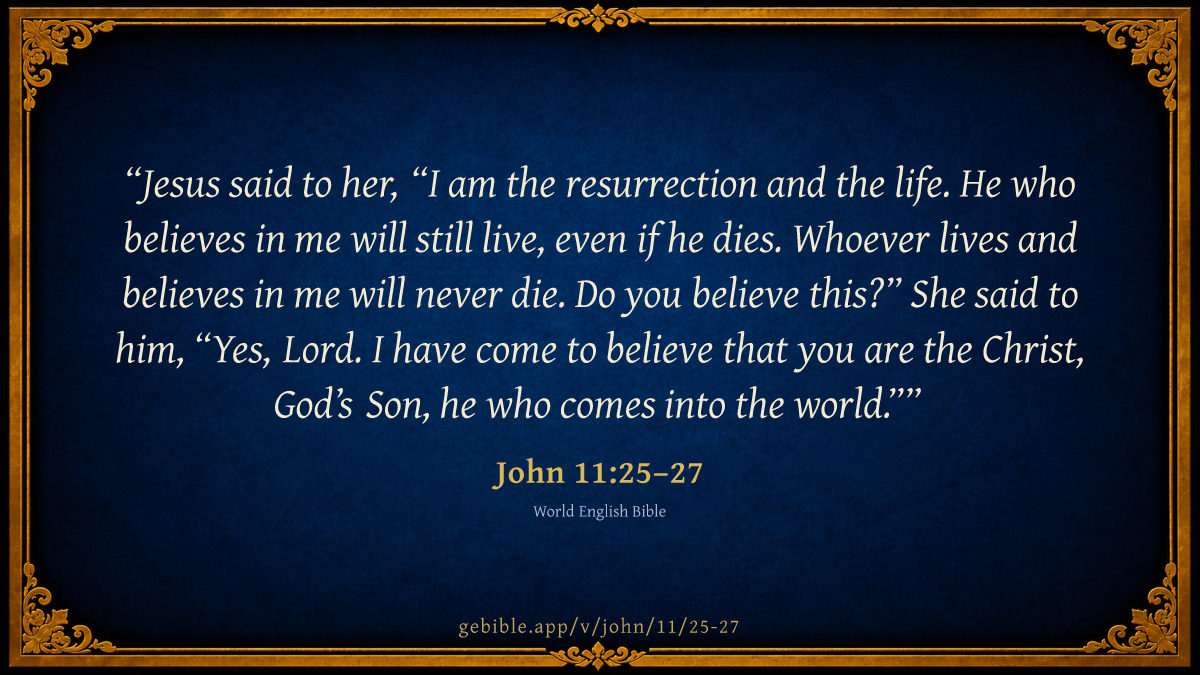
25Jesus said to her, “I am the resurrection and the life. He who believes in me will still live, even if he dies.26Whoever lives and believes in me will never die. Do you believe this?”
27She said to him, “Yes, Lord. I have come to believe that you are the Christ, God’s Son, he who comes into the world.”
1 Thessalonians 4:14(v25)For if we believe that Jesus died and rose again, even so God will bring with him those who have fallen asleep in Jesus.
John 3:36(v25)One who believes in the Son has eternal life, but one who disobeys the Son won’t see life, but the wrath of God remains on him.”
1 John 5:11-12(v25)The testimony is this, that God gave to us eternal life, and this life is in his Son. He who has the Son has the life. He who doesn’t have…
John 1:4(v25)In him was life, and the life was the light of men.
Romans 8:10-11(v25)If Christ is in you, the body is dead because of sin, but the spirit is alive because of righteousness. But if the Spirit of him who raised…
Show all 68 cross-references
John 5:21(v25)For as the Father raises the dead and gives them life, even so the Son also gives life to whom he desires.
Isaiah 26:19(v25)Your dead shall live. My dead bodies shall arise. Awake and sing, you who dwell in the dust; for your dew is like the dew of herbs, and the…
John 6:39-40(v25)This is the will of my Father who sent me, that of all he has given to me I should lose nothing, but should raise him up at the last day.…
John 6:44(v25)No one can come to me unless the Father who sent me draws him, and I will raise him up in the last day.
Romans 8:2(v25)For the law of the Spirit of life in Christ Jesus made me free from the law of sin and of death.
Philippians 3:20-21(v25)For our citizenship is in heaven, from where we also wait for a Savior, the Lord Jesus Christ, who will change the body of our humiliation…
Job 19:25-27(v25)But as for me, I know that my Redeemer lives. In the end, he will stand upon the earth. After my skin is destroyed, then I will see God in…
Romans 8:38-39(v25)For I am persuaded that neither death, nor life, nor angels, nor principalities, nor things present, nor things to come, nor powers, nor…
John 6:35(v25)Jesus said to them, “I am the bread of life. Whoever comes to me will not be hungry, and whoever believes in me will never be thirsty.
Philippians 3:10(v25)that I may know him, and the power of his resurrection, and the fellowship of his sufferings, becoming conformed to his death,
Revelation 21:4(v25)He will wipe away every tear from their eyes. Death will be no more; neither will there be mourning, nor crying, nor pain, any more. The…
John 10:28(v26)I give eternal life to them. They will never perish, and no one will snatch them out of my hand.
John 5:24(v26)“Most certainly I tell you, he who hears my word and believes him who sent me has eternal life, and doesn’t come into judgment, but has…
2 Corinthians 5:1-8(v25)For we know that if the earthly house of our tent is dissolved, we have a building from God, a house not made with hands, eternal, in the…
Colossians 3:3-4(v25)For you died, and your life is hidden with Christ in God. When Christ, our life, is revealed, then you will also be revealed with him in…
Revelation 20:5(v25)The rest of the dead didn’t live until the thousand years were finished. This is the first resurrection.
John 14:6(v25)Jesus said to him, “I am the way, the truth, and the life. No one comes to the Father, except through me.
Acts 3:15(v25)and killed the Prince of life, whom God raised from the dead, to which we are witnesses.
John 5:26(v25)For as the Father has life in himself, even so he gave to the Son also to have life in himself.
Romans 8:13(v26)For if you live after the flesh, you must die; but if by the Spirit you put to death the deeds of the body, you will live.
Psalms 36:9(v25)For with you is the spring of life. In your light we will see light.
Isaiah 38:16(v25)Lord, men live by these things; and my spirit finds life in all of them: you restore me, and cause me to live.
John 14:19(v25)Yet a little while, and the world will see me no more; but you will see me. Because I live, you will live also.
Hebrews 11:13-16(v25)These all died in faith, not having received the promises, but having seen them and embraced them from afar, and having confessed that they…
Romans 5:17-19(v25)For if by the trespass of the one, death reigned through the one; so much more will those who receive the abundance of grace and of the…
1 Corinthians 15:20-26(v25)But now Christ has been raised from the dead. He became the first fruits of those who are asleep. For since death came by man, the…
Philippians 1:23(v25)But I am hard pressed between the two, having the desire to depart and be with Christ, which is far better.
1 John 1:1-2(v25)That which was from the beginning, that which we have heard, that which we have seen with our eyes, that which we saw, and our hands…
1 John 5:10-12(v26)He who believes in the Son of God has the testimony in himself. He who doesn’t believe God has made him a liar, because he has not believed…
Revelation 22:17(v25)The Spirit and the bride say, “Come!” He who hears, let him say, “Come!” He who is thirsty, let him come. He who desires, let him take the…
Luke 23:43(v25)Jesus said to him, “Assuredly I tell you, today you will be with me in Paradise.”
John 8:51-53(v26)Most certainly, I tell you, if a person keeps my word, he will never see death.” Then the Jews said to him, “Now we know that you have a…
1 Corinthians 15:29(v25)Or else what will they do who are baptized for the dead? If the dead aren’t raised at all, why then are they baptized for the dead?
1 Corinthians 15:43-57(v25)It is sown in dishonor; it is raised in glory. It is sown in weakness; it is raised in power. It is sown a natural body; it is raised a…
2 Corinthians 4:14(v25)knowing that he who raised the Lord Jesus will raise us also with Jesus, and will present us with you.
Revelation 20:10-15(v25)The devil who deceived them was thrown into the lake of fire and sulfur, where the beast and the false prophet are also. They will be…
John 6:54-58(v26)He who eats my flesh and drinks my blood has eternal life, and I will raise him up at the last day. For my flesh is food indeed, and my…
Romans 4:17(v25)As it is written, “I have made you a father of many nations.” This is in the presence of him whom he believed: God, who gives life to the…
1 Corinthians 15:18(v25)Then they also who are fallen asleep in Christ have perished.
Revelation 22:1(v25)He showed me a river of water of life, clear as crystal, proceeding out of the throne of God and of the Lamb,
John 3:15-18(v26)that whoever believes in him should not perish, but have eternal life. For God so loved the world, that he gave his one and only Son, that…
John 6:50-51(v26)This is the bread which comes down out of heaven, that anyone may eat of it and not die. I am the living bread which came down out of…
Matthew 16:16(v27)Simon Peter answered, “You are the Christ, the Son of the living God.”
John 4:14(v26)but whoever drinks of the water that I will give him will never thirst again; but the water that I will give him will become in him a well…
John 14:10(v26)Don’t you believe that I am in the Father, and the Father in me? The words that I tell you, I speak not from myself; but the Father who…
Malachi 3:1(v27)“Behold, I send my messenger, and he will prepare the way before me; and the Lord, whom you seek, will suddenly come to his temple; and the…
Matthew 9:28(v26)When he had come into the house, the blind men came to him. Jesus said to them, “Do you believe that I am able to do this?” They told him,…
John 6:14(v27)When therefore the people saw the sign which Jesus did, they said, “This is truly the prophet who comes into the world.”
John 6:69(v27)We have come to believe and know that you are the Christ, the Son of the living God.”
Mark 9:23(v26)Jesus said to him, “If you can believe, all things are possible to him who believes.”
John 9:35(v26)Jesus heard that they had thrown him out, and finding him, he said, “Do you believe in the Son of God?”
1 John 5:1(v27)Whoever believes that Jesus is the Christ has been born of God. Whoever loves the Father also loves the child who is born of him.
Matthew 26:53(v26)Or do you think that I couldn’t ask my Father, and he would even now send me more than twelve legions of angels?
Luke 2:11(v27)For there is born to you today, in David’s city, a Savior, who is Christ the Lord.
1 Timothy 1:15-16(v27)The saying is faithful and worthy of all acceptance, that Christ Jesus came into the world to save sinners, of whom I am chief. However,…
1 John 5:20(v27)We know that the Son of God has come, and has given us an understanding, that we know him who is true, and we are in him who is true, in…
Matthew 11:3(v27)and said to him, “Are you he who comes, or should we look for another?”
Luke 7:19-20(v27)John, calling to himself two of his disciples, sent them to Jesus, saying, “Are you the one who is coming, or should we look for another?”…
John 1:49(v27)Nathanael answered him, “Rabbi, you are the Son of God! You are King of Israel!”
John 4:42(v27)They said to the woman, “Now we believe, not because of your speaking; for we have heard for ourselves, and know that this is indeed the…
John 9:36-38(v27)He answered, “Who is he, Lord, that I may believe in him?” Jesus said to him, “You have both seen him, and it is he who speaks with you.”…
John 20:28-31(v27)Thomas answered him, “My Lord and my God!” Jesus said to him, “Because you have seen me, you have believed. Blessed are those who have not…
Acts 8:36(v27)As they went on the way, they came to some water, and the eunuch said, “Behold, here is water. What is keeping me from being baptized?”
Cross-references from openbible.info (CC BY 4.0)
Explain this passage (20 sources)
Historical commentary, presented as a primary source — not an endorsement.
John Calvin1540 · Public DomainOn vv25–2725. I am the resurrection and the life. Christ…
25. I am the resurrection and the life. Christ first declares that he is the resurrection and the life, and then he explains, separately and distinctly, each clause of this sentence. His first statement is, that he is the resurrection, because the restoration from death to life naturally comes before the state of life. Now the whole human race is plunged in death; and, therefore, no man will be a partaker of life until he is risen from the dead. Thus Christ shows that he is the commencement of life, and he afterwards adds, that the continuance of life is also a work of his grace. That he is speaking about spiritual life, is plainly shown by the exposition which immediately follows,
He who believeth in me, though, he were dead, shall live. Why then is Christ the resurrection? Because by his Spirit he regenerates the children of Adam, who had been alienated from God by sin, so that they begin to live a new life. On this subject, I have spoken more fully under John 5:21 and 24; and Paul is an excellent interpreter of this passage, (Ephesians 2:5, and Ephesians 5:8.) Away now with those who idly talk that men are prepared for receiving the grace of God by the movement of nature. They might as well say that the dead walk. For that men live and breathe, and are endued with sense, understanding, and will, all this tends to their destruction, because there is no part or faculty of the soul that is not corrupted and turned aside from what is right. Thus it is that death everywhere holds dominion, for the death of the soul is nothing else than its being estranged and turned aside from God. Accordingly, they who believe in Christ, though they were formerly dead, begin to live, because faith is a spiritual resurrection of the soul, and — so to speak — animates the soul itself that it may live to God; according to that passage,
Read full note →
The dead shall hear the voice of the Son of God, and they who hear shall live (John 5:25.)
This is truly a remarkable commendation of faith, that it conveys to us the life of Christ, and thus frees us from death.
John Calvin's Commentaries (1540-1563) — public domain. Text from the Calvin Translation Society English edition (1840s-50s) via the Christian Classics Ethereal Library (ccel.org). Calvin's coverage is partial (roughly two-thirds of the Bible); uncommented books and verses are honest gaps, never fabricated. The 19th-century editor's footnotes and remarks are omitted so the notes are faithfully Calvin's own voice.
John Trapp1656 · Public DomainOn vv25–2725 Jesus said unto her, I am the resurrection,…
25 Jesus said unto her, I am the resurrection, and the life: he that believeth in me, though he were dead, yet shall he live:
Ver. 25. He that believeth in me, though, &c.] Oh the wonderful force of faith! Questionless (saith a reverend man, Mr S. Ward) justifying faith is not beneath miraculous in the sphere of its own activity, and where it hath warrant of God’s word, &c.
John Trapp, A Commentary or Exposition upon All the Books of the Old and New Testament (1647–1656) — public domain. Text from a community e-Sword module.
Matthew Poole1685 · Public DomainOn vv25–27Martha by her speech seemed not to have a…
Martha by her speech seemed not to have a true notion of Christ; she believed that there should be a general resurrection from the dead in the last day, by the mighty power of God, but she did not truly understand what influence Christ had upon this resurrection, that the raising of the dead should be the peculiar work of Christ, not without the Father, but as he was ordained by the Father to be the Judge of the quick and of the dead. Christ doth therefore here further instruct her, and tell her, he was
the resurrection; where (as is usual in Scripture) the effect is put for the cause:
Read full note →
I am the resurrection, is no more than, I am, and shall be, the principal cause of the resurrection: the dead shall hear the voice of the Son of God, Joh 5:28. He also adds, and the life; that is, the cause of life; both that life which the dead shall in the resurrection recover, and also that eternal life which shall follow. And whosoever looketh upon me in that notion, and committeth himself unto me, though he doth die, yet he shall rise again, and live eternally; and this power being in me, I am not tied to the last day, but have a power when I please to raise the dead. Our Saviour indeed hath more in his answer than respected the present case; but there was nothing more usual with him, than in his discourses to raise up the hearts of his people to higher things, as he doth in this place raise Martha beyond the thoughts of a resurrection of her brother’s body to a natural life, to the thoughts of a spiritual and eternal life.
Matthew Poole's English Annotations on the Holy Bible (1683–1685) — public domain. Text from a community e-Sword/MySword module.
William Burkitt1703 · Public DomainOn v27Observe here, 1. The full confession which Martha makes…
Observe here, 1. The full confession which Martha makes of her faith in Christ: Thou art the Christ the Son of God, which should come into world. A confession which comes nearest to that of St. Peter (Mat 16:16.) of any that we meet with in scripture: nay, it seems more full than Peter’s confession; for those additional words, Which should come into the world, are not in his confession; the sum is, she believed Christ to be the very Messias who was typified and prefigured, prophesied of, and promised to, the Old Testament saints, as the person that in the fulness of time should come into the world for the redemption and salvation of it. Thou art the Christ, the Son of God, which should come into the world.
Hence learn, That Christ is never rightly believed in, nor regularly depended upon, for salvation, except he be owned and acknowledged to be the eternal Son of God. Martha was now fully persuaded of Christ’s divine nature, of which the best of the disciples, till after our Saviour’s resurrection, had but a faint and uncertain persuasion.
Read full note →
Observe, 2. How earnest and intent our Saviour was to dispatch the errand he came upon, namely, to raise Lazarus from the grave, and to comfort the two mournful sisters: he would not so much as enter the house, till he had effected his work: and therefore he goes straight to the grave, which probably was the place where Mary met him: Lord! It was thy meat and drink to do the will of thy Father: it was thy meat and drink by day, thy rest and repose by night. How unlike are we to thyself, if we suffer either our pleasures or our profits to divert us from our duty!
Observe, 3. What haste and speed Mary makes to attend upon our Saviour: she arose quickly, and came unto him. Mary’s love added wings to her motion. The Jews observing her hasty motion, have a loving suspicion that she is gone to the grave to weep there; but their thoughts were too low; for whilst they supposed that she went to a dead brother, she was waiting upon a living Saviour. And she that used to sit at Jesus’s feet, now falls at his feet, with an awful veneration: the very gesture was supplicatory. And her humble prostration was seconded with a doleful lamentation, Lord, hadst thou been here, any brother had not died: full of affection, but not free from frailty and infirmity; however Christ takes no notice of her errors and infirmity; but all the reply we hear of, is a compassionate groan, which the following verses acquaint us with.
William Burkitt's Expository Notes on the New Testament (1700–1703) — public domain. Text from a community e-Sword module.
John Gill1763 · Public DomainOn vv25–27And whosoever liveth and believeth in me,..... Whoever will…
And whosoever liveth and believeth in me,..... Whoever will be found alive at Christ's second coming, and is a believer in him,
shall never die, but shall be changed, and shall be for ever with Christ; and such as shall be raised to life by him, shall never die any more, not even a bodily death, and much less an eternal one, or the second death: and though believers die a corporeal death as others do, yet their souls live, and live in happiness, whilst their bodies are under the power of death; nor shall they always continue so, but being raised, shall become immortal, and die no more. So living believers in Christ shall never die more a spiritual death; they are passed from death to life, and shall never return to death more; their spiritual life cannot be lost; grace in them is an immortal seed, a well of living water springing up into everlasting life: grace may be very low in its exercise, and may seem to be ready to die; they may be in lifeless frames, and without the comforts of a spiritual life, and be under the hidings of God's face, which is as death unto them, and may reckon themselves as free among the dead; yet the principle of life will never be extinct in them; nor shall they die the second death, which lies in an eternal separation from God, and in an everlasting sense of his wrath; that shall have no power on them, nor shall they be in the least hurt by it; for they are ordained to eternal life, and have the promise of it; they are united to Christ, and their life is secured in him; and he has redeemed them from death; and they have the Spirit of life dwelling in them, as the pledge and earnest of eternal glory.
Read full note →
Believest thou this? the whole of this concerning the power of Christ, and privilege of believers; every tittle of it is to be believed. And as with respect to a corporeal resurrection, so with regard to a spiritual one; that men by nature are dead in sins; that Christ is the author of the resurrection from such a state, to a spiritual life; that this life is only by Christ, and can never be lost: this is a doctrine to be believed; it is the doctrine of the Scriptures; it is according to godliness; it makes for the comfort of the people of God, and glorifies the divine perfections.
John Gill's Exposition of the Whole Bible (1746–1763) — public domain (CC PDM 1.0). Text via the HelloAO Bible API.
John Wesley1765 · Public DomainOn v25l am the resurrection - Of the dead. And…
l am the resurrection - Of the dead. And the life - Of the living. He that believeth in me, though he die, yet shall he live - In life everlasting.
John Wesley, Explanatory Notes Upon the Whole Bible (1754–1765) — public domain. Text via the GEBible commentary corpus.
Adam Clarke1810 · Public DomainOn vv25–27Verse 25. I am the resurrection, and the life]…
Verse 25. I am the resurrection, and the life] Thou sayest that thy brother shall rise again in the resurrection at the last day; but by whom shall he arise if not by ME, who am the author of the resurrection, and the source of life? And is it not as easy for me to raise him now as to raise him then? Thus our blessed Lord raises her hope, animates her faith, and teaches her that he was not a mere man, but the essential principle and author of existence.
Though he were dead] Every man who has believed or shall believe in me, though his believing shall not prevent him from dying a natural death, yet his body shall be re-animated, and he shall live with me in an eternal glory. And every one who is now dead, dead to God, dead in trespasses and sins, if he believe in me, trust on me as his sole Saviour, he shall live, shall be quickened by my Spirit, and live a life of faith, working by love.
Adam Clarke's Commentary on the Bible (1810–1826) — public domain. Text from a community e-Sword/MySword module.
Joseph Benson1811 · Public DomainOn vv25–27Joh 11:25. Jesus said, I am the resurrection —…
Joh 11:25. Jesus said, I am the resurrection — The author and cause of the resurrection of the dead; and the life — The source of life, natural, spiritual, and eternal; of the living, both in the present world and in the world to come. Martha believed that in answer to his prayer God would give any thing; but he would have her to know that by his power he could effect any thing. Martha believed a resurrection to take place at the last day; but Christ tells her he had now the power whereby it should be effected lodged in his hands: from whence it was easy to infer, that he who could raise the world of men that had been dead many ages, could, doubtless, raise one man that had been dead only a few days. Observe, reader, it ought to be a source of unspeakable comfort to us, that Christ is the resurrection and the life, and that he will be such to us, if we be his true disciples. A resurrection is a return to life, and Christ is the author of that return. We profess, in the Creed, to look for the resurrection of the dead, and the life of the world to come. Let us remember, then, that Christ is the author and principle of both; and that our hope of both must be built on him. Jesus proceeds: He that believeth in me — With a faith overcoming the world, (1Jn 5:4-5,) and purifying the heart; (Act 15:9;) though he were dead — Or, though he should die, as καν αποθανη is properly rendered; yet shall he live — Not only shall his soul survive the death of his body, and continue immortal, but, ere long, his reanimated body shall be again united to that soul; and even at present I can loose the bonds of death, and though thy brother now is holden by them, I can recall him when I please. Observe well, reader, to whom this promise is made; namely, to them that believe in Christ Jesus, to them that consent to, and confide in him, as the only Mediator of reconciliation and of intercourse between God and man; that receive the record God has given in his word concerning his Son; who sincerely comply with it, and answer all the great and gracious intentions of it. Both the promise and the conditions are further explained in the next verse.
Joseph Benson's Commentary on the Old and New Testaments (1811–1818) — public domain. Text from a community e-Sword module.
Albert Barnes1834 · Public DomainOn vv25–27I am the resurrection - I am the author…
I am the resurrection - I am the author or the cause of the resurrection. It so depends on my power and will, that it may be said that I am the resurrection itself. This is a most expressive way of saying that the whole doctrine of the resurrection came from him, and the whole power to effect it was his. In a similar manner he is said to be made of God unto us “wisdom and righteousness, and sanctification, and redemption,” 1Co 1:30.
And the life - Joh 1:4. As the resurrection of all depends on him, he intimated that it was not indispensable that it should be deferred to the last day. He had power to do it now as well as then.
Read full note →
Though he were dead - Faith does not save from temporal death; but although the believer, as others, will die a temporal death, yet he will hereafter have life. Even if he dies, he shall hereafter live.
Shall he live - Shall be restored to life in the resurrection.
Albert Barnes' Notes on the Bible (1834–1885) — public domain. Text from a community e-Sword/MySword module.
Haydock's Catholic Bible Commentary1859 · Public DomainOn vv25, 27I am the resurrection, and the life. That is,…
I am the resurrection, and the life. That is, the author of both. (Witham) --- I am the resurrection, I am he who will at the last day raise him up; I can, therefore, if I will, raise him up now also. (St. Augustine)
George Leo Haydock (1774–1849), Haydock's Catholic Family Bible and Commentary, 1859 edition — public domain. Excludes Psalms (Douay-Rheims chapter numbering differs from Protestant) and Deuterocanonical books (Catholic canon only).
Robert Jamieson, A. R. Fausset & David Brown1871 · Public DomainOn vv25, 27Jesus said, I am the resurrection and the life--"The…
Jesus said, I am the resurrection and the life--"The whole power to restore, impart, and maintain life, resides in Me." (See on Joh 1:4; Joh 5:21). What higher claim to supreme divinity than this grand saying can be conceived?
he that believeth in me, though . . . dead . . . shall he live--that is, The believer's death shall be swallowed up in life, and his life shall never sink into death. As death comes by sin, it is His to dissolve it; and as life flows through His righteousness, it is His to communicate and eternally maintain it (Rom 5:21). The temporary separation of soul and body is here regarded as not even interrupting, much less impairing, the new and everlasting life imparted by Jesus to His believing people.
Read full note →
Believest thou this?--Canst thou take this in?
Jamieson, Fausset & Brown — Commentary Critical and Explanatory on the Whole Bible (1871) — public domain (CC PDM 1.0). Text via the HelloAO Bible API.
Daniel D. Whedon1874 · Public DomainOn vv25, 2725. I am… resurrection… life—The due understanding of these…
25. I am… resurrection… life—The due understanding of these two sublime verses requires an analysis of the two principal terms. Resurrection is the reunion of a conscious soul to a body by it vitalized. Thence results actual physical life compositely of soul and body. Yet life, as often used, especially in John’s Gospel, designates something over and above this. Certainly does this higher meaning exist when the life is conditioned, as here, upon faith. It is then a life upon life; THE life supereminently; the glorified, celestial Life, over and above a life consisting in mere conscious existence. When, therefore, Martha names the resurrection, Christ responds, I am not only the resurrection but I am more; I am the life. He is author not only of that mere life resulting from union of soul and body, but of the celestial life by which man is a glorified being. We then paraphrase the words thus: I am not only the physical resurrection, but I am the life celestial; he that believeth in me, though he (like Lazarus) should die, yet the life celestial survives; and he that (unlike Lazarus) is still alive, and is a believer in me, shall never experience any death of that celestial life. To be the resurrection is one thing; to be the life another.
Daniel D. Whedon (gen. ed.), Commentary on the Old and New Testaments (1874–1909) — public domain. Text from a community e-Sword module.
The Cambridge Bible for Schools and Colleges1878 · Public DomainOn vv25–2725. I am the resurrection, and the life] He…
25. I am the resurrection, and the life] He draws her from her selfish grief to Himself. There is no need for Him to pray as man to God (Joh_11:22); He (and none else) is the Resurrection and the Life. There is no need to look forward to the last day; He is (not ‘will be’) the Resurrection and the Life. Comp. Joh_14:6; Col_3:4. In what follows, the first part shews how He is the Resurrection, the second how He is the Life. ‘He that believeth in Me, even if he shall have died (physically), shall live (eternally). And every one that liveth (physically) and believeth in Me, shall never die (eternally).’
The Cambridge Bible for Schools and Colleges (gen. ed. J. J. S. Perowne; Cambridge University Press, 1878–1918) — public domain. Text from a community e-Sword module.
Ellicott's Commentary for English Readers1878 · Public DomainOn vv25–27(25) I am the resurrection, and the life.—She has…
(25) I am the resurrection, and the life.—She has spoken of the resurrection as a truth which she believes, and as an event in the far-off future, so remote from the present life indeed, as to be powerless to comfort her now. The two first words of His answer, expressed in the fulness of emphasis, teach her that the resurrection is to be thought of as His person, and that it is to be thought of as actually present. “I,”—his words mean—“and none beside Me, am the Resurrection. I am the Resurrection—a. present life, and not simply a life in the remoteness of the last day.” In the same sense in which He has declared Himself to be the Water of Life and the Bread of Life, supplying in Himself every need of spiritual thirst and spiritual hunger, He declares Himself to be the Resurrection, revealing in His own person all that men had ever thought and hoped of a future life, being Himself the power which shall raise them at the last day, and could therefore raise them now. This is because He is also “the Life,” and therefore every one in communion
He that believeth in me, though he were dead, yet shall he live.—Better, though he have died . . . She thinks and speaks of Lazarus as dead. He asserts that in the true thought of the spiritual life the fact of physical death does not interrupt that life.
A Bible Commentary for English Readers, edited by Charles John Ellicott (1878–1897) — public domain. Text from a community e-Sword module.
The Pulpit Commentary1880 · Public DomainOn vv25, 27Vers. 25, 26. Jesus said to her, I am…
Vers. 25, 26. Jesus said to her, I am the Resurrection. Not merely that God will give me what I ask, but that I am in some sense already his gift to man of resurrection, inasmuch as I am that of Life . (So Luthardt and Godet, but not Meyer, who makes zwh the positive result of anastasiv .) By taking humanity into his Person, Christ reveals the permanence of human individuality, that is, of such individuality as is in union with himself. He associates (Joh_14:6) "the Life" which he gives with" the Way" and "the Truth," i.e. with the whole sum of human experience and of human meditation and speculation, i.e. with all the conduct of the will and the mind. He that believeth on me, though he die, yet shall he live. In these words he identifies the "life" with the transfiguration of the bodily life. The grand method of this blessed life is faith. The life which is the condition and ground of resurrection is the natural consequence of a faith which accepts Christ, and identifies itself with him. But "there are some who have believed, and have what you call diedthough they die, they shall live. In such cases, so-called "death" is veritable "life." The life of faith will survive the shock of death, and whosoever liveth, and believeth on me, shall never die shall never taste of death. (cf. Joh_6:51, Joh_8:51) This is no new teaching for the more thoughtful of his hearers. There are multitudes now believing (and therefore living) in him. They shall never die in the sense in which death has been hitherto regarded; they shall by no means die forever. Faith is eternal life: death is only a momentary shadow upon a life which is far better. Whether the corruption of the grave passes over the believer or not, he lives an eternal life, which has no element of death nor proclivity to death in it. So far the Lord is lifting Martha to a higher experience of life and a comparative in difference to death. Before he offers any further consolation, he probes to the quick her faith in him and in the eternal life. Believest thou this? Touto ; "Is this thy belief?" not toutw ; "Dost thou believe in my statement?" "Believest thou that the Resurrection which I am and which I give can thus transform for thee the whole meaning of death?" The fullness of life after death is assured in virtue of the resurrection which Christ could effect at any moment, and will eventually effect for all. This life of which Christ speaks may be the life which is the consequence of the resurrection (anastasiv) of man effected in the Incarnation, or it may be the condition of "resurrection" and sufficient proof that, if a man receive it by faith, he is free" from all the curse of physical death, and assured of a perfect victory over it. So also the ou mh eiv to may either mean "not forever," and thus the words may be taken to refer to the resurrection. "He will not forever die," i.e. death may supervene, but will be conquered; or ou mh may mean "never," "in no wise," and the "never die" may refer to spiritual death, overlooking physical death altogether. The whole narrative is a great parable of life through death.
The living and life-giving Lord.
Read full note →
The confession of Martha was a good and sound one. Yet it is clear that our Lord did not wish her to rest in her creed. He pointed her to himself as the Sum and Substance of all true beliefs, as the Object of all true faith. Creeds are good for the memory, Christ is good for the heart.
I LIFE IS IN CHRIST. The miracles of raising from the dead which Jesus wrought were intended not only for the assuagement of human sorrow, but for the satisfying of human aspirations. He drew the attention away from the great work to the greater Worker. In him was life; and by his incarnation and sacrifice he brought the life of God to this world of sin and death.
II THE LIFE OF CHRIST, WHEY COMMUNICATED TO MEN, BECOMES A SPIRITUAL IMMORTALITY. "The Son quickeneth whom he will." He introduced the new life into our humanity. How it has spread! In how many soils have barrenness and death disappeared, and spiritual vitality, vigor, and fruitfulness abounded in their place! Christ has taught the independence of the spiritual life upon the life of this body of our humiliation. In his own resurrection he manifestly conquered death. Living, he has the keys of death and Hades. He is both the Firstfruits of the rising again, and the Agent and quickening Power in raising his people. What can compare for spiritual potency with the life-giving authority of the Savior? In what other is there hope for man"s deathless spirit? Like morning after a stormy night, like spring after a dreary winter, like triumph after arduous warfare, like the haven after a tempestuous voyage, so is the immortality of the righteous who, living in Christ, live in perpetual blessedness. All their aspirations are realized, and all their hopes fulfilled.
III IT IS BY FAITH THAT THE GLORIOUS IMMORTALITY OF THE BLESSED IS ACHIEVED. Christ presents himself as the Divine Object of faith. It is no arbitrary connection which is exhibited in these words of our Redeemer as existing between faith and life. Life is personal, and spiritual life comes from the Lord and Giver of life to those who believe. Faith is spiritual union with the Christ who died and rose for us, and is the means, first of a death unto sin and a life unto righteousness, and then of all which this spiritual change involves. A life in God is a life eternal. T.
The Pulpit Commentary (1880–1919), ed. H.D.M. Spence-Jones & Joseph S. Exell — public domain. Text from a community e-Sword module.
B. W. Johnson1891 · Public DomainOn vv25–2725. I am the resurrection, and the life. Christ…
25. I am the resurrection, and the life. Christ makes the grand, striking declaration that he is the Resurrection and the Life, words that never could have fallen from the lips of a sane mortal. They mean that he is the power which opens every grave, gives life to the sleepers, and calls them forth to a new existence; that the life that endows men with eternal being is in him and proceeds from him. In the light of his own resurrection they mean that when he burst open the tomb he did it for humanity and in him humanity has won the victory over death.
B. W. Johnson's The People's New Testament with Notes (1889–1891) — public domain. Electronic text from the Christian Classics Ethereal Library (CCEL) ThML edition.
Alexander MacLaren1905 · Public DomainOn vv25, 27John - Job
John - Job
CHRIST’S QUESTION TO EACH
Read full note →
JOB’S QUESTION, JESUS’ ANSWER
Job 14:14. - Joh 11:25 - Joh 11:26.
Job’s question waited long for an answer. Weary centuries rolled away; but at last the doubting, almost despairing, cry put into the mouth of the man of sorrows of the Old Testament is answered by the Man of Sorrows of the New. The answer in words is this second text which may almost be supposed to allude to the ancient question. The answer, in fact, is the resurrection of Christ. Apart from this answer there is none.
So we may take these two texts to help us to grasp more clearly and feel more profoundly what the world owes to that great fact which we are naturally led to think of to-day.
I. The ancient and ever returning question.
The Book of Job is probably a late part of the Old Testament. It deals with problems which indicate some advance in religious thought. Solemn and magnificent, and for the most part sad; it is like a Titan struggling with large problems, and seldom attaining to positive conclusions in which the heart or the head can rest in peace. Here all Job’s mind is clouded with a doubt. He has just given utterance to an intense longing for a life beyond the grave. His abode in Sheol is thought of as in some sense a breach in the continuity of his consciousness, but even that would be tolerable, if only he could be sure that, after many days, God would remember him. Then that longing gives way before the torturing question of the text, which dashes aside the tremulous hope with its insistent interrogation. It is not denial, but it is a doubt which palsies hope. But though he has no certainty, he cannot part with the possibility, and so goes on to imagine how blessed it would be if his longing were fulfilled. He thinks that such a renewed life would be like the ‘release’ of a sentry who had long stood on guard; he thinks of it as his swift, joyous ‘answer’ to God’s summons, which would draw him out from the sad crowd of pale shadows and bring him back to warmth and reality. His hope takes a more daring flight still, and he thinks of God as yearning for His creature, as His creature yearns for Him, and having ‘a desire to the work of His hands,’ as if His heaven would be incomplete without His servant. But the rapture and the vision pass, and the rest of the chapter is all clouded over, and the devout hope loses its light. Once again it gathers brightness in the twenty-first chapter, where the possibility flashes out starlike, that ‘after my skin hath been thus destroyed, yet from my flesh shall I see God.’
These fluctuations of hope and doubt reveal to us the attitude of devout souls in Israel at a late era of the national life. And if they show us their high-water mark, we need not suppose that similar souls outside the Old Testament circle had solid certainty where these had but a variable hope. We know how large a development the doctrine of a future life had in Assyria and in Egypt, and I suppose we are entitled to say that men have always had the idea of a future. They have always had the thought, sometimes as a fear, sometimes as a hope, but never as a certainty. It has lacked not only certainty but distinctness. It has lacked solidity also, the power to hold its own and sustain itself against the weighty pressure of intrusive things seen and temporal.
But we need not go to the ends of the earth or to past generations for examples of a doubting, superficial hold of the truth that man lives through death and after it. We have only to look around us, and, alas! we have only to look within us. This age is asking the question again, and answering it in many tones, sometimes of indifferent disregard, sometimes flaunting a stark negative without reasoned foundation, sometimes with affirmatives with as little reason as these negatives. The modern world is caught in the rush and whirl of life, has its own sorrows to front, its own battles to fight, and large sections of it have never come as near an answer to Job’s question as Job did.
II. Christ’s all-sufficing answer.
He gave it there, by the grave of Lazarus, to that weeping sister, but He spoke these great words of calm assurance to all the world. One cannot but note the difference between His attitude in the presence of the great Mystery and that of all other teachers. How calmly, certainly, and confidently He speaks!
Mark that Jesus, even at that hour of agony, turns Martha’s thoughts to Himself. What He is is the all-important thing for her to know. If she understands Him, life and death will have no insoluble problems nor any hopelessness for her. ‘I am the Resurrection and the Life.’ She had risen in her grief to a lofty height in believing that ‘even now’-at this moment when help is vain and hope is dead-’whatsoever thou wilt ask of God, God will give it thee,’ but Jesus offers to her a loftier conception of Him when He lays a sovereign hand on resurrection and life, and discloses that both inhere in Him, and from Him flow to all who shall possess them. He claims to have in Himself the fountain of life, in all possible senses of the word, as well as in the special sense relevant at that sad hour. Further, He tells Martha that by faith in Him any and all may possess that life. And then He majestically goes on to declare that the life which He gives is immune from, and untouched by, death. The believer shall live though he dies, the living believer shall never die. It is clear that, in these two great statements, to die is used in two different meanings, referring in the former case to the physical fact, and in the latter carrying a heavier weight of significance, namely the pregnant sense which it usually has in this Gospel, of separation from God and consequently from the true life of the soul. Physical death is not the termination of human life. The grim fact touches only the surface life, and has nothing to do with the essential, personal being. He that believes on Jesus, and he only, truly lives, and his union with Jesus secures his possession of that eternal life, which victoriously persists through the apparent, superficial change which men call death. Nothing dies but the death which surrounds the faithful soul. For it to die is to live more fully, more triumphantly, more blessedly. So though the act of physical death remains, its whole character is changed. Hence the New Testament euphemisms for death are much more than euphemisms. Men christen it by names which drape its ugliness, because they fear it so much, but Faith can play with Leviathan, because it fears it not at all. Hence such names as ‘sleep,’ ‘exodus,’ are tokens of the victory won for all believers by Jesus. He will show Martha the hope for all His followers which begins to dawn even in the calling of her brother back from the grip of death. And He shows us the great truth that His being the ‘Life’ necessarily involved His being also the ‘Resurrection,’ for His life-communicating work could not be accomplished till His all-quickening vitality had flowed over into, and flooded with its own conquering tides, not only the spirit which believes but its humble companion, the soul, and its yet humbler, the body. A bodily life is essential to perfect manhood, and Jesus will not stay His hand till every believer is full-summed in all his powers, and is perfect in body, soul, and spirit, after the image of Him who redeemed Him.
III. The pledge for the truth of the answer.
The words of Jesus are only words. These precious words, spoken to that one weeping sister in a little Jewish village, and which have brought hope to millions ever since, are as baseless as all the other dreams and longings of the heart, unless Jesus confirms them by fact. If He did not rise from the dead, they are but another of the noble, exalted, but futile delusions of which the world has many others. If Christ be not risen, His words of consolation are swelling words of emptiness; His whole claims are ended, and the age-old question which Job asked is unanswered still, and will always remain unanswered. If Christ be not risen, the hopeless colloquy between Jehovah and the prophet sums up all that can be said of the future life: ‘Son of man, can these bones live?’ And I answered, ‘O Lord God, Thou knowest!’
But Christ’s resurrection is a fact which, taken in connection with His words while on earth, endorses these and establishes His claims to be the Declarer of the name of God, the Saviour of the world. It gives us demonstration of the continuity of life through and after death. Taken along with His ascension, which is but, so to speak, the prolongation of the point into a line, it declares that a glorified body and an abode in a heavenly home are waiting for all who by faith become here partakers in Jesus and are quickened by sharing in His life.
So in despite of sense and doubt and fear, notwithstanding teachers who, like the supercilious philosophers on Mars Hill, mock when they hear of a resurrection from the dead, we should rejoice in the great light which has shined into the region of the shadow of death, we should clasp His divine and most faithful answer to that old, despairing question, as the anchor of our souls, and lift up our hearts in thanksgiving in the triumphant challenge, ‘O death! where is thy sting? O grave! where is thy victory?’
Alexander MacLaren, Expositions of Holy Scripture (1904–1910) — public domain. Text from a community e-Sword module.
C. I. Scofield1917 · Public DomainOn vv26–27never die
never die
i.e. the "second death." Cf. Rev 2:1; Rev 20:6.
The Scofield Reference Bible (1917 edition), notes by C. I. Scofield — public domain. Text from a community e-Sword module.
unfoldingWord translationNotes2017 · CC BY-SA 4.0On v27She said to him
She said to him
"Martha said to Jesus"
Read full note →
Yes, Lord, I believe that you are the Christ, the Son of God ... coming into the world
Martha believes that Jesus is Lord, the Christ (the Messiah), the Son of God.
Son of God
This is an important title for Jesus. (See: Translating Son and Father)
she went away and called her sister Mary
Mary is the younger sister of Martha. AT: "she went away and called her younger sister Mary" (See: Assumed Knowledge and Implicit Information)
Tyndale Open Study Notes2022 · CC BY-SA 4.0On vv25–2611:25 Jesus helped Martha to believe in him not…
11:25 Jesus helped Martha to believe in him not simply as a healer, but as one who vanquishes death. • I am the resurrection and the life: Victory over death is an aspect of living in association with Jesus. Although his followers are still mortal, they will enjoy eternal life after death. Regarding Jesus’ I am statements, see the study note on 6:35.

John Calvin 1540 · Public Domain On vv25–27 25. I am the resurrection and the life. Christ…
25. I am the resurrection and the life. Christ first declares that he is the resurrection and the life, and then he explains, separately and distinctly, each clause of this sentence. His first statement is, that he is the resurrection, because the restoration from death to life naturally comes before the state of life. Now the whole human race is plunged in death; and, therefore, no man will be a partaker of life until he is risen from the dead. Thus Christ shows that he is the commencement of life, and he afterwards adds, that the continuance of life is also a work of his grace. That he is speaking about spiritual life, is plainly shown by the exposition which immediately follows,
He who believeth in me, though, he were dead, shall live. Why then is Christ the resurrection? Because by his Spirit he regenerates the children of Adam, who had been alienated from God by sin, so that they begin to live a new life. On this subject, I have spoken more fully under John 5:21 and 24; and Paul is an excellent interpreter of this passage, (Ephesians 2:5, and Ephesians 5:8.) Away now with those who idly talk that men are prepared for receiving the grace of God by the movement of nature. They might as well say that the dead walk. For that men live and breathe, and are endued with sense, understanding, and will, all this tends to their destruction, because there is no part or faculty of the soul that is not corrupted and turned aside from what is right. Thus it is that death everywhere holds dominion, for the death of the soul is nothing else than its being estranged and turned aside from God. Accordingly, they who believe in Christ, though they were formerly dead, begin to live, because faith is a spiritual resurrection of the soul, and — so to speak — animates the soul itself that it may live to God; according to that passage,
Read full note →
The dead shall hear the voice of the Son of God, and they who hear shall live (John 5:25.)
This is truly a remarkable commendation of faith, that it conveys to us the life of Christ, and thus frees us from death.
John Calvin's Commentaries (1540-1563) — public domain. Text from the Calvin Translation Society English edition (1840s-50s) via the Christian Classics Ethereal Library (ccel.org). Calvin's coverage is partial (roughly two-thirds of the Bible); uncommented books and verses are honest gaps, never fabricated. The 19th-century editor's footnotes and remarks are omitted so the notes are faithfully Calvin's own voice.
John Trapp 1656 · Public Domain On vv25–27 25 Jesus said unto her, I am the resurrection,…
25 Jesus said unto her, I am the resurrection, and the life: he that believeth in me, though he were dead, yet shall he live:
Ver. 25. He that believeth in me, though, &c.] Oh the wonderful force of faith! Questionless (saith a reverend man, Mr S. Ward) justifying faith is not beneath miraculous in the sphere of its own activity, and where it hath warrant of God’s word, &c.
John Trapp, A Commentary or Exposition upon All the Books of the Old and New Testament (1647–1656) — public domain. Text from a community e-Sword module.
Matthew Poole 1685 · Public Domain On vv25–27 Martha by her speech seemed not to have a…
Martha by her speech seemed not to have a true notion of Christ; she believed that there should be a general resurrection from the dead in the last day, by the mighty power of God, but she did not truly understand what influence Christ had upon this resurrection, that the raising of the dead should be the peculiar work of Christ, not without the Father, but as he was ordained by the Father to be the Judge of the quick and of the dead. Christ doth therefore here further instruct her, and tell her, he was
the resurrection; where (as is usual in Scripture) the effect is put for the cause:
Read full note →
I am the resurrection, is no more than, I am, and shall be, the principal cause of the resurrection: the dead shall hear the voice of the Son of God, Joh 5:28. He also adds, and the life; that is, the cause of life; both that life which the dead shall in the resurrection recover, and also that eternal life which shall follow. And whosoever looketh upon me in that notion, and committeth himself unto me, though he doth die, yet he shall rise again, and live eternally; and this power being in me, I am not tied to the last day, but have a power when I please to raise the dead. Our Saviour indeed hath more in his answer than respected the present case; but there was nothing more usual with him, than in his discourses to raise up the hearts of his people to higher things, as he doth in this place raise Martha beyond the thoughts of a resurrection of her brother’s body to a natural life, to the thoughts of a spiritual and eternal life.
Matthew Poole's English Annotations on the Holy Bible (1683–1685) — public domain. Text from a community e-Sword/MySword module.
William Burkitt 1703 · Public Domain On v27 Observe here, 1. The full confession which Martha makes…
Observe here, 1. The full confession which Martha makes of her faith in Christ: Thou art the Christ the Son of God, which should come into world. A confession which comes nearest to that of St. Peter (Mat 16:16.) of any that we meet with in scripture: nay, it seems more full than Peter’s confession; for those additional words, Which should come into the world, are not in his confession; the sum is, she believed Christ to be the very Messias who was typified and prefigured, prophesied of, and promised to, the Old Testament saints, as the person that in the fulness of time should come into the world for the redemption and salvation of it. Thou art the Christ, the Son of God, which should come into the world.
Hence learn, That Christ is never rightly believed in, nor regularly depended upon, for salvation, except he be owned and acknowledged to be the eternal Son of God. Martha was now fully persuaded of Christ’s divine nature, of which the best of the disciples, till after our Saviour’s resurrection, had but a faint and uncertain persuasion.
Read full note →
Observe, 2. How earnest and intent our Saviour was to dispatch the errand he came upon, namely, to raise Lazarus from the grave, and to comfort the two mournful sisters: he would not so much as enter the house, till he had effected his work: and therefore he goes straight to the grave, which probably was the place where Mary met him: Lord! It was thy meat and drink to do the will of thy Father: it was thy meat and drink by day, thy rest and repose by night. How unlike are we to thyself, if we suffer either our pleasures or our profits to divert us from our duty!
Observe, 3. What haste and speed Mary makes to attend upon our Saviour: she arose quickly, and came unto him. Mary’s love added wings to her motion. The Jews observing her hasty motion, have a loving suspicion that she is gone to the grave to weep there; but their thoughts were too low; for whilst they supposed that she went to a dead brother, she was waiting upon a living Saviour. And she that used to sit at Jesus’s feet, now falls at his feet, with an awful veneration: the very gesture was supplicatory. And her humble prostration was seconded with a doleful lamentation, Lord, hadst thou been here, any brother had not died: full of affection, but not free from frailty and infirmity; however Christ takes no notice of her errors and infirmity; but all the reply we hear of, is a compassionate groan, which the following verses acquaint us with.
William Burkitt's Expository Notes on the New Testament (1700–1703) — public domain. Text from a community e-Sword module.
John Gill 1763 · Public Domain On vv25–27 And whosoever liveth and believeth in me,..... Whoever will…
And whosoever liveth and believeth in me,..... Whoever will be found alive at Christ's second coming, and is a believer in him,
shall never die, but shall be changed, and shall be for ever with Christ; and such as shall be raised to life by him, shall never die any more, not even a bodily death, and much less an eternal one, or the second death: and though believers die a corporeal death as others do, yet their souls live, and live in happiness, whilst their bodies are under the power of death; nor shall they always continue so, but being raised, shall become immortal, and die no more. So living believers in Christ shall never die more a spiritual death; they are passed from death to life, and shall never return to death more; their spiritual life cannot be lost; grace in them is an immortal seed, a well of living water springing up into everlasting life: grace may be very low in its exercise, and may seem to be ready to die; they may be in lifeless frames, and without the comforts of a spiritual life, and be under the hidings of God's face, which is as death unto them, and may reckon themselves as free among the dead; yet the principle of life will never be extinct in them; nor shall they die the second death, which lies in an eternal separation from God, and in an everlasting sense of his wrath; that shall have no power on them, nor shall they be in the least hurt by it; for they are ordained to eternal life, and have the promise of it; they are united to Christ, and their life is secured in him; and he has redeemed them from death; and they have the Spirit of life dwelling in them, as the pledge and earnest of eternal glory.
Read full note →
Believest thou this? the whole of this concerning the power of Christ, and privilege of believers; every tittle of it is to be believed. And as with respect to a corporeal resurrection, so with regard to a spiritual one; that men by nature are dead in sins; that Christ is the author of the resurrection from such a state, to a spiritual life; that this life is only by Christ, and can never be lost: this is a doctrine to be believed; it is the doctrine of the Scriptures; it is according to godliness; it makes for the comfort of the people of God, and glorifies the divine perfections.
John Gill's Exposition of the Whole Bible (1746–1763) — public domain (CC PDM 1.0). Text via the HelloAO Bible API.
John Wesley 1765 · Public Domain On v25 l am the resurrection - Of the dead. And…
l am the resurrection - Of the dead. And the life - Of the living. He that believeth in me, though he die, yet shall he live - In life everlasting.
John Wesley, Explanatory Notes Upon the Whole Bible (1754–1765) — public domain. Text via the GEBible commentary corpus.
Adam Clarke 1810 · Public Domain On vv25–27 Verse 25. I am the resurrection, and the life]…
Verse 25. I am the resurrection, and the life] Thou sayest that thy brother shall rise again in the resurrection at the last day; but by whom shall he arise if not by ME, who am the author of the resurrection, and the source of life? And is it not as easy for me to raise him now as to raise him then? Thus our blessed Lord raises her hope, animates her faith, and teaches her that he was not a mere man, but the essential principle and author of existence.
Though he were dead] Every man who has believed or shall believe in me, though his believing shall not prevent him from dying a natural death, yet his body shall be re-animated, and he shall live with me in an eternal glory. And every one who is now dead, dead to God, dead in trespasses and sins, if he believe in me, trust on me as his sole Saviour, he shall live, shall be quickened by my Spirit, and live a life of faith, working by love.
Adam Clarke's Commentary on the Bible (1810–1826) — public domain. Text from a community e-Sword/MySword module.
Joseph Benson 1811 · Public Domain On vv25–27 Joh 11:25. Jesus said, I am the resurrection —…
Joh 11:25. Jesus said, I am the resurrection — The author and cause of the resurrection of the dead; and the life — The source of life, natural, spiritual, and eternal; of the living, both in the present world and in the world to come. Martha believed that in answer to his prayer God would give any thing; but he would have her to know that by his power he could effect any thing. Martha believed a resurrection to take place at the last day; but Christ tells her he had now the power whereby it should be effected lodged in his hands: from whence it was easy to infer, that he who could raise the world of men that had been dead many ages, could, doubtless, raise one man that had been dead only a few days. Observe, reader, it ought to be a source of unspeakable comfort to us, that Christ is the resurrection and the life, and that he will be such to us, if we be his true disciples. A resurrection is a return to life, and Christ is the author of that return. We profess, in the Creed, to look for the resurrection of the dead, and the life of the world to come. Let us remember, then, that Christ is the author and principle of both; and that our hope of both must be built on him. Jesus proceeds: He that believeth in me — With a faith overcoming the world, (1Jn 5:4-5,) and purifying the heart; (Act 15:9;) though he were dead — Or, though he should die, as καν αποθανη is properly rendered; yet shall he live — Not only shall his soul survive the death of his body, and continue immortal, but, ere long, his reanimated body shall be again united to that soul; and even at present I can loose the bonds of death, and though thy brother now is holden by them, I can recall him when I please. Observe well, reader, to whom this promise is made; namely, to them that believe in Christ Jesus, to them that consent to, and confide in him, as the only Mediator of reconciliation and of intercourse between God and man; that receive the record God has given in his word concerning his Son; who sincerely comply with it, and answer all the great and gracious intentions of it. Both the promise and the conditions are further explained in the next verse.
Joseph Benson's Commentary on the Old and New Testaments (1811–1818) — public domain. Text from a community e-Sword module.
Albert Barnes 1834 · Public Domain On vv25–27 I am the resurrection - I am the author…
I am the resurrection - I am the author or the cause of the resurrection. It so depends on my power and will, that it may be said that I am the resurrection itself. This is a most expressive way of saying that the whole doctrine of the resurrection came from him, and the whole power to effect it was his. In a similar manner he is said to be made of God unto us “wisdom and righteousness, and sanctification, and redemption,” 1Co 1:30.
And the life - Joh 1:4. As the resurrection of all depends on him, he intimated that it was not indispensable that it should be deferred to the last day. He had power to do it now as well as then.
Read full note →
Though he were dead - Faith does not save from temporal death; but although the believer, as others, will die a temporal death, yet he will hereafter have life. Even if he dies, he shall hereafter live.
Shall he live - Shall be restored to life in the resurrection.
Albert Barnes' Notes on the Bible (1834–1885) — public domain. Text from a community e-Sword/MySword module.
Haydock's Catholic Bible Commentary 1859 · Public Domain On vv25, 27 I am the resurrection, and the life. That is,…
I am the resurrection, and the life. That is, the author of both. (Witham) --- I am the resurrection, I am he who will at the last day raise him up; I can, therefore, if I will, raise him up now also. (St. Augustine)
George Leo Haydock (1774–1849), Haydock's Catholic Family Bible and Commentary, 1859 edition — public domain. Excludes Psalms (Douay-Rheims chapter numbering differs from Protestant) and Deuterocanonical books (Catholic canon only).
Robert Jamieson, A. R. Fausset & David Brown 1871 · Public Domain On vv25, 27 Jesus said, I am the resurrection and the life--"The…
Jesus said, I am the resurrection and the life--"The whole power to restore, impart, and maintain life, resides in Me." (See on Joh 1:4; Joh 5:21). What higher claim to supreme divinity than this grand saying can be conceived?
he that believeth in me, though . . . dead . . . shall he live--that is, The believer's death shall be swallowed up in life, and his life shall never sink into death. As death comes by sin, it is His to dissolve it; and as life flows through His righteousness, it is His to communicate and eternally maintain it (Rom 5:21). The temporary separation of soul and body is here regarded as not even interrupting, much less impairing, the new and everlasting life imparted by Jesus to His believing people.
Read full note →
Believest thou this?--Canst thou take this in?
Jamieson, Fausset & Brown — Commentary Critical and Explanatory on the Whole Bible (1871) — public domain (CC PDM 1.0). Text via the HelloAO Bible API.
Daniel D. Whedon 1874 · Public Domain On vv25, 27 25. I am… resurrection… life—The due understanding of these…
25. I am… resurrection… life—The due understanding of these two sublime verses requires an analysis of the two principal terms. Resurrection is the reunion of a conscious soul to a body by it vitalized. Thence results actual physical life compositely of soul and body. Yet life, as often used, especially in John’s Gospel, designates something over and above this. Certainly does this higher meaning exist when the life is conditioned, as here, upon faith. It is then a life upon life; THE life supereminently; the glorified, celestial Life, over and above a life consisting in mere conscious existence. When, therefore, Martha names the resurrection, Christ responds, I am not only the resurrection but I am more; I am the life. He is author not only of that mere life resulting from union of soul and body, but of the celestial life by which man is a glorified being. We then paraphrase the words thus: I am not only the physical resurrection, but I am the life celestial; he that believeth in me, though he (like Lazarus) should die, yet the life celestial survives; and he that (unlike Lazarus) is still alive, and is a believer in me, shall never experience any death of that celestial life. To be the resurrection is one thing; to be the life another.
Daniel D. Whedon (gen. ed.), Commentary on the Old and New Testaments (1874–1909) — public domain. Text from a community e-Sword module.
The Cambridge Bible for Schools and Colleges 1878 · Public Domain On vv25–27 25. I am the resurrection, and the life] He…
25. I am the resurrection, and the life] He draws her from her selfish grief to Himself. There is no need for Him to pray as man to God (Joh_11:22); He (and none else) is the Resurrection and the Life. There is no need to look forward to the last day; He is (not ‘will be’) the Resurrection and the Life. Comp. Joh_14:6; Col_3:4. In what follows, the first part shews how He is the Resurrection, the second how He is the Life. ‘He that believeth in Me, even if he shall have died (physically), shall live (eternally). And every one that liveth (physically) and believeth in Me, shall never die (eternally).’
The Cambridge Bible for Schools and Colleges (gen. ed. J. J. S. Perowne; Cambridge University Press, 1878–1918) — public domain. Text from a community e-Sword module.
Ellicott's Commentary for English Readers 1878 · Public Domain On vv25–27 (25) I am the resurrection, and the life.—She has…
(25) I am the resurrection, and the life.—She has spoken of the resurrection as a truth which she believes, and as an event in the far-off future, so remote from the present life indeed, as to be powerless to comfort her now. The two first words of His answer, expressed in the fulness of emphasis, teach her that the resurrection is to be thought of as His person, and that it is to be thought of as actually present. “I,”—his words mean—“and none beside Me, am the Resurrection. I am the Resurrection—a. present life, and not simply a life in the remoteness of the last day.” In the same sense in which He has declared Himself to be the Water of Life and the Bread of Life, supplying in Himself every need of spiritual thirst and spiritual hunger, He declares Himself to be the Resurrection, revealing in His own person all that men had ever thought and hoped of a future life, being Himself the power which shall raise them at the last day, and could therefore raise them now. This is because He is also “the Life,” and therefore every one in communion
He that believeth in me, though he were dead, yet shall he live.—Better, though he have died . . . She thinks and speaks of Lazarus as dead. He asserts that in the true thought of the spiritual life the fact of physical death does not interrupt that life.
A Bible Commentary for English Readers, edited by Charles John Ellicott (1878–1897) — public domain. Text from a community e-Sword module.
The Pulpit Commentary 1880 · Public Domain On vv25, 27 Vers. 25, 26. Jesus said to her, I am…
Vers. 25, 26. Jesus said to her, I am the Resurrection. Not merely that God will give me what I ask, but that I am in some sense already his gift to man of resurrection, inasmuch as I am that of Life . (So Luthardt and Godet, but not Meyer, who makes zwh the positive result of anastasiv .) By taking humanity into his Person, Christ reveals the permanence of human individuality, that is, of such individuality as is in union with himself. He associates (Joh_14:6) "the Life" which he gives with" the Way" and "the Truth," i.e. with the whole sum of human experience and of human meditation and speculation, i.e. with all the conduct of the will and the mind. He that believeth on me, though he die, yet shall he live. In these words he identifies the "life" with the transfiguration of the bodily life. The grand method of this blessed life is faith. The life which is the condition and ground of resurrection is the natural consequence of a faith which accepts Christ, and identifies itself with him. But "there are some who have believed, and have what you call diedthough they die, they shall live. In such cases, so-called "death" is veritable "life." The life of faith will survive the shock of death, and whosoever liveth, and believeth on me, shall never die shall never taste of death. (cf. Joh_6:51, Joh_8:51) This is no new teaching for the more thoughtful of his hearers. There are multitudes now believing (and therefore living) in him. They shall never die in the sense in which death has been hitherto regarded; they shall by no means die forever. Faith is eternal life: death is only a momentary shadow upon a life which is far better. Whether the corruption of the grave passes over the believer or not, he lives an eternal life, which has no element of death nor proclivity to death in it. So far the Lord is lifting Martha to a higher experience of life and a comparative in difference to death. Before he offers any further consolation, he probes to the quick her faith in him and in the eternal life. Believest thou this? Touto ; "Is this thy belief?" not toutw ; "Dost thou believe in my statement?" "Believest thou that the Resurrection which I am and which I give can thus transform for thee the whole meaning of death?" The fullness of life after death is assured in virtue of the resurrection which Christ could effect at any moment, and will eventually effect for all. This life of which Christ speaks may be the life which is the consequence of the resurrection (anastasiv) of man effected in the Incarnation, or it may be the condition of "resurrection" and sufficient proof that, if a man receive it by faith, he is free" from all the curse of physical death, and assured of a perfect victory over it. So also the ou mh eiv to may either mean "not forever," and thus the words may be taken to refer to the resurrection. "He will not forever die," i.e. death may supervene, but will be conquered; or ou mh may mean "never," "in no wise," and the "never die" may refer to spiritual death, overlooking physical death altogether. The whole narrative is a great parable of life through death.
The living and life-giving Lord.
Read full note →
The confession of Martha was a good and sound one. Yet it is clear that our Lord did not wish her to rest in her creed. He pointed her to himself as the Sum and Substance of all true beliefs, as the Object of all true faith. Creeds are good for the memory, Christ is good for the heart.
I LIFE IS IN CHRIST. The miracles of raising from the dead which Jesus wrought were intended not only for the assuagement of human sorrow, but for the satisfying of human aspirations. He drew the attention away from the great work to the greater Worker. In him was life; and by his incarnation and sacrifice he brought the life of God to this world of sin and death.
II THE LIFE OF CHRIST, WHEY COMMUNICATED TO MEN, BECOMES A SPIRITUAL IMMORTALITY. "The Son quickeneth whom he will." He introduced the new life into our humanity. How it has spread! In how many soils have barrenness and death disappeared, and spiritual vitality, vigor, and fruitfulness abounded in their place! Christ has taught the independence of the spiritual life upon the life of this body of our humiliation. In his own resurrection he manifestly conquered death. Living, he has the keys of death and Hades. He is both the Firstfruits of the rising again, and the Agent and quickening Power in raising his people. What can compare for spiritual potency with the life-giving authority of the Savior? In what other is there hope for man"s deathless spirit? Like morning after a stormy night, like spring after a dreary winter, like triumph after arduous warfare, like the haven after a tempestuous voyage, so is the immortality of the righteous who, living in Christ, live in perpetual blessedness. All their aspirations are realized, and all their hopes fulfilled.
III IT IS BY FAITH THAT THE GLORIOUS IMMORTALITY OF THE BLESSED IS ACHIEVED. Christ presents himself as the Divine Object of faith. It is no arbitrary connection which is exhibited in these words of our Redeemer as existing between faith and life. Life is personal, and spiritual life comes from the Lord and Giver of life to those who believe. Faith is spiritual union with the Christ who died and rose for us, and is the means, first of a death unto sin and a life unto righteousness, and then of all which this spiritual change involves. A life in God is a life eternal. T.
The Pulpit Commentary (1880–1919), ed. H.D.M. Spence-Jones & Joseph S. Exell — public domain. Text from a community e-Sword module.
B. W. Johnson 1891 · Public Domain On vv25–27 25. I am the resurrection, and the life. Christ…
25. I am the resurrection, and the life. Christ makes the grand, striking declaration that he is the Resurrection and the Life, words that never could have fallen from the lips of a sane mortal. They mean that he is the power which opens every grave, gives life to the sleepers, and calls them forth to a new existence; that the life that endows men with eternal being is in him and proceeds from him. In the light of his own resurrection they mean that when he burst open the tomb he did it for humanity and in him humanity has won the victory over death.
B. W. Johnson's The People's New Testament with Notes (1889–1891) — public domain. Electronic text from the Christian Classics Ethereal Library (CCEL) ThML edition.
Alexander MacLaren 1905 · Public Domain On vv25, 27 John - Job
John - Job
CHRIST’S QUESTION TO EACH
Read full note →
JOB’S QUESTION, JESUS’ ANSWER
Job 14:14. - Joh 11:25 - Joh 11:26.
Job’s question waited long for an answer. Weary centuries rolled away; but at last the doubting, almost despairing, cry put into the mouth of the man of sorrows of the Old Testament is answered by the Man of Sorrows of the New. The answer in words is this second text which may almost be supposed to allude to the ancient question. The answer, in fact, is the resurrection of Christ. Apart from this answer there is none.
So we may take these two texts to help us to grasp more clearly and feel more profoundly what the world owes to that great fact which we are naturally led to think of to-day.
I. The ancient and ever returning question.
The Book of Job is probably a late part of the Old Testament. It deals with problems which indicate some advance in religious thought. Solemn and magnificent, and for the most part sad; it is like a Titan struggling with large problems, and seldom attaining to positive conclusions in which the heart or the head can rest in peace. Here all Job’s mind is clouded with a doubt. He has just given utterance to an intense longing for a life beyond the grave. His abode in Sheol is thought of as in some sense a breach in the continuity of his consciousness, but even that would be tolerable, if only he could be sure that, after many days, God would remember him. Then that longing gives way before the torturing question of the text, which dashes aside the tremulous hope with its insistent interrogation. It is not denial, but it is a doubt which palsies hope. But though he has no certainty, he cannot part with the possibility, and so goes on to imagine how blessed it would be if his longing were fulfilled. He thinks that such a renewed life would be like the ‘release’ of a sentry who had long stood on guard; he thinks of it as his swift, joyous ‘answer’ to God’s summons, which would draw him out from the sad crowd of pale shadows and bring him back to warmth and reality. His hope takes a more daring flight still, and he thinks of God as yearning for His creature, as His creature yearns for Him, and having ‘a desire to the work of His hands,’ as if His heaven would be incomplete without His servant. But the rapture and the vision pass, and the rest of the chapter is all clouded over, and the devout hope loses its light. Once again it gathers brightness in the twenty-first chapter, where the possibility flashes out starlike, that ‘after my skin hath been thus destroyed, yet from my flesh shall I see God.’
These fluctuations of hope and doubt reveal to us the attitude of devout souls in Israel at a late era of the national life. And if they show us their high-water mark, we need not suppose that similar souls outside the Old Testament circle had solid certainty where these had but a variable hope. We know how large a development the doctrine of a future life had in Assyria and in Egypt, and I suppose we are entitled to say that men have always had the idea of a future. They have always had the thought, sometimes as a fear, sometimes as a hope, but never as a certainty. It has lacked not only certainty but distinctness. It has lacked solidity also, the power to hold its own and sustain itself against the weighty pressure of intrusive things seen and temporal.
But we need not go to the ends of the earth or to past generations for examples of a doubting, superficial hold of the truth that man lives through death and after it. We have only to look around us, and, alas! we have only to look within us. This age is asking the question again, and answering it in many tones, sometimes of indifferent disregard, sometimes flaunting a stark negative without reasoned foundation, sometimes with affirmatives with as little reason as these negatives. The modern world is caught in the rush and whirl of life, has its own sorrows to front, its own battles to fight, and large sections of it have never come as near an answer to Job’s question as Job did.
II. Christ’s all-sufficing answer.
He gave it there, by the grave of Lazarus, to that weeping sister, but He spoke these great words of calm assurance to all the world. One cannot but note the difference between His attitude in the presence of the great Mystery and that of all other teachers. How calmly, certainly, and confidently He speaks!
Mark that Jesus, even at that hour of agony, turns Martha’s thoughts to Himself. What He is is the all-important thing for her to know. If she understands Him, life and death will have no insoluble problems nor any hopelessness for her. ‘I am the Resurrection and the Life.’ She had risen in her grief to a lofty height in believing that ‘even now’-at this moment when help is vain and hope is dead-’whatsoever thou wilt ask of God, God will give it thee,’ but Jesus offers to her a loftier conception of Him when He lays a sovereign hand on resurrection and life, and discloses that both inhere in Him, and from Him flow to all who shall possess them. He claims to have in Himself the fountain of life, in all possible senses of the word, as well as in the special sense relevant at that sad hour. Further, He tells Martha that by faith in Him any and all may possess that life. And then He majestically goes on to declare that the life which He gives is immune from, and untouched by, death. The believer shall live though he dies, the living believer shall never die. It is clear that, in these two great statements, to die is used in two different meanings, referring in the former case to the physical fact, and in the latter carrying a heavier weight of significance, namely the pregnant sense which it usually has in this Gospel, of separation from God and consequently from the true life of the soul. Physical death is not the termination of human life. The grim fact touches only the surface life, and has nothing to do with the essential, personal being. He that believes on Jesus, and he only, truly lives, and his union with Jesus secures his possession of that eternal life, which victoriously persists through the apparent, superficial change which men call death. Nothing dies but the death which surrounds the faithful soul. For it to die is to live more fully, more triumphantly, more blessedly. So though the act of physical death remains, its whole character is changed. Hence the New Testament euphemisms for death are much more than euphemisms. Men christen it by names which drape its ugliness, because they fear it so much, but Faith can play with Leviathan, because it fears it not at all. Hence such names as ‘sleep,’ ‘exodus,’ are tokens of the victory won for all believers by Jesus. He will show Martha the hope for all His followers which begins to dawn even in the calling of her brother back from the grip of death. And He shows us the great truth that His being the ‘Life’ necessarily involved His being also the ‘Resurrection,’ for His life-communicating work could not be accomplished till His all-quickening vitality had flowed over into, and flooded with its own conquering tides, not only the spirit which believes but its humble companion, the soul, and its yet humbler, the body. A bodily life is essential to perfect manhood, and Jesus will not stay His hand till every believer is full-summed in all his powers, and is perfect in body, soul, and spirit, after the image of Him who redeemed Him.
III. The pledge for the truth of the answer.
The words of Jesus are only words. These precious words, spoken to that one weeping sister in a little Jewish village, and which have brought hope to millions ever since, are as baseless as all the other dreams and longings of the heart, unless Jesus confirms them by fact. If He did not rise from the dead, they are but another of the noble, exalted, but futile delusions of which the world has many others. If Christ be not risen, His words of consolation are swelling words of emptiness; His whole claims are ended, and the age-old question which Job asked is unanswered still, and will always remain unanswered. If Christ be not risen, the hopeless colloquy between Jehovah and the prophet sums up all that can be said of the future life: ‘Son of man, can these bones live?’ And I answered, ‘O Lord God, Thou knowest!’
But Christ’s resurrection is a fact which, taken in connection with His words while on earth, endorses these and establishes His claims to be the Declarer of the name of God, the Saviour of the world. It gives us demonstration of the continuity of life through and after death. Taken along with His ascension, which is but, so to speak, the prolongation of the point into a line, it declares that a glorified body and an abode in a heavenly home are waiting for all who by faith become here partakers in Jesus and are quickened by sharing in His life.
So in despite of sense and doubt and fear, notwithstanding teachers who, like the supercilious philosophers on Mars Hill, mock when they hear of a resurrection from the dead, we should rejoice in the great light which has shined into the region of the shadow of death, we should clasp His divine and most faithful answer to that old, despairing question, as the anchor of our souls, and lift up our hearts in thanksgiving in the triumphant challenge, ‘O death! where is thy sting? O grave! where is thy victory?’
Alexander MacLaren, Expositions of Holy Scripture (1904–1910) — public domain. Text from a community e-Sword module.
C. I. Scofield 1917 · Public Domain On vv26–27 never die
never die
i.e. the "second death." Cf. Rev 2:1; Rev 20:6.
The Scofield Reference Bible (1917 edition), notes by C. I. Scofield — public domain. Text from a community e-Sword module.
unfoldingWord translationNotes 2017 · CC BY-SA 4.0 On v27 She said to him
She said to him
"Martha said to Jesus"
Read full note →
Yes, Lord, I believe that you are the Christ, the Son of God ... coming into the world
Martha believes that Jesus is Lord, the Christ (the Messiah), the Son of God.
Son of God
This is an important title for Jesus. (See: Translating Son and Father)
she went away and called her sister Mary
Mary is the younger sister of Martha. AT: "she went away and called her younger sister Mary" (See: Assumed Knowledge and Implicit Information)
Teacher
This is a title referring to Jesus.
is calling for you
"is asking that you come"
translationWords
lord
believe
Christ
Son of God
world
Mary (sister of Martha)
teacher
unfoldingWord translationNotes — © Distant Shores Media and the Door43 World Missions Community, licensed CC BY-SA 4.0. Source: git.door43.org/Door43/en_tn.
Tyndale Open Study Notes 2022 · CC BY-SA 4.0 On vv25–26 11:25 Jesus helped Martha to believe in him not…
11:25 Jesus helped Martha to believe in him not simply as a healer, but as one who vanquishes death. • I am the resurrection and the life: Victory over death is an aspect of living in association with Jesus. Although his followers are still mortal, they will enjoy eternal life after death. Regarding Jesus’ I am statements, see the study note on 6:35.
Tyndale Open Study Notes — © Tyndale Open Resources, licensed CC BY-SA 4.0. Text via the HelloAO Bible API.