
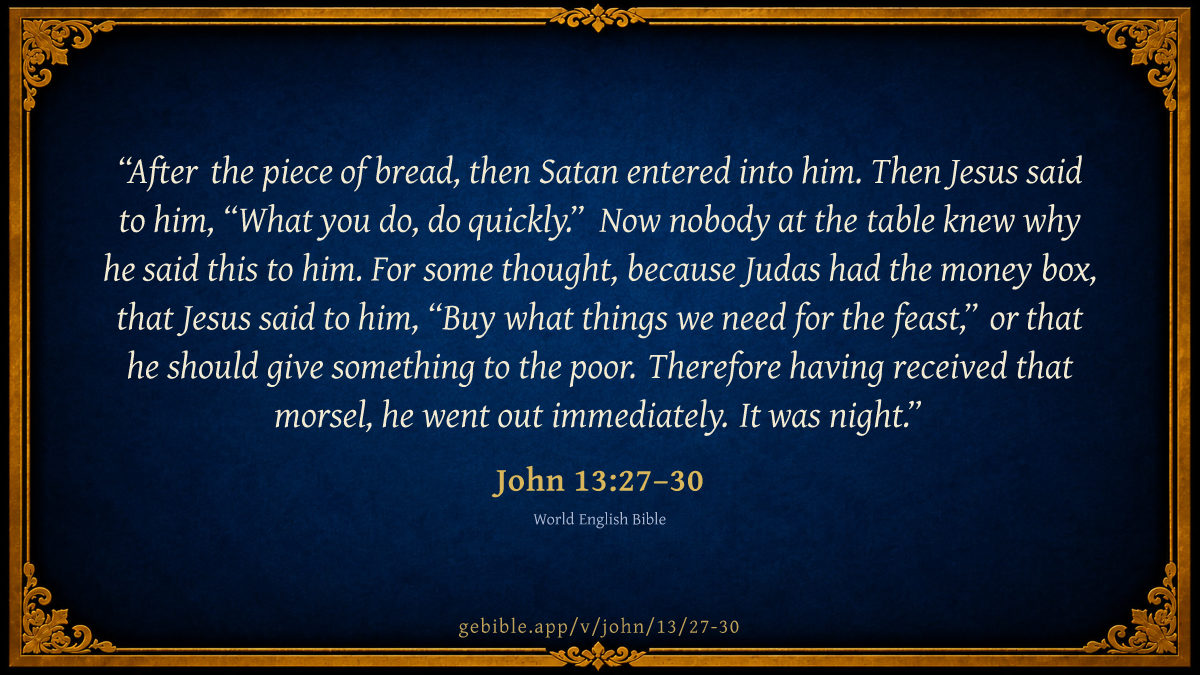
After the piece of bread, then Satan entered into him. Then Jesus said to him, “What you do, do quickly.”
Now nobody at the table knew why he said this to him. For some thought, because Judas had the money box, that Jesus said to him, “Buy what things we need for the feast,” or that he should give something to the poor. Therefore having received that morsel, he went out immediately. It was night.
John Calvin 1540 · Public Domain On vv27–29 27. Satan entered into him. As it is certain…
27. Satan entered into him. As it is certain that it was only at the instigation of Satan that Judas formed the design of committing so heinous a crime, why is it now said, for the first time, that Satan entered into him, who had already held the throne in his heart? But as they who are more fully confirmed in the faith which they formerly possessed are often said to believe, and thus an increase of their faith is called faith, so now that Judas is utterly given up to Satan, so as to be hurried on, by vehement impetuosity, to every extremity of evil, Satan is said to have entered into him. For as the saints make gradual progress, and in proportion to the new gifts by which they are continually enlarged, they are said to be filled with the Holy Spirit; so, in proportion as wicked men provoke the anger of God against themselves by their ingratitude, The Lord deprives them of his Spirit, of all light of reason, and, indeed, of all human feeling, and delivers them unreservedly to Satan. This is a dreadful vengeance of God, when men are given up to a reprobate mind, (Romans 1:28,) so that they scarcely differ at all from the brutes, and — what is worse — fall into horrid crimes from which the brutes themselves would shrink. We ought, therefore, to walk diligently in the fear of the Lord, lest, if we overpower his goodness by our wickedness, he at length give us up to the rage of, Satan.
By giving the sop, Christ did not give an opportunity to Satan, but rather Judas, having received the sop, gave himself up entirely to Satan. It was, indeed, the occasion, but not the cause. His heart, which was harder than iron, ought to have been softened by so great kindness showed to him by Christ; and now his desperate and incurable obstinacy deserves that God, by his just judgment, should harden his heart still more by Satan. Thus, when, by acts of kindness to enemies, we heap coals of fire on their heads, (Romans 12:20,) if they are utterly incurable, they are the more enraged and inflamed to their destruction. And yet no blame is due, on this account, to our kindness, by which their hearts ought to have been inflamed to love us.
Read full note →
Augustine was wrong in thinking that this sop was an emblem of the body of Christ, since it was not during the Lord’s Supper that it was given to Judas. It is also a very foolish dream to imagine that the devil entered essentially — as the phrase is — into Judas; for the Evangelist speaks only of the power and efficacy of Satan. This example reminds us what a dreadful punishment awaits all those who profane the gifts of the Lord by abusing them.
What thou doest, do quickly. The exhortation addressed by Christ to Judas is not of such a nature that he can be regarded as exciting him to do the action: it is rather the language of one who views the crime with horror and detestation. Hitherto he had endeavored, by various methods, to bring him back, but to no purpose. Now he addresses him as a desperate man, “Go to destruction, since you have resolved to go to destruction;” and, in doing so, he performs the office of a, judge, who condemns to death not those whom he, of his own accord, desires to ruin, but those who have already ruined themselves by their own fault. In short, Christ does not lay Judas under the necessity of perishing, but declares him to be what he had formerly been.
John Calvin's Commentaries (1540-1563) — public domain. Text from the Calvin Translation Society English edition (1840s-50s) via the Christian Classics Ethereal Library (ccel.org). Calvin's coverage is partial (roughly two-thirds of the Bible); uncommented books and verses are honest gaps, never fabricated. The 19th-century editor's footnotes and remarks are omitted so the notes are faithfully Calvin's own voice.
John Trapp 1656 · Public Domain On vv27–30 27 And after the sop Satan entered into him.…
27 And after the sop Satan entered into him. Then said Jesus unto him, That thou doest, do quickly.
Ver. 27. Satan entered into him] Had gotten more full possession of him. Let them that depart the public assemblies ere all be done, as Judas did, take heed they meet not the devil at the door. The fourth Council of Carthage excommunicated such, and so delivered them up to Satan, which is a grievous punishment; for then they lie open to all wickedness, as Ananias, whose heart Satan had filled from corner to corner. Luther when he had read certain letters sent to him from Vitus Theodorus, fetched a deep sigh, and said, Heu quam furit Satan, et impellit securos homines ad horrenda flagitia, quae corpus et animum perdunt! Oh how the devil rageth and driveth on secure persons to horrible and damnable wickedness! That which moved Luther to say so, was a sad relation made in that letter, of a certain widow, who being with child by a young scholar, could not have her child baptized unless she would tell the priest who was the child’s father; whereat she being grievously vexed, first killed her child and then hanged herself. Which when the scholar heard of, he likewise stabbed himself to death. The priest understanding what tragedies had followed upon his refusing to baptize the child, hanged himself also. Now, who can doubt but all this was done by the instigation of the devil? Men usually defy him and spit at his name; but they spit not low enough, they spit him out of their mouths, but not out of their hearts; there he plays Rex, and so long cares no more for their cursing of him than he doth for holy water.
Read full note →
That thou doest, do quickly] This is no command, but a prediction by way of detestation; like as when God said to Balaam, Go, for I know thou wilt go after the wages of wickedness. Some note here that, even to Judas, Christ saith, "That thou doest, do quickly," so odious is dulness unto him. (Ward’s Serm.)
John Trapp, A Commentary or Exposition upon All the Books of the Old and New Testament (1647–1656) — public domain. Text from a community e-Sword module.
Matthew Poole 1685 · Public Domain On vv27, 28, 30 That the devil did ever so enter into Judas…
That the devil did ever so enter into Judas as to possess him, as we read of many who were possessed, and violently acted by the devil, is more than we read and, where in holy writ: the entrance into him, signifies Judas’s free and willing giving up of himself to the devil’s suggestions and conduct; and in this sense the devil also before this time was entered into Judas, Luk 22:3. But as holy men are said to be filled with the Spirit of God, who had before received the Spirit, because the Holy Spirit came after upon them with fuller and stronger impulses and motions; so though the devil had formerly been moving Judas to this vile act, and had had his consent to it, yet after he had taken this mouthful, the devil plied him with stronger motions, impulses, and suggestions: and now he had mastered his conscience, and hardened his heart, so as he was more prepared for the villany about which he had some thoughts before. He had now, with an unbelieving and unthankful heart, been eating the passover, which was a type of Christ; and had so mastered his conscience, as to come and do this, with a vile heart, reeking before with treacherous and bloody designs against his Lord and Master. See what is the effect. His heart is more vile, more treacherous, and bloody; he is twice more the servant of the devil than he was before. The sop given him by Christ was but an accidental occasion of it; as the devil took more advantage from his now hardened and further emboldened heart, and he is twice more the child of the devil than he was before. Christ, knowing this, doth not command, advise, or exhort him; but, in a detestation, bids him go and do what he was resolved to do, and which he knew would be quickly; letting him know both that he knew what was in his heart, and that he was now ready to receive the effects of his malice.
Matthew Poole's English Annotations on the Holy Bible (1683–1685) — public domain. Text from a community e-Sword/MySword module.
John Gill 1763 · Public Domain On vv27–30 And after the sop, Satan entered into him,.... After…
And after the sop, Satan entered into him,.... After he had taken and eaten the sop, or crust of bread, by which he was pointed out to be the betrayer, "Satan entered into him"; possessed his body, and filled his mind, and stirred him up more eagerly to pursue with rigour his wicked design. The Jews have a saying (l), that
"no man commits a transgression, until , "a spirit of madness enters into him".''
Read full note →
Such an evil spirit entered into Judas, which pushed him on to commit this horrid iniquity:
then said Jesus to him, that thou doest, do quickly; this he said, not as approving his wicked design, and exhorting him to it as a laudable action, but rather as deriding him, having nothing to care about, or fear from him; or as upbraiding him with his perfidy and wickedness, and signifying that he should take no methods to prevent him, though he fully knew what was in his heart to do; and it seems also to express the willingness of Christ, and his eager and hearty desire to suffer and die for his people, in order to obtain salvation for them.
(l) T. Bab. Sota, fol. 3. 1. Tzeror Hammor, fol. 112. 1. & 117. 3.
John Gill's Exposition of the Whole Bible (1746–1763) — public domain (CC PDM 1.0). Text via the HelloAO Bible API.
John Wesley 1765 · Public Domain On vv27, 28, 30 What thou doest, do quickly - This is not…
What thou doest, do quickly - This is not a permission, much less a command. It is only as if he had said, If thou art determined to do it, why dost thou delay? Hereby showing Judas, that he could not be hid, and expressing his own readiness to suffer.
John Wesley, Explanatory Notes Upon the Whole Bible (1754–1765) — public domain. Text via the GEBible commentary corpus.
Adam Clarke 1810 · Public Domain On vv27, 29, 30 Verse 27. Satan entered into him.] He had entered…
Verse 27. Satan entered into him.] He had entered into him before, and now he enters again, to strengthen him in his purpose of delivering up his Master. But the morsel was not the cause of this entering in; the giving of it only marks the time in which the devil confirmed Judas in his traitorous purpose. Some have thought that this morsel was the sacrament of the Lord's Supper: but this is an utter mistake.
That thou doest, do quickly.] As if he had said: "Thou art past all counsel; thou hast filled up the measure of thy iniquity, and hast wholly abandoned thyself to Satan; I will not force thee to turn from thy purpose, and without this thou wilt not. Thy designs are all known to me; what thou art determined to do, and I to permit, do directly; delay not, I am ready."
Adam Clarke's Commentary on the Bible (1810–1826) — public domain. Text from a community e-Sword/MySword module.
Joseph Benson 1811 · Public Domain On v27 Joh 13:27-30. And after the sop Satan entered into…
Joh 13:27-30. And after the sop Satan entered into him — More fully; “non secundum substantiam,” says Jerome, “sed secundum operationem,” not as to his substance, but as to his operation; as he is said to do when man’s will is fully inclined to obey his motions. Then said Jesus, That thou doest, do quickly — This is not a permission, much less a command. It is only as if he had said, If thou art determined to do it, why dost thou delay? Hereby showing Judas that he could not be hid, and expressing his own readiness to suffer. No man at the table knew why he said this — That is, none except John and Judas, for John does not here include himself, but speaks of the other disciples; for though they could know nothing of the matter, in all probability he must have comprehended the meaning of Christ’s words to the traitor. Some thought because Judas had the bag — Had the keeping of the common purse, on which they were to subsist during their stay at Jerusalem; that Jesus had said, Buy that which we have need of against the feast — That is, the seven ensuing days of the feast; or that he should give something to the poor — These meanings were what first occurred to the disciples. But being in great perplexity on account of his declaration concerning the treachery of one of their number, they did not think much upon what he now said to Judas. The declaration which engrossed their attention had not pointed at any of them in particular, and the discovery of the person was made to John only. They were therefore swallowed up in grief, and each of them would fain have cleared himself, inquiring of Jesus, one by one, Lord, is it I? Mat 26:22; Mar 14:19. Judas himself even, conscious as he was of his guilty purpose, also inquiring, with unparalleled impudence, Master, is it I? He then, having received the sop — With the awful words of his Master (giving him to know that his intentions were not concealed) sounding, as it were, in his ears; went immediately out — To the chief priests, or, went out soon, without any further reply, as ευθεως, here rendered immediately, sometimes signifies: for it seems he stayed till the Lord’s supper was instituted: being so utterly abandoned as to be capable of committing his intended horrible crime, even with this aggravation; and it was night — Which was the time he had appointed to meet those who were consulting how to execute their purpose against the life of Jesus, and under the cover of it he went to them, and fulfilled his engagement in a little time, by delivering his Master into their hands.
Joseph Benson's Commentary on the Old and New Testaments (1811–1818) — public domain. Text from a community e-Sword module.
Albert Barnes 1834 · Public Domain On vv27, 28, 30 After the sop - After he had taken and…
After the sop - After he had taken and probably eaten it. By this Judas saw that Jesus knew his design, and that he could not conceal his plan. He saw, also, that the other disciples would be acquainted with it; and, aroused by sudden anger, or with the apprehension that he should lose his reward, or that Jesus might escape, he resolved on executing his plan at once.
Satan entered into him - The devil had before this put it into his heart to betray Jesus Joh 13:2, but he now excited him to a more decided purpose. See Luk 22:3; also Act 5:3; “Why hath Satan filled thine heart,” etc.
Read full note →
What thou doest, do quickly - This showed to Judas that Jesus was acquainted with his design. He did not command him to betray him, but he left him to his own purpose. He had used means enough to reclaim him and lead him to a holy life, and now he brought him to a decision. He gave him to understand that he was acquainted with his plan, and submitted it to the conscience of Judas to do quickly what he would do. If he relented, he called on him to do it at once. If he could still pursue his wicked plan, could go forward when he was conscious that the Saviour knew his design, he was to do it at once. God adopts all means to bring men to a decision. He calls upon them to act decisively, firmly, immediately. He does not allow them the privilege to deliberate about wicked deeds, but calls on them to act at once, and to show whether they will obey or disobey him; whether they will serve him, or whether they will betray fits cause. He knows all their plans, as Jesus did that of Judas, and he calls on men to act under the full conviction that he knows all their soul. Sin thus is a vast evil. When men can sin knowing that God sees it all, it shows that the heart is fully set in them to do evil, and that there is nothing that will restrain them.
Albert Barnes' Notes on the Bible (1834–1885) — public domain. Text from a community e-Sword/MySword module.
Haydock's Catholic Bible Commentary 1859 · Public Domain On v27 Satan entered into him, who presently went out with…
Satan entered into him, who presently went out with great anger and indignation. It was then night, likely about nine o’clock. (Witham) --- That which thou dost, do quickly. It is not a license, much less a command, to go about his treason: but a signification to him, that Christ would not hinder or resist what he was about, do it as soon as he pleased: but was both ready, and desirous to suffer for our redemption. (Challoner) --- Christ does not by these words exhort the traitor, much less command him, to perform his wicked deed; but he means to reprobate it, and at the same time testify that he would not hinder his being betrayed. (St. John Chrysostom, hom. lxxi. in Joan.) --- It is the voice not of command, but of permission, not of a person in fear, but of one prepared for death. (St. Leo)
George Leo Haydock (1774–1849), Haydock's Catholic Family Bible and Commentary, 1859 edition — public domain. Excludes Psalms (Douay-Rheims chapter numbering differs from Protestant) and Deuterocanonical books (Catholic canon only).
Robert Jamieson, A. R. Fausset & David Brown 1871 · Public Domain On vv27, 28, 30 after the sop Satan entered into him--Very solemn are…
after the sop Satan entered into him--Very solemn are these brief hints of the successive steps by which Judas reached the climax of his guilt. "The devil had already put it into his heart to betray his Lord." Yet who can tell what struggles he went through ere he brought himself to carry that suggestion into effect? Even after this, however, his compunctions were not at an end. With the thirty pieces of silver already in his possession, he seems still to have quailed--and can we wonder? When Jesus stooped to wash his feet, it may be the last struggle was reaching its crisis. But that word of the Psalm, about "one that ate of his bread who would lift up his heel against Him" (Psa 41:9) probably all but turned the dread scale, and the still more explicit announcement, that one of those sitting with Him at the table should betray Him, would beget the thought, "I am detected; it is now too late to draw back." At that moment the sop is given; offer of friendship is once more made--and how affectingly! But already "Satan has entered into him," and though the Saviour's act might seem enough to recall him even yet, hell is now in his bosom, and he says within himself, "The die is cast; now let me go through with it"; fear, begone!" (See on Mat 12:43).
Then said Jesus unto him, That thou doest, do quickly--that is, Why linger here? Thy presence is a restraint, and thy work stands still; thou hast the wages of iniquity, go work for it!
Jamieson, Fausset & Brown — Commentary Critical and Explanatory on the Whole Bible (1871) — public domain (CC PDM 1.0). Text via the HelloAO Bible API.
Daniel D. Whedon 1874 · Public Domain On vv27, 28, 30 27. Do quickly—This is properly no original command to…
27. Do quickly—This is properly no original command to do, and no permission of the act. It only requires that the act, wicked and forbidden though it be, should be rapid and brief. This both required his instant departure, which was a desirable result, and indicated that there was but a short time for the accomplishment of a stupendous destiny.
Daniel D. Whedon (gen. ed.), Commentary on the Old and New Testaments (1874–1909) — public domain. Text from a community e-Sword module.
The Cambridge Bible for Schools and Colleges 1878 · Public Domain On vv27–30 27. Satan entered into him] Literally, at that moment…
27. Satan entered into him] Literally, at that moment Satan entered into him. At first Satan made suggestions to him (Joh_13:2) and Judas listened to them; now Satan takes full possession of him. Desire had conceived and brought forth sin, and the sin full grown had engendered death (Jas_1:15). Satan is mentioned here only in S. John.
Then said] Once more we must substitute therefore for ‘then.’ Jesus knew that Satan had claimed his own, and therefore bad him do his work.
Read full note →
do quickly] Literally, do more quickly; carry it out at once, even sooner than has been planned. Now that the winning back of Judas has become hopeless, delay was worse than useless: it merely kept Him from His hour of victory. Comp. Mat_23:32.
The Cambridge Bible for Schools and Colleges (gen. ed. J. J. S. Perowne; Cambridge University Press, 1878–1918) — public domain. Text from a community e-Sword module.
Ellicott's Commentary for English Readers 1878 · Public Domain On vv27–30 (27) And after the sop Satan entered into him.—The…
(27) And after the sop Satan entered into him.—The Greek expresses more vividly the very moment when the mind finally cast out love, and left itself as a possession for Satan. “And after the sop, then Satan entered into him.” It was at that moment, when the last effort had been tried, and tried in vain, when the heart hardened itself to receive from Jesus the sacred pledge of love, while it was plotting in black hatred how to betray Him; it was then that hope took her flight from a realm of gloom where she could no longer dwell, and light ceased to shine in a darkness that would not comprehend it.
Then said Jesus unto him.—Better, Jesus therefore said unto him. It was because He read the secrets of the heart, and saw that it was wholly given up to evil that He said it.
Read full note →
That thou doest, do quickly.—The Greek is exactly, more quickly. “Carry out your plans even more quickly than you have proposed. Do the fatal deed at once. It is resolved, and every effort to win thee has failed. A fixed resolve is nothing less than the deed itself.”
A Bible Commentary for English Readers, edited by Charles John Ellicott (1878–1897) — public domain. Text from a community e-Sword module.
The Pulpit Commentary 1880 · Public Domain On vv27, 28, 30 And after the sop; not with it. By no…
And after the sop; not with it. By no magical or demoniacal rite was the man rendered the slave of Satan; post hoc is not propter hoc. After the sop, after this last final proof of the unutterable friendship and love of the Divine Lord tote , then, "at that moment," as though goodness was turned into wrath, and the conflict with evil closed, the incarnated fiend resolved that he would wait no longer. Then Satan (the only place in the Fourth Gospel where Satan is mentioned) entered into him. How could this be known? The evangelist clearly saw what he thus described he saw the malign and unrelenting expression on Judas"s face; he suspected that some devilish plot was hatched, some hideous purpose finally formed. It is the evangelist"s way of saying what he personally saw and afterwards concluded. Up to that moment of supreme forbearance, the character was not irretrievably damned, but now he had sinned against knowledge and love, and even Jesus gives him up. "It were better for him that he had never been born." There is no more awful or tragic touch in the whole narrative, nor any more symbolic of the curse which the corrupt heart can make and bring down upon itself out of the greatest blessing. There is no advantage in trying to determine the amount of figurative sense conveyed by the expression, "Satan entered." The ethical state consequent either upon the sop or the devil is clear enough. The moment when it was induced is signalized in this tragedy. The vehement effort which the traitor must have made to resist all gracious influences opened the way for the powers of hell and darkness to take possession of him. He strengthened himself to do evil. Jesus therefore said to him, That thou doest, do quickly. Questions have been raised as to the sentence whether it was a solemn command or a permission at once to carry out the purpose that was in his heart (as Grotius, Kuinoel, and others suppose); but Meyer here is more penetrative (so Moulton): "Jesus (as a man) actually wishes to surmount as soon as possible the last crisis of his fate now determined for him." Jameson ("Profound Problems in Theology and Philosophy") urges that it was the prolongation of the struggle which was the bitterest element in Christ"s sufferings. The decision at which he had arrived brooked no longer delay. As if he had said, "If you have any manhood in you, and you are not altogether incarnate daemon, make haste, let me remain no longer in suspense; carry out the purpose now and at once." Ambrose, Lucke, Tholuck, suggest that he meant to separate Judas from the eleven, and be rid of his presence. His removal from the group is undoubtedly the condition of our Lord"s highest revelations of himself.
The Pulpit Commentary (1880–1919), ed. H.D.M. Spence-Jones & Joseph S. Exell — public domain. Text from a community e-Sword module.
The Biblical Illustrator 1887 · Public Domain On v30 He then having received the sop went immediately out:…
Joh_13:30
He then having received the sop went immediately out: and it was night
Read full note →
Judas and the sop
The subject suggests
I.
THE TWO-FOLD AND EVEN CONTRASTED SIGNIFICANCE OF THE SAME THING.
1. The giving of the sop meant one thing to John, viz., who was the betrayer? It does not seem to have been fully understood (verse 28), but that was its meaning. To Judas it was meant as a mark of kindness. There was no inconsistency in this. It was done for a good reason. It consisted with Christs affection for John, not to allow the suspicion of betrayal to rest upon him, and with His love for Judas to show him kindness. But why should Christ so act when He knew the result? Because He invariably acted as though results were unknown. He knew that He would raise Lazarus, yet He gave way to grief. He knew who believed not and who should betray Him, but that did not lead Him to slacken efforts on their behalf.
2. And so the same providence now may convey a varied meaning according to our feeling or position. We are more susceptible at one time than another. A song may make glad feelings in one and sad in another, according to the mood. Let each learn what God says aside to him.
II. HOW MUCH MEANING MAY BE CONVEYED BY A LITTLE THING. In the very unobtrusiveness of the sop there was an element of power. It was better than if many words had been employed. The little friendly act was sufficient to flash the whole before His mind, and to discover the whole attitude of the Saviour. It was an intimation that it was not too late for repentance. Shortly before Christ put into a little service the great lesson of humility and serviceableness; shortly after He put great meaning into a look; and while sitting there He put meaning to all time into simple bread and wine. It needs only to have susceptible warm hearts to learn great lessons through little things.
III. THE DISASTROUS EFFECT THAT MAT FOLLOW FROM THE REJECTION OF AN APPEAL.
1. During all his declension Judas had the close attendance of Jesus, and therefore must have had every help toward a successful issue in his trial. And now a last appeal was about to be made. Would he say yes or no to the love of Christ. That was the turning point in his, as in every mans, destiny. And he was so infatuated with evil as to say No. And so Satan, who had only previously put the thought in his heart, now entered him, and the Spirit of the Lord departed from him. But as soon as the act was performed, the enchantment was gone, and he hurried himself into eternity.
2. And so Christ is continually making appeals to us, in some sermon, book, mercy, worldly loss. If we do not yield there will come a last and decisive appeal, and if we reject that, despair.
IV. HOW EXTERNAL NATURE REFLECTS AND MEETS STATES OF THE HUMAN SOUL. It was night--a congenial time for the deed of darkness. The children of darkness are dark within, and when Judas went out the dark thought of his mind was reflected there. Perhaps it was a relief to be away from the light, perhaps a suggestion of destiny. There is only outer darkness for those who go out from Christ. Let us accept Him now, from whose presence by and by we shall go no more out. (R. Finlayson, B. A.)
The sop and a dark deed
Notice
I. THE GROWTH AND STRENGTHENING OF EVIL AMID THE HOLIEST INFLUENCES. Judas lived within the circle of the Saviours influence for three years. Eli was rebuked by Samuel for permitting his sons to commit sin on the threshold of the Temple, and--strange irony--Samuels sons while doing priestly work walked in the same evil way. We may attend the sanctuary and listen to a mothers prayers for fifty years, and afterwards be lost.
II. THE SAVIOURS GOODNESS BECOMES THE OCCASION OF GREAT EVIL. Judas was a worse man at the end of three years; while Christs appreciation of Marys offering, and His appeal to Judas, seemed to strengthen him in his purpose. So the presence of goodness, if not a blessing to us, is a withering curse.
III. CHRISTS GENEROUS TREATMENT OF THE SINNER. He saw the growth of evil in Judas, but it made no difference in His trust and love. At the last moment, there was one more attempt to touch the traitors heart. Friend, etc. The gift of the sop was a sign of love. What a wealth of persevering love is poured out on the most depraved!
IV. THE DARK TERMINATION OF AN EVIL LIFE. Judas went out into the calm of that beautiful Syrian night, but is was a scene of blankness and tempest to him. Then came that deeper night of unavailing penitence and suicide. The path of sin always ends in night. It may be strewn with flowers or steeped in blood, but there is the same termination--the night of separation from God and communion with our own sins. (Noel R. Hamer, M. A.)
It was night
I. IN JERUSALEM. Only the pale shining of the passover moon lit the streets. The sieve was shaken, and the small soul of the money lover dropped through out of honour into shame and gloom.
II. In His HEART. For Satan, the prince of darkness, in person was ruling there. Over him swept a wave of the outer darkness like a cloud from the bottomless pit. Suicide was just at hand.
III. IN ALL THE VAST FUTURE. He was going to his own place. (Job_10:22). We see at this vanishing moment that the man is lost while he is living, virtually in hell because the prince of hell is in his heart. And so we know that a soul can be damned even before it is dead. (C. S.Robinson, D. D.)
Walking in the night
I. THE DARKNESS OF JUDASS CRIME.
1. The night has become intolerable to him now.
2. He was not always a traitor.
3. He may even have been brought into Christs company that he might be saved.
4. But over all good his evil heart obtains supremacy.
II. THE DARKNESS OF HIS REPENTANCE.
1. His conscience works up with the terror of night upon it, but without the accents of hope.
2. His repentance leads only to suicide--a further crime.
III. THE DARKNESS OF HIS DOOM. It had been better for that man, if he had never been born. (J. H. Hargreaves.)
The harmony of nature with our mental moods
We always like to have nature in sympathy with our sorrows and our joys; to have our moods of mind quite in accordance with our moods of seasons. Thus, if you and I are in distress, there is a sort of melancholy pleasure to find the sky gloomy with clouds; and when the shutter which tells our loss, and hides our mourning from the world and casts a shadow upon our home, lets in through the crevice the sunbeam, and we hear the happy crowd enjoying it outside, that intrusion seems quite an injury to our feelings. We take our moods of mind from those of nature, and this is a mystery, of course, which we cannot explain; but we have pleasure in finding that her moods are in accordance with ours, that she is bright when we are bright, that she is in sackcloth when we are sad. And so it is quite a relief to our feelings, just as it must have been to the Evangelists, to find it was night. Such a deed could not have been done before the face of Gods smiling sun. (C. J. P. Eyre, M. A.)
Moral seasons
There is a moral night upon the soul of every sinful creature, just as there has been a day spring in the soul of every true believer. (C. J. P. Eyre, M. A.)
Now is the Son of Man glorified.
The triple glorification
I. THE GLORIFICATION OF THE SON OF MAN IN AND BY HIS SUFFERING. This language is strange here. It would not have been wonderful at Jordan or on the Mount of Transfiguration. Observe that it is as the Son of Man He is glorified, i.e., His glory
1. As the perfect man was displayed in and by His sufferings. Mans excellence consists in entire conformity to Gods will. Of this Christ was all through possessed, but more particularly when at the supreme moment to do Gods will He died for man.
2. As the representative man, as typified by the vicarious sacrifice on the Day of Atonement, and by the Kinsman Redeemer. How glorious this was.
3. As the God-man, as illustrated by the supernatural portents before and at the Crucifixion, which made the Centurion exclaim, Surely this is the Son of God.
4. As the predicted man. At no period of His history were so many prophecies fulfilled. It is probable that the words suggest that there should be spectators: that there should not only be glory, but glorification. If so, Christ was glorified in His sufferings by the dying thief, God the Father, and the holy angels. Some expositors refer the words to the Lords supper--a glorious display of His authority as the Legislator, and His love as theSaviour of the Church.
II. THE GLORIFICATION OF GOD IN THE SON OF MAN SUFFERING. This is a strange declaration. We can understand how God is glorified in heaven, in the universe, in His government, and in multitudes of saved beings, but how in the sufferings of His Son? Now was the hour and power of darkness. The words in Him explain the mystery. By men and devils God was dishonoured, but by Christ honoured. God was glorified in Christs sufferings
1. Viewed in themselves, they glorify
(1) The Divine power which inflicted them and sustained the Sufferer. Never was sorrow like Christs sorrow, but never was Gods grace so abundant. Christ crucified is the power of God.
(2) The Divine wisdom. Christs sufferings
(a) Effectually answer an important end--the eternal salvation of man.
(b) By means different from any that created wisdom could have suggested.
(3) The Divine justice (Rom_3:25-26).
(4) The Divine faithfulness in exactly fulfilling so many predictions.
(5) The Divine benignity (chap. 3:16).
2. Viewed in their results.
(1) In the events themselves. The enemy of God is baffled, evil in the form of sin and suffering prevented, and good in the form of holiness and happiness produced.
(2) In those events as the results of Christs suffering--to bring such results out of such means. Satans ruin rises out of his apparent triumph; life is the fruit of death; favour arises out of wrath, etc.
III. THE GLORIFICATION BY GOD OF THE SON OF MAN, ON ACCOUNT OF HIS SUFFERINGS, IN CONSEQUENCE OF GOD BEING GLORIFIED BY HIM IN THEM.
1. God glorified the Son of Man
(1) Under His sufferings, which tested His power to bear and His disposition to obey, by sustaining Him amid them.
(2) After His sufferings--straightway, It is finished, paradise, the resurrection, ascension, session, and the judgment to come.
2. God glorified the Son of Man in Himself. If God is glorified in Him He shall be glorified in God.
3. Gods glorification of the Son of Man was the result and reward of God being glorified in and by the Son of Mans sufferings.
Conclusion: The subject bids us
1. Rest with entire confidence on the finished work of Christ as the ground of our hope.
2. Imitate the Son of Man in glorifying God and in seeking thus to be glorified by God.
3. Cooperate, though at an infinite distance, with God in glorifying the Son of Man. (J. Brown, D. D.)
God glorified in His Son
showed what glory accrued from the sufferings of Christ.
I. TO THE SON HIMSELF.
1. In completing His engagements with the Father.
2. In redeeming from death a ruined world.
II. TO THE FATHER THROUGH THE SON.
1. In the display of all His perfections.
2. In the accomplishment of all His purposes.
III. TO THE SON BY AND WITH THE FATHER.
1. In the testimonies borne to Him under His sufferings.
2. In the triumphant issue of them.
3. In the benefits conferred in consideration of them. (C. Simeon, M. A.)
God glorified in His Son
By
I. HIS OBEDIENCE TO GODS LAW.
II. HIS TEACHING OF GODS WILL.
III. HIS SUBMISSION TO GODS APPOINTMENTS.
IV. HIS DEATH FOR GODS CHILDREN. (S. S. Times.)
The cross the glory of Christ and God
There is something very weird and awful in the brief note of time--it was night. In immediate connection comes this singular burst of triumph--Therefore. Now that that spot in their feast of charity had disappeared, the Master felt at ease; and, like some stream, out of the bed of which a black rock has been taken, His words flow more freely. How intensely real and human the narrative becomes when we see that Christ, too, felt the oppression of an uncongenial presence, and was relieved and glad at its removal! The departure of the traitor evoked these words of triumph in another way. The match was lit that was to be applied to the train. He had gone out on his dark errand, and that brought the Cross within measurable distance of our Lord. What Judas went to do was the beginning of Christs glorifying.
I. THE SON OF MAN GLORIFIED IN HIS CROSS.
1. There is a double aspect under which our Lord regarded His sufferings. On the one hand we mark the innocent shrinking of His manhood. And yet, side by side with that, there is the reaching out almost with eagerness to bring the Cross nearer. Like the pellucid Rhine and the turbid Moselle, that flow side by side, so the shrinking and the desire were contemporaneous in Christs mind. Here we have the triumphant anticipation rising to the surface, and conquering for a time the shrinking.
2. Why did Christ think of His Cross as a glorifying? The New Testament generally represents it as the lowest point of His degradation; Johns Gospel always represents it as the highest point of His glory. And both are true; just as the zenith of our sky is the nadir for these on the other side of the world. The same fact which in one aspect sounds humiliating, in another is glorious. The Cross glorified Christ because
(1) It was the revelation of His heart. All His life long He had been trying to tell the world how much He loved it; but in His death it comes in a flood, and pours itself upon the world. For Him to be known was to be glorified. So pure and perfect was He, that revelation of His character and glorification of Himself were one and the same thing. We can fancy a mother in the anticipation of shame, and suffering, and death for the sake of some prodigal child, forgetting all, because all are absorbed in the one thought: If I bear them, my poor, rebellious child will know at last how much I loved him. So Christ yearns to impart the knowledge of Himself to us because by that knowledge we may be won to His love and service.
(2) It is His throne of saving power. Christ could not have spoken such words as these if He had simply thought of His death as a Plato or a John Howard might have thought of his, as being the close of his activity for the welfare of his fellows. If His death is His glorifying, it must be because in that death something is done which was not completed by the life, however fair; by the words, however wise and tender; by the works of power, however restorative and healing. Here is something more, viz., that His
Cross is the propitiation for the sins of the whole world. He is glorified therein, not as a Socrates might be glorified by his calm and noble death; but because in that death He wrestled with and overcame our foes, and because, like the Jewish hero, dying, He pulled down the house which our tyrants had built, and overwhelmed them in its ruins.
3. And so there blend, in that last act, the two contradictory ideas of glory and shame; like some sky, all full of dark thunderclouds, and yet between them the brightest blue and the blazing sunshine. In the Cross Death crowns Him the Prince of Life, and His Cross is His throne. He endured the Cross, despising the shame; and lo! the shame flashed up into the very brightness of glory, and the ignominy and the suffering became the jewels of His crown.
II. GOD GLORIFIED IN THE SON OF MAN. The mystery deepens as we advance. That God shall be glorified in a man is not strange, but it is strange that the act in which He was glorified was the death of an innocent man, and must imply
1. That God was in Christ, in some singular and eminent manner. If His whole human life and nature were the brightest manifestation of God, we can understand that the Cross was the highest point of the revelation of the Divine nature, and so was the glorifying of God in Him. But if we take any lower view of the relation between God and Christ, these words are a world too wide for the facts of the case.
2. That these sufferings bore no relation to the deserts of the person who endured them. If Christ, with His pure and perfect character, suffered so, then, if they have any bearing at all on the character of God, they cast a shadow rather than a light upon the Divine government. But if we can say, God was in Christ reconciling the world to Himself; that His death was the death of Him whom God had appointed to live and die for us, and to bear our sins then, though deep mysteries come with the thought, still we can see that, in a very unique manner, God is glorified and exalted in His death. For, if the dying Christ be the son of God dying for us, then the Cross glorifies God, because it teaches us that the glory of the Divine character is the Divine love. If there be nothing Diviner in God than His giving of Himself to His creatures, then the Cross towers above all other revelations. And is it not so? Has it not scattered doubts that lay like mountains of ice upon mans heart? Has it not delivered men from the dreams of gods angry, capricious, vengeful, etc.? Has it not taught us that love is God, and God is love?
III. THE SON OF MAN GLORIFIED IN THE FATHER. The mysteries deepen as we advance. If God be glorified in Him, etc. Do these words sound to you as if they expressed no more than the confidence of a good man, who, when he was dying, believed that he would be accepted of a loving Father, and would be at rest from his sufferings?
1. In Himself. That is the obvious antithesis to the previous clause, a glorifying which consisted in a manifestation to the external universe, whereas this is a glorifying within the depths of the Divine nature. And the best commentary is: Father! glorify Thou Me with the glory which I had with Thee before the world was. We get a glimpse into the very centre of the brightness of God; and there, walking in that beneficent furnace, we see One like unto the Son of Man.
2. This reception into the bosom of the Father is given to the Son of Man. The brother of us all, in His manhood, enters into that same glory, which, from the beginning, the Eternal Word had with God.
3. That glorifying is set forth as commencing immediately--straightway. At the instant, then, that He said, It is finished, and all that the Cross could do to glorify God was done, at that instant there began, with Gods glorifying of the Son in Himself. It began in that Paradise into which we know that upon that day He entered. It was manifested to the world when He raised Him from the dead and gave Him glory. It reached a still higher point when, ascending up on high, a dominion and a throne and a glory were given to Him. It shaft rise to its highest manifestation before an assembled world, when He shall come in His glory, and before Him shall be gathered all nations. Conclusion: From that elevation He looks down ready to bless each poor creature here. And if we will but take Him as our Saviour, His all-prevalent prayer, presented within the veil for us, will certainly be fulfilled at last--Father, I will that they also whom Thou has given Me, etc. (A. Maclaren, D. D.)
Three important facts in relation to Christ
I. A PAINFUL IMPRESSION REMOVED FROM HIS HEART. Therefore when he was gone out
1. An object of moral offence had been removed from His vision. It is never felt to be a pleasant thing to have in your social circle a corrupt man, especially if you know he has plotted against you. The exit of such a man is felt to be a relief.
2. An obstruction to the free utterance of His love had been removed from amongst His hearers. Parents and pastors have often things to say which they will not utter in the presence of a stranger or enemy. When the traitor was gone Christs tongue was free.
II. A GLORIOUS CONSUMMATION OF THE GREAT PURPOSE OF HIS LIFE. The expression Son of Man occurs sixty-six times. Not son of a tribe, nation, sect, or He would have had tribal, etc., peculiarities. He realized the Divine ideal of what man ought to be.
1. The true glory of a man is the realization of the Divine purpose in his Ills. The universe is glorious because it realizes the Divine purpose. The gospel is glorified when it transforms men into the image of God.
2. The man who thus realizes the Divine purpose glorifies God also. We see most of Gods glory in his life who works out the Divine will in a Godlike life. This is what Christ felt now.
III. A TENDER CONSIDERATION FOR THE COMING TRIAL OF HIS DISCIPLES (Joh_13:33).
1. He informs them of that trial. A trial that would crush if it came unexpectedly may fall lightly when anticipated.
2. He informs them in the language of endearment. (D. Thomas, D. D.)
The Biblical Illustrator, edited by Joseph S. Exell (c. 1880s–1900s) — public domain. Text from a community e-Sword module.
B. W. Johnson 1891 · Public Domain On v30 30. Went immediately out. It is probable that the…
30. Went immediately out. It is probable that the Lord's Supper was instituted, at this point, after Judas went out. It was, as we learn from Matthew, after the passover. Matthew's order (see Matt., chap. 26) is as follows: (1) The Passover; (2) the Exposure of Judas; (3) the Lord's Supper. This is John's order, save that he omits, because well known, to record the origin of the Lord's Supper here, and simply tells of the departure of Judas.
B. W. Johnson's The People's New Testament with Notes (1889–1891) — public domain. Electronic text from the Christian Classics Ethereal Library (CCEL) ThML edition.
Alexander MacLaren 1905 · Public Domain On v27
John
THE DISMISSAL OF JUDAS
Read full note →
Joh 13:27.
When our Lord gave the morsel, dipped in the dish, to Judas, only John knew the significance of the act. But if we supplement the narrative here with that given by Matthew, we shall find that, accompanying the gift of the sop, was a brief dialogue in which the betrayer, with unabashed front, hypocritically said, ‘Lord! Is it I?’ and heard the solemn, sad answer, ‘Thou sayest!’ Two things, then, appealed to him at the moment: one, the conviction that he was discovered; the other, the wonderful assurance that he was still loved, for the gift of the morsel was a token of friendliness. He shut his heart against them both; and as he shut his heart against Christ he opened it to the devil. So ‘after the sop Satan entered into him.’ At that moment a soul committed suicide; and none of those that sat by, with the exception of Christ and the ‘disciple whom He loved,’ so much as dreamed of the tragedy going on before their eyes.
I know not that there are anywhere words more weighty and wonderful than those of our text. And I desire to try if I can at all make you feel as I feel, their solemn signification and force. ‘That thou doest, do quickly.’
I. I hear in them, first, the voice of despairing love abandoning the conflict.
If I have rightly construed the meaning of the incident, this is the plain meaning of it. And you will observe that the Revised Version, more accurately and closely rendering the words of our text, begins with a ‘Therefore.’ ‘Therefore said Jesus unto him,’ because the die was cast; because the will of Judas had conclusively welcomed Satan, and conclusively rejected Christ; therefore, knowing that remonstrance was vain, knowing that the deed was, in effect, done, Jesus Christ, that Incarnate Charity which ‘believeth all things, and hopeth all things,’ abandoned the man to himself, and said, ‘There, then, if thou wilt thou must. I have done all I can; my last arrow is shot, and it has missed the target. That then doest, do quickly.’
There is a world of solemn meaning in that one little word ‘doest.’ It teaches us the old lesson, which sense is so apt to forget, that the true actor in man’s deeds is ‘the hidden man of the heart,’ and that when it has acted, it matters comparatively little whether the mere tool and instrument of the hands or of the other organs have carried out the behest. The thing is done before it is done when the man has resolved, with a fixed will, to do it. The betrayal was as good as in process, though no step beyond the introductory ones, which could easily have been cancelled, had yet been accomplished. Because there was a fixed purpose which could not be altered by anything now, therefore Jesus Christ regards the act as completed. It is what we think in our hearts that we are; and our fixed determinations, our inclinations of will, are far more truly our doings than the mere consequences of these, embodied in actuality. It is but a poor estimate of a man that judges him by the test of what he has done. What he has wanted to do is the true man; what he has attempted to do. ‘It was well that it was in thine heart!’ saith God to the king who thought of building the Temple which he was never allowed to rear. ‘It is ill that is in thine heart,’ says He by whom actions are weighed, to the sinner in purpose, though his clean hands lie idly in his lap. These hidden movements of desire and will that never come to the surface are our true selves. Look after them, and the deeds will take care of themselves. Serpent’s eggs have serpents in them. And he that has determined upon a sin has done the sin, whether his hands have been put to it or no.
But, then, turn for a moment to the other thought that is suggested here-that solemn picture of a soul left to do as it will, because divine love has no other restraints which it can impose, and is bankrupt of motives that it can adduce to prevent it from its madness. Now I do not believe, for my part, that any man in this world is so all-round ‘sold unto sin’ as that the seeking love of God gives him up as irreclaimable. I do not believe that there are any people concerning whom it is true that it is impossible for the grace of God to find some chink and cranny in their souls through which it can enter and change them. There are no hopeless cases as long as men are here. But, then, though there may not be so, in regard to the whole sweep of the man’s nature, yet every one of us, over and over again, has known what it is to come exactly into that position in regard to some single evil or other, concerning which we have so set our teeth and planted our feet at such an angle of resistance as that God gives up dealing with us and leaves us, as He did with Balaam when He opposed his covetous inclinations to all the remonstrances of Heaven. God said at last to him ‘Go!’ because it was the best way to teach him what a fool he had been in wanting to go. Thus, when we determine to set ourselves against the pleadings and the beseechings of divine love, the truest kindness is to fling the reins upon our necks, and let us gallop ourselves into a sweat and weariness, and then we shall be more amenable to the touch of the rein thereafter.
Are there any people whom God is teaching obedience to His light touch, by letting them run their course after some one specific sin? Perhaps there are. At all events, let us remember that that position of being allowed to do as we like is one to which we all tend, in the measure in which we indulge our inclinations, and shut our hearts against God’s pleadings. There is such a thing as a conscience seared as with a hot iron. They used to say that there were witches’ marks on the body, places where, if you stuck a pin in, there was no feeling. Men cover themselves all over with marks of that sort, which are not sensitive even to the prick of a divine remonstrance, rebuke, or retribution. They ‘wipe their mouths and say I have done no harm.’ You can tie up the clapper of the bell that swings on the black rock, on which, if you drift, you go to pieces. You can silence the Voice by the simple process of neglecting it. Judas set his teeth against two things, the solemn conviction that Jesus Christ knew his sin, and the saving assurance that Jesus Christ loved him still. And whosoever resists either of these two is getting perilously near to the point where, not in petulance but in pity, God will say, ‘Very well, I have called and ye have refused. Now go, and do what you want to do, and see how you like it when it is done. What thou doest, do quickly.’ Do you remember the other word, ‘If ‘twere done when ‘tis done, then ‘twere well it were done quickly’? But since consequences last when deeds are past, perhaps you had better halt before you determine to do them.
II. Now, secondly, I hear in these words the voice of strangely blended majesty and humiliation.
‘What thou doest, do!’ Judas thought he had got possession of Christ’s person, and was His master in a very real sense. When lo! all at once the victim assumes the position of the Lord and commands, showing the traitor that instead of thwarting and counterworking, he was but carrying out the designs of his fancied victim; and that he was an instrument in Christ’s hands for the execution of His will. And these two thoughts, how, in effect, all antagonism, all malicious hatred, all violent opposition of every sort but work in with Christ’s purpose, and carry out His intention; and how, at the moments of deepest apparent degradation, He towers, in manifest Majesty and Masterhood, seem to me to be plainly taught in the word before us.
He uses his foes for the furtherance of His purpose. That has been the history of the world ever since. ‘The floods, O Lord, have lifted up their voice.’ And what have they done? Smashing against the breakwater, they but consolidate its mighty blocks, and prove that ‘the Lord on high is mightier than the noise of many waters.’ It has been so in the past, it is so to-day; it will be so till the end. Every Judas is unconsciously the servant of Him whom he seeks to betray; and finds out to his bewilderment that what he meant for a death-blow is fulfilling the very purpose and will of the Lord against whom he has turned.
Again, the combination here, in such remarkable juxtaposition, of the two things, a willing submission to the utmost extremity of shame, which the treasonous heart can froth out in its malice and, at the same time, a rising up in conscious majesty and lordship, are suggested to us by the words before us. That combination of utter lowliness and transcendent loftiness runs through the whole life and history of our Lord. Did you ever think how strong an argument that strange combination, brought out so inartificially throughout the whole of the Gospels, is for their historical veracity? Suppose the problem had been given to poets to create and to set in a series of appropriate scenes a character with these two opposites stamped equally upon it, neither of them impinging upon the domain of the other-viz., utter humility and humiliation in circumstance, and majestic sovereignty and elevation above all circumstances-do you think that any of them could have solved the problem, though- Aeschylus and Shakespeare had been amongst them, as these four men that wrote these four little tracts that we call Gospels have done? How comes it that this most difficult of literary problems has been so triumphantly solved by these men? I think there is only one answer, ‘Because they were reporters, and imagined nothing, but observed everything, and repeated what had happened.’ He reconciled these opposites who was the Man of Sorrows and acquainted with grief, and yet the Eternal Son of the Father; and the Gospels have solved the problem only because they are simple records of its solution by Him.
Wherever in His history there is some trait of lowliness there is by the side of it a flash of majesty. Wherever in His history there is some gleaming out from the veil of flesh of the hidden glory of divinity, there is immediately some drawing of the veil across the glory. And the two things do not contradict nor confuse, but we stand before that double picture of a Christ betrayed and of a Christ commanding His betrayer, and using his treason, and we say, ‘The Word was made flesh, and dwelt among us.’
III. Again, I hear the voice of instinctive human weakness.
‘That thou doest, do quickly.’ It may be doubtful, and some of you perhaps may not be disposed to follow me in my remark, but to my ear that sounds just like the utterance of that instinctive dislike of suspense and of the long hanging over us of the sword by a hair, which we all know so well. Better to suffer than to wait for suffering. The loudest thunder-crash is not so awe-inspiring as the dread silence of nature when the sky is black before the peal rolls through the clouds. Many a martyr has prayed for a swift ending of his troubles. Many a sorrowing heart, that has been sitting cowering under the anticipation of coming evils, has wished that the string could be pulled, as it were, and they could all come down in one cold flood, and be done with, rather than trickle drop by drop. They tell us that the bravest soldiers dislike the five minutes when they stand in rank before the first shot is fired. And with all reverence I venture to think that He who knew all our weaknesses in so far as weakness was not sin, is here letting us see how He, too, desired that the evil which was coming might come quickly, and that the painful tension of expectation might be as brief as possible. That may be doubtful; I do not dwell upon it, but I suggest it for your consideration.
IV. And then I pass on to the last of the tones that I hear in these utterances-the voice of the willing Sacrifice for the sins of the world.
‘That thou doest, do quickly.’ There is nothing more obvious throughout the whole of the latter portion of the Gospel narrative than the way in which, increasingly towards its close, Jesus seemed to hasten to the Cross. You remember His own sayings: ‘I have a baptism to be baptized with, and how am I straitened till it be accomplished. I am come to cast fire on the earth; would it were already kindled!’ You remember with what a strange air-I was going to use an inappropriate word, and say, of alacrity; but, at all events, of fixed resolve-He journeyed from Galilee, in that last solemn march to Jerusalem, and how the disciples followed, astonished at the unwonted look of decision and absorption that was printed upon His countenance. If we consider His doings in that last week in Jerusalem, how he courted publicity, how He avoided no encounter with His official enemies, how He sharpened His tones, not exactly so as to provoke, but certainly so as by no means to conciliate, we shall see, I think, in it all, His consciousness that the hour had come, and His absolute readiness and willingness to be offered for the world’s sin. He stretches out His hands, as it were, to draw the Cross nearer to Himself, not with any share in the weakness of a fanatical aspiration after martyrdom, but under a far deeper and more wonderful impulse.
Why was Christ so willing, so eager, if I may use the word, that His death should be accomplished? Two reasons, which at the bottom are one, answer the question. He thus hastened to His Cross because He would obey the Father’s will, and because He loved the whole world-you and me and all our fellows. We were each in His heart. It was because He wanted to save thee that He said to Judas, ‘Do it quickly, that the world’s salvation and that man’s salvation may be accomplished.’ These were the cords that bound Him to the altar. Let us never forget that Judas with his treachery, and rulers with their hostility, and Pilate with his authority, and the soldiers with their nails, and centurions with their lances, and the grim figure of Death itself with its shaft, would have been all equally powerless against Christ if it had not been his loving will to die on the Cross for each of us.
Therefore, brethren, as we hear this voice, let us discern in it the tones which warn us of the danger of yielding to inclination and stifling His rebukes, till He abandons us for the moment in despair; let us hear in it the pathetic voice of a Brother, who knows all our weaknesses and has felt our emotions; let us hear the voice of Sovereign Authority which uses its enemies for its purposes, and is never loftier than when it is most lowly, whose Cross is His throne of glory, whose exaltation is His deepest humiliation, and let us hear a love which, discerning each of us through all the ages and the crowds, went willingly to the Cross because He willed that He should be our Saviour.
And seeing that time is short, and the future precarious, and delay may darken into loss and rejection, let us take these words as spoken to us in another sense, and hear in them the warning that ‘to-day, if we will hear His voice, we harden not our hearts,’ and when He says to us, in regard to repentance and faith, and Christian consecration and service, ‘That thou doest, do quickly,’ let us answer, ‘I made haste and delayed not, but made haste to keep Thy commandments.’
Alexander MacLaren, Expositions of Holy Scripture (1904–1910) — public domain. Text from a community e-Sword module.
Paul E. Kretzmann 1924 · Public Domain On v27 The betrayal definitely decided upon:
The betrayal definitely decided upon:
v. 27. And after the sop Satan entered into him. Then said Jesus unto him, That thou doest, do quickly.
Read full note →
v. 28. Now no man at the table knew for what intent He spake this unto him.
v. 29. For some of them thought, because Judas had the bag, that Jesus had said unto him, Buy those things that we have need of against the feast, or that he should give something to the poor.
v. 30. He, then, having received the sop, went immediately out; and it was night.
In all His dealings with Judas, in all the warnings which the Lord sounded, He still had the object of winning him from his way of sin and damnation, if possible. But in this crisis Judas decided the wrong way, he rejected the admonition of the Lord. After he had received the sop, the devil entered into him, took complete possession of his heart and mind, hardened both against the influence of Jesus, and forced Judas to do his will. That is the final result of yielding to evil influence in the first place; the ability to turn to good is lost. and in the crisis the devil steps in and takes hold of such a person as his own property. Now Jesus distinctly, so that all the disciples could hear it, told Judas to do as quickly as possible what he had in mind, what he intended to do. The traitor was not directing the turn of events, for this was altogether in the hands of Jesus; he was the devil’s tool, but his devilish work resulted in the serving of God’s plans. The fate of Judas was hereby decided; his heart was hardened; he was deserted by God forever: forever given into the will and submission of the devil. That is the terrible judgment which finally strikes the backslider, the apostate that denies the accepted truth: he is the tool and instrument of the devil to work his will, to commit one sin after the other, and finally to end in everlasting damnation. Though the disciples heard the order of Jesus to Judas, there was none of them in the table round, not even John himself, that understood to what Jesus had reference. Since Judas was the treasurer of the disciples, some thought that he was to buy provisions for the Passover and the Feast of Unleavened Bread, which was connected with the Passover, or for the chagigah, or meal of thanksgiving, which was celebrated on the 15th
of Nisan, or that he was to take care of some poor people. Note: It seems that Jesus, in the midst of His great poverty, still took occasion to do good to the poor. Ways and means may always be found to make the mammon of unrighteousness work for the Lord. Immediately after Judas had received the sop at the hand of Jesus and had heard the remark which accompanied the action, he left the room. It was now about the time of the evening when twilight gave way to complete darkness, when night fell, about seven o’clock or somewhat later at that time of the year. Judas belonged to those that hate the light, that prefer the cover of darkness for their deeds. For that purpose he had left the upper room. There was night in him, and there was night about him; he was a child of darkness and damnation.
Paul E. Kretzmann, Popular Commentary of the Bible (1921–1924) — public domain. Text from a community e-Sword module.
unfoldingWord translationNotes 2017 · CC BY-SA 4.0 On v28 that he should give something to the poor
that he should give something to the poor
You can translate this as a direct quote: "Go and give some money to the poor."
Read full note →
he went out immediately. It was night
John seems to draw attention here to the fact that Judas will do his evil or "dark" deed in the darkness of the night. AT: "he went out immediately into the dark night" (See: Background Information)
translationWords
feast
unfoldingWord translationNotes — © Distant Shores Media and the Door43 World Missions Community, licensed CC BY-SA 4.0. Source: git.door43.org/Door43/en_tn.
Tyndale Open Study Notes 2022 · CC BY-SA 4.0 On vv27, 28, 30 13:27 When Satan entered into Judas (see Luke 22:3),…
13:27 When Satan entered into Judas (see Luke 22:3), Judas became an example of what happens to those who are consumed by the darkness. Satan uses such people as pawns in a wider struggle against the light. • Hurry and do what you’re going to do: In issuing this command, Jesus once again showed that he was in control, not human beings or Satan (see study note on John 7:30).
Tyndale Open Study Notes — © Tyndale Open Resources, licensed CC BY-SA 4.0. Text via the HelloAO Bible API.