
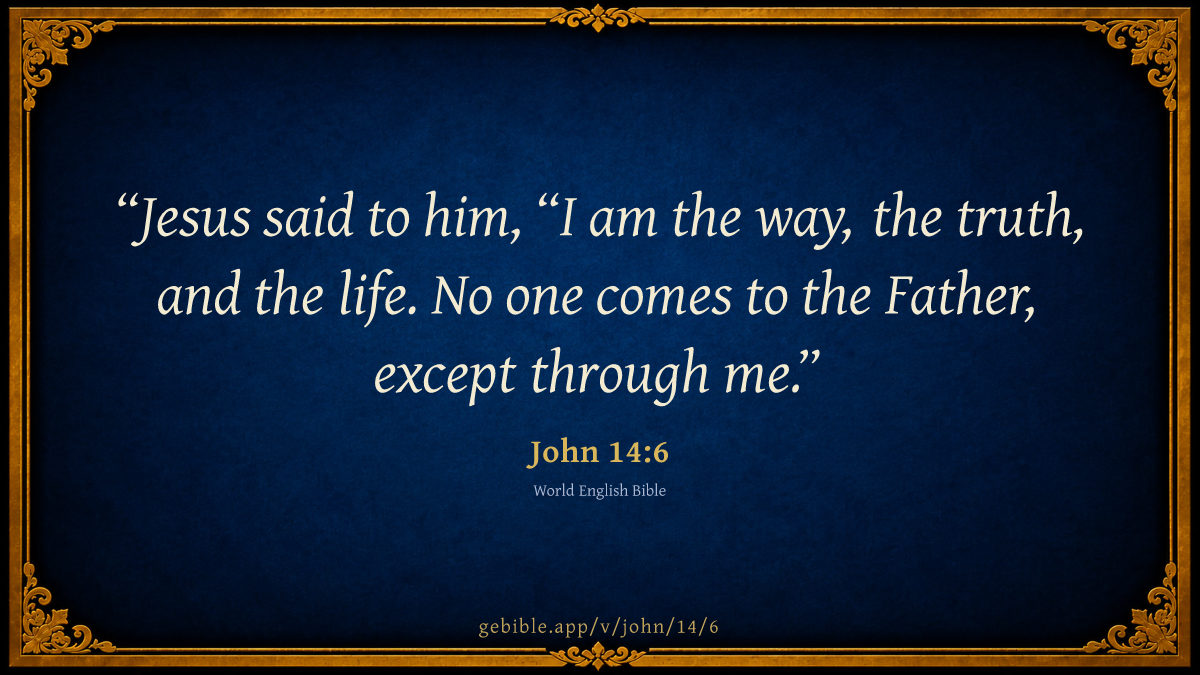
Jesus said to him, “I am the way, the truth, and the life. No one comes to the Father, except through me.
Parallel Translations
-
Jesus said to him, “I am the way, the truth, and the life. No one comes to the Father, except through me.
-
Iesus sayd vnto him: I am the waye the truthe and the life. And no man cometh vnto the father but by me.
-
Iesus sayd vnto him, I am that Way, and that Trueth, and that Life. No man commeth vnto the Father, but by me.
Cross-references (56)
Passages linked to John 14:6 in the Treasury of Scripture Knowledge, ordered by reader-vote popularity; verse text shown in World English Bible.
- Acts 4:12 There is salvation in no one else, for there is no other name under heaven that is given among men, by which we must be saved!”
- John 10:9 I am the door. If anyone enters in by me, he will be saved, and will go in and go out, and will find pasture.
- Ephesians 2:18 For through him we both have our access in one Spirit to the Father.
- John 11:25-26 Jesus said to her, “I am the resurrection and the life. He who believes in me will still live, even if he dies. Whoever lives and believes in me will never die. Do you believe this?”
- John 1:4 In him was life, and the life was the light of men.
- 1 John 5:20 We know that the Son of God has come, and has given us an understanding, that we know him who is true, and we are in him who is true, in his Son Jesus Christ. This is the true God and eternal life.
- John 1:14 The Word became flesh, and lived among us. We saw his glory, such glory as of the one and only Son of the Father, full of grace and truth.
- 1 John 5:11-12 The testimony is this, that God gave to us eternal life, and this life is in his Son. He who has the Son has the life. He who doesn’t have God’s Son doesn’t have the life.
- Isaiah 35:8-9 A highway will be there, a road, and it will be called “The Holy Way”. The unclean shall not pass over it, but it will be for those who walk in the Way. Wicked fools shall not go there. No lion will be there, nor will any ravenous animal go up on it. They will not be found there; but the redeemed will walk there.
- John 1:17 For the law was given through Moses. Grace and truth were realized through Jesus Christ.
- John 8:32 You will know the truth, and the truth will make you free.”
- Hebrews 7:25 Therefore he is also able to save to the uttermost those who draw near to God through him, seeing that he lives forever to make intercession for them.
- 1 Peter 3:18 Because Christ also suffered for sins once, the righteous for the unrighteous, that he might bring you to God, being put to death in the flesh, but made alive in the Spirit,
- John 5:21 For as the Father raises the dead and gives them life, even so the Son also gives life to whom he desires.
- 2 John 1:9 Whoever transgresses and doesn’t remain in the teaching of Christ, doesn’t have God. He who remains in the teaching has both the Father and the Son.
- Revelation 20:15 If anyone was not found written in the book of life, he was cast into the lake of fire.
- John 15:1 “I am the true vine, and my Father is the farmer.
- Matthew 11:27 All things have been delivered to me by my Father. No one knows the Son, except the Father; neither does anyone know the Father, except the Son, and he to whom the Son desires to reveal him.
- John 5:25-29 Most certainly I tell you, the hour comes, and now is, when the dead will hear the Son of God’s voice; and those who hear will live. For as the Father has life in himself, even so he gave to the Son also to have life in himself. He also gave him authority to execute judgment, because he is a son of man. Don’t marvel at this, for the hour comes in which all who are in the tombs will hear his voice, and will come out; those who have done good, to the resurrection of life; and those who have done evil, to the resurrection of judgment.
- John 6:51 I am the living bread which came down out of heaven. If anyone eats of this bread, he will live forever. Yes, the bread which I will give for the life of the world is my flesh.”
- John 8:51 Most certainly, I tell you, if a person keeps my word, he will never see death.”
- Revelation 22:17 The Spirit and the bride say, “Come!” He who hears, let him say, “Come!” He who is thirsty, let him come. He who desires, let him take the water of life freely.
- John 17:2-3 even as you gave him authority over all flesh, so he will give eternal life to all whom you have given him. This is eternal life, that they should know you, the only true God, and him whom you sent, Jesus Christ.
- John 10:28 I give eternal life to them. They will never perish, and no one will snatch them out of my hand.
- 1 John 2:23 Whoever denies the Son doesn’t have the Father. He who confesses the Son has the Father also.
- John 6:33 For the bread of God is that which comes down out of heaven, and gives life to the world.”
- Hebrews 10:19-22 Having therefore, brothers, boldness to enter into the holy place by the blood of Jesus, by the way which he dedicated for us, a new and living way, through the veil, that is to say, his flesh, and having a great priest over God’s house, let’s draw near with a true heart in fullness of faith, having our hearts sprinkled from an evil conscience, and having our body washed with pure water,
- John 18:37 Pilate therefore said to him, “Are you a king then?” Jesus answered, “You say that I am a king. For this reason I have been born, and for this reason I have come into the world, that I should testify to the truth. Everyone who is of the truth listens to my voice.”
- John 14:19 Yet a little while, and the world will see me no more; but you will see me. Because I live, you will live also.
- John 6:57 As the living Father sent me, and I live because of the Father; so he who feeds on me, he will also live because of me.
- John 10:7 Jesus therefore said to them again, “Most certainly, I tell you, I am the sheep’s door.
- 1 Peter 2:4 coming to him, a living stone, rejected indeed by men, but chosen by God, precious.
- Colossians 3:4 When Christ, our life, is revealed, then you will also be revealed with him in glory.
- Romans 5:2 through whom we also have our access by faith into this grace in which we stand. We rejoice in hope of the glory of God.
- 1 Corinthians 15:45 So also it is written, “The first man, Adam, became a living soul.” The last Adam became a life-giving spirit.
- John 6:68 Simon Peter answered him, “Lord, to whom would we go? You have the words of eternal life.
- Romans 5:21 that as sin reigned in death, even so grace might reign through righteousness to eternal life through Jesus Christ our Lord.
- 1 John 1:8 If we say that we have no sin, we deceive ourselves, and the truth is not in us.
- 2 Corinthians 1:19-20 For the Son of God, Jesus Christ, who was preached among you by us, by me, Silvanus, and Timothy, was not “Yes and no,” but in him is “Yes.” For however many are the promises of God, in him is the “Yes.” Therefore also through him is the “Amen”, to the glory of God through us.
- 1 John 1:1-2 That which was from the beginning, that which we have heard, that which we have seen with our eyes, that which we saw, and our hands touched, concerning the Word of life (and the life was revealed, and we have seen, and testify, and declare to you the life, the eternal life, which was with the Father, and was revealed to us);
- Revelation 1:5 and from Jesus Christ, the faithful witness, the firstborn of the dead, and the ruler of the kings of the earth. To him who loves us, and washed us from our sins by his blood—
- 1 Peter 1:21 who through him are believers in God, who raised him from the dead, and gave him glory, so that your faith and hope might be in God.
- Revelation 13:7-8 It was given to him to make war with the saints, and to overcome them. Authority over every tribe, people, language, and nation was given to him. All who dwell on the earth will worship him, everyone whose name has not been written from the foundation of the world in the book of life of the Lamb who has been killed.
- Revelation 19:11 I saw the heaven opened, and behold, a white horse, and he who sat on it is called Faithful and True. In righteousness he judges and makes war.
- Revelation 7:9-17 After these things I looked, and behold, a great multitude, which no man could count, out of every nation and of all tribes, peoples, and languages, standing before the throne and before the Lamb, dressed in white robes, with palm branches in their hands. They cried with a loud voice, saying, “Salvation be to our God, who sits on the throne, and to the Lamb!” All the angels were standing around the throne, the elders, and the four living creatures; and they fell on their faces before his throne, and worshiped God, saying, “Amen! Blessing, glory, wisdom, thanksgiving, honor, power, and might, be to our God forever and ever! Amen.” One of the elders answered, saying to me, “These who are arrayed in the white robes, who are they, and where did they come from?” I told him, “My lord, you know.” He said to me, “These are those who came out of the great suffering.They washed their robes, and made them white in the Lamb’s blood. Therefore they are before the throne of God, they serve him day and night in his temple. He who sits on the throne will spread his tabernacle over them. They will never be hungry or thirsty any more. The sun won’t beat on them, nor any heat; for the Lamb who is in the middle of the throne shepherds them and leads them to springs of life-giving waters. And God will wipe away every tear from their eyes.”
- Colossians 2:9 For in him all the fullness of the Deity dwells bodily,
- 1 John 5:6 This is he who came by water and blood, Jesus Christ; not with the water only, but with the water and the blood. It is the Spirit who testifies, because the Spirit is the truth.
- Acts 3:15 and killed the Prince of life, whom God raised from the dead, to which we are witnesses.
- Romans 15:8-9 Now I say that Christ has been made a servant of the circumcision for the truth of God, that he might confirm the promises given to the fathers, and that the Gentiles might glorify God for his mercy. As it is written, “Therefore I will give praise to you among the Gentiles and sing to your name.”
- Colossians 2:17 which are a shadow of the things to come; but the body is Christ’s.
- Revelation 3:7 “To the angel of the assembly in Philadelphia write: “He who is holy, he who is true, he who has the key of David, he who opens and no one can shut, and who shuts and no one opens, says these things:
- Revelation 5:8-9 Now when he had taken the book, the four living creatures and the twenty-four elders fell down before the Lamb, each one having a harp, and golden bowls full of incense, which are the prayers of the saints. They sang a new song, saying, “You are worthy to take the book and to open its seals: for you were killed, and bought us for God with your blood out of every tribe, language, people, and nation,
- Revelation 3:14 “To the angel of the assembly in Laodicea write: “The Amen, the Faithful and True Witness, the Beginning of God’s creation, says these things:
- Revelation 22:1 He showed me a river of water of life, clear as crystal, proceeding out of the throne of God and of the Lamb,
- Romans 15:16 that I should be a servant of Christ Jesus to the Gentiles, serving as a priest of the Good News of God, that the offering up of the Gentiles might be made acceptable, sanctified by the Holy Spirit.
- Hebrews 9:8 The Holy Spirit is indicating this, that the way into the Holy Place wasn’t yet revealed while the first tabernacle was still standing.
Cross-references from openbible.info (CC BY 4.0)
Explain this verse (15 sources)
Historical commentary, presented as a primary source — not an endorsement.
Private notes
Saved on this device only — never synced or sent anywhere.
John Calvin 1540 · Public Domain 6. I am the way. Though Christ does not…
6. I am the way. Though Christ does not give a direct reply to the question put to him, yet he passes by nothing that is useful to be known. It was proper that Thomas’ curiosity should be checked; and, therefore, Christ does not explain what would be his condition when he should have departed out of this world to go to the Father, but dwells on a subject far more necessary. Thomas would gladly have heard what Christ intended to do in heaven, as we never become weary of those intricate speculations; but it is of greater importance to us to employ our study and labor in another inquiry, how we may become partakers of the blessed resurrection. The statement amounts to this, that whoever obtains Christ is ill want of nothing; and, therefore, that whoever is not satisfied with Christ alone, strives after something beyond absolute perfection.
The way, the truth, and the life. He lays down three degrees, as if he had said, that he is the beginning, and the middle, and the end; and hence it follows that we ought to begin with him, to continue in him, and to end in him. We certainly ought not to seek for higher wisdom than that which leads us to eternal life, and he testifies that this life is to be found in him. Now the method of obtaining life is, to become new creatures. He declares, that we ought not to seek it anywhere else, and, at the same time, reminds us, that he is the way, by which alone we can arrive at it. That he may not fail us in any respect, he stretches out the hand to those who are going astray, and stoops so low as to guide sucking infants. Presenting himself as a leader, he does not leave his people in the middle of the course, but makes them partakers of the truth. At length he makes them enjoy the fruit of it, which is the most excellent and delightful thing that can be imagined.
Read full note →
As Christ is the way, the weak and ignorant have no reason to complain that they are forsaken by him; and as he is the truth and the life, he has in himself also what is fitted to satisfy the most perfect. In short, Christ now affirms, concerning happiness, what I have lately said concerning the object of faith. All believe and acknowledge that the happiness of man lies in God alone: but they afterwards go wrong in this respect, that, seeking God elsewhere than in Christ, they tear him — so to speak — from his true and solid Dignity.
The truth is supposed by some to denote here the saving light of heavenly wisdom, and by others to denote the substance of life and of all spiritual blessings, which is contrasted with shadows and figures; as it is said, grace and truth came by Jesus Christ, (John 1:17.) My opinion is, that the truth means here the perfection of faith as the way means its beginning and first elements. The whole may be summed up thus: “If any man turn aside from Christ, he will do nothing but go astray; if any man do not rest on him, he will feed elsewhere on nothing but wind and vanity; if any man, not satisfied with him alone, wishes to go farther, he will find death instead of life.”
No man cometh to the Father. This is an explanation of the former statement’, for he is the way, because he leads us to the Father, and he is the truth and the life, because in him we perceive the Father. As to calling on God, it may indeed be said, with truth, that no prayers are heard but through the intercession of Christ; but as Christ does not now speak about prayer, we ought simply to understand the meaning to be, that men contrive for themselves true labyrinths, whenever, after having forsaken Christ, they attempt to come to God. For Christ proves that he is the life, because God, with whom is the fountain of life, (Psalm 36:9,) cannot be enjoyed in any other way than in Christ. Wherefore all theology, when separated from Christ, is not only vain and confused, but is also mad, deceitful, and spurious; for, though the philosophers sometimes utter excellent sayings, yet they have nothing but what is short-lived, and even mixed up with wicked and erroneous sentiments.
John Calvin's Commentaries (1540-1563) — public domain. Text from the Calvin Translation Society English edition (1840s-50s) via the Christian Classics Ethereal Library (ccel.org). Calvin's coverage is partial (roughly two-thirds of the Bible); uncommented books and verses are honest gaps, never fabricated. The 19th-century editor's footnotes and remarks are omitted so the notes are faithfully Calvin's own voice.
Geneva Bible translators 1599 · Public Domain This saying showeth unto us both the nature, the…
This saying showeth unto us both the nature, the will and office of Christ.
Geneva Bible (1599) marginal notes — public domain.
John Trapp 1656 · Public Domain 6 Jesus saith unto him, I am the way,…
6 Jesus saith unto him, I am the way, the truth, and the life: no man cometh unto the Father, but by me.
Ver. 6. I am the way, and the truth, &c.] As if he should say, Thou hast no whither to go but to me, nor which way to go but by me, that thou mayest attain eternal life. Which made Bernard say, Sequemur, Domine, te, per te, ad te: Te quia Veritas, per te quia Via, ad te quia Vita. God, we will follow you, through you, to you: because you are the truth, through you because you are the way, to you because you are the life. And this was one of those sweet sayings that old Beza had much in his mouth a little before his death. (Melch. Adam. in Vitis exter.)
Read full note →
No man cometh unto the Father, but by me] Christ hath paved us a new and living way to God, with his own meritorious blood: and his flesh stands as a screen between us and those everlasting burnings, Isa 33:14. Let Papists say of their saints, Per hunc itur ad Deum, sed magis per hunc. Through him is the way to God, but greater through him. Let us say of all their he and she saints, as that heathen, Contemno minutos istos Deos, modo Iovem (Iesum) propitium habeam. I despise such petty gods, but let us have the propious Jesus.
John Trapp, A Commentary or Exposition upon All the Books of the Old and New Testament (1647–1656) — public domain. Text from a community e-Sword module.
Matthew Poole 1685 · Public Domain Christ was his own way to his Father; By…
Christ was his own way to his Father; By his own blood he entered in once into the holy place, Heb 9:12. See Luk 24:26; Phi 2:8. But both the former words, where the apostle spake of the way they should go, and the following words, hint to us, that Christ is here speaking of their way, not his own.
As to them, he saith,
Read full note →
I am the way; that is, the way by which those must get to heaven who will ever come there. Christ is our way to heaven by the doctrine which he taught; by his death, by which he purchased this heavenly inheritance for us; by his holy life and conversation, setting us an example that we should follow his steps; by the influence of his Spirit, guiding us to, and assisting us in, those holy actions by which we must come unto glory.
He is
the truth; that is, say some, the true way to life eternal: but he is the truth as to His doctrine, the gospel being the word of truth, Eph 1:13; and as truth signifies reality and accomplishment, in opposition to the prophecies and promises, all being but words till they were in him fulfilled; in which sense we read of the true tabernacle, and the true holy places, Heb 8:2; Heb 9:24 ;or as truth is opposed to falsehood, as truth is taken Joh 8:44; Rom 3:7.
And he is
the life, the Author and Giver of eternal life, Joh 11:25; 1Jo 5:11; and the purchaser of it by his death; he who by his doctrine showeth the way to it, and by his Holy Spirit begins it, and carrieth it on to perfection. The Jews thought the way to it was by the law of Moses; but our Saviour beateth his disciples out of that opinion: for if the law could have given life, Christ had died in vain, as the apostle argues. Therefore (saith he) there is no coming to the Father
but by me; no way for you or any other, to come to heaven, but by receiving, and embracing, and believing in me.
Matthew Poole's English Annotations on the Holy Bible (1683–1685) — public domain. Text from a community e-Sword/MySword module.
John Gill 1763 · Public Domain Jesus saith unto him, I am the way,.... Our…
Jesus saith unto him, I am the way,.... Our Lord takes the opportunity of this discourse about the place he was going to, and the way unto it, more fully to instruct his disciples concerning himself, saying, "I am the way"; Christ is not merely the way, as he goes before his people as an example; or merely as a prophet, pointing out unto them by his doctrine the way of salvation; but he is the way of salvation itself by his obedience and sacrifice; nor is there any other; he is the way of his Father's appointing, and which is entirely agreeable to the perfections of God, and suitable to the case and condition of sinners; he is the way to all the blessings of the covenant of grace; and he is the right way into a Gospel church state here; no one comes rightly into a church of Christ but by faith in him; and he is the way to heaven: he is entered into it himself by his own blood, and has opened the way to it through himself for his people: he adds,
the truth he is not only true, but truth itself: this may regard his person and character; he is the true God, and eternal life; truly and really man; as a prophet he taught the way of God in truth; as a priest, he is a faithful, as well as a merciful one, true and faithful to him that appointed him; and as a King, just and true are all his ways and administrations: he is the sum and substance of all the truths of the Gospel; they are all full of him, and centre in him; and he is the truth of all the types and shadows, promises and prophecies of the Old Testament; they have all their accomplishment in him; and he is the true way, in opposition to all false ones of man's devising. And this phrase seems to be opposed to a notion of the Jews, that the law was the true way of life, and who confined truth to the law. They have a saying (r), that , "Moses and his law are the truth"; this they make Korah and his company say in hell. That the law of Moses was truth, is certain; but it is too strong an expression to say of Moses himself, that he was truth; but well agrees with Christ, by whom grace and truth came in opposition to Moses, by whom came the law: but when they say (s), , "there is no truth but the law", they do not speak truth. More truly do they speak, when, in answer to that question, , "what is truth?" it is said, that he is the living God, and King of the world (t), characters that well agree with Christ.
Read full note →
And the life: Christ is the author and giver of life, natural, spiritual, and eternal; or he is the way of life, or "the living way"; in opposition to the law, which was so far from being the way of life, that it was the ministration of condemnation and death: he always, and ever will be the way; all in this way live, none ever die; and it is a way that leads to eternal life: and to conclude all the epithets in one sentence, Christ is the true way to eternal life It is added by way of explanation of him, as the way,
no man cometh unto the Father but by me; Christ is the only way of access unto the Father; there is no coming to God as an absolute God, not upon the foot of the covenant of works, nor without a Mediator; and the only Mediator between God and man is Christ: he introduces and presents the persons and services of his people to his Father, and gives them acceptance with him.
(r) T. Bab. Bava Bathra. fol. 74. 1. Bemidbar Rabba, fol. 223. 2. (s) Hieros. Roshhashanah, fol. 59. 1. Praefat. Echa Rabbati, fol. 36. 2. (t) Ib. Sanhedrin, fol. 18. 1.
John Gill's Exposition of the Whole Bible (1746–1763) — public domain (CC PDM 1.0). Text via the HelloAO Bible API.
John Wesley 1765 · Public Domain To the question concerning the way, he answers, I…
To the question concerning the way, he answers, I am the way. To the question concerning knowledge, he answers, I am the truth. To the question whither, I am the life. The first is treated of in this verse; the second, ver. 7-17; the third, xiv, 18, &c.
John Wesley, Explanatory Notes Upon the Whole Bible (1754–1765) — public domain. Text via the GEBible commentary corpus.
Adam Clarke 1810 · Public Domain Verse 6. I am the WAY] That leads so…
Verse 6. I am the WAY] That leads so the Father: - the TRUTH that teaches the knowledge of God, and directs in the way: - the LIFE that animates all those who seek and serve him, and which is to be enjoyed eternally at the end of the way.
Christ is the WAY:
Read full note →
1. By his doctrine, Joh 6:68.
2. By his example, 1Pe 2:21.
3. By his sacrifice, He 9:8-9.
4. By his Spirit, Joh 16:13.
He is the TRUTH:
1. In opposition to all false religions.
2. To the Mosaic law, which was only the shadow, not the truth or substance, of the good things which were to come. And
3. In respect to all the promises of God, 2Co 1:20.
He is the LIFE, both in grace and glory; the life that not only saves from death, but destroys it.
No man cometh unto the Father] By any other doctrine, by any other merit, or by any other intercession than mine.
Adam Clarke's Commentary on the Bible (1810–1826) — public domain. Text from a community e-Sword/MySword module.
Albert Barnes 1834 · Public Domain I am the way - See Isa 35:8. By…
I am the way - See Isa 35:8. By this is meant, doubtless, that they and all others were to have access to God only by obeying the instructions, imitating the example, and depending on the merits of the Lord Jesus Christ. He was the leader in the road, the guide to the wandering, the teacher of the ignorant, and the example to all. See Joh 6:68; “Thou hast the words of eternal life;” 1Pe 2:21; “Christ - suffered for us, leaving us an example that ye should follow his steps;” Heb 9:8-9.
The truth - The source of truth, or he who originates and communicates truth for the salvation of men. Truth is a representation of things as they are. The life, the purity, and the teaching of Jesus Christ was the most complete and perfect representation of the things of the eternal world that has been or can be presented to man. The ceremonies of the Jews were shadows; the life of Jesus was the truth. The opinions of men are fancy, but the doctrines of Jesus were nothing more than a representation of facts as they exist in the government of God. It is implied in this, also, that Jesus was the fountain of all truth; that by his inspiration the prophets spoke, and that by him all truth is communicated to men. See the notes at Joh 1:17.
Read full note →
The life - See Joh 11:25, and the notes at Joh 1:4.
No man cometh to the Father but by me - To come to the Father is to obtain his favor, to have access to his throne by prayer, and finally to enter his kingdom. No man can obtain any of these things except by the merits of the Lord Jesus Christ. By coming by him is meant coming in his name and depending on his merits. We are ignorant, and he alone can guide us. We are sinful, and it is only by his merits that we can be pardoned. We are blind, and he only can enlighten us. God has appointed him as the Mediator, and has ordained that all blessings shall descend to this world through him. Hence he has put the world under his control; has given the affairs of men into his hand, and has appointed him to dispense whatever may be necessary for our peace, pardon, and salvation, Act 4:12; Act 5:31.
Albert Barnes' Notes on the Bible (1834–1885) — public domain. Text from a community e-Sword/MySword module.
Daniel D. Whedon 1874 · Public Domain 6. I am the way—Our Lord at once, declining…
6. I am the way—Our Lord at once, declining all topography, and refusing to lift the vail to the curiosity of his apostle, concentrates his attention and faith into himself. If Thomas wishes to know the way and the terminus, let him repose full, unquestioning faith in the Son of God. He is the way by which we go; the truth by which we learn the way; and the life in which the way finally merges.
Cometh… Father… by me—He is the living way of access to the Father. He is the bridge from man to God. And, what is the same thing, he is the bridge from earth to heaven.
Daniel D. Whedon (gen. ed.), Commentary on the Old and New Testaments (1874–1909) — public domain. Text from a community e-Sword module.
The Cambridge Bible for Schools and Colleges 1878 · Public Domain 6. I am the way] The pronoun is emphatic;…
6. I am the way] The pronoun is emphatic; I and no other: Ego sum Via, Veritas, Vita. S. Thomas had wished rather to know about the goal; Christ shews that for him, and therefore for us, it is more important to know the way. Hence the order; although Christ is the Truth and the Life before He is the Way. The Word is the Truth and the Life from all eternity with the Father: He becomes the Way for us by taking our nature. He is the Way to the many abodes in His Father’s home, the Way to the Father Himself; and that by His doctrine and example, by His Death and Resurrection. In harmony with this passage ‘the Way’ soon became a recognised name for Christianity; Act_9:2; Act_19:9; Act_19:23; Act_22:4; Act_24:22 (comp. Act_24:14; 2Pe_2:2). But this is obscured in our version by the common inaccuracy ‘this way’ or ‘that way’ for ‘the Way.’ (See on Joh_1:21; Joh_1:25, Joh_6:48.)
the truth] Better, and the Truth, being from all eternity in the form of God, Who cannot lie (Php_2:6; Heb_6:18), and being the representative on earth of a Sender Who is true (Joh_8:26). To know the Truth is also to know the Way to God, Who must be approached and worshipped in truth (Joh_4:23). Comp. Heb_11:6; 1Jn_5:20.
Read full note →
and the life] Comp. Joh_11:25. He is the Life, being one with the living Father and being sent by Him (Joh_6:57, Joh_10:30). See on Joh_1:4, Joh_6:50-51, and comp. 1Jn_5:12; Gal_2:20. Here again to know the Life is to know the Way to God.
no man cometh unto the Father, but by me] Christ continues to insist that the Way is of the first importance to know. ‘Through Him we have access unto the Father’ (Eph_2:18). Comp. Heb_10:19-22; 1Pe_3:18.
The Cambridge Bible for Schools and Colleges (gen. ed. J. J. S. Perowne; Cambridge University Press, 1878–1918) — public domain. Text from a community e-Sword module.
Ellicott's Commentary for English Readers 1878 · Public Domain (6) I am the way.—The pronoun is emphatic. “I,…
(6) I am the way.—The pronoun is emphatic. “I, and none besides Me.” “The way” is again made prominent, reversing the order which Thomas had used. He and He only is the means through which men can approach to the Father. (Comp. Notes on Joh_1:18, and on 1Ti_2:5.)
The truth, and the life.—Better, and the Truth, and the Life. The thought of His being the Way through which men come to the Father is the reverse side of the thought, that in Him the Father is revealed to men, that He is Himself the Eternal Truth, that He is Himself the Source of eternal life. (Comp. Joh_1:14; Joh_1:17; Joh_6:50-51; Joh_11:25-26.) Had they known what His earlier words meant, they would have had other than temporal and local thoughts of the Father’s house, and would have known Him to be the Way.
Read full note →
No man cometh unto the Father, but by me.—This was the answer to the doubt of Thomas. This was the true “whither” which they knew not. The thought of heaven is not of a place far above, or of a time far before, but of a state now and hereafter. To receive the Truth and the Life revealed in the presence of the Son is to come to the Father by the only Way. To be with the Father is home. (Comp. Notes on Joh_1:18; Joh_3:13.)
A Bible Commentary for English Readers, edited by Charles John Ellicott (1878–1897) — public domain. Text from a community e-Sword module.
The Pulpit Commentary 1880 · Public Domain Vers. 6, 7. Jesus saith to him, I am…
Vers. 6, 7. Jesus saith to him, I am the Way, and the Truth, and the Life: no one cometh unto the Father, but by me. If ye had learned to know me, ye would haveknown (absolutely) my Father also: from henceforward ye know (by personal experience) him, and (or, perhaps, even) ye have seen him. The whole sentence must be taken together. The whither of Christ is obvious enough, and throws consequent illumination upon the way thither. "The Father"s house" is the whither no one cometh unto the Father (but) except through me. Christ explicitly says
(1) that the entire goal of this wondrous way of his is the Father himself. From the Father he came, to the Father he was moving, not for his own sake only, but also as King Messiah for all his subjects. He suggests
Read full note →
(2) that mankind generally, as well as his disciples, are anxious to find their way to the Father"s house, to the Father"s heart, i.e. to resting and rejoicing in God, and satisfaction in their entire conception of him and relation to him.
(3) He declares post-lively that this idea of God as Father, this approach to God for every man, is through him through what he is and what he is doing and has so often described, for them. True, lie had said, in Joh_6:37, Joh_6:44, that the Father gave to him and drew towards him those who came to him. A fatherly monition and inward working of grace opened men"s eyes in Christ to the mystery of true human son-ship of the eternal Father. The statement of this verse supplements the former utterance. They may best understand the way he is taking when they grasp the fact that he is going to the Father to prepare a place for them, and so he becomes "the Way, the Truth, the Life," for all who are coming after him, "following him afterwards" to the Father. Grotius sums up this great saying by regarding Christ as "the Exemplum, Doctor, et Dater vitro eternae;" Luther speaks of it as referring to the past, present, and future; Calvin, as "the Principium, Medium, et Finis;" and Augustine "vera vitae Via;" but each term means more than this. The way of approach to God is constituted by his simply being the incarnate Loges, by his revealing the mind and nature of God, by his laying down his life for the sheep that he might take it again. In doing this he supplies the method-and motive of holy living. It is not easy to say why our Lord should have added "the Truth and the Life." Maldonatus exclaimed, "Si Christus minus fuisset in respondendo liberalis, minus nobis in hujus loci interpretatione laborandum esset." The two further terms used by himself are probably introduced to throw light upon the way to the Father. Thus there are numerous assurances that he is the Truth itself, that is, the adequate and sufficient expression of Divine thought. "All the promises of God are yea i.e. are uttered and Amen i.e. confirmed in him." He is the absolute Truth
(1) about God"s nature;
(2) the perfect Exponent of God"s idea of humanity;
(3) the Light of the world;
(4) the Expression of the reality touching the relations between moral beings and God all the relations, not only those of saints and holy angels, but those of rebels and sinners, whose destiny he has taken upon himself. He is the Way because he is the whole Truth about God and man and concerning the way to the Father. More than this, and because of this, he adds, "I am the Life life eternal," the Possessor, Author, Captain, Giver, and Prince of life the life in the heart of man that can never die; the occasion, germ, condition, and force of the new lath. It were impossible to imagine higher claim. But he leaves his hearers without any doubt as to his personal and conscious identification of himself with the Father. Hitherto he had not so clearly unveiled himself as in that which he has here said and is now doing. Hence his nearest and dearest only partially knew him. If they had seen all they might have seen, they would have seen the Father also. Then, as though he would close all aperture to doubt about the glory involved in his humiliation, and the way in which his human life had revealed the Father, he says aparti henceforward this must be a fact of your consciousness, that you do learn and come to know him by personal experience (ginwskete); and as a matter of fact ye have seen him (ewrakate). Possibly in the aparti , involving the notion of a period rather than a moment, the Lord was including the full revelation of the glory of self-sacrificial love given alike in his death and resurrection. And the important thought is suggested that neither the knowledge of God can ever be complete, nor the vision either. Is Thomas answered or no? He is silent, and perhaps is pondering the words, which will lead him, before long, notwithstanding his doubts, to make the grandest confession contained in the entire Gospel, the answer of convinced though once skeptical humanity to the question, "Whom say ye that I am?" The other apostles feel that Christ"s words have met the mystic vague fear of Thomas, and that "henceforward" they all belong with Christ to the Father"s house. They would go to the Father, and at the right time dwell in the place prepared for them; but how can they be said to know and have seen the Father already to have passed into the light or received the beatific vision?
Christ the Truth.
Often in the New Testament do we find our Lord Jesus associated with truth. Those who saw him as he wan beheld him "full of grace and truth." His promise to the disciples who studied him was that they should know the truth, and by the truth should be made free. When the crisis of his ministry and the hour of his sacrifice arrived, he summed up the whole purpose of his mission in the declaration that he came into the world in order to "bear witness unto the truth." Hence in the Apocalypse he is named as "the faithful and true Witness.
I WHAT IS THE TRUTH TO BE FOUND IN CHRIST? All truth is beautiful, worthy of reverence and of quest; but there are grades of truth. There is a common notion that upon matters of little moment truth is attainable; but that, the higher we go in our inquiries, the more is it imperative to be content with doubt and uncertainty; whilst upon the most wonderful and sacred of all themes truth is absolutely beyond our reach. This accounts for much of men"s absorption in trifles. How many are content with the knowledge of individual facts and unimportant generalizations, just because the skeptical spirit of the time indisposes them to believe in the possibility of grasping the truth upon the greatest subjects of all! Yet it is a persuasion as unreasonable as it is dreary, that man is not made to know the truth. Pilate asked, perhaps with a cynical and wearied indifference, "What is truth?" But multitudes are like him in the conviction, the prejudice, that to this query there is no reply. Positivism tells us that phenomena and their invariable connections may be known, but that it is a waste of human time and power to seek for what really is, for what accounts for all that appears. Yet there are times when the most hopeless skeptic longs for truth. And especially are we constrained to desire truth regarding our own nature, truth regarding the character and purposes of God, truth regarding the Divine purpose in our being and our life, truth relating to eternity. The small syllogisms by which men attempt to prove that truth, on all matters upon which we really care for truth, is beyond our reach, impose upon none of us. And Christianity is the highest reason, because it offers that which our limited and unaided experience cannot acquire the truth, which may take to one mind the form of spiritual beauty, to another the shape of a law of infinite righteousness, but which is what alone can satisfy the craving nature of man.
II HOW DOES CHRIST REVEAL THE TRUTH? The most obvious answer to this inquiry is, that our Lord"s recorded words are the embodiment of religious truth both speculative and practical. And he distinctly and boldly claimed to tell his auditors "the truth." Certain it is that upon all matters of highest interest we are indebted more to Jesus than to all others. The intuitions of genius, the conclusions of meditation and of learning, cannot be compared with those Divine utterances of the Prophet of Nazareth, which, though in form and in language so simple, have been recognized by the thoughtful as consummate wisdom as, in fact, revelation, and nothing less than revelation. Sit at the feet of the great Teacher, and you will learn more truth from his lips than can be acquired from studying the treatises of thinkers and the aphorisms of sages. Yet it is observable that Jesus does not say, "I teach the truth;" he says," I am the Truth." This may be paradoxical, but it is just. The truth upon the highest of all themes cannot be put into words. Human language is not always adequate to express human ideas, human emotions; how can it be expected to utter the thoughts and the principles which are Divine? There are subjects to which the close precision of words may seem adapted; they are capable of verbal vesture. But how much there is which no words can tell-even those words which, as their Speaker said, are "spirit and life!" "Truth in closest words shall fail, When truth, embodied in a tale, Shall enter in at lowly doors.
There was but one way in which man could learn God, and that was by God becoming man. "The Word became flesh." We learn Divine truth in the ministry, the life, of God"s Son. The truth as to God"s character we read in the deeds of Immanuel, so gentle, yet so grand and God-like. The truth as to God"s purposes of love we learn from Christ"s sacrifice, from Christ"s cross. The truth concerning our salvation we know when we witness Christ"s victory over sin and death. It is the complete picture which portrays the complete original; he who would acquaint himself with the whole truth of God, as far as God is related to man, must take into his mind the perfect and glorious representation offered in the gospel. There is no other way in which the truth can be grasped and held by the finite, created nature. Know him who is the Truth; and then, then only, do you know the truth itself.
III BY WHAT MEANS IS THE TRUTH TO BE GAINED? If what has been said be accepted as a just expression of the fact, and a just interpretation of the text, then we are on the way to a solution of the practical difficulty. There is no place for skepticism for that superficial and often unreflecting denial of the possibility of attaining truth, which leads some men to despair, but more to indolence of mind or to sensuality of life. And yet truth is not to be found by a mere passive submission to human authority; nor by a process of scientific inquiry applied to matters with which that process has no affinity. But it is to be found by those morally prepared for the discovery by humility and reverence; it is to be found by those who come to Christ, to listen to him, to watch him, to win him by the wide receptiveness of faith, and by the luminous sympathy of love. T.
Christ the Life.
The broadest and most impressive distinction in nature is that between what is inanimate and what lives. Beautiful as are earth"s landscapes, grand as is the rolling sea, awful" as is the storm, still there is an interest in life far deeper than can be found in the passive and the non-sentient creation. The power which living things possess of taking into themselves, and of making their own, the matter of which their own structure is composed the growth of framework and of organs, the exercise of function, the obvious working out in the individual of an end appointed; the reaction of living things upon the lifeless world, and the mysterious connection of life with feeling, and in its higher forms with mind; above all, the union between the living being, man, and the rational, accountable, immortal spirit; all these render life intensely and imperishably interesting. It is not, as at first sight may seem to be the case, a fall in dignity when Jesus, having asserted himself to be "the Truth," goes on to claim that he is also "the Life." In fact, the true is the theoretical, and the living is the practical, in which latter the former finds its true expression, interpretation, and end. In a universe governed by infinite reason and righteousness, the highest truth and the noblest life must be for ever linked in perfect union.
I CHRIST IS IN HIMSELF THE POSSESSOR OF PERFECT SPIRITUAL LIFE, Such was the testimony of evangelists and apostles. "In him was life;" "The life which was with the Father was manifested unto us," etc. The same witness was borne by the Lord himself. "I am the Resurrection and the Life;" "I live." Such language declares the independence of the eternal Word, his underived authority, his supremacy over all who live by and through him. No man can dare to say, "I am the life;" a creature of Divine power, born but yesterday, and every moment depending upon providential care, he cannot but shrink from a claim which would be as absurd as it would be profane. But Jesus could say, "As the Father hath life in himself, even so gave he to the Son also to have life in himself.
II CHRIST IS THE PRINCIPLE OF SPIRITUAL LIFE TO MEN. As far as we can trace it, life always comes from life. A mysterious principle, in its origin of lineal derivation, enables the living being to appropriate to itself its appointed nourishment, to discharge its proper functions, to do the work assigned to it in the economy of nature. Without this principle the lifeless matter is powerless. Now, the spirit of man is the breath of the Almighty. Informed by this Divine energy man lives, spiritually as well as naturally. But there is a life which is distinctively Christian; and this is always traceable to Christ himself. He communicates the life which he possesses. Imagine the earth as it is in the chill, hard grasp of winter; and in your fancy watch the change which takes place when that grasp is relaxed. The sun shines more warmly, the breezes play softly over the fields and the forests, and radiant spring smiles upon the earth, which beneath that smile begins to live. The corn springs up, the flowers bloom, the leaves burst into greenness, the grove lately still and silent echoes with the songs of birds, and all creation flushes, blossoms, murmurs into life. Such is the change which the coming of Christ brings to the soul, brings to the world. "Newness of life," life "more abundantly," the movement of emancipated energies, the chorus of newborn joy, the brightness and the smile of a glorious hope, these all tell that Christ, "the Life," has come. His advent, his sacrifice, his resurrection, his Divine outpouring of blessing, were the means by which his spiritual vitality was communicated. The same Christ who gave the life at first, sustains, enriches, and develops it, and will in his own time also perfect it. It is his work to slay death itself, and to pour the vitality which streams from the bosom of the Eternal through all the channels of the spiritual organism. It must not be overlooked that it is not the mere bodily presence of the Savior upon earth that ensured this result. It is his spiritual presence which secures the fullness of Divine life to humanity. From the Day of Pentecost, when the Spirit, i.e. the Spirit of Christ, was poured out from on high, life has entered human souls in new measure and with new fruits, and in many a spot the desert has rejoiced and blossomed as the rose.
III CHRIST IS THUS TO MAN THE AUTHOR OF AN IMMORTALITY OF BLESSEDNESS. The life of created organisms, both vegetable and animal, is perishable and brief. The life even of a species, a race, is but for a season. There are good reasons for regarding the spiritual life as above the action of this scientific law. To that law the body, a part of nature, is subject; from its action the spirit is exempt. There are those who hold that endless continuance of being is the purchase of the Savior"s redemption. But certain it is, that what makes life good and desirable is due to the Spirit of the living Redeemer. He has "brought life and immortality to light by the gospel." He has said, "Because I live, ye shall live also." A mere enduring sentiency is valueless; eternal progress in the knowledge and fellowship of God himself, this is life indeed. It is in this sense that he who liveth and believeth on Christ shall never die.
IV THAT CHRIST IS THE LIFE OF MEN IS PRECIOUS TIDINGS WORTHY OF ALL ACCEPTATION. Spiritual death is indeed dreadful to contemplate; to experience it is the most awful doom that man can know. Yet the Scriptures represent sinful men as spiritually dead in trespasses and sins." To those in such a state it seems, if they know themselves and know not Christ, that existence is a curse. With what sweetness must the gospel come to such! To them it is the bringer of hope; for to them Christ is the Bringer of life. The welcome message is, "Awake, thou that sleepest, and arise from the dead, and Christ shall give thee light! T.
Ample supply for three great needs.
Jesus here suggests three great needs. He has spoken of journeying, continuous movement into ever new places in one place to-day, in another to-morrow, and the day after in still another. Even while we are moving about in the same locality, so far as natural life is concerned, we the real we must be ever moving forward into higher and still higher states. That Jesus should speak of a way was therefore evidently appropriate. But there are two other needs the need of truth, all that gives a sense of reality, stability, security; and the need of life, all that gives energy, persistence, enjoyment. Or we might say that Jesus here indicates three aspects of the universal need, of which first one aspect and then another rises into prominence. But, whatever the aspect of human need may be, in Jesus there is something to correspond, for full and immediate supply.
I THE WAY. There is a way which we must take the way along which time takes our bodies; the way of physical development, maturity, decay. But side by side with the way which cannot be chosen, and in striking contrast with it, is the way which must be chosen. For that way we are responsible; none can compel us to take even one step in it. And what that way shall be depends on where we want to get. Those who want to be with Jesus hereafter must be with him here. And those who want to be with the Father hereafter, having knowledge of him, and receiving of his fullness, can only gain this through Jesus. There is no other name given whereby men are to be saved. No one else has a sure and certain path into the future. In Jesus there is a provision, the very neglect of which only sets in a most melancholy light the various provisions which men make for the life.of time. Men who can walk diligently enough in the way of ordinary industry, in the way of frugality, in the way of intellectual activity, yet stumble and retreat at once when the Way Christ Jesus is put before them.
II THE TRUTH. HOW much useless disputing, how many weary doubts, are saved to those who can put a real faith in Jesus! Everything practical and possible is known by knowing him. Truth is a very large word, but all that it suggests is amply comprehended in Jesus. In Jesus only do we find the real, the abiding, and that which can never be shaken. How simplified our inquiries become the moment we can rest in the all-sufficiency of Jesus! "Where is Jesus?" not "What is true?" becomes the main question then. All that lies outside of his intent and his support is seen to be but as a passing dream. All investigation of the problems of the universe is in vain apart from him. All phenomenal realities, all human sciences, only find out their use as they become subordinate to the truth as it is in Jesus.
III THE LIFE. Jesus becomes the Existence of the believer. In him he lives and moves and has his being. Through Jesus we are born again into newness of life, and being born again, we find in Jesus the atmosphere, the nourishment, and all the ministering associations of our new life. We need all the energy and perennial freshness of his own vitality; and if we truly have Jesus, whatever we may lack, we shall not lack life. Y.
The Pulpit Commentary (1880–1919), ed. H.D.M. Spence-Jones & Joseph S. Exell — public domain. Text from a community e-Sword module.
The Biblical Illustrator 1887 · Public Domain Jesus said unto him, I am the Way, the…
Joh_14:6
Jesus said unto him, I am the Way, the Truth, and the Life
Read full note →
Brief expositions
The way of a holy conversation; the truth of a heavenly doctrine; the life of a bliss everlasting (Leo)
.
The way to beginners, the truth to the progressing (chap. 8:32), the life to the perfect (Ferus)
. I am the Way, leading to the truth; I am the Truth, promising life; I am the Life, which I give (St. Augustine)
. I am the Way and the Life; the way on earth, the life in heaven: I am He, to whom you go; I am He, by whom you go (St. Augustine)
. The way, in which we walk by charity; the truth, to which we cling by faith; the life, to which we aspire by hope. The life in His example, the truth in His promise, the life in His reward (St. Bernard)
. Truth lies between way and life, as if the way to life were through truth (Leigh)
. The true way to eternal life (Dr. Whichcote)
. Without the Way there is no going; without the Truth there is no knowing; without the Life there is no living. I am the Way which thou oughtest to follow; the Truth which thou oughtest to trust; the Life which thou oughtest to hope for. I am the inviolable Way, the infallible Truth, the Godless Life. If thou remain in My way thou shalt know the truth, and the truth shall make thee free and thou shalt lay hold on eternal life. (Thomas a Kempis.)
The Way, the Truth, and the Life
Mistakes have been made the occasion of profoundest utterances. It was so here
I. I AM THE WAY. Mans primal communion with God in Eden was broken by his fall. Henceforth humanity became as an islet in mid-ocean, without material for bridge or boat. And the Eternal Word became flesh in order that He himself might become the causeway which should reconnect the island man and the continent God. He not only shows the way, as our Teacher, He is the way itself, the true ladder connecting earth and heaven. He is alike the portal, the line of direction, the true Scala Santa, The great worlds altar stairs that slope through darkness up to God. His Via Dolorosa is our Via Gloriosa. His valley of Achor is our door of hope.
II. I AM THE TRUTH.
1. In distinction from what is symbolic. He is the fulfiller and realizer of all prophetic hints. Thus He is said to be the True Light, the True Bread, the True Tabernacle, etc.
2. In distinction from what is phenomenal. For truths are ever greater than facts. There is no necessary morality in mere facts as such, e.g., in the fact that every particle of matter attracts every other particle in the direct ratio of its mass, and in the inverse ratio of the square of its distance. Truth is moral, and can exist only in connection with person, i.e., a person who shall somehow stand as its end or representation. Such a person is Christ. He not only has truth, He is the Truth--Himself its eternal embodiment; its source, means, and end. He is the meaning of facts. All things have been created through Him and for Him. He is creations definition or final cause.
III. I AM THE LIFE.
1. Of all animate existence; all things are also subsisting in Him.
2. Particularly is this true of man.
(1) Jesus Christ is the life of our bodily nature. Poor Marthas and Marys may weep by the tombs of dead brothers; but Jesus Christ shall say, I am the Resurrection and the Life.
(2) Of our spiritual nature, God hath given unto us eternal life and this life, is in His Son. Conclusion: Christ is the only way, No man cometh, etc. Other voices indeed proclaim the contrary; but they are the voices of false prophets. Liberalism says: There are many ways to the Father; for instance, nature, aesthetics, charity, etc. Materialism says: It is through the uplifting of environment. Ecclesiasticism says: It is through the Church, the sacraments. But all who undertake to climb over into the fold by any other way are thieves and robbers. (G. D. Boardman, D. D.)
The Way, the Truth, and the Life
Science tells us that there are three elements in light--the illuminating, the chemical, and the heat power. So in Him who is the Light of the World there is a threefold perfection.
I. THE TRUTHS SEPARATELY.
1. Christ the Way. One of the deepest feelings in mans nature is that of a want of something which this world is found not to supply. The eye is not satisfied with seeing, nor the ear with hearing, nor the ambition with success, nor the lust with gratification. It arises from the terrible disruptions with the intervening chasms which sin has produced. Despite our downward tendencies, man is led by what he feels within, and sees around, to look up to a Divine Power. That Being we would fondly claim as a Father. But where is that Father? There is a way, but somehow we have lost it, and the difficulty is to find it. Conceive a planet wandering from its sphere. Now it is hindered by bodies attracting it or attracted by it, and forthwith it dashes through space, threatening to strike and break in fragments, or to kindle into a conflagration, all the other planets and suns it meets with. It is a picture of a wandering man loosened from the Central Power that stays him, and from the Central Light that should illuminate him. Neither wanderer will right itself till made to move in its old path. But how can we know the way? The flaming sword, turned every way to keep the sinner from the tree of life, has entered into him who is Gods fellow, and hath now power against us, and there is a way opened by which the sinner can come into the very presence of God. I am the Way.
2. Christ the Truth. By truth, in this passage, we are not to understand abstract or general doctrine. Systematized truth may serve most important purposes; but it is not to such that our Lord refers. Truth is defined by philosophers as the agreement of our ideas with things. If we know God as He really is, then have we truth in religion. But how can we know God as He really is? Do we not feel as if He were at an infinite distance, as if we could no more rise to Him with our spirits than our frail bodies could mount from earth to heaven? Who will give us wings that we may ascend to Him? Alas! the attraction of earth is too powerful to admit of our rising to Him. The approach must be on His part. Plato was obliged to say: The Father of the world is hard to discover, and when discovered cannot be communicated. But when we go on by Christ as the Way, He introduces us to the Father, and we have the truth. God is no longer at a distance; Emmanuel, God with us. Aristotle has said that the mind as it came from its Maker is organized for truth, as the eye is to perceive light and the ear to hear sounds. He who has found Christ knows that he has found the truth. With the truth there is assurance; the eye has found the light, the ear is listening to the sound. This, this is the reality of things.
3. Christ the Life. It is of vast moment that we know the way, all good that we reach the truth; but we must have more. The well-formed statue is an interesting object, but none of us would exchange our living condition for that of the chiselled marble. Along with the truth we must have life. There are few or no sinners so dead that they do not wish at times to have life. And yet when they would excite and stimulate it, they find that they have only the cold and the clamminess of death. Feeling never will be excited by a mere determination to raise it. There must be a something to call it forth. Nor will it be evoked by an abstract statement or general doctrine. It is called forth by a living person. Christ so lovely and so loving. Apprehended as the truth He becomes the life.
II. THE TRUTHS IN THEIR CONNECTION. The full truth is to be found in the union of these various truths. If we would have a true religion, and a proper theology founded upon it, we must give Christ the supreme place. Displace Christ the head from this His proper position and the whole form becomes disproportioned.
1. There are some who would have men first to find the way, and then in the way to find Christ. Who would have, e.g., inquirers first to find the true Church, and then through it to find Christ. But this is to reverse the Scriptural order.
2. Some would have us first seek the truth, and then seek Christ. Seekers of truth deserve all the honour that has been paid to them, but they will never find truth in religion till they find Christ. So Justin Martyr acknowledged, and Augustine, and Luther. Let us not go out with the tapers of earth to seek the sun. Any other light can at best be merely like the star to guide the wise men, serving a good end only so far as it guides us to where Christ as the truth is to be found.
3. Again, some would find life without Christ. Their appeal is to inward feelings, sentiments, and intuitions. But what, I ask, is to evoke such sentiments from our dead and sinful hearts? They tell us by such grand and generous ideas as the infinite and the eternal. But these ideas call forth love only when they are associated with a living being whose love is infinite and eternal. And such is Christ.
4. There are some who would seek for Christ under one of these aspects or in one of these characters, but who do not care for the others.
(1) Thus, there are some who are anxious to have Christ as the way, but who stop at the entrance, instead of going on in the path. They are most anxious to have Christ for salvation; but they do not go on to establish themselves in the truth.
(2) Some are contented with the truth without the life, with their orthodox creed, their reverence for the Bible, their attendance at religious meetings. Such a formal religion is offensive to man, even as it is displeasing to God.
(3) Another class seek the life without the truth, led into this by a reaction against a stiff formalism or a frigid orthodoxy, or by an unwillingness to submit to any restraints. Persons are calling for a life which is to be independent of all the old forms of orthodoxy and of the letter of the Word of God. Of this I am sure, that the life which is not supported by Scriptural truth will be of a very uncertain and wavering and transient character. (J. Mc Cosh, D. D.)
The Way, the Truth, and the Life
1. Christ is the Way, for He recovers man from his godless wandering. The metaphor views man in the light of his practical obliquities. He is estranged by wicked works from the filial fellowship in which the life of Jesus Christ was unchangeably centred. A way is that which connects the distant and inaccessible. Traversed as is our land in every possible direction by the highways of commerce and civilization, we perhaps scarcely feel the force of this figure. Poor Livingstone, who waded waist deep through pestilential marshes for weeks, to die at last in a miserable hut by the lake shore; the traveller, who has to cut his way for hundreds of miles through tangled forest and jungle at the rate of half a mile a day; the emigrant, who has to cross the trackless alkali plain, and who may perish midway; the military commander, who had to carry his forces over mountains, some sections of which are almost perpendicular,--know how a well engineered path is the first condition of successful movement. A way is that which makes movement in some specific direction possible. Movement towards God is impossible without the work of Jesus Christ the Mediator. Jesus Christ brings together in His own person the two most distant objects the whole circle of the universe can contain, God dwelling in unapproachable light, and man wallowing in guilt, worldliness, transgression. Christ subverts and destroys the work of sin in human nature, and makes progress towards God possible to us once more. In Him the alienated are brought back into relations of gentleness, endearment, and obedience.
2. Christ is the truth, for He recovers man from his godless error. The metaphor looks upon man from his intellectual side. Men are estranged from God in their thinkings, alienated from the life of God by reason of the ignorance that is in them. Christ answers our intellectual need. He that hath seen Me hath seen the Father. Scientific truth puts us into intelligent relation with the world of established scientific fact. Historic truth puts us into intelligent relation with the facts that have determined the growth of particular types of government and civilization. Sociological truths puts us into intelligent relation with the facts that have moulded the social life of mankind. Jesus Christ puts us into intelligent relation with all the vital facts of Gods being and nature and government. He is the only possible word by which God can address Himself to a world of sinners. No intellectual activity, no induction of reason, no range of research can fill up this chasm in the mind of man. We can only know God as we give ourselves up to Jesus Christ, and suffer the energy of His spirit and presence to rule us. He is made unto us the wisdom by which we come to the saving knowledge of God. All knowledge that lies outside this sphere of contract with Christ is at the very best but adroit guess work.
3. Christ is the Life, inasmuch as He raises men from their godless insensibility and death. The ideas deepen as they succeed each other. Knowledge passes into life. This is life eternal, to know Thee, the only true God, and Jesus Christ, whom Thou hast sent. He stands forth in the midst of the universe to counterwork the disintegration and decay that set in when the tie binding all life to its first Centre was ruptured by transgression. Union with Christ, our everlasting Life, will guard against the shock and sting and disability of death. The man who is sailing under trustworthy captainship, and in company with genial friends, cut of one zone into another, is scarcely conscious of the lines of demarcation over which the ship glides. So with the man who lives and dies in fellowship with Christ. Throughout the months of summer, darkness is unknown in the latitudes of the far north. The rising and the setting suns blend their light without the hairbreadth of a shadow between. Tourists are all eager to visit the Land of the Midnight Sun. It seems to me that for the man who is vitally united to Christ, the event of death is very much like that. He sails through the quiet, solemn seas of the midnight sun, and before the light of the earthly life has quite gone the light of a nobler sunrise has come to blend with it. In the solemn crisis of transition, for the man who has become one with Christ his Life no darkness deepens, and the shadow of the grave marks the dayspring.
4. Christs words present a corrective to all distracted faith. He asks from His followers concentrated thought and attachment and expectation. They had sought a way outside Christ, though a way through whose mazes He was to guide them; a truth outside Christ, though a truth the exposition of which was to come from His lips; a life outside Christ, though a life of which His immortal reign was to be the seal and the defence. The purport of these words is, that they must seek their all in Christ. They must let their eye rest upon His person as the one centre from which all saving power, all teaching light, all quickening inspiration must come. Mark how in these words the Master leads on His disciples to faith in a Saviour unseen. The love of the disciples had been very apt to glide into an idolatry of Christs human form. But all this is to be corrected by the fresh events that are at hand. The text suggests a warning against all low and dishonouring views of the Saviours work and person. (T. G. Selby.)
The Way, the Truth, and the Life
I. I AM THE WAY. To what? To our eternal destiny. There are ends closer at hand than this which man, if left to himself, seeks before all other things--pleasure, fortune, glory, science. That is what the heathens ardentlydemanded of their gods; but never by a single word did Jesus Christ offer to lavish them upon men.
1. I know that when we speak of the higher aim of life, worldlings shrug their shoulders and smile; and a certain school, now in high favour, gravely affirms that we can neither attain it nor even so much as understand it. But I needs must know whither I go, and if I deem foolish the man who would fling himself in a railway train or embark upon a vessel without asking where the steam power or the breath of the wind is taking him, by what appellation shall I characterize those who allow themselves to be borne away in the voyage of life without knowing whether their destination is death or life?
2. But, says the sceptic, supposing a higher life is indeed reserved for man, how shall he know it? So many ways are open before us! How find out the right path? Not much science is required to discover which is the path to be preferred, of pleasure or duty, iniquity or justice, selfishness or sacrifice, pride or devotion, purity or corruption. And heathens themselves have understood this well. But how much more simple, and solemn has the question become since Christ said, I am the Way! To know if He speaks true, I have only to consider whither He means to lead me. What then is the end which He sets before me? It is the one, holy, just and good Being reigning over all beings: it is harmony governing the world, man loving man. Well, if that is the end towards which Christ would lead me, what need have I to argue further? Were I the most ignorant of men, I would instinctively understand that I must indeed tend towards this aim. Were I the most learned, what could I add to this ideal?
II. I AM THE TRUTH.
1. That is what greatly astonishes many of those who hear Him. They are willing to accept Christ as the instructor of souls. But if Jesus Christ had been nothing more than this, we instinctively feel that, after having guided men to the true God, He should have retired in the background and re echoed the words of the Forerunner: God must increase, and I must decrease. Others, and among these many of the noblest benefactors of mankind, have been compelled to speak thus. Aristotle, Copernicus, Newton, Bacon, Descartes might be unknown to us without this fact depriving their works of aught of their value. And in the religious order, knew we nothing whatever of Moses, David, or St. Paul, we would none the less be in possession of the genesis of the world, of the most heart-thrilling hymns and of the grand doctrine of grace. These men were the witnesses of the truth. This Jesus Christ has also been; but more than all this, and that is why He utters these words, which in the lips of Moses, David, or St. Paul, had been blasphemy: I am the Truth.
2. What is truth? It is the exact relation between two things. Thus a word is true when it corresponds perfectly with the fact or the idea it expresses; and arithmetical calculation is true when it gives accurately the results of a relation between two different quantities. Every truth, therefore, supposes a relation. Well, truth in religion will be the harmonious, and perfect relation between man and God. Now Jesus Christ has not only taught us what this relation is, but that He has realized it in His person. You ask what is the true religion. We point to Jesus Christ and answer: Behold it.
III. I AM THE LIFE.
1. Life, which is the most habitual and common of phenomena, is the most unfathomable of mysteries. Materialism, which triumphs today in so many schools, is stopped by this problem as before a brazen door forever sealed. The Eternal God alone calls forth life; I know the terrible objection, if God alone is the Author of all life, wherefore evil? To this the gospel answers that the world is not in a state of order, that evil has, from the origin, been the consequence of the improper use of liberty. But have you observed how closely the notion of sin and that of death are bound up together; have you remarked that the sublime promise of life is essentially reserved for that alone which is in harmony with the will of God? Consequently, strong is our faith, we are able to say to all the powers of evil: You shall not live forever. The gospel is the doctrine of life; earth has been visited by the perfect Being, and according to His own words: As the Father hath life in Himself, so hath He given to the Son to have life in Himself. Alone the Son of God hath life in Himself. Therefore can He say: I am the Life.
2. As Christ possesses life in Himself, He also brings life. Life alone can bring forth life. Christ came into a world which was literally dried up. What He did in Judea He has done in Rome, in the uncivilized world; what He did in olden time He is doing today; and whilst it remains a fatal law for these nations that civilization alone leads them to destruction, it also remains a certain and striking fact that civilization with Jesus Christ is able to transform and save them. But if Christ brings life to nations, it is by imparting it to souls individually. (E. Bersier.)
The movement of the ages
May it not be said that the movement of our age is towards life? I sometimes fancy that I can discern three epochs in the Reformed Churches corresponding in the main to those three mighty words, via, veritas, vita. The Reformers themselves no doubt laid the stress chiefly upon this first. It was on this Popery had gone most astray, obscuring the doctrine of justification by faith alone. The epoch following was essentially dogmatic when the doctors drew up systems of the truth. It was now indeed Christ as veritas! but the dogma taken alone led to coldness, dogmatism, sectarianism and formality. Happy will it be for the Church if, not forgetting the other two, she shall now be found moving on to the third development of Christ as the Life, which well regulate the two former aspects, while it consummates and informs them. The life must develop the individual, and on individuals the Church depends; for in Gods sight it is no abstraction. (J. Mackintosh.)
I am the Way
The Way
The most precious things lie in the smallest compass. Diamonds have much value in little space. Those Scriptural sayings which are fullest of meaning are many of them couched in the fewest words.
I. HOW JESUS CHRIST IS THE WAY AND HOW HE COMES TO BE SO. A way supposes two points--from which and to which.
1. Christ is the Way
(1) From the guilt of sin. The great difficulty was--How is sin to be put away? Some have hoped for pardon from future good conduct, but the payment of a future debt can by no means discharge a past debt. Some hope much from the mercy of God, but the law knows nothing of clearing the sinner of guilt by a sovereign act of mercy. Here is the way for the sinner to approach the Father. His sin is laid upon Christ, who became his substitute.
(2) The text is true concerning the wrath of God on account of sin. The way to escape from wrath is to escape from the sin which causes the wrath.
Now, when the sin of Gods people was moved from them to Christ, the wrath of God went where the sin went.
(3) There comes upon us, in consequence of sin, a deep and terrible depression of spirit. Christ is the way out of the sense of the wrath of God.
(4) But more, Christ is the way to escape from the power of sin. A man may break off some of his sins by his own unaided efforts. Still, sin dwells in fallen creatures. Who can bring a clean thing out of an unclean? But there is power which can deliver from the power of sin and make holy; it is found in Christ Jesus. The saints in glory overcame through the blood of the Lamb, and there is no other way of overcoming. The precious blood of atonement wherever sprinkled kills sin.
2. Christ is the Way
(1) To the Father. We hear talk of getting to God the Father by nature, but it is a ladder too short to reach the Infinite. It is only by Christ that we realize the Fatherhood of God. We are Gods children when we are created anew in Christ Jesus.
(2) To conscious acceptance with the Father. Made nigh by the blood of Christ.
(3) To communion with the Father. You do talk with God when you draw near in Jesus Christ. Truly, our fellowship is with the Father, and with His Son Jesus Christ.
(4) To resemble the Father. You imitate Christ, and so become like the Father.
II. WHAT SORT OF WAY IS CHRIST AND FOR WHAT SORT OF PEOPLE?
1. What sort of way. He is
(1) The Kings highway, the Divinely-appointed way from sin to the Father.
(2) An open way. If I am treading the kings highway I cannot be a trespasser there.
(3) A perfect way. It would not be complete unless it came down where you are. Where are you? Defiled by evil living? There is a road from where you are right up to the immaculate perfection of the blessed at Gods right hand, and that road is Christ. You think you have some preparations to make, some feelings to pass through, something or other to perform; but all you can do to make yourself fit for Christ is to make yourself unfit; all your preparations are but foul lumber--put them all away. Thou must come as thou art.
(4) A free way. There is not a toll bar all along the road. Whosoever wills to have Christ may have Him for the taking. He that will pay for Christ cannot have Him at all. If faith be in one respect a condition, it is in another respect a gift of God, and though we are commanded to repent, yet Jesus is exalted on high to give repentance.
(5) A permanent way. Not a way for Abraham, Isaac and Jacob, only, but for you; not for the apostles, and martyrs, and early saints, only, but for you. It is a way that never has been broken up, and never will be.
(6) A joyful way.
(7) The only way.
2. For what sort of people. For all sorts
(1) For wanderers.
(2) For backsliders.
(3) For captives.
(4) For the poorest of the poor.
III. HOW WE MAKE CHRIST OUR WAY.
1. How do we make Christ our way? As we make any other way our way: by getting into it.
2. In order to keep the way your own, all you do is to continue in it. The just shall live by faith, not by any other means. (C. H. Spurgeon.)
Jesus the Way
This word way may mean either one of two things--the road along which you must go to reach a certain place; or the thing that must be done in order to secure any particular end. When we think of heaven, Jesus is the way in both these senses. He is the road along which we must walk. He has done all that is necessary, in order that we may get there. The way of salvation through Jesus is
I. A PLAIN WAY. A paved street or a turnpike road, is a plain way. But if we are travelling over a sandy desert, or through a rocky country where there is nothing to mark the path, then we are in a way that is not plain. It is hard to find the way, and at every step, we are liable to get off the right track. The way of salvation in Jesus is easy to find and easy to keep, if we only ask God to help us in finding and keeping it. (Isa_35:8; Hab_2:2). The father of a little girl was once in great trouble on account of his sins. He lay awake, after going to bed one night, in fear and dread. His little daughter was sleeping in her crib beside his bed. Presently she began to move about uneasily. Papa, papa! she called. What is it, my darling? he asked. Oh, papa, its so dark! Take Nellies hand. He reached out and took her tiny little hand, clasping it firmly in his own. A sigh of relief came from her little heart. At once she was quieted and comforted. That father felt that his little child had taught him a valuable lesson. Oh, my Father, my Saviour, he cried, it is dark, very dark in my soul. Take my hand. So he turned to Jesus and trusted in Him. A minister had a son in the army. Tidings came that his son had been wounded and was not expected to live. On arriving there, the doctor said, He may die any moment. With a sad heart, the father went in. Oh, father, said the wounded man, the doctor says I must die, and I am not prepared for it. Tell me how I can be ready. Make it so plain that I can get hold of it. My son, said the father, do you remember one day, years ago, I had occasion to rebuke you for something you had done? You became very angry and abused me. Yes, father. Do you remember, after your anger had passed off, how you came in and threw your arms round my neck and said: My dear father, I am so sorry, wont you forgive me? Yes, I remember it very distinctly. Do you remember what I said? Oh, yes. You said: I forgive you with all my heart, and you kissed me. Did you believe me? Certainly. And then did you feel happy again? Yes, perfectly happy, and since that time I have loved you better than ever before. Well, now, my son, this is the way to come to Jesus. Tell Him, I am so sorry, just as you told me: and He will forgive you a thousand times quicker than I did. Father, is this the way. Why, I can get hold of this. And he did get hold of it and was soon happy. After awhile, the doctor came in. He felt the pulse of the wounded man, and said with surprise: Why, Colonel, you look better. I am better, doctor. Im going to get well. He got well; and he is living now, the joy and comfort of that father who made the way of salvation so plain that he could get hold of it.
II. A BROAD WAY (Mat_9:28; Rev_22:17). There was a poor sailor who had lived a very wicked life. Once, while far off at sea, it pleased God to awaken his conscience. Then he was in great distress. There was no one on board to tell him what to do. One night he lay in his berth, and in the dim light of the feeble lamp, he was reading the Bible. He came to Joh_3:16. He put his finger on the word whosoever,Whosoever, said he, that means anybody; that means everybody! Why, that means me! Then he turned in faith to Jesus, and He received him. He got into the broad way of salvation through this sweet word. One day a minister was visiting with a friend among some of the poorest of the population. He entered a wretched looking house. A rickety bedstead, a couple of broken chairs, the remains of a table, and a few pieces of earthenware on the shelf, made up all the furniture. In the middle of the room a miserable looking woman lay on the floor drunk. The minister said to his friend: Let us pray for her. They kneeled down and prayed that God would have mercy on this poor woman. She lay there still and stupid, and seemed to take no notice. They went away. Some months after the minister was going again through that part of the city. A well-dressed, respectable-looking woman came up and spoke to him. Do you not remember some months since praying over a woman who lay drunk on the floor? I do. Well, sir, I am that woman. I was respectably brought up by Christian parents. I married; but after awhile my husband died, and left me with three children in utter poverty. I saw no way of support but by my own shame. Then I took to drinking to drown my sorrow. I was at the lowest point of sin and misery when you stopped and offered that prayer. It saved me. It made me think of my dear mother, now in heaven. And, by Gods help, I hope yet to loin her there. Oh, it is a broad way of salvation that can take in such poor wretched creatures as this! A gentleman was sent for once to visit one of his class, a newsboy, named Billy, who was very ill. As he entered the room, Billy said: Oh, captain, Im mighty glad to see yer. What can I do for you, my dear fellow? I wanted to ax yer two questions. Did you tell us the other night as how Jesus Christ died for every feller? Yes, Jesus Christ tasted death for every man. Good! said Billy: I thought so. Now did you tell us as how Jesus Christ saves every feller that axes Him? Yes, said his friend; Everyone that asketh receiveth. Then I know, said Billy, with a feeble but happy voice, That He saves me because I axes Him. The teacher paused to wipe away a tear from his eye. Then he stooped down to speak to the boy. But Billys head had dropped back on his pillow of rags, and his happy spirit had gone to Jesus.
III. A NARROW WAY. It is a broad way, because the greatest sinners may come into it, and any number. It is a narrow way, because when sinners come into it they must leave all their sins behind (Mat_7:13).
1. There is a vessel lying at anchor, It can make no progress while the anchor holds it. It may rise and fall, as the tide rises or falls; but it cannot move away. And just what the anchor does to the vessel, one sin, one wrong thought or feeling indulged or allowed, will do for the Soul. It will keep it from going on in the way of salvation.
2. A lady once was led to see that she was a sinner. The thought of her sins made her feel very unhappy. The difficulty was just here. She had been a very charitable woman, and wanted to trust in part to good works. One night, after weeping and praying in great distress, she went to bed. In her sleep she dreamed that she fell over a dreadful precipice. In falling, she caught hold of the branch of a tree. In her terror she cried out: Oh, save me, save me! She heard the voice of Jesus saying: Let go that branch, and I will save you. But she was unwilling to loose her hold. Again she cried: Oh, save me! The same voice said: I cannot help you while you cling there. At last she let go, expecting to be dashed to pieces. But, instead of this, she found herself caught in the strong arms of her Saviour. In the joy of feeling herself safe, she awoke. And so in her dream she had learned the lesson which she had failed to learn in her waking hours. She saw that the way of salvation was too narrow for her to carry any of her good works into it.
IV. THE ONLY WAY. Some people think that there are a great many ways to heaven, and that one of these is as good as any of the others. What does God say about it? (Isa_43:11; Act_4:12). No one can ever get to heaven who does not go there through Jesus Christ. Many will go to heaven without knowing how they get there. But they will find it was Jesus alone who brought them there. A little girl was very ill. She asked: Papa, does the doctor think I shall die? With a very sad heart, her father said: My darling, the doctor is afraid you cannot live. Then her pale face grew very sad. She thought about the dark graves, and her eyes filled with tears as she said: Papa, the grave is very dark. Wont you go down with me into it? With a bursting heart, her father told her he could not go with her, till the Lord called him. Papa, wont you let mamma go with me? It almost broke that fathers heart to tell her that, much as her mother loved her, she could not go with her either. The poor dear child turned her face to the wall and wept. But she had been taught about Jesus, as the Friend and Saviour of sinners. She poured out her little heart to Him with a childs full faith, and found comfort in Him. Soon she turned again to her father, with her face all lighted up with joy, and said: Papa, the grave is not dark now. Jesus will go with me. But Jesus is the only one who can do this Psa_23:4). Some years ago there was a distinguished lawyer, who had an only daughter, the light and joy of her fathers life. The mother of this young girl was an earnest Christian woman. She had tried to teach her child that Jesus was the only way of salvation. But her husband was an infidel. He had told his daughter that we could get to heaven without the help of Jesus. This daughter loved and honoured both her parents; but as her father told her of one way and her mother of another way, she could not make up her mind which of these two ways was the right one. At the age of sixteen she was taken very ill. One day, she said to her father with great earnestness: Father, I am going to die. What must I do to be saved? My mother has taught me that the only way of salvation is in Jesus Christ. You have taught me that we can be saved without Jesus. Shall I take my mothers advice or yours? The strong man was deeply moved. After a while, he came to the bedside of his daughter. He took her pale, thin hand in his, and said slowly but solemnly: My darling daughter, take your mothers way. Here is a ship at sea. She has been overtaken by a dreadful storm. Her masts are broken, her sails are rent. She has sprung a leak, and now the pumps are choked, and can no longer be worked. The water is rising. It is very evident that she cannot be kept afloat much longer. There is only one way left to the poor sailors for saving their lives? What is that? It is to take to the lifeboat. And we, as sinners, are just in the position of such a storm-tossed wreck at sea. Jesus is the lifeboat. (R. Newton, D. D.)
Christ the Way
We could never rejoice in this His way, if He merely stood in the way as a sign post, or went before us as a Guide. God be praised, our Jesus is not only Counsellor, but mighty as well; and not mighty only, but Mighty God! (Isa_9:6). If He is as a sign post, He is one with living arms; for He receives us to Himself, from His Cross He draws us up to Himself, He lifts us upon His shoulders; in short, He is Himself the way, the new living way, which, like a full flowing river, bears along our little hark, and brings it to the ocean of a blissful eternity. Conrad Rieger sets before us Jesus as the way, thus: Where is the man who will give himself to another to be his way? If the king could not cross over a dyke, and were to say to one of you, Lay thyself in this dyke to make a bridge that I may cross over upon thee, where is the meanest subject in the land who would consent to do it? But what no man would like to do for another, that Jesus does for us all. (R. Besser, D. D.)
Christ the way to God
I. IN WHAT RESPECTS IS CHRIST THE WAY?
1. As a Teacher. He came into a world that was filled with error and falsehood. Everywhere men were groping in the dark, following blind leaders. And the Saviour affirmed, I am the Light of the World. I am the Truth. All spiritual truth is associated with Christ, because it proceeds from Him and terminates in Him.
2. As a Mediator. Many can see that Christ is the Way as a Teacher, but not as a Mediator. But if Christ be a Teacher, and nothing more, then He rather shows the Way, than is the Way. Between man and God there stretches a wide gulf which sin has opened. Amidst the many expedients which man vainly devises, the Saviour interposes and becomes the one Mediator between God and man.
3. As such
(1) He intercedes with us, and beseeches us to be reconciled to God.
(2) He intercedes with God. For this the Saviour is fitted because of His atoning work. He entered into the holy place, neither by the blood of goats and calves, but by His own blood. Having, therefore, brethren, boldness to enter, etc.
(3) He receives and bestows upon us the Holy Spirit. If man is to come to God it must be as a new creature that he comes.
II. Some of THE CHARACTERISTICS OF THIS WAY.
1. Truth. Immediately our Lord adds, I am the Truth. From the Fall until now the human mind has been in matters of religion avaricious of error. Now, amidst the many ways which men have invented, Christ presents Himself as the true Way--the Way which God provides, and which Scripture reveals. What other way so commends itself to an enlightened reason as this.
2. Purity. False systems of religion must accommodate themselves to mans frailties, and enable him to compound for his sins; it is only the gospel that presents a pure and perfect standard.
3. Happiness and security. Emphatically may it be said that it is a way of peace. But can you affirm this of those methods of salvation which man has invented? Blessed is the man whose sins are forgiven. Safe as well as happy!--for as this is allying way, all who walk in it participate in that eternal life which it bestows (Isa_35:8-10). I think of every imagethat can suggest this security, but they all fail adequately to shadow it forth. I think of Noah sheltered in the ark; of Lot, plucked as a brand from the burning; of the criminal pursued by the officers of justice reaching the Temple; of the man slayer in the city of refuge. There is no condemnation, etc.
4. Simplicity. What can be plainer than this promise, He that believeth, shall be saved; or than this invitation, Come unto Me, all ye that labour, etc.; or than this assurance, Him that cometh unto Me, I will in no wise cast out; or than this command, Look unto Me, all ye ends of the earth, and be ye saved?
5. Exclusiveness. There is no other name, etc. (H. J. Gamble.)
Make sure that you are in the right way
When I was at Fall River, I was obliged to rise at four oclock in the morning to take the train. I took my carpet bag in my hand, and ran, but was in trouble lest I might be running directly from the cars, instead of towards them. There was not a person in sight; but I saw a light in one upper window. A watcher was there. I rang the bell, and asked information as to my way. It was given. I was about right--only needed a little help, and now, knowing that I was in the right way, I did run. A bird might have counted it doing well to keep up with me; for I expected every moment to hear the bell, and the rushing off of the train, and then I should be there, and my people without a sermon on Sunday. Only let me be sure that I was in the right way, and I was willing to run. So says the Christian, Only let me be sure that I am on my way to heaven, and there is nothing that I am not willing to do or to bear. Well, if you are so earnest, know that Christ is the Way; and if you are desirous to cast away all that shall hinder your race, I think that you need not doubt that you are already in it. (H. W. Beecher.)
Christ the only way
Mrs. Bennet, wife of John Bennet, minister of an Independent Church in Cheshire, the day before she died, raised herself into a very solemn attitude, and with most striking emphasis, delivered, in the following language her dying testimony to the truth as it is in Jesus: I here declare it before you that I have looked on the right hand and on the left--I have cast my eyes before and behind--to see if there was any possible way of salvation but by the Son of God; and I am fully satisfied there is not. No! none on earth, nor all the angels in heaven, could have wrought out salvation for such a sinner. None but God Himself, taking our nature upon Him, and doing all that the holy law required, could have procured pardon for me, a sinner. He has wrought out salvation for me, and I know that I shall enjoy it forever.
The way to our wishes
Thomas was the spokesman of the disciples for the moment. The Saviour speaks to them and to us as if we were anxious to get a glimpse of a particular person, and to go to a particular place. Are not these longings strong and deep in the heart of humanity? Is not science itself in search of the Father? Is it not trying by every means in its power to get up to the Great First Cause? And does not superstition unite its sighs with those of science? When it makes its idol and falls down before it, is it not trying to bring God within the bounds of visibility? And is not Pantheism in pursuit of the same object? God everything, and everything God. Deeper still is the desire in the heart of the Church. Now Christ says, I am the Way. Would it not be wonderful if it were otherwise, if there were no way? We see on all sides provision made for the wants of our nature, for the gratification of the wishes of our hearts. Are we to believe that the desires which we have for the highest and noblest and holiest of all things are to be made exceptions to the rule?
I. CHRIST IS THE WAY BY WHICH THE GREAT FIRST CAUSE, THE FATHER OF ALL, HAS BEEN BROUGHT WITHIN THE RANGE OF HUMAN VISION IN A REAL PERSONAL FORM. His attributes are evident from His works. Holy men of old were permitted to hear His voice sometimes, and to behold symbols of His presence. But the Lord Jesus made the eternal God visible to the eye of man in human form--In Him dwelt all the fulness of the Godhead bodily. And that was the only way in which He could be manifested personally to the eye of flesh. Mortal man could not go up to God where He is. The only alternative was, that God should come down in the fashion of a man. In no other nature could He convey a complete conception of His character to the mind.
II. CHRIST IS THE WAY BY WHICH MAN GETS UP TO GOD, AND DWELLS WITH HIM AT LAST IN HIS HOUSE. When we were bearing our own sins, we dreaded Him; when He is placed before us bearing our sins, we are attracted to Him, and take hold of Him with our whole heart, as His heart took hold of us when we were perishing. When we are drawn to Him we partake of His nature as really as He partook of ours. His Spirit flows into us, and all that is good is quickened and strengthened in us, so that an affinity is established between us and Him, just as an affinity had been previously established between Him and us. If I be lifted up, I will draw all men unto Me. His people seek the things which are above, etc. Our citizenship is in heaven. When the souls of His people are loosed from their bodies at death they go up to Him. And the bodies of believers, as well as their spirits, will be drawn up to Him at last. And so we shall be ever with the Lord. (W. Simpson.)
The way to the Father
We hear much of the Fatherhood of God, and cannot hear too much if the doctrine be truly stated. It is not a new doctrine. The heathen knew something of it; it is in the Old Testament, while it is the very substance of the New. Only in the latter, what heathenism never knew, and what the Law and the Prophets only taught imperfectly, God is our Father in the Eternal Son. This distinctly Christian doctrine is declared in our text
I. POLEMICALLY. It protests against certain religious teachings which contravene it. Throughout His ministry Christ was in conflict with men who held a false doctrine of the Fatherhood of God.
1. There were those who represented God as though He looked on His human offspring with a complacency which winked at all moral distinctions. The Supreme Father looked upon all with equal indifference. In opposition to this Christ taught that man was estranged from God through sin. He had lost the knowledge of God and was spiritually dark; the favour of God and was guilty; the image of God and was corrupt; the life of God and was dead in trespasses and sins; and that men could only secure the prerogatives of sonship by intervention from without. There are those today who teach the old doctrines of a philosophical Sadduceeism. Christianity challenges them. Appealing to Christs credentials as a Teacher sent from God, it proclaims to the world that God hath given unto us eternal life, and that this life is by a Mediator whom He hath ordained. There is no absurdity in the doctrine. Who but God can determine how we may most fitly come to Him? And as the Mediatorship is actually constituted, what lessons touching Divine love and holiness, and human helplessness and dignity, does it not pour into our ears.
2. But Christs ministry did battle even more keenly with those who held that God was their Father through mediatorship. Angels, Abraham, Moses, saintly pedigree, holy observances, etc., were their mouthpieces with God, and stepping stones to immortality. Christ told them they carried a lie in their right hand; that there was but one Mediator--Himself. Alas! we have the doctrine of the Pharisees too. Men are heard proclaiming that the prayer of a disembodied saint, the magic of a Christian rite, etc., have the stupendous power to join heaven and earth together. The New Testament pronounces all this to be falsehood. Our alms, deeds, lastings, communions, baptisms, etc.
these bridge the gulf between us and God I
What does a man think of himself, what does he think of God, who takes up with such a hypothesis?
II. DOCTRINALLY. Taken with its context, the text is the summary and index of a most large and precious Scripture teaching. How do men come to the Father through Christ? Necessarily the Person, character, and history of the Mediator will have much to do with the nature and method of His mediation. Who the Mediator was let John tell us (chap. 1), and His character and history let him and his brethren tell. With these facts in view men have held that the value of Christs mediation consists in the energy of the truth He taught, and the force of His example. Others explain that by His perfect fulfilment of the will of God as our representative, He became so acceptable to God, that by reason of what He did God is now the loving Father of us all, and in Him all men are already virtually, and will be by and by actually justified and glorified. Now both these theories mistake the entire basis, method and scope of Christs Mediatorship, which is essentially an economy of holy law, in which God and man sustain not simply the relations of Father and Son, but those of moral Governor and rational and responsible creature. According to Scripture
1. Christs blood has made satisfaction in law to Divine justice for the sins of all mankind, by virtue of which sin is expiated, and all men through personal faith may find mercy and acceptance.
2. As the recompense of the Redeemers passion. God gives to the world by Christs hands His Holy Spirit, by whom assurance of pardon is given, and new birth to righteousness.
3. Under the reign of Christ believers are protected from the evil that is in the world; subjected to providential discipline, and furnished with strength to do the will of God and make their way to everlasting life.
III. EVANGELICALLY AND PROMISSORY. Men can only come to God by Christ; but by Him there is free access for every soul. To come to the Father is
1. To know God.
2. To be the object of the love of God.
3. To be with God forever.
Conclusion:
1. The words illuminate the widest possible area of religious truth. God is and always has been, whether as Creator, Preserver, Redeemer, the Father of men through a Mediator.
2. Within a narrower circle, Christs doctrine lays down broad lines of duty and privilege for the Church of God. Let no false charity presume to enlarge what God has straitened. It is at the Churchs peril that it dares to cripple mans evangelical liberty.
3. The text speaks with a gracious but authoritative voice to every hearer of the gospel.
(1) Do not hope to find God without Christ.
(2) Do not treat Christ as though His Mediatorship was inadequate.
(3) Let no man despise or neglect the Mediator, How shall we escape, etc. (J. D. Geden, D. D.)
Christ the only way to the Father
Not long ago, two little children rambling from home over a wild and dangerous part of Dartmoor, lost their way. Utterly unable to find the right path, they sat down, and cried bitterly. And what did you do next? was the question put to them afterwards. I said, Our Father, answered the boy, and sister said, Gentle Jesus. Then they made another attempt, and discovered a moorland road which led them safely home. Surely the conduct of those little ones, lost on the moor, has a lesson for us. If any of us have wandered from the right way, and lost sight of our Fathers House, and fallen among the dangers of a sinful world, what can we do better than shed tears of sorrowful repentance; what can we do better than cry to Our Father and Gentle Jesus? (H. J. W. Buxton, M. A.)
Christ the only way of approach to the Father
I. To come UNTO THE FATHER MUST BE REGARDED AS THE CHIEF CONCERN OF MAN.
1. The nature of this coming to the Father. It is
(1) To obtain an accurate acquaintance of His character and His will. We are said to be distant from an object when we are ignorant of it. In the Sacred Writings, on the one hand, ignorance of God is mentioned as being a crime; and, on the other, to attain an accurate acquaintance with Jehovah is the highest human blessing. It is, therefore, desired for men that they may have the spirit of wisdom and of revelation in the knowledge of God and His Son.
(2) The enjoyment of reconciliation with Him. Reconciliation was the grand theme which Christ preached, as well as the grand work which He came to accomplish.
2. The importance of thus coming to the Father. Adopting the most general assumption that God is the Governor, and that man is a subject, and that the sanction by which the government of God is vindicated, over the retribution of eternity, then it must follow that nothing can be of importance at all compared to the attainment of a state by which the infliction of the Divine anger may be avoided, and by which the enjoyment of the Divine favour may be secured.
II. THE WORK OF THE LORD JESUS AFFORDS A METHOD BY WHICH MEN MAY COME UNTO THE FATHER. In the whole of the series of verses, with which the text is connected, our Saviour speaks of Himself as being one who had been introduced for the purpose of accomplishing a work, through the agency of which man might be made possessor of all that is desirable in the state we have endeavoured to describe. Let us notice
1. The nature of the work which our Lord Jesus has accomplished.
(1) Christ is invested with the office of a teacher. One object of His incarnation was to remove those awful shades of ignorance which had overshadowed the nations of the earth; and to inculcate all those principles of spiritual truth which were necessary for man to know and believe.
(2) But we must contemplate the work of our Lord as that which also furnishes a positive atonement for sin.
2. The extent to which this work is intended to be applied. The merit of the work of the Saviour is intrinsically sufficient for the world. The means of access and acceptance with God, under the Levitical dispensation, were restricted to a small nation; but under that dispensation of grace and truth, which came by Jesus Christ, it announced that the party walls were to be broken down, and the distinction of Jew and Gentile known no more; and that whomsoever, of any age, nation, rank, or character, would come unto the Father through the work of the Son, should find in the work of the Son a ready plenitude of Almighty energy and grace. There is no limit to that promise--He that cometh unto Me I will in no wise cast out.
III. TO COME UNTO THE FATHER, EXCEPT THROUGH THE WORK OF JESUS, IS PERFECTLY AND ETERNALLY IMPOSSIBLE.
1. No other being possesses the characteristics which are possessed by our Lord Jesus, and which are necessary to constitute a sufficient mode of access to the Father. For, what is Christ? He is God, and He is Man. The way to God would be shut if it were not for the humanity of Christ; the way to God would be imperfect if it were not for the Divinity of Christ. Humanity is what gives to the work of the Saviour adaptation; Divinity is what gives to the work of Christ efficacy, plenitude, and power.
2. The Sacred Writings distinctly and solemnly declare that the work of Christ, as the Medium of access to the Father, stands exclusive and alone. Neither is there salvation in any other, etc. Other foundation can no man lay, etc. Conclusion:
1. Have you come to the Father?
2. Will you come unto the Father? (J. Parsons.)
Christ the only means of access to the Father
The passage implies
I. THAT IT IS A PRIMARY DUTY OF ALL INTELLIGENT BEINGS TO COME TO GOD. God is the Father of all spirits, of all beings, to whom He has given an intelligent nature, on whom He has conferred moral capacities. From that very circumstance it is their first and positive obligation, and will constitute their happiness to come to Him, i.e., to have constant intercourse with Him. There is something solemn and impressive about it. To come into contact with the eternal and infinite mind! We feel strongly when we have a prospect of coming into contact with some eminent person. But everything falls short of the idea of coming into the presence of God. And then to have a proper idea of our responsibility, and our being constantly under His eye--and yet it is our primary duty to delight in this, and to do it.
II. THAT THERE IS A VERY REMARKABLE SINGULARITY ABOUT THE WAY IN WHICH MAN IS TO COME TO GOD. No man cometh unto the Father but by Me. Anything like that was never uttered in heaven. It never was uttered, and never will be, in any world in which the beings continue to be just as they proceeded from the hands of God. They delight in constant intercourse with God. Why is this? Worlds that have never fallen are in a state of natural religion. With respect to us who have fallen, if we come to God we must come in a particular manner. And the singularity of this arises from our guilt. God is to be viewed by us not merely as God, but as a God whom we have offended. And, therefore, there is some process required to mark our circumstances, both upon Gods part and upon ours. And the peculiarity of the thing as revealed in Scripture is, that we are to come to God, through a Mediator, and to plead the work and sacrifice of the Lord Jesus Christ, and to ask the forgiveness of sin, in the consideration of that reason. Now all just wows of religion rest upon this foundation. The Deist rejects revelation and a mediator altogether, because he looks abroad on the face of the world, and he thinks that nothing more is necessary to come to God but some prayer and some expression of penitence. Then, again, some men reject the idea of the Divinity and sacrifice of Christ, and think it is enough to come to God, as professing to receive the truth of Christ. These views result from very inadequate impressions of the holiness and majesty of God and of the nature of sin, and of that kind of medium which is represented in the New Testament as the way into the presence of the holiest of all.
III. THAT IN COMING TO GOD IT BECOMES US TO HAVE RESPECT TO THE MEDIATOR, AND TO COME ON THE SPECIFIC BUSINESS FOR WHICH HE IS APPOINTED. Only imagine that one of your children, or several of them, had deeply and grievously offended you. Or imagine the case of a monarch, against whom a certain portion of his subjects had rebelled. Imagine, in either of these cases, that some kind and gracious and affectionate declaration of readiness to forgive on certain conditions and in a certain way. And just imagine that either the child, or the subject should dare to come into the presence of the parent or of the sovereign, unconcerned about the matter wherein they had offended. Imagine that your child, without adverting to the circumstances of his actual offence, and of your displeasure, and to the plan which you had designed by which reconciliation might be effected between you--that your child came and praised the properties of your character, and rejoiced in the genuine affections of your nature, and the principles of your behaviour, and praising your heart, or your hands, or your head. Or conceive of the subjects entering the presence chamber of their monarch, and that without adverting to the proclamation that had been made, they should come and unite together in some manifestation of their feelings with regard to his government and his reign, and the happiness of his subjects; never once referring to the business on which they were supposed to come. Would there not be something monstrous in all this? And do you not perceive that the child would increase his offence, and that the subjects would add something like ingratitude and contempt to their rebellion? There are many who just treat God in this way.
IV. THAT IN COMING IN THE WAY THAT HAS BEEN POINTED OUT WE HAVE EVERY ENCOURAGEMENT; AND WE SHALL FIND IT TO BE SUFFICIENT. We shall have a welcome, and shall surely receive whatever is requisite to ensure for us happiness and satisfaction. No man cometh unto the Father but by Me. But whoever cometh I will in no wise cast out. And the reason why you do not enjoy all this is, because you will not.
V. THAT THOSE WHO COME TO GOD BY THE MEDIATOR, AND THEY ONLY, ARE PREPARED FOR DWELLING WITH GOD HEREAFTER. It is not enough to die, and be happy, as some people seem to imagine; you may die and be damned--the Bible says so.
VI. THAT THIS SUBJECT IS EXCEEDINGLY FORGOTTEN AND NEGLECTED BY MEN.
1. There are many men who never come to God at all. They never come in any way; they never think of it.
2. There are others who come to God, professedly, but in the wrong way. They do not come to the Father by the Son.
3. There are others who neglect the spirit of this declaration. They profess to come in the right way; but the particular exercises, and the positive enjoyments of religion, are to them an end of itself. (T. Binney.)
Truth
The Truth
Christ is the Truth
I. IN THE HIGHEST SENSE of that word. Some by the word mean literal accuracy of speech, some a restricted class of theological truths; others some philosophical theories. We use the word to denote the whole sum of Christianity as revealed in the person, teaching, and life, of Jesus; the final test and appeal to which all religious and moral truth must be referred; eclipsing all by its glory, overtopping all by its majesty, swaying all by its authority, and determining all by its decision.
II. THE SAVING TRUTH. A few simple facts and doctrines constitute the main features of our religion. They exhibit the Divine law broken by mans transgression. They proclaim the eternal justice condemning man. Man is guilty, and therefore condemned; depraved, therefore impotent; hopeless, therefore wretched. This, then, is the mystery of godliness: the Christ, who is the sinless one, became the representative and the surety of the sinful, obeyed the law we had broken, endured the penalty we had deserved, is gone to heaven to shed down on our hearts the influence which alone can renew and sanctify. By faith we are united to Him. Thus we are cleansed from our transgression, justified from all condemnation, made partakers of the Saviours Spirit, destined to the Saviours glory.
III. INCOMPARABLY THE MOST IMPORTANT OF ALL TRUTH. No error can be harmless; every truth must have its use; yet it is equally evident that all truth is not of the same importance; but this is the central, all-pervading truth. If we diverge here, we can only go further and further astray. It is in spiritual science what the law of gravitation is in physical science. Other truth will affect your intelligence, your conscience, your luxuries, your civilization your personal freedom; but this affects your soul, your conscience, your character, your eternity.
IV. TO CONTRADICT AND REFUTE THE WORLDS FALSEHOOD. The first temptation was a lie; and ever after that time men were deceived. Thus it came to pass that history, with a slight substratum of fact, became little else than a tissue of fables; philosophy, notwithstanding its high pretensions, became for the most part a mere logomachy or imposing sophism; poetry was employed to dazzle the imagination, to blind the understanding, to decorate the vices; while religion, which, above all things, ought to be the unadulterated truth, became the most complicated and abandoned lie; till Christ stood in the deluded world, and confronted all its delusions, and said, I am the Truth. But since then even the gospel has been perverted. We have need incessantly, therefore, to refer to the first principle; to correct everything by this, I am the Truth.
V. NOTWITHSTANDING THE INDIFFERENCE THAT MEN GENERALLY MANIFEST IN RELATION TO IT. I know of nothing which men are so reluctant to honour. If, indeed, you will lower its tone and destroy its vitality; if you will represent it as a philosophy amenable at the bar of man, and class it as a speculation with all other speculations it will be tolerated.
VI. NOTWITHSTANDING THE WORLDS HOSTILITY. Thus hostility has put the seal to the declaration. Had it not been mighty, it would never have awakened that hostility; had it not been right-hearted, it would never have dared it; had it not been immortal, it would never have survived it; but having awakened, dared, and survived it, in the person of Christ, and in His truth we see it, as if it came direct from heaven, bearing this testimony before all unequivocally and unshakingly, I am the Truth.
VII. AS THE POWER ULTIMATELY TO SUBDUE THE WORLD. Great is the truth, and shall prevail. The thoughtful of all parties assent to that; the mistake is that men should so hastily conclude that the truth is with them. Even they who are engaged in the worst of enterprises wish to have the truth on their side, and labour to have it appear that it is so. And why? Because truth is of God; the man who knowingly goes against it feels he is struggling with Omnipotence. When men see error with their eyes open the spirit shrinks away from it. And if Christs doctrine be not true it must perish; all the learning, and power, and skill, and genius, of the universe cannot save it from the perdition it deserves; but Christ cannot be defeated so long as this text is true. Christs people cannot be defeated so long as they can say, We are in Him that is true. Living in Him; the Church is founded upon a rock, and the gates of hell cannot prevail against it. Remember
1. That though this truth is set before you, it will never be yours but in the exercise of deep humility.
2. That fully to enter into this truth you must possess the spirit of Him from whom it comes.
3. That this truth is Divine in its origin, and intends to be saving in its result.
4. Take it with you as at once your defence and your law. (J. Aldis.)
Jesus, the Truth
It is a truth in arithmetic that two and two make four. It is a truth in geometry that the shortest distance between any two points is a straight line. Certain facts are truths of history. And what we are taught about God or heaven are truths in religion. But Jesus has so much to do with our religion, that we sometimes put His name in place of the word religion, and say of a certain doctrine that it is a truth in Jesus. And this is what Jesus means when He says: I am the Truth. The truth in Jesus is the best of all truth, because it
I. SANCTIFIES OR MAKES US GOOD. The model of goodness is the example of Jesus. There is node like Him in heaven, in the earth, in any other world. He is the chief among ten thousand, and altogether lovely. And that which helps to make us like Jesus is the very best thing in the world for us. It is the truth the Bible teaches us about Jesus, which makes us Christians in the beginning. And then it is only by knowing more of this truth that we grow in grace, or become better Christians.
II. SATISFIES AND MAKES US HAPPY. When you are hungry you have a very disagreeable feeling, and nothing will take it away and make us feel comfortable, but substantial food. But the hunger of the soul is harder to bear than the hunger of the body. Suppose you go to a person, whose soul is in trouble on account of some great sorrow or sin, and try to comfort him by telling him one of the truths in arithmetic or geography. You say to him: Dont be troubled; two and two make four; or the sun rises in the east and sets in the west. Do you think that would satisfy him, or do him any good? None whatever. But suppose that, instead of this, you tell him, and he believes, about the truth as it is in Jesus. This is the food that this hungry soul craves. The Princess Elizabeth, daughter of Charles I, lies buried in Newport Church, in the Isle of Wight. A marble monument erected by Queen Victoria shows, in a very touching way, what her feelings were about the matter of which we are now speaking, at the time of death. During the time of her fathers troubles, she was a prisoner in Carisbrook Castle. She was alone, separated from all the friends and companions of her youth, and lingered on in her sorrows, till death came and set her free. She was found one day dead in her bed, with her Bible open before her, and her finger resting on these words: Come unto Me, all ye that labour, and are heavy laden, and I will give you rest. And this is what the monument in Newport is intended to show. What a sermon in stone that monument preaches! To everyone who looks at it, it seems to say: Riches and rank cannot make you happy. Jesus only can satisfy the soul.
III. SAVES US. But this is what no other kind of knowledge will or can do. You may know all about arithmetic, geography, history, etc., and this knowledge may be very useful to you in the business of this life, but it will not be of the least use to you in trying to get to heaven. If some poor soul, distressed about his sins, should come to you and ask the question: What must I do to be saved? you would find nothing in all those studies that would be the least help to you in answering that question. But, if you only know what the Bible teaches about Jesus, you will be able to answer this question in a moment. It is the truth in Jesus alone which shows us the way to heaven. Some years since, a respectable-looking person said to two collectors for the Bible Society, I belonged to a company of pickpockets. About a year since, two of my companions and myself were passing by a church. It was the anniversary of the Bible Society. Seeing so many there, we thought it would be a good chance for us to carry on our wicked business. The Ten Commandments, in large gilt letters, were on the wall behind the pulpit. The first words that caught my eye were: Thou shalt not steal. In a moment, my attention was arrested. I felt as if God were speaking to me. My conscience troubled me, and my tears began to flow. As soon as the meeting was over, I hurried away to a distant part of the city, where no one knew me. I got a Bible, and began to read it. It showed me what a great sinner I was; but it showed me also what a great Saviour Jesus is. I prayed to Jesus with all my heart. He heard my prayer. Please accept five guineas, and may God bless you in the good work you are doing. The late Dr. Corrie, bishop of Madras, in India, was a chaplain there for some time before he was made bishop. At that time, no translation of the Bible had been made into the language of that country. To help in scattering a little light, he was in the habit of translating striking passages of Scripture on little scraps of paper, and having his servant distribute them at his door every morning. Twenty years afterwards a missionary at Allahabad wrote to him: I have lately visited a Hindoo, who came to this place in ill health. I was surprised to find that he was not only a Christian, but a Christian with a very clear knowledge of Jesus, and of the way in which he saves the souls of His people. How is it, my friend, I said to him, that you understand so much about the Scriptures? You told me you never saw a missionary in your life, and never had anyone to speak to you about the way of salvation? He answered this question by putting his hand under his pillow, and drawing out a parcel of well-worn ragged bits of paper, and saying: From these bits of paper, which Sahib Corrie used to distribute by a servant at his door every day, I have learned all I know about the religion of Jesus. I have read them till, as you see, they are almost worn out. All I know about Jesus they have taught me; but what I do know of Him is worth more than all the world to me. It has saved my soul. (R. Newton, D. D.)
Christ, the Truth
We do not wonder to find Truth made the centre bit of the arch. For truth, wherever it is, holds everything together. It is the integrity of a man which gathers up the man, and gives a unity to his character. Take away truthfulness, and all his virtues, if he have any, fall to the ground. In like manner, the Truth of Christ is the cardinal point of all the strength of Scripture. Therefore, Christ placed it in the middle. For the same reason, in the figurative dress, both of Christ (Isa_11:1-16), and of the Christian (Eph_6:1-24), Truth is the girdle--that which binds up and knits the power of the man. Consider
I. TRUTH WAS AN ATTRIBUTE ABOVE ALL OTHERS, ESSENTIAL TO THE OFFICES WHICH CHRIST UNDERTOOK TO FULFIL.
1. As Witness. In this character, He came from heaven to reveal and testify to men the invisible things of another world. But what is a witness without truth?
2. As the Substance of that of which the whole of the Old Testament was the shadow. But the substance of anything is the truth of anything. Therefore Christ is Truth.
3. As the Founder of a faith very different from all others which ever appeared upon this earth, Its precepts are the strictest--its doctrines are the loftiest--its consolations are the strongest. Now what intense veracity did all that require in Him who propounded such a thing! If one iota or any word of His should ever fail, what would become of the whole gospel, of which He was the Author?
4. As His peoples Righteousness. Truth had died out of the earth, when Christ came to re-make truth, to be Truth. But what must be the truth of Him who was to be the Truth of all the whole world?
5. As Judge.
II. HOW DOES CHRIST BECOME TRUTH?
1. He is natures truth. The earliest record that we have of Him is, that He was that Wisdom which dwelt with God when He made the worlds--that Word by which all things were made. Therefore, all things whichare now in the world were first ideas in the mind of Christ. And there they lay, until His willing it gave those ideas their form, and they took the material substances with which we are conversant. That is the only idea we can form of creation.
2. He is the Truth of God. God is a Being of perfect love. And yet, God has announced, that every soul that sins shall perish. Can you reconcile it? And yet, if two attributes of God cannot be reconciled, where is Gods truth? In Christ the justice is satisfied that the love may be free.
3. He is mans Truth. There are three empires of truth.
(1) The intellectual. I doubt whether any mind ever attains the highest order of intellect without an acquaintance with Jesus Christ. For if everything took its rise, as we have seen, in the mind of Christ, then the true science of every subject must revert to Christ.
(2) Moral. It is very certain that in proportion as nations have departed from Christ, they have wandered out of the orbit of truth. And every man--as he dwells more with Christ--grows in rectitude of conduct andintegrity of practice.
(3) Spiritual. Every undertaking of God to His people owes its strength to Christ, when it says that all the promises of God in Him are yea, and in Him amen. (J. Vaughan, M. A.)
Christ, the Truth
Christ is the Truth, because He came to
I. REVEAL TRUTH, and, but for Christs revelation of it, we should be utterly ignorant of it. He is Himself the substance of all revealed truth.
1. Christ came to teach us about God. And how? He that hath seen Me hath seen the Father. What could we have known of God, of His mercy, His faithfulness, His truth, His justice, but for the revelation of them that is made in Christ?
2. Christ is Truth substantially in relation to the types and shadows of the Old Testament. These all pointed to Him. Under the New Testament we are referred for all truth to Jesus Christ, let who will be the teacher. Every man that hath learned of the Father cometh unto Me. The office of the Holy Spirit is to take of the things of Christ, and show them unto us. And why is this? Because it hath pleased the Father that in Him should be hid all the treasures of wisdom and knowledge.
II. CONFIRM THE TRUTH. Christ came
1. To confirm the promises made unto the fathers, that the Gentiles might glorify God for His mercies. God graciously sustained the faith of the Old Testament saints by a succession of prophecies, and the truth of them was confirmed by the life, and death, and resurrection of Christ.
2. To confirm the threatenings. He had said in Eden that He would punish the breach of His law, at the same time that He promised to spare the offender. Christ confirmed this truth, for in Him we see how the threatenings of the law and the promises of the gospel harmonize.
3. In confirming the Word of God, Christ shows how impossible it is for God to lie. However great the difficulty may be in fulfilling a promise in our estimation, it is impossible for God to lie; and while the infallibility of Gods promises should afford strong consolation to all that trust them, it should be a terror to them that will not obey; for the threatenings will as infallibly he fulfilled as the promises.
III. ESTABLISH THE TRUTH, and to set up a kingdom in which truth reigns, and the subjects of which have truth in their inward parts. Now, in establishing truth in a mans heart, Christ not only sets up the principle of obedience to the Word of God, but He establishes that principle by the power of His own life. It is not so much that they live, as Christ that liveth in them. Whatever knowledge men may have of the truth, if it do not lead to the establishing of Christs kingdom in their hearts, it is lifeless, unprofitable, condemning knowledge.
IV. USE THE TRUTH?
1. He converts men by the convincing evidence of truth. Christ does not deal with us as machines, but as reasonable beings. He brings truth to bear on our understanding, reason, and judgment; and He makes men exercise them upon the truth. Thus the full responsibility of man is maintained, while the power of God comes in all its sovereign force upon their hearts and consciences. For this purpose He sends forth the Spirit; who makes men feel that they are sinners, and then He leads them to desire the salvation of Him who is the Truth. And the same Holy Spirit who reproves of sin also goes on to display the perfect righteousness of Christ, in which the sinner is accepted.
2. He rules in a converted heart by the commanding power of the truth. This power extends to all parts of Gods holy Word. His right to command is as extensive in one thing as another; His least command is as important as His greatest. (J. W. Reeve, M. A.)
The Life
Jesus, the Life
He is
I. THE GIVER OF LIFE. We cannot go anywhere without finding living things. Heaven is full of life; for the angels live there. This world is full of life; for, wherever we go, we find people living. And, when we go outside of the homes, in the fields, on the hills, in the ponds, and rivers, and seas, far down to its lowest depths, something or other is found living. And the air is full of life. And it is Jesus who gives life to all these things (Act_3:15). But it is particularly because He gives life to souls dead in sins, and makes it possible for them to live forever, that Jesus is called the Life. I say, Charlie, said Willie to his brother, isnt it nice to be alive! Why, only see how I can toss my arms about, and use my legs, and feet, and hands. And, then, I can see, and hear, and feel. Its real nice to be alive, especially when you are all alive and have no part of you dead. No part of you dead! said Willie. Who ever heard of such a thing as being part alive and part dead? I have, Willie. It was myself. The best part of me was quite dead; and what made it still worse was that I didnt know it. But what part of you was dead, Charlie? My soul was dead towards God. When God spoke to me, I didnt hear His voice; when He called me to look to Him, I couldnt see Him; and when He told me to love Him, I didnt do it. Well, how did it ever come alive? Well, Willie, it was Jesus who did it all for me. He sent His blessed Spirit into my heart, to show me that my soul was dead; and that I never could be happy, and never go to heaven unless my soul was made alive. Then I prayed to Him, and He heard me, and ever since He has made me feel so happy!
II. THE SUPPORTER OF LIFE. We have no power to make ourselves alive, and when life is given we have no power to keep or preserve it, and therefore we need such a one as Jesus. Nothing could continue to live, if it were left entirely to itself. Some things, when they begin to live, need a great deal more care and support than others. Look, for instance, at a babe that is just born, and a chicken that is just hatched. How very different they are in the care they require! But there is nothing that requires more care than our souls, after Jesus has made them alive. We are in a position of great danger. If left to ourselves, we must perish. If we have a servant working for us, we can show him the work we want him to do; but we cannot give him the strength to do it. Jesus can do both. He is like a great mountain that can support everything that rests upon it, whether an army or a fly. And He is like the ocean, too. When men launch their huge iron steamers, by scores and by hundreds, the ocean supports them as easily as though they were light as a piece of cork. And so Jesus can support all His people.
III. THE EXAMPLE OF LIFE (1Pe_2:21). When Jesus makes our souls alive, then the one thing we have to do is to try to be like Jesus. A little girl went to a writing school. When she saw the copy set before her, she said; I can never write like that. But she took up her pen, and put it timidly on the paper. I can but try, she said. Ill do the best I can. She wrote half a page. The letters were crooked. She feared to have the teacher look at her book. But when the teacher came, he looked and smiled. I see you are trying, my little girl, he said kindly, and that is all I expect. She took courage. Again and again she studied the beautiful copy. She wrote very carefully, but the letters straggled here, were crowded there, and some of them seemed to look every way. She trembled when she heard the step of the teacher. Im afraid youll find fault with me, she said. I do not find fault with you, said the teacher, because you are only a beginner. Keep on trying. In this way, you will do better every day, and soon get to be a very good writer. And this is the way we are to try to be like Jesus. But when we read about Jesus and learn how holy, and good, and perfect He was, we must not be discouraged if we do not become like Him at once. But, if we keep on trying, and ask God to help us, we shall learn of Him to be meek and lowly in heart; and we shall become daily more and more like Him.
IV. THE REWARDER OF LIFE. Those who love Jesus are the happiest in this world, and will be the only happy people in the world to come. (R. Newton, D. D.)
Christ, our Life
Life includes
1. Appropriate activity.
2. Happiness. The life here intended is not natural and intellectual, but spiritual and eternal. Christ is the Life, as He is
I. ITS AUTHOR.
1. He saves us from death
(1) By His atonement, which satisfies the law.
(2) By delivering us from the power of Satan.
2. He gives inward spiritual life, because
(1) He procures for us the gift of the life-giving Spirit.
(2) He not only merits, but sends that Spirit.
II. ITS OBJECT.
1. The exercises in which the Spiritual life consists terminate in Him.
2. The happiness involved consists in fellowship with Him. He is our life, as He is our joy, our portion, our everlasting inheritance.
III. ITS END. It is Christ for us to live. While others live for themselves, their country, mankind, the believer lives for Christ. It is the great design of His life to promote Christs glory, and to advance His kingdom. Inferences
1. Test of character. The difference between the true and the nominal Christian lies here. The one seeks and regards Christ as his life only, as He delivers from death; the other as the object of his life.
2. The true way to grow in grace, and in vigorous spiritual life, is to get more of Christ.
3. The happiness and duty of thus making Christ our life. (C. Hodge, D. D.)
Christ, the Life
A well-known modern scientist has hazarded the speculation that the origin of life on this planet has been the falling upon it of the fragment of a meteor or an aerolite, from some other system, with a speck of organic life upon it, from which all has developed. Whatever may be the case in regard to the physical life, that is absolutely true in the case of spiritual life. It all comes because this heaven-descended Christ has come down the long staircase of Incarnation, and has brought with Him into the clouds and oppressions of our terrestrial atmosphere a germ of life which He has planted in the heart of the race, there to spread forever. (Homiletic Monthly.)
Christ, the Christians life
I. LIFE IN CHRIST. As the life of the mother is imparted to the child, so Christs life is imparted to the Christian. Baptism symbolizes our being born in Christ, and the Lords Supper symbolizes our being fed by Him. Both exhibit a common life between the believer and Christ. In this lies the security of the Christian. If you saw a rill running down a mountain side, you might wonder if that stream would not soon cease to run; but if you found out that a fountain fed it, then you could readily believe that it would keep on running, and that, whatever obstacles might cross its course, it would go on and on toward the ocean. Christ is the eternal fountain--the life of the soul (Rom_8:38-39).
II. LIFE ON CHRIST Some plants grow on that on which they lean. So the life of Christ is to the Christian a support and a supply. This life is given to us through
1. The Word. The words of the Bible are life. Christ is in them. There is not a word here in which, if you go down deep enough, you will not find Christ, as there is not a spot of ground where, if you go down deep enough, you cannot find water.
2. The Sacraments. We do not value these as highly as we ought. In the sixth chapter we read that if we partake of Christ we shall live. This, of course, is but the outward expression of the infinite truth. There is an inward oneness with Christ revealed in the sacraments. We can never understand this union unless we have experienced it.
III. LIFE FOR CHRIST. No one can realize Christs worth to his soul until He works for Him, until he consecrates his life to Him. In consecration Christ is revealed.
IV. LIFE WITH CHRIST. The entire life of the Saviour, from Bethlehem to Calvary, is, I may say, an allegory, a mould in which the Christians life is cast. Christ was born: the Christian is born in Him, etc. We have no trial that Christ did not experience. We can roll all our burdens on Christ, who is by our side. (J. A. M. Chapman.)
The Biblical Illustrator, edited by Joseph S. Exell (c. 1880s–1900s) — public domain. Text from a community e-Sword module.
B. W. Johnson 1891 · Public Domain 6. I am the way, the truth, and the…
6. I am the way, the truth, and the life. This is said in reply to Thomas. Without him there would be no Way revealed; no divine and saving truth, no immortal life. No man cometh to the Father, but by me. Not only can no one enter the Father's house without him, but no man can come to the Father on earth so as to enjoy his favor. “There is no other name given under heaven among men whereby we must be saved.”
B. W. Johnson's The People's New Testament with Notes (1889–1891) — public domain. Electronic text from the Christian Classics Ethereal Library (CCEL) ThML edition.
Tyndale Open Study Notes 2022 · CC BY-SA 4.0 14:6 I am: See study note on 6:35. Access…
14:6 I am: See study note on 6:35. Access to the Father’s presence is only through Jesus, who is the way, the truth, and the life. • The way to the Father is only through Jesus. Other religions and philosophies propose different avenues to God, but Jesus asserted that he is the one exclusive path to God. • Jesus is the truth because God is truth. • God is the source of eternal life. At Lazarus’s tomb, Jesus showed his divine power over life and death (11:25).
Tyndale Open Study Notes — © Tyndale Open Resources, licensed CC BY-SA 4.0. Text via the HelloAO Bible API.