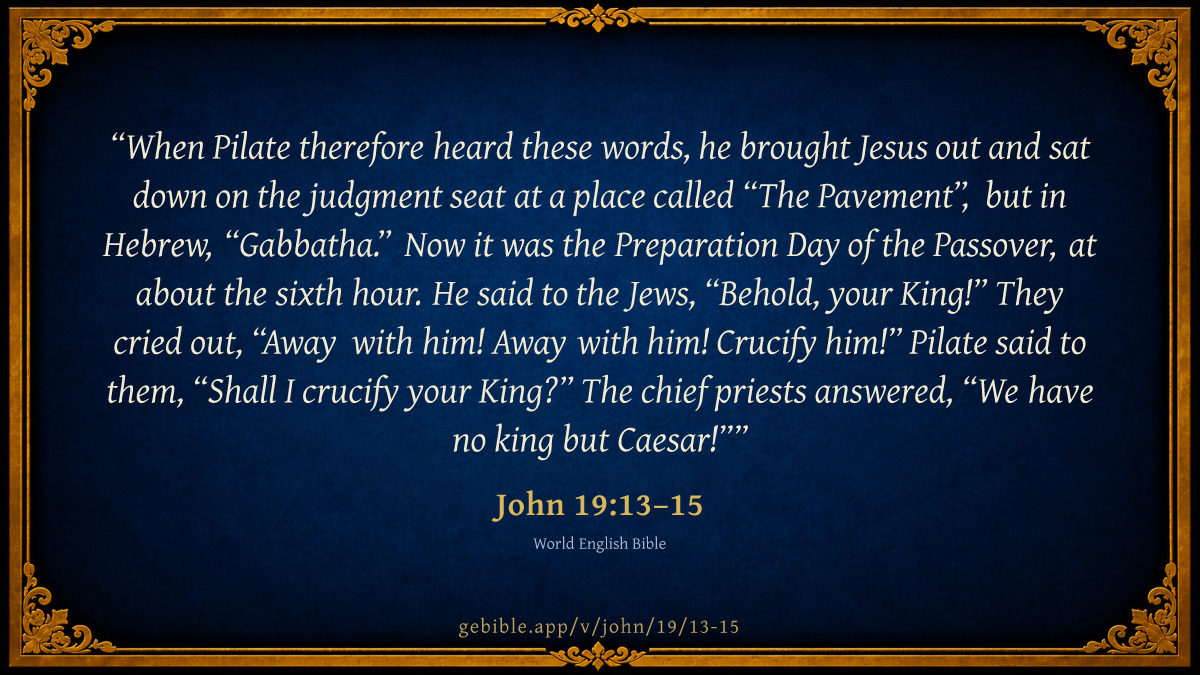
13When Pilate therefore heard these words, he brought Jesus out and sat down on the judgment seat at a place called “The Pavement”, but in Hebrew, “Gabbatha.”14Now it was the Preparation Day of the Passover, at about the sixth hour. He said to the Jews, “Behold, your King!”
15They cried out, “Away with him! Away with him! Crucify him!” Pilate said to them, “Shall I crucify your King?” The chief priests answered, “We have no king but Caesar!”
13 When Pilate therefore heard these words, he brought Jesus out and sat down on the judgment seat at a place called “The Pavement”, but in Hebrew, “Gabbatha.”
14 Now it was the Preparation Day of the Passover, at about the sixth hour. He said to the Jews, “Behold, your King!”
15 They cried out, “Away with him! Away with him! Crucify him!” Pilate said to them, “Shall I crucify your King?” The chief priests answered, “We have no king but Caesar!”
TYNDALETyndale New Testament (1534)
13 When Pylate hearde that sayinge he brought Iesus forthe and sate doune to geve sentence in a place called the pavement: but in the Hebrue tonge Gabbatha.
14 It was the Saboth even which falleth in the ester fest and aboute the sixte houre. And he sayde vnto the Iewes: beholde youre kynge.
15 They cryed awaye with him awaye with him crucify him. Pylate sayde vnto them. Shall I crucify youre kynge? The hye Prestes answered: we have no kynge but Cesar.
Show all 3 translations
GNVGeneva Bible (1599)
13 When Pilate heard this woorde, hee brought Iesus foorth, and sate downe in the iudgement seate in a place called the Pauement, and in Hebrewe, Gabbatha.
14 And it was the Preparation of the Passeouer, and about the sixt houre: and hee sayde vnto the Iewes, Beholde your King.
15 But they cried, Away with him, away with him, crucifie him. Pilate sayde vnto them, Shall I crucifie your King? The high Priestes answered, We haue no King but Cesar.
Questions where the Bible appears to say two different things, with the passages on each side set together.
When was Jesus Crucified?Mark 15:25 puts the crucifixion explicitly at the third hour — about 9 a.m.
When (on what day) was Jesus crucified?John 18:28 has the chief priests refusing to enter Pilate's praetorium 'lest they should be defiled; but that they might eat the passover' — meaning the Passov…
Matthew 27:62(v14)Now on the next day, which was the day after the Preparation Day, the chief priests and the Pharisees were gathered together to Pilate,
Luke 23:18(v15)But they all cried out together, saying, “Away with this man! Release to us Barabbas!”—
John 19:5(v14)Jesus therefore came out, wearing the crown of thorns and the purple garment. Pilate said to them, “Behold, the man!”
Acts 21:36(v15)for the multitude of the people followed after, crying out, “Away with him!”
Genesis 49:10(v15)The scepter will not depart from Judah, nor the ruler’s staff from between his feet, until he comes to whom it belongs. To him will the…
Show all 30 cross-references
Psalms 82:5-7(v13)They don’t know, neither do they understand. They walk back and forth in darkness. All the foundations of the earth are shaken. I said,…
Matthew 27:19(v13)While he was sitting on the judgment seat, his wife sent to him, saying, “Have nothing to do with that righteous man, for I have suffered…
Mark 15:25(v14)It was the third hour, and they crucified him.
John 19:6(v15)When therefore the chief priests and the officers saw him, they shouted, saying, “Crucify! Crucify!” Pilate said to them, “Take him…
John 19:42(v14)Then because of the Jews’ Preparation Day (for the tomb was near at hand) they laid Jesus there.
Acts 22:22(v15)They listened to him until he said that; then they lifted up their voice and said, “Rid the earth of this fellow, for he isn’t fit to live!”
Psalms 58:1-2(v13)Do you indeed speak righteousness, silent ones? Do you judge blamelessly, you sons of men? No, in your heart you plot injustice. You…
Psalms 94:20-21(v13)Shall the throne of wickedness have fellowship with you, which brings about mischief by statute? They gather themselves together against…
Proverbs 29:25(v13)The fear of man proves to be a snare, but whoever puts his trust in Yahweh is kept safe.
Ecclesiastes 5:8(v13)If you see the oppression of the poor, and the violent taking away of justice and righteousness in a district, don’t marvel at the matter,…
Isaiah 51:12-13(v13)“I, even I, am he who comforts you. Who are you, that you are afraid of man who shall die, and of the son of man who will be made as grass?…
Isaiah 57:11(v13)“Whom have you dreaded and feared, so that you lie, and have not remembered me, nor laid it to your heart? Haven’t I held my peace for a…
Ezekiel 21:26-27(v15)the Lord Yahweh says: “Remove the turban, and take off the crown. This will not be as it was. Exalt that which is low, and humble that…
Amos 4:7(v13)“I also have withheld the rain from you, when there were yet three months to the harvest; and I caused it to rain on one city, and caused…
Mark 15:33-34(v14)When the sixth hour had come, there was darkness over the whole land until the ninth hour. At the ninth hour Jesus cried with a loud voice,…
Mark 15:42(v14)When evening had now come, because it was the Preparation Day, that is, the day before the Sabbath,
Luke 12:5(v13)But I will warn you whom you should fear. Fear him who after he has killed, has power to cast into Gehenna. Yes, I tell you, fear him.
Luke 23:54(v14)It was the day of the Preparation, and the Sabbath was drawing near.
John 19:3(v14)They kept saying, “Hail, King of the Jews!” and they kept slapping him.
John 19:8(v13)When therefore Pilate heard this saying, he was more afraid.
John 19:19-22(v14)Pilate wrote a title also, and put it on the cross. There was written, “JESUS OF NAZARETH, THE KING OF THE JEWS.” Therefore many of the…
John 19:31-32(v14)Therefore the Jews, because it was the Preparation Day, so that the bodies wouldn’t remain on the cross on the Sabbath (for that Sabbath…
Acts 4:19(v13)But Peter and John answered them, “Whether it is right in the sight of God to listen to you rather than to God, judge for yourselves,
John 5:2(v13)Now in Jerusalem by the sheep gate, there is a pool, which is called in Hebrew, “Bethesda”, having five porches.
John 18:31(v15)Pilate therefore said to them, “Take him yourselves, and judge him according to your law.” Therefore the Jews said to him, “It is illegal…
Cross-references from openbible.info (CC BY 4.0)
Explain this passage (20 sources)
Historical commentary, presented as a primary source — not an endorsement.
John Calvin1540 · Public DomainOn vv13–1513. And sat down on the judgment-seat. Hence we…
13. And sat down on the judgment-seat. Hence we see what conflicting opinions passed through the mind of Pilate, as if he had been a stage-player who was acting two characters. He ascends the judgment-seat, in order to pronounce sentence of death on Christ solemnly, and in the customary form; and yet he declares openly, that he does so reluctantly and against his conscience. When he calls Christ king, he speaks ironically, meaning that it was a trivial charge which the Jews brought against him; or rather, for the purpose of allaying their fury, he warns them, that it would bring disgrace on the whole nation, if a report were spread abroad, that a person of that nation had been condemned to die for aspiring to kingly power.
In the place which is called the Stone-pavement, but in the Hebrew, Gabbatha. When the Evangelist says, that גבתא (Gabbatha) was the name of the place in Hebrew he means the Chaldaic or Syriac language, which was then in common use; for in Hebrew, גבה(Gabach) means to be lofty. It was proper, therefore, that Christ should be condemned from a lofty place, that he, coming from heaven as the supreme Judge, may acquit us at the last day.
John Calvin's Commentaries (1540-1563) — public domain. Text from the Calvin Translation Society English edition (1840s-50s) via the Christian Classics Ethereal Library (ccel.org). Calvin's coverage is partial (roughly two-thirds of the Bible); uncommented books and verses are honest gaps, never fabricated. The 19th-century editor's footnotes and remarks are omitted so the notes are faithfully Calvin's own voice.
Geneva Bible translators1599 · Public DomainOn v13Gabbatha signifieth an high place, as judgment seats are.
Gabbatha signifieth an high place, as judgment seats are.
Pilate condemneth himself first, with the same mouth wherewith he afterward condemneth Christ.
Geneva Bible (1599) marginal notes — public domain.
John Trapp1656 · Public DomainOn vv13–1513 When Pilate therefore heard that saying, he brought…
13 When Pilate therefore heard that saying, he brought Jesus forth, and sat down in the judgment seat in a place that is called the Pavement, but in the Hebrew, Gabbatha.
Ver. 13. When Pilate therefore heard that saying] That saying, and the base fear of being shent by Caesar, makes him warp and go against his conscience. But should not judges be men of courage? Should not the standard be of steel? the chief posts in the house be heart of oak? Solomon’s tribunal was under propped with lions, to show what metal a magistrate should be made of. It is a mercy to have judges, modo audeant quae sentiunt, saith the orator, so they dare do their consciences. (Cic. pro Milone.)
John Trapp, A Commentary or Exposition upon All the Books of the Old and New Testament (1647–1656) — public domain. Text from a community e-Sword module.
Matthew Poole1685 · Public DomainOn vv13–15That saying, that if he let Jesus go he…
That saying, that if he let Jesus go he was not Caesar’s friend. Pilate was a man that loved the honour that was from men more than the honour and praise which is from God; he was more afraid of losing his place than his soul, and could no longer resist the temptation he was under.
He brought Jesus forth, and sat down in a place called the Pavement, because it was paved with stone, but in the Hebrew, (mixed with the Syriac), Gabbatha, that is, a high place; for it was their manner to have their judgment seats higher than other parts of the room where they were.
Matthew Poole's English Annotations on the Holy Bible (1683–1685) — public domain. Text from a community e-Sword/MySword module.
William Burkitt1703 · Public DomainOn v14Observe here, how careful the Holy Ghost is to…
Observe here, how careful the Holy Ghost is to record and set down the time when Pilate gave sentence against Christ.
In general, it was on the day of the preparation for the passover; that is, the day immediately before it, when they prepared everything needful for the solemnization: and, in particular, it was about the sixth hour of that day.
Read full note →
St. Mark calls it the third hour, St. John the sixth; but this is easily reconciled thus: the Jews divided the day into four quarters, which they called hours; the first was called the third hour, which answers to our ninth; the second, called the sixth hour, answering to our twelfth: the third, called the ninth hour, answering our three in the afternoon: the fourth, called the twelfth hour, which was the time of their retirement from labour, and beginning of the first night watch.
Now the whole time from the third hour to the sixth, that is, from nine to twelve, was called the third hour; and the whole intervening time from the sixth to the ninth, that is from twelve to three, is called the sixth hour; and so of the rest.
Now when St. John says, it was about the sixth hour when Christ was condemned by Pilate, and led away to be crucified, and St. Mark says it was the third hour, we are to understand, that St. Mark takes in the whole time of the third hour, from nine to twelve: and St. John saying it was about the sixth hour, implies that it was near twelve; so that between the hours of nine and twelve our Lord was sentenced, and led away to his cross; about twelve, fastened to his cross, upon which he hung till the ninth hour, that is, till about three in the afternoon; during which time there was such an eclipse of the sun, as did occasion darkness over all the earth.
Learn hence, the great love and condescension of Christ, in stooping so low, to have his sufferings lengthened out upon our accounts, to expiate our guilt, which deserveth eternal sufferings: that he might, by his example, warn us to prepare for trials of long continuance, and sanctify a state of continual affliction to us. Behold the Son of God harassed all night before he suffered, hurried from place to place, posted backward and forward, from Pilate to Herod, and from Herod to Pilate, wearied, scourged, buffeted, crowned with thorns, at last nailed to his cross, and hanging thereupon from about twelve to three, in exquisite torture of body, and under the sense of his Father’s wrath in his soul.
O Lord! thy kindness towards us in matchless an inimitable; never was love like thine.
William Burkitt's Expository Notes on the New Testament (1700–1703) — public domain. Text from a community e-Sword module.
John Gill1763 · Public DomainOn vv13–15When Pilate therefore heard that saying,.... Of the Jews,…
When Pilate therefore heard that saying,.... Of the Jews, that a freeing of Jesus would show an unfriendliness to Caesar; and gave very broad hints that they would accuse him to Caesar of treachery and unfaithfulness, in letting go a man, that made pretensions to be a king in his territories; and knowing well the jealousies and suspicions of Tiberius, and fearing lest it would turn to his own disrepute and disadvantage, immediately
he brought Jesus forth out of the judgment hall, the place where he had been examined in; not to declare his innocence, nor to move their pity, nor to release him, but to pass sentence on him.
Read full note →
And he sat down in the judgment seat: for that purpose. He had sat but little all this while, but was continually going in and out to examine Jesus, and converse with the Jews; but he now takes his place, and sits down as a judge, in order to give the finishing stroke to this affair; and where he sat down, was
in the place that is called the pavement, but in the Hebrew, Gabbatha. This place, in the Greek tongue, was called "Lithostrotos"; or "the pavement of stones", as the Syriac version renders it: it is thought to be the room "Gazith", in which the sanhedrim sat in the temple when they tried capital causes (t); and it was so called, because it was paved with smooth, square, hewn stones:
"it was in the north part; half of it was holy, and half of it common; and it had two doors, one for that part which was holy, and another for that which was common; and in that half which was common the sanhedrim sat (u).''
So that into this part of it, and by this door, Pilate, though a Gentile, might enter. This place, in the language of the Jews, who at this time spoke Syriac, was "Gabbatha", front its height, as it should seem; though the Syriac and Persic versions read "Gaphiphtha", which signifies a fence, or an enclosure. Mention is made in the Talmud (w) of the upper "Gab" in the mountain of the house; but whether the same with this "Gabbaths", and whether this is the same with the chamber "Gazith", is not certain. The Septuagint use the same word as John here does, and call by the same name the pavement of the temple on which the Israelites felt and worshipped God, Ch2 7:3.
(t) Gloss. in T. Bab. Avoda Zara, fol. 8. 2. (u) T. Bab. Yoma, fol. 25. 1. Maimon. Hilch. Beth Habbechira, c. 5. sect. 17. Bartenora in Misn. Middot, c. 5. sect. 3. (w) T. Bab. Sabbat, fol. 115. 1.
John Gill's Exposition of the Whole Bible (1746–1763) — public domain (CC PDM 1.0). Text via the HelloAO Bible API.
John Wesley1765 · Public DomainOn vv13–14Pilate sat down on the judgment seat - Which…
Pilate sat down on the judgment seat - Which was then without the palace, in a place called, in Greek, the pavement, on account of a beautiful piece of Mosaic work, with which the floor was adorned: but in Hebrew, Gabbatha - Or the high place, because it stood on an eminence, so that the judge sitting on his throne might be seen and heard by a considerable number of people.
John Wesley, Explanatory Notes Upon the Whole Bible (1754–1765) — public domain. Text via the GEBible commentary corpus.
Adam Clarke1810 · Public DomainOn vv13–15Verse 13. The Pavement] λιθοστρωτον, literally, a stone pavement:…
Verse 13. The Pavement] λιθοστρωτον, literally, a stone pavement: probably it was that place in the open court where the chair of justice was set, for the prefects of provinces always held their courts of justice in the open air, and which was paved with stones of various colours, like that of Ahasuerus, Es 1:6, of red, blue, white, and black marble; what we still term Mosaic work, or something in imitation of it; such as the Roman pavements frequently dug up in this and other countries, where the Romans have had military stations.
Gabbatha.] That is, an elevated place; from גבה gabah, high, raised up; and it is very likely that the judgment seat was considerably elevated in the court, and that the governor went up to it by steps; and perhaps these very steps were what was called the Pavement. John does not say that Lithostroton, or the Pavement, is the meaning of the word Gabbatha; but that the place was called so in the Hebrew. The place was probably called Lithostroton, or the Pavement: the seat of judgment, Gabbatha, the raised or elevated place.
Read full note →
In several MSS. and versions, the scribes not understanding the Hebrew word, wrote it variously, Gabbatha, Gabatha, Kapphatha, Kappata, Gennetha, Gennaesa, and Gennesar. Lightfoot conjectures that the pavement here means the room Gazith in the temple, in which the grand council, called the Sanhedrin, held their meetings.
Adam Clarke's Commentary on the Bible (1810–1826) — public domain. Text from a community e-Sword/MySword module.
Joseph Benson1811 · Public DomainOn v13Joh 19:13-15. When Pilate heard that saying, he brought…
Joh 19:13-15. When Pilate heard that saying, he brought Jesus forth — Brought him out of the palace a second time; and sat down in the judgment-seat — On the tribunal which was then erected without the palace; in a place that was called, in Greek, λιθοστρωτον, the Pavement — So called on account of a beautiful piece of Mosaic work, with which the floor was adorned; but in the Hebrew, Gabbatha — Or, the high place, because it stood on an eminence; so that the judge, being seated there, might be heard and seen by a considerable number of people. And it was the preparation of the passover — Or, of the paschal sabbath. The word παρασκευη, [here rendered preparation,] in the New Testament, denotes always, in my opinion, says Dr. Campbell, “the day before the sabbath, and not the day which preceded any other festival, unless that festival fell on the sabbath. My reasons for this opinion are, 1st, This explanation coincides exactly with the definition which Mark gives of that word, (Mar 15:42,) It was the preparation, that is, the eve of the sabbath. 2d, The word occurs six times in the New Testament, and, in all these places, confessedly means the sixth day of the week, answering to our Friday, and consequently the day before the Jewish sabbath, or Saturday. 3d, The preparation of all things necessary the day before the sabbath was expressly commanded in the law, Exo 16:5; Exo 16:23. There was nothing analogous to this enjoined in preparation for the other feasts.” And about the sixth hour — Or rather, the third hour: for as there is no reason to think that John computed time in a manner different from that used by the other evangelists; “as six o’clock, (according to the Roman computation,) or soon after sunrise, must have been much too early for all the events to have occurred that morning which preceded our Lord’s crucifixion; as Mark has expressly mentioned the third hour, or nine o’clock, for the time of that event, to which the accounts of the other evangelists accord; and as the sixth hour, or noon, (according to the Jewish computation,) would be too late to agree with the parallel scriptures; so it seems the most easy way of solving the difficulty, to suppose that [ζ] sixth, instead of [γ] third, was inserted by some of the early transcribers of this gospel. The mistake would be very easily fallen into; and in a few places it is necessary to allow that something of this kind has happened. Indeed some manuscripts read the third hour.” — Scott. See this point more fully explained and defended in the note on Mar 15:25. And he saith unto the Jews — Who were present in vast numbers; Behold your king — Pointing to Jesus as he now appeared in the mock pomp of royalty, wearing the purple robe and crown of thorns, and with his hands manacled. It seems he spoke thus, either in ridicule of the national expectation, or, which is more probable, to show the Jews how vain the fears were which they pretended to entertain about the emperor’s authority in Judea, the person who was the occasion of them, showing, in the whole of his deportment, a temper of mind no ways consonant to the ambition which they branded him with. But they cried out — With indignation and disdain; Away with him, &c. — See on Luk 23:18-25. Pilate saith, shall I crucify your king? — According to most commentators, Pilate said this, mocking him. But it is more agreeable to his general behaviour in this affair to suppose, that he spoke it with a view to move the populace, who he knew had once held Jesus in great esteem as the Messiah. For John tells us (Joh 19:12,) that he now sought to release him. The chief priests answered, We have no king but Cesar — “In this reply they publicly renounced their hope of a Messiah, which the whole economy of their religion had been calculated to cherish: and likewise they acknowledged publicly their subjection to the Romans; and by so doing condemned themselves when they afterward rebelled.”
Joseph Benson's Commentary on the Old and New Testaments (1811–1818) — public domain. Text from a community e-Sword module.
Albert Barnes1834 · Public DomainOn vv13–14Judgment-seat - The tribunal or place of pronouncing sentence.…
Judgment-seat - The tribunal or place of pronouncing sentence. He came here to deliver him, in due form of law, into the hands of the Jews.
Pavement - This was an area or room of the judgment hall whose floor was made of small square stones of various colors. This was common in palaces and houses of wealth and splendor. See the notes at Mat 9:2.
Read full note →
Gabbatha - This word is not elsewhere used. It comes from a word signifying to be elevated. The name given to the place by the Hebrews was conferred from its being the place of the tribunal, as an elevated place.
Albert Barnes' Notes on the Bible (1834–1885) — public domain. Text from a community e-Sword/MySword module.
Haydock's Catholic Bible Commentary1859 · Public DomainOn v14The Parasceve of the Pasch; that is, the day…
The Parasceve of the Pasch; that is, the day before the paschal sabbath. The eve of every sabbath was called the Parasceve, or day of preparation. But this was the eve of a high sabbath, viz. that which fell in the paschal week. (Challoner) --- It was about the sixth hour when they crucified him. St. Mark, in his gospel, says, it was at the third hour that Jesus was crucified. These two evangelists are easily reconciled, if we consider that according to the custom of the Jews, all that took place between the third hour and the sixth hour of their day, was said to have happened in the third hour: their days being divided into four parts of three hours each, in the same manner as the nights were into four watches, of three hours each. St. Mark, therefore, might say very well, that the crucifixion of our Saviour took place in the third hour: though it might have been towards the conclusion of this general division of the day: whilst St. John, with a reason equally as good, says that it happened about the sixth hour. (John Nicolaus, in his marginal notes on St. Thomas Aquinas’ Aurea Catena.)
George Leo Haydock (1774–1849), Haydock's Catholic Family Bible and Commentary, 1859 edition — public domain. Excludes Psalms (Douay-Rheims chapter numbering differs from Protestant) and Deuterocanonical books (Catholic canon only).
Robert Jamieson, A. R. Fausset & David Brown1871 · Public DomainOn vv14–15It was the preparation--that is, the day before the…
It was the preparation--that is, the day before the Jewish sabbath.
and about the sixth hour--The true reading here is probably, "the third hour"--or nine A.M.--which agrees best with the whole series of events, as well as with the other Evangelists.
Read full note →
he saith to the Jews, Behold your King!--Having now made up his mind to yield to them, he takes a sort of quiet revenge on them by this irony, which he knew would sting them. This only reawakens their cry to despatch Him.
Jamieson, Fausset & Brown — Commentary Critical and Explanatory on the Whole Bible (1871) — public domain (CC PDM 1.0). Text via the HelloAO Bible API.
Daniel D. Whedon1874 · Public DomainOn vv13–1513. Heard that saying—Jesus, again, must die that another…
13. Heard that saying—Jesus, again, must die that another may not die. A just man though he is, Pilate will shed his blood for his own safety. The Jew conquers the Roman; the subject rules the ruler. The Gentile is compelled by the Jew to be the executioner of the Saviour of mankind.
He brought Jesus forth—Though the examination might be in part in private, yet the sentence must be pronounced in public. Jesus, therefore, is led into the fore court, and Pilate takes his place upon the judgment seat.
Read full note →
Called the Pavement—This was a platform of Mosaic, ornamented and tessellated, on which the judgment throne was made to stand.
Gabbatha—Signifies an elevation. John gives the Hebrew as well as the Greek name of the platform, to indicate that Pilate pronounced judgment solemnly, not from a level, but from the high judicial seat. So truly official a matter was this pavement that we are told by Seutonius, in his life of Cesar, that that general, wherever he marched, had the fitted marble conveyed with him, in order to lay the platform, whenever he encamped, at his pretorium or headquarters.
Daniel D. Whedon (gen. ed.), Commentary on the Old and New Testaments (1874–1909) — public domain. Text from a community e-Sword module.
The Cambridge Bible for Schools and Colleges1878 · Public DomainOn vv13–1513. that saying] The better reading gives, these words.…
13. that saying] The better reading gives, these words. Pilate’s mind seems to be made up at once.
brought Jesus forth] Sentence must be pronounced in public. Thus we find that Pilate, in giving judgment about the standards, which had been brought into Jerusalem, has his tribunal in the great circus at Caesarea, and Florus erects his in front of the palace (Josephus, B. J. ii. ix. 3, xiv. 8).
Read full note →
sat down] The Greek verb (kathizo) may be either transitive, as in 1Co_6:4; Eph_1:20, or intransitive, as in Mat_19:28; Mat_25:31. If it is transitive here, the meaning will be, ‘placed him on a seat,’ as an illustration of his mocking exclamation, ‘Behold your King!’—i.e. ‘There He sits enthroned! But [Joh_8:2;] Joh_12:14; Rev_3:21; Rev_20:4, the only places where S. John uses the word, and Act_12:21; Act_25:6; Act_25:17, where we have the same phrase as here, are against the transitive meaning in this place.
in the judgment seat] In the true text there is no article, which may mean that it was not the usual Bema but a temporary one. Every where else in N.T. ‘judgment seat’ has the definite article.
Pavement] Literally, stone-paved. Josephus (Ant. v. Joh_19:2) says that the Temple-mount, on part of which the fortress of Antonia stood, was covered with a tesselated pavement.
in the Hebrew, Gabbatha] Omit ‘the,’ as in Joh_19:20, and see on Joh_20:16. It was, we may conclude “from its having a Hebrew name, a fixed spot, and not the portable mosaic work which Roman generals sometimes carried about with them.” S. p. 250. The fact that there was a fixed pavement supports this view; but Gabbatha (= Gab Baitha) means ‘the ridge of the House’ i.e. ‘the Temple-mound,’ and refers to the shape of the ground (like a back), not to the pavement upon it.
The Cambridge Bible for Schools and Colleges (gen. ed. J. J. S. Perowne; Cambridge University Press, 1878–1918) — public domain. Text from a community e-Sword module.
Ellicott's Commentary for English Readers1878 · Public DomainOn vv13–15(13) When Pilate therefore heard that saying.—Better . .…
(13) When Pilate therefore heard that saying.—Better . . . these sayings—i.e., the two sayings of the previous verse.
He brought Jesus forth ., .—Comp. Joh_19:9. He hesitates no longer about the course to be taken. His own position and life may be in danger, and he prepares, therefore, to pronounce the final sentence, which must necessarily be done from the public judgment seat outside the palace. (Comp. Mat_27:19.)
Read full note →
The Pavement, but in the Hebrew, Gabbatha.—Both these words occur here only, and are instances of the writer’s minute knowledge of the localities in Jerusalem. It may have been better to have preserved the Greek name (Lithostrôton), as well as that by which the place was known in the Hebrew (Syro-Chaldaic) of the time. The word literally means “stone-paved,” and was the Greek name for the tesselated “pavement” of marble and coloured stones with which from the time of Sylla the Romans delighted to adorn the Prætorium. The Chaldee word means “an elevated place,” so that the one name was given to it from its form, and the other from the material of which it was made. Suetonius (Life, chap. 46) tells us that Julius Cæsar carried about with him such pieces of marble and stone, but the mention of the “place” bears the impression that it was a fixture in front of the Prætorium at Jerusalem, in which the Bema was placed; or it may have been a portion of the northern court of the sanctuary to which Pilate came out, if we identify the Prætorium with the tower Antonia. (Comp. Note on Mat_27:27.) Josephus mentions that the whole of the Temple mountain was paved with this kind of Mosaic work (Ant v. 5. 2. Caspari, Chron. Geogr., Introd., Eng. Trans., p. 225).
A Bible Commentary for English Readers, edited by Charles John Ellicott (1878–1897) — public domain. Text from a community e-Sword module.
The Pulpit Commentary1880 · Public DomainOn vv13–15When Pilate therefore heard these words, or, sayings his…
When Pilate therefore heard these words, or, sayings his fear of Tiberius became greater than his fear of Christ; his anxiety for himself predominated over his desire for justice and fair play. He found he had gone too far. Some commentators and harmonists here introduce the "hand-washing"; (see above, Joh_18:40) but such a proceeding at this moment, when he was straightening up his back for the last act of injustice, would have roused fresh and dangerous charges against his personal honor. He brought Jesus out from the Praetorium to a place in view of the peoples and sat down (not, as some say, caused Jesus, in mockery, to take his place upon the judgment-seat ( kayizw has the transitive sense in 1Co_6:4 and Eph_1:20, but not in John; and undoubtedly it has the intransitive sense, not only in John, but in Act_25:6, Act_25:17. Moreover, the mockery was the act of the soldiery and of Herod"s men of war, not of Pilate). It is remarkable, as Dr. James Drummond (Theological Review, 1877) points out, that Justin Martyr ("Apol.," 1:35) apparently refers to this supposed transitive usage of kayizw in this very connection by John, by the words, Diasurontev autoyison epi bhmatov kai eipon krinon hmin . It is reasonable inference that Justin read John"s Gospel, and supposed him to give transitive force to the verb (see Dr. Salmon, "Introduction to New Testament," p. 89, note). Upon the judgment-seat in a place called liyostryton , the tessellated Pavement equivalent to "stone-joining in which Romans delighted from thedays of Sulla; a decoration which Julius Caesar carried about with him (Suet., "Vit.," 46.) for purposes of judgmentbut in the Hebrew, Oabbatha. This was probably an elevated and fixed platform overlooking the temple-courts, or joining the Castle of Antonia with the temple. Its etymology is atybiAbG, the ridge of the house or temple. Ewald has endeavored to find in the word the root Bq, Aramaic for "insert," modified into, and then to suppose that we have here an exact equivalent to liyostrwton ; but where this word occurs in the LXX it is the equivalent of the Hebrew pxr, Son_3:10. The liyostrwton was possibly some elevated seat reached by a flight of stairs, and in the open air, not the bema within the Praetorium, where the more private conversations took place.
The Pulpit Commentary (1880–1919), ed. H.D.M. Spence-Jones & Joseph S. Exell — public domain. Text from a community e-Sword module.
The Biblical Illustrator1887 · Public DomainOn vv13–15When Pilate therefore heard that
Joh_19:13
When Pilate therefore heard that
Read full note →
The down grade
Pilates time for playing with the situation is gone; now the situation plays with him.
First he said, not asked, What is truth? Now his frightened heart, to which the emperors favour is the supreme law of life, says, What is justice? (J. P. Lange, D. D.)
A place that is called the pavement, but in the Hebrew, Gahbatha.--Both these words occur here only, and are instances of the writers minute knowledge of the localities in Jerusalem. It may have been better to have preserved the Greek name (Lithost-roton), as well as that by which the place was known in the Hebrew (Syro-Chaldaic), of the time. The word literally means stonepaved, and was the Greek name for the tesselated pavement of marble and coloured stones with which, from the time of Sylla, the Romans delighted to adorn the Praetorium. The Chaldic word means an elevated place, so that the one name was given to it from its form, and the other from the material of which it was made. Suetonius tells us that Julius Caesar carried about with him such pieces of marble and stone, but the mention of the place bears the impression that it was a fixture in front of the Praetorium at Jerusalem, in which the Bema was placed; or it may have been a portion of the northern court of the sanctuary to which Pilate came out, if we identify the Praetorium with the tower Antonia (cf. Mat_27:27)
. Josephus mentions that the whole of the Temple mountain was paved with this kind of mosaic work. (Archdeacon Watkins.)
The Biblical Illustrator, edited by Joseph S. Exell (c. 1880s–1900s) — public domain. Text from a community e-Sword module.
C. I. Scofield1917 · Public DomainOn v14sixth hour
sixth hour
(See Scofield "Mar 15:25").
The Scofield Reference Bible (1917 edition), notes by C. I. Scofield — public domain. Text from a community e-Sword module.
unfoldingWord translationNotes2017 · CC BY-SA 4.0On v14Connecting Statement:
Connecting Statement:
Some time has passed and it is now the sixth hour, as Pilate orders his soldiers to crucify Jesus.
Read full note →
Now
This word marks a break in the story line so that John can provide information about the upcoming Passover and the time of day. (See: Background Information)
the sixth hour
"about noontime"
Pilate said to the Jews
Here "Jews" is a synecdoche that refers to the Jewish leaders who opposed Jesus. AT: "Pilate said to the Jewish leaders" (See: Synecdoche)
Should I crucify your King?
Here "I" is a synecdoche that refers to Pilate's soldiers who will actually perform the crucifixion. AT: "Do you really want me to tell my soldiers to nail your king to a cross?" (See: Synecdoche)
Then Pilate gave Jesus over to them to be crucified
Here Pilate gives the order for his soldiers to crucify Jesus. You can translate this in an active form. AT: "So Pilate ordered his soldiers to crucify Jesus" (See: Assumed Knowledge and Implicit Information and Active or Passive)
Tyndale Open Study Notes2022 · CC BY-SA 4.0On vv13–1519:13 Pilate took the governor’s judgment seat (Greek bēma,…
19:13 Pilate took the governor’s judgment seat (Greek bēma, cp. Acts 25:6, “seat in court”) to render his verdict. • The Stone Pavement was the platform holding the judgment seat; from there Pilate now spoke with the authority of his office.

John Calvin 1540 · Public Domain On vv13–15 13. And sat down on the judgment-seat. Hence we…
13. And sat down on the judgment-seat. Hence we see what conflicting opinions passed through the mind of Pilate, as if he had been a stage-player who was acting two characters. He ascends the judgment-seat, in order to pronounce sentence of death on Christ solemnly, and in the customary form; and yet he declares openly, that he does so reluctantly and against his conscience. When he calls Christ king, he speaks ironically, meaning that it was a trivial charge which the Jews brought against him; or rather, for the purpose of allaying their fury, he warns them, that it would bring disgrace on the whole nation, if a report were spread abroad, that a person of that nation had been condemned to die for aspiring to kingly power.
In the place which is called the Stone-pavement, but in the Hebrew, Gabbatha. When the Evangelist says, that גבתא (Gabbatha) was the name of the place in Hebrew he means the Chaldaic or Syriac language, which was then in common use; for in Hebrew, גבה(Gabach) means to be lofty. It was proper, therefore, that Christ should be condemned from a lofty place, that he, coming from heaven as the supreme Judge, may acquit us at the last day.
John Calvin's Commentaries (1540-1563) — public domain. Text from the Calvin Translation Society English edition (1840s-50s) via the Christian Classics Ethereal Library (ccel.org). Calvin's coverage is partial (roughly two-thirds of the Bible); uncommented books and verses are honest gaps, never fabricated. The 19th-century editor's footnotes and remarks are omitted so the notes are faithfully Calvin's own voice.
Geneva Bible translators 1599 · Public Domain On v13 Gabbatha signifieth an high place, as judgment seats are.
Gabbatha signifieth an high place, as judgment seats are.
Pilate condemneth himself first, with the same mouth wherewith he afterward condemneth Christ.
Geneva Bible (1599) marginal notes — public domain.
John Trapp 1656 · Public Domain On vv13–15 13 When Pilate therefore heard that saying, he brought…
13 When Pilate therefore heard that saying, he brought Jesus forth, and sat down in the judgment seat in a place that is called the Pavement, but in the Hebrew, Gabbatha.
Ver. 13. When Pilate therefore heard that saying] That saying, and the base fear of being shent by Caesar, makes him warp and go against his conscience. But should not judges be men of courage? Should not the standard be of steel? the chief posts in the house be heart of oak? Solomon’s tribunal was under propped with lions, to show what metal a magistrate should be made of. It is a mercy to have judges, modo audeant quae sentiunt, saith the orator, so they dare do their consciences. (Cic. pro Milone.)
John Trapp, A Commentary or Exposition upon All the Books of the Old and New Testament (1647–1656) — public domain. Text from a community e-Sword module.
Matthew Poole 1685 · Public Domain On vv13–15 That saying, that if he let Jesus go he…
That saying, that if he let Jesus go he was not Caesar’s friend. Pilate was a man that loved the honour that was from men more than the honour and praise which is from God; he was more afraid of losing his place than his soul, and could no longer resist the temptation he was under.
He brought Jesus forth, and sat down in a place called the Pavement, because it was paved with stone, but in the Hebrew, (mixed with the Syriac), Gabbatha, that is, a high place; for it was their manner to have their judgment seats higher than other parts of the room where they were.
Matthew Poole's English Annotations on the Holy Bible (1683–1685) — public domain. Text from a community e-Sword/MySword module.
William Burkitt 1703 · Public Domain On v14 Observe here, how careful the Holy Ghost is to…
Observe here, how careful the Holy Ghost is to record and set down the time when Pilate gave sentence against Christ.
In general, it was on the day of the preparation for the passover; that is, the day immediately before it, when they prepared everything needful for the solemnization: and, in particular, it was about the sixth hour of that day.
Read full note →
St. Mark calls it the third hour, St. John the sixth; but this is easily reconciled thus: the Jews divided the day into four quarters, which they called hours; the first was called the third hour, which answers to our ninth; the second, called the sixth hour, answering to our twelfth: the third, called the ninth hour, answering our three in the afternoon: the fourth, called the twelfth hour, which was the time of their retirement from labour, and beginning of the first night watch.
Now the whole time from the third hour to the sixth, that is, from nine to twelve, was called the third hour; and the whole intervening time from the sixth to the ninth, that is from twelve to three, is called the sixth hour; and so of the rest.
Now when St. John says, it was about the sixth hour when Christ was condemned by Pilate, and led away to be crucified, and St. Mark says it was the third hour, we are to understand, that St. Mark takes in the whole time of the third hour, from nine to twelve: and St. John saying it was about the sixth hour, implies that it was near twelve; so that between the hours of nine and twelve our Lord was sentenced, and led away to his cross; about twelve, fastened to his cross, upon which he hung till the ninth hour, that is, till about three in the afternoon; during which time there was such an eclipse of the sun, as did occasion darkness over all the earth.
Learn hence, the great love and condescension of Christ, in stooping so low, to have his sufferings lengthened out upon our accounts, to expiate our guilt, which deserveth eternal sufferings: that he might, by his example, warn us to prepare for trials of long continuance, and sanctify a state of continual affliction to us. Behold the Son of God harassed all night before he suffered, hurried from place to place, posted backward and forward, from Pilate to Herod, and from Herod to Pilate, wearied, scourged, buffeted, crowned with thorns, at last nailed to his cross, and hanging thereupon from about twelve to three, in exquisite torture of body, and under the sense of his Father’s wrath in his soul.
O Lord! thy kindness towards us in matchless an inimitable; never was love like thine.
William Burkitt's Expository Notes on the New Testament (1700–1703) — public domain. Text from a community e-Sword module.
John Gill 1763 · Public Domain On vv13–15 When Pilate therefore heard that saying,.... Of the Jews,…
When Pilate therefore heard that saying,.... Of the Jews, that a freeing of Jesus would show an unfriendliness to Caesar; and gave very broad hints that they would accuse him to Caesar of treachery and unfaithfulness, in letting go a man, that made pretensions to be a king in his territories; and knowing well the jealousies and suspicions of Tiberius, and fearing lest it would turn to his own disrepute and disadvantage, immediately
he brought Jesus forth out of the judgment hall, the place where he had been examined in; not to declare his innocence, nor to move their pity, nor to release him, but to pass sentence on him.
Read full note →
And he sat down in the judgment seat: for that purpose. He had sat but little all this while, but was continually going in and out to examine Jesus, and converse with the Jews; but he now takes his place, and sits down as a judge, in order to give the finishing stroke to this affair; and where he sat down, was
in the place that is called the pavement, but in the Hebrew, Gabbatha. This place, in the Greek tongue, was called "Lithostrotos"; or "the pavement of stones", as the Syriac version renders it: it is thought to be the room "Gazith", in which the sanhedrim sat in the temple when they tried capital causes (t); and it was so called, because it was paved with smooth, square, hewn stones:
"it was in the north part; half of it was holy, and half of it common; and it had two doors, one for that part which was holy, and another for that which was common; and in that half which was common the sanhedrim sat (u).''
So that into this part of it, and by this door, Pilate, though a Gentile, might enter. This place, in the language of the Jews, who at this time spoke Syriac, was "Gabbatha", front its height, as it should seem; though the Syriac and Persic versions read "Gaphiphtha", which signifies a fence, or an enclosure. Mention is made in the Talmud (w) of the upper "Gab" in the mountain of the house; but whether the same with this "Gabbaths", and whether this is the same with the chamber "Gazith", is not certain. The Septuagint use the same word as John here does, and call by the same name the pavement of the temple on which the Israelites felt and worshipped God, Ch2 7:3.
(t) Gloss. in T. Bab. Avoda Zara, fol. 8. 2. (u) T. Bab. Yoma, fol. 25. 1. Maimon. Hilch. Beth Habbechira, c. 5. sect. 17. Bartenora in Misn. Middot, c. 5. sect. 3. (w) T. Bab. Sabbat, fol. 115. 1.
John Gill's Exposition of the Whole Bible (1746–1763) — public domain (CC PDM 1.0). Text via the HelloAO Bible API.
John Wesley 1765 · Public Domain On vv13–14 Pilate sat down on the judgment seat - Which…
Pilate sat down on the judgment seat - Which was then without the palace, in a place called, in Greek, the pavement, on account of a beautiful piece of Mosaic work, with which the floor was adorned: but in Hebrew, Gabbatha - Or the high place, because it stood on an eminence, so that the judge sitting on his throne might be seen and heard by a considerable number of people.
John Wesley, Explanatory Notes Upon the Whole Bible (1754–1765) — public domain. Text via the GEBible commentary corpus.
Adam Clarke 1810 · Public Domain On vv13–15 Verse 13. The Pavement] λιθοστρωτον, literally, a stone pavement:…
Verse 13. The Pavement] λιθοστρωτον, literally, a stone pavement: probably it was that place in the open court where the chair of justice was set, for the prefects of provinces always held their courts of justice in the open air, and which was paved with stones of various colours, like that of Ahasuerus, Es 1:6, of red, blue, white, and black marble; what we still term Mosaic work, or something in imitation of it; such as the Roman pavements frequently dug up in this and other countries, where the Romans have had military stations.
Gabbatha.] That is, an elevated place; from גבה gabah, high, raised up; and it is very likely that the judgment seat was considerably elevated in the court, and that the governor went up to it by steps; and perhaps these very steps were what was called the Pavement. John does not say that Lithostroton, or the Pavement, is the meaning of the word Gabbatha; but that the place was called so in the Hebrew. The place was probably called Lithostroton, or the Pavement: the seat of judgment, Gabbatha, the raised or elevated place.
Read full note →
In several MSS. and versions, the scribes not understanding the Hebrew word, wrote it variously, Gabbatha, Gabatha, Kapphatha, Kappata, Gennetha, Gennaesa, and Gennesar. Lightfoot conjectures that the pavement here means the room Gazith in the temple, in which the grand council, called the Sanhedrin, held their meetings.
Adam Clarke's Commentary on the Bible (1810–1826) — public domain. Text from a community e-Sword/MySword module.
Joseph Benson 1811 · Public Domain On v13 Joh 19:13-15. When Pilate heard that saying, he brought…
Joh 19:13-15. When Pilate heard that saying, he brought Jesus forth — Brought him out of the palace a second time; and sat down in the judgment-seat — On the tribunal which was then erected without the palace; in a place that was called, in Greek, λιθοστρωτον, the Pavement — So called on account of a beautiful piece of Mosaic work, with which the floor was adorned; but in the Hebrew, Gabbatha — Or, the high place, because it stood on an eminence; so that the judge, being seated there, might be heard and seen by a considerable number of people. And it was the preparation of the passover — Or, of the paschal sabbath. The word παρασκευη, [here rendered preparation,] in the New Testament, denotes always, in my opinion, says Dr. Campbell, “the day before the sabbath, and not the day which preceded any other festival, unless that festival fell on the sabbath. My reasons for this opinion are, 1st, This explanation coincides exactly with the definition which Mark gives of that word, (Mar 15:42,) It was the preparation, that is, the eve of the sabbath. 2d, The word occurs six times in the New Testament, and, in all these places, confessedly means the sixth day of the week, answering to our Friday, and consequently the day before the Jewish sabbath, or Saturday. 3d, The preparation of all things necessary the day before the sabbath was expressly commanded in the law, Exo 16:5; Exo 16:23. There was nothing analogous to this enjoined in preparation for the other feasts.” And about the sixth hour — Or rather, the third hour: for as there is no reason to think that John computed time in a manner different from that used by the other evangelists; “as six o’clock, (according to the Roman computation,) or soon after sunrise, must have been much too early for all the events to have occurred that morning which preceded our Lord’s crucifixion; as Mark has expressly mentioned the third hour, or nine o’clock, for the time of that event, to which the accounts of the other evangelists accord; and as the sixth hour, or noon, (according to the Jewish computation,) would be too late to agree with the parallel scriptures; so it seems the most easy way of solving the difficulty, to suppose that [ζ] sixth, instead of [γ] third, was inserted by some of the early transcribers of this gospel. The mistake would be very easily fallen into; and in a few places it is necessary to allow that something of this kind has happened. Indeed some manuscripts read the third hour.” — Scott. See this point more fully explained and defended in the note on Mar 15:25. And he saith unto the Jews — Who were present in vast numbers; Behold your king — Pointing to Jesus as he now appeared in the mock pomp of royalty, wearing the purple robe and crown of thorns, and with his hands manacled. It seems he spoke thus, either in ridicule of the national expectation, or, which is more probable, to show the Jews how vain the fears were which they pretended to entertain about the emperor’s authority in Judea, the person who was the occasion of them, showing, in the whole of his deportment, a temper of mind no ways consonant to the ambition which they branded him with. But they cried out — With indignation and disdain; Away with him, &c. — See on Luk 23:18-25. Pilate saith, shall I crucify your king? — According to most commentators, Pilate said this, mocking him. But it is more agreeable to his general behaviour in this affair to suppose, that he spoke it with a view to move the populace, who he knew had once held Jesus in great esteem as the Messiah. For John tells us (Joh 19:12,) that he now sought to release him. The chief priests answered, We have no king but Cesar — “In this reply they publicly renounced their hope of a Messiah, which the whole economy of their religion had been calculated to cherish: and likewise they acknowledged publicly their subjection to the Romans; and by so doing condemned themselves when they afterward rebelled.”
Joseph Benson's Commentary on the Old and New Testaments (1811–1818) — public domain. Text from a community e-Sword module.
Albert Barnes 1834 · Public Domain On vv13–14 Judgment-seat - The tribunal or place of pronouncing sentence.…
Judgment-seat - The tribunal or place of pronouncing sentence. He came here to deliver him, in due form of law, into the hands of the Jews.
Pavement - This was an area or room of the judgment hall whose floor was made of small square stones of various colors. This was common in palaces and houses of wealth and splendor. See the notes at Mat 9:2.
Read full note →
Gabbatha - This word is not elsewhere used. It comes from a word signifying to be elevated. The name given to the place by the Hebrews was conferred from its being the place of the tribunal, as an elevated place.
Albert Barnes' Notes on the Bible (1834–1885) — public domain. Text from a community e-Sword/MySword module.
Haydock's Catholic Bible Commentary 1859 · Public Domain On v14 The Parasceve of the Pasch; that is, the day…
The Parasceve of the Pasch; that is, the day before the paschal sabbath. The eve of every sabbath was called the Parasceve, or day of preparation. But this was the eve of a high sabbath, viz. that which fell in the paschal week. (Challoner) --- It was about the sixth hour when they crucified him. St. Mark, in his gospel, says, it was at the third hour that Jesus was crucified. These two evangelists are easily reconciled, if we consider that according to the custom of the Jews, all that took place between the third hour and the sixth hour of their day, was said to have happened in the third hour: their days being divided into four parts of three hours each, in the same manner as the nights were into four watches, of three hours each. St. Mark, therefore, might say very well, that the crucifixion of our Saviour took place in the third hour: though it might have been towards the conclusion of this general division of the day: whilst St. John, with a reason equally as good, says that it happened about the sixth hour. (John Nicolaus, in his marginal notes on St. Thomas Aquinas’ Aurea Catena.)
George Leo Haydock (1774–1849), Haydock's Catholic Family Bible and Commentary, 1859 edition — public domain. Excludes Psalms (Douay-Rheims chapter numbering differs from Protestant) and Deuterocanonical books (Catholic canon only).
Robert Jamieson, A. R. Fausset & David Brown 1871 · Public Domain On vv14–15 It was the preparation--that is, the day before the…
It was the preparation--that is, the day before the Jewish sabbath.
and about the sixth hour--The true reading here is probably, "the third hour"--or nine A.M.--which agrees best with the whole series of events, as well as with the other Evangelists.
Read full note →
he saith to the Jews, Behold your King!--Having now made up his mind to yield to them, he takes a sort of quiet revenge on them by this irony, which he knew would sting them. This only reawakens their cry to despatch Him.
Jamieson, Fausset & Brown — Commentary Critical and Explanatory on the Whole Bible (1871) — public domain (CC PDM 1.0). Text via the HelloAO Bible API.
Daniel D. Whedon 1874 · Public Domain On vv13–15 13. Heard that saying—Jesus, again, must die that another…
13. Heard that saying—Jesus, again, must die that another may not die. A just man though he is, Pilate will shed his blood for his own safety. The Jew conquers the Roman; the subject rules the ruler. The Gentile is compelled by the Jew to be the executioner of the Saviour of mankind.
He brought Jesus forth—Though the examination might be in part in private, yet the sentence must be pronounced in public. Jesus, therefore, is led into the fore court, and Pilate takes his place upon the judgment seat.
Read full note →
Called the Pavement—This was a platform of Mosaic, ornamented and tessellated, on which the judgment throne was made to stand.
Gabbatha—Signifies an elevation. John gives the Hebrew as well as the Greek name of the platform, to indicate that Pilate pronounced judgment solemnly, not from a level, but from the high judicial seat. So truly official a matter was this pavement that we are told by Seutonius, in his life of Cesar, that that general, wherever he marched, had the fitted marble conveyed with him, in order to lay the platform, whenever he encamped, at his pretorium or headquarters.
Daniel D. Whedon (gen. ed.), Commentary on the Old and New Testaments (1874–1909) — public domain. Text from a community e-Sword module.
The Cambridge Bible for Schools and Colleges 1878 · Public Domain On vv13–15 13. that saying] The better reading gives, these words.…
13. that saying] The better reading gives, these words. Pilate’s mind seems to be made up at once.
brought Jesus forth] Sentence must be pronounced in public. Thus we find that Pilate, in giving judgment about the standards, which had been brought into Jerusalem, has his tribunal in the great circus at Caesarea, and Florus erects his in front of the palace (Josephus, B. J. ii. ix. 3, xiv. 8).
Read full note →
sat down] The Greek verb (kathizo) may be either transitive, as in 1Co_6:4; Eph_1:20, or intransitive, as in Mat_19:28; Mat_25:31. If it is transitive here, the meaning will be, ‘placed him on a seat,’ as an illustration of his mocking exclamation, ‘Behold your King!’—i.e. ‘There He sits enthroned! But [Joh_8:2;] Joh_12:14; Rev_3:21; Rev_20:4, the only places where S. John uses the word, and Act_12:21; Act_25:6; Act_25:17, where we have the same phrase as here, are against the transitive meaning in this place.
in the judgment seat] In the true text there is no article, which may mean that it was not the usual Bema but a temporary one. Every where else in N.T. ‘judgment seat’ has the definite article.
Pavement] Literally, stone-paved. Josephus (Ant. v. Joh_19:2) says that the Temple-mount, on part of which the fortress of Antonia stood, was covered with a tesselated pavement.
in the Hebrew, Gabbatha] Omit ‘the,’ as in Joh_19:20, and see on Joh_20:16. It was, we may conclude “from its having a Hebrew name, a fixed spot, and not the portable mosaic work which Roman generals sometimes carried about with them.” S. p. 250. The fact that there was a fixed pavement supports this view; but Gabbatha (= Gab Baitha) means ‘the ridge of the House’ i.e. ‘the Temple-mound,’ and refers to the shape of the ground (like a back), not to the pavement upon it.
The Cambridge Bible for Schools and Colleges (gen. ed. J. J. S. Perowne; Cambridge University Press, 1878–1918) — public domain. Text from a community e-Sword module.
Ellicott's Commentary for English Readers 1878 · Public Domain On vv13–15 (13) When Pilate therefore heard that saying.—Better . .…
(13) When Pilate therefore heard that saying.—Better . . . these sayings—i.e., the two sayings of the previous verse.
He brought Jesus forth ., .—Comp. Joh_19:9. He hesitates no longer about the course to be taken. His own position and life may be in danger, and he prepares, therefore, to pronounce the final sentence, which must necessarily be done from the public judgment seat outside the palace. (Comp. Mat_27:19.)
Read full note →
The Pavement, but in the Hebrew, Gabbatha.—Both these words occur here only, and are instances of the writer’s minute knowledge of the localities in Jerusalem. It may have been better to have preserved the Greek name (Lithostrôton), as well as that by which the place was known in the Hebrew (Syro-Chaldaic) of the time. The word literally means “stone-paved,” and was the Greek name for the tesselated “pavement” of marble and coloured stones with which from the time of Sylla the Romans delighted to adorn the Prætorium. The Chaldee word means “an elevated place,” so that the one name was given to it from its form, and the other from the material of which it was made. Suetonius (Life, chap. 46) tells us that Julius Cæsar carried about with him such pieces of marble and stone, but the mention of the “place” bears the impression that it was a fixture in front of the Prætorium at Jerusalem, in which the Bema was placed; or it may have been a portion of the northern court of the sanctuary to which Pilate came out, if we identify the Prætorium with the tower Antonia. (Comp. Note on Mat_27:27.) Josephus mentions that the whole of the Temple mountain was paved with this kind of Mosaic work (Ant v. 5. 2. Caspari, Chron. Geogr., Introd., Eng. Trans., p. 225).
A Bible Commentary for English Readers, edited by Charles John Ellicott (1878–1897) — public domain. Text from a community e-Sword module.
The Pulpit Commentary 1880 · Public Domain On vv13–15 When Pilate therefore heard these words, or, sayings his…
When Pilate therefore heard these words, or, sayings his fear of Tiberius became greater than his fear of Christ; his anxiety for himself predominated over his desire for justice and fair play. He found he had gone too far. Some commentators and harmonists here introduce the "hand-washing"; (see above, Joh_18:40) but such a proceeding at this moment, when he was straightening up his back for the last act of injustice, would have roused fresh and dangerous charges against his personal honor. He brought Jesus out from the Praetorium to a place in view of the peoples and sat down (not, as some say, caused Jesus, in mockery, to take his place upon the judgment-seat ( kayizw has the transitive sense in 1Co_6:4 and Eph_1:20, but not in John; and undoubtedly it has the intransitive sense, not only in John, but in Act_25:6, Act_25:17. Moreover, the mockery was the act of the soldiery and of Herod"s men of war, not of Pilate). It is remarkable, as Dr. James Drummond (Theological Review, 1877) points out, that Justin Martyr ("Apol.," 1:35) apparently refers to this supposed transitive usage of kayizw in this very connection by John, by the words, Diasurontev autoyison epi bhmatov kai eipon krinon hmin . It is reasonable inference that Justin read John"s Gospel, and supposed him to give transitive force to the verb (see Dr. Salmon, "Introduction to New Testament," p. 89, note). Upon the judgment-seat in a place called liyostryton , the tessellated Pavement equivalent to "stone-joining in which Romans delighted from thedays of Sulla; a decoration which Julius Caesar carried about with him (Suet., "Vit.," 46.) for purposes of judgmentbut in the Hebrew, Oabbatha. This was probably an elevated and fixed platform overlooking the temple-courts, or joining the Castle of Antonia with the temple. Its etymology is atybiAbG, the ridge of the house or temple. Ewald has endeavored to find in the word the root Bq, Aramaic for "insert," modified into, and then to suppose that we have here an exact equivalent to liyostrwton ; but where this word occurs in the LXX it is the equivalent of the Hebrew pxr, Son_3:10. The liyostrwton was possibly some elevated seat reached by a flight of stairs, and in the open air, not the bema within the Praetorium, where the more private conversations took place.
The Pulpit Commentary (1880–1919), ed. H.D.M. Spence-Jones & Joseph S. Exell — public domain. Text from a community e-Sword module.
The Biblical Illustrator 1887 · Public Domain On vv13–15 When Pilate therefore heard that
Joh_19:13
When Pilate therefore heard that
Read full note →
The down grade
Pilates time for playing with the situation is gone; now the situation plays with him.
First he said, not asked, What is truth? Now his frightened heart, to which the emperors favour is the supreme law of life, says, What is justice? (J. P. Lange, D. D.)
A place that is called the pavement, but in the Hebrew, Gahbatha.--Both these words occur here only, and are instances of the writers minute knowledge of the localities in Jerusalem. It may have been better to have preserved the Greek name (Lithost-roton), as well as that by which the place was known in the Hebrew (Syro-Chaldaic), of the time. The word literally means stonepaved, and was the Greek name for the tesselated pavement of marble and coloured stones with which, from the time of Sylla, the Romans delighted to adorn the Praetorium. The Chaldic word means an elevated place, so that the one name was given to it from its form, and the other from the material of which it was made. Suetonius tells us that Julius Caesar carried about with him such pieces of marble and stone, but the mention of the place bears the impression that it was a fixture in front of the Praetorium at Jerusalem, in which the Bema was placed; or it may have been a portion of the northern court of the sanctuary to which Pilate came out, if we identify the Praetorium with the tower Antonia (cf. Mat_27:27)
. Josephus mentions that the whole of the Temple mountain was paved with this kind of mosaic work. (Archdeacon Watkins.)
The Biblical Illustrator, edited by Joseph S. Exell (c. 1880s–1900s) — public domain. Text from a community e-Sword module.
C. I. Scofield 1917 · Public Domain On v14 sixth hour
sixth hour
(See Scofield "Mar 15:25").
The Scofield Reference Bible (1917 edition), notes by C. I. Scofield — public domain. Text from a community e-Sword module.
unfoldingWord translationNotes 2017 · CC BY-SA 4.0 On v14 Connecting Statement:
Connecting Statement:
Some time has passed and it is now the sixth hour, as Pilate orders his soldiers to crucify Jesus.
Read full note →
Now
This word marks a break in the story line so that John can provide information about the upcoming Passover and the time of day. (See: Background Information)
the sixth hour
"about noontime"
Pilate said to the Jews
Here "Jews" is a synecdoche that refers to the Jewish leaders who opposed Jesus. AT: "Pilate said to the Jewish leaders" (See: Synecdoche)
Should I crucify your King?
Here "I" is a synecdoche that refers to Pilate's soldiers who will actually perform the crucifixion. AT: "Do you really want me to tell my soldiers to nail your king to a cross?" (See: Synecdoche)
Then Pilate gave Jesus over to them to be crucified
Here Pilate gives the order for his soldiers to crucify Jesus. You can translate this in an active form. AT: "So Pilate ordered his soldiers to crucify Jesus" (See: Assumed Knowledge and Implicit Information and Active or Passive)
translationWords
Passover
Pilate
Jew
king
crucify
chief priests
Jesus
Caesar
unfoldingWord translationNotes — © Distant Shores Media and the Door43 World Missions Community, licensed CC BY-SA 4.0. Source: git.door43.org/Door43/en_tn.
Tyndale Open Study Notes 2022 · CC BY-SA 4.0 On vv13–15 19:13 Pilate took the governor’s judgment seat (Greek bēma,…
19:13 Pilate took the governor’s judgment seat (Greek bēma, cp. Acts 25:6, “seat in court”) to render his verdict. • The Stone Pavement was the platform holding the judgment seat; from there Pilate now spoke with the authority of his office.
Tyndale Open Study Notes — © Tyndale Open Resources, licensed CC BY-SA 4.0. Text via the HelloAO Bible API.