
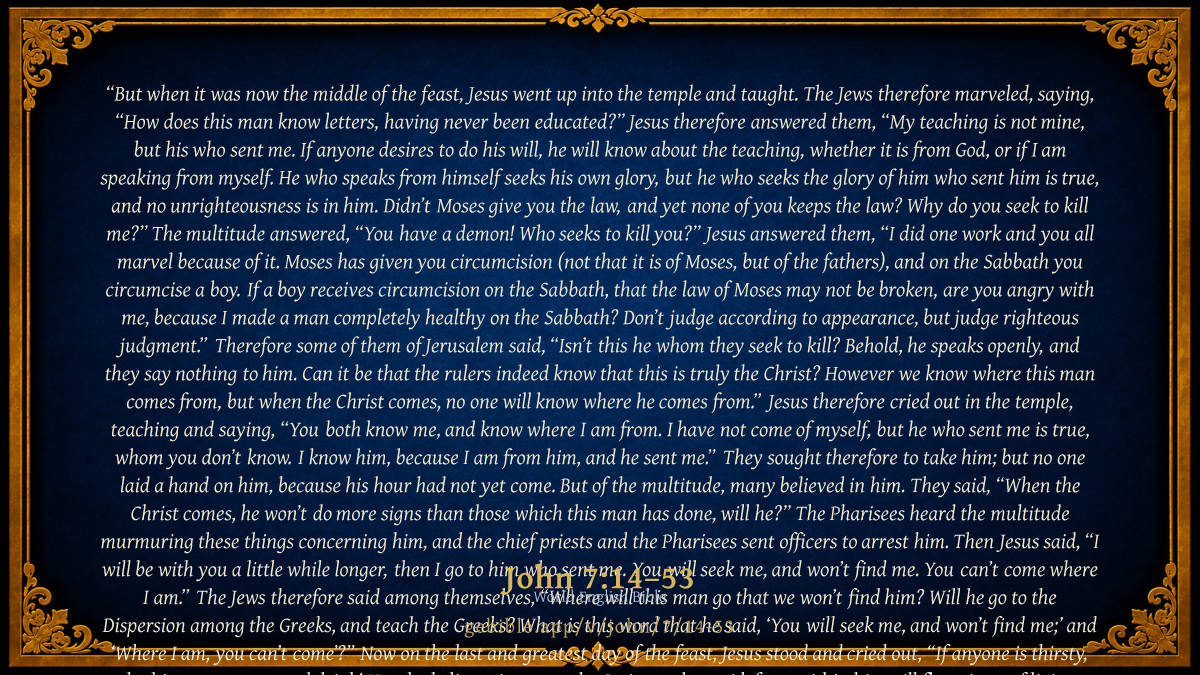
But when it was now the middle of the feast, Jesus went up into the temple and taught. The Jews therefore marveled, saying, “How does this man know letters, having never been educated?”
Jesus therefore answered them, “My teaching is not mine, but his who sent me. If anyone desires to do his will, he will know about the teaching, whether it is from God, or if I am speaking from myself. He who speaks from himself seeks his own glory, but he who seeks the glory of him who sent him is true, and no unrighteousness is in him. Didn’t Moses give you the law, and yet none of you keeps the law? Why do you seek to kill me?”
The multitude answered, “You have a demon! Who seeks to kill you?”
Jesus answered them, “I did one work and you all marvel because of it. Moses has given you circumcision (not that it is of Moses, but of the fathers), and on the Sabbath you circumcise a boy. If a boy receives circumcision on the Sabbath, that the law of Moses may not be broken, are you angry with me, because I made a man completely healthy on the Sabbath? Don’t judge according to appearance, but judge righteous judgment.”
Therefore some of them of Jerusalem said, “Isn’t this he whom they seek to kill? Behold, he speaks openly, and they say nothing to him. Can it be that the rulers indeed know that this is truly the Christ? However we know where this man comes from, but when the Christ comes, no one will know where he comes from.”
Jesus therefore cried out in the temple, teaching and saying, “You both know me, and know where I am from. I have not come of myself, but he who sent me is true, whom you don’t know. I know him, because I am from him, and he sent me.”
They sought therefore to take him; but no one laid a hand on him, because his hour had not yet come. But of the multitude, many believed in him. They said, “When the Christ comes, he won’t do more signs than those which this man has done, will he?” The Pharisees heard the multitude murmuring these things concerning him, and the chief priests and the Pharisees sent officers to arrest him.
Then Jesus said, “I will be with you a little while longer, then I go to him who sent me. You will seek me, and won’t find me. You can’t come where I am.”
The Jews therefore said among themselves, “Where will this man go that we won’t find him? Will he go to the Dispersion among the Greeks, and teach the Greeks? What is this word that he said, ‘You will seek me, and won’t find me;’ and ‘Where I am, you can’t come’?”
Now on the last and greatest day of the feast, Jesus stood and cried out, “If anyone is thirsty, let him come to me and drink! He who believes in me, as the Scripture has said, from within him will flow rivers of living water.” But he said this about the Spirit, which those believing in him were to receive. For the Holy Spirit was not yet given, because Jesus wasn’t yet glorified.
Many of the multitude therefore, when they heard these words, said, “This is truly the prophet.” Others said, “This is the Christ.” But some said, “What, does the Christ come out of Galilee? Hasn’t the Scripture said that the Christ comes of the offspring of David, and from Bethlehem, the village where David was?” So a division arose in the multitude because of him. Some of them would have arrested him, but no one laid hands on him. The officers therefore came to the chief priests and Pharisees, and they said to them, “Why didn’t you bring him?”
The officers answered, “No man ever spoke like this man!”
The Pharisees therefore answered them, “You aren’t also led astray, are you? Have any of the rulers believed in him, or of the Pharisees? But this multitude that doesn’t know the law is cursed.”
Nicodemus (he who came to him by night, being one of them) said to them, “Does our law judge a man, unless it first hears from him personally and knows what he does?”
They answered him, “Are you also from Galilee? Search, and see that no prophet has arisen out of Galilee.”
Everyone went to his own house,
John Calvin 1540 · Public Domain On vv14, 15, 16, 17, 18, 19, 20, 21, 22, 24, 25, 27, 28, 29, 30, 31, 32, 33, 34, 35, 37, 38, 39, 40, 41, 44, 45, 46, 47, 48, 49, 50, 52, 53 14. Jesus went up into the temple. We now…
14. Jesus went up into the temple. We now see that Christ was not so much afraid as to desist from the execution of his office; for the cause of his delay was, that he might preach to a very large assembly. We may sometimes, therefore, expose ourselves to dangers, but we ought never to disregard or omit a single opportunity of doing good. As to his teaching in the temple, he does so according to the ancient ordinance and custom; for while God commanded so many ceremonies, he did not choose that his people should be occupied with cold and useless spectacles. That their usefulness might be known, it was necessary that they should be accompanied by doctrine; and in this manner, external rites are lively images of spiritual things, when they take their shape from the word of God. But almost all the priests being at that time dumb, and the pure doctrine being corrupted by the leaven and false inventions of the scribes, Christ undertook the office of a teacher; and justly, because he was the great High Priest, as he affirms shortly afterwards, that he attempts nothing but by the command of the Father.
John Calvin's Commentaries (1540-1563) — public domain. Text from the Calvin Translation Society English edition (1840s-50s) via the Christian Classics Ethereal Library (ccel.org). Calvin's coverage is partial (roughly two-thirds of the Bible); uncommented books and verses are honest gaps, never fabricated. The 19th-century editor's footnotes and remarks are omitted so the notes are faithfully Calvin's own voice.
Geneva Bible translators 1599 · Public Domain On vv14, 16, 18, 19, 21, 23, 24, 25, 27, 28, 30, 32, 35, 37, 38, 39, 40, 45, 48, 51, 53 About the fourth day of the feast.
About the fourth day of the feast.
Christ striveth with goodness against the wickedness of the world: in the mean season the most part of men take occasion of offense even by that fame, whereby they ought to have been stirred up to embrace Christ.
Geneva Bible (1599) marginal notes — public domain.
John Trapp 1656 · Public Domain On vv14–53 14 Now about the midst of the feast Jesus…
14 Now about the midst of the feast Jesus went up into the temple, and taught.
Ver. 14. About the midst of the feast] That he might have the better audience.
Read full note →
Went up into the temple and taught] Sacerdotum tunc fere muta officia, populi caeca obsequia, ut iam apud Pontificios.
John Trapp, A Commentary or Exposition upon All the Books of the Old and New Testament (1647–1656) — public domain. Text from a community e-Sword module.
Matthew Poole 1685 · Public Domain On vv14–53 About the third or fourth day of the feast…
About the third or fourth day of the feast (which continued seven days) our Lord, being (as was said before) come up privately and by stealth, as it were, to Jerusalem, first appears in the temple preaching. What our Saviour at this time discoursed about the evangelist doth not tell us; but doubtless it was the things of the kingdom of God, which were the usual themes or arguments of his discourse, as we may also understand by the latter part of it. Our Lord probably deferred his preaching to the middle of the feast, partly, because the Pharisees’ heat in hunting after him was now a little over; and that there might be a fuller concourse of people to hear him.
Matthew Poole's English Annotations on the Holy Bible (1683–1685) — public domain. Text from a community e-Sword/MySword module.
William Burkitt 1703 · Public Domain On vv14, 19, 24, 32, 37, 38, 39, 40, 45, 50 Observe here, 1. Though Christ went up to Jerusalem…
Observe here, 1. Though Christ went up to Jerusalem privately, lest he should stir up the jealousy of the Pharisees against himself unseasonably; yet went he into the temple and taught publicly; his example teaches us thus much, "that although the servants of Christ may for a time, and in some cases, withdraw themselves from apprehended danger: yet, when God calls them to appear openly; they must do it courageously, without shrinking, though the danger be still impending." Jesus went up to Jerusalem, entered the temple and taught.
Observe, 2. So admirable was our holy Lord’s doctrine, that the Jews marvel how he should come to the knowledge of such divine mysteries, considering the meanness of his education. They were struck with admiration, but they wanted faith; whereas the least degree of saving faith is beyond all admiration without it.
Read full note →
Observe, 3. Our Lord vindicates his doctrine, telling the Jews, That the doctrine he delivered was not his own; that is, not of his own inventing and devising; it was no contrivance of his, nor was it taught him by men: but received immediately from the Father, whose ambassador and great prophet he was.
Again, when Christ says, My doctrine is not mine, that is, not only mine, but my Father’s and mine. For as he was God equal with the Father, so he naturally knew all his counsels; and as man had knowledge thereof by communication from his godhead.
Learn hence, That the doctrine of the gospel is a doctrine wholly from God; he contrived it, and sent his own Son into the world to publish and reveal it. Christ was sent, and his doctrine was not his own, but his that sent him.
Observe, 4. A double rule given by our Saviour, whereby the Jews might know, whether the doctrine he preached, were the doctrine of God.
First, If a man walk uprightly, and doth the will of God in the best manner according to his knowledge; If any man will do his will, he shall know of my doctrine whether it be of God. There is no such way to find out truth, as by doing the will of God.
The second rule by which they might know that his doctrine was from God was this. Because he sought his Father’s glory, and not his own in the delivery of it. He that seeketh his glory that sent him, that same is true.
Hence learn, That the nature and scope of that doctrine which Christ delivered, eminently tending not to promote his own private glory, but the glorifying of his Father, is an undoubted proof and evidence that his doctrine was of God.
William Burkitt's Expository Notes on the New Testament (1700–1703) — public domain. Text from a community e-Sword module.
Matthew Henry 1710 · Public Domain On vv14, 37, 45 Here is, I. Christ's public preaching in the temple…
Here is, I. Christ's public preaching in the temple (Joh 7:14): He went up into the temple, and taught, according to his custom when he was at Jerusalem. His business was to preach the gospel of the kingdom, and he did it in every place of concourse. His sermon is not recorded, because, probably, it was to the same purport with the sermons he had preached in Galilee, which were recorded by the other evangelists. For the gospel is the same to the plain and to the polite. But that which is observable here is that it was about the midst of the feast; the fourth or fifth day of the eight. Whether he did not come up to Jerusalem till the middle of the feast, or whether he came up at the beginning, but kept private till now, is not certain. But, Query, Why did he not go to the temple sooner, to preach? Answer, 1. Because the people would have more leisure to hear him, and, it might be hoped, would be better disposed to hear him, when they had spent some days in their booths, as they did at the feast of tabernacles. 2. Because he would choose to appear when both his friends and his enemies had done looking for him; and so give a specimen of the method he would observe in his appearances, which is to come at midnight, Mat 25:6. But why did he appear thus publicly now? Surely it was to shame his persecutors, the chief priests and elders. (1.) By showing that, though they were very bitter against him, yet he did not fear them, nor their power. See Isa 50:7, Isa 50:8. (2.) By taking their work out of their hands. Their office was to teach the people in the temple, and particularly at the feast of tabernacles, Neh 8:17, Neh 8:18. But they either did not teach them at all or taught for doctrines the commandments of men, and therefore he goes up to the temple and teaches the people. When the shepherds of Israel made a prey of the flock it was time for the chief Shepherd to appear, as was promised. Eze 34:22, Eze 34:23; Mal 3:1.
II. His discourse with the Jews hereupon; and the conference is reducible to four heads:
Read full note →
1. Concerning his doctrine. See here,
(1.) How the Jews admired it (Joh 7:15): They marvelled, saying, How knoweth this man letters, having never learned? Observe here, [1.] That our Lord Jesus was not educated in the schools of the prophets, or at the feet of the rabbin; not only did not travel for learning, as the philosophers did, but did not make any use of the schools and academies in his own country. Moses was taught the learning of the Egyptians, but Christ was not taught so much as the learning of the Jews; having received the Spirit without measure, he needed not receive any knowledge from man, or by man. At the time of Christ's appearing, learning flourished both in the Roman empire and in the Jewish church more than in any age before or since, and in such a time of enquiry Christ chose to establish his religion, not in an illiterate age, lest it should look like a design to impose upon the world; yet he himself studied not the learning then in vogue. [2.] That Christ had letters, though he had never learned them; was mighty in the scriptures, though he never had any doctor of the law for his tutor. It is necessary that Christ's ministers should have learning, as he had; and since they cannot expect to have it as he had it, by inspiration, they must take pains to get it in an ordinary way. [3.] That Christ's having learning, though he had not been taught it, made him truly great and wonderful; the Jews speak of it here with wonder. First, Some, it is likely, took notice of it to his honour: He that had no human learning, and yet so far excelled all that had, certainly must be endued with a divine knowledge. Secondly, Others, probably, mentioned it in disparagement and contempt of him: Whatever he seems to have, he cannot really have any true learning, for he was never at the university, nor took his degree. Thirdly, Some perhaps suggested that he had got his learning by magic arts, or some unlawful means or other. Since they know not how he could be a scholar, they will think him a conjurer.
(2.) What he asserted concerning it; three things: -
[1.] That his doctrine is divine (Joh 7:16): My doctrine is not mine, but his that sent me. They were offended because he undertook to teach though he had never learned, in answer to which he tells them that his doctrine was such as was not to be learned, for it was not the product of human thought and natural powers enlarged and elevated by reading and conversation, but it was a divine revelation. As God, equal with the Father, he might truly have said, My doctrine is mine, and his that sent me; but being now in his estate of humiliation, and being, as Mediator, God's servant, it was more congruous to say, "My doctrine is not mine, not mine only, nor mine originally, as man and mediator, but his that sent me; it does not centre in myself, nor lead ultimately to myself, but to him that sent me." God had promised concerning the great prophet that he would put his words into his mouth (Deu 18:18), to which Christ seems here to refer. Note, It is the comfort of those who embrace Christ's doctrine, and the condemnation of those who reject it, that it is a divine doctrine: it is of God and not of man.
[2.] That the most competent judges of the truth and divine authority of Christ's doctrine are those that with a sincere and upright heart desire and endeavour to do the will of God (Joh 7:17): If any man be willing to do the will of God, have his will melted into the will of God, he shall know of the doctrine whether it be of God or whether I speak of myself. Observe here, First, What the question is, concerning the doctrine of Christ, whether it be of God or no; whether the gospel be a divine revelation or an imposture. Christ himself was willing to have his doctrine enquired into, whether it were of God or no, much more should his ministers; and we are concerned to examine what grounds we go upon, for, if we be deceived, we are miserably deceived. Secondly, Who are likely to succeed in this search: those that do the will of God, at least are desirous to do it. Now see, 1. Who they are that will do the will of God. They are such as are impartial in their enquiries concerning the will of God, and are not biassed by any lust or interest, and such as are resolved by the grace of God, when they find out what the will of God is, to conform to it. They are such as have an honest principle of regard to God, and are truly desirous to glorify and please him. 2. Whence it is that such a one shall know of the truth of Christ's doctrine. (1.) Christ has promised to give knowledge to such; he hath said, He shall know, and he can give an understanding. Those who improve the light they have, and carefully live up to it, shall be secured by divine grace from destructive mistakes. (2.) They are disposed and prepared to receive that knowledge. He that is inclined to submit to the rules of the divine law is disposed to admit the rays of divine light. To him that has shall be given; those have a good understanding that do his commandments, Psa 111:10. Those who resemble God are most likely to understand him.
[3.] That hereby it appeared that Christ, as a teacher, did not speak of himself, because he did not seek himself, Joh 7:18. First, See here the character of a deceiver: he seeketh his own glory, which is a sign that he speaks of himself, as the false Christs and false prophets did. Here is the description of the cheat: they speak of themselves, and have no commission nor instructions from God; no warrant but their own will, no inspiration but their own imagination, their own policy and artifice. Ambassadors speak not of themselves; those ministers disclaim that character who glory in this that they speak of themselves. But see the discovery of the cheat; by this their pretensions are disproved, they consult purely their own glory; self-seekers are self-speakers. Those who speak from God will speak for God, and for his glory; those who aim at their own preferment and interest make it to appear that they had no commission form God. Secondly, See the contrary character Christ gives of himself and his doctrine: He that seeks his glory that sent him, as I do, makes it to appear that he is true. 1. He was sent of God. Those teachers, and those only, who are sent of God, are to be received and entertained by us. Those who bring a divine message must prove a divine mission, either by special revelation or by regular institution. 2. He sought the glory of God. It was both the tendency of his doctrine and the tenour of his whole conversation to glorify God. 3. This was a proof that he was true, and there was no unrighteousness in him. False teachers are most unrighteous; they are unjust to God whose name they abuse, and unjust to the souls of men whom they impose upon. There cannot be a greater piece of unrighteousness than this. But Christ made it appear that he was true, that he was really what he said he was, that there was no unrighteousness in him, no falsehood in his doctrine, no fallacy nor fraud in his dealings with us.
2. They discourse concerning the crime that was laid to his charge for curing the impotent man, and bidding him carry his bed on the sabbath day, for which they had formerly prosecuted him, and which was still the pretence of their enmity to him.
(1.) He argues against them by way of recrimination, convicting them of far worse practices, Joh 7:19. How could they for shame censure him for a breach of the law of Moses, when they themselves were such notorious breakers of it? Did not Moses give you the law? And it was their privilege that they had the law, no nation had such a law; but it was their wickedness that none of them kept the law, that they rebelled against it, and lived contrary to it. Many that have the law given them, when they have it do not keep it. Their neglect of the law was universal: None of you keepeth it: neither those of them that were in posts of honour, who should have been most knowing, nor those who were in posts of subjection, who should have been most obedient. They boasted of the law, and pretended a zeal for it, and were enraged at Christ for seeming to transgress it, and yet none of them kept it; like those who say that they are for the church, and yet never go to church. It was an aggravation of their wickedness, in persecuting Christ for breaking the law, that they themselves did not keep it: "None of you keepeth the law, why then go ye about to kill me for not keeping it?" Note, Those are commonly most censorious of others who are most faulty themselves. Thus hypocrites, who are forward to pull a mote out of their brother's eye, are not aware of a beam in their own. Why go ye about to kill me? Some take this as the evidence of their not keeping the law: "You keep not the law; if you did, you would understand yourselves better than to go about to kill me for doing a good work." Those that support themselves and their interest by persecution and violence, whatever they pretend (though they may call themselves custodes utriusque tabulae - the guardians of both tables), are not keepers of the law of God. Chemnitius understands this as a reason why it was time to supersede the law of Moses by the gospel, because the law was found insufficient to restrain sin: "Moses gave you the law, but you do not keep it, nor are kept by it from the greatest wickedness; there is therefore need of a clearer light and better law to be brought in; why then do you aim to kill me for introducing it?"
Here the people rudely interrupted him in his discourse, and contradicted what he said (Joh 7:20): Thou has a devil; who goes about to kill thee? This intimates, [1.] The good opinion they had of their rulers, who, they think, would never attempt so atrocious a thing as to kill him; no, such a veneration they had for their elders and chief priests that they would swear for them they would do no harm to an innocent man. Probably the rulers had their little emissaries among the people who suggested this to them; many deny that wickedness which at the same time they are contriving. [2.] The ill opinion they had of our Lord Jesus: "Thou hast a devil, thou art possessed with a lying spirit, and art a bad man for saying so;" so some: or rather, "Thou art melancholy, and art a weak man; thou frightenest thyself with causeless fears, as hypochondriacal people are apt to do." Not only open frenzies, but silent melancholies, were then commonly imputed to the power of Satan. "Thou art crazed, has a distempered brain." Let us not think it strange if the best of men are put under the worst of characters. To this vile calumny our Saviour returns no direct answer, but seems as if he took no notice of it. Note, Those who would be like Christ must put up with affronts, and pass by the indignities and injuries done them; must not regard them, much less resent them, and least of all revenge them. I, as a deaf man, heard not. When Christ was reviled, he reviled not again,
(2.) He argues by way of appeal and vindication.
[1.] He appeals to their own sentiments of this miracle: "I have done one work, and you all marvel, Joh 7:21. You cannot choose but marvel at it as truly great, and altogether supernatural; you must all own it to be marvellous." Or, "Though I have done but one work that you have any colour to find fault with, yet you marvel, you are offended and displeased as if I had been guilty of some heinous or enormous crime."
[2.] He appeals to their own practice in other instances: "I have done one work on the sabbath, and it was done easily, with a word's speaking, and you all marvel, you make a mighty strange thing of it, that a religious man should dare do such a thing, whereas you yourselves many a time do that which is a much more servile work on the sabbath day, in the case of circumcision; if it be lawful for you, nay, and your duty, to circumcise a child on the sabbath day, when it happens to be the eighth day, as no doubt it is, much more was it lawful and good for me to heal a diseased man on that day." Observe,
First, The rise and origin of circumcision: Moses gave you circumcision, gave you the law concerning it. Here, 1. Circumcision is said to be given, and (Joh 7:23) they are said to receive it; it was not imposed upon them as a yoke, but conferred upon them as a favour. Note, The ordinances of God, and particularly those which are seals of the covenant, are gifts given to men, and are to be received as such. 2. Moses is said to give it, because it was a part of that law which was given by Moses; yet, as Christ said of the manna (Joh 6:32), Moses did not give it them, but God; nay, and it was not of Moses first, but of the fathers, Joh 7:22. Though it was incorporated into the Mosaic institution, yet it was ordained long before, for it was a seal of the righteousness of faith, and therefore commenced with the promise four hundred and thirty years before, Gal 3:17. The church membership of believers and their seed was not of Moses or his law, and therefore did not fall with it; but was of the fathers, belonged to the patriarchal church, and was part of that blessing of Abraham which was to come upon the Gentiles, Gal 3:14.
Secondly, The respect paid to the law of circumcision above that of the sabbath, in the constant practice of the Jewish church. The Jewish casuists frequently take notice of it, Circumcisio et ejus sanatio pellit sabbbatum - Circumcision and its cure drive away the sabbath; so that if a child was born one sabbath day it was without fail circumcised the next. If then, when the sabbath rest was more strictly insisted on, yet those works were allowed which were in ordine ad spiritualia - for the keeping up of religion, much more are they allowed now under the gospel, when the stress is laid more upon the sabbath work.
Thirdly, The inference Christ draws hence in justification of himself, and of what he had done (Joh 7:23): A man-child on the sabbath day receives circumcision, that the law of circumcision might not be broken; or, as the margin reads it, without breaking the law, namely, of the sabbath. Divine commands must be construed so as to agree with each other. "Now, if this be allowed by yourselves, how unreasonable are you, who are angry with me because I have made a man every whit whole on the sabbath day!" emoi cholate. The word is used only here, from chogē - fel, gall. They were angry at him with the greatest indignation; it was a spiteful anger, anger with gall in it. Note, It is very absurd and unreasonable for us to condemn others for that in which we justify ourselves. Observe the comparison Christ here makes between their circumcising a child and his healing a man on the sabbath day. 1. Circumcision was but a ceremonial institution; it was of the fathers indeed, but not from the beginning; but what Christ did was a good work by the law of nature, a more excellent law than that which made circumcision a good work. 2. Circumcision was a bloody ordinance, and made sore; but what Christ did was healing, and made whole. The law works pain, and, if that work may be done on the sabbath day, much more a gospel work, which produces peace. 3. Especially considering that whereas, when they had circumcised a child, their care was only to heal up that part which was circumcised, which might be done and yet the child remain under other illnesses, Christ had made this man every whit whole, holon anthrōpon hugiē - I have made the whole man healthful and sound. The whole body was healed, for the disease affected the whole body; and it was a perfect cure, such as left no relics of the disease behind; nay, Christ not only healed his body, but his soul too, by that admonition, Go, and sin no more, and so indeed made the whole man sound, for the soul is the man. Circumcision indeed was intended for the good of the soul, and to make the whole man as it should be; but they had perverted it, and turned it into a mere carnal ordinance; but Christ accompanied his outward cures with inward grace, and so made them sacramental, and healed the whole man.
He concludes this argument with that rule (Joh 7:24): Judge not according to the appearance, but judge righteous judgment. This may be applied, either, First, In particular, to this work which they quarrelled with as a violation of the law. Be not partial in your judgment; judge not, kat' opsin - with respect of persons; knowing faces, as the Hebrew phrase is, Deu 1:17. It is contrary to the law of justice, as well as charity, to censure those who differ in opinion from us as transgressors, in taking that liberty which yet in those of our own party, and way, and opinion, we allow of; as it is also to commend that in some as necessary strictness and severity which in others we condemn as imposition and persecution. Or, Secondly, In general, to Christ's person and preaching, which they were offended at and prejudiced against. Those things that are false, and designed to impose upon men, commonly appear best when they are judged of according to the outward appearance, they appear most plausible prima facie - at the first glance. It was this that gained the Pharisees such an interest and reputation, that they appeared right unto men (Mat 23:27, Mat 23:28), and men judged of them by that appearance, and so were sadly mistaken in them. "But," saith Christ, "be not too confident that all are real saints who are seeming ones." With reference to himself, his outward appearance was far short of his real dignity and excellency, for he took upon him the form of a servant (Phi 2:7), was in the likeness of sinful flesh (Rom 8:3), had no form nor comeliness, Isa 53:2. So that those who undertook to judge whether he was the Son of God or no by his outward appearance were not likely to judge righteous judgment. The Jews expected the outward appearance of the Messiah to be pompous and magnificent, and attended with all the ceremonies of secular grandeur; and, judging of Christ by that rule, their judgment was from first to last a continual mistake, for the kingdom of Christ was not to be of this world, nor to come with observation. If a divine power accompanied him, and God bore him witness, and the scriptures were fulfilled in him, though his appearance was ever so mean, they ought to receive him, and to judge by faith, and not by the sight of the eye. See Isa 11:3, and Sa1 16:7. Christ and his doctrine and doings desire nothing but righteous judgment; if truth and justice may but pass the sentence, Christ and his cause will carry the day. We must not judge concerning any by their outward appearance, not by their titles, the figure they make in the world, and their fluttering show, but by their intrinsic worth, and the gifts and graces of God's Spirit in them.
3. Christ discourses with them here concerning himself, whence he came, and whither he was going, Joh 7:25-36.
(1.) Whence he came, Joh 7:25-31. In the account of this observe,
[1.] The objection concerning this stated by some of the inhabitants of Jerusalem, who seem to have been of all others most prejudiced against him, Joh 7:25. One would think that those who lived at the fountain-head of knowledge and religion should have been most ready to receive the Messiah: but it proved quite contrary. Those that have plenty of the means of knowledge and grace, if they are not made better by them, are commonly made worse; and our Lord Jesus has often met with the least welcome from those that one would expect the best from. But it was not without some just cause that it came into a proverb, The nearer the church the further from God. These people of Jerusalem showed their ill-will to Christ,
First, By their reflecting on the rulers, because they let him alone: Is not this he whom they seek to kill? The multitude of the people that came up out of the country to the feast did not suspect there was any design on foot against him, and therefore they said, Who goes about to kill thee? Joh 7:20. But those of Jerusalem knew the plot, and irritated their rulers to put it into execution: "Is not this he whom they seek to kill? Why do they not do it then? Who hinders them? They say that they have a mind to get him out of the way, and yet, lo, he speaketh boldly, and they say nothing to him; do the rulers know indeed that this is the very Christ?" Joh 7:26. Here they slyly and maliciously insinuate two things, to exasperate the rulers against Christ, when indeed they needed to spur. 1. That by conniving at his preaching they brought their authority into contempt. "Must a man that is condemned by the sanhedrim as a deceiver be permitted to speak boldly, without any check or contradiction? This makes their sentence to be but brutem fulmen - a vain menace; if our rulers will suffer themselves to be thus trampled upon, they may thank themselves if none stand in awe of them and their laws." Note, The worst of persecutions have often been carried on under colour of the necessary support of authority and government. 2. That hereby they brought their judgment into suspicion. Do they know that this is the Christ? It is spoken ironically, "How came they to change their mind? What new discovery have they lighted on? They give people occasion to think that they believe him to be the Christ, and it behoves them to act vigorously against him to clear themselves from the suspicion." Thus the rulers, who had made the people enemies to Christ, made them seven times more the children of hell than themselves, Mat 23:15. When religion and the profession of Christ's name are out of fashion, and consequently out of repute, many are strongly tempted to persecute and oppose them, only that they may not be thought to favour them and incline to them. And for this reason apostates, and the degenerate offspring of good parents, have been sometimes worse than others, as it were to wipe off the stain of their profession. It was strange that the rulers, thus irritated, did not seize Christ; but his hour was not yet come; and God can tie men's hands to admiration, though he should not turn their hearts.
Secondly, By their exception against his being the Christ, in which appeared more malice than matter, Joh 7:27. "If the rulers think him to be the Christ, we neither can nor will believe him to be so, for we have this argument against it, that we know this man, whence he is; but when Christ comes no man knows whence he is." Here is a fallacy in the argument, for the propositions are not body ad idem - adapted to the same view of the subject. 1. If they speak of his divine nature, it is true that when Christ comes no man knows whence he is, for he is a priest after the order of Melchizedek, who was without descent, and his goings forth have been from of old, from everlasting, Mic 5:2. But then it is not true that as for this man they knew whence he was, for they knew not his divine nature, nor how the Word was made flesh. 2. If they speak of his human nature, it is true that they knew whence he was, who was his mother, and where he was bred up; but then it is false that ever it was said of the Messiah that none should know whence he was, for it was known before where he should be born, Mat 2:4, Mat 2:5. Observe, (1.) How they despised him, because they knew whence he was. Familiarity breeds contempt, and we are apt to disdain the use of those whom we know the rise of. Christ's own received him not, because he was their own, for which very reason they should the rather have loved him, and been thankful that their nation and their age were honoured with his appearance. (2.) How they endeavoured unjustly to fasten the ground of their prejudice upon the scriptures, as if they countenanced them, when there was no such thing. Therefore people err concerning Christ, because they know not the scripture.
[2.] Christ's answer to this objection, Joh 7:28, Joh 7:29.
First, He spoke freely and boldly, he cried in the temple, as he taught, he spoke this louder than the rest of his discourse, 1. To express his earnestness, being grieved for the hardness of their hearts. There may be a vehemency in contending for the truth where yet there is no intemperate heat nor passion. We may instruct gainsayers with warmth, and yet with meekness. 2. The priests and those that were prejudiced against him, did not come near enough to hear his preaching, and therefore he must speak louder than ordinary what he will have them to hear. Whoever has ears to hear, let him hear this.
Secondly, His answer to their cavil is, 1. By way of concession, granting that they did or might know his origin as to the flesh: "You both know me, and you know whence I am. You know I am of your own nation, and one of yourselves." It is no disparagement to the doctrine of Christ that there is that in it which is level to the capacities of the meanest, plain truths, discovered even by nature's light, of which we may say, We know whence they are. "You know me, you think you know me; but you are mistaken; you take me to be the carpenter's son, and born at Nazareth, but it is not so." 2. By way of negation, denying that that which they did see in him, and know of him, was all that was to be known; and therefore, if they looked no further, they judged by the outward appearance only. They knew whence he came perhaps, and where he had his birth, but he will tell them what they knew not, from whom he came. (1.) That he did not come of himself; that he did not run without sending, nor come as a private person, but with a public character. (2.) That he was sent of his Father; this is twice mentioned: He hath sent me. And again, "He hath sent me, to say what I say, and do what I do." This he was himself well assured of, and therefore knew that his Father would bear him out; and it is well for us that we are assured of it too, that we may with holy confidence go to God by him. (3.) That he was from his Father, par' autou eimi - I am from him; not only sent from him as a servant from his master, but from him by eternal generation, as a son from his father, by essential emanation, as the beams from the sun. (4.) That the Father who sent him is true; he had promised to give the Messiah, and, though the Jews had forfeited the promise, yet he that made the promise is true, and has performed it. He had promised that the Messiah should see his seed, and be successful in his undertaking; and, though the generality of the Jews reject him and his gospel, yet he is true, and will fulfil the promise in the calling of the Gentiles. (5.) That these unbelieving Jews did not know the Father: He that sent me, whom you know not. There is much ignorance of God even with many that have a form of knowledge; and the true reason why people reject Christ is because they do not know God; for there is such a harmony of the divine attributes in the work of redemption, and such an admirable agreement between natural and revealed religion, that the right knowledge of the former would not only admit, but introduce, the latter. (6.) Our Lord Jesus was intimately acquainted with the Father that sent him: but I know him. He knew him so well that he was not at all in doubt concerning his mission from him, but perfectly assured of it; nor at all in the dark concerning the work he had to do, but perfectly apprized of it, Mat 11:27.
[3.] The provocation which this gave to his enemies, who hated him because he told them the truth, Joh 7:30. They sought therefore to take him, to lay violent hands on him, not only to do him a mischief, but some way or other to be the death of him; but by the restraint of an invisible power it was prevented; nobody touched him, because his hour was not yet come; this was not their reason why they did it not, but God's reason why he hindered them from doing it. Note, First, The faithful preachers of the truths of God, though they behave themselves with ever so much prudence and meekness, must expect to be hated and persecuted by those who think themselves tormented by their testimony, Rev 11:10. Secondly, God has wicked men in a chain, and, whatever mischief they would do, they can do no more than God will suffer them to do. The malice of persecutors is impotent even when it is most impetuous, and, when Satan fills their hearts, yet God ties their hands. Thirdly, God's servants are sometimes wonderfully protected by indiscernible unaccountable means. Their enemies do not do the mischief they designed, and yet neither they themselves nor any one else can tell why they do not. Fourthly, Christ had his hour set, which was to put a period to his day and work on earth; so have all his people and all his ministers, and, till that hour comes, the attempts of their enemies against them are ineffectual, and their day shall be lengthened as long as their Master has any work for them to do; nor can all the powers of hell and earth prevail against them, until they have finished their testimony.
[4.] The good effect which Christ's discourse had, notwithstanding this, upon some of his hearers (Joh 7:31): Many of the people believed on him. As he was set for the fall of some, so for the rising again of others. Even where the gospel meets with opposition there may yet be a great deal of good done, Th1 2:2. Observe here, First, Who they were that believed; not a few, but many, more than one would have expected when the stream ran so strongly the other way. But these many were of the people, ek tou ochlou - of the multitude, the crowd, the inferior sort, the mob, the rabble, some would have called them. We must not measure the prosperity of the gospel by its success among the great ones; nor much ministers say that they labour in vain, though none but the poor, and those of no figure, receive the gospel, Co1 1:26. Secondly, What induced them to believe: the miracles which he did, which were not only the accomplishment of the Old Testament prophecies (Isa 35:5, Isa 35:6), but an argument of a divine power. He that had an ability to do that which none but God can do, to control and overrule the powers of nature, no doubt had authority to enact that which none but God can enact, a law that shall bind conscience, and a covenant that shall give life. Thirdly, How weak their faith was: they do not positively assert, as the Samaritans did, This is indeed the Christ, but they only argue, When Christ comes will he do more miracles than these? They take it for granted that Christ will come, and, when he comes, will do many miracles. "Is not this he then? In him we see, though not all the worldly pomp we have fancied, yet all the divine power we have believed the Messiah should appear in; and therefore why may not this
Matthew Henry's Commentary on the Whole Bible (1708–1710) — public domain (CC PDM 1.0). Text via the HelloAO Bible API.
John Gill 1763 · Public Domain On vv14–50 And the Jews marvelled,.... Both at the matter, and…
And the Jews marvelled,.... Both at the matter, and manner of his doctrine; it was such, as never man spake; his words were so gracious, and there were such truth and evidence in them, and they were delivered with such power and authority, that they were astonished at them:
saying, how knoweth this man letters? or "the Scriptures", as the Arabic and Persic versions render it; which are called "holy letters", Ti2 3:15; according to which, the sense is, that they were surprised at his knowledge of the Scriptures, that he should be conversant with them, and be able to interpret them, and give the sense and meaning of them, in so full and clear a manner, as he did: or else the sense is, how came this man to be such a learned man? whence has he this wisdom, and all this learning which he shows? as in Mat 13:54. So a learned man is in Isa 29:11, said to be one that , , "knows letters", as the Septuagint there translate the Hebrew text; but how Christ should know them, or be a learned man,
Read full note →
having never learned, was surprising to them: that is, he had not had a liberal education, but was brought up to a trade; he was not trained up at the feet of any of their Rabbins, in any of their universities, or schools of learning; and in which they were certainly right. Modern Jews pretend to say he had a master, whom they sometimes call Elchanan (o), but most commonly they make him to be R. Joshua ben Perachiah (p): with whom they say, he fled into Alexandria in Egypt, for fear of Jannai the king: and one of their writers (q), on this account, charges the evangelist with a falsehood: but who are we to believe, the Jews who lived at the same time with Jesus, and knew his education and manner of life, or those that have lived ages since?
(o) Toldos Jesu, p. 5. (p) Juchasin, fol. 159. 1. Ganz Tzemach David, par. 1, fol. 21. 1. & 24. (q) R. Isaac Chizzuk Emuna, par. 2. c. 46. p. 435.
John Gill's Exposition of the Whole Bible (1746–1763) — public domain (CC PDM 1.0). Text via the HelloAO Bible API.
John Wesley 1765 · Public Domain On vv14, 15, 16, 17, 18, 19, 20, 21, 22, 27, 28, 29, 30, 33, 34, 35, 37, 38, 39, 40, 42, 48, 49, 50, 52, 53 Now at the middle of the feast - Which…
Now at the middle of the feast - Which lasted eight days. It is probable this was on the Sabbath day. Jesus went up into the temple - Directly, without stopping any where else.
John Wesley, Explanatory Notes Upon the Whole Bible (1754–1765) — public domain. Text via the GEBible commentary corpus.
Adam Clarke 1810 · Public Domain On vv14, 15, 16, 17, 18, 19, 20, 21, 22, 23, 24, 26, 27, 28, 29, 31, 32, 33, 34, 35, 37, 38, 39, 40, 41, 42, 43, 44, 45, 46, 48, 49, 50, 51, 52, 53 Verse 14. The midst of the feast] Though the…
Verse 14. The midst of the feast] Though the canons required him to be there on the first day, for the performance of a great variety of rites, yet, as these were in general the invention of their doctors, he might think it very proper neither to attend nor perform them.
Adam Clarke's Commentary on the Bible (1810–1826) — public domain. Text from a community e-Sword/MySword module.
Joseph Benson 1811 · Public Domain On vv14, 19, 21, 25, 28, 30, 33, 35, 37, 38, 40, 45, 50 Joh 7:14-18. Now about the midst of the feast…
Joh 7:14-18. Now about the midst of the feast — Which lasted eight days; Jesus went up into the temple and taught — Probably on the sabbath day. His business was to preach the gospel of the kingdom, and he readily did it in every time and place of concourse: and doubtless vast multitudes would be assembled in the temple on this occasion. And the Jews who heard him marvelled — Were amazed, both at the excellence and importance of the doctrines which he delivered, and at the clear, convincing, and forcible manner in which he declared them: saying, How knoweth this man letters, having never learned — How comes he to be so well acquainted with sacred literature, as to be able thus to expound the Scriptures with such propriety and gracefulness; having never learned — Seeing he hath never learned this at any place of education? Jesus answered, My doctrine is not mine — It is not the product of human wisdom: I have neither been taught it by masters, nor have I acquired it by my own study: but his that sent me — It is the doctrine of God, who has inspired me with it because I am his messenger. If any man will do his will — Εαν τις θελη, if any man be willing, especially if he be also desirous and determined, in dependance on divine grace, to do God’s will, as far as he is acquainted with it; he shall know of the doctrine, &c. — A universal rule this with regard to all persons and doctrines. They that are thoroughly willing and desirous to comply with the will of God, shall certainly have his will made known to them. Observe here, reader, who these are: they are such as are impartial and sincere in their inquiries concerning it, and are not biased by any carnal inclinations or interests; they are such as are convinced of the infinite importance of knowing and doing his will, in order to their eternal salvation, being persuaded that only those that know and do it shall enter the kingdom of heaven: Mat 7:21. They are such as carefully and diligently use the means which God has appointed to be used in order thereto; especially the means of prayer, for supernatural light, and of hearing, reading, and meditating on the word of God. Such shall know the doctrine of Christ, and the will of God; 1st, Because Christ has promised to give them that knowledge, namely, by opening the eyes of their understanding, which he is well able to do. Those who improve the light they have, and carefully walk according to it, shall, by divine grace, have that light increased, and be thereby secured against all destructive and hurtful errors. 2d, Because they are prepared to receive that knowledge. Those that are inclined to submit to the rules of the divine law, are disposed to admit the rays of the divine light. Those whose desire and care it is to resemble God, are in the fittest disposition to become acquainted with him. Whether it be of God, or whether I speak of myself — Pious and good men can easily judge of any teacher, whether he and his doctrine come from God; not only because the divine wisdom and goodness are interested to secure such from capital errors, but because they themselves have no predominant evil inclinations to prejudice them against the truth when it appears; and because they can discern how far any doctrine is conformable to the principles of piety and virtue which they possess. He that speaketh of himself, seeketh his own glory — If one teaches what makes for the advancement of his own worldly interest, or for the gratification of his pride, or any other evil passion, the doers of the will of God will immediately know that such a teacher is an impostor. But he that seeketh his glory that sent him, &c. — Whereas, if a teacher proposes doctrines which have a tendency to reform men, and to advance the glory of God, without regard to the opinion of the world, or to his own temporal interest; the same is true — He must certainly be sent of God, and should not by any means be suspected of imposture; and no unrighteousness is in him — No falsehood, no design to deceive the world. See Macknight.
Joseph Benson's Commentary on the Old and New Testaments (1811–1818) — public domain. Text from a community e-Sword module.
Albert Barnes 1834 · Public Domain On vv14, 15, 16, 17, 18, 19, 20, 21, 22, 23, 24, 26, 27, 28, 30, 31, 32, 33, 34, 35, 37, 38, 39, 40, 41, 45, 47, 48, 49, 50, 51, 52, 53 About the midst - Or about the middle of…
About the midst - Or about the middle of the feast. It continued eight days.
The temple - See the notes at Mat 21:12.
Read full note →
And taught - Great multitudes were assembled in and around the temple, and it was a favorable time and place to make known his doctrine.
Albert Barnes' Notes on the Bible (1834–1885) — public domain. Text from a community e-Sword/MySword module.
Haydock's Catholic Bible Commentary 1859 · Public Domain On vv15, 16, 18, 19, 20, 21, 26, 27, 28, 31, 32, 33, 34, 35, 38, 39, 41, 49, 52 Whilst the Jews proceeded no further than to admire…
Whilst the Jews proceeded no further than to admire the wisdom of our Saviour, when they could easily have seen that what he taught he knew by the power of God, Christ himself reveals to them the source of his wisdom, saying: My doctrine is not mine, but his that sent me. (St. John Chrysostom, hom. xlviii. in Joan.) --- St. Thomas Aquinas, the great doctor of the schools, and styled the angelic doctor, informs us that in all the scriptural difficulties he met with, he uniformly had recourse to prayer, and that he acquired greater light and knowledge at the foot of his crucifix than from any books or masters. (Haydock)
George Leo Haydock (1774–1849), Haydock's Catholic Family Bible and Commentary, 1859 edition — public domain. Excludes Psalms (Douay-Rheims chapter numbering differs from Protestant) and Deuterocanonical books (Catholic canon only).
Lange's Commentary on the Holy Scriptures 1864 · Public Domain On vv37, 45 (b) Christ as the dispenser of the spirit, the…
(b) Christ as the dispenser of the spirit, the real, siloam with its water of life. increasing ferment in the people
Joh_7:37-44
Read full note →
37[Now]39 In the last day, that [the] great day of the feast, Jesus stood and cried, saying, If any man [any one] thirst, let him come unto me, and drink. 38He that believeth on [in] me, as the Scripture hath said, out of his belly [body]40 shall flow rivers of living water. 39(But this spake he of the Spirit, which they that believe41 on [in] him should [were about to] receive, for the Holy Ghost [the Spirit] was 40not yet given, [omit given]42 because that [omit that] Jesus was not yet glorified.)
Many43 [some] of the people [multitude] therefore, when they heard this saying 41[these words],44 said, Of a truth this is the Prophet [This is truly the Prophet.] Others said, This is the Christ. But [omit But] some [Others]45 said, Shall Christ come out of Galilee [Doth the Christ then come from Galilee]? 42Hath not the Scripture said, That [the] Christ cometh of [from] the seed of David, and out of the town of Bethlehem [from Bethlehem, the town]46 where David was?
43So there was a division among the people [the multitude] because of him. And 44some of them would have taken him [wished to seize him]; but no man [one] laid hands on him.
EXEGETICAL AND CRITICAL
Joh_7:37. In the last day.—Meyer: “As the eighth day (the 22d Tisri according to Lev_23:34; Num_29:35; Neh_8:18) was reckoned in with the seven days of the feast proper, and as, Succah, fol. 48, 1, the last day (אַחֲרוֹן) of the feast is the eighth, John certainly meant this day and not the seventh (Theoph., Buxtorf, Bengel, Roland, Paulus, Amnion); especially as it was customary at a later period to speak of an eight days’ celebration of the feast of tabernacles (2Ma_10:6; Joseph. Ant. III. 10, 4; Gem. Eruvin. 40, 2; Midr. Kohel. 118, 3). To this corresponds, too, the translation ἐξόδιον (finale of the feast), by which the Septuagint expresses the designation of the eighth day, עֲצֶרֶת [solemn assembly] in Lev_23:36; Num_29:35; Neh_8:18. Comp. Ewald, Alterthümer, p. 481.” Tholuck: “A general jubilee (Plutarch calls it a Bacchanal) and splendid ceremonies of many kinds took place at this feast, so that the Rabbis were accustomed to say: He who has not seen these festivities, knows not what jubilee is. See H. Majus: Diss. de haustu aquarum.”
[Alford takes the same view as to the day, and then tries to solve the difficulty which attaches to it. “The eighth day seems here to be meant, and the last of the feast to be popularly used. But a difficulty attends this view. Our Lord certainly seems to allude here to the custom which prevailed during the seven days of the feast, of a priest bringing water in a golden vessel from the pool of Siloam with a jubilant procession to the temple, standing on the altar and pouring it. out there, together with wine, while meantime the Hallel (Psalms 113-118) was sung. This practice was by some supposed—as the dwelling in tabernacles represented their life in the desert of old—to refer to the striking of the rock by Moses:—by others, to the rain, for which they then prayed, for the seed of the ensuing year:—by the elder Rabbis (Maimonides, cited by Stier, iv. 331, ed. 2), to Isa_12:3, and the effusion of the Holy Spirit in the days of the Messiah. But it was universally agreed (with the single exception of the testimony of R. Juda Hakkadosh, quoted in the tract Succa, which itself distinctly asserts the contrary), that on the eighth day this ceremony did not take place. Now, out of this difficulty I would extract what I believe to be the right interpretation. It was the eighth day, and the pouring of water did not take place. But is therefore (as Lücke will have it) all allusion to the ceremony excluded? I think not: nay, I believe it is the more natural. For seven days the ceremony had been performed, and the Hallel sung. On the eighth day the Hallel was sung, but the outpouring of the water did not take place: ‘desidcraverunt aliquid.’ ‘Then Jesus stood and cried,’ etc. Was not this the most natural time? Was it not probable that He would have said it at a time, rather even than while the ceremony itself was going on?” This accords with the view taken by Lange (see below and Doctr. and Ethical No. 1), but Wordsworth, Owen and others defend the usual opinion that on the eighth day as well as on those preceding, and with louder and more general expressions of joy, the priest brought forth, in a golden vessel, water from the spring of Siloam, and poured it upon the altar, and that Jesus at that very time proffered the water of life to all who would come unto Him and drink.—P. S.]
The last day of the feast of tabernacles was an especially high day, being the close of the feast (as well as of the festal season of the year), and being a Sabbath, a day on which the congregation assembled according to the law (Lev_23:36), and which was therefore distinguished by a special sacrificial ritual. But one thing the day lacked, which distinguished the other days. On each of the seven preceding days, in the morning, occurred the festal water-drawing. A priest drew water daily with a large golden pitcher (holding about two pints and a half) from the spring of Siloam on the temple hill, brought it into the temple, and poured it out mingled with sacrificial wine, into two perforated dishes at the altar. The ceremony was accompanied with the sound of cymbals and trumpets, and the singing of the words of Isa_12:3, which Rabbi Jonathan paraphrased: “With joy shall ye receive the new doctrine from the chosen righteous.” This was the celebration of the miraculous springs which God opened for the people on their pilgrimage through the wilderness. But because the eighth day marked the entrance into Canaan, the water-drawing ceased. On this day the springs of the promised land gave their waters to the people; an emblem of the streams of spiritual blessing which Jehovah had promised to His people. To this symbolical performance the words of Jesus on the last day of the feast evidently refer (Leben Jesu, III. p. 619). It is of no account that, according to Rabbi Juda, the pouring out of the water took place on the eighth day also. This was probably a later supplement, if the statement is not an error.
The great day [τῇ μεγάλῃ].—That is, especially great in comparison with the other days.47 See the preceding remarks. Philo also [De Septenaris II. 298] observes that it was the close of the yearly feasts; i.e. of the three great feasts, not of all.
Cried, saying.—Jesus had not hitherto so openly presented Himself as the personal object of a saving faith.
If any one thirst [i.e. whosoever thirsts] let him come to me and drink.—See the observations on Joh_7:37. The reference of this preaching of salvation under the promise of a miraculous draught and fountain of water to the water-drawing is groundlessly considered by Meyer to be dubious. It agrees entirely with the character of the fourth Gospel, in which Jesus presents Himself in the most varied ways as the fulfilment of the Old Testament symbols. The spiritual import of the water-drawing appears in Isa_12:3 [“with joy shall ye draw water out of the wells of salvation”]. This water-drawing must be distinguished from the devotional water-drawing on days of humiliation and fasting, 1Sa_7:6.
[The invitation first given to the Samaritan woman at Jacob’s well, is here extended to all the people on the great feast in Jerusalem. The N. T. closes with a similar offer of the water of life (Rev_22:17). There is an inner thirst as there is an inner man, and the former is deeper and stronger than the thirst of the body, and can only be satisfied from the fountain of life in Christ. “Under the imagery of one thirsting for water, which everywhere, and especially in countries like Palestine where the want of water is so frequently experienced, would be well understood, our Lord proffers to all such persons that which will forever satisfy the longings of the soul and give it permanent rest.” Owen. “An allusion to the water drawn in a golden vase from the pool of Siloam and poured on the altar in the temple… as a memorial of the water from the rock smitten in the wilderness, and typical of the living water of the Spirit from the true Rock (1Co_10:4).” Wordsworth.—P. S.]
Joh_7:38. He that believeth48 in me, etc.—Explaining the expression: “Come unto me and drink.”—As the scripture hath said.—These words are not to be connected with ὁ πιστεύων, as if the meaning were: “He who according to the scripture believeth in Me” (Chrysostom, Calovius, and others). An ἔστι may be understood. Meyer: Ὁ πιστεύων is nominat. absol. The question then is, what words of Scripture the Lord means. The expression [which follows: “out of his body shall flow rivers of living water”] does not occur literally in the Old Testament; so that Whiston and others took up the idea that it was from some canonical or apocryphal sources now lost. Against this are (1) the usage of the New Testament, (2) the general reference to “the scripture,” which, as such, seems to be intended to point rather to a promise running through the Old Testament than to any particular passage (see Isa_44:3; Isa_55:1; especially Isa_58:11; Eze_47:1 ff.; Joe_2:23; Zec_13:1; Zec_14:8). Olshausen fixes particularly on those passages which promise a flowing forth of living water from the temple, the believer being considered as a living temple.49 And undoubtedly Christ at least would as surely have Himself considered the true temple-fountain, as He in John 2 presented Himself as the true temple. The notions of the temple (John 2) and the fountain (John 4) here run together. The question is whether the believer also will himself be a temple-spring. See the next paragraph.
Out of his belly (body)—Ἐκ τῆς κοιλίας αὐτοῦ. That κοιλία (בֶּטֶן) may denote in Hebrew usage the inward part, the heart, is proved by Pro_20:27, and similar passages (see Bretschneider’s Lexicon); hence Chrysostom [his successors] and others have taken κοιλία as equivalent to καρδία. [Augustine: the inner man, the heart’s conscience.—P. S.] The only question is, why the Lord chose the strong term. Meyer [p. 312] thinks it should be strictly understood of the abdomen [Bauchhöhle, as the receptacle of water taken into a man], and then this should be taken figuratively. His body shall give forth living water as a stream of a fountain (through the mouth!); without the figure, the divine grace and truth which the believer has taken from the fulness of Christ into his inner life, remains not shut up within himself, but imparts itself in overflowing abundance to others. This rendering accounts for the striking expression κοιλία no better than that of Chrysostom. Κοιλία, in the wider sense denotes any belly-like cavity [the belly of the sea, of a mountain, of a large vessel, etc.]. If we keep in view the symbolical reference to the “water-feast,” we may refer the expression to the belly of the temple hill (Gieseler [in the Studien und Kritiken, 1829, p. 138 f.]; see Lücke, II. p. 229), and also to the body of the great golden pitcher with which the priest drew the water (Bengel). We have previously (Leben Jesu, II., p. 945) given the former interpretation.50 But as Christ Himself is the parallel of the temple hill with the spring of Siloam, so the believing Christian is well represented by the golden pitcher with which the priest drew the water; at least this enters into the choice of the expression.51 The meaning is: The whole Christian is a vessel of grace emptied of vanity, filled with the Spirit. Of course the pitcher of itself yields no stream of living water; but this is just the miracle of the true life, that, being drunk (Joh_4:10) or drawn in faith (as in our passage), it becomes a flowing fountain of living water. To refer the ἐκ τῆς κοιλίας αὐτοῦ to Christ (Hahn: Theologie des Neuen Testaments, I. p. 229 [and Gess: Person Christi, p. 166]), jars with the context, especially Joh_7:39. The living water is explained below.
[Shall flow rivers of living water.—Ποταμοί is put first in the original to emphasize the abundance. Chrysostom comments on the plural: “Rivers, not river, to show the copious and overflowing power of grace: and living water, i.e. always moving; for when the grace of the Spirit has entered into and settled in the mind, it flows freer than any fountain, and neither fails, nor empties, nor stagnates. The wisdom of Stephen, the tongue of Peter, the strength of Paul, are evidences of this. Nothing hindered them; but, like impetuous torrents, they went on, carrying everything along with them.”—P. S.]
Joh_7:39. But this spoke he of the Spirit which they that believe in him were about to receive.—[An explanatory remark of the Evangelist similar to the one in Joh_2:21. Important for apostolic exegesis. Otherwise the Evangelists never insert their own views or feelings to interrupt the flow of the objective narration which speaks best for itself.—P. S.].—According to Lightfoot the Rabbins also considered the water-pouring or libation of the feast of tabernacles as the outpouring of the divine Spirit (haustio Spiritus Sancti). [Comp. the prophetic predictions of the Messianic outpouring of the Spirit, Joe_3:1; Isa_32:15; Isa_44:3; Eze_36:25; Eze_39:29].
According to Lücke (II. p. 230) the “living water” is intended to mean as much as “eternal life” [Joh_4:10; Joh_4:14], but not the Holy Spirit; and John’s exposition may be indeed “epexegetically correct, but is not exegetically accurate.”52 His arguments are: (1) “The outflowing, ῥεύσουσιν ἐκ, is not a receiving (λαμβάνειν).” But the receiving is everywhere identical with faith, and the Spirit, which the believers received, also in fact flowed forth. (2) “The ῥεύσουσιν cannot be an absolute future, excluding the present.” But neither has the gospel history made the outpouring of the Holy Ghost so; for before this, in fact, a certain miraculous power already flowed forth from the apostles [comp. also Joh_20:22]. (3) “Olshausen, it is true, observes that even in the New Testament the Spirit is conceived under the figure of water, as the description of the Spirit as ‘poured out,’ Act_10:45, Tit_3:6, clearly shows. But how comes it, that the corresponding emblem of water is never expressly used in the New Testament for the Holy Ghost. We have ὕδωρ τῆς ζωῆς, but never ὕδωρ τοῦ πνεύματος.” This is accounted for by the fact that the symbol arose from the contrast, so vivid to Palestinians, between the stagnant water of cisterns and the living water of springs. The legal system gave a certain measure of life, like cistern water, which did not propagate itself, and easily corrupted. The gospel dispensation of faith gave the water of life, which like a fountain replenished itself, increased, and was always fresh. And this was the Spirit. Lücke says: “The essential affinity of the expressions ζωὴ αἰώνιος and πνεῦμα is undeniable.” Here, however, is more than affinity; the two expressions denote the same life of the Spirit, only under different aspects.
Meyer rightly adduces for the correctness of the Evangelist’s explanation the strength of the term ποταμοί (to which ῥεύσουσι may be added). But when he goes on to remark, that John does not consider the Holy Ghost Himself to be meant by the living water, but only says of the whole declaration, that Jesus meant it of the Holy Ghost, leaving the Christian mind to conceive the Spirit as the Agens, as the impelling power of the stream of living water,—he runs substantially into Lücke’s interpretation.
We have only to distinguish between the Spirit of the life, as the cause, and the life of the Spirit, as the effect; carefully remembering that the cause and the effect are here not physically separate, but penetrate each other. Assuredly the words of Jesus speak directly of the operation of the Holy Ghost. The Spirit is a self-supplying spring.
On the doctrine of the Spirit of God in the Old Testament and of the Holy Ghost in the New, comp. the biblical and dogmatic theologies; Spirit is the uniting formative principle of visible life. So the air, the symbolical spirit of the earth; so the spirit in man. And the Spirit of God is, in the first place, the uniting life and formative principle of the creation (Gen_1:2; Psa_33:6); then, of the life of the creature, and in particular of man (Gen_6:3; Psa_104:29-30); then, of the theocracy (Num_11:25, etc.). Subsequently the promise of a new kingdom (see the Prophets). So in the New Testament, the one life and formative principle of the life of Jesus, of the body of disciples, of the New Testament Church, of the new world.
For the (Holy) Ghost was not yet [οὔπωγάρἦνπνεῦμα (ἄγιον).53—For the reasons above given we keep the ἅγιον. The Spirit was already always present; the Spirit of God had evidenced Himself even in the Old Testament; but the revelation of God as Holy Ghost was not yet given. In the glorification of Christ the Spirit of God first came to view as the Holy in the specific New Testament sense. The ἦν is therefore emphatic; He was not yet present and manifest upon earth to men. The addition [δεδομένον, given, in the E. V.] in cod. B. (Lachmann) seems to be a gloss explanatory of the difficult term. Christ was conceived, in deed, by the Holy Ghost, and anointed with the fulness of the Spirit; but this was as yet a mystery to the world; the Holy Ghost could not come into the world till after the ascension of Christ, Joh_16:7. Hofmann (Schriftbeweis I., p. 196): “The outpouring of the Spirit was the demonstration of His super-mundane nature”—and of His intra-mundane existence; the appropriation of His perfect form of life and vital operation to the world (comp. Act_19:2).—“The Macedonians were unwarranted in applying this passage against the personality of the Holy Ghost. It is metonymia causæ pro effectu.” Heubner. (Or also: metonymia existentiæ pro revelatione),
[Because Jesus was not yet glorified (ἐδοξάσθη).—By the atoning death, resurrection and ascension of Jesus to the right hand of God the Father, from whence He promised to send and did send the Spirit, as the Spirit of the gospel redemption. In promising this Spirit, Christ expressly said that He must withdraw His visible presence from the disciples and return to the Father before the Comforter could come (Joh_16:7). The previous working of the Spirit under the old dispensation was preparatory, prophetic, fragmentary and transitory, like the manifestations of the Logos before the Incarnation. On the day of Pentecost the Spirit took up His abode in the Church and in individual believers, as an immanent and permanent principle, as the Spirit of the God-Man and Saviour, as the Spirit of adoption, as the Spirit of truth and holiness, who reveals and glorifies Christ in the hearts of believers, as Christ revealed and glorified the Father, and abides with them forever.—P. S.]
Joh_7:40-41. When they heard the sayings [instead of this saying].—The reading: “heard the sayings,” has the weight of authorities. The total impression of Christ’s utterances at the feast is therefore intended. The “heard” is emphatic: those of the people who listened to Him with earnestness (ἀκούσαντες τῶν λόγων), said, etc.—Of a truth this is the Prophet.—Meyer groundlessly says, this means the prophet who was to precede the Messiah, not the Messiah Himself; and yet it means the person promised in Deu_18:15. That is, these people are all agreed that Jesus is the Prophet in general. After this, however, they divide. Some are decided, others are not. The ἀκούσαντες separate into ἄλλοι, ἄλλοι. The former declare outright, that He is the Prophet of Deu_18:15; He is the Messiah. The latter, who would admit Him to be the Prophet, the forerunner of the Messiah according to the Jewish theology, have a difficulty—the supposed Galilean origin of Christ. The birth of Christ in Bethlehem was unknown to them. John considers it superfluous to show up their error, and hence De Wette has gratuitously inferred that John himself did not know that Christ was born in Bethlehem.54 John well knew that the conditions of faith had to lie higher and deeper than such a circumstance. Minds which sincerely yield themselves to the impression of Christ, could easily learn His origin, and so be delivered from their error.
Joh_7:42. Hath not the scripture.—Isa_11:1; Jer_23:5; Mic_5:1.—Where David was.—1 Samuel 16.
Joh_7:43. So there was a division.—This division or violent split among those who accorded recognition to the Lord in different degrees, must be distinguished from the division between all those who were friendly to Him and the enemies, of whom Joh_7:44 at once goes on to speak, or the analogous divisions in Joh_9:16; Joh_10:18. There were at first but a few among the people, who made common cause with the hostile Pharisees. See below.
Joh_7:44. And some of them.—That is, not of the two preceding classes, but of the people who heard His words. As ἐξ αὐτῶν stands after ἔθελον, it is even a question whether the words should not be ἐξ ἑαυτῶν: would have taken Him of themselves, on their own responsibility. De Wette thinks they might have wished to rally the intimidated officers. But the probability is that the officers, as a secret police, as under-sheriffs, had mingled with the people; for no point is mentioned, at which they showed themselves openly; and such an arrangement would correspond with the scrupulous caution of the Sanhedrists. These hostile people, therefore, felt an impulse to open the summary process of zealotism against Jesus.—But no man laid hands on him.—They were still fettered by the counsel of God, on the one hand, the fear of the adherents of Jesus, on the other, an involuntary awe. And that the servants of the Sanhedrin did not venture to seize the Lord, we first learn in the next section.
DOCTRINAL AND ETHICAL
1. It yields an incongruous conception, to suppose (with Tholuck and the older expositors,) that Jesus stood and proclaimed aloud the words of Joh_7:37-38, while the priest was carrying that holy water through the fore-court, and the people were giving themselves up entirely to their jubilations over this symbol. Just then He would have announced that in Him was offered in reality what was there signified in symbol. So public an assault upon the temple-worship, as should assume even the appearance of a vehement rivalry, cannot be expected of the Lord. On the contrary, the eighth day, with its lack of the festal water-drawing, must have brought with it to the attendant people a sense of want, to which Jesus addressed His call with good effect. At that moment, when the symbolical lights of a legally inefficient religion were burning low and going out, the evangelical substance of the symbols appears. The points which determine the symbolical utterance of the Lord are these: (1) The water-drawing was a symbol of spiritual blessing. The redeemed of Israel, on their second return to Canaan, were to draw water on the way with joy out of the wells of salvation, Isa_11:12; Isa_12:3. (2) Siloam was situated, indeed, on the temple-hill, but it rose not in the temple itself, but outside of it, at the foot of the holy mountain. So the true spirit of life was lacking in the sacerdotal worship of the temple; it appeared most in the prophetic office, symbolized by the fountain of Siloam in Isa_8:6. (3) Hence the prophets foretold the future priest-hood and worship of the Spirit under the figure of a stream issuing from the temple, Ezekiel 47; Joe_3:18. All Jerusalem was to become full of fountains, Zec_14:8; in fact the whole people was to be like a watered garden, and like a spring of water, Isa_58:11. (4) The eighth day of the feast of tabernacles, in its symbolical place, denoted the time of this gushing life of the Spirit; hence it was primarily a day of expectation, of longing, of prayer for the outpouring of the Holy Ghost (see Leben Jesu, II. p. 942). This is the Lord’s opportunity. In Him the miraculous fountain of the eighth day, for the breaking forth of which from the temple they hoped, was given to the people.
2. Out of his belly. Tholuck: “Luthardt’s observation, that ‘even the corporeal nature was to be an abode of the Holy Ghost,’—is irrelevant.” Yet this is, in fact, involved in the idea of regeneration, of the inner man, of the members made instruments of righteousness (see Leben Jesu, II. John 945: “Their new human nature itself will become the ground whence these springs of water shall issue”). Rivers of living water. While in Joh_4:14, the self-replenishing of the inner life is promised, here the impartation of new life appears in its tendency to issue into the world as a stream for the refreshing of others. Comp. Tholuck, p. 224.
3. On the relation between the Holy Ghost and eternal life, comp. the Exegetical and Critical remarks on Joh_7:39.
4. For the Holy Ghost was not yet (given). In what sense? since even in the Old Testament the Spirit of God, as the Holy Spirit, inspired the prophets, 2Pe_1:21, and was the principle of life in the devout, Isa_63:10-11; Psa_51:12; Psa_143:10. That the prophets of the Old Testament were conscious of a difference between the measure of the Spirit vouchsafed to them and the New Testament revelation of the Spirit, is shown just by the Old Testament predictions of the streams of living water (see above); of the effusion of the Spirit (Joe_3:1); of the anointing of the Messiah with the sevenfold Spirit of God (Isa_11:2; Isa_61:1); and of the Spirit of the inward law, or of regeneration (Jer_31:33; Eze_36:26). Tholuck: “The majority of ancient and modern commentators consider the difference only quantitative (one of degree). Chrysostom: Ἤμελλε τὸ πνεῦμα ἐκχεῖσθαι δαψιλῶς, etc. Chrysostom, however, gives a qualitative difference (difference in kind(?) not in the πνεῦμα itself, but in the aim of its operations: Εἶ χον μὲν οἱ παλαιοὶ πνεῦμα αὐτοί, ἄλλοις δὲ οὐ παρεῖχον. Such a difference in the πνεῦμα itself Augustine points out, in the fact that the Christian impartation of the Spirit was connected with miraculous gifts; so Maldonatus, the Lutheran expositors Tarnow, Hunnius, Gerhard, Loci, I., 308, Lyser, Calovius, Meyer.” Evidently this would not prove much; for the Old Testament prophets also wrought miracles. Brenz, in singularly arbitrary style: “Not till after Pentecost did the preaching de remissione peccatorum go forth, which was in the strict sense the opus Spiritus.”—This is, after all, of the centre of the thing, though not the whole thing. On the contrary Luthardt regards as the qualitative difference that which is indicated in Rom_8:15 and 2Ti_1:7 : “The Holy Ghost was not yet in His office; the old preaching and law were still in force.” That is, correctly, it was not yet the economy of the Holy Ghost. “Cocceius also, in opposition to the identification of the economies which was current in his time, presses this distinction of the tempus promissionis et consummationis. Equidem puto, hic evidentissime dici, adeo multum interesse inter tempus, quod antecessit glorificationem Christi et id, quod consecutum est,” etc. P. 226.—The complete exhibition of Christ and His work in history was the objective condition precedent of the outpouring of the Holy Ghost; the complete spiritual susceptibility of the disciples, as matter of history, and in them the susceptibility of the world, was the subjective condition.” Not until all the elements of the life of Christ and of His redeeming agency had appeared in objective and subjective reality, could the Spirit of the life of Christ enter into believers, and become the Spirit of believers. And not till then could it become manifest and begin an economy of its own as the Holy Ghost, who has His life personally in Himself (Leben Jesu, II. 2, 946). The absolute exaltation of Christ above the world was the condition of His absolute sinking within the world, which made Him the principle of the new life in believers; this first brought into full manifestation that glory of the Holy Ghost which is a new form, and the third form of the personality of God, and at the same time a wholly gracious operation (gratia applicatrix). Yet this blessing of the life of Jesus must be distinguished from His personality itself, and the Spirit imparted to believers is not to be considered, as it is by Tholuck, “the Son of man Himself transfigured into Spirit.”
5. Important as it is that the dispensation of the Spirit he duly appreciated, it is wrong to talk, as the Montanists, the Franciscan Spiritualists, the Anabaptists, and Hegel do, of a separate age or kingdom of the Holy Ghost, supposed to lie beyond the kingdom of the Son.
6. The divisions among the disciples of Jesus themselves, of which the Evangelist tells us, are intimated also in Matthew (Joh_16:14). In them is reflected the much larger division which was germinating between the friends and the enemies of Christ, and which is the main thing in the section before us. Lücke’s supposition that the ostensible objection that Jesus was not from Bethlehem, whence the Messiah ought to come, was made in particular by the scribes among the people, is gratuitous. But it could not enter into the Lord’s plan, to work upon the people with the testimony of His birth in Bethlehem; because His way was, to leave the popular notion of the Messiah quite aside, and to have His Messiahship recognized from His spirit and His work.
7. Here at last a knot of fanatical enemies of Jesus, who would fain seize Him, comes to light in a marked manner among the people themselves. It was the murderous intent of which Jesus had before testified: “Ye seek to kill Me.” They fain would, they well might; but involuntary reverence for the Lord, fear from above, and fear of the people, still restrained them.
HOMILETICAL AND PRACTICAL
Jesus at the feast of His people: 1. At the beginning: staying out of sight. 2. In the middle: appearing and teaching. 3. At the close: standing and calling aloud.—The last day of the feast, the most glorious.—As the hours of grace decline, Christ sounds His gracious call the louder.—How majestically Christ will stand at the last day of the feast of the world, and how loud His call will be then.—Christ the true end of all feasts.—Christ the truth and substance of every sacred feast.—Even of that feast.—As the need of salvation is a thirst, so faith is a drinking (a refreshment) in the highest and holiest sense.—Thirst, as a prophetical pointing: (1) to spiritual thirst; (2) to the spiritual refreshment of salvation; (3) to the destination of the man to be a fountain of life to others.—The call of Christ at the feast of water-pouring: 1. His invitation. 2. His promise.—The measure of the supply which Christ gives to the believer’s thirst: 1. The believer himself shall drink. 2. Out of his belly shall flow streams of living water (he shall give drink to many).—As Christians are to be lights through the light of Christ, and shepherds through the staff of Christ, so they are to be fountains of life through Christ, the fountain of salvation.—“Out of his belly (body):” Even our bodily nature is to be sanctified as a vessel of the Spirit (from mouth and hand, eye and footsteps, it should trickle and stream with blessing).—The promise of the new life a promise of the Spirit.—“The Holy Ghost was not yet:” 1. The declaration. 2. Its import for us.—How the outpouring of the Holy Ghost was dependent on the exaltation of Christ: 1. The world must first be perfectly reconciled, before it can be sanctified. 2. Christ must first transcend sensuous limitation in time and space, before He can communicate Himself to all everywhere according to His essential life. 3. Christ must first be fully the Lord of glory, before He can glorify Himself through the Spirit in all hearts.—In Him the world was offered up to God; therefore through Him God could enter into the world.—All parts of His redemptive manifestation were completed; therefore the Spirit of the whole could come forth.—When the manifestation of the Father was completed, it was followed by the manifestation of the Son. “When the manifestation of the Son was finished, it was followed by the manifestation of the Holy Ghost; while yet this itself was a glorifying of the Son, and of the Father through the Son.—The glory of the dispensation of the Holy Ghost.—The different effects of the words of Christ.—The division over the words of Christ.—The division between the friends and enemies of Christ shades off among His adherents themselves (Joh_7:41), and among His enemies (Joh_7:44).—The hand of God overruling the hands of the enemies of Christ: 1. A hand of omnipotence (they can do nothing, so long as He restrains). 2. A hand of wisdom (they can do no harm, when He lets them loose). 3. A hand of faithfulness (they must serve His people, when He lets them prevail). 4. A hand of triumph (they must destroy their own work, and judge themselves).
Starke: What it is to thirst. To long after righteousness and salvation, Mat_5:3; Rev_22:17, etc.—Nova Bibl. Tub.: We can most nobly keep our feast-days by coming to Jesus.—Majus: The wells of salvation are open to all men who are like dry ground.—Quesnel: In vain do we seek to satisfy our desires and quench our thirst among created things; we only thirst the more, with a thirst unquenchable, till we come to Christ.—According to the breadth and depth of the vessel of our faith will be our portion of the water.—“Rivers,” a type of overflow, Isa_48:18; Isa_66:12.—Majus: True faith is like a copious fountain; it cannot restrain itself from gushing forth in holy love.—Hedinger: Christianity spreads; it is fain to communicate itself by holy conversation, testimonies of disapproval, patience, etc.—Cramer: The world will never be of one mind concerning Christ; and yet amid a multitude of divisions the true church and the true
religion can easily be maintained.—He who loves and seeks the truth, finds it. But he who contemptuously asks, What is truth? falls into error.—Quesnel: We have not so much to fear from the evil will of men, as from our own.—Ibid.: Blessed is he who is in the hand of God, whom no fleshly arm of man can hurt.—It is the method of antichrist always to use force.—Osiander: God upholds those who follow their calling in spite of all the rage and bluster of enemies, till they have finished their course.
Braune: “If any man thirst, let him come unto me, and drink.” Faith has three constituents: Longing for the satisfaction of the most stringent wants; turning of the heart to the Saviour who helps; and reception of that which He offers, and which exactly meets the longing.—From Him, from His personality as sanctified by faith, rivers of living water, active, vigorous quickenings in rich abundance overflow to others. The believer came with thirst, with the feeling of want; and he sends forth rivers.
Gerlach: While John records the grand words of the yearning invitation and mighty promise, he feels how far they were from being fulfilled to any disciple who came to the Lord at he time he spoke them; and that the day of the outpouring of the Holy Ghost was but the beginning of their true fulfilment.
Heubner: Pfenninger: Every good thing in the world must be longed for, thirsted for; else it is not a good.—Bengel: Nothing but thirst, yet sincere thirst, is needed. To him who has a true thirst, nothing is of so great account as the satisfaction of it. Without Christ everything is dry and barren: everything should drive and draw us to Him.—The believer is not only to receive vital force for himself, but also to become a fountain of life for others.—The Spirit of God is a fulness, out of which we are to impart to others.—When Christians can give but little, they prove thereby that they themselves have not much of the Spirit.—What comes from the Spirit tastes, so to speak, like fresh spring-water, not flat like water which has grown stale in a vessel.—We lack in faith, therefore lack in the spirit.—Discord commonly arises wherever Jesus and the gospel attack men.—Thorough inquiry and thorough knowledge would have solved the doubt and discord. The authors of divisions and schisms are swelling smatterers, who have no true knowledge of the Scriptures.
Schleiermacher: We see everywhere, that the Redeemer of the old, to which His people ever persist in adhering, points them at every opportunity to the new.—But what else was the fruit which the life of the Lord was to bring forth, than just this: that the fulness of the Godhead which dwelt in Him, should pass thence to the community of believers, the whole congregation of the Lord.—Besser: There is a doubleness in the nature of the church [and of every believer]: like Abraham, she is blessed and she is a blessing (Gen_12:2).—She is both at once: a garden and a “fountain of gardens” (Son_4:15-16).
Footnotes:
[39]Joh_7:37.—[The δέ after ἐν is not without force, and should not have been omitted in the E. V.—P. S.]
[40]Joh_7:38.—[ἐκ τῆς κοιλίας αὐτοῦ. Alford and Conant retain the strong term of the A. V. Noyes translates: from within him; Luther and Lange: body. Κοιλιά properly means belly, abdomen, bowels, stomach, as the receptacle of food, but tropically also, in Hellenistic usage, the inward parts, the inner man, the heart (καρδία comp. the Lat. viscera), and so it is taken here by Chrysostom and others. The LXX. often interchange κοιλία and καρδία. See the Exeg.—P. S.]
[41]Joh_7:39.—Lachmann [Alford] reads πιστεύσαντες [those who believed] instead of πιστεύοντες on the authority of B. L. T. [א. D. rel. Tischend.: πιστεύοντες.—P. S.]
[42]Joh_7:39.—Ἄγιον [Holy before Spirit] is omitted by Lachmann and Tischendorf, after the Vulgate, Itala, most versions K. T. As B. D. and others have the word, we may suppose the omission of ἅγιον to have been occasioned by doctrinal considerations, which, however, have rather made the passage more difficult than easier. Δεδομένον [given] which Lachmann, after Cod. B., retains, stands less firm. [Both ἅγιον and δεδομένον are wanting in Cod. Sin. which simply reads οὕπω γᾶρ ἥν πνεῦμα (without the article). So Tischendorf in the 8th ed. Alford omits δεδομένον and retains ἅγιον, but puts it in brackets. Westcott and Hort put [ἅγιον] δεδομένον on the margin.—P. S.]
[43]Joh_7:40.—Ἐκ τοῦ ὅχλου ἁκουσαντες. The πολλοί [text. rec.] or τινὲς [explanatory] are dropped, according to B. D. L. T. &c.
[44]Joh_7:40.—Τῶν λόγων Lachmann, Tischendorf, according to [א] B. D. E. G. &c. [Cod. Sin., Tischend., Alf.: τῶν λόγων τούτων, Lat. hos sermones, verba illa, hæc verba. The text. rec. reads τὸν λόγον—P. S.]
[45]Joh_7:41.—Instead of ἅλλοι δὲ Lachmann has οἱ δέ after B. L., etc. [Tischend. after Cod. Sin.: ἄλλοι—ἄλλοι without δέ—P. S.]
[46]Joh_7:42.—[This is the position of the Greek, ἀπὸ Βηθλ. τῆς κώμης ὅπου—P. S.]
[47][Meyer: The μεγαλότης of the eighth day consisted just in this, that it brought the great feast to a solemn close.]
[48][Ὁ πιστεύ ων is an emphatic absolute nominative. The predicate is not expressed, but implied in the words ποταμοί … ῥεύσουσιν. Such irregularity is not unfrequent in the best Greek classics. It is intended to give greater prominence to the noun, hence to the necessity of faith. Similar instances Joh_6:39 (πᾶν); Joh_17:2; Act_7:40; Rev_2:26 (ὁ νικῶν–δώσω αὐτῷ); Joh_3:12; Joh_3:21; comp. Buttmann, Neutestamentl. Grammatik, p. 325.—P. S.]
[49][The most remarkable and appropriate of these passages are Eze_47:1-12, where rivers are prophetically described as issuing from under the threshold of the temple eastward (Joh_7:1), and making alive and healing all that is touched by them (Joh_7:9); Zec_14:8 : “And it shall be in that day, that living waters shall go out from Jerusalem” (ἐξελεύσεται ὕδωρ ζῶν ἐξ Ἰερουσαλήμ); and Isa_58:11, where Jehovah promises the thirsty to satisfy his soul in drought and to make him “like a watered garden, and like a spring of water, whose waters fail not.” To these prophetic words the quotation applies in a free and comprehensive way, and the characteristic ἐκ τῆς κοιλίας αὐτοῦ is an interpretation in application to the individual believer. Compare here also the remarks on p. 182 in regard to the fact made almost certain by recent researches that there was a living spring beneath the altar of the temple, from which all the fountains of Jerusalem were fed, the source of the “Brook that flowed hard by the oracles of God,”—the “perennial river the streams whereof shall make glad the city of God” (Psa_46:1).—P. S.]
[50][So also Olshausen: The believer is here represented as a living temple. Alford: The temple was symbolic of the Body of the Lord (see Joh_2:21); and the Spirit which dwells in and flows forth from His people also, who are made like unto Him, Gal_4:6; Rom_8:9; 1Co_3:6.—P. S.]
[51][This interpretation seems rather far-fetched. The cavity of a small vessel is hardly designated by belly. Besides the Christian is not only an instrument, but a living member, of Christ, and Christ Himself is in him. Godet’s reference to the rock in the wilderness, which Moses smote, so that ἐκ τ. κοιλί ας αὐτοῦ corresponds to מִמֶּנּוּ, Exo_17:6, is still mere artificial.—P. S.]
[52][Alford justly remarks that it is lamentable to see such an able and generally right-minded commentator as Lücke carping at the interpretation of an apostle, especially John, who of all men bad the deepest insight into the wonderful analogies of spiritual things. The difficulties raised by Lücke rest in his own misapprehension. John does not say that the promise of our Lord was a prophecy of what happened on the day of Pentecost, but of the Spirit which the believers were about to receive. The water of life after all is the life of the Spirit, for the “Spirit is life” and “the mind of the Spirit is life.” Rom_8:6; Rom_8:10. The communication of eternal life always implies the gift of the Spirit of Christ.—P. S.]
[53] [The ἦν can, of course, not refer to the essential or personal existence and previous operation of the Spirit, who is coëternal with the Father and the Son, who manifested Himself in the creation (Gen_1:3; Psa_33:6) and through the whole O. T. economy, as the organizing, preserving, enlightening, regenerating and sanctifying principle (Gen_6:3; Exo_31:3; Psalms 51; Psalms 104, etc.), who inspired Moses and the prophets (Num_11:25; 1Sa_10:19; 1Sa_10:26; Isa_61:1; 2Pe_1:21), who overshadowed Mary at the conception of Christ (Mat_1:20; Luk_1:35), who descended upon Him without measure at the baptism in Jordan (Joh_1:32-33; Joh_3:35), but to the presence and working of the Spirit as the Spirit of Christ with the fulness of the accomplished redemption in the Christian Church, or to the dispensation of the Spirit, which, according to the promise of Christ (John 14-16), commenced after His resurrection and ascension, on the day of Pentecost.
The readings δεδομένον, δοθέν, ἐπ’ αὐτοῖς, are all superfluous glosses to guard against a misunderstanding. If anything is to be supplied to ἦν, it should rather be present (aderat), or working (ἐνεργοῦν), or in the believers (ἐν πιστεύουσι) from the preceding.—P. S.]
[54][Alford: “The mention of the question about Bethlehem seems to me rather to corroborate our belief that the Evangelist was well aware how the fact stood, than (De Wette) to ismply that he was ignorant of it. That no more remarks are appended, is natural. John had one great design in writing his Gospel, and does not allow it to be interfered with by explanations of matters otherwise known. Besides… if John knew nothing of the birth at Bethlehem, and yet the mother of the Lord lived with him, the inference must be that she knew nothing of it,—in other words, that it never happened.” Owen argues from this passage in favor of the importance of the genealogical tables of Matthew and Luke to answer Jewish objections like these against the acknowledgment of Jesus as the Messiah.—P. S.]
Lange's Commentary on the Holy Scriptures (Critical, Doctrinal, and Homiletical), ed. John Peter Lange, English translation edited by Philip Schaff (1864–1880) — public domain. Text from a community e-Sword module.
Robert Jamieson, A. R. Fausset & David Brown 1871 · Public Domain On vv14, 15, 16, 17, 18, 19, 20, 21, 22, 24, 25, 26, 27, 28, 30, 31, 32, 33, 35, 37, 38, 39, 40, 41, 42, 44, 45, 46, 47, 48, 49, 50, 51, 52, 53 about the midst of the feast--the fourth or fifth…
about the midst of the feast--the fourth or fifth day of the eight, during which it lasted.
went up into the temple and taught--The word denotes formal and continuous teaching, as distinguished from mere casual sayings. This was probably the first time that He did so thus openly in Jerusalem. He had kept back till the feast was half through, to let the stir about Him subside, and entering the city unexpectedly, had begun His "teaching" at the temple, and created a certain awe, before the wrath of the rulers had time to break it.
Jamieson, Fausset & Brown — Commentary Critical and Explanatory on the Whole Bible (1871) — public domain (CC PDM 1.0). Text via the HelloAO Bible API.
Daniel D. Whedon 1874 · Public Domain On vv14, 15, 16, 17, 18, 19, 20, 21, 22, 23, 24, 25, 26, 27, 28, 30, 31, 32, 33, 34, 35, 36, 37, 38, 39, 40, 42, 43, 45, 46, 48, 49, 50, 51, 52, 53 14. Jesus… into the temple, and taught—Jesus himself is…
14. Jesus… into the temple, and taught—Jesus himself is suddenly found in the temple, and teaching! There is no proof of anything miraculous about it. But it is his hour now to brave the commotion, to proclaim the truth, and to make a show of the weakness of human power against God.
Daniel D. Whedon (gen. ed.), Commentary on the Old and New Testaments (1874–1909) — public domain. Text from a community e-Sword module.
The Cambridge Bible for Schools and Colleges 1878 · Public Domain On vv14–53 14. about the midst of the feast] Literally, But…
14. about the midst of the feast] Literally, But now, when the feast was at the middle, or was half way past; i.e. about the fourth day. But the expression is a vague one, so that we cannot be certain which day.
went up into the temple] Whether He had been in Jerusalem or not since the beginning of the Feast, is uncertain: see on Joh_7:10. This is perhaps the first occasion of His publicly teaching in the Temple; when He cleansed it (Joh_2:13-17) He delivered no discourse.
The Cambridge Bible for Schools and Colleges (gen. ed. J. J. S. Perowne; Cambridge University Press, 1878–1918) — public domain. Text from a community e-Sword module.
Ellicott's Commentary for English Readers 1878 · Public Domain On vv14–53 (14) Now about the midst of the feast.—Better, But…
(14) Now about the midst of the feast.—Better, But now, when it was the middle of the feast. (Comp. Joh_7:8.) This was the technical Chôl Mô’çd or Mô’çd Katôn, “the Middle of the Feast,” or “the Lesser Feast.” He had taken no part in the greater festival itself, and now He appears in the Temple, as far as we know, for the first time as a public teacher, probably (Joh_7:19) as an expounder of some Scripture which had been read.
A Bible Commentary for English Readers, edited by Charles John Ellicott (1878–1897) — public domain. Text from a community e-Sword module.
The Pulpit Commentary 1880 · Public Domain On vv14, 15, 16, 17, 18, 19, 20, 21, 22, 23, 24, 25, 26, 27, 28, 29, 30, 31, 32, 33, 34, 35, 36, 37, 38, 39, 40, 41, 42, 44, 45, 46, 47, 48, 49, 50, 52, 53 When it was already the midst of the feast;…
When it was already the midst of the feast; or, when already the festival had reached the middle Stage. since the feast lasted seven or eight days, this is reasonably supposed to be on the fourth day. We may presume that he had been spending a few days at Bethany, (Luk_10:38) front retirement of which he issued rather as a Prophet and Teacher than as the Messiah of the popular expectation. He went up he came suddenlyinto the temple, into the midst of the crowds where his followers would be found, who would shield him, humanly speaking, from the covert designs of his angry assailants. "He was adorned with the wreath of popular veneration, till this wreath was torn and withered by the poisonous breath of their enmity" (Lange). He went up into the temple, and taught (edidaske , continuously taught). We can only conjecture the theme of these instructions. They must have been sufficiently varied and peculiar to have excited much attention. Either parable, or apothegm, or stirring appeal, or quotation and interpretation from the Old Testament, or voice from the fathomless depths of his own consciousness, may have formed its staple. In his burning summons to conscience, and his gracious offers of mercy, the people who had listened to him on the mountainside or lakeside were accustomed to say, "He speaks with authority, not as the scribes.
Vers. 14-18. Justification of his doctrine.
Read full note →
Jesus appeared suddenly in the temple, and began at once to instruct the people.
I ASTONISHMENT OF THE JEWS AT HIS TEACHING. "And the Jews were astonished, saying, How knoweth this man letters, having never learned?
1. They were astonished at the manner of his teaching. "He spake as never man spake;" he "spake as One having authority, and not as the scribes;" thus "the common people heard him gladly." These passages give an idea of the manner and effect of his teaching.
2. They were astonished at the matter of his teaching. He had not, they thought, been trained in any rabbinic school, yet he seemed to understand the literature of his countrymen which was essentially theological quite as well as their approved religious guides.
II OUR LORD"S EXPLANATION OF HIS TEACHING. "My teaching is not mine, but his that sent me.
1. His doctrine was not self-originated, though he had studied in no school of the rabbis.
2. It was not human; for it was from the Source of all truth, God himself.
3. He claims to be merely the Messenger of his Father, He is the Word of God, who reveals the Father"s mind to men.
III THE METHOD OF VERIFYING THE DOCTRINE. "If any man willeth to do his will, he shall know of the doctrine, whether it be of God, or whether I speak of myself." There is a twofold method of verification one internal, the other external.
1. The internal verification.
(1) It springs from the disposition or desire to do the will of God.
(a) The will of God represents all that is included in doctrine and duty, but it specifically regards man"s salvation. For this is the will of God, even your sanctification". (1Th_4:3)
(b) It is not deed, but will, that holds the primary place in Christian life. The will represents the motive power; the deed is but the outcome of the will. Yet they are inseparably linked in the designs of grace as well as in the experience of the saints it is God that worketh in you, to will and to do of his good pleasure.
(2) The will to do the Divine will is the only condition of Christian insight. We cannot understand a sensation or a feeling in another man unless we have the radical element of that feeling or sensation in ourselves. Even the heathen Aristotle says, The mind"s eye is not capable of rightly judging without moral virtue." It follows from this fact that
(a) unbelief is more the fault of the heart than of the intellect. Therefore Scripture speaks expressively of the evil heart of unbelief". (Heb_3:12)
(b) Religion is essentially a matter of life as well as of thought. Therefore the Jews could not understand the will of God concerning the Messiah, for they were altogether out of sympathy with it.
(c) Faith is, therefore, not the result of a logical operation. It is the gift of God;" it is given to us to believe.
(3) The man who is in sympathy with God"s will is, therefore, in a position to determine experimentally whether the doctrine of Christ is of God, or whether he is an impostor uttering merely human teaching.
2. The external verification. "He that speaketh of himself seeketh his own glory: but he that seeketh the glory of him that sent him, the same is true, and there is no unrighteousness in him." This points to the character of him who delivers the doctrine.
(1) The false teacher seeks the praise of men for his own exaltation. The scribes and the Pharisees exulted in their traditions and their glosses and their interpretations of the Bible.
(2) The true teacher seeks the glory of God, which is the one object of the Bible from beginning to end. This supreme aim attests at once
(a) the truth of the teacher in the sphere of thought, and
(b) his righteousness in the sphere of action. Thus Jesus can be "no deceiver of the people." Therefore his doctrine is to be received.
The Pulpit Commentary (1880–1919), ed. H.D.M. Spence-Jones & Joseph S. Exell — public domain. Text from a community e-Sword module.
The Biblical Illustrator 1887 · Public Domain On vv14, 17, 18, 19, 31, 37, 53 Now about the midst of the feast Jesus went…
Joh_7:14-16
Now about the midst of the feast Jesus went up into the Temple and taught
Read full note →
Christ as a teacher
Whatever theory men hold respecting Christs person and work, all regard Him as an unparalleled teacher.
Four things distinguish Him from all His competitors.
I. HE POPULARIZED RELIGION. The common people heard Him gladly. What audiences He drew I When He began to teach religion had lost its hold on the world. People were wearied of the parodies which went by the name. Christ taught that it was not a doctrine but a life; not a speculation, but a love; not conversion to a sect, but change of heart; and that teaching was at once a revelation and a revolution. What, in despair, the people had come to regard as dreary and repulsive, He made them feel was bright and beautiful, and so popularized religion.
II. HE REVOLUTIONIZED THINKING. It is more important to make men think aright than to teach them what is right. You cannot ensure their believing or obeying your instruction, but if you can start them in conscientious search of what is good, you do them enduring service. Christ did both, but pre-eminently He liberated the intellect and rationalized its operations. There was plenty of colossal thinking before Christ, but it was simply constructive speculation or destructive criticism. And when He came, it was not as another philosopher, to build another stagey system. Men complain that His thinking is defective because fragmentary; but this is its strength. When men asked for His principles He threw in a simple sentence, You must be born again, Love your neighbour, some terse, pregnant phrase which has become the current mental coin of the leading people of the earth. Any other teacher would have said, Come into my class-room and take my lectures; the curriculum is seven years. Christ could settle it in seven minutes.
1. He initiated spontaneous judgment. Instead of sending people to books, He sent them to their own hearts.
2. He introduced liberty of conscience. Whoever heard of men demanding freedom to think and judge for themselves before He came? And yet that freedom has been a ruling maxim of society since. Out of these two changes have grown infinite results, and are quite sufficient to prove that He revolutionized thinking.
III. HE REORGANIZED SOCIETY. The liberty He vindicated involved equality and fraternity. It is fashionable to denounce Socialism, and when it becomes Nihilism or Communism it is a senseless burlesque. He meant that men should serve each other, and not that the lazy should share with the diligent; that as there was a common Fatherhood in God there must be a common brotherhood among men. So He reconstructed society on the basis of mutual respect and reciprocal love. This reconstruction meant
1. That He recruited our hopes. He came to a weary world. Then a few proud, petrified men ruled, and the heart of the crowd was crushed and despairing. The Beatitudes fell on their sad hearts like rain on a drooping flower, and they looked up and felt that a new chance was open to them all. So it is wherever Christ comes now.
2. That He verified our aspirations. Men sighed for another world, but they scarcely knew whether or not to look for it. He came and said, If it were not so I would have told you; I go to prepare a place for you.
IV. HE DIGNIFIED PASSION. Passion, whether good or bad, is the greatest power in the world. When He came it was everywhere disordered. He purified and released and transformed it into affection. Up to that time men knew not exactly what to make of the emotions implied by such words as sorrow, pain, suffering. He gave them at once a status and vindicated their place in the economy of God. The tendency previously was to stifle pathos, and sneer at sentiment. He sanctified and employed them for the noblest ends. (W. R. Attwood.)
Characteristics of Christs teaching
Wherein did its peculiar power consist? The secret of its influence lies in no peculiar excellence of diction. Jesus was no poet, orator, or philosopher. It is not the charm of poetry that attracts us, not the ingenious application which surprises, not flights of eloquence which carry us away, not bold speculation which evokes our astonishment. No one could speak with more simplicity than Jesus, whether on the Mount, in the parables, or in the high priestly prayer. But this is the very reason of His influence, that He utters the greatest and most sublime truths in the present words, so that, as Pascal says, one might almost think He was Himself unconscious what truths He was propounding, only He expressed them with much clearness, certainty, and conviction, that we see how well He knew what He was saying. We cannot fail to see that the world of eternal truth is His home, and that His thoughts have constant intercourse therewith. He speaks of God and of His relation to Him, of the super- mundane world of spirits, of the future world and the future life of man; of the kingdom of God upon earth, of its nature and history; of the highest moral truths, and of the supreme obligations of man; in short, of all the greatest problems and deepest enigmas of life--as simply and plainly, with such an absence of mental excitement, without expatiating upon His peculiar knowledge, and even without that dwelling upon details so usual with those who have anything new to impart, as though all were quite natural and self-evident. We see that the sublimest truths are His nature. He is not merely a teacher of truth, but is Himself its source. He can say I am the Truth. And the feeling with which we listen to His words is, that we are listening to the voice of truth itself. Hence the power which these have at all times exercised over the minds of men. (Prof. Luthardt.)
Though criticised and ridiculed we must go on with our work
Suppose a geometrician should be drawing lines and figures, and there should come in some silly, ignorant fellow, who, seeing him, should laugh at him, would the artist, think you, leave off his employment because of his derision? Surely not; for he knows that he laughs at him out of his ignorance, as not knowing his art and the grounds thereof. (J. Preston.)
And the Jews marvelled, saying, How knoweth this man letters, never having learned.
This testimony of enemies to a fact well known to them strongly confirms what we otherwise must know or must conjecture concerning Christs education, or rather the absence in His case of the ordinary ways and means by which other men receive their knowledge. He was neither school-taught, nor self-taught, nor even God-taught (like inspired prophets), in the usual sense of those terms. No doubt He learned from His mother, went to the synagogue, heard and read the Scriptures, studied nature and man, and the Holy Ghost descended upon Him: yet the secret fountain of His knowledge of God and man must be found in His mysterious and unique relation to the Father, and derived from direct intuition into the living fountain of truth in God. He was and continued to be in the bosom of the Father, and explained Him to us as no philosopher or prophet could do. He spent His youth in poverty and manual labour, in the obscurity of a carpenters shop; far away from universities, academies, libraries, and literary or polished society; without any help, as far as we know, except that mentioned above. Christ can be ranked neither with the school trained, nor with the self.trained or self-made men; if by the latter we understand, as we must, those who, without the regular aid of living teachers, yet with the same educational means, such as books, the observation of men and things, and the intense application of their mental faculties, attained to vigour of intellect, and wealth of scholarship--like Shakespeare, Boeme, Franklin and others. All the attempts to bring Jesus into contact with Egyptian wisdom, or the Essenic theosophy, or other sources of learning, are without a shadow of proof, and explain nothing after all. He never quotes from books except the Old Testament. He never refers to any of those branches of knowledge which make up human learning and literature. He confined Himself strictly to religion. But from that centre, He shed light over the whole world of man and nature. In this department, unlike other great men, even the prophets and apostles, He was absolutely original and independent. He taught the world as one who had learned nothing from it, and was under no obligation to it. He speaks from divine intuition, as one who not only knows but is the Truth; and with an authority that commands absolute submission or provokes rebellion, but can never be passed by with contempt or indifference. (P. Schaff, D. D.)
The originality of Christ as a teacher
We have a great many men who are original in the sense of being originators, within a certain boundary of educated thought. But the originality of Christ is uneducated. That He draws nothing from the stores of learning can be seen at a glance. Indeed, there is nothing in Him that belongs to His age or country--no one opinion, taste, or prejudice. The attempts that have been made to show that He borrowed His sentiments from the Persians and the Eastern forms of religion, or that He had been intimate with the Essence and borrowed from them, or that He must have been acquainted with the schools and religions of Egypt, deriving His doctrine from them--all attempts of the kind have so palpably failed, as not even to require a deliberate answer. If He is simply a man, as we hear, then He is most certainly a new and singular kind of man, never before heard of, as great a miracle as if He were not a man. Whatever He advances is from Himself. Shakespeare, e.g., probably the most creative and original spirit the world has ever produced, and a self-made man, is yet tinged in all His works with human learning. He is the high-priest, we sometimes hear, of human nature. But Christ, understanding human nature so as to address it more skilfully than he, never draws from its historic treasures. Neither does He teach by human methods. He does not speculate about God like a school professor. He does not build up a frame of evidence from below by some constructive process, such as the philosophers delight in; but He simply speaks of God and spiritual things as one who has come out from Him to tell us what He knows. At the same time He never reveals the infirmity so commonly shown by human teachers. When they veer a little from their point or turn their doctrine off by shades of variation to catch the assent of multitudes, He never conforms to an expectation even of His friends. Again, Christ was of no school or party, and never went to any extreme, words could never turn Him to a one-sided view of anything. This distinguishes Him from every other known teacher. He never pushes Himself to any extremity. He is never a radical, never a conservative. And further, while advancing doctrines so far transcending all the deductions of philosophy, and opening mysteries that defy all human powers of explication, He is yet able to set His teachings in a form of simplicity that accommodates all classes of minds. No one of the great writers of antiquity had even propounded, as yet, a doctrine of virtue which the multitude could understand. But Jesus tells them directly, in a manner level to their understandings, what they must do and be to inherit eternal life, and their inmost convictions answer to His words. (H. Bushnell, D. D.)
The teaching of Christ the marvel of unbelief
The wisdom of Christs teaching has proved a hard problem to infidels for 1,800 years. To this day it stands above the efforts of the mightiest and most trained minds. (W. H. Van Doren, D. D.)
And Jesus answered them and said, My doctrine is not Mine, but His that sent Me
The teaching of Christ
I. ITS CONTENTS.
1. Concerning God.
(1) His nature--spirit (Joh_4:24).
(2) His character--love (Joh_3:16).
(3) His purpose--salvation (Joh_3:17).
(4) His requirement--faith (Joh_6:29).
2. Concerning Himself,
(1) His heavenly origin--from above (Joh_6:38).
(2) This higher being--the Son of the Father (Joh_6:17).
(3) His Divine commission--sent by God (Joh_5:37).
(4) His gracious errand--to give life to the world (Joh_5:21; Joh_6:51).
(5) His future glory--to raise the dead (Joh_5:28).
3. Concerning man
(1) Apart from Him, dead (Joh_5:24) and perishing (Joh_3:16).
(2) In Him possessed of eternal life.
4. Concerning salvation
(1) Its substance--eternal life (Joh_5:24).
(2) Its condition--hearing His word (Joh_5:24), believing in Joh_5:24), coming to Him (Joh_5:40).
II. ITS DIVINITY. Three sources possible for Christs teaching.
1. Others. He might have acquired it by education. But this Christs contemporaries negatived. He had never studied at a rabbinical school (Joh_5:15).
2. Himself. He might have evolved it from His own religious consciousness. But this Christ here repudiates.
3. God. This He expressly claimed, and that not merely as prophets had received Divine communications, but in a way that was unique (Joh_5:19-20; Joh_8:28; Joh_12:49), as one who had been in eternity with God (1:1, 18; 3:11).
III. ITS CREDENTIALS.
1. Its self-verifying character: such as would produce in the mind of every sincere person who desired to do the Divine will a clear conviction of its divinity (Joh_5:17).
2. Its God-glorifying aim. Had it been human it would have followed the law of all such developments; its Publisher would have had a tendency to glorify Himself in its propagation. The entire absence of this in Christs case was a phenomenon to which He invited observation. The complete.absorption of the messenger and the message in the Divine glory was proof that both belonged to a different than human category.
3. Its sinless bearer. This follows from the preceding. A messenger whose devotion to God was perfect as Christs was could not be other than sinless. But if the messenger were sinless there could be no unveracity in His message or in what He said concerning it. Lessons:
1. The marvellous in Christianity.
2. The insight of obedience.
3. The danger of high intellectual endowments.
4. The connection between truth and righteousness.
5. The sinlessness of Jesus an argument for His divinity. (T. Whitelaw, D. D.)
The Biblical Illustrator, edited by Joseph S. Exell (c. 1880s–1900s) — public domain. Text from a community e-Sword module.
B. W. Johnson 1891 · Public Domain On vv14, 15, 16, 17, 19, 20, 21, 22, 25, 30, 31, 32, 33, 37, 38, 39, 41, 45, 46, 47, 49, 50 14. About the midst of the feast. The middle.…
14. About the midst of the feast. The middle. It lasted eight days in all. Jesus seems to have appeared unexpectedly in the temple, engaged in teaching.
B. W. Johnson's The People's New Testament with Notes (1889–1891) — public domain. Electronic text from the Christian Classics Ethereal Library (CCEL) ThML edition.
The Preacher's Complete Homiletical Commentary 1892 · Public Domain On vv14, 40, 53 Joh_7:14. Now about the midst, etc.—The middle of the…
EXPLANATORY AND CRITICAL NOTES
Joh_7:14. Now about the midst, etc.—The middle of the feast, or “the lesser feast.” It was the fourth day of the feast most likely. Taught.—For the first time (of which mention is made, but see Joh_2:13-25) openly in the temple. The excitement caused by His non-appearance at the beginning of the feast had died away; and the ruling powers seem to have taken no concerted action against Him.
Read full note →
Joh_7:15. Letters.—I.e. He showed Himself to be well acquainted with the rabbinical learning and literary methods, and yet He had not studied in any of their schools. This fact might surely have led them to make a dispassionate inquiry regarding Him.
Joh_7:16. Doctrine.—διδαχή, teaching.
Joh_7:17. If any man, etc. (ἐάν τις θέλῃ τὸ θέλημα αὐτοῦ ποιεῖν).—If any man willeth to do His will—i.e. not only desires, but makes a distinct voluntary effort—seriously endeavours to do the will of God.
Joh_7:18. He that speaketh, etc.—The Jewish teachers had always in view for the most part their own glory and aggrandisement. This, and not doing the divine will, was their ruling motive. But our Lord never dissociated Himself from His Father. He never swerved from that highest aim in the universe—the divine will and the divine glory. His works, His teaching, proved that, and demonstrated His truth and righteousness. Thus all their charges against Him fell to the ground (Joh_7:12).
Joh_7:19. They professed to be jealous for the law, and yet they broke one of its cardinal statutes.
Joh_7:20. The people.—The multitude (ὁ ὄχλος). The mass of the people, especially those from Galilee and the provinces, did not know of the designs of the rulers against Jesus. The people of the city, however, seem to have been cognisant of the fact (Joh_7:25).
Joh_7:21. One work (ἔν ἔργον).—Our Lord did not notice the unseemly interruption of the “people,” as He knew it was made in haste and ignorance. But He continued His argument to bring home to them the inconsistency of their conduct, at the same time thus indirectly replying to the charge in Joh_7:20. He had done one work at which they were indignantly surprised, at which they marvelled—i.e. the healing of the impotent man on the Sabbath day (Joh_5:1 seq.)—and that not because He healed the man, but that He did so on the Sabbath. He therefore proceeded to point out (Joh_7:22) that they on the Sabbath “violated” the Sabbath law, or set it aside, when they circumcised children on that day. (Therefore [on this account], διὰ τοῦτο, belongs to Joh_7:21, Ye all marvel on this account.) Moses gave the Sabbath law; but it was he also who was commanded to ordain that circumcision. which was a patriarchal rite, should be performed on the eighth day even when that day was a Sabbath. “Moses himself acknowledged even a ceremonial (how much more a moral?) commandment (that of Circumcision) to be superior to the law of the Sabbath as those Jews understood it, … and I have done something superior and better than Circumcision, i.e. I have made a man every whit whole” (Wordsworth’s Greek Testament).
Joh_7:23. Circumcision.—“Circumcision makes the Sabbath give way,” said the Rabbis. For circumcision is the sign of the covenant of promise which precedes the law. “By means of circumcision the man is received into that covenant within which alone the blessing of the Sabbath rest can be imparted to him” (Besser). The law of Moses might not be broken.—The rite of circumcision (Gen_17:12) was incorporated by Moses, or rather given its due place, in his economy (Lev_12:3). Are ye angry, etc.—“I healed the whole man, not only a part; whereas circumcision inflicts a wound. And that is to be performed on the Sabbath. Which work is the more sabbatical of the two?” (Wordsworth’s Greek Testament). The reference is evidently to the idea of the cleansing and consecration symbolised by circumcision, contrasted with the complete healing of the impotent man.
Joh_7:24. Judge … judge (κρίνετε … κρίνατε).—The habit of hastily and superficially judging is condemned strongly by our Lord (Mat_7:1). Judge the righteous judgment means, Give an honest, straightforward judgment founded on the truth.
Joh_7:25. Them of Jerusalem.—The Jerusalemites. They were acquainted with the evil intentions of the rulers (see Joh_7:20).
Joh_7:26. But, lo, He speaketh boldly, etc.—The turn events had taken surprised them. Now that Christ had appeared in Jerusalem the rulers unaccountably left Him undisturbed, in spite of former threatenings. Was this to be taken to mean that the rulers know indeed, etc.?
Joh_7:27. They knew something about the earthly life of Jesus (Mat_13:55-56). The most of the people thought of Him as from Nazareth. Probably some of those in Jerusalem knew of His lineal descent from David, and of His being born in Bethlehem. This would account for their falling back on the rabbinical interpretations of such passages as Isaiah 53, “who shall declare His generation?” “Justin, about the middle of the second century, puts these words in the mouth of the Jew Trypho: The Christ is, even after His birth, to remain unknown, and not to know Himself, and to be without power, until Elias appears, anoints Him, and reveals Him to all” (Godet). Does not this idea strangely coincide with Jesus’ hidden life until His baptism by John (Elias who was to come—Joh_1:29-34; Mat_11:14; Mat_17:12)?
Joh_7:28. Then cried Jesus, etc.—Jesus concedes to them a certain degree of knowledge concerning Him. But no one judges a man merely from the knowledge of certain facts of his life-history. He must be judged by His character, His true self, the manifestations of the Spirit that is in Him. Had they looked with unprejudiced eye on this revelation, they must have known whence He came in reality. But by their blind unbelief they exemplified their own tradition (“No man knoweth,” etc.—Joh_7:27). The reason for this unbelief lay in their misconception of God. Traditionalism and formalism had shut out from them the true knowledge and love of God. Not knowing the Father, how could they know the Son?
Joh_7:29. But I know, etc.—In contrast to their ignorance is His knowledge. One in essence with the Father, He is ever in closest communion with Him, as sent by Him.
Joh_7:30. They sought to take Him.—The Jews again, on the putting forth of this claim, tried to silence Him (Joh_7:25-26). But no one laid hands, etc.—Considerations of prudence (Mar_11:32), and perhaps also qualms of conscience, withheld them. But doubtless also a higher Power restrained them. His hour, etc.—“It was not His will to be then taken. Our hour is His will: what is His hour but His own will? He means the time when He deigned to be slain—not any time when He was compelled to die” (Aug. in Wordsworth).
Joh_7:31. The facts mentioned in Joh_7:30, and our Lord’s calm assertion of His origin, backed by His miracles, led many to advance from the position they took up earlier to an approximation to belief in Him as the Messiah.
Joh_7:32. Murmured.—Our Lord’s appearance at the feast had aroused more keenly the undercurrent of excitement among the multitudes described in Joh_7:12. The Pharisees and chief priests, etc.—The Sanhedrin is meant probably. Here those, many of whom were mutually inimical—Sadducees and Pharisees—are seen uniting against a supposed common danger. The chief priests were those who had held the highest office in the priesthood, and also, it may be, the chief members of priestly families.
Joh_7:33-34. Yet a little while, etc.—A time—although short—was to be granted to them for repentance. Ye shall seek Me, etc.—The time was near when He should withdraw to His Father; and then their time of grace would be past (Luk_19:42; Mat_23:39), and their long, dreary search for Him, which still continues to this hour, would begin.
Joh_7:35-36. Whither will He (this man, οὗτος) go, etc. The dispersed among the Gentiles (Greeks—ἡ διασπορὰ τῶν Ἑλλήνων) were those Jews who were scattered among Greek-speaking peoples, e.g. in Alexandria, Antioch, etc. The Palestinian Jews looked down to some extent on those brethren “scattered abroad” (1Pe_1:1). But the chief point in their contemptuous exclamation lies in the phrase “and teach the Greeks.” Rejected of the Jews, the chosen people: will this would-be Messiah make the dispersion a means of gaining the Gentiles as His disciples? Their incredulous question, however, received afterward an affirmative answer (Act_13:46; Act_26:18; Act_26:20). (See Westcott, etc.)
Joh_7:38. As the Scripture hath said, etc.—The general sense of many passages is here crystallised in this expression: see Joe_3:18; Zec_14:8; Eze_47:1-12. The latter passage especially is parallel to this thought. As the spiritual temple, of which Christ is the chief corner-stone, is composed of “living stones” (1Pe_2:4-9), so from each believer flows the heavenly stream. Belly.—κοιλία = from within him (מִמּנּוּ, comp. Exo_17:6 and Num_20:11). (See Reynolds, etc.)
Joh_7:39. But this spake He of the Spirit, etc.—This is the inspired Evangelist’s interpretation of our Lord’s words in Joh_7:38; and they are by him referred to the pentecostal out pouring of the Spirit. (Holy) Spirit not yet (given), etc—The words holy and given are omitted by many of the best authorities; but the sense of the passage is not thereby altered.
Joh_7:40. People.—Multitude, the general body of the people (see Joh_7:20). When they heard this saying, or these words (ἀκούσαντες τῶν λόγων).—The phrase indicates all the utterances of Jesus at the festival. The Prophet predicted of old (Deu_18:15), whom God had promised to raise up to them (Act_3:22). See also notes on Joh_1:21 and Joh_6:14.
MAIN HOMILETICS OF THE PARAGRAPH.—Joh_7:14-40
Joh_7:14-31. The divine authority of Christ’s teaching and working.—Our Lord’s teaching not only astonished the unlearned multitudes (Mat_7:28-29), but also filled the accredited teachers of Israel with amazement. He had not appeared in the temple before as a teacher. He had, it is true, stood once as a lad of twelve in those sacred precincts among the doctors of the law, “hearing them, and asking them questions” (Luk_2:46). Did any of them remember the wonderful child? and had any hopes been then awakened that He might come forth as leader of the nation? and did those hopes lead to all those endeavours, from the Temptation onward, to entice Him to become a prophet after their own hearts? It may have been, for Jesus was not unknown to many (Joh_7:27; Joh_6:42). But now that He came into the temple as a teacher of righteousness, although they marvelled, they would not listen sincerely; and their emphasis on the fact that Jesus had not been trained in the schools as a teacher was perhaps partly designed with a view to discredit His teaching. But even in their rejection and opposition to it they showed that—
I. Our Lord’s teaching was with authority, because of its contents and the manner in which He taught.—
1. It was so in its manner, not being marked by the subtilties and conceits of the rabbinical teaching. It was simple, straightforward, direct from the heart and to the heart.
2. He did not appeal to select coteries, to the learned few; it was one of the wonders of His gospel that to the poor it was preached. And men listened with eager intentness to the sublime thoughts enshrined in allegory, metaphor, simile, etc., and brought home in simple and telling fashion to mind and heart.
3. But the matter of Christ’s teaching also stamped it with authority. He did not “teach for doctrines the commandments of men” (Mat_15:9). He taught the law in its spiritual fulness (Joh_7:22-24). He led men back and up to the first principles of spiritual and moral life and activity.
4. But His teaching was, above all, distinguished by the presence of eternal truth in it all. It is this that has led to the great teachers of the race being remembered. The truth in their teaching has kept it alive among men. But in Christ all the half-truths and fragments of truth are gathered up and concentrated into one clear, beautiful beam. Thus He could say confidently, appealing to all He had spoken, “My doctrine is not Mine, but His that sent Me” (Joh_7:16). But it is further declared that—
II. Our Lord’s working was with authority.—
1. It was evident that the miracle wrought on the impotent man at Bethesda, on the Lord’s former visit to Jerusalem, had not been forgotten. The fact that Jesus, in His beneficent activity, had brushed aside impatiently the dust and cobwebs of tradition from the Sabbath law had thoroughly enraged the rulers. For was not this a distinct setting aside of their authority, since it set aside their teaching as to the law of the Sabbath?
2. But our Lord showed them that they in reality misinterpreted the law by their traditions, and showed them that even by their own action they justified what He had done. The law was intended for man’s welfare. The Sabbath law was a special instance of this. But here was a religious rite with a great spiritual signification which was permitted on the Sabbath; “for the Sabbath yields to circumcision,” said the Rabbis. And if it was thus permissible to set aside the Sabbath law so that he who was circumcised might be admitted into the ancient covenant with its rights and privileges, much more may that law be set aside when the healing of the whole man is concerned. Nay, to act otherwise would be contrary to the spirit of the law of the Sabbath; for “the Sabbath was made for man” (Mar_2:27).
3. So ran our Lord’s arguments, and they were unanswerable (Joh_7:26). Had not those leaders been blinded by prejudice and hatred, they must have seen that Christ’s working was with authority, and must have confessed with Nicodemus, “No man can do these miracles,” etc. (Joh_3:2).
III. The causes and danger of the rejection of truth.—
1. The prejudices of the Jews led them to shut their eyes to the truth of Christ’s teaching and the evidently divine authority of His activity; and thus pride and passion led to their rejection of Him who came to save them—led them to indulge in feelings of hate, which terminated in awful transgression of the law they professed to revere (Joh_7:19), and a weary curse upon their race.
2. The same causes still are powerful among men, leading them to turn a deaf ear to the voice of truth. The “idols” of the tribe and the cave still attract many—still keep many from doing homage to truth. Too many still continue to judge according to the appearance (Joh_7:24), and passing by truth, as she stands with modest mien by the way, are lured by and follow the meretriciousness of error.
Joh_7:19-24. Keeping the law.—The limits of obedience to the divine will are too often marked simply by individual prejudices and predilections. Too many are content with what is merely an outward and formal adhesion to that will as revealed, or written on the conscience. Too few strive after that perfect righteousness and perfect keeping of the divine will manifested by Jesus in all His works and ways.
I. The observance of the letter of the law was—
1. By the scribes, etc., considered the chief end to be aimed at—the knowledge of that law and of the traditional interpretations of it. They followed the letter and lost the spirit, making the law a heavy yoke, “in place of a delight,” a burden grievous to be borne, instead of a cause of joy (Psa_1:2-3, etc.).
2. So do many nominal Christians pride themselves on their knowledge of the truths of revelation. But how many misinterpret them! how many are entirely unaffected by them in life and conduct! (Rom_2:27).
II. Ritual observance was—
1. The Pharisaic method of keeping God’s law and doing His will. Their prayers, almsgivings, fastings, tithings, etc., were to them the be-all and end-all of religion (Luk_18:12); but they forgot the weightier matters of the law in their zeal for ritual and formal devotion (Mat_23:23).
2. They are emulated by many who bear the Christian name. They are outwardly devout. The forms and ceremonies of religion have their zealous attention. But these are all observed in so formal and perfunctory a fashion, without the heart being engaged, that the life is altogether unaffected. Love does not rule in their hearts—they serve, actuated by some other motive, superstition or fear. Hence their religion is a form; and their so-called religious and their secular life may be (as it was in the case of the Pharisees in our Lord’s day) far apart to outward view, although in reality they are not. A merely formal religion is indeed, as Christ called it, an hypocrisy (Mat_23:24-28).
III. The true method of observing the divine law.—
1. We are not to bind ourselves to the letter merely (2Co_3:6), but to live according to the spirit of the law.
2. And this men do when, following the precept and example of Jesus (Mat_20:27; Rom_13:10), they serve in the spirit of love. Jesus had shown those Jews, in the miracle wrought on the impotent man, how “love is the fulfilling of the law.” But their minds were warped by prejudice, and their hearts filled with hatred. Hence they did not, could not, in that state keep that very law which they accused our Lord of breaking (Joh_7:19; 1Jn_5:1-3).
Joh_7:17. The human will.—Our Lord taught His disciples to pray that the Father’s will might be done on earth perfectly, as it is in heaven (Mat_6:10); for that will is the peace of earth, as it is of heaven.
“Thus of life’s ‘essence’ ’tie in this blest home
To be conformèd to the will divine,
Whereby our wills one with His will become.
So that as all from grade to grade forth shine
Throughout this realm—thus is it pleasing to all
As to the King, to whose will we incline.
In His will is our peace. Toward it all
Things baste. It is the sea toward which flow
What it creates and nature makes.”—Dante, “Par.,” iii. 77–87.
There can be no nobler effort for man and no higher service than to know and do the divine will. It is only when created beings live in harmony with that will that they attain to highest happiness and peace. There is eternal blessedness where the divine will expresses itself through all and in all, in love, righteousness, goodness, truth, etc. So is it in the heavenly seats; but not so is it on earth. From our Lord’s words, therefore, we learn that—
I. Man’s will is free.—
1. Fatalism and necessitarianism find no place in the gospel of Christ. Man is not there regarded as a machine, very wonderful indeed and moved by most complex mechanism, but still a machine without volition and freedom of action. Such an idea is opposed to all human experience, and ignores to a great extent the facts of mental experience, of psychology. For what does it virtually amount to but this—that man is not a morally responsible being, but a waif acted upon by forces external to himself, without power of resistance, like a leaf hurried helplessly down the current of human destiny?
2. But this is not the doctrine of Scripture. It recognises man’s responsibility even without an external law; for the law is (more or less clearly in individuals) written on men’s consciences. And according to Scripture, “to him that knoweth to do good,” etc. (Jas_4:17). Unless this were so indeed, the precepts and commands of Scripture, as well as all other laws, human or divine, would be meaningless and vain. All Scripture precepts and promises imply man’s freedom of choice, and it is plain that our Lord acted on this view.
II. But man’s will is perverted by sin.—
1. This truth also is evidently recognised by our Lord (Joh_5:40). The fact that men do not always choose what is right and good is not the result of their being necessitated to do otherwise, but from the nature being depraved through sin.
2. This leads them often (even when they see what is good, and are convinced that it is for their best interests) to follow what is evil. “Video meliora proboque deteriora sequor” (Ovid). The moral judgment has been perverted, and the will so far weakened by sin—weakened, that is, on the side of good. Hence men often “choose the evil and reject the good.”
3. But it is a deliberate choice. They yield voluntarily. The voices of reason and conscience are frequently deliberately stifled or disregarded. And although the right and good are recognised, evil is followed.
4. In doing this men also frequently deceive themselves as to the consequences of their action. They think God will not be strict to reckon. They interpose good actions, which they imagine will wipe out or balance the bad, and thus they attempt to excuse themselves for not doing the divine will.
5. And what are the consequences? Happiness, peace, progress in good in any measure or fashion? Let the history of those Jewish rulers, among countless examples, bear witness!
III. How are men to attain to the knowledge of the divine will?—
1. How are they to know what His will is amid the perplexities of life and the conflicting opinions of men of “leading,” if not of “light”—amid the strifes of sects and apparently irreconcilable statements of doctrine?
2. There is a talisman which will bear us safely over these troubled waters, when we look to Christ’s example and hear His word, “If any man will to do His will,” etc. It is in the yielding up of our wills to do unreservedly whatever the divine will requires, and whenever it is revealed, that our voyage amid the perplexities of our time will be safe and certain.
3. But that is just the difficulty—to yield our wills wholly to God—to be what He would have us be, do what He would have us do, bear unmurmuringly all He send upon us—and to say, whether in health or sickness, in success or adversity, in life or death, as Christ did, “Not My will but Thine be done.” Here is the difficulty. Self-will, pride, selfishness, lead to rebellion and murmuring, in place of loyal obedience.
4. But this is just what an earnest man will seek most earnestly to do. Realising that there can be no higher service, he will desire with all his heart to do that holy will.
“Our wills are ours, we know not why;
Our wills are ours to make them Thine.”
Tennyson.
“Oh, be my will so swallowed up in Thine
That I may do Thy will in doing mine.”
Hannah More.
IV. To the earnest desire to do His will God will give the power to know and do it.—
1. For what is that will toward men? It is, e.g., our sanctification. “Be ye holy, for I am holy,” says the Lord. And when a man sincerely desires to escape from sin and attain to holiness, then the revelation of Jesus in all its brightness, as the express image of God’s person, is borne in upon him. He sees in Christ’s Gospel his need, the goal to be attained and the way thither.
2. And yet again the will of God toward men is love; and all who would perform that will must obey the command of love (Mat_22:37).
3. But this love is here chiefly evidenced in love to our neighbour. In this is the true fulfilling of the law (Rom_13:8; 1Jn_2:10, etc.). And it was their sinful transgression of this supreme law which condemned the Jewish rulers (Joh_7:19), who, in thought and action, were opposed to the divine will. It was this that lay at the root of their unbelief and their opposition to Jesus (Joh_1:5). They had not the submissive, filial spirit so conspicuous in the life of Jesus.
4. But how shall the earnest desire, the heart prepared to do God’s will, be attained to? Here we come again on the mystery of the interaction of the divine and human in redemption. But this desire and preparedness may be cultivated. Whence come men and women of most earnest Christian life? whence the majority of active labourers in the vineyard? Is it not from among those trained in pious homes, whose young minds and hearts have been filled with heavenly knowledge and love? (2Ti_1:5; 2Ti_3:14-15).
Joh_7:24. “Judge not according to the appearance.”—As human nature is now constituted, this is one of the most difficult commands to keep. Men continually express judgment on their fellows and their actions; and those judgments are swayed by various influences—prejudices, prepossessions, self-interest, etc. In this age of criticism, judging of others seems to be a custom of many from youth up. Accusation, censure, condemnation, are indulged in often without mercy; faults of others are magnified and intensified; good characteristics are diminished in proportional degree. Such a spirit will not find place in the heavenly world. But the gospel does not leave the attainment of the spirit of right judgment to the eternal future. The germs of that perfect state are implanted here. The more we progress in love to our neighbour, the more will the fault of judging others pass away. Besides, men’s attempts at judgment of others are often an infringement of the divine prerogative. It is an endeavour with beclouded judgment, imperfect or erroneous information, and biassed minds, to do what the great Creator, who reads men’s hearts and thoughts, alone can do. But—
I. Are we never to judge of actions or character?—
1. Not so; for our Lord warns men that they must discriminate between false teaching and true, false assumptions and true. As we judge a tree by its fruits, so we must judge the “prophets” who claim our adherence.
2. Nor, of course, does our Lord in any way reflect on the province of human justice, although it must be inferred that in it also judgment must be according to righteousness. Human rights and equity must be enforced. The laws for the commonweal, of morality and social order, must be maintained; and men chosen for their character and learning are appointed to carry out the judgments of the law. Human justice has its source in the divine; and all codes and institutes of human law are attempts to bring us into harmony with eternal justice.
3. But the crown of justice is love; and here often human judgments fail and are imperfect, a fact shown by the continual shifting and changing of human laws. And the more the peoples approximate to the spirit of the gospel, the more humane, etc., do their laws become.
II. It is irresponsible and ill-founded judgments that our Lord commands us to avoid.—
1. We are to avoid rash and unthinking judgments—judgments founded plausibly on appearances, such as those passed on Christ by the Jews (Joh_7:23). We cannot enter into the hidden circle of motive and feeling in the life of another.
2. Nor are we to judge others without careful consideration of the meaning of their words and actions. Careful consideration may often bring to light an entirely different signification.
3. How often and mournfully this sinful habit has wrought havoc is evident in the history of the Church! True, men who become members of and teachers in the Church are not to be permitted to hold and promulgate opinions utterly subversive of the faith. But how frequently are subjects of dubious import, speculations on matters not directly bearing on the great fundamentals of the faith, made the occasion of harsh judgments and irretrievable wrongdoing! How terribly was this exemplified in the relations of the Jewish rulers, etc., to our Lord, as, hurried on by mistaken zeal for the law, and bitter enmity, they misjudged and condemned Him! And how fatally was this spirit perpetuated in the persecutions of the early Christians and in the horrors of the Inquisition!
III. “Judge righteous judgment.”—
1. It is essential to our higher life that we should be able to distinguish between good and evil, between wicked men and just men, so that we may not “walk in the counsel of the ungodly.”
2. But we are not left to our own unaided judgment here. There is a rule laid down for us here. We are to judge men “by their fruits.” There is an unerring standard given us—the revealed will of God; and in judging by this standard we are not following the fallible opinions of men, but the word of God.
3. It was just here that the Jewish rulers erred. They did not conform to the law God had given them (Joh_7:22-23). Even here too, then, we must discriminate, lest we fall into their error. It is not our duty to judge finally; so that even whilst we testify firmly against wrong and evil, our testimony must be given in the spirit of love. And in that case it will not be we who judge, but God by His word and law.
4. How often do men judge others by appearances, which are deceptive, and thus lead to much unhappiness and wrong! Men are not always what they seem to be. How often does it happen, when people have passed away, a chain of hidden circumstances may have come to light, overturning entirely the good or evil name they bore! How frequently the rough casket contains a precious jewel! How many rashly and harshly judged of men are accepted of God! Therefore, whilst discriminating between the evil and the good, we are to be careful to act in the spirit of love, and to obey the injunction of our Master—“Judge not according to the appearance,” etc.
Joh_7:37-40. The spiritual fountain.—The thirty-ninth verse gives the key to the deeper meaning of this passage. For the meaning of Joh_7:37 see pp. 216, 217. The thirty-eighth verse is an advance beyond Joh_7:37. In the latter we have the source of the spiritual stream; in the former that spring of life, accepted and received, becomes in turn, in those who drink, also a living fountain, flowing forth in refreshing streams to men. That spiritual stream is the Holy Spirit. But it could not come down to men to dwell in them with power until Christ had been glorified. But what is the meaning of Joh_7:39? Had not the Holy Spirit come to men before this, to a Simeon, a Zacharias, an Anna, and many another godly man and woman? Yes; but to them individually and specially, and not in the way in which it would flow from heart to heart after Pentecost, in accordance with the old prophetic promise (Act_2:16-18; Joe_2:28-32). That could not be then, till Christ was glorified, till He had ascended, “leading captivity captive,” etc., His atoning work all completed and accepted by the Father, so that He was ready to be communicated to men in all His life-giving fulness by the Spirit, whom He was to send down to His waiting Church. Consider the fountain-head, the reservoirs and cisterns, the vitalising energy of this spiritual stream.
I. The fountain-head.—
1. This need not long detain us. Its rise, its mysterious depths, are hidden from human view. Its waters issue from that land which human eye hath not seen, of which the Lord God Almighty and the Lamb are the temple. The prophet saw the stream issuing from under the right side of the temple; and John, in the apocalyptic vision, saw it proceeding out of the throne of God and of the Lamb (Eze_47:1; Rev_22:1).
2. This stream rises indeed from the unfathomable and eternal deeps of the divine wisdom, power, and love. We cannot go further; we lose ourselves in the infinite.
3. But when this stream of life, in all its fulness, appears among men, it is seen to flow to them through the Saviour. “God giveth not the Spirit by measure unto Him” (Joh_3:34). “It pleased the Father that in Him should all fulness dwell” (Col_1:19). And out of this fulness all His people receive grace, etc. (Joh_1:16).
II. The reservoir and cisterns for the distribution of the spiritual, life-giving Stream.—
1. The great reservoir is the Church of Christ, and the cisterns the hearts of believers. The stream must be spread by irrigation, if the desert is to be fertilised and the fruits of righteousness to grow on what was erewhile a barren waste. And through the communities and lives of believers the Redeemer spreads His spiritual blessings among men.
2. And here we are privileged to see how this blessed promise could be given. “He that believeth on Me, from within Him [ממנוּ, Exo_17:6] shall flow,” etc. (Joh_7:38). Christ and His Church are one body. He is the head, and they are the members of His body. The same spiritual life that is in Him flows to them, now full, free, and uninterruptedly, since He has been glorified, His redeeming work completed. It needed first that the Rock should be smitten (1Co_10:4), and then the streams of salvation flowed forth for all the children of men.
3. But more wonderful than the ancient miracle is the miracle of grace wrought in Christ. For not only do those who drink have their thirst quenched, they in turn—hearts that have been hard and stony as the granitic ribs of Horeb—melted by the power of divine love and grace, become fountains of blessing to all around. See how gloriously this was exemplified at Pentecost, when the disciples were all “filled with the Holy Ghost” (Act_2:4). With what joy they bore witness of Christ, with what power His word was preached, with what tokens of success were their hearts gladdened! See how the relentless persecutor was met on the way to Damascus, and from that heart stony-proud, smitten by grace, there flowed to. Europe and the West the life-giving message of salvation.
4. These times are gone now! Truly they are. There was need in those early days of the Church for such special and wonderful gifts as were given by the Spirit to the apostles and early ministers of the word. But the gifts of the Spirit in His wonted manner of working are still given to “whomsoever will.” And the whole of Christendom to-day is a wonderful proof of that mighty spiritual influence that is working among men.
5. The special promise of this verse also is evidently fulfilled in many a consecrated life. It is quite true the majority of those called by the name of Christ are not distinguished by the full stream of blessed influence here promised to those who believe; and the reason is that their faith is small: there is some obstruction, some sin—worldliness, selfishness, etc.—shutting the channels which unite them to Christ, and hindering the inflow of His spiritual power. Hence it is not wonderful that only droplets, instead of streams of heavenly influences, flow from their lives to the world around. For this is the purpose and end of this life-giving stream which flows from the Father and the Son through the Church and its members into the world.
III. The vitalising energy of this spiritual stream.—
1. It is a stream of living water; and not alone shall it be in those who receive it a “living fountain springing up into everlasting life” (Joh_4:14); its vitalising energy does not cease there, but flows on from heart to heart, from life to life.
2. The reservoir and cistern are not intended to absorb the stream, but to be the channels of distribution. Just as in an Eastern garden there are not only fresh greenery, flowers, and fruit by the banks of the stream which passes by or through it, but where every tiny irrigating stream is turned, there too the ground becomes fruitful, so when the love and grace of God are shed abroad in men’s hearts by the Holy Spirit, how great becomes their power to comfort and strengthen others! And how does the Lord give to those who seek thus to spread His spiritual blessings ability to receive more for themselves! To those who do not selfishly conceal and bury their spiritual gift out of sight, where it can benefit no man, but put it forth and circulate it among men, to them shall be the reward. To those who thus have shall be given, and they shall have abundance (Mat_25:29).
3. But alas! how often among men are those streams retarded in their flow. The days of sultry heat, of burning temptation, love of the world’s pleasures, come, and the stream dries up; or the cold frosts of worldliness and a practical materialism seal up the fountain of the heart, so that the soul-garden yields no fruit, the flowers of grace and beauty of the Christian character wither and die, and only an arid enclosure meets the gazer’s view.
4. Ah! it is in ourselves, it is by our unbelief, that the flow of this heavenly, vitalising stream is often so meagre and its influence so feeble. Think of what Christ intended this gift to be, and what might be the result of its bestowal, did we look for it and pray for it in all its fulness. Would we be such feeble witnesses for Christ as we are? would we do so little for the advance of His kingdom? Were the love of God shed abroad in men’s hearts in all its fulness by the Holy Ghost (Rom_5:5), would the world stand where it does to-day, with its crimes, its wars and fightings, its dishonesty, its hatreds and strifes between man and man, even among those nations who nominally accept Christ as their spiritual king? Do not too many plume themselves on being and doing all that Christ requires? (Rev_3:17-18). And if any should say, We know that we are spiritually poor, very deficient in spiritual possession and power, etc., even here is their condemnation. For to them, as to all, the Saviour cries, as He cried of old in the temple, “If any man,” etc. (Joh_7:37); “He that believeth on Me … out of his belly shall flow rivers of living water” (Joh_7:38).
Joh_7:37. Satisfaction for the soul.—In the East, during the long rainless summer, the wadies, in which during winter there is usually a copious supply of water, are dried up. It is only where a perennial stream or fountain exists that human habitations are reared. Every village has its perennial spring—every habitation must be near one. Water is everywhere precious. Thus we find it, as might be expected, frequently referred to in Scripture. It is used as an emblem of freshness and fertility, of comfort and blessing. It is quite in keeping with the prominence of this natural element, and the universal recognition of its indispensableness, that the Saviour calls men to Himself, as the source of the living waters of salvation. In our Saviour’s words we are reminded of—
I. The passing away of the types and shadows of which He is the antitype and substance.—
1. “Here again Jesus lays His hand on the great thoughts and facts of the old order, and claims to be what they shadowed” (Maclaren).
2. All that prophets promised is fulfilled in Him (Isa_55:1; Psa_23:2, etc.).
3. He alone can satisfy the spiritual needs of humanity. The longings of the soul, the soul-thirst of the race, manifested in their eager though blind search after God, their greedy resort to “broken cisterns,” etc. (Jer_2:13), in the vain attempt to attain to that satisfaction, He alone can give (Psa_42:1; Psa_63:1, etc.). Those needs of the race and that consuming soul-thirst are met and satiated in His gospel, which comes to them with—
II. Refreshing and strengthening power.—
1. Water is absolutely essential to life; and although in well-watered lands the need is not felt so much, still it is universally recognised. In the East, however, for reasons just stated, its preciousness is realised.
2. In the hot noonday, with the blazing sun looking down from the cloudless Syrian summer sky, how refreshing it is to sit by some cool, refreshing spring, and quaff the fresh, sparkling water! No wonder the people call some of those fountains by beautiful names: “Fountain of milk,” “of honey,” etc. How thereby is the labourer refreshed for his work and the traveller for his onward journey!
3. And on the arid and dusty desert, where often there is a march of twelve to eighteen hours between indifferent springs, how precious does every drop of even inferior water become! And when all the sinews are unstrung, and life is languishing and dying, how does the draught of fresh water strengthen and infuse new life! In the East, when drought comes, all nature languishes, etc. (1Ki_18:1-6; Gen_21:12-21).
4. There is nothing which causes a man’s name to be remembered more with blessing in the Orient than to erect a fountain for general use.
5. So Christ comes to quench man’s spiritual thirst. Men seek satisfaction in the world’s pleasures, ambitions, pursuits, prizes, intellectual gains, and so forth. Many of these things may be good in themselves, but are insufficient for the needs of the soul. In so far as that is concerned, they are like the mirage, which deceives the traveller with the hope that soon he will stand on the shores of the pleasant lake and quench his burning thirst, when lo! the vision vanishes and he despairs. But Christ never deceives! Who come to Him drink and are satisfied. The gospel comes to men also with—
III. Cleansing, health-giving power.—
1. Though not specially referred to here, these properties of the living water should not be overlooked. The “cleansings” of the Jews were all symbolical of the cleansing power of Christ’s gospel; they were a testimony to man’s sinfulness and his need of cleansing. So under the gospel, baptism is symbolical of the same need, and of the way in which it may be met. “Ye are washed,” etc. (1Co_6:11); “Now ye are clean” (Joh_15:3, etc.).
2. Good water is essential to health. In the East in some quarters the supply of water is not only indifferent but actually bad, and its use in such cases leads often to serious and lasting disease. Thus the joy of men when they have a pure, good water-supply.
3. The streams of the world’s pleasures are poisoned; they cause spiritual and moral disorder. But who so drinks of the life-giving stream of Christ’s gospel, that water shall be in him as a well of water springing up unto eternal life (Joh_4:14). Our thoughts are further directed in Joh_7:38 to—
IV. Spiritual hydrodynamics.—
1. The power of water needs no demonstration. It is a scientific dream, which may yet become a reality, that the ocean and mighty rivers may yet be “harnessed” to electric engines, and drive the machinery of the world. Give water a sufficient head, and see how great, how destructive a force it often becomes. How beneficial also, irrigating and fertilising, like the Nile, a mighty empire for millennia.
2. So, too, is it with the living water. When Church machinery is driven by this power, the Church will indeed move and revolutionise the whole race of men.
3. If the reservoir and cisterns are freely united to the great living Fountain, then through millions of channels the streams of grace will How to thirsty, sinful, fainting souls, bringing satisfaction, cleansing, quickening (see also Joh_7:37-40).
HOMILETIC NOTES
Joh_7:37-40. The feast of tabernacles.—
1. The feast of tabernacles (from סֻכָּה a hut or booth) was held in autumn, and was indeed called the feast of ingathering (Exo_23:16), as it signalised the completion of the labours of the husbandmen, when the corn, the vintage, and olive harvest were past. “In the fourteenth day of the seventh month, when ye have gathered in the fruits of the land, ye shall keep the feast of the Lord seven days” (Lev_23:39; Deu_16:13, etc.). It was followed also by a special “holy convocation” on the eighth day, in the morning of which the people broke up their booths and returned to their houses. By some this eighth day was regarded as a part of the feast (Lev_23:36; Neh_8:18).
2. It was to the Israelites a special memorial of the wilderness march of their fathers toward Canaan, when they tabernacled in the wilderness, and when the altar of God and the ark of the covenant were sheltered by a tent, under whose roof the priests fulfilled their holy service. And in remembrance of this the people lived for seven days in huts or booths constructed of branches of olive, pine, and other trees, covered over with boughs and reeds or reed mats. In the East these “huts” are set up now, as they were in the time of our Lord, in the courts of the houses, on the flat roofs, or in the fields.
3. When a sabbatical year came round, during this festival, part of the law was daily read in public. And as the year on which these events took place seems, without doubt, to have been a sabbatical year, part of the law that would be read was that written in Deu_1:1 to Deu_6:3. There is no doubt reference to this in Joh_7:19-23—especially to Deu_5:20, which command the Jews were deliberately setting at defiance in their murderous intentions against Jesus.
4. There is one ceremony not mentioned in the Old Testament, but observed in later times, which seems to emerge prominently here. During the seven days of the feast proper—perhaps on the eighth day as well—the people assembled in the temple before the time of the morning sacrifice, each bearing in the one hand a bunch of twigs, and in the other a citron (in attempted literal conformity with Lev_23:40). One of the priests meanwhile went to the Pool of Siloam with a golden vessel, which he filled with water, and, returning to the temple, poured out the water into a silver basin, with perforated bottom, which stood on one side of the altar of sacrifice; and wine was at the same time poured into a similar basin on the other side, both being connected by pipes with the Kidron. Then the Hallel (Psalms 113-118) was sung by all present, and the sacrifices of the day offered. This interesting ceremony called to the remembrance of the people that miracle of divine mercy when from the smitten rock in Horeb refreshing streams flowed to satisfy the thirst of emancipated Israel (Exo_17:6-7, etc.). But the Jewish rabbinical teachers gave to the ceremony a spiritual signification as well. “Maimonides (note in Succah) applies it to the very passage which appears to be referred to by our Lord (Isa_12:3).… The two meanings are of course perfectly harmonious, as is shown by the use St. Paul makes of the historical fact (1Co_10:4): ‘They drank of that spiritual Rock which followed them,’ etc.” (Smith’s Dictionary of the Bible).
5. Another interesting feature of this festival—the lighting of the great lamps at nightfall in the temple area—may be more appropriately referred to at Joh_8:12. This festival was one which was celebrated with great and even abounding rejoicing. “There is a proverb in Succah (vi.), ‘He who has never seen the rejoicing at the pouring out of the water of Siloam has never seen rejoicing in his life.’ Maimonides says that he who failed at the feast of tabernacles in contributing to the general rejoicing according to his means incurred especial guilt (Carpzov, p. 14)” (Smith’s Dictionary of the Bible).
6. One cannot wonder at all this rejoicing when it is remembered what the festival signified to that people, and what it called up, to mind and heart, of the divine mercy and goodness in the past to their race. It reminded them of the first halt they made after leaving Egypt at “ ‘Succoth’—the place of booths or leafy huts—the last spot where they could have found the luxuriant foliage of tamarisk and sycamore and palm, ‘branches of thick trees to make booths,’ as it is written” (A. P. Stanley). It reminded them also of the smitten rock, of the long wilderness sojourn, of the promises that had been all fulfilled. And in the hearts of all true Israelites these remembrances would awake the feeling of hope—as they do among that people at the present day.
7. But all that this great and joyful feast meant to the Jews we can rejoice in, in a spiritual sense, when we look to Christ. In Him we are delivered from a greater bondage than that of Egypt; in Him our pilgrimage is an assured and certain course to the heavenly Canaan; in Him we drink of living water from the smitten rock; in Him no more are we shut out from the immediate divine presence “dwelling between the cherubim,” nor need priestly mediators to supplicate for us; for now the Tabernacle of God is with men in Christ our Emmanuel—God is with us; and the ancient promises are all fulfilled (Lev_26:11; Eze_37:27).
Joh_7:37-38. Christ the smitten rock.—What was this rite? A simple emblem intended to recall one of the great theocratic favours, the springing of water from the rock in the wilderness. Why, then, should not Jesus, instead of stopping at the emblem, go back to the divine fact which this rite commemorated? And if this is the case, it is to the rock itself, whence God made the water to spring for the people, that He compares Himself. He had in chap. 2 represented Himself as the true temple, in chap. 3 as the true brazen serpent, in chap. 6 as the bread of heaven; in chap. 7. He is the true rock; in chap. 8. He will be the true light-giving cloud; and so on till chap. 19, when He will at length realise the type of the Paschal Lamb. It was thus that Jesus, according to the Fourth Gospel, made use of each festival to show the old covenant realised in His person, so entirely did He know and feel Himself to be the essence of all the theocratic types. So much for the opinion of those who represent this book as a writing either foreign or even opposed to the old covenant—a book in which, on the contrary, every root of Christian truth is planted in the soil of the Old Testament.—Dr. F. Godet.
Joh_7:39. All earlier manifestations of the Spirit overshadowed by Pentecost.—Our Lord Himself has thrown most light upon this perplexing saying when, on promising the Paraclete, He said, “He shall not speak of [or, ‘from’] Himself: He will take of Mine, and show unto you” (Joh_16:13-14); and when He declared (Joh_16:7-10) that He must Himself go to the Father, resume His antenatal glory, carry our nature, dishonoured by man, but now clothed with an infinite majesty, to the very throne of God, as the condition of the gift of the Paraclete. There was, in the constitution of nature, in the order of providence, in the revelations of the prophets, in the person of the Son of man, that wherewith the blessed Spirit was ever and ceaselessly working; but not until the atonement was made, till God had glorified His Son Jesus, not until the person of the God-man was constituted in its infinity of power and perfection of sympathy, were the facts ready, were the truths liberated for the salvation of men, were the streams of living water ready to flow from every heart that received the divine gift. In comparison with all previous manifestation of the Spirit, this was so wonderful that John could say of all that had gone before, “Not yet,” “not yet.”—Dr. H. R. Reynolds.
ILLUSTRATIONS
Joh_7:37. Streams from the smitten rock.—In the case of each of the main supports of the Israelites, there have been memorials preserved down to our own time of the hold acquired on the recollections of the Jewish and the Christian Church. The flowing of the water from the rock has been localised in various forms by Arab traditions. The isolated rock in the valley of the Leja, near Mount St. Catherine, with the twelve months, or fissures, for the twelve tribes, was pointed out as the monument of the wonder at least as early as the seventh century. The living streams of Feiran, of Shuk Mûsa, of Wady Mûsa, have each been connected with the event by the names bestowed upon them. The Jewish tradition, to which the apostle alludes, amplified the simple statement in the Pentateuch to the prodigious extent of supposing a rock or ball of water constantly accompanying them. The Christian image, based upon this, passed on into the Catacombs, when Peter, under the figure of Moses, strikes the rock, from which he takes his name; and it has found its final and most elevated application in one of the greatest of English hymns,—
“Rock of Ages, cleft for me,
Let me hide myself in Thee.”
A. P. Stanley.
Joh_7:38. Believers blessed in order to become the medium of blessing to other.—The result of real communion with Jesus Christ is not terminated in the rest, as of satisfied desires, which it brings, bat passes on further to make us the medium of bringing blessings to others. The end of personal religion is not personal reception, but communication, for which reception is the indispensable prior requisite. If a professing Christian has no impulse to impart, he had better examine himself whether he has drunk of the water of life. The paradox is true that we slake our own thirst by giving others to drink. In England we have in some places what we call “swallow holes,” where a river plunges into the ground and is lost. Too many professing Christians are like these. But we are meant to be water-carriers, not water-drinkers only.—Dr. A. Maclaren.
Joh_7:38. The Church is too much a silent Church.—There was never so much public and official witness-bearing as there is at the present day, but it needs to be supplemented by private individual testimony. The Church is too much a silent Church. She ought to be a witnessing Church. There are hundreds of thousands of people in this land, with Christian men and women on every side of them, who have never had a word of direct testimony addressed to them. There is a morbid, unnatural silence among professed Christians which requires to be broken. They are the truest patriots and the most effective social reformers who most truly live the Christian life; and they are rendering the best service to the community to which they belong who are seeking to set up the kingdom of God, which is the empire of Christ, over the hearts and consciences of men.—Morris.
Joh_7:38-39. Water a type of the gospel.—Water typifies the gospel because of its abundance. When we pour the water from the pitcher into the glass we have to be careful or the glass will overflow, and we stop when the water has come to the rim. But when God, in summer, pours out His showers, He keeps pouring on, and pouring on, until the grassblades cry, “Enough!” and the flowers, “Enough!” and the trees, “Enough!” but God keeps pouring on and pouring on until the fields are soaked, and the rivers overflow, and the cisterns are all filled, and the great reservoirs are supplied, and there is water to turn the wheel, water to slake the thirst of the city, water to cleanse the air, water to wash the hemisphere. Abundance! and so with this glorious gospel. Enough for one; enough for all. Thousands have come to this fountain, and have drunk to the satisfaction of their souls. Other thousands will come; and yet the fountain will not be exhausted.—Dr. T. De Witt Talmage.
Joh_7:38-39. Religious activity should not absorb the contemplative life.—[An] earnest address in English, delivered by Protap Chunder Mazoondar, of the Brahmosomaj faith, had the remarkable sequel of his immense audience rising to their feet and singing “Nearer, my God, to Thee,” as he was recalled at its close to receive the hearers’ thanks. Yet he bad given utterance as fearlessly as the Buddhist [who had formerly spoken] to the feelings shared by every thoughtful member of the religions among whom our missions work, when they come to Europe or America, and see how far Western nations are from Christianity. “Your activities are so manifold that you have little time to consider that the sanctification of your own souls is the question of all importance.… What is religion without morality?… Moral attainments do not mean holiness: living and moving in God is the secret of personal holiness.” Could words be more true or better timed than these? Surely the very stones are crying out against the selfish counterfeit of Christianity in which so many of us live to-day. These words were from a speaker who claimed, like so many others, that his religion embodied the best of all religions, and that in its services the best was culled from all of the so-called sacred writings. He has indeed learned much truth somewhere, and the view he presented of his teachings undoubtedly owes great things to Christianity, and leads one to suspect it to be an attempted compromise between a tottering heathendom and conquering Christ. This Indian declaimed against caste, and foretold its abolition, related gleefully the crusade against widow-burning, and urged an increase of public sentiment against child marriage, and in favour of other moral reforms. Were these ever heard of before the Christian missionary entered India? Oh for such a man as this to be India’s Paul! Was not Lather such a one, and were not many of the brightest pioneers of Christianity? Should not all Christendom join in prayer that men like this, so near the light, should taste of it fully and bear it forth?—“Council of Creeds at Chicago.” From The Christian, October 5th, 1893.
Joh_7:39. Christian influence.—No one is entirely without influence. If not a stone can be cast into the sea on one coast without the ripple formed touching the opposite coast, though unseen by human eye, so no human being is entirely indifferent to his fellows. We are either useful or hurtful to each other, we make others joyful or miserable, we forward God’s kingdom or stay its progress, we lead or mislead. Either rivers of living waters or pestilential streams flow from us, from the moment when we open or shut our hearts to or against the word of God, the cross of Jesus, the Holy Spirit. Even from the last and least of those who are Jesus’ disciples shall streams of living water flow. Yonder is a sick and weakly member of the family who fears that he or she is a burden to others. But it is a believing soul, and streams of heavenly peace, of genuine patience, flow in blessing through that home and surroundings. Who is usually less in evidence and so inconspicuous as a mother, who teaches her children to pray and labour? No history of the world or of the Church seems to take account of this. But when a mother brings her children quietly and gently to the Saviour, in spite of the inconspicuous position she occupies she is influencing the community—is influencing the centuries. To use the well-known proverb, “The world is ruled from the nursery.” By our own power we can do nothing. The Holy Spirit is the stream of living water. He it is who gives to drink, who impels, who streams through and from us without constraint or subtlety, without leaving men to faint after His sudden inflow. Around all is dry: who can turn the desert into a garden? Around are drooping souls: who can raise them up? Around is a lying, deceitful, mocking world: whose mouth can duly reprove them of sin, of righteousness, of judgment, so that whoever will permit themselves to be saved may be saved? Against us are Satan and his emissaries: who will overthrow them? After us comes a waiting, hoping generation: who will leave it a rich inheritance? Before us is a Saviour who desires that men should pray for labourers for His harvest: who will pray for this, who will offer themselves? Give Thy Church men of prayer and confessors, give her soldiers and pastors, heroes and physicians; let us seek our brethren until we find them and confirm them. O Holy Spirit, come and visit us! Amen.—Translated from Dr. R. Kögel.
The Preacher's Complete Homiletical Commentary (gen. ed. Joseph S. Exell; Funk & Wagnalls, c. 1892) — public domain (pre-1929). A full-Bible homiletical/sermon-outline anthology covering 65 of 66 books (2 John is absent from the source module). Text from a community e-Sword module.
William B. Godbey 1900 · Public Domain On vv17, 19, 24, 32, 33, 37, 39, 40, 45, 50 Joh 7:17-18. “If any one may wish to do…
VOLITION THE SALIENT FACT
Joh 7:17-18. “If any one may wish to do His will, he shall know concerning the doctrine, whether I speak from God or from Myself. He that speaketh from himself, seeketh his own glory; he that seeketh the glory of Him that sent Him, the same is true, and there is no unrighteousness in Him.” In this passage, where the E. V. says, “If any one will do His will, he shall know concerning the doctrine,” the great salient point is actually omitted, using “will” as an auxiliary to “do;” whereas it is the leading verb on which the infinite “to do” depends, the original being thele, and should read, “If any one may will to do His will;” not simply to be willing or to wish to do His will, or to resolve to do His will, but actually to put forth the volition to do His will, which, in the Divine estimation, is actually doing it; because, “while man looks on the outside, God looks on the heart.” Hence, with God, the volition to do a thing is actually doing it. When you resolve to commit a crime, you are guilty of committing it, though mechanically kept from it by uncontrollable circumstances. Now, you see from this statement of our Lord, that the secret of human ignorance in reference to God’s Word and will is in the heart, rather than the understanding. Our Churches abound in people who say they can not understand sanctification. They are under the delusion of the devil, who is side-tracking them on intellectual lines, simply to keep them from getting it. Sanctification, like regeneration, is an experience which no one can understand till he gets it. The way out off this difficulty is simply to resolve, “I will have it or die,” and become an indefatigable seeker at the altar and everywhere else. In that case, you are sure to get it, and equally sure to understand it. Here, Jesus condemns the man who speaks of himself and seeks his own glory, thus putting all selfishness under eternal interdict. Sam Jones well says, “Hell is nothing but selfishness on fire.” Man is a dependency, independency invariably alienating him from God and superinducing eternal ruin.
William B. Godbey, Commentary on the New Testament (1896–1900) — public domain. Text from a community e-Sword module.
Alexander MacLaren 1905 · Public Domain On vv33, 37 Joh 7:33 - Joh 7:34. - Joh 13:33.
John
ONE SAYING WITH TWO MEANINGS
Read full note →
Joh 7:33 - Joh 7:34. - Joh 13:33.
No greater contrast can be conceived than that between these two groups to whom such singularly similar words were addressed. The one consists of the officers, tools of the Pharisees and of the priests, who had been sent to seize Christ, and would fain have carried out their masters’ commission, but were restrained by a strange awe, inexplicable even to themselves. The other consists of the little company of His faithful, though slow, scholars, who made a great many mistakes, and sometimes all but tired out even His patience, and yet were forgiven much because they loved much. Hatred animated one group, loving sorrow the other.
Christ speaks to them both in nearly the same words, but with what a different tone, meaning, and application! To the officers the saying is an exhibition of His triumphant confidence that their malice is impotent and their arms paralysed; that when He wills He will go, not be dragged by them or any man, but go to a safe asylum, where foes can neither find nor follow. The officers do not understand what He means. They think that, bad Jew as they have always believed Him to be, He may very possibly consummate His apostasy by going over to the Gentiles altogether; but, at any rate, they feel that He is to escape their hands.
The disciples understand little more as to whither He goes, as they themselves confess a moment after; but they gather from His words His loving pity, and though the upper side of the saying seems to be menacing and full of separation, there is an under side that suggests the possibility of a reunion for them.
The words are nearly the same in both cases, but they are not absolutely identical. There are significant omissions and additions in the second form of them. ‘Little children’ is the tenderest of all the names that ever came from Christ’s lips to His disciples, and never was heard on His lips except on this one occasion, for parting words ought to be very loving words. ‘A little while I am with you,’ but He does not say, ‘And then I go to Him that sent Me.’ ‘Ye shall seek Me,’ but He does not say, ‘And shall not find Me.’ ‘As I said unto the Jews, whither I go ye cannot come, so now I say to you,’ that little word ‘now’ makes the announcement a truth for the present only. His disciples shall not seek Him in vain, but when they seek they shall find. And though for a moment they be parted from Him, it is with the prospect and the confidence of reunion. Let us, then, look at the two main thoughts here. First, the two ‘seekings,’ the seeking which is vain, and the seeking which is never vain; and the two ‘cannots,’ the inability of His enemies for evermore to come where He is, and the inability of His friends, for a little season, to come where He is.
I. The two seekings.
As I have observed, there is a very significant omission in one of the forms of the words. The enemies are told that they will never find Him, but no such dark words are spoken to the friends. So, then, hostile seeking of the Christ is in vain, and loving seeking of Him by His friends, though they understand Him but very poorly, and therefore seek Him that they may know Him better, is always answered and over-answered.
Let me deal just for a moment or two with each of these. In their simplest use the words of my first text merely mean this: ‘You cannot touch Me, I am passing into a safe asylum where your hands can never reach Me.’
We may generalise that for a moment, though it does not lie directly in our path, and preach the old blessed truth that no man with hostile intent seeking for Christ in His person, in His Gospel, or in His followers and friends, can ever find Him. All the antagonism that has stormed against Him and His cause and words, and His followers and lovers, has been impotent and vain. The pursuers are like dogs chasing a bird, sniffing along the ground after their prey, which all the while sits out of their reach on a bough, and carols to the sky. As in the days of His flesh, His foes could not touch His person till He chose, and vainly sought Him when it pleased Him to hide from them, so ever since, in regard to His cause, and in regard to all hearts that love Him, no weapon that is formed against them shall prosper. They shall be wrapped, when need be, in a cloud of protecting darkness, and stand safe within its shelter. Take good cheer, all you that are trying to do anything, however little, however secular it may appear to be, for the good and well-being of your fellows! All such service is a prolongation of Christ’s work, and an effluence from His, if there be any good in it at all; and it is immortal and safe, as is His. ‘Ye shall seek Me and shall not find Me.’
But then, besides that, there is another thought. It is not merely hostile seeking of Him that is hopeless vain. When the dark days came over Israel, under the growing pressure of the Roman yoke, and amidst the agonies of that last siege, and the unutterable sufferings which all but annihilated the nation, do you not think that there were many of these people who said to themselves: ‘Ah! if we had only that Jesus of Nazareth back with us for a day or two; if we had only listened to Him!’ Do you not think that before Israel dissolved in blood there were many of those who had stood hostile or alienated, who desired to see ‘one of the days of the Son of Man,’ and did not see it? They sought Him, not in anger any more; they sought Him, not in penitence, or else they would have found Him; but they sought Him simply in distress, and wishing that they could have back again what they had cared so little for when they had it.
And are there no people listening to me now, to whom these words apply?-
‘He that will not, when he may,
When he will it shall be-Nay!’
Although it is {blessed be His name} always true that a seeking heart finds Him, and whensoever there is the faintest trace of penitent desire to get hold of Christ’s hand it does grasp ours, it is also true that things neglected once cannot be brought back; that the sowing time allowed to pass can never return; and that they who have turned, as some of you have turned, dear friends, all your lives, a deaf ear to the Christ that asks you to love Him and trust Him, may one day wish that it had been otherwise, and go to look for Him and not find Him.
There is another kind of seeking that is vain, an intellectual seeking without the preparation of the heart. There are, no doubt, some people here to-day that would say, ‘We have been seeking the truth about religion all our lives, and we have not got to it yet.’ Well, I do not want to judge either your motives or your methods, but I know this, that there is many a man who goes on the quest for religious certainty, and looks at, if not for Jesus Christ, and is not really capable of discerning Him when he sees Him, because his eye is not single, or because his heart is full of worldliness or indifference, or because he begins with a foregone conclusion, and looks for facts to establish that; or because he will not cast down and put away evil things that rise up between him and his Master.
My brother! if you go to look for Jesus Christ with a heart full of the world, if you go to look for Him while you wish to hold on by all the habitudes and earthlinesses of your past, you will never find Him. The sensualist seeks for Him, the covetous man seeks for Him, the passionate, ill-tempered man seeks for Him; the woman plunged in frivolities, or steeped to the eyebrows in domestic cares,-these may in some feeble fashion go to look for Him and they will not find Him, because they have sought for Him with hearts overcharged with other things and filled with the affairs of this life, its trifles and its sins.
I turn for a moment to the seeking that is not vain. ‘Ye shall seek Me’ is not on Christ’s lips to any heart that loves Him, however imperfectly, a sentence of separation or an appointment of a sorrowful lot, but it is a blessed law, the law of the Christian life.
That life is all one great seeking after Christ. Love seeks the absent when removed from our sight. If we care anything about Him at all, our hearts will turn to Him as naturally as, when the winter begins to pinch, the migrating birds seek the sunny south, impelled by an instinct that they do not themselves understand.
The same law which sends loving thoughts out across the globe to seek for husband, child, or friend when absent, sets the really Christian heart seeking for the Christ, whom, having not seen, it loves, as surely as the ivy tendril feels out for a support. As surely as the roots of a mountain-ash growing on the top of a boulder feel down the side of the rock till they reach the soil; as surely as the stork follows the warmth to the sunny Mediterranean, so surely, if your heart loves Christ, will the very heart and motive of your action be the search for Him.
And if you do not seek Him, brother, as surely as He is parted from our sense you will lose Him, and He will be parted from you wholly, for there is no way by which a person who is not before our eyes may be kept near us except only by diligent effort on our part to keep thought and love and will all in contact with Him; thought meditating, love going out towards Him, will submitting. Unless there be this effort, you will lose your Master as surely as a little child in a crowd will lose his nurse and his guide, if his hand slips from out the protecting hand. The dark shadow of the earth on which you stand will slowly steal over His silvery brightness, as when the moon is eclipsed, and you will not know how you have lost Him, but only be sadly aware that your heaven is darkened. ‘Ye shall seek Me,’ is the condition of all happy communion between Christ and us.
And that seeking, dear brother, in the threefold form in which I have spoken of it-effort to keep Him in our thoughts, in our love, and over our will-is neither a seeking which starts from a sense that we do not possess Him, nor one which ends in disappointment. But we seek for Him because we already have Him in a measure, and we seek Him that we may possess Him more abundantly, and anything is possible rather than that such a search shall be vain. Men may go to created wells, and find no water, and return ashamed, and with their vessels empty, but every one who seeks for that Fountain of salvation shall draw from it with joy. It is as impossible that a heart which desires Jesus Christ shall not have Him, as it is that lungs dilated shall not fill with air, or as it is that an empty vessel put out in a rainfall shall not be replenished. He does not hide Himself, but He desires to be found. May I say that as a mother will sometimes pretend to her child to hide, that the child’s delight may be the greater in searching and in finding, so Christ has gone away from our sight in order, for one reason, that He may stimulate our desires to feel after Him! If we seek Him hid in God, we shall find Him for the joy of our hearts.
A great thinker once said that he would rather have the search after truth than the possession of truth. It was a rash word, but it pointed to the fact that there is a search which is only one shade less blessed than the possession. And if that be so in regard to any pure and high truth, it is still more so about Christ Himself. To seek for Him is joy; to find Him is joy. What can be a happier life than the life of constant pursuit after an infinitely precious object, which is ever being sought and ever being found; sought with a profound consciousness of its preciousness, found with a widening appreciation and capacity for its enjoyment? ‘Ye shall seek Me’ is a word not of evil but of good cheer; for buried in the depth of the commandment to search is the promise that we shall find.
II, Secondly, let us look briefly at these two ‘cannots.’
‘Whither I go, ye cannot come,’ says He to His enemies, with no limitation, with no condition. The ‘cannot’ is absolute and permanent, so long as they retain their enmity. To His friends, on the other hand, He says, ‘So now I say to you,’ the law for to-day, the law for this side the flood, but not the law for the beyond, as He explains more fully in the subsequent words: ‘Thou canst not follow Me now, but thou shalt follow Me afterwards.’
So, then, Christ is somewhere. When He passed from life it was not into a state only, but into a place; and He took with Him a material body, howsoever changed. He is somewhere, and there friend and enemy alike cannot enter, so long as they are compassed with ‘the earthly house of this tabernacle.’ But the incapacity is deeper than that. No sinful man can pass thither. Where has He gone? The preceding words give us the answer. ‘God shall glorify Him in Himself.’ The prospect of that assumption into the inmost glory of the divine nature directly led our Lord to think of the change it would bring about in the relation of His humble friends to Him. While for Himself He triumphs in the prospect, He cannot but turn a thought to their lonesomeness, and hence come the words of our text. He has passed into the bosom and blaze of divinity. Can I walk there, can I pass into that tremendous fiery furnace? ‘Who shall dwell with the everlasting burnings?’ ‘Ye cannot follow Me now.’ No man can go thither except Christ goes thither.
There are deep mysteries lying in that word of our Lords,-’I go to prepare a place for you.’ We know not what manner of activity on His part that definitely means. It seems as if somehow or other the presence in Heaven of our Brother in His glorified humanity was necessary in order that the golden pavement should be trodden by our feet, and that our poor, feeble manhood should live and not be shrivelled up in the blaze of that central brightness.
We know not how He prepares the place, but heaven, whatever it be, is no place for a man unless the Man, Christ Jesus, be there. He is the Revealer of God, not only for earth, but for heaven; not only for time, but for eternity. ‘No man cometh unto the Father but by Me,’ is true everywhere and always, there as here. So I suppose that, but for His presence, heaven itself would be dark, and its King invisible, and if a man could enter there he would either be blasted with unbearable flashes of brightness or grope at its noonday as the blind, because his eye was not adapted to such beams. Be that as it may, ‘the Forerunner is for us entered.’ He has gone before, because He knows the great City, ‘His own calm home, His habitation from eternity.’ He has gone before to make ready a lodging for us, in whose land He has dwelt so long, and He will meet us, who would else be bewildered like some dweller in a desert if brought to the capital, when we reach the gates, and guide our unaccustomed steps to the mansion prepared for us.
But the power to enter there, even when He is there, depends on our union with Christ by faith. When we are joined to Him, the absolute ‘cannot,’ based upon flesh, and still more upon sin, which is a radical and permanent impossibility, is changed into a relative and temporary incapacity. If we have faith in Christ, and are thereby drawing a kindred life from Him, our nature will be in process of being changed into that which is capable of bearing the brilliance of the felicities of heaven. But just as these friends of Christ, though they loved Him very truly, and understood Him a little, were a long way from being ready to follow Him, and needed the schooling of the Cross, and Olivet, and Pentecost, as well as the discipline of life and toil, before they were fully ripe for the harvest, so we, for the most part, have to pass through analogous training before we are prepared for the place which Christ has prepared for us. Certainly, so soon as a heart has trusted Christ, it is capable of entering where He is, and the real reason why the disciples could not come where He went was that they did not yet clearly know Him as the divine Sacrifice for theirs and the world’s sins, and, however much they believed in Him as Messiah, had not yet, nor could have, the knowledge on which they could found their trust in Him as their Saviour.
But, while that is true, it is also true that each advance in the grace and knowledge of our Lord and Saviour will bring with it capacity to advance further into the heart of the far-off land, and to see more of the King in His beauty. So, as long as His friends were wrapped in such dark clouds of misconception and error, as long as their Christian characters were so imperfect and incomplete as they were at the time of my text being spoken, they could not go thither and follow Him. But it was a diminishing impossibility, and day by day they approximated more and more to His likeness, because they understood Him more, and trusted Him more, and loved Him more, and grew towards Him, and, therefore, day by day became more and more able to enter into that Kingdom.
Are you growing in power so to do? Is the only thing which unfits you for heaven the fact that you have a mortal body? In other respects are you fit to go into that heaven, and walk in its brightness and not be consumed? The answer to the question is found in another one-Are you joined to Jesus Christ by simple faith? The incapacity is absolute and eternal if the enmity is eternal.
State and place are determined yonder by character, and character is determined by faith. Take a bottle of some solution in which heterogeneous substances have all been melted up together, and let it stand on a shelf and gradually settle down, and its contents will settle in regular layers, the heaviest at the bottom and the lightest at the top, and stratify themselves according to gravity. And that is how the other world is arranged-stratified. When all the confusions of this present are at an end, and all the moisture is driven off, men and women will be left in layers, like drawing to like. As Peter said about Judas with equal wisdom and reticence, ‘He went to his own place.’ That is where we shall all go, to the place we are fit for.
God does not slam the door of heaven in anybody’s face; it stands wide open. But there is a mystic barrier, unseen, but most real, more repellent than cherub and flaming sword, which makes it impossible for any foot to cross that threshold except the foot of the man whose heart and nature have been made Christlike, and fitted for heaven by simple faith in Him.
Love Him and trust Him, and then your life on earth will be a blessed seeking and a blessed finding of Him whom to seek is joyous effort, whom to find is an Elysium of rest. You will walk here not parted from Him, but with your thoughts and your love, which are your truest self, going up where He is, until you drop ‘the muddy vesture of decay’ which unfits you whilst you wear it for the presence-chamber of the King, and so you will enter in and be ‘for ever with the Lord.’
Alexander MacLaren, Expositions of Holy Scripture (1904–1910) — public domain. Text from a community e-Sword module.
J. W. McGarvey 1914 · Public Domain On v53 J. W. McGarvey's The Fourfold Gospel [LXXIX. Story of…
J. W. McGarvey's The Fourfold Gospel [LXXIX. Story of the Adulteress].
LXXIX. THE STORY OF THE ADULTERESS. (Jerusalem.) dJOHN VII. 53-VIII. 11.
Read full note →
[This section is wanting in nearly all older manuscripts, but Jerome (A. D. 346-420) says that in his time it was contained in "many Greek and Latin manuscripts," and these must have been as good or better than the best manuscripts we now possess. But whether we regard it as part of John's narrative or not, scholars very generally accept it as a genuine piece of history.] d53 And they went every man unto his own house [confused by the question of Nicodemus, the assembly broke up and each man went home]: 1 but Jesus went unto the mount of Olives. [Probably crossing the mountain to the house of Lazarus and sisters.] 2 And early in the morning he came again into the temple, and all the people came unto him; and he sat down [as an authoritative teacher did-- Mat_5:1], and taught them. 3 And the scribes and the Pharisees bring a woman taken in adultery; and having set her in the midst, 4 they say unto him, Teacher, this woman hath been taken in adultery, in the very act. [The woman had probably been brought to the rulers for trial, and they had seen in her case what appeared to be a promising means of entrapping Jesus. In the presence of the woman and the form of their accusation we see their coarse brutality. The case could have been presented to Jesus without the presence of the woman, and without a detailed accusation.] 5 Now in the law Moses commanded us to stone such [It was a case under Deu_22:22. Stoning was the legal method of capital punishment]: what then sayest thou of her? 6 And this they said, trying him, that they might have i whereof to accuse him. [They were placing Jesus in a dilemma. They reasoned that he [451] could not set aside the law of Moses and clear the woman without so losing the confidence and favor of the people as to frustrate his claim to be Messiah. They thought he would therefore be compelled to condemn the woman. But if he ordered her to be put to death, he would be assuming authority which belonged only to the Roman rulers, and could therefore be accused and condemned as a usurper.] But Jesus stooped down, and with his finger wrote on the ground. [His act was intended to make them vehement, and to give his answer greater effect. What he wrote is unimportant and immaterial, and hence was not told.] 7 But when they continued asking him [they insisted on an answer, hoping that he would so explain away the seventh commandment as to encourage them in breaking the sixth], he lifted up himself, and said unto them, He that is without sin among you, let him first cast a stone at her. [Under the law ( Deu_17:7), the witnesses were to cast the first stone. Jesus maintained and vindicated the law, but imposed a condition which they had overlooked. The one who executed the law must be free from the same crime, lest by stoning the woman he condemn himself as worthy of a like death. There is no doubt that the words of Jesus impressed upon them the truth that freedom from the outward act did not imply inward purity or sinlessness-- Mat_5:27, Mat_5:28.] 8 And again he stooped down, and with his finger wrote on the ground. [Thus giving them the opportunity to retire without the embarrassment of being watched.] 9 And they, when they heard it, went out one by one, beginning from the eldest, i even unto the last [the oldest was first to be convicted of his conscience, because his experience of life's sinfulness was necessarily the fullest]: and Jesus was left alone, and the woman, where she was, in the midst. [I. e., in the midst of the court, where the crowd had been.] 10 And Jesus lifted up himself, and said unto her, Woman, where are they? did no man condemn thee? [This question is asked to pave the way for the dismissal of the woman.] 11 And she said, No man, Lord. ["Lord" is ambiguous; it [452] may mean "Master" or simply "sir."] And Jesus said, Neither do I condemn thee: go thy way; from henceforth sin no more. [The woman did not ask forgiveness, so no words of pardon are spoken. Compare this case with Luk_12:14. Jesus did not come as an earthly judge; neither did he come to condemn, but to save. The narrative shows how Jesus could deal with malice and impurity in a manner so full of delicacy and dignity as to demonstrate the divine wisdom which dwelt within him.]
[FFG 451-453]
J. W. McGarvey (with Philip Y. Pendleton), Commentaries on the New Testament (The Fourfold Gospel, 1914; Acts; and the epistles) — public domain. Text from a community e-Sword/MySword module.
C. I. Scofield 1917 · Public Domain On vv20, 22, 24, 39, 53 devil demon.
devil demon.
(See Scofield "Mat 7:22").
The Scofield Reference Bible (1917 edition), notes by C. I. Scofield — public domain. Text from a community e-Sword module.
Paul E. Kretzmann 1924 · Public Domain On vv14, 20, 25, 31, 37, 40, 45 The appearance of Jesus at the festival:
The appearance of Jesus at the festival:
v. 14. Now about the midst of the feast Jesus went up into the Temple and taught.
Read full note →
v. 15. And the Jews marveled, saying, How knoweth this man letters, having never learned?
v. 16. Jesus answered them and said, My doctrine is not Mine, but His that sent Me.
v. 17. If any man will do His will, he shall know of the doctrine whether it be of God, or whether I speak of Myself.
v. 18. He that speaketh of himself seeketh his own glory; but He that seeketh His glory that sent Him, the same is true, and no unrighteousness is in Him.
v. 19. Did not Moses give you the Law, and yet none of you keepeth the Law? Why go ye about to kill Me?
Since the atmosphere was now cleared of any danger of a carnal uprising, Jesus felt no hesitation about going up to the Temple about the middle of the festival-week and doing His work as Teacher, attending to the duties of His prophetic office. He did this in the face of Jewish hostility, because it was part of the labor of love which He had come to perform, though His human nature may have had scruples and fears. "St. John describes this for consolation, that no one should concern himself about it and worry, if God gives Himself the semblance of weakness and the world glories and boasts; you must get used to it; also, if the Christians, but especially the preachers, are weak and shy, and their adversaries, the great, powerful men, paw and threaten. That is nothing new, and it does not happen only to us, but the prophets and apostles had the same experience that they seemed weak before the tyrants, but in their weakness they were strongest; yea, it happened thus even to Christ the Lord, who is a Lord of all prophets and apostles. He feigns weakness, just as though He wanted to give up His office of preaching and not be obedient to God, and as though He were badly terrified; while He, in that same weakness, went directly forward. " Not only the fact that Jesus taught, but especially the content of His teaching surprised the Jews. They asked one another where this man had gotten His knowledge. He had not taken the course which was prescribed for the regular scribes and rabbis, and yet He could teach. "The Jewish learning consisted in the knowledge of their own Scriptures and the traditions of their elders. In this learning our blessed Lord excelled. No person ever spoke with more grace and dignity, or knew better how to make a more proper use, or a happier application, of Jewish allegories and parables; because none ever penetrated the sense of the Scriptures as He did; none ever cited them more successfully, or ever showed their accomplishment in so complete and satisfactory a manner. As these branches of learning were taught at the Jewish schools, and our Lord had never attended there, they were astonished to find Him excelling in that sort of learning, of which they themselves professed to be the sole teachers. " Jesus gave the Jews an explanation of this wonderful feat. The teaching which He delivered before them had its source not in His own knowledge, but in Him that sent Him. He was not giving them a summary of human ideas and philosophy, but the eternal truth of His heavenly Father. Note the careful way in which Christ expresses Himself: it is His doctrine, and yet it is not His doctrine. What He was teaching was the truth, and He delivered it with the firm conviction of its eternal truth; and incidentally it was the revelation of the innermost essence of God. This same conviction must live in the heart of every true preacher of the Gospel. "In the same manner I say also: The Gospel is mine, to distinguish it from the doctrine of all other preachers that otherwise do not hold my doctrine. Therefore I say: This is mine, Luther’s, doctrine; and yet I say also: It is not my doctrine, it is not in my hand, but it is the gift of God. For I did not invent it out of my head, it did not grow in my garden, nor bubble up out of my fountain, nor was it born out of me; but it is God’s gift, and not an invention of men. Thus both sayings are true: The doctrine is mine, and yet it is not mine, for it is God’s, the heavenly Father’s, and yet I preach and teach such doctrine."
Jesus now suggests to the Jews a test by which they may try out the truth of His doctrine. The Jews were always boasting of the Law, of the will of God. Here was a chance to put the claims of Jesus to a test. They should take the will of God and earnestly begin the practice of it, they should bend all their efforts toward fulfilling the Law. The first result of such endeavor would be that they must realize their utter inability to keep it properly. Every one that tries to merit salvation by keeping the will of God in the Law will soon come to the conclusion that it is beyond human ability. Only the doctrine of Jesus, the Gospel, will give strength to fulfill the will of God. And there from will follow the second conclusion, that. the doctrine of Jesus must be from God, that He has divine authority for His teaching and does not present His own philosophy. Jesus here places Himself in direct contrast to preachers that preach their own wisdom. There are such that preach their own mind, teach their own ideas, and they have only one aim: they strive after their own glory. That is true of all the modern so-called preachers that feed the people the husks of their own religious systems, that, have discourses on every question under the sun but that which has reference to the salvation of their hearers. There is no honor and glory before men in preaching the old-fashioned Gospel of the forgiveness of sins through the merits of Christ, and therefore these preachers select such topics as will give them opportunity to display their wit or their learning, or the absence of both. They want a great name before men, and cheap notoriety they usually achieve. But with Christ (and with all true Christian preachers) it is different. Christ is seeking the glory of God, therefore He is true, sure, faithful, dependable, and there is no unrighteousness in Him. Only one that leads a morally blameless life is properly a preacher of divine truth, only he will work in the right manner for the glory of God. But the Jews, far from practicing the will of God and living up to its injunctions, did not keep the Law. Their leaders were even then making plans to remove Jesus, to put Him out of the way by murdering Him. The Jews are a picture of all self-righteous people in the world. They insist upon outward order, piety and right moral living, but they are opposed to the doctrine of Christ. But this attitude proves that they are not sincere in their pretensions. If they would make an honest effort to fulfill the entire Law in all its mandates and implications, they would find out how utterly helpless they are, and would turn to the Gospel as the one means of salvation. It is only he that accepts the Gospel and believes its glorious message that can hope in any way to fulfill the will of God.
Paul E. Kretzmann, Popular Commentary of the Bible (1921–1924) — public domain. Text from a community e-Sword module.
unfoldingWord translationNotes 2017 · CC BY-SA 4.0 On vv14, 17, 19, 21, 23, 25, 28, 30, 33, 35, 37, 39, 40, 43, 45, 47, 50, 53 General Information:
General Information:
Jesus is now teaching the Jews in the temple.
Read full note →
How does this man know so much?
The remark appears in the form of a question to emphasize the Jewish leaders' surprise that Jesus has so much knowledge. AT: "He cannot possibly know so much about the scriptures!" (See: Rhetorical Question)
but is of him who sent me
"but comes from God, the one who sent me"
translationWords
festival
temple
teach
amazed
unfoldingWord translationNotes — © Distant Shores Media and the Door43 World Missions Community, licensed CC BY-SA 4.0. Source: git.door43.org/Door43/en_tn.
Tyndale Open Study Notes 2022 · CC BY-SA 4.0 On vv15, 17, 19, 20, 22, 27, 29, 30, 32, 37, 39, 41, 45, 49, 52, 53 7:15 The leaders wanted Jesus to show his credentials.…
7:15 The leaders wanted Jesus to show his credentials. Jesus had not been trained under a rabbi but was taught by his heavenly Father (cp. Peter and John, Acts 4:13; contrast Paul, Acts 22:3).
Tyndale Open Study Notes — © Tyndale Open Resources, licensed CC BY-SA 4.0. Text via the HelloAO Bible API.