
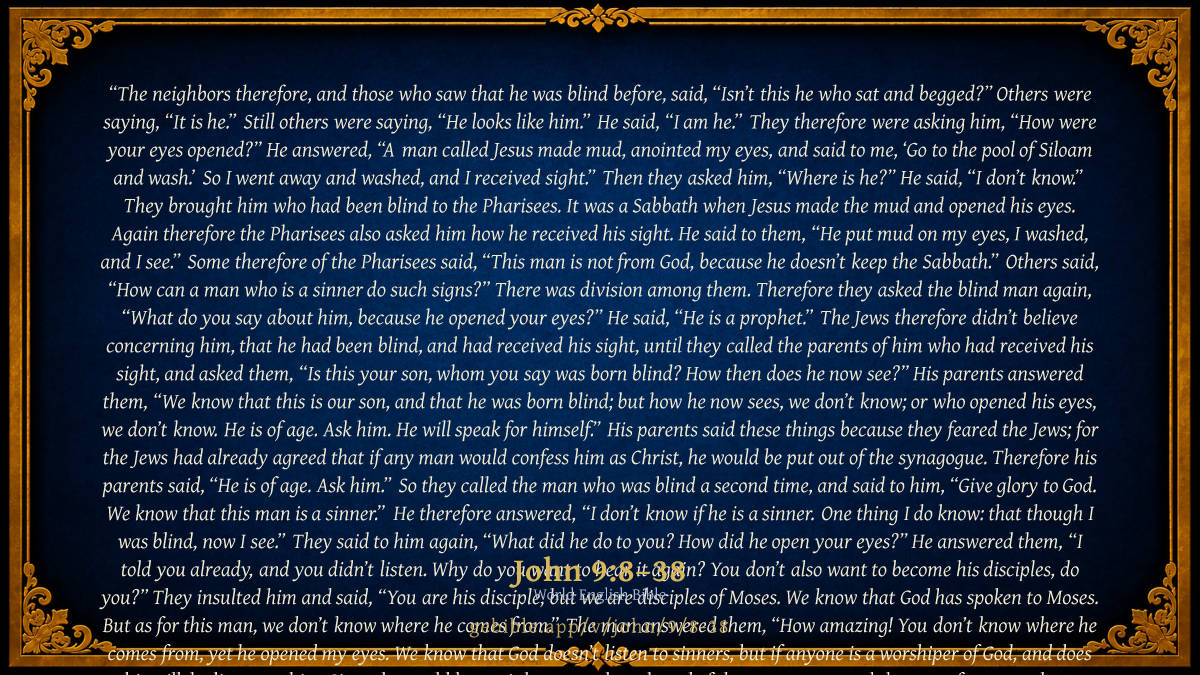
The neighbors therefore, and those who saw that he was blind before, said, “Isn’t this he who sat and begged?” Others were saying, “It is he.” Still others were saying, “He looks like him.” He said, “I am he.”
They therefore were asking him, “How were your eyes opened?”
He answered, “A man called Jesus made mud, anointed my eyes, and said to me, ‘Go to the pool of Siloam and wash.’ So I went away and washed, and I received sight.”
Then they asked him, “Where is he?” He said, “I don’t know.”
They brought him who had been blind to the Pharisees. It was a Sabbath when Jesus made the mud and opened his eyes. Again therefore the Pharisees also asked him how he received his sight. He said to them, “He put mud on my eyes, I washed, and I see.”
Some therefore of the Pharisees said, “This man is not from God, because he doesn’t keep the Sabbath.” Others said, “How can a man who is a sinner do such signs?” There was division among them. Therefore they asked the blind man again, “What do you say about him, because he opened your eyes?” He said, “He is a prophet.”
The Jews therefore didn’t believe concerning him, that he had been blind, and had received his sight, until they called the parents of him who had received his sight, and asked them, “Is this your son, whom you say was born blind? How then does he now see?”
His parents answered them, “We know that this is our son, and that he was born blind; but how he now sees, we don’t know; or who opened his eyes, we don’t know. He is of age. Ask him. He will speak for himself.” His parents said these things because they feared the Jews; for the Jews had already agreed that if any man would confess him as Christ, he would be put out of the synagogue. Therefore his parents said, “He is of age. Ask him.”
So they called the man who was blind a second time, and said to him, “Give glory to God. We know that this man is a sinner.”
He therefore answered, “I don’t know if he is a sinner. One thing I do know: that though I was blind, now I see.”
They said to him again, “What did he do to you? How did he open your eyes?”
He answered them, “I told you already, and you didn’t listen. Why do you want to hear it again? You don’t also want to become his disciples, do you?”
They insulted him and said, “You are his disciple, but we are disciples of Moses. We know that God has spoken to Moses. But as for this man, we don’t know where he comes from.”
The man answered them, “How amazing! You don’t know where he comes from, yet he opened my eyes. We know that God doesn’t listen to sinners, but if anyone is a worshiper of God, and does his will, he listens to him. Since the world began it has never been heard of that anyone opened the eyes of someone born blind. If this man were not from God, he could do nothing.”
They answered him, “You were altogether born in sins, and do you teach us?” Then they threw him out.
Jesus heard that they had thrown him out, and finding him, he said, “Do you believe in the Son of God?”
He answered, “Who is he, Lord, that I may believe in him?”
Jesus said to him, “You have both seen him, and it is he who speaks with you.”
He said, “Lord, I believe!” and he worshiped him.
John Calvin 1540 · Public Domain On vv8, 11, 13, 14, 15, 16, 17, 18, 19, 20, 22, 24, 25, 26, 28, 29, 30, 31, 34, 35, 36, 37, 38 8. Then the neighbors, and those who had formerly…
8. Then the neighbors, and those who had formerly seen him. The blind man was known not only to the neighbors, but to all the inhabitants of the town, having been wont to sit and beg at the gate of the temple; and the common people look more readily at such persons than at others. This circumstance — of the man being known — contributed to make many people acquainted with the fame of the miracle. But, as impiety is ingenious in obscuring the works of God, many thought that it was not the same man, because a new power of God openly appeared in him. Thus we find that the more brightly the majesty of God is displayed in his works, the less credit do they obtain among men. But the doubts of those men aided in proving the miracle, for, in consequence of those doubts, the blind man celebrated more highly the grace of Christ by his testimony. It is not without good reason, therefore, that the Evangelist brings together all those circumstances which seemed to exhibit more clearly the truth of the miracle.
John Calvin's Commentaries (1540-1563) — public domain. Text from the Calvin Translation Society English edition (1840s-50s) via the Christian Classics Ethereal Library (ccel.org). Calvin's coverage is partial (roughly two-thirds of the Bible); uncommented books and verses are honest gaps, never fabricated. The 19th-century editor's footnotes and remarks are omitted so the notes are faithfully Calvin's own voice.
Geneva Bible translators 1599 · Public Domain On vv8, 10, 16, 24, 28, 34, 35 A true image of all men, who as they…
A true image of all men, who as they are of nature blind, do neither themselves receive the light that is offered unto them, nor suffer it in others, and yet make a great ado amongst themselves.
Geneva Bible (1599) marginal notes — public domain.
John Trapp 1656 · Public Domain On vv8–38 8 The neighbours therefore, and they which before had…
8 The neighbours therefore, and they which before had seen him that he was blind, said, Is not this he that sat and begged?
Ver. 8. Is not this he that sat and begged?] As once blind Belisarius did with Da obolum Belisarlo. Give a coin to Belisarius.
John Trapp, A Commentary or Exposition upon All the Books of the Old and New Testament (1647–1656) — public domain. Text from a community e-Sword module.
Matthew Poole 1685 · Public Domain On vv8, 9, 10, 11, 12, 13, 14, 15, 16, 17, 18, 19, 20, 22, 23, 25, 26, 27, 28, 29, 30, 31, 32, 33, 34, 35, 36, 37, 38 The evangelist now reports the consequence of this miracle.…
The evangelist now reports the consequence of this miracle. He, being cured, returneth to his friends: those who lived about that place, had taken notice of his ordinary sitting there, and begging; now, seeing him perfectly recovered, they ask one another, if this were not the blind beggar that used to sit there.
Matthew Poole's English Annotations on the Holy Bible (1683–1685) — public domain. Text from a community e-Sword/MySword module.
William Burkitt 1703 · Public Domain On vv8, 13, 17, 24, 30, 34 The blind man, thus miraculously cured, returns with much…
The blind man, thus miraculously cured, returns with much joy to his neighbours and acquaintance, who confer with him about this matter; they inquire, Whether he was the person cured or not? Who was the person that cured him, and where that person was? he assures them, he was the very person that was blind, but now cured, and he that cured him was Jesus: that the means used was clay and spittle; but where the person was, or what was become of him, he knew not.
Learn thence, 1. That the miraculous cures of God work a sensible alteration in men, not only in their own apprehension, but in the judgments of others. This miracle shined forth among the neighbours, who having seen and observed the blind man, admire his healing.
Read full note →
Learn, 2. How frankly the blind man acknowledges, and how freely he confesses, that he was the person whom Jesus had healed; I am he. It is an unthankful silence to smother the works of God in an affected secrecy; to make God a loser by his bounty towards us, is a shameful injustice. O God! we are not worthy of thy common favours, much less of spiritual blessings, if we do not publish thy mercies on the housetop, and praise thee for them in the great congregation.
William Burkitt's Expository Notes on the New Testament (1700–1703) — public domain. Text from a community e-Sword module.
Matthew Henry 1710 · Public Domain On vv8, 13, 35 Such a wonderful event as the giving of sight…
Such a wonderful event as the giving of sight to a man born blind could not but be the talk of the town, and many heeded it no more than they do other town-talk, that is but nine days' wonder; but here we are told what the neighbours said of it, for the confirmation of the matter of fact. That which at first was not believed without scrutiny may afterwards be admitted without scruple. Two things are debated in this conference about it: -
I. Whether this was the same man that had before been blind, Joh 9:8.
Read full note →
1. The neighbours that lived near the place where he was born and bred, and knew that he had been blind, could not but be amazed when they saw that he had his eye-sight, had it on a sudden, and perfectly; and they said, Is not this he that sat and begged? It seems, this blind man was a common beggar, being disabled to work for his living; and so discharged from the obligation of the law, that if any would not work, neither should he eat. When he could not go about, he sat; if we cannot work for God, we must sit still quietly for him. When he could not labour, his parents not being able to maintain him, he begged. Note, Those who cannot otherwise subsist must not, like the unjust steward, be ashamed to beg; let no man be ashamed of anything but sin. There are some common beggars that are objects of charity, that should be distinguished; and we must not let the bees starve for the sake of the drones or wasps that are among them. As to this man, (1.) It was well ordered by Providence that he on whom this miracle was wrought should be a common beggar, and so generally known and remarkable, by which means the truth of the miracle was better attested, and there were more to witness against those infidel Jews who would not believe that he had been blind than if he had been maintained in his father's house. (2.) It was the greater instance of Christ's condescension that he seemed (as I may say) to take more pains about the cure of a common beggar than of others. When it was for the advantage of his miracles that they should be wrought on those that were remarkable, he pitched upon those that were made so by their poverty and misery; not by their dignity.
2. In answer to this inquiry, (1.) Some said, This is he, the very same man; and these are witnesses to the truth of the miracle, for they had long known him stone-blind. (2.) Others, who could not think it possible that a man born blind should thus on a sudden receive his sight, for that reason, and no other, said, He is not he, but is like him, and so, by their confession, if it be he, it is a great miracle that is wrought upon him. Hence we may take occasion to think, [1.] Of the wisdom and power of Providence in ordering such a universal variety of the faces of men and women, so that no two are so alike but that they may be distinguished, which is necessary to society, and commerce, and the administration of justice. And, [2.] Of the wonderful change which the converting grace of God makes upon some who before were very wicked and vile, but are thereby so universally and visibly altered that one would not take them to be the same persons.
3. This controversy was soon decided by the man himself: He said, I am he, the very man that so lately sat and begged; "I am he that was blind, and was an object of the charity of men, but now see, and am a monument of the mercy and grace of God." We do not find that the neighbours appealed to him in this matter, but he, hearing the debate, interposed, and put an end to it. It is a piece of justice we owe to our neighbours to rectify their mistakes, and to set things before them, as far as we are able, in a true light. Applying it spiritually, it teaches us that those who are savingly enlightened by the grace of God should be ready to own what they were before that blessed change was wrought, Ti1 1:13, Ti1 1:14.
II. How he came to have his eyes opened, Joh 9:10-12. They will now turn aside, and see this great sight, and enquire further concerning it. He did not sound a trumpet when he did these alms, nor perform his cures upon a stage; and yet, like a city upon a hill, they could not be hid. Two things these neighbours enquire after: -
1. The manner of the cure: How were thine eyes opened? The works of the Lord being great, they ought to be sought out, Psa 111:2. It is good to observe the way and method of God's works, and they will appear the more wonderful. We may apply it spiritually; it is strange that blind eyes should be opened, but more strange when we consider how they are opened; how weak the means are that are used, and how strong the opposition that is conquered. In answer to this enquiry the poor man gives them a plain and full account of the matter: A man that is called Jesus made clay, - and I received sight. Joh 9:11. Note, Those who have experienced special instances of God's power and goodness, in temporal or spiritual things, should be ready upon all occasions to communicate their experiences, for the glory of God and the instruction and encouragement of others. See David's collection of his experiences, his own and others', Psa 34:4-6. It is a debt we owe to our benefactor, and to our brethren. God's favours are lost upon us, when they are lost with us, and go no further.
2. The author of it (Joh 9:12): Where is he? Some perhaps asked this question out of curiosity. "Where is he, that we may see him?" A man that did such cures as these might well be a show, which one would go a good way for the sight of. Others, perhaps, asked out of ill-will. "Where is he, that we may seize him?" There was a proclamation out for the discovering and apprehending of him (Joh 11:57); and the unthinking crowd, in spite of all reason and equity, will have ill thoughts of those that are put into an ill name. Some, we hope, asked this question out of good-will. "Where is he, that we may be acquainted with him? Where is he, that we may come to him, and share in the favours he is so free of?" In answer to this, he could say nothing: I know not. As soon as Christ had sent him to the pool of Siloam, it should seem, he withdrew immediately (as he did, Joh 5:13), and did not stay till the man returned, as if he either doubted of the effect or waited for the man's thanks. Humble souls take more pleasure in doing good than in hearing of it again; it will be time enough to hear of it in the resurrection of the just. The man had never seen Jesus, for by the time that he had gained his sight he had lost his Physician; and he asked, it is probable, Where is he? None of all the new and surprising objects that presented themselves could be so grateful to him as one sight of Christ, but as yet he knew no more of him than that he was called, and rightly called, Jesus - a Saviour. Thus in the work of grace wrought upon the soul we see the change, but see not the hand that makes it; for the way of the Spirit is like that of the wind, which thou hearest the sound of, but canst not tell whence it comes nor whither it goes.
Matthew Henry's Commentary on the Whole Bible (1708–1710) — public domain (CC PDM 1.0). Text via the HelloAO Bible API.
John Gill 1763 · Public Domain On vv8–38 The neighbours therefore, and they which before had seen…
The neighbours therefore, and they which before had seen him,.... For it seems the blind man was not a stranger, one that came out of the country to the city to beg; but a native of Jerusalem, that had long lived in a certain neighbourhood in it, and was well known to be what he was;
that he was blind; the Alexandrian copy, and one of Beza's exemplars, and the Vulgate Latin version read, "that he was a beggar"; to which agree the Syriac, Arabic, and Ethiopic versions: wherefore they
Read full note →
said, is this not he that sat and begged? they particularly remark his begging posture; he was not laid all along, as the lame man in Act 3:2; nor did he go from door to door, as others were used to do, but he sat in some certain place, as blind men generally did; see Mat 20:30.
John Gill's Exposition of the Whole Bible (1746–1763) — public domain (CC PDM 1.0). Text via the HelloAO Bible API.
John Wesley 1765 · Public Domain On vv11, 14, 16, 17, 22, 27, 29, 30, 31, 33, 34, 35, 36, 37 A man called Jesus - He seems to have…
A man called Jesus - He seems to have been before totally ignorant of him.
John Wesley, Explanatory Notes Upon the Whole Bible (1754–1765) — public domain. Text via the GEBible commentary corpus.
Adam Clarke 1810 · Public Domain On vv8, 9, 11, 12, 13, 14, 16, 17, 18, 21, 22, 24, 25, 27, 28, 29, 30, 31, 32, 33, 34, 35, 36, 38 Verse 8. That he was blind] Ὁτι τυφλος ην:…
Verse 8. That he was blind] Ὁτι τυφλος ην: but, instead of this, προσαιτης, when he begged, or was a beggar, is the reading of ABC*DKL, seven others, both the Syriac, both the Arabic, later Persic, Coptic, AEthiopic, Armenian, Sahidic, Gothic, Slavonic, Vulgate, eight copies of the Itala, and some of the primitive fathers. This is in all probability the true reading, and is received by Griesbach into the text.
Beggars in all countries have a language peculiar to themselves. The language of the Jewish beggars was the following: זבי כי Deserve something by me - Give me something that God may reward you. רכי ני זכי גר מך O ye tender-hearted, do yourselves good by me. Another form, which seems to have been used by such as had formerly been in better circumstances, was this: סכי כי מה הוינא אסתכל בי מה אנא Look back and see what I have been; look upon me now, and see what I am. See Lightfoot.
Adam Clarke's Commentary on the Bible (1810–1826) — public domain. Text from a community e-Sword/MySword module.
Joseph Benson 1811 · Public Domain On vv8, 10, 13, 15, 17, 24, 30, 35 Joh 9:8-9. The neighbours, therefore — Those who lived…
Joh 9:8-9. The neighbours, therefore — Those who lived in the beggar’s neighbourhood, and those who had frequently passed by where he used to beg, being well acquainted with his form and visage, were astonished at the alteration which they observed in his countenance, by reason of the new faculty that was bestowed upon him. Wherefore they expressed their surprise by asking one another, if this was not the blind man to whom they used to give alms. Some said, This is he; others, He is like him — “The circumstance of having received his sight would give him an air of spirit and cheerfulness, which would render him something unlike what he was before, and might occasion a little doubt to those who were not well acquainted with him.” — Doddridge. But he said, I am he — The very man that so lately sat and begged; I am he that was blind, and was an object of the charity of men, but now see, and am a monument of the mercy and grace of God. We do not find that the neighbours appealed to him in this matter; but he, hearing the debate, interposed, and put an end to it. It is a piece of justice we owe to our neighbours, to rectify their mistakes, and to set things before them, as far as we are able, in a true light. Applying it spiritually, it teaches us that those who are savingly enlightened by the grace of God, should be ready to own what they were before that blessed change was wrought. See 1Ti 1:13-14.
Joseph Benson's Commentary on the Old and New Testaments (1811–1818) — public domain. Text from a community e-Sword module.
Albert Barnes 1834 · Public Domain On vv8, 13, 15, 16, 17, 18, 20, 24, 25, 26, 28, 29, 30, 31, 32, 33, 34, 35, 36, 38 The neighbours ... - This man seems to have…
The neighbours ... - This man seems to have been one who attracted considerable attention. The number of persons totally blind in any community is very small, and it is possible that this was the only blind beggar in Jerusalem. The case was one, therefore, likely to attract attention, and one where there could be no imposture, as he was generally known.
Albert Barnes' Notes on the Bible (1834–1885) — public domain. Text from a community e-Sword/MySword module.
Haydock's Catholic Bible Commentary 1859 · Public Domain On vv17, 22, 24, 27, 28, 31, 32 The Hebrews gave the name of prophet to all…
The Hebrews gave the name of prophet to all those who were honoured by the Almighty in a particular manner. And it was a maxim amongst them, that a prophet could dispense with the law of the sabbath. (Calmet) --- Do you wish to know what he believed Jesus to be? asks St. Augustine. And falling down, he adored him. Before, he regarded him as a holy man, as a prophet; but he did not adore him until he understood him to be the Son of God; whereas no sooner did he know this, than, falling down, he paid him that sovereign worship which is due to God alone. (Calmet)
George Leo Haydock (1774–1849), Haydock's Catholic Family Bible and Commentary, 1859 edition — public domain. Excludes Psalms (Douay-Rheims chapter numbering differs from Protestant) and Deuterocanonical books (Catholic canon only).
Robert Jamieson, A. R. Fausset & David Brown 1871 · Public Domain On vv8, 13, 16, 17, 18, 24, 25, 26, 27, 30, 31, 35, 36, 37, 38 The neighbours therefore . . . said, Is not…
The neighbours therefore . . . said, Is not this he that sat and begged--Here are a number of details to identify the newly seeing with the long-known blind beggar.
Jamieson, Fausset & Brown — Commentary Critical and Explanatory on the Whole Bible (1871) — public domain (CC PDM 1.0). Text via the HelloAO Bible API.
Daniel D. Whedon 1874 · Public Domain On vv8, 9, 11, 12, 13, 14, 15, 16, 17, 20, 21, 22, 24, 25, 26, 27, 28, 29, 30, 31, 32, 33, 34, 35, 36, 38 Excitement among neighbours, Joh_9:8-12.
Excitement among neighbours, Joh_9:8-12.
So great a cure upon so well-known a case could not fail to startle the immediate residents of the locality. The scenes and dialogues that follow are so natural that they cannot but be true. The character of the restored man is developed in the most exquisite manner by his own words. His native shrewdness and firmness of convictions against captious cavils, his rational faith in, and confiding fidelity to, his restorer, appear in beautiful succession. He had, or at least attained, that position, purpose, and spirit of faith which only need Christ to be truly presented, to result in his full acceptance of Christ. Even before he knew the Good Shepherd he was, by anticipation, one of the true sheep, showing his Christward predisposition, and obedience to the Father’s drawings, by hearing the Shepherd’s voice and following his steps. See notes on Joh_9:17; Joh_9:25; Joh_9:35, and Joh_10:4.
Read full note →
The neighbours prosecute a threefold inquiry. Is this the very man who was blind? How were his eyes opened? Where is his restorer? The first two questions were amply answered by the man himself. The third remained as yet unanswered.
8. He that sat and begged—The notoriety of his case explains how it was that the apostles knew him to be born blind. Joh_9:2.
Daniel D. Whedon (gen. ed.), Commentary on the Old and New Testaments (1874–1909) — public domain. Text from a community e-Sword module.
The Cambridge Bible for Schools and Colleges 1878 · Public Domain On vv8, 9, 11, 12, 13, 14, 15, 16, 17, 18, 19, 21, 22, 23, 24, 25, 26, 27, 28, 29, 30, 31, 32, 33, 34, 35, 36, 37, 38 8. had seen him that he was blind] The…
8. had seen him that he was blind] The true reading is, saw him that he was a beggar, or perhaps, because he was a beggar, i.e. he was often seen in public places.
he that sat and begged] Or, he that sitteth and beggeth; present participles with the article to express his general habit.
The Cambridge Bible for Schools and Colleges (gen. ed. J. J. S. Perowne; Cambridge University Press, 1878–1918) — public domain. Text from a community e-Sword module.
Ellicott's Commentary for English Readers 1878 · Public Domain On vv8–38 (8) They which before had seen him that he…
(8) They which before had seen him that he was blind.—The better reading is, that he was a beggar. The persons are the neighbours, who from living near him knew all about him, and those who used to see him at the spot where he sat begging. Both classes, of course, knew that he was blind.
Is not this he that sat and begged?—Better, Is not this he that sitteth and beggeth? The tenses are present, marking his usual custom.
A Bible Commentary for English Readers, edited by Charles John Ellicott (1878–1897) — public domain. Text from a community e-Sword module.
The Pulpit Commentary 1880 · Public Domain On vv8, 9, 10, 11, 12, 13, 14, 15, 16, 17, 18, 20, 21, 22, 23, 24, 25, 26, 27, 28, 29, 30, 31, 32, 34, 35, 36, 37, 38 Vers. 8-34. (9) The proof of the reality of…
Vers. 8-34. (9) The proof of the reality of the miracle, the antagonism of the Pharisees, and the persecution of the heated mad.
The neighbors therefore, and they who beheld him aforetime that (or, be cause) he was a beggar. This is the first time that his well-known position is mentioned, and (if we translate oti "because") the very fact of his begging (probably with loud voice) had made him a well-known individual. Said, Is not this he that sat and begged?
The Pulpit Commentary (1880–1919), ed. H.D.M. Spence-Jones & Joseph S. Exell — public domain. Text from a community e-Sword module.
The Biblical Illustrator 1887 · Public Domain On vv8, 13, 16, 19, 22, 24, 25, 31, 32, 35 The neighbours, therefore … said, Is not this he…
Joh_9:8-13
The neighbours, therefore … said, Is not this he that sat and begged
Read full note →
Types of character in relation to Christs work--Those who are only speculatively interested in the work
As a stone cast into a lake throws the whole mass of water into agitation, producing circle after circle to its utmost bounds, this healing threw into excitement the whole social sphere in which it occurred.
No man liveth unto himself. What affects one will affect many. Society is a chain of which every man is a link, and the motion of one link may vibrate through the whole chain. Society is a body of which every man is a member; the pulsation of one heart will throb through every limb. The feelings produced in this case were various. Note, concerning inquiries of the class we here deal with
I. THEIR LACK OF EARNESTNESS. They related
1. To the identity of the man. The question (Joh_9:8) seems to have been asked out of mere curiosity. Their difficulty (Joh_9:9) arose partly from the change the opened eye would make in his countenance, giving it a new character; and partly from the unaccountableness of the result.
2. To the method of his restoration (Joh_9:10). In this there is no ring of earnestness, only curiosity.
3. To the whereabouts of the Restorer (Joh_9:12). But what is He? All they meant was we should like to see this wonder worker. Those who have a mere speculative interest in Christianity are constantly asking such questions with no genuine thirst for truth.
II. THEIR LACK OF GENEROSITY. They utter no congratulatory word. Had they been true men, the event would have touched them into the enthusiasm of social affection. But there is not one spark of it. Their intellect seems to move in ice. So is it ever with this class. There is no heart exultation over the millions Christianity has blessed, only a cold inquiry about details.
III. THEIR LACK OF INDEPENDENCY (Joh_9:13). They brought Him to the judicial court to try the question of His identity. They were not in earnest enough to reach a conclusion that would satisfy themselves. Conclusion: How lamentable that there should be a class only speculatively interested in the wonderful works of Christ. What then men saw should have led them to hearty acceptance and consecration. (D. Thomas, D. D.)
The change effected in the man
The want or the sudden presence of an eye, much more of both, must needs make a great change in the face; those little balls of light, which no doubt were more clear than nature could have made them, could not but give a new life to the countenance. I marvel not if the neighbours, who had wont to see this dark visage led by a guide, and supported by a staff, seeing him now walking confidently alone out of his own inward light, and looking them cheerfully in the face, doubted whether this were he. The miraculous cures of God work a sensible alteration in men, not more in their own apprehension than in the judgment of others. So, in the redress of the spiritual blindness, the whole habit of the man is changed. Where before his face looked dull and earthly, now there is a sprightly cheerfulness in it, through the comfortable knowledge of God and heavenly things. (Bishop Hall.)
I am the man myself
In a town filled with Romanists, Gideon Ouseley, as was his custom, hired the bellman to announce through the streets the preaching in the evening. The man, afraid of opposition, uttered the announcement timidly and indistinctly. Ouseley, passing in the street, heard him, and taking the bell, rang it himself, proclaiming aloud, This is to give notice, that Gideon Ouseley, the Irish Missionary, is to preach this evening in such a place, and at such an hour. And I am the man myself? (Stevens History of Methodism.)
We ought boldly to confess Ghost
We do not bear enough testimony for our Lord. I am sure I felt quite taken aback the other day when a flyman said to me, You believe that the Lord directs the way of His people, dont you, sir? I said, That I do. Do you know anything about it? Why, he said, Yes. This morning I was praying the Lord to direct my way, and you engaged me; and I felt that it was a good beginning for the day. We began talking about the things of God directly. That flyman ought not to have been the first to speak: as a minister of the gospel I ought to have had the first word. We have much to blame ourselves for in this respect. We hold our tongues because we do not know how a word might be received; but we might as well make the experiment. No harm could come of trying. Suppose you were to go into a place where persons were sick and dying, and you have medicine about you which would heal them, would you not be anxious to give them some of it? Would you say nothing about it because you could not tell how it might be received? How could you know how it would be received except by making this offer? Tell poor souls about Jesus. Tell them how His grace healed you, and perhaps they will answer, You are the very person I need; you have brought me the news I have longed to hear. (C. H. Spurgeon.)
How Christian lost his burden.
He ran thus till he came to a place somewhat ascending, and upon that place stood a cross, and a little below in the bottom a sepulchre. So I saw in my dream, that just as Christian came up with the cross his burden loosed from off his shoulders, and fell from his back, and began to tumble, and so continued to do till it came to the mouth of the sepulchre, where it fell in and I saw it no more. Then was Christian glad and lightsome and said with a merry heart, He hath given me rest by His sorrows and life by His death. (J. Bunyan.)
Jesus all in all to new converts
In this mans mind, as soon as ever he received sight, a man that was named Jesus came to the forefront. Jesus was to him the most important person in existence. All that he knew of Him at first was, that He was a man that was named Jesus; and under that character Jesus filled the whole horizon of His vision. He was more to him than those learned Pharisees, or than all his neighbours put together. Jesus was exceeding great, for He had opened his eyes. By-and-by, fixing his mind upon that figure, he saw more in it, and he declared, He is a prophet. He boldly said this when he was running great risks by doing so. To their faces he told the carping Pharisees He is a prophet. A little further on he came to this, that he believed Him to be the Son of God, and worshipped Him. Now, my dear friend, if you are saved by Jesus your star must set, but the star of Jesus must rise and increase in brilliance till it becomes no more a star, but a sun, making your day, and flooding your whole soul with light. If we are saved Christ Jesus must and will have the glory. (C. H. Spurgeon.)
Converts must testify of Christ
After this man had received sight his testimony was all of Jesus. It was Jesus that spat, it was Jesus that made the clay, it was Jesus that anointed his eyes. So will it be in your mind with the gospel of your salvation: it will be Jesus only. It is Jesus who became the surety of the covenant, Jesus who became the atoning Sacrifice, Jesus is the Priest, the Interposer, the Mediator, the Redeemer. We know Jesus as Alpha, and Jesus as Omega. He is the first, and He is the last. In your salvation there will be no mistake about it, and no mixture in it; you will have nothing to say about man, or mans merit, or mans will; but on the head which once was wounded with the thorns, you will put all your crowns. Jesus did it, did it all, and He must be praised. (C. H. Spurgeon.)
The Biblical Illustrator, edited by Joseph S. Exell (c. 1880s–1900s) — public domain. Text from a community e-Sword module.
B. W. Johnson 1891 · Public Domain On vv13, 14, 15, 17, 22, 24, 30, 34, 35 13. They brought him to the Pharisees. It was…
13. They brought him to the Pharisees. It was a notable event that demanded investigation. Hence they brought him to religious men of great influence.
B. W. Johnson's The People's New Testament with Notes (1889–1891) — public domain. Electronic text from the Christian Classics Ethereal Library (CCEL) ThML edition.
The Preacher's Complete Homiletical Commentary 1892 · Public Domain On v13 Joh_9:13. They brought.—Better They bring.
EXPLANATORY AND CRITICAL NOTES
Joh_9:13. They brought.—Better They bring.
Read full note →
Joh_9:14. Now it was a Sabbath on the day that Jesus made the clay, etc.—It was most likely a festival Sabbath.
Joh_9:15. The Pharisees.—In the lesser Sanhedrin, or Synagogue Councils.
Joh_9:16. This man is not of God … a division among them.—The prophecy that was uttered at His presentation in the temple was being fulfilled (Luk_2:34). The Light was separating the righteous from the unrighteous (Joh_7:43, Joh_10:19).
Joh_9:22. The Jews had agreed, etc.—The Sanhedrin had not likely come openly to this agreement. They would have found opposition in their own ranks. A party of the leading sect had done so, however (Act_23:20). Put out of the synagogue.—Publicly excommunicated from participation in all religious privileges for a time, or for life.
Joh_9:24. Give glory to God.—Many think that these words are simply a call to the man to abjure his supposed former error, in having called Christ a prophet, although He had broken the rabbinical Sabbath law (see Jos_7:19). But it surely means also (since they could not deny the fact of the miracle), Give glory to God for the cure of thy blindness.
Joh_9:27. And ye did not hearken … would ye also become His disciples?—Indignant irony at the crooked method of these Pharisees, who sought to turn truth to error, echoes in these words.
Joh_9:28. Thou art the disciple of that man, etc.—They implicitly accused him of disloyalty to the law.
Joh_9:31. Heareth not sinners, etc.—I.e. men who are hardened and impenitent—wicked men, such as you accuse this prophet of being. A worshipper.—I.e. a devout, pious man (θεοσεβής).
Joh_9:33. Of God.—“The mighty work done by Him proves He is not a wicked man; it proves more, viz. that He is of God.”
Joh_9:34. Cast him out.—There were three degrees of excommunication. The first excluded the person under the ban for a short period from religious privileges. The second extended for a longer period, and was much more severe in that it debarred the person banned even from social intercourse for the time. The third was almost a virtual cutting off from Israel of the person excommunicated. Perhaps the meaning here is simply that they thrust the man violently out of the place of assembly. Those who were trying him might not have full power to excommunicate. Born in sins.—These men held the idea repudiated by our Lord (Joh_9:3).
Joh_9:35. When He found him.—Jesus had a greater work to perform on him than even the cure of his blindness, and therefore He sought him. Son of God.—Some MSS. read Son of man (Tischendorf, Ed. 8, etc.); and this to a devout Jew would mean the Messiah, the King of the eternal kingdom (Dan_7:13).
Joh_9:38. Worshipped (προσεκύνησεν).—This word does not mean reverence merely, but worship due to God (Joh_12:20, etc.).
Joh_9:39. For judgment, etc.—Not to execute judgment (κρίσις), but judgment (κρίμα), a judicial decision, would follow from His very presence among men. The Light must reveal (Joh_3:17-20). This world.—In which there is much darkness, much evil and sin (Gal_1:4).
Joh_9:40. Some of the Pharisees, etc.—Probably some who still believed on Him (Joh_8:30); but no doubt also others who, it may be, kept a watch on Christ and His actions. They were not conscious of their spiritual blindness, and thus were not driven to rely on Him who is the light of men.
MAIN HOMILETICS OF THE PARAGRAPH.—Joh_9:13-41
The progress of faith and the descent of unbelief.—A mighty miracle had been wrought. The blind man’s neighbours, and many who had before known him as blind, were astonished at the event. But the more minute their inquiries, the more fully was the greatness of the miracle established. The man gave a brief but complete account of what had occurred (notice the circumstantiality of the account; he had not seen how the clay was prepared—Joh_9:11). But here also the hatred of Christ’s enemies indirectly made itself felt, even in their absence. They had agreed on a line of action which would deter men from openly allying themselves with Christ (Joh_9:22). Fear of this, and perhaps a wish to ingratiate themselves with the powerful class of the Pharisees, made the man’s neighbours, etc., bring him before a sort of religious judicial court—a lesser Sanhedrin—composed apparently chiefly of Pharisees (Joh_9:18). In place of a judicial inquiry those unjust counsellors sought only by persuasion and threatening to set aside the truth. But their evil design proved abortive. They brought only confusion on themselves and greater glory to Christ. In this narrative we see—
I. The progress of faith.—
1. The blind man came seeing, after having washed in Siloam. What a wonderful evening that was for him, when first on that long-sealed vision the gentle light of the setting sun and gathering twilight revealed the world in its visible wonder and beauty, the human face divine, etc., and when as night descended the wonders of the celestial sphere, in all the brilliance of an Eastern night, first met his gaze, etc. So much was there indeed to attract his attention, that next day probably, when questioned as to the manner in which he had received his sight, he simply gave the facts, telling what the “man called Jesus” had done and said. Whilst full of gratitude for what had been done, he had not yet given thought as to the source of this man’s power.
2. But the question was soon to be pressed on him for an answer. Taken before the council of the Pharisees and questioned by them, he answered them apparently with some curtness, perhaps desiring to avoid a conflict with this powerful sect. He was no doubt aware of their threat (Joh_9:22), and also of the fact that the miracle, having been wrought on the Sabbath day, would further excite their enmity. This incontestable evidence had weight with the more honest and open-minded section of the council. The others, however, even though the voice of truth must have spoken to their consciences, clothed themselves in the triple brass of their tradition. But this division among them, and the further question asked, led the man another step upward on the stairway of faith. He is a prophet. Could He be less? for “were not wondrous works the mark of a prophet?” was that not, indeed, what Nicodemus, one of the Sanhedrin, had openly declared Christ to be (Joh_7:51-52)?
3. Thus the light which they imagined had been suppressed (Joh_8:59) burst out on them with even greater brilliancy. Baffled, yet unreconciled to the truth, they sought to prove the man an impostor or a liar, and proceeded to cross-question his parents concerning him. His parents in their answer left no doubt as to his identity, or the fact that their son had been born blind; but in regard to the manner in which their son was healed, they referred their questioners to the man himself, probably bearing in mind the threat of the rulers. With the man who had been born blind they tried another method (Joh_9:24). The fact of the miracle could not be denied: let the glory be given to God, and Christ denied any genuine participation in the wonder, on the supposition that He was a sinner. But their wicked attempt only led to the man ascending another step toward complete faith in Christ. His scornful utterance on their further cross-examination, “Will ye also be His disciples?” his trenchant repudiation of their attempt to make out Jesus to be a sinner, and his clear affirmation, “If this man were not of God,” etc. (Joh_9:33), show the man rising rapidly toward a true conception of Christ’s nature and office.
4. And now the rage of Christ’s enemies knew no bounds. We seem to hear the shriek of anger in their closing words as they carried out their threat in this case and excommunicated the man (Joh_9:34, but see p. 261). But as persecution never really hinders, but ever helps to forward truth, so the rage of our Lord’s enemies against him led this poor man nearer to that spiritual enlightenment toward which he had been progressing. When the Lord heard what had happened He sought out His persecuted disciple, who was now passing through an experience which all His followers would speedily pass through (Joh_16:2), and gladly aided him up the last step to faith and spiritual enlightenment. In reply to Jesus’ question, “Dost thou believe?” etc. (Joh_9:35), he had answered, “Who is He, Lord?” etc. (Joh_9:36). He had already implicit faith in Jesus’ word. And when Jesus in His reply first gently reminded him of the miracle that had been wrought on him, “Thou hast both seen Him,” i.e. with eyes enlightened by Him, etc., the spiritual darkness passed away from the man’s soul, and from the summit of faith he saw salvation (Joh_9:38). Earth with all its beauty was now lost sight of comparatively in the light of that new spiritual vision which the soul had attained to, and to which a new world of spiritual beauty and eternal glory had been opened. The blind had indeed been made to see (Joh_9:39). In this history there is further seen—
II. The downward progress of unbelief.—
1. The spirit of unbelief is essentially dogmatic and persecuting. The enemies of Jesus had made up their minds, and no amount of evidence of the truth would convince them. This is brought out in their determination to anathematise whoever should be openly favourable to the claims of Jesus. So now unbelief is dogmatic still. It will accept no proof, no evidence, for the truth of the faith. It has agreed to regard supernatural religion as an exploded idea.
2. The next step the Pharisees took was to attempt to weaken the credibility of the chief witness of the great miracle here recorded—to endeavour to show that the subject of the miracle was, in short, a liar. So unbelief still seeks to discredit the witnesses of the gospel, to resolve their writings into mythical histories, and to class their writers as romancers or forgers.
3. The next step of the Pharisees was virtually to admit the fact of the miracle, as all their attempts to throw discredit on it only made it more evident; but to call upon the man on whom it was wrought to deny to its immediate Author any real participation in it—indeed, by acknowledging Him as an especial sinner and transgressor (Joh_9:14; Joh_9:16; Joh_9:24), to declare that He could have had no part in it. So to-day there are many who cannot help acknowledging the beauty, the moral power, and the wonderfully elevating force in the gospel; but they would have men think that this is so not because the author of the gospel is the “power of God.” They would have them believe that it is all the result of a natural evolution of the human mind. The insincerity of the Pharisees is typical of a certain insincerity of modern unbelief.
4. These baffled Jews, unable to overturn the truth, used the weapon of excommunication. So the leaders of unbelief have their own engine of petty persecution. Refusing themselves to investigate candidly into the origin and progress of the faith, they shut themselves within their charmed circle, excluding therefrom all pertaining to the Christian faith, and stigmatising those who still adhere to it as unscientific. But their anathemas will no more prevail finally against the truth than those of the Jews of Jerusalem.
Joh_9:25. “One thing I know.”—Scepticism affected to disbelieve in the reality of this miracle, jealousy sought to argue that it was due to other agencies, persecution set itself to awe the man into contradictions. But through all he persisted in his artless and eloquent tale, with its unanswerable conclusion, “If this man were not of God, He could do nothing.” Mark—
I. The change.—
1. It was a radical change. It is impossible to conceive of two more opposite or different states than that of the blind and the seeing. And there is an analogy between this and spiritual blindness. There is the same glorious change from darkness unto light. Do we know it?
2. It was a divinely effected change. No power but a divine power could have wrought this miracle in the man born blind. So, too, with our spiritual blindness. Reason, education, civilisation may all seek to alleviate man’s condition; they cannot effect this change. “Not by might, not by power, but by My Spirit, saith the Lord of Hosts.”
3. The change was wrought by means. Christ on this occasion chose to employ them. Thus too, in giving sight to those spiritually blind, God does not supersede the use of means, but He vitalises those means, which must be used, just as the blind man had to go and wash in Siloam. With the divine word the human effort must be conjoined.
II. In this miracle there was a testimony given.—
1. The miracle was so noised abroad that the Pharisees felt constrained to inquire into the circumstances of it. Every effort was made to bring the man who was healed to contradict himself, but in vain. He fell back on the evidence of his own senses. “One thing I know,” was his testimony. So is it in the spiritual life. Religion is a real change. And when God has changed a man’s spiritual life, that man should be able to say, “One thing I know,” etc. Does the Spirit of God testify with our spirit?
2. This testimony is consistent and clear. The man who had been born blind was bold and fearless, telling his tale with outspoken frankness. And so, too, are the witnesses of God’s grace equally sincere. There are differences of temperament. Some are reserved and silent. But all on whom this change has passed will in some way testify to its reality.
3. This testimony is consistent under all circumstances, under every pressure. “When, indeed, have these faithful witnesses not spoken? Not only in the fellowship of the saints, but amid the darkest scenes of life. Reproach may bow down the spirit, but it does not silence the testimony. Affliction may shrivel up the strength, but the Spirit-life waxes into comelier and more heavenly beauty.” Even death pauses till the dying can shout, “O death, where is thy sting?” Yes, the testimony is consistent—all circumstances have witnessed it. In every scene alike, whether of human gladness or of human woe, the cry of the faithful has gone upward to the skies: “One thing I know, that, whereas I was blind, now I see.” How is it with us, brethren?—Abridged from Rev. Robert Russell.
Joh_9:29 ff. “God spake unto Moses.”—
I. In affirming, as they did, “We know that God spake to Moses,” etc., the Pharisees virtually condemned themselves, for—
1. In acknowledging the authority of Moses, his authority as a lawgiver commissioned by God, the Pharisees showed themselves capable of being acted on by that sort of proof which a messenger from heaven might be expected to adduce. Therefore—
2. They were bound, on every principle of justice, to admit the authority of any alleged teacher from heaven who should give as strong proof and of the same kind as Moses. On what ground was Moses acknowledged to have spoken in the name of Jehovah? The supernatural powers he displayed, etc.—the plagues, etc.
3. But if all this was received as an undoubted proof of Moses’ claim as a prophet heaven-sent, much more the beneficent miracles of Jesus should have been held to prove His divine mission. So we can offer the Jew precisely the same reasons for believing in Christ from the New Testament as those on which he founds the authority of Moses in the Old Testament.
II. And if the Pharisees were self-condemned, it becomes us to ask ourselves whether we stand in the same case—whether there may not be in our actions and creeds sufficient to convict us, at the judgment, were we to die without interest in the mercies of the Gospel.
1. There may be many who are furnishing against themselves such a testimony as that which was furnished by the Pharisees—a testimony as to a power of attending to what they neglect, believing what they disbelieve, or doing what they omit, which will supersede all necessity for any other evidence when they shall stand to receive sentence from the Judge of quick and dead.
2. An illustration of this is the forethought men apply to earthly things. But that which urges us to provide against to-morrow ought to urge us to provide against eternity. Religion requires nothing but that we be, in respect of another world, what we continually show ourselves to be in respect of the present world.
3. Again, the first and great commandment is, “Thou shalt love,” etc.; and there is no commandment commonly thought more impracticable. It will be urged by some that God is too highly exalted and removed by the majesty and spirituality of His nature to be the object of love on the part of men. “We will love our earthly benefactors and friends, but, as for God, He is too great and too glorious for such an affection.” Well, if men are so constituted that goodness is with them an object of love, then, as God is emphatically good, He ought surely to excite this love. Men are attached to others by kindness, love, etc. Surely, then, they ought to be attracted to God, whose lovingkindness, etc., is over all His works. It will not do to say: The creature is seen, the Creator unseen. It is not needful that our benefactor should be visible to awaken our gratitude and love. “Let a man, in affliction and poverty, be told of some exalted and admirable person who seems to have gathered every virtue into his character; let him know this person only by the description of his qualities, and let him receive from him continued proofs of his benevolence, the supply of every want, the solace of every care, the shield from every danger: will it be impossible for him to love this unknown and invisible benefactor? You know better.” No; “the domestic charities, feelings of children toward parents, etc., all testify that we are capable of loving God.”—Abridged from Henry Melvill.
Joh_9:39-41. The coming of the Light of the world results in a discrimination or judgment.—In these words our Lord made a general observation on the whole course of the events that had just occurred. Jesus came not to judge but to save the world, and His words here are no contradiction of that truth; they are simply a statement of what did actually occur on Christ’s advent. It is not an act of judgment which He performs, but a declaration of the consequences of His coming to various classes of men. But even when considered in this light the passage is a very terrible one. It means that He who came to bring salvation and blessing to men must, through the individual sin and folly of many, become to them a stone of stumbling, etc. (1Pe_2:8). Nor could the result be unexpected. How many make God’s gifts, through prodigal and sinful misuse or neglect of them, to become a curse to them in place of a blessing? And it was foreseen that such would be the result to many, of the sending of God’s best gift (Luk_2:34-35). The result of Christ’s coming as the light of the world is—
I. That they which see not might see.—
1. These are those who are longing for the light, but on whom it has not yet risen. Those whose knowledge of divine things is limited and meagre, who, in the words of the Jews, know not the law (Joh_7:49), but who are conscious of this ignorance and desire enlightenment—these are the “babes” in Christ to whom the Saviour once and again so lovingly refers (Mat_11:25; Luk_10:21). Their hearts and minds are open to the truth, and when it comes they eagerly embrace it.
2. No doubt, also, our Lord refers to those who were in the profoundest spiritual darkness, the other sheep not of that fold which He was to bring in (Joh_10:16). On those who sat in this great darkness the light was to shine, and to be seen by them with joy (Isa_9:2; Isa_60:2, etc.).
3. Such were those who were blind, and who rejoiced when Jesus came with healing, illuminating power—men like the subject of the great miracle which had been wrought, like the Samaritans who gladly believed His word Joh_4:41), etc.
II. That they which see might be made blind.—
1. Those who see are those who prided themselves on their knowledge of the law (Joh_9:29), and who thought themselves infallible interpreters of and guides to truth.
2. But their knowledge was no true knowledge. It was founded on misconceptions of the revelation committed to them. They did not seek to understand its divine, spiritual meaning, but rather sought to make it bear testimony to their own conceptions, and to minister to their own vanity and national pride.
3. From having been long immured in those darkened caverns of tradition, their sight had become defective and rudimentary (like that of the fishes in the waters in great caverns), unable to bear the light, or quite insensible to it. So were those men “blind leaders of the blind” (Rom_2:17-20). In their proud self-sufficiency they lacked all desire for knowledge of the truth. They accounted themselves so wise and prudent, so infallible, that when the Truth appeared, because He did not conform to their preconceptions of what He should be, they rejected Him blindly and stubbornly.
4. They should have known. A true spiritual life and a spiritual desire to know the divine oracles committed to them would have led them, like a Simeon, an Anna (Luk_2:25-38), a Nathanael (Joh_1:49), at once to rejoice in the light when it appeared. But they did not, would not. It was knowingly, in face of the divine revelation committed to them, that they rejected Jesus. They hardened their hearts, and thus committed that sin against the Holy Ghost which abideth. The former class were blind because the eye of knowledge yet waited for the revealing light, and the eye of faith was thus dim. Their sin was thus not the result of wilful rejection, and hope remained for them. Thus the coming of Christ was a revelation of men—“the thoughts of many hearts were revealed.”
III. The proclamation of the gospel leads to the same result now.—
1. Now, as of old, Christ’s truth is “hid from the wise and prudent,” those who presumptuously imagine that their knowledge and wisdom are the measure of the universe. Are they not around us—the men of scientific and philosophical learning, who (like the Sadducees of the council) rely on their own reason and the results of human investigation alone, and who will accept no revelation immediately given by the Eternal, who deny that such a revelation is possible? Founding on their own fancied infallibility, they reject the truth of Christ, forgetting that they, and all men, can see but a little way into the secrets of universal nature even, not to say the Infinite. Even their own boasted knowledge, wonderful as it really is, should lead them to pause in humility, and to examine reverently and earnestly what professes to be a divine revelation. Surely even more truly rational is the position of those who, like the pious Isaac Newton, acknowledge the limits of their knowledge, and confess themselves to be like children sporting on the shore of the infinite ocean of truth,—that “the universe is the centre of a circle whose circumference is infinity” (Pascal). These are the men whose hearts are open to truth, the “babes” to whom the Father will reveal eternal realities (Mat_11:25).
2. There are those also who, like the Pharisees, shut themselves up in the cells of traditional systems, claiming infallibility; so that when the truth comes to them it must judge; they must choose between it and their traditions. And how many resolutely shut their eyes to the light, whilst at the same time refusing to permit others access to the word of truth, by which they might be led to the light! They take away the key of knowledge, etc., and thus choose the darkness, become wilfully blind. But those whose hearts are open to the word, like Luther and the leaders of the Reformation, burst through the walls of the traditional system. They go, following the divine command, untrammelled by supposed infallible systems, and search in the divine word itself, earnestly desiring the truth, and they come seeing.
3. Again, there is a large class who, like many of the Jewish rulers, are actuated by actual enmity to and hatred of the gospel. Had the people accepted and followed Christ, the personal pride and ambition of those rulers would have been thwarted—indeed, were being thwarted. So with many now. Christ and His gospel stand athwart the path of their pleasure, gain, ambitions, etc. “Thou art an hard man,” etc. (Mat_25:24); and they refuse to serve, and the end is darkness (Mat_25:30). “This is the Heir; come, let us kill Him,” etc., and the end is destruction (Luk_20:14-16). It is to those who realise that earth and the things of earth are not all, who wisely resolve to subordinate and make subservient the things of time to those of eternity, that light shall rise in obscurity, and their darkness be as the noonday (Isa_58:8-10).
Joh_9:39-41. Spiritual blindness.—In this miracle this judgment here spoken of was effected, when Christ said: “For judgment am I come,” etc. For just as Moses of old divided Egypt in such a fashion that in all the parts of it inhabited by the Egyptians there was darkness, whilst the Israelites rejoiced in day; thus at the same time when Jesus Christ enlightened the man born blind He blinded the Pharisees, who were the wise and the prudent of the Jewish people. This is a judgment which is daily renewed among us. In this discourse the terrible aspect will be dwelt upon, that some are stricken with an inner blindness, which keeps the soul in the most gross and fatal errors. There is nothing on which Scripture pronounces with such variety of terms as on spiritual blindness. Three kinds of it are here distinguished—a blindness which is itself sin, a blindness which is the cause of sin, and a blindness caused by sin.
I. A blindness which is sin, i.e. which is itself criminal. Why? Because it is voluntary. Such is the blindness of libertines and so-called atheists, who in themselves, and by the way of nature, have light more than sufficient for some knowledge of God, and who in consequence only cease to believe in Him because they will not subject themselves to Him. By continually sinning against Him they come to forget Him and then to deny Him. Such is the blindness of the unfaithful, of sensual and voluptuous men, who in order to be able to enjoy their infamous pleasures, without having their minds disturbed, do not desire to hear eternal truth spoken of. Such is the blindness of certain minds full of vanity, who by the reason of their pride cannot endure the truth, as it humiliates them. Not only will they not see their faults, however gross, but desire others to applaud even their weaknesses. Such is the blindness of many called Christians, who do not desire to be enlightened in certain directions, regarding certain doubts, certain troubles of conscience, because they well know that they are not disposed to accomplish the duties which this enlightenment would press upon them. “Noluit intelligere ut bene ageret.” There is no more pernicious sin than this, nor one more inimical to salvation.
1. Because this voluntary blindness excludes the beginning of all grace—the light divine—and thus arrests the progress of every grace.
2. Because it not only excludes the light, but takes away all desire for the light.
3. Because it makes our will opposed to the divine will, and leads us to flee from the light. God, it is true, can enlighten us; but when we flee from the light, when we hate it, we put serious obstacles in the way of salvation. Let us pray like David, “Open mine eyes.” Lord, enlighten me.
II. Blindness as a cause of sin.—Thus the Jews crucified Christ, because they knew Him not. This species of blindness is still common. How often do men offend against justice, charity, etc., without knowing it, and because they did not know that these acts are sinful! But does this excuse men before God? If it were so, why did David pray, “Cleanse Thou me from secret faults”? I assert that this ignorance is not always a legitimate excuse—that it never is in the case of the majority of Christians; for in the age in which we live there is more than sufficient light to render this excuse invalid. “If I had not come and spoken unto them,” etc. (Joh_15:22), said Jesus to the Jews. Apply this personally. How many have preached to you and instructed you? “They have Moses and the prophets,” said Abraham to Dives. So God says to men now. When, therefore, men who are Christians sin through ignorance their sin is inexcusable. Then you have servants, children. Their ignorance will not form an excuse for them; but still less will you be excused. It is your duty to endeavour that they should be able to instruct themselves, etc.
III. Blindness as the effect of sin.—When the making of men blind enters into the order of the divine decrees, it must be believed that it is an effect of sin, because it is one of the penalties God attaches to sin: in the words of Isaiah He said, “Shut their eyes” (Isa_6:10). If we take the Scripture terms in all their strictness and literality, one would conclude that God effected this blindness by a positive action. But according to their real meaning their signification is, as St. Augustine says, that if God makes us blind it is by way of privation, by withdrawing the light. But, as Augustine adds, God never absolutely deprives men of the light of His grace and the power of choice. He leaves men grace sufficient at least to lead them to seek the way of salvation—to pray, if not to act. This species of blindness is the most terrible punishment God can inflict. It is purely evil, without any leaven of good. After such considerations St. Augustine concludes, “Do you say that God does not even in this life punish sinful men and libertines? If God has not brought this severe judgment on some of you, it is because He has extended His mercy toward you. But who knoweth whether He will longer delay? Who would not tremble at the thought that there is a sin, perhaps, which God has marked as the limit of His forbearance, of His efficacious and victorious grace? What is this sin? I know not. But let me for neglect get nothing, O God, to avert this great evil.”—Abridged from Bourdaloue.
Joh_9:13-41. The gospel of the man born blind.—Jesus Christ healed this blind man; but the Pharisees, who sought to depreciate the works of the Son of God, disputed the reality of the miracle. The man who was born blind nevertheless maintained the fact of the miracle, and boldly bore witness to it. From the history we understand:—
I. Into what blindness our self-interest is capable of leading us, and does lead us daily, as it led the Pharisees. This passion of self-interest blinded the Pharisees—
1. As to the person of Jesus Christ.—As He was opposed to the Pharisees, and His influence gave them umbrage, that was sufficient to lower Him in their estimation. They declared He was a sinner, and in spite of all that could be said they believed it or would believe it. Such is the malignity of the spirit of this world. What is it that ordinarily blinds men in their opinions of others and makes them prejudiced? Their selfish interests. If a man is on our side, his devotion to our interests renders him so far as we are concerned a man of worth. But let him be opposed to us; he is then, according to us, one of the most unworthy of men. Justice withdraws when once self-interest prevails. It is because of this that we have a right to challenge a judge or witness in law, if he is proved to be swayed by some special interest in the case to be adjudicated on.
2. As to the miracles of Christ.—However glorious was the miracle wrought on the man born blind the Pharisees would not acknowledge it; and when finally obliged to admit the fact, they denied the working of it to Christ. They denied it without reason, I say, and in opposition to reason, because they thought it was their interest to deny it. This spirit produces the same effects to-day, or the same errors, not only in regard to the miracles of the Son of God, but generally
(1) in regard to the most incontestable facts of religion. A libertine will not believe so that his disordered and corrupt life may not be self-condemned.
(2) In regard to the most natural and best-established duties. A man may reason very justly concerning some matter proposed to him, and give a stringent decision, so long as his own interests are not concerned. But let these be touched, and he will soon modify the stringency of his judgment, and find reasons for doubting what seemed before incontestable.
(3) In regard to the most evident facts relating to justice and charity toward our neighbour. Why do we prepossess ourselves with a thousand false suppositions, which we seek to prove true, supported by judgments that are rash and futile often, but because our self-interests occupy our whole heart, and leave to the mind no room for the exercise of reflection and reason? Consider—
II. How the testimony of the man healed of his blindness teaches us to dissipate the darkness of error by the light of faith, and to confound falsehood by a holy confession of the truth.—The testimony of this man has four qualities:—
1. It was a sincere testimony.—His sincerity touched on naïveté, and it was this that disconcerted the Pharisees. They questioned Him narrowly. But because the truth never contradicts itself, and is ever the same, they could not embarrass the man or cause him to contradict himself. What could they do or say to elude the force of a testimony so simple and faithful?
2. It was a noble testimony.—In vain did the Pharisees threaten this poor man. They managed to intimidate his parents. But he feared nothing, and maintained his position. This showed a generosity and nobleness which was humiliating to those proud men. But it also condemns much more the weakness of many Christians who are persuaded of the truth, and are slack and timid in their defence of it.
3. It was a convincing testimony.—It is worthy of admiration, this stand of a poor man, who, without study or preparation, so reasoned as to shut the mouths of those doctors of the law. The wisest theologians could not have given better answers than those he gave to all they brought up against him. Such is the victory of faith, and so has she triumphed, and will triumph, over the wisdom of the world.
4. It was a steadfast testimony.—He constantly persisted in glorifying his Benefactor, and in publishing abroad the blessing that had been bestowed on him. The Pharisees cast him out of the synagogue with every mark of ignominy; but he became only the more attached to the Saviour. He worshipped Him as God, and embraced His law. If he had been perhaps less firm, as many are, he might have belied by a shameful inconstancy what he had just affirmed in his noble confession. Many of us yield in face of the least difficulty, and permit our faith to become disturbed. Novelty draws us away, and seduces us by the vain glory with which she decks herself. Let us hold fast the faith of Christ Jesus.—Abridged from Bourdaloue.
HOMILETIC NOTES
The healing of the man born blind; or, Jesus, the light of the world.—I. Jesus is the light of the world.—
1. This truth is perceived in the disclosure He makes regarding the designs of God in the enigmatical and inexplicable concerns of this life (Joh_9:1-3).
2. As the light of the world He has (like the sun) a set time for His earthly activity (Joh_9:4).
3. He declares Himself to be the light of the world (Joh_9:5).
4. And shows Himself to be so through the healing of the man born blind (Joh_9:6-7).
II. The evidence adduced in proof of this truth (Joh_9:8-23).—
1. Such evidence is necessary, for many are doubtful as to the power of Christ (Joh_9:8-9).
2. This testimony should be given by those who have experienced the power and grace of Jesus in themselves (Joh_9:9): “I am” (Joh_9:33).
3. Such must be prepared to give such testimony before everyone (Joh_9:13-15).
4. And should courageously witness to the truth, not caring how their testimony is received (Joh_9:16-17).
5. Many allow themselves to be deterred through the fear of man from giving an open testimony (Joh_9:18-23).
III. This testimony must be borne in face of persecution (Joh_9:24-34).—
1. The world, which is inimical to Jesus, seeks false witnesses against Him (Joh_9:24).
2. This sinful world hates and reviles the steadfast and constant friends of the truth (Joh_9:25-28).
3. They wantonly refuse to recognise the divine mission of Jesus (Joh_9:29).
4. They scorn the most powerful and irrefutable witnesses to the honour of Jesus and the holiness of His person (Joh_9:30-33).
5. They persecute with passionate anger the witnesses of the truth (Joh_9:34).
IV. The merciful Saviour receives to Himself those who suffer for His sake (Joh_9:35-38).—
1. He seeks those cast out by the world (Joh_9:35).
2. He inquires into their convictions (Joh_9:36).
3. He reveals Himself in His dignity to them as the Son of God (Joh_9:37).
4. He thus works in them joyful faith in His divine mission (Joh_9:38).
V. The manner in which fellowship with Jesus, the light of the world, is attained (Joh_9:39-41).—
1. Not all attain to this fellowship (Joh_9:39).
2. Humble confession of their own blindness in regard to divine things prepares men for this fellowship (Joh_9:40-41).
3. Vain-glorious conceit in their own wisdom shuts men out from this fellowship. (Joh_9:41). “But now ye say,” etc.—F. G. Lisco.
ILLUSTRATIONS
Joh_9:30. The careless are inexcusable.—This indication of forethought shall suffice to condemn the ungodly. Why did you live in carelessness as to religion? Why did death come upon you, and find you unprepared? Is it that you could not look forward? Is it that you were shut up, through the nature of your constitution, within things that were, and could not so extricate yourselves as to give heed to things to come? Nay, let the counting-house, the shop, the academy, the study, all witness upon this. These are beings who were always on the wing. They sprang toward coming days, and sought to make them their own. To-day was, with them, but a seed-time for tomorrow. The one toiled for fame, and made his appeal to posterity; another aimed at high station, though there stood many between himself and advancement. This man rose early, and late took rest, that he might add to wealth which he could not exhaust; and that, in order to ennoble his children. In one way or another, they all lived for the future; and, therefore, might they all have lived for eternity. Ay, there is not one of us whom his care for the things of this life will not suffice to condemn for his carelessness as to the things of the next life. There is not one who ever enters into a speculation, who attempts to lay up anything in store, who takes the least pains to secure himself against a possible evil or procure for himself a possible good, who does not thereby show that he might, if he would, give attention to the concerns of the soul, and that, therefore, can he have none but himself to blame if he enter another world with no provision made for the trial to be undergone. The parallel is most accurate, as we would again and again show, between any such case and that of the Pharisees.… The careless man—careless, we mean, as to his soul—will be condemned by his own carefulness; the improvident man, by his own providence; the man who laid up no treasures in heaven, by the treasures which he laid up on earth; the man who sought not the honour which cometh from God, by his having sought the honour which cometh from the world.… The great demand of Christianity is, that we “live soberly, righteously, and godly in the world,” mortifying evil affections, denying ourselves in things which a corrupt nature solicits, but reconciled to present sacrifices and endurances by the prospect of future and everlasting happiness. Does this seem hard? is it too much to ask of us to crucify the flesh, in hope of recompense in some yet distant state? Nay, do not men continually submit to inconvenience, to toil, to pain, for the sake of some advantage which they hope hereafter to reap? Will not a man abandon his home and his family, and go forth to face all varieties of peril and effort, sustained by the hope of accumulating wealth which will enable him to return and spend in quiet ease the close of his days?—Henry Melvill.
Joh_9:31. A clear proof of our divine sonship.—Let us take heed, then, how we continue to treasure up witness against ourselves. Examine carefully what you are proved capable of doing as to God and eternity, by what you are in the habit of doing as to man and time. This is the gist of our discourse: that in things commonly believed and performed there is conclusive testimony that men might, if they would, have believed the Bible and performed God’s will. God may go, as it were, into our households; and there, not by the blemishes which He finds, but by the beauties; not by the stormy passions which often agitate the inmates, but by those lovely affections which give a sacredness to our firesides—by the respect which parents feel and expect as their due, by the meek submissiveness of children, by their devoted attention to those who gave them life, by their obedience to their wishes, by their regard to their feelings—may He proceed to make good His charges against us, if it shall be found, that having drawn from Him our being, been sustained by His bounty, and protected by His power, we have yielded Him no homage and given Him no love. All then who perish must perish self-condemned, their actions attesting that it was in their power to have obtained salvation, and that, therefore, it was their guilt to have missed it.—Idem.
Joh_9:39. Praise to Jesus for spiritual sight.—Praise be to Thee, Lord Jesus, that Thou hast brought us to the knowledge of our spiritual blindness. We are born blind, and know not what we shall do for our salvation. But we would fain be saved, and so we plead with Thee this Thy precious word, that Thou hast come that those who see not might see. Oh, let Thy face be turned toward us also.… But what do we ask? Hast Thou not opened the eyes of us Thy Christian people in the washing of regeneration? (Tit_3:5). Yes, Lord, but Thou knowest also that the devil, the world, the flesh, have again obscured our eyes, and that daily the sand of sin streams in on them. Therefore enable us through faith at all times to turn to the Siloam prepared for us, so that the imperishable power of this gracious spring of life may renew us, and that our whole course of life may be continued within the limits of this sacred experience: “I went and washed and came seeing.” … Let Thy grace indeed be known by us from experience, and may we hold it fast whatever worldly wisdom, pride of reason, and human authority may say against it. Let us not be weary in acknowledging what Thou hast done for us, and never deny Thee before a generation at enmity with Thee and Thine. If men cast us out, take Thou us up, O Lord. Make those seasons in which we suffer for Thy name’s sake seasons of quickening for our inner man, so that we may grow in Thy grace and knowledge. May the comfort of Thy seeking love be precious to us; and when we have been found through Thy shepherd faithfulness, let us ever hear and know Thy voice as the voice of the Son of God who speaks to us: “It is He that talketh with thee.” Yes, in Thy word would we see Thee; strengthen our faith in Thy word, so that we may keep it unto the end … and let us then see Thy face eternally.—Besser, “Bibelst.”
Joh_9:40. “We see” the boast of present-day scepticism.—Just as the Jews felt in their relation to the Gentiles, and as among the Jews the Pharisees felt and comported themselves toward those among their people who were ignorant—self-satisfied, self-sufficient, haughty—so are there not such in our own generation? We see, so speak many cultivated people nowadays; we see the ark of the Church pierced by our scepticism, riddled by our negations—the Church is no longer a proud ship, she is now only a sinking wreck. We see, they affirm further in their selfrighteousness; there is in reality no sin—weaknesses and imperfections, but no guilt which requires forgiveness, no corruption that needs redemption. We see, and we behold Christ deposed from His throne, brought down to the common level, divested of the miraculous, as a Jewish rabbi, an enthusiast, the founder of a religion, and at all events a brave martyr; the days are gone past, for ever gone, in which as the Redeemer He shall wash men clean from their guilty stains, as the Prince of life shall lead them through the dark valley of death, and shall plead for them as their surety at the last judgment. We, we see—we see the coherence of nature as a huge machine: the mechanism of this machine has stifled the breathing of prayer; the regular succession of events has set aside the miraculous; the telescope has dissolved the other world. Like a foundling exposed on the sandbank of the Present, man must just accommodate himself to his poverty as well as he can, must put a good face on a bad business. We are all the more proud to rest on our own resources—unaided to fight the battle of existence. How then? Would not the Lord be justified in replying thus to those people, culture-proud, cultivated, and arrogant: Now you say, We see, therefore your sin remaineth—it abideth unknown, unacknowledged, unconfessed, unforgiven?—Kögel, “Predigt.”
Joh_9:41. The doom of indecision.—The undecided come under the judgment of Him who said, “He who is not with Me is against Me.” He is called the Amen. Yes, and shall He love a theologian to whom yea and nay are alike? He is called the “Bread of Life,” who for our sakes came down into this wilderness; and shall He leave unpunished those who adopt the thankless tongue of the fault-finder, and say, “That is common food.” His kingdom opposes the kingdom of Satan as light opposes darkness, as holiness opposes impurity, as life opposes death. How then? Shall there be before His sight a position lying midway between right and wrong, sweet and sour? Freedom and the kingdom of heaven will have no half-loyalty. The undecided Pilate crucified Christ. King Agrippa remained with arms crossed, an idle spectator, over against Paul in bonds. The vacillator does not take part in the scourging, but he permits it; he does not mock, but permits the mockery. The receiver stands on the same level as the thief. Participator in the act is to be participator in the punishment. First strabitic, then blind.—Idem.
Joh_9:41. The folly of indecision.—How foolish, on every calculation, is indecisive behaviour! Would that they would take one side or the other, that they would either be servants of Christ in earnest, or renounce Him openly, and say that they have nothing to do with Jesus of Nazareth and His salvation. Happy, indeed, would it be for the Church of Christ if all its false friends were to declare themselves its enemies: the gospel would then no more be reproached with the scandal of their evil lives, and the true believers would be drawn more closely to one another, and would feel the name of Christian to be a real tie of brotherhood. But how much more happy if any of those who know not the Son of God might be brought to learn who He is, and to believe and to worship Him in spirit and in truth? And, under God, there is no way so likely to draw them home as for those who do know Christ, and believe in Him and love Him, to increase their knowledge and love more and more, and to bring their lives to a more perfect conformity with His gospel. That in many things we offend all is a truth which the consciences of every one of us can abundantly confirm; but that our offences may daily become fewer and less flagrant should be at once our labour and our prayer. And for all who in sincerity of heart do thus strive to increase their faith and knowledge of their Saviour, His words to the blind man are a most comfortable prophecy of what He will one day say to them, “that they have seen Him, and He has talked with them,”—on earth, by His word and Spirit; in heaven, by His presence revealed to them, when they shall see Him as He is.—Dr. T. Arnold.
Joh_9:41. Men must choose light or darkness.—Through the whole of the New Testament runs an either—or. God’s word is a two-edged sword; Christ is a Rock, on which men either raise themselves, or on which they are broken. The cross is either the power of God unto salvation, or weakness and foolishness to men. The gospel is either a savour of death unto death or of life unto life.… The Alexandrian catechist of the fourth century, Didymus, who was blind from his fifth year, and who attained the age of ninety, once said to one who sought to console him, that he could not sorrow over the want of that eyesight which is common even to flies and mosquitoes—the Lord be praised he had been given such an eye as angels see with, with which God can be seen and His light received. How had that master of harmony Händel, blind in his later years, sought to raise his hands in prayer in the aria composed by him in the oratorio of Samson:—
“Darkness around—nor sun nor moon nor stars.”
With what fervency did a Milton, when singing his Paradise Lost, pray for inner light! “Send forth Thy light and Thy truth; let them lead me,” etc. (Psalms 43); “let Thy word be a light unto my feet; open Thou mine eyes, that I may behold wondrous things out of Thy law.” Let the eyes of my understanding be opened for a double purpose—that I may realise my sinfulness, and recognise my Saviour, that Saviour who said, “If ye were blind, ye should have no sin. I am come,” etc.… In the grey dawn, of morning, in the falling night, I lift up mine hands and pray: Make me to see, make me blest, O Jesus! Away over the roses and lilies which summer bring forth, over the stubble, across which blows the cold breath of autumn, I cry, “Make me to see,” etc. Over biers that go under, over kingdoms that crash in ruin, over a new generation growing up, high over all I pray Him who was and is and is to come, Ever make me to see, ever bless me, O Jesus!—Translated from Kögel, “Predigt.”
The Preacher's Complete Homiletical Commentary (gen. ed. Joseph S. Exell; Funk & Wagnalls, c. 1892) — public domain (pre-1929). A full-Bible homiletical/sermon-outline anthology covering 65 of 66 books (2 John is absent from the source module). Text from a community e-Sword module.
William B. Godbey 1900 · Public Domain On vv13, 22, 23 Joh 9:13-16. “They lead him to the Pharisees, who…
SABBATICAL FANATICISM
Joh 9:13-16. “They lead him to the Pharisees, who was at one time blind. And it was the Sabbath, on which day Jesus made the mortar and opened his eyes. Then again the Pharisees asked him how he looked up. And he said to them, He placed the mortar on my eyes, and I washed, and see. Then certain ones of the Pharisees continued to say, This man is not with God, because He does not keep the Sabbath. Others said, How is a man who is a sinner able to perform such miracles? And there was a division among them. Then they again speak to the blind man, What do you say concerning Him, because He opened thine eyes? And he said, That He is a prophet.” Here we see the silly and disgusting fanaticism of the fallen Jewish Church on the Sabbath question, actually running it in, to nonsense by their rigid adherence to the mere outward form. I meet a similar fanaticism in my travels, and much like these Jews, because they require you to keep the old Jewish Sabbath, and so magnify it out of all legitimate proportions that you may be a vile sinner, ignorant of God, and at the same time they are ready to hail you as a paragon saint if you agree with them on their Sabbath dogma. It is really the same old, silly, crazy fanaticism over which they persecuted Jesus all His life, and hounded Him to the cross. “Then the Jews did not believe concerning him that he was blind, and looked up until they called the parents of him looking up, and asked them, saying, Is this your son, whom you say that he was born blind? How then does he now see? Then his parents responded and said, We know that he is our son, and that he was born blind; but how he now sees, we know not; and who has opened his eyes, we know not. Ask him, he is of age; he shall speak for himself.”
William B. Godbey, Commentary on the New Testament (1896–1900) — public domain. Text from a community e-Sword module.
C. I. Scofield 1917 · Public Domain On vv16, 24, 31 Sin. (See Scofield "Rom 3:23").
sinner
Sin. (See Scofield "Rom 3:23").
The Scofield Reference Bible (1917 edition), notes by C. I. Scofield — public domain. Text from a community e-Sword module.
Paul E. Kretzmann 1924 · Public Domain On vv8, 13, 18, 24, 30, 34 The excitement caused by the miracle:
The excitement caused by the miracle:
v. 8. The neighbors, therefore, and they which before had seen him that he was blind, said, Is not this he that sat and begged?
Read full note →
v. 9. Some said, This is he; others said, He is like him; but he said, I am he.
v. 10. Therefore said they unto him, How were thine eyes opened?
v. 11. He answered and said, A man that is called Jesus made clay, and anointed mine eyes, and said unto me, Go to the pool of Siloam and wash; and I went and washed, and I received sight.
v. 12. Then said they unto him, Where is He? He said, I know not.
The blind man had returned to the city, to his home. Jesus meanwhile continued His way elsewhere. The people of the neighborhood, seeing the former blind man walking about with the manifest ability to use the sense of sight, were filled with the greatest surprise. Others there were that were ready to identify him as the man that had formerly plied his vocation as beggar. The miracle was so singular that they all were somewhat doubtful as to his identity, some saying that it was he, others, that he only resembled him. But the former blind man settled the discussion by frankly maintaining that he was one and the same. Note how minute, distinct, and true to life the narration flows along. The neighbors and all that had come together now eagerly pressed him with questions as to the manner in which he had received his sight. And he related it truthfully. He had never seen Jesus, but he had heard His name. He knew that Jesus put some kind of paste on his dead eyes, which he afterwards found to be clay; how this had been made he could not tell, because he had not seen. He knew that by following directions he had been given his sight, and he was still filled with the wonder of it all. Upon the further question as to the whereabouts of his benefactor, the former blind man can truthfully say only that he does not know. Though Jesus was well known in some parts of Palestine at that time, there were many people that did not yet know Him. They may have heard of Him in a vague way as the great Prophet and Healer, but His name and His person were not well known in Jerusalem.
Paul E. Kretzmann, Popular Commentary of the Bible (1921–1924) — public domain. Text from a community e-Sword module.
unfoldingWord translationNotes 2017 · CC BY-SA 4.0 On vv8, 10, 13, 16, 19, 22, 24, 26, 28, 30, 32, 35 Is not this the man that used to sit…
Is not this the man that used to sit and beg?
This remark appears in the form of a question to express the surprise of the people. AT: "This man is the one who used to sit and beg!" (See: Rhetorical Question)
Read full note →
translationWords
neighbor
beg
unfoldingWord translationNotes — © Distant Shores Media and the Door43 World Missions Community, licensed CC BY-SA 4.0. Source: git.door43.org/Door43/en_tn.
Tyndale Open Study Notes 2022 · CC BY-SA 4.0 On vv11, 13, 17, 18, 20, 24, 28, 30, 32, 34, 35 9:11 The blind man identified Jesus and testified strongly…
9:11 The blind man identified Jesus and testified strongly about him. The man was healed of his physical infirmity, gained increasing spiritual insight (9:17, 33), and became Jesus’ disciple (9:38; cp. 5:11-15).
Tyndale Open Study Notes — © Tyndale Open Resources, licensed CC BY-SA 4.0. Text via the HelloAO Bible API.