
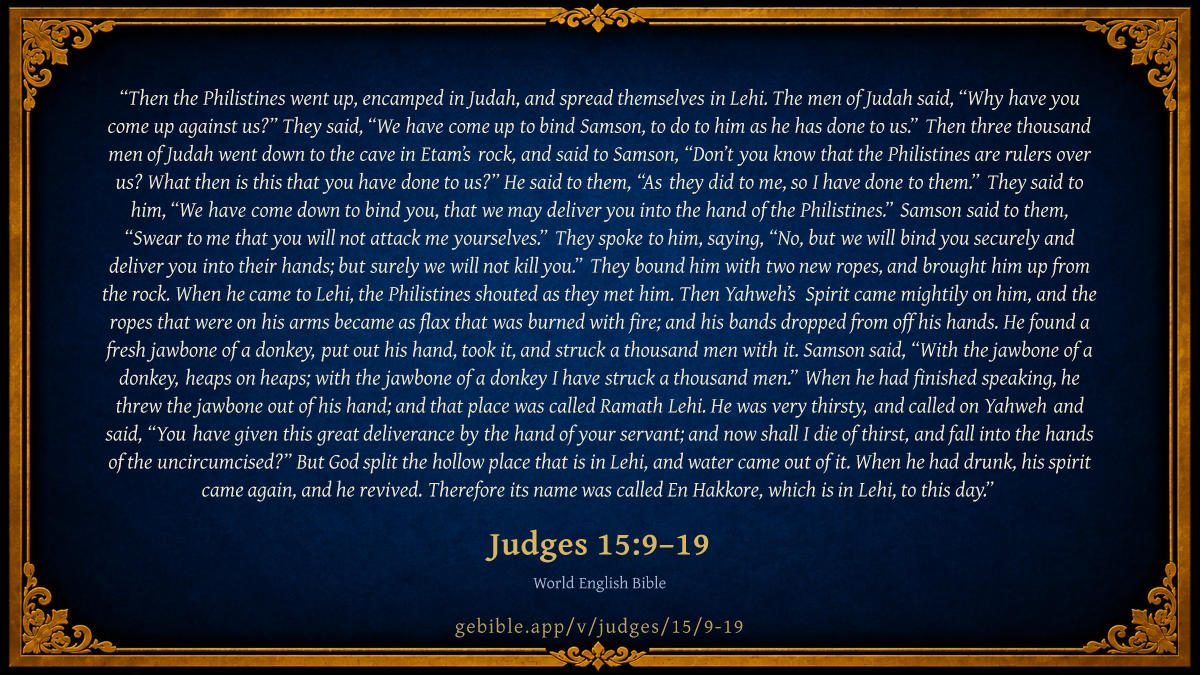
Then the Philistines went up, encamped in Judah, and spread themselves in Lehi.
The men of Judah said, “Why have you come up against us?” They said, “We have come up to bind Samson, to do to him as he has done to us.”
Then three thousand men of Judah went down to the cave in Etam’s rock, and said to Samson, “Don’t you know that the Philistines are rulers over us? What then is this that you have done to us?” He said to them, “As they did to me, so I have done to them.”
They said to him, “We have come down to bind you, that we may deliver you into the hand of the Philistines.” Samson said to them, “Swear to me that you will not attack me yourselves.”
They spoke to him, saying, “No, but we will bind you securely and deliver you into their hands; but surely we will not kill you.” They bound him with two new ropes, and brought him up from the rock.
When he came to Lehi, the Philistines shouted as they met him. Then Yahweh’s Spirit came mightily on him, and the ropes that were on his arms became as flax that was burned with fire; and his bands dropped from off his hands. He found a fresh jawbone of a donkey, put out his hand, took it, and struck a thousand men with it. Samson said, “With the jawbone of a donkey, heaps on heaps; with the jawbone of a donkey I have struck a thousand men.” When he had finished speaking, he threw the jawbone out of his hand; and that place was called Ramath Lehi.
He was very thirsty, and called on Yahweh and said, “You have given this great deliverance by the hand of your servant; and now shall I die of thirst, and fall into the hands of the uncircumcised?”
But God split the hollow place that is in Lehi, and water came out of it. When he had drunk, his spirit came again, and he revived. Therefore its name was called En Hakkore, which is in Lehi, to this day.
Geneva Bible translators 1599 · Public Domain On vv9, 10, 11, 13, 15, 17, 18, 19 Or, camped.
Or, camped.
Geneva Bible (1599) marginal notes — public domain.
John Trapp 1656 · Public Domain On vv9–19 Jdg 15:9 Then the Philistines went up, and pitched…
Jdg 15:9 Then the Philistines went up, and pitched in Judah, and spread themselves in Lehi.
Ver. 9. Spread themselves in Lehi.] Which showeth that they were a great army that came to fetch their bane. "Associate yourselves, ye people, and ye shall be broken in pieces." {Isa 8:9}
John Trapp, A Commentary or Exposition upon All the Books of the Old and New Testament (1647–1656) — public domain. Text from a community e-Sword module.
Matthew Poole 1685 · Public Domain On vv9, 11, 12, 13, 14, 15, 16, 17, 18, 19 The rock Etam was
The rock Etam was
in Judah: see 1Ch 4:32; 2Ch 11:5,6.
Read full note →
Spread themselves, as coming in great numbers with a powerful host.
Lehi; a place so called by anticipation, Jdg 15:17.
Matthew Poole's English Annotations on the Holy Bible (1683–1685) — public domain. Text from a community e-Sword/MySword module.
Matthew Henry 1710 · Public Domain On vv9, 18 Here is, I. Samson violently pursued by the Philistine.…
Here is, I. Samson violently pursued by the Philistine. They went up in a body, a more formidable force than they had together when Samson smote them hip and thigh; and they pitched in Judah, and spread themselves up and down the country, to find out Samson, who they heard had come this way, Jdg 15:9. When the men of Judah, who had tamely submitted to their yoke, pleaded that they had paid their tribute, and that none of their tribe had given them any offence, they freely own they designed nothing in this invasion but to seize Samson; they would fight neither against small nor great, but only that judge of Israel (Jdg 15:10), to do to him as he has done to us, that is, to smite his hip and thigh, as he did ours - an eye for an eye. Here was an army sent against one man, for indeed he was himself an army. Thus a whole band of men was sent to seize our Lord Jesus, that blessed Samson, though a tenth part would have served now that his hour had come, and ten times as many would have done nothing if he had not yielded.
II. Samson basely betrayed and delivered up by the men of Judah, Jdg 15:11. Of Judah were they? Degenerate branches of that valiant tribe! Utterly unworthy to carry in their standard the lion of the tribe of Judah. Perhaps they were disaffected to Samson because he was not of their tribe. Out of a foolish fondness for their forfeited precedency, they would rather be oppressed by Philistines than rescued by a Danite. Often has the church's deliverance been obstructed by such jealousies and pretended points of honour. Rather it was because they stood in awe of the Philistines, and were willing, at any rate, to get them out of their country. If their spirits had not been perfectly cowed and broken by their sins and troubles, and they had not been given up to a spirit of slumber, they would have taken this fair opportunity to shake off the Philistine's yoke. If they had had the least spark of ingenuousness and courage remaining in them, having so brave a man as Samson was to head them, they would now have made one bold struggle for the recovery of their liberty; but no marvel if those that had debased themselves to hell in the worship of their dung-hill gods (Isa 57:9) thus debased themselves to the dust, in submission to their insulting oppressors. Sin dispirits men, nay, it infatuates them, and hides from their eyes the things that belong to their peace. Probably Samson went into the border of that country to offer his service, supposing his brethren would have understood how that God by his hand would deliver them, as Moses did, Act 7:25. But they thrust him from them, and very disingenuously, 1. Blamed him for what he had done against the Philistines, as if he had done them a great injury. Such ungrateful returns have those often received that have done the best service imaginable to their country. Thus our Lord Jesus did many good works, and for these they were ready to stone him. 2. They begged of him that he would suffer them to bind him, and deliver him up to the Philistines. Cowardly unthankful wretches! Fond of their fetters and in love with servitude! Thus the Jews delivered up our Saviour, under pretence of a fear lest the Romans should come and take away their place and nation. With what a sordid servile spirit do they argue, Knowest thou not that the Philistines rule over us? And whose fault was that? They knew they had no right to rule over them, nor would they have been sold into their hands if they had not first sold themselves to work wickedness.
Read full note →
III. Samson tamely yielding to be bound by his countrymen, and delivered into the hands of his enraged enemies, Jdg 15:12, Jdg 15:13. Now easily could he have beaten them off, and kept the top of his rock against these 3000 men, and none of them all could, or durst, have laid hands on him; but he patiently submitted, 1. That he might give an example of great meekness, mixed with great strength and courage; as one that had rule over his own spirit, he knew how to yield as well as how to conquer. 2. That, by being delivered up to the Philistine, he might have an opportunity of making a slaughter among them. 3. That he might be a type of Christ, who, when he had shown what he could do, in striking those down that came to seize him, yielded to be bound and led as a lamb to the slaughter. Samson justified himself in what he had done against the Philistines: "As they did to me, so I did to them; it was a piece of necessary justice, and they ought not to retaliate it upon me, for they began." He covenants with the men of Judah that, if he put himself into their hands, they should not fall upon him themselves, because then he should be tempted to fall upon them, which he was very loth to do. This they promised him (Jdg 15:13), and then he surrendered. The men of Judah, being his betrayers, were in effect his murderers; they would not kill him themselves, but they did that which was worse, they delivered him into the hands of the uncircumcised Philistines, who they knew would do worse than kill him, would abuse and torment him to death. Perhaps they thought, as some think Judas did when he betrayed Christ, that he would by his great strength deliver himself out of their hands; but no thanks to them if he had delivered himself, and, if they thought he would do so, they might of themselves have thought this again, that he could and would deliver them too if they would adhere to him and make him their head. Justly is their misery prolonged who, to oblige their worst enemies, thus abuse their best friend. Never were men so infatuated except those who thus treated our blessed Saviour.
IV. Samson making his part good against the Philistines, even when he was delivered into their hands, fast pinioned with two new cords. The Philistines, when they had him among them, shouted against him (Jdg 15:14), so triumphing in their success, and insulting over him. If God had not tied their hands faster than the men of Judah had tied his, they would have shot at him (as their archers did at Saul) to dispatch him immediately, rather than have shouted at him, and given him time to help himself. But their security and joy were a presage of their ruin. When they shouted against him as a man run down, confident that all was their own, then the Spirit of the Lord came upon him, came mightily upon him, inspired him with more than ordinary strength and resolution. Thus fired, 1. He presently got clear of his bonds. The two new cords, upon the first struggle he gave, broke, and were melted (as the original word is) from off his hands, no doubt to the great amazement and terror of those that shouted against him, whose shouts were hereby turned into shrieks. Observe, When the Spirit of the Lord came upon him, his cords were loosed. Where the Spirit of the Lord is there is liberty, and those are free indeed who are thus freed. This typified the resurrection of Christ by the power of the Spirit of holiness. In it he loosed the bands of death, and its cords, the grave-clothes, fell from his hands without being loosed, as Lazarus's were, because it was impossible that the mighty Saviour should be holden of them; and thus he triumphed over the powers of darkness that shouted against him, as if they had him sure. 2. He made a great destruction among the Philistines, who all gathered about him to make sport with him, Jdg 15:15. See how poorly he was armed: he had no better weapon than the jaw-bone of an ass, and yet what execution he did with it! he never laid it out of his hand till he had with it laid 1000 Philistines dead upon the spot; and thus that promise was more than accomplished. One of you shall chase a thousand, Jos 23:10. A jaw-bone was an inconvenient thing to grasp, and, one would think, might easily be wrested out of his hand, and a few such blows as he gave with it might have crushed and broken it, and yet it held good to the last. Had it been the jaw-bone of a lion, especially that which he himself had slain, it might have helped to heighten his fancy and to make him think himself the more formidable; but to take the bone of that despicable animal was to do wonders by the foolish things of the world, that the excellency of the power might be of God and not of man. One of David's worthies slew 300 Philistines at once, but it was with a spear, Ch1 11:11. Another slew of them till his hand was weary and stuck to his sword, Sa2 23:10. But they all came short of Samson. What could be thought too hard, too much, for him to do, on whom the Spirit of the Lord came mightily! Through God we shall do valiantly. It was strange the men of Judah did not now come in to his aid: cowards can strike a falling enemy. But he was to be a type of him that trod the wine-press alone.
V. Samson celebrating his own victory, since the men of Judah would not do even that for him. He composed a short song, which he sang to himself, for the daughters of Israel did not meet him, as afterwards they did Saul, to sing, with more reason, Samson hath slain his thousands. The burden of this song was, With the jaw-bone of an ass, heaps upon heaps, have I slain a thousand men, Jdg 15:16. The same word in Hebrew (chamor) signifies both an ass and a heap, so that this is an elegant paronomasia, and represents the Philistines falling as tamely as asses. He also gave a name to the place, to perpetuate the Philistines' disgrace, Jdg 15:17. Ramath-lehi, the lifting up of the jaw-bone. Yet he did not vain-gloriously carry the bone about with him for a show, but threw it away when he had done with it. So little were relics valued then.
Matthew Henry's Commentary on the Whole Bible (1708–1710) — public domain (CC PDM 1.0). Text via the HelloAO Bible API.
John Gill 1763 · Public Domain On vv9–19 Then the Philistines went up,.... From Palestine, which lay…
Then the Philistines went up,.... From Palestine, which lay low on the shore of the Mediterranean sea:
and pitched in Judah; in the laud of Judea, which lay higher, particularly in the tribe of Judah, whither they came with an army, and encamped there:
Read full note →
and spread themselves in Lehi; their forces were so many, that they extended a considerable way, and particularly reached to Lehi, that is, which was afterwards so called; for it has its name by anticipation from the jaw bone, which it signifies, with which Samson slew many in this place, as after related.
John Gill's Exposition of the Whole Bible (1746–1763) — public domain (CC PDM 1.0). Text via the HelloAO Bible API.
John Wesley 1765 · Public Domain On vv11–19 Unto us - Thou hast by these actions punished…
Unto us - Thou hast by these actions punished not them only, but us, who are sure to smart for it.
John Wesley, Explanatory Notes Upon the Whole Bible (1754–1765) — public domain. Text via the GEBible commentary corpus.
Adam Clarke 1810 · Public Domain On vv10, 11, 12, 13, 14, 15, 17, 18, 19 Verse 10. To bind Samson are we come up]…
Verse 10. To bind Samson are we come up] It seems they did not wish to come to an open rupture with the Israelites, provided they would deliver up him who was the cause of their disasters.
Adam Clarke's Commentary on the Bible (1810–1826) — public domain. Text from a community e-Sword/MySword module.
Joseph Benson 1811 · Public Domain On vv11, 13, 14, 15, 16, 17, 19 Jdg 15:11-12. What hast thou done unto us? —…
Jdg 15:11-12. What hast thou done unto us? — Thou hast by these actions punished, not them only, but us, who are sure to smart for it. We are come down to bind thee — Why not rather to fight under thy banner? Because sin dispirits men, nay, infatuates them, and hides from their eyes the things that belong to their peace. That we may deliver thee to the Philistines — This shows how dastardly the tribe of Judah was grown, and how much they stood in fear of the Philistines, that they should so readily give up a person of such extraordinary strength and courage, and who was so capable of annoying their enemies. But they seem not to have considered him as a judge or deliverer appointed for them by God, but as a mere private man, who acted of his own will, and who had rashly stirred up the anger of the Philistines, with whom they were afraid to contend: and Samson, to make them easy, and that no damage might come upon them, consented that they should deliver him bound to the Philistines; knowing that his strength would be sufficient to break whatever cords they should bind him with. Swear unto me — Not that he feared them, or could not as easily have conquered them as he did the host of the Philistines: but because he would be free from all temptation of doing them harm, though it were in his own defence.
Joseph Benson's Commentary on the Old and New Testaments (1811–1818) — public domain. Text from a community e-Sword module.
Albert Barnes 1834 · Public Domain On vv9, 11, 14, 15, 16, 17, 19 Spread themselves - An expression used of the Philistine…
Spread themselves - An expression used of the Philistine mode of war 2Sa 5:18, 2Sa 5:22, alluding to the compact way in which they came up the wadys, and then distpersed. Lehi is so called by anticipation (see Jdg 15:17).
Albert Barnes' Notes on the Bible (1834–1885) — public domain. Text from a community e-Sword/MySword module.
Haydock's Catholic Bible Commentary 1859 · Public Domain On vv9, 12, 13, 14, 15, 16, 17, 18, 19 Spread. Hebrew, "encamped in Juda, and spread themselves in…
Spread. Hebrew, "encamped in Juda, and spread themselves in Lechi." (Haydock)
George Leo Haydock (1774–1849), Haydock's Catholic Family Bible and Commentary, 1859 edition — public domain. Excludes Psalms (Douay-Rheims chapter numbering differs from Protestant) and Deuterocanonical books (Catholic canon only).
Lange's Commentary on the Holy Scriptures 1864 · Public Domain On v9 The Philistines threaten war against Judah. The men of…
The Philistines threaten war against Judah. The men of Judah, to save themselves, seek to deliver up Samson, who allows himself to be bound, but tears his bonds when brought in sight of the Philistines, and slays a thousand of the enemy.
Jdg_15:9-20.
Read full note →
9Then the Philistines went up, and pitched in [encamped against] Judah, and spread themselves in Lehi. 10And the men of Judah said, Why are ye come up against us? And they answered, To bind [i. e., to capture] Samson are we come up, to do to him as he hath done to us. 11Then three thousand men of Judah went [down] to the top [cleft] of the rock Etam, and said to Samson, Knowest thou not that the Philistines are [omit: are] rulers [rule] over us? what is this that thou hast done unto us? And he said unto them, As they did unto me, so have I done unto them. 12And they said unto him, We are come down to bind thee, that we may deliver thee into the hand of the Philistines. And Samson said unto them, Swear unto me, that ye will not fall upon me yourselves. 13And they spake unto him, saying, No; but [for] we will bind thee last [omit: fast], and deliver thee into their hand: but surely [omit: surely] we will not kill thee. And they bound him with 14two new cords, and brought him up from the rock. And when he came unto Lehi, the Philistines shouted against10 him: and the Spirit of the Lord [Jehovah] came mightily [suddenly] upon him, and the cords that were upon his arms became as flax that was burnt with fire, and his bands loosed [melted] from off his hands. 15And he found a new [fresh] jaw-bone of an ass, and put forth his hand, and took it, and slew a thousand men therewith. 16And Samson said,11
With the jaw-bone of an ass
A mass, yea masses:
With the jaw-bone of an ass
I slew a thousand men.
17And it came to pass when he had made an end of speaking, that he cast away the jaw-bone out of his hand, and [people] called that place Ramath-lehi [Hill of the jaw-bone]. 18And he was sore athirst, and called on the Lord [Jehovah], and said, Thou hast given this great deliverance into [by] the hand of thy servant: and now 19shall I die for thirst, and fall into the hand of the uncircumcised? But [And] God clave an hollow place [lit.the mortar] that was in the jaw [in Lehi],12 and there came water thereout; and when he had drunk, [and he drank, and] his spirit came again, and he revived. Wherefore he [men] called the name thereof Enhakkore 20[Well of him that called], which is in Lehi unto this day. And he judged Israel in the days of the Philistines twenty years.
TEXTUAL AND GRAMMATICAL
[1 Jdg_15:14.—לִקְרָאתוֹ: “towards,” rather than “against.” The idea is that when the Philistines saw Samson coming, they set up shouts of exultation which “met him,” so to speak, as he approached.—Tr.]
EXEGETICAL AND DOCTRINAL
Jdg_15:9-10. And the Philistines went up and encamped against Judah. Samson had foreseen that the Philistines would now seek vengeance on a larger scale, and had therefore provided himself with a place of security against both friend and foe. This time also, however, the enemy proceed not directly against him, but take the field against Israel. As on a former occasion, they seek satisfaction from those who were really innocent, and who would gladly remain at peace. They announce that they have come to bind Samson, i. e., to make him powerless to injure them. It is no sign of forbearance that they do not say, “We will kill him;” on the contrary, it appears from Judges 16 that they entertained still more cruel designs. It was easy for Judah to perceive how cowardly was the hatred they cherished against Samson, and thence to infer what heroic deeds of conquest the victor might yet achieve; but the great tribe, once so powerful in action, lay helpless in the deepest decay. It would not be possible to portray the slavish disposition of a people that has departed from God more strikingly, than is here done by the conduct of Judah.
Jdg_15:11. Then three thousand men of Judah went down to the cleft of the rock Etam. Judah never enjoyed such an opportunity to free itself from the yoke of the Philistines. It had a leader of incomparable strength and energy. The enemy had been smitten, and was apprehensive of further defeats. If it had risen now, and, ranged under Samson, undertaken a war of liberation in God’s name, where was the station that the Philistines could have continued to hold? The heroic deeds of Joshua and Caleb would have been reenacted. The power of the Philistines would have been broken, perhaps forever. But what did Judah? Terrified by the threatening advance of the Philistines, coming to seek Samson, it has not even courage to say, “Go, and bind him yourselves.” Three thousand armed men are quickly got together, not to avail themselves of Samson’s leadership against the enemy, but—alas! for the cowards—to act as the enemy’s tools, pledged to deliver the nation’s hero into their hands. The Philistines, with malicious cunning, probably demanded this as the price of peace. For either Samson refuses to follow the men of Judah, and smites them, which would be gain to the Philistines, or he is taken and brought by them, in which case they will have heaped disgrace on both, and filled them with wrath toward each other. And in fact the number of the men who proceed to Etam, shows that they feel obliged, if need be, to use violence.
And they said to Samson, Knowest thou not, etc. No lost battle presents so sad a picture as do these three thousand armed men, with their complaint against Samson that he has provoked the Philistines, and their question, Knowest thou not that they rule over us? It was so easy to say to him: Up, Samson! they come to bind thee; come thou to free us from their bonds. But they cannot speak thus. Their heart is lost in idolatry. No one can raise himself to freedom, who has not first repented—for penitence is courage against self, and confession before others—and among the three thousand there are no three hundred who have not bowed to Baal. Samson’s negotiation with them although comprised in a few sentences, is worthy of admiration. After all, he had really fought only for them, and had attacked the oppressor of the nation. But he does not upbraid them with this.13 Since they have not comprehended the fact that his own cause was the cause of the nation, he lays no stress on this, but shows them his personal right to engage in the war he had waged. The justification he sets up was such that they could not in honor turn against him. For he says:—
As they did unto me, so have I done unto them. Retaliation was a primitive oriental right, still sanctioned by the Koran.14 To this right the Philistines had appealed in Jdg_15:10 : “We will do to Samson as he did to us.” The men of Judah do not undertake to decide upon the right of either party. They desire nothing but peace—with the Philistines. They would submit to them at any price. Any admission of Samson’s right would have obligated them to stand by him. The fact is they came to serve not as judges but as tools of the Philistines. Whosoever is weak enough to accept such a mission, will not be brought to thought and reason by any exposition of right. Idolatry is ever blindness. Reason had evanished from the tribe. How else could it surrender such a man, or hope for peace from the Philistines after the here whom they feared was in their possession? How can such slaves—in recent times also such conduct as theirs has been called peace-loving—expect to remain at peace?
Jdg_15:12-13. We are come to bind thee, said the three thousand to the one courageous man. And never does Samson show himself greater than when he voluntarily allows himself to be bound. Against his countrymen he is powerless. With the blood of Israel he must not and will not stain himself. He makes but one condition, and that the least possible. No Judæan hands must meditate his death. That condition alone would have sufficed to inform the men of Judah, had they been able to comprehend such heroism at all, that he consults only their feelings, because they are Israelites, but does not fear the Philistines.
Jdg_15:14. When he came unto Lehi, the shouts of the Philistines met him. What a spectacle! That cowardice can brazen hearts and faces until all sense of shame is lost, is shown by the memorable scene here depicted. Judah is not ashamed to drag its hero forward, bound with strong cords. It does not blush when the Philistines shout aloud at the spectacle. But this cowardly jubilation was soon to be turned into groans and flight. As the hero comes in sight of the enemy and hears their outcries, the Spirit of God comes upon him. His heart boils with indignation over the ignominy of his people. His strength kindles for resistless deeds. His cords fall off like tow seized by the fire. He is free, and his freedom is victory.
Jdg_15:15-16. And he saw a fresh jaw-bone of an ass. The enemy is before him: therefore, forward! to battle! Any weapon is welcome. The jaw-bone of a recently fallen ass is at hand, not yet dried up, and therefore less easily broken.15 Before the enemy can think, perhaps before their shouts over the prisoner have ceased, he is free, armed, and dealing out deadly blows. The panic is as great as the triumph had been. There was nothing but flight and death for the wretched foe. There ensued a slaughter and victory so extraordinary, that Samson himself, in poetic ecstasy, cries out:—
With the jaw-bone of an ass
I slew two armies:
With the jaw-bone of an ass
I took vengeance on a thousand.
For in the clause בִּלְחי הַחֲמוֹר חֲמוֹר חֲמֹרָתָיִם the paronomasia is to be noted between חַמוֹר, an ass, and חֲמֹר, a heap, which latter is here poetically used of an “army.”
German tradition relates a similar deed of Walter of Aquitania. His enemies pursue him in the forest, while he and Hildegunde roast and eat a swine’s back. He seizes the swine’s bone, and throws it against the enemy with such violence that the latter loses his eye (Wilkinasage, translated by Hagen, i. 289, ch. lxxxvii). In the Latin poem Waltarius, the hero tears out the shoulder-blade of a calf, and with it slays the robbers (Grimm and Schmeller, Lateinsche Gedichte des Mittelalters, p. 109 f.). In both versions the fiction is unreasonable and tasteless, whereas the history of Samson is full of dramatic power and spirit.—The mystical sect of the Nasairians, in Syria, are said to venerate the jaw-bone of an ass, because an ass devoured the plant on which the original documents of their religion had been written (cf. Ritter, xvii. 97, 6).
Jdg_15:17. The name of the place was called Ramath-lechi (Hill of the Jaw-bone). To the height upon which Samson threw the jaw-bone, the tradition of an admiring people gave and preserved a name commemorative of that circumstance. The narrative evinces artistic delicacy in that it relates that Samson uttered his poetic words while he was still victoriously swinging the unusual weapon in his hand. The humiliation of the Philistines, formerly smitten by means of foxes, and now with the jaw-bone of an ass, was too deep to allow the historical recollection of it to perish. To seek another explanation of the name is quite unnecessary. It is undoubtedly true that mountainous peaks sometimes derive names from their forms, as, for instance, “Ass’-ears” (on the coast of Aden, cf. Ritter, xii. 675), or “Tooth” (1Sa_14:4), or “Throat,” “Nose,” and “Horn” (cf. my Thür. Ortsnamen, ii. p. 47, n. 304); but the possibility of an historical explanation is not thereby diminished: for although peculiar names have sometimes given rise to historical legends, the above instances show that quite as often this is not the case. Lehi (properly, Lechi), as the name of a locality, does not elsewhere occur;16 and a criticism which would make it the source of a history in which it has but an incidental significance, and which forms an organic part of the history of Samson as a whole, has lost all claim to be called criticism.
Jdg_15:18. And he was sore athirst, and called unto Jehovah. The exertion of the day was too great. The burning sun and the unusual excitement also contributed their part to exhaust the powerful man. But where was there any refreshment? He was alone, as always. The cowardly men of Judah had taken themselves off, in order not to be held responsible by the Philistines on the ground of participation in the conflict. Against the enemy he had that mediate divine help which came to him through his Nazaritic consecration; but this was no protection against thirst. He turns, therefore, to God in prayer for direct deliverance.
Thou hast given this great salvation by the hand of thy servant. These words illustrate and confirm the view we have thus far sought to develop of Samson’s spiritual life. In his hours of lofty elevation of soul, when the Spirit of God impels him to great deeds in behalf of national freedom, he is fully conscious of the work to which he is called. Although he stands alone, the ends he pursues are not personal. And though his people sink so deeply into cowardice and weakness, as to deny him, yet all his powers are directed against the enemies of this people. Although he himself has scarcely escaped from their hands, and has no one to stand by his side, he nevertheless considers himself their leader and champion, in duty bound to vindicate the honor and glory of Israel against the Philistines. Properly speaking, no one was delivered in the conflict on Ramath-Lehi but himself; but he thanks God for “the great salvation given by the hand of thy servant.” He finds this salvation in the humiliation experienced by the Philistines, and in the fact that he, as sole representative of the true Israel, has not been allowed to be put to shame. For with his fall, the last bulwark had been leveled. The shouts of the Philistines over his bonds were shouts of triumph over the faith of Israel and over Israel’s God. Hence he can pray: “Thou hast just performed a great deed through me, by which the honor of the national name of the children of Israel has been rescued and exalted, let me not now die of thirst, and in that way fall into the hands of the uncircumcised.” All benefit of the victory would be lost, if Samson were now to perish. The triumph of the cowardly enemy would be greater than ever, should they next see him as a helpless corpse. He speaks of them as “the un circumcised” for the very purpose of expressing his consciousness that with him to fight, to conquer, and to fall, are not personal matters, but involve principles. He is none other than the Nazir of God, i. e., the consecrated warrior for God and his people Israel against the enemies of the divine covenant—the uncircumcised. His petition springs from the profound emotion into which the successive experiences of this day have plunged him. The greater his ardor in battle and joy in victory, the more painful is now the thought of losing the fruits of the advantage gained, for want of a little water. Here, too, what instruction we find! “What is man that thou art mindful of him.” The mighty warrior, before whom thousands tremble, cannot conquer thirst, and must perish unless a fountain opens itself.
Jdg_15:19. And God clave the mortar that was in Lehi. At the place where Samson was, God clave a mortar-like cavity in the rock, from which water sprang, of which Samson drank, and refreshed himself. This spring was ever after named “Well of him that called;” for it was his salvation and second deliverance. The words at the close of our verse, “which (well) is in Lehi unto this day,” to which those at the beginning of the verse correspond, “God clave the mortar that was in Lehi,” put it beyond all doubt that the reference is to a mortar-like well-opening in the place Lehi, and that (as Keil very well remarked) the old, frequently reproduced exposition (approved also by Bertheau), which bids us think of “the socket of a tooth in the jaw-bone,” is entirely erroneous. For from Jdg_15:17, where Samson throws the jaw-bone away, nothing more is said about it, and the name Lehi refers only to the place; just as in Jdg_15:9 the meaning is, not that the Philistines spread themselves about a real jaw-bone, but about the place of this name. The well, it is said, “is in Lehi unto this day.” The place derived its name, Ramath-lehi, from the battle of the jawbone; but the place was not the jaw-bone, which could not exist “unto this day.” The calling forth of the well was a second deliverance, distinct from the first, which was won in battle. It occurred at Lehi, where Samson had conquered, in order that he might there also experience the vanity of all strength without God. The old opinion arose from the fact that, except in Jdg_15:9, the ancient versions (the Sept.) everywhere translated the term Lehi, whereas it is a proper noun in Jdg_15:19 as much as in Jdg_15:9, as Bochart should have known precisely from the article, for it is used in all three instances, Jdg_15:9 included. It is indeed true that later medical writers call the sockets of the double teeth ὅλμοι, mortars; but, granted that a similar usus loquendi prevailed in the Bible,—of which we have no other evidence than this passage can give,—the use of the article would be surprising, because elsewhere (as in Zep_1:11) it points (in connection with the noun מַכְתֵּשׁ) to a certain definite, mortar like17 locality. Mention might also be made of the cities in Phrygia and Cilicia that bore the name Holmos. The true view was already held by Josephus, the Chaldee Targum, and, with peculiar clearness, by R. Levi ben Gerson. Perhaps it would receive further illustration from the locality which we may probably venture to fix upon for the event. For the question where the event took place is not unimportant. It must be assumed (cf. Jdg_15:13-14) that Etam and Lehi were not far distant from each other. Moreover, it is evident from the connection of the entire narrative, that the Philistines must have threatened especially that part of Judah which lay contiguous to the region whence Samson made his attacks. For this reason alone, the opinion of Van de Velde (adopted by Keil), who looks for it on the road from Tell Kewelfeh to Beer-sheba, appears improbable. On the other hand, the very ancient tradition which locates the Well of Lehi in the vicinity of Eleutheropolis, appears to me, notwithstanding all opposition, to be entirely probable. It was by a series of interesting observations and arguments that Robinson, Rödiger, and others, established the fact that Eleutheropolis and the modern Beit Jibrîn, the Betogabra of the Tabula Peutingeriana, are the same place (cf. Ritter, xvi. 139); but the hints of the Midrash might have led to the same conclusion, and even now afford additional instruction. To the peculiarities of the region belong the numerous cave-formations, which, by their more or less perfect artificial finish, prove themselves to have been the abodes of men in ancient times. חוֹר (chor) is a cavern, and the term חֹרִי (Chorite, E. V. Horite) signifies troglodytes, people who dwell in caverns. Now, wherever the Chorite is spoken of, the Midrash explains by substituting Eleutheropolis.18 It has not hitherto been discovered what circumstance induced the Romans to give this beautiful name to the place. But since the tradition of an heroic exploit (תְּשׁוּעָה גְדוֹלָה) was connected with the place, the Jewish inhabitants derived the name בֵּית חוֹרִי or עִיר חוֹרִי, which it may have borne, not from חוֹר, a cavern, but from חֹר, a freeman. “Bene Chorin,” is the title assumed by those whom heroic feats have made free.19 The same idea leads the Midrash when it derives Eleutheropolis from chiruth, freedom. The name Eleutheropolis was, in fact, only a translation of the ancient name, whose meaning the inhabitants had changed from “City of the Troglodyte” to “City of the Free,” and is undeniably found in the Mishna and Talmud under the forms בית חורין and בית חרורין.20 If the inhabitants expound the present name Beit Jibrîn as meaning “House of Gabriel,” every one capable of forming a judgment in the ease perceives at once that this became possible only with the prevalence of Islam in those regions. But as the name itself is older than Islam, and is apparently found in the Midrash (as בית גוברין, Beth Goberin), the conjecture suggests itself that it is related to גִּבּוֹר, hero, גְּבוּרָה, heroism; which, if true, connects it once more with Samson’s achievement. The “House of Heroism” answers entirely to the “House of Freedom.” And it is at least not impossible that a change of etymological derivation, like that in the case of Chorite, occurred here also, namely, from גּוֹב ,גּוּבָא, a hole, to גִּבּוֹר, a hero. The expression חיקן גבות, in the sense of jaw-bone, occurs also.
The change of the “Troglodytes’ City” into the “City of Heroes,” demonstrates the existence of an old tradition, which, so far as the names (Freedom, Heroism) can explain anything, spoke of the hero who there became free. Springs are still found near the city. One in particular, near the Church of St. Anne, flows from the hard rock, is “fifty-two feet deep, and apparently ancient” (Rob. ii. 26). It is to be noted that Josephus makes Samson’s fountain to spring out of a rock, and declares that its name was still known in his day. The Targum likewise says that God did split the rock (כֵּיפָא), and translates: “They called it ‘the well that arose at the prayer of Samson,’ and it exists in Lehi unto this day.”
No other well than this [one near the church of St. Anne], can be intended by Jerome, when on passing Socoh, he visits the Fountain of Samson (Ep. ad Eust., 106, ed. Benedict. 86). The tradition continued steadfast until the time of Antoninus Martyr, who says (circa 600 a. d.): “We came into the city called Eliotropolis, where Samson, that most valiant man, slew a thousand men with a jaw-bone, out of which jaw-bone, at his prayer, water sprang forth, which fountain irrigates that place unto this day: and we were at the place where it rises.” Traditions reaching so far beyond the age of Islam, are always worthy of attention, especially when they suit so well in their localities. For the distance from Eleutheropolis combines very well with the theatre of Samson’s exploits hitherto, and confirms our assumption that Etam lay in the neighborhood of the present Deir Dubbân. When the Jews grounded the name “City of Freedom” on this tradition, they followed considerations not only beautiful, but also both ethically and historically correct.
It is unquestionably a remarkable feature in the narrative of the occurrence, that, while Samson prays to “Jehovah,” the answer is ascribed to “Elohim:” “Elohim clave the mortar.” Keil’s explanation, that it is thereby intimated that God worked the miracle as Lord of nature, does not seem sufficient. For is not “Jehovah” the Creator of Nature? The Targum uses that name here. According to our view of the relations of the names Jehovah and Elohim in our Book, the latter appears not only when heathen gods are spoken of, but also when others than believing Israelites speak of God. Elohim is here used in order to intimate that non-Israelites also ascribed the wonderful fountain in Lehi to divine intervention. Not only Israel tells of it, how Jehovah clave it,’ but all admit that it is a work of Elohim.
Jdg_15:20. And Samson judged Israel, in the days of the Philistines, twenty years. In the introduction to the history of Samson (Jdg_13:1), it is stated that the Philistines lorded it over Israel forty years. In Jdg_13:5 it is said: “he shall begin to deliver Israel” Their entire downfall he did not accomplish. The blame of this rested not only with the people, of whom Judges 13 does not say that they had repented, but, as Judges 16 shows, also with Samson. But the twenty years during which he wrought are not filled out by the occurrences related. These only indicate what feats and dangers were necessary to qualify Samson for government in Israel. And it may well be supposed that after this the Philistines scarcely undertook to confront him. Doubtless, the tribe of Judah also, must after this last exploit have acknowledged his divine strength, and yielded him their confidence. He himself, in thirst and faintness, had learned that God alone gives strength and help; and this may have served for the moral elevation of the people also. Israel dwelt in security and peace for twenty years, through the consecration and deeds of Samson. For this reason he stood among them as Judge. It was only the want of courage on Israel’s part—due to its imperfect faith—and the excess of it on Samson’s part, that plunged both alike into new distress and suffering.
HOMILETICAL AND PRACTICAL
[Bp. Hall: The Philistines that had before ploughed with Samson’s heifer, in the case of the riddle, are now ploughing a worse furrow with a heifer more his own. I am ashamed to hear these cowardly Jews say, Knowest thou not, etc.—Scott: Heartless professors of religion, who value the friendship and fear the frown of the world, and who are the slaves of sin and Satan, censure, hate, and betray those who call them to liberty in the service of God. To save themselves, in times of persecution, they often apostatize and turn betrayers and accusers of the brethren.—Bp. Hall: Now these Jews, that might have let themselves loose from their own bondage, are binding their deliverer.—Henry: Thus the Jews delivered up our Saviour, under pretense of a fear lest the Romans should come, and take away their place and nation.—Wordsworth: This conduct of the men of Judah, saying that the Philistines are their rulers, and delivering Samson to them, may be compared to that of the Jews, saying, “We have no king but Cæsar” (Joh_19:15), and delivering up Christ to the Romans.
Wordsworth (on Samson’s victory): A greater miracle was wrought “in the time of wheat-harvest” (cf. Jdg_15:1), namely, at the first [Christian] Pentecost, when three thousand were converted by the preaching of Peter and of the other Apostles, filled with the Spirit of God.—Bp. Hall: This victory was not in the weapon, was not in the arm; it was in the Spirit of God, which moved the weapon in the arm. O God! if the means be weak, Thou art strong!
Henry (on Samson’s prayer): Past experiences of God’s power and goodness, are excellent pleas in prayer for further mercy. “Lest the uncircumcised triumph, and so it redound to God’s dishonor.” The best pleas are those taken from God’s glory.—Kitto: Not many would have had such strong persuasion of the Lord’s providential care as would lead them to cry to Him for water to supply their personal wants in the like exigency.
Henry (on En-hakkore): Many a spring of comfort God opens to his people which may fitly be called by this name: it is the “well of him that cried.”—Tr.]
Footnotes:
[10][Jdg_15:14.—לִקְרָאתוֹ: “towards,” rather than “against.” The idea is that when the Philistines saw Samson coming, they set up shouts of exultation which “met him,” so to speak, as he approached.—Tr.]
[11] [Jdg_15:16.—We place the amended rendering of this poetic utterance in the text, and for convenience’ sake subjoin here that of the E. V.:—
With the jaw-bone of an ass,
Heaps upon heaps;
With the jaw of an ass
Have I slain a thousand men.
The unusual form חֹמֶר = חְמוֹר (found elsewhere, if at all, only in 1Sa_16:20), is manifestly chosen for the sake of a pun. It means a “heap;” but in order to reproduce the paronomasia as nearly as possible, we have substituted the word “mass,” as suggested by Dr. Wordsworth, in loc. According to Keil, the expression, “a heap, two heaps,” intimates that the victory was accomplished, not in one combat, but in several. But as the magnitude of the victory is evidently celebrated, rather than the process of its accomplishment, the dual is better regarded as designed to amplify and heighten the idea of the preceding singular: “a heap—yes, a pair of heaps!”—Tr.]
[12][Jdg_15:19.—בַּלֶּחי. The article occasions no difficulty, as it is frequently used with proper nouns, especially with names of places, rivers, etc.; see Ges. Gram. 109, 3, and especially Ewald, 277 c. Keil very properly observes, that if a tooth-socket in the ass’s jaw-bone were intended, the expression would naturally be מַכתֵּשׁ הַלֶּחִי or מַכְתֵּשׁ בַּלֶּחִי, rather than מַכְתֵּשׁ אַשֶׁר בַּלֶּהִי. Wordsworth, speaking of the opinion that God clave the rock, objects “that the words are, ‘God clave the mactesh,’ which seems much more applicable to the mortar of the jaw than to a place in the rock.” As if an ass had but one tooth to a jaw-bone! Bush is probably not far wrong when he suggests that “a fondness for multiplying miracles,” may have had some influence over the renderings of “several of the ancient versions” at this place.—Tr.]
[13] Milton rightly makes Samson say:—
“I, on th’ other side,
Used no ambition to commend my deeds.”
[14]Sura, 5, 53, which refers to Exo_21:24, where, however, the law intends to limit retaliation by determining its measure. Compare the narrative in Diez, Denkwürdigkeiten Asiens, ii. 179.
[15]The following translation of Jdg_15:15-17, from a German book published in 1705, at Halle, may serve as a specimen of the exegesis which sometimes passed current: “Samson found a troop of lively soldiers, stretched forth his hand and commanded them, and led them against the Philistines..… And when he had thus spoken, he dismissed the troops.” Against such insipidity protests arose at that time from all sides (cf. Starke, Not. Select., p. 127), from Gebhardi (De Maxilla Simsonis, 1707) in Greifswald, Sidelmann (De Maxilla, etc., 1706) in Copenhagen, and in a little-known, but thorough refutation by Heine, of Berlin (Dissert. Sacræ, p. 245).
[16]In 2Sa_23:11, where some are disposed to find it in the form לַחַיָּה [by reading לֶֽחְיַה, i. e., לְחִי with ה local, cf. Thenius, in loc., and Fürst, Lex. s. vv. חַיָה and לְחִי], the ל is manifestly the prefix preposition, as appears from Jdg_15:13. The Targum, it is true, distinguished between the two forms, and rendered the first by לְחִייַת, the term which it regularly employs to express עָר מוֹאָב; but Gesenius and others before him made a mistake when they took לְחִייַת as the proper name of a locality. It was only a general term, pagus, village, which was translated into עָר (עִיר).
[17]Including, doubtless, a comparison with the hard, rocky nature of a mortar.
[18]Beresn. Rabba, § 42, p. 37 b. The right reading has been preserved by Aruch, sub voce. Our editions of the Midrash read metropolis, which only uncritical editors could have overlooked, since the explanation which follows indicates the true reading.
[19]Cf. Buxtorff, Lex., p. 836. Israel calls itself by this name in the beautiful hymn Pesach haggadhah, with reference to the time when Messiah shall have made it free. It is true, at least, that He alone makes free.
[20]On the consentaneous position of the place, cf. Zunz, in Benj. of Tudela, ii. 438, note.
Lange's Commentary on the Holy Scriptures (Critical, Doctrinal, and Homiletical), ed. John Peter Lange, English translation edited by Philip Schaff (1864–1880) — public domain. Text from a community e-Sword module.
Robert Jamieson, A. R. Fausset & David Brown 1871 · Public Domain On vv9, 16, 19 HE IS BOUND BY THE MEN OF JUDAH, AND…
HE IS BOUND BY THE MEN OF JUDAH, AND DELIVERED TO THE PHILISTINES. (Jdg 15:9-13)
Then the Philistines went up--to the high land of Judah.
Read full note →
and spread themselves in Lehi--now El-Lekieh, abounding with limestone cliffs; the sides of which are perforated with caves. The object of the Philistines in this expedition was to apprehend Samson, in revenge for the great slaughter he had committed on their people. With a view of freeing his own countrymen from all danger from the infuriated Philistines, he allowed himself to be bound and surrendered a fettered prisoner into their power. Exulting with joy at the near prospect of riddance from so formidable an enemy, they went to meet him. But he exerted his superhuman strength, and finding a new (or moist) jawbone of an ass, he laid hold of it, and with no other weapon, slew a thousand men at a place which he called Ramath-lehi--that is, "the hill of the jawbone."
Jamieson, Fausset & Brown — Commentary Critical and Explanatory on the Whole Bible (1871) — public domain (CC PDM 1.0). Text via the HelloAO Bible API.
Daniel D. Whedon 1874 · Public Domain On vv9–19 SAMSON’S EXPLOIT WITH THE JAWBONE OF AN ASS, Jdg_15:9-20.
SAMSON’S EXPLOIT WITH THE JAWBONE OF AN ASS, Jdg_15:9-20.
9. Philistines went up — At least a thousand strong. Jdg_15:15. The territory of Judah lies higher than the Philistine plain; hence the Philistines went up.
Read full note →
Spread themselves — Scattered about in small companies to hunt for Samson.
Lehi — This word means a jawbone; and Gesenius thinks might have been so called from a chain of steep, craggy rocks, which resembled a jawbone, just as some single rocks are for a like reason called teeth. 1Sa_7:12. The place, however, may have derived its name from Samson’s exploit. See Jdg_15:17.
Daniel D. Whedon (gen. ed.), Commentary on the Old and New Testaments (1874–1909) — public domain. Text from a community e-Sword module.
The Cambridge Bible for Schools and Colleges 1878 · Public Domain On vv9, 14, 15, 16, 17, 18, 19 9. spread themselves in Lehi] Better, made a raid…
9. spread themselves in Lehi] Better, made a raid against Lehi; 2Sa_5:18; 2Sa_5:22. The situation of Lehi is unknown; it must have been nearer to the Philistines than Etam, and in the neighbourhood of the other places already mentioned. The name = jawbone (LXX Jdg_15:14 Siagôn) was no doubt suggested by the formation of a prominent rock; cf. Ass’s Jaw (Ὄνου γνάθος), the name of a peninsula W. of Cape Malea in the Peloponnese (Strabo, p. 363), and the Arabic place-name Camel’s Jaw (laḥy gamal, quot. by Wellhausen).
10f. The Philistines have no quarrel with any one but Samson, and the Judaeans exhibit no resentment against their alien rulers. This shews that Samson’s attacks upon the Philistines were of a purely local and private nature, and that the Israelites in this part of the country had not yet acquired any sense of national feeling or of a common cause.
Read full note →
9–20. Local traditions
Provoked by Samson’s violence, the Philistines made a raid upon Lehi in Judah for the purpose of capturing their enemy. The name of the place was suggestive, and tradition attached to it the story of S.’s feat with the ‘fresh jawbone (lìḥî) of an ass.’ Popular etymology explained Ramath-lehi, ‘the height of Lehi’ (from rûm), as the place where S. ‘threw away’ (râmâh) the jawbone; a hollow basin in the hill side, which held the water of the ‘Partridge Spring’ (‘ên haḳḳôrç’), became the spring which God granted when S. ‘called’ (ḳârâ’) for help in his exhaustion. It is noteworthy that the exploit of Shammah, one of David’s heroes, also took place at Lehi, 2Sa_23:11 (reading unto Lehi for into a troop); cf. also the story of Shamgar, Jdg_3:31.
The Cambridge Bible for Schools and Colleges (gen. ed. J. J. S. Perowne; Cambridge University Press, 1878–1918) — public domain. Text from a community e-Sword module.
Ellicott's Commentary for English Readers 1878 · Public Domain On vv9–19 (9) Then the Philistines went up.—They “went up” in…
(9) Then the Philistines went up.—They “went up” in hostile array against the hill-country of Judea to take vengeance for the dreadful injury which Samson had inflicted on them.
Spread themselves in Lehi.—The use of the name before the incident from which a place is said to have received the name is found also in the case of Hormah (Num_14:45; Num_21:3). It was called in full Ramath-Lehi. (See on Jdg_15:17.) The character of the narrative suggests the question whether the name may not have existed previously, and the play on words may not have been adapted by Samson to the incident. For the name of the place is Lechi (לֶ֫חִי ), and “a jawbone” is Lehi (להי). Shen, “tooth,” is the name of an isolated sharp rock (1Sa_14:4), and therefore “jaw” would not be an unnatural name for a range of such rocks. Josephus, however, says that before Samson’s exploit the place “had no name.” It may be again alluded to in 2Sa_23:11, where the words rendered “into a troop” may mean “to Lehi,” as it is understood by Josephus (Antt. vii. 12, § 4) and some MSS. of the LXX.
A Bible Commentary for English Readers, edited by Charles John Ellicott (1878–1897) — public domain. Text from a community e-Sword module.
The Pulpit Commentary 1880 · Public Domain On vv9, 11, 12, 14, 15, 16, 17, 18, 19 Went up, i.e. from their own country in the…
Went up, i.e. from their own country in the Shephelah to the hill country of Judah. As Samson had avenged his wrongs on the whole Philistine people, so they now came up to Judah to take vengeance for Samson"s injuries. In Lehi, or, rather, hal-Lehi, the Lehi, the place afterwards so called, as related in vers. 17 and 20. (see Jud_1:7:25, note) Lehi has been identified by some with Tell-el-Lekhiyeh, four miles above Beer-sheba; and by others with Beit-Likiyeh, in the Wady Suleiman, two miles below the upper Beth-heron, and so within easy distance of Timnath and other places mentioned in the history of Samson. But no certainty can at present be arrived at.
Vers. 9-20. Man without God, and man with God.
Read full note →
These 3000 men of Judah of whom we read in ver. 11 present us with a pitiable view of man"s spirit crushed by misfortune, when it is not upheld by trust in Almighty God. These men of Judah were among those who did evil in the sight of the Lord, and were In consequence delivered into the hand of the Philistines. But this chastisement, instead of leading them to repent of their sin and folly in forsaking God and putting their trust in false gods, only led to a kind of sullen despair. They said in their hearts," There is no hope: no; for I have loved strangers, and after them will I go". (Jer_2:25) Utterly unmindful of their high privileges and vocation as the people of God, they acquiesce in their own degradation: "The Philistines are rulers over us," They had rather not be disturbed. Let us alone, they said. Let us be as we are, fallen, sunken, degraded. All good within them was blunted and quenched. Self-respect was gone; love of country was gone; aspiration after all that is good and high was gone; courage, honour, enterprise, love of freedom, pride in their own matchless institutions, remembrance of a glorious past, hope for a glorious future, all was crushed within them because they had no trust in God. The elevating, ennobling, sustaining feeling that they were God"s chosen people, and that the unchanging love and power of God were on their side to sustain them in every virtuous effort, and give effect to every good and holy desire, was extinct within them. Their calamities and injuries, not being mixed with confidence in God, and prayer to him for deliverance, had only trodden out their manhood. It was the sorrow of the world working death. Now such a state of mind as this is a very common effect of unsanctified misfortunes. Sorrows, brought on perhaps by misconduct, which do not send men to God in penitence and prayer only harden and depress. They produce sullenness, and they destroy the spring of hope. Men sink on to a lower platform even in regard to their fellow-men. They are not humbled, only lowered. They take a lower, darker view of human life and human responsibilities. Virtue, truth, love of neighbours, kindness, generosity, and the charities of life burn very low and dim within them, if they are not Wholly extinct. A cold, hard selfishness, and even that not an aspiring selfishness, wraps itself around the centre of their being. Every appeal to the higher qualities of human nature is resented or scoffed at. "Leave me alone," is the silent language of their attitude towards humanity. "Trouble me not," is their answer to every call upon them for virtuous effort. And as to the still higher and nobler calls of religion, every invitation to rise toward God, to act in the spirit of his holy word, to follow the leading of his Holy Spirit, to walk in the steps of the Lord Jesus Christ, is received with a cynical sneer; and even those who, in better days, seemed to be actuated by religious hopes and feelings, under the pressure of such unsanctified cares and sorrows fall into a thoroughly low region both of religion and of morals. Now contrast with those men of Judah the feelings and the conduct of Samson. Conscious of Divine aid, and of having unfailing strength in God, his courage never drooped in the darkest days of the Philistine oppression. Conscious of his own high calling, and of the election of Israel to be the people of God, he could not brook the notion of being ruled over by the uncircumcised, nor did he lose the hope of some great deliverance. He was ready for the service of God and of his country. And even the feeling that he stood alone did not quench his spirit. He did not lose sight of hope, because he did not lose sight of God. The weight of the great national calamity, in which he also was involved, did not utterly depress and crush him, because he believed in the mighty hand of God, which could lift up that weight in a moment, whenever it seemed good to him to do so. And so all the natural resources of his mind were kept alive and ready for action, as well as his great supernatural strength, whenever the opportunity should arise. And Samson"s supernatural strength is only a type to us of that invincible spiritual strength which they have who are the faithful servants of the Lord Jesus Christ. "I can do all things through Christ which strengtheneth me," is the truth embodied in Samson"s exploits. In the Christian"s steady, unwearied, resistance to evil, in his patient continuance in well doing, in the quiet, hopeful endurance of sufferings and afflictions, in the undaunted spirit which quails under no dangers, and faints under no adversities, and in the faith which eventually triumphs over all the powers of the world, we have the spiritual counterpart of Samson"s great bodily strength. The brave, hopeful struggle of such, ending in victory, is in striking contrast with the desperate succumbing to evil of which we have spoken. And we may see it on a large scale in the Church herself. Often has the Church of God seemed weak and helpless before the powers of darkness, even while she had in herself the secret of an invincible strength. Often would her professed friends bind her in the fetters of worldly compliances, and hand her over to be shaped according to the fashion of this world, lest she should overthrow the accustomed sway, and break down the traditionary rules. But as often has the Spirit of the Lord come mightily upon her, and she has awakened as a giant refreshed with wine, and gone forth with irresistible might. The most trivial instruments have been in her hands weapons of supernatural power; her fiercest foes have sunk before her victorious progress; God has raised up refreshments to her in her hours of need; when she called upon God for help she was helped; and many a monument of God"s saving grace and he]ping hand has deserved to be inscribed as En-hakkoreh the supply granted to the cry of faithful prayer. O Lord, let thy Spirit come upon us now, in this our day of trial; hear thy Church"s prayer, and let her cry come unto thee!
The Pulpit Commentary (1880–1919), ed. H.D.M. Spence-Jones & Joseph S. Exell — public domain. Text from a community e-Sword module.
C. I. Scofield 1917 · Public Domain On vv17, 19 The hill of the jawbone.
Ramathlehi
The hill of the jawbone.
The Scofield Reference Bible (1917 edition), notes by C. I. Scofield — public domain. Text from a community e-Sword module.
Paul E. Kretzmann 1924 · Public Domain On v9 Samson’s Lone Victory
Samson’s Lone Victory
v. 9. Then the Philistines, in order to take revenge for the slaughter inflicted upon them by Samson, went up, taking the field against Israel, and pitched in Judah, encamped in the territory of this tribe, and spread themselves in Lehi, probably on the road leading to the highlands of Judah from the southwest.
Read full note →
v. 10. And the men of Judah said, Why are ye come up against us? And they answered, To bind Samson are we come up, to do to him as he hath done to us, that is, to put him to death.
v. 11. Then three thousand men of Judah, blind to the fact that they had, in Samson, a leader of incomparable strength and energy, under whose leadership they might easily have thrown off the bondage of the Philistines, went to the top of the rock Etam and said to Samson, in a statement which laid bare the cowardliness of their hearts, bound in idolatry as they were, Knowest thou not that the Philistines are rulers over us? What is this that thou hast done unto us? They rebuked him for a reckless fool, who was bringing trouble upon all their heads. And he said unto them, As they did unto me, so have I done unto them. He found it necessary to apologize for his conduct to his own brethren, who refused to recognize in him their deliverer.
v. 12. And they said unto him, We are come down to bind thee, that we may deliver thee into the hand of the Philistines, an act of betrayal by which they hoped to save their lives and fortunes. And Samson said unto them, Swear unto me that ye will not fall upon me yourselves, namely, for the purpose of putting him to death; for matters had reached a stage where this was not beyond the bounds of possibility, and Samson was powerless in that case, since he would not soil his hands with the blood of his countrymen.
v. 13. And they spake unto him, saying, No; but we will bind thee fast and deliver thee into their hand; but surely we will not kill thee. They gave Samson the assurance which he needed for his plans. And they bound him with two new cords and brought him up from the rock, into the camp of the Philistines.
v. 14. And when he came unto Lehi, where the headquarters of the enemy were, the Philistines shouted against him, their jubilant shouts met him, for they believed that he was now in their power. And the Spirit of the Lord came mightily upon him, filled him with invincible, superhuman strength, and the cords that were upon his arms became as flax that was burned with fire, like tow singed by the action of the flame. and his bands loosed from off his hands. literally, "melted or flowed from his hands," as though turned to a liquid.
v. 15. And, looking about for any kind of a weapon, he found a new jawbone of an ass, of one but recently fallen on the field, whose bones still had great elasticity, and put forth his hand, and took it, and slew a thousand men therewith, for the enemies, seized with a panic of terror, were utterly unable to defend themselves. It was a remarkable victory.
v. 16. And Samson said, shouting out his song of triumph, With the jawbone of an ass, heaps upon heaps, with the jaw of an ass, have I slain a thousand men. It is a stanza of poetic ecstasy:
With the jawbone of an ass
I slew two armies;
With the jawbone of an ass
I took vengeance on a thousand.
v. 17. And it came to pass, when he had made an end of speaking, when he had uttered his song of victory, that he cast away the jawbone out of his hand and called that place Ramath-lehi (hill of the jawbone).
v. 18. And he was sore athirst, for the battle and the pursuit of the enemies had been strenuous work, and it was in the midst of summer, and called on the Lord, and said, Thou hast given this great deliverance into the hand of Thy servant, for Samson was conscious of the fact that he was fighting the battles of Jehovah for His people; and now shall I die for thirst, and fall into the hands of the uncircumcised, the enemies of the divine covenant, the Philistines?
v. 19. But God clave an hollow place that was in the jaw, He opened a mortarlike cleft in the rock at Lehi, and there came water thereout, a miracle in answer to the prayer of Samson; and when he had drunk, his spirit came again, and he revived; wherefore he called the name thereof En-hakkore (well of him that cried), which is in Lehi unto this day, the miraculous spring was still to be seen when this book was written.
v. 20. And he, Samson, judged Israel in the days of the Philistines twenty years. His activity as judge is purposely referred to, for it was due to his efforts that the true God was once more worshiped in Israel. Note: In the power of the Lord it is possible also for us to tear asunder all bands, to overcome all obstacles, and to conquer the hostile world. For the Lord Himself strengthens and revives us in the battle which we are obliged to wage in this world.
Paul E. Kretzmann, Popular Commentary of the Bible (1921–1924) — public domain. Text from a community e-Sword module.
unfoldingWord translationNotes 2017 · CC BY-SA 4.0 On vv9, 11, 12, 14, 15, 17, 19 the Philistines came up ... in Judah
the Philistines came up ... in Judah
The phrase "came up" is used here because the Philistines went to Judah which is higher in elevation than where they traveled from.
Read full note →
prepared for battle
"organized themselves for battle"
Lehi
This is the name of a town in Judah. (See: How to Translate Names)
do to him as he has done to us
The Philistines are comparing how they want to kill Samson to how he killed many of the Philistines. AT: "kill him like he killed many of our people" (See: Assumed Knowledge and Implicit Information and Simile)
translationWords
Philistines
Judah
Samson
unfoldingWord translationNotes — © Distant Shores Media and the Door43 World Missions Community, licensed CC BY-SA 4.0. Source: git.door43.org/Door43/en_tn.