
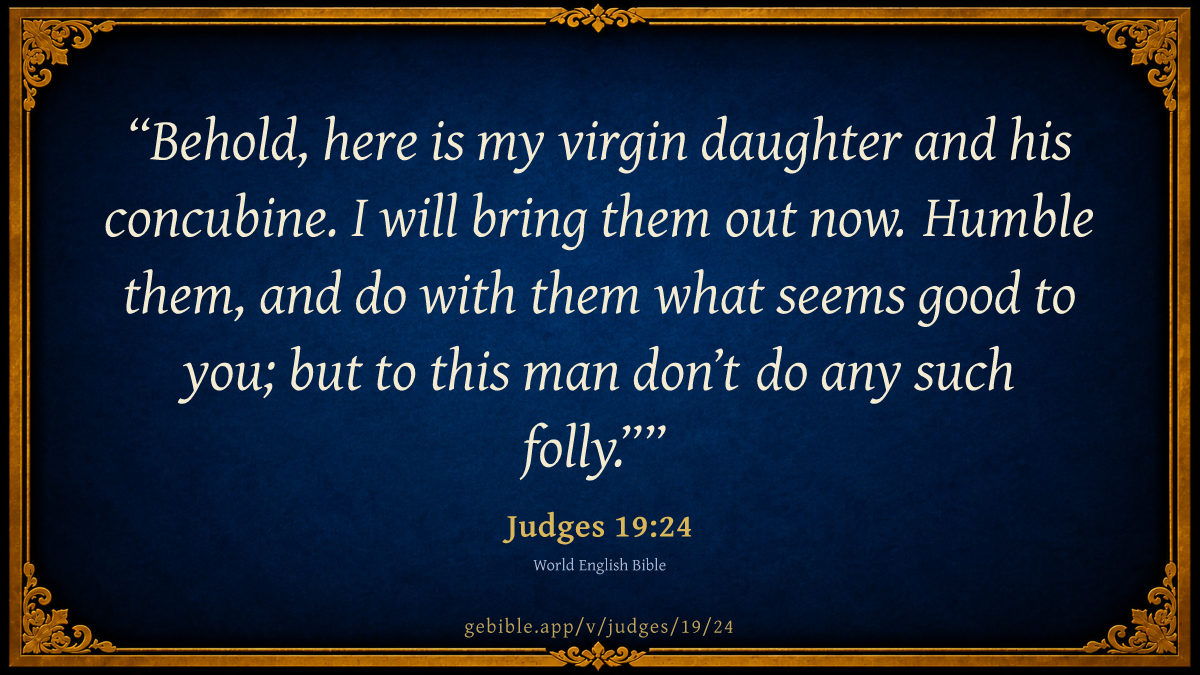
Behold, here is my virgin daughter and his concubine. I will bring them out now. Humble them, and do with them what seems good to you; but to this man don’t do any such folly.”
Parallel Translations
-
Behold, here is my virgin daughter and his concubine. I will bring them out now. Humble them, and do with them what seems good to you; but to this man don’t do any such folly.”
-
Behold, here is my daughter a maiden, and his concubine; them I will bring out now, and humble ye them, and do with them what seemeth good unto you: but unto this man do not so vile a thing.
-
Behold, here is my daughter a virgin, and his concubine; I will bring them out now, and humble ye them, and do with them what seemeth good unto you; but unto this man do not so wanton a thing.'
Cross-references (4)
Passages linked to Judges 19:24 in the Treasury of Scripture Knowledge, ordered by reader-vote popularity; verse text shown in World English Bible.
- Genesis 19:8 See now, I have two virgin daughters. Please let me bring them out to you, and you may do to them what seems good to you. Only don’t do anything to these men, because they have come under the shadow of my roof.”
- Deuteronomy 21:14 It shall be, if you have no delight in her, then you shall let her go where she desires; but you shall not sell her at all for money. You shall not deal with her as a slave, because you have humbled her.
- Genesis 34:2 Shechem the son of Hamor the Hivite, the prince of the land, saw her. He took her, lay with her, and humbled her.
- Romans 3:8 Why not (as we are slanderously reported, and as some affirm that we say), “Let’s do evil, that good may come?” Those who say so are justly condemned.
Cross-references from openbible.info (CC BY 4.0)
Explain this verse (12 sources)
Historical commentary, presented as a primary source — not an endorsement.
Private notes
Saved on this device only — never synced or sent anywhere.
Geneva Bible translators 1599 · Public Domain That is, abuse them, as Gen. 19:8.
That is, abuse them, as Gen. 19:8.
Geneva Bible (1599) marginal notes — public domain.
John Trapp 1656 · Public Domain Jdg 19:24 Behold, [here is] my daughter a maiden,…
Jdg 19:24 Behold, [here is] my daughter a maiden, and his concubine; them I will bring out now, and humble ye them, and do with them what seemeth good unto you: but unto this man do not so vile a thing.
Ver. 24. Behold, here is my daughter.] This was a rash and sinful offer, to prostitute his daughter and the concubine to their brutish and boundless lusts. God preserved the maiden from these impure petulant dogs. As for the concubine, one saith that she offered herself for the deciding of the controversy, and of her own accord, Messalina like, went forth to them. But that is not likely. See Jdg 19:25.
John Trapp, A Commentary or Exposition upon All the Books of the Old and New Testament (1647–1656) — public domain. Text from a community e-Sword module.
Matthew Poole 1685 · Public Domain He offers this to avoid a greater and more…
He offers this to avoid a greater and more unnatural sin, which he thought they designed; but it seems they did not, their abuse being confined to the woman, and not extended to the man, who also was in their power, if they had lusted after him. But this offer was sinful, because he offered that which was not in his nor in the man’s power to dispose of, even the chastity of his daughter, and the man’s wife; and because no man must do any evil, though never so small, for the prevention of any evil of sin or misery, or for the procuring of the greatest good, Rom 3:8; though his sin was much mitigated by his ignorance, by his honest and generous intention of protecting a stranger, by the force which was in some sort put upon him, and by the suddenness and violence of the temptation.
Matthew Poole's English Annotations on the Holy Bible (1683–1685) — public domain. Text from a community e-Sword/MySword module.
John Gill 1763 · Public Domain Behold, here is my daughter, a maiden, and his…
Behold, here is my daughter, a maiden, and his concubine,.... His own daughter, a virgin, and the concubine of the Levite his guest:
them I will bring out now, and humble ye them, and do with them what seemeth good unto you; those he proposed to bring out, and deliver to them, to lie with, to do with as they pleased to gratify their raging lust, which to do was more than he ought, or had power to do: he had no right to prostitute his own daughter, and much less the concubine or wife of another man, though perhaps it might be with the consent of the Levite; but all this he said in a hurry and surprise, in a fright and terror, and of two evils choosing the least, and perhaps in imitation of Lot, whose case might come to remembrance:
Read full note →
but unto this man do not so vile a thing; as he apprehended that to be which they were desirous of, whether to kill him, as he himself says, Jdg 20:5 or to commit the unnatural sin, and which, rather than comply with, he should have chosen to have been slain.
John Gill's Exposition of the Whole Bible (1746–1763) — public domain (CC PDM 1.0). Text via the HelloAO Bible API.
Adam Clarke 1810 · Public Domain Verse 24. Here is my daughter, a maiden] Such…
Verse 24. Here is my daughter, a maiden] Such a proposal was made by Lot to the men of Sodom, Ge 19:8, but nothing can excuse either. That the rights of hospitality were sacred in the East, and most highly regarded we know; and that a man would defend, at the expense of his life, the stranger whom he had admitted under his roof, is true; but how a father could make such a proposal relative to his virgin daughter, must remain among those things which are incomprehensible.
Adam Clarke's Commentary on the Bible (1810–1826) — public domain. Text from a community e-Sword/MySword module.
Joseph Benson 1811 · Public Domain Jdg 19:24. Behold, here is my daughter, &c. —…
Jdg 19:24. Behold, here is my daughter, &c. — The master of the house came at last to a resolution that it was less wickedness to prostitute the women to their lusts than the Levite. The dilemma to which he was reduced was indeed dreadful, nevertheless he is not to be justified in the proposal which he makes, no more than Lot was to be justified in a similar case, in offering his two daughters to satisfy the lusts of the men of Sodom. Although of two evils we must choose the less, yet, as we have there observed, “of two sins we must choose neither, nor ever do evil that good may come.”
Joseph Benson's Commentary on the Old and New Testaments (1811–1818) — public domain. Text from a community e-Sword module.
Haydock's Catholic Bible Commentary 1859 · Public Domain I have, &c. A similar proposal was made by…
I have, &c. A similar proposal was made by Lot; (Genesis xix. 8,) and hence the old man, who was brought up to hard labour, and the young Levite might, through ignorance, suppose it lawful for them to do the like. (Menochius) --- IT is lawful to advise a man, who is about to commit two crimes, to be satisfied with the less: but we cannot persuade any one to do even the smallest offence, that good may ensue, Romans iii. 8. The ignorance or good intention of these people might extenuate, but could hardly excuse their conduct, as it was unjust to the woman, whom the people of Gabaa did not ask for; and they ought rather to have encountered the utmost fury of the populace. Had the latter even come to the extremity proposed, if the Levite had made all possible resistance, his virtue could not have been injured. (Calmet) --- His crown would have been doubled, as St. Lucy observed when the judge threatened to have her prostituted. Castitas mihi duplicabitur ad coronam. (Dec. xiii.) (Haydock) --- Perhaps in the agitation of mind, caused by such a brutal proposal, the old man might have been so disturbed, as scarcely to know what he was saying, and he did not afterwards expose his daughter. (Calmet) --- But the Levite, seeing him in such a dilemma, on his account (Haydock) took this wife by force. (Hebrew, &c.) See Tostat; Bonfrere. (Estius) (Calmet) --- Against nature. Hebrew, "unto this man do not so vile a thing."
George Leo Haydock (1774–1849), Haydock's Catholic Family Bible and Commentary, 1859 edition — public domain. Excludes Psalms (Douay-Rheims chapter numbering differs from Protestant) and Deuterocanonical books (Catholic canon only).
Daniel D. Whedon 1874 · Public Domain 24. Humble ye them — This was a proposition…
24. Humble ye them — This was a proposition most shocking to our Christian instincts, but far less revolting, though not blameless, in that ancient time. It was a thing that had not occurred before in Israel. The fact here related shows how degraded was woman’s condition even in ancient Israel. She was regarded principally as the object meant for man to gratify his sensual lust upon, and held well nigh the position of a slave to him. But was it strange when, even now, in Japan and other lands, it is a common custom for parents to sell their daughters to persons to be subjected to lives of prostitution? A Christian lady, writing from Yokohama, Japan, in August, 1871, says: “In the suburbs of this city my friend pointed out to me a square of native houses in which, he told me, the licensed prostitution of the city is carried on. The victims are the fairest, choicest young girls of the place. They are sold by their parents, and the more beautiful they are, the higher price they command. From eight hundred to a thousand were confined in that square; and this is only what is found in every city in this land.”
Daniel D. Whedon (gen. ed.), Commentary on the Old and New Testaments (1874–1909) — public domain. Text from a community e-Sword module.
The Cambridge Bible for Schools and Colleges 1878 · Public Domain 24. The verse is clearly dependent on Gen_19:8, and,…
24. The verse is clearly dependent on Gen_19:8, and, as Bertheau and Moore think, may be an addition to heighten the resemblance between the two situations. It does not really fit into the context; and his concubine is out of place in view of Jdg_19:25; while the Hebrew exhibits grammatical irregularities which raise a doubt as to the originality of the text. Reading Jdg_19:25 as the sequel of Jdg_19:23 the narrative becomes much more intelligible.
As it stands, the verse illustrates the extravagant lengths to which the duties of hospitality could be carried. To save his guest the master of the house is prepared to sacrifice his daughter. Pushed to this extreme, the code of honour becomes a sanction of dishonour. The writer, however, does not question the morality of the proceeding.
The Cambridge Bible for Schools and Colleges (gen. ed. J. J. S. Perowne; Cambridge University Press, 1878–1918) — public domain. Text from a community e-Sword module.
Ellicott's Commentary for English Readers 1878 · Public Domain (24, 25) Behold, here is my daughter . .…
(24, 25) Behold, here is my daughter . . .—The main horror of these verses lies, and is meant to lie, in the nameless infamy to which these men had sunk, of whom we can only say,
“Non ragionam di lor ma guarda è passa.”
Read full note →
But we must not omit to notice that the conduct of the old man and the Levite, though it is not formally condemned, speaks of the existence of a very rudimentary morality, a selfishness, and a low estimate of the rights and sacred dignity of women, which shows from what depths the world has emerged. If it was possible to frustrate the vile assault of these wretches in this way it must have been possible to frustrate it altogether. There is something terribly repulsive in the selfishness which could thus make a Levite sacrifice a defenceless woman, and that woman his wife, for a whole night to such brutalisation. The remark of St. Gregory is very weighty: “Minus peccatum admittere ut gravius evitetur est a scelere victimas offerre Deo.”
A Bible Commentary for English Readers, edited by Charles John Ellicott (1878–1897) — public domain. Text from a community e-Sword module.
C. I. Scofield 1917 · Public Domain the matter of this folly.
vile
the matter of this folly.
The Scofield Reference Bible (1917 edition), notes by C. I. Scofield — public domain. Text from a community e-Sword module.
unfoldingWord translationNotes 2017 · CC BY-SA 4.0 This word is used to get the peoples' attention.…
See
This word is used to get the peoples' attention. AT: "Listen"
Read full note →
the men would not listen to him
Here the author speaks of "agreeing" as if it were "listening." AT: "the men would not accept his offer" (See: Metaphor)
the man seized his concubine
there could be confusion as to the identity of the man. AT: "the Levite seized his concubine"
at dawn
"when the sun was coming up" or "at first light" This refers to when the sun begins to rise.
it was light
This refers to morning when it is bright outside. AT: "the sun was fully risen" (See: Idiom)
translationWords
virgin
concubine
evil
seize
lord
unfoldingWord translationNotes — © Distant Shores Media and the Door43 World Missions Community, licensed CC BY-SA 4.0. Source: git.door43.org/Door43/en_tn.