Micah 7:7-8(v25)But as for me, I will look to Yahweh. I will wait for the God of my salvation. My God will hear me. Don’t rejoice against me, my enemy.…
Isaiah 40:31(v25)but those who wait for Yahweh will renew their strength. They will mount up with wings like eagles. They will run, and not be weary. They…
Psalms 37:7(vv25–26)Rest in Yahweh, and wait patiently for him. Don’t fret because of him who prospers in his way, because of the man who makes wicked plots…
Psalms 130:5-6(v25)I wait for Yahweh. My soul waits. I hope in his word. My soul longs for the Lord more than watchmen long for the morning, more than…
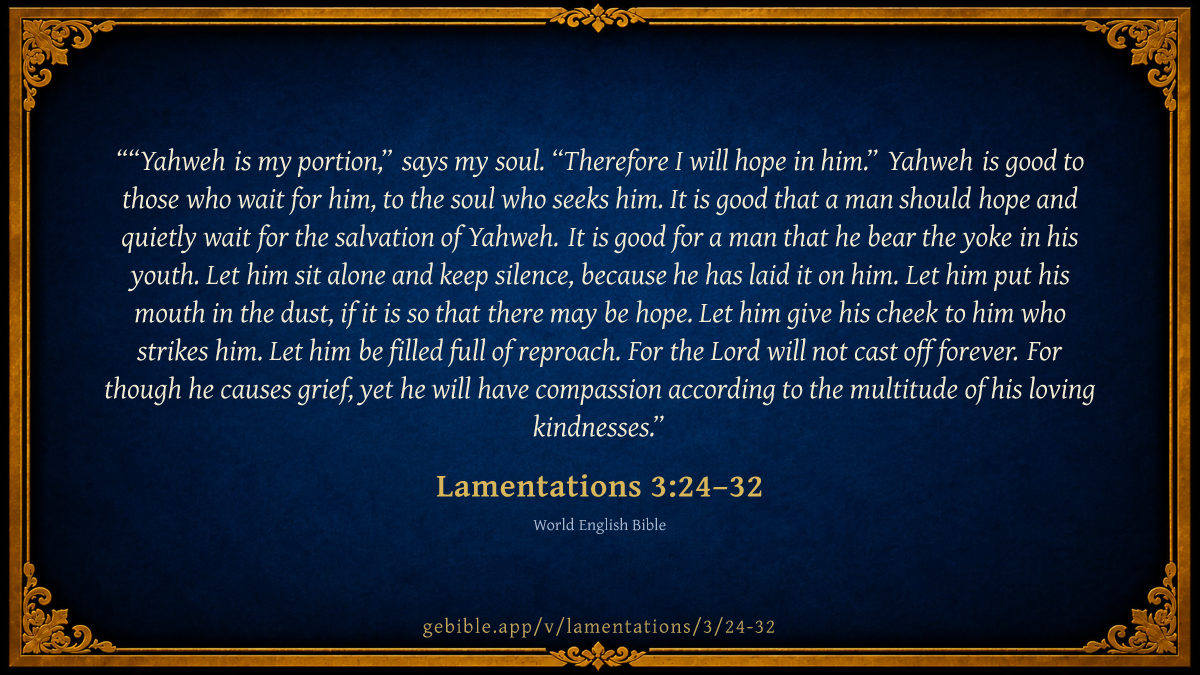
Lamentations 3:26(v25)It is good that a man should hope and quietly wait for the salvation of Yahweh.
Show all 100 cross-references
Psalms 37:34(vv25–26)Wait for Yahweh, and keep his way, and he will exalt you to inherit the land. When the wicked are cut off, you shall see it.
Psalms 40:1-5(v25)I waited patiently for Yahweh. He turned to me, and heard my cry. He brought me up also out of a horrible pit, out of the miry clay. He set…
Psalms 27:14(v25)Wait for Yahweh. Be strong, and let your heart take courage. Yes, wait for Yahweh.
Psalms 73:26(v24)My flesh and my heart fails, but God is the strength of my heart and my portion forever.
Isaiah 25:9(v25)It shall be said in that day, “Behold, this is our God! We have waited for him, and he will save us! This is Yahweh! We have waited for…
Psalms 130:5(v26)I wait for Yahweh. My soul waits. I hope in his word.
Isaiah 30:18(v25)Therefore Yahweh will wait, that he may be gracious to you; and therefore he will be exalted, that he may have mercy on you, for Yahweh is…
James 5:7(v25)Be patient therefore, brothers, until the coming of the Lord. Behold, the farmer waits for the precious fruit of the earth, being patient…
Psalms 16:5(v24)Yahweh assigned my portion and my cup. You made my lot secure.
Ecclesiastes 12:1(v27)Remember also your Creator in the days of your youth, before the evil days come, and the years draw near, when you will say, “I have no…
Genesis 49:18(vv25–26)I have waited for your salvation, Yahweh.
Hebrews 10:35(v26)Therefore don’t throw away your boldness, which has a great reward.
Psalms 94:14(v31)For Yahweh won’t reject his people, neither will he forsake his inheritance.
Isaiah 64:4(v25)For from of old men have not heard, nor perceived by the ear, nor has the eye seen a God besides you, who works for him who waits for him.
Hosea 10:12(v25)Sow to yourselves in righteousness, reap according to kindness. Break up your fallow ground; for it is time to seek Yahweh, until he comes…
Matthew 11:29-30(v27)Take my yoke upon you, and learn from me, for I am gentle and humble in heart; and you will find rest for your souls. For my yoke is easy,…
Psalms 27:8(v25)When you said, “Seek my face,” my heart said to you, “I will seek your face, Yahweh.”
2 Chronicles 31:21(v25)In every work that he began in the service of God’s house, in the law, and in the commandments, to seek his God, he did it with all his…
Psalms 39:7(v25)Now, Lord, what do I wait for? My hope is in you.
Psalms 77:7(v31)“Will the Lord reject us forever? Will he be favorable no more?
Psalms 103:8-10(v31)Yahweh is merciful and gracious, slow to anger, and abundant in loving kindness. He will not always accuse; neither will he stay angry…
Psalms 119:71(v27)It is good for me that I have been afflicted, that I may learn your statutes.
1 Chronicles 28:9(v25)You, Solomon my son, know the God of your father, and serve him with a perfect heart and with a willing mind; for Yahweh searches all…
2 Chronicles 15:2(v25)and he went out to meet Asa, and said to him, “Hear me, Asa, and all Judah and Benjamin! Yahweh is with you, while you are with him; and if…
Psalms 94:12(v27)Blessed is the man whom you discipline, Yah, and teach out of your law,
Isaiah 55:6(v25)Seek Yahweh while he may be found. Call on him while he is near.
Psalms 25:8(v25)Good and upright is Yahweh, therefore he will instruct sinners in the way.
Psalms 142:5(v24)I cried to you, Yahweh. I said, “You are my refuge, my portion in the land of the living.”
Isaiah 30:15(v26)For thus said the Lord Yahweh, the Holy One of Israel, “You will be saved in returning and rest. Your strength will be in quietness and in…
Hebrews 3:14(v26)For we have become partakers of Christ, if we hold the beginning of our confidence firm to the end,
1 Peter 1:13(v26)Therefore prepare your minds for action. Be sober, and set your hope fully on the grace that will be brought to you at the revelation of…
Psalms 78:38(v32)But he, being merciful, forgave iniquity, and didn’t destroy them. Yes, many times he turned his anger away, and didn’t stir up all his…
Psalms 90:12(v27)So teach us to count our days, that we may gain a heart of wisdom.
Psalms 119:2(v25)Blessed are those who keep his statutes, who seek him with their whole heart.
Isaiah 54:7-10(v31)“For a small moment I have forsaken you, but I will gather you with great mercies. In overflowing wrath I hid my face from you for a…
Lamentations 3:21(v24)This I recall to my mind; therefore I have hope.
1 Thessalonians 1:10(v25)and to wait for his Son from heaven, whom he raised from the dead: Jesus, who delivers us from the wrath to come.
Hebrews 12:5-12(v27)You have forgotten the exhortation which reasons with you as with children, “My son, don’t take lightly the chastening of the Lord, nor…
Psalms 30:5(v32)For his anger is but for a moment. His favor is for a lifetime. Weeping may stay for the night, but joy comes in the morning.
Psalms 61:1(v25)Hear my cry, God. Listen to my prayer.
Psalms 61:5(v25)For you, God, have heard my vows. You have given me the heritage of those who fear your name.
Psalms 105:3(v25)Glory in his holy name. Let the heart of those who seek Yahweh rejoice.
Psalms 119:166(v26)I have hoped for your salvation, Yahweh. I have done your commandments.
1 Samuel 12:22(v31)For Yahweh will not forsake his people for his great name’s sake, because it has pleased Yahweh to make you a people for himself.
2 Chronicles 20:17(v26)You will not need to fight this battle. Set yourselves, stand still, and see the salvation of Yahweh with you, O Judah and Jerusalem. Don’t…
Psalms 22:26(v25)The humble shall eat and be satisfied. They shall praise Yahweh who seek after him. Let your hearts live forever.
Psalms 103:11(v32)For as the heavens are high above the earth, so great is his loving kindness toward those who fear him.
Psalms 119:174(v26)I have longed for your salvation, Yahweh. Your law is my delight.
Isaiah 57:16(v31)For I will not contend forever, neither will I always be angry; for the spirit would faint before me, and the souls whom I have made.
Jeremiah 32:40(v31)I will make an everlasting covenant with them, that I will not turn away from following them, to do them good. I will put my fear in their…
Exodus 3:7(v32)Yahweh said, “I have surely seen the affliction of my people who are in Egypt, and have heard their cry because of their taskmasters, for I…
Judges 10:16(v32)They put away the foreign gods from among them and served Yahweh; and his soul was grieved for the misery of Israel.
2 Chronicles 19:3(v25)Nevertheless there are good things found in you, in that you have put away the Asheroth out of the land, and have set your heart to seek…
2 Chronicles 30:19(v25)who sets his heart to seek God, Yahweh, the God of his fathers, even if they aren’t clean according to the purification of the sanctuary.”
Psalms 52:9(v26)I will give you thanks forever, because you have done it. I will hope in your name, for it is good, in the presence of your saints.
Psalms 54:6(v26)With a free will offering, I will sacrifice to you. I will give thanks to your name, Yahweh, for it is good.
Psalms 106:43-45(v32)He rescued them many times, but they were rebellious in their counsel, and were brought low in their iniquity. Nevertheless he regarded…
Isaiah 26:9(v25)With my soul I have desired you in the night. Yes, with my spirit within me I will seek you earnestly; for when your judgments are in the…
Hosea 11:8(v32)“How can I give you up, Ephraim? How can I hand you over, Israel? How can I make you like Admah? How can I make you like Zeboiim? My heart…
Zephaniah 3:8(v25)“Therefore wait for me”, says Yahweh, “until the day that I rise up to the prey, for my determination is to gather the nations, that I may…
Job 16:10(v30)They have gaped on me with their mouth. They have struck me on the cheek reproachfully. They gather themselves together against me.
Psalms 33:18(v24)Behold, Yahweh’s eye is on those who fear him, on those who hope in his loving kindness,
Psalms 73:28(v26)But it is good for me to come close to God. I have made the Lord Yahweh my refuge, that I may tell of all your works.
Isaiah 30:7(v26)For Egypt helps in vain, and to no purpose; therefore I have called her Rahab who sits still.
Isaiah 50:6(v30)I gave my back to those who beat me, and my cheeks to those who plucked off the hair. I didn’t hide my face from shame and spitting.
Jeremiah 15:17(v28)I didn’t sit in the assembly of those who make merry and rejoice. I sat alone because of your hand, for you have filled me with indignation.
Jeremiah 31:20(v32)Is Ephraim my dear son? Is he a darling child? For as often as I speak against him, I still earnestly remember him. therefore my heart…
Luke 15:20(v32)“He arose, and came to his father. But while he was still far off, his father saw him, and was moved with compassion, and ran, and fell on…
2 Kings 13:23(v32)But Yahweh was gracious to them, and had compassion on them, and had respect for them, because of his covenant with Abraham, Isaac, and…
Psalms 69:32(v25)The humble have seen it, and are glad. You who seek after God, let your heart live.
Jeremiah 31:37(v31)Yahweh says: “If heaven above can be measured, and the foundations of the earth searched out beneath, then I will also cast off all the…
Jeremiah 33:24(v31)“Don’t consider what this people has spoken, saying, ‘Has Yahweh cast off the two families which he chose?’ Thus they despise my people,…
Lamentations 3:22(v32)It is because of Yahweh’s loving kindnesses that we are not consumed, because his compassion doesn’t fail.
Micah 7:18(v31)Who is a God like you, who pardons iniquity, and passes over the disobedience of the remnant of his heritage? He doesn’t retain his anger…
Matthew 5:39(v30)But I tell you, don’t resist him who is evil; but whoever strikes you on your right cheek, turn to him the other also.
Matthew 26:67(v30)Then they spat in his face and beat him with their fists, and some slapped him,
Romans 11:1-6(v31)I ask then, did God reject his people? May it never be! For I also am an Israelite, a descendant of Abraham, of the tribe of Benjamin. God…
Galatians 4:18(v26)But it is always good to be zealous in a good cause, and not only when I am present with you.
Exodus 2:23(v32)In the course of those many days, the king of Egypt died, and the children of Israel sighed because of the bondage, and they cried, and…
Psalms 92:1(v26)It is a good thing to give thanks to Yahweh, to sing praises to your name, Most High,
Lamentations 2:10(v28)The elders of the daughter of Zion sit on the ground. They keep silence. They have cast up dust on their heads. They have clothed…
Exodus 14:13(v26)Moses said to the people, “Don’t be afraid. Stand still, and see the salvation of Yahweh, which he will work for you today; for you will…
Job 13:15(v24)Behold, he will kill me. I have no hope. Nevertheless, I will maintain my ways before him.
Psalms 31:24(v24)Be strong, and let your heart take courage, all you who hope in Yahweh.
Psalms 62:8(v24)Trust in him at all times, you people. Pour out your heart before him. God is a refuge for us.
Jeremiah 51:19(v24)The portion of Jacob is not like these, for he is the former of all things; including the tribe of his inheritance: Yahweh of Armies is his…
2 Corinthians 11:20(v30)For you bear with a man if he brings you into bondage, if he devours you, if he takes you captive, if he exalts himself, or if he strikes…
1 Samuel 30:6(v24)David was greatly distressed; for the people spoke of stoning him, because the souls of all the people were grieved, every man for his sons…
1 Chronicles 5:20(v24)They were helped against them, and the Hagrites were delivered into their hand, and all who were with them; for they cried to God in the…
Job 40:4(v29)“Behold, I am of small account. What will I answer you? I lay my hand on my mouth.
Psalms 42:11(v24)Why are you in despair, my soul? Why are you disturbed within me? Hope in God! For I shall still praise him, the saving help of my…
Psalms 43:5(v24)Why are you in despair, my soul? Why are you disturbed within me? Hope in God! For I shall still praise him: my Savior, my helper, and my…
Psalms 69:20(v30)Reproach has broken my heart, and I am full of heaviness. I looked for some to take pity, but there was none; for comforters, but I found…
Psalms 84:12(v24)Yahweh of Armies, blessed is the man who trusts in you.
Psalms 123:3(v30)Have mercy on us, Yahweh, have mercy on us, for we have endured much contempt.
100 distinct cross-references across this passage (123 total citations).
Cross-references from openbible.info (CC BY 4.0)
Explain this passage (19 sources)
Historical commentary, presented as a primary source — not an endorsement.
John Calvin1540 · Public DomainOn vv24–32The Prophet intimates in this verse that we cannot…
The Prophet intimates in this verse that we cannot stand firm in adversities, except we be content with God alone and his favor; for as soon as we depart from him, any adversity that may happen to us will cause our faith to fail. It is then the only true foundation of patience and hope to trust in God alone; and this is the case when we are persuaded that his favor is sufficient for our perfect safety. In this sense it is that David calls God his portion. (Psalm 16:5.) But there is in the words an implied contrast, for most men seek their happiness apart from God. All desire to be happy, but as the thoughts of men wander here and there, there is nothing more difficult than so to fix all our hopes in God so as to disregard all other things.
This then is the doctrine which the Prophet now handles, when he says, that those alone could hope, that is, persevere in hope and patience, who have so received God as their portion as to be satisfied with him alone, and to seek nothing else besides him. But he speaks emphatically, that his soul had thus said. Even the unbelieving are ashamed to deny what we have stated, that the whole of our salvation and happiness is found in God alone. Then the unbelieving also confess that God is the fountain of all blessings, and that they ought to acquiesce in him; but with the mouth only they confess this, while they believe nothing less. This then is the reason why the Prophet ascribes what he says to his soul, as though he had said, that lie did not boast, like hypocrites, that God was his portion, but that of this lie had a thorough conviction. My soul has said, that is, I am fully convinced that God is my portion; therefore will I hope in him. We now understand the meaning of this passage.
Read full note →
It remains for us to make an application of this doctrine. That we may not then fail in adversities, let us bear in mind this truth, that all our thoughts will ever wander and go astray, until we are fully persuaded that God alone is sufficient for us, so that lie may become alone our heritage. For all who are not satisfied with God alone, are immediately seized with impatience, whenever famine oppresses them, or sword threatens them, or any other grievous calamity. And for this reason Paul also says,
“If God be for us, who can be against us? I am persuaded that neither famine, nor nakedness, nor sword, nor death, nor life, can separate me from the love of God, which is in Christ.” (Romans 8:31, 35-39.)
Then Paul lays hold of the paternal favor of God as a ground of solid confidence; for the words in Christ sufficiently show that those are mistaken interpreters who take this love passively, as though he had said, that the faithful would never cease to love God, though he exercised them with many afflictions. But Paul meant that the faithful ought so to fix their minds on God alone, that whatever might happen, they would not yet cease to glory in him. Why? because God is their life in death, their light in darkness, their rest in war and tumult, their abundance in penury and want. It is in the same sense our Prophet now says, when lie intimates that none hope in God but those who build on his paternal favor alone, so that they seek nothing else but to have him propitious to them. It afterwards follows, —
John Calvin's Commentaries (1540-1563) — public domain. Text from the Calvin Translation Society English edition (1840s-50s) via the Christian Classics Ethereal Library (ccel.org). Calvin's coverage is partial (roughly two-thirds of the Bible); uncommented books and verses are honest gaps, never fabricated. The 19th-century editor's footnotes and remarks are omitted so the notes are faithfully Calvin's own voice.
Geneva Bible translators1599 · Public DomainOn vv24, 27, 28, 29The godly put their whole confidence in God, and…
The godly put their whole confidence in God, and therefore look for none other inheritance, as Ps. 16:5.
Geneva Bible (1599) marginal notes — public domain.
John Trapp1656 · Public DomainOn vv24–32Lam 3:24 The LORD [is] my portion, saith my…
Lam 3:24 The LORD [is] my portion, saith my soul; therefore will I hope in him.
Ver. 24. The Lord is my portion.] And that is enough for me, should I never have more. {See Trapp on "Psa 16:5"} That which giveth content in any portion is (1.) The favour and presence of God; (2.) That it is from the hand of a Father; (3.) That it comes to us in the covenant of grace; (4.) That it is the purchase of Christ’s blood; (5.) That it is an answer of prayers, and a blessing from above on honest endeavours, &c. Vide autem, pie Lector, saith an expositor: See here, good reader, how this prophetic lamentation beginneth to be a guide to godliness. For it doth not, after the manner of silly women, throw out empty words without wisdom; but teacheth all along, either overtly or covertly, that all things here below, how highly soever esteemed, are vanity and soon lost; but the grace of God is solid and stable; {a} Christum tollere nemo potest. Christ is a portion unlosable, as one {b} once answered to those that asked him why he was still merry and cheerful.
Read full note →
Said my soul.] {c} Not my mouth only; but I speak it from my very heart, which rejoiceth in God my portion more than the many do in the increase of their grain and wine. {Psa 4:7}
Therefore will I hope in him.] Expectabo ut teneam per speciem, quem teneo per spem.
{a} Pet. a Figueir.
{b} Deicola Abbas.
{c} Emphatice loquitur.
John Trapp, A Commentary or Exposition upon All the Books of the Old and New Testament (1647–1656) — public domain. Text from a community e-Sword module.
Matthew Poole1685 · Public DomainOn vv24–32God is the portion of his people, and they…
God is the portion of his people, and they have chosen him as their portion; he hath declared himself to them as such, and they have accepted him as such. This gives them ground both for patience under his providences, and also of expectation of good from him in their lowest and meanest state.
Matthew Poole's English Annotations on the Holy Bible (1683–1685) — public domain. Text from a community e-Sword/MySword module.
John Gill1763 · Public DomainOn vv24–32The Lord is my portion, saith my soul,.... The…
The Lord is my portion, saith my soul,.... The prophet, or the church, whom he represents, rises and increases in the exercise of faith; from considering the mercies, compassions, and faithfulness of God, concludes a sure and firm interest in him, as a portion and inheritance. The Lord is the portion of his people in life and in death, in time and to eternity; all he is, and has, is theirs; they are heirs of him, and shall enjoy him for ever, and therefore shall not be consumed; he is a portion large and full, inexpressibly rich and great, a soul satisfying one, and will last for ever. And happy are those, who from their hearts, and with their souls, under a testimony of the Spirit of God to their spirits, and through a gracious experience of him, can say he is their portion and exceeding great reward, as the church here did; and these may say with her, as follows:
therefore will I hope in him: for deliverance from all evils and enemies; for present supplies of grace; and for the enjoyment of future glory and happiness.
John Gill's Exposition of the Whole Bible (1746–1763) — public domain (CC PDM 1.0). Text via the HelloAO Bible API.
John Wesley1765 · Public DomainOn vv27–29Bear - Quietly and patiently to bear what afflictions…
Bear - Quietly and patiently to bear what afflictions God will please to lay upon us. And if God tame us when young, by his word or by his rod, it is an unspeakable advantage.
John Wesley, Explanatory Notes Upon the Whole Bible (1754–1765) — public domain. Text via the GEBible commentary corpus.
Adam Clarke1810 · Public DomainOn vv24, 26, 27, 28, 29, 30, 31Verse 24. The Lord is my portion] See Clarke…
Verse 24. The Lord is my portion] See Clarke on Ps 119:57.
Adam Clarke's Commentary on the Bible (1810–1826) — public domain. Text from a community e-Sword/MySword module.
Joseph Benson1811 · Public DomainOn vv24, 27, 31Lam 3:24-26. The Lord is my portion, saith my…
Lam 3:24-26. The Lord is my portion, saith my soul — An interest in the favour and love of God, and his presence with me, my heart tells me, is the best inheritance. And, possessing these, I have that which is sufficient to balance all my troubles, and make up all my losses. For, while portions on earth are empty and perishing things, God is an all-sufficient and durable portion, a portion for ever. Therefore will I hope in him — I will stay myself upon him, and encourage myself in him, when all other supports and encouragements fail me. Observe, reader, it is our duty and interest to make God the portion of our souls, and then to enjoy and take comfort in him as such, in the midst of afflictions and lamentations. The Lord is good unto them that wait for him — To them that patiently wait his time; when he shall judge it a proper season to afford them comfort and deliverance; and who, in the mean while, apply themselves to him by prayer and humiliation. It is good — It is our duty, and will be our unspeakable comfort and satisfaction; that a man should hope and quietly wait, &c. — To hope that it will come, though the difficulties that lie in the way of it seem insuperable; to wait till it does come, though it be long delayed; and while we wait to be quiet and silent, not quarrelling with God, or making ourselves uneasy, but acquiescing in the divine disposal.
Joseph Benson's Commentary on the Old and New Testaments (1811–1818) — public domain. Text from a community e-Sword module.
Albert Barnes1834 · Public DomainOn vv24, 25, 28, 31The Lord is my portion - “My portion is…
The Lord is my portion - “My portion is Yahweh,” see Num 18:20; Psa 16:5 ff.
Therefore will I hope in him - A more full expression of the confidence present in the prophet’s mind in Lam 3:21, but based now upon God’s faithfulness in showing mercy.
Albert Barnes' Notes on the Bible (1834–1885) — public domain. Text from a community e-Sword/MySword module.
Haydock's Catholic Bible Commentary1859 · Public DomainOn vv27–30Yoke. Afflictions endured for justice sake ensure a blessing.…
Yoke. Afflictions endured for justice sake ensure a blessing. (Haydock) --- All may derive great benefit from suffering.
George Leo Haydock (1774–1849), Haydock's Catholic Family Bible and Commentary, 1859 edition — public domain. Excludes Psalms (Douay-Rheims chapter numbering differs from Protestant) and Deuterocanonical books (Catholic canon only).
Robert Jamieson, A. R. Fausset & David Brown1871 · Public DomainOn vv24–32(Num 18:20; Psa 16:5; Psa 73:26; Psa 119:57; Jer…
(Num 18:20; Psa 16:5; Psa 73:26; Psa 119:57; Jer 10:16). To have God for our portion is the one only foundation of hope.
Jamieson, Fausset & Brown — Commentary Critical and Explanatory on the Whole Bible (1871) — public domain (CC PDM 1.0). Text via the HelloAO Bible API.
Daniel D. Whedon1874 · Public DomainOn vv24, 25, 26, 28, 3124. The Lord is my portion — An almost…
24. The Lord is my portion — An almost verbatim quotation from
Psa_119:57, which is also substantially identical with several other passages.
Daniel D. Whedon (gen. ed.), Commentary on the Old and New Testaments (1874–1909) — public domain. Text from a community e-Sword module.
The Cambridge Bible for Schools and Colleges1878 · Public DomainOn vv24, 25, 27, 28, 29, 30, 3124. The Lord is my portion] a frequent expression…
24. The Lord is my portion] a frequent expression in the Psalms (Psa_16:5, Psa_73:26, Psa_119:57, Psa_142:5).
The Cambridge Bible for Schools and Colleges (gen. ed. J. J. S. Perowne; Cambridge University Press, 1878–1918) — public domain. Text from a community e-Sword module.
Ellicott's Commentary for English Readers1878 · Public DomainOn vv24–31(24) The Lord.—An inversion of the sentence gives a…
(24) The Lord.—An inversion of the sentence gives a closer and more emphatic rendering: My portion is Jehovah. The phrase is a reminiscence from Psa_16:5; Psa_73:26; Psa_142:5; Psa_119:57, the thought resting primarily on Num_18:20.
A Bible Commentary for English Readers, edited by Charles John Ellicott (1878–1897) — public domain. Text from a community e-Sword module.
The Pulpit Commentary1880 · Public DomainOn vv24–31The Lord is my Portion. A reminiscence of Psa_16:5.…
The Lord is my Portion. A reminiscence of Psa_16:5. (Psa_73:26 Psa_119:57 Psa_142:5)
The secret of hope.
Read full note →
The reader of the psalms is familiar with the utterance, "The Lord is my Portion." The characteristic peculiarity of the adoption of this confession of faith by the sufferer of the Lamentations is his taking it as a ground of hope. The present is so dark that he can have little joy even in God. Earthly things are so unpropitious that he can hope little from them. But with God for his Portion he can look forward from the troubles of the present and the threatenings of earthly calamities to an unearthly joy in the future. Let us endeavour to see how to haw God for our Portion is the secret of hope.
I GOD IS THE BEST OBJECT OF SORE.
1. Consider how God can be an Object of hope. We hope in God when we hope to enjoy, his presence, to bask in the sunshine of his love, to enter into the life of communion with him. To know God is satisfaction to the intellect. To have fellowship with God through love is to have rest and joy in the heart. To be reconciled to God is to have the trouble of conscience allayed. All the deepest longings of the soul find their end and satisfaction in God.
2. Consider how God is the one perfect Object of hope. The greatest disappointment of an earthly home is when the thing anticipated is given to us and yet the joy expected from it is not forthcoming. We clasp our treasure and find it to be dross, or we see it to be gold and we find that it will not stay the hunger of our souls. We are larger than the biggest. earthly hope. Our aspirations soar able the highest of them. But God is higher and deeper and greater than the largest desire of any soul. He is just what we all need for rest and gladness. He cannot disappoint us. If money is our portion it may be lost, or it may not buy ease of heart. If power, pleasure, success, or any other common end be our portion, we may be most wearied when we have gained most, God is the Portion to satisfy hope, and he only.
II GOD IS THE BEST GROUND OF HOPE. We have most assurance that our hope will not fail us when we trust in him. Why?
1. Because he is good. Malignant beings take pleasure in frustrating hope; cruel people do it with indifference; and selfish and thoughtless men unwittingly. But God, who is love itself and who ever regards the needs of his children with merciful consideration, is too gracious to disappoint the hope we have in him.
2. Because he is faithful. He has invited our confidence and promised his inheritance to his obedient and trustful children. Thus he has pledged his word. His honour is involved. He will never prove false to his promise.
3. Because he is almighty. With the best intentions a man may be compelled to disappoint the confidence reposed upon him through simple inability to meet it. The bankrupt cannot pay his debts, however honest he may be. But as there is no limit to the power of God, so there will be no failure of hope in him.
4. Because hope in God is lawful and right. We need not fear that the strictest judgment will condemn it. It is a holy hope, and it is therefore likely more and more to be satisfied, as the judgment of God condemns and destroys unworthy objects of ambition.
The Portion of the godly.
When the land of promise was divided among the tribes of Israel, no inheritance was assigned to one of the number, viz. the tribe of Levi. It appeared good to Divine wisdom that the consecrated and sacerdotal tribe should be distributed among the population, and that a regular provision should be made for their maintenance. To reconcile the Levites to their lot, it was declared to them by Jehovah himself that he was their Portion. The language here appropriated by the prophet, as his faith and hope revive, is language which every true servant of God may take to himself.
I THE LORD IS AN INCOMPARABLE AND UNRIVALLED PORTION. Without the Divine favour, the greatest, the wealthiest, the most prosperous, are poor; with this favour, the lowliest and the penniless are rich. For that which pertains to the soul exceeds in value that which is external; circumstances are not unimportant, but to the just and reflective mind they are inferior to what is spiritual.
II THE LORD IS A SUFFICIENT AND SATISFYING PORTION. With what jubilant, triumphant exultation did the psalmist exclaim, "The Lord is the Portion of mine inheritance, and my cup"! He who made and redeemed the soul can alone fully satisfy and supply it. Well might the apostle assure his Christian readers, "All things are yours;" and well might he reason for their encouragement, "Shall not God with Christ also freely give you all things?
III THE LORD IS AN ETERNAL PORTION. Whilst "riches take to themselves wings and fly away," whilst "the bubble reputation" bursts, whilst death levels the kings of the earth with the beggars, the spiritual possessions of the pious remain undiminished in preciousness. In fact, the true value of the Portion of the godly can only be known in eternity. Here the estate is in reversion; there it is fully possessed and everlastingly enjoyed. T.
Those who have Jehovah for their Portion.
I EVERY MAN HAS HIS PORTION. That which is his capital, which constitutes his resources, and out of which he has to build up the results of his life. It was only natural that an Israelite should make a great deal of portions. Israel had a portion, divinely secured and wonderfully packed with the raw materials of wealth. Each tribe had its portion, given by lot, so that there was no ground of complaint, and so to each household in due time there came a portion. In Israel, as in every other nation, there were the rich and the poor those with great possessions and those with none at all. Thus there are inequalities, and not the least of them are those which inhere in the constitution of the individual. Our portion depends, not on what we legally possess, but on what we have the energy and the skill to use. The greatest of a man"s natural resources are in himself. Otherwise he may sit among large possessions which are of no more use to him than are his hoards to a miser.
II EVERY MAN HAS IT IN HIS OWN POWER TO REMOVE THE INEQUALITIES OF HIS PORTION. Jeremiah shows us how. Whatever his natural portion may have been, it had well nigh vanished through the hatred of his people and even of his own acquaintance. Nor must we forget that he was speaking in the midst of a desolate land. Many portions had gone and left their owners not knowing which way to turn. But now Jeremiah both assures us of his own resources and advises us where to seek ourselves, by saying, "Jehovah is my Portion." Thus he turns away the mind from mere external property. It is the dreadful character of all mere external wealth that there is only so much of it, and therefore, just in proportion as some grow rich, others must become poor. Besides which there is to be considered that moment when riches will take to themselves wings and flee away, and that still more serious moment when flesh and heart will fail. Thus we see that the complaint about the inequalities of life has more plausibility than force. All purely natural portions are reduced to the same vanity at last, and the man who trusts in them has but wasted his time and procured for himself the deepest disappointments. Whatever we may lack, we need not lack that portion which consists in the promises of God made to them who truly trust in him.
III THE CONSEQUENCE OF HAVING GOD FOR A PORTION. The life is filled with hope. A man can only hope according to his portion. If his portion is in this world, his hope will hate a corresponding character; whereas if his portion is really in God, his hope will partake of the necessary elevation and fulness of his portion. God takes care that those who are really his should have a feeling in their hearts which makes them look forward to a future always better than the present. We are saved by hope. The process is yet far from complete, hut it is our right to rejoice that we are in the hands of One who will make salvation complete in his own time. Y.
The Pulpit Commentary (1880–1919), ed. H.D.M. Spence-Jones & Joseph S. Exell — public domain. Text from a community e-Sword module.
The Expositor's Bible1887 · Public DomainOn v25HAVING struck a rich vein, our author proceeds to…
QUIET WAITING
Lam_3:25-36
Read full note →
HAVING struck a rich vein, our author proceeds to work it with energy. Pursuing the ideas that flow out of the great truth of the endless goodness of God, and the immediate inference that He of whom so wonderful a character can be affirmed is Himself the souls best possession, the poet enlarges upon their wider relations. He must adjust his views of the whole world to the new situation that is thus opening out before him. All things are new in the light of the splendid vision before which his gloomy meditations have vanished like a dream. He sees that he is not alone in enjoying the supreme blessedness of the Divine love. The revelation that has come to him is applicable to other men if they will but fulfil the conditions to which it is attached.
In the first place, it is necessary to perceive clearly what those conditions are on which the happy experience of Gods unfailing mercies may be enjoyed by any man. The primary requisite is affirmed to be quiet waiting. {Lam_3:26} The passivity of this attitude is accentuated in a variety of expressions. It is difficult for us of the modern western world to appreciate such teaching. No doubt if it stood by itself it would be so one-sided as to be positively misleading. But this is no more than must be said of any of the best lessons of life. We require the balancing of separate truths in order to obtain truth, as we want the concurrence of different impulses to produce the resultant of a right direction of life. But in the present case the opposite end of the scale has been so much overweighted that we sorely need a very considerable addition on the side to which the elegist here leans. Carlyles gospel of work-a most wholesome message as far as it went-fell on congenial Anglo-Saxon soil; and this and the like teaching of kindred minds has brought forth a rich harvest in the social activity of modern English life. The Church has learnt the duty of working - which is well. She does not appear so capable of attaining the blessedness of waiting. Our age is in no danger of the dreaminess of quietism. But we find it hard to cultivate what Wordsworth calls "wise passiveness." And yet in the heart of us we feel the lack of this spirit of quiet. Charles Lambs essay on the "Quakers Meeting" charms us, not only on account of its exquisite literary style, but also because it reflects a phase of life which we own to be most beautiful.
The waiting here recommended is more than simple passiveness, however, more than a bare negation of action. It is the very opposite of lethargy and torpor. Although it is quiet, it is not asleep. It is open-eyed, watchful, expectant. It has a definite object of anticipation, for it is a waiting for God and His salvation; and therefore it is hopeful. Nay, it has a certain activity of its own, for it seeks God. Still, this activity is inward and quiet; its immediate aim is not to get at some visible earthly end, however much this may be desired, nor to attain some inward personal experience, some stage in the souls culture, such as peace, or purity, or power, although this may be the ultimate object of the present anxiety; primarily it seeks God-all else it leaves in His hands. Thus it is rather a change in the tone and direction of the souls energies than a state of repose. It is the attitude of the watchman on his lonely tower-calm and still, but keen-eyed and alert, while down below in the crowded city some fret themselves with futile toil and others slumber in stupid indifference.
To this waiting for Him and definite seeking of Him God responds in some special manifestation of mercy. Although, as Jesus Christ tells us, our Father in heaven "maketh His sun to rise on the evil and the good, and sendeth rain on the just and the unjust," {Mat_5:45} the fact here distinctly implied, that the goodness of God is exceptionally enjoyed on the conditions now laid down, is also supported by our Lords teaching in the exhortations, "Ask, and it shall be given you; seek, and ye shall find; knock, and it shall be opened to you; forevery one that asketh receiveth; and he that seeketh findeth; and to him that knocketh it shall be opened." St. James adds, "Ye have not because ye ask not." {Jam_4:2} This, then, is the method of the Divine procedure. God expects His children to wait on Him as well as to wait for Him. We cannot consider such an expectation unreasonable. Of course it would be foolish to imagine God piquing Himself on His own dignity, so as to decline aid until He had been gratified by a due observance of homage. There is a deeper motive for the requirement. Gods relations with men and women are personal and individual; and when they are most happy and helpful they always involve a certain reciprocity. It may not be necessary or even wise to demand definite things from God whenever we seek His assistance; for He knows what is good, while we often blunder and ask amiss. But the seeking here described is of a different character. It is not seeking things; it is seeking God. This is always good. The attitude of trust and expectancy that it necessitates is just that in which we are brought into a receptive state. It is not a question of Gods willingness to help; He is always willing. But it cannot be fitting that He should act towards us when we are distrustful, indifferent, or rebellious, exactly as He would act if He were approached in submission and trustful expectation.
Quiet waiting, then, is the right and fitting condition for the reception of blessing from God. But the elegist holds more than this. In his estimation the state of mind he here commends is itself good for a man. It is certainly good in contrast with the unhappy alternatives-feeble fussiness, wearing anxiety, indolent negligence, or blank despair. It is good also as a positive condition of mind. He has reached a happy inward attainment who has cultivated the faculty of possessing his soul in patience. His eye is clear for visions of the unseen. To him the deep fountains of life are open. Truth is his, and peace and strength also. When we add to this calmness the distinct aim of seeking God we may see how the blessedness of the condition recommended is vastly enhanced. We are all insensibly moulded by our desires and aims. The expectant soul is transformed into the image of the hope it pursues. When its treasure is in heaven its heart is there also, and therefore its very nature becomes heavenly.
To his reflections on the blessedness of quiet waiting the elegist adds a very definite word about another experience, declaring that "it is good for a man that he bear the yoke in his youth." {Lam_3:27} This interesting assertion seems to sound an autobiographical note, especially as the whole poem treats of the writers personal experience. Some have inferred that the author must have been a young man at the time of writing. But if, as seems probable, he is calling to mind what he has himself passed through, this may be a recollection of a much earlier period of his life. Thus he would seem to be recognising, in the calm of subsequent reflection, what perhaps he may have been far from admitting while bearing the burdens, that the labours and hardships of his youth prove to have been for his own advantage. This truth is often perceived in the meditations of mature life, although it is not so easily acknowledged in the hours of strain and stress.
It is impossible to say what particular yoke the writer is thinking about. The persecutions inflicted on Jeremiah have been cited in illustration of this passage; and although we may not be able to ascribe, the poem to the great prophet, his toils and troubles will serve as instances of the truth of the words of the anonymous writer, for undoubtedly his sympathies were quickened while his strength was ripened by what he endured. If we will have a definite meaning the yoke may stand for one of three things-for instruction, for labour, or for trouble. The sentence is true of either of these forms of yoke. We are not likely to dispute the advantages of youthful education over that which is delayed till adult age; but even if the acquisition of knowledge is here suggested, we cannot suppose it to be book knowledge, it must be that got in the school of life. Thus we are brought to the other two meanings. Then the connection excludes the notion of pleasant, attractive work, so that the yoke of labour comes near to the burden of trouble. This seems to be the essential idea of the verse. Irksome work, painful toil, forced labour partaking of the nature of servitude-these ideas are most vividly suggested by the image of a yoke. And they are what we most shrink from in youth. Inactivity is then by no means sought or desired. The very exercise of ones energies is a delight at the time of their fresh vigour. But this exercise must be in congenial directions, in harmony with ones tastes and inclinations, or it will be regarded as an intolerable burden. Liberty is sweet in youth; it is not work that is dreaded, but compulsion. Youth emulates the bounding energies of the war horse, but it has a great aversion to the patient toil of the ox. Hence the yoke is resented as a grievous burden; for the yoke signifies compulsion and servitude. Now, as a matter of fact, this yoke generally has to be borne in youth. People might be more patient with the young if they would but consider how vexatious it must be to the shoulders that are not yet fitted to wear it, and in the most liberty-loving age. As time passes custom makes the yoke easier to be borne; and yet then it is usually lightened. In our earlier days we must submit and obey, must yield and serve. This is the rule in business, the drudgery and restraint of which naturally attach themselves to the first stages. If older persons reflected on what this must mean at the very time when the appetite for delight is most keen, and the love of freedom most intense, they would not press the yoke with needless harshness.
But now the poet has been brought to see that it was for his own advantage that he was made to bear the yoke in his youth. How so? Surely not because it prevented him from taking too rosy views of life, and so saved him from subsequent disappointment. Nothing is more fatal to youth than cynicism. The young man who professes to have discovered the hollowness of life generally is in danger of making his own life a hollow and wasted thing. The elegist could never have fallen to this miserable condition, or he would never have written as he has done here. With faith and manly courage the yoke has the very opposite effect. The faculty of cherishing hope in spite of present hardships, which is the peculiar privilege of youth, may stand a man in stead at a later time, when it is not so easy to triumph over circumstances, because the old buoyancy of animal spirits, which means so much in early days, has vanished; and then if he can look back and see how he has been cultivating habits of endurance through years of discipline without his soul having been soured by the process, he may well feel profoundly thankful for those early experiences which were undoubtedly very hard in their rawness.
The poets reflections on the blessedness of quiet waiting are followed by direct exhortations to the behaviour which is its necessary accompaniment-for such seems to be the meaning of the next triplet, Lam_3:28-30. The Revisers have corrected this from the indicative mood, as it stands in the Authorised Version, to the imperative-"Let him sit alone," etc., "Let him put his mouth in the dust," etc., "Let him give his cheek to him that smiteth him," etc. The exhortations flow naturally out of the preceding statements, but the form they assume may strike us as somewhat singular. Who is the person thus indirectly addressed? The grammar of the sentences would invite our attention to the "man" of the twenty-seventh verse. {Lam_3:27} If it is good for everybody to bear the yoke in his youth, it might be suggested further that it would be well for everybody to act in the manner now indicated-that is to say, the advice would be of universal application. We must suppose, however, that the poet is thinking of a sufferer similar to himself.
Now the point of the exhortation is to be found in the fact that it goes beyond the placid state just described. It points to solitude, silence, submission, humiliation, non-resistance. The principle of calm, trustful expectancy is most beautiful; and if it were regarded by itself it could not but fascinate us, so that we should wonder how it would be possible for anybody to resist its attractions. But immediately we try to put it in practice we come across some harsh and positively repellent features. When it is brought down from the ethereal regions of poetry and set to work among the gritty facts of real life, how soon it seems to lose its glamour! It can never become mean or sordid; and yet its surroundings may be so. Most humiliating things are to be done, most insulting things endured. It is hard to sit in solitude and silence-a Ugolino in his tower of famine, a Bonnivard in his dungeon; there seems to be nothing heroic in this dreary inactivity. It would be much easier to attempt some deed of daring, especially if that were in the heat of battle. Nothing is so depressing as loneliness-the torture of a prisoner in solitary confinement. And yet now there must be no word of complaint because the trouble comes from the very Being who is to be trusted for deliverance. There is a call for action, however, but only to make the submission more complete and the humiliation more abject. The sufferer is to lay his mouth in the dust like a beaten slave. {Lam_3:29} Even this he might brace himself to do, stifling the last remnant of his pride because he is before the Lord of heaven and earth. But it is not enough. A yet more bitter cup must be drunk to the dregs. He must actually turn his cheek to the smiter, and quietly submit to reproach. {Lam_3:30} Gods wrath may be accepted as a righteous retribution from above. But it is hard indeed to manifest the same spirit of submission in face of the fierce malignity or the petty spite of men. Yet silent waiting involves even this. Let us count the cost before we venture on the path which looks so beautiful in idea, but which turns out to be so very trying in fact.
We cannot consider this subject without being reminded of the teaching and-a more helpful memory-the example also of our Lord. It is hard to receive even from His lips the command to turn the other cheek to one who has smitten us on the right cheek. But when we see Jesus doing this very thing the whole aspect of it is changed. What before looked weak and cowardly is now seen to be the perfection of true courage and the height of moral sublimity. By His own endurance of insult and ignominy our Lord has completely revolutionised our ideas of humiliation. His humiliation was His glorification. What a Roman would despise as shameful weakness He has proved to be the triumph of strength. Thus, though we may not be able to take the words of the Lamentations as a direct prophecy of Jesus Christ, they so perfectly realise themselves in the story of His Passion, that to Christendom they must always be viewed in the light of that supreme wonder of a victory won through submission; and while they are so viewed they cannot fail to set before us an ideal conduct for the sufferer under the most trying circumstances.
This advice is not so paradoxical as it appears. We are not called upon to accept it merely on the authority of the speaker. He follows it up by assigning good reasons for it. These are all based on the assumption which runs through the elegies, that the sufferings therein described come from the hand of God. They are most of them the immediate effects of mans enmity. But a Divine purpose is always to be recognised behind the human instrumentality. This fact at once lifts the whole question out of the region of miserable, earthly passions and mutual recriminations. In apparently yielding to a tyrant from among his fellow men the sufferer is really submitting to his God.
Then the elegist gives us three reasons why the submission should be complete and the waiting quiet. The first is that the suffering is but temporary. God seems to have cast off His afflicted servant. If so it is but for a season. {Lam_3:31-32} This is not a case of absolute desertion. The sufferer is not treated as a reprobate. How could we expect patient submission from a soul that had passed the portals of a hell over which Dantes awful motto of despair was inscribed? If they who entered were to "forsake all hope" it would be a mockery to bid them "be still." It would be more natural for these lost souls to shriek with the fury of madness. The first ground of quiet waiting is hope. The second is to be found in Gods unwillingness to afflict. {Lam_3:33} He never takes up the rod, as we might say, con amore. Therefore the trial will not be unduly prolonged. Since God Himself grieves to inflict it, the distress can be no more than is absolutely necessary. The third and last reason for this patience of submission is the certainty that God cannot commit an injustice. So important is this consideration in the eyes of the elegist that he devotes a complete triplet to it, illustrating it from three different points of Lam_3:34-36. We have the conqueror with his victims, the magistrate in a case at law, and the private citizen in business. Each of these instances affords an opportunity for injustice. God does not look with approval on the despot who crushes all his prisoners-for Nebuchadnezzars outrages are by no means condoned, although they are utilised as chastisements; nor on the judge who perverts the solemn process of law, when deciding, according to the Jewish theocratic idea, in place of God, the supreme Arbitrator, and, as the oath testifies, in His presence; nor on the man who in a private capacity circumvents his neighbour. But how can we ascribe to God what He will not sanction in man? "Shall not the Judge of all the earth do right?" {Gen_18:25} exclaims the perplexed patriarch; and we feel that his plea is unanswerable. But if God is just we can afford to be patient. And yet we feel that while there is something to calm us and allay the agonising terrors of despair in this thought of the unswerving justice of God, we must fall back for our most satisfying assurance on that glorious truth which the poet finds confirmed by his daily experience, and which he expresses with such a glow of hope in the rich phrase, "Yet will He have compassion according to the multitude of His mercies." {Lam_3:32}
William Robertson Nicoll, ed., The Expositor's Bible (London: Hodder & Stoughton, 1887–1910) — public domain. 65 of 66 books (1 Corinthians is not separately keyed, as that volume carries no machine-parseable verse references); section-level commentary keyed to the opening verse. Introductory and overview sections not keyed to a specific passage are excluded.
The Preacher's Complete Homiletical Commentary1892 · Public DomainOn vv25, 28, 31(ט) Lam_3:25. Such an acceptance suggests more knowledge. Good…
EXEGETICAL NOTES.—
(ט) Lam_3:25. Such an acceptance suggests more knowledge. Good is Jehovah to them that wait for him, to a soul that seeks him. He is ready to respond to those who feel need of Him and foster longings after Himself.
Read full note →
Lam_3:26. So when the graciousness of the Lord is perceived, and its proffers yielded to, blessedness is not far off. Good it is both to wait and be silent for the salvation of Jehovah. There is to be no striving, nor crying, nor causing the voice to be heard in the street. Confidence in His power to save hushes fears and doubts, and enables us calmly to meet the events of life. He will in no wise leave or forsake those who wait for Him.
Lam_3:27. Good is it for a man to bear a yoke, that is, anything by which he will be trained for his Owner, and to do his Owner’s work. Teaching may do so; affliction may do so. Both the one and the other show to a man what he is—ignorant, weak, with more that is bad than he had believed he had. God speaks in both methods as issues of His love, and to obtain vessels unto honour, sanctified, meet for the Master’s use. The phrase in his youth does not mean that the poet was still a young man. He might be an aged man, looking back on the experiences of his life, and conscious of the value of the discipline he had been subjected to when the dew of youth was upon him. He is blessed who, in earlier years, has been drawn or driven to look into the face of realities, and to learn something of the afflictions of Christ before he has been in grip with temptations from the clamant lusts of the flesh and of the mind.
HOMILETICS
THREE GRADES OF GOODNESS
(Lam_3:25-27)
I. There is the goodness of Jehovah to those who cling to Him. “The Lord is good unto them that wait for Him, to the soul that seeketh Him” (Lam_3:25). God is absolutely and supremely good—good in Himself, good in all things, good at all times. If He is good to all, then He must be especially so to those who wait on Him in conscious dependence and earnestly supplicate His help. There are mysteries about the Divine procedure which we cannot fathom, and we are sometimes tempted to question the goodness of God. But clearer light dispels our doubts, and the more completely we trust in Him the more real and tender and potent does His goodness become. We never know God aright till we trust Him fully.
II. There is the goodness of patient and uncomplaining waiting for God’s time of deliverance. “It is good that a man should both hope and quietly wait for the salvation of the Lord” (Lam_3:26). To indulge in querulous complaints only increases the irritation of our sufferings. Murmuring begets murmuring, and we are apt to blame every one but ourselves. The more we grumble, the farther are we away from goodness. It is only when we are silent and abstain from complaining that we begin to see that our deliverance must come from God, and that it is our wisdom to bide His time and humbly submit to His method. The soul attains goodness by exercising an active and larger faith in the Divine goodness. A clearer apprehension of goodness in God begets a corresponding goodness in the soul that sees it.
III. There is the goodness of being accustomed to the harden of suffering early in life. “It is good for a man that he bear the yoke in his youth” (Lam_3:27). Youth is the period of enjoyment, and it has a pleasure all its own, with its bright and gay romancing, its poetic dreams of beauty and delight, its relishable love of work, its daring enterprise and bold ambitions, its soaring hopes and confident prophecies, its sparkling wit and brimming fun—brilliant and harmless as tropical lightning; buoyant, radiant, joyous youth-time, when every sense is steeped in the intoxicating nectar of innocent rapture, when the whole world shines with the golden glory of perpetual summer, and when life is one long, sweet poem, set to the enchanting movements of exquisite music. But youth has also its burdens and responsibilities, and its happiness is not destroyed but intensified when it learns to bear with bravery the disappointments and afflictions of life. The youth who has known little of suffering is ill prepared for the stern realities of ordinary life. Early sorrow brings early comfort and peace and strength. The best that is in man is tested and perfected by misfortune.
LESSONS.—
1. God is good in Himself inherently and essentially.
2. Man is good only in the degree in which he receives Divine grace and submits to the Divine discipline.
GERM NOTES ON THE VERSES
Lam_3:25. The Divine goodness.
1. A grand reality.
2. Continually manifested.
3. Specially revealed to the earnest seeker.
Lam_3:26. The advantages of a state of expectation.
1. It seems implied that our incapacity of looking into the future has much to do with the production of disquietude and unhappiness.
2. And yet the possession of this power of anticipating the future would be incalculably more detrimental.
3. Our ignorance of what shall happen stimulates exertion. We are so constituted that to deprive us of hope would be to make us inactive and wretched.
4. It is for our advantage that salvation, instead of being a thing of certainty and present possession, must be hoped and quietly waited for.
5. If true believers were withdrawn from earth at the moment of their becoming such, the influences of piety which now make themselves felt through the mass of a population would be altogether destroyed, and the world deprived of that salt which alone preserves it from total decomposition.
6. No fair explanation can be given of the text unless you bring into the account the difference in the portions to be assigned hereafter to the righteous.
7. The continuance of the justified on earth affords them opportunity of rising higher in the scale of future blessedness.
8. Being compelled to hope and to wait is a good moral discipline, so that the exercises prescribed are calculated to promote holiness and ensure happiness.
9. It is good as affording time in which to glorify God.
10. Religion gives a character to hope of which otherwise it is altogether destitute. Hope is a beautiful meteor; but nevertheless this meteor, like the rainbow, is not only lovely because of its seven rich and radiant stripes; it is the memorial of a covenant between man and his Maker, telling us that we are born for immortality, destined, unless we sepulchre our greatness, to the highest honour and noblest happiness.—Henry Melville.
Hope and patience. I. What is meant by the salvation of the Lord? God’s salvation is used very frequently in the Bible for His interposition to save the soul of man from sin. It is not this salvation which is here spoken of, for though a man may be encouraged to hope, he cannot be urged quietly to wait for it. The language of the chapter is not that of a man ignorant of God. It is the salvation which a man needs in any crisis of life, where he suffers under trial, or is threatened with it. Our strength and resources, all possible expedients, have been brought into exercise. The last reserve has been thrown into the battle, and yet it goes against us. It is then the case rises distinctly into the salvation of the Lord. A man who has faith only in worldly resources is powerless here. He must give up in despair, or cast himself on a blind chance. But, for a believing man, there is still a duty and a stay. When he cannot take a step farther in human effort, there is a pathway to the skies, and his heart can travel it. II. What is meant by these exercises of the soul towards God’s salvation—to hope and quietly wait?
1. The foundation of hope lies in desire. But desire may pursue things that can never be objects of hope to us. We can only hope for that which is felt to be possible and reasonable. The next element is faith. But we believe in many things in regard to which we do not hope. Hope is faith with desire pointing out the objects. A third element to make our hope strong is imagination. While sin has made this world a charnel-house of corruption or a storehouse of vanities, purity can fill its treasury with divine aspirations which are as grand as they are transcendently real. II. Quiet waiting. It is termed in the Bible patience. It is the part of hope to seek the future; it is the duty of patience to rest calmly in the present, exercising faith, and giving calm attention to duties. The tamest and most insignificant of daily duties may be made noble and divine when the thought of God and the will of Christ are carried into them. III. Consider the benefit of uniting these—both to hope and quietly wait.
1. The one is needful to save the other from sinking into sin.
2. To raise the other to its full strength.
3. It is good now in the depth of the soul, in the conscious assurance that it is better to rest in the hardest of God’s ways than to wander at will in our own.
4. It is good in the enhancement of every blessing for which we have to wait. Between your use of the means and the result which you desire there is still a gulf of separation, on the brink of which Patience must sit and look across, waiting God’s time and way to pass it.—John Ker, D.D.
Ver.
Lam_3:27. Youth the proper season of discipline. I. In the principles of true religion. II. In the arts of honest industry.—Berriman.
The best burden for young shoulders. The bullocks have to bear the yoke. They go in pairs, and the yoke is borne upon their shoulders. If the bullock is not broken in when young, it will never make a good ploughing ox. So it is good for us when young to learn obedience, to acquire knowledge, and to encounter difficulties and troubles. I. It is good to be a Christian while you are young.
1. The man whose heart is conquered by Divine grace early is made happy soon.
2. Is saved from a thousand snares.
3. Is saved from having his shoulders galled with the devil’s yoke.
4. Gives him longer time in which to serve God.
5. Enables him to be well established in Divine things. II. It is good for young Christians that they bear the yoke of Jesus.
1. They render to Jesus complete obedience from the very first.
2. They attain clear instruction in Divine truth.
3. They serve Christ early.
4. It is good to meet with difficulties and persecution in youth. III. Practically we are all of us in our youth.
1. Bearing the yoke, the old Adam is kept in check.
2. We are helpful to others who have known affliction.
3. Will make heaven all the sweeter.—Spurgeon.
ILLUSTRATIONS.—The goodness of God experienced. A German just converted was greatly surprised at the goodness of God to him, which he now realised. One day he was overheard in prayer saying, “O Lord Jesus! I did not know Thou wert so good!” How general is this ignorance!
Patience conquers. Twenty-five years ago the founder of a college for negroes in America was hunted like a wild beast through the region where his name is now spoken by men of all parties with reverence. Lloyd Garrison was nearly murdered by an infuriated mob for championing the emancipation of the slaves, and years afterwards, in the same city, was made the recipient of its highest honours. Time fights against every tyranny, and in favour of the tyrannised. To endure is to conquer.
Fellow-suffering silences complaints. During one of the campaigns in the American civil war, when the winter weather was very severe, some of Stonewall Jackson’s men, having crawled out in the morning from their snow-laden blankets, half-frozen, began to abuse him as the cause of their sufferings. He lay close by under a tree, himself covered with snow, and heard all this; but, without noticing it, presently crawled out too, and, shaking off the snow, made some jocular remark to the nearest men, who had no idea he had ridden up in the night and lain down amongst them! The incident ran through the array in a few hours, and reconciled his followers to all the hardships of the expedition, and fully re-established his popularity.
Skill acquired in youth. Livy says that at the siege of Samé one hundred slingers were brought from Ægeum, Patræ, and Dymæ. These men, according to the practice of that nation, were exercised from their childhood in throwing with a sling into the open sea the round pebbles which strew the shore. Being accustomed to drive their missiles through circular marks of small circumference placed at a great distance, they not only hit the enemy’s heads, but any part of their faces they aimed at. These slings checked the Sameans from sallying out either so frequently or so boldly, insomuch that they would sometimes from the walls beseech the Achæans to retire for a while and be quiet spectators of their fight with the Roman guards.
A brave youth. William Hunter, a London apprentice, was in 1555 ordered by a priest to attend mass. He refused, and one day was found reading the Bible in Brentwood Church. He fled. His father was seized, and to release him the boy returned and surrendered. He was imprisoned for nine months, then offered a bribe by Bishop Bonner if he would recant. To all he opposed a courageous resistance, and was burned at the stake in his native village, retaining to the last his religious sturdiness and bravery.
The Preacher's Complete Homiletical Commentary (gen. ed. Joseph S. Exell; Funk & Wagnalls, c. 1892) — public domain (pre-1929). A full-Bible homiletical/sermon-outline anthology covering 65 of 66 books (2 John is absent from the source module). Text from a community e-Sword module.
unfoldingWord translationNotes2017 · CC BY-SA 4.0On vv25, 30Yahweh is good to those who wait for him
Yahweh is good to those who wait for him
Here "good" refers to kindness. AT: "Yahweh is kind to those who wait for him" or "Yahweh does good things for those who wait for him"
Read full note →
those who wait for him
Possible meanings are 1) "all those who depend on him" or 2) "the one who waits patiently for him to act."
the one who seeks him
Possible meanings for "seeks him" are 1) asking God for help or 2) wanting to know God. (See: Metaphor)
that he bear the yoke in his youth
Here "bear the yoke" represents suffering. The abstract noun "his youth" can be expressed with the word "young." AT: "that he suffer while he is young" (See: Metaphor and Abstract Nouns)
Let him sit alone in silence
The phrase "in silence" refers to not speaking. Here it may refer specifically to not complaining. AT: "Let him sit alone without speaking" or "Let him sit alone and not complain"
when it is laid upon him
"when the yoke is laid upon him." Here the yoke represents suffering. AT: "when he suffers" (See: Metaphor)
Let him put his mouth in the dust
Putting the mouth in the dust represents bowing down with one's face on the ground. AT: "Let him lie down with his mouth on the ground" (See: Metonymy)
Tyndale Open Study Notes2022 · CC BY-SA 4.0On vv24, 26, 28, 29, 313:24 The Lord is my inheritance: The land of…
3:24 The Lord is my inheritance: The land of Canaan had been regarded as Israel’s inheritance since the time of Moses (Exod 15:17; Josh 21:19; 1 Chr 28:8; Ps 47:4), but the true inheritance of God’s people is really God himself (see Ps 16:5-6; Eph 1:11; Heb 9:15; 1 Pet 1:3-4).
John Calvin 1540 · Public Domain On vv24–32 The Prophet intimates in this verse that we cannot…
The Prophet intimates in this verse that we cannot stand firm in adversities, except we be content with God alone and his favor; for as soon as we depart from him, any adversity that may happen to us will cause our faith to fail. It is then the only true foundation of patience and hope to trust in God alone; and this is the case when we are persuaded that his favor is sufficient for our perfect safety. In this sense it is that David calls God his portion. (Psalm 16:5.) But there is in the words an implied contrast, for most men seek their happiness apart from God. All desire to be happy, but as the thoughts of men wander here and there, there is nothing more difficult than so to fix all our hopes in God so as to disregard all other things.
This then is the doctrine which the Prophet now handles, when he says, that those alone could hope, that is, persevere in hope and patience, who have so received God as their portion as to be satisfied with him alone, and to seek nothing else besides him. But he speaks emphatically, that his soul had thus said. Even the unbelieving are ashamed to deny what we have stated, that the whole of our salvation and happiness is found in God alone. Then the unbelieving also confess that God is the fountain of all blessings, and that they ought to acquiesce in him; but with the mouth only they confess this, while they believe nothing less. This then is the reason why the Prophet ascribes what he says to his soul, as though he had said, that lie did not boast, like hypocrites, that God was his portion, but that of this lie had a thorough conviction. My soul has said, that is, I am fully convinced that God is my portion; therefore will I hope in him. We now understand the meaning of this passage.
Read full note →
It remains for us to make an application of this doctrine. That we may not then fail in adversities, let us bear in mind this truth, that all our thoughts will ever wander and go astray, until we are fully persuaded that God alone is sufficient for us, so that lie may become alone our heritage. For all who are not satisfied with God alone, are immediately seized with impatience, whenever famine oppresses them, or sword threatens them, or any other grievous calamity. And for this reason Paul also says,
“If God be for us, who can be against us? I am persuaded that neither famine, nor nakedness, nor sword, nor death, nor life, can separate me from the love of God, which is in Christ.” (Romans 8:31, 35-39.)
Then Paul lays hold of the paternal favor of God as a ground of solid confidence; for the words in Christ sufficiently show that those are mistaken interpreters who take this love passively, as though he had said, that the faithful would never cease to love God, though he exercised them with many afflictions. But Paul meant that the faithful ought so to fix their minds on God alone, that whatever might happen, they would not yet cease to glory in him. Why? because God is their life in death, their light in darkness, their rest in war and tumult, their abundance in penury and want. It is in the same sense our Prophet now says, when lie intimates that none hope in God but those who build on his paternal favor alone, so that they seek nothing else but to have him propitious to them. It afterwards follows, —
John Calvin's Commentaries (1540-1563) — public domain. Text from the Calvin Translation Society English edition (1840s-50s) via the Christian Classics Ethereal Library (ccel.org). Calvin's coverage is partial (roughly two-thirds of the Bible); uncommented books and verses are honest gaps, never fabricated. The 19th-century editor's footnotes and remarks are omitted so the notes are faithfully Calvin's own voice.
Geneva Bible translators 1599 · Public Domain On vv24, 27, 28, 29 The godly put their whole confidence in God, and…
The godly put their whole confidence in God, and therefore look for none other inheritance, as Ps. 16:5.
Geneva Bible (1599) marginal notes — public domain.
John Trapp 1656 · Public Domain On vv24–32 Lam 3:24 The LORD [is] my portion, saith my…
Lam 3:24 The LORD [is] my portion, saith my soul; therefore will I hope in him.
Ver. 24. The Lord is my portion.] And that is enough for me, should I never have more. {See Trapp on "Psa 16:5"} That which giveth content in any portion is (1.) The favour and presence of God; (2.) That it is from the hand of a Father; (3.) That it comes to us in the covenant of grace; (4.) That it is the purchase of Christ’s blood; (5.) That it is an answer of prayers, and a blessing from above on honest endeavours, &c. Vide autem, pie Lector, saith an expositor: See here, good reader, how this prophetic lamentation beginneth to be a guide to godliness. For it doth not, after the manner of silly women, throw out empty words without wisdom; but teacheth all along, either overtly or covertly, that all things here below, how highly soever esteemed, are vanity and soon lost; but the grace of God is solid and stable; {a} Christum tollere nemo potest. Christ is a portion unlosable, as one {b} once answered to those that asked him why he was still merry and cheerful.
Read full note →
Said my soul.] {c} Not my mouth only; but I speak it from my very heart, which rejoiceth in God my portion more than the many do in the increase of their grain and wine. {Psa 4:7}
Therefore will I hope in him.] Expectabo ut teneam per speciem, quem teneo per spem.
{a} Pet. a Figueir.
{b} Deicola Abbas.
{c} Emphatice loquitur.
John Trapp, A Commentary or Exposition upon All the Books of the Old and New Testament (1647–1656) — public domain. Text from a community e-Sword module.
Matthew Poole 1685 · Public Domain On vv24–32 God is the portion of his people, and they…
God is the portion of his people, and they have chosen him as their portion; he hath declared himself to them as such, and they have accepted him as such. This gives them ground both for patience under his providences, and also of expectation of good from him in their lowest and meanest state.
Matthew Poole's English Annotations on the Holy Bible (1683–1685) — public domain. Text from a community e-Sword/MySword module.
John Gill 1763 · Public Domain On vv24–32 The Lord is my portion, saith my soul,.... The…
The Lord is my portion, saith my soul,.... The prophet, or the church, whom he represents, rises and increases in the exercise of faith; from considering the mercies, compassions, and faithfulness of God, concludes a sure and firm interest in him, as a portion and inheritance. The Lord is the portion of his people in life and in death, in time and to eternity; all he is, and has, is theirs; they are heirs of him, and shall enjoy him for ever, and therefore shall not be consumed; he is a portion large and full, inexpressibly rich and great, a soul satisfying one, and will last for ever. And happy are those, who from their hearts, and with their souls, under a testimony of the Spirit of God to their spirits, and through a gracious experience of him, can say he is their portion and exceeding great reward, as the church here did; and these may say with her, as follows:
therefore will I hope in him: for deliverance from all evils and enemies; for present supplies of grace; and for the enjoyment of future glory and happiness.
John Gill's Exposition of the Whole Bible (1746–1763) — public domain (CC PDM 1.0). Text via the HelloAO Bible API.
John Wesley 1765 · Public Domain On vv27–29 Bear - Quietly and patiently to bear what afflictions…
Bear - Quietly and patiently to bear what afflictions God will please to lay upon us. And if God tame us when young, by his word or by his rod, it is an unspeakable advantage.
John Wesley, Explanatory Notes Upon the Whole Bible (1754–1765) — public domain. Text via the GEBible commentary corpus.
Adam Clarke 1810 · Public Domain On vv24, 26, 27, 28, 29, 30, 31 Verse 24. The Lord is my portion] See Clarke…
Verse 24. The Lord is my portion] See Clarke on Ps 119:57.
Adam Clarke's Commentary on the Bible (1810–1826) — public domain. Text from a community e-Sword/MySword module.
Joseph Benson 1811 · Public Domain On vv24, 27, 31 Lam 3:24-26. The Lord is my portion, saith my…
Lam 3:24-26. The Lord is my portion, saith my soul — An interest in the favour and love of God, and his presence with me, my heart tells me, is the best inheritance. And, possessing these, I have that which is sufficient to balance all my troubles, and make up all my losses. For, while portions on earth are empty and perishing things, God is an all-sufficient and durable portion, a portion for ever. Therefore will I hope in him — I will stay myself upon him, and encourage myself in him, when all other supports and encouragements fail me. Observe, reader, it is our duty and interest to make God the portion of our souls, and then to enjoy and take comfort in him as such, in the midst of afflictions and lamentations. The Lord is good unto them that wait for him — To them that patiently wait his time; when he shall judge it a proper season to afford them comfort and deliverance; and who, in the mean while, apply themselves to him by prayer and humiliation. It is good — It is our duty, and will be our unspeakable comfort and satisfaction; that a man should hope and quietly wait, &c. — To hope that it will come, though the difficulties that lie in the way of it seem insuperable; to wait till it does come, though it be long delayed; and while we wait to be quiet and silent, not quarrelling with God, or making ourselves uneasy, but acquiescing in the divine disposal.
Joseph Benson's Commentary on the Old and New Testaments (1811–1818) — public domain. Text from a community e-Sword module.
Albert Barnes 1834 · Public Domain On vv24, 25, 28, 31 The Lord is my portion - “My portion is…
The Lord is my portion - “My portion is Yahweh,” see Num 18:20; Psa 16:5 ff.
Therefore will I hope in him - A more full expression of the confidence present in the prophet’s mind in Lam 3:21, but based now upon God’s faithfulness in showing mercy.
Albert Barnes' Notes on the Bible (1834–1885) — public domain. Text from a community e-Sword/MySword module.
Haydock's Catholic Bible Commentary 1859 · Public Domain On vv27–30 Yoke. Afflictions endured for justice sake ensure a blessing.…
Yoke. Afflictions endured for justice sake ensure a blessing. (Haydock) --- All may derive great benefit from suffering.
George Leo Haydock (1774–1849), Haydock's Catholic Family Bible and Commentary, 1859 edition — public domain. Excludes Psalms (Douay-Rheims chapter numbering differs from Protestant) and Deuterocanonical books (Catholic canon only).
Robert Jamieson, A. R. Fausset & David Brown 1871 · Public Domain On vv24–32 (Num 18:20; Psa 16:5; Psa 73:26; Psa 119:57; Jer…
(Num 18:20; Psa 16:5; Psa 73:26; Psa 119:57; Jer 10:16). To have God for our portion is the one only foundation of hope.
Jamieson, Fausset & Brown — Commentary Critical and Explanatory on the Whole Bible (1871) — public domain (CC PDM 1.0). Text via the HelloAO Bible API.
Daniel D. Whedon 1874 · Public Domain On vv24, 25, 26, 28, 31 24. The Lord is my portion — An almost…
24. The Lord is my portion — An almost verbatim quotation from
Psa_119:57, which is also substantially identical with several other passages.
Daniel D. Whedon (gen. ed.), Commentary on the Old and New Testaments (1874–1909) — public domain. Text from a community e-Sword module.
The Cambridge Bible for Schools and Colleges 1878 · Public Domain On vv24, 25, 27, 28, 29, 30, 31 24. The Lord is my portion] a frequent expression…
24. The Lord is my portion] a frequent expression in the Psalms (Psa_16:5, Psa_73:26, Psa_119:57, Psa_142:5).
The Cambridge Bible for Schools and Colleges (gen. ed. J. J. S. Perowne; Cambridge University Press, 1878–1918) — public domain. Text from a community e-Sword module.
Ellicott's Commentary for English Readers 1878 · Public Domain On vv24–31 (24) The Lord.—An inversion of the sentence gives a…
(24) The Lord.—An inversion of the sentence gives a closer and more emphatic rendering: My portion is Jehovah. The phrase is a reminiscence from Psa_16:5; Psa_73:26; Psa_142:5; Psa_119:57, the thought resting primarily on Num_18:20.
A Bible Commentary for English Readers, edited by Charles John Ellicott (1878–1897) — public domain. Text from a community e-Sword module.
The Pulpit Commentary 1880 · Public Domain On vv24–31 The Lord is my Portion. A reminiscence of Psa_16:5.…
The Lord is my Portion. A reminiscence of Psa_16:5. (Psa_73:26 Psa_119:57 Psa_142:5)
The secret of hope.
Read full note →
The reader of the psalms is familiar with the utterance, "The Lord is my Portion." The characteristic peculiarity of the adoption of this confession of faith by the sufferer of the Lamentations is his taking it as a ground of hope. The present is so dark that he can have little joy even in God. Earthly things are so unpropitious that he can hope little from them. But with God for his Portion he can look forward from the troubles of the present and the threatenings of earthly calamities to an unearthly joy in the future. Let us endeavour to see how to haw God for our Portion is the secret of hope.
I GOD IS THE BEST OBJECT OF SORE.
1. Consider how God can be an Object of hope. We hope in God when we hope to enjoy, his presence, to bask in the sunshine of his love, to enter into the life of communion with him. To know God is satisfaction to the intellect. To have fellowship with God through love is to have rest and joy in the heart. To be reconciled to God is to have the trouble of conscience allayed. All the deepest longings of the soul find their end and satisfaction in God.
2. Consider how God is the one perfect Object of hope. The greatest disappointment of an earthly home is when the thing anticipated is given to us and yet the joy expected from it is not forthcoming. We clasp our treasure and find it to be dross, or we see it to be gold and we find that it will not stay the hunger of our souls. We are larger than the biggest. earthly hope. Our aspirations soar able the highest of them. But God is higher and deeper and greater than the largest desire of any soul. He is just what we all need for rest and gladness. He cannot disappoint us. If money is our portion it may be lost, or it may not buy ease of heart. If power, pleasure, success, or any other common end be our portion, we may be most wearied when we have gained most, God is the Portion to satisfy hope, and he only.
II GOD IS THE BEST GROUND OF HOPE. We have most assurance that our hope will not fail us when we trust in him. Why?
1. Because he is good. Malignant beings take pleasure in frustrating hope; cruel people do it with indifference; and selfish and thoughtless men unwittingly. But God, who is love itself and who ever regards the needs of his children with merciful consideration, is too gracious to disappoint the hope we have in him.
2. Because he is faithful. He has invited our confidence and promised his inheritance to his obedient and trustful children. Thus he has pledged his word. His honour is involved. He will never prove false to his promise.
3. Because he is almighty. With the best intentions a man may be compelled to disappoint the confidence reposed upon him through simple inability to meet it. The bankrupt cannot pay his debts, however honest he may be. But as there is no limit to the power of God, so there will be no failure of hope in him.
4. Because hope in God is lawful and right. We need not fear that the strictest judgment will condemn it. It is a holy hope, and it is therefore likely more and more to be satisfied, as the judgment of God condemns and destroys unworthy objects of ambition.
The Portion of the godly.
When the land of promise was divided among the tribes of Israel, no inheritance was assigned to one of the number, viz. the tribe of Levi. It appeared good to Divine wisdom that the consecrated and sacerdotal tribe should be distributed among the population, and that a regular provision should be made for their maintenance. To reconcile the Levites to their lot, it was declared to them by Jehovah himself that he was their Portion. The language here appropriated by the prophet, as his faith and hope revive, is language which every true servant of God may take to himself.
I THE LORD IS AN INCOMPARABLE AND UNRIVALLED PORTION. Without the Divine favour, the greatest, the wealthiest, the most prosperous, are poor; with this favour, the lowliest and the penniless are rich. For that which pertains to the soul exceeds in value that which is external; circumstances are not unimportant, but to the just and reflective mind they are inferior to what is spiritual.
II THE LORD IS A SUFFICIENT AND SATISFYING PORTION. With what jubilant, triumphant exultation did the psalmist exclaim, "The Lord is the Portion of mine inheritance, and my cup"! He who made and redeemed the soul can alone fully satisfy and supply it. Well might the apostle assure his Christian readers, "All things are yours;" and well might he reason for their encouragement, "Shall not God with Christ also freely give you all things?
III THE LORD IS AN ETERNAL PORTION. Whilst "riches take to themselves wings and fly away," whilst "the bubble reputation" bursts, whilst death levels the kings of the earth with the beggars, the spiritual possessions of the pious remain undiminished in preciousness. In fact, the true value of the Portion of the godly can only be known in eternity. Here the estate is in reversion; there it is fully possessed and everlastingly enjoyed. T.
Those who have Jehovah for their Portion.
I EVERY MAN HAS HIS PORTION. That which is his capital, which constitutes his resources, and out of which he has to build up the results of his life. It was only natural that an Israelite should make a great deal of portions. Israel had a portion, divinely secured and wonderfully packed with the raw materials of wealth. Each tribe had its portion, given by lot, so that there was no ground of complaint, and so to each household in due time there came a portion. In Israel, as in every other nation, there were the rich and the poor those with great possessions and those with none at all. Thus there are inequalities, and not the least of them are those which inhere in the constitution of the individual. Our portion depends, not on what we legally possess, but on what we have the energy and the skill to use. The greatest of a man"s natural resources are in himself. Otherwise he may sit among large possessions which are of no more use to him than are his hoards to a miser.
II EVERY MAN HAS IT IN HIS OWN POWER TO REMOVE THE INEQUALITIES OF HIS PORTION. Jeremiah shows us how. Whatever his natural portion may have been, it had well nigh vanished through the hatred of his people and even of his own acquaintance. Nor must we forget that he was speaking in the midst of a desolate land. Many portions had gone and left their owners not knowing which way to turn. But now Jeremiah both assures us of his own resources and advises us where to seek ourselves, by saying, "Jehovah is my Portion." Thus he turns away the mind from mere external property. It is the dreadful character of all mere external wealth that there is only so much of it, and therefore, just in proportion as some grow rich, others must become poor. Besides which there is to be considered that moment when riches will take to themselves wings and flee away, and that still more serious moment when flesh and heart will fail. Thus we see that the complaint about the inequalities of life has more plausibility than force. All purely natural portions are reduced to the same vanity at last, and the man who trusts in them has but wasted his time and procured for himself the deepest disappointments. Whatever we may lack, we need not lack that portion which consists in the promises of God made to them who truly trust in him.
III THE CONSEQUENCE OF HAVING GOD FOR A PORTION. The life is filled with hope. A man can only hope according to his portion. If his portion is in this world, his hope will hate a corresponding character; whereas if his portion is really in God, his hope will partake of the necessary elevation and fulness of his portion. God takes care that those who are really his should have a feeling in their hearts which makes them look forward to a future always better than the present. We are saved by hope. The process is yet far from complete, hut it is our right to rejoice that we are in the hands of One who will make salvation complete in his own time. Y.
The Pulpit Commentary (1880–1919), ed. H.D.M. Spence-Jones & Joseph S. Exell — public domain. Text from a community e-Sword module.
The Expositor's Bible 1887 · Public Domain On v25 HAVING struck a rich vein, our author proceeds to…
QUIET WAITING
Lam_3:25-36
Read full note →
HAVING struck a rich vein, our author proceeds to work it with energy. Pursuing the ideas that flow out of the great truth of the endless goodness of God, and the immediate inference that He of whom so wonderful a character can be affirmed is Himself the souls best possession, the poet enlarges upon their wider relations. He must adjust his views of the whole world to the new situation that is thus opening out before him. All things are new in the light of the splendid vision before which his gloomy meditations have vanished like a dream. He sees that he is not alone in enjoying the supreme blessedness of the Divine love. The revelation that has come to him is applicable to other men if they will but fulfil the conditions to which it is attached.
In the first place, it is necessary to perceive clearly what those conditions are on which the happy experience of Gods unfailing mercies may be enjoyed by any man. The primary requisite is affirmed to be quiet waiting. {Lam_3:26} The passivity of this attitude is accentuated in a variety of expressions. It is difficult for us of the modern western world to appreciate such teaching. No doubt if it stood by itself it would be so one-sided as to be positively misleading. But this is no more than must be said of any of the best lessons of life. We require the balancing of separate truths in order to obtain truth, as we want the concurrence of different impulses to produce the resultant of a right direction of life. But in the present case the opposite end of the scale has been so much overweighted that we sorely need a very considerable addition on the side to which the elegist here leans. Carlyles gospel of work-a most wholesome message as far as it went-fell on congenial Anglo-Saxon soil; and this and the like teaching of kindred minds has brought forth a rich harvest in the social activity of modern English life. The Church has learnt the duty of working - which is well. She does not appear so capable of attaining the blessedness of waiting. Our age is in no danger of the dreaminess of quietism. But we find it hard to cultivate what Wordsworth calls "wise passiveness." And yet in the heart of us we feel the lack of this spirit of quiet. Charles Lambs essay on the "Quakers Meeting" charms us, not only on account of its exquisite literary style, but also because it reflects a phase of life which we own to be most beautiful.
The waiting here recommended is more than simple passiveness, however, more than a bare negation of action. It is the very opposite of lethargy and torpor. Although it is quiet, it is not asleep. It is open-eyed, watchful, expectant. It has a definite object of anticipation, for it is a waiting for God and His salvation; and therefore it is hopeful. Nay, it has a certain activity of its own, for it seeks God. Still, this activity is inward and quiet; its immediate aim is not to get at some visible earthly end, however much this may be desired, nor to attain some inward personal experience, some stage in the souls culture, such as peace, or purity, or power, although this may be the ultimate object of the present anxiety; primarily it seeks God-all else it leaves in His hands. Thus it is rather a change in the tone and direction of the souls energies than a state of repose. It is the attitude of the watchman on his lonely tower-calm and still, but keen-eyed and alert, while down below in the crowded city some fret themselves with futile toil and others slumber in stupid indifference.
To this waiting for Him and definite seeking of Him God responds in some special manifestation of mercy. Although, as Jesus Christ tells us, our Father in heaven "maketh His sun to rise on the evil and the good, and sendeth rain on the just and the unjust," {Mat_5:45} the fact here distinctly implied, that the goodness of God is exceptionally enjoyed on the conditions now laid down, is also supported by our Lords teaching in the exhortations, "Ask, and it shall be given you; seek, and ye shall find; knock, and it shall be opened to you; forevery one that asketh receiveth; and he that seeketh findeth; and to him that knocketh it shall be opened." St. James adds, "Ye have not because ye ask not." {Jam_4:2} This, then, is the method of the Divine procedure. God expects His children to wait on Him as well as to wait for Him. We cannot consider such an expectation unreasonable. Of course it would be foolish to imagine God piquing Himself on His own dignity, so as to decline aid until He had been gratified by a due observance of homage. There is a deeper motive for the requirement. Gods relations with men and women are personal and individual; and when they are most happy and helpful they always involve a certain reciprocity. It may not be necessary or even wise to demand definite things from God whenever we seek His assistance; for He knows what is good, while we often blunder and ask amiss. But the seeking here described is of a different character. It is not seeking things; it is seeking God. This is always good. The attitude of trust and expectancy that it necessitates is just that in which we are brought into a receptive state. It is not a question of Gods willingness to help; He is always willing. But it cannot be fitting that He should act towards us when we are distrustful, indifferent, or rebellious, exactly as He would act if He were approached in submission and trustful expectation.
Quiet waiting, then, is the right and fitting condition for the reception of blessing from God. But the elegist holds more than this. In his estimation the state of mind he here commends is itself good for a man. It is certainly good in contrast with the unhappy alternatives-feeble fussiness, wearing anxiety, indolent negligence, or blank despair. It is good also as a positive condition of mind. He has reached a happy inward attainment who has cultivated the faculty of possessing his soul in patience. His eye is clear for visions of the unseen. To him the deep fountains of life are open. Truth is his, and peace and strength also. When we add to this calmness the distinct aim of seeking God we may see how the blessedness of the condition recommended is vastly enhanced. We are all insensibly moulded by our desires and aims. The expectant soul is transformed into the image of the hope it pursues. When its treasure is in heaven its heart is there also, and therefore its very nature becomes heavenly.
To his reflections on the blessedness of quiet waiting the elegist adds a very definite word about another experience, declaring that "it is good for a man that he bear the yoke in his youth." {Lam_3:27} This interesting assertion seems to sound an autobiographical note, especially as the whole poem treats of the writers personal experience. Some have inferred that the author must have been a young man at the time of writing. But if, as seems probable, he is calling to mind what he has himself passed through, this may be a recollection of a much earlier period of his life. Thus he would seem to be recognising, in the calm of subsequent reflection, what perhaps he may have been far from admitting while bearing the burdens, that the labours and hardships of his youth prove to have been for his own advantage. This truth is often perceived in the meditations of mature life, although it is not so easily acknowledged in the hours of strain and stress.
It is impossible to say what particular yoke the writer is thinking about. The persecutions inflicted on Jeremiah have been cited in illustration of this passage; and although we may not be able to ascribe, the poem to the great prophet, his toils and troubles will serve as instances of the truth of the words of the anonymous writer, for undoubtedly his sympathies were quickened while his strength was ripened by what he endured. If we will have a definite meaning the yoke may stand for one of three things-for instruction, for labour, or for trouble. The sentence is true of either of these forms of yoke. We are not likely to dispute the advantages of youthful education over that which is delayed till adult age; but even if the acquisition of knowledge is here suggested, we cannot suppose it to be book knowledge, it must be that got in the school of life. Thus we are brought to the other two meanings. Then the connection excludes the notion of pleasant, attractive work, so that the yoke of labour comes near to the burden of trouble. This seems to be the essential idea of the verse. Irksome work, painful toil, forced labour partaking of the nature of servitude-these ideas are most vividly suggested by the image of a yoke. And they are what we most shrink from in youth. Inactivity is then by no means sought or desired. The very exercise of ones energies is a delight at the time of their fresh vigour. But this exercise must be in congenial directions, in harmony with ones tastes and inclinations, or it will be regarded as an intolerable burden. Liberty is sweet in youth; it is not work that is dreaded, but compulsion. Youth emulates the bounding energies of the war horse, but it has a great aversion to the patient toil of the ox. Hence the yoke is resented as a grievous burden; for the yoke signifies compulsion and servitude. Now, as a matter of fact, this yoke generally has to be borne in youth. People might be more patient with the young if they would but consider how vexatious it must be to the shoulders that are not yet fitted to wear it, and in the most liberty-loving age. As time passes custom makes the yoke easier to be borne; and yet then it is usually lightened. In our earlier days we must submit and obey, must yield and serve. This is the rule in business, the drudgery and restraint of which naturally attach themselves to the first stages. If older persons reflected on what this must mean at the very time when the appetite for delight is most keen, and the love of freedom most intense, they would not press the yoke with needless harshness.
But now the poet has been brought to see that it was for his own advantage that he was made to bear the yoke in his youth. How so? Surely not because it prevented him from taking too rosy views of life, and so saved him from subsequent disappointment. Nothing is more fatal to youth than cynicism. The young man who professes to have discovered the hollowness of life generally is in danger of making his own life a hollow and wasted thing. The elegist could never have fallen to this miserable condition, or he would never have written as he has done here. With faith and manly courage the yoke has the very opposite effect. The faculty of cherishing hope in spite of present hardships, which is the peculiar privilege of youth, may stand a man in stead at a later time, when it is not so easy to triumph over circumstances, because the old buoyancy of animal spirits, which means so much in early days, has vanished; and then if he can look back and see how he has been cultivating habits of endurance through years of discipline without his soul having been soured by the process, he may well feel profoundly thankful for those early experiences which were undoubtedly very hard in their rawness.
The poets reflections on the blessedness of quiet waiting are followed by direct exhortations to the behaviour which is its necessary accompaniment-for such seems to be the meaning of the next triplet, Lam_3:28-30. The Revisers have corrected this from the indicative mood, as it stands in the Authorised Version, to the imperative-"Let him sit alone," etc., "Let him put his mouth in the dust," etc., "Let him give his cheek to him that smiteth him," etc. The exhortations flow naturally out of the preceding statements, but the form they assume may strike us as somewhat singular. Who is the person thus indirectly addressed? The grammar of the sentences would invite our attention to the "man" of the twenty-seventh verse. {Lam_3:27} If it is good for everybody to bear the yoke in his youth, it might be suggested further that it would be well for everybody to act in the manner now indicated-that is to say, the advice would be of universal application. We must suppose, however, that the poet is thinking of a sufferer similar to himself.
Now the point of the exhortation is to be found in the fact that it goes beyond the placid state just described. It points to solitude, silence, submission, humiliation, non-resistance. The principle of calm, trustful expectancy is most beautiful; and if it were regarded by itself it could not but fascinate us, so that we should wonder how it would be possible for anybody to resist its attractions. But immediately we try to put it in practice we come across some harsh and positively repellent features. When it is brought down from the ethereal regions of poetry and set to work among the gritty facts of real life, how soon it seems to lose its glamour! It can never become mean or sordid; and yet its surroundings may be so. Most humiliating things are to be done, most insulting things endured. It is hard to sit in solitude and silence-a Ugolino in his tower of famine, a Bonnivard in his dungeon; there seems to be nothing heroic in this dreary inactivity. It would be much easier to attempt some deed of daring, especially if that were in the heat of battle. Nothing is so depressing as loneliness-the torture of a prisoner in solitary confinement. And yet now there must be no word of complaint because the trouble comes from the very Being who is to be trusted for deliverance. There is a call for action, however, but only to make the submission more complete and the humiliation more abject. The sufferer is to lay his mouth in the dust like a beaten slave. {Lam_3:29} Even this he might brace himself to do, stifling the last remnant of his pride because he is before the Lord of heaven and earth. But it is not enough. A yet more bitter cup must be drunk to the dregs. He must actually turn his cheek to the smiter, and quietly submit to reproach. {Lam_3:30} Gods wrath may be accepted as a righteous retribution from above. But it is hard indeed to manifest the same spirit of submission in face of the fierce malignity or the petty spite of men. Yet silent waiting involves even this. Let us count the cost before we venture on the path which looks so beautiful in idea, but which turns out to be so very trying in fact.
We cannot consider this subject without being reminded of the teaching and-a more helpful memory-the example also of our Lord. It is hard to receive even from His lips the command to turn the other cheek to one who has smitten us on the right cheek. But when we see Jesus doing this very thing the whole aspect of it is changed. What before looked weak and cowardly is now seen to be the perfection of true courage and the height of moral sublimity. By His own endurance of insult and ignominy our Lord has completely revolutionised our ideas of humiliation. His humiliation was His glorification. What a Roman would despise as shameful weakness He has proved to be the triumph of strength. Thus, though we may not be able to take the words of the Lamentations as a direct prophecy of Jesus Christ, they so perfectly realise themselves in the story of His Passion, that to Christendom they must always be viewed in the light of that supreme wonder of a victory won through submission; and while they are so viewed they cannot fail to set before us an ideal conduct for the sufferer under the most trying circumstances.
This advice is not so paradoxical as it appears. We are not called upon to accept it merely on the authority of the speaker. He follows it up by assigning good reasons for it. These are all based on the assumption which runs through the elegies, that the sufferings therein described come from the hand of God. They are most of them the immediate effects of mans enmity. But a Divine purpose is always to be recognised behind the human instrumentality. This fact at once lifts the whole question out of the region of miserable, earthly passions and mutual recriminations. In apparently yielding to a tyrant from among his fellow men the sufferer is really submitting to his God.
Then the elegist gives us three reasons why the submission should be complete and the waiting quiet. The first is that the suffering is but temporary. God seems to have cast off His afflicted servant. If so it is but for a season. {Lam_3:31-32} This is not a case of absolute desertion. The sufferer is not treated as a reprobate. How could we expect patient submission from a soul that had passed the portals of a hell over which Dantes awful motto of despair was inscribed? If they who entered were to "forsake all hope" it would be a mockery to bid them "be still." It would be more natural for these lost souls to shriek with the fury of madness. The first ground of quiet waiting is hope. The second is to be found in Gods unwillingness to afflict. {Lam_3:33} He never takes up the rod, as we might say, con amore. Therefore the trial will not be unduly prolonged. Since God Himself grieves to inflict it, the distress can be no more than is absolutely necessary. The third and last reason for this patience of submission is the certainty that God cannot commit an injustice. So important is this consideration in the eyes of the elegist that he devotes a complete triplet to it, illustrating it from three different points of Lam_3:34-36. We have the conqueror with his victims, the magistrate in a case at law, and the private citizen in business. Each of these instances affords an opportunity for injustice. God does not look with approval on the despot who crushes all his prisoners-for Nebuchadnezzars outrages are by no means condoned, although they are utilised as chastisements; nor on the judge who perverts the solemn process of law, when deciding, according to the Jewish theocratic idea, in place of God, the supreme Arbitrator, and, as the oath testifies, in His presence; nor on the man who in a private capacity circumvents his neighbour. But how can we ascribe to God what He will not sanction in man? "Shall not the Judge of all the earth do right?" {Gen_18:25} exclaims the perplexed patriarch; and we feel that his plea is unanswerable. But if God is just we can afford to be patient. And yet we feel that while there is something to calm us and allay the agonising terrors of despair in this thought of the unswerving justice of God, we must fall back for our most satisfying assurance on that glorious truth which the poet finds confirmed by his daily experience, and which he expresses with such a glow of hope in the rich phrase, "Yet will He have compassion according to the multitude of His mercies." {Lam_3:32}
William Robertson Nicoll, ed., The Expositor's Bible (London: Hodder & Stoughton, 1887–1910) — public domain. 65 of 66 books (1 Corinthians is not separately keyed, as that volume carries no machine-parseable verse references); section-level commentary keyed to the opening verse. Introductory and overview sections not keyed to a specific passage are excluded.
The Preacher's Complete Homiletical Commentary 1892 · Public Domain On vv25, 28, 31 (ט) Lam_3:25. Such an acceptance suggests more knowledge. Good…
EXEGETICAL NOTES.—
(ט) Lam_3:25. Such an acceptance suggests more knowledge. Good is Jehovah to them that wait for him, to a soul that seeks him. He is ready to respond to those who feel need of Him and foster longings after Himself.
Read full note →
Lam_3:26. So when the graciousness of the Lord is perceived, and its proffers yielded to, blessedness is not far off. Good it is both to wait and be silent for the salvation of Jehovah. There is to be no striving, nor crying, nor causing the voice to be heard in the street. Confidence in His power to save hushes fears and doubts, and enables us calmly to meet the events of life. He will in no wise leave or forsake those who wait for Him.
Lam_3:27. Good is it for a man to bear a yoke, that is, anything by which he will be trained for his Owner, and to do his Owner’s work. Teaching may do so; affliction may do so. Both the one and the other show to a man what he is—ignorant, weak, with more that is bad than he had believed he had. God speaks in both methods as issues of His love, and to obtain vessels unto honour, sanctified, meet for the Master’s use. The phrase in his youth does not mean that the poet was still a young man. He might be an aged man, looking back on the experiences of his life, and conscious of the value of the discipline he had been subjected to when the dew of youth was upon him. He is blessed who, in earlier years, has been drawn or driven to look into the face of realities, and to learn something of the afflictions of Christ before he has been in grip with temptations from the clamant lusts of the flesh and of the mind.
HOMILETICS
THREE GRADES OF GOODNESS
(Lam_3:25-27)
I. There is the goodness of Jehovah to those who cling to Him. “The Lord is good unto them that wait for Him, to the soul that seeketh Him” (Lam_3:25). God is absolutely and supremely good—good in Himself, good in all things, good at all times. If He is good to all, then He must be especially so to those who wait on Him in conscious dependence and earnestly supplicate His help. There are mysteries about the Divine procedure which we cannot fathom, and we are sometimes tempted to question the goodness of God. But clearer light dispels our doubts, and the more completely we trust in Him the more real and tender and potent does His goodness become. We never know God aright till we trust Him fully.
II. There is the goodness of patient and uncomplaining waiting for God’s time of deliverance. “It is good that a man should both hope and quietly wait for the salvation of the Lord” (Lam_3:26). To indulge in querulous complaints only increases the irritation of our sufferings. Murmuring begets murmuring, and we are apt to blame every one but ourselves. The more we grumble, the farther are we away from goodness. It is only when we are silent and abstain from complaining that we begin to see that our deliverance must come from God, and that it is our wisdom to bide His time and humbly submit to His method. The soul attains goodness by exercising an active and larger faith in the Divine goodness. A clearer apprehension of goodness in God begets a corresponding goodness in the soul that sees it.
III. There is the goodness of being accustomed to the harden of suffering early in life. “It is good for a man that he bear the yoke in his youth” (Lam_3:27). Youth is the period of enjoyment, and it has a pleasure all its own, with its bright and gay romancing, its poetic dreams of beauty and delight, its relishable love of work, its daring enterprise and bold ambitions, its soaring hopes and confident prophecies, its sparkling wit and brimming fun—brilliant and harmless as tropical lightning; buoyant, radiant, joyous youth-time, when every sense is steeped in the intoxicating nectar of innocent rapture, when the whole world shines with the golden glory of perpetual summer, and when life is one long, sweet poem, set to the enchanting movements of exquisite music. But youth has also its burdens and responsibilities, and its happiness is not destroyed but intensified when it learns to bear with bravery the disappointments and afflictions of life. The youth who has known little of suffering is ill prepared for the stern realities of ordinary life. Early sorrow brings early comfort and peace and strength. The best that is in man is tested and perfected by misfortune.
LESSONS.—
1. God is good in Himself inherently and essentially.
2. Man is good only in the degree in which he receives Divine grace and submits to the Divine discipline.
GERM NOTES ON THE VERSES
Lam_3:25. The Divine goodness.
1. A grand reality.
2. Continually manifested.
3. Specially revealed to the earnest seeker.
Lam_3:26. The advantages of a state of expectation.
1. It seems implied that our incapacity of looking into the future has much to do with the production of disquietude and unhappiness.
2. And yet the possession of this power of anticipating the future would be incalculably more detrimental.
3. Our ignorance of what shall happen stimulates exertion. We are so constituted that to deprive us of hope would be to make us inactive and wretched.
4. It is for our advantage that salvation, instead of being a thing of certainty and present possession, must be hoped and quietly waited for.
5. If true believers were withdrawn from earth at the moment of their becoming such, the influences of piety which now make themselves felt through the mass of a population would be altogether destroyed, and the world deprived of that salt which alone preserves it from total decomposition.
6. No fair explanation can be given of the text unless you bring into the account the difference in the portions to be assigned hereafter to the righteous.
7. The continuance of the justified on earth affords them opportunity of rising higher in the scale of future blessedness.
8. Being compelled to hope and to wait is a good moral discipline, so that the exercises prescribed are calculated to promote holiness and ensure happiness.
9. It is good as affording time in which to glorify God.
10. Religion gives a character to hope of which otherwise it is altogether destitute. Hope is a beautiful meteor; but nevertheless this meteor, like the rainbow, is not only lovely because of its seven rich and radiant stripes; it is the memorial of a covenant between man and his Maker, telling us that we are born for immortality, destined, unless we sepulchre our greatness, to the highest honour and noblest happiness.—Henry Melville.
Hope and patience. I. What is meant by the salvation of the Lord? God’s salvation is used very frequently in the Bible for His interposition to save the soul of man from sin. It is not this salvation which is here spoken of, for though a man may be encouraged to hope, he cannot be urged quietly to wait for it. The language of the chapter is not that of a man ignorant of God. It is the salvation which a man needs in any crisis of life, where he suffers under trial, or is threatened with it. Our strength and resources, all possible expedients, have been brought into exercise. The last reserve has been thrown into the battle, and yet it goes against us. It is then the case rises distinctly into the salvation of the Lord. A man who has faith only in worldly resources is powerless here. He must give up in despair, or cast himself on a blind chance. But, for a believing man, there is still a duty and a stay. When he cannot take a step farther in human effort, there is a pathway to the skies, and his heart can travel it. II. What is meant by these exercises of the soul towards God’s salvation—to hope and quietly wait?
1. The foundation of hope lies in desire. But desire may pursue things that can never be objects of hope to us. We can only hope for that which is felt to be possible and reasonable. The next element is faith. But we believe in many things in regard to which we do not hope. Hope is faith with desire pointing out the objects. A third element to make our hope strong is imagination. While sin has made this world a charnel-house of corruption or a storehouse of vanities, purity can fill its treasury with divine aspirations which are as grand as they are transcendently real. II. Quiet waiting. It is termed in the Bible patience. It is the part of hope to seek the future; it is the duty of patience to rest calmly in the present, exercising faith, and giving calm attention to duties. The tamest and most insignificant of daily duties may be made noble and divine when the thought of God and the will of Christ are carried into them. III. Consider the benefit of uniting these—both to hope and quietly wait.
1. The one is needful to save the other from sinking into sin.
2. To raise the other to its full strength.
3. It is good now in the depth of the soul, in the conscious assurance that it is better to rest in the hardest of God’s ways than to wander at will in our own.
4. It is good in the enhancement of every blessing for which we have to wait. Between your use of the means and the result which you desire there is still a gulf of separation, on the brink of which Patience must sit and look across, waiting God’s time and way to pass it.—John Ker, D.D.
Ver.
Lam_3:27. Youth the proper season of discipline. I. In the principles of true religion. II. In the arts of honest industry.—Berriman.
The best burden for young shoulders. The bullocks have to bear the yoke. They go in pairs, and the yoke is borne upon their shoulders. If the bullock is not broken in when young, it will never make a good ploughing ox. So it is good for us when young to learn obedience, to acquire knowledge, and to encounter difficulties and troubles. I. It is good to be a Christian while you are young.
1. The man whose heart is conquered by Divine grace early is made happy soon.
2. Is saved from a thousand snares.
3. Is saved from having his shoulders galled with the devil’s yoke.
4. Gives him longer time in which to serve God.
5. Enables him to be well established in Divine things. II. It is good for young Christians that they bear the yoke of Jesus.
1. They render to Jesus complete obedience from the very first.
2. They attain clear instruction in Divine truth.
3. They serve Christ early.
4. It is good to meet with difficulties and persecution in youth. III. Practically we are all of us in our youth.
1. Bearing the yoke, the old Adam is kept in check.
2. We are helpful to others who have known affliction.
3. Will make heaven all the sweeter.—Spurgeon.
ILLUSTRATIONS.—The goodness of God experienced. A German just converted was greatly surprised at the goodness of God to him, which he now realised. One day he was overheard in prayer saying, “O Lord Jesus! I did not know Thou wert so good!” How general is this ignorance!
Patience conquers. Twenty-five years ago the founder of a college for negroes in America was hunted like a wild beast through the region where his name is now spoken by men of all parties with reverence. Lloyd Garrison was nearly murdered by an infuriated mob for championing the emancipation of the slaves, and years afterwards, in the same city, was made the recipient of its highest honours. Time fights against every tyranny, and in favour of the tyrannised. To endure is to conquer.
Fellow-suffering silences complaints. During one of the campaigns in the American civil war, when the winter weather was very severe, some of Stonewall Jackson’s men, having crawled out in the morning from their snow-laden blankets, half-frozen, began to abuse him as the cause of their sufferings. He lay close by under a tree, himself covered with snow, and heard all this; but, without noticing it, presently crawled out too, and, shaking off the snow, made some jocular remark to the nearest men, who had no idea he had ridden up in the night and lain down amongst them! The incident ran through the array in a few hours, and reconciled his followers to all the hardships of the expedition, and fully re-established his popularity.
Skill acquired in youth. Livy says that at the siege of Samé one hundred slingers were brought from Ægeum, Patræ, and Dymæ. These men, according to the practice of that nation, were exercised from their childhood in throwing with a sling into the open sea the round pebbles which strew the shore. Being accustomed to drive their missiles through circular marks of small circumference placed at a great distance, they not only hit the enemy’s heads, but any part of their faces they aimed at. These slings checked the Sameans from sallying out either so frequently or so boldly, insomuch that they would sometimes from the walls beseech the Achæans to retire for a while and be quiet spectators of their fight with the Roman guards.
A brave youth. William Hunter, a London apprentice, was in 1555 ordered by a priest to attend mass. He refused, and one day was found reading the Bible in Brentwood Church. He fled. His father was seized, and to release him the boy returned and surrendered. He was imprisoned for nine months, then offered a bribe by Bishop Bonner if he would recant. To all he opposed a courageous resistance, and was burned at the stake in his native village, retaining to the last his religious sturdiness and bravery.
The Preacher's Complete Homiletical Commentary (gen. ed. Joseph S. Exell; Funk & Wagnalls, c. 1892) — public domain (pre-1929). A full-Bible homiletical/sermon-outline anthology covering 65 of 66 books (2 John is absent from the source module). Text from a community e-Sword module.
unfoldingWord translationNotes 2017 · CC BY-SA 4.0 On vv25, 30 Yahweh is good to those who wait for him
Yahweh is good to those who wait for him
Here "good" refers to kindness. AT: "Yahweh is kind to those who wait for him" or "Yahweh does good things for those who wait for him"
Read full note →
those who wait for him
Possible meanings are 1) "all those who depend on him" or 2) "the one who waits patiently for him to act."
the one who seeks him
Possible meanings for "seeks him" are 1) asking God for help or 2) wanting to know God. (See: Metaphor)
that he bear the yoke in his youth
Here "bear the yoke" represents suffering. The abstract noun "his youth" can be expressed with the word "young." AT: "that he suffer while he is young" (See: Metaphor and Abstract Nouns)
Let him sit alone in silence
The phrase "in silence" refers to not speaking. Here it may refer specifically to not complaining. AT: "Let him sit alone without speaking" or "Let him sit alone and not complain"
when it is laid upon him
"when the yoke is laid upon him." Here the yoke represents suffering. AT: "when he suffers" (See: Metaphor)
Let him put his mouth in the dust
Putting the mouth in the dust represents bowing down with one's face on the ground. AT: "Let him lie down with his mouth on the ground" (See: Metonymy)
translationWords
Yahweh
good
save
bear
yoke
hope
unfoldingWord translationNotes — © Distant Shores Media and the Door43 World Missions Community, licensed CC BY-SA 4.0. Source: git.door43.org/Door43/en_tn.
Tyndale Open Study Notes 2022 · CC BY-SA 4.0 On vv24, 26, 28, 29, 31 3:24 The Lord is my inheritance: The land of…
3:24 The Lord is my inheritance: The land of Canaan had been regarded as Israel’s inheritance since the time of Moses (Exod 15:17; Josh 21:19; 1 Chr 28:8; Ps 47:4), but the true inheritance of God’s people is really God himself (see Ps 16:5-6; Eph 1:11; Heb 9:15; 1 Pet 1:3-4).
Tyndale Open Study Notes — © Tyndale Open Resources, licensed CC BY-SA 4.0. Text via the HelloAO Bible API.