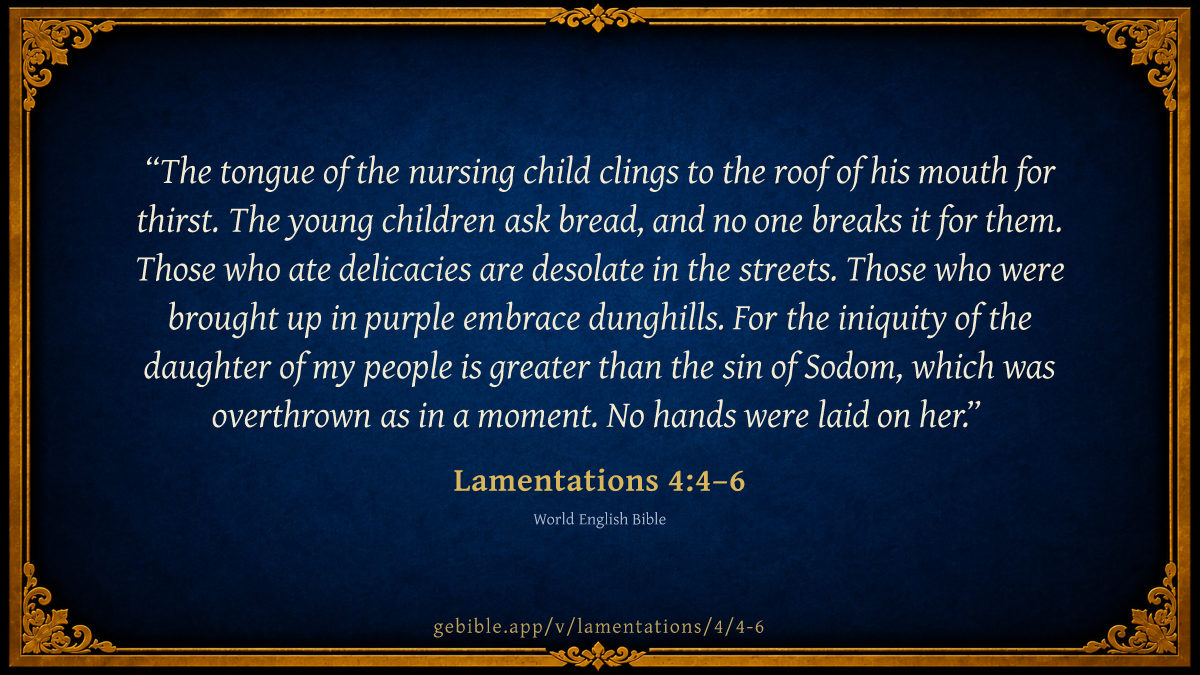
4 The tongue of the nursing child clings to the roof of his mouth for thirst. The young children ask bread, and no one breaks it for them.
5 Those who ate delicacies are desolate in the streets. Those who were brought up in purple embrace dunghills.
6 For the iniquity of the daughter of my people is greater than the sin of Sodom, which was overthrown as in a moment. No hands were laid on her.
KJVKing James Version
4 The tongue of the sucking child cleaveth to the roof of his mouth for thirst: the young children ask bread, and no man breaketh it unto them.
5 They that did feed delicately are desolate in the streets: they that were brought up in scarlet embrace dunghills.
6 For the punishment of the iniquity of the daughter of my people is greater than the punishment of the sin of Sodom, that was overthrown as in a moment, and no hands stayed on her.
Show all 3 translations
JPSJPS Tanakh (1917)
4 The tongue of the sucking child cleaveth to the roof of his mouth for thirst; the young children ask bread, and none breaketh it unto them.
5 They that did feed on dainties are desolate in the streets; they that were brought up in scarlet embrace dunghills.
6 For the iniquity of the daughter of my people is greater than the sin of Sodom, that was overthrown as in a moment, and no hands fell upon her.
Genesis 19:25(v6)He overthrew those cities, all the plain, all the inhabitants of the cities, and that which grew on the ground.
Psalms 22:15(v4)My strength is dried up like a potsherd. My tongue sticks to the roof of my mouth. You have brought me into the dust of death.
Luke 16:19(v5)“Now there was a certain rich man, and he was clothed in purple and fine linen, living in luxury every day.
Proverbs 31:21(v5)She is not afraid of the snow for her household; for all her household are clothed with scarlet.
Lamentations 2:11-12(v4)My eyes fail with tears. My heart is troubled. My liver is poured on the earth, because of the destruction of the daughter of my people,…
Show all 30 cross-references
Amos 6:3-7(v5)Those who put far away the evil day, and cause the seat of violence to come near; Who lie on beds of ivory, and stretch themselves on their…
Luke 15:16(v5)He wanted to fill his belly with the husks that the pigs ate, but no one gave him any.
Deuteronomy 28:54-56(v5)The man who is tender among you, and very delicate, his eye will be evil toward his brother, toward the wife whom he loves, and toward the…
2 Samuel 1:24(v5)You daughters of Israel, weep over Saul, who clothed you delicately in scarlet, who put ornaments of gold on your clothing.
Psalms 137:6(v4)Let my tongue stick to the roof of my mouth if I don’t remember you, if I don’t prefer Jerusalem above my chief joy.
Isaiah 1:9-10(v6)Unless Yahweh of Armies had left to us a very small remnant, we would have been as Sodom. We would have been like Gomorrah. Hear Yahweh’s…
Isaiah 24:6-12(v5)Therefore the curse has devoured the earth, and those who dwell therein are found guilty. Therefore the inhabitants of the earth are…
Matthew 24:21(v6)for then there will be great suffering, such as has not been from the beginning of the world until now, no, nor ever will be.
Luke 7:25(v5)But what did you go out to see? A man clothed in soft clothing? Behold, those who are gorgeously dressed, and live delicately, are in…
Luke 10:12(v6)I tell you, it will be more tolerable in that day for Sodom than for that city.
Luke 12:47(v6)That servant, who knew his lord’s will, and didn’t prepare, nor do what he wanted, will be beaten with many stripes,
1 Timothy 5:6(v5)But she who gives herself to pleasure is dead while she lives.
Revelation 18:7-9(v5)However much she glorified herself, and grew wanton, so much give her of torment and mourning. For she says in her heart, ‘I sit a queen,…
Deuteronomy 32:24(v4)They shall be wasted with hunger, and devoured with burning heat and bitter destruction. I will send the teeth of animals on them, with the…
Isaiah 3:16-26(v5)Moreover Yahweh said, “Because the daughters of Zion are arrogant, and walk with outstretched necks and flirting eyes, walking to trip as…
Isaiah 32:9-14(v5)Rise up, you women who are at ease! Hear my voice! You careless daughters, give ear to my speech! For days beyond a year you will be…
Jeremiah 6:2-3(v5)I will cut off the beautiful and delicate one, the daughter of Zion. Shepherds with their flocks will come to her. They will pitch their…
Jeremiah 9:21-22(v5)For death has come up into our windows. It has entered into our palaces to cut off the children from outside, and the young men from the…
Lamentations 1:11(v4)All her people sigh. They seek bread. They have given their pleasant things for food to refresh their soul. “Look, Yahweh, and see; for I…
Lamentations 4:9(v6)Those who are killed with the sword are better than those who are killed with hunger; For these pine away, stricken through, for lack of…
Ezekiel 16:48-50(v6)As I live,” says the Lord Yahweh, “Sodom your sister has not done, she nor her daughters, as you have done, you and your daughters. “ ‘…
Daniel 9:12(v6)He has confirmed his words, which he spoke against us, and against our judges who judged us, by bringing on us a great evil; for under the…
Matthew 7:9-11(v4)Or who is there among you, who, if his son asks him for bread, will give him a stone? Or if he asks for a fish, who will give him a…
Matthew 11:23-24(v6)You, Capernaum, who are exalted to heaven, you will go down to Hades. For if the mighty works had been done in Sodom which were done in…
Job 24:8(v5)They are wet with the showers of the mountains, and embrace the rock for lack of a shelter.
Cross-references from openbible.info (CC BY 4.0)
Explain this passage (16 sources)
Historical commentary, presented as a primary source — not an endorsement.
John Calvin1540 · Public DomainOn vv4–6He says that sucking children were so thirsty, that…
He says that sucking children were so thirsty, that the tongue was as it were fixed to the palate; and it was a dreadful thing; for mothers would willingly pour forth their own blood to feed their infants. When, therefore, the tongue of a child clave to his mouth, it seemed to be in a manner beyond nature. Among other calamities, then, the Prophet names this, that infants pined away with thirst, and also that children sought bread in vain. He speaks not in the latter instance of sucklings, but. of children three or four years old. Then he says that they sought or asked for bread, but that there was no one to give.
He describes here the famine of the city, of which he had predicted, when he declared that it would be better with the slain than with the people remaining alive, for a harder conflict with famine and want would await the living. But this was not believed. Now, then, the Prophet upbraids the Jews with their former perverseness. He afterwards adds, —
John Calvin's Commentaries (1540-1563) — public domain. Text from the Calvin Translation Society English edition (1840s-50s) via the Christian Classics Ethereal Library (ccel.org). Calvin's coverage is partial (roughly two-thirds of the Bible); uncommented books and verses are honest gaps, never fabricated. The 19th-century editor's footnotes and remarks are omitted so the notes are faithfully Calvin's own voice.
Geneva Bible translators1599 · Public DomainOn v6Or, no strength was against her.
Or, no strength was against her.
Geneva Bible (1599) marginal notes — public domain.
John Trapp1656 · Public DomainOn vv4–6Lam 4:4 The tongue of the sucking child cleaveth…
Lam 4:4 The tongue of the sucking child cleaveth to the roof of his mouth for thirst: the young children ask bread, [and] no man breaketh [it] unto them.
Ver. 4. The tongue of the sucking child cleaveth.] For want of suck. That was a miracle which is recorded of the old woman of Bolton, in Lancashire, who took up a poor child that lay crying at the breasts of her dead mother - slain, among many others, by Prince Rupert’s party - and laying it to her own dry breasts, that had not yielded suck for above twenty years before, on purpose to still it, had milk came to nourish it, to the admiration and astonishment of all beholders. This and another like example of God’s good providence for the relief of little ones whom their mothers could not relieve, may be read of in Mr Clark’s "Mirror for Saints and Sinners," edit. 3, fol. 495, 507.
Read full note →
And no man breaketh it unto them.] The parents either not having it for them, or not having a heart to part with it to them.
John Trapp, A Commentary or Exposition upon All the Books of the Old and New Testament (1647–1656) — public domain. Text from a community e-Sword module.
Matthew Poole1685 · Public DomainOn vv4–6As the fatness of the mother’s milk makes it…
As the fatness of the mother’s milk makes it instead of bread and flesh to the sucking child, so the moisture of it makes it to be as drink to allay its heat; the children wanting this moisture, their mouths were hot and dry. It was a time of famine; the little children, understanding not-the case of the city, were importunate for something to eat, but none had enough for himself, much less for others. See Lam 2:12,13.
Matthew Poole's English Annotations on the Holy Bible (1683–1685) — public domain. Text from a community e-Sword/MySword module.
John Gill1763 · Public DomainOn vv4–6The tongue of the sucking child cleaveth to the…
The tongue of the sucking child cleaveth to the roof of his mouth for thirst,.... Through want of the milk of the breast, which is both food and drink unto it:
the young children ask bread; of their parents as usual, not knowing how the case was, that there was a famine in the city; these are such as were more grown, were weaned from the milk, and drawn from the breasts, and lived on other food, and were capable of asking for it:
Read full note →
and no man breaketh it unto them: distributes unto them, or gives them a piece of bread; not father, friend, or any other person; it not being in their power to do it, they having none for themselves.
John Gill's Exposition of the Whole Bible (1746–1763) — public domain (CC PDM 1.0). Text via the HelloAO Bible API.
John Wesley1765 · Public DomainOn v6Of Sodom - Their punishment was greater, because more…
Of Sodom - Their punishment was greater, because more lingering, and gradual, whereas Sodom was overthrown in a moment, and that by no human hands that abode upon her, causing her a continued torment.
John Wesley, Explanatory Notes Upon the Whole Bible (1754–1765) — public domain. Text via the GEBible commentary corpus.
Adam Clarke1810 · Public DomainOn vv4–6Verse 4. The tongue of the sucking child] See…
Verse 4. The tongue of the sucking child] See Clarke on La 2:12.
Adam Clarke's Commentary on the Bible (1810–1826) — public domain. Text from a community e-Sword/MySword module.
Joseph Benson1811 · Public DomainOn v6Lam 4:6. For the punishment, &c., is greater than…
Lam 4:6. For the punishment, &c., is greater than the punishment of Sodom — The fate of Sodom was less deplorable than that of Jerusalem; for Sodom was destroyed in an instant; but Jerusalem endured a long siege, and suffered all the miseries of famine, sickness, and hostile arms. In Sodom all were destroyed together, and none left to mourn in bitterness of soul the sad loss of their dearest friends; in Jerusalem many survived to mourn the deplorable fate of their friends and country, and to suffer the ignominy and miseries of captivity. The original of the last clause, ידים לא חלו בה, is rendered by the LXX., και ουκ επονεσαν εν αυτη
χειρας, they did not cause hands to labour, or be weary, in her: and by Blaney, nor were hands weakened in her.
Joseph Benson's Commentary on the Old and New Testaments (1811–1818) — public domain. Text from a community e-Sword module.
Albert Barnes1834 · Public DomainOn vv5–6They that were brought up in scarlet - literally,…
They that were brought up in scarlet - literally, “those that were carried upon scarlet;” young children in arms and of the highest birth now lie on the dirt-heaps of the city.
Albert Barnes' Notes on the Bible (1834–1885) — public domain. Text from a community e-Sword/MySword module.
Haydock's Catholic Bible Commentary1859 · Public DomainOn vv5–6Scarlet. Literally, "yellow;" croceis. (Haydock) --- Hebrew means purple.…
Scarlet. Literally, "yellow;" croceis. (Haydock) --- Hebrew means purple. Those who have been educated in the most delicate manner, are forced to feed on the most disgusting things, 4 Kings vi. 25., and xviii. 27., and Deuteronomy xxviii. 54.
George Leo Haydock (1774–1849), Haydock's Catholic Family Bible and Commentary, 1859 edition — public domain. Excludes Psalms (Douay-Rheims chapter numbering differs from Protestant) and Deuterocanonical books (Catholic canon only).
Robert Jamieson, A. R. Fausset & David Brown1871 · Public DomainOn vv4–6thirst--The mothers have no milk to give through the…
thirst--The mothers have no milk to give through the famine.
Jamieson, Fausset & Brown — Commentary Critical and Explanatory on the Whole Bible (1871) — public domain (CC PDM 1.0). Text via the HelloAO Bible API.
Daniel D. Whedon1874 · Public DomainOn vv4–64. The tongue… cleaveth to the roof — The…
4. The tongue… cleaveth to the roof — The most graphic and fearfully expressive feature of the common misery is brought to view in this unnatural conduct of parents, leaving the sucking child and young children to famish for want of proper nutriment.
Daniel D. Whedon (gen. ed.), Commentary on the Old and New Testaments (1874–1909) — public domain. Text from a community e-Sword module.
The Cambridge Bible for Schools and Colleges1878 · Public DomainOn vv5–65. delicately] luxuriously. Children are still the subject, and…
5. delicately] luxuriously. Children are still the subject, and not, as has been suggested, rich persons. In the latter case we should have to render carried on scarlet (i.e. litters or couches furnished with costly stuffs of that colour), unduly forcing the sense of the Heb. verb.
desolate] See on ch. Lam_3:11.
Read full note →
embrace dunghills] for want of a better couch.
The Cambridge Bible for Schools and Colleges (gen. ed. J. J. S. Perowne; Cambridge University Press, 1878–1918) — public domain. Text from a community e-Sword module.
Ellicott's Commentary for English Readers1878 · Public DomainOn vv5–6(5) They that were brought up . . .—Literally,…
(5) They that were brought up . . .—Literally, that were carried (as children are carried). “Scarlet” as in 2Sa_1:24, stands for the shawls or garments of the rich, dyed, as they were, in the Tyrian purple or crimson. Those that had been once wrapped in such shawls now threw themselves, “embracing” them as their only refuge, on dunghills.
A Bible Commentary for English Readers, edited by Charles John Ellicott (1878–1897) — public domain. Text from a community e-Sword module.
The Pulpit Commentary1880 · Public DomainOn vv4–6Breaketh it unto them. The Jewish bread, consisting of…
Breaketh it unto them. The Jewish bread, consisting of round or oval cakes. (comp. 1Ki_19:6)
The Pulpit Commentary (1880–1919), ed. H.D.M. Spence-Jones & Joseph S. Exell — public domain. Text from a community e-Sword module.
unfoldingWord translationNotes2017 · CC BY-SA 4.0On vv4, 6The tongue of the nursing baby sticks to the…
The tongue of the nursing baby sticks to the roof of his mouth by thirst
"Nursing babies are so thirsty that their tongues stick to the top of their mouths"
Read full note →
feast on
"eat much"
now starve in the streets
These people no longer have homes, so they live outside along the streets.
Those who were brought up wearing scarlet clothing
This can be stated in active form. AT: "those who grew up wearing scarlet clothing" or "those who wore scarlet clothing when they were growing up" (See: Active or Passive)
scarlet clothing
Here this phrase is a metonym for luxurious, expensive, and comfortable clothing, at least some of which was probably scarlet. AT: "luxurious clothing"
now lie on piles of ashes
This is because they no longer have homes and soft beds.

John Calvin 1540 · Public Domain On vv4–6 He says that sucking children were so thirsty, that…
He says that sucking children were so thirsty, that the tongue was as it were fixed to the palate; and it was a dreadful thing; for mothers would willingly pour forth their own blood to feed their infants. When, therefore, the tongue of a child clave to his mouth, it seemed to be in a manner beyond nature. Among other calamities, then, the Prophet names this, that infants pined away with thirst, and also that children sought bread in vain. He speaks not in the latter instance of sucklings, but. of children three or four years old. Then he says that they sought or asked for bread, but that there was no one to give.
He describes here the famine of the city, of which he had predicted, when he declared that it would be better with the slain than with the people remaining alive, for a harder conflict with famine and want would await the living. But this was not believed. Now, then, the Prophet upbraids the Jews with their former perverseness. He afterwards adds, —
John Calvin's Commentaries (1540-1563) — public domain. Text from the Calvin Translation Society English edition (1840s-50s) via the Christian Classics Ethereal Library (ccel.org). Calvin's coverage is partial (roughly two-thirds of the Bible); uncommented books and verses are honest gaps, never fabricated. The 19th-century editor's footnotes and remarks are omitted so the notes are faithfully Calvin's own voice.
Geneva Bible translators 1599 · Public Domain On v6 Or, no strength was against her.
Or, no strength was against her.
Geneva Bible (1599) marginal notes — public domain.
John Trapp 1656 · Public Domain On vv4–6 Lam 4:4 The tongue of the sucking child cleaveth…
Lam 4:4 The tongue of the sucking child cleaveth to the roof of his mouth for thirst: the young children ask bread, [and] no man breaketh [it] unto them.
Ver. 4. The tongue of the sucking child cleaveth.] For want of suck. That was a miracle which is recorded of the old woman of Bolton, in Lancashire, who took up a poor child that lay crying at the breasts of her dead mother - slain, among many others, by Prince Rupert’s party - and laying it to her own dry breasts, that had not yielded suck for above twenty years before, on purpose to still it, had milk came to nourish it, to the admiration and astonishment of all beholders. This and another like example of God’s good providence for the relief of little ones whom their mothers could not relieve, may be read of in Mr Clark’s "Mirror for Saints and Sinners," edit. 3, fol. 495, 507.
Read full note →
And no man breaketh it unto them.] The parents either not having it for them, or not having a heart to part with it to them.
John Trapp, A Commentary or Exposition upon All the Books of the Old and New Testament (1647–1656) — public domain. Text from a community e-Sword module.
Matthew Poole 1685 · Public Domain On vv4–6 As the fatness of the mother’s milk makes it…
As the fatness of the mother’s milk makes it instead of bread and flesh to the sucking child, so the moisture of it makes it to be as drink to allay its heat; the children wanting this moisture, their mouths were hot and dry. It was a time of famine; the little children, understanding not-the case of the city, were importunate for something to eat, but none had enough for himself, much less for others. See Lam 2:12,13.
Matthew Poole's English Annotations on the Holy Bible (1683–1685) — public domain. Text from a community e-Sword/MySword module.
John Gill 1763 · Public Domain On vv4–6 The tongue of the sucking child cleaveth to the…
The tongue of the sucking child cleaveth to the roof of his mouth for thirst,.... Through want of the milk of the breast, which is both food and drink unto it:
the young children ask bread; of their parents as usual, not knowing how the case was, that there was a famine in the city; these are such as were more grown, were weaned from the milk, and drawn from the breasts, and lived on other food, and were capable of asking for it:
Read full note →
and no man breaketh it unto them: distributes unto them, or gives them a piece of bread; not father, friend, or any other person; it not being in their power to do it, they having none for themselves.
John Gill's Exposition of the Whole Bible (1746–1763) — public domain (CC PDM 1.0). Text via the HelloAO Bible API.
John Wesley 1765 · Public Domain On v6 Of Sodom - Their punishment was greater, because more…
Of Sodom - Their punishment was greater, because more lingering, and gradual, whereas Sodom was overthrown in a moment, and that by no human hands that abode upon her, causing her a continued torment.
John Wesley, Explanatory Notes Upon the Whole Bible (1754–1765) — public domain. Text via the GEBible commentary corpus.
Adam Clarke 1810 · Public Domain On vv4–6 Verse 4. The tongue of the sucking child] See…
Verse 4. The tongue of the sucking child] See Clarke on La 2:12.
Adam Clarke's Commentary on the Bible (1810–1826) — public domain. Text from a community e-Sword/MySword module.
Joseph Benson 1811 · Public Domain On v6 Lam 4:6. For the punishment, &c., is greater than…
Lam 4:6. For the punishment, &c., is greater than the punishment of Sodom — The fate of Sodom was less deplorable than that of Jerusalem; for Sodom was destroyed in an instant; but Jerusalem endured a long siege, and suffered all the miseries of famine, sickness, and hostile arms. In Sodom all were destroyed together, and none left to mourn in bitterness of soul the sad loss of their dearest friends; in Jerusalem many survived to mourn the deplorable fate of their friends and country, and to suffer the ignominy and miseries of captivity. The original of the last clause, ידים לא חלו בה, is rendered by the LXX., και ουκ επονεσαν εν αυτη
χειρας, they did not cause hands to labour, or be weary, in her: and by Blaney, nor were hands weakened in her.
Joseph Benson's Commentary on the Old and New Testaments (1811–1818) — public domain. Text from a community e-Sword module.
Albert Barnes 1834 · Public Domain On vv5–6 They that were brought up in scarlet - literally,…
They that were brought up in scarlet - literally, “those that were carried upon scarlet;” young children in arms and of the highest birth now lie on the dirt-heaps of the city.
Albert Barnes' Notes on the Bible (1834–1885) — public domain. Text from a community e-Sword/MySword module.
Haydock's Catholic Bible Commentary 1859 · Public Domain On vv5–6 Scarlet. Literally, "yellow;" croceis. (Haydock) --- Hebrew means purple.…
Scarlet. Literally, "yellow;" croceis. (Haydock) --- Hebrew means purple. Those who have been educated in the most delicate manner, are forced to feed on the most disgusting things, 4 Kings vi. 25., and xviii. 27., and Deuteronomy xxviii. 54.
George Leo Haydock (1774–1849), Haydock's Catholic Family Bible and Commentary, 1859 edition — public domain. Excludes Psalms (Douay-Rheims chapter numbering differs from Protestant) and Deuterocanonical books (Catholic canon only).
Robert Jamieson, A. R. Fausset & David Brown 1871 · Public Domain On vv4–6 thirst--The mothers have no milk to give through the…
thirst--The mothers have no milk to give through the famine.
Jamieson, Fausset & Brown — Commentary Critical and Explanatory on the Whole Bible (1871) — public domain (CC PDM 1.0). Text via the HelloAO Bible API.
Daniel D. Whedon 1874 · Public Domain On vv4–6 4. The tongue… cleaveth to the roof — The…
4. The tongue… cleaveth to the roof — The most graphic and fearfully expressive feature of the common misery is brought to view in this unnatural conduct of parents, leaving the sucking child and young children to famish for want of proper nutriment.
Daniel D. Whedon (gen. ed.), Commentary on the Old and New Testaments (1874–1909) — public domain. Text from a community e-Sword module.
The Cambridge Bible for Schools and Colleges 1878 · Public Domain On vv5–6 5. delicately] luxuriously. Children are still the subject, and…
5. delicately] luxuriously. Children are still the subject, and not, as has been suggested, rich persons. In the latter case we should have to render carried on scarlet (i.e. litters or couches furnished with costly stuffs of that colour), unduly forcing the sense of the Heb. verb.
desolate] See on ch. Lam_3:11.
Read full note →
embrace dunghills] for want of a better couch.
The Cambridge Bible for Schools and Colleges (gen. ed. J. J. S. Perowne; Cambridge University Press, 1878–1918) — public domain. Text from a community e-Sword module.
Ellicott's Commentary for English Readers 1878 · Public Domain On vv5–6 (5) They that were brought up . . .—Literally,…
(5) They that were brought up . . .—Literally, that were carried (as children are carried). “Scarlet” as in 2Sa_1:24, stands for the shawls or garments of the rich, dyed, as they were, in the Tyrian purple or crimson. Those that had been once wrapped in such shawls now threw themselves, “embracing” them as their only refuge, on dunghills.
A Bible Commentary for English Readers, edited by Charles John Ellicott (1878–1897) — public domain. Text from a community e-Sword module.
The Pulpit Commentary 1880 · Public Domain On vv4–6 Breaketh it unto them. The Jewish bread, consisting of…
Breaketh it unto them. The Jewish bread, consisting of round or oval cakes. (comp. 1Ki_19:6)
The Pulpit Commentary (1880–1919), ed. H.D.M. Spence-Jones & Joseph S. Exell — public domain. Text from a community e-Sword module.
unfoldingWord translationNotes 2017 · CC BY-SA 4.0 On vv4, 6 The tongue of the nursing baby sticks to the…
The tongue of the nursing baby sticks to the roof of his mouth by thirst
"Nursing babies are so thirsty that their tongues stick to the top of their mouths"
Read full note →
feast on
"eat much"
now starve in the streets
These people no longer have homes, so they live outside along the streets.
Those who were brought up wearing scarlet clothing
This can be stated in active form. AT: "those who grew up wearing scarlet clothing" or "those who wore scarlet clothing when they were growing up" (See: Active or Passive)
scarlet clothing
Here this phrase is a metonym for luxurious, expensive, and comfortable clothing, at least some of which was probably scarlet. AT: "luxurious clothing"
now lie on piles of ashes
This is because they no longer have homes and soft beds.
translationWords
feast
unfoldingWord translationNotes — © Distant Shores Media and the Door43 World Missions Community, licensed CC BY-SA 4.0. Source: git.door43.org/Door43/en_tn.