
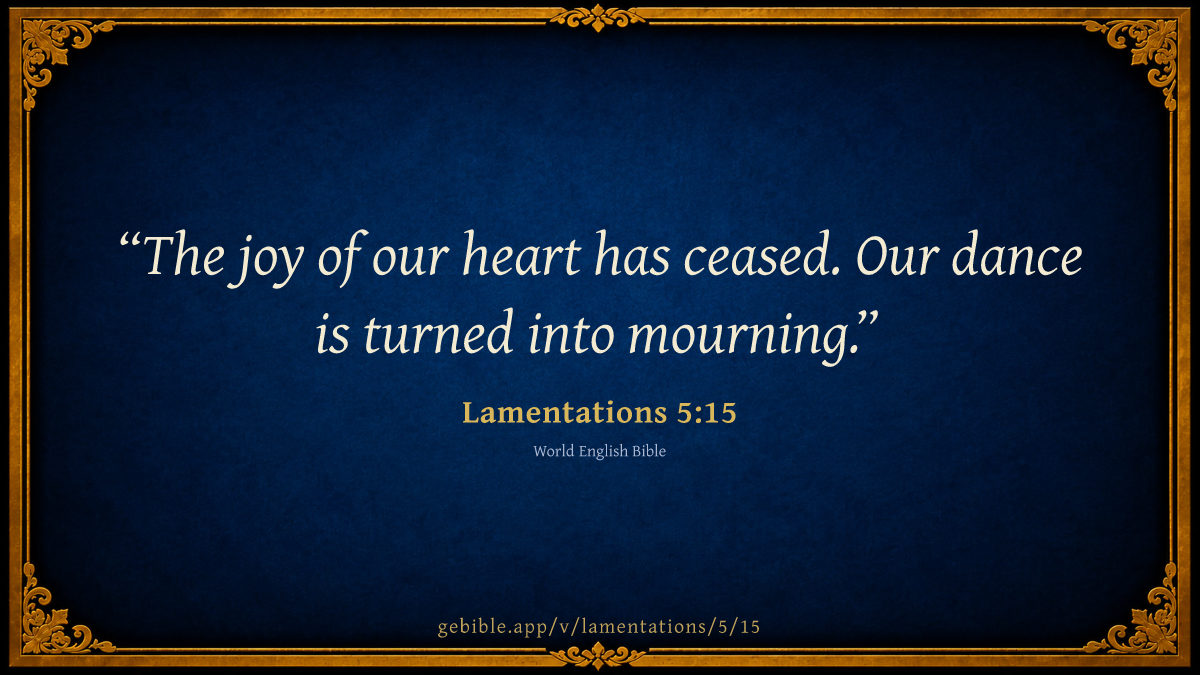
The joy of our heart has ceased. Our dance is turned into mourning.
Parallel Translations
-
The joy of our heart has ceased. Our dance is turned into mourning.
-
The joy of our heart is ceased; our dance is turned into mourning.
-
The joy of our heart is ceased; our dance is turned into mourning.
Cross-references (5)
Passages linked to Lamentations 5:15 in the Treasury of Scripture Knowledge, ordered by reader-vote popularity; verse text shown in World English Bible.
- Amos 8:10 I will turn your feasts into mourning, and all your songs into lamentation; and I will make you wear sackcloth on all your bodies, and baldness on every head. I will make it like the mourning for an only son, and its end like a bitter day.
- Jeremiah 25:10 Moreover I will take from them the voice of mirth and the voice of gladness, the voice of the bridegroom and the voice of the bride, the sound of the millstones, and the light of the lamp.
- Psalms 30:11 You have turned my mourning into dancing for me. You have removed my sackcloth, and clothed me with gladness,
- Amos 6:4-7 Who lie on beds of ivory, and stretch themselves on their couches, and eat the lambs out of the flock, and the calves out of the middle of the stall; who strum on the strings of a harp; who invent for themselves instruments of music, like David; who drink wine in bowls, and anoint themselves with the best oils; but they are not grieved for the affliction of Joseph. Therefore they will now go captive with the first who go captive; and the feasting and lounging will end.
- James 4:9-10 Lament, mourn, and weep. Let your laughter be turned to mourning, and your joy to gloom. Humble yourselves in the sight of the Lord, and he will exalt you.
Cross-references from openbible.info (CC BY 4.0)
Explain this verse (6 sources)
Historical commentary, presented as a primary source — not an endorsement.
Private notes
Saved on this device only — never synced or sent anywhere.
John Calvin 1540 · Public Domain He pursues the same subject, but he seems more…
He pursues the same subject, but he seems more clearly to explain what he had briefly stated in the preceding verse, when he says that all joy of the heart had ceased, and that all the dances were turned into mourning We know that life is more bitter than death when men are in constant mourning; and truly where there is no hilarity, that state of life is worse than death. And this is what the Prophet now means by saying that all joy had ceased, and that all dances were converted into mourning.
John Calvin's Commentaries (1540-1563) — public domain. Text from the Calvin Translation Society English edition (1840s-50s) via the Christian Classics Ethereal Library (ccel.org). Calvin's coverage is partial (roughly two-thirds of the Bible); uncommented books and verses are honest gaps, never fabricated. The 19th-century editor's footnotes and remarks are omitted so the notes are faithfully Calvin's own voice.
John Trapp 1656 · Public Domain Lam 5:15 The joy of our heart is ceased;…
Lam 5:15 The joy of our heart is ceased; our dance is turned into mourning.
Ver. 15. The joy of our heart is ceased.] Heb., Keepeth Sabbath, i.e., is vanished, and that because we made not God’s Sabbath our delight. {as Isa 58:13}
John Trapp, A Commentary or Exposition upon All the Books of the Old and New Testament (1647–1656) — public domain. Text from a community e-Sword module.
Matthew Poole 1685 · Public Domain Either our rejoicing at our solemn festivals, and dancings…
Either our rejoicing at our solemn festivals, and dancings there, which were usual, as appeareth from many scriptures; or all our joy and dancings, as well at other times as in our solemn festivals.
Matthew Poole's English Annotations on the Holy Bible (1683–1685) — public domain. Text from a community e-Sword/MySword module.
John Gill 1763 · Public Domain The joy of our heart is ceased,.... ward joy…
The joy of our heart is ceased,.... ward joy was gone, as well as the external signs of it: it "sabbatized" (y), as it may be rendered; alluding perhaps to the cordial joy expressed formerly on their sabbaths and other festivals, now not observed; at least, not with that joy, inward and outward, they formerly were:
our dance is turned into mourning; which also was used at their solemn feasts, as well as at their common diversions, Jdg 21:21; but now no more of that; but, instead of it, mourning at the calamities they were oppressed with; and at the remembrance of mercies and privileges, civil and religious, they were deprived of.
Read full note →
(y) "sabbatizat".
John Gill's Exposition of the Whole Bible (1746–1763) — public domain (CC PDM 1.0). Text via the HelloAO Bible API.
The Pulpit Commentary 1880 · Public Domain The cessation of joy.
The cessation of joy.
This fate had been foretold. "Then will I cause to cease from the cities of Judah, and from the streets of Jerusalem, the voice of mirth, and the voice of gladness, the voice of the bridegroom, and the voice of the bride: for the land shall be desolate." Well is it for those who take the warning which is given beforehand, and do not wait, as Jerusalem waited, for the stern lessons of a retributive providence.
Read full note →
I THERE IS CESSATION OF JOY WHICH IS NOT PUNITIVE. The health, the elasticity of spirits, the pleasures of youth, cannot be protracted to old age. "Earth"s joys grow dim, its glories fade away." Days of sickness, of poverty, of bereavement, of sorrow, are appointed by the Lord of the human lot, to follow days of brightness. The wail of sorrow will replace the song of gladsome joy. Yet all this experience may be spiritually disciplinary and helpful; there may be in it nothing of punishment, nothing of Divine displeasure.
II THERE IS CESSATION OF JOY WHICH IS THE SIGN OF DIVINE ANGER AND THE FULFILMENT OF DIVINE THREATENING. Such was the case with Judah, upon whom the siege and the Captivity came, not without warning, not without space for repentance. In fact, sin puts an end to the joy which it promises to increase and perpetuate, and brings about the mourning and distress against which it pretends to ensure us. The retrospect of those whose joy has ceased becomes in such cases a retrospect of human rebellion and Divine forbearance. Conscience awakes and admits that sorrow is merited.
APPLICATION. Yet there is a way of repentance. God will renew the days of his people as of old. This is the cry and the hope of the penitent: "Restore unto me the joy of thy salvation. T.
The Pulpit Commentary (1880–1919), ed. H.D.M. Spence-Jones & Joseph S. Exell — public domain. Text from a community e-Sword module.
unfoldingWord translationNotes 2017 · CC BY-SA 4.0 The joy of our heart
The joy of our heart
Here the word "heart" refers to the whole person and emphasizes their emotions. AT: "Our joy" (See: Synecdoche)
Read full note →
The crown has fallen from our head
Possible meanings are 1) "We no longer wear flowers on our heads for celebrations" or 2) The "crown" represents their king and their "head" represents a place of authority over the people. AT: "We no longer have a king" (See: Metonymy)
translationWords
joy
heart
mourn
crown
woe
sin
unfoldingWord translationNotes — © Distant Shores Media and the Door43 World Missions Community, licensed CC BY-SA 4.0. Source: git.door43.org/Door43/en_tn.