
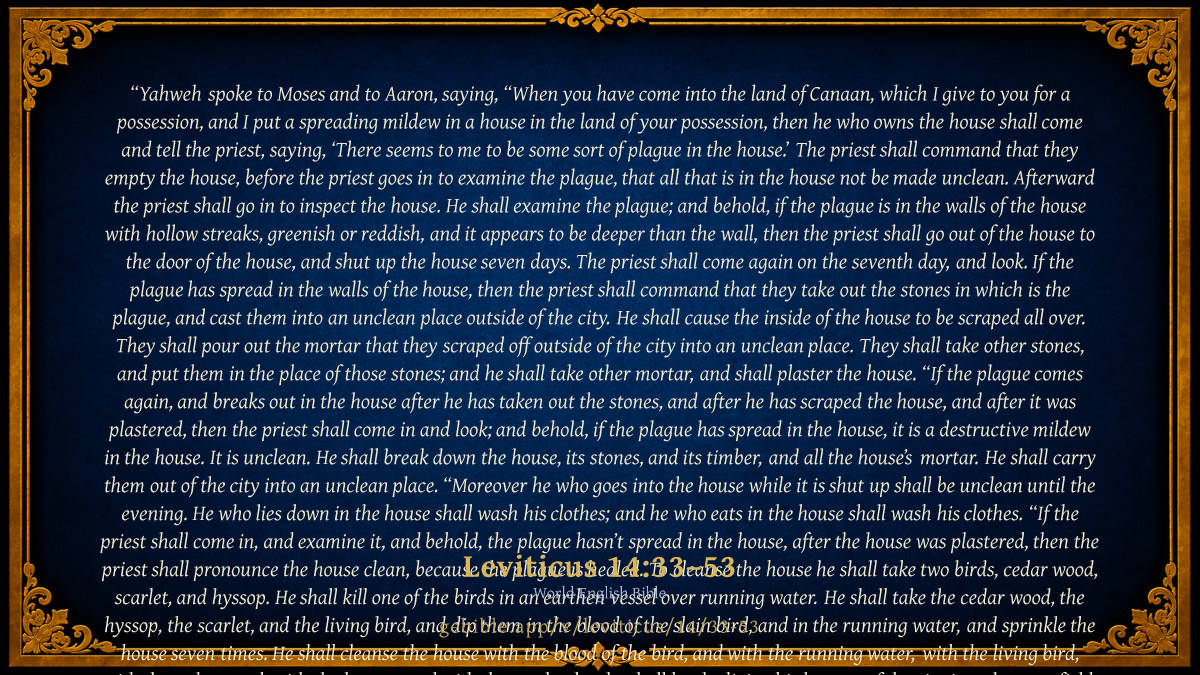
Yahweh spoke to Moses and to Aaron, saying, “When you have come into the land of Canaan, which I give to you for a possession, and I put a spreading mildew in a house in the land of your possession, then he who owns the house shall come and tell the priest, saying, ‘There seems to me to be some sort of plague in the house.’ The priest shall command that they empty the house, before the priest goes in to examine the plague, that all that is in the house not be made unclean. Afterward the priest shall go in to inspect the house. He shall examine the plague; and behold, if the plague is in the walls of the house with hollow streaks, greenish or reddish, and it appears to be deeper than the wall, then the priest shall go out of the house to the door of the house, and shut up the house seven days. The priest shall come again on the seventh day, and look. If the plague has spread in the walls of the house, then the priest shall command that they take out the stones in which is the plague, and cast them into an unclean place outside of the city. He shall cause the inside of the house to be scraped all over. They shall pour out the mortar that they scraped off outside of the city into an unclean place. They shall take other stones, and put them in the place of those stones; and he shall take other mortar, and shall plaster the house.
“If the plague comes again, and breaks out in the house after he has taken out the stones, and after he has scraped the house, and after it was plastered, then the priest shall come in and look; and behold, if the plague has spread in the house, it is a destructive mildew in the house. It is unclean. He shall break down the house, its stones, and its timber, and all the house’s mortar. He shall carry them out of the city into an unclean place.
“Moreover he who goes into the house while it is shut up shall be unclean until the evening. He who lies down in the house shall wash his clothes; and he who eats in the house shall wash his clothes.
“If the priest shall come in, and examine it, and behold, the plague hasn’t spread in the house, after the house was plastered, then the priest shall pronounce the house clean, because the plague is healed. To cleanse the house he shall take two birds, cedar wood, scarlet, and hyssop. He shall kill one of the birds in an earthen vessel over running water. He shall take the cedar wood, the hyssop, the scarlet, and the living bird, and dip them in the blood of the slain bird, and in the running water, and sprinkle the house seven times. He shall cleanse the house with the blood of the bird, and with the running water, with the living bird, with the cedar wood, with the hyssop, and with the scarlet; but he shall let the living bird go out of the city into the open field. So shall he make atonement for the house; and it shall be clean.”
Geneva Bible translators 1599 · Public Domain On vv34, 37, 40, 41, 45, 49, 53 This declareth that no plague nor punishment cometh to…
This declareth that no plague nor punishment cometh to man without God’s providence and his sending.
Geneva Bible (1599) marginal notes — public domain.
John Trapp 1656 · Public Domain On vv34–36 Lev 14:34 When ye be come into the land…
Lev 14:34 When ye be come into the land of Canaan, which I give to you for a possession, and I put the plague of leprosy in a house of the land of your possession;
Ver. 34. Plague of leprosy in a house.] Such is the contagion of sin, that it will infect the very house we dwell in, the garments we wear, even all the creatures we use, so as all things are to us impure; {Tit 1:13} even the house of God also, {Lev 16:16} and his holy ordinances. The Canaanites had defiled the land from one end to another with their uncleannesses, {Ezr 9:11} and so infected the air. This law taught men, (1.) Upon all occasions to show their utter detestation of sin, but especially of idolatry; (2.) To take heed of despising admonition, lest they be utterly ruined, "and that without remedy." {Pro 29:1}
John Trapp, A Commentary or Exposition upon All the Books of the Old and New Testament (1647–1656) — public domain. Text from a community e-Sword module.
Matthew Poole 1685 · Public Domain On vv36, 37, 40, 41 That they empty the house, i.e. the possessors of…
That they empty the house, i.e. the possessors of the house. It is observable here, that neither the people nor the household stuff were polluted till the leprosy was discovered and declared by the priest, to show what great difference God makes between sins of ignorance, and sins against knowledge and conscience.
Matthew Poole's English Annotations on the Holy Bible (1683–1685) — public domain. Text from a community e-Sword/MySword module.
Matthew Henry 1710 · Public Domain On v33 This is the law concerning the leprosy in a…
This is the law concerning the leprosy in a house. Now that they were in the wilderness they dwelt in tents, and had no houses, and therefore the law is made only an appendix to the former laws concerning the leprosy, because it related, not to their present state, but to their future settlement. The leprosy in a house is as unaccountable as the leprosy in a garment; but, if we see not what natural causes of it can be assigned, we may resolve it into the power of the God of nature, who here says, I put the leprosy in a house (Lev 14:34), as his curse is said to enter into a house, and consume it with the timber and stones thereof, Zac 5:4. Now, 1. It is supposed that even in Canaan itself, the land of promise, their houses might be infected with a leprosy. Though it was a holy land, this would not secure them from this plague, while the inhabitants were many of them so unholy. Thus a place and a name in the visible church will not secure wicked people from God's judgments. 2. It is likewise taken for granted that the owner of the house will make the priest acquainted with it, as soon as he sees the least cause to suspect the leprosy in his house: It seemeth to me there is as it were a plague in the house, Lev 14:35. Sin, where that reigns in a house, is a plague there, as it is in a heart. And masters of families should be aware and afraid of the first appearance of gross sin in their families, and put away the iniquity, whatever it is, far from their tabernacles, Job 22:23. They should be jealous with a godly jealousy concerning those under their charge, lest they be drawn into sin, and take early advice, if it but seem that there is a plague in the house, lest the contagion spread, and many be by it defiled and destroyed. 3. If the priest, upon search, found that the leprosy had got into the house, he must try to cure it, by taking gout that part of the building that was infected, Lev 14:40, Lev 14:41. This was like cutting off a gangrened limb, for the preservation of the rest of the body. Corruption should be purged out in time, before it spread; for a little leaven leaveneth the whole lump. If thy right hand offend thee, cut it off. 4. If yet it remained in the house, the whole house must be pulled down, and all the materials carried to the dunghill, Lev 14:44, Lev 14:45. The owner had better be without a dwelling than live in one that was infected. Note, The leprosy of sin, if it be obstinate under the methods of cure, will at last be the ruin of families and churches. If Babylon will not be healed, she shall be forsaken and abandoned, and (according to the law respecting the leprous house), they shall not take of her a stone for a corner, nor a stone for foundations, Jer 51:9, Jer 51:26. The remainders of sin and corruption in our mortal bodies are like this leprosy in the house; after all our pains in scraping and plastering, we shall never be quite clear of it, till the earthly house of this tabernacle be dissolved and taken down; when we are dead we shall be free from sin, and not till then, Rom 6:7. 5. If the taking out the infected stones cured the house, and the leprosy did not spread any further, then the house must be cleansed; not only aired, that it might be healthful, but purified from the ceremonial pollution, that it might be fit to be the habitation of an Israelite. The ceremony of its cleansing was much the same with that of cleansing a leprous person, Lev 14:49, etc. This intimated that the house was smitten for the man's sake (as bishop Patrick expresses it), and he was to look upon himself as preserved by divine mercy. The houses of Israelites are said to be dedicated (Deu 20:5), for they were a holy nation, and therefore they ought to keep their houses pure from all ceremonial pollutions, that they might be fit for the service of that God to whom they were devoted. And the same care should we take to reform whatever is amiss in our families, that we and our houses may serve the Lord; see Gen 35:2. Some have thought the leprosy in the house was typical of the idolatry of the Jewish church, which did strangely cleave to it; for, though some of the reforming kings took away the infected stones, yet still it broke out again, till by the captivity of Babylon God took down the house, and carried it to an unclean land; and this proved an effectual cure of their inclination to idols and idolatrous worships.
Matthew Henry's Commentary on the Whole Bible (1708–1710) — public domain (CC PDM 1.0). Text via the HelloAO Bible API.
John Gill 1763 · Public Domain On vv33–49 And he shall look on the plague,.... That which…
And he shall look on the plague,.... That which is taken or suspected to be one, being pointed unto by the owner of the house:
and, behold, if the plague be in the walls of the house; for there it chiefly was, if not solely; and from hence Gersom infers that it must be a walled house, and that it must have four walls, neither more nor fewer; and with this agrees the Misnah (l), according to which it must be four square; the signs of which were, when it appeared:
Read full note →
with hollow strakes, greenish or reddish, which in sight are lower than the wall: these signs agree with the other signs before given of leprosy in men and garments; the first, the hollow strakes, which are explained by being lower in appearance than the wall, a sort of corrosion or eating into it, which made cavities in it, answer to the plague being deeper than the skin of the flesh in men; and the colours greenish or reddish, or exceeding green or red, as Gersom, are the same with those of the leprosy in clothes; and some such like appearances are in saltpetre walls, or in walls eaten by saline and nitrous particles; and also by sulphureous, oily, and arsenical ones, as Scheuchzer observes (m), and are not only tending to ruin, but unhealthful, as if they had rather been eaten by a canker or spreading ulcer; who also speaks of a fossil, called in the German language "steingalla", that is, the gall of stones, by which they are easily eaten into, because of the vitriolic salt of the fire stone, which for the most part goes along with that mineral, which is dissolved by the moist air. Though this leprosy, in the walls of a house, seems not to have risen from any natural causes, but was from the immediate hand of God; and there have been strange diseases, which have produced uncommon effects on houses, and other things: in the times of Narses is said to be a great plague, especially in the province of Liguria, and on a sudden appeared certain marks and prints on houses, doors, vessels, and clothes, which, if they attempted to wash off, appeared more and more (n).
(l) Misn. Nagaim, c. 12. sect. 1, 2. (m) Physica Sacra, vol. 3. p. 330, 331. (n) Warnefrid de Gest. Longobard. l. 2. apud Scheuchzer. ib.
John Gill's Exposition of the Whole Bible (1746–1763) — public domain (CC PDM 1.0). Text via the HelloAO Bible API.
John Wesley 1765 · Public Domain On vv36, 37, 40 That all be not made unclean - It is…
That all be not made unclean - It is observable here, that neither the people nor the household stuff were polluted till the leprosy was discovered and declared by the priest, to shew what great difference God makes between sins of ignorance, and sins against knowledge.
John Wesley, Explanatory Notes Upon the Whole Bible (1754–1765) — public domain. Text via the GEBible commentary corpus.
Adam Clarke 1810 · Public Domain On vv34, 45, 53 Verse 34. When ye be come into the land…
Verse 34. When ye be come into the land - and I put the plague of leprosy] It was probably from this text that the leprosy has been generally considered to be a disease inflicted immediately by God himself; but it is well known that in Scripture God is frequently represented as doing what, in the course of his providence, he only permits or suffers to be done. It is supposed that the infection of the house, as well as of the person and the garments, proceeded from animalcula. See Clarke on Le 13:47, and "Le 13:52".
Adam Clarke's Commentary on the Bible (1810–1826) — public domain. Text from a community e-Sword/MySword module.
Joseph Benson 1811 · Public Domain On vv34, 36, 37, 40 Lev 14:34. I put the plague of leprosy in…
Lev 14:34. I put the plague of leprosy in a house — Now they were in the wilderness, dwelt in tents, and had no houses; and therefore this law is made only as an appendix to the former laws concerning the leprosy, because it related not to their present state, but to their future settlement in Canaan. The leprosy in a house is as unaccountable as the leprosy in a garment: but if we do not see what natural causes can be assigned for it, we may resolve it into the power of the God of nature, who here saith, I put the leprosy in a house, as (Zec 5:4) his curse is said to enter into a house and consume it, with the stones and timber thereof.
Joseph Benson's Commentary on the Old and New Testaments (1811–1818) — public domain. Text from a community e-Sword module.
Albert Barnes 1834 · Public Domain On v33 This section is separated from that on leprosy in…
This section is separated from that on leprosy in clothing Lev 13:47-59 with which it would seem to be naturally connected, and is placed last of all the laws concerning leprosy, probably on account of its being wholly prospective. While the Israelites were in the wilderness, the materials of their dwellings were of nearly the same nature as those of their clothing, and would be liable to the same sort of decay. They were therefore included under the same law.
I put the plague - Yahweh here speaks as the Lord of all created things, determining their decay and destruction as well as their production. Compare Isa 45:6-7; Jon 4:7; Mat 21:20.
Read full note →
Lev 14:37
Hollow strakes ... - Rather, depressed spots of dark green or dark red, appearing beneath (the surface of) the wall.
Lev 14:49
Cleanse the house - Strictly, “purge the house from sin.” The same word is used in Lev 14:52; and in Lev 14:53 it is said, “and make an atonement for it.” Such language is used figuratively when it is applied to things, not to persons. The leprosy in houses, the leprosy in clothing, and the terrible disease in the human body, were representative forms of decay which taught the lesson that all created things, in their own nature, are passing away, and are only maintained for their destined uses during an appointed period, by the power of Yahweh.
Albert Barnes' Notes on the Bible (1834–1885) — public domain. Text from a community e-Sword/MySword module.
Haydock's Catholic Bible Commentary 1859 · Public Domain On vv34, 36, 37, 41, 53 If there. Hebrew, "and I send the plague;" whence…
If there. Hebrew, "and I send the plague;" whence some infer, that this leprosy was an effect of God’s special indignation against the owners of the house. (Muis; &c.)
George Leo Haydock (1774–1849), Haydock's Catholic Family Bible and Commentary, 1859 edition — public domain. Excludes Psalms (Douay-Rheims chapter numbering differs from Protestant) and Deuterocanonical books (Catholic canon only).
Robert Jamieson, A. R. Fausset & David Brown 1871 · Public Domain On vv34, 48 leprosy in a house--This law was prospective, not to…
leprosy in a house--This law was prospective, not to come into operation till the settlement of the Israelites in Canaan. The words, "I put the leprosy," has led many to think that this plague was a judicial infliction from heaven for the sins of the owner; while others do not regard it in this light, it being common in Scripture to represent God as doing that which He only permits in His providence to be done. Assuming it to have been a natural disease, a new difficulty arises as to whether we are to consider that the house had become infected by the contagion of leprous occupiers; or that the leprosy was in the house itself. It is evident that the latter was the true state of the case, from the furniture being removed out of it on the first suspicion of disease on the walls. Some have supposed that the name of leprosy was analogically applied to it by the Hebrews, as we speak of cancer in trees when they exhibit corrosive effects similar to what the disease so named produces on the human body; while others have pronounced it a mural efflorescence or species of mildew on the wall apt to be produced in very damp situations, and which was followed by effects so injurious to health as well as to the stability of a house, particularly in warm countries, as to demand the attention of a legislator. Moses enjoined the priests to follow the same course and during the same period of time for ascertaining the true character of this disease as in human leprosy. If found leprous, the infected parts were to be removed. If afterwards there appeared a risk of the contagion spreading, the house was to be destroyed altogether and the materials removed to a distance. The stones were probably rough, unhewn stones, built up without cement in the manner now frequently used in fences and plastered over, or else laid in mortar. The oldest examples of architecture are of this character. The very same thing has to be done still with houses infected with mural salt. The stones covered with the nitrous incrustation must be removed, and if the infected wall is suffered to remain, it must be plastered all over anew.
Jamieson, Fausset & Brown — Commentary Critical and Explanatory on the Whole Bible (1871) — public domain (CC PDM 1.0). Text via the HelloAO Bible API.
Daniel D. Whedon 1874 · Public Domain On vv33, 34, 35, 36, 37, 39, 40, 41, 42, 44, 45, 46, 53 SIGNS OF LEPROSY IN A HOUSE, Lev_14:33-45.
SIGNS OF LEPROSY IN A HOUSE, Lev_14:33-45.
The nature of house leprosy is a great mystery. If it proceeded from a natural cause we should expect to find the same cause productive of a like effect in modern Palestine. But travellers report no instances. The most prevalent theory, having a slight scriptural basis (see Lev_14:34, note) is, that it was a supernatural plague. This is the opinion of Patrick, Aberbanel, and many rabbins. The author of Sepher Cosri says, “God inflicted the plague of leprosy upon houses and garments as a punishment for lesser sins, and when the parties continued to multiply transgressions, it invaded their bodies.” Maimonides specifies the sin of which this is the punishment to be an evil tongue. The Targum of Palestine says that the plague was because the house was “built by rapine.” Michaelis has suggested, as a natural cause, a nitrous efflorescence produced by saltpetre, or rather an acid containing it, and issuing in red spots. He cites the case of a house in Lubeck. But this does not counterbalance the absence of such phenomena in the Holy Land in modern times. Says Dr. W.M. Thomson, “I have suspected that this disease is caused by living and self-propagating animalculae; and thus I can conceive it possible that these might fasten on a wall, especially if the cement were mixed with sizing, as is now done, or other gelatinous or animal glues. Still, the most cursory reference to the best of medical works shows how little is known about the whole subject of contagion, and its propagation by fomites. One finds in them abundant and incontestable instances of the propagation of many terrible constitutional maladies, in the most inexplicable manner, by garments, leather, wood, and other things, the materies morbi meantime eluding the most persevering and vigilant search, aided by every appliance of modern science, chemical or optical.”
Daniel D. Whedon (gen. ed.), Commentary on the Old and New Testaments (1874–1909) — public domain. Text from a community e-Sword module.
The Cambridge Bible for Schools and Colleges 1878 · Public Domain On v33 Leprosy in houses (33–53)
Leprosy in houses (33–53)
Nothing definite is known about these appearances on the walls of a house, which are here described as leprosy. It was regarded as a special visitation of God (Lev_14:34, ‘I put the plague’); the Jews believed that the plague was peculiar to Palestine and the chosen people, and was not found in the houses of foreigners. The owner of the house must say ‘There seemeth to me …’ (Lev_14:35): the decision whether the house is leprous rests with the priest. The order to empty the house before the priest comes to inspect shews that there is no fear of contagion. It has been suggested that the appearances were due to damp, or decay, or the growth of some vegetable matter. The diagnosis is similar to that for leprosy in man; the remedy is to remove the stones in which the plague is, and to scrape and plaister the house. If the plague is not stayed, the house must be pulled down. The method of purification if the house be pronounced clean is the same as that prescribed for the leper in Lev_14:4-7. Further regulations are found in Negâim, chs. 12, 13.
The Cambridge Bible for Schools and Colleges (gen. ed. J. J. S. Perowne; Cambridge University Press, 1878–1918) — public domain. Text from a community e-Sword module.
Ellicott's Commentary for English Readers 1878 · Public Domain On vv33, 34, 35, 36, 37, 38, 39, 43, 46, 47, 48, 49 (33) And the Lord spake unto Moses and unto…
(33) And the Lord spake unto Moses and unto Aaron.—Whilst the law about the cleansing of restored lepers was addressed to Moses alone (see Lev_14:1), the regulations about leprous houses, like those with regard to leprous garments and persons, are for the same reason delivered to Moses and Aaron conjointly. (See Lev_13:1.)
A Bible Commentary for English Readers, edited by Charles John Ellicott (1878–1897) — public domain. Text from a community e-Sword module.
The Pulpit Commentary 1880 · Public Domain On vv33, 34, 35, 45, 46, 48 THE LEPROSY OF A HOUSE, AND ITS CLEANSING (verses…
THE LEPROSY OF A HOUSE, AND ITS CLEANSING (verses 33-53). The subject of leprosy in houses must be regarded from the same point of view as that of leprosy in clothes. The regulations respecting it are not sanitary laws, as Lange represents them, but rest, as Keil argues, upon an ideal or symbolical basis. The same thought is attached to all species of uncleanness. Something it matters not what produces a foul and repulsive appearance in the walls of a house. That is in itself sufficient to make that house unclean; for whatever is foul and repulsive is representative of moral and spiritual defilement, and therefore is itself symbolically defiling and defiled. It has been suggested that the special cause of the affection of the houses in Canaan was saltpetre exuding from the materials employed in their building, or iron pyrites in the stone used. This may have been so, or more probably it was the growth of some fungus. Whatever it was, the appearance created by it was so similar to that of leprosy in the human body, as to derive its name from the latter by analogy.
Vers. 33-53. On uncleanness in houses.
Read full note →
There are two metaphors commonly used in Holy Scripture for designating God"s covenant people. They are
(1) God"s household;
(2) God"s house.
I GOD"S HOUSEHOLD. As the household of God the Father," of whom the whole family in heaven and earth is named", (Eph_3:15) they are the members of that august brotherhood gathered together in Christ, of which God himself is the spiritual Father, into which all that are adopted in Christ are incorporated, ceasing to be "strangers and foreigners," and becoming "fellow-citizens with the saints and of the household of God". (Eph_2:19)
II GOD"S HORSE. The representation that God"s people form his house is of a more singular character, and less capable of bring immediately grasped. It is even more commonly employed than the other. In the Epistle to the Corinthians, we read of Christians, that is, the collective body of Christians, being "God"s temple"; (1Co_3:16) "for ye are the temple of the living God; as God hath said, I will dwell in them, and walk in them; and I will be their God, and they shall be my people". (2Co_6:16) In the Epistle to the Ephesians, St. Paul dwells at length on the idea of the Christian Church being built up of living stones into a temple for God"s Spirit: "Ye are built upon the foundation of the apostles and prophets, Jesus Christ being himself the chief corner stone; in whom all the building fitly framed together groweth unto a holy temple in the Lord: in whom ye also are builded together for a habitation of God through the Spirit". (Eph_2:20-22) And in the Epistle to Timothy, he speaks of "the house of God, which is the Church of the living God, the pillar and ground of the truth". (1Ti_3:15) Similarly, the writer of the Epistle to the Hebrews, having described Christ" as a Son over his own house," continues, "whose house are we"; (Heb_3:6) and St. Peter writes, "Ye also, as lively stones, are built up a spiritual house". (1Pe_2:3) Just as God"s Spirit dwells within the heart of each individual Christian, so, and in a more special manner, he dwells within the Church, his house not being made by hands, or constituted of wood and stone, but of the spirits of those who form the Church.
III GOD"S HOUSE MAY NEVER BE DESTROYED, BUT IT MAY BE DEFILED. "Upon this rock" (that is, upon himself as confessed by St. Peter), "I will build my Church, and the gates of hell shall not prevail against it". (Mat_16:18) But though not destructible by the power of evil, it may yet be defiled. "If any man defile the temple of God, him shall God destroy; for the temple of God is holy, which temple ye are". (1Co_3:17) That which defiles God"s house is unrighteousness and falsehood, just as physical and ceremonial uncleanness defiles the comp. (Deu_23:12) If the latter be allowed to continue in the carol, God will symbolically "turn away" from it; "for the Lord thy God walketh in the midst of the camp, to deliver thee, and to give up thine enemies before thee; therefore shall thy camp be holy: that he see no unclean thing in thee, and turn away from thee". (Deu_23:14) If the former be found, "the Holy Spirit of God" will be "grieved", (Eph_4:30) and "vexed," so that God is turned into an "enemy". (Isa_63:10)
IV THE CLEANSING OF GOD"S HOUSE. As soon as there is a prima facie appearance of immorality, or irreligiousness, or superstition in a National Church, a diligent examination should be made by those placed in authority by God. Perhaps it is only an appearance, which will die away of itself. If it does so, no further measures are needed. But "if the plague spread in the walls of the house; then the priest shall command that they take away the stones in which the plague is, and they shall cast them into an unclean place without the city: and he shall cause the house to be scraped within round about, and they shall pour out the dust that they scrape off without the city into an unclean place. Those whose office it is, must not shrink from removing the stones in which the mischief is found, that is, of casting out those who are incurably affected with irreligion, immorality, or superstition. "And they shall take other stones, and put them in the place of those stones; and he shall take other morter, and shall plaister the house." D iscipline must be exercised by substituting sound teachers and members of the flock for those that have become unsound. This is the work of reformation. This is what was done for the Jewish Church by Joash, when he "was minded to repair the house of the Lord So the workmen wrought, and the work was perfected by them, and they set the house of God in his state, and strengthened it"; (2Ch_24:4-13) and by Hezekiah, when he said unto the Levites, "Sanctify now yourselves, and sanctify the house of the Lord God of your fathers, and carry forth the filthiness out of the holy place. For our fathers have trespassed, and done that which was evil in the eyes of the Lord our God, and have forsaken him And the priests went into the inner part of the house of the Lord, to cleanse it, and brought out all the uncleanness that they found in the temple of the Lord into the court of the house of the Lord. And the Levites took it, to carry it out abroad into the brook Kidron"; (2Ch_29:5-16) and by Josiah, when "he began to purge Judah and Jerusalem... when he had purged the land and the house he sent... to repair the house Of the Lord his God... and they gave the money to the workmen that wrought in the house of the Lord, to repair and amend the house: even to the artificers and builders gave they it, to buy hewn stone, and timber for couplings, and to floor the houses which the kings of Judah had destroyed". (2Ch_34:3-11) And this is what was done for the greater part of the Christian Church in the West in the sixteenth century. But if these measures prove ineffective, "if the plague come again, and break out in the house, after that he hath taken away the stones, and after he hath scraped the house and after it is plaistered; then the priest shall come and look, and, behold, if the plague be spread in the house, it is a fretting leprosy in the house: it is unclean. And he shall break down the house, the stones of it, and the timber thereof, and all the morter of the house; and he shall carry them forth out of the city into an unclean place. So it was with the Jewish Church. The reformations of Joash, of Hezekiah, of Josiah, were ineffectual, and the Babylonian captivity followed. And so it will be with the various National Churches of Christendom: any one of them to which the taint of impurity in life or doctrine obstinately adheres, will be destroyed utterly when God"s forbearance shall have at length come to an end.
V WARNING. "Remember therefore from whence thou art fallen, and repent, and do the first works; or else I will come unto thee quickly, and will remove thy candlestick out of his place, except thou repent". (Rev_2:5) "Repent; or else I will come unto thee quickly, and will fight against them with the sword of my mouth". (Rev_2:16) "Remember therefore how thou hast received and heard, and hold fast, and repent. If therefore thou shalt not watch, I will come on thee as a thief, and thou shalt not know what hour I will come upon thee". (Rev_3:3) "As many as I love, I rebuke and chasten: be zealous therefore, and repent. Behold, I stand at the door, and knock: if any man hear my voice, and open the door, I will come in to him, and will sup with him, and he with me". (Rev_3:19, Rev_3:20)
HOMILIES BY W. CLARKSON Vers. 33-53. Cleansing the corrupt house.
That the Divine Lawgiver should, in this tabernacle period of Israel"s history, anticipate a time when their future houses would be affected by some disorder similar to leprosy in the human skin, and that he should direct a treatment of such houses closely corresponding with that of the human leper, is exceedingly remarkable. Nothing could possibly impress the Hebrew mine more powerfully with the idea that "the face of the Lord was against" that spiritual evil of which leprosy was the chosen type. How direct the argument and forcible the conclusion that, if not only every remotest particle of leprosy itself was to be ruthlessly put away but also anything which to the bodily eye had even a near resemblance to it, and was thus suggestive of it, how offensive, how intolerable, in the sight of God must that evil thing itself be held! Here are
I THREE MAIN PRINCIPLES ON THE SUBJECT OF CORRUPTION. In God"s view, as we gain it from his Word,
1. Corruption (impurity) may attach to the "house" or community as well as to the individual. We read of "the iniquity of the house of Israel," and of "the iniquity of the house of Judah"; (Eze_4:5, Eze_4:6) of "the house of Israel dealing treacherously with God", (Jer_3:20) etc.
2. That earnest effort should be made to cleanse it from corruption. The leprous house of stone was to be cleansed: the stones in which the plague was were to be taken away (verse 40); the house was to be scraped round about, and its unclean dust cast out of the camp (verse 41); other stones were to be placed and other mortar used instead (verse 42): the leprous part was to be removed and the house renovated. So must the contaminated community purify itself, removing that from it which is evil and corrupting its Achan, its Ananias and Sapphira, its Simon the sorcerer, its guilty member, (1Co 5) etc.
3. That, all efforts failing, the house will be destroyed. "He shall break down the house, the stones of it," etc. (verse 45). A community of any kind that is incurably corrupt
(1) had better be broken up deliberately by the hand of man; but if no
(2) will certainly be dissolved in time by the hand of God. The history of the world abounds in proofs that moral and spiritual corruption lead on to feebleness, decay, dissolution.
II THREE MAIN APPLICATIONS OF THE PRINCIPLES. To any leprous "house," to any community into which seeds of corruption have been introduced, these principles will apply. They may with peculiar appropriateness be referred to:
1. The nation. The "house of Judah" and the "house of Israel" were continually warned that they had erred from the ways of the Lord and become corrupt, that they must cleanse themselves from their impurities, or that they would be abandoned by God to their doom. Assyria, Judaea, Egypt, Greece, Rome, the Ottoman Empire, provide striking and eloquent illustrations.
2. The family. The "house of Eli" and the "house of Saul" illustrate the principles of the text; so also many a "house" in Christian times that has risen to honour and influence, that has grown leprous (corrupt), that has not heeded the warnings of the Word of God to put away the evil of its doings, and that has fallen into decay and has disappeared.
3. The Church. This is the "house of God" on earth. (1Ti_3:15 2Ti_2:20 Eph_2:19 Heb_3:6) This house may show signs of leprosy; and in individual Churches corruption may break out in doctrine (Galatia), in public worship (Corinth), in morals (Pergamos, Thyatira), in spiritual life (Ephesus, Sardis, Laodicea). The corrupt Church must be cleansed, or it will be disowned of the Divine Lord, and it will perish in his high displeasure. C. (Rev_2:5, Rev_2:16, Rev_2:23, 27 3:3, 17-19)
HOMILIES BY J.A. MACDONALD Ver . 33-57. Leprosy in a house.
From the first of these verses it is concluded that leprosy was not an ordinary disease, but a plague inflicted immediately by a judgment from God. That it was so inflicted in some instances upon persons cannot be disputed, (see Num_12:10 2Ki_5:27 2Ki_15:5) and God threatens to curse the house of the wicked with such a plague. (Zec_5:4) The Jews view it in this light, and consequently regard leprosy as incurable except by the hand of God. But in Scripture, what God permits is often represented as his doing; and evils that Satan inflicts may require the power of God to remove.
I WHAT ARE WE TO UNDERSTAND BY THE HOUSE?
1. There is the obvious literal meaning. It is an ordinary habitation (differing, indeed, from the tents in which the Israelites sojourned in the wilderness), composed of stones, and mortar, and wood, and plaster.
2. It must also have a moral interpretation.
(1) If in the person leprosy has a twofold meaning, viz. a literal and moral; and if the garment plagued with leprosy has a moral as well as a literal meaning, so, by parity of reason, must the house.
(2) It cannot be supposed that for sanitary reasons simply the leprosy in the house should occupy the space it takes in the Scriptures.
(3) Over and above the sanitary regulations, we find regulations for the ceremonial cleansing, in which are sacrifices and sprinklings, "to make an atonement for the house" (verses 48-53). These in other cases are admitted to have reference to the provisions of the gospel for moral purposes, and therefore should be so considered here.
3. It should be taken to represent a community.
(1) It is used sometimes to describe a family. Thus we read. of the "house of Cornelius," and of Noah saving "his house". (Act_10:2 Heb_11:7)
(2) It is also used. to express a lineage. Thus we read of a long war raging between the "house of Saul" and the "house of David". (2Sa_3:1)
(3) The larger community of a nation is called a "house." Thus we read repeatedly of the "house of Israel," the "house of Judah," and Egypt is spoken of as the "house of bondage". (Deu_8:14)
(4) An ecclesiastical community is in like manner described as a house. Paul speaks of the "house of God, which is the Church of the living God". (1Ti_3:15; see also Heb_3:2-6 Heb_10:21 1Pe_4:17)
4. A leprous house is a demoralized community.
(1) Thus a family of wicked persons, or in which are members scandalous for irreligion and vice, is morally a leprous house. Such was the house of Eli.
(2) A lineage of wickedness also is a leprous house. Such was the house of "Jeroboam, the son of Nebat, who made Israel to sin." Such that of Omri.
(3) A nation given to idolatry such as Israel became before the Assyrian captivity, and Judah before the Babylonish, may be regarded as a leprous house. So are modern nations demoralized by atheism, infidelity, sabbath desecration, drunkenness, and dissipation, leprous houses.
(4) A Church holding out the poison cup of "damnable heresy" to intoxicate nations, encouraging vice by "indulgences," and "red" with the "blood of the saints and martyrs of Jesus," is a house fearfully smitten with the plague of leprosy.
II WHAT TREATMENT SHOULD IT RECEIVE?
1. The leprosy should be reported to the priest (verses 34, 35).
(1) The Priest is Christ, to whom we must carry all our concerns in prayer domestic, political, ecclesiastical. The voice of suffering cries to him for judgment upon oppressors, (Jam_5:4) and the voice from the ashes of the martyrs loudly imprecates judgment upon their persecutors. (Rev_6:9-11)
(2) Faithful ministers of Christ should be apprised of the symptoms of the plague of heresy or immorality, that they might use their good offices and influence to stop the mischief.
(3) Any of the spiritual priesthood, persons of recognized sanctity and probity, might be informed of the spreading of moral leprosy, whether it be in the family, or State, or Church.
2. Warning should be given to those concerned.
(1) The priest himself gives the warning. The premonitions of Jesus are written in his Word. It tells us of days of judgment upon nations, upon Churches, upon individuals.
(2) Faithful ministers of Christ will utter his words. No false notions of "charity will prevent them from sounding the alarm.
(3) The use of the warning is to have everything removed from the leprous house before the priest"s inquisition for judgment; for whatever he finds in the unclean house will be concluded to be unclean. (see Rev_18:4)
3. It will be duty inspected.
(1) Christ moves in all communities, though unseen, and more particularly amongst the candlesticks, or Churches. His eyes are as flames of fire, searching into all secrets of the "reins and hearts". (Rev_1:12-16)
(2) The light of God"s Word should be let in to discover the heresy that may plague any Church, and to rebuke the laxity of discipline which may connive at licentiousness. (Rev_2:14-16, Rev_2:20-23)
4. It will be shut up for seven days.
(1) The priest himself withdraws. Jesus cannot abide in a foul community.
(2) Whoever enters it during this interval becomes unclean (verse 46). Where Jesus cannot abide, his people should not go.
(3) He that lieth in the house or eateth in it shall wash his clothes (verse 47). Fellowship in such a community compromises righteousness. What is the condition of those who are perverted to heresy!
5. Efforts towards a reformation should be made.
(1) Where the plague may appear superficial, the place must be scraped; where it has eaten deeply, the stones affected must be removed and new ones substituted, and the whole plastered afresh.
(2) However painful the process, the scraping of discipline must be endured. (Job_22:23) There must be an excision of scandalous offenders. (1Co_5:13)
6. The sequel.
(1) If the plague remain through the days of trial, breaking out afresh, notwithstanding the efforts for reformation, when the case is hopeless, then comes the visitation of judgment. The house is demolished and the wreck carried outside the city to an unclean place. (see Rev_22:15)
(2) If the reformation has proved successful, the house abides. The ceremonies of the shedding and sprinkling the sacrificial blood (verses 48-53) show that salvation is through faith in the merits of Christ. To those merits we are indebted for a present and an everlasting salvation. J.A.M.
The Pulpit Commentary (1880–1919), ed. H.D.M. Spence-Jones & Joseph S. Exell — public domain. Text from a community e-Sword module.
The Biblical Illustrator 1887 · Public Domain On v34 Leprosy in a house.
Lev_14:34-57
Leprosy in a house.
Read full note →
Leprosy of house and garments
(see also Lev_13:49):--Few subjects have proved more perplexing to the student of Scripture than this. That human dwellings and garments should exhibit a similar disease to that which infects the human body seems at first sight to be highly improbable. We are indebted to the recent discoveries of the microscope for the first intimation of the true nature of the leprosy of house and garments. A careful examination of the Levitical narrative in the light of modern science leaves no room to doubt that the conclusions of Sommer, Kmtz, and other recent authors, who attribute a vegetable origin to this plague, are correct. The characteristics mentioned are such as can belong only to plants. There are some species of fungi which could have produced all the effects described, and whose form and colour answer admirably to the appearances presented by the leprosy. We are therefore safe in believing that the phenomena in question were caused by fungi. The language of Moses is evidently popular, not scientific, and may therefore be supposed to include not only different species, but even different genera and orders of fungi as concerned in the production of the effects described. The leprosy of the house consisted of reddish and greenish patches. The reddish patches on the wall were in all likelihood caused by the presence of a fungus well known under the common name of dry-rot, and called by botanists Merulius lachrymans. Builders have often painful evidence of the virulent and destructive nature of this scourge. It is frequent all the year round, being in this respect different from other fungi, which are usually confined to the season of decay. If once established dry-rot spreads with amazing rapidity, destroying the best houses in a very short time. The law regarding it in Leviticus is founded upon this property; seven days only were allowed for its development, so that its true nature might be placed beyond doubt. The precautions here adopted are in entire accordance with the nature and habits of fungi. By emptying the house of its furniture, shutting the doors and windows, and excluding the air and light, the very conditions were provided in which the dry-rot would luxuriate and come to maturity. If the walls were completely impregnated with its seed and spawn, this short period of trial would amply suffice to show the fact, and the building might then safely be condemned to undergo a process of purification. There are no means of restoring rotten timber to a sound condition, and the dry-rot can only be eradicated by removing the decayed and affected parts, clearing away all the spawn and destroying the germs with which the plaster and the other materials of the walls may have been impregnated. For this purpose the process of kyanising and burnetising have been recommended--that is, washing the walls or the woodwork with a strong solution of corrosive sublimate or chloride of zinc. If the dry-rot is not fairly established in a house it may be removed with tolerable ease by these processes; should the disease, however, have become widespread and deep-seated, no means of dealing with the evil can be depended upon, except that of removing altogether the corrupted and contagious matter and admitting a free circulation of air. This was exactly what the Jewish priest was commanded to do (verses 40-42). It often happens, however, that even this severe operation proves ineffectual; and after repeated repairs of the same nature, it is found that the building is so hopelessly ruined that it must be abandoned and dismantled (verses 43-45). Dr. Thomson, in The Land and the Book, mentions that the upper rooms of the houses in Palestine, if not constantly ventilated, become quickly covered with mould and are unfit to live in. In many cases the roofs of the houses are little better than earth rolled hard, and it is by no means uncommon to see grass springing into a short-lived existence upon them. Such habitations must be damp and peculiarly subject to the infection of fungi. During the months of November and December especially, fungi make their appearance in the wretched ephemeral abodes of the poorer classes; and in the walls of many a dwelling at the present day may be seen the same leprous appearances described by Moses three thousand years ago. When the Israelites entered Palestine they occupied the dwellings of the dispossessed aboriginal inhabitants instead of building new houses for themselves. And in these dwellings, as the Canaanites lived in the midst of moral and physical impurity, and were, moreover, ignorant of all sanitary conditions, the plague of leprosy would be very apt to manifest itself. The Bible speaks of it as sent expressly by God Himself: When ye be come into the land of Canaan, which I give to you for a possession, and I put the plague of leprosy in a house of the land of your possession. It was so sent in mercy and not in judgment, to show to them, by a palpable proof appealing to the eye, what could not be so well revealed by other evidence. It was the visible manifestation of a hidden insidious unwholesomeness--the breaking out, as it were, of an internal and universal disease. It directed attention to the unhealthy character of the house, and stimulated inquiry as to how it could be remedied. Whereas if no such abnormal appearance presented itself, the inhabitants might remain unconsciously in the midst of conditions which would slowly but surely undermine their health, and in the end prove fatal. In the Levitical narrative we read that in the walls of the affected houses there were greenish as well as reddish streaks. These greenish streaks were caused by a much humbler kind of fungus than the tile Merulius lachrymans, or dry-rot, concerned in the production of tim reddish streaks. Every one is familiar with the common green mould, or Penicillium glaucum, of botanists. This fungus is extremely abundant everywhere, and seems to have been no less general in the ancient world, for we find traces of it pretty frequently in amber, mixed with fragments of lichens and mosses. It grows on all kinds of decaying substances, and is very protean in its appearance, assuming different forms according to the nature of the body or situation which it affects. Common mould grows on every substance, whether animal or vegetable, in a state of decay. It grows even upon the human body when it is in an enfeebled or disordered condition; and many diseases of the skin are owing to its efforts to develop and spread itself. The thrush in children, the muscardine so destructive to silkworms, the fungoid growth which so often causes the death of the common house-fly in autumn, are all different forms of the common mould. Its germs or spores are constantly floating in the air or swimming in the water in incalculable myriads, so that it is difficult to conceive how any place can be free from their presence. The atmosphere of our houses is loaded with them; and were we endowed with microscopic vision, we should see them dancing about in the draughts and currents of our rooms, or shining among the motes in the pencilled rays of sunshine. The ubiquity of mould has given rise to the theory of spontaneous generation, still held by a certain class of naturalists; but the immense profusion of its seeds, and their wonderful powers of adaptability under varying circumstances, and of entering through the finest conceivable apertures, will easily account for its presence in every situation, without being under the necessity of admitting what has never yet been proved--that substances in a particular state of decay can, without seeds or germs of any kind, generate low forms of life. Many medical men are of opinion that various zymotic diseases, if not originated, are increased by the presence of these minute cellules in the blood, and by their deleterious action in developing themselves. The injuries inflicted by fungi are indeed incalculable. But we have nevertheless a grand compensation in the benefits which they confer in accelerating, by their unparalleled rapidity of growth, the process of decay, and removing frown the atmosphere into their own tissues, where they arc innocuous, the putrescent effluvia of dead substances. They also economise the stock of organised material which has been slowly and tediously gained from the earth, air, and water, by preventing it from going back through decomposition to the mineral state, and preserving it in an organic form to be at once made available for the purposes of higher animal and plant life. Mould, for these reasons, is not so much an evil in itself as an indication of evil conditions in the World, and by minimising these it renders an all-important service in the economy of nature. Its great purpose is purely benevolent; but, like the storm intended to purify the atmosphere, it sometimes oversteps its limits, and proves injurious in particular cases. The minute regulations for inspecting and cleansing those houses where symptoms of leprosy appeared, indicate how complete was the sanitary system under which the ancient Israelites lived. God considered no part of their domestic and social economy, however humble, beneath His notice. Cleanliness in person, in dress, in dwellings, and in all outward appointments, was enforced by statutes of a peculiarly solemn character. All these ceremonial enactments were in the first instance intended for sanitary purposes. God had respect to the physical health and well-being of His people. He wished them to be patterns of purity, models of beauty, their bodies to be perfectly developed in the midst of the most favourable circumstances; and therefore the most admirable arrangements were made for securing cleanly, orderly, and healthy habitations. But not for purely physical purposes alone were the Levitical laws regarding the leprosy of the house enforced. They had also a spiritual significance. All experience tells us of the mysterious connection, founded upon the constitution of our twofold nature, between physical and moral evil--between external and internal impurity. The proverb, Cleanliness is next to godliness, is truer even than it is admitted to be. Physical filth has in innumerable instances been the means of turning away the Lord from the homes of those who endure it. For want of a little more room and a little more purity in their dwellings, the sublimest truths fall dead upon the ears of thousands. The salvation of the poor, though to them the gospel is preached, is in very many cases rendered impossible, humanly speaking, on account of the degrading conditions amid which they live, and the deadening, hardening influence which familiarity with noxious sights and smells produces. How often are the spiritual instructions of the district visitor thrown away on account of the unhallowed effects of filthy surroundings! Sad it is to think of the leprosy of the house being the type of the leprosy of sin which infects the earthly tabernacle of this body. We bear about with us this plague in all our members. From the crown of the head to the sole of the foot there is no soundness in us. Be it ours to put our natures entirely under the purifying power of Gods Spirit, so that they may be cleansed from all impure desires, &c. So much for the leprosy of the house. The leprosy of garments may have been caused by the same fungi. Precisely the same appearances manifested themselves in the one case as in the other. I am disposed to attribute the greenish streaks on the garments to the common green mould; for, as I have observed, it is ubiquitous, and grows as readily on clothes as on house walls, when left in damp, ill-ventilated, ill-lighted places. The reddish patches, however, seem to me to have been produced by the growth of the Sporendonema, or red mould, very common on cheese; or of the Palmella prodigiosa. This last-mentioned plant is occasionally found on damp walls in shady places, and on various articles of dress and food, sometimes extending itself over a considerable area. It is usually a gelatinous mass of the colour and general appearance of coagulated blood, whence it has received the famous name of Gory-dew. Though formerly ranked with the algae, or seaweed family, it is now ascertained by more accurate physiological researches to be a species of mould; so that, under whatever names we may class them, the plants which occasioned the strange appearances on houses and garments belong to the same tribe. Instances of reddish patches suddenly investing linen and woollen clothes are by no means confined to the Levitical narrative. A whole volume might be filled with similar examples. Along with other marvellous prodigies they abound in the mediaeval chronicles; and were they not authenticated by the most trustworthy evidence, we should hesitate--from their very extraordinary character--to accept them as true. It was by no means rare to find, in the Middle Ages, consecrated wafers and priestly vestments sprinkled with a minute red substance like blood. Such abnormal appearances were called Signacula, as tokens of the Saviours living body; and pilgrimages were not unfrequently made to witness them. In several cases the Jews were suspected, on account of their abhorrence of Christianity, of having caused sacramental hosts to bleed, and were, therefore, ruthlessly tormented and put to death in large numbers. Upwards of ten thousand were slaughtered at Rotil, near Frankfort, in 1296, for this reason. The bleeding of the host, produced in consequence of the scepticism of the officiating priest, gave rise to the miracle of Bolsena in 1264; the priests garment stained with this bloody-looking substance being preserved until recent times as a relic. This gave rise to the festival of the Corpus Christi founded by Urban
IV. Before the potato-blight broke out in 1846, red mould spots appeared on wet linen surfaces exposed to the air in bleaching-greens, as well as on household linen kept in damp places, in Ireland. In September, 1848, Dr. Eckard, of Berlin, while attending a cholera patient, observed the same production on a plate of potatoes which had been placed in a cupboard in the patients house. All these instances-and hundreds more might be enumerated--though somewhat exaggerated by the dilated eye of fear, were found by microscopic investigation to be caused by the extraordinary development in abnormal circumstances of the red mould. Occurring, as most of them did, before the outbreak of epidemics, which they were supposed to herald, they obviously point to the conclusion that they were developed by unhealthy conditions of the atmosphere. In ordinary times but few of the fungi which caused these alarming appearances are produced, and then only in obscure and isolated localities; but their seeds lie around us in immense profusion, waiting but the recurrence of similar atmospheric conditions as existed in former times, to exhibit as extraordinary a development. O Lord, how manifold are Thy works; in wisdom hast Thou made them all! is the thought that arises in the devout soul at the contemplation of the wonderful structure and history of these minute existences, which live and die unknown to the great majority of mankind. Even a mould, requiring the highest powers of the microscope for its examination, can become in His hands a mighty scourge or a transcendent benefit. (H. Macmillan, D. D.)
House leprosy
The particular nature of this affection I cannot very certainly determine. Michaelis thinks it was a sort of mural efflorescence, which often appears in damp situations, cellars, and ground-floors, and so corrodes walls and plastering as to affect and damage everything near it, and sometimes quite destroying the entire building. Calmet thinks it was a disorder caused by animal-eulse which eroded the walls, and finally destroyed them, if left undisturbed. But perhaps we cannot do better than to agree with the Rabbins and early Christian Fathers, who believed that this leprosy was not natural, but sent of God as an extraordinary judgment, to compel men to the public acknowledgment and expiation of some undetected negligence or crime. It was the stone crying out of the wall against the sinner, and the beam out of the timber answering it (Hab_2:11). It came like a great domestic affliction, saying, This is not your rest, because it is polluted. It was the hand of God upon the forgetters of His law. It was the curse of the Lord, in the house of the wicked. Its typical significance will at once suggest itself. It plainly points to the fact that not only man, and his surroundings in life, but his very dwelling-place--the earth itself--is infected. The whole surface and framework of the world bespeaks infection, disobedience, and disorder. We must tear it with instruments of iron, and mix its mould with tears and sweat, before it will yield us bread. Walls and houses must be built to shelter us from its angry blasts. And with all that we can do, the sea will now and then engulf the proudest navies, and the hailstones blast the budding harvests, and famine and pestilence cut down the strength of empires, and earthquakes bury up great cities in a common tomb, and the sun and the moon flash down death in their rays, and the very winds come laden with destruction. And even in a moral aspect, the material world, though meant for spiritual as well as other good, has often been to man a source of defilement. Creation is a standing miracle to show us eternal power and Godhead. Every ray of light is an electric cord let down from the unknown heavens to lift our hearts into communion with the Father of light. Every night puts us into the midst of a sublime temple in which the tapers burn around the everlasting altar, and through which rolls the vesper anthem of the heavenly spheres, to inspire us with adoration. And the innumerable changes that pass before our eyes are but so many letters to spell out to us the name of the unknown God, in whom we live and have our being. But, how often have these very things tended to establish men in unbelief, and tempted them from the ways of piety and peace? How often have persons looked up into the starry sky, and reasoned, until they were led to say the gospel is a forgery?--or dug into the earth, and insisted that Moses was mistaken in its age?--or cut among the arteries and tissues of organic life, and denied mans immortality?--or watched the uniformity of Gods common laws, and pronounced a miracle impossible?--or dipped a little into physical science, and controverted the very existence of a deity? How often have earths products proven to be mere baits and lures to unguarded souls to lead them down to death? How have its wines tempted men to intemperance, and its beautiful groves to the licentiousness of the idolater? How frequently the very gold or silver of its rocks have taken the place of God Himself, and fastened everlasting condemnation on the worshipper? And what scene of beauty contained in this world, but has served to draw the heart of some one from the Lord? But it shall not always be so. The leprosy in our dwelling-place may pass away as well as leprosy in our persons, or in our clothing. God has appointed rites for its cleansing. The time is coming when there shall be no more curse. But it is to be the last thing cleansed. Regeneration begins first in the spirit. From the spirit it extends to the outward life, then to the redemption of the body. And after that comes the grand deliverance, when the creature (or creation) itself shall be delivered from the bondage of corruption, into the glorious liberty of the children of God. Not only our personal nature is to be renewed, but the very world in which we live. And it is only upon the theory of the ultimate and complete recovery of the world from all damage of sin, that the prescriptions now before us can be explained. The first thing to be done to a house found to be leprous, was to have the affected stones removed, the walls scraped, and the plastering renewed. This done, all parties were to wait to see what the effect would be upon the disorder. This evidently recalls the flood, and Gods dealings with the earth at that time. It was then that He broke up the old and tainted foundations, swept away the scum of its surface, and overcast it with a new order of things. All is therefore in waiting now, till our great High Priest and Judge shall come forth again to inspect the earth. After the lapse of an appropriate time of trial, which is left indefinite in the record, the priest was again to examine the house that had been thus dealt with; and if the plague had broken out again, and had spread in the house, he was to break it down, the stones of it, and the timber thereof, and all the mortar of the house, and carry them forth out of the city into an unclean place. If the leprous symptoms were not stayed, it was to be completely and for ever demolished. There was no further hope for it. It perished in its uncleanness. I take this as a type, not of what is to befall the world, but of what would have befallen it without the redemption that has come in to stay its corruption and save it from ruin. How, then, was a leprous house to be cleansed? We have seen what was to be done to it upon the first appearance of the plague. We accordingly read that, after the lapse of a suitable time to test whether the infection was stayed, the priest shall come in, &c. (Lev_14:48-53). All this refers us back to the blood-shedding, death, and resurrection of Jesus Christ, and holds forth the great fact that the world is made clean to us now, and will be entirely cleansed hereafter, by virtue of the redemptive work of our great High Priest. Because Jesus was slain, and has redeemed us to God by His blood, the saints may take it as their song, We shall reign on the earth. Some suppose that this dwelling-place of man is some day to fall to pieces, and pass away, and be no more. Had Christ not died, or having died, not risen again, it might be so; but now a light of glory rises upon its futurity. It shall not die, but live. Great changes may yet pass upon it, but it shall survive unharmed. This world was Heavens gift to man. It was his patrimonial estate. It was his sin that blighted it. And just so far as he is redeemed, he shall get his own again, and hold it by a charter written in his Saviours blood. (J. A. Seiss, D. D.)
The plague in the house
I fancy you have heard words like these before, though you might never have known that they were in the Bible. But you have heard mother or father, when worried and vexed, often say, It almost seems as if there was a plague in the house!
I. The kind of plague the text speaks about was a strange one. It first appeared in a little green or reddish spot, growing on the wall of the house. When that was noticed, the person who lived in the house had to go to the priest and say to him, It seemeth to me there is as it were a plague in the house. Then the priest came and looked at the spot, and ordered the house to be locked up for a week. At the end of that time, if the spot had not grown any larger, it was simply cut out, and the house was declared to be quite safe to dwell in. But if the spot had increased, then they knew that it was the plague, and all the stones round about it were taken out and new ones put in their places, and the old ones were carried away to a distance. But if, after all this care had been taken, the spot appeared again, then they knew it was no use trying further that way. This was a fretting leprosy, as it was called; so the house was ordered to be pulled down, and all its stones carried far away, and a new house built in its stead with entirely new stones.
II. Havent we plagues in the house now, something different from that perhaps, and yet something like too?
1. There is a bad temper. What a plague that is in the house! There is a sulky temper and a quick temper. The sulky one is when a boy or girl goes moping, moping, and wont speak or do anything cheerfully. It is a very hurtful plague in the house. Then there is the quick temper, up in a moment, over in a moment! Perhaps this is better than the other, if we are to make any distinction; but better be rid of bad temper altogether.
2. Selfishness is another plague in the house.
3. Disobedience is another plague in the house. No boy or girl ever yet came to good who did not try to obey father and mother.
III. Where the plague breaks out.
1. Where ventilation is bad. Now what fresh air is to the body, Gods Spirit is to the soul--that which keeps it fresh and free from plague. Maintain that Spirit in the house, prayer and love for God, and--striving to obey Him--no plague shall come nigh thy dwelling.
2. The plague also breaks out where sunshine never comes. What a healing thing is the sunshine! How glorious it can make even the dingiest street! The plague never comes where the sunshine is, and cheerfulness is the sunshine of the home. There was a great scholar once, Dr. Dwight, a big man with a great broad chest. Once when the students in the college were not getting on well, he said to them, Gentlemen, I see there is something wrong; you are becoming too melancholy. You must learn to laugh, thats the way to cure the plague. So he broadened his own chest, took a big breath, and burst into such a hearty laugh that all the others laughed too. Thats very good, he said, very good for a beginning; but see that you keep it up! And it is good practice in the house to have a hearty laugh. Keep cheerfulness there, and the plague wont trouble you. (J. Reid Howatt.)
The way to remove the plague
When plague, or pestilence, or war, or famine, come on a land, there are two classes of persons who act in opposite ways. One class will pray only that God may remove them, and do nothing more; another class will set about sanitary reform--a most precious and important thing--but they will do nothing more. Now, we are taught in this chapter that the two are to be combined. The priest not only applied to God, and offered sacrifices that the plague might be removed from the house, but he set to work and pulled down the stones, and broke the timbers, and scraped the house, and had it plastered and cleansed; and thus there was the most effective sanitary process, accompanied with the most sacred and Christian appeal to Him who is the Lord and the Giver of life; and who alone healeth, and when He healeth none can make ill. Now, it is the happy combination of these that constitutes in all things the perfection of Christian conduct. If we so think of means as to think of nothing else, we shall have no blessing; if we so think of, or engage in prayer, as to exclude means, we shall have no blessing. If we suppose that by attending to all that is just, and proper, and obligatory in sanitary measures, we may defy God, we blaspheme; but on the other hand, if we act as some, pray, and appoint days of fasting and of prayer, but do nothing to lift the poor from their degradation, to improve their dwellings, to increase their comforts, to give raiment to the naked, food to the hungry, a shelter and a home to them that have none, then that is downright hypocrisy. But if we can combine the two, by using all the means that God in His providence has given us, as vigorously as if all depended upon the means, and yet, while we do so, look up to God as if the means were worthless, and He must do all, then we shall combine the blessed heavenly benediction with the use of the most effective earthly means, and God, our own God, shall crown us with His blessing. (J. Cumming, D. D.)
.
The Biblical Illustrator, edited by Joseph S. Exell (c. 1880s–1900s) — public domain. Text from a community e-Sword module.
C. I. Scofield 1917 · Public Domain On v53 (See Scofield "Exo 29:33").
atonement
(See Scofield "Exo 29:33").
The Scofield Reference Bible (1917 edition), notes by C. I. Scofield — public domain. Text from a community e-Sword module.
Paul E. Kretzmann 1924 · Public Domain On v33 Leprosy in a House
Leprosy in a House
v. 33. And the Lord spake unto Moses and unto Aaron, saying,
Read full note →
v. 34. When ye be come in to the land of Canaan, which I give to you for a possession, which is here definitely foreseen, and I put the plague of leprosy in a house of the land of your possession, if it should be found that the Lord had afflicted a house in this way, as a reminder of the fact that not only their bodies, but also their places of habitation should be considered consecrated to the Lord,
v. 35. and he that owneth the house shall come and tell the priest, saying, It seemeth to me there is as it were a plague in the house,
v. 36. then the priest shall command that they empty the house, clear the house by moving all the furniture and utensils out, before the priest go in to it to see the plague, that all that is in the house be not made unclean, for all the furniture mould be looked upon as unclean if it were still in the house when the sentence of condemnation would be passed upon the structure. And afterward the priest shall go in to see the house;
v. 37. and he shall look on the plague, on the spot or area which seems to be infected, and behold, if the plague be in the walls of the house with hollow strakes, greenish or reddish, which in sight are lower than the wall, the reference undoubtedly being to fungous growths which partake of the nature of diseases, are often poisonous, and eat into the stones,
v. 38. then the priest shall go out of the house to the door of the house and shut up the house seven days.
v. 39. And the priest shall come again the seventh day, according to the division of time usually observed in ceremonies of this kind, and shall look; and, behold, if the plague be spread in the walls of the house,
v. 40. then the priest shall command that they take away the stones in which the plague is, which were affected by the fungous disease, and they shall cast them into an unclean place without the city.
v. 41. And he shall cause the house to be scraped within round about, to remove all the loose and soft particles of lime or sand from the stones; and they shall pour out the dust that they scrape off without the city into an unclean place;
v. 42. and they shall take other stones, and put them in the place of those stones; and he shall take other mortar, and shall plaster the house.
v. 43. And if the plague come again, and break out in the house, after that he hath taken away the stones, and after he hath scraped the house, and after it is plastered, the infection thus being not merely on the surface, but indicating a deep-seated trouble,
v. 44. then the priest shall come and look, and, behold, if the plague be spread in the house, it is a fretting leprosy in the house, an infection which eats away the substance of the stones; it is unclean.
v. 45. And he shall break down the house, that is, the priest shall cause this to be done, the stones of it, and the timber thereof, and all the mortar of the house, all the building materials used in its construction; and he shall carry them forth out of the city into an unclean place.
v. 46. Moreover, he that goeth into the house all the while that it is shut up shall be unclean until the even.
v. 47. And he that lieth in the house, reclining there for the purpose of eating or sleeping, shall wash his clothes; and he that eateth in the house shall wash his clothes, not so much on account of the danger of infection as to prevent the contraction of symbolical uncleanness.
v. 48. And if the priest shall come in and look upon it, and, behold, the plague hath not spread in the house after the house was plastered, after the removal of the infected stones, then the priest shall pronounce the house clean, because the plague is healed.
v. 49. And he shall take to cleanse the house two birds, and cedar-wood, and scarlet, and hyssop;
v. 50. and he shall kill the one of the birds in an earthen vessel over running water;
v. 51. and he shall take the cedar-wood, and the hyssop, and the scarlet, and the living bird, and dip them in the blood of the slain bird and in the running water, the blood being mixed with the water in the earthen vessel, and sprinkle the house seven times.
v. 52. And he shall cleanse the house with the blood of the bird, and with the running water, and with the living bird, and with the cedar-wood, and with the hyssop, and with the scarlet;
v. 53. but he shall let go the living bird out of the city into the open fields, and make an atonement for the house, as a structure infected with the uncleanness of sin, as it appeared in the fungous growth on the walls; and it shall be clean. The rite thus was exactly the same as that used for the leper without the camp, vv. 4-7, and the house was restored from its taint to its proper relations and purposes.
v. 54. This is the law for all manner of plague of leprosy, and scall, scab or scurf,
v. 55. and for the leprosy of a garment, and of a house,
v. 56. and for a rising, and for a scab, and for a bright spot,
v. 57. to teach when it is unclean, and when it is clean; this is the law of leprosy, as it is contained in these two Chapters.
Paul E. Kretzmann, Popular Commentary of the Bible (1921–1924) — public domain. Text from a community e-Sword module.
unfoldingWord translationNotes 2017 · CC BY-SA 4.0 On vv33, 36, 39, 41, 43, 45, 48, 49, 52 When you have come
When you have come
Here "you" refers to the people of Israel. (See: Forms of You)
Read full note →
mildew
See how you translated this word in Leviticus 13:47.
in the land of your possession
The word "possession" can be translated as a verb. AT: "in the land that you possess" (See: Abstract Nouns)
translationWords
Yahweh
Moses
Aaron
Canaan
possess
priest
unfoldingWord translationNotes — © Distant Shores Media and the Door43 World Missions Community, licensed CC BY-SA 4.0. Source: git.door43.org/Door43/en_tn.
Tyndale Open Study Notes 2022 · CC BY-SA 4.0 On vv33, 34, 36, 37 14:33-53 The contamination of buildings by rot or mildew…
14:33-53 The contamination of buildings by rot or mildew made them unhealthy or even unsafe. These buildings were considered diseased and therefore not whole or clean (see study note on 11:1–15:33). The inspection and treatment process was similar to the one for mildew in clothing (13:47-59).
Tyndale Open Study Notes — © Tyndale Open Resources, licensed CC BY-SA 4.0. Text via the HelloAO Bible API.