
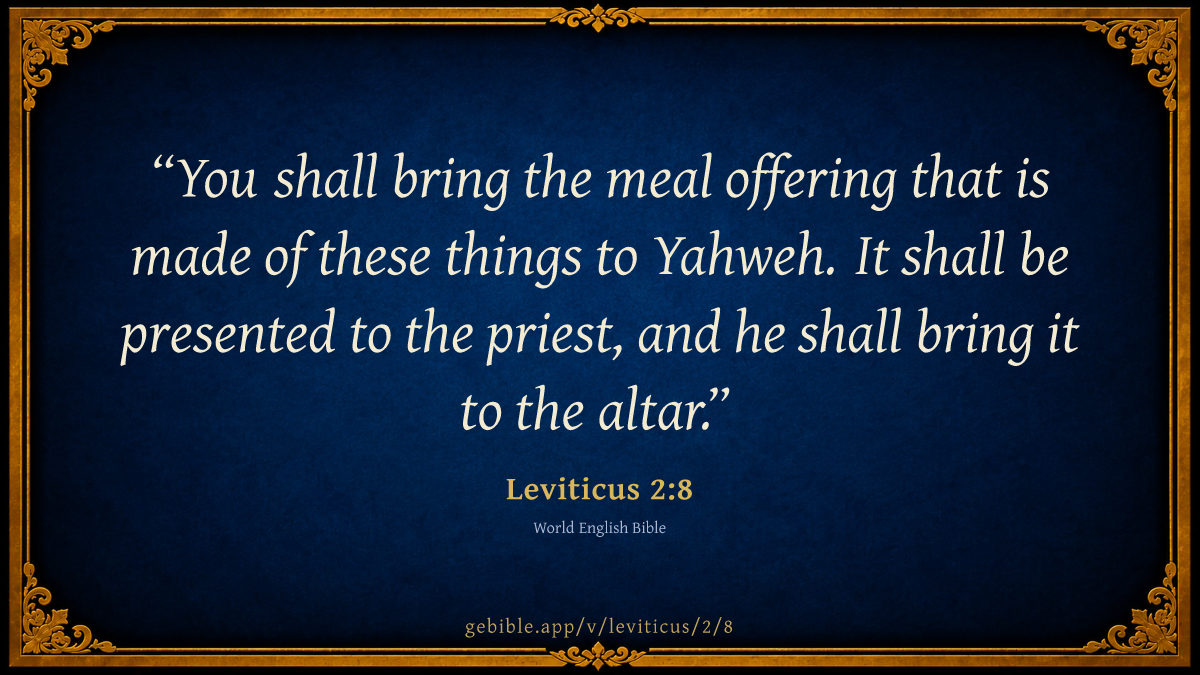
You shall bring the meal offering that is made of these things to Yahweh. It shall be presented to the priest, and he shall bring it to the altar.
Parallel Translations
-
You shall bring the meal offering that is made of these things to Yahweh. It shall be presented to the priest, and he shall bring it to the altar.
-
And thou shalt bring the meat offering that is made of these things unto the LORD: and when it is presented unto the priest, he shall bring it unto the altar.
-
And thou shalt bring the meal-offering that is made of these things unto the LORD; and it shall be presented unto the priest, and he shall bring it unto the altar.
Cross-references
No cross-references for this verse.
Explain this verse (7 sources)
Historical commentary, presented as a primary source — not an endorsement.
Private notes
Saved on this device only — never synced or sent anywhere.
John Trapp 1656 · Public Domain Lev 2:8 And thou shalt bring the meat offering…
Lev 2:8 And thou shalt bring the meat offering that is made of these things unto the LORD: and when it is presented unto the priest, he shall bring it unto the altar.
Ver. 8. He shall bring it unto the altar.] God would have all their offerings brought to one altar; both to figure out the one only all sufficient sacririce of Christ, and to teach all the faithful to consent in one and the same truth of the gospel.
John Trapp, A Commentary or Exposition upon All the Books of the Old and New Testament (1647–1656) — public domain. Text from a community e-Sword module.
John Gill 1763 · Public Domain And thou shalt bring the meat offering, that is…
And thou shalt bring the meat offering, that is made of these things, unto the Lord,.... Either to the tabernacle, the house of the Lord, or to the Lord's priest, as it follows:
and when it is presented to the priest; by the owner of it:
Read full note →
he shall bring it unto the altar; to the south west horn of the altar (o).
(o) Jarchi & Gersom in loc. T. Bab. Sotah, fol. 14. 2. Menachot, fol. 8. 2. Zebachim, fol. 63. 1.
John Gill's Exposition of the Whole Bible (1746–1763) — public domain (CC PDM 1.0). Text via the HelloAO Bible API.
Adam Clarke 1810 · Public Domain Verse 8. Thou shalt bring the meat-offering] It is…
Verse 8. Thou shalt bring the meat-offering] It is likely that the person himself who offered the sacrifice brought it to the priest, and then the priest presented it before the Lord.
Adam Clarke's Commentary on the Bible (1810–1826) — public domain. Text from a community e-Sword/MySword module.
Daniel D. Whedon 1874 · Public Domain 8. Thou shalt bring… unto the Lord — The…
8. Thou shalt bring… unto the Lord — The entire preparation of the offering was to be made by the offerer. This variety in form not only suited the convenience of the people, but it afforded some change to the priests who were to eat the oblation. There were five forms in which it might be brought: fine flour unbaked, to be cooked by the priest, baked on a plate, in a fryingpan, in an oven, and made into wafers. In every case oil is to be added. The frankincense is mentioned only with the first. It was probably an accompaniment of all the other forms.
Daniel D. Whedon (gen. ed.), Commentary on the Old and New Testaments (1874–1909) — public domain. Text from a community e-Sword module.
The Cambridge Bible for Schools and Colleges 1878 · Public Domain 8. that is made of these things] of the…
8. that is made of these things] of the things prepared as described in the preceding verses.
The Cambridge Bible for Schools and Colleges (gen. ed. J. J. S. Perowne; Cambridge University Press, 1878–1918) — public domain. Text from a community e-Sword module.
Ellicott's Commentary for English Readers 1878 · Public Domain (8) And thou shalt bring.—Whichever of the three cereal…
(8) And thou shalt bring.—Whichever of the three cereal preparations is preferred, the offerer is to present it to the priest, who is to take it to the altar. During the second Temple, the pieces were put into a ministering vessel, oil and frankincense were then put on them, and the vessel was carried by the offerer to the priest, and the priest carried it to the altar and brought it to the south-west.
A Bible Commentary for English Readers, edited by Charles John Ellicott (1878–1897) — public domain. Text from a community e-Sword module.
unfoldingWord translationNotes 2017 · CC BY-SA 4.0 General Information:
General Information:
Yahweh continues telling Moses what the people must do so their offerings will be acceptable to him.
Read full note →
made from these things
This can be stated in active form. AT: "that you made from the flour and oil" (See: Active or Passive)
it will be presented
This can be stated in active form. AT: "you will present it" (See: Active or Passive)
Then the priest ... made by fire
For Lev 2:9-10 see how you translated many of these words in Leviticus 2:2-3.
a representative offering
The handful of the grain offering represents the whole grain offering. This means the whole offering belongs to Yahweh. See how you translated this in Leviticus 2:2.
It will be an offering made by fire
This can be stated in active form. AT: "It will be a burnt offering" (See: Active or Passive)
it will produce a sweet aroma for Yahweh
Yahweh being pleased with the sincere worshiper who offered the sacrifice is spoken of as if God were pleased with the aroma of the burning sacrifice. See how you translated this in Leviticus 1:9. (See: Metaphor)
from the offerings to Yahweh made by fire
This can be stated in active form. AT: "from the burnt offerings to Yahweh" (See: Active or Passive)
translationWords
grain offering
Yahweh
priest
altar
Aaron
holy
unfoldingWord translationNotes — © Distant Shores Media and the Door43 World Missions Community, licensed CC BY-SA 4.0. Source: git.door43.org/Door43/en_tn.