
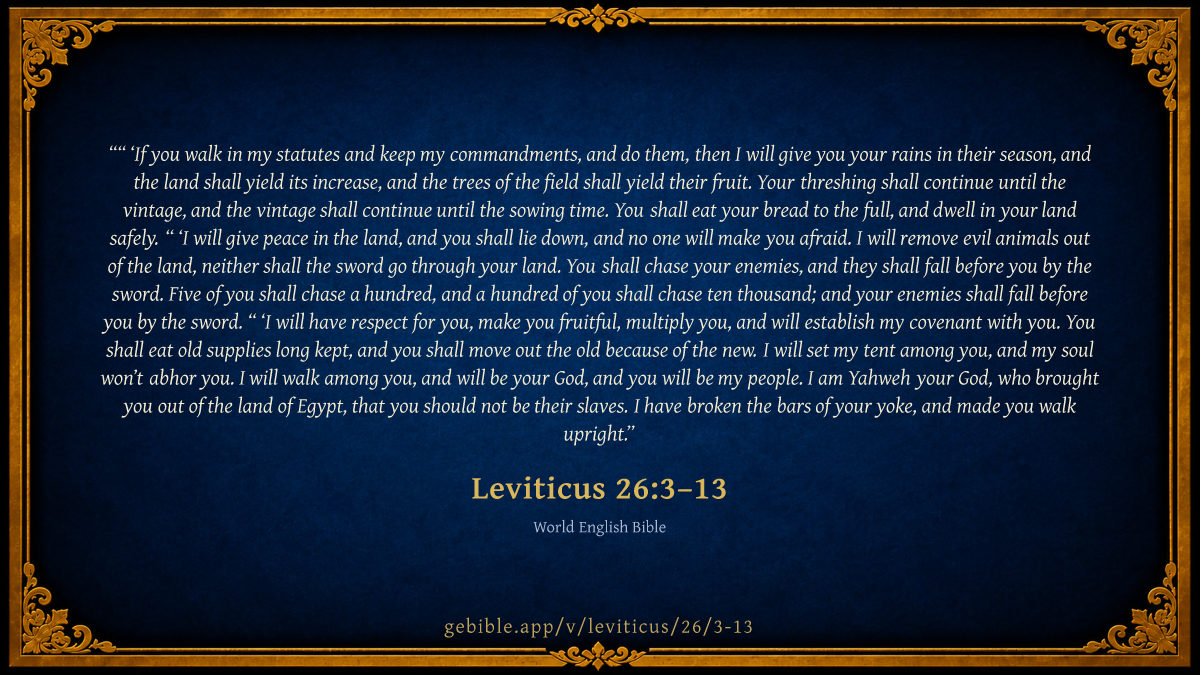
“ ‘If you walk in my statutes and keep my commandments, and do them, then I will give you your rains in their season, and the land shall yield its increase, and the trees of the field shall yield their fruit. Your threshing shall continue until the vintage, and the vintage shall continue until the sowing time. You shall eat your bread to the full, and dwell in your land safely.
“ ‘I will give peace in the land, and you shall lie down, and no one will make you afraid. I will remove evil animals out of the land, neither shall the sword go through your land. You shall chase your enemies, and they shall fall before you by the sword. Five of you shall chase a hundred, and a hundred of you shall chase ten thousand; and your enemies shall fall before you by the sword.
“ ‘I will have respect for you, make you fruitful, multiply you, and will establish my covenant with you. You shall eat old supplies long kept, and you shall move out the old because of the new. I will set my tent among you, and my soul won’t abhor you. I will walk among you, and will be your God, and you will be my people. I am Yahweh your God, who brought you out of the land of Egypt, that you should not be their slaves. I have broken the bars of your yoke, and made you walk upright.
Geneva Bible translators 1599 · Public Domain On vv4, 6, 9, 11, 13 By promising abundance of earthly things, he stirreth the…
By promising abundance of earthly things, he stirreth the mind to consider the rich treasures of the spiritual blessings.
Geneva Bible (1599) marginal notes — public domain.
John Trapp 1656 · Public Domain On vv3–13 Lev 26:3 If ye walk in my statutes, and…
Lev 26:3 If ye walk in my statutes, and keep my commandments, and do them;
Ver. 3. If ye walk in my statutes.] God’s promises are with a condition, which is as an oar in a boat, or stern of a ship, and turns the promise another way.
John Trapp, A Commentary or Exposition upon All the Books of the Old and New Testament (1647–1656) — public domain. Text from a community e-Sword module.
Matthew Poole 1685 · Public Domain On vv4, 5, 6, 8, 9, 10, 11, 12, 13 I will give you rain; therefore God placed them…
I will give you rain; therefore God placed them not in a land where there were such rivers as Nilus to water it and make it fruitful, but in a land which depended wholly upon the rain of heaven, the key whereof God kept in his own hand, that so he might the more effectually oblige them to obedience, in which their happiness consisted.
Matthew Poole's English Annotations on the Holy Bible (1683–1685) — public domain. Text from a community e-Sword/MySword module.
John Gill 1763 · Public Domain On vv3–13 If ye walk in my statutes, and keep my…
If ye walk in my statutes, and keep my commandments, and do them. Both moral, ceremonial, and judicial, which had been delivered unto them, and now completely recorded in this and the preceding book; for what follow in the two next are chiefly repetitions of what are contained in these.
If ye walk in my statutes, and keep my commandments, and do them. Both moral, ceremonial, and judicial, which had been delivered unto them, and now completely recorded in this and the preceding book; for what follow in the two next are chiefly repetitions of what are contained in these.
Read full note →
Leviticus 26:4
lev 26:4
lev 26:4
lev 26:4Then I will give you rain in due season,.... The former and latter rain, in the two seasons of the year in which rain usually fell, and the Scriptures frequently speak of; and when the land of Israel, which required rain, not being watered with a river, as Egypt, was blessed with it; the one was at the sowing of their seed, or a little after it, and the other a little before harvest; and when it was had in those times it was had in due season, and hence the word is in the plural number, "your rains" (i); unless showers of rain are meant: to encourage to keep the commands of God, promises of many outward good things are made; and this is the first, being a principal blessing, and which only God, and not all the vanities of the Gentiles, could give:
and the land shall yield her increase; which is greatly owing to seasonable showers of rain, by which means the earth brings forth bread to the eater and seed to the sower, corn and grass for man and beast:
and the trees of the field shall yield their fruit; vines, olives, pomegranates, figs, &c. are meant, with which the land of Israel abounded, Deu 8:8.
(i) "pluvias vestras", Pagninus, Montanus, Tigurine version, Junius & Tremellius, Piscator.
John Gill's Exposition of the Whole Bible (1746–1763) — public domain (CC PDM 1.0). Text via the HelloAO Bible API.
John Wesley 1765 · Public Domain On vv4, 5, 6, 8, 9, 10, 11, 12, 13 Rain - Therefore God placed them not in a…
Rain - Therefore God placed them not in a land where there were such rivers as the Nile, to water it and make it fruitful, but in a land which depended wholly upon the rain of heaven, the key whereof God kept in his own hand, that so he might the more effectually oblige them to obedience, in which their happiness consisted.
John Wesley, Explanatory Notes Upon the Whole Bible (1754–1765) — public domain. Text via the GEBible commentary corpus.
Adam Clarke 1810 · Public Domain On vv3, 4, 5, 11 Verse 3. If ye walk in my statutes] For…
Verse 3. If ye walk in my statutes] For the meaning of this and similar words used in the law, See Clarke on Le 26:15.
Adam Clarke's Commentary on the Bible (1810–1826) — public domain. Text from a community e-Sword/MySword module.
Joseph Benson 1811 · Public Domain On vv3, 5, 6, 8, 11 Lev 26:3-4. If ye walk in my statutes, &c.…
Lev 26:3-4. If ye walk in my statutes, &c. — In reward of their obedience, God promises them temporal prosperity in every instance that could render a nation happy. And, first, he assures them they should have fruitful seasons, here expressed by giving them rain in due time — Because, in Canaan and Syria, they were wont to have hardly any rain but at two stated seasons; in the end of autumn, at seed-time; and in spring, before harvest; termed the former and latter rain, Jer 5:24; without which, the year was quite barren. For God did not place his people in a land where there were such rivers as the Nile to water it, and render it fruitful; but in a land which depended wholly upon the rain of heaven, the key whereof God kept in his own hand, that so he might the more effectually oblige them to obedience, in which their happiness consisted.
Joseph Benson's Commentary on the Old and New Testaments (1811–1818) — public domain. Text from a community e-Sword module.
Albert Barnes 1834 · Public Domain On v3 As “the book of the covenant” Exo. 20:22–23:33 concludes…
As “the book of the covenant” Exo. 20:22–23:33 concludes with promises and warnings Exo 23:20-33, so does this collection of laws contained in the Book of Leviticus. But the former passage relates to the conquest of the land of promise, this one to the subsequent history of the nation. The longer similar passage in Deuteronomy Deut. 27–30 is marked by broader and deeper promises and denunciations having immediate reference not only to outward consequences, but to the spiritual death incurred by transgressing the divine will.
Lev 26:4
Read full note →
Rain in due season - The periodical rains, on which the fertility of the holy land so much depends, are here spoken of. There are two wet seasons, called in Scripture the former and the latter rain Deu 11:14; Jer 5:24; Joe 2:23; Hos 6:3; Jam 5:7. The former or Autumn rain falls in heavy showers in November and December. In March the latter or Spring rain comes on, which is precarious in quantity and duration, and rarely lasts more than two days.
Lev 26:5
Compare the margin reference; Joe 2:19; Job 11:18.
Lev 26:8
Five of you shall chase - A proverbial mode of expression for superiority in warlike prowess Deu 32:30; Isa 30:17.
Lev 26:9
Establish my covenant - All material blessings were to be regarded in the light of seals of the “everlasting covenant.” Compare Gen 17:4-8; Neh 9:23.
Lev 26:10
Bring forth the old because of the new - Rather, clear away the old before the new; that is, in order to make room for the latter. Compare the margin reference.
Lev 26:16
The first warning for disobedience is disease. “Terror” (literally trembling) is rendered trouble in Psa 78:33; Isa 65:23. It seems here to denote that terrible affliction, an anxious temperament, the mental state ever at war with Faith and Hope. This might well be placed at the head of the visitations on a backslider who had broken the covenant with his God. Compare Deu 32:25; Jer 15:8; Pro 28:1; Job 24:17; Psa 23:4.
Consumption, and the burning ague - Compare the margin reference. The first of the words in the original comes from a root signifying to waste away; the latter (better, fever), from one signifying to kindle a fire. Consumption is common in Egypt and some parts of Asia Minor, but it is more rare in Syria. Fevers of different kinds are the commonest of all diseases in Syria and all the neighboring countries. The opposite promise to the threat is given in Exo 15:26; Exo 23:25.
Lev 26:18
For all this - i. e. for all the afflictions in Lev 26:16-17.
Seven times - The sabbatical number is here proverbially used to remind the people of the covenant. Compare Gen 4:15, Gen 4:24; Psa 119:164; Pro 24:16; Luk 17:4.
Lev 26:19, Lev 26:20
The second warning is utter sterility of the soil. Compare Deu 11:17; Deu 28:18; Eze 33:28; Eze 36:34-35.
Lev 26:21, Lev 26:22
The third warning is the multiplication of destructive animals, etc. Compare Deu 32:24; Eze 5:17; Eze 14:15; Jdg 5:6-7; Isa 33:8.
Lev 26:23-26
The fourth warning. Yahweh now places Himself as it were in a hostile position toward His people who “will not be reformed” (rather, brought unto God: Jer 2:30). He will avenge the outraged cause of His covenant, by the sword, pestilence, famine, and captivity.
Lev 26:26
Omit “and.” “To break the staff of bread,” was a proverbial expression for cutting off the supply of bread, the staff of life (Psa 105:16; Eze 4:16; Eze 5:16; Eze 14:13; compare Isa 3:1). The supply was to be so reduced that one oven would suffice for baking the bread maple by ten women for ten families, and when made it was to be dealt out in sparing rations by weight. See 2Ki 6:25; Jer 14:18; Lam 4:9; Eze 5:12; Hos 4:10; Mic 6:14; Hag 1:6.
Lev 26:27-33
The fifth warning. For Lev 26:29 see 2Ki 6:28-29; Jer 19:8-9; Lam 2:20; Lam 4:10; Eze 5:10, for Lev 26:30 see 2Ch 34:3; Eze 6:4; Jer 14:19, for Lev 26:31 see 2Ki 25:9; Psa 74:6-7 : for Lev 26:32-33 see Deu 28:37; Psa 44:11; Jer 9:16; Jer 18:16; Ezek. 5:1-17; Jer 4:7; Eze 9:6; Eze 12:15; Zec 7:14.
Lev 26:30
High places - There is no doubt that the word here denotes elevated spots dedicated to false worship (see Deu 12:2), and especially, it would seem, to that of Baal Num 22:41; Jos 13:17. Such spots were, however, employed and approved for the worship of Yahweh, not only before the building of the temple, but afterward (Jdg 6:25-26; Jdg 13:16-23; 1Sa 7:10; 1Sa 16:5; 1Ki 3:2; 1Ki 18:30; 2Ki 12:3; 1Ch 21:26, etc.). The three altars built by Abraham at Shechem, between Bethel and Ai, and at Mamre, appear to have been on heights, and so was the temple.
The high places in the holy land may thus have been divided into those dedicated to the worship of Yahweh, and those which had been dedicated to idols. And it would seem as if there was a constant struggle going on. The high places polluted by idol worship were of course to be wholly condemned. They were probably resorted to only to gratify a degraded superstition. See Lev 19:31; Lev 20:2-5. The others might have been innocently used for prayer and religious teaching. But the temptation appears to have been too great for the temper of the people. They offered sacrifice and burnt incense on them; and hence, thorough reformers of the national religion, such as Hezekiah and Josiah, removed the high places altogether 2Ki 18:4; 2Ki 23:5.
Your images - The original word is rendered in the margin of our Bible sun images (2Ch 14:5; Isa 17:8; Eze 6:4, etc.). Phoenician inscriptions prove that the word was commonly applied to images of Baal and Astarte, the god of the sun and the goddess of the moon. This exactly explains 2Ch 34:4 following.
Idols - The Hebrew word here literally means things which could be rolled about, such as a block of wood or a lump of dirt. It was no doubt a name given in derision. Compare Isa 40:20; Isa 44:19; 2Ki 1:2.
Lev 26:31
Sanctuaries - The holy places in the tabernacle and the temple (Psa 68:35. Compare Psa 74:7).
I will not smell the savor ... - See Lev 1:9.
Lev 26:35
More literally: All the days of its desolation shall it rest that time which it rested not in your Sabbaths while ye dwelt upon it. That is, the periods of rest of which the land had been deprived would be made up to it. Compare 2Ch 36:20-21.
Lev 26:38
The land of your enemies shall eat you up - Compare Num 13:32; Eze 36:13.
Lev 26:39
Iniquity - The meaning here is, in the punishment of their iniquity, and, in the next clause, in the punishment of the iniquity (as in Lev 26:41, Lev 26:43) of their fathers. In the next verse the same Hebrew word is properly represented by “iniquity.” Our translators have in several places put one of the English words in the text and the other in the margin (Gen 4:13; Gen 19:15; 2Ki 7:9; Psa 69:27, etc.). The language of Scripture does not make that trenchant division between sin and punishment which we are accustomed to do. Sin is its own punishment, having in itself, from its very commencement, the germ of death. “Sin, when it is finished, bringeth forth death” Jam 1:15; Rom 2:5; Rom 5:12.
Lev 26:40
trespass - The Hebrew word signifies an injury inflicted on the rights of a person, as distinguished from a sin or iniquity regarded as an outrage of the divine law. Every wrong act is of course both a sin and a trespass against God. In this place Yahweh takes the breach of the covenant as a personal trespass.
Lev 26:41
Uncircumcised hearts - The outward sign of the covenant might be preserved, but the answering grace in the heart would be wanting (Act 7:51; Rom 2:28-29; Jer 6:10; Jer 9:26; compare Col 2:11).
Accept of the punishment of their iniquity - literally, enjoy their iniquity. The word here and in Lev 26:43 rendered “accept” in this phrase, is the same as is rendered “enjoy” in the expression “the land shall enjoy her sabbaths” Lev 26:34. The antithesis in Lev 26:43 is this: The land shall enjoy her sabbaths - and they shall enjoy the punishment of their iniquity. The meaning is, that the land being desolate shall have the blessing of rest, and they having repented shall have the blessing of chastisement. The feelings of a devout captive Israelite are beautifully expressed in Tobit 13:1-18.
Albert Barnes' Notes on the Bible (1834–1885) — public domain. Text from a community e-Sword/MySword module.
Haydock's Catholic Bible Commentary 1859 · Public Domain On vv3, 5, 8, 10, 13 Due seasons. Before harvest, in spring; and after that…
Due seasons. Before harvest, in spring; and after that in autumn, when they sow their wheat and barley in Palestine. (Calmet)
George Leo Haydock (1774–1849), Haydock's Catholic Family Bible and Commentary, 1859 edition — public domain. Excludes Psalms (Douay-Rheims chapter numbering differs from Protestant) and Deuterocanonical books (Catholic canon only).
Robert Jamieson, A. R. Fausset & David Brown 1871 · Public Domain On vv3, 4, 5, 10, 13 A BLESSING TO THE OBEDIENT. (Lev 26:3-13)
A BLESSING TO THE OBEDIENT. (Lev 26:3-13)
If ye walk in my statutes--In that covenant into which God graciously entered with the people of Israel, He promised to bestow upon them a variety of blessings, so long as they continued obedient to Him as their Almighty Ruler; and in their subsequent history that people found every promise amply fulfilled, in the enjoyment of plenty, peace, a populous country, and victory over all enemies.
Jamieson, Fausset & Brown — Commentary Critical and Explanatory on the Whole Bible (1871) — public domain (CC PDM 1.0). Text via the HelloAO Bible API.
Daniel D. Whedon 1874 · Public Domain On vv3, 4, 5, 6, 8, 9, 10, 11, 12, 13 BLESSINGS PROMISED TO OBEDIENCE, Lev_26:3-13.
BLESSINGS PROMISED TO OBEDIENCE, Lev_26:3-13.
3. Walk in my statutes — Mosaism was not mere ritualism, but a power which directed the conduct, shaped the character, and sanctified the heart. It aimed at inward as well as outward holiness. This is the end of all God’s statutes. The original statute signifies that which is absolutely fixed, a decree. Commandments signify acts definitely pointed out. The former is used to designate codes of law, the latter, specific precepts.
Daniel D. Whedon (gen. ed.), Commentary on the Old and New Testaments (1874–1909) — public domain. Text from a community e-Sword module.
The Cambridge Bible for Schools and Colleges 1878 · Public Domain On vv3, 5, 6, 9, 10, 12, 13 3–13. The blessing that shall follow upon obedience. (Cp.…
3–13. The blessing that shall follow upon obedience. (Cp. Deu_28:1-11.)
The Cambridge Bible for Schools and Colleges (gen. ed. J. J. S. Perowne; Cambridge University Press, 1878–1918) — public domain. Text from a community e-Sword module.
Ellicott's Commentary for English Readers 1878 · Public Domain On vv3–13 (3) If ye walk in my statutes.—We have already…
(3) If ye walk in my statutes.—We have already remarked that this verse begins the section in the Hebrew and ought to have begun the chapter in English. Having set forth the ceremonial and moral injunctions which are necessary for the development and maintenance of holiness and purity in the commonwealth, the legislator now concludes by showing the happiness which will accrue to the Israelites from a faithful observance of these laws, and the punishments which await them if they transgress these Divine ordinances.
A Bible Commentary for English Readers, edited by Charles John Ellicott (1878–1897) — public domain. Text from a community e-Sword module.
The Pulpit Commentary 1880 · Public Domain On vv3, 4, 8, 10, 11, 12, 13 If ye walk in my statutes. The free will…
If ye walk in my statutes. The free will of man is recognized equally with God"s controlling power.
Vers. 3-46. Promises and threatenings.
Read full note →
In this chapter the prophet looks forward, and declares how God would deal with his people; which should be according to the way in which they should act. In 2Ch_36:14-21, the chronicler looks back, and shows how God had dealt with them; which had been according to the way in which they had acted.
The promises and the threatenings are to the nation, not to individuals; and the prophetical assurance is that national obedience to God shall bring about national happiness and prosperity, and that disobedience shall cause the ruin of the nation. In spite of the rough, wild times of the Judges, and of the apostasy of Saul, the heart of the nation was on the whole loyal to Jehovah till the end of the days of Solomon. And till that time there was an upward growth in the flourishing estate of the people their wealth, their power, their prosperity, their happiness. In the latter days of Solomon, outwardly glorious as they were, decay and corruption began. King and people were alike affected by the splendid despotism which one wielded and under which the other flourished in material prosperity. In that prosperity they forgot the source of it. The king himself pushed his tolerance for foreign habits into idolatry, "His wives turned away his heart after other gods: and his heart was not perfect with the Lord his God, as was the heart of David his father.... And the Lord was angry with Solomon, because his heart was turned from the Lord God of Israel". (1Ki_11:4-9) Like prince, like people; a general relaxation of moral fiber and religious zeal ensued throughout the kingdom. Its culminating point had been reached, and now there followed the rapid descent and fall which resulted from disobedience. The first step to ruin was the great schism, from the effects of which neither the northern nor the southern kingdom ever recovered. Then followed the various apostasies and punishments. In the southern kingdom, "Rehoboam forsook the Law of the Lord, and all Israel with him. And it came to pass, that in the fifth year of King Rehoboam, Shishak King of Egypt came up against Jerusalem, because they had transgressed against the Lord". (2Ch_12:1, 2Ch_12:2) Jehoram "walked in the way of the kings of Israel, like as did the house of Ahab (for he had the daughter of Ahab to wife): and he wrought that which was evil in the eyes of the Lord.... In his days the Edomites revolted.... Moreover the Lord stirred up against Jehoram the spirit of the Philistines, and of the Arabians, that were near the Ethiopians: and they came up into Judah, and brake into it". (2Ch_21:6-17) In the latter days of Joash, "they left the house of the Lord God of their fathers, and served groves and idols: and wrath came upon Judah and Jerusalem for this their trespass And it came to pass at the end of the year, that the host of Syria came up... with a small company of men, and the Lord delivered a very great host into their hand, because they had forsaken the Lord God of their fathers". (2Ch_24:18-24) In the reign of Amaziah, Jerusalem was taken by Joash King of Israel, because "Amaziah sought after the gods of Edom". (2Ch_25:14-24) Ahaz "made molten images for Baalim Wherefore the Lord his God delivered him into the hand of the King of Syria... and into the hand of the King of Israel". (2Ch_28:2-5) At the beginning of the reign of Manasseh, "the Lord spake to Manasseh, and to his people: but they would not hearken. Wherefore the Lord brought upon them the captains of the host of the King of Assyria". (2Ch_33:10, 2Ch_33:11) And at last, these partial chastisements having failed to bring about reformation, came the Babylonish Captivity. "The Lord God of their fathers sent to them by his messengers, rising up betimes, and sending; because he had compassion on his people, and on his dwelling place: but they mocked the messengers of God, and despised his words, and misused his prophets, until the wrath of the Lord arose against his people, till there was no remedy. Therefore he brought upon them the King of the Chaldees, who slew their young men with the sword in the house of their sanctuary, and had no compassion upon young man or maiden, old man, or him that stooped for age: he gave them all into his hand And them that had escaped from the sword carried he away to Babylon". (2Ch_36:15-20) The transgressions of the northern kingdom were even greater than those of the southern kingdom, and their final punishment, therefore, fell upon them earlier. "For so it was, that the children of Israel had sinned against the Lord their God,... and walked in the statutes of the heathen for they served idols, whereof the Lord had said unto them, Ye shall not do this thing And they rejected his statutes, and his covenant that he made with their fathers Therefore the Lord was very angry,... and removed them out of his sight". (2Ki_17:7-18) This occurred in the reign of Hoshea, and in the case of the ten tribes we find no symptoms of repentance under suffering. The two tribes produced a Daniel; and his prayer for the forgiveness of his people (Dan_9:2-19) illustrates the feelings of the better of his fellow-captives; and therefore, according to the promise of Lev_26:40-42, God remembered his covenant with Jacob, and Isaac, and Abraham, and raised up Zerubbabel, Ezra, and Nehemiah to effect the restoration; while the ten tribes pined away in the land of their captivity. Thus Moses" prediction was fulfilled.
God deals with other nations as with Israel; but we have not the inspired record of his dealings. While Greece cultivated intellectual wisdom, she flourished; when she turned to sophistry, she perished. While Rome spread order and law throughout the globe, she grew in strength; when she submitted to the sway of arbitrary despots, she fell. What is England"s mission in the world? To disseminate at once true religion and true liberty. As long as she does this, she will receive God"s blessing. As soon as she fails to fulfill the purpose of her existence as a nation, she will be withdrawn from the scene, and another instrument raised up in her stead.
Vers. 3-13. Incentives to obedience.
Religion has the first claim upon us as the supreme obligation of the soul. We are hound to worship and honour God because we owe far more to him than to all other beings in the universe. The first and all-sufficient reason why we should "worship and bow down" before him, is in the fact that "he is our God that One from whom we come, in whom we live, from whom cometh down every good gift. But God condescends to urge us to obedience by presenting incentives to our minds. He wishes us to consider that he has made it infinitely remunerative for us to do so; that, by so doing, we become recipients of the largest blessings he can confer and we can receive. There is so much of contrast as well as comparison between the blessings of the old and the new dispensations, that we must divide our subject into two parts.
I THE INCENTIVES WHICH GOD HELD OUT TO HIS ANCIENT PEOPLE. These were importantly spiritual, but prominently temporal. If they did but "walk in his statutes, and keep his commandments, and do them" (verse 3), they might reckon on
(1) fertility in the field (verses 4, 5, 10);
(2) sense of security from without and disturbance from within (safety and peace, verses 5, 6);
(3) victory in war (verses 7, 8);
(4) national growth (verse 9);
(5) God"s presence with them (verses 11, 12);
(6) his pleasure in them (verse 11); and
(7) his guarantee of their liberty and self-respect (verse 13).
II THE PROMISES WHICH HE HAS MADE TO US. These are partly temporal, but principally spiritual. They include:
1. Sufficiency of worldly substance. God does not now say, "Serve me, and you shall be strong, wealthy, long-lived," but he does say, "Seek ye first the kingdom of God,... and all these things" (food, clothing, etc.) "shall be added unto you". (Mat_6:33) "Godliness has promise of the life that now is". (1Ti_4:8) Those who are his children in Christ Jesus may reckon upon all needful support from his bountiful hand.
2. Consciousness of spiritual integrity. As God made his people to be delivered from the yoke and to "go upright" (verse 13), so he makes those who have returned to him, and who have escaped from the yoke of sin, to "walk in uprightness of heart." Instead of shrinking in fear, bowing down with a depressing sense of wrong-doing, we have a happy consciousness of integrity of soul. We say with the psalmist, "As for me," etc. (Psa_41:12)
3. Sense of reconciliation with God. God promises peace and a sense of safety (verses 5, 6) to those who seek his favour in Christ Jesus. Being justified by faith in him, we have peace with God; and we know that, whatever may be our circumstances, we are secure behind the shield of his almighty love.
4. Victory in the battle of life. If it be not wholly true that "our life is but a battle and a march," yet it is true that there is so much of spiritual struggle in it, from its beginning to its close, that we all understand only too well what is meant by "the battle of life." There are many foes with which to wrestle, (Eph_6:12) and we need the invigorating power which only the Spirit of the Strong One can impart. If we are his, he will help us in the strife. "Our enemies will fall before us". (verse 7; see 2Co_2:14 and Rom_8:37)
5. His presence with us and his pleasure in us. "God will set his tabernacle among us;" he "will walk among us" (verses 11, 12). He will be "with us always," and his sustaining presence will uphold us in the darkest hour, in the most trying scene. "His soul will not abhor us" (verse 11); he will take Divine pleasure in us; we shall be his children, his guests, his friends, his heirs.
6. An everlasting heritage in him. He will be our God (verse 12). The sacred page does not speak of any duration; but that which is adumbrated in the Old Testament is revealed in the New. Jesus Christ has brought life and immortality out into the light, and we know that "him that overcometh will the Son of man make a pillar in the temple of his God, and he shall go no more out," etc., (Rev_3:12) and that "to him that overcometh will he grant to sit with him on his throne," etc. (Rev_3:21) The present and the future, the best of the one and the whole of the other, are the heritage of those who "know the will of God and do it." Surely it is the choice of the wise to "make haste and delay not to keep his commandments. C.
HOMILIES BY S.R. ALDRIDGE Vers. 3-8. Obedience and prosperity.
The connection between godly conduct and material good may not seem to us so close or so clearly discernible as that which is promised in these verses. Still, the heart of the promise remains, and instances have never been wanting to prove that "godliness is profitable unto all things, having promise of the life that now is, and of that which is to come." The prophecy of Amos (Amo_9:13) evidently founded on this passage of the Law refers to gospel times, and reminds us that the declarations of the text are capable of a spiritual application which invests them with deeper meaning and grander results.
I THE PROPRIETY OF OBEDIENCE.
1. Man is unfit to guide his own way. "It is not in man that walketh to direct his steps." He is a creature swayed by passion, short-sighted, fallible in judgment. Nor can the united wisdom of the multitude secure the framing of a code free from prejudice and error. We may consult the instructions of Scripture as our unfailing chart; we may listen to its precepts as the helmsman does to the commands of the captain, assured that from his loftier position he can better determine the course the vessel ought to take.
2. The Almighty possesses irresistible claims upon our obedience. He is our Creator and Governor, Father and Benefactor. tie has bestowed upon us all our earthly and our spiritual benefits, and in particular spared not his only Son for our sakes. Supremely wise and holy, we cannot without manifest incongruity refuse to follow his counsel and rule of life. We are rebels if we neglect his injunctions. To pick and choose which we will conform to is to assume presumptuous functions.
3. The statutes are such as to commend themselves upon maturest reflection. Any precept plainly contrary to reason or morality no will has power to enforce. But the hexaplar verdict of the psalmist will be pronounced by all who study the laws of God, "The statutes of the Lord are right," etc. (Psa_19:7-9) The teachings of Jesus Christ are a master-piece of skill, goodness, and purity. If universally adhered to, the world would become an Eden.
II THE REWARD OF OBEDIENCE.
1. Blessings are promised to the obedient. Plenty. The ground shall be fertile, the fruit gathered in harvest shall more than suffice to carry the husbandman on to the next ingathering. The gospel does at any rate teach Christian stoicism, making a man contented with his lot, and he who has sufficient for his wants cannot complain. But in the spiritual region we may have a never-ceasing flow of gifts. For God is bountiful, and loves to grant richest graces unto his people. If only we are prepared to receive, the floodgates of his bounty will be opened. Peace. They shall dwell at home in safety, none causing terror. Strife amongst God"s own people shall be unknown, the inestimable blessing of tranquility shall diffuse its sweetness over the land. "Thou wilt keep him in perfect peace whose mind is stayed on thee." Calm of conscience is the peculiar privilege of the believer in Christ. Bodily suffering cannot destroy this peace. The testimony of a well-known minister on his death-bed recently was, "Within I have deep peace, though around is constant searching pain." Victory, if foes attempt to molest. The Christian life is a warfare, and this is quite consistent with the enjoyment of peace. It is an external sphere of conflict, the enemy is determined and active, "but thanks be to God, which giveth us the victory through our Lord Jesus Christ." The obedient soldiers are likeliest to come off conquerors when the general is skilled in strategy. And as Havelock"s men, by their observance of moral rules, were ever prepared for duty, so are those who conform to the precepts of Christ certain of success in the struggle against sin. The association is much more intimate between obedience and spiritual triumph than that which is here promised in the Law.
2. These blessings are eminently desirable. It speaks a wise and gracious God to have made it so greatly men"s interest to keep his laws. In any case we are bound to do what seems right, yet, if this conduct were not coincident with advantage, life would be a melancholy scene. Peace, plenty, and victory are just what the heart desiderates and men strive to attain. God will not offer what men contemn. lit is true that the degraded may at first fail to appreciate the joys of prosperity and tranquility, yet education is possible, and even brief reasoning must convince of the value of these inducements.
3. The list is comprehensive. There is material prosperity and moral good, and in the following verses religious satisfaction is promised God dwelling in the midst of his people. Nothing that can add to man"s real happiness is absent from the catalogue of pleasures to be participated in by the obedient.
III GENERAL REFLECTIONS.
1. There is nothing wrong in allowing ourselves to be influenced by the promise of rewards. Man is compelled to anticipate; prudence is a virtue. All depends upon the character of the rewards. If they minister to base, ignoble lusts, then to be moved thereby is indicative of an evil state of mind. But if the blessings are legitimate and elevating, in accordance with principles implanted by our Maker, then the hope of obtaining them is a strong incitement to be cherished rather than checked. To impel men to a holy life by preaching the bliss and glory of heaven is surely allowable and to be commended.
2. The worth of these rewards will be enhanced by a consideration of the misery of their opposites want, turmoil, and defeat. Such is the lot of those who follow their own devices, blindly hurrying to ruin. The prodigal imagined that he must see the world anti leave his father"s home in order to be happy, but he soon discovered his dire mistake.
3. History proves God"s faithfulness to his word. As long as the Israelites kept the Law, their condition was one of security, development, and honour. Every age has testified to the fulfillment of Divine declarations, forcing from the skeptical an acknowledgment of "a power that makes for righteousness." Seeking first the kingdom of God and his righteousness, all other things have been added. On the other hand, it has been found hard to kick against the pricks. What Carlyle terms the "eternities" war against the evil-doer. As predic tions have been fulfilled in the past, so we are confident that all the promises of God shall ultimately be realized in the experience of his faithful servants. S.R.A.
Vers. 3-39. Promises and threatenings.
Verse 12, "And I will walk among you, and will be your God, and ye shall be my people.
I The true law of human life.
1. Religion the upholding support of individual, social, national well-being. Natural laws subservient to higher ends. Ascending scale in the universe, the physical the basis of the psychical, the psychical of the moral, the moral of the spiritual.
2. The covenant relationship of God and man the only true form in which the ideas of religion can be realized and maintained. Personality of God, freedom of man. Interchange of confidence. Living communion. Support of prayer, which should embrace all wants and possibilities.
3. Illustration of the connection between providence and religion in the history both of individuals and nations. Importance of insisting on the truths contained in this chapter as against secularism and fanaticism and mysticism. Religion is objective as well as subjective. Tremendous fact that, notwithstanding both the promises and threatenings, Israel failed to keep the Law. Illustration of human fall and dependence on Divine grace.
II Divine government.
1. Righteous.
2. Merciful.
3. Revealed in connection with a system of truth and actual promises appealing to faith.
4. Embracing those who know not God, as well as his people. R.
The Pulpit Commentary (1880–1919), ed. H.D.M. Spence-Jones & Joseph S. Exell — public domain. Text from a community e-Sword module.
The Biblical Illustrator 1887 · Public Domain On vv3, 8 If ye walk in My statutes, and keep My…
Lev_26:3-13
If ye walk in My statutes, and keep My commandments, and do them.
Read full note →
The advantages of religion in a nations life
I. Wherein a nations religious life consists. The recognised presence of God in the midst of the people (Lev_26:11-12) may be realised--
1. In sanctuaries consecrated to Divine worship throughout the land, and in assembled congregations gathering to adore Him (Lev_26:2).
2. In sacred literature diffusing religious knowledge among the people.
3. In benevolent and elevating institutions diffusing Christianity in its practical forms.
4. In educational agencies for the training of children early in moral and religious truth.
5. In homes and family life sweetened by the influence of piety.
6. In a legislature ruled by the fear of God and observant of Scripture precepts.
7. In wealth, gathered righteously, being expended for evangelical and Christian ends.
8. In the happy relationship of all social classes, based upon goodwill and respect.
9. In the stores of harvest and gains of commerce being acknowledged as Gods providential gifts and generous benefactions (Lev_26:4-5). All such public recognitions of the authority and the claims of religion, emphasise and declare that within this nations life God dwells--known, revered, and served.
II. Advantages which result to a nation from religion.
1. Religion impels to industry, intelligence, self-respect, and social improvement; and these will affect every branch of labour and enterprise, resulting in material prosperity (Lev_26:4-5).
2. Religion leads to avoidance of agitation and conflict, checks greed, ambition, and vainglory, and thus promotes a wise content among the people, and peaceful relationships with surrounding nations (Lev_26:6).
3. Religion fosters sobriety, energy, and courage, and these qualities will assert themselves on the fields of war when sad occasion arises, and will ensure the overthrow of tyranny and the defeat of invasion (Lev_26:8).
4. Religion nurtures the wise oversight of homes and families, the preservation of domestic purity, the development of healthful and intelligent children, and these will work out in a strong and increasing population (Lev_26:9).
5. Religion corrects the intrigues of self-destructive commerce, and teaches honesty, forethought, and justice in business arrangements; thus checking waste, extravagance, and insolence, and these issue in the enjoyment of plenty (Lev_26:10).
6. Religion enjoins Sabbath observance and sanctuary services (Lev_26:2) which nourish holiness in thought and life, sweeten character, purify the springs of action, incite to righteous and noble deeds, to social goodwill, to mutual regard, to sacred ministries, to reverence for Scripture, to recognition of the claims of the unseen world, and thus bring down upon all people the blessings of God, the Father, the Son, and the Holy Spirit (Lev_26:11-12).
III. Within a religious nation god pledges himself to dwell. And where He makes His tabernacle (Lev_26:11) there--
1. Happiness will be realised, the joy of the Lord will be known, His lovingkindness, which is more than life, will be enjoyed.
2. Security will be assured. None make you afraid (Lev_26:6), for He will be as a defence to His people.
3. Sanctity will flourish. Intercourse with God (Lev_26:12) will elevate, refine, and grace a peoples character and life. (W. H. Jellie.)
Temporal blessings connected with obedience
These temporal blessings--peaces victory over all their enemies, the fruitfulness of the land, the enjoyment of Gods tabernacle in the midst of it--all are promised to obedience. This is still true of nations. Nations that are highest in Christian character will always be highest in every other national blessing. Just cast your eyes over the map of Europe; and if you had a thermometer, and could gauge the amount of living Christianity in each nation, you will find that the nation in which Christianity is purest, rises highest, spreads the farthest, descends the deepest, is the very nation that is highest in all that dignifies, ennobles, and blesses a nation. And so, in our own native land, the victory of our armies in the righteous warfare to which it is committed, the maintenance of our land in peace and prosperity against all foe and all invasion, will rest, not only upon the banners of our brave troops, not only upon the gallantry of our heroic sailors, but far more upon the living religion that saturates the masses of our country. It is righteousness that exalteth a nation, and sin is the ruin of a nation. If you will read the history of nations, you will find this universally true; no nation ever falls before a foreign foe--it always commits suicide. Nations die suicides; they are self-slain. Rome fell only because of its inner corruption; the beautiful sisterhood of Greek states fell by their universal depravity; and our nation will never fall before a foreign foe as long as it is--what it is now in a greater degree than any other--a nation that fears God, and works righteousness, and counts the sunshine of His favour more precious than gold and silver, and whatsoever things may be weighed or bought. (J. Cumming, D. D.)
The advantages of faithfully serving God
A Fingo, traveling through Hankey, where the L.M.S. have a station, sat down to rest at the door of the place of worship; and looking round on the houses, behind which the gardens were concealed, asked one of the deacons how the people got food in such a place, for he had formerly known it as a desert. The deacon told him to look at him and see if he was not in health and well clothed. He then called a fine child, and told the man to look at it and see if it was not well fed. The deacon then told him if he would attend service the next day he would see that it was so with them all. The Fingo rose to depart, and lifting up his eyes and his right hand to heaven, exclaimed, It is always so where that God is worshipped! (Andrew Thomson, D. D.)
The unbroken continuity of Gods gifts
There is in Lev_26:10 a promise as to the fulness of the Divine gifts, which has a far wider reach and nobler application than to the harvests and granaries of old Palestine. We may take the words in that aspect, first, as containing Gods pledge that these outward gifts shall come in unbroken continuity. And have they not so come to us all, for all these long years? Has there ever been a gap left yawning? has there ever been a break in the chain of mercies and supplies? has it not rather been that one post ran to meet another? that before one of the messengers had unladed all his budget, anothers arrival has antiquated and put aside his store? Things grown common lose their dear delight. If in His gifts and benefits He were more sparing and close-handed, said Luther, we should learn to be thankful. But let us learn it by the continuity of our joys, that we may not need to be taught by their interruption; and let us still all tremulous anticipation of possible failure or certain loss by the happy confidence which we have a right to cherish, that His mercies will meet our needs, continuous as they are, and be threaded so close together on the poor thread of our lives that no gap will be discernible in the jewelled circle. May we not apply that same thought of the unbroken continuity of Gods gifts to the higher region of our spiritual experience? His supplies of wisdom, love, joy, peace, power to our souls, are always enough, and more than enough, for our wants. If ever men complain of languishing vitality in their religious emotions, or of a stinted supply of food for their truest self, it is their own fault, not His. He means that there should be no parentheses of famine in our Christian life. It is not His doing if times of torpor alternate with seasons of quick energy and joyful fulness of life. So far as He is concerned the fiery is uninterrupted, and if it come to us in jets and spurts like some intermittent well, it is because our own evil has put some obstacles to choke the channel and dam out His Spirit from our spirits. The source is full to overflowing, and there are no limits to the supply. The only limit is our capacity, which again is largely determined by our desire. So after all His gifts there is more yet unreceived to possess. After all His self-revelation there is more yet unspoken to declare. Great as is the goodness which He has wrought before the sons of men for them that trust in Him, there are far greater treasures of goodness laid up in the deep mines of God for them that fear Him. Bars of uncoined treasure and ingots of massy gold lie in His storehouses, to be put into circulation as soon as we need, and can use them. (A. Maclaren, D. D.)
Ye shall make you no idols.
Idolatry interdicted
I. What the proneness of human nature to idolatry suggests. It shows both the dignity and depravity of man; that--
1. He is endowed with religious instincts. Capable of worship, of exercising faith, hope, love, reverence, fear, &c.
2. He is conscious of amenability to some supreme power. Seeks to propitiate, secure favour, and aid.
3. He is apprehensive of a future state of existence. Ideas vague, indefinite, absurd, yet the outcome of inward presentiment, &c.
4. He is unable by light of nature to discover God. His knowledge is so faded, light so dim. How low the soul must have fallen to substitute nothings for the Eternal One! Heathenism has never of itself emerged into the light of the knowledge of the glory of God, as seen in the voice that has spoken from heaven, and has been recorded by holy men moved by the Holy Ghost.
II. What indulgence in idolatry entails.
1. Degradation. Worship of heathen deities demoralising. In their temples, at their services, the rites observed are grovelling, and, in some instances, demoniacal.
2. Superstition. Devotees are duped by priests, enslaved by torturing ritualism, subject and victims of absurd delusions.
3. Misery. Fear the ruling passion, not love. Nothing ennobling, inspiring, quickening, comforting. Idol worship mocks the longings of the human soul, cannot appease its hunger, satisfy its thirst.
III. How idolatry may be abolished. Darkness can only be dispersed by the letting in of light. The folly of idolatry must be shown, its helplessness, misery, sin by the spread of the written revelation of heaven, the preaching of the glorious gospel. (F. W. Brown.)
The common worship of the sanctuary
There are many who make light of the common worship of the sanctuary, and who are in the habit of depreciating the interest and value of its influences. They tell us that Natures temple is far grander than any human shrine; that the voices of the birds are a sweeter minstrelsy than that of a mediocre choir; that they find sermons in stones whose eloquence is mightier and more penetrating than that of a poor preacher with his string of stale platitudes; and that, therefore, a pleasant country walk is more profitable and sanctifying than an hour spent in the stuffy atmosphere of church or chapel. Nay, even their own fireside has more powerful charms, for have they not Bibles at home, and cannot they read for themselves? and can they not obtain far better sermons for a few pence per volume than they are likely to hear? No doubt there is much truth in such reasoning, but it ignores the social needs of human nature. Man is a social being; social worship is therefore a necessity of his nature. And its necessity has been universally felt. Groves, mountains, grottoes, caves, streams, valleys, plains, lakes, as well as altars and temples, have been consecrated as the abodes of gods. Everywhere men have sought out some shrine at which to offer common and united worship. And in Christian ages the house of prayer has ever been held in honour, and its services regarded as hallowed privileges by the best and wisest men. They meet a deep-seated need of human hearts. As Dr. Geikie has said, There is a breadth of human experience, and of understanding of Divine things to be obtained in the great congregation, in the common confessions, the common prayers, the common praises, the common exhortation of the sanctuary, which would be sought in vain in solitudes. As long as human nature is unchanged, the place of public worship cannot be superseded. (Howard James.)
Commonness of the idolatrous spirit
Yes, the orthodox Greek Churchman is grievously scandalised at the image-worship of the Romanist; it is flat idolatry, and he denounces it vehemently. But what are those pictures, many of them made to stand out with solid plates of gold and silver? Why, these are pictures of the Virgin or of her Son, as the case may be, and your anti-idolatrous Greek bows before these with voluntary humility. He hates image-worship, you see, but stands up for picture-worship. Behold how sinners disagree in name and unite in spirit! Put Greek and Roman in a sack together and let the greatest idolater out first: the wisest solution would be to keep them both in, for Solomon himself would be puzzled to decide between them. Are there no such inconsistencies among ourselves? Do we not condemn in one form what we allow in another? Do we not censure in our neighbours what we allow in ourselves? This query need not be answered in a hurry; the reply will be the more extensive for a little waiting. (C. H. Spurgeon.)
Then I will give you rain.--
The philosophy of rain
To understand the philosophy of this beautiful and often sublime phenomenon, so often witnessed since the creation of the world, and essential to the very existence of plants and animals, a few facts derived from observation and a long train of experiments must be remembered.
1. Were the atmosphere everywhere at all times at a uniform temperature, we should never have rain, or hail, or snow; the water absorbed by it in evaporation from the sea and the earths surface would descend in an imperceptible vapour, or cease to be absorbed by the air when it was once fully saturated.
2. The absorbing power of the atmosphere, and consequently its capability to retain humidity, is proportionably greater in warm than in cold air.
3. The air near the surface of the earth is warmer than it is in the region of the clouds. The higher we ascend from the earth the colder do we find the atmosphere. Hence the perpetual snow on very high mountains in the hottest climate. Now, when from continued evaporation the air is highly saturated with vapour, though, if it be invisible and the sky cloudless, if its temperature be suddenly reduced by cold currents descending from above, or rushing from a higher to a lower latitude, its capacity to retain moisture is diminished, clouds are formed, and the result is rain. Air condenses as it cools, and like a sponge filled with water and compressed, pours out the water which its diminished capacity cannot hold. How singular, yet how simple, the philosophy of rain! Who but Omniscience could have devised such an admirable arrangement for watering the earth? (Dr. Ure.)
Rain from God
St. Ambrose, speaking of great drought in his time, when the people talked much of rain, he sometimes comforted himself with this hope, Neomenia dabit pluvias (The new moon will bring us rain); yet saith he, Though all of us desired to see some showers, yet I wished such hopes might fail, and was glad that no rain fell, donec precibus ecclesia data esset, &c., until it came as a return upon the Churchs prayers, not upon the influence of the moon, but upon the provident mercy of the Creator. Such was the religious care of that good saint then, and the like were to be wished for now, that men would be exhorted not to be so much taken as they are with the vanity of astrological predictions, to read the stars less and the Scriptures more, to eye God in His providence, not the moon so much in its influence, still looking up unto Him as the primus motor, and upon all other creatures whatsoever as subordinate. (J. Spencer.)
The Biblical Illustrator, edited by Joseph S. Exell (c. 1880s–1900s) — public domain. Text from a community e-Sword module.
The Expositor's Bible 1887 · Public Domain On v3 "If ye walk in My statutes, and keep My…
THE PROMISES OF THE COVENANT
Lev_26:3-13
Read full note →
"If ye walk in My statutes, and keep My commandments, and do them; then I will give your rains in their season, and the land shall yield her increase, and the trees of the field shall yield their fruit. And your threshing shall reach unto the vintage, and the vintage shall reach unto the sowing time: and ye shall eat your bread to the full, and dwell in your land safely. And I will give peace in the land, and ye shall lie down, and none shall make you afraid: and I will cause evil beasts to cease out of the land, neither shall the sword go through your land. And ye shall chase your enemies, and they shall fall before you by the sword. And five of you shall chase a hundred, and a hundred of you shall chase ten thousand: and your enemies shall fall before you by the sword. And I will have respect unto you, and make you fruitful, and multiply you; and I will establish My covenant with you. And ye shall eat old store long kept, and ye shall bring forth the old because of the new. And 1 will set My tabernacle among you: and My soul shall not abhor you. And I will walk among you, and will be your God, and ye shall be My people. I am the Lord your God, which brought you forth out of the land of Egypt, that ye should not be their bondmen and I have broken the bars of your yoke, and made you go upright."
The promises of the covenant are thus to the effect that if Israel shall keep the law, God will give them rain and fruitful seasons, harvests so abundant that the "threshing shall reach unto the vintage, and the vintage shall reach unto the sowing time"; internal security; deliverance from the wild beasts, which are still such a scourge in many parts of the East; and such power and spirit, that no enemy shall be able to stand before them, but five of them shall chase a hundred, and a hundred chase ten thousand. Then (Lev_26:9) is renewed the promise, given long before to Abraham, of a great increase in their numbers; and thereupon, very naturally, is repeated the promise of abundant harvests, so that notwithstanding they shall be so multiplied, one years harvest should not be consumed before it would have to be removed from the granaries to make room for the new (Lev_26:10). And then this section ends with the assurance which secures all other blessings, temporal and spiritual, that God will abide among them in His tabernacle, and will be their God, and they shall be His people. And the fulfilment of all this is guaranteed by the person, the purpose, and the past dealing of the Promiser; Himself, Jehovah; His purpose, to deliver them from bondage; and His past mercy, in breaking the bands of their yoke.
William Robertson Nicoll, ed., The Expositor's Bible (London: Hodder & Stoughton, 1887–1910) — public domain. 65 of 66 books (1 Corinthians is not separately keyed, as that volume carries no machine-parseable verse references); section-level commentary keyed to the opening verse. Introductory and overview sections not keyed to a specific passage are excluded.
Alexander MacLaren 1905 · Public Domain On vv10, 13
Leviticus
THE OLD STORE AND THE NEW
Read full note →
Lev 26:10.
This is one of the blessings promised to obedience. No doubt it, like the other elements of that ‘prosperity’ which ‘is the blessing of the Old Testament,’ presupposes a supernatural order of things, in which material well-being was connected with moral good far more closely and certainly than we see to be the case. But the spirit and heart of the promise remain, however the form of it may have passed away. It is a picturesque way of saying that the harvest shall be more than enough for the people’s wants. All through the winter, and the spring, and the ripening summer, their granaries shall yield supplies. There will be no season of scarcity such as often occurs in countries whose communications are imperfect, just before harvest, when the last year’s crop is exhausted, and it is hard to get anything to live on till this year’s is ready. But when the new wheat comes in they will have still much of the old, and will have to ‘bring it forth’ to empty their barns, to make room for the fresh supplies which the blessing of God has sent before they were needed. The same idea of superabundant yield from the fields is given under another form in a previous verse of this chapter {Lev 26:5}: ‘Your threshing shall reach unto the vintage, and the vintage shall reach unto the sowing time, and ye shall eat your bread to the full’: which reminds one of the striking prophecy of Amos: ‘Behold, the days come, saith the Lord, that the plowman shall overtake the reaper, and the treader of grapes him that soweth seed.’ So rapid the growth, and so large the fruitfulness, that the gatherer shall follow close on the heels of the sower, and will not have accomplished his task before it is again time to sow. The prophet clearly has in his mind the old promise of the law, and applies it to higher matters, even to the fields white to harvest, where ‘he that soweth and he that reapeth shall rejoice together.’ In the same way we may take these words, and gather from them better promises and larger thoughts than they originally carried.
There is in them a promise as to the fullness of the divine gifts, which has a far wider reach and nobler application than to the harvests and granaries of old Palestine.
We may take the words in that aspect, first, as containing God’s pledge that these outward gifts shall come in unbroken continuity. And have they not so come to us all, for all these long years? Has there ever been a gap left yawning? has there ever been a break in the chain of mercies and supplies? has it not rather been that ‘one post ran to meet another,’ that before one of the messengers had unladed all his budget, another’s arrival has antiquated and put aside his store? True, we are often brought very low; there may not be much in the barn but sweepings, and a few stray grains scattered over the floor. We may have but a handful of meal in the barrel, and be ready to dress it ‘that we may eat it, and die.’ But it never really comes to that. The new ever comes before the old is all eaten up; or if it be delayed even beyond that time, it comes before the hunger reaches inanition. It may be good that we should have to trust Him, even when the storehouse is empty; it may be good for us to know something of want, but that discipline comes seldom, and is never carried very far. For the most part He anticipates wants by gifts, and His good gifts overlap each other in our outward lives as slates on a roof, or scales on a fish.
We wonder at the smooth working of the machinery for feeding a great city; and how, day by day, the provisions come at the right time, and are parted out among hundreds of thousands of homes. But we seldom think of the punctual love, the perfect knowledge, the profound wisdom which cares for us all, and is always in time with its gifts. It was that quality of punctuality extended over a whole universe which seemed so wonderful to the Psalmist: ‘The eyes of all wait upon Thee, and Thou givest them their meat in due season.’ God’s machinery for distribution is perfect, and its very perfection, with the constancy of the resulting blessings, robs Him of His praise, and hinders our gratitude. By assiduity He loses admiration.
‘Things grown common lose their dear delight.’ ‘If in His gifts and benefits He were more sparing and close-handed,’ said Luther, ‘we should learn to be thankful.’ But let us learn it by the continuity of our joys, that we may not need to be taught it by their interruption; and let us still all tremulous anticipation of possible failure or certain loss by the happy confidence which we have a right to cherish, that His mercies will meet our needs, continuous as they are, and be strung so close together on the poor thread of our lives that no gap will be discernible in the jewelled circle.
May we not apply that same thought of the unbroken continuity of God’s gifts to the higher region of our spiritual experience? His supplies of wisdom, love, joy, peace, power, to our souls are always enough and more than enough for our wants. If ever men complain of languishing vitality in their religious emotions, or of a stinted supply of food for their truest self, it is their own fault, not His. He means that there should be no parentheses of famine in our Christian life. It is not His doing if times of torpor alternate with seasons of quick energy and joyful fullness of life. So far as He is concerned the flow is uninterrupted, and if it come to us in jets and spurts as from an intermittent well, it is because our own fault has put some obstacle to choke the channel and dam out His Spirit from our spirits. We cannot too firmly hold, or too profoundly feel, that an unbroken continuity of supplies of His grace-unbroken and bright as a sunbeam reaching in one golden shaft all the way from the sun to the earth-is His purpose concerning us. Here, in this highest region, the thought of our text is most absolutely true; for He who gives is ever pouring forth His own self for us to take, and there is no limit to our reception but our capacity and our desire; nor any reason for a moment’s break in our possession of love, righteousness, peace, but our withdrawal of our souls from beneath the Niagara of His grace. As long as we keep our poor vessels below that constant downpour they will be full. It is all our own blame if they are empty. Why should Christian people have these dismal times of deadness, these parentheses of paralysis? as if their growth must be like that of a tree with its alternations of winter sleep and summer waking? In regard to outward blessings we are, as it were, put upon rations, and ‘that He gives’ us we ‘gather.’ There He sometimes does, in love and wisdom, put us on very short allowance, and even now and then causes ‘the fields to yield no meat.’ But never is it so in the higher region. There He puts the key of the storehouse into our own hands, and we may take as much as we will, and have as much as we take. There the bread of God is given for evermore, and He wills that in uninterrupted abundance ‘the meek shall eat and be satisfied.’
The source is full to overflowing, and there are no limits to the supply. The only limit is our capacity, which again is largely determined by our desire. So after all His gifts there is more yet unreceived to possess. After all His Self-revelation there is more yet unspoken to declare. Great as is the goodness which He has ‘wrought before the sons of men for them that trust in Him,’ there are far greater treasures of goodness ‘laid up’ in the deep mines of God ‘for them that fear Him.’ Bars of uncoined treasure and ingots of massy gold lie in His storehouses, to be put into circulation as soon as we need, and can use, them. Hence we have the right to look for an endless increase in our possession of God; and from the consideration of an Infinite Spirit that imparts Himself, and of finite but indefinitely expansible spirits that receive, the certainty arises of an endless life for us of growing glory; a heaven of ceaseless advance, where in constant alternation desire shall widen capacity, and capacity increase fruition, and fruition lead in, not satiety, but quickened appetite and deeper longing.
But we may also see in this text the prescription of a duty as well as the announcement of a promise. There is direction here as to our manner of receiving God’s gifts, as well as large assurance as to His manner of bestowing them. It is His to substitute the new for the old. It is ours gladly to accept the exchange, a task not always easy or pleasant.
No doubt there is a natural love of change deep in us all, but that is held in check by its opposite, and all poetry and human life itself are full of the sadness born of mutation. Our Lord laid bare a deep tendency, when He said, ‘No man having tasted old wine, straightway desireth new; because he saith the old is better.’ We cling to what is familiar, in the very furniture of our houses; and yet we are ever being forced to accept what is strange and new, and, like some fresh article in a room, is out of harmony with the well-worn things that we have seen standing in their corners for years. It takes some time for the raw look to wear off, and for us to ‘get used to it,’ as we say. So is it, though often for deeper reasons, in far more important things. A man, for instance, has been engaged in some kind of business for years, and at last God shows him, by clear indications, that he must turn to something else. How slow he is to see it, how reluctant to do it! How he cleaves to the ‘old store’ ! How he shrinks from clearing out the barn, to bring in the new! Or a household has been going on for many days unbroken, and at last a time comes when some of its members have to pass out into new circumstances; a son to push his way in the world, a daughter to brighten another fireside. It is hard for the parents to enter fully into the high hopes of their children, and to accept the new condition, without many vain longings for the old days that can never come back any more. So, all through our lives, wisdom and faith say, ‘Bring forth the old because of the new.’ Accept cheerfully the law of constant change under which God’s love has set us. Do not let the pleasant bonds of habit tie down your hearts so tightly to the familiar possessions that you shrink from the introduction of fresh elements. Be sure that the new comes from the same loving hand which sent the old in its season, and that change is meant to be progress. Do not confine yourselves within any mill-horse round of associations and occupations. Front the vicissitudes of life, not merely with brave patience, but with happy confidence, for they all come from Him whose love is older than your oldest blessings, and whose mercies, new every morning, express themselves afresh through every change. Welcome the new, treasure the old, and in both see the purpose of that loving Father who, Himself unchanged, changeth all things, and
‘. . .fulfils Himself in many ways,
Lest one good custom should corrupt the world.’
In higher matters than these our text may give us counsel as to our duty. ‘God hath more light yet to break forth from His holy word.’ We are bound to welcome new truth, so soon as to our apprehensions it has made good its title, and not to refuse it lodgment in our minds because it needs the displacement of their old contents. In the regions of our knowledge and of our Christian life, most chiefly, are we under solemn obligations to ‘bring forth the old store because of the new’; if we would not be unfaithful to God’s great educational process that goes on through all our lives. It is often difficult to adjust the relations of our last lesson with our previous possessions. There is always a temptation to make too much of a new truth, and to fancy that it will produce more change in our whole mental furniture than it really will do. No man is less likely to come to the knowledge of the truth than he who is always deep in love with some new thought, ‘the Cynthia of the minute,’ and ever ready to barter ‘old lamps for new ones.’ But all these things admitted, still it remains true that we are here to learn, that our education is to go on all our days, and that here on earth it can only be carried out by our parting with the old store, which may have become musty by long lying in the granaries, to make room for the new, just gathered in the ripened field. The great central truths of God in Christ are to be kept for ever; but we shall come to grasp them in their fullness only by joyfully welcoming every fresh access of clearer light which falls upon them; and gladly laying aside our inadequate thoughts of God’s permanent revelation of Himself in Jesus Christ, to house and garner in heart and spirit the fuller knowledge which it may please Him to impart.
So the law for life is thankful enjoyment of the old store, and openness of mind and freedom of heart which permit its unreluctant surrender when newer harvests ripen. And the highest form of the promise of our text will be when we pass into another world, and its rich abundance is poured out into our laps. Blessed are they who can willingly put away the familiar blessings of earth, and stretch out, willingly emptied, expectant hands to meet the ‘new store’ of Heaven!
Alexander MacLaren, Expositions of Holy Scripture (1904–1910) — public domain. Text from a community e-Sword module.
unfoldingWord translationNotes 2017 · CC BY-SA 4.0 On vv3, 5, 7, 9, 11 walk in my laws and keep my commandments and…
walk in my laws and keep my commandments and obey them
These are three ways of saying the same thing. They emphasize that the people must obey everything that God commands them to do. AT: "If you carefully obey my laws and commands" (See: Parallelism)
Read full note →
walk in my laws
Behaving according to the laws is spoken of as if they were to walk in the laws. AT: "If you behave according to my laws" or "if you live according to my laws" (See: Metaphor)
translationWords
walk
law
command
obey
unfoldingWord translationNotes — © Distant Shores Media and the Door43 World Missions Community, licensed CC BY-SA 4.0. Source: git.door43.org/Door43/en_tn.
Tyndale Open Study Notes 2022 · CC BY-SA 4.0 On vv3, 5, 7, 9, 12, 13 26:3-39 These blessings and curses resemble a key element…
26:3-39 These blessings and curses resemble a key element of ancient Near Eastern suzerain-vassal treaties. In such treaties, the suzerain king promised to defend the vassal king and his state, while the vassal took an oath of loyalty to his lord. Blessings and curses followed, with the curses generally being more lengthy (contrast 26:3-13 with 26:14-39; cp. Deut 27:15–28:68). Such treaties would call upon the gods as witnesses and enforcers. In God’s covenant with Israel, however, the Lord was one of the parties to the treaty (Israel being the other); since the Lord could swear by no one greater, he swore by himself (see Gen 22:16; Heb 6:13).
26:3 Treaties and covenants had conditions attached to them. Israel’s blessings were conditioned on the people’s obedience to the terms revealed by God, to whom they had sworn obedience (Exod 24:7; Josh 24:21-22). The covenant itself, however, was irrevocable (Lev 26:44-45; see Rom 11:29); Israel could not cancel it. The people had only two choices: obedience, which brought blessing, or rebellion, which brought curse.
Tyndale Open Study Notes — © Tyndale Open Resources, licensed CC BY-SA 4.0. Text via the HelloAO Bible API.