
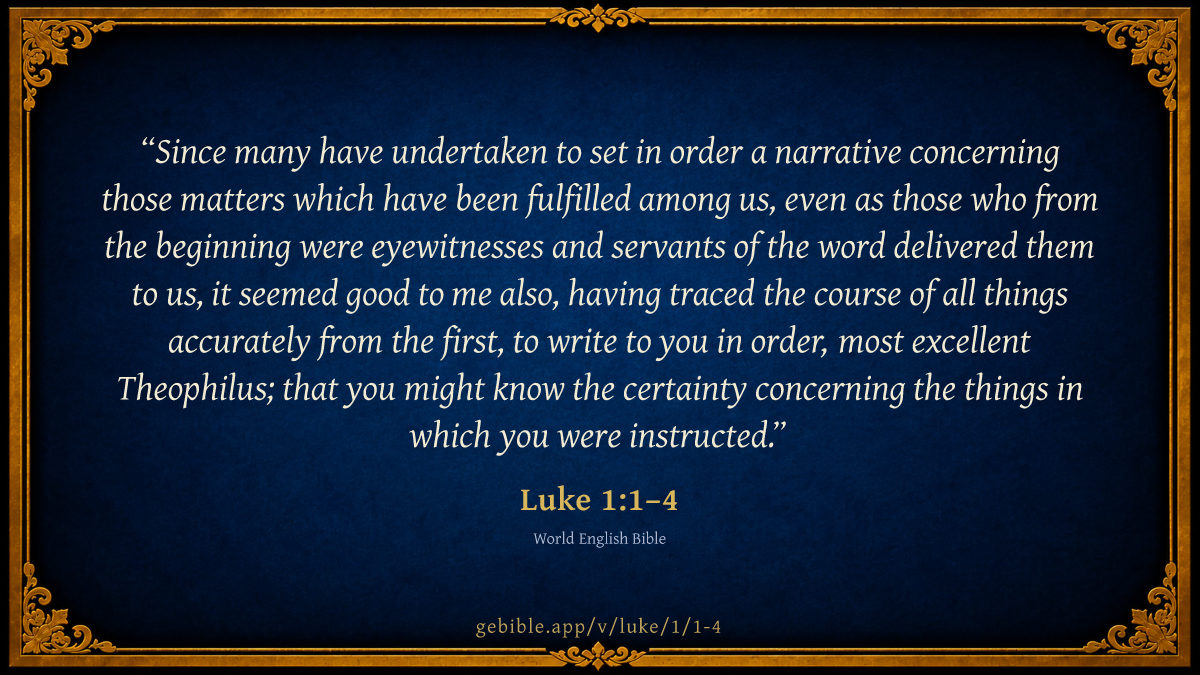
Since many have undertaken to set in order a narrative concerning those matters which have been fulfilled among us, even as those who from the beginning were eyewitnesses and servants of the word delivered them to us, it seemed good to me also, having traced the course of all things accurately from the first, to write to you in order, most excellent Theophilus; that you might know the certainty concerning the things in which you were instructed.
Parallel Translations
-
Since many have undertaken to set in order a narrative concerning those matters which have been fulfilled among us,
even as those who from the beginning were eyewitnesses and servants of the word delivered them to us,
it seemed good to me also, having traced the course of all things accurately from the first, to write to you in order, most excellent Theophilus;
that you might know the certainty concerning the things in which you were instructed.
-
For as moche as many have take in hand to compyle a treates of thoo thinges which are surely knowen amonge vs
even as they declared them vnto vs which from the beginnynge sawe them their selves and were ministers at the doyng:
I determined also assone as I had searched out diligently all thinges from the beginnynge that then I wolde wryte vnto the good Theophilus:
that thou myghtest knowe the certente of thoo thinges wher of thou arte informed.
Show all 3 translations
-
Forasmuch as many haue taken in hand to set foorth the storie of those things, whereof we are fully persuaded,
As they haue deliuered them vnto vs, which from the beginning saw them their selues, and were ministers of ye word,
It seemed good also to me (most noble Theophilus) assoone as I had searched out perfectly all things from the beginning, to write vnto thee thereof from point to point,
That thou mightest acknowledge the certaintie of those things, whereof thou hast bene instructed.
Cross-references (43)
- John 15:27 (v2) You will also testify, because you have been with me from the beginning.
- Acts 1:1-3 (v1) The first book I wrote, Theophilus, concerned all that Jesus began both to do and to teach, until the day in which he was received up,…
- Acts 26:16 (v2) But arise, and stand on your feet, for I have appeared to you for this purpose: to appoint you a servant and a witness both of the things…
- John 20:31 (vv1, 4) but these are written, that you may believe that Jesus is the Christ, the Son of God, and that believing you may have life in his name.
- Hebrews 2:3 (v2) how will we escape if we neglect so great a salvation—which at the first having been spoken through the Lord, was confirmed to us by those…
Show all 42 cross-references
- 2 Peter 1:16 (v2) For we didn’t follow cunningly devised fables when we made known to you the power and coming of our Lord Jesus Christ, but we were…
- Acts 1:1 (v3) The first book I wrote, Theophilus, concerned all that Jesus began both to do and to teach,
- Acts 26:25 (v3) But he said, “I am not crazy, most excellent Festus, but boldly declare words of truth and reasonableness.
- 2 Peter 1:16-19 (v1) For we didn’t follow cunningly devised fables when we made known to you the power and coming of our Lord Jesus Christ, but we were…
- 1 John 1:1-3 (v2) That which was from the beginning, that which we have heard, that which we have seen with our eyes, that which we saw, and our hands…
- Acts 1:3 (v2) To these he also showed himself alive after he suffered, by many proofs, appearing to them over a period of forty days, and speaking about…
- Acts 1:21-22 (v2) “Of the men therefore who have accompanied us all the time that the Lord Jesus went in and out among us, beginning from the baptism of…
- Ecclesiastes 12:9 (v3) Further, because the Preacher was wise, he still taught the people knowledge. Yes, he pondered, sought out, and set in order many proverbs.
- Mark 1:1 (v2) The beginning of the Good News of Jesus Christ, the Son of God.
- Acts 10:39-41 (v2) We are witnesses of everything he did both in the country of the Jews, and in Jerusalem; whom they also killed, hanging him on a tree. God…
- Acts 11:4 (v3) But Peter began, and explained to them in order, saying,
- Acts 15:19 (v3) Therefore my judgment is that we don’t trouble those from among the Gentiles who turn to God,
- Acts 18:25 (v4) This man had been instructed in the way of the Lord; and being fervent in spirit, he spoke and taught accurately the things concerning…
- Acts 23:26 (v3) “Claudius Lysias to the most excellent governor Felix: Greetings.
- Acts 24:3 (v3) we accept it in all ways and in all places, most excellent Felix, with all thankfulness.
- Colossians 1:23-25 (v2) if it is so that you continue in the faith, grounded and steadfast, and not moved away from the hope of the Good News which you heard,…
- 1 Timothy 3:16 (v1) Without controversy, the mystery of godliness is great: God was revealed in the flesh, justified in the spirit, seen by angels, preached…
- 1 Peter 5:1 (v2) Therefore I exhort the elders among you, as a fellow elder, and a witness of the sufferings of Christ, and who will also share in the glory…
- Luke 24:48 (v2) You are witnesses of these things.
- 2 Timothy 4:17 (v1) But the Lord stood by me and strengthened me, that through me the message might be fully proclaimed, and that all the Gentiles might hear.…
- Psalms 50:21 (v3) You have done these things, and I kept silent. You thought that I was just like you. I will rebuke you, and accuse you in front of your…
- Acts 1:8 (v2) But you will receive power when the Holy Spirit has come upon you. You will be witnesses to me in Jerusalem, in all Judea and Samaria, and…
- Acts 4:20 (v2) for we can’t help telling the things which we saw and heard.”
- 1 Corinthians 4:1 (v2) So let a man think of us as Christ’s servants, and stewards of God’s mysteries.
- 1 Corinthians 7:40 (v3) But she is happier if she stays as she is, in my judgment, and I think that I also have God’s Spirit.
- 1 Corinthians 14:19 (v4) However in the assembly I would rather speak five words with my understanding, that I might instruct others also, than ten thousand words…
- 1 Corinthians 16:12 (v3) Now concerning Apollos, the brother, I strongly urged him to come to you with the brothers; and it was not at all his desire to come now;…
- Galatians 6:6 (v4) But let him who is taught in the word share all good things with him who teaches.
- Ephesians 4:11-12 (v2) He gave some to be apostles; and some, prophets; and some, evangelists; and some, shepherds and teachers; for the perfecting of the saints,…
- Psalms 40:5 (v3) Many, Yahweh, my God, are the wonderful works which you have done, and your thoughts which are toward us. They can’t be declared back to…
- Mark 4:14 (v2) The farmer sows the word.
- Luke 1:1 (v3) Since many have undertaken to set in order a narrative concerning those matters which have been fulfilled among us,
- Acts 15:25 (v3) it seemed good to us, having come to one accord, to choose out men and send them to you with our beloved Barnabas and Paul,
- Acts 15:28 (v3) For it seemed good to the Holy Spirit, and to us, to lay no greater burden on you than these necessary things:
- Romans 2:18 (v4) know his will, and approve the things that are excellent, being instructed out of the law,
- 2 Peter 1:15-16 (v4) Yes, I will make every effort that you may always be able to remember these things even after my departure. For we didn’t follow cunningly…
- Ephesians 3:7-8 (v2) of which I was made a servant according to the gift of that grace of God which was given me according to the working of his power. To me,…
42 distinct cross-references across this passage (43 total citations).
Cross-references from openbible.info (CC BY 4.0)
Explain this passage (31 sources)
Historical commentary, presented as a primary source — not an endorsement.
Private notes
Saved on this device only — never synced or sent anywhere.
Geneva Bible translators 1599 · Public Domain On vv1–4 Luke commendeth the witnesses that saw this history.
Luke commendeth the witnesses that saw this history.
Many took it in hand, but did not perform: Luke wrote his Gospel before Matthew and Mark.
Geneva Bible (1599) marginal notes — public domain.
John Trapp 1656 · Public Domain On vv1–4 1 Forasmuch as many have taken in hand to…
1 Forasmuch as many have taken in hand to set forth in order a declaration of those things which are most surely believed among us,
Ver. 1. Many have taken in hand] Or, have attempted, επεχειρησαν, but not effected. Hence some have concluded, that Luke wrote first of the four evangelists. Howbeit the common opinion is (and the most ancient copies say as much) that Matthew wrote his Gospel eight years after Christ, Mark ten, Luke fifteen, and John forty-two.
John Trapp, A Commentary or Exposition upon All the Books of the Old and New Testament (1647–1656) — public domain. Text from a community e-Sword module.
Matthew Poole 1685 · Public Domain On v1 Luke's evangelical history hath this peculiar to itself, that…
Luke's evangelical history hath this peculiar to itself, that whereas the histories of the other evangelists are written to the whole world, having no particular inscription, or dedication, Luke dedicates his to a particular person, named Theophilus; for though that name signifieth one that loveth God, yet I cannot think it is to be taken here appellatively, it being commonly used as a proper name; parents in former ages giving children names generally either expressive of their children's duty to God, (that by their names they might be put in mind of it), or expressive of God's mercy to themselves in giving them such children. The evangelist here suggests, that many had taken in hand orderly to write an account of the things which were certainly believed amongst the Jews. Some think that Luke here reflects upon some that, even so early, had given false accounts of our Saviour's history; for there were several pretended Gospels wrote, called, The Gospel of the Nazarenes, of Thomas, Matthias, Nicodemus, and many others, which the church soon saw cause to reject. But others think that Luke doth not at all reflect, and possibly those figments were not so early; but Luke, observing that many did write this famous history, and some, possibly, for want of due information, not so exactly as they might, yet as they were delivered to them from such as from the beginning were eye witnesses, and ministers of the word, but possibly might not be able so exactly to inform them, or the writers not so able duly to digest them (for most think Matthew, Mark, and John wrote after); or possibly because, there being then no printing, but all in manuscripts, because he thought his friend Theophilus (to whom he knew such a history would be grateful) might not have come to the sight of those manuscripts, he undertakes (not without the direction of the Holy Spirit, as appeared afterward) to compile a history of these things, to which he was either encouraged by the example of others, or incited by the mistakes of those who had done it ill, having the advantage perfectly to understand all things from the first. Most think that this advantage arose not from his personal knowledge, but his converse with the apostles and other ministers of Christ; for he saith no more, Luk 1:2, than,
even as they delivered them unto us, which from the beginning were eye witnesses, and ministers of the word; by which it seemeth to be hinted to us, that he was no eyewitness, nor minister of the word. To understand by the word in that verse Christ (whom John indeed so calleth, Joh 1:1) seemeth to me too hard, considering the word, in the evangelists, doth ordinarily signify the gospel, and no where Christ but in Joh 1:1,2, &c.
Read full note →
That thou mightest know the certainty of those things, wherein thou hast been instructed; hat is, by the relation of others. Before I pass this preface, I shall make some observations upon it.
1. That even from the beginning there were some cheats, in reporting matters of fact concerning the church. Whether Luke intended to reflect on them, or not, if we may believe any thing of ecclesiastical history, there were some false Gospels; and before the time of the Gospel there were apocryphal writings relating to the history of the Old Testament. No writings but the Scriptures deserve our faith (otherwise than they agree with them) in things of which they give us an account.
2. In Luke's time the history of the Gospel was most surely believed, as being delivered from eyewitnesses.
3. Men ought to have perfect understanding of matters of fact before they write them. Whoso writes a history upon uncertainty, imposes upon all future ages.
4. A knowledge of certainties is what all good men ought to aim at in writing and reading. It is a mean soul that can feed upon an uncertainty, and they are as mean that spend their time in catering such food for reasonable souls. Men's understandings are given them for nobler uses than to gain the notion of a falsehood, and they are low born souls that can spend their precious hours in such cookery let the sauce with which they serve it up be never so artificial.
Matthew Poole's English Annotations on the Holy Bible (1683–1685) — public domain. Text from a community e-Sword/MySword module.
William Burkitt 1703 · Public Domain On v1 This gospel, together with the Acts of the Apostles,…
This gospel, together with the Acts of the Apostles, were written by St. Luke, the beloved physician and companion of St. Paul, who wrote, as did the rest of the evangelists, by the special direction and inspiration of the Holy Ghost; where we may profitable remark the wonderful wisdom of God, who, in order to the confirming of our faith in the truth of the gospel, raised up a sufficient number of witnesses to testify the verify and infallible certainty of all that the gospel delivers unto us. Now this evangelist, St. Luke, dedicates this gospel, together with the Acts of the Apostles, to Theophilus, who was, as some think, an honourable senator; or a renowned and eminent person in the church, as others suppose: but many take the word Theophilus, not for a proper name, but common name, signifying every one that loveth God; to whom St. Luke addresses his discourse.
The first four verses of this chapter are a preface to the following history, and acquaint us with the reasons which induced St. Luke to write, namely, because divers persons in that age had imprudently and inconsiderately set upon writing gospels, without direction from the spirit of God, whose errors and mistakes were to be corrected by a true narrative. This St. Luke declares he was able to make, having had perfect understanding and knowledge of the truth of those things he was about to relate; partly by his familiarity with St. Paul, and partly by his conversation with the other apostles, who, constantly attending our Saviour, were eye and ear witnesses of those things that are the subject matter of the ensuing history.
Read full note →
Hence learn, 1. That there were some apocryphal writings (or writings which were not of divine authority) relating to the New Testament, as well as to the Old; as the books of Asher, Gad, and Iddo, are recited in the Old Testament, but were never received into the canon of the scripture: so were there some gospels, or historical relations of our Saviour’s life and actions, wrote by persons which the church never received, as not having the impress of God’s ordination.
Note, 2. That the gospels which St. Luke and the other evangelists wrote, have nothing of fallibility or uncertainty in them; they wrote nothing but what they either heard, or saw themselves, or else received from those that were eye and ear witnesses of matter of fact. It seemed good to me to write, having had perfect knowledge of all things from the very first.
William Burkitt's Expository Notes on the New Testament (1700–1703) — public domain. Text from a community e-Sword module.
Matthew Henry 1710 · Public Domain On v1 Complimental prefaces and dedications, the language of flattery and…
Complimental prefaces and dedications, the language of flattery and the food and fuel of pride, are justly condemned by the wise and good; but it doth not therefore follow, that such as are useful and instructive are to be run down; such is this, in which St. Luke dedicates his gospel to his friend Theophilus, not as to his patron, though he was a man of honour, to protect it, but as to his pupil, to learn it, and hold it fast. It is not certain who this Theophilus was; the name signifies a friend of God; some think that it does not mean any particular person, but every one that is a lover of God; Dr. Hammond quotes some of the ancients understanding it so: and then it teaches us, that those who are truly lovers of God, will heartily welcome the gospel of Christ, the design and tendency of which are, to bring us to God. But it is rather to be understood of some particular person, probably a magistrate; because Luke gives him here the same title of respect which St. Paul gave to Festus the governor, kratiste (Act 26:25), which we there translate most noble Festus, and here most excellent Theophilus. Note, Religion does not destroy civility and good manners, but teaches us, according to the usages of our country, to give honour to them to whom honour is due.
Now observe here, I. Why St. Luke wrote this gospel. It is certain that he was moved by the Holy Ghost, not only to the writing, but in the writing of it; but in both he was moved as a reasonable creature, and not as a mere machine; and he was made to consider,
Read full note →
1. That the things he wrote of were things that were most surely believed among all Christians, and therefore things which they ought to be instructed in, that they may know what they believe, and things which ought to be transmitted to posterity (who are as much concerned in them as we are); and, in order to that, to be committed to writing, which is the surest way of conveyance to the ages to come. He will not write about things of doubtful disputation, things about which Christians may safely differ from one another and hesitate within themselves; but the things which are, and ought to be, most surely believed, pragmata peplērophorēmena - the things which were performed (so some), which Christ and his apostles did, and did with such circumstances as gave a full assurance that they were really done, so that they have gained an established lasting credit. Note, Though it is not the foundation of our faith, yet it is a support to it, that the articles of our creed are things that have been long most surely believed. The doctrine of Christ is what thousands of the wisest and best of men have ventured their souls upon with the greatest assurance and satisfaction.
2. That it was requisite there should be a declaration made in order of those things; that the history of the life of Christ should be methodized, and committed to writing, for the greater certainty of the conveyance. When things are put in order, we know the better where to find them for our own use, and how to keep them for the benefit of others.
3. That there were many who had undertaken to publish narratives of the life of Christ, many well-meaning people, who designed well, and did well, and what they published had done good, though not done by divine inspiration, nor so well done as might be, nor intended for perpetuity. Note, (1.) The labours of others in the gospel of Christ, if faithful and honest, we ought to commend and encourage, and not to despise, though chargeable with many deficiencies. (2.) Others' services to Christ must not be reckoned to supersede ours, but rather to quicken them.
4. That the truth of the things he had to write was confirmed by the concurring testimony of those who were competent and unexceptionable witnesses of them; what had been published in writing already, and what he was now about to publish, agreed with that which had been delivered by word of mouth, over and over, by those who from the beginning were eye-witnesses and ministers of the word, Luk 1:2. Note, (1.) The apostles were ministers of the word of Christ, who is the Word (so some understand it), or of the doctrine of Christ; they, having received it themselves, ministered it to others, Jo1 1:1. They had not a gospel to make as masters, but a gospel to preach as ministers. (2.) The ministers of the word were eye-witnesses of the things which they preached, and, which is also included, ear-witnesses. They did themselves hear the doctrine of Christ, and see his miracles, and had them not by report, at second hand; and therefore they could not but speak, with the greatest assurance, the things which they had seen and heard, Act 4:20. (3.) They were so from the beginning of Christ's ministry, Luk 1:2. He had his disciples with him when he wrought his first miracle, Joh 2:11. They companied with him all the time he went in and out among them (Act 1:21), so that they not only heard and saw all that which was sufficient to confirm their faith, but, if there had been any thing to shock it, they had opportunity to discover it. (4.) The written gospel, which we have to this day, exactly agrees with the gospel which was preached in the first days of the church. (5.) That he himself had a perfect understanding of the things he wrote of, from the first, Luk 1:3. Some think that here is a tacit reflection upon those who had written before him, that they had not a perfect understanding of what they wrote, and therefore, Here am I, send me ( - facit indignatio versum - my wrath impels my pen); or rather, without reflecting on them, he asserts his own ability for this undertaking: "It seemed good to me, having attained to the exact knowledge of all things, anōthen - from above;" so I think it should be rendered; for if he meant the same with from the beginning (Luk 1:2), as our translation intimates, he would have used the same word. [1.] He had diligently searched into these things, had followed after them (so the word is), as the Old Testament prophets are said to have enquired and searched diligently, Pe1 1:10. He had not taken things so easily and superficially as others who had written before him, but made it his business to inform himself concerning particulars. [2.] He had received his intelligence, not only by tradition, as others had done, but by revelation, confirming that tradition, and securing him from any error or mistake in the recording of it. He sought it from above (so the word intimates), and from thence he had it; thus, like Elihu, he fetched his knowledge from afar. He wrote his history as Moses wrote his, of things reported by tradition, but ratified by inspiration. [3.] He could therefore say that he had a perfect understanding of these things. He knew them, akribōs - accurately, exactly. "Now, having received this from above, it seemed good to me to communicate it;" for such a talent as this ought not to be buried.
II. Observe why he sent it to Theophilus: "I wrote unto thee these things in order, not that thou mayest give reputation to the work, but that thou mayest be edified by it (Luk 1:4); that thou mayest know the certainty of those things wherein thou has been instructed." 1. It is implied, that he had been instructed in these things either before his baptism, or since, or both, according to the rule, Mat 28:19, Mat 28:20. Probably, Luke had baptized him, and knew how well instructed he was; peri hōn katēchēthēs - concerning which thou hast been catechized; so the word is; the most knowing Christians began with being catechized. Theophilus was a person of quality, perhaps of noble birth; and so much the more pains should be taken with such when they are young, to teach them the principles of the oracles of God, that they may be fortified against temptations, and furnished for the opportunities, of a high condition in the world. 2. It was intended that he should know the certainty of those things, should understand them more clearly and believe more firmly. There is a certainty in the gospel of Christ, there is that therein which we may build upon; and those who have been well instructed in the things of God when they were young should afterwards give diligence to know the certainty of those things, to know not only what we believe, but why we believe it, that we may be able to give a reason of the hope that is in us.
Matthew Henry's Commentary on the Whole Bible (1708–1710) — public domain (CC PDM 1.0). Text via the HelloAO Bible API.
John Gill 1763 · Public Domain On vv2–4 Even as they delivered them unto us,.... By whom…
Even as they delivered them unto us,.... By whom the evangelist means, as appears from the after description of them, the twelve apostles, and seventy disciples; who handed down to others the accounts of the birth, life, and death of Christ; and according to which the above Christians proposed to write:
which from the beginning were eyewitnesses and ministers of the word; either of the Gospel, or rather of Christ himself, the eternal Word of God; for from the beginning of Christ's preaching the Gospel, or as soon as he entered upon his public ministry, he called his apostles, as Simon, Andrew, James, John, &c. and afterwards seventy disciples; who were eyewitnesses of him, of the truth of his incarnation, and of his ministry and miracles; saw, and conversed with him after his resurrection from the dead and beheld his ascension to heaven; and were ministers that were called, qualified, and sent out by him and waited on him, and served him. This shows, as is by some rightly observed, that Luke was not one of the seventy disciples, as some (i) have thought, and as the title of this Gospel, to the Arabic version of it, expresses; for then he would have been an eyewitness himself: nor did he take his account from the Apostle Paul; for he was not a minister of the word from the beginning, but was as one born out of due time,
Read full note →
(i) Epiphan. contra Haeres. l. 2. Haeres. 51. Theophylact. in Argument in Luc.
John Gill's Exposition of the Whole Bible (1746–1763) — public domain (CC PDM 1.0). Text via the HelloAO Bible API.
John Wesley 1765 · Public Domain On vv1, 3 This short, weighty, artless, candid dedication, belongs to the…
This short, weighty, artless, candid dedication, belongs to the Acts, as well as the Gospel of St. Luke. Many have undertaken - He does not mean St. Matthew or Mark; and St. John did not write so early. For these were eye witnesses themselves and ministers of the word.
John Wesley, Explanatory Notes Upon the Whole Bible (1754–1765) — public domain. Text via the GEBible commentary corpus.
Adam Clarke 1810 · Public Domain On vv1–4 -Usherian year of the World, 3999.
THE GOSPEL ACCORDING TO ST. LUKE.
-Usherian year of the World, 3999.
Read full note →
-Alexandrian year of the World, 5497.
-Antiochian year of the World, 5487.
-Constantinopolitan AEra of the World, 5503.
-Rabbinical year of the World, 3754.
-Year of the Julian Period, 4708.
-AEra of the Seleucidae, 307.
-Year before the Christian AEra, 6.
-Year of the CXCIII. Olympiad, 3.
-Year of the building of Rome, 748.
-Year of the Julian AEra, 41.
-Year of the Caesarean AEra of Antioch, 44.
-Year of the Spanish AEra, 34.
-Year of the Paschal Cycle or Dionysian Period, 529.
-Year of the Christian Lunar Cycle, or Golden Number, 15.
-Year of the Rabbinical Lunar Cycle, 12.
-Year of the Solar Cycle, 4.
-Dominical Letter, C.
-Epact, 4.
-Year of the Emperor Augustus, 25.
-Consuls, D. Laelius Balbus, and C. Antistius Vetus, from January 1 to July 1; and Imp. C. Julius Caesar Octav. Augustus XII. and L. Cornelius Sulla, for the remainder of the year. The reason why two sets of Consuls appear in this Chronology is this: the Consuls were changed every year in July, therefore, taking in the whole year, four Consuls necessarily appear: two for the first six months, and two for the latter half of the year.
CHAPTER I.
The preface, or St. Luke's private epistle to Theophilus, 1-4.
The conception and birth of John Baptist foretold by the angel
Gabriel, 5-17.
Zacharias doubts, 18.
And the angel declares he shall be dumb, till the accomplishment
of the prediction, 19-25.
Six months after the angel Gabriel appears to the virgin Mary,
and predicts the miraculous conception and birth of Christ,
26-38.
Mary visits her cousin Elisabeth, 39-45.
Mary's song of exultation and praise, 46-56.
John the Baptist is born, 57-66.
The prophetic song of his father Zacharias, 67-79.
John is educated in the desert, 80.
NOTES ON CHAP. I.
Verse 1. Many have taken in hand] Great and remarkable characters have always many biographers. So it appears it was with our Lord: but as most of these accounts were inaccurate, recording as facts things which had not happened; and through ignorance or design mistaking others, especially in the place where St. Luke wrote; it seemed good to the Holy Spirit to inspire this holy man with the most correct knowledge of the whole history of our Lord's birth, preaching, miracles, sufferings, death, resurrection, and ascension, that the sincere, upright followers of God might have a sure foundation, on which they might safely build their faith. See Clarke on Lu 9:10.
Most surely believed among us] Facts confirmed by the fullest evidence - των πεπληροφορημενων πραγματων. Every thing that had been done or said by Jesus Christ was so public, so plain, and so accredited by thousands of witnesses, who could have had no interest in supporting an imposture, as to carry the fullest conviction, to the hearts of those who heard and saw him, of the divinity of his doctrine, and the truth of his miracles.
Adam Clarke's Commentary on the Bible (1810–1826) — public domain. Text from a community e-Sword/MySword module.
Joseph Benson 1811 · Public Domain On vv1, 3 Luk 1:1-2. Forasmuch as many have taken in hand…
Luk 1:1-2. Forasmuch as many have taken in hand — Who they were to whom the apostle here alludes, who had, from vague reports, (for so his words seem to imply,) rashly published narratives not entirely to be depended on, it is impossible for us now to discover. It is true, the word επεχειρησαν, have undertaken, used here by Luke, does not necessarily imply any censure on the writers of such accounts, but the scope of the place seems to imply it, if not on all, at least on some of them: for if all, or even most of them, had furnished true narratives, the number was an argument rather against a new attempt than for it. Grotius justly observes, that the spurious gospels, mentioned by ancient writers, are forgeries manifestly of a later date than the time of Luke. That there were, however, some such performances at the time when Luke began to write, the words of this evangelist are a sufficient evidence: for, to consider this book merely on the footing of a human composition, what writer of common sense would introduce himself to the public by observing the numerous attempts that had been made by former writers, some of whom at least had not been at due pains to be properly informed, if he himself were actually the first, or even the second, or the third, who had written on the subject; and if one of the two who preceded him had better opportunities of knowing than he, and the other fully as good? But the total disappearance of those spurious writings, probably no better than hasty collections of flying rumours, containing a mixture of truth and falsehood, may, after the genuine gospels were generally known and read, be easily accounted for. At midnight, the glimmering of the taper is not without its use, but it can make no conceivable addition to the light of the meridian sun. It deserves, however, to be remarked by the way, that whatever may be thought to be insinuated here by the evangelist, concerning the imperfect information of former historians, there is no hint given of their bad designs. It is justly observed here by Dr. Campbell, that the very circumstance of the number of such narratives, at so early a period, is itself an evidence that there was something in the first publication of the Christian doctrine, which, notwithstanding the many unfavourable circumstances wherewith it was attended, excited the curiosity and awakened the attention of persons of all ranks and denominations; insomuch that every narrative, which pretended to furnish men with any additional information concerning so extraordinary a personage as Jesus, seems to have been read with avidity. To set forth in order a declaration — Greek, αναταξασθαι διηγησιν, to compose a narrative; of those things which are most surely believed among us — As the great foundation of our common faith. The expression, πραγματων, refers not only to the things believed, but also to the things performed by Christ and his apostles; this first history of Luke being designed to record what Jesus himself said or did, Act 1:1; and his second, to relate the acts of the apostles: and the participle, πεπληροφορημενων, translated, most surely believed, is rather to be understood as referring to the fulness of that evidence with which the things were attended, than to the confidence with which they were credited. It not only signifies that the doctrines were taught and the things done, but that they were taught and done with such circumstances, as laid a foundation for πληροφορια της πιστεως, a full assurance of faith, as to the truth of the doctrines, and the reality of the facts. Even as they delivered them, which from the beginning — Of Christ’s ministry; were eye-witnesses and ministers of the word — Because the persons, according to whose information the writers referred to by Luke composed their histories, are said to have been eye-witnesses as well as ministers of the word, (του λογου,) several writers have supposed that, by the word, Luke meant Christ himself, one of whose titles is, the Word, Joh 1:1, and, the Word of God, Rev 19:13. Others, however, by the word, understand the transactions of our Lord’s public life; his sermons, miracles, death, resurrection, and ascension, because these things were the great subjects of the preaching of the apostles, who were eye and ear witnesses of them. And to Christians these were matters of such moment, that the knowledge, consideration, and remembrance of them, were the great business and comfort of their lives. It is no wonder, therefore, that those who were able should set down in writing such particulars of them as they had learned, whether from the conversations or sermons of the apostles and eye-witnesses. But histories thus drawn up, though they might contain many things highly worthy of the notice of Christians, must needs have been defective both in their matter and manner. Wherefore, Luke, having attained a thorough knowledge of our Lord’s history from the very beginning, thought fit to give a more full, regular, and connected account of it than had hitherto appeared, as he signifies in the next verse.
Joseph Benson's Commentary on the Old and New Testaments (1811–1818) — public domain. Text from a community e-Sword module.
Albert Barnes 1834 · Public Domain On vv1–4 Forasmuch as many - It has been doubted who…
Forasmuch as many - It has been doubted who are referred to here by the word “many.” It seems clear that it could not be the other evangelists, for the gospel by “John” was not yet written, and the word “many” denotes clearly more than “two.” Besides, it is said that they undertook to record what the “eye-witnesses” had delivered to them, so that the writers did not pretend to be eye-witnesses themselves. It is clear, therefore, that other writings are meant than the gospels which we now have, but what they were is a matter of conjecture. What are now known as spurious gospels were written long after Luke wrote his. It is probable that Luke refers to “fragments” of history, or to narratives of “detached” sayings, acts, or parables of our Lord, which had been made and circulated among the disciples and others. His doctrines were original, bold, pure, and authoritative. His miracles had been extraordinary, clear, and awful. His life and death had been peculiar; and it is not improbable - indeed it is highly probable that such broken accounts and narratives of detached facts would be preserved. That this is what Luke means appears farther from Luk 1:3, where “he” professes to give a regular, full, and systematic account from the very beginning - “having had perfect understanding of “all things from the very first.” The records of the others - the “many” - were broken and incomplete. His were to be regular and full.
Taken in hand - Undertaken, attempted.
Read full note →
To set forth in order - To compose a narrative. It does not refer to the “order” or “arrangement,” but means simply to give a narrative. The word rendered here “in order” is different from that in the third verse, which “has” reference “to order,” or to a full and fair “arrangement” of the principal facts, etc., in the history of our Lord.
A declaration - A narrative - an account of.
Which are most surely believed among us - Among Christians - among all the Christians then living. Here we may remark:
That Christians of that day had the best of all opportunities for knowing whether those things were true. Many had seen them, and all others had had the account from those who had witnessed them. That infidels now cannot “possibly” be as good judges in the matter as those who lived at the time, and who were thus competent to determine whether these things were true or false. That all Christians do “most surely believe” the truth of the gospel. It is their life, their hope, their all. Nor can they doubt that their Saviour lived, bled, died, rose, and still lives; that he was their atoning sacrifice, and that he is God over all, blessed forever.
Albert Barnes' Notes on the Bible (1834–1885) — public domain. Text from a community e-Sword/MySword module.
Haydock's Catholic Bible Commentary 1859 · Public Domain On vv1, 3 That have been accomplished.[1] In the Protestant translation, of…
That have been accomplished.[1] In the Protestant translation, of things most surely believed. They have followed Beza, and Erasmus: but other learned critics have shewn that the same Greek word often signifies to fulfil; and it is clearly proved by St. John Chrysostom.
===============================
Read full note →
[BIBLIOGRAPHY]
Completæ sunt. Greek: peplerophoremenon. I know the pretended differences betwixt Greek: plerophoreisthai, and plerousthai. But divers learned critics, after St. John Chrysostom take notice, that they are many times taken for the same. So 2 Timothy iv. 5. Ministerium tuum imple. Greek: plerophoreson, toutesti, says St. John Chrysostom, Greek: plerosou. log. th. p. 371. Ed. Savil. and on the 17th ver. of the same chapter, ut per me impleretur, Greek: plerophorethe, toutesti, plerothe. (Ibid. p. 376.)
George Leo Haydock (1774–1849), Haydock's Catholic Family Bible and Commentary, 1859 edition — public domain. Excludes Psalms (Douay-Rheims chapter numbering differs from Protestant) and Deuterocanonical books (Catholic canon only).
John Nelson Darby 1862 · Public Domain On v1 Luke Chapter 1
Luke Chapter 1
The Gospel of Luke sets the Lord before us in the character of Son of man, revealing God in delivering grace among men. Hence the present operation of grace and its effect are more referred to, and even the present time prophetically, not the substitution of other dispensations as in Matthew, but of saving heavenly grace. At first, no doubt (and just because He is to be revealed as man, and in grace to men), we find Him, in a prefatory part in which we have the most exquisite picture of the godly remnant, presented to Israel, to whom He had been promised, and in relationship with whom He came into this world; but afterwards this Gospel presents moral principles which apply to man, whosoever he may be, whilst yet manifesting Christ for the moment in the midst of that people. This power of God in grace is displayed in various ways in its application to the wants of men. After the transfiguration, which is recounted earlier in the narration by Luke [1] than in the other Gospels, we find the judgment of those who rejected the Lord, and the heavenly character of the grace which, because it is grace, addresses itself to the nations, to sinners, without any particular reference to the Jews, overturning the legal principles according to which the latter pretended to be, and as to their external standing were originally called at Sinai to be, in connection with God. Unconditional promises to Abraham, etc., and prophetic confirmation of them, are another thing. They will be accomplished in grace, and were to be laid hold of by faith. After this, we find that which should happen to the Jews according to the righteous government of God; and, at the end, the account of the death and resurrection of the Lord, accomplishing the work of redemption. We must observe that Luke (who morally sets aside the Jewish system, and who introduces the Son of man as the man before God, presenting Him as the One who is filled with all the fulness of God dwelling in Him bodily, as the man before God, according to His own heart, and thus as Mediator between God and man, and centre of a moral system much more vast than that of Messiah among the Jews)-we must observe, I repeat, that Luke, who is occupied with these new relations (ancient, in fact, as to the counsels of God), gives us the facts belonging to the Lord’s connection with the Jews, owned in the pious remnant of that people, with much more development than the other evangelists, as well as the proofs of His mission to that people, in coming into the world-proofs which ought to have gained their attention, and fixed it upon the child who was born to them.
Read full note →
In Luke, I add, that which especially characterises the narrative and gives its peculiar interest to this Gospel is, that it sets before us that which Christ is Himself. It is not His official glory, a relative position that He assumed; neither is it the revelation of His divine nature, in itself; nor His mission as the great Prophet. It is Himself, as He was, a man on the earth-the Person whom I should have met every day had I lived at that time in Judea, or in Galilee.
I would add a remark as to the style of Luke, which may facilitate the study of this Gospel to the reader. He often brings a mass of facts into one short general statement, and then expatiates at length on some isolated fact, where moral principles and grace are displayed.
Many had undertaken to give an account of that which was historically received among Christians, as related to them by the companions of Jesus; and Luke thought it well-having followed these things from the beginning, and thus obtained exact knowledge respecting them-to write methodically to Theophilus, in order that he might have the certainty of those things in which he had been instructed. It is thus that God has provided for the instruction of the whole church, in the doctrine contained in the picture of the Lord’s life furnished by this man of God; who, personally moved by Christian motives, was directed and inspired by the Holy Ghost for the good of all believers. [2] At Luk 1:5 the evangelist begins with the first revelations of the Spirit of God respecting these events, on which the condition of God’s people and that of the world entirely depended; and in which God was to glorify Himself to all eternity.
But we immediately find ourselves in the atmosphere of Jewish circumstances. The Jewish ordinances of the Old Testament, and the thoughts and expectations connected with them, are the framework in which this great and solemn event is set. Herod, king of Judea, furnishes the date; and it is a priest, righteous and blameless, belonging to one of the twenty-four classes, whom we find on the first step of our way. His wife was of the daughters of Aaron; and these two upright persons walked in all the commandments and ordinances of the Lord (Jehovah) without blame. All was right before God, according to His law in the Jewish sense. But they did not enjoy the blessing that every Jew desired; they had no child. Nevertheless, it was according, we may say, to the ordinary ways of God in the government of His people, to accomplish His blessing while manifesting the weakness of the instrument-a weakness that took away all hope according to human principles. Such had been the history of the Sarahs, the Rebeccas, the Hannahs, and many more, of whom the word tells us for our instruction in the ways of God.
This blessing was often prayed for by the pious priest; but until now the answer had been delayed. Now, however, when, at the moment of exercising his regular ministry, Zacharias drew near to burn incense, which, according to the law, was to go up as a sweet savour before God (type of the Lord’s intercession), and while the people were praying outside the holy place, the angel of the Lord appears to the priest on the right side of the altar of incense. At the sight of this glorious personage Zacharias is troubled, but the angel encourages him by declaring himself to be the bearer of good news; announcing to him that his prayers, so long apparently addressed in vain to God, were granted. Elizabeth should bear a son, and the name by which he should be called was, “The favour of the Lord,” a source of joy and gladness to Zacharias, and whose birth should be the occasion of thanksgiving to many. But this was not merely as the son of Zacharias. The child was the Lord’s gift, and should be great before Him; he should be a Nazarite, and filled with the Holy Ghost, from his mother’s womb: and many of the children of Israel should he turn to the Lord their God. He should go before Him in the spirit of Elias, and with the same power to re-establish moral order in Israel, even in its sources, and to bring back the disobedient to the wisdom of the just-to make ready a people prepared for the Lord.
The spirit of Elias was a stedfast and ardent zeal for the glory of Jehovah, and for the establishment, or re-establishment by repentance, of the relations between Israel and Jehovah. His heart clung to this link between the people and their God, according to the strength and glory of the link itself, but in the sense of their fallen condition, and according to the rights of God in connection with these relationships. The spirit of Elias-although indeed the grace of God towards His people had sent him-was in a certain sense a legal spirit. He asserted the rights of Jehovah in judgment. It was grace opening the door to repentance, but not the sovereign grace of salvation, though what prepared the way to it. It is in the moral force of his call to repentance that John is here compared to Elias, in bringing back Israel to Jehovah. And in fact Jesus was Jehovah.
But the faith of Zacharias in God and in His goodness did not come up to the height of his petition (alas! too common a case), and when it is granted at a moment that required the intervention of God to accomplish his desire, he is not able to walk in the steps of an Abraham or a Hannah, and he asks how this thing can now take place.
God, in His goodness, turns His servant’s want of faith into an instructive chastisement for himself, and into a proof for the people that Zacharias had been visited from on high. He is dumb until the word of the Lord is fulfilled; and the signs which he makes to the people, who marvel at his staying so long in the sanctuary, explain to them the reason.
But the word of God is accomplished in blessing towards him; and Elizabeth, recognising the good hand of God upon her with a tact that belongs to her piety, goes into retirement. The grace which blessed her did not make her insensible to that which was a shame in Israel, and which, although removed, left its traces as to man in the superhuman circumstances through which it was accomplished. There was a rightmindedness in this, which became a holy woman. But that which is rightly concealed from man has all its value before God, and Elizabeth is visited in her retreat by the mother of the Lord. But here the scene changes, to introduce the Lord Himself into this marvellous history which unfolds before our eyes.
God, who had prepared all beforehand, sends now to announce the Saviour’s birth to Mary. In the last place that man would have chosen for the purpose of God-a place whose name in the eyes of the world, sufficed to condemn those who came from thence-a maiden, unknown to all whom the world recognised, was betrothed to a poor carpenter. Her name was Mary. But everything was in confusion in Israel: the carpenter was of the house of David. The promises of God-who never forgets them, and never overlooks those who are their object-found here the sphere for their accomplishment. Here the power and the affections of God are directed, according to their divine energy. Whether Nazareth was small or great was of no importance, except to shew that God does not expect from man, but man from God. Gabriel is sent to Nazareth, to a virgin who was betrothed to a man named Joseph, of the house of David.
The gift of John to Zacharias was an answer to his prayers-God faithful in His goodness towards His people who wait upon Him.
But this is a visitation of sovereign grace. Mary, a chosen vessel for this purpose, had found grace in God’s sight. She was favoured [3] by sovereign grace-blessed among women. She should conceive and bring forth a son: she should call Him Jesus. He should be great, and should be called the Son of the Highest. God should give Him the throne of His father David. He should reign over the house of Jacob for ever, and His kingdom should have no end.
It will be observed here, that the subject which the Holy Ghost sets before us is the birth of the child, as He would be down here in this world, as brought forth by Mary-of Him who should be born.
The instruction given by the Holy Ghost on this point is divided into two parts: first, that which the child to be born should be; secondly, the manner of His conception, and the glory which would be its result. It is not simply the divine nature of Jesus that is presented, the Word which was God, the Word made flesh; but that which was born of Mary, and the way in which it should take place. We know well that it is the same precious and divine Saviour of whom John speaks that is in question; but He is here presented to us under another aspect, which is of infinite interest to us; and we must consider Him as the Holy Ghost presents Him, as born of the virgin Mary in this world of tears.
To take first the Luk 1:31-33.
It was a child really conceived in Mary’s womb, who brought forth this child at the time which God had Himself appointed for human nature. The usual time elapsed before its birth. As yet this tells us nothing of the manner. It is the fact itself, which has an importance that can neither be measured nor exaggerated. He was really and truly man, born of a woman as we are-not as to the source nor as to the manner of His conception, of which we are not yet speaking, but as to the reality of His existence as man. He was really and truly a human being. But there were other things connected with the Person of the One who should be born that are also set before us. His name should be called Jesus, that is, Jehovah the Saviour. He should be manifested in this character and with this power. He was so.
This is not connected here with the fact, “for he shall save his people from their sins,” as in Matthew, where it was the manifestation to Israel of the power of Jehovah, of their God, in fulfilment of the promises made to that people. Here we see that He has a right to this name; but this divine title lies hidden under the form of a personal name; for it is the Son of man who is presented in this Gospel, whatever His divine power might be. Here we are told, “He”-the One who should be born-”should be great,” and (born into this world) “should be called the Son of the Highest.” He had been the Son of the Father before the world was; but this child, born on earth, should be called-such as He was down here-the Son of the Highest: a title to which He would thoroughly prove His right by His acts, and by all that manifested what He was. A precious thought to us and full of glory, a child born of a woman legitimately bears this name, “Son of the Highest”-supremely glorious for One who is in the position of a man and really was such before God.
But other things still were connected with the One that should be born. God would give Him the throne of His father David. Here again we plainly see that He is considered as born, as man, in this world. The throne of His father David belongs to Him. God will give it Him. By right of birth He is heir to the promises, to the earthly promises which, as to the kingdom appertained to the family of David; but it should be according to the counsels and the power of God. He should reign over the house of Jacob-not only over Judah, and in the weakness of a transitory power and an ephemeral life, but throughout the ages; and of His kingdom there should be no end. As indeed Daniel had predicted, it should never be taken by another. It should never be transferred to another people. It should be established according to the counsels of God which are unchangeable, and His power which never fails. Until He delivered up the kingdom to God the Father, He should exercise a royalty that nothing could dispute; which He would deliver up (all things being fulfilled) to God, but the royal glory of which should never be tarnished in His hands.
Such should be the child born-truly, though miraculously born as man. To those who could understand His name it was Jehovah the Saviour.
He should be King over the house of Jacob according to a power that should never decay and never fail, until blended with the eternal power of God as God.
The grand subject of the revelation is, that the child should be conceived and born; the remainder is the glory that should belong to Him, being born.
But it is the conception that Mary does not understand. God permits her to ask the angel how this should be. Her question was according to God. I do not think there was any want of faith here. Zacharias had constantly asked for a son-it was only a question of the goodness and the power of God to perform his request-and was brought by the positive declaration of God to a point at which he had only to trust in it. He did not trust to the promise of God. It was only the exercise of the extraordinary power of God in the natural order of things. Mary asks, with holy confidence, since God thus favoured her, how the thing should be accomplished, outside the natural order. Of its accomplishment she has no doubt (see Luk 1:45; “Blessed,” said Elizabeth, “is she that believed.”) She inquires how it shall be accomplished, since it must be done outside the order of nature. The angel proceeds with his commission, making known to her the answer of God to this question also. In the purposes of God, this question gave occasion (by the answer it received) to the revelation of the miraculous conception.
The birth of Him who has walked upon this earth was the thing in question-His birth of the virgin Mary. He was God, He became man; but here it is the manner of His conception in becoming a man upon the earth. It is not what He was that is declared. It is He who was born, such as He was in the world, of whose miraculous conception we here read. The Holy Ghost should come upon her-should act in power upon this earthen vessel, without its own will or the will of any man. God is the source of the life of the child promised to Mary, as born in this world and by His power. He is born of Mary-of this woman chosen by God. The power of the Highest should overshadow her, and therefore that which should be born of her should be called the Son of God. Holy in His birth, conceived by the intervention of the power of God acting upon Mary (a power which was the divine source of His existence on the earth, as man), that which thus received its being from Mary, the fruit of her womb, should even in this sense have the title of Son of God. The holy thing which should be born of Mary should be called the Son of God. It is not here the doctrine of the eternal relationship of the Son with the Father. The Gospel of John, the Epistle to the Hebrews, that to the Colossians, establish this precious truth, and demonstrate its importance; but here it is that which was born by virtue of the miraculous conception, which on that ground is called the Son of God.
The angel announces to her the blessing bestowed on Elizabeth through the almighty power of God; and Mary bows to the will of her God-the submissive vessel of His purpose, and in her piety acknowledges a height and greatness in these purposes which only left to her, their passive instrument, her place of subjection to the will of God. This was her glory, through the favour of her God.
It was befitting that wonders should accompany, and bear a just testimony to, this marvellous intervention of God. The communication of the angel was not without fruit in the heart of Mary; and by her visit to Elizabeth, she goes to acknowledge the wonderful dealings of God. The piety of the virgin displays itself here in a touching manner. The marvellous intervention of God humbled her, instead of lifting her up. She saw God in that which had taken place, and not herself; on the contrary the greatness of these marvels brought God so near her as to hide her from herself. She yields herself to His holy will: but God has too large a place in her thoughts in this matter to leave any room for self-importance.
The visit of the mother of her Lord to Elizabeth was a natural thing to herself, for the Lord had visited the wife of Zacharias. The angel has made it known to her. She is concerned in these things of God, for God was near her heart by the grace that had visited her. Led by the Holy Ghost in heart and affection, the glory that belonged to Mary, in virtue of the grace of God who had elected her to be the mother of her Lord, is recognised by Elizabeth, speaking by the Holy Ghost. She also acknowledges the pious faith of Mary, and announces to her the fulfilment of the promise she had received (all that took place being a signal testimony given to Him who should be born in Israel and among men).
The heart of Mary is then poured out in thanksgiving. She owns God her Saviour in the grace that has filled her with joy, and her own low estate-a figure of the condition of the remnant of Israel-and that gave occasion to the intervention of God’s greatness, with a full testimony that all was of Himself. Whatever might be the piety suitable to the instrument whom He employed, and which was found indeed in Mary, it was in proportion as she hid herself that she was great; for then God was all, and it was through her that He intervened for the manifestation of His marvellous ways. She lost her place if she made anything of herself, but in truth she did not. The grace of God preserved her, in order that His glory might be fully displayed in this divine event. She recognises His grace, but she acknowledges that all is grace towards her.
It will be remarked here that, in the character and the application of the thoughts that fill her heart, all is Jewish. We may compare the song of Hannah, who prophetically celebrated this same intervention; and see also Luk 1:54-55. But, observe, she goes back to the promises made to the fathers, not to Moses, and she embraces all Israel. It is the power of God, which works in the midst of weakness, when there is no resource, and all is contrary to it. Such is the moment that suits God, and, to the same end, instruments that are null, that God may be all.
It is remarkable that we are not told that Mary was full of the Holy Ghost. It appears to me that this is an honourable distinction for her. The Holy Ghost visited Elizabeth and Zacharias in an exceptional manner. But, although we cannot doubt that Mary was under the influence of the Spirit of God, it was a more inward effect, more connected with her own faith, with her piety, with the more habitual relations of her heart with God (that were formed by this faith and by this piety), and which consequently expressed itself more as her own sentiments. It is thankfulness for the grace and favour conferred on her the lowly one, and that in connection with the hopes and blessing of Israel. In all this there appears to me a very striking harmony in connection with the wondrous favour bestowed upon her. I repeat it, Mary is great inasmuch as she is nothing; but she is favoured by God in a way that is unparalleled, and all generations shall call her blessed.
But her piety, and its expression in this song, being more personal, an answer to God rather than a revelation on His part, it is clearly limited to that which was necessarily for her the sphere of this piety-to Israel, to the hopes and promises given to Israel. It goes back, as we have seen, to the farthest point of God’s relations with Israel-and they were in grace and promise, not law-but it does not go outside them.
Mary abides three months with the woman whom God had blessed, the mother of him who was to be the voice of God in the wilderness; and she returns to follow humbly her own path, that the purposes of God may be accomplished.
Nothing more beautiful of its kind than this picture of the intercourse between these pious women, unknown to the world, but the instruments of God’s grace for the accomplishment of His purpose, glorious and infinite in their results. They hide themselves, moving in a scene into which nothing enters but piety and grace; but God is there, as little known to the world as were these poor women, yet preparing and accomplishing that which the angels desire to fathom in its depths. This takes place in the hill country, where these pious relatives dwelt. They hid themselves; but their hearts, visited by God and touched by His grace, responded by their mutual piety to these wondrous visits from above; and the grace of God was truly reflected in the calmness of a heart that recognised His hand and His greatness, trusting in His goodness and submitting to His will. We are favoured in being admitted into a scene, from which the world was excluded by its unbelief and alienation from God, and in which God thus acted.
But that which piety recognised in secret, through faith in the visitations of God, must at length be made public, and be fulfilled before the eyes of men. The son of Zacharias and Elizabeth is born, and Zacharias (who, obedient to the word of the angel, ceases to be dumb) announces the coming of the Branch of David, the horn of Israel’s salvation, in the house of God’s elect King, to accomplish all the promises made to the fathers, and all the prophecies by which God had proclaimed the future blessing of His people. The child whom God had given to Zacharias and Elizabeth should go before the face of Jehovah to prepare His ways; for the Son of David was Jehovah, who came according to the promises, and according to the word by which God had proclaimed the manifestation of His glory.
The visitation of Israel by Jehovah, celebrated by the mouth of Zacharias, embraces all the blessing of the millennium. This is connected with the presence of Jesus, who brings in His own Person all this blessing. All the promises are Yea and Amen in Him. All the prophecies encircle Him with the glory then to be realised, and make Him the source from which it springs. Abraham rejoiced to see the glorious day of Christ.
The Holy Ghost always does this, when His subject is the fulfilment of the promise in power. He goes on to the full effect which God will accomplish at the end. The difference here is, that it is no longer the announcement of joys in a distant future, when a Christ should be born, when a child should be brought forth, to bring in their joys in days still obscured by the distance at which they were seen. The Christ is now at the door, and it is the effect of His presence that is celebrated. We know that, having been rejected, and being now absent, the accomplishment of these things is necessarily put off until He returns; but His presence will bring their fulfilment, and it is announced as being connected with that presence.
We may remark here, that this chapter confines itself within the strict limits of the promises made to Israel, that is to say, to the fathers. We have the priests, the Messiah, His forerunner, the promises made to Abraham, the covenant of promise, the oath of God. It is not the law; it is the hope of Israel-founded on the promise, the covenant, the oath of God, and confirmed by the prophets-which has its realisation in the birth of Jesus, of the Son of David. It is not, I again say, the law. It is Israel under blessing, not indeed yet accomplished, but Israel in the relationship of faith with God who would. accomplish it. It is only God and Israel who are in question, and that which had taken place in grace between Him and His people alone.
Footnotes for Luke Chapter 1
1: That is, as to the contents of the Gospel. In the ninth chapter His last journey up to Jerusalem begins; and thence on to the latter part of the eighteenth, where (Luk 1:31) His going up to that city is noticed, the evangelist gives mainly a series of moral instructions, and the ways of God in grace now coming in. In verse 35 of chapter 18 (Luk 18:35) we have the blind man of Jericho already noticed as the commencement of His last visit to Jerusalem.
2: The union of motive and inspiration, which infidels have endeavoured to set in opposition to each other, is found in every page of the word. Moreover the two things are only incompatible to the narrow mind of those who are unacquainted with the ways of God. Cannot God impart motives, and through these motives engage a man to undertake some task, and then direct him, perfectly and absolutely, in all that he does? Even if it were a human thought (which I do not at all believe), if God approved of it, could not He watch over its execution so that the result should be entirely according to His will?
3: The expressions, “found favour” and “highly favoured” have not at all the same meaning. Personally she had found favour, so that she was not to fear: but God had sovereignly bestowed on her this grace, this immense favour, of being the mother of the Lord. In this she was the object of God’s sovereign favour.
John Nelson Darby — Synopsis of the Books of the Bible: the New Testament (c. 1857–1862) — public domain. Text from a community e-Sword module.
Lange's Commentary on the Holy Scriptures 1864 · Public Domain On v1 1Forasmuch1 as many have taken in hand2 to set…
THE HISTORIOGRAPHICAL PREFACE
Luk_1:1-4
Read full note →
1Forasmuch1 as many have taken in hand2 to set forth in order [to draw up] a declaration [narration]3 of those things which are most surely believed [concerning the things2[fulfilled]4 among us, Even5 as they [those] delivered them [handed them down, παρέδωσαν] unto us, which [who] from the beginning were eye-witnesses [οἱ ἀπ̓ ἀρχῆςαὐτόπται],and ministers of the word; 3It seemed good to me also, having had perfect understanding of all things from the very first [having accurately traced down all things from the first, παρηκολουθηκότι ἄνωθεν πᾶσιν ἀκριβῶς],6 to write unto thee in order,7 mostexcellent [most noble, κράτιστε]8 Theophilus, 4That thou mightest know [know accurately, ἐπ ίγνῷς] the certainty of those things [words, or doctrines, λόγων]9 wherein thou hast been instructed [catechized].10
EXEGETICAL AND CRITICAL
Luk_1:1. Have taken in hand.—The expression is happily chosen, to enhance the importance and difficulty of the work, which many (πολλοί) had undertaken. It seems almost adventurous, in Luke’s eyes, to take up the pen for such a composition. Yet does he by no means intend to commence his work by blaming his predecessors, but rather, by the word κά μοί, to me also (Luk_1:3), he places himself in their ranks. It is nevertheless obvious, that if he had considered their labors perfectly satisfactory, he would not have felt impelled to attempt his present composition. With reason, therefore, does Origen write (see Hieronymus, Homilia I. in Lucam): “Hoc quod ait: ‘conati sunt,’ latentem habet accusationem eorum, qui absque gratia Spiritus sancti ad scribenda Evangelia prosilierunt. Matthœus quippe et Marcus et Johannes et Lucas non sunt conati scribere, sed scripserunt.”
Many.—It is perfectly arbitrary to refer this to the apocryphal Gospels, which were the product of later times. Luke had in view rather the very earliest literary attempts, made by persons more or less authorized, at the commencement of the apostolic age; and it may be reasonably concluded from this preface, that, during the composition of his Gospel, he had before him many written documents and records (διηγήσεις), which, when they seemed worthy of acceptation, he incorporated in its pages. The relative coincidence between this and the two former Gospels is certainly most simply accounted for, by supposing them to have been freely drawn from common sources. The very comparison of this literary preface (Luk_1:1-4), written in pure Greek, with the immediately succeeding history of events before Christ’s birth (Luk_1:5-80), abounding in Hebraisms, would lead to the supposition, that the latter was derived from some more ancient record. Concluding expressions, which seem originally to have stood at the end of shorter narratives, are also found in various places; e.g., Luk_1:80; Luk_2:20; Luk_2:52; Luk_4:13, etc. It was Schleiermacher who first directed attention to these facts; but he pushed his conclusion from them too far, when he considered Luke as almost exclusively a compiler and arranger, and allowed too little for the influence of his individuality in the selection and treatment of his materials.
Luk_1:2. As they delivered them to us.—This delivering (παράδοσις) is here certainly the oral tradition, which formed the basis of the written Gospels, and contained the matter of the ἀνάταξις, which had already been attempted, with various degrees of success. It began with the baptism of John, and the public ministry of Jesus (Act_1:21 and Joh_15:27), and did not originally include the narratives either of His birth or childhood; though Matthew and Luke could have found no difficulty in obtaining accounts of these from authentic sources. The eye-witnesses and ministers here mentioned, are the same persons, viz., the original Apostles; and the word here spoken of is by no means the personal Logos—for no interpreter can be justified in thus confusing the respective senses in which Luke and John employ the same term—but the word of the Gospel, delivered by them to Luke and his fellow-laborers.
Luk_1:3. It seemed good to me also.—The addition of some old translators, mihi et Spiritui sancto, the product of a theory of mechanical inspiration, is not needed, to make us conscious that we have, in the Gospel of Luke, a striking revelation of the true Spirit of Christ.
Having accurately traced down all things from the very first.—This very first (ἄνωθεν)reaches farther back, as may be seen by the first two chapters, than the from the beginning (ἀρχῆς) of Luk_1:2. Paul uses the same word in Act_26:5 to designate the beginning of his life among the Jews, before his conversion. Luke, who, according to Act_21:17, saw James at Jerusalem, might have become acquainted, through him, with Mary or the so-called brothers of the Lord, and have learned much from them. The conjecture of a Dutch divine (Dresselhuis), that Luke, in writing the history of the Nativity, made use of an original written narrative, by James the brother of our Lord, which was afterward lost, and replaced by the apocryphal Gospel of James (Protevangelium Jacobi), deserves mention.
Most noble (or honorable) Theophilus.—For the various conjectures that have been made concerning the pedigree, dwelling-place, and rank of this Christian, see Winer, art. Theophilus. We feel most inclined to favor the supposition which fixes his residence in Italy, and perhaps in Rome. For why is Luke so increasingly precise (Acts 27, 28) in topographical hints, as his narrative is hastening to its close, unless this locality were better known to his friend and first reader, than any other? from Act_23:8, we may conclude that Theophilus was not of Jewish extraction. Whether he had already made a profession of Christianity, in which he had at first been instructed, must remain uncertain. Κράτιστος was probably a civil official title.
In order.—It does not appear from the word itself, whether by καθεξῆς is to be understood the order of time, or of things. It may denote both; see Act_3:24; Act_11:4. Since, however, the καθεξῆς γράφειν is spoken of as a result of the ἄνωθεν παρακολουθεῖν, and Luke often shows that he is aiming at chronological exactness, we are inclined to prefer the former meaning. This does not, however, necessarily imply that he always had this exactness equally in view, nor that he was always equally successful in attaining it.
Luk_1:4. Wherein thou hast been catechized.—One of the earliest historical traces of ancient Christian catechizing, of which, according to Luk_1:1-2, the history of our Lord formed the basis. Thereon, however, were built specific Christian λόγοι, whose doctrinal θεμέλιον, or foundation, is pointed out, Heb_6:1-2. These λόγοι could not remain unshaken, unless the most important facts of the gospel history were distinctly understood, and their truth recognized as beyond all doubt. The various, and, perhaps, often contradictory, accounts of these facts, which came to the ears of Theophilus, furnished Luke with a motive for strict historical research, that his friend might know the ἀσφάλεια of the Christian ἀλήθεια.
[This historiographic preface, Luk_1:1-4, is a model of brevity, simplicity, and modesty, as well as of purity and dignity of style. Alford remarks: “The peculiar style of this preface—which is purer Greek than the contents of the Gospel, and also more labored and formal—may be accounted for, partly because it is the composition of the Evangelist himself, and not translated from the Hebrew sources like the rest, and partly because prefaces, especially when also dedicatory, are usually in a rounded and artificial style.” The difference of the periodic Greek style of the preface and the simple Hebraizing language of the following narrative is very striking, and shows the conscientious use of the Hebrew traditions or writings on the history of the infancy. Yet these sources were not slavishly translated, but fully appropriated by Luke and interwoven with the peculiarities of his own style which are found even in the first two chapters. Comp. Credner: Einleitung, i. p. 132 ff.; Wilke: Rhetorik, p. 451; Ewald: Bibl. Jahrbücher, ii. p. 183; Meyer in loc., and Doctrinal Note 5 below.—P. S.]
DOCTRINAL AND ETHICAL
1. We see that, even in the first decades of the apostolic age, many felt themselves authorized, or rather compelled, to take up the pen, to instruct their contemporaries and successors with respect to the things that had happened concerning Jesus of Nazareth; and this in an age and country in which the modern passion for writing was entirely unknown. How can this enthusiasm be accounted for, unless the history of the crucified Jesus were the most remarkable and most glorious of all histories? It is perfectly inexplicable how Christ could have set so many tongues, hearts, and pens in motion, if He had not been something more than the modern criticism of a Strauss, or of the Tübingen school, [or Renan] would make Him. Comp. Act_4:20; 2Co_4:13.
2. Even during the lifetime of the Apostles, the need of an accurate, well-arranged life of Jesus, which should be the work of some competent and duly authorized agent, was felt. And if oral tradition was thus early in danger of becoming corrupted (comp. Joh_21:22-23), how little certainty concerning the Christian revelation should we now possess without the written testimony! Oral tradition is undoubtedly more ancient than the written gospel; nor was the Church exclusively founded upon the latter. But who could instruct us with any certainty, with respect to the contents of the apostolic παράδοσις, without access to the λραφή? Luke, indeed, wrote his Gospel only for Theophilus and his immediate circle; but the question is not concerning the intentions of Luke, but concerning the design of his glorified Lord, under whose special guidance this Gospel was at first composed, and has since been preserved, for the edification of all succeeding ages.
3. Luke speaks of his study of the human sources of information; he says nothing of his divine inspiration. Are we then to conclude that he was unconscious of the latter, or that it was rendered superfluous by the former? By no means; but rather, in this case, the maxim: subordinate non pugnant holds good. The Holy Spirit, through whose operation he first became a believer in Christ, and afterward a fellow-laborer with Paul, did surely not forsake him, but descended upon him in far more abundant measure, when he took up the pen to bear testimony for his Lord in this more permanent form for all ages to come. Paul has not said in vain: “God is not the author of confusion, but of order;” and the possession of supernatural power, by no means supersedes the use of natural assistance.11
4. The grand distinction between Christianity and all systems of philosophy, and all other religions, so called, consists in this, that it is not a mere system of notions, but a series of facts. Its first promulgators could all adopt, as their own, the words of John: “That which we have seen and heard declare we unto you” (1Jn_1:1-3). It is this that makes it everlasting; for deeds once done can never be altered: it is this that makes it universal; for duly accredited facts fall within the reach of those also who could not follow a chain of abstract reasoning: it is this that makes it so mighty; for simple facts are stronger than the most elaborate arguments. That a thorough investigation of these facts is a duty, may be taught us by Luke; but their reality being once ascertained, it results, from his words to Theophilus, that the ἀσφάλεια of the faith can no longer be called in question. Would that they who, in reading the Gospel narratives, have continually in their mouths the words, myth, tradition, legend, might enter into the spirit of Luke’s prologue, and, after due research, might feel and experience that here, if anywhere, they are treading on the firm ground of the most unquestionable reality!
[5. Luke is the only one of the Synoptists who begins his Gospel with a Preface. His preface is historico-critical, while the Introduction of John is historico-doctrinal. The prominent points in this short Preface are: (1) It cautions us against erroneous or defective statements of facts; (2) it directs us to the apostles as eye-witnesses of the life of Christ; (3) it proves the faithfulness of the Evangelist in tracing the facts to the primitive source; (4) it brings out the human side in the origin of the sacred writings; showing that the Evangelists were not passive instruments, but free, conscious, intelligent, and co-operative agents of the Holy Spirit in producing these books; (5) it teaches that “faith cometh by hearing,” and that the gospel was first taught by catechetical instruction or oral tradition, but then written down by reliable witnesses for all ages to come. This written gospel is essentially the same with the preached gospel of Christ and the Apostles, and together with the Epistles is to us the only pure and infallible source of primitive Christianity.—P. S.]
[6. Ambrose: Scriptum est Evangelium ad Theophilum, hoc est, ad eum quem Deus diligit. Si Deum diligis, ad te scriptum est. If you are a lover of God, a Theophilus, it is written to thee. James Ford: The name Theophilus imports the temper of mind which God will bless in the Scripture student; “charity edifieth” (1Co_8:1); and who are the most excellent of the earth, but they whose minds are most imbued with this divine love, with this knowledge of the Lord?—P. S.]
HOMILETICAL AND PRACTICAL
Luke a physician, like the few; Theophilus a patient, like the many.—Historical belief in the divine truth of Christianity: 1. Its necessity; 2. its certainty; 3. its insufficiency, when unaccompanied by a living faith.—Luke: 1. The predecessor of believing searchers; 2. the condemner of unbelieving searchers of Scripture.—The history of the Son of Man, the beginning and foundation of a new world of literature.—The highest aim which a Christian author can propose to himself: to correct what is faulty, to strengthen what is weak, to arrange what is confused.—The spoken word, the first testimony and announcement of the truths of salvation, and the foundation of all future testimony to the Lord and His kingdom.—Assured faith indispensably necessary to those who would bring others to the knowledge of faith.—Assured faith the aim of Christian instruction.—From faith to knowledge, from knowledge to still firmer faith.12—Civil dignities and honors not destroyed, but ennobled, by citizenship in the kingdom of God.—Luke a pattern of profitable trading with intellectual gifts and power in the Christian cause.—The criticism of faith, and the faith of criticism.—“Not for that we have dominion over your faith, but are helpers of your joy” (2Co_1:24).
Starke:—In a good cause, imitation is a good work.—Nothing should be undertaken inconsiderately, especially in important matters (Pro_19:2).—Full assurance and conviction are necessary for writing or speaking with comfort.—The fear of God makes men truly great and excellent.
Heubner:—The providence of God in raising up sincere, earnest, and credible men, for the task of writing the history of Jesus Christ.—The end of Christian authors should be the promotion of Christianity. The real value of an author proportionate to his attainment of this end.
Footnotes:
[1]Luk_1:1.—Forasmuch, antique but not antiquated form for inasmuch, in consideration of, since, well corresponds to ἐπειδήπερ (only here in the N. T.), which is more full-sounding and grave than ἐπειδή, like quoniam quidem and the German sintemal in Luther’s and de Wette’s versions, which van Oosterzee exchanged for nachdem.
[2]Luk_1:1.—Or undertaken, attempted, ἐπεχείρησαν, which, not of itself (Origen, Ambrose, Theophylact), but in connection with Luk_1:3 (Meyer), implies the insufficiency of the older διηγήσεις.
[3]Luk_1:1.—Ἀνατάξασθαι διήγησιν, to draw up, to arrange, to compose a narration (Rheims Version, Alford), or narrative, history (Genevan B.). The improper version: declaration, is from Cranmer’s Bible.
[4]Luk_1:1.—Διήγησιν περὶ τῶν πεπληροφορημένων εν ἡμῖν πραγμάτων. Dr. van Oosterzee (following de Wette, in the third ed. of his Commentary on Luke): eine Erzählung von den unter uns (Christen) vollständig gewordenen Geschichten; Vulgate: quæ in nobis completa sunt; Meyer: welche vollendet sind unter uns. So also Luther, Hammond, Bretschneider, Ebrard, etc. But the Peschito, Theophylact, Beza, Grotius, Kuinoel, Olshausen, Ewald, Alford explain with all the older English Versions, except those of Wiclif and Rheims: quæ satis atque abunde nobis probata sunt, quæ sunt compertissima, certainly, or fully believed, or certified. The verb πληροφορέω means: (1) to bring out fully, to complete, to fulfil (like πληρόω, which is the word used in this sense very often in the N. T.); (2) in the passive: to be fully assured or persuaded; so Rom_4:21; Rom_14:5 (comp. also the noun πληροφορία, full assurance; Col_2:2; 1Th_1:5; Heb_6:11; Heb_10:22). But in this second sense the verb is used of persons only, and not of things, πράγματα, as would be the case here according to the Authorized E. V. It is improper to speak of things fully persuaded. Another objection to the Authorized Version is, that the full assurance, or πληροφορία, of the gospel history could not be taken for granted at the outset, but was to be effected in the mind of Theophilus by the narrative of Luke, comp. Luk_1:4. Meyer brings the expression into pragmatic connection with the following ἀ π’ ἀρχῆς, Luk_1:2. The accomplished facts of the gospel history are regarded as standing in close contact with the events of the apostolic age, so that they were completed among those who, like Luke and Timothy, were no more immediate witnesses of the life of Christ.
[5]Luk_1:2.—Even, which dates from Tyndale, is not required by the Greek καθώς, and is omitted by Wiclif, the Rheims Version, and the N. T. of the Am. B. U.
[6]Luk_1:3.—Παρακολουθεῖν, to follow up, to trace down (by research), and so to know fully, is used in precisely the same sense by Demosthenes, Pro corona, p. Luke 285: παρηκολουθηκότα τοῖς πράγμασιν ἐξ ἀρχῆς, κ.τ.λ. Comp. Alford in loc., Tyndale, and Cranmer: as I had searched out diligently all things from the beginning; Genevan B.: learned perfectly all things from the beginning. I prefer to retain from the first (or from the very first in the C. V.), ἄνωθεν, to distinguish it from ἀ π’ ἀρχῆς, Luk_1:2. See Exegetical and Critical Notes.
[7]Luk_1:3.—Or consecutively, καθεξῆς. Genevan B.: from point to point.
[8]Luk_1:3.—Κράτιστος is here and often an official title, like our honorable. Hence honorable, or most noble (Genevan B.), is preferable to excellent, which is apt to be applied to moral character. The E. V. renders the word twice most excellent, here and Act_23:6, and twice most noble, Act_24:3; Act_26:25.
[9]Luk_1:4.—Van Oosterzee, Luther, de Wette, Meyer, etc., render λόγοι here doctrines; the Latin Vulgate, Wiclif, Rheims Version, van Ess: words; Beza, Kuinoel, and all the older Protestant English versions: res, things; Alford: histories, accounts. The living words and doctrines of Christ are meant, which rest upon the great facts of the gospel history and derive from them their ἀσφάλεια. For Christianity is not simply a system of doctrines, but first of all a system of divine human facts of salvation, God manifest in the flesh, living, dying, rising, and ever living for us.
[10]Luk_1:4.—Lit.: catechized, catechetically taught, κατηχήθης. The specific word should have been retained here and elsewhere instead of the more indefinite instruct or teach. Catechizing is a primitive and most important institution of the Church, and a preparatory school for full membership. Archbishop Usher says: “The neglect of catechizing is the frustrating of the whole work of the ministry.”—P. S.]
[11][“Nature and the supernatural together constitute the one system of God.” This sentence, which Dr. Horace Bushnell has chosen as the title of his book on Nature and the Supernatural, may be applied also to the doctrine of inspiration. The Bible is the result of divine inspiration and of human labor, and is theanthropic, like the person of Christ. See the Preface to the Am. ed. of Lange, vol. i. p. 5. Matthew Henry remarks on Luke’s Preface: “It is certain that Luke was moved by the Holy Ghost not only to the writing, but in the writing of it [his Gospel]; but in both he was moved as a reasonable creature, and not as a mere machine.”—P. S.]
[12][The author has in mind, no doubt, the famous maxim of Augustine, Anselm, and Schleiermacher: Fides precedit intellectum, faith precedes knowledge, and supplies it by the equally correct principle, that true Christian knowledge confirms and increases faith. There is a reciprocal friendly relation between πίστις and γνῶσις. Anselm recognized the latter truth also. For while he said, on the one hand: Neque enim quæro intelligere ut credam, sed credo ut intelligam, he laid down the principle, on the other hand: Negligentiæ mihi videtur si quæ credimus, non studemus intelligere. Such study, far from leading away from faith, confirms and strengthens it.—P. S.]
Lange's Commentary on the Holy Scriptures (Critical, Doctrinal, and Homiletical), ed. John Peter Lange, English translation edited by Philip Schaff (1864–1880) — public domain. Text from a community e-Sword module.
Robert Jamieson, A. R. Fausset & David Brown 1871 · Public Domain On vv2–4 from the beginning--that is, of His public ministry, as…
from the beginning--that is, of His public ministry, as is plain from what follows.
Jamieson, Fausset & Brown — Commentary Critical and Explanatory on the Whole Bible (1871) — public domain (CC PDM 1.0). Text via the HelloAO Bible API.
Daniel D. Whedon 1874 · Public Domain On vv1–4 § 1.—LUKE’S PREFACE, Luk_1:1-4.
§ 1.—LUKE’S PREFACE, Luk_1:1-4.
1. Forasmuch—Luke here informs us that the many attempts made to reduce the oral and documentary gospel matter to form had induced him to furnish a complete, orderly, and reliable Gospel.
Read full note →
Many—The history of the doings and sayings of Jesus would necessarily constitute a main amount of the preaching of the apostles. Of this history so preached every Church, at any rate, if not many private Christians, would desire to possess some sketch or summary. These would be raw material for history, but not of sufficient authority to become a standard gospel for the Christian Church at large. Among these defective particulars of the many, the gospels of Matthew and Mark, even if written previous to the publication of Luke’s, are not to be included. Matthew’s gospel as yet was in the Hebrew language, and Mark’s was published in distant Italy, so that neither probably was yet in circulation in the locality where Luke was conversant.
Have taken in hand—Have undertaken. The phrase in itself expresses neither success nor failure; and so implies neither praise nor censure. The only terms, indeed, in which Luke implies censure are those in which he expresses the excellences he expected his own gospel to exhibit. These excellences will be found to consist in the earliness of the point at which his history begins the care with which he had investigated everything to the bottom, and the certainty of his confirmation.
To set forth in order—To arrange. It does not, therefore, seem that Luke reprehends any very great want of orderly arrangement in the documents of these
many. A declaration—A narrative or relation. Something less than a history, yet constituting a summary of the matter, however long or short.
Things… most surely believed among us—Things held as absolute facts, on the surest evidence, by the full faith of the Church.
Daniel D. Whedon (gen. ed.), Commentary on the Old and New Testaments (1874–1909) — public domain. Text from a community e-Sword module.
The Cambridge Bible for Schools and Colleges 1878 · Public Domain On vv1–4 1. many] Whether the Gospels of St Matthew and…
1. many] Whether the Gospels of St Matthew and St Mark had been written when St Luke’s appeared is a question which cannot be answered with certainty; but it is certain that he does not here allude to those Gospels, and that he did not make any use of them (see Introd. p. 9).
These many attempts to narrate the earthly life of the Saviour were probably those collections of traditional memorials, parables and miracles (logia, diegçseis), of which all that was most valuable was incorporated in our four Gospels. Setting aside the Apocryphal Gospels, which are for the most part worthless and even pernicious forgeries, Christian tradition has not preserved for us one trustworthy event of the Life of Christ, and barely a dozen sayings (agrapha dogmata like that preserved by St Paul in Act_20:35) which are not found in the Gospels.
Read full note →
have taken in hand to set forth in order a declaration] Literally, attempted to draw up a narrative. A remarkable parallel to this passage is found in Josephus (Contra Ap. i. 10); but no censure is here expressed. The word ‘attempted’ shews indeed that these endeavours were not wholly successful, and the use of the aorist implies that they had already failed. (Act_19:13.) “Conati sunt qui implere nequiverunt,” Aug. The works to which St Luke alludes were fragmentary and ill-arranged but not necessarily misleading. Origen (Hom. in Luc.) is hardly justified in supposing that the authors are rebuked for temerity, and Dr McClellan goes much too far in calling them “false Evangelists.”
of those things which are most surely believed among us] Others render it ‘which have been fulfilled,’ ‘have found their accomplishment;’ but the analogous uses of the same Greek verb in Rom_4:21; Rom_14:5, and 2Ti_4:17, and especially of the substantive plerophoria in 1Th_1:5, Heb_6:11, support the English version. The expression is most important as shewing that whatever might be the defects of the narratives there was no hesitation about the facts. (Bp Marsh, p. 364.) “The work of these unknown first Evangelists was new only in form and not in substance.” Westcott, Introd. p. 174.
Ch. Luk_1:1-4. Introduction
Forasmuch as] This brief preface is in several respects most interesting and important.
i. It is the only personal introduction to any historic book in the Bible except the Acts. It is specially valuable here as authenticating the first two chapters and shewing that Marcion’s excision of them was only due to his desire to suppress the true humanity of Christ, as his other mutilations of the Gospel—(which made it “like a garment eaten by moths,” Epiphan.)—were due to hostility to the Old Testament. See Mill’s Mythical Interpretation, p. 103.
ii. The style in which it is written is purer and more polished than that of the rest of the Gospel, though it is “the most literary of the Gospels.” It was the custom of antiquity to give special elaboration to the opening clauses of a great work, as we see in the Histories of Thucydides, Livy, &c. In the rest of the Gospel the style of the Evangelist is often largely modified by the documents of which he made such diligent use.
iii. It shews us in the simplest and most striking manner that the Divine Inspiration was in no way intended to supersede the exercise of human diligence and judgment.
iv. It proves how “many” early attempts to narrate the Life of Christ have perished. We may well suppose that they have only perished because the Four Evangelists were guided by “a grace of superintendency” to select and to record all that was most needful for us to know, and to preserve everything which was accurate and essential in the narratives (διηγήσεις) which had previously been published.
v. It furnishes us on the very threshold with a key to the aims of the Evangelist in the more systematic and comprehensive history which he is now led to write. With a modesty, which is also evinced by his self-suppression in the Acts of the Apostles, he here lays claim to nothing beyond methodical order and diligent research.
vi. We see at once from this preface the association of thought and expression between St Luke and his great Teacher. Several of the most marked words, ‘attempted,’ ‘most surely believed,’ ‘orally instructed,’ ‘certainty,’ are only found elsewhere in the letters and speeches of St Paul.
The Cambridge Bible for Schools and Colleges (gen. ed. J. J. S. Perowne; Cambridge University Press, 1878–1918) — public domain. Text from a community e-Sword module.
Ellicott's Commentary for English Readers 1878 · Public Domain On vv1–4 (1) Forasmuch as many have taken in hand.—On the…
(1) Forasmuch as many have taken in hand.—On the general bearing of this passage on the questions connected with the authorship and plan of the Gospel, see the Introduction. Here we note (1), what is visible in the English, but is yet more conspicuous in the Greek, the finished structure of the sentences as compared with the simpler openings of the other Gospels; (2) the evidence which the verse supplies of the existence of many written documents professing to give an account of the Gospel history at the time when St. Luke wrote—i.e., probably before St. Paul’s death in A.D. 65. The “many” may have included St. Matthew and St. Mark, but we cannot say. There is no tone of disparagement in the way in which the writer speaks of his predecessors. He simply feels that they have not exhausted the subject, and that his inquiries have enabled him to add something.
Of those things which are most surely believed among us.—Better, of the things that have been accomplished among us.
A Bible Commentary for English Readers, edited by Charles John Ellicott (1878–1897) — public domain. Text from a community e-Sword module.
The Pulpit Commentary 1880 · Public Domain On vv1–3 Vers. 1-4. AN INTRODUCTION.
Vers. 1-4. AN INTRODUCTION.
Forasmuch as many have taken in hand. The Greek in which St. Luke"s Gospel is written is generally pure and classical, but the language of the little introduction (verse 1-4) is especially studied and polished, and contrasts singularly with the Hebrew character of the story of the nativity, which immediately follows. St, Luke here, in this studied introduction, follows the example of many of the great classical writers, Latin as well as Greek. Thucydides, Herodotus, Livy, for instance, paid special attention to the opening sentences of their histories. The many early efforts to produce a connected history of the life and work of the great Master Christ are not, as some have supposed, alluded to here with anything like censure, but are simply referred to as being incomplete, as written without order or arrangement. They most probably formed the basis of much of St. Luke"s own Gospel. These primitive Gospels quickly disappeared from sight, as they evidently contained nothing more than what was embodied in the fuller and more systematic narratives of the "four." Of those things which are most surely believed among us. There was evidently no questioning in the Church of the first days about the truth of the story of the teaching and the mighty works of Jesus of Nazareth. It was the incompleteness of these first evangelists, rather than their inaccuracy, which induced St. Luke to take in hand a new Gospel.
Read full note →
Vers. 1-4. Preface to the Gospel.
Observe
I THE AUTHOR"S APOLOGY. How conspicuous in it are the elements of candor, simplicity, and earnestness! The first authorities as to the things related were "the eye-witnesses and ministers of the Word." He is careful to intimate that he is not one of them; not an apostle; not even one of the seventy, as some have supposed he was. The position which he assumes is simply this: Many had taken in hand to draw up "a narrative concerning those matters which had been fulfilled among them;" and he too felt constrained to place on record all the information which he possessed. And his claim to be heard is the painstaking which he has brought to the task, the desire to trace the course of the wonderful history with perfect accuracy. Can we fail to note the absence of all self-assertion? Pretentiousness of all kinds is abhorrent to the mind which is "of the truth." Especially when it contemplates the "holy glory" of Jesus, it is like the friend of the bridegroom, who rejoices greatly to hear, not his own, but the bridegroom"s voice.
II THE AUTHOR"S AIM. It is to give the sequence of events "accurately from the first." He had enjoyed exceptional advantages, on account of which he was able to relate the things connected with "the beginning" of the life of Christ. And his purpose is to unfold that life in the completeness and beauty of its development. Now, is not this the work of the Christian teacher still? Christianity is Christ. It is not a mere system of doctrines to be believed and of duties to be done; the root and strength of all doctrines and of all duties is the Person of Jesus. And the noblest function of the "minister of the Word" is to show the eternal life which was with the Father, and is manifested in the Son, who for us was incarnate.
III THE DESIGNATION OF THE ONE WHOM THE AUTHOR ADDRESSES. "Most excellent Theophilus." Probably he had in view a man bearing this name a man of high station or rank. The superlative employed is the same as that applied in the Book of the Acts to the Roman procurator, and once by Paul himself, when he replied, "I am not mad, most noble Felix." This Theophilus, therefore, may have been distinguished by position. "Not many mighty, not many noble, are called," but some mighty and noble are; and he may have been drawn through the teaching of St. Paul, and may have wished a full account of those things in which he had been catechized. But be this as it may, note the meaning of the name. "To thee, O lover of God, O soul, teachable, humble, desirous to find in Jesus the Way to the Father; to thee, O hungerer and thirster after righteousness, seeking with pure heart God"s gift of the living water; to thee, O man, O woman, who knowest thyself to be the sinner who needs salvation, and wouldst see the Savior who receives sinners and eats with them; to thee, O Israelite indeed, in whom is no guile, this declaration of the gospel of the grace of God is sent! May he who opened the heart of Lydia open thine heart; and through the demonstration of the Spirit, making effectual the exposition of the message, mayest thou have that witness in thyself which is "the certainty of those things wherein thou hast been instructed!
HOMILIES BY W. CLARKSON Vers. 1-4. Certainties concerning Christ.
There are many things in connection with the gospel of Christ about which there is difference of view and some measure of uncertainty. But it is "those things which are most surely believed" that constitute the rock on which we rest, on which we build our hopes. We cannot live spiritually on uncertainties; they may serve the purpose of speculation or discussion, but they do not bring peace to the soul; they do not minister to life. We may thank God most heartily that there are some certainties concerning Jesus Christ, on which we can construct our life as it now is, and on which we can rely for that which is to come. There is no doubt at all respecting
I THE CIRCUMSTANCES OF OUR LORD"S CAREER. We have the testimony of "eyewitnesses," of men who could not have been mistaken, and who gave the very strongest assurances that they were not deceiving and misleading; we therefore know what were the scenes through which Jesus passed, what were the particulars of his life. We know:
1. His character how pure, how perfect, it was.
2. His thoughts how profound, how practical, how original, they were.
3. His works how mighty and how beneficent they were.
4. His sufferings and sorrows with what sublime patience they were endured.
5. His death under what awful solemnities it was undergone.
6. The great and supreme fact of his resurrection. Of all these things we are thoroughly assured.
II THE OFFER HE MAKES OF HIMSELF AS OUR DIVINE REDEEMER. It is perfectly clear that Jesus Christ regarded himself as One that was here on the highest mission, as One that was very far removed above ordinary manhood. He felt that he stood in a relation to the human race that was not only unusual, but unique. Otherwise he could not have spoken of "giving his flesh for the life of the world," of being "the Light of the world," of "drawing all men unto him;" he could not have invited all heavy laden souls to come to him that they might find rest in him. It is abundantly clear that Jesus Christ offered himself, and still offers himself:
1. As the Divine Teacher, at whose feet we may all sit and learn the living truth of God.
2. As the Divine Savior, in whom we may all trust for the forgiveness of our sins and our reconciliation to God.
3. As the Divine Friend, to whom we may trust our heart, and in whom we may find a Refuge.
4. As the Divine Lord, who claims the obedience and service of our lives.
III THE SUFFICIENCY OF CHRIST FOR ALL THAT HE UNDERTAKES. Can he, of whom his critics spoke so slightingly as "the carpenter"s Son," do all this? Is he equal to such offices as these? There is the experience of eighteen centuries to which this appeal may be made. And from the first to the last; from the experience of the little child and of the man in middle life and of extreme old age; from that of health and of sickness; from that of adversity and of prosperity; from that of ignorance and of culture; from that of human souls of every conceivable variety of constitution and of human lives of every,imaginable variety of condition; the answer is one strong, unhesitating, enthusiastic "Yes!" Many things are disputable, but this is certain; many things are to be discredited, but these are to be "most surely believed;" and on them we do well to build our present heritage and our eternal hope. C.
HOMILIES BY R.M. EDGAR Vers. 1-4. The absolute certainty of the Christian religion.
In this prologue by Luke we have an insight into the conditions and purposes of his publication. In an age without the art of printing, it was useful to obtain the patronage of the wealthy, and thus secure the production of such a number of "copies" as would save the volume front oblivion. Hence in the classic world dedications to rich men were the rule with authors rather than the exception. Luke"s Gospel, which is the "classic" Gospel in the series, is thus written for Theophilus, presumably a rich convert, with whom the writer has had most intimate relations. It is to the same patron he dedicates the second volume of the life of Christ, which is commonly, though inaccurately, called "The Acts of the Apostles," but which is really a second volume of the acts of the Lord, accomplished in and through his apostles. The Gospel, as Luke tells us in the prologue to the Acts, was an account of all that Jesus began to do and teach. (Act_1:1) Our Lord"s earthly life was thus, in Luke"s view, only a first stage in an everlasting history. But while Luke, like other authors in the classical world, may have had the interests of his book in view in dedicating it to Theophilus, he had at the same time a nobler purpose, even to confirm Theophilus in the Christian faith. He proposes consequently to display the basis on which this convert has been building, and how absolutely certain the Christian faith is. It is well to revise the foundations. We ought to "walk about Zion, and go round about her;" we ought to "tell the towers thereof, and mark well her bulwarks, and consider her palaces; that we may tell it to the generation following". (Psa_48:12, Psa_48:13) What, then, does Luke present to Theophilus as an account of the Christian faith?
I THE CHRISTIAN FAITH IS NOT A SPECULATIVE SYSTEM. Man, left to himself, evolves out of his consciousness a system more or less complete, and calls upon his fellows to accept of it as their religious faith. But such an evolution of religion has proved a failure. Into the interesting study of comparative religion we cannot here enter at any length, but two tendencies in speculation may be noticed in passing. The first is the outward, or idealistic tendency, which may be found developed in the India religions; the second is the inward, or self-reliant tendency, which may be seen carried to its issues in Hellenism and the speculations of the West. Thus the tendency of the Oriental mind was and is to contemplate Nature and to reverence her underlying forces; while the tendency of the Occidental mind was to contemplate man or human nature, and to find in his individuality, his freedom, and his power the true unit and substance of thought. The Oriental mind consequently lost itself in speculations on the absolute, which became to the dreamers of the East an abstraction without personality, intelligence, or limitation, just as he has become of late to certain of our dreamers in the West; and the climax of being is in the Nirvana, the utter extinction of human personality through absorption into the universal Spirit. The Western, or Grecian mind, on the other hand, held to man and human nature, cultivated a boundless self-reliance, and a supreme confidence in human nature and its powers. His gods and goddesses were but deified men and women; Olympus only a Greece enjoying larger latitude and more abundant sunlight; and reason and self the ultimate objects of trust. The issue, as we might expect, was "intense worldliness of spirit, that dread of death, that doubt of immortality, that decay of the religious sentiment, which finally covered classical life with such deep gloom and despair." The two tendencies, Oriental and Occidental the one making man nothing, the other making man all in all had, before Christ"s time, ample opportunity to prove their insufficiency. They had in Buddhism and in Platonism checks, but they were unequal to the needful reformation. It remained for a better faith to furnish man with certainty. Hence we remark
II THE CHRISTIAN FAITH IS FOUNDED ON THE HISTORY OF A PERSON. The gospel, as Luke here indicates, consists in the history of a Person whose advent is essential to the salvation of the world. Hence the substance of the Christian faith is historical, not speculative. Whatever certainty attaches to historical evidence as superior to speculation attaches, therefore, to the Christian faith. And here we have to notice:
1. That the history rests on the testimony of eye-witnesses. This is asserted by Luke in verse Facts consequently appealing to the senses of the apostles constitute the foundation of the faith. And if it be insinuated that they were "interested witnesses," we reply with Luke:
2. That the witnesses gained nothing in the worldly sense by their testimony. As ministers of the Word, they were persecuted, in many cases killed; in all cases life was much less comfortable in consequence of their testimony than if they had said nothing about the Savior who died and rose again.
3. Luke sifted the facts as carefully as he could. It is significant that he makes no claim to inspiration in his prologue. And this is the rule with the sacred writers. Some have supposed that because the writers do not each and all put in a categorical claim to inspiration, it is superfluous to suppose that they are all inspired. But we reply that it is far better for writers to show that they are inspired than to say they are. Inspiration, like all other good gifts of God, is to be "known by its fruits." This prologue shows that many tried their hands at writing lives of Jesus; but there has been a "survival of the fittest" in this case at all events, to the great advantage of mankind. Instead of asserting his inspiration, Luke used his best endeavors to sift the material and pro. duce a careful and "classic" work. Instead of the Spirit of God despising means, he owns them and blesses them.
III THE HISTORY OF CHRIST HAS A PERSONAL BEARING UPON EACH ONE OF US. Theophilus had been taught this, just as we require to be taught it. Now, we may See the application of Christ"s life to our individual need by the two tendencies already referred to. The human mind is idealizing in its character. It can be shown that we owe even our scientific progress to the idealists, the Pythagoreans in Greece and the Platonists in Alexandria being the only men in the old world who really advanced science.Now, Jesus supplies us, in his own perfect and sinless Person, with the "ideal" we individually need to satisfy the cravings and longings of the heart. He is, in fact, "altogether lovely." So that by his realized Personality we are saved from occupation with a pure abstraction, called the "absolute," and the self-effacement to which the Indian dreamers and others are led, as the hope and consequence of their speculation. The definiteness of the historic Person is thus placed in antagonism to the dreamy indefiniteness of speculation about the absolute. Again, the human mind is introspective and self-reliant in its tendencies. Jesus Christ again applies the requisite check and antagonism to the dangerous tendency. His perfect life shows us by contrast how imperfect our lives are; his mission as Savior demonstrates our spiritual need; and so we end by taking up self-suspicion in place of self-confidence, and we delight ourselves in the Lord alone. Thus it may be seen that the life of Jesus, especially when we remember his Divinity and omnipotence, becomes a personal interest and a reforming power.
IV THE HISTORY OF CHRISTIANITY IS THE RESULT OF THE PERSONAL CHRIST INFLUENCING AS THEY NEEDED IT THE WILLING SONS OF MEN. The Book of the Acts has to be taken as the development of the Gospel. In it we see the Lord adding to the Church of such as shall be saved, and accomplishing his sacred purposes through human instrumentalities. The people are made willing in the day of his Pentecostal power. (Psa_110:3) The great Personality is thus seen to be moulding men. It has been said truly that Christianity has been a progress through antagonism (cf. Hebberd, ut supra). Paganism was a development; Christianity has been a history of restraint. It has curbed men"s passions, and conducted them through antagonism to their goal. "The flesh lusteth against the Spirit, and the Spirit against the flesh: and these are contrary the one to the other: so that ye cannot do the things that ye would". (Gal_5:17) This policy of restraint or antagonism may be traced through Church history. Only an outline can be here suggested. Mohammedanism was a providential restraint upon the growing superstitions of the early centuries. Catholicism again was a restraint upon the vandalism of the Germanic tribes, and by the establishment of feudalism it changed nomadic nations into settled and sympathizing patriots. Protestantism followed, to restrain the "spiritual despotism" which accompanied Catholicism, and secure freedom and the rights of the individual. Even the scientific spirit, as can easily be shown, is due to Protestantism, and if it threatens us, as it does, with unspiritual developments, Christianity will take a new start and antagonize that spirit with a wholesome assertion of the spiritual nature and rights of man (cf. Hebberd, ut supra). A great restraining Savior is thus seen to be moving among men and using their freedom to serve his glorious designs. The Christian faith is simple trust in this historic yet immortal Person, who can consider and consult at once the majestic cycles of human progress and the minutest needs of those who trust him. We have certainty at the foundation of our faith, and a living Lord continually at our side. R.M.E.
The Pulpit Commentary (1880–1919), ed. H.D.M. Spence-Jones & Joseph S. Exell — public domain. Text from a community e-Sword module.
The Biblical Illustrator 1887 · Public Domain On v1 Forasmuch as many have taken in hand
Luk_1:1-4
Forasmuch as many have taken in hand
Read full note →
St. Lukes preface
These four verses arc a preface, and a very valuable preface, because they are a declaration from the author himself of the manner in which we are to regard his work.
I. St. Luke gives us to understand that HE HIMSELF WAS NOT AN EYEWITNESS OF THE EVENTS HE IS ABOUT TO RECORD, but that ha had taken pains to inquire, and had a perfect understanding of all the history of the Lord Jesus Christ.
II. St. Luke tells us that he had undertaken to write his Gospel BECAUSE MANY HAD UNDERTAKEN TO DO THE SAME THING BEFORE. The question arises whether he means us to understand that he is adding one more to authentic and trustworthy histories already existing, or whether he intended rather to supersede and correct unauthorized and imperfect histories. Possibly neither the one view nor the other is entirely and exclusively true. It may be that St. Luke was aware that authentic histories were already in existence, but he may have known also that other and spurious accounts had been composed, and therefore have been desirous of helping Theophilus to choose the true and reject the false by setting down for his use such an orderly account of the life of Jesus Christ as he himself had been able to collect.
III. Again, WHO WAS THEOPHILUS? Some have thought that the name, signifying as it does one who is dear to God, does not refer to any one particular person; it is probable, however, that Theophilus was a real person, perhaps an important man at Antioch, St. Lukes city, for whose confirmation in the faith St. Luke was induced to write. Quite in keeping with the general scheme of Gods government that this should have been so. Works which are instinct with the Spirit of God often go far beyond their immediate aim. The Epistles, which are the precious inheritance of the universal Church, were addressed originally to particular portions of the Church, some of them only to individuals, and the greater number of them were called forth by circumstances which have long passed away. And so we need not be surprised to find that a Gospel addressed to Theophilus has become the possession of all throughout the world who follow his good example.
IV. Lastly, let it be noticed that St. Luke did not write to Theophilus with the purpose of giving him his first notions of Christian truth, BUT ONLY OF ESTABLISHING HIM IN THE KNOWLEDGE OF THOSE THINGS IN WHICH HE HAD BEEN ALREADY INSTRUCTED OR CATECHIZED. This was almost of necessity the course which would be followed in the time of the apostles; but it is also the course which is generally followed by ourselves now: we do not gain our first notions of Christian truth from Scripture or indeed from any written book; we are instructed and catechized by our fathers and mothers and teachers, and when we come to years of discretion, and are able to think for ourselves, we find from careful study of Gods Holy Word that those things which we have learnt as children are indeed the truth of God which is able to make us wise unto salvation through faith in Jesus Christ. (Bishop Harvey Goodwin.)
The purpose of the Gospel
I. THE INTRODUCTION TO THIS GOSPEL IS THE HIGHEST AUTHORITY FOR THE ACCOUNT OF THE PURPOSE OF ITS COMPOSITION. Theophilus, whoever he was, was already a disciple, and had been instructed in the things which were most surely believed in the Church. He desired to know the certainty of those things. St. Luke believed that it was his vocation to give him what he wanted. If Theophilus was an individual, he represented the need of the Church generally. That which was good for him might, if God pleased, be good for ages to come.
II. MANY, ST. LUKE SAYS, HAD ATTEMPTED THIS TASK BEFORE HIM. They had taken in hand to set forth A DECLARATION of the things, &c. The declaration had been made already--contained in the preaching of the apostles and their helpers. What was wanted was a continuous narrative of the things which made the substance of the declaration, for it was a declaration of things, not of opinions. The preaching concerned a Person, the narrative must exhibit a Person. Who the many were St. Luke does not say. Nor does he pronounce upon the merits or demerits of his predecessors. That was not his calling. There was a better judge than he of the genuine and the spurious. We may safely affirm that he was not afraid if the experiments to produce a life of our Lord were ever so numerous; if some of them were ever so confused and erroneous. He could not believe the word which he preached unless he had confidence that what was true would live, that what was false would be, sooner or later, divided from it.
III. The next clause of the introduction has perplexed many, perhaps has given pain to some. WHAT! ARE WE NOT ABOUT TO READ THE STORY OF AN EYE-WITNESS? St. Luke does not claim that character. He has received these records from those who were eye-witnesses. He has examined their reports carefully. He does not say that he ever saw Christ whilst He was walking in Galilee or Judaea. He seems to imply the contrary. Now here is a difference between him and some of the other evangelists, perhaps between him and all the other three. Is it a difference which puts him below them? According to their own judgment and confession, assuredly it is not. They tell us that they did not understand the words and acts of Jesus whilst they were walking with Him, whilst they were eye-witnesses of what He did. They misapprehended the particular words and acts. They misapprehended their relation to each other. They misapprehended the Person who was the Speaker of the words and the Doer of the acts. What they all say--what no one says so frequently as the beloved disciple--is, that the things which they could not understand at first came to them with full power and revelation when they saw Him no more. No doubt to be eye-witnesses of a fact or a person is an honourable distinction, but an eyewitness may glorify himself on that distinction, and attribute a worth to it which no careful student of evidence will concede. There are qualities necessary in an eye-witness besides his eyes. One who possesses these qualities may tell us what they do not tell, may open to us the very sense and purpose of what they do tell. It is so in all cases: if we believe the evangelists--those of them who were eye-witnesses--it is preeminently so in this case.
IV. WHAT DOES ST. LUKE MEAN BY THE WORD? If the expression occurred in St. Johns Gospel it would cause no perplexity. We should assume at once that he was speaking of the Word which was in the beginning and was made flesh. But it has been customary to assume that no other of the evangelists ever fell into this kind of language. I cannot doubt that the apostle who survived to the end of the age was specially appointed to remove confusions which had haunted the readers of the earlier Gospels. But every Jew could read, as well as St. John, that the Word of God had come to Isaiah, or Jeremiah, or Ezekiel. Every Jew who read their prophecies believed they had conversed with this Word as with a living person. The thought, He with whom we have conversed is that same Person--He has in human flesh revealed Himself to us, was not a strange speculation, the refinement of a later age. It was the simplest way of connecting the old world with their day. It was the great escape from the rabbinical traditions which buried the Divine Person under the mere letter of the books. Formally to assert the force of the prophetical phrase--to make it prominent before all others--was not St. Lukes calling.The King, the Christ, is his subject. If we admit any direction of the minds of those who wrote these books--indeed, any special callings of men in this world at all--we can perceive why the tasks of the different evangelists should be different. We can perceive also why each should inevitably at times adopt forms of speech which appear more characteristic of another.
V. IT SEEMED GOOD TO ME ALSO. Some may cry, Was he not then taught by the Spirit of God? I imagine that he who described the Day of Pentecost, and referred the whole existence and work of the Church to the Spirit of God, had quite as awful a feeling of His government over himself as any of us can have. The freedom of his language shows me how strong his feeling was; our sensitiveness and unwillingness to connect the Spirit with the operations of the human intellect, indicate the weakness of ours. We ask for distinctions about the degrees and measures in which the Spirit has been or will be vouchsafed. The Evangelists make no such distinctions. I think they dared not.
VI. The next clause teaches us much on this subject, and would teach us more if it had not been unhappily perverted in our version. What St. Luke says is that it seemed good to him to write, HAVING FOLLOWED OUT ALL THINGS WITH CAREFUL DILIGENCE FROM THEIR SOURCE, JUST as a man traces the source of a river from its mountain-bed through all its windings. Instead of being absolved from this diligence by the presence of the Divine Spirit, he felt himself obliged by that Spirit to spare no labour, not to omit the most solicitous examination of what he heard, not to give himself credit for understanding it at the first, but to wait for that clear, penetrating light which could distinguish between his own impressions and the truth of things,
VII. There is one word more in this preface which I cannot pass by. St. Luke professes to write to Theophilus IN ORDER. The narrative is to be an orderly or continuous one. Can we then discover that order? Clearly it is very different from that of common biographers. I think you will find that what the evangelist traces are the steps by which a King claimed dominion over his subjects; how they were prepared for Him; how He was prepared for going forth among them; how He manifested the powers of His kingdom; how He illustrated the nature of it; what kind of opposition He encountered; what battles He fought; who stood by Him; who deserted Him; how He seemed to be vanquished; how He prevailed at last. The more steadily we keep before ourselves the thought of a Kingdom of Heaven--a kingdom actual in the highest sense, explaining the nature and forces of every kingdom that has existed on the earth, showing what in those kingdoms must abide, what must pass away--the more shall we adhere to the letter of the Gospels, the more shall we enter into their spirit. (F. D. Maurice, M. A.)
Pulpit Notes
1. The reason which Luke gives for writing this Gospel would seem at first sight to be an excellent reason for not writing. It is thought by superficial persons to-day that there are already sufficient religious books before the world. What is the error of such reasoning? Forgetfulness of the fact that Christianity presents different aspects to different minds, so that no statement of it can ever exhaust its intellectual and spiritual riches. Every Christian student writes a life of Christ for himself. The facts of Christianity are few and simple, but the truths arising out of them are innumerable and profound. The preaching of the Word can never be the same by any two men who diligently inquire into its meaning for themselves and fearlessly express the results of their investigation.
2. At the time of Lukes writing, the facts of Christianity were not only known as matters of current turnout--they were most surely believed. Not enough that the events of the Christian history be not discredited. They must be received with all faith and love, and become elements of our own spiritual life. When this is realized a new emphasis will characterize the tone of the Church.
3. Noticeable that Luke enters upon his work with the utmost candour and fearlessness. Does not propose to evade anything or skilfully slur over anything. Distinctly says that he will begin at the beginning, and trace the whole history through all its windings, difficulties, and successes. This is precisely what is wanted for our own day, viz., a distinct and complete idea of the ground which is occupied by Christian history.
4. The principle of tradition runs through this prefatory note in a remarkable manner. First of all come the eye-witnesses and ministers of the Word; then come the writers with whom they were immediately associated; then come such men as are represented by the most excellent Theophilus; and afterward would come the persons to whom Theophilus communicated the information with which he had been put in trust. Thus one age becomes the debtor of another, and we ourselves are to-day the treasurers of the ages. (Joseph Parker, D. D.)
The preface to the Gospel
I. From this preface to St. Lukes Gospel we learn, first, THAT THERE WERE ALREADY EXISTING IN THE EVANGELISTS DAY MANY GOSPELS: Forasmuch as many have undertaken to draw up a consecutive account concerning those matters which have been fully established among us. Christianity has ever been the grand inspirer of Christendoms literature. Probably more has been written about Jesus Christ, His character and teaching and work, than about all other things put together. For it is not in religious books alone that we see the signs of His presence and sway. We can scarcely take up a volume on any grave subject--ethical, philosophical, historic, biographic, aesthetic--without ever and anon catching at least glimpses of the passing shadow of the Son of Mary. The unconscious tributes of literature to Jesus the Nazarene arc surprisingly many and emphatic. And, observe, our evangelist does not censure these attempts at biography. He does not hint that those memorabilia are to be rejected. For aught we know, some of these sketches were as truly inspired as the Gospel of St. Luke himself. What though they have not come down to us? There is reason for believing that some Scriptures--for instance, a letter of St. Paul to the Corinthians--have been lost. But this does not detract from the worth of those we do have. Eternity will not exhaust what memoirs of the Divine Man we do have.
II. From this preface to St. Lukes Gospel, we learn, THE SOURCE OF THE GOSPELS: Even as they delivered them unto us, who from the beginning were eye-witnesses and ministers of the Word. The source and basis, then, of these primitive Gospels was the contemporaneous oral gospel or tradition of the original apostles. Need I add that it is still the only kind of tradition which the Church is at liberty to accept as the authorized gospel and doctrine of Jesus Christ?
III. From this preface to St. Lukes Gospel, we learn, THAT INSPIRATION IS COMPATIBLE WITH FREE-WILL: It seemed good to me also to write unto thee in order, most excellent Theophilus. So far as his own consciousness was concerned, he seems to have set himself to his task spontaneously, and arranged his narrative as seemed to him best. Yet the judgment o! the Christian sense from the beginning has been that in thus composing his recital he was Divinely inspired. These facts cast light on the doctrine of inspiration. They show that one may be inspired, and yet act with entire freeness. The sacred writers have often been compared to AElolian harps, played on by the Holy Spirit or Divine Breath of God. The comparison is beautiful and just, so far as it goes. But it does not cover the whole truth; it fails to recognize the human element in inspiration. But let the sacred writers be compared to different musical instruments, for example, a flute, a cornet, a trumpet, an organ, &c., played on, indeed, by one and the same Divine Breath, but giving forth different melodies, according to the character of each distinct instrument; and the comparison becomes more complete and just. The source of the melody is Divine, and common to them all; the character of the melody is human, varying according to the temperament and peculiarity of the writer.
IV. From this preface to St. Lukes Gospel we learn THAT OUR EVANGELIST WAS QUALIFIED TO WRITE A GOSPEL: Having traced the course of all things accurately from the first. His habits of observation as a physician would naturally lead him to scrutinize closely all alleged facts. He at least would know whether the Church of his day was following cunningly devised myths. In short, he exercised the critical faculty.
V. From this preface to St. Lukes Gospel we learn our EVANGELISTS PURPOSE IN WRITING: That thou mightest know the certainty concerning the things wherein thou wast instructed. For knowledge of facts rather than theories was then, as it still is, the need of the times. Such is the preface to the Gospel according to St. Luke. And as St. Johns prologue may be taken as the prologue to the Gospel, so St. Lukes preface may be taken as the preface to the Gospels. And this suggests our first concluding thought: The advantage of having several Gospels. And herein is an immense advantage. First, the having several Gospels is a key to the detection of imposture: where the testimony is false, it is perilous to multiply witnesses. Again, the having several Gospels helps us to understand better the myriad-sided Divine Man. And yet the four Gospels are but one Gospel. This is the circumstance which makes it so profitable for us to study the Gospels in synchronous lessons. The habit protects us from partial and unsymmetrical views; for the Gospels, like stones in mosaic, are mutually complemental. Secondly, let us thank God that He prompted His servants to note down, so early in the Christian era, statements of the apostolic testimony; for the rich result is that, instead of uncertain and fickle tradition, we have permanent contemporary records. Lastly, be thou thyself a Theophilus, Friend of God; and the Spirit will write a Gospel to thee also. (G. D. Boardman.)
Introductory consideration
The four evangelists are so called, not in same sense as Eph_4:11, but to designate them as evangelical historians. The nature and degree of correspondence between the four furnish a strong proof of the credibility of each and all.
I. THE AUTHOR OF THIS GOSPEL UNIVERSALLY ACKNOWLEDGED TO BE LUKE. Companion of St. Paul (Act_16:1-40. to end; 2Ti_4:11). A physician (Col_4:14). Said also to have been a painter, but no more authority than a very late tradition for this statement. If, however, he did not paint the faces of the Virgin and her Son with the colours of the limner, he did what was of much more importance; he, in this book, drew to the life an exquisite portraiture of their character, which continued with us long after the masterpieces of the ancient painters have vanished, and which will continue to the end of time--the antidote of superstition, the guide of the serious inquirer, and the admiration of all good men.
II. THE DIVINE AUTHORITY OF THIS GOSPEL.
1. The Church took great care to distinguish genuine Gospels from spurious. Clear testimony to the universal reception of these four, and only these, as canonical from the beginning.
2. If Luke was one of the seventy, then was he also miraculously qualified to compose this history; if not, yet both his human and Divine qualifications for the work might be safely rested solely on his being called to preach the Gospel, and to act and write under the eye and approval of St. Paul.
3. Various circumstantial particulars respecting the destruction of Jerusalem, foretold in this Gospel, and nowhere else, have been exactly fulfilled.
4. Mutual dependence and connection of this Gospel and the other three. (James Foote, M. A.)
The power of truth
St. Luke had no authority to suppress these other Gospels, nor does he reprehend or calumniate them; but he writes the truth simply, and leaves it to outswear falsehood; and so it has done. Moses rod has devoured the conjurors rods, and St. Lukes story still retains the majesty of the Maker, and theirs are not. (Dr. Donne.)
Luke and Theophilus
Luke a physician, like the few; Theophilus a patient, like the many. (J. J. Van Oosterzee, D. D.)
Historical belief in the Divine truth of Christianity
1. Its necessity.
2. Its certainty.
3. Its insufficiency when unaccompanied by a living faith. (J. J. Van Oosterzee, D. D.)
Luke is
1. The predecessor of believing searchers.
2. The condemner of unbelieving searchers of Scripture. (J. J. Van Oosterzee, D. D.)
The highest aim which a Christian anther can propose to himself
1. To correct what is faulty.
2. To strengthen what is weak.
3. To arrange what is confused. (Ibid.)
Most excellent Theophilus
Civil dignities and honours not destroyed, but ennobled, by citizenship in the kingdom of God. (J. J. Van Oosterzee, D. D.)
The fear of God makes men truly great and excellent. (Starke.)
St. Lukes preface
Luke is the only one of the synoptists who begins his Gospel with a preface. His preface is historico-critical, while the introduction of John is historico-doctrinal. The prominent points in this short preface are--
1. It cautions us against erroneous or defective statements of facts.
2. It directs us to the apostles as eye-witnesses of the life of Christ.
3. It proves the faithfulness of the evangelist in tracing the facts to the primitive source.
4. It brings out the human side in the origin of the sacred writings.
5. It teaches that faith cometh by hearing, and that the gospel was first taught by catechetical instruction or oral tradition, but then written down by reliable witnesses for all ages to come. This written Gospel is essentially the same with the preached Gospel of Christ and the apostles, and together with the Epistles is to us the only pure and infallible source of primitive Christianity. (P. Schaff , D. D.)
The order in Divine things
From faith to knowledge; from knowledge to still firmer faith. (Van Oosterzee.)
Other narratives of Christs life
It appears from this that narratives of the actions of Jesus, and of the events connected with His life and ministry, had been written by many individuals before Luke composed his history. This fact proves that the actions ascribed to Jesus had made a great noise in the world, and that a high degree of curiosity had been excited to peruse everything recorded concerning Him. Can we then suppose that Luke refers to these writings or to the other Gospels? We have reason to believe that Matthews Gospel was originally written in Syro-Chaldaic, which was the language spoken by the Jews in our Saviours time, and that it was not translated into Greek till some time afterwards. Marks Gospel was short, and Johns was not published till many years had elapsed after the destruction of Jerusalem. But as the evangelist says that many had undertaken to record the actions attributed to Jesus, it is evident that he alludes to more than one or two productions. Besides, though not asserted, it is implied, that the writings referred to were either defective or incorrect, for if they contained no arrors, nor were marked by great defects, the fact that they were numerous was a reason against adding to their number. We conclude, then, that Luke does not here refer to any of the other Gospels. Who, then, could be the writers of those narratives of which the evangelist did not approve? Were they the friends or the enemies of Christianity? There is no reason for supposing that the Scribes and Pharisees ventured to publish anything in writing against Jesus or His religion. They seem at first to have been satisfied by circulating false reports respecting His Resurrection, and afterwards by endeavouring to overwhelm Christianity by the strong arm of persecution. It is probable, therefore, that the objectionable narratives to which Luke refers were written by the friends of Christianity. But the zeal of friends has frequently been more injurious to the Christian religion than the malice of its enemies. We can easily conceive the pernicious consequences that may have arisen from erroneous statements, exaggerated facts, and fanciful explanations, given by honest but ignorant or ill-informed writers. The most judicious and effectual remedy was accordingly adopted by St. Luke. It consisted in making a proper selection and accurate statement of the most important facts as procured from the most undoubted authority. This, accordingly, was done; and the consequence has been that all the defective or erroneous accounts of our Saviour which were then circulated have entirely disappeared, as darkness flies at the approach of the morning sun, while the Gospels which contained the only correct history have been duly valued, copied, and preserved. (J. B. Thomson, D. D.)
Many workers needed
Luke undertook to be very minute and exhaustive in his statement of gospel facts. He was going to do better than many other writers had done. He says so with cool frankness: Forasmuch … to me also. That is a curious expression. We expected him to say, Forasmuch as many have done this work, there is no need for me to do it. But he makes the very fact that there were other writers, a reason why there should be one more. That was good reasoning; it should prevail in all the lines and departments of Christian life and action. The contrary policy often supersedes it, and brings ministers and churches into great discomfort and enfeeblement. Men will say, You have so many helpers, you have no need of me. They are always more or less dishonest men--not intentionally so; intentional dishonesty is perfectly vulgar and wholly detestable, and nobody lays claim to it; but when men say, There are so many preachers, I need not be one: so many deacons, I need not be another: so many helpers, there is no need of me--they are not conducting a Christian argument, they are with all their graciousness unconsciously jealous and spiteful. Luke reasoned in the right way; he said, Many men are taking up this subject, I will do what I can in it; I think I can beat some of them. (Joseph Parker, D. D.)
The preface the best part of the book
Will the book be as good as the preface? I fancy not--when the subject is Jesus Christ. The first sentence is often the best. Why? Because the subject grows. No man can ever prepare his imagination for the glory of that theme. The young preacher feels this; he buckles to with a brave heart, and says he will work honestly all day, and pray most of the night, and produce such discourses as will satisfy his best ambition. He empties his inkhorn, does all he can, and then puts his young hand upon his mouth and says, Unprofitable! I have failed. I had an ambition high as heaven, bright as the unclouded noon; but I have failed! He does not do justice to himself. The Lord does not pronounce that judgment upon him. He says, Thou hast not failed; industry never fails; conscience always succeeds; thou hast won a right bright crown I Cheer thee I It is not the man who has failed; it is the God who has exceeded all ever thought of in prayer, all ever dreamed of in poetry. Still, we expected more from Luke than from the others, and we get more. He does not see some things as Mark saw them. It is fashionable--shall we say, with due mental reservation, pedantic?--to point out that Luke was the observing writer. Mark observed a good many things that Luke never saw, or at least never recorded. Matthew also had his own way of looking at things; and as for St. John, what was he looking at? Apparently at nothing, for his inner eyes were fastened on the soul of Christ. If Luke had sharp eyes, what ears John had! for he heard whisperings of the heart, throbbings and beatings and sighings: and what a gift of expression I for he turned all that he heard into noble, sweet music for the souls comforting in all the cloudy days of Church time. But Luke says he will set down things in order; the others have been good historians, but a little wanting in the power of grouping and classifying; good historians, but poor editors; Luke will break things up into chapters, and verses, and paragraphs, and sections, and he will attend to chronological sequence. We need mechanical men in the Church, people who know when to begin a new paragraph, and to codify laws, and to do a good many useful little things. (Joseph Parker, D. D.)
Religion a reality
In spite of our professions and general convictions, we do not give to the truths of the gospel their full weight as infallible certainties; we do not embrace them as realities.
I. IT IS A REALITY THAT GOD IS SUPREME; THE UNIVERSAL SOVEREIGN, AND THAT HE RIGHTFULLY CLAIMS THE LOVE AND THE ENTIRE ALLEGIANCE OF ALL HIS CREATURES.
II. IT IS A MOST AWFUL FACT THAT A POSITIVE REBELLION AGAINST THE ETERNAL KING HAS TAKEN PLACE IN THIS WORLD, AND THAT WE ARE ALL DEEPLY INVOLVED IN ITS CONSEQUENCES.
III. THE REDEMPTION OF SINNERS, UNDER THE ALARMING CIRCUMSTANCES ABOVE DESCRIBED, BY THE SON OF GOD IS A MOST MERCIFUL PACT ANNOUNCED TO US IN THE HOLY SCRIPTURES. IV THAT THE ACCEPTANCE OF THIS GREAT REDEMPTION, ON YOUR PART, MUST BE A REALITY.
V. RELIGION IS A REALITY IN ITS GREAT AND HAPPY EFFECTS, WHICH ARE SANCTIFICATION AND SALVATION. (Essex Remembrancer.)
To write unto thee in order
In order
A work wall shaped into an artistic whole a history advancing by well-marked steps, and systematically progressive; an inter-connection easily perceptible of causes and effects--these for a Greek mind constituted the best material for carrying conviction. Now it is precisely this kind of evidence which is to be drawn from the third Gospel. And the preamble leads us even to think that such was the deliberate intention of the author. (Professor Godet.)
If it be said that Luke says that he wrote in order (ἐν ταξει), I answer that there are other orderly arrangements besides those of time and place; and that if a work is a religious memoir, the arrangement would be regulated, though not exclusively, by the reference of the facts to the religious end in view. (Prebendary Row.)
Most excellent Theophilus
Most excellent Theophilus
The person to whom the Gospel is addressed. The name Theophilus signifies a lover, or beloved of God; but it would be very unnatural to suppose, with some, that the word is here used as a feigned name, to signify any Christian. Though this method has been adopted by other writers, it is not agreeable to the practice of the inspired. Theophilus is plainly the same real individual to whom the book of the Acts of the Apostles also is addressed. He is here styled most excellent. This was an honorary title bestowed on persons high in office, and of nobility, somewhat similar to the title of excellency with us. Thus it is given to Act_23:26) and to Festus (Act_26:25). Theophilus, therefore, was not only a Christian, but a nobleman, and probably high in office. Thus, though not many mighty, not many noble, were called, yet some such were called from the first; and thus some such are still found among the faithful. Such instances ale highly important and pleasing. Not but that the soul of the meanest peasant is, in itself, as precious as the soul of the most illustrious nobleman--not but that the salvation of every soul transcends in importance every worldly consideration; but in reference to the probable effect on others, there is an undeniable difference. Every good man may be of some service to the cause of Christ; but when rank, office, wealth, and talent are engaged, God may be considered as Himself putting more powerful means in operation; and when His own blessing is superinduced, the good effects are correspondingly extensive. (James Foote, M. A.)
Courtesy
From this form of address, used by an inspired writer, may be fairly deduced the lawfulness and propriety, generally speaking, of giving to men the ordinary titles of respect. As to our Lords teaching His disciples not to be called rabbi, and to call no man father, or master, on earth, Scripture must be interpreted consistently with itself, and that passage, of course, consistently with such as this; and this rule of interpretation leads to the conclusion that Christ forbade, not the use of common terms in common life, but the assumption, on the one hand, and the yielding, on the other, of any human authority in matters of religion which might at all interfere with His own. They err, therefore, who think there is any propriety or religion in assuming a singularity in such things, or in sturdily refusing what are usually considered marks of civility and respect. It is unworthy at once of the Christian and of the man to be guilty of hollow hypocrisy or fawning servility; but it is both dutiful and adorning to be courteous, and to give honour to whom honour is due. (James Foote, M. A.)
Dedication of books
It has been usual with authors to dedicate their works to particular persons, sometimes with the design of securing their patronage, sometimes merely as a mark of respect and affection, and sometimes with a particular view to the benefit of the individuals themselves. The dictates of inspiration needed not, it is true, the support of any human authority; yet it would not have been unworthy of Divine wisdom to have adopted such secondary means. While this dedication is
(1) an obvious expression of high regard to Theophilus, it distinctly states that
(2) his personal improvement was what Luke greatly desired. Though immediately addressed to Theophilus, this book, like the rest of Scripture, comes, with the stamp of Divine authority, for the edification of all who may peruse it. (James Foote, M. A.)
Most excellent Theophilus
I. HUMAN TITLES HAVE A PECULIAR SIGNIFICANCE WHEN APPLIED TO RELIGIOUS MEN. Many called excellent; this friend of God was most excellent.
II. RELIGIOUS MEN MAY BE ILLUSTRIOUS, YET LITTLE KNOWN.
III. TITLED BELIEVERS FEW IN NUMBER--one Theophilus.
IV. WELL TO HAVE A GOOD NAME--Theophilus; better to deserve it--most excellent.
V. Such EXCELLENCE HAS ITS MARKS.
1. Anxious to know things of Christ from beginning.
2. To know their certainty.
VI. SUCH EXCELLENCE HAS ITS ADVANTAGES.
1. Approved of God--such friendship is not one-sided.
2. Approval of the highest order of men--Luke.
3. The honour of having an authentic and inspired history of Christ dedicated to him.
4. His name thus rescued from utter oblivion (Biblical Museum.)
Theophilus
This name, of Grecian origin, though it is sometimes used by the Jews, leads us to suppose that the noble person who bore it was a Greek. We must add that, in dedicating this work to him, St. Luke was probably not thinking only of the use he would personally make of it. The publication of a book was at that time a much more costly undertaking than it is now, since every copy had to be made by hand. By accepting the manuscript which was dedicated to him, the wealthy Theophilus became what was called the patron or, as we should now say, the sponsor of the book. He undertook to make it known, to have copies made of it, and to circulate these amongst those about him, or who belonged to the same nation as himself. The ancient Judaeo-Christian romance, entitled, The Clementines, of about the year 160, makes Theophilus a man of high position in Antioch, who, after having listened to the preaching of Peter, gave up his palace to be used as a church. (Professor Godet.)
The certainty of those things
Certainties
Part of the value of this short and simple introduction consists in its quite undesigned manifestation of the true historic character of Christianity. In the good sense Luke was a sceptic first, in order that he might be a rational and strong believer. Anything more truly scientific than his method I cannot imagine. It is the method of every candid historian who wishes to set down only what is genuine and authentic. When he speaks here of the certainty of some particular things, he means substantially what the Apostle Paul means when he speaks of the gospel of God, the gospel of which he was not ashamed, and of Jesus Christ and Him crucified. Is that first certainty enough for us still? Everything, we are told, is being tried by this practical test, by what it can do, and by the honest feeling men have to it, and we must not complain if the test is applied even to supernatural religion. We do not complain. It is quite true that we ought to be able by this time to furnish much practical corroboration of the truth and worth of Christianity which did not and could not exist in the apostolic days. I will therefore mention some of the practical and secondary certainties which, when duly considered, will tend greatly to confirm and enforce those which are primary and principal.
I. IT IS CERTAIN THAT NO STYLE OR TYPE OF HUMAN CHARACTER IS HIGHER THAN THE CHRISTIAN TYPE; THAT NONE IS SO HIGH. Theoretically it ought to be so. Practically it is so.
II. IT IS CERTAIN THAT THE CHRISTIAN FAITH ENABLES THOSE WHO REALLY HAVE IT TO BEAR THE STRAIN AND PRESSURE OF LIFE--the sorrow, the pain, whatever they may be, as they could not be borne without it; and it is quite certain that we do not know of anything else which has the same upholding and consolatory power.
III. IT IS CERTAIN THAT CHRISTIANITY ALONE KEEPS AN OPEN DOOR FOR US OUT OF THIS WORLD INTO ANOTHER AND A BETTER.
IV. IT IS CERTAIN THAT, AT THIS MOMENT, THERE IS ONLY ONE RELIGION IN THE WORLD THAT CAN, FROM ITS VERY NATURE, BE EXTENDED TO EVERY PART OF IT; only one religion which, as a matter of fact, is being diffused by those who believe in it and adhere to it, in a spirit of entire impartiality, among all nations, kindreds, peoples, and tongues. Christianity is, as it has ever been, the only really missionary religion in the world. The poor Turk has no missionary in any Christian country. Educated Hindoos come to our universities, but although they can speak our language as well as we ourselves, and although they know that there is entire religious freedom in this country, who among them preaches Hindooism, or seeks a footing for it among the English people? On the other hand, every Christian individual and every Christian community stand committed, in simple fidelity to their Master, and in obedience to the very law of their life, to go into all the world and preach the gospel to every creature. (Alexander Raleigh, D. D.)
The tone of the New Testament on certainty in religion
The more closely this tone of certainty is studied the more soul-striking the phenomenon becomes, both in its substance and in its accessories. What led these four evangelists, and these writers of the letters on doctrine and life, to speak one and all in this uniform style of intense belief? Was it the blind certainty of ignorant fools? Was it feigned all through? Were they deceived by appearances? They at least believed what they wrote. They seem utterly regardless of calumny and misrepresentation, like men who know that they are right. They speak with a strength of persuasion and assertion which still moves the world. They teach--
1. That man has lost himself by losing She knowledge of his God; and that he can recover himself, with the knowledge of his own nature and eternal destiny, only by recovering the knowledge of his Maker.
2. That God is to be loved through being known in His work of nature and redemption.
3. That certainty is essential for the peace of the soul.
4. That certain knowledge of Gods works and ways is essential to growth in Christian character.
5. That the quality of the moral excellence required by the gospel under such a character is impossible of attainment apart from confidence in the possession of Gods love and life eternal. (Edward White.)
Importance of a firm religious belief
I envy no quality of the mind or intellect in others, be it genius, power, wit, or fancy; but I should prefer a firm religious belief to every other blessing, for it makes life a discipline of goodness; creates new hopes, when all earthly hopes vanish; and throws over the decay, the destruction o! existence, the most gorgeous of all lights; awakens life even in death, and from corruption and decay calls up beauty and divinity; makes an instrument of torture and shame the ladder of ascent to Paradise; and, far above all combinations of earthly hopes, calls up the most delightful visions of palms and amaranths, the gardens of the blest, the security of everlasting joys, where the sensualist and the sceptic view only gloom, decay, annihilation, and despair. (Davy.)
The Bible really believed
The son of Selina, the Countess of Huntingdon, whose zeal in the extension of the gospel is well known, was unhappily an unbeliever, but reverenced his pious and venerable mother. I wish, said a peer to him, you would speak to Lady Huntingdon; she has just erected a preaching-place close to my residence. His lordship replied, Gladly, my lord; but you will do me the favour to inform me what plea to urge, for my mother really believes the Bible. (Baxendales Illustrations.)
The Christian faith is founded on facts
It is important from time to time to be reminded that the real claims of the Christian faith, speaking of it in its largest sense, upon our obedience and reverence are founded on facts which hardly any one of any name or fame disputes, and which, in fact, have hardly ever been disputed. (Dean Stanley.)
The tone of certainty
Apart from criticism as to its cause, this is the most wonderful phenomenon in all literature. If the New Testament is not the judge that ends the strife, when wit and reason fail, at least it speaks in that tone of absolute and invariable certainty which we should expect to accompany a revelation from the living God. And, as a matter of fact, it is this certainty which armed the martyrs of Christ in the early centuries to confront the direst sufferings in defence of the faith; as it is also this which makes it so exceedingly difficult in our times to overthrow Christianity by a set of mere critical peradventures, which are like brittle glass spears breaking against a shield of diamonds. (E. White.)
The witnesses of the gospel facts
These first spectators of the heavenly vision of God manifest in the flesh are themselves gradually raised into transcendent certainty; and then their testimony, and teaching, and life, transfuse that certitude into those who receive their word. That is according to the general law of life. The generations of men are related intellectually and spiritually. There is a vital unity in humanity--what the French call a solidarity. What human nature once really saw, subjected to every test, and was compelled to believe, humanity still sees through the organs and perceptions of its former members. Inheritance in all departments runs through the world. We believe all our national histories because our fathers have told us. But this is only the first stage of belief. Honest souls can test the traditional and historical by spiritual insight, and then they say--to the all-perceiving and all-reporting humanity-- Now we believe not because of thy saying, for we have seen Him ourselves, and know that this is indeed the Christ, the Saviour of the world. (E. White.)
Testimonies of experience
At night, when a railroad train, having stopped at a station, is about to start again, in order that the conductor may know that everything is as it should be, the brakeman on the last car calls out through the darkness, All right here! and the next man takes up the word, All right here! and the next echoes, All right here! and so it passes along the line, and the train moves on. It does me good to sit here while you speak of the life you are guiding through the worlds darkness, and pass the word from one to another, All right here! All is right everywhere when the heart is right. (H. W. Beecher.)
Power of personal testimony
Thomas Bilney was aa ardent young convert, and longed to do something for his Master. Hugh Latimer was a zealous Roman Catholic priest, who preached against the Reformation. Bilney went to him, and told him that he wished to confess. In the privacy of the confessional, he told him the whole burning story of his conviction, conversion, and new-found happiness. The Spirit helped, and Latimers heart was probed and changed. From that hour Latimer gave his life to the cause he had before opposed, and sealed his testimony with his blood.
Infidels neglect to examine the Bible
Sir Isaac Newton set out in life clamorous infidel; but, on a nice examination of the evidences for Christianity, he found reason to change his opinion. When the celebrated Dr. Edmund Halley was talking infidelity before him, Sir Isaac Newton addressed him in these or the like words: Dr. Halley, I am always glad to hear!you when you speak about astronomy, or other parts of the mathematics, because that is a subject you have studied, and well understand; but you should not talk of Christianity, for you have not studied it. I have; and am certain that you know nothing of the matter. This was a just reproof, and one that would be very suitable to be given to half the infidels of the present day, for they often speak of what they have never studied, and what, in fact, they are entirely ignorant of. Dr. Johnson, therefore, well observed that no honest man could be a Deist, for no man could be so after a fair examination of the proofs of Christianity. On the name of Hume being mentioned to him, No, sir, said he, Hume owned to a clergyman in the Bishopric of Durham that he had never read the New Testament with attention. (Students Handbook to Scripture Doctrines.)
Examination convincing
Conspicuous in John Randolphs library was a family Bible. Surrounding it were many books, some for, and others against, its truthfulness as an inspired revelation. One day Mr. Randolph had a clergyman as his guest, and the family Bible became a topic of conversation. The eccentric orator said, I was raised by a pious mother (God bless her memory!), who taught me the Christian religion in all its requirements. But alas! I grew up an infidel--if not an infidel complete, yet a decided Deist. But when I became a man, in this, as well as in political and all other matters, I resolved to examine for myself, and never to pin my faith to any other mans sleeve. So I bought that Bible; I pored over it; I examined it carefully. I sought and procured those books for and against it; and when my labours were ended, I came to this irresistible conclusion--the Bible is true. It would have been as easy for a mole to have written Sir Isaac Newtons treatise on Optics, as for uninspired men to have written the Bible.
Christianity courts examination
But I am anxious you should never let slip the fact that Christianity itself puts the scales and weights into your hands, and starts you on this universal verifying process. When I was a senior scholar I was dazed and bewildered by a man three times my age seeking to shake my faith in the Gospel by assuring me that the Bible was averse to investigation, shrunk from the full light of day, and could only maintain its ground with those who were prejudiced in its favour. Glad was I to find that Christianity rejoices in all light, welcomes it from every quarter, accepts with thankfulness the aid of all the sciences and arts, and urges us to imitate the Bereans, who did not assent to Pauls words without searching the Scriptures and using the best test they knew, so that they might only believe what was absolutely true, and hold nothing fast except that which was undeniably good. Forget not, then, it is Christianity itself that says, Prove all things. Examine thoroughly. Get at the core of things. Be not deceived by appearances. Go from facts principles, from the letter to the spirit. Be not cheated by any alloys. Light the fires of examination, put on your crucible, cast in your metallic ores, and heat the furnace to its hottest, and then take away with you the pure gold of goodness and truth. (J. Clifford, D. D.)
The Bible tested
The Bible has been tried in the ages of the past by godless men like Voltaire; it has been tried by the best classes like Wilberforce; it has been tried by educators like Alexander; it has been tried by men in every conceivable position, in prosperity and in adversity, and it has stood the test. You need not be afraid to build your hopes upon it for time and for eternity. (Dr. John Hall.)
Afraid of being convinced
At Cairo, Gobat entertained high hopes of the conversion of a learned Mohammedan teacher, Sheik Ahmed, which were doomed to disappointment. After many interviews, in which be appeared deeply impressed and ready to receive Christ as his Saviour and God, Gobat lost sight of him. Three months later he says, I met him one day in the street. I asked him why he had not called for so long a time, to which he naively replied, The last time I was with you I felt that if I went to you again I should be convinced of the truths of Christianity, and be consequently obliged to avow myself a Christian, for which I should have been killed. I therefore resolved to see you no more until my heart should be hardened against your arguments. (Memoirs of Bishop Gobat.)
Triumph of the Word
In the diamond fields of South Africa a diamond was found, celebrated lately under the title of fly-stone; placed under a magnifying glass you see enclosed in all its brilliancy a little fly, with body, wings, and eyes in the most perfect state of preservation. How it came there no one knows; but no human skill can take it out. So in Holy Scripture the Spirit of God is found in a place from which no power of man can remove it. Infidelity and criticism have now done their utmost, and it is a kind of satisfaction to know that more powerful advocates of infidelity can hardly be found in the future than there have been in the past. All kinds of weapons have been employed, but the result has been triumph for the Word. (Dr. McEwan.)
The Biblical Illustrator, edited by Joseph S. Exell (c. 1880s–1900s) — public domain. Text from a community e-Sword module.
B. W. Johnson 1891 · Public Domain On vv1, 3 1. Forasmuch as many. Verses 1–4 are an introduction.…
1. Forasmuch as many. Verses 1–4 are an introduction. They explain that already many narratives of Christ had been written, that these were by eye witnesses and ministers of the word, that Luke had made a careful examination of all these sources of information, and thought it good, “having traced all things accurately from the first, to write them out in order.” We thus learn that at least as early as twenty-seven years after the death of Christ (see Introduction to Luke) many histories of eye witnesses and ministers had already written, of which only two, Matthew and Mark, have come down to us.
B. W. Johnson's The People's New Testament with Notes (1889–1891) — public domain. Electronic text from the Christian Classics Ethereal Library (CCEL) ThML edition.
The Preacher's Complete Homiletical Commentary 1892 · Public Domain On v1 Luk_1:1. Many.—St. Luke cannot here refer exclusively to the…
CRITICAL NOTES
Luk_1:1. Many.—St. Luke cannot here refer exclusively to the works of the other evangelists. He alludes to narratives drawn up by writers who derived their information from the testimony of “eye-witnesses and ministers of the word.” The first and fourth Gospels, written by “eye-witnesses and ministers of the word,” are necessarily excluded from this category. This would only leave one Gospel, St. Mark’s, as a representative of the “many” incomplete narratives. Neither can St. Luke refer to apocryphal gospels, which are of a very much later date and of no historical value. “He had in view rather the very earliest literary attempts, made by persons more or less authorised, at the beginning of the apostolic age; and it may be reasonably concluded from this preface, that, during the composition of his Gospel, he had before him many written documents and records, which, when they seemed worthy of acceptation, be incorporated in its pages. The relative coincidence between this and the two former Gospels is certainly most simply accounted for by supposing them to have been freely drawn from common sources” (Lange). Taken in hand.—I.e. attempted; as Luk_1:3 implies, the attempts had not been very successful. The narratives were fragmentary and ill-arranged, but not necessarily erroneous. Which are most surely believed among us. R.V. “which have been fulfilled among us.” A rendering favoured by many critics, and which seems to yield a better sense, is, “which have been full accredited,” or “established by sure evidence.”
Read full note →
Luk_1:2. Even as they.—I.e. the apostles and original disciples. The English rendering is at first a little misleading. From the beginning.—I.e. from the time Jesus began His public ministry. To have associated with the Saviour from the time of the baptism of John was a necessary qualification for apostleship (Act_1:21-22).
Luk_1:3. It seemed good to me also.—“St. Luke by this classes himself with these πολλοί, and shows that he intended no disparagement nor blame to them, and was going to construct his own history from similar sources. The words that follow imply, however, a conscious superiority of his own qualification for the work” (Alford). Having had perfect understanding, etc.—Rather, “having traced the course of all things accurately” (R.V.). From the very first.—Reference is made here to the contents of the first two chapters of the Gospel. The fragmentary narratives in question dealt solely or chiefly with the official life of the Lord. In order.—I.e. “to narrate the events consecutively in a connected series, and methodical, but not necessarily chronological, order” (Wordsworth). Most excellent.—A title formally applied to officials of high rank (Act_23:26; Act_24:3; Act_26:25). Theophilus.—Probably like St. Luke himself, a Gentile convert. Nothing whatever is known of the person here addressed. The name was a very common one. The idea that it is not a proper name, but is to be taken as a designation of a believer—“one who loves God,” or “is loved by God”—is far-fetched and highly improbable. The official title—“most excellent”—is a conclusive argument against it.
Luk_1:4. Instructed.—Lit. “catechised”; reference being made to the oral teaching imparted to candidates for baptism (catechumens). The section from Luk_1:5 to Luk_2:52 is Hebräistic in style, and hence many have supposed that the Evangelist here makes use of Aramaic documents.
MAIN HOMILETICS OF THE PARAGRAPH.—Luk_1:1-4
The Relation of Believers to the Written Word.
I. Faith in Christ and personal devotion to Him are the sources of religious life, and not merely faith in a book.—Many early disciples had very imperfect knowledge of Jesus, and had to draw upon materials of information very much inferior to those in our Gospels, and yet manifested a love to their Saviour which puts us to shame. The Christian Church, indeed, existed for several centuries before the canon of the New Testament was fully formed. In the age in which St. Luke wrote, and long afterwards, multitudes became Christians who never saw a copy of any of the Gospels, but relied upon the teaching imparted by evangelists and preachers. This explains the words of St. Paul: “How shall they believe in Him of whom they have not heard? and how shall they hear without a preacher?” (Rom_10:14). Specimens of this oral teaching are to be found in Act_10:36-43; Act_13:23-41. The fact that there may be vital religion of the most genuine kind in the cases of individuals who have not very abundant knowledge is a very significant one. We need to remember, too, that there may be abundant knowledge and very little of the religious spirit.
II. Devotion to Christ will lead to our treasuring up everything that we can learn concerning Him—every incident recorded, and every word that fell from His lips. It was this motive no doubt that led to the writing of the multitudinous narratives to which St. Luke here refers. People naturally desired that history of such immense spiritual importance should be committed to writing, and not merely to the fickle memories of hearers. Very early in the history of the Church Papias endeavoured to gather up all the fragments of oral traditions of the facts of the Saviour’s life that were still extant. This interest in everything that concerns Jesus accounts for the extraordinary fascination which the apocryphal gospels have had, in spite of their worthlessness, for many, in every generation of Christian history. As one who has studied them carefully says: “We know before we read them that they are weak, silly, and profitless—that they are despicable monuments even of religious fiction—yet still the secret conviction buoys us up, that, perchance, they may contain a few traces of time-honoured traditions—some faint, feeble glimpses of that blessed childhood, that pensive and secluded youth, over which, in passive moments, we muse with such irrepressible longing to know more—such deep, deep desideration. We think that, though so many have sought amidst all this incoherent tissue for the thin golden thread of true history, and have sought, as they themselves tell us, so utterly, so bitterly in vain—still our eyes may descry it—that we may see and realise in our souls some few unrecorded words or deeds of our Redeemer that others have failed to appreciate” (Ellicott).
III. Christian belief is not allied to credulity.—St. Luke writes that Theophilus may know the certainty of those things in which he had been instructed. The basis of fact is essential to faith; and therefore every believer is convinced that, in the New Testament records of the life and ministry of Jesus Christ, he has to do with genuine history, and not with cunningly devised fables. This conviction rests upon reasonable grounds. Two of the evangelists, St. Matthew and St. John, were themselves eyewitnesses of events they describe, and were apostles of the Lord. St. Mark is generally considered to have drawn the greater part of his Gospel from the testimony of another eyewitness—St. Peter. While St. Luke writes as one who had had access to the fullest and most trustworthy materials for the biography he has drawn up, and plainly informs us that he had carefully traced out matters from the very beginning, and had scrupulously adhered to the principles that should guide a historian. The Gospels, therefore, submit to the test by which ordinary historical works are to be tried, and come scatheless out of the ordeal. The general tendency of modern criticism is to assign them to a period well within the time when persons were living who could have exposed their falsity, if they had not been records of fact.
Luk_1:1-4. The True Teacher.—St. Luke alone, of all the evangelists, writes a personal introduction to his Gospel. The historical is helpful to the doctrinal, and the record of the individual is as necessary as that of the community. Truth passes through one individual to mankind; the few teach the many. This preface is useful as a distinction, an explanation, and a reflection. It distinguishes the competent from the inadequate instructors, it explains the immediate design of the Gospel, and it reflects light on the high character of the writer. It has been remarked that St. Luke, in this preface, makes no claim to Divine inspiration. The best men do not, as a rule, claim inspiration in so many words, but evince it in their record. The sacred writers do not parade the supernatural; their words are bright with its lustre. True inspiration is self-revealing, and does not need to speak its presence any more than the star its light or the rose its fragrance. Men who talk much about inspiration often lack it. This preface is full of literary grace. A graceful style has its moral uses. St. Luke was a cultured penman; he could employ either the graceful or the rugged. This preface would be helpful to the circulation of the Gospel. Gospels do not disdain the advantage of secondary aids. Eternal realities make use of transient assistances; little things may sometimes advance redemptive missions. Small prefaces may herald the Christ. But a preface of high periods must never fall into a commonplace record; the kindled fire must glow more intensely as it burns. Thus is it with the Gospel of St. Luke. Here we have a pattern of the true teacher.
I. That he comes under the sacred spell of truth.—This preface informs us that “many” had taken in hand to write gospels, and that St. Luke was one of a multitude who had commenced a like task. Why so many scribes? Were they mainly animated by a curious desire to investigate the history of the Christ? was their intellectual activity stirred by the strange facts and doctrine they had heard? did they wish to gain fame by literature? Nay! These early writers had come under a mighty influence—the history of the Christ had awakened them to enthusiasm. The truths concerning Him burned in their souls, and longed for outlet through the pen. This is the true history of theological literature. It is the outcome of a holy enthusiasm stirred by soul-moving and unique facts. It is the outcome of a living and acting Christ. No other literature is written under such a constraining energy. Science has no such moving power. All truth has a charm for the sincere mind; but the charm of Christian truth is incomparable. Hence the number of written gospels. The enthusiasm is numerically strong as well as intense. Enthusiasm in the teacher awakens enthusiasm in the scholar. Christ has set many pens in motion. He has awakened innumerable teachers. Christianity is the best teaching power in the earth; it inculcates the most powerful knowledge—a knowledge mighty because based on facts. Men write about it only as they come under its sacred charm. The writer ignorant of this spell will never send a gospel to his fellows. The true teacher is not a common man, but a man in whose soul truth has been revealed, who strives to write in a book the inner vision he has seen and the subtle power he has felt. Only such a man can record miracles with grace. Such men must write gospels.
II. That he is not discouraged by the partial failure of others.—Many had taken in hand to write the holy record of the Christ. St. Luke seems to imply that their efforts were praiseworthy; he indeed ranks himself amongst them; he gives no censure; he implies their honesty. Doubtless they were zealous but inadequate scribes; had their histories been satisfactory, he would not have added another. Zeal is not competency. Evidently St. Luke does not include the other inspired evangelists as amongst “the many.” “The many” are indicated as outside the apostolic circle. He probably refers to writings which have not reached our age. Many feel the impulse of sacred literature; few only realise its ideal. The multitude write inadequate gospels; few write gospels that live. The numerous writers named by St. Luke indicate the difficulty of sacred authorship; in that even a multitude of men cannot accomplish it with success. That in which many fail must be hard to achieve. It indicates the inexhaustibility of religious truth; though many write about it, none can exhaust its meaning. The moral instructor can never wear out his theme. But inadequate attempts to unfold spiritual truth are not without value; each mind has its own peculiar view of Christ, and adds something to the universal conception of Him. But religious literature must of necessity be inadequate, because eye hath not seen, ear hath not heard, pen cannot describe, these inscrutable things. The artist cannot paint the sun; he cannot even look upon its glory. Imperfect gospels must be superseded; they place truth in undue perspective; they may destroy the due proportion of the faith. The imperfect gospel must perish—time will destroy it; the true only can endure. But the true teacher is not discouraged by the multitude of imperfect gospels about him; he summons all his energy, uses them as far as he can, enlarges and transforms them, and conducts his own to a complete and perfect end. His gospel is immortal.
III. That his aim is to impart permanency to truth.—The “most excellent Theophilus” had been orally instructed and catechised in the things most surely believed. Rumour of them had reached him, and doubtless he had also enjoyed the privilege of definite verbal teaching. The traditions of the past had been related to him. But tradition was transient and uncertain, liable to corruption and decay. St. Luke was not content with the oral; he wanted “to write” to Theophilus, and through him to all subsequent ages. The true teacher is anxious alike for the adequate and permanent embodiment of the truth. He wants to write it in books, engrave it on immortal souls, embody it in human lives, and associate it with enduring institutions. He would rather commit it to the care of the pen than to the guardianship of the voice. The written Gospels keep the facts of Christianity alive in the universal mind. The true teacher does all he can to make the truth vital and permanent, so that when he is gone his gospel may survive and instruct. He builds a temple for the truth, that it may no longer live in a frail tent.
IV. That he exercises the highest qualities.—This preface proves that St. Luke gave his best abilities to the writing of his Gospel and to the instruction of Theophilus. He was not content to put forth an inferior effort or to gain a partial success; he engaged his whole being in the task.
1. Diligence. He was diligent in the use of existing documents; he did not want to be original where originality would be injurious. He was diligent in research; he traced the history point by point to its commencement. He did not indolently accept conclusions or facts without testing them. He was diligent in personal application and effort, so that he added much to existing information about the Messiah. The true teacher must be diligent; he must be given to original research and fervent endeavour. His mental activity will have a stimulating effect upon the student.
2. Method. St. Luke wrote “in order.” He was methodical in the arrangement of his materials. Truth is served by arrangement. It is worth arrangement. Arrangement aids the student. God is not the author of confusion. Order is heaven’s first law. It is visible in the material universe. The true teacher will have due regard to the advantage of arrangement; he will secure it by industry and skill. The order of the record will inspire order of mental conception and of moral life.
3. Completeness. St. Luke had “perfect understanding of all things.” He investigated facts both small and great; he allowed nothing to escape his observation; all were of meaning in his history. He was not a careless student. He was not a partial thinker. He was not a prejudiced investigator. He was not a sectarian scribe. He had nothing to conceal. All relating to the Christ was interesting and important to him, and would bear the light of day. The true teacher seeks to gather into his instruction all the facts relating to his theme, and so doing he need not fear results; they are in the safe keeping of truth. Completeness of instruction will lead to fulness of moral conduct.
4. Fidelity. St. Luke does not write as an “eyewitness”; the facts he narrates were delivered to him and investigated by him. Testimony is the basis of Christian truth; and in the first instance it is the testimony of eyewitnesses. St. Luke does not claim an authority he did not possess; he presents his authorship in its true light. This gives antecedent credibility to his history: a man true to himself will be true to his facts. He will not be likely to avail himself of seeming advantage in a clandestine manner. He will be characterised by candour and modesty. The true teacher does not claim more than his due, and will not assert an independence that does not belong to him. His fidelity will awaken a love of truth in his students.
5. Courtesy. St. Luke in his preface addresses Theophilus in the most courteous manner, both as regards his character and official position. Truth gains by the courtesy of its teacher. The true teacher is never rude; he has in him the wisdom that is gentle and peaceable. The historian of Christianity must approach men on their best side, and seek the advantage of conciliatory address. Courtesy reacts in the favourable disposition of the student.
V. That he understands the worth of the solitary mind.—St. Luke wrote his Gospel for the instruction and certitude of the most excellent Theophilus; the instruction and confirmation of one mind were to him an object of desire. He wanted to strengthen faith: how many teachers seem to awaken doubt!
1. The man was attractive in disposition. Theophilus was attractive in disposition. He was friendly toward the Divine. He would be likely to receive with meekness the engrafted word. The true teacher is drawn to the receptive scholar.
2. He was influential in rank. Not many mighty are called. The poor have the gospel preached to them. But the true teacher is also anxious to bring wealth and rank under the influence of the truth as it is in Jesus. Theophilus will be a helpful disciple in the future. Christ Himself sought the single soul, the woman of Samaria. The good Shepherd goes after one lost sheep until He finds it. The true teacher appreciates the value of the individual, and will write a gospel for the one mind.
3. He was representative in position. Though St. Luke wrote to one man, yet his Gospel is characterised by universality. The Gospel is sure to travel beyond Theophilus to the world. It will touch all ages. Providence takes our gospels to people we never addressed them to, to ages beyond our own. In St. Luke’s Gospel the light dawns upon the Gentile world; the true teacher has words of hope for the outcast, for universal man. He is not exclusive in temper. He delights in wise men from the East, in certain Greeks, as well as in the privileged people. One mind is worth more than a world. The Bible is more concerned about souls than suns and material systems.—Exell.
SUGGESTIVE COMMENTS ON Luk_1:1-4
Luk_1:1-4. The Prologue.—In the Muratorian fragment it is expressly said of Luke that he had not himself seen the Lord in the flesh, but, having drawn his information from as high a source as possible, began his narrative with the birth of John. In his prologue we see the witness, as it were, collecting the materials, and laying the productions of his predecessors, as well as the knowledge of his companions, under contribution, that he may present Theophilus with a reliable history.—McCheyne Edgar.
Luk_1:1. “Many have taken in hand.”—We have here an incidental notice of the sensation created in human society by the mission and work of Jesus Christ. Those who had seen and heard Him could not but be persuaded that His appearance upon earth was the greatest event in history, and those to whom they spoke of Him could scarcely fail to form the same opinion. As the first generation of believers who had had personal knowledge of the Saviour began to pass away, oral statements concerning His teaching and mighty deeds would naturally be superseded by written documents of a more or less imperfect character. Fragmentary knowledge would lead to the writing and circulation of defective narratives of the life of the Saviour; and no doubt, in some cases, legendary matter would find its way into the record. There was an opening, therefore, for the work of a regular historian like St. Luke, who would by personal labours fill up gaps in the narrative of the life of the Founder of Christianity, and reject all such matter as was from its apocryphal character unworthy of a place in it. The greatness of the task—“to draw up a narrative concerning those matters which have been fulfilled among us” (R.V.), or an adequate account of the life of Jesus—explains why so many had failed in the endeavour. The life of any ordinary man, who has been successful in accomplishing a certain limited piece of work, may with care be satisfactorily written; but that of those who have exercised wide and deep influence upon the society in which they have lived can only be presented in an imperfect and one-sided manner. In many instances the biography utterly fails to explain to a succeeding generation the extraordinary personal influence exercised by the subject of it upon those who came in contact with him. A consideration of this fact convinces us of the enormous, if not insuperable, difficulties in the way of writing the life of One who was Son of God as well as Son of man. Two reasons for the failure that marked the tentative biographies to which St. Luke here alludes may be noted:
(1) the incompleteness of the historical material at the command of the authors; and
(2) want of adequate spiritual sympathy between them and Him of whom they wrote. Hase felicitously compares these early gospels which have now passed into oblivion with the fossil plants which have disappeared to give place to existing vegetation.
“Among us.”—Whether we take the latter clause of the verse to mean “the events which have been fulfilled,” or “the matters which are most surely-believed,” the words “among us” imply that St. Luke is writing as a sacred, and not as a secular, historian. The readers whom he has in view are those who are firmly convinced that the kingdom of God has been established on earth by the life and work of Jesus, the Son of God. It is our being convinced of this fact by the living evidence of those who are believers in Christ, and by the existence of His Church in the world, that will enable us to read the Gospels themselves so as to understand them aright, and to receive the testimony concerning Him that they have to give. Faith in Him as the Saviour will then enable us to understand the significance of His teaching and work.
Luk_1:2. “Eyewitnesses and ministers of the word.”—Though St. Luke hints at the unsatisfactory results of these early attempts to write the life of Jesus, he casts no slur upon the motives which had influenced the authors of them—indeed, he implies that these narratives were in general based upon the oral testimony of persons who had known Jesus. The errors that characterised them were, therefore, more likely to be those arising from defective knowledge than from intentional perversion of fact. The sources from which St. Luke drew his Gospel were threefold:
(1) the statements of “eyewitnesses and ministers of the word”;
(2) the results of the inquiries which he himself had made into events in the life of Christ, which were not usually contained in oral preaching or not prominent in it; and
(3) no doubt material in the writings to which he refers which was suitable for his purpose. Examples of brief narratives of the life of Jesus as given in oral teaching are to be found in Act_10:36-43; Act_13:23-38. Both of these start from the period of John’s preaching and baptism. St. Luke mentions two qualifications which gave weight to the testimony of apostles and original disciples:
(1) they were eyewitnesses of the life of the Saviour from the beginning of His public ministry; and
(2) they had become, after His ascension, ministers of the word, i.e. they had given themselves up to the work of winning disciples by witnessing to the things which they had seen and heard. This second qualification was equally necessary with the first; for there were eyewitnesses who were enemies of the word—the prejudices of scribes, Pharisees, and elders of the Jews, who rejected Jesus, would render it impossible for them to give trustworthy information concerning Him. The kind of “tradition” St. Luke has in view is that of 1Jn_1:1 : “That which was from the beginning, which we have heard, which we have looked upon, and our hands have handled, of the Word of life … that which we have seen and heard declare we unto you.” Among those who were both eyewitnesses and disciples from whom the Evangelist obtained information were the twelve, the seventy, the Virgin Mary, Lazarus of Bethany and his sisters Martha and Mary, Mary Magdalene, etc. “It is because the Gospels are so primitive and authentic that they bring before us so perfectly, not some visionary ideal that grew up in the mind and soul of Christendom, not some legend of a glorified and saintly figure, but the very picture and image of Jesus Christ as He lived among men.”
Luk_1:3. “It seemed good to me also.”—An interesting light is here thrown incidentally on the nature of the process of inspiration. The Evangelist speaks of the composition of the Gospel as having been a work which he felt at full liberty to undertake or not. He evidently did not regard himself as having been a passive machine moved by the Holy Spirit, but as a man attracted to write upon a subject of absorbing interest, concerning which he was able to give fuller information than had as yet appeared. The method he describes himself as following, too, is that adopted by every conscientious and painstaking historian or biographer. Yet no one can doubt that his work rightly occupies a place in inspired, as distinguished from ordinary, literature. His Gospel has been one of the great means employed by the Holy Spirit for the regeneration of mankind; and all who accept the Christian revelation are firmly convinced that it was composed under the influence of inspiration, however unconscious the author himself may have been of the fact. In this co-operation of the Divine and the human, we have a proof that the Divine sovereignty is exercised without infringement upon the freedom of our will.
“Having traced the course of all things,” etc. (R.V.).—“St. Luke seems to compare himself to a traveller who endeavours to ascend to the very source of a river in order to trace it down again all along its course, and to make a full survey of its banks” (Godet). If we might employ the same metaphor, and apply it to the two historical works which we owe to the pen of this Evangelist—the Gospel and the Acts of the Apostles—we could describe him as following the stream of God’s mercy as revealed in Christ, from the source in the hills of Nazareth down through many lands until it reaches Rome, the centre of the world’s life, from whence its healing waters are to flow again to the nations under its rule.
“All things.”—St. Luke’s purpose seems to be to omit nothing worthy of notice or of a place in the history. St. John, on the other hand, admits that he has in his Gospel merely selected some incidents from a life of unparalleled activity: “Many other signs truly did Jesus in the presence of His disciples, which are not written in this book: but these are written that ye might believe that Jesus is the Christ, the Son of God; and that believing ye might have life through His name” (Luk_20:30-31). And, again, “And there are also many other things which Jesus did, the which, if they should be written every one, I suppose that even the world itself could not contain the books that should be written” (Luk_21:25).
“The very first.”—This is an earlier starting-point than “the beginning” of Luk_1:2. He goes back fully thirty years before the Baptist’s preaching, and begins with the announcement by the angel of the birth of him who was to be the forerunner of the Christ. Some idea of the extent to which St. Luke has supplied us with information omitted by the first and second evangelists may be formed from a consideration of the fact that out of the thirteen hundred and ten verses contained in the first three Gospels, five hundred and forty-one are peculiar to him. So that he has actually given us more than one-third of the history which we possess of the words and sayings of Jesus.
“Most excellent Theophilus.”—From this form of address, used by an inspired writer, may be fairly deduced the lawfulness and propriety, generally speaking, of giving to men the ordinary titles of respect. They err who think that there is any propriety or religion in assuming a singularity in such things, or in sturdily refusing what are usually considered marks of civility and respect. It is unworthy at once of the Christian and of the man to be guilty of hollow hypocrisy or fawning servility; but it is both dutiful and adorning to be courteous, and to give honour to whom honour is due.—Foote.
The Orderliness of Gospel Scripture.—“To write unto thee in order.” St. Luke hoped not only to write what was true, but to write it in order. He knew the importance of arrangement, not least in the things of God. “God is not a God of confusion,” St. Paul says; and the saying has many applications besides the one which he made of it. It has an important application to God’s revelations. The Bible was many books before it was one. The whole volume of the two Testaments was some fifteen hundred years or more in writing; and it was written in order, not casually, and not promiscuously, as regards the Divine Author. There was method, there was system, there was sequence and consequence, in the writing of the Bible. We can trace, too, something of that orderliness of writing which the text speaks of in the acknowledged diversity amongst the three portions of our New Testament.
1. The writings of St. Paul.
2. The first three Gospels.
3. The writings of St. John. Does God write in order, or does “confusion” bewray the no-god, when He bids St. Paul first write down the Saviour in glory—then the three tell us what He was on earth, and then the beloved apostle, survivor of the eleven, spectator of a new age with its troublous fortunes, build the little bridge which shall knit together the two, and say, “He that ascended is the same also that descended: I am He that liveth, and I was dead; and, behold, I am alive for evermore”?—Vaughan.
Luk_1:4. Edification.—It is interesting to notice that St. Luke dedicates his Gospel to a fellow-Christian, to be used by him for edification—that he might know the certainty of those things in which he had been instructed. One might have expected that his purpose would have been to appeal in it to those who were still ignorant of Christian truth, in order to convince them of the reality of those things about which he wrote. But his actual procedure is in perfect harmony with the general character of Holy Scripture. The word of God is so written as to respond only to those who come to it seeking salvation, or who desire to be established and confirmed in the faith they hold, or to make additional attainments in knowledge with a view to a more perfect and worthy service of God. It is a sealed book to those who do not feel the necessity of salvation, and who do not hunger and thirst after righteousness. In it, as in the teaching of Jesus, which is its choicest part, there are things which are hidden from the wise and prudent, but which babes can read and understand. For its treasures are not the prize won by force of intellect, but the gift of Heaven to the loving, believing heart.
The Believer’s Faith confirmed.—We know nothing of Theophilus beyond the facts that he was one who had received certain elementary instruction in the articles of the Christian faith, and that St. Luke wrote his Gospel with the purpose of giving him firm assurance of the truth of the great principles and beliefs on which that faith was founded. In one respect, indeed, he was in different circumstances from those in which we find ourselves: his knowledge of religious truth was not derived from a written revelation, but from the oral teaching of apostles and disciples who had known Christ, or of their immediate successors. We can scarcely make a mistake in saying that, until he received this Gospel from the hands of St. Luke, he had never seen a page of any of the books which now make up the New Testament. But apart from this accidental difference of outward circumstances, his experience as a believer was like that of all who, since his time, have embraced the Christian religion. His religious life was based upon the following beliefs, in which he had been instructed:
1. That God is absolutely holy, and requires holiness in all whom He has made capable of consciously serving Him.
2. That he himself was guilty and depraved, and consequently exposed to the Divine anger against sin, and that he could not by any efforts of his own atone for the evil he had done, nor attain to that holiness which God requires.
3. That Jesus Christ, a perfectly holy being, who was Son of God and Son of man, had made atonement for sin.
4. That in the name of Christ free pardon of sin, and the gift of everlasting life, were now offered to all men, to be received by faith in Him. All these beliefs were fully confirmed by the history St. Luke had to give of the life and teaching of Christ. All through this Gospel Christ claims and exercises the power of forgiving sin; and the record of the mercy shown to the penitent woman, to those who had lived lives like that of the prodigal son, and to the dying robber, abundantly proved that no degree of human guilt need lead to despair of forgiveness. (The incidents referred to, and the parable, are peculiar to this Gospel.) We cannot doubt but that Theophilus derived from his reading of this Gospel a deeper assurance of the love of God revealed to mankind in Christ Jesus than he had had before.
The Preacher's Complete Homiletical Commentary (gen. ed. Joseph S. Exell; Funk & Wagnalls, c. 1892) — public domain (pre-1929). A full-Bible homiletical/sermon-outline anthology covering 65 of 66 books (2 John is absent from the source module). Text from a community e-Sword module.
William B. Godbey 1900 · Public Domain On v1 Luk 1:1-4. “Since indeed many have undertaken to set…
THE INTRODUCTION
Luk 1:1-4. “Since indeed many have undertaken to set forth a narrative concerning the things which have been fulfilled among us, as those being eye-witnesses from the beginning and ministers of the Word, have handed down to us; it seemed good to me also, following all things accurately from the beginning, consecutively to write unto thee, O most noble Theophilus, in order that you may well understand the certainty of the histories concerning which you have been catechetically instructed.” We see from this statement that Luke was not one of the old disciples of our Lord, neither was he an eye-witness of His mighty works; as we never hear of him till the second evangelistic tour of Paul, in which he becomes one of his helpers, about A.D. 42. Doubtless he was a practicing physician in Antioch during the entire period of our Lord’s ministry. We have three reasons for accepting the Gospel of Luke without the slightest discount:
Read full note →
1. He received all of his information from the veritable disciples of our Savior, who were eye-witnesses to His mighty works;
2. Paul was his constant companion, and, as we all believe, the dictator of his writings;
3. The plenary inspiration of the Holy Ghost settles forever all controversy in reference to Biblical authenticity.
2Ti 3:16 :
“All Scripture is given by inspiration of God.” Theophilus literally means “God breathed,” involving the clear and unequivocal revealed truth that all Scripture was breathed into the different authors by the Almighty. Hence the verbal and plenary inspiration of the Bible is positively and unequivocally revealed. The rapid spread of infidelity is one of the omens of the last days and the near coming of the Lord. Semi-infidelity, admitting a kind of substantial inspiration, is rapidly filling the pulpits. The true teaching of the Bible is, that “all Scripture” — i.e., every word — is breathed into the writer by the Holy Spirit. Hence the great importance of understanding the original, because there the plenary verbal inspiration alone is to be found, translations only carrying with them this inspiration in a general, substantial sense, as they literalize the original.
Theophilus was a name so common in the gospel ages that we can have no idea who is personally alluded to, but doubtless some noble Christian friend of the writer. Bear in mind that Luke dedicates this Gospel to this noble Christian, Theophilus. As the word means “Lover of God,” it follows, as the legitimate sequence, that this Gospel is dedicated to all the lovers of God. I hope, reader, that includes you.
William B. Godbey, Commentary on the New Testament (1896–1900) — public domain. Text from a community e-Sword module.
The Sermon Bible 1900 · Public Domain On v1 Luk 1:3-4
Luk 1:3-4
Scripture and the Authority of the Church.
Read full note →
I. St. Luke tells Theophilus that it seemed good to him to write in order an account of our Lord’s life and death, that Theophilus might know the certainty of those things in which he had been instructed; and this, as a general rule, might well describe one great use of the Scripture to each of us: as individual members of Christ’s Church, it enables us to know the certainty of the things in which we have been instructed.
II. Our individual faith, although grounded in the first instance on parental authority, yet rests afterwards on wholly different grounds; namely, on the direct evidence in confirmation of it which is presented to our own minds. But with regard to those who are called the Fathers of the Church, it is contended sometimes that we do receive the Scriptures, in the end, upon their authority; and it is argued that, if their authority is sufficient for so great a thing as this, it must be sufficient for everything else; that if, in short, we believe the Scriptures for their sake, then we ought also to believe other things which they may tell us, even though they are not to be found in Scripture; In this argument there is the great fault that it mistakes the question at the outset. The authority of the Fathers, as they are called, is never to any sound mind the only reason for believing in the Scriptures. In truth, the internal evidence in favour of the authenticity of the Scriptures is that on which the mind can rest with far greater satisfaction than on any external testimonies, however valuable. It has been wonderfully ordered, that the books, generally speaking, are their own witness. When, therefore, we are told that, as we believe the Scriptures themselves upon tradition, so we should believe other things also, the answer is, that we do not believe the Scriptures either entirely or principally upon what is called tradition; but upon their own internal evidence, and that the opinions of the early Christians, like those of other men, may be very good on certain points, and to a certain degree, without being good in all points and absolutely.
T. Arnold, Sermons, vol. iv., p. 236.
Luk 1:5
Man’s Extremity—God’s Opportunity.
Reflect:—
I. On the low ebb to which the fortunes of the house of Israel were reduced at the period when St. John the Baptist was miraculously born. The very language in which the sacred books are written, had long ceased to be a spoken language. The noble spirit of the ancient days had, in a great measure, died out. The very nationality of the Jews had been broken up. Mixed races inhabited Galilee; aliens dwelt in the cities of Samaria; Judea itself had become a conquered province. An Idumæan was king, and even he was but the viceroy of a higher Gentile power. A Roman governor dwelt at Cæsarea, and had his law court in the capital. The descendants of Abraham were heard to declare: "We have no king but Cæsar."
II. The state of religion and morals. What a degraded people the Jews must have been, that the very ministers of religion should have deserved such reproaches as our Lord showered down upon them in the twenty-third chapter of St. Matthew’s Gospel! Their shameful way of evading the law of God—even the law of nature—by a system of quibbling traditions; their shameful violation of the law of marriage; their neglect of the Fifth Commandment; their hollowness about the Fourth; all that happened in the highest quarters in the matter of our Lord’s betrayal, death, resurrection, showing such an utter contempt for truth, justice, right;—you cannot read and weigh the story carefully without feeling that the race must have been degraded and corrupt; that, indeed, things had sunk to a miserably low ebb everywhere.
III. Now it was at such a time as this, that the message of the Angel Gabriel to Zacharias, as he officiated in the Temple at Jerusalem, conveyed the first tidings of the coming Gospel. When night was darkest the day began to dawn, and the first faint streak of light—the harbinger and earnest of the glory that was to follow—was that message of the Angel. The lesson is to us a consolation, a help, and a warning. Be content to leave the future of thy Church, thy country, in the hand of God. In His own good time He will work—work wondrously, but not yet. The night is darkest before the springing of the day. The gathering clouds are meant to conceal the coming glory. Let the shadows, therefore, yet deepen apace, and be thou patient.
J. W. Burgon, Ninety-one Short Sermons, No. 60.
References: Luk 1:6.—Preacher’s Monthly, vol. i., p. 40. Luk 1:6-80.—A. B. Bruce, The Gospel of the Kingdom, p. 14. Luk 1:8-23.—Ibid., p. 41. Luk 1:10.—Preacher’s Monthly, vol. vii., p. 175.
Luk 1:15
I. What makes people great in the sight of men? Several things do this; but birth, money, and talents are the chief things which give this kind of greatness.
II. What makes people great in the sight of God? It is not any of the things which lead to greatness in man’s sight. A person may be born of the greatest king that ever lived, and be as rich as Stephen Gerard, and have many talents, and yet be never great at all in the sight of God. And then, on the other hand, a person may be born in a garret or a cellar, and never have any money to call his own, and no talent at all to to do anything that men call great, and yet may be really great in the sight of the Lord. What made John the Baptist great? And, what will make others as great as he was? The answer is—Obedience. It was simply his obedience which led to all John’s greatness. He did just what God wanted him to do. He did nothing else, and he did this all the time. And if we obey God, as John did, it will make us great in His sight too. All the greatness which people get in men’s sight is little and empty; but it is vast, wonderful, substantial greatness which they get who become great in the sight of God.
III. Why is it better to be great in the sight of the Lord than in the sight of men? We may answer the question by saying that it is so for three reasons. (1) Greatness in God’s sight is better than greatness in man’s sight because it is more useful. Great men in God’s sight are more useful than others by their example. Now the most useful thing that can be done to anybody is to make him a Christian. But there is nothing like the influence of a Christian’s example to help to make others Christians. (2) This greatness is more lasting than the other. Greatness in man’s sight—a greatness that connects itself with birth, or money, or talents merely—will soon pass away; but greatness in God’s sight—a greatness that connects itself with our being made good and holy—will never pass away. (3) It is within the reach of all. This is not true of greatness in the sight of men, but it is true of greatness in the sight of God. But there were three things in John’s case that we must remember if we want to succeed: (1) John began early; (2) John had the Holy Spirit to help him; (3) John gave up everything that was likely to hinder him from becoming great.
R. Newton, Rills from the Fountain of Life, p. 71.
References: Luk 1:15.—J. Keble, Sermons for Saints’ Days, p. 257; J. H. Hancock, Christian World Pulpit, vol. xiii., p. 388; New Manual of Sunday School Addresses, p. 216.
Luk 1:17
Drawing Lightning.
The wonderful suggestiveness of this passage is found in its theme. A wild threat, four hundred years old, is suddenly removed in a flash of benediction. The curse in Malachi is omitted in Luke—the lightning is drawn. The Gospel fulfils the law when it accepts children. God receives the fathers into favour and communion again when their hearts are turned to their offspring. This is the doctrine of the text. Hence, I present now as a legitimate subject of consideration the work of the Sunday school organisation; it discharges harmlessly the Old Testament maledictions, and it becomes the instrument of fulfilling the benedictions of the New. It is the world’s helper and the Church’s servant.
I. The subjects of Sunday school effort are, of course, understood to be the young of our race. Oftentimes these are the least noticed and the last noticed of all classes of beings with souls. And yet there is no truth more settled than that civilisation, chivalry, and Christianity reach their highest culmination in the caring for children.
II. Consider next the nature of the work we desire and propose to do on behalf of children. This is no less than to seek out, to educate, and to redeem children. (1) To seek them out. They must be sought out and brought under the power of the Gospel. They never will be until Christians become more Christlike. Brazilian rivers are full of diamonds; what then? The costliest jewels will only drift down the current and be lost in the sands, unless somebody goes to crown-making and gathers them carefully up. (2) To educate them becomes another part of this work. There is no agency which is doing more in this direction than the Sunday school. This will appear if you consider the class of instructors, the lesson they inculcate, the text-book they use, and the spirit by which they are actuated. (3) To redeem children, however, is the main end. God converts souls; our office is to lead them up under the force of the means of grace. And is there not in the Sunday school arch a fitting symbol of the Divine promise,—the very bow of the ancient covenant, bending over these young immortals, with its benediction of peace?
C. S. Robinson, Sermons on Neglected Texts, p. 182.
References: Luk 1:17.—Clergyman’s Magazine, vol. v., p. 273. Luk 1:18.—Spurgeon, Sermons, vol. xxiv., p. 1,405.
Luk 1:20
Unbelief and dumbness are as fountain and stream, cause and effect. It is written, observes Paul in his second letter to the Church at Corinth, "I believed, therefore have I spoken;" we also believe, and therefore speak. Faith opens the lips, unbelief closes them. There is a noisy unbelief as well as a dumb unbelief. But the loud unbelief is a general faithlessness in all Divine testimony; while the dumb unbelief is lack of faith in some particular word of God. We are speaking, not of the unbelief of the unbeliever, but of the unbelief of the believer.
I. Not believing God’s word about prayer, we cease from it or restrain it. In the first instance, prayer was instinctive. If we believe God’s words we can pray. If we believe them cordially, we can pray earnestly. If we believe them but feebly, we pray faintly. If we do not believe them at all, we cease from prayer; and it is most instructive and interesting to observe how, as faith declines, dumbness in prayer creeps over us. "Thou shalt be dumb, because thou believest not my words."
II. Not believing God’s words, we are dumb as to praise. We require words of God to expound to us the acts and works of God. Perplexity relaxes, loosens, and entangles the strings of our harp. Faith sets them free, tightens them, tunes them; and faith brings forth triumphant music. We may think the silence of our harp, and the dumbness of our voice in praise, of but small moment, but God saith, "Whoso offereth praise glorifieth Me."
III. Not believing God’s words, we are dumb as to our testimony to the truth. Truth is communicated and propagated by tradition; by men saying to each other, "Know the Lord," or, "Lo, here is Christ." When a man speaks of that which he believes, an influence goes forth from himself which does not proceed from him when he gives a tract or book, even though it be the Holy Book. "We believe and speak." We lose our faith and are silent.
IV. Not believing God’s words we become dumb as to Christian intercourse and fellowship. "Then they that feared the Lord spake often one to another." We speak to the unbeliever to bear witness. Believers speak to one another for mutual edification and consolation, and in the degree of their faith they will speak wisely and well.
S. Martin, Comfort in Trouble, p. 78.
References: Luk 1:20.—Spurgeon, Three Hundred Outlines on the New Testament, p. 42. Luk 1:21.—Christian World Pulpit, vol. vi., p. 127.
Luk 1:26
The purpose of this special embassy of the angel was to announce to the Virgin the exceptional and signal honour to which she had been selected as the mother of the Lord. Through this mysterious relationship she became the source and messenger of rest and holiday to a sin-scourged world. But the picture which the words to which we have limited our text bring before us is that of an angel visiting a city,—a messenger from God coming amongst the crowded habitations of men.
I. Angels have visited great cities on various embassies and with divers missions. The historic page of Scripture is sometimes shaded by the wing of the angel of wrath, and sometimes brightened by the alighting of the angel of light. And, surely, if not visibly, angels are busy upon ministries of favour and beneficence still. Surely the same celestial garrison is on duty now as watched the faithful in time past. Surely there is the same alacrity of service, the same vigilance of guardian jealousy among the shining ones. And, surely, the charge has not been withdrawn which the Lord gives to His angels concerning us, to bear us in their mighty hands, and to minister unto those who are the heirs of salvation.
II. Be this, however, as it may, the mind which is thoughtful, and the heart which is devout, will discern a kind of impersonal angelic ministry in the recurrence of seasons, and in the footsteps of advancing time. If there are tongues in trees and books in the running brooks, surely we may find mouths in the months and lips in the lapsing days. Just as the half-way house invites to rest, so should the sixth month, the half-way month, invite us to a calm revision of our spiritual whereabouts. If June does but come as an angel to your Nazareth to show the Christians’ half-way resting-place, and lead you to the Cross again, the straps which bound sin’s tonnage to your back shall burst asunder, and you shall stand upright, a freed man in Christ. If you cannot get away from Nazareth with its workshops, let the Workman of Nazareth come and turn Nazareth itself into a resting-place. He will not despise it because it is a place of toil, but will come to work beside you, that you may rest with Him.
A. Mursell, Christian World Pulpit, vol. xx., p. 21.
Luk 1:26-38
The Annunciation of the Blessed Virgin Mary.
I. "The angel Gabriel was sent from God unto a city of Galilee, named Nazareth." Never was a time when, humanly speaking, the promises of God might seem so much to have failed: the house of David had departed from the sight of men, was unknown and forgotten, and Israel itself under bondage to the heathen; the prince of this world seemed established above the sanctuary of God. But man’s helplessness is God’s opportunity, and nothing was lost in His sight; the fulness of the time was come, and it was fitting that the vessel, meet to be the recipient of the Divine grace, should be nurtured, not in kings’ palaces, but in obscure poverty: poor in spirit, that hers might be the kingdom of heaven; mourning over the desolations of her household and people, that she might be comforted and their comforter; pure in heart, that she might see God.
II. When Mary saw the angel, "she was troubled at his saying, and cast in her mind what manner of salutation this should be." Slight but very beautiful is this indication of the Virgin’s mind: "she was troubled," for the humble are troubled when they hear their own praise; and with that peculiar thoughtfulness which marks all that is said of her she cast in her mind what such a salutation should import. Even as at the last, they who shall hear the words, "Come, ye blessed of My Father," shall say, as it were, "Whence is this voice?" and be even troubled at the saying, as beyond their worthiness.
III. In Mary we see perfect faith, humility, and submission. Calm as deep waters, and thoughtful; as the morning cloud that discloses the rising sun; as the star that first appears when the storm is retiring. Sarah laughed at the strangeness of that salutation beyond all that she looked for; but Mary is composed and reflective, as one that wondered at nothing from the power and the goodness of God. Zacharias doubted, and by a sign was corrected; Mary doubted not, but by a sign was strengthened.
I. Williams, Sermons on the Epistles and Gospels, vol. ii., p. 353.
References: Luk 1:26.—A. Whyte, Expositor, 3rd series, vol. i., p. 120. Luk 1:26-38.—Clergyman’s Magazine, vol. ii., p. 146. Luk 1:28.—J. Keble, Sermons for Saints’ Days, p. 191. Luk 1:31.—G. E. L. Cotton, Sermons in Marlborough College, p. 492. Luk 1:32.—Spurgeon, Sermons, vol. xxx., No. 1760. Luk 1:34.—Ibid., vol. xxiv., No. 1405.
Luk 1:35
The Mystery of the Holy Incarnation.
I. There are beings within the mind’s easy conception that far overpass the glories of the statesman and the monarch of our earth. Men of even no extreme ardour of fancy, when once instructed as to the vastness of our universe, have yearned to know of the life and intelligence that animate and that guide those distant regions of creation which science has so abundantly and so wonderfully revealed; and have dared to dream of the communications that might subsist, and that may in another sphere subsist, with the beings of such spheres. Think what it would be to hold high converse with such a delegate of heaven as this; to find this lord of a million worlds the actual inhabitant of our own; to see him and yet to live; to learn the secrets of his immense administration and hear of forms of being of which men can now have no more conception than the insect living on a leaf has of the forest that surrounds him. Still more, to find in this being an interest, a real interest, in the affairs of our little corner of the universe; of that earthly cell which, in point of fact, is absolutely invisible from the nearest fixed star that sparkles in the heavens above us. Nay, to find him willing to throw aside his glorious toils of empire, in order to meditate our welfare, and dwell among us for a time. This surely would be wondrous, appalling, and yet transporting; such as that, when it had passed away, life would seem to have nothing more it could offer compared to the being blessed with such an intercourse. And now mark—behind all the visible scenery of nature; beyond all the systems of all the stars; around this whole universe, and through the infinity of infinite space itself; from all eternity, and to all eternity,—there lives a Being compared to whom that mighty spirit just described, with his empire of a million suns, is infinitely less than to you is the minutest mote that floats in the sunbeam.
II. The Lord of heaven and earth blended our nature with His own; He took the manhood into God; He bound us up with Himself as one indivisible being; He shared not only our state, but our nature and essence; He took from us a human nature that He might give us a Divine. And remember, further, that this mystery of the God and man is a mystery for everlasting. As there ever has been, and ever will be, the eternal Son of God, so will there ever remain the eternal Son of Man. This blessed union is incapable of dissolution; our immortality is suspended on its continuance; we could not have life eternal unless God were to be man eternal. The firstfruits will remain with the rest of the harvest in glory.
W. Archer Butler, Sermons Doctrinal and Practical, 1st series, p. 16.
References: Luk 1:35.—J. Keble, Sermons for Saints’ Days, p. 201; R. Lorimer, Bible Studies in Life and Truth, p. 377.
Luk 1:38
The Call of God.
It was the answer of profound and humble obedience to the greatest call ever addressed from heaven to a mortal creature. The call, sudden, undreamt of, overwhelming,—interrupting in the most startling manner the daily course of an obscure human life, breaking in on its privacy, and laying on it the most awful of charges,—was a call to prepare for being the instrument of the final and complete accomplishment of God’s highest words and most amazing work. It is idle, it is profane, to attempt to imagine the mind and soul of a human being like ourselves at such a moment. In its sudden translation and lifting up out of all the ordinary conditions of human life, in the tides of honour and rapture, of crushing shame and consciousness of the Divine election, of possible sacrifice and certain triumph, it could be like nothing that man has ever gone through. But whatever passed through the mind of that blessed one while the angel’s words were setting before her the lot to which she had been appointed, and the place she was to fill in the eternal history, her instant expression of character was that of absolute self-surrender to all that she was called to—of perfect readiness for all that might be required of her. "Behold the handmaid of the Lord; be it unto me according to thy word."
I. One great part of the history of the Bible is the history of calls, widely different indeed in their circumstances, but alike in this, that they were a claim from Almighty God on the will of man for a free and unconditional service. It is the history, too, of the way in which this claim was met; and it was met variously—variously in the perfectness of the response made to it; variously in the struggle and discipline through which God’s call at last asserted its supremacy. The calls of God are very various in their circumstances, and they are met in various ways. But wherever they meet us, and in whatever form, there is but one way of meeting them which carries with it blessing and hope,—the way of humble and honest acceptance, of unfeigned self-dedication, of modest and yet resolute determination, of which the highest and purest expression is the answer to the most wonderful call ever made to man. "Be it unto me according to thy word."
II. What is involved in that answer? It is no mere passive resignation and yielding to the Divine call. It is not merely shutting our eyes and saying, "Let what He wills come upon me." It is more than that. The call comes to living souls, to human consciences, to human wills, to human purpose. It asks for more than acquiescence and submission. It asks for conscious, deliberate union with the Divine will. It asks that we should associate and identify our own real wishes and desires with what we know of our Master’s; and that we should work in His cause, as all men work for a cause they have at heart. It is the response of the obedient and ready will. It is the response of the soul which is its own master, feeling itself summoned to fulfil the end of its being—to be that link in the chain of God’s designs, for which it was created, and for which life and spirit and reason were given it. It is the taking upon us the charge which it has pleased God to assign us, with its conditions, its responsibilities, its ventures. It is the offering up of what we are, to do our best for our Master.
R. W. Church, Human Life and Its Conditions, p. 172.
The Humility of the Blessed Virgin Mary.
Humility is not a mere depression of a proud and strong will, not a mere acquiescence in the stronger will of an almighty Lord, but when carried out to perfection it is an absence of all self-will in the presence of God,—a clear, colourless transparency of soul, through which the light of God’s will has liberty to shine and extinguish every other radiance. You know how slight a thing will tinge the ray of sunlight, and give it a tone of colour not its own. A single vine-leaf in the sun will let the ray pass freely through, but gives it in its passage that lovely colour of golden green. On the other hand, the clear atmosphere of a sky recently drained by heavy showers lets the pure sunlight live in it alone. Then you are sensible of mere light, void of all colour; it is light in air. Of such a quality was the humility of the Virgin Mary, pure air for the light of God to live in.
I. No notice, it appears, was given to the Blessed Virgin before the announcement of the angel. And when he announced the birth of Christ and the supernatural manner of it, she answered in these simple holy words, "Behold the handmaid of the Lord; be it unto me according to thy word." She was secure in the deep composure and humility of her heart. The angel folded his golden wings before her, and the radiance of his presence filled the corners of the narrow room; but she, as if she were used to angels’ visits, received him gently, admitting freely through her ears and heart the gracious message of her Lord.
II. The next event mentioned is her visit to Elisabeth. In her hymn, the Magnificat, we observe that the two first verses only speak of herself, and then as pouring out her praise to God, while the rest without exception declare the mighty works of God, a mightiness shown in His mercy towards them that humble themselves.
III. After this event there follow others, where glory and pain interchange with one another; and all of these, with scarcely an exception, are trying to her temper of humility. But the blessed mother took all that came gently, cheerfully, humbly. She could not be surprised, for her heart was awake always to follow the indications of God’s will. "Mary kept all these things, and pondered them in her heart." May we have grace to follow her example who was blessed because she believed; and whose life on earth is a splendid instance of God’s eternal law, He "resisteth the proud, but giveth grace unto the humble."
C. W. Furse, Sermons at Richmond, p. 285.
References: Luk 1:38.—Clergyman’s Magazine, vol. iv., p. 89. T. T. Carter, Sermons, p. 324. Luk 1:43.—J. M. Neale, Sermons in Sackville College, vol. iv., p. 40.
Luk 1:46
I. How the Blessed Virgin was engaged when the Angel Gabriel came in unto her, with his famous words of heavenly salutation on his lips, we know not. We do but know that she was within, and we picture the maiden’s astonishment to be so found out in her privacy; and so addressed, amid the modest simplicity, not to say the poverty, of her home. Very singular are the evidences in Scripture of the maidenly reserve and thoughtfulness of Mary,—those indications of a meek and quiet spirit, which is in the sight of God of great price. "In her we have the outline of all that is best in woman’s nature,—habitual modesty, reserve, quietness, thoughtfulness; yet, if need be, love strong in death, and ability to suffer things which sterner natures shrink from. Above all, you have that holiness of heart which brings angels down from heaven to be its companions; yea, with which God Himself is content to come down from heaven to dwell."
II. We should seek to realise the solemn truth that in Mary the act of our first mother was in a manner reversed, and the penalty done away; that in her person we behold a woman bringing joy to the whole human race, as in the person of Eve we behold a woman bringing a perpetual heritage of woe. This is no mere historical fact, much less a mere theological speculation. As a matter of daily experience, we owe to the share which the Blessed Virgin was made to sustain in the economy of man’s redemption the place which woman now occupies in the social scale. Whatever graces of man’s character are symbolised by such Christian epithets as chivalrous and loyal are all an after-growth,—unknown to the old world, but grafted, so to speak, on to our renewed nature in Christ. The language of the old world had no name for such things. And why not? Simply because anciently such things were not! I am not saying that there was no filial piety and conjugal faithfulness and sincere attachment in the old days of classic Greece and Rome. But I am saying that all these relations—the relation of the child to the parent, of the husband to his wife—have assumed a far deeper, far loftier, far purer character, because they had received a sacred impress, since Christianity came into the world. And what, I ask, what restored the balance, re-adjusted the disturbed condition of the problem, and, in a word, made us what we are? The beginning of the whole matter is found in our text.
J. W. Burgon, Ninety-one Short Sermons, No. 33.
Luk 1:46-47
The Soul rejoicing in God.
These words express:—
I. The satisfaction which man’s reason experiences at contact with God. God satisfies some of the deepest yearnings of our intellectual nature. For instance, all men and women who think at all desire, if they can, to refer the various facts and objects which meet them when they look out from themselves upon life to some common principle, to some all-comprehending law, under which each can be set in its proper place,—some law which will harmonise all, explain all, adjust what seems at variance, interpret what appears to be irregular, by the light poured upon all from a higher unity. God—the supreme Author and End of all existence—satisfies the intellectual demand of the human soul, which can be satisfied by none less than God. God furnishes the soul with the secret of the unity of all existence; and man, in the joy of this profound satisfaction offered to his reason, exclaims, "My soul doth magnify the Lord, and my spirit hath rejoiced in God my Saviour."
II. But the words express also the satisfaction which God yields to another part of our spiritual being—the affections on the emotions. Among these look: (1) at the emotion of awe. Why are we men drawn, we scarcely know how or why, towards what is sublime or magnificent? Stern determination, great vigour of will, have an attraction for the majority of men. Most of us are irresistibly attracted towards that which is higher, greater, stronger, than ourselves. It was this principle which led the heathen nations of antiquity to give Divine honours to men whom they considered extremely eminent; but in reality this enthusiasm for greatness can be satisfied only in Him who alone is great—great in Himself, and not by the bequest of another. (2) We all feel, in various degrees, the love of beauty. It is He, depend upon it, it is He whose presence penetrates us at all the pores of our being which are alive to the sense of beauty in the world of nature and the world of thought. (3) God satisfies our filial affection. When we have found Him—the parent who unites a father’s authority with a mother’s tenderness, it is natural to exclaim, "My soul doth magnify the Lord, and my spirit hath rejoiced in God my Saviour."
III. Note a third satisfaction which God yields to our spiritual nature. He supports and justifies conscience. He gives to conscience basis, firmness, consistency. He relieves its anxieties; He reconciles by a fuller revelation its questionings about Himself. Conscience incessantly chants before the Cross that it magnifies the Lord, and that it rejoices in God its Saviour.
H. P. Liddon, Penny Pulpit, No. 671.
Luk 1:46-48
The Reverence due to the Blessed Virgin.
Note:—
I. The singular beauty and purity and steadiness of character which are manifested in those passages of St. Mary’s life which come before us in the Gospels. (1) The first point I will mention is, the remarkable faith with which she received the annunciation from the angel of the wonderful event which was to take place; her words are very simple and very full of faith,—"Behold the handmaid of the Lord; be it unto me according to thy word." (2) Again, the manner in which, as we read, Mary pondered in her heart the various events of the Lord’s childhood, which seemed to point out her Son as being greater than even she herself had suspected, is worthy of notice, as being precisely that which befits religious character of the highest order. (3) The same religious discretion marked her conduct on the occasion of her losing sight of Jesus on their return from Jerusalem when He was twelve years old. His answer might well add to His parents’ perplexity, and His mother does not seem to have understood it; but she did not forget the saying because she could not understand it; on the other hand, she kept it in her heart.
II. But it is not her own excellence which specially exalts the Blessed Virgin; it is the honour which was put upon her, independently of all merit of her own. We need not flinch from according to St. Mary the honours which belong to her. "All generations shall call me blessed," says the text; and we must have dull hearts if we do not so account her; and as we honour the Apostles because they were very near to, and much honoured by, the Lord, without asserting that they have any actual relation to God which we may not have, so may we rightly honour the Virgin Mother of Christ, without any extravagant views of her nature as being different from, or higher than, our own. While we reverence St. Mary as one of the first of saints, while we call her blessed, and think her the most highly honoured of the human race, we shall still feel no temptation in our hearts to worship her, provided we have our whole souls filled with the contemplation of the Saviour Jesus Christ.
Bishop Harvey Goodwin, Parish Sermons, 2nd series, p. 294.
References: Luk 1:46.—Spurgeon, Sermons, vol. xxvi., No. 1614. Luk 1:46, Luk 1:47.—Ibid., vol. x., No. 606; Preacher’s Monthly, vol. x., p. 133. Luk 1:46-55.—Preacher’s Monthly, vol. i., p. 42. Luk 1:48.—Ibid., vol. vi., p. 157. Luk 1:49-50.—Homiletic Magazine, vol. xii., p. 327.
Luk 1:53
I. When Mary announces the reward of spiritual hunger and the punishment of spiritual satisfaction with self, she touches upon a principle of very wide range, applicable to the needs of mental, of moral, of physical life. If a living being is to benefit by nourishment, whether in body, mind, or spirit, that being must welcome its nourishment by active desire, by appetite. This is plain enough in the life of the body. Food, we all know, as a rule, benefits neither man nor beast unless there be relish or appetite for it. So again with mental life, whether in a man or a child. If knowledge is to do good; if the mind is to digest and make knowledge its own, then there must be a desire or appetite for it. If the mind have no thirst or appetite for knowledge, it will be sent empty away from the choicest library, from the most gifted teachers. Nothing can compensate for the absence of intellectual appetite. And this is also true of the spiritual world. What food is to the body; what useful information or speculative thought is to the mind of man; that religious truth and the supernatural grace of our Lord and Saviour Jesus Christ are to man’s highest nature, to his undying personality, to his spirit. Religious truth forced upon a soul which has no desire for it does not illuminate,—it only provokes a secret or avowed hostility. The soul must desire God as its true life, its true force, if God is to enlighten and strengthen it. Without this desire He will do nothing for it. It will be sent empty away.
II. God gives to every single human soul a sort of provisional or preliminary endowment, which creates in the soul a longing for Himself. Even when our Lord stood before the Jewish people with His startling miracles; with His words such as never man spake; with the play and impress of a character that was unique and incomparable,—He knew and said that this alone would not exert over any human soul that decisive influence which results in conversion. "No man," He said, "can come to Me except the Father which hath sent Me draw him." This drawing—this original inward impulse towards religious truth and grace—is what we commonly call preventive grace. Like other tastes, a hunger for spiritual things is, to a great extent, within our power to encourage or repress, although at first it is the gift of God. There are many forms of appetite which we can well dispense with; with this, never. There are many banquets from which with impunity we may be sent empty away; from this, never. We cannot afford the eternal loss of God. Let us ask Him to give us a strong desire to enjoy Him for ever. He will do for us what He has done for thousands before us: He will give us this hunger here and its reward hereafter.
H. P. Liddon, Penny Pulpit, No. 900.
References: Luk 1:53.—Three Hundred Outlines on the New Testament, p. 42. Luk 1:57-80.—Clergyman’s Magazine, vol. ii., p. 338.
Luk 1:64
Dumbness removed by God.
The subject suggested by these words is, praise of God the fruit of sight and of present enjoyment. We are not to rest our praises on that which was and on that which shall be, but we have abundant material in that which is now.
I. Present reasons for praise: (1) The works of God. (2) The providence and government of God. (3) The gift to us of blessings for which we have had a strong desire, natural or acquired. (4) The gift of things which we have earnestly and importunately prayed for. (5) Gifts sought, but not found until after many days. These are as springs and wells to the traveller disappointed by the mirage. (6) Blessings remaining for a time in promise, and then being brought forth to our possession. (7) Good things, full of the power of doing good to others. (8) Hopes fructifying in possession and in enjoyment. (9) Visions of life and dreams of life changed into life actual and real. (10) Each particular day’s blessings.
II. Restraints of prayer removed. This is effected by the strengthening of our faith, and by the enlarging of our hope, and by the increase of our love, and by the perfecting of our joy. Free praise! (1) This cannot be enclosed in forms, or imprisoned in psalms and hymns. (2) This has no hampering relations with time and place. It is in season winter and spring, summer and autumn. (3) It is beyond the imprisoning fingers of our fellowmen. (4) It involves freedom from ourselves. Praise ejects selfishness, and brings within proper bounds our self-love. In praise we think of the giver rather than of the gift. (5) It banishes littleness from life. (6) It sanctifies the worshipper. (7) It prepares and trains for free praise in heaven. Free praise comes from the Lord’s freed men. Free praise is one fruit of the liberty of the sons of God. Free praise is cherished by the "mercies that are new every morning, and fresh every evening."
S. Martin, Comfort in Trouble, p. 90.
References: Luk 1:64.—Homiletic Quarterly, vol. iv., p. 524. Luk 1:65, Luk 1:66.—J. Keble, Sermons for Saints’ Days, p. 247. Luk 1:66.—Homiletic Magazine, vol. xv., p. 365. Luk 1:68.—J. M. Neale, Sermons in Sackville College, vol. i., p. 64. Luk 1:76.—Clergyman’s Magazine, vol. iv., p. 225; J. M. Neale, Sermons in a Religious House, vol. i., p. 219. Luk 1:77-79. Spurgeon, Sermons, vol. xxxii., No. 1907; Clergyman’s Magazine, vol. iii., p. 93.
Luk 1:78
There are four things which always attend the dayspring’s visit, or the coming of the morning; and when Jesus came into our world He brought these four things; and when He comes into our souls He brings them there too.
I. The first thing that the visit of the dayspring brings with it is Light. In the very next verse Zacharias goes on to show that this would be the effect of Christ’s coming into the world. The object of that coming will be to give light to them that sit in darkness and the shadow of death. When Christ came into the world, He brought light into it; and it is so still wherever He comes with His Gospel. The business of those who are children of light is to scatter the light around them. There are two ways of doing this. One is by our example; the other is by helping to send the Gospel to those who are in darkness.
II. Beauty attends the dayspring when it comes. And when Jesus, "the Dayspring from on high," visited our world, He brought beauty with Him, and spread it around Him everywhere. He was spreading beauty around Him by the miracles He performed every day. When He healed the sick, and raised the dead; when He made the lame to walk, and the blind to see, and the deaf to hear, and the dumb to speak,—He was really giving beauty for ashes. When He comes into the souls of His people, He comes to make them beautiful, because He comes to make them like Himself.
III. The third thing that follows when the dayspring appears is Joy. The prophet Isaiah speaks of Christ as appearing to the joy of His people. It was so when He first appeared. And now when He comes into any heart, any home, any neighbourhood, He always brings joy with Him. The Dayspring’s coming causes joy in two ways: the first is, by what He does for us; the second, by what He helps us to do for others.
IV. There is one other thing that always follows when the morning comes and the dayspring visits us, and that is Activity. When morning comes men wake from their sleep, and go forth to the labours and duties of another day. And so the dayspring, or the morning, when it comes, leads to activity. It was night in the world before Jesus entered it. And it is night in our souls till Jesus comes into them. But Jesus came, as the dayspring, to waken men out of sleep, and stir them up to activity, in working for their souls and for heaven. When He comes into our souls to dwell there, it is like morning coming after a long night. Then we begin to see what Jesus has done for us. We see His wonderful love, and the thought of that love stirs our hearts and souls to be active in His service.
R. Newton, Pebbles from the Brook, p. 50.
Luk 1:78-79
Christ, the Ideal Man.
Man needs a perfect ideal,—an ideal that shall permanently defy criticism, a sample of what human goodness is in its truth and its completeness. We are sure—we men—that there is such a thing as this. How else, we ask, should there be so universal an aspiration towards that which would, upon this hypothesis, have no existence in fact? It is our Lord, and our Lord alone, who satisfies this human want of an ideal of goodness. He shows us what human goodness was meant to be. He offers us, in His life, the ideal life,—the life of man at his best, in his perfection.
I. In the ideal which His life presents to us, let us observe, first, the absence of any disturbing flaw. In the midst of a soiled and sinful world, He alone is absolutely sinless. He, too, is tempted, as was Adam. Unlike Adam, He resists temptation. We shall seek in vain for any trace of evil in that perfect Life,—for any word, any action, any gesture or movement which implies a will averted from good, which implies sin. He challenges His contemporaries to convince Him of sin if they could. The human conscience in all ages, like the conscience of His contemporaries, listens to that astonishing question in reverent silence, and whispers to itself, "He—He has a right to ask it, for He—He alone is without sin."
II. The ideal of goodness presented to us by our Lord is perfectly harmonious. We see in Him nothing of the narrowness or the one-sidedness which is traceable, more or less, in all merely great men. As a rule, we men can only appropriate one part of goodness at the cost of the rest. In our Lord there is no one predominating virtue that throws others into the shade. Every excellence is adjusted, balanced, illustrated, by other excellences. He is in His character, and as by the terms of His mediatorial office, at once the Lamb led forth to sacrifice withal the Lion of the tribe of Judah.
III. The type of goodness presented to us in the life of Jesus is a strictly universal type. It is flavoured, so to speak, by no race or clime or sect. He speaks to the human soul in all countries and ages with the authority of one in whom every soul finds at last its ideal representative. And if any have dared, of His grace, to say, with His Apostles, "Be ye followers of me," they have quickly added, "Even as I also am of Christ."
H. P. Liddon, Penny Pulpit, No. 764.
Christ, the Authoritative Teacher.
I. We see in Christ the authority of certain knowledge. The Scribes argued, conjectured, balanced this interpretation against that; this tradition against the other. They were often learned and laborious, but they dealt with religion only as antiquarians might deal with old ruins or manuscripts, so that when it reached the people the underlying elements of truth were overlaid with a mass of doubtful disputations, of which none could see the precise value or drift. When, then, our Lord spoke with clear distinctness, as one who saw spiritual truth, who took the exact measure of the seen and of the unseen, who described without any ambiguities what He saw,—the effect was so fresh and so unlooked for as to create the astonishment which St. Matthew describes. Jesus, with His "Verily, verily, I say unto you," is the Teacher of teachers,—the most authoritative Teacher, pouring forth a flood of light upon all the great problems of human interest.
II. Observe in Him, too, that authority which among religious teachers has been comparatively rare. Many a man will occasionally say strong or paradoxical things, who is by no means continually fearless. If he fears not the world at large, or his declared opponents, he fears his friends, his supporters, his patrons. He fears them too much to risk their goodwill by telling them unpopular truth. Here, as elsewhere, our Lord is above all. Look at the Sermon on the Mount, in which the most comfortable glosses on the old awful law of Sinai are sternly exposed and set aside; in which the exigency of its spirit as distinct from the easy obedience to its literal requirements is insisted on; in which, as afterwards in those discourses reported by St. John, before the climax of the Passion, the great authority of the most powerful classes of Jerusalem is confronted with uncompromising resistance. Jesus enunciated truth as depending on its internal strength, harmony, necessity; as being no passing or local influence like opinion, but unchanging, eternal, and dear to God; and whether in the triumphs of its representatives, or their failure,—aye, their martyrdom,—holding from God a charter of ultimate victory.
III. Observe in Him, lastly, the authority of His pure, disinterested love. We miss in the prophets that tender love of individual souls which is so conspicuous in our Lord as a teacher. While His horizon of activity and aim is infinitely greater than theirs; while He is gazing steadily on a vast future of which they had only dim and imperfect presentiments, He devotes Himself, we may dare to say, to a publican, to a Syrophenician stranger, to a Nicodemus, to a Samaritan woman, to a family at Bethany, as if, for the time being, there were none others in the world to engage His attention. Nowhere, perhaps, is this aspect of His teaching so prominent as in His last discourse in the supper-room—the language, as that is, of the uncreated love speaking directly to human hearts in words which, at the distance of eighteen centuries, retain this, the secret of their matchless authority.
H. P. Liddon, Penny Pulpit, No. 768.
Christ, the Giver of Grace.
Living, as we do, in an age which is pre-eminently devoted to the philosophy of experience, we may be disposed to look askance at such a conception as that of grace. We do not see grace; we cannot catch it—examine it through a microscope. We only note that there are effects which presuppose some such cause, and then revelation steps in and tells us that that is the cause. First of all men noted the effects of grace; then they were informed of its reality, its source, its power. But in itself, and to the last, grace remains invisible,—invisible like the electric fluid, or like the force of attraction; yet assuredly, in the world of spirits, at least as real, at least as energetic, a force as they.
I. Jesus Christ reveals to us the nature, and He secures to us the gift, of supernatural grace. The immediate minister of grace is revealed as the holy and eternal Spirit. As from all eternity the Holy Spirit is revealed as proceeding from the Son as from the Father, so in time the Spirit is sent, not merely by the Father, but by the Son.
II. We are taught how it is that grace acts upon us, what is the secret of its enabling power. Never acting apart from Christ, the Spirit unites us to, makes us partake in, this Divine humanity, in the glorified human nature of the ascended Son of God. The Spirit’s work is to unite us to Christ, to robe us in our Lord’s perfect nature,—that new nature whereby the Second Adam would repair, and more than repair, what the first had lost. The Eternal Spirit does not act apart. He sets up in the Church and in the heart an inward presence, but that presence is the presence, not of Himself only, but of the Son of Man.
III. We Christians are taught that the certificated points of conduct—so to call them—with this stream of grace, administered by the Spirit and consisting in union with the manhood of our Lord, are the Christian Sacraments. The Gospel differs from the law as a substance differs from the shadow, and sacraments which are symbols, and nothing but symbols, are in no way better than the legal ordinances which preceded them, and therefore have no place in a system like that of the Gospel of Christ, where all is real. Christ’s command to baptize all nations, and to do what He did in the supper-room to the end of time, of itself implies that the sacraments are solemn realities,—acts on His part toward us, and not mere instruments for raising our thoughts towards Him.
H. P. Liddon, Penny Pulpit, No. 788.
Christ, the Deliverer and Restorer.
Our Lord comes into the world, not merely to teach us how to live, not merely to lighten up the dark secrets of our existence and our destiny, but to take away our sins. He is a revelation alike of love and of justice, and of the true term of the reconciliation of love with justice in the counsels of God. The old moral law still holds, "The wages of sin is death." But the new revelation is, "God so loved the world, that He gave His only-begotten Son, that whosoever believeth on Him should not perish." And if it be asked, "How can He possibly stand in this relationship towards man?"—we answer it briefly as follows:—
I. In the first place He is qualified for it as the sinless One—the one sample in all history of an entirely spotless manhood. "He did no sin, neither was guile found in His mouth." One stain would have impaired His capacity for pleading for mercy on a world of sinners.
II. He is qualified for this work as the representative of man. It was not a distinct personal man, it was human nature, which the personal Son of God wrapped around Himself, that He might be, not one among many, but the natural representative of all. The acts and words of His life were representative. His active obedience is, if we will, ours. Purified, restored, believing humanity—restored and purified because believing—acts and speaks in Jesus; and before the eternal purity all the new generations of men are "accepted in the Beloved."
III. He was qualified for this work by offering Himself, voluntarily, to suffer. The notion of injustice attaching to the Atonement proceeds upon the idea—the grave misapprehension—that Jesus was dragged against His will to Calvary, just as the sacrificial beasts of the old covenant were driven to the altar. He was offered because it was His own will. There is all the difference in the world between a victim whose life is wrung out of him and a soldier who freely devotes himself to death.
IV. He was qualified for this tremendous work as more—infinitely more—than man. The value of the death of Christ extending itself in His intention, we know, to the whole human family, in all ages of the world, depends upon the fact that He is the Eternal Son of God. And hence every act and suffering of His is weighted, so to speak, with infinity.
H. P. Liddon, Penny Pulpit, No. 770.
References: Luk 1:78, Luk 1:79.—E. Blencowe, Plain Sermons to a Country Congregation, vol. ii., p. 66; Preacher’s Monthly, vol. iv., p. 174; J. Bagot, Church of England Pulpit, vol. xvii., p. 13. Luk 1:80.—Homiletic Quarterly, vol. i., p. 497. Luke 1-2—E. C. Gibson, Expositor, 2nd series, vol. iii., p. 116.
The Sermon Bible, ed. William Robertson Nicoll (1888–1900) — public domain. Text from a community e-Sword module.
F. W. Grant 1903 · Public Domain On v1 Subdivision 1. (Luk 1:1-80.)
Subdivision 1. (Luk 1:1-80.)
Divine promise fulfilling in sovereign grace.
Read full note →
In the first subdivision we find the events immediately preceding and in relation with the birth of Christ. In them, in the midst of the ruin in which Israel is found (and Israel is but what man is: there is no exceptional betterness that can be claimed for any), God is seen working in pursuance of long-declared purposes, and in sovereign grace. The names of two of those who come before us in the first place in this account are highly significant in this respect. The first is Zacharias, "Jab has remembered"; his wife’s name is Elisabeth, the same as Elisheba, "God has sworn." And in his song of praise Zacharias puts these things together. "Blessed be the Lord" -or Jehovah (of which Jah is a contracted form) -"for He has wrought redemption . . . to remember His holy covenant: the oath that He sware to our father Abraham." Thus is He declared, then; to be acting here.
Thus the spring of all blessing is in God Himself, who from the beginning has pledged Himself in His grace to men, that they might know and so have confidence in it. Thus the New Testament begins for us, with its roots in the Old, new indeed in the fulness of its blessing. He comes who is to bring in the blessing, into whose hands all that concerns human interests and the glory of God can be entrusted without fear. Yet it is Man that is to undertake for man: the Seed of the woman is to bruise the serpent’s head; Man is to glorify God where man has dishonored Him; and goodness is to triumph, not by other might but by its own.
1. The introduction to the Gospel is remarkable as showing the unity of thought that runs through the book, even in parts where naturally we should not expect it. Luke’s is the Gospel of the Manhood; and "the face of a man" greets us in the opening lines. The human purpose is accomplished in a thoroughly human way, and without the claim of anything more than human. Others have taken in hand to put forth narratives of the events which have been fulfilled among men of late, and which have been handed down to them by eye-witnesses who were also specially accredited as ministers of the Word. The attempts themselves show the desirability of giving permanent form to what as tradition was liable so soon to change and to perversion. The writer had given special attention to this subject, and had traced out all things accurately from the first. He writes therefore to his brother-Christian Theophilus, that he might have certainty about the things in which as a Christian he had been instructed.
He claims no commission from the Lord to write his Gospel. He sees a want existing which he is competent to supply, and he supplies it. He does not even speak or think apparently of writing for the Church as a whole, or what would meet the general need. It is for Theophilus. He says nothing of inspiration. Divine love in him sets him to do what he can to establish in the faith one in whom he is interested; and in result he has written what the whole Church has owned to be of God for all.
It is a beautiful example of how naturally the Spirit of God works, or may work, in what we term inspiration. The instrument He uses is not like a mere pen in the hand of another. He is a man acting freely -for "where the Spirit of the Lord is there is liberty" -as if from his own heart and mind alone. He uses all the means he has got, and uses them diligently. You are quite prepared to find in his work the character of the writer: why should not He who has prepared the instrument, use it according to the quality of that which He has prepared? Why should He set aside the mind which He has furnished, any more than the affections of the heart which He has endowed? Why, too, should He who fed the multitudes from the loaves and fishes already provided, set aside what the zeal and diligence of the disciple had "accurately traced out"? It was that before-made provision which the Lord blessed and which common men after their own fashion distributed; and who shall tell us just what it was, wondrous as was the change, that the blessing of the Lord had added to it?
The Author of nature is not jealous of nature: He is Lord of it. Amid laws that He has imposed on it, He moves freely, working His own will, so that we are apt to ask, Where is He? when we should ask, Where is He not? And, even when the greatness of the work accomplished demonstrates that here is the Almighty Worker, we look at the ease and simplicity of the accomplishment, and wonder how can it be He?
This is the lesson of Luke’s introduction; so suited as an introduction to the One who comes to us with the face of a Man, and speaks to us with a human tongue. As is He, so is His word: in which also the human element misread has been made to banish or diminish the divine; to put God into the distance, instead of bringing Him completely nigh.
Luke says nothing explicitly of inspiration; but he knows the power of what he has to communicate to give certainty as to the Christian verities: a certainty which clearly neither tradition for more than a first generation or so could give, nor an inaccurate, however well-intentioned, account of them. This is the ground of his own writing: he has traced out "accurately" all things from the first. How short a time it was that this tradition had existed! Luke was himself the companion of Paul the apostle; yet already it was needful to take measures for giving a settled form to it, and trace out things accurately. We can see that he has not claimed as much as he has really done: for he has given us one part of a fourfold history of Christ, furnishing together what we need to know of Him in all His various value for the soul. He has pictured for us among these the Man, Christ Jesus, distinct from all other views, yet absolutely accordant; pursuing the line of truth entrusted to him with a simplicity of purpose which moulds every part of his Gospel; while the fulness of divine grace in it speaks and will ever speak as from the full heart of God to men.
One thing we must add to this, which naturally connects with it, that we have in Luke the first and only Gentile writer, that we are aware of, in the Bible; and that he writes to Theophilus, evidently another Gentile; by the title of "most noble" applied to him, as to Festus by the apostle (Act 26:25), still or recently in some similar position of honor. Thus the gospel was going out among the heathen while Israel had turned the back upon it. Here was grace indeed in its fullest expression; and it is characteristic of what is presented to us here.
2. (1) The history opens with what is highly significant. Zacharias is a priest, of the course of Abiah, in the days of Herod the king, and his wife is of the daughters of Aaron, and her name is Elisabeth. All is outwardly in order, though the days are evil days in Israel, as the name of Herod stamps them sufficiently. Yet the priests serve in their courses in the temple, according to what David had established, Zacharias being of the course of Abiah, "my Father is Jah," significantly, the eighth course. Not only this, they are both righteous before God, blamelessly walking in the commandments and ordinances of the Lord. They are advanced in years, however, and without children: Elisabeth ("God’s oath") is barren.
The whole is a picture of Israel, the priestly nation, not at its worst but at its best, as seen in a remnant, such as God’s grace always maintained there, but which, under law dispensationally, could not inherit the promises. Nevertheless Jah could remember His oath, but only through the Kinsman Redeemer now to arise, and of whom the Gospel of Luke speaks.
(2) Zacharias comes, then; in the order of his course into the temple, his lot being to burn incense when he went in. The lot is the expression of the sovereign will of God, which in man’s extremity has ever been his resource. Incense is the fragrance of Christ to God: not perhaps of atonement, but rather of Christ personally. And this is what is in view here. By and by it will be seen that atonement must be by His blood, and types and prophecies had long since declared this; yet in fact, historically when He did come the necessity of His death was kept much in the back-ground. Even the Baptist’s pointing to the Lamb of God would seem from his after questions not to have been to himself so clear as we should naturally imagine it must have been. In general, at least, the reserve at first seems to be unquestionable: the incense came before the blood; as on the day of atonement it did also.
Zacharias, then; at the incense-altar sees the angel of the Lord. He stands at the right side of the altar -the right hand of power: for the power of that of which the altar speaks is with him: his visit is, as we see immediately, the expression of the sweet savor of Christ to God.
(3) Yet fear falls upon Zacharias: alas, this cannot surprise us; we are but too well accustomed to such misinterpretations of divine goodness on the part of His own. God means us good, and we charge Him with evil. Through lack of being perfected in the lesson of His love, the fear which has torment takes possession of us. How often has He to say to us, "Fear not," when He is about to give us perhaps the very blessing we have long sought.
So is it at least with Zacharias: the angel has to tell him that his prayer is heard, and a son is to be born to him; a rejoicing not to himself only but to many: for he comes, filled with the Spirit, to turn many to God in Israel, going before Him in the spirit and power of Elias, to make ready for the Lord a people.
4 But Zacharias, though fearing God, is but too much after the pattern of his generation; and seeking a sign to satisfy him of what an angel has been sent from God to declare, gets the sign in his own person; being made dumb until the fulfilment of the angel’s words. Thus also the priestly office has failed in Israel, her oracle is silent, her witness is that of judgment upon herself. The multitudes gaze upon her, only to behold her dumb: till by and by her season is fulfilled, and "God’s oath" is no longer barren.
5 In the consciousness that God is taking away her reproach Elisabeth hides herself. It is in this way that grace works. If God is with one, and this is known aright, it will not exalt but humble. Nothing, indeed, will duly humble but His presence: in the light of this who can exalt oneself?
3. (1) The angel Gabriel* is sent from God in the sixth month (of Elisabeth’s pregnancy) with a more important message. Heaven, after the long silence of centuries, is once again communicative, and in Luke in a more familiar way than Matthew, where it is Joseph who receives the messages, but in a dream. Here we have open face to face speech, and the most important not in the temple, but in a private dwelling. God is coming near in His grace; and always the nearer He comes the more fully He reveals Himself.
{* Gabriel means the "might of the Mighty One."}
Not only is the angel’s mission now not to the temple nor to Jerusalem, it is to Galilee of the Gentiles, and to Nazareth, to a virgin espoused to a man named Joseph, of the fallen house of David: the virgin’s name is Mary, or Miriam ("exalted"). All is in ruin here, when God comes in to revive and raise to higher glory.
By the favor of God she is to have a Son; who will be called the Son of the Most High, and, through her the Son of David, shall receive His father’s throne, but with unending empire. Then; in answer to Mary’s question, it is declared that the Holy Spirit should come upon her, and power of the Highest overshadow her, so that the Holy Thing born should be called the Son of God. This is not, then; the truth of incarnation declared, though, of course, in perfect accordance with it; it is that of a Man born by divine intervention, without human father, -Son of God, but as Man. And this is Luke’s theme: it is the Gospel of the Manhood.
Son of man, He is yet a Second Man; a Man without taint of the fall: a new Adam we cannot speak of as yet; for to this two things are needed, which are not as yet brought out: His full, proper Deity, and His atonement. We have had both, of course, in the previous Gospels: we shall find them all, I think, for the first time connected in the Gospel of John.
Mary yields herself to the Lord’s will.; and the angel departs from her.
(2) Before departing, however, he has referred her to Elisabeth, as a sign of the power of God at work, to which nothing is impossible, and Mary, who has asked for no sign to be given her, yet "drinks of the brook in the way," and goes "with haste," as one feeling the weight of what had been communicated to her, to seek refreshment in the company of her kinswoman, linked with her as she is in faith, and now by this new work of God which is beginning to accomplish the long looked for blessing. She enters the house of Zacharias and salutes Elisabeth.
Here the tender mercy of God meets her with a surprise. When Elisabeth hears the salutation of Mary, the very babe within her leaps for joy, and the Spirit fills her at once with divine intelligence. She cries out to her, "Blessed art thou among women," repeating the words of the angel* which had been matter of wonderment to her before. She adds, "And blessed is the fruit of thy womb," and then expressly addresses her as the mother of her Lord, at whose voice the babe had leaped in her womb for joy. Blessed, she declares her to be also, in the faith which had received the divine message; and there would be an accomplishment of that which had been spoken to her from the Lord, -from Jehovah.**
{*If the majority of the MSS. have here preserved the text; and one does not see why, upon such an occasion as the present, the repetition of the words should not have been intended as divine comfort and strength for Mary.
**Wherever "Lord" is without the article in the Greek, or bracketed in the text here, it stands for Jehovah in the Hebrew, which in the Greek Septuagint is always "Lord."}
(3) Thus, if the unbelief of Zacharias meets with rebuke, though tender rebuke, from God, the faith of Mary receives abundant encouragement. Her heart overflows as she realizes the grace that has made her answer to her name, and she pours out her soul in a song of praise which reflects much that of Hannah (1Sa 2:1-10). It is in fact largely an Old Testament strain, a psalm such as might well become a daughter of David; only with the new gladness of the promises to the fathers being just fulfilled, a covenant going back of Moses to Abraham and his Seed: a ground of blessing to all the families of the earth.
There are three parts; the first of which speaks of the power of God which has intervened in grace to deliver and bless with a blessing that shall resound through following generations. Soul and spirit unite in joy and praise; and the great things done proclaim the holiness of His Name; His mercy is to many generations of those that fear Him.
The second part shows, in view of what the world is, the complete reversal of things when God comes in. The pride of man is smitten down before Him; rulers are put down from their thrones, and the lowly exalted, the hungry are filled and the rich sent empty away.
The third part gives the blessed fact in which all this is realized. God has remembered His promises to the fathers, seemingly so long forgotten, -mercies only, for Israel’s utter failure could allow no possible claim. All the more did they witness to what was in Him, and so could not fail. The help come to Israel was indeed but what enclosed a purpose of wider blessing which the promise to Abraham unconditionally declared.
For in fact the Christ of Israel is the Son of man; the Seed of the woman bruises the serpent’s head; life, righteousness and sanctification are in Him who (crucified through weakness) is the wisdom of God and the power of God by grace through faith alike for all.
4. And now, Elisabeth’s full time having come, she brings forth the promised son. Her neighbors and kindred come round her, hearing of the Lord’s mercy, and rejoice with her. Upon the circumcising of the child on the eighth day the name was given, as then he came into covenant place and privilege; and the friends propose for the son of Zacharias his father’s name. But the mother says, "Nay, but he shall be called John," and the father, when appealed to, confirms this. Immediately his mouth is opened and his tongue loosed; and he speaks out, blessing God. Thus too will Israel when she has learnt to call the offspring of her old age "the grace of Jehovah," find her tongue loosed, and bless God. And the hand of Jehovah will again be with the remnant that He has raised up.
5. The prophecy of Zacharias, filled with the Spirit, celebrates, as has been already said, Jehovah’s remembrance of the covenant oath. The first part declares His faithfulness in this: He has become once more the God of Israel, as redemption witnesses. A horn of salvation; a Saviour, has been raised up in the house of David, a deliverance from all their enemies, that thus delivered they may serve Him without fear, in piety and righteousness.
The second part is more evangelic; and John appears in it as more than the austere messenger of repentance. He is the fore-runner of Jehovah Himself, to prepare His ways; to give the knowledge of salvation to His people by the remission of their sins. This is quite according to the character of the peace-offering Gospel; and it is striking to find it at the very beginning. God is manifested thus in the tenderness of His compassion, in which the day-spring from on high chases away the shades of night where men sit hopeless, and guides the feet into the way of peace.
Thus the unbelief which had clouded Zacharias, vision in the temple disappears, and the blessing of the people, which had been hindered by the chastening hand upon him, is restored and multiplied. Indeed it seems as if now Israel’s full blessing were at hand: as it was really, if only they had heart for it. Who could imagine that their own refusal was to put away from them for now nearly two millennia what was then close at hand? Yet come it shall, for God has promised it; and its coming cannot surely be much longer delayed.
F. W. Grant, The Numerical Bible (4th ed., 1903) — public domain. Text from a community e-Sword module.
J. R. Dummelow 1909 · Public Domain On v1 Birth of John. The Annunciation
Birth of John. The Annunciation
1-4. Preface. To write a preface to a history is not a Jewish, but a classical custom, and by following it St. Luke shows himself a true Gentile, trained in Greek culture and imitating classical models. Here he affects classical elegance and correctness of expression, but in the course of his Gospel he generally imitates the simpler synoptic style.
Read full note →
This Preface contains all that is really known as distinguished from what is guessed about the sources of the Synoptic Gospels. Its main statements are, (1) that already, when St. Luke was compiling his Gospel (56-58 a.d.), many earlier Gospels existed; (2) that these Gospels were based upon the evidence of the eyewitnesses; (3) that these eyewitnesses were the apostles and official Christian teachers; (4) that the eyewitnesses 'delivered' their testimony in the form of a more or less definitely fixed tradition, which may have been either oral or written; (5) that Christians were definitely instructed and catechised in the contents of this tradition.
St. Luke claims for his Gospel, (1) diligence in collecting all available materials, (2) fulness, (3) careful investigation especially of the earliest period (our Lord's birth and infancy), (4) orderly arrangement, (5) accuracy.
1. Surely believed] RV 'fulfilled.'
2. Even as] i.e. these narratives were in exact accordance with the evidence of the eyewitnesses. Eyewitnesses] i.e. mainly the Apostles themselves, perhaps also the seventy disciples.
3. In order] may refer either to chronological order, or to orderly arrangement according to subjects.
Most excellent Theophilus] Some think that Theophilus is not a real person, but an ideal name for a Christian reader ('beloved of God'). More probably Theophilus was a distinguished Roman citizen resident in Rome. The epithet 'most excellent' was under the empire peculiarly appropriated to Romans of high rank, and became in the 2nd cent, a technical title indicating equestrian rank. This is probably its sense here. Both Felix and Festus, addressed by this title in Act_23:26; Act_24:3; Act_26:25, were 'knights' (equites). Acts is also dedicated to Theophilus.
4. Instructed] lit. 'catechised,' i.e. taught by means of question and answer. At a very early period, probably in the apostolic age, candidates for baptism ('catechumens') were required to go through a preliminary course of training in Christian doctrine and morality, of which catechising formed a prominent part. Theophilus was probably one of St. Luke's own converts, who had with other catechumens attended regular catechising on the life of our Lord.
5-25. Conception of John the Baptist. The rise of Christianity was preceded by a long period of four hundred years, during which prophecy was silent, and the religious guidance of the nation passed to the rabbis and the scribes, who made void the Law of God by their traditions. The advent of Christ was heralded by a great revival of prophecy, and by the restoration of direct communications from God to man through supernatural agency, as in the cases of Zacharias, Joseph, Mary, Elisabeth, Simeon, Anna, the shepherds, the Magi, and, in particular, John the Baptist, who, though he left no written prophecies, and worked no miracle, was declared by our Lord to be the greatest of the prophets, yea, and more than a prophet.
5. The classical style of the preface now changes abruptly to one which is deeply tinged with Hebraisms. This Hebraic style continues to the end of Luke 2. Some scholars explain it by supposing that St. Luke is here using a Hebrew document. Herod] see Mat_2:1.
The course of Abia (Abijah)] David divided the priests into twenty-four 'courses' or groups, each of which in rotation was responsible for the Temple services for a week. Each course, therefore, officiated twice a year, at an interval of six months. The course of Abijah was the eighth. After the Captivity only four courses returned, but these were subdivided into twenty-four courses under the old names. The course of Abijah is said to have officiated in April and October: see 1Ch_24:3; Neh_1:1.
6. Righteous] i.e. according to the OT. standard. They were good, pious Jews, strict and careful observers of the Mosaic Law, but not, of course, sinless.
9. Lot] To avoid disputes the various functions were decided by lot. To burn incense] This was done daily, morning and evening (Exo_30:6-8). The daily sacrifice of the lamb was offered on the great altar of burnt offering outside the Temple proper, in front of the porch. The incense was offered inside the Temple on the golden altar of incense which stood before the veil of the Holy of Holies. The officiating priest was alone within the Temple while offering the incense, and the other priests and the people were outside worshipping in the various Temple courts. Only once in a. lifetime could a man enjoy this privilege, and he was ever afterwards called 'rich.' It was the 'highest, mediatorial act,' 'the most solemn part of the day's service, symbolising Israel's accepted prayers.'
11. An angel] It was said of the high priest Simon the Just (died 320 b.c.) that 'for those forty years wherein he had served as high priest, he had seen an angel clothed in white coming into the Holy Place on the Day of Atonement and going out again.' St. Luke gives special prominence to the ministry of angels, and the appearances which he records are particularly difficult to account for as subjective phenomena: see Luk_1:26; Luk_2:9, Luk_2:13, Luk_2:21; Luk_12:8; Luk_15:10; Luk_16:22; Luk_22:43; Luk_24:4, Luk_24:23, and often in Acts.
12. Was troubled] cp. Luk_2:9; Jdg_6:22; Jdg_13:22, etc.
13. My prayer] Probably not for offspring, but for the coming of the kingdom of God, and of the Messianic salvation, the only suitable prayer for so solemn an occasion. It was a maxim of the rabbis that 'a prayer in which there is no mention of the kingdom of God is no prayer at all.' John] lit. 'Jehovah is gracious.'
15. John was a Nazirite, i.e. one of a class of men in Israel who consecrated themselves to God by abstaining from all intoxicants, by avoiding with scrupulous care all ceremonial defilement, and by wearing the hair long, Num_6:1-21. Usually men made the Nazirite vow for a definite time, not less than thirty days, but John, like Samson, Samuel, and the Rechabites in the OT., was a Nazirite for life. There are some examples of the Nazirite vow even among Christians (Act_18:18; Act_21:26). James the Lord's brother is said by Hegesippus to have been a life-long Nazirite.
John, the Nazirite and dweller in the wilderness (probably also a celibate), represents the austere and ascetic type of piety which few can imitate. Jesus, purposing in His life to offer an example to all mankind, came eating and drinking, and sharing the joys and sorrows and even the recreations of ordinary society. Both these types of piety, the ascetic and the social, have their place in the Kingdom of God.
Filled with the Holy Ghost] As Jesus was conceived without sin, so his forerunner was sanctified in the womb, though the reference is less to personal sanctification than to consecration to the prophetic office: see Jer_1:5; Gal_1:5.
17. Go before him] RV 'go before his face,' i.e. before the face of Jehovah. Elias] RV 'Elijah': see Mal_4:5-6 and on Mat_17:10. To turn the hearts, etc.] Malachi's exact words are, 'He shall turn the heart of the fathers to the children, and the heart of the children to their fathers.' 'The fathers' are the patriarchs and prophets of Israel, 'the children' are their degenerate descendants who have alienated the heart of 'their fathers' by their disobedience to their godly precepts. The preaching of John will turn the heart of the children to imitate their just (i.e. pious) ancestors, and thus the heart of their ancestors, now alienated, will be turned to them in love and approbation.
18. With the unbelief of Zacharias compare the laughter of Abraham, Gen_17:17, and of Sarah, Gen_1:12. To ask for a sign was not in itself wrong. Abraham, Gideon, and Hezekiah had done so without rebuke. But the appearance of the angel ought itself to have been a sufficient sign to Zacharias.
19. I am Gabriel, etc.] cp. Tob_1:15, 'I am Raphael, one of the seven holy angels which present the prayers of the saints, and go in before the glory of the Holy One.' Two angels only are named in the canonical Scriptures, Gabriel (lit. 'the mighty man of God'), Dan_8:16; Dan_9:21 and Michael (lit. 'Who is like God?'), Dan_10:13, Dan_10:21; Dan_12:1; Jdg_1:9; Rev_12:7; In the Apocrypha, Raphael and Uriel are also named. The rabbis say that the Jews learnt the names of the angels in Babylon.
The apparent sanction given here to current Jewish angelology is a good instance of the accommodation to human ideas which is so common in both Testaments. God's messenger reveals himself by the name of Gabriel, because that was the name by which he was commonly known among the Jews. The Jews themselves did not suppose that they knew the real names of the angels. According to the rabbis the names of the angels represented their mission, and were changed as their mission was changed.
21. Marvelled that he tarried] RV 'Marvelled while he tarried.' The people were afraid that the officiating priest might be struck dead for omitting some formality (Lev_1:13), hence the custom was for the priest to finish his ministry as quickly as possible. Once when Simon the Just delayed too long, the people became so anxious that they almost broke into the Holy Place. Afterwards they reproached him for his want of consideration for them.
22. Came out] His duty was now to pronounce the priestly benediction (Num_6:24), but this he was unable to do.
23. The days] i.e. the week of the course of Abijah.
24. Hid herself five months] She desired to devote herself entirely to prayer and thanksgiving for so signal a mercy. The reproach of childlessness was deeply felt: see Gen_30:23; 1Sa_1:6, etc.
26-38. The Annunciation (see on Matthew 1). Wonder and awe and adoring praise are the emotions with which Christians have ever regarded the unspeakable condescension of Him who, 'when He took upon Him human nature to deliver it, did not abhor the Virgin's womb.' That Mary fully understood who her child was to be, cannot be supposed. The thought of such a condescension of the Author of nature as is implied in the words of the Creed 'conceived by the Holy Ghost, born of the Virgin Mary,' is overwhelming even to us; to Mary it would have been so appalling that she could not possibly have performed the duties of a mother. Hence the angel was only permitted to reveal to her, that her son would be the Messiah, and the 'Son of God' in some specially exalted yet human sense. The whole narrative moves within the circle of Jewish OT. ideas, and this is a proof of its truth, for an invented story would certainly show marks of a Christian origin. The grace, modest reticence, and inimitable simplicity of the narrative, are in marked contrast to the vulgar details of the Apocryphal Gospels. The festival of the Annunciation (the day on which our Lord became man) is kept on March 25th.
26. The sixth month] i.e. from the conception of John, Luk_1:24. Nazareth] see on Mat_2:23
28. Came in] Local tradition states that Gabriel appeared to her as she was drawing water at the fountain of the Virgin outside Nazareth, where the Church of the Annunciation now stands. But, as the angel 'came in' to her, she must have been in the house, perhaps engaged in prayer, as painters are fond of representing her. Two well-known devotions have been founded on this incident: (1) the 'Ave Maria' ('Hail, Mary!'); (2) the 'Angelus.'
Highly favoured] or, rather, 'endued with grace' (RM), not, as the Vulgate has it, 'full of grace.' She is addressed not as the mother of grace, but as the daughter of it (Bengel). The angel recognised in Mary a holiness of an entirely special kind, which God had given her to fit her to be the mother of the Holy One. Sinless in the absolute sense she probably was not (see on Joh_2:4), yet we may reverently believe that no one approached the perfection of holiness and purity so nearly as she. Blessed art thou among women] These words are omitted by many good authorities: see on Luk_1:42.
32. His father David] This seems to imply the Davidic descent of Mary: cp. Luk_1:27, which is ambiguous, and Luk_1:69.
34. How shall this be, seeing I know not a man?] The traditional view of this passage, which sees in it a proof of the perpetual virginity of our Lord's mother, is perhaps correct. Unless Mary had resolved to remain a virgin after her marriage with Joseph, and had obtained her husband's consent to do so, she would not, as a betrothed woman, regard it as impossible that she should have a child: see on Mat_1:25; Mat_12:50.
35. The Holy Ghost, etc.] Mary would doubtless understand 'the Holy Ghost' impersonally, as the creative power of God, but St. Luke's readers would understand it personally, as frequently in the Acts. The Holy Ghost, (1) miraculously forms and hallows our Lord's human body and soul at His conception; (2) descends upon Him with an abiding unction at His baptism, consecrating Him to the Messianic office and preparing Him for His ministry; (3) brings about the mystical union of the ascended Christ with His people.
Overshadow] like the Shekinah in the Temple, or the cloud of glory at the Transfiguration, which symbolised the divine presence. We have here 'a new, immediate and divine act of creation, and thus the transmission of sinfulness from the sinful race to him is excluded.' That holy thing, etc.] RV 'that which is to be born shall be called holy, the Son of God.' Mary would probably understand from this that her Child was to be sinless, but not that He would be divine, because the Son of God was an accepted title of the Messiah.
36. Unasked, the angel gives Mary a sign. He who has caused Elisabeth to conceive contrary to nature can make good His word to Mary also. Thy cousin] RV 'thy kinswoman.' It does not follow from this that Mary belonged, like Elisabeth, to the tribe of Levi. Male descent alone determined the tribe, and Mary may have been related to Elisabeth on her mother's side.
38. Behold the handmaid (lit. 'the slave') of the Lord] In these words of humble submission Mary accepts her great destiny. She does so freely, with full understanding of the difficulty of her position. The future she leaves in God's hand. Be it unto me according to thy word] This sacred moment, which marks the beginning of our Lord's incarnate life, should be contrasted with Gen_3:6. There the disobedience of a woman brought sin and death into the world. Here the obedience of a woman brought salvation, reversing the effect of the Fall.
39-56. Mary's visit to Elisabeth. The Magnificat. This beautiful narrative must be derived from Mary herself, probably directly. It is told as vividly and minutely after a lapse of half-a-century as if it were an event of yesterday. Clearly it was one of those things which the Virgin mother kept and pondered in her heart.
39. Into a city of Judah] or, 'into a city called Judah' (i.e. possibly Juttah, a priestly city near Hebron).
41. The babe leaped] The Jews believed that children were intelligent before birth: cp. Gen_25:22.
42. Blessed art thou among women] A Hebraism for 'Thou art the most blessed of all women': see on Luk_1:48.
43. The mother of my Lord] The aged Elisabeth acknowledges that the young maiden is greater and more highly favoured than she, because she is 'the mother of my Lord,' i.e. of the Messiah.
44. See on Luk_1:41.
45. For there shall be a performance] RM 'that there shall be,' etc.
46-55. The Magnificat. This glorious song of praise, which has been used in the services of the Church from early times, tells us more than anything else in the NT. of the character of our Lord's mother, and of her spiritual fitness for her exalted destiny. She was one who diligently searched the Scriptures, and was able in spite of her youth to enter into their deepest spiritual meaning. Not that she had risen as yet beyond the standpoint of Judaism. She still regarded the coming of the Kingdom as an overthrow of Herod's dynasty and a restoration of Jewish nationalism (Luk_1:52, Luk_1:54). But her thoughts were fixed on its ethical character. It meant to her the setting up of the ideal of humility, gentleness, and charity, in place of the pride of temporal greatness, a thought which her Son carried further when He said, 'Except ye be converted, and become as little children, ye shall not enter into the kingdom of heaven.' In the Magnificat Mary appears as a prophetess, like Hannah, whom she closely imitates, but greatly excels in spiritual elevation: see 1Sa_2:1. The genuineness of the Magnificat is manifest from its thoroughly Jewish character. It contains no trace of definitely Christian ideas. These may be read into it, and were intended by the Holy Spirit to be ultimately read into it, but they are not there in such a form as to be apprehended by those who are not already Christians. The Magnificat is conveniently divided into two parts: (1) Luk_1:46-49, (2) Luk_1:50-55. The first part is personal in character, expressing the exultant praise of the holy mother for the signal favour which God has shown her, and foretelling that all future generations will call her blessed. The second part sets forth the character of the Kingdom as a moral revolution, and a reversal of all existing standards of goodness and greatness.
46. In the Gospels (not in the Pauline Epistles) 'soul' and 'spirit' are synonymous.
47. In God my Saviour] In Mary's idea of 'salvation' was doubtless included deliverance from foreign power as well as spiritual deliverance. 'God my Saviour' is, of course, in accordance with OT. ideas, God the Father. Not till much later did she come to regard her Son in this aspect.
48. The low estate] cp. 1Sa_1:11. Mary, though descended from David, was in humble circumstances.
All generations shall call me blessed] Prophetically spoken. She has become the pattern of womanhood and motherhood to the whole Christian world, and her song has been enshrined in the Liturgy of every Christian Church. Reverence for our Lord's mother, even in its abuses, has not been without its elevating effect on humanity. 'It is remarkable,' says a judicious writer, 'that one of whom we know nothing except her gentleness and her sorrow, should have exercised a magnetic power upon the world incomparably greater than was exercised by the most majestic female patriots of Paganism. Whatever may be thought of its theological propriety, there can be little doubt that the Catholic reverence for the Virgin has done much to elevate and purify the ideal of woman, and to soften the manners of men. It supplied in a great measure the redeeming and ennobling element in that strange amalgam of religious, licentious, and military feeling which was formed round women in the age of chivalry, and which no succeeding change of habit or belief has wholly destroyed' (Lecky).
49. Cp. Psa_111:9.
50. Cp. Psa_103:17; Psalms 51. Cp. Psa_89:10. With prophetic certainty Mary regards the putting down of pride, and the establishment of meekness as already achieved.
52. Cp. Job_5:11; Job_12:19; 1Sa_2:7. The mighty] RV 'princes,' include Herod and his dynasty, but the main idea is that a kingdom based on humility and love has entered into the world, more powerful than all earthly kingdoms, and destined to revolutionise them.
53. Cp. Psa_107:9; Psa_34:10; 1Sa_2:5. In true OT. style spiritual and temporal blessings are conceived of as united in the Messianic age. The temporal needs of the poor and lowly are to be cared for and their wrongs redressed. All things needful both for their souls and bodies will be bountifully supplied.
54. Cp. Psa_98:3.
55. Cp. Mic_7:20. The national feeling is pronounced. The Gentiles are not mentioned, except indirectly in the allusion to the promise to Abraham. The true translation of Luk_1:54-55 is (see RV) 'He hath helped Israel his servant, that he might remember mercy towards Abraham and his seed for ever, as he spake to our fathers.
56. Joseph's discovery of Mary's condition (Mat_1:18) must have been subsequent to her return to Nazareth.
57-80. Birth and childhood of the Baptist. The Benedictus.
59. The eighth day] Circumcision took place on the eighth day, even though it was the sabbath: see Joh_7:22. At the circumcision of a child the circumciser said, 'Blessed be the Lord our God, who hath sanctified us by his precepts and hath given us the law of circumcision.' The father replied, 'Who hath sanctified us by his precepts and hath commanded us to enter the child into the covenant of Abraham our father.'
63. Writing table] i.e. a tablet covered with wax for writing upon.
68-79. The Benedictus. 'This song, which was composed in the priest's mind during the time of his silence, broke solemnly from his lips the moment speech was restored to him, as the metal flows from the crucible in which it has been melted the moment that an outlet is made for it' (Godet). It consists of five strophes, each of three vv., but is most conveniently divided into two portions: (1) Luk_1:68-75, (2) Luk_1:76-79. In the first portion Zacharias praises God for having now fulfilled His promises to Israel by raising up the Messiah in David's house, to save Israel from foreign oppression, and to establish peace, true religion, and righteousness. In the second portion Zacharias directly addresses his son as the destined forerunner of the Messiah, and the preacher of repentance to Israel. The song closes with a beautiful description of the salvation which the Messiah will bring to His people.
This song, like the Magnificat, is purely Jewish in tone. It does not even mention the Gentiles, and it is only in the light of subsequent events that a Christian sense can be read into it.
68. Hath visited] The past tense may express Zacharias' certainty that the Messiah will come, but more probably it implies prophetic knowledge that the conception of Jesus has already taken place. Redeemed] To Zacharias this would mean political redemption from foreign rule as well as spiritual redemption.
69. An horn of salvation] The power of the Messianic King is likened to the strength of a bull, or wild-ox (AV 'unicorn'), which is represented by his horns: cp. 1Sa_2:10; 2Sa_22:3; Psa_75:10, etc. David] The expression implies that Mary was descended from David.
70. Since the world began] may be taken literally, Adam being regarded as the first prophet. More probably it is used vaguely for 'in olden times.'
71. Enemies] i.e. Herod and the Romans, but when Christians sing this hymn, they mean Satan and all the enemies of Christ.
72. To perform the mercy promised to our fathers] RV 'To shew mercy towards our fathers.' The RV implies that the patriarchs, though dead, still exist, and take an interest in the fortunes of their posterity, a doctrine affirmed with authority by Christ (Mat_22:32).
Covenant] The 'covenant' and 'the oath' (Luk_1:73) are identical, though the irregular grammatical construction conceals this: see Gen_22:16-18.
76. Of the Lord] Zacharias understood it of Jehovah; Christians understand it of Christ. 77. This v. well describes the character of John's ministry, which joined the announcement of the Kingdom with the preaching of repentance. Translate, 'To give unto his people knowledge of salvation—salvation which consists in the remission of sins.'
78. The dayspring] The Gk. word here (anatole) is ambiguous. It may either mean the rising of a heavenly body, and hence the heavenly body itself, so that the Messiah is virtually called 'the Sun' or 'Star of Israel,' or it may mean 'the Branch,' a title applied to the Messiah (Jer_23:5; Jer_33:15; Zec_3:8; Zec_6:12).
79. Peace] not successful war is Zacharias' ideal for the Messianic period, and not only earthly peace, but 'peace with God.'
J. R. Dummelow, A Commentary on the Holy Bible (Macmillan, 1909) — public domain. Text from a community e-Sword module.
J. W. McGarvey 1914 · Public Domain On v1 J. W. McGarvey's The Fourfold Gospel [I. Luke's Preface].
J. W. McGarvey's The Fourfold Gospel [I. Luke's Preface].
The Fourfold Gospel
Read full note →
P A R T F I R S T. THE PERIOD OF CHRIST'S LIFE PRIOR TO HIS MINISTRY.
I. LUKE'S PREFACE AND DEDICATION. cLUKE I. 1-4. Act_1:21-23] and ministers of the word [the apostles were ministers, and not ecclesiastical dignitaries], 3; it seemed good to me also, having traced the course of all things accurately from the first [and being therefore thoroughly fitted to write the gospel], to write unto thee in order [not in chronological, but in topical order], most excellent Theophilus [Luke also dedicated the Book of Acts to this man. Nothing is known of Theophilus, but he is supposed to have been a Greek of high official rank]; 4 that thou mightest know the certainty [might have a [1] fixed written record, and not trust to a floating, variable tradition or a treacherous memory] concerning the things [the gospel facts] wherein thou wast instructed.
* NOTE.--The four Gospels are respectively represented in this volume by the superior letters a, b, c, and d; and variations in the readings of the four Gospels are inserted in braces, thus: { }.
[FFG 1-2]
J. W. McGarvey (with Philip Y. Pendleton), Commentaries on the New Testament (The Fourfold Gospel, 1914; Acts; and the epistles) — public domain. Text from a community e-Sword/MySword module.
C. I. Scofield 1917 · Public Domain On v3 "From the very first": (Greek - ἄνωθεν," "from above)."…
from
"From the very first": (Greek - ἄνωθεν," "from above)." So translated in Joh 3:31; Joh 19:11; Jas 1:17; Jas 3:15; Jas 3:17. In no other place is ANOTHEN translated "from the very first." The use by Luke of anothen is an affirmation that his knowledge of these things, derived from those who had been eye-witnesses from the beginning Luk 1:2 was confirmed by revelation. In like manner Paul had doubtless heard from the eleven the story of the institution of the Lord’s Supper, but he also had it by revelation from the Lord (cf) 1Co 11:23 and his writing, like Luke’s anothen knowledge, thus became first-hand, not traditional, merely.
Read full note →
understanding (Greek - ἄνωθεν," lit). followed alongside of; or, closely traced.
in order The words "in order" are emphatic, indicating Luke’s purpose to reduce to order the Gospel story.
The Scofield Reference Bible (1917 edition), notes by C. I. Scofield — public domain. Text from a community e-Sword module.
Arno C. Gaebelein 1922 · Public Domain On v1 Analysis and Annotations
THE GOSPEL OF LUKE
Analysis and Annotations
Read full note →
I. The Birth and Childhood -- Chapter 1-2:52
CHAPTER 1
1. The Introduction. (Luk 1:1-4)
2. Zacharias and Elizabeth; the Vision. (Luk 1:5-12)
3. John the Baptist, his birth and ministry announced. (Luk 1:13-17)
4. Zacharias’ Unbelief and Punishment. (Luk 1:18-26)
5. The Angel’s Announcement to the Virgin Mary. (Luk 1:27-33)
6. Mary’s Question and the Answer. (Luk 1:34-38)
7. Mary Visits Elizabeth (Luk 1:39-45)
8. The Virgin Mary’s Hymn of Praise. (Luk 1:46-56)
9. The Birth of John. (Luk 1:57-66)
10. The Prophetic Song of Zacharias. (Luk 1:67-80.)
Luk 1:1-4
The third Gospel begins in a way that no other Gospel does. It begins in a very human and humble way corresponding beautifully with the purpose of the Gospel. Yet it is couched in the choicest language. “Not only is it written in most classical Greek, but it reminds us by its contents of the similar preambles of the most illustrious Greek historians, especially those of Herodotus and Thueydides” (Prof. F. Godet). From the introduction we learn that Luke was not an eye-witness and minister of the Word; he did not belong to those who walked with the Lord during His earthly ministry. We do not know who the “many” were who had written on the great things which had taken place on earth and which all Christians believed. The remark has no reference to Matthew or Mark. Some have found in this simple introduction, in which Luke has nothing to say about a divine commission to write, an evidence that he did not write by inspiration. Others have pointed out the fact that the words “from the very first” mean literally “from above” (so rendered in Joh 3:3) and found in these words an evidence that Luke was inspired. This, however, is incorrect; Luke does not assert his own inspiration. The entire introduction rather shows the guidance of the Spirit of God.
“It is a beautiful example of how naturally the Spirit of God works, or may work, in what we term inspiration. The instrument He uses is not like a mere pen in the hand of another. He is a man acting freely--for ‘where the Spirit of the Lord is there is liberty’--as if from his own heart and mind alone. He uses all the means he has got, and uses them diligently. You are quite prepared to find in his work the character of the writer: why should not He who has prepared the instrument, use it according to the quality of that which He has prepared? Why should He set aside the mind which He has furnished, any more than the affections of the heart which He has endowed?”--Numerical Bible.
Luk 1:5-12
For about 400 years the Lord had sent no communication to His people Israel. The silence of heaven is at last broken. The ministering Priest Zacharias beholds the Angel Gabriel, the same wonderful being, who brought heaven’s messages to Daniel. The names of the aged and pious couple are significant. Zacharias means “Jehovah remembers,” and Elizabeth is translated “the oath of God.” If we join them together we have the sentence “Jehovah remembers the oath of God.” The time of remembrance had come. Prophecy is about to be fulfilled.
Luk 1:13-17
John’s birth and ministry are announced. “John” means “Favor of Jehovah.” It fits in beautifully with the names of Zacharias and Elizabeth. “Jehovah remembers the oath of God” and the blessed result of the remembrance is “the Favor of Jehovah.” Gabriel (which means: “God is mighty”) announces that Zacharias’ prayer had been heard and the answer was now given. The prayers of many years had not been forgotten. God’s time for the answer had come. John is not Elias, but he came in the spirit and power of Elias. Mal 4:5-6 is yet to see its fulfillment before the coming of the great and dreadful day of the Lord.
Luk 1:18-26
The announcement of the birth of a son was not believed by Zacharias. Like Abraham and Sarah he looked to earthly circumstances. He did not reckon with the power of God. Disbelieving the words of Gabriel he was struck dumb. He should have shouted praises; instead, he expressed his doubt. Unbelief insults God; the character of God demands judgment upon unbelief.
Luk 1:27-33
Next God’s messenger is sent to Nazareth of Galilee to carry the greatest message, which was ever given to an angel. He appears in Nazareth and came in to the Virgin Mary. How simple and beautiful is the narrative! Here is the woman, the Virgin of Prophecy, who is to bring forth the long promised Son. She is to conceive; bring forth a Son; His name is to be called Jesus; He shall be great and shall be called the Son of the Highest. Even so it came to pass. Then we have an unfulfilled part of the announcement. “The Lord God shall give unto Him the throne of His father David; and He shall reign over the house of Jacob forever; and of His Kingdom there shall be no end.” When He comes the second time, not in humiliation, but in power and great glory, He will receive the throne of His father David and the promised Kingdom. “Let us beware of spiritualizing away the full meaning of these words. The house of Jacob does not mean ‘all Christians.’ The throne of David does not mean the office of a Saviour to Gentile believers. These words will yet receive a literal fulfillment, when the Lord Jesus comes a second time. The Kingdom of which he speaks is the glorious Kingdom of Dan 7:27.” (Bishop Ryle.)
Luk 1:34-38
The Virgin’s question “How shall this be, seeing that I know not a man?”--is not the result of unbelief. She believed, presupposing the absolute reality of the promise, in asking the exact manner of its fulfillment. The blessed mystery of the incarnation, how the Son of God should take on the human form and become man, is made known. It is a great mystery. “The Holy Spirit shall come upon thee” means that the human nature of our Lord was produced in the Virgin by a creative act of the Holy Spirit. (Mat 1:18-20). And therefore He possessed an absolutely holy nature. “And the Power of the Most High shall overshadow thee.” This is not a repetition of the first statement. It means that the Son of God, who is the Most High, overshadowed the Virgin, uniting Himself with the miraculously prepared human nature. He is designated in His Being “that holy thing” because He cannot be classified. And because He is holy there could be nothing in Him, who was born of the Virgin, which is unholy. And beautiful is the submission of the Virgin to the will of God.
Luk 1:39-45
Mary then visited her cousin Elizabeth. How perfectly human is the whole account! And how beautiful the language of the elder woman calling the Virgin “the mother of my Lord.” Surely this was a great revelation she received. With holy reverence we also should use that worthy Name. Well has it been said, “Let us remember the deep meaning of the words ‘the Lord’ and beware of using them lightly and carelessly.” Then she blessed Mary. “Blessed is she that believed.”
Luk 1:46-56
The marvelous outburst of praise which comes from Mary’s lips is a beautiful echo of the Old Testament Scriptures. The pious Virgin knew the Word of God; her heart was filled with it and the Holy Spirit used the Word in the expression of her praise. Many Psalms are touched upon, but especially are we reminded of Hannah’s inspired song. (1Sa 2:1-36.) Notice also Mary’s deep humility and her acknowledgment of the need of a Saviour. The invention of Rome, of the sinless and immaculate person of Mary, is disproved by everything in the Word of God.
Luk 1:57-66
When John is born Zacharias’ tongue is loosed. He is a type of Israel. Now that people is dumb; some future day when “the Grace of Jehovah” is acknowledged by them, when they see and believe, the remnant of Israel will praise and bless God. No doubt Zacharias was also afflicted with deafness. The last written word of the Old Testament is a curse, Mal 4:6; the first written word of the New Testament is “grace”--Bengel, “Gnomen” (John: Grace of Jehovah).
Luk 1:67-80
Zacharias prophesies. He praises God for the fulfillment of His promises spoken by the mouth of His holy Prophets. The Lord of salvation is Messiah. It denotes strength and power. He brings deliverance, salvation from enemies and the promised covenant mercies. (Psa 132:17-18). He beholds the blessings of the promised Kingdom and beholds the blessed results of the visit of the day spring from on high. The Septuagint (Greek translation of the O.T.) translates the word branch in the Old Testament with “day spring.” Christ, the Branch, is also the day spring from on high. The fulfillment of Zacharias’ prophecy takes place with the second coming of the Lord.
Arno C. Gaebelein, The Annotated Bible (1913–1922) — public domain. Text from a community e-Sword module.
Paul E. Kretzmann 1924 · Public Domain On v1 The Preface to the Gospel. Luk 1:1-4
The Preface to the Gospel. Luk 1:1-4
v. 1. Forasmuch as many have taken in hand to set forth in order a declaration of those things which are most surely believed among us,
Read full note →
v. 2. even as they delivered them unto us, which from the beginning were eyewitnesses and ministers of the Word,
v. 3. it seemed good to me also, having had perfect understanding of all things from the very first, to write unto thee, in order, most excellent Theophilus,
v. 4. that thou mightest know the certainty of those things wherein thou hast been instructed.
Inasmuch as, since, seeing as is well known: the strong particle implies that the fact which the evangelist is about to state is well known, that it is important, and that it introduces the reason why Luke enters upon his great undertaking. Many persons had taken into their own hand to set forth in a connected narrative the great things that had been fulfilled, brought to their full consummation in their midst in the fullness of time. The Gospel-account had been transmitted in the form of episodes and individual stories, not in a long connected narrative. And there were many that wished a connected story concerning the events which now lay before the Christians as a complete whole. But many of these went ahead on their own initiative, and the word used by Luke implies a slight censure. They acted without authority of the great teachers of the Church, using their own judgment as to the authenticity of the stories that were circulating. Their efforts were on a par with those of the later apocryphal writers, a mixture of truth and falsehood. But the things that form the subject of Christian belief should not be left to scribes that wrote and edited without authority, without the certainty of full and divine truth. The disciples had been the witnesses of Christ’s ministry, they had seen and heard the miracles and the sermons from the beginning, they had been ministers with Christ, assisting Him in His great work. They had been servants of the Word. The Gospel-story and its application engrossed their attention, that word summed up and characterized their labors. What they had taught had been the divine truth, since the Holy Spirit had led them into all truth. Their actual report of the Gospel-story and of the Gospel-preaching should be the only one to have validity among Christians. That is the notion which Luke had concerning the matter. Therefore he had made careful inquiries, he had very diligently followed up the matter from the very beginning, he had informed himself in all things with the aid of the responsible, authoritative teachers. He was therefore ready, on the basis of such investigations and studies, to write a continuous story, a connected narrative, of the entire Gospel-history, not only from the beginning of Christ’s ministry, but from the beginning of His life. Luke then politely addresses the man for whom his summarized investigations were primarily intended, namely, one Theophilus, probably a Roman, whom he calls honorable, and who may therefore have occupied a high official position. This man had already received catechetical instruction (the first case in which such instruction is implied), but he had not made great advances in religious knowledge outside of the fundamentals, probably for lack of an authoritative textbook. but Luke wants him to know well, to understand exactly and fully, the certainty of the truth which he has learned up to the present time; he should be established in knowledge. It was for that reason that the writing or editing of a chronological and logical history of the life and ministry of Jesus was so desirable. Note: The explanation which Luke here gives does not in any way weaken verbal inspiration. "Though God gives His Holy Spirit to all them who ask Him, yet this gift was never designed to set aside the use of those faculties with which He has already endued the soul, and which are as truly His gifts as the Holy Spirit itself is. The nature of inspiration, in the case of St. Luke, we at once discover: he set himself, by impartial inquiry and diligent investigation, to find the whole truth, and to relate nothing but the truth; and the Spirit of God presided over and directed his inquiries, so that he discovered the whole truth, and was preserved from every particle of error. " Mark also: "This preface gives a lively picture of the intense, universal interest felt by the early Church in the story of the Lord Jesus: Apostles constantly telling what they had seen and heard; many of their hearers taking notes of what they said for the benefit of themselves and others; through these gospelets acquaintance with the evangelic history circulating among believers, creating a thirst for more and yet more; imposing on such a man as Luke the task of preparing a gospel as full, correct, and well-arranged as possible through the use of all available means—previous writing or oral testimony of surviving eyewitnesses. " It may be remarked, finally, that this preface of Luke’s gospel is not only a splendid example of Greek writing, but also breathes the spirit of true meekness, such as should characterize not only the minister of the Gospel, but every Christian.
Paul E. Kretzmann, Popular Commentary of the Bible (1921–1924) — public domain. Text from a community e-Sword module.
unfoldingWord translationNotes 2017 · CC BY-SA 4.0 On v1 General Information:
General Information:
Luke explains why he writes to Theophilus.
Read full note →
of the things that have been fulfilled among us
"about those things that have happened among us" or "about those events that have happened among us"
among us
No one knows for sure who Theophilus was. If he was a Christian, the word "us" here would include him and so be inclusive, and if not, it would be exclusive. (See: Inclusive "We" and Exclusive and Inclusive "We")
were eyewitnesses and servants of the word
An "eyewitness" is a person who saw something happen, and a servant of the word is a person who serves God by telling people God's message. You may need to make it clear how they were servants of the word. AT: "saw what had happened and served God by telling people his message" (See: Assumed Knowledge and Implicit Information)
servants of the word
The word "word" is a synecdoche for a message made up of many words. AT: "servants of the message" or "servants of God's message" (See: Synecdoche)
accurately investigated
"carefully researched." Luke was careful to find out exactly what happened. He probably talked to the different people who saw what happened to make sure that what he wrote down about these events was correct.
most excellent Theophilus
Luke said this to show honor and respect for Theophilus. This may mean that Theophilus was an important government official. This section should use the style that your culture uses to address people of high status. Some people may prefer to also put this greeting at the beginning and say, "To ... Theophilus" or "Dear ... Theophilus."
most excellent
"honorable" or "noble"
Theophilus
This name means "friend of God." It may describe this man's character or it may have been his actual name. Most translations have it as a name. (See: How to Translate Names)
translationWords
fulfill
testimony
servant
word of God
true
teach
unfoldingWord translationNotes — © Distant Shores Media and the Door43 World Missions Community, licensed CC BY-SA 4.0. Source: git.door43.org/Door43/en_tn.
Tyndale Open Study Notes 2022 · CC BY-SA 4.0 On vv1, 3 1:1-4 Luke begins his Gospel with a formal preface…
1:1-4 Luke begins his Gospel with a formal preface in the style of the best Greek writers of his day. These four verses are some of the finest literary Greek in the New Testament.
1:1 Many people have set out to write accounts: Luke was not the first to put the history of Jesus into written form. Most scholars believe that Luke used Mark’s Gospel and other written and oral sources in his writing. • fulfilled: This word can simply mean “accomplished,” but Luke is thinking of Jesus’ fulfillment of Old Testament promises (4:21; 24:44).
Tyndale Open Study Notes — © Tyndale Open Resources, licensed CC BY-SA 4.0. Text via the HelloAO Bible API.