Luke 10:12-15 sits inside this longer paragraph.
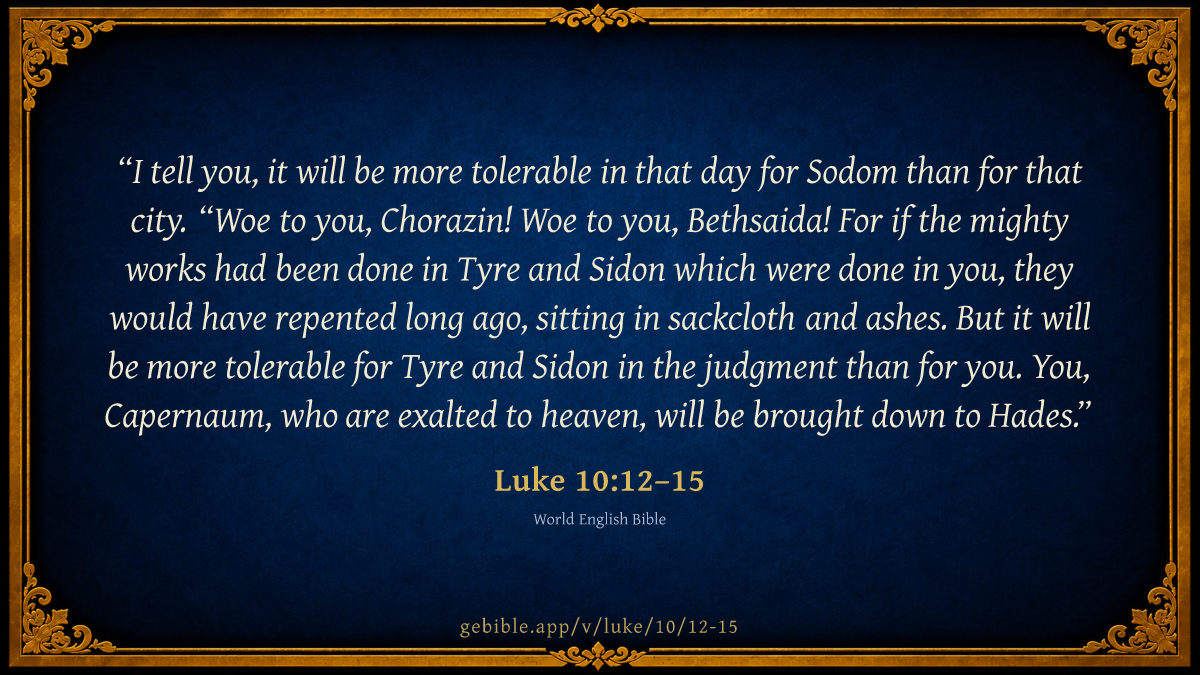
1Now after these things, the Lord also appointed seventy others, and sent them two by two ahead of him into every city and place where he was about to come. 2Then he said to them, “The harvest is indeed plentiful, but the laborers are few. Pray therefore to the Lord of the harvest, that he may send out laborers into his harvest. 3Go your ways. Behold, I send you out as lambs among wolves. 4Carry no purse, nor wallet, nor sandals. Greet no one on the way. 5Into whatever house you enter, first say, ‘Peace be to this house.’ 6If a son of peace is there, your peace will rest on him; but if not, it will return to you. 7Remain in that same house, eating and drinking the things they give, for the laborer is worthy of his wages. Don’t go from house to house. 8Into whatever city you enter, and they receive you, eat the things that are set before you. 9Heal the sick who are there, and tell them, ‘God’s Kingdom has come near to you.’ 10But into whatever city you enter, and they don’t receive you, go out into its streets and say, 11‘Even the dust from your city that clings to us, we wipe off against you. Nevertheless know this, that God’s Kingdom has come near to you.’ 12I tell you, it will be more tolerable in that day for Sodom than for that city.
13“Woe to you, Chorazin! Woe to you, Bethsaida! For if the mighty works had been done in Tyre and Sidon which were done in you, they would have repented long ago, sitting in sackcloth and ashes. 14But it will be more tolerable for Tyre and Sidon in the judgment than for you. 15You, Capernaum, who are exalted to heaven, will be brought down to Hades. 16Whoever listens to you listens to me, and whoever rejects you rejects me. Whoever rejects me rejects him who sent me.”

John Trapp 1656 · Public Domain On vv12–13 12 But I say unto you, that it shall…
12 But I say unto you, that it shall be more tolerable in that day for Sodom, than for that city.
Ver. 12. See Mat 11:24.
John Trapp, A Commentary or Exposition upon All the Books of the Old and New Testament (1647–1656) — public domain. Text from a community e-Sword module.
Matthew Poole 1685 · Public Domain On v13 See Poole on "Mat 11:21", and following verses to…
See Poole on "Mat 11:21", and following verses to Mat 11:24.
Matthew Poole's English Annotations on the Holy Bible (1683–1685) — public domain. Text from a community e-Sword/MySword module.
William Burkitt 1703 · Public Domain On v13 These cities in Galilee, Chorazin, Bethsaida, and Capernaum, having…
These cities in Galilee, Chorazin, Bethsaida, and Capernaum, having been the place where Christ preached and wrought his miracles, they have a woe denounced here against them for their contempt of Christ, and the offers of his grace: Woe unto thee, Chorazin, etc. The higher a people rise under the means, the lower they fall if they miscarry. They that have been nearest to conversion, being not converted, shall have the greatest condemnation when they are judged. Capernaum’s sentence will exceed Sodom’s for severity, because she excelled Sodom in the enjoyment of means and mercy.
Observe here, 1. Capernaum’s privilege enjoyed; She was lifted up to heaven; that is, enjoyed privileges above other places, namely, the presence, preaching, and miracles of our Saviour.
Read full note →
Observe, 2. Capernaum’s doom denounced: Thou shalt be thrust down to hell; that is, thy condition shall be sadder than those that never heard of a Saviour; even Tyre and Sidon, Sodom and Gomorrah, those rude and barbarous nations, out of the pale of the church, shall be in an easier state and condition, than those that have enjoyed gospel ordinances and church privileges, but not improved them.
Learn hence,
1. That gospel ordinances enjoyed, are a mighty honor and advancement to the poorest persons and obscurest places: Thou, Capernaum, art exalted to heaven.
2. That gospel ordinances and church privileges enjoyed, but not improved, provoke Almighty God to inflict the sorest judgments upon a people: Thou that art exalted to heaven, shall be thrust down to hell.
William Burkitt's Expository Notes on the New Testament (1700–1703) — public domain. Text from a community e-Sword module.
John Gill 1763 · Public Domain On vv12–15 But I say unto you,.... The same that he…
But I say unto you,.... The same that he said to the twelve apostles, when he sent them out, Mat 10:15,
that it shall be more tolerable in that day for Sodom than for that city. By "that day" is meant, the famous day to come, the last day; the day of judgment, as it is expressed in Matthew; and so the Ethiopic version reads here, "it shall be better in the day of judgment". Sodom was a very wicked city, and was destroyed by fire from heaven for its iniquity, and its inhabitants suffer the vengeance of eternal fire: and there was also Gomorrha, a neighbouring city, guilty of the same crimes, and shared the same fate; and which is mentioned along with Sodom in Matthew; and is here read in the Persic version. And the sense of the whole is, that though the iniquities of Sodom and Gomorrha were very great, and their punishment very exemplary; yet, as there will be degrees of torment in hell, the case of such a city, which has been favoured with the Gospel, and has despised and rejected it, will be much worse than the case of those cities, which were devoured by fire from heaven; and than that of the inhabitants of them in the future judgment, and to all eternity; See Gill on Mat 10:15.
John Gill's Exposition of the Whole Bible (1746–1763) — public domain (CC PDM 1.0). Text via the HelloAO Bible API.
John Wesley 1765 · Public Domain On v13 Woe to thee, Chorazin - The same declaration Christ…
Woe to thee, Chorazin - The same declaration Christ had made some time before. By repeating it now, he warns the seventy not to lose time by going to those cities. Matt. xi, 21.
John Wesley, Explanatory Notes Upon the Whole Bible (1754–1765) — public domain. Text via the GEBible commentary corpus.
Adam Clarke 1810 · Public Domain On vv13, 15 Verse 13. Wo unto thee, Chorazin!] See on Mt…
Verse 13. Wo unto thee, Chorazin!] See on Mt 11:21-24.
Adam Clarke's Commentary on the Bible (1810–1826) — public domain. Text from a community e-Sword/MySword module.
Joseph Benson 1811 · Public Domain On v13 Luk 10:13. Wo unto thee, Chorazin, &c. — “Having…
Luk 10:13. Wo unto thee, Chorazin, &c. — “Having mentioned the punishment of those cities which should reject his ministers, it naturally brought to his mind the sad state and punishment of the cities where he himself had preached most frequently, namely, Chorazin, Bethsaida, and Capernaum. For, notwithstanding he had often resided in those cities, and performed many miracles before the inhabitants of them, they had continued impenitent. Wherefore, because he was never to preach to them any more, and because he knew how great their punishment would be, in the overflowing tenderness of his soul he affectionately lamented their obstinacy, which he foresaw would draw down on them the heaviest judgments. The same declaration Christ had made some time before. By repeating it now he warns the seventy not to lose time by going to those cities. At the same time, this part of his discourse was well calculated to comfort these disciples, now sent out, under the ill usage they might meet with; the preaching of Christ himself had often been unacceptable and unsuccessful, with respect to many of his hearers, and therefore it was not much to be wondered at if theirs should prove so likewise.” Considering the affectionate temper of our Lord, it is no wonder that he should renew his lamentation over those unhappy places where he had so intimately conversed; and that he should do it in such words as these, so well calculated to alarm and impress all that should hear or read them. O! that they might now have their due weight with those who might pass them over too slightly, when they occurred before in Mat 11:20-24. O! that every impenitent creature who reads them might know that the sentence of his own condemnation is now before his eyes! See Macknight and Doddridge, and the notes on Mat 11:20-24.
Joseph Benson's Commentary on the Old and New Testaments (1811–1818) — public domain. Text from a community e-Sword module.
Albert Barnes 1834 · Public Domain On v13 See the notes at Mat 11:21-24.
See the notes at Mat 11:21-24.
Albert Barnes' Notes on the Bible (1834–1885) — public domain. Text from a community e-Sword/MySword module.
Haydock's Catholic Bible Commentary 1859 · Public Domain On v15 And thou, Capharnaum, &c. Capharnaum is situated on the…
And thou, Capharnaum, &c. Capharnaum is situated on the western coast of the sea of Tiberias. Christ having left Nazareth, made the former city the usual place of his abode. There was no city in which he had preached so much, or wrought so many miracles. On this account, he said it was exalted to the heavens; but for its incredulity he threatens it shall be cast down even unto hell. (Calmet)
George Leo Haydock (1774–1849), Haydock's Catholic Family Bible and Commentary, 1859 edition — public domain. Excludes Psalms (Douay-Rheims chapter numbering differs from Protestant) and Deuterocanonical books (Catholic canon only).
Robert Jamieson, A. R. Fausset & David Brown 1871 · Public Domain On v12 (See on Mat 11:20-24).
(See on Mat 11:20-24).
for Sodom--Tyre and Sidon were ruined by commercial prosperity; Sodom sank through its vile pollutions: but the doom of otherwise correct persons who, amidst a blaze of light, reject the Saviour, shall be less endurable than that of any of these.
Jamieson, Fausset & Brown — Commentary Critical and Explanatory on the Whole Bible (1871) — public domain (CC PDM 1.0). Text via the HelloAO Bible API.
Daniel D. Whedon 1874 · Public Domain On vv13, 15 13. Woe… Chorazin… Bethsaida—As Jesus has just left these…
13. Woe… Chorazin… Bethsaida—As Jesus has just left these cities, this is the last sad reference he makes to them. It expresses in language what the wiping the dust from the feet does in action. And this verse indicates that the sending forth of the seventy could have been on no later occasion.
Daniel D. Whedon (gen. ed.), Commentary on the Old and New Testaments (1874–1909) — public domain. Text from a community e-Sword module.
The Cambridge Bible for Schools and Colleges 1878 · Public Domain On vv12–15 12. more tolerable in that day for Sodom] The…
12. more tolerable in that day for Sodom] The great principle which explains these words may be found in Luk_12:47-48 (compare Heb_2:2-3; Heb_10:28-29).
The Cambridge Bible for Schools and Colleges (gen. ed. J. J. S. Perowne; Cambridge University Press, 1878–1918) — public domain. Text from a community e-Sword module.
Ellicott's Commentary for English Readers 1878 · Public Domain On vv12–13 (12) It shall be more tolerable in that day…
(12) It shall be more tolerable in that day for Sodom.—See Note on Mat_10:15.
A Bible Commentary for English Readers, edited by Charles John Ellicott (1878–1897) — public domain. Text from a community e-Sword module.
The Pulpit Commentary 1880 · Public Domain On vv12–15 But I say unto you, that it shall be…
But I say unto you, that it shall be more tolerable in that day for Sodom, than for that city. Such a rejection implies that they would have nothing to do with the Master of these preachers, the pitiful, loving, Galilaean Teacher. These were days of possible mighty blessings, of proportional terrible punishments. The woe of Sodom, that well-known swift destruction, most probably through sudden volcanic agency, was tolerable in comparison with the far more awful doom reserved in the immediate future, at the hands of Rome, for these guilty cities of Palestine (see a further note on this on ver. 15).
Vers. 12-15. Guilt and punishment.
Read full note →
These very solemn words of our Lord demand our attention the more, because his thought is so fully illustrated. They suggest or convey to us three truths.
I THAT GREAT INIQUITY MAY LOOK FOR SIGNAL PUNISHMENT AT THE HAND OF GOD. Jesus does not intimate that Tyre and Sidon suffered any more than they deserved, that Sodom had a retribution which was in the smallest degree out of proportion to its guilt. These cities deserved their doom; they sowed the wind, and reaped the whirlwind. That which happened to them was exactly what they might have expected; and it is just what such cities as they were may always look for. It does not require a desolating army or a miraculous storm to bring disastrous evil upon the head of shameful wrong. Without such particular instruments as these, the blow which slays and buries will certainly descend. If destruction comes not on the wings of one wind, it will come on those of another; whether we think of the vicious city or the profligate man, we may be sure that great guilt will, sooner or later, work out the downfall and extinction of the evil-doer. By human history and the record of the lives of men, as well as by the sacred page, "the wrath of God is revealed against all unrighteousness of men;" they cannot and will not "escape the judgment of God.
II THAT NEITHER SWIFTNESS NOR APPARENT SEVERITY IN PUNISHMENT IS A SURE CRITERION OF THE MAGNITUDE OF THE CRIME. Destruction had come down suddenly and terribly on Sodom; Capernaum, Chorazin, and Bethsaida were still existing, and were still rejoicing in outward prosperity. Was the ancient city so much guiltier in God"s sight than the (then) modern towns of Galilee? No, replied the great Teacher. Had these ruined cities of a former age enjoyed such privileges as the citizens of his own time were possessing but neglecting, they would have repented and would have been spared. We must take care how we argue from sudden and severe evils to the relative guiltiness of the sufferers. These evils may clearly indicate wrong; they may (though in some cases they do not) indicate very great wrong-doing; but they do not prove that those on whom they descend are more guilty than others who are spared.
1. God may think well, in one case, to manifest his holiness by severe visitation, and in another case to illustrate his patience by delaying long the stroke of justice.
2. God may punish one city (or man) by physical and visible inflictions; he may chastise another by letting his moral laws do their appointed work, and bring down the men themselves to that low spiritual estate which is the saddest and direst consequence of sin.
III THAT PRIVILEGE IS VERY PRECIOUS, BUT IT IS ALSO VERY PERILOUS. Capernaum was "exalted to heaven," raised very high indeed in privilege. There the Son of God abode; there he wrought his mightiest works; there he lived his holy, patient, loving life; there he spake his deep, broad, ever-living truths; there God was manifested in power and grace. It was favored above all cities in the height of its spiritual privileges. But it knew not the day of its visitation; it drew not nigh in reverence to its Lord; it rejected his doctrine; it remained afar off from God and heavenly wisdom. And it incurred thereby the Savior"s strong condemnation; it accumulated guilt, and laid up for itself wrath against the day of wrath; it was "thrust down to hell" in reproach and retribution. We learn, more particularly:
1. That humility of spirit, rather than reproachfulness of tone, becomes us.
2. That the children of special privilege have great reason for devout heart-searching, lest they should find themselves the heirs of Divine condemnation. C.
The Pulpit Commentary (1880–1919), ed. H.D.M. Spence-Jones & Joseph S. Exell — public domain. Text from a community e-Sword module.
The Biblical Illustrator 1887 · Public Domain On v13 Woe unto thee
Luk_10:13-15
Woe unto thee
Read full note →
The sentence of Chorazin
We may conceive some inhabitant of these Jewish towns demanding with astonishment, How can these things be?
Shall we who are the children of Abraham be rejected, and the heathen be preferred in our stead? The Almighty Judge, we may hence collect, in the apportioning of rewards and punishments, regards not the actual amount of profligacy or virtue, but takes into consideration also the means of improvement enjoyed, the kind of information and light vouchsafed. He could estimate, in Tyre and Sidon, debased as they were by ignorance and idolatry, a disposition not indifferent to those proofs of Divine revelation, which to Bethsaida and Chorazin were exhibited in vain. He judges according to that hidden temper, according to that inward disposition; not by the acts committed, but by the circumstances also under which they are done. Nay, He judges of a degree of faith never actually called into existence.
I. The first conclusion to be drawn from the text thus explained relates to the future condition of those millions of mankind who depart this life in ignorance of a Saviours name. The sacrifice of Christ made atonement for the whole race of mankind. And though so many millions are ignorant of His name, yet in some of them is discerned a spirit which would enable them to have repented at His preaching. By that spirit it may be hereafter determined whether or no the merits of Jesus Christ are imparted for the salvation of their souls.
II. Secondly, we may learn, from this view of the text, the probability of our being greatly mistaken in our views of the future judgment.
III. And here, thirdly, it may be observed, that mankind are too ready to draw hasty conclusions, from anything which they can interpret as a manifest interference of Divine Providence for the punishment of sin.
IV. Such, too, let us in the last place remember, is the sentence recorded against every one of us ourselves, if we know these things and do them not; if we acknowledge these mighty works and yet repent not. Let us not then be deceived by the blessings of outward prosperity. They form part of our trial. (C. Girdlestone, M. A.)
The danger of impenitence where the gospel is preached
I. I observe from this discourse of our Saviour that miracles are of great force and efficacy to bring men to repentance.
II. I observe, likewise, from our Saviours discourse, that God is not always obliged to work miracles for the conversion of sinners.
III. I observe farther, from our Saviours discourse, that the external means of repentance which God affords to men, do suppose an inward grace of God accompanying them, sufficiently enabling me, to repent, if it be not their own fault; I say, a sufficient grace of God accompanying the outward means of repentance, till, by our wilful and obstinate neglect and resistance, and opposition of this grace, we provoke God to withdraw it from the means, or else to withdraw both the grace and the means from us: otherwise impenitence, after such external means afforded, would be no new and special fault.
IV. I observe from this discourse of our Saviours, that an irresistible degree of grace is not necessary to repentance, nor commonly afforded to those who do repent.
V. I observe from the main scope of our Saviours discourse, that the sins and impenitence of men receive their aggravation, and consequently shall have their punishment proportionable, to the opportunities and means of repentance which those persons have enjoyed and neglected. For what is here said of miracles, is by equality of reason likewise true of all other advantages and means of repentance and salvation.
VI. Sixth and last observation, and which naturally follows from the former, is this: that the case of those who are impenitent under the gospel is of all others the most dangerous, and their damnation shall be heaviest and most severe. (Archbishop Tillotson.)
Chorazin
It stands in the midst of such desolation as must be seen to be believed. Millions of boulders cover the ground everywhere as far as the eye can reach. The terrible volcanic energy in this district ceased long before the historic period--how long no one can tell--and hence the aspect of the landscape must have been the same in Christs day as at present. One very interesting feature of the ruins is that many of the dwelling-houses are still tolerably perfect, though in the days of St. Jerome (A.D. 331-420), Chorazin had long been deserted. They have stood tenantless for at least 1,500 years, and may well have been standing in the days when our Lord from time to time wandered among them, doing those mighty works which were yet, as at Bethsaida and Capernaum, ineffectual to bring the population to thoughtfulness and repentance. It helps one to realize better the daily life of our Saviour, to see in what poor barren spots He laboured; following the lost sheep of the house of Israel to such a forbidding wilderness. (C. Geikie, D. D.)
The guilt of a privileged people
Max Muller in the preface to his essays tells us of a Hindu who, having been converted in Benares, greatly wished to visit England. He had heard that it was a land of Bibles, a land of preaching, a land of churches and chapels, and he longed to see it. He expected to find the Christian land Christ-like. At length he arrived there. Max Muller adds that never shall he forget the deep dejection of the man when he discovered the Christianity of Europe to be so unlike that of the New Testament. In fact, nothing but keeping to the teachings of the Bible kept him from an utter relapse into idolatry.
The Biblical Illustrator, edited by Joseph S. Exell (c. 1880s–1900s) — public domain. Text from a community e-Sword module.
B. W. Johnson 1891 · Public Domain On v13 13–15. Woe unto thee, Chorazin! See notes on Matt.…
13–15. Woe unto thee, Chorazin! See notes on Matt. 11:21–24. It is thought that this is a repetition of the words used on a former occasion, in order to emphasize the sin of rejecting the messengers of the Lord.
B. W. Johnson's The People's New Testament with Notes (1889–1891) — public domain. Electronic text from the Christian Classics Ethereal Library (CCEL) ThML edition.
C. I. Scofield 1917 · Public Domain On v13 See notes, Mat 11:20; Mar 8:23 (See Scofield "Mat…
Woe
See notes, Mat 11:20; Mar 8:23 (See Scofield "Mat 11:20") See Scofield "Mar 8:23"
The Scofield Reference Bible (1917 edition), notes by C. I. Scofield — public domain. Text from a community e-Sword module.
Paul E. Kretzmann 1924 · Public Domain On v13 Woes upon several cities of Galilee:
Woes upon several cities of Galilee:
v. 13. Woe unto thee, Chorazin! Woe unto thee, Bethsaida! For if the mighty works had been done in Tyre and Sidon which have been done in you, they had a great while ago repented, sitting in sackcloth and ashes.
Read full note →
v. 14. But it shall be more tolerable for Tyre and Sidon at the Judgment than for you.
v. 15. And thou, Capernaum, which art exalted to heaven, shalt be thrust down to hell.
v. 16. He that heareth you heareth Me; and he that despiseth you despiseth Me; and he that despiseth Me despiseth Him that sent Me.
See Mat 11:21-23. The question of the guilt of those that reject the Gospel calls to the mind of Jesus the behavior of the cities of Galilee in whose neighborhood some of His greatest works had been done. He had come to them with the fullness of His love and mercy, and they had rejected Him. Chorazin and Bethsaida were on the shores of Lake Gennesaret, almost side by side. Great miracles had been done in their midst, and the people had been willing enough to be entertained, but the words of eternal love out of the mouth of Jesus had made no impression upon them. Under like circumstances Tyre and Sidon, the heathen cities whom the Jews despised for their idolatrous practices and beliefs, would long since have repented, clothed in a garment of sack-cloth, with ashes on the head. And therefore Tyre and Sidon, to whom His grace had not been revealed in this measure, would receive greater consideration on the Day of Judgment than these cities of Galilee. And Capernaum also, which had been lifted up to heaven by the fact that Jesus made this city His headquarters during His Galilean ministry, would receive the full measure of His wrath on the last day and be forcefully thrust down to hell. Note: There is a word of warning here for all Christians. They have Christ in their midst for years, decades, and generations, in the printed and in the spoken Word of the Gospel. But how often, is Jesus neglected and overlooked in the Christian homes! No reading of Scriptures alone or in family worship; no regular attendance at church;—there is danger of falling into the condemnation of the Galilean cities. And this applies also to the treatment accorded to the messengers of Christ. In hearing, -them we hear Christ, for they are His ambassadors and plenipotentiaries; but also, in despising them, in repudiating the Gospel of mercy, we repudiate Christ, of whose salvation it preaches; and in despising Christ, we despise His heavenly Father, partly because He is sent forth by the Father with full power, partly because He is one with the Father. Here is food for serious thought!
Paul E. Kretzmann, Popular Commentary of the Bible (1921–1924) — public domain. Text from a community e-Sword module.
unfoldingWord translationNotes 2017 · CC BY-SA 4.0 On v13 Woe to you, Chorazin! Woe to you, Bethsaida!
Woe to you, Chorazin! Woe to you, Bethsaida!
Jesus speaks as if the people of the cities of Chorazin and Bethsaida are there listening to him, but they are not. (See: Apostrophe and How to Translate Names and Metonymy)
Read full note →
If the mighty works which were done in you had been done in Tyre and Sidon
Jesus is describing a situation that could have happened in the past but did not. AT: "If someone had performed the miracles for the people of Tyre and Sidon that I performed for you" (See: Hypothetical Situations and Active or Passive)
they would have repented long ago, sitting
"the wicked people who lived there would have shown that they were sorry for their sins by sitting"
sitting in sackcloth and ashes
"wearing sackcloth and sitting in ashes"
But it will be more tolerable for Tyre and Sidon at the judgment than for you
It may be helpful to clearly state the reason for their judgment. AT: "But because you did not repent and believe in me even though you saw me do miracles, God will judge you more severely than he will judge the people of Tyre and Sidon" (See: Assumed Knowledge and Implicit Information and Metonymy)
at the judgment
"on that final day when God judges everyone"
You, Capernaum
Jesus now speaks to the people in the city of Capernaum as if they are listening to him, but they are not. (See: Apostrophe and Metonymy)
do you think you will be exalted to heaven?
Jesus uses a question to rebuke the people of Capernaum for their pride. AT: "you will certainly not go up to heaven!" or "God will not honor you!" (See: Rhetorical Question and Active or Passive)
exalted to heaven
This expression means "greatly exalted."
you will be brought down to Hades
This can be stated in active form. AT: "you will go down to Hades" or "God will send you to Hades" (See: Active or Passive)
translationWords
woe
might
works
Tyre
Sidon
repent
sackcloth
judge
Capernaum
exalt
heaven
Hades
unfoldingWord translationNotes — © Distant Shores Media and the Door43 World Missions Community, licensed CC BY-SA 4.0. Source: git.door43.org/Door43/en_tn.
Tyndale Open Study Notes 2022 · CC BY-SA 4.0 On vv12, 13, 15 10:12 God destroyed Sodom and Gomorrah because of their…
10:12 God destroyed Sodom and Gomorrah because of their wickedness (Gen 18:16–19:29).
Tyndale Open Study Notes — © Tyndale Open Resources, licensed CC BY-SA 4.0. Text via the HelloAO Bible API.